Were the Templars – Gods militia or Gnostic warlords? Well, whings are never as they appear but also not otherwise. The Templars were the first trans-national financial and military organisation, comparable to a blend of Goldman & Sachs, Benedictine Monks and a Blackwater mercenaries elite force. Their secrecy, might and military achievements created awe, envy and myths. Hazy beginnings and their vanishing twenty years later allowed numerous conspiration theories. As soldiers they were the first to enter the battlefield and last to leave. The enemy respected and feared them for their incredible bravery and highly disciplined fighting. Friends, however, observed that they were hedging their bets based on a unique understanding of cultural complexity and on cunning strategic enemy relations. From the (failed) siege of Damascus on, this had raised doubts on which side they stood. Originally strictly catholic and ascetic , over the time leading Templars were seen as tainted by Gnostics thoughts. Rapid expansion and internal organisation created a need for a large backend and fighting force adding the inherent risks of a moral decline, by attracting not only talent and devotion but also some who saw them mainly as promising career path. As the Templars went “native” their rituals and symbols became increasingly dualistic, if not Gnostic. Financial motives were certainly behind their persecution, but the charges of heresy might not have been completely unfounded. As a Tibetan monk once stated: ” Things are never as they appear but also not otherwise“. This article wants to investigate briefly, how and why that organization was broken.
History is the story of the past told for present purpose
The politically correct version of this story attributes the Crusades to an outbreak of religious fanaticism and aggression on the part of Europe. However it is important to consider the 1000 years of history in the Holy Land before, its political situation and cultural context. And the spiritual and economic relevance of warrior monks from the Crusades — secret societies vowed to the purification and defense of their religions. Equally interesting than the topic itself, are the shifting reasons given by historians for their undoing, so the religious and secular leanings of the Templars will be touched. The Templars fought against Islam to reclaim the Holy Land for nearly two centuries. During that time the order grew into a international power, became a state within states and elite army, backed by an extensive network of preceptories in the Outremer and the West. In October 1307, all members of the Order were arrested on the orders of Philip IV, King of France, and charged with serious heresies, including the denial of Christ,homosexuality and idol worship. The ensuing proceedings lasted for almost five years and culminated in the suppression of the Order.
The beginning of the end
One unexpected consequence of the failed Crusades was the beginning of the end of the Roman Catholic Church’s control over Europe. In addition to the military defeat of Christian armies, there were spiritual causes for the fall of the Church’s political and religious hegemony. In the 11th century a second wave of Gnostic thoughts swapped to Europe, which was fought by pope Innocent III. That the Templar’s order did not take part taunted them for the first time with a suspicion of heresy. An assertive interpretation of a monarch’s role and his financial repression toward the orders was the visible and the primary motive of Phillip IV. All this resulted in a drive for centralized absolutist monarchies, by the Phillip IV who saw himself – not the weak Pope Clement V – in charge for the defense of Christianity in his realm. The theocratic conception of kingship and the refusal to recognise any temporal superior provided a firm base for developing a theory of the Kings sovereignty, which crystallised during the disputes with the pope. To the contrary for the Church (and the Templars) a kingdom was a government of a perfect community ordained from God and so different from oligarchy, tyranny and democracy, where, especially in the case of tyranny, the ruler is interested only in his own good.
Where the Templars came from
Lets go one step back to the hazy beginnings. The Templars were founded in 1119 twenty years after the Capture of Jerusalem by the First Crusade as a military elite force and monastic order, for the security of “Outremer”, i.e. the new crusader states in Palestine and Syria . During the twelfth and thirteenth centuries they acquired extensive property and were granted far-reaching ecclesiastical and jurisdictional privileges both by the popes to whom they directly reported, and by secular powers. They became untouchable, functioning as first global bankers, a position facilitated by their wealth, secure fortresses and international nature of their organisation. When in May 1291 after the loss of Acre, the Christian crusaders were driven out of Palestine by the Mamluks of Egypt, the Templars lost their main purpose power base both in the East and Europe. By coincidence, at that time a weak pope, Clemens V, shifted the balance toward secular forces . The Templar’s screwed and dubious warlord politicking, their legendary arrogance and greed had made them many enemies. The military backbone of the Christianity in the Holy Land became now both useless and vulnerable. In 1307, the leading brothers (Grand Master and Visitor) of this Order residing in France were arrested by the officials of King Philip IV in the name of the papal inquisitors.
The Trial
The battle-hardened Templar knights who were already returning to France, posed a military threat. A proposal to merge all the military orders and attempts for new Crusade failed. King Phillip IV of France wanted to destroy the Templar Order globally and confiscate all their treasuries and properties in France. King Phillip’s plan was to arrest the Templar in France, charge them with heresy, and extract confessions from them by torture. Pope Clement V was initially annoyed, but being the charges religious in nature, he could only comply and take the lead himself. Phillip IV managed to carry off a shockingly effective piece of work, instantly chopping off the head of the Order. 625 members of the Order were arrested in the first wave including the Grand Master; the Visitor-General; the Preceptors of Normandy, Cyprus, and Aquitaine; and the Templars’ Royal Treasurer. Due to torture, the overwhelming majority of the knights confessed to every charge that was put to them. The pope reacted just as Phillip had planned. Phillip leaned on Clement to issue papal arrest warrants all across Europe, but those were largely ignored or skirted by other monarchs outside of France. After the first shock, some Templars organized a credible defense. What they did not understand, however, was that the Templar order had become just a pawn in the power struggle of Phillip the Fair and Pope Clement, who was willing to sacrifice it. Its seems that the imprisioned Templars were just a shadow of their powerful and cunning ancestors who fought in the East. To break the defense Phillip ordered 54 of the knights to be burned at the stake in 1310, for the sin of recanting their confessions. That was it.
In 1312, Clement finally decided to end the situation at a council in Vienna to dissolved the Order. All Templar possessions apart from the cash were handed over to the Knights Hospitaller, and many lower rank Templars were assigned to other Orders. Those who did not confess were sent to the stake. Phillip charged a yearly fee from the Hospitallers. One plausible details of the Templar’s history cites the Grand Master, Jacques de Molay, who promised from the pyre 1313, both the pope and the king, that they will appear before the heavenly judge’s within one year. Fact is all leading persecutors died an early and unpleasant death: Pope Clemens V only one month later of an unsettled illness (perhaps, cancer) and King Philipp IV in December of the same year. Had the „curse of Jacques de Molay” come from earthly followers, possibly members of the secret Templar’s section which still continued to exist for years or by alchemy? Who knows?
Where the Templars went
However, some Templars were tipped off and the main treasure was smuggled out of Paris to the naval base. The whole Templar fleet escaped and was never found. The Templar trials went nowhere outside France, so it might pe possible that they went to Scotland. Rumors tell that some were involved in the founding of Switzerland with military and banking expertise. It has been established, that the Scottish freemasons borrowed later liberally Templar symbols. As organisation the Templars vanished into the haze of history. What, however, did become from the legendary wealth the Templar? Nobody knows. Most of it remained untraceable. Historians assume nowadays that their most important treasures have been of immaterial value. That skills and the treasures initiated religious and cultural creativity would result in the rise of esoteric (and economic) movements like Freemasonry. and later utilized by New Age and a New World Order.
Secular impact of the Templars
The Knights Templars are reputed to be the founders of some of the first banks. With the arrival of the Second and Third Crusades, the Templars were perceived in some quarters to have hedged their bets, as they were bankers not only to the local Christian population, but to many of the Saracen merchants as well. The banking system operated with the Templars taking an agreed charge on all monies held, thus ensuring that the Order never ran out of funds. Any monies subject to international transactions were sent under Templar guard to the nearest preceptory in the appropriate region and could be withdrawn somewhere else. Funds were thus able to move freely throughout Outremer and Europe with very little risk. Under Louis IX, the royal treasure was kept at the Temple. Until 1306 the Templars where deeply involved in the Royal financial administration since they had helped with cash in the Holy Land Luis VII during the second crusade 1148. They financed the whole crusade locally when he run out of money. Later they would lend the French Kings significant amount of monies. The acted as royal treasures but the state treasure was relocated from the Templars to the Louvre when around 1292 and 1295 the Templars lost their leading financial influence.
Between 1295 and 1306 Phillip IV debased his money system with FIAT Money effectively using inflation to reduce his debts. 1306 he returned to the silver-based currency on its original 1295 value – basically a partial semi-default. The money depreciated about 70% and riots took place.
The commercial view
Big property in the eyes of the Templars was no aim of original Christianity. They thought procuring money in such a way, that it lost his value after half a year. Who had money, needed to bring it in this period in circulation again, otherwise it would become be worthless. Creating money should not be at the disposal of states and other institutions in private hands. This resembles strongly non FIAT money. For long-term plans there should be special value money, which just worked in the service of the community similar to a monetary device like the MEFO Bills, with which Germany was able to break the chains of her reparation payments and Hjalmar Schacht overcame the Great depression induced by the US banking and stock crash. When Adolf Hitler became 1933 Chancellor of the German Reich he was supported by one paramount economic adviser, Hjalmar Schacht. Hjalmar Schacht (Horace Greely) was a Freemason of the Scottish Rite. He was connected to the English Scottish Rite Freemason Montagu Norman, and negotiated very successfully on behalf of Germany in the financial world of the City of London. As Eustace Mullins wrote in “Secrets of the Federal Reserve”, the Bank of England is under the control of the Rothschild family.
The early Christian Church declared that any usury was against Divine law. As Canon law had no authority over Jews, Christian monarchs looked to the Jews to supply capital to them. The Jewish usurers therefore had no competition in medieval Christian lands and could charge very high interest. As the Jews were ostracised from most professions they were pushed into marginal occupations considered socially inferior, such as tax and rent collecting and money lending. Naturally tensions between creditors and debtors were going to rise and added to social, political, religious, and economic strains. Judaism allowed interest under certain: „From strangers (Goiim) you may take (people Israel) interest” Jahweh (5. Mose 23.21). The Christian rulers have accepted this, because they often needed somebody, who borrowed them money. In the early Middle Ages the influence of these banks was not as big as in our present time only indirect. However, already in the Middle Ages speculation exists, in a certain manner also foreign exchange a monetary syndicates which lent money against interest and compound interest. This appeared to the Templars of evil. To remove this evil, they thought up a new monetary system. Money should serve exclusively the movement of goods, but not traded. It should also not be possible to be hoarded and accumulated.
The political view
This was of just the starting point of the idea of a centrally controlled economy, but it reached also in other areas. The position of the people should not be determined by birth, but exclusively by personal achievement. This would have been one frontal attack on the prerogatives of the nobility at that time. Templars also claimed monarchist ar under „God’s mercies” and this was valid of course also for the pope. Very briefly: the worldly ideas of the Templars were revolutionary and it is out of question that if the Templars had come to political power, an authoritarian world state would have been established. Every kind of vice would have been absolutely punished by draconian measures, like the Sharia. Anybody who thinks the Templar were tolerant Sufis are extremely wrong. This is also reflected in their order colours: „The white is for the good, the black for the evil, and the Red stand for the blood of Christ”. The faith of the Templars was a dualistic one and divided the world and the people in allegorically white and black in good and bad people, wise and ignorant.
Military Tactics
The Templars’ reputation in the field was unsurpassed. Saladin ordered that all the captive Templars and Hospitallers be executed, such was his conviction that the military orders were the Franks’ main weapon against Islam. The knights were the mediaeval equivalent of a tank, with their great war horses often standing up to 17 hands high. The horses – known as destriers – were taught to kick, butt and bite. Tactics were simple, but, when timed properly, were devastatingly effective. Initially, the infantry would provide cover, before the cavalry charge, which would form the main attack. A properly timed charge would wipe out everything in its path. In the early years of the Latin East, the Templars quickly developed a fearsome reputation as the best-trained soldiers , showing almost suicidal bravery. However, as the twelfth century gave way to the thirteenth, the Templars began to soften and became more cautious in battle.
Organization and Goals
One reason that the Templars posed a threat, because the also had big plans for a New World Order. In cooperation with a renewed Roman-German empire, including France they wanted to control the whole world – for the blessing and the well-being of all. The Templars felt and did not think nationwide. Their brothers came from members of many European countries. In a commercially radical different understanding of “Globalisation” as nowadays, the Templars can be seen as the first secret transnational organisation. Their goal was essentially a Gods state in an Augustine (or Islam) fashion. The Templars wanted to remove everything what the„western world” today cherishes Their vision resounds in twenty-first century as daringly and revolutionary as it did in their time. That is why the Templar were pictured as deadly threat to the secular forces and the otherwise relatively liberal republic Venice and the German Hanse issued against Templars draconian punishments.
The Templars and the East
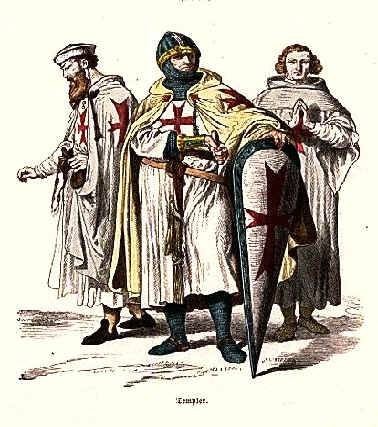
According to Historical records the Order of the Knights of the Temple of Jerusalem was originally founded by Hugo de Payens and Godfrey de St. Omar. The Temple of Jerusalem, where the title Templar originated, was the Al’Aqsa Mosque, rumoured to be the former site of the Temple of Solomon . In 1129 permitted king Balduin II of Jerusalem-Outremer young ones of a knight’s community which was then called „poor knights of Christ” (Paupere Militie of Christ), to use some parts of it as accommodation. Since then the order was called now: Poor knights of Christ and the Temple Solomon’s to Jerusalem (Pauperes commilitones Christ templique Salomonici Hierosalemitanis). Hence they were named “Templars” and with it the came the first documents and enlarged knowledge which should determine the fate and history of the order. With the removal of the partly ailing rooms of the “temple” which Balduin II had permitted, the knights found several documents which were obviously very old, small pieces, described in Aramaic or Hebrew writing. Nobody of the knights knew these languages. Later on all leading Templars in Outremer would employ Saracen secretary and some learned Arabic and Aramaic. For the devout knighthood to go through the old accounts was like a thunder-clap: Christ not Gods son, but they incarnation of the true, otherwise unknown God! Or maybe only a good, courageous person? And Allah of the Muslims could be no one than Satan, nevertheless, since the Koran was based on the same Pentateuch like the old testament of the Christian Bible. This could explain, why Christ called Satan „prince of this world”. What the knights thought at that time and felt, we are not able to imagine. With all confusion the knighthood kept wisely that knowledge under strict secrecy. Later Hugo of the Champagne procured some first Cathars writings, contents to which the accounts of the Eschaimin texts fitted. The sign of the Marcionites Gnostics was the red Thorn cross – exactly as later that of the Cathars. After the legend the mother Christ had tinkered from four thorns of the crown of thorns a small cross. This thorn cross became later the origin of all knight’s crosses. Till then the Templars had a simple Roman Cross in use. From now on it became the Red thorn cross on White.
Excursion to the first centuries
Now at this point we must undertake an excursion to the first centuries, in a time, in which different Christian and gnostic currents fought against each other violently. In the second century it was unclear, which direction Christianity would assert itself. Although one of the groups arguing with each other had the advantage of big of financial possibilities and a good organizational structure, nothing was yet decided. Whether the strongest formation held and also spread the truth and owned the highest wisdom, is more than in question. One very fractured group were gnostic who considered (Christian gnosis, not pagan gnosis) Christ as independent incarnation of the true light, the former unknown God. The Jewish Jahweh was looked by the Gnostics either as a demiurge, so as a negative world creator, or, as Satan (opponent of God).
The huge number of gnostic remains and prevailing religions originated in the Holy Land must have influenced the Templars – above gnosis also Judeo-Christianity, Sufi Islam and radical Shiitsm. The latter two contained significant gnostics thoughts. Those gnostic groupings, originally syncretism from oriental pagan god’s plagued in the first centuries Christianity. One best known of these groups became that of a man from Samaria who was called Simon Magus. Other names to be mentioned are particularly Valentinus and Markos. Many accounts regard the Gnostic weakened by a lack of self-assertion and unity. However, the (his)story would be told differently, if we lived now not a Christian, but a gnostic Europe. The chances for it stood good; particularly among the educated people gnostic groupings had numerous followers. If the Gnostics had united, they could absolutely have arisen as a winner in this fight of religions. However, a weakness also lay in the Gnosis itself. For a state religion like the Roman Church or a religious warrior ideology like the Islam, Gnosis was to complicated, too “elitarian” and actually a step back to polytheism. The demigods (and goddess) from the antiquity were extremely alien to the Middle Age. However, in some circles of the Templars, particularly with the associates, a female divinity had possessed a high value , presumably only in the South of France. In other seats of the Templar’s order, like in the headquarters to Paris, no tracks of this was found.
Templars and Baphomet

The confessions of the Templars make a boring read. Little is in there of the accusations brought against the Knights Templar that they worshipped an idol, said to have taken the form of a head or sometimes a black cat. Baphomet representations, like one found in Paris, were in possession of the Templars. Modern scholars held the opinion that the name of Baphomet was an Old French corruption of the name Muhammad, with the interpretation being that some of the Templars, through their long military occupation of the Outremer, had begun incorporating Islamic ideas into their belief system. That heads were something which has no connection with the Bible and church faith. Baphomet lay long before the foundation of the Templar’s order; and, nevertheless, it is important for the understanding of his history, since they Templars themselves saw her mystic roots in the epoch of Christ, in the first and second century. The time after that was meaningless for them, because they went back to the origin of the Christianity and to its connection with gnostic communities and secret societies. Without all this the way of the Templar’s order would not presumably become such thrilling. However, the history wanted it that it should come differently for the Templars. The confirmation of Eschaimin notes from Jerusalem, were in many respects of vital importance for the internal circles of the Templars. As a result, the order developed a confidential apprenticeship which determined their second hidden personality.
The Templars who lived in the Holy Land, along with the masons they employed, had to deal with the local population on a regular basis. They often became fluent in Arabic, and many crusaders –Templars included — “went native”. That triggered other theories that “Baphomet” was derived from an Arabic term, _abufihamet_, meaning “Father of Understanding”, in Idries Shah’s “The Sufis”. The Sufi origins make sense: as an iconoclastic religion, Islam strictly forbids images, either painted or sculpted, of either God or Muhammad, quite different from Sufis who have Saints. Partner proved that Baphomet was a known entity before the demise of the Templars, and most likely a person with spiritual power. If Shah is correct in his assertions about Sufi influences on the Templars, there is a link between Sufism and Baphomet. As for the Templars and the Sufis, not only were there many documented contacts between Templars and Sufis (as well as other radical Muslims such as the Ismailis mentioned later) during their time in the Middle East, but there were also opportunities for contacts in Europe. One such individual was the tenth century Sufi martyr Husayn ibn Mansur al-Hallaj, who died in 922 AD. A pantheist, an alleged miracle worker, and a most definitely unorthodox Muslim, Hallaj was imprisoned and tried for blasphemy. Shah cited reasons connecting Hallaj to Hiram Abiff and the sect of Sufis known as “the Builders” , who built the Al Aqsa Mosque and the Dome of the Rock on the site of Solomon’s Temple in Jerusalem, which was the Holy Land headquarters for the Templars. Having already encountered books who hypothesized a connection between the Templars and Freemasonry and Templars participants in documented Sufi practices, Templars who “worshipped a head called Baphomet” may have had some factual basis, namely the commemoration of this decapitated Sufi martyr. However the above thesis, hopefully interesting to the reader, remains purely speculative.
Templars and the Assassins

The Templars showed a great deal of tolerance towards Islam. As has been noted, Grand Masters always had Saracen secretaries, and it was not uncommon for Templars to learn Arabic. One group with whom the Templars had a less convivial relationship was the Assassins. They were a fanatical sect of Shi’ite Muslims, who had broken away in the late eleventh century from the Fatimids, the main Shi’ite regime, and set themselves up in the Elburz mountains in northern Persia and later in the mountains of the Lebanon; their leader became known to the Franks as ‘the Old Man of the Mountains’. In 1173, the King of Jerusalem, Amalric I (1162–74), attempted to negotiate an alliance with the Assassins, as Amalric was given to believe that the Old Man of the Mountains was about to convert to Christianity,, as the Old Man had, just a few years earlier, abrogated the law of the Prophet and proclaimed the Millennium, thus making himself and the rest of the sect heretical. Traditional Islam was declared heresy. The Qiyama heresy was promulgated in Syria by the charismatic Assassin leader Sinan. He was a contemporary and sometime ally of both Saladin and Richard Lion-heart. The Syrian Assassins were the channel by which the Ismaili Gnostic current entered the Knights Templar Order which had uneasy and shifting relations with the Assassins. A group of Templar knights ambushed Abdullah, the Old Man’s envoy, near Tripoli and killed him. If the ambush of the Assassins – which were often seen as Muslim equivalent of the Templar organization – was in agreement with the Grand Master is unknown.
Tho Old Men meditating upon a fortress Alamut which he and his flock could maintain their independence, pursue their religion, and spread the doctrines of pure Islam. For Hasan-i-Sabah, founder of the Assassins, understood the secret of the true line of succession from the Prophet Muhammad, and the proper direction for the faith.
When Muhammad died in 632, most Muslims (today known as Sunnis) believed he had endorsed his father-in-law Abu Bakr as his successor. An alternate contemporary faction (known as Shiites) claimed that Muhammad had actually appointed his son-in-law and cousin Ali as his heir. They asserted that leadership should be reserved for descendents of the Prophet through the marriage of Fatima and Ali. The 1400-year-old conflict over succession between Sunnis and Shiites has produced rivers of blood until today unfolding everyday on CNN. Shiism henceforth became a reformist movement seeking for a rebirth of spiritual purity. From the eighth century Shiism has hosted (seen form the outside) heretical strains contributed by new converts including Persians, Greeks, Gnostics, Sufis, Christians, Manichaean dualists, and Jewish kabbalistic. Doctrines of the purity of the bloodline of David, and of the Messiah, metempsychosis, reincarnation, magic, astrology, and numerology were absorbed. In 749, the Abbasids came to power in Baghdad where they would reign for five hundred years. Their political ascent had been heavily supported by Shiites. But the Abbasids abandoned their Shiite base the moment they seized the throne — declaring themselves to be a Sunni dynasty. Yet in 765, another dispute arose concerning the identity of the seventh Imam. Which of two brothers (both lineal descendants of the Prophet) had been given the spiritual mantle to lead Shiites? The supporters of one became known as Ismailis. While they were a minority, they went on to establish the first successful Shiite government in 909. The Fatimid Caliphate ruled Egypt and beyond for over two hundred years. In 1095, during the decline of the Fatimid Caliphate, another schism occurred that is central to our story. The Fatimid Imam (or caliph) concerning his son Nizar to succeed him. Hasan-i-Sabah e a leader of the Fatimid Ismaili mission in Persia supported the succession of Nizar. When he learned that Nizar had been killed, he declared Nizar’s son the true Imam, and founded the Nizari Ismailis. The sect remains flourishing to this day under the cosmopolitan leadership of the Aga Khan. Hasan built a community of believers in the northernmost regions of Iran near the Caspian Sea. His headquarters was named Alamut, the Eagle’s Nest. It was a secluded mountain fortress where he reigned for 35 years. Hasan’s strategic use of selective political murder to eliminate military threats to his community led to the Nizari Ismailis becoming known as Assassins. Hasan’s most illustrious successor was the fourth leader at Alamut named Hasan II. ordered the overturning of all outward observances of Islam in favor of a Gnostic enlightenment, a heaven on earth. He declared that Nizari Ismailis had entered a state of perfection in which the experience of God within was an ascertained reality.
Templars and Simon Magus
Most important has been from Templar’s view Simon Magnus. Within the history of the Templars the religious world and mindset of the Templars it must have been a shock for the devout knights to be exposed to that knowledge with roots in the first two centuries. Certainly a world broke down – their whole religious world. Following Simon Magus, the Bible appeared neither as a historical document nor heavenly revealed Truth. The Bible became a devils script which fancies in genesis 1.17 to Abraham with the words: „Ani ha El Schaddai” – I am El Schaddai. On the other hand – what is called the new testament – became a forgery pursued systematically in the earliest time.
The Templars and Abraxas
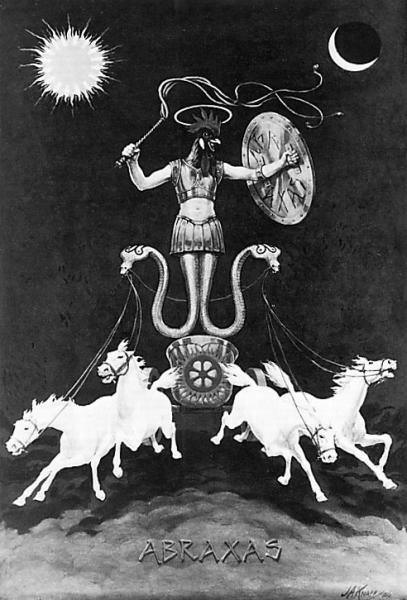
The gnostic sign of the Abraxas is to be found also with the Templars, but it is uncertain in which meaning Abraxas was used by the Templars. There is an unequivocal explanation from Templar’s source themselves with regard to the use of the word “Abraxas” in magic connection; namely in „Small book”. There, however, one must consider that this passage of the „small book” is based of Venetian reconstructed scripts from the 16th century. Nearly everything speaks for the fact, that the postscript indeed are an original presentations of Templars from the Middle Age and Abraxas images used by the Templars. The key for the gate to all temporalities is called: ABRAXAS; and the key to the gates of all rooms is called: MaKaARa. There are four completely different times; and it is from high importance to make a distinction. The Saracen spoke Abracadabra, however it comes from the old Persians, also called Mogani from which also the word Magic is descended from and before this at first from the far away country of Arya-Varta which is called since later time also India. The gnostic relation with the Templars, most probably is a fragmentary tradition of Basilides influences (an Egypt born Gnostic of Greek descent) who he lived on approx. 85-145. Basilides defined Abraxas as a symbol of the highest divine being the driver oft the Archetypes of the Great Father and the Great Mother. In Abraxas five old forces united for Basilides: Mind, Power,Providence, Wisdom and Logos. The standing pentagram symbolises those five old forces and can be found with the Templars at several places.
The Templars and the West
Without question the Templar’s order was initially strictly Catholic. The word of the pope it was valid for the knights as pure and true, none of them doubted the contents of the Bible. They believed what had been taught them, but already a few decades later an invisible front line between the Templars and the official theology appeared. Was Jesus Christ the son of the Hebrew’s God Jahweh, how the Bible states? There discovered quite different perceptions . Only with the council of Nicäa in the year 325 four became the „new Testament” canonised. Now much older sources had been shown to the Templars. From the original one, true Gospel almost nothing was preserved, just as little from the real apostle’s letters? No one knew. The search for the truth of Christ became the most important internal job of the Templar’s order. All ideas arose directly or indirectly from this effort. Some Templar’s formations aimed for a new empire. Spiritual reasons became instruments of power to realise of higher forces.
The Templars and Gnostics
Many leading Templars leaned to the so-called apocalyptic testament form, believing that the Gospel of Christ had been falsified already in early time. Paulus also points to it in his letter to Titus(Tit.2.10-11), which has been preserved in the new testament. With a certain background the Templars interpreted Paulus words: The Gospel of Christ had been falsified massively. Christ was not a son of the Jahweh, but on the contrary appeared against another Jahweh son, which no one else is as the devil (see in the NT still tracks with Jo. 8.44). This also becomes clear in Templar’s symbolism: The representation of a fallen angel with devil’s head; and the reverse pentagrams means the turning away from the Pentateuch (five books of Mose). Thus one can conclude that some of the Templars were heretics, however, not in the form they were later accused. Unforgotten were Cathars or Waldenses and Church was on the alert. The history of this second fight against the Gnostics is well-kept in the Vatican confidential archives.
Templars and the Cathars
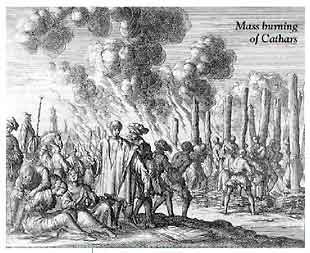
The 11th century was the century of monks and knights, but also of a second wave of religious disputes like in the first two centuries, the century of heretics. While waves of Crusaders were fighting in Palestine, the common people of Europe were experiencing a crisis of faith. They could not find God in the churches, with their corrupt clergy. Since Catharism represented a danger to Catholicism, Innocent III sen a call for another holy war. The Templars did never take part in the fight against the Cathars which raged around during half a century in Europe. They even accepted them to their order. In the original country of the Cathars, the Southern French province of Languedoc, two-thirds of the population were exterminated in this western “crusade”. Repeated requests, to act, were strictly rejected by the Templars. This had very good reasons. The Cathars based on writings of Marcion which were confirmed fragmentary notes from first century, which Templars had found in Jerusalem. In the most popular publications about the Templars one can read nothing about it. So the Templar’s order in ecclesiastical regard was not homogeneous Christian anymore. The Chatars rejected the so-called old testament of the Bible. They called themselves “veri christiani” (true Christians) and defended of a dualistic world view, which contained Marcionites elements. The name Cathars (derived by the Greek: katharós, “purely”) was changed in a linguistic detour from “Katharer” in Germany to the word “Ketzer (Heretic)”. Cathars were the biggest Christian lay-movement of the Middle Ages, in various regards comparable to the Marcionites of the first centuries . There are hints that the Templars Original possess manuscripts of the apostle Johannes, from Marcion origins (old christian heresy). Some of the Templar’s secrets living up to the present day. The Cathars most probably handed over sanctums and valuable texts to the Templars.
Templars and Christian Mystic
Esotericism – from in Ancient Greek terikós: “internally” – a knowledge, mean is accessible not publicly, but lives only in the internal circle of a community. The Templars were esoteric in the original sense. They wanted to experience that beyond the visible, beyond the Bible. In particular the alchemists among them related to Master Eckart who lived 260-1328. Doubts about the church as institution and new ideas lay apparently in the air. Indeed, like centuries later by C.G. Jung, the Templars claimed spiritual property as personal experience. The spiritual movement of the Middle Ages gave – to Cathars and to the Templars – the longing for the grasp of the supernatural. To what extent Eckart with might have stood in connection with Templars is unknown today. Fact is, however, at least one correspondence has existed. Eckart’s views would not have harmonized with those of Templars in Vienna. However, to him more moderate religious visions of the Templars in Paris would have partially fitted.
The Templars and C.G. Jung
Compare the thought above with C.G. Jung’s “Answer to Job”. Where the subject „The Templars” is touched, esoteric thinking and conspiracy theories are not far away. What demonstrate the Templars appeal so outstanding, is a synergy of semi-scientific, financial and gnostic components. Some of biggest creative thinker of the humanity, like C.G. Jung were de facto semi-gnostic and spiritualist. Might has always utilized symbols and collective archetypes. This is valid from Greek philosopher Plato, Dante Alighieri’s “La Divina Commedia”, up to Richard Wagner’s Parsifal, to name just a few. The biggest works of the humanity would not exist without turning to spiritual symbols and collective archetypes. To deal with them is not unscientific, because science is what creates knowledge – not only, what is available cited and adapted, as it is nowadays much too often the case. Science requires the boldness to venture in unknown of not secured terrain as C.G. Jung did. And of course: In the empire of the spiritual, in the unconscious, in those mysterious a lot lies under veils now and then.
Do you believe in the Conspiracy Theory?
Templar and Aquarian Age
An essential part of all efforts of the Templar’s order was to find truth of Christ and to renew to faith. Besides, the Templars also achieved other results. Soon some saw themselves as Guardian of a special, higher knowledge, which to them by divine chance had been given the key and spiritual knowledge. However, they believed, the time was not ripe yet, to carry this outside. Only if the new time had come which they expected, the knowledge could be made accessible to all. After early Christian tradition, Jesus Christ was born on the 19th of December of the year 749 of Roman calendar born, what corresponds to the Year 5 B.C. in our today’s calendar. For determining the „time of the new empire” that seems to correlate with the nowadays much-discussed „new age” of self-appointed “esoterics” – the so-called “Aquarius age”. To the most radicals the new testament contained only tracks of the truth, but not everything could be falsified. Christ became the incarnation of an unknown God, the true God. In this still lifeless duality he gave the divine spark life being the everlasting triad soul life. The spark everybody conceived, cannot be lost – there is no death. We all are in a certain manner, Fallen Angels and “Schaddain” (El Schaddai/Jahweh) (linguistically suitably to the psychoanalytic Shadow) the unwanted. It is our job, to recover the divine light of the Self, similar to the integration of consciousness, anima/animus and the shadow. But as Jung believed we enter the age of the Ani-Christ
The Fiat-Money of King Phillip.
The first central bank of Europe was created by the Knight Templars. After their fall, it is assumed, the Templars went underground and formed the secret society of the Freemasons to preserve their secret tradition. There is evidence that the Templars were the carriers of old mystical knowledge related to the Gnostics. The Knight Templar ran an early prototype of a central banking system, as their promises to pay were widely regarded, and many regard their activities as having laid the basis for the modern banking system. They were in effect bankers to the kings and became so powerful that they had to be destroyed. Capitalism has its origin in this secret society – one which the Masonic fraternity claims to be descended involved in the rise of Capitalism and the modern banking system. Because of their pivotal contributions, numerous modern financial terms, monetary concepts, and banking practices can be traced back to the Templar. Maybe there is an link between todays concentrated’s wealth and King Solomon’s treasure (believed by some to have been discovered by the Knights Templar), and the fabled “lost treasure of the Knights Templar.” The Gnostic thoughts were not a vast horde of gold, but a formula for creating wealth. This formula, the author says, was probably discovered by the Templars and passed on to certain Freemasons, who used it to construct the architecture of the US banking system. As has been shown, Phillip used FIAT money and maybe they were against the usage of Fiat-Money. With Fiat money the currency is not backed by anything but the promise of a country to enforce payment of taxes. Governments are able to create infinite amounts of value without any guarantee. The only guarantee is the trust in the economic system of the Country itself and the monetary repression of the Government to force their citizens to pay the necessary taxes. Look at the EU today. The Fiat-System has created an enormous amount of hyper inflated countries. The only way to pay back Fiat Money is to generate a high level of inflation and/or a tremendous debt. At this moment the, US, EU and UK and Japan print money on a large-scale. We might experience the same situation that existed in Germany in the Weimar Republic and in many other countries were the value of money became hyper inflated globally.
The Fiat-Money of the US.
Thomas Jefferson the third President of the US knew what would happen when the Fiat-System would be introduced in the US. This was his warning:
”I believe that banking institutions are more dangerous to our liberties than standing armies. If the American people ever allow private banks to control the issue of their currency, first by inflation, then by deflation, the banks and corporations that will grow up around [the banks]… will deprive the people of all property until their children wake up homeless on the continent their fathers conquered. …The issuing power should be taken from the banks and restored to the people, to whom it properly belongs“.
Before government could only cheat with coins by alter tine quality or the quantity of the precious metals by reducing the weight, mixing precious metals with other metals and/or covering cheap metals with precious metals. That did routinely happen – look at Faust and Wallenstein’s time. When paper money was introduced it became much easier to cheat. Paper Notes were copied and King Philip started to play with silver coins to back the paper notes. Most of the Central Banks are controlled by Government. An exception is the US FED, but also partially the EZB now run by an G&S allimini. The Elite created and sustained the Great Depression, the financial crises 2008, the EU crises any crisis. I don’t think the Knight Templar and the Free Masons are part of this conspiracy. I do believe the conspiracy (if it exists) has something to do with their Ancestors. The theory behind Financial Manipulation and Financial Warfare is an old theory. It was practiced by all the old Kings. They knew that the control of the foundation of the Money System was crucial to stay in Power. They also knew that they could win a war by destroying the financial center of their enemies. So everybody knows that when a small Elite in a huge Country has the power to issue money they are able to control the World. In a democratic country this power is controlled by Government and Parliament. Not anymore. The consequence is that the coming years, the prices of energy, food and metals will go through the roof. The new Depression will almost certainly lead to a New World Order. It is the only way to go they already claim to solve the EU crisis. All the structures to enforce World Government are already in place and most of them are already in control of the Financial Elite. Does this prove the Conspiracy Theories? They, the elite, wants to create global financial giants with Paulson’s own Goldman Sachs. What could be the aim? The aim could be to destroy their European and other worldwide Competitors.
Revenges
One of the interesting stories behind the Conspiracy Theories is the fact that the Presidents (Kennedy, Lincoln) who wanted to change the center of the Financial System, The FED, were assassinated. Likewise the career of a brilliant banker, Hjalmar Schacht ( mentioned above), who outsmarted the FED was destroyed. Hitler had him thrown into a concentration camp, as he was marginally involved in a the plot against Hitler. After the victory of WWII, he was liberated and became directly an US prisoner of war (!). Hjalmar Schacht must have been the only concentration camp inmate, who was tried in Nuremberg as war criminal and despite his acquittance became person non grata.
It seems the Templars werealso in the way to the absolute power of the French Kings. Another interesting detail: On the morning of 21 January 1793, the French king, Louis XVI, was led out into the Place de la Concord in Paris to face execution. He stepped up onto the platform where the guillotine had been erected, and turned to address the huge crowd who had come to watch him die. He announced that he forgave the revolutionary council who had voted for his death, and then gave himself over to the executioner. The blade fell at 10:15. The executioner held Louis’ decapitated head up by the hair to show that the king was dead. What happened next, according to some sources,1 took the crowd by surprise: a man jumped up onto the platform and dipped his fingers in the dead king’s blood. He held his hand aloft and shouted ‘Jacques de Molay, thus you are avenged!’ The crowd cheered, understanding the reference to the last Templar Grand Master, who was burned as a relapsed heretic in 1314; the long-held popular rumour that one day the Templars would have their revenge on the French monarchy – which had brought the Order down on dubious charges of heresy, blasphemy and sodomy – seemed to have come true. Indeed, speculation was rife that the Templars were among the instigators of the revolution that had swept through France in 1789, ultimately claiming the lives of Louis and his queen, Marie Antoinette.
Conclusion
The trial of the Templars can be explained in terms external to the Order, rather than through any of its internal failings: the financial needs of King Philip, the weakness of the papacy, the loss of Acre and the opportunity the sick Clement and James of Molay’s presence in France during one of the recurrent financial crises of Philip IV’s government offered. However, the secret context of the trial should not be ignored. The devil is constantly seeking to spread corruption throughout Christian society, and, by attacking the weak points of the structure, aims to break down its functional unity. Neither the mystic nor the secular ideas of the Templar’s order were realistic, not at their time – but their financial skills maybe. Think of Global banking and Sharia states today. It could be, that a nasty New World Order ( or two, one secular and one religious) could succeed. There is more than one similarity between the events today and then. Whether in the future this radical thinking will prevail, only heaven knows this. However, remarkably remains that Templars and Middle Age were so close to todays thinking (or our current state is so close to the Medieval Age). The chief executive of Goldman Sachs – which partners and alumni give advice to Europe’s governments and the EU how to solve problems their organization created, run European Governments (until Monday) like Italy and European Central Bank – believes banks serve a social purpose and are doing “God’s work.
“We are grateful to the Washington Post, the New York Times, Time Magazine and other great publications whose directors have attended our meetings and respected their promises of discretion for almost 40 years……It would have been impossible for us to develop our plan for the world if we had been subjected to the lights of publicity during those years. But, the world is more sophisticated and prepared to march towards a world government. The supranational sovereignty of an intellectual elite and world bankers is surely preferable to the national autodetermination practiced in past centuries.”
― David Rockefeller
Do I believe in conspiration theories and the dark secrets of the Templars myself? Secret rituals, symbolism, and myths surround the Knights Templar as they do the Free Masons. That they are related is believed in many areas and indeed there is evidence to support this view. Does anyone truly understand the origins and evolution of either group? I think that like all things, there is some truth, some myth and a lot of “we just don’t know”. I do not know either, but have found it entertaining to connect the dots – there are patterns visible. So much in history and contemporary politics today started to sound questionable, not speaking about the recognizable lies of todays published truth. We live again in interesting times.
Barber-The-Trial-of-the-Templars-2nd-ed.-2006
The Lost History of Christianity
Fiat-Money – the weapon of mass destruction
The Knight Templar (Pocket Essentials)
Hjalmar Schacht and the financial crisis
Bibliography
Orthodox
Malcolm Barber, The Trial of the Templars (Cambridge University Press, 1978); The New Knighthood: A History of the Order of the Temple (Cambridge University Press, 1994)
Malcolm Barber & Keith Bate (translators & editors), The Templars: Selected Sources (Manchester Medieval Sources Series, Manchester University Press, 2002)
Edward Burman, Supremely Abominable Crimes:The Trial of The Knights Templar (Allison & Busby, 1994); The Templars: Knights of God (Inner Traditions, 1990)
Helen Nicholson, Templars, Hospitallers and Teutonic Knights: Images of the Military Orders (Leicester University Press, 1993); Love, War and the Grail:Templars, Hospitallers and Teutonic Knights in Medieval Epic and Romance, 1150–1500 (Brill, 2000); The Knights Templar: A New History (Sutton, 2001)
Peter Partner, The Murdered Magicians (Oxford University Press, 1981)
Piers Paul Read, The Templars (Weidenfeld & Nicholson, 1999)
Desmond Seward, The Monks of War: The Military Religious Orders (Penguin Books, 1992)
Judi Upton-Ward (trans.), The Rule of the Templars:The French Text of the Rule of the Order of Knights Templar (Boydell Press, 1992)
Speculative
Michael Baigent, Richard Leigh & Henry Lincoln, The Holy Blood and the Holy Grail (Jonathan Cape, 1982)
Michael Baigent & Richard Leigh, The Temple and the Lodge (Jonathan Cape, 1989)
Françine Bernier, The Templars’ Legacy in Montreal, the New Jerusalem (Frontier Sciences Foundation, 2002)
Alan Butler & Stephen Dafoe, The Warriors and the Bankers (Templar Books, 1998); The Templar Continuum (Templar Books, 1999)
Erling Haagensen & Henry Lincoln, The Templars’ Secret Island (Weidenfeld & Nicholson, 2002)
Christopher Knight & Robert Lomas, The Second Messiah (Random House, 1997)
Keith Laidler, The Head of God: The Lost Treasure of the Templars (Weidenfeld & Nicholson, 1998); The Divine Deception (Headline, 2000)
Jean Markale, The Templar Treasure at Gisors (Inner Traditions, 2003)
Lynne Picknett and Clive Prince, The Templar Revelation (Bantam, 1997)
Karen Ralls, The Templars and the Grail (Quest Books, 2003)
Andrew Sinclair, The Sword and the Grail (Century, 1993); The Secret Scroll (Sinclair Stevenson, 2001)
Related Interest
76 Jahre meines Lebens, Hjalmar Schacht, 1967
Das Ende der Reparationen. Hjalmar Schacht 1931
John Weitz, Hitler’s Banker (Great Britain: Warner Books, 1999).
Ellen Hodgson Brown, Web of Debt Fifth edition Third Millennium Press
Economy of Nazi Germany from the Wikipedia at its best
Stephen Zarlenga, The Lost Science of Money (Valatie, New York: American Monetary Institute, 2002)
Nazism and the German Economic Miracle Asia Times by Henry C K Liu
The Lost Science of Money By Stephen Zarlenga, 2002
Hjalmar Schacht, Stabilization of the Mark, (London: George Allen & Unwin, 1927)
Hjalmar Schacht, The Magic of Money, (London: Oldboume, Trans. P. Erskine, 1967)
Norbert Muhlen, Schacht – Hitler’s Magician, (New York: Alliance, Longmans Green, trans. Dickes
http://www.freeread.com/archives/tag/fiat-money
C. C. Veith, Citadels of Chaos (Meador, 1949)
W.B. Bartlett, The Assassins: The Story of Islam’s Medieval Secret Sect (Sutton, 2001)
Nigel Bryant (trans.), The High Book of the Grail: A Translation of the Thirteenth-Century Romance of ‘Perlesvaus’ (D.S. Brewer, 1978)
Edward Burman, The Assassins (Crucible, 1987)
E. Christiansen, The Northern Crusades: The Baltic and the Catholic Frontier 1100–1525 (Macmillan, 1980)
Umberto Eco, Foucault’s Pendulum (Secker & Warburg, 1989)
Wolfram von Eschenbach, Parzival (Trans.AT Hatto Penguin Books, 1980)
Malcolm Godwin, The Holy Grail (Bloomsbury, 1994)
Joinville & Villehardouin, Chronicles of the Crusades (Penguin Books, 1963)
Helen Nicholson, The Knights Hospitaller (Boydell, 2001)
Mike Paine, The Crusades (Pocket Essentials, 2001)
Jonathan Riley-Smith, The Knights of St John in Jerusalem and Cyprus 1050–1310 (Macmillan, 1967) The Oxford Illustrated History of the Crusades (Oxford University Press, 1995)
Sir Steven Runciman, A History of the Crusades (3 Vols) (Penguin Books 1990–91)
Yuri Stoyanov, The Other God: Dualist Religion from Antiquity to the Cathar Heresy (Yale University Press, 2000)
Idries Shah, The Sufis (Octagon, 1964)
William Urban, The Teutonic Knights: A Military History (Greenhill Books, 2003)
William Watson, The Last of the Templars (Harvill, 1978)


![In those days Caesar Augustus issued a decree that a census should be taken of the entire Roman world. 2 (This was the first census that took place while[a] Quirinius was governor of Syria.) 3 And everyone went to their own town to register. 4 So Joseph also went up from the town of Nazareth in Galilee to Judea, to Bethlehem the town of David, because he belonged to the house and line of David. 5 He went there to register with Mary, who was pledged to be married to him and was expecting a child. 6 While they were there, the time came for the baby to be born, 7 and she gave birth to her firstborn, a son. She wrapped him in cloths and placed him in a manger, because there was no guest room available for them. 8 And there were shepherds living out in the fields nearby, keeping watch over their flocks at night. 9 An angel of the Lord appeared to them, and the glory of the Lord shone around them, and they were terrified. 10 But the angel said to them, “Do not be afraid. I bring you good news that will cause great joy for all the people. 11 Today in the town of David a Savior has been born to you; he is the Messiah, the Lord. 12 This will be a sign to you: You will find a baby wrapped in cloths and lying in a manger.” 13 Suddenly a great company of the heavenly host appeared with the angel, praising God and saying, 14 “Glory to God in the highest heaven, and on earth peace to those on whom his favor rests.” 15 When the angels had left them and gone into heaven, the shepherds said to one another, “Let’s go to Bethlehem and see this thing that has happened, which the Lord has told us about.” 16 So they hurried off and found Mary and Joseph, and the baby, who was lying in the manger. 17 When they had seen him, they spread the word concerning what had been told them about this child, 18 and all who heard it were amazed at what the shepherds said to them. 19 But Mary treasured up all these things and pondered them in her heart. 20 The shepherds returned, glorifying and praising God for all the things they had heard and seen, which were just as they had been told.](https://i0.wp.com/stottilien.com/wp-content/uploads/2012/12/christmas.jpg?resize=577%2C941)