Category: Catholic

  • Merry Christmas – Christmas minus Christ – “Dump the Myth”?

    Merry Christmas – Christmas minus Christ – “Dump the Myth”?

    I wanted to write a few words about the Luke Christmas story and Christian custom, tradition and myth. It seems, in our real-time or media time, in which many ignore the past and live for no apparent future myths are under fire. From Nativity star up to bright lights, from Christmas story to Midnight mass, the advent and Christmas season is full of symbols that have various backgrounds and history. I like to introduces some of them and explain religious and psychological significance.  As C.G Jung showed, symbols and myths are representations of collective archetypes and of high significance for every culture. Myths are not lies, even if one lacks transcendental depth, collective archetypes are still part of us.

    The myth-less time

    “37 Million Americans know MYTHS when they see them” is written atop a billboard 2012 in NYC, and continues to ask, “What myths do you see?” in between the pictures, suggesting that Jesus and the other figures belong in the same category. It has been said the billboard is “ignorant and vulgar”, because the American Atheist’s billboard message equates myth with untruth, which demonstrates a lack of knowledge about culture, art, history and psychology , among other things. Free speech has been allowed against Western and Asian religions that made some peace with the area of enlightenment. It seems those 37 millions  poor souls are really lost – they have no transcendental experience, not even myths anymore. From a Jungian perspective, their Ego wants to kill their Self for a Merry Food, Fun and other F#s.

    “a spiritual desert is spreading – an interior emptiness, an unnamed fear, a quiet sense of despair.”

    ― Pope Benedict XVI

    I would wonder hpw logng that would stay if  some prophet were depicted here.
    I would wonder how long that would stay if some prophet were depicted here.

    Jesus shows a different way. The church year has as its base five liturgical seasons that recall the great events of Christ’s life. Proceeding in historical order, Advent, the first liturgical season, prepares Roman Catholics for the celebration of the Incarnation, God becoming human, celebrated on Christmas Day. The Christmas season recalls Jesus’ birth and the significant events of his early life, culminating in his baptism.

    Myths have always helped people to ope with their fate, make sense of the senseless: A natural disaster was slightly less arbitrary for the people if he believed divine anger behind it.  Unlike in religions, philosophy or science the myth appears not cool dogmatic and therefore rational, but creative, by itself claims poetic freedom or also the irony: “He speaks in pictures, is never clear,” compared to dogmatic teachings. That is why art offers the myth until today as a “natural habitat”, in the narrative, in allegories, pictures, sculpture, dance and music.  Since enlightenment the myth have recovered but no longer from his suspicion, a testimony of human immaturity of the citizen or but – as the representative of social philosophy criticized them – the self-aggrandizement of the mind. Social philosophy  have mistaken lies by myth, and failed to see that more people had been killed by rational cunning than by myths.  The Christmas story created around the real historic events is the most powerful myth of hope.

    Jung and the Christmas story

    C. G. Jung used the Christian background and often Catholicism’s powerful symbols throughout his career to illuminate the psychological roots of all religions. Jung believed religion was a profound, psychological response to the unknown–both the inner self and the outer worlds–and he understood Christianity to be a profound meditation on the meaning of the life of Jesus of Nazareth. Jung’s personal relationship with Christianity to his psychological views on religion in general, his hermeneutic of religious thought, and his therapeutic attitude toward Christianity  included extensive elaboration to ” “Christ as a Symbol of the Self,” and from Aion, “Answer to Job”.

    mportance of the figure of Christ and the identification of the figure of Christ with the archetype of the Self. the problem of opposites, particularly good and evil
    mportance of the figure of Christ and the identification of the figure of Christ with the archetype of the Self. the problem of opposites, particularly good and evil

    The Christian message is not  a mere collection of dogmas and codes of conduct, but to offer in the form of the Christ the light  on the way to truth and life. The gospel is not primarily theological instruction. Much more important is the question: How can succeed in the incarnation of the people to follow his example? Very early on Christians began therefore to understand the Christmas story metaphorically. These Christians perceived the figure of Christ – even the term “Christ” – as symbolizing the spiritual light that breaks into the darkness of ignorance and illusion.

    This spiritual light has also been called the archetype of the “Divine Child,” the “True Self” or “God” by spiritual writers like Carl Jung, the mystic and founder of analytic psychology. He described the mythological Divine Child as symbolic of creative power within the human psyche.  But the Bible also tells us that the coming of the Divine Child was not welcomed by everyone. It was not long before the child and his parents had to flee for their lives from the kingdom ruled by King Herod.

    That symbolizes “ego consciousness,” or the Ego that resists the coming up of spiritual light. Ego consciousness – which identifies with the body and the mind and which most people believe is all there is of a person thrives on disconnection from the Divine Child, Deep Self, Light, or God. It produces suffering and alienation and prohibits yearning for God. The only remedy for these feelings is surrendering and allowing the Light to rise and expand within consciousness. Recognizing this condition can lead to “spiritual vision” and “awareness of the infinite and eternal Spirit” within – a realization that renews the life of the individual. Here again Jung proved to be both insightful and admonitory: “The main danger is to succumb to the fascinating influence of archetypes, an especially concrete peril if we do not make the archetypal images conscious to ourselves. Since there already is a predisposition to psychosis, it can actually happen that archetypal figures, inherent in which is a certain autonomy by virtue of their numinous nature, break free of any conscious control, thereby acquiring full independence and
    engendering phenomena of possession.”  Today many are not aware of their unconscious, succumb to their Ego and mistake the Ego as their Self.

    Luke’s Christmas Story

    This Christmas story gives a biblical account of the events surrounding the birth of Jesus Christ. The Christmas story is paraphrased from the New Testament books of Luke in the Bible.The Luke gospel (Lk) must be seen together with Acts of the Apostles as a literary and historic work in two parts. According to tradition, the author was the physician Luke, who commanded a very good Greek. The internal evidence may be briefly summarized as follows:

    •  The author of Acts was a companion of Saint Paul, namely, Saint Luke; and
    • the author of Acts was the author of the Gospel.

    The arguments are given at length by Plummer, “St. Luke” in “Int. Crit. Com.” (4th ed., Edinburgh, 1901); Harnack, “Luke the Physician” (London, 1907); “The Acts of the Apostles” (London, 1909); etc.

    Saint Luke belonged to the Greek inhabitants of Antioch and thus part of the first Gentile Christians, who have been evangelized by Paul. Antioch was a city in the ancient Syria (now Antakya in Turkey) of great historic importance. In science, both theses (Luke as a disciple of the Apostles and (Luke as cognomen) are represented by different researchers. Luke’s account of the Christmas story is traditionally read at home and played in our church. Luke’s gospel always focuses on women, in the Christmas story on Mary: the conversation she has with Gabriel, her willing participation in God’s plans, and her visit with her cousin Elizabeth. Luke tells of shepherds and angels, while Matthew describes magi and a guiding star. Intuition, myths and guiding truths of our lives – the freedom of individuals, the importance of love, the sanctity of life and family – are truths that are simply too big to be empirical proven (or disproven) or to tested in a laboratory. Lets face it, all evangelists –  were less interested in recording history – at least not in political correct history telling the past for present purposes. They were in making confessions of faith enduring now millennium. Luke starts his whole attempt, by admitting that he wasn’t an eye-witness but offers his account to strengthen the faith of his community (Luke 1:1-4).  Gospel writers clearly created myth with their reader client in mind editing various stories, sayings, and incidents they inherited. If you see the gospel from a Jungian perspective, the slogan “Dump the myth” becomes even more uninspired.

    In those days Caesar Augustus issued a decree that a census should be taken of the entire Roman world. 2 (This was the first census that took place while[a] Quirinius was governor of Syria.) 3 And everyone went to their own town to register. 4 So Joseph also went up from the town of Nazareth in Galilee to Judea, to Bethlehem the town of David, because he belonged to the house and line of David. 5 He went there to register with Mary, who was pledged to be married to him and was expecting a child. 6 While they were there, the time came for the baby to be born, 7 and she gave birth to her firstborn, a son. She wrapped him in cloths and placed him in a manger, because there was no guest room available for them. 8 And there were shepherds living out in the fields nearby, keeping watch over their flocks at night. 9 An angel of the Lord appeared to them, and the glory of the Lord shone around them, and they were terrified. 10 But the angel said to them, “Do not be afraid. I bring you good news that will cause great joy for all the people. 11 Today in the town of David a Savior has been born to you; he is the Messiah, the Lord. 12 This will be a sign to you: You will find a baby wrapped in cloths and lying in a manger.” 13 Suddenly a great company of the heavenly host appeared with the angel, praising God and saying, 14 “Glory to God in the highest heaven, and on earth peace to those on whom his favor rests.” 15 When the angels had left them and gone into heaven, the shepherds said to one another, “Let’s go to Bethlehem and see this thing that has happened, which the Lord has told us about.” 16 So they hurried off and found Mary and Joseph, and the baby, who was lying in the manger. 17 When they had seen him, they spread the word concerning what had been told them about this child, 18 and all who heard it were amazed at what the shepherds said to them. 19 But Mary treasured up all these things and pondered them in her heart. 20 The shepherds returned, glorifying and praising God for all the things they had heard and seen, which were just as they had been told.
    In those days Caesar Augustus issued a decree that a census should be taken of the entire Roman world. 2 (This was the first census that took place while[a] Quirinius was governor of Syria.) 3 And everyone went to their own town to register.
    4 So Joseph also went up from the town of Nazareth in Galilee to Judea, to Bethlehem the town of David, because he belonged to the house and line of David. 5 He went there to register with Mary, who was pledged to be married to him and was expecting a child. 6 While they were there, the time came for the baby to be born, 7 and she gave birth to her firstborn, a son. She wrapped him in cloths and placed him in a manger, because there was no guest room available for them.
    8 And there were shepherds living out in the fields nearby, keeping watch over their flocks at night. 9 An angel of the Lord appeared to them, and the glory of the Lord shone around them, and they were terrified. 10 But the angel said to them, “Do not be afraid. I bring you good news that will cause great joy for all the people. 11 Today in the town of David a Savior has been born to you; he is the Messiah, the Lord. 12 This will be a sign to you: You will find a baby wrapped in cloths and lying in a manger.”
    13 Suddenly a great company of the heavenly host appeared with the angel, praising God and saying,
    14 “Glory to God in the highest heaven,
    and on earth peace to those on whom his favor rests.”
    15 When the angels had left them and gone into heaven, the shepherds said to one another, “Let’s go to Bethlehem and see this thing that has happened, which the Lord has told us about.”
    16 So they hurried off and found Mary and Joseph, and the baby, who was lying in the manger. 17 When they had seen him, they spread the word concerning what had been told them about this child, 18 and all who heard it were amazed at what the shepherds said to them. 19 But Mary treasured up all these things and pondered them in her heart. 20 The shepherds returned, glorifying and praising God for all the things they had heard and seen, which were just as they had been told.

    Christmas crib with nativity scene

    That Jesus, God’s son, does not  come in a stately palace, but in a humble stable in the world, is one of the strangest aspects of the biblical Christmas story. See “when they were there [in Bethlehem], the time of their birth came to Maria, and she gave birth to her son, the firstborn,” in the Gospel of Luke, and further: “You wrapped him in swaddling clothes and laid him in a manger, because there was no room for them in the Inn. No wonder that a Nativity scene with Mary, Jesus, Christ, ox and donkey not be missing under our Christmas tree.

    There have been religious veneration of Nativity scenes in Rome at the beginning of the middle ages. Saint Francis of Assisi (1181/1182-1226) has contributed much to the spread of the crib. In the Christmas night of the year 1223, he held in a cave, a celebration of Nativity with live animals. Half a century later, there were the first Nativity scene in Rome. The ox and the donkey were not in the biblical Christmas story. That they still belong to the crib, has to do with the animals in different places of the Bible used as symbols and metaphors as that Mary and Joseph and the newborn Jesus in the crib in the night of the 24th.

    Bright light in the dark night – the star of Bethlehem

    If astronomy and theology come together, it is the cosmic symbol the star of Bethlehem that has led the Magi Bible according to the baby Jesus . Over the centuries, there have been different approaches to describe the phenomenon of astronomically. A theory is stating that the star was a comet. As well as it could have been even a supernova which is huge star explosion. However, there was an advanced Babylonian astronomy at that time already so we would know about the latter. But most likely it has been a special constellation, a conjunction of Jupiter and Saturn from the Earth that looked like a single star according to the great German astronomer Kepler. I would assume that the three magi were Babylonian astronomers. The leading star has a great symbolic significance. It was a picture for that in Israel the Messiah come to the world, who bring salvation for all people, even for the pagan Magi from the East. The star shows the connection between heaven and Earth.

    The advent

    The advent reminds us that Christians should expect the second coming of Jesus Christ. It was Pope Gregory I (The Great, 590-604), who had set the number of four advent first in the sixth century. Also, the new liturgical year begins with the first Sunday of Advent. Originally it was a lent, between 11 November and the original date of Christmas, the feast of the Epiphany on January 6. Its Liturgical colour is Purple, synonymous with the transition and transformation, which is also carried in the before Easter (lent). The advent  is important to us, the family comes together after a busy year. Advent devotions gives space for quietness, silences, to listen, to think and to dream and gives ourself a break. The own soul often neglected, really can prepare for the arrival of God on Christmas day and prayers be a source of strength for everyday life, to feel the ground beneath the feet again.

    Midnight mass

    The Catholic Church celebrates the birth of Jesus Christ with the midnight mass in the Holy night. Until the 18th century this service was held early in the morning of 25 December – so after the nightly hour of birth, as it is described in the Gospel of Luke. Recently, the most parishes have brought forward the midnight mass, so that it is now either at midnight or even to 22 or 23: 00 of 24 December.  General night prayer and reading services are referred to as “Mette”. The word derives from the Latin matutinus (for “served”). What part of the Gospel is read at the midnight mass, depends on the time of worship. The Gospel of Luke is presented in nightly “Mette”, while the so-called Christmas mass is celebrated in the morning of 25 December.

    The Christmas tree

    The strongest commercial symbol the Christmas tree has not really a Christian symbol but of the middle class civil society fond to neat things in the so called  Biedermeier period. In this domestic protection area – then was a strong political repression by the noble class – Christmas celebrations with Christmas trees and Christmas carols wer introduced as known today,. So towards the end of the 16th century, it was a custom to place a tree in the living room during the Christmas celebrations and to decorate it with candy, nuts and apples. Around 1730, the Christmas trees received their first candles. The Catholic Church was always against Christmas trees, because the clerical saw a sufficiently meaningful symbol of Christmas in the Nativity scenes. The first Christmas tree balls came 1839 onto the market, for the time being only for the well off society. In the course of time, there were always more beautiful and colorful baubles and were popular also among the ordinary people.

    Death of the Ego or Death of the Self?

    The birth of the Holy (inner) child can happen year-round, but in the darkest days of the year (“no alternatives”),  the event is most powerful because in distress, we are more willing, to allow change and to see new possibilities and to create hope. This is made difficult  by abundance and distractions, but even more by our Ego, by simplistic believe that only one of our function can be tolerated – Thinking. That is exactly what all those billboard atheists do. Like Herod wants to kill the infant Jesus they want to kill the myth, certainly  their inner Self. “And every one who speaks a word against the Son of man will be forgiven . . .” (Lk. 12:10).

    One of the Pope’s best (and the best books on Jesus) are the three volumes “Jesus of Nazareth”. It is the pope’s very personal account both historically grounded and faithful to the text of the New Testament. No polarization between the so-called “Christ of faith” and the “Jesus of history” is really needed. I would also refer to his standard work: “Introduction to Christianity”:. There he writes:

    The dialog between god and man is imbedded in the dialog between men themselves. Their different religious giftedness and ability of  divides men in prophets and listeners (and the deaf)  and thereby forces them to stand by each other and into togetherness).

    White Christmas two weeks before
    White Christmas two weeks before

    One should also keep myths very consciously, in particular the Christmas “routine” striving for spirituality and family values. Even if  Christmas is often a  cultural crossover it is useful emphasising on Christian traditions and taps in classical and religious music as art framework (with quite same American music from Internet Radio).  A  routine is encouraged  for toys and Christmas trees, e.g.  setup of toy train set in his room.

    It’s not snowing today and no hope for “White Christmas” anymore. A pretty unusual warm and sunny Winter day. Why is snow so desirable? The Christmas carols and pop song are full of it. White symbolizes wholeness, connection to transcendence and enlightenment. Snow stands for purity.

    I wish all a Merry  Christmas! Especially our Jewish and Christian brothers and sisters and all other  minorities prosecuted in the Middle East.

    Cuba Pope

    Christmas is a privileged opportunity to meditate on the meaning and value of our existence. The approach of this Solemnity helps us on the one hand to reflect on the drama of history in which people, injured by sin, are perennially in search of happiness and of a fulfilling sense of life and death; and on the other, it urges us to meditate on the merciful kindness of God who came to man to communicate to him directly the Truth that saves, and to enable him to partake in his friendship and his life. Therefore let us prepare ourselves for Christmas with humility and simplicity, making ourselves ready to receive as a gift the light, joy and peace that shine from this mystery.
    —Pope Benedict XVI, General Audience, December 17, 2008

    Jesus von Nazareth: Erster Teil. Von der Taufe im Jordan bis zur Verklärung von Benedikt XVI

  • The Death of the Ego as prerequisite to find God

    The Death of the Ego as prerequisite to find God

    Translation of my article “Gedanken zur Predigt in St. Ottilien 2012-11-18 The Death of the Ego as prerequisite to find God
    By fallenAngel

    This Sunday sermon in St. Ottilien (2012-11-18-0915-konventamt.mp3) addressed an interesting line of thought: in order to experience God (via the Self), we need the death of the Ego in us first. A very tough call indeed. “We have to kill our own will”, as Paul wrote, “so that God lives in us instead.” According to Elisabeth Kübler-Ross, a Swiss-born American psychiatrist and founder of the so called “mortality research”, there are five psychological stages of dying. Those can be applied also to the  “Death of the Ego”:

    1. Isolation
    2. Anger
    3. Negotiation (here with God for pagan believers who knows)
    4. Depression
    5. Acceptance

    I must confess, that the thought has deeply unsettled me. Just after I had brought my rather pantheistic experience of God, individuation and the personal christian God more or less in line (I refer to my post “The Self – God’s window between pantheistic Taoism and Catholic personal god”) –  I was somewhat surprised by this deeply Buddhist image of the dissolution of Ego and Self (which of course makes sense from a monastic perspective).

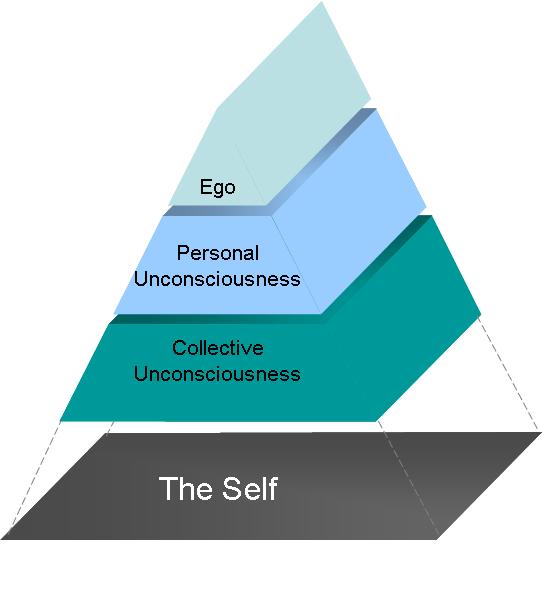
    The Ego and the Self are terms which are often interchangeably used. Likewise often no distinction between personality and Self is made nor taken into account the subconscious.  The psychological term Ego is the center of consciousness and ensures the physical survival . Ego often has an extended meaning in the spiritual language and referrers in general terms to an obstacle for Self realization.

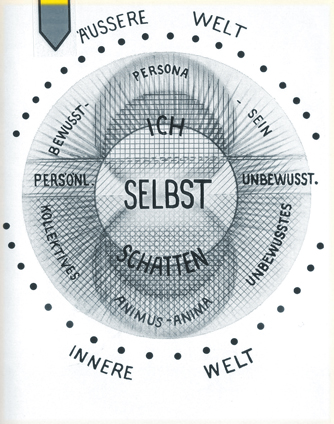
    The total psyche: (Mantra – Jolande Jacobi “The psychology of C.G. Jung”

    The model C.G. Jung does not have this limitation (see Mantra above from the book Jolande Jacobi, The Psychology of C.G. Jung). He distinguishes sharply between Ego and Self and differentiates the unconscious thoughts and feelings of both types of memories: the ones we can remember easily and those who are suppressed for some reason. In addition he introduced the collective unconscious, which belongs to the common humanity, as part of an individual psyche. This article wants to  investigate the “Death of the Ego” from that spiritual point of view and from a psychological perspective (in particular from  C.G. Jung’s individuation). I hope that the context of Jung’s model clarifies it (at least for me). As many, I  lived my life ignoring death, but since the death of my mother this attitude has changed.

    1. The Ego

    Ego is the correct  translation of the German “Ich (I)” used by C.G. Jung and Freud. The term Ego is also common in esoteric  writings often distinguishing the  Ego as a centre of the personality of a higher or true Self not unlike as in C.G. Jung’s psychoanalytic model. The term Ego is widely used In  translations of Buddhist texts for the “I” to overcome. In some languages it attends a negative meaning: to characterize, for example people with a selfish Ego. According to C.G. Jung the Ego can be equated with the conscious mind and includes all thoughts we think at that moment and also our current feelings. In the center of this consciousness we find that “I” or Ego. It guarantees the unity of (thinking, feeling, acting) is focused on physical survival and dealing with everyday demands. All religions (according to the Benedictine monk Anselm Gruen), demand more or less that we must become free from the Ego. This especially applies to our relationship with God. If we do not let go of our Ego we stay materialistic (at best).

    Egocentric-Thinking

    Jesus has spoken this wisdom of all religions in words, which are hard to understand today: “who wants to be my disciple, let him deny himself, take up his cross any day and follow me.” (Lk 9.23). To deny yourself is to say no to be ruled by monopolizing tendencies of the Ego, but distance us from it, to be free from its enslaving power. The Ego wants to impress, wants be presented (inflated) before others. Is the Ego our biggest enemy or our best friend, one might ask?  My usual answer to this question is: who can’t love himself can’t  love others nor God. It is just analogue not digital. The concept of unconditional love may answers this question differently: ” It is never an enemy. It is the best of us, who may feel neglected but in terms of love is always a very good friend .The Ego just wants to be loved – always.”

    But the trivial (or trivialized colloquial term) Ego wants also success, be better than others, wealth, recognition and so on.  In the end the effect is, it will not get love from others in this way. Why? Because it does not recognize that others are needed for this purpose. It calculates coldly cause and effect – feeling not loved (enough) in crises as profound illusion –  due to limited awareness. If we understand our commitment only from the inflated Ego,  my experience is, we may quite benefit in professional life but may get rather hurt in private relations. And: as the two Benedictine (and I think C.G. Jung) told us,  it prevents experiencing the religious dimension of our life.

    For the philosopher Boulad, the death of the Ego is the birth of the Self: we have only a single vocation: to be ourselves. We have only an obligation: especially do – to be to realize ourselves, to develop ourselves. Psychologist Hawkins described the Ego as a negatively oriented structure that denies the existence of God and wants to live independently. The Ego itself is afraid its resolution. And this would indeed happen if God influenced consciousness and we achieved higher levels of consciousness. The death of the Ego is “the final door” Hawkins or “the final moment” so a subjective enlightenment represents (as in Buddhism).

    • Freud: The Ego mediates between the demands of IT, the super-ego, and the social environment and needs a reality-oriented self-image, called Self.
    • C.G.Jung: the Ego represents the differentiation of the individual as a personality evolves. At birth, the Ego separates from the Self. In its development, the individual is always forced to adapt to its social environment; This will be done at the expense of positive attributes which are not valued or tolerated by the outside world. To protect his development, those will be negatively “charged”, fended off and become the Shadow. Furthermore adjusting of  the shared ideal of gender creates another functional complex, Jung calls the soul: the Anima (lat. soul) in men and the animus in women. Outwardly, another functional complex, called persona essential for life in society will be developed.  This is our task in the first half of our lifespan (35-40 years of age) to mature. For many people the end of mental development reached with the realization of the Ego. The life takes place only in socially prescribed patterns, fulfilling our primary need for security (and sexuality according Freud or power according to Adler). Only a few people imagine how to proceed in the midlife or thereafter, usually shaken by a crisis or emergency. The anxious questions of individuation, of Self realization, and meaning of life are major concerns of Jung.
    • Orthodox Islam knows many stages of the “I” (Arabic nafs), and to dissolve it. “The” Ego”is contrary to the spirit of [ruh] the part of the heart of man who was placed under its own control, in developing his soul”. Goal of Islam is to overcome that to a common “Ego” “We”. All people, also husband and wife, were created from a single soul (cf. Holy Quran ‘ at 7: 189). Somewhat different is the Sufi view, the mystical form of Islam. But here  too,  the goalis  the death of the Ego.

    2. The Self

    For me, the Self is again non-uniformly used term within their psychological, sociological, philosophical and theological importance variants. While Freud and Adler considered very narrow psychological driving forces, C.G. Jung understood a central integral concept of the human psyche manifested in the Self. This Self is the wholeness of the human psyche and includes the conscious and unconscious parts of the personality and aims toward the harmonization of the psyche. Only the ego-consciousness with the equipment in use is deliberately sensory perception and thinking, feeling, and intuition. The unconscious part of the people, which splits in the personal unconscious and the collective unconscious, is much more extensive than the ego-consciousness. The Self is the center of the whole personality and therefore the central control instance.  The Ego is the conscious of Self, its eye, with whose help the Self can recognize itself (almost like Adam and Eve after eating the apple). But the Self is the God in us. Individuation is to be who one really is, and a differentiation process that fosters the development of all skills, systems and possibilities of the individual through gradual awareness and realization.


    •  C.G.Jung: The goal of life is to know the Self. The Self is a new Center, a better balanced position of our own psyche. Instead of the the trivialities of the persona and the education of the self I today little more worry on the self to all people, all life, the universe and God. The Self is an archetype, embodying the transcendence of all opposites so that each aspect of the personality is expressed correctly and fair. Then it is neither nor but both, male and female, conscious and unconscious, individual and the entirety of creation. The Self represents the mentally transcendent, and equates to a religious experience.
    •  Sociology: the sociological normal type of “community” is the “self”-benevolent introduced (during the normal type of ‘society’ “as “person”).
    •  Hinduism: self as inner, eternal, indestructible shape each being (Atman)
    • Buddhism: that denies “Even” the existence of a stable, unchanging identity in favour of the doctrine of the non-self
    • Orthodox Islam knows no self, the self” is roughly equivalent with the ‘Ego’, to resolve that it applies. “The” Ego “is contrary to the spirit of [ruh] the part of the heart of man who was placed under its own control, in developing his soul”. Goal of Islam is to overcome the “I” to a common “We”. All people, also husband and wife, were created from a single soul (cf. Holy Quran ‘ at 7: 189).
    The Ego, the Self and God
    The Ego, the Self and Jesus – Individuation and Transcendence

    3. The soul

    In today’s (secular) parlance, the totality of all emotions and mental processes in humans is meant and synonymous with the term psyche with soul often. Psyche (Greek ψυχή, breath) was in the classical antiquity a synonym for the word soul.

    The discussion of the 20th century has discussed various concepts of the concept of a “soul” and a wide variety of points of view. Roughly broken down, one can distinguish the following positions:

    3.1. A philosophical and theological definition,

    which means a one’s own substance ‘Soul’, emanating from the thinking and feeling, and other spiritual acts. In Christian philosophy, but often decidedly anti-Platonic views are represented, which consider body and soul in the sense of a holistic anthropology as a unit.

     Psyche in the sense of the new, Hellenic language exists – to the contrary to the Old Testament “Nefesh” – regardless of the body and can not be killed.

    Darkness-and-Light

    • Theological is the soul of the innermost core of a human person. And of course the question: what is the core? Belong to the soul also instincts, sexuality, hunger and thirst? These elemental feelings do not belong to the theological concept of the soul. Theologically, the soul is the spiritual, life-giving principle in man. The soul is the created by God spiritual and immortal beings form of man, which determines its distinctive individuality – according to the theologians today.
    • Unfortunately, there on the terms: soul ‘ and ‘Spirit’ false statements, you must come to the very right are different, between the biblical statements of AT and NT, Greek philosophy, and the Hindu and Buddhist understanding.  To clarify what the he Bible understands of the ‘soul’. It is necessary to learn how God created man. Moses 2.7: “Since God the Lord made man from clay (matter) from the field and blew the breath of life to him”. And so man became a “living soul”(living creature). Man consists of two components: 1. matter 2. breath giving life. Here it is important that the man get a breathed  a ‘soul’ but does not have one. Only the two components resulted in a “living soul.” The soul here stands for the people in his unity and wholeness. When we die not the soul, but the breath of life leaves us. The ‘immortal soul’ does not exist in the Bible.
    • The “psyché” of New Testament in Greek relates to the Hebrew “nephesch”. Especially in the Gospels, socialized people speak Yes Hebrew Aramaic of the soul. Nephesch means originally not soul, but throat, i.e. the perceptible movement of the throat if breathing, the essence of living. For the Bible, so has every breathing “soul”. “My soul” means something like “I” (Lk 1.46). The nephesch, of a person can take off power, “grieved be unto death”. In severe disease it fades. When dying, it (i.e. the breath of life) is returned God. Because God gave the people of his breath and so man became a living being. (Gen 2, 7B). The idea of the immortality of the soul comes from the Greek (Plato and Ptolemy) and was introduced over the Gnostics into Christianity. It has shaped the medieval Christianity (and Judaism!), but is not biblical. The notion of the soul, which independently could exist without the body comes not from the Bible, but has therefore its origin in the Greek philosophy. Unfortunately, many are believe that soul of Christian origin would be the immortals. This is important in this context. Note also what the Bible says about the death of the man. Moses 3.19: “; because you are clay (matter) and should be back to Earth”;
    • We have no immortal part within us, because sin and its consequences (Romans 6: 23) relates to the people as a whole and not only a part of it. To sinful man, could not immortal after the fall, it was blocked the way to the tree of life. Moses 3, 22: “now but that he now does not stretch forth his HAND and break even by the tree of life and you will find and live ETERNALLY.” The immortality of the people would be the UNADULTERATED communion with God and the access to the tree of life been subject to. He was subjected to death by man both had destroyed his relationship with God, and therefore had no access to the tree of life. He could not free himself from this hopeless situation, his mortality. Therefore, everything else what is in the Bible follows the gradual revelation of the redemption of man from sin and death. The rescue was made possible only by the sacrificial death of Christ, who died for us. Only through Christ alone, we can regain the lost immortality. People get this on the last day, when Jesus will come a second time. Then we regain immortality, which we have lost through Adam and Eve. Immortality we find the word, however, three times in the Scriptures.
      • In 1. Timothy 6.16 writes Paul, that God alone possesses immortality! Therefore, man has no immortal soul.
      • In 1. Corinthians 15: 51-55 Paul then finds: the devout man receives immortality only at the second coming of Jesus and the resurrection of the dead. She is so a gift of God to the end of the world and not an integral part of human nature. Not who makes the belief that gives immortal soul, the Christian faith so questionable, but who drops the hope of the resurrection of the dead at the return of  Jesus (1 Corinthians 15: 12-23).
      • The man has no immortality, thinking, feeling, wanting and acting (preacher 9,5.6.10) end at his death. The Bible compares his State with a sleep from which he will wake up at the end of the world (John 11.11; Daniel 12, 13).
    • In today’s religious and philosophical opinions, the soul is independent of the body and therefore immortal “Soul” an immaterial principle, a stable identity. The Greek term of ψυχή (psyche) occurs in the New Testament which is rendered with ‘Soul’ in older translations of the Bible. In the Gospels, where psyche is, to be alive, meant, specifically to the name of the property of a specific individual – human or animal – “Life” within the meaning of the Nefesh is at most. (MT 2.20), such as lack of food (Mt 6, 25) LK 12, 22f. ), or that she will be withdrawn (Luke 12.20) and is lost (MK 8.35-37). The psyche is the seat and starting point of thinking, feeling and volition. Other places, however, show that the New Testament relation of body and soul is complicated. The term psyche is ambiguous unclear, probably in some places, the transitions between its meanings are fluent.
    • In Plato’s philosophy has the soul (ψυχή, psych) as the intangible principle of life individually. Their existence is entirely independent of the body; She existed before his birth and persists after his destruction of intact (pre-and post existence). Plato and Aristotle differentiated between a senseless and a reasonable soul, psyche and nus.
    •  The Apostle Paul, however, rarely used the term psyche in his letters and avoids him for statements about life after death.
    • Augustine represented the Union of the soul against the Platonic doctrine of the soul parts, but made a promotion to the Aristotelian tradition within the soul: “just living” soul (vegetative), function, rational soul (soul function) with spirit (mens) and will and irrational soul function with motor, sensory perception and memory. Inbound Augustine sought proof of the Incorporeality, and the immateriality of the soul.
    • Particularly Thomas Aquinas conceived the ”nus poietikos” as the creating spirit, as the immortal part of our sou. But he is keen to avoid a rugged body-soul, which is why he, Aristotle then, the unity of the human stresses the unity of mind, body and soul dualism.
    • Orthodox Islamic scholars describe four stages of the soul in the Holy Qur’an ‘ (Sufi more), which correspond to human development. The commanding soul [al-nafs al-‘amara]: the State is the starting point. Like a wild horse, the soul tries to gain control of the “rider” and even “to throw off him”. He orders uncontrollable and harmful, and must be “tamed” are. Even the pure and healthy prophets know this state of mind, even if they have mastered it and point out, like for example Josef (a.) in the Holy Quran ‘ “…And I declare myself not even for the innocent. The soul commands evil emphatically yes, unless my Lord has mercy on himself. My Lord is forgiving, merciful.” (12: 52-53)
      • The plaintive soul [al-nafs al-lawwama]. In this stage, the soul has such self-knowledge that she see their own weaknesses and blames himself “I” to overcome the “self” or. This state of mind is so developed, swore at them: “no, I swear by the day of resurrection. No, I swear by the soul which they pronounce censure.” (75: 1-2)
      • The Inspiring soul [al-nafs al-mulhama]. At this level, the soul has the ability between the useful and harmful inspirations to distinguish and uses this ability to their own development: “…”and the soul and what way she shapes and gives her their Vice and their piety!” (91: 7-8). Freedom is the freedom of knowledge and the defense of the harmful through knowledge and the adoption of useful through knowledge for this soul.
      • The satisfied soul [al-nafs al mutma’innah ‘ inna]. The soul achieves the satisfaction of ALLAH in its perfection and is therefore also pleased about the grace of contentment: “O you satisfied soul, to your Lord satisfied and accompanied by his face return. Joins the ranks of my servants, and enter my paradise. (9: 27-29)

     3.2  Moderate positions,

    such as psychological definitions, may reject a materialism but do not grant the notion of a soul in a traditional sense, in particular not  immortality. Soul is the term for the totality of all conscious and unconscious emotional processes and of all spiritual and intellectual functions.

    •   In his treatise “on the soul” (“de Anima”) defines Aristotle the soul as: “The soul is the first Entelechy of the natural organic body” (full on. II 1, 412 b 4-6). Aristotle not is so not materially the soul but as an intangible entity, which is why Aristotle comes a strict body-soul dualism in question. According to Aristotle the soul is that which the body (which only potentially is a living being) really makes the creatures, the Entelechy biologically today can be seen as a goal-oriented regulation of vital functions as the software for the hardware, which is essential for a living organism in terms of forms. Aristotle States in his treatise “on the soul”, that “the soul from the body is separable and or certain parts of it” .The soul passes so with the body, when the animal dies.
    cropped-spiritualjung.jpg

    • C.G. Jung defines soul in the sense “guarding complex” (Anima) in contrast to the notion of the mind as a “Whole” all conscious experience qualities as well as of all unconscious phenomena. The mental energy occupies a central place in Jung’s psychology. Animus soul, spirit (as opposed to the body), memory, courage, exuberance, confidence, despite, resentment, anger, disposition, mood, passion, desiring soul, desire, desire, decision, desire, inclination; Anima, however, translated with air as element or breath of air, wind, breath, soul, life, or secluded soul. C.G. Jung summed up under the term soul both terms. The soul is dynamic. In humans, this is called also personality.
    • Kant maintains the metaphysical side of the soul, that it treated but related issue of freedom within the framework of practical reason. The soul is called the regulatory term within the framework of morality.

     3.3. Materialism or Neurobiology,

    rejects the existence of a soul, claiming that all talk of mental is reducible to the physical and/or neural States. Are the same soul and psyche and the soul is that which is the psychology and / or employed Neurology.

    •  Sigmund Freud, the founder of psychoanalysis, makes two assumptions for its model of the soul: a physical body (brain, central nervous system) as the place or “Scene” and awareness Act. “” We suppose that the soul-life is the function of an apparatus “, here it is clear that the doctor Freud attempts a neurological Foundation.” We have come to the knowledge of the psychic apparatus through the study of the individual development of the human being”.

    • The man has no soul — he has not even a substantial self, says one contemporary philosopher Thomas Metzinger. Phenomenal States, the experience itself, based on neural patterns, dynamically active nerve networks. The character of the subjective experience remains the same, regardless of whether you actually perceives something or just a hallucination. External factors in the environment, and society to decide whether this experience is considered as hallucination, a abnormal psychic disease wisdom or holiness. The totality of all emotions and feelings are not different for humans or animals. The soul is a portion of the spirit thus, if emotionless information processing in a human brain is excluded (what is hardly possible in reality). Animals have feelings too and therefore also a soul.. Thus overlaps the soul with our memory and learning, forgetting, perception, the totality of all inherited traits of an individual language, intelligence, motivation, will, emotion.

     3.4. Linguistic approach

    • German Seele, Psyche
    • English soul, psyche
    • Greek psyche
    • Hebrew nephesch, ruach
    •  Latin Anima
    • Arabic nafs (نفس) can mean “even” relevant mainly in the Sufi
    •  Chinese (traditional): (línghún) like spirit – or cloud completely invisible:
    • Finnish: sielu
    • French: âme
    • Indonesian: roh
    • Icelandic: sál
    • Italian: anima (female)
    •  Japanese: (kokoro)
    • Dutch: aim (female); spil
    •  Romansh: olma (female)
    • Romanian: restless
    • Russian: душа (duschá)
    • Spanish: alma (female)
    • Thai: วิญญาณ
    • Czech duše (female); Člen (male), obyvatel (male)
    • Turkish can; Ruh
    • Hungarian: lélek
    • Venetian: anema (female)

     4. Individuation versus death of the ego

    I like to understand Individuation not as death or dissolution of the ego. I have witnessed two deaths, an easy one and one prolonged suffering in a cold – not even ill-meaning – care machine. Psychological experiences of Ego death are particularly critical and generate fear: this transformation process is most difficult, because it demands to let go one’s own identity, it may interpreted as abandonment,´resolution, disintegration or fragmentation. All spiritual development processes, however, lead us through meditation and complete resolution of our self-esteem. The individuation is a mismatch  between the beginnings of biological aging and the possibility of another psycho-spiritual development. “It represents those critical situation in which one has arrived at the height of the life and suddenly or gradually is confronted with the reality of the end of death”(Jacobi 1971, p. 31). Quite true in my case. The more one approaches the midlife (as late as this may be)  having succeeded consolidation of  the outer life, personal attitude and social situation, the more one firmly believes having discovered the correct course of life, the right ideals and principles of behavior. Therefore it  requires eternal validity and virtue to move on – otherwise one is stuck. A significant fact is,  that the adaptation and functioning in reality happens at the expense of the totality of the (Self) personality. While the first half of life stood under the aspect of identity a re-orientation must occur,  fulfilling new tasks gains importance, in essence all this is the preparation for death. This turning point is not on a specific point in time (as one of my many “midlife crisis”), but  may extend over a long period of time. First ivomes the confrontation with the shadow, than with the complexes of the collective unconscious, manifesting in  the “Anima” and later the “Old Wise Sage”, or the  woman in “Animus” and “Great Mother”.

    The materialistic-oriented Freudian psychoanalysis has been increasingly questioned, while the spiritually inspired analytical psychology of C.G. Jung becomes lately more important again with religious quests and definitely important to me. Freud, who sees most conflicts as not properly processed (sexual) repression problems, is probably the psychologist of the first half of life. His psychology is retrospective. C.G. Jung’s psychology is more perspective. He has recognized that most of the problems of his patients over 35 were essentially religious in nature. He is the psychologist of the middle and the second half of life. Freud almost always looks back. C.G Jung looked forward. 

    5. My conclusion

    The death of the Ego is to me more of an integration with the Self. Individuation” has shown a way to the Self in the second half of my life, to the deepest innermost area of the personality and has opened the spiritual dimension. Hence it is not only a preparation for death but also a  preservation of body and soul for resurrection – the Self.

    Jacobi, Jolande: Towards the individuation, Walter, Olten 1971 and see also my other standard bibliography.

    .


  • The Self – God’s window between pantheistic Taoism and Catholic personal god

    The Self – God’s window between pantheistic Taoism and Catholic personal god

    Last Saturday (yesterday). I went on a retreat (religious exercise) at the Benedictine monastery St. Ottilien with twenty others men and women looking after their private center and true selves:

    “Looking for the self” What do we know of the psyche and soul?

    The discussion was lead by two monks – the longtime Prior Claudius and Pater Otto, who is catholic priest, Jungian psychologist and as he always proudly announces, orginally a cheese maker. Segments of discussion were preluded from the two monks with some food for thought: first from a catholic view of the wise and senior Bavarian monk and then from a psychological view from the energetic, versatile,  a curious (spiritual and intellectual) searcher in his soft American-Swiss accent. I have known both for a while, and do not  go along always with their statements or definitions. As often, many of the brief thought nuggets answered my current questions and difficulties but also opened more topics to meditated and think about. Never before have I seen priest sharing so openly their lifelong process of believing, their doubts and trust in following Christ. The (Catholic) belief they presented and have lived is one of a unique joyful religion for this life, of  boundless love, capable of deep mystic but also fully compatible with science and Jungian models.

    Life experience in an elevator pitch

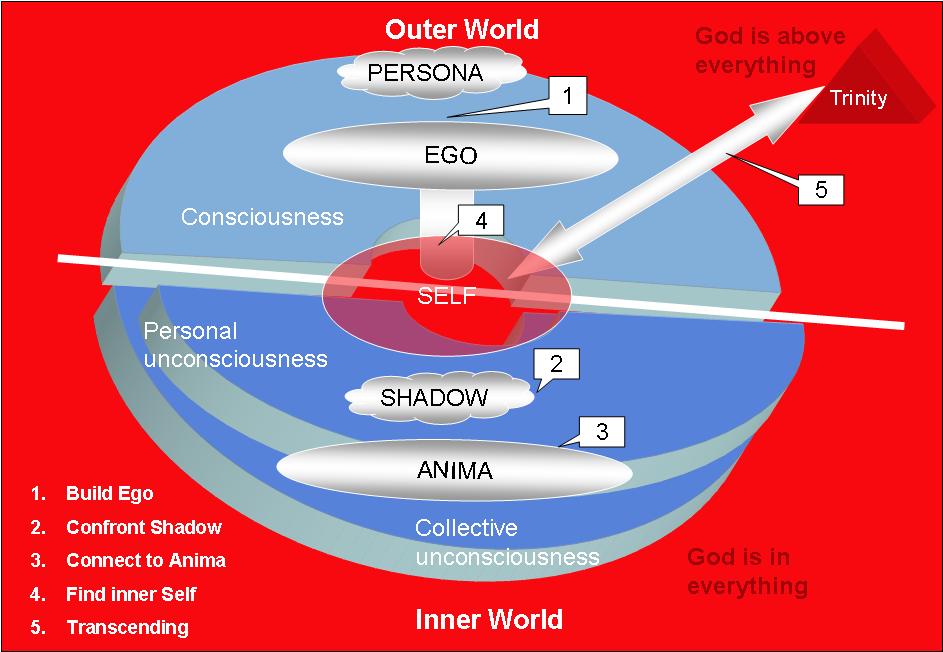
    Do you think, the Prior (second in charge of this monastery) told the audience some conventual belief and bigot phrases? Think again, some of his statements would force both the official church hierarchy together with the noisy know-better-modern- lay(wo)men of today in a tailspin. A concise opening statement of the Prior summed up what one has to do in life and how that helps finding God. I was taken back by its simplicity. His crisp world view came across as a result of his own thinking and experience as a monk without giving  psychoanalysis any deep consideration. But it could be easily matched to individuation of C.G. Jung. I included a crude visualisation below. Furthermore, the Prior eased my biggest problem with a personal god, having had my God experiences in the nature.

    First the Prior showed  us a pantheon (almost Taoist) image of god, how it relates the inner center our Self: God is in everything and above everything or God does not exist. Quite frankly, that resonated well with me, since I felt god the first time, during a backpacking week around Mount Rainer (Wonderland trail). That is – God is in everything  – after I crawled out of the tent and admired nature during the glowing sunrise.
    Secondly Claudius connected men’s outer world, with his inner world and with God –  as an individual to a personal (Du to Du).  It comprised what one has to accomplish in the first half of life ( and where materialism or Freud’s machine stops) and in the second part of life and beyond.  C.G. Jung defined that  without his empiric reach but definitely within his metaphysic view.

    Dealing with the outer world: You have a good meaningful job, live in a nice house, have a good handsome/pretty spouse,your kids turn out well. You sit down and see it is good. I think this relates to the developing an Ego and Persona in the first half of your lifespan. Later Pater Otto brought  the Ego in an Example of a Gel Tub, how the Ego,the center of consciousness is needed as an outer communicator and shell to protect your our Self and our Soul.

    Dealing with inner world: You have to look into yourself think and meditate, rid yourself of the negative. (P. Claudius avoided saying evil or demons). You sit down and see it is good. I think this relates to the Individuation, overcoming the own Shadow and finding the soul (Anima). Later Pater Otto told us about the soul (lat. Anima, gr. psyche ) how this relates our psyche and psychology in general.

    Find your inner center: You have to look beyond this world, to find the loving God in you ( P. Claudius meant looking for our soul). Men is a communicating species, but you have to  have found your inner center to do this successfully..You sit down and see it is good. I think this relates to the Individuation, overcoming the own Shadow and finding the Soul (Anima) and Self. Later Pater Otto told us about the Self, the forces in making cheese by steering in the milk  and the Axis (the big pipe) between the Ego and the Self.

    Communicate with the personal god: You have to connect with the personal God using your Self as window (or membrane). You sit down and see it is good. I think this connects the Individuation process with the  religious or transcendent dimension of an accomplished life. Later P.  Otto told us about special prayers (credo prayers) and Kreuzgänge (walking silent cross walks) how  we can show God we are ready. Now here the monks moved from pantheism to the loving Christian trinity. The communication between the personal God and us as individual is facilitated by the Self, our window to God.The bigger the pipe is between Ego and Self, the easier it is to experience God. Autonomous complexes or an inflated Ego prevents that.

    The Ego, the Self and God
    Multiplicity of Psyche – Individuation and Transcendence


    One Questions two views but one answer

    I have never heard it so clear. The theoretical distinctions of the Self in the different teachings is often unclear and undifferentiated. For the psychologist C.G. Jung the ‘Self’ is an empirical concept for the total amount of all psychic phenomena in humans. It expresses the oneness and wholeness of total personality. The general question in the search for the ‘Self’ is: How can the lives of people succeed? The Prior formulated it in a Christian way,  explaining how to follow Christ; aiming to the realization of the true ‘Self’. I believe that, together with psychoanalytical contribution of C.G.Jung,  the Catholic faith sheds light on the basic “W” questions but also helps in this life. Jesus’ approach to the individual and freedom is unique. We are nor slaves of a cruel god, nor impersonal white noise to resolve our Ego better sooner than later in nothingness, nor a bunch of neurons (mis)firing. As the Prior said: “we can look into the starry sky and say Du,Du, Du”. And I would add, fully aware of todays astrophysical knowledge of our universe.

    God around everything and above everything

    The Self

    Psychological schools are just models. We can’t see atoms or quarks nor can we see our soul.  Therefore scientists and psychoanalysis come up with models, to understand and predict based on empirical data. Even if the Self is a non-uniformly used term with their psychological, sociological, philosophical and theological importance variants, the Jungian model is the closest to Religion. While Freud and Adler considered very narrow psychological drives, C.G. Jung understood the central integral concept of the human psyche as the Self. This Self is the wholeness of the human psyche and connecting the conscious and unconscious parts of the personality and aims toward the harmonization of the psyche. Only the ego-consciousness has the equipment to process deliberately sensory perception and thinking, feeling, and intuition. The unconscious part of the us, which splits in the personal unconscious and the collective unconscious, is larger and often more powerful than ego-consciousness. The ego,on the other hand can run amok and super-inflate. The Self is the center of the whole personality and therefore the central window or “membran”as Pater Otto called it to God. As I interpreted the Prior Claudius, it is also the Place where God or Jesus is in us.  The Ego is the conscious of self, his eye, with whose help the self itself can recognize. The self is the God in us. Individuation is to be who one really is, and thinks a differentiation process that has the development of all skills, systems and possibilities of the individual through gradual awareness and realization of the self to the target.

    Find my Self and inner Center again

    Religion is to C.G. Jung the opportunity to discover the soul. For Freud as for Marx, religion is just opium. Jung sees the benefit of religion (especially of catholic flavor) to deal with many similar psychic circumstances. Today’s psychology – influenced by Freud – to me is Godless and today’s Western theology – influenced by the age of enlightenment – to me often lacks soul. Spirituality and religion, together with logic and science, is focus for individual and political healing. The most important insight, which I understood this day: The impending disasters right now around me, are a direct result of my buried shortcomings like a pretty big Ego which served me well in my career (i.e. the disaster in me). Its is directly linked to Jung’s reminder, the inner world is very real. The evil is in us.

    Conclusion

    I considered myself blessed to get so many hints from the monks for my specific search in such a short time:

    • Who I was in the past, I who want to be in the future and how do I make the transition?
    • How I reflect my undesired aspects of my personality and keep my identity here?
    • What are root causes of interpersonal communication defects – last call to grow up?
    • What are cause and effect of those significant problems in my current professional transition?
    • How to use the current crisis as a momentum and I deal with transcendence and the death?
    • What needs successful self-development within my current life situation (e.g., toward individuation, religiosity)?

    Lots of other questions were discussed, which might “wind up” in another blog entry:

    • Does Evil exists – questions about the dualistic view (Good and Evil)?
    • Does the hell exist. Where does the picture of it come from?
    • What is the opposite of belief (trust in God) what means believing?
    • What is the opposite of love (indifference / egoism)?
    • Usefulness of the religious church hierarchies and dogmas?
    • Theory and praxis of dreams including dream phenomenology and hierarchy?
    • Emphasis on Christ’s suffering versus Christ’s resurrection (central altar figure in  St. Ottilien)?
    • Individual injuries because of rigid and/or bigot religious practices (understood first time how severe those could influence children, and the advantage of converts)
    • Descartes and Dualism
    • Common psychological disposition (e.g. narcisissm of super inflated egos)
    • Fatherly  versus motherly images of god (got lost of this one – thinking of Kali hardly a nice one).

    I was also astonished about the  “Big Bang Didn’t need God to start universe doubt” discussion. To me, believing in God comes down to a personal experience that a benevolent deity is out there. People who are generally more intuitive in the way they think (in the Jungian sense) and make decisions are more likely to believe in God than those who ruminate over their choices. That suggests that basic differences of one’s personality type influences religious belief. Some say we believe in God because our intuitions about how and why things happen lead us to see a divine purpose behind ordinary events that don’t have obvious human causes. As on woman said in the discussion, “I translate believe in trust”. Individual’s belief is influenced by how much we trust natural intuitions. In the end, God can only be known by personal experience not by logic. If one does not experience god, too bad (for her or him). True, big bang and quantum mechanics  describe random fluctuations which can produce matter and energy out of nothingness. But quantum mechanics are just (proved) models too. I don’t doubt that physical laws can “produce” the cosmos. 

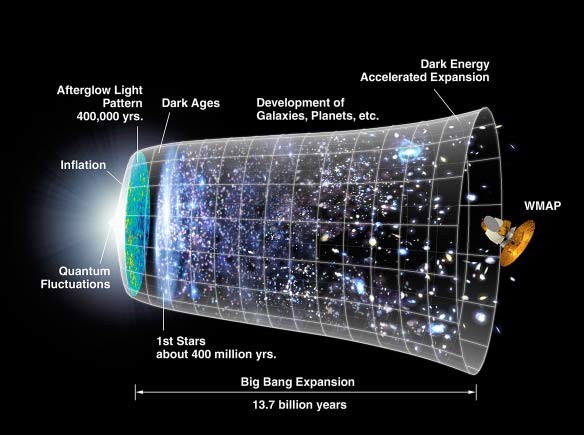
    However, minor asymmetries shortly after the beginning are the cause that matter and anti-matter (particle and antiparticle) did not annihilate itself immediately.  As an engineer, quite interested in astrophysics, physical laws do not at all affect my theological leanings. I see in such statements not attacks on the existence of God. Saying the Big Bang — a massive expansion 13.7 billion years ago that blew space up like a gigantic balloon — could have occurred without God is a far cry from saying that God doesn’t exist. With Jung, and many philosophers I don’t think one can use science to either prove or disprove the existence of God. The question, then, is, Why are there laws of physics? And one could easily say, those required a divine creator a spark that led from the laws of physics to these universes, maybe more than one.  Or, as I humbly admit, one can fall back to pantheistic belief, that ‘divine ‘ is in nature in everything  and produced the laws of physics. I would say let’s just leave that to theology, philosophy and C. G. Jung…

    Appendix :

    • The Persona : “The Persona is that which we present to the outside world. It isn’t really our selves, though there is a danger we can identify too much with it and believe it to be so. It is a mask. It’s not a bad thing to have, in fact it’s necessary for getting along with others.
    • The Ego: “The ego is the centre of consciousness. It is identity…But it is not the totality of the psyche.
    • The Shadow: “it is the receptacle for all of that which we have for one reason or another disowned. In truth there’s a great deal that’s very, very unpleasant here, since we have good reason for wanting to disown our darker natures but like the complexes it is not all evil. The avenue for an attempted redemption of the Shadow lies in the belief that everything disowned winds up here.”
    • The Anima/Animus: The Anima is the female soul image of a man, the Animus the male soul image of a woman. That is the most simple definition, and one which many struggle with, since Jung seems quite absolute in defining a person’s soul image as gender opposite. “Soul image” sounds very pretty, but the Anima/Animus is not without a negative pole as well….. If one is on good terms with one’s Anima/Animus he/she can prove a valuable messenger between the unconscious and the conscious, a connecting link – a veritable Hermes.”
    • The Self: “The Self is simply the centre and the totality of the entire psyche. It is the transcendental archetype which contains all the other archetypes and around which they orbit. Where God is within you, if you believe in God.
    • The Collective Unconscious lies under our personal unconscious, and contains the archetypes and mythical symbols that make up our human psyche. Connection to this in a healthy way is necessary for wholeness.
    • Archetypes (per se) templates (blueprints) for complexes. Note Archetypes and Complexes are used very ambiguous ind interchanged  ( I wrote a few articles just about them)
    • Complexes centers of physical energy (The can be autonomic, good or harmful and take over control.
    • Functional Complexes (The big five, Ego, Self,Persona, Anima, Shadow)
    • Synchronicity—when two or more events happen in a meaningful way to a person, and reveals something about our unconsciousness .
    • Individuation is central to all religion and all healing.
    • Quantum fluctuation is the temporary change in the amount of energy in a point in space arising from Werner Heisenberg’s uncertainty principle in quantum physics. That means that conservation of energy can be violated, but only for small times. This allows the creation of particle-antiparticle pairs important in the origin of the structure of the universe according to the model of inflation.
  • “Wenn ihr fastet, macht kein finsteres Gesicht !” (Mtth. 6,16).

    “Wenn ihr fastet, macht kein finsteres Gesicht !” (Mtth. 6,16).

    Die Fastenzeit / Passionszeit der katholischen Kirche dauert 40 Tage. Dabei werden nur die Werktage, also keine Sonntage gezählt. Sie beginnt mit Aschermittwoch und dauerte bis zum Karsamstag. Ich führe das für mich jedes Jahr durch und, es ist tut mir gut für Geist, Körper und Seele.

    Von Aschermittwoch bis Karsamstag sind es genau 40 Tage, da die Sonntage ausgenommen sind. Die 40 Tage der Passionszeit gehen auf die 40-tägige Gebets- und Fastenzeit von Jesus nach der Taufe im Jordan zurück. Die Zahl 40 ist in der Bibel eine häufige Zahl: Das Volk Israels verbrachte 40 Jahre in der Wüste. Der Prophet Elia wanderte 40 Tage durch die Wüste. Und Mose verbrachte 40 Tage auf dem Berg Sinai verbrachte

    Streng genommen dürfen die Katholiken ab dem Aschermittwoch 40 Tage weder Alkohol noch Fleisch verzehren. Nur Fisch ist erlaubt.

    “Wenn ihr fastet, macht kein finsteres Gesicht !”, heißt es in der Bibel (Mtth. 6,16).

    Gebet:
    Wir handeln im Geiste Jesu und entsprechen dem Wunsch der Kirche, wenn wir in der Fastenzeit neu auf Gottes Zuwendung zu uns antworten und uns besonders darum bemühen. Gemeinschaft mit Gott sollten wir in dieser Zeit auch suchen durch Lesen der Heiligen Schrift, Besuch der Fastenpredigt, Teilnahme an Besinnungstagen, Exerzitien, Zeiten der Stille, Kreuzweg- oder Rosenkranzandachten. Vornehmlich erneuern und vertiefen der Empfang des Bußsakramentes und die Mitfeier der Eucharistie.

    Fasten und Verzicht:
    Es ist eine Erfahrung aller geistlichen Traditionen, daß das leibliche Fasten ein unerläßlicher Bestandteil jeder intensiveren Besinnungszeit ist; das gilt insbesonders, wenn diese Besinnungszeit von einer Gemeinschaft gehalten wird.  Man übt damit  jedes Jahr neu die Haltung zum Konsumverzicht.

    Almosen und Werke der Nächstenliebe:
    Seit alters her haben die Christen es als einen besonderen Sinn des Fastens angesehen, mit den Armen und Verfolgten zu teilen.  Gerade vor dem Hintergrund der weltweiten Christenverfolgung hat das am Ende der Fastenzeit erbetene Opfer seinen Sinn.
     

  • Protected: Ostern entgegengehen – Fastenzeittagebuch 2012

    Protected: Ostern entgegengehen – Fastenzeittagebuch 2012

    This content is password-protected. To view it, please enter the password below.