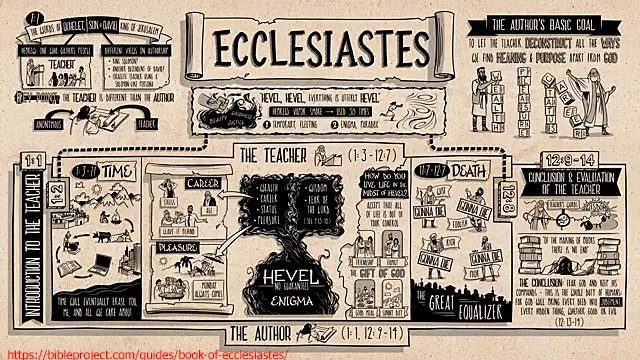
1. Introduction Ecclesiastes
The Book of Ecclesiastes is a brief collection of proverbs opening a dialogue with and between apocryphal writings, Theology, Philosophy, and C.G. Jung. While it does contain proverbial wisdom (especially in chapters 7 and 10), Ecclesiastes is more of a philosophical essay. It takes the form of a dialectical monologue, probing traditional words of wisdom with a distinctly Hegelian methodology: Thesis, Antithesis, and Synthesis.
This complex structure is maintained by a dual perspective. The main body of the text (Ecclesiastes 1:12–12:7) is presented as the actual words, observations, and journal entries of Qoheleth—the royal sage persona. However, the voice that speaks at the very beginning (Ecclesiastes 1:1–1:11) and at the very end (Ecclesiastes 12:8–14) belongs to an overarching figure known by scholars as the Epilogist (or Frame Narrator).
It is this Epilogist who introduces a dark, proto-Gnostic Thesis regarding a broken, trapped world. The text opens powerfully, blowing a Gnostic “secret whistle” that is best captured by the raw weight of an older German translation:
Aus dem Buch des Predigers (Kohelet)
Die Worte des Kohelet, des Sohnes des David, des Königs in Jerusalem:
Nichtigkeit, nur Nichtigkeit, spricht Kohelet, Nichtigkeit, nur Nichtigkeit! Alles ist Nichtigkeit.
Was für einen Gewinn hat der Mensch von all seiner Mühe,
mit der er sich mühet unter der Sonne?
Standard English translations like “vanity” or “nothingness” fail to cover the complex, heavy meanings of Nichtigkeit. Even worse are modern German translations that opt for the almost comical “Windhauch”—evoking a gentle “breath of spring” or a pleasant “spring breeze” rather than existential dread.
The phrase Qoheleth uses repeatedly to anchor this void is tachat hashemesh (“unter der Sonne”). In a Gnostic framework, this geographic boundary is precisely the domain of the Demiurge—the flawed, blind creator of a cyclical, mechanical material world.
Through this framing, the Epilogist lets Qoheleth express his dark, radical, and skeptical observations about this elusive life. Yet, having allowed the abyss to speak for eleven chapters, the Epilogist steps back in at the very end to enforce an orthodox synthesis. He concludes that despite life’s cosmic enigmas and unyielding vanity, one must simply “fear God and keep his commandments.” Stripped of its pious veneer and translated into layman’s terms, the book’s final, devastating advice for surviving the matrix is simple: shut up, obey, and pray.
1.1 Thesis statement
Far from being a simple text of despair, Ecclesiastes operates within a rigorous religious, psychological and philosophical matrix. By critically testing inherited wisdom and exposing the limits of human striving, knowledge and control, Qoheleth develops a worldview of radical limitation. This perspective resonates with aspects of Eastern thought and Western philosophy, including Stoicism, Existentialism and Kantian epistemology, while offering fruitful points of comparison with C. G. Jung’s conception of the homo religiosus, Jung’s concept of individuation and his writings about the Book of Job.
1.2 Meditation with Pope Benedict XVI

https://www.nationalgallery.org.uk/paintings/NG990
For Pope Benedict, the Book of Ecclesiastes is almost existentialist, one that posits that everything is in vain. Yet, “this initial path degrades none of its value; rather, it opens up into a new perspective that ultimately leads to the Cross of Christ“. The book Qoheleth [Ecclesiastes] is preceded by the word of wisdom that he who is good also lives a good life—that is, God rewards the one who is good. Then, however, along come the Psalms, which ask: “But what are You doing, God? The wicked, the arrogant—they live well. They are fat, they feast in abundance, and they laugh at us, saying: ‘Where is God? He does not care about us; we have been sold off like sheep destined for the slaughter.”
In reality—as seen in the Book Job—the God seems indifferent and cruel. God permits the Satan in a wager to strip away Job’s livestock, servants, and children— a cosmic test if Job is faithful to God for nothing. Job himself cries out feeling betrayed by a harsh God. When God finally appears Job inside a whirlwind. He gives no answer. Instead, God takes Job on a “tour” , showing that the cosmos is vast, wild, and far bigger than human can comprehend. The book concludes that for his obedience Job receives the presence of God and has his fortunes restored.
Its seems God is getting progressively worse from The God of Moral Transaction -> of Divine Indifference -> to an amoral, Cosmic Deity -> to obey and fear of Existentialist God E “hevel” (Nichtigkeit / Nothingness). True, Pope Benedict says, but its a continuum, a way which has a destination—Jesus, A brilliant comprehensive analysts making the rather dark proto-gnostic text to a perquisite.
By taking God through this “downward” sequence, the Old Testament systematically burns away every false, transactional idol of the divine. It forces the reader to accept that if God is to be found, He cannot be found in a system of earthly rewards. The path must degrade, it must end in vanity, so that the only way forward is a radical new paradigm: a God who doesn’t just the secular King, another Cosmic Deity. By refusing to be the Raider King , Jesus allowed the worldly powers (Rome and the Pharisee ) to crucify him. In doing so, he became the radical good and shows us God’s wisdom later manifest in Paul’s expansion of Christianity.
1.3 Historical and Cultural Context
Many scholars date the composition of the Book of Ecclesiastes to the early Hellenistic period, probably the third century BCE. Its earliest possible reception is reflected in the wisdom tradition represented by the Book of Sirach, composed in the early second century BCE. The book reflects a changing Jewish world in which inherited traditions encountered political, economic and cultural transitions. Today, some readers explore the text’s resonance in our own “multicultural” era, with its frictions and rootlessness, which can carry both positive and negative connotations. Ecclesiastes explores the futility of human existence through reflections on work, wealth, pleasure, wisdom, injustice and death. Its recurring concept of hevel—often translated as “vanity”—expresses the difficulty of securing lasting meaning or control over human affairs. The German “Nichtigkeit” in my 1929 Bible captures something of both the futility of human striving and the “Vergänglichkeit” (evanescence) of its achievements.

Iconic works like The Jewish Cemetery (c. 1655) and the featured An Extensive Landscape with Ruins use dramatic lighting, storm-tossed skies, decaying ruins, and fallen trees as allegories for human impermanence, divine presence, and the passage of time
1.4 Religious Context
Ecclesiastes and Song of Songs (also known as the Song of Solomon) are both part of the wisdom and poetry literature of the Hebrew Bible (Ketuvim), and while they address different aspects of human existence, they complement each other to form a realistic picture of life under God.
In the religious realm, Qoheleth’s position can be explored as a distinctive middle ground between different responses to the human condition: on the one hand, the radical good, forgiveness and transformation associated with Jesus’s teachings; on the other, forms of Gnostic dualism that regard the material world and embodied existence as fundamentally flawed or evil. Rather than simply rejecting the world, Ecclesiastes confronts its transience, contradictions and limits, while retaining the possibility of finding meaning within the conditions of human existence. He provides a psychological reading of the confrontation with life’s limits: the failure of conscious mastery, the insufficiency of conventional wisdom, and the search for meaning in the face of uncertainty and mortality
1.5. Ecclesiastes and other OT Texts
Ecclesiastes regularly challenges the reader. As I showed , the interpretation even of words which occur frequently in the book is often unclear a matter of dispute or interpretation, The arguments are ithemself complex and sometimes puzzling and appear often inconsistent or outright self-contradictive. When considered in the larger context of the OT, Ecclesiastes stands out as an odd book, We find ourselves apparently reading about the meaninglessness of life and the certainty of death in a universe in which God is certainly present but is visible and somewhat uninvolved. Sound familiar? When considered in the context of the NT, the dissonance between Ecclesiastes and its scriptural context seems even greater; for if there is one thing that we do not find in this book, it joy let alone resurrection.
Even though they sound like opposites—Ecclesiastes is cynical and gloomy, while Song of Songs is passionate and joyful—they are designed to be read togetherThe Song of Songs is originally a Jewish text, but it is highly sacred in Christianity as well. Because the Christian Old Testament is built upon the Hebrew Bible, the book belongs to both traditions, though they interpret its meaning differently. The Song of Songs (also known as the Song of Solomon) has been read, historically, by Christians, in two primary ways–as a text which concerns the love and sexual intimacy of human beings and as a text which uses the language of human love and intimacy to speak of something else–the relationship between Christ and the church. It is one of the challenges of reading the Song and Ecclesiastes to explore how far this more by Platonism and Gnosticism than by biblical thinking.
Job puts God on trial; Qoheleth puts human wisdom to the test. In this sense, the Books of Ecclesiastes and Job become complementary. Job confronts the moral contradictions of the God-image; Qoheleth confronts the limitations of human wisdom. Jung interprets Job’s confrontation with God as a moment of profound psychological and religious significance. The encounter raises questions of divine consciousness, moral awareness and the transformation of the God-image
1.6 The Reality of Hevel: The Limits of Human Mastery
- An Unflinching Diagnosis: Examination of death, cyclical time, and structural injustice (“what is crooked cannot be made straight”).
- The Critique of Human Hubris: Why intellectual systems, wealth, and systemic toil ultimately slip through our fingers like smoke.
1.7 Cosmic Insignificance: Humanity vs. Nature
- The Scale of the Cosmos: Contrasting human labor and anxiety with the indifferent, majestic permanence of nature (“A generation goes, and a generation comes, but the earth remains forever”).
- The Freedom of Insignificance: How Kohelet finds a strange liberation in cosmic smallness—releasing humanity from the treadmill of ego-driven legacy building to enjoy the immediate, ordinary gifts of existence under the sun.
2. The Theological Realm: Echoes in Jesus (Gospels) vs. Gnosticism
2.1. Echoes in the Synoptic Gospels: Subverting and Fulfilling Hevel
In the Synoptic Gospels (Matthew, Mark, Luke), Jesus inherits Kohelet’s unsparing realism about the fragility of human life under the sun, yet transforms it. While Kohelet concludes that striving is hevel (vapor/futility), Jesus redirects that realization toward a radical revaluation of the Kingdom of God.
- The Critique of Material Accumulation & Anxiety:
- The Connection: Look closely at Jesus’s teachings on anxiety, barns, and wealth (e.g., the Parable of the Rich Fool in Luke 12, or the Sermon on the Mount’s injunction against storing treasures on earth where moth and rust destroy).
- The Theological Pivot: Kohelet frequently laments that a person labors with wisdom and knowledge, only to leave it to someone who has not toiled for it (Eccl 2:21). Jesus echoes this exact structural absurdity of hoarding wealth under the sun, but uses it to pivot from existential despair to eschatological trust: “Do not be anxious about tomorrow… each day has enough trouble of its own” (Matthew 6:34).
- The Connection: Look closely at Jesus’s teachings on anxiety, barns, and wealth (e.g., the Parable of the Rich Fool in Luke 12, or the Sermon on the Mount’s injunction against storing treasures on earth where moth and rust destroy).
- The Acceptance of Temporal Limits vs. Divine Provision:
- Kohelet’s repeated refrain—that humanity cannot add a single hour to their span or truly know what comes after them—finds an echo in Jesus’s rhetorical question: “Can any one of you by worrying add a single cubit to your span of life?” (Matthew 6:27).
- Food for thought: For Kohelet, this limitation leads to a stripped-down, pragmatic enjoyment of the present (eat, drink, find satisfaction in toil as a gift from God). For Jesus, this exact same ontological limitation becomes the entry point for radical dependence on the Father, transforming Kohelet’s “humble acceptance of limitation” into “radical childlike trust.”
- Kohelet’s repeated refrain—that humanity cannot add a single hour to their span or truly know what comes after them—finds an echo in Jesus’s rhetorical question: “Can any one of you by worrying add a single cubit to your span of life?” (Matthew 6:27).
2.2 Echoes in the Famous Apocryphal Writings: Wisdom’s Counter-Voice and Radicalization
The intertestamental wisdom literature (such as Wisdom of Solomon and _Sirach / Ecclesiasticus) directly engages, dialogues with, and sometimes pushes back against the bleak realism of Kohelet.
- Sirach (Ben Sira) – Reclaiming Historical Continuity and Tradition:
- The Connection: Written roughly two centuries after Ecclesiastes, Ben Sira reads almost as a deliberate corrective to Kohelet’s subversion. While Kohelet views generations coming and going with little permanent residue (the earth remains forever, but human striving vanishes), Ben Sira launches into the famous “Praise of the Fathers” (“Let us now praise famous men, and our fathers that begat us”—Sirach 44).
- Food for thought: Ben Sira attempts to rescue historical memory, covenantal law (Torah), and institutional tradition as an antidote to hevel, arguing that national history and ancestral legacy do provide a transcendent anchor that Kohelet doubted.
- The Connection: Written roughly two centuries after Ecclesiastes, Ben Sira reads almost as a deliberate corrective to Kohelet’s subversion. While Kohelet views generations coming and going with little permanent residue (the earth remains forever, but human striving vanishes), Ben Sira launches into the famous “Praise of the Fathers” (“Let us now praise famous men, and our fathers that begat us”—Sirach 44).
- The Wisdom of Solomon – The Epicurean Challenge and Eschatological Vindication:
- The Connection: The Wisdom of Solomon explicitly ventriloquizes the voice of the wicked or the radical skeptic speaking the language of Ecclesiastes: “Our life is short and sorrowful, and there is no healing when a man comes to his end… Come let us enjoy the good things that exist… Let us leave tokens of our mirth everywhere” (Wisdom 2:1–9).
- The Theological Pivot: The author of Wisdom uses Kohelet’s observations about the injustice of death (where the righteous and wicked share the same fate) to introduce a definitive post-mortem justice: “The souls of the righteous are in the hand of God… In the eyes of the foolish they seemed to have died… but they are at peace” (Wisdom 3:1–3).
- Food for thought: Here, the apocryphal literature refuses Kohelet’s “dust-to-dust” finality. It constructs a bridge from ancient Hebrew wisdom toward apocalyptic dualism and the doctrine of bodily/spiritual immortality, contrasting Kohelet’s earth-bound realism with a stark metaphysical reward-and-punishment framework.
- The Connection: The Wisdom of Solomon explicitly ventriloquizes the voice of the wicked or the radical skeptic speaking the language of Ecclesiastes: “Our life is short and sorrowful, and there is no healing when a man comes to his end… Come let us enjoy the good things that exist… Let us leave tokens of our mirth everywhere” (Wisdom 2:1–9).
2.3 Conclusion
- Kohelet: Diagnosis of hevel leads to immanent joy and fear of God under a closed sky.
- Synoptics: Diagnosis of hevel is re-anchored in Kingdom ethics and radical trust in a providential Father.
- Apocrypha (Wisdom/Sirach): Either rebels against Kohelet by re-installing Torah/legacy (Sirach) or leaps past Kohelet’s immanence into full-blown post-mortem eschatology (Wisdom of Solomon).
3. The Philosophical Landscape: Eastern and Western Frictions and Dialogues
3.1 Eastern Wisdom Traditions (4 Agreements & 4 Disagreements)
- 1. Confucianism
- Agreement: Mutual respect for cosmic ordering, social duty, and practical ethics over abstract metaphysics.
- Disagreement: Confucianism views human culture and ritual (li) as capable of establishing enduring social harmony, whereas Kohelet views historical cycles as ultimately yielding no permanent transcendent profit (ytvram).
- Agreement: Mutual respect for cosmic ordering, social duty, and practical ethics over abstract metaphysics.
- 2. Buddhism
- Agreement: Shared radical diagnosis of existence as transient, impermanent, and marked by suffering (Anicca/Dukkha aligning with Hevel).
- Disagreement: Buddhism seeks cessation of attachment to escape samsara into Nirvana; Kohelet commands an active, material embrace of life’s plain gifts under the sun.
- Agreement: Shared radical diagnosis of existence as transient, impermanent, and marked by suffering (Anicca/Dukkha aligning with Hevel).
- 3. Taoism
- Agreement: Recognition of the unfathomable ultimate order (the unnamed Tao mirroring Kohelet’s hidden divine work).
- Disagreement: Taoism counsels effortless alignment (wu-wei) with the natural flow to transcend strife; Kohelet maintains a moral tension of personal divine judgment.
- Agreement: Recognition of the unfathomable ultimate order (the unnamed Tao mirroring Kohelet’s hidden divine work).
- 4. Hinduism (Vedanta / Upanishadic Thought)
- Agreement: Recognition of the surface phenomenal world as illusory or temporary.
- Disagreement: Vedanta locates absolute reality in an unchanging metaphysical identity (Atman-Brahman); Kohelet offers no metaphysical escape hatch from the physical dust.
- Agreement: Recognition of the surface phenomenal world as illusory or temporary.
3.2 Western Philosophy Traditions: Agreements & Disagreements)
The Epilogist acts as the ultimate mediator. By stepping in at the beginning and the end, they organize the book into a literal Thesis-Antithesis-Synthesis loop:
- The Thesis (The Frame’s Starting Point): The traditional, orthodox Israelite worldview. This is the baseline theology of the Law and the Prophets—that God is just, order exists, and human life has an objective, discernable moral calculus.
- The Antithesis (Qoheleth’s Voice): The Epilogist then lets loose the radical, raw, existential monologue of Qoheleth (Eccl 1:3–12:7). Qoheleth systematically tears down the thesis, shouting that everything is hevel (smoke/vapor), justice is broken, and wisdom cannot save you from the grave.
- The Synthesis (The Epilogue 12:13–14): The Epilogist returns to wrap up the experience. Crucially, they do not censor Qoheleth’s skepticism. Instead, they absorb it. The final synthesis becomes: “The end of the matter; all has been heard. Fear God and keep his commandments.” This is no longer the naive, untested faith of the beginning; it is a battle-tested, post-existential faith that has stared into the void and chosen to walk forward anyway.
This Hegelian framing explains why the book perfectly bridges canonical and apocryphal thought. Later Jewish writers reading this synthesis split into two camps:
- The Apocryphal Backlash: Books like the Wisdom of Solomon felt the Epilogist’s synthesis didn’t go far enough to fix Qoheleth’s dark reality. They sought a new synthesis by introducing immortality of the soul and cosmic rewards to balance Qoheleth’s ledger.
- The Canonical Acceptance: Because the Epilogist packaged Qoheleth’s dark existentialism inside a loyal, orthodox frame, the book was able to survive fierce rabbinic debates and enter the holy canon, legitimizing doubt as a part of sacred theology
In a classic Hegelian dialectic, the synthesis is supposed to elevate both thesis and antithesis into a higher, more beautiful truth (Aufhebung). But here, the synthesis feels like a collapse.
However Epilogist exhausted the reader. After 11 chapters of staring into the Gnostic abyss of a meaningless universe, the human mind suffers from existential fatigue. The “shut up and obey” synthesis is a relief not because it’s beautiful, but because it gives the exhausted ego a place to land. Fearing God and keeping His commandments is the central conclusion of the biblical book of Ecclesiastes (Ecclesiastes 12:13).
By interpreting this as an institutional “shut up and obey” trap door, it reveals how the early religious structures managed radical doubt.
- 1. Immanuel Kant (Epistemological Limits)
- Agreement: Strict boundaries of human cognition; Kant’s limits of pure reason mirror Kohelet’s boundary on decoding divine architecture.
- Disagreement: Kant seeks objective moral certainty through a transcendental deduction of categories; Kohelet dismantles systematic rationalism, concluding in humble fear before God.
- Agreement: Strict boundaries of human cognition; Kant’s limits of pure reason mirror Kohelet’s boundary on decoding divine architecture.
- 2. Arthur Schopenhauer (Pessimism and Will)
- Agreement: Identifying the engine of human striving as a blind, frustrating force (Schopenhauer’s “Will” matching Kohelet’s striving after wind).
- Disagreement: Schopenhauer advocates for ascetic resignation and negation of the Will; Kohelet flatly rejects asceticism, insisting on temporal, embodied enjoyment as a divine gift.
- Agreement: Identifying the engine of human striving as a blind, frustrating force (Schopenhauer’s “Will” matching Kohelet’s striving after wind).
- 3. Stoicism (Marc Aurel)
- Agreement (Stoicism): Radical acceptance of what is outside human control (“to everything there is a season”).
- Agreement (Existentialism): Confronting the “Absurd” or groundless nature of existence without dogmatic comfort.
- Disagreement: Stoicism grounds resilience in rational alignment with universal Logos; Existentialism posits radical self-creation; Kohelet anchors resilience in external divine boundaries and judgment.
- Agreement (Stoicism): Radical acceptance of what is outside human control (“to everything there is a season”).
- 4. Existentialism (Camus / Sartre)
- Agreement (Stoicism): Radical acceptance of what is outside human control (“to everything there is a season”).
- Agreement (Existentialism): Confronting the “Absurd” or groundless nature of existence without dogmatic comfort.
- Disagreement: Stoicism grounds resilience in rational alignment with universal Logos; Existentialism posits radical self-creation; Kohelet anchors resilience in external divine boundaries and judgment.
- Agreement (Stoicism): Radical acceptance of what is outside human control (“to everything there is a season”).
4. The Jungian Horizon
4.1. Ecclesiastes in Dialogue with C.G.Jung
The Epilogist’s ending — “Shut up, fear and obey” — does not appear to represent a beautiful psychological integration. Rather, it suggests a form of forced psychic repression.
Qoheleth pushes the ego towards the limits of its capacity to understand and control existence, let alone achieve individuation. The Epilogist then appears to restore the security of an established religious order through obedience. It is almost as if the ego were screaming: “Stop thinking!”
Qoheleth takes away the possibility of controlling existence through wisdom, morality, achievement and even conventional religious expectations.
Jung’s psychology raises the question of whether this restoration represents genuine integration or the repression of an unbearable contradiction.
There is a common thread connecting Qoheleth, Jesus and Jung, although their respective frameworks are fundamentally different:
- Qoheleth challenges the ego’s claim to understand existence.
- Jesus challenges the ego’s claim to judge and condemn another human being, while opening the possibility of radical transformation through love and forgiveness.
- Jung’s concept of individuation challenges the ego’s claim to be the centre and totality of the psyche, opening a path towards psychological wholeness and transcendence.
4.2. The Homo Religiosus
- The Homo Religiosus and the Shadow: C.G. Jung’s view of the religious impulse as a structural psychological necessity; Kohelet as the mature ego confronting the irrationality of fate.
- Individuation through Acceptance: Relinquishing the ego’s demand for absolute fairness to achieve psychological wholeness by accepting the polarities of time.
- The Jung connection is interpretive rather than historical. The homo religiosus and individuation offer potentially fruitful frameworks for reading Kohelet’s confrontation with limits, uncertainty and the inadequacy of conscious mastery. But Jung’s psychological model should illuminate the text, not be attributed to its ancient author.
- Jesus’s teachings, Gnostic traditions and Ecclesiastes are internally diverse, and the contrast between Christian affirmation and Gnostic rejection of the world can become too simple. Your central distinction might instead be between different ways of responding to the tension between embodied existence and the desire for transcendence.
5. Critique of Ecclesiastes and the Anti-Intellectual Paradox
- The Performative Contradiction: Analyzing how Kohelet uses high rhetoric, reason, and writing to meticulously prove that wisdom, reason, and writing are hevel.
- Is Kohelet Anti-Science or Anti-Ratio? Clarifying that Kohelet is not launching an anti-intellectual crusade, but a proto-Kantian critique of hubristic ratio that trims reason down so wonder and ethics can survive.
- Internal Tensions and Quietism: The orthodox epilogue (“fear God”) as a potential editorial patch, and the risk of Kohelet’s realism drifting into quietism against structural injustice.
- The rejection of wisdom is not quite a rejection of wisdom itself. Kohelet tests wisdom, pleasure, wealth and work against their promise of lasting advantage. Wisdom remains preferable to folly in certain circumstances, even though it cannot overcome mortality or guarantee justice. This tension is more interesting than a blanket rejection of Western and Eastern wisdom.
6. Conclusion
Much of Ecclesiastes reflects an imerical human, rather than a divine, point of view. Ecclesiastes clearly states from the outset (Ecclesiastes 1:2-3) However, the ending verses shift to a divine point of view, offering a harsh call to fear God and obey His commandments (Ecclesiastes 12:13-14).
Ecclesiastes teaches that pursuing worldly gain is meaningless, and instead life in God’s world is a gift to be enjoyed (Ecclesiastes 3:12-13). The key word in Ecclesiastes is “Nichtigkeit,” expressing the futile attempt to be satisfied apart from God. This word is used 38 times expressing the many things hard to understand about life. All earthly goals and ambitions when pursued as ends in themselves produce only emptiness. Death is a great equalizer, rendering all human efforts and achievements ultimately meaningless.
Today’s culture is often driven by the pursuit of wealth, success, pleasure, crisis and cultural upheaval. Ecclesiastes shows that these things, in themselves, cannot bring lasting satisfaction nor influenced. Despite the somber tone, Ecclesiastes encourages enjoying the simple blessings of life that God provides and to which humans are limited. Ecclesiastes reveals our lack of control over our lives. The true meaning of a good life is found in the hope for God’s judgment that will destroy evil and bring justice despite life’s mysteries..
PRIMARY SOURCE APPARATUS USED
C.G Jung Antwort auf Hiob, Olten 1972
Neue Jerusalemer Bibel. 3, Auflage 2007
Die Heilige Schrift des alten Testaments, München 1929
Bendedikt XVI Die Heilige Schrift Meditationen zur Bibel Leibzig 1980
Secundary SOURCE APPARATUS USED
.G. Jungs “Antwort auf Hiob” und das “Johannes Evangelium”
Bibleproject-book-of-ecclesiastes

Michael V. Fox — Qohelet and His Contradictions (1989).
An important study of the contradictions in Qoheleth. Particularly useful for understanding why the text resists easy theological harmonisation.
Martin A. Shields — The End of Wisdom: A Reappraisal of the Historical and Canonical Function of Ecclesiastes (2006).
Shields takes the Epilogist seriously and argues that the epilogue offers an orthodox framework that criticises or corrects Qoheleth’s more heterodox position. This is almost the opposite of your psychological interpretation, which makes it valuable as a counterargument.
Read the book and its chapter on the epilogue. JSTOR+1
Andrew G. Shead (1997) — Reading Ecclesiastes ‘Epilogically’.
Tyndale Bulletin, 48(1), 67–91.
Shead challenges the assumption that the epilogue necessarily introduces an alien theological perspective. He argues for considerable lexical and thematic continuity between Qoheleth’s text and the epilogue.
This is important because it challenges the assumption that the Epilogist simply suppresses Qoheleth.
Malcolm Welland (1997), Active Imagination in Jung’s Answer to Job. Article. He examines Jung’s own psychological engagement with the God-image. Sage Journals
Brendan Collins (1991), Wisdom in Jung’s Answer to Job. Article. Particularly interesting because it connects Jung’s reading with biblical scholarship on wisdom and lament. Sage Journals
Tony Woolfson (2009), The Book of Job Revisited. International Journal of Jungian Studies, 1(2), 123–143. Article. He examines Job’s capacity to hold opposing aspects of the God-image together