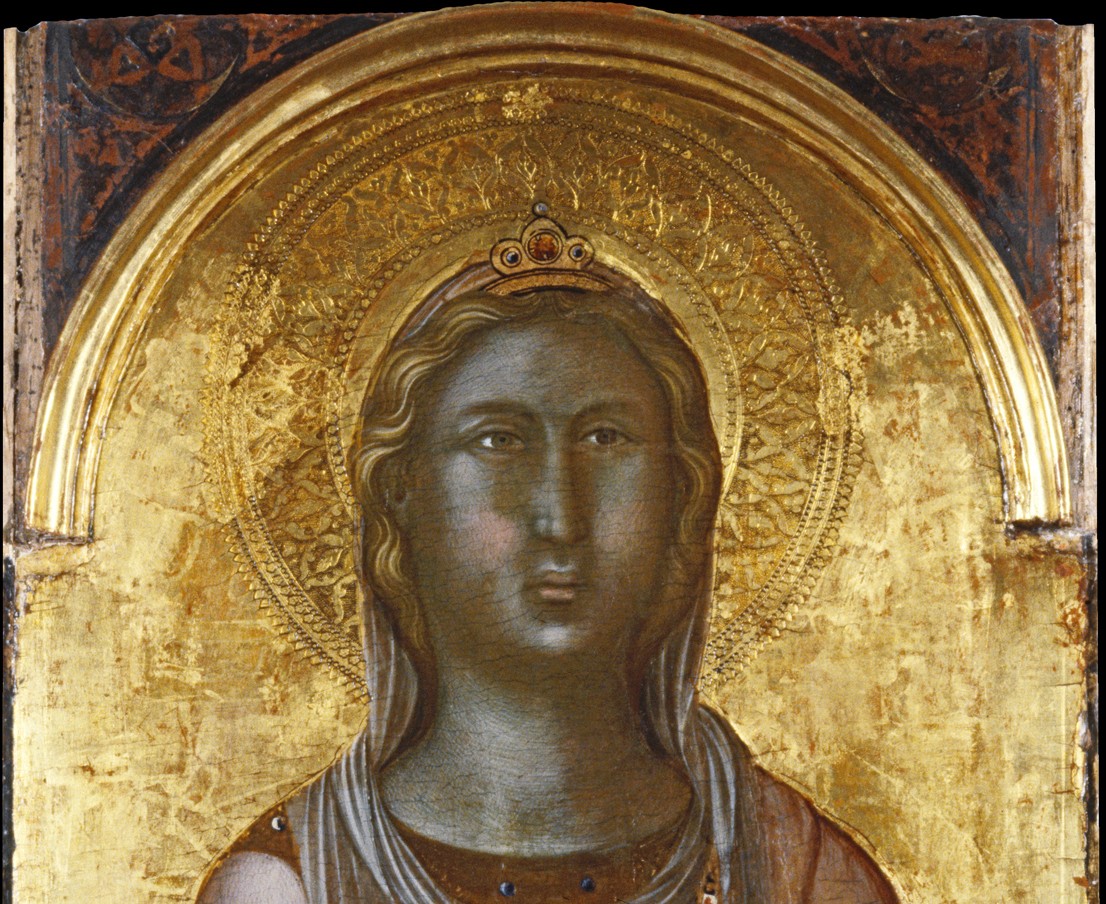
Saint Lucy’s life and legacy offer enduring lessons that resonate deeply in our contemporary violence and uncertainties. Lucia of Syracuse’s hagiography is an inversion of an archetypal hero’s journey: where the hero wins by overcoming power, the martyr triumphs through sacrifice. Lucia’s life serves as a reminder that resilience, kindness, and unwavering commitment to justice and faith can bring light to even the darkest times.
Lucia of Syracuse, also known as Saint Lucy, was a Christian martyr who lived during the late 3rd and early 4th centuries in the Roman Empire. Born to a wealthy family in Syracuse, Sicily, Lucia is celebrated for her unwavering faith, her dedication to the poor, and her courageous defiance of oppression. Her story, though rooted only partial in historic facts, holds profound relevance in the modern world, offering lessons on resilience, selflessness, and the pursuit of justice.
Lucia of Syracuse Historical Background

Lucia of Syracuse was born around 283 CE into a time of intense persecution of Christians under the Roman Emperor Diocletian and the Tetrarchy (ruled A.D 284-305), intent on reviving the waning Roman Empire by enforcing worship of its traditional gods. The Diocletianic or Great Persecution was the last and most severe persecution of Christians in the Roman Empire rescinding Christians’ legal rights and demanding that they comply with traditional religious practices. Abandoning the tradition of a citizen king, Diocletian elevated himself above the masses by initiating imperial ceremonies and requiring his subjects to prostrate themselves in his presence. While Diocletian did not demand personal worship as a deity, his policies required public sacrifices to Roman gods as a demonstration of loyalty to the empire.
Eutychia, Lucia’s mother, arranged a marriage for her with a pagan suitor, but Lucia had already vowed to remain chaste and dedicate her life to God. When her suitor discovered her Christian faith, he denounced her to the Roman authorities. Lucia was subjected to brutal torture and ultimately martyred in 304 CE. Despite the hardships, she remained steadfast in her faith, reportedly declaring, “No one can take Christ from me.”
Lucia’s feast day tomorrow, December 13, is celebrated with great reverence in many Christian traditions, coincides with my monastery retreat this weekend. Before the Gregorian calendar reform in 1582, the winter solstice occurred around December 13. This is how Saint Lucia’s feast day (December 13) became associated with “light” returning after the darkest day. Lucia, whose name means light (from Latin lux), symbolized hope and the coming of longer days. The symbolism of light in her story — often depicted with her holding a lamp or a crown of candles — underscores her role as a beacon of hope and faith in dark times but inherit also Jungian and Taoist concepts.
Saint Lucy’s life and legacy offer enduring lessons that resonate deeply in our contemporary context:
- Courage in the Face of Adversity Lucia’s steadfastness in the face of persecution reminds us of the importance of standing firm in our beliefs and values, even under intense pressure. In modern times, as minorities like Christians, Alawites, Yazidis, and others, or oppressed ethnicities face persecution in regions, where proxy wars and crippling sanctions exacerbate suffering of their countries, Lucia’s story stands as a timeless example of resilience and faith under oppression.
- Advocacy for the Vulnerable Lucia’s dedication to aiding the poor reflects the Christian call to care for the “least of these.” Her acts of charity remind us of the moral imperative to confront human-made tragedies such as war, poverty, and the displacement of entire communities. These injustices are often perpetuated by powerful forces whose actions contradict their professed values, highlighting the hypocrisy of empires that have lost their way and, ironically, their own foundational faith. Lucia’s example also underscores the enduring triumph of spiritual power over temporal force, challenging us to prioritize compassion and justice over dominance and greed.
- Symbol of Light and Hope Lucia’s association with light holds a universal appeal, transcending religious and cultural boundaries. Her story reminds us that even in the darkest times—whether personal struggles, war, or the deprivation caused by political strife—small acts of faith and kindness can bring illumination and hope to others. Her courage and compassion inspire a belief in the transformative power of goodness in a broken world.
- Faithful Witness in a Hostile World Lucia’s martyrdom under Emperor Decius reflects the high cost of faith in a hostile environment. Today, her story resonates with those who remain steadfast in their beliefs despite oppression or violence. While some factions, including groups that paradoxically receive indirect international support, may persecute minorities, her example is a reminder of the enduring strength of conviction and the call to resist injustice.
Jungian Symbolism of Lucia of Syracuse in Dante’s Divine Comedy
In Carl Jung’s psychology, individuation is the path to wholeness, achieved by integrating the shadow—those hidden, repressed parts of ourselves. The shadow, like the darkness of winter, holds our unacknowledged fears and desires. Ignoring it leads to inner conflict, but facing it brings growth and transformation.
Saint Lucia may symbolize this process. Her fate, tied to the darkest time of persecution, reminds us that light can only be found by first confronting the dark. Like Lucia’s candle piercing the shadows, individuation requires courage to illuminate what we hide within ourselves. By accepting our shadow, we reclaim lost parts of the soul and move toward true wholeness—a self both light and dark, balanced and complete.
Saint Lucia (Lucy) plays a subtle yet significant role in Dante Alighieri’s Divine Comedy. She appears as a celestial figure aiding Dante on his spiritual journey, symbolizing grace, light, and divine assistance—qualities deeply tied to her historical and symbolic representation. Dante especially highlights the believed chain of mediation of graces that begin with Christ, through, Mary, and then through particular saints.
The Inferno is, of course, a story of Dante being guided by Virgil through Hell. We learn that Virgil was summoned as Dante’s tour guide by his beloved Beatrice, who was summoned by Saint Lucia.
Her role in helping Dante ascend from the Inferno to Purgatory aligns with the symbolism of individuation as a saint associated with vision, clarity, and overcoming blindness—both physical and spiritual. Lucia’s name is derived from the Latin lux (light), which aligns perfectly with her role as a figure of divine illumination. She appears when Dante is in moments of despair or weakness, providing light, clarity, and divine assistance. In the larger allegory of the Divine Comedy, she represents the grace and guidance necessary for the soul to transition from darkness (sin) to light (salvation).
Thus, Saint Lucy’s presence in Inferno and Purgatorio underscores her role as a pivotal mediator of divine grace and compassion, helping Dante overcome his fears and advance on his spiritual journey.
Saint Lucy in Inferno, Canto II
In Inferno Canto II, Dante is still hesitant and afraid at the prospect of undertaking his perilous journey through Hell. Beatrice descends to Virgil in Limbo and reveals that Lucia had interceded on Dante’s behalf to help him overcome his doubt and begin the journey.
Here, Beatrice recounts Lucia’s role as an intermediary:
“Lucia, foe of all that is cruel, arose
and came to me where I was sitting with
the ancient Rachel. She said: Beatrice,
true praise of God, why do you not assist
the one who loved you so, he left the vulgar crowd?
Do you not hear the anguish in his cry?
Do you not see the death he battles on
the flood that swells against the nearer shore?”
(Inferno II, 97–104, trans. Allen Mandelbaum)
Lucia is described as “nemica di ciascun crudele”—the “enemy of all cruelty”—reflecting her compassion and readiness to aid those in need. She urges Beatrice to help Dante, thus setting in motion the chain of divine intervention that brings Virgil to guide him.
In this context, Lucia serves as a symbol of divine grace and intervention, providing Dante with the courage to begin his arduous journey through Hell and, ultimately, towards redemption.
Saint Lucy in Purgatorio, Canto IX
In Purgatorio, Canto IX, Lucia reappears at a critical juncture to assist Dante in his transition from Hell to Purgatory. After Dante falls asleep, Lucia carries him up to the Gate of Purgatory, a feat symbolizing divine aid in overcoming human weakness.
Virgil describes what happened to Dante as he slept:
“In this deep night before the dawn began,
just as the sun was rising in the east,
a lady, young and fair, appeared to me.
I saw her wandering through the sleeping world;
she bent down, gently gathered you, and took you—
and now the light of day leads us to her.”
(Purgatorio IX, 49–54, trans. Allen Mandelbaum)
Lucia, in this moment, embodies divine assistance and grace, physically carrying Dante upwards—a task that he could not have accomplished on his own. It reflects the theological belief that humans require divine grace to ascend from sin toward salvation.
Virgil’s account emphasizes the contrast between human effort (Dante’s struggles) and divine intervention (Lucia’s aid). By carrying him, Lucia allows Dante to bypass the immediate difficulties of climbing to the gate, symbolizing the grace that makes the transition from sin (Hell) to repentance (Purgatory) possible.
Saint Lucia: Overcoming Power through Sacrifice (update after retreat weekend)
The story of Saint Lucia transcends historical facts, adding to it freely during time to create a symbolic narrative. As a martyr, Lucia’s life aligns with the archetypal hero’s journey, yet with a distinct inversion: where the hero wins by overcoming power through action, the martyr triumphs by surrendering power through sacrifice.
This is like in Taoist philosophy, the concept of wu wei—effortless action—is central to understanding how forces of nature interact in harmony. Water overcoming stone perfectly illustrates the Taoist approach to power: not through direct force, but through subtle persistence and adaptability.
Water as the martyr, in its fluidity, does not struggle against obstacles but flows around them, gradually wearing away the hardest stone. Over time, its soft and yielding nature carves its path. In the same way, the hero’s victory through direct action contrasts with the martyr’s victory through surrender, like water’s triumph over stone. The hero confronts power head-on, using force and will.
This Taoist metaphor suggests like the hagiography that true strength does not lie in confrontation, but in yielding not by defeating obstacles but by flowing through them with grace and resilience.
Lucia’s defiance against the Roman authorities, refusing to renounce her faith, symbolizes resistance to external oppression. Her final act—offering her life—transforms perceived weakness into spiritual strength. When she foretells the fall of Emperor Diocletian, it underscores a profound truth: power rooted in force is temporary, while the courage of sacrifice endures.
In this way, Saint Lucia’s story serves as both a myth to help further the cause of Christianity and a model of courage. The martyr’s “loss” becomes victory, inspiring others to resist tyranny or personal limitations with courage. Whether in the hero’s conquest or the martyr’s surrender, overcoming power—external or internal—requires an unshakable commitment to truth and freedom. Lucia’s light shines not as an escape from darkness or shadow but as a beacon for those who seek the strength to face it, reminding us that true victory often comes through sacrifice.
Lucia of Syracuse’s legacy is therefore not confined to the facts of history or the rituals of religious observance. Martyr’s as well as a hero’s courage, compassion, and enduring faith continue to inspire people across the world.
— Pray for Peace