A Jungian view of my astrophotography ‘The Veil Nebula‘, the universe interpreted though Maxim Gorky’s famous poem and the philosopher Kant. Immanuel Kant saw the universe as a profound source of aesthetic experience, especially through the concept of the sublime—like the infinite universe or a violent storm— which he distinguished from beauty.
Beauty reflects harmony between imagination and understanding, while the sublime emerges when we face something so vast or powerful that our imagination is overwhelmed.
This dynamic is vividly echoed in art and literature: Van Gogh’s Starry Night and the spiral grandeur of Messier 51 mirror the mathematical sublime ( Van Gogh was likely inspired by the nebula M51 from a best-selling book on French astronomy); while Maxim Gorky’s The Song of the Stormy Petrel and the ghostly filaments of NGC 6960 capture the dynamical sublime—the majesty and terror of nature’s force, met by human mind’s resilient and fierce response.
The Cry Before the Storm: The Veil Nebula
“Let it break in all its fury — Let the storm burst forth!” — Maxim Gorky, Song of the Stormy Petrel (1901)
Nowhere is this fusion of the outer storm and inner cry more visceral than in the luminous wreckage of a supernova shell catalogued as NGC 6960: the Veil Nebula West (the right third of my full Veil Nebula mosaic).
The Mosaic
This 2.92° × 2.05° mosaic spans the luminous filaments of the Veil Nebula, the visible remains of a massive supernova in Cygnus, exploding 10,000–20,000 years ago. At the western edge lies NGC 6960, the so-called “Sturmvogel”—a nickname (storm bird, stormy petrel) popularized in early astrophotographic work by Max Wolf (1863–1932) at the Heidelberg Observatory. The filaments likely evoked the bird’s wings riding a cosmic storm. Just to the north (rotated east) lies Pickering’s Triangle, a chaotic sea of shock fronts, while the eastern arc comprises NGC 6992, NGC 6995, IC 1340, and NGC 6974. Together, they form the bright perimeter of the Cygnus Loop, a vast supernova remnant stretching across 3 degrees of sky.
The imago
This widefield mosaic reveals the Veil Nebula, the torn and glowing remains of a massive star that exploded between 10,000 and 20,000 years ago in the constellation Cygnus. The image covers the most prominent filaments of the Cygnus Loop, a supernova remnant still expanding into the interstellar medium. The progenitor star is estimated to have been 20 times more massive than the Sun, and its explosion may have rivaled Venus in brightness, even visible in daylight to early humans.
The nebula is powered by shock fronts—high-velocity shells of ionized gas colliding with the surrounding medium, lighting up filaments rich in oxygen (O III), hydrogen (Hα), and sulfur (S II). These glowing arcs are what we now see as NGC 6960 in the West, Pickering’s Triangle, and the complex Eastern tangle of NGC 6992, NGC 6995, IC 1340, NGC 6974, and NGC 6979.
The western portion, NGC 6960, became known in early 20th-century German literature as the “Sturmvogel”—a storm bird or stormy petrel. Though the origin of the name is uncertain, it was Max Wolf, the Heidelberg astronomer and pioneer of astrophotography, who brought the term into the astronomical community through his deep-sky survey plates and publications. His 1900s-era astrographs, taken with large plate cameras, helped to popularize poetic imagery and inspired the mapping of thousands of nebulae—Wolf’s catalogs eventually included over 6,000 entries.
The “Sturmvogel” metaphor is more than lyrical. If the image is rotated 90° counterclockwise from north-up (placing east at top), the filaments of NGC 6960 unfurl like a bird in flight, its wings flaring through the turbulent ether of the surrounding shockwaves. Just “beneath” it in this orientation lies Pickering’s Triangle—a chaotic lattice of luminous threads, often overlooked but physically adjacent to NGC 6960. This region resembles a choppy, foaming sea, as though the bird skims low over stormy cosmic surf.
The eastern arc, comprising NGC 6992, NGC 6995, IC 1340, and nearby filaments, forms the other wing of the explosion’s outer shell. Together, these bright edges trace a nearly complete hemispherical shell roughly 130 light-years across, expanding at speeds between 150 and 600 km/s. The gas within glows for tens of thousands of years after the explosion, allowing us to see this dramatic transformation in slow motion.
Though shaped by physics, the Veil Nebula also invites metaphor and archetype. In its wisps we glimpse not just shockwaves, but stories: death and rebirth, flight and disintegration, solitude and cosmic defiance. This Sturmvogel, like Gorky’s revolutionary storm petrel, does not fear the coming storm—it becomes its herald. Turn it. Rotate the image 90° counterclockwise—place North to the left, and East to the sky.
The poem
Maxim Gorky’s 1901 poem, The Song of the Stormy Petrel, (in the English Translation) was written as the czarist state trembled with revolution. It was, at once, a coded call to rebellion and a hymn to those rare spirits who thrive in the coming chaos. While lesser birds cower in fear — gulls, loons, and penguins scuttling to shelter — the stormy petrel soars, shrieking, a “black lightning bolt” against the leaden clouds.
“The clouds are darkening the sky, The waves groan beneath them. The storm! The storm is coming soon!”
Der Originaltitel von Maxim Gorkis poem “Das Lied vom Sturmvogel” ist „Песня о Буревестнике“ (Pesnja o Burevestnike). A special stamp was dedicated by the communist GDR post office to Gorky’s “Sturmvogel” in 1968. The stormy petrel—Sturmvogel—shrieking in the dark heavens above a choppy, silvery sea.
Here, in the Veil Nebula, we see that storm brewing—in literal astrophysical terms.
To call the nebula Sturmvogel—as German astronomer Max Wolf did in the early 20th century—is to see more than a name. Dr. Wolf often assigned names inspired by myth, animal shapes, and poetic metaphor.
Beneath the arc—now the “sky” of this rotated scene—lies a tangled field of mist and filament. These lower tendrils correspond to the chaotic region extending toward the Pickering Triangle, itself a fragment of the same blast. But in this orientation, it becomes the silver sea—choppy, dispersed, alive with current.
“The sea, with lightning crashing down on it, Holds the thunder in its depths.”
The psychological dimension is impossible to ignore. To rotate this nebula is to awaken its archetypal charge.
Toward the Storm, Toward the Self
In standard orientations, it is just beautiful. Rotated — it becomes prophetic or as Kant said sublime. Just as Gorky’s poem was banned, feared, and venerated, this image speaks of thresholds — the point where silence ends and scream begins.
To witness the Veil Nebula as Sturmvogel is to stand at the edge of a cosmic battlefield. A soul cries out — not in despair, but in jubilation. It is ready. It does not retreat. The stars themselves have torn open,. and from their shreds, a winged cry rises.
The night is not quiet. The storm is not tragedy. The nebula is not death. It is all a prelude to flight.
In Jungian psychology, the “archetype of the storm” can be understood through several interconnected lenses, encompassing divine power, emotional turmoil, the force of chaos, and the potential for transformation and judgment. It is not a singular, codified archetype but rather a multifaceted symbol that manifests in various ways within the collective unconscious and individual psyche, often associated with deities like Zeus and Odin (Wotan).
Key Aspects of the Storm Archetype in Jungian thought:
Divine Power and Judgment: Storms, particularly those involving thunder and lightning, are often associated with powerful sky gods like Zeus and Odin. These deities are seen as masters of spiritual phenomena and embody divine justice and judgment, capable of both creation and destruction. The storm can symbolize divine intervention or the manifestation of a higher power.
Emotional Turmoil and Internal States: On a personal level, storms can represent powerful and overwhelming emotions, internal struggles, and psychological crises. The “eye of the storm” can symbolize the need for centering and navigating these internal tempests towards clarity and resilience. This can be seen in dream symbolism, where storms may signify repressed emotions or significant life changes.
Chaos and Disorder: The storm can also embody the archetype of chaos and the destructive forces of the unconscious, as seen in mythological figures like Typhon, the Greek monster of chaotic destruction. It represents the unsettling and unpredictable aspects of life and the psyche, often linked to a struggle for consciousness against overwhelming forces.
Transformation and New Beginnings: Despite their destructive potential, storms can also be seen as catalysts for profound change and renewal. Emerging from the turmoil of a storm can lead to a new paradigm, a resetting of paths, and a transformation in consciousness, akin to a “new beginning” or the emergence of a new understanding.
The “Wotan” Archetype: Carl Jung specifically explored the “Wotan” (Odin) archetype as a powerful, dormant force within the Germanic psyche that reawakened with terrifying force, linking it to the “storm clouds” gathering over Europe in his time. This highlights how archetypal patterns can manifest in historical and collective contexts, influencing societal movements and psychological states.
“Let the storm burst forth— The proud stormy petrel soars, Like a black lightning bolt…”
The Veil Nebula is not the remnant of death but literally rebirth, transformation or revolution. We are all stardust.
The first stars burned their fuel quickly and were able to make only a few elements heavier than hydrogen and helium. When those stars went supernova, they expelled the elements they had produced and seeded the next generation of stars.
Back to Kant, reason steps in to conceive the universe’s magnitude, producing a unique aesthetic response that combines awe, respect, and an awareness of both human limitation and rational capacity.
Mathematical Sublime: Arises when we confront immense size—like the vast universe—that imagination cannot grasp, but reason can conceptualize as infinite.
Dynamical Sublime: Emerges in the face of overwhelming natural power, such as storms, evoking fear yet affirming reason’s ability to comprehend from a safe vantage.
Aesthetic Judgment: Kant held that judgments of the sublime, though rooted in feeling, carry a claim to universal validity, expecting shared recognition.
Transcendental Aesthetic: Refers to Kant’s idea that space and time are forms imposed by the mind, shaping how we perceive the universe from the outset.
1. Stormy Petrel in Flight
Visual feature: The filamentary arc, sharply defined and curving like a wing, cutting diagonally across the lower right (now “south”) quadrant.
Interpretation: The stormy petrel itself — sharp-beaked, wing extended mid-cry.
Poetic line: “High above the silvery sea wind / Screeches the stormy petrel, / A black lightning bolt…”
Science: This structure is a shock front — compressed, illuminated gas being shaped like wind-sculpted feathers.
The rift in the emission line appears as wings opened wide against wind — almost tearing through the stars.
2. Choppy, Silver Sea Below
Visual feature: The fragmented, turbulent lower-left tendrils of nebulosity, dispersed and broken up.
Interpretation: This is the sea whipped by storm — erratic, fragmented lines resembling waves crashing.
Poetic line: “The sea — under the storm’s assault — / Holds the thunder in its depths…”
The Veil’s wispy structure renders a heaving, unsettled ‘sea’ of starlight, luminous and restless.
3. Darkness and Thunderclouds
Visual feature: Opaque, darker patches and intersections between arcs of light — spaces of visual silence.
Interpretation: These become thunderclouds — the pressure between light and void, mirroring psychological tension.
Poetic line: “The storm! The storm will break soon! / The bold petrel flies proudly in the lightning.”
The bright-limb–dark-core contrast functions almost as chiaroscuro — a painterly invocation of rolling storm clouds.
4. Lightning and Cry
Visual feature: Sharp, high-contrast transitions and electric blue Hβ or OIII filaments, especially if narrowband data is used.
Interpretation: Lightning across the sky — like the scream of the petrel, jagged and divine.
Poetic line: “The storm — it is coming! / Let it burst in all its fury!”
The emission filaments serve as luminous nerve endings of the storm — prophetic and electric.
WHY THIS ROTATION MATTERS
Most published astrophotographs of NGC 6960 orient North up or East left — creating a sweeping horizontal arc that reads more like a curtain or a wave. But when North is turned left:
The arc becomes a soaring, vertical figure — winged, crying, slicing through the heavens.
The Veil becomes a storm landscape, not a peaceful emission cloud.
The entire field becomes psychologically activated: no longer passive beauty, but visionary unrest.
This is what Max Wolf may have seen — not just a nebula, but a cosmic Sturmvogel singing against the void.
PSYCHOANALYTIC PARALLEL
The Veil Nebula, when viewed this way, externalizes an internal or external psychological structure:
The stormy petrel = archetype of the prophetic Self or Hero archetype, unafraid to confront chaos.
The storm = collective upheaval, unconscious energies breaking into consciousness.
The sea = psychic depths — turbulent but luminous, full of potential.
The Veil itself = the psychic boundary between known and unknown, being torn open.
In this light, your astrophotography of the Veil is not just scientific image-making, but active imagination — to Jung a lens into cosmic individuation or as to Gorky to a historical revolution.
1901 Poem by Maxim Gorky “Song of the Petrel”Google translation from Russianhttps://ruverses.com/
Over the gray plain of the sea the wind gathers clouds. Between the clouds and the sea the Petrel proudly flies, like black lightning. Now touching the waves with its wing, now soaring like an arrow to the clouds, it cries, and — the clouds hear joy in the bird’s bold cry. In this cry — thirst for a storm! The clouds hear the power of anger, the flame of passion and confidence in victory in this cry. The seagulls moan before the storm — moan, rush about above the sea and are ready to hide their horror before the storm at the bottom. And the loons also moan — they, the loons, do not have access to the enjoyment of the battle of life: the thunder of blows frightens them. The stupid penguin timidly hides his fat body in the cliffs… Only the proud Petrel flies boldly and freely above the sea gray with foam! The clouds are sinking darker and lower over the sea, and the waves are singing, and rushing upward to meet the thunder. The thunder is roaring. The waves are moaning in the foam of anger, arguing with the wind. Now the wind embraces the flocks of waves with a strong embrace and throws them with all its might in wild anger onto the cliffs, smashing the emerald masses into dust and spray. The petrel flies with a cry, like a black lightning, pierces the clouds like an arrow, tears off the foam of the waves with its wing. Here it flies like a demon, – a proud, black demon of the storm, – and laughs and sobs… He laughs at the clouds, he sobs with joy! In the wrath of thunder, – a sensitive demon, – he has long heard fatigue, he is sure that the clouds will not hide the sun, – no, they will not hide! The wind howls… The thunder roars…
The flocks of clouds blaze with a blue flame over the abyss of the sea. The sea catches the arrows of lightning and extinguishes them in its depths. Like fiery snakes, the reflections of these lightnings curl in the sea, disappearing. Storm! The storm will soon break out!
This is the brave Petrel proudly fluttering between the lightning over the angrily roaring sea; then the prophet of victory cries out: Let the storm break out stronger!
Maxim Gorki Das Lied vom Sturmvogel
Ob der grauen Meeresebene schart der Wind Gewölk zusammen. Zwischen Wolken und Gewässern gleitet stolz der Sturmverkünder, einem schwarzen Blitz vergleichbar. Bald die Flut mit Flügeln streifend, bald als Pfeil die Wolken treffend, schreit er hell. Die Wolken hören Lust im Schrei des kühnen Vogels. In dem Schrei klingt Sturmessehnsucht! Kraft des Zornes, Glut der Leidenschaft und Siegeszuversicht. Dies hören in dem Schrei die Wolken.
Vor dem Sturm die Möwen stöhnen. — Stöhnen, treiben überm Meere, möchten ihre Angst vorm Sturme auf dem Meeresgrund verbergen. Auch die Tauchervögel stöhnen. Ihnen ist er unzugänglich, der Genuss des Lebenskampfel. Sie erschrecken vor dem Donner. Der Pinguin, der dumme, feige, birgt den feisten Leib im Felswerk. Nur der stolz Sturmverkünder, frei und stolz, beherrscht die Höhe überm grauen Schaum des Meeres!
II
Immer finsterer und tiefer zieh‘n die Wolken überm Meere, und die Wogen singen, dringen hoch, dem Donner zu begegnen. Donner kracht. Wutschäumend , ächzend streiten mit dem Wind die Wellen. Er umfasst sie rudelweise, drückt sie in die starken Arme. Schleudert wuchtig sie in blindem Wüten an die Klippen, wo die hell-smaragdnen Wogen-berge laut zu Staub und Schaum zerschellen. Schreiend schießt der Sturmverkünder, einem schwarzen Blitz gleich, pfeilschnell durch die Wolken. Seine Flügel reißen Gischt vom Kamm der Wogen. Seht, er rast dahin! Ein Dämon — stolz. Des Sturmes schwarzer Dämon! Und sein Lachen tönt, sein Schluchzen. Er verlacht die finstern Wolken, und er weint und schluchzt vor Freude. Längst vernimmt des Dämons waches Ohr im Donnergroll: Erschöpfung. Das Gewölk, weiß er, es kann nicht, – kann die Sonne nicht verbergen!
III
Sturmwind heult — und Donner poltert. Überm abgrundtiefen Meere flammen blau die Wolkenschwärme. Und das Meer fängt Blitzespfeile, löscht sie aus in seinem Strudel. Und wie Feuerschlangen winden sich im Meere — und verschwinden Spiegelbilder dieser Blitze. „Sturmwind! Bald erdröhnt der Sturmwind!“ Sehrt den stolzen Sturmverkünder! Stolz hin schwebend zwischen Blitzen, überm Zorngebrüll des Meeres, schreit er — ein Prophet des Sieges. „Immer stärker tobe, Sturmwind!“
History of time plays a major role as societies moved from from from per-historic to complex civilizations their calendar system adopted from nature and weather calendars to direct observation and lastly to calculated calendars (see here). In this transitions, the switch from lunar calendars to solar calendars (pure solar, lunar-solar or solar-lunar) was an important step seen in many cultures but most prominent in Egypt history which has spaned (or spawned) over 3000 years. The famous myth of Isis and Osiris written down by the Greek Plutarch shows a correspondence to the cultural shift from matriarchal to patriarchal society with complexer ritualized spirituality and civil administration. Isis prevails to a certain degree, making even a revival in Roman times and I would say in Christianity (see Isis, Mithras and Jesus: Clash of male and female Archetypes in classical Rome). Plutarch’s story of the fight between sun and moon, good and evil, yin and yang, based on Egyptian oral teachings has beneath its astronomical setting psychoanalytical and sociological dimension.
The Egyptian civil calendar, base of the Roman Julian and today’s Gregorian calendar, was the first solar calendar known to use a year of 365 days, approximately equal to the tropical year. The Egyptians added 5 days to the schematic (astronomical) year of 30 x 12 = 360 days, invented by the Sumerians around 2400 B.C. to get a solar year. Epigone was the five days of holiday they set in to even the year before New Year. The Greek word means “born afterwards”. The Sumerians had also holidays and called them “sleepers days”.
The 360 days Sumerians (Chaldean) normal year equals with the 360 degrees of the epileptic divided by 12 sectors, the latter again unchanged until today. This astronomical calendar could be connected to the Sumerian civil lunar year of 354 days. On a side note, the Mesopotamians used also the first mathematical position system i.e, an sexgesimal arithmetic, which is method of comutation by 360 of the full circle divided by 12 hours in 60 minutes and60 seconds and came up with weeks and months. Those numbers 5,7, 12, 60 were meaningful and sacred (some sources say also six, but it disturbes my sense of arithmetic):
Seven that is 5 visible planets to the sumerians plus (2) sun and moon.
Twelve, Jupiter completing a full cycle through the epileptic in twelve years
60 years for 5 full Jupiter and 2 full Saturn cycles the epileptic (5 and 2 again give 7); 5 times 12 of course giving 60, 360and in a way six.
Back to Egypt, they simultaneously maintained the older lunar calendar, which consisted of twelve months whose duration differed according to the length of a full lunar cycle (normally 28 or 29 days). Each lunar month began with the first visible new moon. Since the lunar calendar was 10 or 11 days shorter than the solar year, a 13th month (called Thoth) was intercalated every several years to keep the lunar calendar in rough correspondence with the agricultural seasons and their feasts. New Year’s Day was signaled by the annual heliacal rising of the star Sothis (Sirius), when it could be observed on the eastern horizon just before dawn in midsummer; the timing of this observation would determine whether or not the intercalary month would be employed. However, the new calculated solar calender with 365 days matched the tropical years and seasons much better, and here is the story of how the additional five days were found:
The following text an excerpt and translation based on a old narrative in German of Plutarch’s work found in the book of Dr. Wiedemann, Muenster 1890. It can can be seen another myth, but to me there is much more in it: an astronomical revolution. Plutarch’s full text can be obtained in English: Part One of Plutarch’s Greek work entitled Moralia, which was published in Volume V of the Loeb Classical Library, 1936 edition (now in public domain).
This Part One is entitled Isis and Osiris and the extract includes Plutarch’s version of the entire myth of the death and subsequent resurrection of the Egyptian god Osiris. This version is the only relatively complete telling of this story that has survived down to the modern era, although all parts have found as piecemeal in Egyptian writings.
nutgeb
Chronus (Geb , the god of the earth) and Rhea (Nut, the goddess of the night sky) angered the sun god Helios, their grandfather, because they were locked in a perpetual embrace thought to be in a constant state of love making. Helios (Ra), when he became aware of Rhea’s (Nut’s) intercourse with Chronus, invoked a curse upon her that she should not give birth to a child in any month or year; however Hermes (Toth), also being enamored of the goddess, helped her out and she gave later birth to five gods.
Playing checkers with Selene (Goddess of the moon and and sister of the sun-god Helios), he won from her the seventieth part of each of her periods of illumination, and from all the winnings he composed five days, and inserted them as an addition to the three hundred and sixty days (12 x 30). The Egyptians intercalated these five days and celebrated them as the birthdays of the gods. Called Epigone, those days of holidays were set in to adjust to the solar (tropical) year before New Year. The Greek word means “born afterwards” when 5 days was added to 12 x 30 = 360 to even a year. The Sumerians had also those holidays. So the lunar year became a solar year and Nut a chance to give birth to Osiris, Horus the Elder, Set (or Seth), Isis and Nephthys. Since Plutarch used Greek names for gods and goddess an explanation and name mapping is given in the Appendix.
They relate that on the first of these days Osiris was born, and at the hour of his birth a voice proclaim with a loud voice that a mighty and beneficent king, Osiris, had been born; and for this Cronus entrusted to him the child Osiris, which he brought up. It is in his honor that the festival of Pamylia is celebrated, a festival which resembles the phallic processions. On the second of these days Arueris was born whom they call Apollo, and some call him also the elder Horus. On the third day Typhon was born, but not in due season or manner, but with a blow he broke through his mother’s side and leapt forth. On the fourth day Isis was born in the regions that are ever moist; and on the fifth Nephthys, to whom they give the name of Finality and the name of Aphroditê, and some also the name of Victory.
There is also a tradition that Osiris and Arueris were fathered from Helios, Isis from Hermes, and Typhon and Nephthys from Cronus. For this reason the kings considered the third of the intercalated days as inauspicious. Nephthys became the unhappy wife of Typhon; Isis and Osiris were enamored of each other and even consorted together in the darkness of the womb before their birth and so Arueris (Horus the Elder) came from this union who was called Apollo by the Greeks.
IsisOsirisHorus
One of the first acts related of Osiris in his reign was to deliver the Egyptians from their destitute and brutish manner of living. This he did by showing them the fruits of cultivation, by giving them laws, and by teaching them to honor the gods. Later he traveled over the whole earth civilizing it without the slightest need of arms, but most of the peoples he won over to his way by the charm of his persuasive discourse combined with song and all manner of music. Hence the Greeks came to identify him with Dionysus.
During his absence the tradition is that Typhon attempted nothing revolutionary because Isis, who was in control, was vigilant and alert; but when he returned home Typhon contrived a treacherous plot against him and formed a group of conspirators seventy-two in number and Aso, a queen from Ethiopia who was there at the time and whose name they report as Aso. Typhon, having secretly measured Osiris’s body and having made ready a beautiful chest. Typhon jestingly promised to give it to the man who should find the chest to be exactly his length when he lay down in it. They all tried it in turn, but no one fitted it; then Osiris got into it and lay down. The plotters ran to it and slammed down the lid, which they fastened by nails. Then they carried the chest to the river and sent it on its way to the sea through the Tanitic Mouth. Wherefore the Egyptians even to this day name this mouth the hateful and execrable.
The date on which this deed was done was the seventeenth day of Athyr, when the sun passes through Scorpion, and in the twenty-eighth year of the reign of Osiris; but some say that these are the years of his life and not of his reign.
anubis
Isis, when the news reached her, at once put on a garment of mourning and wandered everywhere at her wits’ end; Isis, learning that Osiris in his love had consorted with her sister Nephthys through innocence, in the belief that she was Isis, sought to find this child; Dogs led Isis to it, it was brought up and became her guardian and attendant, receiving the name of Anubis, said to protect the gods just as dogs protect men.
Later Isis learned that the chest had been cast up by the sea near the land of Byblus in the midst of a clump of heather which in a short time ran up into a very beautiful and massive stock, which enfolded and embraced concealed the within its trunk. The king of the country admired the great size of the plant, cut off the portion that enfolded the chest and used it as a pillar to support the roof of his house. Isis ascertained this by the divine intuation, and came to Byblus fragrant with ambrosia. Isis was sent for the queen and became so intimate with the queen that the queen made her the nurse of her baby. They say that the king’s name was Malcander; the queen’s name some say was Astartê (Isis is the Egyptian name for Astarte, the major Phoenician goddess equivalent of the Sumerian goddess Ishtar) The Greeks would call Astartê later Athenaïs.
They relate that Isis nursed the child by giving it her finger to suck instead of her breast, and in the night she would burn away the mortal portions of its body. When the queen saw her child on fire, gave forth a loud cry and thus deprived it of immortality. Then the goddess disclosed herself tothe queen and asked for the pillar. She removed it with the greatest ease and cut away the wood of the heather wrapped it up in a linen cloth and had poured perfume upon it and entrusted it to the care of the kings; and even to this day the people of Byblus venerate this wood which is preserved in the shrine of Isis. Then the goddess placed the coffin on board a boat and put out from land.
In the first place where she found seclusion, when she was quite by herself, they relate that she opened the chest and laid her face upon the face within and caressed it and wept.
isis-and-nursing-horus the child (black maddonna)
Isis proceeded to her son Horus (the Elder), who was being reared in Buto, and bestowed the chest in a place well out of the way; but Typhon, who was hunting by night in the light of the moon, happened upon it. Recognizing the body he divided it into fourteen parts and scattered them, each in a different place. Isis learned of this and sought for them again, sailing through the swamps in a boat of papyrus. The traditional result of Osiris’s dismemberment is that there are many so‑called tombs of Osiris in Egypt; for Isis held a funeral for each one of the 13 parts when she had found it. Of the parts of Osiris’s body the only one which Isis did not find was the male member, for the reason that this had been at once tossed into the river, and the lepidotus, the sea-bream, and the pike had fed upon it; and it is from these very fishes the Egyptians are most scrupulous in abstaining. But Isis made a replica of the member to take its place, and consecrated the phallus, in honor of which the Egyptians even at the present day celebrate a festival. Osiris consorted with Isis after his death, and she became the mother of Harpocrates (Horus the Younger), untimely born and weak in his lower limbs.
Later, as they relate, Osiris now god of the underworld came to Horus from the other world and exercised and trained him for the battle. After a time Osiris asked Horus what he held to be the most noble of all things. When Horus replied, “To avenge one’s father and mother for evil done to them,” Osiris then asked him what animal he considered the most useful for them who go forth to battle; and Horus said, “A horse,” because it served best for cutting off the flight of an enemy and annihilating him.
Now the battle, as they relate, lasted many days and Horus prevailed. Isis, however, to whom Typhon was delivered in chains, did not cause him to be put to death, but released him and let him go. Horus could not endure this and laid hands upon his mother and wrested the royal diadem from her head (some say cut off er head); but Hermes put upon her a head of a cow.
Horus was declared as legitimate child and Typhon was finally overcome in two more battles.
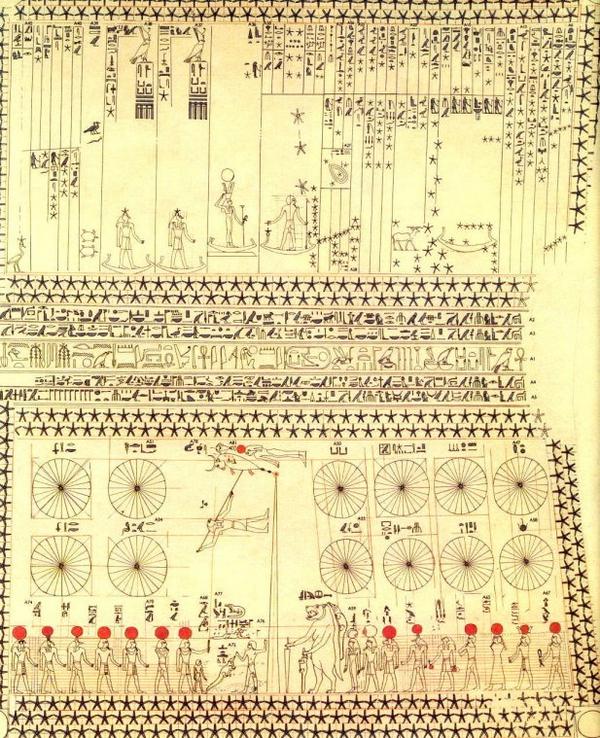
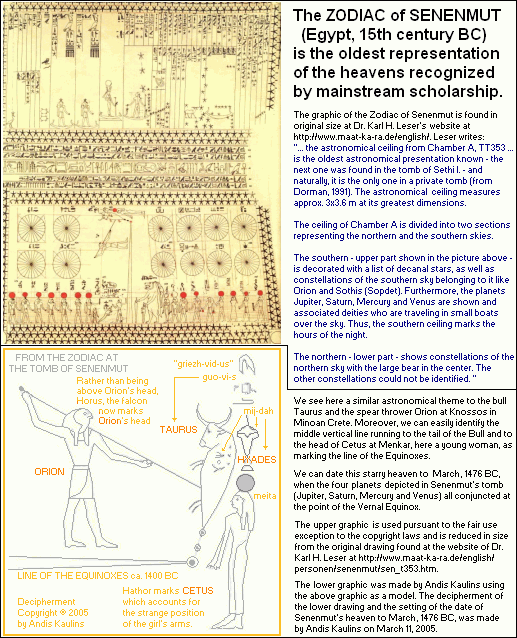
The transition can be wonderfully seen in the tomb of Senemut, chief architect . astronomer, and former lover and favorite of lover of Pharaoh Hatsheput.
His tomb ceiling contains a presentation of the northern constellations with celestial objects, Osiris as Orion, Isis as Sirius, Horus as Jupiter, Horus again as Saturn. A bird on the left represents Osiris as a phoenix linked with planet Venus as a morning star. Another figure of Horus spears an ox representing Set-Apep as the constellation Ursa Major.
senemut night sky
As we learned that the solar (astronomical) year was divided in twelve times thirty days and set in five to six days as a holiday. We understand the synchronization of the sun year and the moon loops in the symbolism as a whole.
The origins of the constellations in the Senenmut calendar are perhaps from about 2700 BC. It is depending on which star is the exact used in the constellation of either Ox or Scorpio.
The black headgears in the rows are originally dark red and are surely moons. The fifth from right have a star symbol in the name and a dog-head. Compared to the Sumerian Dog it maybe was to be synchronized with Sirius.
The asterisks Scorpio and Ox are fix stars of equinoxes and then they originate from ca 3100 BC. We see also twelve wheels as a calendar contending months. The thirteen moons are below and the changing of years is in the middle. The ongoing year is a hippopotamus with a crocodile on its back and the new little crocodile in hand. We see Horus the time or sun using a Stele pointing at the Taurus and the opposite Scorpio with a moon symbol.
Some glyphs are special signs or icons in use with calendar or when writing about time. In the upper row fourth from right the symbol reads KA KA and in beginning of the third is a square with an eagle. In the second row the first wheel from right has a Hathor-cow icon with a year glyph.
In the suite behind Taweret is Isis the leading one as she has been in Egypt for thousands of years before this drawing.
Appendix:
Plutarch uses Greek names for most of the Egyptian gods and goddess (capital letters) so here is a short overview
Small Egyptian Tree
Sun (Helios) AMUN-RA
Ra (Re) was thought of as the “Sun God”, and was once the most important God of the Ancient Egyptians. Ra had been combined with Amon / Amun (the “hidden” aspect of the one God) as Amon-Ra/Re, and with Atum (the “potentiality” aspect of the one God) as Atum-Re/Ra. The Egyptians thought that Nut, the sky-goddess, swallowed Ra each evening, when he then travelled through the underworld only to reappear and be reborn again every morning. Personified in this way as the sun Ra represented life, rebirth, health and vitality. He is not to be confused with the henotheistic abstract God under Akhenaten, ATON or ATEN the new god of the sun, an incarnation of Re. It was a monotheistic attempt, a revolution lasting only on reign.
Rhea -NUT: the sky-goddess, wife/lover/sister of Geb, the earth-god; represented as a woman, her naked body curved to form the arch of heaven. There is a tradition that fromher five children, Osiris and Arueris were fathered from Helios, Isis from Hermes, and Typhon and Nephthys from Chronos.
Chronus – GEB: the earth-god; husband/brother of Nut; member of the ennead of Heliopolis; represented as a man. Geb and Nut angered the sun god Ra, their grandfather, because they were locked in a perpetual embrace. However, Nut was found to be pregnant and gave birth to Osiris, Horus the Elder, Set, Isis and Nephthys. According to the creation myth, Geb still longed for his sister. He wept when he was separated from her, and so created the oceans of the world.
Thoth Ra
Hermes – THOTH
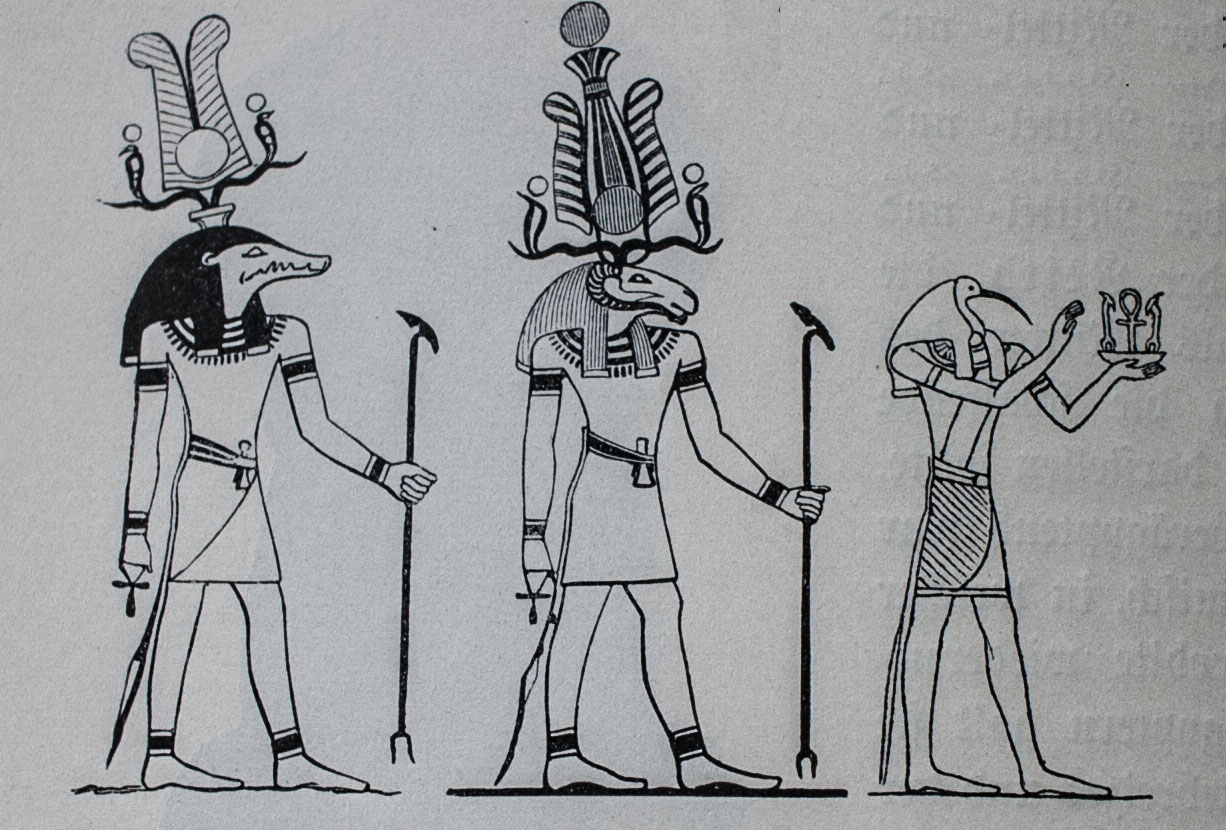
Thoth (also Djehuty or Tehuty) is the archetypal Lord of Wisdom and of learning, writing, speaking, medicine, pictures and symbols. He protects all writers, teachers and scribes and was considered to be the tongue or heart of Ra. He is often shown with the head of the sacred Ibis bird, and sometimes is pictured as a baboon. Thoth is also a master magician and alchemist, and hence sometimes is shown with a lunar disc (symbolising magic) over his head.
MAAT
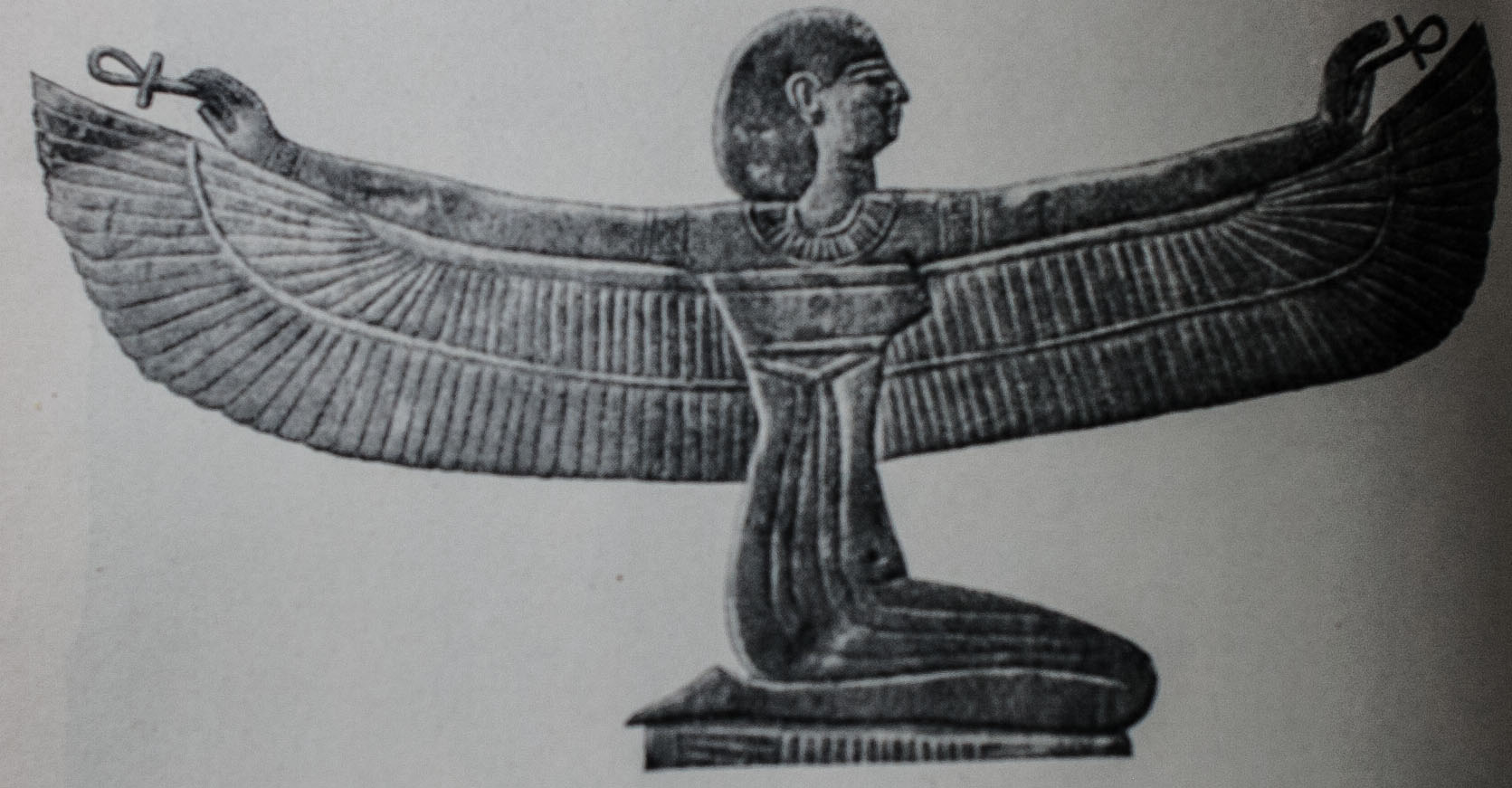
The Goddess Maat can be described as being the Animus of Thoth – Thoth having a wife called Seshat. Maat personifies the concepts of truth, justice, balance, order and Ma’at (the Divine laws) which prevent a return to chaos. To the Egyptian people Maat ruled good behaviour, morality and spiritual ideals. Her symbol is the black and white ostrich feather, which symbolizes duality.
1) OSIRIS
Osiris was husband and brother of Isis, and brother to Nepthys, Set and Horus. He has been called later Lord of the Afterworld and Father of Kings. Because of his legend, which was to do with death and resurrection, he became associated with the cycle of life and death, and with the annual inundation of the Nile. He represents the wise spiritual father, encouraging us on the path of order and self-discipline. Osiris was regarded as the son or earthly representative of Ra (God) just as Jesus was regarded son of Godfather.
2) ISIS
Isis (Eset, Aset) is the wife of Osiris, mother of Horus the Younger and Bast and sister of Nepthys and Set. Her name means “seat” or throne, and this is often pictured symbolically as a crown upon her head. Isis stands for love, magic, medicine and fierce feminine energy. Sothis (Sirius) was identified with Isis in many Egyptian texts Plutarch states that “The soul of Isis” is called Dog by the Greeks. There is also no coincidence that Isis is the Egyptian name for Astarte the major Phoenician goddess, equivalent of the Sumerian goddess Ishtar related to Venus.
During the first century A.D., Alexandria, Egypt was a veritable hotbed of mystical activity, a crucible in which, according to Holy Blood, Holy Grail, “Judaic, Mithraic, Zoroastrian, Pythagorean, Hermetic, and neo-Platonic doctrines in an amalgamation or syncretism. Although they worshiped a Black Madonna as the Holy Virgin, she has an altogether different connotation to Gnostic than it does to Christians. Legend connects this Black Madonna with both Isis and Magdalene.
3) Typhon – SET
Set is the brother of Isis, Osiris, Horus the elder and Nepthys and wife of Nepthys and father of Anubis and uncle to Horus the younger. He is the equivalent of the archetypal “prince of darkness” in the Egyptian belief system, although he was intensly worshiped exactly for this.
4) Arueris – HORUS the Elder
Horus the Elder (Heru) was the son of Nut and Atum.
Harpocrates – Horus the Child (Hor or Har) was a sky and solar god, son of Osiris and Isis, presumable pre-natal. He is known as the God of Joy and of Light, and his symbol is the hawk – master of the skies and protector of kings. Many people confuse him with his grandfather Horus the Elder.
5) Aphrodite – NEPTHYS
Nepthys was the sister of Isis, Set, Osiris and mother to Anubis and wife to Set. Nepthys wears the horns and solar disc, or may be shown with the vulture headdress. She is the guardian of all things hidden or concealed or not yet come into form; of dream and represents psychic receptivity. She is the other side of Isis – Isis representing light and generation, Nepthys representing dark and dissolution. Nepthys represents that which is invisible and the darkness, whilst Isis represents that which is visible and the light.
ANUBIS:
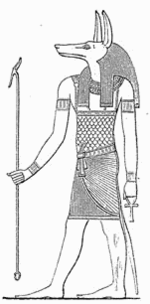
Son of Nepthys and Set (or possibly Osiris) and nephew to Isis. Anubis (also called Anpu, Inpu, or Imeut) is not to be mistaken with Wepwawet. Anubis is the jackal (wolf or dog) – headed God of the Underworld and of Embalming. He is the protector of the dead and overseer of the mummification process. Anubis sits on the boundaries of the living and of the dead.
Ancient Memphis
Pyramids of Giza
Pyramids of Sakkara
Pyramids of Dahshour
Pyramids of Abu sir
Pyamids of Mydoum
Pyramids of eleisht.html
Pyramids of Hawara.html
Pyamrids of Abu Rawash
Pyramids of EL Lahaoun
Pyramids of Hawara
Pyramid of Mazghuna
The Egyptian Museum
The Coptic Museum
The Castle of Saladin
The Old Market “Khan El-Khalili”
The Hanging Church
Santa BarbaraOld Islamic Cairo:
Sultan Hassan Mosque
Refai Mosque
Luxor
Luxor Temple
Karnak Temple
The Colossi Of Memnon
Valley Of The Kings
Temple of queen Hatshepsut
Temple Of Medinat Hapu of Ramses III
Valley Of The Queens
Valley Of The Nobles
Temple Of Dendera
temple of Esna
Temple Of AbydosCourt of Ramses II, which includes a shrine to Thutmose III
Mosque of Sufi Shaykh Yusuf Abu al-Hajjaj
Chapel of Alexander the Great
Alexandria
The Castle of Qaitbay
The Pompeii Pillar
The Catacombs of Kom El-Shouqafa
The Amphitheatre of Kom El-Dikka
The Montazah Palace Gardens
Sinai
The city of Sharm El-sheik
The city of Dahab
The City of Nuweiba
The City of Taba
Red Sea Coast
Monastery of St. Paul
Mostry of St. Anthony
Hurghada
Safaga,
Marsa Alam
Aswan
Temple at Philae, island ancients island surrounded with a dam and inside dry. The main temple is dedicated to Isis and was the center of the cult of Isis and Hathor from 370 BC. The temple was finally closed by the Emperor Justinian in 535AD.
Centre of the Nile Valley (Minya, Asyut and Sohag)
Beni Hassan in Minya
Monasteries of Asyut
Temple of Abydos in Sohag
Akhenaten’s city of Akhetaten at El- Amarna ( near Minya)
About prehistoric Calendar Basics not much is known, and even the old calendar of literate cultures can often only reconstructed incomplete. However, a comparison with various known types of calendars can historically classify calendars. This is a supplementary draft is an overview of the calender development in North Africa, Middle East (including Egypt and Mesopotamia), Persia, Asia Minor, Europe, India, China and Mesa-America from 3000 B.C. to 2000 A.D.
The history of time – Measurement and Calendars – is closely interconnected with the cultural and sociological state of the society. The development of the concept of time and of calendars is remarkably similar in all societies around the world, but remarkable different between hunter-gatherer societies and societies that have agriculture, political hierarchies, and class systems.
When human were gatherers and hunters the real and imaginary world was interchangeable and only present exists. There was no memorized past and empiric observed future, no regular events, therefore no need of calendars. Shamanism, humanity’s most ancient spiritual practice was the first magic to gain control over powers not understood essentially only living in the present. Shamans’ development involves a death-and-rebirth experience and the acquisition of spirit or animal allies that provide powers to heal, control but not predict future, assist in hunting, and engage in fights to harm others. Charismatic social leaders, shamans hold all-night ceremonies in which the entire community dances, drums, and chants. Shamans are not normally possessed by spirits; rather they control spirits.
On a side note, shamanistic practices disappeared under the onslaught of ritualized spirituality, feudalism, capitalism, communism. Today’s highly complex global world ironically travels in reverse, creates new ignorance, consumerism discards future and past and thus, emerging reinventions of shamanism of different pattern re-appear for example the masters of the monetary system and new charismatic leaders. Shamanism has been in a way also used for prophecy, to plan how to deal with the unknown by sensing and intuition.
Nature and weather calenders
When societies moved on to farming and raising animals, the need to understood weather and regular a events. A new class of woman and men was employed to manage past and future – priests, mediums and healers. Healers and mediums share many characteristics with shamans, but differ from shamans in some important ways. They are subordinated to the first religious practitioners called priests. Mediums are predominantly female but unlike shamans, mediums do not hold a high leadership role. Healers are almost exclusively male, and generally of high economic status and holding political power and generally work in collaboration with priests. As the society become complex with political hierarchies, with regular economic pattern and a need of writing and administration the priests class came up together with the first calendars. The simplest calendar is the nature and weather calendar with entirely on one count which divides the year into phenomena. For instance, in the Bay of Bengal is the year has been divided into : Dryness – South West monsoon – Southeast Monsoon – Northeast wind.
Direct observation calendars
A more challenging are the direct observation calendar. For them the months or year are determined by direct lunar and solar observation in the beginning by observing the moon. Any time you can specify how many days since the last appearance of the moon have passed , and when the next one appears. Observing the sun marks , special buildings and sticks were used determining the seasons and in particular the solstices. When a striking point was reached, with the moon usually the first light of the crescent moon, with the sun usually the shortest length of the shadow, the new month and or new year was proclaimed . The word calendar comes from the Latin calendae (to call out ) with the root word calare ( call ) the new moon. There were other direct observations (which led to calculated calendars) which were sidereal (position or rising position of stars) for instance Sirius or elliptic (position or rising position of planets) for instance Mars or Venus. The latter two obviously needs good astronomy conditions like in Mesa-America or Middle East.
Calculated Calendars
As societies became moved from matriarchy to patriarchy most moved from lunar calendars to solar calendars (pure solar, lunar-solar or solar-lunar). However the correlation may be more cultural and mythological. Anthropological female (and goodness) are often associated with the moon and lunar energies in many of the world’s myths, most Goddesses also have correlations with the moon, or phenomenon related to the moon such as ocean tides. Consider the connection between the movements of the moon and the menstrual cycle. As such these cultures tended to follow lunar cycles and build their calender around them, as such these societies had a tendency to value women, and their influences in culture and political discourse, as such they have lunar calendars because of associations of woman with the moon. However, a shift from lunar to solar is very evident in the Egypt culture in which the woman had an important role. You find the shift in the famous myth of Isis ans Osiris from 360 days to 365 days (see in part III).
There is no direct correlation as may be matriarchy without having a lunar calenders and currently rather patriarchal cultures and systems do have lunar calendars.Agricultural needs, trading, ritualized religion and administration created societies a complexity which clearly resulted in a initiative to move to a solar synchronized calendar, be it just for reasons of practicability.
There are six principle calendars in current use. These are the Gregorian, Jewish, Islamic, Indian, Chinese, and Julian Calendars. Six types of calendars replicate astronomical cycles according to fixed rules:
Pure lunar calendar which has no connection to the solar year and the seasons as the Islamic calendar. A true lunar calendar is synchronized with the exact time in which it takes the moon to fully orbit the earth and return to the same exact location in relation to the earth that it was at the beginning of the previous month. This is known as a Synod Orbit. A lunar calendar will very quickly shift with respect to a solar calendar.
Pure solar calendar as the ancient Egyptians can indicate the position of Earth on its revolution around the sun (and seasons) well — the time it takes for the Earth to return to the same place in its orbit of the Sun. A solar year has 365.242199 days. Solar calendars are based on the progression through seasons as the Earth revolves around the Sun, but neglect any attempt to keep the months synchronous with the lunar phases.
Lunisolar calendar used, for example, in Judaism with a leap month to synchronize to the solar year.Lunisolar calendars may be regarded as solar calendars, although their dates additionally indicate the moon phase. A lunisolar calendar year is made up of lunar months. They try to remain synchronous with both the solar year and the moon phases. Without adjustment the seasons will steadily drift through the months. Only a long-term synchronization between months and years is every 19 years possible (Meton equal to 235 lunar months), since a solar year does not contain an integral number of days or an integral number of lunar months. To compensate for this, many luni-solar calendars adjust the length of their years and months.
Solar-lunar calendar like our Gregorian calendar counts. This is actually a solar calendar, but has one reference to the lunar year for religious reasons (Easter).
Sidereal time calendars based on fixed stars or star patterns e.g. (Sirius Egypt, and Mayas Pleiades and Orion)
Calendars based on planets typically Venus (Mayan) or Mars.
All these calendars follow special rules that make them more or less exactly match the astronomical facts. Unfortunately, with the accuracy of the calendar increases the complexity of the switching rules. The peak of accuracy and therefore also on complexity form the astronomical calendar, based on astronomical formulas , such as the French Revolutionary calendar and the ancient Chinese calendar.
Pure lunar calendar which has no connection to the solar year and the seasons
Ancient Roman calendar until 450 BC – then replaced by lunisolar
Islamic Calendar
Pure solar calendar
Christian Church calendar : Liturgical Calendar ( Roman Catholic)
Ethiopian Calendar – Ethiopia in common
Greek Orthodox calendar
Julian Calendar – still only some Orthodox churches ( in the Altkalendariern ) and used in the Historical Sciences
Coptic calendar or Alexandrian calendar – used in the Coptic Orthodox Church
Berber calendar – used widely throughout North Africa (a consequence of the Julian calendar )
Juche calendar – used in North Korea
Modern Japanese calendar or Gengo Calendar – common in Japan
Soviet revolutionary calendar
French Revolutionary Calendar
Suriyakati Calendar – common in Thailand
Minguo calendar – in the Republic of China ( Taiwan ) are common
Armenian calendar
Aztec Calendar
Hindu solar calendar
Indian National Calendar or Saka calendar – in India partly in use
Iranian Calendar or Jalali calendar – used in Iran and Afghanistan
Mayan Calendar: Haab cycle – in Mexico and Guatemala partially in use
Sikh calendar or Nanakschahi calendar – in the religion of the Sikhs partially in use
Tamil Calendar
Zoroastrian Parsi calendar or calendar – in the Parsi religion common
Lunisolar calendar with a leap month
Attic Calendar
Babylonian lunar calendar
Bikram Sambat – in Nepal partially in use
Burmese calendar
Chantarakati Calendar – common for Buddhist festivals in Thailand
Chinese calendar – in China used to determine traditional festivals
Germanic calendar or Rune Calendar
Hindu lunisolar calendar
Japanese lunisolar – replaced by solar calendars
Jewish Calendar – common in Jewish societies and Israel
Celtic Calendar – Calendar of Coligny
Khmer calendar
Korean calendar
Solar-lunar calendar
Gregorian Calendar – the world’s most -used calendar (Solar adjusted to the moon for Easter)
Sidereal time calendars aligned on fixed stars or star patterns
Egyptian calendars, nature calendars with stellar alignment
Egyptian lunar calendar, hybrid of Stellar and Nature Calendar
Babylonian calendar , originally based Calendar stars , later replaced by lunisolar
Assyrian calendar as Babylonian calendar
Inca Calendar
Loango calendar – one based on lunar cycles calendar and Sirius at the West African nation of Loango
Calendars based on planets
Mayan Calendar: Tzolkin cycle 260 days of Venus
Our calendar is composed of the units day, week, month and year. With the exception of the week all other parts are based on astronomical basics. The smallest basic unit is the day. For the calendar of the mean solar day is crucial. The length of the day varies by about ± 15 min during the year and increases by 1.7 milliseconds per century . The month has its origins while in lunar orbit , but the months of our calendar have lost this regard since antiquity . Only the Easter (and Ramadan) calculation still depends on it. Phases of the moon are determining the calendar. This so-called synodic (from the Greek synodos = meeting ) with an average of 29.53059 days but large variation.
Of the four different astronomic years determines the tropical (from the Greek tropos = turn ) years the course of the seasons , and thus also to our calendar. The tropical year has a duration of 365.242199 days. The exact duration of the tropical year was for a long time unknown due to the lack of exact watches and the precession (the circular motion of Earth’s axis) through 25800 years. Since this moves the equinox in 1000 years at least 360 ° / 25800 * 1000 ~ 14 ° records of the ancient astronomers only of limited use. Anonther crucial problem for all calendars arises because the days are counted only with integers , while the orbital periods of sun and moon, planets or stars can be specified only inaccurate in whole days. As a solution , the only way to combine the fractions of a day over several years to whole days and capture it in the calendar by a long-term periodic switched single ” leap days ” or added five days (supplementary days). In order to ensure the predictability of the date in the past and in the future, this could not be done arbitrarily, but by a fixed rules – a mathematically formulated algorithm.
Calendars of ancient Times
Sumerian calendar
Sumerian culture, without prehistoric periods, spans from the 3rd millennia BC, ending with the downfall of the Third Dynasty of Ur around 2004 BC, followed by a transitional period of Amorite states before the rise of Babylonia in the 18th century BC. They were theocratic states, Kings were also Priests. Uruk was2700 BC the first major city in history ruled by King Gilgamesh. TheSumerian civil lunar year of 354 was divided a year into 12 lunar months of 29 or 30 days. Each month began with the sighting of a new moon. There occasionally a leap month to synchronize with the real (tropical year).
Besides many others, Sumerians (Chaldean actually) had an astronomical motivated calender, with 360 days as normal year equals with the 360 degrees of the epileptic divided by 12 sectors, we still use today. It could be connected to the Sumerian civil lunar year of 354 days. On a side note, the Mesopotamians used the first mathematical position system i.e, an sexgesimal arithmetic, which is method of comutation by 360 used in dividing a full circle and hours in minutes and seconds by sixty. 12 (Jupiter completing a full cycle through the epileptic), 7 (visible planets), 60 (Jupiter 5 and Saturn 2 full cycles, together 7 through the epileptic) where meaningful numbers. So was 6, a sacred number, which was used earlier to divide the year in six moths with 60 days. The 7 was used for the week. The Sumerians had the first star catalog with 66 stars which documented for 34 the heliacal rising of fixed stars measured accurate the year’s length. The Babylonians we owe the 12 / 24 hours and the Chaldean the 12 animal signs in the epileptic.
Egyptian calendar
The ancient Egyptians began numbering their years when the star Sirius rose at the same place as the Sun (4241 and 2773 BC). There was no leap year. This Egyptian civil calendar, base of the Roman Julian and today’s Gregorian calendar, was the first solar calendar known to use a year of 365 days, approximately equal to the tropical year. The Egyptians added 5 days to the schematic (astronomical) year of 30 x 12 = 360 days, the astronomical calendar used by the Sumerians from 2400 BC on.There was a simultaneously maintained lunar calendar in Egypt, the older of the two systems, consisted of twelve months whose duration differed according to the length of a full lunar cycle (normally 28 or 29 days). Each lunar month began with the first visible new moon. Since the lunar calendar was 10 or 11 days shorter than the solar year, a 13th month (called Thoth) was intercalated every several years to keep the lunar calendar in rough correspondence with the agricultural seasons and their feasts. New Year’s Day was signaled by the annual heliacal rising of the star Sothis (Sirius), when it could be observed on the eastern horizon just before dawn in midsummer; the timing of this observation would determine whether or not the intercalary month would be employed.
The names of the Eras
Epoch
Eras
JD = 0172598
Egyptian (Sothis)
JD = 1448638
Nabonassar(Ptolemae)
JD = 1603398
Alexander, Philipp
JD = 1724221
Christi (Ethiopian)
JD = 1825030
Diokletian, Martyr (Koptic)
JD = 1922868
Armeniian
JD = 1952036
Jazdagird, Altpersian
Armenian Calendar
The calendar is identical with the Egyptian calendar. However, it has its own era, beginning on July 11, 552 (JD = 1922868), and other month name.
Coptic Calendar
This calendar is derived from the Egyptian. He used the Julian switching and Easter calculation. Leap year if the year is divided by 4 the rest of 3 results. His era begins on 29 August 284 with the accession of Diocletian and is also called martyrs era..
Ethiopian Calendar
Derived from the Coptic calendar, it has just another era (August 29, 8, incarnation of Christ) and has its own month names.
The names of the months
Egypt
Armenian
Koptic
Ethiopian
1
Thoth
Nawasardi
Tût
Maskarem
2
Phaophi
Hori
Bâbeh
Tekemt
3
Hathyr
Sahmi
Hatûr
Hedar
4
Choiak
Trê
Kijhak
Tachsas
5
Tybi
Khalots
Tûbeh
Ter
6
Mechir
Araths
Amschîr
Jacatit
7
Phamenoth
Mehekani
Barmahât
Magabit
8
Pharmouthi
Areg
Barmûdeh
Mijazia
9
Pachon
Ahekani
Beschnes
Ginbot
10
Payni
Mareri
Baûneh
Sene
11
Epiphi
Margaths
Ebîb
Hamle
12
Mesori
Hrotiths
Misra
Nahasse
13
Epagomenen
aveleaths
ejâm-e-nesî
Pagomaen
Persian / Iranian calendar
New Year’s Day in modern Persian calendar is the day of the vernal equinox, when the entrance done (time zone + 3.5 hours) Tehran clock time before 12:00, otherwise one day after. The first six months have 31 days each, the next 5 months of 30 days. The 12th Month comes in the common year to 29 days and in the leap year at 30 days.
The names of the months
1
Farvadîn
Ancestors
2
Urdibihist
Supreme order
3
Hurdâd
Health
4
Tîr
Star Sirius
5
Murdâd
Immortality
6
Sahrîvar
Good governance
7
Mihr
God Mithras
8
Abân
Water
9
Adar
Fire
10
Dai
Demichurge
11
Bahman
God thinking
12
Isfand
Great Mother
The Gelálkalender
The calendar , named after the Grand Sultan Melik Shah Jelaleddin , was introduced by a calendar Commission , at the Omar Chaijám was involved. The circuit rules are handed down contradictory. The sources speak of :
6 * every 4 years and 1 * after 5 years.
7 * every 4 years and 1 * after 5 years.
8 * every 4 years and 1 * after 5 years.
The panel turn in a cycle of 62 years, 6 * 4 + 1 * 5 and 7 * 4 + 1 * 5 The year therefore has 365.2419355 days and achieved an accuracy of 1 day in 3795 years. Start is at the beginning of spring 3/15/1079 (JD = 2115236 ). The structure of the calendar follows the Jazdagird, the leap year has 6 additional days .
The Jazdagird Calendar
The calendar is set up like the old Egyptian calendar . 12 months of 30 days and 5 days without additional circuitry. The era begins on 16.6.632 (JD = 1952063 ) . The extra days were before the year 376 after the Aban (8th month ) and then inserted after the Isfandarmud (12th month). The era depends on the throne of the last Persian king Jezdegerd III . After two lost battles against Caliph Omar , he was 652 killed and no longer carried on the circuit of the ancient Persian calendar , from which this calendar was launched.
The Kurdish calendar
The Kurdish calendar follows the modern Persian calendar.
The names of the months
1
Adar
2
Nîsan
3
Gulan cewzerdan
4
Pûsper Hezîran
5
Tirmeh Temûz
6
Tebax – Kelavêj
7
Îlûn Rezber
8
Cotan Kewçêr
9
Mijdar Sermawez
10
Berfanber Çirya Rêsî
11
Rêbendan Çirya Pasî
12
Sibat Resemî
The Chinese Calendar
The official calendar in China since 1912 is the Gregorian calendar, which is a solar calendar. However, Tthe civil calendar in much of China is the Han calendar, which is a lunisolar calendar. It is used for selecting the day of a wedding or funeral, for opening a venture, or a relocation. Muslims living in northern China use the Islamic calendar, which is a mean moon lunar calendar, as their civil calendar. The civil calendar for Tibet is the Tibetan calendar, which is a lunisolar calendar. There are actually two Chinese calendars, a solar calendar and the han lunarsolar calendar. Both calendars depend on the times of certain astronomical events, such as dark moons and winter solstices. For at least several centuries (according to some scholars, since the 5th C. BCE) the times of these events have been ascertained not by observation but rather by calculation, so these calendars can be classified as calculated or rule-based.
The Han calendar is a lunisolar calendar, which indicates both the moon phases and the solar terms. In Han calendar, a year usually begins on the second dark moon after the winter solstice but occasionally on the third dark moon after the winter solstice.
Chinese calender uses such astromical events
A dark moon occurs when the Sun and the Moon are astronomically conjunct (or more exactly, when either the Moon’s center lies on the line joining the centers of the Earth and the Sun or the plane defined by the Sun, Earth and Moon is perpendicular to the Earth’s orbital plane). A dark moon describes the Moon during that time that it is invisible against the backdrop of the Sun in the sky. The duration of a dark moon is between 1.5 and 3.5 days, depending on the orientation of the Earth and Sun
The term “new moon” is not used here, since it is ambiguous. It can mean either a dark moon or the phase of the Moon when a crescent is first visible (in which sense a month in the Muslim calendar begins at new moon). Originally “new moon” referred to the crescent on the first night it is visible, one or two days after conjunction. Maritime records from the nineteenth century distinguish the dark moon (no moon) from the new moon.
A lunation is a passage of the Moon from one dark moon to the next. A lunation begins at the dark moon (astronomical conjunction of Sun and Moon), and the next dark moon marks the beginning of the next lunation.
An equinox occurs when the angle formed at the Earth’s center between its axis of rotation and the line joining the Earth to the Sun is a right angle. At such a point in the Earth’s orbit the length of day and night is almost equal (but not exactly equal, due to atmospheric refraction of the Sun’s rays near the horizon and the practice of measuring the start and end of the day from the first or last appearance of the Sun). The northern vernal equinox occurs around March 20th of each year, and the northern autumnal equinox occurs around September 21st.
A solstice occurs when this angle reaches a maximum or a minimum. At such a point the duration of the day and the night is either longest or shortest. The northern winter solstice occurs around December 21st of each year, and the northern summer solstice occurs around June 21st.
The Chinese Solar Calendar
The Chinese solar calendar consists of a sequence of solar years which are not divided into months but rather into 24 periods which begin at the “solar terms” (see below). The Chinese lunar calendar consists of a sequence of lunar years which are divided into 12 or 13 lunar months. A solar year begins at the (northern) winter solstice, which is on or around December 22 in the Common Era Calendar. A lunar month begins on the day of a dark moon. The beginning of a lunar year (i.e, lunar new year’s day) is more difficult to define (but see below); it always begins from about January 20th to about February 20th, i.e., about a month or so after the start of the Chinese solar year.
The Chinese Calendar uses cycles of sixty years. A year within a cycle is designated by a combination of an element name (e.g., “Water”) and an animal name (e.g. “Serpent”):
Wood Fire Earth Metal Water
Rat Ox Tiger Rabbit Dragon Snake Horse Sheep Monkey Chicken Dog Pig
For the order in which the various element-animal-designated years occur within a cycle of sixty years (Wood-Rat, Wood-Ox, Fire-Tiger, …) see Interconverting Chinese and Western Years.
A Chinese year is uniquely determined by an element name, an animal name and a cycle number, e.g., the Water-Dragon year in the 21st cycle.
Since the years of the Chinese Calendar run concurrently with the years of the Common Era Calendar (although they do not overlap exactly) each year at a certain position in a certain cycle in the Chinese Calendar can be uniquely associated with a year in the Common Era Calendar provided that one such correlation is known. Actually two such correlations are used by different scholars: The first year in the first cycle is correlated either with -2696 CE (i.e., 2697 BC) or with -2636 CE (i.e., 2637 BC). 2004 is a Wood-Monkey year in Cycle 79 (according to the first correlation) or in Cycle 78 (according to the second)
The Chinese Calendar assumes a prime meridian of 120 degrees East (120°E). This means that a day (or rather, a nychthemeron, a day and a night) is taken to run from midnight Beijing standard time (BST = CCT = GMT+8) to the next midnight BST. This is in contrast to the Common Era Calendar, where a nychthemeron runs from midnight Greenwich Mean Time (GMT) to the next midnight GMT. The time difference between Beijing and London is eight hours, so nychthemerons (or nychthemera) in the Chinese Calendar begin eight hours earlier than nychthemerons in the Common Era Calendar
The Chinese solar year always begins at the winter solstice. It may be thought of either (i) as running from the exact moment of a winter solstice to the exact moment of the next winter solstice or (ii) as running from midnight (Beijing time) at the start of the day during which the winter solstice occurs to the midnight (Beijing time) of the start of the day during which the next winter solstice occurs. We could call these “astronomical” and “calendrical” solar years.
The astronomical solar year is divided into 24 periods. The times of the start and end of these are called “solar terms”. These are denoted by the symbols J1, Z1, J2, Z2, …, J12, Z12. The two (northern) solstices and the two equinoxes coincide with four of these solar terms, as follows:
vernal equinox (VE) Z2
summer solstice (SS) Z5
autumnal equinox (AE) Z8
winter solstice (WS) Z11
The Z’s and J’s
The other eight Z’s (the “major solar terms”, also known as “zhong qi”)) occur at equal (or nearly equal) intervals between these four Z’s. The major solar terms thus are like the hour numbers on a clock face, with the vernal equinox at 2 o’clock, etc. (and the minor solar terms, the J’s, marking the half-hours).
There are two variations on the Chinese solar calendar. It used to be defined so that the period from each solar term to the next was exactly 1/24th of an astronomical solar year, i.e., approximately 15.22 days. This is called the “Mean Sun” variation.
Revised Solar Calendar
In the 17th Century Chinese calendricists adopted calculations based on the true motions of the Earth and Sun, and in this variation of the solar calendar each solar term consists of the time required for the Earth to move exactly fifteen (= 360/24) degrees in its orbit (starting from a solstice or an equinox). This is called the “True Sun” variation. Since the Earth moves at slightly different speeds at different places in its orbit (it moves slightly faster when it is closer to the Sun) this implies that in the True Sun variation the period from one solar term to the next is not always the same.
Strictly speaking, solar terms are points in time, namely, the times at which the Sun (as seen from the Earth to be travelling along the ecliptic) reaches 0°, 15°, 45°, …, measured from a solstice or an equinox. A solar term may also be understood as a period of time, namely, the period between two such solar terms. We can thus say that (in this sense) the solar year is divided into 24 solar terms.
Although there are 12 pairs of adjacent solar terms, a pair of solar terms cannot be regarded as a ‘month’. The solar year is divisible into solar terms, but not into months. An attempt to do so (as is done in Wikipedia) flounders on the astronomical facts underlying why the lunar year sometimes has 12 months and sometimes has 13 months.
Just as “solar year” has two meanings, an astronomical and a calendrical, so a “solar term” may be thought of either (i) as running from the exact moment of a solar term as defined above to the exact moment of the next solar term (an “astronomical solar term”) or (ii) as running from midnight (Beijing time) at the start of the day during which the solar term (in the first sense occurs) to the midnight (Beijing time) of the start of the day during which the next solar term occurs (a “calendrical solar term”).
The day on which a calendrical solar term begins in the Chinese solar calendar is the day in which the astronomical solar term occurs. E.g., if a winter solstice occurs at 23:03 then the calendrical solar term Z2 begins at midnight (Beijing time) at the start of that day.
The 24 calendrical solar terms in a calendrical solar year are numbered 1 – 24 (1 = Z11, 2 = J12, 3 = Z12, 4 = J1, 5 = Z1, and so on). Within a calendrical solar term the days are numbered 1, 2, … Thus a date in the solar calendar may be represented by a quadruple of the form cycle-position-solarterm-day, where c-p-s-d denotes day d (1-16) of solar term s (1-24) of the year at position p (1-60) in cycle c. Thus a sequence of dates in the Chinese solar calendar looks like this:
As noted in the preceding section each position-in-cycle is associated with a unique element-animal combination, so, e.g., “1-59-24-14” can also be expressed as “The 14th day of the last solar term of the Water-Dog year in the 1st cycle.”
Dates in the Chinese solar calendar may be marked by CHS, as in “2-01-01-01 CHS”.
The Chinese Lunar Calendar
The definition of the lunar calendar depends on the definition of the solar calendar, but not vice-versa.
The first day of a lunar month begins at midnight (Beijing time) on the day in which the dark moon occurs. Thus a lunar month always runs from the day of the dark moon up to but not including the day of the next dark moon. It is thus tautologous (and hence true) to say that the dark moon always occurs on the first day of the lunar month.
This series of lunar months is partitioned into lunar years, which consist of either twelve or thirteen lunar months. Months are labelled with a numeral from “1” through “12” or (when a year contains a thirteenth month) with a numeral-plus-asterisk, e.g., “9*”.
The way the series of lunar months is partitioned into lunar years is as follows:
A nian is the period of a whole number of lunar months making up a lunar year, beginning with month “1”. A nian consists of 12 or 13 months. A related concept is a sui, which is a period of a whole number of lunar months such that the first month of the period contains the winter solstice. A sui also consists either of 12 or 13 lunar months. A sui largely overlaps the solar year, but can begin up to nearly a month before the solar year begins (when the winter solstice occurs close to the end of the first month of the sui).
Consider the series of lunar months partitioned into suis. Consider a particular sui. If it has twelve months then the months are to be numbered “11”, “12”, “1”, “2”, …, “10”. The third month will thus be the first month of the nian which largely overlaps this sui.
Suppose, on the other hand, that there are thirteen months in the sui. A sui can contain only twelve major solar terms (the Z’s, or zhong qi’s, described above), so at least one of the months does not contain a major solar term. The first month which does not contain a major solar term is distinguished as a “leap” month (a.k.a. an “intercalary” month). The first month in the sui cannot be a leap month because it contains the solar term Z11. The twelve non-leap months are numbered “11”, “12”, “1”, …, “10”. The leap month has the same number as its preceding month. Leap months are distinguished by an asterisk or a plus sign, so that, e.g., month “4” may be followed by leap month “4*” (or “+4” or “4+”), which is followed by month “5”.
A date in the Chinese lunar calendar may be represented by a quadruple of the form cycle-position-month[*]-day, where c-p-m[*]-d denotes day d (1-30) of month s (1-12) — a leap month if this is s* — of the year at position p (1-60) in cycle c. Thus a sequence of dates in the Chinese lunar calendar looks like this:
As with solar dates the position-in-cycle number can be replaced by an element-animal combination.
Dates in the Chinese lunar calendar may be marked by CHL, as in “1-60-01-01 CHL”.
Overseas Chinese number years sequentially, as in the Gregorian Calendar, with Chinese year 4709 corresponding to Gregorian year 2011. Thus the Overseas Chinese date “4709-07-13 CHL” denotes the same day as the cycle-position date “79-28-07-13 CHL”.
New Year’s Day in the Chinese Lunar Calendar can occur on any date in the Gregorian Calendar from January 21 to February 21 (though not all dates are equally likely).
New Year’s Day in the Gregorian Calendar always occurs about a week after the northern winter solstice, whereas on average New Year’s Day in the Chinese Calendar occurs approximately midway between that solstice and the northern vernal equinox.
A year in the Gregorian Calendar always has 12 months, whereas a year in the Chinese Calendar usually has 12 but in about one year in three it has 13 months.
A month in the Gregorian Calendar may have any number of days from 28 through 31. A month in the Chinese Calendar always has either 29 or 30 days.
A month in the Chinese Calendar always begins at the dark moon, and the full moon always occurs in mid-month. In the Gregorian Calendar the dark moon and full moon can occur at any time during a month.
Traditionally associated with (although not formally a part of) the Gregorian Calendar is a cycle of 7 days (“the week”). There is no such cycle in the Chinese Calendar; instead there are cycles of 60 days, 60 months and 60 years. Each day, month and year in the Chinese Calendar is traditionally associated with one of twelve animals and one of five elements. There is no such association in the Gregorian Calendar, although months are loosely connected with astrological signs of the zodiac (whose periods are offset from the months by about nine days). The Gregorian Calendar is rule-based, whereas the Chinese Calendar depends on exact calculation of the times of dark moons and solar terms (which must be done by calendrical experts using astronomical methods and data).
Mesoamerican systems
The Maya calendar is not the last known cycle calendar but the most accurate. The Maya were consummated astronomers and had at least 20 calendars, based on several astrological movements, but actually used tdree main calendars, a sacred year of 260 days, a vague year of 365 days and the long count. The calendars were based on the Mayans 5/20 double base positional system, similar to the Babylonian 10/60 system, but additionally using zero. They must have known the Earth Tropical Year = 365.24218408 days and Venus Orbital Period (Year) = 224.69526222 days. The Long Count of the Maya and is based on the cycles of the Pleiades. The cycle of the Pleiades uses 26,000 years, that the Sun orbiting Alcyone, the central star of the Pleiades, but is reflected in the calendar we are using by encompassing 260 days. Two kinds of empiric sidereal intervals of Mars were used, a long one (702 days) that included a retrograde loop and a short one that did not. The use of these intervals, which is indicated by the documents in the Dresden Codex, permitted the tracking of Mars across the zodiac and the relating of its movements to the terrestrial seasons and to the 260-day sacred calendar
The Tzolkin
The Tzolkin was a 260-day (20×13) Sacred Round, a ritual calendar, which was not divided by months but just a sequence of days. A day was represented by one of 20 names, each with an unique symbol, accompanied by a numbers from one to thirteen. As 20 and 13 (a prime number) have no common nominator, 260 combinations were possible, until a combination reoccurred and a new Tzolkin began. The naming of the days is done continuously to the model: 1 Imix, 2 Ik, 3 Akbal, …, 13 Ben, Ix 1, …, 8 Imix, … 2 Imix, … etc. It is so at a date after the residue class system of numbers 13 and 20 whose least common multiple of 260. Among the Aztecs, this calendar was held under the name tonalpohualli also use. The Aztec names and their meanings are listed in the range of four and five.
The calendar has a period of 260 days with 20 months each 13 days.
1
Imix
Earth
Cipactli
Alligator
2
Ik
Wind
Ehecatl
Wind
3
Akbal
Night
Calli
Hous
4
Kan
Mais
Cuetzpalin
Eidechse
5
Chiccan
Serpent
Coatl
Serpent
6
Cimi
Death
Miquitzli
Death
7
Manik
Deer
Mazatl
Deer
8
Lamat
Venus
Tochtli
Rabbit
9
Muluc
Water
Atl
Water
10
Oc
Dog
Itzcuintli
Dog
11
Chuen
Ape,Frog
Ozomatli
Ape
12
Eb
?
Malinalli
Gras
13
Ben
Corn Weat
Acatl
Corn
14
Ix
Jaguar
Ocelotl
Ozelot
15
Men
Eagle
Cuauhtli
Eagle
16
Cib
?
Cozcaquauhtli
Vulture
17
Caban
Earth
Ollin
Movement
18
Eznab
Fire
Tecpatl
Fire
19
Cauac
Storm cloud
Quiahuitl
Rain
20
Ahau
Master
Xochitl
Flower
The 13 days of the Tzolkin are probably derived from the gods below 13 days.
1
hun
x
Godness of the moon
2
ca
x
3
ox
x
God of Wind
4
can
x
God of Sun
5
ho
x
God of Wind Year end
6
uac
x
God of Rain
7
uuc
x
God of underworld
8
uaxac
x
God of corn
9
bolon
x
10
lahun
x
God of death
11
buluc
x
Fast
12
lahca
x
God of venus
13
oxlahun
x
God of numbers
The Mayan Haab and the Aztec Xihuitl
The Haab was the solar “civil” year with 365 days (similar to our modern calender and consisted of 18 months of 20 days each, adding an unlucky five-day period, or nineteenth month. The days were numbered from zero to nineteen. A combination of the Haaab and the Tzolkin resulted in 52 possible different Tzolkin days, which could occupy the first position of the Haab. The Mayans an the Actecs had a solar calendar with a constant length of 365 days; they have 18 months to 20 days each and 5 additional days. In the classical period, the day count of this calendar began with the Mayans with “0” zero. The Aztecs used this calendar also, their month names can be found in the two rows on the right. The month of the Haab and the Xihuitl are below.
1
Pop
Tlaxochimaco
2
Uo
Xocotlhuetzli
3
Zip
Ochpaniztli
4
Zotz
Teotleco
5
Tzec
Tepeilhuitl
6
Xul
Quecholli
7
Yaxkin
Panquetzaliztli
8
Mol
Atemoztli
9
Chen
Tititl
10
Yax
Izcalli
11
Zac
Atlcahualo
12
Ceh
Tlacaxpeualiztli
13
Mac
Tozoztontli
14
Kankin
Hueytozoztli
15
Muan
Toxcatl
16
Pax
Etzalcualiztli
17
Kayab
Tecuilhuitontli
18
Cumhu
Hueytechuilhuitl
19
Uayeb
Add. days
Nemontemi
Starts a new year in the Haab or in Xihuitl, the day of the Tzolkin or the tonalpohualli shows the annual name bearer, which is the name of the year. Among the Aztecs, the date was usually given with the date of tonalpohualli and the annual support. 1 Snake in 3 House (13 August 1521) states that the year of the Xihuitl with the date 3 House in tonalpohualli began (May 3, 1521). There are only four years each carrier possible in the Aztec calendar, these are pipe, flint, house and rabbits. Among the Mayas, the system of annual support was also used, but this is not the chronology clearly, obviously, the assignment shifted with time.
Early classic
Manik
Ik
Caban
Eb
Classic
Akbal
Etznab
Ben
Lamat
14 century
Cauac
Ix
Muluc
Kan
18. century
Chuen
Cimi
Imix
Cib
Aztec
Acatl
Tecpatl
Calli
Tochtli
The Tzolkin and Haab syncronization
Sheaf
Every 52 years the so called called Sheaf and synchronized the 52 solar calendar years with 73 forward advance of Venus. The 52 x 365.256363 Earth-Pleiades Cycle was susceptible to precession. This Galactic Alignment occurs only once every 26,000 years, but the ancient Maya pointed to it with their 2012 end-date of the cycle part the Long Count. This alignment occurs as a result of the precession of the equinoxes. Precession is caused by the earth wobbling very slowly on its axis and shifts the position of the equinoxes and solstices one degree every 71.5 years. Because the sun is one-half of a degree wide, it will take the December solstice sun 36 years to precess through the Galactic equator. The precise alignment of the solstice point (the precise center-point of the body of the sun as viewed from earth) with the Galactic equator was calculated to occur in 1998 (Jean Meeus, Mathematical Astronomy Morsels, 1997). Thus, the Galactic Alignment “zone” is 1998 +/- 18 years = 1980 – 2016. This is “era-2012.” According to some, the special version of the Mayan Long Count (called Katun) End Date (13.0.0.0.0 – 13x20x20x18x20 or 1 872 000 days) represents the rare alignment of the Winter Solstice Sun crossing through the Galactic Equator along the dark band of stars at the center of the Milky Way Galaxy, and the Ecliptic (the path of the Sun) that will occur exactly 11:11 AM Greenwich Mean Time.
The Long Count
As a date was only unique in a 52 year period the Mayan but not the Aztec) introduced the perodic Long Count with its zero date (4 Ahau, 8 Cumhu according to Morely in Tzolkin/Haab notation) preceding their earliest record by up to 3440 years (first record 8.14.3.1.12). Those main calendar, the Tzolkin, the Haab and the Long Count can be seen was three parts, but are actually three separate calendars. This Long Count was used by the Mayans in the classical period. The Aztecs used only the Tzolkin called Tonalpohualli) and the Haab called Xihuitl. The Mayan Long Count Calendar was developed around 200 B.C.E. in Izapa, Mexico, using data calculated over hundreds of years. The era of the Long Count is controversial. E. Foerstemann worked out the initial long count 1887 from the Dresden codices, 1897 acknowledged by G.D. Goodman. Thirty years later, in 1927, eminent Maya scholar J. Eric Thompson revived Goodman’s work and tested it against astronomical data in hieroglyphic texts from the Maya Classic Period. Putting it all together in a 1937 land mark publication, Thompson proposed the GMT (Goodman Martinez Thompson) Correlation, also known as the 584283 correlation which received wide acceptance and corresponds to the zero point of the Aztec calendar. According to GMT, the last Mayan Long Count cycle began on August 11th, 3114 B.C and the target end date will be on December 21st, 2012 AD. So the Maya and Western calendars are correlated by using a Julian day number (JDN) of the starting date of the current creation – 13.0.0.0.0, 4 Ahau, 8 Cumhu . Using the GMT correlation, the current creation started on September 6, 3114 BC in the Julian Calendar or August 11 in the Gregorian calendar. The number 584283 is the number of days one has to count from Julian Day Number 0 to arrive at August 11, 3114 BC. The Julian Day Number System, not to be confused with the Julian Calendar, was established by Joseph Justus Scaliger in the 16th Century, specifically to correlate non-western calendar dates. In order to accommodate the most ancient calendars known at that time, he arbitrarily began the JDN count at Greenwich, at 12 o’clock noon, on January 1, 4713 B.C
The evidence for the GMT correlation is therfore historical, astronomical, and archaeological:
Historical: Calendar Round dates with a corresponding Julian date are recorded in Diego de Landa’s Relación de las cosas de Yucatán (written circa 1566), the Chronicle of Oxcutzkab and the books of Chilam Balam. Oxcutzkab and de Landa record a date that is a Tun ending in the Short Count.
Astronomical: Any correct correlation must match the astronomical content of classic inscriptions. The GMT correlation does an excellent job of matching the lunar data in the so called supplementary series. This Long Count is also compliant with the eclipse table of the Dresden Codex and the Venus table which records the heliacal risings of Venus by less than half a day difference.
Archaeological: Various items that can be associated with specific Long Count dates have been isotope dated.
The Long Count itself was assumed earlier by historians consisting of five parts, given the fifth order (Baktun) given initially the name cyle by researchers. There are also four rarely used higher-order periods above the Bakton as shown below. All these words are inventions of Mayanists.
20 Kins
= 1 Uinal or 20 days
18 Uinals
= 1 Tun or 360 days
20 Tuns
= 1 Katun or 7200 days
20 Katuns
= 1 Baktun or 144,000 days
20 Baktun
= 1 Pictun or 2,880,000 days
20 Pictuns
= 1 Calabtun 57,600,000 days
20 Calabtuns
= 1 Kinchilchtun 1,152,000,000 days
20 Kinchilchtuns
= 1 alautun 23,040,000,000 days
The Katun replaced at the end of the Classic Maya culture in northern Yucatan, the Long Count. Whenever an act of the value reached 00 and the katun was incremented by one, the day of the Tzolkin certain the name of the Katun. This results in a period of 20 results Kin * 18 * 20 Uinal days = 7200 days, depending Katun. The count itself is repeated after 13 Katun and thus has a cycle of 93,600 days, giving rise to the 2012 doomsday theory. The Long Count date not only includes the five digits of the main five digit Long Count, but the 2-character Tzolk’in and the two-character Haab’ dates as well. The five digit Long Count can therefore be confirmed with the other four characters (the “calendar round date”). According to creation accounts known to the K’iche’ Maya of the Colonial-era highlands, we are living in the fourth world. The Popol Vuh describes the first three creations that the gods failed in making and the creation of the successful fourth world where men were placed. The third creation ended on a Long Count of 12.19.19.17.19. the next (fifth) 12.19.19.17.19 occurred on December 20, 2012 (Gregorian Calendar).
The Greek Athenian calendar
The Greek Athenian calendar was a lunisolar calendar with 354 day years, consisting of twelve months of alternating length of 29 or 30 days known as the Metonic calendar. This calendar showed that 235 lunar months made up almost exactly 19 solar years. This 19-year cycle became known as the Metonic cycle.
A variant of the Greek calendar is the Attic Delphic Oktaeteris . In a cycle of 8 years , there are five normal years with 354 days each and three leap years of 384 days. Leap years are the 3rd, 5th and 8 Year cycle. The leap month is inserted in the middle of the year and has the name ” Poseidon II ” and the number 7 The months are divided into three decades. The last decade counting backwards. The year begins in the summer (July / August) , the solar year is assumed to be 365.25 days. Epoch is the Neulicht 19 July 264 BC . (JD = 1625179 ) . The calendar gives way after 8 years to 1.528409916 days from the astronomical lunar orbit from and to 0.062408 days from the orbit around the sun .
The Olypiads
In addition to the names of the archons and the Olypiads was expressed as total annual number in the Greek historians. As an example, the year ” Ol.695 , 1″ what 1 Year of 695 Olympics and corresponding falls in the year 2001/2002. The Olympics bill was introduced probably by the historian Timaeus of Tauromenion (around 350-255 BC . ) . First conversions can be found but already the Sicilian politician and historian Philistus .
The beginning of a new year is defined according to in retrospect by historians as the full moon of the first New Moon follows after the summer solstice. In the calendar of the Athenians would be the 14th Hekatombaion . The victory of Coroebus around the summer solstice 776 BC . considered the beginning epoch of the Olympics count.
The names of the months
1
Hekatombaion
30
8
Gamelion
30
2
Metageitnion
29
9
Anthesterion
29
3
Boedromion
30
10
Elaphebolion
30
4
Pyanopsion
29
11
Munichion
29
5
Maimakterion
30
12
Thargelion
30
6
Poseideon
29
13
Skirophorion
29
7
Poseideon II
30
The names of the days
histaménu
epì déka
phthínontos
1
numenía
hendekáte
-10
dekáte
2
deutéra
dodekáte
-9
enáte
3
tríte
tríte
-8
ogdóe
4
tetràs
tetràs
-7
hebdóme
5
pémpte
pémpte
-6
hékte
6
hékte
hékte
-5
pémpte
7
hebdóme
hebdóme
-4
tetràs
8
ogdóe
ogdóe
-3
tríte
9
enáte
enáte
-2
deutéra
10
dekáte
dekáte
-1
héne kaì néa
Deutera is counted only in a month with 30 days. If the month has 29 days jumping from Trite on HeNe kai Nea.
Roman Calendar
The Romans had originally with the old calendar an eight-day market week Nundinae. Over time, the market week was replaced by the seven-day planetary week (Hebdomas , septimana ), which after the Council of Nicaea (325 ) became the Judeo-Christian week. The calendar was calculated “from the founding of the city” of Rome, or ab urbe condita (AUC 750 BC). This old Roman year had 304 days divided into 10 months, beginning one the 21 April with extra months as stop-gaps.
The Julian calendar
The internal structure of the Julian calendar is derived from the ancient Roman lunisolar calendar. This began with the month martius and ended with the februarius. The Julian calendar consisted of cycles of three 365-day years (January until 31 December) followed by a 366-day leap year. Augustus introduced the concept of the “leap year” and that Julian calendar.
In the 6th century, a Christian monk Dionysius Exiguus devised the Anno Domini system, dating from the Incarnation of Jesus. It was used until until 1582 in Europe although rival calendar to Anno Domini remained in use in Christian Europe
Start of the year
New Year
Used at/in
1. January
Rome and Julian Calendar
1. March
Early christians
25. March
England, Florence in Medieval age
Eastersunday
France and Cologne medieval age
1. September
Byzantine and Russia
25. December
Germany until 16.Jh.
The names of the eras (creation date)
Epoch
Era
JD = -458510
Antioch
JD = -290495
Byzantine
JD = -284654
Alexandrina
JD = 0
Julian
JD = 1438171
Olympiic
JD = 1446501
ab urbe condita
JD = 1607739
Seleucid
JD = 1707544
Aszophar
JD = 1721424
Christian
JD = 1825030
Diocletian, Martyr
Named after Julius Caesar was introduced in the year 45 BC after he came back from Cleopatra. It has been scientifically supported by an Egyptian named Sosigenes . The calendar was a pure, solar calendar, derived from the Egyptian calendar with a length of 365 days in general and 366 days in a leap year inserted every 4 years. The beginning of the year was moved from March to January . The official beginning of spring was laid on the 25th March , although it astronomically occurred at the 23rd. They had measured imprecisely in the determination. The internal structure of the Julian calendar is derived from the former Roman lunisolar calendar (which became a mess). The month are preserved until today counting names of months of September ( 7) to December ( 10). Leap ( bissexto ) in the Julian calendar was the 25th February (actually extended to February 24 to 48 hours). This was in addition to religious reasons, probably the leap month of the old calendar which every two years, has been added. This was done alternately on 23 and 24 February . The month Quinctilis was renamed 44 BC in honor of the Caesar Julius and the Sextilis in honor of Augustus. Whether the latter cost February one day so that Augustus had not less days than Julius is controversial.
As of 1582 , the Julian calendar was gradually replaced by the Gregorian calendar. Today, you can still use it in the Orthodox Church and historic times (and astronomy)
Christian Calenders
Although the early church held on to 1st January as a fixed beginning and New Year the Council of Tours ( 576 ) as changed that as antiquus error. This still lives in the Coptic calendar. During the Middle Ages , the Christian era, the rule that leap years rule whose annual figures divided by 4 result as remainder is 0. In the late Middle Ages began the first January to be recognized again recognized (1691) in papal bulls . Nevertheless, additionally to the 1 January, the church year begins on 1 Advent.
In principle, one should not overestimate the broad impact of the historical calendar and therefore also that of the Julian calendar .
For both Christians and Jews, the prime historical date was the Year of Creation, or Annus Mundi.
Th Byzantine Church fixed the date of Creation at 5509 BC.which remained until modern times.
The Coptic Church fixed on 5500 BC.
The Church of England preferred 3761 BC as the date of creation,which forms the basis of the modern Jewish calendar.
The Easter calculation (computus paschalis ) based its historical roots lie on a lunar calendar in the Babylonian calendar. This was the model of the Jewish lunisolar calendar, which directed the date of Passover. Celebrating Easter in turn depends indirectly on Passover, even though it after a decree of Pope Victor I (reigned about 189-198 / 199) it was not allowed to coincide with Passover, The first Ecumenical Council , held in Emperor Constantine in the Summer Palace in Nicaea wanted to unify the date of Easter. After the feast of Easter should not be celebrated before the Passover and on a Sunday. Preparations for the Passover begin on 14 Nisan in the Jewish calendar , the date of the vernal full moon. Hence the rule:
Easter should be celebrated on that Sunday , the first follows on the full moon of spring . Does the full moon with a Sunday together , as Easter is to celebrate until the following Sunday.
To publicize the date of Easter time , unlike the Jewish calendar based on direct observation the Christian Easter was calculated it in advance. There were to be several calculation methods the Roman and the Alexandrian. The Roman method retained the historic beginning of spring on 25 March in and calculated the phase of the moon in a cycle of 84 years the Alexandrian Computus with the (correct) 21 March and a nineteen -year cycle which was more accurate. The calculation was laid based on an average lunar orbit and designed as with an background lunar calendar t0 the Julian year. The nineteen- year lunar cycle , also called meton cycle was already known to the Babylonians and base of their calendar. It describes fact that the phases of the moon fall into its expiry after 19 years relatively accurate to the same dates in a solar year .
Since an orbit of the moon takes 29.53059 days to complete and a solar year lasts 365.242199 days , requires the moon 365.242199 / 29.53059 = 12.36826623 rounds for a year. A lunar year lasts 29.53059 * 12 = 354.36708 days . The moon is so every year around 365.242199 to 354.36708 = 10.875119 days older. There are for the Julian calendar, according to 365.25 to 354.36708 = 10.88292 days . To determine the age of the moon at the beginning of each year in the cycle, only this difference needs to multiplied by the corresponding year.
However the Julian lunar caledar hat some flaws. The monthly length is a 6939.75 / 235 = 29.53085106 days . The lunar month is thus an average of 29.53085106-29.53059 = 0.00026106 days too long. In 19 years, the 235 * 0.00026106 = 0.0613491 days or per Julian year = 0.0613491 / 19 = 0.0032289 days . This results in an error of one day in 1 / 0.0032289 = 309.7029948 years.
Also, the Julian solar year is inaccurate. Average has such a year (365 * 3 + 366) / 4 = 365.25 days . The solar year is 365.242199 days , however, with around 365.25 to 365.242199 = 0.007801 days shorter. Add 1 / 0.007801 = 128.1886938 years adds up the errors to a day.
When Nicholas Copernicus presented in 1514 with his book Commentariolus his heliocentric worldview, he was asked by the church immediately for proposals of an calendar reform . He refused. Pope Gregory XIII (1502 – 1585) then put a calendar Commission and reformed on 02.24.1582 with the Bull Inter gravissimas the calendar. The reform was based on the font Compendium novae rationis restituendi calendarium of the physician and astronomer Aloysius Lilius (actually Luigi Lilio 1510-1576 ) and the Jesuit astronomer Christoph Clavius:
Easter should come back to the astronomically determined by the Council of Nicaea place .
The beginning of spring should be back on the set of the Alexandrian Computisten 21 March fall .
The mean tropical year should be taken as closely as possible in the rules.
The existence of the old calendar should remain possible get .
To do justice to the switching rules of the solar year were extended as follows :
A year whose year number without a remainder is divisible by 4 is a leap year.
The leap year falls out when the year is divisible by 100 without remainder is .
If the year without a remainder is divisible by 400 , the year also by Rule 2 is a leap year .
The Gregorian reform had adapted the outer structure of the calendar with three simple switching rules fairly accurate to the sun’s path. The other hand, the internal structure of the calendar, still drags the ballast of the Roman lunisolar calendar. In 1923, therefore, considered the League of Nations 185 calendar proposals of different radicalism but all these attempts ended 1954 with proposals to the UN but did not materialize. Just the begin of the week was changed from Sunday to Monday by the European Union in essences an pagan and history-ignorant bureaucracy.
The Jewish Calendar
The switching rules and adjournments of the Jewish calendar lead to six different lengths of years . One year may be deficient in common or surplus and is either a joint or a leap year. The annual lengths are accordingly: 353 , 354, 355 and 383 , 384, 385 days . In 19 years 7 leap years of 13 months each are inserted according to the Metonzyklus .
The epoch of the calendar is JD = 347 998 ( the 7.10.3761 BC . ) , As era is considered the foundation of the world .
The molad
The year of the calendar is based on a monthly average length of 29 days, 12 hours and 793 khalakim , which corresponds to 29.5305941235 days. The beginning of the year is from the derived molad , the Jewish new moon determined . The first was on 29 molad Elul in 0 by 23 clock 11 minutes and 20 seconds ( CET) (5 clock and 204 parts of Jewish time).
The beginnings of the year
The civil year begins on 1 Tishri , as well as the Shmitah and the Joweljahr . In contrast, the religious year begins on 1 Nissan the month of the cyclical spring full moon and the Passover . The for determining traditional method of counting the months indicated in the table below in parentheses. In addition , there is the New Year for Trees 15 Shevat and the calculation of the tithes from the cattle on 1 Elul . The counting of the years following the civil calendar and replaced on 1 Tishri .
The names of the months
1
(7)
Tischri
30
2
(8)
Marcheschwan
29 or 30
3
(9)
Kislev
30, or 29
4
(10)
Tebet
29
5
(11)
Schwat
30
6
(12)
Adar
29, or 30
7
(13)
Veadar
29
8
(1)
Nissan
30
9
(2)
Ijahr
30
10
(3)
Siwan
30
11
(4)
Tammus
29
12
(5)
Aw
30
13
(6)
Elul
29
For religious reasons, the beginning of the new year is often postponed or adjourned.
The Chinese Calendar
The calendar is astronomically defined what a historical dating more difficult because the calendar is not based on reproducible rules, but , on partly erroneous , tables. Because of the consequent variations of the calendar of astronomical events of the calendar often had to be adjusted . Thus, the Chinese calendar look back until today to more than 50 reforms. The epoch begins at 8.3 in 2637 BC . in the 61st Year of the Emperor Hoang -ti .
The day begins at midnight.
The months are numbered from 1 to 12. ( Beginning of year = # 1 )
The month begins at the day of the astronomical new moon in Beijing. (Length = -116 ° 24 ‘ , latitude 39 ° 56’ time zone + 8 hours , before 1929 the Beijing local time + 7 hrs 46 min)
The month of sweeps over the beginning of winter , always assigned the number 11
Lying between two winter beginnings 13 new moons , a leap month is inserted.
Leap month is the first month between the two winter starts, which is within a divisible by 30 solar position. The leap month is assigned the number of the previous month with the addition of tan .
Examples:
On 21 March 2004 in Beijing new moon, when the Sun ‘ is at 0 ° 39 . The next new moon the sun is at 29 ° 49 ‘ , it is a 29 -day intercalary month inserted.
On 23 July 2017 , the sun is at 120 ° 44 ‘, 30 days later, on 22 August at 148 ° 53 ‘ , which is a leap month of 30 days conditionally .
The calendar consists of one cycle sixties for the day and the year. They are based on the numbers 10 and 12 is the least common multiple of 60 . Each number is assigned a name , so that each day and each year has a double name .
example:
the ” 1.5.40.76 ” (27 May 1903) is , therefore, 1 Day on the 5th Month on the 40th Year of the 76th Cycle lake. The day is named ” timber – Hare ” , the year is called ” source – Hare ” .
The names of the years
1
Rat
7
Horse
2
Ox
8
Sheep
3
Tiger
9
Monkey
4
Rabbit
10
Rooster
5
Dragon
11
Do
6
Serpent
12
Pig
The Chinese year is divided into 24 parts corresponding to the astronomical position of the sun in steps of 15 °. The organization calls itself tSIE-k’i. Where tSIE for the odd numbers and k’i stands for the even numbers.
Seasons
315°
1
tsie
li-tsch’ün
Begin of Spring
330°
2
k’i
yü-schui
Rainwater
345°
3
tsie
king-tschi
Time of worms
0°
4
k’i
tsch’ün-fen
Spring – solstice
15°
5
tsie
ts’ing-ming
Pure clarity
30°
6
k’i
ku-yü
Fertile rain
45°
7
tsie
li-hia
Begin of summer
60°
8
k’i
siao-man
Small fertility
75°
9
tsie
mang-tschung
Wheat storage
90°
10
k’i
hia-tschi
Summer solstice
105°
11
tsie
siao-schu
Small heat
120°
12
k’i
ta-schu
Big heat
135°
13
tsie
li-ts’ieu
Begin of fall
150°
14
k’i
tsch’u-schu
End of heat
165°
15
tsie
pe-lu
Weißer Tau
180°
16
k’i
ts’ieu-fen
Fall- Equinoctial
195°
17
tsie
han-lu
Cold dew
210°
18
k’i
schuang-kiang
Freeze
225°
19
tsie
li-tung
Start of Winter
240°
20
k’i
siao-süe
Small Snow
255°
21
tsie
ta-süe
Big Snow
270°
22
k’i
tung-tschi
Winter solistice
285°
23
tsie
suiao-han
Small cold
300°
24
k’i
ta-han
Great cold
The French Revolutionary Calendar
The French Revolutionary calendar was from 24/11/1793 to 12/31/1805 in use. His era will begin on 22 September 1792 , the first day of the French Republic. Thus began the first Years of the Republican era. On this day also the autumnal equinox in Paris, which was henceforth regarded as the year fell . The calendar follows in its construction to the Coptic ( Egyptian ) calendar with 12 months of 30 days each and 5, in leap year 6 additional days. The names of the months were directed only to agriculture in the French heartland. The annual figures were given in Roman notation.
An outlook
Later was also , at the suggestion of the astronomer Jean Baptiste Joseph Delambre’s out of planned Gilbert Romme a departure from the astronomical defined circuit . But should an extended firing rule of the Gregorian calendar , introduced by the failure of a leap day every 4000 years. For this revision , however no longer came . Before them decency in the Convention for discussion Romme was arrested and committed suicide. Later attempts failed due to the negative attitude of the Convention.
The names of days and months
The month was divided into three decades with 10 days , the days were numbered were: Primedi , Duodi , Tridi , Quartidi , Quintidi , Sextidi , Septidi , Octidi , Nonodi and Decadi . In practice, however, by days were counted 1-30 . As a rest day and day of public holidays (decade festivals) the Decadi was used. In addition, still got each day in its own name. These were the names of animals , plants, minerals or agricultural equipment . The naming of days and months was elaborated by Philippe -François- Nazaire Fabre . He wanted to bring his naming the people the basics of agriculture close . Four consecutive years ( three normal and leap years ) were referred to as Franciade .
The names of the months
Fall:
Vendémaire
wine
(Herbsterich)
Brumaire
fog
(Dunsterich)
Frimaire
dew
(Frostmonat, Frosterich)
Winter:
Nivôse
snow
(Schneeulf)
Pluviôse
rain
(Regenulf)
Ventôse
wind
(Windulf)
Sping:
Germinal
seed
(Keimbar)
Floréal
blossom
(Blühbar)
Prairial
grass
(Grasbar)
Summer:
Messidor
harvest
(Erntegieberich)
Thermidor
heat
(Hitzgieberich)
Fructidor
fruit
(Fruchtmonat, Früchtegieberich)
Jours complémentaires, Sansculottides, Epagomenen
The Illuminati and Illuminati Calendar
Well, there was also a calendar of my home state Bavaria. The calendar of the Bavarian Illuminati order is based on the writings in-house visitation of the government council Zwack on 11 and 10.12.1786 were found. The calendar starts on 21 March. The first month of the year has 41 days, the last 20 The length of the remaining months are based on the regular calendar, but have different names. For the year must be deducted from the normal 630 years.
The names of the months
1
Pharavardim
2
Adarphahascht
3
Chardad
4
Tirmeh
5
Merdedmeh
6
Schaharimeh
7
Meharmeh
8
Abenmeh
9
Adarmeh
10
Dimeh
11
Benmeh
12
Asphandar
It circulates in the Anglo-Saxon countries and has German names. It was designed by the novelist and anarchist Robert Anton Wilson. The year is divided into five parts with him, each 73 days. Each part has a specific name. The 29 February shall not be counted. The epoch of the calendar is 4000 BC.
The names of the months
1
Confusion
2
Animosity
3
Chaos
4
Bureaucracy
5
Grummet
The Islamic calendar
With a revelation in the second year of the Hegira , the Prophet Muhammad adopted a pure lunar calendar and lifted the old Arab moon – on the solar calendar . Especially so that the insertion of leap months was unnecessary. The calendar moves through the seasons so because it lacks 11 or 12 days a year.
The beginning of the month of the calendar was originally fixed on the basis of direct observation of the first crescent moon. This is true for the holidays and the beginning of Ramadan until today , being resorted to determine the month beginning also in part to astronomical calculations.
The history
The calendar itself was under Caliph Omar II (r. 634-644 ) established to allow a precise dating . There are two variants :
the civil calendar, which begins on 16.7.622 and
the astronomical calendar , with the 15.7.622 as the start date .
As one era put the emigration of Muhammad from Mecca to Medina , the Hijra , firm, which took place in September 622.
The calendar is based on a 30-year cycle in which 10 leap days are added . These are divided by 30 years the residues 2 , 5, 7 , 10, 13 , 15 or 16 , 18, 21 , 24 and 29 result . The remainder being 15, on astronomical , the rest 16 on the other hand for the civil year . Thus, deviations of up to two days between the two variants are possible .
The months are alternately recorded with 30 and 29 days. Their names , their transliteration from Arabic is very different, go back to the pre-Islamic calendar.
The names of the months
1
Moharrem
30
haram = holy
2
Safar
29
Unlucky month
3
Rebi-el-awwel
30
Rainy Season
4
Rebi-el-accher
29
5
Dschemadi-el-awwel
30
Cold Season
6
Dschemadi-el-accher
29
7
Radscheb
30
Month of Peace
8
Schaban
29
Start of robbery
9
Ramadan
30
Month of Fasting
10
Schewwal
29
break up
11
Dsu’l-kade
30
Dsu´l = holy Month
12
Dsu’l-hedsche
29/30
hadschdsch = pilgrim month
Bibliography
“The exact Science in Antiquity” O. Neugebauer, Dover Edition 1989
“Cosmos An illustrated History of Astronomy and Cosmology”. John North 2008
The history of time reflects culture – interconnecting temporal powers, religion and science. For millenniums priest were gatekeeper of time and calendar(s). Now scientists have taken over. Today we are able to contemplate beyond the creation of time, even beyond the big bang. I got the idea to this essay after I read a book, titled… you guessed it… “The Face of God” (Le Visage de Dieu) while I struggled writing a long article “The history of time” from a historical and religious view. After I read the book, I decided to break my monster article in pieces and introduce them with this essay. So this is the first of a series “History of Time” which explores concepts of time and calendars over the last 5000 years.
Most people today avoid the sacred dimension of time as a subject. They may fear past and future – and mortality. Perhaps they have never really thought through meaning of time. Einstein’s outspokenness on his religious attitude was rare. Today religion (and science) are attacked both by post-modern philosophers, “social scientists” claiming all truths are relative and by creationists claiming everything was created just by chance. Under these circumstances, there are good reasons why most scientists avoid all possibility of confusion with religion by never using terms suggestive of divinity. But the loss is that there is no way to understand: we are actually answering questions today whose had been asked by priests and philosophers before. What human action could be more sacred than that?
As we will there is a language of the sacred dimension of time and my essays (touching all major cultures) will follow a certain structure.
The sacred language of time
The worldly language of time
The history of time – Measurement and Calendars
The article gives the upcoming structure as interplay of science, anthropology and religion. Many thinkers nowadays see theistic arguments as just a quick, lazy, irrational short-cut, though of course this is not necessarily the case; there are many smart, thoughtful, careful thinkers who believe in God – not necessarily in religious institutions.
The face of God – cosmology meets meta-physics
We live in political depressing feudal new world order, however, physics today quite successfully attempts to answer metaphysical questions:
What shape has our universe and where are its borders?
Why is it so exactly fine tuned, like defined by an meta-order?
When and how was time and the world was created?
When and how will be destroyed or is it fluctuating?
What was before creation of time?
Cosmology became an empirical and exact science, and it has to be noted that some of its answers proof Church fathers as Augustine right.
The frontiers of contemporary time
Face of God. This is the furthest thing we can see.
Three scientists in 1948 suggested in the famous alpha-beta-gamma report (according to their initials) that billion years ago, the cosmic background radiation of the big bang spreading itself thin must have become low-energy microwaves far colder than ice, later identified at 2.73 degrees above absolute zero as smooth cosmic background radiation. Our universe, however is awfully lumpy, broken up into people, planets, stars, galaxies, clusters of galaxies, and giant walls of superclusters surrounding giant voids. People had been probing the cosmic background radiation for 30 years, but no one had detected any deviation from absolute smoothness until 1992 variations in temperature measured in millionths of a degree were detected. These minuscule differences show the ripples in spacetime, where matter first began to clump gravitationally about 10,000 years after the Big Bang. Radiation from regions of higher density expended more energy trying to escape a deeper gravitational well and therefore appeared slightly cooler than average were chartered in oval shaped eggs in shades of pink and blue decorate Smoot’s office, depicting the pattern of temperature fluctuations across the heavens. As bright and gay as enormous Easter eggs.
Time before time was created
We now can see back up to 380 000 years before the big bang which occurred 13.7 Billion years ago. We enter know metaphysics area. The universe was created from blue print of fine tuned informational pattern (logos the word) and well understood particle physics.
John 1:1
en Archêi ên ho Logos – in the beginning was the word; kai ho Logos ên pros ton Theon – and the word came to god; kai Theos ên ho Logos – God himself was the word
It is a challenge to translate the greek word logos correctly in a single contemporary word. Logos isderived fromlego,“say or speak” whose rootleg means “plan, collect“. Forthe Greeksspeaking was “give from an array ofwords” or the “combining the thoughts.”
We conclude today the universe(space) and time has been created 10-43 seconds after time 0 in a flash of light out of singularity but not ex-nihilo, like written in the Genesis. But where has been god – inside or outside of the universe? An what was he and what was before time?
Physics talks about the KMS-state in the whole universe and contemplates time was defined mathematically complex, oscillating between its real and imaginary component. Remember a complex number is a number that can be expressed in the form a + bi, where a and b are real numbers and i is the imaginary unit, which satisfies the equation i2 = −1.
So there there are three forms of time in cosmology:
Time connected with energy – our real physical time – mathematically an instance of an abstract object or with C.G. Jung an Archetype;
Time connect with information (imaginary energy) instead with real energy – frozen imaginary time – mathematically an abstract object or with C.G. Jung an archetype per-se;
The imaginary time is part of the complex time before the big bang and out of our physical scope – true meta-physical ;
Es werde Licht thus transforms logos i.e. information (imaginary energy) to real energy and imaginary time to real time – from divine patterns.
Divine patterns and theism
Theist as Richard Swinburne and Philip L. Quinn that the specific content of the scientifically most fundamental laws of nature, including the constants they contain, requires supra-scientific explanation or a reconciliation between science and religion. The old-fashioned point of view tend to disbelieve in any religious component to the workings of the universe. Materialism asserts that a complete description of nature consists of an understanding of the structures of which it is comprised together with the patterns which those structures follow, while theism insists on the need for a conscious God who somehow rises above those patterns. Materialist have put their hope to mechanical, evolutionary an biological models stayed shy of the big bang. Within this cosmology, there are two possible roads to reconciliation between science and religion. One is to claim that science and religion are not incompatible because they speak to completely distinct sets of questions, and hence never come into conflict. The other is to assert that thinking scientifically does not lead to rejection of theism, but in fact that religious questions can answered in a similar way than cosmology does.
The essence of materialism is to model the world as a formal system, which is both unambiguous and complete as a description of reality. A materialist model may be said to consist of four elements. First, we model the world as some formal (mathematical) structure. Second, this structure exhibits patterns (the ”laws of nature”). Third, we need boundary conditions which specify the specific realization of the pattern. Finally, we need a way to relate this formal system to the world we see: an ”interpretation.”
The reader might worry that we are glossing over very subtle and important issues in the philosophy of science; they would be correct, but needn’t worry. Philosophy of science becomes difficult when we attempt to describe the relationship of the formalism to the world (the interpretation), as well as how we invent and choose between theories. But the idea that we are trying, in principle, to model the world as a formal system is fairly uncontroversial.
The materialist thesis (before the big bang) was simply: that’s all there is to the world. With Freud it was you eat, copulate and died. Defining theism is more difficult and its subtlety has therefore been transferred to the task of defining ”God.” When I say that God I also have in mind the pantheistic god. In my view, neither cosmology nor theism is logically impossible, but a pure materialism alien to “home religious” as defined by C. G.Jung. This is most evident if we look at the history of time.
The sacred language of time
What is time
Two opposite concepts of time need to be introduced – the understanding of linear time (time has a beginning and and end – predominately in Western civilizations) contrary to revolving and cyclist time (predominately in Eastern civilizations). With linear calendars the question arises when time starts. Cultures differ have different ways of putting value at, organizing and using time.
When did the universe begin?
Time was either seen infinite beyond creation or a property of our world – i.e. created together with the world. Ancient myth, religions, humanistic philosophers like Kant and now contemporary science in particular cosmology, a fast growing discipline of astrophysics, converge at the latter thesis – at the language of sacred dimension of time.
How did the universe begin (Creation myth)?
Creation
Creation myths define how the Earth itself was created, along with the universe, heavens, hell, people, and creatures that exist today. Genesis of Christian mythology, for instance, tells the story of how the single deity God spoke and formed everything. The Genesis and the Book of the Dead of Egypt share the similar ideas of life and afterlife. Others, like the Japanese and Iroquois creation myths, claim the Earth was once covered entirely of water before land was formed. Through studies such as comparative mythology, researchers and philosophers have discovered hundreds of parallels between the myths that make up every culture, including their creation myths. As most are deeply rooted in religion, comparisons based on geographic area, themes, and similar story lines emerge as religions are born and merge. C.G. Jung recognized these similarities and states, It is possible to correlate creation myths of Zen-Buddhism and Christianity, Hinduism and Islam, Confucianism and Hinduism, and polytheistic Greek and Roman state religions. They compare the messianic religions: Christianity, Islam and Judaism; the enlightenment religions, including Buddhism, Hinduism, Sikhism, and Jainism; and the pantheistic religions, encompassing a large group of with Taoism, Confucianism, and Shinto. In all of them exists the basic idea of chaos before creation, and god(s) to form space and time and as such life. Another common element in some myths is a tree of life that connect connects the different realms of the universe together, often referred to as a axis mundi or cosmic channel.
One of the most notable comparisons exists between the Genesis of the Christian religion and the Enuma Elish of Babylonian descent a culture with an highly developed astronomy. Yaw-he or Marduk, are in both myths divine spirits that coexist independent with cosmic matter and are independent of it. In each, the universe is enveloped in darkness. Then light emanates from the gods of both creation myths.They create a firmament – just like today in modern cosmology. The creation myth formed by the Egyptians and that formed by the Chinese also share common aspects. The most popular Egyptian creation myth centers around life stemming from an cosmic egg. Different sources refer also to the solar disk in Egyptian, Nordic, Germanic, Greek & Vedic tradition,
As C.G. Jung noted, Archetypes an Symbols have been an integral element of the lives of all people through either non-spiritual or spiritual means. From what we consider the beginning of humanity to today, myths have been used to educate people why everything happens or how everything came into being. The comparison of myths has emerged as popular archetypes in C.G. Jungs writing. The creation myths, in particular, provide examples of borrowed symbols and common beliefs which persist throughout history. With these parallels, humanity can better understand earlier cultures and document how mythologies interrelate over time.
Natural and supernatural powers
Light and Darkness were first taken as granted like anything in nature. Duration created time and with it the observation of the stunning regularity of sun, moon and stars, which lead to the concept of future and past. Our understanding of time shapes our understanding of god, of creation and of the universe. Of course the opposite also is true.
Temporal powers
With time the primordial sin came to the world and who gained knowledge of time became priest, emperor and gods. In ancient times, the archetype of the magician or priest, the loving god, the king and the warrior typically were combined in the god-emperor. As we will see also temporal rulers (kings, pharaohs, popes or revolutionaries) always had control over worldly calenders and the priest over sacred (and secret) calendars.
Future and Past
With calendars, priest and rulers could not only organize the past, but also plan (and claim to predict) the future. It became possible to calculate the time between two events, to know sacred days or just to “measure in advance”, when the flooding of the Nile or the tax payment is due. That has been diverse and indispensable role from the early agricultural societies, trade industrialization up to the today’s complex global world.
What is after human life ends?
Human limited time, i.e. the painful knowledge of mortality led to the question of what might be after life, which was answered by religions with supernaturals (gods and spirits) as masters of time and for mortals paradise, hell, rebirth or nirvana or ancestor spirits.
How will the universe end
Christian belief tells us,that we lost immortality by eating the fruit of knowledge and that redemption of Jesus promises resurrection and living forever again.
The worldly (temporal) language of time
Time and Mankind
Sometimes during the last 2.5 million years, mankind became conscious of the I (Ego in an Jungian Sense). With this followed the consciousnesses of time, of “now and then”, of synchronicity and duration. This was the begin of subjective (individual) time and of course with the human memory came the past and flow of time.
Time and Language
The language transcended the limitation of the direct experience and opened the path to the future like a linear “time arrow”. With language came regularity, structure and abstraction. From “here and now” mankind went to the collective past (history) to individual and future (civilization).
Time and Culture
The modern time conception of Westerners is strong and they really cherish (their life-) time and ironically waste it with cheap distractions. In contemporary Europe, where more and more people have no children at all and to a high degree lost connection to any religion, time becomes predominantly subjective and abstract beyond their little life span. In a way Westerners became Rousseau’s innocent savages in there little consumer paradise (or hell).
So our concept of time also has to do what we think of our after-life.
Time and religion
Today we miss the wisdom of the spirituality. In Christianity there is chronos and kairos. Both are Greek words which mean time, but they imply different things. Chronos refers to minutes and seconds. It refers to time as a measurable resource. Kairos is the word used for time in Ephesians 5:16). kairos means an appointed time, an opportune moment, or a due season (like in Taoism the right moment to act).
Time and psychology
C.G. Jung had special understanding of time what he called “temporally coincident occurrences of acausal events” or “meaningful coincidence” and “acausal parallelism in which archetypes and the collective unconscious are governing a dynamic that underlies the whole of human experience and history — social, emotional, psychological, and spiritual.
Synchronicity does not admit causality in the analogy between terrestrial events and astrological constellations … What astrology can establish are the analogous events, but not that either series is the cause or the effect of the other. (For instance, the same constellation may at one time signify a catastrophe and at another time, in the same case, a cold in the head.) … In any case, astrology occupies a unique and special position among the intuitive methods… I have observed many cases where a well-defined psychological phase, or an analogous event, was accompanied by a transit (particularly when Saturn and Uranus were affected). – Carl G. Jung
Jung and the quantum physicist Pauli believed, events like this occur too often enough to be only meaningless coincidence. Jung noted taking as usual phenomenological stance, while it would be “absurd” to consider the conjunction of dream material and life events to be causal, “it is wise to consider the fact that [these coincidences] do happen…The East…considers coincidences as the reliable basis of the world rather than causality. Synchronism is the prejudice of the East; causality is the modern prejudice of the West.”
Oh yes, there was a fall, a great big one. The ancients, our forefathers and mothers, knew right away that something horrible had happened. This was the big bang, the creation of time, and the second mankind understanding of is. Thus Adam and Eve myth became like God. Nietzsche, who understood all this, said Christianity closed the door to mass nihilism and decay. To be healed by the words Good and Evil. Christ was the greatest poet who ever lived. He was murdered because he understood all this. Christ understood this and said so; the kingdom is here within us. This is the meaning of religion as o fpsychology is man’s attempt to free himself from linear time.
Time and Society
Even hunters and gathers (at least in a harsh climate) needed to be aware of time. The resulting calendars have been an integral part of different cultures. But even more farmers and traders. Warrior societies need less accurate time than farmers. The first Roman calendar became a mess before fixed by Julius Caesar (with a little help of the Egypt solar calendar). The great French philosopher Voltaire once quipped in hindsight: “The Romans emperors won all the battles but they did not know when”.
Time and economy
Since the beginning of mankind time comes from observation of nature. In any culture, however, the task of the calendar was not only limited to the counting of days. Each date should be assigned to the repeating pattern in nature. Without the ability to plan the time by days, weeks, months and years, agriculture, civil administration and a differentiated role based economies would have been impossible . Even today there are still new applications – especially with the financial and interest experts with perverse micro-trading.
Time and Mathematics
The Athenian law courts – according to Plato’s Apology – had water-clocks: if you couldn’t prove your case before the water-clock stopped dripping, you couldn’t prove your case. History, of course, has time-hooks. It can be said, however that the world of mathematics exists in an eternal present, a state in which neither the past nor the future have any meaning. Thus, because mathematics has no interest in the time dimension, there is also in mathematics no meaning to the question of reason. The area which mathematics does address is the clarification of relationships between various objects: how they connect with each other. This world, although dealing with relationships between stable and changing things, is entirely fundamental with the major dimensions of time – duration (present) and regularity of reoccurring events (past and future).
Time and Astronomy
Ever since man first noticed the regularity in the movement of the Sun and the stars, astronomers have wondered about duration and measured time by the Sun, the Moon and the Stars. As the sun moves across the sky, shadows change in direction and length. Calendar algorithms used natures repeating events the sun, month, moon phases and other astronomical information.They were commonplace, long before watches. Calendar algorithms also allowed the inclusion of sacred (or cursed days) and the number of days, although the week had nothing to do with the movement of the stars.
Time and Nature
The earliest natural events to be recognized were in the heavens, but during the course of the year there were many other events that indicated significant changes in the environment. Seasonal winds and rains, the flooding of rivers, the flowering of trees and plants, and the breeding cycles or migration of animals and birds, all led to natural divisions of the year, and further observation and local customs led to the recognition of the seasons.
Time and Science
What “cosmological results” suggest to some “divine inference”? Simply put: the anthropic principle, or more precisely, the fine tuning of the physical laws. In a nutshell – the fact that many/most of the fundamental properties of the universe, from the charge of the electron to the speed of light, and the total content and rate of expansion of the universe have values that could not have been even slightly different if life, intelligence, and consciousness, like humans and other such creatures, were to exist. Needless to say, many have concluded that something must behind such “fine tuning” like “cosmic code” or divine DNA.
Creation
I want to come back to the creation myths. In 1992 when astronomer George Smoot, the father of the COBE (Cosmic Background Explorer) satellite announced the discovery of patterns in the heat background radiation still arriving from the Big Bang, he said it was “like seeing the face of God.” He took a lot of secular sneering for this remark from colleagues.
The quantum theory was spiritually unacceptable to Einstein as its ultimate nature of reality was randomness. “The [quantum] theory yields much,” he wrote to quantum physicist Max Born in 1926, “but it hardly brings us close to the secrets of the Ancient One. In any case, I am convinced that God does not play dice.” And he was right, today we now that the creation of our universe follows regular pattern and some physical constants must have a certain value – or we would not exists. Independent formulated theories by Alan Guth (MIT) and before by Russian physicist Andrei Linde, holds that the universe began in the expanding fireball of the big bang and then inflated.Quantum fluctuations-hot, spots-arose.The discovery of the microwave whisper, by Arno Penzias and Robert Wilson of AT&T’s Bell Labs in 1964, just about proved that the universe began in a big bang. Hawkins today agrees with church father Augustine the time and space, the world was created together with time in a flash of light. Trouble was, the microwave sea seemed 1964 incredibly smooth. If energy and matter are spread across the heavens so evenly, how could particles ever have clumped together into galaxies? COBE saw almost undetectable temperature fluctuations.
1992 astrophysicist George Smoot of the Lawrence Berkeley Laboratory announced that they had discovered those primordial wrinkles, floating at the very beginning of time. Wispy tendrils, up to 59 billion trillion miles across, are the most gigantic and the most ancient structures ever seen.
Sacred dimensions
Creation myths, from Egypt to the Old Testament’s six days of genesis created the archetypes of time, a flash of light from a singularity of cosmos inflating so wildly that, faster than an eye blink, a blob smaller than a proton grew as big as today’s entire visible universe. This infant created ripples of energy in the fabric of its space. The ripples stretching as the universe expanded and created the sparkling patterns energy and matter which clustered to stars and galaxies of our night sky. The astounding message is that creation myths might be right. Smoot said: “human beings have the audacity to conceive a theory of creation.” Really? The priests of ancient cultures may just have gotten their spirituality right. In the Beginning…
There is the story of the Rabbi who dutifully and concerned asked Einstein in which kind of God, then, did Einstein believe in? “I believe in Spinoza’s God who reveals himself in the harmony of all that exists, but not in a God who concerns himself with the fate and actions of human beings.” The was Einstein’s faith, which at least not entirely anti-spiritual.
A somewhat more modest astrophysicist, whose theory had correctly predicted the discovery of the “divine structures”, Joel Primack was quoted as calling those ripples 380 000 years after the Big Bang, “the handwriting of God.” Are these references to the creator sacrilegious or legitimate interpretations? Either way, they are part of a search that began with the first high cultures in Mesopotamia — the search for language to communicate the sacred dimension of time.
The history of time – Measurement and Calendars
This will be covered in a series of essays covering all major civilizations and will follow the same structure.
The sacred dimensions of their understanding time
The worldly usage of their understanding time
The manifestations in time measurement and calendars
Conclusion
Aft all what I understood, we can interpret space and time as a sort of secret encoded message that science has begun to encipher long after spiritual systems and human intuition (be it by definition of Immanuel Kant or C.G. Jung had the ability to acquire this knowledge without inference of reason or experiment. C.G. Jung’s introverted intuitive types were likely mystics, prophets, or seers struggling between protecting their visions and making their ideas comprehensible but reasonably persuasive—a necessity for their visions (or religions) to foster.
“The exact Science in Antiquity” O. Neugebauer, Dover Edition 1989
“Le visage de Dieu“, 2010 Igor and Grichka Bogdanov
“Symbole der Wandlung” C.G. Jung GW , 1952 Rascher Zürich
“Universalgeschichte der Zeit” Hans Lenz, 2005 Marix Verlag.
“Cosmos An illustrated History of Astronomy and Cosmology”. John North 2008
Appendix review of “Le visage de Dieu”
The book is just that good, what can I say. From the scientific point of view, it stays loyal to the physics and everything as we now understand it, within its usual debates. The rest is just philosophical and metaphysical discussion and interpretation on meaning and direction in the Universe and Everything. They take a step, after reaching the limits of what science can explain, and try to fit it all in a spiritual vision of creation. Faith is a very popular topic of discussion in many cultures including the French, and this book expresses itself and its opinion very elegantly, while on the subject of scientific creation itself I might add, and delivering it all in a language any man can understand.
They authors claim (correctly, just very much like C.G. Jung) that at the limits of where science can study, observe and verify, metaphysics can take over, continue the story, and they do it masterfully. What they interpret as divine inference any scientist can take as just another law/equation yet to be explain. The book has been given unprecedented exposure in the French media, especially considering its overt spiritual tone. Indeed, the Bogdanov twins state clearly that they believe that the Creator conclusion is inescapable from the results of modern Cosmology. They themselves are not particularly religious, in the sense that they do not relate to any specific affiliation, but clearly are convinced of on the divine inference. What “cosmological results” are they basing themselves on to make that “divine inference”? Simply put: the anthropic principle, or more precisely, the fine tuning of the physical laws. In a nutshell – the fact that many/most of the fundamental properties of the universe, from the charge of the electron to the speed of light, and the total content and rate of expansion of the universe have values that could not have been even slightly different if life, intelligence, and consciousness, like humans and other such creatures, were to exist. Needless to say, many have concluded that something must behind such “fine tuning” like “cosmic code” or divine DNA. Three famous scientists have endorsed the book by writing a preface and two post-faces: Robert Wilson, who (with Arno Penzias) discovered the microwave cosmological background in the 60’s and received the Nobel Prize in 1978; John Mather, who (with George Smoot) in 2006 received the Nobel Prize for the variations they found in the microwave cosmological background, which Smoot likened to “seeing the face of God”; Jim Peebles, a renowned cosmologist who has received half a dozen medals, awards, and honors (though not the Nobel Prize).
Interesting enough, this book has infuriated atheist and anti-christian hate reviews. Usually a good sign , the so called “intelligentsia”, especially in Europe, do not like the divine inference. The answer to why is far from trivial, but it has to do with sociology-historical reasons as much as political reasons or just spiritual deafness.
The Article Lupus and Astronomy is an extension of the last post: the archetype of the wolf. I am a hobby astronomer and fond of its older sister Astrology. So lets look to the Wolf from that perspective. The wolf is inherently pagan and shamanic, that means American Indian, Chinese, Egyptians, Babylonians should have big stakes in in its Astronomy representation. There is a Constellation – Lupus (the Wolf) in the southern hemisphere, originally listed as a constellation by the Greek astronomer Ptolemy in the 2nd century CE. Besides the fact, that Lupus was once the site of the brightest supernova SN 1006 (1006 A:D), there is little of archetypal concern.
But the Dog Star” Sirius matters as Noah Brosch said in his book. Sirius is the brightest star in the night sky and can’t be missed in a city, nevermind in a desert. Mostly called the “Dog Star”, in China the “Blue Beast (wolf)” Sirius represents the Heavenly Wolf and in Greece and Roman culture it was associated not only with the dog, but also with wolf and jackal.
Lupus and Astronomy Facts
Sirius: The Embodiment of Isis
Sirius absolute brightness is 23 times as bright as our sun and the fifth nearest star to our solar system. Known to astronomers as Alpha Canis Major, it is the principal star of the constellation Canis Major (the Big Dog). The brightest of the nighttime stars, Sirius caught the eye of the early sky watcher and can even been seen in daylight with a telescope. Sirius is a binary star. Very long ago, Sirius could not even be seen in the sky from some places. This was because of a phenomenon known as the Precession of the Equinoxes. The Precession is a very slow wobble of our planet taking the polar axis of the Earth in a circular swing of 47 degrees every 26,000 years.
For the Egyptians, Sirius was, astronomically speaking, the foundation of their entire religious and temporal system. It was the embodiment of Isis, wife of the god Osiris, who appeared in the sky as Orion. Egyptians called Sirius the “Dog Star”, after their god Osiris, whose head in pictograms resembled that of a dog.The ancient Egyptians called it Septit, the Hebrews knew it as Avrek or Sihor, to the Greeks as Sothis and also as the “the Dog Star” that followed Orion the Hunter. On that latitude the “Star in the East” in our Gospel accounts, was on the meridian line.Egyptian
senenmut zodiac
The reason why the Egyptians and many other civilizations of that era used Sirius as their marker for the passage of time is because they picked the most stable object as their reference point. In Egypt, almost all the temples were aligned with this line, including the gaze of the Sphinx. Many of the temples had a tiny hole in the wall somewhere; then there would be another wall and another, going into some dim inner chamber. The tomb of Senenmut, chief architect, lover and astronomer during the reign of Queen Hatshepsut the only female pharaoh, featured lovely astronomical ceiling. On its walls are extracts from the Book of the Dead. Hatshepsut’s temple is ideally placed to view astronomical events towards the eastern horizon, particularly the Orion constellation and the star Sirius. The alignment of the temple is set on an azimuth of 116½° ±½°. On the Senenmut calendar it is surely the sext idol from right with dog-head and a star above his name. In this case it can be the Canis Major, the Sirius dog, opposite to the Sumerian dog Rahu.
The periodicity of the helical rising of Sirius was such that the Egyptians based their calendar on it. Every year for millennia the appearance of Sirius coincided with the flooding of the Nile, an event that remarkably still happens to this day. Etymologists have suggested a connection with the ancient Egyptian god Osiris, but none can match the “Star of Isis”. Since earliest times the ancient Egyptian paid particular attention to Sirius, which they identified to the ‘soul’ of the Goddess Isis. Historic and mythological descriptions of Sirius provides further insight into the nature of the relationship between the Sun and Sirius. A shaft leading from the Queens chamber of the Great Pyramid of Egypt has been aligned precisely with Sirius.
In his book Echoes of Ancient Skies, the archaeo-astronomer Dr. Ed Krupp writes that, “After disappearing from the night sky (for 70 days) Sirius eventually reappears in the dawn, before the sun come up. The first time this occurs each year is called the star’s heliacal rising, and on this day Sirius remains visible for only a short time before the sky gets too bright to see it. In ancient Egypt this annual reappearance of Sirius fell close to the summer solstice and coincided with the time of the Nile’s inundation. Isis, as Sirius, was the ‘Mistress of the Year’s beginning’, for the Egyptian new year was set by this event. New Year’s ceremony texts at Dendera say Isis coaxes out the Nile and causes it to swell.
The metaphor is astronomical, hydraulic, and sexual, and it parallels the function of Isis in the myth. Sirius revives the Nile just as Isis revives Osiris. Her time in hiding from Seth is when Sirius is gone (70 days) from the night sky.
She (Isis) gives birth to her son Horus, as Sirius gives birth to the new year, and in the texts Horus and the new year are equated. She is the vehicle for renewal of life and order. Shining for a moment, one morning in summer, she stimulates the Nile and starts the year.”
“The coming of Osiris – the savior of Egypt – was associated with the “Star in the East” because the Egyptians recognized that the rising of Sirius with the sun, or “heliacally,” occurred around the summer solstice, the time of the Nile flooding. L ife along the Nile was highly dependent upon the inundation associated with the heliacal rising of Sirius, a flood deified as Osiris, who was said to be “born” at that time.
In addition, Pyramid Text 593:1636b/M 206 states: “Horus the pointed has come forth from thee, in his name of ‘Horus who was in Sothis.’” “Horus in Sothis,” therefore, refers to when the sun rises with Sirius. Thus, in ancient texts we find the birth of Horus the sun associated with the star in the east.
As we can see, the annual emergence of both Sirius and Orion were closely noted, meaning that these celestial events were significantly in the minds of Egyptians for thousands of years. Moreover, the “rebirth of life” in Osiris – his resurrection on Earth – constitutes an annual event, in the Nile’s flooding.
Christian
There is more than one connection between the Egyptians and Christianity. “Osiris’s coming was announced by Three Wise Men: the three stars Mintaka, Anilam, and Alnitak in the belt of Orion, which point directly to Osiris’s star in the east, Sirius (Sothis), significator of his birth.” One must envision that the Virgo was rising in the East at the same time Sirus was visible in the east as well. But also Orion, called “The Three Kings” by oriental astronomers, was in proximity to these other two constellations. Virgo is called Spica; it is to be found in the “ear of corn” (sign of fertility) which the Virgin holds.
Much has been made of the Matthew gospel account of the “star in the east” followed by “wise men” from afar, claimed to have heralded the birth of the newborn savior of the world. And many ancient gods, kings and heroes were said to have been born under a ‘bright star’ or some other sort of celestial sign.
In the gospel story, Jesus’s birth is signaled by a bright star and a visit from wise men or magi, as they are termed in the New Testament, representing Persian astrologers following the star. Despite the stellar brilliance and obviousness, this tracking was apparently not a simple act, since these “wise men” are depicted as nevertheless illogically becoming hopelessly lost and must ask Christ’s enemy King Herod for assistance. (Mt 2:1-10) “It may be inferred from Mt 2 10 that in some way or other the wise men had for a time lost sight of the star. (Mt 2:10 states: “When they saw the star, they rejoiced exceedingly with great joy.”)
Although in the gospels these magi are not numbered, their gifts are counted as three. Hence, the familiar understanding is that Jesus’s birth was accompanied by a “star in the east” and “three wise men.” At a certain point the “three kings” were given names, Caspar, Melchior and Balthasar. Coincidentally, there happen to be three very conspicuous stars in the “belt” of the constellation of Orion that are also called the “Three Kings.” Moreover, as French philosopher Simone Weil (1909-1943), herself a Christian, remarked, “The Christians named the three stars of Orion the Magi,” revealing esoteric knowledge of Christian astrotheology, regardless of when it was first adopted. Within the constellation of Orion, “the Hunter,” are three bright stars said to make up his “belt.” Concerning these stars, in The Geography of the Heavens the astronomer Elijah Hinsdale Burritt remarks:
They are sometimes denominated the Three Kings, because they point out the Hyades and Pleiades on one side, and Sirius, or the Dog-star, on the other. In Job they are called the Bands of Orion…
The biblical Book of Job (38:32) also contains reference to the Mazzaroth, or “zodiac,” and demonstrates significant astronomical knowledge, an important fact in consideration of the contention that, centuries later, the Jewish priesthood rehashed the Egyptian astrotheology in its “midrashic” or fictitious account of Jesus Christ.
The three highly visible “king-stars” of the splendid constellation of Orion are named Mintaka, Aniltak and Anilam or Alnilam, the latter of which means “string of pearls,” while the former two signify “belt.” The statement in the Egyptian texts that Sothis “leads Orion” thus constitutes the motif of the bright star followed by these three “kings,” which have also been called the “three kings of the soothsayers,” a title that may indicate the antiquity of this royal appellation.
The bright star Sirius rose with the sun at the summer solstice, signaling the birth of Osiris as the Nile inundation and the birth of Horus as the daily solar orb. In winter, the Three Kings in the belt of Orion pointed to Sirius at night before the annual birth of the sun, which is also Horus.
The appearance of the three stars in a line with Sirius occurred in the night sky over Egypt thousands of years ago, pointing to the horizon as the new sun was born at the winter solstice. Thus, it could be asserted that the three kings trailing the bright star announced the birth of the savior at the winter solstice in Egypt, ages prior to the same event purportedly taking place in Judea.
Greek
There is much speculation on the origin of its modern name which is generally thought to be derived from the Greek word “Sirio” meaning sparkling. Around 150 AD, the Hellenistic astronomer Claudius Ptolemy described Sirius as reddish, along with five other stars, Betelgeuse, Antares, Aldebaran, Arcturus and Pollux, all of which are clearly of orange or red hue. The discrepancy was first noted by amateur astronomer Thomas Barker, squire of Lyndon Hall in Rutland, who prepared a paper and spoke at a meeting of the Royal Society in London in 1760. The existence of other stars changing in brightness gave credence to the idea that some may change in colour too; Sir John Herschel noted this in 1839, possibly influenced by witnessing Eta Carinae two years earlier. Thomas Jefferson Jackson See resurrected discussion on red Sirius with the publication of several papers in 1892, and a final summary in 1926. He cited not only Ptolemy but also the poet Aratus, the orator Cicero, and general Germanicus as colouring the star red, though acknowledging that none of the latter three authors were astronomers, the last two merely translating Aratus’ poem phenomena. Seneca, too, had described Sirius as being of a deeper red colour than Mars.
Mayan
2013 is upon us, and we survived all the dire predictions about how the world would end did not happen. Among their reasoning was a total misunderstanding of the sacred Mayan calendar. The Maya understood 17 different Calendars based on Venus, Mars, Sun and Moon and most prominently the Pleiades with the precession of the equinoxes, a cycle just short of 26,000 years. So even Sirius was not accurate enough for the “Keeper’s of Time”, the Mayans. With their remarkably advanced astronomy they quickly detected the inaccuracies in using Sirius as a marker for the passage of time, and switched to an even more accurate cycle involving the Pleiades.
The Mayan view of the afterlife consisted primarily of a dangerous voyage of the soul through the underworld, which was populated by sinister gods and represented by the jaguar, symbol of night. The majority of Maya, including the rulers, went to this underworld. Heaven was reserved for those who had been sacrificed or died in childbirth. Like in any ancient belief system, to the Maya, science and religion were one and the same. The Maya developed an impressive mathematical achievements included positional notation and the use of zero; and in astronomy, they accurately calculated a solar year, compiled precise tables of positions for the Moon and Venus, and were able to predict solar eclipses.
For the ancient Maya, the Pleiades represented the principle of life on Planet Earth, and this is why it formed their sacred calendar. Mayan religion and mathematics were intimately connected with the seven stars, or suns, of the Pleiades. I traveled Yucatan once, where Mayan temples are fascinating. The calendars that are most important to beings of earth are the Haab, the Tun-Uc and the Tzolk’in. The Tzolk’in is the most important and the one with the most influence.
The Haab is the Sun calendar. It has 360 + 5 days, totaling 365 days. The Haab uses 18 months with 20 days in each month. There is a 19th month called a Vayeb and uses the 5 extra unlucky days. Each month has it’s own name/glyph. Each day uses a sacred sun/glyph.
The Tun-Uc is the moon calendar. It uses 28 day cycles that mirrors the women’s moon cycle. This cycle of the moon is broken down into 4 smaller cycles, of 7 day each.
The Tzolk’in is the sacred calendar of the Maya and is based on the cycles of 260 days. The cycle of the Pleiades uses 26,000 years, but but encompassing 260 days might allign the Venus cycle. The Mayas knew the importance of the period of 2920 days equal 8 years by 365 days, in which the Venus repeats its movement in relation to the sun, same as the Babylonian did. The “Dreseden codex” in Germany contains tables for predicting solar and lunar eclipses and ephemerides from Venus and Mars for two rounds.
Two kinds of empiric sidereal intervals of Mars were used, a long one (702 days) that included a retrograde loop and a short one that did not. While Kepler solved the sidereal problem of Mars by proposing an elliptical heliocentric orbit, anonymous but equally ingenious Maya astronomers discovered a pair of time cycles that not only accurately described the planet’s motion, but also related it to other cosmic and terrestrial concerns.
Today we only choose the Sun as our reference point, and this is obviously highly inaccurate. Every 4 years a day has to be added to keep accurate time. There is however an even more stable reference point than the Pleiades and that is the Galactic center, which from the perspective of our galaxy is the ultimate center of rotation. And indeed the Mayan’s chose the Galactic Center as a reference point to mark the passage of time, which is evident as the Mayan Long Count ends with the galactic alignment of the Solar System on December 21st 2012.
Sufism
Even as late as the 1970s Sirius became the subject of a (now rejected) theory linked to the Dogon tribe of Mali to recent scientific knowledge of Sirius. The majority of Dogon practice an animist religion, with a significant minority of the Dogon practice (Sufi) Islam, another minority practice Christianity. Sufi historian Indries Shah traces the name of the Illuminati back to a verse in the Koran which mentions a shining star, and Umar Al Sufi a Persian astronomer mentioned it in the 10 century. That knowledge of the Mail tribe concerns Siriusas a binary system. Sirius A is the highly visible star, but there is a companion known as Sirius B. From Africa, where the Dogons live, the star Sirius disappears below the horizon and is out of sight for a couple of months; then it appears again on the morning of July 23, when it rises about one minute before the Sun. It appears bright ruby-red, just above the horizon, almost exactly due east. Sixty seconds later the Sun emerges. So you can see Sirius for just a moment, then it’s gone. This is called the helical rising of Sirius, which was a very important moment for most of the ancient world, not just for the Dogons and Egypt. This is the moment when Sirius and the Sun and the Earth are in a straight line across space.
Conclusion
Sirius has been found linked with every great religion of antiquity. Why? One reason might be was a much better timekeeper than the Sun. But as has been shown, the star Sirius has played a prominent role in astronomy, myth, religion, literature, and history always with an archetype of wolfish character.
Sources
Cosmos An illustrated history of astronomy and cosmology, John David North
The Fontana history of astronomy and cosmology, John David North (German Translation)
The Rise of Early Modern Science – Islam, China and the West, Huff, Toby E.
The Biographical Encyclopedia of Astronomers, Springer Reference. New York: Springer, 2007 (via web)
Starry Night Complete Space and Astronomy Park Deluxe Edition 6