This essay is an virtual evolution observation report of supernova SN 1054, my astro images and spectra done with SLOOH using historical records of the supernova event and spectra of the recent supernova SN 2018zd. There’s consensus that SN 2018zd is of the same type and sub-type as SN 1054 was. To create a virtual evolution spectrum some early spectra of SN 2018zd simulate early SN 1054 spectra of the remnant of SN 1054, the Crab Nebula added. The supernova suddenly appeared out of nowhere as a brilliant “guest star” on July 4, 1054 but this was not a one-off personal observation. It was discovered during routine institutional observations and followed up by a formally recorded, long-term monitoring and recording campaign. Spectroscopy of course did not exist 1054, however sophisticated instruments were used to measure the brightness and position of the supernova.
SN 1054 is the best-documented pre-telescopic supernova. Chinese, Japanese and (more controversially) other records place its first appearance around 4 July 1054, with a brightness (in today’s terms) near V≈−3.5 — comparable to Venus — and daylight visibility for ~23 days. It remained visible to the naked eye at night for roughly 650 days, fading below V∼+5.5 by April 1056.
The Sitian Jian (司天监, Bureau of Astronomy) operated as a permanent government observatory, with officials whose regular duties included watching the sky for any anomalous phenomena—including “guest stars” (客星). A bright new object near Tianguan would therefore have been noticed as a matter of routine, not as an unexpected discovery requiring a special search.
The actual positional measurements—the data that allow modern astronomers to confirm the identification with the Crab Nebula—were most likely made using the Huangyou armillary sphere in the Hanlin observatory, by astronomers of that department, operating as part of the same broader astronomical establishment
For the historical supernova SN 1054 (which created the famous Crab Nebula), the clear indication that it belongs to the broad category of Type II—rather than Type Ib or Ic—is the abundant presence of hydrogen in its remnant filaments.
Because the explosion happened roughly a millennium ago, astronomers could not take a live light spectrum of the event. Instead, they analyzed the expanding wreckage today. The thermal gas filaments in the Crab Nebula contain significant amounts of unstripped hydrogen, meaning the progenitor star absolutely retained its outer hydrogen envelope when it blew up. This rules out stripped core-collapse types (Ib and Ic).
However, the reason astronomers heavily debate the exact subtype is because SN 1054 features a highly unusual contradiction: it was exceptionally bright historically, but it has very low explosion energy today,
Messier 1 / NGC 1952 is that same object, 970 years later. Modern images (Hubble, JWST, Chandra, VLT/MUSE) show:
A filamentary oxygen- and sulfur-rich network — the shocked ejecta — expanding at ~1500 km/s.
A synchrotron nebula powered by the 33 ms Crab pulsar, dominating the optical continuum.
A pulsar-wind torus and jets (Chandra) that trace the energy injection still ongoing.
A hydrogen-poor, helium-rich composition in the filaments — the outer H envelope was stripped or never fully retained, which is one reason a IIn-P channel is worth taking seriously.
A spectroscopy adds the bridge between the 1054 eyewitness accounts and the 2024 images:
Early phase (days–months) — modern Type II SNe show hot, blue continua with broad H P-Cygni profiles at v∼104 km/s. This is exactly the regime your synthetic spectrum #1 models. The historical “daylight visibility for three weeks” is consistent with such a luminous, hot photosphere.
Nebular phase (months–years) — the continuum fades and forbidden lines of [O I], [O III], [Ca II], [S II] and [N II] dominate. This is your spectrum #2, and it is the phase in which the SN would have faded below naked-eye limits (~April 1056).
Remnant phase (centuries–millennia) — the ejecta are now shock-heated and photoionized by the pulsar. The Crab filament spectrum (#3) is not a cooled SN spectrum; it is a pulsar-ionized plasma spectrum. The [O III]/Hβ ratio, the strength of [S II] λλ6717,6731, and the weakness of Hα relative to [N II] all encode the current ionization parameter and density.
The reason a velocity-driven P-Cygni model matters for astroarchaeology is that the expansion velocity is the one quantity that survives from 1054 to today. The historical light curve tells you when the ejecta were hot; the modern filament .
1. SN 1054 Historical Observation Report: The Tianguan Guest Star
The Chinese accounts are well preserved and detailed. The oldest and most detailed accounts are from the Song Huiyao and Songshi, historiographical works whose extant text was redacted perhaps within a few decades of the event. The Song Huiyao (literally “Collected Important Documents of the Song Dynasty”) covers the period 960–1220. The Huiyao is a traditional form of history book in China which aimed mainly to preserve primary sources.
By the time of the Qing Dynasty, except for a synopsis, only a relatively small portion of those accounts was preserved as part of the imperial Yongle Encyclopedia, extracted and re-published as the Song Huiyao Jigao (the “Draft Extract of the Song Huiyao“). This document recounts the observation of the guest star, focusing on the astrological aspect but also giving important information on the visibility of the star.
Zhihe era, first year, seventh lunar month, 22nd day. […] Yang Weide declared: “I humbly observe that a guest star has appeared; above the star there is a feeble yellow glimmer. I respectfully note that the Prognostications in Respect of the Emperor [《皇帝掌握占》] says: The fact that the star has not overrun Bi and that its brightness is full means that there is a person of great worth. I request that the Office of Historiography be informed of this.” All officials congratulated the Emperor, who ordered that his congratulations be forwarded to the Office of Historiography.
First year of the era of Jiayou, third lunar month, the Director of the Astronomical Office said: “The guest star has disappeared, which means the departure of the host [that it represents].” Previously, during the first year of the Zhihe era, during the fifth lunar month, it had appeared at dawn, in the direction of the east, under the watch of Tianguan (天關, Zeta Tauri). It had been seen in daylight, like Venus. It had rays stemming in all directions, and its colour was reddish-white. Altogether visible for 23 days.
Note: Some scholars identify this “Director of the Astronomical Office” with Yang Weide, but the text does not explicitly name him..
1.1. Observing and Reporting Body
The textual record supports this. The Song Huiyao states that the guest star was first seen in the fifth lunar month (July 1054), and the Sitian Jian’s final entry in April 1056 declares simply, “The guest star has vanished.” Between those two dates, the record notes specific observational details: “in the morning it appeared in the east, guarding Tianguan; in daylight it was seen like Venus, with pointed rays shooting out, of a reddish-white color.” This kind of sustained, structured attention—tracking visibility phase, color, brightness, and duration—is exactly what a routine monitoring program would produce. The object was actively followed for its entire ~653-day visibility period, not merely noted once.
Yang Weide (杨惟德), a retired official, submitted a personal memorial on August 27, 1054, interpreting the guest star as an auspicious omen. Yang Weide’s memorial of August 1054 did not initiate the observation; it triggered the institutional machinery to formally interpret and archive what the bureau was already seeing. His report was astrological in purpose—he cited a prognostication text and requested that the History Office record the omen—but its practical effect was to ensure that the Sitian Jian’s observations were compiled into the permanent record.
This is where a question about the equipment becomes decisive. The positional accuracy of the Chinese records is remarkably high for naked-eye observation, and scholarship on Song astronomy notes that Song Dynasty astronomers routinely achieved an observational accuracy of ±0.5°. That level of precision is not achievable by unaided visual estimation alone; it requires a graduated sighting instrument.
The instrument almost certainly used was an armillary sphere (浑仪). The most advanced one available in Kaifeng in 1054 was the Huangyou Armillary Sphere (皇祐浑仪), completed around 1053 by the team of Shu Yijian, Yu Yuan, and Zhou Zong under Emperor Renzong’s orders. This instrument included a representation of the ecliptic (黄道) and was placed in the observatory of the Hanlin Astronomical Department (翰林天文院), inside the imperial palace.
This creates a subtle but important institutional picture:
The Sitian Jian was the bureaucratic body responsible for the official record and its astrological interpretation.
The Hanlin Astronomical Department was a separate institution, also staffed by astronomers, that housed the state-of-the-art armillary sphere.
The two were closely connected; personnel moved between them, and Yang Weide himself had served in both.
Primary Observing Body
Sitian Jian (司天监, Bureau of Astronomy). Maintained the official, continuous log of the event.
Songshi (“司天监言”)
Named Observer
Yang Weide (杨惟德), often identified as a retired official (守将作监致仕), submitted a personal memorial on August 27, 1054(some Chinese sources give August 2, 1054), interpreting the guest star as an auspicious omen.
Song Huiyao Jigao; Songshi, Tianwen zhi; Mengxi Bitan.
Institutional Reporting
The Sitian Jian’s official record began with the July 4 observation and concluded with the April 1056 disappearance report.
Songshi
Cross-Check System
Two institutions (Sitian Jian and Hanlin Astronomical Department) were designed to independently observe and compare reports. However, Shen Kuo later documented collusion and fraud in the system.
Mengxi Bitan (夢溪筆談) by Shen Kuo
1.2. Historical Observational Data & Timeline
Timeline / Observing Body
Historical Chinese Record
Modern Astronomical Notation & Value
Discovery Date / Initial Appearance Songshi , Song Huiyao
Zhihe Reign, 1st Year, 5th Lunar Month, Day Jichu; appeared near the star Tianguan (天关, ζ Tauri).
“Appeared at the south-east of Tianguan, measuring several inches.”
July 4, 1054 AD (Julian Calendar)
Daytime Visibility Songshi , Song Huiyao
Visible in daylight “like Venus” (太白 ) for 23 days total duration
Ended July 27, 1054 AD
Naked-Eye Visibility Song Huiyao
Jiayou Reign, 1st Year, 3rd Lunar Month, Day Xinwei
Ended April 17, 1056 AD (653 days total)
Peak Brightness Song Huiyao
“Visible in the daytime like Venus [Tai-bai], with pointed rays”
Apparent Magnitude (𝑚𝑣): ≈is approximately equal to≈ –6.0
Final Visibility Songshi, Chapter 12
The Sitian Jian reported that the guest star had vanished.d finally vanished”
Apparent Magnitude (𝑚𝑣): ≈is approximately equal to≈ +6.0 to +6.5 (Naked-eye threshold)
Object Classification
Kè xīng (客星 — “Guest Star”)
Type II Supernova (Core-collapse)
1.3. Astrometric Position & Modern Remnant Localization
Ancient observers used a water-driven armillary sphere to isolate the positioning coordinates relative to the established equatorial lunar mansions (xiu).
Historical Position Metric:“Several inches [cun] to the southeast of Tianguan.”
Reference Star (Tianguan): Identified as the modern star Zeta Tauri (ζzeta𝜁 Tau), marking the southern horn of the Taurus constellation.
Historical Separation: “Several cun” structurally corresponds to an estimated angular separation of 0.3∘0.3 raised to the composed with power0.3∘ to 0.5∘0.5 raised to the composed with power0.5∘.
Modern Coordinates of Remnant:
Right Ascension (RA): 05h 34m 31.97s
Declination (Dec): +22° 00′ 52.1″
True Position Delta: The modern remnant sits exactly 1.1° southeast of 𝜁 Tauri (0.9° South, 0.6° East). The minor angular discrepancy between the 1054 record and modern mapping is attributed to irradiation—the blinding, naked-eye glare of a magnitude –6.0 supernova visually blurring its proximity to the adjacent 3rd-magnitude reference star.
Modern Catalog Designation:Messier 1 (M1) / The Crab Nebula, featuring the central Crab Pulsar (PSR B0531+21).
1.4. Original Text Excerpts & Astrological Context
The appearance of this unpredicted object carried severe political risks for the imperial staff. Director Yang Weide successfully controlled the court narrative by framing the stellar physical attributes as a divine endorsement of Emperor Renzong:
“晝見如太白,芒角四出,色赤白” “It was seen in the daytime, like Venus. It had pointed rays in all four directions, and its color was reddish-white.” — Song Shi (Astronomical Treatise)
“客星不犯入太微,無芒角,且黃色,主國大旺,主君之昌。” “The guest star did not trespass into the Supreme Palace enclosure [the constellation governing the imperial court], its rays are non-threatening, and its yellow color indicates a flourishing state for the Empire and great prosperity for the Sovereign.” — Yang Weide, Report to the Throne (Song Huiyao Jigao)
1.5. Observation Instruments
Instrument Attribution
Primary Instrument
Huangyou Armillary Sphere (皇祐浑仪) , an ecliptic armillary sphere completed c. 1053.
Songshi, Chapter 76
Instrument Location
Placed at the observation platform of the Hanlin Astronomical Department (翰林天文院之候台) , inside the imperial palace.
Songshi
Other Instruments
A clepsydra (漏刻) was placed at the Wende Palace bell and drum tower. A gnomon (圭表) was placed at the Sitian Jian.
Songshi
Sitian Jian’s Own Sphere
The Sitian Jian had an older, less accurate armillary sphere made by Han Xianfu (韩显符) in the early 11th century.
Songshi
Primary Instrument for SN1054 Kaifeng observation was the Huangyou Armillary Sphere , an ecliptic armillary sphere completed c. 1053. Placed at the observation platform of the Hanlin Astronomical Department, inside the imperial palace.
My images are from Beijing, China, ancient observatory built in 1442 during the Ming Dynastyr. Note in the tower picture below that the ecliptic armillary is a little more complex than the equatorial armillary. They were re-introduced by the Jesuits 500 years later; the design was close to Tycho Brahe. The Ecliptic Armillary tracks coordinates based on the plane of the Earth’s orbit around the Sun (the ecliptic). Because the ecliptic sits at a shifting 23.5∘ angle relative to the Earth’s celestial equator, the instrument requires an intricate, multi-layered nest of nesting rings that must rotate within each other to align with both axes simultaneously.
Beijing, China, ancient observatory tower built in 1442 the instruments are mostly younger. From left replica court yard, equatorial armillary (1673) and ecliptic armillary (1744).
1.6. About Northern Song vs. The Tang Dynasty
The common opinion about the Tang Dynasty (618–907 AD) being a intensely sophisticated is entirely correct—the Tang was an expansive, cosmopolitan, and highly artistic empire. However, the Northern Song (960–1127 AD) did not just pick up the pieces after the bloody chaos of the Five Dynasties and Ten Kingdoms period; it fundamentally evolved past the Tang into a proto-industrial scientific superpower.
Metric
The Tang Dynasty Sophistication
The Northern Song Sophistication
Cultural Focus
Aristocratic & Cosmopolitan: Dominated by poetry, silk road trade expansion, and international military reach.
Technocratic & Meritocratic: Focus shifted entirely inward toward elite governance, heavy manufacturing, and intellectual specialization.
Technological Leap
Invention of woodblock printing; early experiments with basic iron casting.
Mass Innovation: Widespread use of movable-type printing, advanced water-clocks, and state-wide coal and iron industries.
The Economy
Relying largely on silk and physical copper coin trading routes.
The invention of the world’s first paper currency (Jiaozi), alongside booming maritime trade networks.
1.7. Kaifeng Observatory Evolution
Zhang Sixun (979): Mercury, not water
Zhang Sixun’s 太平浑仪 is often described as a “水运浑象” (water-driven celestial globe), but the whole point of his innovation was to replace water with mercury because water froze in winter. The Songshi records his justification: “今以水银代之,则无差失” — “Now if mercury is used instead, there will be no error.” The mercury dripped from a clepsydra-like device and filled scoops on a wheel, creating an escapement effect that rotated the astronomical display.
So strictly speaking, Zhang’s instrument was mercury-powered, not water-powered. It was the anti-freeze solution to the water-powered tradition, not itself a water-powered device.
Zhou Zong (c. 1049–1050): Not water-powered
This is the most important correction to your original framework. Zhou Zong’s 皇祐浑仪 was a traditional bronze armillary sphere, cast under Emperor Renzong’s orders alongside new clepsydras and gnomons. The Songshi and other sources describe it as a精密 (precise) instrument with improvements to the equatorial ring and leveling mechanisms, but no water transport mechanism is attributed to it. The Yixiang bu jishi explicitly groups it with other non-water-powered instruments.
Su Song’s later 元祐浑仪 (the armillary sphere atop his clock tower) absorbed structural improvements from Zhou Zong’s 皇祐浑仪—but it was Su Song who added the 天运环 (celestial motion ring) driven by water power to make the instrument rotate automatically. In Su Song’s own words: “于三辰仪上设天运环,以水运之” — “On the three-luminary instrument I installed a celestial motion ring, driven by water.”
Su Song (1088–1092): Genuinely water-powered
Su Song’s 水运仪象台 is the only one of the three that was unequivocally water-powered. A waterwheel drove the mechanism through an escapement, and the power was transmitted via a chain drive (天梯) to rotate the armillary sphere on the top platform and the celestial globe in the upper story.
1.8. Usage
So the three instruments do not form a single water-powered lineage. The actual development is:
Zhang Sixun’s mercury innovation solved the freezing problem of earlier water-powered instruments, but his own device was mercury-powered, not water-powered. Zhou Zong’s instrument represented a return to traditional bronze armillary construction without any fluid drive. Su Song then combined the best structural features of Zhou Zong’s design with a new water-power system to create the first truly water-driven armillary sphere in this sequence.
The Coordinate System:
The Equatorial/Celestial Armillary Sphere (Top Deck): This did not have stars painted or engraved on it. It was an open nested framework of bronze rings aligned to the celestial equator and poles (an equatorial mount). It was mechanically rotated to track the sky automatically. To look up a star, an astronomer looked through a sighting tube attached to the coordinate rings.
Star Catalog (RA and DEC)
To use the top armillary sphere to find or track an object, they absolutely relied on a star catalog, though they used the traditional Chinese equivalents of Right Ascension (RA) and Declination (DEC):
Instead of Right Ascension (RA): They used Ruxu (入宿), which translates to “Entry into a Lunar Mansion.” The Chinese split the equatorial sky into 28 uneven zones (Lunar Mansions). The catalog would state how many degrees eastward a star sat from the anchor star of its specific zone.
Instead of Declination (DEC): They used Quji (去极), which means “Distance from the Pole.” This was measured in Chinese degrees (365.25∘ to a full circle, matching the days in a year) starting from 0∘ at the North Celestial Pole down to 91∘ at the equator.
Workflow water-driven equatorial armillary
The astronomer would open the star catalog (published in his treatise Xinyi Xiangfa Yao), look up a star’s Ruxu (RA) and Quji (DEC), manually offset the sighting tube on the armillary rings to those catalog coordinates, and lock it in. Because the water-driven “stepper motor” was constantly turning the equatorial ring, the astronomer could look through the tube at any time of night, and the star would stay perfectly centered in the crosshairs.
The water-driven equatorial armillary could be described as an equatorial mount with a water-driven “stepper motor” as a pretty accurate analogy.
The “Stepper Motor” Analogy
It used a massive waterwheel with scooping buckets. As water flowed at a regulated speed, a bucket would fill up. When it reached a precise weight, a counterweighted trip-lever dropped, allowing the wheel to advance by exactly one bucket-tooth.
This was a mechanical escapement mechanism—invented centuries before it appeared in European clocks. Because the motion moved in discrete, precise, mechanical increments controlled by a steady fluid flow, it functioned exactly like a modern hydraulic stepper motor, driving a gear train that slowly rotated the heavy bronze armillary sphere at sidereal speed (one full rotation per day).
1.9 Key Historical Sources
The following are the major primary and secondary sources for the study of SN 1054 and the Kaifeng Observatory.
Primary Sources (Chinese)
Songshi (宋史, History of Song): The official history of the Song dynasty. The “Treatise on Astronomy” (天文志) contains the primary record of the guest star’s appearance and disappearance. The “Treatise on Calendars and Harmonics” (律历志) documents the construction and placement of the Huangyou armillary sphere.
Song Huiyao (宋会要, Compilation of Essential Documents of the Song Dynasty): A collection of administrative documents. It provides a parallel and often more detailed account of the guest star’s appearance and Yang Weide’s memorial.
Mengxi Bitan (夢溪筆談, Dream Pool Essays): A collection of essays by the polymath Shen Kuo (沈括) , who was a director of the Sitian Jian. It is a crucial source for the institutional practices of the astronomical bureaus, including the cross-check system and its failures.
Secondary Sources (Modern Scholarship)
Pankenier, D. W. (2006). “Notes on Translations of the East Asian Records Relating to the Supernova of AD 1054.” Journal of Astronomical History and Heritage, 9(1), 1-13. A key scholarly article that critically examines and corrects the translations of the primary Chinese and Japanese records. It addresses inconsistencies in the historical accounts.
Stephenson, F. R., & Green, D. A. (2002). Historical Supernovae and their Remnants. Oxford University Press. Described as a “thoroughgoing and authoritative study” of the East Asian records. It provides a comprehensive analysis of the historical data.
Treccani Encyclopedia, “La scienza in Cina: l’epoca Song-yuan. l’astronomia.” An Italian encyclopedia entry that provides a clear, concise summary of the astronomical activities during the Song dynasty, including the creation of the Huangyou armillary sphere and Yang Weide’s observation.
The translated sources provide a solid, well-referenced foundation for research. It clearly separates the observational facts (dates, brightness, duration) from the institutional context (who observed, with what, and how the records were managed). The key sources are the official Song histories, the administrative Song Huiyao, and the critical modern scholarship that has analyzed these records.
Primary & Academic Reference Directory
Chinese Text Project (ctext.org) – Digital repository hosting the fully transcribed Classical Chinese manuscripts of the Song Shi (Astronomical Treatises) and the Wujing Zongyao.
Beijing Ancient Observatory National Museum – Official institutional repository outlining the architectural timeline of the observatory and Ferdinand Verbiest’s original 1673 bronze Tychonic instruments.
The Royal Danish Library: Tycho Brahe Digital Archive – High-resolution digitizations of Tycho’s 1598 treatise Astronomiae Instauratae Mechanica, containing the exact instrument layouts adapted by the Beijing Jesuit Bureau.
The Crab Nebula, is a supernova remnant observed by Chinese astronomers in 1054 AD. and pulsar wind nebula located in the constellation Taurus. I was interested in the blue and turquoise colors primarily from the high-energy synchrotron radiation produced by accelerated electrons spiraling around magnetic field lines. However, I have only two Lights. The rest out of 3 sessions was jittery, so the turquoise seems a little bit too noisy and faint.
At the heart of the Crab Nebula lies a rapidly rotating neutron star, known as a pulsar, which emits beams of radiation that are observed as periodic pulses. The intense magnetic fields of the pulsar generate powerful winds that interact with the surrounding material, creating the vibrant and dynamic features and enigmatic colors observed in the nebula
3. Spectroscopy Report: Crab Nebula (M1/SN 1054)
The 1999 Collins–Clube–Napier re-analysis and the 2025 re-evaluation by the MNRAS team both argue the records are internally consistent with a Type II event, but they leave the subtype open: II-P (plateau) is the conventional candidate, while IIn-P — a sub-energetic, pulsar-driven explosion — was an attractive alternative if the high historical luminosity is taken at face value.
3.1. The Sub Type debate
The debate shifted heavily toward consensus in 2021 when astronomers discovered SN 2018zd, a real-time supernova that perfectly exhibited all six predicted criteria for an electron-capture supernova. Crucially, SN 2018zd’s brightness was enhanced by the exact same circumstellar shock interaction. Instead of treating the pulsar engine and the circumstellar material (CSM) interaction as competing alternative theories, the leading consensus uses a two-phase framework to perfectly explain the historical logs of SN 1054. The violent, immediate collision of phase I acted as a massive kinetic amplifier. Instead of starting faint and slowly ramping up over weeks, the shock wave slammed into the gas like a high-speed train hitting a wall, converting kinetic energy into blinding visual light almost instantly. This immediate conversion explains why the supernova suddenly appeared out of nowhere as a brilliant “guest star” on July 4, 1054. It was so intense right from the start that Song Dynasty astronomers recorded it as being visible in broad daylight immediately upon discovery
In 2021, a team led by Daichi Hiramatsu analyzed SN 2018zd and laid out six strict theoretical rules that a supernova must satisfy to be declared a true electron-capture event. It is the only supernova ever caught in real-time that checked every single box:
1. A Super-AGB Progenitor Star: Pre-explosion images from the Hubble Space Telescope showed a highly evolved, bloated giant star with an internal core composed of oxygen, neon, and magnesium instead of iron.
2. Extreme Pre-Supernova Mass Loss: The star cast off a massive, dense shroud of gas just before dying.
3. Unusual Stellar Chemical Spectrum: The surrounding gas showed a highly specific mix of helium, carbon, and nitrogen, matching an older star’s outer layers.
4. A Weak Explosion Energy: The actual kinetic punch of the blast was significantly lower than standard iron core-collapse supernovae.
5. Very Little Radioactivity: The explosion forged almost zero radioactive nickel (56Ni), which typically keeps normal supernovae glowing for months.
6. A Neutron-Rich Core: The intense gravitational pressure forcing electrons into the atomic nuclei left behind an unusually dense, neutron-rich core remnant.
After some work I got a clean, physically meaningful synchrotron + emission-line spectrum of the Crab out of an SA100 in a converging beam, with a calibration that lands [O I] on 6300.30 exactly, and a continuum reduction that preserves the [O I] doublet ratio.
The discussed combination of two alternatives connects the historical SN 1054 to the modern Crab Nebula, with a focus on spectroscopy.
3.2. Introduction
The historical records of SN 1054 describe a “guest star” visible in daylight for 23 days and at night for approximately 650 days. Modern observations of the Crab Nebula, however, reveal a remnant with unusually low kinetic energy, creating a long-standing puzzle. This report examines whether the spectral evolution of a supernova like SN 2018zd, which exhibited strong circumstellar material (CSM) interaction, can provide a defensible match to the historical accounts of intensity and duration. The analysis is framed within the two-phase framework you proposed, where an initial CSM blast is followed by sustained pulsar energy injection.
3.3. The Two-Phase Framework
The two-phase framework reconciles the high historical luminosity with the low-energy remnant by invoking two distinct power sources.
Phase I: The CSM Blast (Immediate Kinetic Amplifier) The progenitor star shed a massive shell of circumstellar material (CSM) shortly before core collapse. For SN 2018zd, this shell had a mass of 0.18 M☉ and was located at a radius of ~2000 R☉. The supernova shock wave slammed into this dense shell, converting kinetic energy into a brilliant flash of light. This interaction is the mechanism that produces the high peak luminosity.
Phase II: The Pulsar Sustain (Long-Term Energy Injection) As the shock cleared the CSM, the newly born Crab pulsar became the dominant power source. Its spin-down luminosity of ~5 × 10³⁸ erg s⁻¹ provides a continuous energy supply. This can sustain the nebula’s luminosity for hundreds of days, explaining the extended nighttime visibility.
3.4. Spectral Evolution and Intensity
The spectral evolution provides a direct physical probe of these two phases.
Early Phase (Shock Breakout and CSM Interaction) The onset of the explosion is marked by a shock breakout through the dense CSM. This creates a rapid rise to peak brightness and a high-luminosity plateau. The spectra at this stage are characterized by broad emission lines from the rapidly expanding ejecta, with velocities of ~10,000 km/s. The Hα line is particularly strong, and the continuum is hot and blue. This phase is responsible for the daylight visibility.
Late Phase (Nebular and Pulsar-Powered) As the ejecta expand and cool, the spectrum transitions to a nebular phase. The continuum weakens, and forbidden emission lines of [O I], [O III], [Ca II], and [S II] dominate. The Hα line remains strong, but its width narrows as the expansion slows. This is the phase where the pulsar’s energy injection becomes critical. The spin-down power ionizes and heats the surrounding filaments, sustaining the emission. This prolonged energy injection is what allows the supernova to remain visible at night for ~650 days.
3,5. Comparison with Historical Accounts
The historical accounts of SN 1054 describe an object that was “like Venus” in brightness and visible in daylight for 23 days, followed by a long, slow decline. The two-phase framework provides a defensible match to these observations.
Historical Observation
Two-Phase Framework Explanation
Visible in daylight for 23 days
Phase I (CSM Blast): The shock breakout and subsequent CSM interaction produce a high peak luminosity (absolute magnitude ~ -18), making the supernova bright enough to be seen in daylight.
Visible at night for ~650 days
Phase II (Pulsar Sustain): After the initial blast, the Crab pulsar’s spin-down luminosity (~5 × 10³⁸ erg/s) continues to inject energy, powering the nebular emission and keeping the remnant visible for nearly two years.
“Like Venus” at peak
The peak luminosity from CSM interaction can reach ~10⁴⁴ erg/s, comparable to the luminosity of Venus in the sky.
The spectral evolution from broad, hot continuum-dominated to narrow, line-dominated provides a physical timeline that aligns with the historical timeline of 23 days of daylight visibility followed by 650 days of nighttime visibility.
The spectral evolution of a supernova with strong CSM interaction provides a defensible and physically grounded explanation for the historical accounts of SN 1054. The two-phase framework—an initial CSM blast (Phase I) followed by pulsar sustain (Phase II)—can account for both the high peak luminosity (daylight visibility) and the extended duration (nighttime visibility). While the exact core-collapse mechanism (ECSN vs. low-mass Fe CCSN) remains an open question, the CSM interaction and pulsar energy injection are the critical mechanisms that explain the historical intensity and duration. The use of SN 2018zd as a template is valid, as it provides an empirical example of the CSM interaction phase that is essential for explaining the historical light curve.
3.6. 2026 low-resolution spectrum and the low resolution spectrum add value
:It is a valid scientific observation: It provides a modern, integrated spectrum that can be compared with historical data and the latest high-resolution results.
It contributes to a long-term monitoring effort: Your data point helps track the evolution of the synchrotron continuum, which is a key diagnostic of the pulsar’s energy output.
It has pedagogical value: In the context of our discussion, it serves as a practical example of the kind of observational data that complements more complex, spatially-resolved studies.
While it cannot resolve the fine structure that the 2026 SITELLE and HST studies achieve, your spectrum is a legitimate and useful piece of the broader scientific picture. It is a modern, integrated benchmark for a remnant that continues to reveal new secrets.
3.5.1. The SLOOH 2026 Low-Resolution Spectrum
The final state of the reduction is:
Limit: 13.58 Å/sample — a hardware ceiling, not a processing oneI tried to squeeze out all the physically meaningful information an SA100 can deliver on M1 at 13.58 Å/sample:
Calibration: 2-point linear fit, anchored on Hβ and [O I] 6300
Continuum: masked Savitzky–Golay, window 51, polyorder 2, line windows excluded
Output:M1_continuum_subtracted.dat (RSpec)
2-point calibration → intercept and slope both correct
Masked continuum → lines extracted without model bias
Blending → correctly identified and accepted as a resolution limit
The residual nonlinearity of the SA100 is real, but it’s smaller than your measurement uncertainty, so I decided modeling it further is fitting noise. The reduction is done. What’s left is the spectrum itself.
Because the Crab Nebula (SN 1054) shares almost all of these traits (low energy, a low-nickel yield, and a highly active pulsar core), the match with SN 2018zd heavily reinforced the consensus that the Crab was born from an electron-capture event.
My spectrum serves two primary purposes:
A Contemporary Integrated Reference: Your spectrum captures the total, integrated light of the nebula. This is useful for comparing against the many spatially-resolved studies (which look at specific filaments or regions) and for tracking the nebula’s overall evolution. The integrated optical spectrum is a well-established tool, with research specifically focused on evidence for its fading synchrotron continuum. Your single observation becomes a modern data point in that long-term monitoring effort.
A Practical Monitor for the Synchrotron Continuum: Your spectrum is well-suited for tracking the nebula’s synchrotron continuum, which is the key to understanding the pulsar’s energy injection. Recent high-resolution work has focused on this component. For example, the 2026 HST/WFC3 study used specific continuum band filters (F547M and F763M) to study the optical synchrotron nebula. Your low-resolution spectrum, which likely has a moderate signal-to-noise ratio across a wide wavelength range, can provide a complementary, integrated measure of the continuum level and its spectral index, helping to confirm if the fading trend continues.
3.6.2. The High-Resolution Context: What Recent 2026 Studies Have Found
The current state of the art involves high-resolution, spatially-resolved spectroscopy, which reveals details that an integrated spectrum cannot. Several major 2026 studies highlight this:
3D Kinematic Reconstruction (SITELLE/CFHT): A 2026 study used the SITELLE imaging Fourier transform spectrometer to create 3D kinematic reconstructions. Their data cubes span 3600–7000 Å and cover major emission lines including [O II], Hβ, [O III], [N II], He I, [S II], and Hα. This work resolved a cavity at the base of the northern “jet” and established a direct physical connection between the filamentary network and the jet funnel, linking it to the early pulsar wind nebula’s formation.
Search for the Forward Shock (SITELLE/CFHT): Another 2026 study using SITELLE conducted a deep search for the long-sought forward shock of the supernova remnant by targeting the coronal line [Fe XIV] λ5303. They found no statistically significant emission, placing the deepest large-area optical constraint on this feature. This result is consistent with the forward shock expanding into a very low-density medium or being too weak to detect.
HST/WFC3 Revisit: A 2026 HST Cycle 31 program re-observed the Crab with the Wide Field Camera 3. This study used narrowband filters (F487N for Hβ and continuum filters F547M/F763M) to compare the fine-scale structure with the 1999-2000 WFPC2 mosaic. It also identified two previously unrecognized groupings of filaments with similar emission characteristics.
JWST Nucleosynthetic Constraints: The pivotal 2024 JWST study (which we discussed) used MIRI/MRS spectra to probe specific ejecta filaments. It derived a Ni/Fe abundance ratio 3–8 times solar, concluding the observational properties are most consistent with a low-mass iron-core-collapse supernova, though an electron-capture explosion cannot be ruled out.
3.7. Composite evolution spectra
I use the consensus in 2021 (besides some dissent recently from JWST) after astronomers discovered SN 2018zd, a real-time supernova that perfectly exhibited all six predicted criteria for an electron-capture supernova. Crucially, SN 2018zd’s brightness was enhanced by the exact same circumstellar shock interaction. Instead of treating the pulsar engine and the circumstellar material (CSM) interaction as competing alternative theories, the leading consensus uses a two-phase framework to perfectly explain the historical logs of SN 1054. So I transferred a few SN 2018zd of 2018 and 2024 in the file to the evolution spectra starting with the low resolution SLOOH spectrum.
3.8. Alternative Sub-Types
There is of course a crucial point. The uncertainty in the explosion date—”Day 0″—is usually a fundamental parameter that directly impacts the subtype debate. The difference between the date of the explosion and the date of first observation is normally a decisive factor.
Normally core of the issue is that the historical records, while detailed, don’t give us a precise “Day 0.” However as the observations were permanent and institutionalized and SN 1054 was very bright, the only reason for this is that the supernova’s position in the sky may have been too close to the Sun for observation for some time. That can be checked.
This uncertainty in the explosion date acts as a systematic error that changes how we interpret the light curve and, by extension, affects the classification. But there is a core observable problem: the Mismatch of Luminosity and Energy
The central puzzle of SN 1054 is a stark contradiction between what the historical light curve tells us and what the modern remnant shows.
The Historical Record (High Luminosity): The Chinese and Japanese records indicate SN 1054 was visible in daylight for about 23 days, implying it was an intrinsically very luminous event (peak absolute magnitude of at least -18).
The Modern Remnant (Low Energy): The Crab Nebula itself has a low kinetic energy (around 10^50 erg), about an order of magnitude less than a typical core-collapse supernova. It also has a very low mass of ejected ^56Ni (0.007-0.02 solar masses), which is the primary power source for most supernova light curves.
This contradiction is the engine of the entire subtype debate. The explosion date uncertainty makes it harder to resolve.
3.7.1. Alternatives in the the Subtype Debate
The Two-Phase Framework is currently the Consensus: The two-phase framework is indeed the standard explanation for SN 1054. The core idea is that the supernova’s luminosity was not powered by radioactive decay (like a standard Type II-P) but by the shock interaction with a dense shell of circumstellar material (CSM). This framework reconciles the historical record of a very bright event with the modern observation of a low-energy remnant.
SN 2018zd as a Template for Phase II: The interaction with CSM is the mechanism that produces the bright, luminous peak. Observations of SN 2018zd directly support this. The study found that a massive stellar wind created a CSM shell of about 0.18 solar masses around the progenitor. The supernova’s ejecta then slammed into this shell, and this interaction accounts for the luminous peak of the light curve. This is the “kinetic amplifier” in action.
The Core-Collapse Mechanism Remains an Open Question: It is crucial to distinguish the light-curve framework from the core-collapse mechanism. The 2024 JWST study, found that the Crab’s Ni/Fe ratio is most consistent with a low-mass iron-core-collapse supernova, though an electron-capture explosion cannot be ruled out. This means that while the CSM interaction (Phase II) is well-supported by evidence like SN 2018zd, the exact nature of the initial core collapse (Phase I) is still an active area of research Kinematics tell you how fast they are still moving; and the line widths tell you the velocity distribution. A synthetic spectrum that ties Δλ to v/c is therefore a direct, if crude, link between the Song-era sighting and the JWST image.
Type II-P (The former Standard Model)
How it Works: A standard Type II-P supernova is powered by the radioactive decay of ^56Ni. To reach the observed high luminosity, it would need to have produced a large amount of ^56Ni. However, this would also produce a long, luminous tail that is not observed in the historical light curve.
Effect of Date Uncertainty: This is where the uncertainty is most damaging. The lack of a clear, unambiguous date for the explosion makes it difficult to determine the exact shape of the light curve’s tail. An earlier explosion date would imply an even steeper decline, making it even harder for a standard II-P model to explain the data without invoking an unusual mechanism.
Current Status: While a 2024 analysis found the light curve could resemble that of SN 2004dj (a Type II-P), it also concluded the progenitor mass derived from this fit is inconsistent with the mass inferred from the remnant. This tension is a major weakness for the standard II-P scenario.
3.7.2 Type IIn-P (The CSM Interaction Model) alone
How it Works: This model, championed by Nathan Smith, proposes the luminosity was not powered by radioactivity but by the shock interacting with dense circumstellar material (CSM). This allows for a high luminosity even with low explosion energy and low ^56Ni production.
Effect of Date Uncertainty: This model is largely insensitive to the date uncertainty. The key features it explains are the “Type IIn-like” spectra (from the CSM interaction) and a plateau-like light curve, which can be produced regardless of a few weeks’ offset in the start date. It neatly resolves the core contradiction by providing an alternative power source.
Current Status: This is a very strong and attractive alternative. It can naturally explain the high luminosity, the low energy, and the low ^56Ni mass simultaneously. It makes a testable prediction that any light echoes from SN 1054 should show a Type IIn spectrum.
3.7.3. Pulsar-Driven Model (The Central Engine Model) alone
How it Works: This 2024 model proposes that the light curve was powered by the spin-down of the nascent, highly magnetized Crab pulsar. A model with an initial spin period of ~14 ms and a strong magnetic field can reproduce the observed luminosity and velocity of SN 1054.
Effect of Date Uncertainty: Like the IIn-P model, this scenario is also fairly robust against the date uncertainty. It provides a completely different power source that can account for the late-time luminosity, which is a known problem for radioactive decay models. The date offset mainly affects the fine-tuning of the pulsar’s initial parameters, not the overall viability of the model.
Current Status: This is a modern, compelling hypothesis that ties the supernova directly to the observed properties of the Crab Pulsar. It explains the late-time light curve elegantly.
The uncertainty in the explosion date does not invalidate the debate, but it acts as a significant systematic error that weakens the case for a standard Type II-P model while leaving the IIn-P and pulsar-driven models largely intact.
For Type II-P: The uncertainty makes it harder to fit a standard radioactive decay model to the light curve and resolve the luminosity-energy contradiction.
For Type IIn-P & Pulsar-Driven: These models are less sensitive to the exact date, as they rely on power sources (CSM interaction or a central engine) that can produce the observed luminosity independent of the initial ^56Ni yield.
4. Radio Observation of Crab Nebula NGC 1952 pulsar syncroton continuum
The physical mechanics connecting these three components operate as a highly interconnected system:
4.1. The Power Source: The Crab Pulsar
At the absolute center of NGC 1952 lies the Crab Pulsar, a rapidly spinning neutron star that is the collapsed core of the SN 1054 supernova explosion.
It rotates roughly 30 times per second (a period of ~33 milliseconds).
As it rotates, its immense magnetic field generates a highly relativistic “pulsar wind” composed of electrons and positrons accelerated to near the speed of light.
The pulsar is gradually slowing down by about 38 nanoseconds per day. This rotational energy loss (spin-down luminosity) is what actively injects energy into the surrounding space.
4.2. The Mechanism: Synchrotron Radiation
As the relativistic pulsar wind streams outward, it slams into the slower-moving supernova ejecta, creating a termination shock.
At this shock front, the energetic electrons and positrons are accelerated even further.
When these ultra-fast charged particles are forced to spiral around the nebula’s magnetic field lines, they emit Synchrotron Radiation.
Because this radiation depends on particle velocity and magnetic field strength rather than thermal temperature, it does not produce a neat set of elements’ signatures (like a hot gas cloud does). Instead, it generates a continuous smear of light.
4.3. The Visual: The Non-Thermal Continuum
In multi-wavelength images of the Crab Nebula, there is a stark visual distinction between its two main structures:
The Filaments: A complex web of orange and red threads composed of ionized gas (oxygen, sulfur, hydrogen) that emit specific spectral lines.
The Continuum Blue Glow: A ghostly, diffuse, interior pool of blue light. This is the synchrotron continuum. It is completely continuous (non-thermal) and strongly polarized.
While we see the synchrotron continuum as a distinct blue glow in optical light, this continuous power-law emission actually spans the entire spectrum—stretching unbroken from low-energy radio waves, through infrared and optical, up into highly energetic X-rays and gamma rays.
This article wants to explore Caesar Augustus (formerly Octavian), Rome’s first emperor; his achievements and who he was from a Jungian angle. He transformed Rome from a crumbling, war-torn republic into a stable, wealthy (global) empire. His reign birthed the Pax Romana (a 200-year period of relative peace), the creation of a standing professional army, and massive infrastructure projects.
Augustus (born 63 BC as Gaius Octavius, also known as Octavian) was the founder of the Roman Empire and the first Roman emperor from 27 BC until his death in AD 14.He built and run the first global empire (in regards to the known geography) with a shrewd understanding of governance of provinces. Maintaining communication and supply chains, money system an flow, his interior and foreign politics, military achievements all were a roaring success; let alone how he ended the civil war and how gave the Romans back the Republic and a Golden Age, just it wasn’t the Republic but an autocratic empire ruled by an emperor with sophisticated hard and soft power, highly efficient administration and accounting using the currency of the Unconscious: Moneta, Gold and Myths.
He was the first Emperor of Rome and by all accounts the best. As he reigned and right before Augustus died in 14 AD, he had written a record of his good deeds as Emperor—Res Gestae Divi Augusti, The Deeds of the Divine Augustus (left).
Hic vir, hic est, tibi quem promitti saepius audis, Augustus Caesar, divi genus, aurea condet.
— Virgil’s Aeneid, famous Roman propaganda, officially heralding the beginning of the Pax Romana and declaring Augustus as the savior bringing back a mythical, prosperous “Golden Age”
“Here is the man, this is he, whom you so often hear promised to you: Augustus Caesar, son of a god, who will found a golden age again in Latium, across the fields where Saturn once reigned…”
C.G. Jung did write about Augustus, but only briefly and within the specific context of historical and psychological synchronicity. Rather than analyzing Augustus as an individual personality, Jung utilized the Roman Emperor and the “Age of Augustus” to illustrate cultural transitions, archetypal shifts, and the psychological concept of the Kairos (the right or opportune moment for a paradigm shift).
Jung’s Augustus
Jung’s references to Augustus generally center on two main ideas:
1. The Archetype of the Wise King
Jung occasionally cited Augustus alongside other major historical figures—such as Cyrus the Great, Julius Caesar, and Alexander the Great—as physical manifestations of the “wise king” archetype. In Jung’s view, these leaders were successful because they projected and embodied a collective psychological need for order, structure, and a unified “Self” during times of vast cultural chaos.
2. The Birth of Christianity and the Kairos
Jung’s most significant mentions of Augustus occur when he discusses the psychological atmosphere of the Roman Empire around the birth of Christ. In works like Aion: Researches into the Phenomenology of the Self (Volume 9, Part 2 of the Collected Works), Jung explores how the consolidation of the Roman Empire under Augustus created a unique, tense psychological environment:
The Pax Romana as a Psychological Pressure Cooker: Jung noted that Augustus’s political unification of the Mediterranean world stripped conquered nations of their local gods and mythologies. This forced a massive, collective internalization of psychic energy (libido), creating a widespread spiritual vacuum. ]
The Syncretic Cradle: Jung argued that this political structure accidentally created the perfect psychological conditions for a universal religion like Christianity to take root. The outer order established by Augustus forced the human psyche to seek inner, spiritual transformation.
The Psychological Illusion of Augustus: A Jungian Essay Synopsis
To understand Augustus is to understand the psychological phenomenon of the archetype mastering the individual. Augustus was the ultimate psychological magician archetype of the ancient world. He did not just conquer a physical empire; he invoked the collective unconscious of Rome. The persona of Augustus was not personal, but the state, shielding his inflated Ego.
1. The Mask of the Republic: Mastery of the Persona
Jung would emphasize that Augustus’s greatest triumph was his masterful manipulation of the Persona—the public mask we wear to satisfy societal expectations. Rome was profoundly traumatized by decades of bloody civil war. The collective psyche of the Roman people desperately craved peace, yet they violently loathed the concept of a “king” (rex).
Augustus von Prima Porta (20-17 v. Chr.), aus der Villa Livia in Prima Porta, 1863
Augustus understood this collective complex perfectly. He did not crown himself king; instead, he wore the persona of Princeps (First Citizen) and claimed to “restore the Republic.” Psychologically, this was a masterful act of projection. By keeping the outer symbols of the old Republic intact—the Senate, the consuls, the elections—he allowed the Roman people to maintain their conscious illusion of freedom. Behind this democratic mask, however, lay an absolute, cold-blooded autocracy. Augustus split the Roman psyche: he gave them the comfort of their traditions while taking away their actual political power.
2. The Archetype of the Wise Ruler and the Shadow
Augustus was able to rule so successfully because he successfully channeled the Archetype of the Wise King (the bringer of order, law, and structure). When a society is in chaos, it naturally projects this archetype onto a strong leader. Augustus willingly became the living vessel for this projection.
However, Jung always reminded us that where there is great light, there is an equally dark Shadow. The peace of the Pax Romana was built upon a foundation of ruthless, calculated criminality. To achieve total power, the young Augustus (then Octavian) utilized proscriptions—state-sanctioned murders of political rivals—stole private wealth, and crushed opposition without mercy. He integrated his personal shadow into his governance. He was a “criminal” in his methods, but because he used that darkness to establish an unshakeable outer order, the collective consciousness of Rome forgave his sins and eventually deified him as a god.
3. The Currency of the Unconscious: Moneta and Myth
My research highlighted his shrewd governance of money and provinces. A Jungian analysis would look at how Augustus used these tools as psychological symbols. He weaponized Roman coinage, especially the golden Gold Aureus, worth 25 Denari by stamping his own face alongside symbols of peace, fertility, and divine ancestry (claiming descent from Venus).
Every time a Roman merchant spent a coin, they were unconsciously swallowing Augustan propaganda. He unified the vast, diverse provinces not just with military roads, but by establishing the “Cult of the Emperor.” He filled a massive psychological void by turning the state itself into a religion, binding the individual ego of millions of diverse subjects to the central, stabilizing symbol of Rome.
4. The Kairos and the Spiritual Vacuum
Ultimately, Jung would view Augustus as the necessary catalyst for a cosmic psychological shift. By centralizing all power, wealth, and spiritual authority into a single, global, autocratic empire, Augustus created a highly efficient, soulless machine.
In the eyes of Jung, this total outer ordering of the world had a profound psychological consequence: it starved the inner life of the individual. By successfully ending the civil wars and binding the world under one autocratic law, Augustus accidentally created the perfect spiritual vacuum (Kairos). The outer world was completely conquered and pacified, forcing the human psyche to look inward for meaning—thereby setting the stage for the rapid, unstoppable rise of Christianity. Augustus built the external kingdom, but in doing so, he forced humanity to seek the kingdom within.
Augustus did not just rule Rome; he reprogrammed its collective psyche. He understood that laws and swords only control physical actions, but myths and symbols control the human soul.
From a Jungian lens, one may say Augustus’s persona was “perfect” because he deliberately stepped out of his individual human identity to become a state psychological archetype. He mapped his political agenda directly onto the ancient, recurring images of the human unconscious mind.
1. Harnessing the Collective Unconscious: The Myth of Apollo vs. Dionysus
To heal a traumatized Rome, Augustus utilized a profound psychological split. He associated his bitter enemy, Mark Antony, with Dionysus—the archetype of chaos, intoxication, eastern excess, and emotional wildness.
Conversely, Augustus aligned himself entirely with Apollo—the archetype of light, reason, order, harmony, and logic.
He built his personal mansion on the Palatine Hill directly connected to a massive new Temple of Apollo.
In the collective unconscious, Apollo represents the ego’s victory over the dark, chaotic instincts of the unconscious (the Shadow).
By defeating Antony, Augustus framed his victory not as a bloody civil war, but as the cosmic triumph of sanity over madness.
2. The Puer Aeternus (Eternal Youth) in Art
In Jungian psychology, the Puer Aeternus is the archetype of eternal youth, divine potential, and timeless beauty. If one looks at statues of Augustus created throughout his 40-year reign, one will notice something unnatural: he never ages.
Whether he was 30 or 70 years old, masterpieces like the famous Augustus of Prima Porta always depicted him as a flawless, athletic young man in his prime. This was a deliberate psychological manipulation. By freezing his image in time, Augustus communicated a subtle message to the collective unconscious: The Emperor is immortal, and under his rule, Rome will enjoy a permanent, unchanging golden age. He transformed his physical body into a static, divine symbol.
3. Activating the Archetype of the Great Mother
Decades of war had left the Roman population physically and emotionally depleted. Augustus recognized that the collective psyche was crying out for nurturing, fertility, and rebirth. He answered this by elevating the archetype of the Great Mother through state art.
He commissioned the Ara Pacis Augustae (The Altar of Augustan Peace). Its most famous relief panel features a maternal goddess—often identified as Tellus (Mother Earth) or Pax (Peace)—nursing two thriving infants, surrounded by blooming plants, cattle, and flowing water. Through this imagery, Augustus bypassed the rational mind and spoke directly to the instincts of the Roman populace. The symbol promised that submitting to his autocratic power would directly result in psychological safety, abundant food, and a rebirth of the family unit.
4. Religious Manipulation: Pietas and the Pontifex Maximus
Augustus knew that directly declaring himself an absolute dictator would trigger the collective Roman complex against tyranny, which had led to the assassination of Julius Caesar. Instead, he manipulated the Roman virtue of Pietas—duty to the gods, the state, and the family.
He systematically rebuilt 82 decaying temples, revived forgotten priesthoods, and outlawed foreign “cults.” In 12 BCE, he assumed the ultimate religious title: Pontifex Maximus (Chief Priest). Statues from this era, such as the Via Labicana Augustus, show him with his toga pulled over his head in a posture of deep humility and prayer.
This was his most brilliant psychological inversion: he masked supreme political power behind an image of supreme religious submission. A Roman citizen could not rebel against Augustus without feeling unconsciously guilty of rebelling against the gods and the cosmic order itself.
2. Divine Ancestry and Cosmic Justification
To solidify his rule, Augustus utilized the archetype of the Divine Child. Because his adoptive father, Julius Caesar, had been officially deified, Augustus styled himself as Divi Filius (Son of the Divine).
He explicitly linked his family lineage to Venus, the goddess of love and generation, and claimed that his birth had been foretold by cosmic signs. On the intricate Gemma Augustea gemstone, he is carved sitting side-by-side with the goddess Roma, being crowned with a laurel wreath while his personal zodiac sign, Capricorn, floats above him. By weaving his personal biography into the stars, he made the autocratic empire seem like a pre-ordained, cosmic necessity rather than a political coup.
Livia: The Archetype of the Great Mother and the Matrona
If Augustus was the public Sun (Apollo), his wife Livia Drusilla was the grounding Moon. Livia was arguably the most successful female political actor in antiquity because she understood how to manipulate the rigid Roman patriarchy from within. She did this by perfectly embodying the collective Roman archetype of the Matrona (the idealized Roman wife and mother) while quietly managing the levers of imperial power.
[ COLLECTIVE PSYCHE OF ROME ]
(Craved Tradition & Family Order)
│
┌──────────────────────┴──────────────────────┐
▼ ▼
[ LIVIA’S PERSONA ] [ LIVIA’S SHADOW ]
• Wove her own clothes • Orchestrated successions
• Rejected flashy jewelry • Eliminated political rivals
• Posture of quiet obedience • The true “Power behind the Throne”
The Persona of Hyper-Tradition: While previous elite Roman women flaunted their wealth with extravagant silk and imported pearls, Livia did the opposite. She famously spun and wove Augustus’s clothes herself. By presenting herself as an old-fashioned, frugal housewife, she disarmed the conservative Roman Senate. Her public persona was a psychological shield: no one could accuse Augustus of being an Eastern-style tyrant when his wife lived like a woman from Rome’s mythical past.
The Empress Deified: Augustus and Livia flooded the empire with her image. In sculpture, she was deliberately synthesized with Ceres (goddess of agriculture and harvest) and Ops (goddess of abundance). Through these visual anchors, the Roman collective unconscious ceased to see Livia as a mortal politician. Instead, they saw her as the literal source of Rome’s fertility, stability, and peace.
The Shadow Legacy: Behind this flawless mask of submissive motherhood lay an incredibly sharp, calculating political mind. Rumors—later popularized by historians like Tacitus—suggested that Livia was a master poisoner who systematically eliminated every rival heir to ensure her own son, Tiberius, would inherit the empire. From a Jungian perspective, Livia lived out her Shadow in complete secrecy, ensuring that her public Persona remained untarnished.
Virgil: The Mythmaker of the Imperial Soul
Augustus knew that visual art could capture the eyes, but literature could capture the imagination. He and his wealthy cultural minister, Maecenas, bought the loyalty of Rome’s greatest poets. Chief among them was Virgil, whom Jung would view not as a mere propagandist, but as a master mythmaker who rewrote the psychological origin story of the Roman people.
The Aeneid as Collective Therapy: After a century of civil wars, the Roman people suffered from a profound collective guilt complex. They felt cursed by the gods for spilling their brothers’ blood. Virgil’s epic poem, the Aeneid, acted as psychological therapy. He recast the Romans not as bloody conquerors, but as a people of destiny.
The Archetype of Pius Aeneas: Virgil created the ultimate psychological prototype for Augustus in the character of Aeneas. Unlike Greek heroes like Achilles (who fought for personal glory), Aeneas is defined by pietas (duty). He constantly sacrifices his personal desires, his love (Dido), and his comfort to fulfill a divine mission to found Rome. This directly mirrored Augustus’s narrative: I did not want to rule, but I sacrificed my life to save Rome.
The Prophecy of the Golden Age: In Book 6 of the Aeneid, Virgil writes a scene where Aeneas visits the underworld and sees a vision of the future. Virgil explicitly writes Augustus into this cosmic prophecy:
“Here is the man… Augustus Caesar, son of a god, who will bring back the Age of Gold to the Latian fields…”
By anchoring Augustus into a sacred national epic, Virgil did something profound: he made the autocracy feel inevitable. To oppose Augustus was no longer a political stance; it was an act of cosmic rebellion against history, destiny, and the gods themselves.
Augustus, Livia, and Virgil created a triad of political mastery, psychological branding, and mythic storytelling that stabilized an empire for generations.
William Shakespeare saw Augustus Caesar ( he uses his birth name Octavius) as the ultimate political machine—the cold, calculating embodiment of modern realpolitik.
In his two Roman plays, Julius Caesar and Antony and Cleopatra, Shakespeare dramatizes exactly how Augustus as young man used his status as an adopted heir to systematically destroy his much more powerful rivals. From a Jungian perspective, Shakespeare presents Octavius as a man who completely sacrificed his human Ego to become the living Persona of the Roman State.
1. The Power of the Adopted Name
Shakespeare emphasizes that Octavius’s greatest weapon was not military genius, but his legal name. He was only Julius Caesar’s grand-nephew, but the dictator’s will legally adopted him.
In Julius Caesar, when the young Octavius arrives in Rome, the older, battle-hardened Mark Antony treats him like a minor child.
However, Shakespeare shows Octavius instantly weaponizing his inheritance. He drops his birth name (Octavius) and demands to be called “Caesar.”
Shakespeare understood the psychological trick: by adopting the name, Octavius inherited the murdered dictator’s ghost and the fanatical loyalty of Caesar’s veteran legions. He transformed a legal technicality into a divine right.
2. How He Outdid His Powerful Rivals
Shakespeare structures Antony and Cleopatra as a psychological clash between two completely different types of human consciousness: the Emotional/Instinctual man (Antony) versus the Rational/Calculated man (Octavius).
MARK ANTONY (The Past)
OCTAVIUS CAESAR (The Future)
• Driven by Emotion & Passion • Rules via Personal Charisma • Relies on Physical Strength • Antony calls him “The Boy”
• Driven by Logic & Strategy • Rules via Bureaucracy & Law • Relies on Psychological Warfare • Octavius lets Antony ruin self
Shakespeare demonstrates that Octavius defeated his rivals not by being a better battlefield commander, but by possessing absolute self-control and letting his enemies destroy themselves:
Eliminating Lepidus (The Weak Link): The post-Caesar world was ruled by a Triumvirate: Antony, Octavius, and a wealthy politician named Lepidus. Shakespeare portrays Lepidus as a weak, easily manipulated peacemaker. Once Lepidus is no longer politically useful to contain Antony, Octavius ruthlessly strips him of his power and lands on trumped-up charges, locking him away.
Neutralizing Mark Antony (The Great Warrior): Antony was Rome’s greatest general, a legendary soldier of immense charisma. Octavius knew he could not beat Antony in a pure contest of martial valor. Instead, Shakespeare shows Octavius engaging in brilliant psychological warfare. He uses Antony’s scandalous affair with Cleopatra to turn the Roman public against him. He frames Antony not as a rival Roman leader, but as a degenerate who has abandoned his Roman identity for an Eastern queen.
3. The “Boy” Who Became the World
Throughout Antony and Cleopatra, a proud Antony repeatedly mocks Octavius, dismissing him as “the boy Caesar.” Antony represents the old world of chivalry, individual sword fighting, and raw emotion.
Octavius, however, represents the cold dawn of the global, technocraticcratic empire. He does not drink, he does not let passion sway his judgment, and he treats people strictly as chess pieces. When Antony challenges him to a one-on-one sword duel to settle the war, Octavius merely laughs. He understands that the era of individual heroes is over; the era of the institutional state has arrived.
By the end of the play, Antony and Cleopatra are dead by suicide, and the “boy” stands alone at the top of the world.
The Final Shakespearean/Jungian Inversion
Shakespeare gives Octavius the final, chilling lines of the tragedy. Standing over the bodies of Antony and Cleopatra, Octavius orders a grand, respectful burial for them. A casual reader might see this as kindness, but Shakespeare—and Jung—would see it as the ultimate triumph of his Persona. By burying them as tragic, noble figures, Octavius controls the narrative. He absorbs their glamour into his own history, ensuring that his reign as Augustus begins not with the look of a bloody criminal, but with the solemn dignity of a cosmic peacemaker.
To see how Shakespeare reveals Octavius’s cold, calculating nature, we must look directly at his spoken lines. In Shakespeare’s world, characters like Antony and Cleopatra speak in lush, emotional, and poetic language. Octavius, by contrast, speaks in short, sharp, and highly disciplined verse. He treats language not as art, but as a tool for political containment.
Here are three key moments from Antony and Cleopatra where Shakespeare strips away the “perfect persona” to reveal the ruthless political machine underneath:
1. The Weaponization of Public Relations
Octavius defeats Antony primarily in the theater of public opinion. He meticulously documents Antony’s failures in Egypt and reads them aloud to the Roman Senate to alienate the public. When Antony treats his own wife (Octavius’s sister, Octavia) with disrespect, Octavius does not react with personal rage. Instead, he views it as a perfect political opportunity:
“Let determination Antony’s be to do as he please; But let your best love draw to us. The Rome which he forgot Is now upbraiding him…“ (Act 3, Scene 6)
The Strategy: Notice how Octavius removes his own personal feelings. He does not say “I am angry for my sister.” He says “Rome is upbraiding him.” He speaks as the state, converting a private family insult into a national security issue.
2. The Chilling Rejection of Old-World Honor
Mark Antony is a veteran soldier who believes in ancient military chivalry. Knowing he is losing the political war, a desperate Antony sends a messenger to Octavius, challenging the young man to a one-on-one sword duel to decide the fate of the world.
Octavius’s response is dripping with contempt:
“Antony, I have many other ways to die; meantime I laugh at his challenge.“ (Act 4, Scene 1)
The Strategy: Shakespeare uses this moment to show that Octavius has zero ego vulnerabilities. A traditional, prideful tragic hero would feel compelled to fight to prove his bravery. Octavius, however, understands that he has already won through economics, logistics, and strategy. He feels absolutely no need to risk his life for “honor.” He lets Antony’s own emotional instability consume him.
3. The Lie to Cleopatra (The Spider’s Web)
The most terrifying glimpse of Octavius’s calculating nature occurs in the final act. Antony is dead, and Cleopatra is barricaded in her monument. Octavius wants to capture her alive so he can parade her through the streets of Rome in his triumphal march (the ultimate PR campaign for his new empire).
He visits her and speaks words of profound, soothing comfort, promising her mercy and safety:
“Feed, and sleep. Our care and pity is so much upon you That we remain your friend; and so, adieu.“ (Act 5, Scene 2)
The Strategy: It is a complete, ruthless lie. The moment Octavius exits the room, Cleopatra’s handmaid reveals that Octavius’s spies have already confirmed his true plan: he intends to humiliate her in Rome as a trophy. Cleopatra realizes that Octavius’s words are entirely hollow, leading to her famous declaration: “He words me, girls, he words me, that I should not be noble to myself!” Octavius is so detached from human empathy that he can look a grieving woman in the eye, mimic the persona of a benevolent savior, and plan her public psychological destruction simultaneously.
Shakespeare’s Octavius is unforgettable because he is a tragic hero’s worst nightmare: a man who cannot be provoked, cannot be seduced, and cannot be outmaneuvered because he has no vulnerable human heart left to target.The psychological dynamic between Octavius and Cleopatra is arguably the most fascinating relationship in the entire play, specifically because it is the only relationship Octavius cannot fully control.
From both a Shakespearean and a Jungian perspective, their interaction is a profound battle between two opposing cosmic forces: the Archetype of Absolute Logos (Order/Mind) represented by Octavius, and the Archetype of Absolute Eros (Chaos/Passion) represented by Cleopatra.
Here is why their connection is so uniquely compelling:
4. The Clash of Incompatible Worlds
Shakespeare structures the entire play around a geographical and psychological split. Rome is cold, masculine, orderly, and driven by the ego. Egypt is warm, feminine, chaotic, and driven by the unconscious.
Octavius is the supreme master of Rome.
Cleopatra is the literal embodiment of Egypt. When they finally meet face-to-face in Act 5, it is not a meeting of two individuals, but a head-on collision between two incompatible modes of human existence. Octavius cannot understand Cleopatra because she operates entirely outside of logic, and Cleopatra despises Octavius because he is entirely devoid of passion.
5. The Battle for the Narrative
As mentioned earlier, Octavius desperately needs Cleopatra alive. His “perfect persona” back in Rome requires a grand Triumphal March. To truly cement his transition from the “criminal” Octavius to the divine “Augustus,” he needs to parade the conquered Eastern Queen through the streets of Rome in chains.
Cleopatra understands this perfectly. She knows that if she walks in his triumph, she becomes a mere prop in his myth. She describes the horror of what Octavius will do to her image:
“Thou’st sign how the shouting Varletry of Rome Will clamor at our booths! … Saucy lictors Will catch at us like strumpets, and scald rhymers Ballad us out o’ tune.”(Act 5, Scene 2)
The connection between them becomes a high-stakes psychological chess match. Octavius tries to “word” her (manipulate her with false promises of safety), while Cleopatra pretends to submit to his authority while secretly plotting her own escape through death.
6. Cleopatra’s Final Victory Over the Machine
The climax of their relationship occurs when Cleopatra commits suicide using the asp. By choosing the manner and time of her own death, she denies Octavius his ultimate prize. She completely shatters his perfect script. When Octavius enters her monument and finds her dead, Shakespeare gives him a moment of genuine, stunned awe. The cold technocratic machine is forced to recognize a power greater than his own empire:
“Bravest at the last, She leveled at our purposes, and, being royal, Took her own way.”(Act 5, Scene 2)
In Jungian terms, the Shadow of Egypt—the untamed, irrational unconscious—escapes the trap set by the Logos of Rome. Octavius
Octavius: “She shall be buried by her Antony. No grave upon the earth shall clip in it A pair so famous.”
Even in defeat, the future Augustus Caesar manages the public relations. He cannot parade her physical body through Rome, so he will parade her romantic legend instead, ensuring the world remembers him as the majestic architect of peace who brought a tragic, epic era to its grand conclusion.
Essentially Octavian / Augustus was pure ratio, not able to be evil as there was nothing there to hold emotions. To say he was “pure ratio” (pure reason) means he transcended traditional concepts of “good” and “evil.” He did not commit atrocities out of malicious rage, sadistic pleasure, or personal hatred. Conversely, he did not show mercy out of genuine love or empathy. In a Jungian sense, Augustus was dangerous precisely because his Ego was entirely hollowed out and his persona the State. This is why some call him a criminal, my research found him as technocrat and magician a roaring success, and so was his a political machine. They were all looking at a man who successfully achieved the ultimate, chilling goal of total power: he became a mirror.
The Void Where Emotion Should Be
For a normal human being, performing evil acts—like executing political rivals or betraying family members—triggers an emotional response. It causes guilt, fear, or a confrontation with one’s own internal Shadow.
But Augustus operated like an advanced algorithm. To him:
A political murder was not an act of cruelty; it was a necessary subtraction.
A peaceful treaty was not an act of kindness; it was a necessary addition.
Because there was no emotional weight anchoring his actions, he could switch from being a ruthless “criminal” to a benevolent “savior” without feeling any internal contradiction. His moral compass wasn’t broken; it simply didn’t exist. It was replaced entirely by efficiency and strategic utility.
He became an vessel archetype himself. In a Jungian conclusion: he ceased to be a man and became the vessel for the archetype itself. When an individual completely empties out their personal ego and surrenders their human emotions to a collective psychological need, they stop being a person. They become a living symbol. And a vessel archetypes holds more than one archetype.
When we look back at the architecture of his “perfect persona,” we can see that he simultaneously held at least four distinct archetypes within his singular vessel:
1. The Savior / Bringer of Light (Apollo)
The Collective Need: A traumatized society begging for an end to a century of bloody civil war and existential dread.
The Manifestation: Augustus stepped into this vacuum as the bringer of the Pax Romana (Roman Peace). He channeled the sun-god energy of Apollo to project absolute clarity, sanity, renewal, and a literal “Golden Age.”
2. The Tyrant / Ruthless Executioner (The Dark Father)
The Collective Need: The unconscious psychological understanding that chaos cannot be tamed by kindness alone; it requires absolute, terrifying boundaries.
The Manifestation: . Augustus held the archetype of the ruthless autocrat who utilized proscriptions, state-sanctioned murder, and cold-blooded betrayal to liquidate his rivals. He wielded the shadow side of power without letting it consume his sanity.
3. The Humble Priest / Guardian of Tradition (Pietas)
The Collective Need: A deeply religious population feeling intense cosmic guilt, believing their civil wars were a punishment from ancestral gods they had abandoned.
The Manifestation: Augustus seamlessly shifted into the archetype of the pious spiritual guide. By rebuilding 82 temples and posing in sculpture as the veiled Pontifex Maximus (Supreme Priest), he absorbed Rome’s collective guilt. He made the people feel safe by anchoring them back to their mythological roots.
4. The Divine Child / Eternal Youth (Puer Aeternus)
The Collective Need: A dying Republic needing to believe in its own immortality and unshakeable future.
The Manifestation: By styling himself as Divi Filius (Son of the Divine) and legally freezing his public statues so he never aged, he channeled the archetype of eternal potential. He became a symbol of a Rome that would never grow old, decay, or die.
In a way he create himself as archetypal images – understanding the archetypes of Romans and invoking them. His shadow was hidden but had taken over the Ego or maybe fusioned . No individual persona needed. The people projected in this vessel what the wanted to see.
1. The Fusing of Ego and Shadow
In a normal human, the Ego (the conscious “I”) is constantly at war with the Shadow (the repressed, dark impulses like cruelty, greed, and ambition). The Ego uses a Persona to hide the Shadow from the world.
With Augustus, that internal conflict ceased to exist.
[ TRADITIONAL LEADER ] [ AUGUSTUS CAESAR ]
┌────────────────────────┐ ┌────────────────────────┐
│ PERSONA (Fake Mask) │ │ │
├────────────────────────┤ │ EGO / SHADOW FUSION │
│ EGO (Conscious “I”)│ │ │
├────────────────────────┤ │(Cruelty & Order Blended│
│ SHADOW (Hidden Dark) │ │ Into One Divine State) │
└────────────────────────┘ └────────────────────────┘
*Constantly fighting* *Perfect Alignment*
Augustus did not hide his shadow; he rationalized and integrated it. His ruthless criminal acts (the shadow) were perfectly aligned with his desire to create a global empire of absolute law (the ego). Because his personal morality was entirely obliterated, he felt zero guilt. By accepting his own darkness as a necessary tool of statecraft, he achieved a terrifying internal harmony. He didn’t wear a mask; he became the monument.
2. Invoking the Roman Psyche
Because he was internally hollow and entirely self-contained, he could look at the Roman collective unconscious with complete, cold objectivity. He understood what the Romans were too terrified to admit to themselves: they wanted a tyrant, but they needed to call him a savior.
He didn’t force new ideas onto the Romans. Instead, he reached deep into their ancestral memory and pulled out the exact archetypal images they already worshipped—Pietas, Pax, Apollo. He invoked these images so perfectly that he transformed his physical reality into a living mythology.
3. The Mirror Vessel of Projection
The Roman people did not see the real Octavius—because there was no “real Octavius” left to see. Instead:
The traumatized soldier looked at him and projected the Savior.
The conservative Senator looked at him and projected the Restorer of the Republic.
The peasant looking for bread looked at him and projected the Provider of Abundance.
Augustus allowed millions of people to project their deepest psychological desires into his empty vessel. He let them deceive themselves. He didn’t have to lie to the Roman people; he simply allowed them to see exactly what they desperately wanted to see to feel safe again.
This has been a masterclass in psychological and historical analysis. One can compare this type of Ego-Shadow fusion as something unique to antiquity, or notice certain modern political leaders who have successfully turned themselves into a similar mirror for collective projection.
The entire relationship between the Emperor and his people was based on a massive, collective projection of opposites.
┌──────────────────────────────────────┐ ┌──────────────────────────────────────┐
│ WHAT THE ROMANS WANTED TO SEE │ │ WHAT AUGUSTUS ACTUALLY WAS │
├──────────────────────────────────────┤ ├──────────────────────────────────────┤
│ • Traditional Republic (Freedom) │ VS │ • Global Absolute Autocracy │
│ • Holy Priest (Divine Humility) │ │ • Cold Realpolitik & Calculus │
│ • Flawless Eternal Youth (Puer) │ │ • Aging, Frail, Mortal Man │
│ • Traditional Morals & Piety │ │ • Ruthless, Pragmatic Pragmatist │
└──────────────────────────────────────┘ └──────────────────────────────────────┘
The Romans projectively created a myth of ancestral virtue and freedom, using Augustus as the canvas—even though Augustus was the literal architect who dismantled their actual freedom and built a cold, global, bureaucratic machine.
The Ultimate Persona: Princeps
The only true “Persona” left was the title “Princeps” (First Citizen).
This title was a masterstroke of linguistic and psychological camouflage. By refusing titles like “Dictator” or “King,” and choosing a word that literally meant “First Among Equals,” he maintained the fragile, comforting illusion that the old Republic was still alive.
The title Princeps acted as a psychological buffer. It allowed the Romans to hand over total autocratic control of their military, their treasury, and their laws without having to consciously face the humiliating reality that they had become subjects of a tyrant.
The Void of the Mirror
Because the Romans were looking at a mirror, they never had to see the real Octavian. They never had to look at:
The sickly, frail man who suffered from chronic illnesses.
The cold strategist who used his own daughter, Julia, as a political pawn.
The pragmatist who recognized that human freedom is easily traded for physical security and full grain warehouses.
By giving them the title Princeps, Augustus gave the Romans the permission they needed to deceive themselves. They wanted stability at any cost, but they needed to look noble while accepting it. Augustus gave them both. in his way he created and run the empire. The Romans wanted and did BY NO MEANS want really the Old Republic – which was a mess. History named what the economic analysis shows: “Goldene Zeiten führt’ ich ein” (Wilhelm Hankel) – the Golden Age.
Merging a cold, concrete economic analysis with a Jungian archetypal framework will gives a remarkably original and complete picture of how the Roman Empire was built. Historical reality is that the Roman people by no means wanted the old Republic back. The late Republic was a catastrophic mess of hyper-inflation, warlords, broken supply chains, and endless slaughter. The collective psyche was utterly exhausted. By combining economics and psychology, the introduction shows how Augustus didn’t just fix the economy—he used economic stability as the physical medium to manifest the archetype of order. Here is how two analytical angles can perfectly merge:
The Economic Body and the Jungian Soul
The Economic Body and the Jungian Soul
The Problem: The late Republic failed economically because individual elites looted the provinces, destroyed the currency, and disrupted trade to fund their private civil wars. Psychologically, this created a state of constant, collective survival dread.
The Augustan Solution: Augustus centralized the treasury, stabilized the currency, cleared the Mediterranean of pirates, and created a predictable tax system for the provinces.
The Archetypal Merge: This wasn’t just good governance; it was psychological containment. By providing physical, economic security, Augustus fulfilled the collective unconscious craving for the “Wise Ruler/Provider.” The stabilization of money and trade became the physical proof that his myth was real. The Romans happily traded the chaotic “freedom” of a bankrupt Republic for the predictable “slavery” of a prosperous, autocratic empire.
This thesis shows that Augustus’s true genius lay in understanding that one cannot rule the human mind with myth alone, and one cannot rule it with bread alone. He used the title of Princeps to smoothly bridge the gap, giving the Romans a booming economy while allowing them to maintain the comforting, proud illusion of their old traditions. The German ‘Wirtschaftswunder’?
When one dives into the core economic data—such as his tax reforms, provincial governance, or the monetization of the empire—all one can say what his empire survived dozens of less capable and disastrous until the last Augustulus with West Rome fell.
I have stated the ultimate historical proof of his genius. The absolute testament to the system Augustus built is its sheer structural resilience.For the next five centuries, the Western Roman Empire was subjected to every imaginable horror:
The Madmen and the Cruel: Caligula, Nero, and Commodus.
The Incompetent and the Weak: Emperors who were murdered within months of taking power during the anarchic “Crisis of the Third Century.”
Economic Collapses: Hyperinflation, plagues, breaking of supply chains and barbarian invasions.
During decades, centuries of disastrous leadership that would have instantly shattered any normal kingdom, the Roman Empire survived. It endured because Augustus had successfully decentralized the idea of leadership away from the individual and placed it into the Archetype of the State. The bureaucracy kept collecting taxes, the provinces kept trading, and the legions kept fighting because the idea of Rome—the mythic container Augustus forged—remained alive in the collective unconscious of millions.
It wasn’t until 476 CE, when a child named Romulus Augustulus was quietly deposed, that the Western engine finally stopped beating. The profound irony of history is that the Western Empire began with an Augustus who was pure, unshakeable Logos, and ended with an Augustulus (“Little Augustus”) who was an empty, powerless shadow. s
Friedrich Dürrenmatt’s Romulus the Great (Romulus der Große) provides the absolute perfect literary bookend to my thesis. If Augustus created the empire by flawlessly blending the Ego and the Shadow to become a hyper-rational, divine vessel of order, Dürrenmatt’s Romulus dismantles it using the exact same psychological mechanism in reverse. He turns the “weak King” into a weapon of absolute destruction. From a Jungian and economic perspective, Dürrenmatt’s comedy beautifully illustrates the poetic conclusion to the analysis:
1. The Anti-Augustus: The Conscious Saboteur
Augustus masked his absolute autocracy under the humble persona of Princeps (First Citizen) to build a system the Romans secretly wanted.In Dürrenmatt’s play, Romulus Augustulus does the opposite. He masks his razor-sharp political judgment under the persona of a blithe, incompetent chicken-breeder who cares more about his poultry than the encroaching Germanic army let alone Rome. Everyone around him—his wife, his ministers, the soldiers—believes he is just a lazy fool. But as the play unfolds, Dürrenmatt delivers a devastating psychological twist: Romulus’s incompetence is entirely calculated. He knows the empire is economically bankrupt and morally corrupt. He states explicitly that Rome did not just fall; it betrayed its own ideals of humanity for tyranny. Romulus realizes that the only moral thing a ruler can do with a tyrannical machine is to liquidate it.
2. Slaying the Archetype via Farce
Augustus used symbols, art, and myths to make the State look divine, untouchable, and inevitable. Dürrenmatt’s Romulus understands that one cannot defeat a divine myth with swords—one can only defeat it with the Grotesque and the Absurd. ‘ A historical tragedy repeated itself as comedy.
Romulus systematically de-mythologizes the state:
He sells off the ancient busts of Rome’s greatest emperors and heroes just to pay his domestic staff.
He ignores urgent wartime dispatches to eat his soft-boiled eggs.
When a wealthy trouser-manufacturer offers to bail out the empire financially in exchange for the princess’s hand in marriage, Romulus flatly refuses. He refuses to let capitalism artificially prolong a zombie state.
By refusing to act like a “Hero,” Romulus denies the Roman people their final, desperate desire: to project the “Tragic Savior” archetype onto him. He forces them to look at the economic and moral void they have created.
3. The Climax: Two Chicken-Breeders Facing the Void
The psychological masterpiece of Dürrenmatt’s play occurs when Odoacer, the Germanic chieftain, finally conquers the palace. Romulus sits calmly, waiting to be executed as a sacrificial lamb for his judgment against Rome.
But in a stroke of sheer comedic and existential genius, Odoacer deeply admires Romulus.
Odoacer doesn’t want to conquer Rome; his own people are bloodthirsty “heroes” whom he cannot control. Odoacer wanted to surrender to Rome’s civilizing order to save his own people from their savage impulses.
┌──────────────────────────────────────┐ ┌──────────────────────────────────────┐
│ AUGUSTUS’S ERA │ │ AUGUSTULUS ERA 486 AD FALL OF W ROM │
├──────────────────────────────────────┤ ├──────────────────────────────────────┤
│ • Absolute Logos Rules │ VS │ • Absolute Absurdity Rules │
│ • Ego shadow Integration │ │ • Complete Collapse into Asylum │
│ • Global Machine │ │ • Weak Kings Fools Economic crash │
│ • Benefit for Rom HQ & Protectorates │ │• Supply Chain Break Overrun borders │
└──────────────────────────────────────┘ └──────────────────────────────────────┘
The Ultimate Jungian Paradox
The ending is a tragicomic inversion of Augustus’s world. The two leaders realize they are both trapped by the historical projections of their societies. They cannot be heroes, and they cannot be martyrs.
Instead of a bloody execution, Odoacer grants Romulus a pension and sends him into comfortable retirement in Campania. The great, terrifying, global apparatus that Augustus Caesar forged out of pure calculation, myth, and economic steel ends not with a grand cosmic bang, but with two tired old men sitting in a garden, talking about chickens
Using Dürrenmatt’s play dramtizes when an empire’s economic body dies, the grand archetypal projections built by its founder collapse into total absurdity. Augustus created the myth; Romulus Augustulus turned off the lights.
By making Romulus an old, cynical man who acts like an unbothered child, Dürrenmatt exposes the fundamental reality of the historical figure he was named after. Historically, the actual Romulus Augustulus was in reality a child—a defenseless, 14-year-old puppet emperor whose name was a diminished mockery of the great Augustus.
Through a Jungian lens, this brings a entire economic and psychological analysis to a spectacular, full-circle realization:
1. The Child and the Void
Augustus Caesar built an empire because his inner self was a hyper-rational, calculated void. He hollowed out his individual ego to let the massive, devouring Archetype of the State move through him. He was empty, a pristine vacuum of pure calculation.
But a void cannot sustain life forever. Over five hundred years, that structural vacuum completely dried out the soul of Rome. By 476 CE, the grand, terrifying mechanism had exhausted its economic and psychological capital. The empire began with an empty man pretending to be a god, and it ended with a literal, helpless child standing in the wreckage. The “Divine Child” archetype (Puer Aeternus) that Augustus used as propaganda to promise eternal youth had decayed into its sad, literal reality: an impotent, frightened little boy.
2. Dürrenmatt’s Masterstroke
Dürrenmatt’s genius in Romulus the Great was to take that historical child and psychologically transform him into a man who consciously chooses the posture of a child.
Romulus behaves with the total, unbothered innocence of a child—playing with his chickens, eating his breakfast, ignoring his duties—because he knows it is the only way to suffocatingly starve the monstrous machine. By refusing to engage in the “adult” games of war, economy, and politics, he exposes the empire’s ultimate secret: without the founding myths and without a humming industrial economy mighty the Roman Empire is completely empty. It has no clothes.
Conclusion
Augustus was a void who created an empire by letting the collective unconscious project a grand myth onto him.
The Economy was the blood and iron that kept the machine and the empire running for centuries even under incompetent rulers.
Romulus Augustulus was the literal child left behind when the myth ran out of fuel – money.
Dürrenmatt’s Romulus is the philosopher who looks into that void, laughs at its absurdity, and gracefully closes the book.
If you like to read on, here is how economic history aligns with Augustus’ magnificent global technocratic empire and psychological framework.
Appendix Rome Inc.: Caesar & Augustus in Modern Economic Terms
Introduction
Julius Caesar started clearly as a politician, became a brilliant leader and founded Rome’s empire a second time as a corporate raider with legion and a ledger. This document maps his economic strategy and its continuation under Augustus using modern fiscal and geopolitical concepts. We argue that Caesar created an ancient proto-capitalism (early or nascent forms of capitalism) as monopoly and corporatism, while Augustus stabilized the system with propaganda and Egyptian gold — mirroring the U.S. post-WWII.
We are effectively asking: What kind of economic system was the Roman Empire from its rise under Julius Caesar until the fall of Western Rome, and how does it compare to modern Western (post-Enlightenment) economic models. So we are viewing Julius Caesar and Augustus through the lens of economic governance, power centralization, and applied economic concepts. However, Julius Caesar / Augustus are the system.
The Fall of Rome was not a single event — it was the slow unraveling of an almost Jungian system with beautiful persona over its unconscious forces within the empire itself — aggression, decadence, arrogance, corruption — eventually taking over and destroying it from within. Its shadow took over, exposing greed, naked power, decadence and performative pageantry.
Main sources The Cambridge History of Capitalism. Volume 1- The Cambridge Ancient History- The Last Age of the Roman — John Anthony Crook; Andrew Lintott; Elizabeth Rawson, Goldene Zeiten führte ich ein – Caesar und sein Wirtschaftsimperium, Willhelm Hankel, Ceasar, Sämtliche Werke
Rise of economic prosperityof Rome in the late Republic and under Caesar & Augustus
Roman data, especially GDP assumptions are often based on little more than a handful of data points. It has been therefore established fairly recently, that any parts of the Roman world witnessed dramatic population growth during the last few centuries BCE, including its newly conquered territories, and the Roman economy experienced increases in in aggregate production, Roman people also enjoyed higher per capita incomes. For a while, Roman society was not only quite prosperous, but also relatively inclusive (cf. Willem M. Jongman Re-constructing the Roman economy, Cambridge History of Capitalism I, 2014).
Crucial performance indicators show increases in production and consumption from the third century BCE, until the Roman economy reached a spectacular peak during the first century bce and the first century CE, lasting until perhaps the middle of the second century CE. One explanation would be to argue that all this was the product of Roman imperialism, vulgar looting. Keith Hopkins came up with an alternative optimistic model: Roman taxation in rich interior provinces stimulated those interior provinces to develop an export industry (Hopkins 1980, 2002). This then kindled the kind of long-distance economic integration of the empire and technological advances in the wake of the Roman conquest. It was good to live in the Roman empire, and it was good to have been conquered by Rome.
What and who contributed to the success? Roman civil law remains the foundation of many modern legal systems, solving pressing issues that could have harmed the economy. It guaranteed private property, it discouraged dishonesty in business, and made it easy to enforce contracts. We can also see that both the state and private enterprises used effective administration to keep track of their affairs. Roman emperors in this period insisted on the importance of good governance. Roman rule was by the law. Under Augustus, the earlier privatized system of provincial tax collection was brought under central control, if only to avoid the excesses of the previous period. Furthermore, a system of imperial bureaucratic administration evolved, with separate departments such as the treasury, based on preceding model of Roman senior magistrates but he enforced a difference of scale, and it was a big difference. This central government provided infrastructure such as roads for the empire, harbors, and enormous warehousing complexes. Another benefit of Roman rule was internal and external security. Roman legions were better trained, better paid, better led, and better equipped than any opposition. Until the later second century ce undoubtedly they earned it by the peace that they maintained. A sound and stable money is another important institution for an advanced economy, and again there is no doubt that Rome’s integrated monetary system that covered most of its territory and supplied denominations for the entire range of transactions and protected value by low inflation. Apart from coinage, Rome also had a civil banking sector. Large public projects were completed, and complex business ventures were financed. The Roman economy was not constrained by a lack of capital nor of labor due to supply of slaves. The empire was administered effectively from cities, and Roman culture was urban culture and with a complex and sophisticated market for specialized urban goods and services, and advanced division of highly skilled labor. Elite purchasing power was huge, and so was demand for goods. The condition seems to have to be met for such urbanism: agrarian productivity growth to support large non-agricultural sector and elaborate administration as well as demanding infrastructure and long supply chains. (cf. Willem M. Jongman Re-constructing the Roman economy, Cambridge History of Capitalism I, 2014).
Good governance and administration, a high trust, secure business friendly environment with all prerequisites capitalism needs, was put in place or it least perfected by the Julius Caesar / Augustus system. Caesar monetized conquest. Augustus commodified stability.
Timeline of the Pre-Imperial Rupture
The Crises of the Roman Republic refers to an extended period of political instability and social unrest that culminated in the demise of the Roman Republic, and the advent of the Roman Empire from about 134 BCE-44 BCE. Following a period of great military successes and economic failures of the early Republican period, many plebeian calls for reform among the classes had been quieted. However, many new slaves were being imported from abroad, causing an unemployment crisis among the lower classes. A flood of unemployed citizens entered Rome, giving rise to populist ideas throughout the city. Beginning in the summer of 54 BCE, a wave of political corruption and violence swept Rome, reaching a climax in January 52 BCE. The causes and attributes of the crisis changed throughout the decades, including the forms of slavery, brigandage, wars internal and external, overwhelming corruption, land reform, the invention of excruciating new punishments, the expansion of Roman citizenship, and even the changing composition of the Roman army.
133 BCE
Tiberius Gracchus killed — beginning of the death of political consensus.
88 BCE
Sulla first marches on Rome — civil war begins.
82 BCE
Sulla becomes dictator — executions, reforms, and purges.
79 BCE
Sulla retires, dies the next year.
49 BCE
Caesar crosses the Rubicon — follows Sulla’s example, but takes it further.
44 BCE
Caesar assassinated — Brutus and Cassius as last defenders of the old Republic.
27 BCE
Augustus founds the Principate — Republic dead in all but name.
Julius Caesar (49–44 BC)
In Ancient Rome, the main way in which the administrative mechanism, army and social programs were funded was through conquest. If Rome was conquering new territories, the money was rolling in, which included revenue from slave trade, war plunder and annual taxes from the conquered provinces. This allowed for very high amounts of financial debt and spending. For most of the time, this highly leveraged national economy was thriving since these expenses were being covered. Economic crises in the late Roman Republic and the associated problem of private debt are well known to scholars.
Julius Caesar’s actions had a profound effect on the Roman economy between 49 and 45 BC. There is a whole economic discussion of this in Andrew Collins and John Walsh. Debt Deflationary Crisis in the late Roman Republic Ancient Society Vol. 45 (2015), pp. 125-170 (46 pages).
Caesar did crisis management and achieved a turnaround:
addressed the debt crisis, including or maybe foremost his,
addressed the land crisis
increased the money supply by 50% by converting gold and silver bullion into coin,
reduced debt by 25% by allowing land owners to estimate the value of their property before the crisis (That is, before 49 BC),
addressed hoarding of money by passing a law limiting an individual to holding a maximum of 60,000 sesterces in gold or silver,
provided rent relief in the year 48 BC,
regulated interest rates,
normalized grain imports into Rome thus stabilizing the food supply,
sold 1 million Gauls into slavery, thus creating a glut in the slave market,
created colonies in various provinces, using demobilized veterans and unemployed proletarians from the city of Rome.
Caesar’s handling of the debt crisis at the beginning of the civil war is perhaps a good candidate for the notion that Caesar somehow adhered to a modern notion of popular economic ideology, some two thousand years in advance of the thinkers of the Industrial Revolution. The seminal work is Frederksen’s very old but very good article, “Caesar, Cicero and the Problem of Debt.” The short version is that at the start of the civil war, as often happened during civil wars and other domestic crises in the late Republic, a debt crisis occurred, as creditors pulled in their debts en masse in fear of an economic collapse. This caused, as it had only a decade earlier during the Catilinarian crisis in 63, a shortage of cash and credit, which threatened to paralyze the Italian economy. At the time, Roman debt laws were quite harsh towards debtors, the majority of whom were rural farmers rather than urban people (which might account for why this part of Caesar’s career, as well as the debt crisis of 63, are mostly overlooked by pop history, which routinely pretends that the Italian countryside didn’t exist). Frederiksen argued that Caesar did two things to free up cash.
First, he confiscated the money in the treasury, which even Sulla and Cinna hadn’t done. This allowed him to pay his troops, who had gone without pay for quite some time and who, by their reckoning, were mostly due to go home, since the Gallic campaign which they had signed on for was over–Caesar would have issues with reluctant soldiers throughout the early part of the civil war.
Second, he arranged that IOUs, which were frequently used in large transactions (the Romans had no paper currency or bank notes), could be traded at face value temporarily as if they were cash, and over the course of a couple years instituted a new procedure for defaulting on debt. Previously, the debtor basically had to sell everything he owned if he couldn’t pay the full sum of his debt when his creditors called it in. Since the value of his property was probably vastly insufficient to cover his debt, this left everyone unhappy and didn’t accomplish much–the debtor was left homeless and penniless, and the creditors didn’t get even a small portion of their money back.
Early in the civil war Caesar had frozen debts and prevented creditors temporarily from calling them in, and by 47 or so he had worked out a policy by which debtors could willingly default on their debts in advance of their being called on by their creditors. If they did so, instead of ceding all their property, they could go to the praetor and have him evaluate their worth. He would then cede his property to his creditors, but was permitted to retain enough to survive. This policy was expanded on in later years and became the default procedure in the imperial period. But why? Frederiksen’s argument was that Caesar desperately needed cash to continue circulating, because he was at the beginning of a war. To this Morstein-Marx’s added that at the beginning of the civil war Caesar went to great lengths not to make himself look like a radical trying to overthrow the state. In order to keep his legitimacy in the face of an enemy that had badly damaged his own by abandoning the city and Italy, Caesar would have needed to prevent an economic ruin. In that context, it probably doesn’t make sense to attribute Caesar’s debt policy to a general ideological fixation but his strong pragmatism.
Even if we were to focus on only one period of Caesar’s career, his conquest of Gaul, we would see a significant impact upon the Roman economy. One consequence of the Gallic Wars, one million Gauls sold into slavery. This event alone reduced the cost of slaves in the Roman economy, and made it easier to purchase slaves than before. But Julius Caesar did so much more than that. He deposited huge sums of plunder (from Gaul) into the Roman Sacred Treasury, used for emergency situations. When Caesar died, the previously depleted treasury contained 700,000,000 sesterces. Caesar also settled his veterans on land, the usual payout for retiring legionnaires, in colonies in conquered territories. Colonies were also planted by moving members of the Roman proletariat, as many as 80,000 to North Africa. To that end, Caesar planted colonies in Carthage and Corinth, cities that had been destroyed in 146 BC. This act of reconstitution helped not only stabilize the regions (North Africa and Greece) politically, but it also helped these regions thrive economically. Colonies were also planted in the provinces of Further Spain and Gaul.
Caesar also tried to solve the debt crisis by adopting a path between not doing anything (which favored debt-holders) and forgiving debt altogether (which, obviously, favored debtors). Between 49 & 45 BC, land prices had fallen precipitously. Caesar addressed this issue by assessing land at its pre-49 BC value, which allowed debtors to sell their land or transfer it in payment of debt. This was significant because the Roman financial system relied on land value and in order to function properly it needed that value to be consistent. From a macroeconomic perspective, and Caesar understood this, during a period of falling land prices, with debtors flooding the market trying to sell their land in order to pay debt, a downward spiral of falling land prices would cause debtors to default on their debt, with even creditors eventually being ruined. Furthermore, falling land values would result in a shrinking money supply (debt and credit underwritten by land) and a fall in demand for commodities. Also, interest rates would rise significantly as would rents on properties. Caesar addressed all of these problems in an attempt to stabilize the economy.
Caesar reduced Annona recipients by half (down to 150,000), thus relieving pressure on the treasury. Most of the grain at the time came from Sicily. Grain was still being grown in Italy but transportation by sea was much less expensive, and faster, than importation by land. In combination with his colonial policy, Caesar must have relieved pressure on the Roman treasury by reducing the number of poor unemployed Romans in the city.
Julius Caesar actions show key characteristicsof an LBO, i.e. the significant use of debt (borrowed money) to finance the acquisition and his legions. This means he took out out loans to cover a large portion of the purchase price, and used the acquired Rome’s assets as collateral. The term “leveraged buyout” refers to the use of debt to amplify the investment, meaning he could acquire a larger share using a relatively small amount of his own capital. After he won the civil war, the republican oligarchy became a monopoly: L’état, c’est moi. But the oligarchy stabbed back.
Caesar’s Profit & Loss Statement
Assets
Conquest loot, tribute flows, minting control, land reallocation.
Liabilities
Elite debt, urban poverty, military upkeep, corrupt tax farming.
Revenue
War booty, provincial tribute, confiscated aristocratic property.
Yes — growth depended on expansion, not internal productivity.
Julius Caesar and Augustus built history’s most successful state-sponsored extraction model. Their financial statements reveal why the empire thrived temporarily but collapsed inevitably.
Caesar’s Corporate Raiding (49-44 BC)
Assets
Conquest loot, tribute flows, minting control
Crisis capitalism works short-term
Liabilities
Elite debt (1B HS), urban poverty, military upkeep
Unpaid social costs accumulate
Revenue
500M HS war booty + 340M HS annual tribute
Plunder isn’t renewable
Flaw
Growth depended on expansion
No productivity = evt. collapse
Key Insight: Caesar’s reforms were a debt-fueled leveraged buyout, a brilliant restructuring and turnaround without systemic change.
Augustus (27 BC–14 AD)
Since Tiberius Gracchus’s attempts at reform in 133 BC, Rome had been ravaged by a long civil war. The Roman Republic was in crisis because the constitution was no longer being respected Octavian ‘Augustus’ Caesar (63 BC – 14 AD) was Julius Caesar’s Great nephew and adopted son and named successor and for all intents and purposes — recognized as the founder of the Roman Empire, which he ruled from 27 BC until death. After Caesar was assassinated by senators in 44 BC, a new civil war broke out between his adopted son, Octavian, and Marcus Antonius. Octavian and his supporters won the Battle of Actium. After the assassination of Caesar in 43 BC, Octavian fought to avenge him and fought to become Caesar’s political heir in With Mark Antony, a political counterpart and Marcus Lepidus he formed the Second Triumvirate and defeated the assassins of Caesar, Brutus and Cassius at the Battle of Philippi in 42 BCE. The second Triumvirate did not last, its final break came in 32 BC. In a Senate session in January 27 BC, Octavian made a decisive turn: He formally restored the Republic and ended the civil war. Did he? No, Augustus didn’t created only defacto a monarchy”—he built a hybrid regime where republican forms masked imperial substance. He returned formally power to the Senate and the people, sort of that is. The real money (aureus or otherwise) flowed to his fiscus, the legions swore oaths to him, and the Senate clung to hollow rituals and small little purse. As the poet Ovid wrote: “The name of king was hateful; so [Augustus] ruled as princeps.
1. “Lipstick on a Monarchy”: The Augustan Facade
Republican Theater: Augustus retained republican institutions (Senate, magistracies, elections) but hollowed them out.
Titles over Thrones: He avoided titles like rex (king) or dictator, opting for princeps (“first citizen”) and Augustus (“revered one”).
Constitutional Charade: He held a patchwork of powers—tribunicia potestas (veto power), imperium proconsulare (control over provinces/armies)—that gave him monarchical authority while feigning republican modesty.
Julius Caesar’s Ghost: Caesar’s fatal error was flaunting autocracy (e.g., sitting on a golden throne). Augustus learned from this, masking his power behind tradition. As Tacitus quipped: “The nation… preferred the security of the present to the dangers of the past.”
2. “The Real Money Stays with the Real Principal”
Fiscus vs. Aerarium:
Julius Caesar: As dictator, he treated the aerarium (Senate’s treasury) as his personal fund, provoking elite backlash.
Augustus: More subtle. He created the fiscus (imperial treasury) as a parallel system. Tributes from imperial provinces and taxes flowed here, not to the Senate’s aerarium. The fiscus funded legions, client kings, and bribes—all levers of control.
Senatorial Theater: The Senate still managed Italy and senatorial provinces, but the aerarium became a “pocket money” fund for civic pageantry (e.g., games, temples). The real fiscal muscle lay with Augustus.
3. Tribute in mostly Aureus
Gold for Empire-Building: The aureus (gold coin) and denarius (silver) were Rome’s “hard currency,” used for:
Paying legions (loyalty bought in gold).
Long-distance trade and imperial projects.
In-Kind Taxation: Many provinces paid tribute in grain, metals, or goods (e.g., Egypt’s grain funded Rome’s plebs). These were monetized or stored as strategic reserves.
Currency Conversion: Local coinage (e.g., Greek drachmae) circulated in provinces, but procurators often converted taxes into aurei/denarii for transfer to Rome.
4. Why This System Worked
Plausible Deniability: Senators could pretend Rome was still a republic, while Augustus’ control of the fiscus and legions made him the de facto “principal.”
Carrot and Stick:
Carrot: Elite families were co-opted with provincial governorships (senatorial provinces) and symbolic honors.
Stick: The Pax Augusta depended on armies paid from the fiscus—and armies answered to Augustus alone.
5. Julius Caesar vs. Augustus: A Study in Subtlety
Power Display
Overt (dictatorship for life)
Covert (princeps, “restored Republic”)
Financial Control
Seized aerarium openly
Redirected revenue to fiscus
Elite Relations
Alienated Senate (assassinated)
Co-opted Senate (died of old age)
In short: The Republic was a stage set, the aureus was the emperor’s tool, and Augustus was the ultimate principal of the so calledprincipate system.
Augustus assumed leadership of the imperial provinces along the borders of the Roman Empire. Subsequently, he received the official authority of a proconsul. In addition, Augustus combined the powers of a tribune, censor, consul, and pontifex maximus which formed the basis of the lean principate system which controlled not only the main purse of a highly sophisticated decentralized administered Roman empire The principate paved the way for a new era of peace in Rome—the Pax Augusta. Rome experienced its political, economic, and cultural heyday.
1. Decentralization and Provincial Organization
Imperial vs. Senatorial Provinces: The Roman Empire was divided into imperial provinces (under direct control of the princeps/emperor) and senatorial provinces (overseen by the Senate). Imperial provinces were often frontier regions requiring military oversight, while senatorial provinces were typically more stable.
Decentralization: While the system was decentralized in theory (with local elites retaining some autonomy), the emperor increasingly centralized fiscal authority, especially after Augustus. Procurators (imperial financial agents) were appointed to oversee taxation and spending in imperial provinces.
2. Money Flow and Tribute
Taxation in Aureus: While gold aurei and silver denarii were used for large transactions and state payments, much taxation (e.g., grain, goods) occurred in kind, especially in less monetized regions. Cash taxes were often collected in local currencies and exchanged into Roman coinage.
Tribute vs. Local Spending: Provinces paid fixed annual tribute (tributum) to Rome. The idea of “Rome’s demand minus local projects” is partially correct:
Local Projects: Funds for infrastructure (roads, temples) or garrisons were sometimes allocated from provincial revenues, but this was not a standardized “subtraction.” Instead, the emperor or Senate might approve ad hoc expenditures from their respective treasuries (fiscus for the emperor; aerarium for the Senate).
Surplus Extraction: The primary goal was to extract surplus wealth for Rome. Local elites often bore the burden of funding civic projects to maintain their status.
3. Role of the Princeps (Emperor)
Control Over Revenue: The fiscus (emperor’s treasury) received income from imperial provinces, inheritance taxes, and imperial estates. The aerarium (public treasury) managed senatorial provinces and traditional state funds, but the fiscus grew dominant over time.
Profit and Loss: The emperor acted as a de facto “contractor” through procurators (financial officials) who managed provincial accounts. Procurators ensured revenue targets were met and could pocket excess funds or face penalties for shortfalls. However, this was not a formal “percentage” system but rather patronage-driven corruption or efficiency incentives.
Senatorial vs. Imperial Funds: By Augustus’ reign, the fiscus and aerarium were theoretically separate, but emperors often blurred the lines, using the fiscus for state projects (e.g., armies, building programs) to consolidate power.
4. Key Clarifications
Tax Farming: Under the Republic, tax-farming companies (publicani) collected taxes for profit, but Augustus reduced their role in imperial provinces, replacing them with procurators loyal to him.
Fixed Quotas: Provinces often had fixed tribute quotas, but additional exactions (e.g., emergency levies) occurred during crises.
Senatorial Influence: While the Senate nominally controlled senatorial provinces, emperors increasingly intervened in their governance, especially after the 1st century CE.
Decentralization: True for senatorial provinces; imperial provinces saw tighter control.
Aureus Use: Some in-kind taxation was significant.
Emperor’s Treasury: the fiscus (Augustus’ account) eclipsed the Senate’s aerarium.
Contractor Analogy: Procurators functioned like profit-driven agents, but the system was more bureaucratic than a strict “general contractor” model.
The emperor’s financial power stemmed from controlling provincial revenues and military loyalty, enabling him to bypass senatorial oversight. Over time, this fiscal centralization became a hallmark of imperial authority. “Procurators” formed the basis of this empire order and the senatorial ‘beltway elite’ was only to agreeable not to be bothered by the challenging administering of the empire.
1. Provincial Governance Structure
Legate (Legatus Augusti pro praetore)
Role: Appointed by the emperor, the legate was a senator who served as the military commander and civil governor of an imperial province.
Authority:
Controlled the legions stationed in the province.
Oversaw law, order, and public works.
Reported directly to the emperor, not the Senate.
Procurator (Procurator Augusti)
Role: An equestrian official appointed by the emperor to manage financial affairs.
Authority:
Collected taxes (e.g., tributum, customs duties).
Managed imperial estates, mines, and minting.
Audited provincial accounts and ensured revenue flowed to the emperor’s fiscus.
Direct reporting to the emperor, independent of the legate.
2. Financial Control: Who Had “P&L”?
Procurators held de facto “P&L” responsibility:
They were tasked with meeting revenue quotas set by the emperor.
Any surplus after expenses was sent to the fiscus (emperor’s treasury).
Shortfalls or corruption could lead to penalties or dismissal.
Legates had no direct financial control:
They relied on procurators to fund military campaigns or public projects.
Could request funds but had no authority over taxation or treasury.
Their power was constrained to prevent them from amassing both military and fiscal authority (a lesson from the Republican era).
3. Checks and Balances
Separation of Powers:
The legate handled military/governance; the procurator managed money.
This prevented provincial governors from becoming autonomous (e.g., like Republican-era governors who exploited provinces for personal gain).
Emperor’s Oversight:
Both officials reported directly to the emperor, creating a system of mutual accountability.
Procurators acted as the emperor’s “eyes and ears,” ensuring legates did not misappropriate funds or rebel.
4. Key Issues
Conflict Potential:
Tensions between legates and procurators were common. For example, the historian Tacitus mentions clashes in Judaea and Britain.
Procurators sometimes overstepped by interfering in non-financial matters (e.g., Pontius Pilate in Judaea).
Profit Incentives:
Procurators were not “general contractors” who pocketed a formal percentage of revenue. However, corruption (e.g., embezzling surplus or inflating taxes) was widespread, as seen in trials like that of Gaius Verres.
Successful procurators could earn promotions (e.g., to prefectures or higher equestrian offices).
5. Conclusion
In overseas imperial provinces:
Procurators had P&L-like control over finances, ensuring revenue extraction and expenditure management.
Legates focused on military and administrative duties, dependent on procurators for funding.
The system aimed to centralize fiscal power under the emperor while preventing provincial governors from becoming too powerful. This structure reinforced imperial control and ensured wealth flowed to Rome (and the emperor’s fiscus), but it relied heavily on the loyalty and competence of procurators.
The big purse was held by Augustus and his procurators took extracted it, and held the local purse i.e. granted money for investments and some for operational expenses of legat.
1. “The Big Purse” (Emperor’s Fiscus)
Held by Augustus: The emperor’s personal treasury (fiscus) was the ultimate destination for provincial revenue. However, the fiscus was not strictly “private” but a hybrid of imperial and state funds, blurring the line between Augustus’ personal wealth and the empire’s finances.
Procurators as Extractors: Procurators collected taxes (cash and in-kind) and funneled the bulk to the fiscus. They also managed imperial estates, mines, and customs duties, ensuring steady revenue streams.
2. “Local Purse” (Provincial Funds)
Operational Expenses:
Procurators retained some funds locally to cover critical costs:
Legionary pay: Soldiers’ salaries were a top priority (unpaid legions risked mutiny).
Garrison upkeep: Forts, roads, and supply chains.
Imperial projects: Temples, aqueducts, or arenas to promote Romanization (often tied to the emperor’s prestige).
Legate’s Role:
The legate could request funds from the procurator for military campaigns or emergencies but had no direct control over taxation or treasury.
Example: A legate campaigning in Germania might need extra funds for siege engines or bribing tribes—this required negotiation with the procurator, who had final say.
3. Investments & Local Spending
Discretionary Spending:
Procurators could allocate funds for local projects, but major investments (e.g., a new forum or harbor) often required imperial approval.
Local elites (e.g., wealthy merchants, landowners) were frequently pressured to fund public works to gain favor or social status, reducing the burden on the fiscus.
Balancing Act:
Procurators aimed to extract maximum revenue for Rome while maintaining enough local stability to ensure future tax flows. Overspending on local projects risked imperial displeasure; underfunding them risked revolts.
4. Checks on PowerExceptions and Realities
Procurators vs. Legates:
The procurator’s independence from the legate was intentional—a safeguard against governors combining military and financial power (a danger highlighted by figures like Julius Caesar).
Tacitus (Annals) records tensions, such as when a legate in Syria clashed with a procurator over control of funds for troop deployments.
Emperor’s Oversight:
Both officials reported directly to the emperor. Corrupt or incompetent procurators could be recalled or prosecuted (e.g., Pontius Pilate was removed after complaints about his heavy-handedness in Judaea).
Corruption: While procurators were supposed to follow strict accounting, many embezzled funds or extorted extra taxes. The infamous Gaius Verres (though a Republican-era governor) exemplified how officials could exploit provinces for personal gain.
Crisis Adjustments: During wars or famines, the emperor might divert fiscus funds back to provinces, but this was reactive, not systematic.
Procurators acted as the emperor’s financial agents, extracting revenue while managing a “local purse” for essential expenses and approved projects. Legates depended on these funds for operations but lacked fiscal autonomy.Augustus centralized control via this system, ensuring provinces enriched Rome while maintaining stability.The system’s efficiency relied on loyal, competent procurators—when they failed, provinces suffered (e.g., Boudica’s revolt in Britain was partly triggered by procurator greed). This structure became a blueprint for imperial governance, balancing extraction with pragmatic local spending. The Senate’s treasury was called the aerarium (or aerarium populi Romani – “Treasury of the Roman People”).
1. Aerarium (Senate’s little Purse)
Role:
Managed traditional state funds (e.g., revenues from senatorial provinces, sales of public land, fines, and older Republican-era taxes).
Funded non-military state functions: public festivals, roads in Italy, salaries for low-level magistrates.
Control:
Overseen by quaestors (junior magistrates) during the Republic. Under the Empire, Augustus transferred its administration to praefects (appointed by the emperor), reducing senatorial autonomy.
By the 1st century CE, the aerarium became largely symbolic. Emperors like Nero and Vespasian drained it for crises, and it was eventually folded into the fiscus by the 3rd century. Augustus also created the aerarium militare (military treasury), funded by new taxes to pay legionary pensions—a clever way to ensure army loyalty while bypassing the Senate’s aerarium. The Senate’s treasury was the aerarium, but under the Empire, it was a shadow of its Republican self, dwarfed by the emperor’s fiscus.
2. Fiscus (Emperor’s Purse)
Role:
Controlled revenues from imperial provinces, imperial estates, mines, and inheritances.
Funded the military, imperial building projects, and the emperor’s discretionary spending.
Dominance:
Over time, the fiscus eclipsed the aerarium in importance, especially as emperors like Augustus and Tiberus centralized financial power.
3. Key Distinctions
Revenue Sources
Senatorial provinces, fines, old taxes
Imperial provinces, estates, mines
Expenditures
Civic projects, Italian infrastructure
Legions, imperial projects, bureaucracy
Control
Nominally the Senate (but emperors increasingly intervened)
Directly by the emperor via procurators
Theaerarium militare(military treasury) was established by Augustus in 6 CE, and its initial funding came directly from his personal wealth. This was a masterstroke to secure army loyalty while sidestepping reliance on the Senate’s aerarium: “I transferred 170 million sesterces from my own patrimony to the military treasury, which was established on my advice to provide rewards for soldiers who had served twenty years or more.“ — Res Gestae Divi Augusti 17.2
Yes, Augustus kickstarted the aerarium militare with his personal fortune, then institutionalized it through taxes. This move epitomized his genius: using personal wealth to solve a systemic problem, then binding the army’s loyalty to the imperial office itself. The Senate’s aerarium was left funding civic fripperies, while the emperor controlled the lifeblood of power—military pay.
1. Augustus’ “Seed Capital”
Initial Contribution: Augustus injected 170 million sesterces from his own funds (patrimonium Caesaris) to launch the aerarium militare.
Source: He boasts about this in his Res Gestae Divi Augusti (Paragraph 17), his autobiographical account.
Purpose: To fund military pensions (praemia militiae) for retired legionaries, replacing the ad-hoc system of land grants or spoils of war.
2. Sustaining the Fund: New Taxes
To ensure long-term funding, Augustus introduced two new taxes (unpopular but effective):
Vicesima hereditatium (5% inheritance tax):
Levied on Roman citizens inheriting property, with exemptions for close relatives and the poor.
Centesima rerum venalium (1% sales tax):
Applied to public auctions of goods. These taxes flowed directly into the aerarium militare, bypassing the Senate’s aerarium.
3. Why This Mattered
Army Loyalty: By guaranteeing pensions, Augustus transformed the legions into a professional standing army loyal to him, not individual generals or the Senate.
Political Neutralization: The Senate lost control over military funding, weakening its influence.
Fiscal Innovation: This was one of Rome’s first dedicated “social welfare” systems, stabilizing the empire by reducing veteran discontent.
4. Key Nuances
Senatorial Resentment: The new taxes annoyed the elite (especially the inheritance tax), but Augustus framed them as necessary for “national security.”
Separation from Aerarium: The aerarium militare was distinct from both the Senate’s aerarium and the emperor’s fiscus, though emperors later manipulated all three for flexibility.
Legacy: This system lasted for centuries, though later emperors like Nero and Caracalla drained the fund during crises.
Augustus prioritized securing, stabilizing and consolidating the vast territories already acquired. He greatly reformed politics, administration and the economic system, as well as investing in large logistic and public infrastructure needed by the large empire a world currency, the Aureus. It was a Money system similar to Breton Woods- Augustus had essentially (though with some exceptions) created one integrated monetary system that covered most of its territory with a robust monetary denominations to cover the entire range of transactions, from fiduciary small change in bronze, to silver denarii and high-value gold coins (aurei). Recent research has shown that this coinage was widely used. Per capita monetary stock was exceptionally large by the standards of a preindustrial economy. The system also worked well in the sense that there was little or no inflation until the late second century CE. The denarius was never backed 1:1 by silver, and trust decayed faster than coin content.
The Reserve Currency Paradox
Rome, like modern hegemons, ran a chronic current account deficit. It imported luxury (silk, spices, art, slaves), paid in precious metal, and exported state of the art engineering, law, and garrisons. This worked as long as trust in Roman coinage and imperial security held — as mentioned from the second century CE it became a military-backed reserve currency in all but name.
Elites in the beltway (Rome, take your pick) were able to consumed extravagantly
Augustus avoided deficit and imperialism that turned into a treadmill of debt-financed conquest – see military strategy. He wanted a robust ROI for acquiring potential conquest and maintaining it it.
Role and Usage of the Aureus:
The aureus was a high-value gold coin primarily used for large transactions, state payments, and storing wealth, rather than everyday commerce. This limited its direct impact on daily price dynamics, which were more affected by the silver denarius and bronze coins.
Gradual Debasement:
Debasement of the aureus began under Nero (64 AD), reducing its gold content from ~8.18g to 7.2g. Subsequent emperors continued this trend, but the process was slow. By contrast, the denarius suffered extreme debasement, losing most of its silver content by the 3rd century. This stark difference meant inflation manifested more acutely in the denarius-driven economy.
Economic Structure and Monetary Velocity:
The Roman economy was largely agrarian and less monetized. Money velocity was low, delaying inflationary effects. Gold, being scarce and tied to elite/state transactions, retained perceived value longer, even as its content decreased.
Gold Supply and Fiscal Policy:
Conquests and tributes expanded Rome’s gold reserves, offsetting debasement effects. Emperors carefully managed aureus production to avoid oversupply, unlike the rampant minting of debased denarii to fund crises.
Gresham’s Law and Hoarding:
Older, higher-purity aurei were hoarded (as per Gresham’s Law), while newer, debased coins circulated. This preserved trust in gold’s intrinsic value relative to the near-worthless denarius.
3rd-Century Crisis:
Political instability, military demands, and economic collapse in the 3rd century forced rapid debasement of all coinage, including the aureus. By the 270s–280s AD, the aureus’s gold content plummeted to ~5g, eroding trust. Hyperinflation ensued as the monetary system buckled under debased silver and gold.
Monetary Reforms:
Diocletian’s failed price controls (Edict on Maximum Prices, 301 AD) and Constantine’s introduction of the solidus (312 AD) marked the end of the aureus. The solidus, with stable gold content, restored confidence, underscoring that the aureus’s debasement had become unsustainable
The Aureus as a Central Currency & State Control of Money
Role of the Aureus:
The aureus was central to large-scale transactions, debts, and state payments (e.g., military salaries, infrastructure projects). Its high value and association with imperial authority preserved trust despite gradual debasement. As Michael Crawford notes in The Roman Republic, the state’s monopoly on coinage allowed emperors to manipulate currency as a fiscal tool.
Sture Bolin’s Work: Bolin’s 1958 study (State and Currency in the Roman Empire) analyzed coin debasement as a form of implicit taxation. By reducing precious metal content while maintaining nominal value, the state extracted wealth without raising explicit taxes. This “seigniorage” mirrored central bank policies, as you note. His data (8,200 coins) showed debasement was systematic but restrained until the 3rd century crisis.
Bolin Reference: While his 1958/1959 work is cited in economic history circles, access may require academic databases (JSTOR, etc.). A key secondary source is Elio Lo Cascio’s Debasement, Supply of Money, and Prices (2012), which engages with Bolin’s methodology.
2. Money Supply (M) vs. Goods Supply (Q)
Low Money Supply:
Roman coin production was logistically constrained (manual minting, limited bullion). As Keith Hopkins argued (Taxes and Trade in the Roman Empire), the economy was under-monetized, relying heavily on barter and credit. The state struggled to match money supply to economic growth during the Pax Romana (27 BCE–180 CE).
Exploding Q (Goods Supply):
The empire’s expansion integrated provinces into a Mediterranean-wide trade network. Grain from Egypt, metals from Spain, and luxury goods from Asia flooded markets, increasing Q. This parallels the Industrial Revolution’s productivity boom, where output growth offset inflationary pressures from credit expansion (per Adam Tooze, The Deluge).
3. MV = PQ Dynamics in the Roman Context
Low Velocity (V):
Money velocity was suppressed by hoarding (e.g., treasure troves of older, purer aurei), infrastructure investments (e.g., aqueducts, roads), and a rentier elite class that extracted wealth without recirculating it. This aligns with Peter Temin’s analysis in The Roman Market Economy.
M < Q Growth:
As long as Q (goods from conquest, tribute, and trade) grew faster than M (money supply), prices remained stable. The aureus acted as a “reserve currency,” incentivizing provinces to export goods to earn gold for tribute payments, further boosting Q. This system collapsed when Q stagnated (3rd century CE).
4. The 3rd-Century Crisis: Collapse of the System
Disruption of Pax Romana:
Political instability (e.g., the “Barracks Emperors”), invasions (Goths, Persians), and the loss of Egypt (270–273 CE to Palmyrene rebels) shattered supply chains. Egypt alone provided 30% of Rome’s grain; its loss caused famine and panic.
Spike in M and Drop in Q:
Emperors like Gallienus (253–268 CE) debased the aureus to 5g of gold (from Nero’s 7.2g) and minted vast quantities of antoniniani (silver-washed bronze coins) to pay armies. This reckless M expansion, combined with collapsing Q (war, plagues, reduced trade), triggered hyperinflation. Prices in denarii reportedly rose 15,000% by Diocletian’s reign (284–305 CE).
Diocletian’s Reforms:
The Edict on Maximum Prices (301 CE) failed because it ignored MV=PQ dynamics: fixing P while M and Q were volatile was untenable. Constantine’s solidus (312 CE) succeeded by resetting trust in M (stable gold content).
Why Inflation Erupted c. 270 CE
Systemic Collapse:
The crisis was not purely monetary but structural: the empire’s administrative and logistical capacity (tax collection, military defense) broke down. As Clifford Ando notes in Imperial Rome AD 193 to 284, the state could no longer enforce stability, leading to a feedback loop of declining Q and rising M.
Bolin’s Measurement:
Bolin showed that pre-3rd century debasement was calibrated to match Q growth (e.g., Nero’s 10% reduction in aureus weight vs. 20% GDP growth from provincial integration). By contrast, 3rd-century emperors debased coins faster than Q could expand, destroying the M-Q balance.
The long fuse of economic decline
Gibbon diagnosed Rome’s fall not so much in terms of geopolitics, logistics, economics, or even engineering — but as a kind of philosopher’s lament. His core diagnosis was “loss of virtue”, especially civic and martial virtue, and religious excess — which reflects his Enlightenment temperament more than hard historical analysis let alone following the money, the blood of any hegemony. He got even the timeline wrong. Already the Republic was a rotten, a well designed and carefully ritualized oligarchy, a beautiful pack of wolves before degrading in corrupt hyenas. The economic sophistication and urbanization added risks, however, requiring solid agrarian productivity growth *) and stable supply chains.
Not really the idolized virtue of classic Gibbon — unsustainable greatness: “The decline of Rome was the natural and inevitable effect of immoderate greatness. Prosperity ripened the principle of decay; the causes of destruction multiplied with the extent of conquest; and, as soon as time or accident had removed the artificial supports, the stupendous fabric yielded to the pressure of its own weight.” — Volume 3, Chapter 38 (Final Chapter), Modern Library Edition, also in Oxford World’s Classics edition
Before Julius Caesar, Roman authority was legitimated by the “mos maiorum” — the ancestral custom — a blend of civic religion, senatorial tradition, law, and the sacred rites that linked gods, people, and city. The Republic wasn’t just a political form — it was a cosmic order.
Well, a fuse was lit in 88 BCE, when Sulla marched with legions against the capital. He shattered the sacred firewall between:
Military command and domestic power
Violence and law
Republican legitimacy and personal will
The Roman system depended on self-restraint and ritualized (backdoor) power. Sulla introduced pre-emptive violence and legalized vengeance into the heart of Rom. Though the Republic survived Sulla, the spell was broken. His example made it possible for future generals — especially Caesar in this role — to believe that power, once seized, could be legitimized by victory. Was he wrong? No. Before Sulla, Roman politics was violent, yes — but ritualized. Even when chaos erupted, there was still a sense that Senatus Populusque Romanus (SPQR) held a kind of sacred center.
But when Sulla marched on Rome:
Hereplaced auctoritas with vis—authoritywithforce. He didn’t justkill people—hekilled precedent.
From then on:
Loyalty to Rome became loyalty to a general .
Elections became military calculations.
The Senate became a kabuki theater — and the Republic a ritual mask a Jungian persona, which literally means mask, worn by dictators, later by Emperors, later Emperor gods.
Caesar learned the lesson perfectly. So did Pompey. And so did Octavian. The Republic no longer offered a framework for settling disputes — it offered a platform to seize or be destroyed. The explosive came in 49 BCE with Caesar.
Even the strongest emperors — like Marcus Aurelius — ruled in a shadow of that original sin. Their legitimacy was always haunted by the knowledge that a legion could make or break an emperor.
When we finally arrive at Romulus Augustulus (476 CE), we are watching the final symbolic burial of something that died centuries earlier. What would Odoacer answer to Julius Caesar if he would complain about his take over of West-Rome: “You hypocrite”? The Fall of Rome in 476 CE is just the charred crate. But Julius Caesar was at his core an exceptional shrewd business man, as well an exceptional leader, manager and politician. He saw a potential, cool and efficiently prepared for battle for Rome like he did in all his military campaigns.
This is the base of my motivation tofollow the money to understand Julius Ceasar, Augustus and their Empire. They came at the right time in a double strike, as disruptive force and creator of an empire, which is the seed of Western history.
*) It is also worth to mention is, that a contributing factor clearly influencing agricultural economy may have been the Roman warm period (McCormick et al. 2012) The demographic and economic collapse of the late second century saw interestingly worst weather for a long time, and those were only the beginning of a centuries-long period of much less favorable climatic conditions (Campbell 2010). Not the only high culture prospering during climate warming periods in history
1. The Clash of Disciplines: Economists vs. Historians
Wilhelm Hankel’s Lens: As a central banker, Hankel prioritized monetary mechanics over narratives of climate or epidemics, nor was he interested in penuts. His analysis aligns with economists like Peter Bernholz (Monetary Regimes and Inflation), who frame Rome’s debasement as a classic case of fiscal mismanagement, not exogenous shocks.
Historians’ “Thin Data”: Many historians (e.g., Kyle Harper in The Fate of Rome) do emphasize climate cooling (the “Late Antique Little Ice Age”) and plagues (e.g., Cyprian’s Plague, 249–262 CE) as destabilizing factors. However, their datasets (e.g., ice cores, papyri) are indirect proxies, which economists often dismiss as “soft” variables.
Gibbon’s Legacy: Edward Gibbon (Decline and Fall, 1776) famously blamed moral decay and Christianity—a narrative now largely discredited. Your skepticism is shared by modern scholars like Bryan Ward-Perkins (The Fall of Rome), who argue Gibbon ignored structural economic factors.
Key Takeaway: The divide reflects a deeper methodological schism. Economists prioritize quantifiable variables (M, V, Q), while historians integrate “messy” socio-environmental contexts. Complexity theory bridges this gap by modeling systemic interactions (e.g., trade networks collapsing under political shocks).
2. Rome’s 300-Year “Stability” vs. Modern Fiat Systems
Aureus’s Longevity: Rome’s 300-year run is impressive, but it was underpinned by imperial coercion and limited monetization. The state could enforce aureus acceptance (e.g., tax payments), while most transactions occurred outside the monetary system (barter, credit).
Fiat’s “Brittleness”: Modern fiat systems are indeed crisis-prone, but their flexibility (e.g., central bank liquidity, fiscal stimulus) allows recovery. The Eurozone crisis (2009–2015) was resolved through mechanisms Rome lacked: debt restructuring (ECB’s OMT), bailouts (ESM), and political union.
Apples vs. Oranges: Comparing Rome to fiat systems is tricky. Rome’s economy was agrarian, pre-industrial, and lacked financial instruments (bonds, fractional reserve banking). Modern crises stem from interconnected credit markets—a risk Rome never faced.
The euro, designed as a “modern aureus” (but unstable, political), ironically faces similar trust issues. Unlike Rome, however, the ECB can’t debase coins—but it prints digital euros, a power Nero would envy!
3. Complexity Theory and Rome’s Collapse
Systemic Fragility: Rome’s stability masked vulnerability to cascading failures. The 3rd-century crisis was a “perfect storm”:
Political: Loss of Egypt (Rome’s breadbasket) disrupted grain supply (↓Q).
Modern Parallels: Complexity theorists like Joseph Tainter (Collapse of Complex Societies) argue that empires fail when marginal returns on complexity (e.g., bureaucracy, military) turn negative. Rome’s administrative overstretch in the 3rd century mirrors modern states struggling with globalization’s complexity.
While historians fixate on individual shocks (plagues, cooling), economists like Hankel (to whomI agree) rightly stress the system’s inability to absorb shocks once M/Q equilibrium broke.
4. Why Academics Miss the Economic Angle
Disciplinary Silos: Oxford/Cambridge historians often lack training in monetary theory. For example, Adrian Goldsworthy (How Rome Fell) details political-military decline but barely mentions debasement.
Exceptions: Economic historians do exist:
Peter Temin (The Roman Market Economy): Models Rome using neoclassical economics.
Walter Scheidel (Escape from Rome): Analyzes fiscal-military dynamics.
David Schaps (The Invention of Coinage): Links money to state power.
To bypass traditional historiography, engage with:
The Cambridge Economic History of the Greco-Roman World (2007).
Journal of Economic History (papers on Roman monetization).
5. Final Thought: Rome vs. Modern Fiat
Aureus’s “Success”: Rome’s 300-year stability was a product of low complexity, coercive power, and a non-credit economy. When shocks exceeded the system’s adaptive capacity (270s CE), collapse was irreversible.
Fiat’s Trade-offs: Modern systems sacrifice stability for resilience. The Fed’s response to 2008 (QE, bailouts) would’t work in Rome—but Rome couldn’t trigger a global financial crisis either.
Security Strategy: While the Roman military was strong, the challenges of long supply lines, difficult terrain, and hostile local populations made further conquests increasingly risky. Notable campaigns, such as the disastrous defeat in the Battle of the Teutoburg Forest (9 CE), highlighted the dangers of over extension. Publius Quinctilius Varus (AD 9): Tasked with pacifying Germania, Varus was misled by Arminius, a supposed ally. Marching into unfamiliar terrain without adequate reconnaissance, his three legions were ambushed and annihilated in the Teutoburg Forest. This catastrophic loss halted Roman expansion into Germania and exposed vulnerabilities in imperial overreach. [Source]
Security and internal peace: After years of civil war, Austus aimed to establish a secure and stable empire, fostering internal peace (Pax Romana) rather than further military conquests. Augustus favored economic stability and prosperity over the uncertainties of conquest.
Resource Efficiency: Expanding the empire required significant resources, both in terms of finances and military manpower. Augustus recognized that maintaining and defending existing territories was more sustainable than stretching resources thin through continuous expansion. The costs associated with expansion—such as military campaigns, governance, and infrastructure—were weighed against the potential economic benefits.
.Strategic Boundaries: The natural geographic boundaries of the empire (like the Rhine and Danube rivers) provided a strategic defense line. Augustus and his successors understood that pushing beyond these boundaries could lead to overextension and increased vulnerability to external threats.
Political Stability: Augustus sought to establish a system of good governance and economic prosperity that relied on local elites in the provinces, which required a stable political environment. Continuous expansion could disrupt this balance and lead to resistance or rebellion in newly acquired territories.
Augustus’ Profit & Loss Statement
Assets
Egypt’s gold, centralized imperial estates.
Liabilities
28 legions, expensive client kingdoms.
Revenue
Tax census, Egyptian surplus, customs duties.
Expenditures
Salaries, veterans, urban subsidies.
Fix?
Yes — rebranded kleptocracy with divine mandate.
Flaw?
Yes — rentier empire with extractive base.
Augustus’ Vertical Integration (27 BC-14 AD)
Assets
Egypt’s gold (200M HS reserve), imperial estates
Petrostate resource curse
Liabilities
28 legions (300M HS/year), client state bribes
Military-industrial complex
Revenue
Egyptian surplus (40% of total), efficient taxation
Offshore accounts + VAT
Flaw
Rentier economy with extractive base
Dutch Disease in antiquity
Key Insight: Augustus created stability through financialization – it worked with a savvy operator on the helm, but later the Roman equivalent of kicking the can down the road.
Main sources The Cambridge Ancient History, Vol. 10- The Augustan Empire, — Alan Bowman, Edward Champlin, Andrew W. Lintot, The Cambridge History of Capitalism. Volume 1- The Rise of — Larry Neal (Ed.), Jeffrey G. Williamson
Conclusion: Roman vs. Modern Western Economics
If you take a hard look, Julius Caesar / Augustus run a tidier at least tighter economy than today’s western elite.
System
Proto-capitalism *)as monopoly and corporatism in which the state fuses with capital, commands the army, suppresses labor, and controls the narrative. Julius Caesar / Augustus are the system.*)characterized by the beginnings of complex commercial activity, money-based economies, and private corporations laying the groundwork for a more fully developed capitalist system.
Financialized capitalism as oligarchy. Essentially corporatism in which the state elite acts symbiotic with capital, commands the army and security apparatus, party cartels / uni-party suppress opposition and dissidents. Perpetual bureaucracycontrols global narrative, foreign policyand institutions. (Deep State).
Supply Chain
Fully integrated throughout the empire an centrally controlled. Proto-BRICS states (e. g. Carthage) were taken out preemptively, piracy constant problem.
Globally integrated even with adversaries (BRICS). Partially deindustrialized therefore very vulnerable.
Labor Base
Slavery (massive supply from conquest); plebeian urban class for grain & games.
Free labor market; wages set by supply/demand + minimum wage laws and low income migration. Tendency of transhumanism, labor becomes expendable. Highly fractured and ideological urban underclass acts as mob on demand.
Currency
Hard currency: Silver denarius, Gold aureus (Augustus). Value derived from metal content but decreasing rapidly after Augustus. — later a military-backed reserve currency in all but name.
Mostly fiat currency; value comes from legal tender status, trust, and monetary policy. Hegemony/Imperialistic powers enjoy reserve currency status — US after canceling gold standard a military-backed reserve currency in all but name.
Money Creation
Controlled minting = power. Caesar & Augustus centralized it—effectively proto-central banks.
Central banks (e.g., Fed, ECB) create digital/physical money through policy instruments.
Debt
Caesar used debt strategically, both personal and public. He canceled debts and reset land leases. Debt Holders: Urban elites, plebeians, provincial cities.
Sovereign debt is a policy tool; debt monetization (QE) is modern central bank strategy.
Taxation System
Mixed: tribute from provinces, tax farming, poll taxes, indirect taxes. Augustus professionalized it.
Progressive income tax, VAT, corporate taxes; increasingly parasitic.
Land Distribution
Caesar redistributed land to veterans and poor (populist); later Augustus tied this to military service.
Welfare state, housing subsidies, but land = private property, protected by legal structures.
Stimulus, deficit spending in recessions becomes debt induced growth ; Keynesian or monetarist frameworks dominate.
Imperial Integration
Common roads, currency, language, legal norms = economic unification of Mediterranean.
EU economically marginalized , Western globalization, sanctions and tariffs try to enforce integration—less violently but also increasingly repressive internally. BRICS rising in a multi-polar globalism create alternative modern logistic.
Wealth Inequality
Extreme. Elite senatorial/aristocratic class vs. grain-dependent plebs. Asset Holders: Veterans, imperial family, publicani, equestrian class.
Also extreme in some regions; mitigated by progressive taxation and welfare programs.
“Soft Power” / Propaganda
Ultimate power served Caesar/Augustus. Augustus created a state-private fusion economy, backed by propaganda, military prestige, financed by Mediterranean liquidity flows. Augustus considered a “son of a god” Divus Augustus” first emperor worshiped in temples. Public works & grain distributions seen as stabilizing (bread and circus).
Tension between populism, technocracy, and elite capture. Hand-outs limit extremes. Enforced narratives become reality until it isn’t. Increasingly totalitarian and sociopathic tendencies.
Caesar = monetary sovereign / CEO
Central Bank Governor with no limits
Proconsuls = extractive agents
IMF technocrats / public-private contractors
Tribute economy
Post-colonial core–periphery extraction
Debasement
Fiat inflation & monetary easing
Egyptian gold
Reserve currency/ FX reserves
Beltway elite
DC contractors / lobbyists
Client kingdoms
U.S. geopolitical protectorates
Tax farmers
Multinational rent-seekers
Why It Collapsed
Caesar’s Fix
Loot and inject reset and turn around
Shock therapy + liquidity injection
Augustus
Complex stability
Imperialism
Post-Actium
Stagnation
Late capitalist fatigue
3rd Century
Debasement + revolt
Hyperinflation + trust collapse
Late Empire
Barter, autocracy
Failed state syndrome like the stillbirth transnationals
What Gibbon Saw: Moral decay undermining institutions
Gibbon and later Tainter’s theories focus on the internal factors contributing to societal decline, and this is a fair point. Gibbon focuses on the moral and civic decline of the Roman populace, while Tainter suggests that as societies become more complex and require more sophisticated administrative systems, they can reach a point where the failure of maintaining this complexity leads to instability and eventual collapse. And while Gibbon recognized many of the symptoms of economic weakening — inflation, debasement, burdensome taxation, land abandonment — his 18th-century Enlightenment lens missed or minimized some causal mechanisms that modern historians and economists now emphasize:
“But If regimes fail, it’s the money.”
The money supply and supply chains are the most complex parts and integrity sensitive parts of running an empire, but also most vulnerable to outside events and malfeasance. They are the heart of any empire economic endeavor, if unprotected of enemy daggers and destroyed by unhealthy elite incompetence – it is never mono causal and always result of a long process of failures.
WHAT GIBBON UNDERSTOOD
1. Coinage Debasement & Inflation
Gibbon clearly notes the decline of the Roman silver denarius, particularly under emperors like Caracalla and Gallienus, when silver content was drastically reduced. This led to hyperinflation, loss of confidence in imperial money, and a reversion to barter in some regions.
“The numerous and multiplied taxes… consumed the produce of the land. The coin became so base that it ceased to be money.” —Vol. I, Ch. XVII
He understood the symbolic and practical loss of trust in imperial financial instruments.
2. Taxation Overload & Middle-Class Collapse
Gibbon saw how the state, desperate to fund the army and court, crushed landowners and traders with ever-growing taxes. He describes the free peasantry disappearing, replaced by coloni—proto-serfs bound to land.
“The poor were ground down by oppression, the rich by envy. The whole machine groaned under its own weight.”
3. Corruption & Misallocation of Resources
Gibbon often emphasizes the decadence of court officials, eunuchs, and emperors whose excesses diverted resources from productive use to luxury, spectacle, and sycophancy.
He’s perceptive here, but more moralistic than materialist. He condemns corruption without always following the feedback loop: how waste weakened state infrastructure.
GIBBON’S BLIND SPOTS: WHAT HE MISSED OR UNDER-ANALYZED
1. Trade Network Disruption
He gives less attention to the fragility of Roman supply chains—particularly the breakdown of Mediterranean sea trade due to pirate activity, loss of Egypt, and civil war. When grain imports faltered, urban centers like Rome couldn’t feed themselves.
2. Fiscal Dependence on Expansion
Gibbon understates the Ponzi-like nature of Roman imperial economics. Rome paid for its military and bureaucracy with spoils from conquest. When expansion stopped (post-Trajan), the fiscal model turned inward and extractive.
Think: A state addicted to war plunder becomes a state that cannibalizes its own people.
3. Urban De-Complexification
Modern historians use the term “decomplexification” to describe how advanced societies collapse into simpler, rural systems. Gibbon didn’t analyze this in depth: the reduction of cities, trade volume, and infrastructure density.
TIMELINE OF ROMAN ECONOMIC CRISIS POINTS
Here’s a modernized timeline of major economic stress events that either Gibbon noted in part or modern scholars now emphasize:
33 CE
Financial panic under Tiberius
Early credit crunch; Tiberius injects liquidity (bailout)
64–180 CE
Pax Romana
Economic peak: strong coinage, trade, prosperity
193–235 CE
Severan dynasty
Military overspending, coinage debasement begins
235–284 CE
Crisis of the Third Century
Inflation, civil war, trade collapse, ruralization
268–284 CE
Gallienus–Aurelian
95%+ debasement of silver coin; near barter economy
Monetary stabilization, but tax burden shifted to peasants
400s CE
Barbarian incursions and secessions
Italy loses tax base; coin flow dries up
476 CE
Fall of West Rome
Coinage shrinks to ceremonial; economy now local-agro
SUMMARY: Gibbon vs. Modern View
Coin debasement
Noted as symptom of decay
Seen as systemic economic failure
Taxation
Harsh but moralized (bad governance)
Structural necessity of military-overhead economy
Trade disruption
Largely underplayed
Crucial in de-urbanization and state fragmentation
Economic cause of collapse
Secondary to moral/intellectual decay
Imperial Exhaustion
After the close of the gold window, the currency was no longer backed by bullion — but it wasn’t entirely fiat either. It became what some economists quietly acknowledge: a military-backed reserve currency. The logic of imperial dominance shifted from Bretton Woods to what came after — a rentier economy where liquidity was underwritten by weaponry, not productivity or surpluses. Caesar or Augustus — fought real wars, won them, and monetized the victory.
In this sense, this diverged sharply from the Roman model. Caesar used debt strategically but always in service of conquest. His liquidity was backed by legions and loot. Augustus, though more symbolic and subtle, still cashed in on victory — most notably, the seizure of Egypt and its gold reserves after Actium.
Fast forward today. By contrast, modern deficit spending is liquidity avoiding victory. A MIC (Military Industrial Complex) always wins. It is narrative-backed, not reality-backed. Trillions flow into black holes of military adventurism, without land or monopoly taken, no tribute gained, and no legitimacy earned.
Rome faced a similar moment in the 2nd and 3rd centuries AD. By then, real military expansion had stalled. The empire relied increasingly on symbolic power, expensive client states, and debased coinage. It still looked strong, but the victories were archival, not actual. The liquidity remained — but the machinery of conquest and trust had broken down.
Verdict: When liquidity is no longer anchored in victory, debt becomes delusion. An empire can print currency, but it cannot print fear — and fear is what sustains hegemonic trust.
Imperial Liquidity Cycles:
Caesar (49–44 BC)
Conquest-financed liquidity; debt canceled by war spoils; elite expropriation.
Post-WWII economic dominance; Marshall Plan; trust backed by victory and industry.
Augustus (27 BC–14 AD)
Stabilization via Egyptian gold; illusion of productivity; soft imperialism.
Luxury consumption explodes; real productivity slows; military overstretched.
“Greed is good” era; rise of financialization; offshoring; debt-fueled consumption boom.
3rd Century Crisis
Coinage debasement; inflation; local revolts; trust collapse.
QE addiction; rising inflation; debt ceiling theater; military loss of credibility
Late Empire (4th–5th C. AD)
Barter economy resurgence; autocracy; elites hoard; state capacity collapses.
Deindustrialization; polarized elite capture; currency weaponized but production outsourced (incl. to adversaries).
Key Paradox: Both, continued to spend and project force long after it stopped producing at scale. Its enemies are embedded in its own supply chains. Shells and chips come from abroad — war is waged with IOUs.
1-200 AD: Currency debasement as monetary policy failure
300+ AD: Collapse when Egypt’s surplus couldn’t cover deficits
The empire didn’t start to fall when barbarians entered – it fell when the financial statements stopped balancing. Like modern corporations that mistake cash flow for solvency, Rome’s leaders failed to distinguish between liquidity and long-term viability. Not a plus if you start, well provoke a high intensity war and the country is not making things but your enemies are part of their supply chain
Imperial Delusion: Military Theater in Rome’s Decline
Both Rome and the U.S. kept the illusion of economic and military power alive through symbols, propaganda, and fear.” That is a root-cause problem, the media victory becomes more important than real victory. but when the fear fades — when bodies were counted or balance sheets read — the system shifts from propagandato harsh reality
In the twilight of the Roman Empire, military decisions often reflected internal decay more than external threats. Commanders and emperors, driven by personal ambition or political necessity, engaged in campaigns that were as much about image as strategy.
Emperor Domitian (AD 83): Seeking military glory, Domitian launched a campaign against the Chatti tribe. Despite minimal engagement, he celebrated a grand triumph in Rome, bestowing upon himself the title “Germanicus.” Contemporary historians criticized this as a “mock triumph,” highlighting the emperor’s prioritization of image over substantive victory. [Source]
General Barbatio (AD 357): During a coordinated campaign against the Alamanni, Barbatio’s actions undermined fellow commander Julian. By destroying supplies and refusing support, he jeopardized the mission, possibly due to political rivalry. Julian’s eventual success was achieved despite Barbatio’s sabotage, underscoring internal discord within the military hierarchy. [Source]
Emperor Valerian (AD 260): Attempting to negotiate with Persian King Shapur I, Valerian was captured during a parley—a rare and humiliating event for a Roman emperor. He spent his remaining years in captivity, a stark symbol of Rome’s waning influence and the perils of misjudged diplomacy. [Source]
These episodes reflect a broader pattern where military endeavors served more as political theater than genuine strategy. The emphasis on spectacle over substance eroded Rome’s credibility, both internally and among its adversaries.
Final Audit Opinion: Going concern assumption invalid after 200 AD when:
Recurring revenue < recurring expenses
Debt-to-assets ratio exceeded 5:1
No new conquests to recapitalize
Afterword: Illegals at the Gates
Rome killed every state challenger(e.g. Carthage) before they could cohere into an alternative system — a proto-BRICS alliance never had a chance. But it wasn’t conquest that ended Rome. It was internal rot, fully on display already in the Republic. A system that relied on the dark art of imperial outsourcing extraction, vassal loyalty, and hostile oligarchies couldn’t survive the pressure of collapse at the core.
In the end, the ones Rome once feared as “barbarians” became Romans. Just as today’s power structures may be undone not by a superior empire, but by their own overreach, debt, and the unintended consequences of exclusion.
A Jungian view of my astrophotography ‘The Veil Nebula‘, the universe interpreted though Maxim Gorky’s famous poem and the philosopher Kant. Immanuel Kant saw the universe as a profound source of aesthetic experience, especially through the concept of the sublime—like the infinite universe or a violent storm— which he distinguished from beauty.
Beauty reflects harmony between imagination and understanding, while the sublime emerges when we face something so vast or powerful that our imagination is overwhelmed.
This dynamic is vividly echoed in art and literature: Van Gogh’s Starry Night and the spiral grandeur of Messier 51 mirror the mathematical sublime ( Van Gogh was likely inspired by the nebula M51 from a best-selling book on French astronomy); while Maxim Gorky’s The Song of the Stormy Petrel and the ghostly filaments of NGC 6960 capture the dynamical sublime—the majesty and terror of nature’s force, met by human mind’s resilient and fierce response.
The Cry Before the Storm: The Veil Nebula
“Let it break in all its fury — Let the storm burst forth!” — Maxim Gorky, Song of the Stormy Petrel (1901)
Nowhere is this fusion of the outer storm and inner cry more visceral than in the luminous wreckage of a supernova shell catalogued as NGC 6960: the Veil Nebula West (the right third of my full Veil Nebula mosaic).
The Mosaic
This 2.92° × 2.05° mosaic spans the luminous filaments of the Veil Nebula, the visible remains of a massive supernova in Cygnus, exploding 10,000–20,000 years ago. At the western edge lies NGC 6960, the so-called “Sturmvogel”—a nickname (storm bird, stormy petrel) popularized in early astrophotographic work by Max Wolf (1863–1932) at the Heidelberg Observatory. The filaments likely evoked the bird’s wings riding a cosmic storm. Just to the north (rotated east) lies Pickering’s Triangle, a chaotic sea of shock fronts, while the eastern arc comprises NGC 6992, NGC 6995, IC 1340, and NGC 6974. Together, they form the bright perimeter of the Cygnus Loop, a vast supernova remnant stretching across 3 degrees of sky.
The imago
This widefield mosaic reveals the Veil Nebula, the torn and glowing remains of a massive star that exploded between 10,000 and 20,000 years ago in the constellation Cygnus. The image covers the most prominent filaments of the Cygnus Loop, a supernova remnant still expanding into the interstellar medium. The progenitor star is estimated to have been 20 times more massive than the Sun, and its explosion may have rivaled Venus in brightness, even visible in daylight to early humans.
The nebula is powered by shock fronts—high-velocity shells of ionized gas colliding with the surrounding medium, lighting up filaments rich in oxygen (O III), hydrogen (Hα), and sulfur (S II). These glowing arcs are what we now see as NGC 6960 in the West, Pickering’s Triangle, and the complex Eastern tangle of NGC 6992, NGC 6995, IC 1340, NGC 6974, and NGC 6979.
The western portion, NGC 6960, became known in early 20th-century German literature as the “Sturmvogel”—a storm bird or stormy petrel. Though the origin of the name is uncertain, it was Max Wolf, the Heidelberg astronomer and pioneer of astrophotography, who brought the term into the astronomical community through his deep-sky survey plates and publications. His 1900s-era astrographs, taken with large plate cameras, helped to popularize poetic imagery and inspired the mapping of thousands of nebulae—Wolf’s catalogs eventually included over 6,000 entries.
The “Sturmvogel” metaphor is more than lyrical. If the image is rotated 90° counterclockwise from north-up (placing east at top), the filaments of NGC 6960 unfurl like a bird in flight, its wings flaring through the turbulent ether of the surrounding shockwaves. Just “beneath” it in this orientation lies Pickering’s Triangle—a chaotic lattice of luminous threads, often overlooked but physically adjacent to NGC 6960. This region resembles a choppy, foaming sea, as though the bird skims low over stormy cosmic surf.
The eastern arc, comprising NGC 6992, NGC 6995, IC 1340, and nearby filaments, forms the other wing of the explosion’s outer shell. Together, these bright edges trace a nearly complete hemispherical shell roughly 130 light-years across, expanding at speeds between 150 and 600 km/s. The gas within glows for tens of thousands of years after the explosion, allowing us to see this dramatic transformation in slow motion.
Though shaped by physics, the Veil Nebula also invites metaphor and archetype. In its wisps we glimpse not just shockwaves, but stories: death and rebirth, flight and disintegration, solitude and cosmic defiance. This Sturmvogel, like Gorky’s revolutionary storm petrel, does not fear the coming storm—it becomes its herald. Turn it. Rotate the image 90° counterclockwise—place North to the left, and East to the sky.
The poem
Maxim Gorky’s 1901 poem, The Song of the Stormy Petrel, (in the English Translation) was written as the czarist state trembled with revolution. It was, at once, a coded call to rebellion and a hymn to those rare spirits who thrive in the coming chaos. While lesser birds cower in fear — gulls, loons, and penguins scuttling to shelter — the stormy petrel soars, shrieking, a “black lightning bolt” against the leaden clouds.
“The clouds are darkening the sky, The waves groan beneath them. The storm! The storm is coming soon!”
Der Originaltitel von Maxim Gorkis poem “Das Lied vom Sturmvogel” ist „Песня о Буревестнике“ (Pesnja o Burevestnike). A special stamp was dedicated by the communist GDR post office to Gorky’s “Sturmvogel” in 1968. The stormy petrel—Sturmvogel—shrieking in the dark heavens above a choppy, silvery sea.
Here, in the Veil Nebula, we see that storm brewing—in literal astrophysical terms.
To call the nebula Sturmvogel—as German astronomer Max Wolf did in the early 20th century—is to see more than a name. Dr. Wolf often assigned names inspired by myth, animal shapes, and poetic metaphor.
Beneath the arc—now the “sky” of this rotated scene—lies a tangled field of mist and filament. These lower tendrils correspond to the chaotic region extending toward the Pickering Triangle, itself a fragment of the same blast. But in this orientation, it becomes the silver sea—choppy, dispersed, alive with current.
“The sea, with lightning crashing down on it, Holds the thunder in its depths.”
The psychological dimension is impossible to ignore. To rotate this nebula is to awaken its archetypal charge.
Toward the Storm, Toward the Self
In standard orientations, it is just beautiful. Rotated — it becomes prophetic or as Kant said sublime. Just as Gorky’s poem was banned, feared, and venerated, this image speaks of thresholds — the point where silence ends and scream begins.
To witness the Veil Nebula as Sturmvogel is to stand at the edge of a cosmic battlefield. A soul cries out — not in despair, but in jubilation. It is ready. It does not retreat. The stars themselves have torn open,. and from their shreds, a winged cry rises.
The night is not quiet. The storm is not tragedy. The nebula is not death. It is all a prelude to flight.
In Jungian psychology, the “archetype of the storm” can be understood through several interconnected lenses, encompassing divine power, emotional turmoil, the force of chaos, and the potential for transformation and judgment. It is not a singular, codified archetype but rather a multifaceted symbol that manifests in various ways within the collective unconscious and individual psyche, often associated with deities like Zeus and Odin (Wotan).
Key Aspects of the Storm Archetype in Jungian thought:
Divine Power and Judgment: Storms, particularly those involving thunder and lightning, are often associated with powerful sky gods like Zeus and Odin. These deities are seen as masters of spiritual phenomena and embody divine justice and judgment, capable of both creation and destruction. The storm can symbolize divine intervention or the manifestation of a higher power.
Emotional Turmoil and Internal States: On a personal level, storms can represent powerful and overwhelming emotions, internal struggles, and psychological crises. The “eye of the storm” can symbolize the need for centering and navigating these internal tempests towards clarity and resilience. This can be seen in dream symbolism, where storms may signify repressed emotions or significant life changes.
Chaos and Disorder: The storm can also embody the archetype of chaos and the destructive forces of the unconscious, as seen in mythological figures like Typhon, the Greek monster of chaotic destruction. It represents the unsettling and unpredictable aspects of life and the psyche, often linked to a struggle for consciousness against overwhelming forces.
Transformation and New Beginnings: Despite their destructive potential, storms can also be seen as catalysts for profound change and renewal. Emerging from the turmoil of a storm can lead to a new paradigm, a resetting of paths, and a transformation in consciousness, akin to a “new beginning” or the emergence of a new understanding.
The “Wotan” Archetype: Carl Jung specifically explored the “Wotan” (Odin) archetype as a powerful, dormant force within the Germanic psyche that reawakened with terrifying force, linking it to the “storm clouds” gathering over Europe in his time. This highlights how archetypal patterns can manifest in historical and collective contexts, influencing societal movements and psychological states.
“Let the storm burst forth— The proud stormy petrel soars, Like a black lightning bolt…”
The Veil Nebula is not the remnant of death but literally rebirth, transformation or revolution. We are all stardust.
The first stars burned their fuel quickly and were able to make only a few elements heavier than hydrogen and helium. When those stars went supernova, they expelled the elements they had produced and seeded the next generation of stars.
Back to Kant, reason steps in to conceive the universe’s magnitude, producing a unique aesthetic response that combines awe, respect, and an awareness of both human limitation and rational capacity.
Mathematical Sublime: Arises when we confront immense size—like the vast universe—that imagination cannot grasp, but reason can conceptualize as infinite.
Dynamical Sublime: Emerges in the face of overwhelming natural power, such as storms, evoking fear yet affirming reason’s ability to comprehend from a safe vantage.
Aesthetic Judgment: Kant held that judgments of the sublime, though rooted in feeling, carry a claim to universal validity, expecting shared recognition.
Transcendental Aesthetic: Refers to Kant’s idea that space and time are forms imposed by the mind, shaping how we perceive the universe from the outset.
1. Stormy Petrel in Flight
Visual feature: The filamentary arc, sharply defined and curving like a wing, cutting diagonally across the lower right (now “south”) quadrant.
Interpretation: The stormy petrel itself — sharp-beaked, wing extended mid-cry.
Poetic line: “High above the silvery sea wind / Screeches the stormy petrel, / A black lightning bolt…”
Science: This structure is a shock front — compressed, illuminated gas being shaped like wind-sculpted feathers.
The rift in the emission line appears as wings opened wide against wind — almost tearing through the stars.
2. Choppy, Silver Sea Below
Visual feature: The fragmented, turbulent lower-left tendrils of nebulosity, dispersed and broken up.
Interpretation: This is the sea whipped by storm — erratic, fragmented lines resembling waves crashing.
Poetic line: “The sea — under the storm’s assault — / Holds the thunder in its depths…”
The Veil’s wispy structure renders a heaving, unsettled ‘sea’ of starlight, luminous and restless.
3. Darkness and Thunderclouds
Visual feature: Opaque, darker patches and intersections between arcs of light — spaces of visual silence.
Interpretation: These become thunderclouds — the pressure between light and void, mirroring psychological tension.
Poetic line: “The storm! The storm will break soon! / The bold petrel flies proudly in the lightning.”
The bright-limb–dark-core contrast functions almost as chiaroscuro — a painterly invocation of rolling storm clouds.
4. Lightning and Cry
Visual feature: Sharp, high-contrast transitions and electric blue Hβ or OIII filaments, especially if narrowband data is used.
Interpretation: Lightning across the sky — like the scream of the petrel, jagged and divine.
Poetic line: “The storm — it is coming! / Let it burst in all its fury!”
The emission filaments serve as luminous nerve endings of the storm — prophetic and electric.
WHY THIS ROTATION MATTERS
Most published astrophotographs of NGC 6960 orient North up or East left — creating a sweeping horizontal arc that reads more like a curtain or a wave. But when North is turned left:
The arc becomes a soaring, vertical figure — winged, crying, slicing through the heavens.
The Veil becomes a storm landscape, not a peaceful emission cloud.
The entire field becomes psychologically activated: no longer passive beauty, but visionary unrest.
This is what Max Wolf may have seen — not just a nebula, but a cosmic Sturmvogel singing against the void.
PSYCHOANALYTIC PARALLEL
The Veil Nebula, when viewed this way, externalizes an internal or external psychological structure:
The stormy petrel = archetype of the prophetic Self or Hero archetype, unafraid to confront chaos.
The storm = collective upheaval, unconscious energies breaking into consciousness.
The sea = psychic depths — turbulent but luminous, full of potential.
The Veil itself = the psychic boundary between known and unknown, being torn open.
In this light, your astrophotography of the Veil is not just scientific image-making, but active imagination — to Jung a lens into cosmic individuation or as to Gorky to a historical revolution.
1901 Poem by Maxim Gorky “Song of the Petrel”Google translation from Russianhttps://ruverses.com/
Over the gray plain of the sea the wind gathers clouds. Between the clouds and the sea the Petrel proudly flies, like black lightning. Now touching the waves with its wing, now soaring like an arrow to the clouds, it cries, and — the clouds hear joy in the bird’s bold cry. In this cry — thirst for a storm! The clouds hear the power of anger, the flame of passion and confidence in victory in this cry. The seagulls moan before the storm — moan, rush about above the sea and are ready to hide their horror before the storm at the bottom. And the loons also moan — they, the loons, do not have access to the enjoyment of the battle of life: the thunder of blows frightens them. The stupid penguin timidly hides his fat body in the cliffs… Only the proud Petrel flies boldly and freely above the sea gray with foam! The clouds are sinking darker and lower over the sea, and the waves are singing, and rushing upward to meet the thunder. The thunder is roaring. The waves are moaning in the foam of anger, arguing with the wind. Now the wind embraces the flocks of waves with a strong embrace and throws them with all its might in wild anger onto the cliffs, smashing the emerald masses into dust and spray. The petrel flies with a cry, like a black lightning, pierces the clouds like an arrow, tears off the foam of the waves with its wing. Here it flies like a demon, – a proud, black demon of the storm, – and laughs and sobs… He laughs at the clouds, he sobs with joy! In the wrath of thunder, – a sensitive demon, – he has long heard fatigue, he is sure that the clouds will not hide the sun, – no, they will not hide! The wind howls… The thunder roars…
The flocks of clouds blaze with a blue flame over the abyss of the sea. The sea catches the arrows of lightning and extinguishes them in its depths. Like fiery snakes, the reflections of these lightnings curl in the sea, disappearing. Storm! The storm will soon break out!
This is the brave Petrel proudly fluttering between the lightning over the angrily roaring sea; then the prophet of victory cries out: Let the storm break out stronger!
Maxim Gorki Das Lied vom Sturmvogel
Ob der grauen Meeresebene schart der Wind Gewölk zusammen. Zwischen Wolken und Gewässern gleitet stolz der Sturmverkünder, einem schwarzen Blitz vergleichbar. Bald die Flut mit Flügeln streifend, bald als Pfeil die Wolken treffend, schreit er hell. Die Wolken hören Lust im Schrei des kühnen Vogels. In dem Schrei klingt Sturmessehnsucht! Kraft des Zornes, Glut der Leidenschaft und Siegeszuversicht. Dies hören in dem Schrei die Wolken.
Vor dem Sturm die Möwen stöhnen. — Stöhnen, treiben überm Meere, möchten ihre Angst vorm Sturme auf dem Meeresgrund verbergen. Auch die Tauchervögel stöhnen. Ihnen ist er unzugänglich, der Genuss des Lebenskampfel. Sie erschrecken vor dem Donner. Der Pinguin, der dumme, feige, birgt den feisten Leib im Felswerk. Nur der stolz Sturmverkünder, frei und stolz, beherrscht die Höhe überm grauen Schaum des Meeres!
II
Immer finsterer und tiefer zieh‘n die Wolken überm Meere, und die Wogen singen, dringen hoch, dem Donner zu begegnen. Donner kracht. Wutschäumend , ächzend streiten mit dem Wind die Wellen. Er umfasst sie rudelweise, drückt sie in die starken Arme. Schleudert wuchtig sie in blindem Wüten an die Klippen, wo die hell-smaragdnen Wogen-berge laut zu Staub und Schaum zerschellen. Schreiend schießt der Sturmverkünder, einem schwarzen Blitz gleich, pfeilschnell durch die Wolken. Seine Flügel reißen Gischt vom Kamm der Wogen. Seht, er rast dahin! Ein Dämon — stolz. Des Sturmes schwarzer Dämon! Und sein Lachen tönt, sein Schluchzen. Er verlacht die finstern Wolken, und er weint und schluchzt vor Freude. Längst vernimmt des Dämons waches Ohr im Donnergroll: Erschöpfung. Das Gewölk, weiß er, es kann nicht, – kann die Sonne nicht verbergen!
III
Sturmwind heult — und Donner poltert. Überm abgrundtiefen Meere flammen blau die Wolkenschwärme. Und das Meer fängt Blitzespfeile, löscht sie aus in seinem Strudel. Und wie Feuerschlangen winden sich im Meere — und verschwinden Spiegelbilder dieser Blitze. „Sturmwind! Bald erdröhnt der Sturmwind!“ Sehrt den stolzen Sturmverkünder! Stolz hin schwebend zwischen Blitzen, überm Zorngebrüll des Meeres, schreit er — ein Prophet des Sieges. „Immer stärker tobe, Sturmwind!“
Saint Lucy’s life and legacy offer enduring lessons that resonate deeply in our contemporary violence and uncertainties. Lucia of Syracuse’s hagiography is an inversion of an archetypal hero’s journey: where the hero wins by overcoming power, the martyr triumphs through sacrifice. Lucia’s life serves as a reminder that resilience, kindness, and unwavering commitment to justice and faith can bring light to even the darkest times.
Lucia of Syracuse, also known as Saint Lucy, was a Christian martyr who lived during the late 3rd and early 4th centuries in the Roman Empire. Born to a wealthy family in Syracuse, Sicily, Lucia is celebrated for her unwavering faith, her dedication to the poor, and her courageous defiance of oppression. Her story, though rooted only partial in historic facts, holds profound relevance in the modern world, offering lessons on resilience, selflessness, and the pursuit of justice.
Lucia of Syracuse Historical Background
Lucia of Syracuse was born around 283 CE into a time of intense persecution of Christians under the Roman Emperor Diocletian and the Tetrarchy (ruled A.D 284-305), intent on reviving the waning Roman Empire by enforcing worship of its traditional gods. The Diocletianic or Great Persecution was the last and most severe persecution of Christians in the Roman Empire rescinding Christians’ legal rights and demanding that they comply with traditional religious practices. Abandoning the tradition of a citizen king, Diocletian elevated himself above the masses by initiating imperial ceremonies and requiring his subjects to prostrate themselves in his presence. While Diocletian did not demand personal worship as a deity, his policies required public sacrifices to Roman gods as a demonstration of loyalty to the empire.
Eutychia, Lucia’s mother, arranged a marriage for her with a pagan suitor, but Lucia had already vowed to remain chaste and dedicate her life to God. When her suitor discovered her Christian faith, he denounced her to the Roman authorities. Lucia was subjected to brutal torture and ultimately martyred in 304 CE. Despite the hardships, she remained steadfast in her faith, reportedly declaring, “No one can take Christ from me.”
Lucia’s feast day tomorrow, December 13, is celebrated with great reverence in many Christian traditions, coincides with my monastery retreat this weekend. Before the Gregorian calendar reform in 1582, the winter solstice occurred around December 13. This is how Saint Lucia’s feast day (December 13) became associated with “light” returning after the darkest day. Lucia, whose name means light (from Latin lux), symbolized hope and the coming of longer days. The symbolism of light in her story — often depicted with her holding a lamp or a crown of candles — underscores her role as a beacon of hope and faith in dark times but inherit also Jungian and Taoist concepts.
Saint Lucy’s life and legacy offer enduring lessons that resonate deeply in our contemporary context:
Courage in the Face of Adversity Lucia’s steadfastness in the face of persecution reminds us of the importance of standing firm in our beliefs and values, even under intense pressure. In modern times, as minorities like Christians, Alawites, Yazidis, and others, or oppressed ethnicities face persecution in regions, where proxy wars and crippling sanctions exacerbate suffering of their countries, Lucia’s story stands as a timeless example of resilience and faith under oppression.
Advocacy for the Vulnerable Lucia’s dedication to aiding the poor reflects the Christian call to care for the “least of these.” Her acts of charity remind us of the moral imperative to confront human-made tragedies such as war, poverty, and the displacement of entire communities. These injustices are often perpetuated by powerful forces whose actions contradict their professed values, highlighting the hypocrisy of empires that have lost their way and, ironically, their own foundational faith. Lucia’s example also underscores the enduring triumph of spiritual power over temporal force, challenging us to prioritize compassion and justice over dominance and greed.
Symbol of Light and Hope Lucia’s association with light holds a universal appeal, transcending religious and cultural boundaries. Her story reminds us that even in the darkest times—whether personal struggles, war, or the deprivation caused by political strife—small acts of faith and kindness can bring illumination and hope to others. Her courage and compassion inspire a belief in the transformative power of goodness in a broken world.
Faithful Witness in a Hostile World Lucia’s martyrdom under Emperor Decius reflects the high cost of faith in a hostile environment. Today, her story resonates with those who remain steadfast in their beliefs despite oppression or violence. While some factions, including groups that paradoxically receive indirect international support, may persecute minorities, her example is a reminder of the enduring strength of conviction and the call to resist injustice.
Jungian Symbolism of Lucia of Syracuse in Dante’s Divine Comedy
In Carl Jung’s psychology, individuation is the path to wholeness, achieved by integrating the shadow—those hidden, repressed parts of ourselves. The shadow, like the darkness of winter, holds our unacknowledged fears and desires. Ignoring it leads to inner conflict, but facing it brings growth and transformation.
Saint Lucia may symbolize this process. Her fate, tied to the darkest time of persecution, reminds us that light can only be found by first confronting the dark. Like Lucia’s candle piercing the shadows, individuation requires courage to illuminate what we hide within ourselves. By accepting our shadow, we reclaim lost parts of the soul and move toward true wholeness—a self both light and dark, balanced and complete.
Saint Lucia (Lucy) plays a subtle yet significant role in Dante Alighieri’s Divine Comedy. She appears as a celestial figure aiding Dante on his spiritual journey, symbolizing grace, light, and divine assistance—qualities deeply tied to her historical and symbolic representation. Dante especially highlights the believed chain of mediation of graces that begin with Christ, through, Mary, and then through particular saints.
The Inferno is, of course, a story of Dante being guided by Virgil through Hell. We learn that Virgil was summoned as Dante’s tour guide by his beloved Beatrice, who was summoned by Saint Lucia.
Her role in helping Dante ascend from the Inferno to Purgatory aligns with the symbolism of individuation as a saint associated with vision, clarity, and overcoming blindness—both physical and spiritual. Lucia’s name is derived from the Latin lux (light), which aligns perfectly with her role as a figure of divine illumination. She appears when Dante is in moments of despair or weakness, providing light, clarity, and divine assistance. In the larger allegory of the Divine Comedy, she represents the grace and guidance necessary for the soul to transition from darkness (sin) to light (salvation).
Thus, Saint Lucy’s presence in Inferno and Purgatorio underscores her role as a pivotal mediator of divine grace and compassion, helping Dante overcome his fears and advance on his spiritual journey.
Saint Lucy in Inferno, Canto II
In Inferno Canto II, Dante is still hesitant and afraid at the prospect of undertaking his perilous journey through Hell. Beatrice descends to Virgil in Limbo and reveals that Lucia had interceded on Dante’s behalf to help him overcome his doubt and begin the journey.
Here, Beatrice recounts Lucia’s role as an intermediary:
“Lucia, foe of all that is cruel, arose and came to me where I was sitting with the ancient Rachel. She said: Beatrice, true praise of God, why do you not assist the one who loved you so, he left the vulgar crowd? Do you not hear the anguish in his cry? Do you not see the death he battles on the flood that swells against the nearer shore?” (Inferno II, 97–104, trans. Allen Mandelbaum)
Lucia is described as “nemica di ciascun crudele”—the “enemy of all cruelty”—reflecting her compassion and readiness to aid those in need. She urges Beatrice to help Dante, thus setting in motion the chain of divine intervention that brings Virgil to guide him.
In this context, Lucia serves as a symbol of divine grace and intervention, providing Dante with the courage to begin his arduous journey through Hell and, ultimately, towards redemption.
Saint Lucy in Purgatorio, Canto IX
In Purgatorio, Canto IX, Lucia reappears at a critical juncture to assist Dante in his transition from Hell to Purgatory. After Dante falls asleep, Lucia carries him up to the Gate of Purgatory, a feat symbolizing divine aid in overcoming human weakness.
Virgil describes what happened to Dante as he slept:
“In this deep night before the dawn began, just as the sun was rising in the east, a lady, young and fair, appeared to me. I saw her wandering through the sleeping world; she bent down, gently gathered you, and took you— and now the light of day leads us to her.” (Purgatorio IX, 49–54, trans. Allen Mandelbaum)
Lucia, in this moment, embodies divine assistance and grace, physically carrying Dante upwards—a task that he could not have accomplished on his own. It reflects the theological belief that humans require divine grace to ascend from sin toward salvation.
Virgil’s account emphasizes the contrast between human effort (Dante’s struggles) and divine intervention (Lucia’s aid). By carrying him, Lucia allows Dante to bypass the immediate difficulties of climbing to the gate, symbolizing the grace that makes the transition from sin (Hell) to repentance (Purgatory) possible.
Saint Lucia: Overcoming Power through Sacrifice (update after retreat weekend)
The story of Saint Lucia transcends historical facts, adding to it freely during time to create a symbolic narrative. As a martyr, Lucia’s life aligns with the archetypal hero’s journey, yet with a distinct inversion: where the hero wins by overcoming power through action, the martyr triumphs by surrendering power through sacrifice.
This is like in Taoist philosophy, the concept of wu wei—effortless action—is central to understanding how forces of nature interact in harmony. Water overcoming stone perfectly illustrates the Taoist approach to power: not through direct force, but through subtle persistence and adaptability.
Water as the martyr, in its fluidity, does not struggle against obstacles but flows around them, gradually wearing away the hardest stone. Over time, its soft and yielding nature carves its path. In the same way, the hero’s victory through direct action contrasts with the martyr’s victory through surrender, like water’s triumph over stone. The hero confronts power head-on, using force and will.
This Taoist metaphor suggests like the hagiography that true strength does not lie in confrontation, but in yielding not by defeating obstacles but by flowing through them with grace and resilience.
Lucia’s defiance against the Roman authorities, refusing to renounce her faith, symbolizes resistance to external oppression. Her final act—offering her life—transforms perceived weakness into spiritual strength. When she foretells the fall of Emperor Diocletian, it underscores a profound truth: power rooted in force is temporary, while the courage of sacrifice endures.
In this way, Saint Lucia’s story serves as both a myth to help further the cause of Christianity and a model of courage. The martyr’s “loss” becomes victory, inspiring others to resist tyranny or personal limitations with courage. Whether in the hero’s conquest or the martyr’s surrender, overcoming power—external or internal—requires an unshakable commitment to truth and freedom. Lucia’s light shines not as an escape from darkness or shadow but as a beacon for those who seek the strength to face it, reminding us that true victory often comes through sacrifice.
Lucia of Syracuse’s legacy is therefore not confined to the facts of history or the rituals of religious observance. Martyr’s as well as a hero’s courage, compassion, and enduring faith continue to inspire people across the world.
Zazen, the practice of seated (za 坐) meditation (zen 禅), has many beneficial effects on physical health (lowered blood pressure and heart rate, enhanced immune function, etc.), on mental function (increased creativity and focus, etc.) and on emotional well-being (decreased stress and anxiety, enhanced sense of empathy and compassion, etc.). Important as these benefits are, however, they are relatively superficial compared to the spiritual goal toward which Zen meditation has traditionally been directed.
As an unchurched catholic Christian, I’ve gained some of my most valuable insights into spirituality from Zen Buddhism. I’ve finally managed Zazen, to stay with a daily meditation routine and encountered exquisite beauties and powerful insights which helped me to regain my footing in the current world in crisis and cultural decay of the West and all their institutions. Being left alone and sometimes taken aback by Jesus’ ground personnel has eroded somewhat my Christian faith but for sure disconnected me from their temporal institutions. I haven’t been to a mass in church anymore for more than two years.
I did, however befit from three monasteries, one Shaolin, one Catholic and Plum Village, a monastic community founded by the late Zen Master Thich Nhat Hanh. I think Zen Buddhism is almost the other side of Jung’s psychanalysis but ironically it shows also deep connections to Christianity.
ZAZEN ON EASTER SUNDAY
Firstly I do classic zazen (sitting meditation), i.e. simply to count four breaths, over and over again. When a thought intrudes, attention is gently returned to the breath, which becomes a vehicle for concentration and an opening to peace. When pain or worries come up I deal with them gently. Suffering and happiness are not separate.
“Most people are afraid of suffering. But suffering is a kind of mud to help the lotus flower of happiness grow. There can be no lotus flower without the mud.” —Thich Nhat Hanh
Secondly I strive for mindfulness for all I do.
Mindful walking my animal companion, a young Labrador, reduces stress and makes the apparently unhinged world feel more manageable. Its not a (healthy) chore anymore, but makes both of us feel better, and calmer.
Thirdly I ignore people or institutions with negative emotions.
Do you know how receiving impulses from certain people makes you feel better and calmer? I do. Good vibes are scientifically called coregulation, an inter-personal process in which participants permanently adjust (often unconsciously) to co-create and maintain a positive emotional state.
For instance, my spouse (sometimes, we have been married for almost 25 years), or my Shaolin Chi Gong teacher come to my mind. However quite a few others are not around anymore. Literally or not (quite a few turned to the dark side during the last few years). Negative vibes. That’s true for also for groups, institutions, even most Christian churches.
Time to move on. Time to do Zazen.
Well, I started intro-personal coregulation with myself and this time it worked. Establishing a routine of active meditation with Qi Gong and Shaolin forms and Zen meditation (Zazen). I am focusing on mindful living and feeling my way in into Buddhism (again). Calms body and mind, making aware (coregulating) body and mind and shuttling down mind chatter. Good Zazen practice, looks neither back nor forward. It is a practice of live in the present, of being present, in that who we are is defined by what is happening right now and not so much where we came from and not so much where we’re going. It’s not what we’ve been, or what we’re trying to become. Only the present counts.
How about inter-nonpersonal coregulation? For me, stargazing and astrophotography always helped me to connect with the natural world, the universe and align with their rhythms. I added a daily sport routine and substract social media, media period.
When we engage in an activity, our minds are thinking of or we are doing something else. That’s why the Zen principle of mindfulness is so powerful. It calls us to be fully present in each moment, living it fully because it will not pass this way again. The ritual of the tea ceremony is an enactment of the principle of mindfulness.
Eating mindfully can be a good way to start. When I eat, for example, I am fully present for each bite. I savor the smell and the sense of foot on the tongue. I do this this automatically during fasting periods (No meat, No Sweet, Strict Abstinence): New Year Day to Easter and September to Advent.
One need only listen to the words of the Gospel of Thomas to hear how Christianity resonates with the Buddhist tradition: Jesus said, “If those who lead you say to you, ‘Look, the Kingdom is in the sky,’ then the birds of the sky will get there first. If they say, ‘It is in the sea,’ then the fish will get there first. Rather, the Kingdom is inside of you, and it is outside of you. When you come to know yourselves, then you will become known, and you will realize that it is you who are the children of the living Father. But if you will not know yourselves, then you dwell in poverty, and it is you who are that poverty”.
After all, fear is only an illusion. Often even a deliberately induced mind formation.
“We live in illusion and the appearance of things. There is a reality. We are that reality. When you understand this, you see that you are nothing, and being nothing, you are everything. That is all.”.” —Buddha
No Mud, No Lotus The Art of Transforming Suffering, Thich Nhat Hanh
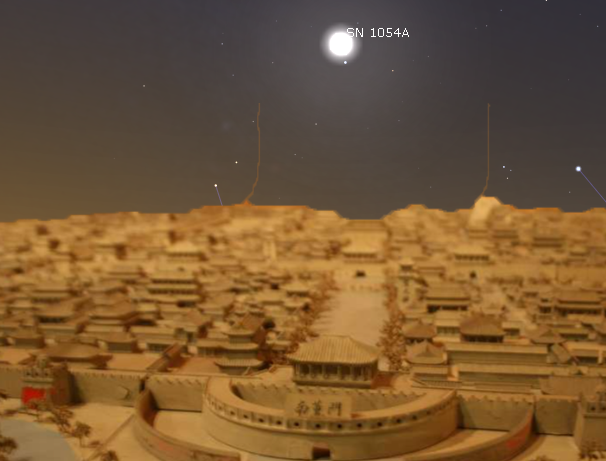

ζzeta𝜁 Tau), marking the southern horn of the Taurus constellation.
0.3∘0.3 raised to the composed with power0.3∘ to
0.5∘0.5 raised to the composed with power0.5∘.
𝜁 Tauri (0.9° South, 0.6° East). The minor angular discrepancy between the 1054 record and modern mapping is attributed to irradiation—the blinding, naked-eye glare of a magnitude –6.0 supernova visually blurring its proximity to the adjacent 3rd-magnitude reference star.


365.25∘ to a full circle, matching the days in a year) starting from
0∘ at the North Celestial Pole down to
91∘ at the equator.

56
Ni), which typically keeps normal supernovae glowing for months.