Category: Movies

  • Infernal Affairs: HE KILLED SIEGFRIED, HIS HERO –  Truth does not disappear. It loses its operational function.

    Infernal Affairs: HE KILLED SIEGFRIED, HIS HERO – Truth does not disappear. It loses its operational function.

    The Infernal Affairs trilogy (I- III) presents a double infiltration structure between the Hong Kong police force and a triad organization. Its deeper structure is about the psychological destabilization of identity under competing evaluative frameworks not about crime resolution. At its surface level, the narrative follows undercover operations, internal betrayal, and escalating exposure of moles within both systems.

    The structural layers of the Infernal Affairs Trilogy

    The Layer Architecture

    I. Immanent

    1. The Hong Kong Crime Story (The Reality):
      The raw, violent, everyday street reality of post-1997 Hong Kong crime and policing. This is the blood, the asphalt, the bodies falling from buildings, and the immediate physical horror of living a double life.
    2. The System Theory (The Machine):
      The abstract, institutional structure that drives the reality. It is a compromised system where Valhalla (the Police Hierarchy) and Nibelheim (the Triads) use identical, manipulative tactics. Both systems become structurally compromised and increasingly reproduce similar patterns of manipulation and sacrifice. Gods (Police) and Underworld systems operate to preserve themselves by almost casually destroying and compromising its individual members.
    3. The Jungian Layer (The Psychology):
      The internal, clinical collapse. The individual suffer under the weight of internal conflicts and the absence of truth, allowing the “Yan Complex” to become entirely autonomous. This culminates in the psychotic break of Ming, showing all signs possessed by his identification with his hero Yan.
    4. The Tragedy Layer (Archetypal images):
      The bridge from the system to the mind, rooted in the traditions of Aeschylean Greek drama and Wagnerian opera. The inevitability of fate where there is no difference between god an underworld, leading to a tragic twilight (Götterdämmerung) where all the good elements—like Siegmund (Yan)—are rejected and the whole Valhalla burns down.
    5. The Socio-Linguistic Layer (The Culture):
      The cultural and geopolitical trap of language. This spans from the weaponized Cantonese street intimacy (Ah-Yan / Ah-Ming) used to bind the moles, to the impenetrable Mandarin barrier (Gai tung ngaap gong) spoken by Mainland official Shen Cheng, which isolates Ming and triggers his fatal paranoia.

    II. Transcendent

    1. The Dantean Framework (The InfernoInfernal Affair):
      The architecture of structural sin and external psychological hell. In Dante’s symbolic universe, Ming would most naturally belong into the 9th Circle of Treachery, where their specific crimes of betrayal dictate their customized, permanent spiritual punishments (contrapasso). Note the wordplay Infernal.
    2. The Buddhist Framework (The Internal Void):
      The cosmic law of Karma: Wu Jian Dao (The Avici Hell). The universe denies Ming the release of his suicide attempt. His punishment is internal, unremitting, and intermissionless—trapping his conscious mind in a permanent, looping fire of his own guilt while his body is paralyzed. We might find Sam there, who is Buddhist. Maybe not.
    3. The Confucian Framework (The External Excellence & Morality):
      The destruction of earthly moral harmony. The system forces the characters to systematically mutilate the foundational Chinese pillars of filial piety, mentorship, and brotherhood. By destroying their families and comrades to survive, they fail the ultimate test of external moral excellence, sealing their absolute spiritual damnation.

    Dante’s Divine Comedy and Buddhist Avici, “The Hell of No Intermission”

    Analyzing the entire Infernal Affairs trilogy reveals a world play connection to Dante Alighieri’s Divine Comedy. The completed trilogy expands into a three-act structure that directly mirrors Dante’s overarching spiritual journey across the Inferno, Purgatorio, and Paradiso.

    Inferno — Infernal Affairs (2002): This first film focuses on an inescapable descent. Both the undercover cop Chan Wing Yan—played by Tony Leung Chiu-wai—and the triad mole Lau Kin Ming—played by Andy Lau—enter a deceptive underworld. I will refer them by Ming and others. They lose their true identities and become trapped in a psychological equivalent of Dante’s “9th Circle of Treachery.”

    Purgatorio — Infernal Affairs II (2003): This prequel functions exactly like Dante’s Purgatorio by exploring ancestral sins and history. Introducing younger versions of the protagonists—played by Shawn Yue (young Yan) and Edison Chen (young Ming)—the film traces how characters climb a mountain of moral compromise that they can never truly descend. The filmmakers deliberately timed the climax of the prequel to take place on June 30, 1997—the exact night of the China Handover.

    After 1997, Hong Kong was caught in a geographic and cultural double-bind. The Five Conditions of Avici Hell are quoted. Ming and Yan are the human manifestation of this political schizophrenia. An undercover cop must act like a triad because he sincerely wants to be cop. He has family connection to a high triad boss. A triad mole must act like a pristine superintendent while serving a hidden master.A semi-orphan with no family in Hong Kong anymore.

    Paradiso — Infernal Affairs III (2003): This finale acts as an inverted, psychological twist on Heaven. Lau Kin Ming (Andy Lau again) achieves what looks like “Paradise”—he is promoted, decorated, and clear of suspicion. However, because his paradise is built on fraud and the blood of Yan (Tony Leung Chiu-wai), it transforms into his ultimate, customized psychological torture chamber. This essay will focus on the Infernal Affairs III – and only its temporal part. A linguistic shift in Infernal Affairs III (2003) is deeply coded. The first two movies deal with the internal, local culture of Hong Kong (Cantonese) right to the transition. But Part III introduces Shen Cheng (Chen Daoming) speaking Mandarin.

    Avici, the “Continuous Hell”

    Infernal Affairs III explicitly quotes Avici, the Buddhist “Continuous Hell” or “The Hell of No Intermission” (无间地狱 – Wújiàn Dìyù). What is it? It may hint to ultimate theological destination of the trilogy, binding the Immanent and Transcendent layers together,

    The phrase “The Way Without Intermission” (Wu Jian Dao) is the literal translation of the film’s original Chinese title. In Buddhist cosmology, Avici is the lowest, deepest, and most terrifying layer of Hell, reserved for the absolute worst sins—specifically the betrayal of parents, mentors, and brothers.

    The ancient Buddhist texts describe Avici with five distinct “continuous” traits that map directly onto Lau Kin-ming’s (Andy Lau) fate at the end of Infernal Affairs III (2003):

    • Continuous Time: The suffering has no breaks, no sleep, and no end.
    • Continuous Space: The hell is customized perfectly around the sinner; it fills their entire vision so there is no escape.
    • Continuous Punishment: The instruments of torture never stop.
    • Continuous Rebirth: The sinner dies a thousand times, only to be instantly revived to suffer again.

    At the end of the movie physical death would have been a release for Ming. However his His catatonic, paralyzed physical state ensures Continuous Hell. Living hell.

    Reading Guardrails

    The use of Chinese Names is subtle and the order is Last name, First name. For short reference I prefer the informal Ming (Lau) and Yan. Sometimes you see Lau and Yan, which is mix using his Last name Lau. However, Ming is the street kid becoming a triad mole, while Yan has some influential (though black) family background as we learn in Infernal Affairs II.

    I decided to focus on the temporal layer: Hong Kong Crime Story, System Theory Layer and the Tragedy Layer. I keep the Jungian layer and lingo deliberately short. The psychology of the triad leaders would equally interesting.

    Anyway, I decided here to change the title of this essay and investigate different angles. Instead of writing patient records of the actors from the Burghölzli (Psychiatric University Hospital Zurich) perspective it seemed to me more appropriate to present two kinships relevant here: system theory (organisational psychology) and tragedy (Wagner’s Opera cycle The Ring and ancient Greek Aeschylus tragedian’s Prometheus). That does not mean I give the other layers less importance. Its more a private interest, since I worked on and off in Hong Kong during 1998-1999 the post-transition years, importantly addressed in the trilogy. This invoked many memories, archetypal images and intercultural connections of this multifaceted fast city and rich culture so aptly presented in this trilogy and also Wong Kar Wei’s movies.


    The Movie Plot Infernal Affairs III – a double infiltration

    At the narrative level, the police embed officer Yan inside the triad, while the triad embeds Ming and unknown number of other moles inside the police. The movie can also be told as a Tragedy: Ming kills Yan, his Hero; when reference systems converge, truth becomes no meaningful operator anymore. Both agents operate under conditions of sustained secrecy, limited information, and mutual surveillance between systems. Over time, key stabilizing figures are eliminated, and informational channels degrade. This leads to escalating misidentification, compromised operations, and the eventual collapse of both systems’ internal stability. Yan is ultimately exposed and killed, while Ming survives physically but undergoes severe psychological breakdown. After a suicide attempt which he survives, he is irrecoverable injured with a bullet in his brain. Sam and other major figures are eliminated as part of the broader systemic collapse

    Infernal Affairs

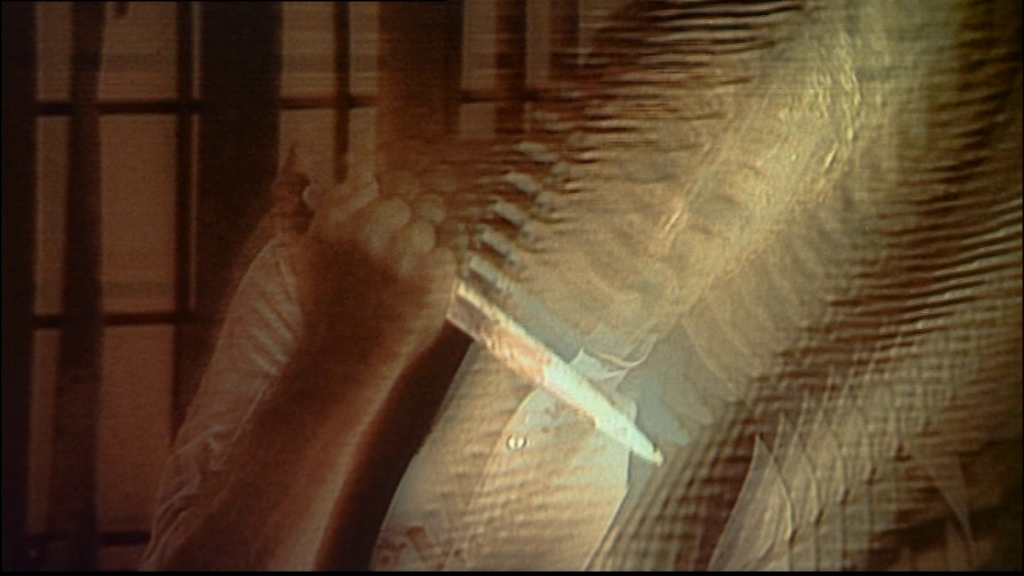
    Infernal Affairs Trilogy DVD cover: Ming (left) and Yan (right)

    Infernal Affairs has two parallel timelines:•

    • Post-Yan timeline (after Infernal Affairs I)
      • Lau Kin-ming (Ming) is now living with the consequences of Yan’s death.
      • He is separated from Dr. Lee.
      • He becomes obsessed with proving to himself that he is a legitimate police officer rather than a triad mole.
      • He starts investigating another senior officer, Yeung, because he suspects Yeung may also have had connections to Sam’s criminal network. In part, Ming is genuinely investigating corruption, but he is also projecting his own guilt and paranoia onto others.
    • Earlier timeline (before and during the events of Infernal Affairs I)
      • The film frequently cuts back to events that occurred before Yan died.
      • These scenes show interactions among Yan, Ming, Sam, and Shen Cheng (the mainland officer).
      • Many of these flashbacks reveal information that was hidden from the audience in the first film and provides new context for characters’ motivations.
    • The flashbacks in Infernal Affairs III are usually fairly easy to identify because:
      • Yan (Tony Leung) is alive in them.
      • Ming’s appearance is slightly different.
      • The police hierarchy and ongoing investigations correspond to events before the climax of the first film.
      • Shen Cheng (the mainland undercover officer) is still active
      • The police hierarchy and ongoing investigations correspond to events before the climax of the first film.
      • Shen Cheng (the mainland undercover officer) is still active.

    The obvious question: Why does the triad mole Ming suspect and investigate Superintendent Yeung

    Ming investigates Superintendent Yeung (Leon Lai) out of a desperate survival instinct that morphs into a profound psychological delusion.

    Yeung is the rising star of the Security Bureau. He is cold, brilliant, and ruthlessly efficient. Ming notices that Yeung is acting suspiciously, secretly meeting with a mysterious Mainland businessman (Shen Cheng). Because Ming is terrified of being exposed as the final mole, he begins investigating Yeung to find blackmail material or frame or unmask Yeung before Yeung can catch him. He has becomes suspicious of his connection to Shen Cheng (Chen Daoming), However the linguistic and cultural border makes it absolutely impossible for someone from the Mainland, like Shen Cheng, to ever be a mole for a local Hong Kong triad boss like Hon Sam. Same is true for the pay grade of Yeung.

    Psychologically, Ming is desperate to erase his criminal past and truly “become a good guy.” In his broken mind, the only way to prove he is a good cop is to catch a traitor. He projects his own dark secret onto Yeung. Ming convinces himself that if he can expose Yeung as a triad mole, he will finally earn his salvation and cleanse his own soul

    • On the surface, because he suspects corruption.
    • Psychologically, because he is trying to distance himself from his own past as a mole and convince himself he can be a “clean” cop.
    • As the film progresses, it becomes clear that his guilt and deteriorating mental state are driving much of his behavior and lead to his complete break down.

    This realization completely unravels Lau Kin-ming (Ming) and seals his tragic fate. Here is how the trilogy structurally and culturally proves why a Mainland mole for Sam could never exist:

    The Cultural Glass Ceiling on which Sam and Ming fail

    In Infernal Affairs I and II, we see how Hon Sam builds his empire. His recruitment of moles is deeply personal, local, and rooted in the Hong Kong streets. He took young, vulnerable Cantonese street kids—like a young Lau Kin-ming (Edison Chen)—and raised them.

    Sam could never replicate this with a Mainland operative. The cultural divide, the intense scrutiny on Mainland-Hong Kong border crossings, and the starkly different law enforcement systems meant Sam could never infiltrate or manipulate a Mainland figure like Shen Cheng. To Sam, Mainlanders were purely a business transaction to get guns or drugs—never people he could truly trust or control.

    Ming’s Paranoia and his Tragic Miscalculation

    Because Lau Kin-ming is losing his mind in Infernal Affairs III (2003), he projects his own reality onto everyone else.

    • Ming knows he is a mole.
    • He knows Yan was a cop masquerading as a triad.
    • Therefore, in his broken, paranoid mind, he assumes everyone could be a double agent.

    Ming suspects that Superintendent Yeung (Leon Lai) and Shen Cheng are secretly working together as a new network of moles for the deceased Hon Sam. Ming completely ignores the language and political border because his guilt has blinded him. He fails to see that a high-level Mainland security official would never take orders from a local Hong Kong street thug.

    The Mandarin Connection – Ming‘ unsubstantiated proof that Yeung and Shen Cheng are trad moles.

    Ming falls into a tragic trap because he completely misreads the political and linguistic reality of post-1997 Hong Kong.

    • The Tapes of the Past: Ming steals secret audio recordings of meetings between Yeung, Shen Cheng (Chen Daoming), and the late Hon Sam. In these tapes, they sound like they are plotting criminal activities. Because Ming is looking for a conspiracy, he takes these recordings at face value.
    • The Real Truth (The Counter-Operation): What Ming fails to understand—due to his lack of knowledge about Mainland networks—is that Shen Cheng was a undercover Mainland Public Security official all along. Shen Cheng had infiltrated Hon Sam’s triad network from the Mainland side. Superintendent Yeung was not a triad; he was simply working a highly classified, cross-border counter-espionage operation with Shen Cheng to bring Sam down from the inside.
    • The Psychological Break: By the climax of the film, Ming’s mind fractures completely. He hallucinates that he is Chan Wing-yan. When he marches into the police headquarters to arrest Yeung, he thinks he is the heroic undercover cop finally exposing the villains. He plays the tape out loud, expecting the entire police force to arrest Yeung and Shen Cheng.

    Instead, the tape only proves that Ming was the one obsessively stalking his colleagues. He completely miscalculated the language of state authority for the language of the underworld. When the illusion shatters, Ming realizes he hasn’t caught any moles—he has only trapped himself.

    The climax – office shootout

    This misunderstanding leads directly to Ming’s ultimate downfall in the police headquarters:

    • Ming believes he is exposing Yeung and Shen Cheng as triads.
    • In reality, because Shen Cheng is a legitimate Mainland Public Security official, he was working with Hong Kong Internal Affairs to clean out the police force.

    When Shen Cheng and Yeung speak to each other in their precise, official Mandarin, they aren’t speaking the language of a criminal underground. They are speaking the language of state authority. By the time Ming realizes that Shen Cheng could never be Sam’s mole, he has already exposed himself as the real traitor. He is left trapped in his wheelchair, paralyzed and isolated in his own mind—the ultimate “Living Damned” in his self-made Inferno.

    A triade mole kills Yan and Ming kills his fellow mole (flash back)

    Officially, they were peer law enforcement officers. Lau Kin-ming was a Senior Inspector in the Criminal Intelligence Bureau (CIB). Inspector B was a fellow inspector within the same police unit. On paper, they were simply colleagues working cases side-by-side.

    Unofficially, they shared a dark, deeply hidden mirror relationship. Both men were moles planted inside the police force by triad boss Hon Sam (Eric Tsang). Crucially, they didn’t even know about each other’s secret identities until the very end of the first film. Hon Sam kept his moles entirely separated so they could never compromise one another.

    When Inspector B ambushes and kills Chan Wing-yan (Tony Leung) on the elevator roof, he thinks he is saving a fellow triad brother. He proudly reveals himself to Ming, expecting solidarity. Instead, because Ming is desperate to erase his criminal past and “become a good guy,” he immediately shoots B to silence the final link connecting himself to Hon Sam.

    Ming investigated for Inspector B’s Death (his cover story cleared)

    The investigation into Ming at the beginning of Infernal Affairs III (2003) is a standard, highly sensitive internal review following a multiple-fatality shooting involving police officers.

    • The Cover Story: After killing B, Ming constructs a carefully calculated lie for Internal Affairs. He claims that Inspector B was the true triad mole. He tells the investigators that B held Yan hostage and shot him in the head, forcing Ming to return fire and execute B in a desperate act of retaliation and defense.
    • The Suspicion: While the police force initially accepts B as the scapegoat to close Yan’s murder case, the internal hierarchy doesn’t completely buy Ming’s clean exit. The sequence of events on that rooftop and in the elevator was too messy, and both dead men (Yan and B) were intricately connected to Hon Sam’s syndicate.
    • The Demotion: Because of the immense gravity of having two inspectors and a deep-cover officer dead or compromised in a single afternoon, Ming is stripped of his active authority. He is demoted to a tedious, low-clearance administrative duty desk while Internal Affairs thoroughly scrutinizes the forensic evidence and his psychological profile.

    This exact investigation is what triggers Ming’s downward spiral into absolute madness in the third film. He is trapped doing paperwork, knowing that if the police dig just an inch deeper into Inspector B’s past, they will find the breadcrumbs that lead straight back to him.

    The role of Dr.Lee

    Then there is Dr. Lee, a police psychology counsel which is a strong clue there is a depth psychology layer as well. There are quite a few other hints. I will touch two examples in a chapter further on.

    Dr. Lee is not just Ming’s wife/ex-wife; she represents the life Ming wanted to have as a genuinely good man with a strong Ego. In Infernal Affairs I the couple is presented as a bright and professional Hong Kong upper middle class couple starting a life together, Throughout the trilogy, she is one of the few people who sees the possibility of a decent person beneath Ming’s deception. When she learns the truth, that relationship becomes another casualty of the lies he built his life on and cost Van’s life, who she treated on behalf of the police and learned to like.

    So after Yan’s death, Ming has several overlapping motives:

    • Guilt — He knows Yan was the real hero.
    • Self-preservation — He wants to erase evidence of his own criminal past.
    • Identity crisis — He no longer knows whether he is a gangster pretending to be a cop or a cop who once worked for gangsters.
    • Dr. Lee — She loved the version of Ming she thought existed. In a sense, that version was closer to the moral integrity that Yan actually possessed.

    There’s a tragic irony here: Ming spent years stealing Yan’s position in the police hierarchy, but after Yan dies, he begins trying to steal something even more impossible—Yan’s moral identity and authenticity.

    The film suggests that Ming envies Yan not only because Yan was admired or because Dr. Lee respected him, but because Yan had something Ming never had: a coherent sense of self. Yan suffered terribly, but he knew who he was. Ming achieved status, success, and relationships through deception, so when the deception collapses, he is left wondering who he really is.

    That’s why the ending of Infernal Affairs III is so bleak. Ming doesn’t merely miss Yan; he becomes obsessed with him. Yan turns into a kind of moral benchmark, almost a ghostly presence in Ming’s mind. Ming wants redemption, but he also wants something impossible: to rewrite the past so that he could have been the man Yan was.

    Whether Dr. Lee specifically loved Yan is left somewhat ambiguous, but it is clear that she comes to respect Yan’s authenticity and sacrifice. As analysis session she let him sleep one hour on her psychoanalytic couch; Alone. One hour safety. Maybe she is impressed how he holds together under pressure and by his boyish charm he till keeps).

    Ming understands that. Part of his pain is realizing that the qualities Dr. Lee valued most were precisely the qualities he lacked when he chose to become Sam’s mole. In that sense, certainly: losing Dr. Lee reinforces Ming’s desire to become “another Yan.” The tragedy is that wanting to be Yan and actually having lived Yan’s life are two very different things. Yan earned his integrity through years of sacrifice; Ming tries to acquire it after the fact. That’s the gap he can never fully close and one of the trilogy’s central paradoxes:

    • Yan is living a lie, but he remains authentic.
    • Ming is living a lie, and gradually becomes the lie.

    Yan’s undercover identity is a professional disguise. Internally, he never stops identifying as a police officer. In fact, much of his suffering comes from holding onto that identity despite years in the triads.

    Ming is the mirror image. He starts as a triad mole inside the police, but over time he genuinely wants the status and respect of being a cop. The problem is that instead of reconciling the contradiction, he keeps covering it up. By the third film, he barely knows who he is anymore.

    Then there is Yeung not another undercover mole in the same sense as Yan or Ming. The film deliberately encourages Ming to suspect that Yeung was secretly connected to Sam and may have protected or benefited from Sam’s network. Ming becomes convinced that Yeung is another hidden traitor. However, much of this investigation is driven by Ming’s paranoia. He starts seeing corruption everywhere because he knows corruption existed in himself.

    Who knows Yan’s true identity?

    The crucial point from the first film is that very few people knew Yan was an undercover police officer. After Superintendent Wong’s death, the number of people with definitive knowledge became extremely small.

    In Infernal Affairs III, Yeung possesses information and files relating to Yan and the undercover operations. This is one reason Ming becomes suspicious of him. Ming starts connecting dots and wondering how Yeung knows what he knows.

    Without spoiling every detail of the ending, the film ultimately reveals that Ming’s theory about Yeung is not as solid as he believes. Ming is partly investigating a real mystery, but he is also constructing a narrative that allows him to externalize his own guilt. If there is another traitor, another corrupt insider, then Ming is no longer uniquely guilty.

    How many moles were actually in the organisation?

    In the reality of the Infernal Affairs III movie, there is only one remaining major triad mole inside the police force during the events of 2003: Lau Kin-ming himself.

    By the time the third movie takes place, the other triad moles that Hon Sam (Eric Tsang) planted in the police force have already been dealt with. Inspector B (Lam Ka-tung): The mole who shot Yan on the elevator roof in the first film. Ming shot and killed him immediately after to erase any link to himself. The 5 Moles Exposed by Yeung: Early in Part III, Superintendent Yeung Kam-wing cleanly exposes and arrests a handful of low-level police officers who were secretly on Sam’s payroll.

    Once those low-level moles are wiped out, Ming is entirely alone. He is the last ghost standing, which is exactly why his paranoia reaches a fever pitch. He has no allies left, and the walls are closing in.

    Ming’s Failed Suicide as Permanent Dissociation

    The observation that he is on the way to a “falling apart suicide” highlights the ultimate, devastating conclusion of the trilogy.

    When the illusion inevitably shatters inside the police headquarters—when he realizes he cannot rewrite history and that he has just murdered Superintendent Yeung (Leon Lai)—the autonomous complex collapses under the weight of reality.

    • The Attempt: Ming turns his actual service weapon on himself and shoots himself through the chin. This is a desperate, physical attempt by the remnants of his shattered Ego to escape the unbearable horror of his existence.
    • The Continuous Hell: The final scene of him paralyzed in the wheelchair signifies a state of permanent, irreversible dissociation. His Ego did not get the mercy of death. Instead, his conscious mind has completely shattered and drowned. He is left trapped in a vegetative state, where his finger eternally taps out Morse code—symbol of the “Yan” complex ruling over a dead mind?

    The psychology layer – Ming’s obsession

    By the time of Part III, Yan is dead. But Ming is obsessed with him.

    When the film cuts to replay Infernal Affairs I from Yan pointing the gun at Ming to the present-day scene ( in the hospital Infernal Affairs III) Ming pointing a finger into the air, we’re no longer watching a simple flashback. The movie is entering Ming’s subjective experience. The physical reality has completely vanished, but the psychological obsession has taken over. The Tragic Meaning: There is no one there. There is no real gun. He is pointing an invisible weapon at his own ghost. He is trying to perform a ritualistic exorcism of his own past, attempting to rewrite history by forcing himself into Yan’s heroic shoes.

    The Hallucination: Ming’s mind has fractured so deeply that he believes he is Yan standing on that rooftop.

    The Empty Gesture: He raises his hand, shapes his finger into the form of a gun, and points it into the empty air. He speaks Yan’s exact words: “Sorry, I am a cop.”

    The “finger pointing” Yan is often interpreted as:

    • Ming’s memory of Yan,
    • Mings guilty conscience,
    • a psychological projection,
    • his I/Ego is temporarily taken over
    • almost a ghost-like figure judging him.

    Not a literal ghost—the film isn’t supernatural—but the simplest interpretation is that Yan has become a presence as a complex in a Jungian definition in Ming’s mind.

    The original gun scene

    In the first film, Infernal Affairs (2002), Yan holds a real gun to Ming’s head on the sunlit rooftop. When Ming begs for a chance, saying, “I want to be a good guy,” Yan delivers the devastating moral judgment: “Sorry, I am a cop.” In that moment, Yan holds all the moral power. He is the true hero, and Ming is exposed as the fraud. After Yan has exposed Ming, Yan points a gun at him. Ming says something like:

    “Give me a chance.”

    Yan replies:

    “How do I give you a chance?”

    Then comes the famous line:

    “Sorry. I’m a cop.”

    The point is not literally “you’re not a cop.” Ming is a police officer by employment. Yan means to say:

    “I am a real cop. My loyalty is clear. You are a mole. I can’t just let this go.”

    It’s a statement of identity. After years undercover, Yan is finally reclaiming who he is.

    The psychoanalysis couch scene

    The scenes where Ming and Yan appear to occupy parallel spaces—sometimes sitting, facing each other, or sharing visual compositions—are generally not time shifts.

    They are cinematic representations of Ming’s mental state.

    Think of them as:

    Ming imagining a dialogue with Yan.

    Or:

    Ming measuring himself against the dead man he can never become.

    The film frequently blends:

    • actual flashbacks,
    • memories,
    • fantasies,
    • hallucinations,
    • symbolic imagery.

    Sometimes it doesn’t clearly signal which one you’re seeing because the audience is meant to experience Ming’s confusion or destruction.

    The System Layer – The Machine

    Competing Reference Systems

    At the structural system level, the trilogy can be understood in terms of competing reference systems—internal frameworks through which individuals interpret reality and evaluate their own actions. Two dominant systems are present: an institutional system grounded in law, hierarchy, and procedural legitimacy, and a criminal system grounded in loyalty, survival, and internal group coherence. Each agent operates not only within a role, but within an inherited evaluative logic that determines what counts as acceptable behavior.

    Two cross compromised Systems

    The central mechanism of the trilogy is the forced migration of individuals across these reference systems. Yan, originating from the institutional system, maintains a stable police internal reference structure even while embedded in the criminal environment. This produces high psychological coherence but increases external vulnerability. As his police institution is compromised by Sams moles, only his (integer) handler shield him from this danger. After his got killed he is basically without exposed to the degraded compromised police system. Ming, by contrast, originates from a criminal logic and becomes embedded within the institutional system. His adaptability allows survival and advancement, but at the cost of increasing internal inconsistency as conflicting evaluative standards accumulate.

    AI generated to the text of this chapter plus a few aesthetic hints . The background is an archetypal snapshot of the city’s visual identity and silently reminds that many competing reference systems are embedded within.

    Hong Kong, 1998–1999

    The accompanying above image was generated from this chapter together with a few aesthetic cues. Unexpectedly, it captured almost exactly the Hong Kong I remember from working there during 1998–1999: the Kowloon waterfront looking across Victoria Harbour toward Central. Whether geographically exact is beside the point. What struck me was not its documentary accuracy but its atmosphere.

    For me, the city view is more than a backdrop. It is the silent protagonist of Infernal Affairs. Beneath its spectacular skyline operated an extraordinarily dense network of information, finance, policing, organized crime, languages, and political transition. It felt less like a conventional static city than a fast living continuously adapting system. That intuition became one of the starting points for the systems-theoretical reading developed in this essay.

    It is therefore fitting that the visual language of Infernal Affairs carries echoes of Wong Kar-wai’s Hong Kong. Christopher Doyle, Wong’s longtime cinematographer, served as visual consultant on the film and helped shape its distinctive urban aesthetic together with Andrew Lau and Alan Mak. The city becomes more than scenery; it silently reminds us that every personal tragedy unfolds within a larger adaptive environment whose structures shape, constrain, and sometimes overwhelm individual lives.

    Individual degradation

    When individuals are required to operate under incompatible reference systems without stable integration, identity coherence degrades. Decision-making becomes unstable, evaluative criteria shift over time, and self-reference loses consistency. At the institutional level, this produces organizations in which trust is replaced by inference, and procedural legitimacy is undermined by informational fragmentation. The system no longer functions as a coherent structure but as a network of competing internal logics.

    Institutional System Break down

    The Infernal Affairs trilogy (Infernal Affairs, Infernal Affairs II, Infernal Affairs III) can be understood as a structural model of institutional breakdown under conditions of reciprocal infiltration, where multiple incompatible “reference systems” begin to coexist within the same organizational space. A reference system here means the internal evaluative framework through which agents interpret events, assign meaning, and decide action—such as legality and duty in the police system, or loyalty and survival logic in the triad system. Under normal conditions, such systems remain separated: each organization maintains its own internal logic, even when they oppose one another externally.

    The central destabilizing mechanism in the trilogy is the sustained insertion of agents carrying foreign reference systems into opposing systems. Yan operates inside the triad while retaining an institutional-police reference structure; Ming operates inside the police while carrying a criminal-adaptive reference structure. In isolation, such infiltration can be contained: the individual maintains internal compartmentalization, and the host system continues to function according to its dominant logic. However, the trilogy escalates this condition beyond containment through long-term reciprocal infiltration, repeated exposure between systems, and the removal of stabilizing intermediaries (handlers, supervisors, and trusted nodes of verification).

    Boundary eroding

    As a result, the boundary between reference systems begins to erode. The police system no longer operates purely according to legal-procedural logic, but increasingly incorporates inference-based, survival-oriented reasoning characteristic of the triad environment. Conversely, criminal operations become partially structured by surveillance logic, procedural anticipation, and counter-inference. This produces a hybrid system in which neither reference framework remains fully dominant. Decision-making becomes increasingly dependent on partial information, inferred intent, and positional advantage rather than stable rules or shared verification.

    Within this degraded structure, truth does not disappear, but loses its operational function. It continues to exist as informational content distributed across different actors, but it no longer functions as a stable coordinating operator that aligns perception, decision, and institutional response. This occurs because verification pathways are fragmented, trust between nodes is compromised, and the act of revealing truth often carries direct strategic cost. Consequently, truth becomes epistemically present but politically inert: it may be known in fragments, but it cannot reliably reorganize the system or restore coherence once disclosed.

    Psychological Dimension

    The psychological dimension mirrors this system degradation. Agents are forced to operate under incompatible reference systems without stable reconciliation. Yan maintains coherence by anchoring identity to an external institutional standard, which increases his exposure within the hostile environment. Ming, by contrast, adapts fluidly across systems, but this adaptability gradually erodes internal consistency, producing oscillation between evaluative frameworks and eventual identity destabilization. The institutional system thus produces divergent failure modes depending on whether coherence or adaptability is prioritized under conditions of systemic ambiguity.

    System Fragmentaton

    Ultimately, the trilogy suggests that institutional system collapse does not require the absence of structure, but can emerge precisely from excessive structural overlap without stable integration mechanisms. When reference systems contaminate one another and truth loses its coordinating function, the organization no longer behaves as a unified decision system. Instead, it becomes a fragmented network of competing logics in which actions remain possible, but coherent system-wide orientation is no longer recoverable. in short, he fights on his own.

    The tragedy – The slaying of Siegfried, the Hero.

    Heros’ suffering

    This brings the Wagnerian layer to its ultimate, tragic conclusion. In Götterdämmerung, Hagen stabs Siegfried in the back to steal his power. But in Infernal Affairs, Ming’s punishment is far more terrifying: Mings causes the killing of his hero (by Inspector B), only to realize that the hero’s purity was the only thing he actually wanted.

    Mingi s trapped in a perpetuous cycle. He cannot be Lau Kin-ming anymore because his guilt is too heavy, and he cannot be Chan Wing-yan because his hands are covered in blood. He is left standing in the wreckage of his own mind, wielding an invisible identity, completely lost in the “Way Without Intermission.”

    The trilogy demonstrates how structural conditions determine psychological outcomes: coherence becomes a liability under hostile environments, while adaptability becomes a source of internal fragmentation. The result is a tragedy in which neither survival nor integrity is fully sustainable under conditions of sustained institutional and informational contradiction. For Yan its worse, he finds himself as undercover agent working for a low/zero trust institution which involves him in reckless planned operations let alone being undercover within the triads a second low/zero trust environment. Like Wagner’s Ring cycle does the trilogy not openly distinguish between good and bad. Only a few can assumed being as good: Yan, Dr. Lee, Siegfried, Brünnhilde.

    Ultimately, the Infernal Affairs trilogy suggests that when agents are forced to operate across incompatible reference systems without mechanisms for integration, both individual identity and institutional stability degrade in parallel. The tragedy is not moral failure, but the structural impossibility of maintaining coherent self-reference within a fragmented and contaminated system.

    Vahlhalla burning down

    Both Wagner’s Ring cycle and Infernal Affairs depict systems that collapse under internally generated contradictions, but while Infernal Affairs collapses through informational and identity contamination, Wagner’s world collapses through a foundational corruption embedded in the very logic of power itself shared by Gods an Underworld.Like Wagner’s Ring cycle, Infernal Affairs depict a system that collapse under internally generated contradictions, but while Infernal Affairs collapses through informational and identity contamination, Wagner’s world collapses through a foundational corruption embedded in the very logic of power itself. It needs to be noted however, that it least it seems to me that Ming has reason to believe that the foundational corruption embedded in the police itself. After becoming psychological destroyed by living two reference systems he sees only one logical resolve for himself as both reference systems turned out questionable, to run amok and kills himself.

    Wagner’ Ring Cycle ( Kupfer 1988) Last scene of Götterdämmerung. Brünnhilde follows Siegfried into death.

    The Infernal Affairs trilogy can be read as a study of how institutions destabilize when multiple, competing reference systems are introduced and gradually contaminate one another through prolonged infiltration. Within the police–triad structure, each actor operates according to an internal evaluative framework—law, loyalty, survival, legitimacy—that serves as a reference system for interpreting reality and guiding action. Through reciprocal infiltration, these frameworks cease to remain compartmentalized and instead begin to influence institutional decision-making itself, producing a hybrid and increasingly unstable organizational logic.

    Truth does not disappear, but it loses its operational function.

    In this condition, truth does not disappear, but it loses its operational function. It continues to exist as information, dispersed among different actors, yet it no longer coordinates belief, action, or institutional correction in a consistent way. Fragmented information pathways, degraded trust, and incentives that discourage disclosure transform truth from an effective organizing principle into politically and institutionally inert knowledge. The institution becomes “polluted” in the sense that its original reference structures no longer dominate. Its capacity to stabilize identity, assign meaning, and resolve uncertainty gradually collapses under internally generated contradictions.

    Self Destruction

    In this respect, again the trilogy invites comparison with Richard Wagner’s Ring cycle. Both works depict systems that ultimately destroy themselves through contradictions generated from within rather than by external enemies. The mechanism, however, differs fundamentally. Infernal Affairs portrays collapse through informational fragmentation, reciprocal infiltration, and the erosion of institutional identity. Wagner’s Ring presents a world whose destruction follows from a corruption already embedded in the logic of power itself.

    The tragedy of Ming provides the trilogy with its deepest psychological dimension. Unlike Yan, who preserves his identity at the cost of his life, Ming survives physically while progressively losing the coherent self that once enabled him to navigate between worlds. Having lived for years within two competing reference systems, he reaches a point where neither offers a stable foundation for identity or action. His psychological disintegration is not merely personal but reflects the collapse of the institution that shaped him. The police organization no longer represents an uncontaminated moral order, while the criminal world offers only a return to the logic that originally corrupted him. The result is a state in which no internally consistent reference system remains.

    Gods and Underworld fall – Human Cost

    Whether one interprets Ming’s final violence and suicide attempt clinically, psychologically, or symbolically, they represent the collapse of a personality that can no longer reconcile incompatible identities. In this sense, Ming recalls Wagner’s tragic figures, although with an important inversion. He destroys the man who embodied the integrity he could never achieve—Yan, his moral counterpart and hero—and ultimately turns his violence upon himself. If Brünnhilde’s self-sacrifice purifies a world whose foundations have become irredeemably corrupted, Ming’s self-destruction offers no comparable redemption. It reveals only the human cost of a world that has lost the capacity to distinguish appearance from identity, loyalty from betrayal, and ultimately truth from the mechanisms by which power sustains itself.

    You may say, what about Wotan and Zeus? True, there were god’s, philandering though with humans, creating all sorts of tragedies and not much better if at all than the underworld. Easy to find synonym for gods. Immortality was sometimes a burden even to Wotan. Wotan’s favorite daughter Brünnhilde gave immortality away easily when she saw even the problematic love between Sigmund and Sieglinde, the incestuous parents of Siegfried. Brünnhilde followed her love Siegfried emasculating herself by jumping with her beloved horse into the burning, crashing Valhalla. Ming#s suicide attempt was not so lucky. We do not know where he ends up, but one can assume it might not be the same place as Brünnhilde, Siegfried, Yan.

    Identities are formed by the Worlds they inhabit

    Institutions shape the reference systems through which individuals construct meaning. When those system reference systems become contaminated, they no longer merely fail to protect integrity—they actively undermine it. The tragedy of Infernal Affairs is therefore not simply the corruption of individuals, but the corrosion of the very frameworks that make integrity possible.
    Perhaps the enduring power of Infernal Affairs lies in the fact that it never asks whether good people can survive in a corrupt institution. It asks a more disturbing question: What happens when the institution itself can no longer provide a coherent reference system for distinguishing truth from appearance, loyalty from opportunism, or integrity from successful performance?

    If that question is taken seriously, the trilogy ceases to be merely a crime drama. It becomes a tragedy—and of the people whose identities are formed by the worlds they inhabit.

    Conclusion

    In that sense, Infernal Affairs belongs to a much older dramatic tradition. Like Wagner’s Ring, it portrays not the triumph of good over evil, but the collapse of an ambiguous world whose internal contradictions have become irreconcilable. Its protagonists are neither heroes nor villains in any simple sense; they are individuals caught within systems that no longer provide a coherent framework for identity, loyalty, or truth. The tragedy lies not only in their deaths, but in the destruction of the very structures that once gave their lives meaning.

    Aeschylus’s Prometheus Bound and Wagner’s Ring are widely studied together, not as opposites, but as direct spiritual and structural kin. Readers may find different symbolic resonances—in Wagner, in Greek tragedy, or even in contemporary political conflicts. Such parallels should not replace the films themselves, but testify to their remarkable capacity to illuminate the recurring relationship between identity, power, and the fragile operational role of truth. We started with what looked like a straightforward crime trilogy. The depth psychology perspective hinted in the film cannot be ignored, but the needed underlying analysis is more structural and, in my view, has explanatory power beyond these trilogy. By the end, we had arrived at a coherent interpretive framework built around a tragedy with value reference systems, system contamination, identity coherence, and the fragile operational role of truth.

    Appendix:

  • Jungian Reading of  Hesse’s Steppenwolf

    Jungian Reading of Hesse’s Steppenwolf

    Introduction

    Hermann Hesse’s novel Steppenwolf (1927) and its film adaptation (1974) are readily interpreted through the framework of Carl Jung’s analytical psychology. At its core, the novel describes, through the main proponent Harry a failed individuation process, Hesse’s own personal crisis.

    The “Treatise on the Steppenwolf” a part of the novel functions as an internal analytic text, assists Haller on his path of individuation by articulating the nature of his shadow.

    Hesse’s work emerges from a period of acute personal and civilizational crisis. In the mid-1920s, Hesse underwent psychoanalytic treatment within Jungian circles, while Europe itself experienced profound postwar fragmentation. Intellectual crosscurrents—especially through figures such as Richard Wilhelm, who introduced both Hesse and Jung to Chinese philosophy—help explain the novel’s symbolic language: psychological, mystical, and deeply ironic.

    The Crisis
    The Crisis

    At the center stands Harry Haller, whose suffering reflects a classical Jungian condition: a hypertrophied ego-persona split from its unconscious foundations. The identification of the “Steppenwolf” as the shadow is correct but insufficient. The wolf is not merely instinctual residue rejected during the building of the persona; it is the repressed totality of unlived life. Haller’s tragedy lies not in possessing a shadow, but in conceptualizing himself through a rigid dualism—man versus wolf—rather than recognizing the psyche’s multiplicity. In Jungian terms, this is a failure to apprehend the psyche as a dynamic system of complexes.

    The “Treatise on the Steppenwolf” functions as a quasi-analytic intervention. It destabilizes Haller’s binary self-conception and introduces a pluralistic model of the psyche. The text operates as a hermeneutic mirror, guiding Haller toward individuation by revealing that identity is not unitary but composed of innumerable potential selves.


    The overarching trajectory of Steppenwolf aligns with Jung’s concept of individuation and its Failure (or Deferral)—the movement toward psychic wholeness through the integration of unconscious elements. Yet Hesse does not present a completed process. Instead, he dramatizes its difficulty, fragmentation, and postponement.

    • The shadow (Steppenwolf) is confronted but not fully assimilated.
    • The anima (Hermine/Maria) is encountered but remains partially projected.
    • The Self (Pablo/Mozart/Goethe) is glimpsed but not embodied.

    The archetypes do not appear as stable categories but as fluid, overlapping presences. Hesse avoids schematic allegory and instead stages a living psychological process.

    Steppenwolf today

    Hermann Hesse’s Steppenwolf remains strikingly relevant in periods that feel like civilizational inflection points. The novel, written in the aftermath of World War I, emerged from a context of cultural fragmentation, rapid modernization, and a loss of shared meaning—conditions that resonate strongly with today’s global atmosphere of uncertainty, technological acceleration, and ideological polarization.

    At its core, Steppenwolf is not simply a story about alienation; it is an exploration of the fractured self in a fractured world in crisis that no longer provides stable frameworks for identity. In contemporary terms, this duality maps onto tensions many people feel, navigating multiple, often conflicting value systems translating in crisis and geopolitical conflicts.

    The sense that “the world is in transition” amplifies the novel’s relevance. Periods of existential crisis—whether driven by permanent crisis mode, manufactured dissent, planted fears, geopolitical instability, or the disruptive force of paradigm shifts like artificial intelligence—tend to dissolve inherited certainties. Hesse anticipated similar dissolution. The “Magic Theater” in Steppenwolf symbolizes a multiplicity of selves and perspectives, suggesting that identity is not fixed but plural and fluid.

    Why, then, was I drawn back to this novel now? Part of the answer lies in recognition. Re-reading Steppenwolf offers not resolution but validation—it frames alienation not onlyas pathology, but as a potentially necessary stage in confronting deeper truths about the self and society.

    Additionally, the novel provides a subtle counterpoint to despair. It suggests that existential upheaval, while disorienting, can also be creative—a precondition for new modes of being. When I read this novel long ago, I had little insights to in the work of C. G. Jung so my interpretation changed profoundly.

    Following a list of book I referred to:

    Literature Register

    • Der Mensch und seine Symbole. By Carl Gustav Jung, Marie-Louise von Franz, Joseph L. Henderson, Aniela Jaffé, and Jolande Jacobi.  Olten Walter Verlag AG,1968 
    • Die Psychologie von C. G. Jung. By Jolande Jacobi. Zürich: Rascher Verlag, 1940.
    • Animus and Anima. By Emma Jung. Zürich: Rascher Verlag, 1957. (Posthumous essays; editions vary.)
    • Materialien zu Hermann Hesses Steppenwolf. By Hermann Hesse (ed.). Frankfurt am Main: Suhrkamp Verlag, 5. Auflage, 1977.
    • Hermann Hesse und China. By Adrian Hsia. Frankfurt am Main: Suhrkamp Verlag, 1974.


    The Literary claim of Steppenwolf

    Analytical psychology in motion

    Steppenwolf-Haller
    Steppenwolf-Haller

    Steppenwolf is not simply a Jungian novel—it is a literary enactment of analytical psychology in motion, complete with regressions, ambiguities, and partial insights.

    In Man and His Symbols, Marie-Louise von Franz articulates individuation not as a linear achievement or abstract doctrine, but as a lived psychological process—one that unfolds organically through the psyche’s symbolic activity. Her exposition, while grounded in Jung’s theoretical framework, emphasizes the experiential and often unpredictable character of this development. Individuation, in her account, is less a goal to be attained than a movement toward psychic wholeness, guided by symbols emerging from the unconscious.

    Von Franz begins from a fundamental premise: that the human psyche is not initially unified. The conscious ego, which organizes perception and action, represents only a small and relatively recent development within a much larger totality. Beneath it lies the personal unconscious—composed of forgotten or repressed contents—and, more profoundly, the collective unconscious, which contains archetypal patterns shared by all humanity. Individuation is the process by which these layers are gradually brought into relation with consciousness.

    This process does not proceed through deliberate rational effort alone. On the contrary, von Franz stresses that the unconscious communicates primarily through symbols—dreams, fantasies, myths, and artistic images. These symbolic expressions are not arbitrary; they are structured manifestations of archetypal realities. To engage in individuation is therefore to enter into a dialogue with these symbols, to interpret them not reductively but as meaningful expressions of the psyche’s self-regulating tendency.

    A central aspect of this process is the confrontation with the shadow. Von Franz describes the shadow as the sum of those qualities that the ego refuses to acknowledge in itself. These may include not only morally negative traits—aggression, envy, selfishness—but also positive potentials that have been neglected or suppressed. The encounter with the shadow is often experienced as unsettling or even threatening, because it challenges the ego’s self-image. Yet without this confrontation, no genuine development is possible. The integration of the shadow expands the personality, making it more complete and less rigid.

    Closely related to this is the emergence of the anima or animus, depending on the individual’s psychological structure. For von Franz, these figures represent the contrasexual dimension of the psyche and serve as mediators between consciousness and the deeper layers of the unconscious. They frequently appear in dreams as personified figures—often charged with emotional intensity—and their role is ambivalent. They can guide and inspire, but they can also deceive and destabilize. The task of individuation is not to identify with these figures or to project them onto others, but to recognize them as internal realities and to establish a conscious relationship with them.

    As the process deepens, the individual encounters what Jung termed the Self—the central archetype of wholeness. Von Franz emphasizes that the Self is not identical with the ego, nor is it simply a higher or more refined version of it. Rather, it is the organizing principle of the entire psyche, encompassing both conscious and unconscious elements. The Self often manifests symbolically in images of unity and totality: circles, mandalas, stones, or divine figures. These images do not represent an achieved state but indicate the direction of psychological development.

    One of the most important insights von Franz offers is that individuation is not a process of perfection. It does not lead to a flawless or morally ideal personality. Instead, it leads to a more balanced and differentiated one. The individual becomes more aware of inner contradictions and learns to live with them rather than attempting to eliminate them. This capacity to تحمل tension—what Jung called the “transcendent function”—is essential. It allows new attitudes and solutions to emerge from the interplay of opposites.

    Von Franz also underscores the temporal dimension of individuation. It is typically associated with the second half of life, when the tasks of adaptation to the external world—career, social role, family—have been largely established. At this stage, the psyche begins to demand a different kind of development, one oriented not outward but inward. Crises, disillusionments, and experiences of meaninglessness often serve as catalysts. They disrupt the established equilibrium and open the individual to the unconscious.

    However, this transition is fraught with danger. The influx of unconscious material can overwhelm the ego, leading to confusion or inflation. Von Franz repeatedly warns against the tendency to identify with archetypal contents—such as seeing oneself as a savior, a genius, or a chosen figure. Such identifications represent a failure of individuation, not its fulfillment. True development requires humility: the recognition that these archetypal energies belong to the psyche as a whole, not to the ego as an isolated entity.

    A particularly illuminating aspect of her discussion concerns the role of symbols such as the mandala. The mandala, often appearing spontaneously in dreams or artistic expressions, represents the Self as an ordering center. Its circular structure conveys a sense of completeness and balance, suggesting that the psyche is moving toward integration. Yet von Franz cautions that such symbols should not be taken as evidence that individuation has been achieved. They are signs of a process, not its conclusion.

    In practical terms, individuation involves a continuous effort to become conscious of unconscious contents and to integrate them into one’s life. This does not mean acting out every impulse or dissolving all boundaries. Rather, it means recognizing the reality of these contents and finding appropriate forms of expression for them. The process is inherently ethical, not in the sense of conforming to external norms, but in the sense of taking responsibility for one’s inner life.

    Von Franz’s account ultimately presents individuation as a paradoxical endeavor. It is deeply personal—no two individuals follow the same path—yet it is also universal, structured by archetypal patterns common to all humanity. It involves both suffering and growth, both loss and discovery. Above all, it requires a willingness to engage with the unknown within oneself, to relinquish the illusion of complete control, and to trust in the psyche’s capacity for self-regulation.

    In simple terms individuation is not an enterprise initiated by the ego, nor a project imposed upon it, but a process through which the psyche gradually moves toward wholeness. In Steppenwolf, this is exemplified by Pablo, who at first appears trivial and external, yet ultimately reveals himself as a guiding principle leading Haller toward confrontation with his own psychic totality. In this sense, individuation is not a project imposed by the ego, but a process initiated by the Self. The ego’s role is to participate consciously, to observe, to reflect, and to respond. It must neither dominate nor withdraw, but remain in a dynamic relation to the unfolding totality of the psyche

    The Magic Theater represents this breakthrough: Haller experiences psychic multiplicity and the illusion of fixed identity. Yet the novel ends with a task, not a resolution. Haller must “learn to laugh,” which in Jungian terms signifies the relinquishing of ego rigidity and the acceptance of paradox.


    The Anima – Hermine and Maria

    Jung’s schema of the anima provides a framework, but Hesse complicates it through splitting, inversion, and overlap.In a Jungian interpretation of Steppenwolf, the figure of the anima assumes a central and structurally decisive role. Yet Hesse does not present the anima in a simple or unified form. Instead, he complicates and differentiates it through the figures of Hermine and Maria, thereby producing a dynamic and, in many respects, deliberately “contaminated” representation that resists strict classification within Jung’s formal schema.

    Hermine – Anima Stage 4

    Jung’s model of the anima, particularly as elaborated by Marie-Louise von Franz, describes a developmental sequence comprising four stages: Eve, Helen, Mary, and Sophia. These stages move from the instinctual and biological, through the erotic and aesthetic, toward the spiritualized and finally the wisdom-bearing dimension of the feminine psyche. In principle, this sequence suggests a linear progression. In Steppenwolf, however, Hesse subverts this linearity. The anima does not appear as a single figure progressing through stages, but rather as a split, distributed, and functionally differentiated presence.

    Hermine stands as the central anima figure, yet she cannot be adequately understood if she is simply equated with the highest stage, Sophia. While she undeniably exhibits characteristics associated with Sophia—wisdom, mediation, and reflective capacity—her function is more complex. She operates as a transitional figure, bridging multiple stages simultaneously, and is best understood as a psychopomp: a guide who leads Haller into the depths of his own psyche.

    Her own self-description as a mirror—“I am a kind of mirror for you”—captures the essential function of the anima at its most developed level. The anima reflects the unconscious contents of the psyche back to consciousness, enabling the individual to encounter aspects of himself that would otherwise remain inaccessible. In Haller’s case, Hermine performs precisely this function. She does not impose a moral framework upon him, nor does she attempt to correct his “Steppenwolf” nature. Instead, she reveals it, renders it visible, and situates it within a broader, more fluid understanding of psychic life.

    At the same time, Hermine embodies a form of wisdom that is not abstract but practical and embodied. She introduces Haller to domains of experience that he has systematically excluded: dancing, jazz, sensuality, and laughter. These are not trivial additions to his life but essential correctives to his one-sided intellectualism. In Jungian terms, Hermine compensates for the hypertrophy of Haller’s thinking function by reactivating his neglected capacities for feeling and sensation.

    Her androgynous quality further reinforces her position within the higher stages of the anima. Her name, as the feminine counterpart of “Hermann,” and her occasional boyish appearance symbolize the union of opposites, a central motif in Jungian psychology often referred to as the Mysterium Coniunctionis. This union is not merely symbolic but functional: Hermine mediates between opposites—spirit and body, intellect and instinct, seriousness and play—without resolving them into a fixed synthesis.

    Yet Hermine is not a purely spiritual or idealized figure. She also possesses qualities that align her with earlier stages of the anima, particularly the erotic and provocative aspects associated with Helen. She is capable of manipulation, of seduction, and of destabilization. This ambivalence is crucial. In Jungian psychology, the anima is not simply a guide but also a force that can disorient and disrupt. Hermine’s role as both psychopomp and destabilizer reflects this dual function.

    Her insistence that Haller will eventually have to kill her introduces an additional layer of complexity. This demand anticipates the necessity of withdrawing projection. As long as the anima is experienced as an external figure, individuation cannot be completed. The “death” of Hermine thus signifies not the destruction of the anima, but its transformation from an external object into an internal function. However, as the later development shows, Haller is not yet capable of accomplishing this transformation in a conscious and integrated manner.

    Maria Anima Stage 2-3

    If Hermine represents a complex and transitional form of the anima, Maria introduces a further complication by inverting the expected symbolic associations. In the traditional Jungian schema, the stage of Mary corresponds to spiritual devotion, purity, and maternal care. In Steppenwolf, however, the figure named Maria embodies almost the opposite: she represents pure Eros, the domain of physical pleasure and sensual experience.

    This inversion is not accidental but deliberate. By naming a courtesan “Maria,” Hesse creates a symbolic dissonance that forces a reconsideration of the anima’s function. For Haller, whose life has been defined by repression and intellectualization, the recovery of the body and its pleasures is not a regression but a necessary step toward wholeness. Maria’s sexuality, far from being merely indulgent, acquires a quasi-sacred character. It becomes, in effect, the means through which Haller is reconnected to life.

    In this sense, Maria functions as a hybrid figure, combining elements of the Helen stage with a reinterpreted version of Mary. She teaches Haller that his body is not an obstacle to be overcome but an integral part of his existence. Through her, he learns that sensuality and joy are not opposed to spirituality but can serve as its foundation, particularly in a psyche that has become excessively abstract.

    The coexistence of Hermine and Maria produces what can be described as a functional splitting of the anima. Rather than presenting a single figure capable of mediating all aspects of the unconscious, Hesse distributes these functions across two distinct figures. Maria embodies the domain of Eros—the physical, emotional, and sensual dimension of life—while Hermine embodies Logos—the reflective, guiding, and meaning-bestowing dimension.

    This division is not merely aesthetic but psychologically necessary. Haller’s psyche is too rigidly structured, too deeply divided between intellect and instinct, to accommodate a unified anima figure. If Hermine were to combine both the sensual immediacy of Maria and the reflective wisdom she already possesses, Haller’s ego might be overwhelmed. He would be unable to integrate such a figure and might either reject her entirely or succumb to a form of archetypal inflation.

    By splitting the anima into two figures, Hesse allows for a gradual and differentiated process of integration. Maria reintroduces Haller to the realm of the body, grounding him in sensory experience and immediate pleasure. Hermine, by contrast, maintains a certain distance, preserving her authority as a guide and interpreter. She “delegates” the work of physical integration to Maria, thereby maintaining her position within the higher, more reflective dimension of the anima.

    This pedagogical structure is evident in Hermine’s role as the “architect” of Haller’s development. She directs his experiences, assigns him tasks, and orchestrates his encounters, including his relationship with Maria. In this sense, she functions as a kind of inner schoolmaster, guiding Haller through stages of development that he could not initiate on his own.

    At the same time, the separation between Hermine and Maria is not absolute. As Haller progresses, the boundaries between these figures begin to blur. In the Magic Theater, he encounters not a single Hermine but “thousands of Hermines,” suggesting that the anima cannot ultimately be confined to a fixed form. The multiplicity of these figures reflects the underlying reality of the psyche: that its contents are fluid, overlapping, and subject to constant transformation.

    The culmination of this process occurs in the symbolic “death” of Hermine. As previously indicated, this event represents the collapse of projection. Haller recognizes, albeit in a distorted and incomplete manner, that Hermine is not an external being but a component of his own psyche. However, his response to this recognition is not integration but destruction. He attempts to resolve the tension by eliminating the figure rather than assimilating its function.

    This failure underscores the central tension of the novel. The anima has fulfilled its role as mediator, guiding Haller into the depths of his psyche and exposing him to dimensions of experience he had previously repressed. Yet the final step—internalization—remains incomplete. Haller is not yet capable of sustaining a relationship to the anima that does not involve projection.

    In Jungian terms, the anima serves as the bridge between the ego and the Self. Through her, unconscious contents become accessible, and the process of individuation is initiated. In Steppenwolf, this function is clearly operative. Hermine and Maria together open the path to the Magic Theater, the symbolic space in which the totality of the psyche is encountered.

    However, the bridge is not yet fully crossed. Haller has traversed it in experience, but he has not stabilized his position on the other side. The anima remains, to a significant extent, externalized, and the integration it makes possible remains a task rather than an accomplished fact.

    Thus, the representation of the anima in Steppenwolf is neither static nor complete. It is dynamic, fragmented, and transitional, reflecting both the possibilities and the limitations of Haller’s psychological development. Through Hermine and Maria, Hesse presents not a finished model of individuation, but a living process in which guidance, disruption, and partial insight coexist.

    The Four Stages of the Anima

    StageNameKey RepresentationDescription
    1EveBiological InstinctInstinctual, survival-based
    2HelenRomantic,
    Aesthetic
    Erotic,
    aesthetic value
    3MarySpiritual
    Devotion
    Idealized, virtuous
    4SophiaWisdomTranscendent mediator

    Hermine is the central anima figure, yet she cannot be reduced to Sophia. She operates as a transitional and composite figure—best understood as a psychopomp bridging Mary and Sophia.

    Why she aligns with Sophia:

    • Mirror of the Soul:I am a kind of mirror for you.”
    • Non-judgmental wisdom: integration of opposites (depth vs. surface)
    • Androgyny: union of masculine and feminine (Mysterium Coniunctionis)

    Yet she is not purely Sophia:

    • Catalyst: employs sexuality and worldliness (Helen-stage traits)
    • Transformative Anima: predicts her own death as necessary sacrifice

    Maria introduces a deliberate inversion of the schema.

    Maria as “Inverse Mary” (Stage 2/3 hybrid):

    • Pure Eros
    • Teacher of bodily joy
    • Restoration of sensual life

    This produces a structural switch:

    • Maria → Helen/Eros
    • Hermine → Sophia/Logos

    Thus, the anima is split:

    • The Body (Maria)
    • The Mind (Hermine)

    This splitting is psychologically necessary:

    • Haller is too dissociated to integrate a unified anima
    • The psyche distributes functions to avoid overload

    The Splitting Logic:

    • Intellectual barrier prevents integration of sexuality and wisdom in one figure
    • Pedagogical division allows gradual assimilation

    Ultimately, in the Magic Theater, this division collapses. Haller encounters multiplicity—“thousands of Hermines”—revealing the anima as an internal function rather than an external figure.


    Inflation and Deflation: The Archetypal Crisis

    A decisive dimension of Haller’s journey is the movement from archetypal inflation to violent deflation, culminating in the murder of Hermine.A decisive dimension of Harry Haller’s psychological trajectory in Steppenwolf is the movement between archetypal inflation and its inevitable counter-process, deflation. This dynamic is not incidental but structurally central to the novel’s Jungian logic. It culminates in the episode of the murder of Hermine, which must be understood not as an isolated घटना, but as the critical rupture through which Haller’s inflated ego is violently brought back into proportion.

    Archetypal inflation, in Jungian psychology, occurs when the ego identifies with contents of the collective unconscious—when it confuses itself with archetypal figures or assumes a scope and significance that properly belong to the Self. In such a state, the individual experiences an expansion of identity that feels profound, even transcendent, but is in fact unstable and ultimately unsustainable. This is precisely the condition into which Haller gradually enters during his passage through the Magic Theater.

    Within this realm, Haller no longer experiences himself as the divided, suffering individual of the earlier narrative. Instead, he participates in a reality populated by the “Immortals,” figures such as Mozart and Goethe, whose existence transcends ordinary human limitation. In their presence, Haller begins to perceive himself as elevated beyond the constraints of his former identity. The rigid dualism of “man versus wolf” dissolves, and in its place arises a sense of participation in a larger, almost cosmic order.

    This expansion of consciousness is, at one level, a genuine breakthrough. Haller encounters dimensions of the psyche previously inaccessible to him and begins to perceive the multiplicity and fluidity of his own being. Yet this insight is accompanied by a subtle but decisive error: the ego does not merely witness these archetypal realities; it begins to identify with them. Haller does not simply encounter the realm of the Self—he begins, implicitly, to regard himself as belonging to it.

    The result is a state of inflation. Haller experiences himself as a figure of heightened significance, a participant in a grand metaphysical drama. His suffering acquires a tragic grandeur; his actions seem to resonate on a universal scale. In this condition, the boundary between ego and archetype becomes blurred. The individual no longer stands in relation to the unconscious but is, in his own perception, absorbed into it.

    This inflated state, however, contains within itself the conditions of its collapse. The ego, however expanded, remains structurally limited. It cannot sustain identification with the totality of the psyche without contradiction. The trigger for this collapse appears in a moment that is, on the surface, strikingly mundane: Haller encounters Hermine in an intimate situation with Pablo.

    This encounter reintroduces a dimension that the inflated ego cannot accommodate—ordinary human emotion, in its most immediate and unrefined form. Jealousy erupts, not as an abstract concept but as a visceral, overwhelming experience. The man who, moments before, had felt himself to be moving among the “Immortals” is suddenly reduced to a state of possessive rage.

    The significance of this moment lies in the irreconcilability it exposes. On the one hand, Haller’s ego is expanded to a quasi-divine scale; on the other, his emotional life remains bound to the most elemental human reactions. The contradiction between these two levels cannot be sustained. The inflated self-conception and the raw immediacy of jealousy collide, producing a psychic crisis.

    It is from within this crisis that the murder of Hermine emerges.

    This act must be interpreted symbolically, as an expression of the ego’s inability to reconcile its identification with archetypal content and its persistence as a limited, human entity. Hermine, as anima, had functioned as both guide and mirror, mediating between Haller’s consciousness and the unconscious. Yet she had also been the object of projection—experienced as an external figure endowed with qualities that properly belong to Haller’s own psyche.

    In the moment of confrontation, this projection becomes intolerable. Hermine appears simultaneously as the “divine” guide and as a woman engaged in a relationship with another man. The ego, unable to integrate these two aspects, attempts to resolve the contradiction through an act of destruction. By killing Hermine, Haller seeks—however unconsciously—to eliminate the tension between archetype and reality.

    Yet this act is not an integration but a rupture. It represents the ego’s desperate assertion of control in the face of an overwhelming psychic situation. Rather than assimilating the anima as an internal function, Haller destroys its external image. The result is not resolution but collapse.

    The presence of the biblical-medieval formula—“Ich kann töten und lebendig machen, und da ist niemand, der aus meiner Hand errette”—marks the deeper level at which this event must be understood. The voice invoked here is not that of the ego but of the Self, the totality that encompasses both life and death, creation and destruction. In this context, Hermine appears as an embodiment of a transformative principle that operates beyond the moral and conceptual frameworks of the conscious mind.

    From this perspective, the murder is part of a larger process: the dissolution of projection. The anima, previously experienced as external, must be withdrawn into the psyche. However, Haller does not accomplish this withdrawal consciously. Instead, he enacts it in a violent and incomplete form, indicative of his inability to mediate between conscious and unconscious processes.

    The immediate consequence of this act is deflation.

    Deflation, in Jungian terms, is the necessary counter-movement to inflation. When the ego has expanded beyond its proper limits, it must be reduced, often abruptly, to a more realistic scale. This reduction can be experienced as humiliation, failure, or collapse. In Haller’s case, it is mediated through the figure of Mozart.

    Mozart’s response to the murder is profoundly significant. He does not react with moral condemnation, sympathy, or even seriousness. Instead, he laughs. This laughter is not dismissive but revelatory. It expresses the standpoint of the Self, which perceives the disproportion between Haller’s subjective experience and the objective scale of his actions.

    For Haller, the murder of Hermine has the weight of a tragic, perhaps even metaphysical event. It appears as the culmination of his inner struggle, a decisive and irreversible act. For Mozart, however, it is something altogether different: a misstep, an overreaction, a failure to grasp the playful and provisional nature of psychic reality.

    The laughter thus functions as a corrective. It punctures the inflated self-image that Haller had constructed and reveals the extent to which his perception has been distorted. What he experienced as profound tragedy is, from the standpoint of the Self, an instance of misunderstanding—an inability to hold together the multiple levels of experience without collapsing into one.

    This moment of deflation is not merely a negation; it is also a necessary condition for further development. As long as the ego remains inflated, it is incapable of genuine relation to the unconscious. It either identifies with archetypal content or resists it entirely. Only through deflation—through the recognition of its own limits—can the ego assume a position that allows for integration.

    In alchemical terms, this process corresponds to the phase of coagulatio following an excessive solutio. The dissolution of boundaries that characterizes inflation must be followed by a reconstitution of form. Haller’s experience in the Magic Theater dissolves his previous identity, but it is only through deflation that a new, more stable configuration becomes possible.

    Yet this process remains incomplete. Haller does not emerge from the experience as an individuated self. He has undergone the collapse of his inflated identification, but he has not yet achieved the integration of the anima or the stable relation to the Self. The energy released by the dissolution of projection has not yet been fully assimilated.

    This incompletion is reflected in the open-ended conclusion of the novel. Haller is not presented as having achieved resolution, but as having recognized the necessity of continued effort. The injunction that he must “learn to laugh” encapsulates the lesson of the crisis. Laughter, in this context, signifies the capacity to hold opposites without identification, to recognize the relativity of one’s own perspective, and to engage with the psyche as a field of play rather than a domain of absolute meanings.

    The movement from inflation to deflation thus constitutes a central dialectic in Steppenwolf. It reveals both the danger and the necessity of encounters with the archetypal. Without such encounters, the psyche remains rigid and one-sided; with them, it risks dissolution and confusion. The task of individuation lies not in avoiding this dynamic, but in learning to navigate it—maintaining a position that allows for engagement with the unconscious without surrendering entirely to it.

    Haller’s failure, or rather his partial success, lies precisely here. He enters the realm of the archetypal and experiences its transformative power, but he is unable to sustain a balanced relation to it. The result is a cycle of expansion and collapse, insight and confusion. Yet within this cycle lies the possibility of further development. The crisis of inflation and deflation is not an endpoint, but a necessary stage in the longer process of individuation

    1. Inflation: The Realm of the Immortals

    In the Magic Theater, Haller becomes inflated:

    • He identifies with the realm of Mozart and Goethe
    • He experiences himself as transcending ordinary humanity
    • He adopts a “cosmic” identity

    This is a classic Jungian inflation:

    • Ego merges with archetypal content
    • Individual feels elevated, exceptional, beyond limitation

    2. The Trigger: Jealousy

    The inflation collapses when Haller finds Hermine with Pablo.

    • The “Immortal” becomes a jealous man
    • Divine identity clashes with human emotion

    Conflict:

    • Expanded ego vs. primitive emotional reality

    3. The Murder of Hermine

    Haller kills Hermine.

    This act must be understood symbolically:

    • It is the violent rupture of projection
    • It is the ego’s attempt to control an archetypal force

    Meaning of the act:

    • Inability to reconcile archetype and reality
    • Collapse under psychic contradiction

    4. The Medieval Formula: Life and Death

    The quotation—
    Ich kann töten und lebendig machen, und da ist niemand, der aus meiner Hand errette.”
    (Deuteronomy 32:39)

    signals the presence of the Self:

    • The unity of creation and destruction
    • The totality that transcends opposites

    Hermine here appears as:

    • Life-giver and life-taker
    • Anima in her most potent form

    5. Violent Deflation

    The murder triggers immediate deflation:

    • The inflated ego collapses
    • The illusion of transcendence is destroyed

    Mozart’s response is decisive:

    • He does not mourn—he laughs

    The laughter:

    • Deflates Haller’s tragic self-image
    • Reveals the disproportion between ego and reality
    • Functions as the “needle” puncturing inflation

    6. Failed Alchemy

    Haller’s act resembles a failed alchemical operation:

    • He destroys the vessel (Hermine)
    • But cannot yet “make alive” the transformation

    Thus:

    • Projection is broken
    • Integration is incomplete

    He must “try the game again.”


    The Self – Pablo, Mozart, and Goethe

    The question of the Self in Steppenwolf resists any simple or schematic resolution, and this resistance is itself essential to Hesse’s psychological precision. If the anima appears in differentiated and partially split form through Hermine and Maria, the Self emerges in a similarly fluid and multi-layered manner through the figures of Pablo, Mozart, and Goethe. None of these figures can be reduced to a single, fixed archetype; rather, they represent shifting manifestations of a deeper psychic center that Haller approaches but does not fully integrate.

    In Jungian psychology, the Self is the totality of the psyche—the organizing principle that encompasses both conscious and unconscious elements. It often appears symbolically as a superior authority, a divine child, or a wise old figure. In Steppenwolf, however, Hesse avoids presenting the Self as a stable, unified image. Instead, he fragments it into multiple figures, each embodying a different mode of access to psychic totality. This fragmentation mirrors Haller’s own condition: just as his ego is divided and unstable, so too his experience of the Self must appear in differentiated and partially contradictory forms.

    Goethe represents the first, and in a sense the most preliminary, manifestation of the Self. When he appears in Haller’s dream early in the narrative, he functions as an intellectual and cultural authority—a figure of classical harmony and humanistic ideal. Yet this appearance is marked by tension. Haller reveres Goethe as a static, almost monumental figure, a symbol of unattainable perfection. Goethe, however, subtly undermines this perception by suggesting that he himself was not merely a solemn classicist, but also a man capable of lightness, irony, and even frivolity.

    This encounter reveals an important limitation in Haller’s consciousness. He is unable to accept the coexistence of seriousness and play, depth and lightness, within a single figure. His reverence becomes a form of rigidity, an extension of his persona as a “serious intellectual.” In Jungian terms, Goethe here functions as an early, incomplete irruption of the Self—an attempt to relativize Haller’s one-sided identification with intellectualism. Yet Haller rejects this corrective, reacting with irritation rather than insight. The Self has appeared, but the ego is not yet capable of receiving it.

    Mozart/Pablo The Self

    Mozart represents a more advanced and potent manifestation of the Self. If Goethe corresponds to the intellectual dimension, Mozart embodies the paradoxical unity of opposites that characterizes the fully realized Self. His defining characteristic is laughter—an ironic, effortless capacity to hold together the tragic and the trivial, the sublime and the absurd. This laughter is not superficial amusement but a profound expression of psychic totality. It reflects a standpoint beyond the ego’s tendency to absolutize its own experiences.

    When Mozart appears in the aftermath of Haller’s murder of Hermine, his response is decisive. He does not condemn, moralize, or empathize in conventional terms. Instead, he laughs. This laughter functions as a direct confrontation with Haller’s inflated self-understanding. Throughout the Magic Theater, Haller has come to experience himself as a participant in a grand, almost cosmic drama, identifying with the realm of the “Immortals.” The murder of Hermine, in his perception, carries the weight of tragic necessity, a profound existential act.

    Mozart’s laughter punctures this illusion. From the standpoint of the Self, Haller’s actions are neither heroic nor metaphysically significant; they are the confused gestures of an ego still caught in its own projections. The laughter thus serves as a mechanism of deflation, reducing Haller from his inflated identification with archetypal forces back to a more modest, human scale. In Jungian terms, this is the necessary counter-movement to inflation: the ego must be humbled if it is not to be overwhelmed by the unconscious.

    At the same time, Mozart’s laughter points toward a different mode of being. It suggests that true wholeness does not lie in the elimination of contradiction, but in the capacity to sustain it without collapse. The Self, as represented by Mozart, is not tragic but playful; it does not resolve opposites but encompasses them. This is why Haller is told that he must “learn to laugh.” The injunction is not moral but psychological: it names the attitude required for individuation.

    Pablo The Self

    Pablo, perhaps the most enigmatic of the three figures, represents yet another dimension of the Self—one that initially appears least compatible with Haller’s values. At first encounter, Pablo is dismissed as a superficial sensualist, a “brainless” jazz musician aligned with the bourgeois world Haller despises. He seems to embody precisely what Haller has rejected: immediacy, physicality, and a lack of intellectual seriousness.

    Yet this initial impression proves to be profoundly misleading. As the narrative unfolds, Pablo is revealed to possess a depth that Haller has failed to perceive. He is, in fact, the master of the Magic Theater, the one who orchestrates Haller’s descent into the unconscious. This reversal is crucial. The figure Haller considered trivial turns out to be the mediator of his most significant psychological experience.

    In Jungian terms, Pablo represents a form of non-dual consciousness. He does not operate within the rigid oppositions that structure Haller’s thinking—spirit versus body, intellect versus instinct, seriousness versus play. Instead, he inhabits a mode of being in which these opposites are already reconciled. His apparent triviality is thus a mask, concealing a deeper wisdom that transcends Haller’s categories.

    Pablo’s role as guide into the Magic Theater aligns him with the function of the Self as mediator between consciousness and the unconscious. Unlike Hermine, who operates primarily within the domain of the anima, Pablo leads Haller into the broader field of psychic totality. His method is not didactic but experiential; he does not explain the psyche but opens it.

    The relationship between Pablo and Mozart further complicates their interpretation. As the narrative progresses, the distinction between them begins to blur. Pablo, the sensual musician, and Mozart, the immortal composer, appear as different expressions of the same underlying principle. This convergence suggests that the Self is not confined to a single symbolic form but can manifest across different registers—cultural, instinctual, and transcendent.

    Taken together, Goethe, Mozart, and Pablo form a triadic representation of the Self, corresponding to different stages or modes of its apprehension. Goethe represents the Self as cultural and intellectual ideal, still externalized and partially misunderstood. Mozart represents the Self in its fully realized form, characterized by irony, play, and totality. Pablo represents the Self as lived immediacy, the integration of instinct and consciousness that Haller initially rejects but ultimately requires.

    This triadic structure can also be understood in relation to Jung’s broader model of the psyche. If Haller represents the struggling ego, and Hermine/Maria the differentiated anima, then the figures of Goethe, Mozart, and Pablo occupy the position of the “wise old man” or spiritual authority—an archetypal expression of the Self. Yet, unlike in more schematic representations, this authority is not singular but multiple, reflecting the complexity of Haller’s psychic condition.

    The Self also manifests structurally in the experience of multiplicity within the Magic Theater. When Haller encounters “thousands of Harrys,” he is confronted with a vision of the psyche as a totality composed of innumerable potential personalities. This corresponds to symbolic representations such as the “cosmic man” or anthropos, in which the individual contains within himself the totality of human possibilities. The Self, in this sense, is not a single identity but the field within which all identities coexist.

    From this perspective, the murder of Hermine acquires an additional dimension. If Hermine is not merely an external figure but a component of Haller’s own psyche, then her “death” does not represent a loss but a transformation—a reintegration into the larger totality. Mozart’s laughter underscores this point: from the standpoint of the Self, nothing essential has been destroyed. What appears as tragedy to the ego is, at the level of the total psyche, a reconfiguration.

    Yet this reconfiguration remains incomplete. Haller does not emerge from the Magic Theater as an individuated self. He has glimpsed the Self, encountered its manifestations, and experienced both inflation and deflation, but he has not yet achieved integration. The figures of Pablo, Mozart, and Goethe remain, to a significant extent, externalized. They function as guides and correctives, but not yet as fully internalized aspects of his own being.

    The final image of Mozart placing the “Hermine” piece into his pocket encapsulates this incompletion. The Self retains what the ego cannot yet assimilate. Haller is not denied access to this dimension of himself, but it is deferred until he is capable of engaging it without projection or inflation.

    Thus, the Self in Steppenwolf is not presented as a final state or achieved unity. It is encountered as a dynamic, elusive presence—appearing in multiple forms, destabilizing the ego, and pointing toward a wholeness that remains, for Haller, a task rather than an accomplishment

    Pablo does not correspond to a fixed archetype. He is hence best understood as a mediator toward the Self.

    • Initially appears trivial and bourgeois
    • Revealed as Master of the Magic Theater
    • Embodies non-dual consciousness

    Three Manifestations of the Self

    1. Goethe – Intellectual Self
      • Cultural authority
      • Attempts to relativize seriousness
    2. Mozart – Laughing Self
      • Irony, play, totality
      • Agent of deflation
    3. Pablo – Embodied Self
      • Bridge between instinct and transcendence
      • Guide into the unconscious

    These are shifting masks of a single psychic center.


    The Magic Theater

    The Magic Theater is the interior map of the psyche—both personal and collective unconscious.

    The Magic Theater

    The Magic Theater constitutes the experiential and symbolic core of Steppenwolf. It is not merely a fantastical episode, but a dramatization of the psyche itself—what, in Jungian terms, would correspond to an immersion into both the personal and collective unconscious. If the earlier sections of the novel prepare the ground conceptually and emotionally, the Theater enacts the process directly. It is here that Haller ceases to reflect upon his condition and instead undergoes it.

    The structure of the Magic Theater is itself psychologically significant. The corridor through which Haller moves represents a threshold state—no longer anchored in ordinary consciousness, but not yet fully dissolved into the unconscious. The doors lining this corridor are not arbitrary scenes; they function as portals into distinct psychic domains. Each room externalizes a particular archetypal configuration or repressed tendency, rendering visible what had previously remained latent within Haller’s psyche.

    The Mirror – Many Haller’s

    The inscription—“Price of Admission: Your Mind”—is not metaphorical ornament but precise psychological instruction. Entry into the deeper layers of the psyche requires the relinquishing of the ego’s claim to unity and control. Haller cannot enter the Theater as “Professor Haller,” the cultivated intellectual persona; that identity must be left behind. What follows is not an expansion of the ego, but its disassembly.

    Within the Theater, Haller encounters a series of scenes that correspond to differentiated aspects of the unconscious. The room labeled “All Girls Are Yours” represents the domain of the anima in its erotic and aesthetic dimension. Here, Haller is confronted with the multiplicity of feminine forms, an overwhelming proliferation of Eros that dismantles his previous repression. This is not merely indulgence; it is a forced encounter with a dimension of life he has systematically excluded.

    Other rooms present more disturbing material. The “Jolly Hunt for Automobiles” introduces Haller to the collective shadow—the destructive, mechanized aggression of modern humanity. What he had previously dismissed as vulgar or beneath him now appears as an inescapable component of the human condition. The violence is not external to him; it implicates him. Similarly, scenes such as those associated with the “Kamasutra” extend the confrontation with instinctual life, pushing Haller beyond the limits of his intellectualized existence.

    Perhaps the most decisive encounter occurs in the episode of the Chess Player. Here, the illusion of a unified personality is explicitly dismantled. The self is revealed not as a coherent entity, but as a configuration of elements—“pieces” that can be rearranged. The Chess Player demonstrates that identity is not fixed but constructed, a game played with the components of the psyche. This corresponds closely to Jung’s conception of the psyche as composed of complexes rather than a singular, stable ego.

    The cumulative effect of these encounters is fragmentation. Haller experiences himself as divided into “thousands of selves,” a direct negation of his earlier dualistic model of man versus wolf. The Theater reveals that even this dualism was a simplification; the psyche is not divided into two, but into an indefinite multiplicity. This realization is both liberating and destabilizing. It opens the possibility of transformation, but at the cost of disorientation.

    The Magic Theater must also be understood as extending beyond Haller’s personal unconscious into the collective. The scenes he encounters—war, eroticism, artistic transcendence—are not merely autobiographical but archetypal. They belong not only to Haller but to humanity as such. In this sense, the Theater functions as an interiorized cosmos, a psychic totality analogous to the mandala structures described in Jungian psychology.

    Killing the Anima

    The climax of the Theater is reached in the sequence involving Hermine. Up to this point, she has functioned as guide and mediator, leading Haller into the depths of his psyche. Yet within the Theater, this relationship undergoes a radical transformation. Haller encounters Hermine in the arms of Pablo, and the encounter triggers a violent resurgence of jealousy—an eruption of ordinary human emotion within a context that had seemed transcendent.

    This moment is crucial because it exposes the instability of Haller’s preceding experience. Despite his apparent elevation into the realm of the “Immortals,” his emotional life remains bound to unresolved human conflicts. The contradiction between his inflated, quasi-divine self-conception and his persistent emotional vulnerability becomes intolerable.

    The murder of Hermine follows.

    This act must not be read literally, but symbolically, as a decisive moment in Haller’s psychological process. By killing Hermine, Haller attempts to resolve the unbearable tension between archetypal projection and empirical reality. Hermine, as anima, had been externalized—experienced as an autonomous figure. The act of killing her represents a violent effort to terminate this projection, to reclaim the anima as an internal function.

    The presence of the medieval-biblical quotation—“I can kill and make alive, and there is none that can deliver out of my hand”—signals that this moment is governed not by the ego but by a deeper psychic authority. The voice is that of the Self, which encompasses both creation and destruction. Hermine, in this context, appears not merely as a woman but as an embodiment of a transformative force that must both give life and take it away.

    Yet Haller’s action is not a successful integration. It is premature, driven by egoic panic rather than conscious assimilation. He destroys the external image of the anima, but does not yet internalize its function. In alchemical terms, he has broken the vessel without completing the transformation. The operation fails.

    The immediate consequence is not transcendence but deflation. The inflated state in which Haller had identified with the “Immortals” collapses abruptly. Mozart’s appearance at this juncture is decisive. Rather than responding with gravity or moral judgment, Mozart laughs. This laughter is not trivial; it is the expression of the Self’s perspective, which perceives the disproportion between Haller’s tragic self-understanding and the actual scale of his actions.

    Through this laughter, Haller’s grandiose identification is punctured. He is brought back from archetypal inflation to human proportion. What he had experienced as a profound tragedy is revealed, from the standpoint of the Self, as a misunderstanding—a failure to grasp the play-like nature of psychic reality.

    The Magic Theater thus culminates not in resolution but in instruction. Haller is not yet integrated; he is, rather, initiated. He has seen the multiplicity of his psyche, experienced the dangers of inflation, and undergone the necessity of deflation. The figures he encountered—Hermine, Pablo, Mozart—are revealed as internal, as “pieces” within the larger configuration of the Self.

    The final gesture—Mozart placing the “Hermine” piece in his pocket—underscores this incompletion. Haller is not yet capable of handling this aspect of himself. The anima has not been lost, but deferred, retained within the deeper structure of the psyche until such time as he can engage it without projection.

    In this sense, the Magic Theater is not an endpoint but a beginning. It provides a map rather than a destination. Haller emerges not as an individuated self, but as a “player”—one who has learned that identity is not fixed but constructed, that the psyche is a field of possibilities, and that the task is not to resolve these possibilities into a static unity, but to learn how to move among them.

    The ultimate lesson is encapsulated in the demand that Haller must “learn to laugh.” This is not merely an aesthetic or moral injunction, but a psychological necessity. Laughter represents the capacity to hold opposites without collapsing into them, to recognize the relativity of one’s own standpoint, and to participate in the play of the psyche without identifying absolutely with any single role.

    Thus, the Magic Theater reveals the psyche as a totality in motion—simultaneously fragmented and unified, chaotic and ordered. It is, in effect, Haller’s first direct encounter with the Self, not as a stable center, but as a dynamic field in which all opposites coexist.

    Structure:

    • Corridor → personal consciousness
    • Doors → archetypal domains

    Examples:

    • All Girls Are Yours” → Anima/Eros
    • Jolly Hunt for Automobiles” → Collective shadow
    • Kamasutra” → Instinctual unconscious
    • Chess Player → Multiplicity of the Self

    The Theater demonstrates:

    • The personality is not unitary
    • It is a configuration of interchangeable elements

    Price of Admission: “Your Mind”

    • Ego must be relinquished
    • Identity must dissolve

    Insight to the shadow

    The distinction between individuation and the so-called “death of the ego” is one of the most conceptually delicate and frequently misunderstood aspects of Jungian psychology, and Steppenwolf offers a particularly rich field in which this tension can be observed in lived, dramatized form. While spiritual traditions often speak in absolute terms about the necessity of overcoming or dissolving the ego, Jung’s analytical framework introduces a more differentiated and structurally precise understanding. In this framework, the ego is neither an enemy to be annihilated nor an ultimate center to be absolutized; rather, it is a necessary but limited function within a larger psychic totality.

    In Jung’s terminology, the ego corresponds to the center of consciousness—the organizing principle that allows for coherent experience, decision-making, and orientation in the external world. It is, in effect, the “I” that experiences, thinks, feels, and acts. Without it, the individual would be incapable of navigating reality. At the same time, the ego is not the totality of the psyche. It is only a fragment, a differentiated part that has emerged from a much larger unconscious ground.

    The Self, by contrast, represents the totality of the psyche, encompassing both the conscious and the unconscious, the personal and the collective dimensions. It is not merely a larger version of the ego, but a fundamentally different order of organization. Where the ego is partial and perspectival, the Self is inclusive and transpersonal. It is the central archetype of wholeness, the principle that seeks to unify the disparate elements of the psyche into a dynamic equilibrium.

    The process of individuation, as Jung conceived it, is the gradual realization of this totality. It does not involve the destruction of the ego, but its transformation. The ego must relinquish its claim to centrality and recognize itself as one component within a larger system. It becomes, in Jung’s metaphor, the “eye” of the Self—an organ of perception through which the Self can become conscious of itself.

    In contrast, many spiritual traditions describe a more radical process, often termed the “death of the ego.” In Christian language, this appears in the injunction to “deny oneself” and “take up the cross”; in Buddhist thought, in the doctrine of non-self; in Sufi traditions, in the dissolution of the nafs. These formulations emphasize the relinquishing of egoic attachment, the abandonment of self-centeredness, and the transcendence of individuality in favor of a more universal or divine identity.

    At first glance, these perspectives might appear to converge with Jung’s concept of individuation. Both involve a decentering of the ego and an encounter with a larger reality. Yet the difference lies in the structural role assigned to the ego. In Jungian psychology, the ego is not to be eliminated but integrated. Its dissolution, if it occurs prematurely or without sufficient psychological grounding, leads not to enlightenment but to disintegration.

    This distinction becomes particularly evident in the figure of Harry Haller. At the beginning of Steppenwolf, Haller’s ego is not weak but hypertrophied in a specific sense. It is rigid, over-identified with the persona of the intellectual, and sharply divided from the instinctual and emotional dimensions of the psyche. His suffering does not arise from an excess of ego in the sense of arrogance, but from its one-sidedness and isolation from the unconscious.

    The process initiated by Hermine, Maria, and ultimately the Magic Theater can be understood as a progressive destabilization of this rigid ego-structure. Haller is led into experiences that challenge his established identity, confront him with repressed aspects of himself, and expose the multiplicity underlying his apparent unity. In this sense, he undergoes what might be described as a symbolic “death” of the ego—not in the sense of its annihilation, but in the sense of the breakdown of its previous form.

    However, this breakdown carries inherent risks. As Jung repeatedly emphasized, encounters with the unconscious—especially with archetypal contents—can overwhelm the ego if it lacks sufficient strength and differentiation. The dissolution of boundaries that characterizes such encounters may lead either to transformation or to disorientation, fragmentation, and even psychological collapse.

    In Steppenwolf, this danger is vividly illustrated in the episodes of archetypal inflation. When Haller enters the realm of the “Immortals” and begins to identify with figures such as Mozart, his ego expands beyond its proper limits. This expansion resembles, on the surface, the spiritual transcendence described in various traditions. Yet it is, in Jungian terms, a misidentification. The ego mistakes the experience of the Self for its own elevation, thereby inflating itself to a quasi-divine status.

    The subsequent collapse—triggered by the murder of Hermine and punctuated by Mozart’s laughter—reveals the fragility of this state. The ego cannot sustain identification with the Self without contradiction. Its attempt to do so results in a violent correction, a deflation that restores it to a more realistic scale. This movement from inflation to deflation illustrates the fundamental principle that the ego must neither dominate the psyche nor dissolve into it.

    The notion of the “death of the ego,” when interpreted without this nuance, risks encouraging precisely the kind of imbalance that Haller experiences. If the ego is prematurely or forcibly “killed,” the individual may lose the capacity for orientation and integration. The result is not wholeness but chaos—a state in which unconscious contents flood consciousness without mediation.

    Jung’s model, by contrast, emphasizes a dialectical process. The ego must be sufficiently strong to confront the unconscious, yet sufficiently flexible to relinquish its centrality. It must endure periods of crisis, disorientation, and apparent disintegration, but these are understood as phases within a larger developmental trajectory. The “death” of the ego is thus not an endpoint but a moment within a process—a transformation rather than an annihilation.

    This process is often associated with what Jung, drawing on alchemical symbolism, termed the nigredo or “blackening.” In this phase, the individual experiences the collapse of previously held certainties, the disintegration of established identity, and a confrontation with the darker aspects of the psyche. It is a period marked by confusion, anxiety, and a sense of loss. Yet it is also a necessary precondition for renewal. Without the dissolution of the old form, no new configuration can emerge.

    In Haller’s case, the Magic Theater functions as a dramatization of this nigredo. His identity as a “serious intellectual,” his dualistic self-conception, and his moral rigidity are all subjected to dissolution. The experience is not orderly or linear but chaotic and overwhelming. He encounters multiple versions of himself, engages with repressed impulses, and ultimately confronts the limits of his own understanding.

    The crucial point, however, is that Haller does not emerge from this process as an individuated self. He has undergone the crisis, experienced the breakdown of his previous ego-structure, and glimpsed the possibility of a more comprehensive psychic organization. But the integration of these experiences remains incomplete. The ego has been destabilized, but it has not yet been reconstituted in a new, more balanced relation to the Self.

    This incompletion underscores the distinction between individuation and the “death of the ego.” Individuation is an ongoing process, one that unfolds over time and requires repeated encounters with the unconscious. It does not culminate in a final state of ego dissolution, but in a dynamic equilibrium in which the ego and the Self are in continuous relation.

    The religious and philosophical traditions that speak of ego death often do so in absolute terms, emphasizing a final transcendence of individuality. Jung’s perspective, while not denying the value of such experiences, situates them within a psychological framework that recognizes the necessity of maintaining a functional ego. Without this, the individual cannot live, act, or relate within the world.

    In this sense, Steppenwolf can be read as a cautionary as well as an exploratory text. It demonstrates both the necessity of transcending the ego’s limitations and the dangers of doing so without sufficient integration. Haller’s journey illustrates that the path toward wholeness involves not the eradication of the ego, but its transformation into a more flexible, permeable, and self-aware structure.

    The final injunction that Haller must “learn to laugh” can be understood within this context. Laughter signifies a release from rigid identification, an ability to perceive the relativity of one’s own position, and a willingness to engage with the contradictions of existence without collapsing into them. It is, in a sense, the psychological attitude that allows the ego to remain intact while no longer insisting on its absolute authority.

    Thus, the relationship between individuation and the “death of the ego” is not one of equivalence but of tension. The ego must “die” in the sense that its прежние формы and identifications must be relinquished, but it must also “live” in the sense that it continues to function as the center of consciousness. Individuation lies precisely in navigating this paradox—allowing the ego to be transformed by its encounter with the Self without being destroyed by it.

    Jolande Jacobi clarifies the shadow is the sum of everything excluded from consciousness.

    For Haller, this includes:

    • aggression
    • instinct
    • joy
    • sexuality
    • play
    • banality

    Thus, repression includes life itself.

    Key insight:

    • Hermine does not replace the shadow
    • She enables access to it

    The Daoist influence reinforces:

    • non-duality
    • fluid identity
    • relativization of opposites

    Individuation versus Death of the Ego

    The distinction between individuation and the so-called “death of the ego” is one of the most conceptually delicate and frequently misunderstood aspects of Jungian psychology, and Steppenwolf offers a particularly rich field in which this tension can be observed in lived, dramatized form. While spiritual traditions often speak in absolute terms about the necessity of overcoming or dissolving the ego, Jung’s analytical framework introduces a more differentiated and structurally precise understanding. In this framework, the ego is neither an enemy to be annihilated nor an ultimate center to be absolutized; rather, it is a necessary but limited function within a larger psychic totality.

    In Jung’s terminology, the ego corresponds to the center of consciousness—the organizing principle that allows for coherent experience, decision-making, and orientation in the external world. It is, in effect, the “I” that experiences, thinks, feels, and acts. Without it, the individual would be incapable of navigating reality. At the same time, the ego is not the totality of the psyche. It is only a fragment, a differentiated part that has emerged from a much larger unconscious ground.

    The Self, by contrast, represents the totality of the psyche, encompassing both the conscious and the unconscious, the personal and the collective dimensions. It is not merely a larger version of the ego, but a fundamentally different order of organization. Where the ego is partial and perspectival, the Self is inclusive and transpersonal. It is the central archetype of wholeness, the principle that seeks to unify the disparate elements of the psyche into a dynamic equilibrium.

    The process of individuation, as Jung conceived it, is the gradual realization of this totality. It does not involve the destruction of the ego, but its transformation. The ego must relinquish its claim to centrality and recognize itself as one component within a larger system. It becomes, in Jung’s metaphor, the “eye” of the Self—an organ of perception through which the Self can become conscious of itself.

    In contrast, many spiritual traditions describe a more radical process, often termed the “death of the ego.” In Christian language, this appears in the injunction to “deny oneself” and “take up the cross”; in Buddhist thought, in the doctrine of non-self; in Sufi traditions, in the dissolution of the nafs. These formulations emphasize the relinquishing of egoic attachment, the abandonment of self-centeredness, and the transcendence of individuality in favor of a more universal or divine identity.

    At first glance, these perspectives might appear to converge with Jung’s concept of individuation. Both involve a decentering of the ego and an encounter with a larger reality. Yet the difference lies in the structural role assigned to the ego. In Jungian psychology, the ego is not to be eliminated but integrated. Its dissolution, if it occurs prematurely or without sufficient psychological grounding, leads not to enlightenment but to disintegration.

    This distinction becomes particularly evident in the figure of Harry Haller. At the beginning of Steppenwolf, Haller’s ego is not weak but hypertrophied in a specific sense. It is rigid, over-identified with the persona of the intellectual, and sharply divided from the instinctual and emotional dimensions of the psyche. His suffering does not arise from an excess of ego in the sense of arrogance, but from its one-sidedness and isolation from the unconscious.

    The process initiated by Hermine, Maria, and ultimately the Magic Theater can be understood as a progressive destabilization of this rigid ego-structure. Haller is led into experiences that challenge his established identity, confront him with repressed aspects of himself, and expose the multiplicity underlying his apparent unity. In this sense, he undergoes what might be described as a symbolic “death” of the ego—not in the sense of its annihilation, but in the sense of the breakdown of its previous form.

    However, this breakdown carries inherent risks. As Jung repeatedly emphasized, encounters with the unconscious—especially with archetypal contents—can overwhelm the ego if it lacks sufficient strength and differentiation. The dissolution of boundaries that characterizes such encounters may lead either to transformation or to disorientation, fragmentation, and even psychological collapse.

    In Steppenwolf, this danger is vividly illustrated in the episodes of archetypal inflation. When Haller enters the realm of the “Immortals” and begins to identify with figures such as Mozart, his ego expands beyond its proper limits. This expansion resembles, on the surface, the spiritual transcendence described in various traditions. Yet it is, in Jungian terms, a misidentification. The ego mistakes the experience of the Self for its own elevation, thereby inflating itself to a quasi-divine status.

    The subsequent collapse—triggered by the murder of Hermine and punctuated by Mozart’s laughter—reveals the fragility of this state. The ego cannot sustain identification with the Self without contradiction. Its attempt to do so results in a violent correction, a deflation that restores it to a more realistic scale. This movement from inflation to deflation illustrates the fundamental principle that the ego must neither dominate the psyche nor dissolve into it.

    The notion of the “death of the ego,” when interpreted without this nuance, risks encouraging precisely the kind of imbalance that Haller experiences. If the ego is prematurely or forcibly “killed,” the individual may lose the capacity for orientation and integration. The result is not wholeness but chaos—a state in which unconscious contents flood consciousness without mediation.

    Jung’s model, by contrast, emphasizes a dialectical process. The ego must be sufficiently strong to confront the unconscious, yet sufficiently flexible to relinquish its centrality. It must endure periods of crisis, disorientation, and apparent disintegration, but these are understood as phases within a larger developmental trajectory. The “death” of the ego is thus not an endpoint but a moment within a process—a transformation rather than an annihilation.

    This process is often associated with what Jung, drawing on alchemical symbolism, termed the nigredo or “blackening.” In this phase, the individual experiences the collapse of previously held certainties, the disintegration of established identity, and a confrontation with the darker aspects of the psyche. It is a period marked by confusion, anxiety, and a sense of loss. Yet it is also a necessary precondition for renewal. Without the dissolution of the old form, no new configuration can emerge.

    In Haller’s case, the Magic Theater functions as a dramatization of this nigredo. His identity as a “serious intellectual,” his dualistic self-conception, and his moral rigidity are all subjected to dissolution. The experience is not orderly or linear but chaotic and overwhelming. He encounters multiple versions of himself, engages with repressed impulses, and ultimately confronts the limits of his own understanding.

    The crucial point, however, is that Haller does not emerge from this process as an individuated self. He has undergone the crisis, experienced the breakdown of his previous ego-structure, and glimpsed the possibility of a more comprehensive psychic organization. But the integration of these experiences remains incomplete. The ego has been destabilized, but it has not yet been reconstituted in a new, more balanced relation to the Self.

    This incompletion underscores the distinction between individuation and the “death of the ego.” Individuation is an ongoing process, one that unfolds over time and requires repeated encounters with the unconscious. It does not culminate in a final state of ego dissolution, but in a dynamic equilibrium in which the ego and the Self are in continuous relation.

    The religious and philosophical traditions that speak of ego death often do so in absolute terms, emphasizing a final transcendence of individuality. Jung’s perspective, while not denying the value of such experiences, situates them within a psychological framework that recognizes the necessity of maintaining a functional ego. Without this, the individual cannot live, act, or relate within the world.

    In this sense, Steppenwolf can be read as a cautionary as well as an exploratory text. It demonstrates both the necessity of transcending the ego’s limitations and the dangers of doing so without sufficient integration. Haller’s journey illustrates that the path toward wholeness involves not the eradication of the ego, but its transformation into a more flexible, permeable, and self-aware structure.

    The final injunction that Haller must “learn to laugh” can be understood within this context. Laughter signifies a release from rigid identification, an ability to perceive the relativity of one’s own position, and a willingness to engage with the contradictions of existence without collapsing into them. It is, in a sense, the psychological attitude that allows the ego to remain intact while no longer insisting on its absolute authority.

    Thus, the relationship between individuation and the “death of the ego” is not one of equivalence but of tension. The ego must “die” in the sense that its прежние формы and identifications must be relinquished, but it must also “live” in the sense that it continues to function as the center of consciousness. Individuation lies precisely in navigating this paradox—allowing the ego to be transformed by its encounter with the Self without being destroyed by it

    The distinction between Ego and Self is essential.

    The Ego

    • Center of consciousness
    • Ensures survival
    • Governs identity

    The Self

    • Total psyche
    • Includes unconscious
    • Central organizing principle

    Process:

    • Inflation
    • Crisis (Nigredo)
    • Confrontation
    • Deflation
    • Reorientation

    The “death of the ego” is not annihilation but transformation.

    The 1974 film Steppenwolf

    The 1974 film Steppenwolf, directed by Fred Haines and starring Max von Sydow as Harry Haller, is an ambitious attempt to translate Hermann Hesse’s deeply introspective and psychologically dense novel into cinematic form. The result is visually striking and at times conceptually faithful, but it only partially succeeds in conveying the full depth of the Jungian framework—particularly as articulated by Marie-Louise von Franz.

    Steppenwolf Movie 1974

    At the level of narrative structure, the film broadly follows the novel. Haller’s existential crisis, his encounter with Hermine, the introduction to Maria, and the progression toward the Magic Theater are all present. The central motifs—alienation, duality (man vs. wolf), and the search for meaning—are preserved. Von Sydow’s performance, in particular, captures the severity, rigidity, and underlying despair of Haller’s ego-consciousness with considerable precision. His portrayal aligns well with a Jungian reading of a hypertrophied, overly intellectual ego cut off from instinct and feeling.

    Where the film is most effective is in its visual rendering of the Magic Theater. Through surreal effects, shifting perspectives, and fragmented imagery, it attempts to depict the multiplicity of the psyche and the dissolution of fixed identity. In this respect, it approximates what Jung would describe as active imagination: a confrontation with unconscious contents in symbolic form. The scenes involving the “thousands of Harrys” and the disintegration of linear reality do echo the idea of the psyche as a system of complexes rather than a unified self.

    However, this is also where the film’s limitations become evident. The symbolic sequences, while visually inventive, tend to externalize what in the novel remains an interior, reflective process. Jungian individuation is not merely the experience of psychic fragmentation, but the gradual integration of these fragments into a meaningful whole. The film captures the fragmentation, but the integrative movement—subtle, ironic, and often mediated through reflection—is far less developed.

    This is particularly noticeable in the treatment of key archetypal figures. Hermine, for instance, appears as a guide and catalyst, but her role as a complex anima figure—simultaneously reflective, destabilizing, and ultimately requiring internalization—is simplified. The psychological nuance of her “mirror” function and her demand for symbolic death is not fully articulated. Similarly, Maria’s role as a necessary reintroduction of Eros is present, but lacks the deeper compensatory significance it holds in a Jungian reading.

    The figure of Pablo is perhaps the most significantly reduced. In the novel, he evolves into a paradoxical representative of the Self—initially dismissed, later revealed as a mediator of a non-dual, integrated consciousness. In the film, while he retains a certain enigmatic quality, his transformation into a figure of deeper authority is less convincing. The subtle shift from superficial sensualist to master of the Magic Theater—and thus to a manifestation of the Self—is not fully developed, which weakens the overall Jungian architecture.

    From the perspective of von Franz’s interpretation, the film can be said to capture the phenomenology of the unconscious—its imagery, its strangeness, its disruptive force—but not its structure. Von Franz emphasizes that individuation involves a careful, often painful negotiation between ego and unconscious, including the dangers of inflation and the necessity of integration. The film touches on these themes but does not systematically unfold them. The crucial dialectic between inflation and deflation, for example, remains more implicit than explicit.

    In conclusion, the film Steppenwolf is a valuable companion to the novel, particularly as a visual and atmospheric interpretation. It succeeds in conveying the mood of existential crisis and the surreal quality of inner experience. However, it does not fully reproduce the psychological precision or theoretical depth of Hesse’s work as it can be understood through Jung and von Franz. One might say that it shows the images of individuation, but not entirely its process.

    To be honest, only after I read my Man and Symbols very carefully again I understood how the power of the anima stages explain her split translated to actors (same with the self). I profited from simply knowing of the split and focused straight on the actors. Hermine’s face and acting was how I understood Marie-Louise von Franz. It came across in her face and voice – to me. I had a problem with the Magic Theater, I missed the door signs, the automobile race was overpowering much more important doors.

    Dominique Sanda (Hermine in the film) manages to carry a large portion of the anima’s ambiguity non-verbally. The “mirror” function derived from Man and His Symbols—especially through Marie-Louise von Franz—is extremely difficult to render explicitly on screen. It has to come through tone, gaze, timing, and a certain emotional detachment combined with intimacy.

    What I was noticing in her face and voice is exactly that liminal quality:

    • not fully autonomous,
    • not merely a “real woman,”
    • but also not abstract.

    That ambiguity is the anima functioning correctly. The viewer who already understands the anima doesn’t need explanation—the performance carries it.

    In the novel, the Theater is not just surreal spectacle; it is structured symbolic space. The doors matter. They are not decorative—they are indexical: each one names a psychic function or domain.

    By downplaying or visually subordinating elements like:

    • the labeled doors (“All Girls Are Yours,” etc.),
    • the differentiation of experiences,
    • the sequence of encounters,

    the film loses what one might call the cartography of the psyche.

    The automobile hunt scene—while visually memorable—becomes disproportionately dominant. It emphasizes:

    • collective shadow,
    • aggression,
    • modernity’s destructiveness,

    but it does so at the expense of balance. In Jungian terms, it overweights one complex (the destructive shadow) and underrepresents others (Eros, play, multiplicity, self-reflection).

    Those doors are not optional; they are the architecture of individuation within the Theater. Without them, the sequence risks becoming:

    a surreal montage rather than a structured encounter with the unconscious.


    There’s also a deeper issue: film tends to privilege intensity over differentiation.

    But Jungian work—especially as described by von Franz—depends on:

    • differentiation of symbolic content,
    • careful sequencing,
    • and the ego’s reflective relation to each element.

    The book gives you time to recognize:

    this is Eros,”
    “this is shadow,”
    “this is multiplicity,”
    “this is the Self.”

    The film compresses this into sensory impact. That’s why your prior reading made such a difference—you were effectively supplying the missing structure.


    In the movie:

    • The anima (Hermine) can be embodied and perceived directly through performance.
    • The Magic Theater, however, is far harder to translate because it requires not just imagery, but symbolic organization.

    And without that organization, the viewer sees contentbut not necessarily the process.


    Appendix

    The Ego and the Self are often conflated, yet Jung distinguishes them sharply. The Ego corresponds to the conscious “I” (Ich), encompassing thoughts and feelings and ensuring orientation in reality. It is necessary for survival but limited in scope. The Self, by contrast, is the totality of the psyche, including both the personal and collective unconscious, and functions as the central organizing principle.

    In the development of the individual, adaptation to society produces the persona, while unaccepted traits are repressed into the shadow. The anima (in men) or animus (in women) forms as a further functional complex. For many, development halts at the level of ego-realization, confined to socially prescribed roles. Individuation, however, begins typically in midlife, often triggered by crisis, loss, or existential questioning.

    This process involves successive confrontations:

    • shadow
    • anima/animus
    • Self
    •  
    • Hinduism: realization of Atman
    • Sufism: overcoming the nafs

    Yet in Jungian psychology, this is not annihilation but integration. The ego becomes the “eye” of the Self rather than its master.

    The Self represents the transcendence of opposites:

    • conscious and unconscious
    • male and female
    • individual and collective

    Individuation is thus the process of becoming what one truly is. It is not merely preparation for death but the realization of psychic totality—the emergence of the Self as the center of the personality.


  • Archetype of the vampire in todays culture of Narcissism

    Archetype of the vampire in todays culture of Narcissism

    The vampire breaks the rules of the gods, society or nature, sometimes maliciously sometimes cunning or foolish or both.  This article wants to explore the connection between Narcissism, Vampires and contemporary politicians. We experience right now a difficult transition especially in Europe, led by an élite bred more than ever by an increasing culture of Narcissism  The psyche of world leaders, almost everybody in power (over us) can been interpreted narcissistic and the power behind (the money cluster and NWO matrix) as a sort of vampires.

    I have written not much lately. The reason was, that I joined a start-up party in the upcoming German election. It is a major election, as Europe is standing on fiscal and value cliff. Basically it is about „Freedom or Euro“ or “democracy or serfdom”. The majority of those party members are highly educated and professional, but  I have seen so many fellow party members quit under flashy and sometimes infantile circumstance, that I could not help to diagnose that narcissistic disorders must be an important topic especially in politics. Therefore I decided to do case studies, based on my experience in this political party. This article is work in progress ro structure my bewilderment a little bit. Indeed, within this new Euro critical party “start-up”  I met more narcissistic hurt people I ever cared for. It was the first time, when I understood why politics is so sick – it lures sick people in a sick mental framework and gives the worst of them an advantage. This political culture reminds me of Ann Rice’s vampires or zombies.

    In this new party, I experienced an active engagement with the tension between destruction and creation. With these developments, an individual – and a party and its voters – cannot easily engage in an effective dialogue that mitigates the coming apocalypse of Europe.

    Vampire myth

    The vampire myth has appeared over the centuries in almost every culture, beginning with the earliest recorded epic from Babylonia, about 2000 years B.C the Gilgamesh.  Although there are cultural variations in the various legends, there is always one defining trait of a vampire: a vampire sucks blood. Blood stands for life in Christianity, and is the archetypal symbol of the soul (life energy). The Sumerian vampires  Ekimmu, not to be confused with Ekindu, were a type of evil spirit (Utukku) riding on a wolf (you might recall a recent article of mine about the archetype of the wolves). The Assyrians of Mesopotamia believed the Ekimmu or Edimmu came into existence when their people died before their time. These unfortunate souls were refused admission to the underworld, causing them to become violent and ill tempered, hence the name “ekimmu” which translates to “that which was snatched away.I When the hero, Gilgamesh, prays to the god Nergal to restore his friend Ea-bani the request is granted, for the ground gapes open and the Utukku of Ea-Bani appears “like the wind”; that is, a transparent spectre in hishuman shape.

    vampire
    Gilgamesch-Epos

    In studying analytical psychology we can begin to look at the vampire myth in psychological terms. It is a fatal symbiosis and a nourishing of one self with another’s vitality (two central points of vampire legends). As said before these traits are also inexplicable components of many human relationships. Most psychological interpretations of the vampire legend are Freudian, and see the legend in terms of incest, homosexuality, sadism and masochism. These interpretations miss a core meaning of the vampire, one of our oldest, most recognizable archetypal figures. The vampire has been cursed, denied eternal rest because of some unredeemed sin.  The Ekimmu, or Departed Spirit was the soul of a dead person who for some reason could find no rest and wandered over the earth seeking to seize the living. As inmost later vampire tales, the Ekimmu and its victim had some mysterious psychic connection, which made the victim particularly vulnerable to attack. The Ekimmu could walk through, doors or walls to take up residence in house. It would then drain the life from the household, usually killing the owner and many of his relatives and servants.

    The earliest Sumerians didn’t have gods and goddesses in human-like form. Instead, the early Sumerians believed in spirits in every object. This type of belief is known as animism, which assigns spirits and life to all things-the rocks, the sun, plants, and all animals. The Ekimmu could suck the life out or could take over a person’s body. They mostly preyed upon the young and those asleep (like Dracula).  The Sumerians later worshipped four all-powerful creation gods. And their creation myth is similar to later myths. Even the Judeo-Christian story of Adam and Eve can be traced back to later Sumerian writings. Yet even in their creation story, the gods breathe life-or spirit-into men. So the belief in a spirit never fully leaves the religion.

    In Babylonia, as in Christianity, the vampire archetype describes a collective darkness: a group of heretics and criminals, raging against mankind and ceaselessly devouring blood. The vampire is not primarily a personification of personal darkness of the Freudian unconscious, but a scourge of the society an archetype from the collective unconscious.  The vampire is therefore a religious figure like the Christian devil, but even older than Lucifer. The Vampire archetype and the Redemptive archetype (Christness) are the first polar opposites of the same archetypal energy (just note that we Catholics believe in drinking Jesus’ blood). They emerge from the collective unconscious as a dividable pair. Although the association is less clear today, vampires always have been closely associated with religions. In Babylonia, China, Greece, and Egypt, and Christianity, the person likely to become a vampire was one who neglected religious rituals, or defied community moral standards.

    Vampire facts

    First impressions or how behaves a political vampire or a person with a narcissistic disorder in a party environment? According to existential-analytical understanding, the narcissistic pathology has its basis in a disorder of the self-value. This point of view could indeed  illustrated with the aid of my phenomenological observation, of the personal fundamental motivations  in politics as well as of my  personal analysis.

    If you go to a person with a narcissistic disturbance hits, one often discovers spontaneously a pleasant persona. One thinks here a very sympathetic guy! So refined, so intelligent, so charming, how can anyone be so perfect! When the presentation is stronger, it may also well happen that in a sense envy or eat least admiration is discovered – both are common reactions when one  has to do with a narcissistically wounded people.

    The Self-concept of a narcissistic disturbed people between is determined between two opposite poles – the sense of grandiosity on one hand and the feeling of the notation for annulment on the other. Dominate outward a striking magnificence and mightiness. A narcissistic is attractive and impresses with its alluring manner. They have a good sense of how well he can come and what he must do to get admiration. In a politic business it gives an edge to draw all eyes to oneself and to place own achievements and successes in the focus. Even in party work, a narcissist gives initially a grandiose and powerful show of ability and wisdom, particularly if not under stress.

    The male vampire

    For Freud, the vampire is largely representative of brutal, primal sexuality coupled with images of death in dark attempts to reach immortality. The vampire to Freud was a very old archetype that compressed one’s projected fears and repressed desires. From a Jungian perspective, the vampire image could be understood as an expression of what he termed the “shadow,” those aspects of the self that the conscious ego suppresses and is unable to recognize during socialization. Some aspects of the shadow were positive. But usually the shadow contained repressed wishes, anti-social impulses, morally questionable motives, childish fantasies of a grandiose nature, and other traits felt to be shameful. Jung interpreted the vampire as an unconscious complex that took over control over the psyche like a curse or spell. I observed particularly auto-erotic, autistic, or otherwise narcissistic personality traits in some party members which behaved fact predatory, anti-social, and parasitic on the life energy to me and others. We had one candidate, who turned out not to advocate the political agenda of this party, but only his own emotional (and maybe financial) needs. His record was one of a long, long but largely unsuccessful political career of a minor politician. He was a basically a political vampire. After his speech was not greeted with warm welcome, he stepped back to preserve his “delusions of grandeur” and his behavior to everybody became destructive and erratic. I sensed a deep narcissistic disappointment which was held up only by a rigid super-inflated Ego.

    I meet some other similar disturbed party members, but the old politician was a prime example what in contemporary psychology and psychiatry this type is called a “narcissistic personality disorder.”

    Island_of_the_Dead,_AfD

    Narcissistic personalities are characterized by a “very inflated concept of themselves and an inordinate need for tribute from others.” Capable of only a shallow emotional life they have difficulty experiencing any empathy for the feelings of others. Their ability to enjoy life, except for their experiences of their own grandiose fantasies and the tributes that they can manipulate others into giving them, is severely limited. They easily become restless and abusive unless new sources are feeding their self esteem. They envy what others possess and tend to idealize the few people from whom they desire food for their narcissistic needs. They depreciate and treat with contempt any from whom they do not expect nurturance and their relationships with other people are clearly exploitative and parasitic. This description of the narcissistic personality sounds as if it were crafted to describe contemporary Western politicians: It is as if they feel they have the right to control and possess others and to exploit them without guilt feelings-and behind the surface, which very often is charming and engaging, one senses coldness and ruthlessness.

    The female vampire

    The female Vampire
    The female Vampire

    Jungian interpreters often highlight the parallels between the vampire image and narcissistic psychopathology. Some, for example, have noted that the vampire is both narcissistic and autistic and emphasize that the vampire experiences “narcissistic self-destruction as a result of their intensely selfish desires. In Germany politics at large, there is one “successful” politician whose imago fits perfectly the shadow of the narcissistic mother – the female vampire. She makes a largely symbolic politic which is clearly against the interest of her voters. But 65% of the German think she does a good job. The narcissistic mother, while appearing on the surface to have good will and a nurturing attitude toward the child, in fact drains the energy of the child and weakens the child through subtle (and not so subtle) emotional exploitation. This pattern provides insight into the psychological experiences that underlie the numerous folktales of vampires preying on children. There is reason to believe that the incidence of such predatory behavior toward citizens is increasing.

    The Vampire and the Culture of Narcissism: Although Jung and subsequent Jungian interpreters have noted these and other narcissistic aspects of vampire myths, they did not adequately explore narcissistic psychopathology, the chief psychological dynamic underlying vampire narratives and the major reason for the current burgeoning fascination with the vampire image. However, others assumed the lead in psychoanalytic research into pathological narcissism and its social formation as a “culture of narcissism.”

    The culture of Narcissism

    Political Vampires

    There is a rapidly spreading climate of moral self-absorption that has emerged in the wake of modernization and secularization – in Germany it’s the Green party which after decades of errors flourish and in the US the liberals (in power). Both have not the slightest self doubt to scan the internet and intimidate or use the free press. Our contemporary penchant for narcissistic self indulgence has resulted from the eclipse of any absolute ethic with its emphasis on spiritual involvement and temporal values. Contemporary alterations in culture indicated a fundamental shift in our psychological development. One Jungian suggested “that the dominant or modal personality of our culture has shifted to a narcissistic psychological organization.” He tied this recent phenomenon to the process of a gradual erosion of a religious view of the world. I agree, the collapse of any ethic restraint as a bulwark against pathological self involvement was only the last in a long line of cultural and religious developments leading to today’s increasing narcissism. Wall Street was always populated by vampires, but today we begin to discern the chief psychological dynamic underlying the increasing popularity of vampire images and narratives. “If our society is a culture of narcissistic self-involvement, then the vampire image is a perfect icon to express the psychological character configuration underlying it.”

    What goes wrong to cause an individual, group or society to develop a narcissistic personality disorder? As C.G. Jung emphasized, the development of a “happy” personality requires a creative interplay between the innate potentials of the Self and the emotional environment.

    An inadequate nurturing environment like broken families, corporations which treat their employees like cattle in the Global competition and of course our distorted political organizations cause significant damage in the form of “narcissistic wounds.” The development of the self is arrested and the emerging self is left in a weakened condition in an ongoing struggle with overwhelming longings and unmet emotional needs. When normal development is disturbed in this way, the resulting state of emotional disequilibrium necessitates that the individual seek to compensate for the resulting deficit or weakness in the structure of the self. Therefore, the person who has not successfully built a psychological internal structure remains pathologically needy and dependent upon others to perform functions, not able to execute. Others must be “used” in various ways to bolster a fragile sense of self and to attempt to fill an inner emptiness. This primal dependency is at the root of “vampiric” predatory patterns in relationship of our failed party candidate – the weak vampire.

    Symptoms resulting from such emotional disturbances have characteristic features. Patients often report feeling depressed, depleted, and drained of energy. They report feelings of emptiness, dulled emotions, inhibited initiative, and not being completely real. Our weak vampire completely lacked empathy for the feelings and needs of others, had attacks of uncontrolled rage or pathological lying in blogs and mail attacks. However, we shall see below that the tie between narcissistic pathology and the vampire is much tighter than merely sharing the same set of symptoms.

    Stage-hungry vampires

    FRANCE-EU-ELECTION-GREENS

    Narcissistic wounds and resulting pathology manifests in a wide spectrum of clinical syndromes ranging from psychosis to narcissistic character disorders. At work they may find themselves constricted in creativity and unproductive. In social interaction they may have difficulty in forming and sustaining interpersonal relationships. They may become involved in delinquent and anti-social activities. Despite their discomfort about their need to display themselves and despite their sometimes severe rejection they must go on trying to find new self objects whose attention and recognition they seek to induce.

    Such stage-hungry personalities often manifest arrogant superiority. There is one minister who arrogantly abused his press speaker before open cameras. If, as it was the case with the weak vampire, this arrogance is not affirmed and accepted they will often withdraw into what self psychologists call “a grandiose retreat” seeking refuge in isolation in order to shore up their self esteem. The dynamics of stage-hunger also helps us to understand the combination of grandiosity and immortality in the vampire mythology. Adult untransformed grandiosity makes unrealistic claims on others. The more disappointment experienced by the stage-hungry person, the more they resort to the grandiose retreat from social involvement. What is Dracula’s remote castle on the top of a difficult to reach mountain if it is not a “grandiose retreat?”

    Stage-hungry personalities often manifest a kind of “counter-dependency.” That is, they will often seek to avoid expressions of emotional need and dependency. Underlying this reluctance to admit chronic unmet needs to self or others is the fear of a disastrous, even fatal, depletion of the person who is seen as a potential source of gratification.

    Vampires and Sexuality

    A archetypal symbol of vampire mythology has been the powerful erotic imagery accompanying the vampire attack. One can find that in politics too. The systemic pedophile behavior of leading members of the Green Party (one of them a current member of the European parliament) has been successfully suppressed for thirty years in the press even if openly admitted by some and one time party program. Only recently, more and more victims, who were abused by those archetypes of “pedophile vampires”, when they were children, speak out.

    TheGreenMonster

    Sexual contacts, which are portrayed in these vampire stories utilize images of the innocent youth becoming the target of compulsive blood-lust.  Psychologically speaking, narcissistic wounds often lead the individual to seek narcissistic nourishment through sexual activity – be it so soft as begging to be fondled with an open fly. Still Sexuality and aggression fuse in a manner that leads to the infection and death of the victim or scars for a lifetime. A facade genital sexual behavior masks a quest for what Freudian’s have called oral (not genital) gratification. The compulsive quality of this sexual behavior is grounded in the individual’s narcissistic psychopathology. Today this pathology is widely understood to be the emotional foundation of sexual addictions. The Dracula story captures this combination of apparently erotic behaviors that are, in fact, expressions of a deep inner emptiness, not human affection.

    Vampire Group behaviour

    The projection of this image onto other social groups is undoubtedly one of the powerful psychosocial mechanisms that fuel malignant racism, anti-Semitism, political correctness, and other expressions of scapegoating . That has been very evident in this start up party, but is also evident in the EU-Crisis, where Germans are depicted as Nazis if not paying through the nose and the ailing countries as lazy folk punished by austerity.

    Vampires and political correctness
    Vampires and political correctness

    In the dynamic of scapegoating, we find someone or some group that can be used as a receptacle for the projection of the vampiric image. Then the scapegoat can be blamed, cast out of the community, and/or persecuted with various degrees of violence. This externalization of the vampiric image enables the person or “in-group” to feel better-guiltless or “cleansed.” As a social dynamic such scapegoating both allocates blame and seems to “inoculate” against further disappointments by evicting or eliminating the cause of one’s “disease.”

    Hate rhetoric is frequently fueled by the projection of the image of the vampire onto other social groups. An example of this recently became international news when a leader of an NGO publicly characterized Jewish people as “bloodsuckers,” imaging them as parasites draining the lifeblood of their community. The projection of this image enables the dehumanization of its target group-allowing the rationalizations needed to justify ruthless racial discrimination and violence. Narcissistic rage seeks the utter destruction of the independent personhood of the other-either through death or ruthless enslavement and exploitation. Thus the vampire within projects its image onto the other-thereby justifying its own predatory intentions – which is a standard procedure for politicians.

    neverminddemocracy if you have the euro
    neverminddemocracy if you have the euro

    We cannot see the energies that these ‘political’ vampire draw from the human population, but we can feel them.  This energy is often described as ‘vibes’ – the good and bad ‘vibes’ that we feel emitting from people we meet. If we could switch our frequency to see deeper realms of reality, we would see that what we are feeling on the ‘physical’ level in emotional ‘feelings’ is the expression of an energy pouring from us (on frequencies outside of visible light) whenever we think or go into emotional states.  This is what the ‘political’ vampires are doing – feeding off lower vibrational human emotion like fear, stress, worry, guilt, hatred etc. These are, in fact, all subdivisions of the one energy that we call hate generated by fear.  The more that humans can be manipulated to feel and therefore generate the energy of fear, the more energetic sustenance is made available to these energy vampires. We hear about blood vampires, but what is blood? It is a massive conduit for human energy and as has been said an synonym for the soul.  Humans have indeed been turned, as Morpheus said in The Matrix, into ‘one of these’:

    Conclusions

    An attempt was made to trace the manner in which my brief stint into politics along with many unpleasant experiences in this culture of Narcissism can be interpreted by vampire archetypes. Each of these perspectives contributed to my understanding of the rich mythological and symbolic narratives of vampire lore, which views the vampire as a primary icon representing essential aspects of narcissistic psychopathology. Personally, even if I want to moved out of this matrix of darkness, I did understand for the first time the attraction of being part of a political organization. It’s not only the greed and lust for power which lures contemporary politicians to the dark side.

  • Jungian Archetype of the wolf – gods and godnesses, warriors and mothers, demons and outlaws, evil and uebermensch

    Jungian Archetype of the wolf – gods and godnesses, warriors and mothers, demons and outlaws, evil and uebermensch

    It became clear during my research of Jungian Archetype of the wolf, that in mythology, religion, in legends and fairy tales the wolf has played an outstanding ambiguous, dualist and multidimensional role. The wolf archetype is so  central,  that how the wolf is viewed, indicates the mindset of the human,  secular or spiritual organisations of the society we live in.

    In a few weeks, there is Whitsun, and I will make one of my occasional trips to the monastery. Writing this article was a preparation to the theme and will be updated afterwards The rock monastery St. George is a development center of the Benedictine  order in the Austrian Inn valley. From the monastery to the St. George mountain (Karwendel) on foot takes approximately one  hour. The religious exercise will be lead by a Benedictine monk, who happens to have formal psychoanalytic credentials and introduced the theme “The archetype of the wolf” for what to my understanding is a spiritual hiking weekend.

    st_georgenberg_stift_fiecht

    But there is much  more. Joland Jacobi, a close assicate of C.G. Jung mentiones the archetype of the wolf a few times in her book “Complex, Archetypes, Symbol in the Psychology of C.G. Jung”, Bollingen Series Princton University Press, 1957. Joland Jacobi writes, “being devoured or swallowed is also a widespread archetypal motif… the wolf that devours the kid”….  [page 155, 181,185].  C:G: Jung writes numerious times about Wotan, who was eaten at Ragnarok  by the giant wolf Fenrir and then avenged by his son Vidar e.g. “Four Archetypes Mother, Rebirth, Spirit, Trickster”, Routledge and Paul, 1957.  In the the same book, C-G. Jung writes about the wolves about the German fairytale, in which the wolf gives the hero a magic gift of his hairs (page 109) .

    Historical encounter between man and wolf

    You may refer my recent article “The Wolf as an Jungian Archetype Vessel” which argues that the wolf is one of the most persistent and structurally overdetermined animal-symbols in human civilization because the historical encounter between man and wolf unfolded simultaneously on three inseparable levels: biological rivalry, social mirroring, and archetypal projection. The wolf therefore persists not merely as zoological memory nor merely as mythological ornament, but as a privileged symbolic convergence point through which deep psycho-biological structures become visible in religion, myth, dream, political imagination, and collective anxiety. In his book Of Wolves and Men, Barry Lopez argues from a naturalist view similarly that traditional hunting cultures suggest deep behavioral analogies achieved through a respectful, reciprocal relationship. These societies and wolves viewed the hunt as a sacred covenant requiring humility, dignity in the ‘conversation of death’ and hunting skills. Barry Lopez shares a Nunamiut elder’s insight that a old man and an old wolf possess identical knowledge of the land and hunting: “After a pause the old man looks up and says: The same. They know the same.

    The wolf reminded men to their domestication and their inner struggle with it. The wolf became also an image of remaining wild and sexuality, in a Jungian sense became men’s Shadow of undesired and unwanted. Those of us with Western background, do often not realize the depths and subtle (subtile) differences and similarity of Pagan German or Norse,  Eastern or Native American stories. Especially wolf stories examine reincarnation, spiritual energy, gift exchange, the vitality of the body, and the spirit of the soul. In the old worldview everything is in flux and begins, balances out from, and ends with polarities akin to yin and yang. Even the gods are subject to this, undergo transformation, and often pay for what they gain with a corresponding loss. For indigenous people – including the indigenous Celts and Germanic – religion as such did not exist. Native views of spirituality wed it to time and place, land and sea and sky. Our forebears lived side by side with the wolves in an inspirited world, and that world abides, as do its instinctive, but sacred dimensions:

    Axe-time, sword-time, shields are sundered,

    Wind-time, wolf-time, ere the world falls;

    Nor ever shall men each other spare….

    Now do I see the earth anew

    Rise all green from the waves again

    Myth wolf – gods, goddesses, demons and outlaws

    Wolves make quick decisions, often need to trust their own instincts and  make firm emotional attachments. They teach us to do the same, to trust our instincts and intuitions, and have control over our own lives.  At some point in psychological development, most people struggle with the transformation of spiritual and physical aspects of their being. In many stories, the wolf was described as wild, tearing, biting, grim and bloodthirsty. The image of the wolf has been used to represent all those aspects.  From where does the primeval fear and awe of the wolf originate?

    Jungian Archetype of the wolf
    The Dark Wolf Outlaw

    Demons: In the Edda, the ancient Icelandic sagas, the wolf was a symbol for demonic powers: Odin, the God of war and death was accompanied by two wolves. The mythical wolf  Fenrir, a son of the fire god Loki and the giant Angrboda was stronger than gods. In Indian mythology, the wolf is described as demonic. Furthermore, the wolf is portrayed as thievish, deceptive and false. In India, the demons were named after the wolf. In Christianity the wolf was even equated with the devil: Jesus Christ advised against false prophets dressed in sheep’s clothing which in fact were wolves. Numerous myths from Eastern Europe, Russia and Scandinavia tell about the creation of the wolf by the devil. During the creation of the wolf, the devil relied on the help of God and it was God’s will that the wolf kills sheep and goats.

    Gods: Many different cultures worshiped the wolf. For the Egyptians the wolf symbolized the god of the empire of the dead. For the Romans the wolf was the symbol for Mars, the God of war. The combination of the wolf with war was not meant to be negative but, instead, correlated it to the glorious death of a warrior or emperor. Furthermore, the fighting heroes were compared with furious wolves.

    Positive Male power: The combination of the wolf with war was not meant to be negative but, instead, correlated it to the glorious death of a warrior or emperor. Furthermore, the fighting heroes were compared with furious wolves. The wolf is also worshiped as the protector of human beings. The wolf was either seen as a fierce guardian or caring provider. The wolf is very often also associated with war and strength. In both German and Norse mythology, wolf was a symbol of chaos, destruction and death. Wolves are seen as teachers of hard, but necessary lessons. The wolf is also a symbol of guardianship, ritual, loyalty, and spirit.

    Positive female power: Many different cultures worshiped the nurturing she-wolf as symbol of fertility.. The most famous myth is Romulus and Remus, the founders of the city of Rome, who were abandoned as small children. A wolf found them and raised them as her own cubs. In other contexts, the wolf also was honored as a  symbol of motherly sacrifice and fertility. The frequent connection between goddess figures and totemic wolves may be taken as another indication of the great role of wolves in primitive matriarchal societies and shamanic religions.

    Fenir

    Negative untamed power: People from many cultures and traditions have interpreted the wolf as representing the untamed (unconscious). The word wolf is widely common in the Indo-European roots of language and often not only stands for the animal, but describes in the old Germanic languages the bandit, murderer, slayer, defied criminal, evil ghost or supernatural beast.

    The Wolf in the wild

    The basic social unit of wolf populations is the pack. Packs usually consist of between five and eight members, up  thirty wolves or more  depending of the size of the prey being hunted.  Wolves generally establish territories ranging from forty to more than four hundred square miles in some cases. They define their ranges with scent markings and such vocalizations as growls, barks, and the legendary howl and will defend this area against intruders. A wolf pack is typically a family unit, consisting of the adult pair, their cubs and yearlings – two generations offspring. Wolf packs rarely accept unfamiliar adult wolves, often chasing or killing intruders to protect their territory. However, they are unique in their natural willingness to adopt unrelated orphaned pups. Members of the pack form strong social bonds that promote internal cohesion. Order is maintained by a dominance hierarchy. The alpha couple, more often the male sometimes the she-wolf depending on prey and situation, initiate pack activity and lead the group on hunts. During a hunt, they will guide the pack’s movements and assume control at critical moments. Communication is especially important for wolves, where coordinating, cooperating, and reinforcing bonds and status are necessary. Within a family of wolves, communication helps maintain social stability and solidarity. Communication among wolves is particularly complex and use a range of vocalizations to “talk”, body language and scent. The “wolf” talk conducted by the  dominate male keeps the family pack together and working as a group. Research at wolves in captivity are not transferable in the wild, because here wolves of different origin or family groups were locked together.

    Wolf family the-alpha-wolf-couplef-amily-the-yearling-missing
    Wolf family the-alpha-wolf-couplef-amily-the-yearling-missing

    Wolves and humans were always fellow hunters, rivals, and sometimes enemies, perhaps because they were so similar to humans in many ways as mentioned before. Wolves have a strong social nature and are, like humans  organized as a family tribe.  In any case, through gestures and body movement, they communicate their feelings. Wolves like to howl as a pack for several reasons. It may be to encourage their closeness, to celebrate a successful hunt, and to tell other packs to keep away. The dispersed wolf, a younger male or female, is usually in search of his own territory and a mate. He will skirt the territories of others, but rarely howl. Leaving the pack allows for the sexually mature young wolves to begin the cycle of life by finding a mate, and starting their own family. This coined the misleading term ‘lone wolf’, they exist, but as exception.

    Until today, the wolf evokes fear. Yet the wolf is not dangerous monstrosity, but rather an intelligent carnivore with a distinct social behavior. Anybody who “owns” a good hunting dog, observes that good dogs, good leaders and good men in general share some attribute of a wolf. The life of a man and a wolf did not differ very much a few thousand years ago: Both were either successful hunters or perished – as simple as that. During those early years of mankind wolves were always competitors with humans for the same prey species. Yet the competition between them increased when men settled 10,000 years ago and began agriculture and cattle-raising. The farm animals  were for wolves easy prey, and many sheep or goats fell victim to  them. The wolf became the hateful animal, which threatened the livelihood or at least property of the man.  Even as backpacker I was more afraid of a wolf(s) pack than of a brown bear.

    Archetypal significance of the Wolf

    StrongMessagOfArchetypes
    Wolf Archetype: Dual Archetypes – conflicting messages

    No matter how polite, on the question how well advertising works, a marketer said once: One must know and find archetypal images and connect them with the products of the market. So the message becomes strong and the desired behavior tendency is more easily constructed. One finds few wolves in advertizing, since the archetypal significance of the wolf symbolizes evil as well as positive and spiritual aspects. As shown before, you do see the claimed by ideologies and religions.  The wolf  represents as noted before, and like the picture on the left an integration of opposites. It has always carried a sense of contradiction: a wild and fearful animal, that can represent death and evil; but at the same time a companion to the goddess Artemis and the norse god, Odin. Theis dual imago of the wolf is also represented by the contrast between its masculine and feminine nature. The masculine nature of the wolf is depicted by many cultures as the protector and warrior. The feminine nature is symbolized as the  she-wolf form nurturing the twins, Romulus and Remus, or in the Irish myth of Cormac, or Kaspar Hauser who were suckled by wolves. Interesting enough, Christianity enforced and broke this dualism in early Biblical sources presenting a contrast between the wolf symbolizing bloodshed and destruction versus the symbol of the wolf and the lamb lying down together representing peace and the coming Messianic rule. The middle ages also presented this contrast between the image of the wolf as devil, versus the wolf as an “emblem of Saint Francis of Assisi who tamed the wolf”.

    C.G. Jung’s basic archetypes and the Wolf

    BasicArchetypesWolf
    BasicArchetypesWolf

    Jung developed an understanding of archetypes as being “ancient or archaic images, that derive from the collective unconscious”. There are many different archetypes, and Jung has stated they are limitless, but they have basic  examples in very person  include the ‘persona’, the ‘shadow’, the ‘anima’, the ‘animus’,  and the Self.   Four more archetypes are prominently mentioned by C.G. Jung; ‘great mother’, the ‘trickster’, the archetype of transformation and  the ‘hero”.  It is interesting, that the wolf can represent them all.

    Jung proposed, that the archetype had a dual nature: it exists both in the psyche and in the world at large. He suggested also, that not only do the archetypal structures govern the behaviour of all living organisms, but that they were  controlling the behaviour of inorganic matter as well. The archetype was not merely a psychic entity, but more fundamentally, a bridge to matter in gnostic entities in occult tradition are known as aeons. The Germanic Wotan (Norse Odin) is such an aeon described by Jung (who was very much drawn to Gnosis).

    In another Jung’s theory about Wotan, invoked in the Germans by Hitler’s disposition as a “seer”  drew a lot of political and academic fire. Interesting here is also, that Hitler, who was inseparable of Blondi, his wolf-hound chose a name for himself – Wolf. In Egyptian mythology a god, Upuaut was the scout, going out to clear routes for the army to proceed forward. One old inscription found  mentioned Upuaut “opens the way” to king Sekhemkhet’s victory. Over time, the connection to war, and thus to death, led to Upuaut also being seen as one who opened the ways to, and through, Duat, for the spirits of the dead.

    But back to my interpretation the basic sub-archetypes of the wolf:

    • The nurturing and protective wolf appearing as the great she-wolf who nursed Romulus and Remus (Mother, Anima).
    • The male wolf  initiated by society forces the young adult in becoming a good hunter (Warrior,Animus).
    • The guard  conducting souls through the gates, which had to be passed as in Egyptian mythology (Shadow).
    • The wolf in sheep’s clothing who attempts to hide its instinctive and wild self by developing a persona of meekness and innocence (Persona).
    • The howling wolf who has a voice to communicate with others and is reclaimed inner voice of the soul (Ego)
    • The wolf and lamb lying together, which represents inner peace  (Self).
    • The wolf who has accepted his (or her) role in life (Ego after individuation).

    C.G. Jung wrote little about  wolves as archetype directly but wrote extensively about fairy tales and myths in which the wolf often plays a major role. Four archetypes “per se”  are prominently mentioned by C.G. Jung; ‘great mother’, the ‘trickster’ , the archetype of rebirth (transformation) and  spirit, the wolf can represent them all and more. Many references to wolves and werewolves can be found in Jung’s Collected Works and separate publications.

    The Romolus myth is mentioned by Henderson in ” Der Mensch und seine Symbole, C.G. Jung, Jaffe  Olten 1968, as the fourth stage of the hero myth. In Bly’s  Iron John the wolf is represented by the wild man, the hunter and warrior.

    C.G. Jung’s archetypes of transformation and the Wolf

    The werewolf  as  bloodthirsty creature, once person, once wolf has been sold gladly by the  film industry in  “American Werewolf” or the classic silent movie Mr. Cecil and Hyde. During the Middle Ages, the belief was widely accepted, that men would transform into werewolves. The werewolf, a creature from the devil, obsessed, half human and half animal, roamed the streets at night and, “drank the still warm blood, gorged the bowels from its innocent victims during orgies of satanic cruelty”. The belief in werewolves already existed in the ancient world, but during the Middle Ages this belief grew to be much stronger. Mostly women and children became victims of werewolves, which, in reality were men, that felt and acted like wolves while under the influence of drugs and rituals. It was believed, that with the help of the Malleus Maleficarum (the hammer of the witches) in 1489, one could not only recognize witches, but also werewolves, which resulted in countless men being burned to death on bonfires as so-called werewolves. To contemporaries, it was clear, that one would turn into a werewolf through an evil spell or as a punishment for a serious sin.

    Wolf archetypes and pagan myths (Edda)

    edda

    There was even a  a monstrous wolf who was a major threat to the gods who appears in both the ‘Poetic (or Elder) Edda’ and the ‘Prose Edda’ written down in Iceland during the 13th from earlier traditional sources, reaching into the Viking Age. The name Fenrir means “from the swamp.” Also known as the Fenriswolf, he was the offspring of the trickster fire god Loki. In Norse mythology, Loki is a god or jötunn/Jætt or both. Some of the jötnar (a mythological of giants and giantesses) have hideous appearances – claws, fangs, and deformed features. Fenrir’s sister was the goddess Hel and his brother the evil serpent Jormungand.  The Vikings believed, that during Ragnarok, the battle that would take place at the end of the world. According to the myths, the evil Loki himself gave birth to Fenrir, after eating the heart of a giantess, the witch Angerbotha. After his birth, the gods received prophecies of disaster, but the gods could not kill Fenrir because it would have defiled their sanctuary. But they sought some way to tie up the beast, who grew noticeably larger each day. They attempted to restrain him, but after failed attempts they became even more afraid of the wolf’s power. Odin sent Skirnir, Frey’s messenger, down into the world of the dwarfs and had them fashion a magic restraint called Gleipnir, smooth and soft, like a silken ribbon. They called the wolf, showed him the silky band, and challenged him to test his strength again. Fenrir was suspicious because of the thinness of the band. The gods agreed to free him if he could not break out of the fetter himself. But Fenrir asked that, someone puts their hand into his mouth as a pledge, that the gods were acting in good faith. None of the gods was willing to take such a risk, knowing full well the deceit, but then Tyr stepped forward and put his right hand into the wolf’s mouth, making the sacrifice that would keep the gods safe. Fenrir was bound with Gleipnir, and he tried with all his might, but could not snap it. The gods laughed to see the wolf’s distress–except for Tyr, of course, his hand got bitten of at the wrist.   Fenrir continued to howl horribly, but would remain until Ragnarok, when the gods and the giants would fight to the death. By the time of Ragnarok, the wolf would have grown so large, that when he opened his mouth, his lower jaw would be against the Earth and his upper jaw would scrape heaven. Flames would burn from his eyes and nostrils. At Ragnarok, the wolf would break loose and join the giants and other monsters in all-out war with the gods. Fenrir would kill Odin by swallowing him. Odin’s son Vidar would then come forward avenging Odin and, killing the beast at last.

    Wolf archetypes – and the Egyptian Lord of the Necropolis

    wepwawet
    wepwawet

    In late Egyptian mythology, Wepwawet (also rendered Upuaut) was originally a war deity.  Wepwawet was called the son of Isis, and was one of several Egyptian deities to take the form of a canine, today identified as a wolf. Egyptologists now believe, that he was more likely associated with the jackal, though he is often depicted with a gray or white head. Wepwawet originally was seen as a wolf deity, thus the Greek name of Lycopolis, meaning city of wolves. Over time, the connection to war, and thus to death, led to Wepwawet also being seen as one who guarded the spirits of the dead. In later Egyptian art, Wepwawet was depicted as a wolf or a jackal, or as a man with the head of a wolf or a jackal.Reflecting his lupine origins, he was depicted dressed as a soldier, as well as carrying other military equipment – a mace and a bow.  With the rise of the solar cult, particularly during the 12th Dynasty, Osiris was limited to the underworld and the local god and Wepwawet  gained the titles, “Lord of Abydos” and Lord of the Necropolis”.  The god is well established in New Kingdom funerary texts such as the Book of Going Forth by Day, Book of the Dead, and the Amduat (Book of That Which Is in the Underworld). Wepwawet was also thought of as the messenger and champion of royalty  who accompanied the king while hunting as “the one with the sharp arrow who is more powerful than the gods.” Wepwawet  is not to be confused with Anubis.

    The story of Isis and Osiris is one of Egypt’s most ancient myths and base of the concept of death (and resurrection) which is so central to their religion.  Osiris, Isis, Seth and Nepthys and the elder Horus  were siblings born of Geb, the sky god, and Nut, the earth goddess, had five children. Osiris became king of Egypt, and he married his sister Isis. Seth was married loveless to Nepthys and always jealous of his oldest brother Osiris. On a feast of gods, he tricked Osiris into  a coffin and drowned him. To prevent Isis from bringing Osiris back to live he cut him into pieces and distributed them throughout Egypt. Isis, who had great magical powers, decided, to collect the pieces of her husband’s body and re-assembling them. Once she completed this task, she breathed the breath of life into his body and resurrected him.  Isis became pregnant soon after gave birth to the younger Horus, the hawk-god. The cult of Isis spread with Alexander the Great throughout Greece and became in Rome through Caligula a state religion. The image of Isis nursing the younger Horus found it way into Christianity, like the judgment after death and the hell and in Iris’ deed maybe even resurrection.

    While over the time all of the many gods only “survived” as incarnations of Re, who became the most powerful, almost panteistic sun god, Osiris was able to descend into the underworld, where he became the only lord of that domain. Here the first time in history the concept of the judgement after death was introduced. There were 42 sins, you could by guilt of. Ages ago, before the birth of Younger Horus, Wepwawet’d situated himself as the god of war, aiding his followers before, during, and even after a battle. But under these new circumstances Wepwawet petitioned Osiris these days for a new role.  The wolf-headed god was then assigned as guide to the dead leading the deceased through the Underworld (hence his name). Not long after Wepwawet appointed as guide did Osiris’ ability to communicate outside of the underworld began to wane. Wepwawet stepped in again and offered his help as a messenger (like the Greek Hermes and the Roman mercury). Some say Wepwawet’s still a scavenger at heart like his animal totem, groping for whatever task isn’t taken or is even partly available.

    Here a list of the most important and mentioned gods:

    • GEB: the earth-god; husband of Nut; member of the ennead of Heliopolis; represented as a man.
    • NUT: the sky-goddess, wife of Geb, the earth-god; represented as a woman, her naked body curved to form the arch of heaven.
    • HORUS: the falcon-deity, originally the sky-god, identified with the king during his lifetime; also regarded as the son of Osiris and Isis, for the former of whom he became the avenger; cult-centers in many places, e.g. Behdet in the Delta, Hierakonpolis and Edfu in Upper Egypt. See also, Haroeris, Harpocrates, Harsiesis, Re-Harakhty.
    • ISIS: the divine mother, wife of Osiris and mother of Horus; one of the four ‘protector’-goddesses, guarding coffins and Canopic jars; sister of Nephthys with whom she acted as a divine mourner for the dead; in the Late Period Philae was her principal cult-centre. I have written about Isis imported to Roman culture in “Isis, Mithras and Jesus”: Clash of male and female Archetypes in classical Rome.
    • SETH (SET, SUTEKH): the god of storms and violence; identified with many animals, including the pig, ass, okapi, and hippopotamus; represented as an animal of unidentified type; brother of Osiris and his murderer; the rival of Horus; equated by the Greeks with Typhon.
    • WEPWAWET (UPUAUT): the wolf god of Asyut in Middle Egypt; a god of the necropolis and an avenger of Osiris. Wepwawet (Upuaut, Wep-wawet, and Ophois) was an ancient canine god whose worship originated in Upper Egypt. He was one of the earliest of the gods to be worshipped at Abydos, possibly predating (and absorbing) that of Khentyamentiu (another god of the Abydos necropolis). Not to be mistaken  with Anubis, there is very little information about the family of Wepwawet, or parents, if he had any at all. He is sometimes the son of Set, or of Anubis.  Most of the time he is said to be a son of Isis, which may further relate him to Anubis. Or he could be another foster-son adopted by Isis.
    • ANUBIS: protector and son of Osiris and Nephthys.  As Osiris grew in popularity (absorbing both Khentyamentiu and Wepwawet) Anubis took on Wepwawet’s funerary role. During the New Kingdom his standard even preceded that of Osiris and the “procession of Wepwawet” initiated the mysteries of Osiris as a god of the dead.
    • NEPHTHYS is the river goddess and daughter of Nut.
    • AMUT, Ammut, or Ammit or Ahemait, is the crocodile goddess known as the “Devourer of the Dead”  assists Anubis with carrying out the Judgements
    • AMON- RE (RA), Amun-Ra and Akmun-Rah: the sun-god of Heliopolis; head of the great ennead, supreme judge; often linked with other gods aspiring to universality, e.g. Amen-Re, Sobk-Re; represented as falcon-headed. Re  is the god of the Sun and king of the gods until Osiris took over his throne.
    • OSIRIS (ASAR): the god of the underworld, identified as the dead king; also a god of the inundation and vegetation; represented as a mummified king; principal cult-center, Abydos.
    • ATON or ATEN is the new god of the sun, an incarnation of Re. It was a monotheistic supernova god in a cultural revolution lasting only on reign. I have written about Aton and Echnaton here.

    ATON was the (monotheistic / pantheistic) religious revolution during the period of Echnaton which wanted to suppress Amon, Osiris and Re (or assimilate him). Not only Amon was dismissed (whom all the kings of the New Empire had worshipped at Thebes), but all the other gods had gone.  Re became a spirit who returned life to each person after every incarnation and a new state religion, Aton (was Re) offered his mercy to all beings of every nation and color. There is a famous engraving of hands reaching to the sun representing an invitation of men towards the sky. Aton, the father of all the gods, also embodied them in his being, and became the one who could purify human beings, when they asked his aid to take them out of the darkness of their material life.

    Wolf archetypes and Christianity

    Wolf-in-sheeps-clothing

    Early Christianity on the European continent employed the wolf, too, but instead of a symbol of nurturing or supernatural transition, the wolf became associated with evil and damnation as the agrarian way of life grew. The Bible describes Jesus as the shepherd protecting his herd of sheep from the wolf (The Bible, John 10:12). This would imply an intrinsic belief of the wolf as a symbol of sin and prurient influence. In Isaiah verse 11:16 of the old testament states “The wolf also shall dwell with the lamb.” This phrase is thought of as a metaphor of coming together of both the upper and lower under the Christian god (Religion 431), a stark contrast in comparison to the previous example and a throwback to an earlier time when the wolf represented more positive ideas. Another very prevalent notion in both the old and new testaments of the Christian Bible, is the wolf a tool of Satan and his henchmen. Wolves in this context are thought of as ravening or stealing away the souls of men.

    There was an interesting sermon in St. Ottilien recently, talking about sheep. The Pater, a son of a veterinary, said he liked sheep, but to him they are dumb. When a wolf comes to them they cuddle together, neither fighting nor running away they when they get killed.  They are powerless victims. He  referred to the German philosopher Nietzsche, who divided us into masters and slaves, in those that are prey (sheep) and those that are predators (wolves). Nietzsche wrote psychologically and physically, this divides our  human species.  The master types live by strength, creativity, independence, assertiveness, and related traits. They respect power, courage, boldness, risk-taking, even recklessness. It is natural for them to follow their own path no matter what, to rebel against social pressure and conformity. The slave types live in conformity. They tend to passivity, dependence, meekness. It is natural for them to stick together for a sense of security, just as herd animals do. (Beyond Good and Evil 264).

    The Pater reminded also to the claim the God is dead – but countered it with the resurrection of Jesus. Now, Nietzsche says, what we take to be moral depends on our biological nature—and different biological natures dictate different moral codes:

    What will seem good to you as a sheep? Being able to graze peacefully, sticking close together with others just like you, being part of the herd and not straying off. What will seem bad to you? Well, wolves will seem bad, and anything wolf-like, predatory, aggressive. But what if you are a wolf? Then strength, viciousness, and contempt for the sheep will come naturally to you and seem good. There is nothing the wolves and the sheep can agree on morally—their natures are different, as are their needs and goals, as is what feels good to them. The same point holds for humans. The divide between strong and weak, assertive and timid, runs straight through the human species. Moral codes, Nietzsche is here suggesting, are part of a biological type’s life strategy of survival, and the more we look at the history of morality evolutionarily and biologically, the more we are struck by the diversity of circumstances and how dramatically beliefs about values have changed across time. (Beyond Good and Evil 199).

    This is precisely our key problem culturally, the pater argued. This world  shows, that we once prized excellence and power and looked down upon the humble and the lowly. Now the meek, the common man, the kindly neighbor are the “good guys” while the aggressive, the powerful, the strong, the proud are “evil.”

    Jesus was warning the disciples in Matthew 10:16 when He says they are being, “sent out as sheep among wolves.”  The image and idea here is intense, but so is being a Christ follower in a world where those who follow Christ continually are facing some level of persecution. Jesus knew this and instead of telling the disciples follow me it will be easy; He let them know it will be just as dangerous, as it is for the sheep among wolves. This is the same for those who follow Christ today. As a Christ follower, a Christian, you already have the way out through salvation in Jesus through His death on the cross and resurrection by choosing it. Christians have the cure, but Jesus tells us, that while we are on this earth, those who follow Him will have difficulties bc this is not heaven this is earth where some people chose to say no to Christ and others believe and chose to follow Jesus and to those Jesus says, “Look, I am sending you out as sheep among wolves. Be as weary as snakes and harmless as doves.” Matthew 10:16

    Wolf archetypes and postmodern ideologies

    The ruling archetype does not stay the same forever, as is evident from the temporal limitations, that have been set to the hoped-for reign of peace, and the irreversible Europe.The archetype of the just, fatherly, benevolent ruler and the nursing mother had been shattered over the whole of northern Europe, as the present fate of the Christian churches bears witness.
    Even the Catholic Church can no longer afford trials of strength. Nihilistic Gods have attacked Christianity on a broad front. In communism, he is called equality and science, in national-socialism, he is called leader, and in capitalism he is called globalism.

    The wolf, seen as today’s financial predator, is naturally preying upon domesticated animals easily transforms into the metaphor of Satan seducing the innocents, drawing them away from their true nature into a state where they are compelled to acting against themselves and nature. This is perhaps the most frequent religious wolf related thought, which influenced Christianity and popular European culture. The sad fact though, is the image of the wolf in this context has little relation to anything based on reality and only serves not to enlighten thinking regarding this animal and its role in our world.

    Wolf archetypes and masculinism

    TheWolvesAnitWhatTheyUsedtoBe
    TheWolvesAintWhatTheyUsedtoBe – masculinism

    Masculinism refers to advocacy of the rights or needs of men and the adherence to or promotion of opinions, values, regarded as typical of men. One of the  most prominent men’s rights advocates, was Warren Farrell. Wolves are very good archetypes  to define masculism and men. The wolf today still represents our “instinctive nature that is wild and natural” and suggests a wild and natural creature within every human, who is filled with good instincts, passionate creativity, and ageless knowing. This warrior within is seen as an archetype, that carries images, ideas, and unique behaviors for humankind. The gifts of wolfish nature come to man at birth, but society, in many instances, will attempt to civilize them into rigid roles, which will destroy the inner treasure and muffle the deep, messages of the soul. As a result, boys become trapped, over-domesticated, uncreative, and have fearful feelings. On a sociological level, societies become confused from kindergarten to the voting booth and bring Father or Mother figures against their interest in power, tangled and confused in narcistic gender issues. For men to find their soul, they will need to face their instinctive wild self so that they can become free, creative, and leading again. Of course the same can be true for females in unhealthy warrior culture, like German women who were  hysterical Hitler believers  or those today who proudly sacrifice their sons  as suicide bombers.

    Wolf archetypes and feminism

    WolfFeminism
    The Wolves ain’t what they used to be – feminism

    The wolf is also a strong female archetype. They have insticts too. Interesting enough typical Feminist ideology  divide  Masculists in a) in male feminists who promote “gender equality”,  a term which of course is shifting sand,  and b) the others as form of misogyny promoting “male superiority or dominance” by being opposed to their definition of equality. Based on this “only dead Indians are good Indians logic”, wolves are very bad role models to define feminism, but still good ones to describe female archetypes.  And there are good examples too. In her book, Women Who run With The Wolves: Myths and Stories of the Wild Woman Archetype, Clarissa Pinkola Estes (1992) suggests, that healthy wolves and healthy women in particular share certain psychic characteristics: keen sensing, playful spirit, and a heightened capacity for devotion. Female wolves  and women by nature are relational, inquiring, and possess great endurance and strength. They are intuitive and concerned with their young, their mate and their pack and shamanic. There is the story of La Loba, the wolf woman. Her work was collecting bones of wolves and singing life into them. The story symbolizes the soul-voice. It conveys the truth of a woman’s healing power over anything, that is ailing or in need of restoration. Thus, the wolf is the representation of the Great Mother an archetype, which carries female images, ideas, and unique behaviors for humankind to help people to find their soul, and as warrior to help people to protect their survival.  You might remember the two articles, Four archetypes of the (fe)male. The wolf combines the duality of the Great Mother and Great Warrior. The wolf can thus be seen as a symbol on an intra-psychic level for a successful individuation. The spiritual Self consoles and integrates his Anima (or her Animus) and their shadow, which was created to adjust to collective norms . Individuation suggests a commitment to inner growth and development.

    Myth wolf – yesterday and today

    A short summary of wolf features prominently in a number of stories everywhere.

    Europe and Middle East:

    • Lycaon was the first king in Arcadia in Greece. He led a wicked life. The god Zeus came in disguise to a banquet at his palace and was disgusted to be served a child’s limbs. The god destroyed the palace and turned the king and his sons into wolves. Then he sent a flood to drown them all.
    •  The Egyptians had a wolf god, Wepwawet, whose name meant “he who opens the road.” He led kings in battle, and his image was carried through the streets of his town, Assiut, during a great annual feast. The wolf counted later also as God of the underworld . He was sort of demoted together with Osiris to the underworld.
    •  Early Biblical sources represented the wolf as destructive and associated with the evening (Jeremiah 5:6, and dishonest gain, bloodshed and destruction (Ezekiel 22:27, The Holy Bible). However, when the wolf and lamb were depicted lying down even though they were considered traditional enemies, together they represented peace and the coming Messianic rule (Isaiah 65:25 The Holy Bible).  Many saints tamed wolves, just as St. Francis of Assisi did.
    rome_shewolf_twins
    rome_shewolf_twins

    The founding of Rome – and thus, an entire empire – was based on the story of Romulus and Remus, orphaned twins who were raised by a she-wolf . The association of the wolf with the female was seen in the primitive Roman cult of Lupa or Feronia, which was inherited from Sabine matriarchy. It is based on best known Western myth  of Romulus and Remus: The wolf as a provider supposed to have nursed human infants. An ancient statue in the Lupercal grotto was later enhanced with images of the infants, Romulus and Remus were annually honored at the Lupercalia, the festival of the She-wolf, held every year in February, which was a multi-purpose event that celebrates the fertility of not only the livestock, but people as well. The “Jungle book” has a similar theme as the main character, “Mowgli”, is raised by wolves.The Romans thought it was lucky to see a wolf. The animal was sacred to Mars, god of war and protector of Rome. Julius Caesar’s victory over the Gauls at Sentinium, in 195 B.C., was attributed to a wolf, which was sent by Mars to frighten the enemy.The German Nibelungen legend tells how warriors used to eat roast wolf-meat to give themselves the courage of the wolf. Norse myths are all about valor, wolves have an important place, showing how they inspire fascination and fear in fighting men. When Wotan (Odin(, god of war and wisdom, sat on his throne at the palace of Valhalla, two great tame wolves lay at his feet,the symbol of his power and guarding the palace. The great wolves Geri and Freki, ate up the remains of the gods’ great feasts. In German fairy tales the big, bad wolf is referred to as being wild, tearing, snappish, grim and sanguinary. Grimm (German Romantic) even describes him as being the most evil creature of all animals in “The Wolf and the Seven Little Goats”.

    In the stories of the Ulster cycle, the Celtic goddess Morrighan is sometimes shown as a wolf. The connection with the wolf, along with the cow, suggests that in some areas, she may have been linked to fertility and land. Prior to her role as a warrior goddess, she was linked to sovereignty and kingship. In Scotland, the goddess known as Cailleach is often associated with wolf folklore. She is an old woman who brings destruction and winter with her, and rules the dark half of the year.

    Native America

    amorok

     The Inuit people of North America hold the great wolf Amarok in high regard. Amarok was a lone wolf, and did not travel with a pack. He was known for preying upon hunters foolish enough to go out at night. According to legend, Amarok came to the people when the caribou became so plentiful that the herd began to weaken and fall sick. Amarok came to prey upon the frail and ill caribou, thus allowing the herd to become healthy once more, so that man could hunt.
    There is a Lakota tale about a woman who was injured while traveling. She was found by a wolf pack, that took her in and nurtured her. During her time with them, she learned the ways of the wolves, and when she returned to her tribe, she used her newfound knowledge to help her people. In particular, she knew far before anyone else when a predator or enemy was approaching.
    A Cherokee tale tells the story of the dog and the wolf. Originally, Dog lived on the mountain, and Wolf lived beside the fire. When winter came, though, Dog got cold, so he came down and sent Wolf away from the fire. Wolf went to the mountains, and found that, he liked it there. Wolf prospered in the mountains, and formed a clan of his own, while Dog stayed by the fire with the people. Eventually, the people killed Wolf, but his brothers came down and took revenge.

    Asia

    Asian Wolves
    Asian Wolves

    The Turks and the fierce Mongols were enemies; but they both claimed to be descended from wolves. One young Turkish warrior, who alone survived after a Mongol raid, was rescued by a she-wolf and led by her to a secret earthly paradise in the mountains. They were married, and their children were led by a great grey wolf to the land which is now Turkey. The Mongol emperor Genghis Khan also claimed to be the son of a wolf. Besides Buddhism  and Nestorians, Mongols have held mainly Shamanic beliefs before they converted to Islam.

    In Turkey, the wolf is still held in high regard, and is seen in a similar light as to the Romans – the wolf Ashina Tuwu is the mother of the first of the great Khans. Also called Asena, she rescued an injured boy, nursed him back to health, and then bore him ten half-wolf half-human children.  Today the wolf is still seen as a symbol of sovereignty and leadership and used from the PKK (Kurdish Separation Movement)..

    The mountain people of Georgia, former part of the USSR, once thought, wolves had a society just like people. They were under the protection of a saint and were not thought of as wild animals. Hunters who killed a wolf wore mourning clothes as if they had killed a man.

    In ancient China, the Wolf is prominent in the Sky. The people believed, that eclipses of the sun were caused by a great sky-wolf eating up the sun. People beat drums and shot arrows at the sun to drive the animal away.  The Chinese saw the wolf also as a guardian of the heavenly palace. In Japan the wolf was admired for its ferocity, tenacity and swift attack. Also, they considered the wolf to be from heaven and to be venerated.

    Conclusion

    Myth is the foundation of life; it is the timeless pattern, the religious formula to which life shapes itself…Whereas in the life of mankind the mythical represents an early and primitive stage, in the life of an individual it represents a late and mature one. — Thomas Mann

    The wolf archetype may seen as great bridge between gods and evil,  male and female, patriarchy and matriarchy,  humans and Nietzsches “Uebermensch”. However, it has to be noted, that wolves live a traditional, wild archetype adjusted to nature. The wolf clearly represents the instincts, so the full and positive wolf  archetypes may be meaningless in today’s context. Or not?  Can be the wolf a weak warrior or a devouring mother, can the wolf sleep with the lambs? Prefer to a be lamb or a lone wolf?

    PRIMARY SOURCE APPARATUS TO BE USED

    Jungian Core Texts

    • CW 8 — On the Nature of the Psyche
    • CW 9/I — The Archetypes and the Collective Unconscious
    • CW 10 — Civilization in Transition (especially Wotan)
    • CW 11 — Psychology and Religion
    • CW 14 — Mysterium Coniunctionis (for transformation motifs)
    • Atom and Archetype: The Pauli/Jung Letters, 1932-1958 is a collection of correspondence between physicist Wolfgang Pauli and C. G Jung
    • CW 18 — THE SYMBOLIC LIFE MISCELLANEOUS WRITINGS
    • McGuire, William (ed.) – C. G. Jung Speaking (Princeton, 1993) (for transformation motifs)
    • Synchronicity: An Acausal Connecting Principle UK, Edition 1985
    • Four Archetypes Mother Rebirth Spirit Trickster UK, Edition 1971
    • C. G. Jung Archetypen (dtv, Bd. 11)
    • Jung, C. G., Jacobi, J. (1971 ): Mensch und Seele. Zitate von C. G. Jung aus dem Gesamtwerk 1905 bis 1961. Olten: Walter
    • Jung in Context A Reader

    Jungian Secondary

    • Jolande Jacobi Die Psychologie von C. G. Jung. Olten: Walter Verlag, 1971
    • Der Mensch und seine Symbole. By Carl Gustav Jung (Hg.) , Marie-Louise von Franz, Joseph L. Henderson, Aniela Jaffé, and Jolande Jacobi. Olten Walter Verlag AG,1968
    • Aniela Jaffe Die Einheitswirklichkeit und das Schöpferische Erich Neumann und C-G. Jung
    • Wes Nisker, 1990 Crazy Wisdom
    • Jolande Jacobi,  Complex, Archetypes, Symbol in the Psychology of C.G. Jung, Bollingen Series Princton University Press, 1957

    Wolf Ethology

    • Of Wolves and Men, Barry Lopez 1978 Paperback 2024
    • European wolf recolonization studies ­ WWF Deutschland, Berlin
    • The International Wolf Center – science-based education
    • Farley Mowat Never Cry Wolf (1963) classic memoir of the Canadian naturalist
    • For visual de-demonization: Jim Brandenburg ‘White Wolf’, 1990 and ‘Bruder Wolf 1994
    • Mech, L. E. (1991). The way of the wolf. Stillwater: Voyageur Press.

    Mythological/Comparative Sources

    • Prose Edda / Poetic Edda
    • Histora Mundi Band 2 Frühe Hochkulturen
    • Histora Mundi Band 4 Römische Weltgeschichte und Christentum
    • Roman foundation myth sources
    • Mythologyof the American Nations
    • Turkic Asena materials
    • The Druids
    • Die Kelten
    • Indo-European canine symbolism
    • Egyptian funerary religion (Wepwawet)
    • Medieval werewolf trials and folklore, “Mac Tíre” (Son of the Earth)
    • The Ossory Werewolves: The Helpful Shape-Shifters

    References Symbols (philosophy, history )

    • Richard Wagner, Ring des Nibelungen und seine Symbole, Donnington (Transl)
    • Spaziergänge durch Nietzsches Sils-Maria, Raabe 1994
    • Nietzsche und Faschismus, Taureck Reclam, 2000
    • Nietzsche Philosophie als Kunst, Friedrich DTV, 1999
    • NietzscheSchriften
      • Die fröhliche Wissenschaft.
      • Also sprach Zarathustra (1883–1885)
      • Jenseits von Gut und Böse
      • Zur Genealogie der Moral
      • Der Antichrist
    • Acient Egypt, Silverman
    • Geschichte des Morgenlandes im Altertum,  Berlin, Historischer Verlag Baumgärtel (ca. 1904)
    • Mythology Comte, 1988
    • Geschichte Ägyptens, Breasted 1954 (Translaion)
    • Neue Jerusalm Bibel, Herder 2011/The holy Bible. King James Translation. (1947). Cleveland: The World Publishing Company.BishopB

    References secondary

    • Alpha Status, Dominance, and Division of Labor in Wolf Packs
    • Wolves: Behavior, Ecology, and Conservation
    • The Wolf: The Ecology and Behavior of an Endangered Species
    • Politics of Aristotle asserts excellence varies with social role, including gender.
    • The Myth of Male Power: Why Men Are the Disposable Sex; Warren Farrell, Simon & Schuster, New York, 1993: ISBN 0-671-79349-7
    • The Liberated Man; Warren Farrell, Simon & Schuster, New York, 1993: ISBN 0-671-79349-7
    • Why Man are the way they are:  Warren Farrell, Simon & Schuster, New York, 1993: ISBN 0-671-79349-7
    • Fire in the Belly by Sam Keen(1991), Bantham
    • Iron John, Robert Bly (1992), Vintage Books
    • Sex Differences, Modern Biology and the Unisex Fallacy, Yves Christen
    • Raising a son by Don Elium and Jeanne Elum (1994);  Celetial Arts, Berceley
    • The War Against Boys: How Misguided Feminism Is Harming Our Young Men; Christina Hoff Sommers ISBN 0-684-84956-9
    • Estes, C. P. (1992). Women who run with the wolves: Myths and stories of the wild Woman archetype. New York: Ballantine Books.
    • Neumann, E. (1955). The great mother. New Jersey: Princeton University Press.
    • Towery, T. L. (1997). The wisdom of wolves: Nature’s way to organizational success. Franklin, TN.: Wessex House publishing.
    • K. Theweleit (1978) Männerphantasien Verlag Roter Stern I and II

    Links

  • Jung’s Rebirth Archetypes and Transformation

    Jung’s Rebirth Archetypes and Transformation

    A  fellow blogger, SymbolReader, pointed out the Rebirth Archetypes in the latest James Bond movie “Skyfall”. In my last article I presented transformation as key element in  Tolkiens Lord of the Rings. Both triggered a brief follow up about the Rebirth Renovatio aspect of C.G. Jung’s Transformation Archetype – written in the Easter Night.

    Jung’s Rebirth Archetypes and Transformation

    Jung enumerates five plus one  different meanings of Rebirth:

    • Metempsychosis – transmigration of souls
    • Reincarnation –  continuity of personality (main Buddhist theme)
    • Resurrection  – reestablishment of human existence after death (main Christian theme)
    • Rebirth Renovatio – rebirth in the narrow sense within a span of a life with the implication of healing, improvement
    • Rebirth Transmutation  – such as transformation of a mortal in an immortal being
    • Participation in or witnessing of  a process of transformation – mystery of ceremony.

    Participation a process of transformation

    In Lord of the Rings I understood the latter. The transformation  (or the quest to counter  Mordor transforming the world in a hell ruled by the evil enforced by Orks)  takes place outside of the individual. In other words, Frodo has to take part in some rite of Transformation.

    Witnessing  a process of transformation – mystery of ceremony 

    Jung was, as Tolkien, leaning on the Catholic side (although Jung’s grandfather was a Free Manson and his Father an unconvincing  Protestant Pastor).  Jung meant here witnessing the transformation of a substance in ceremony such as a mass, e.g.  the mystery of the Eucharist.  It is of the five mysteries  the Church cannot explain, Catholics have to accept them on faith. Of course there is also a strong pagan mystery in it: The grace (more the curse) of immortality.  Jung refers to the Eleusinian Mysteries ceremonies held every year for the cult of Demeter and Persephone. based at Eleusis in ancient Greece (and every Easter in Washington State). Demeter’s rebirth is symbolic for the eternity of life that flows from generation to generation:

    Truly the blessed gods have proclaimed a most beautiful secret Death comes as a blessing to men (Elusian epitaph, quoted by C.G Jung).

    Resurrection  – reestablishment of human existence after death

    Today there is the mystery of the Easter Night – of  Jesus’ Resurrection.

    Rebirth “renovatio”

    I saw the DVD of Craig’s latest 007 flick, “Skyfall recently.  The plot has been kept relatively simple, when a hard drive listing all NATO operatives undercover in terrorist organizations is stolen, which cost M essentially her job.  Bond sets out to recover the drive,  this mission leads him to a man named Silva, who was once also (ab)used by M, questioning  Bond’s loyalty to M. This movie tells a quite intelligent story with the key characters given much more depth and layers and being less playful than usual (and better than the last two before).  In Skyfall,  Sam Mendes has provided us with more visual movie than action thriller combining old school Bond with a psychoanalytical twist. It was significant (and had at least a double meaning) to hear James Bond claim “resurrection” as his hobby. To me it was a more a rebirth in the narrow sense within a span of a life and with the implication of healing, improvement. Here is why.

    The movie opens with thrilling action, the Skyfall after he was shot bay another Agent (his Anima). This seemingly distressing outcome is critical to the plot, but looks like the end of Agent 007. In fact, the British Secret Service does think it is the end of him. Bond revels in the anonymity and decides to stay “dead.”  His mission upon his “resurrection” is to get revenge for what’s happened to him. He was killed by his mother, giving the order to shoot, causing the Skyfall.James Bond “dies” and falls into deep water, with his eyes closed, unconscious. The fall is mighty, like that of a FallenAngel.  Water is the symbol of the unconscious, the Female, back to the Uterus and of course of (Re)birth.

    Jung noted in his book Answer to Job,  Jahweh failed Job in this story in the Bible. Likewise M gave the order to sacrifice Bond.  In a way he understood how she manipulated and used him and let her be killed. That was his revenge. To be honest,  as a male Bond fan, I was relieved –  almost sighing to the villain: “just shoot her now”  to make her retire from the Bond series. Why? Well, l Bond movies were always more stereotypes than archetypes – that’s why they reflect the spirit of different times so well. And she was one too.  But she overextended her stay.  People realize today, women can be just as incompetent and ignorant as men – in politics and in corporations.  I am sure the Bond producer understood that as well, that not Craig, but she became the weak link in the last Bond movies.  Back to the roots: that was signalled by the choice of the car and Bonds new male Boss at the end of the movie. Anyway.

    James Bond isn’t a spokesman on moral issues and Craig always had more the appeal of the British under class lad, coming drunken out of a bar in  London Camden Town and vomiting on the side walk. I hated the scene where Bond dumped Mathis’s body in the dumpster after he died. After recent viewing of that earlier movie again, that scene really disturbed me. Dumping a dead friend into a dumpster, it just didn’t feel right… I’m sure there could have been a better way rather than dumping him with garbage at a nearby dumpster. But when he made this ressurection claim in that dry James Bond-ish way in Skyfall, it brought into a focus a major theme of the movie that is worth considering especially in the Easter night: coming back after everyone thought he was gone forever. And I changed my opinion, this guy finally gave his movie character  depth. The plot and action lack, but visuals and symbolism is superior.

    I agree with “symbolreader” the story is about  Bond’s redemption and resurrection – not revenge.  But there is also the story of Job in there, with an less than godly Jahweh.  Resurrection  is a religious word. The subject of resurrection is generally restricted to spiritual conversation. Contrast this, then, with the Christian resurrection. The genuine resurrection. That is, the resurrection of Jesus Christ. The whole point of Jesus’ death and resurrection was the opposite of revenge.

    • The point was restoration.  Jahweh failed us and humankind rejected Him.  He wanted to reunite with us. So he gave his Son Jesus to pay the penalty for our infraction.
    • Our rejection of God caused a huge gulf between Him and us. Jesus gave up His life and died to pay the price for our sin. With the penalty paid, we could be joined in relationship again with God. The role of the Son, Jesus, was (and is) to restore. That’s why we call Him Savior. He saved us. He brought us back to God.

    When Bond returns, he is physically humiliated but spiritualized and mentally stronger. Although an oprphan,  he is able to separate himself  from his (cruel and more and more incapable) surrogate mother aptly named M. In a way, he accepted or at least was relieved that his Shadow Silva killed her.