Category: Contemporary

Contemporary History

  • Lucia of Syracuse: Timeless Beacon

    Lucia of Syracuse: Timeless Beacon

    Saint Lucy’s life and legacy offer enduring lessons that resonate deeply in our contemporary violence and uncertainties. Lucia of Syracuse’s hagiography is an inversion of an archetypal hero’s journey: where the hero wins by overcoming power, the martyr triumphs through sacrifice. Lucia’s life serves as a reminder that resilience, kindness, and unwavering commitment to justice and faith can bring light to even the darkest times.

    Lucia of Syracuse, also known as Saint Lucy, was a Christian martyr who lived during the late 3rd and early 4th centuries in the Roman Empire. Born to a wealthy family in Syracuse, Sicily, Lucia is celebrated for her unwavering faith, her dedication to the poor, and her courageous defiance of oppression. Her story, though rooted only partial in historic facts, holds profound relevance in the modern world, offering lessons on resilience, selflessness, and the pursuit of justice.

    Lucia of Syracuse Historical Background

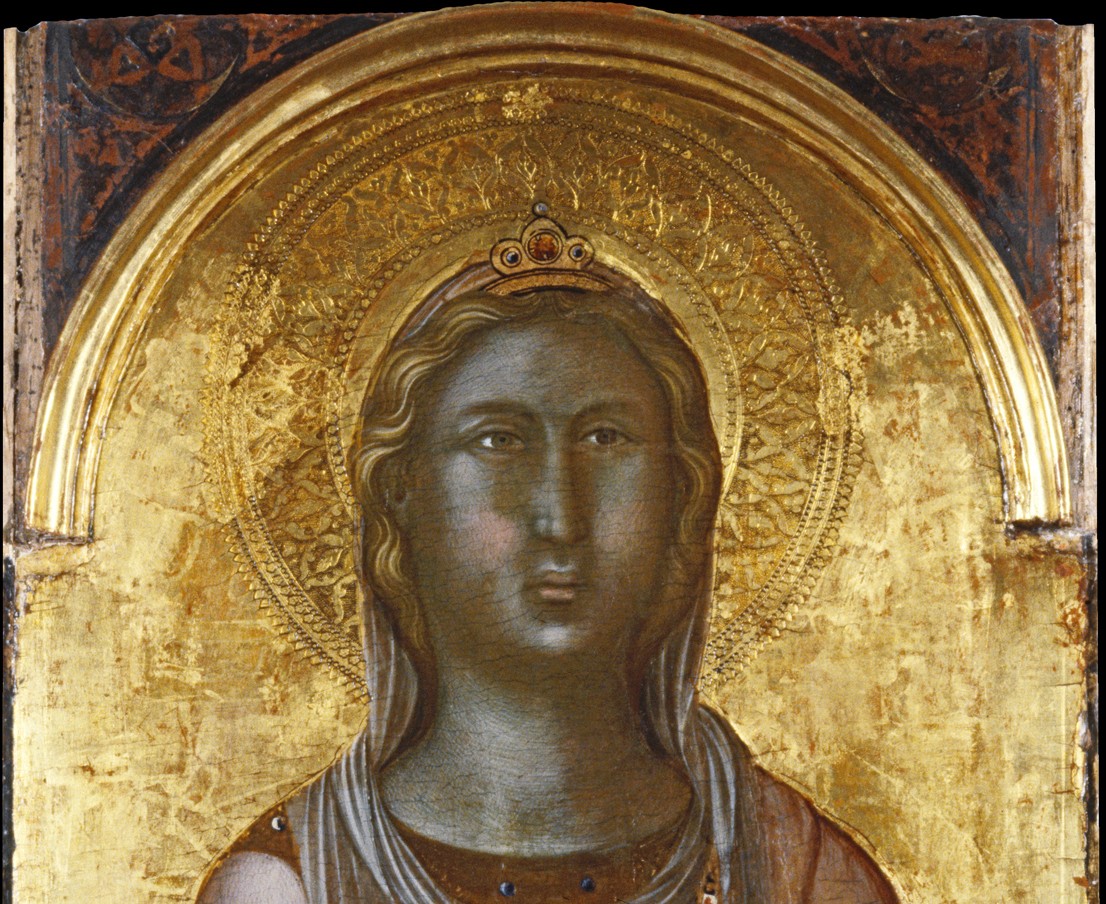
    Saint Lucy, by Niccolò di Segna mid 14th-century Sienese painting, c. 1340. The saint holds the dagger or sword with which she was ultimately executed and the lamp, her attribute.

    Lucia of Syracuse was born around 283 CE into a time of intense persecution of Christians under the Roman Emperor Diocletian and the Tetrarchy (ruled A.D 284-305), intent on reviving the waning Roman Empire by enforcing worship of its traditional gods. The Diocletianic or Great Persecution was the last and most severe persecution of Christians in the Roman Empire rescinding Christians’ legal rights and demanding that they comply with traditional religious practices. Abandoning the tradition of a citizen king, Diocletian elevated himself above the masses by initiating imperial ceremonies and requiring his subjects to prostrate themselves in his presence. While Diocletian did not demand personal worship as a deity, his policies required public sacrifices to Roman gods as a demonstration of loyalty to the empire.

    Eutychia, Lucia’s mother, arranged a marriage for her with a pagan suitor, but Lucia had already vowed to remain chaste and dedicate her life to God. When her suitor discovered her Christian faith, he denounced her to the Roman authorities. Lucia was subjected to brutal torture and ultimately martyred in 304 CE. Despite the hardships, she remained steadfast in her faith, reportedly declaring, “No one can take Christ from me.”

    Lucia’s feast day tomorrow, December 13, is celebrated with great reverence in many Christian traditions, coincides with my monastery retreat this weekend. Before the Gregorian calendar reform in 1582, the winter solstice occurred around December 13. This is how Saint Lucia’s feast day (December 13) became associated with “light” returning after the darkest day. Lucia, whose name means light (from Latin lux), symbolized hope and the coming of longer days. The symbolism of light in her story — often depicted with her holding a lamp or a crown of candles — underscores her role as a beacon of hope and faith in dark times but inherit also Jungian and Taoist concepts.

    Saint Lucy’s life and legacy offer enduring lessons that resonate deeply in our contemporary context:

    1. Courage in the Face of Adversity Lucia’s steadfastness in the face of persecution reminds us of the importance of standing firm in our beliefs and values, even under intense pressure. In modern times, as minorities like Christians, Alawites, Yazidis, and others, or oppressed ethnicities face persecution in regions, where proxy wars and crippling sanctions exacerbate suffering of their countries, Lucia’s story stands as a timeless example of resilience and faith under oppression.
    2. Advocacy for the Vulnerable Lucia’s dedication to aiding the poor reflects the Christian call to care for the “least of these.” Her acts of charity remind us of the moral imperative to confront human-made tragedies such as war, poverty, and the displacement of entire communities. These injustices are often perpetuated by powerful forces whose actions contradict their professed values, highlighting the hypocrisy of empires that have lost their way and, ironically, their own foundational faith. Lucia’s example also underscores the enduring triumph of spiritual power over temporal force, challenging us to prioritize compassion and justice over dominance and greed.
    3. Symbol of Light and Hope Lucia’s association with light holds a universal appeal, transcending religious and cultural boundaries. Her story reminds us that even in the darkest times—whether personal struggles, war, or the deprivation caused by political strife—small acts of faith and kindness can bring illumination and hope to others. Her courage and compassion inspire a belief in the transformative power of goodness in a broken world.
    4. Faithful Witness in a Hostile World Lucia’s martyrdom under Emperor Decius reflects the high cost of faith in a hostile environment. Today, her story resonates with those who remain steadfast in their beliefs despite oppression or violence. While some factions, including groups that paradoxically receive indirect international support, may persecute minorities, her example is a reminder of the enduring strength of conviction and the call to resist injustice.

    Jungian Symbolism of Lucia of Syracuse in Dante’s Divine Comedy

    In Carl Jung’s psychology, individuation is the path to wholeness, achieved by integrating the shadow—those hidden, repressed parts of ourselves. The shadow, like the darkness of winter, holds our unacknowledged fears and desires. Ignoring it leads to inner conflict, but facing it brings growth and transformation.

    Saint Lucia may symbolize this process. Her fate, tied to the darkest time of persecution, reminds us that light can only be found by first confronting the dark. Like Lucia’s candle piercing the shadows, individuation requires courage to illuminate what we hide within ourselves. By accepting our shadow, we reclaim lost parts of the soul and move toward true wholeness—a self both light and dark, balanced and complete.

    Saint Lucia (Lucy) plays a subtle yet significant role in Dante Alighieri’s Divine Comedy. She appears as a celestial figure aiding Dante on his spiritual journey, symbolizing grace, light, and divine assistance—qualities deeply tied to her historical and symbolic representation. Dante especially highlights the believed chain of mediation of graces that begin with Christ, through, Mary, and then through particular saints.

    The Inferno is, of course, a story of Dante being guided by Virgil through Hell. We learn that Virgil was summoned as Dante’s tour guide by his beloved Beatrice, who was summoned by Saint Lucia.

    Her role in helping Dante ascend from the Inferno to Purgatory aligns with the symbolism of individuation as a saint associated with vision, clarity, and overcoming blindness—both physical and spiritual. Lucia’s name is derived from the Latin lux (light), which aligns perfectly with her role as a figure of divine illumination. She appears when Dante is in moments of despair or weakness, providing light, clarity, and divine assistance. In the larger allegory of the Divine Comedy, she represents the grace and guidance necessary for the soul to transition from darkness (sin) to light (salvation).

    Thus, Saint Lucy’s presence in Inferno and Purgatorio underscores her role as a pivotal mediator of divine grace and compassion, helping Dante overcome his fears and advance on his spiritual journey.


    Saint Lucy in Inferno, Canto II

    In Inferno Canto II, Dante is still hesitant and afraid at the prospect of undertaking his perilous journey through Hell. Beatrice descends to Virgil in Limbo and reveals that Lucia had interceded on Dante’s behalf to help him overcome his doubt and begin the journey.

    Here, Beatrice recounts Lucia’s role as an intermediary:

    “Lucia, foe of all that is cruel, arose
    and came to me where I was sitting with
    the ancient Rachel. She said: Beatrice,
    true praise of God, why do you not assist
    the one who loved you so, he left the vulgar crowd?
    Do you not hear the anguish in his cry?
    Do you not see the death he battles on
    the flood that swells against the nearer shore?”
    (Inferno II, 97–104, trans. Allen Mandelbaum)

    Lucia is described as “nemica di ciascun crudele”—the “enemy of all cruelty”—reflecting her compassion and readiness to aid those in need. She urges Beatrice to help Dante, thus setting in motion the chain of divine intervention that brings Virgil to guide him.

    In this context, Lucia serves as a symbol of divine grace and intervention, providing Dante with the courage to begin his arduous journey through Hell and, ultimately, towards redemption.


    Saint Lucy in Purgatorio, Canto IX

    In Purgatorio, Canto IX, Lucia reappears at a critical juncture to assist Dante in his transition from Hell to Purgatory. After Dante falls asleep, Lucia carries him up to the Gate of Purgatory, a feat symbolizing divine aid in overcoming human weakness.

    Virgil describes what happened to Dante as he slept:

    “In this deep night before the dawn began,
    just as the sun was rising in the east,
    a lady, young and fair, appeared to me.
    I saw her wandering through the sleeping world;
    she bent down, gently gathered you, and took you—
    and now the light of day leads us to her.”
    (Purgatorio IX, 49–54, trans. Allen Mandelbaum)

    Lucia, in this moment, embodies divine assistance and grace, physically carrying Dante upwards—a task that he could not have accomplished on his own. It reflects the theological belief that humans require divine grace to ascend from sin toward salvation.

    Virgil’s account emphasizes the contrast between human effort (Dante’s struggles) and divine intervention (Lucia’s aid). By carrying him, Lucia allows Dante to bypass the immediate difficulties of climbing to the gate, symbolizing the grace that makes the transition from sin (Hell) to repentance (Purgatory) possible.


    Saint Lucia: Overcoming Power through Sacrifice (update after retreat weekend)

    The story of Saint Lucia transcends historical facts, adding to it freely during time to create a symbolic narrative. As a martyr, Lucia’s life aligns with the archetypal hero’s journey, yet with a distinct inversion: where the hero wins by overcoming power through action, the martyr triumphs by surrendering power through sacrifice.

    This is like in Taoist philosophy, the concept of wu wei—effortless action—is central to understanding how forces of nature interact in harmony. Water overcoming stone perfectly illustrates the Taoist approach to power: not through direct force, but through subtle persistence and adaptability.

    Water as the martyr, in its fluidity, does not struggle against obstacles but flows around them, gradually wearing away the hardest stone. Over time, its soft and yielding nature carves its path. In the same way, the hero’s victory through direct action contrasts with the martyr’s victory through surrender, like water’s triumph over stone. The hero confronts power head-on, using force and will.

    This Taoist metaphor suggests like the hagiography that true strength does not lie in confrontation, but in yielding not by defeating obstacles but by flowing through them with grace and resilience.

    Lucia’s defiance against the Roman authorities, refusing to renounce her faith, symbolizes resistance to external oppression. Her final act—offering her life—transforms perceived weakness into spiritual strength. When she foretells the fall of Emperor Diocletian, it underscores a profound truth: power rooted in force is temporary, while the courage of sacrifice endures.

    In this way, Saint Lucia’s story serves as both a myth to help further the cause of Christianity and a model of courage. The martyr’s “loss” becomes victory, inspiring others to resist tyranny or personal limitations with courage. Whether in the hero’s conquest or the martyr’s surrender, overcoming power—external or internal—requires an unshakable commitment to truth and freedom. Lucia’s light shines not as an escape from darkness or shadow but as a beacon for those who seek the strength to face it, reminding us that true victory often comes through sacrifice.

    Lucia of Syracuse’s legacy is therefore not confined to the facts of history or the rituals of religious observance. Martyr’s as well as a hero’s courage, compassion, and enduring faith continue to inspire people across the world.

    — Pray for Peace

  • ZAZEN ON EASTER SUNDAY: THE ULTIMATE MEDITATION

    ZAZEN ON EASTER SUNDAY: THE ULTIMATE MEDITATION

    Zazen, the practice of seated (za 坐) meditation (zen 禅), has many beneficial effects on physical health (lowered blood pressure and heart rate, enhanced immune function, etc.), on mental function (increased creativity and focus, etc.) and on emotional well-being (decreased stress and anxiety, enhanced sense of empathy and compassion, etc.). Important as these benefits are, however, they are relatively superficial compared to the spiritual goal toward which Zen meditation has traditionally been directed.

    As an unchurched catholic Christian, I’ve gained some of my most valuable insights into spirituality from Zen Buddhism. I’ve finally managed Zazen, to stay with a daily meditation routine and encountered exquisite beauties and powerful insights which helped me to regain my footing in the current world in crisis and cultural decay of the West and all their institutions.
    Being left alone and sometimes taken aback by Jesus’ ground personnel has eroded somewhat my Christian faith but for sure disconnected me from their temporal institutions. I haven’t been to a mass in church anymore for more than two years.

    I did, however befit from three monasteries, one Shaolin, one Catholic and Plum Village, a monastic community founded by the late Zen Master Thich Nhat Hanh. I think Zen Buddhism is almost the other side of Jung’s psychanalysis but ironically it shows also deep connections to Christianity.

    ZAZEN ON EASTER SUNDAY
    ZAZEN ON EASTER SUNDAY

    Firstly I do classic zazen (sitting meditation), i.e. simply to count four breaths, over and over again. When a thought intrudes, attention is gently returned to the breath, which becomes a vehicle for concentration and an opening to peace. When pain or worries come up I deal with them gently. Suffering and happiness are not separate.

    “Most people are afraid of suffering. But suffering is a kind of mud to help the lotus flower of happiness grow. There can be no lotus flower without the mud.”
    —Thich Nhat Hanh

    Secondly I strive for mindfulness for all I do.

    Mindful walking my animal companion, a young Labrador, reduces stress and makes the apparently unhinged world feel more manageable. Its not a (healthy) chore anymore, but makes both of us feel better, and calmer.

    Thirdly I ignore people or institutions with negative emotions.

    Do you know how receiving impulses from certain people makes you feel better and calmer? I do. Good vibes are scientifically called coregulation, an inter-personal process in which participants permanently adjust (often unconsciously) to co-create and maintain a positive emotional state.

    For instance, my spouse (sometimes, we have been married for almost 25 years), or my Shaolin Chi Gong teacher come to my mind. However quite a few others are not around anymore. Literally or not (quite a few turned to the dark side during the last few years). Negative vibes. That’s true for also for groups, institutions, even most Christian churches.

    Time to move on. Time to do Zazen.

    Well, I started intro-personal coregulation with myself and this time it worked. Establishing a routine of active meditation with Qi Gong and Shaolin forms and Zen meditation (Zazen). I am focusing on mindful living and feeling my way in into Buddhism (again). Calms body and mind, making aware (coregulating) body and mind and shuttling down mind chatter. Good Zazen practice, looks neither back nor forward. It is a practice of live in the present, of being present, in that who we are is defined by what is happening right now and not so much where we came from and not so much where we’re going. It’s not what we’ve been, or what we’re trying to become. Only the present counts.

    How about inter-nonpersonal coregulation? For me, stargazing and astrophotography always helped me to connect with the natural world, the universe and align with their rhythms. I added a daily sport routine and substract social media, media period.

    When we engage in an activity, our minds are thinking of or we are doing something else. That’s why the Zen principle of mindfulness is so powerful. It calls us to be fully present in each moment, living it fully because it will not pass this way again. The ritual of the tea ceremony is an enactment of the principle of mindfulness.

    Eating mindfully can be a good way to start. When I eat, for example, I am fully present for each bite. I savor the smell and the sense of foot on the tongue. I do this this automatically during fasting periods (No meat, No Sweet, Strict Abstinence): New Year Day to Easter and September to Advent.

    One need only listen to the words of the Gospel of Thomas to hear how Christianity resonates with the Buddhist tradition:
    Jesus said, “If those who lead you say to you, ‘Look, the Kingdom is in the sky,’ then the birds of the sky will get there first. If they say, ‘It is in the sea,’ then the fish will get there first. Rather, the Kingdom is inside of you, and it is outside of you. When you come to know yourselves, then you will become known, and you will realize that it is you who are the children of the living Father. But if you will not know yourselves, then you dwell in poverty, and it is you who are that poverty”.

    After all, fear is only an illusion. Often even a deliberately induced mind formation.

    “We live in illusion and the appearance of things. There is a reality. We are that reality. When you understand this, you see that you are nothing, and being nothing, you are everything. That is all.”.”
    —Buddha

    No Mud, No Lotus The Art of Transforming Suffering, Thich Nhat Hanh

    Living Buddha Living Christ, Thich Nhat Hanh

  • The banality of evil from a Jungian view

    The banality of evil from a Jungian view

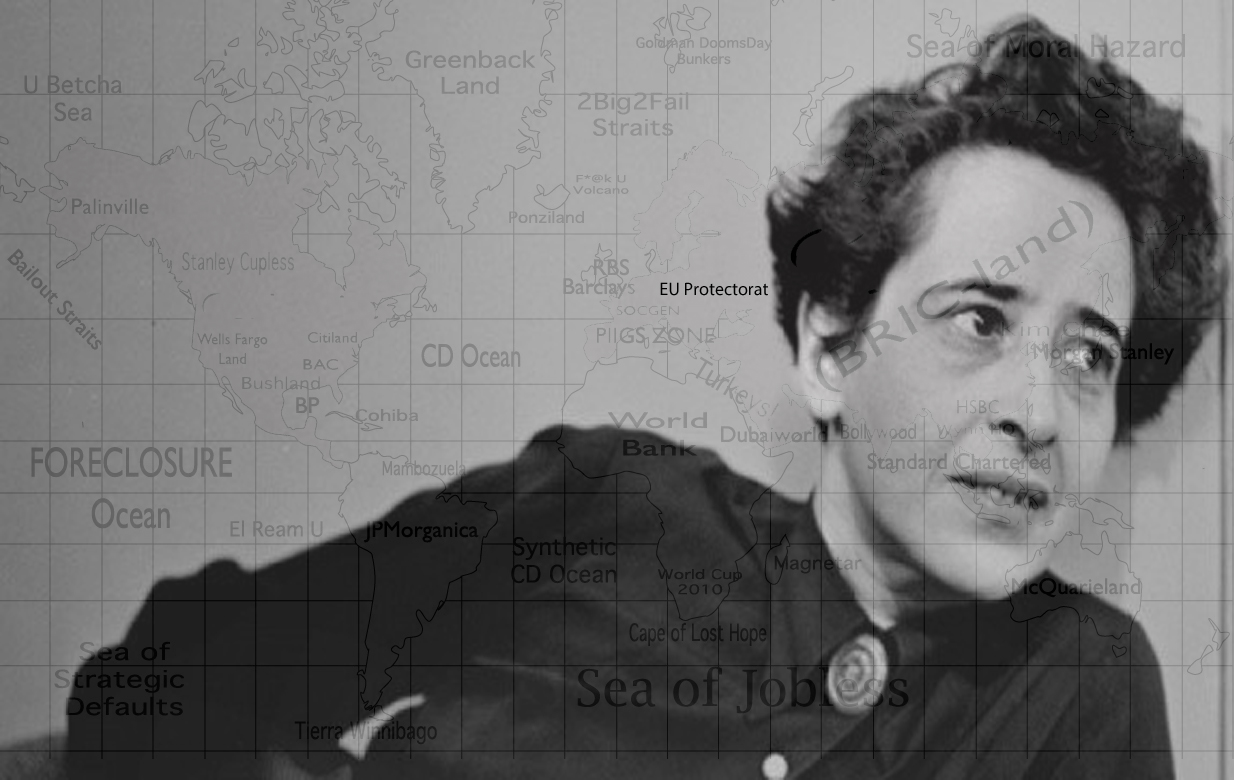
    We’ve all heard the phrase “the banality of evil”, coined by the political theorist Hannah Arendt. Her 1951 masterwork, “The Origins of Totalitarianism,” about the parallels between Hitler’s Third Reich and Stalinist Russia, made her an intellectual celebrity. In her book, she argued that totalitarian regimes seek to dominate every aspect of everyone’s life as a prelude to world domination. Reflecting recent events, on more than one occasion the phrase “the banality of evil” crossed my mind. Touched by her psychological and philosophical view to totalitarian systems, I often wondered, how this radical political theorist would have commented to evil political events of the new millennium. Based on her quotes this essay suggests, that we live in the advent of new totalitarian regimes. I was very hesitant to publish this essay. Why? The psychological and philosophical analysis cannot be strictly separated from its political perspective. Be assured, that I am just interested in todays Evil from a Jungian view without political prejudices.

    Totalitarianism and supranationalism

    TheOrginsArendt emphasized repeatedly  that totalitarianism differs essentially from other forms of political oppression known to us such as despotism, tyranny and dictatorship. Wherever it rose to power, it developed entirely new political institutions and destroyed all social, legal and political traditions of the country. The term totalitarian, first used in the late ’20s, was not fully developed until the late ’40s and early ’50s, when a classical literature arose describing a new kind of tyranny created in this century.  Arendt discusses the use of supranational organizations, fake (non) governmental agencies, and doctrines as a means of concealing totalitarian aims. She claimed for instance that the Nazis were not simple nationalists. Their propaganda was directed toward their fellow-travelers and not their convinced members; the latter, on the contrary, were never allowed to lose sight of a consistently supranational approach to politics.

    Their aim was a dominating superstructure which would destroy all home-grown national structures alike. They could indulge in hypernationalistic talk even as they prepared to destroy the body politic of their own nation, because tribal nationalism, with its immoderate lust for conquest, was one of the principal powers by which to force open the narrow and modest limits of the nation-state and its sovereignty.

    Isolation and loneliness of the individual

    What made totalitarianism unique was its militant, messianic ideology; its mobilization of the masses; its total control of social life (all independent “intermediate” structures — such as churches, parties, unions — standing between the individual and the state were to be eradicated); and its systematic use of terror to enforce that control. Totalitarian regimes were thought to be (under Hitler and Stalin they certainly were) energetic, enthusiastic in an almost religious sense, on the march. Orwell’s 1984 seen from today was not a parody. It was just a mild extrapolation of past totalitarian reality and a abstract picture of today’s totalitarian possibilities. Totalitarian domination as a form of government is not content with isolation in public political life  but aims to destroy private life as well. It bases itself on loneliness, on the experience of not belonging oneself, which is among the most radical and desperate experiences of man. Superfluousness which have been the curse since the beginning of the industrial  revolution, have become individual isolation and loneliness – one looses even contact with the Self – both outcome and precondition of totalitarian domination.


    The Banality of Evil

    Hannah Arendt most memorably employed it in both the subtitle and closing words of Eichmann in Jerusalem: A Report on the Banality of Evil, her book on the trial of Nazi lieutenant-colonel Adolf Eichmann. To Arendt’s mind, Eichmann willingly did his part to organize the Holocaust — and an instrumental part it was — out of neither anti-semitism nor pure malice, but out of a non-ideological, entirely more opportunistic combination of careerism and obedience.

    The sad truth is that most evil is done by people who never make up their minds to be good or evil.

    This kind of evil is very tricky to explain, but one Jungian definition could be this one: Banal evil is a kind of evil
    which is unconscious, a kind of evil that the “evil person” hasn’t reflected over. The complex or the shadow took over.  It’s also a kind of evil that is not considered evil by the person who acts, in the moment of the evil act. The reason why the person doesn’tconsider the act as an evil act is mainly ignorance or inconsiderateness of the Ego.

    In 1961, The New Yorker sent her on her request to cover the trial of Adolf Eichmann, one of the chief instrument of the Third Reich’s Final Solution, who had been kidnapped by Mossad operatives and brought to Jerusalem to stand trial for his crimes. The five-part article which emerged, “Eichmann in Jerusalem,” set off what is considered to be one of the most passionate and best public debates concerning Evil ever to take place

    Arendt, who was born into a secular family of German Jews present-day Hanover and grew up in Königsberg (now Kaliningrad). and Berlin. She studied philosophy with Martin Heidegger (later tainted by his support of the Nazis) and wrote her dissertation in Heidelberg under the existentialist philosopher-psychologist Karl Jaspers on the concept of love in the thought of Saint Augustine, published 1929.  In 1933, she was arrested by the Gestapo for collecting evidence of anti-Semitic propaganda. After fleeing to Paris, she worked for a Jewish relief group before being sent to a French internment camp, from which she escaped. She and her second husband, Heinrich Bluecher a  German Communist, emigrated to America..

    Arendt’s original series of “Eichmann in Jerusalem” articles can be found in the New Yorker‘s online archives:: part one, part two, part three, part four, and part five. Although the poet Robert Lowell called “Eichmann in Jerusalem” a “masterpiece,” Arendt’s portrait of Eichmann as a bureaucrat motivated not by extreme ideology but rather by ambition disturbed many people. Throughout the piece, Arendt wrestles with her perception of Eichmann, calling him “monstrous” yet “terrifyingly normal.” Many readers objected to Arendt’s use of the term “banality of evil” to describe Eichmann. In a Reflections piece published posthumously, Arendt expanded on her use of the controversial phrase:

    I was struck by a manifest shallowness in the doer which made it impossible to trace the incontestable evil of his deeds to any deeper level of roots or motives. The deeds were monstrous, but the doer—at least, the very effective one now on trial—was quite ordinary, commonplace, and neither monstrous nor demonic.

    Go back 60 years to the controversy that surrounded Hannah Arendt’s Eichmann in Jerusalem, a study of the Adolf Eichmann trial, in which she coined this famous phrase “the banality of evil.” Arendt wrote in a letter to a friend: “It is indeed my opinion now that evil is never ‘radical,’ that it is only extreme, and that it possesses neither depth nor any demonic dimension. It can overgrow and lay waste the whole world precisely because it spreads like a fungus on the surface.” This was what Hannah Arendt meant: Evil is unspectacular and always human. The normality of evil is evident.

    In any event, the fearful imagination has the great advantage to dissolve the sophistic-dialectical interpretations of politics which are all based on the superstition that something good might result from evil. Such dialectical acrobatics had at least a semblance of justification so long as the worst that man could inflict upon man was murder.

    The truth about evil that needs attention now is its shallow, deadly, fungus quality. Today evil destroys not only  life, but it destroys the fact of existence itself. In a tiny, multicultural world in which different civilizations inhabit different centuries–are often moved by evil deeds, like blowing up the Other. Don’t bother demonizing  terrorists as being inherently evil (as Satan is evil). That’s not how it works.

    Opportunistic evil passes like unconscious complexes (in a Jungian sense – negative energy) through the world, clustered in supranational institutions and financial concentrations, that take up residence in individuals or cultures from time to time. For example, the International Monetary Fund (IMF), an organization of 186 countries has been the centerpiece of the world monetary order since its creation in 1944, and its supervisory role has been considerably strengthened after the advent of floating rates of 1973. The role of the IMF in the current EU-crises and  global events has been largely overlooked. But this is not the story I like to tell here.

    The Global Evil

    Distance once helped dampen the effects of human wickedness, and weapons once had limited range. But evil has burst into a new dimension. The globalization, democratization and efficiency  of the instruments of destruction and control  mean a quantum leap in the delivery systems of evil. Drones for full physical control or their diabolical stepbrother of electronic and financial means  for full virtual control, un-leveled the local playing field globally again – and the level field has fungus on it.  For a short while ragged Islamist group with weapons, which sells girls in slavery can terrorize citizens by asymmetric strategies, but even then, the Local Evil serves a purpose for the Global Evil.

    Only crime and the criminal, it is true, confront us with the perplexity of radical evil; but only the hypocrite is really rotten to the core.

    The Global Evil potential became a world-historical force, but with more discretionary destructive power at hand than the great old monsters, from Caligula to Stalin, ever had. In the new dimension, micro-evil (the dark impulse to rape or murder, say) and macro-evil (economic genocide) achieve an ominous reunion in any bid for the apocalyptic gesture. That’s the real evil that is going around. Most revolutions, as historical analyst  Hannah Arendt points out in her 1963 published book “the fools of history”, have not established and maintained a state of liberty in which a common citizen can usually make politically heard. Even the American Revolution ultimately failed because Americans lost interest in their political condition in order to pursue their private gain.

    Omnipotent Evil

    ResetTheNetAccording to Arendt that totalitarian totalitarian elites have usually a firm and sincere belief their unilateral omnipotence. Totalitarianism and the belief to be chosen to lead the world instead of other less worthy powers go together. This moral cynicism, their belief that everything is permitted, rests on the solid conviction that everything is allowed to them. Moral decisions become dependent on the context. Aggression on the grounds of “ exceptionalism”, is backed by the dubious idea that some are special and cannot be held to the same standards as others. Unilateralism, preemption, and exceptionalism, the toxic combo that has spurred hundreds of of wars, territory occupation, regime change, global surveillance, extra-judicial assassinations, drone attacks, and hyperbolic state terror most of which has been directed at civilian populations whose only fault is that they occupy regions which have some geostrategic or economic importance.

    The totalitarian attempt at global conquest and total domination has been the destructive way out of all impasses. Its victory may coincide with the destruction of humanity; wherever it has ruled, it has begun to destroy the essence of man.

    …
    And if it is true that in the final stages of totalitarianism an absolute evil appears (absolute because it can no longer be deduced from humanly comprehensible motives), it is also true that without it we might never have known the truly radical nature of Evil.

    Narcissism of totalitarian belief systems

    It’s a cliché to say that most politicians become arrogant if they are in office for more than about six or seven years,  and become quite disconnected from reality. We perhaps didn’t realise when the exceptionalism doctrine was presented first – that exceptionalism is a extreme form of narcissism, a messiah complex, that had been always an thriving impulse in  totalitarian systems.

    narcissus-large“If you had to summarise narcissism, it’s a feeling of specialness,” says Dr Adam Perkins, a researcher at King’s College London’s Institute of Psychiatry. “Narcissists view themselves as special, as deserving of better treatment than the rest of the world.”

    I have experienced and written how narcissism and excessive self-confidence can actually “help” in the political realm often supporting a negative selection. When action is needed, Narcissism – even of the mildly delusional variety – may be a useful thing in publicity.

    And a healthy dose of narcissism is probably protective in certain situations. “If you’re dumped as a leader, it might help you to feel special – to think, well, their loss.

    Narcissus fell in love with his own reflection not because he was narcissistic, necessarily, but because his reflection was so beautiful. Extreme narcissism, however, like psychopathy, usually manifests itself evil. Narcissus’s story ended badly, of course. According to the The Diagnostic and Statistical Manual of Mental Disorders, a diagnosis of narcissistic personality disorder can be made if a patient (or system sic!) displays five of the following nine symptoms:

    • An exaggerated sense of one’s own abilities and achievements.
    • A constant need for attention, affirmation and praise.
    • A belief that he or she is unique or “special”.
    • Persistent fantasies about attaining success and power.
    • Exploiting others for personal gain.
    • A sense of entitlement and expectation of special treatment.
    • A preoccupation with power or success.
    • Feeling envious of others, or believing that others are envious.
    • A lack of empathy for others.

    I mean here extreme exceptionalism, evident in political correctness and certain supranational elites (inner circle) and organisations, and recently very openly in super powers again. Extreme unreflected exceptionalism  has been a trademark of feudal systems with a thin ruling class and a large peasant class.

    Only the mob and the elite can be attracted by the momentum of totalitarianism itself. The masses have to be won by propaganda.

    Lying and deceiving

    snowden4Totalitarian policy is as a case of the government beginning to believe their own propaganda about their narcissist exceptionalism. The distorted reality will be believed by those who use them, just as C.G. Jung said – the unconscious in us is real. It is this form of perceived omnipotence that leads to bullying and manipulating the citizens and the failed Hero acting of the elite: the weak king, the cruel warrior, the wicked magicians, the narcissistic lover. Sure, there are also clear political struggles and psychological motives behind the supranational and unipolar debate: the establishment join in the hope for the blessings of a centralist post-democratic state, because they share belief in the stability of the state as sole power (and on its non accountable priests). Anything significant beyond the state (such as the individual, the family, the truth, the religion), would challenge the semi-religious ego of the transnational institutions – not only their political clout.

    The trouble with lying and deceiving is that their efficiency depends entirely upon a clear notion of the truth that the liar and deceiver wishes to hide.In this sense, truth, even if it does not prevail in public, possesses an ineradicable primacy over all falsehoods.

    Dissent thoughts let the inner circle fear for the long-awaited stability of a nation less and culture less state. That was the reason why the Europe’s leaders and the EU bureaucracy has been trying to reassure the public with obviously wrong assurances and after an earthquakes election continue with business as usual. Assurances, which are obviously wrong arouse always a debate and laid the foundation of today’s distrust in opponents. This triggered even neutral public figures, to believe that conspiracy theories might be plausible. Welcome to virtual reality. In George Orwell’s dark vision, the year 1984 would see the triumph of totalitarianism in Europe—an era of Newspeak and Doublethink, of dictatorial cruelty and dehumanizing coercion. That fateful year is now three decades away, and it seems less and less visible that Orwell’s grim prophecy  proved correct.

    Conclusion

    I’ve read Hannah Arendt “Eichmann in Jerusalem” and “The Origins of Totalitarianism”, several times – it always amazes me. I find Arendt very hard to disagree with – she just seems so shrewd, so alert, annoyingly good at noticing everything that needs noticing; She must have it right. Writing 50 years ago, this great theorists of totalitarianism, noted that totality and irreversibility are related. It used to be thought that totalitarianism had repealed the law of history by which power sows the seeds of its own destruction. If sheer ruthless vigilance could destroy any center of opposition, even any island of independent thought, then — aside from external conquest, with humanitarian  pretext — totalitarian rule could never be reversed. Conversely, if total control fails due to today’s interconnected multipolar world, what happens to single-minded direction? If totalitarianism can decay, can it not be transformed? We don’t yet know. We know only that it can be modified. It can give way to a society with some space. How much? Well,  somewhat between 1984 with drones,  full coverage realtime surveillance and a brave new world of constructed realities.

    Obviously you can read the banality of evil as a description of the ordinariness of the people involved, or as a statement about the optimisation of work in international institutions like the IMF or others. The point about the ‘radical’ evil – the cruel, savage, sadistic kind – is that it is much easier to spot. Is is visual, it is on CNN.  That is what makes it all the more important to be aware of ‘evil’s’ other face – the unconscious  evil. It hides in the balance sheets.

    Economic growth may one day turn out to be a curse rather than a good, and under no conditions can it either lead into freedom or constitute a proof for its existence.

    The banality of evil is not so banal after all.

    Bibliography

    • Eichmann in Jerusalem: A Report on the Banality of Evil (1963). (Rev. ed. New York: Viking)
    • The Origins of Totalitarianism (1951). second enlarged edition;  A MERIDIAN BOOK First Meridian printing September 1958 Seventh printing September 1962
    • The Human Condition (Chicago: University of Chicago Press, 1958).
    • On Revolution (New York: Viking, 1963).

    Note: the first two books are available as free of charge ebooks.

  • Archetype of the vampire in todays culture of Narcissism

    Archetype of the vampire in todays culture of Narcissism

    The vampire breaks the rules of the gods, society or nature, sometimes maliciously sometimes cunning or foolish or both.  This article wants to explore the connection between Narcissism, Vampires and contemporary politicians. We experience right now a difficult transition especially in Europe, led by an élite bred more than ever by an increasing culture of Narcissism  The psyche of world leaders, almost everybody in power (over us) can been interpreted narcissistic and the power behind (the money cluster and NWO matrix) as a sort of vampires.

    I have written not much lately. The reason was, that I joined a start-up party in the upcoming German election. It is a major election, as Europe is standing on fiscal and value cliff. Basically it is about „Freedom or Euro“ or “democracy or serfdom”. The majority of those party members are highly educated and professional, but  I have seen so many fellow party members quit under flashy and sometimes infantile circumstance, that I could not help to diagnose that narcissistic disorders must be an important topic especially in politics. Therefore I decided to do case studies, based on my experience in this political party. This article is work in progress ro structure my bewilderment a little bit. Indeed, within this new Euro critical party “start-up”  I met more narcissistic hurt people I ever cared for. It was the first time, when I understood why politics is so sick – it lures sick people in a sick mental framework and gives the worst of them an advantage. This political culture reminds me of Ann Rice’s vampires or zombies.

    In this new party, I experienced an active engagement with the tension between destruction and creation. With these developments, an individual – and a party and its voters – cannot easily engage in an effective dialogue that mitigates the coming apocalypse of Europe.

    Vampire myth

    The vampire myth has appeared over the centuries in almost every culture, beginning with the earliest recorded epic from Babylonia, about 2000 years B.C the Gilgamesh.  Although there are cultural variations in the various legends, there is always one defining trait of a vampire: a vampire sucks blood. Blood stands for life in Christianity, and is the archetypal symbol of the soul (life energy). The Sumerian vampires  Ekimmu, not to be confused with Ekindu, were a type of evil spirit (Utukku) riding on a wolf (you might recall a recent article of mine about the archetype of the wolves). The Assyrians of Mesopotamia believed the Ekimmu or Edimmu came into existence when their people died before their time. These unfortunate souls were refused admission to the underworld, causing them to become violent and ill tempered, hence the name “ekimmu” which translates to “that which was snatched away.I When the hero, Gilgamesh, prays to the god Nergal to restore his friend Ea-bani the request is granted, for the ground gapes open and the Utukku of Ea-Bani appears “like the wind”; that is, a transparent spectre in hishuman shape.

    vampire
    Gilgamesch-Epos

    In studying analytical psychology we can begin to look at the vampire myth in psychological terms. It is a fatal symbiosis and a nourishing of one self with another’s vitality (two central points of vampire legends). As said before these traits are also inexplicable components of many human relationships. Most psychological interpretations of the vampire legend are Freudian, and see the legend in terms of incest, homosexuality, sadism and masochism. These interpretations miss a core meaning of the vampire, one of our oldest, most recognizable archetypal figures. The vampire has been cursed, denied eternal rest because of some unredeemed sin.  The Ekimmu, or Departed Spirit was the soul of a dead person who for some reason could find no rest and wandered over the earth seeking to seize the living. As inmost later vampire tales, the Ekimmu and its victim had some mysterious psychic connection, which made the victim particularly vulnerable to attack. The Ekimmu could walk through, doors or walls to take up residence in house. It would then drain the life from the household, usually killing the owner and many of his relatives and servants.

    The earliest Sumerians didn’t have gods and goddesses in human-like form. Instead, the early Sumerians believed in spirits in every object. This type of belief is known as animism, which assigns spirits and life to all things-the rocks, the sun, plants, and all animals. The Ekimmu could suck the life out or could take over a person’s body. They mostly preyed upon the young and those asleep (like Dracula).  The Sumerians later worshipped four all-powerful creation gods. And their creation myth is similar to later myths. Even the Judeo-Christian story of Adam and Eve can be traced back to later Sumerian writings. Yet even in their creation story, the gods breathe life-or spirit-into men. So the belief in a spirit never fully leaves the religion.

    In Babylonia, as in Christianity, the vampire archetype describes a collective darkness: a group of heretics and criminals, raging against mankind and ceaselessly devouring blood. The vampire is not primarily a personification of personal darkness of the Freudian unconscious, but a scourge of the society an archetype from the collective unconscious.  The vampire is therefore a religious figure like the Christian devil, but even older than Lucifer. The Vampire archetype and the Redemptive archetype (Christness) are the first polar opposites of the same archetypal energy (just note that we Catholics believe in drinking Jesus’ blood). They emerge from the collective unconscious as a dividable pair. Although the association is less clear today, vampires always have been closely associated with religions. In Babylonia, China, Greece, and Egypt, and Christianity, the person likely to become a vampire was one who neglected religious rituals, or defied community moral standards.

    Vampire facts

    First impressions or how behaves a political vampire or a person with a narcissistic disorder in a party environment? According to existential-analytical understanding, the narcissistic pathology has its basis in a disorder of the self-value. This point of view could indeed  illustrated with the aid of my phenomenological observation, of the personal fundamental motivations  in politics as well as of my  personal analysis.

    If you go to a person with a narcissistic disturbance hits, one often discovers spontaneously a pleasant persona. One thinks here a very sympathetic guy! So refined, so intelligent, so charming, how can anyone be so perfect! When the presentation is stronger, it may also well happen that in a sense envy or eat least admiration is discovered – both are common reactions when one  has to do with a narcissistically wounded people.

    The Self-concept of a narcissistic disturbed people between is determined between two opposite poles – the sense of grandiosity on one hand and the feeling of the notation for annulment on the other. Dominate outward a striking magnificence and mightiness. A narcissistic is attractive and impresses with its alluring manner. They have a good sense of how well he can come and what he must do to get admiration. In a politic business it gives an edge to draw all eyes to oneself and to place own achievements and successes in the focus. Even in party work, a narcissist gives initially a grandiose and powerful show of ability and wisdom, particularly if not under stress.

    The male vampire

    For Freud, the vampire is largely representative of brutal, primal sexuality coupled with images of death in dark attempts to reach immortality. The vampire to Freud was a very old archetype that compressed one’s projected fears and repressed desires. From a Jungian perspective, the vampire image could be understood as an expression of what he termed the “shadow,” those aspects of the self that the conscious ego suppresses and is unable to recognize during socialization. Some aspects of the shadow were positive. But usually the shadow contained repressed wishes, anti-social impulses, morally questionable motives, childish fantasies of a grandiose nature, and other traits felt to be shameful. Jung interpreted the vampire as an unconscious complex that took over control over the psyche like a curse or spell. I observed particularly auto-erotic, autistic, or otherwise narcissistic personality traits in some party members which behaved fact predatory, anti-social, and parasitic on the life energy to me and others. We had one candidate, who turned out not to advocate the political agenda of this party, but only his own emotional (and maybe financial) needs. His record was one of a long, long but largely unsuccessful political career of a minor politician. He was a basically a political vampire. After his speech was not greeted with warm welcome, he stepped back to preserve his “delusions of grandeur” and his behavior to everybody became destructive and erratic. I sensed a deep narcissistic disappointment which was held up only by a rigid super-inflated Ego.

    I meet some other similar disturbed party members, but the old politician was a prime example what in contemporary psychology and psychiatry this type is called a “narcissistic personality disorder.”

    Island_of_the_Dead,_AfD

    Narcissistic personalities are characterized by a “very inflated concept of themselves and an inordinate need for tribute from others.” Capable of only a shallow emotional life they have difficulty experiencing any empathy for the feelings of others. Their ability to enjoy life, except for their experiences of their own grandiose fantasies and the tributes that they can manipulate others into giving them, is severely limited. They easily become restless and abusive unless new sources are feeding their self esteem. They envy what others possess and tend to idealize the few people from whom they desire food for their narcissistic needs. They depreciate and treat with contempt any from whom they do not expect nurturance and their relationships with other people are clearly exploitative and parasitic. This description of the narcissistic personality sounds as if it were crafted to describe contemporary Western politicians: It is as if they feel they have the right to control and possess others and to exploit them without guilt feelings-and behind the surface, which very often is charming and engaging, one senses coldness and ruthlessness.

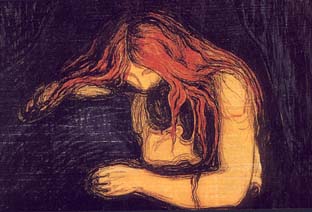
    The female vampire

    The female Vampire
    The female Vampire

    Jungian interpreters often highlight the parallels between the vampire image and narcissistic psychopathology. Some, for example, have noted that the vampire is both narcissistic and autistic and emphasize that the vampire experiences “narcissistic self-destruction as a result of their intensely selfish desires. In Germany politics at large, there is one “successful” politician whose imago fits perfectly the shadow of the narcissistic mother – the female vampire. She makes a largely symbolic politic which is clearly against the interest of her voters. But 65% of the German think she does a good job. The narcissistic mother, while appearing on the surface to have good will and a nurturing attitude toward the child, in fact drains the energy of the child and weakens the child through subtle (and not so subtle) emotional exploitation. This pattern provides insight into the psychological experiences that underlie the numerous folktales of vampires preying on children. There is reason to believe that the incidence of such predatory behavior toward citizens is increasing.

    The Vampire and the Culture of Narcissism: Although Jung and subsequent Jungian interpreters have noted these and other narcissistic aspects of vampire myths, they did not adequately explore narcissistic psychopathology, the chief psychological dynamic underlying vampire narratives and the major reason for the current burgeoning fascination with the vampire image. However, others assumed the lead in psychoanalytic research into pathological narcissism and its social formation as a “culture of narcissism.”

    The culture of Narcissism

    Political Vampires

    There is a rapidly spreading climate of moral self-absorption that has emerged in the wake of modernization and secularization – in Germany it’s the Green party which after decades of errors flourish and in the US the liberals (in power). Both have not the slightest self doubt to scan the internet and intimidate or use the free press. Our contemporary penchant for narcissistic self indulgence has resulted from the eclipse of any absolute ethic with its emphasis on spiritual involvement and temporal values. Contemporary alterations in culture indicated a fundamental shift in our psychological development. One Jungian suggested “that the dominant or modal personality of our culture has shifted to a narcissistic psychological organization.” He tied this recent phenomenon to the process of a gradual erosion of a religious view of the world. I agree, the collapse of any ethic restraint as a bulwark against pathological self involvement was only the last in a long line of cultural and religious developments leading to today’s increasing narcissism. Wall Street was always populated by vampires, but today we begin to discern the chief psychological dynamic underlying the increasing popularity of vampire images and narratives. “If our society is a culture of narcissistic self-involvement, then the vampire image is a perfect icon to express the psychological character configuration underlying it.”

    What goes wrong to cause an individual, group or society to develop a narcissistic personality disorder? As C.G. Jung emphasized, the development of a “happy” personality requires a creative interplay between the innate potentials of the Self and the emotional environment.

    An inadequate nurturing environment like broken families, corporations which treat their employees like cattle in the Global competition and of course our distorted political organizations cause significant damage in the form of “narcissistic wounds.” The development of the self is arrested and the emerging self is left in a weakened condition in an ongoing struggle with overwhelming longings and unmet emotional needs. When normal development is disturbed in this way, the resulting state of emotional disequilibrium necessitates that the individual seek to compensate for the resulting deficit or weakness in the structure of the self. Therefore, the person who has not successfully built a psychological internal structure remains pathologically needy and dependent upon others to perform functions, not able to execute. Others must be “used” in various ways to bolster a fragile sense of self and to attempt to fill an inner emptiness. This primal dependency is at the root of “vampiric” predatory patterns in relationship of our failed party candidate – the weak vampire.

    Symptoms resulting from such emotional disturbances have characteristic features. Patients often report feeling depressed, depleted, and drained of energy. They report feelings of emptiness, dulled emotions, inhibited initiative, and not being completely real. Our weak vampire completely lacked empathy for the feelings and needs of others, had attacks of uncontrolled rage or pathological lying in blogs and mail attacks. However, we shall see below that the tie between narcissistic pathology and the vampire is much tighter than merely sharing the same set of symptoms.

    Stage-hungry vampires

    FRANCE-EU-ELECTION-GREENS

    Narcissistic wounds and resulting pathology manifests in a wide spectrum of clinical syndromes ranging from psychosis to narcissistic character disorders. At work they may find themselves constricted in creativity and unproductive. In social interaction they may have difficulty in forming and sustaining interpersonal relationships. They may become involved in delinquent and anti-social activities. Despite their discomfort about their need to display themselves and despite their sometimes severe rejection they must go on trying to find new self objects whose attention and recognition they seek to induce.

    Such stage-hungry personalities often manifest arrogant superiority. There is one minister who arrogantly abused his press speaker before open cameras. If, as it was the case with the weak vampire, this arrogance is not affirmed and accepted they will often withdraw into what self psychologists call “a grandiose retreat” seeking refuge in isolation in order to shore up their self esteem. The dynamics of stage-hunger also helps us to understand the combination of grandiosity and immortality in the vampire mythology. Adult untransformed grandiosity makes unrealistic claims on others. The more disappointment experienced by the stage-hungry person, the more they resort to the grandiose retreat from social involvement. What is Dracula’s remote castle on the top of a difficult to reach mountain if it is not a “grandiose retreat?”

    Stage-hungry personalities often manifest a kind of “counter-dependency.” That is, they will often seek to avoid expressions of emotional need and dependency. Underlying this reluctance to admit chronic unmet needs to self or others is the fear of a disastrous, even fatal, depletion of the person who is seen as a potential source of gratification.

    Vampires and Sexuality

    A archetypal symbol of vampire mythology has been the powerful erotic imagery accompanying the vampire attack. One can find that in politics too. The systemic pedophile behavior of leading members of the Green Party (one of them a current member of the European parliament) has been successfully suppressed for thirty years in the press even if openly admitted by some and one time party program. Only recently, more and more victims, who were abused by those archetypes of “pedophile vampires”, when they were children, speak out.

    TheGreenMonster

    Sexual contacts, which are portrayed in these vampire stories utilize images of the innocent youth becoming the target of compulsive blood-lust.  Psychologically speaking, narcissistic wounds often lead the individual to seek narcissistic nourishment through sexual activity – be it so soft as begging to be fondled with an open fly. Still Sexuality and aggression fuse in a manner that leads to the infection and death of the victim or scars for a lifetime. A facade genital sexual behavior masks a quest for what Freudian’s have called oral (not genital) gratification. The compulsive quality of this sexual behavior is grounded in the individual’s narcissistic psychopathology. Today this pathology is widely understood to be the emotional foundation of sexual addictions. The Dracula story captures this combination of apparently erotic behaviors that are, in fact, expressions of a deep inner emptiness, not human affection.

    Vampire Group behaviour

    The projection of this image onto other social groups is undoubtedly one of the powerful psychosocial mechanisms that fuel malignant racism, anti-Semitism, political correctness, and other expressions of scapegoating . That has been very evident in this start up party, but is also evident in the EU-Crisis, where Germans are depicted as Nazis if not paying through the nose and the ailing countries as lazy folk punished by austerity.

    Vampires and political correctness
    Vampires and political correctness

    In the dynamic of scapegoating, we find someone or some group that can be used as a receptacle for the projection of the vampiric image. Then the scapegoat can be blamed, cast out of the community, and/or persecuted with various degrees of violence. This externalization of the vampiric image enables the person or “in-group” to feel better-guiltless or “cleansed.” As a social dynamic such scapegoating both allocates blame and seems to “inoculate” against further disappointments by evicting or eliminating the cause of one’s “disease.”

    Hate rhetoric is frequently fueled by the projection of the image of the vampire onto other social groups. An example of this recently became international news when a leader of an NGO publicly characterized Jewish people as “bloodsuckers,” imaging them as parasites draining the lifeblood of their community. The projection of this image enables the dehumanization of its target group-allowing the rationalizations needed to justify ruthless racial discrimination and violence. Narcissistic rage seeks the utter destruction of the independent personhood of the other-either through death or ruthless enslavement and exploitation. Thus the vampire within projects its image onto the other-thereby justifying its own predatory intentions – which is a standard procedure for politicians.

    neverminddemocracy if you have the euro
    neverminddemocracy if you have the euro

    We cannot see the energies that these ‘political’ vampire draw from the human population, but we can feel them.  This energy is often described as ‘vibes’ – the good and bad ‘vibes’ that we feel emitting from people we meet. If we could switch our frequency to see deeper realms of reality, we would see that what we are feeling on the ‘physical’ level in emotional ‘feelings’ is the expression of an energy pouring from us (on frequencies outside of visible light) whenever we think or go into emotional states.  This is what the ‘political’ vampires are doing – feeding off lower vibrational human emotion like fear, stress, worry, guilt, hatred etc. These are, in fact, all subdivisions of the one energy that we call hate generated by fear.  The more that humans can be manipulated to feel and therefore generate the energy of fear, the more energetic sustenance is made available to these energy vampires. We hear about blood vampires, but what is blood? It is a massive conduit for human energy and as has been said an synonym for the soul.  Humans have indeed been turned, as Morpheus said in The Matrix, into ‘one of these’:

    Conclusions

    An attempt was made to trace the manner in which my brief stint into politics along with many unpleasant experiences in this culture of Narcissism can be interpreted by vampire archetypes. Each of these perspectives contributed to my understanding of the rich mythological and symbolic narratives of vampire lore, which views the vampire as a primary icon representing essential aspects of narcissistic psychopathology. Personally, even if I want to moved out of this matrix of darkness, I did understand for the first time the attraction of being part of a political organization. It’s not only the greed and lust for power which lures contemporary politicians to the dark side.

  • The lost History of Christanity

    The lost History of Christanity means that Western foreign policy a pattern for genocide. (via The war in Syria becomes increasingly religious. Out of personal experience and sympathy for the country and its people, I have  written some articles, which anticipated that. Should he Assad regime drop, the minorities have to fear worst. The UN Special Adviser on the prevention of genocide, Adama Dieng, already warns…

    For any Western Christian, even if accustomed with the history in the near east, the book “The Lost History of Christianity: The Thousand-Year Golden Age of the Church in the Middle East, Africa, and Asia–and How It Died” of  John Philip Jenkins opens the eye for common and global Christian identity, also with the Orthodox brothers and sisters and those which were labeled heretics by the mainstream church. The book has a haunting chapter about the genocides during and after the first world war and the subsequent survival strategies of the Christians and events in the Middle East and Asia Minor until the “Arab Spring”. This part provides an especially concise and informative background what and why things happened there and its connections with Christians involved. The book gives great hope in the current Western situation, that is, for Christianity -not- for Europe. For the Middle East, it argues the two crucial lines, majority and super majority have been crossed.  It looks like we will see history repeating itself again.