Some say Sufism, or Tasawwuf as it is known in the Muslim world, is Islamic mysticism; others say it is the primordial mystical tradition, much older than Islam, using Islam as a structural frame as Gnostics usually did. In this article, we will use Jungian concepts, Sufi poetry, and myths to explore the relationship of female Archetypes and the Sufi path. Although the leaders of tariqas and participants in public dhikrs are (almost) always men, there have been some well-known Sufi women adepts, e.g. Rābiʿah al-Baṣrī, and many others, less well-known. Women participate considerably in popular Sufism, especially in visits to the tombs of walis, mulids.
Perhaps Sufism is best defined as an universal path to union with God through self reflection – individuation. In Jungian psychology there are many concepts that illumine the relationship between soul and Absolute, human and God: the ego as the center of consciousness and the Self as a path to god; the individuation process whereby the ego increasingly realizes its source and dependence upon the Self; the alchemical conjunction of ego and Self.
Sufis understand themselves as the only heir of a spiritual heritage, which had been split in many religions and sects. Like Tao, Sufi is eternal, and uses words like “drunkenness” or “grape” or “heart” … As Rumi puts it: Before garden, vine or grape were in the world Our soul was drunken with immortal wine.
I also found, to my astonishment, Sufism is addressing the greats belonging to a variety of cultures: Rumi, Shakespeare, Goethe and other influential thinkers and poets. Goethe’s West-östlicher Divan, or West-East Divan, is a work with deep roots his knowledge of and love for Sufism. I regret to say, that Sufis even caught up with C.G. Jung, and the concept of individuation. C.G. Jung was aware, that any spiritual aware religion – for example Sufism and Catholicism – inherently resembles a psychoanalytic healing.
Boundaries of Sufism
Sufism in a hurry
Well, in any case lets define the boundaries first, but be aware that my understanding of Sufism is deeply influenced by Idries Shah and the interpretation of it by C.G. Jung. This article is not an attempt to feminize Islam, but to explore Sufism from this particular point of view.
See above a slide show with some basic concepts of Sufism. You may press buttons to change slides manually or switch to full screen.
Sufism is a dimension of Islam rather than a sect of Islam. Its mysticism and monastic order are hosted by Islam, but originating and reaching beyond Islam. The abstinence from pleasure, wealth, and prestige sought by most Sufi Masters, and their retiring from others to worship alone has of course a striking similarity to Christian monks. Sufi orders (Tariqas) can be found in Sunni, Shia and non-Islamic (or hardly Islamic) groups. Like the Christian monks Sufis were influential in spreading their belief, particularly to the furthest outpost world in Africa, India and the Far East.
Doris Lessing, stated once: “I found Sufism as taught by Idries Shah, which claims to be the reintroduction of an ancient teaching, suitable for this time and this place.” Arthur J. Deikman, a professor of psychiatry, expressed the view that Western psychotherapists could benefit from the perspective provided by Sufism”.
Sufis are emphatic, that knowledge should be learned from teachers and not exclusively from books. They view deceiving and fanatic fundamentalists seeing Sufis as haram and deceiving scholars as evil spirits, no wonder that these attempts to destroy Sufi heritage.
Tariqas can trace their teachers back through the generation. Modelling themselves on their teachers, students hope that they too will glean something of the Prophetic character. Although Sufis are relatively few in number they have shaped thought and history. Through the centuries Sufis contributed hugely to literature for example Rumi, Omar Khayyám and Al-Ghazali’s is quoted by Western philosophers, writers and theologians.
This new voice of the Abrahamic tradition attempted to reestablish the recognition of the Unity of Being. It tried to address the imbalances that had arisen by the three religions of the books, advising respect and honor for the feminine as well as for the graciousness and harmony of nature.
From the early days onward, women have played an important role in the development of Sufism, which is classically claimed to have begun with the Prophet Muhammad, but Sufisms’s roots are most likely older. Within some Sufi circles, women were integrated with men in ceremonies; in other orders, women gathered in their own circles of remembrance and worshiped apart from men. Some women devoted themselves ascetic, apart from society, others chose the role of benefactress and fostered circles of worship and study. Many of the great masters had female teachers, students, and spiritual friends who greatly influenced their thought and being. The Sufi Master Ibn Arabi (see below), tells of time he spent with one elderly woman mystic, Fatimah of Cordova: “I served as a disciple one of the lovers of God, a gnostic, a lady of Seville called Fatimah bint Ibn al-Muthanna of Cordova. I served her for several years, she being over ninety-five years of age… “
Panentheism
panteistic god
Given thediversity ofschoolsand the diversity ofreligious and philosophicalideas of theirmasters, it is very difficult to pin down theSufithoughtsdefine. By some scholarsSufismis considered a perfectpantheisminthesearch for knowledgeandreunion with theDivine.I prefer, therefore, not necessarilyto speak of anyreligiousdoctrine in Sufism, as the Sufibelief systemexceeds them Sufism is freebecause of its mindset–of every religious limit.Rather, itseems to mean attitude, an enlightenedphilosophy of the individual search for God. Ibn al-‘Arabi (Ibn’ Arabi) (se also below) is the most rigorous Sufi panentheism. Many theologians were scandalized by the apparently blasphemous expressions that occur in his writings, and taxed him with holding heretical doctrines,e.g., the incarnation of God in man (ḥulúl) and the identification of man with God (ittiḥád). Centuries passed, but controversies continue. To Ibn al-‘Arab everything, that exists is a part of and a manifestation of the Oneness of God. Humans are part of God. To him the idea of a separate self is the result of ignorance. Ibn al-‘Arabi was born in Spain, in AD 1165. At the age of twenty he was initiated into Sufism. From the 1190s he engaged in three decades of travels as a wandering scholar, poet and mystic, visiting the Maghreb, Egypt, Arabia, Syria and Asia Minor and finally settled in Damascus. Ibn’ Arabi ascribes the source of his inspirations to an angel, which, in Jungian terms, is an archetypal inhabitant of the unconscious. Angels are particularly regarded as the messengers or intermediaries between God and the human world. With respect to the psyche, as intermediaries and messengers, angels are the very permeability of the division between the two zones of the psyche. Unconscious content, which cannot be directly apprehended by the conscious, is translated into terms the conscious can comprehend: language. Intermediaries between conscious and unconscious are necessary because, as Jung points out, [. . .] “psychic contents cannot be observed in their unconscious state, and moreover the psyche cannot know itself. The conscious can know the unconscious only so far as it has become conscious “( C. G. Jung). Insofar as God is beyond the categories of human thought and beyond language and concept, He is unknowable, unutterable. Commensurately, the Sufi experience of God is referred to as knowledge of the heart. The Sufi calls “knowledge” his own experience – in all areas of the senses and in the experience of own transcendence. Important is the strength and the ability to leave the social frames of that limitation, religion to which we belong; then, suddenly, the consciousness understands the true core of any religion. Any religion.
Sufi literature
We owe a lot FriedrichRückert(1788-1866) , whowas a Germanpoet, translator, and one of the foundersof the GermanOriental Studies. LikeHeine andGoethewasFriedrichRückertaGermanSufiethics. As a translatorof poetryRückertdevoted himself to thetransmissionof countlessSufiverses intheGermanlanguagepoets. 1818, the sameyear, asGoethedrew up aWest–Eastern Divan, the eloquentyoungpoetcame to Viennaandbegan studyingoriental languages.With its“dual talent, poeticandphilological“, RückerttranslatedArabic and Persianpoetry, notably the Sufi mysticism, amazinglyaccurate.
Ibn ‘Arabî – Sufism and heresy
templars
Ibn `Arabî (1165-1240) has been one of the most influential Sufi authors, who deeply influenced the west. He wrote in Persian and Arabic clearly not only for the purposefully for a global readership of all beliefs, but was quite at odds with scholarly interpretations of religious thoughts. ThroughSpainand Sicily, andin part by theTemplars Cristian and Sufi thoughts interrelated.The Sufis in the East,like theChristian mystics in the West were attractedtherefreshing, deep old knowledgeof the Orientalworld. None of themapparently did not fear the dangerof heresy, and many of themleda double life, so to speak: on the one hand,they livedasdevout Christians or Muslims, on the other handthey thoughtasSufischolars. In the 12thcenturythe masterSuhrawardilived inAleppo.He wrotethe work“The knowledgeofenlightenment” andwas murdered byorder of theorthodox Scholars.Theypublicly burnedhis writing, but some copieshave survived: Suhrawardi refers to theSufitraditionas identical withthe esotericteachings of the oldEgyptians, theGreeks andthePersians.Later theEnglish scholarRogerBacon, whospreadthis knowledgein Europe.Baconconfirmedinhis writings thattheSufiideas came from theancient Egyptianera and later inheritedPythagoras, Zoroasterand Socratesthoughts.The Sufishave alwayscalled“The Lovers”.
sufism
But behindthe concept ofLovehidesratherthe pursuit of truth, for the knowledge. In his book“The Sufis” Idries Shahgives a briefhistoryof the great masters Ibn `Arabî and Sufi. IdriesShahfindsmany parallelsbetweenFrancis andthe Dervishes: theclothingwith hood andwide sleeves, theexchangeof seculardresses withacowland theFranciscanideaof the “holyprayer” and Francis‘ typicalWelcome:“Pace a voi” –“Peacebe with you”–whichis an Arabicgreeting
Idries Shah suggests, based on the Spanish Priest Asin Palacios, that Dante had drawn on Ibn ‘Arabi’s writings for his Divine Comedy. That has to be interpreted differently not as a de-christianizing of Dante, as the central theme of“comedy” isthe Trinity, that very concept, which distinguishesChristianityfrom Islam. Not only thispoemas suchhasa Trinitarianform, but also theprocess, by whichthe pilgrimDante(and with it the reader) through purgatoryascends toheaven,“proves”the Trinity.Through the processof self-perfectionof the pilgrimDante, whograduallyrealizesthe divine lawsof the universe,hereached theentranceto the world ofscience,to paradise.The Earthly Paradiseturns outat the endof the bookabout Purgatoryas achimera, andas apolemicalcontrast,the realparadiseunfoldsas aprocess, by whichthe individualunderstandsthe divine laws, as a science. Dante’spoem seems a proof of Jun’s individuation and the Sufi paths though. Both relate to the Christian ideaof theimagovivaDei.
In the 13thcentury, the“Scuola siciliana“, the Sicilianliterary movement was established at the courtof the Hohenstaufen. Frederick II ofHohenstaufen,apupil of the Templars,founded thisinstitution. The German Emperor Friederich II (Frederick)spoke and wroteArabicperfectly, and thesoldiers of hisbodyguardwere allArabs.Sicily, then incharge of theKnights Templars was thecenter of theArabsciences.TheGermanEmperor wasa close friend ofthe Sultan ofEgypt,al-Kamil, the very same Sultan, whohad also receivedtheSt. Francis ofAssisi.
Rumi – Sufism and individuation
In his book “The Sufis” Idries Shah gives a unique history of the great master Rumi. This is a typical example of Sufi central theme – love – therefore I would like to quote it here:
„Ein Mann kam zur Tür der Geliebten und klopfte. Eine Stimme fragte: – Wer ist da? – -Ich bin es -, antwortete er. Da sagte die Stimme: -Hier ist nicht genug Platz für mich und dich.- Und die Tür bliebgeschlossen. Nach einem Jahr der Einsamkeit unt Entbehrung kam der Mann wieder und klopfte. Von drinnen fragte die Stimme: – Wer ist da?- – Du bist es -, sagte der Mann. Und die Tür wurde geöffnet.“ (Jalauddin Rumi)
The connection between the Troubadour movement and Sufis had been established long ago. The term “Troubadour”, the “Finder” can be originally derived from an Arabic root “rbb”, as this certain Sufi community, whose members are the “slaves of love”, played viola. And from the Arabic word for “Viola” came the European “Troubadour”. The Sufishave alwayscalled“The Lovers”. But behindthe concept ofLovehidesratherthe pursuit of truth and knowledge.
How is it that a thirteenth-century Sufi master, like Rumi should become the darling of the West and Amazon Kindle books, in times with interest in neither poetry nor spiritual discipline? His works include a massive collection of lyric poems (ghazelsandrubaiyat) as well as the six-volumeMathnawi, a collection of rhymed couplets that weaves together a rich fabric of stories, humor, and spiritual teaching. In our Western literary tradition and empty churches we have lost this union of the sensual and the spiritual. Our own cultural history has discarded: religion and literature. The Sufis, especially, were neither puritanical nor sensual indulgent. In Rumi we have a model of the potential harmony between the physical and the spiritual, the animus and the anima, the Ego and the Self, the human and the Divine. Two examples from Essential Rumi by Coleman Barks
When I am with you, we stay up all night, When you’re not here, I can’t get to sleep. Praise God for these two insomnias! And the difference between them.
And an excerpt …
Could this be our real master?
The lover is forever like a drunkard whose secrets spill out,forever mad, frenzied, and in love.
To be self-conscious is to worry about everything, but once drunk, what will be will be.
If you desire the self, get out of the self.
Leave the shallow stream behind and flow into the river deep and wide.
Don’t be an ox pulling the wheel of the plow, turn with the stars that wheel above you.
Sufism and psychology
Source: Khalil Andani’s Concept of Tawhid in the Isma’ili & Sufi Thought
In Arabic, the words for ‘eye, ‘fountain’, and ‘self or identity (Self or Ego)’ all emerge from the same root.The specialty of having the same consonance for different words has given poets many opportunities for connections and word play, and Ibn ‘Arabi made masterly use of it.Gardens of paradise are beautiful metaphors for the heart; its center being this spring, which waters and vivifies all in the garden. Spreading out from this centre, according to this cosmological diagram (from Miguel Asin Palacios’ 1931 book on Ibn ‘Arabi – El Islam cristianizado) he compares the Ibn ‘Arabi’s vision of paradise to that of Dante: Self and Ego arr central concepts.
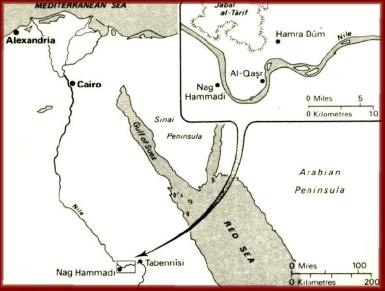
Every discipline – temporal or spriritual – in the world has among its practitioners, those who engage the faith beyond the common boundaries of doctrine and dogma, seeking an unmediated relationship with reality and selfrealization. Sufism, as can be discerned from the writings of Ibn’ Arabi and Jelaluddin Rumi, can be discussed in the terms offered by C.G. Jung in his theories of the structures and functions of the human psyche. In Jung’s terms, Sufism can be seen as an example of how a healthy, integrated psyche might function, and what a living mythology might look like. Sufism as a psychological system has postulated the discoveries of Freud or C.G.Jung centuries before: the Sufi sheikh Ghasali wrote down the sexual knowledge of Freud around 1200 AD and C. G. Jung’s findings on psychological archetypes and the collective unconscious were formulated by the Sufi Master Ibn Arabi. C.G. Jung might have known that therefore and wrote: „What we hold for a specifically western invention, namely the psychoanalysis and those of her outgoing suggestions, it is a beginner’s attempt in comparison to that what is old-skilled art in the east.“ He meant the Far East, but also the Middle East as he was well aware of the findings of the Nag Hammadi library (famous for the “fifth” Gospel of Thomas favored by the Sufis). C. G. Jung has shown a pronounced and informed interest in Gnosticism an Middle Eastern knowledge. Sufism emphasises on the knowledge of transcendence arrived at by way of interior, intuitive means as Jung’s individuation. The importance of the Nag Hammadi library, discovered in upper Egypt in 1945, was pointed out by C.G. Jung. His Book “Antwort auf Hiob” (Answer to Job) is a downright answer to the Bible´, but in accordance of Sufism’s answer to rigid religions. In the light of such recognitions, one may ask: “Is Sufism a religion or a psychology?” The answer is that it may very-well be both, just like Jung’s thought may be interpreted religiously. One of the aeonial beings who bears the name Sophia (“Wisdom”), referred to by C.G. Jung many times, is of great importance to the Gnostic world view and resembles closely the story of the human psyche that loses its connection with the collective unconscious and needs to be rescued by the Self. Analogies of this sort exist in great profusion.
Sufism and syncretic Gnosticism
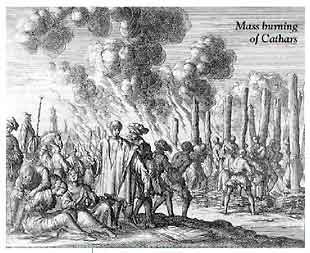
Myth of the Baphomet derived from its usage in Provence the centre of the Cathar Church in France,
We do not know for sure, why has Sufism so much common with Gnosticism. The reason is maybe, that both of these systems implanted their mystical ways, in the prophetic religion (Judaism,Christianity or Islam,) or in a deeper sense how to individually unite with God. We can also admit that the Gnostic Christianity could have influenced the early stage of Islam, particularly Arianism.
The Sufi and also Gnostic view on the created world is sometimes very negative.“The world is a dunghill, and a gathering place of dogs; and meaner than a dog is that person who does not stay away from it.” Sufi could not participate in secular affairs and he must know, that world is a merely an illusion. Even Jesus (highly considered by Sufis) said in the Gnostic Gospel of Thomas: “Whoever has cometo understand the world has found (only) a corpse, and whoever has found a corpse is superior to the world.” We can clearly say that Gnostics and Sufis are not interested in the world or they despise it. Not only, the world is seen in the negative light, but also the work of the heavens and the time. According to the Gnostics, the mundane world is influenced and ruled by the lower heavens – seven spheres with one planetary ruler( archon).
Gnosticism From ancient Oriental religion? Zoroastrian, Mesopotamian, Indian? From heterodox Judaism? Apocalyptic, mystical? From heterodox Christianity? From late Hellenistic philosophy? Neoplatonism?
While Sufi teachings have been influenced by various religions, their practices also bear close similarities to those of Hinduism and other mystical religions of the East. The Sufi orders are led by shaikhs, who play the same role as Hindu gurus. Most Sufi orders still consider the five pillars of Islam to be essential, and practice them piously, however, they go far beyond this, aiming to spiritual awakening. Central to all of these practices are ritual “invocations of the Divine Name,” also known as dhikr, which can be done either silently or in a chant. Here similarities with Hindu mantras are unmistakable. The evidence of Sufi borrowings from other Eastern religions such as Hinduism and Zoroastrianism is certain. The similarities in teachings and ritual are overwhelming. It is no surprise then that the goals of Sufism reflect their pantheism and monism. Of course it is one of the characteristics of living traditions that they are ultimately oral. The spark that kindles the enlightenment is rarely captured on paper: it shifts its emphasis and context with the times and the individual. In matters of the heart and soul, it is the experience of love or of the Self that resonates – not dogmas or theories. This aspect of Sufism is the hardest to convey: In Sufism, great importance is given to the complete human being, the one who is considered activated. It is through the guidance of such a human being that the inner process unfolds. Any particular beliefs in dogmas dissolve as the complete one assists the seeker to fall fully into his or her relationship with God and to recognize the importance of that essential experience.
The socially approved knowledge of argumentation is not valid – unless we have found it out ourself. The Sufi calls all things meaningless, if they are old or new, big or small, important or insignificant, because all things are separated in reality forms one and not. All things („the evident“) are merely bridges to the true reality. Rituals, symbols are representatives, are to reflexion of an internal truth they can be exterior dead and stereotyped; but they show that who can see a way to the internal truth. There is no external sign (like the Christians Cross or the Crescent of Islam) from which one could say this symbolises the Sufi being. Sufis use the most different symbols, quite knowingly that these are just represented phenomena.
Sufism and female archetypes
Fatimah – the primordial woman
Fatimah Zehra wife of Ali
Fatimah, beloved daughter of the Prophet Muhammad, is the most prominent female in the Islamic tradition. Islam is aniconic. In other words, images, effigies, or idols her are not allowed, although verbal depiction is elaborate. She is regarded as a primordial woman, a symbol of divine womanhood giving her many holy names. Shias revere the person of Fatimah, mother of the line of inspired imams who embodied the divine truth for their generation. She was the wife of the fourth Caliph, wife of Ali, mother of Hasan and Hussein and defended Ali’s cause, fiercely opposed the election of Abu Bakr. Fatimah is often associated with Sophia, the divine wisdom, which gives birth to all knowledge of God. She has thus become another symbolic equivalent of the Great Mother. When Fatimah, enters the throne all 124,000 Prophets stand in respect. Around the world men and women of Islam and Sufism look to Fatimah for comfort and inspiration. Because of her special beingness of personality and beyond, Fatimah is considered by many Muslims as divine in origin and several variations of a major hadith describe how she was conceived on the night of Mi’raj (ascension).
I heard the Apostle of Allah say, ‘I am a tree, Fatimah is its trunk and Ali is its pollen. Hassan and Hussein are its fruits, and our followers are its leaves. The roots of the tree are in the Garden of Eden, and its trunk, fruits and leaves are in Paradise.’ – Sacred tradition of Islam on the authority of ‘Abdu ‘r-Rahman ibn ‘Awf’
Fatimah tul Zehra (Fatimah the Radiant, Fatimah the Brightest Star, Fatimah-Star of Venus, Fatimah-The Evening Star), the daughter of the Prophet, is the secret in Sufism. She is the Hujjat of ‘Ali. In other words, she establishes the esoteric sense of his knowledge and guides those who attain to it. Through her perfume, we breathe paradise. Though she was his daughter, the Prophet Muhammad called her Um Abi’ha (mother of her father). While Fatimah Zehra was Muhammad’s daughter, the Rasulallah (Prophet of God – Muhammad) understood that his gnosis was bestowed upon him from the Divine Feminine.
In his allegorical book Herrman Hesse’s “The Journey to the East” searches for a mystical woman named Fatima. Given that this is the author of Siddhartha, one might suppose that the league represents a group of individuals in search of eastern mysticism. The book has clear spiritual overtones.
Sophia – Sufism’s goddess of wisdom
At the very core of Sufism there is a vision of the gnostic Sophia. The philosopher Muid ad-Din ibn al-Arabi (1165-1240) saw a young girl in Mecca surrounded by light and realised that, for him, she was an incarnation of the divine Sophia. She is part of many mystical and religious currents and mentioned often by the psychoanalyst C.G. Jung.
Torah/Old Testament: Sophia is the Greek word for wisdom which is a “she” who personifies integrity, honesty, clear perception, the power by which kings and princes rule, and the creative power present with Yahweh at creation. (see also C. G. Jung’s Answer to Job about the “anamnesis of Sophia” referring to the recollection of God of Wisdom.)
Ancient Wisdom Goddesses: Isis as the “Black One.”
Iranian Sufism: Sophia is Perfect Nature, the object of ecstatic ideation, which was described in an 11th century text as “the philosopher’s angel.” (Cf. H. Corbin, Man of Light in Iranian Sufism.)
Gnosticism: Two Sophias, higher and lower: Ogdoad and Sophia Achamoth, the generative wisdom of the world. (Cf. also “The Thunder Perfect Mind” in Nag Hammadi Library.)
Alchemy: Sapientia (Latin for Sophia, Wisdom). Moon, tree, ogdoad, alchemical salt. (Cf. Jung’s writings on alchemy.)
Christian Black Madonnas in churches throughout Europe: may represent Sophia (often likened to Mary Magdalene) in exile, blackened by association with either the sun, solar principle, or the earth, as in alchemy, black earth.
Western mystical /philosophical/ humanistic tradition: Dante, Boethius, Johann Wolfgang von Goethe, Rudolph Steiner . . .
Nietzsche: “Supposing truth is a woman . . .” (Beyond Good and Evil)
Jungian psychology: anima development in male psychology; individuation concept.
Sophia__Wisdom
Sophia (Greek for “wisdom”) comes from Hellenistic philosophy (Platonism) and is important in Gnosticism, Orthodox Christianity and Christian mysticism. Sophia is honored as a goddess of wisdom by Gnostics, as well as by some Neopagan, New Age, and feminist-inspired Goddess spirituality groups. In Orthodox and Roman Catholic Christianity, Hagia Sophia (Holy Wisdom), is an expression of understanding for the second person of the Holy Trinity as seen in the Book of Proverbs 9:1, but not a goddess.
The earliest Gnostic forms of Sophia emphasized her power and influence on earth and in the human psyche. In the ancient text of Hypostasis of the Archons, found at Nag Hammadi, it is written that Sophia preexisted and gave birth to the male godhead. She chastises his arrogance when he says there is no other god before him. She claims her spiritual authority. She says “you are wrong, Samuel” (meaning Lord of the blind) and stretches forth her finger to send light into matter. She then follows the light down into the region of “Chaos.”
This power of Sophia within the earth realm was seen in early visions: “I am nature, the universal mother, mistress of all the elements, primordial child of time, sovereign of all things spiritual, queen of the dead, queen of the immortals, My nod governs the shining heights of heaven, the wholesome sea breezes, the lamentable silences of the world below. I know the cycles of growth and decay.”
Black_Madonna_of_Einsiedeln
Certainly Sophia has been derived by the Great Mother(s) from whom all life arises and is sustained. The Great Mother was worshipped from 25,000 to 5,000 BC. Themes of the intertwining of nature and spirit, and the paradox of life and death are everywhere in images of the Great Feminine. Muid ad-Din ibn al-Arabi believed that women were the most potent icons of the sacred, because they inspired a love in men, which must ultimately be directed to God, the only true object of love. Ibn al-Arabi argued that humans have a duty to create theophanies for themselves, by means of the creative imagination that pierces the imperfect exterior of mundane reality and glimpses the divine within.
The faculty of imagination is commonly associated with the Divine Feminine. The Sufi poetry teaches the feminine qualities of joy, love, tenderness and self sacrifice on a path of true knowledge derived from the spiritual heart. The spiritual rebirth of the individual is not unlike the trial and tribulation of physical childbirth, according to the Sufis. They take the principle of divine love and use it to facilitate the process of alchemical transformation from mundane human to spiritual being. Sophia is the mystical companion, which belongs to no race or religion exclusivly: ‘My place is the placeless, my trace is the traceless. ‘Tis neither body, nor soul, for I belong to the Soul of the Beloved.’40 Certainly, the Divine Feminine is so marginalized in Islam, that one might be forgiven for believing it to be totally absent.Both Mary and Fatimah are reverenced within esoteric Islam, for they are both mothers of the Logos, the Word. Fatimah inherits the role of Spenta Armaiti, within Shi’ism, for she is the mother of a lineage of imams. She is seen as symbolic of the ‘supracelestial earth.’ She is considered to be the source of the imam’s wisdom because she is lawh mahfuz or ‘the hidden tablet; upon which God has written.’ One of her titles in Ismaeli Shi’ism is Fatimah Fatir, or Fatimah the Creator, which recalls the Sophia Ergane of Proverbs.The nature of both the Black Goddess and Sophia are brought out in Islam. The exoteric fulminations about women, so similar to those found in Christianity and Judaism are, of course, negative polarizations of the devouring Goddess, yet this exists side by side with the positive image of the Ka’ba, Islam’s Black Madonna, preserves the veiled tradition of Sufism.
The Peacock Angel and Sufi’s Iblis
PeacockAngel
Considered a mystery by Orientalists, the Cult of the Snake and Peacock in Iraq was founded on the teaching of a Sufi Sheikh, Adi, son of Musafir, in the twelfth century, although they date their origin back 6,000 years or more.The Yezidi faith is syncretic and combines elements of Judaism, Christianity, Sufism, Manichaeism and the Persian Zoroastrianism faith in parallel and selectively.
In Arabic, ‘Peacock’ also stands for ‘adornment’; while ‘Snake’ has the same letter-form as ‘organism’ and ‘life’. Hence the symbolism of the cryptic Peacock Angel Cult—the Yezidis—is a way of indicating ‘The Interior and the External’, traditional Sufi formula. The Cult has adherents in the West, but was largely unknown, before CNN put the spotlight on them, because of their recent persecution (together with the Christians).
In the Gnostic tradition (in which both Yezidi and Sufism have some roots), the Peacock Angel is analogous to the first son of the Goddess Sophia, who in the process of creating and governing the universe divided herself into seven rays or “sons.” Her seven sons were coeval with and governed one of the seven colors, tones, planets, etc. The peacock was the first form of the Supreme God and one of the Seven Great Angels, named Tawsi Melek or Melek Tawus (the Ildabaoth of the Gnostic’s).
Aroused snake by the entrance to a Yezidee-temple. It is blackened by soot.
However the Angel’ other name — Shaytan — means “devil” not only in Arabic, even in German Scheitan means Satan. Therefore Yezidi, have often seen as Devil worshippers, also through the manifestation the Peacock Angel as as a snake. This is analogous with the gnostic understanding of the Serpent on the Tree in the Garden of Eden – interpreted in Christianity as Satan. Furthermore, because to the connection to the Sufi Iblis tradition, some equate the Peacock Angel with their own unredeemed evil spirit Satan. Iblis is a supernatural being — either a fallen angel or a diabolical fiery creature known as a jinn. In his disobedience against God and his role as tempter of mankind, again resembling the rebellious Satan in the Christian tradition. In fact, they are more remnant of pre Christian religion: the peacock angel being the mysterious Phoenix. The picture above shows an aroused snake by the entrance to a Yezidee-temple. It is blackened by soot. Yezidees (today almost a million believers) think, that in the last judgement the devil will be reconciled with God, and even play an important role in the final judgement of man.
Mary – Sufism’s divine mother
Mary – Divine Mother Maria-Hilf-Kirche. Murnau was the chosen residence of the famous painters – Blaue Reiter
Mary, mother of Christ, is regarded as the most marvelous of all women, a high adept and living example of the pure and holy life. Later commentaries describe Mary as an intervening force between God and humanity. When Muhammad retook Mecca, he removed many frescoes and images from Kaaba, that he considered inauspicious but he specifically left on the walls a fresco of the Virgin Mary and her child.
In one of the most powerful Hadiths ( prophetic sayings of Muhammad) it is reported that Muhammad said, “Paradise is at the feet of the Mother”. Muhammad was escorted by the archangel Gabriel (a masculine force) but the vehicle upon which he rode was the Buraq, a white horse with wings and the face of a woman, clearly suggesting a symbol Goddess or Divine Mother.
A Sufi Ode to the Divine Mother
On the face of the earth there is no one more beautiful than You Wherever I go I wear your image in my heart Whenever I fall in a despondent mood I remember your image And my spirit rises a thousand fold Your advent is the blossom time of the Universe O Mother you have showered your choicest blessings upon me Also remember me on the Day of Judgement I don’t know if I will go to heaven or hell But wherever I go, please always abide in me.
While Sophia has noteworthy archetypal qualities, she lacks in some of the most virtuous aspects. Within the areas they lack in virtue and morality, the Virgin Mary, who is from Christian religions, make up for them. The Virgin Mary is the mother of Jesus, the Son of God. Mary is not the wife of God though. She was chosen by God to give birth to Jesus. “And behold, you will conceive in your womb and bring forth a Son, and shall call His name Jesus” (Luke 1:31). Mary represents everything good in the world. She has never been touched and is clean and pure. The Virgin Mary represents the woman that man wants. “She will conceive…a Son”. Mary is the subservient to man. She is not represented with any symbols, excepts for her pureness. She does not have any mystical powers, except for her conception of child without sex. The Virgin Mary is represented as a woman that has been graciously touched by God himself, and gives birth to the Messiah, Jesus Christ. Yet she is still a “handmaid of the lord”(Luke 1:38). The church, the creator of this story, was apparently concerned with the idolization of the Virgin Mary and wrote:
God came down from heaven, the Word clothed Himself with flesh from a holy Virgin, not, assuredly, that the Virgin should be adored, nor to make her God, nor that we should offer sacrifice to her name, nor that, now after so many generations, women should once again be appointed priests…Let no one adore Mary. (Epiphanius 49)
Here we can see man coming into the monotheism, where Christian belief is today. The Virgin Mary does represent a mother archetype, although it is not as prevalent as Demeter and Isis. Mary’s character is more housed, in a way that can be controlled and can be put into guidelines. Just as times before, man wants what he can not have. In Mary’s case, the forever virgin.
Man needs to realize that men and women are different, and each has wonderful traits. Though many of these archetypes are brought on by the unconscious mind, which is the portion of one’s psyche which is outside of awareness, those thoughts should be left at the realization that they are thoughts. These goddess or mother archetypes are brought into our societies to teach man and woman the values in each other. To restore balance in one’s lives. Demeter, she helped to explain strange occurrences in Greece as well as reveal the importance of woman’s traits to give life. Isis, she kept the Egyptian nation strong and united during her reign by being everything at once. Mary, she has had mercy brought into the Christian beliefs against the sometimes stern male God. All three characters are important throughout history, and have managed to keep their legends alive.
Conclusion
The West is, as Herrman Hesses wrote 1920 in “The Longing of Our Time for a Worldview”. We, in the West, “understand” Sufism, like the group of blind men (or men in the dark) who touch an elephant to learn what it is like. Each one feels a different part, but only one part, such as the side or the tusk. They then compare notes and learn that they are in complete disagreement. Some see Sufism as Neo-platonic, some connected with Manicheanism, some see Sufism as heretic Christianity and others as Persian sect (the latter three all may be interpreted as Gnosticism). To me, Idries Shah’s presentation of Sufism as a form of timeless wisdom, that predated Islam makes sense. Sufis are connected with sacred sex and the movement of troubadours; quite a few important Sufi scholars were women. Sufism has often called the concept and denomination to love. Clearly the role of the Divine Feminine, its principle has been described and explored at length in the tradition of Sufism. Sufism emphasizes passionate, mystical and individual adoration of God. Many Sufis (and other mystics in other religions) seek a spiritual union between themselves and the divine principle not unlike that between a child (the Sufi) and his mother (God) or a bride (Sufi) and the husband (God).
Bibliography
Idries Shah The Sufis 1964, Translated 1980 „Die Sufis“, Diederich’s Gelbe Reihe
Philip Jenkins Baylor University, History of Christianity: The Thousand-Year Golden Age of the Church in the Middle East, Africa, and Asia — and How It Died
“The Other God”. Yuri Soyanov, Yale University Press, 2000
I encountered this fairly good paper and Hesses essay after I finished my article, which also investigated the fact that spiritual Sufi training is very similar to the process of Individuation.
Spiritual Sufi Training is a Process of Individuation Leading Into the Infinite
This paper was presented to the VIII International Conference of the International Transpersonal Association at Davos, Switzerland, Sept 1st, 1983, by Irina Tweedie
Timbuktu-Sunni activist – resurgence of animosity between Salafists and Sufis
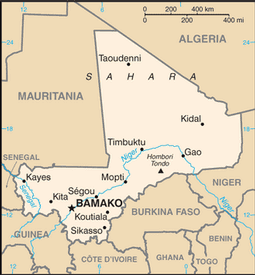
Sufism the Gnostic chameleon came recently into the CNN spotlight when Al Qaeda-linked Mali Islamists armed with Kalashnikov’s and pick-axes destroyed centuries-old mausoleums of saints in the UNESCO-listed city of Timbuktu. Sufism is historically known from the 5th century A.D on (first Sufi order was founded 657), and has survived as the only mystic (gnostic) religion the purges of the three fighting monotheist religions. This article wants to explore its religious and historical roots, and its compatibility to the psychoanalytic concepts of C. G. Jung. Like in the “Golden Words of a Sufi Sheikh”, Sufism appears as a Gnostic chameleon always nodding its head. Gnostic thoughts had been rejected by Christianity, found a new host and became its spiritual brain, the muscle and sinew. First by oral tradition, later in writings, still later as Janissaries. Sufism is very appealing to intellectuals. Sufism and Gnosticism take over silently, hence were often purged violently by Islam and Christianity. Sufism has inspired pacifist teachings, but also Assassination and Jihad for militant and tyrannical regimes. Sufis picture themselves today as struggling against violent fundamentalists who are at once their deadly foes, and ours. Phillip Jenkins sees Sufi Muslims, as potential allies in the fight against extremism. Is todays enemy of our enemy our friend? Are Sufis – Jungian gnostics, syncretic mystics or muslim Templars? Let be history our guide.
Compatibility issues
Although the term “Sufism” is very vague construct, it is still used across the world in both academic and public field of interest. As western –ism concept it originates from Kufa, where Jabir Ibn Hayyan described sufi as a man, who seeks deeper and more intimate relation to God. It was used by Muhasibi and Jahiz to describe a mystic school in Kufa, which was close to Shi‘a teachings. The meaning of the word has been of ten connected with the word “wool”(suf ), from which are made the clothing for ascetics. Sufism embodies so the essence of the Cabbala as well as those of the Christian Gnostics. And not only this: In every religion, so say the Sufis, there is an “internal” “confidential” teaching which is hidden from the believer. This essence of every religion is a component of the Sufism, because the internal knowledge of all religious directions are same. The Sufism recognises this, bundles them up them and draws a line which is congruentially with the human existence. Thus it becomes even more interesting if one sees Sufism from a Jungian view.
Yes, Sufism is syncretistic and individual, but in essence it teaches a personal approach to God and the Self long before C.G. Jung very compatible to his concept of synchronicity and individuation. It would be compatible to all world religions too, but especially if those are connected to worldly ideology, they seek to displace each other. They don’t co-exist. They wish to impose their worldview, and they wish the imposition to be publicly seen. As Philip Jenkins the author of “The Lost History of Christianity” noted, they live, fight, win, go underground or die, but their cultural remains stay for a long time like stellar explosion. Religious history does not know for sure, why has Sufism so much common with Gnosticism. The reason is maybe, that both of these systems are essentially the mystical ways, how to experience the original religion (Judaism, Christianity or Islam,) in a deeper sense and how to unite with God. One must can also admit that the Gnostic Christianity influenced the early stage of Islam and that many Gnostics (e.g. Manicheans, Mandaeans or Christians) converted to Islam and brought the ideas of their old religion into orthodox Islamic theology. Sufi mysticism has long exercised its lure to orientalist scholars. Figures like Rumi have become well published. Based rather on poetry than history Sufism is perceived in the US as a peaceful and apolitical form of Islam and even as means of communication towards the integration of Europe and Muslims.
Cultural Remains
Timbuktu-Damage-Books
A mere slaughter in Africa wouldn’t have raised a cloud of dust in the West or destruction of a Christian church – the world and the CNN would have hardly taken notice. But have you heard about Timbuktu recently? Or of the Buddha statues in Afghanistan? No. Why is that? If we have lost a source of common information about ourselves, and it can never be replaced. Empires may come and go, but the records of man’s achievements are irreplaceable once lost. This is what offends me. If we lose cultural heritage we have lost something of themselves; we have lost something of that which allows us to understand our past – which is of course needed to understand the present. Like the story of the Sufis. I touched it a few times. Sufism has come to mean a wide range of beliefs that center on the quest for personal enlightenment in the union with God. Sufis are sometimes described as the mystics of Islam, but Sufism fits awkwardly in the categories of religions. A cornerstone of mysticism is that true knowledge of God is achieved directly and not through an intermediary like a prophet, saint or priest. Over the centuries this has led to a great deal of political conflict between mystics and non-mystics. If a cleric or Priest behaves or commands something that seems in conflict with dogma, the individual is not in a position to disagree as long as there is no direct relationship between God and the individual.
Many Sufis are not Muslims and there are many Muslims that are reluctant to consider Sufism part of Islam. One of the few concepts that Sufis seem to agree on is that all religions offer a path to salvation or enlightenment and that true God realization, no matter how it is achieved, transcends the limitations and classification of any religion. There is no firm historical source for Sufism. Many of the early orders were considered an integrated part of Islam, but as teachings were codified and the elements of Shi’i and Sunni Islam became more distinct, Sufism emerged with an identity. One of the basic ideas of Sufism is to minimize the self or individual identity (Translate the in the Ego of C.G. Jung). Belonging to a particular group with a unique name is contradictory to this effort. It is said, “a Sufi is one who is not,” and with a philosophy that seeks the destruction of self-identity it is thought that Sufi’s received their name from outsiders. Initially the term Sufi referred only to those who had achieved God realization, but it has since come to be applied to anyone who follows that particular spiritual path.
“The breeze at dawn has secrets to tell you. Don’t go back to sleep.You must ask for what you really want.Don’t go back to sleep.People are going back and forth across the door-sill where the two worlds touch.The door is round and open. Don’t go back to sleep”.
“Not Christian or Jew or Muslim, not Hindu Buddhist, sufi, or zen. Not any religion or cultural system. I am not from the East or the West, not out of the ocean or up from the ground, not natural or ethereal, not composed of elements at all. I do not exist, am not an entity in this world or in the next, did not descend from Adam and Eve or any origin story. My place is placeless, a trace of the traceless. Neither body or soul. I belong to the beloved, have seen the two worlds as one and that one call to and know, first, last, outer, inner, only that breath breathing human being”.
Both from The Essential Rumi by Coleman Barks
Were the Sufis mystics or warriors, dervishes or monks, Christians or Muslims?
Sufi Warrior
Sufi Dervish were Warrior Orders called by the Calif, often from far distances, when long sieges were expected. They were not only mystics but warriors when necessity demanded. There is good evidence, that their secret close-knit brotherhoods was the role model of the European Knight Templars. Sufis have proved to be the most fanatical fighters in Muslim history and in Ottoman culture they had military branches. One particular brand of Sufis influential in Pakistan and Afghanistan in a tradition of secret societies. Information was passed down from person to person for generations. The were active in the jihad to regain India from the Raj for over 100 years. Sufism is influential in Chechnya: The terrorist attacks of Beslan and the Moscow theatre siege had Sufi background. Sufism enjoys a wonderful press in the West by their good old practice writing about non understood issues and deliberately not mentioning the other half. The expansion of Islam outside the core areas of the Middle East is above all a Sufi story. Sufi orders led the armies that conquered lands in Central and South Asia, and in Southeastern Europe; through their piety and their mysticism, the brotherhoods then won the local elite over to Islam. They disguised Islam with local traditions and worship styles, including Christian saints and Hindu gods. Today, Sufi styles and practices dominate in the non-Arab Muslim world: in India and Pakistan, in Indonesia and Malaysia, Nigeria and Senegal, and in the Muslim countries of Central Asia, such as Uzbekistan and Tajikistan.
sufi-war-orders
The Sufi Order was widespread in the Ottoman Empire (because the majority of Ottoman Janissaries were Shia-Sufis). The Janissaries were elite soldiers, a heavy armored infantry or Foot Knights of the Ottoman Empire. Ottoman Heavy Cavalry were Sipahis (Turkish Nobles) and Ghulams (mostly Persian). Janissaries had “cousins” in Iran (Persia) under the Safavid Dynasty (Persian-Turkic Cousins of the Ottomans) . The Safavid counterpart of the Ottoman Janissaries were called the “Qizilbash. Christian children were brought into the corps through the devshirme system, in which young boys were taken from their Christian families in Greece, Serbia, Armenia, or Bulgaria , which were part of the Ottoman Empire. The word “Janissary” comes from the Turkish yeni çeri or “new soldier.” The child soldiers were converted to Islam, and trained in infantry techniques and tactics.
By the end of the seventh century, Turkish migrants converted to Sunni Islam and became champions of Islamic orthodoxy. Beginning in the twelfth century, new waves of Turkic migrants became attracted to militant Sufi orders, which gradually incorporated heterodox Shia beliefs. One Sufi order that appealed to Turks after they won against Christianity was the Safavi, based in northwest Iran. Safavid adherence to a Sufi version of Shi’a Islam had the support of the Turkic tribes called the mentioned Qizilbash [literary the “Redheads” for the twelve red strips on their turbans symbolizing their adherence to twelve Shi’i Imams]. Qizilbash tribes resided mostly in Asia Minor; northern Syria, and northern Iraq. Concern about the growing influence of the Safavi probably was one of the factors that prompted the Ottomans to permit unorthodox Bektasi Sufism to become the official order of the janissary soldiers.
The Sufi orders enhanced their political role again with Western imperialism. When Islam was under threat, their close-knit brotherhoods were devastatingly effective. Sufi orders led anti-colonial movements from Morocco to Indonesia and are the core of the stubborn Chechen guerrillas. Even Stalin’s terror campaigns could not root out the Sufi brotherhoods. A similar story can be told in Kurdistan, Kashmir, Albania, Somalia, Kosovo, and elsewhere, where believers owed their survival and cohesion to the Sufi brotherhoods.
Sufi Mystics
While Sufism did not exist prior to Islam, Sufi doctrine contains many elements that go beyond the teaching of Mohammad. Islam seems to be the external shell in which the Sufism lives while the internal quest for enlightenment belongs to a realm of Sufi knowledge. It seems reasonable that the Sufi doctrine that differs the most from the rest of Islam had its beginnings much earlier (my very non-Muslim view of Sufism). For many centuries these extra qualities created a great deal of friction between mainstream Islam and the Muslim mystics. After centuries of falling in and out of favor, Sufis represent a door to other religions and that is the very reason that they became a target again. Many Sufi orders encourage honoring Saints and Prophets by visiting them if the are alive or their tombs if they have passed on. Pilgrims often will go to ask for favors in the form of miracles or prosperity. In many communities the pilgrims are people from other religions who come to the tombs in hopes of finding favor or receiving miracles, very similar to Christians. The Sufi poet Jalaluddin Rumi (in 1207-1273), said: „Go the way Mohammed, but if you are not able to do this, go the Christian way.“ What he meant with “like a Christian”, is very clear (and said by C.G. Jung later): „Jesus is in you, search for his assistance.“ Sufis idols and customs resemble catholic ones, in Islam the associate either with Shiite or Sunnis.
sufism
To the orthodox Islam, the mystic Sufism is deemed idolatrous. But this is nothing new. That the Sufi shrines recently became some sort of official religio-political status of global importance, which irked Sunnis and particularly Western supported Salafis, to whom all shrines and statues are blasphemous, similarly to protestants in Christianity. Some scholars theorize that many of the esoteric impulses of Europe, from the Middles Ages on, point to Sufi influence. The Knights Templar are said to have brought back Sufi elements from their contacts in the holy lands (I have written about that). The mythical Christian Rosenkreutz of Rosicrucian fame is described as journeying to the East. Some have hypothesized links between Sufi love poetry and the rise of the Troubadours. All of which suggests that, for the West, Sufism is not so much new as it is previously unrecognized. How then do we approach the task of learning what Sufism has to offer?
Sufi Poetry
The best method is to become acquainted with the writings of classical Sufism: the poetry, tales, and teaching texts of the greatest Sufis in centuries past. I have access only to German texts of Ibn El-Arabi (1165-1240) which convey the beauty better than English:
„Mein Herz umfasst sämtliche Formen: Das Mönchskloster, den Tempel der Idole, Die Weide der Gazellen und die Kaaba des Gläubigen, Die Tafeln der Thora und den Koran. Die Liebe ist, wozu ich mich bekenne. Wohin meine Kamele sich auch wenden mögen, Die Liebe ist und bleibt mir Glaube und Gesetz“.
Some of many facets of the Sufismus appeared with some important Sufis writers
Rabia ( a Sufi saint died in 801 A.D.) spoke out against false devoutness,
Al-Harith al-Muhasibi (died 857) taught the constant conscience check,
Dhu’n-Nun (died 859) sang of the divine in the nature and mental development,
al-Hallaj (executed 922 because of his spiritual conviction) based religiousness completely on personal God’s experience,
Hujwiri (died about 1071) stressed the meaning of own decision instead of result of ones past.
Abu Hamid al-Ghazzali (died in 1111) encouraged the person to one by God’s love and charity sanctified life, Ahmad Ghazzali (died in 1126) spoke of God and person who are like mirror for each other
Sanai (died approx. in 1131) admonished the humanity,
Fariduddin Attar (died. about 1220) we carry what our soul longs for basically in ourselves,
Ibn’ Arabi (died in 1240) the possibility of the knowledge of God from his signs in the transient, “what shines through “,
Mu’inuddin Chishti (died in 1236) required tolerance of Hindus and Muslims equally
Persian Sufi writer Jelaluddin Rumi (died in 1273) , was particularly valued by the dervish’s brotherhood who recognised a cosmic quality of the universe – the evolution.
Hazrat Inayat Khan and Pir Vilayat are examples of the fact that modern psychoanalytic thought of C. G. Jung can already be found in the Sufism and modern Sufism could become a unique religious-communication message of love, harmony and beauty as a “relieved spirituality” which is directed at all people.
Sufi and Templars
The connection of the Templars with the Isma’ilis and Assassins has been well researched. The Assassins were first known as the Nizari Isma’ilis. From the Isma’ilis the Crusaders borrowed the conception which led to the formation of all the secret societies, religious and secular, of Europe. The institutions of Templars and Hospitallers; the Society of Jesus, founded in the Holy Land, composed by a body of men whose devotion to their cause can hardly be surpassed in our time; the ferocious Dominicans. the milder Franciscans – may all be traced either to Cairo or to Alamut. The Knights Templar especially, with their system of grand masters, grand priors and religious devotees, and their degrees of initiation, bear the strongest analogy to the Eastern Isma’ilis. Much of the well-known mystical symbolism of Sufism, often best known through the Rubaiyat of Omar Khayyam, was taken over by the Isma’ilis. They joined Sufism and Shiism in a peculiar and unique blend, often appearing as a particular group of Sufis with their own Shaykh. Mount Damavand, constitutes Central Iran although close ro Tehran, this mountainous area has always been and still is remote. Within a high mountain valley stands “the castle of Alamut, the fortress retreat of Hasan-i Sabbah, which became almost legendary after the supposed 1273 visit of Marco Polo and his description of the ‘Old Man of the mountains’ and the Assassins.
“And when the Old Man wished to kill someone, he would take him and say: ‘Go and do this thing. I do this because I want to make you return to paradise’. And the assassins go and perform the deed willingly.”
– Marco Polo – on his visit to Alamut in 1273
Templars – Militant Sufi influenced Order?
Political assassination was not unknown in Islam before Hasan-i Sabbah. Earlier sects had used murder as a political technique, and there is evidence that Mohammed himself disposed of his enemies by suggesting that they did not deserve to live – and hoping that faithful followers would take the hint. Here the strongest possible noun is required since the criminal being confessed is being buried alive head down, thus denoting a sin of particular horror. The connection of assassin with wickedness reinforces the clarity and precision with which Dante used the word, and it was in this sense that ‘assassin’ then passed into other European languages. After the destruction of Alamut by Hulegu in 1256, many members of the Nizari Isma’ili sect are thought to have fled to Afghanistan, the Himalayas and India . The other major branch of the Isma’ilis in the East today are known as the Khojas, who are particularly strong in what was once the Punjab but is now part of Pakistan. The Isma’ilis in general, and the Nizari Isma’ilis or Assassins in particular, were always considered heretical and persecuted by official Islam. The consequence of this is that their doctrines were maintained in secrecy by the Assassins themselves, while their enemies were content to dismiss them as heretical without having deep knowledge of it. Sufi developed–probably under Christian influence–the notion of an eschatological restorer of the faith, identified as a descendant of the Prophet or as the returning ‘Isa (i.e., Jesus). He is usually referred to as the mahdi; i.e., the ‘[divinely] guided one’. After the appearance of ‘Isa, the last judgment will begin: the good will enter paradise; the evil will fall into hell. Heaven and hell possess various goals and steps of recompense for good and evil. The time before the end is viewed pessimistically: God himself will abandon the godless world. Ka’bah (the great pilgrimage sanctuary of the Muslim world) will vanish, the copies of the Qur’an will become empty paper, and its words will disappear from memory. Then the end will draw near.”
“In the Koran Jesus is mentioned no less than thirty-five times, under a number of impressive appellations – including ‘Messenger of God’ and ‘Messiah’. At no point, however, is he regarded as anything other than a mortal prophet, a forerunner of Mohammed and a spokesman for the single supreme God. And like Basilides and Mani, the Koran maintains that Jesus did not die on the cross, ‘they did not kill him, nor did they crucify him, but they thought that did.’ The Koran itself does not elaborate on this ambiguous statement, but Islamic commentators do. According to most of them, there was a substitute – generally, though not always, supposed to have been Simon of Cyrene. Certain Muslim writers speak of Jesus hiding in a niche of a wall and watching the Crucifixion of a surrogate as is described in the Nag Hammadi Scrolls.”
– Baigent, Leigh & Lincoln, The Holy Blood and the Holy Grail
The doctrine of rebirth, consisted of two schools of thought: first, a belief in Ismail himself as immortal, and consequently that he is the Mahdi; second, some believed that Mohammed, son of Ismail, was the Mahdi who would not die until he had conquered the world. “Isma’ili theology was thus “revelationary” in character. The haqa’iq transcended human reason and ultimately derived from gnostic doctrines, considering the principles of spiritual and physical worlds in Neoplatonic terms. The Gnostics held that the physical world had been created by an inferior deity, the Yahweh of the Old Testament, who was allowed a certain lassitude until God decided to send His son to inhabit the body of Jesus and free the world from false teachings. As I have written once, Gnostic notions passed into Islam when Mohammed adopted the gnostic idea that the body which was crucified was only a phantom. which the Jews and Romans could not harm. Arguably Sufis can be seen as one strain of the Gnostic syncretic virus which, after it was stamped out within Christianity, took over successfully the rising Islam as external host for mutual benefit. The Islam, which was in the beginning an oral warrior ideology benefitted by the rich mysticism. whereas Sufi used the spread of Islam taking over the East and almost half of Europe as vehicle and protective shell. When the Templars fell after the failed crusade, the Sufis started to thrive open and militant as Janissaries.
Sufism and Islam
Only in that respect Sufism could have been, especially in the West, portrayed and regarded as a valuable and legitimate part of the Islamic faith. There are three main branches of Islam – Sunni, Shiite and Sufi. Sunnis make up about 85 percent of the Muslim population globally, while Shiites account for about 15 percent. The two split over differences of who should succeed the Prophet Muhammad but are further subdivided.
Sunni follows a strict, literal interpretation of the Quran and the life of Muhammad with the Sunna as core teaching. Wahhabism is an austere form of Sunni dominant in Saudi Arabia for which Muslims more often use the term Salafism.
Shiism is the smaller of the two major branches of Islam. It developed after the death of Muhammad, when his followers split over who would lead Islam.
Sufism is an Islamic mystic tradition with followers around the world. Sufis tend to identify with either Sunni or Shiite Islam. Many Muslims are critical of Sufism as an unjustified deviation if not foreign introduction.
Shia Faction of Islam
Sunni Faction of Islam
Sufis/Sufism
10-15% of all Muslims
Majority of Muslims
Shia means “faction,” refers to “faction of Ali.”
Sunni means “tradition,” adheres to orthodox tradition
Suf means “wool,” considered the Mystics of Islam.
Iran center and home of most Shia, 88% of Iranians are Shia (Shi’i), In Iraqi 96% are Muslim and over 50% of them are Shia (Shi’i), though Iraq was ruled by minority Sunnis. Reverse Syria if you consider Alawis (12er ) to be Shiites.
Grew out of Umayyad dynasty. World-wide 85% of Muslims are Sunni.
Developed in reaction against the excesses of the Sultans and Caliphs (who wore silks, satins), specifically the Caliphate of Damascus in the Umayyad dynasty, Sufis wore course wool garments in protest.
Succession and Leadership
Believe in Ali and the Imams as rightful successors of Muhammad, but not in first 3 Caliphs. Ali was first of 12 successive legitimate Imams. Succession was to be hereditary.
Acknowledge each of the first four Caliphs as rightful successors to Muhammad.
Value deliberate simplicity, meditation rather than just a formalistic following of the rules.
Look forward to Messianic return of the last recognized Imam. Muhammad al-Mahdi, last Imam, disappeared 900 CE, went into “hidden realm”, was sinless. Ayatollah Khomeini (1900-1989) believed by many to be the return of the last Imam.
Through the ages, Caliphs rule “in God’s name.”
Sufis gathered around shaikhs (masters) and formed faqirs (orders or communities). Rabi’a (1717-1801 CE) was a Sufi poet whose poetry spoke of God’s Love similar to Christianty Al-Ghazzali (1058-1111) first Sufi to bring the faction into mainstream Islam.
Imam holds an exalted position, Ayatollah refers to most important Imams.
Imam is a prayer leader. Sunnis approach God directly, there is no clerical hierarchy.
Sufi Shaikhs are the masters. Wandering monastic culture
Teachings and Scripture
Characteristic is the continual exposition and reinterpretation of doctrine by the clerics.
Believe in entire body (canon) of life and teachings of Muhammad as found in Qur’an and hadiths (sayings and traditions of Muhammad). Sayings and traditions are interpreted by scholars in Islamic schools.
Qur’an is full of symbolism, each verse has from 7 to 70 meanings. Believe in three approaches to the divine: mysticism of Love (heart knowledge), Ecstatic (visionary knowledge) and intuitive discernment (mental knowledge)
Both Sunni and Shia factions believe in the Sharia, the comprehensive law derived from the Qur’an (revelations of Muhammad) and the Sunnah (sayings or interpretations of Muhammad).
Believe in fana (extinction) of separateness from God and “remembering” that “there is nothing but God.”
Scholars carry on debate in Islamic Schools. Science of Tradition refers to Islamic scholarship and rating of specific writings (rated sound, good, weak, or infirm)
Influenced by Christianity and Gnosticism (life is a spiritual journey—want to know God/Allah now not just after death), Persian Zoroastrianism and Hindu Mysticism
Shia Faction of Islam
Sunni Faction of Islam
Fufis/Sufism
Fundamentalist approach to Islam, interpretation by clerics
Qur’an applies to everyday life, public life is shaped by the Qur’an. Saudi Arabia considered model of proper Islamic state
Called “the Heart of Islam,” highest experience in life is experience with Allah, can get face to face with Allah/God
Sufism goes beyond the Five Pillars of Islam are which are obligations which are required of every Muslim: shahadah (statement of faith), salat (prayers), zakat (alms), sawm (fasting), and hajj (pilgrimage). A thorough and critical examination of historical and present day Sufism, quickly reveals the influence of numerous religious ideas foreign to Islam. Zoroastrianism had also an intimate contact with Islam like Gnostic Manichaeism. Zoroastrianism provided first of all a vocabulary for Sufi poets and symbols of angelology and cosmology transparent in the light of gnosis. Most orthodox scholars would be perplexed by this conclusion, especially when it is considered that Zoroastrianism (and pre-Christian Gnostic) predated Islam by over 1000 years.
Islam4Dummies (Alevites not shown)
The further one delves into Sufism from a content perspective, the more clear it becomes that both the origins and content of Sufism show the inclusion of religious ideas and influences alian and contradictory to orthodox Islam. The scholar Elliot Miller states that “[being] based on experience rather than doctrine, Sufism has always been more open to outside influence than other forms of Islam… in addition to early influences from Christianity, one can find elements of Zoroastrianism, Neoplatonism, Hinduism, and other diverse traditions.”
Sufism and Gnostics
Sufism might be the last living gnostic tradition today. Why did it survive? Sufism is clearly a reaction or response to what was lacking in early Islam. The very strength of Islam, in its reliance on a simple creed combining religion, law (and power of a non-secular state) and the five pillars of practice, proved to be the very weakness of Islam. The design of the Islamic ideological system had allowed, however, for rapid expansion and political aggression supporting Sufism. Another area of weakness in Islam, which helped lead to the problem of Sufism, is found in the inherent synthesism (and gnosticism) of Islam both share. Here the vagueness caused by the doctrine of the indescribably Allah (a main concept common of Gnosticism) allowed in essence creating a contradictory belief system. The orthodox ulama developed their theology borrowing and changing what they viewed as their ‘Judeo-Christian’ roots (including Christian heresies), while the Sufis were largely influenced by Eastern mystics.
History of religions
A lot of ink was spilled over the question of Sufism’s relationship to Islam. The Sufism does not belong to Islam. Rather vice versa: Islam belongs to the Sufism. So does Christianity. There was Sufism for a long time before Mohammed and it may exist after Mohammed is forgotten. Sufism and Islam have similar gnostic and heretic roots – seen from Christianity. But the roots of Sufism are even older. Like the mystics of the other religions, were the Sufis “dissidents”, even “heretic” for the purposes of ruling religious interpretation, In the Christianity these were particularly the Gnostics, in the Judaism the Cabalists. The Jewish, Christian and Muslim mysticism was the answer to the power and structure hungry monotheist religions, to what they saw as manipulation and assault at the freedom of the believers. The priest’s class was installed between the believer and God and only over them one could approach God or understand him. To them three religious systems were looking at people as conformist, conditioned beings which needed a herd and a shepherd.
There are many different religions, but the Sufism is from all religions the heart, the most internal core, the real soul. Religions form and resolve. The Sufism, however, remains, he will always live – because it incorporates no dogma. It is the heart of all spirituality.I think Sufis is open to include those deeply involved with religious/spiritual traditions other than Islam. The Sufi work is foremost the quest for gnosis (ma’rifah) – the state of opening or illumination in union with God. Echoes of Eastern ( and Western) mystic religions are of course distinctly contrary to Muslim orthodoxy but its mystic quest for spirituality has embraced all sorts of religion.
The stages the dervish proceeds through along this path constitute a system of spiritual psychology and there are parallels between their individual spirituality and Jung’s theory of individuation. As such Sufism is a tradition of human transformation and as such is a valuable resource for the Western seeker. For various reasons, including the long dominance of an orthodoxy which frowned upon (and often explicitly punished) most mysticism or gnosticism not mediated by clerical authorities or theology, these currents in the West have been primarily underground. For Sufis God alone is responsible for the creation of the world through a word. The mystic Isma‘ili sect of Islam personalize the imperative “Be” into the God’s feminine aspect Kuni the spouse of Qadar . Through the feminine Kuni the world becomes to exist just like with Sophia in Gnosticism:“Sophia, who is called Pistis, wanted to create something, alone without her consort; and her product was a celestial thing.” The Sufi like the Gnostic view on the created world is sometimes very negative.“The world is a dunghill and a gathering place of dogs; and meaner than a dog is that person who does not stay away from it.” Sufi could not participate on a secular affairs and he must to know, that world is a merely an illusion. Even Jesus (highly considered by Sufis) said in the Gnostic Gospel of Thomas (56):“Whoever has come to understand the world has found (only) a corpse, and whoever has found a corpse is superior to the world.” We can clearly say that Gnostics and Sufis are not interested in the world and even despise it. Not only the world is seen in the negative light, but also the work of heavens and the time.
Psychological Relevance
Every religion in the world has among its practitioners those who engage the faith beyond the common boundaries of doctrine and dogma, seeking an unmediated relationship with the divine. Sufism, as can be discerned from the writings of Ibn’ Arabi and Jelaluddin Rumi, can be discussed in the terms offered by C.G. Jung in his theories of the structures and functions of the human psyche. In Jung’s terms, Sufism can be seen as an example of how a healthy, integrated psyche might function, and what a living mythology might look like. Sufism as a psychological system has postulated the discoveries of Freud or C.G.Jung centuries before: the Sufi sheikh Ghasali wrote down the sexual knowledge of Freud around 1200 AD and C. G. Jung’s findings on psychological archetypes and the collective unconscious were formulated by the Sufi Master Ibn Arabi. C.G. Jung might have known that therefore and wrote: „What we hold for a specifically western invention, namely the psychoanalysis and those of her outgoing suggestions, it is a beginner’s attempt in comparison to that what is old-skilled art in the east.“ He meant the Far East, but also the Middle East as he was well aware of the findings of the Nag Hammadi library (famous for the “fifth” Gospel of Thomas favoured by the Sufis).
NagHammadi Hidden in 345 AD. By whom? Why? For what future purpose? No one knows,
Ibn al-‘Arabi (Ibn’ Arabi) is the most rigorous Sufi panentheism. Everything that exists is a part of and a manifestation of the Oneness of God. Humans are part of God. To him the idea of a separate self is the result of ignorance. Ibn al-‘Arabi was born in Spain, in AD 1165. At the age of twenty he was initiated into Sufism. From the 1190s he engaged in three decades of travels as a wandering scholar, poet and mystic, visiting the Maghreb, Egypt, Arabia, Syria and Asia Minor and finally settled in Damascus. Ibn’ Arabi ascribes the source of his inspirations to an angel, which, in Jungian terms, is an archetypal inhabitant of the unconscious. Angels are particularly regarded as the messengers or intermediaries between God and the human world. With respect to the psyche, as intermediaries and messengers, angels are the very permeability of the division between the two zones of the psyche. Unconscious content, which cannot be directly apprehended by the conscious, is translated into terms the conscious can comprehend: language. Intermediaries between conscious and unconscious are necessary because, as Jung points out, [. . .] “psychic contents cannot be observed in their unconscious state, and moreover the psyche cannot know itself. The conscious can know the unconscious only so far as it has become conscious “( C. G. Jung). Insofar as God is beyond the categories of human thought and beyond language and concept, He is unknowable, unutterable. Commensurately, the Sufi experience of God is referred to as knowledge of the heart. The Sufi calls “knowledge” his own experience – in all areas of the senses and in the experience of own transcendence. Between me and the motive of my causing stands nothing and nobody!
„Das Kreuz und die Christen nahm ich von allen Seiten in Augenschein. Er war nicht am Kreuz. Ich ging zum Hindu-Tempel, zu der alten Pagode. An beiden Orden fand ich keine Spur von ihm. Ich ging zu den Höhen von Herat und nach Kandahar, schaute mich um. Er war nicht auf den Höhen und nicht auf der Niederung. Entschlossen stieg ich zur Spitze des Kaf-Berges. Dort wohnte nur der Anqa-Vogel. Ich ging zur Kaaba und traf ihn dort nicht. Ich fragte Ibn Sina nach seinem Wesen: Er war jenseits der Definitionen des Philosophen Avicenna. Ich schaute in mein eigenes Herz. An diesem Ort sah ich ihn. Er ist an keinem anderen Ort.“
As well as Gnosticism, Sufi traditions emphasize the meaning of the intuitive knowledge (ma‘rifa) in contrast to the scientific knowledge (‘ilm). A Sufi has to recover the state he had immediately after the creation of Man. The Sufism teaches a direct connection of the searching with the last truth, to the divine dimension as internal personal experience. Important is the strength and the ability to leave the social frames of that limitation religion to which we belong; then, suddenly, the consciousness understands the true core of any religion. Any religion.
While Sufi teachings have been influenced by various religions, their practices also bear close similarities to those of Hinduism and other mystical religions of the East. The Sufi orders are led by shaikhs, who play the same role as Hindu gurus. Most Sufi orders still consider the five pillars of Islam to be essential, and practice them piously, however they go far beyond this, aiming to spiritual awakening. Central to all of these practices are ritual “invocations of the Divine Name,” also known as dhikr, which can be done either silently or in a chant. Here similarities with Hindu mantras are unmistakable. The evidence of Sufi borrowings from other Eastern religions such as Hinduism and Zoroastrianism is certain. The similarities in teachings and ritual are overwhelming. It is no surprise then that the goals of Sufism reflect their pantheism and monism. Of course it is one of the characteristics of living traditions that they are ultimately oral. The spark that kindles the enlightenment is rarely captured on paper: it shifts its emphasis and context with the times and the individual. In matters of the heart and soul, it is the experience of love or of the Self that resonates – not dogmas or theories. This aspect of Sufism is the hardest to convey: In Sufism, great importance is given to the complete human being, the one who is considered activated. It is through the guidance of such a human being that the inner process unfolds. Any particular beliefs in dogmas dissolve as the complete one assists the seeker to fall fully into his or her relationship with God and to recognize the importance of that essential experience.
The socially approved knowledge by argumentation is not valid for me – unless I have found out it myself. The Sufi calls all things meaningless, if they are old or new, big or small, important or insignificant, because all things are separated in reality forms one and not. All things („the evident“) are merely bridges to the true reality. Rituals, symbols are representatives, are to reflexion of an internal truth they can be exterior dead and stereotyped; but they show that who can see a way to the internal truth. There is no external sign (like the Christians Cross or the Crescent of Islam) from which one could say this symbolises the Sufi being. Sufis use the most different symbols, quite knowingly that these are just represented phenomena.
Conclusion
Sufism is intuitive and what is the core of all religions, Christians, Zoroaster, Hebrews, Hindus or Buddhists. Every external religion – except atheism as faith system ( non-intellectual) – is ritualized and symbolized. To me Sufism is Taoist poetry, it is a wide, open sky. It is also individuation of C.G. Jung. The creation is the only church Sufism knows. Liberty is mandatory. One cannot lock up its heart in churches but in armies. Sufi is a tough cookie and born surviver, the (computer) virus of religions. However, like the Tao, if Sufism is squeezed into a system, religion becomes an organised power structure, a ritual, it simply dies… the “Sufi mind” escapes… If the host dies Sufism moves on.
No surprisingly every rigid theology has been afraid of Sufism. If one opens doors and gate to the unconscious, nobody knows to where this will lead. And do not forget: God himself is irrational unconditional love, and this is also wonderful in such a way, what would be God otherwise than a philosophy professor at any university, a pope or a guru– but not a personal God the universe itself. A true Sufi, that is, one who has reached realization, may well step beyond religion or secularism. At such a point, the questions of whether Sufism is Islamic or Christian or not, or whether this path is superior or inferior to others, are largely irrelevant. To Sufism anyway. The answer to the articles question is all of above: Sufis were gnostics and syncretic mystics after which the Templars were modelled. As Islam prevailed, the secret Christian heresy of gnosticism survived within Islam.
Idries Shah The Sufis 1964, Translated 1980 „Die Sufis“, Diederich’s Gelbe Reihe
Philip Jenkins Baylor University, History of Christianity: The Thousand-Year Golden Age of the Church in the Middle East, Africa, and Asia — and How It Died
“The Other God”. Yuri Soyanov, Yale University Press, 2000
One difficulty facing those who approach Sufism for the first time is the prevalence of foreign terms, most of them originally Arabic. A further complication is that the same term may be spelled slightly differently according to its Arabic, Turkish, or Persian usage. To simplify matters we have favored the most common Arabic transliterations of the terms below and elsewhere in this issue.
Adab (literally “courtesy”). Appropriate behavior. This may range from showing respect for one’s elders to “doing the right thing at the right time.” It implies keeping attentive to one’s actions and their effects on others.
Barakah Grace or blessing. A spiritual influence or energy infusing the universe. Saints, spiritual teachers, and Sufi orders are considered to be conduits for barakah to others.
Dervish (“poor one”). A student of Sufism, usually initiated within a specific Sufi order.
Dhikr or zikr (literally “remembrance”). The chanting (either aloud or silently) of names of God or Qu’ranic phrases as a means of prayer and meditation. A common Sufi practice, often done weekly at group meetings.
Fana (literally “extinction”). The experience of the effacement of the ego or sense of self that occurs when the mystic attains union with God or realization of the Absolute. Often referred to as “annihilation.”
Hadith (literally “report”). Advice or sayings of the Prophet Muhammad that supplement or clarify the wisdom of the Qu’ran. Certain hadiths form the key concepts behind much Sufi teaching.
Haqiqah (“the domain of truth [haq]”). Refers to both the ultimate “Reality” and the mystic’s station of attainment to that level of truth.
al-Insan al-kamil (literally the “perfected man”). The title for the human who has been fully realized and has become one with all of God’s attributes. According to some Sufi teachings, this is the ultimate destiny of all conscious humans.
Ma’rifah (literally “knowledge”). Also translated as “gnosis.” The inner knowing of divine reality.
Murid A disciple or student of Sufism who is under the leadership of a developed teacher.
Murshid (literally “director”). An accomplished Sufi master who instructs his murids.
Nafs The soul or psyche. The term is typically applied to the conditioned or habitual self which the dervish on the path must overcome in successive stages of unfoldment.
Qutb (literally “axis” or “pole”). According to tradition, there is one person in each age who serves as the spiritual anchor for humanity. The Qutb resides at the top of the hierarchy of the saints and is said to exert significant unseen influence on human affairs.
Sama (literally “hearing”). In Turkey (where it is spelled sema) it is synonymous with the spinning dance ceremony of the Mevlevi Order, the “whirling dervishes.” In general usage it refers to a concert of mystical music and dance.
Shaikh (literally “elder”). There are several varieties of shaikhs. In some Middle Eastern towns or tribes, the title simply refers to a local leader. Within Sufism, “shaikh” refers to someone appointed to represent the order, or to someone who has successfully completed the order’s path of study and can now teach it reliably. The highest shaikhs have reached illumination, but this is not true of all who bear the title. Similar titles in some orders include Baba (father) and Dede (grandfather).
Shariah Islamic law. The exoteric rules of the religion, intended to guide society in a moral direction. Sufis sometimes interpret components of the shariah in an esoteric fashion that may seem to conflict with orthodox interpretations.
Silsilah (literally “chain”). The “chain of transmission” of an order, stretching from the dervish back to the order’s founder and Muhammad. Each order’s silsilahis often considered to carry its own unique barakah.
Salafists are political correct defined and may be distinguished as:
“Jihadist Salafis” – such as the followers of al-Qaeda and like-minded local groups;
“Salafis” – those who believe that the imitation of the behavior of the Prophet’s closest companions should be the basis of the social order;
“Islamists” – a still broader category,which includes anyone who thinks that the precepts of Islam – however interpreted – should be fundamental to the political and social order; and,
“Discontented Muslims” – people who identify themselves as Muslims,and who are unhappy with their life prospects, with the justice of their societies,and/or with the state of the wider world
Sufi A name technically reserved for those who have completed the path of Sufism and mystical union. However in common parlance, the term gets applied to many dervishes or murids who are still far from completion. (The name is sometimes said to be derived from the Arabic word for “wool” suf, or the Persian word for “pure,” saf.)
Tariqah (literally “path”). A Sufi order or brotherhood. The Naqshbandis, Chishtis, Mevlevis, etc. are each a different brotherhood reflecting the path first delineated by their respective founders.
Tasawwuf (literally “self-purification”). Islamic mysticism or Sufism. The term Sufism is a relatively recent name coined by Western scholars.
Tekke (literally “corner”). A lodge or center of Sufism, also known as a khaneqah. In the Middle Ages, tekkeswere often significant social centers where many dervishes lived and worked. In Turkey, Kemal Ataturk closed the tekkesin the mid-1920s as part of his modernizing revolution following the collapse of the Ottoman Empire.
Appendix
Mystical power Why Sufi Muslims, for centuries the most ferocious soldiers of Islam, could be our most valuable allies in the fight against extremism
By Philip Jenkins | January 25, 2009
THIRTY YEARS AGO this month, the collapse of the Shah’s government marked the launch of Iran’s Islamic Revolution, and since that point the topic of Islam has rarely been out of the headlines. All too often, we hear about Islam in the context of intolerance and, often, violence — of Al Qaeda savagery, of Taliban misogyny, of nuclear weapons in Pakistan and perhaps in Iran itself. Even in Europe, many fear the growth of a radical Islamic presence. For three decades, Western observers have worked fervently to comprehend Islam’s global power and appeal, its ability to inspire the poor and to topple governments. But in all that intense attention, most observers have missed a crucial part of the story: a global web of devout religious brotherhoods that by all logic should be a critical ally against extremism.
Sufis are the power that has made Islam the world’s second-largest religion, with perhaps 1.2 billion adherents. Not a sect of Islam, but rather heirs of an ancient mystical tradition within both the Sunni and Shia branches of the faith, Sufis have through the centuries combined their inward quest with the defense and expansion of Islam worldwide. At once mystics and elite soldiers, dervishes and preachers, charismatic wonder-workers and power-brokers, ascetic Sufis have always been in the vanguard of Islam. While pushing forward the physical borders of Islam, they have been essential to the spiritual and cultural fullness of the faith. Today, the Sufi tradition is deeply threaded through the power structures of many Muslim countries, and the orders are enjoying a worldwide renaissance.
To look at Islam without seeing the Sufis is to miss the heart of the matter. Without taking account of the Sufis, we cannot understand the origins of most contemporary political currents in the Middle East and Muslim South Asia, and of many influential political parties. We can’t comprehend the huge popular appeal of Islam for women, who so often seem excluded from Muslim life. Sufis are central to the ability of Muslim communities to survive savage persecutions — in Chechnya, in Kosovo — and then launch devastating insurgencies. They are the muscle and sinew of the faith.
And, however startling this may seem, these very Sufis — these dedicated defenders and evangelists of mystical Islam — are potentially vital allies for the nations of the West. Many observers see a stark confrontation between the West and Islam, a global conflict that entered a traumatic new phase with the Iranian revolution. But that perspective ignores basic conflicts within the Muslim world itself, a global clash of values over the nature of religious practice, no less than overtly political issues. For the Islamists — for hard-line fundamentalists like the Saudi Wahhabis and the Taliban — the Sufis are deadly enemies, who draw on practices alien to the Quran. Where Islamists rise to power, Sufis are persecuted or driven underground; but where Sufis remain in the ascendant, it is the radical Islamist groups who must fight to survive.
Around the world, the Sufis are struggling against violent fundamentalists who are at once their deadly foes, and ours. To look at Islam without seeing the Sufis is to be ignorant of a crucial clash of civilizations in today’s world: not the conflict between Islam and the West, but an epochal struggle within Islam itself.
If the word “Sufi” conjures up any images for Americans, they normally involve mystical poetry or dance. Thirteenth century poet Rumi was a legendary Sufi, as are Turkey’s whirling dervishes. But these are just the most visible expressions of a movement that runs deeply through the last thousand years of Islam.
Emerging around the year 800, they were originally pious devotees, whose poor woolen clothes showed their humility: “Sufi” comes from the Arabic word for wool. Above all, the Sufis sought the divine reality or ultimate truth that stands above all the illusions and deceptions of the material world. In order to achieve ecstatic union with God, they incorporated techniques of sound and movement — chanting and music, swaying and dance. Believers joined in tight-knit brotherhoods or tariqahs, each following a charismatic leader (shaykh). Among the dozens of these orders, a few grew to achieve special influence, and some operate in dozens of nations, including the United States.
But the orders are more than confraternities of pious devotees. Early in their history, Sufis developed a powerful military streak, making them the knights of Islam, as well as the monks and mystics. Like the Japanese samurai, the brotherhoods trained their followers to amazing feats of devotion and overcoming pain. Fanatical dervish warriors were the special forces of every Islamic army from the 13th century through the end of the 19th.
The expansion of Islam outside the core areas of the Middle East is above all a Sufi story. Sufi orders led the armies that conquered lands in Central and South Asia, and in Southeastern Europe; through their piety and their mysticism, the brotherhoods then won the local populations over to Islam. They presented an Islam that incorporated local traditions and worship styles, including Christian saints and Hindu gods. Today, Sufi styles and practices dominate in the non-Arab Muslim world: in India and Pakistan, in Indonesia and Malaysia, Nigeria and Senegal, and in the Muslim countries of Central Asia, such as Uzbekistan and Tajikistan.
Over the centuries, the territories where Sufi orders seeded Islam have evolved from the faith’s frontiers to its demographic heartlands. These regions now encompass Islam’s largest and fastest-growing populations. Of the eight nations with the world’s largest Muslim communities, only one (Egypt) is Arab. A fifth of the world’s Muslims today identify with Sufism, and for many millions more, Sufism is simply part of the air they breathe.
The Sufi orders enhanced their political role as Western empires encroached. When Islam was under threat, the Sufis were the trained soldiers, and their close-knit brotherhoods allowed them to form devastatingly effective resistance movements. Sufi orders led anti-colonial movements from Morocco to Indonesia. Most Americans, for instance, have heard of the stubborn Chechen guerrillas, but few realize how absolutely this movement is rooted in Sufism. When the Russians pushed south into Muslim lands in the 19th century, the heroic Sufi sheikh Imam Shamil launched a decades-long guerrilla war. Even Stalin’s terror campaigns could not root out the Sufi brotherhoods. The fearsome leader of modern-day Chechen resistance, Shamil Basayev, was named for the original imam.
A similar story can be told of other oppressed peoples, in Kurdistan, Kashmir, Albania, Kosovo, and elsewhere, who owed their solidarity and cohesion to the immense power of the Sufi brotherhoods.
The Sufis might sound like America’s worst nightmare. Not only do they ground political activism in religion, but their faith spreads through intense and secretive brotherhoods, led by charismatic masters: this recalls every sinister stereotype of Muslim fanaticism that potboiler thrillers have offered us over the decades. But it would be a terrible mistake to see the Sufis as enemies. Sufis certainly have fought Western forces through the years, and Sufi-founded movements have on occasion engaged in terrorist actions — witness the Chechens. But in the vast majority of cases, such militancy has been essentially defensive, resisting brutal colonial occupations. This is very different from the aggressive global confrontation pursued by groups such as Al Qaeda.
Today, moreover, Sufi brotherhoods face a deadly danger from the strict puritanical or fundamentalist Islam represented by Qaeda and similar movements, which are as threatening to the Sufi brotherhoods as they are to the West. To the extent that we, like the Sufis, face a real danger from violent jihadi fundamentalism, our interests are closely aligned with those of the Sufis.
But the Sufis are much more than tactical allies for the West: they are, potentially, the greatest hope for pluralism and democracy within Muslim nations. The Sufi religious outlook has little of the uncompromising intolerance that characterizes the fundamentalists. They have no fear of music, poetry, and other artistic forms — these are central to their sense of the faith’s beauty — and the brotherhoods cherish intellectual exploration. Progressive Sufi thinkers are quite open to modern knowledge and science.
From their beginnings, too, Sufi traditions have been religiously inclusive. Wherever the orders flourish, popular Islamic religion focuses on the tombs of saints and sheikhs, who believers venerate with song and ritual dance. In fact, they behave much like traditional-minded Catholics do when they visit their own shrines in Mexico or southern Italy. People organize processions, they seek healing miracles, and women are welcome among the crowds. While proudly Islamic, Sufi believers have always been in dialogue with other great religions.
This open-mindedness contrasts with the much harsher views of the fundamentalists, who we know by various names. Salafism claims to teach a return to the pure religion taught by the prophet Muhammad in the seventh century, and in that early Islamic community Salafis think they can find all they need to know about life and law. The most powerful and best-known version of this back-to-basics ideology is the Wahhabi movement that emerged in the 18th century, and which in modern times has built a worldwide presence on the strength of Saudi oil money. At its most extreme, this exclusive tradition rejects knowledge that is not clearly rooted in the Quran and Islamic legal thought, and regards other religions and cultures as dangerous rivals lacking any redeeming virtues. Al Qaeda and its affiliates represent an extreme and savage manifestation of this fundamentalist current.
As fundamentalist Islam spreads around the world, Sufism is one of its targets, even in such strongholds as Indonesia, Pakistan, and Nigeria. Often this comes in the form of ideological struggle, but open violence has broken out as well. Sudan’s Islamist government attacks the black Sufi population of Darfur; in Iraq, suicide bombers target Sufi centers. Sufis have literally everything to lose from the continued advance of the Islamist extremists.
But Sufis are anything but passive victims, and in their resilience lies their true importance to the West. In many nations, Sufi brotherhoods exercise influence within local regimes, and those alliances allow them to drive back radicalism. Sufi brotherhoods have emerged as critical supporters of government in several post-Communist regimes, including in former Yugoslav regions like Kosovo and Bosnia, and in Albania. When a Qaeda-affiliated Islamist movement arose in Uzbekistan, the government’s intimate alliance with the Sufi orders allowed it to destroy the insurgents quite thoroughly. Syria cultivates tolerant-minded Sufi orders as the best means of fending off Islamist subversion. For similar reasons, even the Chinese government openly favors Sufism. Hard as they try, fundamentalist radicals find it impossible to gain much of a foothold in societies where Islam is synonymous with Sufism, and where Sufi loyalty is deeply tied to cultural and national identity.
In 2007, the influential RAND Corporation issued a major report titled “Building Moderate Muslim Networks,” which urged the US government to form links with Muslim groups that opposed Islamist extremism. The report stressed the Sufi role as moderate traditionalists open to change, and thus as potential allies against violence.
Some Western nations are just now grasping the rich rewards that would come from an alliance with the Sufi, with Muslim forces who can claim such impeccable historical and religious credentials. The British government especially has befriended the Sufi orders, and has made groups like the British Muslim Forum and the Sufi Muslim Council its main conversation partners in the Muslim community.
Sufis, better than anyone, can tell disaffected young Muslims that the quest for peace is not a surrender to Western oppression, still less a betrayal of Islam, but rather a return to the faith’s deepest roots. And while Sufis have religious reasons for favoring peaceful and orderly societies, they also stand to benefit mightily from government support in their struggle against the fanatics. As the fundamentalists have expanded, they press hard on Muslim populations who are overwhelmingly drawn from countries where the Sufi current has always dominated Islamic life, from Pakistan, Turkey, and North Africa.
If this British model works, it would encourage the growth of a Euro-Islam that could reconcile easily with modernity and democracy, while yielding nothing of its religious content.
Nobody is pretending that building bridges with Sufis will resolve the many problems that divide the West from the Islamic world. In countries like Afghanistan or Somalia, warfare and violence might be so deeply engraved into the culture that they can never be expunged. Yet in so many lands, reviving Sufi traditions provide an effective bastion against terrorism, much stronger than anything the West could supply by military means alone. The West’s best hope for global peace is not a decline or secularization of Islam, but rather a renewal and strengthening of that faith, and above all of its spiritual and mystical dimensions.
Philip Jenkins is Distinguished Senior Fellow at the Institute for Studies of Religion at Baylor University. He is author of “The Lost History of Christianity: The Thousand-Year Golden Age of the Church in the Middle East, Africa, and Asia — and How It Died” (HarperOne, 2008).
Were the Templars – Gods militia or Gnostic warlords? Well, whings are never as they appear but also not otherwise. The Templars were the first trans-national financial and military organisation, comparable to a blend of Goldman & Sachs, Benedictine Monks and a Blackwater mercenaries elite force. Their secrecy, might and military achievements created awe, envy and myths. Hazy beginnings and their vanishing twenty years later allowed numerous conspiration theories. As soldiers they were the first to enter the battlefield and last to leave. The enemy respected and feared them for their incredible bravery and highly disciplined fighting. Friends, however, observed that they were hedging their bets based on a unique understanding of cultural complexity and on cunning strategic enemy relations. From the (failed) siege of Damascus on, this had raised doubts on which side they stood. Originally strictly catholic and ascetic , over the time leading Templars were seen as tainted by Gnostics thoughts. Rapid expansion and internal organisation created a need for a large backend and fighting force adding the inherent risks of a moral decline, by attracting not only talent and devotion but also some who saw them mainly as promising career path. As the Templars went “native” their rituals and symbols became increasingly dualistic, if not Gnostic. Financial motives were certainly behind their persecution, but the charges of heresy might not have been completely unfounded. As a Tibetan monk once stated: ” Things are never as they appear but also not otherwise“. This article wants to investigate briefly, how and why that organization was broken.
History is the story of the past told for present purpose
The politically correct version of this story attributes the Crusades to an outbreak of religious fanaticism and aggression on the part of Europe. However it is important to consider the 1000 years of history in the Holy Land before, its political situation and cultural context. And the spiritual and economic relevance of warrior monks from the Crusades — secret societies vowed to the purification and defense of their religions. Equally interesting than the topic itself, are the shifting reasons given by historians for their undoing, so the religious and secular leanings of the Templars will be touched. The Templars fought against Islam to reclaim the Holy Land for nearly two centuries. During that time the order grew into a international power, became a state within states and elite army, backed by an extensive network of preceptories in the Outremer and the West. In October 1307, all members of the Order were arrested on the orders of Philip IV, King of France, and charged with serious heresies, including the denial of Christ,homosexuality and idol worship. The ensuing proceedings lasted for almost five years and culminated in the suppression of the Order.
The beginning of the end
One unexpected consequence of the failed Crusades was the beginning of the end of the Roman Catholic Church’s control over Europe. In addition to the military defeat of Christian armies, there were spiritual causes for the fall of the Church’s political and religious hegemony. In the 11th century a second wave of Gnostic thoughts swapped to Europe, which was fought by pope Innocent III. That the Templar’s order did not take part taunted them for the first time with a suspicion of heresy. An assertive interpretation of a monarch’s role and his financial repression toward the orders was the visible and the primary motive of Phillip IV. All this resulted in a drive for centralized absolutist monarchies, by the Phillip IV who saw himself – not the weak Pope Clement V – in charge for the defense of Christianity in his realm. The theocratic conception of kingship and the refusal to recognise any temporal superior provided a firm base for developing a theory of the Kings sovereignty, which crystallised during the disputes with the pope. To the contrary for the Church (and the Templars) a kingdom was a government of a perfect community ordained from God and so different from oligarchy, tyranny and democracy, where, especially in the case of tyranny, the ruler is interested only in his own good.
Where the Templars came from
Lets go one step back to the hazy beginnings. The Templars were founded in 1119 twenty years after the Capture of Jerusalem by the First Crusade as a military elite force and monastic order, for the security of “Outremer”, i.e. the new crusader states in Palestine and Syria . During the twelfth and thirteenth centuries they acquired extensive property and were granted far-reaching ecclesiastical and jurisdictional privileges both by the popes to whom they directly reported, and by secular powers. They became untouchable, functioning as first global bankers, a position facilitated by their wealth, secure fortresses and international nature of their organisation. When in May 1291 after the loss of Acre, the Christian crusaders were driven out of Palestine by the Mamluks of Egypt, the Templars lost their main purpose power base both in the East and Europe. By coincidence, at that time a weak pope, Clemens V, shifted the balance toward secular forces . The Templar’s screwed and dubious warlord politicking, their legendary arrogance and greed had made them many enemies. The military backbone of the Christianity in the Holy Land became now both useless and vulnerable. In 1307, the leading brothers (Grand Master and Visitor) of this Order residing in France were arrested by the officials of King Philip IV in the name of the papal inquisitors.
The Trial
The battle-hardened Templar knights who were already returning to France, posed a military threat. A proposal to merge all the military orders and attempts for new Crusade failed. King Phillip IV of France wanted to destroy the Templar Order globally and confiscate all their treasuries and properties in France. King Phillip’s plan was to arrest the Templar in France, charge them with heresy, and extract confessions from them by torture. Pope Clement V was initially annoyed, but being the charges religious in nature, he could only comply and take the lead himself. Phillip IV managed to carry off a shockingly effective piece of work, instantly chopping off the head of the Order. 625 members of the Order were arrested in the first wave including the Grand Master; the Visitor-General; the Preceptors of Normandy, Cyprus, and Aquitaine; and the Templars’ Royal Treasurer. Due to torture, the overwhelming majority of the knights confessed to every charge that was put to them. The pope reacted just as Phillip had planned. Phillip leaned on Clement to issue papal arrest warrants all across Europe, but those were largely ignored or skirted by other monarchs outside of France. After the first shock, some Templars organized a credible defense. What they did not understand, however, was that the Templar order had become just a pawn in the power struggle of Phillip the Fair and Pope Clement, who was willing to sacrifice it. Its seems that the imprisioned Templars were just a shadow of their powerful and cunning ancestors who fought in the East. To break the defense Phillip ordered 54 of the knights to be burned at the stake in 1310, for the sin of recanting their confessions. That was it.
In 1312, Clement finally decided to end the situation at a council in Vienna to dissolved the Order. All Templar possessions apart from the cash were handed over to the Knights Hospitaller, and many lower rank Templars were assigned to other Orders. Those who did not confess were sent to the stake. Phillip charged a yearly fee from the Hospitallers. One plausible details of the Templar’s history cites the Grand Master, Jacques de Molay, who promised from the pyre 1313, both the pope and the king, that they will appear before the heavenly judge’s within one year. Fact is all leading persecutors died an early and unpleasant death: Pope Clemens V only one month later of an unsettled illness (perhaps, cancer) and King Philipp IV in December of the same year. Had the „curse of Jacques de Molay” come from earthly followers, possibly members of the secret Templar’s section which still continued to exist for years or by alchemy? Who knows?
Where the Templars went
However, some Templars were tipped off and the main treasure was smuggled out of Paris to the naval base. The whole Templar fleet escaped and was never found. The Templar trials went nowhere outside France, so it might pe possible that they went to Scotland. Rumors tell that some were involved in the founding of Switzerland with military and banking expertise. It has been established, that the Scottish freemasons borrowed later liberally Templar symbols. As organisation the Templars vanished into the haze of history. What, however, did become from the legendary wealth the Templar? Nobody knows. Most of it remained untraceable. Historians assume nowadays that their most important treasures have been of immaterial value. That skills and the treasures initiated religious and cultural creativity would result in the rise of esoteric (and economic) movements like Freemasonry. and later utilized by New Age and a New World Order.
Secular impact of the Templars
The Knights Templars are reputed to be the founders of some of the first banks. With the arrival of the Second and Third Crusades, the Templars were perceived in some quarters to have hedged their bets, as they were bankers not only to the local Christian population, but to many of the Saracen merchants as well. The banking system operated with the Templars taking an agreed charge on all monies held, thus ensuring that the Order never ran out of funds. Any monies subject to international transactions were sent under Templar guard to the nearest preceptory in the appropriate region and could be withdrawn somewhere else. Funds were thus able to move freely throughout Outremer and Europe with very little risk. Under Louis IX, the royal treasure was kept at the Temple. Until 1306 the Templars where deeply involved in the Royal financial administration since they had helped with cash in the Holy Land Luis VII during the second crusade 1148. They financed the whole crusade locally when he run out of money. Later they would lend the French Kings significant amount of monies. The acted as royal treasures but the state treasure was relocated from the Templars to the Louvre when around 1292 and 1295 the Templars lost their leading financial influence.
Between 1295 and 1306 Phillip IV debased his money system with FIAT Money effectively using inflation to reduce his debts. 1306 he returned to the silver-based currency on its original 1295 value – basically a partial semi-default. The money depreciated about 70% and riots took place.
The commercial view
Big property in the eyes of the Templars was no aim of original Christianity. They thought procuring money in such a way, that it lost his value after half a year. Who had money, needed to bring it in this period in circulation again, otherwise it would become be worthless. Creating money should not be at the disposal of states and other institutions in private hands. This resembles strongly non FIAT money. For long-term plans there should be special value money, which just worked in the service of the community similar to a monetary device like the MEFO Bills, with which Germany was able to break the chains of her reparation payments and Hjalmar Schacht overcame the Great depression induced by the US banking and stock crash. When Adolf Hitler became 1933 Chancellor of the German Reich he was supported by one paramount economic adviser, Hjalmar Schacht. Hjalmar Schacht (Horace Greely) was a Freemason of the Scottish Rite. He was connected to the English Scottish Rite Freemason Montagu Norman, and negotiated very successfully on behalf of Germany in the financial world of the City of London. As Eustace Mullins wrote in “Secrets of the Federal Reserve”, the Bank of England is under the control of the Rothschild family.
The early Christian Church declared that any usury was against Divine law. As Canon law had no authority over Jews, Christian monarchs looked to the Jews to supply capital to them. The Jewish usurers therefore had no competition in medieval Christian lands and could charge very high interest. As the Jews were ostracised from most professions they were pushed into marginal occupations considered socially inferior, such as tax and rent collecting and money lending. Naturally tensions between creditors and debtors were going to rise and added to social, political, religious, and economic strains. Judaism allowed interest under certain: „From strangers (Goiim) you may take (people Israel) interest” Jahweh (5. Mose 23.21). The Christian rulers have accepted this, because they often needed somebody, who borrowed them money. In the early Middle Ages the influence of these banks was not as big as in our present time only indirect. However, already in the Middle Ages speculation exists, in a certain manner also foreign exchange a monetary syndicates which lent money against interest and compound interest. This appeared to the Templars of evil. To remove this evil, they thought up a new monetary system. Money should serve exclusively the movement of goods, but not traded. It should also not be possible to be hoarded and accumulated.
The political view
This was of just the starting point of the idea of a centrally controlled economy, but it reached also in other areas. The position of the people should not be determined by birth, but exclusively by personal achievement. This would have been one frontal attack on the prerogatives of the nobility at that time. Templars also claimed monarchist ar under „God’s mercies” and this was valid of course also for the pope. Very briefly: the worldly ideas of the Templars were revolutionary and it is out of question that if the Templars had come to political power, an authoritarian world state would have been established. Every kind of vice would have been absolutely punished by draconian measures, like the Sharia. Anybody who thinks the Templar were tolerant Sufis are extremely wrong. This is also reflected in their order colours: „The white is for the good, the black for the evil, and the Red stand for the blood of Christ”. The faith of the Templars was a dualistic one and divided the world and the people in allegorically white and black in good and bad people, wise and ignorant.
Military Tactics
The Templars’ reputation in the field was unsurpassed. Saladin ordered that all the captive Templars and Hospitallers be executed, such was his conviction that the military orders were the Franks’ main weapon against Islam. The knights were the mediaeval equivalent of a tank, with their great war horses often standing up to 17 hands high. The horses – known as destriers – were taught to kick, butt and bite. Tactics were simple, but, when timed properly, were devastatingly effective. Initially, the infantry would provide cover, before the cavalry charge, which would form the main attack. A properly timed charge would wipe out everything in its path. In the early years of the Latin East, the Templars quickly developed a fearsome reputation as the best-trained soldiers , showing almost suicidal bravery. However, as the twelfth century gave way to the thirteenth, the Templars began to soften and became more cautious in battle.
Organization and Goals
One reason that the Templars posed a threat, because the also had big plans for a New World Order. In cooperation with a renewed Roman-German empire, including France they wanted to control the whole world – for the blessing and the well-being of all. The Templars felt and did not think nationwide. Their brothers came from members of many European countries. In a commercially radical different understanding of “Globalisation” as nowadays, the Templars can be seen as the first secret transnational organisation. Their goal was essentially a Gods state in an Augustine (or Islam) fashion. The Templars wanted to remove everything what the„western world” today cherishes Their vision resounds in twenty-first century as daringly and revolutionary as it did in their time. That is why the Templar were pictured as deadly threat to the secular forces and the otherwise relatively liberal republic Venice and the German Hanse issued against Templars draconian punishments.
The Templars and the East
templars
According to Historical records the Order of the Knights of the Temple of Jerusalem was originally founded by Hugo de Payens and Godfrey de St. Omar. The Temple of Jerusalem, where the title Templar originated, was the Al’Aqsa Mosque, rumoured to be the former site of the Temple of Solomon . In 1129 permitted king Balduin II of Jerusalem-Outremer young ones of a knight’s community which was then called „poor knights of Christ” (Paupere Militie of Christ), to use some parts of it as accommodation. Since then the order was called now: Poor knights of Christ and the Temple Solomon’s to Jerusalem (Pauperes commilitones Christ templique Salomonici Hierosalemitanis). Hence they were named “Templars” and with it the came the first documents and enlarged knowledge which should determine the fate and history of the order. With the removal of the partly ailing rooms of the “temple” which Balduin II had permitted, the knights found several documents which were obviously very old, small pieces, described in Aramaic or Hebrew writing. Nobody of the knights knew these languages. Later on all leading Templars in Outremer would employ Saracen secretary and some learned Arabic and Aramaic. For the devout knighthood to go through the old accounts was like a thunder-clap: Christ not Gods son, but they incarnation of the true, otherwise unknown God! Or maybe only a good, courageous person? And Allah of the Muslims could be no one than Satan, nevertheless, since the Koran was based on the same Pentateuch like the old testament of the Christian Bible. This could explain, why Christ called Satan „prince of this world”. What the knights thought at that time and felt, we are not able to imagine. With all confusion the knighthood kept wisely that knowledge under strict secrecy. Later Hugo of the Champagne procured some first Cathars writings, contents to which the accounts of the Eschaimin texts fitted. The sign of the Marcionites Gnostics was the red Thorn cross – exactly as later that of the Cathars. After the legend the mother Christ had tinkered from four thorns of the crown of thorns a small cross. This thorn cross became later the origin of all knight’s crosses. Till then the Templars had a simple Roman Cross in use. From now on it became the Red thorn cross on White.
Excursion to the first centuries
Now at this point we must undertake an excursion to the first centuries, in a time, in which different Christian and gnostic currents fought against each other violently. In the second century it was unclear, which direction Christianity would assert itself. Although one of the groups arguing with each other had the advantage of big of financial possibilities and a good organizational structure, nothing was yet decided. Whether the strongest formation held and also spread the truth and owned the highest wisdom, is more than in question. One very fractured group were gnostic who considered (Christian gnosis, not pagan gnosis) Christ as independent incarnation of the true light, the former unknown God. The Jewish Jahweh was looked by the Gnostics either as a demiurge, so as a negative world creator, or, as Satan (opponent of God).
The huge number of gnostic remains and prevailing religions originated in the Holy Land must have influenced the Templars – above gnosis also Judeo-Christianity, Sufi Islam and radical Shiitsm. The latter two contained significant gnostics thoughts. Those gnostic groupings, originally syncretism from oriental pagan god’s plagued in the first centuries Christianity. One best known of these groups became that of a man from Samaria who was called Simon Magus. Other names to be mentioned are particularly Valentinus and Markos. Many accounts regard the Gnostic weakened by a lack of self-assertion and unity. However, the (his)story would be told differently, if we lived now not a Christian, but a gnostic Europe. The chances for it stood good; particularly among the educated people gnostic groupings had numerous followers. If the Gnostics had united, they could absolutely have arisen as a winner in this fight of religions. However, a weakness also lay in the Gnosis itself. For a state religion like the Roman Church or a religious warrior ideology like the Islam, Gnosis was to complicated, too “elitarian” and actually a step back to polytheism. The demigods (and goddess) from the antiquity were extremely alien to the Middle Age. However, in some circles of the Templars, particularly with the associates, a female divinity had possessed a high value , presumably only in the South of France. In other seats of the Templar’s order, like in the headquarters to Paris, no tracks of this was found.
Templars and Baphomet
Myth of the Baphomet derived from its usage in Provence the centre of the Cathar Church in France,
The confessions of the Templars make a boring read. Little is in there of the accusations brought against the Knights Templar that they worshipped an idol, said to have taken the form of a head or sometimes a black cat. Baphomet representations, like one found in Paris, were in possession of the Templars. Modern scholars held the opinion that the name of Baphomet was an Old French corruption of the name Muhammad, with the interpretation being that some of the Templars, through their long military occupation of the Outremer, had begun incorporating Islamic ideas into their belief system. That heads were something which has no connection with the Bible and church faith. Baphomet lay long before the foundation of the Templar’s order; and, nevertheless, it is important for the understanding of his history, since they Templars themselves saw her mystic roots in the epoch of Christ, in the first and second century. The time after that was meaningless for them, because they went back to the origin of the Christianity and to its connection with gnostic communities and secret societies. Without all this the way of the Templar’s order would not presumably become such thrilling. However, the history wanted it that it should come differently for the Templars. The confirmation of Eschaimin notes from Jerusalem, were in many respects of vital importance for the internal circles of the Templars. As a result, the order developed a confidential apprenticeship which determined their second hidden personality.
The Templars who lived in the Holy Land, along with the masons they employed, had to deal with the local population on a regular basis. They often became fluent in Arabic, and many crusaders –Templars included — “went native”. That triggered other theories that “Baphomet” was derived from an Arabic term, _abufihamet_, meaning “Father of Understanding”, in Idries Shah’s “The Sufis”. The Sufi origins make sense: as an iconoclastic religion, Islam strictly forbids images, either painted or sculpted, of either God or Muhammad, quite different from Sufis who have Saints. Partner proved that Baphomet was a known entity before the demise of the Templars, and most likely a person with spiritual power. If Shah is correct in his assertions about Sufi influences on the Templars, there is a link between Sufism and Baphomet. As for the Templars and the Sufis, not only were there many documented contacts between Templars and Sufis (as well as other radical Muslims such as the Ismailis mentioned later) during their time in the Middle East, but there were also opportunities for contacts in Europe. One such individual was the tenth century Sufi martyr Husayn ibn Mansur al-Hallaj, who died in 922 AD. A pantheist, an alleged miracle worker, and a most definitely unorthodox Muslim, Hallaj was imprisoned and tried for blasphemy. Shah cited reasons connecting Hallaj to Hiram Abiff and the sect of Sufis known as “the Builders” , who built the Al Aqsa Mosque and the Dome of the Rock on the site of Solomon’s Temple in Jerusalem, which was the Holy Land headquarters for the Templars. Having already encountered books who hypothesized a connection between the Templars and Freemasonry and Templars participants in documented Sufi practices, Templars who “worshipped a head called Baphomet” may have had some factual basis, namely the commemoration of this decapitated Sufi martyr. However the above thesis, hopefully interesting to the reader, remains purely speculative.
Templars and the Assassins
Alamut – Eagles Nest
The Templars showed a great deal of tolerance towards Islam. As has been noted, Grand Masters always had Saracen secretaries, and it was not uncommon for Templars to learn Arabic. One group with whom the Templars had a less convivial relationship was the Assassins. They were a fanatical sect of Shi’ite Muslims, who had broken away in the late eleventh century from the Fatimids, the main Shi’ite regime, and set themselves up in the Elburz mountains in northern Persia and later in the mountains of the Lebanon; their leader became known to the Franks as ‘the Old Man of the Mountains’. In 1173, the King of Jerusalem, Amalric I (1162–74), attempted to negotiate an alliance with the Assassins, as Amalric was given to believe that the Old Man of the Mountains was about to convert to Christianity,, as the Old Man had, just a few years earlier, abrogated the law of the Prophet and proclaimed the Millennium, thus making himself and the rest of the sect heretical. Traditional Islam was declared heresy. The Qiyama heresy was promulgated in Syria by the charismatic Assassin leader Sinan. He was a contemporary and sometime ally of both Saladin and Richard Lion-heart. The Syrian Assassins were the channel by which the Ismaili Gnostic current entered the Knights Templar Order which had uneasy and shifting relations with the Assassins. A group of Templar knights ambushed Abdullah, the Old Man’s envoy, near Tripoli and killed him. If the ambush of the Assassins – which were often seen as Muslim equivalent of the Templar organization – was in agreement with the Grand Master is unknown.
Tho Old Men meditating upon a fortress Alamut which he and his flock could maintain their independence, pursue their religion, and spread the doctrines of pure Islam. For Hasan-i-Sabah, founder of the Assassins, understood the secret of the true line of succession from the Prophet Muhammad, and the proper direction for the faith.
When Muhammad died in 632, most Muslims (today known as Sunnis) believed he had endorsed his father-in-law Abu Bakr as his successor. An alternate contemporary faction (known as Shiites) claimed that Muhammad had actually appointed his son-in-law and cousin Ali as his heir. They asserted that leadership should be reserved for descendents of the Prophet through the marriage of Fatima and Ali. The 1400-year-old conflict over succession between Sunnis and Shiites has produced rivers of blood until today unfolding everyday on CNN. Shiism henceforth became a reformist movement seeking for a rebirth of spiritual purity. From the eighth century Shiism has hosted (seen form the outside) heretical strains contributed by new converts including Persians, Greeks, Gnostics, Sufis, Christians, Manichaean dualists, and Jewish kabbalistic. Doctrines of the purity of the bloodline of David, and of the Messiah, metempsychosis, reincarnation, magic, astrology, and numerology were absorbed. In 749, the Abbasids came to power in Baghdad where they would reign for five hundred years. Their political ascent had been heavily supported by Shiites. But the Abbasids abandoned their Shiite base the moment they seized the throne — declaring themselves to be a Sunni dynasty. Yet in 765, another dispute arose concerning the identity of the seventh Imam. Which of two brothers (both lineal descendants of the Prophet) had been given the spiritual mantle to lead Shiites? The supporters of one became known as Ismailis. While they were a minority, they went on to establish the first successful Shiite government in 909. The Fatimid Caliphate ruled Egypt and beyond for over two hundred years. In 1095, during the decline of the Fatimid Caliphate, another schism occurred that is central to our story. The Fatimid Imam (or caliph) concerning his son Nizar to succeed him. Hasan-i-Sabah e a leader of the Fatimid Ismaili mission in Persia supported the succession of Nizar. When he learned that Nizar had been killed, he declared Nizar’s son the true Imam, and founded the Nizari Ismailis. The sect remains flourishing to this day under the cosmopolitan leadership of the Aga Khan. Hasan built a community of believers in the northernmost regions of Iran near the Caspian Sea. His headquarters was named Alamut, the Eagle’s Nest. It was a secluded mountain fortress where he reigned for 35 years. Hasan’s strategic use of selective political murder to eliminate military threats to his community led to the Nizari Ismailis becoming known as Assassins. Hasan’s most illustrious successor was the fourth leader at Alamut named Hasan II. ordered the overturning of all outward observances of Islam in favor of a Gnostic enlightenment, a heaven on earth. He declared that Nizari Ismailis had entered a state of perfection in which the experience of God within was an ascertained reality.
Templars and Simon Magus
Most important has been from Templar’s view Simon Magnus. Within the history of the Templars the religious world and mindset of the Templars it must have been a shock for the devout knights to be exposed to that knowledge with roots in the first two centuries. Certainly a world broke down – their whole religious world. Following Simon Magus, the Bible appeared neither as a historical document nor heavenly revealed Truth. The Bible became a devils script which fancies in genesis 1.17 to Abraham with the words: „Ani ha El Schaddai” – I am El Schaddai. On the other hand – what is called the new testament – became a forgery pursued systematically in the earliest time.
The Templars and Abraxas
abraxas
The gnostic sign of the Abraxas is to be found also with the Templars, but it is uncertain in which meaning Abraxas was used by the Templars. There is an unequivocal explanation from Templar’s source themselves with regard to the use of the word “Abraxas” in magic connection; namely in „Small book”. There, however, one must consider that this passage of the „small book” is based of Venetian reconstructed scripts from the 16th century. Nearly everything speaks for the fact, that the postscript indeed are an original presentations of Templars from the Middle Age and Abraxas images used by the Templars. The key for the gate to all temporalities is called: ABRAXAS; and the key to the gates of all rooms is called: MaKaARa. There are four completely different times; and it is from high importance to make a distinction. The Saracen spoke Abracadabra, however it comes from the old Persians, also called Mogani from which also the word Magic is descended from and before this at first from the far away country of Arya-Varta which is called since later time also India. The gnostic relation with the Templars, most probably is a fragmentary tradition of Basilides influences (an Egypt born Gnostic of Greek descent) who he lived on approx. 85-145. Basilides defined Abraxas as a symbol of the highest divine being the driver oft the Archetypes of the Great Father and the Great Mother. In Abraxas five old forces united for Basilides: Mind, Power,Providence, Wisdom and Logos. The standing pentagram symbolises those five old forces and can be found with the Templars at several places.
The Templars and the West
Without question the Templar’s order was initially strictly Catholic. The word of the pope it was valid for the knights as pure and true, none of them doubted the contents of the Bible. They believed what had been taught them, but already a few decades later an invisible front line between the Templars and the official theology appeared. Was Jesus Christ the son of the Hebrew’s God Jahweh, how the Bible states? There discovered quite different perceptions . Only with the council of Nicäa in the year 325 four became the „new Testament” canonised. Now much older sources had been shown to the Templars. From the original one, true Gospel almost nothing was preserved, just as little from the real apostle’s letters? No one knew. The search for the truth of Christ became the most important internal job of the Templar’s order. All ideas arose directly or indirectly from this effort. Some Templar’s formations aimed for a new empire. Spiritual reasons became instruments of power to realise of higher forces.
The Templars and Gnostics
Many leading Templars leaned to the so-called apocalyptic testament form, believing that the Gospel of Christ had been falsified already in early time. Paulus also points to it in his letter to Titus(Tit.2.10-11), which has been preserved in the new testament. With a certain background the Templars interpreted Paulus words: The Gospel of Christ had been falsified massively. Christ was not a son of the Jahweh, but on the contrary appeared against another Jahweh son, which no one else is as the devil (see in the NT still tracks with Jo. 8.44). This also becomes clear in Templar’s symbolism: The representation of a fallen angel with devil’s head; and the reverse pentagrams means the turning away from the Pentateuch (five books of Mose). Thus one can conclude that some of the Templars were heretics, however, not in the form they were later accused. Unforgotten were Cathars or Waldenses and Church was on the alert. The history of this second fight against the Gnostics is well-kept in the Vatican confidential archives.
Templars and the Cathars
cathars-mass-buring
The 11th century was the century of monks and knights, but also of a second wave of religious disputes like in the first two centuries, the century of heretics. While waves of Crusaders were fighting in Palestine, the common people of Europe were experiencing a crisis of faith. They could not find God in the churches, with their corrupt clergy. Since Catharism represented a danger to Catholicism, Innocent III sen a call for another holy war. The Templars did never take part in the fight against the Cathars which raged around during half a century in Europe. They even accepted them to their order. In the original country of the Cathars, the Southern French province of Languedoc, two-thirds of the population were exterminated in this western “crusade”. Repeated requests, to act, were strictly rejected by the Templars. This had very good reasons. The Cathars based on writings of Marcion which were confirmed fragmentary notes from first century, which Templars had found in Jerusalem. In the most popular publications about the Templars one can read nothing about it. So the Templar’s order in ecclesiastical regard was not homogeneous Christian anymore. The Chatars rejected the so-called old testament of the Bible. They called themselves “veri christiani” (true Christians) and defended of a dualistic world view, which contained Marcionites elements. The name Cathars (derived by the Greek: katharós, “purely”) was changed in a linguistic detour from “Katharer” in Germany to the word “Ketzer (Heretic)”. Cathars were the biggest Christian lay-movement of the Middle Ages, in various regards comparable to the Marcionites of the first centuries . There are hints that the Templars Original possess manuscripts of the apostle Johannes, from Marcion origins (old christian heresy). Some of the Templar’s secrets living up to the present day. The Cathars most probably handed over sanctums and valuable texts to the Templars.
Templars and Christian Mystic
Esotericism – from in Ancient Greek terikós: “internally” – a knowledge, mean is accessible not publicly, but lives only in the internal circle of a community. The Templars were esoteric in the original sense. They wanted to experience that beyond the visible, beyond the Bible. In particular the alchemists among them related to Master Eckart who lived 260-1328. Doubts about the church as institution and new ideas lay apparently in the air. Indeed, like centuries later by C.G. Jung, the Templars claimed spiritual property as personal experience. The spiritual movement of the Middle Ages gave – to Cathars and to the Templars – the longing for the grasp of the supernatural. To what extent Eckart with might have stood in connection with Templars is unknown today. Fact is, however, at least one correspondence has existed. Eckart’s views would not have harmonized with those of Templars in Vienna. However, to him more moderate religious visions of the Templars in Paris would have partially fitted.
The Templars and C.G. Jung
Compare the thought above with C.G. Jung’s “Answer to Job”. Where the subject „The Templars” is touched, esoteric thinking and conspiracy theories are not far away. What demonstrate the Templars appeal so outstanding, is a synergy of semi-scientific, financial and gnostic components. Some of biggest creative thinker of the humanity, like C.G. Jung were de facto semi-gnostic and spiritualist. Might has always utilized symbols and collective archetypes. This is valid from Greek philosopher Plato, Dante Alighieri’s “La Divina Commedia”, up to Richard Wagner’s Parsifal, to name just a few. The biggest works of the humanity would not exist without turning to spiritual symbols and collective archetypes. To deal with them is not unscientific, because science is what creates knowledge – not only, what is available cited and adapted, as it is nowadays much too often the case. Science requires the boldness to venture in unknown of not secured terrain as C.G. Jung did. And of course: In the empire of the spiritual, in the unconscious, in those mysterious a lot lies under veils now and then.
Do you believe in the Conspiracy Theory?
Templar and Aquarian Age
An essential part of all efforts of the Templar’s order was to find truth of Christ and to renew to faith. Besides, the Templars also achieved other results. Soon some saw themselves as Guardian of a special, higher knowledge, which to them by divine chance had been given the key and spiritual knowledge. However, they believed, the time was not ripe yet, to carry this outside. Only if the new time had come which they expected, the knowledge could be made accessible to all. After early Christian tradition, Jesus Christ was born on the 19th of December of the year 749 of Roman calendar born, what corresponds to the Year 5 B.C. in our today’s calendar. For determining the „time of the new empire” that seems to correlate with the nowadays much-discussed „new age” of self-appointed “esoterics” – the so-called “Aquarius age”. To the most radicals the new testament contained only tracks of the truth, but not everything could be falsified. Christ became the incarnation of an unknown God, the true God. In this still lifeless duality he gave the divine spark life being the everlasting triad soul life. The spark everybody conceived, cannot be lost – there is no death. We all are in a certain manner, Fallen Angels and “Schaddain” (El Schaddai/Jahweh) (linguistically suitably to the psychoanalytic Shadow) the unwanted. It is our job, to recover the divine light of the Self, similar to the integration of consciousness, anima/animus and the shadow. But as Jung believed we enter the age of the Ani-Christ
The Fiat-Money of King Phillip.
The first central bank of Europe was created by the Knight Templars. After their fall, it is assumed, the Templars went underground and formed the secret society of the Freemasons to preserve their secret tradition. There is evidence that the Templars were the carriers of old mystical knowledge related to the Gnostics. The Knight Templar ran an early prototype of a central banking system, as their promises to pay were widely regarded, and many regard their activities as having laid the basis for the modern banking system. They were in effect bankers to the kings and became so powerful that they had to be destroyed. Capitalism has its origin in this secret society – one which the Masonic fraternity claims to be descended involved in the rise of Capitalism and the modern banking system. Because of their pivotal contributions, numerous modern financial terms, monetary concepts, and banking practices can be traced back to the Templar. Maybe there is an link between todays concentrated’s wealth and King Solomon’s treasure (believed by some to have been discovered by the Knights Templar), and the fabled “lost treasure of the Knights Templar.” The Gnostic thoughts were not a vast horde of gold, but a formula for creating wealth. This formula, the author says, was probably discovered by the Templars and passed on to certain Freemasons, who used it to construct the architecture of the US banking system. As has been shown, Phillip used FIAT money and maybe they were against the usage of Fiat-Money. With Fiat money the currency is not backed by anything but the promise of a country to enforce payment of taxes. Governments are able to create infinite amounts of value without any guarantee. The only guarantee is the trust in the economic system of the Country itself and the monetary repression of the Government to force their citizens to pay the necessary taxes. Look at the EU today. The Fiat-System has created an enormous amount of hyper inflated countries. The only way to pay back Fiat Money is to generate a high level of inflation and/or a tremendous debt. At this moment the, US, EU and UK and Japan print money on a large-scale. We might experience the same situation that existed in Germany in the Weimar Republic and in many other countries were the value of money became hyper inflated globally.
The Fiat-Money of the US.
Thomas Jefferson the third President of the US knew what would happen when the Fiat-System would be introduced in the US. This was his warning:
”I believe that banking institutions are more dangerous to our liberties than standing armies. If the American people ever allow private banks to control the issue of their currency, first by inflation, then by deflation, the banks and corporations that will grow up around [the banks]… will deprive the people of all property until their children wake up homeless on the continent their fathers conquered. …The issuing power should be taken from the banks and restored to the people, to whom it properly belongs“.
Before government could only cheat with coins by alter tine quality or the quantity of the precious metals by reducing the weight, mixing precious metals with other metals and/or covering cheap metals with precious metals. That did routinely happen – look at Faust and Wallenstein’s time. When paper money was introduced it became much easier to cheat. Paper Notes were copied and King Philip started to play with silver coins to back the paper notes. Most of the Central Banks are controlled by Government. An exception is the US FED, but also partially the EZB now run by an G&S allimini. The Elite created and sustained the Great Depression, the financial crises 2008, the EU crises any crisis. I don’t think the Knight Templar and the Free Masons are part of this conspiracy. I do believe the conspiracy (if it exists) has something to do with their Ancestors. The theory behind Financial Manipulation and Financial Warfare is an old theory. It was practiced by all the old Kings. They knew that the control of the foundation of the Money System was crucial to stay in Power. They also knew that they could win a war by destroying the financial center of their enemies. So everybody knows that when a small Elite in a huge Country has the power to issue money they are able to control the World. In a democratic country this power is controlled by Government and Parliament. Not anymore. The consequence is that the coming years, the prices of energy, food and metals will go through the roof. The new Depression will almost certainly lead to a New World Order. It is the only way to go they already claim to solve the EU crisis. All the structures to enforce World Government are already in place and most of them are already in control of the Financial Elite. Does this prove the Conspiracy Theories? They, the elite, wants to create global financial giants with Paulson’s own Goldman Sachs. What could be the aim? The aim could be to destroy their European and other worldwide Competitors.
Revenges
One of the interesting stories behind the Conspiracy Theories is the fact that the Presidents (Kennedy, Lincoln) who wanted to change the center of the Financial System, The FED, were assassinated. Likewise the career of a brilliant banker, Hjalmar Schacht ( mentioned above), who outsmarted the FED was destroyed. Hitler had him thrown into a concentration camp, as he was marginally involved in a the plot against Hitler. After the victory of WWII, he was liberated and became directly an US prisoner of war (!). Hjalmar Schacht must have been the only concentration camp inmate, who was tried in Nuremberg as war criminal and despite his acquittance became person non grata.
It seems the Templars werealso in the way to the absolute power of the French Kings. Another interesting detail: On the morning of 21 January 1793, the French king, Louis XVI, was led out into the Place de la Concord in Paris to face execution. He stepped up onto the platform where the guillotine had been erected, and turned to address the huge crowd who had come to watch him die. He announced that he forgave the revolutionary council who had voted for his death, and then gave himself over to the executioner. The blade fell at 10:15. The executioner held Louis’ decapitated head up by the hair to show that the king was dead. What happened next, according to some sources,1 took the crowd by surprise: a man jumped up onto the platform and dipped his fingers in the dead king’s blood. He held his hand aloft and shouted ‘Jacques de Molay, thus you are avenged!’ The crowd cheered, understanding the reference to the last Templar Grand Master, who was burned as a relapsed heretic in 1314; the long-held popular rumour that one day the Templars would have their revenge on the French monarchy – which had brought the Order down on dubious charges of heresy, blasphemy and sodomy – seemed to have come true. Indeed, speculation was rife that the Templars were among the instigators of the revolution that had swept through France in 1789, ultimately claiming the lives of Louis and his queen, Marie Antoinette.
Conclusion
The trial of the Templars can be explained in terms external to the Order, rather than through any of its internal failings: the financial needs of King Philip, the weakness of the papacy, the loss of Acre and the opportunity the sick Clement and James of Molay’s presence in France during one of the recurrent financial crises of Philip IV’s government offered. However, the secret context of the trial should not be ignored. The devil is constantly seeking to spread corruption throughout Christian society, and, by attacking the weak points of the structure, aims to break down its functional unity. Neither the mystic nor the secular ideas of the Templar’s order were realistic, not at their time – but their financial skills maybe. Think of Global banking and Sharia states today. It could be, that a nasty New World Order ( or two, one secular and one religious) could succeed. There is more than one similarity between the events today and then. Whether in the future this radical thinking will prevail, only heaven knows this. However, remarkably remains that Templars and Middle Age were so close to todays thinking (or our current state is so close to the Medieval Age). The chief executive of Goldman Sachs – which partners and alumni give advice to Europe’s governments and the EU how to solve problems their organization created, run European Governments (until Monday) like Italy and European Central Bank – believes banks serve a social purpose and are doing “God’s work.
“We are grateful to the Washington Post, the New York Times, Time Magazine and other great publications whose directors have attended our meetings and respected their promises of discretion for almost 40 years……It would have been impossible for us to develop our plan for the world if we had been subjected to the lights of publicity during those years. But, the world is more sophisticated and prepared to march towards a world government. The supranational sovereignty of an intellectual elite and world bankers is surely preferable to the national autodetermination practiced in past centuries.”
― David Rockefeller
Do I believe in conspiration theories and the dark secrets of the Templars myself? Secret rituals, symbolism, and myths surround the Knights Templar as they do the Free Masons. That they are related is believed in many areas and indeed there is evidence to support this view. Does anyone truly understand the origins and evolution of either group? I think that like all things, there is some truth, some myth and a lot of “we just don’t know”. I do not know either, but have found it entertaining to connect the dots – there are patterns visible. So much in history and contemporary politics today started to sound questionable, not speaking about the recognizable lies of todays published truth. We live again in interesting times.
Malcolm Barber, The Trial of the Templars (Cambridge University Press, 1978); The New Knighthood: A History of the Order of the Temple (Cambridge University Press, 1994)
Malcolm Barber & Keith Bate (translators & editors), The Templars: Selected Sources (Manchester Medieval Sources Series, Manchester University Press, 2002)
Edward Burman, Supremely Abominable Crimes:The Trial of The Knights Templar (Allison & Busby, 1994); The Templars: Knights of God (Inner Traditions, 1990)
Helen Nicholson, Templars, Hospitallers and Teutonic Knights: Images of the Military Orders (Leicester University Press, 1993); Love, War and the Grail:Templars, Hospitallers and Teutonic Knights in Medieval Epic and Romance, 1150–1500 (Brill, 2000); The Knights Templar: A New History (Sutton, 2001)
Peter Partner, The Murdered Magicians (Oxford University Press, 1981)
Piers Paul Read, The Templars (Weidenfeld & Nicholson, 1999)
Desmond Seward, The Monks of War: The Military Religious Orders (Penguin Books, 1992)
Judi Upton-Ward (trans.), The Rule of the Templars:The French Text of the Rule of the Order of Knights Templar (Boydell Press, 1992)
Speculative
Michael Baigent, Richard Leigh & Henry Lincoln, The Holy Blood and the Holy Grail (Jonathan Cape, 1982)
Michael Baigent & Richard Leigh, The Temple and the Lodge (Jonathan Cape, 1989)
Françine Bernier, The Templars’ Legacy in Montreal, the New Jerusalem (Frontier Sciences Foundation, 2002)
Alan Butler & Stephen Dafoe, The Warriors and the Bankers (Templar Books, 1998); The Templar Continuum (Templar Books, 1999)
Erling Haagensen & Henry Lincoln, The Templars’ Secret Island (Weidenfeld & Nicholson, 2002)
Christopher Knight & Robert Lomas, The Second Messiah (Random House, 1997)
Keith Laidler, The Head of God: The Lost Treasure of the Templars (Weidenfeld & Nicholson, 1998); The Divine Deception (Headline, 2000)
Jean Markale, The Templar Treasure at Gisors (Inner Traditions, 2003)
Lynne Picknett and Clive Prince, The Templar Revelation (Bantam, 1997)
Karen Ralls, The Templars and the Grail (Quest Books, 2003)
Andrew Sinclair, The Sword and the Grail (Century, 1993); The Secret Scroll (Sinclair Stevenson, 2001)
Related Interest
76 Jahre meines Lebens, Hjalmar Schacht, 1967
Das Ende der Reparationen. Hjalmar Schacht 1931
John Weitz, Hitler’s Banker (Great Britain: Warner Books, 1999).
Ellen Hodgson Brown, Web of Debt Fifth edition Third Millennium Press
Wolfram von Eschenbach, Parzival (Trans.AT Hatto Penguin Books, 1980)
Malcolm Godwin, The Holy Grail (Bloomsbury, 1994)
Joinville & Villehardouin, Chronicles of the Crusades (Penguin Books, 1963)
Helen Nicholson, The Knights Hospitaller (Boydell, 2001)
Mike Paine, The Crusades (Pocket Essentials, 2001)
Jonathan Riley-Smith, The Knights of St John in Jerusalem and Cyprus 1050–1310 (Macmillan, 1967) The Oxford Illustrated History of the Crusades (Oxford University Press, 1995)
Sir Steven Runciman, A History of the Crusades (3 Vols) (Penguin Books 1990–91)
Yuri Stoyanov, The Other God: Dualist Religion from Antiquity to the Cathar Heresy (Yale University Press, 2000)
Idries Shah, The Sufis (Octagon, 1964)
William Urban, The Teutonic Knights: A Military History (Greenhill Books, 2003)
William Watson, The Last of the Templars (Harvill, 1978)
Islamists in Mali destroyed a number of Sufism tombs in the ancient city of Timbuktu, which in the last year fell under control of a separatist insurgency. Home of the prestigious Sankore University, Timbuktu was an intellectual and spiritual capital and a centre for the propagation of Sufism (an Islam faction) throughout Africa in the 15th and 16th centuries. Its three great mosques, Djingareyber, Sankore and Sidi Yahia, recall Timbuktu’s golden age. “The destruction is a divine order,” said a spokesman from Ansar Dine, a radical outfit with alleged links to al-Qaeda. Ansar Dine or “defenders of the faith” in Arabic is group led by a prominent leader of the Tuareg rebellion in the 1990s which wants the imposition of strict Sharia law across Mali.The Associated Press Posted Jan 28, 2013 @ 07:32 AMSEVARE, Mali (AP) — Islamist extremists torched a library containing historic manuscripts in Timbuktu, the mayor said today, as French and Malian forces closed in on Mali’s fabled desert city.
All of this is haram
According to BBC the “spokesman” went on: “God is unique. All of this is haram (forbidden in Islam). We are all Muslims. Unesco is what?” According to reports, the militants teared down the centuries-old mausoleums of Muslim holy men in Timbuktu. As many as half of the city’s shrines have been destroyed in a display of fanaticism. When driven out of Timbuktu by the French, the leaving “activists” burned down the Ahmed Baba library which is a real tragedy, because so much of Sufi and African history, literature and learning was lost forever. Build by the South African government in 2009, the Ahmed Baba Institute was named after a Timbuktu-born scholar and held thousands of priceless manuscripts in its climate-controlled, underground vaults. Ancient books of culture, geography, science are now all torched up 20,000 scholarly manuscripts lost.
Memories come up when in March 2001, Taliban fighters and grandees blew up the famed giant 6th century statues of the Buddha in Afghanistan.The Taliban also rampaged through the national museum which I visted in the seventies, smashing any art depicting the human form, considered idolatrous under their hardline interpretation of Islam. In all, they destroyed about 2,500 statues. Or of the final destruction of the ancient world’s single greatest archive of knowledge, the Library of Alexandria, which was burned down by Caliph Omar 640 AD when the Muslims took the city of Alexandria. Upon learning of “a great library containing all the knowledge of the world” the conquering general supposedly asked Caliph Omar for instructions. The Caliph has been quoted as saying of the Library’s holdings, “they will either contradict the Koran, in which case they are heresy, or they will agree with it, so they are superfluous.” It is somewhat ironic that Alexandria was the center of Monophysitism, a Christian heresy weakening Byzantine and Roman power.
Ignorance
Too many critics of Islam, including atheists, fail to appreciate just how diverse and varied Islam can be, much more than Christianity. This is especially true when it comes to Wahhabi Islam, the primary religious movement in Saudi Arabia. Saudis are aligned with the West to bring down all somewhat secular dictatorships in the region. In the puritanical strain of Islam adhered by most radical Sunni (like Taliban and Salafists) but also fundamentakist Shiites, veneration of Sufi saints – which remind on Christian saints – counts as idolatry a heretical practice that cannot be tolerated. It is against modernity, secularism, and the Enlightenment which orthodox Islam do fight — and it is this anti-secularism, anti-modernism which helps drive extremism, even to the point of cultural terrorism. Militants bearing guns, pickaxes and shovels reduced to rubble the tomb of Sidi Mahmoud, who died in 955 A.D. They have also knocked down tombs of two other prominent medieval saints, Sidi Moctar and Alpha Moya.
Who controls the history controls the future
Both South Africa and the Libya of Col. Muammar el-Qaddafi were involved in efforts to revive the fortunes of the ancient city and its artifacts. South African researchers involved in a project to preserve the Timbuktu manuscripts have had word that most of the treasures survived in private libraries and secure locations.Mohamed Mathee of the University of Johannesburg told a News Channel, “It seems most of the manuscripts are OK. These manuscripts are with families and are safe.” All those events in the new millennium have highlighted that we are today’ in a ideological war is fought with more than just weapons – just as Samuel Huntington has written in his a powerful and disturbing book in the late nineties.
International outrage with little understanding of the Islam has been swift to blame “Islamists”. But beyond understanding history (and Islam) better, there’s little anyone can do to stop this wretched bout of iconoclasm. History is littered with the debris of toppled temples and smashed idols. Salafists and others who also believe in a more orthodox brand of Sunni Islam harbor a particular animosity toward Sufism, whose mystical interpretation of the divine affords a more heterodox faith, steeped sometimes in local pre-Islamic traditions and a reverence for saints and deceased wise men. Islam, as it spread outside the Arabian world, did so in some part through the peaceful teachings of Sufi orders and wandering monks — not just under the hooves of conquering Arab armies. Yet, recently under the Arab Spring, Sufi shrines have come under attack from emboldened and radicalized puritans in countries like Egypt and Libya by Muslim brotherhood and Salafist; in Pakistan, the Taliban and its affiliates have waged a sectarian war on Sufis, systematically targeting dozens of tombs and Sufi sites, while killing hundreds of devotees. In Persia the orthodox Shiites did not much less harm.
The many holy places and old libraries of Timbuktu, once a prominent center of Islāmic learning in the 15th and 16th centuries, were preserved for centuries as a result of the city’s remote location on the path of now collapsed salt and gold-trade routes. In single-minded devotion to the word of the Koran, the orthodox Islam cares little for the juridical wisdom of generations of Timbuktu’s theologians who critically examined Islam’s founding holy text. The attack on Timbuktu’s cultural heritage is just one more attack against history and the values it carries — values of tolerance, exchange and living together. It is an attack against the physical evidence about the Islam’s majority livelong struggle against freedom, science and mysticism.
Wisdom
The Ahmed Baba Institute had nearly 30,000 manuscripts, which are being studied, catalogued and preserved. Four basic types have survived:
key texts of Islam, including Korans, collections of Hadiths (actions or sayings of the Prophet), Sufi texts and devotional texts
works of the Maliki school of Islamic law
texts representative of the ‘Islamic sciences’, including grammar, mathematics and astronomy
original works from the region, including contracts, commentaries, historical chronicles, poetry, and marginal notes and jottings, which have proved to be a surprisingly fertile source of historical data.
Some manuscripts themselves are also of special importance to their owners to prove noble descent or land and property ownership. But they are also proof of Africa’s pre-Islamic culture, which the Islam claimed (and radical despise) like any culture Islam took over and claimed of its own.
According to the 17th-century historian Abdurrahman As-Sadi, the history of the West African desert region could be divided into the rise and fall of three great empires – ancient Ghana, medieval Mali and the Songhay empire. Located at a hub of commercial exchange between Saharan Africa, tropical Africa and Mediterranean Africa, Timbuktu was a magnet that attracted both men of learning and men of commerce. It benefited from the gold trade , however, the most profitable trade items in Timbuktu were books. Buying them was considered a socially acceptable way of displaying wealth and a great source of prestige. As the empire of Ghana declined, the Mali empire took its place. King Sundiata Keita of Mali conquered ancient Ghana in AD 1240, and two generations later, Islam became the dominant religion of the Malian cities and Arabic became the language of scholarship. Described as the ‘Latin of Africa’, Arabic was useful for communicating between tribes such as the Bambara, Fulani, Hausa, Mossi, Songhay and Tuareg who all spoke different languages. Just as Latin in medieval Europe was associated with Christianity, Arabic in medieval Africa was associated with Islam, and just as Europeans adopted the Latin script to write their own languages, Africans used the Arabic script to write theirs.
Mali became indepdent 1960
The Sankoré University mosque was built in about AD 1300 with funding from a woman of the Aghlal, a religious Tuareg ethnic group. There were a number of challenges to Malian hegemony. ‘The Tuaregs began to raid and cause havoc on all sides. The Malians, bewildered by their many depredations, refused to make a stand against them.’ Mali lost control of Timbuktu in 1433. Once a tributary to the Mali empire, the Songhay became independent as Mali declined. The gold traders and the scholars of Timbuktu were also treated harshly and many fled. Timbuktu benefited under the reign of the Askiya kings by tax and slavery privileges and rose to intellectual dominance in the region. The Sankoré University mosque was the main teaching venue but classes were also taught at the Great Mosque and at the Oratory of Sidi Yahia. Public libraries were established and employed calligraphers to copy books.
Timbuktu was also a religious city. According to a West African proverb: ‘Salt comes from the north, gold from the south and silver from the country of the white men, but the word of God and the treasures of wisdom are only to be found in Timbuktu.’ There is a local legend that the city is guarded by 333 renowned saints as well as numerous lesser ones, and surrounding Timbuktu like a rampart are the chapels where the saints are buried. Saints and chapels are of course an anathema to orthodox Islam. According to the Sufis, a saint is a Muslim mystic, usually a scholar, who has achieved such closeness to God as to possess special powers.
Ahmed Baba
Ahmed Baba, the Sufi scholar after whom the burned down library was named, studied Arabic grammar and syntax, astronomy, logic, rhetoric and prosody. Textbooks were purchased and copied on a number of subjects, including astronomy, astrology, botany, dogma, geography, Islamic law, literary analysis, mathematics (including calculus and geometry), medicine, mysticism, morphology, music, rhetoric, philosophy, and occult sciences. The works of the Greek astronomer Ptolemy were basic references for Islamic astronomy. The Greek philosophers Plato and Aristotle were also common. The Greek physician Hippocrates was popular, as well as the Persian medical philosopher-scholar Avicenna. The Timbuktu manuscripts mainly comprise Korans, Koranic exegesis, collections of Hadiths, writings on Sufism, theology, law and other closely related disciplines. By the 15th century, Timbuktu scholars were producing original works as well as compiling new versions and commentaries on established texts. The reading and writing of poetry was important in these cultures. Among the Timbuktu documents are verses devoted to the Prophet and to the adoration of a particular woman or man, and poems. A number of manuscripts were written in Ajami – Arabic script used to write local languages – with botany, diplomatic correspondence, occult sciences, poetry and traditional medicine.
Sufism
There are three main branches of Islam – Sunni, Shiite and Sufi. Sunnis make up about 85 percent of the Muslim population globally, while Shiites account for about 15 percent. The two split over differences of who should succeed the Prophet Muhammad but are further subdivided.
Sunni follows a strict, literal interpretation of the Quran and the life of Muhammad with the Sunna as core teaching. Wahhabism is an austere form of Sunni dominant in Saudi Arabia for which Muslims more often use the term Salafism.
Shiism is the smaller of the two major branches of Islam. It developed after the death of Muhammad, when his followers split over who would lead Islam.
Sufism is an Islamic mystic tradition with followers around the world. Sufis tend to identify with either Sunni or Shiite Islam. Many Muslims are critical of Sufism as an unjustified innovation.
Shia Faction of Islam
Sunni Faction of Islam
Sufis/Sufism
10-15% of all Muslims
Majority of Muslims
Shia means “faction,” refers to “faction of Ali.”
Sunni means “tradition,” adheres to orthodox tradition
Suf means “wool,” considered the Mystics of Islam.
Iran center and home of most Shia, 88% of Iranians are Shia (Shi’i), In Iraqi 96% are Muslim and over 50% of them are Shia (Shi’i), though Iraq was ruled by minority Sunnis. Reverse Syria if you consider Alawis (12er ) to be Shiites.
Grew out of Umayyad dynasty. World-wide 85% of Muslims are Sunni.
Developed in reaction against the excesses of the Sultans and Caliphs (who wore silks, satins), specifically the Caliphate of Damascus in the Umayyad dynasty, Sufis wore course wool garments in protest.
Succession and Leadership
Believe in Ali and the Imams as rightful successors of Muhammad, but not in first 3 Caliphs. Ali was first of 12 successive legitimate Imams. Succession was to be hereditary.
Acknowledge each of the first four Caliphs as rightful successors to Muhammad.
Value deliberate simplicity, meditation rather than just a formalistic following of the rules.
Look forward to Messianic return of the last recognized Imam. Muhammad al-Mahdi, last Imam, disappeared 900 CE, went into “hidden realm”, was sinless. Ayatollah Khomeini (1900-1989) believed by many to be the return of the last Imam.
Through the ages, Caliphs rule “in God’s name.”
Sufis gathered around shaikhs (masters) and formed faqirs (orders or communities). Rabi’a (1717-1801 CE) was a Sufi poet whose poetry spoke of God’s Love similar to Christianty Al-Ghazzali (1058-1111) first Sufi to bring the faction into mainstream Islam.
Imam holds an exalted position, Ayatollah refers to most important Imams.
Imam is a prayer leader. Sunnis approach God directly, there is no clerical hierarchy.
Sufi Shaikhs are the masters. Wandering monastic culture
Teachings and Scripture
Characteristic is the continual exposition and reinterpretation of doctrine by the clerics.
Believe in entire body (canon) of life and teachings of Muhammad as found in Qur’an and hadiths (sayings and traditions of Muhammad). Sayings and traditions are interpreted by scholars in Islamic schools.
Qur’an is full of symbolism, each verse has from 7 to 70 meanings. Believe in three approaches to the divine: mysticism of Love (heart knowledge), Ecstatic (visionary knowledge) and intuitive discernment (mental knowledge)
Both Sunni and Shia factions believe in the Sharia, the comprehensive law derived from the Qur’an (revelations of Muhammad) and the Sunnah (sayings or interpretations of Muhammad).
Believe in fana (extinction) of separateness from God and “remembering” that “there is nothing but God.”
Scholars carry on debate in Islamic Schools. Science of Tradition refers to Islamic scholarship and rating of specific writings (rated sound, good, weak, or infirm)
Influenced by Christianity and Gnosticism (life is a spiritual journey—want to know God/Allah now not just after death), Persian Zoroastrianism and Hindu Mysticism
Shia Faction of Islam
Sunni Faction of Islam
Fufis/Sufism
Fundamentalist approach to Islam, interpretation by clerics
Qur’an applies to everyday life, public life is shaped by the Qur’an. Saudi Arabia considered model of proper Islamic state
Called “the Heart of Islam,” highest experience in life is experience with Allah, can get face to face with Allah/God
Sufism has been, especially in the West, portrayed and regarded as a valuable and legitimate part of the Islamic faith. Anybody somewhat familiar with the complex interaction of religions will agree with this statement “considerable ink has been spent by modern scholarship on the ‘origins’ of Sufism in Islam, as to how far it is ‘genuinely’ Islamic and how far a product, in the face of Islam, of outside influences, particularly Christian and Gnostic.” The historian Rahman seems to hint that some of this ink has been wasted, as he concludes that “outside influences must have played an accessory role and these no one may deny, but they must have supervened upon an initial native tendency.” Sufism goes beyond the Five Pillars of Islam are which are obligations which are required of every Muslim: shahadah (statement of faith), salat (prayers), zakat (alms), sawm (fasting), and hajj (pilgrimage).
History of religions
A thorough and critical examination of historical and present day Sufism, quickly reveals the influence of numerous religious ideas foreign to Islam. Zoroastrianism had also an intimate contact with Islam like Gnostic Manichaeism. Zoroastrianism provided first of all a vocabulary for Sufi poets and symbols of angelology and cosmology transparent in the light of gnosis. Most orthodox scholars would be perplexed by this conclusion, especially when it is considered that Zoroastrianism (and pre-Christan Gnostic) predated Islam by over 1000 years.
The further one delves into Sufism from a content perspective, the more clear it becomes that both the origins and content of Sufism show the inclusion of religious ideas and influences alian and contradictory to orthodox Islam. The scholar Elliot Miller states that “[being] based on experience rather than doctrine, Sufism has always been more open to outside influence than other forms of Islam… in addition to early influences from Christianity, one can find elements of Zoroastrianism, Neoplatonism, Hinduism, and other diverse traditions.”
While Sufi teachings have been influenced by various religions, their practices also bear close similarities to those of Hinduism and other mystical religions of the East. The Sufi orders are led by shaikhs, who play the same role as Hindu gurus. Most Sufi orders still consider the five pillars of Islam to be essential, and practice them piously, however they go far beyond this, aiming to spiritual awakening. Central to all of these practices are ritual “invocations of the Divine Name,” also known as dhikr, which can be done either silently or in a chant. Here similarities with Hindu mantras are unmistakable. The evidence of Sufi borrowings from other Eastern religions such as Hinduism and Zoroastrianism is certain. The similarities in teachings and ritual are overwhelming. It is no surprise then that the goals of Sufism reflect their pantheism and monism.
Echoes of Eastern ( and Western) mystic religions are of course distinctly contrary to Muslim orthodoxy but its mystic quest for spirituality has embraced all sorts of religion. How then, in conclusion, does the evidence presented, reflect not only on the nature of Sufism, but on the very nature of Islam itself? Sufism is clearly a reaction or response to what was lacking in early Islam. The very strength of Islam, in its reliance on a simple creed combining religion, law (and power of a non-secular state) and the five pillars of practice, proved to be the very weakness of Islam. The design of the Islamic ideological system had allowed, however, for rapid expansion and political aggression. Another area of weakness in Islam, which helped lead to the problem of Sufism, is found in the inherent synthesism (and gnosticism) of Islam. Here the vagueness caused by the doctrine of the indescribably Allah (a main concept common of Gnosticism) allowed in essence creating a contradictory belief system. The orthodox ulama developed their theology borrowing and changing what they viewed as their ‘Judeo-Christian’ roots (including Chrisiam heresies), while the Sufis were largely influenced by Eastern mystics.
Sufism, with its radical mystic concepts, is for orthodox Islam not a legitimate part of Islam, if Islam is narrowed to a logically coherent set of beliefs. For Sufism not only points to a lack of spirituality in Islam, but also contradicts orthodox Muslim teachings – in the process clearly opening the door to all the world’s religions. One more door of many, now was violently shut by orthodox Islam in Timbuktu which goes deliberately back to its origional political and ideological purpose as mean of expansion.“It’s truly alarming that this has happened,” Mayor Ousmane Halle told The Associated Press by telephone from Bamako. “They torched all the important ancient manuscripts. The ancient books of geography and science. It is the history of Timbuktu, of its people.” After Islamists seized Timbuktu last April they began imposing a strict Islamic version of Shariah, or religious law, across northern Mali, carrying out amputations and public executions. Women could be whipped for going out in public without wearing veils.
Conclusion
The golden age of Timbuktu came to an end with the collapse of the Songhay empire following the invasion by Morocco, when an Arab-European army invaded Songhay in 1591 and destroyed it. The invaders confiscated gold and other resources, enslaved the Songhay scholars – including Ahmed Baba, who was deported to Morocco – and attempted to confiscate Timbuktu’s archives. The “Liberation of Libia” hailed by the Western press, threw what was once one of West Africa’s most stable democracies once again into chaos: the rebellion in the north gained ground with Gaddafi’s fighters and weapons moving over the border into Mail and effectively capturing half the country afterwards splintering on religious lines, with Salafist factions clashing with more secular elements. Western military intervention dimly disguising economic interests started after hundreds of thousands of Malians have been forced to flee their homes as refugees. Fears of an escalating humanitarian crisis have been publicized but the writings on the wall have been ignored. You see a pattern of wisdom and ignorance here? Yes, I do too. Please note, this is an essay out of general interest (and sympathy) to religion even if not my belief. I am neither Muslim nor scholar.
Today’s [2012] coverage of the Syrian conflict and Syrian Alawites in the media is inexcusable – its often simplistic misguided, or worse.
I traveled the Middle East and the little I know about this area, one thing I am sure of – we have to consider at least two thousand years ethnic differences and religious history to understand what happens in Syria today. Syria is not a backward country, this area is arguable the cradle of civilization and certainly also Christianity. It is widely ignored in the media, that If Assad falls, many fear a backlash for Alawites, outnumbered six to one by the Sunnis in a Syrian population of 23 million, and also for large minorities of Christians and ethnic Kurds. So it is of interest to understand religious subtleties of this area in which history and culture was invented.
For starters the current ruling minority in Syria, the Alawis also known as Alawites, Nusayris and Ansaris is often confused with the Alevis (Alevites) which is predominately a Kurdish religion. The Kurds (a nation without state) play also a role in Syria. The Kurds live the eastern Taurus and the Zagros mountain ranges. Seven states meet in and near that area: Turkey, Iran, Iraq, Syria, Georgia, Armenia and Azebaijan. In this highland area called Kurdistan (German speakers may remember Karl May) they have lived for thousands of years. Their main centre lies between Lake Van in Turkey and Lake Urmia in Iran.
Alawism and Alevism
Alawism and Alevism are usually both relatively unintelligible narrowed to just another Shiite Islam sect. The Alevis are, however, predominantly in Kurdish East-Turkey, and have in common with the Alawites that both are considered as an extrem variant of the Shiite Islam of Iran, who revere Ali Ibn Abi Talib and the Twelve Imams of his house. It is fair to say, that Alawites have been disliked if not hated by Syrian Sunnis and Alevis by Turkish Sunnis alike. Alawites and Alevis have had a bad (his)story for thousand years with the Sunnis and were both subject to Genocides. After the revival of Islamist in Turkey the Alevis (who aligned with secular Atatürk) have been prosecuted and still encounter sporadic violence in Turkey similar to Christians until today. It is unclear if Kurds are Alevis or the other way around. Todays young Kurds a mostly political left.
But if one looks closer, more differences to Shiite Islam than similarities can be found in both groups. The Syrian Alawites are a mystical, syncretic religious community that functions almost as a disguised Christian Gnostic offshoot, aligned with Islam more through politics than through creed or ritual. Meanwhile, the Turkish Alevis resemble a Sufi Islamic offshoot but are fundamentally a non-monotheistic ‘Angel Cult.’ The foundations of this ‘Angel Cult’ were likely brought from Western Siberia by Indo-Europeans during the third and second millennia BC to Northern India, Europe, and the Middle East, explaining its striking similarities to Hinduism.
The Syrian Alawites (historically known as Nusayris) are a mystical, syncretic religious community whose theology functions similarly to a disguised Christian Gnostic offshoot. Structurally, they are aligned with Islam more through political expedience than through creed or ritual. Their core theology centers on a Divine Triad—comprising Ali as the Ma’na (Meaning), Muhammad as the Ism (Name or Veil), and Salman al-Farisi as the Bab (Gate)—which mirrors the Neoplatonic and Gnostic concept of cosmic emanations. Furthermore, their esoteric doctrine (batin) includes a firm belief in the transmigration of souls (tanasukh), an initiatory hierarchy restricted exclusively to men, and the celebration of Christian liturgical feasts like Epiphany and Christmas.
Meanwhile, Anatolian Alevis behave more like a Sufi Islamic offshoot on the surface, but their foundational belief system structurally resembles a non-monotheistic, pre-Islamic “Angel Cult”. Academically linked by some scholars to historical “Yazdanism” or ancient Kurdish/Anatolian angel worship, Alevi theology views God, Muhammad, and Ali as a singular spiritual light, rather than a physical incarnation. This complex cosmology is overseen by holy spiritual entities or angels.
Historically, Sunni majorities viewed the “Shiite leaning” of Alawites and Alevis not merely as heterodoxy, but as absolute heresy (Zandaqa) and apostasy (Irtidad). Because both groups deified Ali and rejected the outer pillars of Islamic law, Sunni authorities historically classified them as Ghulāt (extremists who exceeded the bounds of Islam), often judging them more harshly than Christians or Jews.
Alawites & Alevis elevate Ali far beyond a human leader into a cosmic, divine manifestation:
For Alawites, Ali is the supreme aspect of a divine trinity (the Ma’na or Meaning).
For Alevis, Ali is part of a mystical unity expressed as Hak-Muhammed-Ali (Truth-Muhammad-Ali), viewed as a single spiritual light.
Gnostic traits are highly visible in both traditions, but they are particularly explicit and structurally central to Syrian Alawism. When analyzing these groups through the lens of academic religious studies, several core Gnostic doctrines—such as cosmic dualism, hidden knowledge (gnosis), and the fall and redemption of souls—are clearly identifiablWhen Islamic armies conquered the Levant and Anatolia, the indigenous populations did not simply abandon their ancient Gnostic and Neo-Platonic worldviews. Instead, they adapted them. They took the Gnostic concept of the “Unknowable Father” and named him Ali; they took the “Demiurge/Emanation” and named him Muhammad; and they took the “Gnostic path to awakening” and turned it into the secret initiatory rites of the Alawites and the Cem ceremonies of the Alevis.
One can clearly understand that Sunni majorities did not see the Alawite and Alevi “Shiite leaning” as a valid branch of Shiism. Instead, Sunnis viewed it as a syncretic mask—a clever infiltration of pre-Islamic, Gnostic, and pagan ideas disguised under the name of Ali to subvert orthodox Islam from within. Early Christianity fought off this infiltration tooth and nail. From an academic perspective, orthodox Shiites view Alawites and Alevis through the lens of a specific, deeply reviled Islamic legal category: the Ghulāt (the “Exaggerators”).
Syrian Alawite
The Syrian Alawite (Nusayri) Tradition: is almost Pure Gnosticism. The Alawite cosmogony mirrors for instance classical 2nd-century Christian Gnosticism (like Valentinianism or Basilideanism) almost item for item.The Cycle of Reincarnation (Tanasukh): To return to the stars, a soul must be purified. Uninitiated Alawites or non-believers are reincarnated into other human bodies (or even animals and plants) repeatedly. Initiated Alawites who achieve gnosis break this cycle and return to their original form as stars in the cosmos.
In Syria, the Alawite claim to represent the furthest extension of Twelver Shi’ism. The Alawites take their name from Ali ibn Abi Talib, cousin and son-in-law of Muhammad, who was the first Shi’a Imam and the fourth and last “Rightly Guided Caliph” of Sunni Islam. Until fairly recently, Alawis were referred to as “Nusairis”, but this name is considered derogatory from them. The origin of the Alawis is disputed. The Alawis themselves trace their origins to the eleventh Imam, Hassan al-‘Askari (d. 873). The Alavis have been perfected by al-Khasibi, who travelled extensively in Persia and Iraq even founded a branch in Baghdad. He finally settled and died in Aleppo about 969 and in 1032 his grandson and pupil al-Tabarani moved to Latakia (close to Antioch, which was then controlled by the Byzantine Empire. Al-Tabarani converted the rural population of the Syrian Coastal Mountain Range and the plain of Cilicia to the Alawi faith, so their ancestral heartlands in Syria are in the agriculturally poor Nusayri Mountain range in the coastal part of north-west Syria, but with sizeable communities on the inland plains of Homs and Hama.
Poor peasants until the twentieth century, they changed ploughshares into swords, first becoming military officers, then using the instruments of war to seize the state. Tribal affiliation, kinship, and ideology forced to be secular against vicious religious opposition defines Syria’s yet ruling elite. The old controversy over the origins of the Alawis has been forgotten, and the contemporary Alawi enigma is this: the Alawis are heirs to a distinctive and secretive religious tradition, which is at the root of their dilemma in modern Syria. Beginning in the nineteenth century, scholars acquired and published some of the esoteric texts of the Alawis, and these texts still provide most of what is known about Alawi doctrine.
The picture that emerged from these documents was of a highly eclectic creed, embracing elements of uncertain origin. Some of its features were indisputably Shi’ite, and included the veneration of Ali and the twelve Imams. But in the instance of Ali, this veneration carried over into actual deification, which is a touchstone of Alawi belief. Astral gnosticism and metemspychosis (transmigration of souls) also figured in Alawi cosmology. These religious truths were guarded by a caste of religious shaykhs. The mass of uninitiated Alawis knew only the exoteric features of their faith. Alawi doctrine attracted much interest among French missionaries and orientalists, some of whom were convinced that the Alawis were lost Christians. From 1922 to 1936, the Alawis even had a separate state of their own, under French mandate.
Esoteric Knowledge (Batin / Gnosis): Salvation is not achieved through good deeds or keeping Islamic law (Sharia). It is achieved exclusively through Batin—the secret, mystical knowledge of the true nature of the universe, transmitted only to male initiates through a multi-stage ritual process.
The Unknowable God and Emanations: Classical Gnosticism posits a supreme, unknowable God (the Monad or Bythos) who creates the universe through a series of divine emanations. In Alawite theology, Ali is the Ma’na (the absolute, unknowable Essence/Meaning). He emanates Muhammad (the Ism, or Name/Veil), who in turn emanates Salman al-Farisi (the Bab, or Gate). This Triad is a classic Gnostic emanationist structure disguised with Islamic names.
The Fall of Souls from the Spiritual Realm: Alawite myth states that humans were originally luminous, celestial stars in the divine world. Due to pride and a refusal to recognize the supreme divinity, they fell from grace and were entrapped in material, physical bodies (the Gnostic concept of matter as a prison for the spirit).]
The history has been rich in irony. Exchanging insult to injury, Alawis have bent Shiite Islam beyond recognition under Arab rule. Politically the Alawis, having been denied their own state by the Sunni nationalists, had taken all of Syria instead. In February 1971, Hafiz al-Asad became the first Alawi president of Syria. Then came the Sunni violence of 1973 and the reiterated charge that the Alawis were not Muslims. In June 1977, Ali Shariati was laid to rest in Damascus and this motley assortment of Iranian émigrés and dissidents came to power in Iran later. A sense of shared fate, not shared faith, have bound now these two regimes together until today and brought them in the crosshairs of the radical Muslim brotherhood and Salafists and the supporting Wester powers.
The mountainous areas of Syria have always been a safe haven for minority groups seeking security. Three Islamic sects found refuge there: the infamous Assassins (Nizari Isma’ilis) and the Druze who were direct offshoots of the Isma’ili Sevener Fatimids of Egypt, and the ‘Alawis who were based on extreme Twelver Shi’a thought mixed with syncretic Christian and pagan influences;
Secrecy: ‘Alawites have tried to keep their inner teaching and rituals secret, somewhat like the masons or Mormons. One of their rituals is a communion, including drinking wine. Like Catholics, they believe that the wine is transubstantiated into deity, Allah.
The Five Pillars of Islam: the creed, prayer, alms, pilgrimage, fasting during Ramadan, are believed only as symbols and there is no need to practice them. They have two other pillars:
Jihad, or holy struggle/war, was also considered the sixth pillar by the Kharijites.
Worship of ‘Ali, (called Waliya), is the seventh pillar. This involves not only devotion to ‘Ali, but also struggle against ‘Ali’s enemies.
A “Trinity”: Almost all Shi’ites (Zaydis excepted) believe ‘Ali, the son-in-law of Mohammed, was the rightful first caliph. However, ‘Alawites go further and believe ‘Ali is a member of an appearance of a “Trinity” of Allah together with Saliman al Farisi. Muslims sees any Trinity – including the Christian – as heresy. Like the other Isma’ilis, Alawites believe Allah has appeared in a threeness at least seven times. The last appearance was Mohammed, ‘Ali and Saliman al-Farisi. “al-Farisi” means “the Persian”.
Seven Cycles: ‘Alawites believe Allah appeared in seven cycles of three parts.
Revealed
Hidden
Gate
Adam
Abel
Noah
Seth
Jacob
Joseph
Moses
Joshua
Solomon
Asaph/’Asaf
Jesus
Peter
Mohammed
‘Ali
Saliman al Farisi
Note that Noah and Seth are together, even though Seth is an Egyptian god.
Reincarnation: People who deny ‘Ali will be punished by being reincarnated into animals.
Attending Mosque is not important to most ‘Alawites.
Holidays: Like both Sunnis and Shi’ites, they celebrate the sacrificial feast Id al-Azha. Like other Shi’ites, they celebrate the festivals of Idr i-Fitr, Idr i-Kabir, and Ashura. They also celebrate Christmas and Epiphany. They also celebrate Nawruz, which is the New Year of the Zoroastrians. Other Shi’ites celebrate this also, teaching this was the day Mohammed gave the Caliphate to ‘Ali.
Astrology: While Mohammed was against astrology, ‘Alawites use astrology; perhaps they were influenced by Zoroastrians here. They believe the stars in the Milky Way are actually the deified souls of believers.
ETHNIC CONTEXT
In the Jabal al-Nusayriyah, the mountain ranges of north-western Syria that overlook the Mediterranean Sea, the ‘Alawi community has maintained itself for over one thousand years, fiercely clinging to its syncretistic secret religion. The ‘Alawis have survived as a distinct group in spite of repeated persecution and the threat of extinction by the Sunni majority and rulers who considered them pagans, “disloyal Persians” and heretics who were not even eligible for the status of a dhimmi religion.Around the turn of the last century, some Western scholars believed Alawis to be descended from ancient Middle Eastern peoples such as Canaanites and Hittites. They are an Arabic speaking ethno-religious community, who also lived until 1948 concentrated in the Latakiah province of Syria and in the adjacent districts of northern Lebanon and southern Turkey. In recent years many ‘Alawis have moved to the large cities of Syria. A small number still survive in Wadi al-Taym south of Mt Hermon.
World wide they number 2.2 million people, of whom 1.6 million live in Syria where they constitute 13% of the population and are the largest minority group. The second largest group is that of southern Turkey (0.5 million).The ‘Alawis are a tribal people (divided into four main tribes) with a closed society. They see themselves chosen people of God, the only ones to have seen the light in a world of darkness.
RELIGIOUS CONTEXT
The ‘Alawi religion is secret and just revealed by an convert to Christianity, Sulyman al-Adani (taken from the book Extremist Shiites: The Ghulat Sects By Matti Moosa). Its doctrine is based on the myth of the creation and fall of lights souls that are imprisoned in bodies of flesh and blood. The Alawites see themselves as descendants of Ali. He is a manifestation of the highest, nameless God of mythological realm.
Many common points with Christianity are visible, for example in the feast calendar, the names of Holy, supporting theories that suggest a relationship of the Alawites to the Christians. However the Gnostic similarities are much stronger. Other sources assume that the term “Nusairier“, from which to derive is root “nsr”, meaning “the star watcher” or “keep the cult”. The self-designation of the Mandeans (Nasoraya), and the names of various pre-Christian and Judah-Christian sects are derived from this root. Here is an article “The many life of Christianity” about the Christian Development Tree including heresies stamped out in “Jesus Wars”.
One has to rembemer that Syria long before the rise of Islam (and even Jesus birth) hosted not only Christianity (including what was later labeled as heresies) , but also the oldest shools of Gnosticism. It was the birthplace of the Gnostic movement also. Notable Simon Magus, Menander, Ebionites, Encratites, Ophites, Naassenes, the Gnostics of the “Acts of Thomas”, and many others heveavily influenced by Persians.
Their religion seems therefore a syncretistic mixture of extreme Shi’a (who sees Ali as highest God), ancient (Persian) pagan, gnostic and Christian elements. They do not keep the five pillars of Islam, and their festivals include Persian and especially to Christian elements as the celebration of festivals, the private and public confession of sins, the partaking of a ceremonial meal resembling the Lord’s Supper and a ceremony similar to the Christian mass and finally a trinitarian manifestation of God, which runs completely against orthodox Muslim belief (which considers also Christian trinity as heresy). The following quotes are from Matti Moosa, Extremist Shiites: The Ghulat Sects, 1988 :
It would be easy to dismiss the members of these sects as heterodox Shiites who have deviated from orthodox Islam, but the fact remains that they maintain many religious beliefs and rituals not only alien but blasphemous to orthodox Islam. Thorough investigation surprisingly reveals a Christian origin for some of these beliefs.
The study of their religious tenets reveals a syncretism of Islamic Shiism, Sufism, and Christianity, along with traces of animistic and heathen superstitions. But one should be careful not to confuse these sects with the greater body of Shiites, especially the Twelvers, who do not deify Ali.
There is a great deal of fluidity and divergence in the religious practices of the Ghulat sects, due perhaps to the ignorance of their religious leaders, their lack of substantial body of religious literature, and the utter secrecy with which they guard their beliefs. Nevertheless, the investigation of these beliefs shows that they derive partly from heathenism, partly from Shiite Islam, and partly from Christianity
The ‘Alawis believe in the absolute unity and transcendence of God who is undefinable and unknowable. God however reveals himself periodically to man in a Trinitarian form. This has happened seven times in history, the last and final revelation being in ‘Ali, Muhammad, and Salman al-Farisi. (Salman was a Persian disciple and close companion of Muhammad). Alawis adopted the name partly to indicate that through their devotion to Ali they belonged within the Shi’a.
Alawis subscribe to the idea of a Divine Triad, expressed in seven emanations of the Godhead, each embodied in three persons.The first person of this Trinity (‘Ali) represents the Meaning of the Deity (Ma’na) which is the inner essence of God. The second person (Muhammad) is the Name or the Veil of Deity (Ism, Hijab) – its outward manifestation. The third person (Salman) is the Gate (Bab) of the Deity, through whom the true believer can gain an entrance to the mystery Muhammad emanated from the light of ‘Ali’s essence, and ‘Ali taught him the Quran. Muhammad’s role was to create and sustain the universe, and to reveal ‘Ali to mankind. Muhammad is thus like the Gnostic demiurge.Salman in turn emanated from Muhammad and also appeared as the angel Gabriel to guide Muhammad into the Quran. He is also called the Holy Spirit and the Universal Soul, the third person in the ‘Alawi Trinity.
The ‘Alawi profession of faith states: “I testify that there is no God but ‘Ali ibn-Talib the one to be worshipped, no Veil but the Lord Muhammad worthy to be praised, and no Gate but the Lord Salman al-Farisi the object of love”.
The mystery of the Trinity is the centre of ‘Alawi worship and rituals. It is symbolised by the three letters AMS (Arabic ‘Ain, Mim, Sin) standing for ‘Ali, Muhammad and Salman. Meditating on the relationship between the three persons of this Trinity is part of ‘Alawi religious practice.
Out of the Bab emanated the five Lords of the Elements and below them are five further spiritual ranks and in addition, the ‘Alawis also revere many prophets and apostles. The total number of hierarchies, apostles and prophets is said to be 124,000.
Light is the very essence of God, so the ‘Alawis worship the sun and the moon seeing them as the abodes of ‘Ali, Muhammad and Salman and and an ancient Aramaic community of upper Mesopotamia (Harran) who worshipped the sun, moon and the five planets. The Persian Nawruz (New Year, held in Spring and symbolising the change from cold to heat), and the Mihrajan (signifying the change from heat to cold in the Autumn), are also celebrated by the ‘Alawis revealing the strong Persian links of their religion.
The main ‘Alawi Holy Book is the “Kitab al-Majmu’” compiled by al-Khasibi and containing 16 Suras. Other sacred books are: Kitab al-Mashaykha (manual for Sheikhs), Kitab Majmu’ al-‘Ayad (Book of Feasts) and Kitab Ta’lim al-Diyana al-Nusayriyyah, the ‘Alawi chatechism.
The ‘Alawis believe in the transmigration of souls (metempshychosis, reincarnation). Unbelievers (Muslims, Christians, Jews) return as animals, whilst ‘Alawis are reincarnated in other ‘Alawis and eventually can reach the state of luminous stars.
SOCIOLOGICAL CONTEXT
An important ‘Alawi principle is that of Taqiya – religious dissimulation, practiced also by Shi’as and the Druze. ‘Alawis may pretend to adhere outwardly to the majority religion in order to ensure their own survival. This also means keeping the ‘Alawi religion and its principles hidden from outsiders and may explain how the present themselves them often so eagerly as Muslims. Alawites swear by the initiation to keep secret the teachings of his religion. The ‘Alawi community is organised as a secret society, revealing its teachings only to the fully initiated who pledge themselves to keep them secret.
The ‘Alawi community is divided into the “Khassah”, the initiated religious leaders who learn the mysteries of the religion, and the ignorant majority called “‘Ammah”. All Khassah must pledge to keep the secrets of the faith (Kitman) and it’s obligations. The ignorant ‘Ammah are expected only to keep general moral rules, be loyal to the community’s spiritual leaders, celebrate the ‘Alawi feasts and make pilgrimages to the tombs of various holy men, amongst them al-Khidr (Elijah, St. George) and other saints venerated also by Muslims and Christians.
Religious knowledge is the exclusive privilege of the men, so only males are initiated. ‘Alawis believe that women were created from devils. ‘Alawi society is still strongly tribal and patriarchal. Feuding was the norm until the beginning of this century, and marauding into the territories of neighbouring non-‘Alawi communities was common.
CHRISTANITY AND ALAWIS
There are many nominal Christian and heretical Christian elements in ‘Alawi religion. They include the concept of the Trinity, the celebration of the mass, the keeping of Christmas and other Christian holy days. Christian names such as Matthew, Gabriel, Catherine and Helen are common.
Christian feast days such as Christmas, Epiphany (the baptism of Jesus by John the Baptist), Pentecost and Palm Sunday are celebrated. Also the feasts of Saint John the Baptist, Saint John Chrysostom, Saint Barbara and Saint Mary Magdalene.
The ‘Alawis also celebrate a ceremony resembling the mass (Quddass), where wine and bread are consecrated and partaken of by the male initiates. The wine especially is considered to be the very essence of God (‘Ali), transsubstantiated by the mass and offered to the believer.
As with the Druze and other similar closed and secret sects, the ‘Alawis are bound by gnostic principalities and powers who will not easily be shaken. Whilst there are superficial similarities to Christian doctrines, concepts and practices, one must be careful to realise the differences. Christians have a loving personal God with whom Christians can have a relationship as opposed to the Gnostic abstract and unknowable God or the Islam with its master slave relation. Of course the concept of incarnation, where God not only manifested himself in human flesh, but actually was made flesh and dwelt amongst us in Jesus Christ is unknown to Alawis.
ALAWIS AND ISLAM
Like Twelver Shi’ites, the ‘Alawis believe in the twelve Imams from ‘Ali down to Muhammad the Mahdi, each of whom had a Gate (Bab) who served as the pathway leading believers to the Imam. The twelfth Imam disappeared leaving no Bab. This position was then claimed by ibn-Nusayr the founder of the ‘Alawi faith. The Imams are seen as pre- existent heavenly spirits around God’s throne who later descended to earth in physical bodies to lead humans in praise back to God.
The ‘Alawi feasts include the general Muslim feasts of ‘Id al-Fitr ( but without the fast of Ramadan) and ‘Id al-Adha (without the pilgrimage to Mecca). From Shi’a Islam they celebrate ‘Id al-Ghadir that commemorates ‘Ali’s nomination as successor to Muhammad, and the ‘Ashura that commemorates the martyrdom of Hussein, ‘Ali’s son, at Karbala.
The Alawites are considered relatively liberal. To pray like other Muslims five times a day, and a pilgrimage to Mecca once in life, is not considered as absolute obligation. One can not accept the Alawite faith, one can only be born Alawites. The most obvious difference between Alawites and Shiite Muslims, is that Alawis believe the Sunni Caliph and Shiite Imam Ali is an incarnation of one of the persons of God and wholly divine, along with Jesus Christ, Muhammad and many other eastern holy men. Some Sunnis and Shiites do not even recognize the Alawites as Muslims, since the Alawites do not recognize Sharia law. With they Isma’ilis, share many ideas of exoteric and esoteric beliefs. Some Alawis disregard the basic Muslim ritual duties. But there are some branches which even go to Qom in Iran to study in Shia religious schools. A fatwa by Imam Musa al Sadr declares Alawis Shi’a Muslims.
ALWIS AND GNOSTICS
Like these other groups, the ‘Alawi religion has a strong gnostic base and is characterised by Syrio-Babylonian, Hellenistic, Persian and Christian influences. The ‘Alawi Nusayriyah are one of several groups of extremist Shi’a sects known as the Ghulat (exaggerators). While most Shi’a groups revere ‘Ali and his family, the Ghulat have gone beyond veneration, considering ‘Ali to be the very manifestation God. That is a tough call for the strict monothestic Islam.
The ‘Alawis may be descendants of an ancient community that kept its own pagan basis and consecutively added to it elements of the new majority religions – Christianity in the Roman-Byzantine period and Shi’a Islam after the Muslim conquest. This local ethnic group was especially receptive to the gnostic ideas of the Ghulat and also absorbed Arabic and Persian tribes with similar beliefs who migrated to their mountains.
The founder of the ‘Alawi sect was Abu Shu’ayb Muhammad ibn Nusayr (d.874), the “Gate” (Bab) to the eleventh Twelver Shi’a Imam Hasan al-‘Askari. He deified ‘Ali and his successors in his teachings which started in Persia and Iraq but was brought to Syria by al-Khasibi (d. 957) in the second part of the tenth century. There it took root and survived whilst other centers of the sect disappeared. Alawis adopted the name partly to indicate that through their devotion to Ali they belonged within the Shi’a.
Many of the Byzantines and Persians who turned to Islam after the Arab conquest, strongly resented the Arab dominance under which they were relegated to dhimni status. They regained sort of cultural superiority over the Arabs that led them to accept extreme Shi’a (as well as Sufi) teaching, mixing it with their own ancient religious and philosophical systems.
In the ‘Alawi religion there is a definite stress on the superiority of Persia in a golden age before Islam. ‘Ali is said to have manifested himself in the person of two Persian Kings before reappearing as an Arab. Before leaving, he deposited with the Persian Kings the divine wisdom and revelation of himself which the Persians (as Shi’as) have faithfully preserved, whilst the Arabs (as Sunnis) have lost. Most ‘Alawi religious leaders and writers were of Persian origin.
Ibn-Nusayr, the founder, was followed by ibn-Jundub and al-Junbulani as leaders. Then came al-Khasibi who is the highly respected unifier and consolidator of this religion. Al-Khasibi (d.957) taught for a while at the courts of the Shi’a Hamdanids of Aleppo and the Shi’a Buyids of Baghdad. When these Twelver Shi’a states were taken over by the Sunni Seljuk Turks, he moved to Latakia which became the ‘Alawi centre.
During the Crusades, the ‘Alawis were accused of favouring the Franks, and were punished for it by the victorious Sunni Ayyubis and Mamluks (warror slaves) of Egypt. In 1220 the ‘Alawis were almost eliminated by the Sunni Kurds migrating from the north-east and by the Isma’ilis attacking from the south. After 1090 AD under the leadership of Hasan-i Sabbah, Alamut became the site of intense activity for the Shi’a Nizari Ismai’li, along with a smaller subgroup known as the Assassins (who used assassinations as mean of politics).
They had another brief respite for Alawis (and Nestorians) during the Mongol invasion of Persia and Syria dismantling the ardent Nizari Ismaili state. Hukegu had to successively destroy these castles – most famous 1256 AD Alamut (Eagles Nest), where Al Tusi was imprisioned. Only after their destruction could the invading Mongols proceed to remove the Abbasid caliph from Baghdad and advance their conquest westward.
But later the victorious Mameluk armies of Sultan Baybars destroyed their castles and forced them to build mosques and to conform to orthodox Sunni Islam but they again fled to the mountains to escape persecution in a deep and bitter conflict with the dominant Sunni culture on the plain ever since. Most Alawis were tribal mountain folks until the twentieth century..
The Mamluk rule lasted till 1516, when the Ottoman Turks crushed the Mamluks and added Syria and Egypt to their Sunni Empire. During the takeover they massacred thousands of ‘Alawi leaders. In the centuries long conflict between the Sunni Ottomans and the Shi’a Safavids of Persia, the ‘Alawis were suspected of favouring the Persians and as a result they were again cruelly persecuted and not given independent religious status and were exploited by the Sunni. The ‘Alawis rebelled against the Ottomans in 1806, 1811 and 1852
Following the breakup of the Ottoman Empire during World War I, France administered Syria until its independence in 1946. The French created a separate autonomous ‘Alawi region which was given independent status in 1922. The economic conditions where improved and education introduced.The country lacked political stability, however, and experienced a series of military coups during its first decades.
Syria united with Egypt in February 1958 to form the United Arab Republic, but in September 1961 the two entities separated and the Syrian Arab Republic was reestablished. Alawites cooperated with the occupying forces during the French mandate rule at the beginning of the 20th century in Syria. Large numbers of peasant Alawis joined Les Troupes Speciales under French rule but then moved en mass to the Ba’ath. They gained again political weight for the first time in 1963 in Syria by the seizure of power by the Baath party, because a lot of the leaders in the party and army were Alawites. In November 1970, Hafiz al-ASAD, a member of the Socialist Ba’th Party and the minority Alawite sect, seized power in a bloodless coup and brought political stability to the country.
I traveled as young student in the summer 1971 all over Syria. Despite of a car accident, which brought a Kafkaesk encounter with the Hafiz al-Assad state, I remember the people in Damascus (and Beirut) as pleasant. The general setting was quite cosmopolitan in which young upwardly mobile members of the military and the Ba’ath saw that the best opportunity in secular Arab nationalism. The rapid growth of an Alawi middle and professional class from the mid-twentieth century, where none existed before, transformed the Alawite community from a backward tribe they still were 1948 into a coherent and economically powerful and arguably the best educated group. As always in this area, however, family and tribe still count in patronage networks.
Under Sunni-dominated Syria, the Alawi minority faced discrimination as heretics and most Sunnis still accuse the Alawites of heresy. Once Hafez al-Assad, an Alawi, seized power in 1970, group members rapidly but also Christians gained privileged status. Assad surrounded himself with Alawis, especially stocking them in key state security roles. The Muslim Brotherhood, a Sunni organization favored by by the West in the Arab spring, targeted Alawis for violence during the 1970s, but the regime crushed it 1982.
Alawis maintained their privileged status when Assad’s son Bashar assumed the presidency following his death in 2000. It is important to note that whilst government is dominated by Alawi leaders, there are also Alawis among the opposition. However, the Syrian Alawites see the rise of the Sunni Islamist movement and the Muslim Brotherhood and other conservative Sunnis with anxiety. I do not blame them. If you read an internal Islamic discussion about Alawis today, however 50 percent will say they Alawis are Muslims (mostly Alawis) and the other 50% (mostly Sunnis) tell exactly the opposite. One example of a Sunni comment by far not the most radical:
“Thursday, 6 December, 2012 at 11:53
salam alaykum,
humans need faith (imam) belonging – not national belonging; all scholars, whether muslim or not, agree that ‘nationalism’ is a constructed (taught) identity, while faith (imam) is rooted in our hearts – felt identity.
humans need a caliph – not a president; a caliph is the best in faith (imam) practice, (very) highly educated, respected family lineage AND have a practical skill (craft) – he is independent. a president just must have your votes, nothing else.
humans need a caliphate – not a state.
humans need sharia – not demo(N)cracy; ‘voting is the most non-democratic way of deciding’ – said a western friend of mine.
– for 1400 years muslims mastered the knowledge of dunia and of the books, with the blessings of Allah (swt). when muslims (arabs) got poisoned by kafirs with ideas about ‘nationalism’ and ‘state’ (and money), the blessed ottoman empire weakened. . time is now, time is here, mahdi is coming, insha-allah.”
Turkish Alevis
Alevisms origin is similar controversial. By theological and scientific research it has become clear over the years that we can not assume a general theology, because it varies widely. Here are a few rituals that have a deep theological significance for Alevites:
light candles on the graves of deceased Saints
kissing the doors of Holy spaces or grave borders
do not step on the threshold of Holy spaces
looking for prayers done by healers or shamans
Prayers on pieces of cloth or paper writing and bind to trees, which are regarded as particularly sacred.
One can see hardly any similarities with the theology of Islam. It should be remembered that the most Alevites have taken the name of Islam to find protection from the Ottoman Empire, Arabs and Persians (a so-called protection name). The name Alevites was taken because of these protection measures, the previous names of the Kurdish Alevites were as follows; Haq al, Ezdan, Yarisdan.
HISTORICAL CONTEXT
The cult of the Angels is the Kurdish religion par excellence and one can find the most important municipalities of the cult in the Kurdish regions: in Eastern Turkey, the Iran (in the area of Kermanshah), in the northern Iraq (in the region of Mosul and Sinjar Jebel) and in the North of Syria, Aleppo and Qameshli. There are also large exile communities in Germany, the United States and even in Australia. While it is possible to declare the origins of Christianity, Islam, and Buddhism and even of Judaism, the origins of the cult of the angels are in the dark. Paradoxically the cult of angels which was open as a universal religion was modified in the sense of a stronger demarcation. In the cult of the Angels, every believer had to be respected, no matter what was his faith because he was a believer. And his religion deserves respect and could be included at the end of even partially or completely in the original cult.
ALEVIS AND SUFI SLAM
Its Islam roots go back to Shah Ismail (Azerbaijan, Iran). Although Alevis are often influenced by Sufism, viewed as followers of Shiism. The Sufis, being the “monkish and catholic” branch of Islam have high regards for Jesus, depicting him as “the monk of the monk.”. The Alevites have little to do with orthodox Islam,: they are followers of the cult of the Angels. Their religion is characterized especially by humanism and liberal social behaviours that are far removed from those of traditional Islam. So they equate men and women. They follow not the fast of Ramadan. The majority of the Kurdish Alevites belong now to the Sufi Bektashi (or Baktâshi), and meet on the occasion of major events in Hacibektas, a city in Central Anatolia, in honor of Hacibektas, the founder of the faith and one of the most important one (spirit avatar).
RELIGIOUS CONTEXT
The Alevis should be understood primarily as an Angel cult. There are still three variations of the cult of the Angels: Alevism, Yezidism and Yarsanism. While these religions were kept secret until a short time ago for reasons of security and survival, they are exercised far more open today. They are examined by scholars and in the context of any major religions. Religious rites are often accompanied by dancing and mystical music, held on “Meeting places”, the Cem, which are no mosques, are called in the presence of religious leaders, Dede, or SAM. Since they have no holy books, they value Torah and the Koran, and the Gospel. You believe in five angels, 12 Messenger of God and 40 prophets as a mediator between God and man. Known as the “Red heads” (Kizibasch), they are found especially in Anatolia, in the provinces of Diyarbekir, OASIS and Kharpout.
Followers of the cult believe in a universal spirit that had created the material universe, after he had created himself. Then he gave birth to seven angelic creatures, luminaries who were responsible to protect the universe from the seven powers of darkness. The followers of faith believed in transmigration of souls and multiple rebirths. This transmigration of souls also applies to the universal mind in the form of seven avatars, which include also minor avatars just like in some Gnostic belief systems.
ETHNIC CONTEXT
Etymologically, you could search for the origin of the Alevism in Islam, because the word Elewi is thus the Kurdish version of the Arabic word Alawi (trailer) of Caliph Ali ibn Abu Talib (the son-in-law of Prophet Muhammad). What is Alevism and wherever it goes, is discussed by all sides and unfortunately much divided. The older ones are think that the Alevism belongs to Islam and even the origin would be. Another view is that the Alevism is an independent religion, but has influenced by Islam. There is still another opinion that considers the Alevism as ethic system and a life philosophy.
According to latest estimates, the Kurdish and non-Kurdish Alevis should make up more than 25% of the Turkish population. A claim that is difficult to verify because the Alevites show often greatest restraint: the times are yet not so long ago, as the Ottoman Empire (officially Sunni), which controlled the whole Middle East, condemned the Alevism and caused true massacres among its followers. Today, things have somewhat changed, but Alevites are still in disrepute in the leading circles of the Sunnis.
ALEVIS AND ORTODOX ISLAM
Roughly speaking two categories of religion have formed in the course of human history,
the so-called indigenous religions often lumped together with polytheistic religions (like Hinduism)and dualistic beliefs (like Gnostic) as pagan religions and
the monotheistic (Christianity, Islam, Judaism) religions including Pantheism beliefs that hold the universe itself is God (like Taoism).
You would have to categorize Alevism as indigenous beliefs, which has little to do with the monotheistic religions. Many people associate with religion, the monotheistic religions. Accordingly, the Alevis are asked always for a God and Prophet. But you should be aware that there are still indigenous beliefs such as Alevism.
Let us look at the time that initial thesis the Alevism belong to Islam. Who compares Alevism with Islam, must consider the so-called five pillars of Islamic practice of faith:
Creed (Profession of faith)
Ritual prayers five times daily
Fasting during Ramadan
Charity (give alms
Pilgrimage to Mecca.
Here, there are enormous differences between Islam and Alevism.
Profession of faith: many of the Alevis have a very open defined pantheistic notion of God such as: “God is all things of the universe.” Or: “God is a undefined force or power”. Many of them interpret hence the Muslim creed, which States: “there is no God but Allah, and Mohammed is the Prophet of God”, very differently and it is much more important in which way a man is dealing with his fellow as about the correct theology.
Ritual prayer: there is hardly an Alevis who prays five times a day in the mosque and also the Friday prayer is little visited. Alevites meet in special meetings to the worship and the common prayer and enter into a deeper spiritual relationship to the conductor and to God. Participate can only those who are clear of (have confessed) personal sins and disputes. No ablution is carried out and the most Alevis say that the inner cleaning is important as the exterior.
Fasting: The most Alewis do not take part in the 30-day fasting during the month of Ramadan. The first 12 days of the Muslim month of Muharrem which begins 20 days after the feast of the sacrifice are their most important lent. There is even a fast from February 13-15.
Charity: there is no fixed sum or percentage that Alevites should give as alms. It is generally as given food or a sacrifice of sheep consumed together with guests. It is given also money for the poor or to organizations or centers of Alevites to support religious, cultural activities or to promote education.
Pilgrimage: the pilgrimage to Mecca is not performed by the Alevites. You can visit the tombs of Alevi Saints but quite often.
Conclusion
It is clear to see that the naive and not so naive support (for instance to destabilize Shiite Iran) of the West lends to the predominately Sunni side may be a similar bad move like the support of the Taliban thirty years ago in Afghanistan had been. A government run with Muslim brotherhood and Salafists majority will hurt the urban and well educated minorities and the Arab Spring may turn in a caliphate Winter at best. And a Sunni-Alawite bloodbath or at least civil prosecution in Syria could lead to something similar happening in Iraq, Saudi Arabia, Bahrain, and Lebanon. We see already the effect of the Western “Arab Spring support 2011 against Libyan leader Moammar Gadhafi, which plunged Libya into chaos. His weapons became available and the Tuareg — who fought on his payroll — seized them before they fled and now took up arms against the Malian government.
Update Jan. 30. Aleppo Khan Al-Wazeer before & after #FSA decided to liberate
The result of the naivite in Syria could also be a sectarian war that might last for generations. The best option would have been a military coup led by an Alawite general who would free political prisoners, initiate real and major reforms, imprison those guilty of corruption and murder in the current government, and bring a transformation to democracy making the downfall of the Assad regime even more important and pressing.
Otherwise, both Syria and the region will pay a high price, with the victims being mostly innocent victims of communal and religious hatred on both sides. It is vital that those in the West understand there is limited time and that a successful revolution in Syria followed by national conciliation is in everyone’s interest. What we see with the constitution in Egypt is not encouraging. In Syria it becomes more and more clear that the activists in the FSA are hostages of the Saudi (and US) supported terrorists.
Note dated August 2014:My worst fears became true. I feel for the people and children in despair in a now dismantled but formals functioning state, as terrible it looked by Western universal values. Better said, values the West once had. I could scream at the Western propaganda bullhorns, as they prepare the ground for yet another war, now in Syria for resources and more weapon sales. I could scream to the uninformed people who buy the corporate narrative to cover their tracks. Presumably fighting ISIS, which did the dirty work of big money, to once again redraw colonial borderlines. Christianity and all other minorities are now extinguished. The country and all its 2000 years old heritage has gone up in flames. The second conquest of Syria after the 7th century to the region known as the Bilad al-Sham, the Levant, or Greater Syria to conquer and finally destroy an important culture. Actually the roots of civilized mankind.
Ethnic groups: Arab 90.3%, Kurds, Armenians, and other 9.7%
Religions: Sunni Muslim 74%, Alawite, Druze, and other sects 16%, Christian (various sects) 10%, Jewish (tiny communities in Damascus, Al Qamishli, and Aleppo)
Languages: Arabic (official); Kurdish, Armenian, Aramaic, ; French, English somewhat
Literacy: 79.6% — Male: 86%, Female: 73.6%
PRIMARY SOURCE APPARATUS TO BE USED
Within their tradition, the true core of their faith (Batin) is strictly withheld from the outside world, from Alawite women, and from uninitiated Alawite males under the age of roughly 18 to 20. Admission into the religious class (Khassa, or the elite) requires a multi-staged initiation process where the young initiate takes blood oaths never to betray the secret text (Kitab al-Majmu) or the allegorical nature of the divine triad. Historically, breaking this oath carried penalties of execution or spiritual damnation.
The most highly regarded secondary literature, scholarly monographs, and dissertations analyzing the secret society mechanics and initiatory systems of the Alawites include the following:
1. The Definitive Monographs on Secrecy & Initiation
Why it’s essential: Dr. Bella Tendler’s work is the absolute gold standard for your thesis. She specifically investigates the why and how of the Alawite secret society. She breaks down the exact multi-staged educational and ritual process by which young males are initiated, analyzing the heavy reliance on taqiyya (dissimulation) and the pattern of secrecy used to preserve their early Islamic heretical links.
Friedman, Y. (2010).The Nusayri-ʿAlawis: An introduction to the religion, history and identity of a leading minority in the Middle East. Brill. brill.com
Why it’s essential: Yaron Friedman provides a massive historical analysis of the sect’s survival tactics. He analyzes how the group operated as a closed-off, geographical enclave in the Syrian coastal mountains, creating an impenetrable closed circle where doctrinal secrets were transmitted strictly by word of mouth to protect the community from the Mamluk and Ottoman empires.
2. Contemporary & Anthropological Perspectives
Tezcür, G. M. (2024).Liminal minorities: Religious difference and mass violence in Muslim societies. Cornell University Press. cornell.edu
Why it’s essential: Dr. Tezcür categorizes Alawites, Alevis, and Druze as “liminal minorities” whose intense secrecy was a direct defensive reaction to being stigmatized and heavily targeted for mass violence by dominant state entities. He explains how secret society dynamics form organically as an existential shell against generational persecution.
Geerse, J. (2025). Alawite politics of religious secrecy: Dynamics of dissimulation and concealment among a religious minority in Antakya, Türkiye. In The politics of religious secrecy. Brill. https://brill.com/display/book/9789004749016/BP000018.xml
Why it’s essential: This chapter offers an up-to-date ethnographic case study focusing specifically on the Turkish Alawites of Hatay (Antakya). It explores how the ancient, strict boundaries of religious concealment operate today within a modern, secular state, showing how the secret rituals keep the inner boundaries of the community safe from external sunnification.
3. Early 20th-Century Pioneer Literature
Dussaud, R. (1900).Histoire et religion des Nosairîs [History and religion of the Nusayris]. Librairie Émile Bouillon. archive.or
Gnostic general core texts
1. Dualism and Heretical Continuities
Stoyanov, Y. (2000).The other God: Dualist religions from antiquity to the Cathar heresy. Yale University Press. jstor.org
Academic Rationale: Use this text to justify your argument regarding the “Angel Cult” and the geographical migration of dualist ideas. Stoyanov provides the historical framework for how Indo-European, Zoroastrian, and Manichaean dualism moved across Eurasia into the Middle East and Anatolia, setting the exact historical stage for the emergence of the Alevi and Alawite belief systems.
2. Esoteric Frameworks and the “Syncretic Mask”
Shah, I. (2015).The Sufis. ISF Publishing. (Original work published 1964). idriesshahfoundation.org
Academic Rationale: Use this source to theorize the “syncretic mask.” Shah argues that esoteric movements frequently adopt the outward linguistic and cultural structures of a dominant religion (such as the veneration of Ali in Islam) to shield a core, pre-Islamic spiritual psychology. This perfectly backs up your thesis that their “Shiite leaning” served as a political and social cloak.
Shah, I. (1999).The way of the Sufi. Penguin Compass. (Original work published 1968). idriesshahfoundation.org
Academic Rationale: Cite this anthology when discussing the rejection of orthodox Islamic structures. Shah details how various non-traditional mystic groups rejected formal external rituals (like the mosque or standard legalistic prayer) in favor of communal, music-driven, and experiential learning structures, which structurally mirrors the Anatolian Alevi Cem ceremony.
3. General Gnostic Theory and History
Hoeller, S. A. (2002).Gnosticism: New light on the ancient tradition of inner knowing. Quest Books. google.com
Academic Rationale: Use this text to contrast faith-based monotheism with Gnosis (direct, experiential spiritual knowledge). It provides an accessible academic foundation for explaining how Alawites and Alevis prioritize internal, secret illumination (Batin) over external adherence to Islamic law (Zahir).
Jonas, H. (2001).The Gnostic religion: The message of the alien God and the beginnings of Christianity (3rd ed.). Beacon Press. (Original work published 1958). beacon.org
Academic Rationale: This is your primary source for mapping specific Gnostic doctrines to the Syrian Alawite cosmogony. Jonas clearly outlines the concepts of cosmic dualism, the fall of celestial souls into physical matter (the body as a prison), and the radical rejection of external religious laws (antinomianism), all of which are explicitly mirrored in Alawite theology.
Rudolph, K. (2001).Gnosis: The nature and history of Gnosticism (R. M. Wilson, Trans.). Edinburgh University Press. (Original work published 1977). euppublishing.com
Academic Rationale: Cite Rudolph to demonstrate the historical fragmentation of Gnostic sects. He traces how 2nd- and 3rd-century Gnostic groups were pushed underground and migrated eastward into Mesopotamia and the Levant, directly illustrating how these ancient ideas survived long enough to cross-pollinate with early Islamic heterodox movements (Ghulāt).
Primary Gnostic Source Texts
Barnstone, W., & Meyer, M. (Eds.). (2009).The Gnostic Bible: Revised and expanded edition. Shambhala Publications. shambhala.com
Academic Rationale: Use this broad compilation to draw parallel textual connections. The editors trace the lineage of Gnostic thought through various historical iterations, including West Asian heresies, allowing you to argue that the textual framework of the Syrian Alawite Kitab al-Majmu belongs within the broader Gnostic literary tradition.
Davies, S. (Trans.). (2007).The secret book of John: The Gnostic gospel, annotated & explained. SkyLight Paths Publishing. google.com
Academic Rationale: Primary text when explicitly comparing the Alawite Divine Triad (Ali-Muhammad-Salman) to classical Gnostic emanationist cosmology. The Apocryphon of John provides the ultimate blueprint for how a supreme, unknowable essence projects itself into the cosmos through a series of divine emanations, “veils,” and “gates.”
Pagels, E. (1989).The Gnostic Gospels. Vintage Books. (Original work published 1979). randomhousebooks.com
Academic Rationale: Use this to defend the structural mechanics of how alternative religious visions are labeled as heresy by dominant political forces trying to centralize institutional authority.
Pagels, E. (2004).Beyond belief: The secret Gospel of Thomas. Vintage Books. (Original work published 2003). https://www.elaine-pagels.com/books
Academic Rationale: Use this to analyze the transition from institutional, literalist religious requirements (Zahir) to individualistic, mystical paths of internal illumination (Batin).
Christian Gnostic Source Texts
Irenaeus, Bk V, Ch. IX, 1-2.ii. Gospel of Philip 22 Gospel of Mary 5:5, Philip 59. Irenaeus of Lyon. Against Heresies, Bk. I, Ch. VI, 3. Gospel of Thomas 114. First Apocalypse of James 41:15-19; cf. Clement of Alexandria, Excerpts from Theodotus, 79, and commentary in Hippolytus, Refutation of All Heresies, 5.8.44.
Pagan, Christian, and Islamic Elements in the Beliefs of the Ghulat (excerpt chapter 37)
References have been made throughout this study to pagan, Christian, and Islamic elements in the beliefs of contemporary extremist Shiite sects, and especially to such Christian elements as the celebration of festivals, the private and public confession of sins, and the partaking of a ceremonial meal resembling the Lord’s Supper. In this chapter we shall discuss the sources of these elements and show how they found their way into the worship and rituals of extremist Shiite sects, particularly the Kizilbash Kurds of Turkey.
It would be easy to dismiss the members of these sects as heterodox Shiites who have deviated from orthodox Islam, but the fact remains that they maintain many religious beliefs and rituals not only alien but blasphemous to orthodox Islam. Thorough investigation surprisingly reveals a Christian origin for some of these beliefs. Al-Sarraf, who discussed the confession of sins and the ceremonial meal observed by the Shabak, states that these practices are of Christian origin, but fails to explain how such non-Islamic rituals came to be practiced by the Shabak. Although he avers that these rituals are common among such other groups as the Bektashis, Kizilbash, Nusayris, and Ahl-i Haqq (Ali Ilahis), he admits to puzzlement as to how they found their way into the worship of these extremist Shiites (1).
We have pointed out throughout this study that the contemporary Ghulat are mostly of Turkoman, Persian, Kurdish, or Arab origin. Despite their common belief in the deification of Ali, their names, languages, and locations vary widely. The Ahl-i Haqq are found mainly in Western Iran; the Shabak, Bajwan, Ibrahimiyya, and Sarliyya-Kakaiyya [420] live in Iraq; the Nusayris live in Syria and Lebanon; and the Bektashis, Kizilbash (Alevis), Çepnis, and Takhtajis in Turkey (2). Generally, the names of these sects indicate a religious rather than an ethnological identity. The study of their religious tenets reveals a syncretism of Islamic Shiism, Sufism, and Christianity, along with traces of animistic and heathen superstitions. But one should be careful not to confuse these sects with the greater body of Shiites, especially the Twelvers, who do not deify Ali. These sects are extremists whose apotheosis of Ali is the cornerstone of their belief. Their belief in a trinity of God, Muhammad, and Ali (or Ali, Muhammad, and Salman al-Farisi in the case of the Nusayris) and in metempsychosis also separates them from Twelver Shiism and from orthodox Islam.
There is a great deal of fluidity and divergence in the religious practices of the Ghulat sects, due perhaps to the ignorance of their religious leaders, their lack of substantial body of religious literature, and the utter secrecy with which they guard their beliefs. Nevertheless, the investigation of these beliefs shows that they derive partly from heathenism, partly from Shiite Islam, and partly from Christianity.
Writers have observed idolatrous practices among these groups, especially the Kizilbash. Dunmore writes that whenever the Kizilbash find a piece of black wood, they worship it, saying it is a relic of some holy man or of a horse (3). Herrick considers them heathens because they revere their religious leaders to the point of worship. He reports some of these idolatrous practices, for example, their practice of bowing before wands cut from a certain tree and kept in the house of their shaykh, or religious leader (4). In this sense the Kizilbash are no different from the Ahl-i Haqq, who deify their shaykhs (5). J. G. Taylor speaks of a rock that is the object of idolatrous worship by some Kizilbash in the district of Dersim (Tunceli), in the upper Euphrates valley. He also reports that some Kizilbash worship fire, the sun at its rising and setting, and the sources of rivers, practices he believes are remnants of old Armenian paganism (6). Taylor thus implies that the Kizilbash Kurds of Dersim are of Armenian origin; this, as shall be seen shortly, has a great bearing on the presence of Christian elements in the worship of extremist Shiite groups.
Similar traces of paganism among the Kizilbash have also been observed by Grenard, who reports that they worship the sun and the moon, and subscribe to the cults of the goddesses Anahit, Artemis, Aphrodite, Astarte (Ishtar), and others (7). This has also been observed by G. E. White, who points out that in ancient Anatolia, the female principle in the divine nature was primary, while the male principle was secondary, accounting for the worship of goddeseses (8). Devil worship is reported among a [421] branch of the Ahl-i Haqq as well as among the Yezidis of northern Iraq. It may be more accurate, however, to say that the Ahl-i Haqq and Yezidis do not worship Satan as a deity, but honor him from fear of his evil power. Like the Yezidis, some Ahl-i Haqq honor Taus Malak, the peacock angel that they believe guards the gates of paradise; they are therefore known as the Tausis, or peacock sect (9).
Pantheistic beliefs are also reported among some of the Ahl-i Haqq. S. G. Wilson, a longtime missionary in Persia, states that some Ahl-i Haqq (whom he calls Ali Ilahis) maintain that “not only prophets and Imams, but also all of God’s creation (including angels), emanate from Him and are an integral part of His essence. This belief is closely associated with the doctrine of metempsychosis and the ultimate absorption of all things in the infinite” (10). Although specific pagan practices are not reported among the extremist Shiites of northern Iraq, it is certain that the Shabak share with their neighbors the Yezidis a veneration for some holy shrines (the shrine of Hasan Fardosh in the village of al-Darawish, east of Mosul, Iraq, for one) in addition to celebrating of some Yezidi festivals (11). The Ghulat also believe in the transmigration of souls, a doctrine which has a major place in the belief systems of the Ahl-i Haqq (Ali Ilahis), the Kakaiyya, and the Nusayris.
On the Shiite side, we may note the exalted position these groups give to the Imam Ali, whom they deify. They consider him part of a trinity along with God and Muhammad or among the Nusayris, with Muhammad and Salman al-Farisi. They exalt Ali above the Prophet Muhammad, who they maintain was the forerunner of Ali. To them Ali is God incarnate. He is the divine being that dwelt in the biblical prophets Abraham, Moses, and David, and even in Christ. As an expression of their worship of Ali, they offer him prayer and sacrifice (12). To the Nusayris Ali is God Himself the Lord of Lords, the creator of mankind and the source of the livelihood of His creation. The author of the Nusayri Kitab al-Mashyakha (Manual for shaykhs) states that Ali/God created Muhammad from the light of His unity and from the power of His eternity. This book contains traditions in which Muhammad himself attests to the divinity of Ali, demonstrating that Ali is superior to Muhammad (13). The extremist Shiites also exalt the Imams, considering them infallible, sinless, and divine.
Such hyperbole is totally foreign to orthodox Islam. In fact, to orthodox Muslims, the majority of the Shiites, and especially the Ghulat, are heretics. The Ghulats’ total disregard for religious duties and obligations moreover, drive them still farther from orthodox Islam. They do not pray or perform the ablution (purification by washing) before prayer. [422] They do not fast during the month of Ramadan or make the pilgrimage to Mecca. They do not recognize the Quran as the only sacred book—they have their own sacred books—or accept Muhammad as a prophet. Some of them prohibit divorce, a practice sanctioned by the Quran. They have a religious hierarchy of elders, or shaykhs, who they believe are the descendants of Ali and are infallible regarding religous matters (14).
The most striking phenomenon about the extremist Shiites is the Christian elements in their belief and rituals; those elements are noted by almost every writer who has come in contact with them. Most of the writers focus on the Bektashis and Kizilbash of Asia Minor and on smaller groups like the Takhtajis and Çepnis; Sir Charles Wilson was the first to classify the Shabak and Bajwan as Kizilbash, who have many things in common with the Ahl-i Haqq of western Iran (15).
Christian elements are prevalent in both the beliefs and the rituals of the extremist Shiite groups. The Nusayris celebrate Christmas and other Christian festivals, and their catechism affirms their belief in the Holy Eucharist. Some extremist Shiites believe that Jesus is the Son of God or even God Himself, although they maintain that He appeared under the name of Ali. They believe that as God is Christ, so Ali is the one who spoke through Moses and the prophets. To them Jesus is also the Word of God and the Savior of men, who intercedes with the Father on behalf of sinful humanity.
Like the Christians, they maintain that God comprises a trinity, although unlike the Christian trinity, the three persons of their trinity do not seem to be equal. Some of them baptize their children, but in the name of Ali. They believe that Mary is the mother of God, and that her conception of Jesus was an act of divine will. Like the Roman Catholics and all the Eastern Churches, they maintain that Mary was a virgin before and after she gave birth to Christ. They celebrate a rite resembling the Lord’s Supper, partaking of a cup of wine which they call the Cup of Love. Those guilty of sin are not allowed to partake of this cup. They confess their sins to their pirs and once a year hold a ceremony of public penance.
The religious hierarchy of the Ghulat is quite similar to that of Christianity. They observe several Christian holidays and honor several Christian saints. Finally, some of them accept the Bible rather than the Quran as a sacred book (16). Nutting, who attended an open prayer meeting of some Kizilbash in Turkey, writes that at the end of their worship, men and women kissed one another in the most modest manner. This practice resembles the Christian kiss of peace, performed during the celebration of the liturgy by the Eastern Churches to this day. Nutting [423] also found other practices among the Kurdish Kizilbash which he believed had a Christian origin. Among these were phrases and concepts contained in their songs and hymns proclaining such Christian truths as the duty of humility and the necessity of forgiving injuries inflicted by others (17).
Before baking their bread, the Kizilbash women around Marsovan, Turkey, mark every loaf with the sign of the cross (18). Christian traits among the Kizilbash of the Hermus valley in the neighborhood of Sardis were noted by Sir William M. Ramsay. He states that while the men of these villages bore Muslim names, the women had such common Christian names as Sophia, Ann, and Maryam. The villagers drank wine and were monogamous. They accepted Christian holy books and were visited by an itinerant religious official, a kind of priest, called a Karabash (one who wears a black headdress). Ramsay’s informant told him that these villagers were Christians with a veneer of Muhammadanism (19).
Their beliefs and practices have led many writers to regard extremist Shiites as crypto-Christian or, as Grenard puts it, “Islamic Protestants” (20). Some writers have maintained that these extremist Shiites are closer to Christianity than to Islam (21). S. G. Wilson states that one of the beliefs of the Ahl-i Haqq of Persia is that as a god incarnate, Ali manifested himself in Christ. Therefore, Ali and Christ are identical; like Christ, Ali becomes the Redeemer. For this reason the Ahl-i Haqq receive Christians as their brethren and listen to the gospel. Wilson further relates that one time, when he attended the celebration of the Persian New Year, a part of the end of the celebration was omitted, and at that point he was invited to read from the Injil (gospel) (22).
E M. Stead relates that once, when he was preaching the gospel to the Ahl-i Haqq in Western Iran, they asked him, “Why do you come to us with this message? We are already near you in belief. You should go to the Muslims, who are far removed in faith” (23). This corroborates the statement of de Gobineau, who wrote in the middle of the nineteenth century that the Muslims of Persia consider the Ahl-i Haqq close to the Christians, for just as the Christians believe that Jesus is God incarnate, the Ahl-i Haqq believe that Ali is the manifestation of God (24). Such evidence illustrates how far these deifiers of Ali are from orthodox Islam and how near they are to Christianity. G. E. White, for many years a missionary in Turkey with many friends among the Kizilbash (whom he calls the Shia Turks), rightly states that there is much truth in their claim that “less than the thickness of an onionskin separates [them] from Christians” (25).
Our study of the extremist Shiite sects of northern Iraq shows that their rituals, like those of the Bektashis and Kizilbash, contain [424] unmistakably Christian elements. There is no evidence that these rituals were introduced by the small Christian communities in Iraq (namely, the Assyrians or Nestorians), whose members were converted to Catholicism in the eighteenth and nineteenth centuries and were renamed Chaldeans by the Church of Rome. To determine the effect of Christianity on the extremist Shiites of northern Iraq, we should look for evidence instead among the Shiite heterodox groups of Turkey, especially the Bektashis and the Kizilbash. These groups, Turkoman by origin, lived in Anatolia and held the same religious beliefs as the Shabak and related sectaries in Iraq. But how were these extremist Shiites in Turkey influenced by Christian beliefs and rituals?
To answer this question, it is necessary to trace the spread of Christianity among the Turks and Mongols. In the apostolic and post-apostolic eras, Christianity spread into Central Asia and China, taking especial hold among the Turks and Mongols. There is ample evidence in Greek, Latin, and Syriac sources to attest to this historical fact. From Bardaysan (154-222), Eusebius of Caesarea (263-339), and St. Jerome (347-420) to the Syrian Maphrian Bar Hebraeus (1226-1286) and the Venetian traveler Marco Polo (1254-1324), we learn about the spread of Christianity among the Scythians, Parthians, Chinese, Turks, and Mongols (26).
It is difficult, however, to determine the extent to which Christianity influenced these people, especially the Turks, among whose beliefs Christian elements persisted even after their conversion to Islam. One could dismiss the whole question by saying that after the Byzantines were defeated at the battle of Malazgirt in 1071 and the hordes of Muslim Turkoman tribes rushed from Persia to Iraq to dwell in Asia Minor, there ensued a mass conversion of the Christian population to Islam. One can also speculate that the Ghazis—zealot Muslim religious warriors motivated by the Islamic tenet of Jihad (holy war) against the Christian “infidels”—were instrumental in spreading Islam in Asia Minor and establishing a number of Muslim Turkish states. There is evidence that the leaders of these Ghazis, the Danishmends, were Armenian converts to Islam (27), which explains the emergence of crypto-Christian communities like the extremist Shiites. On the surface this may be true, and there is no denying that cases of forced conversion among the population of Asia Minor can be cited. But there is no evidence of forcible mass conversion under the Seljuk Turks.
As the Ottomans consolidated their power toward the end of the thirteenth century, a large number of conquered people converted to Islam, and a new army, the Janissaries, was recruited from captured [425] Christian children. Many of the Christians retained their religion and were recognized as independent ethnic or religious communities under the millet system (28). From a purely economic point of view, mass conversion of these rayas (subjects) was not in the interest of the Ottomans, because as soon as the rayas became Muslims they were exempt from the taxes imposed on non-Muslims according to Islamic law. There were, however, Christians who converted to Islam but retained most of their religious practices in secret. They are most likely the same people from Trebizond and the neighboring mountains mentioned by W. J. Hamilton. He calls them “Greek Turks” or “Turkish Greeks” and says that they profess to be Muslims and, observe such Muslim religious duties as circumcision and attending the mosque, but are secretly Christians (29). According to Ramsay, these crypto-Christians “have now ceased to be under the necessity of practicing this sham Mohammedanism” (30).
Rev. Horatio Southgate also refers to these people in describing a visit to the district of Trebizond in 1841. He states that in the city of Trebizond, there are several hundred people of Greek origin called Croomlees who are outwardly Muslims, but secretly Christians. They baptize their children, receive Holy Communion, and welcome priests to their homes, but in public they profess to be Muslims and wear the white turban of the Turks. Southgate also writes that in the vicinity of Trebizond there are many Muslims of Greek descent; indeed, they make up the majority of the Muslim population between Trebizond and Gumuşhane (31).
Vital Cuinet mentions the crypto-Christians of Trebizond in the district of Rize, who, though Muslims by faith, have preserved some Christian rituals, such as baptism (32). Many of these crypto-Christians speak not Turkish but Armenian, indicating their Armenian origin. Southgate states that in the district east of Trebizond live some thousand Muslim families of Armenian origin who still speak the Armenian language (33). The influence of Armenian Christianity on the extremist Shiites, particularly the Kizilbash, will be explored later. Suffice it to say here that incidents of conversion to Islam did exist. The conversion to Islam of the crypto-Christians of Trebizond, however, was recent (the seventeenth century), and they were most likely converted to Sunnite rather than to Shiite Islam (34).
Tracing the history of the transition from Christianity to Islam in Asia Minor is difficult and complex, due mainly to the dearth of information available about the Christian cults in Asia Minor at the time of the Turkish conquest, except for the heterodox Paulicians in Armenia and eastern Anatolia, who shall be discussed later. There is, however, [426] ample evidence of religious interrelations between Christians and Muslims and of the usurpation of many Christian sanctuaries and saints by Muslims (35). Like the orthodox Muslims, the Bektashis, Kizilbash, and Mevlevis appropriated a number of Christian sanctuaries, saints, and burial grounds, but in their dealings with the Christians of Asia Minor they followed a policy of tolerance, in order to win the Christian peasantry to their fold.
It should be remembered that the difference between the Bektashis and Kizilbash is less in their teachings than in their organization (36), and if we realize that the Shabak and other related sects in northern Iraq are of both Bektashi and Kizilbash origin, we can safely state that what applies to the Bektashis and Kizilbash regarding their association with Christianity applies also to the Shabak and related sects. One difference is that while the Bektashis and Kizilbash in Asia Minor continued to revere Christian saints and sanctuaries, the Shabak and related sects, who since the sixteenth century had lived as an isolated group in northern Iraq, lost faith. Their neighbors were either Sunnite Muslims or Yezidis, and the Shabak and related sects found themselves drawn more toward the Yezidis than to the Sunnite Muslims, with whom they had sharp religious differences. This explains their sharing of some shrines and festivities with the Yezidis. From the defeat of the Byzantine army at the battle of Malazgirt (1071) until the rise of the Ottomans to power at the end of the thirteenth century, Christians and Turks lived side by side. The establishment of the Seljuk state of Rum in 1077 may be regarded as the beginning of a long association between Muslim Turks and Christians. The Seljuk sultans of Rum were patrons of the liberal arts, literature, and science, and left behind them the most beautiful architecture in Asia Minor. Many of them were familiar with Christianity and treated their Christian subjects with tolerance (37).
The Seljuks may also have been influenced by the Crusaders from Europe, who in 1096 marched through Asia Minor on their way to the Holy Land to wrest Jerusalem from Muslim hands. In 1190 Frederick Barbarossa captured Konya, the capital of the Seljuks, forcing Konya to furnish him with guides and provisions. Six years later, the Seljuk Sultan Rukn al-Din Sulayman (reigned 1196-1206) coined money in imitation of Christian money. The opponents of the Seljuks, the Danishmends of Malatya (Melitene) and Sivas, even minted coins with the image of Christ on them. Many of the coins minted by Rukn al-Din Sulayman had a portrait of a horseman carrying a mace on his shoulders, in imitation of the coin minted by Roger of Antioch one hundred years earlier (38).
The Seljuk Sultan Ala al-Din Kaykubad I (reigned 1219-1236) became [427] acquainted with Christianity during his eleven years of exile in Constantinople. One of his predecessors, Ghiyath al-Din Kaykhosraw I (reigned 1192-1196 and 1204-1210), who was obliged to take refuge in Lesser Armenia, Trebizond, and Constantinople, fell in love with a Greek woman while in the Byzantine capital, a lady of noble birth, the daughter of Manuel Movrozomas (39). At one time Ghiyath al-Din was accused of apostasy by his more strict Muslim neighbors of Aleppo (40). It is even said that Giyath al-Din’s son Izz al-Din Kaykaus I (reigned 1210-1219), while in Constantinople, was admitted to the Sacraments (41). Many Seljuk sultans married Christian wives and had Christian mothers, some of whom had great influence on the Seljuk court. One of these women was the Georgian Princess Russudana, wife of Ghiyath al-Din Kaykhosraw II (reigned 1236-1245). Kaykhosraw’s II intention to stamp a portrait of his wife on his coin met with public opposition, and he was forced to abandon the idea (42). His partiality toward the Christians also enraged his Muslim subjects. His chief judge accused him of loving and admiring the Byzantine [Christian] way of life. Angered by the audacity of the judge, Ghiyath al-Din had him killed instantly (43).
In the latter part of the thirteenth century, the prevalence of Christian elements among the Turks of Asia Minor caused Anthimus, Patriarch of Constantinople, to believe that Izz al-Din Kaykaus II (1246-1283) had secretly converted to Christianity, and that there were many converts among the Bektashis and the Ismailis. It is not certain whether Izz al-Din Kaykaus II was converted to Christianity, but there is no doubt that his youngest son, Malik Constantine, lived in Constantinople, converted to Christianity, and married a Greek woman (44). At Konya, headquarters of the Mevlevi (Mawlawi) order of dervishes, Christians (both Greek and Armenian) and Jews were treated with tolerance. Scholars and physicians among them were welcomed at the court of the Seljuk sultans, as were their Muslim counterparts. Some Greeks and Armenians converted to Islam for convenience, in order to seek favor with the Sultans or to protect their property, but they continued to adhere to certain Christian practices which eventually became part of the Seljuk tradition. With the state of Lesser Armenia to the east and the Greeks and the Crusaders to the west of their sultanate, and with many Christians living amongst them, the Seljuks could hardly have escaped Christian influence (45).
Such tolerance was perhaps one factor giving rise to the dervish orders of the Mevlevis (Mawlawis) and the Bektashis. The period of the Seljuk state of Rum at Konya, especially during the rule of Ala al-Din Kaykubad I, was marked by great upheavals in art and literature and the fusion of Christian and Muslim cultures. In fact, the rise of the Seljuks of [428] Rum to power coincides with the rise of the state of Lesser Armenia in 1180. For 300 years this state fought on all fronts against the Byzantines, Arabs, and Seljuks.
The impact of Armenian legends and beliefs is most evident among the Kizilbash Kurds and the Ahl-i Haqq, as shall be seen in the following chapter. Under the Seljuk sultans of Rum, especially during the thirteenth century, constant warfare, the mingling of population and ideas, and especially religious tolerance were the major factors in the emergence of the dervish orders, whose religion combined pagan, Christian, and Muslim beliefs (46). It was during this period that numerous holy men and mystics from Bukhara, Khurasan, and other parts of Persia, driven by Mongol pressure at home, left for Anatolia. Most notable among them were the mystic poet Jalal al-Din Rumi, who left Bukhara and arrived in Konya in 1233, and his friend Shams al-Din Tabrizi (d. 1246), who arrived in the same city in 1244. There they founded the Mevlevi Order. Rumi was tolerant toward Christians and even had Christian disciples (47).
The Bektashis were one of the dervish orders which flourished at this time; unlike the Mevlevis (Mawlawis), they began to propagate their beliefs among different people, including the Christian peasantry. Under Ala al-Din I, Konya became the focus of ideas and a culture wholly derived from Persia. Many of these dervishes were probably already Shiites or influenced by Shiite beliefs. There is evidence that in Asia Minor, missionaries from Konya preached Shiism to the common people. The objects of Shiite propaganda were the Takhtajis of Lycia and the Alawi (Kizilbash) Kurds of Diyarbakr. According to Hamd Allah Mustawfi (1340), the inhabitants of Senusa, near Amasia, were fanatic Shiites (48). Other streams of Shiism flowed from neighboring Syria. We have noted earlier that a certain Baba Ishaq, originally from the town of Kfarsud on the Syrian border, preached extreme Shiite beliefs to the Turkoman tribes and instigated an insurrection by these tribes against the Seljuk Sultan Ghiyath al-Din Kaykhosraw II (reigned 1236-45) (49).
The rise of the dervish orders may also be attributed partially to the rise of the Ottomans to power near the end of the thirteenth century and their establishment of a theocratic state based on the Islamic Sharia. Although Turkoman in origin, the Ottomans were nevertheless distinct from the rest of the Turks of Asia Minor in character, outlook, and political ambition (50). The Ottomans were the ruling class, and their objective was to build a strong empire. They were political pragmatists, more concerned with their destiny as a military elite than with the religious duty of converting non-Muslims, which motivated the Turkish Ghazis. To the Ottoman rulers the non-Muslims, whether of Greek, [429] Armenian, or any other origin, were taxpayers, and their conversion to Islam would deprive the state of substantial revenue. This is why the Ottomans based their state not on race but on religious denominationalism (the millet system), offering the Christian communities the freedom to manage their own cultural and religious affairs as long as they accepted the status of rayas (subjects) and paid the Jizya (poll-tax) (51).
Most significant, however, is that the Ottomans adopted orthodox Islam according to the Hanafite school as the formal religion of their state. The reason may be that they found in orthodox Islam a workable judicial and administrative system able to meet the needs of the new state. The Islamic Sharia served also as a convenient solution to the problems caused by the many different religious groups in the Ottoman state. Non-Muslisms had to pay the Jizya and Kharaj (land-tax) to receive protection from the state. Thus, the relationship between the non-Muslim subjects and the state was more concerned with economics than with allegiance. The elaborate and intricate judicial system of Islam was based on the Quran and the interpretation of jurists, the Ulama (men learned in religious science). They were the guardians of the Sharia and its application to the lives of the Muslim believers. The chief of these Ulama was Shaykh al-Islam, who advised the Ottoman sultans on the operation and actions of the government, to ensure that they were in conformity with the tenets of the Quran and the Sharia. The juristic opinions of Shaykh al-Islam ranged from determining the fast of Ramadan to the declaration of war on a foreign state.
The reverence of the Ulama and their sultans for the Islamic Sharia was boundless, since, according to Islam, its source was God, not man. Hence, to the Ulama, the Sharia was divinely instituted, and no mortal could tamper with it. The Ulama, the upholders of the Sharia, became a separate caste, and along with the ruling class and the military were the backbone of the Ottoman state. One of the results of their adherence to Islamic orthodoxy was that the Ottomans came to employ more and more Arabic words and usages, which caused their language to diverge increasingly from the old Turkish. According to Ziya Gökalp (d. 1924), it was the official language of the Ottomans, but not of the Turkish masses (32).
In fact, at one time some sultans wanted to adopt Arabic, the language of the Quran, as their formal tongue. By the fourteenth century, the dichotomy between the Ottomans and the Turkish masses began to widen, and it continued to do so until the fall of the empire in 1918. According to some authorities, from the beginning of their political career in the latter part of the thirteenth century, the Ottomans called themselves only Ottomans, never Turks. They also considered themselves different from the Turks (53). [430] The American missionaries Eli Smith and G. H. O. Dwight, who traveled through Turkey at the beginning of the nineteenth century, observed that the Turkomans were generally called Turks by the Ottomans, who abhorred the name Turk and preferred to be called Musulmans (Muslims) (54).
To the Ottomans, “Turk” was a name that belonged to the people of Turkestan and the nomadic hordes who roamed the steppes of Khurasan. They considered themselves civilized Ottomans, and could not understand why Europeans called them Turks. As a sophisticated ruling class, the Ottomans looked down upon the Turkish peasantry, calling them Eshek Turk (the donkey Turk) and Kaba Turk (stupid Turk) (55). Expressions like “Turk-head” and “Turk-person” were contemptously used by Ottomans when they wanted to denigrate each other (56).
The Turkish peasantry, although Muslim, was little affected by the Ottomans’ Islamic orthodoxy, with its intricate scholastic theology, its religious schools, the juristic opinions of the Ulama, and the Arabic terminology that inundated the Ottoman literary language. To the masses, the Ottomans were as alien, as the Greeks. The strict and complex orthodoxy adopted by the Ottomans appealed little to the Turkish peasant who, although Islamized, was still influenced by the shamanistic origin of his culture. Their God was Tanri, the old pagan deity who symbolized love and beauty. According to Halide Edib, Muslim preachers who threatened the masses with hellfire and the torture of Ifrits (demons) were less popular among the masses than those who talked of Tanri as the symbol of beauty and love. It is against this background that many dervish orders and heterodox sects emerged in Asia Minor, in reaction to strict Islamic orthodoxy. Among these were the Kizilbash, the Mevlevis (Mawlawis), and the Bektashis, whose simple spiritual teaching and emphasis on mystical love and universal brotherhood appealed tremendously to the Turkish masses (57). To them, true religion was the internal enlightenment of the heart, rather than a formal application of ritual. This is why they rejected the religious dogmatism and ritualism of the orthodoxy sponsored by the state.
In the thirteenth and fourteenth centuries, the Bektashis were actively competing with other orders to win the majority of the populace to their fold. There is evidence that they encroached upon the tribal sanctuaries and holy places of other orders. This encroachment extended to Christian sanctuaries, churches, saints, and tombs (58). In order to win the Christian peasantry to their fold, the Bektashis opened their own holy places to the Christians (59) At the beginning of the fifteenth century [431] Badr al-Din, son of the judge of Samawna, led a socio-religious rebellion which was connected with the Bektashi sect. There is evidence that in the wake of this rebellion, Christian converts to Bektashism were enthusiastically welcomed, and the equality of Christians with Muslims in their worship of God was so emphasized that leaders of the rebellion proclaimed that any Turk who denied the truths of the Christian religion was himself irreligious (60).
Thus, in time, the simple and illiterate folk of Anatolia, both Christian and Muslim, came to honor the same saints, visit the same shrines, and share common burial grounds. For example, the Haji Bektash lodge near Kirşehir is visited not only by members of the Bektashi order, but also by Christians, who, on entering the shrine, make the sign of the cross. For this reason, local tradition associates the tomb of Haji Bektash with the Greek Saint Charalambo, and the Bektashi dervishes who guard the shrine seem to encourage this association. It is said that many Bektashi dervishes consider Haji Bektash to be the incarnation of St. Charalambo, whom they honor so much that they do not hesitate to kill any Muslim who blasphemes him or Christ (61). The Haji Bektash lodge has also become the religious center for all Bektashis, Kizilbash, and other extremist Shiite sects in Asia Minor. To these extremist Shiites, the holy shrines of Karbala and Najaf in Iraq were too far to visit as a religious duty; they found it more convenient to perform the pilgrimage to the Haji Bektash lodge (62). A similar shrine is in the village of Haydar al-Sultan, near Angora (Ankara), where a Muslim saint is buried. He is identified as Khoja Ahmad (Karaja Ahmad), presumably a disciple of Haji Bektash. His wife Mene was a Christian from Caesarea. Local tradition indicates that this tekke stands on the site of a Christian monastery. The inhabitants of the village are Kizilbash, indicating that the differences between the Bektashis and Kizilbash are minor (63).
Yaron Friedman “The Nusayri-Alawis: An Introduction to the Religion, History, and Identity of the Leading Minority in Syria”, 2010
The book uses recently published Alawi religious sources and looks at the period from the origins of the sect in the 9th century to the period of political, social, and theological consolidation in the 14th century He claims that Alawi religious views are as fully Muslim as those of any other sect. The book is somewhat misleading because members of this group are the “leading minority in Syria” is late 20th-century phenomenon and not taken in account that the Shiite – Sunni is essentially a religious expression of the Persia – Arab conflict. While I agree, that the Ortodox Islam view has just the justification of majority and raw power and have great respect of the spritual and intellectual strength of Sufi Islam and Shia Islam, I fail to see how Alawism – if one just takes creed not the religious practice of the non-initiated – is within the limits of a strict monotheistic religion as Islam is.