Tobias Kratzer’s Die Walküre at Opera for All 2026 combined pleasant musical performances with visually pleasant theatre. Yet despite its imagery, the production never performed a coherent interpretation of Wagner’s classic tragedy. Rather than focussing Wotan’s dilemma, it dispersed attention across competing symbolic systems.
This is a very personal take on yesterday’s Die Walküre, Part II of Richard Wagner’s famous Ring cycle (Ring 2025/26, premiere June, 25 2026)
Saturday, 4 July 2026, 5:00 p.m. Happy Fourth of July and 250th anniversary of the American revolution.
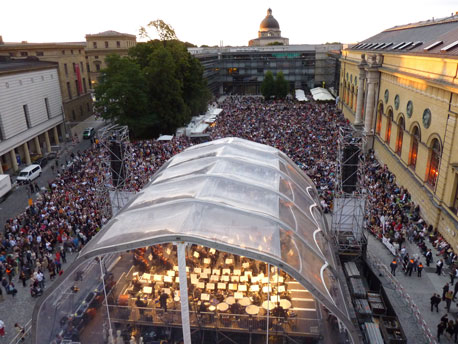
Live audiovisual broadcast from the National Theatre to Max Joseph Square as part of Opera for All. Admission free; no tickets required.
Cast Die Walküre
Sieglinde – Irene Roberts
Brünnhilde – Miina-Liisa Värelä
Fricka – Ekaterina Gubanova
Siegmund – Joachim Bäckström
Wotan – Nicholas Brownlee
Hunding – Ain Anger
Conductor: Vladimir Jurowski Production: Tobias Kratzer
The Festival
For more than 130 years, the Munich Opera Festival has attracted opera lovers from around the world. As one of the oldest international opera festivals, its reputation extends far beyond the city and Germany itself. For around twenty years, the festival has also presented the free open-air event Opera for All, once again held yesterday on the newly refurbished Max Joseph Square.
Opera-for-All-2026-Valkyrie (Die Walküre)
Die Walküre: Musical Performance
The Bavarian State Opera clearly possesses everything required for productions of this calibre and has long been among the opera houses seeking new ways of presenting opera. Munich has every reason to be grateful for that.
Nicholas Brownlee, singing Wotan, combines commanding stage presence with even greater musical authority. His German diction is exceptionally clear. His voice fills the space with ease, possessing a rich baritonal timbre and impressive depth. He is a convincing Wotan.
I am neither a Wagnerian nor what today is called an expert, but, subjectively, Miina-Liisa Värelä’s Brünnhilde does not quite match him, although her overall performance is strong. I remember Anne Evans in Harry Kupfer’s 1988 production: when she sang “Hojotoho! Hojotoho! Heiaha! Heiaha!”, even before she appeared on stage one could almost see Brünnhilde riding furiously through the air.
Joachim Bäckström possesses a warm and highly appealing tenor as Siegmund. His partner, Irene Roberts, gives an excellent performance as Sieglinde, moving effortlessly between lyrical tenderness and emotional intensity while never being overwhelmed by the orchestra.
Since the charismatic conductor Vladimir Jurowski came to Munich, these Opera for All performances have become even more of a cult event for both younger audiences and those less accustomed to the rustle of jewellery in plush opera-house seats. I have admired him in several Academy concerts. Here he unleashes Wagner’s Walküre with tremendous passion, shaping the score with unwavering commitment. It is a performance well worth both hearing and seeing.
Tobias Kratzer’s Interpretation of Walküre
A persistent feature of Regietheater—director-driven theatre in its less convincing form—is its tendency toward didactic finger-wagging: the desire to explain, to uncover the “true” meaning of the work, to understand composer and librettist better than the educated member of the audience (who, after all, has paid for the ticket), and to demonstrate the work’s contemporary relevance. The latter is entirely legitimate.
Tobias Kratzer undoubtedly approaches Wagner with profound understanding. Yet, as the saying goes, there is light and shadow in his realisation.
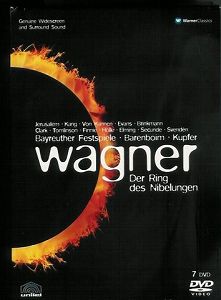
I remain a great admirer of Harry Kupfer’s Ring at Bayreuth. Occasionally Regietheater, as in Kupfer’s case, succeeds in creating something genuinely new. The austere aesthetic of that production, conceived in the waning years of the Cold War in 1988, remains palpable. Its minimalist staging strips away the heavy layers of Teutonic theatrical decoration. If one reads the Reclam edition of the text, the abstraction makes perfect sense. Heaven and the underworld—equally troubled and troubling—leave room for the psychological tragedy to emerge.
It is difficult to surpass Kupfer’s production, but equally difficult to do worse than last year’s Opera for All staging, one which Kratzer himself, between the lines, seemed to consider a bit too far.
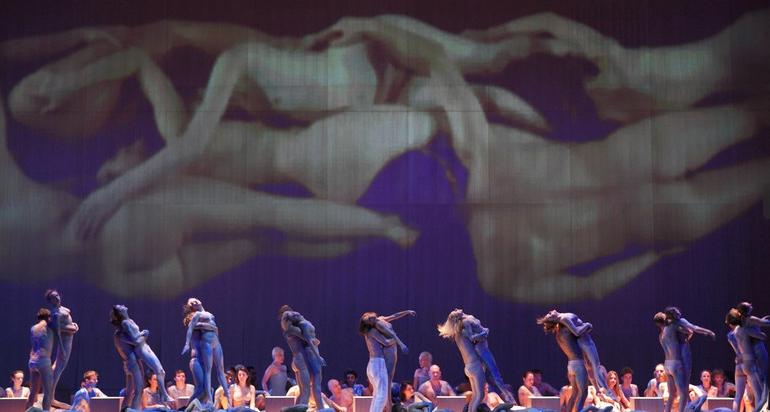
Kratzer makes extensive use of video, often presenting flashbacks to events occurring between Das Rheingold and Die Walküre. His interpretation begins with the burning of the woodland cabin where Wotan had lived with his mortal wife and where Siegmund and Sieglinde spent their childhood. In an additional visual layer, the fire is later attributed to Fricka and Loge, the god of fire. Kratzer’s Ride of the Valkyries sweeping through Munich is an attractive sequence, and although similar imagery had already appeared (Western Style) in the 1970s television series Münchner Geschichten, it is beautifully filmed.
Where Kratzer is less persuasive is in replacing one layer of theatrical convention with another. Rather than removing the cumbersome realism of traditional staging, he overlays it with an equally cumbersome critique of the petty bourgeoisie: a cheap prefabricated house, something resembling a Land Rover, and a ram hunted by Hunding, the oppressive husband of Sieglinde.
The Wälsung twins Siegmund’s and Sieglinde
In Kratzer’s backstory, Wotan lives with his mortal wife and the Wälsung twins in a woodland cabin a peaceful and rewarding family life. While hunting with his son, the cabin is consumed by fire killing his wife. Subsequently separated in childhood, Siegmund and Sieglinde suffer profound isolation. Siegmund becomes a hunted outcast, forever fleeing society’s laws. Sieglinde is trapped in an abusive and loveless marriage to Hunding, the embodiment of rigid bourgeois morality. When Siegmund seeks refuge in Hunding’s house, the twins recognise one another not merely as brother and sister, but as psychological mirrors.
Their bond later develops into an incestuous love. They do not experience it as a transgression, but rather as a return to an original, uncorrupted wholeness.
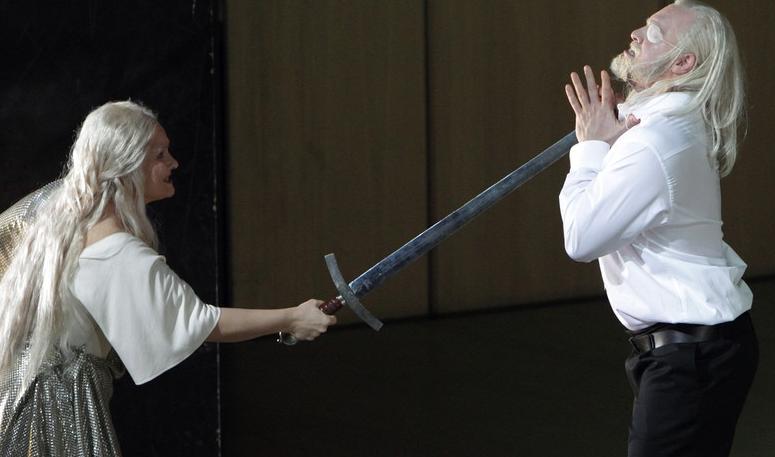
In Wagner’s drama, Siegmund draws the sword Notung from the ash tree into which Wotan had thrust it—a weapon destined only for the greatest hero. In Kratzer’s production, however, the sword comes from a tool shed instead. This outrages Fricka, the goddess of marriage, who is both magnificently sung and convincingly portrayed. She demands that Wotan swear to avenge this violation of marriage by abandoning his own children.
Wotan’s Central Tragedy
Kratzer intensifies the scene considerably. Fricka dismembers the ram, pulling out its entrails and heart while ordering Wotan to destroy the offspring of his adulterous relationship by supporting Hunding in combat. To reinforce her argument, she waves Siegmund’s underwear as incriminating evidence.
Yet this seems inconsistent with Kratzer’s own interpretation. He has argued that Fricka persuades Wotan not because the twins are products of his long-standing extramarital affair, but through the force of her rhetorical sophistication. However, both Wagner’s text and Kratzer’s imagery appear to contradict that reading.
The more compelling argument is, in my view, Wotan’s own explanation to Brünnhilde. There he reveals that he is ensnared by the very contracts and obligations through which he rules the world, and by the consequences of Alberich’s realm beneath the earth. This tragic self-awareness—not merely Fricka’s moral outrage—is what ultimately seals Siegmund’s fate.
Kratzer has remarked that immortality is itself a burden. That is an intriguing premise. One can easily imagine that an eternal marriage—whether Wotan’s with Fricka or Zeus’ with Hera—would carry its own peculiar misery. The gods may possess limitless time, but not necessarily freedom or happiness.
Yet this idea never fully develops into the production’s central dramatic argument.
Instead, Kratzer seems to ask a different question: what do gods do in a godless age? Hunding’s house is cluttered with religious icons and domestic altars. He compels Sieglinde to participate in empty rituals and appears as the stereotype of a religious hypocrite who uses faith to justify domestic tyranny. Even Wotan seems repelled by him.
Hunding sacrifices a ram to Fricka, who disembowels the animal with bloodied hands while demanding Siegmund’s death. The image is visually striking, but its symbolic meaning remains elusive. Is religion itself being indicted? Is Fricka exposed as merely another bloodthirsty deity? Or is the production suggesting that religious morality ultimately serves violence? None of these possibilities is developed sufficiently to become the production’s governing idea.
The extensive flashbacks projected onto the screen are often beautifully realised. The opening images of an idyllic family—Wotan with his mortal wife and the Wälsung twins in a woodland cabin—create genuine emotional investment. Their destruction by fire and Sieglinde’s abduction effectively establish the family’s trauma. Yet almost all of this background is already narrated in Wagner’s libretto. The projections illustrate rather than reinterpret.
More importantly, they shift attention away from what is, in Wagner’s drama, the central conflict: not the childhood of the twins, but Wotan’s impossible predicament.
Wotan’s tragedy is not that he has become unhappy in his marriage, nor even that he cannot save his children. His tragedy is metaphysical. He has created a legal and political order that now binds him. The ruler of the gods discovers that he is no longer sovereign. Every attempt to preserve his power only strengthens the system that deprives him of freedom. His great monologue to Brünnhilde is therefore not merely paternal grief but the confession of a ruler trapped by his own laws.
Kratzer stages Wotan’s despair through repeated attempts at suicide, slashing his wrists. Yet this never becomes convincing. An immortal being cannot escape his predicament by dying. His despair lies precisely in the impossibility of death. If immortality is the premise, suicide becomes a literal gesture for a fundamentally metaphysical condition.
“Heroes” in Kratzer’s reading
This leads to a further question concerning the representation of the male figures and so-called “heroes” in Kratzer’s reading.
Siegmund appears less to me as a mythic figure or tragic outsider than as a physically imposing but psychologically subdued man, almost passive in his own fate.
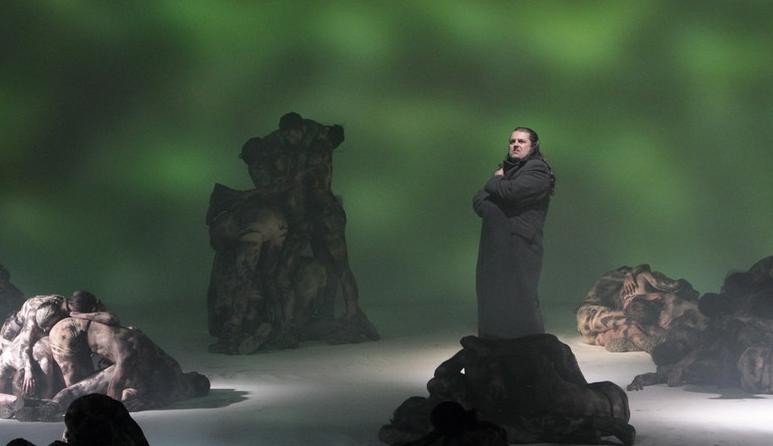
Wotan similarly no longer reads as the ruler of a collapsing metaphysical order, but rather as a figure who has already lost authority without fully articulating the nature of that loss. His struggle with the underworld, the gods, and Fricka’s moral claims remains visually present, yet its philosophical dimension is only partially developed.
Hunding, by contrast, is rendered with much clearer definition: he becomes a socially coded figure of bourgeois rigidity and domestic authoritarianism. While this is theatrically legible, it risks reducing him to a satirical type. In Wagner, Hunding is more than a social caricature; he functions as an expression of law, survival, and violence stripped of justification. When reduced to a contemporary stereotype, this complexity is diminished.
For me, this leaves the production without a fully coherent narrative or reading of the protagonists. Its individual images are often memorable, but they never quite crystallise into an interpretation that illuminates Wagner’s central tragedy.
My reservation is not directed against reinterpretation itself. Opera has always invited new readings. Rather, I wonder whether the additional narrative truly grows out of Wagner’s drama. The libretto already provides extraordinarily rich material—psychological, philosophical, and political. If a production adds another conceptual layer, it should sharpen those conflicts, not obscure them. Otherwise, the audience is left with impressive images whose relationship to the central tragedy remains uncertain.
Wagner’s Ring is already extraordinarily dense. Every motif, every dialogue, every dramatic turn serves multiple functions. When a director adds another symbolic system—religious oppression, the nuclear family, contemporary politics—it must earn its place. Otherwise, the original network of meanings becomes diluted rather than enriched.
Comparison with Harry Kupfer’s Walküre
A useful point of comparison is Harry Kupfer’s Ring, particularly its opening conception of Die Walküre. Kupfer’s Bayreuth Ring demonstrates that radical abstraction need not obscure Wagner’s dramaturgy. His minimalist stage language consistently serves a single conceptual idea. One may disagree with his interpretation, but it remains internally coherent. Kratzer’s production, by contrast, offers a succession of compelling theatrical images without arriving at an equally clear interpretative centre.
In Harry Kupfer’s legendary Bayreuth Ring production (1988–1992, designed by Hans Schavernoch), the traditional World Ash Tree (Weltesche) in Die Walküre was reimagined within a bleak, post-apocalyptic universe.
The Ash Tree concept is central to this vision:
The “Road of History”: an endless cracked asphalt highway stretching into a foggy void, symbolising the trajectory of human civilisation.
Dead metallic trunk: the ash tree reduced to a skeletal vertical structure.
Ecological collapse: a metaphor for a world ruined by Wotan’s system of power.
Siegmund’s entrance: his descent into Hunding’s shelter through this fractured landscape.
By contrast, Kratzer’s Die Walküre approach relies heavily on cinematic layering, flashbacks, and external visual commentary. While often visually compelling, these elements remain detached from Wagner’s text rather than emerging from its internal logic. The result is interpretative multiplication: instead of a single governing spatial idea that evolves, several parallel explanatory systems coexist. This may enrich perception in the short term, but it can also dilute the dramaturgical necessity central to Wagner’s construction.
Kratzer introduces numerous interpretative motifs—religious ritual, domestic violence, cinematic flashbacks, ecological imagery and the modern nuclear family. Individually these changes are often theatrically effective. Collectively, however, they do not converge upon a single reading of the drama. Rather than clarifying Wotan’s predicament, they disperse the audience’s attention across several competing symbolic systems.
Why the Religious Symbolism Doesn’t Convince
Kratzer’s religious imagery appears to originate less in Wagner’s text than in a contemporary symbolic vocabulary linking patriarchy, religious ritual, and domestic oppression. While theatrically intelligible, this association seems not developed by Wagner himself. Hunding represents law, custom, and clan obligation rather than institutional religion, while Fricka’s victory over Wotan rests primarily on the force of her argument rather than ritual or sacrifice. Consequently, the production shifts the audience’s attention from Wagner’s philosophical debate toward a symbolic discourse of its own.The third act (Aufzug) I leave uncommented. I listened to the broadcast of the premiere. The music was beautiful.
Conclusion
That is ultimately why I remain unconvinced. I admired many individual scenes—the flashbacks, the cinematography, the Ride of the Valkyries through Munich—but left the theatre without a clear sense of the production’s governing idea. Wagner’s Ring is already one of the most intellectually and dramatically complex works in the operatic repertoire. A new interpretation need not simplify that complexity, but it should help us see it more clearly.
As a review of Tobias Kratzer’s Die Walküre at Opera for All 2026, my conclusion remains mixed. The musical performance was exceptional, but the staging never quite clarified the metaphysical tragedy at the heart of Wagner’s drama
Richard Wagner PRIMARY SOURCE APPARATUS
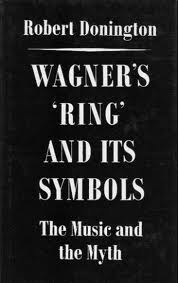
Robert Donington, Richards Wagner’s Ring des Nibelungen und seine Symbole (Wagner’s Ring and its Symbols) Reclam 1978
This essay analyzes Sabina Spielrein’s most famous work, “Destruction as the Cause of Coming into Being” (Destruktion als Ursache des Werdens, 1912) . It envisions her neither as a premature Jungian nor as a dissident Freudian, but as what she truly was: an independent theorist whose dialectic of creation and destruction in transformation occupies the intellectual space between Freud’s metapsychology and Jung’s later psychology of individuation and the collective unconscious.
Spielrein, a Russian psychoanalyst, argues that creation and destruction are inseparable. Her core insight is that genuine transformation requires the dissolution of an existing form—a law that applies equally across the biological, philosophical, psychological, and symbolical realms. Sabina Spielrein should not primarily be understood as a precursor of either Freud’s death instinct or Jung’s collective unconscious. Rather, she developed an independent process-oriented psychology of transformation, rooted in the dynamic interplay of psychic multiplicity, dissolution, and emergence.
Do we start in Zurich in 1911, where Spielrein’s dissertation, ”On the Psychological Content of a Case of Schizophrenia (Dementia Praecox),“ became the very first psychoanalytically oriented doctoral thesis written by a woman ? A pioneering achievement in the field of psychosis research, her work left Professor Bleuler, Jung, and Freud equally enthusiastic, and it was immediately published in the renowned Yearbook for Psychoanalytic and Psychopathological Research.
Or do we start in Rostov-on-Don, where she was born in 1885 into a wealthy family, only for her life to end there in 1942—forgotten in the West, impoverished, and stripped of the permission to practice her profession, ground down by history with her three brothers executed during Stalin’s Great Terror, and she and her daughters ultimately murdered by the German SS ?
For me, the story surrounding “Destruction as the Cause of Coming into Being” begins on the evening of November 29, 1911, when she presented several excerpts from her new work to Freud and the Vienna Psychoanalytic Society (WPV) . By this time, the friendship between Freud and Jung already showed deep cracks—as had the personal relationship between Sabina Spielrein and C.G. Jung . Among her Viennese colleagues, Spielrein’s presentation was met with massive resistance . Freud himself was not yet ready to entertain her ideas; it was not until his 1920 essay, “Beyond the Pleasure Principle,” that he would finally acknowledge Spielrein’s work—relegating it to a mere footnote.
Sabina Spielrein did not leave Jung in Zurich voluntarily, but rather tore herself away in a violent confrontation of reality and love. She traveled to Munich to complete her new work and study art history. Although she enjoyed Munich’s culture and people, it was merely a stopover; she had successfully insisted to her parents that she remain in the West. A lively correspondence maintained the connection between Munich and Zurich. Physically separated from Jung, Sabina now sought an inner detachment through her new scientific work, “Destruction as the Cause of Coming into Being”. She tested her hypotheses against biological facts, individual psychological considerations, and child psychology, citing examples from literature and philosophy while drawing on material from European myths and dreams. She referenced the philosophers Ernst Mach and Friedrich Nietzsche—particularly his work Thus Spoke Zarathustra—as well as Richard Wagner’s heroic model in Das Rheingold and the psychoanalytic writings of Jung and her doctoral supervisor, Bleuler.
Spielrein left Munich and arrived in Vienna in October 1911. On October 11, one of her two great wishes came true: on the merits of her dissertation, she was elected as a member of the Vienna Psychoanalytic Society. Meanwhile, the intense friendship between Jung and Freud had begun to fracture.
It is well known that Sabina Spielrein was a student of Jung’s—a fact she made no secret of. For the majority of her Viennese colleagues, this position was anything but popular. The fact that Sabina Spielrein—through her new work—distanced herself from Freud in a manner that was diplomatic yet clear did not strengthen her position; many passages begin with “Freud is right about…” followed by a major “but” or “however”. For instance, Freud viewed the reproductive/sexual drive as purely a pleasure-seeking, life-affirming force (Eros). Spielrein boldly countered that in the case of incest, the sexual instinct inherently contains a destructive impulse (“der im Fortpflanzungstrieb enthaltene Destruktionsdrang”) .
Sabina Spielrein’s November 29 entry presentation to the Vienna Psychoanalytic Society, bearing the working title “Über Transformation,” was a preview of her finalized 1912 paper, “Die Destruktion als Ursache des Werdens”. Her work seems inherently more Jungian than Freudian, yet at the crucial points, she is neither Jung nor Freud—she is Sabina Spielrein.
Jung reacted to the manuscript with palpable enthusiasm, writing to Spielrein, “I am surprised by the wealth of excellent thoughts that anticipate various ideas of mine” . However, Jung wrote very differently to Freud about the manuscript; both referred to her derogatorily in their letter exchanges as “Die Kleine” (4 J287/F286) .
It is worth noting that, at this time, Jung was working with Toni Wolff on Wandlungen und Symbole der Libido (revised as Symbole der Wandlung from the fourth edition onward), which was published in 1912, almost at the same time as Spielrein’s paper.
While Wandlung and Transformation are often used interchangeably as synonyms for “change,” they have distinctly different nuances in German. In the German language, Wandlung denotes a deep, organic, and spiritual metamorphosis—an internal maturing process and progressive evolution of character, much like Jung’s individuation, to discover the Self . Here, the inflated ego is put in its place within a polypsychic personality, not dissolved.
Conversely, Transformation specifies a radical, structured, and large-scale disruption in form, function, or systemic organization. By intentionally prioritizing Transformation as her main theme, Spielrein signals that psychological change is not a linear development, but a cyclic reconfiguration where the old must be given up for the new to emerge. She explicitly embraces Jung’s polypsychic theory of personality, noting that “according to him we have in us not an undivided ‘I’ but various complexes, which contend (streiten) for priority,” while her chosen term dividuum (meaning “divisible”) is to be understood as the antonym of “individuum” (indivisible), describing an entity that is inherently an interconnected multiplicity. Both this conceptual synthesis and her working and final titles clearly point to her dialectic view of transformation.
SPIELREINS SEMANTIC AND TERMINOLOGY
Sabina Spielrein is writing her paper precisely at the moment Freud and Jung are breaking apart (1911–1912), and she uses Freudian-Plus vocabulary to validate Jung’s discoveries. When she invents these hybrid terms, she is trying to bridge the gap of the two schools. Here is a proposed direct translation of some “semi-Freudian” terms into clear Jungian school terminology.
Below are some examples of these hybrid terms:
“I-Psyche” (Ichpsyche): In Jungian terms, this corresponds to the Ego-Complex or the Personal Psyche. The Ichpsyche constitutes the layer of the mind tied directly to conscious identity, individuality, and personal survival.
“Type-Image” (Typusbild): In terms Jungian later coined, these may be interpreted as Archetypal Images. Spielrein deployed the term “type” (Typus) in its classic etymological sense: a prototype, mold, or universal blueprint. A type-image belongs to the collective, impersonal inheritance of humanity rather than to the individual biographical experience.
Usage example: If a patient is traumatized by their own sexuality, their I-psyche feels personal shame. To protect itself, the mind dissolves the personal “I-image” (the ego) and replaces it with a “type-image.” Instead of saying “I am dirty from sex,” the patient says, “The Earth has been fouled with urine.” The personal shame is inflated into a universal, mythic, or cosmic “type” (The Earth Mother / Cosmic defilement).
The Antagonistic Streams: I-Psyche vs. Type-Psyche:
Spielrein introduced the radical premise that the human psyche is permanently torn between two opposing dynamics or “streams”). Although those were not referred in Freudian terms as drive or instinct, this structural polarity indirectly anticipated Freud’s dualistic framework in Beyond the Pleasure Principle (1920) and touched what Jung later designated as psychological compensation)
The I-Psyche Stream (Jungian: Personal / Ego)
The Type-Psyche Stream
Goal: Individual preservation and personal pleasure.
Goal: Species preservation, continuity, and transformation.
Focus: The “Me” (The unique, isolated individual).
Focus: The “We” (The eternal, collective human experience).
Stance on Pain: Avoids it at all costs to protect the Ego.
Stance on Pain: Welcomes it if it forces growth or change.
This structural tension answers a foundational clinical question that perplexed early psychoanalysis: why do patients suffering from psychosis (historically classified as dementia praecox or schizophrenia) deliberately sabotage their own lives or experience a paradoxical “joy in pain”?
From the I-psyche perspective, this makes no sense because the Ego only wants pleasure. But from the Type-psyche perspective, the individual ego is completely insignificant—it is just a “momentary grouping of feelings.” The Type-psyche will readily override, damage, or dissolve the Ego if it means forcing the individual back into alignment with the transpersonal (“We”).
“The I-psyche can only wish for pleasure feelings, but beyond that the type-psyche teaches us what we really desire, what positive or negative feeling-tone is tous, and there we see that the type-wishes living in us do not correspond at all to the I-wishes, that the typepsyche wants the present [rezente] I-psyche assimilated, while the I, yes, every little part of the I, possesses the endeavor for self-preservation in the present form (inertia). The type-psyche, which accordingly denies the present I, recreates it, however, through this very denial, for the sunken little I-particle emerges clothed in new mental images richer than ever before.“
This passage anticipates several structural features that Jung would later organize under the concept of the Collective Unconscious. Spielrein’s “We” bears a resemblance to later Jungian formulations of transpersonal psychic layers. Sabina Spielrein manually engineered these German compound terms (Ichpsyche, Ichleben, Typusbild) to solve a massive political and theoretical dilemma. She wrote:
“I believe that Freud is right, when he accepts striving after the attainment of pleasure… as the basis of all psychic productions.””Now, however, the question is whether our whole psychic life consists of this I-life…”
At this point in history (1911), Jung had not yet fully formulated the term “Collective Unconscious” or “Archetype” in print. He was dropping hints in lectures and letters, but the official nomenclature did not exist yet. Spielrein had to invent a language to describe what she and Jung were discovering in schizophrenia patients at the Burghölzli clinic. She explicitly coins:
Ichpsyche (I-Psyche) & Ichleben (I-life): She takes Freud’s Ich (Ego) and anchors it down. By compounding it into “I-life,” she restricts Freud’s entire pleasure-principle theory to the mere daily, personal maintenance of the individual identity.
Typus-Bilder (Type-images) & Das “Wir” (The “We”): Since the word “Archetype” wasn’t canonized yet, she used Typus (from the Greek typos, meaning “impression,” “mold,” or “pattern”). Typus-Bilder can often be translated into later Jungian language as archetypal images. She explicitly states: “The depth of our psyche knows no ‘I,’ but only its summation, the ‘We’.” Spielrein’s concept of the “We” should not be equated directly with Jung’s later Collective Unconscious. Rather, it designates a transpersonal layer of psychic and biological life that precedes the differentiated ego. Depending on context, this layer appears as species-life, ancestral inheritance, symbolic origin, maternal matrix, or collective humanity. The ambiguity may reflect not confusion but the fact that Spielrein was attempting to describe a phenomenon that Jung himself had not yet fully conceptualized.
SPIELREIN AND FREUD
“Ueber Transformation”
Her paper starts with a lengthy Jung quote about the two sides of libido. A preview excerpt of her paper was presented under the working title “Über Transformation”. Both is highly significant. By explaining schizophrenia (dementia praecox) through transformation rather than mere Freudian “regression” or “fixation,” she argues very similar as Jung.
Freud viewed schizophrenia as a catastrophic failure where the Ego withdraws its libido from the world and regresses into primary narcissism. To Spielrein (and Jung), the patient is speaking the language of a cosmic, mythological sacrificial ritual. The pain of the individual is being dissolved into an objective fact of nature.
Conflict or Transformation?
In Freud’s mature metapsychology, especially after Sigmund Freud introduced the death drive (Todestrieb) in Beyond the Pleasure Principle (1920), psychic life is structured around a tension between two fundamentally opposed classes of drives:
Eros (life drives): preservation, union, sexuality, creation.
Death drive: dissolution, reduction of tension, return to an inorganic state.
This is fundamentally a dualistic conflict model.
By contrast, in Sabina Spielrein’s 1912 essay Destruction as the Cause of Coming into Being, destruction is not primarily an opposing force to life. Rather, destruction is an intrinsic moment within transformation and generation itself. Her argument is often summarized as:
Becoming requires the dissolution of what already exists.
Unlike Freud’s later dual-drive theory, Spielrein does not primarily conceive psychic life as a conflict between antagonistic instincts. Rather, she understands destruction and creation as complementary moments within a single process of transformation and becoming. The reproductive act itself, for example, involves the loss of individual form in the service of creating something new. This is closer to a dialectic of transformation than to Freud’s later opposition between life and death instincts.
The pleasure principle (Ichpsyche) cannot explain why humans voluntarily seek experiences that dismantle their own ego boundaries. Spielrein’s language often conveys an impulsion, urge, or dynamic tendency rather than instinctual system as she used Drang translated ‘impulse’ instead drive or instinct. Her identification of a stream that “wants this self-damaging” and “takes pleasure in pain,” was interpreted by many, especially the Freudian, as the Destruction Drive (Destruktionstrieb). Freud initially resisted her idea. But nearly a decade later, in Beyond the Pleasure Principle (1920), Freud finally admitted she was right and introduced his own famous concept of the Death Drive (Thanatos), citing her in a footnote.
It seems arguable that Spielrein’s term Destruction Impulse (Drang) should not be reworded as Destruction Drive. Her paper reads like a masterclass in diplomacy, but conceptually, she is pulling the rug right out from under Freud, by saying “Freud is right that everything is driven by the pleasure of the individual”, but immediately follows it with a massive “however” that completely shatters his deterministic view of the mind. She expands the map of the mind, implicating that beneath Freud’s puddle of an individual ego desperately managing personal repressions lies a massive, ancient ocean of the human experience that operates on completely different laws. Spielrein looks past the individual puddle and looks at biological, philosophical and psychological realms. For her:
Destruction is a prerequisite for creation. Freud saw destruction as a neurosis or a failure of the ego. Spielrein argued that the Artpsyche demands the temporary dissolution of the ego because that is the only way a human can love, reproduce, or create art.
Spielrein’s concept of destruction presupposes a dividual rather than an individual psyche. Drawing on Jung’s theory of complexes, she conceives personality as a multiplicity of semi-autonomous psychic complexes whose continual reconfiguration requires the dissolution of existing forms. Destruction therefore functions, in modern terms, not as an instinct opposed to life but as a transformative process within a fundamentally polypsychic system. Destruction therefore functions not as an instinct opposed to life but as a transformative process within a fundamentally polypsychic system.Modern polypsychic interpretations find strong antecedents in Spielrein’s conception of the psyche as a multiplicity of interacting complexes rather than a unitary ego.
Freud’s metapsychology certainly contains internal plurality—the unconscious, ego, id, superego, conflicting wishes, and so on. But Freud generally seeks to explain psychic life through dynamic conflicts among drives and agencies. Spielrein’s emphasis increasingly falls on the transformation of configurations within a psyche that is already intrinsically multiple.
She became not a bridge between two great men as she had wished nor is she proto-Jung. She is Spielrein. She stood entirely on her own ground, utilizing Jung’s concepts at that time and her clinical experience to present a completely unique cyclic view of human transformation. In Spielrein and early Jung, the psyche is better understood as a dynamic, self-organizing system of interacting complexes rather than a unitary ego defending itself against instinctual pressures. Psychic life is therefore not primarily structured by conflict between rational control and dark drives, but by continuous emergent reconfiguration within a distributed, polypsychic field.
Spielrein’s cultural-intellectual background
Many scholars have noted that Spielrein’s thought resonates with currents in late nineteenth- and early twentieth-century Russian philosophy and science. Whether there was direct influence in every case is harder to prove, but the parallels are striking.
She developed her thoughts within a cultural-intellectual background in which processual, transformative, and non-substantialist models of life, psyche, and creativity were already intelligible and philosophically resonant. Within that milieu, the three intellectuals were named by Sabine Richebaecher who function well as representative poles of resonance, not sources in a strict genealogical sense:
Vladimir Solovyov → metaphysical holism (unity-through-transformation)
Vyacheslav Ivanov → symbolic-ritual dynamics of dissolution and rebirth
Ilya Mechnikov → biological self-regulation through constructive destruction
Together, they map a conceptual field in which:
being is not static substance but ongoing becoming
destruction is not pure negation but functional or generative transition
identity is not absolute but relational and processual
Vladimir Solovyov (1853–1900)
Solovyov was perhaps the most influential Russian religious philosopher of the period.
His doctrine of all-unity (vseedinstvo) held that reality is constituted through the reconciliation of differences within a larger whole.
This bears a notable resemblance to Spielrein’s idea that:
individuality must partly surrender itself,
separation gives way to union,
destruction becomes a condition for higher forms of existence.
Solovyov frequently presents death, sacrifice, and self-transcendence not merely as negations but as moments in a movement toward fuller realization. Thus, Spielrein’s notion that annihilation can be productive fits remarkably well with Solovyov’s metaphysical framework.
Vyacheslav Ivanov (1866–1949)
Ivanov is perhaps even closer to Spielrein in spirit.A major figure in Russian Symbolism, he was heavily influenced by: Nietzsche, Greek tragedy, Dionysian religion,mystical transformation. For Ivanov, genuine creation requires: dissolution of the isolated self, ecstatic participation in something larger, death and rebirth as recurring patterns of culture and psyche. His Dionysian philosophy repeatedly portrays destruction as creative. A recurring theme is:
The individual must die to be reborn at a higher level.
This does not necessarily mean physical death; it refers to the breakdown of existing forms, identities, and structures so that new forms can emerge. That idea is extremely close to Spielrein’s conception of psychic and biological transformation. Both thinkers reject a simple opposition between life and death. Instead, death-like processes become moments within life itself.
Ilya Mechnikov (1845–1916)
Mechnikov is the most scientifically relevant comparison.Known for discovering phagocytosis and helping found immunology, he won the Nobel Prize in Physiology or Medicine in 1908.
What is especially interesting is his biological view that: life depends upon processes of destruction, cells destroy other cells, organisms constantly renew themselves through breakdown and reconstruction. The immune system itself functions through controlled destruction.
Mechnikov therefore offered a biological picture in which: death serves life, elimination serves reservation, destruction enables development.
This resembles Spielrein’s argument more closely than Freud’s later death drive. For Freud, destruction points toward a tendency to return to an inorganic state. For Mechnikov and Spielrein, destructive processes are integrated into the ongoing production and maintenance of life. Many historians see this as a crucial distinction.
THE DIVIDUUM: SPIELREINS’s POLYPSYCHIC PERSONALITY
The ocean was largely defined by their work at the Burghölzli Asylum. Both Jung and Spielrein were trying to understand the fragmented, highly symbolic, and fluid language of psychotic patients.
They both realized that Freud’s “puddle” (individual repressions and childhood neuroses) was inadequate to explain why a schizophrenic patient would suddenly speak in grand, cosmic, mythological symbols.
They were both forced to look deeper into the collective and cultural history of the human experience to find answers. Even though they swam in the same ocean, they eventually swam in different directions:
Jung charted the ocean by mapping it—building a structured taxonomy of archetypes and creating a map with a clear destination (Individuation).
Spielrein remained focused on the fluid dynamic of the water itself—the constant, cyclical currents of Transformation and Werden, where nothing stays fixed and the cycle never truly end.
Its Jung’s ocean. Either she swims to a different island or they are swimming side by side. We will never know. Jung definitely reached his island. All we can do, is letting Spielrein speak:
For me the name of Jung is intimately connected with the name of Mach, for it is this researcher as well, who thinks of the mind as consisting of many individuals. It is indeed Jung who speaks of the complex-autonomy [Komplex-autonomie], so that according to him we have in us not an undivided I but various complexes, which contend [streiten] for priority. The most beautiful confirmation of his views is provided by the dementia-praecox patients, who so strongly feel the power of individual complexes separated from the I.
I had to reach the insight that the principal characteristic of the individual consists in the fact that it is a dividuum [Dividuum]. The closer we get to conscious thinking, the more differentiated become our mental images; the deeper we reach into the unconscious, the more general, more typical become the images. The depth of our psyche knows no “I,” but only its summation, the “We” [das “Wir”];9 or the present “I” becomes, seen as object, subordinate to other similar objects
Spielrein is not merely borrowing from Jung—she is explicitly telling you what she believes she has learned from him, and then she pushes it a step further. Sabina Spielrein’s concept of the “dividuum” argues that the psyche is not a unitary entity, but rather fundamentally composed of multiple, conflicting parts. In her 1912 work, she moves beyond Jung’s theory of autonomous complexes, framing the individual’s core characteristic as a “divisible” entity (a dividuum) rather than an indivisible one Spielrein argues that the “I” a return to the deeper ground,” anticipating a transpersonal psychology while focusing more on the ego’s return to this deeper ground than the mature Jung, who sought to maintain ego differentiation.
The Dark Mirror (1946) | Film Noir| Twin Sisters | Psychological Mystery
Jung’s Discovery autonomous complexes
By 1911, Carl Jung had already developed his groundbreaking theory of autonomous complexes through his word association experiments and dementia praecox studies at the Burghölzli clinic. His framework explicitly states that we have in us not an undivided “I” but various complexes, which contend for priority. This insight proves that the human psyche is not a unitary entity and the conscious ego is not sovereign. Instead, these complexes possess a relative autonomy within the mind. In cases of schizophrenia, this autonomy becomes highly visible because the complexes detach so dramatically from the central personality. As a result of this detachment, the patient experiences these split-off parts as independent, vital, and hostile alien beings.
Clinical Confirmation Schizophrenia as mind’s underlying structure
With this foundational framework established, the focus shifts to the clinical proof that validates the theory. Schizophrenia does not merely serve as a description of pathology, but rather as definitive evidence of the mind’s underlying structure. The disease acts as a unique window, revealing a fragmented architecture that normally remains completely hidden in a healthy person. This reflects a major theoretical move where the pathological state is utilized to expose the universal architecture of the normal psyche. The most beautiful confirmation of these views is provided by dementia-praecox patients, who vividly experience the independent power of individual complexes that have separated from the ego.
Spielrein’s Own Conclusion principal characteristic of the individual it is a dividuum”
From this clinical confirmation, Sabina Spielrein makes an original theoretical leap to her own definitive conclusion. She explicitly declares her thesis statement: “I had to reach the insight that the principal characteristic of the individual consists in the fact that it is a dividuum”. This proposition belongs entirely to Spielrein, moving far beyond a mere footnote to Jung’s work. Her core argument is that multiplicity is not just a feature of the mind, but the defining characteristic of human identity itself.
By choosing the Latin term dividuum, she delivers a radical philosophical attack on the traditional metaphysical assumption of psychic unity. While the word individual historically means “that which cannot be divided,” Spielrein asserts that, psychologically speaking, this assumption is false. The human being is precisely that which is divided. A person is not an indivisible unit that merely contains internal parts; rather, the person is fundamentally composed of parts from the very beginning.
The emergence of the “We”
The text outlines a strict, coherent progression as the psyche descends deeper into the unconscious, moving precisely from the local Ego (“I”), through the autonomous Complexes, into the divided structure of the Dividuum, toward Typical images, and finally to the emergence of the “We”. To map this descent, Spielrein deliberately constructs two sets of compound terms.
Brigitte Lin in Ashes of Time (1994)
First, she creates Ichpsyche (I-Psyche) and Ichleben (I-life). By taking Freud’s Ich (Ego) and anchoring it down into “I-life,” she restricts Freud’s entire pleasure-principle theory to the mere daily, personal maintenance of individual identity.
Second, she introduces Typus-Bilder (Type-images) and Das “Wir” (The “We”). Because the word “Archetype” was not yet canonized in 1912, she utilized Typus (from the Greek typos, meaning an impression, mold, or pattern). Consequently, these Typus-Bilder can often be translated into later Jungian language as archetypal images. She explicitly states, “The depth of our psyche knows no ‘I,’ but only its summation, the ‘We’”.
As consciousness deepens, individuality decreases, typicality increases, and collective patterns emerge. However, Spielrein’s concept of the “We” should not be equated directly with Jung’s later Collective Unconscious. Rather, it designates a transpersonal layer of psychic and biological life that precedes the differentiated ego. Depending on the context, this layer appears simultaneously as species-life, ancestral inheritance, symbolic origin, the maternal matrix, or collective humanity. This ambiguity reflects the fact that Spielrein was attempting to describe a pioneering phenomenon that Jung himself had not yet fully conceptualized or differentiated in print.
At this specific historical crossroads, Sabina Spielrein’s relationship to Carl Jung reveals that she is not merely anticipating his later work, but is actually presenting a more radical vision than the mature Jung would ever accept. This divergence centers entirely on the ultimate fate of the individual identity.
For the mature Jung later, the psychological journey is defined by two very different movements:
Individuation: The process where the ego enters into a conscious relationship with transpersonal realities while remaining highly differentiated. Jung never wanted the ego to disappear; he only wanted it relativized.
Collective Possession: A dangerous state where the ego is entirely dissolved, overrun, and consumed by collective forces. This second movement is the precise pathology Jung later warned against in his Wotan essay, where archetypal inflation leads to mass ideological possession.
Spielrein, however, is at that time far more radical as Jung will ever be. While Jung never abandons the absolute importance of differentiation, Spielrein is far more attracted to the concept of dreturn to the deeper ground. For her, genuine transformation hints a longing for return—the voluntary return to the deeper ground of the differentiated ego.
Her core insight emphasizes that what appears destructive to the conscious mind is not necessarily pathological; rather, destruction is the absolute precondition for creation. The old self must partially die for a new self to emerge. Whenever the ego identifies itself with a particular form, role, belief, or image, psychological development eventually demands that this identification be sacrificed. What the ego experiences as terrifying loss and destruction, the deeper personality experiences as growth.
While Jung viewed the complete immersion of the ego into the collective psyche as a dangerous inflation to be avoided, Spielrein embraces this as a general law of life. She recognizes that transformation naturally threatens the existing form, causing an intense fear of change within the Ichpsyche. Yet, she insists that every major development of personality requires a total sacrifice of identity. To Spielrein, becoming requires letting go of what one has been, meaning the individual must be willing to let the differentiated “I” dissolve back into the universal maternal matrix of the “We” to achieve a more comprehensive form of life.
Spielrein repeatedly follows a symbolic expansion process in which a personal image gradually reveals transpersonal meanings.
The progression is not imposed by the interpreter; she herself walks the reader through it.
Stage 1 — The Personal Mother
The witch-story example begins with ordinary developmental psychology.
the girl identifies with her mother
the witch represents the mother
the emotional charge comes from the mother’s life
At this level we remain entirely within a personal-biographical framework.
The mother is still my mother.
Stage 2 — Mother as Symbolic Form
The moment Spielrein moves to Goethe’s “Mothers” and Silberer’s sea-image, something changes. Now the mother is no longer a particular woman.The sea becomes maternal, life-generating primordial. The symbol is already expanding beyond biography.
Stage 3 — Mother as Origin
Then comes the remarkable step:
“the maternal, creating water, from which all life has come into being. Now we have crossed into cosmological language.
The mother is becoming source,origin beginning. The symbol is no longer primarily psychological. It is ontological. Spielrein is asking where forms come from.
Stage 4 — Mother as the Undifferentiated
This may be the conceptual center of the sequence. The sea-mother is described as outside time, outside place, beyond opposites, before differentiation That is a very specific description. The important term is not “mother.” The important term is: undifferentiated state. The mother image is functioning as a symbolic representation of pre-differentiated existence. This is where transformation enters. Because for Spielrein every differentiated form secretly longs to return to its origin. Not to disappear absolutely. But to undergo reconfiguration.
Stage 5 — Mother as Transformative Matrix (Rückverwandlung)
Now the symbol acquires dynamism. The sea is not merely origin. It is also the place from which new forms emerge. This is why she immediately links it to transformation (Verwandlung).
The movement becomes: emergence differentiated forms arise →differentiated forms become unstable →differentiated forms partially return to origin →new forms emerge
Stage 6 — Toward the “We”
Only after all these expansions does the the “We” become intelligible. The “We” is not introduced from nowhere. The groundwork has already been laid. Seen this way, the “We” is not simply collective humanity. Nor is it yet Jung’s later collective unconscious. It is the level of reality at which individual differentiation has not yet fully occurred. That is why Spielrein can speak of type-life, unconscious life symbolic life. maternal life almost interchangeably. She is still describing one phenomenon through several overlapping vocabularies. Through what symbolic expansions does she arrive at the We?
Jung’s later archetypal theory can be understood as one attempt to conceptualize systematically the type of symbolic expansion that Spielrein is already tracing here. To Sabrina Spielrein’s “We” at the time of writing is not one thing. It is a deliberately broad term for the deeper level of life from which individual identity emerges. That deeper level appears simultaneously as type, unconscious, ancestral inheritance, symbolic origin, maternal source, collective humanity.
In other words, she has identified a phenomenon before she has fully differentiated its components. That would actually be very typical of pioneering work. She knows there is a deeper layer, it is not the ego, it operates according to different laws, it speaks through symbols.
But she has not yet separated: biology, collective psychology, archetypal structure, mythic imagery, with the precision that Jung would later attempt.
This may be one of the most revealing paragraphs in the entire essay. Not because it proves a later Jungian doctrine, but because it exposes the underlying metaphysical structure of Spielrein’s thought:
“The differentiated mother = patient transforms herself into this prime mother. Not for nothing have Greek philosophers, as, e.g., Anaxagoras, sought the origin of world-weariness [Welt-schmerz] in the differentiation of beings [Seienden] from the primary elements. This pain consists precisely in the fact that each particle of our being longs for the back-transformation [Rückverwandlung] in its origins, from which then new becoming [Werden] comes forth.” … “The closer we get to conscious thinking, the more differentiated become our mental images; the deeper we reach into the unconscious, the more general, more typical become the images. The depth of our psyche knows no “I,” but only its summation, the “We” [das “Wir”];9 or the present “I” becomes, seen as object, subordinate to other similar objects.”
For Spielrein, the pain of existence originates not primarily in repression but in differentiation itself. Every differentiated form experiences a tension between its separate existence and its participation in a deeper originating ground. Transformation becomes possible only through a Rückverwandlung—a return-transformation to that source from which new becoming can emerge. It is one of the places where Spielrein stops talking like a clinician and starts talking like a philosopher of becoming. The entire essay may be read as an attempt to understand why life repeatedly sacrifices its existing forms in order to generate new ones. The biological examples, the psychological examples, the mother symbolism, and eventually the “We” all seem to orbit that central question.Why Anaxagoras may not be accidental. Most readers focus on the sentence about world-weariness (Weltschmerz). But the choice of philosopher matters. Anaxagoras is associated with primordial mixture, differentiation of things from an original state, Nous as ordering principle.Spielrein does not discuss Nous here.
However, she does discuss original undifferentiated states, differentiation return , emergence of new forms which overlaps strongly with Presocratic cosmology. She is clearly thinking beyond individual psychology and borrowing cosmological language to describe psychic processes.
Spielrein seems to be discovering, almost in real time, that the problem of transformation cannot be explained solely by personal biography. The symbols keep expanding outward—from mother, to sea, to earth, to origin, to timeless unconscious. Whether one ultimately reads that through Freud, Jung, philosophy, mythology, or religion, the text itself is already pushing beyond a purely personal psychology.
Spielrein describes psychic life through a cyclical model. Thats nonlinear time, profoundly Asian. Not Western Christian “AD”or Marxist of “Permanent Progress. Panspermia as it is known today, however, is not identical to Anaxagoras original theory. The name, as applied to this theory, was only first coined in 1908. We are in early cosmology I think you’re touching on a place where a strictly Jungian reading may actually become too narrow:
The clue is “Werden”. Modern readers often focus on destruction death drive sexuality ego. But the word that appears again and again is Werden (becoming) an almost a metaphysical category. The question becomes What is the source from which new forms emerge? That is not merely a Freudian question. It is an ancient cosmological question.
Spielrein writes:
each particle of our being longs for the back-transformation (Rückverwandlung) into its origins, from which new becoming comes forth.
That is not linear progress. It is cyclical emergence. And, this feels much closer to Presocratic cosmology Indian thought certain Gnostic motifs , Jung was interest at that time and later Jungian transformation symbolism than to nineteenth-century European progress narratives. Spielrein’s concept of the “We” should not be understood merely as an early version of Jung’s collective unconscious. In the text it functions as a broader principle of origin. Through a sequence of symbolic expansions—mother, sea, earth, origin, undifferentiated state—the psyche is traced back toward a transpersonal source from which differentiated life emerges and to which it periodically returns. The “We” therefore denotes not only collective psychology but a deeper principle of becoming that is simultaneously biological, symbolic, and cosmological.
That is surprisingly close to how a modern system theorist might describe movement between attractors in a complex adaptive system.Of course Spielrein knew none of that mathematics. But conceptually she is not thinking in straight lines. She is thinking in cycles, transformations, dissolutions, and re-formations. That is why the essay often feels closer to a process cosmology than to a conventional clinical paper. Spielrein explicitly invokes Anaxagoras at a crucial point, and the conceptual structure surrounding that citation resonates with themes historically associated with Anaxagorean cosmology. What is important here is that Anaxagoras appears precisely where Spielrein is wrestling with differentiation. She writes:
the origin of world-weariness lies in the differentiation of beings from the primary elements
This is where Nietzsche becomes interesting. Nietzsche himself was fascinated by exactly this problem:
How does form emerge from an underlying multiplicity?
The comparison becomes even more interesting when you remember that Spielrein is simultaneously developing, here autonomous complexes, dividuum, dissolution of the unitary ego, emergence of higher forms through destruction. The point about nous is particularly intriguing in classical Anaxagoras:
everything is originally mixed
differentiation occurs
nous initiates ordering
In Spielrein:
psyche tends toward undifferentiated origin
differentiated forms dissolve
new forms emerge
The systems are obviously not identical. But they share a common concern:
How does ordered form arise from a deeper, more fundamental state?
Why does destruction generate form?
That is simultaneously:
a biological question,
a psychological question,
an artistic question,
and arguably a cosmological question.
The artist destroys an existing form and creates another.The psyche relinquishes one identity and produces another. Life dissolves one generation and produces another. The same pattern recurs.
But one unresolved question remains:
What causes new form to emerge from that ground?
For Jung, later, that answer increasingly becomes the Self. For Anaxagoras, it is Nous. For Nietzsche, creative becoming itself often occupies that role. For Spielrein in 1912, the answer is not yet obvious.
Her Answer is the cycle:
is actually faithful to the text because it preserves two things most interpretations lose:
cyclicality (not teleology)
regeneration (not annihilation)
If “destruction” only meant loss, Freud dominates the reading.
If “destruction” is a phase in regeneration, then Spielrein is already operating in a transformation-theory framework rather than a pathology-theory framework
Spielrein’s essay describes psychic life as a cyclical transformation system in which differentiation generates instability, instability triggers partial de-differentiation, and de-differentiation functions as a regenerative return to a pre-individual substrate from which new differentiated forms emerge.
The cycle (clean structural form)
Stage 1 Equilibrium disruption
Destruction (Zerstörung / Untergang)
breakdown of stable ego-configuration
loss of prior identity equilibrium
increase in internal tension between complexes
This is not “annihilation” but destabilization of a metastable structure.
instead enters a high-variance, loosely coordinated state
multiple tendencies (complexes) compete without stable hierarchy
This is crucial: it is not yet “new order,” but plasticity under reduced constraint.
Stage 3 Back-transformation (Rückverwandlung)
This is the most conceptually dense step. It is not simply “return.” It functions more like:
re-integration of differentiated elements into a new organizing principle
So it is:
not regression
not restoration of prior state
but re-binding of multiplicity into a new coherent configuration
In modern structural language: a re-attraction into a new basin of stability
Stage 4 Stabilized new form (Werden)
Werden (becoming as outcome-state)
a new equilibrium emerges
but it is not identical to the original
it preserves traces of prior fragmentation
So the “identity” that emerges is:
structurally derived from transformation history, not pre-given essence
Spielrein conceptualizes psychic life as a cyclical process in which destabilization of an existing ego-configuration leads to a phase of unstructured multiplicity, followed by a re-binding of psychic elements (Rückverwandlung) into a new stabilized form (Werden), such that transformation is understood not as linear development but as recurrent reorganization of a divided psychic system.
What selects the new equilibrium (Werden) rather than any other possible configuration?
That is where Jung later introduces stronger organizing principles—and where Spielrein remains deliberately open:
Emergence of distributed subsystem activity (dividuum state)
Rückverwandlung (re-binding operator)
New stabilized configuration (Werden)
Metamorphosis marker: discontinuous identity shift with preserved material continuity (butterfly)
The butterfly should is here a biological exemplum for non-linear reorganization of structured multiplicity not a symbol of transcendence or archetype .
At this stage, one reading is converging on something quite coherent. Spielrein is effectively describing identity as a temporally structured reconfiguration process of partially autonomous components, where “form” is not preserved but iterative reconstructed to a new equilibrium if a new attractor arises:
Recurrent reconfiguration of psychic multiplicity of semi-autonomous psychic elements into metastable equilibria.
or tighter:
Recurrent reconfiguration of psychic multiplicity into new equilibria.
Recurrent reconfiguration of psychic multiplicity into new states.
That first version preserves the key technical triad:
recurrence (cycle)
multiplicity (dividuum / complexes)
metastable equilibrium (temporary stability, not final order)
That second version is actually very close to how dynamical systems people would informally speak when they don’t want to over-formalize. In this kind of model, “new” is not just qualitative novelty. It encodes:
a changed attractor basin
a reweighted configuration of internal relations
a different stability profile, even if not named
An aesthetic instinct is doing real work here, but it is slightly “compressing away” the constraint language that makes the model precise. What stands out most is that two independent lines of inquiry are beginning to converge:
The Dividuum line: complex autonomy schizophrenia →multiplicity of psyche →dissolution of ego-centrality →emergence of the We
The Mother / Transformation line: mother→sea→origin→undifferentiated state →Rückverwandlung→Werden
At first glance they look like different arguments.But increasingly they appear to be answering the same question: How can new psychic form emerge from an underlying multiplicity?
The “We” and the “Dividuum” may not be separate discoveries. They may be opposite perspectives on the same phenomenon.
Seen from above the psyche is many. That is the Dividuum.
Seen from below the many participate in a deeper common ground. That is the We.
In other words:
Dividuum describes differentiation.
We describes the underlying field from which differentiation emerges.
The Siegfried Complex
Introduction
The psychological phenomenon that would define Sabine Spielrein’s best known work is anchored in her letters her diary and transformation notes she wrote when she was Jung’s patient. Most importantly in a 1912 letter to Carl Gustav Jung referring to her paper, Sabina Spielrein wrote: “Receive now the product of our love, the project which is our little son Siegfried” (quoted after Carotenuto, 1982, p. 49). In context, the phrase appears to function less as a reference to an actual child than as a symbolic designation for a shared intellectual creation. “Siegfried” had become, at least in part, a figure through which Jung and Spielrein expressed creative, emotional, and theoretical aspirations that could not be realized directly. This “son” was her seminal paper, “Destruction as the Cause of Coming into Being.” Correspondence, diary materials, and later recollections suggest that fantasies concerning a future child named “Siegfried” were at various points entertained by both Jung and Spielrein.
The Son Siegfried
Yet the meaning and emotional significance of this fantasy increasingly diverged. For Spielrein, Siegfried appears to have developed into a profound personal wish. For Jung, the figure seems to have remained more symbolic and conflicted, constrained by the realities of marriage, professional obligations, and social standing. For Spielrein, Siegfried evolved into an absolute existential wish she pursued. For Jung, Siegfried remained a fluid, emotional dream, heavily and unpleasantly constrained by the realities of his bourgeois life, his professional and standing, and his material security. The symbolic fate of “Siegfried” may itself illustrate the central insight that would later stand at the center of Destruction as the Cause of Coming into Being. A desired form that cannot be realized directly does not simply disappear. Instead, it undergoes transformation and reappears in another mode of existence. Viewed in this light, the figure of Siegfried becomes more than a biographical curiosity. It becomes a concrete example of the process Spielrein would later theorize: the destruction of one possibility serving as the condition for the emergence of another.
The Psychoanalytical Spielrein
The primary objective of this chapter is to verify that “Destruction as the Cause of Coming into Being” was far more than an abstract, universal law of transformation. It can plausibly be read as both a pioneering theoretical work and an unusually sophisticated act of self-analysis. Spielrein did not merely survive the dissolving of her therapeutic and personal relationship with Jung; she more and more actively managed it. Rather than allowing herself to be reduced to a tragic clinical case study, she turned her analytical lens upon her own psyche. She used her personal heartbreak, her unfulfilled maternal fantasies, and her internal mythic structures as raw, clinical data. In doing so, she transformed personal experience into theoretical reflection, producing a remarkably original paper that explored transformation not merely as a clinical phenomenon but as a general principle of psychic life.
The Psychoanalytical Siegfried
In his historical analysis, John Kerr identifies this specific psychological knot as the “Siegfried Complex.” Within the clinical boundaries of early psychoanalysis, this complex represents the transformation of a forbidden, boundary-shattering desire between analyst and patient—an occupational hazard inherent to the intense dynamics of transference and countertransference—into an defining monument of psychological history When a physical or literal union becomes impossible due to societal, professional, or personal taboos, the creative libido is forced to redirect its energy. The unresolvable personal passion is sublimated, shifting from the biological realm into the conceptual sphere. Siegfried becomes a the child of their professional collaboration rather than a child of flesh that at one point in time they desired to have together.
The Father Jung in a Nutshell
For Jung, the relationship with his patient and his own countertransference ran completely out of control, and his frantic attempts at mitigation only made matters worse. The historical timeline reveals a sharp, ironic contrast between Jung’s symbolic fantasies and his domestic reality. Jung’s legitimate “Siegfried”—his first and eagerly desired biological son, Franz—was born in November 1908 to his wife, Emma Rauschenbach. As Kerr surmises, a mere two days after this birth, Jung and Spielrein met for what appears to have been a dramatic and volatile confrontation. While the exact dialogue remains lost to history, one likely scenario is One possible interpretation is that Jung, confronted simultaneously with new family responsibilities and an increasingly complicated relationship with Spielrein, sought to redefine or limit the connection. The stakes for Jung were not merely professional. Jung had strong personal, marital, professional, and institutional reasons to avoid any public scandal. The situation rapidly deteriorated. In January 1909, Spielrein’s mother received an anonymous letter—whose authorship remains disputed and has generated considerable speculation among later commentators—advising her to look closely at her daughter’s behavior with her physician. Jung involved Sigmund Freud painting Spielrein in a letter as a vengeful, scheming former patient who frantically to projected here desires on him. In the process, Jung shared with Freud information that later acquired considerable significance after the eventual breakdown of their relationship. Retrospectively, these exchanges illustrate how deeply personal and professional conflicts had already become intertwined within the early psychoanalytic movement.
The Wagnerian Matrix and the Sibling Impulse
The Opera Siegfried: A Shared Mythology
To understand how Spielrein and Jung processed their real-world crisis, one must turn to their favorite cultural and mythic touchstone: Richard Wagner’s “Der Ring des Nibelungen”, specifically the opera Siegfried. For both Jung and Spielrein, Wagner was not merely entertainment but a symbolic and imaginative framework through which personal, psychological, and cultural themes could be explored.
In the Wagnerian mythos, the lineage is defined by divine intervention and tragic necessity. Wotan, the grandfather and supreme patriarch, fathers the twin siblings Siegmund and Sieglinde. Separated at birth, the twins are drawn together by an irresistible, magnetic intimacy that defies all human and cosmic laws. Their fierce, incestuous union violates tribal taboos but fulfills a higher destiny: it breeds the fearless hero, Siegfried. Left an orphan after his parents’ tragic demise, the young Siegfried is raised in isolation by the manipulative dwarf Mime, completely unaware of his noble, transgressive origins.
Spielrein and Wagner
Wagner’s Teutonic Siegfried was explicitly discussed in her work, so the whole textual tapestry of Richard Wagner’s “Der Ring des Nibelungen” and Sabine Spielrein’s interpretation of him will be analyzed.To understand why Wagner’s Der Ring des Nibelungen served as an intimate psychological code between Spielrein and Jung, one must map the specific, volatile genealogy of the Wälsung line. This is not a standard family tree; it is an archetypal architecture of transgression, designed by a god to break his own laws.
                  WOTAN (The Patriarch / God of Law)
                                  │
         ┌────────────────────────┴────────────────────────┐
  SIEGMUND (The Outcast Brother) ◄──[Incestuous Union]──► SIEGLINDE (The Captive Sister)
                                  │
                              SIEGFRIED (The Fearless Orphan / The "Symbolic Son")
The Patriarchal Double-Bind (Wotan / Freud)
At the root of the lineage stands Wotan, the chief of the gods. Wotan is trapped by his own treaties and laws, which are carved into the shaft of his spear. Desperate to bypass his own cosmic restrictions and reclaim the all-powerful Ring, Wotan conceives a plan: he must create an autonomous, totally free hero who can act outside the divine laws.
Wotan descends to earth and fathers the mortal Wälsung twins, Siegmund and Sieglinde. This directly mirrors the psychological position of Sigmund Freud within early psychoanalysis. Freud is the supreme lawgiver, yet he desperately requires brilliant, unorthodox heirs to validate and expand his psychological empire.
The Twin Resonance (Siegmund and Sieglinde)
Separated in childhood, the twins suffer immense isolation. Siegmund becomes a hunted outcast, perpetually fleeing societal law. Sieglinde is forced into a abusive, loveless marriage to Hunding—the embodiment of rigid, conventional bourgeois morality. When Siegmund seeks shelter in Hunding’s house, the twins recognize each other not just as siblings, but as psychic mirrors.
This recognition is instantly transgressive. Their bond is a deep, narcissistic, and incestuous fusion. They do not view their love as a violation, but as a return to an original, untainted state of wholeness.
The Sword and the Transgression
During their ecstatic reunion, Siegmund pulls the magic sword, Notung (Need), from the trunk of the great ash tree where Wotan had plunged it—a weapon meant only for the bravest hero. Armed with the sword, the siblings consummate their incestuous love. This act breaks all tribal taboos.
In the language of the Siegfried Complex, drawing the sword represents the breaking of the clinical boundary. The countertransference is unleashed. The twins deliberately shatter professional and societal laws, believing that their unique, elite spiritual union elevates them above ordinary morality.
The Sacrifice and the Orphan (The Genesis of Siegfried)
The tragedy of the lineage is immediate. Fricka, the goddess of marriage and guardian of social order, demands that Wotan punish the twins for their incestuous violation. Bound by his own laws, Wotan is forced to shatter Siegmund’s sword with his spear, leaving Siegmund to be slain. Sieglinde escapes into the forest, pregnant with their child, only to die during childbirth. The resulting child is Siegfried. He is born from a destroyed union, entirely orphaned, and raised in total isolation by the scheming, resentful dwarf Mime. Siegfried grows up knowing nothing of his parents’ love, only the raw fragments of his father’s shattered sword.
Here starts Richard Wagner’s “Siegfried” third opera in his epic Der Ring des Nibelungen cycle. It follows the fearless, innocent young hero who reforges his father’s shattered sword, slays a dragon to win a cursed ring, and defies the gods to awaken the sleeping Valkyrie, Brünnhilde. Act I: Forging the SwordSiegfried, the fearless son of Siegmund and Sieglinde, is raised in a forest by the scheming Nibelung dwarf, Mime. Mime hopes to use Siegfried to kill Fafner—a giant who has transformed into a dragon to guard the Ring of the Nibelung—so the dwarf can claim the Ring for himself. Siegfried despises Mime but demands that the dwarf reforge his father’s broken sword, Nothung, because the dwarf’s own blades shatter in Siegfried’s hands.After Mime fails, a mysterious visitor—who is actually the god Wotan in disguise, known as “The Wanderer”—appears and wagers his head in a riddle contest. Wotan easily wins and prophesies that Nothung can only be reforged by someone who has never known fear. Mime realizes he cannot forge the sword and is terrified when Wotan leaves his fate in Siegfried’s hands. Upon returning, Siegfried grows impatient, grinds the sword fragments into dust, melts them down, and easily reforges Nothung himself. Act II: The Dragon’s LairMime and Siegfried travel to Fafner’s cave. While Siegfried waits peacefully, the Wanderer confronts the dwarf Alberich (Mime’s brother), warning him that Siegfried will eventually claim the Ring. Alberich tries to warn Fafner, but the dragon dismisses him.Later, Siegfried plays a tune on a reed pipe to awaken the dragon and courageously fights Fafner, fatally piercing his heart with Nothung. As Siegfried pulls the sword out, some of the dragon’s blood splashes onto his lips. Magically, this grants him the ability to understand the language of the forest birds. After tasting the blood, he also gains the ability to read Mime’s true thoughts. Realizing that Mime plans to poison him, Siegfried strikes the dwarf down. A forest bird sings to Siegfried, telling him about a treasure trove and a beautiful woman named Brünnhilde, who is sleeping on a mountain surrounded by a magical ring of fire. Act III: Waking the ValkyrieWotan, sensing that the twilight of the gods is approaching, summons the earth goddess Erda to seek her advice, but she can no longer offer any guidance. Resigned to his fate, Wotan awaits Siegfried. When the young hero arrives, he disrespectfully challenges the Wanderer. Wotan attempts to block his path, but Siegfried shatters the god’s spear with Nothung, marking the end of Wotan’s power.Siegfried proceeds to the blazing mountain, marching straight through the magical fire. At the summit, he discovers a sleeping warrior in armor. Removing the helmet and breastplate, he is stunned to find a woman for the very first time. Overcome by both awe and the sudden realization of fear, he kisses the sleeping Brünnhilde, waking her from her magical slumber. After some initial hesitation, Brünnhilde joyfully accepts her mortal existence, and the two declare their passionate love for one another, embracing as the curtain falls.
This is the precise symbolic weight that Spielrein channels into her 1912 letter. When the real-world crisis forced the end of their physical and clinical relationship—sacrificed to preserve Jung’s social standing and institutional laws—the biological child became impossible. The “son” could only exist if he was sublimated.
Like the operatic Siegfried, her paper “Destruction as the Cause of Coming into Being” was born from the wreckage of a shattered, forbidden union. It even became an intellectual orphan, forged from the fragments of their dissolved intimacy, carrying the genetic code of both its creators into the psychological world
The Incestuous Impulse
Within the framework of early psychoanalysis, this sibling-incest motif served a vital theoretical and psychological function. For Freud, the incestuous impulse was the literal, biological core of the Oedipus complex—a primitive desire that must be repressed to sustain civilization. For Jung and Spielrein, however, the incest motif began to take on a highly symbolic, archetypal meaning. In Wagner’s opera, the twins break all cosmic boundaries to give birth to a hero who is entirely free from the fear of the gods. In the consulting room, the breaking of the professional, analytical boundary was driven by an identical psychic urge: the desire to break free from rigid institutional constraints and give birth to a psychological revolution.
The Judgment of Wotan
The mythic parallel reaches its completion in the third vertex of their psychological triangle: Sigmund Freud. Within the symbolic framework reconstructed from their writings, Freud can be read as occupying a role analogous to Wotan—the lawgiver, patriarch, and guardian of the psychoanalytic order. Freud represented the ultimate patriarchal authority whose rules governed their professional universe. Both Jung and Spielrein found themselves caught in a agonizing paradox: they desperately sought Wotan’s authoritative approval and validation for their brilliance, yet they deeply feared his swift, castrating judgment. Like Siegmund in Die Walküre, who is ultimately sacrificed by Wotan to uphold cosmic law, Jung and Spielrein knew that their transgressive, boundary-breaking union could not coexist with the strict psychoanalytic laws established by the father. They were operating in the shadow of a deity who could protect them, but who would just as quickly destroy them to preserve the purity of his empire.
The Clinical Reality: The Peer Analyst and the “Transformation Log”
• The Patient as Co-Theorist: Prove that Spielrein was never a passive subject of clinical observation. Even while sitting in the patient’s chair, she debated Jung on a peer level, actively co-constructing early analytical psychology. • The Evidence of the Log: Detail her diary entries from her time in session, which she explicitly titled her “Transformation Log.” This document acts as the raw material for her later paper, verifying that her insights were formed during the treatment, not after. • The Working Title (Über Transformation): Document that her thesis carried the early working title “Über Transformation” (On Transformation). The central insight was already clear: creation is impossible without giving away the old. • Jung’s Pre-Split Desires: Provide evidence from Jung’s own confessions that he anticipated this mythic outcome. He admitted a deep, honest desire to father a child with her before institutional panic, marital survival, and career anxieties forced his retreat.
The Strategic Break: Dissolving the Transference in Love
• Deconstructing the Illusion: Map the moment Spielrein recognized the reality of the situation: Jung would never leave his wife, and their relationship was trapped in a classic loop of transference and countertransference. • A Split Made in Love: Argue that her decision to halt the psychoanalytic sessions was a conscious, agonizing choice to split in love. By ending the analysis and redefining the relationship, Spielrein created the conditions under which personal conflict could be transformed into independent intellectual work. • The Shift to Independent Scholar: Show how stopping the analysis allowed her to fully externalize her subjective pain, converting it into her 1912 publication.
The Slayed Hero: Jung’s Retrospective Remorse
• The December 1913 Dream: Analyze the historical turning point recorded in Jung’s Black Books / Red Book. On December 18, 1913—a year after her paper was published—Jung dreamt he was in a lonely, rocky mountain landscape with a brown-skinned savage. • The Murder of Siegfried: Detail the dream’s mechanics: hearing Siegfried’s horn jubilantly echoing over the mountains, Jung and the guide lay in wait with rifles. Siegfried appears high on the crest in the first rays of the sun, driving at furious speed down a precipitous slope in a chariot made of the bones of the dead. Jung shoots him dead. • The Price of Erasing the Past: Focus on Jung’s waking reaction: a profound sense of disgust and remorse “for having destroyed something so great and beautiful.” Analyze the dream’s conclusion—a rainstorm that wipes away all traces of the deed so that “life would go on.” • The Psychobiographical Truth: The dream invites comparison with the symbolic figure of Siegfried that had occupied an important place in Jung and Spielrein’s shared imaginative world. Without reducing the dream to a single meaning, it can be read as reflecting Jung’s confrontation with the sacrifice of an earlier heroic ideal and with the psychological consequences of choices that had reshaped both his personal life and intellectual development. If interpreted within the broader context of the Siegfried motif, the dream may suggest an unconscious recognition that certain possibilities—personal, relational, and symbolic—had been irrevocably sacrificed. The subsequent rainstorm, which erases all traces of the act, acquires particular significance when viewed alongside Jung’s later reflections on loss, transformation, and renewal.
Psychoanalytic Archaeology
The Correspondence up to 1912
The letters exchanged during the critical years 1911–1912 reveal intense intellectual collaboration behind the scenes. Jung actively edited Spielrein’s manuscript, encouraged its publication, and repeatedly promised to acknowledge her contribution, while simultaneously engaging deeply with her conceptual framework.
He praised her central insihgt: that the personal ego must periodically undergo dissolution as part of transformative processes. As mentioned earlier, Spielreinsent t drhe him aft manuscript of Destruction as the Cause of Coming into Being for his comments.
However, it is important not to overstate the case. The correspondence documents a genuine intellectual exchange rather than a one-sided transfer of ideas. Spielrein explicitly credits Jung for his theory of complexes and for her clinical training, while simultaneously developing a distinctly original theoretical position of her own.
The ‘Siegfried Letter’
As written before, Sabine added a letter to her final manuscript.
The Intervening Years (1913–1916)
After the break with Freud, Jung entered his intense period of isolation and self-experimentation—his confrontation with the unconscious, which later contributed to The Red Book.
One may cautiously observe that Jung was, in some respects, personally experiencing processes that strongly resonate with Spielrein’s 1912 thesis. His ego boundaries were destabilized, and he increasingly described his psyche as populated by multiple autonomous figures and voices.
This should not be understood as Jung “living out Spielrein’s theory,” but rather as a convergence between her earlier conceptualization of psychic transformation and his own experiential exploration of psychic multiplicity.
CW 7 and the Origins of the Collective Unconscious
Although essays on the collective unconscious and archetypes would seem to belong naturally in CW 9i (The Archetypes and the Collective Unconscious), they were initially published in CW 7, Two Essays on Analytical Psychology.
It is important to remember that these texts were repeatedly revised over several decades. Consequently, CW 7 should not be read as a single theoretical moment but as a layered document reflecting Jung’s evolving thought.
The decisive distinction is that, during this period, Jung was still moving from an empirical psychology of complexes toward his later concepts of the collective unconscious and archetypes.
The archetypes of this period should primarily be understood as archetypal images rather than as the later, more formalized concept of archetypes per se.
The 1916 Drafts (Later Included as Appendices)
The Psychology of the Unconscious Processes (1917) was continuously expanded and eventually became On the Psychology of the Unconscious.
The two foundational texts were:
I. New Paths in Psychology (Neue Bahnen der Psychologie, 1912)
II. The Structure of the Unconscious (Über das Unbewusste und seine Inhalte, 1916)
Both texts underwent substantial revision and ultimately formed the basis for later sections of CW 7.
Importantly, these texts should not be read retrospectively through Jung’s mature theory of archetypes. Rather, they document the gradual emergence of concepts that Jung would continue to refine throughout the following decades.
The Modern, Evolved Versions (The Main Text)
CW 7 TWO ESSAYS IN ANALYTICAL PSYCHOLOGY
ON THE PSYCHOLOGY OF THE UNCONSCIOUS I. Psychoanalysis II. The Eros Theory III. The Other Point of View: The Will to Power IV. The Problem of the Attitude-Type V. The Personal and the Collective (or Transpersonal) Unconscious VI. The Synthetic or Constructive Method VII. The Archetypes of the Collective Unconscious VIII. General Remarks on the Therapeutic Approach to the Unconscious Conclusion II THE RELATIONS BETWEEN THE EGO AND THE UNCONSCIOUS Part I THE EFFECTS OF THE UNCONSCIOUS UPON CONSCIOUSNESS I. The Personal and the Collective Unconscious II. Phenomena Resulting from the Assimilation of the Unconscious III. The Persona as a Segment of the Collective Psyche IV. Negative Attempts to Free the Individuality from the Collective Psyche Part 2 INDIVIDUATION I. The Function of the Unconscious II. Anima and Animus III. The Technique of Differentiation between the Ego and the Figures of the Unconscious IV. The Mana-Personality
All 1916 Drafts (The Appendices)
The Psychology of the Unconscious Processes (1917) was continuously expanded by Jung. It became the famous “On the Psychology of the Unconscious”.
I. New Paths in Psychology II. The Structure of the Unconscious
THE DISTINCTION BETWEEN THE PERSONAL AND THE IMPERSONAL UNCONSCIOUS
PHENOMENA RESULTING FROM THE ASSIMILATION OF THE UNCONSCIOUS
THE PERSONA AS A SEGMENT OF THE COLLECTIVE PSYCHE
ATTEMPTS TO FREE THE INDIVIDUALITY FROM THE COLLECTIVE PSYCHE a. The Regressive Restoration of the Persona b. Identification with the Collective Psyche
FUNDAMENTAL PRINCIPLES IN THE TREATMENT OF COLLECTIVE IDENTITY
Essay 1. First published as “Neue Bahnen der Psychologie” in Raschers Jahrbuch für Schweizer Art and Kunst (Zurich, 1912); trans. as “New Paths in Psychology,” Collected Papers on Analytical Psychology (1st edn., London, 1916). Subsequently revised and expanded (more than threefold) and published under the title Die Psychologie der unbewussten Prozesse (Zurich, 917); Essay 2.- [First delivered as a lecture to the Zurich School for Analytical Psychology, 1916, and published the same year, in a French translation by M. Marsen, in the Archives de Psychologie (XVI, pp. 152–79) under the title “La Structure de l’inconscient.” The German MS, titled “Über das Unbewusste and seine Inhalte,” came to light again only after Jung’s death in 1961.
It contained a stratum of revisions and additions, in a later hand of the author’s, most of which were incorporated in the revised and expanded version, titled Die Beziehungen zwischen dem Ich and dem Unbewussten (1928), a translation of which forms Part II of the present volume. The MS did not, however, contain all the new material that was added in the 1928 version.
By 1917: The tables have turned.
By 1917, Jung had survived his psychological descent and had begun formalizing his vocabulary, including the concept of the collective unconscious, which had been introduced in 1916.
At this point, it was Spielrein who wrote to him again.
The famous correspondence is preserved in A Secret Symmetry.
An important archival detail is that these mid-December 1917 letters were addressed to Jung while explicitly employing Freud’s recently published metapsychological papers as argumentative tools.
In the letters of December 15, 20, and 21, 1917, Spielrein critically examines both Freud’s and Jung’s conceptions of the unconscious.
Jung has survived his psychological descent and has formalized his vocabulary (naming the Collective Unconscious in 1916). Now, in those December 1917 letters, it is Spielrein who writes to him again.
The critical letters are famously preserved and translated in Aldo Carotenuto’s seminal 1982 book, A Secret Symmetry: Sabina Spielrein Between Jung and Freud.
Spielrein’s Intervention
Spielrein argues that Freud’s concept of the unconscious is too narrow because it defines the unconscious almost exclusively as the domain of the repressed (Verdrängtes).
She therefore proposes a more differentiated topography consisting of:
consciousness
subconsciousness
preconsciousness
unconsciousness
She also refers to the preconscious and the unconscious together as a form of lateral consciousness.
In her letter of December 15, 1917, she writes:
“In my study Destruction, etc. I always replaced the expression ‘unconscious’ by ‘subconscious’, or wanted to replace it, without yet realizing, I believe, that Freud means something fundamentally different by ‘unconscious’ from what I meant when I wanted to replace his term ‘unconscious’ by ‘subconscious’. As your pupil, I was used to conceiving of the ‘unconscious’ in your sense of the non-conscious, and only later did I realize that you and Freud meant entirely different things by the expression.” (Spielrein, in Carotenuto, p. 61)
This passage is remarkable because it demonstrates that Spielrein was explicitly mediating between two incompatible conceptions of the unconscious.
From Ichpsyche to Wirpsyche
Spielrein uses this conceptual gap to connect her 1912 framework to a differentiated topography of mental life.
She argues that the Ichpsyche (ego-psyche) governs the differentiated levels of consciousness, whereas deeper layers gradually dissolve personal imagery into a more universal, assimilation-driven Wirpsyche (we-psyche).
This does not yet constitute Jung’s mature theory of the collective unconscious. Rather, Spielrein appears to be developing her own process-oriented account of the relationship between personal and supra-personal psychic life. Jung was directly experiencing his psyche as a multiplicity of autonomous figures and symbolic personifications.
Freud had just finalized his first topographic system (Conscious, Preconscious, Unconscious). In her letter of December 20, 1917, Spielrein heavily critiques Jung’s and Freud’s blurred boundaries by forcing a structural distinction between Unterdrückung (suppression) and Verdrängung (repression)-
Suppression operates from the Conscious down to the Subconscious.
Repression operates from the Subconscious down into the true Unconscious.
Spielrein argues that Freud’s “Unconscious” is far too narrow because he defines it strictly as the “repressed”—wishes and thoughts that are merely blocked from personal consciousness.
On the December, 20th 1917 letter, she writes to Jung:
“You are perceiving the unconscious as wishes and thoughts that are not capable of consciousness… Freud’s unconscious, as you correctly state, consists of the ‘repressed’…”
She uses this gap to map her 1912 framework directly into the topography. She argues that the Ego-psyche (Ichpsyche) rules the higher, differentiated levels of consciousness. But as you dive deeper into the true Unconscious, personal imagery dissolves entirely into the universal, assimilation-driven Type-psyche (Wirpsyche).
Jung’s immediate response on December 28, 1917 (likewise found in Carotenuto’s source material / Jung’s collected letters) shows him directly wrestling with her integration attempt:
“Dear Doctor, you are perceiving the unconsciousness as wishes and thought that are not capable of consensus but if this wishes are not capable of consciousness how do you know about them? Moreover there are very many people to whom these wishes are by no mean unconscious.In certain circumstances, they are like the rest, below the surface. Freud’s unconscious as you correctly state, consists of the repressed: when the censorship is lifted, that is when the repression is analyzed, is there is no longer an unconscious? Just as subconscious? I would make different distinctions: 1. personal and conscious consisted of repressed personal material and 2. a collective unconscious consisting of common archaic residues and in recent combinations of this represent possible future content of consciousness.”
….
“As long as personal repressions continue, so that we are not aware of our incompatible wishes, we must continue to analyze in a personal way as Freud does, without reaching the collective unconscious.”
Through these December letters, Spielrein brilliantly leverages Freud’s clinical mechanics (Verdrängung) as the defensive barrier the personal ego uses to insulate itself from the vast, dissolving undercurrents of the Wirpsyche. Interesting is that Jung already operates with the term Collective Unconscious.
CONCLUSION
Spielrein developed here concepts based on what she learned in Zurich and Burghölzli (PUK) , proposing a “polypsychic” mind composed of autonomous complexes rather than Freud’s unified ego. Her work positions the deep psyche as a collective human experience directly relating Jung’s theory of complexes and somewhat resonating with Jung’s later formalized Collective Unconscious.
Ideas did and do not simply pass from A → B → C. They are often iterative:
adopted,
translated,
revised,
forgotten,
reintroduced under new names.
The expanded timeline itself already reveals this:
Jung (1907–1912): complexes and psychic multiplicity.
1912: Spielrein formulates process oriented transformation through dissolution within a dividual, polypsychic psyche.
1913–1916: Jung undergoes experiential immersion in psychic multiplicity.
1916–1917: Jung experiential confrontation and formalization of the collective unconscious.
1917: Spielrein re-enters the discussion in an independent attempt to reconcile, differentiate, and critique both Jung’s and Freud’s unconscious models.
1920: Freud formalizes the death drive.
1928 onward: Jung systematizes individuation and the collective psyche.
Seen this way the question is not ‘Who invented what first?’ Reconstructing an archaeology of concepts show that similar approaches become stabilized into different theoretical frameworks.
A Jungian should recognize a familiar pattern in Spielrein’s argument:
The ego wants stability and continuity.
Psychological growth requires surrendering an existing identity.
This surrender is experienced as anxiety, fear, or even a kind of symbolic death.
A larger and more integrated personality emerges afterward.
Götterdämmerung (Twilight of the Gods) is the last in Richard Wagner’s cycle of four operas titled The Ring for short)
(Brünnhilde perceives her horse.) Grane, my steed, I greet thee, friend!
Know’st thou now to whom and whither I lead thee? In fire radiant, lies there thy lord, Siegfried, my hero blest. To follow thy master, joyfully neigh’st thou? Lures thee to him the light with its laughter? Feel, too, my bosom, how it doth burn; glowing flames now lay hold on my heart: fast to enfold him, embraced by his arms, in might of our loving with him aye made one! Heiajaho! Grane! Give him thy greeting! (… urges it to spring forward [into the fire].)
Spielrein was an independent theorist whose 1912 paper articulates a distinct process-oriented conception of psychic and its transformation, situated within a Russian intellectual milieu and a Jungian clinical framework, but reducible to neither. Jung provided the clinical language of complexes; Freud provided a metapsychological interlocutor; Spielrein developed her own theory of transformational becoming:
centered around transformation – her text opens with a significant Jung quote,
used Freud insights often as a special case affirming to subvert him (Yes, But),
reformulated and generalized them using Jung’s core concepts developing her own insights and deviations to it,
used specific semantic and semi-Freudian compound terms, to bridge differences in lingo and concepts (e. g. Freud’s “I” (Ich / Ego) is not purely conscious),
synthesized remarkably transformation independent of Jung,
moved away from a purely Freudian psychology actually developing her own insights and, deviations to it,
tested her hypothesis with clinical diagnoses or different layer of the psyche.
This essay could have begun: “After forgotten for about 60 years, an archival discovery of Sabina Spielrein’s manuscripts in Geneva in the late 1970s and early 1980s single-highhandedly triggered a rebirth of her legacy. A suitcase containing her extensive personal papers, including her private diaries, developmental psychology notes, and over 80 letters exchanged with Carl Gustav Jung and Sigmund Freud.”
Sabina Spielrein
Did it? I read what I got hands on. It seems, a lot was written of her since then, but little clarity was achieved. The independent pioneering theorist came again in the cross hairs of Freudians, Jungians,.. and plenty of new posthumous ‘friends’. Arguable she became a vessel for causes, a projection screen for many, a juicy human interest story for some. His-Story. With notable exceptions for instance: Carotenuto Aldo, Kerr John and Reichebächer, Sabine.
Freud and Jung were very remarkable visionary and pioneering, the one more deductive, the other more inductive, empirical, practical. One needs both for doing science. Her-Story are about 30 dense papers a remarkable contribution; let her speak.
PRIMARY SOURCE APPARATUS
Spielrein Core Texts
Spielrein, S. (1912) Die Destruktion als Ursache des Werdens.Jahrbuch für psychoanalytische und psychopathologische Forschung,IV. Band. I. Hälfte. 1912 :465-503 via internet active
Spielrein, S. (1994). Destruction as cause of becoming (1994) Journal of Analytic Psychology 1994 39 155-186
Spielrein, S. (1912). Destruction as cause of becoming (S. K. Witt, Trans.). Instituto de Psicoterapia e Investigación Psicoanalítica (INDEPSI) & Área Lacaniana de la Saff (ALSF-Chile). alsf-chile.org
Spielrein, S. (1982). Letters from Sabina Spielrein to C. G. Jung. In: A. Carotenuto (Org.), A secret symmetry: Sabina Spielrein between Jung and Freud (pp. 45-90). New York: Pantheon Books
Spielrein, S. (1982). Letters from Sabina Spielrein to Freud. In: A. Carotenuto (Org.), A secret symmetry: Sabina Spielrein between Jung and Freud (pp. 91-133). New York: Pantheon Books
Spielrein, S. (1982). Diary of Sabina Spielrein to C. G. Jung. In: A. Carotenuto (Org.), A secret symmetry: Sabina Spielrein between Jung and Freud (pp. 3-44. New York: Pantheon Books
Spielreins’s doctoral thesis and her famous publication “Die Destruktion als Ursache des Werdens” Jahrbuch für psychoanalytische und psychopathologische Forschungen, Jung Wandlungen und Symbole der Libido IV. Band 1912 (JdP_IV_1912_1_SpielreinJung)
McGuire, William (ed.) – C. G. Jung Speaking (Princeton, 1993) (for transformation motifs)
Four Archetypes Mother Rebirth Spirit UK, Edition 1971
Jungian Secondary
Jolande Jacobi Die Psychologie von C. G. Jung. Olten: Walter Verlag, 1971
Der Mensch und seine Symbole. By Carl Gustav Jung, Marie-Louise von Franz, Joseph L. Henderson, Aniela Jaffé, and Jolande Jacobi. Olten Walter Verlag AG,1968
Aniela Jaffe Die Einheitswirklichkeit und das Schöpferische Erich Neumann und C-G. Jung
Freud
Freud. (1982). Letters from Freud to Spielrein. In: A. Carotenuto (Org.), A secret symmetry: Sabina Spielrein between Jung and Freud (pp. 114-130). New York: Pantheon Books
Beyond the Pleasure Principle (1920)
Sigmund Freud Darstellung der Psychoanalyse
Sigmund Freud Massenpychologie und Ich-Analyse
Sigmund Freud Totem und Tabu
Sigmund Freud Drei Abhandlungen zur Sexualtheorie
Three Essays on the Theory of Sexuality (1905)
The Interpretation of Dreams (1899)
Psychology of the Unconscious (1912)
The Ego and the Id (1923)
The Four Fundamental Concepts of Psychoanalysis (1964)
Richard Wagner
Robert Donington, Richards Wagner’s Ring des Nibelungen und seine Symbole (Wagner’s Ring and its Symbols) Reclam 1978
Harry Kupfer’s Wagner Ring Cycle, particularly its opening conception of Die Walküre. Kupfer’s Bayreuth Ring demonstrates that radical abstraction need not obscure Wagner’s dramaturgy. His minimalist stage language consistently serves a single conceptual idea. One may disagree with his interpretation, but it remains internally coherent. Compelling theatrical images arrive at an equally clear interpretative centre.
In Harry Kupfer’s legendary Bayreuth Ring production (1988–1992, designed by Hans Schavernoch), the traditional World Ash Tree (Weltesche) in Die Walküre was reimagined within a bleak, post-apocalyptic universe.
Ich maße mir nicht an ein Kunst- oder gar Wagnerkritiker zu sein. Es geht um 7 hochwertige DVDs und ob diese Bayreuth und Wagner korrekt abbilden. Die Antwort ist, ja unbedingt. Die Neuauflage der Produktion bietet Breitwandformat und Surroundklang, so dass die Aura Bayreuths zumindest technisch ins Wohnzimmer übertragbar ist. Wagnerliebhaber – und solche wie ich die es werden wollen – sollten hier nicht vorbeigehen. Günstiger kann große Kunst nicht erfahren werden. Sowohl Kamera als auch Ton sind von hoher technische Qualität und das Orchester und die Stimmen in optimaler Balance. Die Darsteller des Bayreuther Rings haben wie zu erwarten Weltklasse, allen voran Siegfried Jerusalem als Siegfried, dramatisch Anne Evans als Brünnhilde und der starke Bass Philip Kangs als Hagen überzeugen. Die Nahaufnahmen, welche die Kameraperspektive ermöglicht, zeigen die Gestik alle Protagonisten allerdings teilweise in sehr gewöhnungsbedürftigen Kostümen. Die musikalische Leitung Barenboims wurde seinerzeit groß bejubelt und gefeiert – meines Erachtens nicht zu Unrecht. Barenboim hat Kupfer bis an die Grenze des vom Gesang her Möglichen nachgegeben – es wird gerannt, gelegen, geklettert, gerutscht, gekniet. Parallel zur Oper lese ich ein Buch des Kunsthistorikers Richard Wagner’s Robert Donington ‘Ring des Nibelungen’ und seine Symbole: Musik und Mythos. Er zitiert in der Einführung Richard Wagners Bemerkung sinngemäss: “Ein allzu offenes Aufdecken der Absicht stört das richtige Verständnis durchaus: es gilt im Drama – wie im Kunstwerk überhaupt – nicht durch Darlegung der Absichten, sondern durch Darstellung des Unwirklichen zu wirken”. Anders gesagt, Kunst kann durch sich selbst überzeugen. Ich kein Freund der unbedingten Werktreue, aber mit der Bühnenbildgestaltung durch Hans Schavernoch und der Inszenierung Harry Kupfers kann ich mich anfreunden. Wenn ich mich auf den Begriff Regietheater mal einlasse, sollte es besser Musiktheater heißen, mit guten Regisseuren und klugen Dramaturgen. Die Regie sollte nicht vorne stehen. Bei Wagner frage ich Simpel mich zudem immer, transportieren die Inszenierung die Bilder der Symbole und Mythen in der ganzen Vielschichtigkeit? Ein klares Ja, bei der genialen Laser Unterwasserszene in Rheingold (die den Ton störte), geschieht das hier immer. Die Götterdämmerung ist ganz besonders beeindruckend. Ein durchgängiges Moment des Regietheaters im negativen Sinne ist ja der pädagogische Zeigefinger: man will aufklären, erklären, den wahren “Gehalt” des Kunstwerkes zeigen, den Komponisten und Textdichter besser verstehen als der Bildungsbürger (der ja dafür zahlt), die Wichtigkeit des Werkes für heute zeigen. Letzteres ist ja auch in Ordnung. Zwei Kinder suchen den Weg aus der Katastrophe und ziehen von der Bühne. Die Konzeption des Gesamtkunstwerks der Ring entstand zur Zeit zwischen 1850-1890. Diese Epoche ist durch die Erstarrung des Bürgertums nach dem Scheitern der Märzrevolution (1848). Dies Erstarrung der Bürgertums – oder was heute noch davon übrig ist – und die Kapitalismuskritik Wagners ist heute aktueller den je. Andreas Kriegenburg im derzeitigen Ring im Nationaltheater München transportiert Wagners Metaphern meines Erachtens etwas besser. Trotzdem, unbedingt hörenswert, sehenswert – ganz besonders wenn man minimalistisch mag,
“Wagner’s Ring and Its Symbols” originally published 1984. (English and German article). Applied in my article C.G Jung and Wagner – Rainy Götterdämmerung in Munich.
I wanted to learn more about Wagner and bought therfore recently a used copy of the English musicologist Robert Donington. He provides an allegorical interpretation of the Wagners Ring Cycle according to the criteria music, drama and the psychological analysis of C.G. Jung. I have worked through the book scene for scene based on a DVD of the Bayreuth production of Wagner’s “Der Ring des Nibelungen’ from the year 1991-92 (Kupfer / Barenboim). The author impresses with broad and in-depth knowledge suitable for the description of the complexity and richness of relationship the musical symbols of Wagner’s opera. Donnington analyzes and describes the entire ring from Rheingold and Götterdämmerung. The underlying ring myths and fairy tales are set in context with the poetic and musical symbols (e.g. recurrent sequences) of Wagner in an exciting way. From the symbolic and artistic consciousness he goes towards intellectual and analytical penetration of the substance. A very good appendix (notes of the sequences / relationship diagram) and scriptures complement the book.
I am Opera fan, but (was) not a Wagner fan) but this very systematic approach in regards of general background lasting has significantly sharpened my senses (and reception). I have been subscribed to the scheme of C.G. Jung for a long time, and considers Robert Donnington’s approach to use it for Wagner brilliant and all in all valid. He does justice to the complexity of Wagner with a comprehensive knowledge of literary and musical material. C.G. Jung has dealt precisely with Archetypes of the hero and Wotan. Concepts of animus and Anima, shadow do very well describe Wagner’s poetic figures.Alberich pays by his own self. He gives up love for power, loses the power, which represents the Ring. His life is hell.
The appearance” of the “Unwillkürlichen” is the subject of the ring according to Wagner’s own information. That fits in well with C.G. Jung’s unconscious, his view of consciousness functions – Sensing and Intuition and the a-causal contexts (synchronicity). Robert Donington used once in a while the vocabulary of modern psychology s quite arbitrarily. Then, I had to put a question mark and the edge in the “split shadow”. There is also a mix of Freud and Jung and concepts and occasionally heavily psychological charged sentences, whose meaning and benefit are not immediately clear to. However, for me a very successful and engaging introduction to The Ring.
Meine Rezension: Richard Wagner’s ‘Ring des Nibelungen’ und seine Symbole: Musik und Mythos
Der englische Musikwissenschaftler Robert Donnington gibt diesem Buch eine allegorische Deutung des Ring-Zyklus nach Kriterien Musik, Drama und der Psychoanalytik von C.G. Jung. Donnington analysiert und beschreibt den gesamten Ring von Rheingold bis Götterdämmerung. Die dem Ring zugrunde liegende Mythen und Märchen werden dabei auf sehr anregende Weise mit den poetischen und musikalischen Symbolen (z.B. immer wiederkehrende Sequenzen) von Wagner in Verbindung gebracht. Vom symbolischen und künstlerischen Bewusstsein geht es in Richtung intellektuelle und analytische Durchdringung des Stoffes. Ein sehr guter Anhang Noten der Sequenzen / Beziehungsvdiagramm) und Stichwortverzeichnis ergänzen das Buch. Ich habe das Buch Szene für Szene anhand einer DVD der Bayreuther Aufführung von Wagners ‘Der Ring des Nibelungen’ aus dem Jahre 1991/92 durchgearbeitet(Kupfer/ Barenboim). Bei der Beschreibung der Vielschichtigkeit und Beziehungsreichtum der musikalischen Partitur beeindruckt das breite und fundierte Wissen des Autors. Ich bin zwar Opern-Fan, aber (war) kein Wagner Fan) und diese sehr systematische Herangehensweise des Buches über gesamthaften Hintergrund und Zusammenhang hat meine Sinne (und Rezeption) entscheidend geschärft. Ich fühle mich durch die Systematik von C.G. Jung seit langem sehr angesprochen, und halte Robert Donnington’s Ansatz diesen bei Wagner zu verwenden, für brillant und alles in allem gültig durchgeführt. Der Komplexität von Wagner wird er mit einer umfassenden Kenntnis des literarischen und musikalischen Materials gerecht. C.G. Jung hat ja sich ja eingehend genau mit dem Archetypen des Helden und Wotan auseinandergesetzt. Konzepte von Animus und Anima, sowie Schatten beschreiben sehr gut Wagners poetische Figuren. Die “Darstellung des Unwillkürlichen” ist nach Wagners eigener Auskunft Gegenstand des Rings. Das deckt sich gut mit C.G. Jungs Unbewussten, seiner Sicht der Bewusstseinsfunktionen – Empfinden und Intuieren und der akausalen Zusammenhänge (Synchronizität). Nur verwendet Robert Donnington das Vokabular der modernen Psychologie einige Male recht willkürlich. Dann musste ich ein Fragezeichen and den Rand setzen, so bei den “gespaltenen Schatten”. Auch gibt es manchmal ein Gemengelage von Freud und Jung und gelegentlich stark mit Psychoanalytik geladene Sätze, deren Sinn und Mehrwert mir nicht sofort einleuchtet. Für mich ein sehr gelungene und fesselnde Einführung in den Ring.
This is a very personal take on Götterdämmerung the last one in the four of the opera cycle by Richard Wagner’s “Ring” from a Jungian perspective. However also if the themes of the Ring, though universal, specifically apply to our lives today.
The Conductor Kent Nagano
The Munich Opera Festival draws for over 130 years opera fans to Munich, and as one of the oldest international festival continues far beyond the city and national borders. Since fifteen years there is a free eopen air event “Opera for all”. Since the charismatic Conductor Kent Nagano came to Munich Opera, those two events “Opera for all” became even more cult for young folks not used to rattle the jewelry in plush seats. I saw him first time in California (Berkeley) and still appreciate Kent Nagano’s courageous and creative ways to transfer his subtle understanding of classical music to the audience. Already on Saturday – on a beautiful night – he conducted open air with the Bavarian State Orchestra excerpts from Richard of Wagner’s “Ring des Nibelungen”, an arrangement on 16 hours of Wagner’s ring issues put together in one hours without singer. Already raising eyebrows, as a bonus, there he played still another ring – parts of the film music for “Lord of the Rings”.
In any case, not entirely being a usual Wagner fan.
What’s the “Ring” all about?
Actually, Richard Wagner wanted not only to edit the well-known the German and Scandinavia legend of Siegfried’s death, a saga of gods and people of faith and fraud. Wagner takes the world of the Norse gods to the ring as a template for a critical interpretation of human society, around the failed revolution 1848. The ring and the gold as symbols of power and of the capital, the power versus rebellion and the failure of the hero Siegfried are all universal archetypes still up to date.
The Casts
In the figures we see the relationships of the various races of mortals and immortals: the immortal inhabitants of Valhalla, the Walküren who move between the worlds, the mortal Vaelsungs of the Forest, the Giants of Earth, the Gibichungs who inhabit the Rhine Castle, the Nibelung dwarfs of the shadows, and the Rhinemaidens who inhabit the source of life.
Siegfried (Tenor), Son of Sieglinde und Siegmund kills Fafner, wins the Ring and looses Brünnhilde
Dragon Fafner (Bass), guarding the the Ring
The Nornen (Sopran, Mezzosopran, Alt), three wise Daugters of Erda
Gunther (Bariton), Leader
Gutrune (Sopran), his Sister
Hagen (Bass), the son Alberichs and half-brother of Gunther.
Waltraute (Alt), Sister Walküren of Brünnhilde
The Ring Cycle
The Ring consists of four operas begins with a symbolics Genesis of the world (Water) and with its destruction (Fire).
Das Rheingold, Munich, 22 Sep 1869
Day1 Die Walküre, first Munich, 26 Jun 1870
Day 2 Siegfried, first Bayreuth, 16 Aug 1876
Day 3 Goetterdaemmerung, first Bayreuth, 17 Aug 1876
Prelude: The opera: ” Rheingold“
The Rhinemaidens have a magical gold treasures with magical powers. Alberich an ugly dwarf, trys to score on them but they laugh at him. So he robs their treasure with the ring (the key to power and wealth). To do this, he must renounce love. At the same time had the gods (Wotan) built a castle (Valhalla) built by the Giants Fasolt and Fafner. They price is the goddess Freia who guards the secret of eternal youth of the gods. As Wotan learns about Alberich’s theft he manages to remove the treasure and the ring, forged from the Rheingold from Alberich. Alberich curses the ring. The gods pay their castle with that treasure and the ring to the giants. The cursed ring does its effect one of the Giants (Fafner) which kills his brother (Fasolt). At the end of the story, the gods take the Castle Valhalla in possession. Wotan begins his reign based on free coexistence; from but still fears the danger of ring and its curse is not yet banned.
Day1: The opera “Die Walküren”
Walküren collect heroes from the battlefields and bring them toValhalla. A pair of twins: Siegmund and Sieglinde are separated by fate and now meet again in Hundings house and fall in love. Sieglindes husband, Hunding, challenges Siegmund therefore to fight with him. Wotan gives Brünnhilde (one of the Valkyries) order that should to support Siegmund. The wife of Wotan, Fricka does not accept Siegmunds adultery and incest and Wotan has to reverse e the order. But Brünnhilde decides to help him Siegmund anyway and Wotan influences the fight by himself. Siegmund is powerless against Wotan and dies, his famous sword shattered. Brünnhilde advises Sieglinde, who is pregnant, to move in the forest where Fanfer the dragon the dragon lives. Brünnhilde awaits Wotan’s anger and Wotan banishes her to a mountain, but protects her wit a ring of fire which only strongest hero” can redeem her (Brünnhilde thought this might be Sieglindes son …).
Day2: The opera “Siegfried”
Mime, Alberic’s brother and blacksmith raises Siegfried, Sieglindes son. Mime is hoping the boy would take the ring from Fafner who turned into a dragon . Mime is not able make Siegfried a suitable sword, so he refurbishes himself the sword Nothung of his father and kills the Dragon. A Bird (Waldvogel) whose song Siegfried can understand tells him what happens next: he should take the ring and the cloak of invisibility. Then, he advises him or how he would be able to get “the most beautiful woman” – Brünnhilde – on their fire rocks. Siegfried gladly accepts this advice rushes to Brünnhilde and falls in love with in infinity.
Day3: The opera “Die Götterdämmerung”
It is indeed my favorite Wagner opera. At the beginning, we see the Norns, weaving the rope of destiny. They tell the events of the beginning of conscious action on. As they approach they pull the rope. The Norns flee to Erda – the fate of the world is open.
Brünnhilde and Siegfried had married. At the Court of the Gibichungen Hagen (their sleazy half-brother and Ablrbrichs son) the weak royal brother and sister Gunther and Gutrune pointed out meanwhile that he can’t get Gunther Brünhilde as wife and Gutrune Sigfried as husband. Due to his magical drunk, Siegfried falls in love with Gutrune, and brings (his wife) Brünhilde to Gunter in the persona of Gunter and takes the ring from her.
The double marriage happens. Brünhilde, recognizes the Ring on Siegfried’s hand and outraged of Siegfried’s betrayal, let Hagen kill him. Haunted by nightmares Gutrune wanders through the night. The dead Siegfried is brought. Hagen boasts defiantly with murder and wants the ring. Gunther rejects, but Hagen kills him too and “grabs Siegfried’s hand which lifts up ithreatening”. Brünnhilde appears now. She orders to build a stake on the edge of the Rhine to burn Siegfried and herself. She draws the ring from Siegfried’s finger. As the fire blazes, the Rhine water comes over the shores with the Rhine maidens. who get the treasure back and pull Hagen into the depths. In a bright glow of fire in the sky, you can see the burning Valhalla. As the gods of the flames are completely hidden, the curtain falls.
The most intense drama in the opera “Gotterdämmerung” as well as the ring cycle comes after Siegfried’s death, the central character in Wagner’s opera. Siegfried is dead, and his body is brought back and shown to both Brunnhilde and Getrune,who are taken with attacks of grief at the sight of the corpse of the man whom they both loved. The only real issue for the mischievous Hagen is the ring and to whom it should go to and he rids himself of his own brother to obtain the coveted ring. Siegfried’s dead hand moves in a clear indication that he is not ready to give up the ring. It is also as Siegfried’ body is being carried that we hear one of Wagner’s most powerful pieces which truly captures the moment with all that Siegfried was, the Archetype of the hero from dragon slayer to the one who was able to defeat Wotan but also Brunnhilde’s tender lover. In my opinion Wagner’s music captures the somber mood which is about as this once mighty hero lies dead and to illustrate in its harmonies the glory. Wagner’s music increases to the force of a hurricane as the fire from the pyre rises as high as to consume not only Valhalla but the deities who rule the world. Hagan however tries to prevent the ring from going back to where it came from and in doing so is drowned by the Rhine maidens, who finally have back what was taken from them at start.
Wager and psychoanalytic models
Lets allign the key concepts of Wager to psychoanalytic models. Both the Freudian and Jungian models of the psyche rely on the balance of forces among the elements of the psyche. A major difference between the two is in the chosen center-point or balance point. Freud’s model is primarily centered around the healthy functioning of the Ego in the society and (sexual) relationship; his model focusses on consciousness and the outer world – the unconsciousness is almost treated like a malfunction. By contrast, Jung’s model is Self-centered. That is, the whole self, conscious and alike. Jung uses the term Self both for the personal (experienced) god, and for the whole human psyche. Whereas Freud considered religion to derive from illusion, Jung considered religion as a way to the whole self, seeking to integrate the roalm of the spiritual with our lives in the outer world.
The Freudian view
Siegmund falls in love with his long lost sister Sieglinde. And, make no mistake, they know they are brother and sister and still engage in lust and plan on marriage even Sieglinde is already married. Their father is the god Wotan. Wotan had many affairs and Siegmund and Sieglinde are the product of one of those. Those characters would indicate Freud’s approach, that all thrive comes from sexuality. Fricka, Wotans wife wants Siegmund killed in a fight despised by such immorality. As the Goddess of marriage you’d expect her to say that, she represents the repressive factor. Very simplistic.
Adler’s view
Another superhuman being, Alberich, has given up love to more fully pursue power. Alberich’s giving up all love to gain power teaches Adler’s main force the lust for power may have different values but are playing to win. Wotan’s realization teaches us that power cannot be taken for granted and it cannot be sustained by constant uncontrolled,irresponsible and inconsiderate lust. Again too simplistic.
The Jungian view
Micha Brumlik interprets the depth psychology as romantic theory of the unconscious and uncovers their archetypical references to Richard Wagner’s magnificent operas, The Ring, provides an intense and amazing example. In high drama we get answers to the Authoritarian breakdown. Incest is one of this. There is some significance in Jung’s belief — or his occasional claim — that he was a descendant of Goethe. He was completely out of sympathy with the narrow materialism of nineteenth-century science. In an essay on Wagner, Thomas Mann quoted a dignitary of Seville cathedral, who is supposed to have said to the architect: ‘Build me a cathedral so enormous that people of the future will say: the chapter must have been mad to build anything so huge … ‘ Mann pointed out that the nineteenth century was full of this spirit of Balzac’s Human Comedy, Hegel’s System, Zola’s Rougon Macquart cycle, Wagner’s Ring, Tolstoy’s War and Peace. Jung’s sympathy was all with transcendence and myths. His psychology is built of the same mythological material as Wagner’s Ring.
Symbols
Though there are many symbols in the story, four symbols of personal power are central to our theme:
Wotan’s spear, his symbol of conscious (Ego) power is carved from the world ash tree of life.
The Chain of possession starts with the Rhinemaidens and ends with Flosshilde, a Rhinemaiden. The chain turns upon itself to form a ring.
The tarnhelm, or helmet, confers the power to change but it also entails the power to deceive. Wotan used it to get the ring from Alberich; Siegfried used it to regain the ring from Bruennhilde;
The sword, the weapon for the heroic struggle, was given by the father (grandfather Wotan), but it was broken; Siegfried had to reforged his own weapon for the struggle;
The Self
The ring itself represents for us the lure of gold, or or lust of power, from the Rhine, a them which has been reused by the lords of the ring. Possession of the ring confers power over the world. We set out to relate the life-cycle of the ring to the life-cycle of the psyche. The figure suggests how this might be done. The story begins in the realm of the Self, which has its origin in the value of life.
The Shadow
Alberich and his son Hagen inhabit the realm of Shadow, where reside rejection, frustration, anger, hate, evil.
In these storms of life are all the human ills — theft, deceit, betrayal, murder, incest, and all such. This is the considerable shadow energy of the psyche, seen in Alberich’s evil reaction to rejection, in Wotan’s awful betrayal of Youth and Beauty (Freia) to build his castle; in his stripping Bruennhilde of her immortality and his imprisoning her in the ring of fire in order to regain the ring of power.
Shadow energy is also seen in the struggle between Siegfried and Mime, his evil stepfather — the orphaned Siegfried is raised by his shadow, Alberich’s brother! That same shadow energy also provides resistance to the reintegration of the psyche. Siegfried had to slay a dragon, but he also had to struggle with the Gibichungs. They defend the castle which guards access to the Rhine. This reasoning teaches us that the underpinnings of morality rest on the ability to distinguish good from bad, the sacred from the profane.
The Ego
Wotan and his castle building express the realm of Ego inflation in which he and we deal with the giants of earth.The return of the ring into the deep currents of the flow of life completes this life cycle. The self is made whole. The cognitive conscious world of Ego is reconciled with its spiritual origin; the Self is reconciled.
The Archetypal Hero – Animus and Anima
Siegried reprents the archetypal hero. But re-establishing balance in the psyche requires an heroic struggle. Siegfried’s slaying of the dragon represents the start of re-establishing balance. His love of Bruennhilde represents the necessary union between the conscious realm and the realm of his Anima. In Siegfried’s death we see the individuation becoming, and in Bruennhilde’s immolation, similar burning away her self taken human mortality.
The Persona
As is morality, Wagner is very personal and philosophical. Wotan is a God. Watching his son die will not be easy. But as his son has transgressed the basic rules of decency in society Wotan understands the necessity of killing him. He tells his daughter, Brunnhilde the Valkyrie, but emotions cause her to disobey the cold moral.Like all great art, Wagner’s The Valkyrie teaches fundamental cultural lessons about society.
Rainy Sunday
On Sunday Nagano‘s new production “Götterdämmerung” of National Theatre completely sold out for a long time, came on a big screen. The weather did not want to play along on that day, and so the Open-Air visitors were hit repeatedly by – some long-lasting – showers. But with the right equipment, some fans including me held out over six hours on the Max-Joseph-Platz before the National Theater and eagerly pursued the Opera broadcast on the big screen. The singers of this show and Conductor Kent Nagano came out after the end of the opera to say thank you for this dedication.
Like the psyche, Wagner’s work has had influence for both good and evil. Nietzsche and Hitler both much admired Wagner’s work, and that nihilistic chain of influence was to give in the 20th century full expression to destruction and evil until today. Yet the same work also had a considerable influence on may others, notable King Ludwig the II. As we look back, it often seems as if the necrophiliac shadow aspects of our collective psyche have had the upper hand. In Goetterdaemmerung, one of the three Fates sings that the rope of the world’s destiny has been severely frayed by evil. As she sings that, the rope breaks completely.
We now are in Europe in the beginning of a turbulent transition from democracy to some new type of world-order at the threshold of another economic war – the “Third Geldkrieg”. The twilight of the gods will not be the twilight before the dawn, but before a new darkness. The lust for power and greed will represent the extinguishing of Psyche’s gods.
In that respect, Wagner is pointing to the current economic system, whose manipulator think they are gods. Our society would be better grounded if it spent more time with great art; pieces like Wagner’s Ring are entertaining, they create a shared vocabulary within our culture just like C.G. Jung’s Archetypes.
“Wagner’s Ring and Its Symbols” originally published 1984. Robert Donington (Wagner seen mainly throug C.G. Jungs eyes)
Index to “Richard Wagner”in the Collected Works of Carl G. Jung (mainly he was concerned with Wotan)
Volume 5: Symbols of Transformation
par. 421 (p.275) — fig. 28: Wotan on eight-legged horse Sleipnir; Wotan as Drosselbart half-man, half-horse
par. 422 (p.278) — horse \ wind; Wotan galloping in storm chasing the wind- bride
Sieglinde as “human mother”, Br. as “spirit mother”; Br. banished by Wotan for complicity (approval) of incest; Siegfried \ Horus; Sieglinde’s “night-sea journey to the east”;
par. 556 (p.358) — broken sword \ dismemberment
par. 559 (p.359) — Wotan \ persecution motif
par. 560 (p.360) — Bruenhilde “split off” from Wotan, a feminine emmisary for a martial god “somewhat remarkable”
par. 563 (p.360) — Bruenhilde. as anima attached to masculine deity, a dissociation; Wotan unconscious of his own femininity
par. 564 (p.361) — Wotan’s lament for Bruenhilde
par. 565 (p.361) — Br. support of Siegmund; the incest a projection: Wotan’s entering “into his own daughter to rejuvenate himself
par. 566 (p.361) — Sieglinde’s death; Mime of “a race who has abjured love”
par. 567 (p.362) — Br. asleep in ring of fire; Mime a masculine representative of the Terrible Mother; Siegfried drawn away by longing for Mother-imago
par. 568 (p.363) — the song of the Forest Bird \ mother Jung Index: “Richard Wagner” 10:18:36
par. 569 (p.363) — gold \ “treasure hard to attain” \ the “mother” \ unconscious; “magic cap” (tarnhelm) changes Alberich into serpent \ motif of rejuvenation; dragon’s blood \ understanding nature.
par. 598-600 (385-6) — Wotan (Wanderer) and Erda \ “fatal charm of the mother”
par. 602-11 (p.387-391) — Siegfried’s encounter with Bruenhilde, evokes mother; Br. \ mother-sister wife anima archetype; Siegfried as archetypal hero