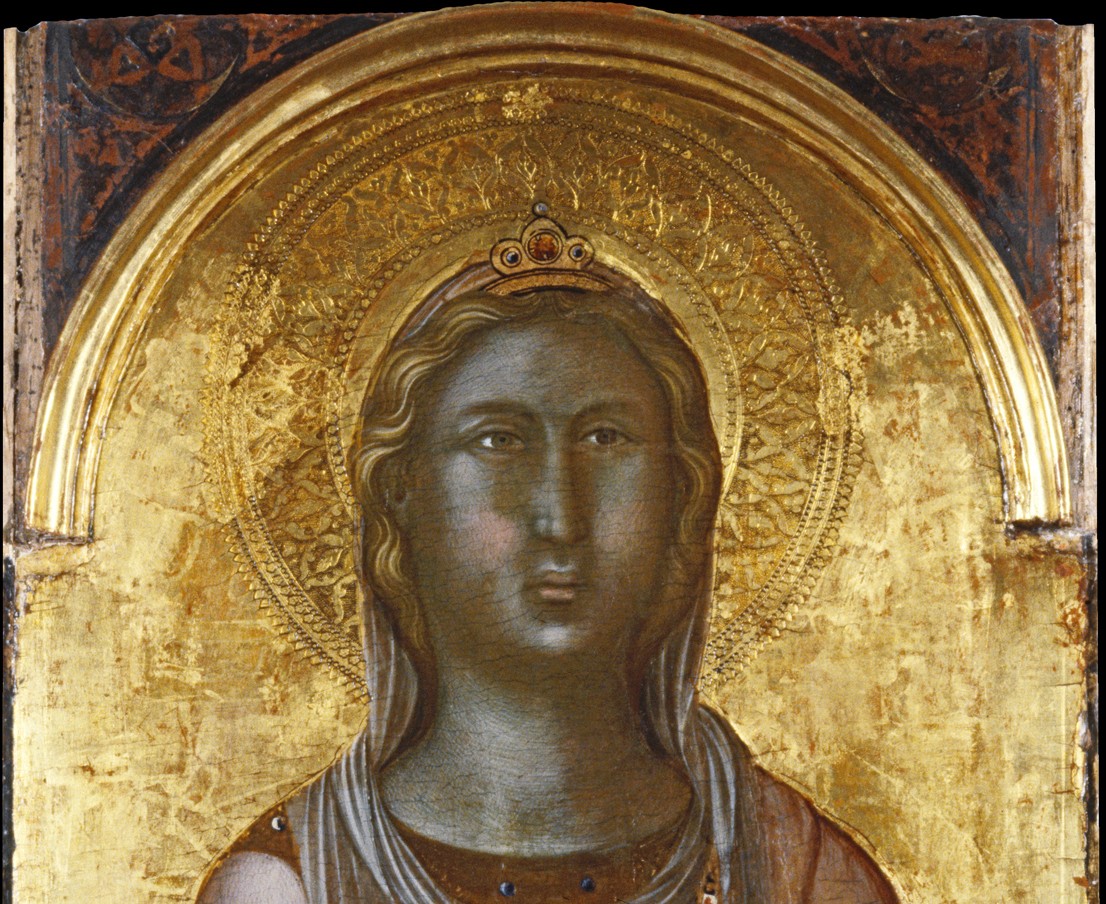
Saint Lucy’s life and legacy offer enduring lessons that resonate deeply in our contemporary violence and uncertainties. Lucia of Syracuse’s hagiography is an inversion of an archetypal hero’s journey: where the hero wins by overcoming power, the martyr triumphs through sacrifice. Lucia’s life serves as a reminder that resilience, kindness, and unwavering commitment to justice and faith can bring light to even the darkest times.
Lucia of Syracuse, also known as Saint Lucy, was a Christian martyr who lived during the late 3rd and early 4th centuries in the Roman Empire. Born to a wealthy family in Syracuse, Sicily, Lucia is celebrated for her unwavering faith, her dedication to the poor, and her courageous defiance of oppression. Her story, though rooted only partial in historic facts, holds profound relevance in the modern world, offering lessons on resilience, selflessness, and the pursuit of justice.
Lucia of Syracuse Historical Background
Lucia of Syracuse was born around 283 CE into a time of intense persecution of Christians under the Roman Emperor Diocletian and the Tetrarchy (ruled A.D 284-305), intent on reviving the waning Roman Empire by enforcing worship of its traditional gods. The Diocletianic or Great Persecution was the last and most severe persecution of Christians in the Roman Empire rescinding Christians’ legal rights and demanding that they comply with traditional religious practices. Abandoning the tradition of a citizen king, Diocletian elevated himself above the masses by initiating imperial ceremonies and requiring his subjects to prostrate themselves in his presence. While Diocletian did not demand personal worship as a deity, his policies required public sacrifices to Roman gods as a demonstration of loyalty to the empire.
Eutychia, Lucia’s mother, arranged a marriage for her with a pagan suitor, but Lucia had already vowed to remain chaste and dedicate her life to God. When her suitor discovered her Christian faith, he denounced her to the Roman authorities. Lucia was subjected to brutal torture and ultimately martyred in 304 CE. Despite the hardships, she remained steadfast in her faith, reportedly declaring, “No one can take Christ from me.”
Lucia’s feast day tomorrow, December 13, is celebrated with great reverence in many Christian traditions, coincides with my monastery retreat this weekend. Before the Gregorian calendar reform in 1582, the winter solstice occurred around December 13. This is how Saint Lucia’s feast day (December 13) became associated with “light” returning after the darkest day. Lucia, whose name means light (from Latin lux), symbolized hope and the coming of longer days. The symbolism of light in her story — often depicted with her holding a lamp or a crown of candles — underscores her role as a beacon of hope and faith in dark times but inherit also Jungian and Taoist concepts.
Saint Lucy’s life and legacy offer enduring lessons that resonate deeply in our contemporary context:
Courage in the Face of Adversity Lucia’s steadfastness in the face of persecution reminds us of the importance of standing firm in our beliefs and values, even under intense pressure. In modern times, as minorities like Christians, Alawites, Yazidis, and others, or oppressed ethnicities face persecution in regions, where proxy wars and crippling sanctions exacerbate suffering of their countries, Lucia’s story stands as a timeless example of resilience and faith under oppression.
Advocacy for the Vulnerable Lucia’s dedication to aiding the poor reflects the Christian call to care for the “least of these.” Her acts of charity remind us of the moral imperative to confront human-made tragedies such as war, poverty, and the displacement of entire communities. These injustices are often perpetuated by powerful forces whose actions contradict their professed values, highlighting the hypocrisy of empires that have lost their way and, ironically, their own foundational faith. Lucia’s example also underscores the enduring triumph of spiritual power over temporal force, challenging us to prioritize compassion and justice over dominance and greed.
Symbol of Light and Hope Lucia’s association with light holds a universal appeal, transcending religious and cultural boundaries. Her story reminds us that even in the darkest times—whether personal struggles, war, or the deprivation caused by political strife—small acts of faith and kindness can bring illumination and hope to others. Her courage and compassion inspire a belief in the transformative power of goodness in a broken world.
Faithful Witness in a Hostile World Lucia’s martyrdom under Emperor Decius reflects the high cost of faith in a hostile environment. Today, her story resonates with those who remain steadfast in their beliefs despite oppression or violence. While some factions, including groups that paradoxically receive indirect international support, may persecute minorities, her example is a reminder of the enduring strength of conviction and the call to resist injustice.
Jungian Symbolism of Lucia of Syracuse in Dante’s Divine Comedy
In Carl Jung’s psychology, individuation is the path to wholeness, achieved by integrating the shadow—those hidden, repressed parts of ourselves. The shadow, like the darkness of winter, holds our unacknowledged fears and desires. Ignoring it leads to inner conflict, but facing it brings growth and transformation.
Saint Lucia may symbolize this process. Her fate, tied to the darkest time of persecution, reminds us that light can only be found by first confronting the dark. Like Lucia’s candle piercing the shadows, individuation requires courage to illuminate what we hide within ourselves. By accepting our shadow, we reclaim lost parts of the soul and move toward true wholeness—a self both light and dark, balanced and complete.
Saint Lucia (Lucy) plays a subtle yet significant role in Dante Alighieri’s Divine Comedy. She appears as a celestial figure aiding Dante on his spiritual journey, symbolizing grace, light, and divine assistance—qualities deeply tied to her historical and symbolic representation. Dante especially highlights the believed chain of mediation of graces that begin with Christ, through, Mary, and then through particular saints.
The Inferno is, of course, a story of Dante being guided by Virgil through Hell. We learn that Virgil was summoned as Dante’s tour guide by his beloved Beatrice, who was summoned by Saint Lucia.
Her role in helping Dante ascend from the Inferno to Purgatory aligns with the symbolism of individuation as a saint associated with vision, clarity, and overcoming blindness—both physical and spiritual. Lucia’s name is derived from the Latin lux (light), which aligns perfectly with her role as a figure of divine illumination. She appears when Dante is in moments of despair or weakness, providing light, clarity, and divine assistance. In the larger allegory of the Divine Comedy, she represents the grace and guidance necessary for the soul to transition from darkness (sin) to light (salvation).
Thus, Saint Lucy’s presence in Inferno and Purgatorio underscores her role as a pivotal mediator of divine grace and compassion, helping Dante overcome his fears and advance on his spiritual journey.
Saint Lucy in Inferno, Canto II
In Inferno Canto II, Dante is still hesitant and afraid at the prospect of undertaking his perilous journey through Hell. Beatrice descends to Virgil in Limbo and reveals that Lucia had interceded on Dante’s behalf to help him overcome his doubt and begin the journey.
Here, Beatrice recounts Lucia’s role as an intermediary:
“Lucia, foe of all that is cruel, arose and came to me where I was sitting with the ancient Rachel. She said: Beatrice, true praise of God, why do you not assist the one who loved you so, he left the vulgar crowd? Do you not hear the anguish in his cry? Do you not see the death he battles on the flood that swells against the nearer shore?” (Inferno II, 97–104, trans. Allen Mandelbaum)
Lucia is described as “nemica di ciascun crudele”—the “enemy of all cruelty”—reflecting her compassion and readiness to aid those in need. She urges Beatrice to help Dante, thus setting in motion the chain of divine intervention that brings Virgil to guide him.
In this context, Lucia serves as a symbol of divine grace and intervention, providing Dante with the courage to begin his arduous journey through Hell and, ultimately, towards redemption.
Saint Lucy in Purgatorio, Canto IX
In Purgatorio, Canto IX, Lucia reappears at a critical juncture to assist Dante in his transition from Hell to Purgatory. After Dante falls asleep, Lucia carries him up to the Gate of Purgatory, a feat symbolizing divine aid in overcoming human weakness.
Virgil describes what happened to Dante as he slept:
“In this deep night before the dawn began, just as the sun was rising in the east, a lady, young and fair, appeared to me. I saw her wandering through the sleeping world; she bent down, gently gathered you, and took you— and now the light of day leads us to her.” (Purgatorio IX, 49–54, trans. Allen Mandelbaum)
Lucia, in this moment, embodies divine assistance and grace, physically carrying Dante upwards—a task that he could not have accomplished on his own. It reflects the theological belief that humans require divine grace to ascend from sin toward salvation.
Virgil’s account emphasizes the contrast between human effort (Dante’s struggles) and divine intervention (Lucia’s aid). By carrying him, Lucia allows Dante to bypass the immediate difficulties of climbing to the gate, symbolizing the grace that makes the transition from sin (Hell) to repentance (Purgatory) possible.
Saint Lucia: Overcoming Power through Sacrifice (update after retreat weekend)
The story of Saint Lucia transcends historical facts, adding to it freely during time to create a symbolic narrative. As a martyr, Lucia’s life aligns with the archetypal hero’s journey, yet with a distinct inversion: where the hero wins by overcoming power through action, the martyr triumphs by surrendering power through sacrifice.
This is like in Taoist philosophy, the concept of wu wei—effortless action—is central to understanding how forces of nature interact in harmony. Water overcoming stone perfectly illustrates the Taoist approach to power: not through direct force, but through subtle persistence and adaptability.
Water as the martyr, in its fluidity, does not struggle against obstacles but flows around them, gradually wearing away the hardest stone. Over time, its soft and yielding nature carves its path. In the same way, the hero’s victory through direct action contrasts with the martyr’s victory through surrender, like water’s triumph over stone. The hero confronts power head-on, using force and will.
This Taoist metaphor suggests like the hagiography that true strength does not lie in confrontation, but in yielding not by defeating obstacles but by flowing through them with grace and resilience.
Lucia’s defiance against the Roman authorities, refusing to renounce her faith, symbolizes resistance to external oppression. Her final act—offering her life—transforms perceived weakness into spiritual strength. When she foretells the fall of Emperor Diocletian, it underscores a profound truth: power rooted in force is temporary, while the courage of sacrifice endures.
In this way, Saint Lucia’s story serves as both a myth to help further the cause of Christianity and a model of courage. The martyr’s “loss” becomes victory, inspiring others to resist tyranny or personal limitations with courage. Whether in the hero’s conquest or the martyr’s surrender, overcoming power—external or internal—requires an unshakable commitment to truth and freedom. Lucia’s light shines not as an escape from darkness or shadow but as a beacon for those who seek the strength to face it, reminding us that true victory often comes through sacrifice.
Lucia of Syracuse’s legacy is therefore not confined to the facts of history or the rituals of religious observance. Martyr’s as well as a hero’s courage, compassion, and enduring faith continue to inspire people across the world.
Zazen, the practice of seated (za 坐) meditation (zen 禅), has many beneficial effects on physical health (lowered blood pressure and heart rate, enhanced immune function, etc.), on mental function (increased creativity and focus, etc.) and on emotional well-being (decreased stress and anxiety, enhanced sense of empathy and compassion, etc.). Important as these benefits are, however, they are relatively superficial compared to the spiritual goal toward which Zen meditation has traditionally been directed.
As an unchurched catholic Christian, I’ve gained some of my most valuable insights into spirituality from Zen Buddhism. I’ve finally managed Zazen, to stay with a daily meditation routine and encountered exquisite beauties and powerful insights which helped me to regain my footing in the current world in crisis and cultural decay of the West and all their institutions. Being left alone and sometimes taken aback by Jesus’ ground personnel has eroded somewhat my Christian faith but for sure disconnected me from their temporal institutions. I haven’t been to a mass in church anymore for more than two years.
I did, however befit from three monasteries, one Shaolin, one Catholic and Plum Village, a monastic community founded by the late Zen Master Thich Nhat Hanh. I think Zen Buddhism is almost the other side of Jung’s psychanalysis but ironically it shows also deep connections to Christianity.
ZAZEN ON EASTER SUNDAY
Firstly I do classic zazen (sitting meditation), i.e. simply to count four breaths, over and over again. When a thought intrudes, attention is gently returned to the breath, which becomes a vehicle for concentration and an opening to peace. When pain or worries come up I deal with them gently. Suffering and happiness are not separate.
“Most people are afraid of suffering. But suffering is a kind of mud to help the lotus flower of happiness grow. There can be no lotus flower without the mud.” —Thich Nhat Hanh
Secondly I strive for mindfulness for all I do.
Mindful walking my animal companion, a young Labrador, reduces stress and makes the apparently unhinged world feel more manageable. Its not a (healthy) chore anymore, but makes both of us feel better, and calmer.
Thirdly I ignore people or institutions with negative emotions.
Do you know how receiving impulses from certain people makes you feel better and calmer? I do. Good vibes are scientifically called coregulation, an inter-personal process in which participants permanently adjust (often unconsciously) to co-create and maintain a positive emotional state.
For instance, my spouse (sometimes, we have been married for almost 25 years), or my Shaolin Chi Gong teacher come to my mind. However quite a few others are not around anymore. Literally or not (quite a few turned to the dark side during the last few years). Negative vibes. That’s true for also for groups, institutions, even most Christian churches.
Time to move on. Time to do Zazen.
Well, I started intro-personal coregulation with myself and this time it worked. Establishing a routine of active meditation with Qi Gong and Shaolin forms and Zen meditation (Zazen). I am focusing on mindful living and feeling my way in into Buddhism (again). Calms body and mind, making aware (coregulating) body and mind and shuttling down mind chatter. Good Zazen practice, looks neither back nor forward. It is a practice of live in the present, of being present, in that who we are is defined by what is happening right now and not so much where we came from and not so much where we’re going. It’s not what we’ve been, or what we’re trying to become. Only the present counts.
How about inter-nonpersonal coregulation? For me, stargazing and astrophotography always helped me to connect with the natural world, the universe and align with their rhythms. I added a daily sport routine and substract social media, media period.
When we engage in an activity, our minds are thinking of or we are doing something else. That’s why the Zen principle of mindfulness is so powerful. It calls us to be fully present in each moment, living it fully because it will not pass this way again. The ritual of the tea ceremony is an enactment of the principle of mindfulness.
Eating mindfully can be a good way to start. When I eat, for example, I am fully present for each bite. I savor the smell and the sense of foot on the tongue. I do this this automatically during fasting periods (No meat, No Sweet, Strict Abstinence): New Year Day to Easter and September to Advent.
One need only listen to the words of the Gospel of Thomas to hear how Christianity resonates with the Buddhist tradition: Jesus said, “If those who lead you say to you, ‘Look, the Kingdom is in the sky,’ then the birds of the sky will get there first. If they say, ‘It is in the sea,’ then the fish will get there first. Rather, the Kingdom is inside of you, and it is outside of you. When you come to know yourselves, then you will become known, and you will realize that it is you who are the children of the living Father. But if you will not know yourselves, then you dwell in poverty, and it is you who are that poverty”.
After all, fear is only an illusion. Often even a deliberately induced mind formation.
“We live in illusion and the appearance of things. There is a reality. We are that reality. When you understand this, you see that you are nothing, and being nothing, you are everything. That is all.”.” —Buddha
No Mud, No Lotus The Art of Transforming Suffering, Thich Nhat Hanh
Last fall, I travelled all over Al-Andalus in the footsteps of philosophers, poets, warriors and great mystics Sufi’s like Ibn-Arabi. If you are interested in philosophy, science history and intercultural transmission of knowledge, Al- Andalus is your place and I invite you to read further. Al-Andalus represents a singular, tragic and wonderful moment of cultural history, however, also a warning, despite being obscured by its Western romanticized view.
Being an outpost, al-Andalus did give more freedom to outstanding thinkers, but they were a minority. A transmission of knowledge existed, but that was filtered and soon tolerance stopped by fundamentalists from North Africa invited to help out against the Christians advances.
It was the very autumn, when CNN sent those images from Munich of a welcomed mass immigration in the world. Influenced and attracted by the history of Al-Andalus, I remember seeing those strange pictures with rather mixed emotions. Indeed this “German Fall” would on New Years Eve turn into a winter like the “Arab Spring” did.
Anyway, Al-Andalus is one of many icons of Europe’s cultural diversity. It is also a visible warning, despite it’s history has been heavily obscured by a Western romanticized view.
Please be aware, this is just an essay, written to collect my memories of al-Andalus. In first two main chapters I want to connect history and culture with an emphasis on Sufism. In the last chapter this essay presents al-Andalus’ beauty in art and architecture and last but not least its great people.
For those in a hurry, who just want a quick powerpoint intro to the history of al-Andalus:
al -Andalus an anticipated Renaissance
Medivial Spain
“al-Andalus” is the historical and also geographical term for the epoch, when Islam dominated from the eighth to the fifteenth century Southern Spain. It refers to the cities of Almeria, Malaga, Cadiz, Seville, Cordoba, Jaen and Granada. The contact of Islam with all the good and evil of the West created the unique culture of Al Andalus. The culture shock of the invaders anticipated a (failed) Islamic Renaissance, with great thinkers of secular philosophical and mystical Islam.
It is a fact that al-Andalus developed a unique frontier society. Cordoba, at one time the capital city of Al-Andalus, was the center of a sophisticated and rich civilization. In its heyday, Cordoba is often praised for its intellectually advanced culture, its centers of learning and its great libraries. In those years, there were about one million people, 200,000 houses, 60 palaces, 600 mosques, 700 baths, 17 universities and 70 public libraries in the city.
Cordoba The Mezquita
al-Andalus and Andalusia are different two terms and even opposed. The ambiguity, of course, based on the phonetic similarity. In Arabic, al-Andalus refers to any Muslim Hispania (that is to say up to Duero River, the northern border in the tenth century, or only the kingdom of Granada in the XIV century). The word Andalucia (Andalusia) is used in Spanish that in the course of the thirteenth century.
The Moorish era is so regarded as the golden age of cultural prosperity and religious tolerance among Muslims, Christians and Jews. The myth of al-Andalus – too good to be true. Every time, every culture, indeed every society creates myths in which they reflect themselves. This is different to living mythology as defined by C.G. Jung. Every discipline – temporal or spiritual – in the world has among its practitioners, those who engage the faith beyond the common boundaries of doctrine and dogma, seeking an unmediated relationship with reality and self realization. Myths load the cold randomness of existence with meaning, to organize the world into good and evil. Myths are like magical mirrors the viewer reflect the picture that he and his peers have of themselves. One of the favorite myths of the educated classes of the West is the one from Splendor and the decline of Moorish Spain considered as the golden age of science and the arts and Christian-Jewish-Muslim harmony – under the protection of a tolerant, mild, of reason through the Islam on European soil.
The Alhambra, Granada @fallenangel
The Muslim Spain as a place superior humanity was invented 250 years ago in the period of Enlightenment and has been renewed in countless versions. Political myths always serve these interests at the appropriate time. At that time French ideology based on radicalized revolutionary ideals wanted to contrast the sclerotic rigid Catholic Church with an idealized, almost deistic purified Islamic alternative. A world without Pope, dogma or inquisition (which indeed has strong Spanish roots). As Rousseau’s noble savage, also the figure of the noble Muslim or noble Orientals of Pierre Bayle, and later Karl May and others form a critical “model of virtue and self shame” towards the European culture and civilization. Jean-Jacques appeared the cultural activist and champion of the opressed; but he also provided arguments which served the purposes of the Jacobine terror in contrast to Montesquieu and Voltaire.
In Herder’s humanity utopia, it finally appears as the Hispano-Arabs act as “Teacher of Europe”, who bring the light of the “oriental Genius”, to end the culture occidental “darkness” of the Medieval Age. The romantic turnings with their longing for the past and an enchanted place in the Moorish traditions and legends are an ideal decor for tales of chivalry, honor and selfless love. Washington Irving (“Tales of the Alhambra”, 1832) started this with his book an Alhambra cult” and as a result the cultural tourism with relevant travel reports – as mine.
The famous Rainer Maria Rilke wrote 1912 in a letter from Spain: “By the way, you need to know, since I’m from Córdoba an almost rabid Antichristianity, I read the Quoran, often it creates a voice so I feel all it strengths, as the airflow inside an church organ.“
Ibn al-‘Arabi – al-Andalus seen from Jungian view
Little private Museum Córdoba dedicated to mystics an philosophers
There is no better biography (to me), which relates the greatness of al-Andalus and the offer the Islam rejected, than that of the Sufi master, poet and philosopher Ibn al-‘Arabi . The reason, that I am attracted or at least fond of Sufism, is Ibn al-‘Arabi. His Sufism is more of a secular, almost a pantheist like Taoism and approachable for Westeners even from C.G. Jung.
Some say Sufism, or Tasawwuf as it is known in the Muslim world, is Islamic mysticism; others say it is the primordial mystical tradition, much older than Islam, using Islam as a structural frame as Gnostics usually did. Perhaps Sufism is best defined as an universal path to union with God through self reflection – individuation. In Jungian psychology there are many concepts that illumine the relationship between soul and Absolute, human and God: the ego as the center of consciousness and the Self as a path to god; the individuation process whereby the ego increasingly realizes its source and dependence upon the Self; the alchemical conjunction of ego and Self. See here another of my essay about Sufism: Sufism the Gnostic chameleon – muscle and brain of Islam.
Sufis understand themselves as the only heir of a spiritual heritage, which had been split in many religions and sects. Like Tao, Sufi is eternal, and uses words like “drunkenness” or “grape” or “heart” … As Rumi puts it: Before garden, vine or grape were in the world Our soul was drunken with immortal wine.
To Ibn al-‘Arabi Sufism is best defined as a universal path to union with God through self reflection – individuation in Jungian terms. In Jungian psychology there are many concepts that illumine the relationship between soul and Absolute, human and God: the ego as the center of consciousness and the Self as a communication path to God or even rather gnostic, a part of god.
Everything that exists is a part of and a manifestation of the Oneness of God. Humans are part of God. The idea of ones Ego is the result of ignorance.
Ibn al-‘Arabi was born in a Taifa called Murcia, one of the many petty-kingdoms in al-Andalus, in AD 1165. At the age of twenty he was initiated into Sufism.His father Ali Ibn al-Arabi was a man of influence as he considered Cordoba‟s chief judge Ibn Rushd. When Ibn Arabi was 8 years old, Murcia was occupied the family moved to Seville, the great intellectual centre. This is where Ibn Arabi spent the next 30 years of his life. Seville was also an important centre of Sufism, with a record number of Sufis living in the city. He met two women saints here who had a strong influence on him,Yasamin of Marchena, and Fatimah of Cordoba. Due to Ibn Arabi‟s extraordinary scholarship and spiritual insights, his fame spread throughout Andalus.
Cordoba‟s Qazi Ibn Rushd, also the master interpreter of Aristotle, requested Ibn „Arabi’s father for a meeting with Ibn Arabi.This meeting is important in that of the two illustrious men, one was a follower of the edicts of reason, who became the most influential thinker in the West. The other was almost a Gnostic for whom knowledge meant “vision”, who became a towering personality in Sufism. From the 1190s he engaged in three decades of travels as a wandering scholar, poet and mystic, visiting the Maghreb, Egypt, Arabia, Syria and Asia Minor. In 1223 he finally settled in Damascus.
Ibn al-‘Arabi applies Sufism rigorously. To associate anything at all with God would be shirk. Therefore, nothing can exist except God.
However, Ibn al-‘Arabi believed that God had a transcendental as well as an immanent aspect. God was manifested in, but also extended beyond the material universe. Ibn al-‘Arabi had a hidden, non-religious side. In the Juderia, the Jewish quarter of Cordoba, I visited a peaceful little museum to Sufism with a little bookshop. A poem of Ibn al-‘Arabi on rough, self-made paper caught my eye, so tourism or not, I bought it. This is one of my favorite poem by him:
My heart has become capable of taking on all forms. A pasture for gazelles and a convent for Christian monks, and a temple for idols and the pilgrim’s Kaa’ba, and the tables of the Torah and the book of the Quran. I follow the religion of Love: whatever route Love’s caravans shall take, that path shall be the path of my faith.
Tarjuman al-Ashwaq, or the ‘Interpreter of Desires,’ the first edition of which was completed in 1215 A.D.When the poems were later criticized by religious scholars as being to sensous, he had to add an explaining comment. There are other statements from The Bezels of Wisdom and The Treatise on Being, which go in the same direction.
Identity of self and God. Thou art not thou: thou art He. Thou never wast nor wilt be, Thou art neither ceasing to be nor still existing. Thou art He. [TB]
God is all things. The Cosmos is His form. The forms of the Cosmos are the manifest Reality, He being the manifest. He is also their inner essence, being also the unmanifest. He is the first, since He was when they were not, and also the Last, since in their manifestation He is the Essence. [BW X]
God is essentially all things. He permeates through all beings created and originated. [BW X]
He is Being itself, the Essence of Being, He is the Preserver of all. In preserving all things, He is preserving His form, lest anything should assume a form other than His Form, which is not possible. [BW X]
One of the most prolific of the medieval Sufi writers, al-Arabi wrote over 150 books. Unfortunately, very little of this output was translated, up to the early 20th century.
His texts are of great interest, aside from its literary merits as delightful (but highly encoded) Sufi love poetry. Reynold A. Nicholson supplied extensive commentary for each poem. This is key to disentangling the Sufi narrative from the exterior form of the work. At this level, Sufi love poems may actually be interpreted a philosophical treatise with profound insights.
The whole of the spiritual life begins, Ibn ‘Arabi would say, in the realization of transcendence, and Ego ends in it Jung would say. What lies between is the discovery of the intimate heart of each individual being the self. So the discovery of God is equally the self-discovery of the individual. The world is no longer static, but the dynamic theatre of the Divine manifestation, and every movement in it is essentially a movement in love of God. It is simultaneously “He and not He”, as Ibn ‘Arabi says, just like the image of a person in a mirror. The particular quality that he often employs in his writings is that of the constant interplay of paradox, similar to the Zen koan, a Taoist poem, to force the mind to reach its limit so that the truth may be seen without limitation.
al-Andalus Myths and Reality
al-Andalus war and peace
The reality is, that al-Andalus has seen numerous religious and ethic fights and many revolts and revolutions. In short, it was also blunt Islamic imperialism. It is the fact, that 800 years of Islamic rule of Al-Andalus were a permanent war and inner-Islamic struggle between ethnics, sects, Islam fractions, fiefdoms, or dynasties of Islam. There were also constant fights with uprisings of the non-Muslims, slaves, or against Christian intruders and Muslim raids or failed expansions into Christian territory. Furthermore the Renaissance was primarily not defeated by the Christians, but destroyed by “Islamist” fundamentalists (the second wave of Berbers), who viewed Al-Andalus decadent. From al-Andalus from Arab troops and gangs launched regular raids (al-ghazw, Arab. ” the rampage”) deep into the backcountry of the Christian barbarians. They plundered repeatedly the Rhone Valley, terrorizing southern France, occupied Arles, Avignon, Nîmes, Narbonne, which they set on fire 793, devastated 981 Zamora and deported 4,000 prisoners. Four years later, they burned down Barcelona, killed or enslaved all the inhabitants, 987 they devastated the Portuguese Coimbra, which then seven years remained uninhabited. León along with surroundings was destroyed by the Amiriden ruler al-Mansur, “the Victorious” (981-1002), known for burning all philosophical books, which he got hold of. He led during his reign about fifty vampaigns, one regularly in the spring and one in autumn.
al-Andalus Islamic tolerance
The Orientalist Bernard Lewis has pointed out, that the “myth of Spanish-Islamic Tolerance was particularly promoted by Jewish scholars for a very good reason: “One of the main reasons was the prolonged refusal of Christian Europe, in regards of emancipation and recognition of Jews. To offset this, Jewish intellectuals led the historic case of al-Andalus in the battle, “those beautiful and unmatched Civilization “, as the English statesman Disraeli wrote: “During this blessed centuries it was difficult to distinguish the followers of Moses the followers of Mohammed. Both they built palaces, gardens and Wells, sided equal the highest offices of state, competed in an ambitious and enlightened in the distance trade and vied together at famous universities.”
Also in recent years al-Andalus evocative sound soothes confused elites of Europe scared and offended by unending violence and war in the Middle Easte and by the advance of Islamist terror in their own cities. Just opening the borders is and contact is fruitful, isolation and struggle is seen as deadly.True, Christians and the Jews enjoyed under Muslim rule limited religious freedom. Nobody was forced to convert, there, but there were numerous penalties and executions of real or alleged religious violation. Apostasy was like today atoned with the death. Christians as well as Jews were granted a Dhimmi status, an Arabic term that refers to its non-Islamic embracing population living in Islamic conquered lands and subject to special tax. The Dhimmi is a distinctly subjugated second class non-citizen. Granted, this status also brought a certain degree of security and even participation. Influential Christians, as well as Jewish, made a good living as scholars, administrators, even run petty kingdoms called Taifas and were integrated into this rich culture. The attempt of a tiny minority of Islamic scholars to reconcile Islam with Greek philosophy proved ultimately unsuccessful due to persistent religious resistance. Philosophers were banned and their books burned by the orthodox majority. Now, that’s not what I really wanted to focus on. I am interested in the historical and cultural dimension of that period and in particularly Sufism.
Rise and fall of al-Andalus
Pre-conquest
Al-Andalus history is one of invasion and immigration; they came over the Pyrenees or over the sea, warriors or merchants. The blessed Iberian Peninsula at the coasts of the Mediterranean Sea and the Atlantic was an attractive place for Carthaginians, Romans, Phoenician and Greeks. Carthage the trade city at the North African coast had its branches in Andalusia. After the Punic wars the Romans valued this piece of country for approximately 700 years. Very important Roman personalities were originally from Andalusia, so the philosopher Seneca to whom a monument is dedicated in Córdoba and Emperor Trajan and Hadrian. After the Fall of the West Roman empire the Visigoths reigned briefly 3 million inhabitants. Visigoths believed to a Christian heresy called Arianism so they were never entirely comfortable with the Church of Rom nor with the Byzantine East Rom. They saw their legitimization from their noble descent.
Andalusia was soon conquered by the Arabs and mostly Berbers, the Moors. They dominated almost 800 years the south of Spain. Unlike the Visigoths, the Islamic rulers did interact with the Roman, Greek and Hispanic culture, which created the uniqueness of Al-Andalus I want to focus on the cultural aspects of that historical period Al-Andalus. If the Arab were conquerors of the Iberian Peninsula or created by the interaction of cultures the identity of Spain is still a hotly debated topic, which has been controversially discussed by two historians Americo Castro and Claudio Sanchez-Albarnoz.
According to Claudio Sanchez-Albarnoz the signs of the Roman and Visigoth culture in Andalusia must not to be discarded and the influence of the Iberian Romans culture to the Muslim Invaders not to be overlooked. Also, it is fact that Islam interacted not only close with the two religions of the book, but also Greek philosophy. This has influenced deeply the history of Spain, also Europe, but not the orthodox Islam in its core constituency.
Rough overview over the Muslim Period
After a passible betrayal of the Byzantine Exarch (viceroy) Julian, the count of Ceuta, an army under the leadership of Berber commander Tariq Gibraltar (Jabal al-Tarik, the Rock of Tarik) invaded 711 AD and short time later controlled, large parts of Spain.It was the most western part of the Islamic Empire, which itself stretched from Lisbon to the Indus. The Muslim rule in al-Andalus can be divided in five major phases:
711-756: Dependent Emirate of Damascus. Al-Andalus is ruled by the Umayyads.
756-929: Independent Emirate after the Abbasids replaced Umayyad dynasty in Damascus and Abd-al-Rahman I takes refuge in Cordoba.
929-1031: Caliphate of Córdoba with Abd-al-Rahman III first proclaimed caliph.
1031-1261: Taifa Kingdoms. Political division of al-Andalus inidependent petty kingdoms called Taifa. Later the Almoravids and then the Almohads took power.
1238-1492: Kingdom of Granada. Last stronghold of the Arab presence in the Iberian Peninsula.
During the whole epoch also Islamic sailors and pirates crossed the Coasts of southern France, Italy, Sardinia, Sicily, Greece on. Their devastating raids resulted in the depopulation as many contemporary accounts document. Crete, recorded in a chronicle, was looted 827 for twelve days, and the inhabitants of 29 cities were driven into slavery. Another chronicle tells of the case of Syracuse after a nine month siege in 878: “Thousands of people were killed, and it was there booty like never before in another city. Only a few managed to escape. “
The troops of the emirs and caliphs consisted partly of large contingents of non-Muslims. The raids presented – in addition to the filling of the rulers treasury – the supply of fighting slaves, but also those of working slaves or women in the harem. And it had yet another purpose, according to the historian Ahmed Mohammed al-Maqqari from the North African. Because of the terror, he wrote, which the Arab horsemen and sailors spread, the later conquest was easier: “Allah, on this manner sows fear among the infidels, so that they are not there dared to stir, and to fight against the invaders; only as a supplicant they approached, begging for peace. “
To be clear, raw brutality, enslavement, pillage were the practice of all armies of the in the past. But the “excess, the regularity and the systematic nature of devastation », says the British-Egyptian Historian Bat Ye’or, distinguish the Islamo-Arab expansion of military operations of the then Greek, Slavic, Latin armies, and make them to “perhaps the greatest of lootings of history”.
The Muslim combatants were inspired by the idea of jihad, the holy war, a central concept in Islam until today. Islam divides the world into the Dar al-Islam (House of Islam), in which the law Allah prevails, and in the Dar al-Harb (House of War), residence of the Infidels, meaning all non-Muslims. The goal of jihad is to bring the people of the world under the law of Allah, to bring under the Sharia. “The jihad is a sacred duty” , wrote 14 in the century the famous Ibn Khaldun, a politician, sociologist and descendant of a noble Arab family from al-Andalus, “because of the Universality of the Islamic mission and the obligation to anyone to convert to Islam , either by persuasion or by force”.
Arab Invasion
The invasion seemed to happen like an accident, more like a private enterprise than centrally ordered. After the brief 710 exploratory raid led by a Tarif bin Malluq (remembered in the town of Tarifa, where it happened), Tariq ibn Ziyad, governor of Tangier, sent 711 an expedition of 7,000 Berbers to the Iberian Peninsula through the Strait of Gibraltar. Tariq ibn Ziyad conquests swiftly Algeciras (Portus Vandalusius) and defeats the Visigoth king Rodrigo at the Battle of Guadalete. The location of the battle has been described at various but was probably thirty-five kilometers to the north-west of. The Visigoth troops were decisively defeated and fled northwards, spreading terror and despair, because the invaders triumphed over the Visigoth army and eliminated their king.
Musa, the Arab governor of Tunisia and Tariq’s superior, follows 712 to incorporate the Berber conquests to the Arab Empire. It is often claimed that religious convulsions and resentments to the Visigoths, may have favored the quick surrender of many cities like Cordoba, Malaga, Seville and Toledo (capital of the Visigoths) In 713 Merida fell, this has been a refuge for many Goths in the region of Murcia. It is true, that the Spanish-Roman population disliked their Visigoth leaders and the Jewish community the treatment of the Christian majority. The existing network of roads laid down by the Romans and the standard pragmatic approach, giving treaty on favourable terms to surrenders have helped. But in any case there is a lack documentation of Arab conquest. The first Arab chronicle that relates the event, that of Ibn’Abd al-Hakam is in effect after a century and a half. Maybe, it is due to the fact, that the first three major actors vanished quickly. In 713 Musa’s son Abd al-Aziz, who was appointed Governor of al-Andalus as Musa had been recalled to Damascus 712 and never heard of. Musa’s deputy Tariq also fades out of history. Musa’s son Abd al-Aziz, married in kingly ambitions Egilona, the widow of Roderic, but got murdered in Seville in 715.
Myth of Visigoth King Rodrigo
With the Islamic conquest a myth is connected. The Visigoth Count Julian sent his daughter Florinda Cava to the Visigoth court of Toledo. King Rodrigo (Roderic) raped her and the enraged Count turned to the Islamic conquerors. This development is said to have led to the rapid demise of the Visigoth kingdom and has probably a historical core. In Spain, the figures of the lecherous King Rodrigo, of Count Julian and his beautiful daughter Cava Florinda were themes of folk romance songs. In those romances the king must pay for his lust, through a two-headed snake, which eats both his heart and his private members as a kind of symbolic punishment for the rape and the destruction of the Visigoth kingdom in southern Spain.
Emirate of Dependent Damascus
Caliphate of Córdoba
It took a while, until the spoils of the victory were divided, and the Berber grumbled, since they counted for the majority in the army, but got short changed by the Arabs, who saw them inferior. Córdoba became the capital a few years after the invasion.
There were numerous uprising of the Berbers. On one occasion the Arabs called in a Syrian relief army in, which, after quelling the Berber unrest turned against the Arabs. The Syrian were given some fertile lands and settled, fractionizing al-Adalus even more. A pattern we will see more often later in the history of al-Andalus. The invasion was brought further, as Arab army crossed the Pyrenees at the eastern end and took Narbonne in 720. In an attack on Toulouse in 721, the Arabs suffered a defeat. A defeat through Charles Martel ended the France adventure, logistically over-extended, and up against an equally powerful force. They continued raiding Christian possessions and got rich by tributes an looting, until fragmented Muslim states weakened under the Taifa period. Muslim petty kingdoms got invaded in return, raided or had to pay tribute.
In 750 the Umayyad Caliph was overthrown by the Abbasid clan. Only one young man, Abd al-Rahman an Umayyad prince fled from Damascus and established the Iberian branch of the dynasty in 756. Only with this establishment of the Emirate of Cordoba Uma by Abdel Al Rahman I, Southern Spain was brought in a solid and permanent form Islamic rule.
Umayyad Emirate and Caliphate
As described above, the Umayyad conquest of Hispania established the dependent Emirate of Cordoba. The situation changed after the Umayyad caliphs in Damascus were defeated by the Abbasids. Al- Andalus and Cordoba became an independent Umayyad outpost of the Abbasids rule in Baghdad. The independent Emirate of Cordoba was established by Abd al-Rahman I, which marks the westernmost expansion of both the Muslim rule in Europe.
Later Abd al-Rahman III, called al-Nasir (or Victorious), succeeded in 912 his grandfather as emir and ruled until 961 for almost 50 moon years. An astute politician, Abd al-Rahman adopted the supreme title of Caliph in 929, to legitimize his imperial pretensions over the claims of Abbasid and Fatimid rivals. Cordoba became during his reign the greatest metropolis of Western Europe, rivaling Constantinople. He had pacified the realm, dealt aptly with his Fatimid rivals, and stabilized the frontier with Christian Spain.
Almoravids 1086 until 1147
His son Al Hakam II brought Cordoba to the height of its power. He expanded the Mosque of Córdoba and a library which included 400,000 books and manuscripts from religion to philosophy and rule book subsidence. His successor was less successful, their period is called in Arabic the time of confusion. Invasion, civil wars and complex ethnic conflicts between newly arrived Berbers from North Africa against Arabs and the already assimilated first wave Berbers brought the caliphate down. On the death of al-Mansur finally internal struggles reappeared and Al-Andalus disintegrated 1031 into numerous kingdoms called Taifa. The caliphate disappeared and the aftermath was a patchwork of petty Taifa kingdoms fighting each other sometimes of religious lines.
The fragmented Taifa Kingdoms of Al-Andalus
1031-1261 Taifa Kingdoms
Al-Andalus fragmented 1031 into numerous kingdoms, the most powerful were those of Seville, Toledo, Zaragoza and Badajoz.
Abdallah ibn Buluggin, a contemporary explained the rise of the Taifas:
“When the ‘Amirid dynasty [of al-Mansur] came to an end and the people were left without an imam [leader], every military commander rose up in his own town and entrenched himself behind the walls of his own fortress, having first secured his own position, created his own army and amassed his own resources. These persons vied with one another for worldly power, and each sought to subdue the other.”
Those Taifa kings were not from the Umayyad family, nor did they have any traditional claims to authority, so their ability to exert authority was limited to their ability to militarily conquer lands. With dozens of commanders rising up in the mid-11th century, conflict was bound to happen. Later the Almoravids and then the Almohads halted momentarily the Christian domination, but also incorporated it in their Berber empire.
Almoravids came to Spain in the eleventh century to stop the inexorable advance of the Reconquista, but their rigid understanding of Islam marked also end of tolerance in al-Andalus. Almoravids were a Berber dynasty controlling an empire stretching from Morocco to al-Andalus, so it lost its independence and became merely a province. Almohades replaced in the twelfth century Almoravids. They were even more literal interpreting the Koran. Almohad (al-Muwahhidun) means ‘monotheistic’.
Defeat at Las Navas de Tolosa (1212)
This fragmented situation obviously favored the advance of the Christian kingdoms of the North which was slowed down by Berber armies from North African kingdoms. This Almoravids dominance 1086 until 1147 and the Almohad dominance from 1172 until 1212 proved more a curse than a blessing. During the Reconquista, Muslim states fell one by one to the Christian kingdoms invading from the North. The major cities of Cordoba, Seville, and Toledo fell from the 1000s to the 1200s. Eventually the Almohades suffered a major defeat at Las Navas de Tolosa (1212) until 1261 all but one Taifa Kingdoms had vanished.
Granada – last stand of Islam in Al-Andalus
1238-1492 Kingdom of Granada
In the days following the battle of Las Navas de Tolosa (1212) years, the Spaniards conquered the Guadalquivir valley. One Muslim state – Granada – was able to escape conquest by Christians in the 1200s. After the fall of Cordoba in 1236, the rulers of the Emirate of Granada signed a special agreement with the Kingdom of Castile, one of the most powerful Christian kingdoms. It became the only Muslim kingdom of Granada territory, ruled by the Nasrid dynasty. 1238-1492 the Kingdom of Granada represented the last stronghold of the Arab presence.
Its territory was mountainous, which facilitated the defense. Furthermore, the extent of its coasts facilitated trade. The kingdom of Granada achieved great cultural and artistic splendor, though their kings often were forced to pay tribute to the Christian monarchs of Castile.
Culture of Al-Andalus
We hear that the Spanish are the heirs of the Arab-Muslim culture that has been present in Spain for more than seven centuries. Some even say that the Spanish are “half-Arab”, anxious to find exotic origins, distinct from those of all other Spaniards. The existence of a Spanish vocabulary whose root is Arabic is not a strong argument in favour of the thesis of the Arab-Muslim legacy, as the phonetics, prosody, morph syntax of Spanish Arabs are few, while the Latin affiliations Germanic and Christian are absolutely predominant. There were many languages spoken in al-Andalus.
High Arabic used by Mozarabics and rulers
Latin, the high language used by Christians
Hebrew used by Jews
Mozarabic language a continuum of Romance dialects was spoken by many groups in the territory of al-Andalus.there are preserved documents written in Mozarabic.
Andalusia Arabic, or Hispano-Arabic, was a variety or were varieties of the Arabic dialects spoken by all groups in the territory of al-Andalus
Berber dialects spoken by the new Berber of al-Andalus
Al-Andalus was the birthplace of important philosophers and religious scholars and some of then played a pivotal role in the Jewish history. In Roman times the Stoic philosopher Seneca needs to be mentioned.
Sufi Mystics
Sufism
Sufism is a continuity of Near Eastern tradition using any religion as a vessel and structure. It may be at the same time indigenous to Islam. You may read more about Sufism in my other essays. Muslim mystic-philosopher gave the esoteric, mystical dimension of Islamic thought its first full-fledged philosophic expression, but they were called into doubt by many scholars, who were suspicious of the monastic tendencies of their metaphysical teaching and often allegorical interpretation of the Qur’an. Ibn ‘Arabi, the most well known Sufi in the West, faced fierce theological controversy over the great Muslim mystical thinker. Even during his lifetime, Ibn ‘Arabi’s conformity with the Muslim dogma was called into doubt by many scholars. Following Ibn ‘Arabi’s death, these misgivings grew into an outright condemnation of his teachings by a number of influential thirteenth through fifteenth century theologians who portrayed him as a dangerous heretic bent on undermining the foundations of Islamic faith and communal life. Ibn ‘Arabi’s advocates, however, praised him as the greatest saint of Islam who was unjustly slandered by the bigoted and narrow-minded critics. Ibn ‘Arabi was rejected by many in Islam, for example, Ibn Taymiyya (d. 1328), the Wahhabi movement as a pantheist who leads people into heresy with are heretical innovations. But supporters see him until today as a saint who explained reality in the most profound way. His writings are not for the layman, but rather in the spiritual and scholarly elect.
The Near Eastern Tradition is based on Christian desert ascetics & monks of Syria and Gnostic Tradition, i.e. salvational knowledge to escape the prison of the material world and reunite with God. In the 9th century those Gnostic themes appeared in Sufism: a model of emanation and return. There were l‘Sober’ (later ‘Orthodox) Sufis prominent in Baghdad and Iran like Junayd (d. 910), al-Sarraj (d. 988), al-Qushayri (d. 1072) who attempted to portray Sufism as thoroughly ‘Islamic’. Early Sufis like Ibn Hanbal were portrayed as Sufis and Gnostics and got even mainstream acceptance.
Ibn al-ʿArabī, in full Muḥyī al-Dīn Abū ʿAbd Allāh Muḥammad, also called Al-Sheikh al-Akbar or “Magister Magnus
born July 28, 1165, Murcia, Valencia—died November 16, 1240, Damascus),
His major works are the monumental Al-Futūḥāt al-Makkiyyah (“The Meccan Revelations”) and Fuṣūṣ al-ḥikam (1229; “The Bezels of Wisdom”). Educated at Sufi school of Ibn al-Arif in Almería (Taifa of Murcia), moved to Sevillia and later Damascus. Father friend of Philosopher Averroes. Human beings as manifestation of God’s attributes God: “I was a hidden treasure….”
Abu Hamid al-Ghazali
Born c. 1058
Tus Persia, Great Seljuq Empire
Died 1111
Muslim theologian, jurist, philosopher, and mystic of Phas been referred to by some historians as the single most influential Muslim
God is ‘Light of all Lights’ – Gnostic model
Jalal al-Din Rumi
born c., 1207, Balkh [now in Afghanistan]—died 1273), l
the greatest Sufi mystic and poet in the Persian language, famous for his lyrics and for his didactic epic Mas̄navī-yi Maʿnavī (“Spiritual Couplets”) the cry of the reed-flute
Neo-platonic philosophers
philo
In Islamic times, the attempt to reconcile Islam with Greek philosophy was to last for several centuries, but ultimately proved unsuccessful due to persistent religious resistance.
Jews were given high positions as something more reliable than Christians who were under latent suspicion to be a treacherous partisan of the enemy Christians States. And towards Muslim dignitaries they had the advantage, that they could never be a threat to the Caliph or Sultan. Without tribal or family connections to the courtyard, infidels never hope itself to gain power, and owed their by sharia in prohibited position only because of the arbitrary decision of their ruler created a strong loyalty.
After Samuel Ibn Nagrella died 1056 under unclear circumstances was followed by his son Josef, also a gifted scholar in his official post. At 1066, there was an anti-Jewish pogrom. The thousands of members of the Jewish community of Granada were slain, with them also the Jewish Vizier. Pamphlets and poems as that of pious jurist Abu Ishaq had the mood prepared: “These Jews, who earlier in the Middens a scrap of colored cloth sought to bury their dead, […]
Granada has now divided among themselves […]. Drag a Tribute and dress up elegant […], and the monkey Josef has his house with marble designed […]. Hasten to cut his throat; He is a fat Hammel, take him off his money, because you deserve it more than him! “
Dishonored intolerably the most famous Jew of Moorish Spain and Cordoba, the great philosopher and doctor Maimonides wrote his works in Cairo in exile. When he fled in 1149 with his family before the persecution of the Jews from Córdoba, already existed hardly any Christian or Jewish communities existed anymore in al-Andalus. He later wrote in a much-quoted letter to the Jews of Yemen, us he had reported the local pogroms: “Remember, my coreligionists that God gives us our great burden of sin because in the midst of this people, the Arabs, has thrown […]. Never us a nation has so complained, humiliated, Humiliated and hated as they […], we were of them in intolerable Way dishonored.”
Al-Andalus has left a rich legacy of lyrical. In Arabic and Hebrew is celebrated nature, the enjoyment of wine, the love Youths, the transience of life. The sophistication, the beauty, and frivolity of poems testify to the intellectual freedom and libertinism a narrow urban and courtly elite, which is rigid from the
Whose rules too strict doctrine of God far away. It is striking, however, also the highest percentage of lobby poetry: Almost all poets have written to the mighty many hymns. This refers to another feature of their life. Not only the court Jews, but also poets and Scholar, science and art were generally part of an Oriental clientele system.
The ruler patron gave the order, and he had the power, the artists in throwing the dungeon, if he did not like the result. Only he could before he protects the snares of a fanatical theology or before vindictiveness another patron. What he chose depended on his mood or his current interests. The artist or scholar was his master dependent to death, and he had every reason to keep these in a good mood.
Fundamentalist
Even more precarious the status of the scholar was the unstable political ratios. The era of al-Andalus was marked by riots, semi-anarchy, civil war, progroms, throne struggles, conquests and reconquests. Times of peace were rare. The protective patron could be suddenly gone, murdered by the brother, expelled from another competitor tribal. The biographies of many Moorish scholars reflect this situation. They tell of escape, a new beginning, banishment, of adjustment. List of a deeper meaning. As that of the great scholar Averroes (1126-1198), the modern European philosophy owes so much.
From his audience with the Almohad Sultan Yusuf I Averroes reported: “After the Commander of the Faithful had asked me my name, just after my origins, he began the conversation by saying: ‘What they think (the philosopher) across the sky and the world? Think of them as forever or created?. It came over me, a mixture of shame and fear. […] I found my composure back, so in the end, I took the floor and he could find out what I thought about. For the goodbye, he order a gift of money, a precious robe of honor and to hand over a horse.”
Averroës was personal physician to the sultan and commented on whose behalf the works Aristotle. When the Sultan died, issued his successor Sultan Jakub”Al-Mansur» 1195 a decree, in which the philosophy and the “Greek”
Studies were sentenced. The books of Averroes were the fire thrown, asked the philosopher in front of the Mosque of Cordoba in the pillory and subsequently banned for three years. Shortly after his release he died.
He developed one of the earliest nonreligious philosophies of history, contained in his work the Muqaddimah (“Introduction”) where he sought to explain the basic factors in the historical development of the Islamic countries. Yet he was limited by his traditional Islamic contempt for non-Muslim cultures.
(ca. AD 801-870), flourished in Iraq under the caliphs al-Maʾmūn (813–833) and al-Muʿtaṣim (833–842).
First notable Muslim philosopher, although his reputation in the Middle East was eventually eclipsed by that of al-Farabi (ca. AD 878-950). Al-Kindi flourished in Baghdad in the ninth century where he wrote on many subjects ranging from medicine, optics, mathematics, Indian arithmetic and basic cryptography to the manufacture of swords.
His attempts to integrate Islamic traditions with neoplatonic Greek thought and Aristotelian philosophy were largely ignored in the Islamic world but were ironically thoroughly studied in Latin Christian Europe. He faced trouble for his work, was expelled and books burned. He is today hailed as a beacon of “tolerance,” yet he was also an orthodox jurist of Makati law and served as an Islamic judge in Seville. He approved, without reservation, the killing of heretics in a work that was entirely philosophical in nature.
He combined Middle Eastern and Greco-Roman Classical teachings with his own innovations and became “Islam’s greatest medieval surgeon.” As a matter of fact he was “virtually the only significant physician in the Islamic world who had practical experience with surgery. Surgery was neglected also by Rhazes and Avicenna.” His surgical treatise had again tremendous influence in Christian Europe.
Avempace, Ibn Bâjja or Abu Bakr Muhammad ibn Yahya, Baddscha, Badjdja, Ibn Badj, Ibn Bagga, Ibn Bajja, Ibn Bajjah, Ibn Sa’igh Ibn Baggain
(ca. 1085 – 1138)
Medieval Andalusian: his writings include works regarding astronomy, physics, and music, as well as philosophy, medicine, botany, and poetry
Ibn Ḥazm, in full Abū Muḥammad ʿAlī ibn Aḥmad ibn Saʿīd Ibn Ḥazm
(born November 7, 994, Córdoba, Caliphate of Córdoba—died August 15, 1064, Manta Līsham, near Sevilla)
Muslim writer, historian, jurist, and theologian of Islamic Spain, and leading exponents of the Ẓāhirī (Literalist) school of jurisprudence, he produced some 400 works, covering jurisprudence, logic, history, ethics, comparative religion, and theology, and The Ring of the Dove, on the art of love.
Other Islamic Scholars
Abd Allah al-Qaysi, an early jurist spreading the Zahirite school
Mundhir bin Sa’īd al-Ballūṭī, a prominent judge for the Caliph of Cordoba,
Ibn Maḍāʾ, the first linguist to write about dependency grammar,
al-Qurtubi, a leading jurist of the Maliki school
Moses Maimonides
Cordoba
A rabbi who radically changed Jewish philosophy.
Andalusian religious groups
2 Ways to see it – Los Baños de Doña María de Padilla, Alcazar de Seville
Like in all Islamized countries, also in al-Andalus, the Dhimma law applied. Although less contractual and more like blackmail arrangement- tribute or death – Dhimma methods exerted a civilizing effect on dominated states. Jihad was the tradition of a predatory economy where the migrant Bedouin formed the main forces of the united Islamic occupations. The idea of a binding agreement with the vanquished not to exercise the usual plundering, massacres and enslavement moderated the cruelty of the Bedouins” (Bat Ye’or). A Dhimma law made the Jihad efficient. The modern lovers of Moorish occupation in Spain, with amazing logic see in the Dhimma a striking proof of al-Andalus’ tolerance. “The new Islamic policy, “writes, for example, the Yale professor María Rosa Menocal in her book “The Ornament of the World,” “not only has permitted the survival of the Christians and Jews but according to the Koranic order protected on them as a whole. “But the protection contract obeyed the secular principle of Utilitas, with pragmatic sly usefulness. The protection agreement is also called Pact of Umar, after Umar (634-644), the second Caliph, who urged his followers to protect the Dhimmi, because it is the will of the prophet and because “it for the livelihoods of your families to care”. And one of the companions of the Prophet was asked, so the
Tradition, including the tributaries of the Muslims were good. “They help you, “the answer,” to escape poverty.”The system of tribute, takes the form of Cash, or kind of work, too, “was because the first (and most important) Source » (Bat Ye’or) of economic welfare of the Umma, the Islamic Community.
The sheer demographic reality forced the Muslims to bureaucratization and legalization of raising funds. They stood as foreign conquerors for a long time against huge majority local Christian and Jewish faith. The transfer of resources and makes locking
Knowledge was ensured by the Caliph, the head of the Dhimmi communities, the rabbis and bishops with high positions in business and administration entrusted. As a command receiver and privileged beneficiaries of the Islamic Power were those prepared to squeeze their own people even if the tribute demands had long exceeded the tolerable measure.
At the same time provided a theological, political and everyday rules for permanent humiliation and “ritual humiliation” (Bernard Lewis) of non-Muslim population. The highly respected scholar Ibn Abdun wrote, for example, in 1100 in Seville a long legal appraisal as the representative of the Maliki school of law, which had prevailed in al-Andalus. It states: “A Muslim must not massage a Jew, not a Christian. He is allowed to not eliminate their waste and do not clean their latrines; it is reasonable that Jews and Christians to exercise this trade, because it is the work of the most despised “(n. 153).
“We must not allow a tax collector, policeman, lawyer or a rich Jew a Christian, to dress like a noble. Sincerely, because Satan has taken possession of them and forget the remembrance of Allah. Satan has gained mastery over them and has made them neglect remembering Allah. They are the party of Satan. Behold, the party of Satan will be the losers. (Sura 58:19). You must wear a badge on which one recognizes that you shame enough “(n. 169).
“One must sell the Jews and the Christians no scientific book sell, unless the author confess to their religion, because they translating scientific books and write their trailers and Bishops, while their authors are bishops “(n. 206).
The society was divieded in religous groups:
Muladíes (<muwalladín ‘non-Arab mother’) were the Christians during the Islamic domination embraced the new faith of Muhammad.
Mozárabes (<musta’rabí ‘Arabized): Christians who lived in Muslim Spain until the late eleventh century, preserving their Christian religion and even ecclesiastical and judicial organization
Mudejares (<muwalladín ‘non-Arab mother’) were the Moslems under the Christian domination
Moriscos were the Moslems embraced christianity in reality or deceiving
Jews
Andalusian ethnic groups
Bernard Lewis and before him, Ignaz Goldziher showed from many Arab texts of the time that ethnic criteria were commonly used: Arab north against southern Arabs, Berbers against Arabs against Arabs and Slavs against Muslims of Hispanic origin (who were the most numerous) and, obviously vice versa.
Visigoths noble ruling until conquest
Hispanic-Romans
Jews
Few families of Arab origin ruling the army (Berber and Slaves)
Old Berber, Islamized native inhabitants of North Africa, predominant in invasion army
New Berber, Mercenaries of Caliphs or Berber dynasties
Moriscos, crypto muslims after 1500
The religious “apartheid” continued in a sharp social stratification . At the top of the social hierarchy al-Andalus’ was the
Master race of Arab tribes. Set out from the most inhospitable parts of the world, they had the fertile river valleys of Spain
possession. In constant rivalry with each other for the most lucrative positions in new kingdom, they were united in their contempt for the North African Berber. This, forcibly Islamized by the Arabs and them as clients assumed had the dry mountain and steppe regions make shift and looked down at the turn Muwallad, converted to Islam Locals. The condescension of all turn hit the unbelievers who in theCities in ghettos lived, whose testimony was inalid in court, where it was forbidden to ride on a noble animal like a horse or to have sexual relations with Muslim women and marry them, and had to live constant fear, denigrated for blasphemy and for death sentenced to be. Social deeper were only slaves.al-Andalus Cities and Taifas.
The following is an overview of the most important cities.
Cordoba
Cordoba was founded by the Romans, with its mighty bridge “El Puente Romano” over the Guadalquivir River. But Cordoba’s hour of greatest glory was when it became the Moorish formal capital of the independent Emirate and later Caliphate. A brief period of one-off and relative religious tolerance witnessed al-Andalus in the second half of the 10th century under Abdurrahman III. (912-961), the Caliph of Córdoba, and his successor al-Hakam a bibliophile, who is said to have created the mentioned library of 400,000 volumes. With ruthlessness Abdurrahman had united the disintegrated rich country again and organized it with prudence.The economic boom – not least caused by the peacefulness Christian principalities, which lowered the cost of the army, and by a exceptional series yielding crops – took some pressure off the dhimmi away, helped unprecedented lavish tour of the farm and attracted large European ambassadors and the heads of the international intelligence and Art by Córdoba. Luxury and cosmopolitanism produced a “sham boom multicultural tolerance “as the Orientalist Hans-Peter Raddatz writes, “Whose existence depended less from the spirit of Islam but of its ability to maintain the flow of tribute.
Moses Maimonides was born in 1135 in Córdoba. He was a Jewish rabbi, physician, and philosopher in Andalusia, Morocco and Egypt during the Middle Ages.Little magic hotel
The city’s most famous landmark, The Great Mosque, or “Mezquita” became, after several centuries of additions and enlargements one of the largest in all of Islam. The Romans had built a pagan temple earlier on this site, which was replaced by the Visigoths by a church for St. Vincent which, in turn, was razed by the victorious Moors. The spectacular landmark took more than 200 years to complete and more than 1,000 pillars of granite, onyx, marble and jasper support its arches. When the Christians seized the city in 1236 they built a cathedral in the midst of it, creating today’s extraordinary church-mosque. The juderia is a charming entirely white district, filled with patios and flowers that state the testimony of the Jewish nucleus that already existed at Roman and Wisigoth times. In 1965, in the small Tiberias square, after over 800 years, the Cordobans finally erected a monument in honor of Maimonide, born in 1135 right there in the juderia. Persecuted and expelled from his homeland by the Moors when very young, he traveled the world studying medecine and philosophy becoming the illustrious and wise thinker we known today. Also in its western part, amongst ponds and gardens, a tribute to two others great Cordoban figures: Seneca, Roman writer and philosopher, whose statue is located in a charming square neighbouring the Door of Almodovar, and the statue of Averroes in the street of the Muralla. Another famous monument is the Alcazar, or Fortress, which was constructed by the Christians in 1326.
Seville
The Giralda of the Cathedral in Seville, Spain. It was originally built as a minaret during the Moorish periodb
During the period of Al-Andalus the Arabs arrived under the command of General Musa ibn Nusayr, and made Sevilla one of the most beautiful cities of Al-Andalus. She was known as the Isbiliyya. From 1013 on the town became one the of the Taifas kingdoms.
The Almoravids ruled it from 1086 on, and the Almohads from 1144 on. From that time on Sevillia experienced an economic boom through trade with North Africa . The Great Mosque is built, whose towers the Giralda belongs. During the Christian conquest it was taken by Ferdinand III. 1248
Cádiz
Founded as Gadir or Agadir by Phoenicians from Tyre, Cádiz may be the most ancient standing city still standing in Western Europe.Under Moorish rule between 711 and 1262, the city was called Qādis. The Moors were finally ousted by Alphonso X of Castile in 1262.
Almería
View From Moorish Castle Fortress Of Coastal City Almeria …
In 955 it became the principal harbour of Abd-ar-Rahman III of Córdoba in his extensive domain to strengthen his Mediterranean defences. In this period, the port city of Almería reached its historical peak. Its Moorish castle, the Alcazaba of Almería, is the second largest among the Muslim fortresses of Andalusia, after the Alhambra.
After the fragmentation of the Caliphate of Córdoba in 1031, Almería continued to be ruled by powerful local Muslim Taifa emirs like Jairan and Almotacin, the poet emir. Contested by the emirs of Granada and Valencia, Almería experienced many sieges, including that of Alfonso VII and it was occupied in October 1147. Within a decade, however, Almería had passed to the control of the puritanical Muslim Almoravid emirs. The city surrendered to the Catholic Monarchs, Fernando and Isabel, on December 26, 1489.
Málaga
The castle of Gibralfaro, Malaga
After the Moors invaded Spain Málaga became a major Moorish city and port – it was the main port for Granada tooe. Moorish ruler Yusuf I built the Gibralfaro as a defence against the Christian conquerors. Málaga fell to the Christians in 1487. It was one of the last cities to be taken by the Christian conquerors,
Ronda
Ronda was part of the Visigoth reign until 713, when it fell to the Arabs, who named it Izn-Rand Onda (“city of the castle”) and made it the capital of the Takurunna province.
After the disintegration of the caliphate of Córdoba, Ronda became the capital of a small kingdom ruled by the Berber Banu Ifran, the taifa of Ronda. During this period Ronda received most of its Islamic architectural heritage. In 1065 Ronda was conquered by the taifa of Seville led by Abbad II al-Mu’tadid.
The Islamic domination of Ronda ended in 1485, when it was conquered by the Marquis of Cádiz after a brief siege. Shortly after 1492, when Granada, was conquered, the Spanish decreed that all Muslims and Jews must either vacate the peninsula or convert to Christianity. Muslims who converted were called Moriscos (“Little Moors”). The term later became a pejorative applied those who had outwardly converted but secretly continued to practice Islam. The Spanish Inquisition investigated suspected secret Muslims. Systematic suppression forced the Muslims to seek refuge in mountainous regions; Ronda was one such refuge. Both the poet Salih ben Sharif al-Rundi (1204–1285) and the Sufi scholar Ibn Abbad al-Rundi (1333–1390) were born in Ronda.It was the hometown of Abbas Ibn Firnas (810–887), an inventor, engineer, aviator, physician, Arabic poet, and Andalusian musician.
Conclusion
Myth & Reality
A myth will not be primarily recognized for its upscale, anthemic sound, but especially at the obstinacy with which it resists reality and time. So the transfiguration of of the Islamic rule in Spain and its accompanying complaints of Christian intolerance systematically ignored the Arab military invasion and violent domination in Spain.
Al-Andalus is not only for a the intellectuals a mythical desired country. In one of the apartments of the Islamist bombers who killed 191 people on 11th March 2004 in Madrid trains and injured hundreds more, the police found a video claiming responsibility. The terrorist Islamists justified it by referring to al-Andalus, the land which was once belonged to the Dar al-Islam.
Fact is, there was no permanent confrontation in al-Andalus, but there was also no harmony or tolerance without limits: everything depended on the specific circumstances. The Moriscos, Jewish and Christian communities saw some of their rights (not all, of course) recognized as groups. Jews and Christians practice their religions with restrictions and with the greatest possible discretion. In the middle of the ninth century, there was an anti-Christian persecution in Cordoba, with many martyrs. The largest anti-Jewish pogrom in Granada occurred in 1066. But the situation worsened even further from the twelfth century, after the Almohad took over.
Serafín Fanjul is one of the most prestigious Spanish Arabists and written books and numerous articles denouncing the myth of al-Andalus “the most advanced civilization of the High Middle Ages,” symbol of the peaceful and tolerant coexistence of the three cultures. He refutes a homogeneous historical process of nearly eight centuries. In the eighth century, the society of al-Andalus was different from the tenth century, a time when Muslims were the majority, and Arabic cultural hegemony was a fact and Christianity in full decline. The kingdom of Granada, which lasted two and a half centuries (1238-1492), was not identical to the al-Andalus in the prior period. It was a monoculture society, with one language, one religion and often a terribly intolerant society.
The contribution of scientists of al-Andalus was undoubtedly important, especially in transmitting knowledge of Persian, Indian and Greek antiquity that reached Europe through various channels including that of al-Andalus. However the medievalist Sylvain Gougenheim questioned the claim that the Muslim world has played a single and a fundamental role in the transmission of Greek science and philosophy to the West in the Middle Ages. In his book, Aristotle at Mont Saint-Michel: The Greek roots of Christian Europe, he showed the importance of filiations Latin translations was widely underestimated thus incurring the reproach.
Bibliography
For those who wish to explore further the world that was al-Andalus, the following are recommended in the first instance:
Bernard Lewis. The Arabs in History, 1993 edition
Bernard Lewis, What Went Wrong?: The Clash Between Islam and Modernity in the Middle East 2002 edition
Georg Bossong, Das Maurische Spanien: Geschichte und Kultur (Beck’sche Reihe)– 25. Juni 2011
Michael B. Barry Homage to al-Andalus: The Rise and Fall of Islamic Spain, ebook . Andalus Press 2014
Washington Irving Tales of the Alhambra – 2009
Claudio. SANCHEZ ALBORNOZ ESPAÑA, UN ENIGMA HISTORICO. (English Translation) Madrid – 1975
Barrucand, M. and Bednorz, A., Maurische Architektur in Andalusien Gebundene Ausgabe – 1991
Stanley Lane-Poole The Moors in Spain – ebook Published by Didactic Press 2013
Fletcher, R., ‘Moorish Spain’, University of California Press, Berkley, 1993.
Guichard, P., ‘From the Arab Conquest to the Reconquest, The Splendour and Fragility of al-Andalus’, Legado Andalusí, Granada, 2006.
Karoline Gimpel, DuMont Kunst-Reiseführer Andalusien: Kathedralen, maurische Paläste und Gärten im Süden Spaniens – 2012
For those who wish to explore Sufism and transmission of cultures, the following were helpful for me:
Idries Shah The Sufis – 1971 An exellent introduction of Sufism interest in philosophical Sufi aspects
Annemarie Schimmel, Mystische Dimensionen des Islam – 1992
Sylvain Gouguenheim Aristoteles auf dem Mont Saint-Michel: Die griechischen Wurzeln des christlichen Abendlandes – 2012
Bat Ye’or, Europe, Globalization, and the Coming of the Universal Caliphate – 2011
Bat Ye’or, The Dhimmi: Jews and Christians Under Islam by Bat Ye’or – 1985
Idries Shah Tales of the Dervishes – 1993
Idries Shah Caravan of Dreams – ebook 2015
Idries Shah und Doris Lessing Learning How to Learn: Psychology and Spirituality in the Sufi Way – 1996
Sigrid Hunke, Le Soleil d’Allah brille sur l’Occident : Notre héritage arabe 1. German 1961
Who were the Gnostics? Christian commentators described them as dualists who pitted ‘divine spark or ‘light’ against the of the material world. Christianity painted many Gnostics as heretics for claiming to be Christ’s true followers while denying his singular divinity.
Its claim of a world as a mistake and shadow of the Christian creation myth (if not Christianity as a whole), favors a gloomy view of the world. Carl Gustav Jung warned that if societies do not attend to their collective shadow, a world crisis can result. Our era is one of failing civilizations and broken social covenants, is fraught with the dangers of unleashed economical, military and social chaos. We each can do our part to safeguard each other by understanding black swans.
Are we witnessing a rediscovery of Gnosticism? I’d say yes. Increased academic attention (beginning with the discovery of the Nag Hammadi scriptures in 1945) and the ensuing popular interest have produced utter confusion. It is often difficult even to tell what is meant by the word. Not only Gnosis is gnostic, classical Gnosticism of Valentinus, Basilides, but the heretics are gnostic, the Neoplatonic too, Nazism was gnostic, Islam (at least Sufism) if not also seen of heretic origins, existentialism and psychoanalysis is gnostic too. Certainly the early C. G. Jung can be seen as one.
Evil world
Confused Religions
This metaphysical dream is utterly incompatible with Christianity. The world was made fundamentally good, as the first pages of Genesis remind us. Though Creation has been corrupted by sin, its essential goodness could not be totally destroyed; being corrupted is not the same as being completely corrupt. Both Gnostics and those Christians seeking a rapturous rescue from the world have misread the architecture: our bodies are not “prisons” to be escaped, renovated, destroyed ad lib., but temples of the Holy Spirit.
So the Corinthians heard from St. Paul, whose much-abused spirit-flesh distinction Irenaeus clarifies: “the weakness of the flesh” can be “absorbed by the strength of the Spirit”; the two may then inherit the kingdom together.[1] Our resurrected “spiritual bodies” are not spiritual in substance, but in the sense that they are moved first by spirit and not by flesh. In the Christian metaphysical dream, matter is subordinated in order to be glorified – neither abolished nor discarded, but perfected.
But affirmations of the world’s created goodness require a leap of faith, and thus a rejection of knowing spiritualism and dogmatic materialism; the normativity of this stance tolerates neither.
Certainly it is true that gnostics who ridiculed the idea of bodily resurrection frequently devalued the body, and considered its actions (sexual acts,for example) unimportant to the “spiritual” person. According to the Gospel of Thomas, for example, Jesus says, “If spirit came into being because of the body, it is a wonder of wonders. Indeed, I am amazed at how this great wealth [the spirit] has made its home in this poverty [the body].” I have written here an here of the Chartensians in Southern France, which I consider a as typical medieval Neo-gnostic movement.
Now, any leap of faith has a mystery at its core. But the ‘mystery’ of Gnosticism is less a reasonable affirmation that can be accepted in love than a hopeless and anti-individual agnosticism, ever subject to opportunistic revision. Neo-Gnostics and cultural revolutionaries give us an imagined freedom from norms while imposing – consciously or not – worse commitments. It is the same liberty that defines the right to construct one’s own concept of existence, of meaning, of the universe, and of the mystery of human life – a sunny ambiguity the employed to extend the right to end and create life.
The Hypostasis of the Archons, recounting Sophia’s tale, says the universe started out “like a miscarriage.”[2] In a world built on stillbirth from the womb of an aeon, or on the freak chance of meaningless matter from nowhere, destruction in our own mothers’ wombs just blends into the landscape. A flight to the pleroma or an escape into “pure pleasure” will not rouse us from this metaphysical nightmare. The threefold promise of Creation, Incarnation, and Resurrection may.
Many argue with same truth in it, however, the established Christianity, that affirmed the threefold promise is merely a cultural construction: it is in fact ‘the greatest marketing sucess a a religion viewed as a product’ or in a Jungian sense a clever use of collective archetypes some of them of Egyptian origin.
The Pauline faction, being both moralistic and power-hungry, desorted the “Christian legend” to launch history’s most successful project of mass mind-control and cultural hegemony.[3] Meanwhile, Christ’s potentially human life with the Magdalene, had to be suppressed; his identification with Yahweh gave the project its trump card. Small bands of dissenters, however, preserved the truth – until Rom – East and West stamped them out.
Divine spark
Divine Spark
Pagels, a professor at Princeton, has devoted her career to the writings of these noble Gnostic underdogs, most of which have only been re-discovered beginning in the 1940s. 2006, Pagels proclaimed that the newly found Gospel of Judas would continue “exploding the myth of a monolithic Christianity and showing how diverse and fascinating the early Christian movement really was.”[4]
Among their most ‘diverse’ elements, Pagels observes, is a vaguely Eastern strain: “the ‘living Jesus’…speaks in sayings as cryptic and compelling as Zen koans.” Whereas “Orthodox Jews and Christians insist that a chasm separates humanity from Its creator,” such that “God is wholly other,” Pagel proffers “the secret of gnosis” with more than a hint of Jung’s individation: “self-knowledge is knowledge of God; the self and the divine are
The Ego, the Self and Jesus – Individuation and Transcendence
identical.” Jesus, no savior, is a mere “guide” showing us the way to a “spiritual understanding” rendering leader and follower “equal—even identical.”[5]. I have written about individuation and the Self here. Gnosis is non-creedal; indeed, the events recounted in the Christian canon are anything but literally true. Belief in the Virgin Birth is an “error,” says the Gospel of Philip, and Christ’s resurrection is metaphorical: “he rose up first and [then] died.”[6]
Self-actualization is just the beginning. Some Gnostics could even be read as bring back the supressed female spirituality – wise women. Valentinians, for example, drank not Christ’s blood in their sacraments, but a mother-spirit’s.[7] Salvation was through “Immortal Androgynous Man”; in the Wisdom of Jesus Christ, his “female name is…‘All-Begettress Sophia’ [Wisdom].” The divine narrator of The Thunder, Perfect Mind frequently adopts a feminine voice; Sophia resurfaces as the self-awareness of a depersonalized One in the Secret Book of John, where Jesus also calls himself “Mother”.[8] There’s a Gospel of Mary with the Magdalene as the favorite disciple, and in Philip Jesus kisses her, leaving the other disciples scandalized, or perhaps jealous.[9] Indeed Sects devoted to these traditions were more inclusive to women and even had priestesses. So Gnostics look almost like looking for their anima (and animus).
Gnostic heretics
The most exhaustive (and hostile) commentary on the early Gnostics comes from St. Irenaeus, the second-century bishop of Lyon. On some points he confirms the popular account of their liberal practices in his condemnation of them. Gnostics would “yield themselves up to the lusts of the flesh with the utmost greediness, maintaining that carnal things should be allowed to the carnal nature, while spiritual things are provided for the spiritual.”[10] Carpocratics even claimed that salvation demanded the experience of everything, and rather than storing up treasure in, say, virtue, it was sexual experiences they were keenest on collecting. But so what? “God,” at any rate, “does not greatly regard such matters.”[11]
Today such a statement is hardly controversial. But the bishop levels other charges – manipulation, brainwashing, adultery, polygamy, intimidation – some of which sound like the very cultish practices we do still condemn. They also sound like charges that some pro-Gnostic writers bring against orthodox churches.
To be fair, Irenaeus is polemical in its purpose to stamp Gnosticism out. But the texts of the Gnostics themselves confirm his account more than not. Their value of women, for example, turns out to be very inconsistent. In the Gospel of Thomas, Simon demands of his guru, “Let Mary leave us, for women are not worthy of life.” Instead of reprimanding him, Jesus reassures him: “I shall lead her to make her male, so that she too may become a living spirit resembling you males. For every woman who will make herself male will enter the kingdom of heaven.”[12] In a number of texts, “the bondage of femaleness” must be shed for “the salvation of maleness”; even metaphorical interpretations do not celebrate differences, but only obliterate them.[13]
In fact, no one should be comfortable in any human body. Elsewhere in Thomas, Christ says that soul, flesh, and body are each “wretched.”[14] Matter, Christ tells Mary, will all be destroyed.[15] The Secret Book of John consistently refers to the body as a “prison” that degrades the soul, trapping it in cycles of transmigration and reincarnation so long as it lacks salvific gnosis. For Carpocratics, this belief justified the pursuit of carnal knowledge; for others, the harshest asceticism.[16] If they were sometimes ascetics and sometimes aesthetes, it was because the body didn’t matter: anything could be justified or condemned, and almost everything was, depending on what magnified ‘light’. A sort of Gnostic dualism about the texts exists today: the bad is from the Orthodox patriarchy, whereas the good is Gnostic cafeteria ethics, wich maps well onto today’s conventional narrative.
The world a mistake
But whether Irenaeus is right damming the Gnostic myths and truth-claims the bottom line today is, their cosmology deserves a hearing. What did Gnostics teach about the world’s origins?
The Gnostic story of Creation is begins before Adam and Eve. According to this doctrine, there is an unknowable being called the “True Father.” He created a being called Sophia. It is an impersonal father-principle whose emanations filled the divine pleroma, or spiritual realm, with dyads of sexual, sentient aeons. The most important aeon – of course, it’s the wise Sophia – but because Sophia was forbidden to know the True Father, she became angry and created a monstrous god named Yaldaboath or Yahweh (the most sacred Hebrew name for God) – further in her anguish, matter fell stillborn and formless from her womb.[17] Her torment, “by means of a defect,” produced a scheming demiurge, viler but duller than Plato’s.[18] It then formed the universe, and with it corporeal mankind, from the undesired matter: “material substance had its beginning from ignorance and grief, and fear and bewilderment.”[19] Philip puts it bluntly: “the world came about through a mistake.”[20] Recalling the pre-incarnate, star-riding souls of Plato’s Timaeus, the Wisdom of Jesus Christ says we existed as “drop[s] from Light and Spirit” before being trapped in bodies; it is gnosis that breaks our chains and lets us be subsumed into the same impersonal substance of the father-principle whence our drams of divinity were drawn.[21]
Zeitgeist and Gnostic worldviews
SatanCenter
Yet the Zeitgeist and Gnostic worldviews share more than an ill-fitting ethical overlap and a common enemy. For, despite certain peculiarities, their metaphysical dreams of the (new) world unite them. The current world is essentially not good.Who can blame them for this view? Goodness in the material world implies a normativity and an absolute grounding in nature, to which both Gnostics and Zeitgeist are allergic. Out acts in the flesh are irrelevant at the deepest level, since matter is devoid of intrinsic value. The strictest principles we can apply are those of pleasure/pain and that of superiority/harmdoers – individuals perceived attributes. Our refuge is in surregate religion, understood as knowledge, and the sacrosanct orientation of the global will.
Perhaps the newspeak say it best. Alive, the body seems to be what matters. But while the material is denied its intrinsic worth, the mind cannot avoid immaterial experiences like choice and thought: something persists which can say, “What my body is doing is irrelevant.” Our reduction of any life to coperate and economic ressource has really chased us outside of our body, an intellectual and voluntary abstraction of the Ego from itself, the Self. And so, even alive, the body and the soul turns out not to matter.
And it matters even less when wie are in transition from life to death or vice versa. At death, or during pregnancy artifacts might as easily be used as spare parts as be patented. We are quite finished with our bodies when we die, we’re probably finished, period. Almost like the Demiurge (demigurge) starts all over again. In a time, when I have to watch a catholic priest during Chrismas Mass , pacing around the altar, and shouting five times – wir schaffen das (Yes we can), there is almost a perverse comfort in it.
[1] Irenaeus, Bk V, Ch. IX, 1-2.
[2] Hypostasis of the Archons, 94:8-19.
[3] Pagels, Elaine. The Gnostic Gospels. New York: Vintage Books, 1979, p. xii. xv-xxiii. avaiable as pdf
[4] Pagels. “The Gospel Truth.” New York Times. April 8, 2006.
[5] Pagels. The Gnostic Gospels, pp. xv-xxiii.
[6] Gospel of Philip 22
[7] Pagels, Elaine. “The Suppressed Gnostic Feminism.” New York Review of Books. November 22, 1979.
[8] The Secret Book of John 10 and 3, respectively.
[9] Gospel of Mary 5:5, Philip 59.
[10] Irenaeus of Lyon. Against Heresies, Bk. I, Ch. VI, 3.
[11] Ibid., Bk. I, Ch. XXV, 4; Ch. XXVIII, 2.
[12] Gospel of Thomas 114.
[13] First Apocalypse of James 41:15-19; cf. Clement of Alexandria, Excerpts from Theodotus, 79, and commentary in Hippolytus, Refutation of All Heresies, 5.8.44.
[14] Thomas 84, 87, 112
[15] Mary 4:22-23.
[16] Secret Book of John 23, 26; Irenaeus, Against Heresies, Bk. I, Ch. XXV, 4.
[17] Irenaeus, Book I, Ch. IV, 3.
[18] Ibid., Bk I, Ch. XVI, 3.
[19] Ibid., Bk. I, Ch. II, 3.
[20] Philip 105.
[21] Wisdom of Jesus Christ (verses unnumbered; p. 118 of the Berlin Gnostic Codex).
Memorial of the site where over 200 Cathars were burned alive, having refused to renounce their faith.
I just came back again from the haunted and magic Languedoc-Roussillon, where I followed the footsteps of the Esclarmonde de Foix and the heretic Cathars. This essay will focus on Esclarmonde de Foix. Cathars, Catharism and its connection to the holy grail seen through the eyes of Otto Rahn, a shady self proclaimed archaeologist, who had been driven into suicide by the Nazis:
Where did the Cathars come from and what were their beliefs?
Was Otto Rahn (“Crusade Against the Grail”), a kind of Indiana Jones, killed for failing to find the Holy Grail in the Cathar land?
In her mystic and symbolic importance, was Esclarmonde de Foix (1151 to 1215), not only a “Cathar Bona Femna” (Good Woman), but also a “Ketzerpäpstin” (heretic counter pope)?
In Languedoc-Roussillon Cathar castles, Templar Abbeys and Châteaus inspire powerful myths, major mysteries, complex religious history, symbols of psychological relevance and – also significant pseudo-history. There are lots of stories about the Crusades and the mysteries of Sacred France connected to it. Or, as in the case the holy Grail, downright fabrications and conspiracy theories. So my journey became a transformational journey visiting places with magic and mysticism in addition to hiking, camping and photographing. I choose as base camp a wonderful Bed&Breakfast in sight of the last Cathar stronghold Montségur and close to Foix. As always, please be aware that this is an essay on my impressions and their reflections on history, culture and psychology, not a scholarly work. Readers of my articles know, that I have an soft spot for intuitive, but holistic interpretation of historical schisms, heretics and cross cultural transmission of myths and knowledge. Catharism holds all those secrets, and more, the egnima of Catharism can be felt still in southern France.
My encounter with a French writer
Chalet in France
We stayed in sight of Montségur’s castle, in the hamlet of Mijanes, which is situated 650 m above sea level in a clearing at the end of a small road. The house is an old stone farmhouse, beautifully restored in order to preserve the built’s authenticity. At street-level, the old hay barn completely open to the south, gave the opportunity to develop a large community room with separate entrance and fireplace. Very bright, it opens onto a gallery with large sliding doors. Two hectares of meadows surround the house with lots of room for sheep, chicken and a dog called Hector. After a few tries, he got along with our dog. Around, the forest offers beautiful walks and the lack of light pollution nice astronomical pictures and nice sights of the sunset over Montsegur.
The house has “only” room for two guests, its wall of the rooms’ corridor is fully dressed with a bark and natural pigment wallpaper from New Caledonia. The other room was occupied by a French couple, a writer and a retired teacher, who we met during breakfast. The writer happened to be Jose Dupre, who wrote about the German anthropologist Rudolf Steiner, Catharism and Déodat Roché, with whom he maintained a close relation and friendly collaboration during nearly 10 years. Not only a writer, but an expert in his field. Jose Dupre saw interestingly Déodat Roché as a bon homme, a modern Cathari Parfaite or perfect.
Roché’s career was an interesting one, from Martinism – esoteric Christianity, concerned with the fall of the first man – and the Gnostic Church he promoted his own understanding of perennial religion while remaining an active and influential Mason leader for a small formal group of disciples. Via the work of Rudolf Steiner, “Christianity as Mystical Fact” in 1921, the then 43 years old Déodat Roché discovered a modern “Manichean spiritual stream, and received the advice to meditate on the main stages of the life of Jesus Christ from the representation of John’s Gospel. This looked for Roché like a living link with the meditative tradition, which had been maintained by the Cathars.
He became well known through his writings, which were – especially in the 1960s and 1970s – a major source for the renewal of interest in Catharism, marketed into
French view of Otto Rahn
The Holy Blood and the Holy Grail (1982) and thence into The Da Vinci Code (2003). He was a Gnostic, who lived like a contemporary Carthar lifestyle according his friend Jose Dupre – “Un cathare au 20e siècle”.
During a conversation, I naively showed to Jose Dupre a vintage copy of Otto Rahns book which started an interesting if not agitated discussion. Otto Rahn is not forgotten in France, but highly disputed if not despised, and his views are of Chatharism and Esclarmonde considered as pure speculations. Jose Dupre told me some details of Déodat Roché, who died in 1978 at the age of 101 years He was a philosopher and seeker who sought contact with people of very different spiritual orientation like Otto Rahn, Simone Weil, but never to lost sight of Christian-Gnostic Manichaeism. Even his appearance – slim, ascetic and benevolent facial features – reminiscent of a figure of early Christianity, such as Origenes, whose writings are more interesting than many “esoteric” contemporaries.
The heretic papessa Esclarmonde de Foix
Esclarmonde was identified from the German mystics Otto Rahnas a historical precedent of the protector of the Grail “Repanse de Schoye” of Eschenbach’s “Parzival”, which included the Grail in the mountain of Munsalvaesche (Montségur), to protect him from the armies of Lucifer.
The historical Esclarmonde (” Light of the World ” in Occitan) was born around 1150 as daughter of Roger Bernard I, Count of Foix and who fathered also another Esclarmonde (The Bastard). Esclarmonde and her brother, Raymond-Roger grew up in the Cheateau de Foix at the foothills of the Pyrenees mountain range at the center of the triangle of Carcassonne-Toulouse-Andorra. She married Seigneur de l’Isle-Jourdain. Their six children’s children included Bertrand, Baron de Launac who later inherited the County of Foix. She was widowed in October 1200, and from this time turned openly to the Cathar Church.
In 1204 she became a Parfaite, a member of the Cathar Elect by the Consolamentum from the hands of the Cathar Bishop Guilhabert de Castres. She would become almost a female pope of the Cathar faith, combining temporal power and transcendental authority. She moved to Pamiers and later decided to fortify the Castle at Montségur against likely assaults by the French Catholic Crusaders. Otto Rahn claims that Montségur was the famous the castle of the Gral’s legend. In 1207 she organized the Colloquy of Pamiers, the last public debate between the Cathars and the Roman Catholic Church, whose representatives were led by Dominic Guzman (later Saint Dominic). It was at this debate that Esclarmonde, an educated Occitan, famously spoke up. The of the Roman Church lost in these intellectual and theological debates as often. At one point, being reminded of the cruelty of the Church by Esclarmonde Dominic admonished her: “go to your spinning madam”. It is not proper for a woman to speak in a debate of this sort”. The following year, 1208, despairing of success through intellectual and spiritual means, Pope Innocent III would launch the Albigensian Crusade.
Montsegur
Certainly the Cathar and Esclarmonde challenged the central power structure of the Roman Popes. The popes of that period were very powerful and interfered quite broadly in the affairs of secular monarchies. But it was also a church that was troubled by corruption and lack of clerical celibacy and moral decency.
Because she refused to submit to the Roman Church, the pope put a price on her head; even so, she managed to evade not only the crusaders and the papal legates but also a series of bounty hunters. There was evidence that she was in the area around Dun until 1212, but the Chateau de Foix, Esclarmonde’s brother’s estate, from was 1214 to 1218 in the hands of the papal legate, who turned it over to the feared and hated Simon de Montfort.
When Raymond-Roger went to Rome to try to retrieve his lands in 1215 at the Lateran Council, the pope reproached him about his sister’s activities. By then she had become the symbol of the resistance against the crusaders’ occupation and the papal inquisitors, as she encouraging the resistance fighters, providing them useful information, and refortifying castles. She became so cunningly, that in time the Crusaders were to call her La Renarde de Foix (the Fox of Foix); the Occitans called her La Grande Esclarmonde (Esclarmonde the Great), and her frequent appearances all over the land gave the people hope and inspiration. In 1218, Raymond-Roger did eventually win back his castle, not through any justice or intervention of the pope, but rather by force of arms. Rumors tell, that for more than 30 years, Esclarmonde lived as a fugitive on the run, sleeping sometimes in caves and keeping a hair’s breadth ahead of the inquisitors and bounty hunters. There is one mention of her in 1232. But it was only a brief appearance, and then she vanished once more.
Her death is said to be 1215, but no-one knows the exact time or place of Esclarmonde’s death— she was rumored to have died in one of the caves where she took shelter—but her memory lives on. Jules Massenet wrote his opera Esclarmonde about her life 1889. In 1911 in Foix, a committee tried to erect a statue to her memory, but the bishop of Pamiers, Jean-Marie Vidal, did all in his power to have the project stopped. Esclarmonde, for she remains “one of the strongest symbols of the Occitan woman’s attachment to religious freedom” and an inspiring role model for courage and strength against tyranny and despotism everywhere. Esclarmonde of Foix has become something of a role model, after her name – almost forgotten for seven hundred years – but made known again by Otto Rahn in the twentieth century.
Otto Rahn the Indiana Jones, who worked for the Nazis
Very little is certain in the short life of Otto Rahn. But one of the few things one can with any confidence say about him is that Rahn, small and weasel-faced, with a hesitant, sly smile and oily hair, was the inspiration for Harrison Ford’s most famous role, Indiana Jones. Like Jones, Rahn was an archaeologist, like him, he fell foul of the Nazis and like him he was obsessed with finding the Holy Grail – the cup reputedly used to catch Christ’s blood when he was crucified. Rahn was a dreamer, who entered into a terrible Faustian pact: impressed with his first book “Kreuzug gegen den Gral” (Crusade Against the Grail), Heinrich Himmler committed every resource imaginable to realize his dream and a formidable salary. There has been just one catch: in return, he had to find something that – if it ever existed – had not been seen for almost 2,000 years, which he write must be buried in southern France. He didn’t, so Rahn’s obsession ended up costing him his life.
Rahn was born in 1904 in Michelstadt (Germany) and made Abitur (German university entrance qualification) in Giessen 1922. Through one of his religion teacher, he became fascinated by the history of the Cathars. At an early age became fascinated with the Holy Grail and the famous German archaeologist, Heinrich Schliemann. Schliemann had found what he believed to be the ruins of Troy on the western coast of Turkey. Rahn used later the 13th-century epic Parsifal as his guide to finding the Holy Grail. He started studying 1922 law, but switched and completed his university studies in literature and philology 1928.
Research trips
During his stays in Geneva and Paris 1928 he researched medieval scripts. In Paris he met an esoteric circle of literati and scholar like the Toulouse poet Magre, who both believed that the manuscript of the mysterious Bogomil Bishop Nicetas the Château de Monségur was preserved. It was thought to be hidden during the Albigensian Crusade as part of the legendary Cathar treasure in the underground cave of Ornolaca in the south of France, Languedoc. Through Magre, Rahn met the spiritualist Countess Miryanne Pujol-Murat and became her protege. She claimed to be a descendant of Countess Esclarmonde de Foix and a member of a Gnostic Church.
Grail quest with Antonin Gadal
From 1929 Rahn undertook as part of his study, travels in southern French Languedoc, where he researched among other things caves, and the ruins of Montsegur. In 1930 he undertook a journey to the valley of the Ariege. In France, he investigated the medieval heretic movement, especially the Cathars and Albigensians. On his first explorations he befriended Déodat Roché, a follower of Rudolf Steiner, and the local historian Antonin Gadal. Gadal developed an intense friendship Rahn, and become his mentor and patron, and both worked extensively in the following three years together. From late autumn 1931, Rahn settled in the small spa town of Ornolac-Ussat-les-Bains, in which Antonin Gadal lived, with whom he remained friends over the coming turmoil and difficult years until his untimely death. From 1930-1932 Rahn explored from his home the southern French Pyrenees together with Antonin Gadal.
The more Rahn, a serious scholar read Eschenbachs Parsifal, the more he became convinced that the Cathars, the medieval Christian sect, held the secret to the Grail’s whereabouts. In 1244, shortly before the Cathars were massacred by a Catholic crusade, three Cathar knights had apparently slipped over the wall of Montsegur Castle in the Languedoc area of France. With them, together with the Bogomil manuscripts, was a cup reputed to be the Holy Grail.
Rahn arrived at Montsegur in the summer of 1931. He didn’t find the Grail, but he did find a complex of caves nearby that the Cathars had used as a kind of subterranean cathedral. If he’d been of a less optimistic bent, he might have shrugged his narrow shoulders and gone home. Rahn, however, wasn’t the going-home type. Certainly he was on the right track, he wrote a book called Crusade Against the Grail in which he described his quest.
Otto Rahn and the Nazis
It was because of this book, that Rahn met his Mephistopheles Heinrich Himmler, the head of Hitler’s SS. Not only had Himmler read Crusade Against the Grail; he loved it. All Rahn had to do was find the Holy Grail. Everything but a Nazi he seems to have been blithely unaware with what what he was letting himself in for. A few weeks later a close friend (Rahn was gay) ran into him wearing the black uniform of an SS Sturmbannführer and asked him what on earth he was doing. ‘A man has to eat,’ Rahn replied sheepishly. ‘What was I supposed to do? Turn Himmler down?’
He wrote another book, with the none too catchy title of Lucifer’s Court: A Heretic’s Journey in Search of the Light Bringers, which detailed his further efforts to find the Grail. The book had one open anti-Semitic passage, which was not from him. By now it must have dawned on Rahn that he was dealt with extremely nasty folks.
Otto Rahn’s mysterious death
wilder-kaiser
What gives Rahn’s dilemma peculiar piquancy, is that there’s evidence to suggest that he was Jewish himself – although it’s not clear if he was aware of it and gay. Bravely, if naively, Rahn began to move in anti-Nazi circles. As naive as it was brave, he applied to Himmler to resign from the SS – an organization you could only resigned from feet-first. And so he did. There are stories that Rahn had links with British Intelligence. He ended up dead like Faust. One evening in March 1939, he climbed up a snow-covered slope in the Tyrol mountains and lay down to die. He is believed to have swallowed poison, although no cause of death was ever given. The following day Rahn’s body was found, frozen solid. He was 34.
Nigel Graddon, author of a new biography of Rahn, “Otto Rahn and the Quest for the Holy Grail: the Amazing Life of the Real Indiana Jones”, believes that Himmler’s disenchantment with Rahn was a result of his failure to find the Grail.
The Cathar heresy
The Cathar heresy was a major challenge to the Roman Catholic Church. The Cathars rejected the Roman Catholic church structure and considered themselves the only true Christians. The Thirteenth century was at a high point of their power and influence. Unless in other countries, the itinerant preachers in southern France received extensive support of the local nobles.
The Cathars rejected the old testament of the Bible. They called themselves “veri christiani” (true Christians) and defended of a dualistic world view, which contained Marcionites elements. Catharism promoted values of equality, neighbourliness and charity, and turned its back on the pomp, hierarchy and worldly wealth of the Catholic church. It did not have a founder or leader, nor did it take root in one place. It may have originated in the Middle East i.e. Persia, and spread to Europe via Constantinople, the Balkans and Italy. It inherited elements of Sufism, Gnosticism and Zoroastrianism, fused with the mentioned dualist perspective: a universe of Good versus Evil; Light versus Darkness; a Good God of the spiritual world and an Evil God of the material world. By the eleventh century, there were Cathar believers all over Europe, including England. But one of the places, in which the Cathar church really flourished, and the place with which the word Cathar is now strongly associated, is southern France.
Among several books on Albigensians another name for Catharism, that of Jacques Madaule is free of sectarianism, although noticeably not without sympathy for the phenomenon. It claims to adhere to the results of scientific research and the French writer I met, was worried that the speculation by the Otto Rahn damages their credibility.
The riddle that gives us this first great medieval movement against the Roman Church, has so many aspects. The central questions are:
How was it possible for an early Christian movement from far remote to propagate beliefs and partly hostile moods and practices in the superior Languedoc, home of the Troubadours and an advanced cultural refinement?
Why was their doctrine preferably found among the nobility of the country and their followers?
Why did Rome react so harshly under Innocent III against this doctrine and practice of nonviolence?
Why did the Inquisition decades after the defeat of the Albigensian army still searched for the “good people”?
How do we understand the proven fact, that quite many representatives of the Southern French aristocracy and Bishops were Roman Catholics, but were also persecuted and repressed?
When one considers that there have been in northern Italy and on the Rhine Cathars and that Northern Italy temporarily offered even refuge to the persecuted, the matter is even more mysterious. To equate the Cathars with early Protestants is wrong. Those Heretics were Gnostics. Their dualist teachings, their tolerance, their mild life practice their gentility were the flower of a different culture or time. The denial of the incarnation of Christ meant in the Middle Ages the negation of all spiritual and worldly social fabric created by the councils of the forth century.
The Chathars and the Templars
The Templars have never taken part in the fight against the Cathars which raged around during half a century in Europe. They even accepted them into their order. There are hints that the Templars possessed original manuscripts of the apostle Johannes, from Marcion origins (old christian heresy). In the original country of the Cathars, the Southern French province of Languedoc, two-thirds of the population were exterminated in this western “crusade”. Repeated requests, to act, had been strictly rejected by the Templars. They had very good reasons. The Cathars based some of their writings of Marcion, which Templars had found in Jerusalem. In the most popular publications about the Templars, one can read nothing about it. So the Templar’s order in ecclesiastical regard was not homogeneous Christian anymore. Some of the Templar’s secrets living up to the present day. The Cathars most probably handed over sanctums and valuable texts to the Templars.
What the knights thought at that time and felt, we are not able to imagine. The knighthood kept wisely that knowledge under strict secrecy. Later, Hugo of the Champagne procured some first Cathars writings, contents to which the accounts of the Eschaimin texts fitted. The sign of the Marcionites Gnostics was the red Thorn cross – exactly as later that of the Cathars. After the legend the mother Christ had tinkered from four thorns of the crown of thorns a small cross. This thorn cross became later the origin of all knight’s crosses. Till then the Templars had a simple Roman Cross in use. From now on it became the Red thorn cross on White.
The Myth of the Holy grail
Myths may be divided into three classes: those that are connected with the quest for certain power symbols, of which the Grail is only one, those that deal with the quest of the hero in a Jungian sense; and third, those that deal with the nature and history of the symbols.
These wordily stories were interpreted in the light and spirit of medieval Christianity and mysticism, but in essence were contradictive to the Cathar dualistic rejection of the real world.
The Holy Grail is generally considered to be the cup from which Christ drank at the Last Supper and the one used by Joseph of Arimathea to catch his blood as he hung on the cross.
Guyot, a Provençal poet who flourished in the middle of the twelfth century, is said to be the originator of the story. Much ink had been spilled around the possible Eastern origin of the Grail legend based on an Arabic book by an astrologer, Flegitanis found in Toledo, Spain, which contained the Grail story. “Flegitanis” sounds certainly not like an Arabian proper name, but more like the Persian felekedânêh (“astrology”). Some believed the legend originated in the mind of Guyot himself, but there is, however, there is some reason to believe that the story might have been brought from the East by the Knights Templar.
In earlier sources and in some later ones, the grail is something very different. Chrétien, for example, speaks of “un graal,” a grail or platter and thus not a unique item. Wolfram von Eschenbach’s Parzival presents the Grail as a stone which provides sustenance and prevents anyone who beholds it from dying within the week.
Parzival is a medieval German romance written by the poet Wolfram von Eschenbach in Middle High German. The poem, commonly dated to the first quarter of the 13th century, centers on the Arthurian hero Parzival (Percival in English) and his long quest for the Holy Grail.
As for the Grail, that too lives on, with claimants and contenders continuing to turn up in the most unlikely places. As one said at the time, ‘The Grail is like Everest: you climb it because it’s there.’ Or not there, of course.
The Chathars and the Holy Grail through Otto Rahns Eyes
Rahn’s studies and his extensive research in the French archives of Montsegur (Eastern Pyrenees), it eventually led him to believe that he had found the mysterious Grail, that for the first time, was mentioned by the Provencal poets of the 12th century Guyot, the inventor of the Holy Grail. So proclaimed Rahn that in the history of the Cathars so meaningful Montsegur Castle with the Castle of the Grail Montsalvatge (Mont Salva sealed) from Wolfram von Eschenbach epic Parzival is identical. Otto Rahn had put forward the theory, that the Cathars were the guardians of the Grail, which he described as a stone of light. He claimed also that Pope Innocent III. had initiated Albigensian war, actually as a crusade against the Grail. Those theses originate mainly from Antonin Gadal, a teacher, who researched after his retirement after the historical heritage of the Cathars and gained a reputation as a Neukatharer-expert. He was interested in the French history and the Cathar heresy and explored it also climbing into many caves. Gadals paleontological studies of the caves in the valley of the Ariege and his extensive research in the southern French Languedoc finally made both believe, that he had come to the mysterious Cathar treasure. They likened it to the Grail, which the inventor of the Grail legend, a Provencal poet of the 12th century Guyot , mentioned. Gadal infected Otto Rahn in his assumption that the Cathar treasure is hidden in the caves of Sabarthes and encouraged the research of the Middle Ages Montsegur Castle, which he likened to the Grail Montsalvatge (Mont Salva sealed) from Wolfram von Eschenbach epic Parzival held.
The Albigensian Crusade and Inquisition
The 11th century was the century of monks and knights, but also of a second wave of religious disputes like in the first two centuries, the century of heretics. While waves of Crusaders were fighting in Palestine, the common people of Europe were experiencing a crisis of faith. They could not find God in the churches, with their corrupt clergy.
In a bizarre parallel to the fourth century, Rome tried to quell the heresy by a string of councils and sent out priests, but that did not help. Since Catharism represented a clear and present danger to Catholicism, Innocent III sent a call for another holy war March 1208, summoning all Christian nations to launch a Crusade against a country of fellow-Christians. The Pope’s appeal came four years after the sacking of Constantinople by a Crusaders’ army, already the fourth against the Saracens a much harder enemy, than initially thought. The Albigensian Crusade can clearly be described as the first act of genocide in Europe. Starting with the sack of Béziers, historians estimate that the persecution of the Cathars in Languedoc caused half a million deaths. In cultural terms, the suppression of the Cathar heresy and the consolidation of French power in Occitania led to a complete strangling of Catharism in mediaeval Europe.
The temporal enemy was Raymond VI, Count of Toulouse, a cousin of the King of France, a feudal sovereign whose authority extended over the regions of Agenais, Quercy, Rouergue, Albigeois, Comminges and Carcassès, not to mention the County of Foix. In the owner of all the territories where the langue d’oc was spoken.
The nobility was weakened on the battlefields of Palestine, during the various local campaigns they had to conduct proving futile. The Crusades itself were gradually appeared to be a dead end.
What was new type of Crusade? The aristocracy of this period was as cosmopolitan as before the first World War. Italian and Spanish poets composed in the langue d’oc, and German Minnesinger took lessons from the Troubadours. Against a methodical system of oppression was established from West Rome. The circumstances which led Innocent III were of some justification for the Pope’s appeal. Every single district throughout the Count’s countries was a hotbed of heresy; and on 14th January 1208 Brother Peter of Castelnau, the Papal Legate, had been assassinated at Saint-Gilles — which was a capital crime. It did, however, justified a declaration of war, since the Church was not, in theory, a temporal power, but intervening in the life of an Emperor still a valid option.
But when the Pope pronounced his excommunication against the County of Toulouse, he knew that was not the case. Raymond VI’s mistake was that of ruling a country where the spiritual authority of the Church was in decline. The murder of Peter of Castelnau, has been said ‘was worse than a crime: it was a mistake’, most likely not of the Count himself, who just declined to take part in the league of Southern barons, to hunt down heretics. The Papacy had no armies in its pay and could not force the French King to launch a Crusade, and in the event failed to persuade him, but could attract a ragged and greedy team of Rome’s mercenaries. The propaganda drive was so successful that the King of France found himself forced to change his stand. It was a large army, which made a considerable impression and devastated the country in what would be called today an act of ethnic cleansing or genocide. Except, that not only heretics were killed, but also Catholics and Jews, as evident in the Massacre at Béziers. “Caedite eos. Novit enim Dominus qui sunt eius. (“Kill them all, God will know His own)” was a phrase allegedly spoken by Papal legate and Cistercian abbot Arnaud Amalric prior to the first major military action of the Albigensian Crusade.
The Fall of Montségur and termination of Catharsis
The last stand of the Cathars took place at Montsegur 1241, literally the safe or ‘secure’ mountain. The siege lasted more than two years and there were battles and skirmishes fought every day.
According to Magre, many of the great heroes of chivalry fought and died there. “Men such as Lantar, Belissen and Caraman”, and the beautiful Esclarmonde d’Alion, also known as “Esclarmonde the Bastard”, sword mistress of the south. Through two winters the defenders of Montsegur held out against the Pope, against the Spanish inquisition, the Teutonic knights, the kings of France and last but not least Simon de Montfort – effectively against the world.
The castle fell to treachery just before the spring equinox in the second year of the siege, when shepherds from the neighboring village of Camon showed the Teutonic knights, who were accustomed to the icy Alpine conditions, the secret path up the sheer side of the mountain by which the defenders smuggled in their supplies and on March 16th, the last of the Albigensians, some 225 surviving men, women and children were dragged down the mountain in chains to be burned on the Camp de Cremat.
The castle’s history as, above all, a symbol of resistance made it impossible for the conquering orthodoxy to Christianize or take in the Holy Roman faith as they did at Montserrat and countless other pagan sites such as Montserrat, Lourdes or Fatima.
It is surprising that the outside world has thus far avoided the subject matter of a clear Catholic genocide. When the ‘Cathars’ do surface in films, they are usually portrayed in the inquisitions terms as fanatics or devil worshippers. Otto Rahn’s positive account, Crusade Against the Grail, was the first to be published outside France, and translated in the English. Despite the title, surprisingly little reference to the Grail itself is made in Otto’s opus. Besides, as before mentioned, nobody seems to know what a Grail is, theories range from the sacred bloodline or ‘Sangraal’ described in Baigent, Lincoln and Leigh’s fanciful bestseller The Holy Blood and the Holy Grail, Bran’s cauldron, the lost Gospel of Saint John, the Book of Nicetas, a graven tablet or a ‘hard, dark stone’, symbolic of Christ’s suffering according to Wolfram von Eschenbach’s Parsifal or the Indian Lapis as Otto Rahn suggested.
Conclusion
In what was then the largest French provincial newspaper, the Dépêche de Toulouse printed 1933 a lead editorial that tore a veil in front of the secret history of Occitan South.
A foreigner, even German, who had until then encountered arrogant silent rejection, suddenly showed that the bloody tragedy of the crusade against the Albigensian Church had not disappeared from the awareness of citizens of Southern France nor from the world.
What was the reason that the repressed and buried layers suddenly came to light? It was a speculative, scientifically immature book of a completely unknown young German named Otto Rahn, who wrote boldly, almost provocative “The Crusade against the Grail, the tragedy of the Cathars”. He took his life under strange circumstances in 1939, alone in the snowy mountains of the Wilder Kaiser, after he had maneuvered through an unexplained cooperation in entanglement and danger with Heinrich Himmler, head of the SS. How is it possible, that an unknown German usurped the historical past of Muret and Montségur?
Otto Rahn was from the Marburg area, in which long ago, a judge, Konrad from Marburg had been assigned as an inquisitor to stamp out an heretic offshoot of Catharism, until his assassination.
Rahn had presented prehistoric evidence of the caves of the Pyrenees area, that ancient Persian religions, Gnosticism and Manichaeism of post-Constantinian period had been entrained earlier than historical sources claimed, the heretic church known as Albigensians spread over later over the entire Languedoc, the county of Toulouse across to Beziers, Montpellier, Narbonne and to Catalonia and Ax. The boldest of Rahn’s thesis was, that the Grail legend was nothing more than mythologizing the Cathar belief of their heretical Sacrament and the famous and infamous Mountain Montségur in the lonely Pyrenees, the historical archetype of Montsalwatsch in the great poems of Chrétien de Troyes and the 13th-century work Parzival by Wolfram von Eschenbach and The Ring opera’s of Richard Wagner.
It was understandable raising eyebrows in those years, that a German took the French a centerpiece of history and turned it into something like an anti-Roman gnostic anti-Pope myth.
Now the French historical research Catharism has of course been more repressed than neglected. Jacobinism and Enlightenment as the official doctrine had no room for medieval religious wars and so-called Crusades. Meanwhile the situation has changed thoroughly. In the Tarn valley underground places of worship were discovered which suggested strange astral symbolism. Montségur, especially the burial ground (champs cremats), where the last fighting faithfuls have been burnt in 1244, was investigated and buried ceremonial objects found.
Of course, we it is known, that there is something like a heretic movement against Rome in French South has formed; science also knows, that originally domestic Bogumiles in Bulgaria represent the link from the Christian centuries to Catharism; we know of the crusade against Albigensian by Pope Innocent III and that the “secular sword” of Anglo-Norman baron Simon yon Montfort and the subsequent Inquisition by the Dominican Order and its founder Dominic de Guzman have eradicated literally Albigensian sect. Nevertheless, there is a certain fuzziness.
The reasons are diverse. In fact, the prosecution has produced a lot of documents, but in particular those relating to doctrine and worship, destroyed. The heretics had been driven back together with their cult in the Pyrenees caves. However, a number of important documents have found in the recent past. Ironically, scholarly Dominicans are significantly involved in these discoveries and important chronicles were found in the Vatican.
What we do not know, comes from the fact that the Catharism continues, and in a sense the old heretic church remains to this day. Only in 1950 the Cahiers d’Etudes cathares were founded. The writer I met, called his late professor a typical “perfait”. Actually, there may be men out there, who up to the present day, form an Episcopate of the “Pure”.
Indeed the original meaning of the word Cathari, came from the Greek katharos, “pure”). The Cathari professed a neo-Manichaean dualism—that there are two principles, one good and the other evil, and that the material world is evil. Embarrassingly often the medieval Catharism is seen as the frontrunner of Anthroposophy, Rosicrucianism, occult directions or New Age movement. Certain analogies must be stated, like the historical the historical and current anti-Roman movement particularly in Germany.
Otto Rahn Kreuzzug gegen den Gral. Die Tragödie des Katharismus Gebundene Ausgabe – November 1955
The Cathars, France MSM 2006
Christiana Reemts, Origenes: Eine Einführung in Leben und Denken Broschiert – Dezember 2003
Hans-Jürgen Lange, Otto Rahn und die Suche nach dem Gral Taschenbuch – 1999
The Other God: Dualist Religions from Antiquity to the Cathar Heresy (Yale Nota Bene), Stoyanov, Yuri
The Cathars: The Rise and Fall of the Great Heresy by Sean Martin
The Knights Templar: The History and Myths of the Legendary Military Order by Sean Martin
Gnosticism and Early Christianity by R. M. Grant
Jesus Wars Harper, 2010 by Phillip Jenkins
C.G. Jung, Aion Untersuchungen zur Symbolgeschichte
The Rise of Christianity: How the Obscure, Marginal Jesus Movement Became the Dominant Religious Force in the Western World in a Few Centuries by Rodney Stark
The Lost History of Christianity: The Thousand-Year Golden Age of the Church in the Middle East, Africa, and Asia–and How It Died by Philip Jenkins
Historia Mundi Volume IV, Lehnen Verlag, Die Kirche zur Zeit der Apostel und Märtyrer
The Cults of the Roman Empire, Robert Turcan
Les sites templiers, Jea Luc Barbiere
Montsegur Le trace du Chateau
Bernard Hamilton: The Albigensian Crusade. Historical Association, London, 1974.
Milan Loos: Dualist Heresy in the Middle Ages. Academia M.Nijhoff, Prague, 1974.