Introduction
Hermann Hesse’s novel Steppenwolf (1927) and its film adaptation (1974) are readily interpreted through the framework of Carl Jung’s analytical psychology. At its core, the novel describes, through the main proponent Harry a failed individuation process, Hesse’s own personal crisis.
The “Treatise on the Steppenwolf” a part of the novel functions as an internal analytic text, assists Haller on his path of individuation by articulating the nature of his shadow.
Hesse’s work emerges from a period of acute personal and civilizational crisis. In the mid-1920s, Hesse underwent psychoanalytic treatment within Jungian circles, while Europe itself experienced profound postwar fragmentation. Intellectual crosscurrents—especially through figures such as Richard Wilhelm, who introduced both Hesse and Jung to Chinese philosophy—help explain the novel’s symbolic language: psychological, mystical, and deeply ironic.

At the center stands Harry Haller, whose suffering reflects a classical Jungian condition: a hypertrophied ego-persona split from its unconscious foundations. The identification of the “Steppenwolf” as the shadow is correct but insufficient. The wolf is not merely instinctual residue rejected during the building of the persona; it is the repressed totality of unlived life. Haller’s tragedy lies not in possessing a shadow, but in conceptualizing himself through a rigid dualism—man versus wolf—rather than recognizing the psyche’s multiplicity. In Jungian terms, this is a failure to apprehend the psyche as a dynamic system of complexes.
The “Treatise on the Steppenwolf” functions as a quasi-analytic intervention. It destabilizes Haller’s binary self-conception and introduces a pluralistic model of the psyche. The text operates as a hermeneutic mirror, guiding Haller toward individuation by revealing that identity is not unitary but composed of innumerable potential selves.
The overarching trajectory of Steppenwolf aligns with Jung’s concept of individuation and its Failure (or Deferral)—the movement toward psychic wholeness through the integration of unconscious elements. Yet Hesse does not present a completed process. Instead, he dramatizes its difficulty, fragmentation, and postponement.
- The shadow (Steppenwolf) is confronted but not fully assimilated.
- The anima (Hermine/Maria) is encountered but remains partially projected.
- The Self (Pablo/Mozart/Goethe) is glimpsed but not embodied.
The archetypes do not appear as stable categories but as fluid, overlapping presences. Hesse avoids schematic allegory and instead stages a living psychological process.
Steppenwolf today
Hermann Hesse’s Steppenwolf remains strikingly relevant in periods that feel like civilizational inflection points. The novel, written in the aftermath of World War I, emerged from a context of cultural fragmentation, rapid modernization, and a loss of shared meaning—conditions that resonate strongly with today’s global atmosphere of uncertainty, technological acceleration, and ideological polarization.
At its core, Steppenwolf is not simply a story about alienation; it is an exploration of the fractured self in a fractured world in crisis that no longer provides stable frameworks for identity. In contemporary terms, this duality maps onto tensions many people feel, navigating multiple, often conflicting value systems translating in crisis and geopolitical conflicts.
The sense that “the world is in transition” amplifies the novel’s relevance. Periods of existential crisis—whether driven by permanent crisis mode, manufactured dissent, planted fears, geopolitical instability, or the disruptive force of paradigm shifts like artificial intelligence—tend to dissolve inherited certainties. Hesse anticipated similar dissolution. The “Magic Theater” in Steppenwolf symbolizes a multiplicity of selves and perspectives, suggesting that identity is not fixed but plural and fluid.
Why, then, was I drawn back to this novel now? Part of the answer lies in recognition. Re-reading Steppenwolf offers not resolution but validation—it frames alienation not onlyas pathology, but as a potentially necessary stage in confronting deeper truths about the self and society.
Additionally, the novel provides a subtle counterpoint to despair. It suggests that existential upheaval, while disorienting, can also be creative—a precondition for new modes of being. When I read this novel long ago, I had little insights to in the work of C. G. Jung so my interpretation changed profoundly.
Following a list of book I referred to:
Literature Register
- Der Mensch und seine Symbole. By Carl Gustav Jung, Marie-Louise von Franz, Joseph L. Henderson, Aniela Jaffé, and Jolande Jacobi. Olten Walter Verlag AG,1968
- Die Psychologie von C. G. Jung. By Jolande Jacobi. Zürich: Rascher Verlag, 1940.
- Animus and Anima. By Emma Jung. Zürich: Rascher Verlag, 1957. (Posthumous essays; editions vary.)
- Materialien zu Hermann Hesses Steppenwolf. By Hermann Hesse (ed.). Frankfurt am Main: Suhrkamp Verlag, 5. Auflage, 1977.
- Hermann Hesse und China. By Adrian Hsia. Frankfurt am Main: Suhrkamp Verlag, 1974.
The Literary claim of Steppenwolf
Analytical psychology in motion

Steppenwolf is not simply a Jungian novel—it is a literary enactment of analytical psychology in motion, complete with regressions, ambiguities, and partial insights.
In Man and His Symbols, Marie-Louise von Franz articulates individuation not as a linear achievement or abstract doctrine, but as a lived psychological process—one that unfolds organically through the psyche’s symbolic activity. Her exposition, while grounded in Jung’s theoretical framework, emphasizes the experiential and often unpredictable character of this development. Individuation, in her account, is less a goal to be attained than a movement toward psychic wholeness, guided by symbols emerging from the unconscious.
Von Franz begins from a fundamental premise: that the human psyche is not initially unified. The conscious ego, which organizes perception and action, represents only a small and relatively recent development within a much larger totality. Beneath it lies the personal unconscious—composed of forgotten or repressed contents—and, more profoundly, the collective unconscious, which contains archetypal patterns shared by all humanity. Individuation is the process by which these layers are gradually brought into relation with consciousness.
This process does not proceed through deliberate rational effort alone. On the contrary, von Franz stresses that the unconscious communicates primarily through symbols—dreams, fantasies, myths, and artistic images. These symbolic expressions are not arbitrary; they are structured manifestations of archetypal realities. To engage in individuation is therefore to enter into a dialogue with these symbols, to interpret them not reductively but as meaningful expressions of the psyche’s self-regulating tendency.
A central aspect of this process is the confrontation with the shadow. Von Franz describes the shadow as the sum of those qualities that the ego refuses to acknowledge in itself. These may include not only morally negative traits—aggression, envy, selfishness—but also positive potentials that have been neglected or suppressed. The encounter with the shadow is often experienced as unsettling or even threatening, because it challenges the ego’s self-image. Yet without this confrontation, no genuine development is possible. The integration of the shadow expands the personality, making it more complete and less rigid.
Closely related to this is the emergence of the anima or animus, depending on the individual’s psychological structure. For von Franz, these figures represent the contrasexual dimension of the psyche and serve as mediators between consciousness and the deeper layers of the unconscious. They frequently appear in dreams as personified figures—often charged with emotional intensity—and their role is ambivalent. They can guide and inspire, but they can also deceive and destabilize. The task of individuation is not to identify with these figures or to project them onto others, but to recognize them as internal realities and to establish a conscious relationship with them.
As the process deepens, the individual encounters what Jung termed the Self—the central archetype of wholeness. Von Franz emphasizes that the Self is not identical with the ego, nor is it simply a higher or more refined version of it. Rather, it is the organizing principle of the entire psyche, encompassing both conscious and unconscious elements. The Self often manifests symbolically in images of unity and totality: circles, mandalas, stones, or divine figures. These images do not represent an achieved state but indicate the direction of psychological development.
One of the most important insights von Franz offers is that individuation is not a process of perfection. It does not lead to a flawless or morally ideal personality. Instead, it leads to a more balanced and differentiated one. The individual becomes more aware of inner contradictions and learns to live with them rather than attempting to eliminate them. This capacity to تحمل tension—what Jung called the “transcendent function”—is essential. It allows new attitudes and solutions to emerge from the interplay of opposites.
Von Franz also underscores the temporal dimension of individuation. It is typically associated with the second half of life, when the tasks of adaptation to the external world—career, social role, family—have been largely established. At this stage, the psyche begins to demand a different kind of development, one oriented not outward but inward. Crises, disillusionments, and experiences of meaninglessness often serve as catalysts. They disrupt the established equilibrium and open the individual to the unconscious.
However, this transition is fraught with danger. The influx of unconscious material can overwhelm the ego, leading to confusion or inflation. Von Franz repeatedly warns against the tendency to identify with archetypal contents—such as seeing oneself as a savior, a genius, or a chosen figure. Such identifications represent a failure of individuation, not its fulfillment. True development requires humility: the recognition that these archetypal energies belong to the psyche as a whole, not to the ego as an isolated entity.
A particularly illuminating aspect of her discussion concerns the role of symbols such as the mandala. The mandala, often appearing spontaneously in dreams or artistic expressions, represents the Self as an ordering center. Its circular structure conveys a sense of completeness and balance, suggesting that the psyche is moving toward integration. Yet von Franz cautions that such symbols should not be taken as evidence that individuation has been achieved. They are signs of a process, not its conclusion.
In practical terms, individuation involves a continuous effort to become conscious of unconscious contents and to integrate them into one’s life. This does not mean acting out every impulse or dissolving all boundaries. Rather, it means recognizing the reality of these contents and finding appropriate forms of expression for them. The process is inherently ethical, not in the sense of conforming to external norms, but in the sense of taking responsibility for one’s inner life.
Von Franz’s account ultimately presents individuation as a paradoxical endeavor. It is deeply personal—no two individuals follow the same path—yet it is also universal, structured by archetypal patterns common to all humanity. It involves both suffering and growth, both loss and discovery. Above all, it requires a willingness to engage with the unknown within oneself, to relinquish the illusion of complete control, and to trust in the psyche’s capacity for self-regulation.
In simple terms individuation is not an enterprise initiated by the ego, nor a project imposed upon it, but a process through which the psyche gradually moves toward wholeness. In Steppenwolf, this is exemplified by Pablo, who at first appears trivial and external, yet ultimately reveals himself as a guiding principle leading Haller toward confrontation with his own psychic totality. In this sense, individuation is not a project imposed by the ego, but a process initiated by the Self. The ego’s role is to participate consciously, to observe, to reflect, and to respond. It must neither dominate nor withdraw, but remain in a dynamic relation to the unfolding totality of the psyche
The Magic Theater represents this breakthrough: Haller experiences psychic multiplicity and the illusion of fixed identity. Yet the novel ends with a task, not a resolution. Haller must “learn to laugh,” which in Jungian terms signifies the relinquishing of ego rigidity and the acceptance of paradox.
The Anima – Hermine and Maria
Jung’s schema of the anima provides a framework, but Hesse complicates it through splitting, inversion, and overlap.In a Jungian interpretation of Steppenwolf, the figure of the anima assumes a central and structurally decisive role. Yet Hesse does not present the anima in a simple or unified form. Instead, he complicates and differentiates it through the figures of Hermine and Maria, thereby producing a dynamic and, in many respects, deliberately “contaminated” representation that resists strict classification within Jung’s formal schema.

Jung’s model of the anima, particularly as elaborated by Marie-Louise von Franz, describes a developmental sequence comprising four stages: Eve, Helen, Mary, and Sophia. These stages move from the instinctual and biological, through the erotic and aesthetic, toward the spiritualized and finally the wisdom-bearing dimension of the feminine psyche. In principle, this sequence suggests a linear progression. In Steppenwolf, however, Hesse subverts this linearity. The anima does not appear as a single figure progressing through stages, but rather as a split, distributed, and functionally differentiated presence.
Hermine stands as the central anima figure, yet she cannot be adequately understood if she is simply equated with the highest stage, Sophia. While she undeniably exhibits characteristics associated with Sophia—wisdom, mediation, and reflective capacity—her function is more complex. She operates as a transitional figure, bridging multiple stages simultaneously, and is best understood as a psychopomp: a guide who leads Haller into the depths of his own psyche.
Her own self-description as a mirror—“I am a kind of mirror for you”—captures the essential function of the anima at its most developed level. The anima reflects the unconscious contents of the psyche back to consciousness, enabling the individual to encounter aspects of himself that would otherwise remain inaccessible. In Haller’s case, Hermine performs precisely this function. She does not impose a moral framework upon him, nor does she attempt to correct his “Steppenwolf” nature. Instead, she reveals it, renders it visible, and situates it within a broader, more fluid understanding of psychic life.
At the same time, Hermine embodies a form of wisdom that is not abstract but practical and embodied. She introduces Haller to domains of experience that he has systematically excluded: dancing, jazz, sensuality, and laughter. These are not trivial additions to his life but essential correctives to his one-sided intellectualism. In Jungian terms, Hermine compensates for the hypertrophy of Haller’s thinking function by reactivating his neglected capacities for feeling and sensation.
Her androgynous quality further reinforces her position within the higher stages of the anima. Her name, as the feminine counterpart of “Hermann,” and her occasional boyish appearance symbolize the union of opposites, a central motif in Jungian psychology often referred to as the Mysterium Coniunctionis. This union is not merely symbolic but functional: Hermine mediates between opposites—spirit and body, intellect and instinct, seriousness and play—without resolving them into a fixed synthesis.
Yet Hermine is not a purely spiritual or idealized figure. She also possesses qualities that align her with earlier stages of the anima, particularly the erotic and provocative aspects associated with Helen. She is capable of manipulation, of seduction, and of destabilization. This ambivalence is crucial. In Jungian psychology, the anima is not simply a guide but also a force that can disorient and disrupt. Hermine’s role as both psychopomp and destabilizer reflects this dual function.
Her insistence that Haller will eventually have to kill her introduces an additional layer of complexity. This demand anticipates the necessity of withdrawing projection. As long as the anima is experienced as an external figure, individuation cannot be completed. The “death” of Hermine thus signifies not the destruction of the anima, but its transformation from an external object into an internal function. However, as the later development shows, Haller is not yet capable of accomplishing this transformation in a conscious and integrated manner.

If Hermine represents a complex and transitional form of the anima, Maria introduces a further complication by inverting the expected symbolic associations. In the traditional Jungian schema, the stage of Mary corresponds to spiritual devotion, purity, and maternal care. In Steppenwolf, however, the figure named Maria embodies almost the opposite: she represents pure Eros, the domain of physical pleasure and sensual experience.
This inversion is not accidental but deliberate. By naming a courtesan “Maria,” Hesse creates a symbolic dissonance that forces a reconsideration of the anima’s function. For Haller, whose life has been defined by repression and intellectualization, the recovery of the body and its pleasures is not a regression but a necessary step toward wholeness. Maria’s sexuality, far from being merely indulgent, acquires a quasi-sacred character. It becomes, in effect, the means through which Haller is reconnected to life.
In this sense, Maria functions as a hybrid figure, combining elements of the Helen stage with a reinterpreted version of Mary. She teaches Haller that his body is not an obstacle to be overcome but an integral part of his existence. Through her, he learns that sensuality and joy are not opposed to spirituality but can serve as its foundation, particularly in a psyche that has become excessively abstract.
The coexistence of Hermine and Maria produces what can be described as a functional splitting of the anima. Rather than presenting a single figure capable of mediating all aspects of the unconscious, Hesse distributes these functions across two distinct figures. Maria embodies the domain of Eros—the physical, emotional, and sensual dimension of life—while Hermine embodies Logos—the reflective, guiding, and meaning-bestowing dimension.
This division is not merely aesthetic but psychologically necessary. Haller’s psyche is too rigidly structured, too deeply divided between intellect and instinct, to accommodate a unified anima figure. If Hermine were to combine both the sensual immediacy of Maria and the reflective wisdom she already possesses, Haller’s ego might be overwhelmed. He would be unable to integrate such a figure and might either reject her entirely or succumb to a form of archetypal inflation.
By splitting the anima into two figures, Hesse allows for a gradual and differentiated process of integration. Maria reintroduces Haller to the realm of the body, grounding him in sensory experience and immediate pleasure. Hermine, by contrast, maintains a certain distance, preserving her authority as a guide and interpreter. She “delegates” the work of physical integration to Maria, thereby maintaining her position within the higher, more reflective dimension of the anima.
This pedagogical structure is evident in Hermine’s role as the “architect” of Haller’s development. She directs his experiences, assigns him tasks, and orchestrates his encounters, including his relationship with Maria. In this sense, she functions as a kind of inner schoolmaster, guiding Haller through stages of development that he could not initiate on his own.
At the same time, the separation between Hermine and Maria is not absolute. As Haller progresses, the boundaries between these figures begin to blur. In the Magic Theater, he encounters not a single Hermine but “thousands of Hermines,” suggesting that the anima cannot ultimately be confined to a fixed form. The multiplicity of these figures reflects the underlying reality of the psyche: that its contents are fluid, overlapping, and subject to constant transformation.
The culmination of this process occurs in the symbolic “death” of Hermine. As previously indicated, this event represents the collapse of projection. Haller recognizes, albeit in a distorted and incomplete manner, that Hermine is not an external being but a component of his own psyche. However, his response to this recognition is not integration but destruction. He attempts to resolve the tension by eliminating the figure rather than assimilating its function.
This failure underscores the central tension of the novel. The anima has fulfilled its role as mediator, guiding Haller into the depths of his psyche and exposing him to dimensions of experience he had previously repressed. Yet the final step—internalization—remains incomplete. Haller is not yet capable of sustaining a relationship to the anima that does not involve projection.
In Jungian terms, the anima serves as the bridge between the ego and the Self. Through her, unconscious contents become accessible, and the process of individuation is initiated. In Steppenwolf, this function is clearly operative. Hermine and Maria together open the path to the Magic Theater, the symbolic space in which the totality of the psyche is encountered.
However, the bridge is not yet fully crossed. Haller has traversed it in experience, but he has not stabilized his position on the other side. The anima remains, to a significant extent, externalized, and the integration it makes possible remains a task rather than an accomplished fact.
Thus, the representation of the anima in Steppenwolf is neither static nor complete. It is dynamic, fragmented, and transitional, reflecting both the possibilities and the limitations of Haller’s psychological development. Through Hermine and Maria, Hesse presents not a finished model of individuation, but a living process in which guidance, disruption, and partial insight coexist.
The Four Stages of the Anima
| Stage | Name | Key Representation | Description |
|---|---|---|---|
| 1 | Eve | Biological Instinct | Instinctual, survival-based |
| 2 | Helen | Romantic, Aesthetic | Erotic, aesthetic value |
| 3 | Mary | Spiritual Devotion | Idealized, virtuous |
| 4 | Sophia | Wisdom | Transcendent mediator |
Hermine is the central anima figure, yet she cannot be reduced to Sophia. She operates as a transitional and composite figure—best understood as a psychopomp bridging Mary and Sophia.
Why she aligns with Sophia:
- Mirror of the Soul: “I am a kind of mirror for you.”
- Non-judgmental wisdom: integration of opposites (depth vs. surface)
- Androgyny: union of masculine and feminine (Mysterium Coniunctionis)
Yet she is not purely Sophia:
- Catalyst: employs sexuality and worldliness (Helen-stage traits)
- Transformative Anima: predicts her own death as necessary sacrifice
Maria introduces a deliberate inversion of the schema.
Maria as “Inverse Mary” (Stage 2/3 hybrid):
- Pure Eros
- Teacher of bodily joy
- Restoration of sensual life
This produces a structural switch:
- Maria → Helen/Eros
- Hermine → Sophia/Logos
Thus, the anima is split:
- The Body (Maria)
- The Mind (Hermine)
This splitting is psychologically necessary:
- Haller is too dissociated to integrate a unified anima
- The psyche distributes functions to avoid overload
The Splitting Logic:
- Intellectual barrier prevents integration of sexuality and wisdom in one figure
- Pedagogical division allows gradual assimilation
Ultimately, in the Magic Theater, this division collapses. Haller encounters multiplicity—“thousands of Hermines”—revealing the anima as an internal function rather than an external figure.
Inflation and Deflation: The Archetypal Crisis
A decisive dimension of Haller’s journey is the movement from archetypal inflation to violent deflation, culminating in the murder of Hermine.A decisive dimension of Harry Haller’s psychological trajectory in Steppenwolf is the movement between archetypal inflation and its inevitable counter-process, deflation. This dynamic is not incidental but structurally central to the novel’s Jungian logic. It culminates in the episode of the murder of Hermine, which must be understood not as an isolated घटना, but as the critical rupture through which Haller’s inflated ego is violently brought back into proportion.
Archetypal inflation, in Jungian psychology, occurs when the ego identifies with contents of the collective unconscious—when it confuses itself with archetypal figures or assumes a scope and significance that properly belong to the Self. In such a state, the individual experiences an expansion of identity that feels profound, even transcendent, but is in fact unstable and ultimately unsustainable. This is precisely the condition into which Haller gradually enters during his passage through the Magic Theater.
Within this realm, Haller no longer experiences himself as the divided, suffering individual of the earlier narrative. Instead, he participates in a reality populated by the “Immortals,” figures such as Mozart and Goethe, whose existence transcends ordinary human limitation. In their presence, Haller begins to perceive himself as elevated beyond the constraints of his former identity. The rigid dualism of “man versus wolf” dissolves, and in its place arises a sense of participation in a larger, almost cosmic order.
This expansion of consciousness is, at one level, a genuine breakthrough. Haller encounters dimensions of the psyche previously inaccessible to him and begins to perceive the multiplicity and fluidity of his own being. Yet this insight is accompanied by a subtle but decisive error: the ego does not merely witness these archetypal realities; it begins to identify with them. Haller does not simply encounter the realm of the Self—he begins, implicitly, to regard himself as belonging to it.
The result is a state of inflation. Haller experiences himself as a figure of heightened significance, a participant in a grand metaphysical drama. His suffering acquires a tragic grandeur; his actions seem to resonate on a universal scale. In this condition, the boundary between ego and archetype becomes blurred. The individual no longer stands in relation to the unconscious but is, in his own perception, absorbed into it.
This inflated state, however, contains within itself the conditions of its collapse. The ego, however expanded, remains structurally limited. It cannot sustain identification with the totality of the psyche without contradiction. The trigger for this collapse appears in a moment that is, on the surface, strikingly mundane: Haller encounters Hermine in an intimate situation with Pablo.
This encounter reintroduces a dimension that the inflated ego cannot accommodate—ordinary human emotion, in its most immediate and unrefined form. Jealousy erupts, not as an abstract concept but as a visceral, overwhelming experience. The man who, moments before, had felt himself to be moving among the “Immortals” is suddenly reduced to a state of possessive rage.
The significance of this moment lies in the irreconcilability it exposes. On the one hand, Haller’s ego is expanded to a quasi-divine scale; on the other, his emotional life remains bound to the most elemental human reactions. The contradiction between these two levels cannot be sustained. The inflated self-conception and the raw immediacy of jealousy collide, producing a psychic crisis.
It is from within this crisis that the murder of Hermine emerges.
This act must be interpreted symbolically, as an expression of the ego’s inability to reconcile its identification with archetypal content and its persistence as a limited, human entity. Hermine, as anima, had functioned as both guide and mirror, mediating between Haller’s consciousness and the unconscious. Yet she had also been the object of projection—experienced as an external figure endowed with qualities that properly belong to Haller’s own psyche.
In the moment of confrontation, this projection becomes intolerable. Hermine appears simultaneously as the “divine” guide and as a woman engaged in a relationship with another man. The ego, unable to integrate these two aspects, attempts to resolve the contradiction through an act of destruction. By killing Hermine, Haller seeks—however unconsciously—to eliminate the tension between archetype and reality.
Yet this act is not an integration but a rupture. It represents the ego’s desperate assertion of control in the face of an overwhelming psychic situation. Rather than assimilating the anima as an internal function, Haller destroys its external image. The result is not resolution but collapse.
The presence of the biblical-medieval formula—“Ich kann töten und lebendig machen, und da ist niemand, der aus meiner Hand errette”—marks the deeper level at which this event must be understood. The voice invoked here is not that of the ego but of the Self, the totality that encompasses both life and death, creation and destruction. In this context, Hermine appears as an embodiment of a transformative principle that operates beyond the moral and conceptual frameworks of the conscious mind.
From this perspective, the murder is part of a larger process: the dissolution of projection. The anima, previously experienced as external, must be withdrawn into the psyche. However, Haller does not accomplish this withdrawal consciously. Instead, he enacts it in a violent and incomplete form, indicative of his inability to mediate between conscious and unconscious processes.
The immediate consequence of this act is deflation.
Deflation, in Jungian terms, is the necessary counter-movement to inflation. When the ego has expanded beyond its proper limits, it must be reduced, often abruptly, to a more realistic scale. This reduction can be experienced as humiliation, failure, or collapse. In Haller’s case, it is mediated through the figure of Mozart.
Mozart’s response to the murder is profoundly significant. He does not react with moral condemnation, sympathy, or even seriousness. Instead, he laughs. This laughter is not dismissive but revelatory. It expresses the standpoint of the Self, which perceives the disproportion between Haller’s subjective experience and the objective scale of his actions.
For Haller, the murder of Hermine has the weight of a tragic, perhaps even metaphysical event. It appears as the culmination of his inner struggle, a decisive and irreversible act. For Mozart, however, it is something altogether different: a misstep, an overreaction, a failure to grasp the playful and provisional nature of psychic reality.
The laughter thus functions as a corrective. It punctures the inflated self-image that Haller had constructed and reveals the extent to which his perception has been distorted. What he experienced as profound tragedy is, from the standpoint of the Self, an instance of misunderstanding—an inability to hold together the multiple levels of experience without collapsing into one.
This moment of deflation is not merely a negation; it is also a necessary condition for further development. As long as the ego remains inflated, it is incapable of genuine relation to the unconscious. It either identifies with archetypal content or resists it entirely. Only through deflation—through the recognition of its own limits—can the ego assume a position that allows for integration.
In alchemical terms, this process corresponds to the phase of coagulatio following an excessive solutio. The dissolution of boundaries that characterizes inflation must be followed by a reconstitution of form. Haller’s experience in the Magic Theater dissolves his previous identity, but it is only through deflation that a new, more stable configuration becomes possible.
Yet this process remains incomplete. Haller does not emerge from the experience as an individuated self. He has undergone the collapse of his inflated identification, but he has not yet achieved the integration of the anima or the stable relation to the Self. The energy released by the dissolution of projection has not yet been fully assimilated.
This incompletion is reflected in the open-ended conclusion of the novel. Haller is not presented as having achieved resolution, but as having recognized the necessity of continued effort. The injunction that he must “learn to laugh” encapsulates the lesson of the crisis. Laughter, in this context, signifies the capacity to hold opposites without identification, to recognize the relativity of one’s own perspective, and to engage with the psyche as a field of play rather than a domain of absolute meanings.
The movement from inflation to deflation thus constitutes a central dialectic in Steppenwolf. It reveals both the danger and the necessity of encounters with the archetypal. Without such encounters, the psyche remains rigid and one-sided; with them, it risks dissolution and confusion. The task of individuation lies not in avoiding this dynamic, but in learning to navigate it—maintaining a position that allows for engagement with the unconscious without surrendering entirely to it.
Haller’s failure, or rather his partial success, lies precisely here. He enters the realm of the archetypal and experiences its transformative power, but he is unable to sustain a balanced relation to it. The result is a cycle of expansion and collapse, insight and confusion. Yet within this cycle lies the possibility of further development. The crisis of inflation and deflation is not an endpoint, but a necessary stage in the longer process of individuation
1. Inflation: The Realm of the Immortals
In the Magic Theater, Haller becomes inflated:
- He identifies with the realm of Mozart and Goethe
- He experiences himself as transcending ordinary humanity
- He adopts a “cosmic” identity
This is a classic Jungian inflation:
- Ego merges with archetypal content
- Individual feels elevated, exceptional, beyond limitation
2. The Trigger: Jealousy
The inflation collapses when Haller finds Hermine with Pablo.
- The “Immortal” becomes a jealous man
- Divine identity clashes with human emotion
Conflict:
- Expanded ego vs. primitive emotional reality
3. The Murder of Hermine
Haller kills Hermine.
This act must be understood symbolically:
- It is the violent rupture of projection
- It is the ego’s attempt to control an archetypal force
Meaning of the act:
- Inability to reconcile archetype and reality
- Collapse under psychic contradiction
4. The Medieval Formula: Life and Death
The quotation—
“Ich kann töten und lebendig machen, und da ist niemand, der aus meiner Hand errette.”
(Deuteronomy 32:39)
signals the presence of the Self:
- The unity of creation and destruction
- The totality that transcends opposites
Hermine here appears as:
- Life-giver and life-taker
- Anima in her most potent form
5. Violent Deflation
The murder triggers immediate deflation:
- The inflated ego collapses
- The illusion of transcendence is destroyed
Mozart’s response is decisive:
- He does not mourn—he laughs
The laughter:
- Deflates Haller’s tragic self-image
- Reveals the disproportion between ego and reality
- Functions as the “needle” puncturing inflation
6. Failed Alchemy
Haller’s act resembles a failed alchemical operation:
- He destroys the vessel (Hermine)
- But cannot yet “make alive” the transformation
Thus:
- Projection is broken
- Integration is incomplete
He must “try the game again.”
The Self – Pablo, Mozart, and Goethe
The question of the Self in Steppenwolf resists any simple or schematic resolution, and this resistance is itself essential to Hesse’s psychological precision. If the anima appears in differentiated and partially split form through Hermine and Maria, the Self emerges in a similarly fluid and multi-layered manner through the figures of Pablo, Mozart, and Goethe. None of these figures can be reduced to a single, fixed archetype; rather, they represent shifting manifestations of a deeper psychic center that Haller approaches but does not fully integrate.
In Jungian psychology, the Self is the totality of the psyche—the organizing principle that encompasses both conscious and unconscious elements. It often appears symbolically as a superior authority, a divine child, or a wise old figure. In Steppenwolf, however, Hesse avoids presenting the Self as a stable, unified image. Instead, he fragments it into multiple figures, each embodying a different mode of access to psychic totality. This fragmentation mirrors Haller’s own condition: just as his ego is divided and unstable, so too his experience of the Self must appear in differentiated and partially contradictory forms.
Goethe represents the first, and in a sense the most preliminary, manifestation of the Self. When he appears in Haller’s dream early in the narrative, he functions as an intellectual and cultural authority—a figure of classical harmony and humanistic ideal. Yet this appearance is marked by tension. Haller reveres Goethe as a static, almost monumental figure, a symbol of unattainable perfection. Goethe, however, subtly undermines this perception by suggesting that he himself was not merely a solemn classicist, but also a man capable of lightness, irony, and even frivolity.
This encounter reveals an important limitation in Haller’s consciousness. He is unable to accept the coexistence of seriousness and play, depth and lightness, within a single figure. His reverence becomes a form of rigidity, an extension of his persona as a “serious intellectual.” In Jungian terms, Goethe here functions as an early, incomplete irruption of the Self—an attempt to relativize Haller’s one-sided identification with intellectualism. Yet Haller rejects this corrective, reacting with irritation rather than insight. The Self has appeared, but the ego is not yet capable of receiving it.

Mozart represents a more advanced and potent manifestation of the Self. If Goethe corresponds to the intellectual dimension, Mozart embodies the paradoxical unity of opposites that characterizes the fully realized Self. His defining characteristic is laughter—an ironic, effortless capacity to hold together the tragic and the trivial, the sublime and the absurd. This laughter is not superficial amusement but a profound expression of psychic totality. It reflects a standpoint beyond the ego’s tendency to absolutize its own experiences.
When Mozart appears in the aftermath of Haller’s murder of Hermine, his response is decisive. He does not condemn, moralize, or empathize in conventional terms. Instead, he laughs. This laughter functions as a direct confrontation with Haller’s inflated self-understanding. Throughout the Magic Theater, Haller has come to experience himself as a participant in a grand, almost cosmic drama, identifying with the realm of the “Immortals.” The murder of Hermine, in his perception, carries the weight of tragic necessity, a profound existential act.
Mozart’s laughter punctures this illusion. From the standpoint of the Self, Haller’s actions are neither heroic nor metaphysically significant; they are the confused gestures of an ego still caught in its own projections. The laughter thus serves as a mechanism of deflation, reducing Haller from his inflated identification with archetypal forces back to a more modest, human scale. In Jungian terms, this is the necessary counter-movement to inflation: the ego must be humbled if it is not to be overwhelmed by the unconscious.
At the same time, Mozart’s laughter points toward a different mode of being. It suggests that true wholeness does not lie in the elimination of contradiction, but in the capacity to sustain it without collapse. The Self, as represented by Mozart, is not tragic but playful; it does not resolve opposites but encompasses them. This is why Haller is told that he must “learn to laugh.” The injunction is not moral but psychological: it names the attitude required for individuation.

Pablo, perhaps the most enigmatic of the three figures, represents yet another dimension of the Self—one that initially appears least compatible with Haller’s values. At first encounter, Pablo is dismissed as a superficial sensualist, a “brainless” jazz musician aligned with the bourgeois world Haller despises. He seems to embody precisely what Haller has rejected: immediacy, physicality, and a lack of intellectual seriousness.
Yet this initial impression proves to be profoundly misleading. As the narrative unfolds, Pablo is revealed to possess a depth that Haller has failed to perceive. He is, in fact, the master of the Magic Theater, the one who orchestrates Haller’s descent into the unconscious. This reversal is crucial. The figure Haller considered trivial turns out to be the mediator of his most significant psychological experience.
In Jungian terms, Pablo represents a form of non-dual consciousness. He does not operate within the rigid oppositions that structure Haller’s thinking—spirit versus body, intellect versus instinct, seriousness versus play. Instead, he inhabits a mode of being in which these opposites are already reconciled. His apparent triviality is thus a mask, concealing a deeper wisdom that transcends Haller’s categories.
Pablo’s role as guide into the Magic Theater aligns him with the function of the Self as mediator between consciousness and the unconscious. Unlike Hermine, who operates primarily within the domain of the anima, Pablo leads Haller into the broader field of psychic totality. His method is not didactic but experiential; he does not explain the psyche but opens it.
The relationship between Pablo and Mozart further complicates their interpretation. As the narrative progresses, the distinction between them begins to blur. Pablo, the sensual musician, and Mozart, the immortal composer, appear as different expressions of the same underlying principle. This convergence suggests that the Self is not confined to a single symbolic form but can manifest across different registers—cultural, instinctual, and transcendent.
Taken together, Goethe, Mozart, and Pablo form a triadic representation of the Self, corresponding to different stages or modes of its apprehension. Goethe represents the Self as cultural and intellectual ideal, still externalized and partially misunderstood. Mozart represents the Self in its fully realized form, characterized by irony, play, and totality. Pablo represents the Self as lived immediacy, the integration of instinct and consciousness that Haller initially rejects but ultimately requires.
This triadic structure can also be understood in relation to Jung’s broader model of the psyche. If Haller represents the struggling ego, and Hermine/Maria the differentiated anima, then the figures of Goethe, Mozart, and Pablo occupy the position of the “wise old man” or spiritual authority—an archetypal expression of the Self. Yet, unlike in more schematic representations, this authority is not singular but multiple, reflecting the complexity of Haller’s psychic condition.
The Self also manifests structurally in the experience of multiplicity within the Magic Theater. When Haller encounters “thousands of Harrys,” he is confronted with a vision of the psyche as a totality composed of innumerable potential personalities. This corresponds to symbolic representations such as the “cosmic man” or anthropos, in which the individual contains within himself the totality of human possibilities. The Self, in this sense, is not a single identity but the field within which all identities coexist.
From this perspective, the murder of Hermine acquires an additional dimension. If Hermine is not merely an external figure but a component of Haller’s own psyche, then her “death” does not represent a loss but a transformation—a reintegration into the larger totality. Mozart’s laughter underscores this point: from the standpoint of the Self, nothing essential has been destroyed. What appears as tragedy to the ego is, at the level of the total psyche, a reconfiguration.
Yet this reconfiguration remains incomplete. Haller does not emerge from the Magic Theater as an individuated self. He has glimpsed the Self, encountered its manifestations, and experienced both inflation and deflation, but he has not yet achieved integration. The figures of Pablo, Mozart, and Goethe remain, to a significant extent, externalized. They function as guides and correctives, but not yet as fully internalized aspects of his own being.
The final image of Mozart placing the “Hermine” piece into his pocket encapsulates this incompletion. The Self retains what the ego cannot yet assimilate. Haller is not denied access to this dimension of himself, but it is deferred until he is capable of engaging it without projection or inflation.
Thus, the Self in Steppenwolf is not presented as a final state or achieved unity. It is encountered as a dynamic, elusive presence—appearing in multiple forms, destabilizing the ego, and pointing toward a wholeness that remains, for Haller, a task rather than an accomplishment
Pablo does not correspond to a fixed archetype. He is hence best understood as a mediator toward the Self.
- Initially appears trivial and bourgeois
- Revealed as Master of the Magic Theater
- Embodies non-dual consciousness
Three Manifestations of the Self
- Goethe – Intellectual Self
- Cultural authority
- Attempts to relativize seriousness
- Mozart – Laughing Self
- Irony, play, totality
- Agent of deflation
- Pablo – Embodied Self
- Bridge between instinct and transcendence
- Guide into the unconscious
These are shifting masks of a single psychic center.
The Magic Theater
The Magic Theater is the interior map of the psyche—both personal and collective unconscious.

The Magic Theater constitutes the experiential and symbolic core of Steppenwolf. It is not merely a fantastical episode, but a dramatization of the psyche itself—what, in Jungian terms, would correspond to an immersion into both the personal and collective unconscious. If the earlier sections of the novel prepare the ground conceptually and emotionally, the Theater enacts the process directly. It is here that Haller ceases to reflect upon his condition and instead undergoes it.
The structure of the Magic Theater is itself psychologically significant. The corridor through which Haller moves represents a threshold state—no longer anchored in ordinary consciousness, but not yet fully dissolved into the unconscious. The doors lining this corridor are not arbitrary scenes; they function as portals into distinct psychic domains. Each room externalizes a particular archetypal configuration or repressed tendency, rendering visible what had previously remained latent within Haller’s psyche.

The inscription—“Price of Admission: Your Mind”—is not metaphorical ornament but precise psychological instruction. Entry into the deeper layers of the psyche requires the relinquishing of the ego’s claim to unity and control. Haller cannot enter the Theater as “Professor Haller,” the cultivated intellectual persona; that identity must be left behind. What follows is not an expansion of the ego, but its disassembly.
Within the Theater, Haller encounters a series of scenes that correspond to differentiated aspects of the unconscious. The room labeled “All Girls Are Yours” represents the domain of the anima in its erotic and aesthetic dimension. Here, Haller is confronted with the multiplicity of feminine forms, an overwhelming proliferation of Eros that dismantles his previous repression. This is not merely indulgence; it is a forced encounter with a dimension of life he has systematically excluded.
Other rooms present more disturbing material. The “Jolly Hunt for Automobiles” introduces Haller to the collective shadow—the destructive, mechanized aggression of modern humanity. What he had previously dismissed as vulgar or beneath him now appears as an inescapable component of the human condition. The violence is not external to him; it implicates him. Similarly, scenes such as those associated with the “Kamasutra” extend the confrontation with instinctual life, pushing Haller beyond the limits of his intellectualized existence.
Perhaps the most decisive encounter occurs in the episode of the Chess Player. Here, the illusion of a unified personality is explicitly dismantled. The self is revealed not as a coherent entity, but as a configuration of elements—“pieces” that can be rearranged. The Chess Player demonstrates that identity is not fixed but constructed, a game played with the components of the psyche. This corresponds closely to Jung’s conception of the psyche as composed of complexes rather than a singular, stable ego.

The cumulative effect of these encounters is fragmentation. Haller experiences himself as divided into “thousands of selves,” a direct negation of his earlier dualistic model of man versus wolf. The Theater reveals that even this dualism was a simplification; the psyche is not divided into two, but into an indefinite multiplicity. This realization is both liberating and destabilizing. It opens the possibility of transformation, but at the cost of disorientation.
The Magic Theater must also be understood as extending beyond Haller’s personal unconscious into the collective. The scenes he encounters—war, eroticism, artistic transcendence—are not merely autobiographical but archetypal. They belong not only to Haller but to humanity as such. In this sense, the Theater functions as an interiorized cosmos, a psychic totality analogous to the mandala structures described in Jungian psychology.

The climax of the Theater is reached in the sequence involving Hermine. Up to this point, she has functioned as guide and mediator, leading Haller into the depths of his psyche. Yet within the Theater, this relationship undergoes a radical transformation. Haller encounters Hermine in the arms of Pablo, and the encounter triggers a violent resurgence of jealousy—an eruption of ordinary human emotion within a context that had seemed transcendent.
This moment is crucial because it exposes the instability of Haller’s preceding experience. Despite his apparent elevation into the realm of the “Immortals,” his emotional life remains bound to unresolved human conflicts. The contradiction between his inflated, quasi-divine self-conception and his persistent emotional vulnerability becomes intolerable.
The murder of Hermine follows.
This act must not be read literally, but symbolically, as a decisive moment in Haller’s psychological process. By killing Hermine, Haller attempts to resolve the unbearable tension between archetypal projection and empirical reality. Hermine, as anima, had been externalized—experienced as an autonomous figure. The act of killing her represents a violent effort to terminate this projection, to reclaim the anima as an internal function.
The presence of the medieval-biblical quotation—“I can kill and make alive, and there is none that can deliver out of my hand”—signals that this moment is governed not by the ego but by a deeper psychic authority. The voice is that of the Self, which encompasses both creation and destruction. Hermine, in this context, appears not merely as a woman but as an embodiment of a transformative force that must both give life and take it away.
Yet Haller’s action is not a successful integration. It is premature, driven by egoic panic rather than conscious assimilation. He destroys the external image of the anima, but does not yet internalize its function. In alchemical terms, he has broken the vessel without completing the transformation. The operation fails.
The immediate consequence is not transcendence but deflation. The inflated state in which Haller had identified with the “Immortals” collapses abruptly. Mozart’s appearance at this juncture is decisive. Rather than responding with gravity or moral judgment, Mozart laughs. This laughter is not trivial; it is the expression of the Self’s perspective, which perceives the disproportion between Haller’s tragic self-understanding and the actual scale of his actions.
Through this laughter, Haller’s grandiose identification is punctured. He is brought back from archetypal inflation to human proportion. What he had experienced as a profound tragedy is revealed, from the standpoint of the Self, as a misunderstanding—a failure to grasp the play-like nature of psychic reality.
The Magic Theater thus culminates not in resolution but in instruction. Haller is not yet integrated; he is, rather, initiated. He has seen the multiplicity of his psyche, experienced the dangers of inflation, and undergone the necessity of deflation. The figures he encountered—Hermine, Pablo, Mozart—are revealed as internal, as “pieces” within the larger configuration of the Self.
The final gesture—Mozart placing the “Hermine” piece in his pocket—underscores this incompletion. Haller is not yet capable of handling this aspect of himself. The anima has not been lost, but deferred, retained within the deeper structure of the psyche until such time as he can engage it without projection.
In this sense, the Magic Theater is not an endpoint but a beginning. It provides a map rather than a destination. Haller emerges not as an individuated self, but as a “player”—one who has learned that identity is not fixed but constructed, that the psyche is a field of possibilities, and that the task is not to resolve these possibilities into a static unity, but to learn how to move among them.
The ultimate lesson is encapsulated in the demand that Haller must “learn to laugh.” This is not merely an aesthetic or moral injunction, but a psychological necessity. Laughter represents the capacity to hold opposites without collapsing into them, to recognize the relativity of one’s own standpoint, and to participate in the play of the psyche without identifying absolutely with any single role.
Thus, the Magic Theater reveals the psyche as a totality in motion—simultaneously fragmented and unified, chaotic and ordered. It is, in effect, Haller’s first direct encounter with the Self, not as a stable center, but as a dynamic field in which all opposites coexist.
Structure:
- Corridor → personal consciousness
- Doors → archetypal domains
Examples:
- “All Girls Are Yours” → Anima/Eros
- “Jolly Hunt for Automobiles” → Collective shadow
- “Kamasutra” → Instinctual unconscious
- Chess Player → Multiplicity of the Self
The Theater demonstrates:
- The personality is not unitary
- It is a configuration of interchangeable elements
Price of Admission: “Your Mind”
- Ego must be relinquished
- Identity must dissolve
Insight to the shadow
The distinction between individuation and the so-called “death of the ego” is one of the most conceptually delicate and frequently misunderstood aspects of Jungian psychology, and Steppenwolf offers a particularly rich field in which this tension can be observed in lived, dramatized form. While spiritual traditions often speak in absolute terms about the necessity of overcoming or dissolving the ego, Jung’s analytical framework introduces a more differentiated and structurally precise understanding. In this framework, the ego is neither an enemy to be annihilated nor an ultimate center to be absolutized; rather, it is a necessary but limited function within a larger psychic totality.
In Jung’s terminology, the ego corresponds to the center of consciousness—the organizing principle that allows for coherent experience, decision-making, and orientation in the external world. It is, in effect, the “I” that experiences, thinks, feels, and acts. Without it, the individual would be incapable of navigating reality. At the same time, the ego is not the totality of the psyche. It is only a fragment, a differentiated part that has emerged from a much larger unconscious ground.
The Self, by contrast, represents the totality of the psyche, encompassing both the conscious and the unconscious, the personal and the collective dimensions. It is not merely a larger version of the ego, but a fundamentally different order of organization. Where the ego is partial and perspectival, the Self is inclusive and transpersonal. It is the central archetype of wholeness, the principle that seeks to unify the disparate elements of the psyche into a dynamic equilibrium.
The process of individuation, as Jung conceived it, is the gradual realization of this totality. It does not involve the destruction of the ego, but its transformation. The ego must relinquish its claim to centrality and recognize itself as one component within a larger system. It becomes, in Jung’s metaphor, the “eye” of the Self—an organ of perception through which the Self can become conscious of itself.
In contrast, many spiritual traditions describe a more radical process, often termed the “death of the ego.” In Christian language, this appears in the injunction to “deny oneself” and “take up the cross”; in Buddhist thought, in the doctrine of non-self; in Sufi traditions, in the dissolution of the nafs. These formulations emphasize the relinquishing of egoic attachment, the abandonment of self-centeredness, and the transcendence of individuality in favor of a more universal or divine identity.
At first glance, these perspectives might appear to converge with Jung’s concept of individuation. Both involve a decentering of the ego and an encounter with a larger reality. Yet the difference lies in the structural role assigned to the ego. In Jungian psychology, the ego is not to be eliminated but integrated. Its dissolution, if it occurs prematurely or without sufficient psychological grounding, leads not to enlightenment but to disintegration.
This distinction becomes particularly evident in the figure of Harry Haller. At the beginning of Steppenwolf, Haller’s ego is not weak but hypertrophied in a specific sense. It is rigid, over-identified with the persona of the intellectual, and sharply divided from the instinctual and emotional dimensions of the psyche. His suffering does not arise from an excess of ego in the sense of arrogance, but from its one-sidedness and isolation from the unconscious.
The process initiated by Hermine, Maria, and ultimately the Magic Theater can be understood as a progressive destabilization of this rigid ego-structure. Haller is led into experiences that challenge his established identity, confront him with repressed aspects of himself, and expose the multiplicity underlying his apparent unity. In this sense, he undergoes what might be described as a symbolic “death” of the ego—not in the sense of its annihilation, but in the sense of the breakdown of its previous form.
However, this breakdown carries inherent risks. As Jung repeatedly emphasized, encounters with the unconscious—especially with archetypal contents—can overwhelm the ego if it lacks sufficient strength and differentiation. The dissolution of boundaries that characterizes such encounters may lead either to transformation or to disorientation, fragmentation, and even psychological collapse.
In Steppenwolf, this danger is vividly illustrated in the episodes of archetypal inflation. When Haller enters the realm of the “Immortals” and begins to identify with figures such as Mozart, his ego expands beyond its proper limits. This expansion resembles, on the surface, the spiritual transcendence described in various traditions. Yet it is, in Jungian terms, a misidentification. The ego mistakes the experience of the Self for its own elevation, thereby inflating itself to a quasi-divine status.
The subsequent collapse—triggered by the murder of Hermine and punctuated by Mozart’s laughter—reveals the fragility of this state. The ego cannot sustain identification with the Self without contradiction. Its attempt to do so results in a violent correction, a deflation that restores it to a more realistic scale. This movement from inflation to deflation illustrates the fundamental principle that the ego must neither dominate the psyche nor dissolve into it.
The notion of the “death of the ego,” when interpreted without this nuance, risks encouraging precisely the kind of imbalance that Haller experiences. If the ego is prematurely or forcibly “killed,” the individual may lose the capacity for orientation and integration. The result is not wholeness but chaos—a state in which unconscious contents flood consciousness without mediation.
Jung’s model, by contrast, emphasizes a dialectical process. The ego must be sufficiently strong to confront the unconscious, yet sufficiently flexible to relinquish its centrality. It must endure periods of crisis, disorientation, and apparent disintegration, but these are understood as phases within a larger developmental trajectory. The “death” of the ego is thus not an endpoint but a moment within a process—a transformation rather than an annihilation.
This process is often associated with what Jung, drawing on alchemical symbolism, termed the nigredo or “blackening.” In this phase, the individual experiences the collapse of previously held certainties, the disintegration of established identity, and a confrontation with the darker aspects of the psyche. It is a period marked by confusion, anxiety, and a sense of loss. Yet it is also a necessary precondition for renewal. Without the dissolution of the old form, no new configuration can emerge.
In Haller’s case, the Magic Theater functions as a dramatization of this nigredo. His identity as a “serious intellectual,” his dualistic self-conception, and his moral rigidity are all subjected to dissolution. The experience is not orderly or linear but chaotic and overwhelming. He encounters multiple versions of himself, engages with repressed impulses, and ultimately confronts the limits of his own understanding.
The crucial point, however, is that Haller does not emerge from this process as an individuated self. He has undergone the crisis, experienced the breakdown of his previous ego-structure, and glimpsed the possibility of a more comprehensive psychic organization. But the integration of these experiences remains incomplete. The ego has been destabilized, but it has not yet been reconstituted in a new, more balanced relation to the Self.
This incompletion underscores the distinction between individuation and the “death of the ego.” Individuation is an ongoing process, one that unfolds over time and requires repeated encounters with the unconscious. It does not culminate in a final state of ego dissolution, but in a dynamic equilibrium in which the ego and the Self are in continuous relation.
The religious and philosophical traditions that speak of ego death often do so in absolute terms, emphasizing a final transcendence of individuality. Jung’s perspective, while not denying the value of such experiences, situates them within a psychological framework that recognizes the necessity of maintaining a functional ego. Without this, the individual cannot live, act, or relate within the world.
In this sense, Steppenwolf can be read as a cautionary as well as an exploratory text. It demonstrates both the necessity of transcending the ego’s limitations and the dangers of doing so without sufficient integration. Haller’s journey illustrates that the path toward wholeness involves not the eradication of the ego, but its transformation into a more flexible, permeable, and self-aware structure.
The final injunction that Haller must “learn to laugh” can be understood within this context. Laughter signifies a release from rigid identification, an ability to perceive the relativity of one’s own position, and a willingness to engage with the contradictions of existence without collapsing into them. It is, in a sense, the psychological attitude that allows the ego to remain intact while no longer insisting on its absolute authority.
Thus, the relationship between individuation and the “death of the ego” is not one of equivalence but of tension. The ego must “die” in the sense that its прежние формы and identifications must be relinquished, but it must also “live” in the sense that it continues to function as the center of consciousness. Individuation lies precisely in navigating this paradox—allowing the ego to be transformed by its encounter with the Self without being destroyed by it.
Jolande Jacobi clarifies the shadow is the sum of everything excluded from consciousness.
For Haller, this includes:
- aggression
- instinct
- joy
- sexuality
- play
- banality
Thus, repression includes life itself.
Key insight:
- Hermine does not replace the shadow
- She enables access to it
The Daoist influence reinforces:
- non-duality
- fluid identity
- relativization of opposites
Individuation versus Death of the Ego
The distinction between individuation and the so-called “death of the ego” is one of the most conceptually delicate and frequently misunderstood aspects of Jungian psychology, and Steppenwolf offers a particularly rich field in which this tension can be observed in lived, dramatized form. While spiritual traditions often speak in absolute terms about the necessity of overcoming or dissolving the ego, Jung’s analytical framework introduces a more differentiated and structurally precise understanding. In this framework, the ego is neither an enemy to be annihilated nor an ultimate center to be absolutized; rather, it is a necessary but limited function within a larger psychic totality.
In Jung’s terminology, the ego corresponds to the center of consciousness—the organizing principle that allows for coherent experience, decision-making, and orientation in the external world. It is, in effect, the “I” that experiences, thinks, feels, and acts. Without it, the individual would be incapable of navigating reality. At the same time, the ego is not the totality of the psyche. It is only a fragment, a differentiated part that has emerged from a much larger unconscious ground.
The Self, by contrast, represents the totality of the psyche, encompassing both the conscious and the unconscious, the personal and the collective dimensions. It is not merely a larger version of the ego, but a fundamentally different order of organization. Where the ego is partial and perspectival, the Self is inclusive and transpersonal. It is the central archetype of wholeness, the principle that seeks to unify the disparate elements of the psyche into a dynamic equilibrium.
The process of individuation, as Jung conceived it, is the gradual realization of this totality. It does not involve the destruction of the ego, but its transformation. The ego must relinquish its claim to centrality and recognize itself as one component within a larger system. It becomes, in Jung’s metaphor, the “eye” of the Self—an organ of perception through which the Self can become conscious of itself.
In contrast, many spiritual traditions describe a more radical process, often termed the “death of the ego.” In Christian language, this appears in the injunction to “deny oneself” and “take up the cross”; in Buddhist thought, in the doctrine of non-self; in Sufi traditions, in the dissolution of the nafs. These formulations emphasize the relinquishing of egoic attachment, the abandonment of self-centeredness, and the transcendence of individuality in favor of a more universal or divine identity.
At first glance, these perspectives might appear to converge with Jung’s concept of individuation. Both involve a decentering of the ego and an encounter with a larger reality. Yet the difference lies in the structural role assigned to the ego. In Jungian psychology, the ego is not to be eliminated but integrated. Its dissolution, if it occurs prematurely or without sufficient psychological grounding, leads not to enlightenment but to disintegration.
This distinction becomes particularly evident in the figure of Harry Haller. At the beginning of Steppenwolf, Haller’s ego is not weak but hypertrophied in a specific sense. It is rigid, over-identified with the persona of the intellectual, and sharply divided from the instinctual and emotional dimensions of the psyche. His suffering does not arise from an excess of ego in the sense of arrogance, but from its one-sidedness and isolation from the unconscious.
The process initiated by Hermine, Maria, and ultimately the Magic Theater can be understood as a progressive destabilization of this rigid ego-structure. Haller is led into experiences that challenge his established identity, confront him with repressed aspects of himself, and expose the multiplicity underlying his apparent unity. In this sense, he undergoes what might be described as a symbolic “death” of the ego—not in the sense of its annihilation, but in the sense of the breakdown of its previous form.
However, this breakdown carries inherent risks. As Jung repeatedly emphasized, encounters with the unconscious—especially with archetypal contents—can overwhelm the ego if it lacks sufficient strength and differentiation. The dissolution of boundaries that characterizes such encounters may lead either to transformation or to disorientation, fragmentation, and even psychological collapse.
In Steppenwolf, this danger is vividly illustrated in the episodes of archetypal inflation. When Haller enters the realm of the “Immortals” and begins to identify with figures such as Mozart, his ego expands beyond its proper limits. This expansion resembles, on the surface, the spiritual transcendence described in various traditions. Yet it is, in Jungian terms, a misidentification. The ego mistakes the experience of the Self for its own elevation, thereby inflating itself to a quasi-divine status.
The subsequent collapse—triggered by the murder of Hermine and punctuated by Mozart’s laughter—reveals the fragility of this state. The ego cannot sustain identification with the Self without contradiction. Its attempt to do so results in a violent correction, a deflation that restores it to a more realistic scale. This movement from inflation to deflation illustrates the fundamental principle that the ego must neither dominate the psyche nor dissolve into it.
The notion of the “death of the ego,” when interpreted without this nuance, risks encouraging precisely the kind of imbalance that Haller experiences. If the ego is prematurely or forcibly “killed,” the individual may lose the capacity for orientation and integration. The result is not wholeness but chaos—a state in which unconscious contents flood consciousness without mediation.
Jung’s model, by contrast, emphasizes a dialectical process. The ego must be sufficiently strong to confront the unconscious, yet sufficiently flexible to relinquish its centrality. It must endure periods of crisis, disorientation, and apparent disintegration, but these are understood as phases within a larger developmental trajectory. The “death” of the ego is thus not an endpoint but a moment within a process—a transformation rather than an annihilation.
This process is often associated with what Jung, drawing on alchemical symbolism, termed the nigredo or “blackening.” In this phase, the individual experiences the collapse of previously held certainties, the disintegration of established identity, and a confrontation with the darker aspects of the psyche. It is a period marked by confusion, anxiety, and a sense of loss. Yet it is also a necessary precondition for renewal. Without the dissolution of the old form, no new configuration can emerge.
In Haller’s case, the Magic Theater functions as a dramatization of this nigredo. His identity as a “serious intellectual,” his dualistic self-conception, and his moral rigidity are all subjected to dissolution. The experience is not orderly or linear but chaotic and overwhelming. He encounters multiple versions of himself, engages with repressed impulses, and ultimately confronts the limits of his own understanding.
The crucial point, however, is that Haller does not emerge from this process as an individuated self. He has undergone the crisis, experienced the breakdown of his previous ego-structure, and glimpsed the possibility of a more comprehensive psychic organization. But the integration of these experiences remains incomplete. The ego has been destabilized, but it has not yet been reconstituted in a new, more balanced relation to the Self.
This incompletion underscores the distinction between individuation and the “death of the ego.” Individuation is an ongoing process, one that unfolds over time and requires repeated encounters with the unconscious. It does not culminate in a final state of ego dissolution, but in a dynamic equilibrium in which the ego and the Self are in continuous relation.
The religious and philosophical traditions that speak of ego death often do so in absolute terms, emphasizing a final transcendence of individuality. Jung’s perspective, while not denying the value of such experiences, situates them within a psychological framework that recognizes the necessity of maintaining a functional ego. Without this, the individual cannot live, act, or relate within the world.
In this sense, Steppenwolf can be read as a cautionary as well as an exploratory text. It demonstrates both the necessity of transcending the ego’s limitations and the dangers of doing so without sufficient integration. Haller’s journey illustrates that the path toward wholeness involves not the eradication of the ego, but its transformation into a more flexible, permeable, and self-aware structure.
The final injunction that Haller must “learn to laugh” can be understood within this context. Laughter signifies a release from rigid identification, an ability to perceive the relativity of one’s own position, and a willingness to engage with the contradictions of existence without collapsing into them. It is, in a sense, the psychological attitude that allows the ego to remain intact while no longer insisting on its absolute authority.
Thus, the relationship between individuation and the “death of the ego” is not one of equivalence but of tension. The ego must “die” in the sense that its прежние формы and identifications must be relinquished, but it must also “live” in the sense that it continues to function as the center of consciousness. Individuation lies precisely in navigating this paradox—allowing the ego to be transformed by its encounter with the Self without being destroyed by it
The distinction between Ego and Self is essential.
The Ego
- Center of consciousness
- Ensures survival
- Governs identity
The Self
- Total psyche
- Includes unconscious
- Central organizing principle
Process:
- Inflation
- Crisis (Nigredo)
- Confrontation
- Deflation
- Reorientation
The “death of the ego” is not annihilation but transformation.
The 1974 film Steppenwolf
The 1974 film Steppenwolf, directed by Fred Haines and starring Max von Sydow as Harry Haller, is an ambitious attempt to translate Hermann Hesse’s deeply introspective and psychologically dense novel into cinematic form. The result is visually striking and at times conceptually faithful, but it only partially succeeds in conveying the full depth of the Jungian framework—particularly as articulated by Marie-Louise von Franz.

At the level of narrative structure, the film broadly follows the novel. Haller’s existential crisis, his encounter with Hermine, the introduction to Maria, and the progression toward the Magic Theater are all present. The central motifs—alienation, duality (man vs. wolf), and the search for meaning—are preserved. Von Sydow’s performance, in particular, captures the severity, rigidity, and underlying despair of Haller’s ego-consciousness with considerable precision. His portrayal aligns well with a Jungian reading of a hypertrophied, overly intellectual ego cut off from instinct and feeling.
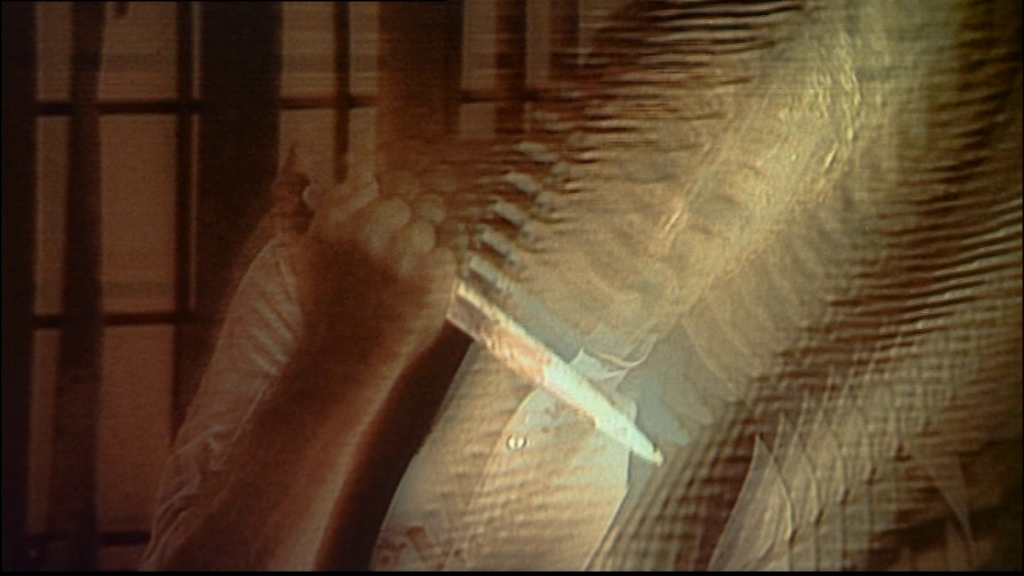
Where the film is most effective is in its visual rendering of the Magic Theater. Through surreal effects, shifting perspectives, and fragmented imagery, it attempts to depict the multiplicity of the psyche and the dissolution of fixed identity. In this respect, it approximates what Jung would describe as active imagination: a confrontation with unconscious contents in symbolic form. The scenes involving the “thousands of Harrys” and the disintegration of linear reality do echo the idea of the psyche as a system of complexes rather than a unified self.
However, this is also where the film’s limitations become evident. The symbolic sequences, while visually inventive, tend to externalize what in the novel remains an interior, reflective process. Jungian individuation is not merely the experience of psychic fragmentation, but the gradual integration of these fragments into a meaningful whole. The film captures the fragmentation, but the integrative movement—subtle, ironic, and often mediated through reflection—is far less developed.
This is particularly noticeable in the treatment of key archetypal figures. Hermine, for instance, appears as a guide and catalyst, but her role as a complex anima figure—simultaneously reflective, destabilizing, and ultimately requiring internalization—is simplified. The psychological nuance of her “mirror” function and her demand for symbolic death is not fully articulated. Similarly, Maria’s role as a necessary reintroduction of Eros is present, but lacks the deeper compensatory significance it holds in a Jungian reading.
The figure of Pablo is perhaps the most significantly reduced. In the novel, he evolves into a paradoxical representative of the Self—initially dismissed, later revealed as a mediator of a non-dual, integrated consciousness. In the film, while he retains a certain enigmatic quality, his transformation into a figure of deeper authority is less convincing. The subtle shift from superficial sensualist to master of the Magic Theater—and thus to a manifestation of the Self—is not fully developed, which weakens the overall Jungian architecture.
From the perspective of von Franz’s interpretation, the film can be said to capture the phenomenology of the unconscious—its imagery, its strangeness, its disruptive force—but not its structure. Von Franz emphasizes that individuation involves a careful, often painful negotiation between ego and unconscious, including the dangers of inflation and the necessity of integration. The film touches on these themes but does not systematically unfold them. The crucial dialectic between inflation and deflation, for example, remains more implicit than explicit.
In conclusion, the film Steppenwolf is a valuable companion to the novel, particularly as a visual and atmospheric interpretation. It succeeds in conveying the mood of existential crisis and the surreal quality of inner experience. However, it does not fully reproduce the psychological precision or theoretical depth of Hesse’s work as it can be understood through Jung and von Franz. One might say that it shows the images of individuation, but not entirely its process.
To be honest, only after I read my Man and Symbols very carefully again I understood how the power of the anima stages explain her split translated to actors (same with the self). I profited from simply knowing of the split and focused straight on the actors. Hermine’s face and acting was how I understood Marie-Louise von Franz. It came across in her face and voice – to me. I had a problem with the Magic Theater, I missed the door signs, the automobile race was overpowering much more important doors.
Dominique Sanda (Hermine in the film) manages to carry a large portion of the anima’s ambiguity non-verbally. The “mirror” function derived from Man and His Symbols—especially through Marie-Louise von Franz—is extremely difficult to render explicitly on screen. It has to come through tone, gaze, timing, and a certain emotional detachment combined with intimacy.
What I was noticing in her face and voice is exactly that liminal quality:
- not fully autonomous,
- not merely a “real woman,”
- but also not abstract.
That ambiguity is the anima functioning correctly. The viewer who already understands the anima doesn’t need explanation—the performance carries it.
In the novel, the Theater is not just surreal spectacle; it is structured symbolic space. The doors matter. They are not decorative—they are indexical: each one names a psychic function or domain.
By downplaying or visually subordinating elements like:
- the labeled doors (“All Girls Are Yours,” etc.),
- the differentiation of experiences,
- the sequence of encounters,
the film loses what one might call the cartography of the psyche.
The automobile hunt scene—while visually memorable—becomes disproportionately dominant. It emphasizes:
- collective shadow,
- aggression,
- modernity’s destructiveness,
but it does so at the expense of balance. In Jungian terms, it overweights one complex (the destructive shadow) and underrepresents others (Eros, play, multiplicity, self-reflection).
Those doors are not optional; they are the architecture of individuation within the Theater. Without them, the sequence risks becoming:
a surreal montage rather than a structured encounter with the unconscious.
There’s also a deeper issue: film tends to privilege intensity over differentiation.
But Jungian work—especially as described by von Franz—depends on:
- differentiation of symbolic content,
- careful sequencing,
- and the ego’s reflective relation to each element.
The book gives you time to recognize:
“this is Eros,”
“this is shadow,”
“this is multiplicity,”
“this is the Self.”
The film compresses this into sensory impact. That’s why your prior reading made such a difference—you were effectively supplying the missing structure.
In the movie:
- The anima (Hermine) can be embodied and perceived directly through performance.
- The Magic Theater, however, is far harder to translate because it requires not just imagery, but symbolic organization.
And without that organization, the viewer sees content—but not necessarily the process.
Appendix
The Ego and the Self are often conflated, yet Jung distinguishes them sharply. The Ego corresponds to the conscious “I” (Ich), encompassing thoughts and feelings and ensuring orientation in reality. It is necessary for survival but limited in scope. The Self, by contrast, is the totality of the psyche, including both the personal and collective unconscious, and functions as the central organizing principle.
In the development of the individual, adaptation to society produces the persona, while unaccepted traits are repressed into the shadow. The anima (in men) or animus (in women) forms as a further functional complex. For many, development halts at the level of ego-realization, confined to socially prescribed roles. Individuation, however, begins typically in midlife, often triggered by crisis, loss, or existential questioning.
This process involves successive confrontations:
- shadow
- anima/animus
- Self
- Hinduism: realization of Atman
- Sufism: overcoming the nafs
Yet in Jungian psychology, this is not annihilation but integration. The ego becomes the “eye” of the Self rather than its master.
The Self represents the transcendence of opposites:
- conscious and unconscious
- male and female
- individual and collective
Individuation is thus the process of becoming what one truly is. It is not merely preparation for death but the realization of psychic totality—the emergence of the Self as the center of the personality.