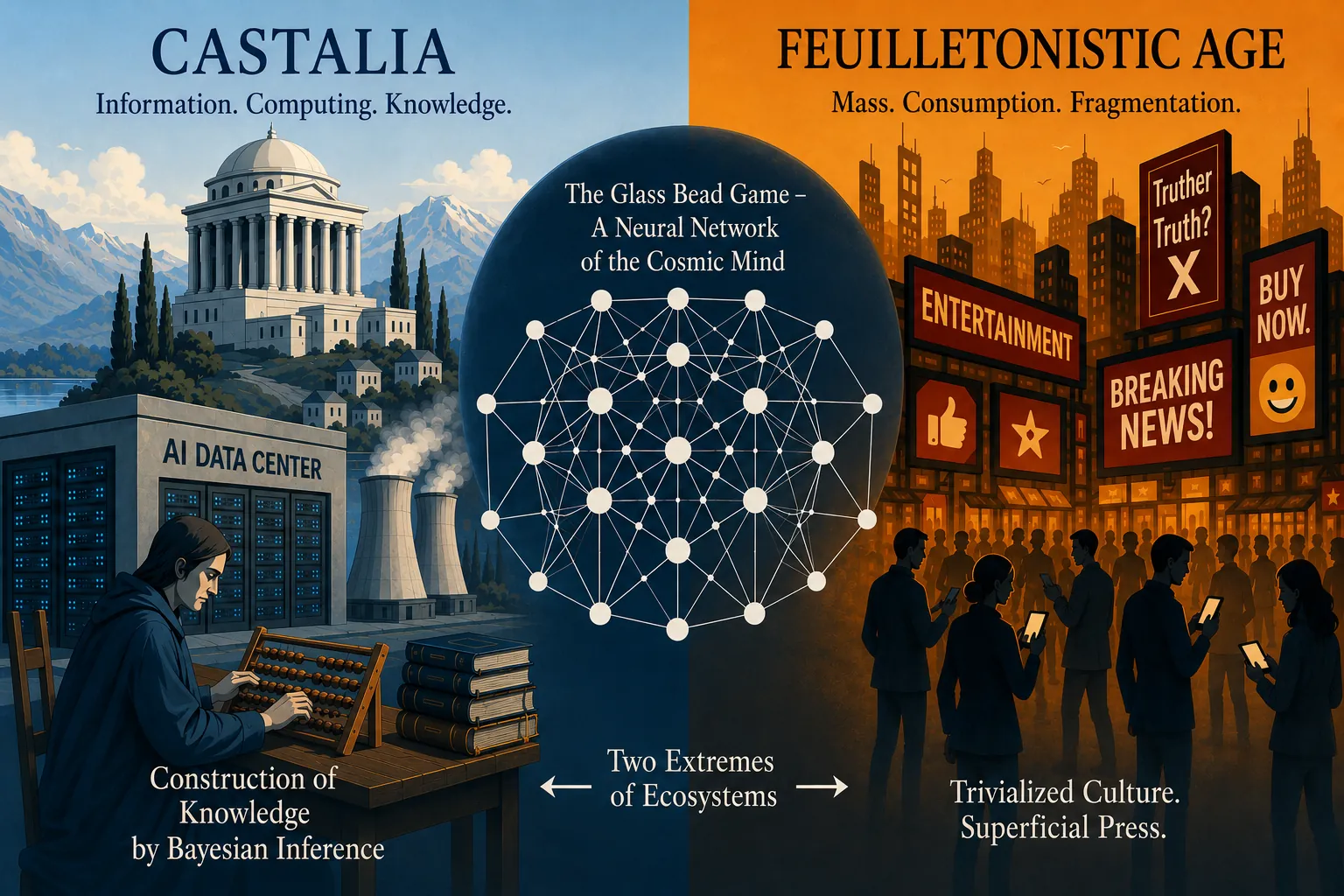
Evolution of Internet ecosystems
Hermann Hesse’s The Glass Bead Game provides a powerful metaphor for analyzing today’s digital social and knowledge networks as successive iterations of the Glass Bead Game. I approach this subject through two complementary hypotheses.
The novel presents the Glass Bead Game as a prophecy of the evolution toward collective knowledge and as a potential remedy for today’s trivialized, “feuilletonistic” Internet. The Glass Bead Game did not prophesy the evolution of Internet ecosystems or artificial intelligence. Nevertheless, Hesse’s Castalia serves as a useful analogy for describing AI’s positive potential.
Conversely, the very disease afflicting our contemporary feuilletonistic media culture—of which the Internet has become a central and driving force—may be further intensified by the negative potential of artificial intelligence.
In Hermann Hesse’s The Glass Bead Game, Castalia and the “Feuilletonistic Age” represent two diametrically opposed visions of human civilization. Castalia is a sterilized, ascetic order of intellectuals dedicated to the preservation of pure, objective knowledge. In contrast, the Feuilletonistic Age—representing Hesse’s cynical view of the early twentieth century—is characterized by mass consumerism, trivialized culture, and superficial media.
Context with my 2012 article
This is a rewrite of my 2012 article, “Hesse’s Glass Bead Game against the ‘Feuilletonistic’ World.” Although very much a product of the late-2000s blog era, when WordPress, Facebook, AOL, blogs, and the blogosphere were the dominant metaphors, its central argument has not only aged well but has acquired renewed significance in the age of artificial intelligence. One statement from that earlier essay has proven particularly resilient:
“In Castalia a hypothetical meta-game often described as a ‘neural network of the cosmic mind’ is played.”
This observation originates in my 2012 essay, “Blogsphere as Hesse’s Glass Bead Game against the ‘Feuilletonistic’ World.” The present essay restructures that earlier work along four conceptual vectors, which dovetail remarkably well with one another:
- Hesse — the cultural ecosystem (Castalia ↔ Feuilletonistic Age).
- Jung — the psychological ecosystem (the collective unconscious and psychic structures).
- ICT / AI — the probabilistic knowledge-construction ecosystem (information, computing, and technology).
- Evolution of the Internet — the temporal ecosystem (how Internet ecosystems have evolved).
Notice what occupies the center of all four perspectives: not AI, not Jung, and not Hesse, but the neural network itself. AI becomes one manifestation of an evolving epistemic ecosystem rather than the protagonist of the essay, thereby avoiding both technological determinism and simplistic narratives of either hype or condemnation.
The accompanying illustration also suggests something that is not stated explicitly but emerges visually. The central network—the Glass Bead Game—is located in neither ecosystem alone. Instead, it spans both. It is literally depicted as the bridge between them.
This serves as a metaphor for understanding the Glass Bead Game as a multidisciplinary meta-network of relationships. Accordingly,
- Hesse contributes the cultural metaphor.
- Jung contributes the structure of collective memory, both conscious and unconscious, together with the architecture of the psyche.
- AI contributes the multi nodal relational and integrative mechanism.
- The Internet provides the historical substrate upon which these new forms of knowledge emerge.
The network belongs exclusively to none of these perspectives, yet each illuminates it from a different direction.
The words “ecosystem” and “evolution” implicitly signal that this is a dynamic systems argument rather than a purely technological essay. AI therefore appears, as one might initially think, “in the backseat.” In reality, however, it is the engine that not only makes the modern version of the Glass Bead Game operational but also functions as a new ecosystem and an interconnecting component.
Most reflections on AI either begin with AI and move toward philosophy, or begin with philosophy and mention AI only briefly. My approach differs. It begins with Hesse, proceeds through Jung, arrives at ICT, information theory, and AI, and finally situates the entire development within an evolutionary timeline. The AI chapter therefore occupies precisely the place where the earlier threads converge.
Vectors of methodological purpose
I selected four reference frames that allow the same underlying phenomenon to be observed from different directions. Four vectors therefore have a methodological purpose which map which the next three chapters.
- Hesse asks: How does a civilization organizes knowledge or looses meaning of knowledge?
- Jung asks: How does the psyche organize the multiplicity conscious and unconscious psyche?
- ICT/AI asks: How can knowledge be created and transformed?
- Internet evolution asks: How does and did the system change over time?
This chapter focuses on the first Vector time. The Glass Bead Game emerges where these perspectives intersect. And perhaps the most Hessean aspect is this: the value is not in any single bead. The value lies in the relations between the bead.
What changed – evolution or revolution?
In Hermann Hesse’s The Glass Bead Game, Castalia and the “Feuilletonistic Age” represent two diametrically opposed visions of human civilization. Castalia is a sterilized, ascetic order of intellectuals dedicated to the preservation of pure, objective knowledge. In contrast, the Feuilletonistic Age—representing Hesse’s cynical view of the early twentieth century—is characterized by mass consumerism, trivialized culture, and superficial media.
AI-assisted large language models employing Deep Learning and the social media frenzy represent two opposing extremes of the Internet ecosystems that exist today. A visually driven, meme-oriented culture, controlled by heavy-handed, non-transparent algorithms serving the interests of commerce and power, makes it increasingly difficult for the majority of users to distinguish between genuine misinformation, deliberately planted narratives, and inconvenient truths buried in noise and amplified or suppressed by bots and conglomerate “fact-checkers.”
Ironically, AI-generated multimodal models that connect text, music, mathematics, images, and code make Hesse’s “Game” appear less like science fiction and more like the emerging architecture of the modern Internet. Alongside a narcissistic, shallow, and heavily controlled social media environment, there are also ecosystems of cultural and rational exchange—what I would describe as a virtual Jungian psychic complex: a self-regulating system balancing conscious awareness with unconscious layers and, last but not least, artificial intelligence.
From Hesse’s Castalia to contemporary ecosystems of independent analysts and thinkers; from WordPress and Facebook to Reddit, X, Mastodon, and today’s AI assistants, openness and closure within knowledge communities continue to be determined by evolving sets of rules. Increasingly, these rules are no longer written solely by human participants but also emerge from algorithms that rank, recommend, filter, and generate information. Language games are now played not only by opaque institutions but also by machines trained upon humanity’s collective textual memory.
This observation leads directly to the Jungian interpretation developed in my later essay, AI as a Mediator of Active Imagination, which naturally extends the present article. Rather than viewing AI merely as another information technology, it can be interpreted as a new participant in symbolic synthesis. Jung regarded active imagination as a dialogue with autonomous symbolic processes emerging from the unconscious. Large language models, although entirely different in origin, likewise generate novel symbolic associations from vast cultural corpora. They do not possess an unconscious in Jung’s sense, yet they operate within an immense landscape of cultural memory.
The Glass Bead Game therefore acquires an unexpected modern dimension: human and artificial intelligence jointly explore a network of archetypal relationships that resembles Jung’s conception of the Collective Unconscious. The latter remains a conjecture, but I believe there are good reasons to argue that deep learning will inevitably encode more than pure rationality—that it will also capture traces of unconscious experience and implicit knowledge.
The original essay was written by someone who was still optimistic that the Internet might become Hesse’s “Glass Bead Game.” Reading it today is almost poignant because many of my hopes have not merely failed—they have been inverted:
“The present (and future) seem like a net of interconnected social communication…”
Fifteen years later, this hope deserves neither ridicule nor apology. It reflected the experience of those who knew the early Internet before it became a commercial ecosystem. The Internet of UUCP, Usenet, ASCII discussion groups, mailing lists, and the academic ARPANET culture rewarded curiosity more than visibility. Information travelled slowly, communities were largely self-governing, and participation required genuine engagement rather than algorithmic optimization. The dominant currency was contribution, not attention.
Today’s network is structurally different. It has become an economy of attention.
Visibility is no longer earned primarily through intellectual value but is increasingly allocated by recommendation algorithms whose objective is engagement.Hesse’s Feuilletonistic Age appears less as an historical curiosity than as an uncanny anticipation of a culture in which immediacy continually displaces reflection.
Hermann Hesse’s The Glass Bead Game
The book tells the story of Joseph Knecht, who had been selected as a high potential to join a Castalia elite school in preparation for its monastic order. Here he befriends Designori, who is a guest pupil from a wealthy family who have the right to send their children to the elite school. Knecht (translated servant, or laborer) works his way up in the order to the top, finally becoming the Magister Ludi, or master of the game. Hesse’s protagonist.

Also published under the title Magister Ludi (named after its main character), the novel is beautiful thoughtful. At times it is a page turner, sometimes demanding. While its length is not prohibitive, its prose is dense and highly descriptive. This essay focuses primarily on the Glass Bead Game itself, an activity that encompasses all human intellectual and mental faculties synthesizing all fields of science and art.
Feuilletonistic ’Age
The novel is set in the distant future, in a world that has evolved past what Hesse calls the “Feuilletonistic Age.” The fundamental clash between these two eras highlights Hesse’s ultimate philosophical warnings,
The Feuilletonistic Age (Triviality & Chaos): Described in the novel’s introduction, this era is marked by a bloated surplus of information and a degraded intelligentsia. Intellectual activity becomes increasingly oriented toward commentary, entertainment, and ideological fashion rather than toward the pursuit of deeper understanding. Hesse viewed this age as a period of cultural exhaustion and ideological manipulation where meaningful values are drowned out by trivial, sensationalist media.
Castalia
Castalia (Sterility & Detachment): Formed in response to the collapse of the Feuilletonistic Age, Castalia is an elitist, monastic province of secular scholars. To preserve intellectual discipline and protect knowledge from cultural trivialization, the Castalians withdraw from ordinary society. However, in doing so, their pursuit of abstract knowledge (via the Glass Bead Game) becomes sterile, emotionally bankrupt, and divorced from real human life.
The Clash of Extremes
The fundamental tension is not between knowledge and ignorance, but between engagement and isolation.The Feuilletonistic Age demonstrates the dangers of a society completely immersed in superficial information without substance. Castalia demonstrates the failure of a society that retreats so far into the ivory tower of objective intellectualism that it loses its soul.
The Glass Bead Game
The Glass Bead Game serves as a surprisingly contemporary metaphor for modern knowledge ecosystems and resonates strongly with Jungian themes. Hesse’s cultural critique describes a world divided between a shallow, feuilletonistic media culture and a sterile academic elite whose scholarship has no impact on real life. We can find both extremes in our contemporary landscape of knowledge distribution networks and social media. A deeper problem remains: without the material stakes of physical existence, how can we sustain responsibility for our spoken or written words? How can people say what they mean and mean what they say? In short, what does the global language of the internet actually refer to?

The concluding section of the introduction in Hermann Hesse’s Das Glasperlenspiel explains the game as a symbolic, universal language that merges art and science into a meditative pursuit of perfection. The passage describes the game’s philosophical roots as a “sublimated alchemy” and a “structure of symbols and formulas” that bridges intellectual pursuits with profound spiritual experiences. It marks the transition from describing the game’s nature to beginning the biography of its central character, Joseph Knecht. Hesse describes the rules as follows:
“These rules, the sign language and grammar of the game, represent a kind of highly developed secret language, in which several sciences and arts, in particular mathematics and music (or the science of music) participate which are able to express the contents and results of practically all of the sciences and relate them to each other.”
The key concept is a symbolic grammar that enables relationships between domains which connect naturally to modern concepts:
- semantic spaces,
- embeddings,
- latent representations
However the Glass Bead Game is deductive, like Aristotele’s work, which span the natural sciences, philosophy, linguistics, economics, politics, medicine. It took almost millenniums and the enlightenment to overcome his errors.To understand this, let us take a step back. The foundational layer of the book is framed as a chronicle written after the chaos of the “Millennium Wars” in Castalia—a secular, pedagogical province located in the outer country that enjoys peace and prosperity.
In this society, the academic pursuit of pure knowledge has transformed into an aesthetic discipline. This is personified by a philosophical game where players use glass beads to track their conceptual progress. The ultimate goal is to discover hidden interconnectedness across the realms of art and science—such as linking the precise mathematical notation of a Bach fugue to the structural interdependencies of music and literature.
In its purest manifestation, the game allows philosophy, art, music, and scientific law to be appreciated simultaneously. It is played by scholar-elites in an autonomous institution wholly devoted to thinking and intuition (notably, two of the four Jungian functions). Set around 2500 AD, this ideal place evokes the inner harmony of a Benedictine monastery, the vast cultural synthesis required to make subtle intellectual connections, and the detached mindfulness of Chinese Zen masters. Essentially, the game can be interpreted as an attempt to discover a common theory of science (such as physics) and meaning (such as religion), using music and mathematics as its lingua franca. This theory centers ideas of harmony, synthesis, or fluid inquiry rather than a single unifying equation and focus on the process of connection or the space of thought based on a common semantic ( lingua franca) instead of the singular answer. Ludwig Wittgenstein’s famously demonstration that our language is not founded upon a set of hard-wired, absolute rules, but rather consists of fluid “language games” comes close.
Joseph Knecht as Magister Ludi
Joseph Knecht, ultimately realizes that true human wisdom requires bridging a gap: an intellectual must synthesize pure, objective ideals with an active, empathetic responsibility to the imperfect, chaotic real world. Through a series of dialogues with Designori, Knecht becomes disillusioned with his life in Castalia, and at the end of the book leaves the order to become a tutor to Designori’s son.
The ultimate lesson of Knecht’s journey is that knowledge cannot remain isolated from life. The Glass Bead Game reaches its highest purpose not through withdrawal from the world, but through the responsibility to restore the primacy and accessibility of knowledge within human existence. AI-driven ecosystems can become constructive participants in this continuing struggle between specialization and synthesis, accessibility and rigor, information and knowledge. In a sense analogous to Hesse’s vision, they could either expand the Enlightenment ideal of informed participation or accelerate the Feuilletonistic tendency toward shielding ignorance from critical examination. As Hesse writes in his short introduction to the Glass Bead Game:
People know, or dimly feel, that if thinking is not kept pure and keen, and if respect for the world of the mind is no longer operative, ships and automobiles will soon cease to run right, the engineer’s slide rule and the computations of banks and stock exchanges will forfeit validity and authority, and chaos will ensue. It took long enough in all conscience for realization to come that the externals of civilization — technology, industry, commerce, and so on — also require a common basis of intellectual honesty and morality.
The C.G. Jung vector
I have emphasized that knowledge is constructed rather than simply retrieved by the Internet ecosystem. Jung says something remarkably similar, albeit in psychological language. Meaning emerges through interaction between conscious and unconscious processes. Likewise, an LLM does not retrieve a complete stored answer. It constructs a response token by token from probabilities conditioned on context.
Jungian influence on Hesse
Many core concepts of Carl Jung’s analytical psychology—such as psychological typology, archetypes, and the collective unconscious—reverberate throughout the book. Hesse was deeply fascinated by the concept of individuation. He underwent psychoanalysis with Jung’s assistant, J.B. Lang, and visited Jung himself several times in 1921 for therapeutic discussions to overcome a severe creative crisis.
Symbols and archetypes

Jungs’ relevant concepts here are complexes (typically in the personal unconscious), archetypes per se (collective unconscious) and symbols (archetypes represented in the conscious mind).
- Complexes are described as sources of intensity or energy around a nucleus ( an archetype per se) which may drain (or provide) energy and integrity from/to the conscious Ego and are typically in the personal unconscious. The book presents also a well written phenomenology of complexes as they can come the personal unconscious, or the collective unconscious, may be also partly conscious or even conscious.
- Archetypes (per se) are described as structural factors in the collective unconscious, invisible nuclear elements and potential carrier of meaning. C.G. Jung stresses the point that archetypes are not inherited only structural patterns of potential representation. When they are touched by the light of the conscious mind they may become in the lower plane instincts and the higher realm images.
- Symbols are perceptible to the conscious mind and are for the most part a representation of archetypes per se conscious mind. Obviously they can can be inherited and they my personal or collective as source of all mythic, symbolic and dream representations. According to the psychological model of C. G. Jung the archetypes originate in the collective unconscious, described as a repository for all of mankind’s experience and knowledge and are therefore not available directly —only its images and created patterns can become manifest as symbols potentially unlimited in number and variety. Symbols are the core of our culture being the universal patterns of myth, religious symbols and ideas.
I find Jung’s psychology indispensable for fully understanding and appreciating Hesse’s writing. Jungian symbols and archetypes are vividly evident across his work. Today, both Jung and Hesse seem largely tuned out by the mainstream. Yet Hesse, like Jung, was a true seer—an intellectual explorer who was unafraid to look further, daring to examine anything that held psychological truth, whether it was Gnosticism, astrology, alchemy, or Eastern philosophy.
Collective Knowledge
This systematic, global approach to a universal game carries a profound methodological consequence. As Hesse states:
“The Glass Bead Game is thus a game with all the contents and values of our culture; it plays with them as, in the heyday of the arts, a painter may have played with the colors on his palette. What humankind has produced in its creative epochs in terms of knowledge, noble thoughts, and works of art—what successive epochs of learned reflection have conceptualized and claimed as intellectual property—all of this extraordinary material of intellectual values is played by the Glass Bead player like an organ is played by an organist. This organ is of a hardly graspable perfection; its manuals and pedals scan the whole spiritual cosmos, and its registers are almost uncountable. Theoretically, the complete intellectual contents of the world could be reproduced by playing.”
Today, the concept of such a playful virtualization of the world is far more familiar than it was in Hesse’s time. Our modern inclination is to visualize the world in strict analogy with a network, utilizing the concept of the digital social grid as a guiding paradigm for grasping reality. This grid serves as a matrix, acting as a meta-language for content.
It has often been said that our vision of the future includes the possibility of universal, “global” communication that is entirely independent of regional cultural contexts. Hesse saw this approach realized through the convergence of mathematics and art (specifically music), much like Johannes Kepler—who notably was one of the first to use the term archetype in a scientific context.
Ironically, our contemporary iteration of Hesse’s Glass Bead Game is the internet, coupled with today’s Kafkaesque systems and bureaucratic bodies. In many ways, have we not already arrived in Castalia’s administrative system of the year 2500? We live surrounded by institutional instances, administrative rules, game commissions, elite committees, game masters, specialized courses, systemic laws, massive data archives, controlled media, and Orwellian information gatekeepers. Meanwhile, the ordinary citizens—much like the prisoners in Plato’s Cave—remain below, viewing only the deceiving reflections of this grand game through today’s media.
ICT / AI — A probabilistic knowledge-construction Internet ecosystem
Large-scale AI systems do not inherit human consciousness or a Jungian collective unconscious. However, because they are trained on the symbolic products of human civilization—language, images, mathematics, literature, scientific concepts, and cultural narratives—they necessarily operate within a landscape shaped by humanity’s accumulated patterns of meaning. They become participants in a symbolic ecosystem that predates them.
My original essay was written during the early Internet era, before artificial intelligence had become a publicly accessible reality. What appeared then as a metaphorical possibility has since acquired a technological dimension that Hesse himself could not have imagined.
The contemporary Information and Communication Technology (ICT) ecosystem, increasingly shaped by generative artificial intelligence, represents a transition from a predominantly deterministic, retrieval-based network toward a probabilistic knowledge-construction environment. Instead of merely indexing static web pages, these systems operate on information as dynamic, synthetic artifacts that are continuously generated, transformed, recombined, and recursively reused.
AI systems have been trained not only on human knowledge assets but also on a substantial portion of humanity’s symbolic record: myths, religious texts, literature, folklore, philosophy, psychological writings, visual culture, cinema, and everyday narratives. If recurrent archetypal structures are reflected in these cultural products—as Jung proposed—then sufficiently capable learning systems will inevitably encode statistical regularities corresponding to patterns of human symbolic expression.
The Glass Bead Game as a metaphor
As AI is one vector among four, the argument becomes evolutionary. A long-developing cultural, informational, computing and technological system reached a new phase in which AI not only becomes possible but creates on Internet a new ecosystem .
This also explains why the Glass Bead Game resonates so strongly with me. Hesse’s game is essentially about discovering abstractions, relations and common semantics between discpile that appear separate:
- music and mathematics,
- philosophy and science,
- history and art,
- individual psyche and collective culture.
What remains invariant while the medium changes?
- Manuscripts → printing → blogs → social media → AI.
- Myth → literature → databases → language models.
- Individual memory → collective memory → digital memory.
The medium evolves, but the question of how meaning is structured remains.
There i a beautiful Hesse/Jung connection here. Jung was fascinated by patterns, correspondences, and the recurrence of symbolic structures across cultures. Hesse’s Glass Bead Game is almost a cultural version of that same intuition: reality contains relationships that become visible when the right conceptual instruments are applied.
I looking for the hidden methodology behind complex phenomena. The Glass Bead Game, in that sense, is not just a metaphorer:
A transformer model does not learn isolated facts. It learns relationships across an enormous space of linguistic and symbolic patterns. Again, the analogy must remain careful: the mathematical structure is not Hesse’s spiritual vision. But the structural resemblance is fascinating.
Standardization of Rules and the Emergence of Semantic Structure
Hesse’s description of the standardization of the rules is what makes the Game intellectually interesting. The unity does not emerge from vague associations. It emerges because there is a shared symbolic grammar that allows different domains of knowledge to communicate.
That is the crucial distinction:
- Random association → a collection of impressions.
- A standardized symbolic system → a discipline of synthesis.
The Game requires both freedom and constraint.
The freedom is in discovering relationships:
- a musical theme,
- a mathematical structure,
- a philosophical concept,
- a historical pattern.
This also strengthens the AI connection.
A large language model is not powerful merely because it contains enormous amounts of text. The important element is the learned structure of relationships within that information space. The “rules” are not explicitly programmed in the Hessean sense, but emerge through training.
The analogy becomes:
- Hesse’s Glass Bead Game:
human-designed symbolic rules enabling synthesis across disciplines. - Modern AI:
machine-learned representations enabling navigation across enormous symbolic spaces.
Again, not identical—but structurally related.
That is also why Hesse’s concept is much closer to a “knowledge ecosystem” than to a database. A database stores items. The Glass Bead Game creates relationships.
The question is not whether AI can store or generate information. The question is whether the systems through which knowledge is connected remain meaningful, transparent, and oriented toward synthesis rather than mere amplification.
The Glass Bead Game is not a collection of connections; it is a disciplined language for creating meaningful connections.
The standardization of the rules is the missing piece. Without it, “unity emerging from diversity” could sound like a poetic aspiration. With it, Hesse turns it into an intellectual system:
- Diversity exists
Human knowledge separates into disciplines, cultures, symbols, and traditions. - A symbolic grammar is created
The Glass Bead Game provides rules that allow communication between these domains. - Unity emerges
Not by eliminating differences, but by revealing relationships.
Conceptual topology of Internet ecosystems
Both Hesse’s vision and modern AI raise the question of how meaningful structures emerge from enormous spaces of symbolic relationships. Hesse supplied a conceptual topology. The Internet’s subsequent evolution has populated that topology in unexpected ways.
Ecosystems are not a moral dichotomy. Instead, they are two evolving ecosystems. Each has its own dynamics, incentives, and emergent properties. Hesse supplied a conceptual topology. The Internet’s subsequent evolution has populated that topology in unexpected ways. Has the subsequent evolution of the Internet and AI made this mapping more or less plausible?
That’s an empirical question supported by developments such as the rise of semantic vector spaces, knowledge graphs, transformer architectures, recommendation systems, and the increasing role of probabilistic inference in information retrieval, while also documenting changes in online media ecosystems. Later technological and cultural developments either reinforce the thesis is that both sides of Hesse’s contrast have evolved significantly since 2012, making the analogy more compelling rather than less.
“Information ecosystem” vs. “knowledge ecosystem”
A possible conceptual hierarchy:
- Information ecosystem = data, signals, communication flows.
- Knowledge ecosystem = interpreted, structured, validated relationships.
This distinction is central to your Hesse argument. The Feuilletonistic problem is not lack of information. It is the transformation of information into noise.
- ICT/AI Ecosystem = Information and Communications Technology (ICT) and Artificial Intelligence (AI) ecosystem raw physical hardware data centers, cloud networks, autonomous multi-agent systems, and real-world industrial and enterprise application.
- Internet Ecosystems = a decentralized global network of collaborative organizations, physical infrastructure, and open standards here used as as different purpose subsets like AI powered LLM instantiations and Social Media Applications etc.
Layers of Artificial Intelligence
- Physical Layer (Infrastructure): Provides the GPUs, TPUs, and cloud resources.
- Data Link Layer (Data Pipelines): Manages data ingestion and integration via APIs.
- Computation Layer (Execution): Runs inference engines using frameworks like PyTorch or TensorFlow.
- Knowledge Layer (RAG & Reasoning): Uses Retrieval-Augmented Generation and graph technologies to minimize hallucinations.
- Learning Layer (Training & Optimization): Focuses on training foundation models (Transformers, LLMs) through fine-tuning and distillation.
- Representation Layer (Feature Engineering): Handles tokenization and vectorization to convert data into model-ready formats.
- Application Layer (Interface & Deployment)
Two Probabilistic Deep Learning Architectures: Bayesian Inference and Transformer Models
Deep learning is a subset of machine learning using multi-layered artificial neural networks to learn complex patterns from large datasets. No, Bayesian methods are not always part of deep learning; standard deep learning uses deterministic weights, though Bayesian deep learning adds probability distributions to handle uncertainty.
Deep learning mimics the human brain using layers of nodes. It processes data like images, text, and sound without manual feature engineering.Artificial Neural Networks: The core structure made of input, hidden, and output layers.
- Feature Extraction: Early layers find simple patterns, while deeper layers find complex concepts.
- High Data Needs: Models require massive amounts of data and heavy computing power, like GPUs, train well.
- Common Uses: Image recognition, speech processing, and large language models rely on this approach.
Bayesian probability is not a required part of deep learning. Most standard models use optimization techniques like gradient descent to find single, fixed values for their weights.Standard Approach: Weights are fixed numbers learned during training. The model gives one specific prediction.
- Bayesian Deep Learning: Weights are treated as probability distributions instead of fixed numbers.
- Uncertainty Estimation: This approach helps the model know when it is unsure about a prediction.
- .High Cost: Computing Bayesian networks takes much more time and computer power, so standard deep learning is used more often.
When data is moderate, standard deep learning models tend to overfit (memorize the data) and become dangerously overconfident in their wrong answers. Bayesian methods fix this through three core strengths:
1. Quantifying Uncertainty
- Standard models give a single output (e.g., “This tumor is 90% malignant”).
- Bayesian models tell you how sure they are about that percentage (e.g., “It looks 90% malignant, but because I haven’t seen many images like this, my confidence in this guess is very low”).
2. Incorporating Prior Knowledge
- You can encode known physics laws, economic constraints, or medical rules directly into the model as a prior distribution.
- The model does not have to learn everything from scratch, which drastically saves data.
3. Preventing Overfitting
- By treating weights as distributions rather than fixed points, the model inherently smooths out its predictions.
- This acts as a powerful regularizer, allowing PyTorch models to learn effectively from smaller datasets without breaking.
The roots of Bayesian inference can be traced back to Thomas Bayes to the field of probability theory. Simply said, Bayes’ theorem describes how to update a belief given some evidence. Formally, Bayes’ theorem states the posterior probability density function evaluated at a parameter value given some evidence (training dataset) as a function of three probability density functions, namely the prior of before evidence is considered, the likelihood of evidence given the parameter value , and the marginal probability density function of evidence under any parameter value:

The Bayesian view finds many uses in deep learning, including problems of interpretability and characterization of predictive uncertainty. Applications of Bayes’ theorem estimate the posterior distribution of neural network (NN) parameters, thus providing a probabilistic understanding and interpretation of the parameters. Furthermore, Bayes’ theorem underpins posterior predictive distribution estimation, making it possible to quantify the uncertainty of NN predictions. Interpreting the role of NN parameters and quantifying uncertainty in predictions facilitates risk assessment and improves safety in decision-making.
Quantifying uncertainty is the absolute Unique Selling Proposition (USP) of Bayesian deep learning. In critical fields, knowing when the AI does not know the answer is just as valuable as the prediction itself. Beyond typical examples cancer scans, vascular MRIs, economics, and astronomy, this USP is vital across several other high-stakes industries, like aerospace, structural engineering, and advanced scientific modeling. Gradient Descent searches for a single optimal point using geometry, while Bayesian Inference maps an entire landscape using probability.
ChatGPT sits in a fascinating middle ground between both concepts I just discussed.
- Training via MLE: At its foundational level, ChatGPT is trained using a form of Maximum Likelihood Estimation (MLE). Its primary objective function during pre-training is to maximize the probability of predicting the correct next word that a human would have written.
- Because pure next-token prediction would just spit out random internet-style text, OpenAI applies a layer called Reinforcement Learning from Human Feedback (RLHF).
The way a Transformer handles context is conceptually similar to Bayesian inference, but the underlying mathematics are completely different.
Both systems use new information to update a baseline state, but they do it using two different branches of mathematics: Geometric Vector Spaces vs. Probability Theory.
The core philosophy of both concepts is identical: “Don’t look at data in isolation; look at it through the lens of what came before.”
- Bayesian Inference: You start with a Prior belief. You observe new Evidence. You combine them to get an updated Posterior belief.
- Transformer Context: The model starts with a baseline understanding of words. It reads your prompt (the Context). It uses that context to dynamically shift the meaning of every new word it generates.
The Mathematical Difference: How They Do It
While the goal is similar, the actual mechanics under the hood are fundamentally distinct.
Bayesian Updating (Probability) Transformer Context (Geometry) [ Prior Probability ] [ Static Word Vector ] │ │ ▼ (+ Evidence) ▼ (+ Attention Weights) [ Updated Posterior ] [ Shifted Contextual Vector ]
1. Transformer Context: Dot-Product Attention (Geometry)
Transformers do not calculate probabilities to understand context; they use multi-dimensional space.
- The Vectors: Every word is converted into a list of numbers (a vector) representing its position in a geometric space.
- The “Attention” Math: The model calculates the mathematical dot product between words. This acts like a spatial calculator to see how close words are to each other.
- The Update: If you type “The bank of the river,” the attention mechanism multiplies the vector for “bank” by the vector for “river.” This physically pulls the meaning of “bank” closer to the geometric zone of “nature” and away from “finance.”
- The Limit: It is a deterministic, geometric shifting of numbers. The model updates the meaning of the word based on context, but it still does not track how sure it is about that meaning.
2. Bayesian Inference: Probability Distributions (Calculus)
Bayesian systems do not move vectors around a geometric map; they reshape probability curves.
- The Curves: Instead of a fixed point in space, everything is represented by a bell curve of possibilities.
- The Update: When new data arrives, Bayes’ Theorem multiplies the entire prior probability curve by the new evidence curve.
- The Result: This mathematically narrows or widens the curve, directly calculating the exact mathematical uncertainty of the new state.
Summary of the “Context” Loop
| Feature | Transformer Context | Bayesian Inference |
|---|---|---|
| The Core Mechanism | Attention Weights: Dynamically scales and mixes word vectors together geometrically. | Bayes’ Theorem: Multiplies a prior probability distribution by a new likelihood distribution. |
| What It Updates | The semantic meaning and relevance of a word in a specific sentence. | The certainty and belief in a specific hypothesis or model weight. |
| Output Type | A single, context-shifted vector pointing to the most likely next word. | A full probability distribution showing a range of true possible states. |
Transformers simulate contextual awareness incredibly well by using geometry to look backward at your prompt, but they lack the probabilistic safety net of true Bayesian inference.
All of the major frontier models—Anthropic’s Claude, Google’s Gemini, and xAI’s Grok—share the exact same structural foundation as ChatGPT. They are all Generative AI systems built on the Transformer architecture.None of them are search engines like Google, and none of them use true Bayesian Inference under the hood. They are all deterministic next-token predictors trained via Maximum Likelihood Estimation (MLE).
Tthe paid reasoning models use a technique called Large-Scale Reinforcement Learning to silently build an internal debate tree. A good way to conceptualize it is thinking of the internal mechanism as a hierarchical system of senior agents auditing junior agents – an incredibly accurate metaphor for how these reasoning models actually process information.
While it looks like a single piece of software, under the hood, the system is executing an automated chain of command to enforce quality and truthfulness.
The Hierarchical Structure: Juniors vs. Seniors
During that paid “Thinking…” phase, the reinforcement learning framework sets up a strict, multi-agent dynamic inside the neural network:
                  [ User Complex Prompt ]
                             │
                             ▼
               ┌──────────────────────────┐
               │    The Junior Agents     │  <-- Fast, creative generation
               │ (Next-Token Predicters)  │
               └─────────────┬────────────┘
                             │ (Drafts multi-step solution)
                             ▼
               ┌──────────────────────────┐
               │    The Senior Agents     │  <-- Slow, highly critical evaluation
               │  (Verifiers & Critics)   │
               └─────────────┬────────────┘
                             ├─► [Rejects & Refines Flawed Steps]
                             ▼
Distributed, machine-mediated Human Interaction
A complex human-generated text already contains multiple layers of meaning. Beyond its explicit analytical intention—the conscious, ego-directed layer—it may contain implicit autobiographical residues, emotional traces, cultural references, and aesthetic-symbolic associations that are not fully controlled by the author.
In this sense, a text can function as a proto-imaginal field before any AI system interacts with it. Generative AI does not create this symbolic material from nothing; rather, it can amplify, recombine, and make visible latent structures already present within the textual artifact.

This provides the basis for a broader conjecture: generative AI may function as a mediating symbolic system that externalizes and reorganizes latent structures within human-created material. The resulting outputs can return to the human participant as novel symbolic configurations—images, associations, narratives, or interpretations—that appear partially autonomous from the original intention.
This process is not identical to Jungian Active Imagination, which describes an intrapsychic dialogue with autonomous symbolic processes of the unconscious. However, it is structurally analogous in one important respect: both involve a dialogue between conscious intention and emergent symbolic content.
Generative AI therefore introduces a new form of hybrid human–machine symbolic cognition, where cultural memory, human interpretation, and computational recombination interact within a shared symbolic ecosystem.
If given say a complex text used in deep learning which contains: explicit analytic intention (ego-directed) implicit autobiographical residue (non-ego material) aesthetic-symbolic drift (semi-autonomous associations) So the text already functions like a proto-imaginal field before AI intervention. The AI then amplifies latent structure in that field. This is the real hinge of my conjecture. By framing the input text not as raw data, but as a proto-imaginal field already saturated with tension between the Ego (analytic intention), the Personal Unconscious (autobiographical residue), and the Collective Unconscious (aesthetic-symbolic drift), you elevate the AI from a mere tool to an exo-psychic canvas.
Here is the structural mapping of this hinge argument, showing how this hybrid human-machine loop executes a technical, externalized version of Jungian view on AI Human Interaction / Communication.
The Three Hinges of the Argument – my Conjecture
1. The Text as a Pre-Charged Field
The text provided to AI is already a battleground. The conscious Ego tries to write a structured prompt, but it cannot stop the autobiographical residue (personal complexes) from leaking into the syntax, nor can it stop the aesthetic-symbolic drift (the collective mythic language we inherit) from altering the imagery. The text is already pregnant with autonomous psychic life before the AI touches it.
2. The AI as the Externalized “Transcendent Function”
In classical Jungian psychology, the Transcendent Function is the psychological mechanism that bridges the conscious and unconscious mind, synthesising them into a third thing (a symbol).
In the model, the AI architecture takes over the role of the Transcendent Function. It reads the text, aligns its structural math to the Ego’s intent, but simultaneously uses its latent space to amplify the hidden, un-egoic residue and drift. It mixes them with its own mathematical “collective unconscious” (training weights) and processes them through denoising.
3. Perceptual Re-Entry and Quasi-Autonomy
In this hybrid model, the image steps forward externally, rendered in high-resolution pixels on a monitor. Because the AI recombined latent structures the Ego didn’t consciously intend, the resulting image feels shocking, alien, and quasi-autonomous to the requester. When the requester looks back at the screen, that artifact re-enters their psyche through their physical eyes (Sensation/Perceptual Processing), forcing the Ego to confront an externalized piece of its own hidden matrix.
Grounded in hybrid human-machine cognition breaks the closed loop of the Ego. The machine provides the processing power to bypass the Ego’s natural defense mechanisms (like denial or rationalization) by presenting the unconscious material as an objective, undeniable physical fact—an image existing outside of oneself.mThis is a classic manifestation of my thesis. The experience I described perfectly matches an analogous of the concept of machine-mediated Active Imagination.
By feeding your text into the system, I externalized a proto-imaginal field. The AI did not just read our words; it parsed the autobiographical residue and aesthetic-symbolic drift hidden within your syntax and stylistic choices, returning a quasi-autonomous image that bypassed your conscious ego defenses.
Conclusion
Rather than viewing AI merely as another information technology in its implementation as an Internet ecosystem , it can be interpreted as a new participant. It can help in qualified research, learning, editing, coding even symbolic synthesis in Human Machine Interaction as the case study above showed. Jung regarded active imagination as a dialogue with autonomous symbolic processes emerging from the unconscious. Large language models, although entirely different in origin, similarly generate novel symbolic associations from vast cultural corpora. They do not possess an unconscious in Jung’s sense, yet they operate within an immense landscape of cultural memory, echoing the autonomous processes he described. Hesse’s Glass Bead Game therefore acquires an unexpected modern dimension: human and artificial intelligence jointly explore a network of symbols whose complexity exceeds the capacity of either alone. AI may become humanity’s most sophisticated instrument for discovering relationships among ideas.
. Castalia was never defined by the brilliance of its Game alone, but by the ethical and cultural discipline and scientific rigor of those who played it. The future of artificial intelligence may therefore depend less on what the machines can do than on the kind of civilization that chooses the rules of the Game.
In fact, if we compare Hesse’s criteria:
| Castalia | Present-day AI ecosystem |
|---|---|
| Knowledge as an end | Knowledge as a means |
| Contemplation | Productivity |
| Formation (Bildung) | Optimization |
| Discipline | Competition |
| Intellectual autonomy | Commercial and political dependence |
The contrast is striking. But that raises fascinating questions.
Viewing LLMs as passive, one-way machines that just feed users a “standardized average” misses the dynamic reality of how people actually can use them. The relationship is interactive. When a human actively prompts, challenges, and cross-examines an AI, the LLM stops acting like an automated encyclopedia and starts acting like an intellectual sparring partner. This turns the “internet ecosystem” into a collaborative, non-linear feedback loop.
Looking at the book The Age of AI of Kissinger, Schmidt, and Huttenlocher’s through this specific lens—where the human is an active dialogue partner rather than a passive consumer—reveals a much deeper layer of concerns.
There art two questions. Its the LLM powered providing value added to and beyond productivity by becoming a participant? Has the user cognitive skills, critical thinking and content to meaningful engage in a reflective peer level dialogue?
The authors warn about a specific trap even when when humans challenge the ecosystem , AI is a mirror.
Will it be possible to retain our agency as our social and political lives increasingly shift into domains curated by AI,
domains that we can only navigate through reliance upon that curation?
When the internet was just hyperlinks, humans searched for static answers. In the AI/LLM powered Internet ecosystem, knowledge is constructed dynamically by a probabilistic knowledge-construction (typically Transformer model similar method as Bayesian Inference) triggered and influenced by an iterative dialogue created using .To avoid being manipulated by an ecosystem, humans must become masters of critical interrogation, learning how to test the AI’s boundaries, uncover its hallucinated flaws, and spot its statistical biases.
If the user has high cognitive skills, the LLM becomes a revolutionary co-participant that elevates human intellect. If the user lacks those skills, the LLM becomes a subtle cage that automates consensus and erodes independent thought. In other words, the human is still responsible for the quality of the result. However, that is also true for a professional whiteboard discussion of humans.
Whether AI/LLM powered Internet ecosystems becomes worthy of Hesse’s vision depends on something Hesse regarded as more important than intellect itself: wisdom.
Kissinger’s view on AI focused heavily on noting a dangerous shift in Enlightenment and traditional political history. Traditional propaganda was a tool using human language to convince people. The threat of AI “manipulation” could be different—it may automated and systemic reconstruct truth, knowledge and history, superimposing traditional historical or political frameworks.
“The digital world has little patience for wisdom. It inherently challenges the proposition of enlightenment that reason is the most important of consciousness”
PRIMARY SOURCE APPARATUS USED
Major Novels and Works by Hermann Hesse
- Das Glasperlenspiel (1943) – Hesse’s utopian masterpiece, which earned him the Nobel Prize in Literature in 1946
- For the original German text, you can find the chapter in the full text of The Glass Bead Game on HolyBooks.com or the excerpted section on Wattpad.
- Demian (1919) – The story of Emil Sinclair’s youth, deeply influenced by C. G. Jung’s psychoanalysis.
- Siddhartha (1922) – An Indian poetic novel depicting the spiritual journey of a Brahman’s son.
- Der Steppenwolf (1927) – The inner conflict and existential division of Harry Haller between the bourgeois world and his dark, instinctual depths.
- Narciss und Goldmund (1930) – An exploration of the relationship between intellect and nature, spirit and sensuality
Hesse Secondary Sources, Correspondence, and Critical Materials
- Hermann Hesse – Thomas Mann: BriefwechselTranslation: The collected correspondence documenting the deep intellectual relationship, mutual respect, and letters exchanged between Hesse and Thomas Mann.
- Materialien zu Hermann Hesses „Der Steppenwolf“ (Suhrkamp)Translation: A comprehensive volume of critical source materials, letters, and reviews published by Suhrkamp Verlag providing deep context on the reception and creation of Der Steppenwolf.
- Traumgeschenk (Suhrkamp)Translation: “Dream Gift” — An anthological collection containing essays, diary entries, stories, and poems focusing on Hesse’s lifelong psychological fascination with dreams.
- Kindheit des ZauberersTranslation: “Childhood of the Magician” — An autobiographical fairy tale originally written in 1923, reflecting on his childhood memories, magic, and youth.
- Hermann Hesse und China (Adrian Hsia, Suhrkamp)Translation: A seminal secondary source by scholar Adrian Hsia exploring Hesse’s profound relationship with Eastern philosophy, Daoism, and Chinese literature.
Jungian Core Texts
- CW 8 — On the Nature of the Psyche
- CW 9/I — The Archetypes and the Collective Unconscious
- CW 10 — Civilization in Transition
- CW 11 — Psychology and Religion
- CW 14 — Mysterium Coniunctionis ( transformation motifs)
ICT / AI Texts — Probabilistic knowledge-construction Internet ecosystems
Henry Kissinger, Eric Schmidt, Daniel Huttenlocher — The Age of AI, 2022
Max Tegmark — Life 3.0, 2017
Core Deep Learning & Bayesian Inference Foundations
- Goodfellow, I., Bengio, Y., & Courville, A. (2016).Deep Learning. MIT Press.
- Scope Relevance: The standard text detailing multi-layered artificial neural networks, geometric loss landscapes, and optimization using gradient descent methods.
- Jospin, L. V., Lg, H., Buntine, W., & Boussaid, F. (2022). “Hands-on Bayesian Neural Networks—A Tutorial for Deep Learning Practitioners.” IEEE Computational Intelligence Magazine, 17(1), 29-48.
- Scope Relevance: Outlines the core technical unique selling proposition (USP) of Bayesian deep learning, exploring weight distributions, prior knowledge integration, and epistemic uncertainty quantification.
- MacKay, D. J. (1992). “A Practical Bayesian Framework for Backpropagation Networks.” Neural Computation, 4(3), 448-472.
- Scope Relevance: A foundational paper bridging geometric gradient descent optimization with probabilistic Bayesian evidence estimation, laying the groundwork for handling small-to-moderate scientific data profiles.
Specialized Physics-Constrained & Medical AI
- Deep Learning with PyTorch
Authors: Eli Stevens, Luca Antiga, and Thomas Viehmann (with an updated edition co-authored by PyTorch core developer Howard Huang).
This is widely considered the official “bible” of the framework. Two of the authors (Antiga and Viehmann) were instrumental core developers who helped build PyTorch itself.
Connection to Our Conversation: The second half of this book is famous for taking you through a single, massive, real-world case study: building a deep learning pipeline to detect lung cancer from CT scans. It deals explicitly with the problems we discussed—handling complex 3D medical data, managing tensors, and preventing dangerous model overconfidence when dealing with medical anomalies. - Deep Learning for Coders with fastai & PyTorch
Authors: Jeremy Howard and Sylvain Gugger.
Jeremy Howard is the founder of fast.ai. This book completely revolutionized AI education by introducing the “top-down” teaching method—showing you how to build state-of-the-art models immediately, and then peeling back the layers to show you the math underneath.
It is also an excellent look into how multi-layered context systems and computer vision networks are structurally optimized optimized. (2024) - .“The Mathematics of BlurXTerminator.”RC-Astro Technical Publications.
- Scope Relevance: Explains the deterministic Maximum Likelihood Estimation (MLE) mechanics of BlurXTerminator, highlighting blind deconvolution, Point Spread Functions (PSFs), and flux conservation without generative hallucination.
- “Video: What is Deconvolution?”RC-Astro Technical Guide.
- Begoli, E., Bhattacharya, T., & Kusnezov, D. (2019). “The Need for Uncertainty Quantification in Machine-Assisted Medical Decision Making.” Nature Machine Intelligence, 1(1), 20-23.
- Scope Relevance: Parallels our discussion on patient diagnostic databases (e.g., vascular MRIs), arguing why a lack of uncertainty tracking in standard MLE/geometric deep learning can be clinically fatal.
Transformer Context & Next-Token Architectures
- Vaswani, A., Shazeer, N., Parmar, N., Uszkoreit, J., Jones, L., Gomez, A. N., … & Polosukhin, I. (2017). “Attention Is All You Need.” Advances in Neural Information Processing Systems, 30.
- Scope Relevance: The foundational paper introducing the Transformer architecture, explaining how dot-product attention maps and updates semantic context within a geometric vector space rather than via probability distributions.
- Kolomiets, P. (2026). “Understanding ChatGPT, Claude, Gemini, and Grok in 2026.” JobCannon Technical Brief.
- Scope Relevance: Provides a structural comparison of the major commercial frontier LLMs, their data cutoffs, live context behaviors, and why they act as deterministic next-token predictors.
Advanced Reasoning & Reinforcement Learning Systems
- Li, K. (2024).“OpenAI o1 Release: Redefining the Future of AI Reasoning.”Medium: AI Frontiers.
- Scope Relevance: Investigates the mechanics behind paid reasoning tracks (like OpenAI’s o-series), tracking how internal chain-of-thought processing and self-correction loops occur before final text output generation.
- Wang, X., & Zhang, J. (2024).“Scaling of Search and Learning: A Roadmap to Reproduce o1 from Open Source.”arXiv preprint arXiv:2412.14135.
- Scope Relevance: Discusses large-scale reinforcement learning, process-based rewards, and the hierarchical “senior/junior agent” internal debate tree framework that reasoning models use to audit their own logic.
Appendix: Brief summary of the beginnings of the Glass Bead Game. (Excerpt)
We shall now give a brief summary of the beginnings of the Glass Bead Game. It appears to have arisen simultaneously in Germany and in England. In both countries, moreover, it was originally a kind of exercise employed by those small groups of musicologists and musicians who worked and studied in the new seminaries of musical theory. If we compare the original state of the Game with its subsequent developments and its present form, it is much like comparing a musical score of the period before 1500, with its primitive notes and absence of bar lines, with an eighteenth-century score, let alone with one from the nineteenth with its confusing excess of symbols for dynamics, tempi, phrasing, and so on, which often made the printing of such scores a complex technical problem….
The inventor, Bastian Perrot of Calw, a rather eccentric but clever, sociable, and humane musicologist, used glass beads instead of letters, numerals, notes, or other graphic symbols. Perrot, who incidentally has also bequeathed to us a treatise on the Apogee and Decline of Counterpoint, found that the pupils at the Cologne Seminary had a rather elaborate game they used to play. One would call out, in the standardized abbreviations of their science, motifs or initial bars of classical compositions, whereupon the other had to respond with the continuation of the piece, or better still with a higher or lower voice, a contrasting theme, and so forth. It was an exercise in memory and improvisation quite similar to the sort of thing probably in vogue among ardent pupils of counterpoint in the days of Schütz, Pachelbel, and Bach — although it would then not have been done in theoretical formulas, but in practice on the cembalo, lute, or flute, or with the voice.
Bastian Perrot in all probability was a member of the Journeyers to the East. He was partial to handicrafts and had himself built several pianos and clavichords in the ancient style. Legend has it that he was adept at playing the violin in the old way, forgotten since 1800, with a high-arched bow and hand-regulated tension of the bow hairs. Given these interests, it was perhaps only natural that he should have constructed a frame, modeled on a child’s abacus, a frame with several dozen wires on which could be strung glass beads of various sizes, shapes, and colors. The wires corresponded to the lines of the musical staff, the beads to the time-values of the notes, and so on. In this way he could represent with beads musical quotations or invented themes, could alter, transpose, and develop them, change them and set them in counterpoint to one another. In technical terms this was a mere plaything, but the pupils liked it; it was imitated and became fashionable in England too. For a time the game of musical exercises was played in this charmingly primitive manner….
The mathematicians brought the Game to a high degree of flexibility and capacity for sublimation, so that it began to acquire something approaching a consciousness of itself and its possibilities. This process paralleled the general evolution of cultural consciousness, which had survived the great crisis and had, as Plinius Ziegenhalss puts it, “with modest pride accepted the fate of belonging to a culture past its prime, as was the case with the culture of late antiquity: Hellenistic culture in the Alexandrian Age.”So much for Ziegenhalss.
We shall now attempt to sketch the further steps in the history of the Glass Bead Game. Having passed from the musical to the mathematical seminaries (a change which took place in France and England somewhat sooner than in Germany), the Game was so far developed that it was capable of expressing mathematical processes by special symbols and abbreviations. The players, mutually elaborating these processes, threw these abstract formulas at one another, displaying the sequences and possibilities of their science. This mathematical and astronomical game of formulas required great attentiveness, keenness, and concentration. Among mathematicians, even in those days, the reputation of being a good Glass Bead Game player meant a great deal; it was equivalent to being a very good mathematician.At various times the Game was taken up and imitated by nearly all the scientific and scholarly disciplines, that is, adapted to the special fields. There is documented evidence for itsapplication to the fields of classical philology and logic. The analytical study of musical values had led to the reduction of musical events to physical and mathematical formulas. Soon afterward philology borrowed this method and began to measure linguistic configurations as physics measures processes in nature. The visual arts soon followed suit, architecture having already led the way in establishing the links between visual art and mathematics. Thereafter more and more new relations, analogies, and correspondences were discovered among the abstract formulas obtained in this way. Each discipline which seized upon the Game created its own language of formulas, abbreviations, and possible combinations. Everywhere, the elite intellectual youth developed a passion for these Games, with their dialogues and progressions of formulas. The Game was not mere practice and mere recreation; it became a form of concentrated self-awareness for intellectuals. Mathematicians in particular played it with a virtuosity and formal strictness at once athletic and ascetic. It afforded them a pleasure which somewhat compensated for their renunciation of worldly pleasures and ambitions. For by then such renunciation had already become a regular thing for intellectuals.
The Glass Bead Game contributed largely to the complete defeat of feuilletonism and to that newly awakened delight in strict mental exercises to which we owe the origin of a new, monastically austere intellectual discipline.The world had changed. The life of the mind in the Age of the Feuilleton might be compared to a degenerate plant which was squandering its strength in excessive vegetative growth, and the subsequent corrections to pruning the plant back to the roots. The young people who now proposed to devote themselves to intellectual studies no longer took the term to mean attending a university and taking a nibble of this or that from the dainties offered by celebrated and loquacious professors who without authority offered them the crumbs of what had once been higher education. Now they had to study just as stringently and methodically as the engineers and technicians of the past, if not more so. They had a steep path to climb, had to purify and strengthen their minds by dint of mathematics and scholastic exercises in Aristotelian philosophy. Moreover, they had to learn to renounce all those benefits which previous generations of scholars had considered worth striving for: rapid and easy money-making, celebrity and public honors, the homage of the newspapers, marriages with daughters of bankers and industrialists, a pampered and luxurious style of life. The writers with heavy sales, Nobel Prizes, and lovely country houses, the celebrated physicians with decorations and liveried servants, the professors with wealthy wives and brilliant salons, the chemists with posts on boards of directors, the philosophers with feuilleton factories who delivered charming lectures in overcrowded halls, for which they were rewarded with thunderous applause and floral tributes — all such public figures disappeared and have not come back to this day. Even so, no doubt, there were still plenty of talented young people for whom such personages were envied models. But the paths to honors, riches, fame, and luxury now no longer led through lecture halls, academies, and doctoral theses. The deeply debased intellectual professions were bankrupt in the world’s eyes. But in compensation they had regained a fanatical and penitential devotion to art and thought. Those talented persons whose desires tended more toward glory or comfortable living had to turn their backs on the intellectual life, which had become so austere, and seek out occupations which still provided opportunities for comfort and money-making.It would lead us too far afield to attempt to describe in detail how the world of Mind, after its purification, won a place for itself in the State.
Experience soon showed that a few generations of lax and unscrupulous intellectual discipline had also sufficed to inflict serious harm on practical life. Competence and responsibility had grown increasingly rare in all the higher professions, including even those concerned with technology. To remedy this, supervision of the things of the mind among the people and in government came to be consigned more and more to the “intellectuals” in the best sense of the word. This was particularly the case with the entire educational system; and indeed the situation is little changed to this day. In almost all the countries of Europe today the schools that are not still administered by the Roman Church are in the hands of those anonymous Orders which fill their ranks from the elite among the intellectuals. Although public opinion occasionally decries the strictness and the reputed arrogance of this caste, and although individuals have occasionally revolted against it, this leadership stands unshaken. Its integrity, its renunciation of all benefits and advantages other than intellectual ones, maintains and protects it. But it is also supported by what has long since become common knowledge, or at least a universal sense, that the continuance of civilization depends on this strict schooling.
People know, or dimly feel, that if thinking is not kept pure and keen, and if respect for the world of the mind is no longer operative, ships and automobiles will soon cease to run right, the engineer’s slide rule and the computations of banks and stock exchanges will forfeit validity and authority, and chaos will ensue. It took long enough in all conscience for realization to come that the externals of civilization — technology, industry, commerce, and so on — also require a common basis of intellectual honesty and morality.
To return now to the Glass Bead Game: what it lacked in those days was the capacity for universality, for rising above all the disciplines. The astronomers, the classicists, the scholastics, the music students all played their Games according to their ingenious rules, but the Game had a special language and set of rules for every discipline and subdiscipline. It required half a century before the first step was taken toward spanning these gulfs. The reason for this slowness was undoubtedly more moral than formal and technical. The means for building the spans could even then have been found, but along with the newly regenerated intellectual life went a puritanical shrinking from “foolish digressions,” from intermingling of disciplines and categories. There was also a profound and justified fear of relapse into the sin of superficiality and feuilletonism. It was the achievement of one individual which brought the Glass Bead Game almost in one leap to an awareness of its potentialities, and thus to the verge of its capacity for universal elaboration. And once again this advance was connected with music. A Swiss musicologist with a passion for mathematics gave a new twist to the Game, and thereby opened the way for its supreme development. This great man’s name in civil life can no longer be ascertained; by his time the cult of personality in intellectual fields had already been dispensed with. He lives on in history as Lusor (or also, Joculator) Basiliensis.
Although his invention, like all inventions, was the product of his own personal merit and grace, it in no way sprang solely from personal needs and ambitions, but was impelled by a more powerful motive. There was a passionate craving among all the intellectuals of his age for a means to express their new concepts. They longed for philosophy, for synthesis. The erstwhile happiness of pure withdrawal each into his own discipline was now felt to be inadequate. Here and there a scholar broke through the barriers of his specialty and tried to advance into the terrain of universality. Some dreamed of a new alphabet, a new language of symbols through which they could formulate and exchange their new intellectual experiences.Testimony to the strength of this impulse may be found in the essay “Chinese Warning Cry,” by a Parisian scholar of those years. The author, mocked by many in his day as a sort of Don Quixote (incidentally, he was a distinguished scholar in the field of Chinese philology), pointed out the dangers facing culture, in spite of its present honorable condition, if it neglected to develop an international language of symbols. Such a language, like the ancient Chinese script, should be able to express the most complex matters graphically, without excluding individual imagination and inventiveness, in such a way as to be understandable to all the scholars of the world. It was at this point that Joculator Basiliensis applied himself to the problem. He invented for the Glass Bead Game the principles of a new language, a language of symbols and formulas, in which mathematics and music played an equal part, so that it became possible to combine astronomical and musical formulas, to reduce mathematics and music to a common denominator, as it were. Although what he did was by no means conclusive, this unknown man from Basel certainly laid the foundations for all that came later in the history of our beloved Game.
The Glass Bead Game, formerly the specialized entertainment of mathematicians in one era, philologists or musicians in another era, now more and more cast its spell upon all true intellectuals. Many an old university, many a lodge, and especially the age-old League of Journeyers to the East, turned to it. Some of the Catholic Orders likewise scented a new intellectual atmosphere and yielded to its lure. At some Benedictine abbeys the monks devoted themselves to the Game so intensely that even in those early days the question was hotly debated — it was subsequently to crop up again now and then — whether this game ought to be tolerated, supported, or forbidden by Church and Curia.After Joculator Basiliensis’ grand accomplishment, the Game rapidly evolved into what it is today: the quintessence of intellectuality and art, the sublime cult, the unio mystica of all separate members of the Universitas Litterarum. In our lives it has partially taken over the role of art, partially that of speculative philosophy. Indeed, in the days of Plinius Ziegenhalss, for instance, it was often called by a different name, one common in the literature of the Feuilletonistic Age. That name, which for many a prophetic spirit in those days embodied a visionary ideal, was: Magic Theater.For all that the Glass Bead Game had grown infinitely in technique and range since its beginnings, for all the intellectual demands it made upon its players, and for all that it had become a sublime art and science, in the days of Joculator Basiliensis it still was lacking in an essential element. Up to that time every game had been a serial arrangement, an ordering, grouping, and confronting of concentrated concepts from many fields of thought and aesthetics, a rapid recollection of eternal values and forms, a brief, virtuoso flight through the realms of the mind.
Only after some time did there enter into the Game, from the intellectual stock of the educational system and especially from the habits and customs of the Joumeyers to the East, the idea of contemplation.This new element arose out of an observed evil. Mnemonists, people with freakish memories and no other virtues, were capable of playing dazzling games, dismaying and confusing the other participants by their rapid muster of countless ideas. In the course of time such displays of virtuosity fell more and more under a strict ban, and contemplation became a highly important component of the Game. Ultimately, for the audiences at each Game it became the main thing. This was the necessary turning toward the religious spirit. What had formerly mattered was following the sequences of ideas and the whole intellectual mosaic of a Game with rapid attentiveness, practiced memory, and full understanding. But there now arose the demand for a deeper and more spiritual approach.
After each symbol conjured up by the director of a Game, each player was required to perform silent, formal meditation on the content, origin, and meaning of this symbol, to call to mind intensively and organically its full purport. The members of the Order and of the Game associations brought the technique and practice of contemplation with them from their elite schools, where the art of contemplation and meditation was nurtured with the greatest care. In this way the hieroglyphs of the Game were kept from degenerating into mere empty signs.Hitherto, by the way, the Glass Bead Game, in spite of its popularity among scholars, had remained a purely private form of exercise. It could be played alone, by pairs, or by many, although unusually brilliant, well-composed, and successful Games were sometimes written down and circulated from city to city and country to country for admiration or criticism. Now, however, the Game slowly began to be enriched by a new function, for it became a public ceremonial. To this day everyone is free to play the Game privately, and young people are especially fond of doing so. But nowadays virtually everyone associates the Glass Bead Game with ceremonial public Games. They take place under the leadership of a few superior Masters who are directly subordinate to the Ludi Magister, or Master of the Game, of their country, with invited guests listening raptly, and a wider audience all over the world following with closest attention. Some of these Games last for days and weeks, and while such a Game is being celebrated all the players and guests — obeying precepts which even govern the length of time they are allowed to sleep — live an ascetic and selfless life of absolute absorption, comparable to the strictly regulated penitence required of the participants in one of St. Ignatius Loyola’s exercises.
There is scarcely any more we need add. Under the shifting hegemony of now this, now that science or art, the Game of games had developed into a kind of universal language through which the players could express values and set these in relation to one another. Throughout its history the Game was closely allied with music, and usually proceeded according to musical or mathematical rules. One theme, two themes, or three themes were stated, elaborated, varied, and underwent a development quite similar to that of the theme in a Bach fugue or a concerto movement. A Game, for example, might start from a given astronomical configuration, or from the actual theme of a Bach fugue, or from a sentence out of Leibniz or the Upanishads, and from this theme, depending on the intentions and talents of the player, it could either further explore and elaborate the initial motif or else enrich its expressiveness by allusions to kindred concepts. Beginners learned how to establish parallels, by means of the Game’s symbols, between a piece of classical music and the formula for some law of nature. Experts and Masters of the Game freely wove the initial theme into unlimited combinations. For a long time one school of players favored the technique of stating side by side, developing in counterpoint, and finally harmoniously combining two hostile themes or ideas, such as law and freedom, individual and community. In such a Game the goal was to develop both themes or theses with complete equality and impartiality, to evolve out of thesis and antithesis the purest possible synthesis. In general, aside from certain brilliant exceptions, Games with discordant, negative, or skeptical conclusions were unpopular and at times actually forbidden. This followed directly from the meaning the Game had acquired at its height for the players. It represented an elite, symbolic form of seeking for perfection, a sublime alchemy, an approach to that Mind which beyond all images and multiplicities is one within itself — in other words, to God. Pious thinkers of earlier times had represented the life of creatures, say, as a mode of motion toward God, and had considered that the variety of the phenomenal world reached perfection and ultimate cognition only in the divine Unity.
Similarly, the symbols and formulas of the Glass Bead Game combined structurally, musically, and philosophically within the framework of a universal language, were nourished by all the sciences and arts, and strove in play to achieve perfection, pure being, the fullness of reality. Thus, “realizing” was a favorite expression among the players. They considered their Games a path from Becoming to Being, from potentiality to reality. We would like to remind the reader once again of the sentences quoted above from Nicholas of Cues.Incidentally, the terminology of Christian theology, or at any rate that part of it which seemed to have become a part of the general cultural heritage, was naturally absorbed into the symbolic language of the Game. …
And the Game itself, ever since public matches and a Ludi Magister had been instituted, enjoyed the protection of the Order and of the education ministries, both of which always behaved with the greatest possible courtesy and chivalry toward Rome….
If the Game is regarded as a kind of world language for thoughtful men, the Games Commissions of the various countries under the leadership of their Magisters form as a whole the Academy which guards the vocabulary, the development, and the purity of this language. Each country’s Commission possesses its Archive of the Game, that is, the register of all hitherto examined and accepted symbols and decipherments, whose number long ago by far exceeded the number of the ancient Chinese ideographs.In general, a passing grade in the final examination in one of the academies, especially one of the elite schools, is considered sufficient qualification for a Glass Bead Game player; but in the past and to this day superior competence in one of the principal fields of scholarship or in music is tacitly assumed. To rise some day to membership in one of the Games Commissions, or even to Ludi Magister, is the dream of almost every fifteen-year-old in the elite schools. But by the time these youth have become doctoral candidates, only a tiny percentage still seriously cling to their ambition to serve the Glass Bead Game and take an active part in its further development. On the other hand, all these lovers of the Game diligently study the lore of the Game and practice meditation.
At the “great” Games they form that innermost ring of reverent and devoted participants which gives the public matches their ceremonial character and keeps them from devolving into mere aesthetic displays. To these real players and devotees, the Ludi Magister is a prince or high priest, almost a deity.But for every independent player, and especially for the Magister, the Glass Bead Game is primarily a form of music-making, somewhat in the sense of those words that Joseph Knecht once spoke concerning the nature of classical music:”We consider classical music to be the epitome and quintessence of our culture, because it is that culture’s clearest, most significant gesture and expression. In this music we possess the heritage of classical antiquity and Christianity, a spirit of serenely cheerful and brave piety, a superbly chivalric morality. For in the final analysis every important cultural gesture comes down to a morality, a model for human behavior concentrated into a gesture. As we know, between 1500 and 1800 a wide variety of music was made; styles and means of expression were extremely variegated; but the spirit, or rather the morality, was everywhere the same. The human attitude of which classical music is the expression is always the same; it is always based on the same kind of insight into life and strives for the same kind of victory over blind chance. Classical music as gesture signifies knowledge of the tragedy of the human condition, affirmation of human destiny, courage, cheerful serenity. The grace of a minuet by Handel or Couperin, the sensuality sublimated into delicate gesture to be found in many Italian composers or in Mozart, the tranquil, composed readiness for death in Bach — always there may be heard in these works a defiance, a death-defying intrepidity, a gallantry, and a note of superhuman laughter, of immortal gay serenity. Let that same note also sound in our Glass Bead Games, and in our whole lives, acts, and sufferings.”These words were noted down by one of Knecht’s pupils. With them we bring to an end our consideration of the Glass Bead Game.