History of time plays a major role as societies moved from from from per-historic to complex civilizations their calendar system adopted from nature and weather calendars to direct observation and lastly to calculated calendars (see here). In this transitions, the switch from lunar calendars to solar calendars (pure solar, lunar-solar or solar-lunar) was an important step seen in many cultures but most prominent in Egypt history which has spaned (or spawned) over 3000 years. The famous myth of Isis and Osiris written down by the Greek Plutarch shows a correspondence to the cultural shift from matriarchal to patriarchal society with complexer ritualized spirituality and civil administration. Isis prevails to a certain degree, making even a revival in Roman times and I would say in Christianity (see Isis, Mithras and Jesus: Clash of male and female Archetypes in classical Rome). Plutarch’s story of the fight between sun and moon, good and evil, yin and yang, based on Egyptian oral teachings has beneath its astronomical setting psychoanalytical and sociological dimension.
The Egyptian civil calendar, base of the Roman Julian and today’s Gregorian calendar, was the first solar calendar known to use a year of 365 days, approximately equal to the tropical year. The Egyptians added 5 days to the schematic (astronomical) year of 30 x 12 = 360 days, invented by the Sumerians around 2400 B.C. to get a solar year. Epigone was the five days of holiday they set in to even the year before New Year. The Greek word means “born afterwards”. The Sumerians had also holidays and called them “sleepers days”.
The 360 days Sumerians (Chaldean) normal year equals with the 360 degrees of the epileptic divided by 12 sectors, the latter again unchanged until today. This astronomical calendar could be connected to the Sumerian civil lunar year of 354 days. On a side note, the Mesopotamians used also the first mathematical position system i.e, an sexgesimal arithmetic, which is method of comutation by 360 of the full circle divided by 12 hours in 60 minutes and60 seconds and came up with weeks and months. Those numbers 5,7, 12, 60 were meaningful and sacred (some sources say also six, but it disturbes my sense of arithmetic):
Seven that is 5 visible planets to the sumerians plus (2) sun and moon.
Twelve, Jupiter completing a full cycle through the epileptic in twelve years
60 years for 5 full Jupiter and 2 full Saturn cycles the epileptic (5 and 2 again give 7); 5 times 12 of course giving 60, 360and in a way six.
Back to Egypt, they simultaneously maintained the older lunar calendar, which consisted of twelve months whose duration differed according to the length of a full lunar cycle (normally 28 or 29 days). Each lunar month began with the first visible new moon. Since the lunar calendar was 10 or 11 days shorter than the solar year, a 13th month (called Thoth) was intercalated every several years to keep the lunar calendar in rough correspondence with the agricultural seasons and their feasts. New Year’s Day was signaled by the annual heliacal rising of the star Sothis (Sirius), when it could be observed on the eastern horizon just before dawn in midsummer; the timing of this observation would determine whether or not the intercalary month would be employed. However, the new calculated solar calender with 365 days matched the tropical years and seasons much better, and here is the story of how the additional five days were found:
The following text an excerpt and translation based on a old narrative in German of Plutarch’s work found in the book of Dr. Wiedemann, Muenster 1890. It can can be seen another myth, but to me there is much more in it: an astronomical revolution. Plutarch’s full text can be obtained in English: Part One of Plutarch’s Greek work entitled Moralia, which was published in Volume V of the Loeb Classical Library, 1936 edition (now in public domain).
This Part One is entitled Isis and Osiris and the extract includes Plutarch’s version of the entire myth of the death and subsequent resurrection of the Egyptian god Osiris. This version is the only relatively complete telling of this story that has survived down to the modern era, although all parts have found as piecemeal in Egyptian writings.
nutgeb
Chronus (Geb , the god of the earth) and Rhea (Nut, the goddess of the night sky) angered the sun god Helios, their grandfather, because they were locked in a perpetual embrace thought to be in a constant state of love making. Helios (Ra), when he became aware of Rhea’s (Nut’s) intercourse with Chronus, invoked a curse upon her that she should not give birth to a child in any month or year; however Hermes (Toth), also being enamored of the goddess, helped her out and she gave later birth to five gods.
Playing checkers with Selene (Goddess of the moon and and sister of the sun-god Helios), he won from her the seventieth part of each of her periods of illumination, and from all the winnings he composed five days, and inserted them as an addition to the three hundred and sixty days (12 x 30). The Egyptians intercalated these five days and celebrated them as the birthdays of the gods. Called Epigone, those days of holidays were set in to adjust to the solar (tropical) year before New Year. The Greek word means “born afterwards” when 5 days was added to 12 x 30 = 360 to even a year. The Sumerians had also those holidays. So the lunar year became a solar year and Nut a chance to give birth to Osiris, Horus the Elder, Set (or Seth), Isis and Nephthys. Since Plutarch used Greek names for gods and goddess an explanation and name mapping is given in the Appendix.
They relate that on the first of these days Osiris was born, and at the hour of his birth a voice proclaim with a loud voice that a mighty and beneficent king, Osiris, had been born; and for this Cronus entrusted to him the child Osiris, which he brought up. It is in his honor that the festival of Pamylia is celebrated, a festival which resembles the phallic processions. On the second of these days Arueris was born whom they call Apollo, and some call him also the elder Horus. On the third day Typhon was born, but not in due season or manner, but with a blow he broke through his mother’s side and leapt forth. On the fourth day Isis was born in the regions that are ever moist; and on the fifth Nephthys, to whom they give the name of Finality and the name of Aphroditê, and some also the name of Victory.
There is also a tradition that Osiris and Arueris were fathered from Helios, Isis from Hermes, and Typhon and Nephthys from Cronus. For this reason the kings considered the third of the intercalated days as inauspicious. Nephthys became the unhappy wife of Typhon; Isis and Osiris were enamored of each other and even consorted together in the darkness of the womb before their birth and so Arueris (Horus the Elder) came from this union who was called Apollo by the Greeks.
IsisOsirisHorus
One of the first acts related of Osiris in his reign was to deliver the Egyptians from their destitute and brutish manner of living. This he did by showing them the fruits of cultivation, by giving them laws, and by teaching them to honor the gods. Later he traveled over the whole earth civilizing it without the slightest need of arms, but most of the peoples he won over to his way by the charm of his persuasive discourse combined with song and all manner of music. Hence the Greeks came to identify him with Dionysus.
During his absence the tradition is that Typhon attempted nothing revolutionary because Isis, who was in control, was vigilant and alert; but when he returned home Typhon contrived a treacherous plot against him and formed a group of conspirators seventy-two in number and Aso, a queen from Ethiopia who was there at the time and whose name they report as Aso. Typhon, having secretly measured Osiris’s body and having made ready a beautiful chest. Typhon jestingly promised to give it to the man who should find the chest to be exactly his length when he lay down in it. They all tried it in turn, but no one fitted it; then Osiris got into it and lay down. The plotters ran to it and slammed down the lid, which they fastened by nails. Then they carried the chest to the river and sent it on its way to the sea through the Tanitic Mouth. Wherefore the Egyptians even to this day name this mouth the hateful and execrable.
The date on which this deed was done was the seventeenth day of Athyr, when the sun passes through Scorpion, and in the twenty-eighth year of the reign of Osiris; but some say that these are the years of his life and not of his reign.
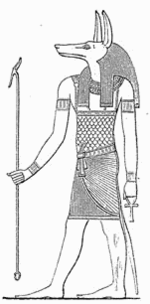
anubis
Isis, when the news reached her, at once put on a garment of mourning and wandered everywhere at her wits’ end; Isis, learning that Osiris in his love had consorted with her sister Nephthys through innocence, in the belief that she was Isis, sought to find this child; Dogs led Isis to it, it was brought up and became her guardian and attendant, receiving the name of Anubis, said to protect the gods just as dogs protect men.
Later Isis learned that the chest had been cast up by the sea near the land of Byblus in the midst of a clump of heather which in a short time ran up into a very beautiful and massive stock, which enfolded and embraced concealed the within its trunk. The king of the country admired the great size of the plant, cut off the portion that enfolded the chest and used it as a pillar to support the roof of his house. Isis ascertained this by the divine intuation, and came to Byblus fragrant with ambrosia. Isis was sent for the queen and became so intimate with the queen that the queen made her the nurse of her baby. They say that the king’s name was Malcander; the queen’s name some say was Astartê (Isis is the Egyptian name for Astarte, the major Phoenician goddess equivalent of the Sumerian goddess Ishtar) The Greeks would call Astartê later Athenaïs.
They relate that Isis nursed the child by giving it her finger to suck instead of her breast, and in the night she would burn away the mortal portions of its body. When the queen saw her child on fire, gave forth a loud cry and thus deprived it of immortality. Then the goddess disclosed herself tothe queen and asked for the pillar. She removed it with the greatest ease and cut away the wood of the heather wrapped it up in a linen cloth and had poured perfume upon it and entrusted it to the care of the kings; and even to this day the people of Byblus venerate this wood which is preserved in the shrine of Isis. Then the goddess placed the coffin on board a boat and put out from land.
In the first place where she found seclusion, when she was quite by herself, they relate that she opened the chest and laid her face upon the face within and caressed it and wept.
isis-and-nursing-horus the child (black maddonna)
Isis proceeded to her son Horus (the Elder), who was being reared in Buto, and bestowed the chest in a place well out of the way; but Typhon, who was hunting by night in the light of the moon, happened upon it. Recognizing the body he divided it into fourteen parts and scattered them, each in a different place. Isis learned of this and sought for them again, sailing through the swamps in a boat of papyrus. The traditional result of Osiris’s dismemberment is that there are many so‑called tombs of Osiris in Egypt; for Isis held a funeral for each one of the 13 parts when she had found it. Of the parts of Osiris’s body the only one which Isis did not find was the male member, for the reason that this had been at once tossed into the river, and the lepidotus, the sea-bream, and the pike had fed upon it; and it is from these very fishes the Egyptians are most scrupulous in abstaining. But Isis made a replica of the member to take its place, and consecrated the phallus, in honor of which the Egyptians even at the present day celebrate a festival. Osiris consorted with Isis after his death, and she became the mother of Harpocrates (Horus the Younger), untimely born and weak in his lower limbs.
Later, as they relate, Osiris now god of the underworld came to Horus from the other world and exercised and trained him for the battle. After a time Osiris asked Horus what he held to be the most noble of all things. When Horus replied, “To avenge one’s father and mother for evil done to them,” Osiris then asked him what animal he considered the most useful for them who go forth to battle; and Horus said, “A horse,” because it served best for cutting off the flight of an enemy and annihilating him.
Now the battle, as they relate, lasted many days and Horus prevailed. Isis, however, to whom Typhon was delivered in chains, did not cause him to be put to death, but released him and let him go. Horus could not endure this and laid hands upon his mother and wrested the royal diadem from her head (some say cut off er head); but Hermes put upon her a head of a cow.
Horus was declared as legitimate child and Typhon was finally overcome in two more battles.
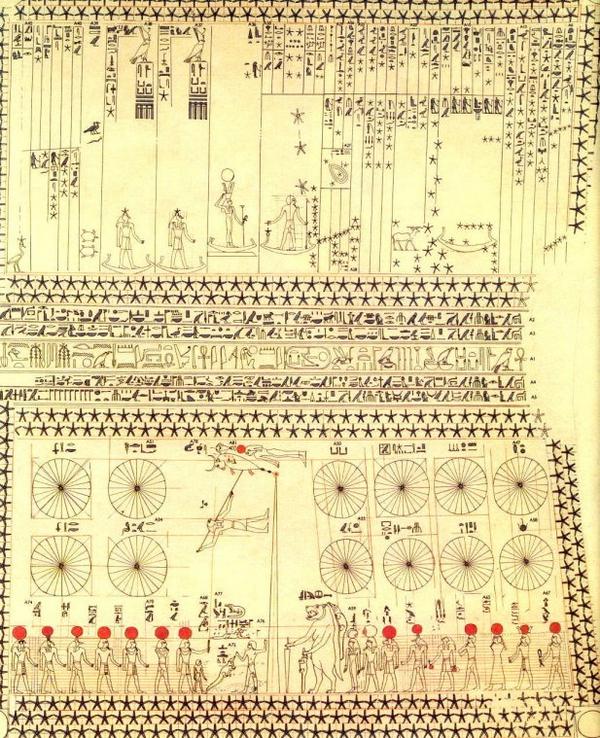
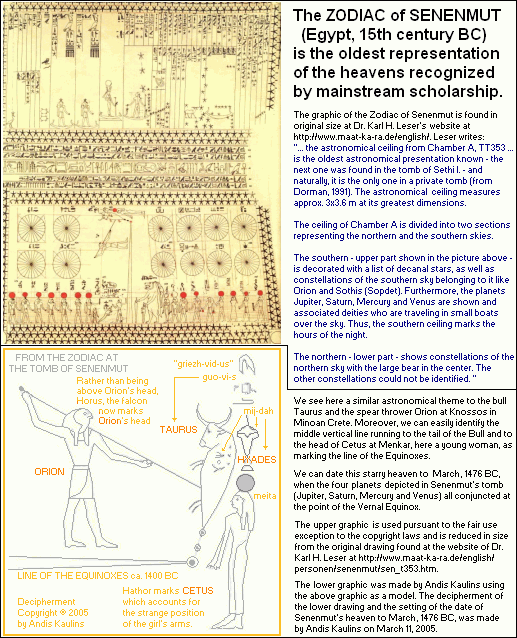
The transition can be wonderfully seen in the tomb of Senemut, chief architect . astronomer, and former lover and favorite of lover of Pharaoh Hatsheput.
His tomb ceiling contains a presentation of the northern constellations with celestial objects, Osiris as Orion, Isis as Sirius, Horus as Jupiter, Horus again as Saturn. A bird on the left represents Osiris as a phoenix linked with planet Venus as a morning star. Another figure of Horus spears an ox representing Set-Apep as the constellation Ursa Major.
senemut night sky
As we learned that the solar (astronomical) year was divided in twelve times thirty days and set in five to six days as a holiday. We understand the synchronization of the sun year and the moon loops in the symbolism as a whole.
The origins of the constellations in the Senenmut calendar are perhaps from about 2700 BC. It is depending on which star is the exact used in the constellation of either Ox or Scorpio.
The black headgears in the rows are originally dark red and are surely moons. The fifth from right have a star symbol in the name and a dog-head. Compared to the Sumerian Dog it maybe was to be synchronized with Sirius.
The asterisks Scorpio and Ox are fix stars of equinoxes and then they originate from ca 3100 BC. We see also twelve wheels as a calendar contending months. The thirteen moons are below and the changing of years is in the middle. The ongoing year is a hippopotamus with a crocodile on its back and the new little crocodile in hand. We see Horus the time or sun using a Stele pointing at the Taurus and the opposite Scorpio with a moon symbol.
Some glyphs are special signs or icons in use with calendar or when writing about time. In the upper row fourth from right the symbol reads KA KA and in beginning of the third is a square with an eagle. In the second row the first wheel from right has a Hathor-cow icon with a year glyph.
In the suite behind Taweret is Isis the leading one as she has been in Egypt for thousands of years before this drawing.
Appendix:
Plutarch uses Greek names for most of the Egyptian gods and goddess (capital letters) so here is a short overview
Small Egyptian Tree
Sun (Helios) AMUN-RA
Ra (Re) was thought of as the “Sun God”, and was once the most important God of the Ancient Egyptians. Ra had been combined with Amon / Amun (the “hidden” aspect of the one God) as Amon-Ra/Re, and with Atum (the “potentiality” aspect of the one God) as Atum-Re/Ra. The Egyptians thought that Nut, the sky-goddess, swallowed Ra each evening, when he then travelled through the underworld only to reappear and be reborn again every morning. Personified in this way as the sun Ra represented life, rebirth, health and vitality. He is not to be confused with the henotheistic abstract God under Akhenaten, ATON or ATEN the new god of the sun, an incarnation of Re. It was a monotheistic attempt, a revolution lasting only on reign.
Rhea -NUT: the sky-goddess, wife/lover/sister of Geb, the earth-god; represented as a woman, her naked body curved to form the arch of heaven. There is a tradition that fromher five children, Osiris and Arueris were fathered from Helios, Isis from Hermes, and Typhon and Nephthys from Chronos.
Chronus – GEB: the earth-god; husband/brother of Nut; member of the ennead of Heliopolis; represented as a man. Geb and Nut angered the sun god Ra, their grandfather, because they were locked in a perpetual embrace. However, Nut was found to be pregnant and gave birth to Osiris, Horus the Elder, Set, Isis and Nephthys. According to the creation myth, Geb still longed for his sister. He wept when he was separated from her, and so created the oceans of the world.
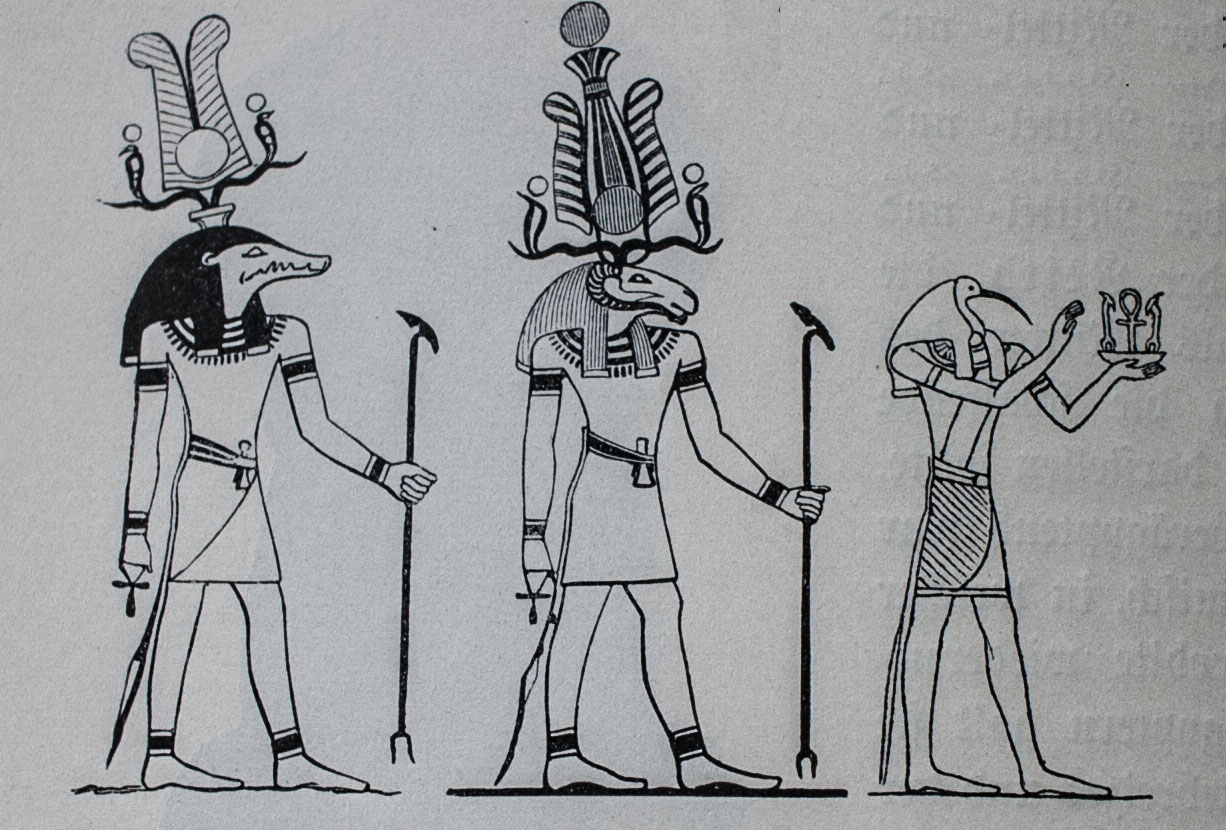
Thoth Ra
Hermes – THOTH
Thoth (also Djehuty or Tehuty) is the archetypal Lord of Wisdom and of learning, writing, speaking, medicine, pictures and symbols. He protects all writers, teachers and scribes and was considered to be the tongue or heart of Ra. He is often shown with the head of the sacred Ibis bird, and sometimes is pictured as a baboon. Thoth is also a master magician and alchemist, and hence sometimes is shown with a lunar disc (symbolising magic) over his head.
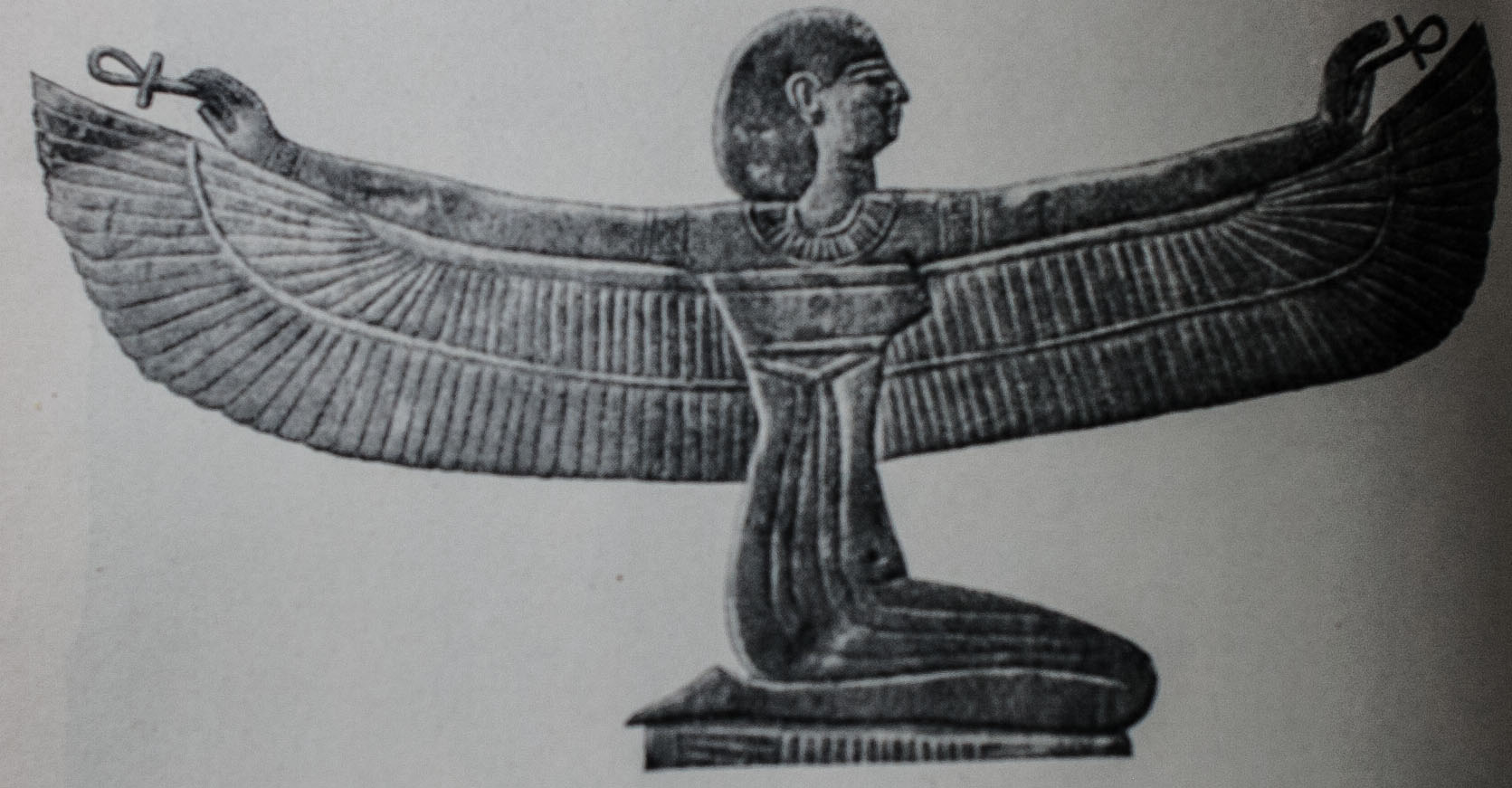
MAAT
The Goddess Maat can be described as being the Animus of Thoth – Thoth having a wife called Seshat. Maat personifies the concepts of truth, justice, balance, order and Ma’at (the Divine laws) which prevent a return to chaos. To the Egyptian people Maat ruled good behaviour, morality and spiritual ideals. Her symbol is the black and white ostrich feather, which symbolizes duality.
1) OSIRIS
Osiris was husband and brother of Isis, and brother to Nepthys, Set and Horus. He has been called later Lord of the Afterworld and Father of Kings. Because of his legend, which was to do with death and resurrection, he became associated with the cycle of life and death, and with the annual inundation of the Nile. He represents the wise spiritual father, encouraging us on the path of order and self-discipline. Osiris was regarded as the son or earthly representative of Ra (God) just as Jesus was regarded son of Godfather.
2) ISIS
Isis (Eset, Aset) is the wife of Osiris, mother of Horus the Younger and Bast and sister of Nepthys and Set. Her name means “seat” or throne, and this is often pictured symbolically as a crown upon her head. Isis stands for love, magic, medicine and fierce feminine energy. Sothis (Sirius) was identified with Isis in many Egyptian texts Plutarch states that “The soul of Isis” is called Dog by the Greeks. There is also no coincidence that Isis is the Egyptian name for Astarte the major Phoenician goddess, equivalent of the Sumerian goddess Ishtar related to Venus.
During the first century A.D., Alexandria, Egypt was a veritable hotbed of mystical activity, a crucible in which, according to Holy Blood, Holy Grail, “Judaic, Mithraic, Zoroastrian, Pythagorean, Hermetic, and neo-Platonic doctrines in an amalgamation or syncretism. Although they worshiped a Black Madonna as the Holy Virgin, she has an altogether different connotation to Gnostic than it does to Christians. Legend connects this Black Madonna with both Isis and Magdalene.
3) Typhon – SET
Set is the brother of Isis, Osiris, Horus the elder and Nepthys and wife of Nepthys and father of Anubis and uncle to Horus the younger. He is the equivalent of the archetypal “prince of darkness” in the Egyptian belief system, although he was intensly worshiped exactly for this.
4) Arueris – HORUS the Elder
Horus the Elder (Heru) was the son of Nut and Atum.
Harpocrates – Horus the Child (Hor or Har) was a sky and solar god, son of Osiris and Isis, presumable pre-natal. He is known as the God of Joy and of Light, and his symbol is the hawk – master of the skies and protector of kings. Many people confuse him with his grandfather Horus the Elder.
5) Aphrodite – NEPTHYS
Nepthys was the sister of Isis, Set, Osiris and mother to Anubis and wife to Set. Nepthys wears the horns and solar disc, or may be shown with the vulture headdress. She is the guardian of all things hidden or concealed or not yet come into form; of dream and represents psychic receptivity. She is the other side of Isis – Isis representing light and generation, Nepthys representing dark and dissolution. Nepthys represents that which is invisible and the darkness, whilst Isis represents that which is visible and the light.
ANUBIS:
Son of Nepthys and Set (or possibly Osiris) and nephew to Isis. Anubis (also called Anpu, Inpu, or Imeut) is not to be mistaken with Wepwawet. Anubis is the jackal (wolf or dog) – headed God of the Underworld and of Embalming. He is the protector of the dead and overseer of the mummification process. Anubis sits on the boundaries of the living and of the dead.
Ancient Memphis
Pyramids of Giza
Pyramids of Sakkara
Pyramids of Dahshour
Pyramids of Abu sir
Pyamids of Mydoum
Pyramids of eleisht.html
Pyramids of Hawara.html
Pyamrids of Abu Rawash
Pyramids of EL Lahaoun
Pyramids of Hawara
Pyramid of Mazghuna
The Egyptian Museum
The Coptic Museum
The Castle of Saladin
The Old Market “Khan El-Khalili”
The Hanging Church
Santa BarbaraOld Islamic Cairo:
Sultan Hassan Mosque
Refai Mosque
Luxor
Luxor Temple
Karnak Temple
The Colossi Of Memnon
Valley Of The Kings
Temple of queen Hatshepsut
Temple Of Medinat Hapu of Ramses III
Valley Of The Queens
Valley Of The Nobles
Temple Of Dendera
temple of Esna
Temple Of AbydosCourt of Ramses II, which includes a shrine to Thutmose III
Mosque of Sufi Shaykh Yusuf Abu al-Hajjaj
Chapel of Alexander the Great
Alexandria
The Castle of Qaitbay
The Pompeii Pillar
The Catacombs of Kom El-Shouqafa
The Amphitheatre of Kom El-Dikka
The Montazah Palace Gardens
Sinai
The city of Sharm El-sheik
The city of Dahab
The City of Nuweiba
The City of Taba
Red Sea Coast
Monastery of St. Paul
Mostry of St. Anthony
Hurghada
Safaga,
Marsa Alam
Aswan
Temple at Philae, island ancients island surrounded with a dam and inside dry. The main temple is dedicated to Isis and was the center of the cult of Isis and Hathor from 370 BC. The temple was finally closed by the Emperor Justinian in 535AD.
Centre of the Nile Valley (Minya, Asyut and Sohag)
Beni Hassan in Minya
Monasteries of Asyut
Temple of Abydos in Sohag
Akhenaten’s city of Akhetaten at El- Amarna ( near Minya)
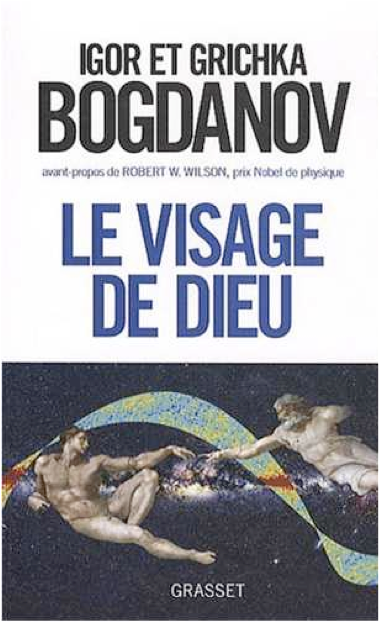
The history of time reflects culture – interconnecting temporal powers, religion and science. For millenniums priest were gatekeeper of time and calendar(s). Now scientists have taken over. Today we are able to contemplate beyond the creation of time, even beyond the big bang. I got the idea to this essay after I read a book, titled… you guessed it… “The Face of God” (Le Visage de Dieu) while I struggled writing a long article “The history of time” from a historical and religious view. After I read the book, I decided to break my monster article in pieces and introduce them with this essay. So this is the first of a series “History of Time” which explores concepts of time and calendars over the last 5000 years.
Most people today avoid the sacred dimension of time as a subject. They may fear past and future – and mortality. Perhaps they have never really thought through meaning of time. Einstein’s outspokenness on his religious attitude was rare. Today religion (and science) are attacked both by post-modern philosophers, “social scientists” claiming all truths are relative and by creationists claiming everything was created just by chance. Under these circumstances, there are good reasons why most scientists avoid all possibility of confusion with religion by never using terms suggestive of divinity. But the loss is that there is no way to understand: we are actually answering questions today whose had been asked by priests and philosophers before. What human action could be more sacred than that?
As we will there is a language of the sacred dimension of time and my essays (touching all major cultures) will follow a certain structure.
The sacred language of time
The worldly language of time
The history of time – Measurement and Calendars
The article gives the upcoming structure as interplay of science, anthropology and religion. Many thinkers nowadays see theistic arguments as just a quick, lazy, irrational short-cut, though of course this is not necessarily the case; there are many smart, thoughtful, careful thinkers who believe in God – not necessarily in religious institutions.
The face of God – cosmology meets meta-physics
We live in political depressing feudal new world order, however, physics today quite successfully attempts to answer metaphysical questions:
What shape has our universe and where are its borders?
Why is it so exactly fine tuned, like defined by an meta-order?
When and how was time and the world was created?
When and how will be destroyed or is it fluctuating?
What was before creation of time?
Cosmology became an empirical and exact science, and it has to be noted that some of its answers proof Church fathers as Augustine right.
The frontiers of contemporary time
Face of God. This is the furthest thing we can see.
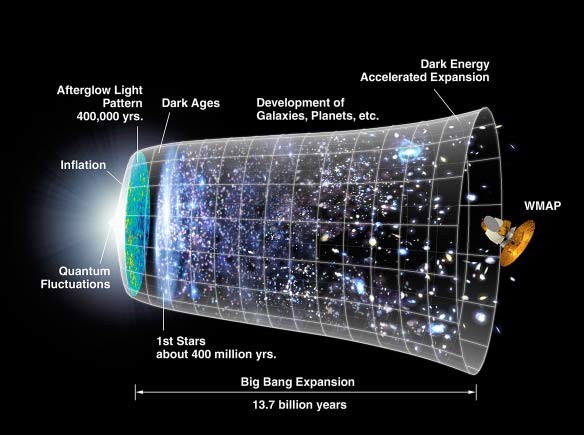
Three scientists in 1948 suggested in the famous alpha-beta-gamma report (according to their initials) that billion years ago, the cosmic background radiation of the big bang spreading itself thin must have become low-energy microwaves far colder than ice, later identified at 2.73 degrees above absolute zero as smooth cosmic background radiation. Our universe, however is awfully lumpy, broken up into people, planets, stars, galaxies, clusters of galaxies, and giant walls of superclusters surrounding giant voids. People had been probing the cosmic background radiation for 30 years, but no one had detected any deviation from absolute smoothness until 1992 variations in temperature measured in millionths of a degree were detected. These minuscule differences show the ripples in spacetime, where matter first began to clump gravitationally about 10,000 years after the Big Bang. Radiation from regions of higher density expended more energy trying to escape a deeper gravitational well and therefore appeared slightly cooler than average were chartered in oval shaped eggs in shades of pink and blue decorate Smoot’s office, depicting the pattern of temperature fluctuations across the heavens. As bright and gay as enormous Easter eggs.
Time before time was created
We now can see back up to 380 000 years before the big bang which occurred 13.7 Billion years ago. We enter know metaphysics area. The universe was created from blue print of fine tuned informational pattern (logos the word) and well understood particle physics.
John 1:1
en Archêi ên ho Logos – in the beginning was the word; kai ho Logos ên pros ton Theon – and the word came to god; kai Theos ên ho Logos – God himself was the word
It is a challenge to translate the greek word logos correctly in a single contemporary word. Logos isderived fromlego,“say or speak” whose rootleg means “plan, collect“. Forthe Greeksspeaking was “give from an array ofwords” or the “combining the thoughts.”
We conclude today the universe(space) and time has been created 10-43 seconds after time 0 in a flash of light out of singularity but not ex-nihilo, like written in the Genesis. But where has been god – inside or outside of the universe? An what was he and what was before time?
Physics talks about the KMS-state in the whole universe and contemplates time was defined mathematically complex, oscillating between its real and imaginary component. Remember a complex number is a number that can be expressed in the form a + bi, where a and b are real numbers and i is the imaginary unit, which satisfies the equation i2 = −1.
So there there are three forms of time in cosmology:
Time connected with energy – our real physical time – mathematically an instance of an abstract object or with C.G. Jung an Archetype;
Time connect with information (imaginary energy) instead with real energy – frozen imaginary time – mathematically an abstract object or with C.G. Jung an archetype per-se;
The imaginary time is part of the complex time before the big bang and out of our physical scope – true meta-physical ;
Es werde Licht thus transforms logos i.e. information (imaginary energy) to real energy and imaginary time to real time – from divine patterns.
Divine patterns and theism
Theist as Richard Swinburne and Philip L. Quinn that the specific content of the scientifically most fundamental laws of nature, including the constants they contain, requires supra-scientific explanation or a reconciliation between science and religion. The old-fashioned point of view tend to disbelieve in any religious component to the workings of the universe. Materialism asserts that a complete description of nature consists of an understanding of the structures of which it is comprised together with the patterns which those structures follow, while theism insists on the need for a conscious God who somehow rises above those patterns. Materialist have put their hope to mechanical, evolutionary an biological models stayed shy of the big bang. Within this cosmology, there are two possible roads to reconciliation between science and religion. One is to claim that science and religion are not incompatible because they speak to completely distinct sets of questions, and hence never come into conflict. The other is to assert that thinking scientifically does not lead to rejection of theism, but in fact that religious questions can answered in a similar way than cosmology does.
The essence of materialism is to model the world as a formal system, which is both unambiguous and complete as a description of reality. A materialist model may be said to consist of four elements. First, we model the world as some formal (mathematical) structure. Second, this structure exhibits patterns (the ”laws of nature”). Third, we need boundary conditions which specify the specific realization of the pattern. Finally, we need a way to relate this formal system to the world we see: an ”interpretation.”
The reader might worry that we are glossing over very subtle and important issues in the philosophy of science; they would be correct, but needn’t worry. Philosophy of science becomes difficult when we attempt to describe the relationship of the formalism to the world (the interpretation), as well as how we invent and choose between theories. But the idea that we are trying, in principle, to model the world as a formal system is fairly uncontroversial.
The materialist thesis (before the big bang) was simply: that’s all there is to the world. With Freud it was you eat, copulate and died. Defining theism is more difficult and its subtlety has therefore been transferred to the task of defining ”God.” When I say that God I also have in mind the pantheistic god. In my view, neither cosmology nor theism is logically impossible, but a pure materialism alien to “home religious” as defined by C. G.Jung. This is most evident if we look at the history of time.
The sacred language of time
What is time
Two opposite concepts of time need to be introduced – the understanding of linear time (time has a beginning and and end – predominately in Western civilizations) contrary to revolving and cyclist time (predominately in Eastern civilizations). With linear calendars the question arises when time starts. Cultures differ have different ways of putting value at, organizing and using time.
When did the universe begin?
Time was either seen infinite beyond creation or a property of our world – i.e. created together with the world. Ancient myth, religions, humanistic philosophers like Kant and now contemporary science in particular cosmology, a fast growing discipline of astrophysics, converge at the latter thesis – at the language of sacred dimension of time.
How did the universe begin (Creation myth)?
Creation
Creation myths define how the Earth itself was created, along with the universe, heavens, hell, people, and creatures that exist today. Genesis of Christian mythology, for instance, tells the story of how the single deity God spoke and formed everything. The Genesis and the Book of the Dead of Egypt share the similar ideas of life and afterlife. Others, like the Japanese and Iroquois creation myths, claim the Earth was once covered entirely of water before land was formed. Through studies such as comparative mythology, researchers and philosophers have discovered hundreds of parallels between the myths that make up every culture, including their creation myths. As most are deeply rooted in religion, comparisons based on geographic area, themes, and similar story lines emerge as religions are born and merge. C.G. Jung recognized these similarities and states, It is possible to correlate creation myths of Zen-Buddhism and Christianity, Hinduism and Islam, Confucianism and Hinduism, and polytheistic Greek and Roman state religions. They compare the messianic religions: Christianity, Islam and Judaism; the enlightenment religions, including Buddhism, Hinduism, Sikhism, and Jainism; and the pantheistic religions, encompassing a large group of with Taoism, Confucianism, and Shinto. In all of them exists the basic idea of chaos before creation, and god(s) to form space and time and as such life. Another common element in some myths is a tree of life that connect connects the different realms of the universe together, often referred to as a axis mundi or cosmic channel.
One of the most notable comparisons exists between the Genesis of the Christian religion and the Enuma Elish of Babylonian descent a culture with an highly developed astronomy. Yaw-he or Marduk, are in both myths divine spirits that coexist independent with cosmic matter and are independent of it. In each, the universe is enveloped in darkness. Then light emanates from the gods of both creation myths.They create a firmament – just like today in modern cosmology. The creation myth formed by the Egyptians and that formed by the Chinese also share common aspects. The most popular Egyptian creation myth centers around life stemming from an cosmic egg. Different sources refer also to the solar disk in Egyptian, Nordic, Germanic, Greek & Vedic tradition,
As C.G. Jung noted, Archetypes an Symbols have been an integral element of the lives of all people through either non-spiritual or spiritual means. From what we consider the beginning of humanity to today, myths have been used to educate people why everything happens or how everything came into being. The comparison of myths has emerged as popular archetypes in C.G. Jungs writing. The creation myths, in particular, provide examples of borrowed symbols and common beliefs which persist throughout history. With these parallels, humanity can better understand earlier cultures and document how mythologies interrelate over time.
Natural and supernatural powers
Light and Darkness were first taken as granted like anything in nature. Duration created time and with it the observation of the stunning regularity of sun, moon and stars, which lead to the concept of future and past. Our understanding of time shapes our understanding of god, of creation and of the universe. Of course the opposite also is true.
Temporal powers
With time the primordial sin came to the world and who gained knowledge of time became priest, emperor and gods. In ancient times, the archetype of the magician or priest, the loving god, the king and the warrior typically were combined in the god-emperor. As we will see also temporal rulers (kings, pharaohs, popes or revolutionaries) always had control over worldly calenders and the priest over sacred (and secret) calendars.
Future and Past
With calendars, priest and rulers could not only organize the past, but also plan (and claim to predict) the future. It became possible to calculate the time between two events, to know sacred days or just to “measure in advance”, when the flooding of the Nile or the tax payment is due. That has been diverse and indispensable role from the early agricultural societies, trade industrialization up to the today’s complex global world.
What is after human life ends?
Human limited time, i.e. the painful knowledge of mortality led to the question of what might be after life, which was answered by religions with supernaturals (gods and spirits) as masters of time and for mortals paradise, hell, rebirth or nirvana or ancestor spirits.
How will the universe end
Christian belief tells us,that we lost immortality by eating the fruit of knowledge and that redemption of Jesus promises resurrection and living forever again.
The worldly (temporal) language of time
Time and Mankind
Sometimes during the last 2.5 million years, mankind became conscious of the I (Ego in an Jungian Sense). With this followed the consciousnesses of time, of “now and then”, of synchronicity and duration. This was the begin of subjective (individual) time and of course with the human memory came the past and flow of time.
Time and Language
The language transcended the limitation of the direct experience and opened the path to the future like a linear “time arrow”. With language came regularity, structure and abstraction. From “here and now” mankind went to the collective past (history) to individual and future (civilization).
Time and Culture
The modern time conception of Westerners is strong and they really cherish (their life-) time and ironically waste it with cheap distractions. In contemporary Europe, where more and more people have no children at all and to a high degree lost connection to any religion, time becomes predominantly subjective and abstract beyond their little life span. In a way Westerners became Rousseau’s innocent savages in there little consumer paradise (or hell).
So our concept of time also has to do what we think of our after-life.
Time and religion
Today we miss the wisdom of the spirituality. In Christianity there is chronos and kairos. Both are Greek words which mean time, but they imply different things. Chronos refers to minutes and seconds. It refers to time as a measurable resource. Kairos is the word used for time in Ephesians 5:16). kairos means an appointed time, an opportune moment, or a due season (like in Taoism the right moment to act).
Time and psychology
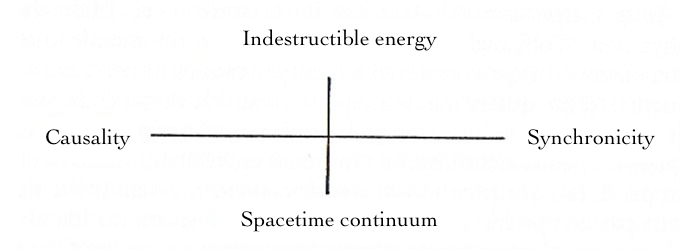
C.G. Jung had special understanding of time what he called “temporally coincident occurrences of acausal events” or “meaningful coincidence” and “acausal parallelism in which archetypes and the collective unconscious are governing a dynamic that underlies the whole of human experience and history — social, emotional, psychological, and spiritual.
Synchronicity does not admit causality in the analogy between terrestrial events and astrological constellations … What astrology can establish are the analogous events, but not that either series is the cause or the effect of the other. (For instance, the same constellation may at one time signify a catastrophe and at another time, in the same case, a cold in the head.) … In any case, astrology occupies a unique and special position among the intuitive methods… I have observed many cases where a well-defined psychological phase, or an analogous event, was accompanied by a transit (particularly when Saturn and Uranus were affected). – Carl G. Jung
Jung and the quantum physicist Pauli believed, events like this occur too often enough to be only meaningless coincidence. Jung noted taking as usual phenomenological stance, while it would be “absurd” to consider the conjunction of dream material and life events to be causal, “it is wise to consider the fact that [these coincidences] do happen…The East…considers coincidences as the reliable basis of the world rather than causality. Synchronism is the prejudice of the East; causality is the modern prejudice of the West.”
Oh yes, there was a fall, a great big one. The ancients, our forefathers and mothers, knew right away that something horrible had happened. This was the big bang, the creation of time, and the second mankind understanding of is. Thus Adam and Eve myth became like God. Nietzsche, who understood all this, said Christianity closed the door to mass nihilism and decay. To be healed by the words Good and Evil. Christ was the greatest poet who ever lived. He was murdered because he understood all this. Christ understood this and said so; the kingdom is here within us. This is the meaning of religion as o fpsychology is man’s attempt to free himself from linear time.
Time and Society
Even hunters and gathers (at least in a harsh climate) needed to be aware of time. The resulting calendars have been an integral part of different cultures. But even more farmers and traders. Warrior societies need less accurate time than farmers. The first Roman calendar became a mess before fixed by Julius Caesar (with a little help of the Egypt solar calendar). The great French philosopher Voltaire once quipped in hindsight: “The Romans emperors won all the battles but they did not know when”.
Time and economy
Since the beginning of mankind time comes from observation of nature. In any culture, however, the task of the calendar was not only limited to the counting of days. Each date should be assigned to the repeating pattern in nature. Without the ability to plan the time by days, weeks, months and years, agriculture, civil administration and a differentiated role based economies would have been impossible . Even today there are still new applications – especially with the financial and interest experts with perverse micro-trading.
Time and Mathematics
The Athenian law courts – according to Plato’s Apology – had water-clocks: if you couldn’t prove your case before the water-clock stopped dripping, you couldn’t prove your case. History, of course, has time-hooks. It can be said, however that the world of mathematics exists in an eternal present, a state in which neither the past nor the future have any meaning. Thus, because mathematics has no interest in the time dimension, there is also in mathematics no meaning to the question of reason. The area which mathematics does address is the clarification of relationships between various objects: how they connect with each other. This world, although dealing with relationships between stable and changing things, is entirely fundamental with the major dimensions of time – duration (present) and regularity of reoccurring events (past and future).
Time and Astronomy
Ever since man first noticed the regularity in the movement of the Sun and the stars, astronomers have wondered about duration and measured time by the Sun, the Moon and the Stars. As the sun moves across the sky, shadows change in direction and length. Calendar algorithms used natures repeating events the sun, month, moon phases and other astronomical information.They were commonplace, long before watches. Calendar algorithms also allowed the inclusion of sacred (or cursed days) and the number of days, although the week had nothing to do with the movement of the stars.
Time and Nature
The earliest natural events to be recognized were in the heavens, but during the course of the year there were many other events that indicated significant changes in the environment. Seasonal winds and rains, the flooding of rivers, the flowering of trees and plants, and the breeding cycles or migration of animals and birds, all led to natural divisions of the year, and further observation and local customs led to the recognition of the seasons.
Time and Science
What “cosmological results” suggest to some “divine inference”? Simply put: the anthropic principle, or more precisely, the fine tuning of the physical laws. In a nutshell – the fact that many/most of the fundamental properties of the universe, from the charge of the electron to the speed of light, and the total content and rate of expansion of the universe have values that could not have been even slightly different if life, intelligence, and consciousness, like humans and other such creatures, were to exist. Needless to say, many have concluded that something must behind such “fine tuning” like “cosmic code” or divine DNA.
Creation
I want to come back to the creation myths. In 1992 when astronomer George Smoot, the father of the COBE (Cosmic Background Explorer) satellite announced the discovery of patterns in the heat background radiation still arriving from the Big Bang, he said it was “like seeing the face of God.” He took a lot of secular sneering for this remark from colleagues.
The quantum theory was spiritually unacceptable to Einstein as its ultimate nature of reality was randomness. “The [quantum] theory yields much,” he wrote to quantum physicist Max Born in 1926, “but it hardly brings us close to the secrets of the Ancient One. In any case, I am convinced that God does not play dice.” And he was right, today we now that the creation of our universe follows regular pattern and some physical constants must have a certain value – or we would not exists. Independent formulated theories by Alan Guth (MIT) and before by Russian physicist Andrei Linde, holds that the universe began in the expanding fireball of the big bang and then inflated.Quantum fluctuations-hot, spots-arose.The discovery of the microwave whisper, by Arno Penzias and Robert Wilson of AT&T’s Bell Labs in 1964, just about proved that the universe began in a big bang. Hawkins today agrees with church father Augustine the time and space, the world was created together with time in a flash of light. Trouble was, the microwave sea seemed 1964 incredibly smooth. If energy and matter are spread across the heavens so evenly, how could particles ever have clumped together into galaxies? COBE saw almost undetectable temperature fluctuations.
1992 astrophysicist George Smoot of the Lawrence Berkeley Laboratory announced that they had discovered those primordial wrinkles, floating at the very beginning of time. Wispy tendrils, up to 59 billion trillion miles across, are the most gigantic and the most ancient structures ever seen.
Sacred dimensions
Creation myths, from Egypt to the Old Testament’s six days of genesis created the archetypes of time, a flash of light from a singularity of cosmos inflating so wildly that, faster than an eye blink, a blob smaller than a proton grew as big as today’s entire visible universe. This infant created ripples of energy in the fabric of its space. The ripples stretching as the universe expanded and created the sparkling patterns energy and matter which clustered to stars and galaxies of our night sky. The astounding message is that creation myths might be right. Smoot said: “human beings have the audacity to conceive a theory of creation.” Really? The priests of ancient cultures may just have gotten their spirituality right. In the Beginning…
There is the story of the Rabbi who dutifully and concerned asked Einstein in which kind of God, then, did Einstein believe in? “I believe in Spinoza’s God who reveals himself in the harmony of all that exists, but not in a God who concerns himself with the fate and actions of human beings.” The was Einstein’s faith, which at least not entirely anti-spiritual.
A somewhat more modest astrophysicist, whose theory had correctly predicted the discovery of the “divine structures”, Joel Primack was quoted as calling those ripples 380 000 years after the Big Bang, “the handwriting of God.” Are these references to the creator sacrilegious or legitimate interpretations? Either way, they are part of a search that began with the first high cultures in Mesopotamia — the search for language to communicate the sacred dimension of time.
The history of time – Measurement and Calendars
This will be covered in a series of essays covering all major civilizations and will follow the same structure.
The sacred dimensions of their understanding time
The worldly usage of their understanding time
The manifestations in time measurement and calendars
Conclusion
Aft all what I understood, we can interpret space and time as a sort of secret encoded message that science has begun to encipher long after spiritual systems and human intuition (be it by definition of Immanuel Kant or C.G. Jung had the ability to acquire this knowledge without inference of reason or experiment. C.G. Jung’s introverted intuitive types were likely mystics, prophets, or seers struggling between protecting their visions and making their ideas comprehensible but reasonably persuasive—a necessity for their visions (or religions) to foster.
“The exact Science in Antiquity” O. Neugebauer, Dover Edition 1989
“Le visage de Dieu“, 2010 Igor and Grichka Bogdanov
“Symbole der Wandlung” C.G. Jung GW , 1952 Rascher Zürich
“Universalgeschichte der Zeit” Hans Lenz, 2005 Marix Verlag.
“Cosmos An illustrated History of Astronomy and Cosmology”. John North 2008
Appendix review of “Le visage de Dieu”
The book is just that good, what can I say. From the scientific point of view, it stays loyal to the physics and everything as we now understand it, within its usual debates. The rest is just philosophical and metaphysical discussion and interpretation on meaning and direction in the Universe and Everything. They take a step, after reaching the limits of what science can explain, and try to fit it all in a spiritual vision of creation. Faith is a very popular topic of discussion in many cultures including the French, and this book expresses itself and its opinion very elegantly, while on the subject of scientific creation itself I might add, and delivering it all in a language any man can understand.
They authors claim (correctly, just very much like C.G. Jung) that at the limits of where science can study, observe and verify, metaphysics can take over, continue the story, and they do it masterfully. What they interpret as divine inference any scientist can take as just another law/equation yet to be explain. The book has been given unprecedented exposure in the French media, especially considering its overt spiritual tone. Indeed, the Bogdanov twins state clearly that they believe that the Creator conclusion is inescapable from the results of modern Cosmology. They themselves are not particularly religious, in the sense that they do not relate to any specific affiliation, but clearly are convinced of on the divine inference. What “cosmological results” are they basing themselves on to make that “divine inference”? Simply put: the anthropic principle, or more precisely, the fine tuning of the physical laws. In a nutshell – the fact that many/most of the fundamental properties of the universe, from the charge of the electron to the speed of light, and the total content and rate of expansion of the universe have values that could not have been even slightly different if life, intelligence, and consciousness, like humans and other such creatures, were to exist. Needless to say, many have concluded that something must behind such “fine tuning” like “cosmic code” or divine DNA. Three famous scientists have endorsed the book by writing a preface and two post-faces: Robert Wilson, who (with Arno Penzias) discovered the microwave cosmological background in the 60’s and received the Nobel Prize in 1978; John Mather, who (with George Smoot) in 2006 received the Nobel Prize for the variations they found in the microwave cosmological background, which Smoot likened to “seeing the face of God”; Jim Peebles, a renowned cosmologist who has received half a dozen medals, awards, and honors (though not the Nobel Prize).
Interesting enough, this book has infuriated atheist and anti-christian hate reviews. Usually a good sign , the so called “intelligentsia”, especially in Europe, do not like the divine inference. The answer to why is far from trivial, but it has to do with sociology-historical reasons as much as political reasons or just spiritual deafness.
The Article Lupus and Astronomy is an extension of the last post: the archetype of the wolf. I am a hobby astronomer and fond of its older sister Astrology. So lets look to the Wolf from that perspective. The wolf is inherently pagan and shamanic, that means American Indian, Chinese, Egyptians, Babylonians should have big stakes in in its Astronomy representation. There is a Constellation – Lupus (the Wolf) in the southern hemisphere, originally listed as a constellation by the Greek astronomer Ptolemy in the 2nd century CE. Besides the fact, that Lupus was once the site of the brightest supernova SN 1006 (1006 A:D), there is little of archetypal concern.
But the Dog Star” Sirius matters as Noah Brosch said in his book. Sirius is the brightest star in the night sky and can’t be missed in a city, nevermind in a desert. Mostly called the “Dog Star”, in China the “Blue Beast (wolf)” Sirius represents the Heavenly Wolf and in Greece and Roman culture it was associated not only with the dog, but also with wolf and jackal.
Lupus and Astronomy Facts
Sirius: The Embodiment of Isis
Sirius absolute brightness is 23 times as bright as our sun and the fifth nearest star to our solar system. Known to astronomers as Alpha Canis Major, it is the principal star of the constellation Canis Major (the Big Dog). The brightest of the nighttime stars, Sirius caught the eye of the early sky watcher and can even been seen in daylight with a telescope. Sirius is a binary star. Very long ago, Sirius could not even be seen in the sky from some places. This was because of a phenomenon known as the Precession of the Equinoxes. The Precession is a very slow wobble of our planet taking the polar axis of the Earth in a circular swing of 47 degrees every 26,000 years.
For the Egyptians, Sirius was, astronomically speaking, the foundation of their entire religious and temporal system. It was the embodiment of Isis, wife of the god Osiris, who appeared in the sky as Orion. Egyptians called Sirius the “Dog Star”, after their god Osiris, whose head in pictograms resembled that of a dog.The ancient Egyptians called it Septit, the Hebrews knew it as Avrek or Sihor, to the Greeks as Sothis and also as the “the Dog Star” that followed Orion the Hunter. On that latitude the “Star in the East” in our Gospel accounts, was on the meridian line.Egyptian
senenmut zodiac
The reason why the Egyptians and many other civilizations of that era used Sirius as their marker for the passage of time is because they picked the most stable object as their reference point. In Egypt, almost all the temples were aligned with this line, including the gaze of the Sphinx. Many of the temples had a tiny hole in the wall somewhere; then there would be another wall and another, going into some dim inner chamber. The tomb of Senenmut, chief architect, lover and astronomer during the reign of Queen Hatshepsut the only female pharaoh, featured lovely astronomical ceiling. On its walls are extracts from the Book of the Dead. Hatshepsut’s temple is ideally placed to view astronomical events towards the eastern horizon, particularly the Orion constellation and the star Sirius. The alignment of the temple is set on an azimuth of 116½° ±½°. On the Senenmut calendar it is surely the sext idol from right with dog-head and a star above his name. In this case it can be the Canis Major, the Sirius dog, opposite to the Sumerian dog Rahu.
The periodicity of the helical rising of Sirius was such that the Egyptians based their calendar on it. Every year for millennia the appearance of Sirius coincided with the flooding of the Nile, an event that remarkably still happens to this day. Etymologists have suggested a connection with the ancient Egyptian god Osiris, but none can match the “Star of Isis”. Since earliest times the ancient Egyptian paid particular attention to Sirius, which they identified to the ‘soul’ of the Goddess Isis. Historic and mythological descriptions of Sirius provides further insight into the nature of the relationship between the Sun and Sirius. A shaft leading from the Queens chamber of the Great Pyramid of Egypt has been aligned precisely with Sirius.
In his book Echoes of Ancient Skies, the archaeo-astronomer Dr. Ed Krupp writes that, “After disappearing from the night sky (for 70 days) Sirius eventually reappears in the dawn, before the sun come up. The first time this occurs each year is called the star’s heliacal rising, and on this day Sirius remains visible for only a short time before the sky gets too bright to see it. In ancient Egypt this annual reappearance of Sirius fell close to the summer solstice and coincided with the time of the Nile’s inundation. Isis, as Sirius, was the ‘Mistress of the Year’s beginning’, for the Egyptian new year was set by this event. New Year’s ceremony texts at Dendera say Isis coaxes out the Nile and causes it to swell.
The metaphor is astronomical, hydraulic, and sexual, and it parallels the function of Isis in the myth. Sirius revives the Nile just as Isis revives Osiris. Her time in hiding from Seth is when Sirius is gone (70 days) from the night sky.
She (Isis) gives birth to her son Horus, as Sirius gives birth to the new year, and in the texts Horus and the new year are equated. She is the vehicle for renewal of life and order. Shining for a moment, one morning in summer, she stimulates the Nile and starts the year.”
“The coming of Osiris – the savior of Egypt – was associated with the “Star in the East” because the Egyptians recognized that the rising of Sirius with the sun, or “heliacally,” occurred around the summer solstice, the time of the Nile flooding. L ife along the Nile was highly dependent upon the inundation associated with the heliacal rising of Sirius, a flood deified as Osiris, who was said to be “born” at that time.
In addition, Pyramid Text 593:1636b/M 206 states: “Horus the pointed has come forth from thee, in his name of ‘Horus who was in Sothis.’” “Horus in Sothis,” therefore, refers to when the sun rises with Sirius. Thus, in ancient texts we find the birth of Horus the sun associated with the star in the east.
As we can see, the annual emergence of both Sirius and Orion were closely noted, meaning that these celestial events were significantly in the minds of Egyptians for thousands of years. Moreover, the “rebirth of life” in Osiris – his resurrection on Earth – constitutes an annual event, in the Nile’s flooding.
Christian
There is more than one connection between the Egyptians and Christianity. “Osiris’s coming was announced by Three Wise Men: the three stars Mintaka, Anilam, and Alnitak in the belt of Orion, which point directly to Osiris’s star in the east, Sirius (Sothis), significator of his birth.” One must envision that the Virgo was rising in the East at the same time Sirus was visible in the east as well. But also Orion, called “The Three Kings” by oriental astronomers, was in proximity to these other two constellations. Virgo is called Spica; it is to be found in the “ear of corn” (sign of fertility) which the Virgin holds.
Much has been made of the Matthew gospel account of the “star in the east” followed by “wise men” from afar, claimed to have heralded the birth of the newborn savior of the world. And many ancient gods, kings and heroes were said to have been born under a ‘bright star’ or some other sort of celestial sign.
In the gospel story, Jesus’s birth is signaled by a bright star and a visit from wise men or magi, as they are termed in the New Testament, representing Persian astrologers following the star. Despite the stellar brilliance and obviousness, this tracking was apparently not a simple act, since these “wise men” are depicted as nevertheless illogically becoming hopelessly lost and must ask Christ’s enemy King Herod for assistance. (Mt 2:1-10) “It may be inferred from Mt 2 10 that in some way or other the wise men had for a time lost sight of the star. (Mt 2:10 states: “When they saw the star, they rejoiced exceedingly with great joy.”)
Although in the gospels these magi are not numbered, their gifts are counted as three. Hence, the familiar understanding is that Jesus’s birth was accompanied by a “star in the east” and “three wise men.” At a certain point the “three kings” were given names, Caspar, Melchior and Balthasar. Coincidentally, there happen to be three very conspicuous stars in the “belt” of the constellation of Orion that are also called the “Three Kings.” Moreover, as French philosopher Simone Weil (1909-1943), herself a Christian, remarked, “The Christians named the three stars of Orion the Magi,” revealing esoteric knowledge of Christian astrotheology, regardless of when it was first adopted. Within the constellation of Orion, “the Hunter,” are three bright stars said to make up his “belt.” Concerning these stars, in The Geography of the Heavens the astronomer Elijah Hinsdale Burritt remarks:
They are sometimes denominated the Three Kings, because they point out the Hyades and Pleiades on one side, and Sirius, or the Dog-star, on the other. In Job they are called the Bands of Orion…
The biblical Book of Job (38:32) also contains reference to the Mazzaroth, or “zodiac,” and demonstrates significant astronomical knowledge, an important fact in consideration of the contention that, centuries later, the Jewish priesthood rehashed the Egyptian astrotheology in its “midrashic” or fictitious account of Jesus Christ.
The three highly visible “king-stars” of the splendid constellation of Orion are named Mintaka, Aniltak and Anilam or Alnilam, the latter of which means “string of pearls,” while the former two signify “belt.” The statement in the Egyptian texts that Sothis “leads Orion” thus constitutes the motif of the bright star followed by these three “kings,” which have also been called the “three kings of the soothsayers,” a title that may indicate the antiquity of this royal appellation.
The bright star Sirius rose with the sun at the summer solstice, signaling the birth of Osiris as the Nile inundation and the birth of Horus as the daily solar orb. In winter, the Three Kings in the belt of Orion pointed to Sirius at night before the annual birth of the sun, which is also Horus.
The appearance of the three stars in a line with Sirius occurred in the night sky over Egypt thousands of years ago, pointing to the horizon as the new sun was born at the winter solstice. Thus, it could be asserted that the three kings trailing the bright star announced the birth of the savior at the winter solstice in Egypt, ages prior to the same event purportedly taking place in Judea.
Greek
There is much speculation on the origin of its modern name which is generally thought to be derived from the Greek word “Sirio” meaning sparkling. Around 150 AD, the Hellenistic astronomer Claudius Ptolemy described Sirius as reddish, along with five other stars, Betelgeuse, Antares, Aldebaran, Arcturus and Pollux, all of which are clearly of orange or red hue. The discrepancy was first noted by amateur astronomer Thomas Barker, squire of Lyndon Hall in Rutland, who prepared a paper and spoke at a meeting of the Royal Society in London in 1760. The existence of other stars changing in brightness gave credence to the idea that some may change in colour too; Sir John Herschel noted this in 1839, possibly influenced by witnessing Eta Carinae two years earlier. Thomas Jefferson Jackson See resurrected discussion on red Sirius with the publication of several papers in 1892, and a final summary in 1926. He cited not only Ptolemy but also the poet Aratus, the orator Cicero, and general Germanicus as colouring the star red, though acknowledging that none of the latter three authors were astronomers, the last two merely translating Aratus’ poem phenomena. Seneca, too, had described Sirius as being of a deeper red colour than Mars.
Mayan
2013 is upon us, and we survived all the dire predictions about how the world would end did not happen. Among their reasoning was a total misunderstanding of the sacred Mayan calendar. The Maya understood 17 different Calendars based on Venus, Mars, Sun and Moon and most prominently the Pleiades with the precession of the equinoxes, a cycle just short of 26,000 years. So even Sirius was not accurate enough for the “Keeper’s of Time”, the Mayans. With their remarkably advanced astronomy they quickly detected the inaccuracies in using Sirius as a marker for the passage of time, and switched to an even more accurate cycle involving the Pleiades.
The Mayan view of the afterlife consisted primarily of a dangerous voyage of the soul through the underworld, which was populated by sinister gods and represented by the jaguar, symbol of night. The majority of Maya, including the rulers, went to this underworld. Heaven was reserved for those who had been sacrificed or died in childbirth. Like in any ancient belief system, to the Maya, science and religion were one and the same. The Maya developed an impressive mathematical achievements included positional notation and the use of zero; and in astronomy, they accurately calculated a solar year, compiled precise tables of positions for the Moon and Venus, and were able to predict solar eclipses.
For the ancient Maya, the Pleiades represented the principle of life on Planet Earth, and this is why it formed their sacred calendar. Mayan religion and mathematics were intimately connected with the seven stars, or suns, of the Pleiades. I traveled Yucatan once, where Mayan temples are fascinating. The calendars that are most important to beings of earth are the Haab, the Tun-Uc and the Tzolk’in. The Tzolk’in is the most important and the one with the most influence.
The Haab is the Sun calendar. It has 360 + 5 days, totaling 365 days. The Haab uses 18 months with 20 days in each month. There is a 19th month called a Vayeb and uses the 5 extra unlucky days. Each month has it’s own name/glyph. Each day uses a sacred sun/glyph.
The Tun-Uc is the moon calendar. It uses 28 day cycles that mirrors the women’s moon cycle. This cycle of the moon is broken down into 4 smaller cycles, of 7 day each.
The Tzolk’in is the sacred calendar of the Maya and is based on the cycles of 260 days. The cycle of the Pleiades uses 26,000 years, but but encompassing 260 days might allign the Venus cycle. The Mayas knew the importance of the period of 2920 days equal 8 years by 365 days, in which the Venus repeats its movement in relation to the sun, same as the Babylonian did. The “Dreseden codex” in Germany contains tables for predicting solar and lunar eclipses and ephemerides from Venus and Mars for two rounds.
Two kinds of empiric sidereal intervals of Mars were used, a long one (702 days) that included a retrograde loop and a short one that did not. While Kepler solved the sidereal problem of Mars by proposing an elliptical heliocentric orbit, anonymous but equally ingenious Maya astronomers discovered a pair of time cycles that not only accurately described the planet’s motion, but also related it to other cosmic and terrestrial concerns.
Today we only choose the Sun as our reference point, and this is obviously highly inaccurate. Every 4 years a day has to be added to keep accurate time. There is however an even more stable reference point than the Pleiades and that is the Galactic center, which from the perspective of our galaxy is the ultimate center of rotation. And indeed the Mayan’s chose the Galactic Center as a reference point to mark the passage of time, which is evident as the Mayan Long Count ends with the galactic alignment of the Solar System on December 21st 2012.
Sufism
Even as late as the 1970s Sirius became the subject of a (now rejected) theory linked to the Dogon tribe of Mali to recent scientific knowledge of Sirius. The majority of Dogon practice an animist religion, with a significant minority of the Dogon practice (Sufi) Islam, another minority practice Christianity. Sufi historian Indries Shah traces the name of the Illuminati back to a verse in the Koran which mentions a shining star, and Umar Al Sufi a Persian astronomer mentioned it in the 10 century. That knowledge of the Mail tribe concerns Siriusas a binary system. Sirius A is the highly visible star, but there is a companion known as Sirius B. From Africa, where the Dogons live, the star Sirius disappears below the horizon and is out of sight for a couple of months; then it appears again on the morning of July 23, when it rises about one minute before the Sun. It appears bright ruby-red, just above the horizon, almost exactly due east. Sixty seconds later the Sun emerges. So you can see Sirius for just a moment, then it’s gone. This is called the helical rising of Sirius, which was a very important moment for most of the ancient world, not just for the Dogons and Egypt. This is the moment when Sirius and the Sun and the Earth are in a straight line across space.
Conclusion
Sirius has been found linked with every great religion of antiquity. Why? One reason might be was a much better timekeeper than the Sun. But as has been shown, the star Sirius has played a prominent role in astronomy, myth, religion, literature, and history always with an archetype of wolfish character.
Sources
Cosmos An illustrated history of astronomy and cosmology, John David North
The Fontana history of astronomy and cosmology, John David North (German Translation)
The Rise of Early Modern Science – Islam, China and the West, Huff, Toby E.
The Biographical Encyclopedia of Astronomers, Springer Reference. New York: Springer, 2007 (via web)
Starry Night Complete Space and Astronomy Park Deluxe Edition 6
It became clear during my research of Jungian Archetype of the wolf, that in mythology, religion, in legends and fairy tales the wolf has played an outstanding ambiguous, dualist and multidimensional role. The wolf archetype is so central, that how the wolf is viewed, indicates the mindset of the human, secular or spiritual organisations of the society we live in.
In a few weeks, there is Whitsun, and I will make one of my occasional trips to the monastery. Writing this article was a preparation to the theme and will be updated afterwards The rock monastery St. George is a development center of the Benedictine order in the Austrian Inn valley. From the monastery to the St. George mountain (Karwendel) on foot takes approximately one hour. The religious exercise will be lead by a Benedictine monk, who happens to have formal psychoanalytic credentials and introduced the theme “The archetype of the wolf” for what to my understanding is a spiritual hiking weekend.
st_georgenberg_stift_fiecht
But there is much more. Joland Jacobi, a close assicate of C.G. Jung mentiones the archetype of the wolf a few times in her book “Complex, Archetypes, Symbol in the Psychology of C.G. Jung”, Bollingen Series Princton University Press, 1957. Joland Jacobi writes, “being devoured or swallowed is also a widespread archetypal motif… the wolf that devours the kid”…. [page 155, 181,185]. C:G: Jung writes numerious times about Wotan, who was eaten at Ragnarok by the giant wolf Fenrir and then avenged by his son Vidar e.g. “Four Archetypes Mother, Rebirth, Spirit, Trickster”, Routledge and Paul, 1957. In the the same book, C-G. Jung writes about the wolves about the German fairytale, in which the wolf gives the hero a magic gift of his hairs (page 109) .
Historical encounter between man and wolf
You may refer my recent article “The Wolf as an Jungian Archetype Vessel” which argues that the wolf is one of the most persistent and structurally overdetermined animal-symbols in human civilization because the historical encounter between man and wolf unfolded simultaneously on three inseparable levels: biological rivalry, social mirroring, and archetypal projection. The wolf therefore persists not merely as zoological memory nor merely as mythological ornament, but as a privileged symbolic convergence point through which deep psycho-biological structures become visible in religion, myth, dream, political imagination, and collective anxiety. In his book Of Wolves and Men, Barry Lopez argues from a naturalist view similarly that traditional hunting cultures suggest deep behavioral analogies achieved through a respectful, reciprocal relationship. These societies and wolves viewed the hunt as a sacred covenant requiring humility, dignity in the ‘conversation of death’ and hunting skills. Barry Lopez shares a Nunamiut elder’s insight that a old man and an old wolf possess identical knowledge of the land and hunting: “After a pause the old man looks up and says: The same. They know the same.“
The wolf reminded men to their domestication and their inner struggle with it. The wolf became also an image of remaining wild and sexuality, in a Jungian sense became men’s Shadow of undesired and unwanted. Those of us with Western background, do often not realize the depths and subtle (subtile) differences and similarity of Pagan German or Norse, Eastern or Native American stories. Especially wolf stories examine reincarnation, spiritual energy, gift exchange, the vitality of the body, and the spirit of the soul. In the old worldview everything is in flux and begins, balances out from, and ends with polarities akin to yin and yang. Even the gods are subject to this, undergo transformation, and often pay for what they gain with a corresponding loss. For indigenous people – including the indigenous Celts and Germanic – religion as such did not exist. Native views of spirituality wed it to time and place, land and sea and sky. Our forebears lived side by side with the wolves in an inspirited world, and that world abides, as do its instinctive, but sacred dimensions:
Axe-time, sword-time, shields are sundered,
Wind-time, wolf-time, ere the world falls;
Nor ever shall men each other spare….
Now do I see the earth anew
Rise all green from the waves again…
Myth wolf – gods, goddesses, demons and outlaws
Wolves make quick decisions, often need to trust their own instincts and make firm emotional attachments. They teach us to do the same, to trust our instincts and intuitions, and have control over our own lives. At some point in psychological development, most people struggle with the transformation of spiritual and physical aspects of their being. In many stories, the wolf was described as wild, tearing, biting, grim and bloodthirsty. The image of the wolf has been used to represent all those aspects. From where does the primeval fear and awe of the wolf originate?
The Dark Wolf Outlaw
Demons: In the Edda, the ancient Icelandic sagas, the wolf was a symbol for demonic powers: Odin, the God of war and death was accompanied by two wolves. The mythical wolf Fenrir, a son of the fire god Loki and the giant Angrboda was stronger than gods. In Indian mythology, the wolf is described as demonic. Furthermore, the wolf is portrayed as thievish, deceptive and false. In India, the demons were named after the wolf. In Christianity the wolf was even equated with the devil: Jesus Christ advised against false prophets dressed in sheep’s clothing which in fact were wolves. Numerous myths from Eastern Europe, Russia and Scandinavia tell about the creation of the wolf by the devil. During the creation of the wolf, the devil relied on the help of God and it was God’s will that the wolf kills sheep and goats.
Gods: Many different cultures worshiped the wolf. For the Egyptians the wolf symbolized the god of the empire of the dead. For the Romans the wolf was the symbol for Mars, the God of war. The combination of the wolf with war was not meant to be negative but, instead, correlated it to the glorious death of a warrior or emperor. Furthermore, the fighting heroes were compared with furious wolves.
Positive Male power: The combination of the wolf with war was not meant to be negative but, instead, correlated it to the glorious death of a warrior or emperor. Furthermore, the fighting heroes were compared with furious wolves. The wolf is also worshiped as the protector of human beings. The wolf was either seen as a fierce guardian or caring provider. The wolf is very often also associated with war and strength. In both German and Norse mythology, wolf was a symbol of chaos, destruction and death. Wolves are seen as teachers of hard, but necessary lessons. The wolf is also a symbol of guardianship, ritual, loyalty, and spirit.
Positive female power: Many different cultures worshiped the nurturing she-wolf as symbol of fertility.. The most famous myth is Romulus and Remus, the founders of the city of Rome, who were abandoned as small children. A wolf found them and raised them as her own cubs. In other contexts, the wolf also was honored as a symbol of motherly sacrifice and fertility. The frequent connection between goddess figures and totemic wolves may be taken as another indication of the great role of wolves in primitive matriarchal societies and shamanic religions.
Fenir
Negative untamed power: People from many cultures and traditions have interpreted the wolf as representing the untamed (unconscious). The word wolf is widely common in the Indo-European roots of language and often not only stands for the animal, but describes in the old Germanic languages the bandit, murderer, slayer, defied criminal, evil ghost or supernatural beast.
The Wolf in the wild
The basic social unit of wolf populations is the pack. Packs usually consist of between five and eight members, up thirty wolves or more depending of the size of the prey being hunted. Wolves generally establish territories ranging from forty to more than four hundred square miles in some cases. They define their ranges with scent markings and such vocalizations as growls, barks, and the legendary howl and will defend this area against intruders. A wolf pack is typically a family unit, consisting of the adult pair, their cubs and yearlings – two generations offspring. Wolf packs rarely accept unfamiliar adult wolves, often chasing or killing intruders to protect their territory. However, they are unique in their natural willingness to adopt unrelated orphaned pups. Members of the pack form strong social bonds that promote internal cohesion. Order is maintained by a dominance hierarchy. The alpha couple, more often the male sometimes the she-wolf depending on prey and situation, initiate pack activity and lead the group on hunts. During a hunt, they will guide the pack’s movements and assume control at critical moments. Communication is especially important for wolves, where coordinating, cooperating, and reinforcing bonds and status are necessary. Within a family of wolves, communication helps maintain social stability and solidarity. Communication among wolves is particularly complex and use a range of vocalizations to “talk”, body language and scent. The “wolf” talk conducted by the dominate male keeps the family pack together and working as a group. Research at wolves in captivity are not transferable in the wild, because here wolves of different origin or family groups were locked together.
Wolf family the-alpha-wolf-couplef-amily-the-yearling-missing
Wolves and humans were always fellow hunters, rivals, and sometimes enemies, perhaps because they were so similar to humans in many ways as mentioned before. Wolves have a strong social nature and are, like humans organized as a family tribe. In any case, through gestures and body movement, they communicate their feelings. Wolves like to howl as a pack for several reasons. It may be to encourage their closeness, to celebrate a successful hunt, and to tell other packs to keep away. The dispersed wolf, a younger male or female, is usually in search of his own territory and a mate. He will skirt the territories of others, but rarely howl. Leaving the pack allows for the sexually mature young wolves to begin the cycle of life by finding a mate, and starting their own family. This coined the misleading term ‘lone wolf’, they exist, but as exception.
Until today, the wolf evokes fear. Yet the wolf is not dangerous monstrosity, but rather an intelligent carnivore with a distinct social behavior. Anybody who “owns” a good hunting dog, observes that good dogs, good leaders and good men in general share some attribute of a wolf. The life of a man and a wolf did not differ very much a few thousand years ago: Both were either successful hunters or perished – as simple as that. During those early years of mankind wolves were always competitors with humans for the same prey species. Yet the competition between them increased when men settled 10,000 years ago and began agriculture and cattle-raising. The farm animals were for wolves easy prey, and many sheep or goats fell victim to them. The wolf became the hateful animal, which threatened the livelihood or at least property of the man. Even as backpacker I was more afraid of a wolf(s) pack than of a brown bear.
Archetypal significance of the Wolf
Wolf Archetype: Dual Archetypes – conflicting messages
No matter how polite, on the question how well advertising works, a marketer said once: One must know and find archetypal images and connect them with the products of the market. So the message becomes strong and the desired behavior tendency is more easily constructed. One finds few wolves in advertizing, since the archetypal significance of the wolf symbolizes evil as well as positive and spiritual aspects. As shown before, you do see the claimed by ideologies and religions. The wolf represents as noted before, and like the picture on the left an integration of opposites. It has always carried a sense of contradiction: a wild and fearful animal, that can represent death and evil; but at the same time a companion to the goddess Artemis and the norse god, Odin. Theis dual imago of the wolf is also represented by the contrast between its masculine and feminine nature. The masculine nature of the wolf is depicted by many cultures as the protector and warrior. The feminine nature is symbolized as the she-wolf form nurturing the twins, Romulus and Remus, or in the Irish myth of Cormac, or Kaspar Hauser who were suckled by wolves. Interesting enough, Christianity enforced and broke this dualism in early Biblical sources presenting a contrast between the wolf symbolizing bloodshed and destruction versus the symbol of the wolf and the lamb lying down together representing peace and the coming Messianic rule. The middle ages also presented this contrast between the image of the wolf as devil, versus the wolf as an “emblem of Saint Francis of Assisi who tamed the wolf”.
C.G. Jung’s basic archetypes and the Wolf
BasicArchetypesWolf
Jung developed an understanding of archetypes as being “ancient or archaic images, that derive from the collective unconscious”. There are many different archetypes, and Jung has stated they are limitless, but they have basic examples in very person include the ‘persona’, the ‘shadow’, the ‘anima’, the ‘animus’, and the Self. Four more archetypes are prominently mentioned by C.G. Jung; ‘great mother’, the ‘trickster’, the archetype of transformation and the ‘hero”. It is interesting, that the wolf can represent them all.
Jung proposed, that the archetype had a dual nature: it exists both in the psyche and in the world at large. He suggested also, that not only do the archetypal structures govern the behaviour of all living organisms, but that they were controlling the behaviour of inorganic matter as well. The archetype was not merely a psychic entity, but more fundamentally, a bridge to matter in gnostic entities in occult tradition are known as aeons. The Germanic Wotan (Norse Odin) is such an aeon described by Jung (who was very much drawn to Gnosis).
In another Jung’s theory about Wotan, invoked in the Germans by Hitler’s disposition as a “seer” drew a lot of political and academic fire. Interesting here is also, that Hitler, who was inseparable of Blondi, his wolf-hound chose a name for himself – Wolf. In Egyptian mythology a god, Upuaut was the scout, going out to clear routes for the army to proceed forward. One old inscription found mentioned Upuaut “opens the way” to king Sekhemkhet’s victory. Over time, the connection to war, and thus to death, led to Upuaut also being seen as one who opened the ways to, and through, Duat, for the spirits of the dead.
But back to my interpretation the basic sub-archetypes of the wolf:
The nurturing and protective wolf appearing as the great she-wolf who nursed Romulus and Remus (Mother, Anima).
The male wolf initiated by society forces the young adult in becoming a good hunter (Warrior,Animus).
The guard conducting souls through the gates, which had to be passed as in Egyptian mythology (Shadow).
The wolf in sheep’s clothing who attempts to hide its instinctive and wild self by developing a persona of meekness and innocence (Persona).
The howling wolf who has a voice to communicate with others and is reclaimed inner voice of the soul (Ego)
The wolf and lamb lying together, which represents inner peace (Self).
The wolf who has accepted his (or her) role in life (Ego after individuation).
C.G. Jung wrote little about wolves as archetype directly but wrote extensively about fairy tales and myths in which the wolf often plays a major role. Four archetypes “per se” are prominently mentioned by C.G. Jung; ‘great mother’, the ‘trickster’ , the archetype of rebirth (transformation) and spirit, the wolf can represent them all and more. Many references to wolves and werewolves can be found in Jung’s Collected Works and separate publications.
The Romolus myth is mentioned by Henderson in ” Der Mensch und seine Symbole, C.G. Jung, Jaffe Olten 1968, as the fourth stage of the hero myth. In Bly’s Iron John the wolf is represented by the wild man, the hunter and warrior.
C.G. Jung’s archetypes of transformation and the Wolf
The werewolf as bloodthirsty creature, once person, once wolf has been sold gladly by the film industry in “American Werewolf” or the classic silent movie Mr. Cecil and Hyde. During the Middle Ages, the belief was widely accepted, that men would transform into werewolves. The werewolf, a creature from the devil, obsessed, half human and half animal, roamed the streets at night and, “drank the still warm blood, gorged the bowels from its innocent victims during orgies of satanic cruelty”. The belief in werewolves already existed in the ancient world, but during the Middle Ages this belief grew to be much stronger. Mostly women and children became victims of werewolves, which, in reality were men, that felt and acted like wolves while under the influence of drugs and rituals. It was believed, that with the help of the Malleus Maleficarum (the hammer of the witches) in 1489, one could not only recognize witches, but also werewolves, which resulted in countless men being burned to death on bonfires as so-called werewolves. To contemporaries, it was clear, that one would turn into a werewolf through an evil spell or as a punishment for a serious sin.
Wolf archetypes and pagan myths (Edda)
There was even a a monstrous wolf who was a major threat to the gods who appears in both the ‘Poetic (or Elder) Edda’ and the ‘Prose Edda’ written down in Iceland during the 13th from earlier traditional sources, reaching into the Viking Age. The name Fenrir means “from the swamp.” Also known as the Fenriswolf, he was the offspring of the trickster fire god Loki. In Norse mythology, Loki is a god or jötunn/Jætt or both. Some of the jötnar (a mythological of giants and giantesses) have hideous appearances – claws, fangs, and deformed features. Fenrir’s sister was the goddess Hel and his brother the evil serpent Jormungand. The Vikings believed, that during Ragnarok, the battle that would take place at the end of the world. According to the myths, the evil Loki himself gave birth to Fenrir, after eating the heart of a giantess, the witch Angerbotha. After his birth, the gods received prophecies of disaster, but the gods could not kill Fenrir because it would have defiled their sanctuary. But they sought some way to tie up the beast, who grew noticeably larger each day. They attempted to restrain him, but after failed attempts they became even more afraid of the wolf’s power. Odin sent Skirnir, Frey’s messenger, down into the world of the dwarfs and had them fashion a magic restraint called Gleipnir, smooth and soft, like a silken ribbon. They called the wolf, showed him the silky band, and challenged him to test his strength again. Fenrir was suspicious because of the thinness of the band. The gods agreed to free him if he could not break out of the fetter himself. But Fenrir asked that, someone puts their hand into his mouth as a pledge, that the gods were acting in good faith. None of the gods was willing to take such a risk, knowing full well the deceit, but then Tyr stepped forward and put his right hand into the wolf’s mouth, making the sacrifice that would keep the gods safe. Fenrir was bound with Gleipnir, and he tried with all his might, but could not snap it. The gods laughed to see the wolf’s distress–except for Tyr, of course, his hand got bitten of at the wrist. Fenrir continued to howl horribly, but would remain until Ragnarok, when the gods and the giants would fight to the death. By the time of Ragnarok, the wolf would have grown so large, that when he opened his mouth, his lower jaw would be against the Earth and his upper jaw would scrape heaven. Flames would burn from his eyes and nostrils. At Ragnarok, the wolf would break loose and join the giants and other monsters in all-out war with the gods. Fenrir would kill Odin by swallowing him. Odin’s son Vidar would then come forward avenging Odin and, killing the beast at last.
Wolf archetypes – and the Egyptian Lord of the Necropolis
wepwawet
In late Egyptian mythology, Wepwawet (also rendered Upuaut) was originally a war deity. Wepwawet was called the son of Isis, and was one of several Egyptian deities to take the form of a canine, today identified as a wolf. Egyptologists now believe, that he was more likely associated with the jackal, though he is often depicted with a gray or white head. Wepwawet originally was seen as a wolf deity, thus the Greek name of Lycopolis, meaning city of wolves. Over time, the connection to war, and thus to death, led to Wepwawet also being seen as one who guarded the spirits of the dead. In later Egyptian art, Wepwawet was depicted as a wolf or a jackal, or as a man with the head of a wolf or a jackal.Reflecting his lupine origins, he was depicted dressed as a soldier, as well as carrying other military equipment – a mace and a bow. With the rise of the solar cult, particularly during the 12th Dynasty, Osiris was limited to the underworld and the local god and Wepwawet gained the titles, “Lord of Abydos” and Lord of the Necropolis”. The god is well established in New Kingdom funerary texts such as the Book of Going Forth by Day, Book of the Dead, and the Amduat (Book of That Which Is in the Underworld). Wepwawet was also thought of as the messenger and champion of royalty who accompanied the king while hunting as “the one with the sharp arrow who is more powerful than the gods.” Wepwawet is not to be confused with Anubis.
The story of Isis and Osiris is one of Egypt’s most ancient myths and base of the concept of death (and resurrection) which is so central to their religion. Osiris, Isis, Seth and Nepthys and the elder Horus were siblings born of Geb, the sky god, and Nut, the earth goddess, had five children. Osiris became king of Egypt, and he married his sister Isis. Seth was married loveless to Nepthys and always jealous of his oldest brother Osiris. On a feast of gods, he tricked Osiris into a coffin and drowned him. To prevent Isis from bringing Osiris back to live he cut him into pieces and distributed them throughout Egypt. Isis, who had great magical powers, decided, to collect the pieces of her husband’s body and re-assembling them. Once she completed this task, she breathed the breath of life into his body and resurrected him. Isis became pregnant soon after gave birth to the younger Horus, the hawk-god. The cult of Isis spread with Alexander the Great throughout Greece and became in Rome through Caligula a state religion. The image of Isis nursing the younger Horus found it way into Christianity, like the judgment after death and the hell and in Iris’ deed maybe even resurrection.
While over the time all of the many gods only “survived” as incarnations of Re, who became the most powerful, almost panteistic sun god, Osiris was able to descend into the underworld, where he became the only lord of that domain. Here the first time in history the concept of the judgement after death was introduced. There were 42 sins, you could by guilt of. Ages ago, before the birth of Younger Horus, Wepwawet’d situated himself as the god of war, aiding his followers before, during, and even after a battle. But under these new circumstances Wepwawet petitioned Osiris these days for a new role. The wolf-headed god was then assigned as guide to the dead leading the deceased through the Underworld (hence his name). Not long after Wepwawet appointed as guide did Osiris’ ability to communicate outside of the underworld began to wane. Wepwawet stepped in again and offered his help as a messenger (like the Greek Hermes and the Roman mercury). Some say Wepwawet’s still a scavenger at heart like his animal totem, groping for whatever task isn’t taken or is even partly available.
Here a list of the most important and mentioned gods:
GEB: the earth-god; husband of Nut; member of the ennead of Heliopolis; represented as a man.
NUT: the sky-goddess, wife of Geb, the earth-god; represented as a woman, her naked body curved to form the arch of heaven.
HORUS: the falcon-deity, originally the sky-god, identified with the king during his lifetime; also regarded as the son of Osiris and Isis, for the former of whom he became the avenger; cult-centers in many places, e.g. Behdet in the Delta, Hierakonpolis and Edfu in Upper Egypt. See also, Haroeris, Harpocrates, Harsiesis, Re-Harakhty.
ISIS: the divine mother, wife of Osiris and mother of Horus; one of the four ‘protector’-goddesses, guarding coffins and Canopic jars; sister of Nephthys with whom she acted as a divine mourner for the dead; in the Late Period Philae was her principal cult-centre. I have written about Isis imported to Roman culture in “Isis, Mithras and Jesus”: Clash of male and female Archetypes in classical Rome.
SETH (SET, SUTEKH): the god of storms and violence; identified with many animals, including the pig, ass, okapi, and hippopotamus; represented as an animal of unidentified type; brother of Osiris and his murderer; the rival of Horus; equated by the Greeks with Typhon.
WEPWAWET (UPUAUT): the wolf god of Asyut in Middle Egypt; a god of the necropolis and an avenger of Osiris. Wepwawet (Upuaut, Wep-wawet, and Ophois) was an ancient canine god whose worship originated in Upper Egypt. He was one of the earliest of the gods to be worshipped at Abydos, possibly predating (and absorbing) that of Khentyamentiu (another god of the Abydos necropolis). Not to be mistaken with Anubis, there is very little information about the family of Wepwawet, or parents, if he had any at all. He is sometimes the son of Set, or of Anubis. Most of the time he is said to be a son of Isis, which may further relate him to Anubis. Or he could be another foster-son adopted by Isis.
ANUBIS: protector and son of Osiris and Nephthys. As Osiris grew in popularity (absorbing both Khentyamentiu and Wepwawet) Anubis took on Wepwawet’s funerary role. During the New Kingdom his standard even preceded that of Osiris and the “procession of Wepwawet” initiated the mysteries of Osiris as a god of the dead.
NEPHTHYS is the river goddess and daughter of Nut.
AMUT, Ammut, or Ammit or Ahemait, is the crocodile goddess known as the “Devourer of the Dead” assists Anubis with carrying out the Judgements
AMON- RE (RA), Amun-Ra and Akmun-Rah: the sun-god of Heliopolis; head of the great ennead, supreme judge; often linked with other gods aspiring to universality, e.g. Amen-Re, Sobk-Re; represented as falcon-headed. Re is the god of the Sun and king of the gods until Osiris took over his throne.
OSIRIS (ASAR): the god of the underworld, identified as the dead king; also a god of the inundation and vegetation; represented as a mummified king; principal cult-center, Abydos.
ATON or ATEN is the new god of the sun, an incarnation of Re. It was a monotheistic supernova god in a cultural revolution lasting only on reign. I have written about Aton and Echnaton here.
ATON was the (monotheistic / pantheistic) religious revolution during the period of Echnaton which wanted to suppress Amon, Osiris and Re (or assimilate him). Not only Amon was dismissed (whom all the kings of the New Empire had worshipped at Thebes), but all the other gods had gone. Re became a spirit who returned life to each person after every incarnation and a new state religion, Aton (was Re) offered his mercy to all beings of every nation and color. There is a famous engraving of hands reaching to the sun representing an invitation of men towards the sky. Aton, the father of all the gods, also embodied them in his being, and became the one who could purify human beings, when they asked his aid to take them out of the darkness of their material life.
Wolf archetypes and Christianity
Early Christianity on the European continent employed the wolf, too, but instead of a symbol of nurturing or supernatural transition, the wolf became associated with evil and damnation as the agrarian way of life grew. The Bible describes Jesus as the shepherd protecting his herd of sheep from the wolf (The Bible, John 10:12). This would imply an intrinsic belief of the wolf as a symbol of sin and prurient influence. In Isaiah verse 11:16 of the old testament states “The wolf also shall dwell with the lamb.” This phrase is thought of as a metaphor of coming together of both the upper and lower under the Christian god (Religion 431), a stark contrast in comparison to the previous example and a throwback to an earlier time when the wolf represented more positive ideas. Another very prevalent notion in both the old and new testaments of the Christian Bible, is the wolf a tool of Satan and his henchmen. Wolves in this context are thought of as ravening or stealing away the souls of men.
There was an interesting sermon in St. Ottilien recently, talking about sheep. The Pater, a son of a veterinary, said he liked sheep, but to him they are dumb. When a wolf comes to them they cuddle together, neither fighting nor running away they when they get killed. They are powerless victims. He referred to the German philosopher Nietzsche, who divided us into masters and slaves, in those that are prey (sheep) and those that are predators (wolves). Nietzsche wrote psychologically and physically, this divides our human species. The master types live by strength, creativity, independence, assertiveness, and related traits. They respect power, courage, boldness, risk-taking, even recklessness. It is natural for them to follow their own path no matter what, to rebel against social pressure and conformity. The slave types live in conformity. They tend to passivity, dependence, meekness. It is natural for them to stick together for a sense of security, just as herd animals do. (Beyond Good and Evil 264).
The Pater reminded also to the claim the God is dead – but countered it with the resurrection of Jesus. Now, Nietzsche says, what we take to be moral depends on our biological nature—and different biological natures dictate different moral codes:
What will seem good to you as a sheep? Being able to graze peacefully, sticking close together with others just like you, being part of the herd and not straying off. What will seem bad to you? Well, wolves will seem bad, and anything wolf-like, predatory, aggressive. But what if you are a wolf? Then strength, viciousness, and contempt for the sheep will come naturally to you and seem good. There is nothing the wolves and the sheep can agree on morally—their natures are different, as are their needs and goals, as is what feels good to them. The same point holds for humans. The divide between strong and weak, assertive and timid, runs straight through the human species. Moral codes, Nietzsche is here suggesting, are part of a biological type’s life strategy of survival, and the more we look at the history of morality evolutionarily and biologically, the more we are struck by the diversity of circumstances and how dramatically beliefs about values have changed across time. (Beyond Good and Evil 199).
This is precisely our key problem culturally, the pater argued. This world shows, that we once prized excellence and power and looked down upon the humble and the lowly. Now the meek, the common man, the kindly neighbor are the “good guys” while the aggressive, the powerful, the strong, the proud are “evil.”
Jesus was warning the disciples in Matthew 10:16 when He says they are being, “sent out as sheep among wolves.” The image and idea here is intense, but so is being a Christ follower in a world where those who follow Christ continually are facing some level of persecution. Jesus knew this and instead of telling the disciples follow me it will be easy; He let them know it will be just as dangerous, as it is for the sheep among wolves. This is the same for those who follow Christ today. As a Christ follower, a Christian, you already have the way out through salvation in Jesus through His death on the cross and resurrection by choosing it. Christians have the cure, but Jesus tells us, that while we are on this earth, those who follow Him will have difficulties bc this is not heaven this is earth where some people chose to say no to Christ and others believe and chose to follow Jesus and to those Jesus says, “Look, I am sending you out as sheep among wolves. Be as weary as snakes and harmless as doves.” Matthew 10:16
Wolf archetypes and postmodern ideologies
The ruling archetype does not stay the same forever, as is evident from the temporal limitations, that have been set to the hoped-for reign of peace, and the irreversible Europe.The archetype of the just, fatherly, benevolent ruler and the nursing mother had been shattered over the whole of northern Europe, as the present fate of the Christian churches bears witness. Even the Catholic Church can no longer afford trials of strength. Nihilistic Gods have attacked Christianity on a broad front. In communism, he is called equality and science, in national-socialism, he is called leader, and in capitalism he is called globalism.
The wolf, seen as today’s financial predator, is naturally preying upon domesticated animals easily transforms into the metaphor of Satan seducing the innocents, drawing them away from their true nature into a state where they are compelled to acting against themselves and nature. This is perhaps the most frequent religious wolf related thought, which influenced Christianity and popular European culture. The sad fact though, is the image of the wolf in this context has little relation to anything based on reality and only serves not to enlighten thinking regarding this animal and its role in our world.
Wolf archetypes and masculinism
TheWolvesAintWhatTheyUsedtoBe – masculinism
Masculinism refers to advocacy of the rights or needs of men and the adherence to or promotion of opinions, values, regarded as typical of men. One of the most prominent men’s rights advocates, was Warren Farrell. Wolves are very good archetypes to define masculism and men. The wolf today still represents our “instinctive nature that is wild and natural” and suggests a wild and natural creature within every human, who is filled with good instincts, passionate creativity, and ageless knowing. This warrior within is seen as an archetype, that carries images, ideas, and unique behaviors for humankind. The gifts of wolfish nature come to man at birth, but society, in many instances, will attempt to civilize them into rigid roles, which will destroy the inner treasure and muffle the deep, messages of the soul. As a result, boys become trapped, over-domesticated, uncreative, and have fearful feelings. On a sociological level, societies become confused from kindergarten to the voting booth and bring Father or Mother figures against their interest in power, tangled and confused in narcistic gender issues. For men to find their soul, they will need to face their instinctive wild self so that they can become free, creative, and leading again. Of course the same can be true for females in unhealthy warrior culture, like German women who were hysterical Hitler believers or those today who proudly sacrifice their sons as suicide bombers.
Wolf archetypes and feminism
The Wolves ain’t what they used to be – feminism
The wolf is also a strong female archetype. They have insticts too. Interesting enough typical Feminist ideology divide Masculists in a) in male feminists who promote “gender equality”, a term which of course is shifting sand, and b) the others as form of misogyny promoting “male superiority or dominance” by being opposed to their definition of equality. Based on this “only dead Indians are good Indians logic”, wolves are very bad role models to define feminism, but still good ones to describe female archetypes. And there are good examples too. In her book, Women Who run With The Wolves: Myths and Stories of the Wild Woman Archetype, Clarissa Pinkola Estes (1992) suggests, that healthy wolves and healthy women in particular share certain psychic characteristics: keen sensing, playful spirit, and a heightened capacity for devotion. Female wolves and women by nature are relational, inquiring, and possess great endurance and strength. They are intuitive and concerned with their young, their mate and their pack and shamanic. There is the story of La Loba, the wolf woman. Her work was collecting bones of wolves and singing life into them. The story symbolizes the soul-voice. It conveys the truth of a woman’s healing power over anything, that is ailing or in need of restoration. Thus, the wolf is the representation of the Great Mother an archetype, which carries female images, ideas, and unique behaviors for humankind to help people to find their soul, and as warrior to help people to protect their survival. You might remember the two articles, Four archetypes of the (fe)male. The wolf combines the duality of the Great Mother and Great Warrior. The wolf can thus be seen as a symbol on an intra-psychic level for a successful individuation. The spiritual Self consoles and integrates his Anima (or her Animus) and their shadow, which was created to adjust to collective norms . Individuation suggests a commitment to inner growth and development.
Myth wolf – yesterday and today
A short summary of wolf features prominently in a number of stories everywhere.
Europe and Middle East:
Lycaon was the first king in Arcadia in Greece. He led a wicked life. The god Zeus came in disguise to a banquet at his palace and was disgusted to be served a child’s limbs. The god destroyed the palace and turned the king and his sons into wolves. Then he sent a flood to drown them all.
The Egyptians had a wolf god, Wepwawet, whose name meant “he who opens the road.” He led kings in battle, and his image was carried through the streets of his town, Assiut, during a great annual feast. The wolf counted later also as God of the underworld . He was sort of demoted together with Osiris to the underworld.
Early Biblical sources represented the wolf as destructive and associated with the evening (Jeremiah 5:6, and dishonest gain, bloodshed and destruction (Ezekiel 22:27, The Holy Bible). However, when the wolf and lamb were depicted lying down even though they were considered traditional enemies, together they represented peace and the coming Messianic rule (Isaiah 65:25 The Holy Bible). Many saints tamed wolves, just as St. Francis of Assisi did.
rome_shewolf_twins
The founding of Rome – and thus, an entire empire – was based on the story of Romulus and Remus, orphaned twins who were raised by a she-wolf . The association of the wolf with the female was seen in the primitive Roman cult of Lupa or Feronia, which was inherited from Sabine matriarchy. It is based on best known Western myth of Romulus and Remus: The wolf as a provider supposed to have nursed human infants. An ancient statue in the Lupercal grotto was later enhanced with images of the infants, Romulus and Remus were annually honored at the Lupercalia, the festival of the She-wolf, held every year in February, which was a multi-purpose event that celebrates the fertility of not only the livestock, but people as well. The “Jungle book” has a similar theme as the main character, “Mowgli”, is raised by wolves.The Romans thought it was lucky to see a wolf. The animal was sacred to Mars, god of war and protector of Rome. Julius Caesar’s victory over the Gauls at Sentinium, in 195 B.C., was attributed to a wolf, which was sent by Mars to frighten the enemy.The German Nibelungen legend tells how warriors used to eat roast wolf-meat to give themselves the courage of the wolf. Norse myths are all about valor, wolves have an important place, showing how they inspire fascination and fear in fighting men. When Wotan (Odin(, god of war and wisdom, sat on his throne at the palace of Valhalla, two great tame wolves lay at his feet,the symbol of his power and guarding the palace. The great wolves Geri and Freki, ate up the remains of the gods’ great feasts. In German fairy tales the big, bad wolf is referred to as being wild, tearing, snappish, grim and sanguinary. Grimm (German Romantic) even describes him as being the most evil creature of all animals in “The Wolf and the Seven Little Goats”.
In the stories of the Ulster cycle, the Celtic goddess Morrighan is sometimes shown as a wolf. The connection with the wolf, along with the cow, suggests that in some areas, she may have been linked to fertility and land. Prior to her role as a warrior goddess, she was linked to sovereignty and kingship. In Scotland, the goddess known as Cailleach is often associated with wolf folklore. She is an old woman who brings destruction and winter with her, and rules the dark half of the year.
Native America
amorok
The Inuit people of North America hold the great wolf Amarok in high regard. Amarok was a lone wolf, and did not travel with a pack. He was known for preying upon hunters foolish enough to go out at night. According to legend, Amarok came to the people when the caribou became so plentiful that the herd began to weaken and fall sick. Amarok came to prey upon the frail and ill caribou, thus allowing the herd to become healthy once more, so that man could hunt. There is a Lakota tale about a woman who was injured while traveling. She was found by a wolf pack, that took her in and nurtured her. During her time with them, she learned the ways of the wolves, and when she returned to her tribe, she used her newfound knowledge to help her people. In particular, she knew far before anyone else when a predator or enemy was approaching. A Cherokee tale tells the story of the dog and the wolf. Originally, Dog lived on the mountain, and Wolf lived beside the fire. When winter came, though, Dog got cold, so he came down and sent Wolf away from the fire. Wolf went to the mountains, and found that, he liked it there. Wolf prospered in the mountains, and formed a clan of his own, while Dog stayed by the fire with the people. Eventually, the people killed Wolf, but his brothers came down and took revenge.
Asia
Asian Wolves
The Turks and the fierce Mongols were enemies; but they both claimed to be descended from wolves. One young Turkish warrior, who alone survived after a Mongol raid, was rescued by a she-wolf and led by her to a secret earthly paradise in the mountains. They were married, and their children were led by a great grey wolf to the land which is now Turkey. The Mongol emperor Genghis Khan also claimed to be the son of a wolf. Besides Buddhism and Nestorians, Mongols have held mainly Shamanic beliefs before they converted to Islam.
In Turkey, the wolf is still held in high regard, and is seen in a similar light as to the Romans – the wolf Ashina Tuwu is the mother of the first of the great Khans. Also called Asena, she rescued an injured boy, nursed him back to health, and then bore him ten half-wolf half-human children. Today the wolf is still seen as a symbol of sovereignty and leadership and used from the PKK (Kurdish Separation Movement)..
The mountain people of Georgia, former part of the USSR, once thought, wolves had a society just like people. They were under the protection of a saint and were not thought of as wild animals. Hunters who killed a wolf wore mourning clothes as if they had killed a man.
In ancient China, the Wolf is prominent in the Sky. The people believed, that eclipses of the sun were caused by a great sky-wolf eating up the sun. People beat drums and shot arrows at the sun to drive the animal away. The Chinese saw the wolf also as a guardian of the heavenly palace. In Japan the wolf was admired for its ferocity, tenacity and swift attack. Also, they considered the wolf to be from heaven and to be venerated.
Conclusion
Myth is the foundation of life; it is the timeless pattern, the religious formula to which life shapes itself…Whereas in the life of mankind the mythical represents an early and primitive stage, in the life of an individual it represents a late and mature one. — Thomas Mann
The wolf archetype may seen as great bridge between gods and evil, male and female, patriarchy and matriarchy, humans and Nietzsches “Uebermensch”. However, it has to be noted, that wolves live a traditional, wild archetype adjusted to nature. The wolf clearly represents the instincts, so the full and positive wolf archetypes may be meaningless in today’s context. Or not? Can be the wolf a weak warrior or a devouring mother, can the wolf sleep with the lambs? Prefer to a be lamb or a lone wolf?
PRIMARY SOURCE APPARATUS TO BE USED
Jungian Core Texts
CW 8 — On the Nature of the Psyche
CW 9/I — The Archetypes and the Collective Unconscious
CW 10 — Civilization in Transition (especially Wotan)
Jolande Jacobi Die Psychologie von C. G. Jung. Olten: Walter Verlag, 1971
Der Mensch und seine Symbole. By Carl Gustav Jung (Hg.) , Marie-Louise von Franz, Joseph L. Henderson, Aniela Jaffé, and Jolande Jacobi. Olten Walter Verlag AG,1968
Aniela Jaffe Die Einheitswirklichkeit und das Schöpferische Erich Neumann und C-G. Jung
Wes Nisker, 1990 Crazy Wisdom
Jolande Jacobi, Complex, Archetypes, Symbol in the Psychology of C.G. Jung, Bollingen Series Princton University Press, 1957
Wolf Ethology
Of Wolves and Men, Barry Lopez 1978 Paperback 2024
European wolf recolonization studies WWF Deutschland, Berlin
The International Wolf Center – science-based education
Farley Mowat Never Cry Wolf (1963) classic memoir of the Canadian naturalist
For visual de-demonization: Jim Brandenburg ‘White Wolf’, 1990 and ‘Bruder Wolf 1994
Mech, L. E. (1991). The way of the wolf. Stillwater: Voyageur Press.
Mythological/Comparative Sources
Prose Edda / Poetic Edda
Histora Mundi Band 2 Frühe Hochkulturen
Histora Mundi Band 4 Römische Weltgeschichte und Christentum
Roman foundation myth sources
Mythologyof the American Nations
Turkic Asena materials
The Druids
Die Kelten
Indo-European canine symbolism
Egyptian funerary religion (Wepwawet)
Medieval werewolf trials and folklore, “Mac Tíre” (Son of the Earth)
The Ossory Werewolves: The Helpful Shape-Shifters
References Symbols (philosophy, history )
Richard Wagner, Ring des Nibelungen und seine Symbole, Donnington (Transl)
Spaziergänge durch Nietzsches Sils-Maria, Raabe 1994
Nietzsche und Faschismus, Taureck Reclam, 2000
Nietzsche Philosophie als Kunst, Friedrich DTV, 1999
NietzscheSchriften
Die fröhliche Wissenschaft.
Also sprach Zarathustra (1883–1885)
Jenseits von Gut und Böse
Zur Genealogie der Moral
Der Antichrist
Acient Egypt, Silverman
Geschichte des Morgenlandes im Altertum, Berlin, Historischer Verlag Baumgärtel (ca. 1904)
Mythology Comte, 1988
Geschichte Ägyptens, Breasted 1954 (Translaion)
Neue Jerusalm Bibel, Herder 2011/The holy Bible. King James Translation. (1947). Cleveland: The World Publishing Company.BishopB
A primatologist’s “Image of God” reimagines divinity through our closest evolutionary relatives, the Chimp (chimpanzee), which share ~ 98.4% of human DNA. By observing their capacity for culture, tool use, empathy, and social complexity, we are challenged to expand our understanding of the divine spark beyond purely human boundaries. Maybe it’s because I am an “unchurched”, humanist and cultural religious person, but today’s anti-religious tracts and rants do bore me. However, a new book of the primatologist Frans de Waal, raised hope for new insights: The Bonobo and the Atheist: In Search of Humanism Among the Primates. He made accidentally an interesting point – the reciprocal imago dei (God’s imago modeled after human) of today’s atheists (or spiritual deaf).
I hold the opinion that God’s existence can’t be proved nor denied. God can only be experienced personally or by intuitive wisdom. Although I consider myself religious, I can only shrug my shoulder to fierce pro and con advocates. To me, religions have had a positive effect on morale and cohesion of society and intrinsic merits. Religion is formalized spirituality not an ideology, although some ideologies mutated in deadly and evil belief systems. Simply go with Kant’s categorical imperative: How would a world look like, where everybody is… greedy, hedonistic, promiscuous and spiritual deaf? You say that would look like today’s globalized world? Bertolt Brecht concluded that 50 years ago: “Erst kommt das Fressen und dann die Moral”.
Religions and the zoo
According to Mr. de Waal it would look like a zoo. Doesn’t sound completely wrong to me either. Mr. de Waal has spent his career studying chimpanzees and bonobos, two of humanity’s closest living relatives. He draws on a lifetime of empirical research and claims his data provides plenty of evidence that religion is not necessary in order for animals to display something that looks strikingly like human morality. Consequently to him Gods imago is the “Great Chimp”.
We all went in the zoo, right? While I would admit, that apes look strikingly human, throwing excrement like – say politicians, those in power monopolizing sex and generally follow interaction pattern of large corporation, I am still surprised. Is it my distorted view of moral or my different understanding of “Gods” image? Now, that is exactly where we differ, Frans de Waal, like the old Greeks, or Romans or Goths, proposes to model God after the worldly observation. Social science boldly constructs here not only the world, but also the heaven, and up there is the ultimate alfa male (chimp). There is no place for the female Hindu goddess Kali, Confucius or pantheistic Taoism. Nevermind, lets look where this leads us to.
According to primatologist, Chimps help in lab tests other chimps obtain food even though there is no benefit in doing so, or even refusing rewards themselves until their troop-mates get some. Examples also come from the wild: young chimps fetch water for oldsters who cannot manage themselves, for instance, or adopt orphaned youngsters from other families. Rhesus monkeys are recorded as tolerating handicapped similar to human Down’s syndrome. Mr de Waal’s central aim is to attack the idea that morality makes human stand apart “lower” animals. Thus, he concludes no religion is needed: No philosophy either. I doubt that. In Hinduism the goal of all mystical yearning is union of the individual soul with the universal soul. In the Adhyatma (‘spiritual’) Ramayana, a Sanskrit text dating from the fourteenth or fifteenth century, Sita represents the individual (jiva-atma), which has separated from the universal (param-atma) symbolized by Rama. In an almost Jungian interpretation, Hanuman (the chimp) here is said to personify bhakti, which annihilates the ‘ahankara’ or ego (Ravana), and re-unites the two. That can be easily translated in the Jung context : The Death of the Ego as prerequisite to find God.
Nature is our link with Creation.
In Hindu symbolism, a monkey signifies the human mind, which is ever restless and never still. This monkey-mind (consciousness) happens to be the only thing over which man has absolute control. We cannot control the world around us and cannot choose our life but we can choose the way we respond to it. Hanuman, when he was a child monkey, was tempted by the sun and he rushed towards it thinking it to be a delectable fruit. On his way however, he was distracted by the planet Rahu and changed his path. Thus Hanuman is the temperamental human intellect, which is unquiet and excitable. It is only by diverting it to the path of pure bhakti (devotion), that it can be made aware of its profound and silent essence. Hanuman is no ordinary monkey. While embarking on the search for Sita, the monkeys were confronted by the vast ocean lying between them and Lanka. They wondered how they would make their way across this mighty obstacle. Someone suggested that Hanuman jump and cross over the sea. But Hanuman was doubtful, “I cannot do that,” he said. At that moment, one of his companions reminded Hanuman of the awesome powers lying dormant within him. Instantly Hanuman regained memory of his divine strength and he successfully leaped across the ocean – the individuation. The monkey is us, specifically our conscious Ego , not God.
Religion and philosophy
Most people, the primatologist notes, accept that their bodies evolved from those of man’s predecessors, but the conceits of religion and philosophy make it much harder to accept that the same is true of human minds. I have indeed my difficulties, together with Descartes: I think – therefore I am.
I agree, that human ethical codes arise from ancient social behaviours, but not exclusively. Different versions of this can be found in a variety of animals and variety of human tribes. Often it was ritualized in spiritual or religious conduct. For Mr. de Waal, religion is just a natural consequence of combining the built-in behaviours of an intelligent, sociable ape with strong dominance hierarchies and God’s image may very well be the ultimate, old, fat chimp with the red “bottom”. Mr de Waal’s sophisticated interpretation of religion seems to make it hard for him, however, to imagine that people can take religion allegorically and spiritually.
I share his little patience for sometimes shallow, overly confident, assertive atheism of today, seeing it as tilting hopelessly against the strive for spirituality in human nature. In other words, a crowd of crashing bores treating the gospel like a car manual. Called or uncalled, God is present, was written over C.G. Jung’s door. Religious experience plays an important role in Jungian psychology. Jung, a Christian maybe of more Gnostic virtue, believed that this experience is nothing but a product of the psyche, and consequently viewed other world religions as an expression of one psychic function that has its roots deep in the collective unconscious of mankind. Jung and Mr. de Waal are strong empiricists, but to Jung religion and spirituality are based on complex archetypes not on low-level instincts.
Religion and totalitarian systems
The second thing to consider is Jung’s point of view toward religion in general, and his various attitudes with regards to fanatics and totalitarian ideologies and states: “Of course, it is not a spiritual religion in the sense in which we ordinarily use the term. But remember that in the early days of Christianity it was the church which made the claim to total power, both spiritual and temporal! Today the church no longer makes this claim, but the claim has been taken by the totalitarian states which demand not only temporal but spiritual power”.
It is no coincidence that the three most religion-hating ideologies (Maoism, Stalinism and National-Socialism) killed also most humans known in history. Jung is speaking only about the USSR and Nazi Germany (he died 1961) in a sense that those ideologies were not only secular and political, but also semi-religious. Jung speaks about totalitarian belief systems not only demanding temporal obedience but spiritual as well and covering not only the spiritual aspects of the human condition but also mundane. If one looks to Jung’s quotes closely, one can derive there are similar concepts between totalitarian religions and totalitarian systems. Thus, Mr de Waal has a wonderful convincing argument against himself. Absolute religions always have striven for absolute secular power and vice versa, and both versions exist and have power today. Deconstructional philosophy and tactics of social science is inherently inhuman. Thus, this sort of atheism is ironically also anti-humanism. As the Tao Te Ching, written by Lao-tse noted – this tactics are against the (divine) law:
When people see some things as beautiful, other things become ugly. When people see some things as good, other things become bad.
Manmade, constructed Gods (even if just for the purpose of fighting religions) are more often than not – evil.
Conclusion
Very often atheism employs a simple understanding of religions based on a personal god and ignores spirituality and pantheism. Mr de Waal’s shows convincingly that social science has to catch up with 2000 years of philosophy. Humanism is not easily found in a zoo, nor can it be a substitute religion for humans need of spirituality.
When human beings are deprived of any “image of god” (imago dei) they are reduced to numbers and seen as livestock (or primates) – result versus costs: anyone who is old, weak, sick, unwilling or just inconvenient would be starved to death or killed. It is Dante’s hell – the opposite from imago dei. Hitlers, Mao’s, Pol Pots, Stalin’s illusion of new societies, new men and totalitarian state religion crashed. Because it was not a spiritual religion, but an ideology and man-made cult utilizing instincts (and archetypes). Charley Chaplin pictured this funny in “The great Dictator”.
Hitler’s, Stalin’s, Mao’s and Pol Pot’s approach had all in common that they wanted to form new people and themselves as supreme . Their leadership cult and the state consequently asked for religious obedience. If one looks closely we find, that the concepts of totalitarian religions and systems are similar. In their focus is hate, essentially hate against humanity and clearly defined external groups or simply against everybody, which in the last essence is self-hate. Nazi racism and evilness cannot by diluted by the historical observation of Stalin’s and Mao’s motivations which were often similar national or ethnic. The starving caused by their failed industrialization policies or flawed visions left Stalin and Mao untouched by the death of double-digit millions of humans. Creating their imago as supreme semi-God, they fought a war against the nature, reason, tradition, spirituality and their own people, ultimately humanity: Can Hitler go to heaven? The evil presented in Mao, Stalin, Hitler, Pol Pot.
It is sad, that humanist movements have become strongly aligned with secularism. Germans used the term humanism to refer to Italian Renaissance and classical learning. There is of course large benefit in learning from cultural, non-Christian sources. But solely centering philosophies and morality around human kind or primates, without attention to the divine is not sound practice. Humanism or human morality, spirituality or religion are all more than sharing a banana (within the tribe).