Category: Dreams
Jungian Individuation and Dreams
-
C.G. Jung’s Red Book and ‘The Seven Sermons to the Dead’
Seven Sermons to the Dead (Septem Sermones ad Mortuos) is a collection of seven mystical or “Gnostic” texts written and privately published by C.G. Jung, under the title Seven Sermons to the Dead, written by Basilides of Alexandria, the city where East and West meet.
It is the only portion of his famous, deeply private The Red Book (Liber Novus) that Jung chose to share and privately distribute to select friends and students during his lifetime. Scholars widely consider these sermons to be the “summary revelation” and the foundational psychological nucleus of all of Jung’s later academic work.

Origins of the ‘The Seven Sermons to the Dead’
- The Pseudonym: Jung did not publish the work under his own name. Instead, he attributed the text to Basilides of Alexandria, a prominent second-century Christian Gnostic teacher. [1, 2]
- The Setting: Jung framing the sermons as being written in Alexandria, “the city where East and West meet,” to symbolize the bridging of rationalism and mysticism. [1, 2]
- The Context: Jung wrote the sermons during a intense period of introspection following his 1913 professional split from Sigmund Freud. He referred to this tumultuous time as his “confrontation with the unconscious”.
The Core Narrative and Structure ‘The Seven Sermons to the Dead’
The ‘The Seven Sermons to the Dead’ begins with a haunting narrative framing: the spirits of dead Christian crusaders return from Jerusalem because they did not find what they were seeking. They gather at Jung’s house demanding answers, prompting the speaker to deliver seven distinct psychological and cosmological lessons:
- Sermon I (The Pleroma): Introduces the Pleroma, a Gnostic term for the ultimate, undifferentiated fullness and nothingness where all opposites cancel out. Creation (Creatura) only exists because it differentiates itself from this void.
- Sermons II & III (God and Abraxas): Introduces Abraxas, a supreme deity higher than both the traditional Christian God and Satan. Abraxas represents a force that unites all opposites, seamlessly blending life and death, good and evil, light and darkness.
- Sermon IV (The Tree of Life): Explores how humanity splits into multiplicities and outlines the fundamental driving forces of spiritual and physical life.
- Sermon V (The Community): Focuses on spirituality and the tension between human communities and individual distinctiveness.
- Sermon VI (The Daemons): Outlines the inner spiritual guides influencing the soul, symbolized by the serpent (earthly sexuality and desire) and the white bird (celestial spirituality). [1]
- Sermon VII (The Inner Star): Concludes by teaching the dead that man is a gateway to the cosmos. Redemption is found by following one’s own unique, inner guiding star. [1]
Availability and Influence of ‘The Seven Sermons to the Dead’
Upon hearing the seventh sermon, the enlightened dead express gratitude and peacefully depart. While the text remained obscure for decades, Jung eventually allowed it to be published as an appendix to his 1962 autobiography, Memories, Dreams, Reflections. Today, you can read or listen to the full text via platforms like the Gnostic Society Library text repository
‘The Seven Sermons to the Dead’ is a part of Jung’s Red Book and can be described as its “summary revelation.”
The Red Book
The ‘Red Book’ connects aesthetics with an aura of art and secrecy. It touches the layman like me, who gets involved with C.G. Jung, because it is a central work regarding the history of spirituality and it contains the roots of the works C.G. Jung with lots of reference to gnosticism. It is also beautiful.
The publisher, Sonu Shamdasani, a science historian, brings in the introduction the available texts of C. to G. Jung in culture and science-historical context and creates a connection to lives and work of the depth psychologist.
Contrary to C. G. Jung as scientist, ‘The Red Book’ documents subjective recordings of a self trial (active imagination). It contains the notes of the ‘Black book, reflections C.G.Jung wrote down over many years beginning after with separation from Freud. The book was created and accessible only for good friends and not published formerly. The language appears sometimes emotion-filled, but everyone, who wrote a diary (particularly during a crisis), may understand this.
Carl Gustav Jung was 37 when by most accounts he lost his soul. As psychological historian Sonu Shamdasani explained, “Jung had reached a point in 1912 when he’d achieved all of his youthful ambitions but felt that he’d lost meaning in his life, an existential crisis in which he simply neglected the areas of ultimate spiritual concern that were his main motivations in his youth.
Under no circumstances, we have to reconsider or re-evaluate C.G. Jung after reading this book. `The Red Book’ is, however, nevertheless more than a psychological picture book or an art catalog. Visions and fantasies are large-sized, ornate and colourful held. It is C.G. Jung’s hand written and painted legacy.
The book records more than its author’s spiritual crisis and is a foretaste of his evolving intellectual path. Liber Novus (Latin for “New Book”) documents such matters as his conversations with the winged “Philemon” during his daytime walks. The book records obviously the results of the ‘active imagination’ technique described later in his works.
C.G. Jung says later: `Everything my work, everything that I created mentally, comes from the initial imaginations and – dream. 1912 began it, that are now nearly 50 years ago. Everything that I did in my later life, is in them already contained, although only in the form of emotions or pictures. He continues, ‘In uns ist der Weg, die Wahrheit und das Leben’ , which reminds me strongly of modern Christianity. The book comes perhaps on the right time, a time, in which Europe denies its roots. One can call the ‘Red book’ created between 1914 and 1930, a visual dream diary. C. G. Jung qualified his book – whose language and emotions are often nearly embarrassing – as important documentation of its psychological and mental development.
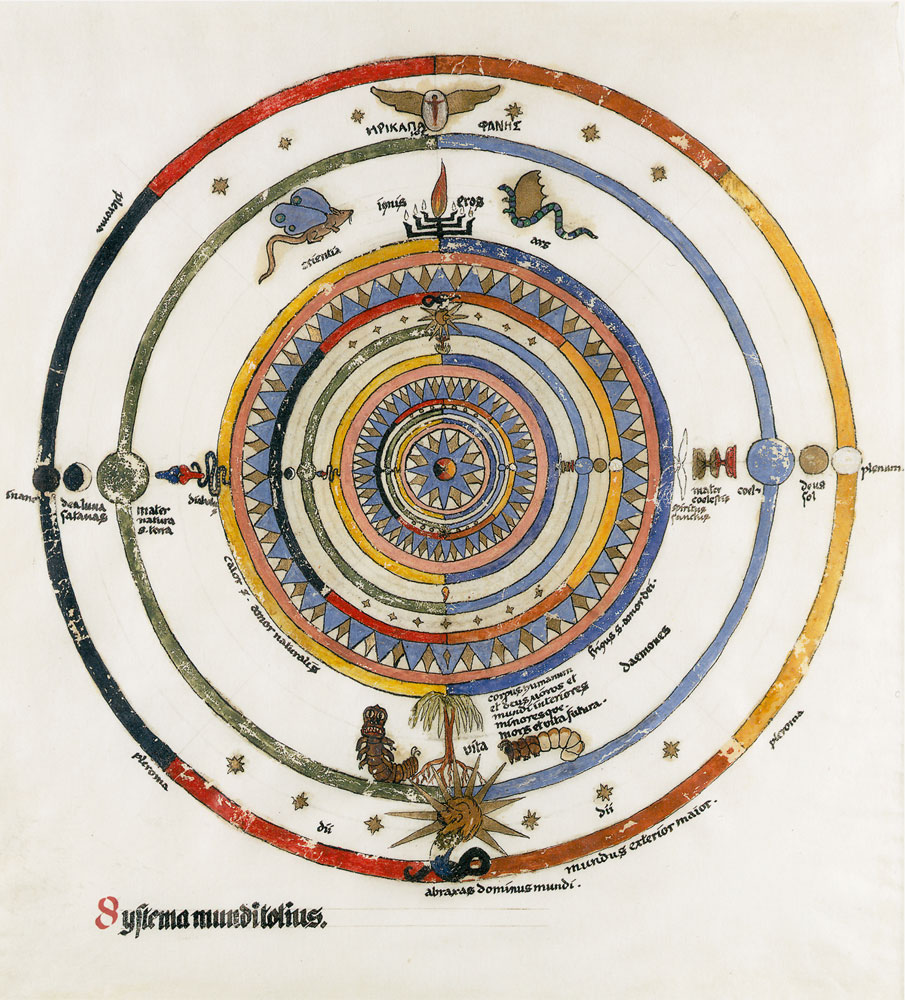
No doubt, Jung was captivated by mandala’s, not merely because of his attraction to Eastern philosophy, but also because he thought the circular images represent the self or totality of the personality. It could be experienced Museum Rietberg “Carl Gustav Jung: Das Rote Buch Le Livre Rouge from December 2010 to March 2011 where Jung’s first-known mandala-inspired work, “Systema mundi totius”, illustrated in 1916 was on display. The brightly hued circular graphic shows a reference to very gnostic-like text ”The Seven Sermons to the Dead” he wrote 1916/1917. He had a striking parapsychological event in the winter of that year, in which the dead, whom he’d encountered in his fantasies about two years earlier, end up at his door. There is an interesting book evaluating and commenting ‘The Seven Sermons to the Dead’ from a gnostic point of view. Both books lay the foundation of his Jung’s legacy.
The original
When I had my last project in Zürich I had a chance to see the Red book. C.G. Jung marked its unfinished work, ‘a necessary, but annoying ästhetisierende elaboration’. The adjective “ästhetisierende” means to place an object into an aesthetic context and qualified by criteria as beautiful or ugly. That hits the core of the matter
The original ‘Red Book’ is approximately seven kilograms heavy work bound into red leather is written and in the ornate calligraphic of medieval handwriting held in a strangely high German language. The book, we can buy, has the format of the original and is bound in linen. One reason for the enigma surrounding Carl Jung’s Red Book is that he never finished it. The book ends 1958 mid-sentence in his normal hand writing (pg 190/191):
“Ich habe an diesem Buch 16 Jahre gearbeitet.“ “Die Bekanntschaft mit der Alchemie 1930 hat mich davon weggenommen. Der Anfang vom Ende kam 1928, als mir Willhelm den Text der Golden Blüte eines alchemistischenn Traktates sandte. Da fand der Inhalt diese Buches in die Wirklichkeit und ich konnte nicht mehr weiterarbeiten. Dem oberflächlichen Betrachter wird es wie eine Verrücktheit vorkommen. Es wäre auch zu einer solchen geworden, wenn ich die überwältigende Kraft der ursprünglichen Erlebnisse nicht mehr hätte auffangen können. Mit Hilfe der Alchemie konnte ich sie schließlich in ein Ganzes einordnen. Ich wusste immer, dass jene Erlebnisse Kostbares enthielten und darum wusste ich Nichts Besseres als sie in einem „kostbaren“ d.h. teueren Buch aufzuschreiben und die beim Wiederdurchleben auftretenden Bilder zu malen – so gut dies eben ging. Ich weiss, wie erschreckend inadäquat diese Unternehmung war, aber trotz vieler Arbeit und Ablenkung blieb ich ihr getreu, auch wenn ich nie eine andere Möglichkeit.“
Addon 2013: I own one facsimile of the Red Book. I penned a synopsis containing my notes and narrative of the Red Book . If you are interested, you find it here. I must warn you, even a short version of C.G. Jung results in a long article.