When they all know the good as good, there arises the recognition of evil.
This article explores the psychological underpinnings of Shakespeare’s “Macbeth” from a Jungian view. Carl Jung left a great deal of ambiguity surrounding his work. He understood, as long as there have been men and they have lived, they have all felt this tragic ambiguity and everybody must accept his or her “Shadow” during the individuation process. Ambiguity between good an evil, and a failed individuation is the core theme in the tragedy Macbeth: “Fair is foul, and foul is fair” say the three witches in the beginning of the play and this paradox is touched again by Macbeth: “So foul and fair a day I have not seen”. The enemy and death is “foul” – bad – but the outcome of the battle is “fair” – good, only because he has won.So the play Macbeth is about the evil, but as we see mostly the evil in us, and this evil is first impersonated by the witches. That is why Macbeth is also called the “Scottish play” by the superstitious theater folk. The play has gotten a reputation for being bad luck in terms of productions and those who act in it, and so it is referred from them to as “the Scottish play” to avoid naming it. The play is about the good consumed by the evil. However, Tao says Tao is eternal and so are the two principles Yang and Yin, so that good and evil must be eternal, as necessary elements of our world.
Secularism, particularly relativism has tried to blur the line between good and evil where belief systems and philosophies used different approaches to mask the ambiguity between “evil and good”. Dualistic has the view that the world consists of or is explicable as those two fundamental entities. It is God, love, death, suffering and infinity that open us to the non-dualistic mind, or contemplation. Dualism means eliminating everything that is not like you (or projecting all your rejected attributes to others). Lao-Tse and Jesus were masters of non-dualistic thinking. The Jungian System is a fine example of an non-dualistic psychology : the more inflated your self-image (Ego), the bigger your shadow will be. Macbeth looses his soul (his Self) failing to differentiate between Persona and his inflated Ego and overwhelmed by his shadow and his anima utilized by the ambitious Lady Macbeth.
Jung’s vastly varying influences have helped shape a psychology that has influenced a great many scholars, theorists, psychologists, and artists of various specialties. While still maintaining an empirical stance Carl Gustav Jung has taken the influential elements of literature, symbolism, religion, and the alchemy and has formed these raw, primordial factors into a unparalleled psychoanalytic system. Jung’s view of literature was ambivalent. He was fascinated by Nietzsche, and lectured on Nietzsche’s Zarathustra, Besides of German literature C. G. Jung appears to have been influenced by Shakespeare. In particular Jung was interested in the mythic and archaic elements in literature. Hermann Hesse’s novel Demian was inspired by Jung’s theory of individuation whereas Macbeth seems to be the prototype of a failure to achieve successful ego-individuation.
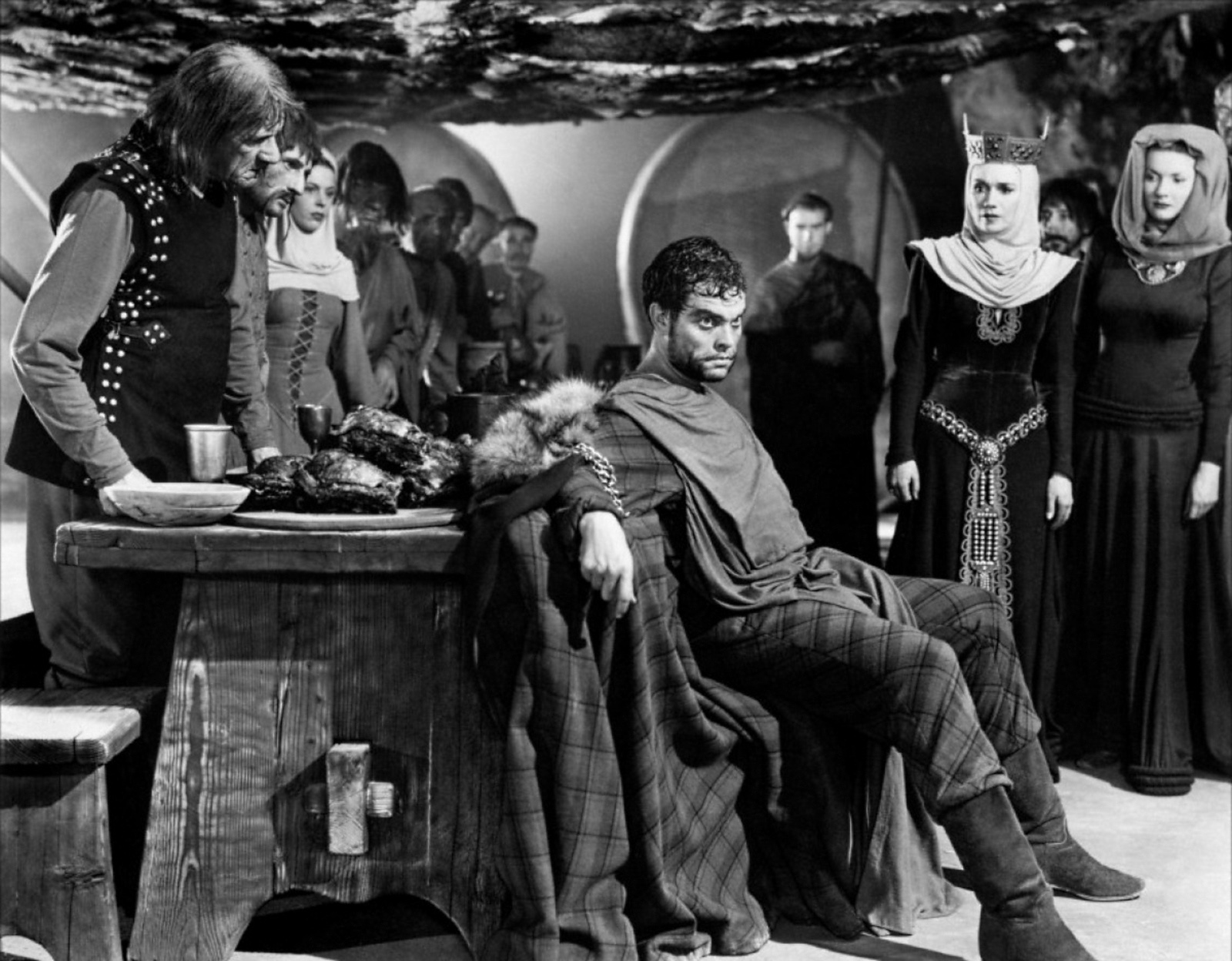
The play Macbeth
title_macbeth
Jung found literature to be a psychological process which includes the process of materials being “drawn from man’s conscious life; and the visionary dealing with primordial images that transcend human understanding.” Jung found that the archetypal symbols he worked with could, quite naturally, be found in the works of various ages. “It is to be expected… that the poet will turn to these mythological images to give suitable expression to his own experiences.”
Macbeth, when you analyze it, is a psychological battle between good and evil, and between evil ambition and order. Darkness is a symbol of the characters forgetting all about honor or goodness. The play demands that the audience think about how we make excuses in our life to pursue false ambitions that are wrong. Macbeth makes this mistake and ultimately it leads to his death. Darkness in Macbeth is a key theme. The play begins with the brief appearance of a trio of witches and then moves to a military camp, where the Scottish King Duncan hears the news that his generals, Macbeth and Banquo, have defeated two separate invading armies—one from Ireland, led by the rebel Macdonwald, and one from Norway. Macbeth and Banquo encounter the witches who prophesy that Macbeth will be made thane (a rank of Scottish nobility) of Cawdor and eventually King of Scotland. Macbeth and Banquo treat their prophecies skeptically until some of King Duncan’s men come to thank the two generals for their victories in battle and to tell Macbeth that he has indeed been named thane of Cawdor. Macbeth is intrigued by the possibility that the remainder of the witches’ prophecy—that he will be crowned king—might be true, but he is uncertain what to expect. It remins me a little bit of Wagners Rhinemaidens, who have a magical gold treasures with magical powers. Alberich an ugly dwarf, trys to score on them but they laugh at him. So he robs their treasure with the ring (the key to power and wealth). To do this, he must renounce love. I think Macbeth never could love, neither himself nor others.
Lady Macbeth suffers none of her husband’s uncertainty. She desires the kingship for him and wants him to murder Duncan in order to obtain it. When Macbeth arrives at Inverness, she overrides all of her husband’s objections and persuades him to kill the king that very night. He and Lady Macbeth plan to get Duncan’s two chamberlains drunk so they will blame the murder on the chamberlains. While Duncan is asleep, Macbeth stabs him, despite his doubts and a number of supernatural portents, including a vision of a bloody dagger. When Duncan’s death is discovered the next morning, Macbeth kills the chamberlains—ostensibly out of rage at their crime—and easily assumes the kingship. Duncan’s sons Malcolm and Donalbain flee to England and Ireland, respectively, fearing that whoever killed
C_G_JUNG_MALE_FEMALE_ARCHETYPES
Duncan desires their demise as well. Fearful of the witches’ prophecy that Banquo’s heirs will seize the throne, Macbeth hires a group of murderers to kill Banquo and his son Fleance. They ambush Banquo on his way to a royal feast, but they fail to kill Fleance, who escapes into the night. Macbeth becomes furious: as long as Fleance is alive, he fears that his power remains insecure. At the feast that night, Banquo’s ghost visits Macbeth. When he sees the ghost, Macbeth raves fearfully, startling his guests, who include most of the great Scottish nobility causing Macbeth’s kingship to incite increasing resistance from his nobles and subjects. Frightened, Macbeth goes to visit the witches in their cavern. There, they show him a sequence of demons and spirits who present him with further prophecies: he must beware of Macduff, a Scottish nobleman who opposed Macbeth’s accession to the throne. Macbeth orders that Macduff’s castle be seized and, most cruelly, that Lady Macduff and her children be murdered. It should be clear by now, that Macbeth represents the archetypes of weak king and becomes a cruel sadistic warrior, whereas Lady Macbeth seems to own foremost frigid witch qualities.
When news of his family’s execution reaches Macduff in England, he is stricken with grief and takes revenge and with Prince Malcolm, Duncan’s son, and the support of the Scottish nobles, who are appalled and frightened by Macbeth’s tyrannical and murderous behavior. Lady Macbeth, meanwhile, becomes plagued with fits of sleepwalker in which she bemoans what she believes to be bloodstains on her hands. Before Macbeth’s opponents arrive, Macbeth receives news that she has killed herself, causing him to sink into a deep and pessimistic despair.
He is struck numb with fear, however, when he learns that the English army is advancing on Dunsinane shielded with boughs cut from Birnam Wood. Birnam Wood is indeed coming to Dunsinane, fulfilling half of the witches’ prophecy. In the battle, Macbeth hews violently, but the English forces gradually overwhelm his army and castle and he realizes that he is doomed, Macbeth continues to fight until Macduff kills and beheads him.
Failed Individuation in Shakespeare’s Macbeth
macbeth
Macbeth has not begun to deal with the adult developmental task of individuation. According to Jung, in the process of individuation “unconscious potentials are explored and reintegrated with the “Self”. The exploration of certain parts of the unconscious brings to consciousness unacknowledged ” missing pieces. Macbeth’s failure to individuate successfully is reflected by the distance between his rigid Persona and his real personality, and his inability to confront the shadow aspects of his psyche, and the complete rejection of his anima. Tellingly those developmental issues only seem able to get Macbeth’s attention through his hallucinations and visions. Jung said that “only through the adult development of individuation can the person become truly an ‘individual’ and not simply a carrier of unconscious images and other people’s projections”. This “carrier of unconscious images” and receptacle of “other people’s projections” is exactly how Shakespeare paints Macbeth: Macbeth is Duncan’s “O worthiest cousin” (I, iv, 17), the murderers’ “Highness,” “liege,” “lord” (III, I, 81, 102, and 131), and Malcolm’s “tyrant” (Iv, iii, 14). Throughout the play Macbeth’s identity is formed by Shakespeare’s other characters. The tragedy of Macbeth is that he has failed to explore his unconscious and discover and accept his true identity. Because he has not individuated, he can be molded and pushed into identities and actions that others project onto him. Macbeth is very conscious of his persona and of the positive reputation he has cultivated, and he enjoys thinking of himself in this way. According to Jung, the Persona (literally the mask) is the aspect of personality that adapts to the world to be accepted in society. Throughout the play Macbeth attempts to put on a “false face” (I, vii, 9 5) so that he can hide what his “false heart doth/know” (I, vii, 95-96). When he has plotted Banquo’s death and is preparing to make merry with his guests, Macbeth believes that he can cover not only his conscious knowledge of his role in Banquo’s death from others but keep his unconscious feelings of fear, shock, and guilt at arranging a murder from himself. During dinner Macbeth has a hallucination. He sees the ghost of Banquo come to haunt him and denies his guilt: “Thou canst not say I did it. Never shake/ Thy gory locks at me” (III, iv, 61-62). Throughout the play Macbeth refuses to own his unconscious; he places supreme importance on appearances (Persona), his consciousness and refuses to deal with any desires and actions which challenge his idealized Ego.
Shadow- instinctive powerful, beast
His rejection and disregard of this “shadow” keep him ignorant of its motivational power and the gulf that develops between his persona and real personality. Jung described the shadow as “those aspects of the psyche that are rejected from consciousness by the ego (during sozialization in the first half of life), because they are inconsistent with one’s self-concept. Macbeth’s history of denying his shadow is detailed throughout the play. In Act I, after learning of Duncan’s intention of having Malcolm succeed to the throne, Macbeth rejects his ambitiously motivated ability to become a traitor. Jung says that as we show our persona to others and conceal our shadow from ourselves, “the shadow gets more and more ugly, and the split between persona and shadow … widens”. For Macbeth, this is true. After he kills Duncan, Macbeth refuses to believe that he could be a murderer – one although this ability to murder is present in Macbeth’s character. After his second meeting with the Weird Sisters, Macbeth resolves to kill Macduff’s family in the Thane of Fife’s absence Macbeth has progressed from ambitious regicide to familial mass murderer. Because Macbeth has not confronted his shadow and haven’t taken the effort caused by introduction of the shadow to consciousness, Macbeth cannot follow an intrinsic moral compass. This allows him to commit his atrocities without having to justify them. Ironically, part of Macbeth’s anima is positive, but it is repressed because he believes it to contain negative qualities.
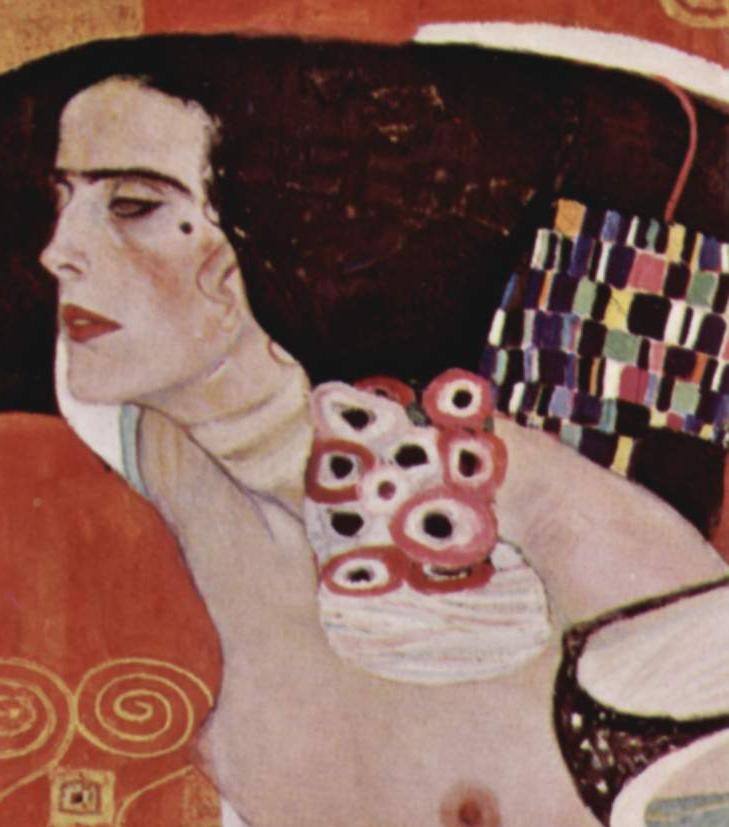
anima
According to Jung, men have “repressed feminine-typed qualities” (their anima) and women have “repressed masculine-typed qualities” (their animus). While this area of Macbeth seems cloudy, I believe that Macbeth cannot explore what Jung would call the inner feminine qualities of empathy and emotion because Lady Macbeth is constantly questioning his identity as a man, struggling herself to be a women and with her animus. Two passages support this theory. When Macbeth begins to vacillate between killing Duncan and maintaining his honorable reputation, Lady Macbeth chastises him for not being man enough to take what he wants (I, vii, 3 9-49). She also calls him to task for not being a man of his word (I, vii, 53-67). Lady Macbeth claims that she, a woman, is more manly than Macbeth. Macbeth is expressing fear and guilt, emotional inner controls, and Lady Macbeth makes fun at him. Later, when Macbeth is confronted with his hallucination of Banquo’s ghost, he expresses fear and revulsion at what he has done to Banquo through the ghost’s horrible appearance. Lady Macbeth tells him to stop acting like a hysterical woman and to live in reality. She even asks Macbeth, “Are you a man” (III, iv, 70). While Macbeth clearly rejects his “inner woman,” as shown by the ease with which he is manipulated by gender role identification (making him vulnerable to Lady Macbeth evilness), he is severely hampered in uncovering his anima by her disparaging of his male identity.
Personal Layers
Macbeth’s strict adherence to his inflated Ego a false Persona, his unwillingness to deal with his shadow. According to Jung rejecting anima have psychological consequences – sometimes the shadow and anima merge and overpower the consciousness (Ego); he has hallucinations. Jung interpreted psychotic hallucinations and delusions as expressions of the collective unconscious archetypes, which can be interpreted as visions or a type of dream, manifesting their meaning from his personal unconscious. Act II’s floating dagger can be read as a symbol forcing its way into consciousness. Through his visions, Macbeth’s unconscious is trying to show him the issues he must deal with. One of the sadder aspects of the tragedy is that he is constantly dissuaded from looking at them. The moral conflict needed to mitigate his personal not to speak collective un consciousness is not present. This is why poor Macbeth (like many powerful men and women) is so far from the mark with his comments on life. They does not know enough about themself to allow anything but a shallow, two-dimensional interpretation of life, letting them be directed by passions unseen, greed and manipulative persons around them.
Anima and Animus in Shakespeare’s Macbeth
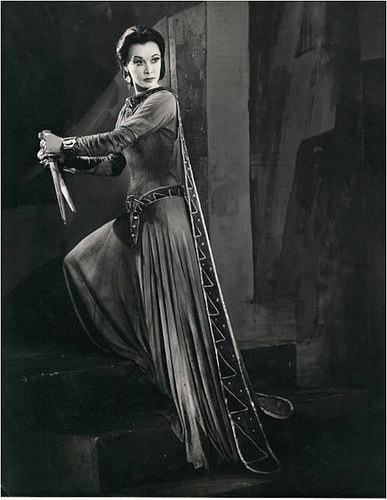
Lady Macbeth
There appears to be some critical discord in connection to the classification of Lady Macbeth, whether she qualifies as an innocent, supportive wife, or, in Malcolm’s words, as a “fiend-like queen.” (Shakespeare V. ix. 35) However, Shakespeare’s text simply does not support the idea that the Lady Macbeth did not play a serious role in the murder of King Duncan and. The concept which seems to lie at the core of critical discussion in relation to Lady Macbeth, is gender. Lady Macbeth herself, makes the argument about gender in her famous speech, wherein she appeals to the powers of dark spirits to “unsex” her, and replace any feminine tendency in her with “direst cruelty” (Shakespeare I. v. 42-43). She wishes to take all that she perceives as weak and feminine in herself, and seeks to substitute it with an evil. Jung believed that all men and women were made up of masculine and feminine energies, the former being called the animus and the latter being called the anima and this unconscious selves of individuals can be used to understand Lady Macbeth’s actions. It can be argued, that Lady Macbeth’s vehement denial of her feminine self (or her anima) that causes her to manipulate her husband into committing the murder of Duncan, affected her relationship with her husband (unable to maintain it) and ultimately led to her insanity and death.
Conclusion
“Fair is foul, and foul is fair” : What the line points to is the play’s concern with the discrepancy between appearance and reality: that is, the difference between how someone seems and how someone really is. It is a central concern of Shakespeare’s, and obviously one that fits well with the medium of theatre, which relies on actors seeming to be something that they most definitely aren’t. This is one of the last lines in Act 1 Scene 1 when the witches are foreshadowing events to come in the play. With these words, they are predicting the evil that will cloud Macbeth’s judgments and that those judgments will appear to Macbeth as fair and just. This line also could refer to the witches believing that things some consider to be foul and ugly are just and beautiful to them because they embody evil.
The vampire breaks the rules of the gods, society or nature, sometimes maliciously sometimes cunning or foolish or both. This article wants to explore the connection between Narcissism, Vampires and contemporary politicians. We experience right now a difficult transition especially in Europe, led by an élite bred more than ever by an increasing culture of Narcissism The psyche of world leaders, almost everybody in power (over us) can been interpreted narcissistic and the power behind (the money cluster and NWO matrix) as a sort of vampires.
I have written not much lately. The reason was, that I joined a start-up party in the upcoming German election. It is a major election, as Europe is standing on fiscal and value cliff. Basically it is about „Freedom or Euro“ or “democracy or serfdom”. The majority of those party members are highly educated and professional, but I have seen so many fellow party members quit under flashy and sometimes infantile circumstance, that I could not help to diagnose that narcissistic disorders must be an important topic especially in politics. Therefore I decided to do case studies, based on my experience in this political party. This article is work in progress ro structure my bewilderment a little bit. Indeed, within this new Euro critical party “start-up” I met more narcissistic hurt people I ever cared for. It was the first time, when I understood why politics is so sick – it lures sick people in a sick mental framework and gives the worst of them an advantage. This political culture reminds me of Ann Rice’s vampires or zombies.
In this new party, I experienced an active engagement with the tension between destruction and creation. With these developments, an individual – and a party and its voters – cannot easily engage in an effective dialogue that mitigates the coming apocalypse of Europe.
Vampire myth
The vampire myth has appeared over the centuries in almost every culture, beginning with the earliest recorded epic from Babylonia, about 2000 years B.C the Gilgamesh. Although there are cultural variations in the various legends, there is always one defining trait of a vampire: a vampire sucks blood. Blood stands for life in Christianity, and is the archetypal symbol of the soul (life energy). The Sumerian vampires Ekimmu, not to be confused with Ekindu, were a type of evil spirit (Utukku) riding on a wolf (you might recall a recent article of mine about the archetype of the wolves). The Assyrians of Mesopotamia believed the Ekimmu or Edimmu came into existence when their people died before their time. These unfortunate souls were refused admission to the underworld, causing them to become violent and ill tempered, hence the name “ekimmu” which translates to “that which was snatched away.I When the hero, Gilgamesh, prays to the god Nergal to restore his friend Ea-bani the request is granted, for the ground gapes open and the Utukku of Ea-Bani appears “like the wind”; that is, a transparent spectre in hishuman shape.
Gilgamesch-Epos
In studying analytical psychology we can begin to look at the vampire myth in psychological terms. It is a fatal symbiosis and a nourishing of one self with another’s vitality (two central points of vampire legends). As said before these traits are also inexplicable components of many human relationships. Most psychological interpretations of the vampire legend are Freudian, and see the legend in terms of incest, homosexuality, sadism and masochism. These interpretations miss a core meaning of the vampire, one of our oldest, most recognizable archetypal figures. The vampire has been cursed, denied eternal rest because of some unredeemed sin. The Ekimmu, or Departed Spirit was the soul of a dead person who for some reason could find no rest and wandered over the earth seeking to seize the living. As inmost later vampire tales, the Ekimmu and its victim had some mysterious psychic connection, which made the victim particularly vulnerable to attack. The Ekimmu could walk through, doors or walls to take up residence in house. It would then drain the life from the household, usually killing the owner and many of his relatives and servants.
The earliest Sumerians didn’t have gods and goddesses in human-like form. Instead, the early Sumerians believed in spirits in every object. This type of belief is known as animism, which assigns spirits and life to all things-the rocks, the sun, plants, and all animals. The Ekimmu could suck the life out or could take over a person’s body. They mostly preyed upon the young and those asleep (like Dracula). The Sumerians later worshipped four all-powerful creation gods. And their creation myth is similar to later myths. Even the Judeo-Christian story of Adam and Eve can be traced back to later Sumerian writings. Yet even in their creation story, the gods breathe life-or spirit-into men. So the belief in a spirit never fully leaves the religion.
In Babylonia, as in Christianity, the vampire archetype describes a collective darkness: a group of heretics and criminals, raging against mankind and ceaselessly devouring blood. The vampire is not primarily a personification of personal darkness of the Freudian unconscious, but a scourge of the society an archetype from the collective unconscious. The vampire is therefore a religious figure like the Christian devil, but even older than Lucifer. The Vampire archetype and the Redemptive archetype (Christness) are the first polar opposites of the same archetypal energy (just note that we Catholics believe in drinking Jesus’ blood). They emerge from the collective unconscious as a dividable pair. Although the association is less clear today, vampires always have been closely associated with religions. In Babylonia, China, Greece, and Egypt, and Christianity, the person likely to become a vampire was one who neglected religious rituals, or defied community moral standards.
Vampire facts
First impressions or how behaves a political vampire or a person with a narcissistic disorder in a party environment? According to existential-analytical understanding, the narcissistic pathology has its basis in a disorder of the self-value. This point of view could indeed illustrated with the aid of my phenomenological observation, of the personal fundamental motivations in politics as well as of my personal analysis.
If you go to a person with a narcissistic disturbance hits, one often discovers spontaneously a pleasant persona. One thinks here a very sympathetic guy! So refined, so intelligent, so charming, how can anyone be so perfect! When the presentation is stronger, it may also well happen that in a sense envy or eat least admiration is discovered – both are common reactions when one has to do with a narcissistically wounded people.
The Self-concept of a narcissistic disturbed people between is determined between two opposite poles – the sense of grandiosity on one hand and the feeling of the notation for annulment on the other. Dominate outward a striking magnificence and mightiness. A narcissistic is attractive and impresses with its alluring manner. They have a good sense of how well he can come and what he must do to get admiration. In a politic business it gives an edge to draw all eyes to oneself and to place own achievements and successes in the focus. Even in party work, a narcissist gives initially a grandiose and powerful show of ability and wisdom, particularly if not under stress.
The male vampire
For Freud, the vampire is largely representative of brutal, primal sexuality coupled with images of death in dark attempts to reach immortality. The vampire to Freud was a very old archetype that compressed one’s projected fears and repressed desires. From a Jungian perspective, the vampire image could be understood as an expression of what he termed the “shadow,” those aspects of the self that the conscious ego suppresses and is unable to recognize during socialization. Some aspects of the shadow were positive. But usually the shadow contained repressed wishes, anti-social impulses, morally questionable motives, childish fantasies of a grandiose nature, and other traits felt to be shameful. Jung interpreted the vampire as an unconscious complex that took over control over the psyche like a curse or spell. I observed particularly auto-erotic, autistic, or otherwise narcissistic personality traits in some party members which behaved fact predatory, anti-social, and parasitic on the life energy to me and others. We had one candidate, who turned out not to advocate the political agenda of this party, but only his own emotional (and maybe financial) needs. His record was one of a long, long but largely unsuccessful political career of a minor politician. He was a basically a political vampire. After his speech was not greeted with warm welcome, he stepped back to preserve his “delusions of grandeur” and his behavior to everybody became destructive and erratic. I sensed a deep narcissistic disappointment which was held up only by a rigid super-inflated Ego.
I meet some other similar disturbed party members, but the old politician was a prime example what in contemporary psychology and psychiatry this type is called a “narcissistic personality disorder.”
Narcissistic personalities are characterized by a “very inflated concept of themselves and an inordinate need for tribute from others.” Capable of only a shallow emotional life they have difficulty experiencing any empathy for the feelings of others. Their ability to enjoy life, except for their experiences of their own grandiose fantasies and the tributes that they can manipulate others into giving them, is severely limited. They easily become restless and abusive unless new sources are feeding their self esteem. They envy what others possess and tend to idealize the few people from whom they desire food for their narcissistic needs. They depreciate and treat with contempt any from whom they do not expect nurturance and their relationships with other people are clearly exploitative and parasitic. This description of the narcissistic personality sounds as if it were crafted to describe contemporary Western politicians: It is as if they feel they have the right to control and possess others and to exploit them without guilt feelings-and behind the surface, which very often is charming and engaging, one senses coldness and ruthlessness.
The female vampire
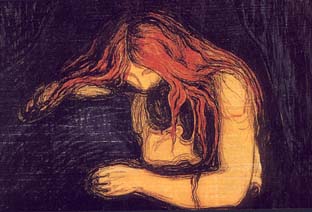
The female Vampire
Jungian interpreters often highlight the parallels between the vampire image and narcissistic psychopathology. Some, for example, have noted that the vampire is both narcissistic and autistic and emphasize that the vampire experiences “narcissistic self-destruction as a result of their intensely selfish desires. In Germany politics at large, there is one “successful” politician whose imago fits perfectly the shadow of the narcissistic mother – the female vampire. She makes a largely symbolic politic which is clearly against the interest of her voters. But 65% of the German think she does a good job. The narcissistic mother, while appearing on the surface to have good will and a nurturing attitude toward the child, in fact drains the energy of the child and weakens the child through subtle (and not so subtle) emotional exploitation. This pattern provides insight into the psychological experiences that underlie the numerous folktales of vampires preying on children. There is reason to believe that the incidence of such predatory behavior toward citizens is increasing.
The Vampire and the Culture of Narcissism: Although Jung and subsequent Jungian interpreters have noted these and other narcissistic aspects of vampire myths, they did not adequately explore narcissistic psychopathology, the chief psychological dynamic underlying vampire narratives and the major reason for the current burgeoning fascination with the vampire image. However, others assumed the lead in psychoanalytic research into pathological narcissism and its social formation as a “culture of narcissism.”
The culture of Narcissism
There is a rapidly spreading climate of moral self-absorption that has emerged in the wake of modernization and secularization – in Germany it’s the Green party which after decades of errors flourish and in the US the liberals (in power). Both have not the slightest self doubt to scan the internet and intimidate or use the free press. Our contemporary penchant for narcissistic self indulgence has resulted from the eclipse of any absolute ethic with its emphasis on spiritual involvement and temporal values. Contemporary alterations in culture indicated a fundamental shift in our psychological development. One Jungian suggested “that the dominant or modal personality of our culture has shifted to a narcissistic psychological organization.” He tied this recent phenomenon to the process of a gradual erosion of a religious view of the world. I agree, the collapse of any ethic restraint as a bulwark against pathological self involvement was only the last in a long line of cultural and religious developments leading to today’s increasing narcissism. Wall Street was always populated by vampires, but today we begin to discern the chief psychological dynamic underlying the increasing popularity of vampire images and narratives. “If our society is a culture of narcissistic self-involvement, then the vampire image is a perfect icon to express the psychological character configuration underlying it.”
What goes wrong to cause an individual, group or society to develop a narcissistic personality disorder? As C.G. Jung emphasized, the development of a “happy” personality requires a creative interplay between the innate potentials of the Self and the emotional environment.
An inadequate nurturing environment like broken families, corporations which treat their employees like cattle in the Global competition and of course our distorted political organizations cause significant damage in the form of “narcissistic wounds.” The development of the self is arrested and the emerging self is left in a weakened condition in an ongoing struggle with overwhelming longings and unmet emotional needs. When normal development is disturbed in this way, the resulting state of emotional disequilibrium necessitates that the individual seek to compensate for the resulting deficit or weakness in the structure of the self. Therefore, the person who has not successfully built a psychological internal structure remains pathologically needy and dependent upon others to perform functions, not able to execute. Others must be “used” in various ways to bolster a fragile sense of self and to attempt to fill an inner emptiness. This primal dependency is at the root of “vampiric” predatory patterns in relationship of our failed party candidate – the weak vampire.
Symptoms resulting from such emotional disturbances have characteristic features. Patients often report feeling depressed, depleted, and drained of energy. They report feelings of emptiness, dulled emotions, inhibited initiative, and not being completely real. Our weak vampire completely lacked empathy for the feelings and needs of others, had attacks of uncontrolled rage or pathological lying in blogs and mail attacks. However, we shall see below that the tie between narcissistic pathology and the vampire is much tighter than merely sharing the same set of symptoms.
Stage-hungry vampires
Narcissistic wounds and resulting pathology manifests in a wide spectrum of clinical syndromes ranging from psychosis to narcissistic character disorders. At work they may find themselves constricted in creativity and unproductive. In social interaction they may have difficulty in forming and sustaining interpersonal relationships. They may become involved in delinquent and anti-social activities. Despite their discomfort about their need to display themselves and despite their sometimes severe rejection they must go on trying to find new self objects whose attention and recognition they seek to induce.
Such stage-hungry personalities often manifest arrogant superiority. There is one minister who arrogantly abused his press speaker before open cameras. If, as it was the case with the weak vampire, this arrogance is not affirmed and accepted they will often withdraw into what self psychologists call “a grandiose retreat” seeking refuge in isolation in order to shore up their self esteem. The dynamics of stage-hunger also helps us to understand the combination of grandiosity and immortality in the vampire mythology. Adult untransformed grandiosity makes unrealistic claims on others. The more disappointment experienced by the stage-hungry person, the more they resort to the grandiose retreat from social involvement. What is Dracula’s remote castle on the top of a difficult to reach mountain if it is not a “grandiose retreat?”
Stage-hungry personalities often manifest a kind of “counter-dependency.” That is, they will often seek to avoid expressions of emotional need and dependency. Underlying this reluctance to admit chronic unmet needs to self or others is the fear of a disastrous, even fatal, depletion of the person who is seen as a potential source of gratification.
Vampires and Sexuality
A archetypal symbol of vampire mythology has been the powerful erotic imagery accompanying the vampire attack. One can find that in politics too. The systemic pedophile behavior of leading members of the Green Party (one of them a current member of the European parliament) has been successfully suppressed for thirty years in the press even if openly admitted by some and one time party program. Only recently, more and more victims, who were abused by those archetypes of “pedophile vampires”, when they were children, speak out.
Sexual contacts, which are portrayed in these vampire stories utilize images of the innocent youth becoming the target of compulsive blood-lust. Psychologically speaking, narcissistic wounds often lead the individual to seek narcissistic nourishment through sexual activity – be it so soft as begging to be fondled with an open fly. Still Sexuality and aggression fuse in a manner that leads to the infection and death of the victim or scars for a lifetime. A facade genital sexual behavior masks a quest for what Freudian’s have called oral (not genital) gratification. The compulsive quality of this sexual behavior is grounded in the individual’s narcissistic psychopathology. Today this pathology is widely understood to be the emotional foundation of sexual addictions. The Dracula story captures this combination of apparently erotic behaviors that are, in fact, expressions of a deep inner emptiness, not human affection.
Vampire Group behaviour
The projection of this image onto other social groups is undoubtedly one of the powerful psychosocial mechanisms that fuel malignant racism, anti-Semitism, political correctness, and other expressions of scapegoating . That has been very evident in this start up party, but is also evident in the EU-Crisis, where Germans are depicted as Nazis if not paying through the nose and the ailing countries as lazy folk punished by austerity.
Vampires and political correctness
In the dynamic of scapegoating, we find someone or some group that can be used as a receptacle for the projection of the vampiric image. Then the scapegoat can be blamed, cast out of the community, and/or persecuted with various degrees of violence. This externalization of the vampiric image enables the person or “in-group” to feel better-guiltless or “cleansed.” As a social dynamic such scapegoating both allocates blame and seems to “inoculate” against further disappointments by evicting or eliminating the cause of one’s “disease.”
Hate rhetoric is frequently fueled by the projection of the image of the vampire onto other social groups. An example of this recently became international news when a leader of an NGO publicly characterized Jewish people as “bloodsuckers,” imaging them as parasites draining the lifeblood of their community. The projection of this image enables the dehumanization of its target group-allowing the rationalizations needed to justify ruthless racial discrimination and violence. Narcissistic rage seeks the utter destruction of the independent personhood of the other-either through death or ruthless enslavement and exploitation. Thus the vampire within projects its image onto the other-thereby justifying its own predatory intentions – which is a standard procedure for politicians.
neverminddemocracy if you have the euro
We cannot see the energies that these ‘political’ vampire draw from the human population, but we can feel them. This energy is often described as ‘vibes’ – the good and bad ‘vibes’ that we feel emitting from people we meet. If we could switch our frequency to see deeper realms of reality, we would see that what we are feeling on the ‘physical’ level in emotional ‘feelings’ is the expression of an energy pouring from us (on frequencies outside of visible light) whenever we think or go into emotional states. This is what the ‘political’ vampires are doing – feeding off lower vibrational human emotion like fear, stress, worry, guilt, hatred etc. These are, in fact, all subdivisions of the one energy that we call hate generated by fear. The more that humans can be manipulated to feel and therefore generate the energy of fear, the more energetic sustenance is made available to these energy vampires. We hear about blood vampires, but what is blood? It is a massive conduit for human energy and as has been said an synonym for the soul. Humans have indeed been turned, as Morpheus said in The Matrix, into ‘one of these’:
Conclusions
An attempt was made to trace the manner in which my brief stint into politics along with many unpleasant experiences in this culture of Narcissism can be interpreted by vampire archetypes. Each of these perspectives contributed to my understanding of the rich mythological and symbolic narratives of vampire lore, which views the vampire as a primary icon representing essential aspects of narcissistic psychopathology. Personally, even if I want to moved out of this matrix of darkness, I did understand for the first time the attraction of being part of a political organization. It’s not only the greed and lust for power which lures contemporary politicians to the dark side.
The interpretations which Jung places on Gnosticism and the texts which Jung refers to on alchemy, were often Number, Pattern and Kabbalah Symbols , so much so that one would be more justified in calling the Jung of the Mysterium Coniunctionis or Kabbalistic in contemporary disguise.
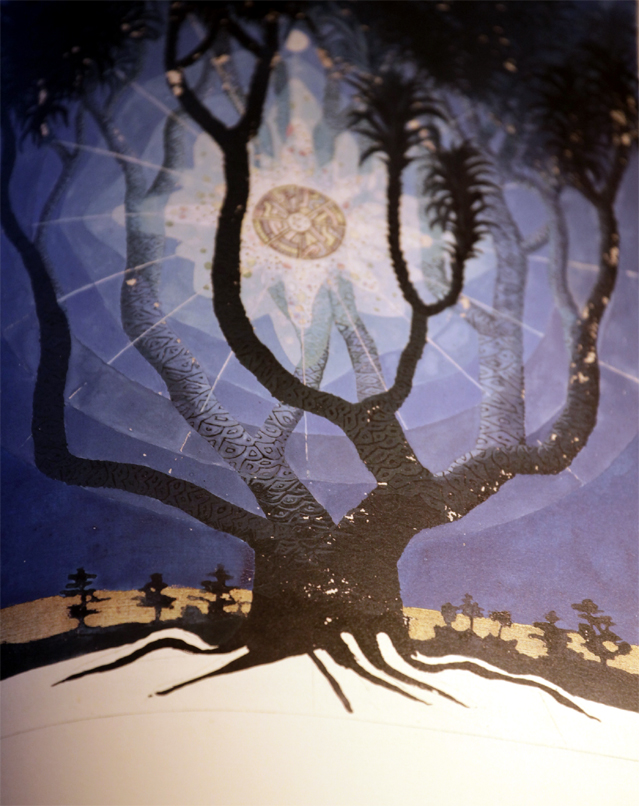
Red Book Tree of Life
Jung has been often (rightfully) seen of being a contemporary Gnostic.One of the most serious and arguably criticisms against Kabbalah and the early Gnosticism of C.G. Jung is, that they may lead away from monotheism, and instead promote dualism, the belief that there is a counterpart to God: The good power versus an evil power. Gnostic-dualistic cosmology having roots in Zoroastrianism, believes since creation good and evil forces are divided; Neo-Platonism (which found its way in Christianity), argues that the universe knew a primordial harmony, disrupted by an evil force. This second model influenced the cosmology of the Kabbalah.
According to Kabbalah cosmology, an infinite number of ten Sefirots are emanated from the representing ten different ways the one God reveals his will and also represent the different aspects of Morality. To Jung, profoundly influenced by Catholicism God is in us, to Taoism God is in the nature. The goal of this essay is therefore to find the Tree of life in C.G. Jung’s view of our psyche, Astrology and contemporary Physics. The article appreciates the affinities between Jungian psychology and Jewish mystical thought in particular Jung’s use of Kabbalistic symbols and ideas as well as his usage of numbers and Alchemist thoughts. It is just draft, and sketchbook and interested primarily on three (trinity), four (quaternary) and ten (as well as their multiples).
Number, Pattern and Jewish characters
Practical Kabbalah
The Hebrew Alef-Beit (alphabet, can be mapped to a number and symbol representing the deepest secrets of Creation. In one monastery I say recently an exhibition which visualizes those numbers and characters as symbols. The Kabbalistic classic Sefer Yetzirah (Book of Formation) teaches that creative consciousness exists in three states (space, time, and soul), which are reflected in the form, name and numerical equivalent of each letter.
In practical Kabbalah the Rabbis counted every word and letter, and as their numbers were represented by their letters, they counted the numeration of all God names and titles, and all proper names, and the numeration of he phrases recording Divine commands. The Hebrew letters and numbers were :
Aleph A 1
Beth B, V 2
Gimel G, Gh 3
Daleth D, Dh 4
Heh H 5
Vau O, U, V 6
Zayin Z 7
Cheth Ch 8
Teth T 9
Yod I, Y 10
Kaph K, Kh 20
Lamed L 30
Mem M 40
Nun N 50
Samekh S 60
Ayin Aa, Ngh 70
Pe P 80
Tzaddi Tz 90
Qoph Q 100
Resh R 200
Shin Sh 300
Tau T, Th 400
Dogmatic Kabbalah
In Dogmatic Kabbalah the conscious God is the awakened decade of Sephira. The primary human conception of God is the Boundless, whereas the Conscious God has awaked.
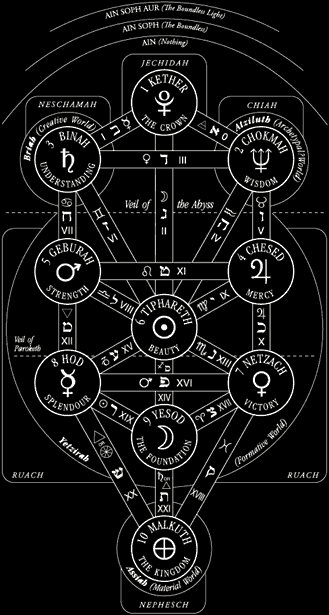
Tree of Life
Kether, the Crown, the First Sephira, First Emanation of Incomprehensible Deity will be followed by the Second Sephira, Chokmah, Wisdom, The King, and the Third Sephira Binah, Understanding, The Queen. Then follows the forth Sephira Gedulah, also called Chesed, Mercy, and its contrast Geburah, Severity, also called Pachad, Fear. That triangle is completed by the Sixth Sephira, the Sun named Tiphareth, or Beauty. The third triangle is formed of the seventh, eighth, and ninth Sephiroth; Netzach, Firmness or Victory, Hod or Hud, Splendour and Yesod, Foundation. Finally, all these ideals are resumed in a single form, the Tenth Sephira, MLKUT, Malkuth, the Shekinah, the Kingdom, also sometimes called Tzedek, Righteousness. The whole Decad form “Adam Kadmon,” “The Archetypal Man,” and the “Tree of Life.”
The word “Sephir,” from which “Sephira” is derived, is usually translated as “Book” “Letter” or “Number” but the underlying idea is “Information” or “Pattern”. Those pattern represent culture interconnections or in a Jungian sense symbols, i.e. manifestations of archetypes.
The sephiroth operate on a numeric progression. The ideas corresponding to the number one naturally lead on to the ideas corresponding to the number two, and so on. The Sephiroth, when referred to by number, are always shown in their descending order, referring to their order of emanation. However, the task of the mystic is to move his consciousness in their reverse order, this process being called “The Way of Return”
The left column is called the Pillar of Severity. This represents the female side of man and contains three sephira: Binah (Understanding), Geburah (Severity) and Hod (Splendor).
The right column is called the Pillar of Mercy. This represents the male side of man and also contains three sephira: Chokmah (Wisdom), Chesed (Mercy) and Netzach (Victory).
The middle pillar is called the Pillar of Equilibrium. It represents the balance between the male and female pillars. It contains four sephira: Kether (Crown), Tiphareth (Beauty), Yesod (Foundation) and Malkuth (Kingdom).
The fifth, sixth, seventh, and eighth Sephira are called, respectively, Hesed (Strength, Red), Gevurah (Beauty,Yellow), Netsah (Firmness,Green), and Hod (Splendor, Blue) and represent four of the component colors of Light: Red, Yellow, Green and Blue.
Tifereth, Hesed and Gevurah form the second Triad, and Yesod, Netsah and Hod the third; these two Triads combined constitute the Hexad, which is the Soul of the World, and of it are derived the souls of all individualized existences.
(1) Finding its Soul
The Primary Archetype the Self which is neither known nor can be known to consciousness – Kether
The First Cause, timeless and eternal, the first emanation of diety as our universe is Kether. Like the Chinese Tao, talking about it too much, evaporates your understanding of it.
English meaning: Crown
Sphere: Primum Mobile/Uranus
Gem: Diamond
Plants: Almond
Magical Tool: Crown
Divine Name: Eheieh
Archangel: Metatron
Angelic Choir: Chayoth ha-Qadesh
(2) Soul and God
To Jung is the union of every thing and its opposite, of male and female, good and evil, Animus – Chokmah and Anima
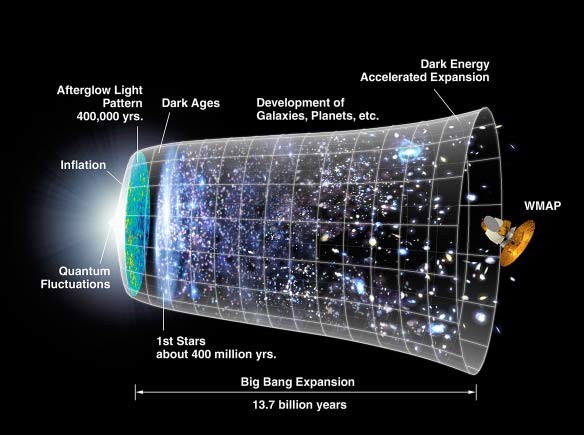
While Kether is timeless, the action of Chokmah is completely dynamic. It is the Lingam of creation, the “bang” part of the big bang, the massive Yang exploding outwards in all directions with the energy of Kether. This explosive nature is admirably suited to the astrological character of Pluto, to which it has now been assigned
English meaning: Wisdom
Sphere: Zodiac/Pluto
Gem: Star Ruby/Turquoise
Plants: Amaranth
Magical Tool: The Inner Robe of Glory
Divine Name: Yah
Archangel: Raziel
Angelic Choir: Auphanim
.
(3) On the Service of the Soul
The primal unconscious is concealed from awareness through a primal opposite, the Animus – Binah
The Yin to the Yang of Chokmah, Binah receives the projective force of Chokmah and limits it to give it form. It is the last of the supernal powers, which are beyond manifestation. Saturn was placed upon this sephira, but with the discovery of the three outer planets, it is more effectively associated with Neptune. Binah is also the Great Mother, the ocean that gives birth to the life of the universe.
English meaning: Understanding
Sphere: Saturn/Neptune
Gem: Star Sapphire, Pearl
Plants: Cypress, Poppy
Magical Tool: The Outer Robe of Concealment
Divine Name: YHVH Elohim
Archangel: Tzaphquiel
Angelic Choir: Aralim
(4) The Dessert
The boundless, chaotic, Personal Unconscious which lies at the heart of the human psyche – Chesed / Gedulah
The first sephiroth below the supernals is Chesed, which means “Mercy.” This is a sephira of merciful power, benevolence and generosity. The influence of this sephira is kingly and mystical.
English meaning: Mercy
Sphere: Jupiter
Gem: Amethyst/Sapphire
Plants: Olive, Shamrock
Magical Tool: Staff, Sceptre, or Crook
Divine Name: El
Archangel: Tzadiquiel
Angelic Choir: Chashmalim
(5) Descent into Hell in the Future
Here there is the smallest element of awareness of the conscious and the Ego – Geburah
The primary influence of this sephira is strength. Specifically, the strength of the righteous against the forces of evil like warrior gods.
English meaning: Severity
Sphere: Mars
Gem: Ruby
Plants: Oak, Nux Vomica, Nettle
Magical Tool: Sword,Spear, Scourge, or Chain
Divine Name: Elohim Gibor
Archangel: Kamael
Angelic Choir: Seraphim
(6) Splitting of the Spirit
A primal Self emerges – Tiphareth / Tiferet
At the center of the Tree of Life lies Tiferet, the sephira of the sun. It is the main connection between the Divine and the mundane, and is the only sephira below the supernals which has a direct path with Kether. The gods attributed to this sphere are the child, and the sacrificed god, as well as the more obvious solar dieties
English meaning: Beauty/Harmony
Sphere: Sol
Gem: Topaz/Yellow Diamon
Plants: Acacia, Bay, Laurel, Vine
Magical Tool: The Lamen or Rosy Cross
Divine Name: YHVH Eloah Ve-Daath
Archangel: Raphael
Angelic Choir: Melekim
.
(7) Murder of the Hero
From the interaction between the Ego and the world the original, unmodified structures of the Persona emerge – Netzach
The sephira of nature is Netzach. Its nature is ecstatic, the joyous play of the divine energy. It is also the first sephira of emanation that operates without “ethics,” It contains within its meaning the process of negative feedback. To this sphere are attributed the gentle gods of life and beauty, of which some are Venus, Aphrodite, and Bast. Their terrible aspect comes from their inhuman natures with respect to justice or morality. To note that the most successful are often those unworthy of it is to operate within the laws of this sphere
English meaning: Victory
Sphere: Venus
Gem: Emerald
Plants: Rose
Magical Tool: The Lamp and Girdle
Divine Name: YHVH Tzabaoth
Archangel: Haniel
Angelic Choir: Elohim
(8) The Conception of the God
(8) These structures are the archetypal values and tendencies of humanity which are embodied within the conscious realm – Hod
Hod is the sephiroth of the scientific intellect, which operates here in a passive sense to the emotional Netzach. Instead of unintelligible ecstasy, we have wonderful ideas, words of knowledge and poetry, and inspirations. All gods of the intellect are represented here
English meaning: Glory/Splendour
Sphere: Mercury
Gem: Opal/Fire Opal
Plants: Moly, Anhalonium Lewinii
Magical Tool: The Names, Versicles, and Apron
Divine Name: Elohim Tzabaoth
Archangel: Michael
Angelic Choir: Beni Elohim
.
(9) Mysterium encounter
Will or Desire, the fundamental motivating force of the Shadow – Yesod
The sephiroth of Yesod is the process of crystalization, where energy becomes definable as forces. The action of Hod and Netzach comes together before its final projection into Malkuth.
English meaning: Foundation
Sphere: Luna
Gem: Quartz
Plants: Mandrake, Damiana
Magical Tool: Perfumes and Sandals
Divine Name: Shaddai El Chai
Archangel: Gabriel
Angelic Choir: Kerubim
(10) Instruction
A new Self must emerge by restoring and restructuring the elements of the old ego that has been shattered by crisis. This is the process of individuation – Malkuth
The last emanation of creation is Malkuth, which represents the final solidification of the energy of Kether. It is result of all the work done through the preceding sephiroth. This sephira is totally passive; all energy directed to it works it’s change and is grounded. The titles of Malkuth are “Malkah,” the princess and “Kalah,” the bride, when considered as the Spouse of Zauir Anpin, the Microprosopus
English meaning: Kingdom
Sphere: Elements/Saturn/Earth
Gem: Rock Crystal/Salt
Plants: Willow, Lily, Ivy
Magical Tool: The Magical Circle and Triangle
Divine Name: Adonai ha-Aretz
Archangel: Sandalphon
Angelic Choir: Ashim
(0) The Incantations
DA’ATH – Knowledge – is not a Sephira. It is not on the Tree of Life: that is, there is in reality no such thing. Da’ath is the crown of the Ruach, the Spirit and its place is in the Abyss. “Da’ath like the evil number zero, has a dual aspects, on one hand it is our knowledge of the world of appearance, the body of facts which constitute our beliefs, identity and ego. On the other hand it is revelation, objective knowledge, what is often referred to as gnosis. The transition between the knowledge of the world of appearance and revelation entails the experience of the abyss, the abolition of the sense of ego, the negation of identity. From within the abyss any identity is possible. It is chaos, unformed. It contains, as it were, the seeds of identity.
“sacred whore;”
The sphere of knowledge Daath is invisible and the Random chaos of thought and conceptionbecause it contains both accessible and hidden knowledge. This sphere has no archangel but is used as an entrance and exit point to the Yetzirah (the third world of formation), the realm of the angels. Daath is often called the Abyss, the gulf between the phenomenal world of manifestation and its source. Only by passing through the Abyss can we realize out innermost spiritual nature. Daath is the primary junction where various forces on the Tree of Life – femal and male – come together, yet it is also a barrier that you must pass beyond if you wish to scale the Tree of Life.
In Christianity the male and female archetype is the celibate Jesus and the Virgin Mary. In Babylon however, the High Priestess, however, a priestess is essentially a “nun”, whereas the role of the priestess in the mystery cults of the ancient world was essentially that of what has been derogatorily (but correctly) described as a “sacred whore” of Babylon.
Kabbalah and C.G. Jung
In Messianic Kabbalah relevations it represents the mystical relevation of God’s secret and mysteries in effect knowledge of god and the infinite. C.G. Jung loved quaternities (multiples of them are of course 8 and 16) and says this about numbers and their relation to the unconscious in his book “Synchronicity: An Acausal Connecting Principle”:
Number helps more than anything else to bring order into the chaos of appearances. Remarkably enough, the psychic images of wholeness which are spontaneously produced by the unconscious, the symbols of the self in mandala form, also have a mathematical structure. They are as a rule quaternities (or their multiples). These structures not only express order, they also create it.
The Red Book
The Kabbalah, regarded by many as a Jewish form of Gnosticism , the Kabbalah achieved its own unique expression in the anonymous Sefer HaBahir, generally regarded as the earliest extant text in this mystical genre. It is in this work that the theory of the ten Sefirot, the value archetypes (Will, Wisdom, Understanding, Kindness, Judgment, Beauty, Glory, Splendor,Foundation and Kingship) which the Kabbalists all held to be the essence of creation, takes distinctive form. The Zohar, which is written as a loose and far-reaching commentary on the Torah (the Five Books of Moses), is the source of much of the “wedding symbolism” (unifications of the various Sefirot) which preoccupied the alchemists studied by Jung. Its homilies on the nature of the unknowable infinite, the integration of masculine and the feminine, and the relationship between good and evil can provide much of interest to analytic and archetypal psychologists. Jung himself quoted a number of Zoharic passages. Mysterium Coniunctionis includes citations of the Kabbalistic symbols and ideas found in non-Hebrew reference on the Kabbalah and had correspondence with a number of sholars who had first-hand knowledge of Kabbalistic texts and certain Kabbalistic symbols, such as the Sefirot. The major Kabbalistic ideas which concerned Jung were those that had clear parallel formations in Gnosticism and alchemy: the notion of a spark of divine light contained within humanity, the concept of Primordial Adam who contains within himself in coincidentia oppositorum the various conflicting tendencies within the human spirit, the theory of divine unifications, particularly the unifications of good and evil and masculine and feminine.
Jung’s interpretation of Gnosticism, indeed his interpretation of religious phenomena in general, rests upon his theory of the history of the human psyche in which humankind has historically moved from a condition in which it projects the contents of its unconscious onto the world and heavens but fails completely to recognize the archetypes of the unconscious mind “loosing its religion. Jung writes:
Psychology, specifically Jungian psychology, is in a position to provide individuals with a direct awareness of the archetypes within their own psyches. This, Jung believes, can be accomplished through an interpretation of the spontaneous symbolic projections of the unconscious in fantasy, art, and dreams, guided by a new psychological understanding of the basic archetypal images which have presented themselves in the history of myth and religion. Jung’s interpretation of Gnosticism is critical to his understanding of the Kabbalah. Traditionally Gnosticism was viewed as a Christian heresy which developed along-side the early Catholic Church in the second and third centuries. The discovery in 1945 of a library of Gnostic texts at Nag Hammadi along the Nile River in Egypt, and their eventual publication, has led to a view of Gnosticism as a multifaceted religious phenomenon with roots (and foes) not only in Christianity. Scholars have also differed in opinions regarding the identity and defining characteristics of Gnosticism, some pointing, for example, to its dualism of good and evil, others to its theories regarding the aeons, and the demiurge. Jung’s comments on Gnosticism are scattered throughout his writings (See Segal, 1992), but his major statement on the subject is contained in his essay “Gnostic symbols of the self” (Jung, 1969). However, long before he had
systematically considered Gnosticism from the point of view of his own analytical psychology, Jung had been familiar with Gnostic theology and even constructed, in 1916, his own “Gnostic Myth” entitled “Septem Sermones ad Mortuos” (Seven Sermons to the Dead). A variety of other typically Gnostic themes make their appearance in “The Seven Sermons”. Amongst these are the doctrine that humans, as finite creatures, are characterized by “distinctiveness,” and the natural striving of humankind is towards distinctiveness and individuation. Years later, when Jung comes to take a second look at Gnosticism through the eyes of a more fully developed archetypal psychology, he reverses himself and interprets it in a manner which is far more friendly to the world and the individual, and, as I will argue, far more Kabbalistic than Gnostic. Jung sees in the Gnostic (and Kabbalistic) symbol of Primordial Man a symbol of the goal of his own analytical psychology.
Kabbalah and Alchemy
Jung provides a daring and far reaching interpretation of alchemy and was aware of the strong relationship between the Kabbalah and late alchemy. He wrote of specific Kabbalistic influences on the alchemists of the 16th century and later. “Directly or indirectly”, Jung writes in the Mysterium, “the Kabbalah was assimilated into alchemy. Relationships must have existed between them at a very early date, though it is difficult to trace them in the sources”.Jung points out that by the end of the 16th century the alchemists began making direct quotations from the Zohar. He also notes that Paracelsus had introduced the sapphire as an “arcanum” into alchemy from the Kabbalah. While Jung clearly recognizes the relationship between Kabbalah and alchemy, the spiritual aspects of alchemy, which interested Jung, were to a very large extent Jewish in origin. He regarded the various metals in the alchemical work to be analogous to aspects of humanity, hence one famous maxim “Join the male and the female and you will find what is sought” could well serve as a motto for much of Jung’s individuadion. The interested reader is referred to works by Suler (1972), and Patai (1994).
Kabbalah and Science
Although its origins are rooted in deep antiquity, from the time of ancient Babylon, the science of Kabbalah has remained virtually hidden from humanity since it appeared more than four thousand years ago. Newton, Leibniz, and Pico della Mirandola, have investigated and tried to understand the science of Kabbalah. It is impossible to comprehend the invisible, the imperceptible, and that which has not been experienced. For thousands of years, humanity was offered a wide variety of things under the name “Kabbalah”: spells, curses, and even miracles, cluttered with misconceptions and misinterpretations. Therefore, first and foremost, the numers of Kabbalah needs to be made clear. There exists the upper force or the Creator, and governing forces descend from this upper force into our world. We are familiar with various forces in our world, such as gravity, electromagnetism and the power of thought. This upper force gave birth to the upper worlds. There are five worlds in total. The so called Machsom—a barrier that separates the upper worlds and our world—follows them. From the upper force—the Creator, also known as “the world of Infinity”—mathematically the turned eight. There was a wonderful article about Hod, Hebrew for 8. Indeed the 8 is well used in the archetypical knowledge in all cultures. In Hebrew every letter has a numerical value, or gematria. The gematria of Chet ח is 8 and is referred to as ‘the letter of life’. i.e. the Life Dynamic – Run and Return.
Quantum physics
Lets not forget the three and the hexagon. Six (and twelve) are important to science and its early sisters – astrology and alchemy. Also the Kabbalah system of ten sephiroth, is comprised in three pillars of three with twenty-two paths interconnecting them: – “The Tree of Life”. The three is prominent in physics, especially in quantum physics.A unique scientific conference was held in San Francisco, California 2005, introducing Kabbalist Rav Michael Laitman, PhD and quantum physicists William Tiller, PhD, Dr. Jeffrey Satinover, and Fred Alan Wolf, PhD. The theme of the conference was “Quantum Physics Meets Kabbalah”.
Isaac Newton proved through a series of experiments that white light refracted with a prism, resolved it into its component colors: red, orange, yellow, green, blue and violet (being red, green and blue primary). Two times three. Then there are six quarks who form matter. This Standard Model of six flavors of describe all the currently known elementary particles, as well as the Higgs boson: (q), named up (u), down (d), strange (s), charm (c), bottom (b), and top (t). Again two times three.
Now, a term “color” was introduced to label a property of the quarks which allowed apparently identical quarks to reside in the same particle, for example, two “up” quarks in the proton. To allow three particles to coexist and satisfy the Pauli exclusion principle, a property with three values was needed. The idea of three primary colors like red, green, and blue making white light define symbolic three distinct quantum states.
Unfortunately that das not match with the four colours of those for Kabbalah Sephiras have also pretty consistent cross cultural meanings.
Green nature/wisdom: Egyptians believed that a god named Thoth led the souls of the dead to “a green hill of everlasting life and eternal wisdom.” Romans based their god Mercury on Thoth, and the planet Mercury was in turn based on the god. For this reason, in astrology,”green is sometimes said to be the color of the planet Mercury, which is the planet governing the mind and conferring knowledge knowledge. Christians often tied the archangel Michael to Roman mythology’s Mercury. The color green is often said to forebode death. This idea may be a survival of the ancient worship of Mercury, and even of St. Michael in Christian times, both of whom were messengers of death.”
Blue truth/sadness The primary association of the color blue for most of recorded history was with truth a meaning that leaves a remnant in our language in the phrase “true blue.” This was because blue is the color of a calm and clear sky, and it is calm reflection that leads to truth.
Red passion: Red has a range of symbolic meanings, including life, health, vigor, war, courage, anger, love and religious fervor. The common thread is that all these require passion, and the “life force” that drives passion blood is red.
Yellow happiness/cowardliness It isn’t surprising that yellow symbolizes happiness, warmth and sunshine in most cultures; these are characteristics of the yellow sun and its effects.In ancient cultures where a god or gods were associated with the sun, such as Egypt and China, yellow was the highest and noblest of colors and thus, the color of religious figures and royals (who were thought to be descendants of the gods or semi-gods).
The quest for the unified theory
Science, in its quest to reveal the underlying unity within nature, constantly finds itself returning to the origins of the universe — to the primordial “day one” (yom echad) of Creation or Big Bang. The universe, in its present state, is too cool and solid for one to find within it an intimation of such unity. Only amid the energy and heat that reigned at the very inception of time and space, could all the forces and elements of nature meld into one. Such are the premises that underlie the unified field and “big bang” theories. Should one seek the even deeper unity that binds “existence” to “non-existence,” then it becomes necessary to propose even more obscure theories — such as string theory — which an meta-physical character and somewhat discared today.
The cosmological process that produced this space-time continuum is presently understood by many to have taken place in four stages — derived from the “string” theorists and the “big bang theory”. First, the mathematical properties and relations governing space-time had to be defined or “created”. Next, in a single quantum leap, “something-ness” emerged spontaneously out of that “abstraction”. At that point, a great “inflation” of the universe occurred. Finally, the “big bang” unleashed the full thrust of its force from within a single point inside that inflated universe.
In Kabbalistic terms, these four stages could be viewed as corresponding to the four-letter sequence of G-d’s ineffable Name — Yud Hei Vav Hei, the model upon which all meditation directed at G-d and Creation is based. Thus, any return to the primordial unity of creation would seem to imply a corresponding return to maximal symmetry.
Uncertainty principle
The uncertainty principle of quantum physics, discussed by Paul and Jung establishes the impossibility of simultaneously determining certain pairs of subatomic phenomena (such as position and momentum), implies that the very act of human observation — or “consciousness” — irrevocably affects one of the properties which one is observing. Physicists disagree as to what degree of consciousness is necessary to the measurement of physical reality. Nevertheless, the implication remains — as supported by the corresponding meta-physics of Kabbalah — that consciousness can determine of its own the nature of the world we seek to know.
The litany of modern physics is replete with constants: the speed of light remains constant regardless of the circumstances surrounding its measurement; energy-changes in the universe occur at fixed “quantum” intervals (Planck’s constant) rather than in contiguous increments. These two “constants” in nature — “c” (the speed of light) and “h” (the quantum-energy unit) — change forever the way we conceive classical concepts such as “infinity” and “zero”.
Position of Rest
Another foundation of modern physics is cited as the postulate stating that all physical structures tend toward their lowest possible energy level. This fundamental principle is reflected in the Kabbalistic doctrine of “descending worlds” whereby Creation is viewed as descending from the infinite energy of Divine Being into the stasis of material reality.
In Kabbalah, the property of “descent” associated with the material realm achieves its ultimate expression in water — which by nature flows downward, seeking out the lowest ground. The opposing property of spiritual ascent is modeled in the flame of fire, consuming matter in its attempt to ascend upward. Ultimately, the force of gravity associated with water supersedes the force of lightness connected with fire — just as the world’s grounding in materiality over-rides its inner desire to be consumed within Divinity. According to most physicists, the universe has already achieved its lowest level of energy distribution. This would mean, according to Kabbalistic faith, that the world is about to enter into a new state of symmetry.
In conclusion, we now see how fundamental tenets of modern science — the underlying unity of nature, the uncertainty built into subatomic reality, and the universe’s tendency toward increasing dissipation — found in Kabbalistic belief at three junctures: the primordial past (belief in the initial Divine unity out of which Creation was conceived), the continuous present moment (belief in the ongoing construction of reality through refined consciousness), and the developing future (belief in the higher unity that will assert itself once every last element within Creation is illuminated by the soul).
Kabbalah and Sufism
Sufi is a form of Islam which typically places less emphasis on literal interpretations of Qur’an and hadith but instead focuses on mysticism and spirituality. Typical practices include dhikr (reciting the names of God) and some forms of mystical dance. It can rightfully been argues as to whether Sufis are even Muslim, a separate Islamic denomination to Sunni/Shia or whether Sufi practice is included in normal Muslim beliefs. Despite the repeated protestations to the contrary, Sufism was infused from Kabbalah and may be more Gnostic than Islam in the inside. Sufism was endemic around the Mediterranean basin, surrounding Kabbalistic philosophers. Islamic mystics were not only ubiquitous in the areas where the Kabbalah emerged, but they had used as Gnostics the trail of mystical which the Kabbalah showed. While Jewish mysticism of the visceral, prophetic sort had been a decentralized, flaccid affair over the several hundred years prior to even Christianity, Sufis had been assiduously following a path of personal union with God.
Sufis became inspired by Jews such as Moses, Abraham and Obadyah Maimonides, Solomon Ibn Gabirol, Judah Halevi and many other philosophical ideas of Jewish mystical conceptions, thereby taking their first steps in this journey towards a mystical symbiosis.
Kabbalah and Alchemy
Since ancient times the close correlation between the kabbalistic Tree of Life and astrological charts, which could interpret personal paths of absolutely different individuals, was carefully studied by a great number of kabbalistic and astrological interested. Together they combined their wisdom and learned to see the signs sent by cosmos and understand them from the deeply kabbalistic point of view. These signs affect every living and not-living matter, every creature and object on the planet. Here the mapping is:
kabbalahl_spheres
Kether – Primum Mobile
Chokmah – Zodiac (Fixed Stars)
Binah – Saturn
Chesed – Jupiter
Geburah – Mars
Tiphireth – Sol
Netzach – Venus
Hod – Mercury
Yesod – Luna
Malkuth – Earth
There were seven classical planets including the sun and the moon, seven days in a week. Below we see a hexagram with the planets displayed on it.
In the Old World it was taught that the soul ‘descends from and returns to the stars’ via the planetary spheres. The order of descent was as you see above, from Saturn, to Jupiter, Mars, the Sun, Venus, Mercury, and the Moon. The Moon, at the bottom is the last sphere before reaching the earth plane, and since the moon rules Cancer, this was called the Gate of Birth. Saturn, at the top, rules Capricorn and is the last sphere before the stars, and is the Gate of Death.
Conclusion
NWO
Today, many people believe that humanity’s progress is approaching a dead end. Our past hopes for a better, happier life through scientific and economic progress have been overshadowed by a growing pessimism over what seems to be an impasse.
We see that more and more people in the world are unable to find fulfillment. Once, we thought of ourselves as making great leaps forward, believing we were making substantial progress, but now we appear to be facing some kind of a wall.
Humanity seems to be plunging into depression, greed and violence abound, and people are trying to disengage themselves from the world, and suppress their feelings. Terrorism and a rapid upsurge in natural disasters are symptoms of a global crisis, and all these states are leading humanity to one fundamental question: “What is the meaning of life?”
It may be found in the Book of Zohar, that at the end of the twentieth century humanity will start asking about the meaning of life, and that the answer to this question, hidden in the ancient science of Kabbalah, can only be revealed in our time, precisely because of these challenging circumstances of the new world order.
Sources:
Stephan A. Hoeller “Der gnostische Jung und die sieben Reden an die Toten
Jung, C. G. (Hg.) (1968). Der Mensch und seine Symbole. Olten: Walter
Jung, C. G., Clarke, J. J. (1997): C. G. Jung und der östliche Weg. Hrsg. und mit einer Einl. von J. J. Clarke. Düsseldorf: Walter
Jung, C. G., Jacobi, J. (1971 ): Mensch und Seele. Zitate von C. G. Jung aus dem Gesamtwerk 1905 bis 1961. Olten: Walter
Jung, C. G., Wilhelm, R. (1938): Das Geheimnis der goldenen Blüte: Ein chinesisches Lebensbuch. Übersetzt und erläutert von Richard Wilhelm mit einem europäischen Kommentar von C. G. Jung. (1929) 2., revidierte und erweiterte Aufl. Zürich: Rasche
C. G. Jung Das Rote Buch, Patmos-Verlag Olten, 2010
C.G. Jung Speaking: Interviews and Encounters (Bollingen Series) [Englisch] [Taschenbuch]
C.G. Jung Synchronicity: An Acausal Connecting Principle
C.G. Jung Four Archetypes (Routledge Classics)
C. G. Jung Archetypen (dtv, Bd. 11)
Mandala: Bilder aus dem Unbewussten (German Edition) [Hardcover] 2.Auflage Olten 1977
Jung, C. G. (1973): Briefe I, 1906-1945; Briefe II 1946-1955;
Briefe III 1956-1961. Olten: Walter
Jung, C. G. (1976) The Visions Seminars. Zürich: Spring
Jung, C. G. (1986): C. G. Jung im Gespräch. Interviews, Reden, Begegnungen. Zürich: Daimon. Herausgegeben von Hinshaw, R. Fischli, L.
Jung, C. G. (1997): Die Zofingia-Vorträge. Mit einer Einführung von Marie-Louise von Franz. Hrsg. von Helga Egner. Düsseldorf : Walter
Jung, C. G. (1998): Die Psychologie des Kundalini-Yoga.
Herausgegeben von S. Shamdasani. Düsseldorf: Walter
Jung, C. G., Jaffé, A. (1962): Erinnerungen, Träume, Gedanken von C. G. Jung. Aufgezeichnet und herausgegeben von Aniela Jaffé. Olten: Walter
Jung, C. G., Kerényi, K. (1951): Einführung in das Wesen der Mythologie. Zürich: Rhein
Jung, C. G., Pauli, W. (1952): Naturerklärung und Psyche. Zürich: Rascher (Download)
Jung, C. G., Pauli, W. (1992): Ein Briefwechsel 1932 – 1958. Wolfgang Pauli und C. G. Jung. Hrsg. von Meier, C. A. Unter Mitarb. von Enz, C. P. und Fierz, M. Berlin: Springer
C. G. Jung Grundausgabe
C. G. Jung. (1963) Mysterium Coniunctionis. C.G. Jung Collected Works, Vol. 14, Translated by R.F.C. Hull. Princeton NJ: Princeton University Press.
Jung, C.G. Psychology and Religion. In Psychology and Religion: West and East. Collected Works, Vol. 10.
Jung, C. G. (1968). Psychology And Alchemy. In C.G. Jung Collected Works, Vol. 12. (
Pictures: Taken from a pdf published and freely available on the internet under public domain.
Recently I attended a catholic retreat in a Benedictine mountain monastery. The theme was: The wolf in us. We discussed the archetypes and myths of the wolf, a topic I had explored in great length before, their archetypes here and here. The point was raised, that the wolf represents greed, one of the seven deadly sins. What was interesting, however, was at some point the monk, an American Swiss, who can flawlessly yodel, let us howl like wolves. A quite devoted group of catholics from all walk of life became a wolf pack. My experience during this long Whitsun weekend with an intimate and less organisational approach to spirituality is what I want to write about. Because, as I see it, the wolf in us, seen from a Jungian view, is our untamed shadow, but also a great source of energy. This article is so the third in cycle of the archetype of the wolf, a personal defense of the wolf from German romanticism (or if you want from Rousseau’s nobel savage) and includes some of my unsystematic associations. Nature never deceives us; it is always we who deceive ourselves – the philosopher Jean-Jacques Rousseau.
St. Francis and the wolf of Gubbio
animalschagall
The monk told us on the first day the most famous story of St. Francis is when he tamed the wolf that was terrorizing the people of Gubbio. While Francis was staying in that town he learned of a wolf so ravenous that it was not only killing and eating animals, but people, too. The people took up arms and went after it, but those who encountered the wolf were killed. The villagers became afraid to leave the city walls.
Francis took pity on the people and the wolf as well and decided to go out and meet the wolf. He was desperately warned by the people, but he insisted that God would take care of him. A brave friar and several peasants accompanied Francis outside the city gate. But soon the peasants became terrified and said they would go no farther.
Francis and his companion began to walk on. Suddenly the wolf, jaws wide open, charged out of the woods at the couple. Francis made the Sign of the Cross toward the wolf who immediately slowed down and closed its mouth. Then Francis called out to the wolf: “Come to me, Brother Wolf. I wish you no harm.” At that moment the wolf lowered its head and lay down at St. Francis’ feet, meek as a lamb.
St. Francis explained to the wolf that he had been terrorizing the people, killing not only other animals, but humans as well. “Brother Wolf,” said Francis, “I want to make peace between you and the people of Gubbio. They will harm you no more and you must no longer harm them. All past wrongs are to be forgiven.”
The wolf showed its assent by moving its body and nodding its head. Then to the absolute surprise of the gathering crowd, Francis asked the wolf to make a pledge. As St. Francis extended his hand to receive the pledge, so the wolf extended its front paw and placed it into the saint’s hand. Then Francis invited the wolf to follow him into town to make a peace pact with the townspeople. The wolf meekly followed St. Francis.
By the time they got to the town square, everyone was there to witness the miracle. Then he offered the townspeople peace, on behalf of the wolf. The townspeople promised in a loud voice to feed the wolf.
Apollo_Action
Then Francis asked the wolf if he would live in peace under those terms. He bowed his head and twisted his body in a way that convinced everyone he accepted the pact. Then once again the wolf placed its paw in Francis’ hand as a sign of the pact.From that day on the people kept the pact they had made. The wolf lived for two years among the townspeople, going from door to door for food. It hurt no one and no one hurt it. When the wolf finally died of old age, the people of Gubbio were sad.
Owning a Labrador, actually I thought during the session the wolf in me says; Come to me, Brother. My Labrador retrievers never fails to amaze me when he puts his paw in my hand. Which he does at least every morning, when I come down to the basement giving him his two pieces of a treat. Labs are known for their voracious appetites and mine seems always hungry. Apollo, thats his name, will never turn down food except when not feeling well (or one rare exception italian Rucola salad). His the most negative behaviors that need to be curtailed is begging while I cook, making long faces and pleading eyes. But is he or the wolf a symbol of greed? I think not. More a symbol of bonding. Both have developed the emotional need to constantly interact with the other members of the “pack”.
The (human) wolf pack
Wolfsklamm, gorge in Tyrol Alps in Karwendel
Most of us in the group of 15 knew the open-minded monk (who is priest and psychoanalyst) and each other, from past exercitation – but wolf howling created an extra physical and psychological experience of belonging and trust. As did two days of long mountain hikes, where we held a proper holy masses, one time on a wide mountain meadow and on the next day in three parts in two different churches and one capella. Again the experience was quite unique. Like wolves we roamed “our territory” with a resident monk, who explained us that most of this Tirol territory with its 20 high mountains still has been owned by the monastery in which we stayed. That opened many doors in this countryside area.
waterfallpfinsten
We hiked up a waterfall which carved out a deep canyon in limestone (called wolf gorge / Wolfsklamm). The Wolfsklamm in Karwendel impressed the nature lover with thundering waterfalls, emerald green pools and a rising spray creating rainbows. The strong spring floods, the roar of the stream lead up to the monastery of St. George mountain pilgrimage. We walked further in the nature reserve Karwendel. Just before reaching the Stall Alm, we reached a wide alpine meadow for the open air mass. The monastery of St. George – St. Georgenberg – was a mountain hermitage, which was first mentioned in 950 for the first time in writing. St. George Berg, is the oldest place of pilgrimage throughout the Tyrol. The monastery still exists, it is a place of power and offers personal retreats. We stayed this year down in the large monastery in Fiecht.
While I walked up against the current of the water, I could not help but seeing in the water flow a symbol of going back in (my life) time. I saw blocks and trees in the rapid water, going up river water the water was calm. You never now what the future holds for oneself down the river. I imagined a wolf pacing up the stones. Time is rapid water.
There is eternal timeless truth within our universe which expands since 13.8 Billion years. To the Hindus this is just on of many Shiva’s dreams, a representation of the creation of the universe at the beginning of each cosmic cycle – a reminder that the universe now newly created… will billion of years from now will be utterly destroyed or vanish. Creation. Destruction. But the the deep canyon also reflects the eternal truth and overall time. At least within the realm of one of Shiva’s dreams.
chapellpfingsten
Now back to the real wolves an wolfs howl. The groups conclusion was, that wolves and people did not get along well because their social behaviors is so similar. To find the wolf in us we imitated how it would be like wolves. That means, observing like they walk and how they use several forms of verbal communication, including high-pitched-barks, yips, whines, whimpers, and howls. Like my Labrador dog also wolves whine and whimper as indication of either physical or emotional discomfort or if they are hungry. A yip might be heard when a Wolf is suddenly frightened or hurt during play or ritual combat. Barks or woofs are generally short and warn against the approach of intruders or to attract the attention of another Wolf within visual range. Of all the sounds, none are as famous, haunting, or beautiful (and frightening) as a Wolf’s howl. Wolves howl also alone or together for a variety of reasons. To notify other Wolves of their whereabouts; such as when they wish to attract a mate, rally the pack together for the hunt, when distressed, during or after playing and other social interactions, and often just for the fun of it.
I have to admit it was fun to howl in a group, and actually the famous Bavarian or Tirol yodel may be a reminiscences of the lone howling (don’t try that in an urban environment):
Find a wide open space – opportune locations include fields, meadows, rolling hills, and/or the privacy of your own (large) backyard.
As the power rises within you, gather strength from your diaphragm and inhale deeply.
Exhale with force and feeling as you make an oval shape with your mouth.
During exhalation, let out a piercing and mournful cry,(also known as a “howl”) keeping your mouth in an oval shape
Let the howl resonate for seconds, gradually reducing inflection and fading out.
You can tell what a howl means by its pitch and strength. The longer the lasting, the more strength of the emotion. The higher the pitch, the happier the feeling. Quieter sounds mean more bland of an emotion.
Repeat if desired, until all frustration is let loose. Once howling has ceased, reflect on your wolf experience,It is better to do this with friends if your personality is like a “pack wolf” but if you’re a lone wolf..try doing it yourself. One howl a day keeps the doctor away.
Howling sessions among multiple Wolves generally begin as a series of short yaps, then howls that last from less than a second to longer than ten seconds. During the howl the voice may maintain a single tonal quality or cascade from high down to low and then back up to high. Group howls can take on a truly frenzied quality, and two or three howling Wolves can sound like a dozen or more. Larger Wolves tend to have a lower sounding howl. A Wolf’s howl can be heard for up to ten miles under optimal conditions. Wolves can howl while standing, sitting, or laying down. Wolves do not howl at the moon as so many people like to romanticize, studies have shown no correlation to (Wer-)Wolves howling and lunar phase; Wolves just love to howl, period.
Charismatic wolves
pentecostal
Rousseau, said also once, the world of reality has its limits; the world of imagination is boundless, which I would translate in C.G.Jung’s claim, the religion is out of scope of the temporal world but the desire for it is in every men. By chance I talked one time with the monks about the new pope Francis I and the pentecostal movement. The question was what can we use as catholics from “charismatic techniques” learning from the competition. I got mixed responses. A pragmatic response was, they spread the gospel, that is good. But not following liturgy literally raises also eyebrows. Once during dinner the head of the monastery greeted us and when we discussed our “three church mass” asked us quite ironically, he sure hopes we had celebrated catholic. It occurred to me then that our weekend experience was quite closer to the bible than to conservative church rituals and in a way proper catholic with some little charismatic sprinkles very appropriate to the special liturgy of Whitsun. We sung to the guitar every night after dinner and during the retreat sessions. The world of spirituality is boundless indeed.
I’m not very familiar with the pentecostal churches (outpacing in Africa and South America any other religion) but I have written a bit about them consider them historically interesting. Some have very charismatic leaders where everyone is memorised by their voice. The music, speaking in tongues etc puts people into a trance-like state where they are open to suggestion. Any person should know, who plays music to evoke the mood, to evoke emotion, to enable free thinking. Are they the wolves in sheep clothes, or allies? There seemed to be a psychological connection between our howling in the group and the pentecostal trance – at least this was a Whitsun weekend. I know it is a clumsy, if not even an offending comparison, but I am suspicious of group experiences. Furthermorehowling with wolves is a not well-meaning proverb.
Paul warned us that grievous wolves in sheep’s clothing would come into the Church. We know that in the history of the Church many wolves dressed in sheep’s clothing have devoured the flock. Today in our time there are many breeds of wolves in sheep’s clothing work in temporal institutions and religious organizations churches and ideologies dressed up as religions that are decimating the flock like never before. But is it? The writer and respected professor of history and religious studies Philip Jenkins who is also the author of “The Lost History of Christianity argues that the rapid growth of Christianity around the world (both within and alongside existing traditions) will literally reshape the world, with possible religious and geopolitic conflicts. Jenkins observes that especially Pentecostalism, mainly a protestant renewal movement within Christianity (German: Pfingstler, Pfingstkirche, Pfingstbewegung), is steadily winning millions of follower in Latin America, South America, Africa, India, Malaysia, China, and Eastern Europe, including Russia. There is even a Catholic Charismatic Renewal, which pope emeritus Benedict XVI once praised highlighting its positive contribution. According to the U.S. urban specialist Mike Davis “Pentecostalism is the largest self-organized movement of urban poor in the world”. Are they a wolf’s pack in a good sense to defend persecution, or wolves in sheep clothes? Can learn Christians from wolves – giving the bad rap they have within the bible? I think, yes we can.
The perils for Christians today are real. In the very monastery a young christian refuge from South Sudan had one time dinner with us on Sunday. He told us his story. His whole family and all relatives had been killed. He was assaulted as kid from the militias with machetes and survived just because he protected his head with his hand stopping the machete with his wrist. This cost him half of his hand and he was left for dead in a pool of blood. His journey went then on through Tchad, Libia often helped by Christians and lastly via a cargo ship to Europe. I saw this boys smile and his hand, who lives now with kids mainly from Afghanistan in a sort of foster home until he is 18. I believe his story. Persecution and poverty of which so much are made in the New Testament literature is very much the context of the majority of today’s southern Christians (not to mention those who await their moment a half-century hence). However, for whatever reason, Western investment in missions has been cut back dramatically at just the point it is most desperately needed, at the peak of the current surge in Christian numbers from self-centered European clergy. According to Philip Jenkins: “For the average Western audience, New Testament passages about standing firm in the face of pagan persecution have little immediate relevance…. “Millions of Christians around the world do in fact live in constant danger of persecution or forced conversion, from either governments or local vigilantes.”
When he says, “Looking at Christianity as a planetary phenomenon, not merely a Western one, makes it impossible to read the New Testament in quite the same way ever again”, he has a particular strong point pointing out the Book of Revelation. and that nevertheless, “Christianity is flourishing wonderfully among the poor and persecuted, while it atrophies among the rich and secure.” We could learn from the wolves breathtaking ability to bundle strength in a pack.
Conclusion
wolfhowling
„lupus est homo homini, non homo, quom qualis sit non novit.“ The phrase is sometimes translated as “man is man’s wolf” or “man is a wolf to his fellow man.” It is widely referenced when discussing the horrors of which humans are capable. But that Man to me is an errant Wolf not the Wolf an errant Man and I dislike Hobbes’s observation, claiming that all human are always inherently selfish.
Yes, there have never been so many human wolves in sheep’s clothing attacking from so many directions. With mass media the grievous wolves in sheep’s clothing have access to many sheep and they are fleecing the flock like never before in history. Some prosperity confession and temporal (taxing) powers teach sheep that coming to the Great Shepherd is to partake in the abundant life that will be provided for them while they are still on the hoof. To become a partner in this abundant lifestyle sheep just need to send them a hundred pounds of wool each month (or a one time annual gift of a thousand pounds). In return, these wolves will send the sheep a collector item bell to wear around their neck to remind them how much they enjoyed being fleeced. But are they wolves?
I agree with the idea being that Greed is a powerful, vicious force and a deadly sin. It is shameless in what it wants and how it takes it. Greed, bites down hard and shakes and tears into things, it is untamed and straightforward and devours all it can. While a greedy person may come off as wolfish, the actual feeling that one gets while in the grip of being greedy is unlike a wolf on the hunt. Pigs are better used to describe the so-called and admired star investors who shape our world today. Wolves in traditional symbolic meanings may differ from how an actual wolf behaves. Even the wolf of Gubbio was just hungry. I came to the conclusion after this retreat we were howling after what we lost, the connection to an untamed dangerous nature and the dream of the nobel savage.
Freedom
Many miles mankind went
To reach this point
They went to seek what they lost
What they lost before time
Before the first rays of light
When men settled down more domesticated than their dogs
Despair
Men, they the warriors they once were
They dedicated their existence to explore
To control
And to follow
Eternity and enlightenment
Men, they the thinkers they were
ended up trivialized
In a never-ending maze of
Confusion
Wolves so many lifetimes before
Had reached those points
Made the right decisions
And so many lifetimes to go
Greed and darkness
But Men still see only pieces of the
Complete puzzle
Emptiness
They – the wolves they were
Are now a never-ending maze of emptiness and
Greediness
The wolf their symbol for this major sin.
Really? The Dow Jones is up.
But the lone wolf still howls.
And avoids men.
2001-who is evil wolf or men
Back in Munich, during a visit of the newly opened Lenbach House, I came across a of this exuberant painting by the German painter Franz Marc (1880-1916.) Marc’s paintings of animals, mostly horses, had fluidity, grace and deep emotion. In 1911, Franz Marc, along with August Macke and Wassily Kandinsky, founded Der Blaue Reiter (The Blue Rider). They were a diverse group stylistically, but they held common beliefs in the spiritual nature of art, the link between visual art and music and the symbolic use of color to depict emotion. Sadly, Marc was killed by a shell splinter to the head in the Battle of Verdun in his twenties where people killed each other in the millions.
The Article Lupus and Astronomy is an extension of the last post: the archetype of the wolf. I am a hobby astronomer and fond of its older sister Astrology. So lets look to the Wolf from that perspective. The wolf is inherently pagan and shamanic, that means American Indian, Chinese, Egyptians, Babylonians should have big stakes in in its Astronomy representation. There is a Constellation – Lupus (the Wolf) in the southern hemisphere, originally listed as a constellation by the Greek astronomer Ptolemy in the 2nd century CE. Besides the fact, that Lupus was once the site of the brightest supernova SN 1006 (1006 A:D), there is little of archetypal concern.
But the Dog Star” Sirius matters as Noah Brosch said in his book. Sirius is the brightest star in the night sky and can’t be missed in a city, nevermind in a desert. Mostly called the “Dog Star”, in China the “Blue Beast (wolf)” Sirius represents the Heavenly Wolf and in Greece and Roman culture it was associated not only with the dog, but also with wolf and jackal.
Lupus and Astronomy Facts
Sirius: The Embodiment of Isis
Sirius absolute brightness is 23 times as bright as our sun and the fifth nearest star to our solar system. Known to astronomers as Alpha Canis Major, it is the principal star of the constellation Canis Major (the Big Dog). The brightest of the nighttime stars, Sirius caught the eye of the early sky watcher and can even been seen in daylight with a telescope. Sirius is a binary star. Very long ago, Sirius could not even be seen in the sky from some places. This was because of a phenomenon known as the Precession of the Equinoxes. The Precession is a very slow wobble of our planet taking the polar axis of the Earth in a circular swing of 47 degrees every 26,000 years.
For the Egyptians, Sirius was, astronomically speaking, the foundation of their entire religious and temporal system. It was the embodiment of Isis, wife of the god Osiris, who appeared in the sky as Orion. Egyptians called Sirius the “Dog Star”, after their god Osiris, whose head in pictograms resembled that of a dog.The ancient Egyptians called it Septit, the Hebrews knew it as Avrek or Sihor, to the Greeks as Sothis and also as the “the Dog Star” that followed Orion the Hunter. On that latitude the “Star in the East” in our Gospel accounts, was on the meridian line.Egyptian
senenmut zodiac
The reason why the Egyptians and many other civilizations of that era used Sirius as their marker for the passage of time is because they picked the most stable object as their reference point. In Egypt, almost all the temples were aligned with this line, including the gaze of the Sphinx. Many of the temples had a tiny hole in the wall somewhere; then there would be another wall and another, going into some dim inner chamber. The tomb of Senenmut, chief architect, lover and astronomer during the reign of Queen Hatshepsut the only female pharaoh, featured lovely astronomical ceiling. On its walls are extracts from the Book of the Dead. Hatshepsut’s temple is ideally placed to view astronomical events towards the eastern horizon, particularly the Orion constellation and the star Sirius. The alignment of the temple is set on an azimuth of 116½° ±½°. On the Senenmut calendar it is surely the sext idol from right with dog-head and a star above his name. In this case it can be the Canis Major, the Sirius dog, opposite to the Sumerian dog Rahu.
The periodicity of the helical rising of Sirius was such that the Egyptians based their calendar on it. Every year for millennia the appearance of Sirius coincided with the flooding of the Nile, an event that remarkably still happens to this day. Etymologists have suggested a connection with the ancient Egyptian god Osiris, but none can match the “Star of Isis”. Since earliest times the ancient Egyptian paid particular attention to Sirius, which they identified to the ‘soul’ of the Goddess Isis. Historic and mythological descriptions of Sirius provides further insight into the nature of the relationship between the Sun and Sirius. A shaft leading from the Queens chamber of the Great Pyramid of Egypt has been aligned precisely with Sirius.
In his book Echoes of Ancient Skies, the archaeo-astronomer Dr. Ed Krupp writes that, “After disappearing from the night sky (for 70 days) Sirius eventually reappears in the dawn, before the sun come up. The first time this occurs each year is called the star’s heliacal rising, and on this day Sirius remains visible for only a short time before the sky gets too bright to see it. In ancient Egypt this annual reappearance of Sirius fell close to the summer solstice and coincided with the time of the Nile’s inundation. Isis, as Sirius, was the ‘Mistress of the Year’s beginning’, for the Egyptian new year was set by this event. New Year’s ceremony texts at Dendera say Isis coaxes out the Nile and causes it to swell.
The metaphor is astronomical, hydraulic, and sexual, and it parallels the function of Isis in the myth. Sirius revives the Nile just as Isis revives Osiris. Her time in hiding from Seth is when Sirius is gone (70 days) from the night sky.
She (Isis) gives birth to her son Horus, as Sirius gives birth to the new year, and in the texts Horus and the new year are equated. She is the vehicle for renewal of life and order. Shining for a moment, one morning in summer, she stimulates the Nile and starts the year.”
“The coming of Osiris – the savior of Egypt – was associated with the “Star in the East” because the Egyptians recognized that the rising of Sirius with the sun, or “heliacally,” occurred around the summer solstice, the time of the Nile flooding. L ife along the Nile was highly dependent upon the inundation associated with the heliacal rising of Sirius, a flood deified as Osiris, who was said to be “born” at that time.
In addition, Pyramid Text 593:1636b/M 206 states: “Horus the pointed has come forth from thee, in his name of ‘Horus who was in Sothis.’” “Horus in Sothis,” therefore, refers to when the sun rises with Sirius. Thus, in ancient texts we find the birth of Horus the sun associated with the star in the east.
As we can see, the annual emergence of both Sirius and Orion were closely noted, meaning that these celestial events were significantly in the minds of Egyptians for thousands of years. Moreover, the “rebirth of life” in Osiris – his resurrection on Earth – constitutes an annual event, in the Nile’s flooding.
Christian
There is more than one connection between the Egyptians and Christianity. “Osiris’s coming was announced by Three Wise Men: the three stars Mintaka, Anilam, and Alnitak in the belt of Orion, which point directly to Osiris’s star in the east, Sirius (Sothis), significator of his birth.” One must envision that the Virgo was rising in the East at the same time Sirus was visible in the east as well. But also Orion, called “The Three Kings” by oriental astronomers, was in proximity to these other two constellations. Virgo is called Spica; it is to be found in the “ear of corn” (sign of fertility) which the Virgin holds.
Much has been made of the Matthew gospel account of the “star in the east” followed by “wise men” from afar, claimed to have heralded the birth of the newborn savior of the world. And many ancient gods, kings and heroes were said to have been born under a ‘bright star’ or some other sort of celestial sign.
In the gospel story, Jesus’s birth is signaled by a bright star and a visit from wise men or magi, as they are termed in the New Testament, representing Persian astrologers following the star. Despite the stellar brilliance and obviousness, this tracking was apparently not a simple act, since these “wise men” are depicted as nevertheless illogically becoming hopelessly lost and must ask Christ’s enemy King Herod for assistance. (Mt 2:1-10) “It may be inferred from Mt 2 10 that in some way or other the wise men had for a time lost sight of the star. (Mt 2:10 states: “When they saw the star, they rejoiced exceedingly with great joy.”)
Although in the gospels these magi are not numbered, their gifts are counted as three. Hence, the familiar understanding is that Jesus’s birth was accompanied by a “star in the east” and “three wise men.” At a certain point the “three kings” were given names, Caspar, Melchior and Balthasar. Coincidentally, there happen to be three very conspicuous stars in the “belt” of the constellation of Orion that are also called the “Three Kings.” Moreover, as French philosopher Simone Weil (1909-1943), herself a Christian, remarked, “The Christians named the three stars of Orion the Magi,” revealing esoteric knowledge of Christian astrotheology, regardless of when it was first adopted. Within the constellation of Orion, “the Hunter,” are three bright stars said to make up his “belt.” Concerning these stars, in The Geography of the Heavens the astronomer Elijah Hinsdale Burritt remarks:
They are sometimes denominated the Three Kings, because they point out the Hyades and Pleiades on one side, and Sirius, or the Dog-star, on the other. In Job they are called the Bands of Orion…
The biblical Book of Job (38:32) also contains reference to the Mazzaroth, or “zodiac,” and demonstrates significant astronomical knowledge, an important fact in consideration of the contention that, centuries later, the Jewish priesthood rehashed the Egyptian astrotheology in its “midrashic” or fictitious account of Jesus Christ.
The three highly visible “king-stars” of the splendid constellation of Orion are named Mintaka, Aniltak and Anilam or Alnilam, the latter of which means “string of pearls,” while the former two signify “belt.” The statement in the Egyptian texts that Sothis “leads Orion” thus constitutes the motif of the bright star followed by these three “kings,” which have also been called the “three kings of the soothsayers,” a title that may indicate the antiquity of this royal appellation.
The bright star Sirius rose with the sun at the summer solstice, signaling the birth of Osiris as the Nile inundation and the birth of Horus as the daily solar orb. In winter, the Three Kings in the belt of Orion pointed to Sirius at night before the annual birth of the sun, which is also Horus.
The appearance of the three stars in a line with Sirius occurred in the night sky over Egypt thousands of years ago, pointing to the horizon as the new sun was born at the winter solstice. Thus, it could be asserted that the three kings trailing the bright star announced the birth of the savior at the winter solstice in Egypt, ages prior to the same event purportedly taking place in Judea.
Greek
There is much speculation on the origin of its modern name which is generally thought to be derived from the Greek word “Sirio” meaning sparkling. Around 150 AD, the Hellenistic astronomer Claudius Ptolemy described Sirius as reddish, along with five other stars, Betelgeuse, Antares, Aldebaran, Arcturus and Pollux, all of which are clearly of orange or red hue. The discrepancy was first noted by amateur astronomer Thomas Barker, squire of Lyndon Hall in Rutland, who prepared a paper and spoke at a meeting of the Royal Society in London in 1760. The existence of other stars changing in brightness gave credence to the idea that some may change in colour too; Sir John Herschel noted this in 1839, possibly influenced by witnessing Eta Carinae two years earlier. Thomas Jefferson Jackson See resurrected discussion on red Sirius with the publication of several papers in 1892, and a final summary in 1926. He cited not only Ptolemy but also the poet Aratus, the orator Cicero, and general Germanicus as colouring the star red, though acknowledging that none of the latter three authors were astronomers, the last two merely translating Aratus’ poem phenomena. Seneca, too, had described Sirius as being of a deeper red colour than Mars.
Mayan
2013 is upon us, and we survived all the dire predictions about how the world would end did not happen. Among their reasoning was a total misunderstanding of the sacred Mayan calendar. The Maya understood 17 different Calendars based on Venus, Mars, Sun and Moon and most prominently the Pleiades with the precession of the equinoxes, a cycle just short of 26,000 years. So even Sirius was not accurate enough for the “Keeper’s of Time”, the Mayans. With their remarkably advanced astronomy they quickly detected the inaccuracies in using Sirius as a marker for the passage of time, and switched to an even more accurate cycle involving the Pleiades.
The Mayan view of the afterlife consisted primarily of a dangerous voyage of the soul through the underworld, which was populated by sinister gods and represented by the jaguar, symbol of night. The majority of Maya, including the rulers, went to this underworld. Heaven was reserved for those who had been sacrificed or died in childbirth. Like in any ancient belief system, to the Maya, science and religion were one and the same. The Maya developed an impressive mathematical achievements included positional notation and the use of zero; and in astronomy, they accurately calculated a solar year, compiled precise tables of positions for the Moon and Venus, and were able to predict solar eclipses.
For the ancient Maya, the Pleiades represented the principle of life on Planet Earth, and this is why it formed their sacred calendar. Mayan religion and mathematics were intimately connected with the seven stars, or suns, of the Pleiades. I traveled Yucatan once, where Mayan temples are fascinating. The calendars that are most important to beings of earth are the Haab, the Tun-Uc and the Tzolk’in. The Tzolk’in is the most important and the one with the most influence.
The Haab is the Sun calendar. It has 360 + 5 days, totaling 365 days. The Haab uses 18 months with 20 days in each month. There is a 19th month called a Vayeb and uses the 5 extra unlucky days. Each month has it’s own name/glyph. Each day uses a sacred sun/glyph.
The Tun-Uc is the moon calendar. It uses 28 day cycles that mirrors the women’s moon cycle. This cycle of the moon is broken down into 4 smaller cycles, of 7 day each.
The Tzolk’in is the sacred calendar of the Maya and is based on the cycles of 260 days. The cycle of the Pleiades uses 26,000 years, but but encompassing 260 days might allign the Venus cycle. The Mayas knew the importance of the period of 2920 days equal 8 years by 365 days, in which the Venus repeats its movement in relation to the sun, same as the Babylonian did. The “Dreseden codex” in Germany contains tables for predicting solar and lunar eclipses and ephemerides from Venus and Mars for two rounds.
Two kinds of empiric sidereal intervals of Mars were used, a long one (702 days) that included a retrograde loop and a short one that did not. While Kepler solved the sidereal problem of Mars by proposing an elliptical heliocentric orbit, anonymous but equally ingenious Maya astronomers discovered a pair of time cycles that not only accurately described the planet’s motion, but also related it to other cosmic and terrestrial concerns.
Today we only choose the Sun as our reference point, and this is obviously highly inaccurate. Every 4 years a day has to be added to keep accurate time. There is however an even more stable reference point than the Pleiades and that is the Galactic center, which from the perspective of our galaxy is the ultimate center of rotation. And indeed the Mayan’s chose the Galactic Center as a reference point to mark the passage of time, which is evident as the Mayan Long Count ends with the galactic alignment of the Solar System on December 21st 2012.
Sufism
Even as late as the 1970s Sirius became the subject of a (now rejected) theory linked to the Dogon tribe of Mali to recent scientific knowledge of Sirius. The majority of Dogon practice an animist religion, with a significant minority of the Dogon practice (Sufi) Islam, another minority practice Christianity. Sufi historian Indries Shah traces the name of the Illuminati back to a verse in the Koran which mentions a shining star, and Umar Al Sufi a Persian astronomer mentioned it in the 10 century. That knowledge of the Mail tribe concerns Siriusas a binary system. Sirius A is the highly visible star, but there is a companion known as Sirius B. From Africa, where the Dogons live, the star Sirius disappears below the horizon and is out of sight for a couple of months; then it appears again on the morning of July 23, when it rises about one minute before the Sun. It appears bright ruby-red, just above the horizon, almost exactly due east. Sixty seconds later the Sun emerges. So you can see Sirius for just a moment, then it’s gone. This is called the helical rising of Sirius, which was a very important moment for most of the ancient world, not just for the Dogons and Egypt. This is the moment when Sirius and the Sun and the Earth are in a straight line across space.
Conclusion
Sirius has been found linked with every great religion of antiquity. Why? One reason might be was a much better timekeeper than the Sun. But as has been shown, the star Sirius has played a prominent role in astronomy, myth, religion, literature, and history always with an archetype of wolfish character.
Sources
Cosmos An illustrated history of astronomy and cosmology, John David North
The Fontana history of astronomy and cosmology, John David North (German Translation)
The Rise of Early Modern Science – Islam, China and the West, Huff, Toby E.
The Biographical Encyclopedia of Astronomers, Springer Reference. New York: Springer, 2007 (via web)
Starry Night Complete Space and Astronomy Park Deluxe Edition 6