What we are seeing in our time is a generation, where truth is relative to what people wish to believe. Those with this mindset have now infiltrated and are actively taking over our Christian institutions. It is influenced by a Science of Religion that was not, as a rule, done by advocates of the Christian faith. The anti-Christian theory that all religions may be derived from some preconceived philosophy with the emphasis placed a so called openness. They have included Christ in the same category with Plato and Buddha, or a minor prophet, and have generally placed Him upside down; and this supposed openness has given them a degree of influence with dubious and wavering Christians, as well as with multitudes, which are without faith of any kind. Many other works designed to show that Christianity was developed from ancient myths, or sell fiction stories about him, have been current among us. But strangely enough, the Christian Churches, except the Catholic Church, which watches centralized over its belief, has seemed to regard this subject as scarcely worthy of serious defense. That is very surprising, because in a single word, the struggle of truth and error has become world-wide globalized and localized at the same time.
The inter-religious discourse
There are no ethnic religions anymore. There is Christianity in Beijing, and there is Buddhism in Munich. This is fine. Western intellectuals surpringly have manifested an ardent affinity to extremist ideologies against human rights, rational thought (as opposed to dogma), tolerance and an open society if it comes from Islam. The line of struggle is the parallel that belts the globe. There must be no blundering: the counter-missionary effort must be waged with arguments of precision, while thoroughly expansive religions claim there victory is sure. It is like last centuries Christian missionary effort has drawn the fire of the enemy with a time delay towards Europe, and the current Christians don’t even notice. There is a reason, perhaps, why these hostile systems have been underestimated.
Not only is the modern missionary enterprise of the Christian churches in self doubt, also the Christians themselves are. Before you can act efficiently in self-defense for you Religion, you have to know your own religion and have a basic understanding of others. Good men are asking, “Is not such a study a waste of energy? And my answer, “No: by all means. Another view of the subject is more serious. May there not, after all, be danger in the study of false systems? Will there not be found perplexing parallels which will shake our trust in the positive and exclusive supremacy of the Christian faith, or we start cherry picking? Well, the early church, when brought face to face with the culture of Greece and the self-assertion of Roman state, when confronted with profound philosophies like those of Plato and Aristotle, and with countless admixtures of Gnostic mysticism, had quite as formidable a task as those that are presented in the countless false belief systems of to-day. It will be of advantage, for one thing, if we learn to give credit to the non-Christian religions (and the philosophy’s) for the good which they may fairly claim.
Crusade of the atheists
In a world that has become relativistic, a new paganism has gained more and more influence over people’s thoughts and actions. A new intolerance is spreading. There are imposed standards of thinking that are supposed to be imposed on everyone. The aggressiveness with which this new religion appears was described by the German magazine “Spiegel” as a “crusade of the atheists”. It is a crusade that mocks Christianity as the illusion and classifies every religion as a curse. Anti-Christian writers have made great capital of the alleged crimes of Christianity; also here it is useful to counter based on facts on whichever side the truth may be. Whether the secular press (not all media are thus unfair) are influenced by partisan hatred of the truth or simply by a reckless regard for whatever is most popular does not matter. The saddest consideration is that the power of the secular press is so vast and far reaching. When Plato wrote, books were few. When Voltaire, Hume, Marx and Nietzsche made their assailants on the Christian faith, the discussion was worthwhile. But now the accumulated opinions and opinionated judgments of the new infidels are spread relentlessly. It became a sermon rather than a philosophic debate, with the Christian sermon never heard in the owerpowering white noise.
Dictatorship of relativism
“We are building a dictatorship of relativism”, Pope Benedict declared in his homily at the opening of the conclave [in 2005], “that does not recognize anything as definitive and whose ultimate standard consists solely of one’s own ego and desires.” The truth comes to rule, not through violence, but rather through its own right; this is the central theme of John’s Gospel: When brought before Pilate, Jesus professes that he himself is The Truth and the witness to the truth.
In his futuristic novel Brave New World, the British author Aldous Huxley had predicted in 1932 that deception and lies would be the decisive element of modernity. Today, in fact, truth is regarded as subjective and the distinction between genuine and fake seems to have been discarded. Everything seems negotiable. History has sufficiently demonstrated how destructive majorities can be, for instance, in systems such as Nazism and Marxism, all of which also stood against truth in particular.
Taking a stand.
It is perfectly evident that in an age like this we cannot propagate Christianity without brain and heart. But it needs also patience. Several days ago I entered in a blog exchange with a difficult fellow. After three interactions, I politely broke up the conversation, because I became bored with his substance-less illogical argumentation style. Was I right? I think I was not.
“Each of you has a personal vocation which He has given you for your own joy and sanctity. When a person is conquered by the fire of His gaze, no sacrifice seems too great to follow Him and give Him the best of ourselves. This is what the saints have always done, spreading the light of the Lord … and transforming the world into a welcoming home for everyone.”
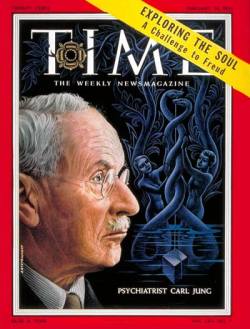
The psychoanalytic C.G.Jung and the famous astronomer Kepler were both intuitive thinkers and empiric scientists with strong mystic tendencies. Pauli was a famous particle physicist, who collaborated with C.G. Jung on the concept synchronicity. When I studied Kepler’s work, I found a similarity of C.G. Jung’s and Kepler’s view on astrology and to my surprise, that Kepler even used the term archetype just in the way C.G. Jung did. This is touched in Pauli’s essay on Kepler. Kepler, Pauli and Jung were trailblazers in their own disciplines as well as in the realm of collaboration across disciplines. Their similar approach as scientist or physician and the concept of synchronicity and archetype form a triangle.
C.G.Jung valued astrology as one of the intuitive methods he used like the I Ching. For him astrology is based upon the synchronicity principle, i.e. meaningful coincidence: “Astrology is a naively projected psychology in which the different attitudes and temperaments of man are represented as gods and identified with planets and zodiacal constellations”.
Kepler is recognized as one of the founders of modern science. He was a devout Christian with mystical tendencies (obvious in his book Harmonices Mundi) working as astrologer of General Albrecht von Wallenstein, a successful soldier of fortune for Rudolph II. Keplers (two) horoscopes of Wallenstein are studied and books written about them until today. Kepler lived during turbulent times, the 30 Year’s War, in “Germany”. This war, by no means only a religious war, decimated half of its population. Kepler was not only working as astrologer in order to make ends meet (he got never paid for his job as court astronomer and adviser of the Habsburg Holy Roman Emperor Rudolph II). Although Kepler was deeply dissatisfied with the way some astrology was practised, he strove to improve the predictive capability by strengthen the theoretical underpinnings of astrology with both mathematical and philosophical models and his superior ephemeris (his Rudolphine Tables). He used carefully selected methods (sun arc directions – and secondary directions – one ephemeris day equals one year of life – but not for planets but axis, which is actually a primary direction i.e.one degree on the Zodiac equals one year of life). For Kepler the sun/earth relation is paramount..He also compared astrological predictions correcting assumed birth time and was able to use “true time” that is actual pace of the Sun not the mean time.
Kepler strongly believed that ‘The world of nature, the world of man, the world of God—all three fit together.In particular, Kepler reasoned that because the universe was designed by an intelligent Creator, it should function according to some logical pattern.Kepler converted to the Copernican heliocentric universe early in his career but was also strongly influenced by neo-Platonic philosophy, which saw the divine in the regularity of geometry (“God always geometrizes”, Plato). It is no exaggeration to say that Kepler was one of the most outstanding and dramatic figures under all his contemporaries and a scientist who repeatedly attacked dogmas of astronomy or astrology. He not only ensured that the Copernican theory became widely recognized, but actually gave it the needed physical and mathematical underpinnings. Before Kepler’s Laws, the basic Copernican model was neither more reliable, nor physical more accurate or mathematical less complicated than the old Ptolemaic model: All astronomers assumed (wrongly) uniform circular motion. When Kepler worked in the Prague period on the “Astronomia nova“, he discovered the famous second law of planetary motion (“planets moved in elliptical orbits, in which a focal point the Sun is”) with the millennia-old paradigm. This needed intellectual courage of Kepler, because it was a break with the tradition of all great astronomers from Ptolemy and Copernicus and the concept of the perfect form – the circle. Nonetheless, after numerous calculations and double-checks Kepler regretfully accepted, basically apologizing to god in his foreword. Kepler also calculated without wavering the birth date of Jesus Christ new. In his work “About the date of birth of God’s true Jesus Christ” Kepler identified the star of Bethlehem with the great conjunction of Saturn and the Jupiter and calculated that this event on the third year CE.
Pauli, a “Wunderkind” may be called a pioneer of quantum physics and leading member of the group of theoretical physicists, including Niels Bohr, Werner Heisenberg and Erwin Schrödinger. The group transformed our understanding of the way matter behaves at the subatomic level encountering a new world where Einstein’s theories (and Newtons Laws) do not apply. Exploration of the Pauli-Jung collaboration is particularly interesting because of the holistic view of his major scientific work, which won him the Nobel prize.The Pauli exclusion principle explains how matters form and a variety of astrophysic effects.
On the psychic side, the Pauli effect was named after the anecdotal bizarre ability of his to break experiments simply by being in the vicinity and his sarcastic remarks toward colleagues. Pauli has always been a strong drinker, which did not seem to hamper his scientific genius. His marriage with a bar singer-dancer became a complete disaster within one year. His mother committed suicide. Despite his Jewish origins Pauli was baptised catholic. Pauli met with Jung, whom he consulted regularly till 1934 in a deep psychological crisis. Especially Pauli’s dreams, which were full of symbolism from alchemy, were extensively discussed.
Pauli himself had written an article called “The Influence of Archetypal Ideas on the Scientific Theories of Kepler” which appeared later in a volume with an essay of Jung’s on synchronicity. The Pauli-Jung collaboration aimed at explication of a unifying or connecting principle bridging the gap between mind and matter or (quantum) physics with psychoanalysis. Jung’s theory of synchronicity stipulated that certain events-often called coincidences-actually reveal the operation of an non-causal connection between mental and physical events through meaning. The history of Jung’s reception by the scientific and scholarly communities is cautious – they largely discredited theories of Freud are considered scientific, but although many Jung’s concepts are widely used his overall work is labeled often as unscientific. Synchronicity has been the prime target for criticism of Jung, but is for me a natural extension of Jung’s view of the intuitive function.
Synchronicity
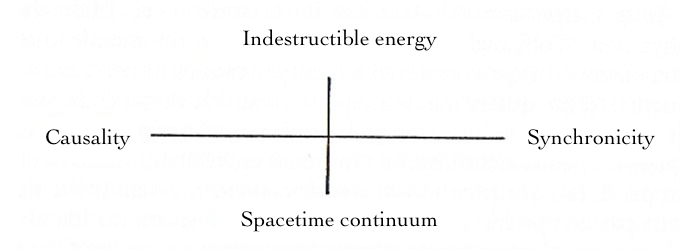
Jung coined the word to describe what he called “temporally coincident occurrences of acausal events” or “meaningful coincidence” and “acausal parallelism in which archetypes and the collective unconscious are governing a dynamic that underlies the whole of human experience and history — social, emotional, psychological, and spiritual.
Synchronicity does not admit causality in the analogy between terrestrial events and astrological constellations … What astrology can establish are the analogous events, but not that either series is the cause or the effect of the other. (For instance, the same constellation may at one time signify a catastrophe and at another time, in the same case, a cold in the head.) … In any case, astrology occupies a unique and special position among the intuitive methods… I have observed many cases where a well-defined psychological phase, or an analogous event, was accompanied by a transit (particularly when Saturn and Uranus were affected). – Carl G. Jung
Jung’s paradigmatic example of a synchronicity occurred during a therapy session, and the connecting meaning in a synchronistic event is subjective, related to the individual’s psychological maturation, or individuation. Jung and Pauli believed, events like this occur too often enough to be only meaningless coincidence. Jung noted taking as usual phenomenological stance, while it would be “absurd” to consider the conjunction of dream material and life events to be causal, “it is wise to consider the fact that [these coincidences] do happen…The East…considers coincidences as the reliable basis of the world rather than causality. Synchronism is the prejudice of the East; causality is the modern prejudice of the West.”
Jung mentioned the concept again in his commentary to Wilhelm’s translation of “The Secret of the Golden Flower”. He concluded that “the causality principle” cannot explain “psychic parallelisms” that must somehow be connected but are not causally related and equated synchronicity with the Chinese Tao. Jung would write about this concept again, and when he did, his focus would shift from the empirical and phenomenological aspects of synchronistic phenomena to the ontological and archetypal nature of such events. Pauli thought that the probabilistic nature of quantum theory and the Uncertainty Principle offered the possibility of discovering something beyond the mind-matter gap which transformed Jung’s understanding of synchronicity. As a result of his interaction with Pauli, Jung gradually came to see this non-causal connecting principle as an explanatory theory must be seen in combination with causality to lead to a better understanding reality, rather than having only a subjective meaning.
Astrology and Alchemy
C.G.Jung saw alchemy as continuation of Gnostic thoughts and wrote: “The starry vault of heaven is in truth the open book of cosmic projection, in which are reflected the mythologies, i.e., the archetypes. In this vision astrology and alchemy, the two classical functionaries of the psychology of the collective unconscious, join hands”.
In his book “Psychology and Alchemy” of C.G. Jung contains Pauli’s early dreams which provided Jung with a rich resource for theoretical exploration, and his own interpretations played a role in Jung’s theories. Pauli clearly believed that this effort was scientific; he said that “even the most modern physics also lends itself to the symbolic representation of psychic processes, even down to the last detail.” In his final version of the synchronicity essay (The Interpretation of Nature and the Psyche Part 2), Jung wrote that the “archetype represents psychic probability”. Pauli wrote in his Kepler essay (published there as part one), that “pure logic” is not capable of establishing a “bridge between the sense perceptions and the concepts.” Kepler himself thought that scientific ideas discerned by humanity exist eternally as archetypes in the mind of God, and Jung’s theories understand archetypes similar “as ordering operators and image-formers” in the symbolic. “It would be most satisfactory” said Pauli, “if physics and psyche could be seen as complementary aspects of the same reality.”
Kepler expressed also original ideas in relation to astrology almost like something the physical resonance theory like: the celestial bodies themselves exert no influence on the human fate, but fixed the angle between the rays toward the heavenly bodies the soul at the moment of human birth and later responds specifically to them. He used actually the term archetypes in his astrological work and not only his Wallenstein horoscope legendary. Kepler ideas, as Wolfgang Pauli observed, identify important intermediate stage between archaic, logical symbolic, and new, quantitative and mathematical description of nature. Much of what was later separated in scientific and non-scientific knowledge was at that time merged inseparably. Similar to representatives of scholastic science, Kepler relied on accuracy, allegory, speculative ideas, and mysticism, but unlike the Scholastics he tested constantly each theory and carefully compared the results with the rich observations of Tyco Brahe and calculations. C.G. Jung derived lekewise many of his insights from observation he made treating his patients.
Ancient wisdom in a global world
Our modern science begins with astronomy. Instead of saying that man was led by psychological motives, they formerly said he was led by his stars. … The puzzling thing is that there is really a curious coincidence between astrological and psychological facts, so that one can isolate time from the characteristics of an individual, and also, one can deduce characteristics from a certain time. Therefore we have to conclude that what we call psychological motives are in a way identical with star positions. Since we cannot demonstrate this, we must form a peculiar hypothesis. This hypothesis says that the dynamics of our psyche is not just identical with the position of the stars, nor has it to do with vibrations – that is an illegitimate hypothesis. It is better to assume that it is a phenomenon of time. … The stars are simply used by man to serve as indicators of time… – Carl G. Jung in 1929
The arrogance of today’s scholarstoward medieval age and traditional knowledge is incomprehensible and the humiliating assessments of Kepler activity, which can be found in the “history of Western philosophy” by Bertrand Russell who described Kepler is “an example of what can achieve mediocrity through hard work”. But Kepler, not Galileo came up for the mathematical proof and physical correct model of the heliocentric model. Kepler is particularly suitable for tracking the various sides and peculiarities of the epistemological concepts, problems of scientific paradigm change and the relations between the empirical and theoretical knowledge. Kepler himself speaks of primary images as being “archetypal” [archetypalis], and Pauli develops a detailed correspondence with Jung’s archetypes. Pauli writes: “the view of the universe was not as yet split into a religious one and a scientific one.” Indeed subjects of physics, religion, mathematics and astrology are all found in one single book of Kepler. His astrological and religious themes have been neglected and Jung’s broader view of psychoanalysis has until very recently been marginalized. The tide is slowly turning, though, and at least Jung may yet have his day. Physicists with a psychological or spiritual inclination have taken note of synchronicity and written of its validity for exploring the connection between quantum and classical physics. Others scientists have begun to explore theories of human cognition that rely on constructs very much like Kepler’s and Jung’s archetypes and his evolutionary understanding of human experience so useful in a globalized world, where I cross many cultural boundaries on a given day.To me Kepler’s astrology is not only superstition but contains some psychological facts (like theosophy) which are of considerable importance. Kepler never predicted the future but in possible (character) dispositions. His astrology connects at least culturally and historically the religion and psychology of antiquity with physics and astronomy of today.
Jung, C. G., Pauli, W. (1952): Naturerklärung und Psyche. Zürich: Rascher (Download)
C.G. Jung (1955) Synchronicity: An Acausal Connecting Principle
Wolfgang Pauli. Verzeichnis der Manuskripte und Korrespondenzen im Archiv der ETH Zürich
Wolfgang Pauli und die moderne Physik. Virtuelle Ausstellung der ETH-Bibliothek
Pauli Archives, CERN, Nachlassverzeichnis
W. Pauli, The Influence of Archetypal Ideas on the Scientific Theories of Kepler
Kepler, Harmonices mundi, Harmony of the Worlds, 1619
Das Buch ist eine vollständige, zuweilen recht wissenschaftliche und sehr detaillierte Ricci Biographie , dessen Kapitel hauptsächlich nach Wirkungsorten und in den letzten zwei Kapiteln nach sein Hauptwerken angeordnet sind. Der Autor ist Chinese-American, der daher auch chinesische Quellen berücksichtigten kann. Das Buch wird vom Kapitel Beijing an ausserordentlich lebendig, und brilliant, geradezu einzigarig wenn es Riccis Argumentation beschreibt. Man glaubt wirklich dabei zu sein, im “Hostel for Barbarians” eine Art Hotel Lux oder bei den vielen Konversationen deren Eleganz noch im Englischen fühlbar ist. Ricci war als Begründer der Chinamission – in einer Zeit von offener Xenophobie eine beachtliche Leistung – einer der bedeutendsten Vermittler europäischer Ideen nach China. Zugleich aber brachte er zum ersten Mal Kenntnisse über Gesellschaft, Geschichte und Kultur der Chinesen der späten Ming-Zeit nach Europa. Ricci ist Begründer der Akkommodationsmethode und Inkulturation. Er lernte die Landessprache, studierte die chinesische Literatur und nahm einen chinesischen Namen an. Er pflegte die Lebensgewohnheiten und Umgangsformen der Gelehrten des Landes, mit denen er in freundschaftlicher Beziehung stand. Als Adressaten seiner missionarischen Vorgehensweise sah Ricci primär die konfuzianische Bildungselite. Der Bezug zu den Eliten des Landes hatte überdies zum Ziel, den Kaiser zu erreichen und möglicherweise zum Christentum zu bekehren, um dann von oben das ganze Reich zu christianisieren. Das Buch stellt ausgezeichnet sein Hauptwerk vor, das versuchte ein etwas vereinfachtes Christentum mit dem Konfuzianismus zu verbinden (in klarer Gegnerschaft zum Taoismus und Buddhismus). Die Querverbindungen z.B. zu Galileo Galileis Wirken oder den Nestorianischen Zeugnissen die die Jesuiten vorfanden werden im Buch kaum erwähnt. Der Index ist etwas dünn, die Fülle der präsentierten Fakten erschliesst sich erst durch aufmerksames Lesen. Das sehr informative Buch geht, wie zu erwarten ist, exzellent auf die Interaktionen der verschieden Religionen und Kulturen aus chinesischer Sicht ein. Oft werden die vielen Gespräche, die Ricci mit den “hochgestellten aber machtlosen Verwandten”, den mächtigen Generälen und den vielen Mandarins geführt hat, zitiert oder Dialoge nachgestellt. Das macht den grossen Reiz des Buches aus. Der Autor ist Professor der Pen Universität und es gibt gute youtube Interviews von ihm.
Ricci in Macerata und Rom
Matteo Ricci stammte aus Macerata. Dort besuchte der das Jesuitenkolleg und studierte Jurisprudenz in Rom, bevor er1671 ins römische Noviziat der Gesellschaft Jesu eintrat. In seiner weiteren Ausbildung studierte er Philosophie und Theologie, aber auch Mathematik beim berühmten P. Christoph Clavius Mathematiker, Astronom und Jesuitenpater am Collegio Romano, der kollegial-freundschaftliche Beziehungen zu Galileo Galilei unterhielt . 1578 wurde Matteo Ricci als Missionar nach Asien entsandt, hielt sich zunächst im indischen Goa auf. Die große Sehnsucht des Jesuiten (1552-1610) galt der christlichen Mission in China, wo bisher alle Versuche, Fuß zu fassen fehlgeschlagen waren.
Die Überfahrt
Gute und packende Beschreibung der pysischen Anstrengung und Gefahren einer solchen Überfahrt und der bewunderswerten Disziplin der Jesuiten,
Ricci in Goa
Mit der Ankunft des italienischen Jesuiten Matteo Ricci beginnt 1583 die christliche Mission in China , aber erst 1601 konnte er Peking betreten. In den ersten Jahren sind Ricci und seine Gesellen allein schon aus sprachlichen Gründen unfähig, ihre Lehre auf Chinesisch angemessen zu formulieren, daher verwundert es nicht, dass die Christen anfangs tatsächlich als eine Spielart des Buddhadharma missverstanden werden; kommen sie doch – wie die Lehre des Buddha – auch aus dem fernen Westen, und die Statue der Madonna mit Kind wird von den Buddhisten als Darstellung der Guanyin gedeutet.
Ricci in Zaoqing
1583 ließ er sich in Zhaoqing in der Provinz Guangdong nieder, gemeinsam mit seinem Mitbruder und Landsmann Michelle Ruggieri, dem er als Assistent zugeteilt worden war. In den ersten zwölf Jahren seiner Tätigkeiten passen sich die Jesuiten äußerlich an buddhistische Gepflogenheiten an, sie tragen die in China übliche buddhistische Mönchskleidung und bezeichnen sich selbst als “Bhikkhu” (chin. seng), leben in buddhistischen Klöstern oder in deren Nähe.
Ricci in Shangzu
Er ging zuerst nach Shangzu, und dort konnt er er schon ohne Übersetzer auskommen. Er nahm die Kleidung des gebildeten Chinesen an. 1598 unternahm er einen erfolglosen Versuch, sich in Peking zu etablieren. Er musste 1599 nach Nanking ausweichen fand aber dort eine völlig veränderte Situation vor. Die höchsten Mandarinen wesentlich offener. Trotzdem glaubte Ricci, dass seine Gemeidegründungen in den Provinzen nicht sicher waren, wenn sie nicht von der Hauptstadt autorisiert waren.
Ricci in Nanchang
Als er 1595 erfolglos versucht sich in Nanking, die berühmte alte Hauptstadt im Süden von China, niederzulassen, konnte er dort eine christlichen Kirche gründen. Ricci verbrachte drei Jahre (von 1595 bis 1598) in Nanchang, eine Provinzhauptstadt (Jiangxi) im Südosten und schrieb seinen Freunden in Italien; “Nanchang hat saubere Straßen und ist mindestens zweimal so groß war, wie Florenz”. Nanchang war die Hauptstadt von von Kiang-si, welche auch viele gebildete gebildeten Männern hervorbrachte.
Ricci in Nanjing
Nanjing (Südliche Hauptstadt auch Nanking) war zeitweise, Hauptstadt des chinesischen Kaiserreichs in Ostchina.Nachdem Ricci 1595 in der alten Hauptstadt Nanking eingetroffen war, musste er zunächst wieder umkehren, ehe er sich 1598 dort dauerhaft niederlassen konnte. Nanjing ist die Stadt, in der sich Matteo Ricci und Xu Guangqi zum ersten Mal im Jahr 1600 trafen. Im Laufe der Zeit rücken Matteo Ricci immer deutlicher vom Buddhismus ab und vertauschten die buddhistischen Roben mit dem Gelehrtengewand der Konfuzianer. Ricci beginnt den Buddhismus scharf anzugreifen, was sich in öffentlichen Disputationen (Ricci gegen Sanhuai Xuelang 1599 in Nanjing) und Riccis Hauptwerk Tian zhu shi yi (Wahre Idee des Himmelsherrn) äußert – sehr zur Verwunderung der Chinesen, die gerade im Hinblick auf die beiderseitig erfolgreiche Begegnung mit dem Nestorianismus einige Jahrhunderte früher durchaus gerade geneigt waren, Ähnlichkeiten zwischen Christentum und Buddhismus zu sehen.
Ricci in Beijing
1601 gelangte er schließlich bis nach Peking und dort bald auch in die „Verbotene Stadt“, wo er als Botschafter der Europäer anerkannt und am kaiserlichen Hof als Mathematiker, Astronom und Kartograph tätig war. Er erstellte die erste Weltkarte, die China nicht als „Reich der Mitte“, sondern als Teil einer größeren Welt zeigte. Überdies erkannte Ricci die Bedeutung der Vermittlung europäischerWissenschaft (Mathematik, Astronomie, Geographie), der Technologie und der Künste (Malerei, Architektur, Holzschnitt) für den Dialog mit der Führungsschicht. Daher sind die Jesuitenmissionare vor allem als Mathematiker und Astronomen tätig. Neben diesem kartographischen Werk, das für China eine neue Weltsicht mit sich brachte, verfasste er zahlreiche weitere Schriften in Chinesisch, so einen Traktat über die Freundschaft und Abhandlungen über die Elemente der Geometrie und über die Agrikultur sowie mathematische und astronomische Schriften.
Das Hauptwerk (The true meaning of the lord of heaven)
In seinem Hauptwerk wurde der chinesische Philosoph Konfucius quasi von einem frühen, heidnischen Verkünder einer hochstehenden Ethik und Moral zu einem Monotheisten. In den alten konfuzianischen Büchern fand Ricci einen Urmonotheismus, während er den zeitgenössischen Konfuzianismus als rein säkulare Staatsphilosophie ansah. Chinesen konnten damit Konfuzianer und Christ zugleich sein, da Ricci ihnen die Teilnahme an den konfuzianischen Riten erlaubte, die nicht abergläubisch seien. Damit machte er die eigentlich fremde Religion des Christentums einigermassen kompatibel für die Chinesen. Andere Religionen Chinas lehnte er jedoch ab, so Buddhismus, Daoismus und den Neo-Konfuzianismus, denen er die “Verfälschung” des konfuzianischen Urmonotheismus zuschrieb.
Laying the foundation
Er wollte dem katholische “HQ” nachweisen, dass die christliche Lehre mit den besten Traditionen Chinas nicht nur kompatibel war, sondern ihre Erfüllung darstellte. Ricci praktizierte aber nicht nur eine äußerliche Anpassung an die Kultur, sondern hatte eine innere Interkulturalität im Auge, in der es zum wissenschaftlichen Austausch und zum geistigen Dialog kommt. Dies drückt sich in einem weiteren Element der Missionskonzeption aus, nämlich der indirekten Verbreitung des Glaubens durch Wissenschaft und Technologie, der seine Übersetzungen mathematischer Werke diente. Gegenüber diesem Konzept der Missionierung und Integration mit der kulturellen Traditionen des Landes setzte die römische Kongregation De Propaganda Fide seit ihrer Gründung 1622 mehr auf die Bildung von Gemeinden unter dem Volk.
The man of paradox
Sein zweitwichtigstes Buch das zu eient einem berühmten Schriftwechse führte. All diese Elemente einer Akkomodation kam auch in der Folgezeit zum Tragen und wurde von Gestalten wie Adam Schall von Bell und Ferdinand Verbiest weitergeführt, die Zugang zum Hof hatten. Sie waren insbesondere am Kaiserhof, wo sie sich durch ihre Kenntnis derWissenschaften unentbehrlich machten. Denn sie vermochten die für das chinesische Staatswesen wichtigen Sonnen- und Mondfinsternisse (Glücks- und Unglückstage) exakter zu berechnen und konnten so dartun, dass sie nicht nur vom irdischen Himmel und seiner Mechanik mehr verstanden, sondern auch vom „Herrn des Himmels“. Die Grundsätze der Chinamission der Jesuiten, also die „Akkomodation“ an die chinesische Kultur, die Evangelisierung von oben nach unten war damals gängige Praxis aber die die indirekte Glaubensverbreitung durch Wissenschaft wohl eher der Renaissance geschuldet der Kulturepoche, in der die sowohl klerikale wie säkulare Eliten an Naturwissenschaften hochinteressiert waren. Dieser Aspekt wird im Buch wenig behandelt, gerade die spannende Geschichte des Pekinger Observatoriums und seinen Nachfolgern (das Geschehen war ja auch nach seinem Tod – aber er schuf das Netzwerk).
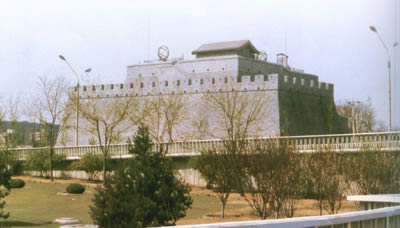
Jesuit missionaries Matteo Ricci, Johann Adam Schall von Bell, and Ferdinand Verbiest served as court astronomers and mathematicians to Chinese Emperors. For over two centuries, they used the Beijing Ancient Observatory to introduce European astronomy and reform the Chinese calendar, which secured imperial protection for their Catholic Mission.The ancient observatory in Beijing China, once part of the city walls, is mounted on the battlements of a ten-meter watchtower close to the “First Ring”. As one of the oldest and famous observatories in the world, it covers an area of 10,000 square meters. The observatory dates back to Kublai Khan’s days when it was north of the present site, and Marco Polo writes:
There are in the city of Khanbalu…about five thousand astrologers and soothsayers… They have their astrolabes, upon which are described the planetary signs, the hours and their several aspects for the whole year… They write their predictions for the year upon for the year upon certain small squares… and these they sell, for a groat apiece, to all persons who are desirous of peeping into the future…
Likewise, the Ming and Qing Emperors relied heavily on astrologers before making a move. Therefore the present Beijing Observatory was built in 1437 to 1446, not only to facilitate astrological predictions but to aid seafaring navigators. Here a short overview:
The Jesuits
The Jesuits, scholars as well as proselytizers, found their way into the capital in 1601 when Matteo Ricci and company were permitted to work with Chinese scientists. The Emperor was keen to find out about European firearms and cannons from them.
The Jesuits outdid the resident Moslem calendar-setters and were given control of the observatory, becoming the Chinese court’s advisors. Of the eight bronze instruments on display (including an equatorial armillary sphere, celestial globe and altazimuth) six were designed and constructed under the supervision of the Belgian priest Ferdinand Verbiest, who came to China in 1659 to work at the Qing court. The instruments were built between 1669 and 1673, and are embellished with sculpted bronze dragons and other Chinese craftwork, a unique mix of east and west. The azimuth theodolite was supervised by Bernard Stumpf, also a missionary; the eighth instrument, the new armillary sphere, was completed in 1754. It’s not known which of the instruments on display are the originals.
The Ancient Observatory
Ancient Observatory, Beijing was known as the ‘Platform of Star Watching’ during the Ming Dynasty but later the name was changed to ‘Observatory’ during the Qing Dynasty. The name was further changed to ‘Central Observatory’ after the revolution of 1911. After its renovation in 1980, the Observatory has become the, ‘Beijing Ancient Astronomical Display Hall’. Records of astronomical observations run from 1442 to 1929, making it the record-holder for the longest period of continuous sky watching. The observatory was in use until 1929 and restored as a museum 2008(!). Today’s building stands alone, severed from the ancient Beijing city wall that Mao Zedong ordered destroyed to make way for the Second Ring Road. As a result, the observatory sits amidst a graceless jumble of modern buildings and highway overpasses, cloaked in the smog of China’s booming capital. Most would agree that the observatory has seen better days, but it still exists as an impressive and fascinating monument to the history of science in China. It can be reached by taxi and there is aclose underground station,. I directed the cab driver to the ancient observatory east of Tiananmen Square using a printout of the official web page in Chinese with the phone number because my Chinese is limited (non existent). Even then he had trouble to find the entry although from the avenue below, some of the various archaic instruments are clearly visible in the skyline.
This ancient pre-telescopic observatory, the most important in China, was first built in 1422 during the Ming Dynasty, around the same time as the Forbidden City. Covering an area of 10, 000 square meters, the Ancient Observatory of Beijing is one of the oldest Observatories in the world, situated in the southeast corner of Beijing’s Jianguomen Bridge. With more than five hundred years old history, Ancient Observatory is not only one of the oldest but also one of the most interesting historical observatories in the world. It is recognized for magnificence, unrivalled beautiful craftsmanship and best preserved instruments, some according the design of Thycho Brahe. Muslim scholars were also recruited and in the seventeenth century, the Jesuits, who were able to more accurately predict the eclipses, helped to further develop the observations of the stars and the planets. During the Boxer Rebellion, the instruments disappeared into the hands of the French and Germans. Some were returned in 1902, and others (good guess – the German parts) were returned after WWI, under the provisions of the Treaty of Versailles (1919).
The Instruments
Thycho Brahe instruments, the work of his life, became obsolete after the invention of the telescope and got burned, but in Beijing, one can still see them. This is the story, which is full of irony. Following the advice of Jesuit padre Joseph Adam Schall von Bell, a teacher of the heir to the emperor and political advisor of the emperor, the Chinese began to use western computation and measuring systems. Another Jesuit, Ferdinand Verbiest constructed the new instruments. According to some sources, he came out of prison, because Emperor Kang Xi wanted to hear his opinion to the calendar reform, proposed by the emperor’s Muslim court astronomer. In 1669, the Kangxi Emperor was informed that serious errors had been found in the calendar for 1670, which had been drawn up by Yang Guangxian. Kangxi commanded a public test to compare the merits of European and Chinese astronomy. The Jesuit, could outwit his competitor. The test was to predict three things: the length of the shadow thrown by a gnomon of a given height at noon of a certain day; the absolute and relative positions of the sun and the planets on a given date; and the exact time of an anticipated lunar eclipse. Verbiest had access to the latest updates on the Rudolphine Tables, done by Kepler with the inherited observations of Thycho Brahe. Ferdinand Verbiest succeeded therefore in all three tests, and was immediately installed as Head of the Mathematical Board and Director of the Observatory. Out of consideration for him, the exiled Jesuits were authorized to return to their missions. The old court astronomer was deposed, and Ferdinand Verbiest became responsible for calendar reform and this court observatory, which he remodelled then with European instruments.
Having resolved the issues surrounding the calendar, Verbiest went on to compose a table of all solar and lunar eclipses for the next 2000 years. Delighted with this, the emperor awarded him complete charge of the imperial astronomy observatory, which he rebuilt in 1673. The existing equipment was obsolete, so Verbiest consigned it to a museum and set about designing six new instruments, later, Kilian Stumpf designed other instruments, the new Armilla and the Azimuth Theodilite.
Altazimuth, used to measure the position of celestial bodies relative to the celestial horizon and the zenith – the altitude azimuth.
Celestial globe, six feet in diameter, used to map and identify celestial objects.
Ecliptic armilla, armillary sphere, six feet in diameter, used to measure the ecliptic longitude difference and latitudes of celestial bodies. (This was the traditional European device while the Chinese developed the equatorial armilla.)
Equatorial armilla, armillary sphere, six feet in diameter, used primarily for measuring true solar time as well as right ascension difference and declination of celestial bodies.
Quadrant Altazimuth, six feet in radius, for measuring altitudes or zenith distances of celestial bodies.
Sextant, eight feet in radius, used to measure the angle of elevation of a celestial object above the horizon. It is used to calculate the angle between two objects, although it is limited to 60 degrees of arc. In navigation, it is used to take a measure of the angle of the sun at noon to determine latitude.
The flat top, 14 meters (46 feet) high, is home to an amazing array of instruments, some originals and others replicas. Among the most interesting are those that were constructed under the direction of Jesuit astronomers residing in Beijing at the invitation of Qing emperors; designed to Western specifications with superficial Chinese ornamentation, the bronze instruments are examples of the first wave of modern-era scientific collaboration between China and the West. On entering the unassuming entrance of the observatory compound, one can see various sea-faring instruments at the courtyard, including an interesting sundial. In the courtyard of the museum, surrounded by ancient trees, the hall and east gate areas exhibit early astronomical instruments and the methods and changes in making them. In the western chamber some 150 early methods of calculating calendars in China are exhibited. Eight bronze astronomical instruments are arranged on the top of the platform, as per the Qing-dynasty emperor Qianlong’s instructions. One then enters a two storey museum which is a collection of pictures, write-ups and busts to show the ancient Chinese scientists and their various astronomical achievements and a replica of a Ming Dynasty gold foil map of the constellations. On climbing to the roof of the observatory, one is almost alone with those unique giant bronze instruments designed in the Qing Dynasty the celestial globe, dragon quadrant, elliptical armillary and azimuth theodolite by the Jesuits. With the completion of the present observatory, it has housed the replica instruments and served the Ming and Qing astronomers in their star-gazing reports, for the Emperor, the Son of Heaven, is closely tied up with the movements of the heavenly bodies. Considered as a milestone in Chinese architecture, Ancient Observatory, Beijing marks my cultural crossroads between the Orient I admire and the Western Catholizism roots which I admire in my way too (when it is lively, intellectual and strong).
Many of the cities and entire civilizations prospered and decayed along the way in history. The cities of the Silk Road witnessed numerous devastating wars, destructions, fires, famine and death. For centuries those dusty caravan roads were traveled by merchants, warriors, priests and scientists. The story of Nasir al-Din al-Tusi and Hulegu Khan, a Persian Astronomer and a Mongol General, a famous fortress and an observatory started in Alamut north of Tehran back in the late 13th century.. It ended in Maraghah City located to the south of Mt. Sahand,what is now northwestern Iran. From the 14th century onwards only walls of this once famous contribution to science of the Silk Road are left. It is a story of science and religion, of superstition and assassins, of violence and betrayal, a story of empires and caliphates built and lost.
In 1971 and 1972 I traveled parts of the Silk Road on my way from Europe to Syria and later to Afghanistan. The road stretched for thousands kilometers leading caravans across scorching deserts, picturesque oases, and mountain passes but obviously travelling through the USSR was not possible at this time.
The Silk Road originated in Chang’an, the ancient capital of China, and went along the northern Tien-Shan to Dunhua, the city near the Great Wall of China. There the single road split bordering the Taklamakan desert from the north and the south. The northern way went through Turfan to the Ili river valley. The Middle road (the so-called Southern way) led from Zhang Qian to the southern coast of Lake Issyk Kul- via Khotan and Yarkand, and reached Bactria (northern Afghanistan). There the Southern route split in two other roads: one followed to India, the other to the West and Merv where it merged with the Northern route. Further it passed via Nisa, the capital Parthia, Iran, Mesopotamia, Bagdad, went to Damascus and reached the Mediterranean. The Nestorians and in the Middle Ages the Venetian merchant Marco Polo travelled the caravan routes. It was the German researcher Ferdinand Richthofen who coined the term the Great Silk Road in his fundamental work, “China”, in 1877.
Along the Silk Road – Alamut and Maragha
Science is international and transreligious. Science is like building a house. Each builder puts up a stone. These stones do not have religion, even if the person has. It’s irrelevant who put up the next block. Al-Tusi put up a block, while working for the Mongol general Hulagu Khan, very much like a few hundred years later Kepler, a Protestant working for the (kind of) catholic general Wallenstein. Hulagu Khan, the grandson of Genghis Khan, hardly a savage, but from his mother Nestorian and later Buddhist fought Islam. He built this observatory in Maragha for and with the help of this Persian astronomer, named Al Tusi. The observatory at Maragha was built to accommodate al-Tusi and many others from many places, who worked eagerly for the destroyer of the Islam Empire. Let’s go back to the history of those two men.
The General Hulagu Khan
The Mongol military leader Hulegu Khan believed as Wallenstein to the advice of astronomers (who were also astrologers), especially of Nasīr al-Dīn al-Tūsī who was a genius like Kepler. Tūsī then served under the Mongols as an advisor to Īlkhānid ruler Hūlāgū Khan, becoming court astrologer. Hulagu Khan, (1217 – 1265), was a Mongol ruler who conquered much of Southwest Asia. Son of Tolui and the Kerait princess Sorghaghtani Beki (both Nestorians), he was a grandson of Genghis Khan, and the brother of Arik Boke, Möngke Khan and Kublai Khan. Hulagu’s army greatly expanded the southwestern portion of the Mongol Empire, founding the Ilkhanate of Persia, a precursor to the eventual Safavid dynasty, and then the modern state of Iran. Under Hulagu’s leadership, the Mongols destroyed the greatest center of Islamic power, Baghdad, and also weakened Damascus, causing later a shift of Islamic influence to the Mamluks (slaves who formed an elite army under Islamic control) in Cairo. It was also in Hulagu’s reign that historians switched from writing in Arabic to writing in Persian.
The Astronomer Nasir al-Din al-Tusi
Nasir al-Din al-Tusi (1201 – 1274) of Persian origin was one of the greatest scientists, mathematician, astronomer and philosopher of his time. He was born in Tus in Khurasan (now Iran) to a family whose notion of learning was the study of religious law and how it was practiced. However, his jurist father encouraged his son to study the philosophical and natural sciences. Educated first in Tūs, where his father was a jurist in the Twelfth Imam school, the main sect of Shīite Muslims, al-Tūsī finished his education in Neyshābūr, about 75 kilometers (50 miles) to the west, an important center of learning, where he studied philosophy, medicine and mathematics and earned a reputation as an outstanding scholar. Nasir al-Din al-Tusi tried to travel to Baghdad to pursue his studies and to join the caliph’s court, still a young man when the Assassins made him an offer he couldn’t refuse. In about 1227 the Ismāiīlīte governor Nādir al-Dīn Abd al-Raiīm granted al-Tūsī “sanctuary” in his mountain fortresses in Khorāsān. Al-Tusi became astrologer in the castle of Alamut, a fortress which was the headquarters of the terrorist Assassins.
The fortress Alamut
Alamut – Eagle’s Nest
Found in the central Alborz Mountains of Iran, Alamut Castle was built into the rock in the 9th century. The name means Eagle’s Nest. The capital Tehran of today, is over 100 kilometers away to the southwest. The natural geographical features of the valley surrounding Alamut largely secured the castle’s defence. Positioned atop a narrow rock base approximately 180 meters above ground level, the fortress could not be taken by direct military force. To the east, the Alamut valley is bordered by a mountainous range called Alamkuh (The Throne of Solomon) between which the Alamut River flows. Under the residence of Nasir al-Din al-Tusi Alamut became also a center for libraries and education.
Hulagu Khan captured and destroyed the Hashshashin stronghold at Alamut in present-day Iran as part of the Mongol offensive on Islamic southwest Asia. When the armies of Halagu, the grandson of Genghis Khan, massed outside the city in 1256, al-Tusi had little trouble deciding where his loyalties lay. In 1256 Al-Tusi gave away secrets of the castle to the invading Mongol army. The invading Mongols led by Hulagu Khan, grandson of Genghis Khan captured Alamut. Al-Tusi joined Halagu and accompanied him to Baghdad, which fell in 1258. Quite interested in the sciences, Hulagu treated Tusi with respect and appointed him one of his ministers and advisor. Later, while serving as an administrator of Auqaf, al-Tusi persuaded Hulagu to build an observatory at Maragha, with al-Tusi as its director as mentioned before.
The observatory at Maragha
Samarkand_observatoire_ulugh_beg
So the astronomical observatory was built in 1259 by the astrology-addicted Hulagu Khan at the behest of his Persian minister who was assisted by Chinese astronomers. The observatory became operational in 1262, lasted and stopped to function within 50 years. In a citadel-like area stood a four-story circular stone building with a diameter of 28 meters. The mural quadrant to observe the positions of the stars and planets was aligned with the meridian. This meridian served as prime meridian for the tables in Zij-e Ilkhani, as the meridian applied today passes the Royal Greenwich Observatory. The Maragha observatory consisted of a series of buildings occupying an area 150 meters in width and 350 meters in length. One of these buildings was a dome that allowed the sun’s rays to pass through. Astronomers from across Persia, Syria, Anatolia and even China were gathered at the observatory, and the names of at least 20 of them who worked at the observatory are known. It is believed that several Chinese astronomers introduced several Chinese methods of computation. The observatory had a library with some 400,000 books on a wide range of scientific topics and a school for training specialists in mathematics, science and philosophy.
It was here that al-Tusi did some of his most important work, using the rich library to write on logic, philosophy, mathematics and astronomy with many other scholars. It had various instruments such as a 4 meter wall quadrant made from copper and an azimuth quadrant which was the invention of al-Tusi himself. Al-Tusi also designed other instruments for the Observatory. A number of prominent astronomers worked with Tusi there, such as Muhyi al-Din al-Maghribi, Mu’ayyid al-Din al-’Urdi, from Damascus, and Qutb al-Din al-Shirazi. It also attracted scholars from the Byzantine Empire, most notably Gregory Choniades, who studied under Shams ad-Din al-Bukhari, an astronomer who worked at the famous observatory under al-Tusi. The observatory also attracted scholars from beyond the Byzantine and Islamic world, such as Hulagu’s Chinese astronomer Fao Munji, whose Chinese astronomical experience brought further improvements to the Ptolemaic system initially used by Tusi. After his death, his son was appointed the director of the institution, but it was later abandoned by the middle of the 14th century (!).
A visit to the ruins of the observatory later inspired Ulugh Beg to build 1428 his own large observatory at Samarkand to continue the astronomical research of the Maragha school. This great astronomer, was a grandson of Tamerlane, a Mongol Conqueror who restored the Mongol Empire and himself a descendant of a celebrated Mongol Emperor soldier, Genghis Khan. At that time, the Mongol leaders had converted already from shamanic religions, Buddhism or Nestorianism to Islam. In the end observatories failed to take root in the Islamic dominated countries. It may be fair to assume, that the orthodox Islamic belief system would have been too rigid to adjust to their findings connecting astronomy with astrology which was (like in Christianity) heresy.
Historical Context
The Silk Road did not only promote commodity exchange but also cultural. For example, Buddhism as one of the religions of theKushan kingdom reached China. Together with merchant caravans Buddhist monks went from India to Central Asia and China, preaching the new religion. Buddhist monuments were discovered in numerous cities along the Silk Road. In the first centuries of Christian era Manicheism (originated in the 3rd century in Iran and was a synthesis of Zoroastrism and Christianity) and Christianity (Nestorians) penetrated from the Near East to Central Asia and further to China. In the 13th century the Silk Road was the route for the new wave of Christian doctrine dissemination connected with the activity of Catholic missions. Warriors of Arabian caliphate brought Islāmic doctrine in the 7th century and the Mongolian travelled along the Silk Road in the 12th and 13th century the other way. The Silk Road was not only the source of goods but also information on their making, i.e. technologies. In particular, the ways of silk, stained glass, paper, books, gunpowder and guns production.
Agents of transmission
In the late 13th century A.D., Gregory Chionades travelled from Byzantium to Persia to study mathematics and astronomy under Shams ad-Din al-Bukhari, who was associated with the Maragha school of Nasir al-Din al-Tusi. Chioniades translated many works from Arabic and Persian into Greek, and is probably the person responsible for introducing such Persian innovations as the so-called “Tusi Couple” to the West. The transmission of Tusi’s work from Iran to the West is discussed in Otto Neugenauer’s History of Ancient Mathematical Astronomy. Choniades later translated the Zij-i Ilkhani into Byzantine Greek and took it to the Byzantine Empire. Al-Tusi’s deftness and ideological flexibility in pursuit of the resources to do science paid off. The road to modern astronomy, winds from Athens to Alexandria, Byzanz, Baghdad, Damascus and it was traveled not just by astronomy but by all science. In the end the observatories and science failed to take root in the Islamic dominated countries. It may be fair to assume, that the orthodox Islamic belief system would have been too rigid to adjust to their findings. Furthermore Islam (as Christianity) was connecting astronomy with astrology, which was heresy. Western Renaissance thinkers later sought out in Europe’s monastic libraries and this crumbling Byzantine Empire and Greek and Arabic works of natural sciences, philosophy and mathematics. The transmission of the Arabic, Persian and Indian astronomy (and astrology),did indeed exist, and was important but used many routes.
The fall of the Roman and Persian Empire
After the fall of the Western Roman Empire in the late 5th century, the Byzantine (East Roman) and Persian Empires dominated the world scene for a while. In Western Europe books were made using parchment which made them enormously expensive. In the eight and ninth centuries the Almagest was translated first into Syriac. Under the Islamic rule, Jews and Christians participated in the state of Dhimmni, significantly to art, medicine and philosophy, which endured for at least 500 years and spread from Spain to Persia. However, by the end of the 11th century AD, the Golden Age was over for many reasons including political/economic stagnation and foreign attacks. The great families who supported the translation movement and promoted advancement of science and philosophy in Persian, Byzantine and other territories were eradicated. The Muslim schools were fully established and were dominated by the fundamentalists where political ideology emphasized fate over reason. The Hellenistic cultures of Egypt, Syria and the Holy Land with its’ Greek and Syriac elements and the Byzantine (Turkey) did not survive. They lost their language and their culture of scientific tradition and enquiry. Persian culture partially survived but empirical knowledge and scientific traditions were lost. Astronomy like other branches of empirical science was virtually vanished and like medicine was only revived in the 20th century.
The Rise of the Islam
Commanded by the Koran to conquer and utilize all resources, and inspired by a treasure trove of ancient Greek learning, Muslims took over a Syrian, Jewish and Christian intellectuals and knowledge. Later the Chinese and Indian Science was adopted. The Arabic language must be used as official language of the oppressors. The rise of Arabic to the status of a major world language is inextricably intertwined with the rise of Islam.
When Muhammad’s armies swept out from the Arabian Peninsula in the seventh and eighth centuries, annexing territory from Spain to Persia, they also annexed the works of Plato, Aristotle, Democritus, Pythagoras, Archimedes, Hippocrates and other Greek thinkers. The largely illiterate conquerors very effectively turned to the local intelligentsia to help them govern. Although the Babylonians, Indians and Egyptians had astronomical observatories, those founded under Mongol (operated by Persian, Indian and Chinese) rulers in Maragha and Samarkand were sophisticated, equipped with an impressive array of astrolabes, sundials, sextants, celestial globes and armillary spheres. Muhammad, the prophet entrusted by God to deliver the Islamic message, Arabic had become the official language of a world empire whose boundaries stretched from the Oxus Riverin Central Asia to the Atlantic Ocean, and had even moved northward into the Iberian Peninsula of Europe.
Science Achievements
al-Tusi’s Maragha in Alamut
Although al-Tusi later said he had been held in Alamut against his will, al-Tusi thrived there, publishing works on astronomy, ethics, mathematics and philosophy that marked him as one of the great intellectuals of his age.
al-Tusi’s Maragha school
Al-Tusi’s Maragha school had a library with some 400,000 books on a wide range of scientific topics and a school for training specialists in mathematics, science and philosophy. Al-Tusi enhanced the Ptolemaic model, however, it remains a fact that the Maragha school never made the big leap to heliocentric system of Copernicus not to speak the first physical correct and accurate model of Kepler. [Toby E.Huff(1993)].
In the Ptolemaic system, as shown below the planets and sun moved in small mini-orbits
To clarify a current and often copied myth, the influence of the Maragha school, say on Copernicus remains speculative, since there is no documentary evidence to prove it and even if it were, it was negligible to Copernicus’ (see below) and irrelevant to Kepler’s achievements . But Al-Tusi was an outstanding Persian scholar on his own rights, however, who wrote around 150 books in Arabic, Persian, and Turkish, with sixty-four treatises known to have survived. Many were consolidated accounts of what others had previously written. But he also made many original contributions, most particularly in mathematics. He was the first to treat trigonometry as a separate science, rather than just a set of tools for astronomy. He edited the definitive Arabic versions of the works of Euclid, Archimedes, Ptolemy, Autolycus, and Theodosius. His most famous astronomical work is the four-volume Al-Zij-Ilkhani (Astronomic Tables of Ilkhan), dedicated to Hulagu Khan. It is an accurate table of planetary movements, based on the research carried on at the Maragha Observatory. Al-Tusi’s main contribution to logic is contained in The Ground for the Acquisition of Knowledge. Al-Tusi’s commentary on Ptolemy’s Almagest, called the Tadhkira fi ilm al-Haya (“Memoir on Astronomy”) is a most thorough discussion of Ptolemaic astronomy.
The Zij-i Ilkhani tables
The result of his astronomical observations and calculations were compiled in the famous tables of the Zij-i Ilkhani originally in Persian. A range of evidence leads to the assumption, the nature of the “Chinese” calendar had been brought to Iran by this Chinese Taoist Fu Mengchi who accompanied his ruler Hulegu Khan. He informed Tusi of the calendar, which Tusi described in the Zij-i Ilkhani. The Chinese calendrical system was then included in the Zij of Muhyi al-Din Maghribi in the period immediately thereafter, and it was practiced only among the Mongol ruling class and their Buddhist servants, who were called “Uighur.” In reflecting on this social situation, Muhy i al-Din labeled the “Chinese” calendar as the “Chinese-Uighur” calendar, and this title succeeded to the later zijes, one of which became the first focus for analysis of the “Chinese” calendar. Thus, the calendar was attributed to the Uighurs, who surely played an important role in the nascent period of the Mongol empire. It is natural that there are similarities between the Chinese Heavenly Agreement Calendar and Season-Granting Calendar, as several previous studies have noted. These calendars were all used or compiled in accordance with the same intellectual foundation, Tusi the Chinese system. Studies on the Mongol empire shown that, while its warfare was cruel, was not at all (science) cultural ignorant as the Western history claims until today.
The (in)famous Tusi Couple
geometric construction, recently known as al-Tūsī couple
Al-Tūsī’s most influential book in the West may have been “Treasury of astronomy”. It gave a better mathematical model (but not the reality) of planetary motion to appear in medieval times. Al-Tusi appears to have been the first to discover that if one circle rolls around inside the circumference of another and if the second circle has a radius twice, that of the first, then any point on the periphery of the first circle describes a diameter of the second. His manuscript and his ingenious device, now known as the “Tusi Couple.” solved a centuries-old problem that plagued Ptolemy and other Greek astronomers more accurate: how circular motion can generate linear motion. By means of this construction, mathematical essentially a geometric way to achieve a Fourier Transformation, al-Tusi succeeded in enhancing the accuracy of the Ptolemaic geocentric models, producing a system in which all orbits are described by uniform circular motion. The Tusi couple is a 2-cusped hypocycloid obtained by rolling a circle of radius inside a circle of radius 2a. The result is a line segment which replaced the simple different. In the Ptolemaic system, as shown below the planets and sun moved in small mini-orbits, known as epicycles, within a larger, greater orbit around the earth, was comprised in order from closest to farthest as Mercury, Venus, Sun, Mars, Jupiter, and Saturn. By means of this construction, al-Tūsī succeeded in adding value to the Ptolemaic geocentric model, producing a system in which all orbits are described but still a uniform circular motion round the earth.
Copernicus heliocentric model
There is a common misconception that the Copernican model did away with the need for epicycles. This is not true, because Copernicus was able to rid himself of the long-held notion that the Earth was the center of the Solar system, but he did not question the (both wrong) assumptions of uniform and circular motion. Thus, in the Copernican model the Sun was near at the center, but the planets still executed uniform circular motion about it. As Kepler discovered, the orbits of the planets are not circles, they are actually ellipses.
Copernican model, with it assumption of uniform circular motion, still could not explain all the details of planetary motion on the celestial sphere without epicycles
As a consequence, the Copernican model, with it assumption of uniform circular motion, still could not explain all the details of planetary motion on the celestial sphere without epicycles. The difference was that the Copernican system required many fewer epicycles than the Ptolemaic system because it moved the Sun nearly to the center and needed it for different reasons. In the Copernican system, it can be seen then that epicycles are unnecessary as a means to explain retrograde motion. His actual reason for this was because planetary observations indicated that even when the slowing down and speeding up of the observed planets due to retrograde motion was precisely accounted for, the planets still nevertheless did not seem to travel at uniform speed about the sun. Rather, the observations clearly demonstrated that they appeared to travel faster through space when closer to the sun and slower when further away from it. Indeed, this noted fact that the planets did not maintain a constant distance from the sun at all times in their orbits led Copernicus to offset his major orbital circles so that they were not precisely centered on the sun. Thus, in holding fast to his circles, and through his conviction that the speed of the planets was uniform, he was forced to retain small planetary epicyclical orbits as a subtle way to account for the continued presence of their apparent non-uniform motion about the sun. This was really nothing more though than a mathematical manipulation employed in order not to have to discard the primary aspects of his system; to allow it to better match actual observations; and also to allow him to claim that any observed non-uniform motion was not real, but illusory. A planet in orbit about the sun is travelling anti-clockwise in its epicycles and also anti-clockwise in its main orbital circle; the centre of the smaller circle moving in uniform motion upon the circumference of the larger circle. When positioned at P1 the combined speeds of both ‘orbital circles’ are pointed in the same direction and thus are added. The picture above (left) from the book III chapter 4 is often referred as a planetary model similar to al Tusi as it bears indeed some resemblance. However, its purpose is just to show “How the reciprocal movement or movement of liberation is composed of circular movements.
Copernicus Venus
The models for inferior and superior planets of Copernicus are quite differently – shown below on the left (Venus) and below right (Mars).
Copernicus Mars
I fail to see, why a heliocentric model using epicycles’ needs help of an geocentric mode using hypocycloids as some Islamic historians claim. This necessitates that the planet is at this moment travelling at its fastest in orbit about the sun. From this initial position, as the planet moves yet further about the sun on its main circle, the uniform speed of the planet in its epicycle is such that by completing half of its main orbit about the sun, reaching point P2, it has completed one full orbit of its epicycles. At this point, the main orbit is counter to the direction of that of the epicycles, and thus the planet, at its most extreme position from the sun, is travelling at its slowest. If one were to plot the actual path of one full orbit about the sun, the planet would be found to trace out an elongated circular path as opposed to an exact circle. Such is the result of combining two uniform circular orbits in the proscribed manner. Upon the issue of system accuracy, one should note that the Copernican system actually afforded mostly a lesser level of precision than that of the Ptolemaic system. Indeed, Copernicus’s continued use of epicycles was in fact necessary simply to allow it to achieve the same level of accuracy as was present under the Ptolemaic system. Without them, although the general ordering of the planets about the sun would have been correct, the predictive power of the system would have been even weaker.
Kepler’s breakthrough – the first physical correct model
Due to Ptolemaic system ability to fairly accurately predict the paths of the observable planets in the sky, it remained widely accepted well after Copernicus defined the heliocentric theory. Even then, Ptolemy’s system was still better able to explain the motions of the planets. Also Galileo’s support of a heliocentric theory of Copernicus model, was with the wrong arguments.
Kepler’s Model
It was not until the later addition of Kepler’s laws of motion and elliptic orbits until the heliocentric theory fell neatly into place that and his model become of practical use. Only Kepler provided later the mathematic laws, and broke the 2000 year obeying usage of circles, which made the heliocentric model more accurate than the Ptolemaic model. Whether Earth centered or sun centered, it is impossible to know which if any is based upon truth. The Astronomia nova is a book, published in 1609, that contains the results of the astronomer Johannes Kepler’s ten-year long investigation provided strong arguments for heliocentrism and contributed valuable insight into the movement of the planets and provided better results and accuracy. The orbit of every planet is an ellipse with the Sun at one of the two foci. A line joining a planet and the Sun sweeps out equal areas during equal intervals of time. The square of the orbital period of a planet is directly proportional to the cube of the semi-major axis of its orbit. In 1623, Kepler at last completed the Rudolphine Tables. In 1628, following the military successes of the Emperor Ferdinand’s armies under General Wallenstein, Kepler became an official advisor to Wallenstein just like Tusi to the Mongolian emperor.
Science in Islamic dominated countries
There is no question that at that time astronomy and science flourished in the Islamic dominated countries. The truth it was based on the Chinese, Indian, and Christian roots and local intelligentsia in countries under Islamic control responsible not Islamic science. Coming back to Al Tusi. Syrian, Arabic and Persian Astronomers writing in Arabic at that time did certainly more than simply read and fine tuning Ptolemy. However, they never questioned geocentricity. According to the philosophers, celestial bodies were supposed to move in circles, the ideal form and with uniform speeds. But the complexity of Ptolemy’s attempt to explain the very un-uniform motions of planets and the Sun as seen from Earth was marred by corrections like orbits within orbits, known as epicycles, and geometrical modifications. Al-Tusi was just adding pairs of cleverly designed epicycles to each orbit to Ptolemy’s model.
Science in the Byzantine Empire
The Byzantine Empire, centered at Constantinople, maintained complex relations with the Eastern Orthodox Catholic Church. Within this reign, Greek remained a common language among the native tongues of the Syrians and Arabs. Because Greek continued to be spoken and scholars still had a direct access to many Hellenistic libraries. In fact, the era following the fall of Rome and preceding the rise of Islam was the age of Byzantium. The famous library at Alexandria was burned by invading Arabs in the 8th century. When we speak of the fall of the Roman Empire, we should not forget that in fact only the western portion of that empire succumbed to the Germanic invaders. In the east, the eastern Roman, or Byzantine, Empire stood for a thousand years as a citadel against the threats of expansion by the Muslims until 1453. The Byzantine Empire made great contributions to civilization: Greek language and learning were preserved for posterity; the Roman imperial system was continued and Roman law codified; the Greek Orthodox church converted some Slavic people and fostered the development of a splendid new art. Situated at the crossroads of east and west, Constantinople acted as the disseminator of culture for all people who came in contact with the empire. Called with justification “The City,” this rich and turbulent metropolis was to the early Middle Ages what Athens and Rome had been to classical times until it was laid in ashes. Little primary resources of Byzantium contribution to science are therefore available, and its place in the history has been written by the victors. In the early seventh century (610-645) Emperor Heraclius in Constantinople took an interest in astronomy and he, or his astronomer Stephanus produced a commentary on Ptolemy’s “Handy Tables”. It was not a climate that astronomy or any scientific study could thrive. Instead, the few educated people who could preserve some of the books and knowledge of the past, looked back on Ptolemy’s achievements in awe and reverence.
Arab Science
Early Arab science succeeded more in pragmatic applications as it did in theoretical concepts. However, a new empire was now expanding; this was the empire of Islam. The Prophet Mohammed (570-632) and his followers the Caliphs had built up a vast empire, which included Egypt, Syria and Mesopotamia. The common language of the empire was Arabic, the language of the Koran. The Abbasid Caliphs built themselves a new capital in 762, Baghdad. In this very early period, Arabic astronomy was influenced by Indian astronomy. Indian astronomy had been influenced by Greek ideas from the time of Alexander the Greats conquests in the east. From the 750’s onwards the use of paper was introduced into the Islamic dominated countries from China. This made books much cheaper to produce and encouraged scholarship.
The Renaissance which did not happen
Some scientists and historians call for an ”Islamic science”, but most argue successfully that a religious conservatism has dampened the skeptical spirit necessary for good science. ”Civilizations clash,” Islam is an example of that. As discussed before, some historians of a so-called Islamic astronomy – whatever that may be – believed that some knowledge developed at Maragha found their way to Europe (perhaps via Byzantium) and provided Nicolaus Copernicus (1473–1543) with inspiration for his usage of the Tusi Couples. In this case Al Tusi was a Persian scholar working for a Nestorian / Buddhist ruler, and is it needs to be noted, that even if this may be possible, the Tusi Couple have little to do with the real revolution of the heliocentric model not speaking with the introduction of the elliptic curves. Nor was the Tusi Couple central in Copernicus’ achievement, or his model more accurate. That does not chip anything away of the outstanding achievements of Al Tusi. The conservatives in Islamic culture up today still favor the geocentric model, never having the fundamental will to break up religion doctrine and science.
Conclusion
Geocentrism was not the result of a priori deduction from first principles, but rather the result of empirical observation and experience. It was the best hypothesis, given the data possible at the time. It was not until Kepler that a heliocentric model was developed that worked better; and not until Newton was there a reason to believe that it ought to be physically true. Don’t forget that the real revolution of Copernicus was the revelation of the earth not being the center of creation. Mathematical and empirically his system was inferior to the Ptolemaic system and a similar device as the Tusi couple was marginally used once. Mathematical and empirical it was Kepler and Newton who switched astronomy from the math department to the physics department, and people began to wonder if these purely mathematical models might be physically true. Ptolemaic astronomers had never claimed physical reality for their epicycles.
The attitude of conservative Muslims to science was not so much hostile as schizophrenic, wanting its benefits but not its world view. They may apply modern technology, but they don’t deal with issues of religion and basic science. One response to the invasion of Western science, in particular in the internet, has been an effort to ”Islamicize” science by portraying the Koran as a source of scientific knowledge, very much like some Christian do. The requirement that Muslims face in the direction of Mecca when they pray, for example, required knowledge of the size and shape of the Earth. Astronomy in the East reached its zenith, at least from the Western perspective, in the 13th and 14th centuries, when al-Tusi and his successors pushed against the limits of the Ptolemaic world view that had ruled for a millennium. But the East had no need of heliocentric models of the universe and never went beyond. All motion being relative, it was irrelevant for the purposes of Muslim rituals – and is for all practical purpose of observation with the eye – whether the sun went around the Earth or vice versa. Among other things, the Islamic empire began to be whittled away in the 13th century by Crusaders from the West and Mongols from the East. Today, science still lags there, but a lot of money is spent to deconstruct and re-write science history with a little help of science- and history-ignorant media.
Sources:
The Rise of Early Modern Science – Islam, China and the West, Huff, Toby E.
The Biographical Encyclopedia of Astronomers, Springer Reference. New York: Springer, 2007 (via web)
Astronomy and astrology in the medieval Islamic world, Edward Stewart Kennedy
Cosmos An illustrated history of astronomy and cosmology, John David North
On the revolution of heavenly spheres (Niclolaus Copernicus)
The Fontana history of astronomy and cosmology, John David North (German Translation)
Aristote au Mont-Saint-Michel, Sylvain Gouguenheim (German Translation)
Sources by excerpts: Astronomy in the service of Islam,
David A. King Islamic astronomical instruments ,
David A. King A History of Arabic Astronomy, George Saliba Digital International Astrology Library
J. A. Boyle, “The Longer Introduction to the Zij-i Ilkhani of Nasir ad-Din Tusi”, Journal of Semitic Studies (1963)
E. S. Kennedy, A Survey of Islamic Astronomical Tables, Transactions of the American Philosophical Society