Category: Meditation

  • The wolf in us from an Jungian view: “lupus est homo homini”

    The wolf in us from an Jungian view: “lupus est homo homini”

    Recently I attended a catholic retreat in a Benedictine mountain monastery.  The theme was: The wolf in us.  We discussed the archetypes and myths of the wolf, a topic I had explored in great length before, their archetypes here and here. The point was raised, that the wolf represents greed, one of the seven deadly sins.  What was interesting, however, was  at some point the monk, an American Swiss, who can flawlessly yodel, let us howl like wolves. A quite devoted group of catholics from all walk of life became a wolf pack. My experience during this long Whitsun weekend with an intimate and less organisational approach to spirituality is what I want to write about. Because, as I see it, the wolf in us, seen from a Jungian view, is our untamed shadow, but also a great source of energy. This article is so the third in cycle of the archetype of the wolf, a personal defense of the wolf from German romanticism (or if you want from Rousseau’s nobel savage) and includes some of my unsystematic associations.  Nature never deceives us; it is always we who deceive ourselves – the philosopher Jean-Jacques Rousseau.

    St. Francis and the wolf of Gubbio

    animalschagall
    animalschagall

    The monk told us on the first day the most famous story of St. Francis is when he tamed the wolf that was terrorizing the people of Gubbio. While Francis was staying in that town he learned of a wolf so ravenous that it was not only killing and eating animals, but people, too. The people took up arms and went after it, but those who encountered the wolf were killed. The villagers became afraid to leave the city walls.

    Francis took pity on the people and the wolf as well and decided to go out and meet the wolf. He was desperately warned by the people, but he insisted that God would take care of him. A brave friar and several peasants accompanied Francis outside the city gate. But soon the peasants became terrified and said they would go no farther.

    Francis and his companion began to walk on. Suddenly the wolf, jaws wide open, charged out of the woods at the couple. Francis made the Sign of the Cross toward the wolf who immediately slowed down and closed its mouth. Then Francis called out to the wolf: “Come to me, Brother Wolf. I wish you no harm.” At that moment the wolf lowered its head and lay down at St. Francis’ feet, meek as a lamb.

    St. Francis explained to the wolf that he had been terrorizing the people, killing not only other animals, but humans as well. “Brother Wolf,” said Francis, “I want to make peace between you and the people of Gubbio. They will harm you no more and you must no longer harm them. All past wrongs are to be forgiven.”

    The wolf showed its assent by moving its body and nodding its head. Then to the absolute surprise of the gathering crowd, Francis asked the wolf to make a pledge. As St. Francis extended his hand to receive the pledge, so the wolf extended its front paw and placed it into the saint’s hand. Then Francis invited the wolf to follow him into town to make a peace pact with the townspeople. The wolf meekly followed St. Francis.

    By the time they got to the town square, everyone was there to witness the miracle. Then he offered the townspeople peace, on behalf of the wolf. The townspeople promised in a loud voice to feed the wolf.

    Apollo_Action
    Apollo_Action

    Then Francis asked the wolf if he would live in peace under those terms. He bowed his head and twisted his body in a way that convinced everyone he accepted the pact. Then once again the wolf placed its paw in Francis’ hand as a sign of the pact.From that day on the people kept the pact they had made. The wolf lived for two years among the townspeople, going from door to door for food. It hurt no one and no one hurt it.  When the wolf finally died of old age, the people of Gubbio were sad.

    Owning a Labrador,  actually I thought during the session the wolf in me says; Come to me, Brother. My Labrador retrievers never fails to amaze me when he puts his paw in my hand. Which he does at least every morning, when I come down to the basement giving him his two pieces of a treat. Labs are known for their voracious appetites and mine seems always hungry. Apollo, thats his name, will never turn down food except when not feeling well (or one rare exception italian Rucola salad). His the most negative behaviors that need to be curtailed is begging while I cook, making  long faces and pleading eyes. But is he or the wolf a symbol of greed?  I think not.  More a symbol of bonding. Both have developed the emotional need to constantly interact with the other members of the “pack”.

    The (human) wolf pack

    Wolfsklamm, gorge in Tyrol Alps in Karwendel
    Wolfsklamm, gorge in Tyrol Alps in Karwendel

    georgenberg

    Most of us in the group of 15 knew the open-minded monk (who is priest and psychoanalyst) and each other, from past exercitation – but wolf howling created an extra physical and psychological experience of belonging and trust. As did two days of long mountain hikes, where we held a proper holy masses, one time on a wide mountain meadow and on the next day in three parts  in two different churches and one capella. Again the experience was quite unique. Like wolves we roamed “our territory” with a resident monk, who explained us that most of this Tirol territory with its 20 high mountains still has been owned by the monastery in which we stayed. That opened many doors in this countryside area.

    waterfallpfinsten
    waterfallpfinsten

    We hiked up a waterfall  which carved out a deep canyon in limestone (called wolf gorge / Wolfsklamm). The Wolfsklamm in Karwendel impressed the nature lover with thundering waterfalls, emerald green pools and a  rising spray creating rainbows. The strong spring floods, the roar of the stream lead up to the monastery of St. George mountain pilgrimage. We walked further in the nature reserve Karwendel. Just before reaching the Stall Alm, we reached a wide alpine meadow for the open air mass. The monastery of St. George – St. Georgenberg – was a mountain hermitage, which was first mentioned in 950 for the first time in writing. St. George Berg, is the oldest place of pilgrimage throughout the Tyrol. The monastery still exists, it is a place of power and offers  personal retreats. We stayed this year down in the large monastery in Fiecht.

    While I walked up against the current of the water, I could not help but seeing in the water flow a symbol of going back in (my life) time. I saw blocks and trees in the rapid water, going up river water the water was calm. You never now what the future holds for oneself down the river.  I imagined a wolf pacing up the stones. Time is rapid water.
    There is eternal timeless truth within our universe which expands since 13.8 Billion years. To the Hindus this is just on of many Shiva’s dreams, a representation of the creation of the universe at the beginning of each cosmic cycle – a reminder that the universe now newly created… will billion of years from now will be utterly destroyed or vanish. Creation. Destruction. But the the deep canyon also reflects the eternal truth and overall time. At least within the realm of one of Shiva’s dreams.

    chapellpfingsten
    chapellpfingsten

    Now back to the real wolves an wolfs howl. The groups conclusion was, that wolves and people did not get along well because their social behaviors is so similar. To find the wolf in us we imitated how it would be like wolves. That means, observing like they walk and how they use several forms of verbal communication, including high-pitched-barks, yips, whines, whimpers, and howls. Like my Labrador dog also wolves whine and whimper as indication of either physical or emotional discomfort or if they are hungry. A yip might be heard when a Wolf is suddenly frightened or hurt during play or ritual combat. Barks or woofs are generally short and warn against the approach of intruders or to attract the attention of another Wolf within visual range. Of all the sounds, none are as famous, haunting, or beautiful (and frightening) as a Wolf’s howl. Wolves howl also alone or together for a variety of reasons. To notify other Wolves of their whereabouts; such as when they wish to attract a mate, rally the pack together for the hunt, when distressed, during or after playing and other social interactions, and often just for the fun of it.

    I have to admit it was fun to howl in a group, and actually the famous Bavarian or Tirol yodel may be a reminiscences of the lone howling (don’t try that in an urban environment):

    • Find a wide open space – opportune locations include fields, meadows, rolling hills, and/or the privacy of your own (large) backyard.
    • As the power rises within you, gather strength from your diaphragm and inhale deeply.
    • Exhale with force and feeling as you make an oval shape with your mouth.
    • During exhalation, let out a piercing and mournful cry,(also known as a “howl”) keeping your mouth in an oval shape
    • Let the howl resonate for seconds, gradually reducing inflection and fading out.
    • You can tell what a howl means by its pitch and strength. The longer the lasting, the more strength of the emotion. The higher the pitch, the happier the feeling. Quieter sounds mean more bland of an emotion.
    • Repeat if desired, until all frustration is let loose. Once howling has ceased, reflect on your wolf experience,It is better to do this with friends if your personality is like a “pack wolf” but if you’re a lone wolf..try doing it yourself. One howl a day keeps the doctor away.

    Howling sessions among multiple Wolves generally begin as a series of short yaps, then howls that last from less than a second to longer than ten seconds. During the howl the voice may maintain a single tonal quality or cascade from high down to low and then back up to high. Group howls can take on a truly frenzied quality, and two or three howling Wolves can sound like a dozen or more. Larger Wolves tend to have a lower sounding howl. A Wolf’s howl can be heard for up to ten miles under optimal conditions. Wolves can howl while standing, sitting, or laying down. Wolves do not howl at the moon as so many people like to romanticize, studies have shown no correlation to (Wer-)Wolves howling and lunar phase; Wolves just love to howl, period.

    Charismatic wolves

    pentecostal
    pentecostal

    Rousseau, said also once, the world of reality has its limits; the world of imagination is boundless, which I would translate in C.G.Jung’s claim, the religion is out of scope of the temporal world but the desire for it is in every men. By chance I talked one time with the monks about the new pope Francis I and the pentecostal movement. The question was what can we use as catholics  from “charismatic techniques” learning from the competition. I got mixed responses. A pragmatic response was, they spread the gospel, that is good. But not following liturgy literally raises also eyebrows. Once during dinner the head of the monastery greeted us and when we discussed our “three church mass” asked us quite ironically, he sure hopes we had celebrated catholic. It occurred to me then that our weekend experience was quite closer to the bible than to conservative church rituals and in a way proper catholic with some little charismatic sprinkles very appropriate to the special liturgy of Whitsun. We sung to the guitar every night after dinner and during the retreat sessions. The world of spirituality is boundless indeed.

    I’m not very familiar with the pentecostal churches (outpacing in Africa and South America any other religion) but I have written a bit about them consider them historically interesting.  Some have very charismatic leaders where everyone is memorised by their voice.  The music, speaking in tongues etc puts people into a trance-like state where they are open to suggestion.  Any person should know, who plays music to evoke the mood, to evoke emotion, to enable free thinking.  Are they the wolves in sheep clothes, or allies? There seemed to be a psychological connection between our howling in the group and the pentecostal trance – at least this was a Whitsun weekend. I know it is a clumsy, if not even an offending comparison, but I am suspicious of group experiences. Furthermorehowling with wolves is a not well-meaning proverb.

    Paul warned us that grievous wolves in sheep’s clothing would come into the Church. We know that in the history of the Church many wolves dressed in sheep’s clothing have devoured the flock. Today in our time there are many breeds of wolves in sheep’s clothing work in temporal institutions and religious organizations churches and ideologies dressed up as  religions that are decimating the flock like never before.  But is it? The writer and respected professor of  history and religious studies Philip Jenkins who is also the author of The Lost History of Christianity argues that the rapid growth of  Christianity around the world (both within and alongside existing traditions) will literally reshape the world, with possible religious and geopolitic conflicts.  Jenkins observes that especially Pentecostalism, mainly a protestant renewal movement within Christianity (German: Pfingstler, Pfingstkirche, Pfingstbewegung), is steadily winning  millions of follower in Latin America, South America, Africa, India, Malaysia, China, and Eastern Europe, including Russia. There is even a Catholic Charismatic Renewal, which  pope emeritus Benedict XVI once praised highlighting its positive contribution.  According to the U.S. urban specialist Mike Davis “Pentecostalism is the largest self-organized movement of urban poor in the world”.  Are they a wolf’s pack in a good sense to defend persecution, or wolves in sheep clothes?  Can learn Christians from wolves – giving the bad rap they have within the bible? I think, yes we can.

    windowpfinsten106The perils for Christians today are real.  In the very monastery a young christian refuge from South Sudan had one time dinner with us on Sunday. He told us his story. His whole family and all relatives had been killed.  He was assaulted as kid from the militias with machetes and survived  just because he protected his head with his hand stopping the machete with his wrist. This cost him half of his hand and he was left for dead in a pool of blood. His journey went then on through Tchad, Libia often helped by Christians and lastly via a cargo ship to Europe. I saw this boys smile and his hand, who lives now with kids mainly from Afghanistan in a sort of foster home until he is 18. I believe his story. Persecution and poverty of which so much are made in the New Testament literature is very much the context of the majority of today’s southern Christians (not to mention those who await their moment a half-century hence).  However, for whatever reason, Western investment in missions has been cut back dramatically at just the point it is most desperately needed, at the peak of the current surge in Christian numbers from self-centered European clergy. According to Philip Jenkins:  “For the average Western audience, New Testament passages about standing firm in the face of pagan persecution have little immediate relevance…. “Millions of Christians around the world do in fact live in constant danger of persecution or forced conversion, from either governments or local vigilantes.”

    When he says, “Looking at Christianity as a planetary phenomenon, not merely a Western one, makes it impossible to read the New Testament in quite the same way ever again”, he has a particular strong point pointing out the Book of Revelation. and that nevertheless, “Christianity is flourishing wonderfully among the poor and persecuted, while it atrophies among the rich and secure.”  We could learn from the wolves breathtaking ability to bundle strength in a pack.

    Conclusion

    wolfhowling
    wolfhowling

    lupus est homo homini, non homo, quom qualis sit non novit.“ The phrase is sometimes translated as “man is man’s wolf” or “man is a wolf to his fellow man.”  It is widely referenced when discussing the horrors of which humans are capable. But that Man to me is an errant Wolf not the Wolf an errant Man and I dislike Hobbes’s observation, claiming that all human are always inherently selfish.

    Yes, there have never been so many human wolves in sheep’s clothing attacking from so many directions. With mass media the grievous wolves in sheep’s clothing have access to many sheep and they are fleecing the flock like never before in history. Some prosperity confession and temporal (taxing) powers teach sheep that coming to the Great Shepherd is to partake in the abundant life that will be provided for them while they are still on the hoof. To become a partner in this abundant lifestyle sheep just need to send them a hundred pounds of wool each month (or a one time annual gift of a thousand pounds). In return, these wolves will send the sheep a collector item bell to wear around their neck to remind them how much they enjoyed being fleeced. But are they wolves?

    I agree with the idea being that Greed is a powerful, vicious force and a deadly sin. It is shameless in what it wants and how it takes it. Greed,  bites down hard and shakes and tears into things, it is untamed and straightforward and devours all it can.  While a greedy person may come off as wolfish, the actual feeling that one gets while in the grip of being greedy is unlike a wolf on the hunt. Pigs are better used to describe the so-called and admired star investors who shape our world today. Wolves in traditional symbolic meanings may differ from how an actual wolf behaves. Even the wolf of Gubbio was just hungry. I came to the conclusion after this retreat we were howling after what we lost, the connection to an untamed dangerous nature and the dream of the nobel savage.

    Freedom

    Many miles mankind went
    To reach this point
    They went to seek what they lost
    What they lost before time
    Before the first rays of light
    When men settled down more domesticated than their dogs

    Despair

    Men, they the warriors they once were

    They dedicated their existence to explore
    To control
    And to follow

    Eternity and enlightenment

    Men, they the thinkers they were
    ended up trivialized

    In a never-ending maze of

    Confusion

    Wolves so many lifetimes before
    Had reached those points
    Made the right decisions

    And so many lifetimes to go

    Greed and  darkness

    But Men still see only pieces of the
    Complete puzzle

    Emptiness
    They – the wolves they were
    Are now a never-ending maze of emptiness and

    Greediness
    The wolf their symbol for this major sin.
    Really? The Dow Jones is up.
    But the lone wolf still howls.

    And avoids men.

    2001-manIsMnsWolf
    2001-who is evil wolf or men


    Back in Munich, during a visit of the newly opened Lenbach House, I came across a  of this exuberant painting by the German painter Franz Marc (1880-1916.)  Marc’s paintings of animals, mostly horses, had fluidity, grace and deep emotion. In 1911, Franz Marc, along with August Macke and Wassily Kandinsky, founded Der Blaue Reiter (The Blue Rider). They were a diverse group stylistically, but they held common beliefs in the spiritual nature of art, the link between visual art and music and the symbolic use of color to depict emotion. Sadly, Marc was killed by a shell splinter to the head in the Battle of Verdun in his twenties where people killed each other in the millions.

  • St. Augustine – City of God  –  Love is the greatest power on Earth

    St. Augustine – City of God – Love is the greatest power on Earth

    In his book City of God, St. Augustine famously said, “without justice, what else is the state but a great band of robbers?”  This statement seems to be a favorite of Pope Benedict XVI Emeritus, and he has recruited it in warning lawmakers, particularly lawmakers in the Western nations with Christian heritage, of the way to which they are headed.

    Benedict XVI Emeritus referring to St. Augustine Source Welt

    Benedict XVI Emeritus referring to St. Augustine

    He referred to these words in his address to the German Parliament or Bundestag when he visited Germany September 2011.  Some years earlier, in his encyclical Deus caritas est, Pope Benedict XVI referred to those very same words.

    It is useful from time to time to recall these words of St. Augustine and the deep truth that they convey especially for the EU.  St. Augustine  relates the story about the pirate who had been seized and brought before Alexander the Great. The cheeky pirate asks Alexander what is the real difference between a pirate and an emperor apart from the scale of action: Justice being taken away, then, what are kingdoms but great robberies? For what are robberies themselves, but little kingdoms? . For when that king had asked the man what he meant by keeping hostile possession of the sea, he answered with bold pride, “What thou meanest by seizing the whole earth; but because I do it with a petty ship, I am called a robber, whilst thou who dost it with a great fleet art styled emperor.”

    The root cause is the loss of Love.

    Love is the greatest power on Earth

    • Obligation without love is irksome.
    • Education without love is inconsistent.
    • Justice  without love is harsh.
    • Friendliness without love is hypocritical.
    • Order without love makes petty.
    • Responsibility without love is reckless.
    • Wisdom without love is torn.
    • Knowledge without love is opinionated.
    • Truth without  love makes impatient.
    • Power without love is violent.
    • Possession without love is stingy.
    • Honor without love is arrogant.
    • Faith without love is fanatical.

    A life without love is meaningless.

    The death of the Church father Augustine of Hippo, 430 fell in a time of change, as is the ancient world came to the end. The “leaders” of the EU are certainly no match to Alexander the Great. But the book was written soon after Rome was sacked by the Visigoths in 410. This event left Romans in a deep state of shock.  This event in Cyprus – even if taken back – is a suicidal attempt of lawless and godless leaders and constitution which does not refer to god nor to freedom and prosperity. In relation to Hegel and C. G. Jung is worth noting in that pure efficiency thinking that methodically requires total abstraction leads to a negative between ignorance which wants to know nothing, and a rationalism which wants to believe anything. Agustine is worth reading.
    • Book 1 Augustine censures the pagans, who attributed the calamities of the world.
    • Book 2 k Augustine reviews the greatest, of all calamities— the corruption of manners, and the vices of the soul.
    • Book 3 As in reviews e proves external and bodily disasters caused by such calamities.
    • Book 4 There is one true God, the author of felicity, by whose power and judgment earthly kingdoms are founded and maintained.
    • Book 5 Here he proves that there is no contradiction between God’s prescience and our free will.
    • Book 6 . Of this theology Augustine adopts a division into three kinds, mythical, natural, and civil.
    • Book 7 In this book it is shown that eternal life is not obtained by the worship of Janus, Jupiter, Saturn, and the other “select gods” like the markets we offer today.
    • Book 8 Augustine discussed the Platonic system which is the nearest approximation to Christian truth.
    • Book 9 Augustine proves that to no demon, but to Christ alone, belongs the office of providing men with eternal blessedness.
    • Book 10 In this book Augustine teaches principle and way of the soul’s cleansing and deliverance.
    • Book 11 Here he discusses the creation of the world, as it is described in Holy Scripture in the beginning of the book of Genesis.
    • Book 12 Augustine discusses there in some a good, and in others an evil will? And, what is the reason of the blessedness of the good, and the misery of the evi
    • Book 13 In this book it is taught that death is a penalty, and had its origin in Adam’s sin.
    • Book 14 Augustine again treats of the sin of the first man.
    • Book 15-19 , Augustine explains the two cities, the earthly and the heavenly growth and progress in the four books which follow.
    • Book 20 Concerning the last judgment, and the declarations regarding it in the old and new testaments.
    • Book 21 Of the end reserved for the city of the devil, namely, the eternal punishment of the damned; and of the arguments which unbelief brings against it.
    • Book 22 This book treats of the end of the city of God.
  • Blogsphere as Hesse’s Glass Bead Game against the ‘Feuilletonistic‘ world

    Blogsphere as Hesse’s Glass Bead Game against the ‘Feuilletonistic‘ world

    The Internet as the Glass Bead Game

    In Hermann Hesse’s The Glass Bead Game, Castalia and the “Feuilletonistic Age” represent two diametric extremes of human civilization. Castalia is a sterilized, ascetic order of intellectuals dedicated to the preservation of pure, objective knowledge. In contrast, the Feuilletonistic Age—representing Hesse’s cynical view of the early 20th century—is characterized by mass consumerism, trivialized culture, and superficial media. In Castalia a hypothetical meta-game often described as a “neural network of the cosmic mind” is played. Hesse’ metaphors are used to analyze today’s digital social and knowledge networks as if they were iterations of the Glass Bead Game. I approach this through two distinct hypotheses:

    'feuilletonistic‘ media culture
    ‘feuilletonistic‘ media culture
    1. The book presents the Glass Bead Game as a prophecy of interconnected knowledge and a potential remedy for today’s trivialized, “feuilletonistic” world.
    2. Conversely, the book prophesies the very disease afflicting our current feuilletonistic media culture—a culture of which the internet is a central part.

    Also published under the title Magister Ludi (named after its main character), the novel is beautiful but demanding. While its length is not prohibitive, its prose is dense and highly descriptive. This essay focuses primarily on the Glass Bead Game itself, an activity that encompasses all human intellectual and mental faculties within the worldly environment. It synthesizes all fields of science and art that serve as the inventory of human orientation.

    Hesse describes the rules as follows:

    “These rules, the sign language and grammar of the game, represent a kind of highly developed secret language, in which several sciences and arts, in particular mathematics and music (or the science of music) participate which are able to express the contents and results of practically all of the sciences and relate them to each other.”

    It occurred to me that the underlying purpose—and curiosity—driving much of my own activity in the blogosphere is similarly devoted to connecting these disparate topics.


    Prophecy of the ‘Feuilletonistic’ World

    The novel is set in the distant future, in a world that has evolved past what Hesse calls the “Feuilletonistic Age.” This age mirrors our own postmodern, post-metaphysical society, where culture is trivialized and the boundary between truth and lies has dissolved.

    The fundamental clash between these two eras highlights Hesse’s ultimate philosophical warning about the human condition:

    • The Feuilletonistic Age (Triviality & Chaos): Described in the novel’s introduction, this era is marked by a bloated surplus of information and a degraded intelligentsia. Intellectuals use their skills not to seek truth, but to entertain the culture-hungry masses. Hesse viewed this age as a period of cultural exhaustion and ideological manipulation where meaningful values are drowned out by trivial, sensationalist media.
    • Castalia (Sterility & Detachment): Formed in response to the collapse of the Feuilletonistic Age, Castalia is an elitist, monastic province of secular scholars. To protect absolute truth from being cheapened, the Castalians completely isolate themselves from the rest of society. However, in doing so, their pursuit of abstract knowledge (via the Glass Bead Game) becomes sterile, emotionally bankrupt, and divorced from real human life.
    • The Clash of Extremes: The conflict is ultimately one of engagement versus isolation. The Feuilletonistic Age demonstrates the dangers of a society completely immersed in superficial information without substance. Castalia demonstrates the failure of a society that retreats so far into the ivory tower of objective intellectualism that it loses its soul.

    Hesse’s protagonist, Joseph Knecht, ultimately realizes that both extremes are flawed. He discovers that true human wisdom requires bridging the gap: an intellectual must synthesize pure, objective ideals with an active, empathetic responsibility to the imperfect, chaotic real world. The climax of the book conveys, that Joseph Knecht, the Magister Ludi (Master of the Game, Leader of Castalia), looks at this perfect, beautiful machine of knowledge and realizes it is not rigor nor wisdom but a dead, lifeless prison, its ‘elite’ already on a way to bureaucratic mediocrity.

    He walks away from Castalia to go into the real world to teach a single, real human child to do better, to create synergy. He trades perfect, infinite, automated symbols for messy, fragile, mortal human connection. He follows this human child Tino, the son of his lifelong friend Plinio Designori into the icey lake water of a mountain lake and drowns.

    Tino Designori looks back, try to find and save him. Exhausted he swims to the shore, warms himsel in Knecht’s bathrobe, taking over Knecht’s quest and responsibility.

    Alexander Shubin – The Glass Bead Game

    The Glass Bead Game serves as a fascinating prophecy of modern life, as well as a classic of Jungian-influenced literature. Hesse’s cultural critique describes a world divided between a shallow, feuilletonistic media culture and a sterile academic elite whose scholarship has no impact on real life. We can find both extremes in our contemporary landscape of knowledge distribution networks and social media. While the blogosphere generally contains less trivia than mainstream media, a deeper problem remains: without the material stakes of physical existence, how can we sustain responsibility for our spoken or written words? How can people say what they mean and mean what they say? In short, what does the global language of the internet actually refer to?


    The Game

    To understand this, let us take a step back. The foundational layer of the book is framed as a chronicle written after the chaos of the “Millennium Wars” in Castalia—a secular, pedagogical province located in the country of Waldzell that enjoys peace and prosperity.

    In this society, the academic pursuit of pure knowledge has transformed into an aesthetic discipline. This is personified by a philosophical game where players use glass beads to track their conceptual progress. The ultimate goal is to discover hidden interconnectedness across the realms of art and science—such as linking the precise mathematical notation of a Bach fugue to the structural interdependencies of music and literature.

    Master Ludi
    Master Ludi

    In its purest manifestation, the game allows philosophy, art, music, and scientific law to be appreciated simultaneously. It is played by scholar-elites in an autonomous institution wholly devoted to thinking and intuition (notably, two of the four Jungian functions). Set around 2500 AD, this ideal place evokes the inner harmony of a Benedictine monastery, the vast cultural synthesis required to make subtle intellectual connections, and the detached mindfulness of Chinese Zen masters. Essentially, the game can be interpreted as an attempt to discover a Grand Unified Theory of science (such as physics) and meaning (such as religion), using music and mathematics as its lingua franca. Ludwig Wittgenstein famously demonstrated that our language is not founded upon a set of hard-wired, absolute rules, but rather consists of fluid “language games.”


    The Magister Ludi

    The book tells the story of Joseph Knecht, who at the beginning is a young initiate in Castalia, a monastic order of secular scholars. His fellow monks study various subjects, but they are linked by a vaguely defined activity called the Glass Bead Game. Hesse never explains the game, except to say that it involves all forms of knowledge, particularly mathematics and music.

    Knecht works his way up in the order, finally becoming the Magister Ludi, or master of the game.The games are played according to strictly prescribed rules, overseen by an elite class of trained experts under the leadership of the Magister Ludi (the Master of the Game).


    The C.G. Jung Connections

    Beyond the structural alignment of the four Jungian functions with the novel’s four biographical narratives (the main biography of Josef Knecht and the three alternate life stories in the second part), the Glass Bead Game serves as a metaphor for a sterile knowledge society. However, if one looks for spiritual parallels, the structure of Hesse’s novel feels less like a traditional Christian text and more like the mystical, faintly Gnostic Gospel of John. Indeed, it frequently reads like a Gnostic or alchemical treatise.

    Many core concepts of Carl Jung’s analytical psychology—such as psychological typology, archetypes, and the collective unconscious—reverberate throughout the book. Hesse was deeply fascinated by the concept of individuation. He underwent psychoanalysis with Jung’s assistant, J.B. Lang, and visited Jung himself several times in 1921 for therapeutic discussions to overcome a severe creative crisis.

    The biographical parallels between Jung and Hesse are striking. Both had remarkably similar upbringings, including intense friction with rigid, religious fathers (Hesse’s father was a Pietist missionary, while Jung’s was a Swiss Reformed pastor), and both struggled against their conservative upbringings. In their respective spiritual searches, both men remained open to Western mysticism, Eastern philosophy, and Gnostic ideas. Later in life, both also faced criticism for their perceived compliance with Nazi ideology.

    The Jungian influence on Hesse’s creative output is undeniable; I find Jung’s psychology indispensable for fully understanding and appreciating Hesse’s writing. Jungian symbols and archetypes are vividly evident across his work. Today, both Jung and Hesse seem largely tuned out by the mainstream. Yet Hesse, like Jung, was a true seer—an intellectual explorer who was unafraid to look further, daring to examine anything that held psychological truth, whether it was Gnosticism, astrology, alchemy, or Eastern philosophy.

    Archetypal Knowledge

    This systematic, global approach to a universal game carries a profound methodological consequence. As Hesse states:

    “The Glass Bead Game is thus a game with all the contents and values of our culture; it plays with them as, in the heyday of the arts, a painter may have played with the colors on his palette. What humankind has produced in its creative epochs in terms of knowledge, noble thoughts, and works of art—what successive epochs of learned reflection have conceptualized and claimed as intellectual property—all of this extraordinary material of intellectual values is played by the Glass Bead player like an organ is played by an organist. This organ is of a hardly graspable perfection; its manuals and pedals scan the whole spiritual cosmos, and its registers are almost uncountable. Theoretically, the complete intellectual contents of the world could be reproduced by playing.”

    Today, the concept of such a playful virtualization of the world is far more familiar than it was in Hesse’s time. Our modern inclination is to visualize the world in strict analogy with a network, utilizing the concept of the digital social grid as a guiding paradigm for grasping reality. This grid serves as a matrix, acting as a meta-language for content.

    Master of the Glass Bead Game
    Master of the Glass Bead Game

    It has often been said that our vision of the future includes the possibility of universal, “global” communication that is entirely independent of regional cultural contexts. Hesse saw this approach realized through the convergence of mathematics and art (specifically music), much like Johannes Kepler—who notably was one of the first to use the term archetype in a scientific context.

    Ironically, our contemporary iteration of Hesse’s Glass Bead Game is the internet, coupled with today’s Kafkaesque transnational systems and bureaucratic bodies. In many ways, have we not already arrived in Castalia’s administrative system of the year 2500? We live surrounded by institutional instances, administrative rules, game commissions, elite committees, game masters, specialized courses, systemic laws, massive data archives, controlled media, and Orwellian information gatekeepers. Meanwhile, the ordinary citizens—much like the prisoners in Plato’s Cave—remain below, viewing only the deceiving reflections of this grand game through today’s media.


    A Conceptual View

    The Glass Bead Game itself is a fascinating mathematical, aesthetic, philosophical, and mystical concept. To me, it lays the foundation for an artistic ritual that integrates all fields of human—and perhaps spiritual—knowledge through dense symbolism. As Hesse writes:

    “How far back the historian wishes to place the origins and antecedents of the Glass Bead Game is, ultimately, a matter of his personal choice… We find it foreshadowed, as a dim anticipation and hope, in a good many earlier ages. There are hints of it in Pythagoras, for example… and the path of its prehistory leads on through Scholasticism and Humanism to the academies of mathematicians… and on to the Romantic philosophies and the runes of Novalis’ hallucinatory visions.”

    The Game can be interpreted through C.G. Jung’s concepts or Wittgenstein’s language games, which organize the world through clusters of criterion properties. Music, particularly the Bach fugue, serves as a vital component in its ideal relation to mathematics, echoing Douglas R. Hofstadter’s Gödel, Escher, Bach. Fortunately, Hesse did not provide an explicit, unambiguous manual for the Game, providing instead an ascetic framework for interpretation.

    Broad Bandwidth/Flattened World

    To me, the Glass Bead Game is a metaphor to bring all relevant knowledge and art together. One example is how the inherent and direct feedback of blogs is used to learn, improve, and fine-tune on a Glass Bead Board (or net). We are embracing three megatrends in the Brave New World of digital media, science, art, and politics:

    • A shift from presentation to participation by bidirectional communication
    • Using technology to connect—or disconnect
    • Using social media interaction to make the world better—or worse

    The present (and future) seem like a net of interconnected social communication beyond AOL and Facebook trivia. Like any powerful change agent, social media interaction cannot only be used to make the world better but also worse. It is not surprising that blogging offers, beyond knowledge, a useful platform or medium for both serious and more trivial discussions about belief, belonging, and the distribution of self-published art. In recent years, this has taken place increasingly on weblogs which may or may not have been established by single-topic institutions, organizations, or groups. Unlike those dedicated to sports and politics (to take two obvious examples), serious blogs frequently engender passions and psycho dynamic energies which move significantly beyond the mere agenda of the targeted communities.

    Clearly, the Internet provides (as it does, respectively, for almost every area of human knowledge) a much-appreciated and used gateway for accessing and retrieving significant resources. However, it also offers at the same time a powerfully seductive arena in which belief systems do not merely get presented and convivially discussed but also baldly and repeatedly asserted. Taken together, the bidirectional communication in blogs constitutes a more efficient technological platform for a contest that has been ongoing in the real world for millennia: the control, manipulation, and, most significantly, replication of symbolic resources—archetypes—because of its theoretical ability to allow the opinions (and feedback) of anyone to be published without reference to tradition, canon, or other relevant authority—past or present.

    However, the blogosphere increases risk by limiting our ability to evaluate the truth of claims. For many, blogs bring the internet to life through participation rather than just perusal. Consequently, controversies often appear on blogs rather than moderated, official pages. Furthermore, the idea that the internet makes “geography history” conflicts with fundamentalist beliefs or political systems grounded in specific times and places.

    Real Variants on Hesse’s Game

    Generally, I am not interested in playing games (with the exception of chess), but I became fascinated by its psychoanalytic (C.G. Jung), religious (i.e., meditative), and philosophical aspects (in particular, Wittgenstein). I was thoroughly impressed by the complex and many incarnations of this game which have been posted up to today, and I will point out some of those games. What continues to strike me as I come across new games is the way in which different designers emphasize (“capture”) different aspects of the game.

    Here is a brief overview of a variety of current attempts to create playable variants of Hesse’s Game. The Game Hesse describes in his novel—and this is a very brief and dense overview—is played with ideas. The ideas themselves can be of any kind (musical, mathematical, verbal, or visual), but the game draws its profound beauty from the nodes of those ideas: the symbols. The ideas played are linked to one another, Hesse tells us, in much the same way in which melodies are presented in a musical form such as a Bach fugue. In another metaphor, he compares the Game to games of chess in which symbolic meaning has somehow been added to every move in its own concise and beautiful calligraphy.

    This calligraphy, in turn, is inscribed on beads, and these are displayed on a board. The hieroglyphs and “meanings” of games of merit are then stored in a Games Archive, so that they can be called into play again in future games. The moves and links themselves become the subjects of formal meditation. In the most lofty of games—the annual Solemn Games over which the Magister Ludi himself presides—the beads with their hieroglyphs are ceremoniously presented on a large board to an attentive and cultivated audience for their edification and contemplation. There is also a form of the Glass Bead Game which he describes in his poem Hours in the Garden. In this simpler form, the game consists of imagining the great minds and hearts of the past—”wise men and poets and scholars and artists”—meeting across the centuries and talking.

    Conclusion fifteen years later (2026)

    The original essay was written by someone who was still optimistic that the Internet might become Hesse’s “Glass Bead Game.” Reading it today is almost poignant because many of my hopes have not merely failed—they have inverted:

    “The present (and future) seem like a net of interconnected social communication…”

    Almost two decades later, this hope deserves neither ridicule nor apology. It reflected the experience of those who knew the early Internet before it became a commercial enterprise. The Internet of UUCP, Usenet, ASCII discussion groups, mailing lists and the academic ARPANET culture rewarded curiosity more than visibility. Information traveled slowly, communities were largely self-governing, and participation required genuine engagement rather than algorithmic optimization. The dominant currency was contribution, not attention.

    Today’s network is structurally different. It has become an economy of attention. Visibility is no longer primarily earned through intellectual value but increasingly allocated by recommendation algorithms whose objective is engagement. Hesse’s Feuilletonistic Age a satirical and cultural term coined Hermann Hesse is describing intellectual levity, and a lack of genuine cultural depth that appears less as an historical curiosity than as an uncanny anticipation of a culture in which immediacy continually displaces reflection.

    Exhibit I: Chess and the I Ching

    “A reader who chanced to be ignorant of the Glass Bead Game might imagine such a Game pattern as rather similar to the pattern of a chess game, except that the significance of the pieces and the potentialities of their relationships to one another and their effect upon one another multiplied many fold and an actual content must be ascribed to each piece, each constellation, each chess move, of which this move, configuration, and so on is the symbol.”

    William Horden’s Intrachange performs a skillful marriage of Chess and the I Ching, providing an exceptional current expression of the Glass Bead Game as a chess-like matrix. Horden takes brilliant advantage of the structural correspondences between the two systems:

    • The 64 hexagrams of the I Ching align with the 64 squares of the chessboard.
    • The 8 trigrams correspond to the 8 files of the board.
    • The 6 lines of a hexagram match the 6 unique pieces in a chess set.
    • The foundational Yin and Yang dynamics mirror the two opposing sides of the game.

    Exhibit II: The Language Game

    “Joculator Basiliensis applied himself to the problem. He invented for the Glass Bead Game the principles of a new language, a language of symbols and formulas, in which mathematics and music played an equal part, so that it became possible to combine astronomical and musical formulas, to reduce mathematics and music to a common denominator, as it were.”

    Mark Line’s Waldzell Glass Bead Game Approach features the development of a unique “constructed language” (conlang) for gameplay. This framework allows players from different linguistic backgrounds and cultures to utilize a shared, unambiguous semantic language to structure and express their moves.


    Exhibit III: Symbols and Decipherable

    “Each country’s Commission possesses its Archive of the Game, that is the register of all hitherto examined and accepted symbols and decipherments, whose number long ago by far exceeded the number of the ancient Chinese ideographs.”

    Ron Hale-Evans’s Kennexions Glass Bead Game offers a playable, real-world framework. These “Kenning Games” can be played right now. However, they will truly come into their own as their respective digital archives expand to cover a much wider, more interconnected universe of human ideas than they do at present.


    Exhibit IV: The Meditative Game

    “Every transition from major to minor in a sonata, every transformation of a myth or a religious cult, every classical or artistic formulation was, I realized in that flashing moment, if seen with a truly meditative mind, nothing but a direct route into the interior of the cosmic mystery, where in the alternation between inhaling and exhaling, between heaven and earth, between Yin and Yang, holiness is forever being created.”

    Variants of the game played via email give participants a direct experience of counterpointing the ego idea with the shadow idea—regardless of whether those ideas are musical, mathematical, verbal, or visual. Players name and quote the ideas directly without relying on a fictional hieroglyphic language, placing them on a spatial board layout that allows everyone to visualize and meditate on the deep correspondences between them.

    • Terence MacNamee’s Ludus Solemnis: MacNamee brings an understanding of liturgical drama to his games. This provides a clearer insight into the mystical, dramatic ritual presentations of Hesse’s work, striking a deeply Jungian chord.
    • Joshua Fost’s Paper: Toward the Glass Bead Game: Explores the concept of the game as a structured form of rhetorical invention.
    • Dunbar Aitkens’s The Glass Plate Game: Designed specifically as a collaborative thinking game.

    Related Theoretical Frameworks

    Several modern intellectual works closely mirror the structural and philosophical ambitions of the Glass Bead Game:

    • Christopher Alexander’s architectural design philosophy in A Pattern Language.
    • Nobel laureate Manfred Eigen and Ruthild Winkler’s exploration of natural structures in Laws of the Game.
    • Anthony Judge’s expansive semantic mapping projects, available via Laetus in Praesens and through the Union of International Associations on the UIA Encyclopedia of World Problems and Human Potential.

  • Alan Watts Tribute to C.G.Jung

    Alan Watts Tribute to C.G.Jung

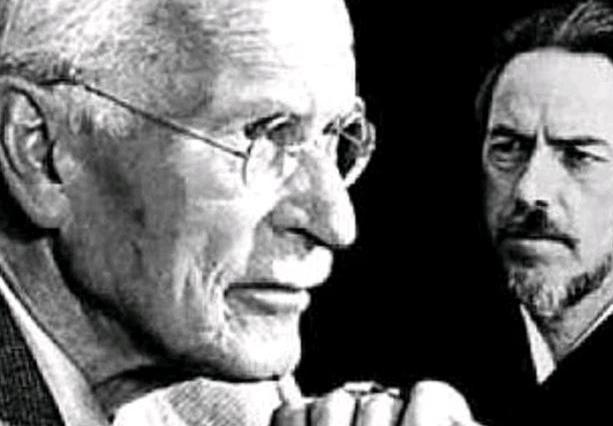
    This record of Alan Watts, done shortly after C.G. Jung’s death really blew  me away.  Alan Watts brings C.G. Jung’s concept of Good and Evil right to the  point. Listen to Alan Watts.  Watts believed that the key to the universe is fundamentally a higher consciousness or mind. The world is an emanation of the one Being or Consciousness. Unity is the nature of the universe while the distinctions between knowing subject and the objects of knowledge are actually expressions of unity.  True Zen, he said, was  liberation of the mind from traditional thought forms to raise human consciousness to identify with the Consciousness which is Reality.  Mystical thinkers of all traditions have discovered this, he said, and modern psychotherapy is coming to agree now. In Psychotherapy East and West (1961) Watts referred to Carl Jung,  bringing science closer to Eastern insight or as he said in this record – Western and Eastern minds arriving at the same point by different means.

    Alan Watts clarified that C.G. Jung viewed good and evil not as absolute, warring opposites, but as interconnected polarities of an underlying unity. Watts explained that to truly understand and integrate evil, one must first confront their own dark side without judgment..

    Alan Watts on Evil

    In his tribute to Carl Jung, Watts highlighted several key concepts regarding Good and Evil:

    The Polarity of Life

    Jung believed that existence requires duality and that opposites define one another. Just as you cannot understand “to be” without “not to be,” you cannot comprehend good without the existence of evil. Rather than an absolute cosmic battle that can never be harmonized, good and evil are two halves of a whole.

    Confronting the Shadow

    Watts stressed the importance of acknowledging your own inherent flaws. As Jung observed, the more we repress our “dark side,” the denser and more destructive it becomes. When we obsessively condemn evil in others, it is often a defense mechanism masking an unconscious awareness of the potential for that same evil within ourselves

    Alan Wilson Watts was born in England,1915 and had early interest in Eastern thought. He sought to apply its principles to modern psychology and argued for a common mystical core underlying all religions, reflecting the influence of Aldous Huxley, a major attempt to reconcile Christianity and Eastern thought. Watts taught comparative philosophy and psychology at the new American Academy of Asian Studies in San Francisco and still is much recognized in California. He wrote and lectured at colleges, universities, medical schools, and mental health institutions in the United States, Canada, Europe, and Asia, including Harvard; Yale; Cambridge; the Universities of Chicago, Michigan, Indiana, and Hawaii; and the C. J. Jung Institute (Zurich).

  • Protected: Die Wilde Jagd: Munich night blessing

    This content is password-protected. To view it, please enter the password below.