Category: Other Gods

Ancient and Heretics

  • Jungian Archetype of the wolf – gods and godnesses, warriors and mothers, demons and outlaws, evil and uebermensch

    Jungian Archetype of the wolf – gods and godnesses, warriors and mothers, demons and outlaws, evil and uebermensch

    It became clear during my research of Jungian Archetype of the wolf, that in mythology, religion, in legends and fairy tales the wolf has played an outstanding ambiguous, dualist and multidimensional role. The wolf archetype is so  central,  that how the wolf is viewed, indicates the mindset of the human,  secular or spiritual organisations of the society we live in.

    In a few weeks, there is Whitsun, and I will make one of my occasional trips to the monastery. Writing this article was a preparation to the theme and will be updated afterwards The rock monastery St. George is a development center of the Benedictine  order in the Austrian Inn valley. From the monastery to the St. George mountain (Karwendel) on foot takes approximately one  hour. The religious exercise will be lead by a Benedictine monk, who happens to have formal psychoanalytic credentials and introduced the theme “The archetype of the wolf” for what to my understanding is a spiritual hiking weekend.

    st_georgenberg_stift_fiecht

    But there is much  more. Joland Jacobi, a close assicate of C.G. Jung mentiones the archetype of the wolf a few times in her book “Complex, Archetypes, Symbol in the Psychology of C.G. Jung”, Bollingen Series Princton University Press, 1957. Joland Jacobi writes, “being devoured or swallowed is also a widespread archetypal motif… the wolf that devours the kid”….  [page 155, 181,185].  C:G: Jung writes numerious times about Wotan, who was eaten at Ragnarok  by the giant wolf Fenrir and then avenged by his son Vidar e.g. “Four Archetypes Mother, Rebirth, Spirit, Trickster”, Routledge and Paul, 1957.  In the the same book, C-G. Jung writes about the wolves about the German fairytale, in which the wolf gives the hero a magic gift of his hairs (page 109) .

    Historical encounter between man and wolf

    You may refer my recent article “The Wolf as an Jungian Archetype Vessel” which argues that the wolf is one of the most persistent and structurally overdetermined animal-symbols in human civilization because the historical encounter between man and wolf unfolded simultaneously on three inseparable levels: biological rivalry, social mirroring, and archetypal projection. The wolf therefore persists not merely as zoological memory nor merely as mythological ornament, but as a privileged symbolic convergence point through which deep psycho-biological structures become visible in religion, myth, dream, political imagination, and collective anxiety. In his book Of Wolves and Men, Barry Lopez argues from a naturalist view similarly that traditional hunting cultures suggest deep behavioral analogies achieved through a respectful, reciprocal relationship. These societies and wolves viewed the hunt as a sacred covenant requiring humility, dignity in the ‘conversation of death’ and hunting skills. Barry Lopez shares a Nunamiut elder’s insight that a old man and an old wolf possess identical knowledge of the land and hunting: “After a pause the old man looks up and says: The same. They know the same.

    The wolf reminded men to their domestication and their inner struggle with it. The wolf became also an image of remaining wild and sexuality, in a Jungian sense became men’s Shadow of undesired and unwanted. Those of us with Western background, do often not realize the depths and subtle (subtile) differences and similarity of Pagan German or Norse,  Eastern or Native American stories. Especially wolf stories examine reincarnation, spiritual energy, gift exchange, the vitality of the body, and the spirit of the soul. In the old worldview everything is in flux and begins, balances out from, and ends with polarities akin to yin and yang. Even the gods are subject to this, undergo transformation, and often pay for what they gain with a corresponding loss. For indigenous people – including the indigenous Celts and Germanic – religion as such did not exist. Native views of spirituality wed it to time and place, land and sea and sky. Our forebears lived side by side with the wolves in an inspirited world, and that world abides, as do its instinctive, but sacred dimensions:

    Axe-time, sword-time, shields are sundered,

    Wind-time, wolf-time, ere the world falls;

    Nor ever shall men each other spare….

    Now do I see the earth anew

    Rise all green from the waves again

    Myth wolf – gods, goddesses, demons and outlaws

    Wolves make quick decisions, often need to trust their own instincts and  make firm emotional attachments. They teach us to do the same, to trust our instincts and intuitions, and have control over our own lives.  At some point in psychological development, most people struggle with the transformation of spiritual and physical aspects of their being. In many stories, the wolf was described as wild, tearing, biting, grim and bloodthirsty. The image of the wolf has been used to represent all those aspects.  From where does the primeval fear and awe of the wolf originate?

    Jungian Archetype of the wolf
    The Dark Wolf Outlaw

    Demons: In the Edda, the ancient Icelandic sagas, the wolf was a symbol for demonic powers: Odin, the God of war and death was accompanied by two wolves. The mythical wolf  Fenrir, a son of the fire god Loki and the giant Angrboda was stronger than gods. In Indian mythology, the wolf is described as demonic. Furthermore, the wolf is portrayed as thievish, deceptive and false. In India, the demons were named after the wolf. In Christianity the wolf was even equated with the devil: Jesus Christ advised against false prophets dressed in sheep’s clothing which in fact were wolves. Numerous myths from Eastern Europe, Russia and Scandinavia tell about the creation of the wolf by the devil. During the creation of the wolf, the devil relied on the help of God and it was God’s will that the wolf kills sheep and goats.

    Gods: Many different cultures worshiped the wolf. For the Egyptians the wolf symbolized the god of the empire of the dead. For the Romans the wolf was the symbol for Mars, the God of war. The combination of the wolf with war was not meant to be negative but, instead, correlated it to the glorious death of a warrior or emperor. Furthermore, the fighting heroes were compared with furious wolves.

    Positive Male power: The combination of the wolf with war was not meant to be negative but, instead, correlated it to the glorious death of a warrior or emperor. Furthermore, the fighting heroes were compared with furious wolves. The wolf is also worshiped as the protector of human beings. The wolf was either seen as a fierce guardian or caring provider. The wolf is very often also associated with war and strength. In both German and Norse mythology, wolf was a symbol of chaos, destruction and death. Wolves are seen as teachers of hard, but necessary lessons. The wolf is also a symbol of guardianship, ritual, loyalty, and spirit.

    Positive female power: Many different cultures worshiped the nurturing she-wolf as symbol of fertility.. The most famous myth is Romulus and Remus, the founders of the city of Rome, who were abandoned as small children. A wolf found them and raised them as her own cubs. In other contexts, the wolf also was honored as a  symbol of motherly sacrifice and fertility. The frequent connection between goddess figures and totemic wolves may be taken as another indication of the great role of wolves in primitive matriarchal societies and shamanic religions.

    Fenir

    Negative untamed power: People from many cultures and traditions have interpreted the wolf as representing the untamed (unconscious). The word wolf is widely common in the Indo-European roots of language and often not only stands for the animal, but describes in the old Germanic languages the bandit, murderer, slayer, defied criminal, evil ghost or supernatural beast.

    The Wolf in the wild

    The basic social unit of wolf populations is the pack. Packs usually consist of between five and eight members, up  thirty wolves or more  depending of the size of the prey being hunted.  Wolves generally establish territories ranging from forty to more than four hundred square miles in some cases. They define their ranges with scent markings and such vocalizations as growls, barks, and the legendary howl and will defend this area against intruders. A wolf pack is typically a family unit, consisting of the adult pair, their cubs and yearlings – two generations offspring. Wolf packs rarely accept unfamiliar adult wolves, often chasing or killing intruders to protect their territory. However, they are unique in their natural willingness to adopt unrelated orphaned pups. Members of the pack form strong social bonds that promote internal cohesion. Order is maintained by a dominance hierarchy. The alpha couple, more often the male sometimes the she-wolf depending on prey and situation, initiate pack activity and lead the group on hunts. During a hunt, they will guide the pack’s movements and assume control at critical moments. Communication is especially important for wolves, where coordinating, cooperating, and reinforcing bonds and status are necessary. Within a family of wolves, communication helps maintain social stability and solidarity. Communication among wolves is particularly complex and use a range of vocalizations to “talk”, body language and scent. The “wolf” talk conducted by the  dominate male keeps the family pack together and working as a group. Research at wolves in captivity are not transferable in the wild, because here wolves of different origin or family groups were locked together.

    Wolf family the-alpha-wolf-couplef-amily-the-yearling-missing
    Wolf family the-alpha-wolf-couplef-amily-the-yearling-missing

    Wolves and humans were always fellow hunters, rivals, and sometimes enemies, perhaps because they were so similar to humans in many ways as mentioned before. Wolves have a strong social nature and are, like humans  organized as a family tribe.  In any case, through gestures and body movement, they communicate their feelings. Wolves like to howl as a pack for several reasons. It may be to encourage their closeness, to celebrate a successful hunt, and to tell other packs to keep away. The dispersed wolf, a younger male or female, is usually in search of his own territory and a mate. He will skirt the territories of others, but rarely howl. Leaving the pack allows for the sexually mature young wolves to begin the cycle of life by finding a mate, and starting their own family. This coined the misleading term ‘lone wolf’, they exist, but as exception.

    Until today, the wolf evokes fear. Yet the wolf is not dangerous monstrosity, but rather an intelligent carnivore with a distinct social behavior. Anybody who “owns” a good hunting dog, observes that good dogs, good leaders and good men in general share some attribute of a wolf. The life of a man and a wolf did not differ very much a few thousand years ago: Both were either successful hunters or perished – as simple as that. During those early years of mankind wolves were always competitors with humans for the same prey species. Yet the competition between them increased when men settled 10,000 years ago and began agriculture and cattle-raising. The farm animals  were for wolves easy prey, and many sheep or goats fell victim to  them. The wolf became the hateful animal, which threatened the livelihood or at least property of the man.  Even as backpacker I was more afraid of a wolf(s) pack than of a brown bear.

    Archetypal significance of the Wolf

    StrongMessagOfArchetypes
    Wolf Archetype: Dual Archetypes – conflicting messages

    No matter how polite, on the question how well advertising works, a marketer said once: One must know and find archetypal images and connect them with the products of the market. So the message becomes strong and the desired behavior tendency is more easily constructed. One finds few wolves in advertizing, since the archetypal significance of the wolf symbolizes evil as well as positive and spiritual aspects. As shown before, you do see the claimed by ideologies and religions.  The wolf  represents as noted before, and like the picture on the left an integration of opposites. It has always carried a sense of contradiction: a wild and fearful animal, that can represent death and evil; but at the same time a companion to the goddess Artemis and the norse god, Odin. Theis dual imago of the wolf is also represented by the contrast between its masculine and feminine nature. The masculine nature of the wolf is depicted by many cultures as the protector and warrior. The feminine nature is symbolized as the  she-wolf form nurturing the twins, Romulus and Remus, or in the Irish myth of Cormac, or Kaspar Hauser who were suckled by wolves. Interesting enough, Christianity enforced and broke this dualism in early Biblical sources presenting a contrast between the wolf symbolizing bloodshed and destruction versus the symbol of the wolf and the lamb lying down together representing peace and the coming Messianic rule. The middle ages also presented this contrast between the image of the wolf as devil, versus the wolf as an “emblem of Saint Francis of Assisi who tamed the wolf”.

    C.G. Jung’s basic archetypes and the Wolf

    BasicArchetypesWolf
    BasicArchetypesWolf

    Jung developed an understanding of archetypes as being “ancient or archaic images, that derive from the collective unconscious”. There are many different archetypes, and Jung has stated they are limitless, but they have basic  examples in very person  include the ‘persona’, the ‘shadow’, the ‘anima’, the ‘animus’,  and the Self.   Four more archetypes are prominently mentioned by C.G. Jung; ‘great mother’, the ‘trickster’, the archetype of transformation and  the ‘hero”.  It is interesting, that the wolf can represent them all.

    Jung proposed, that the archetype had a dual nature: it exists both in the psyche and in the world at large. He suggested also, that not only do the archetypal structures govern the behaviour of all living organisms, but that they were  controlling the behaviour of inorganic matter as well. The archetype was not merely a psychic entity, but more fundamentally, a bridge to matter in gnostic entities in occult tradition are known as aeons. The Germanic Wotan (Norse Odin) is such an aeon described by Jung (who was very much drawn to Gnosis).

    In another Jung’s theory about Wotan, invoked in the Germans by Hitler’s disposition as a “seer”  drew a lot of political and academic fire. Interesting here is also, that Hitler, who was inseparable of Blondi, his wolf-hound chose a name for himself – Wolf. In Egyptian mythology a god, Upuaut was the scout, going out to clear routes for the army to proceed forward. One old inscription found  mentioned Upuaut “opens the way” to king Sekhemkhet’s victory. Over time, the connection to war, and thus to death, led to Upuaut also being seen as one who opened the ways to, and through, Duat, for the spirits of the dead.

    But back to my interpretation the basic sub-archetypes of the wolf:

    • The nurturing and protective wolf appearing as the great she-wolf who nursed Romulus and Remus (Mother, Anima).
    • The male wolf  initiated by society forces the young adult in becoming a good hunter (Warrior,Animus).
    • The guard  conducting souls through the gates, which had to be passed as in Egyptian mythology (Shadow).
    • The wolf in sheep’s clothing who attempts to hide its instinctive and wild self by developing a persona of meekness and innocence (Persona).
    • The howling wolf who has a voice to communicate with others and is reclaimed inner voice of the soul (Ego)
    • The wolf and lamb lying together, which represents inner peace  (Self).
    • The wolf who has accepted his (or her) role in life (Ego after individuation).

    C.G. Jung wrote little about  wolves as archetype directly but wrote extensively about fairy tales and myths in which the wolf often plays a major role. Four archetypes “per se”  are prominently mentioned by C.G. Jung; ‘great mother’, the ‘trickster’ , the archetype of rebirth (transformation) and  spirit, the wolf can represent them all and more. Many references to wolves and werewolves can be found in Jung’s Collected Works and separate publications.

    The Romolus myth is mentioned by Henderson in ” Der Mensch und seine Symbole, C.G. Jung, Jaffe  Olten 1968, as the fourth stage of the hero myth. In Bly’s  Iron John the wolf is represented by the wild man, the hunter and warrior.

    C.G. Jung’s archetypes of transformation and the Wolf

    The werewolf  as  bloodthirsty creature, once person, once wolf has been sold gladly by the  film industry in  “American Werewolf” or the classic silent movie Mr. Cecil and Hyde. During the Middle Ages, the belief was widely accepted, that men would transform into werewolves. The werewolf, a creature from the devil, obsessed, half human and half animal, roamed the streets at night and, “drank the still warm blood, gorged the bowels from its innocent victims during orgies of satanic cruelty”. The belief in werewolves already existed in the ancient world, but during the Middle Ages this belief grew to be much stronger. Mostly women and children became victims of werewolves, which, in reality were men, that felt and acted like wolves while under the influence of drugs and rituals. It was believed, that with the help of the Malleus Maleficarum (the hammer of the witches) in 1489, one could not only recognize witches, but also werewolves, which resulted in countless men being burned to death on bonfires as so-called werewolves. To contemporaries, it was clear, that one would turn into a werewolf through an evil spell or as a punishment for a serious sin.

    Wolf archetypes and pagan myths (Edda)

    edda

    There was even a  a monstrous wolf who was a major threat to the gods who appears in both the ‘Poetic (or Elder) Edda’ and the ‘Prose Edda’ written down in Iceland during the 13th from earlier traditional sources, reaching into the Viking Age. The name Fenrir means “from the swamp.” Also known as the Fenriswolf, he was the offspring of the trickster fire god Loki. In Norse mythology, Loki is a god or jötunn/Jætt or both. Some of the jötnar (a mythological of giants and giantesses) have hideous appearances – claws, fangs, and deformed features. Fenrir’s sister was the goddess Hel and his brother the evil serpent Jormungand.  The Vikings believed, that during Ragnarok, the battle that would take place at the end of the world. According to the myths, the evil Loki himself gave birth to Fenrir, after eating the heart of a giantess, the witch Angerbotha. After his birth, the gods received prophecies of disaster, but the gods could not kill Fenrir because it would have defiled their sanctuary. But they sought some way to tie up the beast, who grew noticeably larger each day. They attempted to restrain him, but after failed attempts they became even more afraid of the wolf’s power. Odin sent Skirnir, Frey’s messenger, down into the world of the dwarfs and had them fashion a magic restraint called Gleipnir, smooth and soft, like a silken ribbon. They called the wolf, showed him the silky band, and challenged him to test his strength again. Fenrir was suspicious because of the thinness of the band. The gods agreed to free him if he could not break out of the fetter himself. But Fenrir asked that, someone puts their hand into his mouth as a pledge, that the gods were acting in good faith. None of the gods was willing to take such a risk, knowing full well the deceit, but then Tyr stepped forward and put his right hand into the wolf’s mouth, making the sacrifice that would keep the gods safe. Fenrir was bound with Gleipnir, and he tried with all his might, but could not snap it. The gods laughed to see the wolf’s distress–except for Tyr, of course, his hand got bitten of at the wrist.   Fenrir continued to howl horribly, but would remain until Ragnarok, when the gods and the giants would fight to the death. By the time of Ragnarok, the wolf would have grown so large, that when he opened his mouth, his lower jaw would be against the Earth and his upper jaw would scrape heaven. Flames would burn from his eyes and nostrils. At Ragnarok, the wolf would break loose and join the giants and other monsters in all-out war with the gods. Fenrir would kill Odin by swallowing him. Odin’s son Vidar would then come forward avenging Odin and, killing the beast at last.

    Wolf archetypes – and the Egyptian Lord of the Necropolis

    wepwawet
    wepwawet

    In late Egyptian mythology, Wepwawet (also rendered Upuaut) was originally a war deity.  Wepwawet was called the son of Isis, and was one of several Egyptian deities to take the form of a canine, today identified as a wolf. Egyptologists now believe, that he was more likely associated with the jackal, though he is often depicted with a gray or white head. Wepwawet originally was seen as a wolf deity, thus the Greek name of Lycopolis, meaning city of wolves. Over time, the connection to war, and thus to death, led to Wepwawet also being seen as one who guarded the spirits of the dead. In later Egyptian art, Wepwawet was depicted as a wolf or a jackal, or as a man with the head of a wolf or a jackal.Reflecting his lupine origins, he was depicted dressed as a soldier, as well as carrying other military equipment – a mace and a bow.  With the rise of the solar cult, particularly during the 12th Dynasty, Osiris was limited to the underworld and the local god and Wepwawet  gained the titles, “Lord of Abydos” and Lord of the Necropolis”.  The god is well established in New Kingdom funerary texts such as the Book of Going Forth by Day, Book of the Dead, and the Amduat (Book of That Which Is in the Underworld). Wepwawet was also thought of as the messenger and champion of royalty  who accompanied the king while hunting as “the one with the sharp arrow who is more powerful than the gods.” Wepwawet  is not to be confused with Anubis.

    The story of Isis and Osiris is one of Egypt’s most ancient myths and base of the concept of death (and resurrection) which is so central to their religion.  Osiris, Isis, Seth and Nepthys and the elder Horus  were siblings born of Geb, the sky god, and Nut, the earth goddess, had five children. Osiris became king of Egypt, and he married his sister Isis. Seth was married loveless to Nepthys and always jealous of his oldest brother Osiris. On a feast of gods, he tricked Osiris into  a coffin and drowned him. To prevent Isis from bringing Osiris back to live he cut him into pieces and distributed them throughout Egypt. Isis, who had great magical powers, decided, to collect the pieces of her husband’s body and re-assembling them. Once she completed this task, she breathed the breath of life into his body and resurrected him.  Isis became pregnant soon after gave birth to the younger Horus, the hawk-god. The cult of Isis spread with Alexander the Great throughout Greece and became in Rome through Caligula a state religion. The image of Isis nursing the younger Horus found it way into Christianity, like the judgment after death and the hell and in Iris’ deed maybe even resurrection.

    While over the time all of the many gods only “survived” as incarnations of Re, who became the most powerful, almost panteistic sun god, Osiris was able to descend into the underworld, where he became the only lord of that domain. Here the first time in history the concept of the judgement after death was introduced. There were 42 sins, you could by guilt of. Ages ago, before the birth of Younger Horus, Wepwawet’d situated himself as the god of war, aiding his followers before, during, and even after a battle. But under these new circumstances Wepwawet petitioned Osiris these days for a new role.  The wolf-headed god was then assigned as guide to the dead leading the deceased through the Underworld (hence his name). Not long after Wepwawet appointed as guide did Osiris’ ability to communicate outside of the underworld began to wane. Wepwawet stepped in again and offered his help as a messenger (like the Greek Hermes and the Roman mercury). Some say Wepwawet’s still a scavenger at heart like his animal totem, groping for whatever task isn’t taken or is even partly available.

    Here a list of the most important and mentioned gods:

    • GEB: the earth-god; husband of Nut; member of the ennead of Heliopolis; represented as a man.
    • NUT: the sky-goddess, wife of Geb, the earth-god; represented as a woman, her naked body curved to form the arch of heaven.
    • HORUS: the falcon-deity, originally the sky-god, identified with the king during his lifetime; also regarded as the son of Osiris and Isis, for the former of whom he became the avenger; cult-centers in many places, e.g. Behdet in the Delta, Hierakonpolis and Edfu in Upper Egypt. See also, Haroeris, Harpocrates, Harsiesis, Re-Harakhty.
    • ISIS: the divine mother, wife of Osiris and mother of Horus; one of the four ‘protector’-goddesses, guarding coffins and Canopic jars; sister of Nephthys with whom she acted as a divine mourner for the dead; in the Late Period Philae was her principal cult-centre. I have written about Isis imported to Roman culture in “Isis, Mithras and Jesus”: Clash of male and female Archetypes in classical Rome.
    • SETH (SET, SUTEKH): the god of storms and violence; identified with many animals, including the pig, ass, okapi, and hippopotamus; represented as an animal of unidentified type; brother of Osiris and his murderer; the rival of Horus; equated by the Greeks with Typhon.
    • WEPWAWET (UPUAUT): the wolf god of Asyut in Middle Egypt; a god of the necropolis and an avenger of Osiris. Wepwawet (Upuaut, Wep-wawet, and Ophois) was an ancient canine god whose worship originated in Upper Egypt. He was one of the earliest of the gods to be worshipped at Abydos, possibly predating (and absorbing) that of Khentyamentiu (another god of the Abydos necropolis). Not to be mistaken  with Anubis, there is very little information about the family of Wepwawet, or parents, if he had any at all. He is sometimes the son of Set, or of Anubis.  Most of the time he is said to be a son of Isis, which may further relate him to Anubis. Or he could be another foster-son adopted by Isis.
    • ANUBIS: protector and son of Osiris and Nephthys.  As Osiris grew in popularity (absorbing both Khentyamentiu and Wepwawet) Anubis took on Wepwawet’s funerary role. During the New Kingdom his standard even preceded that of Osiris and the “procession of Wepwawet” initiated the mysteries of Osiris as a god of the dead.
    • NEPHTHYS is the river goddess and daughter of Nut.
    • AMUT, Ammut, or Ammit or Ahemait, is the crocodile goddess known as the “Devourer of the Dead”  assists Anubis with carrying out the Judgements
    • AMON- RE (RA), Amun-Ra and Akmun-Rah: the sun-god of Heliopolis; head of the great ennead, supreme judge; often linked with other gods aspiring to universality, e.g. Amen-Re, Sobk-Re; represented as falcon-headed. Re  is the god of the Sun and king of the gods until Osiris took over his throne.
    • OSIRIS (ASAR): the god of the underworld, identified as the dead king; also a god of the inundation and vegetation; represented as a mummified king; principal cult-center, Abydos.
    • ATON or ATEN is the new god of the sun, an incarnation of Re. It was a monotheistic supernova god in a cultural revolution lasting only on reign. I have written about Aton and Echnaton here.

    ATON was the (monotheistic / pantheistic) religious revolution during the period of Echnaton which wanted to suppress Amon, Osiris and Re (or assimilate him). Not only Amon was dismissed (whom all the kings of the New Empire had worshipped at Thebes), but all the other gods had gone.  Re became a spirit who returned life to each person after every incarnation and a new state religion, Aton (was Re) offered his mercy to all beings of every nation and color. There is a famous engraving of hands reaching to the sun representing an invitation of men towards the sky. Aton, the father of all the gods, also embodied them in his being, and became the one who could purify human beings, when they asked his aid to take them out of the darkness of their material life.

    Wolf archetypes and Christianity

    Wolf-in-sheeps-clothing

    Early Christianity on the European continent employed the wolf, too, but instead of a symbol of nurturing or supernatural transition, the wolf became associated with evil and damnation as the agrarian way of life grew. The Bible describes Jesus as the shepherd protecting his herd of sheep from the wolf (The Bible, John 10:12). This would imply an intrinsic belief of the wolf as a symbol of sin and prurient influence. In Isaiah verse 11:16 of the old testament states “The wolf also shall dwell with the lamb.” This phrase is thought of as a metaphor of coming together of both the upper and lower under the Christian god (Religion 431), a stark contrast in comparison to the previous example and a throwback to an earlier time when the wolf represented more positive ideas. Another very prevalent notion in both the old and new testaments of the Christian Bible, is the wolf a tool of Satan and his henchmen. Wolves in this context are thought of as ravening or stealing away the souls of men.

    There was an interesting sermon in St. Ottilien recently, talking about sheep. The Pater, a son of a veterinary, said he liked sheep, but to him they are dumb. When a wolf comes to them they cuddle together, neither fighting nor running away they when they get killed.  They are powerless victims. He  referred to the German philosopher Nietzsche, who divided us into masters and slaves, in those that are prey (sheep) and those that are predators (wolves). Nietzsche wrote psychologically and physically, this divides our  human species.  The master types live by strength, creativity, independence, assertiveness, and related traits. They respect power, courage, boldness, risk-taking, even recklessness. It is natural for them to follow their own path no matter what, to rebel against social pressure and conformity. The slave types live in conformity. They tend to passivity, dependence, meekness. It is natural for them to stick together for a sense of security, just as herd animals do. (Beyond Good and Evil 264).

    The Pater reminded also to the claim the God is dead – but countered it with the resurrection of Jesus. Now, Nietzsche says, what we take to be moral depends on our biological nature—and different biological natures dictate different moral codes:

    What will seem good to you as a sheep? Being able to graze peacefully, sticking close together with others just like you, being part of the herd and not straying off. What will seem bad to you? Well, wolves will seem bad, and anything wolf-like, predatory, aggressive. But what if you are a wolf? Then strength, viciousness, and contempt for the sheep will come naturally to you and seem good. There is nothing the wolves and the sheep can agree on morally—their natures are different, as are their needs and goals, as is what feels good to them. The same point holds for humans. The divide between strong and weak, assertive and timid, runs straight through the human species. Moral codes, Nietzsche is here suggesting, are part of a biological type’s life strategy of survival, and the more we look at the history of morality evolutionarily and biologically, the more we are struck by the diversity of circumstances and how dramatically beliefs about values have changed across time. (Beyond Good and Evil 199).

    This is precisely our key problem culturally, the pater argued. This world  shows, that we once prized excellence and power and looked down upon the humble and the lowly. Now the meek, the common man, the kindly neighbor are the “good guys” while the aggressive, the powerful, the strong, the proud are “evil.”

    Jesus was warning the disciples in Matthew 10:16 when He says they are being, “sent out as sheep among wolves.”  The image and idea here is intense, but so is being a Christ follower in a world where those who follow Christ continually are facing some level of persecution. Jesus knew this and instead of telling the disciples follow me it will be easy; He let them know it will be just as dangerous, as it is for the sheep among wolves. This is the same for those who follow Christ today. As a Christ follower, a Christian, you already have the way out through salvation in Jesus through His death on the cross and resurrection by choosing it. Christians have the cure, but Jesus tells us, that while we are on this earth, those who follow Him will have difficulties bc this is not heaven this is earth where some people chose to say no to Christ and others believe and chose to follow Jesus and to those Jesus says, “Look, I am sending you out as sheep among wolves. Be as weary as snakes and harmless as doves.” Matthew 10:16

    Wolf archetypes and postmodern ideologies

    The ruling archetype does not stay the same forever, as is evident from the temporal limitations, that have been set to the hoped-for reign of peace, and the irreversible Europe.The archetype of the just, fatherly, benevolent ruler and the nursing mother had been shattered over the whole of northern Europe, as the present fate of the Christian churches bears witness.
    Even the Catholic Church can no longer afford trials of strength. Nihilistic Gods have attacked Christianity on a broad front. In communism, he is called equality and science, in national-socialism, he is called leader, and in capitalism he is called globalism.

    The wolf, seen as today’s financial predator, is naturally preying upon domesticated animals easily transforms into the metaphor of Satan seducing the innocents, drawing them away from their true nature into a state where they are compelled to acting against themselves and nature. This is perhaps the most frequent religious wolf related thought, which influenced Christianity and popular European culture. The sad fact though, is the image of the wolf in this context has little relation to anything based on reality and only serves not to enlighten thinking regarding this animal and its role in our world.

    Wolf archetypes and masculinism

    TheWolvesAnitWhatTheyUsedtoBe
    TheWolvesAintWhatTheyUsedtoBe – masculinism

    Masculinism refers to advocacy of the rights or needs of men and the adherence to or promotion of opinions, values, regarded as typical of men. One of the  most prominent men’s rights advocates, was Warren Farrell. Wolves are very good archetypes  to define masculism and men. The wolf today still represents our “instinctive nature that is wild and natural” and suggests a wild and natural creature within every human, who is filled with good instincts, passionate creativity, and ageless knowing. This warrior within is seen as an archetype, that carries images, ideas, and unique behaviors for humankind. The gifts of wolfish nature come to man at birth, but society, in many instances, will attempt to civilize them into rigid roles, which will destroy the inner treasure and muffle the deep, messages of the soul. As a result, boys become trapped, over-domesticated, uncreative, and have fearful feelings. On a sociological level, societies become confused from kindergarten to the voting booth and bring Father or Mother figures against their interest in power, tangled and confused in narcistic gender issues. For men to find their soul, they will need to face their instinctive wild self so that they can become free, creative, and leading again. Of course the same can be true for females in unhealthy warrior culture, like German women who were  hysterical Hitler believers  or those today who proudly sacrifice their sons  as suicide bombers.

    Wolf archetypes and feminism

    WolfFeminism
    The Wolves ain’t what they used to be – feminism

    The wolf is also a strong female archetype. They have insticts too. Interesting enough typical Feminist ideology  divide  Masculists in a) in male feminists who promote “gender equality”,  a term which of course is shifting sand,  and b) the others as form of misogyny promoting “male superiority or dominance” by being opposed to their definition of equality. Based on this “only dead Indians are good Indians logic”, wolves are very bad role models to define feminism, but still good ones to describe female archetypes.  And there are good examples too. In her book, Women Who run With The Wolves: Myths and Stories of the Wild Woman Archetype, Clarissa Pinkola Estes (1992) suggests, that healthy wolves and healthy women in particular share certain psychic characteristics: keen sensing, playful spirit, and a heightened capacity for devotion. Female wolves  and women by nature are relational, inquiring, and possess great endurance and strength. They are intuitive and concerned with their young, their mate and their pack and shamanic. There is the story of La Loba, the wolf woman. Her work was collecting bones of wolves and singing life into them. The story symbolizes the soul-voice. It conveys the truth of a woman’s healing power over anything, that is ailing or in need of restoration. Thus, the wolf is the representation of the Great Mother an archetype, which carries female images, ideas, and unique behaviors for humankind to help people to find their soul, and as warrior to help people to protect their survival.  You might remember the two articles, Four archetypes of the (fe)male. The wolf combines the duality of the Great Mother and Great Warrior. The wolf can thus be seen as a symbol on an intra-psychic level for a successful individuation. The spiritual Self consoles and integrates his Anima (or her Animus) and their shadow, which was created to adjust to collective norms . Individuation suggests a commitment to inner growth and development.

    Myth wolf – yesterday and today

    A short summary of wolf features prominently in a number of stories everywhere.

    Europe and Middle East:

    • Lycaon was the first king in Arcadia in Greece. He led a wicked life. The god Zeus came in disguise to a banquet at his palace and was disgusted to be served a child’s limbs. The god destroyed the palace and turned the king and his sons into wolves. Then he sent a flood to drown them all.
    •  The Egyptians had a wolf god, Wepwawet, whose name meant “he who opens the road.” He led kings in battle, and his image was carried through the streets of his town, Assiut, during a great annual feast. The wolf counted later also as God of the underworld . He was sort of demoted together with Osiris to the underworld.
    •  Early Biblical sources represented the wolf as destructive and associated with the evening (Jeremiah 5:6, and dishonest gain, bloodshed and destruction (Ezekiel 22:27, The Holy Bible). However, when the wolf and lamb were depicted lying down even though they were considered traditional enemies, together they represented peace and the coming Messianic rule (Isaiah 65:25 The Holy Bible).  Many saints tamed wolves, just as St. Francis of Assisi did.
    rome_shewolf_twins
    rome_shewolf_twins

    The founding of Rome – and thus, an entire empire – was based on the story of Romulus and Remus, orphaned twins who were raised by a she-wolf . The association of the wolf with the female was seen in the primitive Roman cult of Lupa or Feronia, which was inherited from Sabine matriarchy. It is based on best known Western myth  of Romulus and Remus: The wolf as a provider supposed to have nursed human infants. An ancient statue in the Lupercal grotto was later enhanced with images of the infants, Romulus and Remus were annually honored at the Lupercalia, the festival of the She-wolf, held every year in February, which was a multi-purpose event that celebrates the fertility of not only the livestock, but people as well. The “Jungle book” has a similar theme as the main character, “Mowgli”, is raised by wolves.The Romans thought it was lucky to see a wolf. The animal was sacred to Mars, god of war and protector of Rome. Julius Caesar’s victory over the Gauls at Sentinium, in 195 B.C., was attributed to a wolf, which was sent by Mars to frighten the enemy.The German Nibelungen legend tells how warriors used to eat roast wolf-meat to give themselves the courage of the wolf. Norse myths are all about valor, wolves have an important place, showing how they inspire fascination and fear in fighting men. When Wotan (Odin(, god of war and wisdom, sat on his throne at the palace of Valhalla, two great tame wolves lay at his feet,the symbol of his power and guarding the palace. The great wolves Geri and Freki, ate up the remains of the gods’ great feasts. In German fairy tales the big, bad wolf is referred to as being wild, tearing, snappish, grim and sanguinary. Grimm (German Romantic) even describes him as being the most evil creature of all animals in “The Wolf and the Seven Little Goats”.

    In the stories of the Ulster cycle, the Celtic goddess Morrighan is sometimes shown as a wolf. The connection with the wolf, along with the cow, suggests that in some areas, she may have been linked to fertility and land. Prior to her role as a warrior goddess, she was linked to sovereignty and kingship. In Scotland, the goddess known as Cailleach is often associated with wolf folklore. She is an old woman who brings destruction and winter with her, and rules the dark half of the year.

    Native America

    amorok

     The Inuit people of North America hold the great wolf Amarok in high regard. Amarok was a lone wolf, and did not travel with a pack. He was known for preying upon hunters foolish enough to go out at night. According to legend, Amarok came to the people when the caribou became so plentiful that the herd began to weaken and fall sick. Amarok came to prey upon the frail and ill caribou, thus allowing the herd to become healthy once more, so that man could hunt.
    There is a Lakota tale about a woman who was injured while traveling. She was found by a wolf pack, that took her in and nurtured her. During her time with them, she learned the ways of the wolves, and when she returned to her tribe, she used her newfound knowledge to help her people. In particular, she knew far before anyone else when a predator or enemy was approaching.
    A Cherokee tale tells the story of the dog and the wolf. Originally, Dog lived on the mountain, and Wolf lived beside the fire. When winter came, though, Dog got cold, so he came down and sent Wolf away from the fire. Wolf went to the mountains, and found that, he liked it there. Wolf prospered in the mountains, and formed a clan of his own, while Dog stayed by the fire with the people. Eventually, the people killed Wolf, but his brothers came down and took revenge.

    Asia

    Asian Wolves
    Asian Wolves

    The Turks and the fierce Mongols were enemies; but they both claimed to be descended from wolves. One young Turkish warrior, who alone survived after a Mongol raid, was rescued by a she-wolf and led by her to a secret earthly paradise in the mountains. They were married, and their children were led by a great grey wolf to the land which is now Turkey. The Mongol emperor Genghis Khan also claimed to be the son of a wolf. Besides Buddhism  and Nestorians, Mongols have held mainly Shamanic beliefs before they converted to Islam.

    In Turkey, the wolf is still held in high regard, and is seen in a similar light as to the Romans – the wolf Ashina Tuwu is the mother of the first of the great Khans. Also called Asena, she rescued an injured boy, nursed him back to health, and then bore him ten half-wolf half-human children.  Today the wolf is still seen as a symbol of sovereignty and leadership and used from the PKK (Kurdish Separation Movement)..

    The mountain people of Georgia, former part of the USSR, once thought, wolves had a society just like people. They were under the protection of a saint and were not thought of as wild animals. Hunters who killed a wolf wore mourning clothes as if they had killed a man.

    In ancient China, the Wolf is prominent in the Sky. The people believed, that eclipses of the sun were caused by a great sky-wolf eating up the sun. People beat drums and shot arrows at the sun to drive the animal away.  The Chinese saw the wolf also as a guardian of the heavenly palace. In Japan the wolf was admired for its ferocity, tenacity and swift attack. Also, they considered the wolf to be from heaven and to be venerated.

    Conclusion

    Myth is the foundation of life; it is the timeless pattern, the religious formula to which life shapes itself…Whereas in the life of mankind the mythical represents an early and primitive stage, in the life of an individual it represents a late and mature one. — Thomas Mann

    The wolf archetype may seen as great bridge between gods and evil,  male and female, patriarchy and matriarchy,  humans and Nietzsches “Uebermensch”. However, it has to be noted, that wolves live a traditional, wild archetype adjusted to nature. The wolf clearly represents the instincts, so the full and positive wolf  archetypes may be meaningless in today’s context. Or not?  Can be the wolf a weak warrior or a devouring mother, can the wolf sleep with the lambs? Prefer to a be lamb or a lone wolf?

    PRIMARY SOURCE APPARATUS TO BE USED

    Jungian Core Texts

    • CW 8 — On the Nature of the Psyche
    • CW 9/I — The Archetypes and the Collective Unconscious
    • CW 10 — Civilization in Transition (especially Wotan)
    • CW 11 — Psychology and Religion
    • CW 14 — Mysterium Coniunctionis (for transformation motifs)
    • Atom and Archetype: The Pauli/Jung Letters, 1932-1958 is a collection of correspondence between physicist Wolfgang Pauli and C. G Jung
    • CW 18 — THE SYMBOLIC LIFE MISCELLANEOUS WRITINGS
    • McGuire, William (ed.) – C. G. Jung Speaking (Princeton, 1993) (for transformation motifs)
    • Synchronicity: An Acausal Connecting Principle UK, Edition 1985
    • Four Archetypes Mother Rebirth Spirit Trickster UK, Edition 1971
    • C. G. Jung Archetypen (dtv, Bd. 11)
    • Jung, C. G., Jacobi, J. (1971 ): Mensch und Seele. Zitate von C. G. Jung aus dem Gesamtwerk 1905 bis 1961. Olten: Walter
    • Jung in Context A Reader

    Jungian Secondary

    • Jolande Jacobi Die Psychologie von C. G. Jung. Olten: Walter Verlag, 1971
    • Der Mensch und seine Symbole. By Carl Gustav Jung (Hg.) , Marie-Louise von Franz, Joseph L. Henderson, Aniela Jaffé, and Jolande Jacobi. Olten Walter Verlag AG,1968
    • Aniela Jaffe Die Einheitswirklichkeit und das Schöpferische Erich Neumann und C-G. Jung
    • Wes Nisker, 1990 Crazy Wisdom
    • Jolande Jacobi,  Complex, Archetypes, Symbol in the Psychology of C.G. Jung, Bollingen Series Princton University Press, 1957

    Wolf Ethology

    • Of Wolves and Men, Barry Lopez 1978 Paperback 2024
    • European wolf recolonization studies ­ WWF Deutschland, Berlin
    • The International Wolf Center – science-based education
    • Farley Mowat Never Cry Wolf (1963) classic memoir of the Canadian naturalist
    • For visual de-demonization: Jim Brandenburg ‘White Wolf’, 1990 and ‘Bruder Wolf 1994
    • Mech, L. E. (1991). The way of the wolf. Stillwater: Voyageur Press.

    Mythological/Comparative Sources

    • Prose Edda / Poetic Edda
    • Histora Mundi Band 2 Frühe Hochkulturen
    • Histora Mundi Band 4 Römische Weltgeschichte und Christentum
    • Roman foundation myth sources
    • Mythologyof the American Nations
    • Turkic Asena materials
    • The Druids
    • Die Kelten
    • Indo-European canine symbolism
    • Egyptian funerary religion (Wepwawet)
    • Medieval werewolf trials and folklore, “Mac Tíre” (Son of the Earth)
    • The Ossory Werewolves: The Helpful Shape-Shifters

    References Symbols (philosophy, history )

    • Richard Wagner, Ring des Nibelungen und seine Symbole, Donnington (Transl)
    • Spaziergänge durch Nietzsches Sils-Maria, Raabe 1994
    • Nietzsche und Faschismus, Taureck Reclam, 2000
    • Nietzsche Philosophie als Kunst, Friedrich DTV, 1999
    • NietzscheSchriften
      • Die fröhliche Wissenschaft.
      • Also sprach Zarathustra (1883–1885)
      • Jenseits von Gut und Böse
      • Zur Genealogie der Moral
      • Der Antichrist
    • Acient Egypt, Silverman
    • Geschichte des Morgenlandes im Altertum,  Berlin, Historischer Verlag Baumgärtel (ca. 1904)
    • Mythology Comte, 1988
    • Geschichte Ägyptens, Breasted 1954 (Translaion)
    • Neue Jerusalm Bibel, Herder 2011/The holy Bible. King James Translation. (1947). Cleveland: The World Publishing Company.BishopB

    References secondary

    • Alpha Status, Dominance, and Division of Labor in Wolf Packs
    • Wolves: Behavior, Ecology, and Conservation
    • The Wolf: The Ecology and Behavior of an Endangered Species
    • Politics of Aristotle asserts excellence varies with social role, including gender.
    • The Myth of Male Power: Why Men Are the Disposable Sex; Warren Farrell, Simon & Schuster, New York, 1993: ISBN 0-671-79349-7
    • The Liberated Man; Warren Farrell, Simon & Schuster, New York, 1993: ISBN 0-671-79349-7
    • Why Man are the way they are:  Warren Farrell, Simon & Schuster, New York, 1993: ISBN 0-671-79349-7
    • Fire in the Belly by Sam Keen(1991), Bantham
    • Iron John, Robert Bly (1992), Vintage Books
    • Sex Differences, Modern Biology and the Unisex Fallacy, Yves Christen
    • Raising a son by Don Elium and Jeanne Elum (1994);  Celetial Arts, Berceley
    • The War Against Boys: How Misguided Feminism Is Harming Our Young Men; Christina Hoff Sommers ISBN 0-684-84956-9
    • Estes, C. P. (1992). Women who run with the wolves: Myths and stories of the wild Woman archetype. New York: Ballantine Books.
    • Neumann, E. (1955). The great mother. New Jersey: Princeton University Press.
    • Towery, T. L. (1997). The wisdom of wolves: Nature’s way to organizational success. Franklin, TN.: Wessex House publishing.
    • K. Theweleit (1978) Männerphantasien Verlag Roter Stern I and II

    Links

  • C. G. Jung’s Red Book in a hurry – Narrative

    C. G. Jung’s Red Book in a hurry – Narrative

    Prelude

    The «Red Book» created between 1914 and 1930 can be described as a visual diary of dreams. Jung described this book – its language and emotions seem at times almost embarrassing – as important testimonies of his psychological and spiritual development. The psychoanalyst referred to his unfinished work as a !necessary but annoying ‘aesthetic elaboration”‘. This is the crux of the matter. The price is annoying and the ‘ Red Book ‘ combines beauty with an aura of art and mystery. I highly recommend it to anyone who is involved with C.G. Jung, because it is a key work in the history of spirituality. It is also beautiful. This article contains my notes to the Red Book in form of a narrative and how I understood it for myself. A brief narrative is attached as appendix.

    You will need not reconsider C.G. Jung after reading this book. However, the ‘ red book ‘ is more than a psychological art catalogue. Visions and fantasies are analyzed and gaudy documented. It is C. G. Jung’s handwritten and painted legacy. Jung says later: ‘ all my work, everything that I have mentally created comes from the initial imaginings and dream. ‘ Including the sentence ‘In us is the way, the truth and the life’ set heavily on modern Christianity of the Benedictine monk Anselm Grün but also of the Gnostics reminiscen. The book may come at the right time, a time in which Europe denies his roots.

    This book consists of three major parts:

    • An introduction by Sonu Shamdasani.
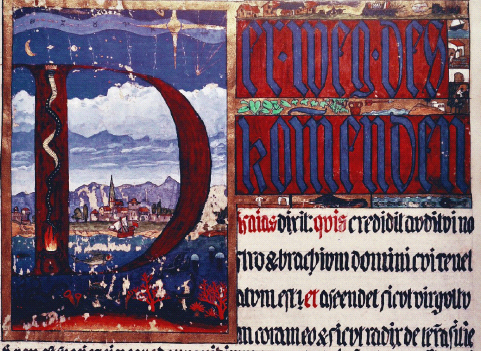
    • The actual ‘ red book ‘Liber Novus’ a scanned calligraphic text with Imaginatio­ns and reflections and pictures painted by him, which look  like a medieval illuminated manuscript.
    • The manuscripts of the Liber Novus (Liber Primus, Liber Secundus, and attachments) in normal print.

    Introduction

    The Red Book has been characterized according do the New York Times variously as a creative psychosis, a descent into the underworld, a plunge in insanity, a narcissistic self-deification, a transcendence experience, a midlife crisis and an inner disturbance foreseeing the upheaval of World War I and afterwards. Whatever the case, in 1913, Jung, who was then 38, got lost in troubling visions and heard inner voices. In that age successful and well married men are prone to midlife crises. In any case Carl Gustav Jung’s personal crisis between 1913 and 1918 was a complex, multi-layered breakdown. It was not caused by a single isolated event; rather, it was a perfect storm of professional isolation, marital tension, and profound psychological disorientation.

    1. The Breakup with Sigmund Freud (Professional Crisis)

    • The Context: Freud had groomed Jung to be his “crown prince” and the heir to psychoanalysis.
    • The Rift: By 1912, Jung published Transformations and Symbols of the Libido, directly challenging Freud’s dogma that all unconscious impulses are sexual.
    • The Fallout: Their formal split in 1913 left Jung completely isolated. He resigned from the International Psychoanalytic Association and his lectureship at the University of Zurich. He was blackballed by mainstream psychology, labeled a mystic, and cut off from his professional community.

    This harsh split with his mentor Freud, throw him into a period of profound uncertainty regarding his psychology and philosophy. In 1913 the relationship with Freud came to an end and 1914 Jung resigned as president of the International Psychoanalytic Association. In was in these intense years, however, that he created a complete different psychology than Freud’s cold machinery – one could rekindle spirituality. Jung sought to find a new conception of God that would be more psychologically whole. Wholeness is a key feature in Jung’s psychology, both in terms of each human integrating or assimilating lost and undeveloped potentials of the Self, but also in terms of seeking to understand God as combining both light and dark.

    2. The Premonitions of World War I (The Visions)

    • The Cataclysm: In October 1913, Jung experienced an overwhelming waking vision while traveling: he saw a monstrous flood covering Europe, turning completely to blood and filled with thousands of floating corpses. This terrifying vision recurred multiple times over the following months.
    • The Fear of Psychosis: Because he had no logical explanation for these apocalyptic images, Jung genuinely feared he was undergoing a psychotic break or “doing a schizophrenia”.
    • The Realization: When World War I broke out in August 1914, Jung experienced immense relief. He realized his mind had not broken down; rather, he had tapped into a collective, precognitive layer of the human psyche. This realization laid the groundwork for his theory of the Collective Unconscious.

    3. Personal and Domestic Tensions (The Private Crisis)

    • Domestic Strain: During this exact window, Jung’s personal life was highly volatile. His marriage to Emma Jung was severely strained.
    • The Affair: He began a profound, lifelong, and highly complex extramarital relationship with Toni Wolff, a former patient who became his intellectual collaborator and guide through his darkest unconscious explorations.

    Instead of medicating himself or repressing these terrifying voices and images, Jung made a radical choice: he chose to dive directly into them. He used a technique he called Active Imagination, forcing himself to consciously interact with the figures haunting his mind. The Red Book is the exact, raw laboratory notebook of that experiment. Henri Ellenberger later categorized this period as a “creative illness”—a temporary, functional psychological collapse from which an individual emerges with an entirely new, transformative worldview.

    Some private remarks

    The Red Book
    The Red Book

    Jung’s Red Book has to do with  Zürich – something previously hidden reveals itself, therefore a few words about my Zürich as a stranger,  if I may. The city is an excellent city for Jungian’s, pretty much for any minority; here they have found a certain quiet niche.  Zürich, for Jungian’s, is spiritually loaded. It’s a kind of Jerusalem, the place where C. G. Jung began. It is one of the last cities, where you can strike a meaningful conversation in bookstores, especially about C.G. Jung and Freud. It is the city of Max Frisch, my favorite writer, Thomas Mann, Einstein and Lenin lived there.

    In 2010 I saw the Red Book in the exhibition in Zürich and  wanted to own a copy of it. The original  was a nearly 100-year-old book, bound in red leather. The book is big and heavy and its spine is etched with gold letters that say “Liber Novus,” which is Latin for “New Book. The Book  is odd in regards to color already.  Red is an no-no color in Zürich Finance, which I learned the hard way presenting in a large Swiss bank once.  No Red Book of Mao, no red Letters in Powerpoint, no red Figures in Excel –  please.

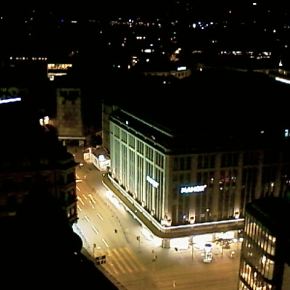
    Shot from Urania observatory in the Lindenhof quarter of Zurich, Switzerland. The muse of astronomy in Greek mythology
    Shot from Urania observatory in the Lindenhof quarter of Zurich, Switzerland. The muse of astronomy in Greek mythology

    Zürich is, despite the beautiful landscape around it, is neither pretty nor impressive, but one of Europe’s more purposeful cities. Lots of money and many hookers, neatly and orderly lined up  like the SBB trains which glide in and out on a flawless schedule. Fondue restaurants full of tourists and chocolatiers full of Swiss.

    Tough natives ride their bicycles  up the hill,  pedaling suicidal over the Hart fly over. In summer, white-steam ships puff around Lake Zürich; in winter, the mountains glitter on the horizon in direction of the “Pnüsli coast”. This is where I lived six+ years, working in Zürich and all over Switzerland. Zürich has  really good theaters, operas and small art movie cinemas but its Zwingli flavor gets boring after 6 months. Not an easy city, but after 2 years a Swiss father/men group  – of straight middle class men – took me under its wing. I am still grateful to them, since I learned how the city ticks, and made my peace with it. During lunch hour year-round, young business men stride the Bahnhofstrasse in their power suits and  rich, well-kept women go shopping. It’s not a fantastic tourist destination either nor a good place to hide money anymore.  However, a book was hidden for almost fifty years in a bank vault in Switzerland. Is long-awaited publication in October, 2009 was a signal event for Jungian’s.  Jung’s entire corpus, is as enigmatic as profound and Jungian’s, a species of thinkers who subscribe to the theories of Carl Jung, by definition get enthused anytime something previously hidden reveals itself. That is what C. G. Jung is all about,  right?

    The Drama

    Nachdenken und Rede sind nun wohl zwar dasselbe, nur dass das Gespräch, welches in der Seele mit sich selbst ohne Laut vor sich geht, bei uns den Namen Nachdenken erhielt? PLATON

    Jung, who was at that point, when  he “wrote” the Red Book,  an outwardly successful and ambitious man with a young family, a thriving private practice and a big, elegant house on the shores of Lake Zürich, felt his own psyche deteriorated in a life-altering crisis. For about six years, Jung worked to prevent his conscious mind from blocking out what his unconscious mind wanted to show him with actually induced hallucinations — what he called “active imaginations.” “In order to grasp the fantasies which were stirring in me ‘underground,’ ” Jung wrote at the end of his life in his book

    C.G. Jung Active Imagination
    C.G. Jung Active Imagination

    “I knew that I had to let myself plummet down into them.” Writing in German, he filled 205 oversize pages with elaborate calligraphy and with richly hued, staggeringly detailed paintings. It was not a dispassionate, academic essays on psychiatry, nor a straightforward diary. Instead, the book was a kind of  Gnostic theater play, driven by the idea that a person might move beneficially between the poles of the rational and irrational, the light and the dark, the conscious and the unconscious — that provided the core for his later work and for what analytical psychology would become. The book tells the story of facing his own demons as they emerged from the Shadow.  He worked on his red book — and he called it just that, the Red Book — on and off for about 16 years, long after his personal crisis had passed, but he never managed to finish it.  The structure sounds like a severe midlife crisis of  a psychiatrist: Man encounters midlife and loses his soul. Man goes looking for soul. After much  hardship and adventure — genius and madness,  possession and obsession taking place entirely in his head — he finds his soul again.  It was in such states that a  drama played itself out; Jung would have lengthy dialogues with the imaginal beings that spontaneously presented themselves. For Jung this was not play acting, since he took these presences as real and allowed himself to experience real emotions ranging from bliss and surprise to nausea, disgust, guilt and shame. The experiences were so intense that Jung said that at times he had to grip the table with both hands to steady himself as he endured the experiences brought on by the unconscious. For this reason he called this period of self-exploration a “confrontation with the unconscious.”

    The Cast

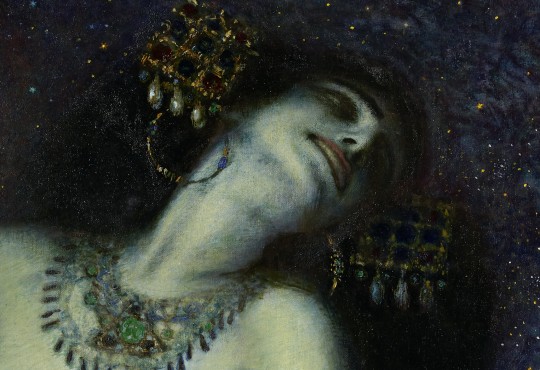
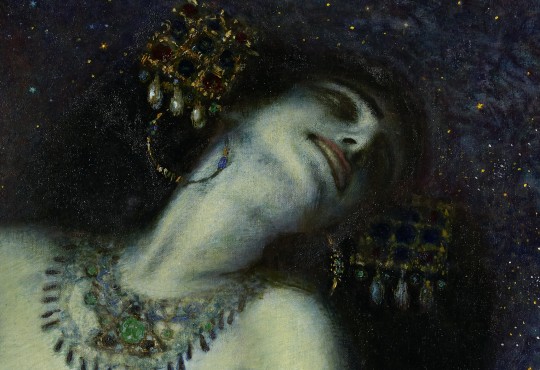
    Active Imagination, a dialogue with mystical or invented figures like Salome (Anima)  and Elijah (Father, wise old man)  in effect archetypes, became a hallmark of Jungian method.  Entering into the world of a dream allowed him to be fully affected by the unconscious . Interpretation is most often the goal and conclusion of working with a dream. This is not the case with Jung’s method. Finding an interpretation of a dream is only the first step in unleashing the power of an image. The Red Book is essentially a narrative of Active Imaginations (wake dreams) together with Jung’s discoveries during this endeavor. In the Red Book we witness the first time what Jung called a “confrontation” with unknown aspects of himself, giving voice to the inner figures that spontaneously arose during his descents into his unconscious. Jung’s method of dialogue with images and presences within himself was undoubtedly influenced by his observation of mediums that would go into trance states and perform séances, a widespread and common practice throughout Europe in the early part of the 1900’s.

    The major Player- Jung, Salome, Elijah
    The major Player- Jung, Salome, Elijah

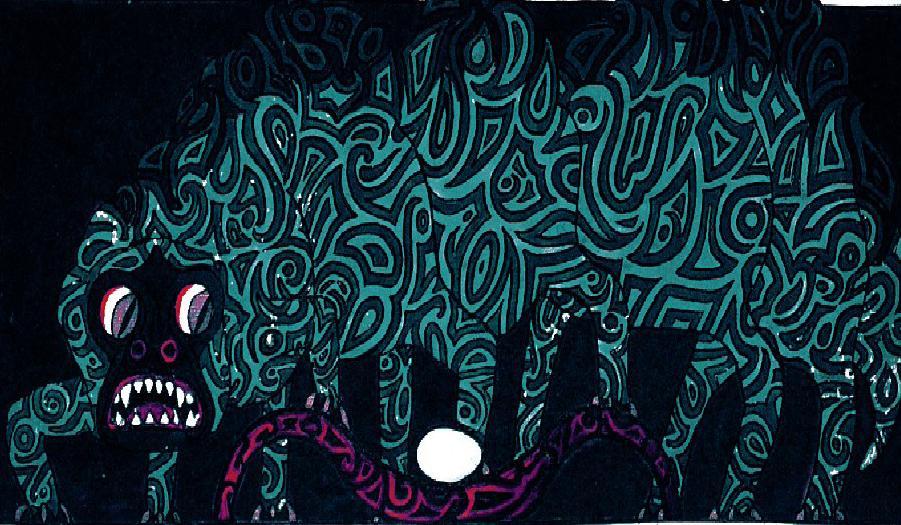
    In the book, Jung travels the land of the dead, falls in love with Salome, gets squeezed by a giant serpent and, in one terrifying moment, becomes Jesus. At one point, even the devil criticizes Jung as hateful.  After he has traversed a desert, scrambled up mountains, carried God on his back, committed murder to Siegfried the Hero, visited hell; and he has had long and inconclusive talks with Philemon an FatherArchetype. Salome, a female Archetype Anima, tells him not to fear madness but to accept it, even to tap into it as a source of creativity: Madness is not to be despised and not to be feared, but instead you should give it life. If you want to find paths, you should also not spurn madness,since it malees up such a great part of your nature.  Man strives toward ·reason only so that he can make rules for himself. Life itself has no rules

    The Red Book is not an easy journey — it is larger than life,medieval and like so much else about Carl Jung, a willful oddity, synched with a alchemy and mystic. The text is dense, often poetic, always strange. The art is arresting and equally strange. While the Red Book contains many beautiful paintings, he was not doing art. His artistic expressions were a means of evoking meaning rather than being primarily an aesthetic experience to gain a deeper connection to the inner figures of his imagination. It was a way of making the representation of his inner experiences more real. In other words, he did art not for art’s sake, but rather part of the method.

    The publishing

    “There can be few unpublished works that have already exerted such far-reaching effects upon twentieth-century social and intellectual history as Jung’s Red Book,” so writes the translator of Carl Jung’s recently published personal journal. By Jung’s own admission, the period of self-examination at mid-life that was recorded in the Red Book was source for all that Jung would write about for the next several decades. Even Jung’s popular autobiography, Memories, Dreams, Reflections, is drawn from the Red Book, yet the document itself had been closely guarded and withheld from the public for fifty more years. The question whether Jung wanted to share his encounter with the unconscious with the future generations,however, remains unsolved, because he expressed himself only ambivalent on this. On the one hand he instructed his children that the Red Book should remain in the family, on the other hand he showed different versions of the work two dozen people. It is quite understandable, that Jung’s heirs declined those recordings to the professional world and interested readership for so long. A reason may be, that the author even was not sure. This indecision is quite evident in the fact, that Jung in the epilogue, which he added 1959, breaks off in the middle of the sentence in after having left the book more or less untouched for 30 or so years. He wrote:

    Epilogue 1959

    I worked on this book for 16 years. My acquaintance with alchemy in 1930 tool( me away from it. The beginning of the end came in 1928, when Wilhelm sent me the text of the “Golden Flower,” an alchemical treatise. There the contents of this book,found their way into actuality and I could no longer continue working on it. To the superficial observer, it will appear like madness. I t would also have developed into one, had I not been able to absorb the overpowering force of the original experiences. With the help of alchemy, I could finally arrange them into a whole. I always knew that these experiences contained something precious, and therefore I knew of nothing better than to write them down in a “precious,” that is to say, costly book and to paint the images that emerged through reliving it all-as well as I could. I knew how frightfully inadequate this undertaking was, but despite much work and many distractions I remained true to it,even if another possibility never …

    Credit Photo: hammer.ucla.edu
    Credit Photo: hammer.ucla.edu

    Yet the very fact he wrote an epilogue close to the end of his life, seems to indicate that he wanted to find the right audience, but only after he took great care that this will happen after his career (and death).

    Decisively for the publication of the work clouded in secrecy work was the discovery of copies by Sonu Shamdasani. The Historian meet in 1997 for the first time to the family Jung and persuaded during three years its members, to release the Red Book for the publication. Jung’s grandchildren soon recognised, that there could be hardly a more experienced Jung historian than Shamdasani.

    Underlying concepts

    Jung understood the psyche as an inherently more spiritual and fluid place, an ocean that could be fished for enlightenment and healing. Whether or not he would have wanted it this way, Jung — who regarded himself like Freud as a scientist — is today remembered more as an icon, a proponent of spirituality inside and outside religion. He is indeed the ultimate champion of dreamers and seekers. Unknown to many his more down to the earth methods were forerunner of the Myers-Briggs personality test and cross cultural trainings utilized by smart consultants. The existence of a collective unconscious and the power of archetypes — have influenced also the shallow domain of New Age thinking.

    For an introduction to the concepts of “C.G. Jung in hurry” see a few slides:

    The Author

    C.G. Jung Source Astro Wiki
    C.G. Jung Source Astro Wiki

    Even after Freud’s theories have been largely discounted for all practical purpose, C.G. Jung still remains at the fringes of orthodox, “serious” psychology. Well, they borrow his concepts liberally without giving credit but labeled him often as non-scientific and inherently politically dubious. No wonder, Jung was interested in the psychological aspects of séances, of astrology, and of witchcraft. I own for example, a book of the late 1950s that examined the psychological phenomenon of flying saucers. He broke with the established ranks of his profession. Even worse, Jung was a well-off conservative, but also a bookish James Bond, with a famously magnetic appeal with women and  prone to dangerous affairs. He even worked once for the OSS (a predecessor of the CIA) and the US president. In short, he was quite a man. Jung pored over Dante, Goethe, Kant and Nietzsche as well as mythology, world religions and cultures. Somewhere along the way, he started to view the human soul — not as an organ to be repaired or drugged — but requiring spiritual development, an idea that pushed him into a province long occupied by artists and priests but not so much by medical doctors and empirical scientists. To him the purpose of analysis was not about handing over problems to a godlike specialist or to give life back to someone who’s lost it. Jung found himself in opposition not just then but also today. Psychiatrists constitute a dominant sect with a language of symptom and diagnoses. Today the just changed asylum wards with Psychopharmaca, or even worse, sometimes project the patients ills to the society and align with political fashions.

    Conclusion

    E: "I am Elijahls7 and this is my daughter Salome."IS8I: "The daughter of Herod, the bloodthirsty woman?"
    Quite an Anima:  “I am Elijahls and this is my daughter Salome.” Jung: “The daughter of Herod, the bloodthirsty woman?”

    Even the Jungian world is cautious about regarding Carl Jung as a sage — a history of political incorrect remarks and his rather patriarchal views of women spells trouble today. I have privately gotten insights from Jungian psychology for more than 12 years and am particularly drawn to the breadth of Jung’s psychology, his knowledge of philosophy, art and world religions. His works include references to Wagner, Faust, (Franz Stuck’s) Salome, Ovid, the Norse gods Odin and Thor, the Egyptian deities Isis and Osiris,the Greek goddess Hecate, ancient Gnostic texts, Greek Hyperboreans, King Herod, the Old Testament, the New Testament, Nietzsche’s Zarathustra, alchemy and astrology, Buddha and Lao-tse. And that’s just naming a few. Jung opened to me encounters with my soul and explained to a “Homo Faber” magic, coincidence and the mythological symbols. I would not like to give most “shrinks” my hand, but found Jung’s work extremely helpful for men (and women) in the second half of their lives. The broader goals of self-discovery and wholeness — a maturation process Jung himself referred to as “individuation” – are timeless:  The blond hero lay slain. The black beetle is the death that is necessary for renewal; and so thereafter, a new sun glowed.

    Note: Of course the Red Book must not read not in a hurry.  As I said, those are just my notes sprinkeld with some quotes and personal memories. I am currently expanding them, since I re-read the book.  I hope it makes appetite.

    The Narrative

    Jung made once  a rather informative remark about the difficult language of his Red Book: „archetypes speak the language of high rhetoric, even of bombast. (…) I had no choice but to write everything down in the styles selected by the unconscious itself.“ (Jung in 1963).  It is also noteworthy that he admits to have lost the control of this self-experiment („(„Today I might equally well say that it was an experiment which was being conducted with me.“). The two most important archetypes, who accompanied him in his dream wanderings are The wise old and more fatherly Man (Elijah, then Philemon resulted from this figure) and the girl Salome (his Anima).  Other women come up, usually representing his soul, as well as one big black Serpent appear also in impressive drawings in the Red Book again. The employment of these and to other figures of his dreams and awake imagination led him to the deciding insight, namely that there are things in the psyche which avoid our control, show themselves and develop an own way of life.  More than 16 years, it was for Jung, primarily about closing the gap between that cosy and orderly outside world and his  inside world of the pictures and to understand the interaction of both worlds. Only when the contradiction between “Inside” and “Outside” was solved for him, he could conclude this self-experiment.

    The Red Book is a testament to what might be called Religion or a spirituality that is developed from the ever evolving Self that is indeed as aspect of nature. It was Jung’s experience to see what the “Deep Knowledge” would present him if he simply put aside his dominant mode of apprehension, the linear, analytical mind, and allowed what else was in him to manifest itself. The conversations we see in the Red Book are a detailed description of what Nature did with Jung. It can be the same with us as well, since our dreaming is unconscious speaking with us. All that is required is that we learn how to enter into the imaginal dialogue that would allow this other intelligence to be understood.

    Jung was very adamant that each of us can and must enter into our own experiment with the unconscious. Ultimately, if we are to become the full potential of our being then we cannot have heroes above us who do things that we cannot do. In Jung’s words, we must be the Christ; that is, we must live our lives as distinctly and as uniquely and as fully as Christ lived his life, taking on himself the full weight of a human life and being true to all that he was.

    “The images of the unconscious place a great responsibility upon a man. Failure to understand them, or a shirking of ethical responsibility, deprives him of his wholeness and imposes a painful fragmentariness on his life.” Liber Novus is an unfinished manuscript corpus, and it taken from series of manuscripts, of which no single version can be taken as final.

    .

    The Red Book: Liber Primus

    Prologue

    Main proponents:   Spirit of the Time, Spirit of the Depth  Gospel of John,  Bible

    The Way of What is to Come
    The Way of What is to Come

    Jung’s Prologue starts with a prophesy announcing Jesus: For unto us a child is born, unto us a son is given: and the government shall be upon his shoulder: and his name shall be

    called Wonderful, Counsellor, The mighty God, The everlasting Father, The Prince of Peace. (Isaiah 9:6) and continues with an vers of the famous prologue in the Gospel of John: And the Word was made flesh, and dwelt among us (and we beheld his glory; the glory as of the only begotten of the Father), full of grace and truth. (John 1:14). Then Jung himself discards the spirit of this time (Zeitgeist) who just wants only to hear about benefit and value. But I did not consider that the spirit of the depths from time immemorial and for all the future possesses a greater power.  Melting sense and anti-sense leads to a supreme (sense) meaning  –  to  “The Way of What is to Come“, – the bridge to what is  coming – but not  to God himself but to his image offering inspiration and knowledge from the Depths but also visions of the coming first Wold War.

    But the spirit of the depths said: “No one can or should halt sacrifice. Sacrifice is not destruction, sacrifice is the foundation stone of what is to come … You should carry the monastery in yourself . The desert is within you. The desert calls you and draws you back … Truly; I prepare you for solitude.”

    After this, my humanity remained silent. Something happened to my spirit, however, which I must call mercy.

    The Prologue closes:

    There is only one way and that is your way. You seek the path, I warn you away from my own. It could also be the

    wrong way for you.

     One eye of the Godhead is blind, one ear of the Godhead is deaf,

    the order of its being is crossed by chaos.

    The Red Book: Liber Primus, Chapters I-VII

    Pages filled with cramped calligraphy that seemed at once controlled but also written feverishly.

    (1) Refinding the soul

    rb-1

    Main proponents:  Jung himself reflecting of the Soul and the  Spirit of the Depth.

    Main thought:  The soul contains the images which the half (of Platon’s) world.

    If we possess the image of a thing, we possess half the thing.

    The image of the world is half the world. He who possesses the world but not its image’ possesses only half the world, since his soul is poor and has nothing. The wealth of the soul exists in images.He who possesses the image of the world, possesses half the world, even if his humanity is poor and owns nothing. 

    (2) Soul and God

    rb-2

    Main proponents:  Jung himself reflecting of the Soul and God.

    Main thought:  One has to recognize and accept that Anima and Animus is  which is irrational. Anima and Animus is the first internal God you meet. Dreams  as knowledge of the heart.

    If you are boys, your God is a woman.

    If you are women, your God is a boy.

    If you are men, your God is a maiden.

    The God is where you are not.

    So: it is wise that one has a God; this serves for your perfection.

    A maiden is the pregnant future.

    A boy is the engendering future.

    A woman is: having given birth.

    A man is: having engendered.

    So: if you are childlike beings now, your God will descend from the height of ripeness to age and death.

    (3) On the Service of the Soul

    rb-3-1

    Main proponents:  Jung  fighting seven Nights against the spirit of the Depth, writing down dreams

    Main thought: Open the gates of the soul to let the dark flood of chaos flow into your order and meaning.

    Christ taught: God is love.  But you should know that love is also terrible.

    Christ totally overcomes the temptation of the devil, but not the temptation

    of God to good and reason.

    The slave to virtue finds the way as little as the slave to vices. 

    If you believe that you are the master of your soul, then become servant.        

    If you were her servant, yourself master, since she needs to be

    ruled. These should be your first steps.

    (4) The Dessert

    rb-4

    Main proponents:  Jung  going in the desert to find his Self

    Main thought: Why is my self a desert? Have I lived too much outside of myself in men and events? Why did I avoid my self?

    When you say that the place of the soul is not, then it is not.

    But if you say that it is, then it is. Notice what the ancients said

    in images: the word is the creative act. The ancients said: in the

    beginning was the Word. Consider this and think upon it.

    The words that oscillate between nonsense and supreme

    meaning are the oldest and truest.

    Experiences in the Desert

    rb-5

    Main proponents: Jung and his Soul – after 25 nights his soul speaks to him, lectures him

    Main thought:  After 25 nights his soul speaks to him, lectures him:  “I am not your mother.”

    Should everything fall into your lap ripe and finished? You are

    full, yes, you teem with intentions and desirousness!-Do you

    still not know that the way to truth stands open only to those

    without intentions?”

    The Zeitgeist considers itself extremely clever, like every such

    spirit of the time. But wisdom is simple-minded, not just simple.

    Many will laugh at my

    foolishness. But no one will laugh more than I laughed at myself.

    So I overcame scorn. But when I had overcome it, I was near to my soul,

    and she could speak to me, and I was soon to see the desert becoming green.


    (5) Descent into Hell in the Future

    rb-5-1

    Main proponents:  Many confused  voices, thousand serpents, Jung falling, spirit of the depth, blond slain hero

    Main thought:  I am seized by fear.

    The spirit of the depths opened my eyes and I caught a glimpse of the inner things, the world of my soul, the many-formed and changing.

    I see a gray rock face along which I sink into great depths.I hear the flow of underground waters. I see the bloody head of a man on the dark stream. Someone wounded, someone

    slain floats there. I see a large black scarab floating past on the dark stream. In the deepest reach of the stream shines a red sun, radiating  through the dark water.  Serpents on the dark rock walls, striving toward the depths, where the sun shines. A thousand serpents crowd around, veiling the sun. Deep night falls. A red stream of blood, thick red blood

    springs up, surging for a long time, then ebbing. I am seized by fear.

    To the extent that the Christianity of this time lacks madness, it lacks divine life.

    But also speak of sick delusion when the spirit of this time does not leave a man and forces him to see only the surface, to deny the spirit of the depths and to

    take himself for the spirit of the times. The spirit of this time is ungodly; the spirit of the depths is ungodly; balance is godly.

    The spirit of the depths is pregnant with ice, fire, and death. You are right to fear the spirit of the depths, as

    he is full of horror.

    Blood shone at me from the red light of the crystal, and when

    I picked it up to discover its mystery; there lay the horror uncovered

    before me: in the depths of what is to come lay murder.

    The blond hero lay slain. Therefore I take part in that murder; the sun of the depths

    also shines in me after the murder has been accomplished; the

    thousand serpents that want to devour the sun are also in me. I

    myself am a murderer and murdered, sacrificer and sacrificed.

    The upwelling blood streams out of me.

    The heroic in you is the fact that you are ruled by the

    thought that this or that is good, that this or that performance

    is indispensable, this or that cause is objectionable, this or that

    goal must be attained in headlong striving work, this or that

    pleasure should be ruthlessly repressed at all costs. Consequently

    you sin against incapacity. But incapacity exists. No one should

    deny it, find fault with it, or shout it down.

    (6) Splitting of the Spirit

    rb-6

    Main proponents:  Jung’s Ego, His Soul in God mask and Devils mask

    Main thought:   Going to hell is equal to becoming hell.

    My soul: “Who gives you thoughts and words? Do you malice

    them? Are you not my serf a recipient who lies at my door and

    picks up my alms? And you dare think that what you devise and

    speak could be nonsense? Don’t you know yet that it comes from

    me and belongs to me?”


    As the first vision had predicted to me, the assassin appeared

    from the depths, and came to me just as in the fate of the people

    of this time a nameless one appeared and leveled the murder

    weapon at the prince. ( Black Book 2 continues: ”Are you neurotic? Are we neurotic?”

    Everything that becomes too old becomes evil, the same is true of your

    highest. Learn from the suffering of the crucified God that one can also betray

    and crucify a God, namely the God of the old year. If a God ceases being the

    way of life, he must fall secretly. The God becomes sick if he overstep the height of the zenith. That is why the

    spirit of the depths took me when the spirit of this time had led me to the summit.

    (7) Murder of the Hero

    rb-7

    Main proponents: Jung, Siegfried (the hero), the spirit of the depth); Siegfried was a heroic prince who appears in old German and Norse epics. In the twelfth-century Nibelunglied, he is described as follows: ”And in what magnificent style Siegfried rode! He bore a great spear, stout of shaft and broad of head; his handsome sword reached down to his spurs; and the fine horn which this lord carried was of the reddest gold” His wife, Brunhild, is tricked into revealing the only place where he could be wounded and killed. Richard Wagner reworked these epics in The Ring of the Nibelung.

    Main action:  Jung ambushes and shoots Siegfried, Jung is reborn, vision of illuminated white men

    Main thought:  “The highest truth is one and the· same with the absurd.”

    What does Siegfried mean for the Germans! What does it

    tell us that the Germans suffer Siegfried’s death! That is why

    I almost preferred to kill myself in order to spare him. But I

    wanted to go on living with a new God.

    After death on the cross Christ went into the underworld

    and became Hell. So he took on the form of the Antichrist, the

    dragon. The image of the Antichrist, which has come down to

    us from the ancients, announces the new God, whose coming

    the ancients had foreseen.

    Gods are unavoidable. The more you flee from the God, the

    more surely you fall into his hand.

    The Red Book: Liber Primus, Chapters VIII-XI

    Of Gods and Prophets.

    (8) The Conception of the God

    rb-8

    Main proponents: Child, Jesus

    Main action:  Christ’s descent into Hell ( contained in several gnostic apocryphal gospels. In the ”Apostles Creed,” it is stated that “He descended into Hell. The third day He

    arose again from the dead.” Jung commented on  this motif  in Psychology and Alchemy, 1944, CW 12, §61n, 440, 451; Mysterium Coniunctionis, 1955/56, CW 14,475). It is the psychological equivalent of an integration with the collective unconscious and an essential part of the individuation process. (Aion, CW 9,2, §72). But the serpent is also life. In the image furnished by the ancients, the serpent put an end to the childlike magnificence of paradise; they even said that Christ himself had been a serpent”  commented on this motif in 1950 in Aion, CW 9, 2. 

    Main thought:   God combining beauty and goodness, beautiful and hateful, good and evil, laughable and serious, human and inhuman. Definition of hell. Why the hero needs to be slain.

    You new spark of an eternal fire, into which night were you born?’

    When my prince had fallen, the spirit of the depths opened my vision and let me become aware of the birth of the new God.

    The divine child approached me out of the terrible ambiguity, the hateful-beautiful, the evil-good, the laughable-serious, the

    sick-healthy, the inhuman-human and the ungodly-godly.

    Therefore after his death Christ had to journey to Hell, otherwise the ascent to Heaven would have become impossible

    for him. Christ first had to become his Antichrist, his underworldly brother. No one knows what happened during the three days Christ

    was in Hell. I have experienced it. 

    The dead matter will change into black serpents.

    What do you think of the essence of Hell? Hell is when the depths come to you with all that you no longer are or are not yet

    capable of Hell is when you can no longer attain what you could attain. Hell is when you must think and feel and do everything

    that you know you do not want. Hell is when you know that your having to is also a wanting to, and that you yourself are responsible

    for it. Hell is when you know that everything serious that you have planned with yourself is also laughable, that everything fine is also brutal, that everything good is also bad, that everything high is also low, and that everything pleasant is also shameful.

    But the deepest Hell is when you realize that Hell is also no Hell, but a cheerful Heaven, not a Heaven in itself, but in this

    respect a Heaven, and in that respect a Hell.

    That is the ambiguity of the God: he is born from a dark ambiguity and rises to a bright ambiguity. Unequivocalness is

    simplicity and leads to death.141 But ambiguity is the way of life.

    I must say that the God could not come into being before the hero had been slain. The hero as we understand him has become an

    enemy of the God, since the hero is perfection. The Gods envy the perfection of man, because perfection has no need of the Gods. But

    since no one is perfect, we need the Gods.

    That will be a time of salvation and the dove, and the eternal fire, and redemption will descend.

    Then there will no longer be a hero, and no one who can imitate him.

    The hero must fall for the sake of our redemption, since he is the model and demands imitation.

    (9) Mysterium encounter

    rb-9

    Main proponents:  Jung,  Elijahls (old man, prophet),  Herod’s bloodthirsty daughter Salome,  black serpent

    Main action:  Meets Salome (his Anima) and Elijah who was one of the prophets of the Old Testament. Jung replied used once Elijah as an archetype, describing him as a “living

    archetype” who represented the collective unconscious and the self.  Salome was the daughter of Herodias and the step-daughter of King Herod danced once before Herod .  She requested the head of John the Baptist, who was then beheaded. In the late nineteenth this archetype of the Feminine Evil, or femme fatale fascinated painters and writers, including

    Oscar Wilde, and Franz von Stuck.

    Main thought:   Why ones Anima must be feared and loved.

    I: “Forgive my astonishment, am I truly in the underworld?”

    S: “Do you love me?”

    I: “How can I love you? How do you come to this question? I see only one thing, you are Salome, a tiger, your hands are stained with the blood of the holy one. How should I love you?”

    S: “You will love me.”

    I: “I? Love you? Who gives you the right to such thoughts?”

    S: “I love you.”

    I: “Leave me be, I dread you, you beast.”

    I: “I am horrified. Who wouldn’t be horrified if Salome loved him?”

    E: ”Are you cowardly? Consider this, I and my daughter have been one since eternity.”

    I see how the black serpent writhes up the tree, and hides in the branches. Apart from Elijah and Salome I found the serpent as a third

    principle. It is a stranger to both principles although it is associated with both. The serpent is the

    earthly essence of man of which he is not conscious.

    Elijah said: “You should recognize her through her love!” Not only do you venerate the object, but the object also sanctifies

    you. Salome loved the prophet, and this sanctified her. The prophet loved God, and this sanctified him. But Salome did not

    love God, and this profaned her. But the prophet did not love Salome, and this profaned him. And thus they were each other’s

    poison and death. May the thinking person accept his pleasure, and the feeling person accept his own thought. Such leads one

    along the way.

    (10) Instruction

    rb-10

    Main proponents:  Jung,  Elijahls (old man, prophet),  Herod’s bloodthirsty daughter Salome, black serpent

    Main action:  Loves Salome (his Anima) becomes prophet.

    Main thought: Sensuality is the lowest and commonest form of pleasure. This is represented by Kali. Salome is the image of his pleasure, that suffers pain,  Salome is Jungs soul. Pope in Rome has become an image and-symbol for us of how God becomes human.

    You see, prophet, I am tired, my head is as heavy as lead. I am

    Elijah and Salome stand smiling before me.

    Elijah is silent. Heaviness lies on me. Then Salome steps in, comes

    over to me and lays her arm around my shoulder. She takes me for

    her father in whose chair I sat.

    On account of my thoughts, I had left myself; therefore my

    self became hungry and made God into a selfish thought.

    Salome embraced me and I thus became a prophet, since I had

    found pleasure in the primordial beginning, in the forest, and in

    the wild animals.

    (11) Resolution

    rb-11

    Main proponents:  Jung,  Elijahls (old man, prophet),  Herod’s bloodthirsty daughter Salome,   black and white serpent, Wagner dwarf mime.


    Main action: Dialogue between Christ and Salome. Christ states that he has come to undo the work of the female, namely; lust, birth, and decay: To Salome’s question of how long shall death prevail, Christ answered, as long as women bear children. In Wagner’s Ring of the Nibelung, the Nibelung dwarf Mime is the brother of Alberich and a master craftsman. Alberich stole the Rhinegold from the Rhinemaidens; through renouncing love, he was able to forge a ring out of it that conferred limitless power. In Siegfried, Mime, who lives in a cave, brings up Siegfried so that he will kill Fafner the giant, who has transformed into a dragon and now has the ring. Siegfried slays Fafner with the invincible sword that Mime has fashioned, and kills Mime, who had intended to kill him after he had recovered the gold.  Fight of the two snakes: the white means a movement into the day, the black into the kingdom of

    darkness, with moral aspects too. Compare Dante’s Inferno. The Gnostics express this same idea in the symbol of the reversed cones. In Aion, Jung also noted that serpents were a typical pair of opposites, and that the conflict between serpents was a motif found in medieval alchemy (1951, CW 9,2, §181).

    War was not only adventure, criminal acts and killing, but the mystery of self-sacrifice. Love brings the self-sacrificer and self-sacrifice. Love is also the mother of my self-sacrifice. In that I hear and accept this, I experience that I become Christ, since I recognize that love makes me into Christ.  My willing, which earlier served the spirit-of-this-time [“Zeitgeist”] went under to the spirit of the depths, and just as it was previously determined by the spirit of the time, it is now determined by the spirit of the depths, by forethinking, by that image of the sighted Salome.  What is presented here develops the notions of the conflict between opposing functions, the identification with the leading function, and the development of

    the reconciling symbol as a resolution of the conflict of opposites, which are the central issues of psychological Types (CW 6),  the process of the fusion of the two currents to the transcendent function.

    Main thought: Jung once recounted that after Salome’s declaration that he was Christ was deification. The animal face which I felt mine transformed into was the famous [Deus] Leontocephalus of the Mithraic mysteries, the figure which is represented with a snake coiled around the man, the snake’s head resting on the man’s head, and the face of the man that of a lion … In this deification mystery you make yourself into the vessel, and are a vessel of creation in which the opposites reconcile. All say that they are fighting for the good and for peace, but one cannot fight one another over the good. No one can judge history in terms of right and wrong. Because one-half of mankind is wrong, every man is half wrong. The psychological processes, which accompany the present war , above all the incredible brutalization of public opinion, the mutual slanderings, the unprecedented fury of destruction, the monstrous flood of lies, and man’s incapacity to call a halt to the bloody demon-are suited like nothing else to powerfully push in front of the eyes of thinking men the problem of the restlessly slumbering chaotic unconscious under the ordered world of consciousness. This war has pitilessly revealed to civilized man that he is still a barbarian … But the psychology of the individual corresponds to the psychology of the nation. What the nation does is done also by each individual, and so long as the individual does it, the nation also does it. Only the change in the attitude of the individual will do.

    The rock separates day and night. On the dark side lies a big black serpent, on the bright side a white serpent.

    Elijah climbs down from the stone, his form becomes smaller in descending, and finally becomes dwarf like. The serpents

    become infinitely small. I feel as if I too am shrinking.

    E: “You wanted to come here far too much. I did not deceive you, you deceived yourself He sees badly who wants to see; you

    have overreached yourself”

    Salome draws near. The serpent has wound itself around my whole body, and my countenance

    is that of a lion.

    Salome says, “Mary was the mother of Christ, do you understand?”

    Then she cries, “I see light!” Truly; she sees, her eyes are open. The serpent falls from my body and lies languidly on the ground.  Elijah transforms into a huge flame of white light.

    The hero strives after the utmost in the pure principle, and therefore he finally falls for the serpent.

    Love and forethinking are in one and the same place. Love cannot be without forethinking, and forethinking cannot be

    without love. Man is always too much in one or the other. Thiscomes with human nature.

    You are Christians and run after heroes, and wait for redeemers who should take the

    agony on themselves for you, and totally spare you Golgotha.

    The spirit of the depths clutched the fate of man unto itself as it clutched mine. He leads mankind through the river of blood

    to the mystery: In the mystery man himself becomes the two principles, the lion and the serpent.

    Because I also want my being other, I must become a Christ. I am made into Christ, I must suffer it. Thus the redeeming blood

    flows. Through the self-sacrifice my pleasure is changed and goes above into its higher principle. Love is sighted, but pleasure is

    blind. Both principles are one in the symbol of the flame. The principles strip themselves of human form.

    The mystery showed me in images what I should afterward live. I did not possess any of those boons that the mystery showed

    me, for I still had to earn all of them.

    finis. part. prim. (End of part one)

    The Red Book: Liber Secundus, Chapters I-VII

    Strange soulmaking encounters.

    (1) The Images of the Erring

    rbs-1

    Hearken not unto the words of the prophets that prophesy unto you: they make you vain: they speak a vision of their own heart, and not out of the mouth of the Lord.” (Jeremiah 23: 16)

    (2) The Red One

    rbs-2

    Main proponents:  Jung, the Devil (The Red One)

    Main proponents:  Jung, the Devil (The Red One)

    Main action:  Funny dialogue

    Main thought: It does not help that we say in the spirit of this time: There is no personal devil. There is one I earnestly confronted my devil and behaved with him as with a real person. Take seriously every unknown wanderer who personally inhabits the inner world, since they are real because.

    T. R.: ”Are you a doctor of theology, who examines Christianity from the outside and appreciates it historically, and therefore a sophist after all?”

    I: “You’re stubborn. What I mean is that it’s hardly a coincidence that the whole world has become Christian. I also believe that it was the task of Western man to carry Christ in his heart and to grow with his suffering, death, and resurrection.”

    (2) The Castle in the Forest

    rbs-3

    Main proponents: Jung, old castle owner and his daughter

    Main action: Overnight in a castle in the wood

    Main thought: You are a slave of what you need in your soul. The most masculine man needs women, and he is consequently their slave. Become a woman yourself; and you will be saved from slavery to woman.The acceptance of femininity leads to completion. The same is valid for the woman who accepts her masculinity. The feminine in men is bound up with evil. I find it on the way of desire. The masculine in the woman is bound up with evil.

     I: “But for Heaven’s sake, tell me one thing: in all earnestness must I assume that you are real?”

    She weeps and does not answer.

    I: “Who are you, then?”

    She: “I am the old man’s daughter. He holds me here in unbearable captivity; not out of envy or hate, but out of love, since

    I am his only child and the image of my mother, who died young.”

    (3) One of the Lowly

    rbs-4

    Main proponents: Jung, a tramp (former convict)

    Main action: Wandering in a homely, snow-covered country, overnight in a country tavern.

    Main thought: At your low point you are no longer distinct from your fellow beings. You are not ashamed and do not regret it, since insofar as you live the life of your beings and descend to their lowliness / you also climb into the holy stream of common life, where you are no longer an individual on a high mountain, but a fish among fish, a frog among frogs. Your heights are your own mountain, which belongs to you and you alone. Becoming belongs to the heights and is full of torment. How can you become if you never are?

    He: “You can go to the cinema in the evenings. That’s great and it’s cheap. You get to see everything that happens in the world.” I have to think of Hell, where there are also cinemas for those who despised this institution on earth and did not go there because everyone else found it to their taste. I: “What interested you most about the cinema?” He: “One sees all sorts of stunning feats. Oh, today’s miracles are simply somewhat less mythical than technical.

    (4) The Anchorite

    rbs-5

    Main proponents: Jung, anchorite of the Libyan Desert

    Main action: hot dry yellow sand desert, discussion about the prologue of the gospel of John

     Main thought: The God of words is cold and dead and shines from afar like the moon. Honor the darkness as the light, and you will illumine your darkness.

     I: “But Philo Judeaus, if this is who you mean, was a serious philosopher and a great thinker. Even John the Evangelist included some of Philo’s thoughts in the gospel.” A: “You are right. It is to Philo’s credit that he furnished language like so many other philosophers. He belongs to the language artists. But words should not become Gods.”

    A: “Guard against being a slave to words.

    I: “‘And life was the light of men and the light shines in the darkness and the darkness has not understood it. But it became a person sent from God, by the name of John, who came as a witness and to be a witness of the light. The genuine light, which Philo Judeaus, also called Philo of Alexandria (20 BCE-50 CE), was a Greek-speaking Jewish philosopher. His works presented a fusion of Greek philosophy and Judaism. For Philo, God, to whom he referred by the Platonic term “To On” (the One), was transcendent and unknowable. A: “I ask you, was this [Logos] a concept, a word? It was a light, indeed a man, and lived among men. You see, Philo only lent John the word so that John would have at his disposal the word ‘logos’ alongside the word ‘light’ to describe the son of man.

    (5) Dies II.

    rbs-6

    Main proponents: Jung, anchorite of the Libyan Desert

    Main action: Morning in the Desert

     Main thought: Things also change, but you do not notice this if you do not change. But if you change, the countenance of the world alters. The manifold sense of things is your manifold sense. It is useless to fathom it in things. And this probably explains why the solitary went into the desert, and fathomed the thing but not himself.

     Then he said: “Dear Ammonius, I have delightful tidings for you: God has become flesh in his son and has brought us all salvation.” “What are you saying,” I called, “you probably mean Osiris, who shall appear in the mortal body?

    “No,” the old man insisted, “he was the Son of God.” “Then you mean Horus the son of Osiris, don’t you?”

    I answered.

    “No, he was not Horus, but a real man, and he was hung from a cross.” “Oh, but this must be Seth, surely; whose punishments our old ones have often described.”But the old man stood by his conviction and said: “He died and rose up on the third day.”

    “Well, then he must be Osiris,” I replied impatiently.“No,” he cried, “he is called Jesus the anointed one.”

    ”Ah, you really mean this Jewish God, whom the poor honor at the harbor, and whose unclean mysteries they celebrate in cellars.” “He was a man and yet the Son of God,” said the old man staring at me intently.

    “That’s nonsense, dear old man,” I said, and showed him to the door. But like an echo from distant rock faces the words returned to me: a man and yet the Son of God. It seemed significant to me, and this phrase was what brought me to Christianity.

    I: “But don’t you think that Christianity could ultimately be a transformation of your Egyptian teachings?”

    A: “If you say that our old teachings were less adequate expressions of Christianity, then I’m more likely to agree with you.”

     (6) Death

    rbs-7

    Main proponents: Jung, the Death

    Main action: Wandering the Northern land meeting death

    Main thought: We need the coldness of death to see clearly. Life wants to live and to die, to begin and to end.74 You are not forced to live eternally; but you can also die, since there is a will in you for both.

     We answered: “Stranger, you may well stand by me, if it is not too cold for you. As you can see, I am cold and my heart has never beaten.”

    “I know, you are ice and the end; you are the cold silence of the stones; and you are the highest snow on the mountains and the most extreme frost of outer space. I must feel this and that’s why

    I stand near you.” “What leads you here to me, you living matter? The livings are never guests here.

     When I see the lamentation and nonsense of the earth and consequently enter death with a covered head, then everything I see will indeed turn to ice. But in the shadow world the other rises, the red sun.

    The ancients said: Inter faeces et urinas nascimur. For three nights I was assaulted by the horrors of birth. On the third night junglelike.

    (7) The Remains of the Earlier Temples

    rbs-8

    Main proponents: Jung, the Devil two strange journey men probably: an old monk and a tall gangly thin man with a childish gait and discolored red clothes. The all one is the Red Rider. The old monk is Ammonius.

    Main action: wide meadows spread out before me-a carpet of flowers-soft hills-a fresh green wood in the distance.

    Main thought: They had got caught in the muck, and so they called the living a devil and traitor. Because both of them believed in themselves and in their own goodness, each in their own way, they ultimately became mired in the natural and conclusive burial ground of all outlived ideals.

    Ammonius exclaims horrified: ”Apage, Satanas!” The Red One: “Damned pagan riffraff!” I: “But my dear friends, what’s wrong with you? I’m the Hyperborean stranger, who visited you, Oh Ammonius, in the desert.84 And I’m the watchman whom you, Red One, once visited.” Ammonius: “I recognize you, you supreme devil. My downfall began with you.” The Red One looks at him reproachfully and gives him a poke in the ribs. The monk sheepishly stops. The Red One turns haughtily toward me.R: ”Already at that time I couldn’t help thinking that you lacked a noble disposition, notwithstanding your hypocritical seriousness. Your damned Christian play-act-“

    The Red Book: Liber Secundus, Chapters VIII-XI

    The healing of Izdubar

    (8) First day

    rbs-9

    Main proponents: Jung, enormous man with bullhead (Izdubar)

    Main action: Discussion with Izdubar

    Main thought: The outer opposition is an image of my inner opposition.

    I: “In the course of the centuries men have made many discoveries, through precise observation and the science of outer things.” Iz: “But this science is the awful magic that has lamed me. How can it be that you are still alive even though you drink from this poison every day?”

    I: “We’ve grown accustomed to this over time, because men get used to everything. But we’re still somewhat lamed. On the other hand, this science also has great advantages, as you’ve seen.What we’ve lost in terms of force, we’ve rediscovered many times through mastering the force of nature.”

    Iz: “Isn’t it pathetic to be so wounded? For my part, I draw my own force from the force of nature. I leave the secret force to the cowardly conjurers and womanly magicians. If I crush another’s skull to pulp, that will stop his awful magic.”

    I: “But don’t you realize how the touch of our magic has worked upon you? Terribly; I think.”

    Iz: “Unfortunately; you are right.”

    (9) Second Day

    rbs-10

    Main proponents: Jung, Izdubar who is sick

    Main action: Carrying Izdubar to the Western Land (Land of the Death in Egypt). Jung reduced Izdubar to the size of an egg so he could secretly carry Izdubar into the house and enable his healing.

    Main thought: Jung said to Aniela Jaffe concerning these sections that some of the fantasies were driven by fear, such as the chapter on the devil and the chapter on Gilgamesh-Izdubar.

    Set the egg before you, the God in his beginning. And behold it. And incubate it with the magical warmth of your gaze.

    rbs-26

    (10) The Incantations

    Main proponents: Jung, Izdubar who is in the Egg

    Main action: Christmas has come. The God is in the egg.

    Main thought: In “Dreams,” Jung wrote: “17 I 1917 Tonight: awful and formidable avalanches come crashing down the mountainside, like utterly nightmarish clouds; they will fill the valley on whose rim I am standing on the opposite side. His soul tells him to help the Gods and to sacrifice to them. She tells him that the worm crawls up to Heaven, it begins to cover the stars and with a tongue of fire he eats the dome of the seven blue heavens. The God is coming, Jung should get ready to receive him.

    My God, I love you as a mother loves the unborn whom she carries in her heart. Grow in the egg of the East, nourish yourself from my love, drink the juice of my life so that you will become a radiant God. We need your light, oh child. Since we go in darkness, light up our paths. May your light shine before us, may our fire warm the coldness of our life. We do not need your power but life.

    (11) The Opening of the Egg

    rbs-12

    Main proponents: Jung, Izdubar who is healed

    Main action: Izdubar comes out of the Egg

    Main thought: Nature is playful and terrible. Some see the playful side and dally with it and let it sparkle. Others see the horror and cover their heads and are more dead than alive. The way does not lead between both, but embraces both. It is both cheerful play and cold horror.

    Iz: Where am I How narrow it is here, how dark, how cool-am I in the graver Where was I ? It seemed to me as if I had been outside in the universe-over and under me was an endlessly dark star ,glittering sky and I was in a passion of unspeakable yearning.Streams of fire broke from my radiating body- I surged through blazing flames. I swam in a sea that wrapped me in living fires- Full of light, full of longing, full of eternity- I was ancient and perpetually renewing myself- Falling from the heights to the depths, and whirled glowing from the depths to the heights hovering around myself amidst glowing clouds as raining embers beating down like the foam of the surf, engulfing/ myself in stiffing heat-Embracing and rejecting myself in a boundless game-Where was I was completely sun. “

    I: “Oh Izdubar! Divine one! How wonderful! You are healed!”

    The Red Book: Liber Secundus, Chapters XII-XIII

    The descent to the hell

    (12) Hell

    rbs-13

    Main proponents: Jung, young maiden, death,

    Main action: Jung reached the underworld

    Main thought: No one should be astonished that men are so far removed from one another that they cannot understand one another, that they wage war and kill one another. One should be much more surprised that men believe they are close, understand one another and love one another.

    (13) The Sacrificial Murder

    rbs-15

    Main proponents: Jung, a woman with covered by an impenetrable veil –his soul

    Main action: Jung eats gods liver

    Main thought: The sacrifice has been accomplished: the divine child, the image of the God’s formation, is slain, and I have eaten from the sacrificial flesh. The child, that is, the image of the God’s formation, not only bore my human craving, but also enclosed all the primordial and elemental powers that the sons of the sun possess as an inalienable inheritance. The God needs all this for his genesis.

    S: “So, take part in his act, abase yourself and eat. I need atonement.”

    I: “So shall it be for your sake, as you are the soul of this child.” I kneel down on the stone, cut off a piece of the liver and put it in my mouth. My gorge rises-tears burst from my eye cold sweat covers my brow-a dull sweet taste of blood I swallow with desperate efforts-it is impossible-once again and once again I almost faint-it is done. The horror has been accomplished.

    S: “I thank you.”

    She throws her veil back-a beautiful maiden with ginger hair. S: “Do you recognize me?”

    I: “How strangely familiar you are! Who are you?”

    S: “I am your soul.”

    The Red Book: Liber Secundus, Chapters XIV-XVIII

    The Library, the Kitchen, and the Madhouse

    (14) Divine Folly

    rbs-16

    Main proponents: Jung, a librarian

    Main action: In a hall. Reflections about Thomas a Kempis’s The Imitation of Christ.

    Main thought: The Imitation of Christ exhorts people to be concerned with the inner spiritual life as opposed to outer things, gives advice as to how this is to be lived: ”Anyone who wishes to understand and to savor the words of Christ to the full must try to make his whole life conform to the pattern of Christ’s life”

    (15) Nox Secunda

    rbs-18

    Main proponents: Jung, fat women in kitchen, Ezechiel (Anabaptist), fellow believers on pilgrimage, two doctors

    Main action: Treated in a large sickroom.

    Main thought: Every man has a quiet place in his soul, where everything is self-evident and easily explainable, a place to which he likes to retire from the confusing possibilities of life, because there everything is simple and clear, with a manifest and limited purpose. And even this place is a smooth surface, an everyday wall, nothing more than a snugly sheltered and frequently polished crust over the mystery of chaos.

    (16) Nox tercia

    rbs-19

    Main proponents: Jung, Soul, Professor, the Fool

    Main action: treated in a madhouse

    Main thought: Commenting on transformation of Judeo- Christian God an incarnation of God after Christ”Ever since John the apocalyptist experienced for the first time (perhaps unconsciously) the conflict into which Christianity inevitably leads, mankind is burdened with this: God wanted and wants to become man” (CW II, §739). In Jung’s view, there was a direct link between John’s views and Master Eckhart’s views and points to the pleroma, and the future birth of the divine child, who, in accordance with the divine trend toward incarnation. This metaphysical process is known as the individuation process in the psychology of the unconscious.

    You can never deny your knowledge of good and evil to yourself, so that you could betray your good in order to live evil.For as soon as you separate good and evil, you recognize them. He who cannot bear doubt does not bear himself. Such a one is doubtful; he does not grow and hence he does not live. Doubt is the sign of the strongest and the weakest. The strong have doubt, but doubt has the weak. My speech is neither light nor dark, since it is the speech of someone who is growing.

    (17) Nox quarta

    rbs-20

    Main proponents: Jung, Soul, librarian

    Main action: Jung  joins a Wagner opera during the last act. One must kneel down as the Good Friday service begins: Parsifal enters-slowly

    Main thought: In Parsifal, Wagner presented his reworking of the Grail legend. The plot runs as follows: Titurel and his Christian knights have the Holy Grail in their keeping in their castle, with a sacred spear to guard it. Klingsor is a sorcerer who seeks the Grail. Parsifal defeats Klingsor’s knights. Kundry is transformed into a beautiful woman, and she kisses him. In the discussion, Jung said: “Wagner’s exhaustive treatment of the legend of the Holy Grail and Parsifal would need to be supplemented with the synthetic view that the various figures correspond to various artistic aspirations. -The incest barrier will not serve to explain that Kundry’s ensnarement fails; instead this has to do with the activity of the psyche to elevate human aspirations ever higher

    (18) The Three prophecies

    Unbenannt-21

    Main proponents: Jung, Soul

    Main action: Jung’s soul gave ancient things that pointed to the future. She gave me three things: The misery of war, the darkness of magic, and the gift of religion.

    Main thought: A free man knows only free Gods and devils that are self-contained and take effect on account of their own force. If they fail to have an effect, that is their own business, and I can remove this burden from myself But if they are effective, they need neither my protection nor my care, nor my belief.

    S: “Will you accept what I bring?”

    I: ”’I will accept what you give. I do not have the right to judge or to reject.”

    S: So listen.

    The Red Book: Liber Secundus, Chapters XIX-XXI

    Magic, Symbols and the Critique of Reason

    (19) The Gift of Magic

    rbs-22

    Main proponents: Jung, Soul

    Main action: Jung’s soul gets magic rod.

    Main thought: Abyss, give birth to the unredeemed. Who is our redeemer? Who our leader? Where are the ways through black wastes? God, do not abandon us!

    S: “Well, then, raise your hands and receive what comes to you.”

    I: “What is it? A rod? A black serpent? A black rod, formed like a serpent-with two pearls as eyes-a gold bangle around its neck. Is it not like a magical rod?”

    S: “It is a magical rod.”

    I: “What should I do with magic? Is the magical rod a misfortune? Is magic a misfortune?”

    S: “Yes, for those who possess it.”

    (20) The Way of the Cross

    rbs-23

    Main proponents: Jung, Soul

    Main action: Jung saw the black serpent, as it wound itself upward around the wood of the cross. It crept into the body of the crucified and emerged again transformed from his mouth. The black snake transformed into become white. It wound itself around the head of the dead one like a diadem, and a light gleamed above his head, and the sun.

    Main thought: The symbol is the word that goes out of the mouth, that one does not simply speak, but that rises out of the depths of the self as a word of power and great need and places itself unexpectedly on the tongue.

    The ancients devised magic to compel fate. They needed it to determine outer fate. We need it to determine inner fate and to find the way that we are unable to conceive.

    (21) The Magician

    rbs-24

    Main proponents: Jung, Philemon ( the magician) and his wife, Bankis, Salome Serpent

    Main action: Jung’s soul gave ancient things that pointed to the future. She gave me three things: The misery of war, the darkness of magic, and the gift of religion.

    Main thought: The devil is the sum of the darkness of human nature. He who lives in the light strives toward being the image of God; he who lives in the dark strives toward being the image of the devil. Because I wanted to live in the light, the sun went out for me when I touched the depths. It was dark and serpentlike.I united myself with it and did not overpower it. I took my part of the humiliation and subjugation upon myself, in that I took on the nature of the serpent.

    Elijah and Salome! The cycle is completed and the gates of the mysteries have opened again. Elijah leads Salome, the seeing one, by the hand. She blushes and lowers her eyes while lovingly batting her eyelids.

    E: “Here, I give you Salome. May she be yours.”

    I: “For God’s sake, what should I do with Salome? I am already married and we are not among the Turks.”

    E: “You helpless man, how ponderous you are. Is this not a beautiful gift? Is her healing not your doing? Won’t you accept her love as the well-deserved payment for your trouble?”

    I: “It seems to me a rather strange gift, more burden than joy. I am happy that Salome is thankful to me and loves me. I love her too-somewhat. Incidentally, the care I afforded her, was, literally, pressed out of me, rather than something I gave freely and intentionally. If my partly unintentional 1 ordeal has had such agood outcome, I’m already completely satisfied.”

    Salome to Elijah: “Leave him, he is a strange man. Heaven knows what his motives are, but he seems to be serious. I’m not ugly and surely I’m generally desirable.”

    Salome to me: “Why do you refuse me? I want to be your maid and serve you. I will sing and dance before you, fend off people for you, comfort you when you are sad, laugh with you when you are happy. I will carry all your thoughts in my heart. I will kiss the words that you speak to me. I will pick roses for you each day and all my thoughts will wait upon you and surround you.”

    I: “I thank you for your love”.

    rbs-25
    The Red Book: Liber Tertitius – Scrutinies (I)

    Philosophical and Theological Reflections. The Scrutinies consists of the Black Books 5-6 (April 1914-June 1916), Septem Sermones (1916) a handwritten and printed draft of the Red book. There are three parts, of which part and III be a final reflection after the individuation.

    I, Self, Prophet, Soul and God

    The Red Book: Liber Tertitius Scrutinies (II)

    “The Seven Sermons to the Dead” I have written about this in another article. This version is expanded.

    The Red Book: Liber Tertitius Scrutinies (III)

    Final Encounters with Elijah and Salome and Reflections

    Sources

    Biographical Scholarship: Toni Wolff & C. G. Jung: A Collaboration (2017) by Nan Savage Healy, Ph.D. (Funded via grants from the Joseph Campbell Foundation and Harvard University’s Countway Library of Medicine).
    Historical Biography: Jung: A Biography (2003) by Deirdre Bair (Winner of the National Book Award).
    Primary Text History: The Red Book: Liber Novus (Edited and introduced by prominent historian Sonu Shamdasani, 2009)

    The Red Book (German Version). 2008 Pictures:  Taken from a pdf published and freely available on the internet under public domain.

  • The footprints of Aquarius and New World Order – a Jungian view

    The footprints of Aquarius and New World Order – a Jungian view

    The Aquarius Age (aka New Age or New World Order) is a period defined by the passage of the spring equinox (literally “Equal Night”) into the Aquarius zodiac sign. What does the Aquarius age promise? What are its footprints? Is it the blue pill or the red – hope or despair? What had Jung  to say…?

    The gradual shift in the orientation of Earth’s axis of rotation changes the apparent position of the vernal equinox through all twelve traditional constellations of the zodiac, at the rate of about 2150 years for one of them (called a Great Month) in a full cycle of ca. 26,000 years (called a Great or Platonic Year).

    Aquarius
    New World

    In our lifetime the earth is (was) on the brink of the Pisces Age to Aquarius age. Change has been positively embraced by the pop culture (like in the musical “Hair” in the sixties or Obama in his election rhetoric), by liberals, astrology and esotericism as way to equality and individualism. Syncretic and atheist movements have claimed it will bring forth global integration in a brave new world. Economy experts have offered endless growth. Today in retrospect the Aquarius age is more and more associated with the rise of the evil, the globalization and undemocratic transnational organizations and a New World Order controlled by secret power elites.I want to approach this essay by a Jungianan New Age book: “The Footprints of God: The Relationship of Astrology, C.G. Jung, the Gospels” by Luella Sibbald from the year 1988 – stripped of New Age content and trying to allign physical facts, underlying myths and astrological claims with historical facts of the past.

    Astronomy

    434px-Praezession

    The psychoanalyst Carl Gustav Jung was an early popularizer of the concept of the Age of Aquarius (already in the forties of last century). I might be drawn to C.G. Jung but certainly not to New Age, so lets look at the astronomical facts first. The reason of the Great Year is an axial precession of the earth similar to the precession of a spinning top due to gravity. The precession of the Earth’s axis has a number of observable effects. First, the positions of the celestial poles appear to move in circles against the space-fixed backdrop of stars, completing one circuit in 25,772 Julian years (2000 rate). Thus, while today the star Polaris lies approximately at the north celestial pole, this will change over time, and other stars will become the “alignment star” for us star gazers. Secondly, the position of the Earth in its orbit changes relative to the backdrop of the stars and therefore also the vernal equinox slowly regresses a full 360 degree through all twelve traditional constellations of the zodiac, at the rate of about 50.3 seconds of arc per year (approximately 360 degrees divided by 25,772), or 1 degree every 71.6 years.The Mayas observed with the help of the Venus orbit already this axial precession of our earth.

    Modern astronomy aside, all religions and cultures have recognized the vernal equinox for thousands of years. The date is significant in Christianity because Easter always falls on the first Sunday after the first full moon after the vernal equinox. It is also probably no coincidence that early Egyptians built the Great Sphinx so that it points directly toward the rising Sun on the day of the vernal equinox. The first day of spring also marks the beginning of the Persian New Year in the 3,000-year-old tradition of Zorastrianism. Other important advanced civilisations of the humanity – Maya, Sumerian, Chaldaean, Egypt’s, Chinese etc. – held a similar idea of the change of Aeon’s and interpreted it in religious and mythical traditions . ‘Aeon’ comes from the Greek and means “long time” originally a name of the old Persian eternity God czar’s van akaran (=time without end). In the numerous mystic schools of the later Gnosis, which heavily influence C.G. Jung, “Aeon”, loses this meaning and  defines those long zodiac periods.

    Astrology

    Age of Aquarius
    Age of Aquarius

    In Astrology, still of those darkened avenues considered off-limits of science the Great Year of have recognized the vernal equinox were interpreted by Babylonian astronomers. It is worth to mention, that in Babylonian times there was no difference between a priest and a doctor and up to the time of the Astronomer Kepler little difference between Astrology and Astronomy. In his research into the symbolic meaning of his patient’s dreams, conversations and paintings, Jung observed recurring mythical themes. Jung concluded that the constellations were originally inspired by projections of images created by the collective unconscious. Jung wrote “Astrology represents the sum of all the psychological knowledge of antiquity”.

    A vernal point moving through the randomly sized zodiacal constellations or sidereal zodiac  too erratic and suggest a false accuracy for  a long period transitions one may round all astrological ages to exactly 2000 years each: In that the Aries age is found from 2000 BC to 1 AD, Pisces age 1 AD to 2000 AD, the Aquarian age 2000 AD – 4000 AD, and so on. So the great year is defined by the vernal equinox sign placed in the particular house.

    houses_chart
    houses_chart

    The houses have certain meanings:

    • The 1st house ( Ascendant) Real Self, demeanour, and vitality
    • The 2nd house: possession and material goods.
    • The 3rd house: immediate surroundings, siblings, studies.
    • The 4th house, (Imum Coeli): family, home, origins,  and father.
    • The 5th house: creativity love, pleasure, leisure, and children
    • The 6th house: everyday life, service and health.
    • The 7th house (Descendant): Persona how to perceives, partnership, marriage
    • The 8th house: crises, transformations, death,  sexuality, occultism.
    • The 9th house: travels, mental explorations, philosophy, law and religion.
    • The 10th house, (mid-heaven): hope a professional destiny,  mother.
    • The 11th house: friends, hope and wishes, supports and protections
    • The 12th house: own undoing, enemies, difficulties, solitude, secrets

    The Zodiac is divided into four quadrants and hemisphere of the same size.

    •  The first quadrant comprises the 1st, 2nd, and 3rd houses. They symbolise levels of consciousness of egotistical nature
    •  The second quadrant comprises the 4th, 5th, and 6th houses. Sociability, creativity and work.
    • The third quadrant comprises the 7th, 8th, and 9th houses, which are of sheer interpersonal nature.
    •  The fourth quadrant comprises the 10th, 11th, and 12th houses, the sector of spiritual and humanitarian actions.
    • The Northern hemisphere comprises the 1st, 2nd, 3rd, 4th, 5th, and 6th houses and indicates a personal, egotistical, subjective, and internalized typology.
    •  The Southern hemisphere comprises the 7th, 8th, 9th, 10th, 11th, and 12th houses and indicates an active, objective, externalized, and group-oriented typology.
    • The Eastern hemisphere comprises the 10th, 11th, 12th, 1st, 2nd, and 3rd house, near the Ascendant it indicates a typology marked by independence and personal action.
    • The Western hemisphere comprises the 4th, 5th, 6th, 7th, 8th, and 9th houses, near the Descendant it indicates the importance of communication, dependency and relation with on other people

    “The Age of Freedom and the Water Bearer” (Aquarius AD 2150 to 4300)

    The edge established between Pisces and Aquarius locates the beginning of the Aquarian Age around the year 2600. C.G. Jung followed interpretation that the Age of Aquarius will begin in AD 1997 but in the Mayan Calendar / Egyptian Cycle of the Phoenix begins AD 21 December 2012.

    We live in emotional and intellectual disturbed times.  In (European) retrospect this has been caused by permanent indoctrination of sterile and spiritual deaf scholars in the sixties like Marxist Ernst Bloch who ridiculed Carl Gustav Jung, ” who offers art as a religious substitute, religion life substitute and both for a tired bourgeoisie” or petty revolutionary like Rudis Dutschkes comrades, little Red Guards who until today just can utter “Ultra reactionary”. When Jung was dying in 1961, age-old and terminally ill from heart problems, his thoughts circled round the Far Eastern practice of the rebirth. Now, so he entrusted friends, he will probably learn shortly what the Self is all about. In 1958 Jung, in a writing with the title “a modern myth”, he had forecast the coming world order in the sign of the Aquarius: “Now we approach”, he announced, “the big change, with the entry of the spring equinox we expect the coming world order in Aquarius”  with “secular changes of the collective psyche”.

    Jung and the Age of Aquarius

    As has been shown, the defection the transition into the Aquarius depends on arbitrarily agreed zodiac borders of the constellations, the change the age cannot be defined rationally or exactly. Thus very different times were calculated up to now:  1950, in 1962, but also in 1997, in 2012 (aligned with the Mayan calendar) and 2146 were given. The latter number arises if one defines the (Western notation) year 1 A.D. as a beginning of this Pisce age how it is mostly done for reasons of the descriptiveness. C.G.Jung has dated such a change of “Aeons” in his work, hence, on 1997. Aniela Jaffé in “C.G.Jung in his last years and other articles” and C. G. Jung in his work “Aion” (1950) interprets this change as a “synchronicity phenomenon”.  Aniela Jaffé ties it with the (decline) of the Christianity whose symbol is the fish. She claims, that possibly thousand years ago – as the second part of the Pisces sign was touched, the age of the Antichrist begun whose climax we experience right now.

    Who wants to understand, why academic Europeans turned to Indian gurus in the sixties and value Jung today, should rather read Jung than Freud; Jung is a precursor of that capitalism and civilisation criticism which becomes today more than valid  in view of the menacing economic and spiritual disasters of literally dying societies. Secularism in the West and  not bring enlightenment but a soft totalitarian Socialism in partnership with the New World Order of the “Masters of the Universe”. More still: The “wise old person of the Zurich lake”, as his disciples called him, opened his system of theories quite early to all sorts of occult influences which appears today meaningful in the post-scientific world view of the disappointed protagonists and the post-democratic reality: Myths and fairy tales, spiritualism, astrology, alchemy, shamanism, Catholicism, Zen and yoga – all this melted in the thinking of the psycho-magician Jung to a cosmic whole.  The “Self”  was Jung’s objective, a psychic integration of consciousness and unconscious and awareness of collective archetypes, so vivid needed in the fast paced globalisation and global communication which develop according to their own laws and are called upon by fanatics (or paid manipulators) with a mouse click to raise an angry religious or pseudo-secular (post-modern) mob.

    Below are excerpts of what Jung wrote of the Age of Aquarius..

    • C G Jung 1951 AD [for the German-language Version], Aion [published in the Collected Works 9, Part II] Chapter IV, The Sign of the Fishes:
      • “If, as seems probable, the aeon of the fishes is ruled by the archetypal motif of the hostile brothers, then the approach of the next Platonic month, namely Aquarius, will constellate the problem of the union of the opposites. It will then no longer be possible to write off evil as the mere privation of good; it’s real existence will have to be recognized. This problem can be solved neither by philosophy, nor by economics, nor by politics, but only by the individual human being, via his experience of the living spirit…”
      • ” Astrologically interpreted, the designation of Christ as one of the fishes identified him with the first fish, the vertical one. Christ is followed by the Antichrist at the end of time. The beginning of the enantiodromia would fall, logically, midway between the two fishes. We have seen that this is so. The time of the Renaissance begins in the immediate vicinity of the second fish, and with it comes the spirit which culminates in the modern age”
      • “Since the delimitation of the constellations is known to be somewhat arbitrary, this date is very indefinite. It refers to the actual constellation of fixed stars, not to the zodion noeton, i.e. the zodiac divided into sectors of 30º each. Astrologically, the beginning of the next aeon, according to the starting point you select falls between AD 2000 and AD 2200. Starting from the star “O” and assuming a Platonic month of 2 143 years, one would arrive at AD 2154 for the beginning of the Aquarian Age, and at AD 1997 if you start at star “a 113.” The latter date agrees with the longitude of the stars in Ptolemy’s Almagest, p. 199, n. 1.”
    • C G Jung 1959 AD: Flying Saucers, Introduction, pp xi – xii:
      • ” They are, it seems, changes in the constellation of the psychic dominants, of the archetypes or “Gods” as they used to be called, which bring about, or accompany, long-lasting transformations of the collective psyche. This transformation started within the historical tradition and left traces behind within it, first in the transition of the Age of Taurus to that of Aries, and then from Aries to Pisces, whose beginning coincides with the rise of Christianity. We are now nearing that great change which may be expected when the spring-point enters Aquarius. “
    newWorldOrder

    To others (presumably before the start of the current global mess and violence) the age of the Aquarius promises an era of nonconformity and individualism defined by qualities like tolerance, openness and a non-egalitarian but elitarian world bourgeoisie.I don’t think elitarian is a word, but I just declare it one.referring to a system of government, economics, or general society that is governed by a concept of an “elite”… this can include things from elements of EU commitess, Nazi Germany, IMF or the Bilderbergers with hidden goals. The problem is rather simple; under such structures, you assume a different type of dreaded brave new world “ethics”. You  offer  “bread and games” as well as projections of “bad” elements to a society of second class of citizen. People behave in Jungs’s conservative manner, the need spiritualiy surroundings, nurturing parents and community. The spirit of the Aquarius age will affect not only in research and science counterproductively, but  also encompasses a New World Order. Hence, the Aquarius Age by worldwide interlinking and globalisation it creates the base to centralize the problems of the humanity worldwide essentially in a post democratic way but also is decentralized counter movement.  It looks like the beauty of the Aquarian Ange lies in the beholder.

    quarian Age 1st housePisces  2nd house
    Aquarian Age 1st housePisces 2nd house

    Jung pointed out the vital necessity for a new religious myth that would support Western culture. He recognized that we are living in a time that has lost its central myth, which he understood as truly pathologic if not apocalyptic condition. Our civilization has become rudderless, without the means to steer Western societies in meaningful ways, without solid basis for decision-making. In earlier essays I discussed the collective archetypes and how current global conditions are leading us closer and closer to confronting our collective shadow. The emergence of the “communication outside the reach of the New World Order” is the only positive sign on the horizon that could avert global disaster. But for it to do so requires individuals to share that “treasure in the field”—the treasure that lies within each of us.

    Astrology gives those hints for the Sign of Aquarius:

    • Fixed water sign (resistance to change)
    • Rulers Saturn and Uranus
    • Uranus the planet of the unconsciousness and unconventionality
    • Saturn the planet of the caution and tradition
    • Ascendent is Leo – fire sign  (Ruler Sun) of strength and passion

    This fosters an expectation that the Aquarian age will foster in a period of group consciousness. Furthermore we saw the appearance of dictators, self-expression and the rising influence of the entertainment industry are linked to the Aquarian age by its opposite sign Leo. In popular culture, the expression “Age of Aquarius” usually refers to Hippie and New Age. The musical Hair brought the Aquarian Age concept 1967 to the attention of a huge worldwide audience. This New Age phenomenon is seen by some astrologers to be marked by the conjunction of the planet Uranus, ruler of the sign Aquarius, and the coming age, with Pluto, ruler of the masses, bringing radical change. However, as the Hair opening song relates, it is only considered by astrologers as the “dawning” or “cusp” of the Age

    Spiritual Archetypes: Traits of Aquarius such as being ‘humanitarian’ but at the same time ‘unemotional’ may indicate to the emergence of active trans-governmental organisations and global “solidarity” movements. Alternatively, it may indicate individual New Age spiritual awakening en mass, which although is not organized, spontaneously forms a worldwide ‘humanitarian’ yet ‘unemotional’ era of spiritual clarity and spontaneous friendship.

    “The Age of Monotheism, Spirituality, and the Fish” (AD 1 to 2150)

    This is technically the current age but there are many astrologers who believe that the Age of Aquarius has already arrived or will arrive soon (Mayan: ends 21 December 2012).

    • Pisces is a fixed water sign (selfishness)
    • Rulers are Jupiter and Neptune
    • Jupiter the planet of justice,  spirituality and compassion
    • Neptune the planet of artistic inspirations
    • Ascendent is Virgo – fire sign  (Ruler Mercury) service and rationality

    Spiritual Archetypes: The Age of Pisces is characterized by the rise of many religions such as Christianity (founded 1st Century), Islam (founded 7th Century) and Buddhism (founded 6th to 4th Century BC) due to the “spiritual” nature of Pisces and its ability to go beyond the boundaries of the physical world. The Age of Pisces is mainly marked by the continuous research of humanity about the truth hidden behind what’s perceived.

    “The Age of War, Fire and the Ram” (Aries  2150 BC to ca. 1 AD)

    • Fixed water sign (resistance to change)
    • Rulers Saturn and Uranus
    • Uranus the planet of the unconsciousness and unconventionality
    • Saturn the planet of the caution and tradition
    • Ascendent is Leo – fire sign  (Ruler Sun) of strength and passion

    Aries represents a Fire symbol as well as bold actions, such as the expanding empires of China, Persia, Greece and Rome, are often cited as examples of the archetypes of Aries in action. Also the Aries constellation shows a ram running. This could correspond with the sacrifice of Abraham’s Ram. The battering ram invokes the symbol of Mars, the planetary ruler of Aries, According to the Roman state religion, the Roman people were the “Sons of Mars” attributed to the various Wars of the time. Aries is associated with the metal iron, and iron ore was for the first time smelted and worked into iron swords in Anatolia during the early phase of this era, replacing the heavier, softer-metalled, duller-edged bronze swords of the previous Taurus Age.

    Spiritual Archetypes:The Age of Aries ushered in efforts to replace polytheism with monotheism. The earliest known attempt was by the Egyptian Pharaoh Akhenaten, who, in about 1350 BC, decreed the Sun God Aten to be the supreme deity, apparently in reaction to his earlier lack of inclusion in religious rites by his family. The symbol of Aries can be seen as representing the power of multiple gods streaming down into a single god-head. Moses, an early Biblical Hebrew religious leader, lawgiver, prophet, and military leader, condemns his own people upon finding them worshiping a ‘golden calf’ (a symbol of the previous Age of Taurus and of the worship of the bull deity).

    The Age of Earth, Agriculture and the Bull” (Taurus 4300 BC to 2150 BC)

    This age is notable for the building of the Pyramids, during the Old Kingdom of Egypt and the Middle Kingdom of Egypt. They personify structure, solidity, stability and attempts at eternity, keywords of Taurus. The completed Great Pyramid of Khufu, clad in smooth pure white limestone, must have been a sight of dazzling beauty in the sunlight. Beauty is another keyword of Taurus. Taurus is associated with the metal copper, and bronze. Papyrus was invented during this time, enabling improved writing techniques. Traits of Taurus such as ‘stubbornness’ and ‘strength’ but at the same time ‘sensuality’ may be attributed to civilizations such as Ancient Egypt’s.

    Spiritual Archetypes: When Moses was said to have descended from the mountain with the ten commandments (c. 17th – 13th century BC, the end of the Age of Taurus), some of his people or followers were found by him to be worshipping a golden bull calf. He instructed these worshippers to be killed. This represents Moses “killing” the bull and ending the Age of Taurus, and ushering in the Age of Aries, which he represents.

    “The Age of Communication and Trade” (Gemini to 6450 to 4300 BC)

    During this age writing developed, and trade started to accelerate. This corresponds to the symbols the Gemini constellation represents believed by some to be symbolic for trade and communication of people. Both writing and trade (including messaging) are traditional archetypes belonging to the ruling planet Mercury. The wheel, which was used for local transportation are archetypes associated with the sign of Gemini.

    Spiritual Archetypes: Multiple gods, such as the pantheon of gods in Ancient Greek literature, are believed to have appeared in this Gemini age probably in Sumer (Mesopotamia).

    “The Age of the Great Mother” (Cancer ca. 8600 BC to ca. 6450 BC.

    The Neolithic Revolution, including the beginning of civilization, with domestication of farm animals including pigs, goats and bees. Some nomadic people settled down to living in permanent dwellings protected by a wall. Cancer is always associated with ‘protection’ by utilizing an external barrier. Cancer is ruled by the Moon, and is associated with the process of bearing, birthing, nurturing, and protecting.including anything to do with the home (including houses, place of residence, migration).Rise of pottery (a protective vessel conforming to one of Cancer’s archetypes).

    Spiritual Archetypes: Widespread evidence of the mother goddess in the Near East (the `mother’ archetype in all shapes and forms is always related to the sign Cancer).

     “The Golden Age” (Leo  ca. 10,500 BC to 8000 BC)

    The major event at this time was an ancient global warming to such a massive extent that it led to the de-glaciation of what now constitutes much of the modern habitable world. The sign Leo is a Fire sign and is traditionally ruled by the Sun in astrology.

    Conclusion

    The New World Order or the emergence of a totalitarian trans-national government seem more likely than the anticipated new human millennium the musical anticipated. A not so secretive power elite with a globalist agenda will eventually rule the world through an authoritarian world government— the EU just now replaces sovereign nation-states—and an all-encompassing propaganda that ideologizes its establishment as the culmination of history’s progress. Significant crisis in politics and finance are orchestrated or at least utilized by unduly influential banks and transnational shadow bodies through many front organizations. Numerous historical and current events can be seen as steps in an on-going plot to achieve world domination through financial powers and manipulated decision-making processes. Note 2014;  Pope Francis urged the world on September,13th to shed its apathy in the face of what he characterizes as a third world war, intoning “war is madness”, The pope said “even today, after the second failure of another world war, perhaps one can speak of a third war, one fought piecemeal, with crimes, massacres, destruction.” Pope Francis said also these wars are driven by “interests, geopolitical strategies, lust for money and power, and there is the manufacture and sale of arms.”

  • History of Christianity:  Success factors and USP’s

    History of Christianity: Success factors and USP’s

    Success factors and USP’s of Christianity 

    Success factors and USP’s of Christianity  are a interesting question, but I am not sure if I understand it at all. It took earliest Christians more than 400 years to somewhat agree on the nature of Jesus as Son of God. As it has been pointed out, the reason why the early church survived has little to do if they believed in resurrection but more with political factors – i.e. how successful the perfect Christian organization took over a failing and degenerating West Rom and became state religion of East Rome by Roman Emperor Constantine. Even then, the remaining dissent about Jesus’ nature supported the rise of Islam (for which Jesus is a minor prophet and do not believe in resurrection) as the Monophysites and others were more comfy being Dhmnis than Byzantine subjects. Some of my little knowledge I derived from the book “The lost history of Christianity – from Philip Jenkings.

    In regards to the quote Lucan (the physician in Antioch) authorship of the Acts is widely held, therefore it is useful to be examined in conjunction with the Gospel of Luke (my favorite Gospel anyway). Luke’s description of “Ascension of Christ” has a very important function in the Lucan work, told twice. The Gospel closes with the assumption of Christ and the Acts of the Apostles start with it. Behind this is a formulation of the early beliefs that Jesus was resurrected and raised to God.

    Which led to an interesting discussion.

    Daniels  remark “We could explain the expansion of Christianity under the rule of Roman Emperor Constantine the Great (306–337) as political but that would not be true for first Christian movement.”

     I politely disagree; the history of Rome (and the Catholic Church) tells exactly that story. Let me elaborate what I meant with the perfect Christian organization took over a failing and degenerating West Rom. This story of the Church’s success started (AD 37) around the last years of the reign of Tiberius who a that time already lived at Capri to enjoy his pervert lifestyle. The empire was stretched from England to Africa and from Syria to Spain, its borders calm the vast majority of earth lived under Roman law and paid contribution.  But the core was already rotten, the enormous wealth leads to a corrupted and decadent upper class and an alimented and circus entertained Roman underclass (slave work was cheap) and sophistication mixed with brutality terror, tyranny and greed.  After Tiberius’ death, the crazy Caligula took over, then the weakling Claudius and then the infamous Nero. Except some bright spots, the situation only became worse in the next 300 years until the empire faltered und the Roman church took over the spoils.

     Daniels  remark:  My question is not if early Christians agree the deity(or dual natures) of Jesus of Nazareth, but how do we explain the first Christians movement, if we deny resurrection?

     Thanks, here is the misunderstanding on my side.  As a Christian I would never deny the resurrection as a central message, but my assertion was it was not the only and not the only factor of the church as an organization.

     Earlier to Lucanian account is Pauline quote(in 1 Cor. 15) of early Christians’ poetic hymn, which Historians both, Christian and non-Christians date it 2-5 years after the crucifixion of Jesus from Nazareth(C.H. Dodd, The Apostolic Preaching and its Developments (New York: Harper and Brothers, 1960), 16.) :

     Daniels remark:  How to explain the first Christians’ movement if we reject resurrection hypothesis.

     That I am afraid you have to ask a pagan. I even pointed out in my last post that in the Lucanian writings death and resurrection of the Nazarene was of first importance. For the reasons of fulfilling prophesy (here what he said to his followers about his death and resurrection) but even more as he did for our sins exactly this gave us back the promise of eternal life. Having said that, other offshoots like Islam quite flourish (in numbers) denying any claim of resurrections. For the early Christians it would have denied them the central message of hope and most likely would have stayed in despair of the Messiahs death…

     The success factures of the Christian church as an organization are two folded

     1) External success factors, the early followers used the globalized infrastructure (streets, common languages Latin and Greek) a revolutionary situation with brilliant apostles, an   appeal to women, slaves and other disfranchised which had more clout than the eye met. This, together with learning and taking over a centralized global administration from within was the core reason of establishing a central Roman church organization which exists today.

     2) There were however, also unique selling prepositions (USP) of Christianity together with a superior quality of the Christian core teachings of the Apostles (e.g. Gospels). The Christian message is one of hope, but it has been multidimensional to some Jesus was the prophesy fulfillment of the messiah to others the promise of eternal life promised by the resurrection. As the pagan Seneca said: “Show me one being resurrected and I believe in eternal live”. But that was not all, I would agree with Henri Daniel-Rops (The church of apostles and martyrs), even more important was the Pentecostal event and the Sacrament of communion.  Also the incredible uniqueness up today of the dual nature of Jesus: he was not man, he was not God but both – a union of two natures as undiminished deity and true human in one person forever, inseparably united God being fully God and man being fully man in ONE person forever. Jesus died as human for us and this gives us eternal life back. The image of a Christian god was one of unconditional love, not the punishing Yahweh or the many polytheistic manmade creatures before. A prior very recently explained me, that the Christian god can be seen more as mother than of a father, which almost annoyed me (my first association was the goodness Kali). But it’s true, that was exactly the reasons for the initial appeal to the powerless.  Furthermore the message was refined and blended with Greek philosophy (e.g. the concept of an eternal soul came later and originates entirely on Plato and Plotinus.  

    Summary: The message of the Resurrection of Christ is important, even a crucial last stone in the church but  not the only reason for success of the first Christians’ movement or if denied its compelling and mandatory failure:

    http://wp.me/s2bcCT-3671

  • The Story of Nasir al-Din al-Tusi and Hulegu Khan

    The Story of Nasir al-Din al-Tusi and Hulegu Khan

    Many of  the cities and entire civilizations prospered and decayed along the way in history. The cities of the Silk Road witnessed numerous devastating wars, destructions, fires, famine and death. For centuries those dusty caravan roads were traveled by merchants, warriors, priests and scientists. The story of Nasir al-Din al-Tusi and Hulegu Khan, a Persian Astronomer and a Mongol General, a famous fortress and an observatory started in Alamut north of Tehran back in the late 13th century.. It ended in Maraghah City located to the south of Mt. Sahand,what is now northwestern Iran. From the 14th century onwards only walls of this once famous contribution to science of the Silk Road are left. It is a story of science and religion, of superstition and assassins, of violence and betrayal, a story of empires and caliphates built and lost.

    In 1971 and 1972 I traveled parts of the Silk Road on my way from Europe to Syria and later to Afghanistan. The road stretched for thousands kilometers leading caravans across scorching deserts, picturesque oases, and mountain passes but obviously travelling through the USSR was not possible at this time.

    The Silk Road originated in Chang’an, the ancient capital of China, and went along the northern Tien-Shan to Dunhua, the city near the Great Wall of China. There the single road split bordering the Taklamakan desert from the north and the south. The northern way went through Turfan to the Ili river valley. The Middle road (the so-called Southern way) led from Zhang Qian to the southern coast of Lake Issyk Kul- via Khotan and Yarkand, and reached Bactria (northern Afghanistan). There the Southern route split in two other roads: one followed to India, the other to the West and Merv where it merged with the Northern route. Further it passed via Nisa, the capital Parthia, Iran, Mesopotamia, Bagdad, went to Damascus and reached the Mediterranean. The Nestorians  and in the Middle Ages the Venetian merchant Marco Polo travelled the caravan routes. It was the German researcher Ferdinand Richthofen who coined the term the Great Silk Road in his fundamental work, “China”, in 1877.

    Along the Silk Road – Alamut and Maragha

    Science is international and transreligious. Science is like building a house. Each builder puts up a stone. These stones do not have religion, even if the person has. It’s irrelevant who put up the next block. Al-Tusi put up a block, while working for the Mongol general Hulagu Khan, very much like a few hundred years later Kepler, a Protestant working for the (kind of) catholic general Wallenstein. Hulagu Khan, the grandson of Genghis Khan, hardly a savage, but from his mother Nestorian and later Buddhist fought Islam. He built this observatory in Maragha for and with the help of this Persian astronomer, named Al Tusi. The observatory at Maragha was built to accommodate al-Tusi and many others from many places, who worked eagerly for the destroyer of the Islam Empire. Let’s go back to the history of those two men.

    The General Hulagu Khan

    The Mongol military leader Hulegu Khan believed as Wallenstein to the advice of astronomers (who were also astrologers), especially of Nasīr al-Dīn al-Tūsī who was a genius like Kepler. Tūsī then served under the Mongols as an advisor to Īlkhānid ruler Hūlāgū Khan, becoming court astrologer. Hulagu Khan, (1217 – 1265), was a Mongol ruler who conquered much of Southwest Asia. Son of Tolui and the Kerait princess Sorghaghtani Beki (both Nestorians), he was a grandson of Genghis Khan, and the brother of Arik Boke, Möngke Khan and Kublai Khan. Hulagu’s army greatly expanded the southwestern portion of the Mongol Empire, founding the Ilkhanate of Persia, a precursor to the eventual Safavid dynasty, and then the modern state of Iran. Under Hulagu’s leadership, the Mongols destroyed the greatest center of Islamic power, Baghdad, and also weakened Damascus, causing later a shift of Islamic influence to the Mamluks (slaves who formed an elite army under Islamic control) in Cairo. It was also in Hulagu’s reign that historians switched from writing in Arabic to writing in Persian.

    The Astronomer Nasir al-Din al-Tusi

    Nasir al-Din al-Tusi (1201 – 1274) of Persian origin was one of the greatest scientists, mathematician, astronomer and philosopher of his time. He was born in Tus in Khurasan (now Iran) to a family whose notion of learning was the study of religious law and how it was practiced. However, his jurist father encouraged his son to study the philosophical and natural sciences. Educated first in Tūs, where his father was a jurist in the Twelfth Imam school, the main sect of Shīite Muslims, al-Tūsī finished his education in Neyshābūr, about 75 kilometers (50 miles) to the west, an important center of learning, where he studied philosophy, medicine and mathematics and earned a reputation as an outstanding scholar. Nasir al-Din al-Tusi tried to travel to Baghdad to pursue his studies and to join the caliph’s court, still a young man when the Assassins made him an offer he couldn’t refuse. In about 1227 the Ismāiīlīte governor Nādir al-Dīn Abd al-Raiīm granted al-Tūsī “sanctuary” in his mountain fortresses in Khorāsān. Al-Tusi became astrologer in the castle of Alamut, a fortress which was the headquarters of the terrorist Assassins.

    The fortress Alamut

    Alamut - Eagel Nest
    Alamut – Eagle’s Nest

    Found in the central Alborz Mountains of Iran, Alamut Castle was built into the rock in the 9th century. The name means Eagle’s Nest.  The capital Tehran of today, is over 100 kilometers away to the southwest. The natural geographical features of the valley surrounding Alamut largely secured the castle’s defence. Positioned atop a narrow rock base approximately 180 meters above ground level, the fortress could not be taken by direct military force. To the east, the Alamut valley is bordered by a mountainous range called Alamkuh (The Throne of Solomon) between which the Alamut River flows. Under the residence of Nasir al-Din al-Tusi Alamut became also a center for libraries and education.

    Hulagu Khan captured and destroyed the Hashshashin stronghold at Alamut in present-day Iran as part of the Mongol offensive on Islamic southwest Asia. When the armies of Halagu, the grandson of Genghis Khan, massed outside the city in 1256, al-Tusi had little trouble deciding where his loyalties lay. In 1256 Al-Tusi gave away secrets of the castle to the invading Mongol army. The invading Mongols led by Hulagu Khan, grandson of Genghis Khan captured Alamut. Al-Tusi joined Halagu and accompanied him to Baghdad, which fell in 1258. Quite interested in the sciences, Hulagu treated Tusi with respect and appointed him one of his ministers and advisor. Later, while serving as an administrator of Auqaf, al-Tusi persuaded Hulagu to build an observatory at Maragha, with al-Tusi as its director as mentioned before.

    The observatory at Maragha

    Samarkand_observatoire_ulugh_beg
    Samarkand_observatoire_ulugh_beg

    So the  astronomical observatory was  built in 1259 by the astrology-addicted Hulagu Khan at the behest of his Persian minister who was assisted by Chinese astronomers. The observatory became operational in 1262, lasted and stopped to function within 50 years. In a citadel-like area stood a four-story circular stone building with a diameter of 28 meters. The mural quadrant to observe the positions of the stars and planets was aligned with the meridian. This meridian served as prime meridian for the tables in Zij-e Ilkhani, as the meridian applied today passes the Royal Greenwich Observatory. The Maragha observatory consisted of a series of buildings occupying an area 150 meters in width and 350 meters in length. One of these buildings was a dome that allowed the sun’s rays to pass through. Astronomers from across Persia, Syria, Anatolia and even China were gathered at the observatory, and the names of at least 20 of them who worked at the observatory are known. It is believed that several Chinese astronomers introduced several Chinese methods of computation. The observatory had a library with some 400,000 books on a wide range of scientific topics and a school for training specialists in mathematics, science and philosophy.

    It was here that al-Tusi did some of his most important work, using the rich library to write on logic, philosophy, mathematics and astronomy with many other scholars.   It had various instruments such as a 4 meter wall quadrant made from copper and an azimuth quadrant which was the invention of al-Tusi himself.  Al-Tusi also designed other instruments for the Observatory. A number of prominent astronomers worked with Tusi there, such as Muhyi al-Din al-Maghribi, Mu’ayyid al-Din al-’Urdi, from Damascus, and Qutb al-Din al-Shirazi.  It also attracted scholars from the Byzantine Empire, most notably Gregory Choniades, who studied under Shams ad-Din al-Bukhari, an astronomer who worked at the famous observatory under al-Tusi.  The observatory also attracted scholars from beyond the Byzantine and Islamic world, such as Hulagu’s Chinese astronomer Fao Munji, whose Chinese astronomical experience brought further improvements to the Ptolemaic system initially used by Tusi. After his death, his son was appointed the director of the institution, but it was later abandoned by the middle of the 14th century (!).

    A visit to the ruins of the observatory later inspired Ulugh Beg to build 1428 his own large observatory at Samarkand to continue the astronomical research of the Maragha school. This great astronomer, was a grandson of Tamerlane,  a Mongol Conqueror who restored the Mongol Empire and himself a descendant of a celebrated Mongol Emperor soldier, Genghis Khan. At that time, the Mongol leaders had converted already from shamanic religions, Buddhism or Nestorianism to Islam. In the end observatories failed to take root in the Islamic dominated countries. It may be fair to assume, that the orthodox Islamic belief system would have been too rigid to adjust to their findings connecting astronomy with astrology which was (like in Christianity) heresy.

    Historical Context

    The Silk Road did not only promote commodity exchange but also cultural. For example, Buddhism as one of the religions of theKushan kingdom reached China. Together with merchant caravans Buddhist monks went from India to Central Asia and China, preaching the new religion. Buddhist monuments were discovered in numerous cities along the Silk Road. In the first centuries of Christian era Manicheism (originated in the 3rd century in Iran and was a synthesis of Zoroastrism and Christianity) and Christianity (Nestorians) penetrated from the Near East to Central Asia and further to China. In the 13th century the Silk Road was the route for the new wave of Christian doctrine dissemination connected with the activity of Catholic missions. Warriors of Arabian caliphate brought Islāmic doctrine in the 7th century and the Mongolian travelled along the Silk Road in the 12th and 13th century the other way. The Silk Road was not only the source of goods but also information on their making, i.e. technologies. In particular, the ways of silk, stained glass, paper, books, gunpowder and guns production.

    Agents of transmission

    In the late 13th century A.D., Gregory Chionades travelled from Byzantium to Persia to study mathematics and astronomy under Shams ad-Din al-Bukhari, who was associated with the Maragha school of Nasir al-Din al-Tusi. Chioniades translated many works from Arabic and Persian into Greek, and is probably the person responsible for introducing such Persian innovations as the so-called “Tusi Couple” to the West. The transmission of Tusi’s work from Iran to the West is discussed in Otto Neugenauer’s History of Ancient Mathematical Astronomy. Choniades later translated the Zij-i Ilkhani into Byzantine Greek and took it to the Byzantine Empire. Al-Tusi’s deftness and ideological flexibility in pursuit of the resources to do science paid off. The road to modern astronomy, winds from Athens to Alexandria, Byzanz, Baghdad, Damascus and it was traveled not just by astronomy but by all science. In the end the observatories and science failed to take root in the Islamic dominated countries. It may be fair to assume, that the orthodox Islamic belief system would have been too rigid to adjust to their findings. Furthermore Islam (as Christianity) was connecting astronomy with astrology, which was heresy. Western Renaissance thinkers later sought out in Europe’s monastic libraries and this crumbling Byzantine Empire and Greek and Arabic works of natural sciences, philosophy and mathematics. The transmission of the Arabic, Persian and Indian astronomy (and astrology),did indeed exist, and was important but used many routes.

    The fall of the Roman and Persian Empire

    After the fall of the Western Roman Empire in the late 5th century, the Byzantine (East Roman) and Persian Empires dominated the world scene for a while. In Western Europe books were made using parchment which made them enormously expensive. In the eight and ninth centuries the Almagest was translated first into Syriac. Under the Islamic rule, Jews and Christians participated in the state of Dhimmni, significantly to art, medicine and philosophy, which endured for at least 500 years and spread from Spain to Persia. However, by the end of the 11th century AD, the Golden Age was over for many reasons including political/economic stagnation and foreign attacks. The great families who supported the translation movement and promoted advancement of science and philosophy in Persian, Byzantine and other territories were eradicated. The Muslim schools were fully established and were dominated by the fundamentalists where political ideology emphasized fate over reason. The Hellenistic cultures of Egypt, Syria and the Holy Land with its’ Greek and Syriac elements and the Byzantine (Turkey) did not survive. They lost their language and their culture of scientific tradition and enquiry. Persian culture partially survived but empirical knowledge and scientific traditions were lost. Astronomy like other branches of empirical science was virtually vanished and like medicine was only revived in the 20th century.

    The Rise of the Islam

    Commanded by the Koran to conquer and utilize all resources, and inspired by a treasure trove of ancient Greek learning, Muslims took over a Syrian, Jewish and Christian intellectuals and knowledge. Later the Chinese and Indian Science was adopted. The Arabic language must be used as official language of the oppressors. The rise of Arabic to the status of a major world language is inextricably intertwined with the rise of Islam.

    When Muhammad’s armies swept out from the Arabian Peninsula in the seventh and eighth centuries, annexing territory from Spain to Persia, they also annexed the works of Plato, Aristotle, Democritus, Pythagoras, Archimedes, Hippocrates and other Greek thinkers. The largely illiterate conquerors very effectively turned to the local intelligentsia to help them govern. Although the Babylonians, Indians and Egyptians had astronomical observatories, those founded under Mongol (operated by Persian, Indian and Chinese) rulers in Maragha and Samarkand were sophisticated, equipped with an impressive array of astrolabes, sundials, sextants, celestial globes and armillary spheres. Muhammad, the prophet entrusted by God to deliver the Islamic message, Arabic had become the official language of a world empire whose boundaries stretched from the Oxus Riverin Central Asia to the Atlantic Ocean, and had even moved northward into the Iberian Peninsula of Europe.

    Science Achievements

    al-Tusi’s Maragha in Alamut

    epicycles

    Although al-Tusi later said he had been held in Alamut against his will, al-Tusi thrived there, publishing works on astronomy, ethics, mathematics and philosophy that marked him as one of the great intellectuals of his age.

    al-Tusi’s Maragha school

    Al-Tusi’s Maragha school had a library with some 400,000 books on a wide range of scientific topics and a school for training specialists in mathematics, science and philosophy. Al-Tusi enhanced the Ptolemaic model, however, it remains a fact that the Maragha school never made the big leap to heliocentric system of Copernicus not to speak the first physical correct and accurate model of Kepler. [Toby E.Huff(1993)].

    In the Ptolemaic system, as shown below the planets and sun moved in small mini-orbits
    In the Ptolemaic system, as shown below the planets and sun moved in small mini-orbits

    To clarify a current and often copied myth, the influence of the Maragha school, say on Copernicus remains speculative, since there is no documentary evidence to prove it and even if it were, it was negligible to Copernicus’ (see below) and irrelevant to Kepler’s achievements . But Al-Tusi was an outstanding Persian scholar on his own rights, however, who wrote around 150 books in Arabic, Persian, and Turkish, with sixty-four treatises known to have survived. Many were consolidated accounts of what others had previously written. But he also made many original contributions, most particularly in mathematics. He was the first to treat trigonometry as a separate science, rather than just a set of tools for astronomy. He edited the definitive Arabic versions of the works of Euclid, Archimedes, Ptolemy, Autolycus, and Theodosius. His most famous astronomical work is the four-volume Al-Zij-Ilkhani (Astronomic Tables of Ilkhan), dedicated to Hulagu Khan. It is an accurate table of planetary movements, based on the research carried on at the Maragha Observatory. Al-Tusi’s main contribution to logic is contained in The Ground for the Acquisition of Knowledge. Al-Tusi’s commentary on Ptolemy’s Almagest, called the Tadhkira fi ilm al-Haya (“Memoir on Astronomy”) is a most thorough discussion of Ptolemaic astronomy.

    The Zij-i Ilkhani tables

    The result of his astronomical observations and calculations were compiled in the famous tables of the Zij-i Ilkhani originally in Persian. A range of evidence leads to the assumption, the nature of the “Chinese” calendar had been brought to Iran by this Chinese Taoist Fu Mengchi who accompanied his ruler Hulegu Khan. He informed Tusi of the calendar, which Tusi described in the Zij-i Ilkhani. The Chinese calendrical system was then included in the Zij of Muhyi al-Din Maghribi in the period immediately thereafter, and it was practiced only among the Mongol ruling class and their Buddhist servants, who were called “Uighur.” In reflecting on this social situation, Muhy i al-Din labeled the “Chinese” calendar as the “Chinese-Uighur” calendar, and this title succeeded to the later zijes, one of which became the first focus for analysis of the “Chinese” calendar. Thus, the calendar was attributed to the Uighurs, who surely played an important role in the nascent period of the Mongol empire. It is natural that there are similarities between the Chinese Heavenly Agreement Calendar and Season-Granting Calendar, as several previous studies have noted. These calendars were all used or compiled in accordance with the same intellectual foundation, Tusi the Chinese system. Studies on the Mongol empire shown that, while its warfare was cruel, was not at all (science) cultural ignorant as the Western history claims until today.

    The (in)famous Tusi Couple

    geometric construction, rescently known as al-Tūsī couple
    geometric construction, recently known as al-Tūsī couple

    Al-Tūsī’s most influential book in the West may have been “Treasury of astronomy”. It gave a better mathematical model (but not the reality) of planetary motion to appear in medieval times. Al-Tusi appears to have been the first to discover that if one circle rolls around inside the circumference of another and if the second circle has a radius twice, that of the first, then any point on the periphery of the first circle describes a diameter of the second. His manuscript and his ingenious device, now known as the “Tusi Couple.” solved a centuries-old problem that plagued Ptolemy and other Greek astronomers more accurate: how circular motion can generate linear motion. By means of this construction, mathematical essentially a geometric way to achieve a Fourier Transformation, al-Tusi succeeded in enhancing the accuracy of the Ptolemaic geocentric models, producing a system in which all orbits are described by uniform circular motion. The Tusi couple is a 2-cusped hypocycloid obtained by rolling a circle of radius inside a circle of radius 2a. The result is a line segment which replaced the simple different. In the Ptolemaic system, as shown below the planets and sun moved in small mini-orbits, known as epicycles, within a larger, greater orbit around the earth, was comprised in order from closest to farthest as Mercury, Venus, Sun, Mars, Jupiter, and Saturn. By means of this construction, al-Tūsī succeeded in adding value to the Ptolemaic geocentric model, producing a system in which all orbits are described but still a uniform circular motion round the earth.

    Copernicus heliocentric model

    There is a common misconception that the Copernican model did away with the need for epicycles. This is not true, because Copernicus was able to rid himself of the long-held notion that the Earth was the center of the Solar system, but he did not question the (both wrong) assumptions of uniform and circular motion. Thus, in the Copernican model the Sun was near at the center, but the planets still executed uniform circular motion about it. As Kepler discovered, the orbits of the planets are not circles, they are actually ellipses.

    Copernican model, with it assumption of uniform circular motion, still could not explain all the details of planetary motion on the celestial sphere without epicycles
    Copernican model, with it assumption of uniform circular motion, still could not explain all the details of planetary motion on the celestial sphere without epicycles

    As a consequence, the Copernican model, with it assumption of uniform circular motion, still could not explain all the details of planetary motion on the celestial sphere without epicycles. The difference was that the Copernican system required many fewer epicycles than the Ptolemaic system because it moved the Sun nearly to the center and needed it for different reasons. In the Copernican system, it can be seen then that epicycles are unnecessary as a means to explain retrograde motion. His actual reason for this was because planetary observations indicated that even when the slowing down and speeding up of the observed planets due to retrograde motion was precisely accounted for, the planets still nevertheless did not seem to travel at uniform speed about the sun. Rather, the observations clearly demonstrated that they appeared to travel faster through space when closer to the sun and slower when further away from it. Indeed, this noted fact that the planets did not maintain a constant distance from the sun at all times in their orbits led Copernicus to offset his major orbital circles so that they were not precisely centered on the sun. Thus, in holding fast to his circles, and through his conviction that the speed of the planets was uniform, he was forced to retain small planetary epicyclical orbits as a subtle way to account for the continued presence of their apparent non-uniform motion about the sun. This was really nothing more though than a mathematical manipulation employed in order not to have to discard the primary aspects of his system; to allow it to better match actual observations; and also to allow him to claim that any observed non-uniform motion was not real, but illusory. A planet in orbit about the sun is travelling anti-clockwise in its epicycles and also anti-clockwise in its main orbital circle; the centre of the smaller circle moving in uniform motion upon the circumference of the larger circle. When positioned at P1 the combined speeds of both ‘orbital circles’ are pointed in the same direction and thus are added.  The picture above (left) from the book III chapter 4 is often referred as a planetary model similar to al Tusi as it bears indeed some resemblance. However, its purpose is just to show “How the reciprocal movement or movement of liberation is composed of circular movements.

    Kopernikus Venus
    Copernicus Venus

    The models for inferior and superior planets of Copernicus are quite differently – shown below on the left (Venus) and below right (Mars).

    Kopernikus Mars
    Copernicus Mars

    I fail to see, why a heliocentric model using epicycles’ needs help of an geocentric mode using hypocycloids as some Islamic historians claim. This necessitates that the planet is at this moment travelling at its fastest in orbit about the sun. From this initial position, as the planet moves yet further about the sun on its main circle, the uniform speed of the planet in its epicycle is such that by completing half of its main orbit about the sun, reaching point P2, it has completed one full orbit of its epicycles. At this point, the main orbit is counter to the direction of that of the epicycles, and thus the planet, at its most extreme position from the sun, is travelling at its slowest. If one were to plot the actual path of one full orbit about the sun, the planet would be found to trace out an elongated circular path as opposed to an exact circle. Such is the result of combining two uniform circular orbits in the proscribed manner. Upon the issue of system accuracy, one should note that the Copernican system actually afforded mostly a lesser level of precision than that of the Ptolemaic system. Indeed, Copernicus’s continued use of epicycles was in fact necessary simply to allow it to achieve the same level of accuracy as was present under the Ptolemaic system. Without them, although the general ordering of the planets about the sun would have been correct, the predictive power of the system would have been even weaker.

    Kepler’s breakthrough – the first physical correct model

    Due to Ptolemaic system ability to fairly accurately predict the paths of the observable planets in the sky, it remained widely accepted well after Copernicus defined the heliocentric theory. Even then, Ptolemy’s system was still better able to explain the motions of the planets. Also Galileo’s support of a heliocentric theory of Copernicus model, was with the wrong arguments.

    Keplers Model
    Kepler’s Model

    It was not until the later addition of Kepler’s laws of motion and elliptic orbits until the heliocentric theory fell neatly into place that and his model become of practical use. Only Kepler provided later the mathematic laws, and broke the 2000 year obeying usage of circles, which made the heliocentric model more accurate than the Ptolemaic model. Whether Earth centered or sun centered, it is impossible to know which if any is based upon truth. The Astronomia nova is a book, published in 1609, that contains the results of the astronomer Johannes Kepler’s ten-year long investigation provided strong arguments for heliocentrism and contributed valuable insight into the movement of the planets and provided better results and accuracy. The orbit of every planet is an ellipse with the Sun at one of the two foci. A line joining a planet and the Sun sweeps out equal areas during equal intervals of time. The square of the orbital period of a planet is directly proportional to the cube of the semi-major axis of its orbit. In 1623, Kepler at last completed the Rudolphine Tables. In 1628, following the military successes of the Emperor Ferdinand’s armies under General Wallenstein, Kepler became an official advisor to Wallenstein just like Tusi to the Mongolian emperor.

    Science in Islamic dominated countries

    There is no question that at that time astronomy and science flourished in the Islamic dominated countries. The truth it was based on the Chinese, Indian, and Christian roots and local intelligentsia in countries under Islamic control responsible not Islamic science. Coming back to Al Tusi. Syrian, Arabic and Persian Astronomers writing in Arabic at that time did certainly more than simply read and fine tuning Ptolemy. However, they never questioned geocentricity. According to the philosophers, celestial bodies were supposed to move in circles, the ideal form and with uniform speeds. But the complexity of Ptolemy’s attempt to explain the very un-uniform motions of planets and the Sun as seen from Earth was marred by corrections like orbits within orbits, known as epicycles, and geometrical modifications. Al-Tusi was just adding pairs of cleverly designed epicycles to each orbit to Ptolemy’s model.

    Science in the Byzantine Empire

    The Byzantine Empire, centered at Constantinople, maintained complex relations with the Eastern Orthodox Catholic Church. Within this reign, Greek remained a common language among the native tongues of the Syrians and Arabs. Because Greek continued to be spoken and scholars still had a direct access to many Hellenistic libraries. In fact, the era following the fall of Rome and preceding the rise of Islam was the age of Byzantium. The famous library at Alexandria was burned by invading Arabs in the 8th century. When we speak of the fall of the Roman Empire, we should not forget that in fact only the western portion of that empire succumbed to the Germanic invaders. In the east, the eastern Roman, or Byzantine, Empire stood for a thousand years as a citadel against the threats of expansion by the Muslims until 1453. The Byzantine Empire made great contributions to civilization: Greek language and learning were preserved for posterity; the Roman imperial system was continued and Roman law codified; the Greek Orthodox church converted some Slavic people and fostered the development of a splendid new art. Situated at the crossroads of east and west, Constantinople acted as the disseminator of culture for all people who came in contact with the empire. Called with justification “The City,” this rich and turbulent metropolis was to the early Middle Ages what Athens and Rome had been to classical times until it was laid in ashes. Little primary resources of Byzantium contribution to science are therefore available, and its place in the history has been written by the victors. In the early seventh century (610-645) Emperor Heraclius in Constantinople took an interest in astronomy and he, or his astronomer Stephanus produced a commentary on Ptolemy’s “Handy Tables”. It was not a climate that astronomy or any scientific study could thrive. Instead, the few educated people who could preserve some of the books and knowledge of the past, looked back on Ptolemy’s achievements in awe and reverence.

    Arab Science

    Early Arab science succeeded more in pragmatic applications as it did in theoretical concepts. However, a new empire was now expanding; this was the empire of Islam. The Prophet Mohammed (570-632) and his followers the Caliphs had built up a vast empire, which included Egypt, Syria and Mesopotamia. The common language of the empire was Arabic, the language of the Koran. The Abbasid Caliphs built themselves a new capital in 762, Baghdad. In this very early period, Arabic astronomy was influenced by Indian astronomy. Indian astronomy had been influenced by Greek ideas from the time of Alexander the Greats conquests in the east. From the 750’s onwards the use of paper was introduced into the Islamic dominated countries from China. This made books much cheaper to produce and encouraged scholarship.

    The Renaissance which did not happen

    Some scientists and historians call for an ”Islamic science”, but most argue successfully that a religious conservatism has dampened the skeptical spirit necessary for good science. ”Civilizations clash,” Islam is an example of that. As discussed before, some historians of a so-called Islamic astronomy – whatever that may be – believed that some knowledge developed at Maragha found their way to Europe (perhaps via Byzantium) and provided Nicolaus Copernicus (1473–1543) with inspiration for his usage of the Tusi Couples. In this case Al Tusi was a Persian scholar working for a Nestorian / Buddhist ruler, and is it needs to be noted, that even if this may be possible, the Tusi Couple have little to do with the real revolution of the heliocentric model not speaking with the introduction of the elliptic curves. Nor was the Tusi Couple central in Copernicus’ achievement, or his model more accurate. That does not chip anything away of the outstanding achievements of Al Tusi. The conservatives in Islamic culture up today still favor the geocentric model, never having the fundamental will to break up religion doctrine and science.

    Conclusion

    Geocentrism was not the result of a priori deduction from first principles, but rather the result of empirical observation and experience. It was the best hypothesis, given the data possible at the time. It was not until Kepler that a heliocentric model was developed that worked better; and not until Newton was there a reason to believe that it ought to be physically true. Don’t forget that the real revolution of Copernicus was the revelation of the earth not being the center of creation. Mathematical and empirically his system was inferior to the Ptolemaic system and a similar device as the Tusi couple was marginally used once. Mathematical and empirical it was Kepler and Newton who switched astronomy from the math department to the physics department, and people began to wonder if these purely mathematical models might be physically true. Ptolemaic astronomers had never claimed physical reality for their epicycles.

    The attitude of conservative Muslims to science was not so much hostile as schizophrenic, wanting its benefits but not its world view. They may apply modern technology, but they don’t deal with issues of religion and basic science. One response to the invasion of Western science, in particular in the  internet, has been an effort to ”Islamicize” science by portraying the Koran as a source of scientific knowledge, very much like some Christian do. The requirement that Muslims face in the direction of Mecca when they pray, for example, required knowledge of the size and shape of the Earth. Astronomy in the East reached its zenith, at least from the Western perspective, in the 13th and 14th centuries, when al-Tusi and his successors pushed against the limits of the Ptolemaic world view that had ruled for a millennium. But the East had no need of heliocentric models of the universe and never went beyond. All motion being relative, it was irrelevant for the purposes of Muslim rituals – and is for all practical purpose of observation with the eye – whether the sun went around the Earth or vice versa. Among other things, the Islamic empire began to be whittled away in the 13th century by Crusaders from the West and Mongols from the East. Today, science still lags there, but a lot of money is spent to deconstruct and re-write science history with a little help of science- and history-ignorant media.  

    Sources:

    • The Rise of Early Modern Science – Islam, China and the West, Huff, Toby E.
    • The Biographical Encyclopedia of Astronomers, Springer Reference. New York: Springer, 2007 (via web)
    • Astronomy and astrology in the medieval Islamic world, Edward Stewart Kennedy
    • Cosmos An illustrated history of astronomy and cosmology, John David North
    • On the revolution of heavenly spheres (Niclolaus Copernicus)
    • The Fontana history of astronomy and cosmology, John David North (German Translation)
    • Aristote au Mont-Saint-Michel, Sylvain Gouguenheim (German Translation)
    • Sources by excerpts: Astronomy in the service of Islam,
    • David A. King Islamic astronomical instruments ,
    • David A. King A History of Arabic Astronomy, George Saliba Digital International Astrology Library
    • J. A. Boyle, “The Longer Introduction to the Zij-i Ilkhani of Nasir ad-Din Tusi”, Journal of Semitic Studies (1963)
    • E. S. Kennedy, A Survey of Islamic Astronomical Tables, Transactions of the American Philosophical Society