Tag: C.G.Jung

  • Jianghu seen as Archetypes defined by C.G. Jung (Magician, King, Lover, Warrior and Hero)

    Jianghu seen as Archetypes defined by C.G. Jung (Magician, King, Lover, Warrior and Hero)

    The Jianghu is the fictional alternative universe coexisting with the actual historical in which many Chinese wuxia stories are set. It seems jianghu, a literary tradition going back to the Ming Dynasty,  can easily be explained  as collective unconscious in which the Chinese universal themes which run through all human life. Inwardly, the whole history of the human race, back to the most primitive times, lives on in us and the wuxia stories are myths bringing the archetypes  of the  collective unconscious. A strong element in the structure of jianghu, is the line between good and evil, right and wrong, is crystal clear; it is absolute, an in this movie you can see the Archetypes of the shadow, animus and anima of the personal unconsciousness. Typically, the heroes in Chinese wuxia fiction do not serve a lord, wield military power or belong to the aristocratic class. The Chinese wuxia stories can be contrasted with martial codes from other countries, such as the Japanese samurai’s bushido tradition, the chivalry of medieval European knights and America’s Western but moral and laws of physics my not apply in this grene.

    One example  is the cult movie Ashes of Time,  Wong Kar-Wai’s wuxiapian is the most uncompromisingly complex film of thinking man’s martial arts melodrama with very little action outlined like a greek tragedy. It features some of the  biggest stars in Hong kong Cinema and Christopher Doyle’s usual magnificent visuals, and William Chang’s predictably sublime art direction,  derived from the two characters  from Lois Chas’s novel The Eagelshooting Heros: Xidu (Emperor of the West) and Dongxie (Emperor of the East).  One is the anti-thesis of the other, they are implemented as the two negative Archetypes Ouyang (The Magicician) and Huang (The Lover).

    Wong’s goal is focusing on the psychological and emotional reasons that brought the characters to the behavior we see in the novel. The most striking example is the principal character Ouyang Feng (Leslie Cheung). In the film he’s still a man who trusts people, and is not completely selfish. His troubled relationship with a woman (the famous Maggie Cheung) shapes his character, and leads to his change to an evil and treacherous man.  The movie took a de-humanized world (where heroism was often more important than sentiments) and injected humanity into it. We’re presented with allegedly invincible characters who turn out to  crumble under the pressure and pain of rejection and memory.

    It’s pointless trying to write about Ashes of Time’s plot, as doing so would be entirely too superficial, and leave out important facets of the story. With a careful eye and a few repeated viewings the film’s story is not so hard to grasp. What’s important is the mood Wong Kar-Wai creates, and the symbols and Archetypes we feel in each and every character. For those who seek metaphors,  the movie presents the eye as well as the illusions of vision. One character is nearly blind. Another, a swordsman, goes blind in the middle of a horrendous battle. Two characters, Yin and Yang—one presented as a man, the other as his sister—are identical. And there is a brief appearance by a legendary sword fighter who hones his skills against his own reflection. Plenty of visual symbolism , from the Yin/Yang character to the motifs of water and the desert landscape. Two women hopelessly in love with the man who pines away for the woman who will never be his (and whom we do not learn about until the very end).

    Ouyang Feng (Leslie Cheung Kwok-Wing) the fallen swordsman commissioning assassins later known as the Poison of the West.The impotent Lover becoming the (cruel) Magician
    Hong Qigong  (Jacky Cheung Hok-Yau) the young idealistic swordsman, going north with his wife The Warrior in its fullness – The Hero
    Murong Yin (Brigitte Lin Ching-Hsia) daughter of Murong clan; Murong Yang the Brother one schyzophrene personBrother want to have Huang killed because of rejection of Murong’s love she his brother Animus and shadow under control of ego
    The Blind Swordsman (Tony Leung Chiu-Wai)
     The (weak) wandering King – Ödipus at Colonos
    Ouyang Feng’s love (Maggie Cheung Man-Yuk) she married his brother, because he asked her too late and waits her whole live for him The Mother Earth – center of the pentagon
    Huang Yoshi (Tony Leung Ka-Fai) adventurous swordsman and longtime friend of Ouyang Feng Huang is a burnt-out womanizer later he will be known as the Evil of the East. The (addicted) Lover
    The girl with the mule (Charlie Young Choi-Nei) The virgin (Maria?)
    Hong Qigong’s wife (Li Bai) The loyal wife
    Blind Swordsman’s wife (Carina Lau) The queen

    Leslie Cheung Kwok-Wing, Maggie Cheung Man-Yuk, Tony Leung Chiu-Wai, Tony Leung Ka-Fai, Brigitte Lin Ching-Hsia, Carina Lau Ka-Ling, Jacky Cheung Hok-Yau, Charlie Young Choi-Nei, Lau Shun

    Occurring over the five months of the Chinese calendar, Ashes of Time spends most of its length with two characters in particular, Ouyang Feng (Leslie Cheung) and Huang Yaoshi (Tony Leung Ka-fai). Old friends who meet once a year to catch up and drink a magic wine, the two serve as the nexus for the film’s overlapping narratives, mired in their own emotional crises.  Ouyang Feng’s  inn is the center of the action, as the stories are told by and about the visitors in the great Chaucerian tradition. Ouyang is morally bankrupt, yet manages to come up with some of the most poetic observations of human nature in his ruthless monologues.The story is not circular, despite the essentially equivalent monologue delivered by the protagonist at both ends of the film.  Ashes of time is a study of personalities and as such follows the convoluted logic of human relationships.  For the first half of the film characters come and go in seemingly pointless chaos. Yet, the travelers at the inn are connected, and their fates intertwined by the simplest passions. In a bizarre twist, one woman is the reason for Feng’s self-imposed hermitage, for he rejected her to marry his older brother even though they had both been in love and connects all main characters.

    Raised by his elder brother, Ouyang’s ambition is to become a famous swordsman  and faced with a choice 10 years earlier between the said woman he loves and martial adventures, he chooses the latter. Ouyang becomes cynical and materialistic,  runs a small inn at the edge of the desert,  commissioning assassins by  hiring young but poor swordsmen. Every year during the season in which peach trees blossom a close friend visits him, Huang Yaoshi. This year Huang brought something for his friend Ouyang, a magical wine that would make one forget the past.

    Huang Yaoshi, has, like Ouyang, also  a sad love story to tell–he once had an unconsummated affair with the wife of his best friend – which turns out the blind swordsman – at Peach Blossom Land. Over the next year, in the different seasons, many travellers pass by the inn each bringing their stories, many of them being about lost love and why would one wish to forget the past.   Ouyang  becomes an assassin contract from the schizophrenic Murong Yang/Murong Yin (Sister and Brother). He meets the down-and-out swordsman with failing eyesight (who turns out to be Huang’s friend who seduced his wife); an impoverished young girl with an mule who wants to avenge her brother’s death; and Hong Qi, another aspiring poor swordsman, and his loyal wife.

    Murong Yin/Yang (Brigitte Lin) at first it appears as if Yin and Yang are brother and sister, the brother wanting to kill the womanizer Huang for rejecting his sister, and the sister wanting to kill her brother for interfering with her relationship. As it turns out, however, Yin-Yang are one and the same physical person, who has developed a severe split personality disorder because of Huang’s rejection of Murong’s love.

    The pentagon.

    The Blind Swordsman (Tony Leung Chiu Wai) also suffers from rejected love, his wife having been seduced by said Huang on their wedding night. He wishes to complete one last job to raise the money to return home to see the “peach blossom,” later revealed to be the name of his wife, before his creeping blindness ensures he can never see her again.

    Carina Lau, playing the Blind Swordsman’s wife is shown wordlessly caressing her horse with such tenderness that the stallion becomes as much a symbol of virility and sexuality, The Blind Swordsman’s last job has him saving a village from a swarm of bandits, and the ensuing bloodbath is more visceral than anything to crop up in the last decade’s boom of arty martial arts films. Yet even that sequence is undercut by Wong’s directorial flourishes, the image bleeding into white when the swordsman looks up and has his already weakened vision bleached out by the sun. The entire scene builds less a sense of heroism than a mounting futility.

    Achetypes

    The other two strangers, Hung Chi (Jacky Cheung) and the Young Girl (Charlie Yeung), arrive separately only to influence each other’s lives profoundly. She wants to hire Feng to arrange the murder of some men, who have killed her brother. She has nothing to offer except eggs and her mule and Feng refuses to help, but suggests that her body is more marketable than her pitiful eggs. She refuses to yield and waits for someone to agree to help her. The young Hung is a master swordsman, but also a bit of an idealist. He works for Feng for a while but eventually takes pity on the girl and goes on a murderous rampage, slaughtering all those who had participated in the killing of her brother. In the brawl he loses his finger and thus the ability to wield a sword. He is undeterred, however, and when Feng refuses to send for a doctor hinting to the Girl again that she might have to prostitute herself for the sake of Hung, he forbids her to do so. He picks up where the Blind Swordsman fails. Where he has spent his entire life counting the money of each job to collect wealth, Hong redeems himself when he helped the poor village girl who paied  him a single chicken egg. The girl, the virgin with the donky leaves without trace. Visually, she is almost like a distorted Eastern Version of the Virgin Mary. She is also the only one not interconnected in the pentagon.  After he recovered Hung, heads with his loyal wife north, leaving Feng in envy of fulfilled love.

    In the books to which Ashes of Time serves as a prequel, the Ouyang and Huang are hard-hearted and violent, Huang someone who still believes in love but can never have it himself, Ouyang a man who rejects love entirely. Ouyang has fled from the woman who loves him, while Huang never follows through with the love he inspires . Maggie Cheung arrives near the end of the film to deliver a devastating monologue to Huang. Ouyang’s ex-lover, Cheung’s character ultimately married the man’s brother because she tired of waiting for Feng to return to her. She clarifies the reasons for Huang and Ouyang’s annual meeting and the woman who links them in pain, and her speech, framed in a simple, wide-angle close-up without trickery that lets all focus rest on her words, speaks directly and piercingly to the pain of unrequited love. When the story comes full circle and the two main characters discover the uselessness  deception of themselves, that the attempt to forget only further ensconces painful remembrances in memory, Cheung’s pain is fully visited upon Ouyang and Huang. Maggie Cheung’s five-minute  are the undisputed centerpiece of the film both in terms of story (she is the one link between most of the characters) and acting. Wai’s camera stares intently at her while she gazes beyond time and relives the past full of regret.

    Maggie is an accomplished actress, but this performance was beyond description.

    Her subtle agony is expressed obliquely and the one has to look into her eyes to touch the intensity of her feeling. Ouyang’s ex-lover, Cheung’s character gives Huang  the wine to forget and  dies soon afterwards. When she dies, the expression is beyond visual. Her body seems to become colder and shrinks, the eyes close, the flower wilds. She dies as there is no reason to live.

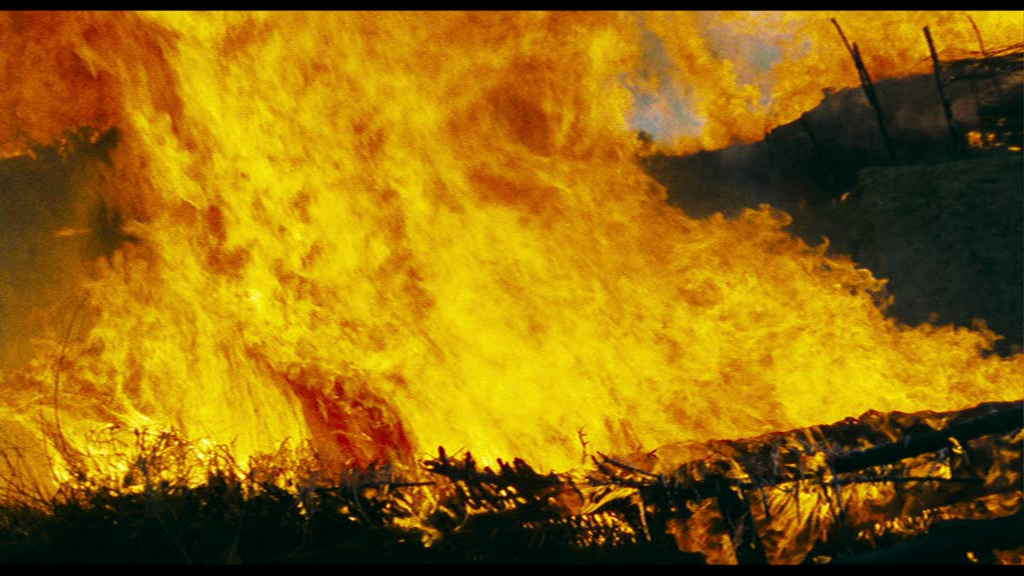
    The mesmerizing tale of lost chances, fear of abandoning oneself to another, and pain of betrayal stops by the individuation when Oyuand returns to White Camel Mountain after finding out that his beloved has died. Where in the youth he saw mountains only as obstacles that concealed a wonderful world behind them, where he would climb them, leaving his love to seek this world, where once there he would find that there’s nothing worth seeing; he now no longer wondered what hid behind the mountains. He burns  his inn and moves back later be known of the Poison of the West.

    The cinematography is out of this world. There is so much imagery that repeated viewing is a must. Complicated tracking shots, abrupt editing, impressionistic pastel-like blurred images, and static scenes, all mix together in a veritable whirlpool of technique and ideas. Christopher Doyle is perhaps one of the best, most imaginative, and daring cinematographers out there. Seeing is believing.
    http://www.youtube.com/watch?v=5VZfieiscO4

  • The symbol of serpent and dragon – an Jungian view

    The symbol of serpent and dragon – an Jungian view

    Serpent and dragon

    Everywhere the symbol of the serpent and dragon is connected with the (d)evil. That does hurt me a little bit, as I am Serpent in the Chinese Zodiac – which is the least favored sign. The snake has a bad rap not only according to my wife, but certainly within Christianity. In defense of myself (and the snake), I wanted to look at the snake in symbolic terms, in Jungian terms and to explore this from all possible angles.  In alchemical symbolism dragons are associated with fire and the primal chaotic material. The Western concept of dragons is to portray them as to be feared, and destroyed, whereas in the Near East these negative traits are minimized, Furthermore in the  Far East the dragon possesses different aspects, in that it is simultaneously a creature of water, of earth, of the underworld, and of the sky. A self depicting serpent or dragon eating its own tail ( Ouroboros) is an ancient symbol which is often associated with Gnosticism, and Hermeticism. Carl Jung interpreted the Ouroboros as having an archetypal significance. Jung gave the serpent an important role in his Quaternio Series Diagrams in his book “Aion”.

    The Dragon

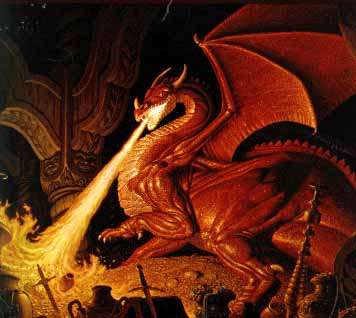
    This is one of the most easily recognized mythical beasts. It is also a pervasive symbol in a variety of cultures, giving rise to many interpretations about exactly what a dragon is, what it represents, and how it behaves. It can be associated with good luck, fortune and wisdom, or with bad luck, elemental evil and heresy. Carl Jung would have called the dragon a symbol of the universal unconscious, since so many cultures have myths associated with a dragon, or dragon like beasts.

    The symbol of serpent and dragon

    The dragon is for Carl G. Jung the personification of Sulphur and is by far the male element. Since the dragon is said to impregnate himself by swallowing his tail, then the tail is the male organ and the mouth is the female organ.  The winged dragon represents personal obstacles that must be overcome to insure a more-perfect being; thus, leading to the saying: “You conquer the dragon or he will conquer you.”   We see that Jung did, certainly, inspire awareness of the connections between modern psychology and ancient spiritual practice.  Some credit the Chinese as the inventors of dragon. The origins of dragon lore are a matter of some debate. It is known that at least as far back as 300 BCE, some bones of prehistoric animals were labeled as coming from dragons. In Christianity the dragon is generally a symbol of evil, a demon or the devil. The most famous Christian legend is that of St. George slaying the dragon.

    Much of dragon lore tells us that dragons were loathsome beasts and evil enemies to humankind. But dragons were born of a time other than men, a time of chaos, creation out of destruction. The dragon is a fabulous and universal symbolic figure found in most cultures thought the world.

    Symbology of the dragon:

    Gnostics: “The way through all things.”

    Alchemy: “A winged dragon – the volatile elements; without wings – the fixed elements.”

    Guardian of the ‘Flaming Pearl” symbol of spiritual perfection and powerful amulet of luck.

    Chinese: “The spirit of the way”‘ bringing eternal change.

    In Scripture the term dragon refers to any great monster, whether of the land or sea, usually to some kind of serpent or reptile, sometimes to land serpents of a powerful and deadly kind. It is also applied metaphorically to Satan.

    • Thou breakest the heads of the dragons in the waters. — Ps. lxxiv.13.
    •  Thou shalt tread upon the lion and adder; the young lion and the dragon shalt thou trample under feet. — Ps. xci.13.
    •  He laid hold on the dragon, that old serpent, which is the Devil and Satan, and bound him a thousand years. –Rev. xx. 2.
    •  In the New Testament the word “dragon” is found only in Rev. 12:3, 4, 7, 9, 16, 17, etc., and is there used metaphorically of “Satan.”

    The Serpent

    Aroused snake by the entrance to a Yezidee-temple. It is blackened by soot.
    Aroused snake by the entrance to a Yezidee-temple. It is blackened by soot.

    Of course, everybody knows the Biblical story of the fall of man tells of how Adam and Eve were deceived into disobeying God by a snake (identified as Satan by both Paul and John in II Corinthians and Revelation, respectively). In the story, the snake convinces Eve to eat fruit from the Tree of Knowledge of Good and Evil, which she then convinces Adam to do as well. As a result, God banishes Adam and Eve from the garden and curses the snake

    Dr. Jolande Jacobi signifies in her chapter “The Dream of the Bad Animal” the serpent initial material, in need of transformation, the chthonic, moist element of water, female, standing for unconscious  symbol for many things depending on the context, also wisdom. In the famous Houston Interviews (Bollinger, C.G. Jung Speaking or youtube) he talked about a  28-year-old woman who told Jung that “she had a black serpent in her belly.”  The woman was “only intuitive, entirely without a sense of reality.” Then she announced that the snake, which had been dormant, had suddenly become active. “One day she came and said that the serpent in her belly had moved; it had turned around,” Jung says. “Then the serpent moved slowly upward, coming finally out of her mouth, and she saw that the head was golden” 

    Jung amplifies the image of the snake in the abdomen by reference to the serpent in Kundalini Yoga. “I told you,” Jung says, “the case of that intuitive girl who suddenly came out with the statement that she had a black snake in her belly.” He situates the snake in the context of the collective unconscious. “Well now, that is a collective symbol,” he says. “That is not an individual fantasy, it is a collective fantasy.” The image of the snake in the abdomen, Jung says, “is well known in India.” Although the woman “had nothing to do with India” and although the image “is entirely unknown to us,” he says that “we have it too, for we are all similarly human.” When the woman first told Jung about the snake in her belly, he wondered whether “perhaps she was crazy,” but then he realized that “she was only highly intuitive.” She had intuited a typical, or archetypal, image. “In India,” Jung says, “the serpent is at the basis of a whole philosophical system, of Tantrism; it is Kundalini, the Kundalini serpent” (1977: 322).

    .

    Fighting with them – The Hero Myth

    In the fight with the dragon the hero battles the regressive forces of the unconscious, which threaten to swallow the individuating ego. The forces, personified in figures like Circe, Kali, Medusa, Sea Serpents, Minotaur, or Gorgon, represents the Terrible side of the Great Mother. The Hero may voluntarily submit to being swallowed by the monster, or to a conscious descent into Hades so as to vanquish the forces of darkness. This mortifying descent into the abyss, the sea, the dark cave, or the underworld in order to be reborn to a new identity expresses the symbolism of the night-sea journey through the uterine belly of the monster. It is a fundamental theme in mythology the world over — that of death and rebirth. All initiatory rituals involve this basic archetypal pattern through which the old order and early infantile attachments must die and a more mature and productive life be born in their place.

    The mythological goal of the dragon fight is almost always the virgin, the captive, or more generally, the ‘treasure hard to attain.’ This image of the vulnerable, beautiful, and enchanting woman, guarded by and captive of a menacing monster gives us a picture of the inner core of the personality and its surrounding defenses. The hero’s task is to rescue the maiden from the grasp of the monster and, ultimately, to marry her and establish his kingdom with her. This dragon fight and liberation of the captive is the archetypal pattern that can guide us through those major transitional passages in our personal development where a rebirth or reorientation of consciousness is indicated. The captive represents the ‘new’ element whose liberation makes all further development possible. In response to the call the hero undertakes  a dangerous journey to an unknown region full of both promise and danger.

    Getting there – the night sea journey.

    cropped-spiritualjung.jpg

    The night sea journey is a kind of descensus ad inferos--a descent into Hades and a journey to the land of ghosts somewhere beyond this world, beyond consciousness, hence an immersion in the unconscious [“The Psychology of the Transference,” CW 16, par. 455.]. Mythologically, the night sea journey motif usually involves being swallowed by a dragon or sea monster. It is also represented by imprisonment or crucifixion, dismemberment or abduction, experiences traditionally weathered by sun-gods and heroes: Gilgamesh, Osiris, Christ, Dante, Odysseus, Aeneas.

    In the language of the mystics it is the dark night of the soul.  Sometimes, as with Jonah, Aeneas, Christ, and Psyche, it is a descent into the depths — the sea, the underworld, or Hades itself. Always there is a perilous crossing. Sometimes the faintheartedness of the hero is balanced by the appearance of guardians or helpful animals that enable the hero to perform the superhuman task that cannot be accomplished unaided. These helpful forces are representatives of the psychic totality that supports the ego in its struggle. They bear witness to the fact that the essential function of the hero myth is the development of the individual’s true personality.

    Symbols of Spiritual Growth and Transformation

    Uroboros
    Uroboros

    The Ouroboros, the snake forever swallowing its own tail, is a famous alchemical symbol of transformation. Jung saw the Ouroboros much like he saw the mandala, as an archetypal template of the psyche symbolizing eternity and the law of endless return – and individuation.

    This Ouroboros symbol was first created in 1682. However, the idea of a snake/serpent eating its own tails can be referred to as far back as Ancient Egypt.

    The image, according to Dr. Jolande Jacobi, “shows a sinful world of creation, surrounded by the Serpent of Eternity, the Ouroboros, and characterized by the four elements and the sins corresponding to them; the whole circle relates to the center, the weeping eye of God, i.e., the point where salvation, symbolized by the dove of the Holy Ghost, may be achieved by compassion and love.”

    Ouroboros symbol in Alchemy

    The Uroboros symbol in Alchemy, was also seen as a symbol of assimilation. Consumption of the opposite. This sign was also regarded as a symbol for immortality as the serpent never dies and is always reborn.  The snake is seen as a sacred creature in Africa, especially in West Africa. The Ouroboros symbol is prevalent in many religious aspects in the form of the Oshunmare. The Oshunmare is also seen as a symbol for rebirth.

    Quaternio series: Moses - Shadow - Paradise - Lapis Quaternio
    Quaternio series: Moses – Shadow – Paradise – Lapis Quaternio

    In the Quaternio series; Man culminates in the of a good God, but rests below on a dark and evil principle (Devil or serpent). The serpent has its complement in the Paradise Quaternio which leads into the world of plants and animals. Indeed, this serpent actually dwells in the interior of the earth and is the pneuma that lies hidden in the stone. The point of greatest tension between the opposites…(is)…the double significance of the serpent, which occupies the center of the system. Being an allegory of Christ as well as of the devil, it contains and symbolizes the strongest polarity into which the Anthropos falls when he descends into Physis. Symbols of fear and cunning

    A lack of first hand experience with snakes makes the serpent a creature representing a fear of the unknown. As such, snake symbolize that unknown fear. The fear can be an intuitive warning or an unfounded anxiety about some undefinable, something hidden. Honest analysis provides the key to deciphering the snake symbol. In Christianity, the symbol pertains to Satan and the world we currently live in. It also refers to the men and women of this planet as being self-centered and “fallen”. The whole idea of the serpent itself is that it reflects something that is re-creating itself.  Be wise as serpents … – Serpents have always been an emblem of wisdom and cunning:

    Genesis 3:1. Now the serpent was more crafty than any beast of the field which the LORD God had made. And he said to the woman, “Indeed, has God said, ‘You shall not eat from any tree of the garden’?” 2The woman said to the serpent, “From the fruit of the trees of the garden we may eat; but from the fruit of the tree which is in the middle of the garden, God has said, ‘You shall not eat from it or touch it, or you will die.’” 4The serpent said to the woman, “You surely will not die! 5“For God knows that in the day you eat from it your eyes will be opened, and you will be like God, knowing good and evil.”

    Snakes as Sexual Symbols

    Sexuality greensnake
    Sexuality greensnake

    Snakes are usually symbolizing sex and sexuality. The feelings the snake evokes is key to its interpretation. Feelings of revulsion indicate sexual dissatisfaction.
    The Legend of the White Snake is one of the most famous folk tales in Chinese culture. Legendary actress Brigitte Lin, is a snake spirit who has come into the human world with her sister Green Snake. Human scholar Xu Xian  immediately catches White Snake’s attention from afar, and the two quickly fall in love and get married. However, a Taoist priest sees the two spirit sisters returning to their true self. There is an enigmatic seduction scene in there. Maggie Chung is the lusty maiden & titular character Green Snake, flirting erotically with thrilling, dynamic, not to say with perverse personality. Despite having accumulated 500 years of merit, her ability to remain in human guise is restricted by her delight in her own snakey sensuousness.

    She frequently reverts to her serpent form, in whole or in part. Green Snake in her unrestrained manner finds that she is attracted to the monk, & as White’s Snake disciple, she thinks it only correct that she find a human partner as admirable as Xu Xian has been for White Snake.

    Serpents as Symbols of Wisdom

    The Egyptians used the serpent in their hieroglyphics as a symbol of wisdom. Probably the thing in which Christ directed his followers to imitate the serpent was in its caution in avoiding danger. No animal equals them in the rapidity and skill which they evince in escaping danger. So said Christ to his disciples, You need caution and wisdom in the midst of a world that will seek your lives.

    My Chinese sign of the snake serves as embodiments of intellectual, elegance, wisdom and sensuality, but describes the bearer of the sign also as cold, arrogant and feared by many. For Chinese astrologers, the snake is a revered creature of  intuition, and spiritual development. The very same mystery and elusiveness causing fear in some gives rise to a fascination or intrigue in others. I connect to the sign of the snake as embodiments of elegance, sensuality,  the intuitive, introspective, refined and collected of the Animal Signs.  But am I dark  and  cunning,  plotting and schemes to make certain things turn out exactly as I want them to? I guess that would be similar to the “green snake”,  would be my shadow.