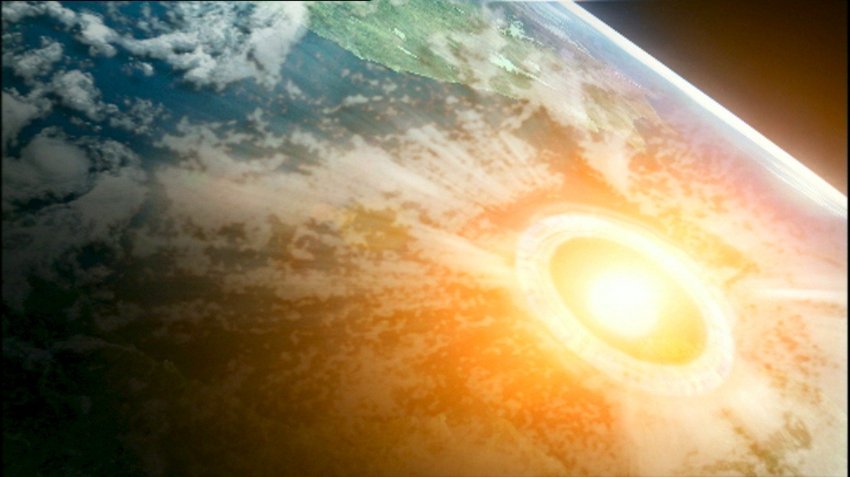
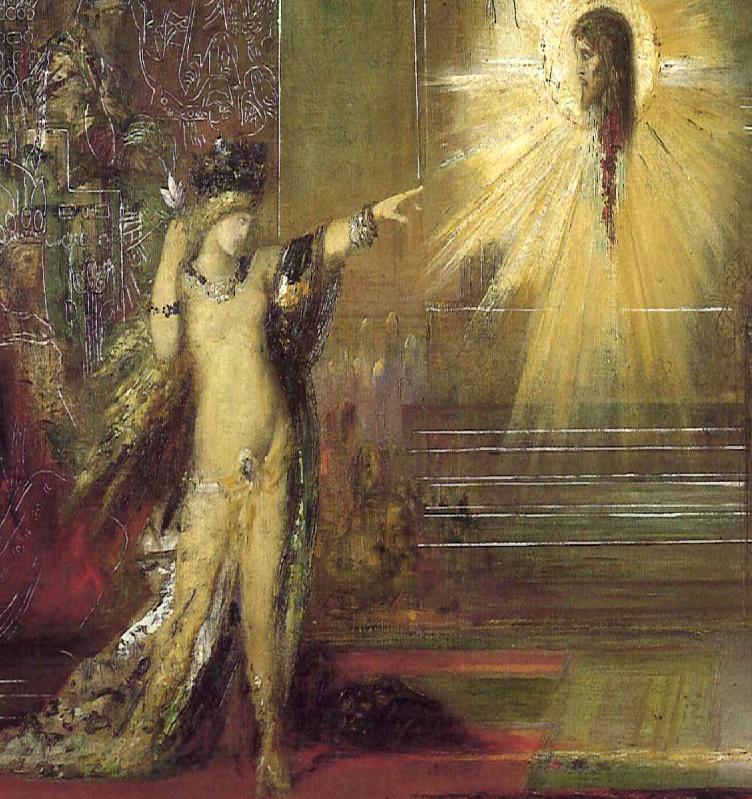
The world might come down tomorrow according to Mayan calendar. Actually the Mayan never predicted an apocalypse, but a reset sure would be nice, at least in politics. There are many of unlikely astronomic mishaps which could happen, but I am convinced mankind’s stupidity is on the very top of the list.The vigesimal system (that means that the number 20 was the basis of their arithmetic system of time-reckoning that produces the Mayan Long Count, a continuous count of the days from mythical beginnings (and is responsible for current fears that the end of the world will occur in tomorrow, December 21, 2012. The article explores the 2012 Bak’tun apocalypse from a personal, astronomical and psychological level.
The Maya worshipped a pantheon of nature gods, each of which had both a benevolent side and a malevolent side. The most important deity was the supreme god Itzamná, the creator god, the god of the fire and god of the hearth. Mayan rulers were seen as intermediaries between the gods and the people, and as semi-divine themselves like the Agyptian Pharos. They were buried in elaborate tombs filled with valuable offerings. The Mayan view of the afterlife consisted primarily of a dangerous voyage of the soul through the underworld, which was populated by sinister gods and represented by the jaguar, symbol of night. The majority of Maya, including the rulers, went to this underworld. Heaven was reserved for those who had been sacrificed or died in childbirth. Like in any ancient belief system, to the Maya, science and religion were one and the same. The Maya developed an impressive mathematical achievements included positional notation and the use of zero; and in astronomy, they accurately calculated a solar year, compiled precise tables of positions for the Moon and Venus, and were able to predict solar eclipses.
Memory of a journey
That triggered a memory. Exactly December,20th 1988 we flew in to Cancun from SFO via Mexico City for Christmas holidays.I had picked up my then wife a day before at SFO airport. From the mid eighties until the early nineties I worked in Silicon Valley. My wife lived in Europe, because her work leave could not be extended and she did not want to quit her job. I remember picking up the tickets, the travel agent seem to be relieved, because the agency had tried to contact me numerous times but never reached me (no mobile then). “Is that your home phone” showing me a long telephone log … “yes ma’am”, I said … “but you are never there?”, “umm no ma’am”, I said.
Palenquechichen-itzaoppsFirestorm-1943: Source Universty of Exter
Reason was I managed a pretty hot project at that time and was quite busy in this year (and others to come). In Mexico, I had just booked a hotel for one or two days and a rental car which was a red VW (beatle). VW’s had been built still built there at that time. Cancun has wonderful beaches and the water has a unique colour. With all due respect, however, I did not care for the city because it was such a boring resort setting. We moved on fast. The water out of the pipe smelled like it was imported and the air condition in the hotel made me shiver. I am not a beach whale and it was the aftermath of a big storm, lots of palm trees gone and still high waves.
1988 the world isstillnot coming down
So my to-be-ex wife and I – we got divorced 10 years later – set with the banged up red VW to a memorable journey all over Yucatan . Oh, did I say my luggage was delayed, I had to buy some stuff and borrow some of her t-shirts and trousers (she was slim then). Always a systematic traveller, she had learned enough Spanish to ask for directions, order food or book hotels and figured what we must see. First we went to Tulum, spent new year in Palenque, partying hard with a French group until the morning. Via Campeche we visited Uxmal continued to Merida. All historic sites are of great astronomical interest. In Merida I still remember a old hotel with a nice court yard and spicy food. Best Mexican food I ever had,and California’s food isn’t too bad Highlight was Chichen Itza and Palenque. Of course we saw the pink flamingos, hiring a boat.
The astronomy view
Chichen Itza, is a regional civic-ceremonial polity by the end of the 6th century AD. It developed towards the Late Classic and the Terminal Classic periods(roughly 10th and 11th centuries). It declined after 1221 (because of a civil war).Deep within the jungles of Mexico and Guatemala and extending into the limestone shelf of the Yucatan peninsula lie the mysterious temples and pyramids of the Maya. Without metal tools, beasts of burden or even the wheel they were able to construct vast buildings ina a jungle landscape with an amazing degree of architectural perfection and variety.
chichen-itza
Astronomical elements: El Castillo (Temple of Kukulcan) which displays the equinox phenomenon; El Caracol – the snail was for sure an observatory with wholes for solstice sunset alignments, sunset on the day of zenithal passage, the northernmost setting position of Venus, sunset at the equinoxes; the Great Ball Court (Temples of the Jaguar – pointing to the sunsets on April 29 and August 13); Las Monjas (pictorial representations of the Maya zodiac); Temple of Venus (iconographic representation of 8 solar years equalling 5 Venus cycles); Their legacy in stone lives on as do the seven million descendants of the classic Maya civilization. The name Chichén-Itzá is a Mayan word: CHI (mouth) CHEN (well) and ITZA (of the Itza tribe). The site is divided into three sections. The North grouping of structures is distinctly Toltec in style. Much has been written about it. We visited Chichén Itzá in late in the afternoon. Shown here is the central pyramid, also known as El Castillo, this spectacular, massive Mesoamerican step-pyramid. Built by the Maya sometime between the 1000 and 1200 AD, El Castillo served as a temple to the god Kukulkan and is believed to have served as a calendar. Each of the structures four stairways contains 91 steps. When counting the top platform as another step, in total El Castillo has 365 steps, one step for each day of the year. We also climbed on top of the pyramid and later visited the large ball court where Mayan men played a game in which each team had six field players who would attempt to pass the ball – using any body part except their hands – to their captain who would attempt the shot . The captain of the team that made the first successful shot was then decapitated as a sacrifice to the gods. One fact worth noting is the repetition of the number seven, which was also sacred to the Mayans. There were seven players on a team, the rings were seven meters high and if you clap your hands or shout in the court, the sound will echo exactly seven times. There are carvings on the stone walls that depict the ball players (some of which are remarkably intact) and after the captain was beheaded, it is said that seven serpents grew out of his neck. But the true mystery behind the ball court at Chichén-Itzá is the Mayan prophecy that on December 2012, the great warrior serpent Kukulkán will rise from the ground beneath the playing field and end the world for good.
Palenque is one of the most important Mayan sites, it reached its height between 500 and 750 AD. Astronomical elements: inscriptions referring to the conjunction of planets (Jupiter, Saturn, and Mars and the Moon) and the birth of three ancestor gods and the First Mother, in July 690; the Temple of Inscriptions (with the tomb of Janaab´ Pakal); the Palace and the Group of the Cross. Records at the site suggest the site came under attack by another Maya center, Calakmul, in 599 and again in 611. The main point of interest about Palenque is not its size or age, as other sites are larger and likely much older, Its importance lies rather in its naturalistic sculpture, architectural inventiveness, and detailed epigraphic records. According to them the world will see a significant event but continue to exist after 2012 CE, since this date has just a spiritual meaning in the life of the ruler. As I remember, according to my travel guide one can see, birth , Accession, Death and Reign Post.
Uxmal is another major Mayan centre, built between about 700 and 1100. Astronomical elements: the Governor’s Palace (alignments to the Venus extreme positions, (eastward or westward), iconographic representations of the Venus cycle and of the Mayan zodiac; the Nunnery Quadrangle (astronomical imagery), visual relationships between the most important structures as viewed from the top of the Adivino (Pyramid of the Magician).
The Maya were a clever kind of folks. Pre-Hispanic Mesoamerica made perhaps the best examples of calendrical-astronomical speculations and computation ever made by the populations of ancient America.Their civilization got started several thousand years ago and reached its height by 900 A.D., spread over the Yucatan Peninsula and what is today Guatemala (I unfortunately was never there). They had a sophisticated culture and were adept in agriculture and architecture. They had a complex written language and a keen system of mathematics. They were excellent astronomers, understanding the patterns of the stars and planets in the sky. And, as described, they had an advanced calendar.
The Basics of the Mayan Calendar
Keeping time is of paramount importance to any civilization. The Maya used different calendars for different purposes The magic number is her 13th Bak’tun period – Mayans valued 13 and 7 and calcultated base 20 instead of the 12 most ancient astronomer used. The Mesoamerican calendrical system is displayed in the form of many different permutations, and expressed the universal laws governing the world as it was then conceived.he Maya understood 17 different Calendars based on the Cosmos. The calendars that are most important to beings of earth are the Haab, the Tun-Uc and the Tzolk’in. The Tzolk’in is the most important and the one with the most influence. The Haab is based in the cycles of earth. It has 360 + 5 days, totaling 365 days. The Haab uses 18 months with 20 days in each month. There is a 19th month called a Vayeb and uses the 5 extra unlucky days. Each month has it’s own name/glyph. Each day uses a sacred sun/glyph. The Tun-Uc is the moon calendar. It uses 28 day cycles that mirrors the women’s moon cycle. This cycle of the moon is broken down into 4 smaller cycles, of 7 day each. These smaller cycles are the four phases of moon cycle. Portal days (p), on the calendar provided marks days using mathematics of 28 and therefore have a connection with the moon cycles. The Tzolk’in is the sacred calendar of the Maya and is based on the cycles of 260 days. The cycle of the Pleiades uses 26,000 years, but but encompassing 260 days might allign the Venus cycle as shown below. The Mayas knew the importance of the period of 2920 days equal 8 years by 365 days, in which the Venus repeats its movement in relation to the sun, same as the Babylonian did. The “Dreseden codex” in Germany contains tables for predicting solar and lunar eclipses and ephimerides fro Venus and Mars for two rounds.
dresden_codex_germany
The morning star was seen as a male deity. Venus war regulary abserved as said using sacred numbers 13 and 20. The 13 represents the numbers and 20 represents the sun/glyphs.The Tzolkin calendar was meshed with a 365-day solar cycle called the “Haab”. The calendar consisted of 18 months with 20 days (numbered 0-19) and a short “month” of only 5 days that was called the Wayeb and was considered to be a dangerous time. It took 52 years for the religious Tzolkin (13×20) and civil Haab (18×20+5) calendars to move through a complete cycle. We know from many other cultures, the year that previously worldwide had 360 days, was suddenly at any time to 5 days longer. You do not believe in the real 360-day year, but it was there really. Nothing demonstrates this more clearly than the Mayan calendar labels. If the count on the basis of 20 would have been a theoretical construction, so would do this twenty times that of a uinal (20 days) = 400 must be. But one year had 360 days. And all other calendar cycles are both multiples of 360.
The baktun period of 144000 days shows that this system must be old. All astronomers who deals with the Mayan calendar, are of the opinion that the accuracy of the Mayan calendar must be based on a very precise, centuries-old day count. In addition, it is long since known that the Maya payed to the orbit of the planet Venus a particularr attention. This should be noted when one has the theory they introduced the Tzolkinfor correction. The name implies that there cannot be a “liturgical year cycle”. Kin means yes day. There were days so kin = added. It was necessary to adapt their previous calendar to the new cosmic conditions. This applied particularly to the orbit of the planet Venus
1440 = 18720 Days à 13 groups of four
In addition 13 Tzolkin à 20 days = 260 days
a total of 18980 days
These are 52 years of Earth à 365 days.With this correction Tzolkin period, they had corrected not only the solar year, but also a relationship to the Venus year established. The Sidereal Period of an object is the time it takes to make a complete circuit of the celestial sphere with respect to the fixed stars. The Synodic Period is the time required to make a circuit of the celestial sphere with respect to the Sun – which is also moving eastward among the stars. The synodic period is always greater than the sidereal period, the difference being due to the apparent motion of the Sun. The synodic period as seen from the Earth (which is now the outer planet with orbital period one year) is 1.599 years.Venus needs thus – seen from the Earth – 584 Earth days, until Venus shows up again at the same point in the sky (Synodical year of Venus).Venus has an orbital (sidereal) period of 0.615 years. Venus needs thus – seen from the Earth 4745 Earth days, until Venus shows up again at the same point in the sky and compared with the stars.(Sidereal year of Venus).
They had to wait 4 x 13 years for the fractions to sort themselves out. Only after 52 years did the two calendars finally get back to where they had both started. And that period of 52 years became known as the Calendar Round on what the Dresden Codex is based on which escaped Bishop Diego da Landa’s bonfire of all the Mayan sacred books. The Dresden Codex lists the start dates in the tzolkin calendar for each phase of the Venus cycle – the 8 days of invisibility at inferior conjunction, the 236 days as morning star, the 90 days of invisibility at superior conjunction and the 250 days as evening star for 2 requnds 104 years. Each circuit takes 8 years so 52 years = 6.5 circuits of the new pattern. So the scribes had to write out two Calendar Rounds to get the two calendars and the planets all back to their starting positions relative to the stars – now this shows an amazing match (common nominator):
8 * 4745 (siderisch) = 37960 Tage
65 * 584 (synodisch) = 37960 Tage
104 * tun + 2 * tzolkin = 37960 Tage
104 years with 365 days = 37960 Tage
or
13*2920 days = 8*4745 days = 2*18980 = 37960 days (104 years)
46*260 days = 65*584 days = 104*365 days = 37960 days (104 years
104 Earth years included so all the corrections and the absolute correspondence between the traditional 360-days calculation, the correction of the Tzolkin and sidereal and Synodic Venus circulation. This included the solar year.
But the calendar we’re interested in regards to doomsday is called the Long Count. The Long Count, for which we do not know the Maya name, is commonly considered the Maya’s linear count of days. In truth it is yet another cycle, but its great length of at least 5126 years makes it essentially a linear count through history beginning a cycle with 2,880,000 days thus very close to 7885 years. It was assumed that the universum is desströyed and reborn at every end of the cycle. When counting they favored a bas of twenty except in the second place they preferred 18 to aproximate a year, so the units were 20 (month), 360 (year), 7200 and 144,000 (half cycle). That is of course place holding notion. The cycle just ended began on 6. September 3114 BC (Julian Calender). The baktun digits run out in 4772 AD. We’re probably all right until then.
These are the Mayan words for periods of time:
Day = Kin (keen)
Month of 20 days = Uinal (wee nal)
Year of 360 days = Tun (toon)
20 Tuns = K’atun (k’ ah toon)
20 K’atuns = Baktun (bock toon)
The earliest known Maya long count was recorded in year 32 AD at the site of Chiapa de Corzo in the Highlands of Chiapas, Mexico. Just like the Christian calendar, the long count has a start date: ours is January 1 of 0 AD, and theirs (by our reverse engineering) is August 11 of 3114 BC. But unlike our Christian calender, theirs also has an apparent end date, December 21 of 2012 AD. The long count is represented as a five place notation system of ascending cycles – kins (days), winals (20-day months), tuns (360 days), k’atuns (20 tuns), and bak’tuns (20 k’atuns). It is important to note that the long count’s version of a year, the tun, is only 360 days, not the solar count of 365. This means that the long count diverges from the Haab by five days every year, making it a completely unique and separate cycle.
longcount_positionsl
The largest of the long count’s five cycles, the bak’tun, is a period equaling 400 tuns. Many people believe that the full cycle of the Long Count is complete when 13 bak’tuns have passed since the beginning of the creation of this current universe, identified as the 4th creation in the Maya “story of creation”, the Popol Vuh. That date, currently of such great interest to those anticipating an “end of days”, will occur on December 21, 2012 AD. Astronomical practices by the Maya and the Mesoamerican system of time-reckoning are exceptional. A period of 260 days in combination with the 365-day year cycle, producing a ‘Calendar Round’ (cycle of roughly 52 years), is a method of marking the passage of time unique in the history of humankind. That das not mean a such apocalypse is foretold no Maya text – ancient, colonial or modern – ever predicted the end of time or the end of the world. Apocalypse is a Christian concept. Just a restart, after what Mayas considered a very long time. Noted Mayan scholar, admit that December 21, 2013, marks a special occasion in the ancient Mayan calendar. They hold that December 21, 2012, marks the end of the 13th Bak’tun period. The close of each Bak’tun period occurs approximately once every 5125 years. “There can be little doubt the ancient Maya would have seen the date as a numerological echo of the current era’s start date, and they would have marked the occasion of the 13th Bak’tun with great solemnity and fanfare,” writes Callaway in a magazine article titled Ancient Endings and New Beginnings: Maya Cosmology, Just in Time for 2012. The doomsday scenario is simply a human concoction. If anything, it would seem, that the image of the apocalypse in the name of the Mayans is a convenient projection to project a large section of our own society’s subconscious fears, insecurities and fantasies we certainly have in the west.
The astrology view.
Sun 29°59 Schütze Haus 10
Moon 14°08 Widder Haus 1
21.12.2012 12:00 Munich, Europe
Aszendent Fische
Merkur 14°41 Schütze Haus 9
Venus 6°34 Schütze Haus 8
Mars 26°25 Steinbock Haus 11
Jupiter 8°54 Zwillinge Haus 3
Saturn 8°39 Skorpion Haus 7
Uranus 4°38 Widder Haus 1
Neptun 0°48 Fische Haus 12
Pluto 8°56 Steinbock Haus 10
Mondknoten25°36 Skorpion Haus 8
Chiron 5°37 Fische Haus 12
Pholus 19°47 Schütze Haus
Throw that in for completeness. Nothing unusual. Quite loaded but no doomsday.
The psychoanalytical view.
Two Twelver cycles later, happy 2012 close of each Bak’tun period. “The greatest threat to Earth in 2012, at the end of this year and in the future, is just from the human mind” C.G.Jung would have said. The word “Apocalypse” (revelation) is from the Greek meaning “uncovering what has been hidden.” In other words, the revelation of new truth. It is a concept very evident in Christianity and separates in four phases: revelation, judgment, destruction, and a new birth. If we look back over centuries, we see the revelation of torrents of new scientific, psychological and social truth; judgments or assessments made on the basis of this new truth; the collapse of beliefs and institutions based on the former truth, and are becoming dysfunctional within the context of the new truth; and the sprigs of the new worldview trying to blossom. Destruction and new birth take place simultaneously in Hinduism, although the popular use of the word apocalypse means now total destruction. When Christianity took over the Roman Empire and became the second truly global organization (and the only one which still exist in Roman Catholicism) it was because Jesus articulated and manifested what had been gradually growing in the collective psyche, the political circumstances were ripe for a revolution and the Roman citizen’s vision, will and spirituality broken. All essential of a state were outsourced and the succession of rulers changed from bad to worse. It might be said that evangelist were the master psychologist of his day. Jung once said he loved to read the Bible not only for its spiritual insights, but also for its psychological significance. Again we’ve so completely alienated ourselves from nature and its essential role in the human psyche, and our state of knowledge and psychic development are driven by a media time, the concept of the global Now, the Bible no longer has the same numinosity to many in the West.
So to summarize: the Mayan hype December 21st is the faint memory of the “archetype of the Apocalypse” essentially of numinosity. The concept of the “global Now”, knows no God, certainly no Past and no Future anymore. People remember archetypes like the Zombies, who (or which) wander aimless in the shopping center, since that was once the center of their life. George A. Romero conceived this allegory brilliantly in the best legitimate zombie film ever, ” Dawn of the Dead” (1978). Likewise The collective “mind” of the twenty-first century seemed to have been obsessed with Apocalypse. There is little doubt that the culmination of this obsession echos destructive capabilities of the financial market (aptly named new world order) for political and social autonomy. Thus, it may be the an unconscious “death wish”, a psychological problem which Jung’s patient ( and the first female psychoanalytic) Sabine Spielrein discovered in her paper, ‘Destruction as a Cause of Coming into Being’ (written immediately after she graduated with top honours). A death wish expressed collectively for its civilization–like once the Romans– which understand and avert its own demise. Read a German newspaper for instance – the death wish of a society – which does not even want to breed anymore – is printed all over the place by zombie journalists.
“Cosmos An illustrated History of Astronomy and Cosmology”. John North 2008
“The exact Science in Antiquity” O. Neugebauer, Dover Edition 1989
Heritage Sites of Astronomy and Archaeoastronomy in the context of the UNESCO World Heritage Convention: A Thematic Study. Other. ICOMOS, 2010 Paris
Letters of C.G. Jung and Sigmund Freud Princeton, 1974
This article explores Wittgenstein’s Tractatus as a mystical, metaphysical insight in the light of Eastern philosophy, Catholic mysticism and C. G Jung. Please be gentle and read this as an (intuitive) essay not as a scholarly article. There are methodological implications of Wittgenstein’s doctrine of silence for transcendental philosophy, Zen Buddhism, psychoanalysis and metaphysics. Or there is a line from Lao-Tse to Wittgenstein, connected by Jung and Watts.
Wittgenstein’s Tractatus-Logico-Philosophicus,(Logisch-Philosophische-Abhandlung,1921 translated by C.K. Ogden 1922) is much closer to me than his work Philosophical Investigations (Philosophische Untersuchungen,1953 translated by G.E.M. Anscombe). Simply because I understand the Tractatus largely transcendental (similar to Allan Watts). A fellow blog author (Recollecting Philosophy), who knows definitely more about philosophy and Wittgenstein than I do, objected slightly to Allan Watts rating the Tractatus higher than the Investigations,however.
In the eighties and early nineties during my time in California I picked up Allan Watts thoughts. Allan Watts knew C.G. Jung well and both were quite knowledgeable in Eastern Philosophy. Watts proposed that Buddhism could be thought of as a form of psychotherapy and not just a religion. Like Jung he was (to me) a bridge between the ancient and the modern, between East and West, and between culture and science. Both had considerable problems with the institution of the church, were mystics and in a way certainly religious. Both emphasized that we Westerners cannot and should not escape our Western cultural roots but value them. Both valued Catholicism although Watts view is more bizarre. It’s not difficult to see therefore, that Allan Watts, who became a kind of Guru in California and postmodern mystic, reads Tractatus as a product of mystic consciousness.
Wittgenstein’s Tractatus
Before I had read more of Wittgenstein and secondary literature, I regarded Wittgenstein’s writings as a kind of academic “Glass Bead Game”. I still think, that what he tried to achieve, could have done simpler by mathematical language (or computer science). Therefore I can relate to Allan Watt, classifying the writings of Wittgenstein “as a form of jnana-yoga, intellectual bending” and that he favors Wittgenstein’s Tractatus.
Logic without Mystic
The Tractatus is notorious for its interpretative challenges. In Europe we live in a post-metaphysic world. If you approach Tractatus, however, from C.G. Jung’s Symbols as representation of archetypes, which manifest themselves in language (as part of the cultural context which are those archetypes) you see it crystal clear.
The Tractatus’s structure contains seven basic propositions translated by Ogden and Pears/McGuinness. Here I stick with German:
The seven basic propositions are (in German):
1 Die Welt ist alles, was der Fall ist.
2 Was der Fall ist, die Tatsache, ist das Bestehen von Sachverhalten.
3 Das logische Bild der Tatsachen ist der Gedanke.
4 Der Gedanke ist der sinnvolle Satz.
5 Der Satz ist eine Wahrheitsfunktion der Elementarsätze. (Der Elementarsatz ist eine Wahrheitsfunktion seiner selbst.)
6 Die allgemeine Form der Wahrheitsfunktion ist: [ p, ξ, N(ξ)].Dies ist die allgemeine Form des Satzes.
7 Wovon man nicht sprechen kann, darüber muss man schweigen.
After three propositions Wittgenstein leaves metaphysics realm but comes back to it with the most elegant proposition seven, which again mirrors a sentence in the bible. For that reason only 1-3 and 7 will be discussed.
Proposition (1) The world is everything that is the case.
Starting with a metaphysics, Wittgenstein sees the world as consisting of facts, rather than of objects and reads to me like the beginning of the Gospel of John:
Tractatus 1 The world is everything that is the case.
Tractatus 1.1 The world is the totality of facts, not of things.
Tractatus 1.11 The world is determined by the facts, and by these being all the facts.
Jh 1.1 In the beginning was the Logos, the Word, and the Word was with God, and the Word was God.
Jh 1.2 The same was in the beginning with God.
Jh 1.3. All things were made through him; and without him was not anything made that hath been made.
Equally beautiful and pretty much the same statement except god is absent. Logos, originally a word meaning “word,” “speech,” or “reason was used by Heraclitus to describe the principle of order and knowledge. There are some remarkable implications here starting of a debate between Plato and Aristotle which I want to move in an area between Wittgenstein and Western (Catholicism) and Eastern Mystic (Taoism and Zen Buddhism) and the psychoanalytic model of C.G Jung.
The idea of Tao is always stated negatively. The same is true of all its major characteristics, of which I would distinguish three: nothingness, the formless, and the unconditioned. Again Lao-tse as starting point of our inquiry is strikingly similar:
The Tao (Way) that can be told of is not the eternal Tao;
The name that can be named is not the eternal name.
The Nameless is the origin of Heaven and Earth;
The Named is the mother of all things.
Wittgenstein’s Tractatus – Seen from Eastern metaphysic
I understand Wittgenstein, who was from the personality type based on C.G. Jung (and like him) an innovative thinker from the mystic as well as a logic angle. As anybody knows, Wittgenstein was fond of Augustine and Kierkegaard, of Tolstoy and Dostoyevsky and wanted to become a monk on more than one occasion. Wittgenstein’s Tractatus support my religious views, which are based on Catholicism, C.G. Jung and some pantheistic Asian influence coming from Taoism and Buddhism. There is alignment between Buddhism and psychoanalysis, as Watts stated, although I see goal of alignment more in an integration of the Ego and the main archetypes than a dilution of the Ego. However, Watts followed Zen Buddhism or Zen, a 5th century line of Mahayana Buddhism, which was heavily influenced by Chinese Taoism in China. And Taoism is indeed much more compatible with Wittgenstein, Jung and Catholicism.
Crist and Buddha
Since I know Taoism and Zen Buddhism better I will focus on those. Both offer direct access to most deepest essence of our mind, exactly like Jung’s individuation.
There is good book about that particular topic from Russell Nieli, “From mysticism to ordinary language”, 1987. He claims, that Wittgenstein’s experience of language (and indeed the language game) was deeply influenced by his experience as rural school teacher, but got stuck there, staying in the uncritical childhood experience (page 244). Wittgenstein’s language analysis offers no differentiation of what is of value or absurd in a given society. Obviously he received a harsh criticism not only from the Marxist side: “When … Wittgenstein set up the actual use of language as a standard that was equivalent to accept a certain setup and belief of the society of the standard. And when he says philosophy “may not interfere”, that come to saying that it may not interfere with a currently accepted society and culture”. I think this may by a misunderstanding taking him as a positivist.
Proposition (2) What is the case (a fact) is the existence of states of affairs.
Mystics, such as Taoists or catholic mysticism, can be aligned to the West and especially Wittgenstein. Systematic inquiry through a logical analysis make its mystical elements clear and comprehensible to non intuitive audiences. But as C.G. Jung noted, its intuitive sensing is highly beneficial to the individuation in our Western culture. When for Wittgenstein, the logical structure of the picture is identical to the logical structure of the situation, in Taoism it is simpler: the inexpressible Tao is in everything, or alternatively, everything is a manifestation of the inexpressible Tao. That is pretty similar what catholic monk told me a few weeks ago: God is in us and above us or God does not exists. When one sees both statements to express the same thought, one can see Wittgenstein’s transcendental elements can be coupled with Eastern and Western religious and mystical elements.
Dreams
Wittgenstein’s Tractatus – Western metaphysic view
Plato put forth the idea that the metaphysical world is more knowable than the physical world. Following Socrates, Plato illustrates this idea through allegory of the cave. The idea is that this physical world we reside in is merely a shadow of a more real and more knowable world that is not physical but metaphysical. From here Plato posits the idea of the Forms. Plato would tell us that we know that it is a thing because there exists in our minds an abstract thing and the reason we know that the thing before us is this thing, is because of its resemblance to the archetype.
Archetypes
That archetype equals the collective known form and is a centerpiece in C.G.Jung psychoanalytic model. In short, we have knowledge of physical things here and now because of the resemblance of these physical things to their ideal metaphysical form. In contrast, Aristotle denies that the Forms exist way out there in the metaphysical realm. So, the lines are defined : Is knowledge of a thing transcendent (Plato) or is it immanent (Aristotle)? Is the nature of all things Being (Plato) or Becoming (Aristotle) or in Kant seeking a synthesise? In his Critique of Judgment, Kant says that “a final purpose is a purpose that requires no other purpose as a condition of its possibility:
The final purpose is unconditioned, and that nature would therefore be incapable of achieving it and producing it in accordance with the idea of this purpose. … But a thing that, on account of its objective character, is to exist necessarily as the final purpose of an intelligent cause must be of such a kind that in the order of purposes it depends on no condition other than just the idea of it.
Proposition (3) A logical picture of facts is a thought – Archetypes in Wittgenstein’s Tractatus
Tractatus, however, also with the conditions with Symbolism in which a sentence “means” something quite definite. In practice, language is always more or less vague, so that what we assert is never quite precise. And that’s the beauty of it – of Jung, Taoism and Christianity. Wittgenstein’s logic tries to overcome: (1) the conditions for non/sense combinations of symbols; (2) the conditions for uniqueness.
Tractatus: 3.32 The sign is the part of the symbol perceptible by the senses.
From Carl Jung’s “The Structure of the Psyche”, 1927:
The collective unconscious — so far as we can say anything about it at all — appears to consist of mythological motifs or primordial images, for which reason the myths of all nations are its real exponents. In fact, the whole of mythology could be taken as a sort of projection of the collective unconscious.
We can see this most clearly if we look at the heavenly constellations, which original chaotic forms were organized through the projection of images. This explains the influence of the stars as asserted by astrologers. These influences are nothing but unconscious, introspective perceptions of the activity of the collective unconscious. Just as the constellations were projected into the heavens, similar figures were projected into legends and fairy tales or upon historical persons.
So according to Jung, those archetypes, which Wittgenstein calls symbols, are models (abstract classes in computer science) which are innate, universal and hereditary. And that’s the point. Archetypes are unlearned (but some shared by some cultures and some by all cultures) and function to organize how we experience certain things. “All the most powerful ideas in history go back to archetypes,” Jung wrote:
“This is particularly true of religious ideas, but the central concepts of science, philosophy, and ethics are no exception to this rule. In their present form they are variants of archetypal ideas created by consciously applying and adapting these ideas to reality. For it is the function of consciousness, not only to recognize and assimilate the external world through the gateway of the senses, but to translate into visible reality the world within us.”
Conclusion
Wittgenstein’s deep understanding of the mystical dimension brings him close to Taoist and Jungian thoughts. Wittgenstein is almost a Taoist and certainly a sophisticated logician. And, both these qualities are spontaneously exhibited in Wittgenstein. No other Western philosopher is better than Wittgenstein for the representation of the synthesis of mystics and metaphysics with sophisticated logical analysis. As Wittgenstein said once, a deep thinker makes us see that there is something that cannot be said. In his transcendental philosophy, Wittgenstein shows that there is something that cannot be said. In contrast, Lao-tse says that there is something that cannot be named – this is the single difference to monotheistic views,
Proposition (7) Whereof one cannot speak, thereof one must be silent
There are methodological implications of Wittgenstein’s doctrine of silence for transcendental philosophy and metaphysics. There are two senses of “sense” which Wittgenstein uses in the Tractatus, the actual sense. and the logical sense. Wittgenstein explains that “every proposition is essentially true-false. Wittgenstein calls this “true-false” possibility bi-polarity an important concept, important to C.G. Jung, Taoism and C.G. Jung.
Philosophers should keep silent about the not speakable because “philosophy is not one of the natural sciences. The doctrine of silence is applicable to mysticism, however. Mysticism may be seen as equivalent to metaphysics, or as not too far away from metaphysics. Now we can see why the doctrine of silence is applicable to mysticism as well. Wittgenstein explains that
the urge towards the mystical comes of the non-satisfaction of our wishes by science. We feel that even if all possible scientific questions are answered our problem is still not touched at all. Of course in that case there are no questions any more; and that is the answer.
Transcendental mysticism seen in this light is the attempt to tell the same story: the inexpressible Tao and nonsense are the same story, a story that, technically and literally speaking, cannot be told. That story begins with the Lao-tzu’s inexpressibility covers Jung’s collective – not to be learned archetypes – and ends with the Tractatus’s silence.
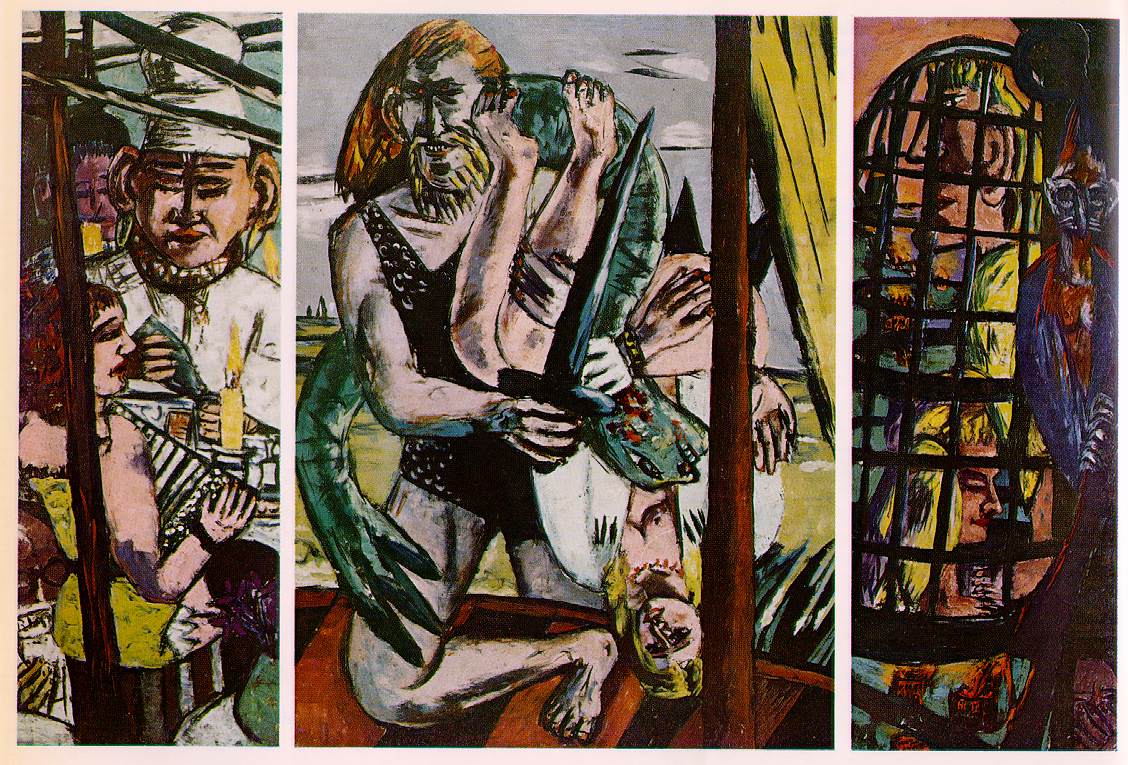
The Newsweek article “A New Theory of PTSD and Veterans: Moral Injury” was probably the best article I ever read about PTSD – besides Shay’s Achilles in Vietnam. Yes most important factors may very well be moral injury, traumatic events and being betrayed by leadership. But, there is more – ethical, Jungian depth psychological and political circumstances:
Villains don’t get PTSD: The individual (and its society) has to have moral standards and be reflective to experience moral injury.
Adding insult to injury: Societies project their shadows on the soldiers traumatic events.
The line between Good and Evil: PTSD is an Achilles heel made visible by modern media
Serving the Devil: Differences between societies collective and individual belief systems – the coming home effect (after winning and loosing) and the authoritarian mass psychology.
The contemporary despise of the Archetype of the Warrior – Do nothing, see nothing, hear nothing, and go nowhere, feeling good looking away.
People never come back from war unchanged.
I’m glad that the issue for individuals of crossing previously taboo lines of behavior, in the context of combat/trauma, is recognized as a significant factor. The example of the Marine Fox Company is very convincing and the arguments make a lot of sense. Send people to war today and a certain percentage will get PTSD, commit or see war crimes and suffer after coming home. Because war transforms also the country at war. Sometimes with a time delay. It took 50 years (protected by the American soldiers) before European social scientists and media were allowed to stereotype their fathers – all soldiers as war criminals.
My father, a country boy, who was drafted with 17 during the Second World War, fought basically as “grunt” for his life. He served in Russia until 1945 and subsequently three years longer as prisoner of war in coal mine under very harsh conditions. 1948 he returned to Germany with empty hands, which lost not only a war but any moral standards and cared little about foot soldiers busying itself with clearing the rubble and starting the Wirtschaftswunder. Nevertheless, he became a good father and husband and raised me fairly well. He told me little about this time, only that he almost got court marshalled two times. Once he was watched laughing over a propaganda poster and one time after a frontal assault of the russians (he was an army machine gunner). Reason was, he had to open his last ammunition box, having killed wave after wave of soldiers driven into the bullet hail by Stalin’s commissars. It was us or them, but his last box unfortunately contained food which he stashed away. But there is always more ammunition.
Why was PTSD a lesser issue after the 2nd world war?
It must be todays schism of moral standards imposed on the soldiers and reality – the increased awareness of rotten political leadership sending them to war. I would argue it is the incredible difference between reality and moral standards reflected as hypocrisy of the society. If we’re serious about ending PTSD we must be serious about our shadow. Yes, there is moral injury, caused in large part by betrayal — not only from a field commander putting career over the lives of soldiers or betrayal by one’s government, namely, being sent to a war based on lies but also by us watching the war on TV projecting our undesired and evil wishes on them. The first duty of the ethically minded person is, from Jung’s psychological perspective, to become as conscious as possible of his or her own shadow.
The good and the Evil – “good wars” and “wars of aggression”
I would also argue there have been no “good wars” anymore after the second world war. If – and that’s at least a little IF – even the Second World War was one. Lets assume it was. Outside of the political correct realm the older Germans remember the American soldiers (correctly) as a kind victor.
But why did the RAF pilots who executed ‘Bomber Commander Sir Arthur Harris’s industrialized burning of German cities and civilians not develop PTSD? Harris was appointed chief of Bomber Command in February 1942. His first raids were bombing of medieval Lubeck (‘more like a fire-lighter than a human habitation’, in Harris’s words) and the 1,000-bomber raid on Cologne. The Operations Order for the bombing of Hamburg in July envisaged the ‘total destruction’ of the city. And so it did. At least Harris was honest: his aim was to destroy whole German cities and their inhabitants. Others were not. The official British line was dishonest. The fires were far away. So I guess.
Firestorm-1943: Source Universty of Exter
Not comparing, evil with evil, few Nazis developed PTSD either. Derived from the history of Nazi Germany, Jung would have to confront the shadow within the larger structures of any society. The ways in which a society is set up, through its laws and customs, has a lot to do with how evil is handled and perceived within its precincts. “Moral man and immoral society,” a concept of Reinhold Niebuhr’s, may be a guide here. Many scrupulous and well-intentioned individuals end up serving the Devil by being good and obedient citizens. And nobody is free of opportunistic strains, some outstanding artists and brilliant expertsserved dictators more or less knowingly or naively.
Responsibility and Truth
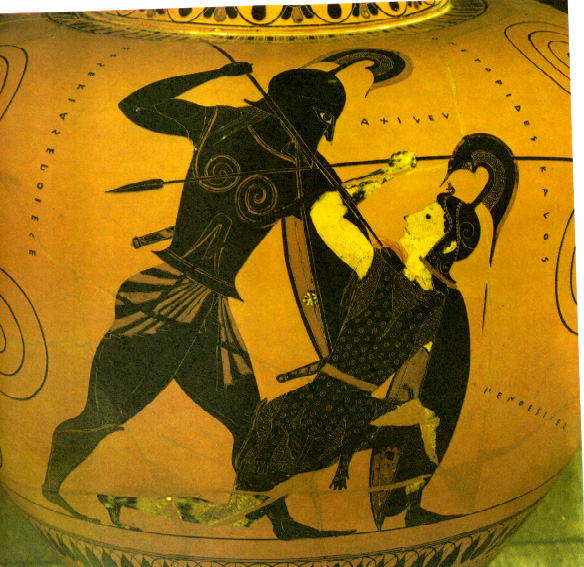
PTSD is itself not a moral injury. The Newsweek article rightfully does not equate PTSD with moral guilt. It makes the case, that there is a certain kind of (combat) guilt that could exacerbate or even trigger PTSD. The analysis does not blame the victim or smear the character of anyone else who suffers from PTSD. We are each responsible for our actions, but the “monies” who create the conditions and send people to war bear ultimate responsibility. That’s why the Nuremberg Tribunal judges ruled (before pre-emptive strikes became fashionable) that a “war of aggression” is the primary source of all other war-related evils – war crimes and crimes against humanity — flow. Sadly, we all own a piece of the responsibility regarding the latest generation of returning veterans and to believe what stipulates a war of aggression. War and guilt has been topic from greek tragedies, as Dr. Jonathan Shay’s points out very well in his “Achilles in Vietnam”.
Guilt is a reflection of Evil. But what is Evil?
It seems you need to reflect and to have a soul to develop PTSD, to accept a line between good and evil based on moral standards and coming to the conclusion to have failed on them.
We need more understanding of human nature, because the only real danger that exists is man himself. He is the great danger, and we are pitifully unaware of it. We know nothing of man, far too little. His psyche should be studied, because we are the origin of all coming evil.(C. G Jung in an Interview , Bollinger Series or YouTube).
Jung’s question to the problem of evil were:
Is the unconscious evil?
What is the source of evil?
What is the relation between good and evil?*
How should human beings deal with evil?
Surely to him the unconscious is not the source of evil and Jung would answer in the affirmative that, yes, evil is real and it cannot be written off as the absence of good. Evil can inflict injuries indeed. Jung felt that a view like that Augustin’s who espoused in his doctrine of “privatio boni” underestimated the problem of evil. Jung did not want to be soft on evil, which he thought is part of us. And yet, Jung did not want to see evil as an independent, self-standing and inherent part of nature, psychological, physical or metaphysical. This would lead to dualism. To him Evil is (like PTSD) most primarily a category of conscious thought, a judgment of the Ego, and therefore dependent for its existence upon consciousness:
With no human consciousness to reflect themselves in, good and evil simply happen, or rather, there is no good and evil, but only a sequence of neutral events, or what the Buddhists call the Nidhanachain, the uninterrupted causal concatenation leading to suffering, old age, sickness, and death.
The source of what we perceive as evil, then, is a mixture of psychological content (as defined by C.G. Jung as Shadow) and psychological dynamics that allow for, encourage, or require shadow enactments.
Do nothing, see nothing, hear nothing, and go nowhere – But what is Good?
chickenhawk-robert-mason-paperback-cover-art
I recently read Robert Mason’s narrative of his experiences as helicopter pilot during the Vietnam War, “chickenhawk”. He comes across as perfectly decent and reflected person, who wanted to fly, enlisted and survived the war but failed bitterly afterwards in private life. Almost a prototype of the moral injury argument. He functioned perfectly in his profession, get shot at during more than thousand sorties, lost comrades, witnessed cruel violence, was abused by incompetent leadership and coming back home spit at by a society, which fancied the Anti-Archetype of the Warrior. Causes for PTSD include things like child abuse, rape, bad car accidents, or emergency calls. Some people are less prone to experience post-traumatic stress. But the only sure way to prevent PTSD is to do nothing, see nothing, hear nothing, and go nowhere, project all the own aggressions to the veterans – just be good – and let the evil, the “monies”, the Pol Pots, the Mao’s, the Stalin’s, the Hitler’s have their way.
Religions and pseudo religions
It has been said God is dead. Dimwits proudly announce on TV, that they are transcendental deaf and the anchoresses roll over in delight. In his reflections on Western religious history in Aion (C,G. Jung CW 9/2), published in the aftermath of the Second World War, Jung interprets the future with reference to the astrological sign of the Fishes. In this Platonic Year (the “aion” of Pisces), which has lasted for two thousand years, there has been an underlying theme of conflict between great opposing forces, which is symbolized in astrology by two opposite fishes. As Jung delineates this history, he sees the conflict as raging between spirituality and materialism (spirit vs. body) and a parallel conflict between good and evil.
There is in Jung’s work a significant differentiation of collective shadow and individual shadow. At the very end, political correctness may be seen as today’s collective shadow. We want the paradise now and here. Ironically, the nickname of the Fox company was Saints and Sinners, but the concept of sin and confession has been largely discredited blocking to help mortals with the work of shadow awareness and integration. This is left now to a large extent to the single individual, often patched over by pharmacy or drugs. However, the work of confronting evil and dealing with it continues.The wider area of society and politics fanatical ideologies become demonic materialistic or ideological pseudo religions depending for their existence upon abuse of archetypal images, worshiped by the “Never Did Anything”.
In the sixteenth century, the time of Johannes Kepler, fields such as alchemy, astrology, and harmonics were considered important subjects eyed suspiciously by theology which overtook metaphysics. Narrowed down to chemistry, astronomy and (some) art and a materialistic positivism, C.G. Jung gave us back an holistic and spiritual view very compatible with Kepler’s religious motivated cosmology. How did that happen, what are the relations?
Relationship between Astrology and Metaphysics
Both Islam and Christianity have had a conflicting relationship to astrology, because the predestination of fate is contrary to free will as an unconditional prerequisite (sine qua non) of the Christian faith or the opposite in the Islam. Predicting the future implicit in astrology was broadly incompatible with orthodox teachings of Islam, which means ‘submission’ to the Will of Allah. Tertullian warns of astrology but Constantine the great was committed to it.
In Greek philosophy correspondences between celestial configurations and events on Earth demonstrated the wholeness of Creation, with theories of Aristotle and Ptolemy provided a respectable scientific framework. Arabic astrology by al-Kindi used those classical ideas, of ‘cosmic sympathy’ linking the macrocosm and microcosm. Astrological symbolism became an important element of Sufi mystics. Orthodox Islamic theologians argued that since Allah was all-powerful, astrology was irrelevant at best; at worst it was a dangerous delusion bordering on the magical and demonic. Similar objections were raised by Christian theologians when astrology and mysticism began to filter back into medieval Europe.
Renaissance and humanism brought Astrology and Alchemy back referring back to Hellenistic and Arabic sources. Until the Renaissance, astronomers were frequently at the same time astrologers (Tycho Brahe, Johannes Kepler). Despite the historical enmity between Islam and Christianity ‘Arabian parts’ were well-known in classical European astrology. Accessible to most astrologers today is al-Biruni’s Book of Instruction in the Elements of the Art of Astrology written at Afghanistan in 1029, while not a direct influence upon European astrology, and gives a concise account of contemporary Arabic astrology.
The time around 1600 was also characterized by larger and smaller scientific break troughs and innovations Those include the increasing detachment and independence of Greek and Arab authorities, especially Aristotle, the establishment of the empirical methods, the incipient delimitation the scientific nature of Alchemy and Astrology, new technical inventions such as the telescope, but also the attempt to separate the scientific view from the theological view. Of course the persistence of tradition and the traditionalists had to be overcome first.
Kepler and Astronomy
Everybody knows the three laws of planetary motion in the history of science, which more than Copernicus himself or Galileo Galilei use of the telescope proved the heliocentric model mathematically. Few are equally aware that he has been an avid proponent of astrology and inspired in his scientific pursuit also intellectual ideas of astrology and anticipated going to the moon. More than four hundred years ago, Johannes Kepler thought on the Moon: its text, which is now for the first time completely in German, is a scientific-literary game.
For as long as Kepler was fixated on scientifically traditional views, he could not prove the heliocentric model he aspired to achieve. He did so when he began thinking freely with a very accurate set of observations he became from Tycho Brahe, to verify assumptions, theories, mathematical models and derive predictions.
In 1596, Kepler authored a book titled “Mysterium Cosmographicum” (“The Cosmographic Mystery”).A firm believer in absolute divine harmony, he believed that this was due to the fact that there are only five regular polyhedrons. In other words, Kepler formulated a theory based on the medieval perception of the ordering of the world into “impure” and “pure” territories. In the pure territory,everything should be as perfect and harmonious as the perfect circles.Kepler was greatly disappointed, as these did not prove that the orbits of the planets form perfect circles, and dedicated much time to ineffective efforts being trapped by the metaphysical credence.
Although Kepler accepted the heliocentric rather than the geocentric system, only after abjure his metaphysical faith he was able to prove it. Kepler had predicted a conjunction of planets Jupiter, Saturn and Mars in the constellation of Sagittarius, in November 1603 and those interested in astronomy awaited the event to take place so as to check Kepler’s predictions.. According to Arabic astrology, when a planetary triangle is formed, a comet appears but no comet appeared. However, on 8 December 1604, a more remarkable and rare astronomical event took place. Not too far from the planetary conjunction, a stellar explosion (supernova named SN 1604) occurred. Following the discovery of the laws of planetary motion, Kepler calculated that a similar the three aforementioned planets had entered a conjunction in the constellation of Pisces in 7 BC and claimed that this phenomenon was the Star referred to by Matthew the Evangelist
The Kepler position in regards to astronomy and astrology is also particularly interesting, because Kepler on the one hand takes many Astrology critical points, but on the other hand tells that the basic assumption of astrology are interferences between the celestial and the earthly world and also defends that it is worth to investigate this relationship and the terms and conditions of the influence. This mediation position is already evident in the title Tertius interveniens. The controversy with and around Kepler show him as a first rated researcher, a devoted Christian but also an intuitive mystic.
The questions the relationship between astronomy and astrology and the possibility for an exact, physical Astrology are the central objects of the controversy. The views and positions are represented with following short
Theses:
comets and new stars have signed character;
specific prophecies are possible and methodical backed up;
Anti-thesis:
comets and new star have no sign character;
Astrology and the technique of their prophecy are methodically unsecured;
Kepler’s negotiating position
celestial bodies influence the “lower world”, i.e. the operations on earth;
Usually no specific prophecies should be inferred;
Astrology research as question of cosmological contexts deserves to be continued even if there are no safe results are available and despite prevailing abuses
Kepler and Astrology
According to astrologists, the positions of the planets at various points of the zodiac cycle, their conjunctions and retrograde motions predict future events on Earth. Using Kepler’s laws, astronomers could much better determine the position of planets in the sky both in the future and in the past; until then, they had only been able to make short-term calculations of planetary positions.
Using Kepler’s laws, we can go back in time, so to speak, and examine if these views coincide with the same or, at the very least, similar events as those predicted by astrology. Kepler, however, believed that the discovery of his laws would add accuracy and scientific merit to astrology. In the context of his astrological studies Kepler did not hesitate to discard traditional ideas, which seemed questionable to him. He condemned the doctrine of the twelve domiciles in the strongest terms in his Astrology: “But there is nothing outrageous as the almost exclusive concern of some astrologers who distribute twelve homes in a childish credulity without any reasoned consideration or scientific method on the seven planets and devise dominions and momentary change of sphere, as it is located in the human political life; all magic and astrological superstition comes from there.” Similarly, he dismissed so-called Ingreß horoscopes, where you pointed from the horoscope of the entry of the Sun in the zodiac signs of Aries, “Pinnacle of stupidity” far from the course of the entire year: “It is a viewpoint disputed completely out of the void”. Also, he warns strongly against the abuse of astrology.
Kepler and Metaphysics
Kepler believed that the world was created by God to express divine aesthetics, what Kepler called “Archetypes.” Johannes Kepler’s system of mathematical archetypes played a primary role in his physical cosmology which were Identified as the geometrical models making up the metaphysical blueprint of the material world.
In Kepler’s eyes, the theory of harmony was essential to astronomy. As an astronomer, he felt himself responsible for supporting one of three competing theories dealing with the motions of the planets. There was the Hellenistic Ptolemaic system, in which all bodies moved around a stationary earth, the Copernican system, which was (almost) heliocentric and involved all of the six planets moving around the sun and that of Tycho Brahe with the sun moving around a stationary earth but the other planets moving around the sun. One of the most important factors in each decision, for Kepler, was harmony. Harmony was a concept of beauty and grace combined with simplicity. Kepler believed that these were attributes of God – a God whose mind was essentially disposed to geometrical archetypes. So he chose the system which he found most aesthetic pleasure, and justified his choice with complex theories of harmony. This is how and why he chose to support the Copernican system. Kepler’s idea of astrology and his concept of archetypes seems very modern and can be easily related to psychoanalytic theory (e.g. Synchronity of C.G. Jung) and holistic approaches of cosmology. For Kepler, the Earth had a soul, an own life force, which is sensitive for the geometric pattern of the sky and responds accordingly. Again and again, he stressed that the earthly events represent only resonances from the stars and are not caused but on the movements of the stars – so how will become audible sound waves over the human ear as a sounding board and can be perceived as music.
Thus he turned first and foremost against the idea, one could derive concrete statements (“Particularia”), for example in the forecast, from the stands of star in the. He adjusts his testimonies very much by the people and the circumstances in which he lives, to find out whether and how a constellation or not applies: “You can learn nothing from the Astrology as a specific deviation from the mental and spiritual inclination of the normal; as the man in a certain way in the future will be of the people, which is an image of God and not only a creature of nature lies in terms of political life completely and utterly free decision, as is the case with the other beings.” So he criticized Wallenstein, for home he twice did a horoscope: “There is an obsession with the birth, as if to predict to be quite the Particularia out of the sky.” To him, each constellation – thus his statement – is dependent on their concrete manifestation of the object which enters the sphere of their competence.
Conclusion
The tragedy of Kepler’s is – as so often – just that his clear and fathom approach has been met by contemporaries with disgrace or simply ignored. His rejection of everything superfluous and his desire to concentrate to produce understandable and coherent thoughts could have been a compelling reason even after the fall of the geocentric universe by Copernicus to continue Astrology as a serious art regardless of physical effects.
His contemporaries have, however, not recognized the significance of Kepler’s effort to detach the Astrology of their alleged laws of cause and effect and of it outdated view of the world and to limit them only on symbolic (allegoric) interpretation, which led to the downfall of astrology. It took another intuitive thinker, C.G. Jung, who understood the importance of mystic, archetypical patterns and wholeness and religiosity for today’s globalized culture.
Johannes Kepler, Von den gesicherten Grundlagen der Astrologie, Chiron Verlag, Mössingen 1999
Ulrike Voltmer, Rhythmische Astrologie, Johannes Keplers Prognose-Methode aus neuer Sicht Urania Verlag Neuhausen 1998
HEINDEL, Max – The Message of the Stars. The Rosicrucian Fellowship, Oceanside, CA, 1973.
Al-Biruni, The Book of Instruction in the Elements of the Art of Astrology, translated by R. Ramsey Wright (Luzac 1934). Available as a reprint from Ascella in London or Ballantrae Reprints in Canada.
Todays answer to aging of medicine, psychology and sociology (or the happy union of postmodern and materialistic society) is contrary to common sense and spiritual void: Accept to be incomplete and fragmentary and the own life – regardless of the question how incomplete, unsuccessful void it has been. Consume if you have money, don’t bother us if you don’t.
To the contrary C. G. Jung was of one of the first who explored the development and spiritual maturing of the second half of life and described life as a continuum. Jung called this process of lifelong learning and striving for wholeness “become what you are” as individuation.
Basic factors of happiness
Jung answered on the question during a Sunday Times interview on the occasion of his 85th birthday: “What do you consider to be more or less basic factors making for happiness in the human mind?”:
Good physical and mental health.
Good personal and intimate relationships, such as those of marriage, the family, and friendships.
The faculty for perceiving beauty in art and nature.
Reasonable standards of living and satisfactory work.
A philosophic or religious point of view capable of coping successfully with the vicissitudes of life.
He added that the list to define unhappiness would be much longer and under certain circumstances some factors of happiness can even cause the opposite. In the same interview Jung noted somewhat amused his contempt for intellectuals who do not read his books. “Recently I had an intellectual as visitor who I lectured 30 minutes without any response from him. Finally he got enlightened, and muttered surprised: What you say Dr. Jung, is common sense”.
Common Sense
So it is. C.G. Jung is not a doctor without medicine but a doctor who does not need pharmacy. Despite his mystic tendencies, the basics in his writings – especially in regards to individuation – are fairly easy to understand. No need for shrinks, experts and new age prophets. Without meaning it cynical, I found a supplement of roman-catholic belief with monastic a Jungian influence helpful. It can clearly be seen, that striving for those five key factors can and should be lifelong.
The crisis which needs to be
One conclusion, which I derived from the interview, was that a crisis is a perquisite for progress in one’s life, as the instinct will tell the solution – within the so-called “important dreams. While I phase gradually out of my job, I definitely experience aging as crisis as well as an opportunity. The question I like to discuss therefore in this essay: can I keep up these five success factors during this transition – or do they turn against me?
aging-marriage
Aging comes in a variety of very different shades: the relieved faces of the well-off generation of 60-plus, enjoying life and the independence associated with it ; fearful faces of old people in nursing homes, which I saw while caring for my mother before death; There’s also the melancholy face of the age, which needs to acknowledge limitations and the injuries to an inflated ego, correct narcissism, often behind a self-deprecating attitude; This new phase of life beyond 60 is not always an adventure awaited eagerly, but – according to the culturally mediated age stereotype – a dreaded lifetime expected as a period of degradation, loss of attractiveness, health and mental ability with fright and burden to society or, if the elderly target consumer is affluent, shallow and pampered pseudo youth. The age itself is a sociopolitical issue, because society in Europe as a whole experiences serious demographic changes. Its macroeconomic implications raise additional issues for those who are aging.
aging-barbie – Anything can be expolited
The above statement of C.G Jung contradicts todays point of view, which defines ages as imbalance between our physical capabilities and problem-solving requirements. The Chinese character crisis means: risk, decision, peak, and turning point as well as chance.
aging-crisis
But to Jung there is even more to it. Crises are the needed worsening of a situation where people are seized by panic and fear and see no way out and no longer can use their previous patterns to cope with the situation. According to Jung such cross-border and transit situations are needed to break the pattern in order to follow ones instinct. Crisis is the time in which the human being as a whole is in question and undergoes a change from which it emerges as a new energetic other with a spiritual outlook, i.e. religiosity. To C.G. Jung Personal growth is:
Increase in awareness,
Increase in behavior options
Gain in ego-strength,
Increase in permeability,
Ultimately a mystery.
He also suggested that finding the Self is like a marriage which becomes rarely or perhaps never smoothly and without crises a personal relationship; “There is no consciousness without pain”. The first step to the individuality is the break off with the unconsciousness of the herd. “It is the loneliness of mature man, who no longer ´depends on the value judgements of his environment, but in his relationship to the Self is firmly established.”
All the wrong answers
Todays psychology is not helpful in that respect, almost destructive by focussing on the bad news, by pointing out that almost a third of all suicides are carried out by people over 60 years of age being only a fifth of the population. The retirement, the loss of employment, experience of being “too old” on the labour market, the physical changes are fear factors during transition from middle adulthood to the age. Indeed, with noticing the seemingly ever faster rushing time by, a lot of questions come up: “This should have it been now? Was that my life worth? Have I fulfilled its meaning? Can I and I will I survive my relationship?” . Not addressing the development and maturing tasks of age together may indeed result in aggressive-destructive and sometimes vicious behaviors. But todays media cacophony encourages older people to hide their hardships and problems not to face them.
aging-postmodern
Even if age researcher Gene D. Cohen speaks vehemently against the relativistic stereotype of aging as a foreclosure process, he misses individuation. Cohen’s theories are supported by results of recent brain research, but again his theses are purely neurological. being deaf towards spiritual potentials.
Remodeling is continually the human brain through learning and experience.
Through new brain cells are formed through the whole life.
The emotional connectivity patterns in the brain become more complex with age.
In older adults, the interplay between of the two halves of the brain is more balanced than in younger people. This allows more holistic, balanced reactions, DIS-embodied behavior than in recent years.
A mature brain has learned more as a junior. It can capture better therefore diverse aspects of life.
The complex neural structure of the older brain, which consists in decades of experience and everyday coping is a fundamental strength of older adults, the wisdom of their age.
Challenging mental activities stimulate the growth of neurons, as well as physical activity. And better networking and connectivity can make up a certain extent taking place gradually slowing down of the signal transmission and loss of nerve cells.
Age as living and aging opportunity
All life transitions are per definition phases of increased instability. Jungian Verena Kast says: “you are associated with anxiety, tension, and self-doubt. Conflicts that habitually are part of our lives, be difficulties that we have always had reactivated […]. It is a phase where it is vulnerable, which harbors the opportunity in itself but to old issues again, again himself and his creation to deal with.” She criticizes the gerontological medicine system with its predominantly arrested viewpoints of Pathology, describing age almost exclusively as a foreclosure, loss and descent to death.
Individuation is the centerpiece of Jungian analytical psychology. It involves an archetypical specific differentiation process in the dispute between Ego and Self as a conscious and unconscious search for spiritual wholeness and completeness. In the above mentioned Interview, the journalist Gordon Young asked him also how he sees people after crossing the boundary to the second half of life. Jung’s reply: “an ever-deepening self-awareness seems to me as probably essential for the continuation of a truly meaningful life in the age, how uncomfortable this self-knowledge may be. Nothing is more ridiculous or unsuitable as older people who act as if they were still young — they lose even their dignity, the only privilege of age. The watch must be the introspection. Everything is revealed in self-knowledge, what is it, what it is intended to and about what and what for one lives. The wholeness of ourselves is certainly a rational not to complete something, but we are just so, and that must be lived as a unique, repetitive experience.”
aging-individuation
Where this wholeness is lacking, where people can find no transcendence of ay kind, no relationship in their life, we are often demoralized, blunt and atrophy in the age. Who can understand individuation without discarding postmodernism first? It is so important and necessary to seek his wholeness, which cannot been done without to accept one’s own life imperfectness. So one has to strive for wholeness and to learn, on the other hand but even more for transcendence and the death of the Ego.
Conclusion
The answer of today’s to the art of aging and mental health is common sense – read C.G Jung and ignore today’s social science and todays mechanistic medicine :
To learn even more and understand and even reconcile with the Self
Be at peace.
To learn yourself well to ensure the appropriate forms to find us.
In diverse forms of intellectual and other exchanges with others to stay.
To confront the fundamental spiritual questions, and to be able to give the own life meaning and importance.
Accept the different experiences of aging.
Death and dying need not to be hidden but included.
To recognize that human life is embedded in a larger context of transcendent.