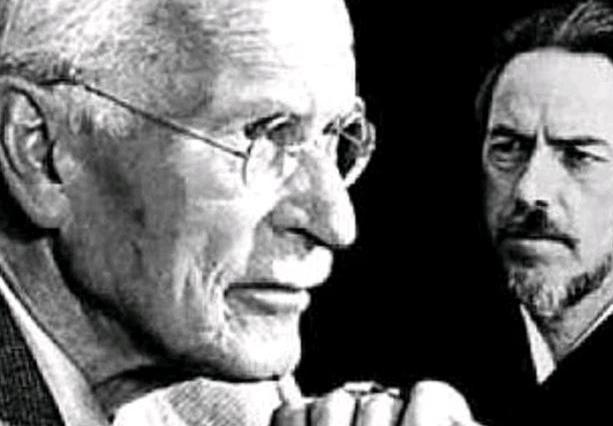
George Orwell’s iconic 1984 stand as perfect examples of the societal structures Jung warns against. Granted, all dystopian literature set in a totalitarian future could fall into this category, but two of his books are probably the two best examples of the genre. Animal Farm, and Orwell’s novel, Nineteen Eighty-four show totalitarian systems and are highly relevant today.
Modeled after the Stalinism, the basic pattern was repeated by Mao’s Big Leap and the Cultural Revolution, by Pol-Pot, just to name a few. It’s about state totalitarianism, and if you look too much to right or to the left you become a road-kill by well-meaning national or transnational organization. The best example the European Union, the hunger of central power and the severe distortion of reality by language intended to disguise, distort, or obscure its real meaning was aptly foreseen in “Nineteen Eighty-four” Political language, George Orwell wrote nearly 60 years ago, is “designed to make lies sound truthful and murder respectable and to give an appearance of solidity to pure wind”. It is a pity that Orwell won’t be around to write a new book about the double-speak that passes for the European Union’s and the national finance ministers official discourse on the EU crises. A fundamental concept to control of the thought is to control of the past. Therefore, a gigantic effort is operated today to fit all existing publications of the current political correct line and to overpower by sheer mass production the unwanted. Especially worrisome can that be seen in dispute parts in some Wikipedia articles.
George Orwell lived out Jung’s theory of The Shadow. Dr. Carl Jung argues that the future depends on our ability to resist society’s mass movements. Only by understanding our unconscious inner nature-“the undiscovered self”-can we gain the self-knowledge that is antithetical to ideological fanaticism. In his book The Undiscovered Self, C.G. Jung points with logical assertions that “it is chiefly in times of physical, political, economic and spiritual distress that men’s eyes turn with anxious hope to the future”. The only way to combat these stresses and worries is for humanity to embrace its potential on both a conscious and unconscious level. Without a finely tuned awareness of self, we are doomed to pass control of the individual self onto an external collective entity such as the government. The Individual’s Understanding of Himself: “It has even become a political and social duty to apostrophize the capitalism of one and the communism of the other as the very devil, so as to fascinate the outward ey and prevent it from looking at the individual life within.”
Much of the book warns against succumbing to the will of the collective without first consulting the needs of the individual. Humanity must open itself up to acknowledging its equal capacity for good and evil. But perhaps the strongest evidence attesting Jung’s accuracy is the near rabid, even quasi-religious nature of the political debate even in, or perhaps especially in, the European Union which has ‘officially’ removed religion from its pitifully so-called failed “constitution”. The religion has gone underground, and political assertions of the churches in Europe have the air of dissident meetings. The same ist true for families in one parent stays at home.
Perhaps Jung’s approach is helping us to find the inner self first, and then unite to counter the mass-mindness and its pursuit for maximized profits, whether in the form of a government or a global corporation and the lure of a motherly state taking care of life’s hardship of the never-grew-ups.
Where there are many, there is security. What the many believe, must of course be true. What the many want, must be worth striving for, necessary, and therefore good. In the clamour of the many, lies the power to snatch wish-fulfilment by force. Sweetest of all however, is that gentle and painless slipping back into the kingdom of childhood, into the paradise of parental care, into happy-go-luckiness and irresponsibility…to all questions there is an answer…. C.G. Jung in “The Undiscovered Self
“Frightened though they were, some of the animals might possibly have protested, but at this moment the sheep set up their usual bleating of “Four legs good, two legs bad”, which went on for several minutes and put an end to the discussion.
George Orwell in “Animal Farm”
The psychoanalytic C.G.Jung and the famous astronomer Kepler were both intuitive thinkers and empiric scientists with strong mystic tendencies. Pauli was a famous particle physicist, who collaborated with C.G. Jung on the concept synchronicity. When I studied Kepler’s work, I found a similarity of C.G. Jung’s and Kepler’s view on astrology and to my surprise, that Kepler even used the term archetype just in the way C.G. Jung did. This is touched in Pauli’s essay on Kepler. Kepler, Pauli and Jung were trailblazers in their own disciplines as well as in the realm of collaboration across disciplines. Their similar approach as scientist or physician and the concept of synchronicity and archetype form a triangle.
C.G.Jung valued astrology as one of the intuitive methods he used like the I Ching. For him astrology is based upon the synchronicity principle, i.e. meaningful coincidence: “Astrology is a naively projected psychology in which the different attitudes and temperaments of man are represented as gods and identified with planets and zodiacal constellations”.
Kepler is recognized as one of the founders of modern science. He was a devout Christian with mystical tendencies (obvious in his book Harmonices Mundi) working as astrologer of General Albrecht von Wallenstein, a successful soldier of fortune for Rudolph II. Keplers (two) horoscopes of Wallenstein are studied and books written about them until today. Kepler lived during turbulent times, the 30 Year’s War, in “Germany”. This war, by no means only a religious war, decimated half of its population. Kepler was not only working as astrologer in order to make ends meet (he got never paid for his job as court astronomer and adviser of the Habsburg Holy Roman Emperor Rudolph II). Although Kepler was deeply dissatisfied with the way some astrology was practised, he strove to improve the predictive capability by strengthen the theoretical underpinnings of astrology with both mathematical and philosophical models and his superior ephemeris (his Rudolphine Tables). He used carefully selected methods (sun arc directions – and secondary directions – one ephemeris day equals one year of life – but not for planets but axis, which is actually a primary direction i.e.one degree on the Zodiac equals one year of life). For Kepler the sun/earth relation is paramount..He also compared astrological predictions correcting assumed birth time and was able to use “true time” that is actual pace of the Sun not the mean time.
Kepler strongly believed that ‘The world of nature, the world of man, the world of God—all three fit together.In particular, Kepler reasoned that because the universe was designed by an intelligent Creator, it should function according to some logical pattern.Kepler converted to the Copernican heliocentric universe early in his career but was also strongly influenced by neo-Platonic philosophy, which saw the divine in the regularity of geometry (“God always geometrizes”, Plato). It is no exaggeration to say that Kepler was one of the most outstanding and dramatic figures under all his contemporaries and a scientist who repeatedly attacked dogmas of astronomy or astrology. He not only ensured that the Copernican theory became widely recognized, but actually gave it the needed physical and mathematical underpinnings. Before Kepler’s Laws, the basic Copernican model was neither more reliable, nor physical more accurate or mathematical less complicated than the old Ptolemaic model: All astronomers assumed (wrongly) uniform circular motion. When Kepler worked in the Prague period on the “Astronomia nova“, he discovered the famous second law of planetary motion (“planets moved in elliptical orbits, in which a focal point the Sun is”) with the millennia-old paradigm. This needed intellectual courage of Kepler, because it was a break with the tradition of all great astronomers from Ptolemy and Copernicus and the concept of the perfect form – the circle. Nonetheless, after numerous calculations and double-checks Kepler regretfully accepted, basically apologizing to god in his foreword. Kepler also calculated without wavering the birth date of Jesus Christ new. In his work “About the date of birth of God’s true Jesus Christ” Kepler identified the star of Bethlehem with the great conjunction of Saturn and the Jupiter and calculated that this event on the third year CE.
Pauli, a “Wunderkind” may be called a pioneer of quantum physics and leading member of the group of theoretical physicists, including Niels Bohr, Werner Heisenberg and Erwin Schrödinger. The group transformed our understanding of the way matter behaves at the subatomic level encountering a new world where Einstein’s theories (and Newtons Laws) do not apply. Exploration of the Pauli-Jung collaboration is particularly interesting because of the holistic view of his major scientific work, which won him the Nobel prize.The Pauli exclusion principle explains how matters form and a variety of astrophysic effects.
On the psychic side, the Pauli effect was named after the anecdotal bizarre ability of his to break experiments simply by being in the vicinity and his sarcastic remarks toward colleagues. Pauli has always been a strong drinker, which did not seem to hamper his scientific genius. His marriage with a bar singer-dancer became a complete disaster within one year. His mother committed suicide. Despite his Jewish origins Pauli was baptised catholic. Pauli met with Jung, whom he consulted regularly till 1934 in a deep psychological crisis. Especially Pauli’s dreams, which were full of symbolism from alchemy, were extensively discussed.
Pauli himself had written an article called “The Influence of Archetypal Ideas on the Scientific Theories of Kepler” which appeared later in a volume with an essay of Jung’s on synchronicity. The Pauli-Jung collaboration aimed at explication of a unifying or connecting principle bridging the gap between mind and matter or (quantum) physics with psychoanalysis. Jung’s theory of synchronicity stipulated that certain events-often called coincidences-actually reveal the operation of an non-causal connection between mental and physical events through meaning. The history of Jung’s reception by the scientific and scholarly communities is cautious – they largely discredited theories of Freud are considered scientific, but although many Jung’s concepts are widely used his overall work is labeled often as unscientific. Synchronicity has been the prime target for criticism of Jung, but is for me a natural extension of Jung’s view of the intuitive function.
Synchronicity
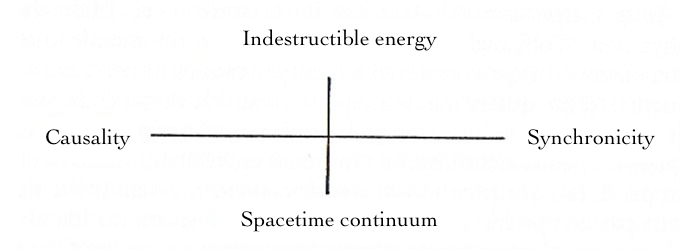
Jung coined the word to describe what he called “temporally coincident occurrences of acausal events” or “meaningful coincidence” and “acausal parallelism in which archetypes and the collective unconscious are governing a dynamic that underlies the whole of human experience and history — social, emotional, psychological, and spiritual.
Synchronicity does not admit causality in the analogy between terrestrial events and astrological constellations … What astrology can establish are the analogous events, but not that either series is the cause or the effect of the other. (For instance, the same constellation may at one time signify a catastrophe and at another time, in the same case, a cold in the head.) … In any case, astrology occupies a unique and special position among the intuitive methods… I have observed many cases where a well-defined psychological phase, or an analogous event, was accompanied by a transit (particularly when Saturn and Uranus were affected). – Carl G. Jung
Jung’s paradigmatic example of a synchronicity occurred during a therapy session, and the connecting meaning in a synchronistic event is subjective, related to the individual’s psychological maturation, or individuation. Jung and Pauli believed, events like this occur too often enough to be only meaningless coincidence. Jung noted taking as usual phenomenological stance, while it would be “absurd” to consider the conjunction of dream material and life events to be causal, “it is wise to consider the fact that [these coincidences] do happen…The East…considers coincidences as the reliable basis of the world rather than causality. Synchronism is the prejudice of the East; causality is the modern prejudice of the West.”
Jung mentioned the concept again in his commentary to Wilhelm’s translation of “The Secret of the Golden Flower”. He concluded that “the causality principle” cannot explain “psychic parallelisms” that must somehow be connected but are not causally related and equated synchronicity with the Chinese Tao. Jung would write about this concept again, and when he did, his focus would shift from the empirical and phenomenological aspects of synchronistic phenomena to the ontological and archetypal nature of such events. Pauli thought that the probabilistic nature of quantum theory and the Uncertainty Principle offered the possibility of discovering something beyond the mind-matter gap which transformed Jung’s understanding of synchronicity. As a result of his interaction with Pauli, Jung gradually came to see this non-causal connecting principle as an explanatory theory must be seen in combination with causality to lead to a better understanding reality, rather than having only a subjective meaning.
Astrology and Alchemy
C.G.Jung saw alchemy as continuation of Gnostic thoughts and wrote: “The starry vault of heaven is in truth the open book of cosmic projection, in which are reflected the mythologies, i.e., the archetypes. In this vision astrology and alchemy, the two classical functionaries of the psychology of the collective unconscious, join hands”.
In his book “Psychology and Alchemy” of C.G. Jung contains Pauli’s early dreams which provided Jung with a rich resource for theoretical exploration, and his own interpretations played a role in Jung’s theories. Pauli clearly believed that this effort was scientific; he said that “even the most modern physics also lends itself to the symbolic representation of psychic processes, even down to the last detail.” In his final version of the synchronicity essay (The Interpretation of Nature and the Psyche Part 2), Jung wrote that the “archetype represents psychic probability”. Pauli wrote in his Kepler essay (published there as part one), that “pure logic” is not capable of establishing a “bridge between the sense perceptions and the concepts.” Kepler himself thought that scientific ideas discerned by humanity exist eternally as archetypes in the mind of God, and Jung’s theories understand archetypes similar “as ordering operators and image-formers” in the symbolic. “It would be most satisfactory” said Pauli, “if physics and psyche could be seen as complementary aspects of the same reality.”
Kepler expressed also original ideas in relation to astrology almost like something the physical resonance theory like: the celestial bodies themselves exert no influence on the human fate, but fixed the angle between the rays toward the heavenly bodies the soul at the moment of human birth and later responds specifically to them. He used actually the term archetypes in his astrological work and not only his Wallenstein horoscope legendary. Kepler ideas, as Wolfgang Pauli observed, identify important intermediate stage between archaic, logical symbolic, and new, quantitative and mathematical description of nature. Much of what was later separated in scientific and non-scientific knowledge was at that time merged inseparably. Similar to representatives of scholastic science, Kepler relied on accuracy, allegory, speculative ideas, and mysticism, but unlike the Scholastics he tested constantly each theory and carefully compared the results with the rich observations of Tyco Brahe and calculations. C.G. Jung derived lekewise many of his insights from observation he made treating his patients.
Ancient wisdom in a global world
Our modern science begins with astronomy. Instead of saying that man was led by psychological motives, they formerly said he was led by his stars. … The puzzling thing is that there is really a curious coincidence between astrological and psychological facts, so that one can isolate time from the characteristics of an individual, and also, one can deduce characteristics from a certain time. Therefore we have to conclude that what we call psychological motives are in a way identical with star positions. Since we cannot demonstrate this, we must form a peculiar hypothesis. This hypothesis says that the dynamics of our psyche is not just identical with the position of the stars, nor has it to do with vibrations – that is an illegitimate hypothesis. It is better to assume that it is a phenomenon of time. … The stars are simply used by man to serve as indicators of time… – Carl G. Jung in 1929
The arrogance of today’s scholarstoward medieval age and traditional knowledge is incomprehensible and the humiliating assessments of Kepler activity, which can be found in the “history of Western philosophy” by Bertrand Russell who described Kepler is “an example of what can achieve mediocrity through hard work”. But Kepler, not Galileo came up for the mathematical proof and physical correct model of the heliocentric model. Kepler is particularly suitable for tracking the various sides and peculiarities of the epistemological concepts, problems of scientific paradigm change and the relations between the empirical and theoretical knowledge. Kepler himself speaks of primary images as being “archetypal” [archetypalis], and Pauli develops a detailed correspondence with Jung’s archetypes. Pauli writes: “the view of the universe was not as yet split into a religious one and a scientific one.” Indeed subjects of physics, religion, mathematics and astrology are all found in one single book of Kepler. His astrological and religious themes have been neglected and Jung’s broader view of psychoanalysis has until very recently been marginalized. The tide is slowly turning, though, and at least Jung may yet have his day. Physicists with a psychological or spiritual inclination have taken note of synchronicity and written of its validity for exploring the connection between quantum and classical physics. Others scientists have begun to explore theories of human cognition that rely on constructs very much like Kepler’s and Jung’s archetypes and his evolutionary understanding of human experience so useful in a globalized world, where I cross many cultural boundaries on a given day.To me Kepler’s astrology is not only superstition but contains some psychological facts (like theosophy) which are of considerable importance. Kepler never predicted the future but in possible (character) dispositions. His astrology connects at least culturally and historically the religion and psychology of antiquity with physics and astronomy of today.
Jung, C. G., Pauli, W. (1952): Naturerklärung und Psyche. Zürich: Rascher (Download)
C.G. Jung (1955) Synchronicity: An Acausal Connecting Principle
Wolfgang Pauli. Verzeichnis der Manuskripte und Korrespondenzen im Archiv der ETH Zürich
Wolfgang Pauli und die moderne Physik. Virtuelle Ausstellung der ETH-Bibliothek
Pauli Archives, CERN, Nachlassverzeichnis
W. Pauli, The Influence of Archetypal Ideas on the Scientific Theories of Kepler
Kepler, Harmonices mundi, Harmony of the Worlds, 1619
This record of Alan Watts, done shortly after C.G. Jung’s death really blew me away. Alan Watts brings C.G. Jung’s concept of Good and Evil right to the point. Listen to Alan Watts. Watts believed that the key to the universe is fundamentally a higher consciousness or mind. The world is an emanation of the one Being or Consciousness. Unity is the nature of the universe while the distinctions between knowing subject and the objects of knowledge are actually expressions of unity. True Zen, he said, was liberation of the mind from traditional thought forms to raise human consciousness to identify with the Consciousness which is Reality. Mystical thinkers of all traditions have discovered this, he said, and modern psychotherapy is coming to agree now. In Psychotherapy East and West (1961) Watts referred to Carl Jung, bringing science closer to Eastern insight or as he said in this record – Western and Eastern minds arriving at the same point by different means.
Alan Watts clarified that C.G. Jung viewed good and evil not as absolute, warring opposites, but as interconnected polarities of an underlying unity. Watts explained that to truly understand and integrate evil, one must first confront their own dark side without judgment..
In his tribute to Carl Jung, Watts highlighted several key concepts regarding Good and Evil:
The Polarity of Life
Jung believed that existence requires duality and that opposites define one another. Just as you cannot understand “to be” without “not to be,” you cannot comprehend good without the existence of evil. Rather than an absolute cosmic battle that can never be harmonized, good and evil are two halves of a whole.
Confronting the Shadow
Watts stressed the importance of acknowledging your own inherent flaws. As Jung observed, the more we repress our “dark side,” the denser and more destructive it becomes. When we obsessively condemn evil in others, it is often a defense mechanism masking an unconscious awareness of the potential for that same evil within ourselves
Alan Wilson Watts was born in England,1915 and had early interest in Eastern thought. He sought to apply its principles to modern psychology and argued for a common mystical core underlying all religions, reflecting the influence of Aldous Huxley, a major attempt to reconcile Christianity and Eastern thought. Watts taught comparative philosophy and psychology at the new American Academy of Asian Studies in San Francisco and still is much recognized in California. He wrote and lectured at colleges, universities, medical schools, and mental health institutions in the United States, Canada, Europe, and Asia, including Harvard; Yale; Cambridge; the Universities of Chicago, Michigan, Indiana, and Hawaii; and the C. J. Jung Institute (Zurich).
For the uninitiated, Wong Kar Wai’s films seem pointless and confusing, which is reinforced by the director’s trademark cinematic indulgences, laggard pacing and minimalist plotting. However, upon closer inspection, it is easy to become intrigued by the rampant symbolism, the metaphor-laden dialogue, and the philosophical and psychological underpinnings of his films. Maybe its a problem of “if you have hammer, everything looks like a nail”, but I cant help his movies remind me on C.G. Jung: Failed individuation, shadows, persona and archetypes manifest in the here and now. But are there common elements that tie his entire body of work together? Is there some underlying structure or theme by which one can gain a better comprehension of his sometimes cryptic images and symbols?
The classic archetypes in Wong Kar Wai Films
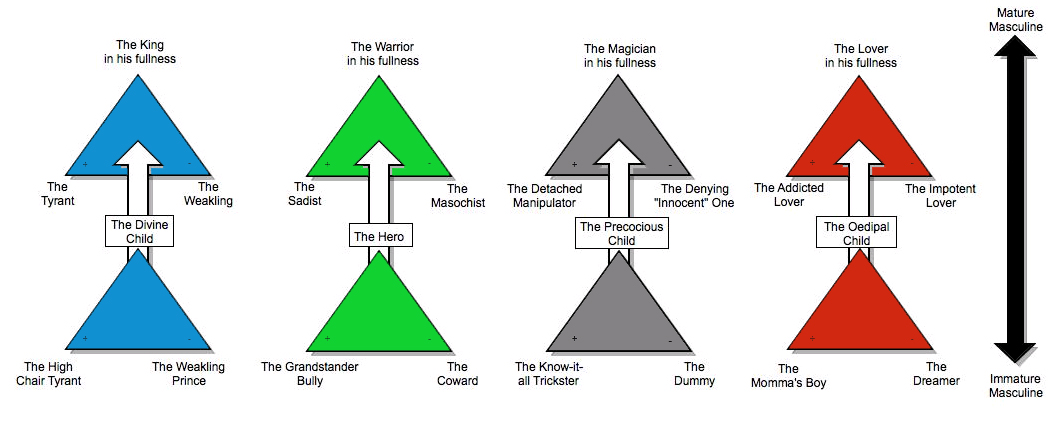
One way of approaching the cure for the modern malaise in his films may come from the book King, Warrior, Magician, Lover: Rediscovering the Archetypes of the Mature Masculine, by Jungian psychologist Robert Moore and mythologist Douglas Gillette. Moore argues that masculinity is made up of four archetypal male energies which serve different purposes: King, Warrior, Magician, Lover. Like much of the literature in the mythopoeic realm, KWMLis grounded in the psychology of Carl Jung, particularly in his idea of psychological archetypes. While Jung suggested a number of universal archetypes (Mother, Hero), the four personal ones are: the Self, the Shadow, the Animus and Anima, and the Persona. They play a role too, as they are parts of the personal unconscious. I like to investigate, here some archetypes and their shadow representation ( and symbols which are archetypes in the here and now). Each of the four consists according to Moore of three parts: the full and highest expression of the archetype and two bi-polar dysfunctional shadows of the archetype. To better understand this, Moore portrays each archetype as a triangle full (to weak, to strong, and an bi-polar shadow split. These shadows are the result of the archetype not being integrated in a healthy and coherent way. The two shadows of the Lover archetype are the Addicted Lover and the Impotent Lover. A man possessed by the Addicted Lover is, as Moore puts it, “eternally restless.”Men dogged by the Impotent Lover archetype feel depressed, flat, and dead inside. Nothing brings them joy anymore. They’ve lost their passion for life and become cynical. Relationships, whether romantic or platonic, struggle and falter.
Ashes of Time is best candidate applying this framework, as it is almost a greek tragedy. You find the cynical magician, the weak king (note the absence of the positive king),the full warrior who becomes a hero and the addicted lover who cannot love. The women are brilliant too, there is the virgin, the animus, the unfaithful and loyal wife and there is Maggie Cheu.
Brigitte Lin in Ashes of Time (1994)
Wong’s films, at their most basic level, are an exploration of the double-edged sword known as memory, which may be seen as consciousness. This strong thematic undercurrent is expressed through subtext in the dialogue, characterizations, and the often-minimalist plotting. Pain of loss and the tenacity of remembrance are both destructive forces, yet essential for survival. All the characters in his films are products of this loss, and their actions in the present stem from their reactions to that loss. Unfortunately, the results are often tragic. In ashes of time the girl with the donkey begs the agent for assassins ( in my view a cynical materialistic magician type):
Please help me. I beg of you.
It’s no use. I’m just an agent. You must solve your own problem.
“Ashes of Time”
Ouyang Feng’s lost love ( Cheung’s character in Ashes of Time) ultimately married his brother because she tired of waiting for her real love return to her. Wai’s camera stares intently at her while she gazes beyond time and relieves the past full of regret to his “friend. She dies as there is no reason to live. Besides being one of the strongest impression of melodrama, it is also the most puzzling. I noted two times the look in the mirror, visually and verbal in the film. It almost seems tis relates to the pain to learn about ourselves.
Do you know what the most important thing is in my life?
Maggie Cheung ponders in Ashes of Time (1994)
Your son?
I thought so too. But as he grows up, I know he’ll be leaving me one day. Nothing’s important to me now. I thought the words ‘I love you’ really mattered. I thought they meant a lifetime commitment. But looking back, nothing matters… because everything changes. I thought I was the winner, until one day I looked into the mirror and saw the face of a loser. I failed to have the person I loved most to be with me in my best years. How wonderful it would be if we could forget the past…
“Ashes of Time”
The post-modern archetypes in Wong Kar Wai Films
His other films are mostly a study of relationships in the post-modern world, in which the exchange of goods and services serves as the basis of all relationships, instead of emotional connection– a representation of cosmopolitan life in modern Hong Kong – and elsewhere. Very few of the relationships found in Wong’s films are based on emotional connection, and the struggle that his characters face is to cultivate deeper forms of association. Unfortunately, many of his characters do not form these emotional connections, out of fear of rejection, and find it much easier to have transaction-based encounters. After thinking this through, and stereotypes not being archetypes, it appears to me that his central archetypes of loneliness are (negative) lover and warrior.
When I am about to leave, I ask him to take me home. I haven’t ridden on a motorbike for a long time. Actually, I haven’t been so close with a man for a while. The road isn’t that long, and I know that I’ll be getting off soon, but I’m feeling such warmth this very moment.
“Fallen Angels”
The most important aspect of Wong’s thematic focus is the transience of relationships. Even if the characters manage to find an emotional connection with one another, they learn to accept the fact that all relationships must end, and those who survive at the end of the film have learned to embrace the moment. This theme was best represented by #223’s (Takeshi Kaneshiro) ‘expiry date’ speech in “Chungking Express”, and the final soliloquy given by the nameless agent (Michelle Reis) while riding into the Hong Kong night on the back of a motorcycle. Not surprisingly, this can also be seen in Wong’s fascination with images of smoke and drifting clouds– like these transient phenomena, relationships form like a puff of smoke, only to quickly lose their cohesion and dissipate into the night. To embody these themes within his films, Wong populates his films with a number of archetypal characters: the ‘impotent lover’, the ‘carefree lover’, and sometimes, ‘the indecisive warrior’.
The impotent lover
Tony Leung Chiu Wai as the Blind Swordsman in Ashes of Time
The impotent lover has been seen in many forms, but their origins and current condition are always the same: the small time gangster Wah Ha-tau (Andy Lau) from “As Tears Go By”, both Yuddy (Leslie Cheung) and the soda counter girl Su Lizhen (Maggie Cheung) in “Days of Being Wild”, the Blind Swordsman (Tony Leung Chiu Wai) in “Ashes of Time”, and Police Officer #663 (Tony Leung Chiu Wai) in “Chungking Express”.
This the time of year to change into a summer uniform. I don’t know if it is the weather, but I feel that things are changing.
“Chungking Express”
The impotent lover is in a constant state of emotional paralysis, arising from his or her inability to forget the pain of a broken relationship. Blinded by the haze of nostalgia and desperately attempting to hang on their halcyon days, they miss the opportunities of the present and are completely unaware of the incessant progression of time.
Go ahead. I just want you to hate me. That way, at least you won’t forget me.
“Days of Being Wild”
#663 of “Chungking Express” is another good example of the impotent lover. Always waiting for his stewardess ex-girlfriend (Zhou Jialing) to return, he is completely oblivious to the fact that Fay (Faye Wong), the counter girl at a local fast food place, has been breaking into his apartment and rearranging his belongings. He does not notice that his canned food tastes different, or that the number of goldfish in his aquarium is increasing.
To capture the impotent lover’s introspective point-of-view visually, Wong employs a number of cinematic techniques. His use of the Godard-ian jump cut seamlessly blends temporally-exclusive scenes together, making the passage of time unnoticeable. Other Godard-ian touches include the many shots of clocks, which remind the viewer that despite the blind mourner’s fixation on the past, time continues to move on and that moments in the present are fleeting.
Tony Leung Chiu Wai and Faye Wong share a moment in Chungking Express
Another interesting technique, seen in “Chungking Express”, clearly represents the lover’s detachment from reality– the film is sped up, but the actors move very slowly. The resulting visual effect then conveys that while the rest of the world blurs by like the flapping of a hummingbird’s wings, the impotent lover is in a stagnant state of existence, lost within their own nostalgic thoughts.
The addicted lover
I’ve heard that there’s a kind of bird without legs that can only fly and fly, and sleep in the wind when it is tired. The bird only lands once in its life… that’s when it dies.
“Days of Being Wild”
In contrast to the impotents lover is the other staple characterization of Wong’s films, the ‘addicted lover’. Characters that fall into this classification include the hotheaded Fly (Jackie Cheung) from “As Tears Go By”, the lonely beat cop (Andy Lau) from “Days of Being Wild” an mostely the amnesic Huang Yoshi (Tony Leung Ka-Fai) from “Ashes of Time”, and the fickle Ho Wo Ping (Leslie Cheung) of “Happy Together”.
I never think about the next time when doing anything.
“As Tears Go By”
The carefree addicted lover is a character oblivious to history with no appreciation for the lessons of the past. As a result, their actions usually end up destroying the lives of those they come across. In “As Tears Go By”, it is clear that Fly is the carefree wanderer, since it is his reckless actions that end up destroying three lives, despite the escalating consequences of his previous misdeeds and the volatile situations he manages to entangle himself in.
Tony Ka Fai Leung drinks the magic wine in Ashes of Time (1994)
The more wine you drink, the warmer you’ll get. Water will only make you feel cold.
“Ashes of Time”
The most literal interpretation of the carefree addicted lover was seen in “Ashes of Time“. Huang Yoshi has his memory of the past erased after drinking a magical wine called ‘A Happy Go Lucky Life’ which erases memory. While the wine has eased the pain of the past for Huang Yoshi , it has also made him forget his emotional connections with others. As a result, his ‘carefree’ existence ends up destroying the lives of the other characters, including the split-personality Murong Yin/Yang (Bridget Lin) and the Blind Swordsman wife but mostly Ouyang Feng’s love and his “friend” Ouyang Feng .
Similarly, Ho Wo Ping in “Happy Together” has a shiftless existence living for only the moment. His inability to recognize his history with Lai Yiu Fai (Tony Leung Chiu Wai) ends up relegating him to a lonely permanence of his own doing.
I used to think there was a kind of bird that, once born, would keep flying until death. The fact is that the bird hasn’t gone anywhere. It was dead from the beginning.
“Days of Being Wild”
Through this stock character, Wong illustrates the other extreme to the impotent lover. While the addicted lover is not subject to the anguish of remembrance, they too are caught in a stagnant existence. Instead of missing the opportunities of the present due to an obsessive fixation on some past trauma, they never learn from their mistakes, nor do they ever form stable relationships with those around them. However, the result is the same– a lonely existence in isolation.
Do you remember at 3pm on April the sixteenth last year, what you were doing?
Why this question?
Well, I have a friend who challenges my memory. She asked me what I did on that day. I wouldn’t remember. Do you?
She told you?
I thought you would have forgotten.
What’s to be remembered, I would always remember. So you knew each other?
For a period of time. I left for the sea, and we lost contact. How about you?
Me? It’s off. What else did she tell you?
Not much. We’ve actually only known each other for a short period of time.
Did you love her?
Not exactly… just friends.
If you see her again in the future, tell her I’ve forgotten her. That’ll be better for everyone.
I’m not sure I’ll see her again. Maybe, she would have forgotten about me too.
“Days of Being Wild”
The indecisive warrior
michelle reis as the killer’s agent in Fallen Angels
The best thing about my profession is that there’s no need to make any decision. Who’s to die… when… where… it’s all been planned by others. I’m a lazy person. I like people to arrange things for me. That’s why I need a partner.
“Fallen Angels”
This last archetype is a more recent innovation in Wong’s films, first seen in “Fallen Angels”. To me it seams, it is a parody of a warrior. The male leads, hit man Wong Zhiming (Leon Lai) and mute 223 (Takeshi Kaneshiro), are both in search of a sense of belonging, but end up in pathological situations where they lose their identity. Zhiming muses that the best thing about his ‘job’ is that he never has to make any decisions of his own, since everything he does has been arranged for him by his partner, the unnamed agent. When he finally does realize that he must take a more active role in the job, he is too late– ironically he is gunned down in an ambush set up by his lovelorn agent.
They say that love can change a man. I start to find myself looking better and more charming, and suddenly I discover that I’m turning blonde.
“Fallen Angels”
223 has a similar problem. Creating a state of moral contradiction, 223 breaks into other people’s businesses at night such that he can ‘be his own boss’. However, in actuality, he has merely taken decisions that have been made by others and uses them, instead of making his own. He also hooks up with brokenhearted woman (Charlie Yeung) who is obsessed with getting revenge on a woman named Blondie. Together, they traverse the Hong Kong nightscape in search of Blondie, and in the process, blonde hairs begin to sprout from 223’s head, a metaphor for his adoption of his newfound partner’s system of values.
Like the impotent lover and the carefree lover, the life of the indecisive warrior is a lonely one. However, unlike the tragic note that Zhiming’s story ends one, 223’s outcome is certainly more upbeat. He ends up being rejected by the jilted woman and learns to make decisions for himself in the process (visually conveyed by his blonde hairs disappearing), the first of which is to give Zhiming’s former agent a ride home on his motorcycle.
Conclusion
So instead of being confusing jumbles of abstract dialogue and quirky characterizations, the films of Wong Kar Wai have a consistency in structure and theme. The archetypal characters of Wong Kar Wai’s angst-ridden narratives are classical different perspectives on man and women. While some of these characters do meet tragic ends resulting from their inability to change, the director does provide a glimmer of hope in the characters that do survive the melancholic plot.
The Jianghu is the fictional alternative universe coexisting with the actual historical in which many Chinese wuxia stories are set. It seems jianghu, a literary tradition going back to the Ming Dynasty, can easily be explained as collective unconscious in which the Chinese universal themes which run through all human life. Inwardly, the whole history of the human race, back to the most primitive times, lives on in us and the wuxia stories are myths bringing the archetypes of the collective unconscious. A strong element in the structure of jianghu, is the line between good and evil, right and wrong, is crystal clear; it is absolute, an in this movie you can see the Archetypes of the shadow, animus and anima of the personal unconsciousness. Typically, the heroes in Chinese wuxia fiction do not serve a lord, wield military power or belong to the aristocratic class. The Chinese wuxia stories can be contrasted with martial codes from other countries, such as the Japanese samurai’s bushido tradition, the chivalry of medieval European knights and America’s Western but moral and laws of physics my not apply in this grene.
One example is the cult movie Ashes of Time, Wong Kar-Wai’s wuxiapian is the most uncompromisingly complex film of thinking man’s martial arts melodrama with very little action outlined like a greek tragedy. It features some of the biggest stars in Hong kong Cinema and Christopher Doyle’s usual magnificent visuals, and William Chang’s predictably sublime art direction, derived from the two characters from Lois Chas’s novel The Eagelshooting Heros: Xidu (Emperor of the West) and Dongxie (Emperor of the East). One is the anti-thesis of the other, they are implemented as the two negative Archetypes Ouyang (The Magicician) and Huang (The Lover).
Wong’s goal is focusing on the psychological and emotional reasons that brought the characters to the behavior we see in the novel. The most striking example is the principal character Ouyang Feng (Leslie Cheung). In the film he’s still a man who trusts people, and is not completely selfish. His troubled relationship with a woman (the famous Maggie Cheung) shapes his character, and leads to his change to an evil and treacherous man. The movie took a de-humanized world (where heroism was often more important than sentiments) and injected humanity into it. We’re presented with allegedly invincible characters who turn out to crumble under the pressure and pain of rejection and memory.
It’s pointless trying to write about Ashes of Time’s plot, as doing so would be entirely too superficial, and leave out important facets of the story. With a careful eye and a few repeated viewings the film’s story is not so hard to grasp. What’s important is the mood Wong Kar-Wai creates, and the symbols and Archetypes we feel in each and every character. For those who seek metaphors, the movie presents the eye as well as the illusions of vision. One character is nearly blind. Another, a swordsman, goes blind in the middle of a horrendous battle. Two characters, Yin and Yang—one presented as a man, the other as his sister—are identical. And there is a brief appearance by a legendary sword fighter who hones his skills against his own reflection. Plenty of visual symbolism , from the Yin/Yang character to the motifs of water and the desert landscape. Two women hopelessly in love with the man who pines away for the woman who will never be his (and whom we do not learn about until the very end).
Ouyang Feng (Leslie Cheung Kwok-Wing) the fallen swordsman commissioning assassins later known as the Poison of the West.
The impotent Lover becoming the (cruel) Magician
Hong Qigong (Jacky Cheung Hok-Yau) the young idealistic swordsman, going north with his wife
The Warrior in its fullness – The Hero
Murong Yin (Brigitte Lin Ching-Hsia) daughter of Murong clan; Murong Yang the Brother one schyzophrene personBrother want to have Huang killed because of rejection of Murong’s love she his brother
Animus and shadow under control of ego
The Blind Swordsman (Tony Leung Chiu-Wai)
The (weak) wandering King – Ödipus at Colonos
Ouyang Feng’s love (Maggie Cheung Man-Yuk) she married his brother, because he asked her too late and waits her whole live for him
The Mother Earth – center of the pentagon
Huang Yoshi (Tony Leung Ka-Fai) adventurous swordsman and longtime friend of Ouyang Feng Huang is a burnt-out womanizer later he will be known as the Evil of the East.
Occurring over the five months of the Chinese calendar, Ashes of Time spends most of its length with two characters in particular, Ouyang Feng (Leslie Cheung) and Huang Yaoshi (Tony Leung Ka-fai). Old friends who meet once a year to catch up and drink a magic wine, the two serve as the nexus for the film’s overlapping narratives, mired in their own emotional crises. Ouyang Feng’s inn is the center of the action, as the stories are told by and about the visitors in the great Chaucerian tradition. Ouyang is morally bankrupt, yet manages to come up with some of the most poetic observations of human nature in his ruthless monologues.The story is not circular, despite the essentially equivalent monologue delivered by the protagonist at both ends of the film. Ashes of time is a study of personalities and as such follows the convoluted logic of human relationships. For the first half of the film characters come and go in seemingly pointless chaos. Yet, the travelers at the inn are connected, and their fates intertwined by the simplest passions. In a bizarre twist, one woman is the reason for Feng’s self-imposed hermitage, for he rejected her to marry his older brother even though they had both been in love and connects all main characters.
Raised by his elder brother, Ouyang’s ambition is to become a famous swordsman and faced with a choice 10 years earlier between the said woman he loves and martial adventures, he chooses the latter. Ouyang becomes cynical and materialistic, runs a small inn at the edge of the desert, commissioning assassins by hiring young but poor swordsmen. Every year during the season in which peach trees blossom a close friend visits him, Huang Yaoshi. This year Huang brought something for his friend Ouyang, a magical wine that would make one forget the past.
Huang Yaoshi, has, like Ouyang, also a sad love story to tell–he once had an unconsummated affair with the wife of his best friend – which turns out the blind swordsman – at Peach Blossom Land. Over the next year, in the different seasons, many travellers pass by the inn each bringing their stories, many of them being about lost love and why would one wish to forget the past. Ouyang becomes an assassin contract from the schizophrenic Murong Yang/Murong Yin (Sister and Brother). He meets the down-and-out swordsman with failing eyesight (who turns out to be Huang’s friend who seduced his wife); an impoverished young girl with an mule who wants to avenge her brother’s death; and Hong Qi, another aspiring poor swordsman, and his loyal wife.
Murong Yin/Yang (Brigitte Lin) at first it appears as if Yin and Yang are brother and sister, the brother wanting to kill the womanizer Huang for rejecting his sister, and the sister wanting to kill her brother for interfering with her relationship. As it turns out, however, Yin-Yang are one and the same physical person, who has developed a severe split personality disorder because of Huang’s rejection of Murong’s love.
The pentagon.
The Blind Swordsman (Tony Leung Chiu Wai) also suffers from rejected love, his wife having been seduced by said Huang on their wedding night. He wishes to complete one last job to raise the money to return home to see the “peach blossom,” later revealed to be the name of his wife, before his creeping blindness ensures he can never see her again.
Carina Lau, playing the Blind Swordsman’s wife is shown wordlessly caressing her horse with such tenderness that the stallion becomes as much a symbol of virility and sexuality, The Blind Swordsman’s last job has him saving a village from a swarm of bandits, and the ensuing bloodbath is more visceral than anything to crop up in the last decade’s boom of arty martial arts films. Yet even that sequence is undercut by Wong’s directorial flourishes, the image bleeding into white when the swordsman looks up and has his already weakened vision bleached out by the sun. The entire scene builds less a sense of heroism than a mounting futility.
Achetypes
The other two strangers, Hung Chi (Jacky Cheung) and the Young Girl (Charlie Yeung), arrive separately only to influence each other’s lives profoundly. She wants to hire Feng to arrange the murder of some men, who have killed her brother. She has nothing to offer except eggs and her mule and Feng refuses to help, but suggests that her body is more marketable than her pitiful eggs. She refuses to yield and waits for someone to agree to help her. The young Hung is a master swordsman, but also a bit of an idealist. He works for Feng for a while but eventually takes pity on the girl and goes on a murderous rampage, slaughtering all those who had participated in the killing of her brother. In the brawl he loses his finger and thus the ability to wield a sword. He is undeterred, however, and when Feng refuses to send for a doctor hinting to the Girl again that she might have to prostitute herself for the sake of Hung, he forbids her to do so. He picks up where the Blind Swordsman fails. Where he has spent his entire life counting the money of each job to collect wealth, Hong redeems himself when he helped the poor village girl who paied him a single chicken egg. The girl, the virgin with the donky leaves without trace. Visually, she is almost like a distorted Eastern Version of the Virgin Mary. She is also the only one not interconnected in the pentagon. After he recovered Hung, heads with his loyal wife north, leaving Feng in envy of fulfilled love.
In the books to which Ashes of Time serves as a prequel, the Ouyang and Huang are hard-hearted and violent, Huang someone who still believes in love but can never have it himself, Ouyang a man who rejects love entirely. Ouyang has fled from the woman who loves him, while Huang never follows through with the love he inspires . Maggie Cheung arrives near the end of the film to deliver a devastating monologue to Huang. Ouyang’s ex-lover, Cheung’s character ultimately married the man’s brother because she tired of waiting for Feng to return to her. She clarifies the reasons for Huang and Ouyang’s annual meeting and the woman who links them in pain, and her speech, framed in a simple, wide-angle close-up without trickery that lets all focus rest on her words, speaks directly and piercingly to the pain of unrequited love. When the story comes full circle and the two main characters discover the uselessness deception of themselves, that the attempt to forget only further ensconces painful remembrances in memory, Cheung’s pain is fully visited upon Ouyang and Huang. Maggie Cheung’s five-minute are the undisputed centerpiece of the film both in terms of story (she is the one link between most of the characters) and acting. Wai’s camera stares intently at her while she gazes beyond time and relives the past full of regret.
Maggie is an accomplished actress, but this performance was beyond description.
Her subtle agony is expressed obliquely and the one has to look into her eyes to touch the intensity of her feeling. Ouyang’s ex-lover, Cheung’s character gives Huang the wine to forget and dies soon afterwards. When she dies, the expression is beyond visual. Her body seems to become colder and shrinks, the eyes close, the flower wilds. She dies as there is no reason to live.
The mesmerizing tale of lost chances, fear of abandoning oneself to another, and pain of betrayal stops by the individuation when Oyuand returns to White Camel Mountain after finding out that his beloved has died. Where in the youth he saw mountains only as obstacles that concealed a wonderful world behind them, where he would climb them, leaving his love to seek this world, where once there he would find that there’s nothing worth seeing; he now no longer wondered what hid behind the mountains. He burns his inn and moves back later be known of the Poison of the West.
The cinematography is out of this world. There is so much imagery that repeated viewing is a must. Complicated tracking shots, abrupt editing, impressionistic pastel-like blurred images, and static scenes, all mix together in a veritable whirlpool of technique and ideas. Christopher Doyle is perhaps one of the best, most imaginative, and daring cinematographers out there. Seeing is believing.