Category: Medival

Medival History

  • Gnosticism – the empire strikes back.

    Gnosticism – the empire strikes back.

    Gnosticism can be considered collective name for a large number of greatly varying and pantheistic-dualistic sects, which flourished from some time before the Christian era down to the fifth century. It became a dangerous corruption of Christianity, even or because its first traces can be found some centuries before the Christian era. That Alexandrian thought had some share at least in the development of Christian Gnosticism is clear from the fact that the bulk of Gnostic literature which we possess comes to us from Egyptian (Coptic) sources. Sometimes Manichaeism is even classified as a form of Gnosticism and styled Parsee Gnosis, as distinguished from Syrian and Egyptian Gnosis. Though they have the doctrine of the evil of matter in common, Manichaeism starts from dualism, while Gnosticism is mainly heavily allegorical Pantheism.

    Gnostic groups were so many and different flavors, mostly alike but not quite the same. However, there were certain core markers. In gnosticism, the spiritual world was full of deep secrets. Matter was evil or unreal or at best disgusting, and spirit was good.  There was one superior and many semi creatures which formed a hierarchy.  Some spirits were more ‘good’ than others, and part of the task  was to keep these spiritual superiors happy. A few people (that is, psychic) were learning about and evolving toward the spiritual world envolving th the spiritual man — the pneumatic Gnostic. A follower’s task was to stay focused on spiritual things and to ignore or not value those sarkic (earthly, hignorant, uninitiated), who lacked such ‘knowledge’ or ‘consciousness’.  The meaning of Christian writings (including some of their leaders and pagan writings but not including most of the Old Testament) was turned upside down by way of allegory.

    Gnostic sources.

    The Gnostic “gospels” include books such as the Gospel of Thomas, Gospel of Mary, Gospel of Truth, and Dialogue of the Savior, and were written in the late second century AD. Most of these writings were found 1961 at Nag Hammadi, which was a religious library. For the most part, these ‘gnostic gospels’ are not stories told about Jesus, or reports about his life. They’re not about him giving grace, or being up close and personal with people. The Gnostics’ writings deal with Jesus’ death hardly at all. The Jesus portrayed by the gnostics gives out spiritual sayings or responds to questions, mostly left alone without a context. There’s not much of a setting – it’s as if no life was lived behind the sayings. The Gnostic Jesus has little about him that marks him as a Jew save for some apocalyptic symbolism. This could not be more unlike the Synoptic Gospels, which show Jesus at synagogue and at the Temple and in prayer, turning to the Hebrew holy books, as one would expect from the Jew he was.  For a gnostic, God would never be contaminated with humanity. Thus, of course, they had to re-translate Jesus: he was a human who had developed the highest level of contacts in the spirit world. His body either became, or always was, an illusion. Gnostic were – if they talked about Jesus – of course Eboinites.

    It is difficult in a few lines to sketch this Gnosticism, which grew into a great danger for the Church in the second century but let’s try:

    Gnosis puts that is knowledge into the place of faith.

    Gnosis means knowledge and the essence of this movement lies in the word which furnished its name To the Gnostic the great question was not, “What must I do to be saved?” In the very knowledge of these was redemption as the Gnostic understood it. Thus, by combining with the ideas original to Christianity the most various elements, such as Greek philosophy, Jewish theology, and ancient Oriental theosophy, great systems of speculative thought were constructed, all with the object of displaying the process of the world’s development.

    Gnosticism is thinly disguised Pantheism (and a subtile form of polytheism).

    In the beginning was the Depth; the Fullness of Being, first Cause. According to this development, from a pantheistic First Cause emanates a series of beings called Aeons, beings of Light, of which each in succession as it recedes from the First Cause is also less perfect than the preceding. Together with the source from which they emanate they form the Pleroma. Pleroma is simply the soul’s ascent, in Babylonian astrology as Wilhelm Anz (Ursprung des Gnosticismus, 1897) pointed out. Gnostic eschatology, consisting in the soul’s struggle with hostile Aeons  in its attempt to reach the Pleroma, is a close parallel of the soul’s ascent, in Babylonian astrology, through the realms of the seven planets to anu.

    Gnostic depressing and imperfect world.

    Gnostic world is imperfect and depressing. Gnosticism presents a distinction between the highest, unknowable God and the demiurge, “creator” of the material. The transition from the immaterial to the material, from the noumenal to the sensible, is brought about by a flaw, or a passion, or a sin, in one of the Aeon. There are many different myths about the creation some including also Sophia. In any case the last and lowest spirit (Aeon) – the demiurge – comes into contact with matter, which from all eternity has stood opposed to the divine Light— as Darkness, on-existence, and all that is the reverse of divine. From this contact, from the mingling of the Light with Matter, the visible world comes into being, in which a portion of spiritual being, of Light, is held captive by matter and combined with it. Redemption is the liberation of this captive Light from the fetters of matter, the dissolution of this union, and the restoration of the original order of things. This redemption has been accomplished by Christ.

    Gnostic salvation is a cosmic process.

    Gnostic salvation is not merely individual redemption of each human soul; it is a cosmic process. It is the return of all things to what they were before the flaw in the sphere of the Aeons brought matter. This last tenet bears testimony to the connection of Gnosticism with Christianity, in contrast to many similar heathen systems, but of course what the Gnostics call redemption is something entirely different from that to which the Scriptures give the same name. Gnostic redemption is not deliverance from sin, but the restoration of cosmic order, and so Christ is to them, not the Savior who brings salvation and forgiveness of sin; Gnostic salvation is not merely individual redemption of each human soul; it is a cosmic process. It is the return of all things to what they were before the flaw in the sphere of the Aeons brought matter.

    Some important Gnostic spirits.

    The Gnostics differentiate between the Supreme God, or God the Father, and the imperfect maker. The Demiurge became often the personification of the power of evil in consequence all law also became intrinsically evil. The speculations on Primeval Man (Protanthropos, Adam) also occupy a prominent place in several Gnostic systems. According to the Sophia myth, matter is a fruit of her sin. Sophia plays an important role in Valentinian, but is completely absent in Basilica’s system. Sophia seems to represent the supreme female principle, as for instance in the Ptolemaic system.

    Gnosticism denies Jesus having really assumed a human nature.

    There is no place in the Gnostic system for the creation, or for the incarnation. Only in appearance did he become man, and his whole life on earth, especially his passion and death, were all an illusion. The Gnostics were thorough Docetism, that is, they treated the whole manifestation of Christ as only a semblance. The events which brought salvation were not facts to them, but remained only as symbols, and the substance of Christianity was evaporated into speculative ideas.

    Gnosticism concept of  human – the divine spark

    Gnosticism taught generally that matter was evil, and as has been said the creation of a lesser spirit(called the Demiurge, after Plato). But human bodies, although their matter is evil, contained within them a divine spark that fell from the good, true God. Knowledge (gnosis) enables the divine spark to return to the true God from whence it came. For Christians all evil in the world comes from the human sin –  Omne bonum a Deo, omne malum ab homini. Gnostics come up with a simple and different answer, but complicated implementation why the world is imperfect – the Creator is, that’s why.

    Monism and Dualism in Gnosticism 

    Religious monism has two forms: atheism and pantheism. Both deny that there is a transcendent deity. Pantheism sees a deity that is immanent to the world and nature – like Taoism- and on which the world completely depends.  Everything is god. This is main concept in but Dualism is als found in Gnostics. Dualism is a system which would explain the universe as the outcome of two eternally opposed and coexisting principles, conceived as good and evil, light and darkness, or some other form of conflicting powers or signify the ordinary view that the existing universe contains two radically distinct kinds of being or substance — matter and spirit, body and mind.

    Typically, Gnostic systems are loosely described as being “dualistic” and  “monistic” in nature:

    • Radical Dualism — or absolute Dualism which posits two co-equal divine forces. Manichaeism conceives of two previously coexistent realms of light and darkness e.g. the Mandaean creation myth.
    • Mitigated Dualism — where one of the two principles is in some way inferior to the other.
    • Qualified Monism — where it is arguable whether or not the second entity is divine or semi-divine. Elements of Valentinian versions of Gnostic myth suggest to some that its understanding of the universe may have been monistic rather than a dualistic one.
    • One entity Dualism. Abraxas is a conception of God that incorporates both Good and Evil in one entity. The origins of the God Abraxas are mysterious though it is believed the concept existed in ancient Egypt, later  adopted by Jewish mystics and the Gnostic Christians.  The Swiss Psychologist Carl Jung wrote a short Gnostic treatise in 1916 called The Seven Sermons to the Dead, which called Abraxas a God higher than the Christian God and Devil, that combines all opposites into one Being. This may have come from one of his his patient, the famous writer Hermann Hesse wo wrote in „Demian”: „… unser Gott heißt Abraxas, und er ist Gott und Satan, er hat die lichte und die dunkle Welt in sich …”

    Christian philosophy, however, expounded with minor differences by theologians and philosophers from St. Augustine downwards, holds generally that physical evil is the result of the necessary limitations of finite created beings and a consequence of the creation of beings possessed of free wills and is tolerated by God but not a positive entity.

    Gnosticism schools.

    As Gnosticism possessed no central authority for either doctrine or discipline; considered as a whole it had no organization similar to the vast organization of the Catholic Church. It was but a large conglomeration of sects, of which Marcionites alone attempted in some way to rival the constitution of the Church, and even Marcionites had no unity. No other classification of these sects is possible than that according to their main trend of thought. We can therefore distinguish:

    • Syrian or Semitic;

    This school represents the oldest phase of Gnosticism, as Western Asia was the birthplace of the movement. Dositheus, Simon Magus, Menander, Cerinthus, Cerdo, Saturninus Justin, the Bardesanites, Severians, Ebionites, Encratites, Ophites, Naassenes, the Gnostics of the “Acts of Thomas”, the Sethians, the Peratae, the Cainites may be said to belong to this school. Later in Christianity , Antioch became the center of the Nestorians  which was declared a Christian heresy and Alexandria was  the  stronger and primary enemy of the Antioch school.

    • Hellenistic or Alexandrian;

    These systems were more abstract, and philosophical, and self-consistent than the Syrian. The Semitic nomenclature was almost entirely replaced by Greek names. The cosmologist problem had outgrown all proportions, the ethical side was less prominent, asceticism less strictly enforced. The two great thinkers of this school were Basilides and Valentinus. Again later in Christianity, Alexandria became the center of Monophysitism which was declared a Christian heresy leading to an 200 year struggle.

    • Dualistic Gnostics

    The system of Marcion distinguished between the God of the New Testament and the God of the Old Testament, as between two eternal principles.

    • Antinomian Gnostics.

    As a moral law was given by the God of the Jews, and opposition to the God of the Jews was a duty, the breaking of the moral law was encouraged.

    The deadly embrace.

    I have already attributed Gnosticism an all-embracing breadth. Gnosticism knew how to utilize every mental product of the age. Elements, oriental and occidental, in a curious medley, philosophy and popular superstition, all averse collected and used as materials for the building of Gnostic systems. The myths of the heathen may be found side by side with the Gospel histories, which were only myths to the Gnostic. One proof-text is taken from the Bible, and the next from Homer or Hesiod, and both alike are used by an allegorical exegesis to support the ready-made creations of the author’s fancy – breadth enough too, in morality, no trembling fear of pollution, no anxious care. It was no fiction inspired by the hatred of heresy, when the Gnostics were said to be very lax in their adhesion to the laws of morality.

    Many of them expressly permitted flight from persecution. Gnosticism extended far and wide in the second century. There was something very imposing in those mighty systems, which embraced heaven and earth. How plain and meager was in comparison seemed simple Christianity. There is something remarkably attractive in the breadth and liberality of Gnosticism, no wonder it is resurfacing even today.

    Gnostics seemed completely to have reconciled Christianity with culture. Even noble souls might be captivated by the hope of winning the world over to Christianity in this way, while the multitude was attracted by the dealing in mysteries with which the Gnostic sects fortified themselves, by offering mighty spells and amulets, thus appealing to the popular taste. Finally, some were no doubt drawn in by the fact that less strictness of life was required, and that they could thus be Christians without suffering martyrdom. But the victory of Gnosticism would have been the ruin of Christianity. Christianity would have split into a hundred sects, its line of division from Heathenism would have been erased, its inmost essence would have been lost, and instead of producing something really new, it would have become only an element of the melting mass, an additional ingredient in the fermenting chaos of religions which characterized the fight of the different heresies.

    The Church fought as for its life.

    The Church fought as for its life with all the forms of the false Gnosis and heresy. Over against the mighty systems of the Gnostics, the Church stood, in sober earnestness and childlike faith, on the simple Christian doctrine of the apostles. This was to be sought in the churches founded by the apostles themselves, where they had defined the faith in their preaching. Tradition was appealed to against the heretics, but in truth with the same end in view which the brightest had in going back to the scriptures, in order to oppose a corrupted tradition. For then the church was in direct possession of an unadulterated tradition, from which the doctrine preached by the apostles could be known with certainty. At this time the Church began to make a trustworthy collection of the apostolic writings, and, on the basis of both scripture and tradition, held with the greatest tenacity to the historical facts as the basis of true Christianity, parrying every attempt to transform them into semblances or symbols. These facts were condensed, on the basis of scripture, into a short rule of faith, and this, whose perfected expression in the “Apostles’ Creed” is still our rule of faith, was set up as a firm breakwater against the flood of Gnostic speculation.

    The empire strikes back.

    In it, over against the Gnostic scheme of Aeons emanating from the First Cause, the Church acknowledged after struggling more to the divine or the human side with clear simplicity and crisp definition the concept of Trinity in Pope Leos creed. In opposition to Gnostic idealism, the Church avowed its faith in the real historical facts, that the Son of God truly became man, was born of the Virgin Mary, was truly crucified and died, truly rose again. Thus the Church rescued Christianity (See the review of Jesus Wars).

    Only to be caught a few hundred years again later in a state of exhaustion  from another Ebionite system originating of a no-mans land desert.

    Sources:

    Historia Mundi Volume IV, Lehnen Verlag,

    Die Kirche zur Zeit der Apostel und Märtyrer

    Phillip Jenkins, “Jesus Wars” Harper, 2010

    R. M. Grant Gnosticism and Early Christianity

    C.G. Jung,  Aion Untersuchungen zur Symbolgeschichte

    O. G Neugebauer, The exact scinece in antiqitity

    John North, Cosmos, an illustrated history of astronomy and cosmology

    Web resources:

    http://www.newadvent.org/cathen/06592a.htm

    Appendix:

    Abraxas (or Abrasax); The letters of this word add up to 365. Basilidian claimed Abraxas as their supreme god, and said that Jesus Christ was only a phantom sent to earth by him.  The older Mythologists placed him among the number of Egyptian gods, and demonologists have described him as a demon, with the head of a king and with serpents forming his feet. Under the pen name Basilides, Jung uses the name Abraxas to refer to illusory reality in his neo-Gnostic text “The Seven Sermons to the Dead”  he wrote in 1916 after he had received intense psychic experiences in a crisis.

    Aeon; These are the emanations from first cause, the Father. The word not only refers to the “worlds” of emanation, but to the personalities as well. Sophia, Logos, and the other high principles are aeons.

    Agape; Unconditional love. A love that stems from the ability of the initiate to see the divine spark in all life.

    Agnosia; The state of not having insight or Gnosis. Agnostiker 😉

    Allogenes; Means “alien”. The existance of spiritual force in the material realm is “alien” to it. This includes both aeons, such as the Logos, as well as the Gnostic him/her self.

    Anthropos; “Man”. This is the cosmic human as well as the philosophical form of the regular human.

    Antinomianism; While this word literally refers to the belief that legal precepts are no longer applicable to a “saved” individual, for Gnostics like Carpocrates and Corinthuse.

    Apochryphon; “Secret Book”. The notion of secrecy was important for a wide variety of reasons. Thus the development of the “secret writings” amongst the Gnostics.

    Archon; “Ruler”. Refers to the creators and governing forces in the material world. The Demiurge and his angels.

    Arete; Means “virtue”. In Platonic ideal it is a reference to the importance of meaning above technical skill (techne).

    Autogenes; “Self Generated” is a reference to the first Aeon or the guiding light (Barbelos the first aeon androgynous connotation).

    Boule; the “will” of God which in turn leads to the word (Logos) of God.

    Bythos; the “Void”. Its the “primal ground” and the pre-beginning forefather.

    Chrestos; “Friendly” Is a play on the word Christ (anointed). Both refer to the Logos.

    Demiurge; The “Craftsman” or creator of the material world. Usually viewed in a negative fashion. If nothing else, the material is less than the spirit so that the creator is lower than the prime source.

    Docetism; From the root word “image”. This is a theological premise that states that Christ’s actions on the earth (including the “passion”) is illusory.

    Ennoia; Means “thought” Sophia in her high form Barbelo is the first thought (so she is the first Aeon and the last one as well). Creation happens in the triad of thought, word, action.

    Epinoia; Means “insight” as it comes from the higher connections of spirit. I can be translated as “wisdom” in the modern sense of the word. Without it one cannot gain Gnosis.

    Eros; This is the love that comes from the desire to reunite. It is a passion contrast with agape which is compassion). Eros originates when the Demiurge sees “light Adam” or the primal man (see Anthropos).

    Esaldaios; This is the name that the Naasenes used for the Demiurge.

    Gnosis; While the literal translation for this word is “knowledge”, it’s meaning is closer to “insight” or, to use a more modern concept, “enlightenment”. Rather than purely an intellectual understanding then, it is a “knowledge of the heart” (which is not meant to imply mere emotionalism) or wisdom. It is the complete comprehension that comes from both rational and intuited means.

    Gnosticism; the word was created by modern scholors to refer to the sects of the Late Antiquities that shared a similar cosmology and soteriology. More recently the definition has been widened in some circles to mean any form of mysticism or esotericism. However, this has largely happened as a result of ignorance as to the technical purpose of the term.

    Hebdomas; The kingdom of the “Seven”, referring to the spheres of the planets and thus the Archons and heimarene.

    Heimarene; Literally “destiny”. Hylics are controlled by the spheres of the stars, which represent different base drives. Destiny does not apply to the pneumatic, who has broken past such connections.

    Hylic; “of matter” This level of thinking (one of the three aspects of existance) deals with the lowest portion of human nature. The world and the instinctual drives with no sublimation.

    Logos; often translated as “word”, it’s true meaning is much more multifunctional (a better translation would be “reason”). The Logos is the light that gives Gnosis via communication. It is the Christ (not to be confused with Jesus). First there was a thought, then the word. We pass on knowledge in this world through words. It is something that gives us guidance by “seeing” or a certain amount of comprehension.

    Metennoia; This is the “change of mind” or perspective that happens to the initiate.

    Nous; “Mind”, The soul, which is not the same as the pneuma or spirit. It is the part of the anima that gives us conciousness. The anima as a whole gives life (or literally movement.. “animates”) to our bodies.

    Hebdomas (7). It is the realm of the Demiurgos , as well as usually being the realm of the zodiac (dodecon).

    Ouroboros; This trademark image of the serpent biting it’s own tail is meant to imply infinity. Or, possibly, eternally being stuck in the material cycle.

    Paraklete; “Comforter”. This is a familiar word used for the Holy Spirit or for the Logos.

    Pleroma; The word means “fullness”. It refers to all existence beyond matter but not including Bythos who is beyond it. In other words it is the world of the Aeons, the heavens or spiritual universe.

    Pneumatic; One who identifies with the spirit (pneuma) as opposed to the material world (hylic) or the intellect alone (psychic). The pneuma is the spark (spinther) that came from and is drawn to reunite with the Father. One who awakens it within the self does it through gnosis.

    Poimandres; “Good Shepard” This is a reference to the first androgynous emanation which guides us back. A Hermetic (rather than Gnostic) term that is basically a Sophia and a Logos.

    Prunikus; “Whore” Sophia is sometimes referred to as “Pistis Sophia Prunikus”. The fallen Sophia.

    Psychic; This level of thinking is the one right above “hylic”. It’s drive is the intellect, or normal understanding of the mind.

    Saklas; Literally means “fool”.

    Samael; The word “Samael” means “blind god” and is another name for the Demiurge.

    Sarkic; “Fleshly”. Same as “hylic” – unitiated.

    Sophia; Means “wisdom”. Like the Logos this is a primal form. While the Logos is personified as male, Sophia is female. Logos has a direct and intellectual basis for guidance, Sophia is inspirational (sometimes even sensual). The basic idea is comparable to the Shekinah, or “Holy Spirit”.

    Soter; “Savior” is a name for the Logos.

    Spinther; The “spark” or “splinter” that is awakened with Gnosis is the spirit (not the same as soul see “nous”), which is a piece of the divine source. Also see “pneumatic”.

    Syncretism; Syncretism is the interworking of two or more cultural perspectives into one system. Gnosticism  grew from syncretism. It is patchwork religion, a picking and choosing according to taste, without the internal framework of a genuine understanding of function.

    Yaldabaoth (Ialdabaoth Jaldabaoth); From the Aramaic, meaning “begetter of the Heavens”. A name for the Demiurge.

    Zoe; Means “Life” and is usually equated with “Eve” which means the same thing. This is essentially the fallen Sophia.


  • Sylvain Gouguenheim: Der Historiker zum Abschießen

    Sylvain Gouguenheim: Der Historiker zum Abschießen

    Wenn ein anerkannter Historiker sich erdreistet, eine der herrschenden Lehre entgegengesetzte Meinung zu vertreten und sich somit in Opposition zu arrivierten Geschichtsdekonstruktivisten stellt, dann muss man um seinen akademischen Ruf besorgt sein. Das haben auch deutsche Wissenschaftler auf ähnlichen Gebieten erfahren, wie Karl-Heinz Ohlig, Christoph Luxenberg, Gerd oder Gerd Rudiger Puin.

    Sylvain Gouguenheim, Professor für mittelalterliche Geschichte, hat gegen den Kodex seiner Zunft verstoßen und seine Thesen für ein breites Lesepublikum zugänglich gemacht. Nach ausgewogenen Rezensionen in NYT und der NZZ, bricht der Sturm in Deutschland los: “Skandalbuch von Sylvain Gouguenheim – Der Mittelalter-Sarrazin” … von einem sogenannten Qualitätsmedium – der SZ – das Buch muss lesenswert sein. Diese Bewertung dieses  Blattes, mit einer solchen Schlagzeile der Boulevardpresse, machte mich  zumindest neugierig. Alle Kritiken, die gegen das Buch gerichtet wurden, betrachteten wie üblich nicht den Kern des Themas. Meist  kritisierten sie bestimmte kleinere, zweifelhafte Stellen ausführlich, um die Ernsthaftigkeit des Buches anzuzweifeln obwohl das Buch für Durchschnittsleser mit ausführlicher akademischer Bibliografie geschrieben war, mithin simplifiziert werden musste. Einige Rezensenten behaupteten, dass es einer akademischen These welche in einer Universität eingereicht wurde ähnelte, also nichts Neues enthielt.  Die Diskussionen nahmen eine vertraute Richtung, es ist immer das selbe “Small coin” Schema und Konkurrenten der unbeliebten These argumentieren nicht mehr auf der Faktenebene. Stattdessen kritisierten sie persönlich und beschuldigten ihn des Rassismus, indem sie mit dem radikalen Rechten gleichstellten.

    Es ist anzunehmen, dass das Buch inhaltliche Mängel aufweist; das sollen Fachleute klären. Aber selbst wenn sie umfangreich ausgefallen sein sollten (was heute – 2012 nicht belegt ist, vermutlich weil Gouguenheim immerhin Professor für mittelalterliche Geschichte ist), rechtfertigen sie die aggressiven Reaktionen nicht. Die Wissenschaftliche Buchgesellschaft, die die deutsche Übersetzung herausgibt, erstaunt das Publikum damit, dass sie dem Text einen »kritischen Kommentar« von zwei deutschen Historikern anhängt von denen ich vorher nie etwas gehört habe. Der eine – Daniel König – soll »Gouguenheims kulturvergleichende Ausführungen methoden- und ideologiekritisch … reflektieren«, dem anderen – Martin Kintzinger – ist aufgetragen, sie »in den gegenwärtigen wissenschaftlichen Diskurs einzuordnen«. Ihren Auftrag erfüllen sie mehr schlecht als recht mit teilweise obskuren Quellen.

    Was war denn so schlimm? Gouguenheim’s  Aussage laute nur, dass, anders als es derzeit im Kanon der Mediävisten unisono verlautbart wird, dem Islam bei Weitem nicht die herausragende Rolle bei der Vermittlung des antiken Wissens zukommt. Diese These, die der Autor in seinem Buch Aristoteles auf dem Mont Saint-Michel. Die griechischen Wurzeln des christlichen Abendlandes wird anhand eines umfangreichen Quellenmaterials belegt.

    Das christliche Mittelalter war, so der Autor, nicht die Zeit der geistigen Finsternis, aus der es erst durch die intellektuellen Leistungen einer überlegenen islamischen Kultur befreit wurde, sondern er belegt, dass u. a. die aristotelische “Politik” bereits im frühen 12. Jahrhundert ins Lateinische übersetzt wurde. Immerhin fast hundert Jahre, bevor die Übersetzertätigkeit im maurisch besetzten Spanien begann. Selbst diese wurde von unter islamischer Herrschaft stehenden Juden und Christen durchgeführt wie  Übersetzungen schon in Syrien vor der Islamischen Herrschaft.

    Die Kampagne der  Intellektuellen und Medien gegen Sylvain Gouguenheim, den Professor für mittelalterliche Geschichte an der École normale supérieure von Lyon (LSH geschah in Frankreich heftig aber wie immer mit offenen Visier und meist – aber nicht immer – auf höheren Niveau.

    Das Pamphlet des Kollektivs der 56, in der Libération, vom 30. April 2008, und eine drittklassige Rezension des Johannes Wetzel in Weltonline, vom 2. Mai 2008, können dem Buch nichts anhaben. Sylvain Gouguenheim wird dann aber in der Libération und der Welt vorgeführt .  Am 16. Juli 2008 nimmt sich Paul-François Paoli im Figaro ganzseitig des Falles an: L´historien à abattre, etwa: Der Historiker zum Abschießen, zum Niedermachen.

    Die Linke kann nichts anfangen mit Begriffen wie “Wurzeln”, “griechisch”, “christlich”, sie sind Misstöne in ihren Ohren; denn für sie existiert Europa nur ohne Identität und ohne Grenzen , “l´Europe ne peut être que sans identité ni frontière”.  Unter dem Stichwort Die Affäre Gouguenheim gibt es zwei Appelle aus der Hochschule gegen ihn, von Professoren, Forschern, Personal, Studenten und ehemaligen Studenten sowie der Fédération syndicale unitaire (FSU), der Gewerkschaft der Beschäftigten des öffentlichen Dienstes, deren Chef Gérard Aschieri den Kommunisten nahe steht.

    In einem Interview mit der Abendzeitung Le Monde zeigt sich Sylvain Gouguenheim erstaunt und verwirrt über die Reaktionen, die sein Buch hervorruft, über die Unterstellung von Absichten, die er nicht habe, er streite gar nicht ab, daß es auch arabische Übermittlung der griechischen Kultur gegeben habe, aber er lege die Betonung auf die direkte Vermittlung auf dem Weg über Byzanz und Sizilien vom Griechischen ins Lateinische, wofür der Mont-Saint-Michel im 12. Jahrhundert dank Jacobus Veneticus das Zentrum gewesen sei.

    Der Wissenschaftler befaßt sich mit dem hochsensiblen Thema des “Islams der Aufklärung”, das ist Grund genug für seine Kritiker, die im Besitz der absoluten Wahrheit über die Rolle des Islams im Mittelalter sind, die Hetzkampagne loszutreten.  Die griechischen Philosophen seien vor allem von syrischen Christen ins Arabische übersetzt worden, und das europäische Mittelalter sei nicht das düstere Zeitalter gewesen, wie manche es zeichneten. Das dürfte heute unbestritten sein.

    Keiner seiner Kritiker stellt die Frage und weiß gar eine Antwort, ob es überhaupt sein kann bei Kenntnis von Koran, Hadithen und Scharia, daß sich der Islam hellenisiert, daß arabische Denker den Rationalismus nach Europa bringen, wie die emeritierte Professorin für französische Zivilisation (sic!) an der Al-Azhar Universität Zeinab Abdel Aziz behauptet und dabei von acht Jahrhunderten der Anwesenheit des Europa begründenden Islams spricht.

    Sylvain Gouguenheim wurde so weit angegriffen, daß er seine Vorlesungen unterbrechen musste, und er ist umso mehr verletzt, als er die Urheber der Appelle und zahlreiche Unterzeichner kennt, die noch dazu ganz offen erklären, daß sie das Buch nicht gelesen hätten. Auch das erinnert an den Appell für Charles Enderlin, da wissen auch viele nicht, um welche Tatsachenbehauptungen es geht.

    Unter anderen Himmeln hätte Aristote au Mont-Saint-Michel gelehrte Debatten von Spezialisten entfacht.  Nur wenige seiner Kollegen stellen sich bei dem Angriff auf seine Seite, der anerkannte Mediävist Jacques Le Goff ist einer dieser seltenen Spezies. Die bekanntesten Mediävisten unterschreiben den Appell nicht. Alain Finkielkraut verteidigt Sylvain Gouguenheim und lädt ihn in seine Sendung auf Radio France Culture ein. Die Schüler von Sylvain Gouguenheim unterzeichnen ihrerseits eine Petition zur Unterstützung ihres Hochschullehrers, aber der Schaden bleibt.

    Zwei muslimische Intellektuelle, der Anthropologe und Philosoph Malek Chebel und der Dichter und Schriftsteller Abdelwahab Meddeb erklären schlicht, daß sie nicht über das Buch diskutieren wollen, und daß sie es auch gar nicht erst lesen. Ich habe es gelesen, und kann dieses Buch des anerkannten Mediävisten Sylvain Gouguenheim empfehlen.

    Nachfolgend meine Rezension (Amazon):

    Das Buch bietet einen interessanten Aufriss der Transmissionen zwischen der griechischen Kultur und Europa über Arabien und dem byzantinischen Reich. Gouguenheim berichtigt das früher weit verbreitete Bild, demzufolge das christliche Europa im Mittelalter ein finsteres Zeitalter war und die derzeit moderne Behauptung, die Brücke vom Hellenismus zur Aufklärung wäre nur über die islamische Vermittlung erfolgt. Dagegen verweist Gouguenheim im Kapitel 3 auf die Pionierarbeit der Mönche, beispielsweise etwa auf den weitgereisten Jakob von Venedig, einem möglicherweise griechischen Mönch, der bereits im frühen 12. Jahrhundert die aristotelische ‘Politik’ ins Lateinisch übersetzt hatte. Ein Jahrhundert früher, als im maurischen Spanien meist durch Juden oder Christen (Dhimmi” – unter islamischer Herrschaft) eine lebhafte Übersetzertätigkeit ins Arabische und von arabischer Schriften einsetzte. Die heute oft geäußerte Idee einer liberalen Zusammenkunft von Christen, Muslimen und Juden liegt seiner Ansicht im Bereich der unhistorischen Romantik.

    Das zweite Kapitel beschreibt den engen Austausch des frühen Christentums mit dem hellenistischen Gedankengut über das Griechische, die Sprache der Evangelien. Das Kloster Mont Saint-Michel wurde zu einem Zentrum in dem Abschriften der lateinischen Übersetzungen erstellt wurden. In einer Entgegnung im Anhang zu einer zutreffenden Kritik eines Kollegen, dass dort keine Übersetzungen stattgefunden hätten, stellt er diesen Sachverhalt in der deutschen Ausgabe klarer dar.

    Nachvollziehbar und gut belegt ist daher Gouguenheim’s These im vierten Kapitel, das der Islam damals nur punktuelle, oft gefilterten Wissensaufnahme erlaubte, mithin auch gar nicht die Fülle des jüdischen und hellenistischen Wissens weitergeben hätte können. Meiner Ansicht ist die Anwendung der stereographischen Projektion ein gutes Beispiel, welche den Bau von (wunderbaren) Astrolabien erlaubte. Diese war für den Islam wegen den Gebetszeiten wichtig, aber die Sternwarte von Maragha in der iranischen Provinz Ost-Aserbaidschan wurde durch den Islam zerstört. Sylvain Gouguenheim beschreibt im vierten Kapitel den komplexen Mittelmeerraum und würdigt die Rolle von Byzanz und Syrien. Detailliert differenziert er zwischen Leistungen der damaligen jüdischen und koptischen Eliten im muslimischen Einflussbereich und der von genuine Muslimen. Er spricht sich natürlicherweise dagegen aus, die damalige arabische und persische Kultur als auch die christliche und jüdische als alleiniges muslimisches Erbe einvernehmen zu lassen. Das Buch belegt den Umstand der Immigration von verfolgten jüdischen und christlichen Eliten in den Europäischen Einflussbereich, welche das hellenische Wissen manchmal direkt auf der Flucht mitbrachten.
    Sehr gut beschreibt er die unterschiedlichen Wertesysteme und die dadurch bedingte Durchlässigkeit. Sylvain Gouguenheim differenziert sehr genau zwischen unbestrittenen Verdiensten der arabischen und persischen Wissenschaft. Einleuchtend ist, wie er die Probleme zwischen dem rationalen Paradigma, der Grundlagenforschung und dem eher weltanschaulich fixiertem Islam darstellt, wo Rechtsätze dominierten und Wissenserwerb letztlich nur der Erkenntnis Gottes dient. Prägnant für mich (nicht im Buch) in der Geschichte des altes Observatorium von Peking in der das Wissen der Jesuiten im Wettstreit um den genauesten Kalender den Kaiser überzeugte.

    Nicht nur in Frankreich hat das Buch des Mediävisten Sylvain Gouguenheim eine heftige Kontroverse ausgelöst. In der deutschen Übersetzung musste sogar eine recht dünne und generische Gegendarstellung im Anhang von einem deutschen Professor und einem deutschen wissenschaftlichen Mitarbeiter angefügt werden. Diese machten sich augenscheinlich, wie manche Presserezensenten, nicht die Mühe, sich mit dem Buch argumentativ auseinandersetzen. Sie bezogen sich auf einen akademischen Protest meist durch Fachfremde und obskure Tagungsbände, um dem Buch dann recht holzschnittartig unlautere Motive vorzuwerfen.

    Das Buch hat sicher einen begrenzten Leserkreis. Als ein in Wissenschaft und Wissenschaftsgeschichte interessierter Laie meine ich, Sylvain Gouguenheim rekonstruiert schlüssig ein dekonstruiertes schiefes ethnisch zentriertes Geschichtsbild. Die Beschreibung der Wissenstransfers deckt sich, immer anekdotisch, gut mit meinem Einblick in die Transmission im Bereich von Astronomie und Astrologie zwischen Europa, dem Orient und Asien. Das Buch gab mir weitere wertvolle Hinweise und Verbindungen, ist flüssig geschrieben und gut übersetzt. Das Buch bietet fundierte Quellenangaben. Es erzählt eine spannende, reich belegte, Geschichte, die sich nicht ganz so aber sicher so ähnlich zugetragen hat und mich beim Lesen an eine Begebenheit in Zürich erinnerte. Bei einer Führung in einer Synagoge fragte ich den jungen Juden, warum Bildung und Wissen für sein Volk so wichtig sind. Er antwortete: Wir wurden in all diesen Jahrhunderten verfolgt, Wissen konnten wir aber immer über alle Grenzen mitnehmen

    Quellen

    (1) Appel. Pour Charles Enderlin, NouvelObs.com, 27 mai 2008/15 juillet 2008

    http://tinyurl.com/3w7ozo

    Charles Enderlin, menteur en toutes les langues. Par Luc Rosenzweig, Metula

    News Agency, 3 février 2005

    http://www.menapress.com/article.php?sid=1014

    (2) Arabische Terroristen: ja! – Ariel Sharon: nein! 7. August 2004

    http://www.eussner.net/artikel_2004-08-07_18-54-40.html

    (3) Mohammed al-Dura. Wie der Skandal entsorgt werden soll. 3. Juli 2008

    http://www.eussner.net/artikel_2008-07-03_21-58-10.html

    (4) Le cauchemar Vychinsky : Sylvain Gouguenheim. Par sil, eXtrêmeCentre,

    30 avril 2008

    http://tinyurl.com/5tdnwc

    (5) Michel Houellebecq. Par Didier Sénécal, Lire, septembre 2001

    http://www.lire.fr/entretien.asp/idC=37437/idTC=4/idR=201/id G=

    Michel Houellebecq devant la justice pour injure à l´islam. Par AFP, Yahoo Actualités, 17 septembre 2002

    http://www.geocities.com/atheisme/textes_divers/2002_09_18ho uellebecq.htm

    (6) Le MRAP enfin devant ses pratiques diffamatoires au procès intenté par

    Louis Chagnon, Atheisme.org, février 2005

    http://www.atheisme.org/chagnon.html

    (7) “Alain Finkielkraut muß weg !” 11. Dezember 2005

    http://www.eussner.net/artikel_2005-12-11_00-13-22.html

    Finky Finkielkraut, ich habe dich gewarnt! 8. August 2007

    http://www.eussner.net/artikel_2007-08-08_02-49-31.html

    (8) Politischer Prozeß in Frankreich gegen Charlie Hebdo und der Mekka-SPIEGEL. 22. November 2006

    http://www.eussner.net/artikel_2006-11-22_23-08-27.html

    (9) Robert Redeker lebt! 10. Februar 2007

    http://www.eussner.net/artikel_2007-02-10_22-28-44.html

    (10) Oui, l´Occident chrétien est redevable au monde islamique. Un collectif international de 56 chercheurs en histoire et philosophie du Moyen Age, Libération, 30 avril 2008

    http://www.liberation.fr/rebonds/323893.FR.php

    Was Europa dem Islam verdankt – und was nicht. Von Johannes Wetzel, WeltOnline, 2. Mai 2008

    http://tinyurl.com/58ts55

    (11) Sylvain Gouguenheim wird in der “Libération” und der “Welt” vorgeführt, 9. Mai 2008

    http://www.eussner.net/artikel_2008-05-09_01-25-52.html

    (12) L´historien à abattre. Par Paul-François Paoli, Le Figaro, 16 juillet 2008

    http://tinyurl.com/6fsjew

    (13) Oeconomische Encyclopädie online. Oekonomische Encyclopaedie der Staats-, Stadt-, Haus- und Landwirthschaft. Von D. Johann Georg Kruenitz. Universitätsbibliothek Trier

    http://www.kruenitz1.uni-trier.de/

    (14) L´Affaire “Sylvain Gouguenheim” à LENS LHS (Lyon) : Histoire, récriture, ideologie et xenophobie, par arnaud, Polart – poétique et politique de l´art, 1 mai 2008

    http://tinyurl.com/5szhw6

    Europe´s debt to Islam given a skeptical look. By John Vinocur, IHT, April 28, 2008

    http://www.iht.com/articles/2008/04/28/europe/politicus.php? page=1

    (15) Sylvain Gouguenheim “On me prête des intentions que je n´ai pas”. Propos recueillis par Jean Birnbaum, Le Monde des Livres, 25 avril 2008 (abonnés)

    http://www.lemonde.fr

    (16) Les Vraies Racine De L´europe. Par Dr. Zeinab Abdel Aziz, articlesbase, 17 avril 2007

    http://fr.articlesbase.com/article_134227.html

    (17) Le Louvre oder: Frankreichs Elite versinkt in Neid, Haß und Realitätsverlust. 30. Januar 2007

    http://www.eussner.net/artikel_2007-01-30_20-34-59.html

    (18) Europe’s debt to Islam given a skeptical look http://www.nytimes.com/2008/04/28/world/europe/28iht-politicus.2.12398698.html

  • Arianism, Docetism and Ebionism compared with the Qur’an

    Arianism, Docetism and Ebionism compared with the Qur’an

    Survival of the fittest. Religions fight – survive or die.

    Arianism, Docetism and Ebionism were formal and near formal heresies ( heresy = a theological doctrine or system rejected as false by ecclesiastical authority ) such as including Nestorians, Apollinarian, Monophysitism  (several heresies ) and Gnosticism just to name few. Christian Gnostics  believed that someone else was crucified instead of Jesus Christ – e.g. the non canonical Gospel of Thomas.  Others believed just the opposite, that Jesus Christ was just human, that is also the current view of Islam. Interesting enough,  Islam usually claims that the  crucifixion of Jesus Christ was an illusion.  This article investigates the relationship of two early heresies, Docetism and Ebionism, with the Islam.

    Docetism

    In Christianity, a sectarian doctrine  “Docetism” claimed that Jesus Christ had appeared as an illusion, that he had not had a real or natural body, and that his crucifixion had only been an illusion. It emerged in the 2nd century, mingled with gnostic schools and resurfaced in the 7th century in the Islamic view of crucifixion.  The ideology has derived its name from Greek dokeo, “to seem”. Docetism is closely linked to the Gnostic ideas of the Middle East in its time, among them Valentianism. It explains that matter represents evil, spirit the good. Therefore, Jesus physical body was merely an illusion for humans witnessing it. The same applies to his crucifixion, Jesus was incorporeal, a pure spirit and could not physically die. Consequently, Christ’s resurrection and ascension into heaven were denied. The concept of a Jesus without a natural body appears well-known in the first stages of Jesus-Judaism, mentioned in the letters of John (1 John 4:1–3; 2 John 7). Docetism became more fully developed as an important doctrinal position of Gnosticism, a religious dualist system of belief arising in the 2nd century ad which held that matter was evil and the spirit good and claimed that salvation was attained only through esoteric knowledge, or gnosis. The heresy developed from speculations about the imperfection or essential impurity of matter.  Also later Islam, which closeness in time and location offers the theory that it picked up Docetism thoughts, asserted that all the acts and sufferings of Jesu’s life, including the Crucifixion, were mere appearances. It consequently denied Christ’s Resurrection and Ascension into heaven. Docetism was attacked with the same furor than Gnosticism, especially by Bishop Ignatius of Antioch in the 2nd century.

    Ebionism

    To be honest, it also overtly contradicts Gnosticism because it lays emphasis on Jesus’ human nature while objecting to the Christian belief in Jesus’ divinity. In order to reject the dogma of a divine Jesus, the Qur’an once claims that Jesus the Messiah is nothing more than a prophet (an a lesser one) and focuses on Jesus’ human nature by disregarding the Christian doctrine of incarnation.  When I try to get an overview of the different so-called heresies I found similarities of those heretical sects and the emphasis on Jesus’ human nature. In the 4th century most heresies were still not soundly defeated  and  Ebionism found its  rebirth which affirmed Jesus’ physical manhood and believed he was the Messiah ,but denied his divinity. I came to the conclusion this view might be Ebionism simplified. The doctrines of this sect are said by Irenaeus to be like those of Cerinthus and Carpocrates.  It is very hazardous, therefore, to maintain, as is sometimes done, that the distinction between Nazarenes and Ebionites goes back to the earliest days of Christianity.
    Of the history of this sect hardly anything is known.  In St. Epiphanius’s time small communities seem still to have existed in some hamlets of Syria and Palestine, but they were lost in obscurity. Further east, in Babylonia and Persia, their influence is perhaps traceable amongst the Mandeans, and it is suggested by Uhlhorn and others that they may be brought into connection with the origin of Islam.

    History clues

    That is when I learned about Karl-Heinz Ohlig, who came to the conclusion  that at this very early stage Islam was in fact an Arabic Christian sect (likely Ebionism), based on the recorded Ebionites faith of Khadija, Muhammad’s first wife. The later hadith and biographies have been seen  in large part legends, instrumental in severing Islam from its Christian roots and building a full-blown new religion.  John Wansbrough believed that the Qu’ran is a redaction in part of other sacred scriptures, in particular the Judaeo-Christian scriptures.  As Phillip  Jenkins points out, Islam’s understanding of Jesus has strong  similarities to Ebionism but also to Docetism, and may even have taken its understanding from its theology.  In the Koran 4:156 it is stated that: “…but they did not kill him, and they did not crucify him, but a similitude was made for them…”  The person of Jesus or Isa in Arabic  is of great significance in both Islam and Christianity. One of the apocryphal gospels, the one of Peter fits the basic concepts of Docetism.   Docetism is among the earliest Christian sectarian doctrines.

    Linguistic clues.

    In 1972 ancient Qur’anic manuscripts wer discovered in Sana’a, Yemen. Dr. Gerd R Puin, a quranic expert leading the scientific analysis dated them at between 705 and 715. It is the oldest datable Quran in the world but was created 70 years after Mohammed’s death. Fragments from nearly 1000 different Quran’s were identified and verses and chapters changed and rearranged.  It is proof, that the Quran was not a single product or a single entity that was fixed by 650 but developed much, much later hence the overlaying of text. Gerd Rüdiger Puin (born 1940) is a German scholar and an authority on Qur’anic historical orthography, the study and scholarly interpretation of ancient manuscripts. He is also specialist in Arabic palaeography and head of a restoration project, commissioned by the Yemeni government, which spent a significant amount of time examining the ancient Qur’anic manuscripts . Gerd Rüdiger Puin is quoted 1999 as saying that:

    My idea is that the Koran is a kind of cocktail of texts that were not all understood even at the time of Muhammad. Many of them may even be a hundred years older than Islam itself. Even within the Islamic traditions there is a huge body of contradictory information, including a significant Christian substrate; one can derive a whole Islamic anti-history from them if one wants. The Qur’an claims for itself that it is ‘mubeen,’ or clear, but if you look at it, you will notice that every fifth sentence or so simply doesn’t make sense. Many Muslims will tell you otherwise, of course, but the fact is that a fifth of the Qur’anic text is just incomprehensible. This is what has caused the traditional anxiety regarding translation. If the Qur’an is not comprehensible, if it can’t even be understood in Arabic, then it’s not translatable into any language. That is why Muslims are afraid. Since the Qur’an claims repeatedly to be clear but is not—there is an obvious and serious contradiction. Something else must be going on.

    Syrian Aramaic the language of the bible.

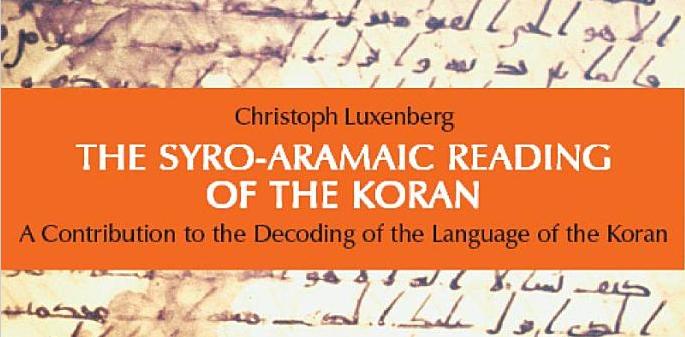
    Luxenberg picks up on that argument that the Qur’an contains much ambiguous and even inexplicable language and accuses Western academic scholars of the Qur’an of taking a timid and imitative approach, relying too heavily on the biased work of Muslim scholars. The author (Luxenberg  is not his real name) claims  in his book, that parts of philologically not clarified text can only be correctly understood by using Syrian Aramaic language.

    Questions asked.

    Now this opens questions. Was the Islam original a current or even syncretic combination of the Christianity?  Did the aspect of the establishment of religion only came later for political reasons? Since the nineteenth century the confidence of the European Islam science  in regards of the three sources of the Islam decreased considerably. Ignaz Goldziher recognized that the Hadith does not reflect in various way the early Islamic, but the  struggle which broke out about three decade after Mohammed death. What can be established about the historical Jesus depends therefore almost without exception on Christian (or heretic) traditions, especially on the material used in the composition of the Gospels of Mark, Matthew, and Luke, which may similar reflect deliberately  myth building  (and motives) of the later church and its faith in Jesus.

    Pre-islamic Islam

    Surprisingly  Western Church history and Western Islamic studies really miss the lack of evidence for pre-islamic Islam, that is to say its Ebionites Christians, Sabaean pagans, Seekers (hanifi) and Meccan pagans probably also Nestorian and Jewish roots. Why are all the pre-cursors to Islam all pagan or heretical christian? Why are the early sources of Islam not islamic when even the Nag Hammadi library of ‘gnostic Christianity’ survived.   Paul Addae and Tim Bowes (1998) write that the Ebionites were faithful to the original teachings of Jesus and thus shared Islamic views about Jesus’ humanity. In 610 AD, at age 40, Muhammad became a prophet. Mohammed’s wife’s cousin, Waraka, the Ebionite Bishop in Mecca, disciple of Mohammed.  The period immediately preceding the time of Muhammad witnessed the bitter fight of theistic sects and the Christological question which formed the background to the controversy: “How are divinity and humanity joined together and related to each other in Jesus Christ?”  John wrote against the Gnostics, Jews wrote against the worship of baal, yet silence against Islam until 632 AD or so, why would that be? Could it be, that Islam was just seen as a Christian offspring and alley against Constantinople and Rome.  Therefore its useful to find similarities and differences in terms of beliefs about the nature of  Jesus understanding the many schism before Islam and the Islamic information about Jesus in the Quran.

    Comparing (Chalcedonian) Christianity and Islam (1) Similarities ….

    Christians believe Jesus was a human and divine being sent by  God.  With the exception of Unitarian Christians and Ebionites Christians , who like Islam today  do not believe in the Trinity, most Christians now believe in the Divinity of Jesus, which is connected to the belief in Trinity. They say he is the second member of the Triune God, the Son of the first part of the Triune God, and at the same time “fully” God in every respect.

    Belief in all of the Prophets and Messengers of God is a fundamental article of faith in Islam. Thus, believing in Prophets Adam, Jesus, Moses, and Muhammad is a requirement for anyone who calls him or herself a Muslim. A person claiming to be a Muslim who, for instance, denies  that Jesus was a messenger, is not considered a Muslim.   The Quran says in reference to the status of Jesus as a Messenger:  “The Messiah (Jesus), son of Mary, was no more than a Messenger before whom many Messengers have passed away; and his mother adhered wholly to truthfulness, and they both ate food (as other mortals do). See how We make Our signs clear to them; and see where they are turning away!” (Quran 5:75).

    Both believe Jesus was born of a Virgin Mother,  chaste and pious human woman who gave birth to Jesus Christ, the second member of the Trinity, the Son of God, and at the same time “fully” God Almighty in every respect. Christians believe however, that while she was a virgin, she was married to a man named Joseph (Bible: Matthew:1:18). According to Matthew 1:25, Joseph “kept her a virgin until she gave birth to a Son; and he called His name Jesus”

    Like Christians, Muslims believe Mary, Maria in Spanish, or Maryam as she is called in Arabic, was a chaste, virgin woman, who miraculously gave birth to Jesus.  “Relate in the Book the story of Mary, when she withdrew from her family, to a place in the East. She screened herself from them; then We sent to her Our spirit (angel Gabriel) and he appeared before her as a man in all respects. She said: I seek refuge from you in God Most Gracious (come not near) if you do fear God. He said: Nay, I am only a Messenger from your Lord, to announce to you the gift of a pure son. She said: How shall I have a son, when no man has ever touched me, and I am not unchaste? He said: So it will be, your Lord says: ‘That is easy for Me; and We wish to appoint him as a sign unto men and a Mercy from Us’: It was a matter so decreed” (Quran 19:16-21).   The Quran says:  “She (Mary) said: ‘O my Lord! How shall I have a son when no man has touched me.’ He (God) said: ‘So (it will be) for God creates what He wills. When He has decreed something, He says to it only: ‘Be!’- and it is” (3:47).  It should also be noted about his birth that:  “Verily, the likeness of Jesus in God’s Sight is the likeness of Adam. He (God) created him from dust, then (He) said to him: ‘Be!’-and he was” (Quran 3:59).

    Muslims, like Christians believe Jesus performed miracles. “And now, Lord, look upon their threats, and grant to thy servants to speak thy word with all boldness, while thou stretches out thy hand to heal, and sign and wonders are performed through the name of thy holy servant Jesus (Bible: Acts 4:30). But im Islam these were performed by the will and permission of God, Who has power and control over all things.  “Then will God say: ‘O Jesus the son of Mary! recount My favor to you and to your mother. Behold! I strengthened you with the Holy Spirit (the angel Gabriel) so that you did speak to the people in childhood and in maturity. Behold! I taught you the Book and Wisdom, the Law and the Gospel. And behold: you make out of clay, as it were, the figure of a bird, by My leave, and you breathe into it, and it becomes a bird by My leave, and you heal those born blind, and the lepers by My leave. And behold! you bring forth the dead by My leave. And behold! I did restrain the children of Israel from (violence to you) when you did show them the Clear Signs, and the unbelievers among them said: ‘This is nothing but evident magic’ (5:110).

    Comparing (Chalcedonian) Christianity and Islam (2) differences

    With the exception of the Unitarian Christians and at that time Ebionites Christians,  Trinity is the central doctrine of the Christian religion. Islam charged Christianity with having distorted the pure monotheism of Jesus through the doctrines of trinity and through the veneration of icons. The belief is that in the unity of the Godhead there are Three Persons, the Father, the Son, and the Holy Spirit. These three Persons or beings are distinct from each another, while being similar in character: uncreated and omnipotent. The word “trinity” is a term used to denote the Christian doctrine that God exists as a unity of three distinct persons: Father, Son, and Holy Spirit. Each of the persons is distinct from the other, yet identical in essence. In other words, each is fully divine in nature, but each is not the totality of the other persons of the Trinity. Each has a will, loves, and says “I” and “You” when speaking. The Father is not the same person as the Son, who is not the same person as the Holy Spirit, who is not the same person as the Father. Each is divine, yet there are not three gods, but one God. There are three individual subsistences, or persons. The word “subsistence” means something that has a real existence. The word “person” denotes individuality and self-awareness.  Included in the doctrine of the Trinity is a strict monotheism which is the teaching that there exists in all the universe a single being known as God who is self-existent and unchangeable (Isaiah 43:10; 44:6,8). Therefore, it is important to note that the doctrine of the trinity is not polytheistic but monotheistic by definition:

    • God is three persons
    • Each person is divine
    • There is only one God.

    God is a trinity of persons consisting of one substance and one essence. God is numerically one. Yet, within the single divine essence are three individual subsistences that we call persons:

    •  Each of the three persons is completely divine in nature though each is not the totality of the Godhead.
    • Each of the three persons is not the other two persons.
    • Each of the three persons is related to the other two, but are distinct from them.

    The word “trinity” is not found in the Bible. But this does not mean that the concept is not taught there.  The First Vatican Council has explained the meaning to be attributed to the term mystery in theology.

    Muslims believe in the Absolute Oneness of God, Who is a Supreme Being free of human limitations, needs and wants. He has no partners in His Divinity. He is the Creator of everything and is completely separate from His creation.  God says in the Quran regarding the Trinity:  “People of the Book (Jews and Christians)! Do not exceed the limits in your religion, and attribute to God nothing except the truth. The Messiah, Jesus, son of Mary, was only a Messenger of God, and His command that He conveyed unto Mary, and a spirit from Him. So believe in God and in His Messengers, and do not say: ‘God is a Trinity.’ Give up this assertion; it would be better for you. God is indeed just One God. Far be it from His glory that He should have a son. To Him belongs all that is in the heavens and in the earth. God is sufficient for a guardian” (Quran 4:171).

    Only Christians believe that Jesus was the son of God. “For God so loved the world that He gave His only Son that whoever believes in Him should not perish but have eternal life. For God sent the Son into the world, not to condemn the world, but that the world might be saved through Him (Bible: John 3:16).  However, it is interesting to note that the term “son of God” is used in other parts of the Bible to refer to Adam (Bible: Luke 3:38), Israel (Bible: Exodus 4:22) and David (Bible: Psalms 2:7) as well. The creatures of God are usually referred to in the Bible as children of God.   The notion of Jesus as son of God is something that was established under the influence of Paul of Tarsus (originally named Saul), who had been an disbeliever, but later changed course and joined the disciples after the departure of Jesus. Paul is considered by a number of Christian scholars to be the father of Christianity whereas Islam later opposed trinity  as a misrepresentations of the message of Jesus.  Heretics struggled to reject the notion of the Divinity of Jesus for close to 200 years.   The Gospel of Barnabas was accepted as a Canonical Gospel in the Churches of Alexandria till 325 CE Irenaeus (130-200) wrote in support of pure monotheism and opposed Paul for injecting into Christianity doctrines of the pagan Roman religion and Platonic philosophy.  In 325 (CE), a council of Christian leaders met at Nicaea and made Paul’s beliefs officially part of Christian doctrine (see chart).

    Muslims believe that God is one, that there are no gods except the God. They may contend that even though Christians claim to be monotheists, they actually believe in more than one God. Since Christians believe that Jesus is the Son of God, to them they therefore err like other people of ancient or modern times who have believed in a plurality of gods or the sons and daughters of Go. The Quran, of course is simplified in that respect and strictly monotheistic:. “Say: “God is Unique! God, the Source [of everything]. He has not fathered anyone nor was He fathered, and there is nothing comparable to Him!” (Quran 112:1-4).  The Quran also states: “Such was Jesus, the son of Mary; it is a statement of truth, about which they vainly dispute. It is not befitting to the majesty of God, that He should beget a son. Glory be to Him! When He determines a matter, He only says to it, ‘Be’ and it is” (Quran 19:34-35). 

    Only Christians believe that Jesus was killed on the cross then resurrected. In that respect Islam is similar to  Docetism belief that Jesus’ physical body was an illusion, as was his crucifixion; that is, Jesus only seemed to have a physical body and to physically die, but in reality he was incorporeal, a pure spirit, and hence could not physically die. ““They did not kill him, nor did they crucify him, but they thought they did.” (Quran 4:156) “God lifted him up to His presence. God is Almighty, All-Wise” (Quran 4:157) .

    Death and resurrection is a core Christian belief and it relates to the concept of atonement. According to this belief, Jesus died to save mankind from sin. However, this is not stated explicitly in the four gospels which form the primary source texts of Christianity. It is found, however, in Romans 6:8,9.   Christians believe Jesus was spat on, cut, humiliated, kicked, striped and finally hung up on the cross to endure a slow and painful death.  According, to Christian belief, the original sin of Adam and Eve of eating from the forbidden tree was so great that God could not forgive it by simply willing it, rather it was necessary to erase it with the blood of a sinless, innocent Jesus.   The four Gospels and the Epistles of St. Paul are the main sources of Christianity which discuss the Resurrection of Jesus after his crucifixion. According to St. Matthew, Jesus appeared to the holy women, and again on a mountain in Galilee. Mark’s Gospel tells a different story: Jesus was seen by Mary Magdalene, by the two disciples at Emmaus, and the Eleven before his Ascension into heaven.  Luke’s Gospel says Jesus walked with the disciples to Emmaus, appeared to Peter and to the assembled disciples in Jerusalem. In John’s Gospel, Jesus appeared to Mary Magdalene, to the ten Apostles on Easter Sunday, to the Eleven a week later, and to seven disciples at the Sea of Tiberias.  Another account of the resurrection by St. Paul is found in Bible: Corinthians 15: 3-8.  According to Christian belief, Resurrection is a manifestation of God’s justice, Who exalted Christ to a life of glory, as Christ had humbled himself unto death (Phil., 2: 8-9). This event also completes the mystery of Christian salvation and redemption. The death of Jesus frees believers from sin, and with his resurrection, he restores to them the most important privileges lost by sin (Bible: Romans 4:25).  More importantly, the belief in the resurrection of Jesus indicates Christian acknowledgment of Christ as the immortal God, the cause of believers’ own resurrection (Bible: I Corinthians 4: 21; Phil., 3:20-21), as well as the model and the support of a new life of grace (Bible: Romans 4: 4-6; 9-11).

    Wrapping it up.

    The emergence of the Islam can so be seen as a part of ancient church history.  Islam researcher Friedrich Schwally said 1919: The theologians are not aware that the Islam is a part of our church history. The more one with studies the Quran, the clearer it becomes that its origin comes from a form of the Christianity.  Probably only around the year 800 from Islam became its own religion.

    What are the central proofs? As said, the Syrian church always saw Jesus as prophet, as a messenger of God. The Syrian church father Afrahat often calls Jesus „ the large prophet “, not the son of God, but the son Maria’s, and on this Syrian theology the Koran decreases/goes back. They wrote that „ Muhammad is actually “ a name for Jesus. „ Muhammad “ is called „ the praising “, and the first coin minting, on which this title appears, carry excluding Christian symbols, the cross, the baptism Jesu or the like.

    The Kalif Abd Al-Malik established the rock cathedral, which is considered as the first Muslim building in Jerusalem, but it was a church. The inscription  the inside, is a purely christian text, against the thesis, Jesus is the son of God.  If one, as Christoph Luxenberg suggests, reads in such a way „ Muhammad “ literally translated and the sentence: is praised (muhammad), then it is to be referred to thereafter the mentioned Jesus.

    Abdallah, the slave of God, is an old Syrian name for Jesus. Later the inscription was read: Mohammed, son of the Abdallah.  The first Muslims did not know thus at all that they were Muslims. They held themselves for Christians, a special form of the Christianity which rejected trinity. This could be the  cause could be for the fast propagation of the Islam: That people did not have to be converted, where the religious was already a rather unitarian tradition, where Jesus was admired as humans and an envoy (messenger) of God, not as God. Can such realizations carry the communication between the religions?  No, but consciousness that one has common roots, can lead perhaps nevertheless to a communication, as it the communication between Christians and Jews.

    Sources: Mark. A. Gabriel “Jesus and Muhammad”, Translation Resch Verlag 2006,

    Historia Mundi Volume IV, Lehnen Verlag,

    Die Kirche zur Zeit der Apostal und Märtyrer

    Phillip Jenkins, “Jesus Wars” Harper, 2010

    R. M. Grant Gnosticism and Early Christianity

    Web resources:

    The Gnosis Archive

    http://www.nestorian.org/nestorian_theology.html

    http://www.miraclesofthequran.com/historical_09.html

    http://answering-islam.org.uk/Books/Goldsack/Sources/chap1.htm

  • Phillip Jenkins book “Jesus Wars” seen from a Jungian view

    Phillip Jenkins book “Jesus Wars” seen from a Jungian view

    In his book book “Jesus Wars” Philip Jenkins is able to communicate complex ideas and complicated concepts in a manner that preserves their integrity  to a wide audience and at the same time renders them as a fascinating and lively story. I have been a fan of his books for some time.  His book “Jesus Wars” describes the historical intricacies that surrounded the theological debates of the fifth through eighth centuries of nature and person of Christ. The book  lives up to its subtitle — How Four Patriarchs, Three Queens, and Two Emperors Decided What Christians Would Believe for the Next 1,500 Years in more than one way.   “Jesus Wars” explains how arbitrary and narrowly the Orthodox belief won over what’s declared as Heresy. Phillip Jenkins  got me hooked from the first page by answering my key questions  about this Byzantine period of Christian schism in the 4th and 5th century (and beyond):

    • Why were theological battles about Jesus’  nature that  fierce and violent?
    • Were those Christian “civil wars” the primary cause of the “Fall of the Roman Empire”
    • Did those tensions in the cradle of Christianity lead to appeasement toward their  invaders?
    • How interacted religion, patriarchs and worldly powers?
    • Were the theological differences subtile or substantial?

    Orthodoxy (and of course the Roman Catholic Church) state that Jesus was both God and Human. Seen from C. G. Jung  it misses just one dimension why the most complex monotheistic symbol  (Trinity) prevailed.  As Phillip Jenkins explained in  another brilliant book  “The Lost History of Christianity” –  religions fight, prosper, flee, fade away, die or get even killed. His sociological understanding of religious history is always  helpful to connect related and interdependent events. He argues also convincingly from Mark gospel and even more from  (mystic and slightly gnostic) St. John the validation approaches. Approaching religious and the mystic questions with logic (!) is less convincing: “But when we have said that, we have raised more questions than we have answered, as the basic belief in Jesus Christ demands combining two utterly different categories of being”. 

    The book explains very well, the substance of different beliefs of Jesus’ nature and their political and philosophical implications. Such a transgression of boundaries indicated indeed a crossroad within Christianity between the “patriarchs” of Constantinople, Rome, Antiochian and Alexandria. It has been also hotly disputed, up today  by strict monotheists such as Muslims and Jews. If pressed to identify a deficiency in Jenkins’ telling of these debates it is that his text emphasis to the human and political factors in this drama. Modern history is somewhat deaf in regards of religious, transcendent and psychoanalytical importance of those positions  keeping  God at a distance.  Jenkins knows the Gospel but may underestimate the powerful value of combining the material (human) and the spiritual (divine), the power of archetypes and symbols and the importance of the female Mary leading to Quaternity.

    Seen only from the historian angle Phillip Jenkins notes correctly “What ultimately became accepted as Christian orthodoxy was hammered out in a process that was painfully slow, gradual, and often bloody. This conflict was marked by repeated struggles, coups, and open warfare spread over centuries. It is easy to imagine another outcome in which the so-called Orthodox would have been scorned as heretics, with incalculable consequences for mainstream political history, not to mention all later Christian thought and devotion.” Phillip Jenkins believes that this thing “turned on a dime.” Doctrinal shifts went back and forth and there was a time when the two-nature or God/Human description of Jesus was a heresy.  This is how one of the battles was won: “Caledonian ideas triumphed not because of the force of their logic, but because the world that opposed them perished.” “Looking at history, the process of establishing orthodoxy involved a huge amount of what we might call political accident” he claims — on the outcome of dynastic succession, on victory or defeat in battle, on the theological tastes and political plans of key figures. History is however, always a story of ifs, and matters might very easily have gone another way.  And yet the outcome — the Trinity and the supposed two natures of Jesus — form the bedrock of orthodox Christian belief.

    Jenkins asks if chance is a valid concept and when he says no — not from a Christian perspective – he steps over the border being a historian. Yes, Nestorians, or Monophysites could have won – but they didn’t – and so failed other competitors to the Roman Church. As Christians refused to worship the emperor as a god, persecution of the Christians and conflicts continued until the reign of Constantine in the early 4th century AD. Very popular with the military was for instance Mithraism, until by 392 AD, Emperor Theodosius I banned the practice of pagan religions in Rome altogether and Christianity was, without question, the official religion of the state. That is just another if.

    From  my catholic profession and Jungian point I would strongly disagree with Jenkins when he analyzes logically Monophysitism,Nestorianism and  the prevailing Orthodox concept of Trinity.  He leaves aside its  theological novelty, uniqueness and the symbolic value of the separated dual nature picture of Jesus. I share his critique of the basic political process: this is the truth and if you don’t believe it, you are a heretic. Philip Jenkins points out that these conflicts have “left an impact that survives into the present day.” He then makes what I feel is his most profound contribution: he says that the church councils which were responsible for the present-day creeds “remade a faith.” Quite frankly – yes-  this central and dogmatic approach is the very reason why the Roman Church became the first and still is the largest global organisation with the “biggest brand name” and not 38000 other Christian side branches.

    We all know that the winners write history but as Jenkins sees it, it is even worse than that — far worse. He rightfully argues that “historians write retroactively from the point of view of those who would win at some later point, even if that victory was nowhere in sight at the time they are describing.” Quite frankly, his story of twisted, tortured history applies also to the background of postmodern de-constructionism also known as political correctness.

    The author describes the key questions of an honest fight between concepts (or religions): How is it possible to possess two natures — what was their relationship?

    Arianism is the teaching that Jesus was not eternal, that he was a created being, created within the framework of earthly space and time, and thus not fully God. Arius was a priest in Alexandria, Egypt, who died in AD 336. Jesus was seen as the very best creature that God created.  Arius had triggered such turmoil within the churches that it was a leading cause of the Council of Nicaea in 325 AD. The Council examined the Scriptures that spoke of who and what Jesus was, in Paul’s letters and the first chapter of the Gospel of John, and declared Arianism to be a heresy. They wrote a creed that was mainly aimed at opposing Arianism. The struggle continued after Nicaea and after Arius’ death, and it even took on political implications. The chief of the opposition to Arianism was Athanasius. In 381, the Council of Constantinople once again called Arianism a heresy, mostly due to the Biblical and philosophical case that Athanasius had built over the years. Arianism faded fast after that.  The specific Arianist group Athanasius fought had died, but the basic idea did not. It resurrected itself many times throughout church history. Many of today’s groups that derived from Christianity have strong tendencies toward that belief, even if expressed very differently: Unitarianism and Jehovah’s Witnesses

    Docetism [ < Greek dokeo (to seem, appear to be)] : The idea that Jesus Christ was a totally divine being who only appeared to be human. It is the opposite idea to Arianism, in which Jesus was all-human and not in any way divine in nature. For docetists, Jesus was with us, but never really of us, and thus didn’t really suffer, and (for most Docetism) didn’t really die. Docetism is not a heretical group as much as it is a category, a basic idea which describes many schools of thought over the years.  Any idea that assigns a low worth to the material world and a high value to that which is deemed ‘spiritual’ will tend toward this idea. (See “Gnostic” below.) Docetism is a form of dualism, and like other dualisms, Docetism was rejected by the early church as not being in keeping with what Christ was about. God so loved us that God ‘incarnated’ (that is, became human) in Jesus, thus blessing the whole ‘material’ realm with the ‘spiritual’ impact of God. But like most heresies, Docetism tries to come in the back door; the churches, especially parts of Roman Catholicism, and fundamentalist Calvinists often draw a vigorous sacred/secular divide. Christian Gnostics are in effect docetists.

    Ebionitism [ < Heb. ‘ebyônim (the poor) < ‘ebyôn (a poor person)]: The idea that Jesus was a human being and not at all divine, but Jesus was given certain gifts by God’s spirit which set him apart from other people. Because of what God gave Him, Jesus was deemed the Messiah or Christ, but that meant only that He was chosen by God, not that He was savior of all humankind. The Law of Moses was still what counts with God. The church rejected the idea behind it, possibly as early as 110 AD.  Some scholars have made the claim that the Ebionites were pretty much the lineal descendents of the Jewish Christians that were led by James the Just at the time of Paul. (These scholars posit a stronger adversarial relationship between James himself and Paul than Acts or Paul’s letters show.) However, it would be much more accurate to put them in the context of other groups, both Jewish and Christian, that existed during the first two centuries of Christianity. There were many small Jewish groups (like the Essenes of Dead Sea Scrolls fame) with many different shades of practice, with many ideas and practices which bled into those of other groups, making a continuum. Like Judaism, Christianity also had small groups which took a different direction than the mainstream. Nearly all of these were moral rightist in some way — their behavior had to tightly conform to the Law of Moses, seen to varying degrees through the lens of Jesus’ sermons. And only some of them were rejected by mainstream Christianity. Ebionitism view of Jesus is shared by Islam.

    Apollinarism or Apollinarianism : Since the Nicean Council in 325, Christian theological-talk focused on what the Trinity meant, especially to explain how Jesus Christ could be fully God and fully human at the same time. Apollinaris the Younger (d. 390 AD) became bishop of Laodicea (in Syria) around 361 AD. He championed the idea that Jesus’ mind was solely divine and not human, that the creative Logos of God had in some way taken the place of the human Jesus’ mind. His human nature was confined to His body (physical nature), but even that was in a sense ‘glorified’. This made Jesus almost entirely divine and not fully human.  The trouble was that the churches had come to see in Scripture Jesus’ role in relating not just to God within the Trinity but to humans as a human. He was on both sides of the Divine/Human relationship. It was the only way he could effectively reunite and reconcile the two sides. Or, to use the language of the sacrifice: he was fully God, in order to be a pure and worthy sacrifice, and he was fully human like us, so he could be the sacrifice for us. Apollinaris’ approach makes Jesus un-like us and not quite like God, a third kind of being. Athanasius showed how Apollinaris’ approach poorly explained what Jesus Christ did, at a Synod (in Alexandria in 362. The “fully God, fully human” approach of Athanasius won the day in 381 at the Council of Constantinople.

    Eutychianism: In the Eutychian way of thinking, Christ was put through a blender – that is, His being God and His being human were so totally mixed together that He was homogenized into being Something Else. When theologians say that Christ has two natures, they mean that Jesus was fully God (and thus had the full power and ability to accomplish His mission of rescue) – and fully a human, living out a material human life (which made it possible to experience life such as what we have, to be in full solidarity with us, and to redeem us out of love). Jesus is one of us, and that is what makes what He did so real, what makes it matter. No third type of being could do it for real, because it wouldn’t be on either side of the relationship that was to be healed.

    Gnosticism  gnosis [ < Greek gnosis (knowledge)]. The Greek word gnosis is a basic word for any sort of knowledge. In a religious or philosophical context, it usually refers to the ‘secret’ or ‘special’ knowledge that is said to set one free from the ‘illusory’ material world. Gnosticism was a religious and philosophical movement of the late Hellenistic times, which according to modern scholar have Egyptian and Persian roots and arising out of Jewish mysticism.   Gnosticism arrived therefore even before  Christianity. It was the offspring of the mystery cults and pantheism religions of Greece, Persian Dualism, and Palestine, with Jewish sectarian apocalypse .

    The starting point is noble but it’s many ideas depressing.  The one God is without fail and perfect but the created world is on big mistake and illusion.  The contradiction is solved by an imperfect creator – the demiurge – created an illusionary world – in modern times the Movie “Matrix” has purely gnostic concepts:

    •  the material world is not an illusion for us to be freed from, it is a wonder-work of God’s creation we were made to be a part of, and God is still at work today to make it whole again;
    • the knowledge on which everything hangs is already revealed by (and as) Jesus Christ, and God sent the Spirit to reveal to all believers what God is up to — this is no ‘secret’, and even if it was, the Christian’s duty would be to give it away freely anyway.

    To the contrary, the Christian see a perfect world, created by a God as perfect creator. , in that the eval came by Gnosticism was more than a corruption of Christianity, which fought  it with furor. Even today you can read Christian qualify Gnostic as “fungus” and “cancer” trying to take over Christianity  which tried its best to suck in the strong, fledgling Christian faith and reshape it into its image.

    The gnostic “Jesus” is one who saves you from the world, not for it. A Gnostic god could never really be ‘God-with-us’, nor could it be so focused on loving those wallowing in the earthly mire. Gnosticism faded away as they most converted to Islam but recently raised again New Age and  left its traces in other places (Psychoanalysis). The idea of ‘secret’ or ‘special’ spiritual knowledge has historically had its strongest appeal among the intelligentsia and C.G. Jung was deeply influenced with Gnostic thoughts.

    Nestorianism, deriving from Antiochian school sees the Person of Christ as a single unified human person having two disjoint natures. Nestorianism stressed the distinction between the divine and the human in Christ to such an extent that it appeared that two persons were living in the same body and rejected the title Theotokos (“Bringer forth of God”) for the Virgin Mary.

    Monophysitism, from the Alexandrian school of thought (fashioned on the Gospel of John) see Jesus Christ, as the incarnation of the eternal Son or Word (Logos) of God, who had only a single (divine) nature.

    Miaphysitism holds that in the one person of Jesus Christ, Divinity and Humanity are mingled in one or single nature (“physis”). As Nestorianism had its roots in the Antiochene tradition and was opposed by the Alexandrian tradition, Christians in Syria and Egypt  wanted to distance themselves with this term. A scholarly used term only, Miaphysitism will be usually – and is also by Jenkins’ book – lumped together with Monophysitism. Note the subtile difference to Roman Catholic and Eastern Orthodox belief, which is mainly in understanding of the word nature.

    Roman Catholic and Eastern Orthodox belief explained the huge issue of a God better, who could suffer and die, strongly opposing Nestorius who said, “The creature did not bear the Creator, but she bore a man, the instrument of deity” and Cyril, Bishop of Alexandria, who thought that Christ was an abstraction, going into very grave heresies, seeing Jesus as a “nonresident alien.”  The Council of Chalcedon was the watershed of prevailing Roman Catholic and Eastern Orthodox belief. Human and divine natures of the Person of Christ co-exist, yet each is distinct and complete and the Council clearly distinguished between person and nature. The fight between Monophysitism and  Caledonians (later Roman Catholic) went on for 200 years after the Council of Chalcedon until Antioch and Alexandria came under -from Monophysitism welcomed- rule of the Islam with disastrous results. After a brief period of dimmni status,  this part of the world was in effect lost to Christianity after the Christians lost majority presecutution started.

    I appreciate, as always, Jenkins the fresh and unique historian and recommend this book, but I am a little bit disappointed in Jenkins’ description of “transcendent issues” and behavior of organisation in this “business”.  Great book though of  the best  scholar covering those issues and that time.

  • Protected: International view on Christoph Luxenberg

    Protected: International view on Christoph Luxenberg

    This content is password-protected. To view it, please enter the password below.