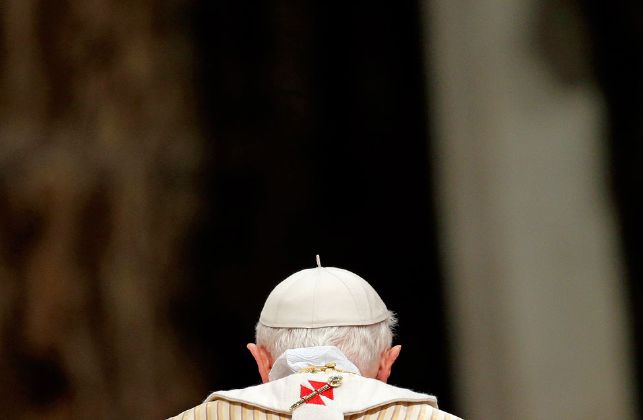
This is a sad day: “Der Lotse geht von Bord”. The pope steps down, our great spiritual and intellectual leader leaves the ship. I have respect for his decision, which must not have been an easy one for this modest man. I want to discuss the spiritual and political background of this.
Spiritual consequences
Der Lotse geht von Bord” Karikatur aus dem Londoner “Punch” vom 2. September 1890 zur Entlassung Bismarcks durch Wilhelm II.
I pray that he has still enough time left and for his health. Catholicism does not depend like other “beliefs” on new doctrines and to hurry from fashion to fashion because opinions of yesterday’s turn out useless already today. Sometimes it seems only the Catholic church can preserve us from the embarrassing and degrading slavery of stupidity, decay and greed, of dark totalitarian forces being ideological motivated ones or creeping out of dark medieval ages. The catholic church is no invention of our time. She will survive as the first steely global organisation, even if her enemies have not given up the hope to see catholic dying one day. Thanks to the Holy Father for his smart and modest guidance of our church. The pope was neither ultra conservative, nor a Church-CEO. He was as a bishop of Rome in the succession of Peter and is time of his life an intellectual thinker and light tower for us Catholic Christians. And if one really deals with his writings and his work, one recognises how deeply religious this man is and what a luminous example he is to us Catholics.
From a Jungian view I may not always have agreed with Pope Benedict , but I do thank him for his work, for taking a stand and wish him a few more quiet years in late autumn of his life. All the best for the future! I hope the next pope comes from a spiritual young Catholic church – Asia, Africa or South America – not from the Western Ship of Fools. When the last pope resigned with Celestine V 1294 and Gregory XII 1415, it was on the eve of the fall of Constantinople, of East Rome 1453, of Christianity in the Middle East. Pope Benedict XVI created a new Vatican department aimed at “re-evangelizing” the most secular regions of the globe, including areas of Europe that have become “de-Christianized.” That is needed indeed. In any case, Pope Benedikt is a universally educated high dignitary of the Church, willfully misunderstood by most, never mind if they really have read a line from him. His level is another than coarse and vicious debate culture let alone the jaded role models for the masses. Ironically it became clear those last years, that he was a modern intellectual. He spoke out for freedom, also individual freedom, for separation of state and church, building bridges to other religions, to science and philosophy and fighting for a global church in countries where spirituality still prospers.
Political reasons
Pope Benedict XVI has made many enemies within and out of the Catholic church. An enlightened scholar and philosopher was hunted down by indignity. His relation with Germany was stressed. In his last speech in Germany he spoke of “Entweltlichung” hinting that German clerics live to cosy within the state concordat and lack spiritual drive. In the parliament he quoted for our “great” politicians St. Augustine: “What are the states without justice than only than a big band of robbers?“ (Book 4.4). It can be also interpreted as: A state without God is at best a well organised band of robbers. Indeed, that was the European Union and Germany became. Given the disgusting public noise towards his person it was a sensible decision to retire. It was telling, that the German (cleric) officials referred only to Celestine V, a hermetic monk, who, overwhelmed and tired of the poisoned climate of the Vatican tepped down after five months. Some of them had wished a Pope Benedict XVI more streamlined, more postmodern or at least more protestant. He was neither. Joseph Ratzinger has recognised early that reforms, when they lead to a religious relativism, block the essentials, the faith in God and lead in a dead-end. The 68er movement has made clear to the young theologian Ratzinger the dangers of the approaching spirit of the time. Today’s coinage very clearly drags everything onto the suction of a doctrinal secularism and dissolves thus the Christianity in pagan belief. In this respect one may see the big achievement pope Benedikts XVI to have held up those disastrous currents and with it perserved the livelihood of the Catholic church. Besides, Joseph Ratzinger had to lead the discussion with the Marxist liberation theology arising in Latin America as a prefect of the religious congregation that has severely challenged the church just in these countries. Furthermore his achievements are indisputable regarding the unity of the Catholic faith. Newsweek stated gaffes statements are the red thread of his pontiff, and the Regensburger speech is stated as an example. Clearly who reduces such a speech into a 130 Twitter message comes to such a mistaken judgement. The speech opened even a dialog with moderate Muslims on a peer level in addition to the Orthodox and Jewish. Of course, there are many which want to misunderstand for political reasons. Many just wish a politically correct church – Johannes Paul just as like Benedikt disappointed them and this is a good thing.
Pope Benedict XVI’s spokesman has denied the pontiff will resign over the VatiLeak of confidential documents. However, there were smearing gossip articles lately and hints that some treacherous infighting was going on in the Vatican. He was the one who cleaned up the act of the church regarding the abuse cases, reaching out to the victims. Maybe he had alienated some preference groups with his “zero tolerance” policy and because he was firm on catholic tradition and truth. It seems clear, that the pope has deeply been made sick by the child abuse in the Catholic church and came to conflict with the cardinals. He will disappear from March, 2013 out of sight of the public and Vatican will provide for the fact that this also remains extensively so.
As head of the state, Pope Benedict XVI has not done so well. Not always he trusted the right people. To be fair, the ailing pope before him left behind a big administrative and financial mess (not improved by the EU financial crisis). A cluster of banking scandals have been surfacing in Italy recently. They concern the Banca Monte dei Paschi di Siena (MPS) involving head of the European Central Bank Mario Draghi (G&S alumni) when he was still head of the Italian central bank. The history of the bank is a telling example of the murderous symbiosis of politics and investment banks. The fired boss of the bank, Giuseppe Mussari, is a leading Freemasons according to the newspaper Il Fatto Quotidiano. Freemasons have a long tradition in Tuscany and numerous members of the socialist party. Those socialists who control the city of Siena since generations installed Goldman Sachs together with the Citigroup and Merill Lynching as a „joint Worldwide Coordinators“ and for buying the Spanish Bank Antonveneta 2007 on the brink of the finance crises. One of the most important actors in the crime movie was Mario Draghi. It is completely implausible that Draghi has known nothing about the details about the state of the Antonveneta as he claimed of the G&S deals with Greece in the scandal around manipulated figures of the Greeks for the EU entry. As a boss of the EZB he is meanwhile the true ruler of Europe. The EU installed Italian Prime Minister Mario Monti, also a Goldman adviser, has tried during the past years to keep the bank with tax money alive, and has pumped billions of taxpayer money into the bank. While little has been said in the mainstream western press about the ongoing fiasco surrounding Siena’s Banca Monte dei Pasci, Italy’s third largest bank and the world’s oldest may get its third bailout in three years. The situation on the ground in Italy is getting more serious, and will have implications on both next month’s general election, on Mario Monti, on Silvio Berlusconi, as the scandal reaches as far up as the head of the ECB – Mario Draghi. Due to previously undisclosed derivative contracts first exposed by Bloomberg, the Siena bank has hidden as much as $1 billion in losses. The “Latest Italian Bailout Scandal”, has far greater implications for the implied credibility of both the Bank of Italy, and especially the man who headed it for five years before becoming head of the ECB (where he now demands the same supervisory authority over all European banks that he had in Italy, only to supposedly let countless derivative fiascos slip through his fingers). Or in plain English, why the then-Draghi led Bank of Italy allowed this to happen not once, not twice, but at least three times. This scandal maybe connected with Pope Bendict’s VVI significant problems of the Vatican bank IOR. The Italian press indicated that those scandals have an international dimension. The former Vatican IOR boss, Ettore Gotti Tedeschi, was before his engagement with the Vatican Chef of the Italian establishment of the Spanish Santander, the very bank who sold Antonvenet for an inflated price (and under investigation of kickback corruption) to the now troubled Banca Monte dei Paschi di Siena.
Benedikt XVI attempted to resolve the shady behavior of the Vatican Bank by installing the former German Banker Tietmeyer. Bad customs, defamation, power plays, ambitions without barriers and theft led to the destruction of the Vatican Bank. Established financial power groups could be involved for their part in the Vatican bank scandal and may be also behind the butler who stole confidential papers from the desk of Pope Benedikt. The shadows behind the butler never came to light and the Pope sure must have been tired and disappointed. The Italian journalist Gianluigi Nuzzi ( he has to be taken with a bit of salt) is convinced: Pope Benedikt XVI has stepped down to put a sign against the mismanagement in Vatican. He has felt as a theologian not competent enough to solve the economic problems of the church state. He has had no friends in the Vatican. Above all his cardinal’s Assistant Secretary Tarcisio Bertone has built up a dangerous network of ropes and carries on opaque business with „dubious figures“. The pope has not stopped Bertone. The loyalty of the pope to a man who clearly damages him is surprising: „They fit not really. Ratzinger is a subtle intellectual, a shepherd. Bertone is a cunning administrator who knows the Curia inside and by heart”, Nuzzi wrote. Fact is, the he former head of the IOR Ettore Gotti Tedeschi has been recently fired for never revealed reasons and the pope has approved today the German layer Ernst von Freyberg as new head of the IOR. Pope Benedikt XVI. had tried to enforce stricter rules for the IOR by founding 2011 an independent controlling institution and also favored Gotti Tedeschi proposal for compliance to international rules while some parts of the Vatican, particularily Secretary Tarcisio Bertone, wanted to keep its current “independent” mode.
Conclusion
One can argue, that the Pope did no solve the management crisis he inherited completely. This cheap criticism comes predictable from sides, however, which never liked a strong catholic faith. It is often just unfounded repetition or strange spin of shady economic and political clusters. To the resignation of pope Benedikt XVI the Freemasons have sharply criticised the economic behaviour of the Vatican. They hope for a complete coup. In the TV broadcasting “Öteki Gündem” the Turkish (!) journalist Aytunç has raised Altındal heavy charges against the parting pope based on hearsay of American (!) sources – John Patrick Quirk, a professor and former CIA advisor. It looks like the Pope emeritus has to watch his back even more now than before, also physically. Somebody has unleashed many dogs, after Pope Benedikt XVI forced the cleanup by his resignation.
An observation of the history is always interesting:
The more powerful the financial dynasties became, the more and more audaciously the Christianity and the Catholic church was attacked. They control not only semi-secret organizations (Freemason, Bilderberger, CFR, trilateral commission, Illuminati, black nobility etc.), but manupilate politicians and transnational organisations (EU, IMF, UN) more and more violently the fate of us all.
Pope Benedict XVI was a great admire of Augustine, a contemporary of the (declining) Roman Empire. This world state was taken over by the early Roman Church because of visible injustice. Similar like radical Islam outshines today corrupt secular governments. After the victory over the communism by Johannes Paul, to Pope Benedict those greater challenges became obvious. During the last years the Christianity has become the mostly persecuted religion of the world. The European West seems lost to the Christianity whose heritage it owes most. By failing Augustine’s – lets call it ethical – virtues the West fails its secular objectives too. Continuing this way, world finance and its paid servants will lead us back to the dark ages to either secular or religious totalitarian systems. One can take from the “God’s state” of Augustine the following eight elements:
God’s image must be promoted. Secondly uniqueness of any person created after God’s image has to be acknowledged. In this the dignity of any person has its foundation.
Above all, man is made good. If man sins, he /she acts under his/her dignity and against possibilities and God’s order. The evil is the absences of the good, it has no substance in itself.
The states must allow the God’s love, that is „the true religion“. The God’s citizen who face God live the truth. The cosmopolitan who are aimed only to themselves live the lie.
The God’s state is formed by citizens who live the spirit, the world state by citizens who live after the flesh. The states should allow to live after the spirit.
The highest aim of the God’s state is peace. In order that anybody achieves the everlasting aim, the state must guarantee above all “freedom”.
The state being must provide for justice. The rhetorical question: „What are the states without justice differently than big bands of robbers?“ (Book 4.4), may be interpreted so also: A state without God is at best a well organised band of robbers.
Another important principle for the state is that it rules by virtue. Even the Roman’s empire – the first and only world state – has prospered according to Augustine, as long as Romans have practiced virtues.
The state authority who acknowledges God has a right to obedience if it concerns the worldly things. The state is no remedial way itself.
Gianluigi Nuzzi works as an investigative journalist with the Italian magazine “Panorama”, before he was for the newspapers “Corriere della Sera” and „Il Giornale.
Vatikan AG – Ein Geheimarchiv enthüllt die Wahrheit über die Finanz- und Politskandale der Kirche, 360 Seiten, Ecowin-Verlag, 22,50 Euro
Seine Heiligkeit – Die geheimen Briefe aus dem Schreibtisch von Papst Benedikt XVI., 416 Seiten, Piper-Verlag, 22,99 Euro
Note: One who is less a servant of God and more a servant of his own self-esteem might have embraced the power of the office he held and ignored the needs of the flock. Not so Pope Benedict, he truly accepted the second half of St. Peter’s exhortation: “Do not lord it over those assigned to you, but be examples to the flock.” His example tells us clearly that the needs of those we serve out-weigh our own.
There has been a claim put forth by Italian daily newspaper La Republica, that pope’ decision was influenced by a secretive “gay lobby” within the Vatican itself.
Yesterday this paper published an article alleging that Pope Benedict XVI’s decision to resign this month was partly prompted by a report that accused Vatican officials of being under the influence of several internal lobbies, reportedly including a gay one. The nearly 300-page dossier would be passed on to pope’s successor, the report added.
The Irish Times reports that Benedict commissioned the report after the Vatileaks scandal broke last year. The report, written by a trio of cardinals, concluded that “various lobbies within the Holy See were consistently breaking” the sixth and seventh commandments, “thou shalt not commit adultery” and “thou shalt not steal.”
Throughout his life, Pope Benedict XVI has professed our Lord Jesus as the Christ. No person needed to tell him this; he was truly given access to the will of the Holy Spirit. We, who like him, are adopted by Christ must now thank him for the gift of his life, energy, and service to the people of God and the Church. We look to the empty Chair of St. Peter and pray that, as in past Conclaves, a new Pontiff will emerge and that he will become stronger than he had ever thought possible.
Today especially we conclude with Prayer:
Lord, send forth your Holy Spirit and continue to guide and inspire our Holy Father Pope Benedict XVI during these final days of his papacy. Be with the College of Cardinals for the next conclave and fill them with your grace. Through Christ our Lord. Amen.
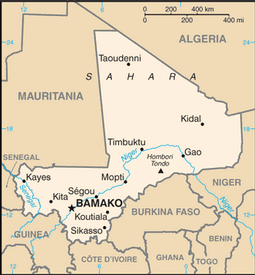
Islamists in Mali destroyed a number of Sufism tombs in the ancient city of Timbuktu, which in the last year fell under control of a separatist insurgency. Home of the prestigious Sankore University, Timbuktu was an intellectual and spiritual capital and a centre for the propagation of Sufism (an Islam faction) throughout Africa in the 15th and 16th centuries. Its three great mosques, Djingareyber, Sankore and Sidi Yahia, recall Timbuktu’s golden age. “The destruction is a divine order,” said a spokesman from Ansar Dine, a radical outfit with alleged links to al-Qaeda. Ansar Dine or “defenders of the faith” in Arabic is group led by a prominent leader of the Tuareg rebellion in the 1990s which wants the imposition of strict Sharia law across Mali.The Associated Press Posted Jan 28, 2013 @ 07:32 AMSEVARE, Mali (AP) — Islamist extremists torched a library containing historic manuscripts in Timbuktu, the mayor said today, as French and Malian forces closed in on Mali’s fabled desert city.
All of this is haram
According to BBC the “spokesman” went on: “God is unique. All of this is haram (forbidden in Islam). We are all Muslims. Unesco is what?” According to reports, the militants teared down the centuries-old mausoleums of Muslim holy men in Timbuktu. As many as half of the city’s shrines have been destroyed in a display of fanaticism. When driven out of Timbuktu by the French, the leaving “activists” burned down the Ahmed Baba library which is a real tragedy, because so much of Sufi and African history, literature and learning was lost forever. Build by the South African government in 2009, the Ahmed Baba Institute was named after a Timbuktu-born scholar and held thousands of priceless manuscripts in its climate-controlled, underground vaults. Ancient books of culture, geography, science are now all torched up 20,000 scholarly manuscripts lost.
Memories come up when in March 2001, Taliban fighters and grandees blew up the famed giant 6th century statues of the Buddha in Afghanistan.The Taliban also rampaged through the national museum which I visted in the seventies, smashing any art depicting the human form, considered idolatrous under their hardline interpretation of Islam. In all, they destroyed about 2,500 statues. Or of the final destruction of the ancient world’s single greatest archive of knowledge, the Library of Alexandria, which was burned down by Caliph Omar 640 AD when the Muslims took the city of Alexandria. Upon learning of “a great library containing all the knowledge of the world” the conquering general supposedly asked Caliph Omar for instructions. The Caliph has been quoted as saying of the Library’s holdings, “they will either contradict the Koran, in which case they are heresy, or they will agree with it, so they are superfluous.” It is somewhat ironic that Alexandria was the center of Monophysitism, a Christian heresy weakening Byzantine and Roman power.
Ignorance
Too many critics of Islam, including atheists, fail to appreciate just how diverse and varied Islam can be, much more than Christianity. This is especially true when it comes to Wahhabi Islam, the primary religious movement in Saudi Arabia. Saudis are aligned with the West to bring down all somewhat secular dictatorships in the region. In the puritanical strain of Islam adhered by most radical Sunni (like Taliban and Salafists) but also fundamentakist Shiites, veneration of Sufi saints – which remind on Christian saints – counts as idolatry a heretical practice that cannot be tolerated. It is against modernity, secularism, and the Enlightenment which orthodox Islam do fight — and it is this anti-secularism, anti-modernism which helps drive extremism, even to the point of cultural terrorism. Militants bearing guns, pickaxes and shovels reduced to rubble the tomb of Sidi Mahmoud, who died in 955 A.D. They have also knocked down tombs of two other prominent medieval saints, Sidi Moctar and Alpha Moya.
Who controls the history controls the future
Both South Africa and the Libya of Col. Muammar el-Qaddafi were involved in efforts to revive the fortunes of the ancient city and its artifacts. South African researchers involved in a project to preserve the Timbuktu manuscripts have had word that most of the treasures survived in private libraries and secure locations.Mohamed Mathee of the University of Johannesburg told a News Channel, “It seems most of the manuscripts are OK. These manuscripts are with families and are safe.” All those events in the new millennium have highlighted that we are today’ in a ideological war is fought with more than just weapons – just as Samuel Huntington has written in his a powerful and disturbing book in the late nineties.
International outrage with little understanding of the Islam has been swift to blame “Islamists”. But beyond understanding history (and Islam) better, there’s little anyone can do to stop this wretched bout of iconoclasm. History is littered with the debris of toppled temples and smashed idols. Salafists and others who also believe in a more orthodox brand of Sunni Islam harbor a particular animosity toward Sufism, whose mystical interpretation of the divine affords a more heterodox faith, steeped sometimes in local pre-Islamic traditions and a reverence for saints and deceased wise men. Islam, as it spread outside the Arabian world, did so in some part through the peaceful teachings of Sufi orders and wandering monks — not just under the hooves of conquering Arab armies. Yet, recently under the Arab Spring, Sufi shrines have come under attack from emboldened and radicalized puritans in countries like Egypt and Libya by Muslim brotherhood and Salafist; in Pakistan, the Taliban and its affiliates have waged a sectarian war on Sufis, systematically targeting dozens of tombs and Sufi sites, while killing hundreds of devotees. In Persia the orthodox Shiites did not much less harm.
The many holy places and old libraries of Timbuktu, once a prominent center of Islāmic learning in the 15th and 16th centuries, were preserved for centuries as a result of the city’s remote location on the path of now collapsed salt and gold-trade routes. In single-minded devotion to the word of the Koran, the orthodox Islam cares little for the juridical wisdom of generations of Timbuktu’s theologians who critically examined Islam’s founding holy text. The attack on Timbuktu’s cultural heritage is just one more attack against history and the values it carries — values of tolerance, exchange and living together. It is an attack against the physical evidence about the Islam’s majority livelong struggle against freedom, science and mysticism.
Wisdom
The Ahmed Baba Institute had nearly 30,000 manuscripts, which are being studied, catalogued and preserved. Four basic types have survived:
key texts of Islam, including Korans, collections of Hadiths (actions or sayings of the Prophet), Sufi texts and devotional texts
works of the Maliki school of Islamic law
texts representative of the ‘Islamic sciences’, including grammar, mathematics and astronomy
original works from the region, including contracts, commentaries, historical chronicles, poetry, and marginal notes and jottings, which have proved to be a surprisingly fertile source of historical data.
Some manuscripts themselves are also of special importance to their owners to prove noble descent or land and property ownership. But they are also proof of Africa’s pre-Islamic culture, which the Islam claimed (and radical despise) like any culture Islam took over and claimed of its own.
According to the 17th-century historian Abdurrahman As-Sadi, the history of the West African desert region could be divided into the rise and fall of three great empires – ancient Ghana, medieval Mali and the Songhay empire. Located at a hub of commercial exchange between Saharan Africa, tropical Africa and Mediterranean Africa, Timbuktu was a magnet that attracted both men of learning and men of commerce. It benefited from the gold trade , however, the most profitable trade items in Timbuktu were books. Buying them was considered a socially acceptable way of displaying wealth and a great source of prestige. As the empire of Ghana declined, the Mali empire took its place. King Sundiata Keita of Mali conquered ancient Ghana in AD 1240, and two generations later, Islam became the dominant religion of the Malian cities and Arabic became the language of scholarship. Described as the ‘Latin of Africa’, Arabic was useful for communicating between tribes such as the Bambara, Fulani, Hausa, Mossi, Songhay and Tuareg who all spoke different languages. Just as Latin in medieval Europe was associated with Christianity, Arabic in medieval Africa was associated with Islam, and just as Europeans adopted the Latin script to write their own languages, Africans used the Arabic script to write theirs.
Mali became indepdent 1960
The Sankoré University mosque was built in about AD 1300 with funding from a woman of the Aghlal, a religious Tuareg ethnic group. There were a number of challenges to Malian hegemony. ‘The Tuaregs began to raid and cause havoc on all sides. The Malians, bewildered by their many depredations, refused to make a stand against them.’ Mali lost control of Timbuktu in 1433. Once a tributary to the Mali empire, the Songhay became independent as Mali declined. The gold traders and the scholars of Timbuktu were also treated harshly and many fled. Timbuktu benefited under the reign of the Askiya kings by tax and slavery privileges and rose to intellectual dominance in the region. The Sankoré University mosque was the main teaching venue but classes were also taught at the Great Mosque and at the Oratory of Sidi Yahia. Public libraries were established and employed calligraphers to copy books.
Timbuktu was also a religious city. According to a West African proverb: ‘Salt comes from the north, gold from the south and silver from the country of the white men, but the word of God and the treasures of wisdom are only to be found in Timbuktu.’ There is a local legend that the city is guarded by 333 renowned saints as well as numerous lesser ones, and surrounding Timbuktu like a rampart are the chapels where the saints are buried. Saints and chapels are of course an anathema to orthodox Islam. According to the Sufis, a saint is a Muslim mystic, usually a scholar, who has achieved such closeness to God as to possess special powers.
Ahmed Baba
Ahmed Baba, the Sufi scholar after whom the burned down library was named, studied Arabic grammar and syntax, astronomy, logic, rhetoric and prosody. Textbooks were purchased and copied on a number of subjects, including astronomy, astrology, botany, dogma, geography, Islamic law, literary analysis, mathematics (including calculus and geometry), medicine, mysticism, morphology, music, rhetoric, philosophy, and occult sciences. The works of the Greek astronomer Ptolemy were basic references for Islamic astronomy. The Greek philosophers Plato and Aristotle were also common. The Greek physician Hippocrates was popular, as well as the Persian medical philosopher-scholar Avicenna. The Timbuktu manuscripts mainly comprise Korans, Koranic exegesis, collections of Hadiths, writings on Sufism, theology, law and other closely related disciplines. By the 15th century, Timbuktu scholars were producing original works as well as compiling new versions and commentaries on established texts. The reading and writing of poetry was important in these cultures. Among the Timbuktu documents are verses devoted to the Prophet and to the adoration of a particular woman or man, and poems. A number of manuscripts were written in Ajami – Arabic script used to write local languages – with botany, diplomatic correspondence, occult sciences, poetry and traditional medicine.
Sufism
There are three main branches of Islam – Sunni, Shiite and Sufi. Sunnis make up about 85 percent of the Muslim population globally, while Shiites account for about 15 percent. The two split over differences of who should succeed the Prophet Muhammad but are further subdivided.
Sunni follows a strict, literal interpretation of the Quran and the life of Muhammad with the Sunna as core teaching. Wahhabism is an austere form of Sunni dominant in Saudi Arabia for which Muslims more often use the term Salafism.
Shiism is the smaller of the two major branches of Islam. It developed after the death of Muhammad, when his followers split over who would lead Islam.
Sufism is an Islamic mystic tradition with followers around the world. Sufis tend to identify with either Sunni or Shiite Islam. Many Muslims are critical of Sufism as an unjustified innovation.
Shia Faction of Islam
Sunni Faction of Islam
Sufis/Sufism
10-15% of all Muslims
Majority of Muslims
Shia means “faction,” refers to “faction of Ali.”
Sunni means “tradition,” adheres to orthodox tradition
Suf means “wool,” considered the Mystics of Islam.
Iran center and home of most Shia, 88% of Iranians are Shia (Shi’i), In Iraqi 96% are Muslim and over 50% of them are Shia (Shi’i), though Iraq was ruled by minority Sunnis. Reverse Syria if you consider Alawis (12er ) to be Shiites.
Grew out of Umayyad dynasty. World-wide 85% of Muslims are Sunni.
Developed in reaction against the excesses of the Sultans and Caliphs (who wore silks, satins), specifically the Caliphate of Damascus in the Umayyad dynasty, Sufis wore course wool garments in protest.
Succession and Leadership
Believe in Ali and the Imams as rightful successors of Muhammad, but not in first 3 Caliphs. Ali was first of 12 successive legitimate Imams. Succession was to be hereditary.
Acknowledge each of the first four Caliphs as rightful successors to Muhammad.
Value deliberate simplicity, meditation rather than just a formalistic following of the rules.
Look forward to Messianic return of the last recognized Imam. Muhammad al-Mahdi, last Imam, disappeared 900 CE, went into “hidden realm”, was sinless. Ayatollah Khomeini (1900-1989) believed by many to be the return of the last Imam.
Through the ages, Caliphs rule “in God’s name.”
Sufis gathered around shaikhs (masters) and formed faqirs (orders or communities). Rabi’a (1717-1801 CE) was a Sufi poet whose poetry spoke of God’s Love similar to Christianty Al-Ghazzali (1058-1111) first Sufi to bring the faction into mainstream Islam.
Imam holds an exalted position, Ayatollah refers to most important Imams.
Imam is a prayer leader. Sunnis approach God directly, there is no clerical hierarchy.
Sufi Shaikhs are the masters. Wandering monastic culture
Teachings and Scripture
Characteristic is the continual exposition and reinterpretation of doctrine by the clerics.
Believe in entire body (canon) of life and teachings of Muhammad as found in Qur’an and hadiths (sayings and traditions of Muhammad). Sayings and traditions are interpreted by scholars in Islamic schools.
Qur’an is full of symbolism, each verse has from 7 to 70 meanings. Believe in three approaches to the divine: mysticism of Love (heart knowledge), Ecstatic (visionary knowledge) and intuitive discernment (mental knowledge)
Both Sunni and Shia factions believe in the Sharia, the comprehensive law derived from the Qur’an (revelations of Muhammad) and the Sunnah (sayings or interpretations of Muhammad).
Believe in fana (extinction) of separateness from God and “remembering” that “there is nothing but God.”
Scholars carry on debate in Islamic Schools. Science of Tradition refers to Islamic scholarship and rating of specific writings (rated sound, good, weak, or infirm)
Influenced by Christianity and Gnosticism (life is a spiritual journey—want to know God/Allah now not just after death), Persian Zoroastrianism and Hindu Mysticism
Shia Faction of Islam
Sunni Faction of Islam
Fufis/Sufism
Fundamentalist approach to Islam, interpretation by clerics
Qur’an applies to everyday life, public life is shaped by the Qur’an. Saudi Arabia considered model of proper Islamic state
Called “the Heart of Islam,” highest experience in life is experience with Allah, can get face to face with Allah/God
Sufism has been, especially in the West, portrayed and regarded as a valuable and legitimate part of the Islamic faith. Anybody somewhat familiar with the complex interaction of religions will agree with this statement “considerable ink has been spent by modern scholarship on the ‘origins’ of Sufism in Islam, as to how far it is ‘genuinely’ Islamic and how far a product, in the face of Islam, of outside influences, particularly Christian and Gnostic.” The historian Rahman seems to hint that some of this ink has been wasted, as he concludes that “outside influences must have played an accessory role and these no one may deny, but they must have supervened upon an initial native tendency.” Sufism goes beyond the Five Pillars of Islam are which are obligations which are required of every Muslim: shahadah (statement of faith), salat (prayers), zakat (alms), sawm (fasting), and hajj (pilgrimage).
History of religions
A thorough and critical examination of historical and present day Sufism, quickly reveals the influence of numerous religious ideas foreign to Islam. Zoroastrianism had also an intimate contact with Islam like Gnostic Manichaeism. Zoroastrianism provided first of all a vocabulary for Sufi poets and symbols of angelology and cosmology transparent in the light of gnosis. Most orthodox scholars would be perplexed by this conclusion, especially when it is considered that Zoroastrianism (and pre-Christan Gnostic) predated Islam by over 1000 years.
The further one delves into Sufism from a content perspective, the more clear it becomes that both the origins and content of Sufism show the inclusion of religious ideas and influences alian and contradictory to orthodox Islam. The scholar Elliot Miller states that “[being] based on experience rather than doctrine, Sufism has always been more open to outside influence than other forms of Islam… in addition to early influences from Christianity, one can find elements of Zoroastrianism, Neoplatonism, Hinduism, and other diverse traditions.”
While Sufi teachings have been influenced by various religions, their practices also bear close similarities to those of Hinduism and other mystical religions of the East. The Sufi orders are led by shaikhs, who play the same role as Hindu gurus. Most Sufi orders still consider the five pillars of Islam to be essential, and practice them piously, however they go far beyond this, aiming to spiritual awakening. Central to all of these practices are ritual “invocations of the Divine Name,” also known as dhikr, which can be done either silently or in a chant. Here similarities with Hindu mantras are unmistakable. The evidence of Sufi borrowings from other Eastern religions such as Hinduism and Zoroastrianism is certain. The similarities in teachings and ritual are overwhelming. It is no surprise then that the goals of Sufism reflect their pantheism and monism.
Echoes of Eastern ( and Western) mystic religions are of course distinctly contrary to Muslim orthodoxy but its mystic quest for spirituality has embraced all sorts of religion. How then, in conclusion, does the evidence presented, reflect not only on the nature of Sufism, but on the very nature of Islam itself? Sufism is clearly a reaction or response to what was lacking in early Islam. The very strength of Islam, in its reliance on a simple creed combining religion, law (and power of a non-secular state) and the five pillars of practice, proved to be the very weakness of Islam. The design of the Islamic ideological system had allowed, however, for rapid expansion and political aggression. Another area of weakness in Islam, which helped lead to the problem of Sufism, is found in the inherent synthesism (and gnosticism) of Islam. Here the vagueness caused by the doctrine of the indescribably Allah (a main concept common of Gnosticism) allowed in essence creating a contradictory belief system. The orthodox ulama developed their theology borrowing and changing what they viewed as their ‘Judeo-Christian’ roots (including Chrisiam heresies), while the Sufis were largely influenced by Eastern mystics.
Sufism, with its radical mystic concepts, is for orthodox Islam not a legitimate part of Islam, if Islam is narrowed to a logically coherent set of beliefs. For Sufism not only points to a lack of spirituality in Islam, but also contradicts orthodox Muslim teachings – in the process clearly opening the door to all the world’s religions. One more door of many, now was violently shut by orthodox Islam in Timbuktu which goes deliberately back to its origional political and ideological purpose as mean of expansion.“It’s truly alarming that this has happened,” Mayor Ousmane Halle told The Associated Press by telephone from Bamako. “They torched all the important ancient manuscripts. The ancient books of geography and science. It is the history of Timbuktu, of its people.” After Islamists seized Timbuktu last April they began imposing a strict Islamic version of Shariah, or religious law, across northern Mali, carrying out amputations and public executions. Women could be whipped for going out in public without wearing veils.
Conclusion
The golden age of Timbuktu came to an end with the collapse of the Songhay empire following the invasion by Morocco, when an Arab-European army invaded Songhay in 1591 and destroyed it. The invaders confiscated gold and other resources, enslaved the Songhay scholars – including Ahmed Baba, who was deported to Morocco – and attempted to confiscate Timbuktu’s archives. The “Liberation of Libia” hailed by the Western press, threw what was once one of West Africa’s most stable democracies once again into chaos: the rebellion in the north gained ground with Gaddafi’s fighters and weapons moving over the border into Mail and effectively capturing half the country afterwards splintering on religious lines, with Salafist factions clashing with more secular elements. Western military intervention dimly disguising economic interests started after hundreds of thousands of Malians have been forced to flee their homes as refugees. Fears of an escalating humanitarian crisis have been publicized but the writings on the wall have been ignored. You see a pattern of wisdom and ignorance here? Yes, I do too. Please note, this is an essay out of general interest (and sympathy) to religion even if not my belief. I am neither Muslim nor scholar.
In the sixteenth century, the time of Johannes Kepler, fields such as alchemy, astrology, and harmonics were considered important subjects eyed suspiciously by theology which overtook metaphysics. Narrowed down to chemistry, astronomy and (some) art and a materialistic positivism, C.G. Jung gave us back an holistic and spiritual view very compatible with Kepler’s religious motivated cosmology. How did that happen, what are the relations?
Relationship between Astrology and Metaphysics
Both Islam and Christianity have had a conflicting relationship to astrology, because the predestination of fate is contrary to free will as an unconditional prerequisite (sine qua non) of the Christian faith or the opposite in the Islam. Predicting the future implicit in astrology was broadly incompatible with orthodox teachings of Islam, which means ‘submission’ to the Will of Allah. Tertullian warns of astrology but Constantine the great was committed to it.
In Greek philosophy correspondences between celestial configurations and events on Earth demonstrated the wholeness of Creation, with theories of Aristotle and Ptolemy provided a respectable scientific framework. Arabic astrology by al-Kindi used those classical ideas, of ‘cosmic sympathy’ linking the macrocosm and microcosm. Astrological symbolism became an important element of Sufi mystics. Orthodox Islamic theologians argued that since Allah was all-powerful, astrology was irrelevant at best; at worst it was a dangerous delusion bordering on the magical and demonic. Similar objections were raised by Christian theologians when astrology and mysticism began to filter back into medieval Europe.
Renaissance and humanism brought Astrology and Alchemy back referring back to Hellenistic and Arabic sources. Until the Renaissance, astronomers were frequently at the same time astrologers (Tycho Brahe, Johannes Kepler). Despite the historical enmity between Islam and Christianity ‘Arabian parts’ were well-known in classical European astrology. Accessible to most astrologers today is al-Biruni’s Book of Instruction in the Elements of the Art of Astrology written at Afghanistan in 1029, while not a direct influence upon European astrology, and gives a concise account of contemporary Arabic astrology.
The time around 1600 was also characterized by larger and smaller scientific break troughs and innovations Those include the increasing detachment and independence of Greek and Arab authorities, especially Aristotle, the establishment of the empirical methods, the incipient delimitation the scientific nature of Alchemy and Astrology, new technical inventions such as the telescope, but also the attempt to separate the scientific view from the theological view. Of course the persistence of tradition and the traditionalists had to be overcome first.
Kepler and Astronomy
Everybody knows the three laws of planetary motion in the history of science, which more than Copernicus himself or Galileo Galilei use of the telescope proved the heliocentric model mathematically. Few are equally aware that he has been an avid proponent of astrology and inspired in his scientific pursuit also intellectual ideas of astrology and anticipated going to the moon. More than four hundred years ago, Johannes Kepler thought on the Moon: its text, which is now for the first time completely in German, is a scientific-literary game.
For as long as Kepler was fixated on scientifically traditional views, he could not prove the heliocentric model he aspired to achieve. He did so when he began thinking freely with a very accurate set of observations he became from Tycho Brahe, to verify assumptions, theories, mathematical models and derive predictions.
In 1596, Kepler authored a book titled “Mysterium Cosmographicum” (“The Cosmographic Mystery”).A firm believer in absolute divine harmony, he believed that this was due to the fact that there are only five regular polyhedrons. In other words, Kepler formulated a theory based on the medieval perception of the ordering of the world into “impure” and “pure” territories. In the pure territory,everything should be as perfect and harmonious as the perfect circles.Kepler was greatly disappointed, as these did not prove that the orbits of the planets form perfect circles, and dedicated much time to ineffective efforts being trapped by the metaphysical credence.
Although Kepler accepted the heliocentric rather than the geocentric system, only after abjure his metaphysical faith he was able to prove it. Kepler had predicted a conjunction of planets Jupiter, Saturn and Mars in the constellation of Sagittarius, in November 1603 and those interested in astronomy awaited the event to take place so as to check Kepler’s predictions.. According to Arabic astrology, when a planetary triangle is formed, a comet appears but no comet appeared. However, on 8 December 1604, a more remarkable and rare astronomical event took place. Not too far from the planetary conjunction, a stellar explosion (supernova named SN 1604) occurred. Following the discovery of the laws of planetary motion, Kepler calculated that a similar the three aforementioned planets had entered a conjunction in the constellation of Pisces in 7 BC and claimed that this phenomenon was the Star referred to by Matthew the Evangelist
The Kepler position in regards to astronomy and astrology is also particularly interesting, because Kepler on the one hand takes many Astrology critical points, but on the other hand tells that the basic assumption of astrology are interferences between the celestial and the earthly world and also defends that it is worth to investigate this relationship and the terms and conditions of the influence. This mediation position is already evident in the title Tertius interveniens. The controversy with and around Kepler show him as a first rated researcher, a devoted Christian but also an intuitive mystic.
The questions the relationship between astronomy and astrology and the possibility for an exact, physical Astrology are the central objects of the controversy. The views and positions are represented with following short
Theses:
comets and new stars have signed character;
specific prophecies are possible and methodical backed up;
Anti-thesis:
comets and new star have no sign character;
Astrology and the technique of their prophecy are methodically unsecured;
Kepler’s negotiating position
celestial bodies influence the “lower world”, i.e. the operations on earth;
Usually no specific prophecies should be inferred;
Astrology research as question of cosmological contexts deserves to be continued even if there are no safe results are available and despite prevailing abuses
Kepler and Astrology
According to astrologists, the positions of the planets at various points of the zodiac cycle, their conjunctions and retrograde motions predict future events on Earth. Using Kepler’s laws, astronomers could much better determine the position of planets in the sky both in the future and in the past; until then, they had only been able to make short-term calculations of planetary positions.
Using Kepler’s laws, we can go back in time, so to speak, and examine if these views coincide with the same or, at the very least, similar events as those predicted by astrology. Kepler, however, believed that the discovery of his laws would add accuracy and scientific merit to astrology. In the context of his astrological studies Kepler did not hesitate to discard traditional ideas, which seemed questionable to him. He condemned the doctrine of the twelve domiciles in the strongest terms in his Astrology: “But there is nothing outrageous as the almost exclusive concern of some astrologers who distribute twelve homes in a childish credulity without any reasoned consideration or scientific method on the seven planets and devise dominions and momentary change of sphere, as it is located in the human political life; all magic and astrological superstition comes from there.” Similarly, he dismissed so-called Ingreß horoscopes, where you pointed from the horoscope of the entry of the Sun in the zodiac signs of Aries, “Pinnacle of stupidity” far from the course of the entire year: “It is a viewpoint disputed completely out of the void”. Also, he warns strongly against the abuse of astrology.
Kepler and Metaphysics
Kepler believed that the world was created by God to express divine aesthetics, what Kepler called “Archetypes.” Johannes Kepler’s system of mathematical archetypes played a primary role in his physical cosmology which were Identified as the geometrical models making up the metaphysical blueprint of the material world.
In Kepler’s eyes, the theory of harmony was essential to astronomy. As an astronomer, he felt himself responsible for supporting one of three competing theories dealing with the motions of the planets. There was the Hellenistic Ptolemaic system, in which all bodies moved around a stationary earth, the Copernican system, which was (almost) heliocentric and involved all of the six planets moving around the sun and that of Tycho Brahe with the sun moving around a stationary earth but the other planets moving around the sun. One of the most important factors in each decision, for Kepler, was harmony. Harmony was a concept of beauty and grace combined with simplicity. Kepler believed that these were attributes of God – a God whose mind was essentially disposed to geometrical archetypes. So he chose the system which he found most aesthetic pleasure, and justified his choice with complex theories of harmony. This is how and why he chose to support the Copernican system. Kepler’s idea of astrology and his concept of archetypes seems very modern and can be easily related to psychoanalytic theory (e.g. Synchronity of C.G. Jung) and holistic approaches of cosmology. For Kepler, the Earth had a soul, an own life force, which is sensitive for the geometric pattern of the sky and responds accordingly. Again and again, he stressed that the earthly events represent only resonances from the stars and are not caused but on the movements of the stars – so how will become audible sound waves over the human ear as a sounding board and can be perceived as music.
Thus he turned first and foremost against the idea, one could derive concrete statements (“Particularia”), for example in the forecast, from the stands of star in the. He adjusts his testimonies very much by the people and the circumstances in which he lives, to find out whether and how a constellation or not applies: “You can learn nothing from the Astrology as a specific deviation from the mental and spiritual inclination of the normal; as the man in a certain way in the future will be of the people, which is an image of God and not only a creature of nature lies in terms of political life completely and utterly free decision, as is the case with the other beings.” So he criticized Wallenstein, for home he twice did a horoscope: “There is an obsession with the birth, as if to predict to be quite the Particularia out of the sky.” To him, each constellation – thus his statement – is dependent on their concrete manifestation of the object which enters the sphere of their competence.
Conclusion
The tragedy of Kepler’s is – as so often – just that his clear and fathom approach has been met by contemporaries with disgrace or simply ignored. His rejection of everything superfluous and his desire to concentrate to produce understandable and coherent thoughts could have been a compelling reason even after the fall of the geocentric universe by Copernicus to continue Astrology as a serious art regardless of physical effects.
His contemporaries have, however, not recognized the significance of Kepler’s effort to detach the Astrology of their alleged laws of cause and effect and of it outdated view of the world and to limit them only on symbolic (allegoric) interpretation, which led to the downfall of astrology. It took another intuitive thinker, C.G. Jung, who understood the importance of mystic, archetypical patterns and wholeness and religiosity for today’s globalized culture.
Johannes Kepler, Von den gesicherten Grundlagen der Astrologie, Chiron Verlag, Mössingen 1999
Ulrike Voltmer, Rhythmische Astrologie, Johannes Keplers Prognose-Methode aus neuer Sicht Urania Verlag Neuhausen 1998
HEINDEL, Max – The Message of the Stars. The Rosicrucian Fellowship, Oceanside, CA, 1973.
Al-Biruni, The Book of Instruction in the Elements of the Art of Astrology, translated by R. Ramsey Wright (Luzac 1934). Available as a reprint from Ascella in London or Ballantrae Reprints in Canada.
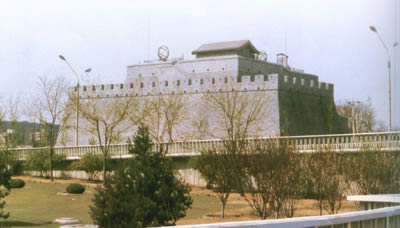
Jesuit missionaries Matteo Ricci, Johann Adam Schall von Bell, and Ferdinand Verbiest served as court astronomers and mathematicians to Chinese Emperors. For over two centuries, they used the Beijing Ancient Observatory to introduce European astronomy and reform the Chinese calendar, which secured imperial protection for their Catholic Mission.The ancient observatory in Beijing China, once part of the city walls, is mounted on the battlements of a ten-meter watchtower close to the “First Ring”. As one of the oldest and famous observatories in the world, it covers an area of 10,000 square meters. The observatory dates back to Kublai Khan’s days when it was north of the present site, and Marco Polo writes:
There are in the city of Khanbalu…about five thousand astrologers and soothsayers… They have their astrolabes, upon which are described the planetary signs, the hours and their several aspects for the whole year… They write their predictions for the year upon for the year upon certain small squares… and these they sell, for a groat apiece, to all persons who are desirous of peeping into the future…
Likewise, the Ming and Qing Emperors relied heavily on astrologers before making a move. Therefore the present Beijing Observatory was built in 1437 to 1446, not only to facilitate astrological predictions but to aid seafaring navigators. Here a short overview:
The Jesuits
The Jesuits, scholars as well as proselytizers, found their way into the capital in 1601 when Matteo Ricci and company were permitted to work with Chinese scientists. The Emperor was keen to find out about European firearms and cannons from them.
The Jesuits outdid the resident Moslem calendar-setters and were given control of the observatory, becoming the Chinese court’s advisors. Of the eight bronze instruments on display (including an equatorial armillary sphere, celestial globe and altazimuth) six were designed and constructed under the supervision of the Belgian priest Ferdinand Verbiest, who came to China in 1659 to work at the Qing court. The instruments were built between 1669 and 1673, and are embellished with sculpted bronze dragons and other Chinese craftwork, a unique mix of east and west. The azimuth theodolite was supervised by Bernard Stumpf, also a missionary; the eighth instrument, the new armillary sphere, was completed in 1754. It’s not known which of the instruments on display are the originals.
The Ancient Observatory
Ancient Observatory, Beijing was known as the ‘Platform of Star Watching’ during the Ming Dynasty but later the name was changed to ‘Observatory’ during the Qing Dynasty. The name was further changed to ‘Central Observatory’ after the revolution of 1911. After its renovation in 1980, the Observatory has become the, ‘Beijing Ancient Astronomical Display Hall’. Records of astronomical observations run from 1442 to 1929, making it the record-holder for the longest period of continuous sky watching. The observatory was in use until 1929 and restored as a museum 2008(!). Today’s building stands alone, severed from the ancient Beijing city wall that Mao Zedong ordered destroyed to make way for the Second Ring Road. As a result, the observatory sits amidst a graceless jumble of modern buildings and highway overpasses, cloaked in the smog of China’s booming capital. Most would agree that the observatory has seen better days, but it still exists as an impressive and fascinating monument to the history of science in China. It can be reached by taxi and there is aclose underground station,. I directed the cab driver to the ancient observatory east of Tiananmen Square using a printout of the official web page in Chinese with the phone number because my Chinese is limited (non existent). Even then he had trouble to find the entry although from the avenue below, some of the various archaic instruments are clearly visible in the skyline.
This ancient pre-telescopic observatory, the most important in China, was first built in 1422 during the Ming Dynasty, around the same time as the Forbidden City. Covering an area of 10, 000 square meters, the Ancient Observatory of Beijing is one of the oldest Observatories in the world, situated in the southeast corner of Beijing’s Jianguomen Bridge. With more than five hundred years old history, Ancient Observatory is not only one of the oldest but also one of the most interesting historical observatories in the world. It is recognized for magnificence, unrivalled beautiful craftsmanship and best preserved instruments, some according the design of Thycho Brahe. Muslim scholars were also recruited and in the seventeenth century, the Jesuits, who were able to more accurately predict the eclipses, helped to further develop the observations of the stars and the planets. During the Boxer Rebellion, the instruments disappeared into the hands of the French and Germans. Some were returned in 1902, and others (good guess – the German parts) were returned after WWI, under the provisions of the Treaty of Versailles (1919).
The Instruments
Thycho Brahe instruments, the work of his life, became obsolete after the invention of the telescope and got burned, but in Beijing, one can still see them. This is the story, which is full of irony. Following the advice of Jesuit padre Joseph Adam Schall von Bell, a teacher of the heir to the emperor and political advisor of the emperor, the Chinese began to use western computation and measuring systems. Another Jesuit, Ferdinand Verbiest constructed the new instruments. According to some sources, he came out of prison, because Emperor Kang Xi wanted to hear his opinion to the calendar reform, proposed by the emperor’s Muslim court astronomer. In 1669, the Kangxi Emperor was informed that serious errors had been found in the calendar for 1670, which had been drawn up by Yang Guangxian. Kangxi commanded a public test to compare the merits of European and Chinese astronomy. The Jesuit, could outwit his competitor. The test was to predict three things: the length of the shadow thrown by a gnomon of a given height at noon of a certain day; the absolute and relative positions of the sun and the planets on a given date; and the exact time of an anticipated lunar eclipse. Verbiest had access to the latest updates on the Rudolphine Tables, done by Kepler with the inherited observations of Thycho Brahe. Ferdinand Verbiest succeeded therefore in all three tests, and was immediately installed as Head of the Mathematical Board and Director of the Observatory. Out of consideration for him, the exiled Jesuits were authorized to return to their missions. The old court astronomer was deposed, and Ferdinand Verbiest became responsible for calendar reform and this court observatory, which he remodelled then with European instruments.
Having resolved the issues surrounding the calendar, Verbiest went on to compose a table of all solar and lunar eclipses for the next 2000 years. Delighted with this, the emperor awarded him complete charge of the imperial astronomy observatory, which he rebuilt in 1673. The existing equipment was obsolete, so Verbiest consigned it to a museum and set about designing six new instruments, later, Kilian Stumpf designed other instruments, the new Armilla and the Azimuth Theodilite.
Altazimuth, used to measure the position of celestial bodies relative to the celestial horizon and the zenith – the altitude azimuth.
Celestial globe, six feet in diameter, used to map and identify celestial objects.
Ecliptic armilla, armillary sphere, six feet in diameter, used to measure the ecliptic longitude difference and latitudes of celestial bodies. (This was the traditional European device while the Chinese developed the equatorial armilla.)
Equatorial armilla, armillary sphere, six feet in diameter, used primarily for measuring true solar time as well as right ascension difference and declination of celestial bodies.
Quadrant Altazimuth, six feet in radius, for measuring altitudes or zenith distances of celestial bodies.
Sextant, eight feet in radius, used to measure the angle of elevation of a celestial object above the horizon. It is used to calculate the angle between two objects, although it is limited to 60 degrees of arc. In navigation, it is used to take a measure of the angle of the sun at noon to determine latitude.
The flat top, 14 meters (46 feet) high, is home to an amazing array of instruments, some originals and others replicas. Among the most interesting are those that were constructed under the direction of Jesuit astronomers residing in Beijing at the invitation of Qing emperors; designed to Western specifications with superficial Chinese ornamentation, the bronze instruments are examples of the first wave of modern-era scientific collaboration between China and the West. On entering the unassuming entrance of the observatory compound, one can see various sea-faring instruments at the courtyard, including an interesting sundial. In the courtyard of the museum, surrounded by ancient trees, the hall and east gate areas exhibit early astronomical instruments and the methods and changes in making them. In the western chamber some 150 early methods of calculating calendars in China are exhibited. Eight bronze astronomical instruments are arranged on the top of the platform, as per the Qing-dynasty emperor Qianlong’s instructions. One then enters a two storey museum which is a collection of pictures, write-ups and busts to show the ancient Chinese scientists and their various astronomical achievements and a replica of a Ming Dynasty gold foil map of the constellations. On climbing to the roof of the observatory, one is almost alone with those unique giant bronze instruments designed in the Qing Dynasty the celestial globe, dragon quadrant, elliptical armillary and azimuth theodolite by the Jesuits. With the completion of the present observatory, it has housed the replica instruments and served the Ming and Qing astronomers in their star-gazing reports, for the Emperor, the Son of Heaven, is closely tied up with the movements of the heavenly bodies. Considered as a milestone in Chinese architecture, Ancient Observatory, Beijing marks my cultural crossroads between the Orient I admire and the Western Catholizism roots which I admire in my way too (when it is lively, intellectual and strong).
Many of the cities and entire civilizations prospered and decayed along the way in history. The cities of the Silk Road witnessed numerous devastating wars, destructions, fires, famine and death. For centuries those dusty caravan roads were traveled by merchants, warriors, priests and scientists. The story of Nasir al-Din al-Tusi and Hulegu Khan, a Persian Astronomer and a Mongol General, a famous fortress and an observatory started in Alamut north of Tehran back in the late 13th century.. It ended in Maraghah City located to the south of Mt. Sahand,what is now northwestern Iran. From the 14th century onwards only walls of this once famous contribution to science of the Silk Road are left. It is a story of science and religion, of superstition and assassins, of violence and betrayal, a story of empires and caliphates built and lost.
In 1971 and 1972 I traveled parts of the Silk Road on my way from Europe to Syria and later to Afghanistan. The road stretched for thousands kilometers leading caravans across scorching deserts, picturesque oases, and mountain passes but obviously travelling through the USSR was not possible at this time.
The Silk Road originated in Chang’an, the ancient capital of China, and went along the northern Tien-Shan to Dunhua, the city near the Great Wall of China. There the single road split bordering the Taklamakan desert from the north and the south. The northern way went through Turfan to the Ili river valley. The Middle road (the so-called Southern way) led from Zhang Qian to the southern coast of Lake Issyk Kul- via Khotan and Yarkand, and reached Bactria (northern Afghanistan). There the Southern route split in two other roads: one followed to India, the other to the West and Merv where it merged with the Northern route. Further it passed via Nisa, the capital Parthia, Iran, Mesopotamia, Bagdad, went to Damascus and reached the Mediterranean. The Nestorians and in the Middle Ages the Venetian merchant Marco Polo travelled the caravan routes. It was the German researcher Ferdinand Richthofen who coined the term the Great Silk Road in his fundamental work, “China”, in 1877.
Along the Silk Road – Alamut and Maragha
Science is international and transreligious. Science is like building a house. Each builder puts up a stone. These stones do not have religion, even if the person has. It’s irrelevant who put up the next block. Al-Tusi put up a block, while working for the Mongol general Hulagu Khan, very much like a few hundred years later Kepler, a Protestant working for the (kind of) catholic general Wallenstein. Hulagu Khan, the grandson of Genghis Khan, hardly a savage, but from his mother Nestorian and later Buddhist fought Islam. He built this observatory in Maragha for and with the help of this Persian astronomer, named Al Tusi. The observatory at Maragha was built to accommodate al-Tusi and many others from many places, who worked eagerly for the destroyer of the Islam Empire. Let’s go back to the history of those two men.
The General Hulagu Khan
The Mongol military leader Hulegu Khan believed as Wallenstein to the advice of astronomers (who were also astrologers), especially of Nasīr al-Dīn al-Tūsī who was a genius like Kepler. Tūsī then served under the Mongols as an advisor to Īlkhānid ruler Hūlāgū Khan, becoming court astrologer. Hulagu Khan, (1217 – 1265), was a Mongol ruler who conquered much of Southwest Asia. Son of Tolui and the Kerait princess Sorghaghtani Beki (both Nestorians), he was a grandson of Genghis Khan, and the brother of Arik Boke, Möngke Khan and Kublai Khan. Hulagu’s army greatly expanded the southwestern portion of the Mongol Empire, founding the Ilkhanate of Persia, a precursor to the eventual Safavid dynasty, and then the modern state of Iran. Under Hulagu’s leadership, the Mongols destroyed the greatest center of Islamic power, Baghdad, and also weakened Damascus, causing later a shift of Islamic influence to the Mamluks (slaves who formed an elite army under Islamic control) in Cairo. It was also in Hulagu’s reign that historians switched from writing in Arabic to writing in Persian.
The Astronomer Nasir al-Din al-Tusi
Nasir al-Din al-Tusi (1201 – 1274) of Persian origin was one of the greatest scientists, mathematician, astronomer and philosopher of his time. He was born in Tus in Khurasan (now Iran) to a family whose notion of learning was the study of religious law and how it was practiced. However, his jurist father encouraged his son to study the philosophical and natural sciences. Educated first in Tūs, where his father was a jurist in the Twelfth Imam school, the main sect of Shīite Muslims, al-Tūsī finished his education in Neyshābūr, about 75 kilometers (50 miles) to the west, an important center of learning, where he studied philosophy, medicine and mathematics and earned a reputation as an outstanding scholar. Nasir al-Din al-Tusi tried to travel to Baghdad to pursue his studies and to join the caliph’s court, still a young man when the Assassins made him an offer he couldn’t refuse. In about 1227 the Ismāiīlīte governor Nādir al-Dīn Abd al-Raiīm granted al-Tūsī “sanctuary” in his mountain fortresses in Khorāsān. Al-Tusi became astrologer in the castle of Alamut, a fortress which was the headquarters of the terrorist Assassins.
The fortress Alamut
Alamut – Eagle’s Nest
Found in the central Alborz Mountains of Iran, Alamut Castle was built into the rock in the 9th century. The name means Eagle’s Nest. The capital Tehran of today, is over 100 kilometers away to the southwest. The natural geographical features of the valley surrounding Alamut largely secured the castle’s defence. Positioned atop a narrow rock base approximately 180 meters above ground level, the fortress could not be taken by direct military force. To the east, the Alamut valley is bordered by a mountainous range called Alamkuh (The Throne of Solomon) between which the Alamut River flows. Under the residence of Nasir al-Din al-Tusi Alamut became also a center for libraries and education.
Hulagu Khan captured and destroyed the Hashshashin stronghold at Alamut in present-day Iran as part of the Mongol offensive on Islamic southwest Asia. When the armies of Halagu, the grandson of Genghis Khan, massed outside the city in 1256, al-Tusi had little trouble deciding where his loyalties lay. In 1256 Al-Tusi gave away secrets of the castle to the invading Mongol army. The invading Mongols led by Hulagu Khan, grandson of Genghis Khan captured Alamut. Al-Tusi joined Halagu and accompanied him to Baghdad, which fell in 1258. Quite interested in the sciences, Hulagu treated Tusi with respect and appointed him one of his ministers and advisor. Later, while serving as an administrator of Auqaf, al-Tusi persuaded Hulagu to build an observatory at Maragha, with al-Tusi as its director as mentioned before.
The observatory at Maragha
Samarkand_observatoire_ulugh_beg
So the astronomical observatory was built in 1259 by the astrology-addicted Hulagu Khan at the behest of his Persian minister who was assisted by Chinese astronomers. The observatory became operational in 1262, lasted and stopped to function within 50 years. In a citadel-like area stood a four-story circular stone building with a diameter of 28 meters. The mural quadrant to observe the positions of the stars and planets was aligned with the meridian. This meridian served as prime meridian for the tables in Zij-e Ilkhani, as the meridian applied today passes the Royal Greenwich Observatory. The Maragha observatory consisted of a series of buildings occupying an area 150 meters in width and 350 meters in length. One of these buildings was a dome that allowed the sun’s rays to pass through. Astronomers from across Persia, Syria, Anatolia and even China were gathered at the observatory, and the names of at least 20 of them who worked at the observatory are known. It is believed that several Chinese astronomers introduced several Chinese methods of computation. The observatory had a library with some 400,000 books on a wide range of scientific topics and a school for training specialists in mathematics, science and philosophy.
It was here that al-Tusi did some of his most important work, using the rich library to write on logic, philosophy, mathematics and astronomy with many other scholars. It had various instruments such as a 4 meter wall quadrant made from copper and an azimuth quadrant which was the invention of al-Tusi himself. Al-Tusi also designed other instruments for the Observatory. A number of prominent astronomers worked with Tusi there, such as Muhyi al-Din al-Maghribi, Mu’ayyid al-Din al-’Urdi, from Damascus, and Qutb al-Din al-Shirazi. It also attracted scholars from the Byzantine Empire, most notably Gregory Choniades, who studied under Shams ad-Din al-Bukhari, an astronomer who worked at the famous observatory under al-Tusi. The observatory also attracted scholars from beyond the Byzantine and Islamic world, such as Hulagu’s Chinese astronomer Fao Munji, whose Chinese astronomical experience brought further improvements to the Ptolemaic system initially used by Tusi. After his death, his son was appointed the director of the institution, but it was later abandoned by the middle of the 14th century (!).
A visit to the ruins of the observatory later inspired Ulugh Beg to build 1428 his own large observatory at Samarkand to continue the astronomical research of the Maragha school. This great astronomer, was a grandson of Tamerlane, a Mongol Conqueror who restored the Mongol Empire and himself a descendant of a celebrated Mongol Emperor soldier, Genghis Khan. At that time, the Mongol leaders had converted already from shamanic religions, Buddhism or Nestorianism to Islam. In the end observatories failed to take root in the Islamic dominated countries. It may be fair to assume, that the orthodox Islamic belief system would have been too rigid to adjust to their findings connecting astronomy with astrology which was (like in Christianity) heresy.
Historical Context
The Silk Road did not only promote commodity exchange but also cultural. For example, Buddhism as one of the religions of theKushan kingdom reached China. Together with merchant caravans Buddhist monks went from India to Central Asia and China, preaching the new religion. Buddhist monuments were discovered in numerous cities along the Silk Road. In the first centuries of Christian era Manicheism (originated in the 3rd century in Iran and was a synthesis of Zoroastrism and Christianity) and Christianity (Nestorians) penetrated from the Near East to Central Asia and further to China. In the 13th century the Silk Road was the route for the new wave of Christian doctrine dissemination connected with the activity of Catholic missions. Warriors of Arabian caliphate brought Islāmic doctrine in the 7th century and the Mongolian travelled along the Silk Road in the 12th and 13th century the other way. The Silk Road was not only the source of goods but also information on their making, i.e. technologies. In particular, the ways of silk, stained glass, paper, books, gunpowder and guns production.
Agents of transmission
In the late 13th century A.D., Gregory Chionades travelled from Byzantium to Persia to study mathematics and astronomy under Shams ad-Din al-Bukhari, who was associated with the Maragha school of Nasir al-Din al-Tusi. Chioniades translated many works from Arabic and Persian into Greek, and is probably the person responsible for introducing such Persian innovations as the so-called “Tusi Couple” to the West. The transmission of Tusi’s work from Iran to the West is discussed in Otto Neugenauer’s History of Ancient Mathematical Astronomy. Choniades later translated the Zij-i Ilkhani into Byzantine Greek and took it to the Byzantine Empire. Al-Tusi’s deftness and ideological flexibility in pursuit of the resources to do science paid off. The road to modern astronomy, winds from Athens to Alexandria, Byzanz, Baghdad, Damascus and it was traveled not just by astronomy but by all science. In the end the observatories and science failed to take root in the Islamic dominated countries. It may be fair to assume, that the orthodox Islamic belief system would have been too rigid to adjust to their findings. Furthermore Islam (as Christianity) was connecting astronomy with astrology, which was heresy. Western Renaissance thinkers later sought out in Europe’s monastic libraries and this crumbling Byzantine Empire and Greek and Arabic works of natural sciences, philosophy and mathematics. The transmission of the Arabic, Persian and Indian astronomy (and astrology),did indeed exist, and was important but used many routes.
The fall of the Roman and Persian Empire
After the fall of the Western Roman Empire in the late 5th century, the Byzantine (East Roman) and Persian Empires dominated the world scene for a while. In Western Europe books were made using parchment which made them enormously expensive. In the eight and ninth centuries the Almagest was translated first into Syriac. Under the Islamic rule, Jews and Christians participated in the state of Dhimmni, significantly to art, medicine and philosophy, which endured for at least 500 years and spread from Spain to Persia. However, by the end of the 11th century AD, the Golden Age was over for many reasons including political/economic stagnation and foreign attacks. The great families who supported the translation movement and promoted advancement of science and philosophy in Persian, Byzantine and other territories were eradicated. The Muslim schools were fully established and were dominated by the fundamentalists where political ideology emphasized fate over reason. The Hellenistic cultures of Egypt, Syria and the Holy Land with its’ Greek and Syriac elements and the Byzantine (Turkey) did not survive. They lost their language and their culture of scientific tradition and enquiry. Persian culture partially survived but empirical knowledge and scientific traditions were lost. Astronomy like other branches of empirical science was virtually vanished and like medicine was only revived in the 20th century.
The Rise of the Islam
Commanded by the Koran to conquer and utilize all resources, and inspired by a treasure trove of ancient Greek learning, Muslims took over a Syrian, Jewish and Christian intellectuals and knowledge. Later the Chinese and Indian Science was adopted. The Arabic language must be used as official language of the oppressors. The rise of Arabic to the status of a major world language is inextricably intertwined with the rise of Islam.
When Muhammad’s armies swept out from the Arabian Peninsula in the seventh and eighth centuries, annexing territory from Spain to Persia, they also annexed the works of Plato, Aristotle, Democritus, Pythagoras, Archimedes, Hippocrates and other Greek thinkers. The largely illiterate conquerors very effectively turned to the local intelligentsia to help them govern. Although the Babylonians, Indians and Egyptians had astronomical observatories, those founded under Mongol (operated by Persian, Indian and Chinese) rulers in Maragha and Samarkand were sophisticated, equipped with an impressive array of astrolabes, sundials, sextants, celestial globes and armillary spheres. Muhammad, the prophet entrusted by God to deliver the Islamic message, Arabic had become the official language of a world empire whose boundaries stretched from the Oxus Riverin Central Asia to the Atlantic Ocean, and had even moved northward into the Iberian Peninsula of Europe.
Science Achievements
al-Tusi’s Maragha in Alamut
Although al-Tusi later said he had been held in Alamut against his will, al-Tusi thrived there, publishing works on astronomy, ethics, mathematics and philosophy that marked him as one of the great intellectuals of his age.
al-Tusi’s Maragha school
Al-Tusi’s Maragha school had a library with some 400,000 books on a wide range of scientific topics and a school for training specialists in mathematics, science and philosophy. Al-Tusi enhanced the Ptolemaic model, however, it remains a fact that the Maragha school never made the big leap to heliocentric system of Copernicus not to speak the first physical correct and accurate model of Kepler. [Toby E.Huff(1993)].
In the Ptolemaic system, as shown below the planets and sun moved in small mini-orbits
To clarify a current and often copied myth, the influence of the Maragha school, say on Copernicus remains speculative, since there is no documentary evidence to prove it and even if it were, it was negligible to Copernicus’ (see below) and irrelevant to Kepler’s achievements . But Al-Tusi was an outstanding Persian scholar on his own rights, however, who wrote around 150 books in Arabic, Persian, and Turkish, with sixty-four treatises known to have survived. Many were consolidated accounts of what others had previously written. But he also made many original contributions, most particularly in mathematics. He was the first to treat trigonometry as a separate science, rather than just a set of tools for astronomy. He edited the definitive Arabic versions of the works of Euclid, Archimedes, Ptolemy, Autolycus, and Theodosius. His most famous astronomical work is the four-volume Al-Zij-Ilkhani (Astronomic Tables of Ilkhan), dedicated to Hulagu Khan. It is an accurate table of planetary movements, based on the research carried on at the Maragha Observatory. Al-Tusi’s main contribution to logic is contained in The Ground for the Acquisition of Knowledge. Al-Tusi’s commentary on Ptolemy’s Almagest, called the Tadhkira fi ilm al-Haya (“Memoir on Astronomy”) is a most thorough discussion of Ptolemaic astronomy.
The Zij-i Ilkhani tables
The result of his astronomical observations and calculations were compiled in the famous tables of the Zij-i Ilkhani originally in Persian. A range of evidence leads to the assumption, the nature of the “Chinese” calendar had been brought to Iran by this Chinese Taoist Fu Mengchi who accompanied his ruler Hulegu Khan. He informed Tusi of the calendar, which Tusi described in the Zij-i Ilkhani. The Chinese calendrical system was then included in the Zij of Muhyi al-Din Maghribi in the period immediately thereafter, and it was practiced only among the Mongol ruling class and their Buddhist servants, who were called “Uighur.” In reflecting on this social situation, Muhy i al-Din labeled the “Chinese” calendar as the “Chinese-Uighur” calendar, and this title succeeded to the later zijes, one of which became the first focus for analysis of the “Chinese” calendar. Thus, the calendar was attributed to the Uighurs, who surely played an important role in the nascent period of the Mongol empire. It is natural that there are similarities between the Chinese Heavenly Agreement Calendar and Season-Granting Calendar, as several previous studies have noted. These calendars were all used or compiled in accordance with the same intellectual foundation, Tusi the Chinese system. Studies on the Mongol empire shown that, while its warfare was cruel, was not at all (science) cultural ignorant as the Western history claims until today.
The (in)famous Tusi Couple
geometric construction, recently known as al-Tūsī couple
Al-Tūsī’s most influential book in the West may have been “Treasury of astronomy”. It gave a better mathematical model (but not the reality) of planetary motion to appear in medieval times. Al-Tusi appears to have been the first to discover that if one circle rolls around inside the circumference of another and if the second circle has a radius twice, that of the first, then any point on the periphery of the first circle describes a diameter of the second. His manuscript and his ingenious device, now known as the “Tusi Couple.” solved a centuries-old problem that plagued Ptolemy and other Greek astronomers more accurate: how circular motion can generate linear motion. By means of this construction, mathematical essentially a geometric way to achieve a Fourier Transformation, al-Tusi succeeded in enhancing the accuracy of the Ptolemaic geocentric models, producing a system in which all orbits are described by uniform circular motion. The Tusi couple is a 2-cusped hypocycloid obtained by rolling a circle of radius inside a circle of radius 2a. The result is a line segment which replaced the simple different. In the Ptolemaic system, as shown below the planets and sun moved in small mini-orbits, known as epicycles, within a larger, greater orbit around the earth, was comprised in order from closest to farthest as Mercury, Venus, Sun, Mars, Jupiter, and Saturn. By means of this construction, al-Tūsī succeeded in adding value to the Ptolemaic geocentric model, producing a system in which all orbits are described but still a uniform circular motion round the earth.
Copernicus heliocentric model
There is a common misconception that the Copernican model did away with the need for epicycles. This is not true, because Copernicus was able to rid himself of the long-held notion that the Earth was the center of the Solar system, but he did not question the (both wrong) assumptions of uniform and circular motion. Thus, in the Copernican model the Sun was near at the center, but the planets still executed uniform circular motion about it. As Kepler discovered, the orbits of the planets are not circles, they are actually ellipses.
Copernican model, with it assumption of uniform circular motion, still could not explain all the details of planetary motion on the celestial sphere without epicycles
As a consequence, the Copernican model, with it assumption of uniform circular motion, still could not explain all the details of planetary motion on the celestial sphere without epicycles. The difference was that the Copernican system required many fewer epicycles than the Ptolemaic system because it moved the Sun nearly to the center and needed it for different reasons. In the Copernican system, it can be seen then that epicycles are unnecessary as a means to explain retrograde motion. His actual reason for this was because planetary observations indicated that even when the slowing down and speeding up of the observed planets due to retrograde motion was precisely accounted for, the planets still nevertheless did not seem to travel at uniform speed about the sun. Rather, the observations clearly demonstrated that they appeared to travel faster through space when closer to the sun and slower when further away from it. Indeed, this noted fact that the planets did not maintain a constant distance from the sun at all times in their orbits led Copernicus to offset his major orbital circles so that they were not precisely centered on the sun. Thus, in holding fast to his circles, and through his conviction that the speed of the planets was uniform, he was forced to retain small planetary epicyclical orbits as a subtle way to account for the continued presence of their apparent non-uniform motion about the sun. This was really nothing more though than a mathematical manipulation employed in order not to have to discard the primary aspects of his system; to allow it to better match actual observations; and also to allow him to claim that any observed non-uniform motion was not real, but illusory. A planet in orbit about the sun is travelling anti-clockwise in its epicycles and also anti-clockwise in its main orbital circle; the centre of the smaller circle moving in uniform motion upon the circumference of the larger circle. When positioned at P1 the combined speeds of both ‘orbital circles’ are pointed in the same direction and thus are added. The picture above (left) from the book III chapter 4 is often referred as a planetary model similar to al Tusi as it bears indeed some resemblance. However, its purpose is just to show “How the reciprocal movement or movement of liberation is composed of circular movements.
Copernicus Venus
The models for inferior and superior planets of Copernicus are quite differently – shown below on the left (Venus) and below right (Mars).
Copernicus Mars
I fail to see, why a heliocentric model using epicycles’ needs help of an geocentric mode using hypocycloids as some Islamic historians claim. This necessitates that the planet is at this moment travelling at its fastest in orbit about the sun. From this initial position, as the planet moves yet further about the sun on its main circle, the uniform speed of the planet in its epicycle is such that by completing half of its main orbit about the sun, reaching point P2, it has completed one full orbit of its epicycles. At this point, the main orbit is counter to the direction of that of the epicycles, and thus the planet, at its most extreme position from the sun, is travelling at its slowest. If one were to plot the actual path of one full orbit about the sun, the planet would be found to trace out an elongated circular path as opposed to an exact circle. Such is the result of combining two uniform circular orbits in the proscribed manner. Upon the issue of system accuracy, one should note that the Copernican system actually afforded mostly a lesser level of precision than that of the Ptolemaic system. Indeed, Copernicus’s continued use of epicycles was in fact necessary simply to allow it to achieve the same level of accuracy as was present under the Ptolemaic system. Without them, although the general ordering of the planets about the sun would have been correct, the predictive power of the system would have been even weaker.
Kepler’s breakthrough – the first physical correct model
Due to Ptolemaic system ability to fairly accurately predict the paths of the observable planets in the sky, it remained widely accepted well after Copernicus defined the heliocentric theory. Even then, Ptolemy’s system was still better able to explain the motions of the planets. Also Galileo’s support of a heliocentric theory of Copernicus model, was with the wrong arguments.
Kepler’s Model
It was not until the later addition of Kepler’s laws of motion and elliptic orbits until the heliocentric theory fell neatly into place that and his model become of practical use. Only Kepler provided later the mathematic laws, and broke the 2000 year obeying usage of circles, which made the heliocentric model more accurate than the Ptolemaic model. Whether Earth centered or sun centered, it is impossible to know which if any is based upon truth. The Astronomia nova is a book, published in 1609, that contains the results of the astronomer Johannes Kepler’s ten-year long investigation provided strong arguments for heliocentrism and contributed valuable insight into the movement of the planets and provided better results and accuracy. The orbit of every planet is an ellipse with the Sun at one of the two foci. A line joining a planet and the Sun sweeps out equal areas during equal intervals of time. The square of the orbital period of a planet is directly proportional to the cube of the semi-major axis of its orbit. In 1623, Kepler at last completed the Rudolphine Tables. In 1628, following the military successes of the Emperor Ferdinand’s armies under General Wallenstein, Kepler became an official advisor to Wallenstein just like Tusi to the Mongolian emperor.
Science in Islamic dominated countries
There is no question that at that time astronomy and science flourished in the Islamic dominated countries. The truth it was based on the Chinese, Indian, and Christian roots and local intelligentsia in countries under Islamic control responsible not Islamic science. Coming back to Al Tusi. Syrian, Arabic and Persian Astronomers writing in Arabic at that time did certainly more than simply read and fine tuning Ptolemy. However, they never questioned geocentricity. According to the philosophers, celestial bodies were supposed to move in circles, the ideal form and with uniform speeds. But the complexity of Ptolemy’s attempt to explain the very un-uniform motions of planets and the Sun as seen from Earth was marred by corrections like orbits within orbits, known as epicycles, and geometrical modifications. Al-Tusi was just adding pairs of cleverly designed epicycles to each orbit to Ptolemy’s model.
Science in the Byzantine Empire
The Byzantine Empire, centered at Constantinople, maintained complex relations with the Eastern Orthodox Catholic Church. Within this reign, Greek remained a common language among the native tongues of the Syrians and Arabs. Because Greek continued to be spoken and scholars still had a direct access to many Hellenistic libraries. In fact, the era following the fall of Rome and preceding the rise of Islam was the age of Byzantium. The famous library at Alexandria was burned by invading Arabs in the 8th century. When we speak of the fall of the Roman Empire, we should not forget that in fact only the western portion of that empire succumbed to the Germanic invaders. In the east, the eastern Roman, or Byzantine, Empire stood for a thousand years as a citadel against the threats of expansion by the Muslims until 1453. The Byzantine Empire made great contributions to civilization: Greek language and learning were preserved for posterity; the Roman imperial system was continued and Roman law codified; the Greek Orthodox church converted some Slavic people and fostered the development of a splendid new art. Situated at the crossroads of east and west, Constantinople acted as the disseminator of culture for all people who came in contact with the empire. Called with justification “The City,” this rich and turbulent metropolis was to the early Middle Ages what Athens and Rome had been to classical times until it was laid in ashes. Little primary resources of Byzantium contribution to science are therefore available, and its place in the history has been written by the victors. In the early seventh century (610-645) Emperor Heraclius in Constantinople took an interest in astronomy and he, or his astronomer Stephanus produced a commentary on Ptolemy’s “Handy Tables”. It was not a climate that astronomy or any scientific study could thrive. Instead, the few educated people who could preserve some of the books and knowledge of the past, looked back on Ptolemy’s achievements in awe and reverence.
Arab Science
Early Arab science succeeded more in pragmatic applications as it did in theoretical concepts. However, a new empire was now expanding; this was the empire of Islam. The Prophet Mohammed (570-632) and his followers the Caliphs had built up a vast empire, which included Egypt, Syria and Mesopotamia. The common language of the empire was Arabic, the language of the Koran. The Abbasid Caliphs built themselves a new capital in 762, Baghdad. In this very early period, Arabic astronomy was influenced by Indian astronomy. Indian astronomy had been influenced by Greek ideas from the time of Alexander the Greats conquests in the east. From the 750’s onwards the use of paper was introduced into the Islamic dominated countries from China. This made books much cheaper to produce and encouraged scholarship.
The Renaissance which did not happen
Some scientists and historians call for an ”Islamic science”, but most argue successfully that a religious conservatism has dampened the skeptical spirit necessary for good science. ”Civilizations clash,” Islam is an example of that. As discussed before, some historians of a so-called Islamic astronomy – whatever that may be – believed that some knowledge developed at Maragha found their way to Europe (perhaps via Byzantium) and provided Nicolaus Copernicus (1473–1543) with inspiration for his usage of the Tusi Couples. In this case Al Tusi was a Persian scholar working for a Nestorian / Buddhist ruler, and is it needs to be noted, that even if this may be possible, the Tusi Couple have little to do with the real revolution of the heliocentric model not speaking with the introduction of the elliptic curves. Nor was the Tusi Couple central in Copernicus’ achievement, or his model more accurate. That does not chip anything away of the outstanding achievements of Al Tusi. The conservatives in Islamic culture up today still favor the geocentric model, never having the fundamental will to break up religion doctrine and science.
Conclusion
Geocentrism was not the result of a priori deduction from first principles, but rather the result of empirical observation and experience. It was the best hypothesis, given the data possible at the time. It was not until Kepler that a heliocentric model was developed that worked better; and not until Newton was there a reason to believe that it ought to be physically true. Don’t forget that the real revolution of Copernicus was the revelation of the earth not being the center of creation. Mathematical and empirically his system was inferior to the Ptolemaic system and a similar device as the Tusi couple was marginally used once. Mathematical and empirical it was Kepler and Newton who switched astronomy from the math department to the physics department, and people began to wonder if these purely mathematical models might be physically true. Ptolemaic astronomers had never claimed physical reality for their epicycles.
The attitude of conservative Muslims to science was not so much hostile as schizophrenic, wanting its benefits but not its world view. They may apply modern technology, but they don’t deal with issues of religion and basic science. One response to the invasion of Western science, in particular in the internet, has been an effort to ”Islamicize” science by portraying the Koran as a source of scientific knowledge, very much like some Christian do. The requirement that Muslims face in the direction of Mecca when they pray, for example, required knowledge of the size and shape of the Earth. Astronomy in the East reached its zenith, at least from the Western perspective, in the 13th and 14th centuries, when al-Tusi and his successors pushed against the limits of the Ptolemaic world view that had ruled for a millennium. But the East had no need of heliocentric models of the universe and never went beyond. All motion being relative, it was irrelevant for the purposes of Muslim rituals – and is for all practical purpose of observation with the eye – whether the sun went around the Earth or vice versa. Among other things, the Islamic empire began to be whittled away in the 13th century by Crusaders from the West and Mongols from the East. Today, science still lags there, but a lot of money is spent to deconstruct and re-write science history with a little help of science- and history-ignorant media.
Sources:
The Rise of Early Modern Science – Islam, China and the West, Huff, Toby E.
The Biographical Encyclopedia of Astronomers, Springer Reference. New York: Springer, 2007 (via web)
Astronomy and astrology in the medieval Islamic world, Edward Stewart Kennedy
Cosmos An illustrated history of astronomy and cosmology, John David North
On the revolution of heavenly spheres (Niclolaus Copernicus)
The Fontana history of astronomy and cosmology, John David North (German Translation)
Aristote au Mont-Saint-Michel, Sylvain Gouguenheim (German Translation)
Sources by excerpts: Astronomy in the service of Islam,
David A. King Islamic astronomical instruments ,
David A. King A History of Arabic Astronomy, George Saliba Digital International Astrology Library
J. A. Boyle, “The Longer Introduction to the Zij-i Ilkhani of Nasir ad-Din Tusi”, Journal of Semitic Studies (1963)
E. S. Kennedy, A Survey of Islamic Astronomical Tables, Transactions of the American Philosophical Society