Category: West

Western Philosophy

  • “Don’t be a maybe” – a Junganian view of postmodern, post-metaphysical, post-philosophical neo-pragmatism

    “Don’t be a maybe” – a Junganian view of postmodern, post-metaphysical, post-philosophical neo-pragmatism

    That movie title “Do the Right Thing” – “Don’t be a maybe” of Spike Lee would not fly today. Rather Raymond Chandlers “The Big Sleep”. Maybe. Something feels not right any more. Specifically the “Right” (as opposed to Wrong not to Left) is an endangered species. One has to decode first all the Western mental systems before separating Wright from Wrong! Right? For example, is neoliberalism good or bad from a Gender perspective? “On the one hand”, says the young woman, “it fosters the image a sexless and faceless human capital against patriarchy“ – break – however, it is an antisocial, undemocratic élite project.

    My observation is that philosophy is going through a bit of a dry spell at the moment. Philosophy flowered beautifully from Plato, through the medieval ages, to the majestic insight of Kant and the last great unlikely prophets of our post-modern times, Nietzsche and Wittgenstein. But the last century was not kind to philosophy and it gets progressively worse. For all practical purposes science has taken over ontology and cosmology; pragmatism has taken over ethics, pseudo-religions have been taken over metaphysics, the Dow Jones social relevance; and psychology has taken over epistemology. Analytical Psychology is the most wide-ranging kind of psychology, unafraid to deal with anything. Jung was a pioneer who were “cutting edge” in his day. He was very much aware that knowledge was evolving rapidly, but his concept of collective archetypes contradicts postmodern relativism.

    “Don’t be a maybe”

    "Don't be a maybe"
    Generation Maybe

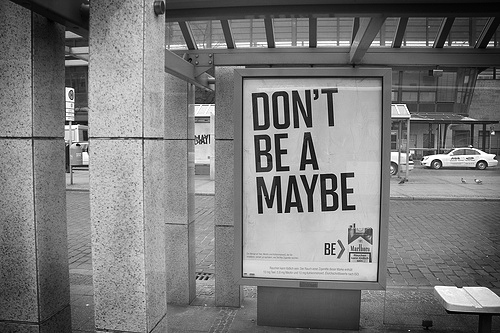
    Lets face it, in the West we live in a world of Maybe-Academics, Maybe-Journalist, Maybe-Analysts, Maybe-Churches and of course Maybe-Politicians. We, ourselves, are the Generation ” Maybe“. One cigarette company advertises with the slogan Don’t be a maybe”, but universalism is just as out as the truth, the evil and the good. One rather says „Yes, but“ and has learned that knowledge and facts are social constructs, all so-called facts one has to seen in the society-political context. We generate worlds, through generating languages, according to the “post-metaphysical”  philosopher Wittgenstein. Since him, an immense power has been awarded the language. The postmodern/deconstructionist claim „Nobody who has not made the experience, while something what is absolutely clear in one world, that in another world something absolutely differently can be equally clear, is able to talk even today competently.“ Scary really.

    Not, nevertheless, for Richard Rorty, for him even the existence of the dinosaurs beyond the language was unlikely: “The world does not speak. Only we do. The world can, once we have programmed ourselves with a language, cause us to hold beliefs. But it cannot propose a language for us to speak. Only other human beings can do that.”  For Jung, as for later cognitive psychologists, the human mind is not a simple, passive, externally programmed machine.  Our minds are part of the universe, participants in the same laws that created the universe. We are made, as Christians believe, in Gods image. Richard Rorty was a popular professor of philosophy at Princeton University and at Stanford University – sometimes called neo-pragmatist, for whom scientific and philosophical methods form merely a set of contingent “vocabularies” which  post-philosophers abandon or adopt as they please.  We old people shake our heads about the Wischiwaschis aka transitory trendy studies”. Mrs. Schavan, a so-called “modern christian” (and politician longtime responsible for education and science in Germany), recently lost her PhD title, because  essentially used copy cat in her PhD thesis. Here rather uninspiring doctorate was about truth and ethics, isn’t that funny?

    The Maybe Academics

    truth-is-out-of-fashion
    truth-is-out-of-fashion

    But they shape the world.  Historian in the meantime, pursue less fact research, they track now down narratives. Traditional historians believe, that primary sources should be used to research history, whereas  postmodern historians claim because of a different age in a different culture, the historian of today has no way of interpreting these sources accurately,therefore again they are not to be trusted and rely more on secondary sources and individual perception of historical events. Personally,I think post modernists are just too lazy to do proper, real research. Postmodernism has brought history dangerously close to the fairy tales. Postmodern historians, a term that, by its own definition, is difficult to define, is a line of thought still remains the discipline of choice of many historians today. It is best known, and equally best hated, for its relativism. For instance, R.G. Collingwood constantly states in `The Idea of History’ that history is the `history of thought.’ While the history of humanity itself may not have a purpose, the writing of historical accounts does. Resonating with Foucault’s approach to history is the view that the writing of history should promote an ideology.

    Truth is the story of the past told at present for present purpose.
    History is the story of the past told at present for present purpose.

    If, as Foucault declares, a claim to knowledge really is nothing but an attempt to overpower others, then retelling history serves the purpose of gaining power. This rewriting of the past to serve a purpose, known as revisionist history, contributes to empowering minorities. Thus feminist histories attempt to expose a male-dominated, patriarchal past and point the way for empowering women. Likewise, gender preference histories are put forward (in response to gender-preference-phobic repressions) to provide equality for all gender-preferences.  Religious histories emphasize the horrors of, say the crusade, to redress past misbehavior of the other side. Every repressed group—minorities of all colors, ethnicities, nationalities, and gender—has an injustice that must be exposed in order to rectify the abuses of the past –  except the White (Anglo-Saxon) Male, as the late NY mayor Ed Koch once quipped.

    The Maybe Journalists

    Meanwhile, Journalist promises in the “real” world of quality medias “facts, facts, facts”, and serve either opinions or sponsored, well, also narratives. There is no doubt that many produce not only (usually) left-leaning editorial and op-ed pages, but some news coverage was among the finest in the world.

    Embedded Journalism
    Embedded Journalism

    When did we reach the point where news articles in the established media were considered suspect? And if news in the quality medias can’t be trusted then what news sources can be? We truly reached the age of Post-Modern Journalism. Postmodernism, among other things, is the denial of objective truths, so Post-Modern Journalism would be the denial of basic facts. And it is. The Benghazi disaster, the involvement of trans-national financial powers in the Banking crisis, made smartly to an Euro crisis, Syria activism, or the Arab spring turned to Brotherhood winter are all a typical examples of a status in which baseline facts are in constant dispute. Post-Modern Journalism then is what happens when we – as a society – can no longer agree to these facts. When journalists can no longer collect, verify and report on the facts of a story – because the facts are in a constant state of contradiction – then we have reached the point of Post-Modern Journalism. The consequent step of traditional embedded Journalism of the Gulf Wars is the   “secret service and elite-embedded   Journalism”  in crisis . A multiple “news sources” at least claiming to be objective journalism but with varying definitions of what the baseline”facts” and “truths” has been replaced by single source  / view journalism (especially evident in  TV News).  It is any wonder that so many people no longer believe what they read and see from news organizations when we’ve reached this point? When any facts about the origin and political beliefs are under dispute or plain disinformation how can we trust anything written? The result is news organizations with different factual foundations – and ever skewing toward their audience’s perspectives. In simple terms: FOX-News vs. CNN or The Daily Beast vs. Blogs. There has been much ink spilled worrying about how the Internet is destroying journalism, but the change from the Post-Modern Journalism to Maybe Journalism is the real threat. It does not help, that Newsweek comes since January over Whisper Net.

    The Maybe Churches

    Confused Religions
    Confused Religions

    In the modern age, staunch atheists and, even worse, confused and misleading theologians have severed the link between humanity, the Church and the Creator: hence the mutation of human failures into systemic misbehavior.  So, because ideas have consequences, we cannot afford to overlook the effects of the radical “Maybe” in ethics and churches.  If everything is mere fiction, or even largely so, then those who deny, for example, the Nazi holocaust are validated , then Jesu and Hitler cannot be used as examples of good and evil. There are no “facts, there is no moral.” There are only various degrees of fiction.

    POSTMODERN RELIGION
    POSTMODERN RELIGION

    Jung, however, affirmed that the human unconscious, expressed spontaneously in religious practice, myth, and literature,transcends mere subjectivity. It is kind of perception, through us as a thing-in-itself, of things as they really are and by pouring into consciousness, it is the personality of the universe becoming self-aware. More than even many today’s theologians, Jung took seriously that the God of the Bible is a personality, and an omnipresent, and evolving one at that. Hence, Jung agreed that the Bible is on to something, namely, that consciousness and personality are not mere artifacts of electrons and energy-events, they’re a natural outgrowth of Creation, fundamental ontological characteristics of the universe itself. By including this biblical perspective he avoided one of the biggest failings of post-metaphysical philosophy, namely the denial of the reality of consciousness. In any mechanistic worldview, a view intuition is only used to make materialistic gains, truth becomes a victim of complexity. Not so for Jung.

    If one searches for contemporary courageous and outspoken critics of relativist ideologies, beside the stepped down pope Benedict XVI, finally, the truth finishes to be a valid currency. The airwaves are full of theologians like Küngs and other ex-catholic judging his truly modern (and truly anti-postmodern) pontificate after he stepped down.  Benedict XVI announcing resignation on 11 February 2013, only two months after his decision to join twitter could not have finished on a less coherent note. It has been said he stays on twitter. I have been a follower, and one can hope the ope never read the often disgusting comments I observed. Benedict XVI, soon Joseph Ratzinger again, has relied on the unbending and strong faith of a bright gifted Bavarian country boy: doctrinal solidity has been his asset as theologian and bishop, then, as the Prefect of the Congregation for the Doctrine of the Faith; and finally, as Pope Benedict XVI, the re-evangelizer of Europe in the name of faith -and- reason.  Since his early years, small is beautiful was his recipe, against the background of a world, and a Church, going crazily secular and going crazy. Catholicism teaches that our failures are the inevitable consequence of the original sin.

    Over Cross
    Over Cross

    Joseph Ratzinger was defined by what he saw as the spreading of Marxism in German faculties of theology after the Second Vatican Council.To him a polluted theology and a God-free philosophy of the 1960s and the 1970s produced anarchy. Acclaimed by Catholics worldwide as the greatest theologian of his time, and as the most powerful Catholic cleric he has inspired the Church, and stood firmly against the post modern, secular and relativistic age, within the church and outside.  In Benedict XVI,  a very old man when he was elected, the mixture of softness and hardness, of weakness and strength was inextricable. He fired one Jungian theologian and still was so typical Jungian. In this, of course, stepping down is not about diminishing the leadership and not about relinquishing control either.  Despite the isolation of his retreat in  the territory of Vatican City, he will be there. I found it remarkable that he read his announcement in Latin. He must have felt, that post-modern clerics are in the wait and huge tensions await the Catholic Church. The Pope has anticipated this decision often, and yet he is giving the Papacy a depth-psychological spin, once more acknowledged the Shadow of the Church. Benedict XVI will be remembered for this dramatic departure. The theologian who held relativism as the worst foe of the Church, will be a decisive Pope who may have led the church outside of this God-less, sterile post-modern mess. Even, if it is more than likely that he was hunted down by (financial) powers.

    Jung and truth

    Broadly speaking, philosophy can be broken up into four basic types of truth-claims: Empirical, Pragmatic,Subjective, and Rationalistic.

    • Empirical systems hold that reality is that which is observable, verifiable, and replicable. It’s major deficits are three. One, that there are some things, especially cultural and emotional phenomena, which are real, important, life and death issues that are not so predictable.Two, Empiricism leads to some untenable conclusions. Three, our knowledge is limited.
    • Pragmatic systems, like the bottom line question, “Does it work?” It’s danger is that purely practical”truth” can change,inaccurate beliefs and evil actions can be practical, hence, by Pragmatic standards, true. It would have been eminently practical, for example, in the 1930’s in Germany to believe in the inferiority of the international money system. Pragmatism too easily lends itself to self-centered ethics. Believing something is not enough to make it really True.
    • Subjective system especially in post-modern thought, since Nietzsche hold that reality is a matter of personal perception. Contemporary post-modern subjectivism  as shown above, loves to protest “hegemonic” world views, defend reality as social construct, and explore truth as defined by “power” relationships.There are  strengths three deadly dangers. One is that it is inherently negative. It protests and deconstructs, but chronic skepticism makes no real contribution and it allows anyone to retain any idea they wish by simply labeling contrary ideas and even evidence as “opinion”. The major danger is solipsism. All the assertions, “God exists.”, “Terrorists kill.”, “Activists kill”, and “lasagna taste great.” become the same in the end.
    • Rationalistic, systems particularly modern logic realizes that observed data may be flawed and is definitely limited. “Facts” change as observations improve and knowledge grows.  The weakness of this school is that every meaningful assertion must be tested in the real world.

    Empiricism and pragmatism are materialistic, subjectivism and rationalism are idealistic. Since Wittgenstein all of them spend a great deal of time discussing language as the medium of the philosophical enterprise. Jung, allowed elegantly with  his four function and synchronicity a synergy,.Being something out of his empiric scope, did not mean to him  it does not exist. What probably intrigues me most about Jung is his ability to bridge the gap between apparently different viewpoints, without post-modern relativism and connecting into the wide world of religion, history, anthropology, and philosophy. He does this primarily by distinguishing between the psychic functions while remaining adamant that they are necessarily complementary to each other. In this, Jung describes (in his ascetic,cross-cultural way) that naive post-modern thinking is too simple. We are not a tabula rasa nor a language programmed machine. Our Sensations provide facts to our Intuitions, our Intuitions provide organization for our Sensations. Sensations are not always reliable, but our intuition solve equations that describes intangible knowledge virtually perfectly.

    Conclusion

    George Soros made almost $1 billion since November from bets that the yen would tumble
    George Soros made almost $1 billion since November from bets that the yen would tumble €, USD will be next.

    Post-modern subjectivism is a tool to create complexity in order to hide reality and dress up totalitarian systems as pragmatic. Public faces of this unholy alliance of neoliberalism and neo-pragmatism are for example Mrs. Maybe-Merkel and Mr. Maybe-Obama. Of course they can be decisive holding on to their office. You vote for them. Those, however,  are only the first layer of the matrix.

    Definitely no “Maybe’s” is “star investor” Soros, one face behind those public faces. Behind him there are  G&S and other finance clusters,  for which we are less than a muppet.  Mr. Soros owns own analysts and is regularly in Davos publishing his views where and when he pleases.  Those behind the faces rule you in reality – say if you believe what Maybe Journalist and the Maybe Academics tell you. And if you listen to the Maybe Clerics, most likely you will not go to heaven either.  So the confusion of this young women is understandable. An antisocial, undemocratic élite project uses conveniently, whining, nihilistic depression, humanistic godlessness, subjectivism and linguistic niggling as it became the norm today.

    What do you think? Can reality be objective? Should it at least strive for objectivity? Or is this state of Post-Modern “ironism and confusionism” a permanent condition?

  • Queen, Mother, Wise Woman and Lover: Rediscovering the Archetypes of the Mature Feminine

    Queen, Mother, Wise Woman and Lover: Rediscovering the Archetypes of the Mature Feminine

    This article complements the concepts explored in my article “Archetypes of the Mature Masculine” and applies them to the other half of humanity—women. In doing so I apply the same principles, not in a mechanistic way, but in the spirit of Jung’s archetypes and their rationale. Let’s start with a few words of C. G. Jung himself, when he talks about the Anima.

    Feamaland Male Shadow Triangle
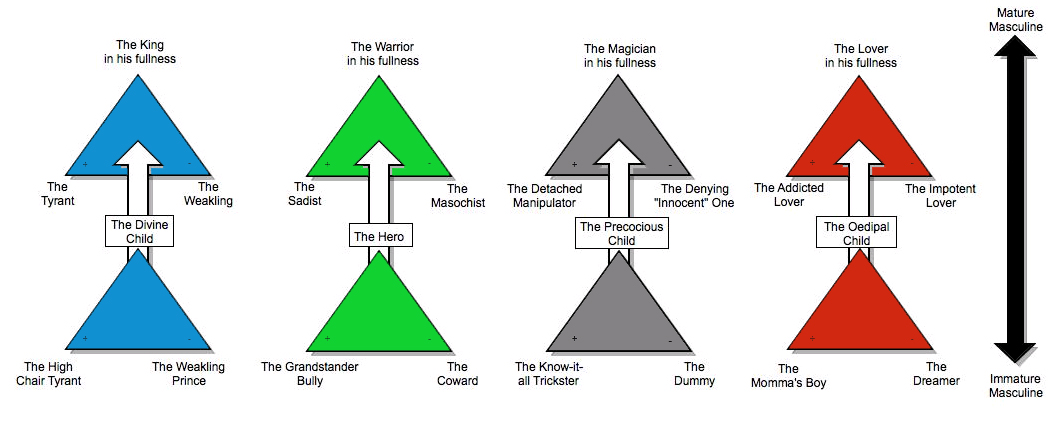
    Male Shadow Triangle Source: King, Warrior, Magician, Lover: Rediscovering the Archetypes of the Mature Masculine by Robert Moore and Douglas Gillette

    Thomas Moore and Douglas Gillette adopted and extended Jung’s approach in their exploration of the masculine psyche by using the collective archetypes of the King, the Warrior, the Magician, and the Lover. Obviously those four male archetypes can be translated and mapped in female clusters of virtues, specific attributes associated with four major female archetypes: the Queen, the Mother, the Wise Woman and the (female) Lover found in history and  myths. This has been done before.

    Jean Shinoda Bolen, a Jungian psychiatrist, published in 1984 “Goddesses in Every Women: A New Psychology of Women”. She came up with seven feminine archetypes, based on ancient Greek mythology. Each Goddess represents a primordial image for women’s personality; they are: Hestia, Athena, Demeter, Aphrodite, Hera, Artemis, Persephone. Jennifer Baker and Roger J., Woolger in 1989 included only six of the Goddesses taking away Hestia. I think that is still a bit inflated, narrow and not powerful enough. I get lost on the many fairies and goddesses, and I miss the most powerful female Archetype – The Mother – of which C.G. Jung had written at great length.

    Toni Wolff, colleague and presumable lover of Carl Jung, identified four feminine archetypes:  Mother, the Amazon, the Hetaira, and the Medial.  Wolff at the first glance comes closer, but her model is a male-centered quadruple (male Anima structure) instead a male-female archetype symmetry: This is most evident in Wolff’s definition of the Amazon, who represents more a female in good contact with  her Animus, furthermore the semi-divine Queen is missing, while her Hetaira is not quite a full lover.

    Emma Jung, the wife of C.G. Jung, wrote two very concise papers about Animus and Anima. Those two functional complexes represent symmetrically the personality component of the opposite sex and, at the same time the image of the opposite sex. By their fundamental nature, Animus and Anima symbolize primal masculinity and femininity in general. In other words, the Anima figures represent the archetype of the feminine. Emma Jung gives various narratives of the Great Mother like Cybele, of Prophetess and the Love Goddess and animal or mixed human-animal semi-goddess motives like the swan-maiden in the Edda. Emma Jung refers to her husband, stating the male archetype is the one of meaning and the female archetype primarily of life. And indeed, life as such to me is about birth and death – between is wisdom, spirituality and individuation (redemption), if one is unlucky only staring at the Dow Jones.

    To me the reproductive Mother archetype is not only neatly symmetrical to the destructive warrior archetype, it is definitely a primary one. No individual is completely masculine or feminine though, good or evil, right or wrong. Tyrants and Weaklings for instance represent an imbalance, a shadow or missing quality of power, a failure to employ virtues, and a negative female Archetype drains away all male energy. Females in myths representing the Anima appear often in multiples e.g. three or nine like the Nordic Valkyries. Quadruple qualities, however, take later in account the important (particularly for C.G. Jung) number four. A quadruple seen by C.G. Jung might be thought of as the cross, a mantra or cardinal points that must be balanced in the fully realized being.

    Archetypes

    C.G. Jung totally differs from Sigmund Freud and most of his colleagues in that he thought (wo)men as “homo religious”. Freud’s deep fear of spiritualism was rooted in his urge, to establish psychoanalysis as science. Jung’s own approach to religion was complex, unorthodox, and open to the speculative ranging from affinity to Catholicism and Eastern thoughts to gnosis and alchemy. He recognized and valued collective cultural patterns (archetypes) but also individual enlightenment or at least development to find a person’s whole being (individuation).  He felt those were dismissed by modern positivistic science and political systems which recognizes only the material world and denies or claim any spiritual dimension (totalitarian systems with personal cult).
    The acceptance of the spiritual dimension allows us to understand holistic a person, society, cooperation —the complex of (conscious and unconscious) beliefs, attributes, and virtues that defines that entity.  Key to this understanding is Jung’s concept of the archetype. According to Jung, “The concept of the archetype is derived from the repeated observation that, for instance, the religious myths and fairytales of world literature contain many symbols which are manifestations of those archetypes”. There is a good book from his former assistant Jolande Jacobi about archetype, symbols and complexes to clarify Jung’s slight ambiguity using those terms over his lifetime.

    Proposed set of female Archetypes

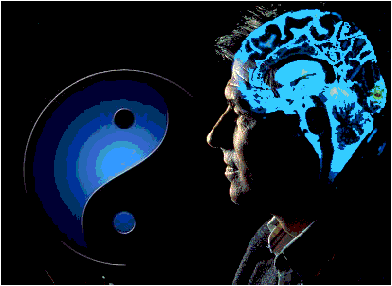
    Significantly, female in myth and art can serve as vehicles for both the understanding and the modeling of these female archetypes. Jung’s theoretical framework of the human psyche follows Taoist principles and is remarkably symmetrical; the extrovert is balanced by the introvert; the material outer world by the inner world, the masculine principle—the Animus (Yang within the Yin) — is balanced by the feminine principle, the Anima (Yin within the Yang). Jung also favored strongly the number four and following Jung’s idea of the complementarity of opposites, a similar foursome archetype can be identified and used to provide a foundation for the understanding of the unique qualities that characterize the female psyche.

    All four representations of the archetypes have one positive (right amount – fullness) and 2 negative poles (deficit or surplus). For example, the positive lover archetype embraces the world with passion whereas the negative poles are the seductive (or promiscuous) lover and the frigid (or selfish) lover. One can see every woman (or girl) somewhere between these three extremes.

    • The Queen is the semi-divine leader responsible for the safety and well being. History and art have shown that every society must have not only a wise leader who is entrusted with guiding his people to success and comfort but navigate in unknown territory towards redemption. The responsibilities of the Queen are mainly on the unconscious side, but worldly benefits and virtues must be many as well. And if the Queen fails in her duties she is traditionally disposed and evil prevails. Her shadow sides are tyrant and weakling both disposing male energies.
    • The Mother is like the Warrior today the most controversial of the archetypes, because of  ideological former and current stereotypes. The two male (warrior) shadow sides are the Sadist and the Masochist. The Mother is a life giver who maintains humanity as the warrior clears the space for renewal and change. The prototype of the mother is, well – the mother.  But there are shadows here too – the careless and the devouring mother.
    • The Wise Woman, represents Logos according to Jung a feminine principle, is the archetype behind a multitude of professions like doctors, but also lawyers, teachers and priests. She sees the unseen. She is the prophetess, mediator and communicator of secret knowledge, the healer, counselor, teacher, and spiritual. The Wise Woman always has a tendency to abuse her power, being the negative , the witch.
    • The Lover like the feminine principle Eros manifests energy and fertility of the nature. The gendering of Eros and Logos and synergy is a consequence of Jung’s anima/animus synergy. Lovers are at ease with our own deepest and most central values and visions. And only through union of the feminine and the masculine our culture and personality prospers and grows. The “me- society” of the impotent is sterile and without compassion and destroys any spiritual dimension.

    All these roles could be fulfilled by one person. The shaman as a holistic archetype has the King’s capacity to lead, the Mother’s capacity to care and the Lover’s capacity to value someone or something enough to fight.

    C_G_JUNG_FEMALE_ARCHETYPES
    C_G_JUNG_FEMALE_ARCHETYPES Copyright @fallenangel, permission to mirror on fair usage policy with reference to owner.

    Despite the visible presence of men in political power and economic power in various cultures, social and hidden political power has been disproportionately exercised by women. Western culture has its religious sources in the Jewish-Semitic and the Greco-Roman political and philosophical traditions and of course Christianity. They were distinctly patriarchal on the outside, but quietly influenced by women. The success of Christianity was mostly based on  reaching out to females essentially with ancient female archetypes. Christianity entered the drama of ancient life—and, in particular, Roman urban culture—rather late in the play. Savvy architects with great insight —not to mention foresight— understood  ancient female archetypes as critical success factor for the spectacular growth rate of Christianity. If you look at the gospels and apocrypha  and the early church, you find little patriarchy at all. I have written here in my “Jungian journey through a land of heretics and Mary Magdalene” how vivid the archetypes of lover (Mary Magdalene), mother ( Holy Mary)  and wise women were.

    In the Western, Eastern and Orthodox political, religious, and economic spheres, however, the majority of kings has been male. In those cases, where women have been called upon to lead empires, they have exercised male-like leadership, even literally assuming a male role. Nonetheless, most cultures, including Hindu and Buddhist regarded women’s roles in the family highly. Tribal societies, of course dominated by the male Warrior archetype, have integrated the original matriarchal social system in parallel. All of these cultural frameworks employ both powerful male and female symbolism. Honor and respect is not enough. However. It is quite ironic, that in such a geographic proximity, there were major civilization, one as Egypt, which thrived on freedom for women for almost two thousand years, and others, predominantly some Muslim context, because having been much more restrictive of female freedom, have arguably suffered distinctive social and economic disadvantages, but gaining now not only demographically for this very reason.

    The Queen – Power

    The Faerie, the Goddesses—The Great Mother, the Wise Woman and the female Lover are found within the secondary C.G. Jung literature and in feminist and/or New Age books Goddesses are everywhere. Not so the Mother and only as a recent addition the Queen. As is the case with her male counterpart, the King, the Queen is the most holistic and temporal (worldly) of the female archetypes. But also the most simple to map to the Moore model. There have been weak and evil Queens and Kings at all times. The image of Queen serves as a center for the mature ordering of things; it includes and transcends the other archetypes of the Feminine. Ideally, all “leading” human would, to a greater or lesser degree, embody the ideal King or Queen. Now it  is evident, that the “Good King” in the temporal realm is an archetype of a good statesman. But recently we have many female leaders of the state. The acceptance is with ease, but they reflect more often an archetype of the Mother than of the Queen. One female politician’s nickname is even  “mom” and this is uttered in the context of the cold cruel mother. Why those symbols can be created so easily? Because, as we see below, all this female archetypes were here for thousands of years. Tell me what calendar (lunar, solar, event) you have and I can tell in which archetypical context you live (open or hidden). As societies moved from pre-historic to complex civilizations, their calendar system adopted from nature and weather calendars to direct observation and lastly to calculated calendars (see here). In these transitions, the switch from lunar calendars to solar calendars (pure solar, lunar-solar or solar-lunar) represented changing dominance of male or female archetypes (see here).

    The Queen
    The Queen

    In former times, the worldly Queen was also a priest, warrior and mother – sometimes even the ultimate archetype, the Self or goddess. It was rare, but did happen. One example, born in the 15th century BC, Hatshepsut, daughter of Tuthmose I and Aahmes, both of royal lineage, gained the throne upon the death of her father. To have a female Pharaoh was unprecedented. Although there were no wars during her reign, she proved her sovereignty being a master politician, and an elegant stateswoman with enough charisma to keep control of an entire country for twenty years.  In all, Hatshepsut accomplished what no woman had before her. She ruled the most powerful, advanced civilization in the world, successfully, for twenty years. Another  example, the mother and the father of a family would model them. In those not so rare cases where women become leaders of nations, the archetypical Queen may take visible form, wise or foolish, caring or cruel. Just as the King is not born as a King, but must start life as a divine child, so does the Queen. A powerful embodiment of this archetype is the Pharaoh, like in Egypt were those roles merged. Another example is Nefertiti, who oversaw the first semi-monetheistic attempt. Here the Queen Nefertiti and the Heretic Pharaoh Akhenaten became a mediator to an all-powerful God abstraction, the source of complete cosmic power – the sun (see here) and below.  As is true of her male counterpart, the Queen was the symbol for the leader of a nation as divine couple. However, all the essential attributes of the archetype of the Queen are present in any real woman wherever she plays a leading (if only herself) role, regardless of the scope her real responsibilities—be she queen of an empire, a nation, a clan, or her own family.

    The Mother – Creator

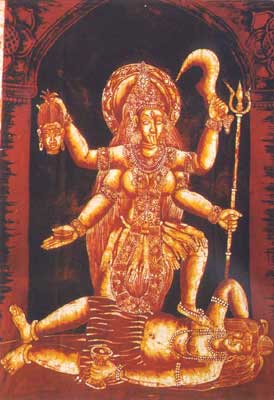
    This is the one archetype that is distinctly different for male and female development. Just as the Warrior is the most natural complement to the King and embodies a set of virtues that are necessary to defend the Kingdom, the Great Mother is the most natural complement to Queenship – and the King. The explosive, destructive energy of the  male Warrior archetype is balanced by the reproductive energy of the female Mother archetype. This is most evident in Kali-Ma the terrible mother. The Hindu religion has a myriad of Gods and Goddesses  and the most revered Goddess is Kali. She is usually pictured wearing a necklace of skulls and girdle of human hands, dancing on the body of her consort, Shiva. In many attributes the Mother clearly complements the Warrior. Wagner’s Valkyries, those tough maidens who took worthy fallen warriors to Valhalla also served as sources of inspiration for heroic action. Just as the Warrior appears most fully when he gives himself over to death in an act of self-denial, the Mother appears most fully when she gives birth. Warriors take life, Mothers give life. This is the source of her power. Both places them outside any human power; thus, she has the power to inspire, to create. Kali, in this aspect is said to be “The hungry earth, which devours its own children and fattens on their corpses.

    The great and cruel mother
    The great and cruel mother

    But the Mother archetype is also the symbol of all that is fair, all that is beautiful, all that transcends material existence. These concepts are not merely ornamental niceties, but are at the very center of Being. Indeed, in their mythological thinking, the Ancient Greeks recognized the importance of Skills in their concept of the Nine Muses—each the inspiration and source of such humane gifts as poetry, music, and history.  In their philosophical thinking, the Greeks recognized Beauty is an essential attribute of the Absolute Good. The Mothers’ virtues are intangible and ethereal; they often had been be self-sacrificial.  Consider the holy Mary and the real-life women who have embodied legions of Virgin-Martyrs venerated by the early Church attest to the power of the self-sacrificing, inspirational but unreachable mother. As a powerful archetype the “feminine” aspect the Mother come up in the Christian quadruple  conception of the Holy Mother.

    Like all archetypes, the Mother can appear as a shadow, the distant and cruel mother. Like any shadow, the cruel mother is not bad or evil. The cruel mother energy links  itself to the male archetype counterpart the warrior. Both are associated with death and destruction – actual physical death.  For instance the Hindu goddess Kali embodies a cruel mother, whose destruction is in the service of creation.

    The enigmatic chief queen Nefertiti (Neferneferuaten) of Akhenaten’s (Echnaton) is the most mysterious and interesting of all the ancient Egyptian queen and an example of a possessive mother symbol. Little is known about her and his overpowering mother Tiye  influence on the androgynous Pharaoh, who brought down the Egyptian empire with his daring cultural and religious revolution (see here).  After a few loving years, in which the couple celebrated publicly family life with six children, they separated. Close to her end, she reacted again, as it is believed that Nefertiti sent a frantic letter to the Hittite King Suppiluliumas after Tutankhamun died, begging the longtime enemy of Akhenaten and Egypt, for a marriage with one of his sons.

    cybele
    cybele

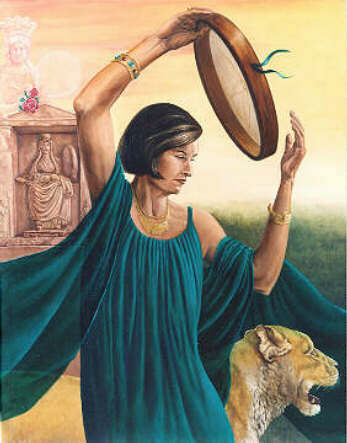
    In one of the oldest cults imported into Rome, the Great Mother Cybele’s major attributes was, that she protected people at war and, as such, was often shown wearing a crown of city walls symbolizing the defense she offered adherents. Also, as an earth-mother deity in origin, she bestowed fertility and governed creatures of the wild—ancient portraits show her riding in a chariot pulled by lions—and in both aspects she appealed to the Roman public whose lifestyle was still, for the most part, agrarian. Besides that, her powers included the ability to cure disease and predict the future, making Cybele an all-purpose deity if ever there was. I have written here about the  clash of male and female Archetypes in classical Rome. She was an ancient fertility goddess whose worship is thought to have spread from Anatolia to Greece in the Archaic period (c. 800-500 BC) and mysterious rites were performed in the name of Cybele — as they were for the other earth mother type goddesses, like Demeter and Isis. It is worth to note the ambiguity, which makes it possible to align many female mother archetypes with the lover and the warrior but not the queen.

    The Wise Women – Spirituality

    I like to think that psychoanalyst Sabina Spielrein a woman in the shadow of C. G. Jung and Sigmund Freud (see here), resembles the archetype of the Wise Woman or Queen (in exile). The archetype of the Wise Women inhabits not ethereal regions where all appears as bright and luminous, the Wise Women inhabits like the magician the shadows. She is at home near the earth, even inside the earth, inside the dark, moist, primordial womb, the source of all fertility. The Wise One is no longer young. She started as precious child, but is mature now, rooted. She is likely to be old. Like a priest, she may have even loved, but she has now transcended all sexuality and reproductivity and has reached a state of superior wisdom.

    The Wise Women
    The Wise Women

    Also in contrast to her male counterpart—the Magician— a non spiritual mind seeks not to penetrate beneath the surface of things and probe the mysteries of nature, rather, she looks inward into the mysteries of Being. This earthly knowledge extends to the body and more specifically to the very distinct realities of the female body, with its mysteries of fertility and procreation. Women who knew this much were much respected and feared. Mary Magdalene might be one of the wise women, Kassandra was one and in a way every midwife. Male resented them and worldly institutions persecuted this source of feminine power because it lay out of their control.  Antigone was one The mortal daughter of Oedipus and Jocasta she openly defied her evil uncle King Creon to bury her brother, Polydices. Creon sentenced her to be buried alive. Many Wise Women were later  accused of being “witches”.Saint Augustine of Hippo, the most influential Christian theologian argued around 400 AD that, neither Satan nor witches had supernatural powers and only pagan can believe this. In 1208, however, Pope Innocent III opened an attack on Cathar dualistic heretics who believed in a world in which God and Satan, both having supernatural powers, in a perpetual war. Many adherents of this secret dualistic sect had migrated into Germany and the Savoy where the first witch hunt started. It was natural for both Wise women and Magician, to seek separation from the world, but being a single woman – especially with low status and without children, was a major source of suspicion. Their quest for special knowledge requires long hours of solitude for study and reflection. Most often, both become a seer, an adviser. The Queen of Sheba, one of the most famous figures in the Bible visited King Solomon in Jerusalem after hearing of his great wisdom. According to legend, King Solomon was not only the wisest man in the land, but he also had magical abilities and could command demons. The Queen of Sheba tests Solomon’s wisdom, asking him many questions and giving him riddles to solve. He answers to her satisfaction and then he teaches her about his god Yahweh and she becomes a follower. The two most famous queens of Egypt Hatshepsut and Nefertiti  were also high priests and Wise One’s. Another powerful and inspiring embodiment of the archetype of the Wise One outside Christianity, is the gnostic Figure of Sophia.

    Sophia__Wisdom
    Sophia__Wisdom

    As equally powerful Christian archetype the “feminine” aspect the Wise Women come up in the Christian Trinitarian conception of the Holy Spirit. Who is Sophia? Literally, she is Wisdom, because the Greek word Sophia means “wisdom” in English. More than that, she has been revered as the Wise Bride of Solomon by Jews, as the Queen of Wisdom and War (Athena) by Greeks, and as the Holy Spirit of Wisdom by Christians. Solomon was considered to be married to Sophia. One of the many layers of symbolism attributed to the Song of Songs (also known as Song of Solomon or Canticle of Canticles) is that it speaks of Solomon’s marriage to Holy Sophia. Sophia surfaced in the Eastern Christian tradition with the construction of the Hagia Sophia cathedral in Constantinople (converted to a Mosque 1453 and today a Muslim museum in Istanbul). Sophia has survived in the West today, in the form of Gnosticism. Sophia plays a very active role in Jung’s Answer to Job (Hiob), where she also completes  Quaternity.

    Lover – Eros

    The fourth archetype of the mature feminine is the Lover, or Eros. The Lover is a life-affirming and sometimes hedonistic archetype which dislikes rigid order and sterile knowledge. But without love, without compassion those are nothing. I would argue that self-sacrifice belongs there too. The lover energy, arising as it does from the Oedipal child, is the source of spirituality and fertility. It is the attachment of the child to the parent of the opposite sex, accompanied by envious and aggressive feelings toward the parent of the same sex.

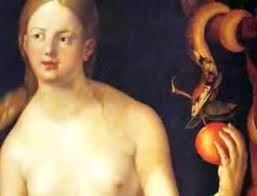
    The Sin Adam and Eve
    The Lover

    A powerful female mythological archetypical lover complex runs deep in Eastern and Western Civilizations. In the cradle of civilization, it started with Astarte and Ishtar. Some scholars hold Astarte was a prototype of the Virgin Mary. Their theory is based on the ancient Syrian and Egyptian rituals of celebrating Astarte’s rebirth of the solar god on December 25th. Other counterparts are Isis of Egypt, Kali of India, and Aphrodite and Demeter of Greece and Venus of Rom. In China you have the archetype of the Green Snake and White Snake and the holistic archetype of Tao, which to me is the perfect example of the Self, integrating female and male love..

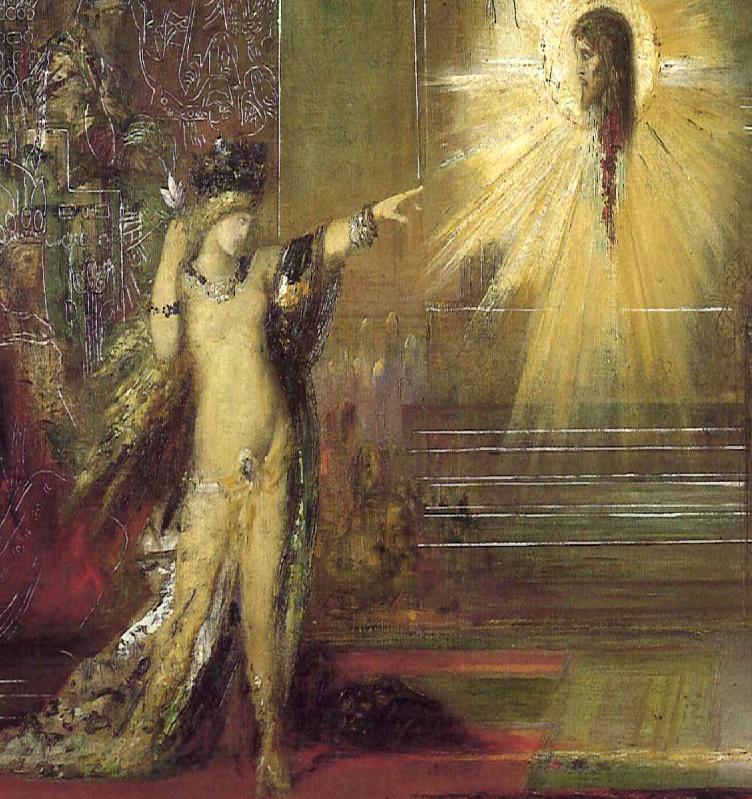
    Thus, the Lover intrudes powerfully into humanity’s collective consciousness and enthusiastic, connects with followers, inspiring them to accomplish the difficult deeds. The intoxication of love opens an alternate reality with its own truths which separates those in the grip of the Lover from mundane concerns. Thus, as is the case with the male Lover, the female Lover gains enormous powers of transcendence, but she, and he, are subjected to “the other” and therefore lack the freedom of the other archetypes. This is the power and limitation of the hierosgamos—the cosmic marriage of opposites. Without Jesus, our life would be meaningless, incomprehensible; Jesus explains our life. Joan of Arc, whose last recorded words before she was burnt at the stake were: “I pray you, go to the nearest church, and bring me the cross, and hold it up level with my eyes until I am dead. I would have the cross on which God hung be ever before my eyes while life lasts in me. Jesus, Jesus!” It appears again that the Lover archetype is essential. Of course, there is also the dark story of Salome, the infamous daughter of Kind Herod, has fascinated many painters for centuries. Paintings of her equally infamous dance with John the Baptist’s head evoke a sensual, evocative atmosphere.Salome’s story first appears as a fragment in the New Testament Gospel of Mark, where she dances in exchange for the head of John the Baptist on a silver charger, at her mother’s behest. In the Gospel version, the burden of wickedness thus falls upon Salome’s mother, Herodias, and Salome’s virtue remains ambiguous.

    salome-with-the-head-of-st-john-the-baptist
    salome-with-the-head-of-st-john-the-baptist

    Salome dances as a femme fatale for her stepfather, Herod Antipas, defying Herodias. The beheading of the Baptist is Salome’s own idea, for which she will pay with her own ghastly death. Nevertheless, John, the Evangelist, comes to prepare the way of Messiah with a new gospel of love, succeeds in coaxing the Judean princess to a personal epiphany, for the soul of Salome is not the same fetid sink as her mother’s. “Speak again,” Salome exhorts him, “Thy voice is as music to mine ear…. Speak again…and tell me what I must do.” But just when a prophet’s wisdom might have done some good, John is out of ideas, saying: “I will not look at thee. Thou art accursed, Salome….”

    Conclusion

    What can we learn from the examination of the archetypes of the mature feminine ? First, female like male, in order to fulfill their wholeness properly, would do well to embody the best qualities represented by all of their archetypes. When men and women do this, they model these archetypes inspire both of them on the path of virtue and spirituality. The archetypes are viable because they furnish us with a short-cut, an intuitive way to grasp the essence of a group of attributes that connects directly with the unconscious mind. Instead of patient intellectual analysis of each individual attribute of leadership, the ethos of each archetype is immediately accessible through a complex of cultural pattern which are instantly recognized even trans-cultural. These archetypes are emotional and spiritual pictures that have an immediate effect on individuals and groups. This effect is readily apparent when one compares the phrase “The Good King” with “a King who is good, strong, wise, just and so on”. The first phrase is incomparably richer in context and seems “alive” compared to a list of adjectives to describe a particular King. It evokes an instant visual image that has an immediate appeal. This is why the old Greek epics, the Bibles stories and Wagner’s opera are so powerful.

    Archetypes – actually “archetypes per se”- are, are cultural patterns and by their very nature, are universal and here to stay. Like the physical heritage, stored in our genes, cultural patterns are saved in our collective consciousness. They can be invoked or forgotten, or even suppressed. But even in materialistic, matriarchal or patriarchal cultures, that are hostile to spirituality, to the male. or the feminine, archetypes cannot forever be suppressed. Once more, external like internal suppression of archetypes is a case of too much, or of too little, of a needed cultural model for humanity to survive and for the individual to live a meaningful life. However, archetypes can be invoked as symbols any time — hence their power to manipulate, to motivate, to influence. There is much to contemplate in these archetypes which can be mapped with political, mythic and culture examples. The self-evident interpretation and its usefulness is overwhelmingly convincing.

    Women should be aware of her animus and thus with the aspects of the four male archetypes and for men to mature, they must meet and integrate their anima and learn from the four female archetypes. How does it look in your family or relationship? Suppression of an archetype only results in denial of attributes and spiritual resources that we, as humans, need. If one comes to terms with the Shadow and the Soul, one will encounter the enchanted castle with its King and Queen. This is a pattern of wholeness and individuation. The opposites of the outer and the inner life are now joined in marriage. Great power arises from this integration. Be aware of pretended or real archetypes in the public realm. For example, look at your (male or female) politicians: Does one of them have the virtues of those positive archetypes?

    Looking beyond herself, women should care how and if divine couple symbols (syzygy images) are invoked. Pharaoh and his Queen, Christ and the Church, God and Israel are syzygy images. Do we still have Divine Couples (Syzygy) and Divine Triads in the spiritual realm? The believer who aspires to be the “bride of Christ” is modeling his or her experience in response to the syzygy archetype. Next our hope is from the Child Archetype, a pattern with a promise of new beginnings. The birth of the Christ Child who unites Heaven and Earth, God became Man and God, is one of those powerful archetype creating a triad. Triads, like for example the Egyptian triad of Isis, Osiris and Horus are predecessors symbols of the Trinity. When the Mother Archetype joined the Holy Trinity Jung’s Quaternity was formed.

    What I am trying to say in a nutshell, is this: Good Kings (and Queens) need to encompass two Quaternities. Not only take care of your own set archetypes, which enhances your temporal virtues, we need also to understand our opposite sex archetypes – of our Animus or our Anima. According to C.G. Jung this will lead you to our Shadow, and if we integrate the Shadow, that opens us to our Self – the divine in us – or at least a communication path to it. God or goddesses are both holistic and androgen. The yin yang symbol from ancient China represents the belief that everything in the universe consists of two forces that are opposing but in need for each other. The Great Mother Cybele was Mother (in a narrow sense) and Warrior symbol.

    Copyright 2011-2014 stottilien.com – Text and illustrations may be used indicating stottilien.com ownership.

    Bibliography Links

    • Emma Jung. Animus and Anima – Two Papers
    • STRUKTURFORMEN DER WEIBLICHEN PSYCHE wolff Structural forms of the Feminine psyche (http://ufdc.ufl.edu/AA00001582/00001)
    • C.G. Jung Four Archetypes (Routledge Classics)
    • C. G. Jung Archetypen (dtv, Bd. 11)
    • King, Warrior, Magician, Lover: Rediscovering the Archetypes of the Mature Masculine by Robert Moore and Douglas Gillette (Aug 16, 1991)
    • Tao Te Ching The idea of the Ying-Yang duality
    • Jacobi, Jolande, Die Psychologie von C. G. Jung – Eine Einführung in das Gesamtwerk, mit einem Geleitwort von C. G. Jung [Gebundene Ausgabe]
    • Jacobi, Jolande, Complex/Archetype/Symbol in the Psychology of C.G. Jung (Bollingen Series) [Englisch] [Taschenbuch]
    • Theologische Aspekte der Tiefenpsychologie von C. G. Jung (Patmos-Paperback) (German Edition) by Herbert Unterste (1977)
    • Mandala: Bilder aus dem Unbewussten (German Edition) [Hardcover] 2.Auflage Olten 1977
    • Jung, C. G., Jaffé, A. (1962): Erinnerungen, Träume, Gedanken von C. G. Jung. Aufgezeichnet und herausgegeben von Aniela Jaffé. Olten: Walter
    • Jung, C. G., Kerényi, K. (1951): Einführung in das Wesen der Mythologie. Zürich: Rhein
    • C. G. Jung Grundausgabe CW 18

    See slide show with some basic concepts of C.G. Jung. Press buttons to change slides manually or switch to full screen:

    Google

  • From language games to mysticism – Allan Watts and Wittgenstein’s Tractatus

    From language games to mysticism – Allan Watts and Wittgenstein’s Tractatus

    This article explores Wittgenstein’s Tractatus as a mystical, metaphysical insight in the light of Eastern philosophy, Catholic mysticism and C. G Jung. Please be gentle and read this as an (intuitive) essay not as a scholarly article. There are methodological implications of Wittgenstein’s doctrine of silence for transcendental philosophy, Zen Buddhism, psychoanalysis and metaphysics. Or there is a line from Lao-Tse to Wittgenstein, connected by Jung and Watts.

    Wittgenstein’s Tractatus-Logico-Philosophicus,(Logisch-Philosophische-Abhandlung,1921 translated by C.K. Ogden 1922) is much closer to me than his work  Philosophical Investigations (Philosophische Untersuchungen,1953 translated by G.E.M. Anscombe). Simply because I understand the Tractatus largely transcendental (similar to Allan Watts). A fellow blog author (Recollecting Philosophy), who knows definitely more about philosophy and Wittgenstein than I do, objected slightly to Allan Watts rating the Tractatus higher than the Investigations,however. 

    In the eighties and early nineties during my time in California  I picked up Allan Watts thoughts. Allan Watts knew C.G. Jung well and both were quite knowledgeable in Eastern Philosophy. Watts proposed that Buddhism could be thought of as a form of psychotherapy and not just a religion. Like Jung he was (to me) a bridge between the ancient and the modern, between East and West, and between culture and science. Both had  considerable problems with the institution of the church, were mystics and in a way certainly religious. Both emphasized that we Westerners cannot and should not escape our Western cultural roots but value them. Both valued Catholicism although Watts view is more bizarre. It’s not difficult to see therefore, that Allan Watts, who became a kind of Guru in California and postmodern mystic, reads Tractatus as a product of mystic consciousness.

    Wittgenstein’s Tractatus 

    Before I had read more of Wittgenstein and secondary literature, I regarded Wittgenstein’s writings as a kind of academic “Glass Bead Game”.  I still think, that what he tried to achieve, could have done simpler by mathematical language (or computer science). Therefore I can relate to Allan Watt, classifying the writings of Wittgenstein “as a form of jnana-yoga, intellectual bending” and that he favors Wittgenstein’s Tractatus.  

    Logic without Mystic
    Logic without Mystic

    The Tractatus is notorious for its interpretative challenges. In Europe we live in a post-metaphysic world. If you approach Tractatus, however, from C.G. Jung’s Symbols as representation of archetypes, which manifest themselves in language (as part of the cultural context which are those archetypes) you see it crystal clear.

    The Tractatus’s structure contains  seven basic propositions translated by Ogden and  Pears/McGuinness. Here I stick with German:

    The seven basic propositions are (in German):

    • 1 Die Welt ist alles, was der Fall ist.
    • 2 Was der Fall ist, die Tatsache, ist das Bestehen von Sachverhalten.
    • 3 Das logische Bild der Tatsachen ist der Gedanke.
    • 4 Der Gedanke ist der sinnvolle Satz.
    • 5 Der Satz ist eine Wahrheitsfunktion der Elementarsätze. (Der Elementarsatz ist eine Wahrheitsfunktion seiner selbst.)
    • 6 Die allgemeine Form der Wahrheitsfunktion ist: [ p, ξ, N(ξ)].Dies ist die allgemeine Form des Satzes.
    • 7 Wovon man nicht sprechen kann, darüber muss man schweigen.

    After three propositions Wittgenstein leaves metaphysics realm but comes back to it with the most elegant proposition seven, which again mirrors a sentence in the bible.  For that reason only 1-3 and 7 will be discussed.

    Proposition (1) The world is everything that is the case.

    Starting with a metaphysics, Wittgenstein sees the world as consisting of facts, rather than of objects and  reads to me like the beginning of the Gospel of John: 

    • Tractatus 1 The world is everything that is the case.
    • Tractatus 1.1 The world is the totality of facts, not of things.
    • Tractatus 1.11 The world is determined by the facts, and by these being all the facts.

     This is poetry to me. Let’s hear what the mystic (slightly Gnostic / Neoplatonic) St. John says:

    •  Jh 1.1 In the beginning was the Logos, the Word, and the Word was with God, and the Word was God.
    • Jh 1.2 The same was in the beginning with God.
    • Jh 1.3. All things were made through him; and without him was not anything made that hath been made.

    Equally beautiful and pretty much the same statement except god is absent. Logos, originally a word meaning “word,” “speech,” or “reason was used by Heraclitus to describe the principle of order and knowledge. There are some remarkable implications here starting of a debate between Plato and Aristotle which I want to move in an area between Wittgenstein and Western (Catholicism) and Eastern Mystic (Taoism and Zen Buddhism) and the psychoanalytic model of C.G Jung.

    The idea of Tao is always stated negatively. The same is true of all its major characteristics, of which I would distinguish three: nothingness, the formless, and the unconditioned.  Again Lao-tse as starting point of our inquiry is strikingly similar:

    • The Tao (Way) that can be told of is not the eternal Tao;
    • The name that can be named is not the eternal name.
    • The Nameless is the origin of Heaven and Earth;
    • The Named is the mother of all things.

     Wittgenstein’s Tractatus – Seen from Eastern metaphysic

    I understand Wittgenstein, who was from the personality type based on C.G. Jung (and like him) an innovative thinker  from the mystic as well as a logic angle. As anybody knows, Wittgenstein was fond of Augustine and Kierkegaard, of Tolstoy and Dostoyevsky and wanted to become a monk on more than one occasion.  Wittgenstein’s Tractatus support my religious views, which are based on Catholicism, C.G. Jung and some pantheistic Asian influence coming from Taoism and Buddhism. There is alignment between Buddhism and psychoanalysis, as Watts stated, although I see goal of alignment more in an integration of the Ego and the main archetypes than a dilution of the Ego. However, Watts followed Zen Buddhism or Zen, a 5th century line of Mahayana Buddhism, which was heavily influenced by Chinese Taoism in China. And Taoism is indeed much more compatible with Wittgenstein,  Jung and Catholicism.

    Crist and Buddha
    Crist and Buddha

    Since I know Taoism and Zen Buddhism better  I will focus on those. Both offer direct access to most deepest essence of our mind, exactly like Jung’s individuation.

     There is good book about that particular topic from Russell Nieli, “From mysticism to ordinary language”, 1987.  He claims, that Wittgenstein’s experience of language (and indeed the language game) was deeply influenced by his experience as rural school teacher, but got stuck there, staying in the uncritical childhood experience (page 244).  Wittgenstein’s language analysis offers no differentiation of what is of value or absurd in a given society. Obviously he received a harsh criticism not only from the Marxist side: “When … Wittgenstein set up the actual use of language as a standard that was equivalent to accept a certain setup and belief of the society of the standard. And when he says philosophy “may not interfere”, that come to saying that it may not interfere with a currently accepted society and culture”. I think this may by a misunderstanding taking him as a positivist.

    Proposition (2) What is the case (a fact) is the existence of states of affairs.

    Mystics, such as Taoists or catholic mysticism, can be aligned to the West and especially Wittgenstein. Systematic inquiry through a logical analysis make its mystical elements clear and comprehensible to non intuitive audiences. But as C.G. Jung noted, its intuitive sensing is highly beneficial to the individuation in our Western culture.  When for Wittgenstein, the logical structure of the picture is identical to the logical structure of the situation,  in Taoism it is simpler: the inexpressible Tao is in everything, or alternatively, everything is a manifestation of the inexpressible Tao. That is pretty similar what catholic monk told me a few weeks ago: God is in us and above us or God does not exists. When one sees both statements to express the same thought, one can see Wittgenstein’s transcendental elements can be coupled with Eastern and Western religious and mystical elements.

    Dreams
    Dreams

    Wittgenstein’s Tractatus – Western metaphysic view

    Plato put forth the idea that the metaphysical world is more knowable than the physical world. Following Socrates, Plato illustrates this idea through allegory of the cave. The idea is that this physical world we reside in is merely a shadow of a more real and more knowable world that is not physical but metaphysical. From here Plato posits the idea of the Forms. Plato would tell us that we know that it is a thing because there exists in our minds an abstract thing and the reason we know that the thing before us is this thing, is because of its resemblance to the archetype.

    Archetypes
    Archetypes

    That archetype equals the collective known form and is a centerpiece in C.G.Jung psychoanalytic model. In short, we have knowledge of physical things here and now because of the resemblance of these physical things to their ideal metaphysical form. In contrast, Aristotle denies that the Forms exist way out there in the metaphysical realm.  So, the lines are defined : Is knowledge of a thing transcendent (Plato) or is it immanent (Aristotle)? Is the nature of all things Being (Plato) or Becoming (Aristotle) or in Kant seeking a synthesise? In his Critique of Judgment, Kant says that “a final purpose is a purpose that requires no other purpose as a condition of its possibility:

    The final purpose is unconditioned, and that nature would therefore be incapable of achieving it and producing it in accordance with the idea of this purpose. … But a thing that, on account of its objective character, is to exist necessarily as the final purpose of an intelligent cause must be of such a kind that in the order of purposes it depends on no condition other than just the idea of it.

    Proposition (3) A logical picture of facts is a thought – Archetypes in Wittgenstein’s Tractatus

    Tractatus, however, also  with the conditions with Symbolism in which a sentence “means” something quite definite. In practice, language is always more or less vague, so that what we assert is never quite precise. And that’s the beauty of it – of Jung, Taoism and Christianity.  Wittgenstein’s logic tries to overcome: (1) the conditions for non/sense combinations of symbols; (2) the conditions for uniqueness.

    •  Tractatus: 3.32 The sign is the part of the symbol perceptible by the senses.

     From Carl Jung’s “The Structure of the Psyche”, 1927:

    •  The collective unconscious — so far as we can say anything about it at all — appears to consist of mythological motifs or primordial images, for which reason the myths of all nations are its real exponents. In fact, the whole of mythology could be taken as a sort of projection of the collective unconscious.
    •  We can see this most clearly if we look at the heavenly constellations, which original chaotic forms were organized through the projection of images. This explains the influence of the stars as asserted by astrologers. These influences are nothing but unconscious, introspective perceptions of the activity of the collective unconscious. Just as the constellations were projected into the heavens, similar figures were projected into legends and fairy tales or upon historical persons.

    So according to Jung, those archetypes, which Wittgenstein calls symbols, are models (abstract classes in computer science) which are innate, universal and hereditary. And that’s the point. Archetypes are unlearned (but some shared by some cultures and some by all cultures) and function to organize how we experience certain things. “All the most powerful ideas in history go back to archetypes,” Jung wrote:

    “This is particularly true of religious ideas, but the central concepts of science, philosophy, and ethics are no exception to this rule. In their present form they are variants of archetypal ideas created by consciously applying and adapting these ideas to reality. For it is the function of consciousness, not only to recognize and assimilate the external world through the gateway of the senses, but to translate into visible reality the world within us.”

    Conclusion

    Wittgenstein’s deep understanding of the mystical dimension brings him close to Taoist and Jungian thoughts. Wittgenstein is almost a Taoist and certainly a sophisticated logician. And, both these qualities are spontaneously exhibited in Wittgenstein. No other Western philosopher is better than Wittgenstein for the representation of the synthesis of mystics and metaphysics with sophisticated logical analysis. As Wittgenstein said once, a deep thinker makes us see that there is something that cannot be said. In his transcendental philosophy, Wittgenstein shows that there is something that cannot be said. In contrast, Lao-tse says that there is something that cannot be named – this is the single difference to monotheistic views,

    Proposition (7) Whereof one cannot speak, thereof one must be silent

    There are methodological implications of Wittgenstein’s doctrine of silence for transcendental philosophy and metaphysics. There are two senses of “sense” which Wittgenstein uses in the Tractatus, the actual sense. and the logical sense.  Wittgenstein explains that “every proposition is essentially true-false. Wittgenstein calls this “true-false” possibility bi-polarity an important concept, important to C.G. Jung, Taoism and C.G. Jung.

    Philosophers should keep silent about the not speakable because “philosophy is not one of the natural sciences. The doctrine of silence is applicable to mysticism, however. Mysticism may be seen as equivalent to metaphysics, or as not too far away from metaphysics. Now we can see why the doctrine of silence is applicable to mysticism as well. Wittgenstein explains that

    SymbII

    the urge towards the mystical comes of the non-satisfaction of our wishes by science. We feel that even if all possible scientific questions are answered our problem is still not touched at all. Of course in that case there are no questions any more; and that is the answer.

    Transcendental mysticism seen in this light is the attempt to tell the same story: the inexpressible Tao and nonsense are the same story, a story that, technically and literally speaking, cannot be told. That story begins with the Lao-tzu’s inexpressibility  covers Jung’s collective – not to be learned archetypes – and ends with the Tractatus’s silence.

  • The Self – God’s window between pantheistic Taoism and Catholic personal god

    The Self – God’s window between pantheistic Taoism and Catholic personal god

    Last Saturday (yesterday). I went on a retreat (religious exercise) at the Benedictine monastery St. Ottilien with twenty others men and women looking after their private center and true selves:

    “Looking for the self” What do we know of the psyche and soul?

    The discussion was lead by two monks – the longtime Prior Claudius and Pater Otto, who is catholic priest, Jungian psychologist and as he always proudly announces, orginally a cheese maker. Segments of discussion were preluded from the two monks with some food for thought: first from a catholic view of the wise and senior Bavarian monk and then from a psychological view from the energetic, versatile,  a curious (spiritual and intellectual) searcher in his soft American-Swiss accent. I have known both for a while, and do not  go along always with their statements or definitions. As often, many of the brief thought nuggets answered my current questions and difficulties but also opened more topics to meditated and think about. Never before have I seen priest sharing so openly their lifelong process of believing, their doubts and trust in following Christ. The (Catholic) belief they presented and have lived is one of a unique joyful religion for this life, of  boundless love, capable of deep mystic but also fully compatible with science and Jungian models.

    Life experience in an elevator pitch

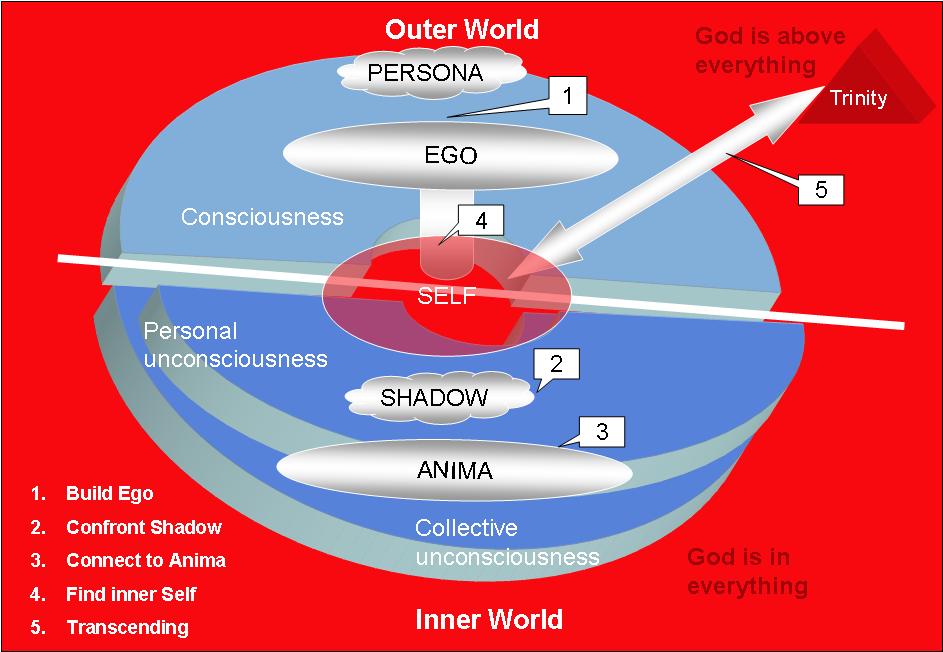
    Do you think, the Prior (second in charge of this monastery) told the audience some conventual belief and bigot phrases? Think again, some of his statements would force both the official church hierarchy together with the noisy know-better-modern- lay(wo)men of today in a tailspin. A concise opening statement of the Prior summed up what one has to do in life and how that helps finding God. I was taken back by its simplicity. His crisp world view came across as a result of his own thinking and experience as a monk without giving  psychoanalysis any deep consideration. But it could be easily matched to individuation of C.G. Jung. I included a crude visualisation below. Furthermore, the Prior eased my biggest problem with a personal god, having had my God experiences in the nature.

    First the Prior showed  us a pantheon (almost Taoist) image of god, how it relates the inner center our Self: God is in everything and above everything or God does not exist. Quite frankly, that resonated well with me, since I felt god the first time, during a backpacking week around Mount Rainer (Wonderland trail). That is – God is in everything  – after I crawled out of the tent and admired nature during the glowing sunrise.
    Secondly Claudius connected men’s outer world, with his inner world and with God –  as an individual to a personal (Du to Du).  It comprised what one has to accomplish in the first half of life ( and where materialism or Freud’s machine stops) and in the second part of life and beyond.  C.G. Jung defined that  without his empiric reach but definitely within his metaphysic view.

    Dealing with the outer world: You have a good meaningful job, live in a nice house, have a good handsome/pretty spouse,your kids turn out well. You sit down and see it is good. I think this relates to the developing an Ego and Persona in the first half of your lifespan. Later Pater Otto brought  the Ego in an Example of a Gel Tub, how the Ego,the center of consciousness is needed as an outer communicator and shell to protect your our Self and our Soul.

    Dealing with inner world: You have to look into yourself think and meditate, rid yourself of the negative. (P. Claudius avoided saying evil or demons). You sit down and see it is good. I think this relates to the Individuation, overcoming the own Shadow and finding the soul (Anima). Later Pater Otto told us about the soul (lat. Anima, gr. psyche ) how this relates our psyche and psychology in general.

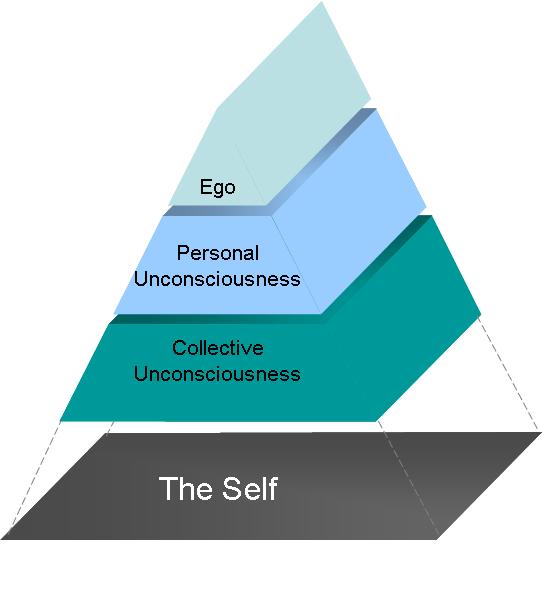
    Find your inner center: You have to look beyond this world, to find the loving God in you ( P. Claudius meant looking for our soul). Men is a communicating species, but you have to  have found your inner center to do this successfully..You sit down and see it is good. I think this relates to the Individuation, overcoming the own Shadow and finding the Soul (Anima) and Self. Later Pater Otto told us about the Self, the forces in making cheese by steering in the milk  and the Axis (the big pipe) between the Ego and the Self.

    Communicate with the personal god: You have to connect with the personal God using your Self as window (or membrane). You sit down and see it is good. I think this connects the Individuation process with the  religious or transcendent dimension of an accomplished life. Later P.  Otto told us about special prayers (credo prayers) and Kreuzgänge (walking silent cross walks) how  we can show God we are ready. Now here the monks moved from pantheism to the loving Christian trinity. The communication between the personal God and us as individual is facilitated by the Self, our window to God.The bigger the pipe is between Ego and Self, the easier it is to experience God. Autonomous complexes or an inflated Ego prevents that.

    The Ego, the Self and God
    Multiplicity of Psyche – Individuation and Transcendence


    One Questions two views but one answer

    I have never heard it so clear. The theoretical distinctions of the Self in the different teachings is often unclear and undifferentiated. For the psychologist C.G. Jung the ‘Self’ is an empirical concept for the total amount of all psychic phenomena in humans. It expresses the oneness and wholeness of total personality. The general question in the search for the ‘Self’ is: How can the lives of people succeed? The Prior formulated it in a Christian way,  explaining how to follow Christ; aiming to the realization of the true ‘Self’. I believe that, together with psychoanalytical contribution of C.G.Jung,  the Catholic faith sheds light on the basic “W” questions but also helps in this life. Jesus’ approach to the individual and freedom is unique. We are nor slaves of a cruel god, nor impersonal white noise to resolve our Ego better sooner than later in nothingness, nor a bunch of neurons (mis)firing. As the Prior said: “we can look into the starry sky and say Du,Du, Du”. And I would add, fully aware of todays astrophysical knowledge of our universe.

    God around everything and above everything

    The Self

    Psychological schools are just models. We can’t see atoms or quarks nor can we see our soul.  Therefore scientists and psychoanalysis come up with models, to understand and predict based on empirical data. Even if the Self is a non-uniformly used term with their psychological, sociological, philosophical and theological importance variants, the Jungian model is the closest to Religion. While Freud and Adler considered very narrow psychological drives, C.G. Jung understood the central integral concept of the human psyche as the Self. This Self is the wholeness of the human psyche and connecting the conscious and unconscious parts of the personality and aims toward the harmonization of the psyche. Only the ego-consciousness has the equipment to process deliberately sensory perception and thinking, feeling, and intuition. The unconscious part of the us, which splits in the personal unconscious and the collective unconscious, is larger and often more powerful than ego-consciousness. The ego,on the other hand can run amok and super-inflate. The Self is the center of the whole personality and therefore the central window or “membran”as Pater Otto called it to God. As I interpreted the Prior Claudius, it is also the Place where God or Jesus is in us.  The Ego is the conscious of self, his eye, with whose help the self itself can recognize. The self is the God in us. Individuation is to be who one really is, and thinks a differentiation process that has the development of all skills, systems and possibilities of the individual through gradual awareness and realization of the self to the target.

    Find my Self and inner Center again

    Religion is to C.G. Jung the opportunity to discover the soul. For Freud as for Marx, religion is just opium. Jung sees the benefit of religion (especially of catholic flavor) to deal with many similar psychic circumstances. Today’s psychology – influenced by Freud – to me is Godless and today’s Western theology – influenced by the age of enlightenment – to me often lacks soul. Spirituality and religion, together with logic and science, is focus for individual and political healing. The most important insight, which I understood this day: The impending disasters right now around me, are a direct result of my buried shortcomings like a pretty big Ego which served me well in my career (i.e. the disaster in me). Its is directly linked to Jung’s reminder, the inner world is very real. The evil is in us.

    Conclusion

    I considered myself blessed to get so many hints from the monks for my specific search in such a short time:

    • Who I was in the past, I who want to be in the future and how do I make the transition?
    • How I reflect my undesired aspects of my personality and keep my identity here?
    • What are root causes of interpersonal communication defects – last call to grow up?
    • What are cause and effect of those significant problems in my current professional transition?
    • How to use the current crisis as a momentum and I deal with transcendence and the death?
    • What needs successful self-development within my current life situation (e.g., toward individuation, religiosity)?

    Lots of other questions were discussed, which might “wind up” in another blog entry:

    • Does Evil exists – questions about the dualistic view (Good and Evil)?
    • Does the hell exist. Where does the picture of it come from?
    • What is the opposite of belief (trust in God) what means believing?
    • What is the opposite of love (indifference / egoism)?
    • Usefulness of the religious church hierarchies and dogmas?
    • Theory and praxis of dreams including dream phenomenology and hierarchy?
    • Emphasis on Christ’s suffering versus Christ’s resurrection (central altar figure in  St. Ottilien)?
    • Individual injuries because of rigid and/or bigot religious practices (understood first time how severe those could influence children, and the advantage of converts)
    • Descartes and Dualism
    • Common psychological disposition (e.g. narcisissm of super inflated egos)
    • Fatherly  versus motherly images of god (got lost of this one – thinking of Kali hardly a nice one).

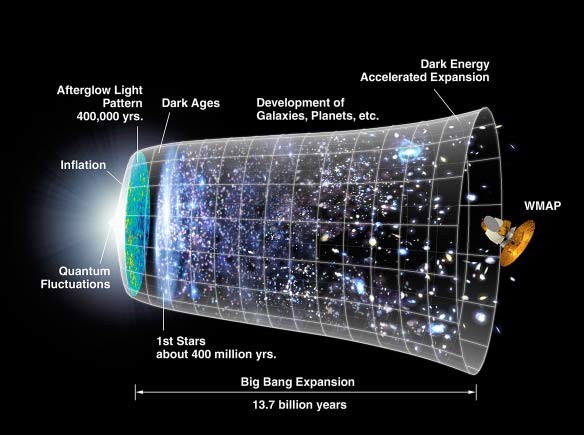
    I was also astonished about the  “Big Bang Didn’t need God to start universe doubt” discussion. To me, believing in God comes down to a personal experience that a benevolent deity is out there. People who are generally more intuitive in the way they think (in the Jungian sense) and make decisions are more likely to believe in God than those who ruminate over their choices. That suggests that basic differences of one’s personality type influences religious belief. Some say we believe in God because our intuitions about how and why things happen lead us to see a divine purpose behind ordinary events that don’t have obvious human causes. As on woman said in the discussion, “I translate believe in trust”. Individual’s belief is influenced by how much we trust natural intuitions. In the end, God can only be known by personal experience not by logic. If one does not experience god, too bad (for her or him). True, big bang and quantum mechanics  describe random fluctuations which can produce matter and energy out of nothingness. But quantum mechanics are just (proved) models too. I don’t doubt that physical laws can “produce” the cosmos. 

    However, minor asymmetries shortly after the beginning are the cause that matter and anti-matter (particle and antiparticle) did not annihilate itself immediately.  As an engineer, quite interested in astrophysics, physical laws do not at all affect my theological leanings. I see in such statements not attacks on the existence of God. Saying the Big Bang — a massive expansion 13.7 billion years ago that blew space up like a gigantic balloon — could have occurred without God is a far cry from saying that God doesn’t exist. With Jung, and many philosophers I don’t think one can use science to either prove or disprove the existence of God. The question, then, is, Why are there laws of physics? And one could easily say, those required a divine creator a spark that led from the laws of physics to these universes, maybe more than one.  Or, as I humbly admit, one can fall back to pantheistic belief, that ‘divine ‘ is in nature in everything  and produced the laws of physics. I would say let’s just leave that to theology, philosophy and C. G. Jung…

    Appendix :

    • The Persona : “The Persona is that which we present to the outside world. It isn’t really our selves, though there is a danger we can identify too much with it and believe it to be so. It is a mask. It’s not a bad thing to have, in fact it’s necessary for getting along with others.
    • The Ego: “The ego is the centre of consciousness. It is identity…But it is not the totality of the psyche.
    • The Shadow: “it is the receptacle for all of that which we have for one reason or another disowned. In truth there’s a great deal that’s very, very unpleasant here, since we have good reason for wanting to disown our darker natures but like the complexes it is not all evil. The avenue for an attempted redemption of the Shadow lies in the belief that everything disowned winds up here.”
    • The Anima/Animus: The Anima is the female soul image of a man, the Animus the male soul image of a woman. That is the most simple definition, and one which many struggle with, since Jung seems quite absolute in defining a person’s soul image as gender opposite. “Soul image” sounds very pretty, but the Anima/Animus is not without a negative pole as well….. If one is on good terms with one’s Anima/Animus he/she can prove a valuable messenger between the unconscious and the conscious, a connecting link – a veritable Hermes.”
    • The Self: “The Self is simply the centre and the totality of the entire psyche. It is the transcendental archetype which contains all the other archetypes and around which they orbit. Where God is within you, if you believe in God.
    • The Collective Unconscious lies under our personal unconscious, and contains the archetypes and mythical symbols that make up our human psyche. Connection to this in a healthy way is necessary for wholeness.
    • Archetypes (per se) templates (blueprints) for complexes. Note Archetypes and Complexes are used very ambiguous ind interchanged  ( I wrote a few articles just about them)
    • Complexes centers of physical energy (The can be autonomic, good or harmful and take over control.
    • Functional Complexes (The big five, Ego, Self,Persona, Anima, Shadow)
    • Synchronicity—when two or more events happen in a meaningful way to a person, and reveals something about our unconsciousness .
    • Individuation is central to all religion and all healing.
    • Quantum fluctuation is the temporary change in the amount of energy in a point in space arising from Werner Heisenberg’s uncertainty principle in quantum physics. That means that conservation of energy can be violated, but only for small times. This allows the creation of particle-antiparticle pairs important in the origin of the structure of the universe according to the model of inflation.