Category: West

Western Philosophy

  • Who killed Freud? And is Psychoanalysis dead too?

    Who killed Freud? And is Psychoanalysis dead too?

    Arguably no other notable figure in history was as wrong as Freud was about every important thing he had to say. He was a favorite of the avantgarde from the begin of last century until its sixties, but while the theories of his contemporary colleagues, C.G. Jung, Adler and Wilhelm Reich aged well, little of Freud’s narrow understanding of the human psyche is in practical use today. What an utter disappointment this must been for the fans of Freud.  Psychoanalysis Is Dead … So how does that make me feel as an Jungian? Well, I must admit Freud is truly in a class of his own. While I credit Freud as absolute trailblazer to reveal the concept of the unconscious, the so-called “Freud wars” caused a tremendous loss in our culture, in essence a counter revolution.  However, by no means all psychoanalysis is dead, quite the contrary, the concepts of C.G. Jung and Adler are still important to understand individuals, political and organisational cultures.

    This essay is a crime story, which wants to show: when was Freud killed; who had motives and means; finally, who had done it. As we will see,  laymen did it, but particularly certain segments which wanted and succeeded installing a new religion of narcissistic unlimited individualism, very convenient for those in power and  suitable in today’s post-industrial society.  The murder happened in the sixties or early seventies and paved the way for “greed is good” which prevails today, a boulevard of broken dreams and global wars, financial, cultural, cold and hot wars.

    Note: I connected four very old articles of Time magazine which are not mine. Although those articles are most likely open source, I have protected them by a password (which you may find at the end of this essay). Nevertheless I want to share them on request as a fascinating Longitudinal Study of Culture. Here is the link to TIME Magazine archive, or google will lead you to the source, but you need to have a TIME subscription.

    The death of Freud

    The assault on Freud
    The assault on Freud, Time Magazine 1993

    1993 Time magazine asked aloud, and on its cover no less, “Is Freud Dead?” questioning Freud’s reputation as a man and as a thinker. The psychoanalytic century was over before the 21st century had begun. Every seems to know the answer to Time’s rhetorical question: Indeed, Freud is dead. However, the opinion shapers who understood little, the anti-intellectual and foremost the Freud killers wanted to do away with psychoanalysis as a whole. As we will see, this has been done for very good reasons, because wo/men go great length to deny their shadows. We all agree that Freud did not “discover” the unconscious, but are sophisticated enough to see that it has a history that long predates him. However, he did formulate the first coherent theory about it. In a way, it was a response to the second industrial revolution, to the advent to the modern society of mass-production and mass media democracy of consumers, gratification seekers, me-suffers and myriads of suffering fractions of society. This has been very well described by the French philosopher Pascal Bruckner: “I Suffer therefore I am”. This exaltation of pseudopathos creates all kind of sweepstakes of attention seekers. “Everyone aspires to be taken for an underdog,” says Bruckner, which results in “victimization gone berserk — metastasizing through the social body.” This change was at the same time a retreat from the objective  rational and political realm to the subject, to extreme individualism and later to narcissism. In retrospective , was this liberating? Yes, in a way it fulfilled the promise of the Enlightenment period, facilitated new art cultures, emancipation movements and deconstructed most moral restrictions. But the price was high. Transcendence and spirituality were lost. Community spirit and family bonds were discarded. Adaptation to a materialistic society and  a sexualized consumerism became the benchmark of a successful life. The meaning of autonomy, equality, democracy changed, even the definition of gender.

    The motive

    The history of science is littered with cases where advocates of a theory have clung to it in spite of apparently falsifying data and have later been vindicated. Something more than mere tenacity is at issue. Sometimes as in the case of Freud the accusation was the stronger one that he reported his theory to have been confirmed when he must have known he was not in a position to do so. Freud’s theories interacted well with the socialist thinkers in the twenties and played a central role in the upheavals of the sixties. After Trotsky’s fall (who was fond of psychoanalysis and had known Adler personally), Stalin outlawed  psychoanalysis and eliminated later in the thirties Freudians quite literally. Despite strong opportunism especially in the German speaking countries, Hitler did the same in the forties. However Freudianism flourished briefly again in the Anglo-Saxon after WWII. It has been always a charismatic movement, maybe suitable for medical purpose in the context of the hysterical Viennese upper class but an efficient and instrumental for deconstructing and cultural engineering. Until Woody Allan came along. The strongest reason for considering Freud a pseudo-scientist is that he claimed to have tested – and thus to have provided the most cogent grounds for accepting – theories which are either untestable or even if testable had not been tested. Why? Shortly afterwards it became an “antipolitical, antifeminist and homophobic degraded pseudo science”,the latter, by the way it always has been. You might see this paradox as a case of the revolution devours its children, but I like to explore Eli Zaretsky’s answers given in “Secrets of the Soul” which point to social and cultural history.

    The culprits

    Ironically extreme feminism and genderism, denying differences of sexes, which followed and prevails today, triggered Freud’s downfall. Freudian’s were at least in the beginning a heterosexual patriarchical men’s club viewing homosexuality as deviation until the third industrial revolution.  Freud was the father of an charismatic movement, and his children killed their “Father”.The children were left, naked and uncared for. The “Death of Freud” gave way to the postmodern society, which exchanged the term psychoanalysis with psychology and became an instrument of social control, to a great deal exercised by lay(wo)man and media as agents with zeitgeist-authority or in self-medication. Consultants, routinely counsel people and mediate team issues today, not speaking of post-modern new age prophets or gender-related NGO’s. The children of the sixties and the new service based economy turned the back on Freud. Jungian’s found a profitable market niche, haunted however in Germany by the published opinion as a convenient shadow for the opportunism of psychoanalysis in the Third Reich. Most people do not recognize, how much in counselling, cross-cultural training and corporate  psychology we owe C.G. Jung.

    Well, in any case 1993 almost everyone knew that “Freud is dead.” You can always count on orthodox and opportunistic academics to keep a candle burning for whatever idea they’ve invested long years, enormous sums of money and, perhaps above all, limitless ego promoting. Eli Zaretsky seems to be one of those, but his historical context, is a brilliant longitudinal study,  based on facts, which gives give food for thought and explains raise and fall. It is not likely that intellectuals walks away from a venture  that helped pave the way for tenure and the prestige of authorship. Over the years, there were so many books, so many reviews, so many lectures, all with so little perspective on Freud’s limitations, and the folly continued to march on. So the Freud industry continues. Academics always have been — and still are — infinitely creative in their efforts to white wash any errors, even as laymen grow increasingly critical. Zaretsky’s thesis is that psychoanalysis has repressive  and  emancipatory aspects is true. However, as Karl Kraus put it many years ago, Freud’s psychoanalysis itself became the poison it purports to cure and Freud’s psychoanalysis is just an outdated subset. Another way to put it, is that Freud’s clerics have infected the Western mainstream with and sex-is-everything view, penis envy, Oedipal conflicts as source for anything what can can go wrong, even politically,  that Freud itself became irrelevant. Nietzsche claimed “God is death”. The new Freudian replaced (or killed) the spiritual “Self” with an infantile inflated Super-Ego. To Jung (and Eastern spirituality), one part of the subconscious  — the term Self — was given for an entity, which is our communication path to God or even God in us and had a complete different meaning than it has today in the Freudian context. Freud’s followers, replaced what was left, the rational Ego quite directly with an ever young forlorn based primarily on sexual identity and entitelment.

    The remains

    Consequently, the killer got killed, the death of psychoanalysis is itself the desired outcome Freud’s psychoanalysis was ever designed to deliver. Depriving the world of spirituality and transcendence in nihilistic capitalism, which replaced the  failed Communism as unilateral power. Or in other words Freud’s theories did their job, but its usefulness expired. We had priest, quack or analyst –which claimed special access to the darkest, scariest reaches of our minds — today we are left with ‘experts’ and quacks amplified by media and technology. For a certain price, they drug us. scientifically, Freud’s psychoanalysis turned out very ponderable and has left psychoanalysis as a whole discredited and made laughable today. Psychology took a worse turn. Evidently (or forensic)  I encountered this today in my local library. 12 large bookshelves, containing 50 % women’s problem in all shades (with sexuality, with men, with themselves, with the kids…) the other half is generic self-help and astrology. A real triviality shock.  Out of 10 Books left under the label “Psychoanalysis” only one was worth to be picked up – and that was sampler of original texts.

    Unfortunately, this is tragic — for Western culture and the world  in general, because like one never will understand himself if not in touch with the unconsciousness,  the history of psychoanalysis and political history must be seen tangled and holistic. I would argue, the history of psychoanalysis and development of theories reflects the unconsciousness of human history. When I read the Time articles (again) they became a Longitudinal Study of Culture with all wishes, suppressed fears, shadows and projection of those years in and between  and after the major wars.  As Jung noted,  the “unconsciousness is real” like blueprint for houses, they create reality (a great youtube video interview with C.G. Jung touches that – see around min 37). Troubled dreams, visions, or complexes lead to psychological troubled people (and societies). This full film represents a rare record of an original genius. In Dr. Richard Evans interviews, “Jung on Film”, C.G. Jung tells us about his collaboration with Sigmund Freud, about the insights he gained from listening to his patients’ dreams, and about world events. It is almost frightening, how valid his unique psychoanalytic view on political issues still is today.

    Cultural history of Psychoanalysis

    FreudAfter1stWW
    FreudAfter1stWW

    Freud, Adler and Jung—these names personify, above all others, modern man’s restless exploration of his own mind, his struggles for self-knowledge and for control of his darkest drives. Freud gave an individual, Adler a political and C.G. Jung a spiritual answer. In the 20th century, impelled by the detailed theory and dogma of the Big Three, psychology has burst out of consulting room and clinic, spreading all through life and leaving nothing untouched—neither love nor economics, war nor politics, neither art nor culture nor God. Freud clung to the mechanical and material scientism of his age and was anti-religious almost until its end. He constructed a new. detailed, machine like scheme run by sexual energy or libido. In Freud’s view, the unconscious was a problems zone cluttered with neuroses and repressed materials. The Freudian concept of libido eventually grudgingly broadened, but still narrowly insisted that infantile parricide and incest wish were almost mono-causal important. Vienna’s Alfred Adler, like C.G. Jung an early disciple of Freud, rejected this sex-is-everything view, and formulated his theory that human beings are propelled more by drives for power because of inherent feelings of inferiority. Both saw the same importance of gender differences, but Adler did understand the upcoming womans lib movement whereas Freud, did not. Adler, being political motivated wanted to combine feminism with socialism. Freud’s work, “Totem and” Tabu  tried to reconcile differences mainly with Jung, but also with Adler.  Here the view of irrationalism, mythos and transcendence were the great dividers. So only a  trinity , all men which went quite different ways. I have written about Sabine Spielrein, I see this as a great loss that she was belitteled away (by Jung and Freud).

    After the three arch-fathers, came the Early psychoanalysts like Wilhelm Reich, Sabine Spielrein,Toni Wolff, Karl Abraham, Sandor Ferenczi and Anna Freud. Neo-psychoanalysts like Erich Fromm and third generation psychoanalysts like Alexander Mitscherlich followed.  Then already existentialist and phenomenalists like Erwin W. Strauss took over.

    The promise of Psychoanalysis

    Eli Zaretsky agues that psychoanalysis was created and meant as a liberating and emancipating movement to fulfill the promise of enlightenment – and that would mean Kant, Voltaire and Hume. However, even he grudgingly accepts  the fact, that it was abused both in capitalism as in communism as means of social control – of the masses.  Tellingly, to him the three promises were autonomy, emancipation of women and democracy .While this may be include this is a very narrow view, with which I beg to differ. The intellectual movement of Enlightenment was a very complex movement. It has 4 main points. First is that it believes in the idea of the existence of natural laws. It also believes in natural rights (Life, Liberty, Property, political and religious freedom) of individuals, human reason, as well as sociological and scientific progress. The autonomy of individuals meant  moral (decide what is good and bad) and political autonomy (democracy), not personal unlimited and unconditional autonomy, beyond self control and moral conditionality. Zaretskyis is too smart to make such an error, so this is by purpose or – I believe – a Freudian slip. On base of  Zaretsky’s facts one could argue, that Freud, even if conservative, created a theory which instead perverted the promise of enlightenment to a hydra of psychologization of authority, narcissistic individualism and personal self exploration. Descartes “T think so I am” became Pascal Bruckners “I suffer so I am”  which he  argues ia a conformity now a stifling orthodoxy in the West, instilling within us the desire to “practice self-flagellation” and “culture of permanent disadvantage and inequalities”. At the personal level, the politics of guilt is a perfect accompaniment to another dubious legacy of the (late) Sixties —what even Eli Zaretsky  calls a culture of narcissism; an infantile and regressive and therapeutic culture of the self, self, self in a constructed social reality ruled by a new class of social workers, self-support group and self-appointed counselors who took over. This “Temptation of Innocence” changed the age of Enlightenment into an ” Age of Entitlement” (again French philosopher Pascal Bruckner) –  with mother centered psychological underpinnings for an welfare state (until it had been abolished too by globalism).

    Psychoanalysis and Marxism

    The first world war was a total war, which not only killed six thousand of the brightest and the best in per day (!) over 4 years but also the old Europe and Russia civilization. The war had triggered a high demand for psychoanalysts (for instance to cure shell shocks). It is often said, that this war was reflected by Freud’s “death instinct, but that had com e from a brilliant paper of Sabine Spielrein,  patient, lover and pupil of C.G. Jung (and later working with Freud) before WWI.  Like in Europe, also in Russia the charismatic avantgarde movement flirted with another utopian movement, not only because the had a common enemy – the family and patriarchism. The Bolsheviks printed Freud’s writings, although they had a different concept of personal autonomy. Under patronage of Trotsky who was close to Adler, the Russian psychoanalysis (strictly speaking Freudian) experienced at the beginning of the twenties a short bloom. Like in later in America, Trotsky saw it primarily as mean to control the subconsciousness of the underlings, the mass . The Bolshevik revolution, already ruthless by Lenin’s design, succumbed after Lenin’s death to evil and inhuman Stalin. Under his rule, the USSR degenerated into a brutal tyranny of its own, aptly symbolized in George Orwell’s book “Animal Farm”.  After the (too) brilliant Leon Trotsky (chosen by Lenin as his successor) had to emigrate to Mexico, all intellectuals in the Soviet Union were in great danger. Trotsky was killed 1938 with an ice pick by a Stalinist agent, in Mexico-City. Intellectuals, who stayed, had either to adapt totally and opportunistically or perish in a niche. After 1925, when Stalin began repressing psychoanalysis, would have been risky. Spielrein, on advice of Freud and for  private reasons had moved to Russia 1924 and worked as school medical psychologist in Moskow and later practical-therapeutic in Rostov on Don. In Moscow Spielrein founded together with Ivan Ermakov Dimitrievitch and Moshe Wulff, the first Institute for Psychoanalysis in the Soviet Union. It was also the first state psychoanalytic training institute in the world.  1921-1924 of the Psychoanalytic Institute experiments were performed with liberal collective education in early childhood in the orphanage Laboratory, which served the ’68 movement as a model for their sexually charged socialist children shops. All three brothers of Spielrein were arrested and killed under Stalin’s reign of terror  by the National Commissariat for Internal Affairs (NKVD) like many other intellectuals and/or Jewish.

    Psychoanalysis and capitalism

    FreudAfter2ndWW
    Post homous praise Time Magazine 1956b

    The promise of psychoanalysis, was essential aligned to Fordism, as “a manufacturing system designed to flood you with standardized, low-cost goods and afford its workers decent enough wages to buy them. Although Fordism was a method used to improve productivity in the automotive industry, this principle could be applied to any kind of manufacturing process. Major success stemmed from three major principles

    1. The standardization of the product
    2. The use of special-purpose tools and/or robots.
    3. Trickle down economy – workers are paid higher “living” wages,  to allow them to purchase the products they make.

    The deal was called off several times and according to the Time of this week has been called off open ended. However, Fordism initially broke down European class barriers creating a convergence between Freud and capitalism. Complex systems need well educated managers. Those managers were ordered to pay attention to the individual (worker) and that meant also psychology played a certain role. On the demand side, ever good advertising uses archetypal symbols. Furthermore sex sells. 1926, that is 75 years before Madonna. Gramsci, an Italian communist wondered in one of his letters
    from prison whether it really meant anything ‘that many of the so-called theoreticians of historical materialism have fallen into a philosophical
    position similar to mediaeval theology and have turned “economic structure” into a hidden god is probably demonstrable’, while capitalism emphasises the sexuality to enforce conformity in their workers and consumers. Fordism needs Freudianism to decipher the hidden wishes and desires of the masses, since enforcement alone does not suffice. He praises Fordism, to create new females which are employed in the (capitalistic or communist) factory.

    To some may occur, that this alliance resembles closely todays alliance between neocons, the hapless EU and feminists. Today relentless individualism became a mass product, but on a positive the side effect of destructed gender roles contributes to less breeding, helping with the fact that workers are redundant today. For  the high inequality of todays economy, Freud (and Ford) would have been to human, too fond of animal instincts. We are living  in the century or millennium of fracking, micro trading, robots, drones and narcissism – feudalism was only outgunned for a short while. Absolute super-national power can be achieved, whiteout paying attention to the underlings. The noble savage of the French philosopher,  revived by Freud has been killed again. Freud emphasized like Rousseau on  early experience, believing that children are born with a conscience corrupted by morals and society. Both had the idea of the “noble savage” living a moral life in the state of nature.

    Today – Psychoanalysis as Business of Restoring the Dream Post in post-modern culture of narcissism
    PsychologyofNarcissm
    PsychologyofNarcissm

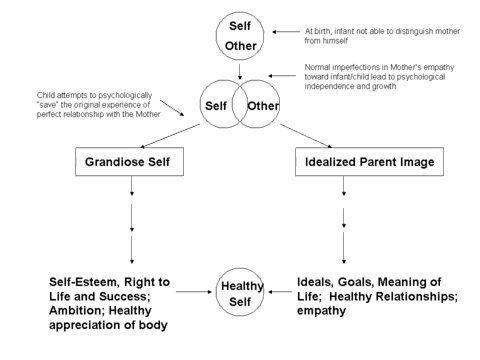
    The Merriam-Webster Dictionary defines narcissism as the act of “egocentrism,” where a person is full of love for self. Many experts think that, because of what are being hailed as advances in media and technology, we became a world of narcissistic children and adults. A most recent American Freshman Survey, which has gathered data from some 9 million young adults, reveals “that college students are more likely than ever to call themselves gifted and driven to succeed, even though their test scores and time spent studying are decreasing.” Make yourself into something you’re not. Though users may actually know a lot of people they connect with on Facebook, the social media site allows most of them to make a lot more “friends” than they actually have – perhaps hundreds or thousands more. They are able to delete unflattering comments or “unfriend” or “block” anyone who upsets them or disagrees with them or otherwise “pokes holes in their inflated self-esteem”. It seems we can pick and choose the media and what we want to see the world. However, major media outlets today are highly concentrated and block out anything undesirable as well. Yesterday,  elites misused God to keep the masses obedient. Or so it seems to revolutionaries and atheists. Science has replaced myths and  media has replaced sermons. Money used to be only object or record that is generally accepted as payment for goods and services and repayment of debts in a given country or economic context. The main functions of money are distinguished as: a medium of exchange; a unit of account; a store of value. Today money is the only value, the only benchmark for the individual and sole power.  Michel Foucault advanced a critical perspective on the modern experience of individuality as the result of power relations in his  essay “The Subject and Power”:

    “this form of power applies itself to immediate everyday life and which categorizes the individual, marks him by his own individuality, attaches him to his own identity, imposes a law of truth on him which he must recognize and which others have to recognize in him. It is a form of power which makes individuals subjects. There are two meanings of the word subject: subject to someone else by control and dependence, and tied to his own identity by a conscience or self-knowledge. Both meanings suggest a form of power which subjugates and makes subject to.” The very possibility of a narcissistic decision is itself a product of power relations. The collapse of community is a systemic symptom of societal impoverishment. No personal choice to go back to church can undo this institutionalized alienation, however much religion may give solace to the faithful.

    According to Jung one must overcome the Ego to reach the unconsciousness realm to reach his or her Self. But that s a very different Self than in todays self-entered ideology. Actually meant is the “I” (Ich) or Ego, which has been replaced with the term “Self” by American Freudian, the “Ich” of course only a small part of one’s personality – consciousness and more or less congruent with C.G. Jung’s “Ego”.
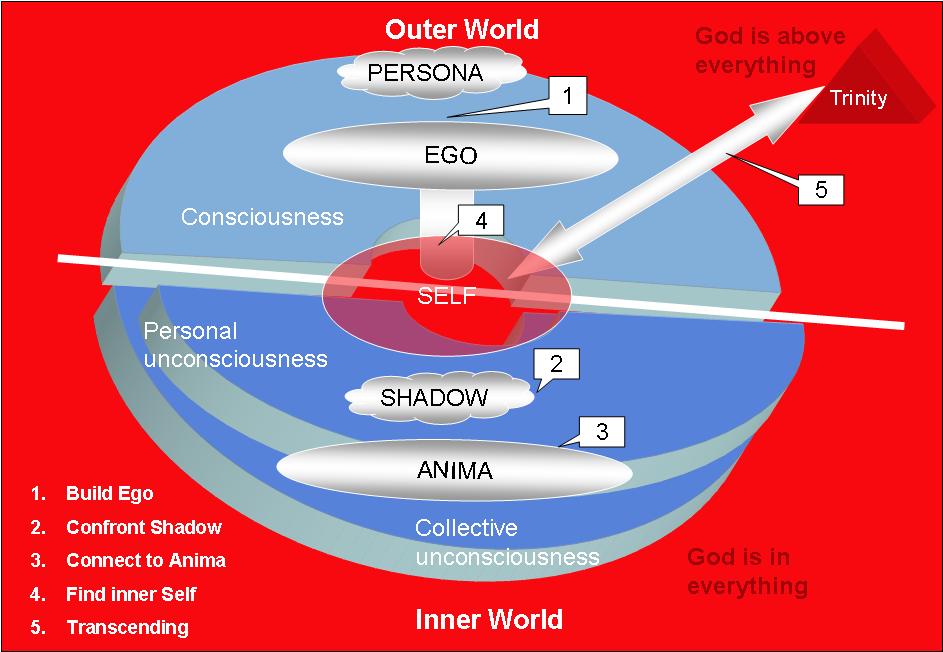
    The Ego, the Self and God
    The Ego, the Self and God – Individuation and Transcendence

    The Ego and the Self are terms which are often interchangeably used. Likewise often no distinction between personality and Self is made nor taken into account the subconscious anymore. The psychological term Ego is the center of consciousness and ensures the physical survival . Ego often has an extended meaning in the spiritual language and referrers in general terms to an obstacle for Self realization. You may go deeper in the model her, but critical to me is,  that according to the model C.G. Jung must distinguishes sharply between Ego and Self. The unconscious thoughts and dreams are both types of memories: the ones we can remember easily and those who are suppressed for some reason. In addition Jung introduced the collective unconscious, which belongs to the common humanity, as part of an individual psyche. Ego is the correct translation of the German “Ich (I)” used by C.G. Jung and Freud. The term Ego is also common in esoteric writings often distinguishing the Ego as a centre of the personality of a higher or true Self not unlike as in C.G. Jung’s psychoanalytic model. The term Ego is widely used In translations of Buddhist texts for the “I” to overcome.  So it boils down to that the Freud’s kills want o narrow down a personality only the conscious Ego, renamed to Self,  which used to attend a negative meaning: to characterize, for example people with a selfish narcissism. According to C.G. Jung the Ego can be equated with the conscious mind and includes all thoughts we think at that moment and also our current feelings. In the center of this consciousness we find that “I” or Ego. It guarantees the unity of (thinking, feeling, acting) is focused on physical survival and dealing with everyday demands. All religions (according to the Benedictine monk Anselm Gruen), demand more or less that we must become free from the Ego. This especially applies to our relationship with God. If we do not let go of our Ego we stay materialistic (at best). Today’s self-centered psychology is essentially reviving narcissism as a norm.

    Jung’s answer to Freud

    C.G. Jung The wise old man Time Magazine

    In the Freudian world, the human being stands alone, bound and hunted by mysterious urges and traumas over which he has no control. Religion is usually seen a form of neurosis and God is a projection of the Father image. But Jung was a “homo religious” bitingly said once about Freud: “The brain is viewed as an appendage of the genital glands”,  He was more interested on the unconsciousness, and  as a source of energy and channel to transcendence, particularly in the pool of archetypal common knowledge, the collective  unconsciousness which he differentiated from the personal unconsciousness. It is, argues Jung, is not merely a trash basket for disagreeable experiences, but a vast source of energy full of both good and evil. For the most part the eternal human affections, aspirations and fears are just what they seem to be. Religion is not a neurosis, in Jung’s view; it is a timeless and universally felt human need. Freud was the Copernicus who discovered the nature of the solar system. Jung may well be the Kepler to circumscribe correctly the whole sphere of the psyche.

    The ultimate value of psychoanalysis cannot alone be measured by practical standards. But it must be a psychology for human beings who reach out toward the unknown, the intangible, the spiritual. arguably both todays narcissism nor the goal of psychological adjustment for the unsuccessful adapted lead to unbearable boredom, infernal sterility, and hopelessness.  Jung has suggested to mankind a way of “adjustment” not merely to his animal instincts and social pressures but to his individuation and his eternal religious needs,  “Individuation means to become what one is really meant to be”,  like meditation in Zen Buddhism.

    Conclusion

    So what can we see today that we didn’t see during the last century? We know that Freud never seriously dealt with the problem of “suggestion,” which totally compromised his clinical findings and, by extension, his theories. Amazingly, these critical insights were buried under Freud’s rhetoric of denial and by his growing fame. Today we know better than to trust to paid consultants, or in benefit, that supposedly issue from the “therapeutic alliance” between analyst and patient. I have one primary aim for psychoanalysis in mind, and that is; “The Business of Restoring the Dream.” Many on our planet live on the “Boulevard of Broken Dreams”. The psychological problem is clearly illustrated in the Hollywood dream factory film “The Matrix”, in which the narcissistic character Cypher wants his old life in the Matrix where he can be rich and famous and “where ignorance is bliss”.

    Bibliography

    Secrets of the Soul: A Social and Cultural History of Psychoanalysis, 2004 by Eli Zaretsky

    Time magazine 1924-today (subscribers archive)
     

  • The Black Swan as Acausal Connecting Principle

    The Black Swan as Acausal Connecting Principle

    No, this essay is not about the movie, Black Swan with Natalie Portman. By chance I recently  picked up Nassim Nicholas Taleb’s The Black Swan, and it reminded me on C.G. Jung’s Synchronicity: An Acausal Connecting Principle. Nassim Nicholas Taleb is a mathematician who has made a fortune by betting on highly improbable market events. Those markets, which symbolize repressed ambition, greed, ignorance, which undo our society. Carl Jung warned, that if societies do not attend to their collective shadow, a world crisis may result. Our era is one of failing elites and broken social covenants, which is fraught with the dangers of unleashed economic and social chaos. We each can do our part to safeguard each other by understanding black swans.  I want to apply C.G. Jung’s wisdom, an intuitive thinker, on Taleb’s book (The Black Swan) beneficial to analyze external events – and yes, I am afraid this has something to do with the financial crisis and current geopolitical risks.

    The Black Swan

    Black Swan

    As an engineer, interested not only in C.G. Jung but also in economic theories I have read NN Taleb’s book (The Black Swan). Both C.G. Jung and Taleb contain the same message: the assumptions underlying modern science models are wrong. Ever since nuclear experts said that a fatality due to radiation exposure from an accident at one of nuclear facilities should happen less than once per million years. That was the standard by which they were managing the reactors. From my profession, I never bought that. Today everybody and anybody knows,  what can go wrong at nuclear facilities, does – or did (Murphy’s Law). We were also told alpha, beta and gamma radiation differ in that alpha particles do not travel far through air, and thus were not easily picked up. Until Tokyo Electric Power Company (TEPCO) struggled to bring the leaks under control and after a string of blunders over the past few months released hundreds and thousands of liters of contaminated water into the Pacific Ocean. Three of the Fukushima plant’s nuclear reactors were damaged by an earthquake-triggered tsunami on March 11, 2011, which caused multiple meltdowns, most likely open fissions, and the largest nuclear disaster since Chernobyl. The risks posed by nuclear energy, both personally and to society, seem to be a classic case of black swan logic: so unlikely as to be unintelligible through normal statistical methods, but occurring often enough that they cannot be treated as outliers and ignored as spurious.

    Uncertainty

    shot0001

    Uncertainty is building pattern of nature as the unlikely cross-disciplinary relationship  of psychoanalytic (and often alchemist) C. G. Jung and theoretical physicist Pauli discovered. Pauli, a “Wunderkind” may be called a pioneer of quantum physics and leading member of the group of theoretical physicists, including Niels Bohr, Werner Heisenberg and Erwin Schrödinger. The group transformed our understanding of the way matter behaves at the subatomic level encountering a new world where Einstein’s theories (and Newtons Laws) do not apply. Exploration of the Pauli-Jung collaboration is particularly interesting because of the holistic view of his major scientific work, which won him the Nobel prize.The Pauli exclusion principle explains how matters form and a variety of astrophysical effects. On the psychic side, the Pauli effect was named after the anecdotal bizarre ability of his to break experiments simply by being in the vicinity and his sarcastic remarks toward colleagues.  Despite his Jewish origins Pauli was baptised catholic. Pauli met with Jung, whom he consulted regularly till 1934 in a deep psychological crisis. Especially Pauli’s dreams, which were full of symbolism from alchemy, were extensively discussed.

    That brings me to currently greatest alchemist experiment the Euro and FIAT money in general. There are some parallels evident in economic history, over thousands of years currencies failed, but according to experts Euro and Dollar will stay. “The Euro is irreversible, declares European Central Bank president Mario Draghi a Goldman & Sachs alumni. The European Central Bank will do ‘whatever it takes’ to preserve the currency. Ever since the 2008 financial experts tell us the economy is under control. Looking in financial history, I think we ought to know better, there was always a black swan.

    Why didn’t I stock up food and emergency kits yet? Because, we tend to underestimate both the probabilities and the damage and, what is worse, we do not follow our intuitions or hunches anymore. Discovering black swan risks, create tremendous anxiety within us. And Western do not see not Paulis quantum physics world without an individuation process. Jung felt that our journey in life was one of striving for completion, or wholeness. This is also a difficult journey for there is so much that we are called to integrate within ourselves. But there is an important difference here. On the journey towards completeness or wholeness we become more aware and more open as we travel the road. With each step along the journey we enlarge consciousness. Becoming conscious of the suppressed knowledge of  risks is beneficial. Instincts work through us whether we are conscious of it or not. If we remain unconscious of the process, then we find life more difficult to understand. We are at the whim of the Fates (or markets). If we consciously work to make the unknown known, then we are part of (CW 9i, par. 278), “the production and unfolding of the original, potential wholeness…” within.

    Shadows on the Wall

    Right now our Europe leaders (more the ECB) claim they solved the Euro Crises this week and US did not default yesterday. The US “leaders”  are hopelessly divided and the European leaders scary brought in line, but both chase the  black swan back to the backwaters of their unconscious and ours. Depth psychologist Carl Jung called it the “shadow” It’s the weaknesses, imperfections, faults, and instincts which we hide from others and ourselves by repressing them into our unconscious. The elites’s shadow is the sinner within; the ctizens’s shadow is the saint within. The shadow or black swan is the disowned part of our psychological wholeness.

    SwanChaser
    SwanChaser

    What we see today is not criminal stupidity of statistical science but an arrogant élite overpowered by a collective shadow. Financial and technical models told them something about normal events (that was the basic assumptions on financial weapons of mass destructions), but they cannot deal with unexpected, high-impact events. Some guy probably measured the risk according to a formula and said, “Well, it meets the one-in-a-million standard.” But we are incapable scientifically of measuring the risk of rare events. As Warren Buffet stated on Derivatives in the  Berkshire Hathaway annual report for 2002: The derivatives genie is now well out of the bottle, and these instruments will almost certainly multiply in variety and number until some event makes their toxicity clear. Central banks and governments have so far found no effective way to control, or even monitor, the risks posed by these contracts. In my view,derivatives are financial weapons of mass destruction, carrying dangers that, while now latent, are potentially lethal…Another problem about derivatives is that they can exacerbate trouble that a corporation has run into for completely unrelated reasons.

    Because the world has become so connected, a crisis today quickly becomes global. As the nuclear situation in Japan, the EU crises and the US dept ceiling soap opera continues, you’re going to see a major disturbance of supply chains. When the interest rate goes up, and it will, one “butterfly can cause an earthquake”. Our connected world appears only to be more efficient. We have economies of scale, and layers of oversight which generate an organized inacountability bordering on synchronicity. But when there is a disturbance, the setback is much harder to handle. Not only are we building riskier systems, but also the risks involved in failure are a lot larger. C. G. Jung published an famous essay on Wotan, the Norse (and German) god of the war in the , Neue Schweizer Rundschau (Zurich March, 1936)

    En Germanie naistront diverses sectes,
    S’approchans fort de l’heureux paganisme:
    Le coeur captif et petites receptes
    Feront retour a payer la vraye disme.
    — Propheties De Maistre Michel Nostradamus, 1555

    Ring-Walkure-Wotan

    When we look back to the time before 1914, we find ourselves living in a world of events which would have been inconceivable before the war. We were even beginning to regard war between civilized nations as a fable, thinking that such an absurdity would become less and less possible on our rational, internationally organized world. And what came after the war was a veritable witches’ sabbath. Everywhere fantastic revolutions, violent alterations of the map, reversions in politics to medieval or even antique prototypes, totalitarian states that engulf their neighbours and outdo all previous theocracies in their absolutist claims, persecutions of Christians and Jews, wholesale political murder, and finally we have witnessed a light-hearted piratical raid on a peaceful, half-civilized people.

    No all swans are white

    The term “black swan” is philosophical in nature. Eighteenth-century Scottish philosopher David Hume once stated, “No amount of observations of white swans can allow the inference that all swans are white, but the observation of a single black swan is sufficient to refute that conclusion.” Today the black swan definition is: An event or occurrence that deviates beyond what is normally expected of a situation and that would be extremely difficult to predict. In laymen’s terms, black swans are events that are typically random and unexpected

    Black Swan Investing

     There is no way to know that somewhere out there a black swan is not hiding, disproving the rule and nullifying our “knowledge” of swans. Induction tells us that we cannot really learn from our experiences. It makes knowledge very problematic, if not impossible. And yet, we humans do behave almost without exception as though they believe that experience teaches us mono-causal lessons. This is forgivable; like classic physics it works but as science showed later not in quantum physics. C.G. Jung showed that humans seem, at every turn, have this critical self-awareness of collective archetypes.

    Taleb shows an similar skepticism in the story of a trader who insisted that he should not worry about the fluctuating values of economic indicators. Indeed, Taleb proudly declares that, to this day, he remains blissfully ignorant of supposedly crucial “indicators” like housing starts and consumer spending and cholesterol level I might add. Even if these “common knowledge” indicators were predictive, they would be useless because everyone else is already accounting for them. They are “white swans,” or common sense. Regardless of their magnitude, white swans are basically irrelevant sometimes. In todays environment, one can only profitably concern oneself with those bets, which others are ignoring systematically. Bets on those highly unlikely, but highly consequential events that utterly defy the conventional wisdom. Black swan’s we have to worry about not the prospect of a quarter-percent rise in interest rates.

    The thing with Black Swans is that they cannot be foreseen – only the ones, who chase him up. In the apocalypse – where chaos reigns, the wholly unexpected happens, power laws and quantum physics apply but the bell curve does not. We need to understand the risks we face more accurately. Risks can be framed in a certain way. When they tell us something could happen once every 1 million years (or we fix a problem by the same means it has been created), we’re going to take that chance, thinking the risk is periodic and we are safe in the short term. But C.G. Jung knew the world within is as real as the world outside. The risk of interrupting events hasn’t changed since mankind crawled out of cave . The archetype of the apocalypse has been always there.

    Pauli himself had written an article called “The Influence of Archetypal Ideas on the Scientific Theories of Kepler” which appeared later in a volume with an essay of Jung’s on synchronicity. The Pauli-Jung collaboration aimed at explication of a unifying or connecting principle bridging the gap between mind and matter or (quantum) physics with psychoanalysis. Jung’s theory of synchronicity stipulated that certain events-often called coincidences-actually reveal the operation of a non-causal connection between mental and physical events through meaning. The history of Jung’s reception by the scientific and scholarly communities is cautious – they largely discredited theories of Freud are considered scientific, but although many Jung’s concepts are widely used his overall work is labeled often as unscientific.  Synchronicity has been the prime target for criticism of Jung, but is for me a natural extension of Jung’s view of the intuitive function.

    Synchronicity and the Black Swan

    Jung coined the word to describe what he called “temporally coincident occurrences of acausal events” or  “meaningful coincidence” and “acausal parallelism in which archetypes and the collective unconscious are governing a dynamic that underlies the whole of human experience and history — social, emotional, psychological, and spiritual.

    snchronicity

    Synchronicity does not admit causality in the analogy between terrestrial events and astrological constellations … What astrology can establish are the analogous events, but not that either series is the cause or the effect of the other. (For instance, the same constellation may at one time signify a catastrophe and at another time, in the same case, a cold in the head.) … In any case, astrology occupies a unique and special position among the intuitive methods… I have observed many cases where a well-defined psychological phase, or an analogous event, was accompanied by a transit (particularly when Saturn and Uranus were affected). – Carl G. Jung

    Jung’s paradigmatic example of a synchronicity occurred during a therapy session, and the connecting meaning in a synchronistic event is subjective, related to the individual’s psychological maturation, or individuation. Jung and Pauli believed, events like this occur too often enough to be only meaningless coincidence. Jung noted taking as usual phenomenological stance, while it would be “absurd” to consider the conjunction of dream material and life events to be causal, “it is wise to consider the fact that [these coincidences] do happen…The East…considers coincidences as the reliable basis of the world rather than causality. Synchronism is the prejudice of the East; causality is the modern prejudice of the West.”

    Jung mentioned the concept again in his commentary to Wilhelm’s translation of “The Secret of the Golden Flower”. He concluded that “the causality principle” cannot explain “psychic parallelisms” that must somehow be connected but are not causally related and equated synchronicity with the Chinese Tao. Jung would write about this concept again, and when he did, his focus would shift from the empirical and phenomenological aspects of synchronistic phenomena to the ontological and archetypal nature of such events. Pauli thought that the probabilistic nature of quantum theory and the Uncertainty Principle offered the possibility of discovering something beyond the mind-matter gap which transformed Jung’s understanding of synchronicity. As a result of his interaction with Pauli, Jung gradually came to see this non-causal connecting principle as an explanatory theory must be seen in combination with causality to lead to a better understanding reality, rather than having only a subjective meaning. To me that is the narrative of Talib’s Black Swan.

    However, swans can be chased up. “When the Last Tree Is Cut Down, the Last Fish Eaten, and the Last Stream Poisoned, You Will Realize That You Cannot Eat Money”, apparently an Indian Chief said.

  • A primatologist image of God: The Ultimate Chimp

    A primatologist image of God: The Ultimate Chimp

    A primatologist’s “Image of God” reimagines divinity through our closest evolutionary relatives, the Chimp (chimpanzee), which share ~ 98.4% of human DNA. By observing their capacity for culture, tool use, empathy, and social complexity, we are challenged to expand our understanding of the divine spark beyond purely human boundaries. Maybe it’s because I am an “unchurched”, humanist and cultural religious person, but today’s anti-religious tracts and rants do bore me.  However, a new book of  the primatologist Frans de Waal, raised hope for new insights: The Bonobo and the Atheist: In Search of Humanism Among the Primates. He made accidentally an interesting point – the reciprocal imago dei (God’s imago modeled after human) of today’s atheists (or spiritual deaf).

    I hold the opinion that God’s existence can’t be proved nor denied. God can only be experienced personally or by intuitive wisdom. Although I consider myself religious, I can only shrug my shoulder to fierce pro and con advocates. To me, religions have had a positive effect on morale and cohesion of society and intrinsic merits. Religion is formalized spirituality not an ideology, although some ideologies mutated in deadly and evil belief systems. Simply go with Kant’s categorical imperative:  How would a world look like, where everybody is… greedy, hedonistic, promiscuous and spiritual deaf? You say that would look like today’s globalized world? Bertolt Brecht concluded that 50 years ago: “Erst kommt das Fressen und dann die Moral”.

    Religions and the zoo

    According to Mr. de Waal it would look like a zoo. Doesn’t sound completely wrong to me either. Mr. de Waal has spent his career studying chimpanzees and bonobos, two of humanity’s closest living relatives. He draws on a lifetime of empirical research and claims his data provides plenty of evidence that religion is not necessary in order for animals to display something that looks strikingly like human morality. Consequently to him Gods imago is the “Great Chimp”.

    We all went in the zoo, right?  While I would admit, that apes look strikingly human, throwing excrement like – say politicians, those in power monopolizing sex and generally follow interaction pattern of large corporation, I am still surprised.  Is it my distorted view of moral or my different understanding of “Gods” image?  Now, that is exactly where we differ, Frans de Waal,  like the old Greeks, or Romans or Goths, proposes to model God after the worldly observation. Social science boldly constructs here not only the world, but also the heaven, and up there is the ultimate alfa male (chimp).  There is no place for the female Hindu goddess Kali, Confucius or pantheistic Taoism. Nevermind, lets look where this leads us to.

    7parvat-737408

    According to primatologist,  Chimps help in lab tests other chimps obtain food even though there is no benefit in doing so, or even refusing rewards themselves until their troop-mates get some. Examples also come from the wild: young chimps fetch water for oldsters who cannot manage themselves, for instance, or adopt orphaned youngsters from other families. Rhesus monkeys are recorded as tolerating handicapped  similar to human Down’s syndrome. Mr de Waal’s central aim is to attack the idea that morality makes human stand apart  “lower” animals. Thus, he concludes no religion is needed: No philosophy either. I doubt that. In Hinduism the goal of all mystical yearning is union of the individual soul with the universal soul. In the Adhyatma (‘spiritual’) Ramayana, a Sanskrit text dating from the fourteenth or fifteenth century, Sita represents the individual (jiva-atma), which has separated from the universal (param-atma) symbolized by Rama. In an almost  Jungian interpretation, Hanuman (the chimp) here is said to personify bhakti, which annihilates the ‘ahankara’ or ego (Ravana), and re-unites the two. That can be easily translated in the Jung context : The Death of the Ego as prerequisite to find God.

    Chimp Nature is our link with Creation.
    Nature is our link with Creation.

    In Hindu symbolism, a monkey signifies the human mind, which is ever restless and never still. This monkey-mind (consciousness) happens to be the only thing over which man has absolute control. We cannot control the world around us and cannot choose our life but we can choose the way we respond to it. Hanuman, when he was a child monkey, was tempted by the sun and he rushed towards it thinking it to be a delectable fruit. On his way however, he was distracted by the planet Rahu and changed his path. Thus Hanuman is the temperamental human intellect, which is unquiet and excitable. It is only by diverting it to the path of pure bhakti (devotion), that it can be made aware of its profound and silent essence. Hanuman is no ordinary monkey. While embarking on the search for Sita, the monkeys were confronted by the vast ocean lying between them and Lanka. They wondered how they would make their way across this mighty obstacle. Someone suggested that Hanuman jump and cross over the sea. But Hanuman was doubtful, “I cannot do that,” he said. At that moment, one of his companions reminded Hanuman of the awesome powers lying dormant within him. Instantly Hanuman regained memory of his divine strength and he successfully leaped across the ocean – the individuation. The monkey is us, specifically our conscious Ego , not God.

    Religion and philosophy

    Most people, the primatologist notes, accept that their bodies evolved from those of man’s predecessors, but the conceits of religion and philosophy make it much harder to accept that the same is true of human minds. I have indeed my difficulties, together with Descartes: I think – therefore I am.

    I agree, that human ethical codes arise from ancient social behaviours, but not exclusively. Different versions of this can be found in a variety of animals and variety of human tribes. Often it was ritualized in spiritual or religious conduct. For Mr. de Waal, religion is just a natural consequence of combining the built-in behaviours of an intelligent, sociable ape with strong dominance hierarchies and God’s image may very well be the ultimate, old, fat chimp with the red “bottom”. Mr de Waal’s sophisticated interpretation of religion seems to make it hard for him, however, to imagine that people can take religion allegorically and spiritually.

    I share his little patience for sometimes shallow, overly confident, assertive atheism of today, seeing it as tilting hopelessly against the strive for spirituality in human nature.  In other words, a crowd of crashing bores treating the gospel like a car manual. Called or uncalled, God is present, was written over C.G. Jung’s door. Religious experience plays an important role in Jungian psychology. Jung, a Christian maybe of more Gnostic virtue, believed that this experience is nothing but a product of the psyche, and consequently viewed other world religions as an expression of one psychic function that has its roots deep in the collective unconscious of mankind.  Jung and Mr. de Waal are strong empiricists, but to Jung religion and spirituality are based on complex archetypes not on low-level instincts.

    Religion and totalitarian systems

    The second thing to consider is Jung’s point of view toward religion in general, and his various attitudes with regards to fanatics and totalitarian ideologies and states: “Of course, it is not a spiritual religion in the sense in which we ordinarily use the term. But remember that in the early days of Christianity it was the church which made the claim to total power, both spiritual and temporal! Today the church no longer makes this claim, but the claim has been taken by the totalitarian states which demand not only temporal but spiritual power”.

    It is no coincidence that the three most religion-hating ideologies (Maoism, Stalinism and National-Socialism) killed also most humans known in history. Jung is speaking only about the USSR  and Nazi Germany (he died 1961) in a sense that those ideologies were not only secular and political, but also semi-religious.  Jung speaks about totalitarian belief systems not only demanding temporal obedience but spiritual as well and covering not only the spiritual aspects of the human condition but also mundane. If one looks to Jung’s quotes closely,  one can derive there are similar concepts between totalitarian religions and totalitarian systems. Thus, Mr de Waal has a wonderful convincing argument against himself.  Absolute religions always have striven for absolute secular power and vice versa, and both  versions exist and have power today. Deconstructional philosophy and tactics of social science is inherently inhuman. Thus, this sort of atheism is ironically also anti-humanism.  As the Tao Te Ching, written by Lao-tse  noted – this tactics are against the (divine) law:

    When people see some things as beautiful,
    other things become ugly.
    When people see some things as good,
    other things become bad.

    Manmade, constructed Gods  (even if just for the purpose of fighting religions) are more often than not – evil.

    Conclusion

    Very often  atheism employs a simple understanding of religions based on a personal god and ignores spirituality and pantheism. Mr de Waal’s shows  convincingly that social science has to catch up with 2000 years of philosophy. Humanism is not easily found in a zoo, nor can it be a substitute religion for humans need of spirituality.

    When human beings are deprived of any “image of god” (imago dei) they are reduced to numbers and seen as livestock (or primates) – result versus costs: anyone who is old, weak, sick, unwilling or just inconvenient would be starved to death or killed. It is Dante’s hell – the opposite from imago dei. Hitlers, Mao’s, Pol Pots, Stalin’s illusion of new societies, new men and totalitarian state religion crashed. Because it was not a spiritual religion, but an ideology and man-made cult utilizing instincts (and archetypes). Charley Chaplin pictured this funny in “The great Dictator”.

    Hitler’s, Stalin’s, Mao’s and Pol Pot’s approach had all in common that they wanted to form new people and themselves as supreme . Their leadership cult and the state consequently asked for religious obedience. If one looks closely we find, that the concepts of totalitarian religions and systems are similar. In their focus is hate, essentially hate against humanity and clearly defined external groups or simply against everybody, which in the last essence is self-hate. Nazi racism and evilness cannot by diluted by the historical observation of Stalin’s and Mao’s motivations which were often similar national or ethnic. The starving caused by their failed industrialization policies or flawed visions left  Stalin and Mao untouched by the death of double-digit millions  of humans.  Creating their imago as supreme semi-God, they fought a war against the nature, reason, tradition, spirituality and their own people, ultimately humanity: Can Hitler go to heaven? The evil presented in Mao, Stalin, Hitler, Pol Pot.

    It is sad, that humanist movements have become strongly aligned with secularism. Germans used the term humanism to refer to Italian Renaissance and classical learning. There is of course large benefit in learning from cultural, non-Christian sources. But solely centering philosophies and morality around human kind or primates, without attention to the divine is not sound practice. Humanism or human morality, spirituality or religion are all more than sharing a banana (within the tribe).

    Question: What imago (if so) you have of God?

  • St. Augustine – City of God  –  Love is the greatest power on Earth

    St. Augustine – City of God – Love is the greatest power on Earth

    In his book City of God, St. Augustine famously said, “without justice, what else is the state but a great band of robbers?”  This statement seems to be a favorite of Pope Benedict XVI Emeritus, and he has recruited it in warning lawmakers, particularly lawmakers in the Western nations with Christian heritage, of the way to which they are headed.

    Benedict XVI Emeritus referring to St. Augustine Source Welt

    Benedict XVI Emeritus referring to St. Augustine

    He referred to these words in his address to the German Parliament or Bundestag when he visited Germany September 2011.  Some years earlier, in his encyclical Deus caritas est, Pope Benedict XVI referred to those very same words.

    It is useful from time to time to recall these words of St. Augustine and the deep truth that they convey especially for the EU.  St. Augustine  relates the story about the pirate who had been seized and brought before Alexander the Great. The cheeky pirate asks Alexander what is the real difference between a pirate and an emperor apart from the scale of action: Justice being taken away, then, what are kingdoms but great robberies? For what are robberies themselves, but little kingdoms? . For when that king had asked the man what he meant by keeping hostile possession of the sea, he answered with bold pride, “What thou meanest by seizing the whole earth; but because I do it with a petty ship, I am called a robber, whilst thou who dost it with a great fleet art styled emperor.”

    The root cause is the loss of Love.

    Love is the greatest power on Earth

    • Obligation without love is irksome.
    • Education without love is inconsistent.
    • Justice  without love is harsh.
    • Friendliness without love is hypocritical.
    • Order without love makes petty.
    • Responsibility without love is reckless.
    • Wisdom without love is torn.
    • Knowledge without love is opinionated.
    • Truth without  love makes impatient.
    • Power without love is violent.
    • Possession without love is stingy.
    • Honor without love is arrogant.
    • Faith without love is fanatical.

    A life without love is meaningless.

    The death of the Church father Augustine of Hippo, 430 fell in a time of change, as is the ancient world came to the end. The “leaders” of the EU are certainly no match to Alexander the Great. But the book was written soon after Rome was sacked by the Visigoths in 410. This event left Romans in a deep state of shock.  This event in Cyprus – even if taken back – is a suicidal attempt of lawless and godless leaders and constitution which does not refer to god nor to freedom and prosperity. In relation to Hegel and C. G. Jung is worth noting in that pure efficiency thinking that methodically requires total abstraction leads to a negative between ignorance which wants to know nothing, and a rationalism which wants to believe anything. Agustine is worth reading.
    • Book 1 Augustine censures the pagans, who attributed the calamities of the world.
    • Book 2 k Augustine reviews the greatest, of all calamities— the corruption of manners, and the vices of the soul.
    • Book 3 As in reviews e proves external and bodily disasters caused by such calamities.
    • Book 4 There is one true God, the author of felicity, by whose power and judgment earthly kingdoms are founded and maintained.
    • Book 5 Here he proves that there is no contradiction between God’s prescience and our free will.
    • Book 6 . Of this theology Augustine adopts a division into three kinds, mythical, natural, and civil.
    • Book 7 In this book it is shown that eternal life is not obtained by the worship of Janus, Jupiter, Saturn, and the other “select gods” like the markets we offer today.
    • Book 8 Augustine discussed the Platonic system which is the nearest approximation to Christian truth.
    • Book 9 Augustine proves that to no demon, but to Christ alone, belongs the office of providing men with eternal blessedness.
    • Book 10 In this book Augustine teaches principle and way of the soul’s cleansing and deliverance.
    • Book 11 Here he discusses the creation of the world, as it is described in Holy Scripture in the beginning of the book of Genesis.
    • Book 12 Augustine discusses there in some a good, and in others an evil will? And, what is the reason of the blessedness of the good, and the misery of the evi
    • Book 13 In this book it is taught that death is a penalty, and had its origin in Adam’s sin.
    • Book 14 Augustine again treats of the sin of the first man.
    • Book 15-19 , Augustine explains the two cities, the earthly and the heavenly growth and progress in the four books which follow.
    • Book 20 Concerning the last judgment, and the declarations regarding it in the old and new testaments.
    • Book 21 Of the end reserved for the city of the devil, namely, the eternal punishment of the damned; and of the arguments which unbelief brings against it.
    • Book 22 This book treats of the end of the city of God.
  • 2013 Conclave Easter of Abraxas or Pentecostal ? A Jungian view

    2013 Conclave Easter of Abraxas or Pentecostal ? A Jungian view

    This article will try to summarise the narrative of Jesus’ Passion  (the period  between Easter and Ascension) based on Abraxas some Gnostic writings . We will particularly view the 1500 year old scripts of the  Nag Hammadi library discovered in Egypt in 1945 and show strange repeating tracks in a supposedly pathless world of truth. On the other and is the recent development in Africa and Latin America, where population growth and contraction look poised to reduce European domination radically while a boom in many southern states continues apace. When turning to religious indicators, all of them suggest that the surge in southern Christianity has barely begun – and raises another problem,  largely ignored by a self centered Chatholic Curie . The surge in Christanity in Africa and Lation America is due to Pentecostalism, Protestant renewal movement that places special emphasis on a direct personal experience of God through the baptism with the Holy Spirit.  Most Christians will follow the lead of the new elected Pope in Rome and celebrate Easter in four weeks. Pentecost reminds to the descent of the Holy Spirit upon the followers of Jesus Christ, as described in the second chapter of the Book of Acts.Will be 2013 the Easter of Abraxas or Pentecostal?

    cross-shine
    cross-shine

    The time between Easter and Ascension of Jesus  has an important place in Christian Gnosticism. And, what is perhaps more surprising is that Gnosis and Easter are not mutually exclusive, although most secrets of the faith are virtually nonexistent in Gnosticism.

    Easter marks the beginning of the Christian Church calendar, namely in recollection of the resurrection by Jesus after his crucifixion. Easter weekend is the culmination of the Christian faith, every other aspect of the religion being merely a footnote. But the Easter celebration is actually timeless, since the dying and rising is a classic motif found in many cultures representing the renewal of various aspects of Creation and nature. The Christian story, however, is very powerful:  “O Death where is thy sting? O Hell where is thy victory? Christ is risen, and thou are overthrown. Christ is risen, and the demons are fallen. Christ is risen, and the angels rejoice. Christ is risen, and life reigns. Christ is risen, and not one dead remains in the grave. For Christ, being risen from the dead, is become the first fruits of those who have fallen asleep. To Him be glory and dominion unto ages of ages. Amen.” Lets see how the Gnostic versions compare to this.

    Gnostic  roots

    Gnostic Roots
    Gnostic Roots

    The Gnostics derived their leading doctrines and ideas from Plato and Philo of Alexandria, the Zend-avesta (Zoroastrianism), the Kabalah, and the Sacred books of India and Egypt; and thus introduced into the core of Christianity the cosmological and theosophical speculations. Those had formed the larger portion of the ancient religions of the Orient, joined to those of the Egyptian, Greek, and Jewish doctrines and were adopted by the Neo-Platonists.  Mythologists have revealed strong Gnostic similarities with the Egyptian and Persian gods and Easter derive from very ancient times, including the holiday known as Sham el Nessim, which may have been celebrated as early as 4,500 years ago.  It falls immediately on the first Monday following the Coptic Easter and it was related to agriculture in ancient Egypt which contained fertility rites that were later attached to Christianity and the celebration of Easter. Christians celebrate Easter on Sunday after the first spring full moon, which ties Easter to the vernal equinox (spring equal night). Linguistically the name “Easter” seems to be older than the Christianity itself. It can be derived from germanic “Ostara”, in the Anglo-Saxon it is Eastre or Eostre, the goddess of fertility and also a derivation of the name Ishtar, the Babylonian and Assyrian goddess of the love and fertility.

    Gnostics and Plato

    In Plato’s work we recognize dualism already. Platon makes a distinction between the world of the ideas and the discernible empiric world in the famous cage metaphor.  However, the shadow  is an effigy of the world of ideas, and thus the difference to the Gnosis becomes clear.  For Plato both worlds hang together because of its dynamism (“prototype effigy theory”). Therefore, with Plato there is no radical separation of both worlds of each other and no refusal of the discernible world. Plotinus works from the 2nd century A.D. makes this particularly clear: “This world is so nice that there can be no one else who would be nicer.” A Gnostic could never say this.

    The dualism of the Gnostics

    The dualism of the Gnostics is more radical with two conflicting principles which are radically opposed. Good and fair stand against bad and evil, namely from the outset. Therefore for the Gnostic exits also a good and a bad world. Both worlds are separated radically of each other. A harmonization of the prototype and from the effigy does not succeed in the Gnosis. On the contrary: both worlds are intervened in a constant fight. Like in Buddhism to Gnosis all life is filled with suffering.

    The dualism of the Christian Gnostics

    Devil crushed
    Devil crushed

    Before Christianity was stamped out Gnosis this radicalism has not taken over completely by Christian Gnosis.  Christian Gnosis lets the world at the beginning be still a unity, a single entity. This state shows a sort of pre-beginning.  It decreases to a divine principle which is not, however, identically with our God. This pre-beginning has an ancestor not at all known to the imperfect creator. Nevertheless, the unity of the world in its old state is actually meaningless. Since directly a part of this world from this monistic origin fell out. Cause for it was a fight in these first ones, the divine world at whose end a part from the divine Pleroma left this world in free choice. Secondly,  the sensuous, earthly world, a world fallen from the outset originates from it from the first world. This is an image which can be also found in the New Testament,  the second major part of the Christian biblical canon theology with several strong statements. The empire clearly hit back.

    Christian Gnostic

    Gnosis is defined by the Catholic Encyclopedia as follows: “Whereas Judaism and Christianity, and almost all pagan systems, hold that the soul attains its proper end by obedience of mind and will to the Supreme Power, i.e. by faith and works, it is markedly peculiar to Gnosticism that it places the salvation of the soul merely in the possession of a quasi-intuitive knowledge of the mysteries of the universe and of magic formulae indicative of that knowledge.”

    Many Gods of panentheism, either polytheism or monotheism had been conceived in various degrees of abstraction.  The character Gnosis being mystic rather than religion, however,  is inherently parasitic and syncretistic. Apparently like a virus, its construct of ideas  cannot exist without a host. Gnosticism holds on to existing ideas and enters a connection with them. There is – as  mentioned in other articles – for example, a Jewish (Cabals)  and Islam Gnosis (Sufi). The Gnosis need a substrate around for its  speculations. Accordingly it also came to a connection of gnostic body of thought with the Christianity two times in history ( the Templars being a secondary infection). As one of many variants,  the Gnosis a Christian-gnostic announcement developed. The Roman Church acknowledged after struggling more to the divine or the human side with clear simplicity and crisp definition the concept of Trinity in Pope Leos creed. In opposition to Gnostic idealism, the Church avowed its faith in the real historical facts, that the Son of God truly became man, was born of the Virgin Mary, was truly crucified and died, truly rose again. Thus the Church rescued Christianity (See the review of Jesus Wars).

    Gnostic concept of Christ

    jesus_gnostic

    It has no interest in Jesus as a saviour and bearer of  human  redemption by taking away our sins by ding on the cross. In the Christian Gnosis the divine revelation is sufficient and equated  quite simply with the of person Jesus Christ. For Gnostics Jesus Christ is nothing more than the personification of this divine revelation and the historic (and human) Jesus plays basically no role. He can’t, actually, because otherwise  the saviour  would be tied too strongly to this imperfect  world in the  the negative gnostic worldview. From there it is not surprising that for the Gnosis the earthly life of Jesus is rather dull. Above all, only the period between Easter and Ascension  is important here and highlighted in primarily by gnostic texts.

    In gnostic view Jesus has brought in a hermaphroditic  shape revelation exactly during this tim to a select circle.   The historic Jesus is almost counter productive for the role of a gnostic redeemer, and therefore is suppressed in most gnostic strains until almost  nothing more is left.  It is simply not comprehensible for the Gnosis that there should be a connection of God with this discernible world. With that the incarnation of Jesus Christ as Good into a Human could only be a an illusion. Which of course,  in  Christian terminology is called Docetism, according to which the phenomenon of Christ, his historical and bodily existence, and thus above all the human form of Jesus and his death, was altogether merely an  illusion without any true. reality. The name comes from the Greek word [“dokein”], “seem”, and although Christ appears in the flesh, however, he is  no “incarnation in flesh”. He seems only in such a way, the body of Jesus is completely thought as a false body or somebody else.  Of course the atonement of the death of Christ in the Gnosticism caused by refusal of the worldly flesh.

    Gnostic concept of redemption

    redemption_
    redemption_

    The redemption takes place in Gnosis completely by the revelation. Only the Greek word [“logos”], “word”  is authoritative. The central concern of the Gnosis the knowledge and redemption given to the person on the way, who is trapped within a body thrown in an imperfect world.  Besides, Gnosticism not about an intellectual and holistic knowledge processes. The object of the knowledge is first of all the person. The person recognises himself (better his divine spark)  in the Gnosis, his origin and meaning. Accordingly the basic questions of the Gnosis can be outlined with Clemens of Alexandria:

    “Who were we? What have we become?
    Where were we? Where have we thrown into?
    Where do we hurry? What are we released from?
    What is birth, and what is rebirth?”

    It is important that the answers to these questions can’t be answered  simply by a person. Gnosis is not rational  and logical. The individual cannot find the answers to these questions by personal enlightenment either. One wins knowledge only if it is given to one, by being initiated. Therefore, Gnosis is about recognising revealed message. It is significant that the knowledge is intended for all people, but not all will receive it. Therefore Gnosticism defines itself as an “elitarian”  knowledge which is given only to few chosen.

    The gnostic world

    Therefore, for the purposes of the Gnosis the sensuous world is something what was not planned, actually, not at all, rather something what might not have been. The second world is actually, something what should not be. The completely anti-cosmic position of the Gnosis arises from this.  While the first world from divine (Pleroma) is surrounded so by the divine fullness, the second world is a world absolutely divorced from the divine space. This world is original nothing else than an emptiness. Now, however,from the first world sparks of the Pleroma got in us, parts from the divine world fell in the sensuous world.

    Gnostic concept of Men

    Sivine Spark
    Sivine Spark

    Divine sparks represent – one can probably say with restrictions – the human souls. According to Gnosis we are fallen souls caught within the body, within the flesh. The person carries a spark from the world of the divine Pleroma which is caught in the visible world, living dazed and ignorant, knowing nothing of it. Humans are like “a light ray in the darkness” or “woman in the brothel” or like “gold in the dirt”. The divine revelation releases the soul with it call from the world, coming from the space of the divine Pleroma and releasing Gnosis, knowledge.

    Since, to the best of my ability, I have explained the unknown Gnosis, it seemed expedient likewise to give an example. The difference in the translation is strikingly. This psalm of theirs has been composed to celebrate all Gnostic mysteries in a Christianized psalm, the Psalm of the Nazarene ;

    Homesick, drunken, sleepy and ignorant live the humans in our sensual world.

    The world’s producing law was Primal Mind, And next was First-born’s outpoured Chaos; And third, the soul received its law of toil: Encircl’d, therefore, with an acqueous form, With care overpowered it succumbs to death. Now holding sway, it eyes the light, And now it weeps on misery flung; Now it mourns, now it thrills with joy; Now it wails, now it hears its doom; Now it hears its doom, now it dies, And now it leaves us, never to return.

    Werdegesetz von allem war der erste Nous, Der zweite nach dem ersten war das Chaos, ausgeschüttet. Als drittes nahm die Psyche das Gesetz der Arbeit. Drum ist sie wie der Hirsch ins Fell gehüllt. Gepackt von Todesangst hetzt sie dahin.Bald hat sie Raum, sieht Licht, Bald weint ins Elend sie geworfen, bald lacht sie auf und weint doch schon. Bald weint sie auf und wird verdammt.Bald dann verdammt, fühlt sie das Sterben. Bald wird ihr Rückkehr. Die Unselige!

    The godly revelation frees the soul with a call of the other world. Coming from the realm of Plemora it leads to the secret knowledge.

    It, hapless straying, treads the maze of ills. But Jesus said, Father, behold, A strife of ills across the earth Wanders from thy breath (of wrath); But bitter Chaos (man) seeks to shun, And knows not how to pass it through.

    Sie lief verwirrt ins Labyrinth.Da sprach Jesus: ” Schau doch, Vater! Als Beute des Bösen schweift`s über die Erde, Und doch von Deinem Hauch gebildet, Versucht`s zu fliehen bitteres Chaos, Und weiss doch nicht, wie durchzukommen.

    On this account, O Father, send me; Bearing seals, I shall descend; Through ages whole I’ll sweep, All mysteries I’ll unravel, And forms of Gods I’ll show; And secrets of the saintly path, Styled “Gnosis,” I’ll impart.

    Aus diesem Grunde schick mich, Vater. Mit Siegeln will herab ich steigen,Will jeden der Äonen überwandern, Mysterien, sie all offen machen.Die Gottgestalten will ich weisen: Das Abgetretene des heiligen Weges, Gnosis rufend, will ich bereiten”.

    It needs a revelation to reveal the truth. But the Jesus of the Gnostic is quite different from the Jesus one knows from Christianity. According to Vaentinus: The compassionate, faithful Jesus was patient in his sufferings until he took that book, since he knew that his death meant life for many. Just as in the case of a will which has not yet been opened, for the fortune of the deceased master of the house is hidden, so also in the case of the All which had been hidden as long as the Father of the All was invisible and unique in himself, in whom every space has its source. For this reason Jesus appeared. He took that book as his own. He was nailed to a cross. He affixed the edict of the Father to the cross.’
    In other words, the death of Jesus and Gnosis are truly in many Valentinian belief systems. In a sense, The Cross is the Tree of Knowledge (Gnosis)

    The passion narrative in Gnosis

    jesus-illusion

    Many Gnostic texts, like The Letter of Peter to Phillip and The Gospel of Mary simply see the death and resurrection drama as a small intermission in the imparting of Gnosis by Jesus, as well as a test of faith for his followers. The great mysteries are truly passed on after Jesus has returned in an angelic shape and can no longer be harassed by the Archons. Some Gnostics were simply against the idea that Jesus Christ could suffer on Earth (or that he even possessed a human form). In The Apocalypse of Peter, Jesus mocks his execution and the spectacle around it, stating that it is actually Jehovah who has been replaced on the Cross: ‘Be strong, for you are the one to whom these mysteries have been given, to know them through revelation, that he whom they crucified is the first-born, and the home of demons, and the stony vessel in which they dwell, of Elohim, of the cross, which is under the Law. But he who stands near him is the living Savior, the first in him, whom they seized and released, who stands joyfully looking at those who did him violence, while they are divided among themselves. Therefore he laughs at their lack of perception, knowing that they are born blind.’

    In The Acts of John, Jesus appears to the Apostle John after the crucifixion. He explains to the ‘Beloved Disciple’ that there were two crosses at Golgotha. One was the Cross of Light that stands above the material world and is the doorway to faith, hope, wisdom and the Pleroma itself. The other was the Cross of Wood that represents the lower nature of humanity dominant within all those who witnessed the crucifixion of nothing more than a phantom.

    A person is no longer part of the crowds under the Cross of Wood staring at phantoms but within the Cross of Light, filled with faith, hope, wisdom and even the Pleroma:  “Understand me then as the slaying of a Word, wound of a Word, hanging of a Word, suffering of a Word, fastening of a Word, death of a Word, resurrection of a Word, and defining this Word, I mean every man!”

    Christ and human had become one.

    The Gnostic Sage Basilides also believed that the crucifixion was a hoax to mock Jahweh, except that  Simon of Cyrene was nailed to a cross. The Second Treatise to the Great Seth has a Simon replacing Jesus, but it’s unclear which Simon. This idea of Jesus avoiding his death by a slight of divine hand was later adopted by Islam, raising additional arguments to claims od historians that Mohammed might have been in contact with Gnostic sects and that the Koran  itself was an amalgam of some heresies  circulating among some Christians in the Seventh Century.

    Despite the varied beliefs in Gnosticism, there is a common thread on most versions of the Passion narrative: The Savior arrives in a form recognizable to humans; his form is destroyed by the  demons who  rule the universe and lastly he returns in an astral manifestation to impart his greatest teachings to those who both had faith and understood his message from the beginning.

    And because Gnostics believe in becoming Christlike while alive, the death and resurrection of  The Savior symbolizes part of the process of Gnosis itself.  You might remember my article and Death of the Ego as prerequisite to find God or C.G. Jung’s Self in Quaternio Series of Aion – Jesus or Abraxas? An individual who seeks ultimate spiritual freedom must get over his Ego, which is attached to the material world to reach the Self.  This is found very differently in C.G. Jung’s thoughts, here the Ego must establish a channel to the Self. It has to be noted that C.G. Jung sees this Self also as Christlike.

    Gnostic Deity

    Barbelo

    Barbelo is the primary goddess of Gnostic Magic. She equates to the Egyptian Nut, and also to Babalon, the Enoch’s goddess. The worship of Barbelo was so great, that one of the names given to the Gnostics was the Barbeloites. She is the first reflex of divinity, called the Invisible Spirit. As the Invisible Spirit is pure subjectivity, so Barbelo is pure objectivity, the two forming the first and most fundamental of all dualities.

    Seth

    The Egyptian Set and the Gnostic Seth are both equivalent to the Hindu Siva (sometimes spelled Shiva), the god of destruction, but also the god of mystics, yogis, and magicians. Christian theologians have equated Seth with Satan, but mythical he represents the spiritual impulse that opposes all material manifestation. The four letters of his name represent a synthesis (S) of science (E) and the reasoning processes (T) within the mind (H), identical with gnosis; an direct awareness and understanding of knowledge.

    Norea

    Norea , the Gnostic equivalent of the Egyptian goddess, Nephthys, is the name of Seth’s sister, the fourth child of Adam and Eve. Norea is always shown in Gnostic literature as highly intelligent and given to spiritual insight. In the Hypostasis of the Archons she is “an assistance for many generations of humankind.” However, Jewish tradition has equated Norea with wickedness, and, like Set/Seth, having a demonic nature.

    Sophia

    The Greek word Sophia means wisdom. Sophia was a goddess assigned to the thirteenth Aeon under the great Angel Eleleth . The Gnostics taught that it was Sophia who, on her own and without a masculine consort, gave birth to the material universe by creating the demiurge, Ialdabaoth. She then repented of her deed, but meanwhile the material world had come into existence. She represents spiritual capability and desire for expression  that created . It is also interesting Sophia takes the form of The Tree of Knowledge in The Secret Book of John).

    Ialdabaoth

    This is the demiurge or archdemon who rules the worlds of manifestation below the Abyss. He was created by Sophia. The Gnostics equated Ialdaboth with the Hebrew Jehovah. Ialdabaoth represents physicality, the logic and reason of the human mind.

    Sabaoth

    The son of Ialdabaoth who saw the wickedness of his father and repented. Because his repentance was sincere, the gods granted him divine assistance.

    Abraxas

    abraxas

    Abraxas,  is a Gnostic solar deity associated Yeshu (Jesus) and by the ancients with Yahweh, Mithras and the Celtic Belenus.  Amulets and seals bearing with a figure of a cock head and the legs of serpents were used in the thirteenth century in the seals of the Knights Templar. A god of time and ruler of the days of the year, Abraxas bestows gifts on those who call to him; especially protection from all manner of harm. By medieval times, Abraxas was relegated to the ranks of demons. The image most associated with Abraxas is that of a composite creature with the head of a rooster, the body of a man, and legs made of serpents or scorpions. He carries a whip and shield, called wisdom and power, respectively. The word Abraxas was first proposed by the Alexandrian Gnostic scholar Basilides, and is created using the first letters of the names of the seven visible planets. The letters in Abraxas add to 365, the number of days in a solar year, and the number of Aeons, or divine emanations, in Gnostic cosmology. Each of the seven letters represents one of the seven planetary powers. Church father Tertullian, speaking of Basilides’ and  Abraxas:

    “Afterwards broke out the heretic Basilides. He affirms that there is a supreme Deity, by name Abraxas, by whom was created Mind, which in Greek he calls Nous; that thence sprang the Word; that of Him issued Providence, Virtue, and Wisdom; that out of these subsequently were made Principalities, powers, and Angels; that there ensued infinite issues and processions of angels; that by these angels 365 heavens were formed, and the world, in honour of Abraxas, whose name, if computed, has in itself this number. Now, among the last of the angels, those who made this world, he places the God of the Jews latest, that is, the God of the Law and of the Prophets, whom he denies to be a God, but affirms to be an angel.”

    Basilides wrote, “God and devil are distinguished by the qualities fullness and emptiness, generation and destruction. Effectiveness common to both. Effectiveness joined them. Effectiveness, therefore, standeth above both; ia a god above god, since in its effect it united fullness and emptiness. This is a god whom ye knew not, for mankind forgot it. We name it by its name ABRAXAS.” And later he writes, “In this world is man Abraxas, the creator and the destroyer of his own world.”

    The Swiss psychologist C.G. Jung wrote a  Gnostic treatise in 1916 called Seven Sermons to the Dead, which called Abraxas a God higher than the Christian God and Devil, that combines all opposites into one Being. under the pen name of the ancient Gnostic sage called Basilides of Alexandria, who was a strong proponent of Abraxas. The Nobel prize winning novelist Herman Hesse uses Abraxas in his novel Demian, which explores the themes of good and evil. And the popular jazz guitarist Carlos Santana called an album Abraxas in the 70s.

    Religion or a psychology?

    NagHammadi Hidden in 345 AD. By whom? Why? For what future purpose? No one knows,
    NagHammadi Hidden in 345 AD. By whom? Why? For what future purpose? No one knows,

    C. G. Jung had shown a pronounced and informed interest in Gnosticism and Alchemy. This is evident in the Quaternio Series of the Self in his book. “Aion“.   Was Jung really a Gnostic? I seems to me, that “Aion” and another late work The “Answer to Job” give some evidence to the assertion: No, he wasn’t.

    Throughout the twentieth Century the new scientific discipline of depth psychology has gained much prominence. The depth psychologists who have shown a pronounced and informed interest in Gnosticism was to C. G. Jung. Jung was instrumental in calling attention to the Nag Hammadi library of Gnostic writings in the 1950’s because he perceived the outstanding psychological relevance of Gnostic insights. His Red Book  and the mentioned Seven Sermons to the Dead are famous psychoanalytical Gnostic texts.

    In pantheism the universe is God whereas in deism the supreme deity is cold and indifferent (and unaware) to its creation like Abraxas. This main symbol (or word) for the Gnostic God, Abraxas, is known from the Gnostic writings of Simon Magus, father of the Gnostics and Basilides of Egypt. C.G. Jung described a three stages of human perception of God. The first stage was that God appears undifferentiated. The second stage is the moral dualism perception of personal benevolent God(s) and evil Devil(s) in which they are separated. The final stage is the integration of the good and the evil. One example for a thoroughly dualistic view is Abraxas. The name stands in connection with Mithras, also with one of Homer’s solar horses, and in Greek the magic name contains the numerical of its seven letters (weekdays) adding up to 365 days of the year. In numerous representations of Abraxas is shown with serpent feet and the bird head. He symbolizes creator, thus destructive force and saviour, the unknown and unnamed God of Revelation.In The Seven Sermons to the Dead C. G. Jung says

    Jung’s reflections had long been immersed in the thought of the ancient Gnostics to such an extent that he considered them the as on of many form where religion is applied of ‘depth psychology’ . Gnosis, albeit in its form of universal religion helped him to clarify, if not invent, the nature of Jungian spiritual therapy.

    jung_jesus
    jung_jesus

    Is Gnosticism a religion or a psychology? The answer is that for Sufism or spiritual Catholicism it may very-well be both. Gnostic scriptures as the Bible possess psychological relevance and applicability. For instance the blind and arrogant creator-demiurge bears a close resemblance to the alienated human ego that has lost contact with the ontological Self. Also, the myth of Sophia resembles closely the story of the human psyche that loses its connection with the collective unconscious and needs to be rescued by the Self. Analogies of this sort exist in great profusion.

    C.G. Jung said once,

    [Abraxas] is… a thousand-armed polyp, coiled knot of winged serpents… the hermaphrodite of the earliest beginning… the lord of toads and frogs, which live in the water… abundance that seeketh union with emptiness.”

    Hesse derived his understanding of the Western and Eastern religious foundation and Gnostic thoughts from C.G. Jung’s psychology. It opened a new thinking and a new, modern and fascinating way to interpret and to make his personal experiences fruitful for his poetic work. C.G. Jung’s  teaching gives him the key for the synopsis of the world religions and specifically for the combination of psychology and religion, specifically in “Demian”. Even more C.G. Jung’s psychology of religion provides the theoretical justification for the central message of Hesse in his  poetry: the identity of raising consciousness and experiencing God. It confirms his own hunches and insights on the common psychological and anthropological understanding of the world religions. For Hesse Abraxas this view in the nihilistic ‘chaos’ initiates innovative and the cyclic revelation, like the ‘everlasting mother’ in his poems . Soon after he meet C. G. Jung in 1917, he originates his Demian, partly inspired from dream analyses, with symbols like the young eagle who struggles from the nest, a dark and bi-polar God similar to the bird-like demiurge Abraxas from the Gnosis which must be overcome by love.

    Gnostic  and Christianity in the view of the Gospels

    The church and the Gnostics continued to reinterpret Jesus, such as to strengthen (or weaken) apocalyptic eschatology. In the first place we find within Luke a complete new interpretation of the oral traditions. He treats it as historical, like in 19.11 “they supposed that the kingdom of God was coming immediately ” – indicating they did not understand Jesus. Besides the synoptic gospels, a complete different matter is the Gospel of John.-

    Gospel of John(Johannes)

    St. John
    St. John

    Critical opinions a have gone back and forth and interpretation moved like the tides. In the Gospel of John, there is little of the historical Jesus and clear strains of these gnostic systems are already found. Quite clearly visible in radical separation  of God’s area and world, the way of the saviour as a descent and rise, the predetermination of the released and the remedial individualism are all striking signs of gnostic mentality. Of big importance has been the  the question is the Johannes Gospel seduced by thee Gnosis of was a refute of it.

    Indeed, remains to note  that during the long discussion some concepts has been introduced to  Christian apprenticeship from gnostic philosophy, particularly this is to be felt with the speech of spirit and flesh. It is the mind who brings life; the flesh is useless:The Spirit gives life; the flesh counts for nothing. The words I have spoken to you are spirit and they are life. (Joh 6.63).

    This could also have formulated quite similar from a gnostic. However, well-chosen  anti-gnostic points are already visible in the first half of the Johannes Gospel :

    • the confession of the creator’s God immediately at the beginning in the prologue of the Gospel (Joh 1.3),
    • the confession of the incarnation of the saviour (Joh 1.14),
    • the proclamation of the atonement death of the lamb  (Joh 1.29).

    The sequence is informative in Joh 3,13-14: the statement of the need of the suffering is followed by a strongly gnostic sentence. It is, however, paradoxical for us, that some Gnostics have made the Gospel of John to a favorite target in the New Testament, although it is by far insufficient to confirm non-Christian doctrines,  in fact rather contradicts them. One sees his father in a wonderful representation giving a clear and convincing picture, especially in  the prologue, which is in fulfillment of old testament prophecies. The glory of the risen Lord is so closely connected with his earthly Ministry, that the literary freedom gives a  prophetic image of uniqueness. The key, therefore, is the beautiful prologue.  Logos is usually translated with “the word (of God) but could be also reason, matter, thought. I apologize, but I prefer for aesthetic and other reasons the German version (my Greek is not sufficient).

    1Im Anfang war der Logos,
    und der Logos war bei Gott, (kai theos en ho logos)
    und Gott war der Logos,
    2dieser war im Anfang bei Gott.

    3Alles ist durch ihn geworden
    und ohne ihn ist nichts geworden, was geworden ist.

    4In ihm war das Leben,
    und das Leben war das Licht der Menschen.
    5Und das Licht scheint in der Finsternis,
    und die Finsternis hat’s nicht erfasst.

    And it ends with the unseen God.

    18Keiner hat Gott je gesehen.
    Der Eingeborene, Gott,
    der im Schoß des Vaters ruht,
    er hat Kunde gebracht.

    John is clearly imitating the Genesis,  attempting a complex Midrashic speculation. The first verse of the song are verse 1-5. They are a Christological recap of the book of Genesis. Two quatrains frame a central couplet  illuminates the theological requirements of the creation: God is the one and only, the father; He is from eternity. Before all the time, always has logos (as it is said in Greek: the word) ben part from God being the father. The second part of verse (1.3) is defined in the horizon John’s  Christology that the world of God is a good creation. The third part of verse (1.4) brings to the people, and with him the dualism of light and darkness: there is darkness. But the light is stronger. That is not Gnostic. To me that Gospel was a well designed answer to the fight between Christianity and Gnosis. It has been said, that the Christian Gnostics were the first theologians – the posted the problems at least, which were solved differently by others. Church has been never a democracy, nor is  truth found by majority vote. Under the leadership of the Roman Church Christian orthodoxy was victorious so was the Good Creation over the Aeons. The Church developed the weapons in the struggle of history over free imagination, objectivity over subjectivity which in essence enabled the Renaissance ( “re-birth”, “Rinascimento”) that spanned the period roughly a millennium later spreading to the rest of Europe. Yes, something was lost, but it was a good trade off, which is unfortunately in the danger of getting lost in a very similar fight today.

    the doubt
    the doubt

     The Gospel of Thomas

    The Gospel of Thomas does not refer to Jesus as “Christ” or “Lord,” as the New Testament does, but does call him “Jesus,” and “Son of Man,” which are concurrent with the canonical Gospels. The Gospel of Thomas also lacks any mention of Jesus’ birth, baptism, miracles, travels, death, and resurrection  However, some of the sayings in Thomas are similar to sayings and parables found in the canonical gospels. Oddly, this most popular Gnostic Scripture, The Gospel of Thomas, makes no mention of the death and resurrection of Jesus. In saying #55, Jesus does call for those to carry a cross as he does, but some scholars believe it was a common expression in those days of widespread Jewish executions by the Romans.

    The Gospel of Judas

    I certainly find the “new” Judas text fascinating, and understand why it is news. Denounced by Bishop Irenaeus in 180, this “gospel” sheds light on early Gnosticism. The Sethians in The Gospel of Judas express a disdain for any type of atoning death. This is revealed in a passage where Jesus mocks the Apostles and their belief in Jewish Temple rituals that includes blood sacrifice. However, Jesus does not see his fated execution as wholly negative since it means discarding his human clothes and once again becoming an Aeon.  But does finding one of those rejected texts really paint a picture of a church that is trying to hide the truth? Or is it merely evidence of — a marketing induced — editing process, something to which all reporters ought to know a thing or two about?  In one gnostic gospel, Jesus asks Judas to step away from the other disciples and offers to share with him secret knowledge, which right there should be a clue that this isn’t the Jesus that the Church had known.

    The Gospels of Valentinus

    There are various interpretations on how the Valentinian viewed the Passion of The Savior. One of the most interesting ones is that at the moment Jesus died, a cosmic explosion erupted that fully awakened the Pneumatic (The Elect) and gave a last choice to the Psychic (those in-between  the spiritual and material realms).

    valentinus
    valentinus

    In The Gospel of Truth, Valentinus himself wrote a very inspirational passage on the crucifixion:

    ‘For this reason error was angry with him, so it persecuted him. It was distressed by him, so it made him powerless. He was nailed to a cross. He became a fruit of the knowledge of the Father. He did not, however, destroy them because they ate of it. He rather caused those who ate of it to be joyful because of this discovery.’

    The Valentinian Gospel of Philip makes a connection instead between The Cross and The Tree of Life:

    ‘Philip the apostle said, “Joseph the carpenter planted a garden because he needed wood for his trade. It was he who made the cross from the trees which he planted. His own offspring hung on that which he planted. His offspring was Jesus, and the planting was the cross.” But the Tree of Life is in the middle of the Garden. However, it is from the olive tree that we got the chrism, and from the chrism, the resurrection.’

    In The Secret Book of James, also a Valentinian work, Jesus plainly states ‘Remember my cross and my death, and you will live!’
    Not all Gnostic sects viewed the Passion narrative in such positive terms.

    Conclusion

    Theology has been called an intellectual formalisation around the spiritual kernel of a religion. If this is true, then it is also true that often religions are being strangled and stifled by their wrappings. Gnosticism run the opposite danger, because its world view is stated in myth rather than in theology. Myths, including the Gnostic myths, may be interpreted in diverse ways. Transcendence, numinosity, as well as psychological archetypes along with other elements, play a role in such interpretation. But we have seen how wonderful  the prologue introduces the content of the Gospel of John. It refers to God’s plan, his wisdom and power to, to his only begotten (indigenous) son. John points to this intimate relationship between the father and the son, which are a distinct person. In the struggle between light and darkness, the Gospels shows that the darkness is not in the position  to win this fight. God  became flesh in whom we recognize in the Lord Jesus Christ and his resurrection leads to important truths the identity of Jesus which correct the doctrinal errors of the Gnostics.

    Of course, the Gnostic world view has always been timely, for it always responded best to the “Zeitgeist”. Abraxas is on his peak now. Two times in history conspiracies, secret meetings, Gnosticism, and heretic thinking became popular with strong attacks on Christianity. During the “Jesus Wars”, around the Crusades and today. Christianity’s foes have  argued that the Church has kept the deep mysteries away from the public as a way to enhance its control. Mystery, New Age and patchwork religion is in, but not the kind that requires self-sacrifice, following rules, agape love, and understanding difficult teachings. Which is why seemingly intelligent people will believe just about anything — and there’s nothing new under the sun, and this resurgence of Gnosticism isn’t new either. A major indicator of Gnostic is their strong Dualism. To the lure of knowledge, come easy answers. Yet today, its timeliness is increasing, for the end of the second millennium has seen the radical deterioration of many secular  ideologies which and religions, even politics evaded the great questions and those are seemingly addressed and answered by Gnosticism. The mix of ambiguity and frankness, of simplicity and complexity in Gnostic answers to questions of human predicament cannot fail to impress and (in time) to “convince” the multi-media educated. Even more, because there are some pearls hidden in the mud.

    Less than two weeks after the  historic papal resignation, a believe is shared, that the pope emeritus was not abandoning the Church in times of difficulties. Quite the opposite.  His reign saw Muslim anger, atheist  anger,  the usual Western postmodern noise and finally betrayal within the rotten Vatican.   What he has done is enough.   It seems he inherently points to a “young man” to cope with the inside and outside tide of Abraxas. In the West, a great deal of contemporary Scholarship of hidden Gospels depend on the theory that the Catholic Church has been from its foundation a conspiracy to suppress spirituality, science, women, men – you name it. Ironically this is to a degree true,  “Entweltlichung” (as Benedict said) and Pentecostal might bring spirituality back. But that will not come from Europe. In all throughout the history of the Roman Catholic Church, no person from Africa or the Indian subcontinent has ever been chosen as pope. It is high time for the current conclave in Vatican City to elect a Black archbishop as Pope Benedict XVI’s successor.  In 2011, a document, “Toward Reforming the International Financial and Monetary Systems in the Context of a Global Public Authority,” amounted to a call by the Vatican for a World Political and Financial Authority. It was published by the Pontifical Council for Justice and Peace, which is headed by Cardinal Peter Turkson today still young in church terms at 63. The media was quick—inside and outside Christianity—to see the light side raising its head against “Globals” in power. And this is where things start getting interesting.  The Associated Press stated once, “The pope has appointed Cardinal Peter Turkson of Ghana to head the Vatican’s justice and peace office, a high-profile post that cements his reputation as a possible future papal candidate”. The secretary of state, Cardinal Tarcisio Bertone, the very one who later defended the status quo in the Vatican Bank IOR, complained furiously about Turkson’s paper, precisely when the G20 and EU was coming to its weak and uncertain actions on the global financial crisis.

    Vatican watcher and journalist Andrea Tornielli had stated as much earlier, documenting how Bertone had been consolidating his influence in the Vatican:  …through a number of actions: he appointed bishops who are well known to him and friends in key roles, especially in positions involving the management and control of the Holy See’s finances. The last individual appointed, was the Bishop of Alexandria Giuseppe Versaldinew, to the position of President of the Prefecture for Economic Affairs of the Holy See… On the other hand, Bertone has done away with prelates who had moved against him in some way or another, such as Archbishop Carlo Maria Viganò, who had left the Government office to become Nuncio (ambassador) to the United States, or Bishop Vincenzo di Mauro, who left the Office of Economic Affairs to become Archbishop of Vigevano.  One might fear with some certainty that Bertone is thus a shoo-in for the New World Order role of Petrus Romanus. However, as we move into  Easter 2013, cracks are suddenly appearing in the foundation of his sand castle,  and not everybody in the Curia may wind up as eager to support him as they once were.  Will be Cardinal Peter Turkson  elected as the first Black pope in the history of the Roman Catholic Church? There are others in South America. I trust, the next pope will not be an European.

    “In times of universal deceit, telling the truth becomes a revolutionary act.” – George Orwell – Happy Gnostic or Catholic Easter.

    Appendix

    Secondary literature about or around Abraxas and Gnostics

    Web resources:

    http://www.newadvent.org/cathen/06592a.htm

    Nag Hammadi library of Gnostic writings:

    Codex I (The Jung Codex)

    1. 1.   The Prayer of the Apostle Paul
    2. 2.   The Apocryphon of James:
    1. 3.   The Gospel of Truth:*
    1. 4.   The Treatise on the Resurrection
    2. 5.   The Tripartite Tractate

    Codex II

    1. 1.   The Apocryphon of John* (long version)
    1. 2.   The Gospel of Thomas:
    1. 3.   The Gospel of Philip
    2. 4.   The Hypostasis of the Archons
    3. 5.   On the Origin of the World*
    4. 6.   The Exegesis on the Soul
    5. 7.   The Book of Thomas the Contender

    Codex III

    1. 1.   The Apocryphon of John* (short version)
    2. 2.   The Gospel of the Egyptians*
    3. 3.   Eugnostos the Blessed*
    4. 4.   The Sophia of Jesus Christ
    5. 5.   The Dialogue of the Savior

    Codex IV

    1. 1.   The Apocryphon of John* (long version)
    2. 2.   The Gospel of the Egyptians*

    Codex V

    1. 1.   Eugnostos the Blessed*
    2. 2.   The Apocalypse of Paul
    3. 3.   The (First) Apocalypse of James
    4. 4.   The (Second) Apocalypse of James
    5. 5.   The Apocalypse of Adam

    Codex VI

    1. 1.   The Acts of Peter and the Twelve Apostles
    2. 2.   The Thunder, Perfect Mind
    3. 3.   Authoritative Teaching
    4. 4.   The Concept of Our Great Power
    5. 5.   Plato, Republic 588A-589B
    6. 6.   The Discourse on the Eighth and Ninth
    7. 7.   The Prayer of Thanksgiving
    8. 8.   Asclepius 21-29

    Codex VII

    1. 1.   The Paraphrase of Shem
    2. 2.   The Second Treatise of the Great Seth
    3. 3.   The Apocalypse of Peter
    4. 4.   The Teachings of Silvanus
    5. 5.   The Three Steles of Seth

    Codex VIII

    1. 1.   Zostrianos
    2. 2.   The Letter of Peter to Philip

    Codex IX

    1. 1.   Melchizedek
    2. 2.   The Thought of Norea
    3. 3.   The Testimony of Truth

    Codex X

    1. 1.   Marsanes

    Codex XI

    1. 1.   The Interpretation of Knowledge
    2. 2.   A Valentinian Exposition

      2a. On the Anointing

      2b. On the Baptism A

      2c. On the Baptism B

      2d. On the Eucharist A

      2e. On the Eucharist B
    3. 3.   Allogenes
    4. 4.   Hypsiphrone

    Codex XII

    1. 1.   The Sentences of Sextus
    2. 2.   The Gospel of Truth:*
    1. 3.   Fragments (translation not provided here)

    Codex XIII

    1. 1.   Trimorphic Protennoia
    2. 2.   On the Origin of the World*

    http://www.ordendeltemple.org/english/index.htmhttp://www.dailymotion.com/video/x3qq4z_baphomet_musicGospel of Nazarenes