The 2013 Year of Snake begins shortly after the New moon in Aquarius, the humanitarian of the zodiac. The Snake is the sixth sign of the Chinese Zodiac, which consists of 12 Animal Signs. That means all twelve years begins a new cycle.
12Year_Chinese-Astrology
The snake is considered the enigmatic, intuitive, introspective, refined and collected (cold) of the Animals Signs. Ancient Chinese wisdom says a Snake in the house is a good omen because it means that your family will not starve. My wife, whose sign is pig, means that the snake is very incompatible with pig to which I have been agreeing for 14 years. Snake has sneaky energy that can be of advantage but it is definitely not the most favorite sign.
I was born in the Year of the Snake, ending mx fifth 12 year cycle. My western Sign is Gemini, like Snakes they are reputed to be thoughtful and wise and to approach problems rationally and logically and, if not, more intuitively than instinctively. I figured that out by now, because it had said to me many times that I belong to the complex beings (though most use the word difficult). I do not consider myself so cunning and clever but certainly I am not a good small talker. Yes, business is always going well, but I can be stingy and sometimes egoistic and conceited. It is also true I belive in being active, but not much in other people and rely mostly if not only on myself. Snakes are also very insightful and naturally intuitive. If anyone has a sixth sense, it’s those born in the Snake year what makes me so mysterious (in consultant parlance a bad communicator). Snakes of course come in all varieties of colors and patterns and love to appreciate beauty. People with the Chinese zodiac snake sign are considered very stylish, fashionable and to have exceptional taste. Sounds good to me.
fallenAngel
People born in the Year of the Snake do have a sure touch in money. Determined and ambitious characters of Snakes take their failures hard. They are usually very attractive on the outside and inwardly, that, taking into consideration their frivolity, can lead to some relationship problems.
The 2013 year of Snake is Water Snake; Water Snakes are always seem to have money flowing their way. They are adventurous spirits and love to take risks. They are also very intelligent and often a wellspring of creative ideas. Water Snakes love to meet new people – if useful – but not often make new friends. Self-reliant Snake’s don’t like to ask others for advice and some see them as cold and calculating – not so, they are just being careful. They need to plan every detail before embarking on an objective. Snake has excellent communications skills (mostly onedirectional though – they are creatures sayin less than they know. Quiet and unassuming, they prefer to work alone and if they step in the spotlight they do it for a purpose. Actually, they can be a lot of fun when they want to be and they exude a charismatic confidence that makes them good team leaders (for while until they take off again). Like consultants – I happen to be one – they have the ability to shed adversity like a second skin, and their recuperative powers are legendary. Snakes are proud of their achievements, and can be very thoughtful and considerate of others.
It seems 2013 will be an awesome year for people born in the following zodiac signs – Rat, Ox, Snake, Sheep and Rooster. And it will not be that great a year for people born in Tiger, Rabbit, Dragon, Horse, Monkey, Dog and Pig signs. If people put in their right efforts and have confidence in themselves, then they can shine even amidst difficulties. Let the year of Water Snake be a good turning point in my life in transition.
FallenAngell2013YofSnake Jupiter starts good
The colour of the 2013 year of Snake is Black (Dark Blue). Dark blue color is the Space, Arctic night, darkness on the Abyss, this is a color of deep waters and my favoirite colour for business suits. The Black Snake will bring people however, unexpected changes, instability, and changeability. That is why it is important in the year of Snake to plan everything beforehand, and evaluate adequately before taking any actions. I need to be more careful and cautious than ever.
Details of 2013 Year of Snake
Ideal compatibility with: Ox and Rooster.
More or less compatible with: Rat, Rabbit, Dragon, Snake, Horse, Sheep.
Absolutely incompatible with: Tiger and Pig – sigh.
Lucky colors for the Snake: Yellow, Red
Lucky directions for the Snake: Southwest, Northeast
Lucky numbers for the Snake: 2, 4, 7, and 9.
Monday is the lucky day of the week for Snakes – nope.
The Aquarius Age (aka New Age or New World Order) is a period defined by the passage of the spring equinox (literally “Equal Night”) into the Aquarius zodiac sign. What does the Aquarius age promise? What are its footprints? Is it the blue pill or the red – hope or despair? What had Jung to say…?
The gradual shift in the orientation of Earth’s axis of rotation changes the apparent position of the vernal equinox through all twelve traditional constellations of the zodiac, at the rate of about 2150 years for one of them (called a Great Month) in a full cycle of ca. 26,000 years (called a Great or Platonic Year).
New World
In our lifetime the earth is (was) on the brink of the Pisces Age to Aquarius age. Change has been positively embraced by the pop culture (like in the musical “Hair” in the sixties or Obama in his election rhetoric), by liberals, astrology and esotericism as way to equality and individualism. Syncretic and atheist movements have claimed it will bring forth global integration in a brave new world. Economy experts have offered endless growth. Today in retrospect the Aquarius age is more and more associated with the rise of the evil, the globalization and undemocratic transnational organizations and a New World Order controlled by secret power elites.I want to approach this essay by a Jungianan New Age book: “The Footprints of God: The Relationship of Astrology, C.G. Jung, the Gospels” by Luella Sibbald from the year 1988 – stripped of New Age content and trying to allign physical facts, underlying myths and astrological claims with historical facts of the past.
Astronomy
The psychoanalyst Carl Gustav Jung was an early popularizer of the concept of the Age of Aquarius (already in the forties of last century). I might be drawn to C.G. Jung but certainly not to New Age, so lets look at the astronomical facts first. The reason of the Great Year is an axial precession of the earth similar to the precession of a spinning top due to gravity. The precession of the Earth’s axis has a number of observable effects. First, the positions of the celestial poles appear to move in circles against the space-fixed backdrop of stars, completing one circuit in 25,772 Julian years (2000 rate). Thus, while today the star Polaris lies approximately at the north celestial pole, this will change over time, and other stars will become the “alignment star” for us star gazers. Secondly, the position of the Earth in its orbit changes relative to the backdrop of the stars and therefore also the vernal equinox slowly regresses a full 360 degree through all twelve traditional constellations of the zodiac, at the rate of about 50.3 seconds of arc per year (approximately 360 degrees divided by 25,772), or 1 degree every 71.6 years.The Mayas observed with the help of the Venus orbit already this axial precession of our earth.
Modern astronomy aside, all religions and cultures have recognized the vernal equinox for thousands of years. The date is significant in Christianity because Easter always falls on the first Sunday after the first full moon after the vernal equinox. It is also probably no coincidence that early Egyptians built the Great Sphinx so that it points directly toward the rising Sun on the day of the vernal equinox. The first day of spring also marks the beginning of the Persian New Year in the 3,000-year-old tradition of Zorastrianism. Other important advanced civilisations of the humanity – Maya, Sumerian, Chaldaean, Egypt’s, Chinese etc. – held a similar idea of the change of Aeon’s and interpreted it in religious and mythical traditions . ‘Aeon’ comes from the Greek and means “long time” originally a name of the old Persian eternity God czar’s van akaran (=time without end). In the numerous mystic schools of the later Gnosis, which heavily influence C.G. Jung, “Aeon”, loses this meaning and defines those long zodiac periods.
Astrology
Age of Aquarius
In Astrology, still of those darkened avenues considered off-limits of science the Great Year of have recognized the vernal equinox were interpreted by Babylonian astronomers. It is worth to mention, that in Babylonian times there was no difference between a priest and a doctor and up to the time of the Astronomer Kepler little difference between Astrology and Astronomy. In his research into the symbolic meaning of his patient’s dreams, conversations and paintings, Jung observed recurring mythical themes. Jung concluded that the constellations were originally inspired by projections of images created by the collective unconscious. Jung wrote “Astrology represents the sum of all the psychological knowledge of antiquity”.
A vernal point moving through the randomly sized zodiacal constellations or sidereal zodiac too erratic and suggest a false accuracy for a long period transitions one may round all astrological ages to exactly 2000 years each: In that the Aries age is found from 2000 BC to 1 AD, Pisces age 1 AD to 2000 AD, the Aquarian age 2000 AD – 4000 AD, and so on. So the great year is defined by the vernal equinox sign placed in the particular house.
houses_chart
The houses have certain meanings:
The 1st house ( Ascendant) Real Self, demeanour, and vitality
The 2nd house: possession and material goods.
The 3rd house: immediate surroundings, siblings, studies.
The 4th house, (Imum Coeli): family, home, origins, and father.
The 5th house: creativity love, pleasure, leisure, and children
The 6th house: everyday life, service and health.
The 7th house (Descendant): Persona how to perceives, partnership, marriage
The 8th house: crises, transformations, death, sexuality, occultism.
The 9th house: travels, mental explorations, philosophy, law and religion.
The 10th house, (mid-heaven): hope a professional destiny, mother.
The 11th house: friends, hope and wishes, supports and protections
The 12th house: own undoing, enemies, difficulties, solitude, secrets
The Zodiac is divided into four quadrants and hemisphere of the same size.
The first quadrant comprises the 1st, 2nd, and 3rd houses. They symbolise levels of consciousness of egotistical nature
The second quadrant comprises the 4th, 5th, and 6th houses. Sociability, creativity and work.
The third quadrant comprises the 7th, 8th, and 9th houses, which are of sheer interpersonal nature.
The fourth quadrant comprises the 10th, 11th, and 12th houses, the sector of spiritual and humanitarian actions.
The Northern hemisphere comprises the 1st, 2nd, 3rd, 4th, 5th, and 6th houses and indicates a personal, egotistical, subjective, and internalized typology.
The Southern hemisphere comprises the 7th, 8th, 9th, 10th, 11th, and 12th houses and indicates an active, objective, externalized, and group-oriented typology.
The Eastern hemisphere comprises the 10th, 11th, 12th, 1st, 2nd, and 3rd house, near the Ascendant it indicates a typology marked by independence and personal action.
The Western hemisphere comprises the 4th, 5th, 6th, 7th, 8th, and 9th houses, near the Descendant it indicates the importance of communication, dependency and relation with on other people
“The Age of Freedom and the Water Bearer” (Aquarius AD 2150 to 4300)
The edge established between Pisces and Aquarius locates the beginning of the Aquarian Age around the year 2600. C.G. Jung followed interpretation that the Age of Aquarius will begin in AD 1997 but in the Mayan Calendar / Egyptian Cycle of the Phoenix begins AD 21 December 2012.
We live in emotional and intellectual disturbed times. In (European) retrospect this has been caused by permanent indoctrination of sterile and spiritual deaf scholars in the sixties like Marxist Ernst Bloch who ridiculed Carl Gustav Jung, ” who offers art as a religious substitute, religion life substitute and both for a tired bourgeoisie” or petty revolutionary like Rudis Dutschkes comrades, little Red Guards who until today just can utter “Ultra reactionary”. When Jung was dying in 1961, age-old and terminally ill from heart problems, his thoughts circled round the Far Eastern practice of the rebirth. Now, so he entrusted friends, he will probably learn shortly what the Self is all about. In 1958 Jung, in a writing with the title “a modern myth”, he had forecast the coming world order in the sign of the Aquarius: “Now we approach”, he announced, “the big change, with the entry of the spring equinox we expect the coming world order in Aquarius” with “secular changes of the collective psyche”.
Jung and the Age of Aquarius
As has been shown, the defection the transition into the Aquarius depends on arbitrarily agreed zodiac borders of the constellations, the change the age cannot be defined rationally or exactly. Thus very different times were calculated up to now: 1950, in 1962, but also in 1997, in 2012 (aligned with the Mayan calendar) and 2146 were given. The latter number arises if one defines the (Western notation) year 1 A.D. as a beginning of this Pisce age how it is mostly done for reasons of the descriptiveness. C.G.Jung has dated such a change of “Aeons” in his work, hence, on 1997. Aniela Jaffé in “C.G.Jung in his last years and other articles” and C. G. Jung in his work “Aion” (1950) interprets this change as a “synchronicity phenomenon”. Aniela Jaffé ties it with the (decline) of the Christianity whose symbol is the fish. She claims, that possibly thousand years ago – as the second part of the Pisces sign was touched, the age of the Antichrist begun whose climax we experience right now.
Who wants to understand, why academic Europeans turned to Indian gurus in the sixties and value Jung today, should rather read Jung than Freud; Jung is a precursor of that capitalism and civilisation criticism which becomes today more than valid in view of the menacing economic and spiritual disasters of literally dying societies. Secularism in the West and not bring enlightenment but a soft totalitarian Socialism in partnership with the New World Order of the “Masters of the Universe”. More still: The “wise old person of the Zurich lake”, as his disciples called him, opened his system of theories quite early to all sorts of occult influences which appears today meaningful in the post-scientific world view of the disappointed protagonists and the post-democratic reality: Myths and fairy tales, spiritualism, astrology, alchemy, shamanism, Catholicism, Zen and yoga – all this melted in the thinking of the psycho-magician Jung to a cosmic whole. The “Self” was Jung’s objective, a psychic integration of consciousness and unconscious and awareness of collective archetypes, so vivid needed in the fast paced globalisation and global communication which develop according to their own laws and are called upon by fanatics (or paid manipulators) with a mouse click to raise an angry religious or pseudo-secular (post-modern) mob.
Below are excerpts of what Jung wrote of the Age of Aquarius..
C G Jung 1951 AD [for the German-language Version], Aion [published in the Collected Works 9, Part II] Chapter IV, The Sign of the Fishes:
“If, as seems probable, the aeon of the fishes is ruled by the archetypal motif of the hostile brothers, then the approach of the next Platonic month, namely Aquarius, will constellate the problem of the union of the opposites. It will then no longer be possible to write off evil as the mere privation of good; it’s real existence will have to be recognized. This problem can be solved neither by philosophy, nor by economics, nor by politics, but only by the individual human being, via his experience of the living spirit…”
” Astrologically interpreted, the designation of Christ as one of the fishes identified him with the first fish, the vertical one. Christ is followed by the Antichrist at the end of time. The beginning of the enantiodromia would fall, logically, midway between the two fishes. We have seen that this is so. The time of the Renaissance begins in the immediate vicinity of the second fish, and with it comes the spirit which culminates in the modern age”
“Since the delimitation of the constellations is known to be somewhat arbitrary, this date is very indefinite. It refers to the actual constellation of fixed stars, not to the zodion noeton, i.e. the zodiac divided into sectors of 30º each. Astrologically, the beginning of the next aeon, according to the starting point you select falls between AD 2000 and AD 2200. Starting from the star “O” and assuming a Platonic month of 2 143 years, one would arrive at AD 2154 for the beginning of the Aquarian Age, and at AD 1997 if you start at star “a 113.” The latter date agrees with the longitude of the stars in Ptolemy’s Almagest, p. 199, n. 1.”
C G Jung 1959 AD: Flying Saucers, Introduction, pp xi – xii:
” They are, it seems, changes in the constellation of the psychic dominants, of the archetypes or “Gods” as they used to be called, which bring about, or accompany, long-lasting transformations of the collective psyche. This transformation started within the historical tradition and left traces behind within it, first in the transition of the Age of Taurus to that of Aries, and then from Aries to Pisces, whose beginning coincides with the rise of Christianity. We are now nearing that great change which may be expected when the spring-point enters Aquarius. “
To others (presumably before the start of the current global mess and violence) the age of the Aquarius promises an era of nonconformity and individualism defined by qualities like tolerance, openness and a non-egalitarian but elitarian world bourgeoisie.I don’t think elitarian is a word, but I just declare it one.referring to a system of government, economics, or general society that is governed by a concept of an “elite”… this can include things from elements of EU commitess, Nazi Germany, IMF or the Bilderbergers with hidden goals. The problem is rather simple; under such structures, you assume a different type of dreaded brave new world “ethics”. You offer “bread and games” as well as projections of “bad” elements to a society of second class of citizen. People behave in Jungs’s conservative manner, the need spiritualiy surroundings, nurturing parents and community. The spirit of the Aquarius age will affect not only in research and science counterproductively, but also encompasses a New World Order. Hence, the Aquarius Age by worldwide interlinking and globalisation it creates the base to centralize the problems of the humanity worldwide essentially in a post democratic way but also is decentralized counter movement. It looks like the beauty of the Aquarian Ange lies in the beholder.
Aquarian Age 1st housePisces 2nd house
Jung pointed out the vital necessity for a new religious myth that would support Western culture. He recognized that we are living in a time that has lost its central myth, which he understood as truly pathologic if not apocalyptic condition. Our civilization has become rudderless, without the means to steer Western societies in meaningful ways, without solid basis for decision-making. In earlier essays I discussed the collective archetypes and how current global conditions are leading us closer and closer to confronting our collective shadow. The emergence of the “communication outside the reach of the New World Order” is the only positive sign on the horizon that could avert global disaster. But for it to do so requires individuals to share that “treasure in the field”—the treasure that lies within each of us.
Astrology gives those hints for the Sign of Aquarius:
Fixed water sign (resistance to change)
Rulers Saturn and Uranus
Uranus the planet of the unconsciousness and unconventionality
Saturn the planet of the caution and tradition
Ascendent is Leo – fire sign (Ruler Sun) of strength and passion
This fosters an expectation that the Aquarian age will foster in a period of group consciousness. Furthermore we saw the appearance of dictators, self-expression and the rising influence of the entertainment industry are linked to the Aquarian age by its opposite sign Leo. In popular culture, the expression “Age of Aquarius” usually refers to Hippie and New Age. The musical Hair brought the Aquarian Age concept 1967 to the attention of a huge worldwide audience. This New Age phenomenon is seen by some astrologers to be marked by the conjunction of the planet Uranus, ruler of the sign Aquarius, and the coming age, with Pluto, ruler of the masses, bringing radical change. However, as the Hair opening song relates, it is only considered by astrologers as the “dawning” or “cusp” of the Age
Spiritual Archetypes: Traits of Aquarius such as being ‘humanitarian’ but at the same time ‘unemotional’ may indicate to the emergence of active trans-governmental organisations and global “solidarity” movements. Alternatively, it may indicate individual New Age spiritual awakening en mass, which although is not organized, spontaneously forms a worldwide ‘humanitarian’ yet ‘unemotional’ era of spiritual clarity and spontaneous friendship.
“The Age of Monotheism, Spirituality, and the Fish” (AD 1 to 2150)
This is technically the current age but there are many astrologers who believe that the Age of Aquarius has already arrived or will arrive soon (Mayan: ends 21 December 2012).
Pisces is a fixed water sign (selfishness)
Rulers are Jupiter and Neptune
Jupiter the planet of justice, spirituality and compassion
Neptune the planet of artistic inspirations
Ascendent is Virgo – fire sign (Ruler Mercury) service and rationality
Spiritual Archetypes: The Age of Pisces is characterized by the rise of many religions such as Christianity (founded 1st Century), Islam (founded 7th Century) and Buddhism (founded 6th to 4th Century BC) due to the “spiritual” nature of Pisces and its ability to go beyond the boundaries of the physical world. The Age of Pisces is mainly marked by the continuous research of humanity about the truth hidden behind what’s perceived.
“The Age of War, Fire and the Ram” (Aries 2150 BC to ca. 1 AD)
Fixed water sign (resistance to change)
Rulers Saturn and Uranus
Uranus the planet of the unconsciousness and unconventionality
Saturn the planet of the caution and tradition
Ascendent is Leo – fire sign (Ruler Sun) of strength and passion
Aries represents a Fire symbol as well as bold actions, such as the expanding empires of China, Persia, Greece and Rome, are often cited as examples of the archetypes of Aries in action. Also the Aries constellation shows a ram running. This could correspond with the sacrifice of Abraham’s Ram. The battering ram invokes the symbol of Mars, the planetary ruler of Aries, According to the Roman state religion, the Roman people were the “Sons of Mars” attributed to the various Wars of the time. Aries is associated with the metal iron, and iron ore was for the first time smelted and worked into iron swords in Anatolia during the early phase of this era, replacing the heavier, softer-metalled, duller-edged bronze swords of the previous Taurus Age.
Spiritual Archetypes:The Age of Aries ushered in efforts to replace polytheism with monotheism. The earliest known attempt was by the Egyptian Pharaoh Akhenaten, who, in about 1350 BC, decreed the Sun God Aten to be the supreme deity, apparently in reaction to his earlier lack of inclusion in religious rites by his family. The symbol of Aries can be seen as representing the power of multiple gods streaming down into a single god-head. Moses, an early Biblical Hebrew religious leader, lawgiver, prophet, and military leader, condemns his own people upon finding them worshiping a ‘golden calf’ (a symbol of the previous Age of Taurus and of the worship of the bull deity).
The Age of Earth, Agriculture and the Bull” (Taurus 4300 BC to 2150 BC)
This age is notable for the building of the Pyramids, during the Old Kingdom of Egypt and the Middle Kingdom of Egypt. They personify structure, solidity, stability and attempts at eternity, keywords of Taurus. The completed Great Pyramid of Khufu, clad in smooth pure white limestone, must have been a sight of dazzling beauty in the sunlight. Beauty is another keyword of Taurus. Taurus is associated with the metal copper, and bronze. Papyrus was invented during this time, enabling improved writing techniques. Traits of Taurus such as ‘stubbornness’ and ‘strength’ but at the same time ‘sensuality’ may be attributed to civilizations such as Ancient Egypt’s.
Spiritual Archetypes: When Moses was said to have descended from the mountain with the ten commandments (c. 17th – 13th century BC, the end of the Age of Taurus), some of his people or followers were found by him to be worshipping a golden bull calf. He instructed these worshippers to be killed. This represents Moses “killing” the bull and ending the Age of Taurus, and ushering in the Age of Aries, which he represents.
“The Age of Communication and Trade” (Gemini to 6450 to 4300 BC)
During this age writing developed, and trade started to accelerate. This corresponds to the symbols the Gemini constellation represents believed by some to be symbolic for trade and communication of people. Both writing and trade (including messaging) are traditional archetypes belonging to the ruling planet Mercury. The wheel, which was used for local transportation are archetypes associated with the sign of Gemini.
Spiritual Archetypes: Multiple gods, such as the pantheon of gods in Ancient Greek literature, are believed to have appeared in this Gemini age probably in Sumer (Mesopotamia).
“The Age of the Great Mother” (Cancer ca. 8600 BC to ca. 6450 BC.
The Neolithic Revolution, including the beginning of civilization, with domestication of farm animals including pigs, goats and bees. Some nomadic people settled down to living in permanent dwellings protected by a wall. Cancer is always associated with ‘protection’ by utilizing an external barrier. Cancer is ruled by the Moon, and is associated with the process of bearing, birthing, nurturing, and protecting.including anything to do with the home (including houses, place of residence, migration).Rise of pottery (a protective vessel conforming to one of Cancer’s archetypes).
Spiritual Archetypes: Widespread evidence of the mother goddess in the Near East (the `mother’ archetype in all shapes and forms is always related to the sign Cancer).
“The Golden Age” (Leo ca. 10,500 BC to 8000 BC)
The major event at this time was an ancient global warming to such a massive extent that it led to the de-glaciation of what now constitutes much of the modern habitable world. The sign Leo is a Fire sign and is traditionally ruled by the Sun in astrology.
Conclusion
The New World Order or the emergence of a totalitarian trans-national government seem more likely than the anticipated new human millennium the musical anticipated. A not so secretive power elite with a globalist agenda will eventually rule the world through an authoritarian world government— the EU just now replaces sovereign nation-states—and an all-encompassing propaganda that ideologizes its establishment as the culmination of history’s progress. Significant crisis in politics and finance are orchestrated or at least utilized by unduly influential banks and transnational shadow bodies through many front organizations. Numerous historical and current events can be seen as steps in an on-going plot to achieve world domination through financial powers and manipulated decision-making processes. Note 2014; Pope Francis urged the world on September,13th to shed its apathy in the face of what he characterizes as a third world war, intoning “war is madness”, The pope said “even today, after the second failure of another world war, perhaps one can speak of a third war, one fought piecemeal, with crimes, massacres, destruction.” Pope Francis said also these wars are driven by “interests, geopolitical strategies, lust for money and power, and there is the manufacture and sale of arms.”
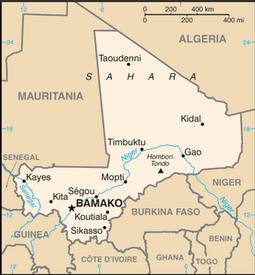
Islamists in Mali destroyed a number of Sufism tombs in the ancient city of Timbuktu, which in the last year fell under control of a separatist insurgency. Home of the prestigious Sankore University, Timbuktu was an intellectual and spiritual capital and a centre for the propagation of Sufism (an Islam faction) throughout Africa in the 15th and 16th centuries. Its three great mosques, Djingareyber, Sankore and Sidi Yahia, recall Timbuktu’s golden age. “The destruction is a divine order,” said a spokesman from Ansar Dine, a radical outfit with alleged links to al-Qaeda. Ansar Dine or “defenders of the faith” in Arabic is group led by a prominent leader of the Tuareg rebellion in the 1990s which wants the imposition of strict Sharia law across Mali.The Associated Press Posted Jan 28, 2013 @ 07:32 AMSEVARE, Mali (AP) — Islamist extremists torched a library containing historic manuscripts in Timbuktu, the mayor said today, as French and Malian forces closed in on Mali’s fabled desert city.
All of this is haram
According to BBC the “spokesman” went on: “God is unique. All of this is haram (forbidden in Islam). We are all Muslims. Unesco is what?” According to reports, the militants teared down the centuries-old mausoleums of Muslim holy men in Timbuktu. As many as half of the city’s shrines have been destroyed in a display of fanaticism. When driven out of Timbuktu by the French, the leaving “activists” burned down the Ahmed Baba library which is a real tragedy, because so much of Sufi and African history, literature and learning was lost forever. Build by the South African government in 2009, the Ahmed Baba Institute was named after a Timbuktu-born scholar and held thousands of priceless manuscripts in its climate-controlled, underground vaults. Ancient books of culture, geography, science are now all torched up 20,000 scholarly manuscripts lost.
Memories come up when in March 2001, Taliban fighters and grandees blew up the famed giant 6th century statues of the Buddha in Afghanistan.The Taliban also rampaged through the national museum which I visted in the seventies, smashing any art depicting the human form, considered idolatrous under their hardline interpretation of Islam. In all, they destroyed about 2,500 statues. Or of the final destruction of the ancient world’s single greatest archive of knowledge, the Library of Alexandria, which was burned down by Caliph Omar 640 AD when the Muslims took the city of Alexandria. Upon learning of “a great library containing all the knowledge of the world” the conquering general supposedly asked Caliph Omar for instructions. The Caliph has been quoted as saying of the Library’s holdings, “they will either contradict the Koran, in which case they are heresy, or they will agree with it, so they are superfluous.” It is somewhat ironic that Alexandria was the center of Monophysitism, a Christian heresy weakening Byzantine and Roman power.
Ignorance
Too many critics of Islam, including atheists, fail to appreciate just how diverse and varied Islam can be, much more than Christianity. This is especially true when it comes to Wahhabi Islam, the primary religious movement in Saudi Arabia. Saudis are aligned with the West to bring down all somewhat secular dictatorships in the region. In the puritanical strain of Islam adhered by most radical Sunni (like Taliban and Salafists) but also fundamentakist Shiites, veneration of Sufi saints – which remind on Christian saints – counts as idolatry a heretical practice that cannot be tolerated. It is against modernity, secularism, and the Enlightenment which orthodox Islam do fight — and it is this anti-secularism, anti-modernism which helps drive extremism, even to the point of cultural terrorism. Militants bearing guns, pickaxes and shovels reduced to rubble the tomb of Sidi Mahmoud, who died in 955 A.D. They have also knocked down tombs of two other prominent medieval saints, Sidi Moctar and Alpha Moya.
Who controls the history controls the future
Both South Africa and the Libya of Col. Muammar el-Qaddafi were involved in efforts to revive the fortunes of the ancient city and its artifacts. South African researchers involved in a project to preserve the Timbuktu manuscripts have had word that most of the treasures survived in private libraries and secure locations.Mohamed Mathee of the University of Johannesburg told a News Channel, “It seems most of the manuscripts are OK. These manuscripts are with families and are safe.” All those events in the new millennium have highlighted that we are today’ in a ideological war is fought with more than just weapons – just as Samuel Huntington has written in his a powerful and disturbing book in the late nineties.
International outrage with little understanding of the Islam has been swift to blame “Islamists”. But beyond understanding history (and Islam) better, there’s little anyone can do to stop this wretched bout of iconoclasm. History is littered with the debris of toppled temples and smashed idols. Salafists and others who also believe in a more orthodox brand of Sunni Islam harbor a particular animosity toward Sufism, whose mystical interpretation of the divine affords a more heterodox faith, steeped sometimes in local pre-Islamic traditions and a reverence for saints and deceased wise men. Islam, as it spread outside the Arabian world, did so in some part through the peaceful teachings of Sufi orders and wandering monks — not just under the hooves of conquering Arab armies. Yet, recently under the Arab Spring, Sufi shrines have come under attack from emboldened and radicalized puritans in countries like Egypt and Libya by Muslim brotherhood and Salafist; in Pakistan, the Taliban and its affiliates have waged a sectarian war on Sufis, systematically targeting dozens of tombs and Sufi sites, while killing hundreds of devotees. In Persia the orthodox Shiites did not much less harm.
The many holy places and old libraries of Timbuktu, once a prominent center of Islāmic learning in the 15th and 16th centuries, were preserved for centuries as a result of the city’s remote location on the path of now collapsed salt and gold-trade routes. In single-minded devotion to the word of the Koran, the orthodox Islam cares little for the juridical wisdom of generations of Timbuktu’s theologians who critically examined Islam’s founding holy text. The attack on Timbuktu’s cultural heritage is just one more attack against history and the values it carries — values of tolerance, exchange and living together. It is an attack against the physical evidence about the Islam’s majority livelong struggle against freedom, science and mysticism.
Wisdom
The Ahmed Baba Institute had nearly 30,000 manuscripts, which are being studied, catalogued and preserved. Four basic types have survived:
key texts of Islam, including Korans, collections of Hadiths (actions or sayings of the Prophet), Sufi texts and devotional texts
works of the Maliki school of Islamic law
texts representative of the ‘Islamic sciences’, including grammar, mathematics and astronomy
original works from the region, including contracts, commentaries, historical chronicles, poetry, and marginal notes and jottings, which have proved to be a surprisingly fertile source of historical data.
Some manuscripts themselves are also of special importance to their owners to prove noble descent or land and property ownership. But they are also proof of Africa’s pre-Islamic culture, which the Islam claimed (and radical despise) like any culture Islam took over and claimed of its own.
According to the 17th-century historian Abdurrahman As-Sadi, the history of the West African desert region could be divided into the rise and fall of three great empires – ancient Ghana, medieval Mali and the Songhay empire. Located at a hub of commercial exchange between Saharan Africa, tropical Africa and Mediterranean Africa, Timbuktu was a magnet that attracted both men of learning and men of commerce. It benefited from the gold trade , however, the most profitable trade items in Timbuktu were books. Buying them was considered a socially acceptable way of displaying wealth and a great source of prestige. As the empire of Ghana declined, the Mali empire took its place. King Sundiata Keita of Mali conquered ancient Ghana in AD 1240, and two generations later, Islam became the dominant religion of the Malian cities and Arabic became the language of scholarship. Described as the ‘Latin of Africa’, Arabic was useful for communicating between tribes such as the Bambara, Fulani, Hausa, Mossi, Songhay and Tuareg who all spoke different languages. Just as Latin in medieval Europe was associated with Christianity, Arabic in medieval Africa was associated with Islam, and just as Europeans adopted the Latin script to write their own languages, Africans used the Arabic script to write theirs.
Mali became indepdent 1960
The Sankoré University mosque was built in about AD 1300 with funding from a woman of the Aghlal, a religious Tuareg ethnic group. There were a number of challenges to Malian hegemony. ‘The Tuaregs began to raid and cause havoc on all sides. The Malians, bewildered by their many depredations, refused to make a stand against them.’ Mali lost control of Timbuktu in 1433. Once a tributary to the Mali empire, the Songhay became independent as Mali declined. The gold traders and the scholars of Timbuktu were also treated harshly and many fled. Timbuktu benefited under the reign of the Askiya kings by tax and slavery privileges and rose to intellectual dominance in the region. The Sankoré University mosque was the main teaching venue but classes were also taught at the Great Mosque and at the Oratory of Sidi Yahia. Public libraries were established and employed calligraphers to copy books.
Timbuktu was also a religious city. According to a West African proverb: ‘Salt comes from the north, gold from the south and silver from the country of the white men, but the word of God and the treasures of wisdom are only to be found in Timbuktu.’ There is a local legend that the city is guarded by 333 renowned saints as well as numerous lesser ones, and surrounding Timbuktu like a rampart are the chapels where the saints are buried. Saints and chapels are of course an anathema to orthodox Islam. According to the Sufis, a saint is a Muslim mystic, usually a scholar, who has achieved such closeness to God as to possess special powers.
Ahmed Baba
Ahmed Baba, the Sufi scholar after whom the burned down library was named, studied Arabic grammar and syntax, astronomy, logic, rhetoric and prosody. Textbooks were purchased and copied on a number of subjects, including astronomy, astrology, botany, dogma, geography, Islamic law, literary analysis, mathematics (including calculus and geometry), medicine, mysticism, morphology, music, rhetoric, philosophy, and occult sciences. The works of the Greek astronomer Ptolemy were basic references for Islamic astronomy. The Greek philosophers Plato and Aristotle were also common. The Greek physician Hippocrates was popular, as well as the Persian medical philosopher-scholar Avicenna. The Timbuktu manuscripts mainly comprise Korans, Koranic exegesis, collections of Hadiths, writings on Sufism, theology, law and other closely related disciplines. By the 15th century, Timbuktu scholars were producing original works as well as compiling new versions and commentaries on established texts. The reading and writing of poetry was important in these cultures. Among the Timbuktu documents are verses devoted to the Prophet and to the adoration of a particular woman or man, and poems. A number of manuscripts were written in Ajami – Arabic script used to write local languages – with botany, diplomatic correspondence, occult sciences, poetry and traditional medicine.
Sufism
There are three main branches of Islam – Sunni, Shiite and Sufi. Sunnis make up about 85 percent of the Muslim population globally, while Shiites account for about 15 percent. The two split over differences of who should succeed the Prophet Muhammad but are further subdivided.
Sunni follows a strict, literal interpretation of the Quran and the life of Muhammad with the Sunna as core teaching. Wahhabism is an austere form of Sunni dominant in Saudi Arabia for which Muslims more often use the term Salafism.
Shiism is the smaller of the two major branches of Islam. It developed after the death of Muhammad, when his followers split over who would lead Islam.
Sufism is an Islamic mystic tradition with followers around the world. Sufis tend to identify with either Sunni or Shiite Islam. Many Muslims are critical of Sufism as an unjustified innovation.
Shia Faction of Islam
Sunni Faction of Islam
Sufis/Sufism
10-15% of all Muslims
Majority of Muslims
Shia means “faction,” refers to “faction of Ali.”
Sunni means “tradition,” adheres to orthodox tradition
Suf means “wool,” considered the Mystics of Islam.
Iran center and home of most Shia, 88% of Iranians are Shia (Shi’i), In Iraqi 96% are Muslim and over 50% of them are Shia (Shi’i), though Iraq was ruled by minority Sunnis. Reverse Syria if you consider Alawis (12er ) to be Shiites.
Grew out of Umayyad dynasty. World-wide 85% of Muslims are Sunni.
Developed in reaction against the excesses of the Sultans and Caliphs (who wore silks, satins), specifically the Caliphate of Damascus in the Umayyad dynasty, Sufis wore course wool garments in protest.
Succession and Leadership
Believe in Ali and the Imams as rightful successors of Muhammad, but not in first 3 Caliphs. Ali was first of 12 successive legitimate Imams. Succession was to be hereditary.
Acknowledge each of the first four Caliphs as rightful successors to Muhammad.
Value deliberate simplicity, meditation rather than just a formalistic following of the rules.
Look forward to Messianic return of the last recognized Imam. Muhammad al-Mahdi, last Imam, disappeared 900 CE, went into “hidden realm”, was sinless. Ayatollah Khomeini (1900-1989) believed by many to be the return of the last Imam.
Through the ages, Caliphs rule “in God’s name.”
Sufis gathered around shaikhs (masters) and formed faqirs (orders or communities). Rabi’a (1717-1801 CE) was a Sufi poet whose poetry spoke of God’s Love similar to Christianty Al-Ghazzali (1058-1111) first Sufi to bring the faction into mainstream Islam.
Imam holds an exalted position, Ayatollah refers to most important Imams.
Imam is a prayer leader. Sunnis approach God directly, there is no clerical hierarchy.
Sufi Shaikhs are the masters. Wandering monastic culture
Teachings and Scripture
Characteristic is the continual exposition and reinterpretation of doctrine by the clerics.
Believe in entire body (canon) of life and teachings of Muhammad as found in Qur’an and hadiths (sayings and traditions of Muhammad). Sayings and traditions are interpreted by scholars in Islamic schools.
Qur’an is full of symbolism, each verse has from 7 to 70 meanings. Believe in three approaches to the divine: mysticism of Love (heart knowledge), Ecstatic (visionary knowledge) and intuitive discernment (mental knowledge)
Both Sunni and Shia factions believe in the Sharia, the comprehensive law derived from the Qur’an (revelations of Muhammad) and the Sunnah (sayings or interpretations of Muhammad).
Believe in fana (extinction) of separateness from God and “remembering” that “there is nothing but God.”
Scholars carry on debate in Islamic Schools. Science of Tradition refers to Islamic scholarship and rating of specific writings (rated sound, good, weak, or infirm)
Influenced by Christianity and Gnosticism (life is a spiritual journey—want to know God/Allah now not just after death), Persian Zoroastrianism and Hindu Mysticism
Shia Faction of Islam
Sunni Faction of Islam
Fufis/Sufism
Fundamentalist approach to Islam, interpretation by clerics
Qur’an applies to everyday life, public life is shaped by the Qur’an. Saudi Arabia considered model of proper Islamic state
Called “the Heart of Islam,” highest experience in life is experience with Allah, can get face to face with Allah/God
Sufism has been, especially in the West, portrayed and regarded as a valuable and legitimate part of the Islamic faith. Anybody somewhat familiar with the complex interaction of religions will agree with this statement “considerable ink has been spent by modern scholarship on the ‘origins’ of Sufism in Islam, as to how far it is ‘genuinely’ Islamic and how far a product, in the face of Islam, of outside influences, particularly Christian and Gnostic.” The historian Rahman seems to hint that some of this ink has been wasted, as he concludes that “outside influences must have played an accessory role and these no one may deny, but they must have supervened upon an initial native tendency.” Sufism goes beyond the Five Pillars of Islam are which are obligations which are required of every Muslim: shahadah (statement of faith), salat (prayers), zakat (alms), sawm (fasting), and hajj (pilgrimage).
History of religions
A thorough and critical examination of historical and present day Sufism, quickly reveals the influence of numerous religious ideas foreign to Islam. Zoroastrianism had also an intimate contact with Islam like Gnostic Manichaeism. Zoroastrianism provided first of all a vocabulary for Sufi poets and symbols of angelology and cosmology transparent in the light of gnosis. Most orthodox scholars would be perplexed by this conclusion, especially when it is considered that Zoroastrianism (and pre-Christan Gnostic) predated Islam by over 1000 years.
The further one delves into Sufism from a content perspective, the more clear it becomes that both the origins and content of Sufism show the inclusion of religious ideas and influences alian and contradictory to orthodox Islam. The scholar Elliot Miller states that “[being] based on experience rather than doctrine, Sufism has always been more open to outside influence than other forms of Islam… in addition to early influences from Christianity, one can find elements of Zoroastrianism, Neoplatonism, Hinduism, and other diverse traditions.”
While Sufi teachings have been influenced by various religions, their practices also bear close similarities to those of Hinduism and other mystical religions of the East. The Sufi orders are led by shaikhs, who play the same role as Hindu gurus. Most Sufi orders still consider the five pillars of Islam to be essential, and practice them piously, however they go far beyond this, aiming to spiritual awakening. Central to all of these practices are ritual “invocations of the Divine Name,” also known as dhikr, which can be done either silently or in a chant. Here similarities with Hindu mantras are unmistakable. The evidence of Sufi borrowings from other Eastern religions such as Hinduism and Zoroastrianism is certain. The similarities in teachings and ritual are overwhelming. It is no surprise then that the goals of Sufism reflect their pantheism and monism.
Echoes of Eastern ( and Western) mystic religions are of course distinctly contrary to Muslim orthodoxy but its mystic quest for spirituality has embraced all sorts of religion. How then, in conclusion, does the evidence presented, reflect not only on the nature of Sufism, but on the very nature of Islam itself? Sufism is clearly a reaction or response to what was lacking in early Islam. The very strength of Islam, in its reliance on a simple creed combining religion, law (and power of a non-secular state) and the five pillars of practice, proved to be the very weakness of Islam. The design of the Islamic ideological system had allowed, however, for rapid expansion and political aggression. Another area of weakness in Islam, which helped lead to the problem of Sufism, is found in the inherent synthesism (and gnosticism) of Islam. Here the vagueness caused by the doctrine of the indescribably Allah (a main concept common of Gnosticism) allowed in essence creating a contradictory belief system. The orthodox ulama developed their theology borrowing and changing what they viewed as their ‘Judeo-Christian’ roots (including Chrisiam heresies), while the Sufis were largely influenced by Eastern mystics.
Sufism, with its radical mystic concepts, is for orthodox Islam not a legitimate part of Islam, if Islam is narrowed to a logically coherent set of beliefs. For Sufism not only points to a lack of spirituality in Islam, but also contradicts orthodox Muslim teachings – in the process clearly opening the door to all the world’s religions. One more door of many, now was violently shut by orthodox Islam in Timbuktu which goes deliberately back to its origional political and ideological purpose as mean of expansion.“It’s truly alarming that this has happened,” Mayor Ousmane Halle told The Associated Press by telephone from Bamako. “They torched all the important ancient manuscripts. The ancient books of geography and science. It is the history of Timbuktu, of its people.” After Islamists seized Timbuktu last April they began imposing a strict Islamic version of Shariah, or religious law, across northern Mali, carrying out amputations and public executions. Women could be whipped for going out in public without wearing veils.
Conclusion
The golden age of Timbuktu came to an end with the collapse of the Songhay empire following the invasion by Morocco, when an Arab-European army invaded Songhay in 1591 and destroyed it. The invaders confiscated gold and other resources, enslaved the Songhay scholars – including Ahmed Baba, who was deported to Morocco – and attempted to confiscate Timbuktu’s archives. The “Liberation of Libia” hailed by the Western press, threw what was once one of West Africa’s most stable democracies once again into chaos: the rebellion in the north gained ground with Gaddafi’s fighters and weapons moving over the border into Mail and effectively capturing half the country afterwards splintering on religious lines, with Salafist factions clashing with more secular elements. Western military intervention dimly disguising economic interests started after hundreds of thousands of Malians have been forced to flee their homes as refugees. Fears of an escalating humanitarian crisis have been publicized but the writings on the wall have been ignored. You see a pattern of wisdom and ignorance here? Yes, I do too. Please note, this is an essay out of general interest (and sympathy) to religion even if not my belief. I am neither Muslim nor scholar.
The world might come down tomorrow according to Mayan calendar. Actually the Mayan never predicted an apocalypse, but a reset sure would be nice, at least in politics. There are many of unlikely astronomic mishaps which could happen, but I am convinced mankind’s stupidity is on the very top of the list.The vigesimal system (that means that the number 20 was the basis of their arithmetic system of time-reckoning that produces the Mayan Long Count, a continuous count of the days from mythical beginnings (and is responsible for current fears that the end of the world will occur in tomorrow, December 21, 2012. The article explores the 2012 Bak’tun apocalypse from a personal, astronomical and psychological level.
The Maya worshipped a pantheon of nature gods, each of which had both a benevolent side and a malevolent side. The most important deity was the supreme god Itzamná, the creator god, the god of the fire and god of the hearth. Mayan rulers were seen as intermediaries between the gods and the people, and as semi-divine themselves like the Agyptian Pharos. They were buried in elaborate tombs filled with valuable offerings. The Mayan view of the afterlife consisted primarily of a dangerous voyage of the soul through the underworld, which was populated by sinister gods and represented by the jaguar, symbol of night. The majority of Maya, including the rulers, went to this underworld. Heaven was reserved for those who had been sacrificed or died in childbirth. Like in any ancient belief system, to the Maya, science and religion were one and the same. The Maya developed an impressive mathematical achievements included positional notation and the use of zero; and in astronomy, they accurately calculated a solar year, compiled precise tables of positions for the Moon and Venus, and were able to predict solar eclipses.
Memory of a journey
That triggered a memory. Exactly December,20th 1988 we flew in to Cancun from SFO via Mexico City for Christmas holidays.I had picked up my then wife a day before at SFO airport. From the mid eighties until the early nineties I worked in Silicon Valley. My wife lived in Europe, because her work leave could not be extended and she did not want to quit her job. I remember picking up the tickets, the travel agent seem to be relieved, because the agency had tried to contact me numerous times but never reached me (no mobile then). “Is that your home phone” showing me a long telephone log … “yes ma’am”, I said … “but you are never there?”, “umm no ma’am”, I said.
Palenquechichen-itzaoppsFirestorm-1943: Source Universty of Exter
Reason was I managed a pretty hot project at that time and was quite busy in this year (and others to come). In Mexico, I had just booked a hotel for one or two days and a rental car which was a red VW (beatle). VW’s had been built still built there at that time. Cancun has wonderful beaches and the water has a unique colour. With all due respect, however, I did not care for the city because it was such a boring resort setting. We moved on fast. The water out of the pipe smelled like it was imported and the air condition in the hotel made me shiver. I am not a beach whale and it was the aftermath of a big storm, lots of palm trees gone and still high waves.
1988 the world isstillnot coming down
So my to-be-ex wife and I – we got divorced 10 years later – set with the banged up red VW to a memorable journey all over Yucatan . Oh, did I say my luggage was delayed, I had to buy some stuff and borrow some of her t-shirts and trousers (she was slim then). Always a systematic traveller, she had learned enough Spanish to ask for directions, order food or book hotels and figured what we must see. First we went to Tulum, spent new year in Palenque, partying hard with a French group until the morning. Via Campeche we visited Uxmal continued to Merida. All historic sites are of great astronomical interest. In Merida I still remember a old hotel with a nice court yard and spicy food. Best Mexican food I ever had,and California’s food isn’t too bad Highlight was Chichen Itza and Palenque. Of course we saw the pink flamingos, hiring a boat.
The astronomy view
Chichen Itza, is a regional civic-ceremonial polity by the end of the 6th century AD. It developed towards the Late Classic and the Terminal Classic periods(roughly 10th and 11th centuries). It declined after 1221 (because of a civil war).Deep within the jungles of Mexico and Guatemala and extending into the limestone shelf of the Yucatan peninsula lie the mysterious temples and pyramids of the Maya. Without metal tools, beasts of burden or even the wheel they were able to construct vast buildings ina a jungle landscape with an amazing degree of architectural perfection and variety.
chichen-itza
Astronomical elements: El Castillo (Temple of Kukulcan) which displays the equinox phenomenon; El Caracol – the snail was for sure an observatory with wholes for solstice sunset alignments, sunset on the day of zenithal passage, the northernmost setting position of Venus, sunset at the equinoxes; the Great Ball Court (Temples of the Jaguar – pointing to the sunsets on April 29 and August 13); Las Monjas (pictorial representations of the Maya zodiac); Temple of Venus (iconographic representation of 8 solar years equalling 5 Venus cycles); Their legacy in stone lives on as do the seven million descendants of the classic Maya civilization. The name Chichén-Itzá is a Mayan word: CHI (mouth) CHEN (well) and ITZA (of the Itza tribe). The site is divided into three sections. The North grouping of structures is distinctly Toltec in style. Much has been written about it. We visited Chichén Itzá in late in the afternoon. Shown here is the central pyramid, also known as El Castillo, this spectacular, massive Mesoamerican step-pyramid. Built by the Maya sometime between the 1000 and 1200 AD, El Castillo served as a temple to the god Kukulkan and is believed to have served as a calendar. Each of the structures four stairways contains 91 steps. When counting the top platform as another step, in total El Castillo has 365 steps, one step for each day of the year. We also climbed on top of the pyramid and later visited the large ball court where Mayan men played a game in which each team had six field players who would attempt to pass the ball – using any body part except their hands – to their captain who would attempt the shot . The captain of the team that made the first successful shot was then decapitated as a sacrifice to the gods. One fact worth noting is the repetition of the number seven, which was also sacred to the Mayans. There were seven players on a team, the rings were seven meters high and if you clap your hands or shout in the court, the sound will echo exactly seven times. There are carvings on the stone walls that depict the ball players (some of which are remarkably intact) and after the captain was beheaded, it is said that seven serpents grew out of his neck. But the true mystery behind the ball court at Chichén-Itzá is the Mayan prophecy that on December 2012, the great warrior serpent Kukulkán will rise from the ground beneath the playing field and end the world for good.
Palenque is one of the most important Mayan sites, it reached its height between 500 and 750 AD. Astronomical elements: inscriptions referring to the conjunction of planets (Jupiter, Saturn, and Mars and the Moon) and the birth of three ancestor gods and the First Mother, in July 690; the Temple of Inscriptions (with the tomb of Janaab´ Pakal); the Palace and the Group of the Cross. Records at the site suggest the site came under attack by another Maya center, Calakmul, in 599 and again in 611. The main point of interest about Palenque is not its size or age, as other sites are larger and likely much older, Its importance lies rather in its naturalistic sculpture, architectural inventiveness, and detailed epigraphic records. According to them the world will see a significant event but continue to exist after 2012 CE, since this date has just a spiritual meaning in the life of the ruler. As I remember, according to my travel guide one can see, birth , Accession, Death and Reign Post.
Uxmal is another major Mayan centre, built between about 700 and 1100. Astronomical elements: the Governor’s Palace (alignments to the Venus extreme positions, (eastward or westward), iconographic representations of the Venus cycle and of the Mayan zodiac; the Nunnery Quadrangle (astronomical imagery), visual relationships between the most important structures as viewed from the top of the Adivino (Pyramid of the Magician).
The Maya were a clever kind of folks. Pre-Hispanic Mesoamerica made perhaps the best examples of calendrical-astronomical speculations and computation ever made by the populations of ancient America.Their civilization got started several thousand years ago and reached its height by 900 A.D., spread over the Yucatan Peninsula and what is today Guatemala (I unfortunately was never there). They had a sophisticated culture and were adept in agriculture and architecture. They had a complex written language and a keen system of mathematics. They were excellent astronomers, understanding the patterns of the stars and planets in the sky. And, as described, they had an advanced calendar.
The Basics of the Mayan Calendar
Keeping time is of paramount importance to any civilization. The Maya used different calendars for different purposes The magic number is her 13th Bak’tun period – Mayans valued 13 and 7 and calcultated base 20 instead of the 12 most ancient astronomer used. The Mesoamerican calendrical system is displayed in the form of many different permutations, and expressed the universal laws governing the world as it was then conceived.he Maya understood 17 different Calendars based on the Cosmos. The calendars that are most important to beings of earth are the Haab, the Tun-Uc and the Tzolk’in. The Tzolk’in is the most important and the one with the most influence. The Haab is based in the cycles of earth. It has 360 + 5 days, totaling 365 days. The Haab uses 18 months with 20 days in each month. There is a 19th month called a Vayeb and uses the 5 extra unlucky days. Each month has it’s own name/glyph. Each day uses a sacred sun/glyph. The Tun-Uc is the moon calendar. It uses 28 day cycles that mirrors the women’s moon cycle. This cycle of the moon is broken down into 4 smaller cycles, of 7 day each. These smaller cycles are the four phases of moon cycle. Portal days (p), on the calendar provided marks days using mathematics of 28 and therefore have a connection with the moon cycles. The Tzolk’in is the sacred calendar of the Maya and is based on the cycles of 260 days. The cycle of the Pleiades uses 26,000 years, but but encompassing 260 days might allign the Venus cycle as shown below. The Mayas knew the importance of the period of 2920 days equal 8 years by 365 days, in which the Venus repeats its movement in relation to the sun, same as the Babylonian did. The “Dreseden codex” in Germany contains tables for predicting solar and lunar eclipses and ephimerides fro Venus and Mars for two rounds.
dresden_codex_germany
The morning star was seen as a male deity. Venus war regulary abserved as said using sacred numbers 13 and 20. The 13 represents the numbers and 20 represents the sun/glyphs.The Tzolkin calendar was meshed with a 365-day solar cycle called the “Haab”. The calendar consisted of 18 months with 20 days (numbered 0-19) and a short “month” of only 5 days that was called the Wayeb and was considered to be a dangerous time. It took 52 years for the religious Tzolkin (13×20) and civil Haab (18×20+5) calendars to move through a complete cycle. We know from many other cultures, the year that previously worldwide had 360 days, was suddenly at any time to 5 days longer. You do not believe in the real 360-day year, but it was there really. Nothing demonstrates this more clearly than the Mayan calendar labels. If the count on the basis of 20 would have been a theoretical construction, so would do this twenty times that of a uinal (20 days) = 400 must be. But one year had 360 days. And all other calendar cycles are both multiples of 360.
The baktun period of 144000 days shows that this system must be old. All astronomers who deals with the Mayan calendar, are of the opinion that the accuracy of the Mayan calendar must be based on a very precise, centuries-old day count. In addition, it is long since known that the Maya payed to the orbit of the planet Venus a particularr attention. This should be noted when one has the theory they introduced the Tzolkinfor correction. The name implies that there cannot be a “liturgical year cycle”. Kin means yes day. There were days so kin = added. It was necessary to adapt their previous calendar to the new cosmic conditions. This applied particularly to the orbit of the planet Venus
1440 = 18720 Days à 13 groups of four
In addition 13 Tzolkin à 20 days = 260 days
a total of 18980 days
These are 52 years of Earth à 365 days.With this correction Tzolkin period, they had corrected not only the solar year, but also a relationship to the Venus year established. The Sidereal Period of an object is the time it takes to make a complete circuit of the celestial sphere with respect to the fixed stars. The Synodic Period is the time required to make a circuit of the celestial sphere with respect to the Sun – which is also moving eastward among the stars. The synodic period is always greater than the sidereal period, the difference being due to the apparent motion of the Sun. The synodic period as seen from the Earth (which is now the outer planet with orbital period one year) is 1.599 years.Venus needs thus – seen from the Earth – 584 Earth days, until Venus shows up again at the same point in the sky (Synodical year of Venus).Venus has an orbital (sidereal) period of 0.615 years. Venus needs thus – seen from the Earth 4745 Earth days, until Venus shows up again at the same point in the sky and compared with the stars.(Sidereal year of Venus).
They had to wait 4 x 13 years for the fractions to sort themselves out. Only after 52 years did the two calendars finally get back to where they had both started. And that period of 52 years became known as the Calendar Round on what the Dresden Codex is based on which escaped Bishop Diego da Landa’s bonfire of all the Mayan sacred books. The Dresden Codex lists the start dates in the tzolkin calendar for each phase of the Venus cycle – the 8 days of invisibility at inferior conjunction, the 236 days as morning star, the 90 days of invisibility at superior conjunction and the 250 days as evening star for 2 requnds 104 years. Each circuit takes 8 years so 52 years = 6.5 circuits of the new pattern. So the scribes had to write out two Calendar Rounds to get the two calendars and the planets all back to their starting positions relative to the stars – now this shows an amazing match (common nominator):
8 * 4745 (siderisch) = 37960 Tage
65 * 584 (synodisch) = 37960 Tage
104 * tun + 2 * tzolkin = 37960 Tage
104 years with 365 days = 37960 Tage
or
13*2920 days = 8*4745 days = 2*18980 = 37960 days (104 years)
46*260 days = 65*584 days = 104*365 days = 37960 days (104 years
104 Earth years included so all the corrections and the absolute correspondence between the traditional 360-days calculation, the correction of the Tzolkin and sidereal and Synodic Venus circulation. This included the solar year.
But the calendar we’re interested in regards to doomsday is called the Long Count. The Long Count, for which we do not know the Maya name, is commonly considered the Maya’s linear count of days. In truth it is yet another cycle, but its great length of at least 5126 years makes it essentially a linear count through history beginning a cycle with 2,880,000 days thus very close to 7885 years. It was assumed that the universum is desströyed and reborn at every end of the cycle. When counting they favored a bas of twenty except in the second place they preferred 18 to aproximate a year, so the units were 20 (month), 360 (year), 7200 and 144,000 (half cycle). That is of course place holding notion. The cycle just ended began on 6. September 3114 BC (Julian Calender). The baktun digits run out in 4772 AD. We’re probably all right until then.
These are the Mayan words for periods of time:
Day = Kin (keen)
Month of 20 days = Uinal (wee nal)
Year of 360 days = Tun (toon)
20 Tuns = K’atun (k’ ah toon)
20 K’atuns = Baktun (bock toon)
The earliest known Maya long count was recorded in year 32 AD at the site of Chiapa de Corzo in the Highlands of Chiapas, Mexico. Just like the Christian calendar, the long count has a start date: ours is January 1 of 0 AD, and theirs (by our reverse engineering) is August 11 of 3114 BC. But unlike our Christian calender, theirs also has an apparent end date, December 21 of 2012 AD. The long count is represented as a five place notation system of ascending cycles – kins (days), winals (20-day months), tuns (360 days), k’atuns (20 tuns), and bak’tuns (20 k’atuns). It is important to note that the long count’s version of a year, the tun, is only 360 days, not the solar count of 365. This means that the long count diverges from the Haab by five days every year, making it a completely unique and separate cycle.
longcount_positionsl
The largest of the long count’s five cycles, the bak’tun, is a period equaling 400 tuns. Many people believe that the full cycle of the Long Count is complete when 13 bak’tuns have passed since the beginning of the creation of this current universe, identified as the 4th creation in the Maya “story of creation”, the Popol Vuh. That date, currently of such great interest to those anticipating an “end of days”, will occur on December 21, 2012 AD. Astronomical practices by the Maya and the Mesoamerican system of time-reckoning are exceptional. A period of 260 days in combination with the 365-day year cycle, producing a ‘Calendar Round’ (cycle of roughly 52 years), is a method of marking the passage of time unique in the history of humankind. That das not mean a such apocalypse is foretold no Maya text – ancient, colonial or modern – ever predicted the end of time or the end of the world. Apocalypse is a Christian concept. Just a restart, after what Mayas considered a very long time. Noted Mayan scholar, admit that December 21, 2013, marks a special occasion in the ancient Mayan calendar. They hold that December 21, 2012, marks the end of the 13th Bak’tun period. The close of each Bak’tun period occurs approximately once every 5125 years. “There can be little doubt the ancient Maya would have seen the date as a numerological echo of the current era’s start date, and they would have marked the occasion of the 13th Bak’tun with great solemnity and fanfare,” writes Callaway in a magazine article titled Ancient Endings and New Beginnings: Maya Cosmology, Just in Time for 2012. The doomsday scenario is simply a human concoction. If anything, it would seem, that the image of the apocalypse in the name of the Mayans is a convenient projection to project a large section of our own society’s subconscious fears, insecurities and fantasies we certainly have in the west.
The astrology view.
Sun 29°59 Schütze Haus 10
Moon 14°08 Widder Haus 1
21.12.2012 12:00 Munich, Europe
Aszendent Fische
Merkur 14°41 Schütze Haus 9
Venus 6°34 Schütze Haus 8
Mars 26°25 Steinbock Haus 11
Jupiter 8°54 Zwillinge Haus 3
Saturn 8°39 Skorpion Haus 7
Uranus 4°38 Widder Haus 1
Neptun 0°48 Fische Haus 12
Pluto 8°56 Steinbock Haus 10
Mondknoten25°36 Skorpion Haus 8
Chiron 5°37 Fische Haus 12
Pholus 19°47 Schütze Haus
Throw that in for completeness. Nothing unusual. Quite loaded but no doomsday.
The psychoanalytical view.
Two Twelver cycles later, happy 2012 close of each Bak’tun period. “The greatest threat to Earth in 2012, at the end of this year and in the future, is just from the human mind” C.G.Jung would have said. The word “Apocalypse” (revelation) is from the Greek meaning “uncovering what has been hidden.” In other words, the revelation of new truth. It is a concept very evident in Christianity and separates in four phases: revelation, judgment, destruction, and a new birth. If we look back over centuries, we see the revelation of torrents of new scientific, psychological and social truth; judgments or assessments made on the basis of this new truth; the collapse of beliefs and institutions based on the former truth, and are becoming dysfunctional within the context of the new truth; and the sprigs of the new worldview trying to blossom. Destruction and new birth take place simultaneously in Hinduism, although the popular use of the word apocalypse means now total destruction. When Christianity took over the Roman Empire and became the second truly global organization (and the only one which still exist in Roman Catholicism) it was because Jesus articulated and manifested what had been gradually growing in the collective psyche, the political circumstances were ripe for a revolution and the Roman citizen’s vision, will and spirituality broken. All essential of a state were outsourced and the succession of rulers changed from bad to worse. It might be said that evangelist were the master psychologist of his day. Jung once said he loved to read the Bible not only for its spiritual insights, but also for its psychological significance. Again we’ve so completely alienated ourselves from nature and its essential role in the human psyche, and our state of knowledge and psychic development are driven by a media time, the concept of the global Now, the Bible no longer has the same numinosity to many in the West.
So to summarize: the Mayan hype December 21st is the faint memory of the “archetype of the Apocalypse” essentially of numinosity. The concept of the “global Now”, knows no God, certainly no Past and no Future anymore. People remember archetypes like the Zombies, who (or which) wander aimless in the shopping center, since that was once the center of their life. George A. Romero conceived this allegory brilliantly in the best legitimate zombie film ever, ” Dawn of the Dead” (1978). Likewise The collective “mind” of the twenty-first century seemed to have been obsessed with Apocalypse. There is little doubt that the culmination of this obsession echos destructive capabilities of the financial market (aptly named new world order) for political and social autonomy. Thus, it may be the an unconscious “death wish”, a psychological problem which Jung’s patient ( and the first female psychoanalytic) Sabine Spielrein discovered in her paper, ‘Destruction as a Cause of Coming into Being’ (written immediately after she graduated with top honours). A death wish expressed collectively for its civilization–like once the Romans– which understand and avert its own demise. Read a German newspaper for instance – the death wish of a society – which does not even want to breed anymore – is printed all over the place by zombie journalists.
“Cosmos An illustrated History of Astronomy and Cosmology”. John North 2008
“The exact Science in Antiquity” O. Neugebauer, Dover Edition 1989
Heritage Sites of Astronomy and Archaeoastronomy in the context of the UNESCO World Heritage Convention: A Thematic Study. Other. ICOMOS, 2010 Paris
Letters of C.G. Jung and Sigmund Freud Princeton, 1974
In the sixteenth century, the time of Johannes Kepler, fields such as alchemy, astrology, and harmonics were considered important subjects eyed suspiciously by theology which overtook metaphysics. Narrowed down to chemistry, astronomy and (some) art and a materialistic positivism, C.G. Jung gave us back an holistic and spiritual view very compatible with Kepler’s religious motivated cosmology. How did that happen, what are the relations?
Relationship between Astrology and Metaphysics
Both Islam and Christianity have had a conflicting relationship to astrology, because the predestination of fate is contrary to free will as an unconditional prerequisite (sine qua non) of the Christian faith or the opposite in the Islam. Predicting the future implicit in astrology was broadly incompatible with orthodox teachings of Islam, which means ‘submission’ to the Will of Allah. Tertullian warns of astrology but Constantine the great was committed to it.
In Greek philosophy correspondences between celestial configurations and events on Earth demonstrated the wholeness of Creation, with theories of Aristotle and Ptolemy provided a respectable scientific framework. Arabic astrology by al-Kindi used those classical ideas, of ‘cosmic sympathy’ linking the macrocosm and microcosm. Astrological symbolism became an important element of Sufi mystics. Orthodox Islamic theologians argued that since Allah was all-powerful, astrology was irrelevant at best; at worst it was a dangerous delusion bordering on the magical and demonic. Similar objections were raised by Christian theologians when astrology and mysticism began to filter back into medieval Europe.
Renaissance and humanism brought Astrology and Alchemy back referring back to Hellenistic and Arabic sources. Until the Renaissance, astronomers were frequently at the same time astrologers (Tycho Brahe, Johannes Kepler). Despite the historical enmity between Islam and Christianity ‘Arabian parts’ were well-known in classical European astrology. Accessible to most astrologers today is al-Biruni’s Book of Instruction in the Elements of the Art of Astrology written at Afghanistan in 1029, while not a direct influence upon European astrology, and gives a concise account of contemporary Arabic astrology.
The time around 1600 was also characterized by larger and smaller scientific break troughs and innovations Those include the increasing detachment and independence of Greek and Arab authorities, especially Aristotle, the establishment of the empirical methods, the incipient delimitation the scientific nature of Alchemy and Astrology, new technical inventions such as the telescope, but also the attempt to separate the scientific view from the theological view. Of course the persistence of tradition and the traditionalists had to be overcome first.
Kepler and Astronomy
Everybody knows the three laws of planetary motion in the history of science, which more than Copernicus himself or Galileo Galilei use of the telescope proved the heliocentric model mathematically. Few are equally aware that he has been an avid proponent of astrology and inspired in his scientific pursuit also intellectual ideas of astrology and anticipated going to the moon. More than four hundred years ago, Johannes Kepler thought on the Moon: its text, which is now for the first time completely in German, is a scientific-literary game.
For as long as Kepler was fixated on scientifically traditional views, he could not prove the heliocentric model he aspired to achieve. He did so when he began thinking freely with a very accurate set of observations he became from Tycho Brahe, to verify assumptions, theories, mathematical models and derive predictions.
In 1596, Kepler authored a book titled “Mysterium Cosmographicum” (“The Cosmographic Mystery”).A firm believer in absolute divine harmony, he believed that this was due to the fact that there are only five regular polyhedrons. In other words, Kepler formulated a theory based on the medieval perception of the ordering of the world into “impure” and “pure” territories. In the pure territory,everything should be as perfect and harmonious as the perfect circles.Kepler was greatly disappointed, as these did not prove that the orbits of the planets form perfect circles, and dedicated much time to ineffective efforts being trapped by the metaphysical credence.
Although Kepler accepted the heliocentric rather than the geocentric system, only after abjure his metaphysical faith he was able to prove it. Kepler had predicted a conjunction of planets Jupiter, Saturn and Mars in the constellation of Sagittarius, in November 1603 and those interested in astronomy awaited the event to take place so as to check Kepler’s predictions.. According to Arabic astrology, when a planetary triangle is formed, a comet appears but no comet appeared. However, on 8 December 1604, a more remarkable and rare astronomical event took place. Not too far from the planetary conjunction, a stellar explosion (supernova named SN 1604) occurred. Following the discovery of the laws of planetary motion, Kepler calculated that a similar the three aforementioned planets had entered a conjunction in the constellation of Pisces in 7 BC and claimed that this phenomenon was the Star referred to by Matthew the Evangelist
The Kepler position in regards to astronomy and astrology is also particularly interesting, because Kepler on the one hand takes many Astrology critical points, but on the other hand tells that the basic assumption of astrology are interferences between the celestial and the earthly world and also defends that it is worth to investigate this relationship and the terms and conditions of the influence. This mediation position is already evident in the title Tertius interveniens. The controversy with and around Kepler show him as a first rated researcher, a devoted Christian but also an intuitive mystic.
The questions the relationship between astronomy and astrology and the possibility for an exact, physical Astrology are the central objects of the controversy. The views and positions are represented with following short
Theses:
comets and new stars have signed character;
specific prophecies are possible and methodical backed up;
Anti-thesis:
comets and new star have no sign character;
Astrology and the technique of their prophecy are methodically unsecured;
Kepler’s negotiating position
celestial bodies influence the “lower world”, i.e. the operations on earth;
Usually no specific prophecies should be inferred;
Astrology research as question of cosmological contexts deserves to be continued even if there are no safe results are available and despite prevailing abuses
Kepler and Astrology
According to astrologists, the positions of the planets at various points of the zodiac cycle, their conjunctions and retrograde motions predict future events on Earth. Using Kepler’s laws, astronomers could much better determine the position of planets in the sky both in the future and in the past; until then, they had only been able to make short-term calculations of planetary positions.
Using Kepler’s laws, we can go back in time, so to speak, and examine if these views coincide with the same or, at the very least, similar events as those predicted by astrology. Kepler, however, believed that the discovery of his laws would add accuracy and scientific merit to astrology. In the context of his astrological studies Kepler did not hesitate to discard traditional ideas, which seemed questionable to him. He condemned the doctrine of the twelve domiciles in the strongest terms in his Astrology: “But there is nothing outrageous as the almost exclusive concern of some astrologers who distribute twelve homes in a childish credulity without any reasoned consideration or scientific method on the seven planets and devise dominions and momentary change of sphere, as it is located in the human political life; all magic and astrological superstition comes from there.” Similarly, he dismissed so-called Ingreß horoscopes, where you pointed from the horoscope of the entry of the Sun in the zodiac signs of Aries, “Pinnacle of stupidity” far from the course of the entire year: “It is a viewpoint disputed completely out of the void”. Also, he warns strongly against the abuse of astrology.
Kepler and Metaphysics
Kepler believed that the world was created by God to express divine aesthetics, what Kepler called “Archetypes.” Johannes Kepler’s system of mathematical archetypes played a primary role in his physical cosmology which were Identified as the geometrical models making up the metaphysical blueprint of the material world.
In Kepler’s eyes, the theory of harmony was essential to astronomy. As an astronomer, he felt himself responsible for supporting one of three competing theories dealing with the motions of the planets. There was the Hellenistic Ptolemaic system, in which all bodies moved around a stationary earth, the Copernican system, which was (almost) heliocentric and involved all of the six planets moving around the sun and that of Tycho Brahe with the sun moving around a stationary earth but the other planets moving around the sun. One of the most important factors in each decision, for Kepler, was harmony. Harmony was a concept of beauty and grace combined with simplicity. Kepler believed that these were attributes of God – a God whose mind was essentially disposed to geometrical archetypes. So he chose the system which he found most aesthetic pleasure, and justified his choice with complex theories of harmony. This is how and why he chose to support the Copernican system. Kepler’s idea of astrology and his concept of archetypes seems very modern and can be easily related to psychoanalytic theory (e.g. Synchronity of C.G. Jung) and holistic approaches of cosmology. For Kepler, the Earth had a soul, an own life force, which is sensitive for the geometric pattern of the sky and responds accordingly. Again and again, he stressed that the earthly events represent only resonances from the stars and are not caused but on the movements of the stars – so how will become audible sound waves over the human ear as a sounding board and can be perceived as music.
Thus he turned first and foremost against the idea, one could derive concrete statements (“Particularia”), for example in the forecast, from the stands of star in the. He adjusts his testimonies very much by the people and the circumstances in which he lives, to find out whether and how a constellation or not applies: “You can learn nothing from the Astrology as a specific deviation from the mental and spiritual inclination of the normal; as the man in a certain way in the future will be of the people, which is an image of God and not only a creature of nature lies in terms of political life completely and utterly free decision, as is the case with the other beings.” So he criticized Wallenstein, for home he twice did a horoscope: “There is an obsession with the birth, as if to predict to be quite the Particularia out of the sky.” To him, each constellation – thus his statement – is dependent on their concrete manifestation of the object which enters the sphere of their competence.
Conclusion
The tragedy of Kepler’s is – as so often – just that his clear and fathom approach has been met by contemporaries with disgrace or simply ignored. His rejection of everything superfluous and his desire to concentrate to produce understandable and coherent thoughts could have been a compelling reason even after the fall of the geocentric universe by Copernicus to continue Astrology as a serious art regardless of physical effects.
His contemporaries have, however, not recognized the significance of Kepler’s effort to detach the Astrology of their alleged laws of cause and effect and of it outdated view of the world and to limit them only on symbolic (allegoric) interpretation, which led to the downfall of astrology. It took another intuitive thinker, C.G. Jung, who understood the importance of mystic, archetypical patterns and wholeness and religiosity for today’s globalized culture.
Johannes Kepler, Von den gesicherten Grundlagen der Astrologie, Chiron Verlag, Mössingen 1999
Ulrike Voltmer, Rhythmische Astrologie, Johannes Keplers Prognose-Methode aus neuer Sicht Urania Verlag Neuhausen 1998
HEINDEL, Max – The Message of the Stars. The Rosicrucian Fellowship, Oceanside, CA, 1973.
Al-Biruni, The Book of Instruction in the Elements of the Art of Astrology, translated by R. Ramsey Wright (Luzac 1934). Available as a reprint from Ascella in London or Ballantrae Reprints in Canada.