Category: Rational

Science and Ancient wisdom

  • History of Time I: The face of God from ancient cultures to the big bang.

    History of Time I: The face of God from ancient cultures to the big bang.

    primordal sinThe history of time reflects culture – interconnecting temporal powers, religion and science. For millenniums priest were gatekeeper of time and calendar(s). Now scientists have taken over. Today we are able to contemplate beyond the creation of time, even beyond the big bang. I got the idea to this essay after I read a  book, titled… you guessed it… “The Face of God” (Le Visage de Dieu) while I struggled writing a long article “The history of time” from a historical and religious view. After I read the book, I decided to break my monster article in pieces and introduce them with this essay. So this is the first of a series “History of Time” which explores concepts of time and calendars over the last 5000 years.

    Most people today avoid the sacred dimension of time as a subject. They may fear past and future – and mortality. Perhaps they have never really thought through meaning of time. Einstein’s outspokenness on his religious attitude was rare. Today religion (and science) are attacked both by post-modern philosophers, “social scientists” claiming all truths are relative and by creationists claiming everything was created just by chance. Under these circumstances, there are good reasons why most scientists avoid all possibility of confusion with religion by never using terms suggestive of divinity. But the loss is that there is no way to understand: we are actually answering questions today whose had been asked by priests and philosophers before.  What human action could be more sacred than that?

    As we will there is a language of the sacred dimension of time and my essays (touching all major cultures) will follow a certain structure.

    • The sacred language of time
    • The worldly language of time
    • The history of time – Measurement and Calendars

    The article gives the upcoming  structure as interplay of science, anthropology and religion. Many thinkers nowadays see theistic arguments as just a quick, lazy, irrational short-cut, though of course this is not necessarily the case; there are many smart, thoughtful, careful thinkers who believe in God – not necessarily in religious institutions.

    The face of God – cosmology meets meta-physics

    We live in political depressing feudal new world order, however, physics today quite successfully attempts to answer metaphysical questions:

    • What shape has our universe and where are its borders?
    • Why is it so exactly fine tuned, like defined by an meta-order?
    • When and how was time and the world was created?
    • When and how will be destroyed or is it fluctuating?
    • What was before creation of time?

    Cosmology became an  empirical and exact science, and it has to be noted that some of its answers proof Church fathers as Augustine right.

    The frontiers of contemporary time

    Face of God.  This is the furthest thing we can see.
    Face of God. This is the furthest thing we can see.

    Three  scientists in 1948 suggested in the famous alpha-beta-gamma report (according to their initials) that billion years ago, the cosmic background radiation of the big bang spreading itself thin must have become low-energy microwaves far colder than ice, later identified at 2.73 degrees above absolute zero as smooth cosmic background radiation. Our universe, however is awfully lumpy, broken up into people, planets, stars, galaxies, clusters of galaxies, and giant walls of superclusters surrounding giant voids.  People had been probing the cosmic background radiation for 30 years, but no one had detected any deviation from absolute smoothness until 1992 variations in temperature measured in millionths of a degree were detected. These minuscule differences show the ripples in spacetime, where matter first began to clump gravitationally about 10,000 years after the Big Bang. Radiation from regions of higher density expended more energy trying to escape a deeper gravitational well and therefore appeared slightly cooler than average   were chartered in oval shaped eggs in shades of pink and blue decorate Smoot’s office, depicting the pattern of temperature fluctuations across the heavens. As bright and gay as enormous Easter eggs.

    Time before time was created

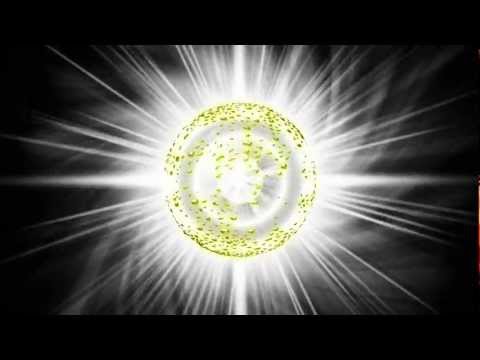
    We now can see back up to 380 000 years before the big bang which occurred 13.7 Billion years ago. We enter know metaphysics area. The universe was created from blue print of fine tuned informational pattern (logos the word) and well understood particle physics.

    John 1:1

    en Archêi ên ho Logos – in the beginning was the word; kai ho Logos ên pros ton Theon – and the word came to god; kai Theos ên ho Logos – God himself was the word

    It is a challenge to translate the greek word logos correctly in a single contemporary word. Logos is derived from lego, say or speakwhose root leg means “plan, collect“. For the Greeks speaking was  give from an array of words” or the “combining the thoughts.”

    We conclude today the universe(space) and time has been created 10-43 seconds after time 0 in a flash of light out of singularity but not ex-nihilo, like written in the Genesis. But where has been god – inside or outside of the universe? An what was he and what was before time?

    Physics talks about the KMS-state in the whole universe and contemplates time was defined mathematically complex, oscillating between its real and imaginary component. Remember a complex number is a number that can be expressed in the form a + bi, where a and b are real numbers and i is the imaginary unit, which satisfies the equation i2 = −1.

    So there there are three forms of time in cosmology:

    • Time connected with energy – our real physical time – mathematically an instance of an abstract object or with C.G. Jung an Archetype;
    • Time connect with information (imaginary energy) instead with real energy – frozen imaginary time – mathematically an abstract object or with C.G. Jung an archetype per-se;
    • The imaginary time is part of the complex time  before the big bang  and out of our physical scope  – true meta-physical ;

    Es werde Licht thus transforms logos i.e. information (imaginary energy) to real energy and imaginary time to real time – from divine patterns.

    Divine patterns and theism

    Theist as Richard Swinburne and Philip L. Quinn that the specific content of the scientifically most fundamental laws of nature, including the constants they contain, requires supra-scientific explanation or a reconciliation between science and religion. The old-fashioned point of view tend to disbelieve in any religious component to the workings of the universe. Materialism asserts that a complete description of nature consists of an understanding of the structures of which it is comprised together with the patterns which those structures follow, while theism insists on the need for a conscious God who somehow rises above those patterns. Materialist have put their hope to mechanical, evolutionary an biological models stayed shy of the big bang. Within this cosmology, there are two possible roads to reconciliation between science and religion. One is to claim that science and religion are not incompatible because they speak to completely distinct sets of questions, and hence never come into conflict. The other is to assert that thinking scientifically does not lead to rejection of theism, but in fact that religious questions can answered in a similar way than cosmology does.

    The essence of materialism is to model the world as a formal system, which is both unambiguous and complete as a description of reality. A materialist model may be said to consist of four elements. First, we model the world as some formal (mathematical) structure.  Second, this structure exhibits patterns (the ”laws of nature”). Third, we need boundary conditions which specify the specific realization of the pattern. Finally, we need a way to relate this formal system to the world we see: an ”interpretation.”

    The reader might worry that we are glossing over very subtle and important issues in the philosophy of science; they would be correct, but needn’t worry. Philosophy of science becomes difficult when we attempt to describe the relationship of the formalism to the world (the interpretation), as well as how we invent and choose between theories. But the idea that we are trying, in principle, to model the world as a formal system is fairly uncontroversial.

    The materialist thesis (before the big bang) was simply: that’s all there is to the world. With Freud it was  you eat, copulate and died. Defining theism is more difficult  and its subtlety has therefore been transferred to the task of defining ”God.” When I say that God I also have in mind the pantheistic god. In my view, neither cosmology nor theism is logically impossible, but a pure materialism alien to “home religious” as defined by C. G.Jung. This is most evident if we look at the history of time.

    The sacred language of time

    What is time

    Two opposite concepts of time need to be introduced – the  understanding of linear time  (time has a beginning and and end – predominately in Western civilizations) contrary to revolving and cyclist time (predominately in Eastern civilizations). With linear calendars the question arises when time starts. Cultures differ have different ways of putting value at, organizing and using time.

    When did the universe begin?

    Time was either seen infinite beyond creation or a property of our world – i.e. created together with the world. Ancient myth, religions, humanistic philosophers like Kant and now contemporary science in particular cosmology, a fast growing discipline of astrophysics, converge at the latter thesis – at the language of sacred dimension of time.

    How did the universe begin (Creation myth)?

    Creation
    Creation

    Creation myths define how the Earth itself was created, along with the universe, heavens, hell, people, and creatures that exist today. Genesis of Christian mythology, for instance, tells the story of how the single deity God spoke and formed everything. The Genesis and the Book of the Dead of Egypt share the similar ideas of life and afterlife. Others, like the Japanese and Iroquois creation myths, claim the Earth was once covered entirely of water before land was formed.  Through studies such as comparative mythology, researchers and philosophers have discovered hundreds of parallels between the myths that make up every culture, including their creation myths. As most are deeply rooted in religion, comparisons based on geographic area, themes, and similar story lines emerge as religions are born and merge. C.G. Jung recognized these similarities and states,  It is possible to correlate creation myths of Zen-Buddhism and Christianity, Hinduism and Islam, Confucianism and Hinduism, and polytheistic Greek and Roman state religions. They compare the messianic religions: Christianity, Islam and Judaism; the enlightenment religions, including Buddhism, Hinduism, Sikhism, and Jainism; and the pantheistic religions, encompassing a large group of with Taoism, Confucianism, and Shinto. In all of them exists the basic idea of chaos before creation, and god(s) to form space and time and as such life.  Another common element in some myths is a tree of life that connect connects the different realms of the universe together, often referred to as a axis mundi or cosmic channel.

    One of the most notable comparisons exists between the Genesis of the Christian religion and the Enuma Elish of Babylonian descent a culture with an highly developed astronomy. Yaw-he or Marduk, are in both myths divine spirits that coexist independent with cosmic matter and are independent of it. In each, the universe is enveloped in darkness. Then light emanates from the gods of both creation myths. They create a firmament –  just like today in modern cosmology.  The creation myth formed by the Egyptians and that formed by the Chinese also share common aspects. The most popular Egyptian creation myth centers around life stemming from an cosmic egg. Different sources refer also to the solar disk in Egyptian, Nordic, Germanic, Greek & Vedic tradition,

    As C.G. Jung noted, Archetypes an Symbols have been an integral element of the lives of all people through either non-spiritual or spiritual means. From what we consider the beginning of humanity to today, myths have been used to educate people why everything happens or how everything came into being. The comparison of myths has emerged as popular archetypes in C.G. Jungs writing. The creation myths, in particular, provide examples of borrowed symbols and common beliefs which persist throughout history. With these parallels, humanity can better understand earlier cultures and document how mythologies interrelate over time.

    Natural and supernatural powers

    Light and Darkness were first taken as granted like anything in nature. Duration created time and with it the observation of the stunning regularity of sun, moon and stars, which lead to the concept of future and past.  Our understanding of time shapes our understanding of god, of creation and of the universe. Of course the opposite also is true.

    Temporal powers

    With time the primordial sin came to the world and who gained knowledge of time became priest, emperor and gods. In ancient times, the archetype of the magician or priest, the loving god, the king and the warrior typically were combined in the god-emperor. As we will see also temporal rulers (kings, pharaohs, popes or revolutionaries) always had control over worldly calenders and the priest over sacred (and secret) calendars.

    Future and Past

    With calendars, priest and rulers could not only organize the past, but also plan (and claim to predict) the future. It became possible to calculate the time between two events, to know sacred days or just to “measure in advance”, when the flooding of the Nile or the tax payment is due. That has been diverse and indispensable role from the early agricultural societies, trade industrialization up to the today’s complex global world.

    What is after human life ends?

    Human limited time, i.e. the painful knowledge of mortality led to the question  of what might be after life, which was answered by religions with supernaturals (gods and spirits) as masters of time and for mortals paradise, hell, rebirth or nirvana or ancestor spirits.

    How will the universe end

    Christian belief tells us,that we lost immortality by eating the fruit of knowledge and that redemption of Jesus promises resurrection and living forever again.

    The worldly (temporal) language of time

    Time and Mankind

    Sometimes during the last 2.5 million years, mankind became conscious of the I (Ego in an Jungian Sense). With this followed the consciousnesses of time, of “now and then”, of synchronicity and duration.  This was the begin of subjective (individual) time and of course with the human memory came the past and flow of time.

    Time and Language

    The language transcended the limitation of the direct experience and opened the path to the future like a linear “time arrow”. With language came regularity, structure and abstraction. From “here and now” mankind went to the collective past (history) to individual and future (civilization).

    Time and Culture

    The modern time conception of Westerners is strong and they really cherish (their life-) time and ironically waste it with cheap distractions. In contemporary Europe, where more and more people have no children at all and to a high degree lost connection to any religion, time becomes predominantly subjective and abstract beyond their little life span. In a way Westerners became Rousseau’s innocent savages in there little consumer paradise (or hell).

    So our concept of time also has to do what we think of our after-life.

    Time and religion

    Today we miss the wisdom of the spirituality. In Christianity there is chronos and kairos. Both are Greek words which mean time, but they imply different things. Chronos refers to minutes and seconds. It refers to time as a measurable resource. Kairos is the word used for time in Ephesians 5:16). kairos means an appointed time, an opportune moment, or a due season (like in Taoism the right moment to act).

    Time and psychology

    C.G. Jung had special understanding of time what he called “temporally coincident occurrences of acausal events” or  “meaningful coincidence” and “acausal parallelism in which archetypes and the collective unconscious are governing a dynamic that underlies the whole of human experience and history — social, emotional, psychological, and spiritual.
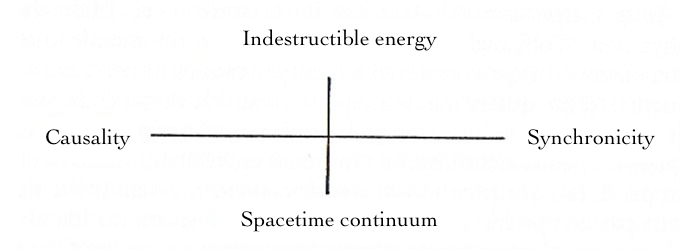
    Synchronicity does not admit causality in the analogy between terrestrial events and astrological constellations … What astrology can establish are the analogous events, but not that either series is the cause or the effect of the other. (For instance, the same constellation may at one time signify a catastrophe and at another time, in the same case, a cold in the head.) … In any case, astrology occupies a unique and special position among the intuitive methods… I have observed many cases where a well-defined psychological phase, or an analogous event, was accompanied by a transit (particularly when Saturn and Uranus were affected). – Carl G. Jung

    Jung and the quantum physicist Pauli believed, events like this occur too often enough to be only meaningless coincidence. Jung noted taking as usual phenomenological stance, while it would be “absurd” to consider the conjunction of dream material and life events to be causal, “it is wise to consider the fact that [these coincidences] do happen…The East…considers coincidences as the reliable basis of the world rather than causality. Synchronism is the prejudice of the East; causality is the modern prejudice of the West.”

    Oh yes, there was a fall, a great big one.  The ancients, our forefathers and mothers, knew right away that something horrible had happened. This was the big bang, the creation of time, and the second mankind understanding of is. Thus Adam and Eve myth  became like God.  Nietzsche, who understood all this, said Christianity closed the door to mass nihilism and decay. To be healed by the words Good and Evil.  Christ was the greatest poet who ever lived. He was murdered because he understood all this. Christ understood this and said so; the kingdom is here within us. This is the meaning of religion as o fpsychology is man’s attempt to free himself from linear time.

    Time and Society

    Even hunters and gathers (at least in a harsh climate) needed to be aware of time. The resulting calendars have been an integral part of different cultures. But even more farmers and traders. Warrior societies need less accurate time than farmers. The first Roman calendar became a mess before fixed by Julius Caesar (with a little help of the Egypt solar calendar). The great French philosopher Voltaire once quipped in hindsight: “The Romans emperors won all the battles but they did not know when”.

    Time and economy

    Since the beginning of mankind time comes from observation of nature. In any culture, however, the task of the calendar was not only limited to the counting of days. Each date should be assigned to the repeating pattern in nature.  Without the ability to plan the time by days, weeks, months and years, agriculture, civil administration and a differentiated role based economies would have been impossible . Even today there are still new applications – especially with the financial and interest experts with perverse micro-trading.

    Time and Mathematics

    The Athenian law courts – according to Plato’s Apology – had water-clocks: if you couldn’t prove your case before the water-clock stopped dripping, you couldn’t prove your case. History, of course, has time-hooks. It can be said, however that the world of mathematics exists in an eternal present, a state in which neither the past nor the future have any meaning. Thus, because mathematics has no interest in the time dimension, there is also in mathematics no meaning to the question of reason. The area which mathematics does address is the clarification of relationships between various objects: how they connect with each other. This world, although dealing with relationships between stable and changing things, is entirely fundamental with the major dimensions of time – duration (present) and regularity of reoccurring events (past and future).

    Time and Astronomy

    Ever since man first noticed the regularity in the movement of the Sun and the stars, astronomers have wondered about duration and measured time by the Sun, the Moon and the Stars. As the sun moves across the sky, shadows change in direction and length. Calendar algorithms used natures repeating events the sun, month, moon phases and other astronomical information.They were commonplace, long before watches. Calendar algorithms also allowed the inclusion of sacred (or cursed days) and the number of days, although the week had nothing to do with the movement of the stars.

    Time and Nature

    The earliest natural events to be recognized were in the heavens, but during the course of the year there were many other events that indicated significant changes in the environment. Seasonal winds and rains, the flooding of rivers, the flowering of trees and plants, and the breeding cycles or migration of animals and birds, all led to natural divisions of the year, and further observation and local customs led to the recognition of the seasons.

    Time and Science

    What “cosmological results” suggest to some “divine inference”? Simply put: the anthropic principle, or more precisely, the fine tuning of the physical laws. In a nutshell – the fact that many/most of the fundamental properties of the universe, from the charge of the electron to the speed of light, and the total content and rate of expansion of the universe have values that could not have been even slightly different if life, intelligence, and consciousness, like humans and other such creatures, were to exist. Needless to say, many have concluded that something must behind such “fine tuning” like “cosmic code” or divine DNA.

    Creation
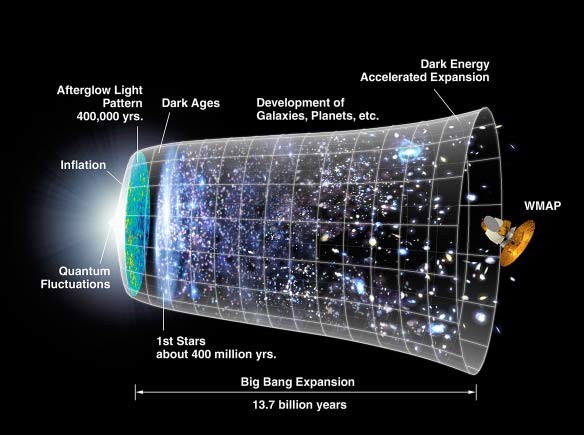
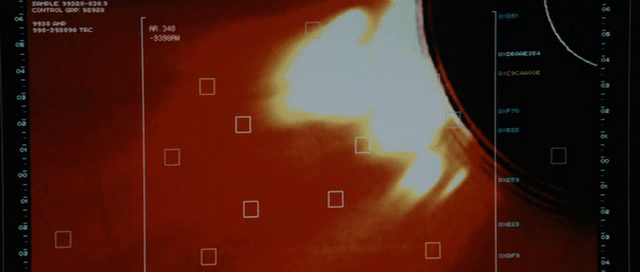
    bigbangI want to come back to the creation myths. In 1992 when astronomer George Smoot, the father of the COBE (Cosmic Background Explorer) satellite  announced the discovery of patterns in the heat background radiation still arriving from the Big Bang, he said it was “like seeing the face of God.” He took a lot of secular sneering for this remark from colleagues.

    The quantum theory was spiritually unacceptable to Einstein as its ultimate nature of reality was randomness. “The [quantum] theory yields much,” he wrote to quantum physicist Max Born in 1926, “but it hardly brings us close to the secrets of the Ancient One. In any case, I am convinced that God does not play dice.”  And he was right, today we now that the creation of our universe follows regular pattern and some physical constants must have a certain value – or we would not exists. Independent formulated theories by Alan Guth (MIT) and before by Russian physicist Andrei Linde, holds that the universe began in the expanding fireball of the big bang and then inflated.Quantum fluctuations-hot, spots-arose.The discovery of the microwave whisper, by Arno Penzias and Robert Wilson of AT&T’s Bell Labs in 1964, just about proved that the universe began in a big bang. Hawkins today agrees with church father Augustine the time and space, the world was created together with time in a flash of light. Trouble was, the microwave sea seemed 1964 incredibly smooth. If energy and matter are spread across the heavens so evenly, how could particles ever have clumped together into galaxies? COBE saw almost undetectable temperature fluctuations.

    1992 astrophysicist George Smoot of the Lawrence Berkeley Laboratory announced that they had discovered those primordial wrinkles, floating at the very beginning of time. Wispy tendrils, up to 59 billion trillion miles across, are the most gigantic and the most ancient structures ever seen.

    Sacred dimensions

    Creation myths, from Egypt to the Old Testament’s six days of genesis created the archetypes of time, a flash of light from a singularity of cosmos inflating so wildly that, faster than an eye blink, a blob smaller than a proton grew as big as today’s entire visible universe. This infant created ripples of energy in the fabric of its space. The ripples stretching as the universe expanded and created the sparkling patterns energy and matter which clustered to stars and galaxies of our night sky. The astounding message is that  creation myths might be right. Smoot said: “human beings have the audacity to conceive a theory of creation.” Really? The priests of ancient cultures may just have gotten their spirituality right. In the Beginning…

    There is the story of the Rabbi who dutifully and concerned asked Einstein in which kind of God, then, did Einstein believe in? “I believe in Spinoza’s God who reveals himself in the harmony of all that exists, but not in a God who concerns himself with the fate and actions of human beings.”  The was Einstein’s faith, which at least not entirely anti-spiritual.

    A somewhat more modest astrophysicist, whose theory had correctly predicted the discovery of the “divine structures”, Joel Primack was quoted as calling those ripples 380 000 years after the Big Bang, “the handwriting of God.” Are these references to the creator sacrilegious or legitimate interpretations? Either way, they are part of a search that began with the first high cultures in Mesopotamia — the search for language to communicate the sacred dimension of time.

    The history of time – Measurement and Calendars

    This will be covered in a series of essays covering all major civilizations and will follow the same structure.

    • The sacred dimensions of their understanding time
    • The worldly usage of their understanding time
    • The manifestations in time measurement and calendars

    Conclusion

    Aft all what I understood, we can interpret space and time as a sort of secret encoded message that science has begun to encipher long after spiritual systems and human intuition (be it by definition of Immanuel Kant or C.G. Jung had the ability to acquire this knowledge without inference of reason or experiment. C.G. Jung’s introverted intuitive types were likely mystics, prophets, or seers struggling between protecting their visions and making their ideas comprehensible but reasonably persuasive—a necessity for their visions (or religions) to foster.

    • “The exact Science in Antiquity”  O. Neugebauer, Dover Edition 1989
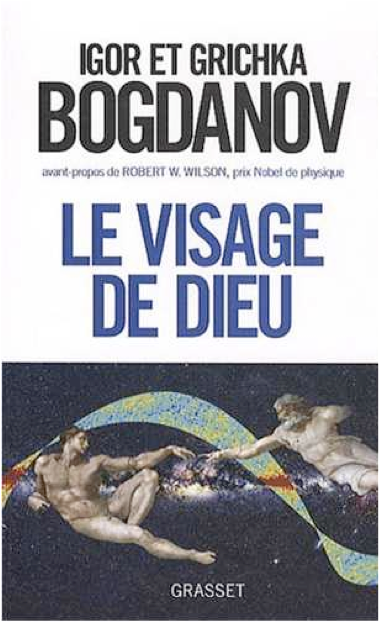
    • “Le visage de Dieu“, 2010 Igor and Grichka Bogdanov
    •  “Symbole der Wandlung” C.G. Jung GW , 1952 Rascher Zürich
    • “Universalgeschichte der Zeit” Hans Lenz, 2005 Marix Verlag.
    • “Cosmos An illustrated History of Astronomy and Cosmology”. John North 2008

    Appendix review of “Le visage de Dieu”

    The book is just that good, what can I say. From the scientific point of view, it stays loyal to the physics and everything as we now understand it, within its usual debates. The rest is just philosophical and metaphysical discussion and interpretation on meaning and direction in the Universe and Everything. They take a step, after reaching the limits of what science can explain, and try to fit it all in a spiritual vision of creation. Faith is a very popular topic of discussion in many cultures including the French, and this book expresses itself and its opinion very elegantly, while on the subject of scientific creation itself I might add, and delivering it all in a language any man can understand.
    They authors claim (correctly, just very much like C.G. Jung) that at the limits of where science can study, observe and verify, metaphysics can take over, continue the story, and they do it masterfully. What they interpret as divine inference any scientist can take as just another law/equation yet to be explain. The  book has been given unprecedented exposure in the French media, especially considering its overt spiritual tone. Indeed, the Bogdanov twins state clearly that they believe that the Creator conclusion is inescapable from the results of modern Cosmology. They themselves are not particularly religious, in the sense that they do not relate to any specific affiliation, but clearly are convinced of on the divine inference. What “cosmological results” are they basing themselves on to make that “divine inference”? Simply put: the anthropic principle, or more precisely, the fine tuning of the physical laws. In a nutshell – the fact that many/most of the fundamental properties of the universe, from the charge of the electron to the speed of light, and the total content and rate of expansion of the universe have values that could not have been even slightly different if life, intelligence, and consciousness, like humans and other such creatures, were to exist. Needless to say, many have concluded that something must behind such “fine tuning” like “cosmic code” or divine DNA. Three  famous scientists have endorsed the book by writing a preface and two post-faces:  Robert Wilson, who (with Arno Penzias) discovered the microwave cosmological background in the 60’s and received the Nobel Prize in 1978; John Mather, who (with George Smoot) in 2006 received the Nobel Prize for the variations they found in the microwave cosmological background, which Smoot likened to “seeing the face of God”; Jim Peebles, a renowned cosmologist who has received half a dozen medals, awards, and honors (though not the Nobel Prize).

    Interesting enough, this book has infuriated atheist and anti-christian hate reviews. Usually a good sign , the  so called “intelligentsia”, especially in Europe, do not like the divine inference. The answer to why is far from trivial, but it has to do with sociology-historical reasons as much as political reasons or just spiritual deafness.

    1:1 en Archêi ên ho Logos
    im Ursprung ging der Sinn auf
    kai ho Logos ên pros ton Theonund der Sinn erschloß sich dem Gott
     kai Theos ên ho Logosund Gott selbst war der Sinn
  • The Black Swan as Acausal Connecting Principle

    The Black Swan as Acausal Connecting Principle

    No, this essay is not about the movie, Black Swan with Natalie Portman. By chance I recently  picked up Nassim Nicholas Taleb’s The Black Swan, and it reminded me on C.G. Jung’s Synchronicity: An Acausal Connecting Principle. Nassim Nicholas Taleb is a mathematician who has made a fortune by betting on highly improbable market events. Those markets, which symbolize repressed ambition, greed, ignorance, which undo our society. Carl Jung warned, that if societies do not attend to their collective shadow, a world crisis may result. Our era is one of failing elites and broken social covenants, which is fraught with the dangers of unleashed economic and social chaos. We each can do our part to safeguard each other by understanding black swans.  I want to apply C.G. Jung’s wisdom, an intuitive thinker, on Taleb’s book (The Black Swan) beneficial to analyze external events – and yes, I am afraid this has something to do with the financial crisis and current geopolitical risks.

    The Black Swan

    Black Swan

    As an engineer, interested not only in C.G. Jung but also in economic theories I have read NN Taleb’s book (The Black Swan). Both C.G. Jung and Taleb contain the same message: the assumptions underlying modern science models are wrong. Ever since nuclear experts said that a fatality due to radiation exposure from an accident at one of nuclear facilities should happen less than once per million years. That was the standard by which they were managing the reactors. From my profession, I never bought that. Today everybody and anybody knows,  what can go wrong at nuclear facilities, does – or did (Murphy’s Law). We were also told alpha, beta and gamma radiation differ in that alpha particles do not travel far through air, and thus were not easily picked up. Until Tokyo Electric Power Company (TEPCO) struggled to bring the leaks under control and after a string of blunders over the past few months released hundreds and thousands of liters of contaminated water into the Pacific Ocean. Three of the Fukushima plant’s nuclear reactors were damaged by an earthquake-triggered tsunami on March 11, 2011, which caused multiple meltdowns, most likely open fissions, and the largest nuclear disaster since Chernobyl. The risks posed by nuclear energy, both personally and to society, seem to be a classic case of black swan logic: so unlikely as to be unintelligible through normal statistical methods, but occurring often enough that they cannot be treated as outliers and ignored as spurious.

    Uncertainty

    shot0001

    Uncertainty is building pattern of nature as the unlikely cross-disciplinary relationship  of psychoanalytic (and often alchemist) C. G. Jung and theoretical physicist Pauli discovered. Pauli, a “Wunderkind” may be called a pioneer of quantum physics and leading member of the group of theoretical physicists, including Niels Bohr, Werner Heisenberg and Erwin Schrödinger. The group transformed our understanding of the way matter behaves at the subatomic level encountering a new world where Einstein’s theories (and Newtons Laws) do not apply. Exploration of the Pauli-Jung collaboration is particularly interesting because of the holistic view of his major scientific work, which won him the Nobel prize.The Pauli exclusion principle explains how matters form and a variety of astrophysical effects. On the psychic side, the Pauli effect was named after the anecdotal bizarre ability of his to break experiments simply by being in the vicinity and his sarcastic remarks toward colleagues.  Despite his Jewish origins Pauli was baptised catholic. Pauli met with Jung, whom he consulted regularly till 1934 in a deep psychological crisis. Especially Pauli’s dreams, which were full of symbolism from alchemy, were extensively discussed.

    That brings me to currently greatest alchemist experiment the Euro and FIAT money in general. There are some parallels evident in economic history, over thousands of years currencies failed, but according to experts Euro and Dollar will stay. “The Euro is irreversible, declares European Central Bank president Mario Draghi a Goldman & Sachs alumni. The European Central Bank will do ‘whatever it takes’ to preserve the currency. Ever since the 2008 financial experts tell us the economy is under control. Looking in financial history, I think we ought to know better, there was always a black swan.

    Why didn’t I stock up food and emergency kits yet? Because, we tend to underestimate both the probabilities and the damage and, what is worse, we do not follow our intuitions or hunches anymore. Discovering black swan risks, create tremendous anxiety within us. And Western do not see not Paulis quantum physics world without an individuation process. Jung felt that our journey in life was one of striving for completion, or wholeness. This is also a difficult journey for there is so much that we are called to integrate within ourselves. But there is an important difference here. On the journey towards completeness or wholeness we become more aware and more open as we travel the road. With each step along the journey we enlarge consciousness. Becoming conscious of the suppressed knowledge of  risks is beneficial. Instincts work through us whether we are conscious of it or not. If we remain unconscious of the process, then we find life more difficult to understand. We are at the whim of the Fates (or markets). If we consciously work to make the unknown known, then we are part of (CW 9i, par. 278), “the production and unfolding of the original, potential wholeness…” within.

    Shadows on the Wall

    Right now our Europe leaders (more the ECB) claim they solved the Euro Crises this week and US did not default yesterday. The US “leaders”  are hopelessly divided and the European leaders scary brought in line, but both chase the  black swan back to the backwaters of their unconscious and ours. Depth psychologist Carl Jung called it the “shadow” It’s the weaknesses, imperfections, faults, and instincts which we hide from others and ourselves by repressing them into our unconscious. The elites’s shadow is the sinner within; the ctizens’s shadow is the saint within. The shadow or black swan is the disowned part of our psychological wholeness.

    SwanChaser
    SwanChaser

    What we see today is not criminal stupidity of statistical science but an arrogant élite overpowered by a collective shadow. Financial and technical models told them something about normal events (that was the basic assumptions on financial weapons of mass destructions), but they cannot deal with unexpected, high-impact events. Some guy probably measured the risk according to a formula and said, “Well, it meets the one-in-a-million standard.” But we are incapable scientifically of measuring the risk of rare events. As Warren Buffet stated on Derivatives in the  Berkshire Hathaway annual report for 2002: The derivatives genie is now well out of the bottle, and these instruments will almost certainly multiply in variety and number until some event makes their toxicity clear. Central banks and governments have so far found no effective way to control, or even monitor, the risks posed by these contracts. In my view,derivatives are financial weapons of mass destruction, carrying dangers that, while now latent, are potentially lethal…Another problem about derivatives is that they can exacerbate trouble that a corporation has run into for completely unrelated reasons.

    Because the world has become so connected, a crisis today quickly becomes global. As the nuclear situation in Japan, the EU crises and the US dept ceiling soap opera continues, you’re going to see a major disturbance of supply chains. When the interest rate goes up, and it will, one “butterfly can cause an earthquake”. Our connected world appears only to be more efficient. We have economies of scale, and layers of oversight which generate an organized inacountability bordering on synchronicity. But when there is a disturbance, the setback is much harder to handle. Not only are we building riskier systems, but also the risks involved in failure are a lot larger. C. G. Jung published an famous essay on Wotan, the Norse (and German) god of the war in the , Neue Schweizer Rundschau (Zurich March, 1936)

    En Germanie naistront diverses sectes,
    S’approchans fort de l’heureux paganisme:
    Le coeur captif et petites receptes
    Feront retour a payer la vraye disme.
    — Propheties De Maistre Michel Nostradamus, 1555

    Ring-Walkure-Wotan

    When we look back to the time before 1914, we find ourselves living in a world of events which would have been inconceivable before the war. We were even beginning to regard war between civilized nations as a fable, thinking that such an absurdity would become less and less possible on our rational, internationally organized world. And what came after the war was a veritable witches’ sabbath. Everywhere fantastic revolutions, violent alterations of the map, reversions in politics to medieval or even antique prototypes, totalitarian states that engulf their neighbours and outdo all previous theocracies in their absolutist claims, persecutions of Christians and Jews, wholesale political murder, and finally we have witnessed a light-hearted piratical raid on a peaceful, half-civilized people.

    No all swans are white

    The term “black swan” is philosophical in nature. Eighteenth-century Scottish philosopher David Hume once stated, “No amount of observations of white swans can allow the inference that all swans are white, but the observation of a single black swan is sufficient to refute that conclusion.” Today the black swan definition is: An event or occurrence that deviates beyond what is normally expected of a situation and that would be extremely difficult to predict. In laymen’s terms, black swans are events that are typically random and unexpected

    Black Swan Investing

     There is no way to know that somewhere out there a black swan is not hiding, disproving the rule and nullifying our “knowledge” of swans. Induction tells us that we cannot really learn from our experiences. It makes knowledge very problematic, if not impossible. And yet, we humans do behave almost without exception as though they believe that experience teaches us mono-causal lessons. This is forgivable; like classic physics it works but as science showed later not in quantum physics. C.G. Jung showed that humans seem, at every turn, have this critical self-awareness of collective archetypes.

    Taleb shows an similar skepticism in the story of a trader who insisted that he should not worry about the fluctuating values of economic indicators. Indeed, Taleb proudly declares that, to this day, he remains blissfully ignorant of supposedly crucial “indicators” like housing starts and consumer spending and cholesterol level I might add. Even if these “common knowledge” indicators were predictive, they would be useless because everyone else is already accounting for them. They are “white swans,” or common sense. Regardless of their magnitude, white swans are basically irrelevant sometimes. In todays environment, one can only profitably concern oneself with those bets, which others are ignoring systematically. Bets on those highly unlikely, but highly consequential events that utterly defy the conventional wisdom. Black swan’s we have to worry about not the prospect of a quarter-percent rise in interest rates.

    The thing with Black Swans is that they cannot be foreseen – only the ones, who chase him up. In the apocalypse – where chaos reigns, the wholly unexpected happens, power laws and quantum physics apply but the bell curve does not. We need to understand the risks we face more accurately. Risks can be framed in a certain way. When they tell us something could happen once every 1 million years (or we fix a problem by the same means it has been created), we’re going to take that chance, thinking the risk is periodic and we are safe in the short term. But C.G. Jung knew the world within is as real as the world outside. The risk of interrupting events hasn’t changed since mankind crawled out of cave . The archetype of the apocalypse has been always there.

    Pauli himself had written an article called “The Influence of Archetypal Ideas on the Scientific Theories of Kepler” which appeared later in a volume with an essay of Jung’s on synchronicity. The Pauli-Jung collaboration aimed at explication of a unifying or connecting principle bridging the gap between mind and matter or (quantum) physics with psychoanalysis. Jung’s theory of synchronicity stipulated that certain events-often called coincidences-actually reveal the operation of a non-causal connection between mental and physical events through meaning. The history of Jung’s reception by the scientific and scholarly communities is cautious – they largely discredited theories of Freud are considered scientific, but although many Jung’s concepts are widely used his overall work is labeled often as unscientific.  Synchronicity has been the prime target for criticism of Jung, but is for me a natural extension of Jung’s view of the intuitive function.

    Synchronicity and the Black Swan

    Jung coined the word to describe what he called “temporally coincident occurrences of acausal events” or  “meaningful coincidence” and “acausal parallelism in which archetypes and the collective unconscious are governing a dynamic that underlies the whole of human experience and history — social, emotional, psychological, and spiritual.

    snchronicity

    Synchronicity does not admit causality in the analogy between terrestrial events and astrological constellations … What astrology can establish are the analogous events, but not that either series is the cause or the effect of the other. (For instance, the same constellation may at one time signify a catastrophe and at another time, in the same case, a cold in the head.) … In any case, astrology occupies a unique and special position among the intuitive methods… I have observed many cases where a well-defined psychological phase, or an analogous event, was accompanied by a transit (particularly when Saturn and Uranus were affected). – Carl G. Jung

    Jung’s paradigmatic example of a synchronicity occurred during a therapy session, and the connecting meaning in a synchronistic event is subjective, related to the individual’s psychological maturation, or individuation. Jung and Pauli believed, events like this occur too often enough to be only meaningless coincidence. Jung noted taking as usual phenomenological stance, while it would be “absurd” to consider the conjunction of dream material and life events to be causal, “it is wise to consider the fact that [these coincidences] do happen…The East…considers coincidences as the reliable basis of the world rather than causality. Synchronism is the prejudice of the East; causality is the modern prejudice of the West.”

    Jung mentioned the concept again in his commentary to Wilhelm’s translation of “The Secret of the Golden Flower”. He concluded that “the causality principle” cannot explain “psychic parallelisms” that must somehow be connected but are not causally related and equated synchronicity with the Chinese Tao. Jung would write about this concept again, and when he did, his focus would shift from the empirical and phenomenological aspects of synchronistic phenomena to the ontological and archetypal nature of such events. Pauli thought that the probabilistic nature of quantum theory and the Uncertainty Principle offered the possibility of discovering something beyond the mind-matter gap which transformed Jung’s understanding of synchronicity. As a result of his interaction with Pauli, Jung gradually came to see this non-causal connecting principle as an explanatory theory must be seen in combination with causality to lead to a better understanding reality, rather than having only a subjective meaning. To me that is the narrative of Talib’s Black Swan.

    However, swans can be chased up. “When the Last Tree Is Cut Down, the Last Fish Eaten, and the Last Stream Poisoned, You Will Realize That You Cannot Eat Money”, apparently an Indian Chief said.

  • Number, Pattern and Kabbalah Symbols – from a Jungian view

    Number, Pattern and Kabbalah Symbols – from a Jungian view

    The interpretations which Jung places on Gnosticism and the texts which Jung refers to on alchemy, were often Number, Pattern and Kabbalah Symbols , so much so that one would be more justified in calling the Jung of the Mysterium Coniunctionis  or Kabbalistic in contemporary disguise. 

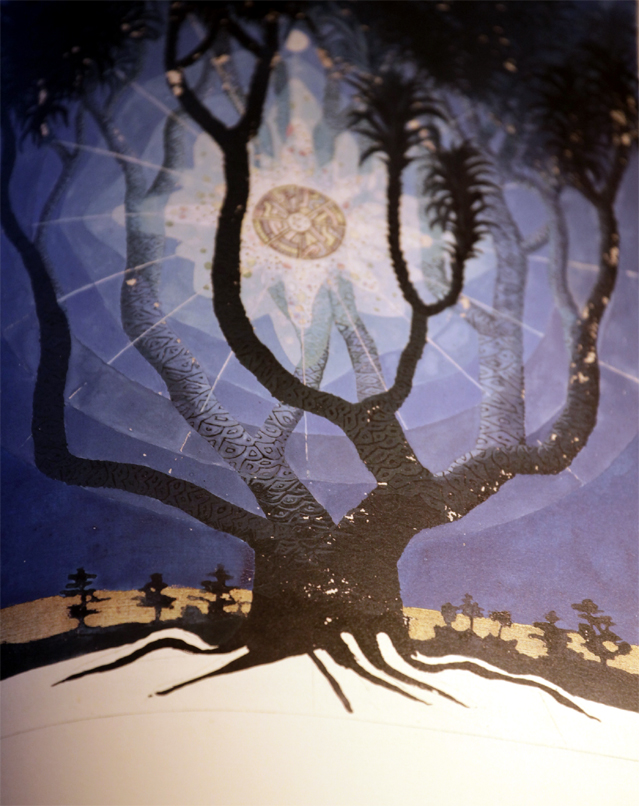
    Red Book Tree of Life
    Red Book Tree of Life

    Jung has been often (rightfully) seen of being a contemporary Gnostic.One of the most serious and arguably criticisms against Kabbalah and the early Gnosticism of C.G. Jung is, that they may lead away from monotheism, and instead promote dualism, the belief that there is a counterpart to God: The good power versus an evil power.  Gnostic-dualistic cosmology having roots in Zoroastrianism, believes since creation good and evil forces are divided; Neo-Platonism (which found its way in Christianity), argues that the universe knew a primordial harmony,  disrupted by an evil force. This second model influenced the cosmology of the Kabbalah.

    According to Kabbalah cosmology, an infinite number of ten Sefirots are emanated from the representing ten different ways the one God reveals his will and also represent the different aspects of Morality. To Jung, profoundly influenced by Catholicism  God is in us, to Taoism God is in the nature. The goal of this essay is therefore to find the Tree of life in C.G. Jung’s view of our psyche, Astrology and contemporary Physics. The article appreciates the affinities between Jungian psychology and Jewish mystical thought in particular Jung’s use of Kabbalistic symbols and ideas as well as his usage of numbers and Alchemist thoughts.  It is just draft, and sketchbook and interested primarily on three (trinity), four (quaternary) and  ten (as well as their multiples).

    Number, Pattern and Jewish characters

    Practical Kabbalah

    The Hebrew Alef-Beit (alphabet, can be mapped to a number and symbol representing the deepest secrets of Creation. In one monastery I say recently an exhibition which visualizes those numbers and characters as symbols. The Kabbalistic classic Sefer Yetzirah (Book of Formation) teaches that creative consciousness exists in three states (space, time, and soul), which are reflected in the form, name and numerical equivalent of each letter.

    In practical Kabbalah the Rabbis counted every word and letter, and as their numbers were represented by their letters, they counted the numeration of all God names and titles, and all proper names, and the numeration of he phrases recording Divine commands. The Hebrew letters and numbers were :

    • Aleph A 1
    • Beth B, V 2
    • Gimel G, Gh 3
    • Daleth D, Dh 4
    • Heh H 5
    • Vau O, U, V 6
    • Zayin Z 7
    • Cheth Ch 8
    • Teth T 9
    • Yod I, Y 10
    • Kaph K, Kh 20
    • Lamed L 30
    • Mem M 40
    • Nun N 50
    • Samekh S 60
    • Ayin Aa, Ngh 70
    • Pe P 80
    • Tzaddi Tz 90
    • Qoph Q 100
    • Resh R 200
    • Shin Sh 300
    • Tau T, Th 400

    Dogmatic Kabbalah

    In Dogmatic Kabbalah the conscious God is the awakened decade of Sephira. The primary human conception of God is the Boundless, whereas the Conscious God has awaked.

    Tree of Life
    Tree of Life

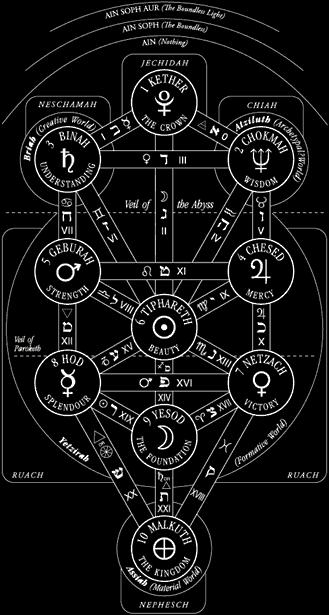
    Kether, the Crown, the First Sephira, First Emanation of Incomprehensible Deity will be followed by the Second Sephira, Chokmah, Wisdom, The King, and the Third Sephira Binah, Understanding, The Queen. Then follows the forth Sephira Gedulah, also called  Chesed, Mercy, and its contrast  Geburah, Severity, also called Pachad, Fear. That triangle is completed by the Sixth Sephira, the Sun named Tiphareth, or Beauty. The third triangle is formed of the seventh, eighth, and ninth Sephiroth; Netzach, Firmness or Victory, Hod or Hud, Splendour and Yesod, Foundation. Finally, all these ideals are resumed in a single form, the Tenth Sephira, MLKUT, Malkuth, the Shekinah, the Kingdom, also sometimes called Tzedek, Righteousness. The whole Decad form “Adam Kadmon,” “The Archetypal Man,” and the  “Tree of Life.”

    The word “Sephir,” from which “Sephira” is derived, is usually translated as “Book” “Letter” or “Number” but the underlying idea is “Information” or “Pattern”.  Those pattern represent culture interconnections or in a Jungian sense symbols, i.e. manifestations of archetypes.

    The sephiroth operate on a numeric progression. The ideas corresponding to the number one naturally lead on to the ideas corresponding to the number two, and so on. The Sephiroth, when referred to by number, are always shown in their descending order, referring to their order of emanation. However, the task of the mystic is to move his consciousness in their reverse order, this process being called “The Way of Return”

    • The left column is called the Pillar of Severity. This represents the female side of man and contains three sephira: Binah (Understanding), Geburah (Severity) and Hod (Splendor).
    • The right column is called the Pillar of Mercy. This represents the male side of man and also contains three sephira: Chokmah (Wisdom), Chesed (Mercy) and Netzach (Victory).
    • The middle pillar is called the Pillar of Equilibrium. It represents the balance between the male and female pillars. It contains four sephira: Kether (Crown), Tiphareth (Beauty), Yesod (Foundation) and Malkuth (Kingdom).

    The fifth, sixth, seventh, and eighth Sephira are called, respectively, Hesed (Strength, Red), Gevurah (Beauty,Yellow), Netsah (Firmness,Green), and Hod (Splendor, Blue) and represent four of the component colors of Light: Red, Yellow, Green and Blue.

    Tifereth, Hesed and Gevurah form the second Triad, and Yesod, Netsah and Hod the third; these two Triads combined constitute the Hexad, which is the Soul of the World, and of it are derived the souls of all individualized existences.

    (1) Finding its Soul

    rb-1

    The Primary Archetype the Self which is neither known nor can be known to consciousness – Kether

    The First Cause, timeless and eternal, the first emanation of diety as our universe is Kether. Like the Chinese Tao, talking about it too much, evaporates your understanding of it.

    • English meaning: Crown
    • Sphere: Primum Mobile/Uranus
    • Gem: Diamond
    • Plants: Almond
    • Magical Tool: Crown
    • Divine Name: Eheieh
    • Archangel: Metatron
    • Angelic Choir: Chayoth ha-Qadesh

    (2) Soul and God

    rb-2

     To Jung is the union of every thing and its opposite, of male and female, good and evil,  Animus  – Chokmah and Anima

    While Kether is timeless, the action of Chokmah is completely dynamic. It is the Lingam of creation, the “bang” part of the big bang, the massive Yang exploding outwards in all directions with the energy of Kether. This explosive nature is admirably suited to the astrological character of Pluto, to which it has now been assigned

    • English meaning: Wisdom
    • Sphere: Zodiac/Pluto
    • Gem: Star Ruby/Turquoise
    • Plants: Amaranth
    • Magical Tool: The Inner Robe of Glory
    • Divine Name: Yah
    • Archangel: Raziel
    • Angelic Choir: Auphanim

    .

    (3) On the Service of the Soul

    rb-3-1

     The primal unconscious is concealed from awareness through a primal opposite, the Animus – Binah

    The Yin to the Yang of Chokmah, Binah receives the projective force of Chokmah and limits it to give it form. It is the last of the supernal powers, which are beyond manifestation. Saturn was placed upon this sephira, but with the discovery of the three outer planets, it is more effectively associated with Neptune. Binah is also the Great Mother, the ocean that gives birth to the life of the universe.

    • English meaning: Understanding
    • Sphere: Saturn/Neptune
    • Gem: Star Sapphire, Pearl
    • Plants: Cypress, Poppy
    • Magical Tool: The Outer Robe of Concealment
    • Divine Name: YHVH Elohim
    • Archangel: Tzaphquiel
    • Angelic Choir: Aralim

    (4) The Dessert

    rb-4

     The boundless, chaotic, Personal Unconscious  which lies at the heart of the human psyche  – Chesed / Gedulah

    The first sephiroth below the supernals is Chesed, which means “Mercy.” This is a sephira of merciful power, benevolence and generosity.  The influence of this sephira is kingly and mystical.

    • English meaning: Mercy
    • Sphere: Jupiter
    • Gem: Amethyst/Sapphire
    • Plants: Olive, Shamrock
    • Magical Tool: Staff, Sceptre, or Crook
    • Divine Name: El
    • Archangel: Tzadiquiel
    • Angelic Choir: Chashmalim

    (5) Descent into Hell in the Future

    rb-5-1

    Here there is the smallest element of awareness of the conscious and the Ego – Geburah

    The primary influence of this sephira is strength. Specifically, the strength of the righteous against the forces of evil like warrior gods.

    • English meaning: Severity
    • Sphere: Mars
    • Gem: Ruby
    • Plants: Oak, Nux Vomica, Nettle
    • Magical Tool: Sword,Spear, Scourge, or Chain
    • Divine Name: Elohim Gibor
    • Archangel: Kamael
    • Angelic Choir: Seraphim

    (6) Splitting of the Spirit

    rb-6

    A primal Self emerges  – Tiphareth / Tiferet

    At the center of the Tree of Life lies Tiferet, the sephira of the sun. It is the main connection between the Divine and the mundane, and is the only sephira below the supernals which has a direct path with Kether. The gods attributed to this sphere are the child, and the sacrificed god, as well as the more obvious solar dieties

    • English meaning: Beauty/Harmony
    • Sphere: Sol
    • Gem: Topaz/Yellow Diamon
    • Plants: Acacia, Bay, Laurel, Vine
    • Magical Tool: The Lamen or Rosy Cross
    • Divine Name: YHVH Eloah Ve-Daath
    • Archangel: Raphael
    • Angelic Choir: Melekim

    .

    (7) Murder of the Hero

    rb-7

    From the interaction between the Ego and the world the original, unmodified structures of the Persona emerge – Netzach

    The sephira of nature is Netzach. Its nature is ecstatic, the joyous play of the divine energy. It is also the first sephira of emanation that operates without “ethics,” It contains within its meaning the process of negative feedback. To this sphere are attributed the gentle gods of life and beauty, of which some are Venus, Aphrodite, and Bast. Their terrible aspect comes from their inhuman natures with respect to justice or morality. To note that the most successful are often those unworthy of it is to operate within the laws of this sphere

    • English meaning: Victory
    • Sphere: Venus
    • Gem: Emerald
    • Plants: Rose
    • Magical Tool: The Lamp and Girdle
    • Divine Name: YHVH Tzabaoth
    • Archangel: Haniel
    • Angelic Choir: Elohim

    (8) The Conception of the God

    rb-8

    (8) These structures are the archetypal values and tendencies of humanity which are embodied within the conscious realm – Hod

    Hod is the sephiroth of the scientific intellect, which operates here in a passive sense to the emotional Netzach. Instead of unintelligible ecstasy, we have wonderful ideas, words of knowledge and poetry, and inspirations. All gods of the intellect are represented here

    • English meaning: Glory/Splendour
    • Sphere: Mercury
    • Gem: Opal/Fire Opal
    • Plants: Moly, Anhalonium Lewinii
    • Magical Tool: The Names, Versicles, and Apron
    • Divine Name: Elohim Tzabaoth
    • Archangel: Michael
    • Angelic Choir: Beni Elohim

    .

    (9) Mysterium encounter

    rb-9

    Will or Desire, the fundamental motivating force  of the Shadow – Yesod

    The sephiroth of Yesod is the process of crystalization, where energy becomes definable as forces. The action of Hod and Netzach comes together before its final projection into Malkuth.

    • English meaning: Foundation
    • Sphere: Luna
    • Gem: Quartz
    • Plants: Mandrake, Damiana
    • Magical Tool: Perfumes and Sandals
    • Divine Name: Shaddai El Chai
    • Archangel: Gabriel
    • Angelic Choir: Kerubim


    (10) Instruction

    rb-10

    A new Self must emerge by restoring and restructuring the elements of the old ego that has been shattered by crisis. This is the process of individuation – Malkuth

    The last emanation of creation is Malkuth, which represents the final solidification of the energy of Kether. It is result of all the work done through the preceding sephiroth. This sephira is totally passive; all energy directed to it works it’s change and is grounded. The titles of Malkuth are “Malkah,” the princess and “Kalah,” the bride, when considered as the Spouse of Zauir Anpin, the Microprosopus

    • English meaning: Kingdom
    • Sphere: Elements/Saturn/Earth
    • Gem: Rock Crystal/Salt
    • Plants: Willow, Lily, Ivy
    • Magical Tool: The Magical Circle and Triangle
    • Divine Name: Adonai ha-Aretz
    • Archangel: Sandalphon
    • Angelic Choir: Ashim

    (0) The Incantations

    DA’ATH – Knowledge – is not a Sephira. It is not on the Tree of Life: that is, there is in reality no such thing. Da’ath is the crown of the Ruach, the Spirit and its place is in the Abyss. “Da’ath like the evil number zero, has a dual aspects, on one hand it is our knowledge of the world of appearance, the body of facts which constitute our beliefs, identity and ego. On the other hand it is revelation, objective knowledge, what is often referred to as gnosis. The transition between the knowledge of the world of appearance and revelation entails the experience of the abyss, the abolition of the sense of ego, the negation of identity. From within the abyss any identity is possible. It is chaos, unformed. It contains, as it were, the seeds of identity.

    “sacred whore;”
    “sacred whore;”

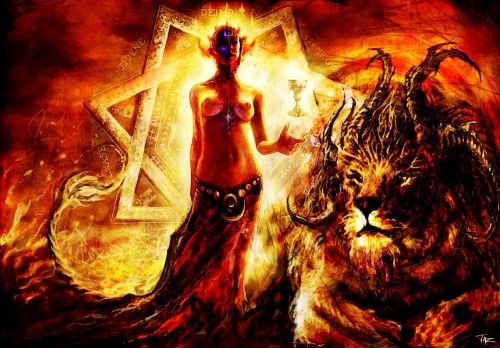
    The sphere of knowledge Daath is invisible and the Random chaos of thought and conceptionbecause it contains both accessible and hidden knowledge. This sphere has no archangel but is used as an entrance and exit point to the Yetzirah (the third world of formation), the realm of the angels. Daath is often called the Abyss, the gulf between the phenomenal world of manifestation and its source. Only by passing through the Abyss can we realize out innermost spiritual nature. Daath is the primary junction where various forces on the Tree of Life – femal and male – come together, yet it is also a barrier that you must pass beyond if you wish to scale the Tree of Life.

    In Christianity the male and female archetype is the celibate Jesus and the Virgin Mary. In Babylon however, the High Priestess, however, a priestess is essentially a “nun”, whereas the role of the priestess in the mystery cults of the ancient world was essentially that of what has been derogatorily (but correctly) described as a “sacred whore” of Babylon.

    Kabbalah and C.G. Jung

    In Messianic Kabbalah relevations it represents the mystical relevation of God’s secret and mysteries in effect knowledge of god and the infinite. C.G. Jung loved  quaternities (multiples of them are of course 8 and 16) and says this about numbers and their relation to the unconscious in his book “Synchronicity: An Acausal Connecting Principle”:

    Number helps more than anything else to bring order into the chaos of appearances. Remarkably enough, the psychic images of wholeness which are spontaneously produced by the unconscious, the symbols of the self in mandala form, also have a mathematical structure. They are as a rule quaternities (or their multiples). These structures not only express order, they also create it. 

    The Red Book
    The Red Book

    The Kabbalah,  regarded by many as a Jewish form of Gnosticism , the Kabbalah achieved its own unique expression in the anonymous Sefer HaBahir, generally regarded as the earliest extant text in this mystical genre. It is in this work that the theory of the ten Sefirot, the value archetypes (Will, Wisdom, Understanding, Kindness, Judgment, Beauty, Glory, Splendor,Foundation and Kingship) which the Kabbalists all held to be the essence of creation, takes distinctive form. The Zohar, which is written as a loose and far-reaching commentary on the Torah (the Five Books of Moses), is the source of much of the “wedding symbolism” (unifications of the various Sefirot) which preoccupied the alchemists studied by Jung. Its homilies on the nature of the unknowable infinite, the integration of masculine and the feminine, and the relationship between good and evil can provide much of interest to analytic and archetypal psychologists. Jung himself quoted a number of Zoharic passages. Mysterium Coniunctionis includes citations of the Kabbalistic symbols and ideas found in non-Hebrew reference on the Kabbalah and had correspondence with a number of sholars who had first-hand knowledge of Kabbalistic texts and certain Kabbalistic symbols, such as the Sefirot. The major Kabbalistic ideas which concerned Jung were those that had clear parallel formations in Gnosticism and alchemy: the notion of a spark of divine light contained within humanity, the concept of Primordial Adam who contains within himself in coincidentia oppositorum the various conflicting tendencies within the human spirit, the theory of divine unifications, particularly the unifications of good and evil and masculine and feminine.

    Quaternio series: Moses - Shadow - Paradise - Lapis Quaternio
    Quaternio series: Moses – Shadow – Paradise – Lapis Quaternio

    Jung’s interpretation of Gnosticism, indeed his interpretation of religious phenomena in general, rests upon his theory of the history of the human psyche in which humankind has historically moved from a condition in which it projects the contents of its unconscious onto the world and heavens but fails completely to recognize the archetypes of the unconscious mind “loosing its religion.  Jung writes:
    Psychology, specifically Jungian psychology, is in a position to provide individuals with a direct awareness of the archetypes within their own psyches. This, Jung believes, can be accomplished through an interpretation of the spontaneous symbolic projections of the unconscious in fantasy, art, and dreams, guided by a new psychological understanding of the basic archetypal images which have presented themselves in the history of myth and religion. Jung’s interpretation of Gnosticism is critical to his understanding of the Kabbalah.  Traditionally Gnosticism was viewed as a Christian heresy which developed along-side the early Catholic Church in the second and third centuries. The discovery in 1945 of a library of Gnostic texts at Nag Hammadi along the Nile River in Egypt, and their eventual publication, has led to a view of Gnosticism as a multifaceted religious phenomenon with roots (and foes) not only in Christianity. Scholars have also differed in opinions regarding the identity and defining characteristics of Gnosticism, some pointing, for example, to its dualism of good and evil, others to its theories regarding the aeons, and the demiurge. Jung’s comments on Gnosticism are scattered throughout his writings (See Segal, 1992), but his major statement on the subject is contained in his essay “Gnostic symbols of the self” (Jung, 1969). However, long before he had
    systematically considered Gnosticism from the point of view of his own analytical psychology, Jung had been familiar with Gnostic theology and even constructed, in 1916, his own “Gnostic Myth” entitled “Septem Sermones ad Mortuos” (Seven Sermons to the Dead). A variety of other typically Gnostic themes make their appearance in “The Seven Sermons”. Amongst these are the doctrine that humans, as finite creatures, are characterized by “distinctiveness,” and the natural striving of humankind is towards distinctiveness and individuation. Years later, when Jung comes to take a second look at Gnosticism through the eyes of a more fully developed archetypal psychology, he reverses himself and interprets it in a manner which is far more friendly to the world and the individual, and, as I will argue, far more Kabbalistic than Gnostic.  Jung sees in the Gnostic (and Kabbalistic) symbol of Primordial Man a symbol of the goal of his own analytical psychology.

    Kabbalah and Alchemy

    Jung provides a  daring and far reaching interpretation of alchemy and was aware of the strong relationship between the Kabbalah and late alchemy. He wrote of specific Kabbalistic influences on the alchemists of the 16th century and later. “Directly or indirectly”, Jung writes in the Mysterium, “the Kabbalah was assimilated into alchemy. Relationships must have existed between them at a very early date, though it is difficult to trace them in the sources”.Jung points out that by the end of the 16th century the alchemists began making direct quotations from the Zohar. He also notes that Paracelsus had introduced the sapphire as an “arcanum” into alchemy from the Kabbalah. While Jung clearly recognizes the relationship between Kabbalah and alchemy, the spiritual aspects of alchemy, which interested Jung, were to a very large extent Jewish in origin. He regarded the various metals in the alchemical work to be analogous to aspects of humanity, hence one famous maxim “Join the male and the female and you will find what is sought” could well serve as a motto for much of Jung’s  individuadion. The interested reader is referred to works by Suler (1972), and Patai (1994).

    Kabbalah and Science

    Although its origins are rooted in deep antiquity, from the time of ancient Babylon, the science of Kabbalah has remained virtually hidden from humanity since it appeared more than four thousand years ago. Newton, Leibniz, and Pico della Mirandola, have investigated and tried to understand the science of Kabbalah. It is impossible to comprehend the invisible, the imperceptible, and that which has not been experienced. For thousands of years, humanity was offered a wide variety of things under the name “Kabbalah”: spells, curses, and even miracles, cluttered with misconceptions and misinterpretations. Therefore, first and foremost, the numers of Kabbalah needs to be made clear. There exists the upper force or the Creator, and governing forces descend from this upper force into our world.  We are familiar with various forces in our world, such as gravity, electromagnetism and the power of thought. This upper force gave birth to the upper worlds. There are five worlds in total. The so called Machsom—a barrier that separates the upper worlds and our world—follows them. From the upper force—the Creator, also known as “the world of Infinity”—mathematically the turned eight. There was a wonderful article about Hod, Hebrew for 8. Indeed the 8 is well used in the archetypical knowledge in all cultures. In Hebrew every letter has a numerical value, or gematria.  The gematria of Chet ח is 8 and is referred to as ‘the letter of life’. i.e. the Life Dynamic – Run and Return.

    Quantum physics

    Lets not forget the three and the hexagon. Six (and twelve) are important to science and its early sisters – astrology and alchemy. Also the Kabbalah system of ten sephiroth, is comprised in three pillars of three with twenty-two paths interconnecting them: – “The Tree of Life”.  The three is prominent in physics, especially in quantum physics.A unique scientific conference was held in San Francisco, California  2005, introducing Kabbalist Rav Michael Laitman, PhD and quantum physicists William Tiller, PhD, Dr. Jeffrey Satinover, and Fred Alan Wolf, PhD. The theme of the conference was “Quantum Physics Meets Kabbalah”.

    bigbang

    Isaac Newton proved through a series of experiments that  white light refracted with a prism, resolved it into its component colors: red, orange, yellow, green, blue and violet (being red, green and blue primary). Two times three. Then there are six quarks who form matter. This Standard Model of six flavors of describe all the currently known elementary particles, as well as the Higgs boson: (q), named up (u), down (d), strange (s), charm (c), bottom (b), and top (t). Again two times three.

    Now, a term “color” was introduced to label a property of the quarks which allowed apparently identical quarks to reside in the same particle, for example, two “up” quarks in the proton. To allow three particles to coexist and satisfy the Pauli exclusion principle, a property with three values was needed. The idea of three primary colors like red, green, and blue making white light define symbolic three distinct quantum states.

    Unfortunately that das not match with the four colours of those for Kabbalah Sephiras have also pretty consistent cross cultural meanings.

    • Green nature/wisdom: Egyptians believed that a god named Thoth led the souls of the dead to “a green hill of everlasting life and eternal wisdom.” Romans based their god Mercury on Thoth, and the planet Mercury was in turn based on the god. For this reason, in astrology,”green is sometimes said to be the color of the planet Mercury, which is the planet governing the mind and conferring knowledge knowledge. Christians often tied the archangel Michael to Roman mythology’s Mercury. The color green is often said to forebode death. This idea may be a survival of the ancient worship of Mercury, and even of St. Michael in Christian times, both of whom were messengers of death.”
    • Blue truth/sadness The primary association of the color blue for most of recorded history was with truth a meaning that leaves a remnant in our language in the phrase “true blue.” This was because blue is the color of a calm and clear sky, and it is calm reflection that leads to truth.
    • Red passion: Red has a range of symbolic meanings, including life, health, vigor, war, courage, anger, love and religious fervor. The common thread is that all these require passion, and the “life force” that drives passion blood is red.
    • Yellow happiness/cowardliness It isn’t surprising that yellow symbolizes happiness, warmth and sunshine in most cultures; these are characteristics of the yellow sun and its effects.In ancient cultures where a god or gods were associated with the sun, such as Egypt and China, yellow was the highest and noblest of colors and thus, the color of religious figures and royals (who were thought to be descendants of the gods or semi-gods).

    The quest for the unified theory

    Science, in its quest to reveal the underlying unity within nature, constantly finds itself returning to the origins of the universe — to the primordial “day one” (yom echad) of Creation or Big Bang. The universe, in its present state, is too cool and solid for one to find within it an intimation of such unity. Only amid the energy and heat that reigned at the very inception of time and space, could all the forces and elements of nature meld into one. Such are the premises that underlie the unified field and “big bang” theories. Should one seek the even deeper unity that binds “existence” to “non-existence,” then it becomes necessary to propose even more obscure theories — such as string theory — which an meta-physical character and somewhat discared today.

    The cosmological process that produced this space-time continuum is presently understood by many to have taken place in four stages — derived from the “string” theorists and the “big bang theory”. First, the mathematical properties and relations governing space-time had to be defined or “created”. Next, in a single quantum leap, “something-ness” emerged spontaneously out of that “abstraction”. At that point, a great “inflation” of the universe occurred. Finally, the “big bang” unleashed the full thrust of its force from within a single point inside that inflated universe.

    In Kabbalistic terms, these four stages could be viewed as corresponding to the four-letter sequence of G-d’s ineffable Name — Yud Hei Vav Hei, the model upon which all meditation directed at G-d and Creation is based. Thus, any return to the primordial unity of creation would seem to imply a corresponding return to maximal symmetry.

    Uncertainty principle

    PauliJungKeplerSychrity

    The uncertainty principle of quantum physics,  discussed by Paul and Jung establishes the impossibility of simultaneously determining certain pairs of subatomic phenomena (such as position and momentum), implies that the very act of human observation — or “consciousness” — irrevocably affects one of the properties which one is observing. Physicists disagree as to what degree of consciousness is necessary to the measurement of physical reality. Nevertheless, the implication remains — as supported by the corresponding meta-physics of Kabbalah — that consciousness can determine of its own the nature of the world we seek to know.

    The litany of modern physics is replete with constants: the speed of light remains constant regardless of the circumstances surrounding its measurement; energy-changes in the universe occur at fixed “quantum” intervals (Planck’s constant) rather than in contiguous increments. These two “constants” in nature — “c” (the speed of light) and “h” (the quantum-energy unit) — change forever the way we conceive classical concepts such as “infinity” and “zero”.

     Position of Rest

    Another foundation of modern physics is cited as the postulate stating that all physical structures tend toward their lowest possible energy level. This fundamental principle is reflected in the Kabbalistic doctrine of “descending worlds” whereby Creation is viewed as descending from the infinite energy of Divine Being into the stasis of material reality.

    In Kabbalah, the property of “descent” associated with the material realm achieves its ultimate expression in water — which by nature flows downward, seeking out the lowest ground. The opposing property of spiritual ascent is modeled in the flame of fire, consuming matter in its attempt to ascend upward. Ultimately, the force of gravity associated with water supersedes the force of lightness connected with fire — just as the world’s grounding in materiality over-rides its inner desire to be consumed within Divinity. According to most physicists, the universe has already achieved its lowest level of energy distribution. This would mean, according to Kabbalistic faith, that the world is about to enter into a new state of symmetry.

    In conclusion, we now see how fundamental tenets of modern science — the underlying unity of nature, the uncertainty built into subatomic reality, and the universe’s tendency toward increasing dissipation — found in Kabbalistic belief at three junctures: the primordial past (belief in the initial Divine unity out of which Creation was conceived), the continuous present moment (belief in the ongoing construction of reality through refined consciousness), and the developing future (belief in the higher unity that will assert itself once every last element within Creation is illuminated by the soul).

    Kabbalah and Sufism

    Sufi is a form of Islam which typically places less emphasis on literal interpretations of Qur’an and hadith but instead focuses on mysticism and spirituality. Typical practices include dhikr (reciting the names of God) and some forms of mystical dance.  It can rightfully been argues as to whether Sufis are even Muslim, a separate Islamic denomination to Sunni/Shia or whether Sufi practice is included in normal Muslim beliefs. Despite the repeated protestations to the contrary, Sufism was infused from Kabbalah and may be more Gnostic than Islam in the inside. Sufism was endemic around the Mediterranean basin, surrounding Kabbalistic philosophers. Islamic mystics were not only ubiquitous in the areas where the Kabbalah emerged, but they had used as Gnostics the trail of mystical which the Kabbalah showed. While Jewish mysticism of the visceral, prophetic sort had been a decentralized, flaccid affair over the several hundred years prior to even Christianity,  Sufis had been assiduously following a path of personal union with God.

    Sufis became inspired by Jews such as Moses, Abraham and Obadyah Maimonides, Solomon Ibn Gabirol, Judah Halevi and many other philosophical ideas of Jewish mystical conceptions, thereby taking their first steps in this journey towards a mystical symbiosis.

    Kabbalah and Alchemy

    Since ancient times the close correlation between the kabbalistic Tree of Life and astrological charts, which could interpret personal paths of absolutely different individuals, was carefully studied by a great number of kabbalistic and astrological interested. Together they combined their wisdom and learned to see the signs sent by cosmos and understand them from the deeply kabbalistic point of view. These signs affect every living and not-living matter, every creature and object on the planet. Here the mapping is:

    kabbalahl_spheres
    kabbalahl_spheres
    1. Kether – Primum Mobile
    2. Chokmah – Zodiac (Fixed Stars)
    3. Binah – Saturn
    4. Chesed – Jupiter
    5. Geburah – Mars
    6. Tiphireth – Sol
    7. Netzach – Venus
    8. Hod – Mercury
    9. Yesod – Luna
    10. Malkuth – Earth

    There were seven classical planets including the sun and the moon, seven days in a week.  Below we see a hexagram with the planets displayed on it.kabbalahexagram

    In the Old World it was taught that the soul ‘descends from and returns to the stars’ via the planetary spheres. The order of descent was as you see above, from Saturn, to Jupiter, Mars, the Sun, Venus, Mercury, and the Moon. The Moon, at the bottom is the last sphere before reaching the earth plane, and since the moon rules Cancer, this was called the Gate of Birth. Saturn, at the top, rules Capricorn and is the last sphere before the stars, and is the Gate of Death.

    Conclusion

    NWO
    NWO

    Today, many people believe that humanity’s progress is approaching a dead end. Our past hopes for a better, happier life through scientific and economic progress have been overshadowed by a growing pessimism over what seems to be an impasse.

    We see that more and more people in the world are unable to find fulfillment. Once, we thought of ourselves as making great leaps forward, believing we were making substantial progress, but now we appear to be facing some kind of a wall.

    Humanity seems to be plunging into depression, greed and violence abound, and people are trying to disengage themselves from the world, and suppress their feelings. Terrorism and a rapid upsurge in natural disasters are symptoms of a global crisis, and all these states are leading humanity to one fundamental question: “What is the meaning of life?”

    It may be found in the Book of Zohar, that at the end of the twentieth century humanity will start asking about the meaning of life, and that the answer to this question, hidden in the ancient science of Kabbalah, can only be revealed in our time, precisely because of these challenging circumstances of the new world order.

    Sources:

    Stephan A. Hoeller “Der gnostische Jung und die sieben Reden an die Toten

    Jung, C. G. (Hg.) (1968). Der Mensch und seine Symbole. Olten: Walter

    Jung, C. G., Clarke, J. J. (1997): C. G. Jung und der östliche Weg. Hrsg. und mit einer Einl. von J. J. Clarke. Düsseldorf: Walter

    Jung, C. G., Jacobi, J. (1971 ): Mensch und Seele. Zitate von C. G. Jung aus dem Gesamtwerk 1905 bis 1961. Olten: Walter

    Jung, C. G., Wilhelm, R. (1938): Das Geheimnis der goldenen Blüte: Ein chinesisches Lebensbuch. Übersetzt und erläutert von Richard Wilhelm mit einem europäischen Kommentar von C. G. Jung. (1929) 2., revidierte und erweiterte Aufl. Zürich: Rasche

    C. G. Jung Das Rote Buch, Patmos-Verlag Olten, 2010

    C.G. Jung Speaking: Interviews and Encounters (Bollingen Series) [Englisch] [Taschenbuch]

    C.G. Jung Synchronicity: An Acausal Connecting Principle

    C.G. Jung Four Archetypes (Routledge Classics)

    C. G. Jung Archetypen (dtv, Bd. 11)

    Mandala: Bilder aus dem Unbewussten (German Edition) [Hardcover] 2.Auflage Olten 1977

    Jung, C. G. (1973): Briefe I, 1906-1945; Briefe II 1946-1955;

    Briefe III 1956-1961. Olten: Walter

    Jung, C. G. (1976) The Visions Seminars. Zürich: Spring

    Jung, C. G. (1986): C. G. Jung im Gespräch. Interviews, Reden, Begegnungen. Zürich: Daimon. Herausgegeben von Hinshaw, R. Fischli, L.

    Jung, C. G. (1997): Die Zofingia-Vorträge. Mit einer Einführung von Marie-Louise von Franz. Hrsg. von Helga Egner. Düsseldorf : Walter

    Jung, C. G. (1998): Die Psychologie des Kundalini-Yoga.

    Herausgegeben von S. Shamdasani. Düsseldorf: Walter

    Jung, C. G., Jaffé, A. (1962): Erinnerungen, Träume, Gedanken von C. G. Jung. Aufgezeichnet und herausgegeben von Aniela Jaffé. Olten: Walter

    Jung, C. G., Kerényi, K. (1951): Einführung in das Wesen der Mythologie. Zürich: Rhein

    Jung, C. G., Pauli, W. (1952): Naturerklärung und Psyche. Zürich: Rascher (Download)

    Jung, C. G., Pauli, W. (1992): Ein Briefwechsel 1932 – 1958. Wolfgang Pauli und C. G. Jung. Hrsg. von Meier, C. A. Unter Mitarb. von Enz, C. P. und Fierz, M. Berlin: Springer

    C. G. Jung Grundausgabe

    C. G. Jung. (1963) Mysterium Coniunctionis. C.G. Jung Collected Works, Vol. 14, Translated by R.F.C. Hull. Princeton NJ: Princeton University Press.

    Jung, C.G. Psychology and Religion. In Psychology and Religion: West and East. Collected Works, Vol. 10.

    Jung, C. G. (1968). Psychology And Alchemy. In C.G. Jung Collected Works, Vol. 12. (

    Pictures: Taken from a pdf published and freely available on the internet under public domain.

  • Archetype Lupus and Astronomy – the Sirius Case

    Archetype Lupus and Astronomy – the Sirius Case

    The Article Lupus and Astronomy is an extension of  the last post: the archetype of the wolf. I am a hobby astronomer and fond of its older sister Astrology. So lets look to the Wolf from that perspective. The wolf is inherently pagan and shamanic, that means American Indian, Chinese, Egyptians, Babylonians should have big stakes in in its Astronomy representation. There is a Constellation – Lupus (the Wolf)  in the southern hemisphere, originally listed as a constellation by the Greek astronomer Ptolemy in the 2nd century CE.  Besides the fact, that Lupus was once the site of the brightest supernova SN 1006 (1006 A:D),  there is little of archetypal concern.

    But the Dog Star” Sirius matters as Noah Brosch said in his book. Sirius is the brightest star in the night sky and can’t be missed in a city, nevermind in a desert.  Mostly called the “Dog Star”,  in China the “Blue Beast (wolf)”  Sirius represents the Heavenly Wolf and in Greece and Roman culture it was associated not only with the dog, but also with wolf and jackal.

    Lupus and Astronomy Facts

    Lupus and Astronomy
    Sirius: The Embodiment of Isis

    Sirius absolute brightness is 23 times as bright as our sun and the fifth nearest star to our solar system.  Known to astronomers as Alpha Canis Major, it is the principal star of the constellation Canis Major (the Big Dog). The brightest of the nighttime stars, Sirius caught the eye of the early sky watcher and can even been seen in daylight with a telescope. Sirius is a binary star. Very long ago, Sirius could not even be seen in the sky from some places. This was because of a phenomenon known as the Precession of the Equinoxes. The Precession is a very slow wobble of our planet taking the polar axis of the Earth in a circular swing of 47 degrees every 26,000 years.   

    For the Egyptians, Sirius was, astronomically speaking, the foundation of their entire religious and temporal system. It was the embodiment of Isis, wife of the god Osiris, who appeared in the sky as Orion. Egyptians called Sirius the “Dog Star”, after their god Osiris, whose head in pictograms resembled that of a dog.The ancient Egyptians called it Septit, the Hebrews knew it as Avrek or Sihor, to the Greeks as Sothis and also as the “the Dog Star” that followed Orion the Hunter. On that latitude the “Star in the East” in our Gospel accounts, was on the meridian line.Egyptian

    senenmut
    senenmut zodiac

    The reason why the Egyptians and many other civilizations of that era used Sirius as their marker for the passage of time is because they picked the most stable object as their reference point. In Egypt, almost all the temples were aligned with this line, including the gaze of the Sphinx. Many of the temples had a tiny hole in the wall somewhere; then there would be another wall and another, going into some dim inner chamber. The tomb of Senenmut, chief architect, lover and astronomer during the reign of Queen Hatshepsut  the only female pharaoh,  featured lovely astronomical ceiling. On its walls are extracts from the Book of the Dead. Hatshepsut’s temple is ideally placed to view astronomical events towards the eastern horizon, particularly the Orion constellation and the star Sirius. The alignment of the temple is set on an azimuth of 116½° ±½°. On the Senenmut calendar it is surely the sext idol from right with dog-head and a star above his name.  In this case it can be the Canis Major, the Sirius dog,  opposite to the Sumerian dog Rahu.

    The periodicity of the helical rising of Sirius was such that the Egyptians based their calendar on it. Every year for millennia the appearance of Sirius coincided with the flooding of the Nile, an event that remarkably still happens to this day. Etymologists  have suggested a connection with the ancient Egyptian god Osiris, but none can match the “Star of Isis”. Since earliest times the ancient Egyptian paid particular attention to Sirius, which they identified to the ‘soul’ of the Goddess Isis.  Historic and mythological descriptions of Sirius provides further insight into the nature of the relationship between the Sun and Sirius. A shaft leading from the Queens chamber of the Great Pyramid of Egypt has been aligned precisely with Sirius.

    In his book Echoes of Ancient Skies, the archaeo-astronomer Dr. Ed Krupp writes that, “After disappearing from the night sky (for 70 days) Sirius eventually reappears in the dawn, before the sun come up. The first time this occurs each year is called the star’s heliacal rising, and on this day Sirius remains visible for only a short time before the sky gets too bright to see it. In ancient Egypt this annual reappearance of Sirius fell close to the summer solstice and coincided with the time of the Nile’s inundation. Isis, as Sirius, was the ‘Mistress of the Year’s beginning’, for the Egyptian new year was set by this event. New Year’s ceremony texts at Dendera say Isis coaxes out the Nile and causes it to swell.

    The metaphor is astronomical, hydraulic, and sexual, and it parallels the function of Isis in the myth. Sirius revives the Nile just as Isis revives Osiris. Her time in hiding from Seth is when Sirius is gone (70 days) from the night sky.

    She (Isis) gives birth to her son Horus, as Sirius gives birth to the new year, and in the texts Horus and the new year are equated. She is the vehicle for renewal of life and order. Shining for a moment, one morning in summer, she stimulates the Nile and starts the year.”

    “The coming of Osiris – the savior of Egypt – was associated with the “Star in the East” because the Egyptians recognized that the rising of Sirius with the sun, or “heliacally,” occurred around the summer solstice, the time of the Nile flooding. L ife along the Nile was highly dependent upon the inundation associated with the heliacal rising of Sirius, a flood deified as Osiris, who was said to be “born” at that time.

    In addition, Pyramid Text 593:1636b/M 206 states: “Horus the pointed has come forth from thee, in his name of ‘Horus who was in Sothis.’” “Horus in Sothis,” therefore, refers to when the sun rises with Sirius. Thus, in ancient texts we find the birth of Horus the sun associated with the star in the east.

    As we can see, the annual emergence of both Sirius and Orion were closely noted, meaning that these celestial events were significantly in the minds of Egyptians for thousands of years. Moreover, the “rebirth of life” in Osiris – his resurrection on Earth – constitutes an annual event, in the Nile’s flooding.

    Christian

    There is more than one connection between the Egyptians and Christianity. “Osiris’s coming was announced by Three Wise Men: the three stars Mintaka, Anilam, and Alnitak in the belt of Orion, which point directly to Osiris’s star in the east, Sirius (Sothis), significator of his birth.” One must envision that the Virgo was rising in the East at the same time Sirus was visible in the east as well. But also Orion, called “The Three Kings” by oriental astronomers, was in proximity to these other two constellations. Virgo is called Spica; it is to be found in the “ear of corn” (sign of fertility) which the Virgin holds.

    Much has been made of the Matthew gospel account of the “star in the east” followed by “wise men” from afar, claimed to have heralded the birth of the newborn savior of the world. And  many ancient gods, kings and heroes were said to have been born under a ‘bright star’ or some other sort of celestial sign.

    In the gospel story, Jesus’s birth is signaled by a bright star and a visit from wise men or magi, as they are termed in the New Testament, representing Persian astrologers following the star. Despite the stellar brilliance and obviousness, this tracking was apparently not a simple act, since these “wise men” are depicted as nevertheless illogically becoming hopelessly lost and must ask Christ’s enemy King Herod for assistance. (Mt 2:1-10) “It may be inferred from Mt 2 10 that in some way or other the wise men had for a time lost sight of the star.  (Mt 2:10 states: “When they saw the star, they rejoiced exceedingly with great joy.”)

    Although in the gospels these magi are not numbered, their gifts are counted as three. Hence, the familiar understanding is that Jesus’s birth was accompanied by a “star in the east” and “three wise men.”  At a certain point the “three kings” were given names, Caspar, Melchior and Balthasar. Coincidentally, there happen to be three very conspicuous stars in the “belt” of the constellation of Orion that are also called the “Three Kings.” Moreover, as French philosopher Simone Weil (1909-1943), herself a Christian, remarked, “The Christians named the three stars of Orion the Magi,” revealing esoteric knowledge of Christian astrotheology, regardless of when it was first adopted. Within the constellation of Orion, “the Hunter,” are three bright stars said to make up his “belt.” Concerning these stars, in The Geography of the Heavens the astronomer Elijah Hinsdale Burritt remarks:

    They are sometimes denominated the Three Kings, because they point out the Hyades and Pleiades on one side, and Sirius, or the Dog-star, on the other. In Job they are called the Bands of Orion…

    The biblical Book of Job (38:32) also contains reference to the Mazzaroth, or “zodiac,” and demonstrates significant astronomical knowledge, an important fact in consideration of the contention that, centuries later, the Jewish priesthood rehashed the Egyptian astrotheology in its “midrashic” or fictitious account of Jesus Christ.

    The three highly visible “king-stars” of the splendid constellation of Orion are named Mintaka, Aniltak and Anilam or Alnilam, the latter of which means “string of pearls,” while the former two signify “belt.” The statement in the Egyptian texts that Sothis “leads Orion” thus constitutes the motif of the bright star followed by these three “kings,” which have also been called the “three kings of the soothsayers,” a title that may indicate the antiquity of this royal appellation.

    The bright star Sirius rose with the sun at the summer solstice, signaling the birth of Osiris as the Nile inundation and the birth of Horus as the daily solar orb. In winter, the Three Kings in the belt of Orion pointed to Sirius at night before the annual birth of the sun, which is also Horus.

    The appearance of the three stars in a line with Sirius occurred in the night sky over Egypt thousands of years ago, pointing to the horizon as the new sun was born at the winter solstice. Thus, it could be asserted that the three kings trailing the bright star announced the birth of the savior at the winter solstice in Egypt, ages prior to the same event purportedly taking place in Judea.

    Greek

    There is much speculation on the origin of its modern name which is generally thought to be derived from the Greek word “Sirio” meaning sparkling.   Around 150 AD, the Hellenistic astronomer Claudius Ptolemy described Sirius as reddish, along with five other stars, Betelgeuse, Antares, Aldebaran, Arcturus and Pollux, all of which are clearly of orange or red hue. The discrepancy was first noted by amateur astronomer Thomas Barker, squire of Lyndon Hall in Rutland, who prepared a paper and spoke at a meeting of the Royal Society in London in 1760. The existence of other stars changing in brightness gave credence to the idea that some may change in colour too; Sir John Herschel noted this in 1839, possibly influenced by witnessing Eta Carinae two years earlier. Thomas Jefferson Jackson See resurrected discussion on red Sirius with the publication of several papers in 1892, and a final summary in 1926. He cited not only Ptolemy but also the poet Aratus, the orator Cicero, and general Germanicus as colouring the star red, though acknowledging that none of the latter three authors were astronomers, the last two merely translating Aratus’ poem phenomena. Seneca, too, had described Sirius as being of a deeper red colour than Mars.

    Mayan

    2013 is upon us, and we survived all the dire predictions about how the world would end did not happen. Among their reasoning was a total misunderstanding of the sacred Mayan calendar. The Maya understood 17 different Calendars based on Venus, Mars, Sun and Moon and most prominently the Pleiades with the precession of the equinoxes, a cycle just short of 26,000 years.  So even Sirius was not accurate enough for the “Keeper’s of Time”, the Mayans. With their remarkably advanced astronomy they quickly detected the inaccuracies in using Sirius as a marker for the passage of time, and switched to an even more accurate cycle involving the Pleiades.

    The Mayan view of the afterlife consisted primarily of a dangerous voyage of the soul through the underworld, which was populated by sinister gods and represented by the jaguar, symbol of night. The majority of Maya, including the rulers, went to this underworld. Heaven was reserved for those who had been sacrificed or died in childbirth. Like in any ancient belief system, to the Maya, science and religion were one and the same. The Maya developed an impressive mathematical achievements included positional notation and the use of zero; and in astronomy, they accurately calculated a solar year, compiled precise tables of positions for the Moon and Venus, and were able to predict solar eclipses.

    For the ancient Maya, the Pleiades represented the principle of life on Planet Earth, and this is why it formed their sacred calendar. Mayan religion and mathematics were intimately connected with the seven stars, or suns, of the Pleiades. I traveled Yucatan once, where Mayan temples are  fascinating. The calendars that are most important to beings of earth are the Haab, the Tun-Uc and the Tzolk’in. The Tzolk’in is the most important and the one with the most influence. 

    The Haab is the Sun calendar. It has 360 + 5 days, totaling 365 days. The Haab uses 18 months with 20 days in each month. There is a 19th month called a Vayeb and uses the 5 extra unlucky days. Each month has it’s own name/glyph. Each day uses a sacred sun/glyph. 

    The Tun-Uc is the moon calendar. It uses 28 day cycles that mirrors the women’s moon cycle. This cycle of the moon is broken down into 4 smaller cycles, of 7 day each.

    The Tzolk’in is the sacred calendar of the Maya and is based on the cycles of 260 days. The cycle of the Pleiades uses 26,000 years, but but encompassing 260 days might allign the Venus cycle. The Mayas knew the importance of the period of 2920 days equal 8 years by 365 days, in which the Venus repeats its movement in relation to the sun, same as the Babylonian did. The “Dreseden codex”  in Germany contains tables for predicting solar and lunar eclipses and ephemerides from Venus and Mars for two rounds.

    Two kinds of empiric sidereal intervals of Mars were used, a long one (702 days) that included a retrograde loop and a short one that did not. While Kepler solved the sidereal problem of Mars by proposing an elliptical heliocentric orbit, anonymous but equally ingenious Maya astronomers discovered a pair of time cycles that not only accurately described the planet’s motion, but also related it to other cosmic and terrestrial concerns.

    Today we only choose the Sun as our reference point, and this is obviously highly inaccurate. Every 4 years a day has to be added to keep accurate time. There is however an even more stable reference point than the Pleiades and that is the Galactic center, which from the perspective of our galaxy is the ultimate center of rotation. And indeed the Mayan’s chose the Galactic Center as a reference point to mark the passage of time, which is evident as the Mayan Long Count ends with the galactic alignment of the Solar System on December 21st 2012. 

    Sufism

    Even as late as the 1970s Sirius became the subject of a (now rejected)  theory linked to the Dogon tribe of Mali to recent scientific knowledge of Sirius. The majority of Dogon practice an animist religion, with a significant minority of the Dogon practice (Sufi) Islam, another minority practice Christianity. Sufi historian Indries Shah traces the name of the Illuminati back to a verse in the Koran which mentions a shining star, and Umar Al Sufi a Persian astronomer mentioned it in the 10 century. That knowledge of the Mail tribe concerns Siriusas a binary system. Sirius A is the highly visible star, but there is a companion known as Sirius B. From Africa, where the Dogons live, the star Sirius disappears below the horizon and is out of sight for a couple of months; then it appears again on the morning of July 23, when it rises about one minute before the Sun. It appears bright ruby-red, just above the horizon, almost exactly due east. Sixty seconds later the Sun emerges. So you can see Sirius for just a moment, then it’s gone. This is called the helical rising of Sirius, which was a very important moment for most of the ancient world, not just for the Dogons and Egypt. This is the moment when Sirius and the Sun and the Earth are in a straight line across space.

    Conclusion

    Sirius has been found linked with every great religion of antiquity. Why?  One reason might be was a much better timekeeper than the Sun.  But as has been shown, the star Sirius has played a prominent role in astronomy, myth, religion, literature, and history always with an archetype of wolfish character.

    Sources

    Cosmos An illustrated history of astronomy and cosmology, John David North

    The Fontana history of astronomy and cosmology, John David North (German Translation)

    The Rise of Early Modern Science – Islam, China and the West, Huff, Toby E.

    The Biographical Encyclopedia of Astronomers, Springer Reference. New York: Springer, 2007 (via web)

    Starry Night Complete Space and Astronomy Park Deluxe Edition 6

    Plans of the different Temple sitescan be  taken from Google Earth mapping Programme.
    See http://earth.google.com/download-earth.html

    Senemut (web)

    Carl Johan Calleman. The Mayan Calendar and the Transformation of Consciousness.

  • FALLEN ANGELS FEAR – Sacred aesthetics of fractal recursion

    FALLEN ANGELS FEAR – Sacred aesthetics of fractal recursion

    TreeOf Live - Source Avatar
    TreeOf Live – Source Avatar
    FALLEN ANGELS FEAR
    Angels Fear – The Sacred Destroyed

    FALLEN ANGELS FEAR an obvious wordplay which crossed my mind after a blog reader pointed out that Bateson’s book  Angels Fear: Towards an Epistemology of the Sacred might be of relevance to me.  

    FALLEN ANGELS FEAR

    The title created immediately multiple associations and images,  so  I became curious and got the book.  Bateson presents from a anthropologist view concepts and topology of structure- determined recursion – in a nutshell – sacred aesthetics of fractal recursion.  

    Douglas Hofstadter articulated fractal recursions mathematically in his book Goedel, Escher, Bach: An Eternal Golden Braid , 1979. The Bateson’s (father and daughter) define ecology and aesthetics, combining them to ecological aesthetics viewed at every level from the cellular to the cultural to the religious from a communicative perspective.  Angels Fear is food for thought and relevant indeed, this  book is for anyone who feels that there is more to life than logic and science. Bateson’s main thesis is that aesthetics, beauty, and the spiritual are as valid as logic and science. It is an original synthesis of cybernetics, biology, anthropology (his daughter is anthropologist) but avoids New Age. The book resounds very well with my Jungian and spiritual side, although Jung has covered that area much broader and more coherent from empirical science as a physician.

    Like the psychoanalyst C. G. Jung,  Gregory Bateson never really says what the sacred actually is. To both, it is just beyond their scope, something which is beyond facile descriptions. The sacred ( to me the religious realm) is common intuitive knowledge in every human experience. The Ego (lets say mind) and  unconsciousness cannot meet  easily., hence  there is a necessary gap between the two – so Bateson is essentially saying that our attempts to explain our human experience is always and necessarily incomplete. And that there is a lot more to life and mind than meets consciousness and unconsciousness depersonified. That is true, but hardly new – in Bateson’s words:

    ‘But the bits and pieces of mind which appear before consciousness invariably give a false picture of mind as a whole. The systemic character of mind is never there depicted, because the sampling is governed by purpose.  We never see in consciousness that the mind is like an ecosystem – a self-corrective network of circuits. We only see arcs of these circuits. And the instinctive vulgarity of scientists consists precisely in mistaking these arcs for the larger truth, i.e., thinking that because what is seen by consciousness has one character, the total mind must have the same character.Freud’s personified ‘ego’, ‘id’, ‘super-ego’ are, in fact not, truly personified at all. Each of his components is constructed in the image of only consciousness (even though the component may be unconscious) and the ‘consciousness’ does not resemble a total person. The isolated consciousness is necessarily depersonified. The whole iceberg does not have those characteristics which could be guessed at from looking only at what is above water. I mean: the iceberg does – mind does not. Mind is not like an iceberg.”

    The way that humans have dealt with this feature of human existence were religions.

    The point is that, even before modern technology, something had to be done about the innate split between consciousness and the rest of the mind, because the unaided consciousness would always wreck human relations. Because the unaided consciousness must always combine the wisdom of the dove with the harmlessness of the serpent. And I will tell you what they did in the old Stone Age to deal with that split. Religion is what they did. It’s that simple, and religion is whatever they could devise to beat into man the fact that most of him (and, analogously, most of his society and the ecosystem around him) was systemic in nature and imperceptible to his consciousness.  This included dreams and trances, intoxication, castration, rituals, human sacrifices, myths of all sorts, invocations of death, art, poetry, music and so on. And of course, they did not and could not really say or know clearly what it was they were doing or why. And, often, it did not work.” [Bateson]

    Oh yes, it did work. The rise of psychoanalytic  but also New Age quacks  clearly is attributed to the decline of religion in the West. After pseudo-religious totalitarian states collapsed, the former religions came back and vice versa. To fully live in our humanness we must ‘give away’  our Ego to  our Self but  resist the temptation futile attempts to describe or explain these experiences in a language of conscious .

    Self
    Self

    Here is what Wittgenstein says about this individuation (or religious) effort.

    “My whole tendency and I believe the tendency of all men who ever tried to write or talk Ethics or Religion was to run up against the boundaries of language. This running up against the walls of our cage is perfectly, absolutely hopeless. Ethics so far as it springs from the desire to say something about the ultimate meaning of life, the absolute good, the absolute valuable, can be no science. But it is a document of a tendency in the human mind which I personally cannot help respecting deeply and I would not for my life ridicule it. ” [1929]

    In this quote we can see that whatever we manage to concoct remains entirely our own subjective property (and thus a sense which never can proved), but that, on the other hand, we can and must transcend by making efforts to move beyond the ‘limits of language’, by bringing into question our given limits and by choosing  domains where our understandings break down. In the view of Bateson, the willingness to make this effort is a symptom of  the sacred . So far so good. Did not mathematics, art and nature always cross the boundary of language in the search of ascetics and perfection?

    Structure-determined recursion

    Escher - structure determined recursion
    Escher – structure determined recursion

    Angels Fear argues that the science of biology required an ecological aesthetic because biology, like any self-recursive communication system, must become aware of the disruption of its own relations with the unity of nature  to understand science’s limitation in a spiritual (if not even religious) realm.   In other words, biology becomes bad science,  by violation of ” Gods plan”, be it tho one known by  Christianity or Taoism and/or Zen Buddhism.  Christianity and Western cultures subsequently science  have a linear concept of time and structures.  C. G. Jung understood the true nature of time (linear, cyclical, and recursive), which generations have struggled to comprehend except ancient religions Taoists and Hindus knew.

    There are two processes of recursion, the one semantic and interpretative , the other structural.  Like C. G. Jung,  the Batesons conclude that the world of signals and signs  (or images and symbols) are an universal and collective aspect of living systems, neglected by hard (and I might add soft) science).  Goedel, Escher, Bach describes many instances of such recursion and self-reference, where symbols and archetypes speak about or refer back to themselves.  To describe such self-referencing objects, Hofstadter coins the term “strange loop”. To escape many of the logical contradictions brought about by these self-referencing objects, Hofstadter discusses Zen koans. He attempts to show readers how to perceive reality outside their own experience and embrace such paradoxical questions by rejecting the premise.

    Computer programs use functions (or methods in OOP) which can call other functions, and also themselves. When a function calls itself, it is called recursive. The nature of programming is itself recursive. Programming languages are defined by grammars which are recursive, which is why programming has infinite possibilities. On a higher level, the programmer is always seeking to abstract and generalize essential pieces, so that they can be re-used in different contexts instead of re-written. A programmer and nature  tries to repeat their processes by recursion),  always attempting to find the most elegant solution to the problem. Eventually the solution arrives at a “metastable place  and when in the future that model itself is transcended, the new model will be inside yet a higher meta-model (recursion), and so on. The higher up this pyramid of models, the more perfect the program seems. However, this pyramid has no end. This is why perfection is impossible – but beauty is the way and the way is the destination.

    Recursion is all around us. It is in our computers, in our cells, in the plants we eat, in our brain, in the land we walk on, in Goedel’s incompleteness theorem, in Escher’s art, and in Bach’s music.

    Mathematical aesthetics

    The Platonic Solids sacred-geometry
    The Platonic Solids
    sacred-geometry

    Kepler presents in Harmonices Mundi (The Harmony of the World, 1619) his findings about the concept of congruence with respect to diverse categories of the physical domain: regularities in three-dimensional geometry, the relationships among different species of magnitude, the principles of consonance in music, and the organization of the Solar System. Here we seek to highlight issues that provide a flavor of his thought:

    “On the regular figures, the harmonic proportions they create, their source, their classes, their order, and their distinction into knowability and representability.”

    This expanded his investigation of three-dimensional geometric shapes, notably of the semi-regular Archimedean Solids earlier, in the 1597 Mysterium Cosmographicum. Kepler proposed that a nested arrangement of the Platonic Solids determines the spacing between the planetary orbits of the known five planets.   As engineer, and having programmed  highly complex communication systems in a former live,  I did observe, that only aesthetic solutions are good solutions (and programs).  Well, programming was art then, before MS came into the picture.  Angels fears resound from a biological view Greek philosophy: ” beauty can’t be evil”.

    Indeed there are connections between mathematical aesthetics and spiritual receptiveness  (religiosity).  For example, I am having a hard time with my son and failed with daughter to show them how beautiful mathematic is. I am almost thinking it’s not my failure, but a systemic failure of a society which becomes intellectually flat and subsequently spiritual deaf (or vice versa). When I grew up, there was a book in our house that was called “The magic of numbers” – a brief history of numbers. Much later I read Hofstadter, with his unique synergy of  art, mathematics, music, philosophy, symbolic logic, computers, genetics, paradoxes, palindromes and Zen koans among many, many other things. Most of it is still over my head like some aspects  of structure- determined recursion. However this “nerd bible” is in a way like in religion and theology,  revealing or disclosing  some some form of truth or knowledge for (us) nerds:  differently stated by the  Austrian mathematician Kurt Goedel , the  Dutch artist M.C. Escher and  the Baroque composer Johann Sebastian Bach. It became a cult classic , while a later book,  I am a Strange Loop, goes to far darker side.

    Hofstadter was fascinated by visual and conceptual loops: feedback, self-reference, recursiveness, anything that curved back on itself in an unexpected way.  Goofing around with a video camera, Hofstadter pointed it straight at the TV screen to create an infinite receding tunnel of video feedback, some copy cat of it you might have seen in any modern art museum. Those themes–recursive loops and the physical origins of consciousness–get braided together in I Am a Strange Loop in unexpected ways.  Goedel demonstrated in 1931 that conventional mathematics, which we think of as a supremely logical and consistent system, is actually capable of making all sorts of strange, paradoxical, self-referential statements about itself. There are mathematical statements that, while true, can never be proved. How can something be both true and unprovable? This idea, loosely known as “incompleteness,” came as a logical bombshell to all mathematical philosophers (like Wittgenstein)  but in a way was inherent in Heisenberg’s famous uncertainty principle. It turns out that mathematics isn’t a neat straight line; it’s a loop, and so is life (if you are lucky enough to have kids).

    Now I do see here a connection with the human mind and the main thesis of Angles Fear. The brain, if seen  merely as a cluster of firing neurons (or like Freud of a linear,  determined machine), shouldn’t by rights be able to think–it shouldn’t be able to wake up, think, become aware of itself, and in doing so become an “I am” but it does. Just Plato observed in his famous cave example: reality is a strange, self-referential loop–it’s a mirage, but “a very peculiar kind of mirage … a mirage that perceived itself, and of course it didn’t believe that it was perceiving a mirage, but no matter–it still was a mirage.”

    Hofstadter and Bateson occupy a middle ground: it’s neither spiritual nor is it locked into the cold neurological materialism of cellular mechanics.  The same rings true with  C.G. Jung, a friend of the great physician Pauli, to whom the human mind (and reality) is a bright, shimmering, self-sustaining miracle of collective archetypical : vague, metaphorical, ambiguous, and always exceedingly beautiful object oriented programming (OOP).  Actually on a side remark, Jung’s very ambiguous description of archetypes (per se), symbols and images can be easily likened  to objects and abstract classes found in computer science. My father lives in me, a faint but real copy of his software running on my neural hardware. Hofstadter says. “If you believe that what makes for consciousness is some kind of abstract pattern, then it’s sort of self-evident fact that whatever pattern exists in my brain could exist in other physical structures in the world.

    Ecological aesthetics – fractal recursion

    tree-result
    tree-result
    Living systems are recursive systems

    Ever went hiking and looked closely to trees? Trees are beautiful and fractalTrees played an important role in the movie Avatar and in Tolkien books. Fractals can be  generated by a program that  defines a recursive process, and the resulting tree is a recursive structure. Curiously, such recursive structures and processes are found everywhere in nature.  This program grows a simple tree (no sun, no other plants, no storm) recursively, by adding two branches to the end of the current branch until it bottoms out. Bottoming out happens when the tree has branched a certain number of times. The size of the two new branches relative to the current one is determined by the sizeFactor variable. The angle at which the two new branches will branch out relative to the current one is determined by the angleFactor variable. The height of the first tree is determined by trunkHeight, and the number of levels of recursion (the number of times the tree branches into new trees until it bottoms out) is determined by depth. Investigation of social and biological systems is not equivalent to investigation of physical systems, Bateson states, for all social and biological science is participant investigation, unlike the observer-oriented science of physical systems.  As the example shows, this is not always correct for social science and as Pauli and Heisenberg found out not even true in quantum physics.  Angels Fear proposes an ecological aesthetics within the unity of life, akin to the notion of the unity inherent in the sacred aspects of religion – and I would see also in what C.G. Jung coined as collective archetypes. That requires an epistemology, a set of procedures about how one might investigate the phenomenon of unity and derive from further understanding of holism, its order and its organization. Many regularities contribute to their own determination. In biology, Bateson argues that recursive regularities cannot be simply read-out or treated solely in an abstract context.  Again the psychoanalytic C.G. Jung and the quantum physics Pail would disagree. According to Angels Fear, another pattern  permits rather than to deny circularity at the point of re-entry. These processes ‘bootstrap’ circularity so that any ‘top’ is continuously re-cycled through a ‘bottom’ and thus all cycles in between are able to support themselves in their own circularities creating aesthetics.

    The beauty of a landscape or organism affects human emotions as well as ecological facts. Aesthetic preferences determine whether landscapes are viewed as beautiful, sustainable or threatened. Naturally these preferences are subjective and have changed through time and may reflect sociological context. However, while communication of ecological research may change public perception of nature, certain facts remain until today. A house on the hill not only looks good, but one does not get the feet wet, the air more healthy and you see whats coming. Beauty has always been recognized as a fundamental part of the human experience but, like truth and evilness, beauty is a complex term that resists simple definition (outside mathematics). Among the more persistent descriptions are terms like: a harmony of parts, unity in diversity,low complexity, high integration, recursive patterns and clarity—qualities readily observable in nature. The French scientist Henri Poincaré (1913:336) wrote: “…the scientist does not study nature because it is useful; he studies it because he delights in it, and he delights in it because it is beautiful. If nature were not beautiful it would not be worth knowing, and if nature were not worth knowing, life would not be worth living”.  Aesthetic preferences clearly have played an evolutionary role in the development and the persistence of our species. C.G. Jung discussed how collective cultural responses , partially via development of aesthetic symbols over time, may have led to the survival of ancestral hominids through a deeper understanding of ecological phenomena, nature and human mind.

    True and False - Right or wrong - good or evil - black or white
    True and False – Right or wrong – good or evil – black or white

    Seen from aesthetic epistemology, Kant’s definition of aesthetic judgment is exemplary of the subjective activity of judgment, the harmony of imagination and understanding. Unlike ordinary empirical judgment, aesthetic judgment phenomenologically reveals to us a synthesizing holistic activity.  Aesthetic judgment is in the center of Kant’s epistemological project in order to show that our minds are capable of getting at something outside of ourselves in the world. Furthermore it commits to the necessary relation between the aesthetic judgment’s beauty and the reflective judgment’s logical principle of nature’s purposiveness. The principle of nature’s purposiveness must be grounded in the principle of beauty because of empirical cognition. On can indeed characterize aesthetic judgment as a resistance to or interruption of cognition.

    Science has its own version of epistemology, but most of these lie in a scientific methodology and axioms. Western science rarely argues from a holistic view, and if so, it becomes like social sciences often soft and meaningless. Those aspects of the world that scientific method cannot determine through breaking or interfering the object – routinely taken care in the realm of synchronicity and spirituality, and remains unexamined. It has become too easy for modern science to continue to treat the biosphere and humans as it had treated any other mechanism since the sixteenth century. Ecology as a holistic phenomenon would be a very different sort of undertaking, not only in a switch of focus from the physical dimensions of ecological objects, but also in the methodological path it takes. Explanations derived from quantitative examination would have to be reconsidered or abandoned, as would the inferences of drawn from these correlations. The major investigation would be one of how parts fit into a holistic order, and vice versa, how holistic order is contained in the recursion. Such as investigation would also require to add some modesty in the rationality driving  modern science.  I do not argue that this epistemology of aesthetic holism incorporating needs to return to the mediaeval realm of superstition, nor did it mean uncritical acceptance of any New Age  spirituality or take over world-views of  major religions.  In fact, aesthetic preference may have affected our behaviors and our understanding of the natural world from ancient times to the present. Like  social scientists, ecologists and biologists rarely acknowledge the way  biases  can affect research, and these may be significant and therefore worth discussing.  It is important for scientists to recognize the inherent and subtle, yet powerful, persuasion of beauty as it shadows ecological research from conception through interpretation.

    Conclusion

    Athena_Perfection
    Athena_Perfection

    Mutual  acceptance of the idea that holism, unity and beauty are purposefully coincident with each other should be an integral part of any modern science deciphering Gods creation – particularly the human “imago dei”. Bateson’s argument in Angels Fear that when humans presume to ‘play God’ the consequences are grave, is sound. Also the presumption that humans can play God tempts fate in the same way that all acts of hubris do. Developmental biologist, a branch of biology that has generally been critical of the over-arching claims of the molecular biologists who have insisted for fifty years that they have discovered the blue-print of life just shows to him a wrong sense of the sacred.  When the book strays in the intuitive realm of modern physics or Jung’s psychoanalysis  (synchronicity and individuation) his claims are not backed by empiric science and a bit dusty (or too abstract or over my head).

    For the artist, the making of the perfect piece of art has always been a purification process of his soul. When he finished his work, he knew that gods and humans alike would feel pleasure when they see the sculpture.  Investigation nature, likewise ancient Greek´stated God was a geometer, and felt that aesthetically appealing objects were beautiful in and of themselves.  Plato felt that beautiful objects incorporated proportion, harmony, and unity. Similarly, in his Metaphysics, Aristotle found that the universal elements of beauty were order, symmetry, and definiteness. That was clearly revived in Renaissance art again and transferred to science (just think of the Astronomer Kepler) and on secular issues of human life. Medieval art focusses´highly on religious images and symbols. Post-modern aesthetics  often rebels against beauty in modernist art. This Anti-Aesthetic reaction has been described “kalliphobia” (after the Greek word for beauty kalos) which leads to an inner and outer wasteland.   Although ascetics is determined by cultural contexts, a common ascetic clearly is visible and sacred. I like to believe it is recursional.

    Gödel, Escher, Bach: An Eternal Golden Braid , Douglas R. Hofstadter

    Angels Fear: Towards An Epistemology Of The Sacred by Gregory Bateson and Mary Catherine Bateson ( 2004)

    Complex/Archetype/Symbol in the Psychology of C.G. Jung. J. Jacobi;

    Flying Saucers: A Modern Myth of Things Seen in the Sky. (From Vols. 10 and 18, Collected Works). C.G. Jung; R.F.C. Hull, trans.

    Four Archetypes: (From Vol. 9, Part 1 of the Collected Works of C. G. Jung)

    Psychology and the East: (From Vols. 10, 11, 13, 18 Collected Works). C.G. Jung;

    Psychology and the Occult: (From Vols. 1, 8, 18 Collected Works). C.G. Jung;

    Psychology and Western Religion: (From Vols. 11, 18 Collected Works). C.G. Jung;

     Jung, C. G., Pauli, W. (1952): Naturerklärung und Psyche. Zürich: Rascher (Download)

    C.G. Jung (1955) Synchronicity: An Acausal Connecting Principle

    Wolfgang Pauli und die moderne Physik. Virtuelle Ausstellung der ETH-Bibliothek

    W. Pauli, The Influence of Archetypal Ideas on the Scientific Theories of Kepler

    Kepler, Harmonices mundi, Harmony of the Worlds, 1619