Tag: Catholic

  • From language games to mysticism – Allan Watts and Wittgenstein’s Tractatus

    From language games to mysticism – Allan Watts and Wittgenstein’s Tractatus

    This article explores Wittgenstein’s Tractatus as a mystical, metaphysical insight in the light of Eastern philosophy, Catholic mysticism and C. G Jung. Please be gentle and read this as an (intuitive) essay not as a scholarly article. There are methodological implications of Wittgenstein’s doctrine of silence for transcendental philosophy, Zen Buddhism, psychoanalysis and metaphysics. Or there is a line from Lao-Tse to Wittgenstein, connected by Jung and Watts.

    Wittgenstein’s Tractatus-Logico-Philosophicus,(Logisch-Philosophische-Abhandlung,1921 translated by C.K. Ogden 1922) is much closer to me than his work  Philosophical Investigations (Philosophische Untersuchungen,1953 translated by G.E.M. Anscombe). Simply because I understand the Tractatus largely transcendental (similar to Allan Watts). A fellow blog author (Recollecting Philosophy), who knows definitely more about philosophy and Wittgenstein than I do, objected slightly to Allan Watts rating the Tractatus higher than the Investigations,however. 

    In the eighties and early nineties during my time in California  I picked up Allan Watts thoughts. Allan Watts knew C.G. Jung well and both were quite knowledgeable in Eastern Philosophy. Watts proposed that Buddhism could be thought of as a form of psychotherapy and not just a religion. Like Jung he was (to me) a bridge between the ancient and the modern, between East and West, and between culture and science. Both had  considerable problems with the institution of the church, were mystics and in a way certainly religious. Both emphasized that we Westerners cannot and should not escape our Western cultural roots but value them. Both valued Catholicism although Watts view is more bizarre. It’s not difficult to see therefore, that Allan Watts, who became a kind of Guru in California and postmodern mystic, reads Tractatus as a product of mystic consciousness.

    Wittgenstein’s Tractatus 

    Before I had read more of Wittgenstein and secondary literature, I regarded Wittgenstein’s writings as a kind of academic “Glass Bead Game”.  I still think, that what he tried to achieve, could have done simpler by mathematical language (or computer science). Therefore I can relate to Allan Watt, classifying the writings of Wittgenstein “as a form of jnana-yoga, intellectual bending” and that he favors Wittgenstein’s Tractatus.  

    Logic without Mystic
    Logic without Mystic

    The Tractatus is notorious for its interpretative challenges. In Europe we live in a post-metaphysic world. If you approach Tractatus, however, from C.G. Jung’s Symbols as representation of archetypes, which manifest themselves in language (as part of the cultural context which are those archetypes) you see it crystal clear.

    The Tractatus’s structure contains  seven basic propositions translated by Ogden and  Pears/McGuinness. Here I stick with German:

    The seven basic propositions are (in German):

    • 1 Die Welt ist alles, was der Fall ist.
    • 2 Was der Fall ist, die Tatsache, ist das Bestehen von Sachverhalten.
    • 3 Das logische Bild der Tatsachen ist der Gedanke.
    • 4 Der Gedanke ist der sinnvolle Satz.
    • 5 Der Satz ist eine Wahrheitsfunktion der Elementarsätze. (Der Elementarsatz ist eine Wahrheitsfunktion seiner selbst.)
    • 6 Die allgemeine Form der Wahrheitsfunktion ist: [ p, ξ, N(ξ)].Dies ist die allgemeine Form des Satzes.
    • 7 Wovon man nicht sprechen kann, darüber muss man schweigen.

    After three propositions Wittgenstein leaves metaphysics realm but comes back to it with the most elegant proposition seven, which again mirrors a sentence in the bible.  For that reason only 1-3 and 7 will be discussed.

    Proposition (1) The world is everything that is the case.

    Starting with a metaphysics, Wittgenstein sees the world as consisting of facts, rather than of objects and  reads to me like the beginning of the Gospel of John: 

    • Tractatus 1 The world is everything that is the case.
    • Tractatus 1.1 The world is the totality of facts, not of things.
    • Tractatus 1.11 The world is determined by the facts, and by these being all the facts.

     This is poetry to me. Let’s hear what the mystic (slightly Gnostic / Neoplatonic) St. John says:

    •  Jh 1.1 In the beginning was the Logos, the Word, and the Word was with God, and the Word was God.
    • Jh 1.2 The same was in the beginning with God.
    • Jh 1.3. All things were made through him; and without him was not anything made that hath been made.

    Equally beautiful and pretty much the same statement except god is absent. Logos, originally a word meaning “word,” “speech,” or “reason was used by Heraclitus to describe the principle of order and knowledge. There are some remarkable implications here starting of a debate between Plato and Aristotle which I want to move in an area between Wittgenstein and Western (Catholicism) and Eastern Mystic (Taoism and Zen Buddhism) and the psychoanalytic model of C.G Jung.

    The idea of Tao is always stated negatively. The same is true of all its major characteristics, of which I would distinguish three: nothingness, the formless, and the unconditioned.  Again Lao-tse as starting point of our inquiry is strikingly similar:

    • The Tao (Way) that can be told of is not the eternal Tao;
    • The name that can be named is not the eternal name.
    • The Nameless is the origin of Heaven and Earth;
    • The Named is the mother of all things.

     Wittgenstein’s Tractatus – Seen from Eastern metaphysic

    I understand Wittgenstein, who was from the personality type based on C.G. Jung (and like him) an innovative thinker  from the mystic as well as a logic angle. As anybody knows, Wittgenstein was fond of Augustine and Kierkegaard, of Tolstoy and Dostoyevsky and wanted to become a monk on more than one occasion.  Wittgenstein’s Tractatus support my religious views, which are based on Catholicism, C.G. Jung and some pantheistic Asian influence coming from Taoism and Buddhism. There is alignment between Buddhism and psychoanalysis, as Watts stated, although I see goal of alignment more in an integration of the Ego and the main archetypes than a dilution of the Ego. However, Watts followed Zen Buddhism or Zen, a 5th century line of Mahayana Buddhism, which was heavily influenced by Chinese Taoism in China. And Taoism is indeed much more compatible with Wittgenstein,  Jung and Catholicism.

    Crist and Buddha
    Crist and Buddha

    Since I know Taoism and Zen Buddhism better  I will focus on those. Both offer direct access to most deepest essence of our mind, exactly like Jung’s individuation.

     There is good book about that particular topic from Russell Nieli, “From mysticism to ordinary language”, 1987.  He claims, that Wittgenstein’s experience of language (and indeed the language game) was deeply influenced by his experience as rural school teacher, but got stuck there, staying in the uncritical childhood experience (page 244).  Wittgenstein’s language analysis offers no differentiation of what is of value or absurd in a given society. Obviously he received a harsh criticism not only from the Marxist side: “When … Wittgenstein set up the actual use of language as a standard that was equivalent to accept a certain setup and belief of the society of the standard. And when he says philosophy “may not interfere”, that come to saying that it may not interfere with a currently accepted society and culture”. I think this may by a misunderstanding taking him as a positivist.

    Proposition (2) What is the case (a fact) is the existence of states of affairs.

    Mystics, such as Taoists or catholic mysticism, can be aligned to the West and especially Wittgenstein. Systematic inquiry through a logical analysis make its mystical elements clear and comprehensible to non intuitive audiences. But as C.G. Jung noted, its intuitive sensing is highly beneficial to the individuation in our Western culture.  When for Wittgenstein, the logical structure of the picture is identical to the logical structure of the situation,  in Taoism it is simpler: the inexpressible Tao is in everything, or alternatively, everything is a manifestation of the inexpressible Tao. That is pretty similar what catholic monk told me a few weeks ago: God is in us and above us or God does not exists. When one sees both statements to express the same thought, one can see Wittgenstein’s transcendental elements can be coupled with Eastern and Western religious and mystical elements.

    Dreams
    Dreams

    Wittgenstein’s Tractatus – Western metaphysic view

    Plato put forth the idea that the metaphysical world is more knowable than the physical world. Following Socrates, Plato illustrates this idea through allegory of the cave. The idea is that this physical world we reside in is merely a shadow of a more real and more knowable world that is not physical but metaphysical. From here Plato posits the idea of the Forms. Plato would tell us that we know that it is a thing because there exists in our minds an abstract thing and the reason we know that the thing before us is this thing, is because of its resemblance to the archetype.

    Archetypes
    Archetypes

    That archetype equals the collective known form and is a centerpiece in C.G.Jung psychoanalytic model. In short, we have knowledge of physical things here and now because of the resemblance of these physical things to their ideal metaphysical form. In contrast, Aristotle denies that the Forms exist way out there in the metaphysical realm.  So, the lines are defined : Is knowledge of a thing transcendent (Plato) or is it immanent (Aristotle)? Is the nature of all things Being (Plato) or Becoming (Aristotle) or in Kant seeking a synthesise? In his Critique of Judgment, Kant says that “a final purpose is a purpose that requires no other purpose as a condition of its possibility:

    The final purpose is unconditioned, and that nature would therefore be incapable of achieving it and producing it in accordance with the idea of this purpose. … But a thing that, on account of its objective character, is to exist necessarily as the final purpose of an intelligent cause must be of such a kind that in the order of purposes it depends on no condition other than just the idea of it.

    Proposition (3) A logical picture of facts is a thought – Archetypes in Wittgenstein’s Tractatus

    Tractatus, however, also  with the conditions with Symbolism in which a sentence “means” something quite definite. In practice, language is always more or less vague, so that what we assert is never quite precise. And that’s the beauty of it – of Jung, Taoism and Christianity.  Wittgenstein’s logic tries to overcome: (1) the conditions for non/sense combinations of symbols; (2) the conditions for uniqueness.

    •  Tractatus: 3.32 The sign is the part of the symbol perceptible by the senses.

     From Carl Jung’s “The Structure of the Psyche”, 1927:

    •  The collective unconscious — so far as we can say anything about it at all — appears to consist of mythological motifs or primordial images, for which reason the myths of all nations are its real exponents. In fact, the whole of mythology could be taken as a sort of projection of the collective unconscious.
    •  We can see this most clearly if we look at the heavenly constellations, which original chaotic forms were organized through the projection of images. This explains the influence of the stars as asserted by astrologers. These influences are nothing but unconscious, introspective perceptions of the activity of the collective unconscious. Just as the constellations were projected into the heavens, similar figures were projected into legends and fairy tales or upon historical persons.

    So according to Jung, those archetypes, which Wittgenstein calls symbols, are models (abstract classes in computer science) which are innate, universal and hereditary. And that’s the point. Archetypes are unlearned (but some shared by some cultures and some by all cultures) and function to organize how we experience certain things. “All the most powerful ideas in history go back to archetypes,” Jung wrote:

    “This is particularly true of religious ideas, but the central concepts of science, philosophy, and ethics are no exception to this rule. In their present form they are variants of archetypal ideas created by consciously applying and adapting these ideas to reality. For it is the function of consciousness, not only to recognize and assimilate the external world through the gateway of the senses, but to translate into visible reality the world within us.”

    Conclusion

    Wittgenstein’s deep understanding of the mystical dimension brings him close to Taoist and Jungian thoughts. Wittgenstein is almost a Taoist and certainly a sophisticated logician. And, both these qualities are spontaneously exhibited in Wittgenstein. No other Western philosopher is better than Wittgenstein for the representation of the synthesis of mystics and metaphysics with sophisticated logical analysis. As Wittgenstein said once, a deep thinker makes us see that there is something that cannot be said. In his transcendental philosophy, Wittgenstein shows that there is something that cannot be said. In contrast, Lao-tse says that there is something that cannot be named – this is the single difference to monotheistic views,

    Proposition (7) Whereof one cannot speak, thereof one must be silent

    There are methodological implications of Wittgenstein’s doctrine of silence for transcendental philosophy and metaphysics. There are two senses of “sense” which Wittgenstein uses in the Tractatus, the actual sense. and the logical sense.  Wittgenstein explains that “every proposition is essentially true-false. Wittgenstein calls this “true-false” possibility bi-polarity an important concept, important to C.G. Jung, Taoism and C.G. Jung.

    Philosophers should keep silent about the not speakable because “philosophy is not one of the natural sciences. The doctrine of silence is applicable to mysticism, however. Mysticism may be seen as equivalent to metaphysics, or as not too far away from metaphysics. Now we can see why the doctrine of silence is applicable to mysticism as well. Wittgenstein explains that

    SymbII

    the urge towards the mystical comes of the non-satisfaction of our wishes by science. We feel that even if all possible scientific questions are answered our problem is still not touched at all. Of course in that case there are no questions any more; and that is the answer.

    Transcendental mysticism seen in this light is the attempt to tell the same story: the inexpressible Tao and nonsense are the same story, a story that, technically and literally speaking, cannot be told. That story begins with the Lao-tzu’s inexpressibility  covers Jung’s collective – not to be learned archetypes – and ends with the Tractatus’s silence.
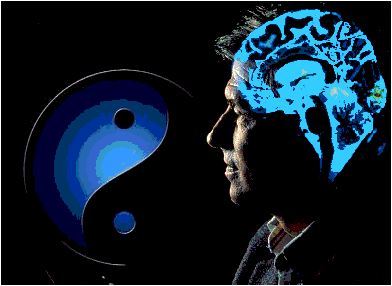
  • The Self – God’s window between pantheistic Taoism and Catholic personal god

    The Self – God’s window between pantheistic Taoism and Catholic personal god

    Last Saturday (yesterday). I went on a retreat (religious exercise) at the Benedictine monastery St. Ottilien with twenty others men and women looking after their private center and true selves:

    “Looking for the self” What do we know of the psyche and soul?

    The discussion was lead by two monks – the longtime Prior Claudius and Pater Otto, who is catholic priest, Jungian psychologist and as he always proudly announces, orginally a cheese maker. Segments of discussion were preluded from the two monks with some food for thought: first from a catholic view of the wise and senior Bavarian monk and then from a psychological view from the energetic, versatile,  a curious (spiritual and intellectual) searcher in his soft American-Swiss accent. I have known both for a while, and do not  go along always with their statements or definitions. As often, many of the brief thought nuggets answered my current questions and difficulties but also opened more topics to meditated and think about. Never before have I seen priest sharing so openly their lifelong process of believing, their doubts and trust in following Christ. The (Catholic) belief they presented and have lived is one of a unique joyful religion for this life, of  boundless love, capable of deep mystic but also fully compatible with science and Jungian models.

    Life experience in an elevator pitch

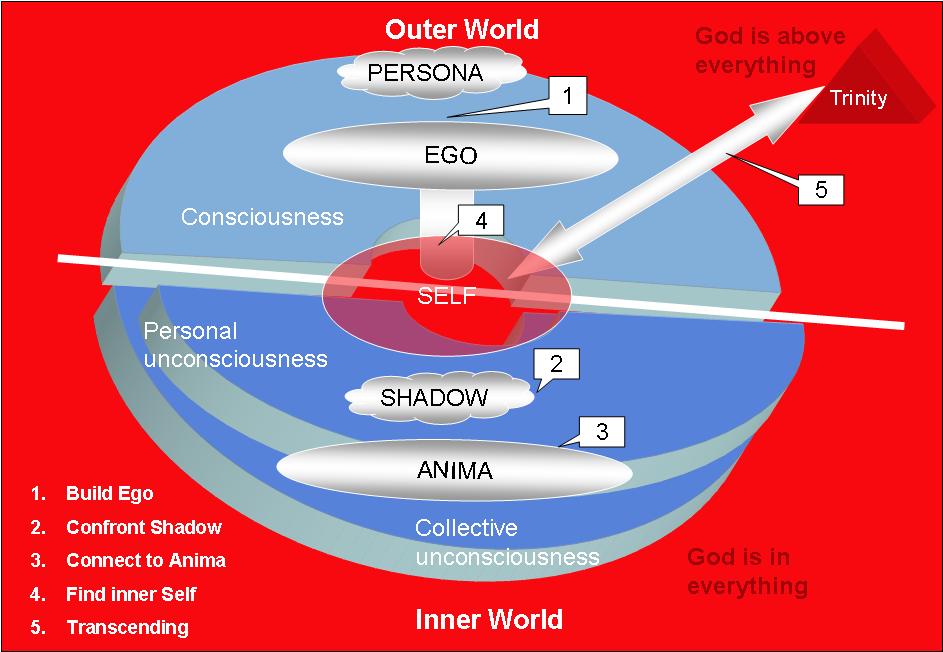
    Do you think, the Prior (second in charge of this monastery) told the audience some conventual belief and bigot phrases? Think again, some of his statements would force both the official church hierarchy together with the noisy know-better-modern- lay(wo)men of today in a tailspin. A concise opening statement of the Prior summed up what one has to do in life and how that helps finding God. I was taken back by its simplicity. His crisp world view came across as a result of his own thinking and experience as a monk without giving  psychoanalysis any deep consideration. But it could be easily matched to individuation of C.G. Jung. I included a crude visualisation below. Furthermore, the Prior eased my biggest problem with a personal god, having had my God experiences in the nature.

    First the Prior showed  us a pantheon (almost Taoist) image of god, how it relates the inner center our Self: God is in everything and above everything or God does not exist. Quite frankly, that resonated well with me, since I felt god the first time, during a backpacking week around Mount Rainer (Wonderland trail). That is – God is in everything  – after I crawled out of the tent and admired nature during the glowing sunrise.
    Secondly Claudius connected men’s outer world, with his inner world and with God –  as an individual to a personal (Du to Du).  It comprised what one has to accomplish in the first half of life ( and where materialism or Freud’s machine stops) and in the second part of life and beyond.  C.G. Jung defined that  without his empiric reach but definitely within his metaphysic view.

    Dealing with the outer world: You have a good meaningful job, live in a nice house, have a good handsome/pretty spouse,your kids turn out well. You sit down and see it is good. I think this relates to the developing an Ego and Persona in the first half of your lifespan. Later Pater Otto brought  the Ego in an Example of a Gel Tub, how the Ego,the center of consciousness is needed as an outer communicator and shell to protect your our Self and our Soul.

    Dealing with inner world: You have to look into yourself think and meditate, rid yourself of the negative. (P. Claudius avoided saying evil or demons). You sit down and see it is good. I think this relates to the Individuation, overcoming the own Shadow and finding the soul (Anima). Later Pater Otto told us about the soul (lat. Anima, gr. psyche ) how this relates our psyche and psychology in general.

    Find your inner center: You have to look beyond this world, to find the loving God in you ( P. Claudius meant looking for our soul). Men is a communicating species, but you have to  have found your inner center to do this successfully..You sit down and see it is good. I think this relates to the Individuation, overcoming the own Shadow and finding the Soul (Anima) and Self. Later Pater Otto told us about the Self, the forces in making cheese by steering in the milk  and the Axis (the big pipe) between the Ego and the Self.

    Communicate with the personal god: You have to connect with the personal God using your Self as window (or membrane). You sit down and see it is good. I think this connects the Individuation process with the  religious or transcendent dimension of an accomplished life. Later P.  Otto told us about special prayers (credo prayers) and Kreuzgänge (walking silent cross walks) how  we can show God we are ready. Now here the monks moved from pantheism to the loving Christian trinity. The communication between the personal God and us as individual is facilitated by the Self, our window to God.The bigger the pipe is between Ego and Self, the easier it is to experience God. Autonomous complexes or an inflated Ego prevents that.

    The Ego, the Self and God
    Multiplicity of Psyche – Individuation and Transcendence


    One Questions two views but one answer

    I have never heard it so clear. The theoretical distinctions of the Self in the different teachings is often unclear and undifferentiated. For the psychologist C.G. Jung the ‘Self’ is an empirical concept for the total amount of all psychic phenomena in humans. It expresses the oneness and wholeness of total personality. The general question in the search for the ‘Self’ is: How can the lives of people succeed? The Prior formulated it in a Christian way,  explaining how to follow Christ; aiming to the realization of the true ‘Self’. I believe that, together with psychoanalytical contribution of C.G.Jung,  the Catholic faith sheds light on the basic “W” questions but also helps in this life. Jesus’ approach to the individual and freedom is unique. We are nor slaves of a cruel god, nor impersonal white noise to resolve our Ego better sooner than later in nothingness, nor a bunch of neurons (mis)firing. As the Prior said: “we can look into the starry sky and say Du,Du, Du”. And I would add, fully aware of todays astrophysical knowledge of our universe.

    God around everything and above everything

    The Self

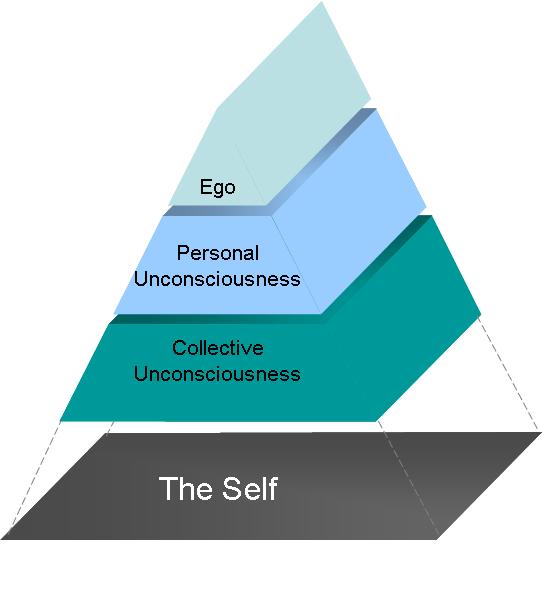
    Psychological schools are just models. We can’t see atoms or quarks nor can we see our soul.  Therefore scientists and psychoanalysis come up with models, to understand and predict based on empirical data. Even if the Self is a non-uniformly used term with their psychological, sociological, philosophical and theological importance variants, the Jungian model is the closest to Religion. While Freud and Adler considered very narrow psychological drives, C.G. Jung understood the central integral concept of the human psyche as the Self. This Self is the wholeness of the human psyche and connecting the conscious and unconscious parts of the personality and aims toward the harmonization of the psyche. Only the ego-consciousness has the equipment to process deliberately sensory perception and thinking, feeling, and intuition. The unconscious part of the us, which splits in the personal unconscious and the collective unconscious, is larger and often more powerful than ego-consciousness. The ego,on the other hand can run amok and super-inflate. The Self is the center of the whole personality and therefore the central window or “membran”as Pater Otto called it to God. As I interpreted the Prior Claudius, it is also the Place where God or Jesus is in us.  The Ego is the conscious of self, his eye, with whose help the self itself can recognize. The self is the God in us. Individuation is to be who one really is, and thinks a differentiation process that has the development of all skills, systems and possibilities of the individual through gradual awareness and realization of the self to the target.

    Find my Self and inner Center again

    Religion is to C.G. Jung the opportunity to discover the soul. For Freud as for Marx, religion is just opium. Jung sees the benefit of religion (especially of catholic flavor) to deal with many similar psychic circumstances. Today’s psychology – influenced by Freud – to me is Godless and today’s Western theology – influenced by the age of enlightenment – to me often lacks soul. Spirituality and religion, together with logic and science, is focus for individual and political healing. The most important insight, which I understood this day: The impending disasters right now around me, are a direct result of my buried shortcomings like a pretty big Ego which served me well in my career (i.e. the disaster in me). Its is directly linked to Jung’s reminder, the inner world is very real. The evil is in us.

    Conclusion

    I considered myself blessed to get so many hints from the monks for my specific search in such a short time:

    • Who I was in the past, I who want to be in the future and how do I make the transition?
    • How I reflect my undesired aspects of my personality and keep my identity here?
    • What are root causes of interpersonal communication defects – last call to grow up?
    • What are cause and effect of those significant problems in my current professional transition?
    • How to use the current crisis as a momentum and I deal with transcendence and the death?
    • What needs successful self-development within my current life situation (e.g., toward individuation, religiosity)?

    Lots of other questions were discussed, which might “wind up” in another blog entry:

    • Does Evil exists – questions about the dualistic view (Good and Evil)?
    • Does the hell exist. Where does the picture of it come from?
    • What is the opposite of belief (trust in God) what means believing?
    • What is the opposite of love (indifference / egoism)?
    • Usefulness of the religious church hierarchies and dogmas?
    • Theory and praxis of dreams including dream phenomenology and hierarchy?
    • Emphasis on Christ’s suffering versus Christ’s resurrection (central altar figure in  St. Ottilien)?
    • Individual injuries because of rigid and/or bigot religious practices (understood first time how severe those could influence children, and the advantage of converts)
    • Descartes and Dualism
    • Common psychological disposition (e.g. narcisissm of super inflated egos)
    • Fatherly  versus motherly images of god (got lost of this one – thinking of Kali hardly a nice one).

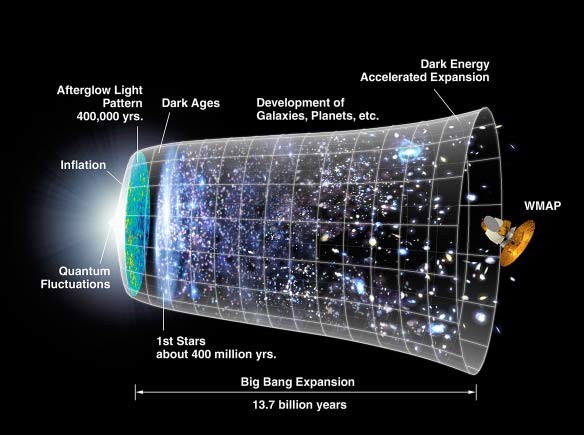
    I was also astonished about the  “Big Bang Didn’t need God to start universe doubt” discussion. To me, believing in God comes down to a personal experience that a benevolent deity is out there. People who are generally more intuitive in the way they think (in the Jungian sense) and make decisions are more likely to believe in God than those who ruminate over their choices. That suggests that basic differences of one’s personality type influences religious belief. Some say we believe in God because our intuitions about how and why things happen lead us to see a divine purpose behind ordinary events that don’t have obvious human causes. As on woman said in the discussion, “I translate believe in trust”. Individual’s belief is influenced by how much we trust natural intuitions. In the end, God can only be known by personal experience not by logic. If one does not experience god, too bad (for her or him). True, big bang and quantum mechanics  describe random fluctuations which can produce matter and energy out of nothingness. But quantum mechanics are just (proved) models too. I don’t doubt that physical laws can “produce” the cosmos. 

    However, minor asymmetries shortly after the beginning are the cause that matter and anti-matter (particle and antiparticle) did not annihilate itself immediately.  As an engineer, quite interested in astrophysics, physical laws do not at all affect my theological leanings. I see in such statements not attacks on the existence of God. Saying the Big Bang — a massive expansion 13.7 billion years ago that blew space up like a gigantic balloon — could have occurred without God is a far cry from saying that God doesn’t exist. With Jung, and many philosophers I don’t think one can use science to either prove or disprove the existence of God. The question, then, is, Why are there laws of physics? And one could easily say, those required a divine creator a spark that led from the laws of physics to these universes, maybe more than one.  Or, as I humbly admit, one can fall back to pantheistic belief, that ‘divine ‘ is in nature in everything  and produced the laws of physics. I would say let’s just leave that to theology, philosophy and C. G. Jung…

    Appendix :

    • The Persona : “The Persona is that which we present to the outside world. It isn’t really our selves, though there is a danger we can identify too much with it and believe it to be so. It is a mask. It’s not a bad thing to have, in fact it’s necessary for getting along with others.
    • The Ego: “The ego is the centre of consciousness. It is identity…But it is not the totality of the psyche.
    • The Shadow: “it is the receptacle for all of that which we have for one reason or another disowned. In truth there’s a great deal that’s very, very unpleasant here, since we have good reason for wanting to disown our darker natures but like the complexes it is not all evil. The avenue for an attempted redemption of the Shadow lies in the belief that everything disowned winds up here.”
    • The Anima/Animus: The Anima is the female soul image of a man, the Animus the male soul image of a woman. That is the most simple definition, and one which many struggle with, since Jung seems quite absolute in defining a person’s soul image as gender opposite. “Soul image” sounds very pretty, but the Anima/Animus is not without a negative pole as well….. If one is on good terms with one’s Anima/Animus he/she can prove a valuable messenger between the unconscious and the conscious, a connecting link – a veritable Hermes.”
    • The Self: “The Self is simply the centre and the totality of the entire psyche. It is the transcendental archetype which contains all the other archetypes and around which they orbit. Where God is within you, if you believe in God.
    • The Collective Unconscious lies under our personal unconscious, and contains the archetypes and mythical symbols that make up our human psyche. Connection to this in a healthy way is necessary for wholeness.
    • Archetypes (per se) templates (blueprints) for complexes. Note Archetypes and Complexes are used very ambiguous ind interchanged  ( I wrote a few articles just about them)
    • Complexes centers of physical energy (The can be autonomic, good or harmful and take over control.
    • Functional Complexes (The big five, Ego, Self,Persona, Anima, Shadow)
    • Synchronicity—when two or more events happen in a meaningful way to a person, and reveals something about our unconsciousness .
    • Individuation is central to all religion and all healing.
    • Quantum fluctuation is the temporary change in the amount of energy in a point in space arising from Werner Heisenberg’s uncertainty principle in quantum physics. That means that conservation of energy can be violated, but only for small times. This allows the creation of particle-antiparticle pairs important in the origin of the structure of the universe according to the model of inflation.
  • Had Jesus a wife? Professor Karen L. King publish or perish: “Gospel of Jesus’ Wife”

    Had Jesus a wife? Professor Karen L. King publish or perish: “Gospel of Jesus’ Wife”

    There has been a bit of noise about a dubious a “business card size” piece of papyrus the “Gospel of Jesus’ Wife” which purportedly provides evidence that Jesus had a wife. That Jesus was married, many hope, is somehow undermining  the core doctrines of Christianity.  Apart from the fact that it the tiny scrap is currently dated a few hundred years after Jesus life and during primetime for Gnostics inventing facts about Jesus to support their own theological (heretical) texts, many seem to think this is somehow evidence against celibacy and calls for a larger women’s role in the church (hierarchy).

    No wonder, that rumor has it, Harvard Theological Review is now declining to publish Karen King’s paper on this Coptic fragment she calls the “Gospel of Jesus’ Wife.”  When I first read about it, I discarded the headline conclusion immediately. I took also the liberty to the read the paper “Jesus’ Wife”. King_JesusSaidToThem_draft_0920. It has a lot of If’s and assumptions.  New Testament scholar Craig Evans writes:  Is the Coptic papyrus, in which Jesus speaks of his “wife,” a fake? Probably. We are far from a “consensus,” but one scholar after another and one Coptologist after another has weighed in pointing out serious problems with the paleography, the syntax, and the very troubling fact that almost all of the text has been extracted from the Gospel of Thomas (principally from logia 30, 101, and 114). I suspect the papyrus itself is probably quite old, perhaps fourth or fifth century, but the oddly written (or painted) letters on the recto side are probably modern and probably reflect recent interest in Jesus and Mary Magdalene. The decision of the editors of Harvard Theological Review not to publish Karen King’s paper is very wise. Perhaps we will eventually learn more about who actually produced this text.

    The academic world became quickly  skeptical about the ancient provenance of this fragment despite the typical professional hysteria in the media and amateur hysteria in the blogosphere. To be fair BBC brought with a lot of trivia and political motivated statement also the facts.
    Anybody who reads a bit about the history and language of the gospel might react similar. A papyrus fragment in Egyptian Coptic most likely of the fourth century, isn’t a proof of any historical value of Jesus’ life.  It’s indeed most likely nothing more than one of many gnostic heresies. By the way, Prof Karen Leigh King is foremost an expert in Gnostic writings; she could tell the – sorry for my language – uninformed press, but of course publish or perish.. This sort of debate that should be carried carefully, so scholarship can get it right.

    Before we get start rewriting Christ’s history it is worth examining the source of the document and the institution at which the discovery was made.Besides some call it a straight forward hoax, currently most experts assumed, that the so-called “gospel” was written in 4th Century AD in Egypt and is written in Coptic, the language spoken by the Egyptians of the time. The professor who discovered it,Karen L. King, and other scholars have solemnly proclaimed it to be genuine. Some doubt even that. Egypt of the 4th Century has long been known as a rich source of gnostic fabricated accounts of the lives of Jesus and his disciples. A similarly strange find –dubbed the Gospel of Judas[Iscariot] – was unveiled also by Karen L. King. This “gospel” has since dropped off the academic radar. There is so much similar stuff floating around – all utterly discredited, so it is difficult to see what a mere eight lines without any context of its finding should tell. A key to understanding the wholly over-blown nature of the controversy lies in the discoverer’s academic speciality.The focus of Professor King’s studies has been Coptic literature, Gnosticism and women in the Bible’

    King writes: “This new gospel doesn’t prove that Jesus was married, but it tells us that the whole question only came up as part of vociferous debates about sexuality and marriage.“. Is that a scholar statement or a feminist statement? Indeed, a bonus in unveiling the controversial scrap of papyrus in Rome was probably a hit on Pope Benedict XVI and the Roman Catholic Church which requires its priests to be celibate. The Huffington Post. “Beyond internal Catholic Church politics, a married Jesus invites are consideration of orthodox teachings about gender and sex,”.Professor King argues without any proof the document is a translation of an earlier one that was written in Greek. This seems a stretch. In fact, it is possible that this “gospel” fragment is associated with such writings found at Nag Hammadi, just after World War II. These writings, all originating centuries after the Apostolicera, were widely published in the 1950s and  inspired C.G. Jung. Jung was instrumental in calling attention to the Nag Hammadi library of Gnostic writings in the 1950’s because he perceived the outstanding psychological relevance of Gnostic insights. Most mythologems found in Gnostic scriptures possess psychological relevance and applicability.  Less to Christanity I would add. Gnosticism flourished in Egypt long after it had ceased to be a major headache to Christianity elsewhere. Egypt had a multi-millennia history of mysticism and so  Egyptian Coptic Christians added to Christianity. It seem we are living again in a climate of decay prone to Gnosticism and superstition.

    From Christianity’s beginnings, the Church has been attacked by those introducing false teachings, or heresies – it seems some Christian churches are too weak now to fight this fungus off. Thanks god, I am Catholic. Having said that, if ones read the Luke Gospel, one will found importance and high status Jesus assigned to women. No need to need to give him a wife.

    Sources:

    Wikipedia on Karen_Leigh_King

    Reality Check: The “Jesus’ Wife” Coptic Fragment

     “Jesus had a wife” manuscript fragment a forgery

    So What if Jesus did Have a Wife?

    Reading_Judas. by Karen L. King

  • “Truth is not determined by a majority vote.”Taking a stand for Christianity

    “Truth is not determined by a majority vote.”Taking a stand for Christianity

    Plato_Today
    Plato_Today

    “Truth is not determined by a majority vote.”

    ― Pope Benedict XVI

    What we are seeing in our time is a generation, where truth is relative to what people wish to believe. Those with this mindset have now infiltrated and are actively taking over our Christian institutions. It is influenced by a Science of Religion that was not, as a rule, done by advocates of the Christian faith. The anti-Christian theory that all religions may be derived from some preconceived philosophy with the emphasis placed a so called openness. They have included Christ in the same category with Plato and Buddha, or a minor prophet, and have generally placed Him upside down; and this supposed openness has given them a degree of influence with dubious and wavering Christians, as well as with multitudes, which are without faith of any kind. Many other works designed to show that Christianity was developed from ancient myths, or sell fiction stories about him, have been current among us. But strangely enough, the Christian Churches, except the Catholic Church, which watches centralized over its belief, has seemed to regard this subject as scarcely worthy of serious defense. That is very surprising, because in a single word, the struggle of truth and error has become world-wide globalized and localized at the same time.

    The inter-religious discourse

    There are no ethnic religions anymore. There is Christianity in Beijing, and there is Buddhism in Munich. This is fine. Western intellectuals surpringly have manifested an ardent affinity to extremist ideologies against human rights, rational thought (as opposed to dogma), tolerance and an open society if it comes from Islam. The line of struggle is the parallel that belts the globe. There must be no blundering: the counter-missionary effort must be waged with arguments of precision, while thoroughly expansive religions claim there victory is sure. It is like last centuries Christian missionary effort has drawn the fire of the enemy with a time delay towards Europe, and the current Christians don’t even notice. There is a reason, perhaps, why these hostile systems have been underestimated.

     Not only is the modern missionary enterprise of the Christian churches in self doubt, also the Christians themselves are. Before you can act efficiently in self-defense for you Religion, you have to know your own religion and have a basic understanding of others. Good men are asking, “Is not such a study a waste of energy? And my answer, “No: by all means. Another view of the subject is more serious. May there not, after all, be danger in the study of false systems? Will there not be found perplexing parallels which will shake our trust in the positive and exclusive supremacy of the Christian faith, or we start cherry picking? Well, the early church, when brought face to face with the culture of Greece and the self-assertion of Roman state, when confronted with profound philosophies like those of Plato and Aristotle, and with countless admixtures of Gnostic mysticism, had quite as formidable a task as those that are presented in the countless false belief systems of to-day. It will be of advantage, for one thing, if we learn to give credit to the non-Christian religions (and the philosophy’s) for the good which they may fairly claim.

     Crusade of the atheists

    In a world that has become relativistic, a new paganism has gained more and more influence over people’s thoughts and actions. A new intolerance is spreading. There are imposed standards of thinking that are supposed to be imposed on everyone. The aggressiveness with which this new religion appears was described by the German magazine “Spiegel” as a “crusade of the atheists”. It is a crusade that mocks Christianity as the illusion and classifies every religion as a curse. Anti-Christian writers have made great capital of the alleged crimes of Christianity; also here it is useful to counter based on facts on whichever side the truth may be. Whether the secular press (not all media are thus unfair) are influenced by partisan hatred of the truth or simply by a reckless regard for whatever is most popular does not matter. The saddest consideration is that the power of the secular press is so vast and far reaching. When Plato wrote, books were few. When Voltaire, Hume, Marx and Nietzsche made their assailants on the Christian faith, the discussion was worthwhile. But now the accumulated opinions and opinionated judgments of the new infidels are spread relentlessly. It became a sermon rather than a philosophic debate,  with the Christian sermon never heard in the owerpowering white noise.

    Dictatorship of relativism

     “We are building a dictatorship of relativism”, Pope Benedict declared in his homily at the opening of the conclave [in 2005], “that does not recognize anything as definitive and whose ultimate standard consists solely of one’s own ego and desires.” The truth comes to rule, not through violence, but rather through its own right; this is the central theme of John’s Gospel: When brought before Pilate, Jesus professes that he himself is The Truth and the witness to the truth.  

    In his futuristic novel Brave New World, the British author Aldous Huxley had predicted in 1932 that deception and lies would be the decisive element of modernity. Today, in fact, truth is regarded as subjective and the distinction between genuine and fake seems to have been discarded. Everything seems negotiable.  History has sufficiently demonstrated how destructive majorities can be, for instance, in systems such as Nazism and Marxism, all of which also stood against truth in particular.

    Taking a stand.

    It is perfectly evident that in an age like this we cannot propagate Christianity without brain and heart. But it needs also patience. Several days ago I entered in a blog exchange with a difficult fellow. After three interactions, I politely broke up the conversation, because I became bored with his substance-less illogical argumentation style. Was I right? I think I was not.

    “Each of you has a personal vocation which He has given you for your own joy and sanctity. When a person is conquered by the fire of His gaze, no sacrifice seems too great to follow Him and give Him the best of ourselves. This is what the saints have always done, spreading the light of the Lord … and transforming the world into a welcoming home for everyone.”

    ― Pope Benedict XVI

  • Confession of an unchurched spiritual and religious person.

    Confession of an unchurched spiritual and religious person.

    For the past decades, steps forward to my Self (as defined by C.G. Jung) or spirituality have always been attempted at moments of incipient crisis time or when I had time to take a breath. Confession: None, though, has been really followed through. The ability and given a chance to switch my career to a lower gear and the turmoil of the death of my mother, both last year, triggered the next leap.

    I started seriously to question my belief system and state of my individuation. For that reason I went back to psychoanalysis theory C.G. Jung) and its connection to religion and mystic but also digging deeper in catholic credo and history. Subsequently I started a blog, which initially contained only my private notes as a scratchpad, but also opened additional avenues to other blogs. I stumbled over one article with title: “Am I Religious or Am I Spiritual?” – A very popular question in the US.

    Well, good question. Similar to my question I have been pondering; do you believe in a (personal) god? Don’t get me wrong, I answered to myself the question 20 years ago, after I stepped out of a tent backpacking at Mt. Rainer. Just like C.G. Jung the conclusion was: “I know God exists.” Jung said that on more than one occasion.

    “Am I Religious or Am I Spiritual?” Maybe that is a question, which I should ask myself first? One of the biggest assets of the Catholicism is, religion and spirituality are not as separated as in Protestantism for some reason. “Bells and Smells, said a Benedictine monk and C.G. Jung emphasised the big psychological benefit of the confession.

    Going after the headline “Survey: 72% of young adults ‘more spiritual than religious”, this seems to mean rarely or never:

    • pray with others, and pray by themselves either,
    • attend worship services,
    • read the Bible or sacred texts.

    To my surprise this would indicate I am religious.

    As an article in psychology magazine pointed out for personality tests, by checking the “atheist” box (if there actually were one), you’ll be waiting a long time for your matches. But if you describe yourself as “spiritual but not religious” your chances are markedly improved (though the problem now is that you’ll see a lot of new age types showing up). Why?

    Despite the fact that more and more people are comfortable “coming out” as atheists, the word is still very much associated with being immoral, or at the very least agnostic. That is to say in the US. The results of a survey in a German news magazine suggested than 80% could happily check the “atheist” box. It seems, Atheism is in Europe the belief of the masses, Voltaire is even more dead than god to them.

    Enter the word “spiritual,” which is becoming synonymous with claiming all that is good in a religious person, without the religion.

    spiritual (spîr´î-ch¡-el) adjective
    1. Of, relating to, consisting of, or having the nature of spirit; not tangible or material. See synonyms at immaterial.
    2. Of, concerned with, or affecting the soul.
    3. Of, from, or relating to God; deific.
    4. Of or belonging to a church or religion; sacred.
    5. Relating to or having the nature of spirits or a spirit; supernatural
    .

    Ignoring (4) and (2) – dictionaries adapt slowly – what exactly, does it mean to be just plain spiritual? One obvious interpretation is (5) taking the word literally: if you are spiritual you believe in spirits. A second possibility (1) is that spiritual is meant to indicate someone who devotes energy to cultivate “spirit,” as opposed to just being concerned with “material” things. That’s a pretty Gnostic definition trying to become  pneumatics the highest order of humans.

    A third interpretation would be: pondering philosophical or environmental questions and reflecting psychologically, behaving ethically ant otherwise correct and compassionately, and also nurturing ones aesthetic sense through arts and blogs. Okay, by that definition, I am also spiritual. However, by this definition, almost everybody is spiritual – some more than others.

    By the way, although I would not check the “atheists” box, I would happily check the humanist box (assuming one or more is allowed). I do suggest that we value the separation of church and state the mutual benefit of belief and rationality since the Renaissance and even pagan Hellenism. As I indicated, in addition I would need to check the “mystic” box.

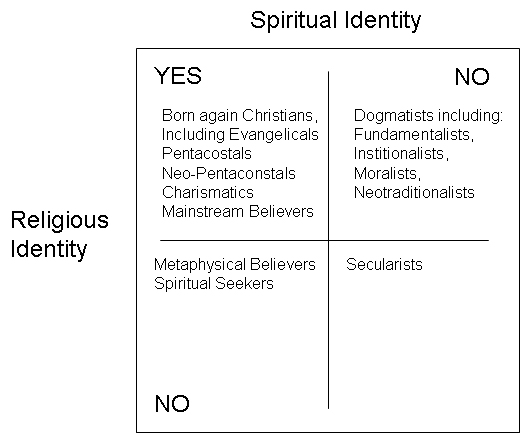
    Besides holding a degree in applied economics I’m just an average engineer who tends to check facts and does not believe anything not seen or touched. Working as a management consultant did not help either. Lets do a (googled) quadrant:

    According to this quadrant I am a mainstream believer.  On the other hand, I attend Catholic mass and routinely check in a Catholic monastery for a few days (sometime with my family), although technically not being affiliated with any religious organization. I am attracted by Taoist thoughts and my wife is Buddhist. On the other hand I like the pope, the global institution and the absolute moral system of the Catholicism not to speak of their powerful symbolism and mystic. I cannot relate to New Age, although having lived for five years in California where  I learned to meditate at Big Sur. On the other hand, I connect easily astronomy and modern physics with Astrology and C.G. Jung’s Synchronicity which is not far away of “The Dancing Wu Li Masters” – a popular New Age book.

    I come to the conclusion “being spiritual but not religious” does not make a lot of sense – to me at least even if I am legally “unchurched”. I can relate to an intelligent professing atheist; we may have fewer than we think however ,  but lots of empty check boxes.