Tag: Dualism

  • Jungian Archetype Checklist for Tolkien’s Lord of the Rings

    Jungian Archetype Checklist for Tolkien’s Lord of the Rings

    In his masterpiece The Lord of the Rings, J.R.R. Tolkien created what he called a “new mythos”. There is undoubtedly much in Tolkien’s Lord of the Rings that invites us seeing it through the Jungian framework.  However, on a closer look, comparatively few archetypes are present, and the main protagonist’s (Frodo’s) individuation arguably fails. A Jungian view must offer more than “In a fairy land lived a halfling who, together with some helper-figures, became a wiser and individuated hobbit’.  On the first glance (and even on the second) Frodo listens more to his shadow than to his Anima – if he has an own Anima at all.

    Now, how do we avoid  the “If you have a hammer, everything looks like a nail“, problem?  By systematically testing elements in the Jungian framework on its applicability to the Lord of the Ring and comparing the results with similar elements  in Richards Wagner “Ring Cycle”. The result is surprising and I hope a bit entertaining.

    Where is Frodo’s Anima?

    anima
    anima

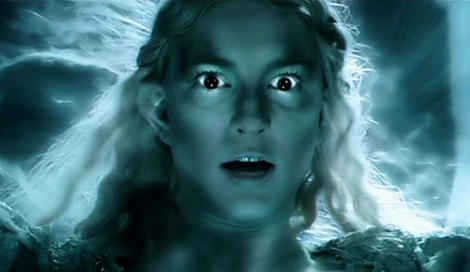
    The story, set in a world Tolkien called Middle-earth, puts forth a possible alternative past for our Earth, one that could have occurred before our written history began.  Tolkien was fascinated with the pre-Christian mythology of northern Europe. To make his story, he pulled elements from these myths. He also imbued it with elements from his own Catholic faith. The story follows a basic plot of a heroic quest. And here it gets meager for Frodo in regards to individuation and Anima.  Without doubt Gollum is Frodo’s shadow. When the Fellowship goes out into the evil lands, passes the trials of Caradhras, the Wargs, and the Balrog, they encounter in Lothlorien  a fair and terrifying Anima.  Galadriel, who sees into one’s heart and forces people to look honestly at themselves, to see the shadow within, giving Frodos followers a hint of individuation – the initial dream.

    While the characters with most depth are Hobbits,  I am not quite sure, if you can interpret Frodo’s quest as his individuation, self-actualization and search for enlightenment. Without blasphemy, one may find a resemblance to Jesus’ hesitation to take the cross. Most of Tolkien’s writings can perceived in the dualistic view of good and evil in distinct ‘mythic’ flavor of a very personal evil and even an evil empire.  However, unlike in  opera or theatre, Tolkien’s Lord of the Rings is not myth per se, but a cleverly fabricated  and artistically elaborated piece of art,  more for effect than symbolic.

    Many of Tolkien’s protagonists resemble thus somewhat more shallow characters of fairy stories, than those, say in Wagner’s Ring,  which Jungian’s generally easily find representation of the collective unconscious. Tolkien’s  (human) figures are more theatric  than archetypal images – or  archetypal per se (templates) :  Sure, the King(s), the Warrior and the  Wizard are quite obvious and map easily and directly to Jung’s “standard” archetypal images.  But all in all it is more Shakespeare than Wagner. Why then, does Lord of the Rings have such an overwhelming emotional impact on me and on others?  Precisely of that. For many of us, the simple identification with the most obvious Jungian archetypal images is the unconsciously response to a typical hero quest and the lure of alchemy. Take the wizard Gandalf, his name was part of 50 % of the root passwords in Unix systems, long before the movie came out. To the younger and/or non-techies, Unix was predecessor of Android OS and is after a rebirth in Linux still base of most Internet infrastructure.

    Tolkien’s “brave old world” in Lord of the Rings

    galadriel
    galadriel

    As we experience today really, “The End of an Age,”  people’s attitude toward religion in the contemporary West (true more than Europe than the United States) has changed. The Hobbit’s Shire creates a suitable sugary pagan (or pseudo religious) setting similar to Jean-Jacques Rousseau’s understanding of “good” nature and savage before Christianity and science took over.  And as Campbell puts it, “It has always been the prime function of mythology and rite to supply the symbols that carry the human spirit.” This is why “Lord of the Rings” speaks as deeply to people who share neither Tolkien’s faith nor his opinions as it does to those who do. It transcends the personal and the particular to touch us all.  As a put off,  it is often argued that the “analytical psychology” developed by C. G. Jung in the early years of the last century was always more religion than a science anyway. Jung was intrigued by the imagery of dreams and waking visions experienced both by himself and his patients, and how this same symbolic imagery appeared repeatedly in religion, mythology and alchemy–areas of which the patients in question were most often ignorant. His concept of archetypes and archetypal imagery has permeated our culture, especially in the arts and humanities.  Hence, an ‘emotional response problem is expected in Tolkien’s approach. It is one thing to like a piece of art, but another to analyse and assess it as a collective unconscious. One may value Tolkien’s Lord of the Rings as a book of undoubted literary quality, whereas even more respond enthusiastically to a trashy sequential  also by another British. Lord of the Rings especially seems to have ‘spoken’ to many of its readers via its archetypal images and the “American National Park” motifs. I have heard, that he had traveled to the US – when I moved to the states and saw them for the first time I was able to map  my own, self created images having read the book 10 years before.

    Jungian framework and art

    I want to suppress the understandable desire to prove that the book I love is also a ‘good’ book in a literary terms but look at it in another way of exploring the reader’s (my) psyche.   Jungian literary criticism is, in my opinion, a method very well suited  exploring the psychological dimension of fiction. I have written about, say Herman Hesse,  Max Frisch.  Both obviously succeeded in creating a work of art rooted in the Western tradition that ‘speaks’ to millions of readers, and a Jungian approach can give a reason for this success, namely that it constitutes a compensatory set of archetypal images that transcend age and culture for a greater balance. Yet, the Jungian framework also harbours some grave dangers – the subject of the analysis becomes too easily confused with the concepts and terminology of what should be the meta-language; the ‘critical’ distance between ‘theory’ and ‘object’ is often dangerously small and causes us to confuse and mix the two levels.  It becomes post-modern mud like those ‘history studies’ blissfully ignoring sources, parallels and analogues and mixing facts and opinion. I use the  Encyclopedia of Arda to keep me honest about the content, Timothy R. O’Neill’s  book “The Individuated Hobbit: Jung, Tolkien and the Archetypes of Middle-Earth” of 1979 and Wagner’s Ring and Its Symbols” originally published 1984 from the English musicologist Robert Donington, both major landmarks in the uncovering mythical-archetypal structures in art. I found little other (and better) than that.  O’Neill’s 1979 book-length study comes from an army psychologist but is not based on professional training in analytical psychology. I am also  aware of the study of  Jungian analyst Pia Skogemann “Where the Shadows lie” in 2009.

    The Heroic Journey

    Tolkien started out just to write a sequel to The Hobbit.  Tolkien tells us in the Foreword to The Lord of the Rings that “the tale grew in the telling” into something much larger, darker, and complicated than his original intent. At the end of his first draft of Chapter III, Tolkien wrote to his publisher that the story “has taken an unpremeditated turn.” By the time he was writing Chapter VII, he reported that “It is now flowing along, and getting out of hand . . . [it] progresses towards quite unforeseen goals.” When Faramir appeared, Tolkien reported to his son that “I am sure I did not invent him, I did not even want him . . . but there he came walking into the woods of Ithilien . . .” Later he said “Gollum continues to develop into a most intriguing character.”The Lord of the Rings follows the basic plot of the hero’s journey.

    Night Journey
    Night Journey

    Joseph Campbell recognized a basic pattern in many of those  narratives and has named those necessary stages to this journey:

    • Separation and departure from the safe haven of home or childhood,
    • Initiation,
    • The Fight or the underworld,
    • Return and reintegration.

    To accomplish his quest, the hero will need to call on his own strengths. These qualities are represented as companions with different qualities.  Heroes are almost always the most unlikely person possible. Each time Frodo and Sam begin another stage of their journey, they encounter one or more threshold guardians (wise men or wise women).

    Spot the archetype

    The method is playing “spot the archetype” with Tolkien’s characters is a game that many scholars have played with relish – functional complexes or archetypes as Ego, Shadow, Anima and Self and collective archetypes  as Warrior, Magician, Hero,  King, among others.

    Archetypes (per se) are described as structural templates  in the collective unconscious, invisible nuclear elements and potential carrier of meaning. C.G. Jung stresses the point that aarchetypes are not inherited but only structural patterns of potential representation. When they are touched by the light of the conscious mind they may become in the lower plane instincts and the higher realm images. Archetypes (not per se!) may be equated with complexes, particularly the those of personal unconscious (like shadow) which are often refered as functional complexes.

    Complexes according to C.G. Jung are described as sources of intensity or energy around a nucleus ( an archetype per se) which may drain (or provide) energy and integrity from/to the conscious Ego and are typically in the personal unconscious but also in the collective unconscious,  Jolande Jacobi describes the “complex” as a node of unconscious feelings and beliefs, detectable only indirectly, through behavior.

    Symbols are perceptible to the conscious mind and are for the most part a representation of archetypes per se conscious mind. Obviously they can be inherited and they my personal or collective as source of all mythic, symbolic and dream representations. This mankind’s experience and knowledge is  not available directly — only its images and created patterns can become manifest as symbols potentially unlimited in number and variety. Symbols are the core of our culture being the universal patterns of myth, religious symbols and Tolkien.

    Symbols in Lord of the Rings

    Though there are many symbols in the story, four symbols of personal power are central to our theme:

    • The evil ring, and the relationship with the other rings.
    • The phial of light.
    • The invisibility cloak, confers the power to change but it also entails the power to deceive.
    • The sword, stinger,  the weapon for the heroic struggle against the Orks.

    The number four is very significant in Jung’s analytical psychology.Jung loves the number four.  One can compare the three Elven rings plus the One Ring to Jung’s analysis of the Christian age in the light of alchemical symbolism, with the good Trinity and the hidden (evil) or later in live (female) fourth. by Pia Skogemann argues that the Fellowship is not really nine but eight, divided into two quaternities.

    Functional Archetypes

    The total psyche: (Mantra - Jolande Jacobi "The psychology of C.G. Jung"
    The total psyche: (Mantra – Jolande Jacobi “The psychology of C.G. Jung”

    The Ego and the Self are terms which are often interchangeably used.  The psychological term Ego is the center of consciousness and ensures the physical survival . Ego often has an extended meaning in the spiritual language and referrers in general terms to an obstacle for Self realization.

    Jung distinguishes sharply between Ego and Self and differentiates the unconscious thoughts and feelings of both types of memories: the ones we can remember easily and those who are suppressed for some reason. In addition he introduced the collective unconscious, which belongs to the common humanity, as part of an individual psyche.

    The Ego

    Frodo and the Shire express the realm of Ego.  The Ring is the Ego inflation  The return of the ring into the deep currents of the fire  completes this life cycle. The self is made whole. The cognitive conscious world of Ego is reconciled with its spiritual origin; the Self is reconciled. Howver, the Ego must also be overcome and accept the shadow. When Galadriel shows Boromir his shadow, he refuses to see. As C.G. Jung said, people would do anything to avoid admitting  failings and working to overcome them. This is part of the power of the shadow. Frodo passes this test, but the price is loosing himself, dissolving the Ego.

    Animus and Anima

    galadrielAndFrodo
    galadrielAndFrodo

    It has been noted, the beautiful Galadriel, who forces people to look at themselves, is the primary Anima. Through her, Gimli realizes that not material wealth but  love is the highest form, Merry and Pippin begin to grow up and take responsibility,  Sam makes his final commitment to the quest going with Frodo all the way and Legolas, another Elf answers the call to action and joins the fellowship. Boromir fails this test.

    Frodo represents the archetypal hero of the Lord of the Rings, but I am missing a dedicated love (or female) who represents the necessary union between the conscious realm and the realm of his Anima. He does not come close to her, and thats in my opinion why he in end fails on the mountain of doom to give up the ring.  The gifts from Galadriecome with the words: “And you, Ringbearer’ she said, turning to Frodo. ‘I come to you last who are not last in my thoughts. For you I have prepared this.’ She held up a small crystal phial: it glittered as she moved it and rays of white light sprang from her hand. ‘In this phial,’ she said,’ is caught the light of Earendil’s star, set amid the waters of my fountain. It will shine still brighter when night is about you. May it be a light to you in dark places, when all other lights go out.  Frodo took the phial, and  Stinger (that symbol should be clear) and the dangerous female become again “like a queen,  fair and beautiful.”  Only later  in Golums’s death we see him freed by the burning away of his accepted shadow. Love might be found between Aragorn and Arwen. When Arwen and Aragorn commit to each other forever,  Arwen chooses to turn and embrace her shadow, her human side, and remain in Middle-earth. The rest of Elvendom chooses to remain within the rapidly shrinking circles of light until finally they lose the world entirely. Arwen, by committing to Aragorn, gives him the inspiration to complete his part of the quest. Aragorn becomes through her the leader he is meant to be.

    shadow
    shadow

    The Shadow

    In the realm of Shadow, represented in Lord of the Rings by Gollum reside rejection, frustration, anger, hate, evil. According to Jung, we all must struggle with our shadow. The shadow is our unconscious self, all the parts of ourselves that we refuse to acknowledge or are shamed by. The more we try to flee from or ignore the shadow, the more it grows and the more power it gains over us. To master the shadow, we need to stop running, turn, and face it. “The hero . . . must realize that the shadow exists and that he can draw strength from it. He must come to terms with its destructive powers if he is to become sufficiently terrible to overcome it. Gollum is Frodo’s shadow made manifest. He represents Frodo’s biggest fear: that he will succumb to the Ring’s siren call. Frodo fears and even hates Gollum up until the moment he actually meets the wretched creature. Once he sees Gollum in the light of day, his heart is moved to compassion. We cannot gain mastery over our weaknesses until we first admit that we have them and then forgive ourselves for that. Only then can we see clearly how to overcome them. Looking at Gollum, Frodo feels pity. Out of this pity he finds the strength to control Gollum — who even calls him “master” — and resist the lure of the Ring.

    The Self

    To me Samin Lord of the Rings represent the Self.  He is the only one who can resists the ring. In the end Frodo leaves the shire and Sam inherits it.  The ring itself represents for us the lure of gold, or lust of power. Possession of the ring confers power over the world. We set out to relate the life-cycle of the ring to the life-cycle of the psyche. The circle of a ring suggests how this might be done. The story begins in the realm of the Self, which has its origin in the value of life. O’Neil’s book identifies (wrongly)  the thoroughly evil “One Ring” with the Self, based on its superficial symbolic characteristics. Sam is a much more satisfying and nuanced view of both of the Self archetype.

    The Persona

    In Wagner’s The Valkyrie teach in “The Ring” a fundamental cultural lessons about society. I do not really see a complement in Lord of the Rings.

    Autonomous Complex

    It is on of the effects of the Ring–“the normal identity disappears and is taken over by the norms and values of autonomous complex (The Ring) takes over. Gollum is clearly an overpowered Ego becoming a merge of Shadow and an autonomous Complex. In one scene his remaining  good and bad side even talk even to each other.

    Archetypes of Transformation (Rebirth)

    The landscape of Middle-earth and the actual journey of the Fellowship have particular archetypal significance : rivers and forests; descent (death and rebirth); changing of the wind; and man-made towers. Significant are borders, crossroads, river crossings and other points of decision, and their relationship to the unconscious.  Jung enumerates five plus one  different meanings of Rebirth:

    • Metempsychosis – transmigration of souls
    • Reincarnation –  continuity of personality (main Buddhist theme)
    • Resurrection  – reestablishment of human existence after death (main Christian theme)
    • Rebirth Renovatio – rebirth in the narrow sense within a span of a life with the implication of healing, improvement
    • Rebirth Transmutation  – such as transformation of a mortal in an immortal being
    • Participation in a process of transformation.

    In Lord of the Rings I see the latter. The transformation  (or the quest to counter  Mordor transforming the world in a hell ruled by the evil enforced by Orks)  takes place outside of the individual. In other words, Frodo has to take part in some rite of Transformation. Jung was, as Tolkien, leaning Catholic (although Jung’s grandfather was a Free Manson and his Father an unconvincing  Protestant Pastor).  Jung meant witnessing the transformation of a substance in ceremony such as a mass, e.g.  the mystery of the Eucharist. It is of the five mysteries  the Church cannot explain,Catholics have to accept them on faith. Of course there is also a strong pagan mystery in it: The grace (more the curse) of immortality.  Jung refers to the Eleusinian Mysteries ceremonies held every year for the cult of Demeter and Persephone. based at Eleusis in ancient Greece (and every Easter in Washington State). Demeter’s rebirth is symbolic for the eternity of life that flows from generation to generation:

    Truly the blessed gods have proclaimed a most beautiful secret Death comes as a blessing to men (Elusian epitaph, quoted by C.G Jung).

    Collective Archetypes

    In his book  Four Archetypes C. G. Jung refers to the Mother, Rebirth, Spirit and Trickster. The mother is just very brief present in the second book (the self sacrifice) and at the very end when Sam becomes father. There are strong women visible, but the narrative is a men’s world. As presented above, one of the five aspects of the Transformation archetype participation in a transformation – is the core of the Narrative. In addition, “King, Warrior, Magician, Lover – Rediscovering the Archetypes of the Mature Masculine” ,  a C. G. Jung based interpretation of masculine behavior is very applicable to the human fictional characters ´Tolkien.  All four representations of the archetypes have one positive (right amount) and 2 negative poles (deficit or surplus). For example, the positive King archetype rules his world wise whereas the negative Kings are the weakling and the tyrant. The Hero or warrior archetype is a timeless, present in all art and global. Two examples of my articles: Jianghu seen as Archetypes defined by C.G. Jung (Magician, King, Lover, Warrior and Hero) and Wagner’s Ring, Richard Wagner from Scene to Scene utilizing C.G. Jung.

    C_G_JUNG_FEMALE_ARCHETYPES
    C_G_JUNGFEMALE and MALE ARCHETYPES

    The Magician

    The Magician, Trickster or Wise Man, represents Logos according to Jung a masculine principle, is sees the unseen. He is like Gandalf the mediator and communicator of secret knowledge, the healer, technologist, teacher, and spiritual. A wizard or a witch, a man or woman of power, advises and sometimes accompanies the hero . This person represents supernatural aid and is another sign that the quest is guided and blessed. But we do not see Gandalf’s true power until Frodo and Sam have gone on without him. Magician, however, always has a tendency to abuse his power, being the negative Magician, the manipulator like Sauron, the most powerful of the wizards,. But Saruman has let his shadow control him. He lies to others and to himself about his true motives. Lies are always a sign that the shadow is in control.

    The King

    The King is the life giver and the most important responsible for the safety and well being. The book quotes from history and art that every society must have king or leader who is entrusted with guiding his people to success and comfort. The benefits and virtues of the king are many, but the responsibilities are many as well. And if the king fails in his duties he is traditionally disposed. The shadows sides are tyrant and the weakling.  The Aragon of volume III may be seen as a personification of the the King.  The self-effacing Ranger, Strider, learns to embrace his heritage and destiny. He has to rise above his self-doubts and take on his rightful role as the King of Men, which he does on the plains of Rohan: It is only after he declares himself openly to Eomer and takes his full power that Aragorn can look Sauron in the face and not be conquered.

    The Warrior (or Hero)

    The Warrior is a destroyer who destroys the enemies and clears a space for renewal and change. The prototype of the warrior is the soldier. In The Lord of the Rings, we have many heroes (and even more warriors), but the two primary heroes are Frodo and Sam. Both express aspects of the archetypal hero. Frodo is an orphan and the adopted and spiritual heir of Bilbo Baggins, who himself does not quite fit in the Shire. Frodo appears to be a normal hobbit up until Bilbo’s disappearance. The Warrior is besides the Wizard  the most viable of the archetypes.  It is vital that this quest be accomplished not by God or agents of God, but by a mortal being. And the hero must fulfill the quest using his own strengths alone. This is the only way he can learn what those strengths are. The lesson for us here is that when we find ourselves in great trouble, not to despair, for that’s when we’ll learn who we really are. The hero must make a formal commitment. His aggressiveness are a highly needed characteristic responsible for his achievements and those of middle earth. Properly accessed, the Warrior provides self-discipline, and protects. The two shadow sides of the Hero are the Sadist of Mordor, the Orks.  The other pole, the Masochist, is not visible in Lord of the Ring.

    The Lover

     The Lover like the feminine principle Eros manifests energy and fertility of the nature. The gendering of Eros and Logos and synergy is a consequence of Jung’s anima/animus synergy. Generally the Lovers are represented by the elves, easy with our own deepest and most central values and visions, and with others. Those are archetypal parents, people and more power and wisdom than the hero does at this stage of his development offer place of safety where the hobbits can relax and  and give gifts to help the hobbits on their way. At the Council of Elrond, the true scope of the quest is made clear: to take the Ring to Mount Doom and destroy it. Frodo is still hoping that the quest is not his. But the wise Elves, brave Men, and strong Dwarves sit in silence. I will take the Ring,” says Frodo, “though I do not know the way.”

    In King, Warrior, Magician, Lover: Rediscovering the Archetypes of the Mature Masculine, a point has been made that every man has to have those (ideally) balanced archetypes.  Jolande Jacobi’s book gives  also a good explanation of how archetypes, complexes and symbols are perceived, interact with each other and gain autonomous power.

    Jungian concepts

    Furthermore one has to deal with the so-called archetypes of transformation and  more general concepts. Tolkien resembles individuation,  how humans develop into mature, emotionally healthy adults. C. G. Jung: “. . . the essential function of the heroic myth is the development of the individual’s ego-consciousness — his awareness of his own strengths and weaknesses — in a manner that will equip him for the arduous tasks with which life confronts him.”

    Personal Layers
    Personal Layers

    Jungian Types

     Skogemann examines the four hobbits as “team consciousness” with each individual representing one of the four Jungian psychological functions (thinking, intuition, sensation, feeling).  Repeated literal losses of consciousness and subsequent awakening of the hobbits correlate with the awakening of the various psychological functions. That may be the case,  but this team building aproach is ultimatly not helping much.

    Individuation

     The Jungian concept of individuation is tailor-made for studying the coming-of-age story, and The Lord of the Rings is rife with such stories. Frodo and Sam an descent into the Underworld. This is the descent into the darkest parts of one’s own soul. Before the hero can face the One problem, or destroy the One Ring, he has to master his own shadow. Frodo allows his shadow Gollum to be his guide through the Underworld. They traverse the Dead Marshes and Shelob’s tunnel. Here, Frodo is betrayed by Gollum and appears to die. This is Sam’s crisis, that he would not be able to protect Mr. Frodo.  But he resists the Ring, takes on a tower full of Orcs, and rescues Frodo. The initiation continues as Frodo and Sam are tempered by their passage through the shadow lands of Mordor. Frodo, who is still struggling with his shadow, cannot see anything beyond that. But Sam, here almost being Frodo’s Ego has gained perspective. Finally they reach Mount Doom. At the ultimate moment, Frodo succumbs to the temptation of the Ring and claims it for his own. However, his earlier compassion for this failing saves Frodo from a terrible fate. Because of both Sam and Gollum the quest of Frodo can be fulfilled.

    Eternity and Judgment Day

    The Ego, the Self and God
    The Ego, the Self and God – Individuation and Transcendence

    Once the quest in Lord of the Rings has been fulfilled, supernatural power can be used freely, so Gandalf and the Eagles can save Frodo and Sam as Mount Doom erupts and Barad-dur collapses. Barad-dur crumbling means Sauron has been completely defeated.

    The World Tree, the Tree of Life, has bloomed. This tree only blooms in the garden where there is no shadow. The restoration of the White Tree in Gondor and the presence of the mallorn in the Shire let us know that things are truly balanced and healed. After wholeness has been restored, it is time for unions. Sam marries Rosie,  Eowyn and Faramir marry and solidify the ties between Gondor and Rohan. And Aragorn, now King Elessar, marries Arwen. This is the Great Marriage, the union of the mortal hero with the immortal goddess, that ensures that the world will be renewed.

    The time for judgment has come. Aragorn sits in judgment on Men, and his decisions reflect the wisdom and mercy of the returned King the world is now ready for. Sauron is condemmed to endless existence as a “mere shadow of malice.  Saruman’s fate turns out to be the same as that of the master he served and betrayed. Those who cannot become whole and balanced, who remain in the power of their shadows, are cast out from the reborn world.

    No marriage forFrodo. But he said to Gandalf: “At last I understand why we have waited! This is the ending.” and finally leaves Middle-earth. This can be interpreted two ways. In a first interpretation, Frodo did, in a sense, fail.  Secondly his disappearing resmbles essentially the dissolving of his ego, which is one common way to see individuation (see The Death of the Ego as prerequisite to find God). In any case, Frodo’s fate is bittersweet. Sam becomes Frodo’s spiritual and material heir – the Self.  He also becomes a parent, symbolic of true maturity. It was a simple story, but had all ingredients of C. G. Jung’s Red Book ( C. G. Jung’s Red Book in a hurry – Narrative)

    Conclusion

    Analytical psychology acknowledges the importance of the spiritual life, but is not tied to a specific religion. Those focused on Tolkien as a Christian author might find Jung’s  alternative psychological explanations thought-provoking.  Like Wagner’s Ring, Tolkien starts with a world of  animistic beliefs threatened by modern science, a trajectory that leaves people cut off from the idea of nature. It may very well be, that Tolkien’s and Jung’s early experiences with the Perilous Realm (whether one calls it Catholic Mystic or the Unconscious) had much in common, even the style of the language in which their experiences were expressed. In his “Red Book” Jung found such language to be a characteristic of archetypes. Both, Jung and Tolkien had serious problem with their era and its lack of any means of spiritual transformation, overwhelmed by science and technology. The Lord of the Rings is and the Red Book not an allegory of World Wars, however World War II affected the conception and portrayal of Mordor and the Red Book anticipated the streams of blood in World War I.

    Sources

    • O’Neill, Timothy R. The Individuated Hobbit: Jung, Tolkien and the Archetypes of Middle-earth. Boston: Houghton Mifflin, 1979
    • Robert Donington, Wagner’s Ring and Its Symbols”,  originally published 1984  both antiquaries
    • Lord of the Rings: The Mythology of Power von Jane Chance
    • Jung, Carl. Aion. Collected Works v. 9ii

    Links

  • 2013 Conclave Easter of Abraxas or Pentecostal ? A Jungian view

    2013 Conclave Easter of Abraxas or Pentecostal ? A Jungian view

    This article will try to summarise the narrative of Jesus’ Passion  (the period  between Easter and Ascension) based on Abraxas some Gnostic writings . We will particularly view the 1500 year old scripts of the  Nag Hammadi library discovered in Egypt in 1945 and show strange repeating tracks in a supposedly pathless world of truth. On the other and is the recent development in Africa and Latin America, where population growth and contraction look poised to reduce European domination radically while a boom in many southern states continues apace. When turning to religious indicators, all of them suggest that the surge in southern Christianity has barely begun – and raises another problem,  largely ignored by a self centered Chatholic Curie . The surge in Christanity in Africa and Lation America is due to Pentecostalism, Protestant renewal movement that places special emphasis on a direct personal experience of God through the baptism with the Holy Spirit.  Most Christians will follow the lead of the new elected Pope in Rome and celebrate Easter in four weeks. Pentecost reminds to the descent of the Holy Spirit upon the followers of Jesus Christ, as described in the second chapter of the Book of Acts.Will be 2013 the Easter of Abraxas or Pentecostal?

    cross-shine
    cross-shine

    The time between Easter and Ascension of Jesus  has an important place in Christian Gnosticism. And, what is perhaps more surprising is that Gnosis and Easter are not mutually exclusive, although most secrets of the faith are virtually nonexistent in Gnosticism.

    Easter marks the beginning of the Christian Church calendar, namely in recollection of the resurrection by Jesus after his crucifixion. Easter weekend is the culmination of the Christian faith, every other aspect of the religion being merely a footnote. But the Easter celebration is actually timeless, since the dying and rising is a classic motif found in many cultures representing the renewal of various aspects of Creation and nature. The Christian story, however, is very powerful:  “O Death where is thy sting? O Hell where is thy victory? Christ is risen, and thou are overthrown. Christ is risen, and the demons are fallen. Christ is risen, and the angels rejoice. Christ is risen, and life reigns. Christ is risen, and not one dead remains in the grave. For Christ, being risen from the dead, is become the first fruits of those who have fallen asleep. To Him be glory and dominion unto ages of ages. Amen.” Lets see how the Gnostic versions compare to this.

    Gnostic  roots

    Gnostic Roots
    Gnostic Roots

    The Gnostics derived their leading doctrines and ideas from Plato and Philo of Alexandria, the Zend-avesta (Zoroastrianism), the Kabalah, and the Sacred books of India and Egypt; and thus introduced into the core of Christianity the cosmological and theosophical speculations. Those had formed the larger portion of the ancient religions of the Orient, joined to those of the Egyptian, Greek, and Jewish doctrines and were adopted by the Neo-Platonists.  Mythologists have revealed strong Gnostic similarities with the Egyptian and Persian gods and Easter derive from very ancient times, including the holiday known as Sham el Nessim, which may have been celebrated as early as 4,500 years ago.  It falls immediately on the first Monday following the Coptic Easter and it was related to agriculture in ancient Egypt which contained fertility rites that were later attached to Christianity and the celebration of Easter. Christians celebrate Easter on Sunday after the first spring full moon, which ties Easter to the vernal equinox (spring equal night). Linguistically the name “Easter” seems to be older than the Christianity itself. It can be derived from germanic “Ostara”, in the Anglo-Saxon it is Eastre or Eostre, the goddess of fertility and also a derivation of the name Ishtar, the Babylonian and Assyrian goddess of the love and fertility.

    Gnostics and Plato

    In Plato’s work we recognize dualism already. Platon makes a distinction between the world of the ideas and the discernible empiric world in the famous cage metaphor.  However, the shadow  is an effigy of the world of ideas, and thus the difference to the Gnosis becomes clear.  For Plato both worlds hang together because of its dynamism (“prototype effigy theory”). Therefore, with Plato there is no radical separation of both worlds of each other and no refusal of the discernible world. Plotinus works from the 2nd century A.D. makes this particularly clear: “This world is so nice that there can be no one else who would be nicer.” A Gnostic could never say this.

    The dualism of the Gnostics

    The dualism of the Gnostics is more radical with two conflicting principles which are radically opposed. Good and fair stand against bad and evil, namely from the outset. Therefore for the Gnostic exits also a good and a bad world. Both worlds are separated radically of each other. A harmonization of the prototype and from the effigy does not succeed in the Gnosis. On the contrary: both worlds are intervened in a constant fight. Like in Buddhism to Gnosis all life is filled with suffering.

    The dualism of the Christian Gnostics

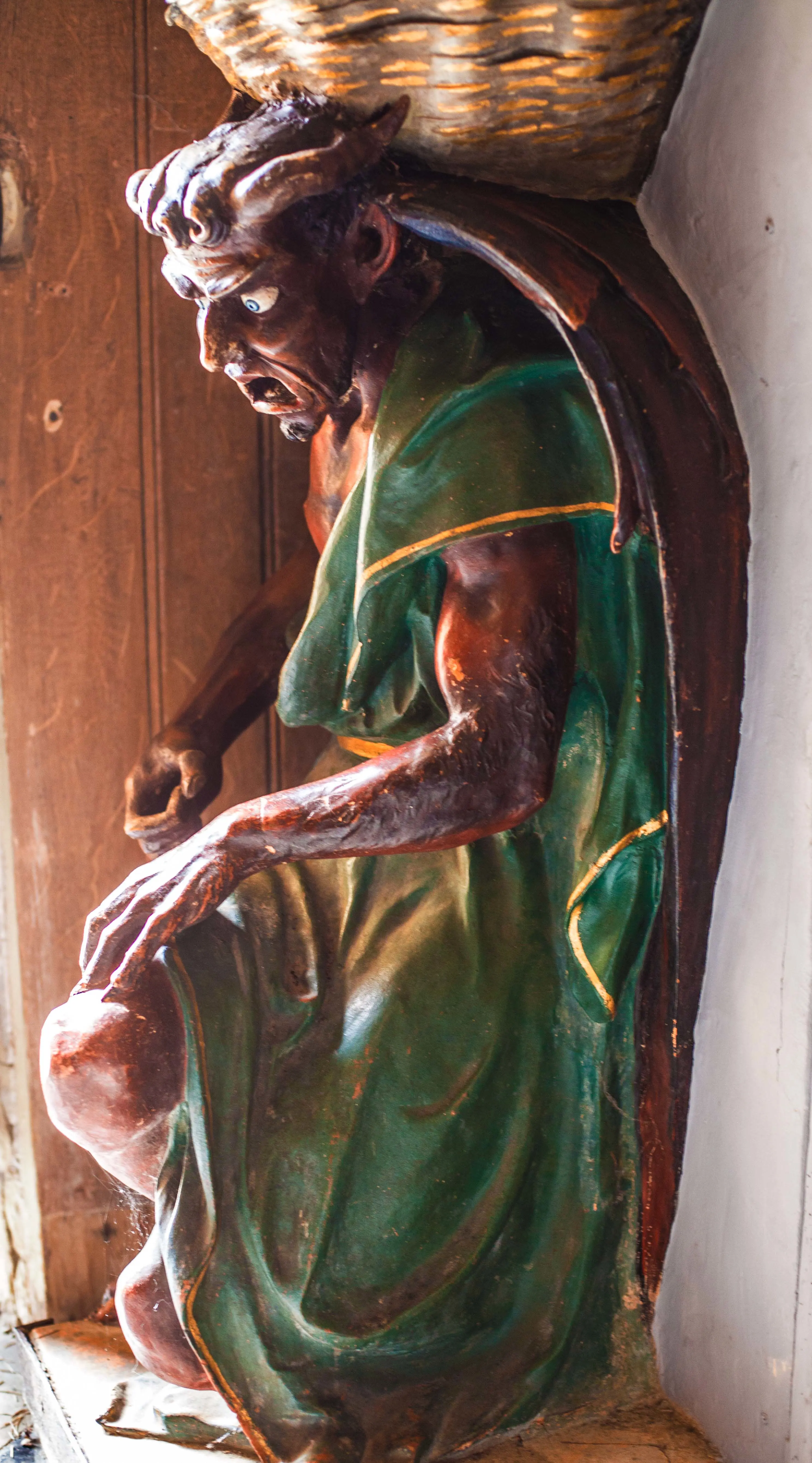
    Devil crushed
    Devil crushed

    Before Christianity was stamped out Gnosis this radicalism has not taken over completely by Christian Gnosis.  Christian Gnosis lets the world at the beginning be still a unity, a single entity. This state shows a sort of pre-beginning.  It decreases to a divine principle which is not, however, identically with our God. This pre-beginning has an ancestor not at all known to the imperfect creator. Nevertheless, the unity of the world in its old state is actually meaningless. Since directly a part of this world from this monistic origin fell out. Cause for it was a fight in these first ones, the divine world at whose end a part from the divine Pleroma left this world in free choice. Secondly,  the sensuous, earthly world, a world fallen from the outset originates from it from the first world. This is an image which can be also found in the New Testament,  the second major part of the Christian biblical canon theology with several strong statements. The empire clearly hit back.

    Christian Gnostic

    Gnosis is defined by the Catholic Encyclopedia as follows: “Whereas Judaism and Christianity, and almost all pagan systems, hold that the soul attains its proper end by obedience of mind and will to the Supreme Power, i.e. by faith and works, it is markedly peculiar to Gnosticism that it places the salvation of the soul merely in the possession of a quasi-intuitive knowledge of the mysteries of the universe and of magic formulae indicative of that knowledge.”

    Many Gods of panentheism, either polytheism or monotheism had been conceived in various degrees of abstraction.  The character Gnosis being mystic rather than religion, however,  is inherently parasitic and syncretistic. Apparently like a virus, its construct of ideas  cannot exist without a host. Gnosticism holds on to existing ideas and enters a connection with them. There is – as  mentioned in other articles – for example, a Jewish (Cabals)  and Islam Gnosis (Sufi). The Gnosis need a substrate around for its  speculations. Accordingly it also came to a connection of gnostic body of thought with the Christianity two times in history ( the Templars being a secondary infection). As one of many variants,  the Gnosis a Christian-gnostic announcement developed. The Roman Church acknowledged after struggling more to the divine or the human side with clear simplicity and crisp definition the concept of Trinity in Pope Leos creed. In opposition to Gnostic idealism, the Church avowed its faith in the real historical facts, that the Son of God truly became man, was born of the Virgin Mary, was truly crucified and died, truly rose again. Thus the Church rescued Christianity (See the review of Jesus Wars).

    Gnostic concept of Christ

    jesus_gnostic

    It has no interest in Jesus as a saviour and bearer of  human  redemption by taking away our sins by ding on the cross. In the Christian Gnosis the divine revelation is sufficient and equated  quite simply with the of person Jesus Christ. For Gnostics Jesus Christ is nothing more than the personification of this divine revelation and the historic (and human) Jesus plays basically no role. He can’t, actually, because otherwise  the saviour  would be tied too strongly to this imperfect  world in the  the negative gnostic worldview. From there it is not surprising that for the Gnosis the earthly life of Jesus is rather dull. Above all, only the period between Easter and Ascension  is important here and highlighted in primarily by gnostic texts.

    In gnostic view Jesus has brought in a hermaphroditic  shape revelation exactly during this tim to a select circle.   The historic Jesus is almost counter productive for the role of a gnostic redeemer, and therefore is suppressed in most gnostic strains until almost  nothing more is left.  It is simply not comprehensible for the Gnosis that there should be a connection of God with this discernible world. With that the incarnation of Jesus Christ as Good into a Human could only be a an illusion. Which of course,  in  Christian terminology is called Docetism, according to which the phenomenon of Christ, his historical and bodily existence, and thus above all the human form of Jesus and his death, was altogether merely an  illusion without any true. reality. The name comes from the Greek word [“dokein”], “seem”, and although Christ appears in the flesh, however, he is  no “incarnation in flesh”. He seems only in such a way, the body of Jesus is completely thought as a false body or somebody else.  Of course the atonement of the death of Christ in the Gnosticism caused by refusal of the worldly flesh.

    Gnostic concept of redemption

    redemption_
    redemption_

    The redemption takes place in Gnosis completely by the revelation. Only the Greek word [“logos”], “word”  is authoritative. The central concern of the Gnosis the knowledge and redemption given to the person on the way, who is trapped within a body thrown in an imperfect world.  Besides, Gnosticism not about an intellectual and holistic knowledge processes. The object of the knowledge is first of all the person. The person recognises himself (better his divine spark)  in the Gnosis, his origin and meaning. Accordingly the basic questions of the Gnosis can be outlined with Clemens of Alexandria:

    “Who were we? What have we become?
    Where were we? Where have we thrown into?
    Where do we hurry? What are we released from?
    What is birth, and what is rebirth?”

    It is important that the answers to these questions can’t be answered  simply by a person. Gnosis is not rational  and logical. The individual cannot find the answers to these questions by personal enlightenment either. One wins knowledge only if it is given to one, by being initiated. Therefore, Gnosis is about recognising revealed message. It is significant that the knowledge is intended for all people, but not all will receive it. Therefore Gnosticism defines itself as an “elitarian”  knowledge which is given only to few chosen.

    The gnostic world

    Therefore, for the purposes of the Gnosis the sensuous world is something what was not planned, actually, not at all, rather something what might not have been. The second world is actually, something what should not be. The completely anti-cosmic position of the Gnosis arises from this.  While the first world from divine (Pleroma) is surrounded so by the divine fullness, the second world is a world absolutely divorced from the divine space. This world is original nothing else than an emptiness. Now, however,from the first world sparks of the Pleroma got in us, parts from the divine world fell in the sensuous world.

    Gnostic concept of Men

    Sivine Spark
    Sivine Spark

    Divine sparks represent – one can probably say with restrictions – the human souls. According to Gnosis we are fallen souls caught within the body, within the flesh. The person carries a spark from the world of the divine Pleroma which is caught in the visible world, living dazed and ignorant, knowing nothing of it. Humans are like “a light ray in the darkness” or “woman in the brothel” or like “gold in the dirt”. The divine revelation releases the soul with it call from the world, coming from the space of the divine Pleroma and releasing Gnosis, knowledge.

    Since, to the best of my ability, I have explained the unknown Gnosis, it seemed expedient likewise to give an example. The difference in the translation is strikingly. This psalm of theirs has been composed to celebrate all Gnostic mysteries in a Christianized psalm, the Psalm of the Nazarene ;

    Homesick, drunken, sleepy and ignorant live the humans in our sensual world.

    The world’s producing law was Primal Mind, And next was First-born’s outpoured Chaos; And third, the soul received its law of toil: Encircl’d, therefore, with an acqueous form, With care overpowered it succumbs to death. Now holding sway, it eyes the light, And now it weeps on misery flung; Now it mourns, now it thrills with joy; Now it wails, now it hears its doom; Now it hears its doom, now it dies, And now it leaves us, never to return.

    Werdegesetz von allem war der erste Nous, Der zweite nach dem ersten war das Chaos, ausgeschüttet. Als drittes nahm die Psyche das Gesetz der Arbeit. Drum ist sie wie der Hirsch ins Fell gehüllt. Gepackt von Todesangst hetzt sie dahin.Bald hat sie Raum, sieht Licht, Bald weint ins Elend sie geworfen, bald lacht sie auf und weint doch schon. Bald weint sie auf und wird verdammt.Bald dann verdammt, fühlt sie das Sterben. Bald wird ihr Rückkehr. Die Unselige!

    The godly revelation frees the soul with a call of the other world. Coming from the realm of Plemora it leads to the secret knowledge.

    It, hapless straying, treads the maze of ills. But Jesus said, Father, behold, A strife of ills across the earth Wanders from thy breath (of wrath); But bitter Chaos (man) seeks to shun, And knows not how to pass it through.

    Sie lief verwirrt ins Labyrinth.Da sprach Jesus: ” Schau doch, Vater! Als Beute des Bösen schweift`s über die Erde, Und doch von Deinem Hauch gebildet, Versucht`s zu fliehen bitteres Chaos, Und weiss doch nicht, wie durchzukommen.

    On this account, O Father, send me; Bearing seals, I shall descend; Through ages whole I’ll sweep, All mysteries I’ll unravel, And forms of Gods I’ll show; And secrets of the saintly path, Styled “Gnosis,” I’ll impart.

    Aus diesem Grunde schick mich, Vater. Mit Siegeln will herab ich steigen,Will jeden der Äonen überwandern, Mysterien, sie all offen machen.Die Gottgestalten will ich weisen: Das Abgetretene des heiligen Weges, Gnosis rufend, will ich bereiten”.

    It needs a revelation to reveal the truth. But the Jesus of the Gnostic is quite different from the Jesus one knows from Christianity. According to Vaentinus: The compassionate, faithful Jesus was patient in his sufferings until he took that book, since he knew that his death meant life for many. Just as in the case of a will which has not yet been opened, for the fortune of the deceased master of the house is hidden, so also in the case of the All which had been hidden as long as the Father of the All was invisible and unique in himself, in whom every space has its source. For this reason Jesus appeared. He took that book as his own. He was nailed to a cross. He affixed the edict of the Father to the cross.’
    In other words, the death of Jesus and Gnosis are truly in many Valentinian belief systems. In a sense, The Cross is the Tree of Knowledge (Gnosis)

    The passion narrative in Gnosis

    jesus-illusion

    Many Gnostic texts, like The Letter of Peter to Phillip and The Gospel of Mary simply see the death and resurrection drama as a small intermission in the imparting of Gnosis by Jesus, as well as a test of faith for his followers. The great mysteries are truly passed on after Jesus has returned in an angelic shape and can no longer be harassed by the Archons. Some Gnostics were simply against the idea that Jesus Christ could suffer on Earth (or that he even possessed a human form). In The Apocalypse of Peter, Jesus mocks his execution and the spectacle around it, stating that it is actually Jehovah who has been replaced on the Cross: ‘Be strong, for you are the one to whom these mysteries have been given, to know them through revelation, that he whom they crucified is the first-born, and the home of demons, and the stony vessel in which they dwell, of Elohim, of the cross, which is under the Law. But he who stands near him is the living Savior, the first in him, whom they seized and released, who stands joyfully looking at those who did him violence, while they are divided among themselves. Therefore he laughs at their lack of perception, knowing that they are born blind.’

    In The Acts of John, Jesus appears to the Apostle John after the crucifixion. He explains to the ‘Beloved Disciple’ that there were two crosses at Golgotha. One was the Cross of Light that stands above the material world and is the doorway to faith, hope, wisdom and the Pleroma itself. The other was the Cross of Wood that represents the lower nature of humanity dominant within all those who witnessed the crucifixion of nothing more than a phantom.

    A person is no longer part of the crowds under the Cross of Wood staring at phantoms but within the Cross of Light, filled with faith, hope, wisdom and even the Pleroma:  “Understand me then as the slaying of a Word, wound of a Word, hanging of a Word, suffering of a Word, fastening of a Word, death of a Word, resurrection of a Word, and defining this Word, I mean every man!”

    Christ and human had become one.

    The Gnostic Sage Basilides also believed that the crucifixion was a hoax to mock Jahweh, except that  Simon of Cyrene was nailed to a cross. The Second Treatise to the Great Seth has a Simon replacing Jesus, but it’s unclear which Simon. This idea of Jesus avoiding his death by a slight of divine hand was later adopted by Islam, raising additional arguments to claims od historians that Mohammed might have been in contact with Gnostic sects and that the Koran  itself was an amalgam of some heresies  circulating among some Christians in the Seventh Century.

    Despite the varied beliefs in Gnosticism, there is a common thread on most versions of the Passion narrative: The Savior arrives in a form recognizable to humans; his form is destroyed by the  demons who  rule the universe and lastly he returns in an astral manifestation to impart his greatest teachings to those who both had faith and understood his message from the beginning.

    And because Gnostics believe in becoming Christlike while alive, the death and resurrection of  The Savior symbolizes part of the process of Gnosis itself.  You might remember my article and Death of the Ego as prerequisite to find God or C.G. Jung’s Self in Quaternio Series of Aion – Jesus or Abraxas? An individual who seeks ultimate spiritual freedom must get over his Ego, which is attached to the material world to reach the Self.  This is found very differently in C.G. Jung’s thoughts, here the Ego must establish a channel to the Self. It has to be noted that C.G. Jung sees this Self also as Christlike.

    Gnostic Deity

    Barbelo

    Barbelo is the primary goddess of Gnostic Magic. She equates to the Egyptian Nut, and also to Babalon, the Enoch’s goddess. The worship of Barbelo was so great, that one of the names given to the Gnostics was the Barbeloites. She is the first reflex of divinity, called the Invisible Spirit. As the Invisible Spirit is pure subjectivity, so Barbelo is pure objectivity, the two forming the first and most fundamental of all dualities.

    Seth

    The Egyptian Set and the Gnostic Seth are both equivalent to the Hindu Siva (sometimes spelled Shiva), the god of destruction, but also the god of mystics, yogis, and magicians. Christian theologians have equated Seth with Satan, but mythical he represents the spiritual impulse that opposes all material manifestation. The four letters of his name represent a synthesis (S) of science (E) and the reasoning processes (T) within the mind (H), identical with gnosis; an direct awareness and understanding of knowledge.

    Norea

    Norea , the Gnostic equivalent of the Egyptian goddess, Nephthys, is the name of Seth’s sister, the fourth child of Adam and Eve. Norea is always shown in Gnostic literature as highly intelligent and given to spiritual insight. In the Hypostasis of the Archons she is “an assistance for many generations of humankind.” However, Jewish tradition has equated Norea with wickedness, and, like Set/Seth, having a demonic nature.

    Sophia

    The Greek word Sophia means wisdom. Sophia was a goddess assigned to the thirteenth Aeon under the great Angel Eleleth . The Gnostics taught that it was Sophia who, on her own and without a masculine consort, gave birth to the material universe by creating the demiurge, Ialdabaoth. She then repented of her deed, but meanwhile the material world had come into existence. She represents spiritual capability and desire for expression  that created . It is also interesting Sophia takes the form of The Tree of Knowledge in The Secret Book of John).

    Ialdabaoth

    This is the demiurge or archdemon who rules the worlds of manifestation below the Abyss. He was created by Sophia. The Gnostics equated Ialdaboth with the Hebrew Jehovah. Ialdabaoth represents physicality, the logic and reason of the human mind.

    Sabaoth

    The son of Ialdabaoth who saw the wickedness of his father and repented. Because his repentance was sincere, the gods granted him divine assistance.

    Abraxas

    abraxas

    Abraxas,  is a Gnostic solar deity associated Yeshu (Jesus) and by the ancients with Yahweh, Mithras and the Celtic Belenus.  Amulets and seals bearing with a figure of a cock head and the legs of serpents were used in the thirteenth century in the seals of the Knights Templar. A god of time and ruler of the days of the year, Abraxas bestows gifts on those who call to him; especially protection from all manner of harm. By medieval times, Abraxas was relegated to the ranks of demons. The image most associated with Abraxas is that of a composite creature with the head of a rooster, the body of a man, and legs made of serpents or scorpions. He carries a whip and shield, called wisdom and power, respectively. The word Abraxas was first proposed by the Alexandrian Gnostic scholar Basilides, and is created using the first letters of the names of the seven visible planets. The letters in Abraxas add to 365, the number of days in a solar year, and the number of Aeons, or divine emanations, in Gnostic cosmology. Each of the seven letters represents one of the seven planetary powers. Church father Tertullian, speaking of Basilides’ and  Abraxas:

    “Afterwards broke out the heretic Basilides. He affirms that there is a supreme Deity, by name Abraxas, by whom was created Mind, which in Greek he calls Nous; that thence sprang the Word; that of Him issued Providence, Virtue, and Wisdom; that out of these subsequently were made Principalities, powers, and Angels; that there ensued infinite issues and processions of angels; that by these angels 365 heavens were formed, and the world, in honour of Abraxas, whose name, if computed, has in itself this number. Now, among the last of the angels, those who made this world, he places the God of the Jews latest, that is, the God of the Law and of the Prophets, whom he denies to be a God, but affirms to be an angel.”

    Basilides wrote, “God and devil are distinguished by the qualities fullness and emptiness, generation and destruction. Effectiveness common to both. Effectiveness joined them. Effectiveness, therefore, standeth above both; ia a god above god, since in its effect it united fullness and emptiness. This is a god whom ye knew not, for mankind forgot it. We name it by its name ABRAXAS.” And later he writes, “In this world is man Abraxas, the creator and the destroyer of his own world.”

    The Swiss psychologist C.G. Jung wrote a  Gnostic treatise in 1916 called Seven Sermons to the Dead, which called Abraxas a God higher than the Christian God and Devil, that combines all opposites into one Being. under the pen name of the ancient Gnostic sage called Basilides of Alexandria, who was a strong proponent of Abraxas. The Nobel prize winning novelist Herman Hesse uses Abraxas in his novel Demian, which explores the themes of good and evil. And the popular jazz guitarist Carlos Santana called an album Abraxas in the 70s.

    Religion or a psychology?

    NagHammadi Hidden in 345 AD. By whom? Why? For what future purpose? No one knows,
    NagHammadi Hidden in 345 AD. By whom? Why? For what future purpose? No one knows,

    C. G. Jung had shown a pronounced and informed interest in Gnosticism and Alchemy. This is evident in the Quaternio Series of the Self in his book. “Aion“.   Was Jung really a Gnostic? I seems to me, that “Aion” and another late work The “Answer to Job” give some evidence to the assertion: No, he wasn’t.

    Throughout the twentieth Century the new scientific discipline of depth psychology has gained much prominence. The depth psychologists who have shown a pronounced and informed interest in Gnosticism was to C. G. Jung. Jung was instrumental in calling attention to the Nag Hammadi library of Gnostic writings in the 1950’s because he perceived the outstanding psychological relevance of Gnostic insights. His Red Book  and the mentioned Seven Sermons to the Dead are famous psychoanalytical Gnostic texts.

    In pantheism the universe is God whereas in deism the supreme deity is cold and indifferent (and unaware) to its creation like Abraxas. This main symbol (or word) for the Gnostic God, Abraxas, is known from the Gnostic writings of Simon Magus, father of the Gnostics and Basilides of Egypt. C.G. Jung described a three stages of human perception of God. The first stage was that God appears undifferentiated. The second stage is the moral dualism perception of personal benevolent God(s) and evil Devil(s) in which they are separated. The final stage is the integration of the good and the evil. One example for a thoroughly dualistic view is Abraxas. The name stands in connection with Mithras, also with one of Homer’s solar horses, and in Greek the magic name contains the numerical of its seven letters (weekdays) adding up to 365 days of the year. In numerous representations of Abraxas is shown with serpent feet and the bird head. He symbolizes creator, thus destructive force and saviour, the unknown and unnamed God of Revelation.In The Seven Sermons to the Dead C. G. Jung says

    Jung’s reflections had long been immersed in the thought of the ancient Gnostics to such an extent that he considered them the as on of many form where religion is applied of ‘depth psychology’ . Gnosis, albeit in its form of universal religion helped him to clarify, if not invent, the nature of Jungian spiritual therapy.

    jung_jesus
    jung_jesus

    Is Gnosticism a religion or a psychology? The answer is that for Sufism or spiritual Catholicism it may very-well be both. Gnostic scriptures as the Bible possess psychological relevance and applicability. For instance the blind and arrogant creator-demiurge bears a close resemblance to the alienated human ego that has lost contact with the ontological Self. Also, the myth of Sophia resembles closely the story of the human psyche that loses its connection with the collective unconscious and needs to be rescued by the Self. Analogies of this sort exist in great profusion.

    C.G. Jung said once,

    [Abraxas] is… a thousand-armed polyp, coiled knot of winged serpents… the hermaphrodite of the earliest beginning… the lord of toads and frogs, which live in the water… abundance that seeketh union with emptiness.”

    Hesse derived his understanding of the Western and Eastern religious foundation and Gnostic thoughts from C.G. Jung’s psychology. It opened a new thinking and a new, modern and fascinating way to interpret and to make his personal experiences fruitful for his poetic work. C.G. Jung’s  teaching gives him the key for the synopsis of the world religions and specifically for the combination of psychology and religion, specifically in “Demian”. Even more C.G. Jung’s psychology of religion provides the theoretical justification for the central message of Hesse in his  poetry: the identity of raising consciousness and experiencing God. It confirms his own hunches and insights on the common psychological and anthropological understanding of the world religions. For Hesse Abraxas this view in the nihilistic ‘chaos’ initiates innovative and the cyclic revelation, like the ‘everlasting mother’ in his poems . Soon after he meet C. G. Jung in 1917, he originates his Demian, partly inspired from dream analyses, with symbols like the young eagle who struggles from the nest, a dark and bi-polar God similar to the bird-like demiurge Abraxas from the Gnosis which must be overcome by love.

    Gnostic  and Christianity in the view of the Gospels

    The church and the Gnostics continued to reinterpret Jesus, such as to strengthen (or weaken) apocalyptic eschatology. In the first place we find within Luke a complete new interpretation of the oral traditions. He treats it as historical, like in 19.11 “they supposed that the kingdom of God was coming immediately ” – indicating they did not understand Jesus. Besides the synoptic gospels, a complete different matter is the Gospel of John.-

    Gospel of John(Johannes)

    St. John
    St. John

    Critical opinions a have gone back and forth and interpretation moved like the tides. In the Gospel of John, there is little of the historical Jesus and clear strains of these gnostic systems are already found. Quite clearly visible in radical separation  of God’s area and world, the way of the saviour as a descent and rise, the predetermination of the released and the remedial individualism are all striking signs of gnostic mentality. Of big importance has been the  the question is the Johannes Gospel seduced by thee Gnosis of was a refute of it.

    Indeed, remains to note  that during the long discussion some concepts has been introduced to  Christian apprenticeship from gnostic philosophy, particularly this is to be felt with the speech of spirit and flesh. It is the mind who brings life; the flesh is useless:The Spirit gives life; the flesh counts for nothing. The words I have spoken to you are spirit and they are life. (Joh 6.63).

    This could also have formulated quite similar from a gnostic. However, well-chosen  anti-gnostic points are already visible in the first half of the Johannes Gospel :

    • the confession of the creator’s God immediately at the beginning in the prologue of the Gospel (Joh 1.3),
    • the confession of the incarnation of the saviour (Joh 1.14),
    • the proclamation of the atonement death of the lamb  (Joh 1.29).

    The sequence is informative in Joh 3,13-14: the statement of the need of the suffering is followed by a strongly gnostic sentence. It is, however, paradoxical for us, that some Gnostics have made the Gospel of John to a favorite target in the New Testament, although it is by far insufficient to confirm non-Christian doctrines,  in fact rather contradicts them. One sees his father in a wonderful representation giving a clear and convincing picture, especially in  the prologue, which is in fulfillment of old testament prophecies. The glory of the risen Lord is so closely connected with his earthly Ministry, that the literary freedom gives a  prophetic image of uniqueness. The key, therefore, is the beautiful prologue.  Logos is usually translated with “the word (of God) but could be also reason, matter, thought. I apologize, but I prefer for aesthetic and other reasons the German version (my Greek is not sufficient).

    1Im Anfang war der Logos,
    und der Logos war bei Gott, (kai theos en ho logos)
    und Gott war der Logos,
    2dieser war im Anfang bei Gott.

    3Alles ist durch ihn geworden
    und ohne ihn ist nichts geworden, was geworden ist.

    4In ihm war das Leben,
    und das Leben war das Licht der Menschen.
    5Und das Licht scheint in der Finsternis,
    und die Finsternis hat’s nicht erfasst.

    And it ends with the unseen God.

    18Keiner hat Gott je gesehen.
    Der Eingeborene, Gott,
    der im Schoß des Vaters ruht,
    er hat Kunde gebracht.

    John is clearly imitating the Genesis,  attempting a complex Midrashic speculation. The first verse of the song are verse 1-5. They are a Christological recap of the book of Genesis. Two quatrains frame a central couplet  illuminates the theological requirements of the creation: God is the one and only, the father; He is from eternity. Before all the time, always has logos (as it is said in Greek: the word) ben part from God being the father. The second part of verse (1.3) is defined in the horizon John’s  Christology that the world of God is a good creation. The third part of verse (1.4) brings to the people, and with him the dualism of light and darkness: there is darkness. But the light is stronger. That is not Gnostic. To me that Gospel was a well designed answer to the fight between Christianity and Gnosis. It has been said, that the Christian Gnostics were the first theologians – the posted the problems at least, which were solved differently by others. Church has been never a democracy, nor is  truth found by majority vote. Under the leadership of the Roman Church Christian orthodoxy was victorious so was the Good Creation over the Aeons. The Church developed the weapons in the struggle of history over free imagination, objectivity over subjectivity which in essence enabled the Renaissance ( “re-birth”, “Rinascimento”) that spanned the period roughly a millennium later spreading to the rest of Europe. Yes, something was lost, but it was a good trade off, which is unfortunately in the danger of getting lost in a very similar fight today.

    the doubt
    the doubt

     The Gospel of Thomas

    The Gospel of Thomas does not refer to Jesus as “Christ” or “Lord,” as the New Testament does, but does call him “Jesus,” and “Son of Man,” which are concurrent with the canonical Gospels. The Gospel of Thomas also lacks any mention of Jesus’ birth, baptism, miracles, travels, death, and resurrection  However, some of the sayings in Thomas are similar to sayings and parables found in the canonical gospels. Oddly, this most popular Gnostic Scripture, The Gospel of Thomas, makes no mention of the death and resurrection of Jesus. In saying #55, Jesus does call for those to carry a cross as he does, but some scholars believe it was a common expression in those days of widespread Jewish executions by the Romans.

    The Gospel of Judas

    I certainly find the “new” Judas text fascinating, and understand why it is news. Denounced by Bishop Irenaeus in 180, this “gospel” sheds light on early Gnosticism. The Sethians in The Gospel of Judas express a disdain for any type of atoning death. This is revealed in a passage where Jesus mocks the Apostles and their belief in Jewish Temple rituals that includes blood sacrifice. However, Jesus does not see his fated execution as wholly negative since it means discarding his human clothes and once again becoming an Aeon.  But does finding one of those rejected texts really paint a picture of a church that is trying to hide the truth? Or is it merely evidence of — a marketing induced — editing process, something to which all reporters ought to know a thing or two about?  In one gnostic gospel, Jesus asks Judas to step away from the other disciples and offers to share with him secret knowledge, which right there should be a clue that this isn’t the Jesus that the Church had known.

    The Gospels of Valentinus

    There are various interpretations on how the Valentinian viewed the Passion of The Savior. One of the most interesting ones is that at the moment Jesus died, a cosmic explosion erupted that fully awakened the Pneumatic (The Elect) and gave a last choice to the Psychic (those in-between  the spiritual and material realms).

    valentinus
    valentinus

    In The Gospel of Truth, Valentinus himself wrote a very inspirational passage on the crucifixion:

    ‘For this reason error was angry with him, so it persecuted him. It was distressed by him, so it made him powerless. He was nailed to a cross. He became a fruit of the knowledge of the Father. He did not, however, destroy them because they ate of it. He rather caused those who ate of it to be joyful because of this discovery.’

    The Valentinian Gospel of Philip makes a connection instead between The Cross and The Tree of Life:

    ‘Philip the apostle said, “Joseph the carpenter planted a garden because he needed wood for his trade. It was he who made the cross from the trees which he planted. His own offspring hung on that which he planted. His offspring was Jesus, and the planting was the cross.” But the Tree of Life is in the middle of the Garden. However, it is from the olive tree that we got the chrism, and from the chrism, the resurrection.’

    In The Secret Book of James, also a Valentinian work, Jesus plainly states ‘Remember my cross and my death, and you will live!’
    Not all Gnostic sects viewed the Passion narrative in such positive terms.

    Conclusion

    Theology has been called an intellectual formalisation around the spiritual kernel of a religion. If this is true, then it is also true that often religions are being strangled and stifled by their wrappings. Gnosticism run the opposite danger, because its world view is stated in myth rather than in theology. Myths, including the Gnostic myths, may be interpreted in diverse ways. Transcendence, numinosity, as well as psychological archetypes along with other elements, play a role in such interpretation. But we have seen how wonderful  the prologue introduces the content of the Gospel of John. It refers to God’s plan, his wisdom and power to, to his only begotten (indigenous) son. John points to this intimate relationship between the father and the son, which are a distinct person. In the struggle between light and darkness, the Gospels shows that the darkness is not in the position  to win this fight. God  became flesh in whom we recognize in the Lord Jesus Christ and his resurrection leads to important truths the identity of Jesus which correct the doctrinal errors of the Gnostics.

    Of course, the Gnostic world view has always been timely, for it always responded best to the “Zeitgeist”. Abraxas is on his peak now. Two times in history conspiracies, secret meetings, Gnosticism, and heretic thinking became popular with strong attacks on Christianity. During the “Jesus Wars”, around the Crusades and today. Christianity’s foes have  argued that the Church has kept the deep mysteries away from the public as a way to enhance its control. Mystery, New Age and patchwork religion is in, but not the kind that requires self-sacrifice, following rules, agape love, and understanding difficult teachings. Which is why seemingly intelligent people will believe just about anything — and there’s nothing new under the sun, and this resurgence of Gnosticism isn’t new either. A major indicator of Gnostic is their strong Dualism. To the lure of knowledge, come easy answers. Yet today, its timeliness is increasing, for the end of the second millennium has seen the radical deterioration of many secular  ideologies which and religions, even politics evaded the great questions and those are seemingly addressed and answered by Gnosticism. The mix of ambiguity and frankness, of simplicity and complexity in Gnostic answers to questions of human predicament cannot fail to impress and (in time) to “convince” the multi-media educated. Even more, because there are some pearls hidden in the mud.

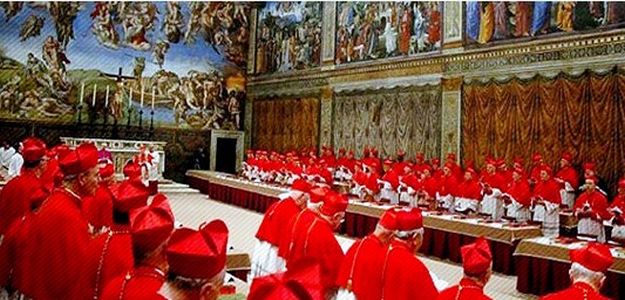
    Less than two weeks after the  historic papal resignation, a believe is shared, that the pope emeritus was not abandoning the Church in times of difficulties. Quite the opposite.  His reign saw Muslim anger, atheist  anger,  the usual Western postmodern noise and finally betrayal within the rotten Vatican.   What he has done is enough.   It seems he inherently points to a “young man” to cope with the inside and outside tide of Abraxas. In the West, a great deal of contemporary Scholarship of hidden Gospels depend on the theory that the Catholic Church has been from its foundation a conspiracy to suppress spirituality, science, women, men – you name it. Ironically this is to a degree true,  “Entweltlichung” (as Benedict said) and Pentecostal might bring spirituality back. But that will not come from Europe. In all throughout the history of the Roman Catholic Church, no person from Africa or the Indian subcontinent has ever been chosen as pope. It is high time for the current conclave in Vatican City to elect a Black archbishop as Pope Benedict XVI’s successor.  In 2011, a document, “Toward Reforming the International Financial and Monetary Systems in the Context of a Global Public Authority,” amounted to a call by the Vatican for a World Political and Financial Authority. It was published by the Pontifical Council for Justice and Peace, which is headed by Cardinal Peter Turkson today still young in church terms at 63. The media was quick—inside and outside Christianity—to see the light side raising its head against “Globals” in power. And this is where things start getting interesting.  The Associated Press stated once, “The pope has appointed Cardinal Peter Turkson of Ghana to head the Vatican’s justice and peace office, a high-profile post that cements his reputation as a possible future papal candidate”. The secretary of state, Cardinal Tarcisio Bertone, the very one who later defended the status quo in the Vatican Bank IOR, complained furiously about Turkson’s paper, precisely when the G20 and EU was coming to its weak and uncertain actions on the global financial crisis.

    Vatican watcher and journalist Andrea Tornielli had stated as much earlier, documenting how Bertone had been consolidating his influence in the Vatican:  …through a number of actions: he appointed bishops who are well known to him and friends in key roles, especially in positions involving the management and control of the Holy See’s finances. The last individual appointed, was the Bishop of Alexandria Giuseppe Versaldinew, to the position of President of the Prefecture for Economic Affairs of the Holy See… On the other hand, Bertone has done away with prelates who had moved against him in some way or another, such as Archbishop Carlo Maria Viganò, who had left the Government office to become Nuncio (ambassador) to the United States, or Bishop Vincenzo di Mauro, who left the Office of Economic Affairs to become Archbishop of Vigevano.  One might fear with some certainty that Bertone is thus a shoo-in for the New World Order role of Petrus Romanus. However, as we move into  Easter 2013, cracks are suddenly appearing in the foundation of his sand castle,  and not everybody in the Curia may wind up as eager to support him as they once were.  Will be Cardinal Peter Turkson  elected as the first Black pope in the history of the Roman Catholic Church? There are others in South America. I trust, the next pope will not be an European.

    “In times of universal deceit, telling the truth becomes a revolutionary act.” – George Orwell – Happy Gnostic or Catholic Easter.

    Appendix

    Secondary literature about or around Abraxas and Gnostics

    Web resources:

    http://www.newadvent.org/cathen/06592a.htm

    Nag Hammadi library of Gnostic writings:

    Codex I (The Jung Codex)

    1. 1.   The Prayer of the Apostle Paul
    2. 2.   The Apocryphon of James:
    1. 3.   The Gospel of Truth:*
    1. 4.   The Treatise on the Resurrection
    2. 5.   The Tripartite Tractate

    Codex II

    1. 1.   The Apocryphon of John* (long version)
    1. 2.   The Gospel of Thomas:
    1. 3.   The Gospel of Philip
    2. 4.   The Hypostasis of the Archons
    3. 5.   On the Origin of the World*
    4. 6.   The Exegesis on the Soul
    5. 7.   The Book of Thomas the Contender

    Codex III

    1. 1.   The Apocryphon of John* (short version)
    2. 2.   The Gospel of the Egyptians*
    3. 3.   Eugnostos the Blessed*
    4. 4.   The Sophia of Jesus Christ
    5. 5.   The Dialogue of the Savior

    Codex IV

    1. 1.   The Apocryphon of John* (long version)
    2. 2.   The Gospel of the Egyptians*

    Codex V

    1. 1.   Eugnostos the Blessed*
    2. 2.   The Apocalypse of Paul
    3. 3.   The (First) Apocalypse of James
    4. 4.   The (Second) Apocalypse of James
    5. 5.   The Apocalypse of Adam

    Codex VI

    1. 1.   The Acts of Peter and the Twelve Apostles
    2. 2.   The Thunder, Perfect Mind
    3. 3.   Authoritative Teaching
    4. 4.   The Concept of Our Great Power
    5. 5.   Plato, Republic 588A-589B
    6. 6.   The Discourse on the Eighth and Ninth
    7. 7.   The Prayer of Thanksgiving
    8. 8.   Asclepius 21-29

    Codex VII

    1. 1.   The Paraphrase of Shem
    2. 2.   The Second Treatise of the Great Seth
    3. 3.   The Apocalypse of Peter
    4. 4.   The Teachings of Silvanus
    5. 5.   The Three Steles of Seth

    Codex VIII

    1. 1.   Zostrianos
    2. 2.   The Letter of Peter to Philip

    Codex IX

    1. 1.   Melchizedek
    2. 2.   The Thought of Norea
    3. 3.   The Testimony of Truth

    Codex X

    1. 1.   Marsanes

    Codex XI

    1. 1.   The Interpretation of Knowledge
    2. 2.   A Valentinian Exposition

      2a. On the Anointing

      2b. On the Baptism A

      2c. On the Baptism B

      2d. On the Eucharist A

      2e. On the Eucharist B
    3. 3.   Allogenes
    4. 4.   Hypsiphrone

    Codex XII

    1. 1.   The Sentences of Sextus
    2. 2.   The Gospel of Truth:*
    1. 3.   Fragments (translation not provided here)

    Codex XIII

    1. 1.   Trimorphic Protennoia
    2. 2.   On the Origin of the World*

    http://www.ordendeltemple.org/english/index.htmhttp://www.dailymotion.com/video/x3qq4z_baphomet_musicGospel of Nazarenes

  • C.G. Jungs Self in Quaternio Series of Aion – Jesus or Abraxas?

    C.G. Jungs Self in Quaternio Series of Aion – Jesus or Abraxas?

    C. G. Jung had shown a pronounced and informed interest in Gnosticism and Alchemy. This is evident in the Quaternio Series of the Self in his book. “Aion”.  In his early works “Seven Sermons to the Dead” (“Die sieben Reden an die Toten ”) and “The Red Book” (recently published) he perceived the outstanding psychological relevance of Gnostic insights. Was Jung really a Gnostic? I seems to me, that “Aion” and another late work The “Answer to Job” give some evidence to the assertion: No, he wasn’t.

    Quaternity in religion and psychoanalysis

    It is true that C.G. Jung saw in Quaternity a divine concept and welcomed the proclamation by the Pope Pius XII in the year 1950 adding the Catholic Holy Virgin Mary, expanding so the Christian Trinity. Neoplatonic philosophy ( and many other metaphysics e.g. Mayan) contained what Jung has called the element of “fourness,” or quaternity, that seems to be so prominent an aspect of the life of the unconscious collective landscape across various cultures. This quaternity is – as the one of the Christian cross – a (3+1) structure, meaning that three parts are equal and the fourth is the “totally different”. One of the most important ramifications, however, unacceptable to some Christians, of the Jungian quaternal recipe is bringing back the original nature of evil and its personification in the real or mythological being of the evil.

    In “Aion” (collected works 9ii) Jung summarizes his researches into the phenomenology of the Self, good and evil seen from Christianity, Alchemy and Gnosis . “Answer to Job” an interpretation of a book in the bible,(“Antwort auf Hiob”)  maybe interpreted as gnostic answer to the Bible  but to me is more a subtile but well-meaning ironic description of the omnipotent god Yahweh of the Old Testament who needs the reflection of the human Job to send his son Jesus to become a just God (again). In this article I want to investigate C.Jung’s starting point and journeys in regards to Jesus. C. G. Jung was a prolific writer and practitioner of psychoanalysis. The reader is invited to consult the C. G. Jung’s Work for expansion on the theme in this essay or to follow the links in this article (indicated in blue).

    Small recurs to Gnosticism

    Gnosticism is the knowledge of transcendence arrived at by way of interior, intuitive knowing (Gnosis). Gnosticism was primarily defined in Christian context also including pre-Christian religious beliefs common to early Christianity, Hellenistic Judaism, Greco-Roman mystery religions, Zoroastrianism (especially Zurvanism), and Neoplatonism. Gnosticism goes hand in hand with Kabbalah, which is the esoteric or mystic religion of Rabbinic Judaism. These occult teachings deal with magic, hypnotism, sorcery and all sorts of pagan practices collected throughout centuries borrowing from different cultures. The mixing of all these pagan traditions turned into a complicated set of Gnostic teachings with all sorts of perverted doctrines added to “Christian” mingling its pure and simple teaching with theosophy and even magic. Gnostic thought were stamped out by Christianity in a struggle of life and death. The Gnostic teacher Carpocrates, as opposed to the official Christian dogma that salvation is the result of a single, unrepeatable event – the crucifixion of Jesus – postulated this process as continuing through a number of lives of earth.  Abraxas, the summation and ruler of the sevenfold planetary spectrum, is thus the true archetype of man’s potential freedom and independence from unconscious psychological pressures and compulsions.

    The Nag Hammadi library, discovered in upper Egypt in 1945 provided a cache of new gnostic documents and its psychological importance was pointed out by C.G. Jung. After his death and the publication of his autobiography, Memories, Dreams and Reflections, and the Red Book, it became also clear that Jung underwent an intense period of spiritual experience between 1912 and 1917. The only fragment of his writings from that period which he permitted to be published was The Seven Sermons to the Dead, using terminology and style of second century Gnosticism. Jung attributes the authorship to Basilides, a Gnostic sage who taught in Alexandria around A.D. 125-140 (see below). It is clear, however, that Jung disagreed with Gnostics (and Buddhism) on the ultimate goal of the individual to return to a supreme, other-worldly re-unification with the Pleroma ( the superior unknown God) as this would be a total identification with the unconscious.

    Small recurs to Evil

    We can argue then that there are three types of evil. The first is relative, caused by the perception of the human mind which labels things it does not accept as evil. The second arises from imbalance. This evil originates in an action that comes at the wrong time for the wrong reasons and which causes much damage as a result. The evil that thus occurs is neither relative nor absolute but falls someplace in-between. The third type is absolute evil. It arises from imbalance but feeds on evil itself and soon grows like a cancer to spread through the body that gave rise to it. One can only fight this evil by trying to find one’s own balance and relationship to the Self.

    In his work The Archetypes of the Collective Unconscious Jung restated the message contained in the Second Sermon when he says: “Evil is the necessary opposite of good, without which there would be no good either. It is impossible to even think good out of existence.” Jung was insistent evil to be real, for he felt that western humanity, dwarfed the picture of evil. In Civilization in Transition he wrote that evil “is of gigantic proportions, so that for the Church to talk of original sin and to trace it back to Adam’s relatively innocent slip-up with Eve is almost a euphemism. The case is far graver and is grossly underestimated.”

    If you recall my article Can Hitler go to heaven? The evil presented in Mao, Stalin, Hitler, Pol Pot. you can only see them as anything but evil, if we take Jung’s point of view seriously. Of course there are many other kinds of what seems to be pure evil in the world. According to Jung, good and evil are not two opposite poles of a linear dimensionality. They resemble a circle wherein going far enough in either direction is likely to associate one with the opposite polarity. He said that there is no good that cannot produce evil and no evil that cannot produce good.

    Aion: Phenomenology of the Self

    Aion is one of a number of major works that Jung wrote during his seventies that were concerned with the relations between psychology, alchemy and religion. He is particularly concerned in this volume with the rise of Christianity and with the figure of Christ. He explores how Christianity came about when it did, the importance of the figure of Christ and the identification of the figure of Christ with the archetype of the Self. A matter of special importance to Jung in his seventies – the problem of opposites, particularly good and evil – is further discussed and the importance of the symbolism of the fish, which recurs as a symbol of both Christ and the devil, is examined. As a study of the archetype of the self, Aion complements The Archetypes and the Collective Unconscious.

    Jung does not decodes events in dreams and associated unconscious products as a facade behind which the true meaning lies, but takes those events themselves as important symbols. Hence, “symbols” must not be misunderstood. To Jung the symbol manifests an unconscious product in conscious form. To appreciate why symbols mean so much to Jung, we need to understand symbols are a bridge for religions which are an object with universally projected contents. That is why there are so much symbols in religion and also why Jung spent so much time looking into the meaning behind religious symbols, and symbols in other fields such as alchemy.  Symbols have often an irrational element, as well as a rational part. Within Jung’s Framework the specific process of successfully acknowledging and integrating the meaning behind (formerly) unconscious contents to the consciousness is called “individuation” and results in the individual achieving the realization of the “Self”  and thus finding transcendence, which is the main theme in this book. The story of the self and Jesus in his book resembles closely the story of the human psyche that loses its connection with the collective unconscious and needs to be rescued by the Self.

    Jung compares in this book also his concept of “self” with other teachings. Jung had never qualms about reducing religion or magic to a psychological process. However, that is not to say it is then worthless in the practical field, because Jung is dedicated to showing precisely how large a factor the psychic realm is in ordering our lives. It must not be forgotten that for Jung, Buddhism itself was originally a result of projected unconscious contents, and the broad parallels are there. In dualistic Gnostic  teaching, the Self is reached when we have rid ourselves of opposites. Jung’s reflections had long been influenced in the thought of the ancient Gnostics to such an extent that he quotes In Aion Second Book XIV Hipolytes: to him were Gnostics psychiatrists. One may go so far to considered them the virtual roots of his  ‘depth psychology’.

    In the light of such recognitions one may ask: “Is Gnosticism a religion or a psychology?” The answer is (in the broad sense) both, just like Jung’s thoughts can be interpreted religiously. Most mythologies found in Gnostic scriptures have psychological relevance and applicability. For instance, the basic Gnostic myth to Aeons, intermediate deific beings who exist between the ultimate, True God and ourselves. They, together with the True God, comprise the realm of Fullness (Pleroma) wherein the potency of divinity operates fully. The Fullness stands in contrast to our existential state, which in comparison may be called emptiness.  The false creator God  bears a close resemblance to the alienated human ego that has lost contact with the  Self. One of the aeonial beings who bears the name Sophia (“Wisdom”), referred to by C.G. Jung many times in his works,  is of great importance to the Gnostic world . Analogies of this sort exist in numbers.

    Highly interesting are Jung’s diagrams in Aion (CW 9ii, penultimate chapter) in which Jung summarizes his researches into the phenomenology of the Self. In those diagrams Jung works his way through 2000 Years of Christian (and Gnostic) symbols of the Self. Using four octahedrons (double pyramids, i.e. one the platonic solids), he clearly tries to enhance the trinity of religion (Christianity) and science (space, time, causality) with a fourth dimension (his concept of synchronicity).

    The Moses Quaternia

    The Moses Quaternia
    The Moses Quaternia

    Lower Adam corresponds to the ordinary mortal man Moses corresponds to the culture hero and lawgiver, personalised ally to the ‘father’ Zipporah corresponds to the ‘higher mother’ as the daughter of a king and priest Moses and Zipporah represent the ‘royal pair’ for the ordinary man (Lower Adam) which for Moses corresponds on the other hand to his ‘higher man’ (Higher Adam) and his anima, Miriam The higher man is synonymous with the ‘spiritual, inner” man, who is represented in the quaternio by Jethro Such is the meaning of the quaternio when seen from the standpoint of Moses. But since Moses is related to Jethro as the lower Adam, or ordinary man, is to Moses, the quaternio cannot be understood merely as the structure of Moses’ personality, but must be looked at from the standpoint of the lower Adam as well.

    The extended (shadow) Moses Quaternia

    The Extended Moses Quaternia
    The Extended Moses Quaternia

    Extensions of the ordinary man’s psychic structure downwards, towards the subhuman, the dark and evil side represented by the shadow – the extended Mose. Homo carnalis refers here to the human Mose as opposite of the spiritual lead. The black woman is his wife. The negative anima is represented by Miriam who was the sister of two powerful biblical figures, Moses and Aaron. Her name derives from the root Mary, Mariamne, or Maria, meaning “bitterness.” She remained steadfast in her determination to free the Hebrew people from the pharaoh’s oppression. But Miriam was human, and not perfect. For her pride and insubordination to the power of God working through Moses, she became afflicted with a disfiguring skin disease (leprous’).  Miriam ‘spoke against’ Moses and even stirred up his brother Aaron against him. because of the black(Ethiopian) woman whom he had married.

    The paradise Quaternia.

    The Paradise Quaternia
    The Paradise Quaternia

    The snake symbol brings us to the images of Paradise, trees and earth. This amounts to an evolutionary regression from the animal Kingdom back to plants and inorganic nature, epitomized in alchemy by the secret of matter, the lapis. Here lapis is not to be understood as the end product of the opus but rather as its initial material. This arcane substance was also called lapis by the alchemists.”  Lapis–a unity, often stands for the prima materia in general, consists of four elements or has to be put together from them.
    prima materia–a bit of the original chaos (increatum of Paracelsus) which was believed to be hidden somewhere in metals, particularly in mercury, or in other substances. Not in itself a simple thing (massa confusa). Elements are not united but merely coexistent in chaos, they are hostile to one another and will not unite of their own accord–must be combined through the alchemical procedure. Represents and original state of conflict and mutual repulsion. Splitting up or unfolding of the original unity into the multiplicity of the visible world.

    The Lapis Quaternio

    The Lapis (Alchemy) Quaternia
    The Lapis (Alchemy) Quaternia

    This primary substance is round (masa globosa, rotundum) like the world and the world soul; it is the ‘stone that has spirit’, in modern parlance the most elementary building-stone in the architecture of matter, the atom, which is an intellectual model. The alchemists describe the ’round element’ now as a primal water, now as a primal fire, or as pneuma, primal earth, or ‘corpusculum nostrae sapientiae’, the little body of our wisdom. As water or fire it is the universal solvent, as stone and metal it is something that has to be dissolved and changed into air (pneuma, spirit).
    Zosimos calls the rotundum the omega element, which probably signifies the head. The skull is mentioned as the vessel of transformation in the Sabaen treatise…the vas is often synonymous with the lapis, so that there is no difference between the vessel and its content; in other words, it is the same arcanum.

    In the hierarchical series of those four, Good and evil are clearly shown to arise from a deintegration of the central Serpens node, “the point of maximal tension in the psyche.” In the Serpens node itself, these extreme opposites presumably coexist without contradictions. In these Aion diagrams, Jung shows two distinct forms of the archetypal Self. Evil (Diabolos) and Good (Christos) arise only in the first hierarchical form of the Self. They do not occur at all in the circular forms of the Self—the ouroboric, rotational.

    Quaternio series: Moses - Shadow - Paradise - Lapis Quaternio
    Quaternio series: Moses – Shadow – Paradise – Lapis Quaternio

    Quaternio series; Man culminates in the of a good God, but rests below on a dark and evil principle (Devil or serpent). The serpent has its compliment in the Paradise Quaternio which leads into the world of plants and animals. Indeed, this serpent actually dwells in the interior of the earth and is the pneuma that lies hidden in the stone. The symmetrical compliment of the serpent, then, is the stone (earth) or in symbolism, the alchemical stage, whose central idea is the lapis which compliments the serpent. The stone is, however, not a human ego but a collective entity, a collective soul an hermaphrodite.The point of greatest tension between the opposites…(is)…the double significance of the serpent, which occupies the center of the system. Being an allegory of Christ as well as of the devil, it contains and symbolizes the strongest polarity into which the Anthropos falls when he descends into Physis. The ordinary man has not reached this point of tension: he has it merely in the unconscious, i.e., in the serpent.The Round is the primary substance (rotundum) like the world and the world soul; it is the ‘stone that has spirit’, in modern parlance the most elementary building-stone in the architecture of matter. The alchemists describe the rotundum the omega element.

    The hierarchical Quaternio series shows the highest central node, the Anthropos, evolving in four deintegrations  and reintegrations from the lowest central node, the rotundum. In doing so, it passes through four quaternios. A quaternio is a structure composed of two pyramids sharing a common base. If the apex of one pyramid points upward, the apex of the other necessarily points downward. It might be possible to construct a fifth quaternio above the Anthropos. It might deintegrate into God-Shekinah and Jesus-Mary, his mother. The reintegration would occur in the next higher central node which could be named simply “God.” But here the upward progression seems to end. What is beyond God? Jung addresses this particular problem by asking, rhetorically, what his diagram would be if its hierarchical nature were destroyed by bending it around so that the lowest node, rotundum, lay next to the highest node, Anthropos?

    In the circular Quaternio series

    Quaternio series circular
    Quaternio series circular

    the lowest node moves “upward” toward increasingly more comprehensive integrations.Can this upward movement continue indefinitely? Obviously it cannot. Much more can be said about the cricular one. For the present discussion of evil it is only necessary to point out that Evil belongs only to first quaterino. There is no place for Evil in the structure of second. Again, both good and evil arise from disintegration of the Serpens node, the “point of maximal tension in the psyche.

    Jung’s View on Jesus “Answer to Job”

    Jung agrees with all modern scholars of antiquity and biblical scholar that Jesus existed. He also does not question his metaphysical importance. His thoughts of Jesus must be seen from his framework and are strictly restricted strictly to psychoanalytic dimensions. He writes extensively in Aion about Jesus as a symbol (manifest and visible) of the archetype Self. But not the full Self. Since Jesus is all good, he feels that is missing his Shadow. The shadow is of course the devil (which was in Answer to Job als God son and Jesus brother). That Jesus was crucified by the order of the Roman Prefect Pontius Pilate is given great significance in the Quaternio series of his book Aion: The serpent is the central node and mediator between Jesus and Lucifer. In his book Aion Jung consistently opposes this summum bonum view of God. Jung, in his psychological works puts a strong emphasis on this (see also my article C. G. Jung’s “Antwort auf Hiob” und das “Johannes Evangelium”).  According to his theory of wholeness being the conjunction of opposites, Jung always affirmed conscious existence after death and, since one opposite is not possible without the other, neither is “good” or “bad” in itself as single entity.   As long as many, if not the majority of us, expect all problems to be solved outside of ourselves, they will be beset by “inhumanity upon inhumanity, holocaust upon holocaust”. To him Christianity of the old Testament has not solved the problem of evil. It flirts with two great metaphysical forces, Good and Evil (or God and the Devil), but always opts for the final supremacy of God. Lucifer is only a “fallen angel” whose true place is in the heavenly court.

    The story of Job, as seen by Jung in his Book Answer to Job (1952), is therefore  the culmination of the Old Testament leading to the Gospel: Job sees that “You (Yahweh) are not a man” (Job 9:32). When Yahweh finally appears to him, Job hopes for an explanation of why he, an honest and just man, had been sent such undeserved afflictions. Yahweh seems unaware of any ethical dimension whatsoever. He overwhelms Job by recounting his creative acts. Job does not so much see evil in Yahweh as he sees a mass of unbalanced forces (as in the Kabbalah and Taoism). Job accepts that he cannot expect justice from God as long as God is primarily identified with His power, His omnipotence. Job realizes that God himself is evolving. Thus Job is able to say, “I know that my redeemer liveth” (Job 19:25). That is, Job intuitively knows that God will evolve in himself the ethical sense that Job already has: to distinguish Right/Wrong and Good/Evil. Another move that Christianity makes is to assert that all good comes from God and all evil comes from man.

    Jungs View on Abraxas  “Seven Sermons to the Dead”

    With Abraxas (Greek Ἀβρασάξ, Ἀβράξας) Jung described Egyptian Gnostics of Basilides in Alexandria around the 2nd century the symbol of the highest Nikolaos, from which emerged the five primal forces Geist(nous), Word (logos), Providence (Phronesis), Weisheit(Sophia) and power as well as moral perfection and inner peace.The name Abraxas is presented on amulets with the head of a cock, dragon’s feet and a whip in his hand. Later, he is recorded as having the head of a king and demon’s feet. He was seen by the Basilidians (after Basilides), a group of twelfth century heretics) as the supreme god which claimed that Abraxas sent Jesus Christ to earth in the form of a benevolent spirit

    Basilides integrated various Christian Jewish, Persian, and neo platonic traditions to a dualistic view of the world. The early Christianity was heavily Gnostic-influenced. Gnostic directions also in Judaism and even Islam has its Gnostics (the Sufis). The gnostics believe that the core of every human is a “divine spark”. The spark of the divine is immortal, he exists outside of time and space. As long as the man but has not recognized its true state, he remains trapped in this world and must reincarnate again and again in a new body. Every once an envoy from the world of light comes but (Christ plays this role in the Gnostic Christians) at the material level in order to connect the souls that have become ripe with the light power of God, and to enable them to escape the access of the false God, the demiurge.

    The Abrahamic God (which describes Jung in “Answer to Job” is this demiurge. Therefore, early Gnostic Christians have roundly rejected the old testament.The Gnostics see Abraxas as Supreme God, good and evil in an entity “Whole”, who sent Jesus as God’s (Yahweh) son in the world.

    Followers of Basilides believed that the body of Jesus Christ was an illusion, visited while here on Earth. From this supreme deity which the followers of Basilides worshipped, emanated seven divine powers (according to the number of planets), the first realm from the gradually decreasing clarity 364 more ghost kingdoms, each with seven “eons”. If one summarizes the entire realms of spirits in the secret word Abraxas or Abrasax,  it contained the seven Greek letters which correspond numerically calculatedto  the number 365. Abraxas is classified under the Egyptian gods. He was depicted on amulets with a whip in his hand. been. The Mystic Word Abracadabra was derived from his name. These Gnostic symbols were adopted by many companies, operated the magic and Alchemy.

    C.G. Jung  wrote in “The seven Sermons of the dead” under the pen name Basilides about Abraxas. According to C.G. Jung Abraxas – man cannot be redeemed without that Satan is understood and integrated . But how will Satan, who represents evil, will be integrated? Jung asserts, only by a way to lift the evil (the shadow) in the consciousness. Before we are not fully aware of our our deeper spiritual needs we will not achieve the individuation, which creates a more and more mature personality.  The “Seven Sermons to the Dead”  was privately printed, without copyright or date, sometime between 1920 and 1925, and distributed only to a select group of friends.  The text is available for the interested in the internet.  But there is a significant translation of Stephan A. Hoeller in his book “The Gnostic Jung” in which Hoeller not only interprets “The Seven Sermons as a Gnostic document, but also claims that Jung himself was a modern Gnostic. The Gnostic Jung is essentially an attempt – and a very interesting one at that – to interpret the Seven Sermons. Along the way, Hoeller, an almost worshipful admirer of the “Wise Man of Küsnacht” as he calls him, gives us a clear, skillful elucidation of some of Jung’s essential ideas. But the question is: Was Jung really a Gnostic is answered with the late work.

    Conclusion

    Gnosticism may possess both a psychological and a religious authenticity. Gnostic psychology and Gnostic religion need not be exclusive of one another but may complement each other within an implicit order of wholeness. Gnostics have always held that divinity is immanent within the human spirit, although it is not limited to it. The convergence of Gnostic religious teaching with psychological insight is thus quite understandable. The Red Book reveals the experiential, Gnostic roots of Jung’s psychology and certainly Jung studied Gnostic thought and his works are liberally sprinkled with references to them. But he never called himself a Gnostic. Without doubt Jung’s kind of psychoanalysis was different. Mental illness was considered to be a divided or incomplete condition and health as a state of spiritual wholeness – or near wholeness which could be reached through a process Jung called individuation. Jung always insisted that his writings were based upon empirical evidence and personal experience – it seems he was be worried to be accused of mystical or metaphysical theories but he connected them very often explicit to (catholic) Christianity.

    This essay has delineated some of the main ways in which Jung can help us to understand the real meaning behind Christianity and Gnostics. It is not comprehensive and exhaustive, but shows how we as humans have a tendency to neglect our unconscious side, and the pressing need to recognize and integrate its contents (achieve individuation).  In plain English, Jung shows us, particularly in Aion  the salutary and prospective character of Religion.

    References

    CW9(i) = Jung, C.G. The Collected Works of C.G. Jung, Vol.9, Part I, The Archetypes of the Collective Unconscious  Zürich 1951, Rascher

    CW9(ii) = Jung, C.G. The Collected Works of C.G. Jung, Vol.9, Part II, Aion Zürich 1951, Rascher

    Jacobi, J. The Psychology of C.G. Jung.  Zürich 1961

    Jung, C.G. Memories, Dreams, Reflections, London: Harper Collins, 1995, PG213.

  • Gut und Böse

    Gut und Böse

    Bestärkt von seinem Freund Wolfgang Pauli, dem weltbekannten Physiknobelpreisträger, nahm Jung an, das Prinzip der Komplementarität habe nicht nur in der Physik, sondern auch in der menschlichen Seelenkunde Geltung. Er verstand kausale und nicht-kausale Erklärungen, Trieb und Willen, aber auch – am umstrittensten – Gut und Böse als einander ergänzende Größen.

    Viele Begriffe Jungs, bilden dieses Gegensatzpaar, etwa Introversion und Extraversion, Anima und Animus und in gewissem Sinne auch Persona und Schatten. “Schatten” steht für die abgewehrte, ins Dunkle verdrängte Seite des Menschen, also für alle Neigungen und Eigenschaften, die man an sich nicht wahrhaben will. “Persona” ist die Maske, die ein Mensch aufsetzt, um sich anzupassen und den Normen zu entsprechen. Nach Jung kann ein Mensch oft erst zu sich selber – zu seinem Zentrum, zum «Selbst» – finden, wenn er Schatten und Persona erkennt und sich mit dem kollektiven Unterbewussten durch die sogenannte aktive Imagination auseinandersetzt. Hermann Hesse, der in drei entscheidenden Krisensituationen seines Lebens (1916/17, 1921 und 1926/27) bei C. G. Jung Hilfe fand, hat diese imaginative Suche literarisch umgesetzt. “Steppenwolf” ist nach Hesses eigenen Worten die literarische Einlösung dessen, was er als das “Feuer“ seiner Analyse bezeichnet hat und illustriert auch das Anliegen Jungs, scheinbar Gegensätzliches zu verbinden und das im westlichen Denken vorherrschende Prinzip der Unterscheidung mit dem östlichen oder mystischen Prinzip der Synthese (wie „Yin und Yang“) zu ergänzen. Jungs Religionspsychologie liefert Hesse die theoretische Legitimation für die zentrale Botschaft seiner mittleren und späten Dichtung: die Identität von Selbsterfahrung und Gotteserfahrung. Sie bestätigt eigene Ahnungen und Erkenntnisse über die gemeinsamen psychologischen und anthropologischen Grundlagen der Weltreligionen. Hesse formuliert in in seiner Betrachtung “Weihnacht” aus dem Jahr 1917:

    “Die Lehre Jesu und die Lehre Lao Tses, die Lehre der Veden und die Lehre Goethes ist in dem, worin sie das ewig Menschliche trifft, dieselbe. Es gibt nur eine Lehre. Es gibt nur eine Religion. Es gibt nur ein Glück. Tausend Formen, tausend Verkünder, aber nur einen Ruf, nur eine Stimme. Die Stimme Gottes kommt nicht vom Sinai und nicht aus der Bibel, das Wesen der Liebe, der Schönheit, der Heiligkeit liegt nicht im Christentum, nicht in der Antike, nicht bei Goethe, nicht bei Tolstoi — es liegt in dir, in dir und in mir, in jedem von uns. Dies ist die alte, einzig ewig gültigeWahrheit. Es ist die Lehre vom ‘Himmelreich’, welches wir ‘inwendig in uns’ tragen.

    In der Bibel ist hierzu das über den Menschen als Sünder Gesagte relevant. Im AT hat der Mensch die Freiheit zu wählen. In Gen 3-11 wird geschildert, dass der Mensch seine Grenzen nicht akzeptiert, wie Gott sein will und damit sein Verhältnis zu Gott, Mitmensch und Umwelt zerstört. Später hat man (die ätiologische und mythologische Erzählung) Gen 3 im Sinne einer Erbsündenlehre verstanden (Augustin; CA 2: „ … dass sie alle vom Mutterleib an voll böser Lust und Neigung sind und von Natur keine wahre Gottesfurcht, keinen wahren Glauben an Gott haben können…“). Das NT betont die Sünde als objektive Macht (vgl. Rö 7/8), die den Menschen beherrscht, erst durch Christus wird diese Macht gebrochen (wobei die endgültige Durchsetzung des Reiches Gottes noch aussteht). Spezifische Aussagen darüber, woher das Böse letztlich kommt, macht die Bibel ebensowenig wie woher Gott kommt.

    Das Nachdenken über bestimmte Bibelstellen, eine bestimmte Predigt führte bei mir zur Erkenntnis, das Himmelreich ist heute schon da, es ist in Dir und Mir. Jungs Psychologie legitimiert, systematisiert und erweitert (für mich auch ganz persönlich) jene religiösen und psychologischen Einsichten. Eine Kernaussage im Taoismus ist ja zum Beispiel, das sich das Gute und das Böse ergänzt und bedingt. Jungs Psychologie bietet das Instrumentarium, um das religiöse Fundament und Denken auf eine neue, zeitgemäße und faszinierende Weise zu deuten. Ohne in eine Patchworkreligion abzugleiten gibt sie den Schlüssel in die Hand für jene Synopsis der Weltreligionen, Mythen, gnostischen und alchemistischen Denkrichtungen und namentlich für die Verbindung von Psychologie und Religion.

     In diesem Essay sollen drei Sichten des Guten und Bösen angesprochen werden:

    • Die Sicht von jenseitsorientierten monotheistischen und polytheistischen „Religionen“. Die Gnostik nimmt hier mit dem subtilen Ansatz der Demiurgen eine Art Zwischenstellung ein.
    • Die Sicht von der diesseitsorientierten Psychoanalytik von C.G. Jung mit dessen Gottesbegriff (Selbst) auch im Zusammenhang mit weiteren vom Individuum (z.B. im Buddhismus) oder der Natur ausgehenden, pantheistischen Gottesvorstellungen wie z.B. im Taoismus.
    • Die anthropologische oder humanistische Sicht einer eigenverantwortlichen Persönlichkeitsentwicklung als weitere Ergänzung speziell zur christlichen (katholischen) Sicht.

    Ausgehend von der Annahme von C.G. Jung, dass wir die Energie der dunklen Seiten in uns produktiv einsetzen können und müssen, ist meine zentrale Frage, wie kann ich dies mit dem humanistische Menschenbild  – edel sei der Mensch hilfreich und gut – und mit dem christlichen Menschenbild – Gut ist nur Gott – vereinbaren. Ging mit dem was, das Christentum „verteufelt“ hat und mit der Verteufelung des Christentum durch Freud, nicht viel Positives verloren?

    Seit der Frühzeit in der Geschichte des Menschen finden wir die Vorstellung des „Jenseits“, welches von guten oder bösen Wesen bevölkert ist. Während in polytheistischen Glaubenssystemen und Kulturen die jenseitigen Mächte auch gleichzeitig gut und böse sein können wird in etablierten monotheistischen Religionen (Judentum, Christentum und Islam) das Böse eindeutig dem Teufel und das Gute eindeutig Gott zugeodnet auch eindeutig festgelegt, was als Gut und Böse zu gelten hat. Allerdings fragen sich nicht nur Theologen, sondern nahezu jeder Mensch dann Warum lässt Gott das Leid zu? Warum gibt es Kriege, Naturkatastrophen, Hunger, Seuchen, Gewalt in den Familien und in der Gesellschaft? Wenn Gott gut und allmächtig ist warum gibt es dann das Böse?

    Das religiöse Weltbild ist grundlegend bestimmt durch die Polarität von Diesseits und Jenseits und dem vom sterblichen Leib und unsterblicher Seele. Im Gegensatz dazu steht das positivistische, seelenlose Weltbild eines (aufgeklärten) Materialismus. Im archaischen Mythen konnte der transzendente sensible Mensch dem Jenseits noch direkt und konkret begegnen, dem Eingang in die Unterwelt dem Feuer im Dornbusch. Fast alles konnte dem Menschen noch Zeichen geben, Sonne Mond und Sterne, Donner und Blitz, Tiere, Pflanzen, Flüsse und Berge. Der Teufel symbolisiert oder besser personifiziert zum Beispiel im Christentum alles was die Gesellschaft als das Böse betrachtet. Luther knüpft an Paulus und Augustin an: Gott ist nur gut, der Mensch ist seiner Natur nach böse (ist aber für seine Schuld verantwortlich, vgl. CA 2), er kann von sich aus nichts zu seinem Heil tun, alles hängt vom Glauben an Christus ab ( solus christus, sola gratia, sola fide, sola scriptura). In dieser Welt bleibt der Mensch simul iustus et peccator. C.G. Jung bemerkt im Protestantismus das Fehlen der von ihm positiv gesehenen Beichte im Vergleich zum katholischen Glauben zum Umgang mit der Sünde aber auch der für Ihn so wichtigen Rituale.

    Mit der Zunahme des Wissens wurde diese Welt entzaubert. Dennoch, der Glaube an die Macht des Gestirns hat bis zur heutigen Zeit überlebt. Mit der Ablehnung des Jenseits erst wird das religiöse Weltbild zerbrochen. Der Mensch wird auf sich selbst zurückgeworden und ist „verdammt zur Freiheit“. Mit dem Atheismus und Materialismus wurde das Jenseits und das personifizierte Böse abgeschafft,  bestenfalls als Hypothese erklärt, welches der aufgeklärte Mensch nicht mehr nötig hat.

    Die Philosophen haben dieametral unterschiedliche Ansichten welche unser “heute” wesentlich bestimmen. Da ist die Vorstellung von J.J.Roussseau (18. Jarhundert) vom edlen Wilden, die von Karl May bis zu den deutschen Linken gepflegt wird: Der Mensch ist von Natur aus gut, die Gesellschaft lässt ihn böse werden.„Alles ist gut, was aus den Händen des Schöpfers kommt; alles entartet unter den Händen des Menschen.“ Bei T. Hobbes (1588-1679) ist der Mensch ist von Natur aus böse”. Oft ist das Böse in der Philosophe nur ein Irrtum oder ein Erkenntnisproblem  wie z.B. Sokrates.  In der Psychologie bzw. Verhaltensforschung bzw. Hirnforschung  ist bei C.G. Jung das Böse das nicht integrierter „Schatten“, bei A. Adler entsteht das Böse “durch eine Fehlkompensation des Minderwertigkeitsgefühls”, und bei K. Lorenz: Das sogenannte Böse (1963). heisst es: “Die gegenwärtig existierende Spezies Mensch ist nicht mehr als „daslanggesuchte Zwischenglied zwischen dem Tiere und dem wahrhaft humanen Menschen“.Die Anthropologie Freuds erklärt das Böse aufgrund des Triebmodells. Zu dem sogenannten Todes- bzw. Destruktionstrieb kann die vom Menschen durch die Kultur geforderte Triebverdrängung (vor allem des Sexualtriebes) zu von der Gesellschaft als „böse“ erlebten Verhaltensweisen führen. Unerfüllbare Anforderungen der christlichen Moral, insbesondere aus der vom Christentum geforderten Verdrängung der Sexualität führen je nach Veranlagung zu Angst oder Aggression.  Die Zeit nach der Aufklärung führte den drei Kränkungen des Menschen:

    • Kopernikanische Kränkung (Erde/Mensch nicht Zentrum der Welt).
    • Darwinistische Kränkung (Mensch nicht Krone der Schöpfung).
    • Freud (Mensch nicht Herr im eigenen Haus, das Ich vom Unbewussten fremdgesteuert).                                                                                                                                                                                     

    Letztlich steht durch letzteres auch der freie Wille in Frage, das Universum erscheint sinnlos, zufällig und chaotisch und Religion ein illusionärer Versuch diese trostlose Realität des Lebens zu verleugnen. Der Teufel ist dann konsequenterweise eine Personifikation des menschlichen Trieblebens, ein Komplex im Unbewussten.  C.G. Jung übernahm das vom Unbewussten gesteuerte Ich, bot aber ein Erlösung (oder Erleuchtung durch die Individuation an.  Diese Seelenlosigkeit und Religionsfeindlichkeit lehnte C.G. Jung vehement ab. Er beschrieb „kollektiven Archetypen“ des Unbewussten im Sinne von oben erwähnten Weltbildern, ihre langlebiger zäher Natur und das sie von kultureller Identität und kulturübergreifend von allen Individuen getragen werden.  Es ist eine Kernaussage und Basis seiner empirischen Forschung, dass Religionen den Menschen beachtliche Lebenshilfe bietet:

    • Opfer (als Handlungsgeschäft mit dem diesseitigen Wesen)
    • Offenbarung (sorgfältige Beobachtung von Zeichen durch Seher oder Propheten und daraus abgeleiteten Handlungsanweisungen)
    • Rituale (als Basis von Magie oder im christlichem Kontext dem Geheimnis des Glaubens).

     Neben den Zeichen bewirken direkte Offenbarungen (Träume und Visionen)  einen direkten Einblick in das Jenseits oder – nach C.G. Jung in das Unbewusste. In der Eucharistie ist der Wandlungsprozess in der Lage, gewöhnliches Brot und gewöhnlichen Wein in den heilbringenden Leib und das erlösende Blut Christi tz verwandeln der sich für den Menschen geopfert hat.

     Schon Platon spricht von einem inneren Zwiespalt in der Seele des Menschen. Einem Pferdegespann, das einen schön und gut himmelwärts strebend, das andere Sitz der Begierden erdwärts ziehend. Das ist auch im Gegensatz zwischen weiblichen (materiellen) und männlichen (geistigen) Prinzip (und etwas neutraler mit Yin und Yang sichtbar. Für Paulus ist dieses untere Pferd, eine autonome Kraft das die Absichten des Hellen durchkreuzt und die niederen Seelenkräfte im Teufel oder in Dämonen personifiziert. 

    Diese autonomen Komplexe beschreibt C.G. Jung, aber in seiner Psychoanalytik kann der Mensch wie im Christentum erlöst werden, wie im Buddhismus zur Ganzheit gelangen. Der Zwiespalt in uns zwischen der hellen und dunklen Seite (dem Schatten), der göttlichen und der teuflischen Stimme wird durch die Individuation aufgelöst.

    Hat auch Gott vielleicht zwei Seiten, eine gütige und eine grausame Seite der Gott Hiobs?. Wie schon in dem Essay “Das Böse bei Markus” und im Essay “Die Intelligenz des Bösen” beschrieben, ist das ist dieses Gottesbild analog zum Mensch durchaus zwiespältig. Beim genaueren Hinsehen, ging C.G. Jung insbesondere in seinem Buch „Antwort auf Hiob“auf unterschiedliche Gottesbilder insbesondere auf das alttestamentarische/jüdische und gnostische ein. Im Buch von Hiob erschein Gott eben nicht als reine Liebe, und der gnostische Gott Abraxas (siehe Essay) vereinigt Gut und Böse in einer Person. Die Vermengung von Schatten und Anima, die oft im Individuum vorkommt, hat Jung klarsichtig, als Ursache der häufigen Projektion des Bösen oder zumindest des Niederen auf das weibliche in Religionen beschrieben.

    Der Mythos vom Engelssturz schildert wie Satan aus dem Himmel gestürzt wurde. Jung verwirft diese Mythen nicht wie Freud, sonder deutet die Mythen und insbesondere die Bibel symbolisch bzw. allegorisch. Nebenbei bemerkt, diese demilitarisierte Zone in der katholischer Lehre zwischen wörtlicher Bibelauslegung und allegorischem Bibelverständnis ist seit den Zelten des Ringens mit den Gnostikern sehr brisant. Der Engelssturz oder der vorangegangene Aufstand gegen Gott ist ein Evolutionsschritt, die Aufteilung zwischen Gut und Böse. Dadurch wird das Ich (vielleicht auch die Persona) heller, der Schatten aber umso dunkler. Die Abendländisch Kultur wurde auf der Vorderseite gerechter (römisches Recht) aber auf der Rückseite dunkler mit den gesamten Kräften die nicht mehr erreicht und kultiviert werden können.  Nach Jung wird ohne Integration des Schattens – aber auch ohne eine Erlösung durch die katholische Mystik, welche er auf eine ähnliche Stufe stellt, die Destruktivität zunehmen. C.G. Jung betrachtet die Entmythologisierung z.B. des Protestantismus aber auch des Materialismus als etwas Barbarisches. Für Jung bilde die Seele die Basis des religiösen Bewusstseins das im Selbst zentriert ist. Als Empiriker und durchaus von Kant beeinflusst, sah er sein Fachgebiet nicht als kompetent an, metaphysische Aussagen zu treffen.                       

    Es ist dieser Komplementaritäts- und Integrationsansatz von Jung, der uns Menschen in einer globalisierten, fragmentierten und anti-religiösen Welt helfen kann. Da sich unsere Welt immer schneller verändert und das Gute immer mehr durch das Böse herausgefordert wird, stellt sich für viele Menschen die Frage nach den kulturellen Wurzeln und der religiösen Identität wieder dringender und anhaltender.  Es hilft nicht nur gegen das Böse sondern auch gegen die den Totalitarismus des Guten, das auch das Böse verursacht. Der nüchterne Schluss lautet, es kann in der Welt nicht nur Gutes oder Böses geben aber es gibt einen Unterschied. 

  • Evangelium Lesung Das personifizierte Böse bei Markus

    Evangelium Lesung Das personifizierte Böse bei Markus

    Die Aussage, das Böse, Daemonen sind das zentrale Element bei Markus schien mir wichtig. Dämonen erkennen bzw. kennen Jesus in (1,21-27) -im Tempel- von Kapernaum. Wer war der bessesenen Mann? Nach C.G. Jungs sind Schatten  psychischen Energien, die mit der bewußten Lebensform nicht übereinstimmen.  Das Markusevangelium berichtet von Jesu Auftreten gleich zu Beginn er habe Dämonen ausgetrieben. Dem folgen andere Exorzismus-Berichte.
    Mk 1,21-28:  Besessene in der Synagoge von Kafarnaum.

    Und sie gehen hinein nach Kafarnaum
    Und sofort am Sabbat kam er in die Synagoge hinein und lehrte
    Und sie waren über seine Lehre sehr betroffen.
    Er lehrte sie nämlich wie einer, der Vollmacht hat, und nicht wie die Schriftgelehrten.

    Gleich die erste, geradezu idealtypische Machttat Jesu macht einerseits deutlich, in welchem Zustand die Welt gesehen wird, wie sie sich aber nun durch das Kommen der Gottesherrschaft ändern wird: Selbst in der Synagoge, dem Versammlungs- und Gebetshaus, sitzt ein Mensch mit einem „unreinen Geist“ (an anderen Stellen „Dämon“). Ich stelle mir Daemonen  als Personifizierungen des Bösen vor.  Psychische Störungen, nach C.G. Jung Komplexe und das Böse gibt es auch in Organsationen (oder besser man kann sie personifiziert denken). Und so habe ich Markus verstanden. Vielleicht war dieser Mensch ein normaler Schriftgelehrter  in der Synagoge und niemand hat erkannt, dass dieser Schriftgelehrte vom Dämon befreit werden muss.

    Und sofort war in ihrer Synagoge ein Mensch in einem unreinen Geist, und er schrie auf und sagte: Was zwischen uns und dir, Jesus Nazarener. Bist du gekommen, uns zu vernichten/aufzulösen?
    Ich kenne dich, wer du bist – der Heilige Gottes! Und Jesus fuhr
    ihn an  und sagte: Mach zu/Schweig! und komm/fahre aus ihm
    heraus. Und es zerrte ihn der unreine Geist hin und her, rief mit lauter Stimme und kam/fuhr aus ihm heraus.

    Anders als andere  Austreibungsberichte erwähnt Markus von Jesus keinerlei Rituale – z. B. Geheimwissen, Beherrschung fremder dämonischer Sprache, Magie, gewalttätiges Vorgehen –, mit denen er den Dämon besiegt. Seine „Waffe“ ist allein die befehlende unwiderstehliche Anrede. Die Reaktion der Anwesenden wird als “Erschrecken” beschrieben. Wieder wird auf die Vollmacht der Lehre rekurriert.

    Und sie alle erschraken sehr, so dass sie einander fragten und sagten: Was ist dies?
    Eine neue Lehre in Vollmacht! Und er befiehlt den unreinen Geistern und sie gehorchen ihm.
    Und es ging sein Ruf sofort aus überall in die ganze umliegende Landschaft von Galiläa.

    Im Christentum gibt es Strömungen, welche die Welt als Schauplatz eines Kampfes zwischen „Gut“ und „Böse“ betrachten. Die guten Elemente (Götter/Engel) bekämpfen die bösen Elemente (Teufel/Dämonen). Ein solcher Dualismus steht allerdings im Widerspruch zu einem konsequent verstandenen Monotheismus.
    Augustinus zufolge kommt das Böse aus dem freien Willen des Menschen in die Welt. Durch die Erbsünde trägt er die Schuld für sein Leiden. Von zahlreichen Philosophen und Theologen fast durchweg im Mittelalter) wird das Böse als substanzlos charakterisiert.
    Augustinus ist sicher schon wichtig. – Aber trotzdem, zuerst ist wichtig was im Evangelium selbst steht. Dort steht unter manch anderen ebenso klaren Stellen von Christi Versuchung in der Wüste. Da begegnet ihm der Böse doch halt schon in Person. Das ist nicht innerpsychisch oder wie zu verstehen. Und, wenn es die Dämonen gibt, von welchen an unzähligen Stellen geschrieben steht, diejenigen von denen es heisst sie seien Legion, diejenigen auch, die dann in die Schweine fahren dürfen, dann gibt es daran auch kaum Zweifel.Seit der Liturgiereform 1970 ist das St. Michaels-Gebet, das früher jeder Priester nach der Hl. Messe gebetet hat, leider „verschwunden“.
    Es gibt verschiedene Personifikationen des Bösen, wie den christlichen Teufel, aber auch bestimmte Arten arabischer Dschinns oder die Dämonen des Hinduismus. Im Taoismus bedingt sich achselzuckend wechselseitig das Böse und das Gute.

    Die Personifikation des Bösen als Teufel gibt es in vielen klassischen Werken der Weltliteratur, so etwa in Dantes Inferno, in Goethes Faust.
    Sogar nach Kant ist das radikales Böse ein wesentlicher Bestandteil der menschlichen Natur. Karl Jaspers stellt definiert, ” das Böse ist, sich von den unmittelbaren Antrieben leiten zu lassen,das Böse als hier Schwäche, die der Neigung nachgibt und ist erst der Wille zum Bösen (auch ausgedrückt in der Entschuldigung des Bösen)”.
    Ihnen allen ist – ihrer bösen Natur gemäß – gemeinsam, dass sie aus freiem Willen und eigenständig Unglück und Verderben bringen.  ist das Böse, eine Gesinnung, eine Absicht, eine Handlung oder deren Konsequenz? Entspringt es einem Mangel an Gutem oder einem Übermaß an Gutherzigkeit?