Tag: Psychology

  • The “Intelligence of Evil” by Jean Baudrillard revisited

    The “Intelligence of Evil” by Jean Baudrillard revisited

    The book “The Intelligence of Evil” by Jean Baudrillard (philosopher, media sociologist) initially seems far away from the demons—the personalized evil that Mark (and even more so John) describes. In the biblical tradition, evil is an external, adversarial force possessing individuals, or a cosmic darkness to be vanquished. Modernity, however, stripped away these personalized entities, leaving a vacuum that postmodernity filled with something far more insidious: systemic automation. Radical evil arises when the only good expands: every power inevitably creates counterpower (Taoism in a sentence). As a sociologist, Jean Baudrillard sees the threat to society (e.g., from terrorism) not from outside but in a decentralized manner, as viruses that (like shadows) evade everyone’s grasp

    Intelligence of Evil

    The Convergence of Two Theoretical Frameworks

    According to Baudrillard, the inherent madness of postmodernism produces madmen, just as unbalanced personality structures produce delinquents and psychopaths. As a theorist, Baudrillard dealt with gentle, impersonal evil from the perspective of virtuality, simulation, cyberspace, hyperreality, fundamentalism, terrorism, globalization, and the end of history. Baudrillard was certainly an apocalypticist. His thesis is based on his concept of hyperreality, in which lies the intelligence of evil—the malicious reversal of structure against itself.

    For Hannah Arendt, evil flourishes when a person surrenders their unique capacity to think critically and integrates themselves into a larger machine. As a theorist, Baudrillard dealt with merciless, totalitarian evils which did exist and and immense harm.

    The black swan flies

    The contemporary global landscape reveals a staggering alignment between theoretical philosophy and reality, where the boundary between “state governance” and “state malfeasance” has completely dissolved.

    Black Swan

    We currently face two devastating wars skating on the razor’s edge of a nuclear apocalypse, a systemic global economic crisis, and a paradigm shift in state-sponsored evil. The absurdest manifestation of this hyperreal twist is in West Asia, where a former Al-Qaeda commander, co-founder of Al-Nusra, and head of HTS now sits as transitional President. He is formally welcomed on Western red carpets, handles diplomatic visits with French President Emmanuel Macron, and secures deals to rescind terrorist designations from Western nations.

    When we apply this benchmark—contrasting Jean Baudrillard’s Intelligence of Evil with Hannah Arendt’s Banality of Evil—to this modern geopolitical reality, we see how the rules of evil have been totally rewritten.


    Why flourish Evils?

    1. The Erasure of the Individual

    If Hannah Arendt looked at the modern world, she would likely argue that the individual has been entirely erased. For Arendt, evil flourishes when a person surrenders their unique capacity to think critically and integrates themselves into a larger machine. In the 2020s, that machine is the digital algorithm.

    • The Digital Apparatchik: The individual sitting in their bedroom is no longer an independent actor. They are a consumer locked in a hyper-optimized feedback loop. Social media algorithms serve as the invisible, automated “bureaucracy” that coordinates any state or psychological Psyops.
    • The Bureaucracy of Hate: Just as Adolf Eichmann claimed he was merely a gear in the state apparatus, the modern narrative operates hand-in-glove with mainstream and social media. The actions of modern actors are profoundly banal because they lack genuine, individual intellectual agency. They draw from pre-fabricated digital aesthetics, gamified violence leaderboards, and shared internet memes, executing the logic of the digital crowd rather than thinking for themselves.

    Baudrillard would take this even further, stating that calling these actors “individuals” fundamentally misunderstands how modern systems of governance operate and fail.

    • Evil as a Virus: Baudrillard explicitly rejects the idea that evil is a conflict between distinct human entities (e.g., “The West vs. Evil”). Instead, he views globalized neoliberalism as a monoculture trying to eliminate all dissent, friction, or manageable conflicts of interest.
    • An Automatic Immune Response: When a system achieves total, absolute dominance, it triggers its own destruction from within. The rogue actor is not an outside political entity; they are a cancerous cell generated by the system itself.
    • The Power of the Hyperreal: The “intelligence of evil” lies in the fact that the global digital network automatically amplifies, distributes, and hyper-accelerates conflicts instead of initiating open, constructive discussion.

    2. Rebranding Responsible Statecraft

    The political transformation we are watching helplessly exposes the core of both philosophies:

    • The Arendtian Perspective (The Banality of Diplomacy): Arendt would look at Western leaders, diplomats, and corporate managers shaking hands with former warlords simply because it suits current geopolitical realpolitik. To her, this is the pinnacle of administrative “thoughtlessness.” The bureaucracy of global diplomacy normalizes past atrocities for the sake of current stability, economic reconstruction, and resource contracts. Evil becomes banal when international statecraft reduces violent insurgency into mere paperwork, protocol, and pragmatism.
    • The Baudrillardian Perspective (The Reversible Structure): Baudrillard would view this not as a political compromise, but as a perfect example of the “intelligence of evil”—the radical inversion of a system against itself. The very West that initiated a decades-long global security apparatus has absorbed its former viral antagonist into its own hyperreal simulation of governance.

    Edging Toward Nuclear War: Geopolitical Crisis vs. The Suicidal System

    With major global conflicts continually threatening to trigger a nuclear escalation, the engine behind the machinery of war is split down two lines:

    • Arendt’s View (The Unthinking Apparatus): The current threat of nuclear escalation is driven by state officials, military strategists, and industrial weapons producers who treat geopolitical brinkmanship like an Excel spreadsheet. Human actors are detached from the reality of global annihilation, sleepwalking into catastrophe because they are tightly bound to institutional rules and geopolitical KPIs.
    • Baudrillard’s View (The Immanent Irreversibility): The global system has reached such a state of absolute, hyper-connected complexity that it has escaped human control entirely. The threat of nuclear war is not a conscious choice by madmen; it is the systemic madness of a postmodern world where deterrence has become an autonomous simulation. The machinery of global capital and military networks operates with a viral momentum that can trigger a catastrophic “glitch” or collapse at any second, entirely independent of human intent.

    3.The Ultimate Reset

    Geopolitical Crisis FactorHannah Arendt’s DiagnosisJean Baudrillard’s Diagnosis
    State Malfeasance & Rebranded GovernanceNormalized Opportunism: Bureaucracies routinely strip violence of its moral weight to achieve current economic and administrative goals.Structural Irony: The absolute global system collapses its own moral binaries to absorb its enemies and preserve the simulation of order.
    Economic and Nuclear CrisesCollective Blindness: Ideologues and technocrats refuse to think critically about the long-term, catastrophic human consequences of their policy actions.Systemic Auto-Immunity: The global order has expanded so aggressively that it is suffocating under its own weight, triggering automatic, chaotic self-destruction.

    The Ultimate Convergence

    Hannah Arendt’s argument—the Banality of Evil—perfectly captures the operationalization of our current chaos. It explains how economic powers using politicians, media anchors, and military commanders can normalize state malfeasance, catastrophic economic strain, and existential wars. The latter comply through uncritical conformity, interconnected in global greed and unprofessional zero sum thinking instead of negotiating conflicts of interest.

    However, Baudrillard’s Intelligence of Evil explains our structural destination. It proves that we are no longer dealing with a stable world order disrupted by occasional rogue actors. We live in an era where the system itself is structurally capable to generate its own destruction. Human agency has been bypassed: the system automatically manufactures its own evils, rebrands its own ‘domestic and international order, stipulates its own truths, and drives humanity toward an unregulated, hyperreal reset.

  • Complex Archetype Symbol in the Psychology of C.G. Jung by Jolande Jacob

    Complex Archetype Symbol in the Psychology of C.G. Jung by Jolande Jacobi, Ralph Manheim (Translator) – Princton University Press 1959

    The title covered the major concepts , but I couldn’t get a German version anymore so I settled for the translation which seems to be good. Most of more recent C.G. Jung scientific research is only available in English anyway.

    There have always been discussions about the nature of the terms complex, archetype and symbols and their interrelation, not to mention my confusion. In  the foreword to Jolande Jacobi’s book,  Jung wrote: “for reasons that I cannot enter into here, I have chosen the term “archetype” for this formal aspect of the instinct . . . . the concept of the archetype has given rise to the greatest misunderstandings and—if one may judge by the adverse criticisms—must be presumed to be very difficult to comprehend”.

    As a layman, I do enjoy C.G. Jung’s ambiguity and mystic,  but my more rational side wanted clear definitions especially on these three interrelated concepts.  Jolande Jacobi has gained a considerable reputation as an expositor of Jung’s theoretical formulations.  I have read more than work of her and never grasped Jung’s concepts as clearly and logical as in her books.  Jacobi makes these basic concepts accessible, last but not least when she tries to visualize them with diagrams (which she doesn’t in this book.

    The first part of her book divides into three sections defining, examining and exploring complexes (typically in the personal unconscious), archetypes per se (collective  unconscious)  and symbols (archetypes represented in the conscious mind).  Quite frankly, it was the first time I understood the  interrelation – and – Jolande Jacob dryly notes, that in a way, these term complexes, archetypes (not per se) and symbols are used by C.G. Jung interchangingly. The complex usually denotes something nonperceptible, whereas the term symbol denotes something image-like, perceptible and accessible from the conscious mind. But both are charged entities around a nucleus. 

    • Complexes are described as sources of intensity or energy around a nucleus ( an archetype per se) which may drain (or provide) energy and integrity from/to  the conscious Ego and are typically in the personal unconscious.  The book presents also a well written phenomenology of complexes as they can come the personal unconscious, or the collective unconscious,   may be also partly conscious or even conscious.  Jolande Jacobi describes the “complex” as a node of unconscious feelings and beliefs, detectable only indirectly, through behavior. The book explains also the difference of Freud and C.G. Jung on this matter.  Complexes  consist primarily of a “nuclear element,” an archetype per se as common vehicle of meaning, which is beyond the realm of the conscious will, unconscious and uncontrollable; and secondarily, of a number of associations connected with the nuclear element.
    • Archetypes (per se) are described as structural factors in the collective unconscious, invisible nuclear elements and potential carrier of meaning.   Jolande Jacobi presents them first  from a biological and philosophical angle. Among the first to formulate a hypothesis about the archetypes was the Greek philosopher Plato.  Jung has pointed out the term is also mentioned by a few of the early Christian writers and he took it taken from his alchemist studies. The concept can also be found in Kepler’s astrology and in Teihard de Chardin’s book “The Phenomenon of Man.” At least several of Teihard’s concepts of the emergence of reflective thought toward collective can be related to the evolution of the archetype. As C.G. Jung, the books stresses the point that archetypes are not inherited  only  structural patterns of potential representation. When they are touched by the light of the conscious mind  they may become in the lower plane instincts and the higher realm images. If I understood right,  archetypes (not per se!) may be equated with complexes,  particularly the those of  personal unconscious (like shadow)  which are often refered as functional complexes.
    • Symbols  are  perceptible to the conscious mind  and are for  the most part a representation of archetypes per se conscious mind. Obviously  they can can be inherited and they my personal or collective as  source of all mythic, symbolic and dream representations. According to the psychological model of C. G. Jung the archetypes originate in the collective unconscious, described as a repository for all of mankind’s experience and knowledge and are therefore  not available directly —only its images and created patterns can become manifest as symbols potentially unlimited in number and variety. Symbols are the core of our culture being the universal patterns of myth, religious symbols and ideas.

    Jolande Jacobi’s book gives  also a good explanation of how archetypes, complexes and symbols are perceived , interact with each other and gain autonomous power.   Jacobi’s analysis delivers the structure in the Jungian theory, which I expected but always with hooks from to C.G. Jung’s original text. In all her books, also in this one, I’ve highlighted one or two sentence per page, as her texts are concise and straight to the point.

    The second part of the book gives very good Jungian dream analysis.  This chapter is heavy and shows a very different Jolande Jacobi. It is really a separate work – an interpretation of one dream – written in a poetic way.The dream is a little hidden door in the innermost of the soul, according to C.G. Jung the royal way. Jolande Jacobi describes  THE DREAM OF THE BAD ANIMAL, a dream of an eight year old girl, who died a year later of scarlet fever.  The dream is explained and interpreted in great detail: the hermaphroditic aspect of the animal,   the meaning of dragon and snake, the horn and the  serpent, the dual psychological aspect of the animal,  the little animals  and  the blue fog or vapor in the dream. The mystic  of  “the four”,  “the one and four”  in the dream is explained and  the rite of the  night sea journey as a metaphor for life,  death and rebirth.

    .

  • Christus Mansionem Benedicat.

    Today the catholic church celebrates the celebration ” HOLY THREE KÖNIG” , its Greek name EPIPHANIA actually means ” ERSCHEINUNG”. In the east church this day is celebrated as birthday of Christ.The “Star of the Magi” can be regarded as an objective phenomenon.
    The New Testament is virtually devoid of astronomical allusions. The episode from the Matthäus gospel, the only who mentions it, describes its historical base. With the magician from the east are obviously member of a Babylonian priest caste meant . The Persian priest class was concerned with astronomy and astrologie, which operated already at the time of Jesu astronomy on astonishing high level.1925 found to archaeologists in Iraq a cuneiform script board, on astronomical events. For the year 7 v. Chr., the probable birth year of the historical Jesus, the cuneiform script forecasts a close conjunction of Jupiter and Saturn, which ” researchers in the meantime think was the Biblical; Star of Bethlehem”. Babylon was leading in Astronomy, which up to Kepler was closely intervined with Astrologie. Kepler mentioned in 1606, the hypothesis that a remarkable of Jupiter and Saturn, which occurred in May of the year 7 B.C., was the celestial sign followed by the Wise Men. Today in any astronomy program this can be proofed.The evangelist Matthäus reports us in his gospel (Kap.2, 1-13) of the visit of three Magier (magi) from the morning country. The term in Greek reads ” Magoi – Magier. The term ” Morgenland” points probably to a country in the east (where the sun comes up in the morning!). In which country it really happened, cannot be constituted according to the Biblical report. In any case Matthäus refers to the Balaks narration in Old Testament (4.Mose 22-24). The gifts they bring along – gold, dedicating smoke and myrrhe – are likewise liturgically to be understood: They point to the king (gold) to the priest (dedicating smoke) and to the physician (Myrrhe). Thus the prophecy Jesajas is fulfilled (Jes. 60,2),which speaks there: ” The herdsmen will pull the kings to your light and to the shine which rises over you; Since these three beside the herdsmen were first, who looked for and found the Jesuskind, they were in the course of church history refered holy and we speak of ” Holy three Königen”. From this a rich tradition developed, not least the star singing. The old holiday” Epiphanias” dedicated – ” Day of the holy three Könige” is dedicated to them.

  • C.G. Jung and Keplers astronomy and astrology

    Kepler’s mathematical metaphysics was always of interest to, because it is this metaphysics connected astronomy, astrology, religion and yes – C. G. Jung. Kepler believed that the world was created by God to express divine aesthetics, what Kepler called “Archetypes.” This aesthetics was essentially geometrical in nature. If one knows the details of God’s aesthetics, then one can infer a priori certain structural features of the world–for example, whether the world is Copernican or Ptolemaic.  Conversely, if one knows the structural features of the world, then one can gain access to God’s aesthetic plan.

    To look at Kepler’s astronomy in some detail, of course interesting in its own right.  Kepler’s manuscripts have been collected in the Johannes Kepler Gesammelte Werke and Joannis Kepleri astronomi opera omnia. The Mysterium cosmographicum, Apologia pro Tychone contra Ursum, Astronomia nova, Harmonice mundi, selections of Epitome astronomiae Copernicanae, and selections of Kepler’s correspondences have been availible to me into English.

  • König, Krieger, Magier und Liebhaber. C.G. Jung. Männliche Archetypen.

    König, Krieger, Magier und Liebhaber. C.G. Jung. Männliche Archetypen.

    Sunday, May 29, 2011, 23:14

    Auf C.G. Jung basierende Exerzitien in St. Ottilien. Brilliante Darstellung und eine brilliante Gruppe – Ärzte, Politiker, Juristen, Architekten und Ingenieure. Es scheint die Kirche zieht heute im Verborgenen Suchende an. Die Frage an diesem Wochende war, was sind eigentlich meine männliche Archetypen?
    Als  interessante Leitlinie stellte Pater Otto mit der Auseinandersetzung mit seelischen Vorbildern (von C. G. Jung Archetypen genannt) vor. Pater Otto war damals Kandidat und ist heute diplomierter nach C.G. Jung ausgebildeter  Psychologe.

    Basierend auf dem Buch von Robert Moore, Douglas Gillette und Richard Rohr erschienenen Buch (Rezension in Englisch),  setzten wir uns mit diesen vier männlichen Grundqualitäten (Archetypen) auseinander: König, Krieger, Magier und Liebhaber.
    Archetypen sind Urbilder der Menschheit. Seit Jahrtausenden sammeln wir Menschen Erfahrungen wie z.B. die Helle des Tages und das Dunkel der Nacht, der Wechsel der Jahreszeiten, der Lauf des Mondes deren ewiger Rhythmus sich tief in unser Bewusstsein eingeprägt hat. Der Schweizer Psychologe C.G. Jung (1875-1961) bezeichnete diese ursprünglichen geistigen Bilder, die allen Menschen gemeinsam sind und seit jeher in Mythen, Legenden und Träumen lebendig waren, als Archetypen, die im kollektiven Unbewussten fest verankert sind.
    Nach Jung gibt es neben unserem individuellen Bewusstsein ein so genanntes kollektives Unbewusstes. Dieser Teil unseres Bewusstseins befasst sich mit dem Fundamentalen der Existenz, mit Geburt, Leben und Tod, Hunger, mit unseren angeborenen Anlagen und Verhaltensmustern. Diese allen Menschen gemeinsamen Symbolformen gehen weit über die durch unsere Sprache gesetzten Grenzen hinaus und spielen in unseren Träumen, Visionen und Grundverhaltensmustern eine sehr bedeutende Rolle.

    Die Frage wie ich die Rollen als Mann, Ehemann, Vater vereinen kann, begleitet mich mindestens seit ich Vater bin, also zwanzig Jahre. Vor 20 Jahren las ich in den USA das Buch des amerikanische Dichter Robert Bly mit dem Buch „Iron John”. Die auf dem gleichnamigen Märchen basierende Betrachtung moderner Männlichkeit schlug damals in den USA wie in Deutschland gleichermaßen Wellen.

    Die Väter und Männerbewegung ebbte wieder ab und schlief ein, als die Genderpolitik völlig Oberhand gewann. Die Aufbruchstimmung der neunziger Jahre wich einem permanenten Getriebensein durch Angst vor Verlust von Arbeitsplatz, Wohlstand und männlicher Identität. Dabei war die Stoßrichtung der „Männerbewegung” darauf ausgerichtet, sich auch in unsicheren Zeiten sicher zu fühlen und das auch an Söhne und Töchter, aber besonders Söhne weiterzugeben. Eben von innen heraus und nicht durch äußere Umstände gegeben.

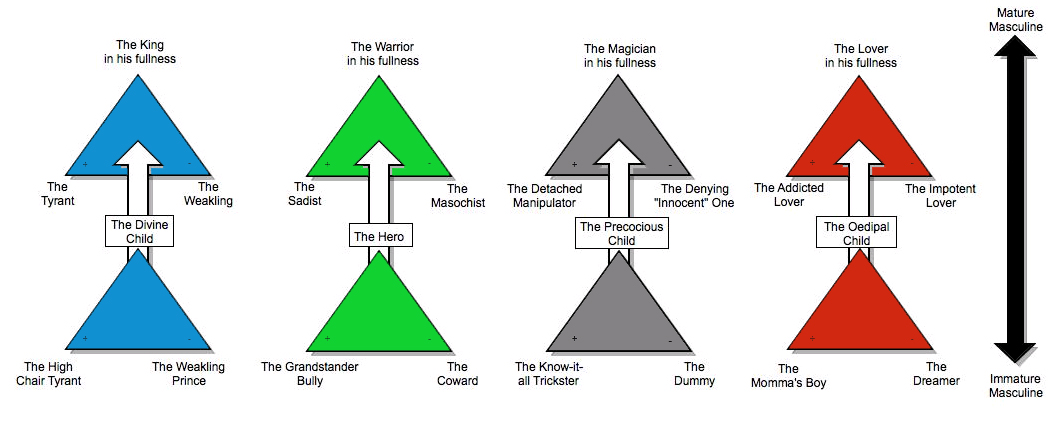
    Basierend auf dem o.g. Buch von Robert Moore sind die Archetypen König, Krieger, Magier, Liebhaber Grundmuster gereifter Männlichkeit. Die psychologischen Studien, die zur Benennung der vier Archetypen führen, ihre Namen sind von den vier grundlegenden Strukturen abgeleitet, die in dynamischem Wechselspiel das Tiefengefüge der mannlichen Psyche bilden. Sie wurden erstmalig am G.Jung Institute of Chicago vorgestellt. Das Buch beruht auf seiner Vorstellung vom archetypischen Selbst, erweitert jedoch das Verstandnis der männlichen Psyche über C.G. Jung hinaus.  Jede dieser vier Qualitäten besitzt eine Licht- und eine Schattenseite wie immer bei den Jungschen Archetypen:

    • Der König: Verantwortung, Sicherheit

    Männer mit reifer Königs Energie wirken stark, gefestigt, gelassen, tolerant, großherzig, erreichbar, ansprechbar. Sie sind wohlwollend streng, stärken anderen den Rücken, können loben und andere anerkennen. Als Schattenform demonstiert der Tyrann seine eigene Wichtigkeit und Macht, verspottet und setzt andere herab, entwürdigt und verbreitet Angst. Der Schwächling weigert sich Verantwortung zu übernehmen und erwachsen zu werden, gibt jedem Recht, lässt alles zu und hat Angst vor Konfrontationen und dem Unbekannten.

    • Der Krieger: Mut, Konzentration, Motivation

    Männer mit starker Krieger Energie sind bereit, sich für ein wichtiges Ziel voll einzusetzen. Sie sind zielbewusst, ausdauernd, und bereiten sich gut auf ihre Herausforderungen vor. Sie beherrschen ihre Werkzeuge und handeln. Als Schattenformen ist der  Sadist hart, brutal, kämpft ohne Rücksicht auf Verluste und Sinn des Kampfes, fühlt sich schnell angegriffen, überflutet von Spannung, Angst, Wut. Er ist aggressiv und hasst (seine eigene) Schwäche, Verletzlichkeit, Hilflosigkeit.Der Masochist lässt scheut Herausforderungen und Auseinandersetzungen; er ist passiv aggressiv, kämpft ungeübt und ungeschickt, gibt schnell nach oder wird unter Druck aggressiv.

    • Der Magier: Wissender, Lehrender

    Männer mit starker Magier Energie wollen mehr wissen, sie lernen und vertiefen sich in ihre Materie. Sie verschaffen sich Hintergrundinformationen und sinnvolle Alternativen, suchen Zugang zu inneren Kräften und zur Weisheit des Unbewussten. Sie erarbeiten sich damit ihre innere Basis, um Wissen fundiert weitergeben. Als Schattenform erkennt der der Manipulant nur seinem eigenen Vorteil, spielt seine Spielchen zum Nachteil andere, intrigiert und setzt Gerüchte in die Welt. Der Ahnungslose „funktioniert“ oberflächlich ohne Selbsterkenntnis und  hinterfrägt nichts.

    • Der Liebhaber:  Leidenschaft, Einfühlungsvermögen

    Die Liebhaber Energie eines Mannes zeigt sich in seiner Begeisterungsfähigkeit, Sinnlichkeit, Liebesfähigkeit und Leidenschaft. Als Schattenformen geht der Süchtige geht völlig auf in positiven oder negativen Empfindungen unter, übernimmt keine Verantwortung für sich und andere,  braucht permanente Stimulation,ist  ruhelos und rastlos. Der Lieblose lebt kalt und leidenschaftslos innerhalb enger Grenzen, ohne Spontaneität,  Liebe und Enthusiasmus, hat Angst sich gehen zu lassen und die Kontrolle zu verlieren.

    König, Krieger, Magier und Liebhaber sind in einer gewissen Mischung in mehr oder weniger reifen Formen zu finden. Der unreife König ist eher damit beschäftigt, sein Reich ständig zu vergrößern als gut für das vorhandene zu sorgen. Der unreife Krieger (+) verausgabt sich und ist besoffen von der eigenen Kraft, oder ist wie heute in Deutschland eher  (-) der “Frauenversteher” der lange bei der Mama wohnt und diese auch wählt. Der unreife Magier bringt wie der goethesche Zauberlehrling Kräfte ins Rollen, die er nicht mehr beherrschen kann. Und der unreife Liebhaber kann zwar Frauen verführen, aber keine Beziehung gestalten – sehr ausgeprägt in fast allen Wang Kar Wai Filmen.

    Psychologe Robert Moore nahm das Konzept von Jung Archetypen und benutzte es,  die Entwicklung von Reife und integralen Männlichkeit bei Männern zu erkläreren. Moore argumentiert, dass viele  heutige Probleme  ein Ergebnis des nicht angemessenen modernen Menschenbildes sein könnte. Weil der Kóntakt mit den  männlichen Archetypen verloren ging, befinden sich Jungen und Männern heute in einem Dillema. Männer und Frauen besitzen  nach Jung weibliche und männliche gegenpolige archetypischen Musters –  eben Anima (weiblicher Anteil) und Anima (männlicher Anteil) und einen Schatten, der bei der Herausbildung der Persona (Maske) entsteht.
    Moore argumentiert, dass jeder diese vier männlichen Archetypen aus drei Teilen besteht: der volle und höchsten Ausdruck der Archetyp und zwei bipolar disfunktionale Schatten des Archetyps mit (+) zuviel und (-) zuwenig Anteil. Um das besser zu erklären, porträtiert Moore jeder Archetyp als ein Dreieck.  Einiges in dem Buch  ist New Age und veraltete feminismus-definierte Männersicht. Das kann man getrost weglassen. Aber das Framwerk als solches ist innovativ und gut anwendbar. Die Visualisierung mit dem Dreieck ist eine einsichtige  Darstellung und Clustering der Schattenanteile des persönlichen Unbewussten eines Jungen, eines Mannes (oder sogar einer sozialen Entitität).  Natürlich ist es nur ein Modell das Wertungen und Begriffe zusammenführt. Es gibt eine Reihe von solchen Weiterentwicklungen des Meyer-Briggs Type Indicator (MBTI) system, aber dies ist die poetischste und folgt auch eher dem Jungschen Entwicklungsmodell als dem MBTI Klassifizierungsmodell mit dem im Human Resource Bereich auch viel “Schubladen-Psychologie getrieben wird.
    Männliche Archetypen

    Der wichtigste Aspekt an diesen vier Archetypen ist jedoch, für mich einen Ausgleich zwischen allen vier Qualitäten zu sorgen und einen Schwerpunkt finden, zu dem es mich automatisch zieht. Die gegenüberliegende Qualität ist schwächer ausgeprägt und bedarf einer besonderen Aufmerksamkeit und Förderung. Es ist zu untersuchen, ob mein eigener Schwerpunkt als Vater und Manager eher beim tyrannischen Despoten als beim weisen Herrscher liegt. Bin ich eher ein zurückgezogener Eremit als ein mutiger Kämpfer? Als Consultant bin ich eher ein kalter Manipulator als ein wahrheitsliebenden Magier? War mein Wunsch, mich im Rausch der Sinne zu verlieren, stärker als mein Wunsch, die Schöpfung durch meine Liebe zu Gott und Menschen zu begreifen? Sieht meine Frau meinen Schatten besser als ich, gerade in Zusammenhang mit der Krankheit meiner Mutter.

    Mit einer ausgeprägte Königs-Qualität, vernachlässige ich sicher meine Fähigkeiten als Liebhaber. Als guter Krieger habe ich einen ausgeprägten Realitätssinn, sicher auch geistige Kräfte (die des Magiers). Compassion ist wohl eher schwierig. Zu dieser Einsicht gelangte ich – siehe oben.

    C.G. Jung behandelt Eigenarten von Organisationen und Nationen wie Individuen. Vor diesem Hintergrund, sehe ich wenig Kriegereigenschaften und viel Schattenanteil der anderen drei Archetypen im derzeitigen Deutschland, ja dem westlichen Kulturkreis.  Das gilt für Kultur, Politik und Männerbewegung.

    Quelle:
    Robert Moore, Douglas Gillette: König,Warrior, Magician, Lover – A bold map for the masculin psyche.
    Robert Bly: Iron John
    C.G.Jung: Gesammelte Werke
    Jolande Jacobi: Die Psychologie des C.G. Jung