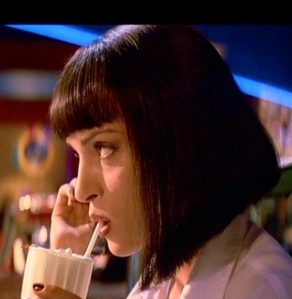
Again, Jungians were faster to search for symbols of the film noir. I just saw some old movies again, including Pulp Fiction, Blade Runner, Rosmary´s Baby and 2001 – A Space Odyssey and some film noir movies. I was interested how Jungian ideas could help me understand the films from a different angle and advance with a little project since I read Marcus – the image of the good and the evil, deamons and shadows. I thought this was an original thought, but no, of course a few articles had been written already.
In Pulp Fiction, Jules (the hit man) expresses his idea of religion: “There’s a passage I got memorized. Ezekiel 25:17. “The path of the righteous man is beset on all sides by the inequities of the selfish and the tyranny of evil men. Blessed is he who, in the name of charity and good will, shepherds the weak through the valley of the darkness. For he is truly his brother’s keeper and the finder of lost children. And I will strike down upon thee with great vengeance and furious anger those who attempt to poison and destroy my brothers. And you will know I am the Lord when I lay my vengeance upon you.” I been sayin’ that shit for years. And if you ever heard it, it meant your ass. I never really questioned what it meant. I thought it was just a cold-blooded thing to say to a motherfucker ‘fore you popped a cap in his ass. But I saw some shit this mornin’ made me think twice. Now I’m thinkin’, it could mean you’re the evil man. And I’m the righteous man. And Mr. 9mm here, he’s the shepherd protecting my righteous ass in the valley of darkness. Or it could be you’re the righteous man and I’m the shepherd and it’s the world that’s evil and selfish. I’d like that. But that shit ain’t the truth. The truth is you’re the weak. And I’m the tyranny of evil men. But I’m tryin’. I’m tryin’ real hard to be a shepherd”. Sounds like Nietzsche’s Zarathustra, the weak men need the strong independent man without moral.

For the viewer of Pulp Fiction, the five-fold pattern punched out by the bullet tracks soon after the film has begun is like Quentin Tarantino’s message. This is the film for anyone to see who wants to understand better what our violent, fear-ridden society may unconsciously be aiming at beyond its own self-destruction. From one side of the ambivalent feeling it sets off, Pulp Fiction is a sharply funny satire of the violence of our culture, offering itself, with its vulgar language and tense set-pieces, as a supreme occasion for indulging our regret at the deterioration of our culture’s values. For me, Pulp Fiction feels like a weirdly hopeful, even religious, film, an angel carrying the message that our collective weariness with violence is a deconstruction within the Western shadow itself.
Five is 4 + 1 or 2 + 3. In the first case its the symbol of the rule of the spirit over the four elements symbolizes (white) magic. In the second case it is the combination of the first female with the first male number and becomes the symbol of the sensuality and (predominantly male) sexuality. In the Christianity its symbolized by the five wounds of Christ a . Five was subordinated in the Christian culture of the four: the the four books of the New Testament. Five was also the number of the old-Babylonian goddess Ischta and in the Alchemie by it quinta essentia, the spirituelle quintessence was the spirit, which was symbolized by the rule of the upright-standing Pentagramm over the four elements. Darkly is the fallen Pentagramm, which symbolized the subordination of the spirit under the raw forces – the spiritual fall. It is symbol for the black magic.
Five bullet holes appear in the wall behind Vincent and Jules, hit men who have come to discipline a flat full of drug dealers for holding back a stash that they owe to the drug lord Marsellus Wallace. Discovering that they have survived an unexpected counterattack from a hidden observer, the two react quite differently. For the yuppier of the pair, coolly slack Vincent (John Travolta), the close call is another occasion to express his dismay at the way things go in our unmannerly society. The more reflective, intense Jules (eloquent Samuel L. Jackson) takes the sparing of his life as a religious rather than social sign, an indication that God wants to keep him alive. He uses the event as an opportunity for a reappraisal of his own relation to the culture of violence.
Five brings me to the next movie: Rosemary’s Baby. The Pentagramm served gnostics and pagans as protection against night daemons (Drude, “weibliche Nachtgeister” like Animus) and bad powers . In Goethe’s Faus Mephisto cannot cross the door limit, because a Pentagramm is scratched there. In the hermetic traditions is the Pentagramm one of the most important symbol. Since the antiquity this symbolism possibly relates to the periodic motion of the planet, whose positions describe every eight years an accurate Pentagramm. Geometry has two great treasures; one is the Theorem of Pythagoras; the other, the division of a line into extreme and mean ratio. The first we may compare to a measure of gold, the second we may name a precious jewel (Johannes Kepler). The Divine Proportion plays an essential role in the construction of the pentagon and five-fold symmetry. The reverse five-pointed star, however, used in the movie, is the most well-known indication of the Satan. The reverse cross standing on the head symbolizes refusal of the Christian cross and 666, the number of the anti-Christian from the “Offenbarung” of Johannes, all are used in Rosemary’s Baby.
Polanski’s Nóż w wodzie – Knife in the water (1962), Repulsion (1965), Dance of the Vampires (1967), Rosemary’s Baby (1968), The Tragedy of Macbeth (1971) and Chinatown are all dark haunted movies. In particular Rosemary’s Baby connects directly to the catholic church. Polanski’s movies paint poetic soul landscapes, whose origins may lie in his personal trauma experiences. As a child the Polish producer survived the Holocaust, which took its mother to it. On August 9th 1969 his high-pregnant wife Sharon Tate was murdered by the Charles Manson gang , a murder for which many held the movie (more Polanskis indirect connection to Manson due to his tideous research) partially responsible. Polanskis experiences with anti-Semitism, force and murder play a central role in this film. His unconcisiouness ceates artistic imageswhich are symbols of shadowly creatures.
Though there have long been films that featured demonic activity, devil worshippers, or appearances by Satan, the release of Rosemary’s Baby marked a significant t new openness to mystical and to explicitly religious themes. Rosemary’s Baby can be seen as nothing more than a well-crafted movie that plays on the timeless and archetypal fear of “the Devil”. However, when one looks at the movie’s precise timing in American history and the incredible series of events that followed its release, the movie becomes unsettling. The same way Rosemary discovers the workings of an international witch coven, Western society “discovers” a darker side of europeanl politics. Media slaves are unleashed in the public, shocking anti-christian events occur and Western culture becomes a celebration of depravity. In terms of mysticism, the unconscious is direct link to our psychic interpretation and divine inspiration. In psychological terms, it would best be associated to what Carl Jung described as the ‘Collective Unconscious.’ Specific cultural archetypes, as Jung described, are able to be found universally through this Collective Unconscious, or that common inner experience that we all share. The projections of these archetypes, such as angelic beings or deamons like in Rosemary’s Baby are simple representations of one’s inner self -of our society that is to say- that can be projected or confronted: ” Angst ist Forderung und Aufgabe, denn nur das Wagnis kann von der Angst befreien. Und wenn es nicht gewagt wird, so ist […] alle zukunft zu hoffnungsvoller Plattheit verdammt, zu einer Dämmerung, die nur noch durch Irrlichter erhellt wird” (C.G. Jung Symbole der Wandlung). Rosemary bore the devil. “Satan” is clearly an archetype for the Reptilian race. “Satan” was often symbolized as a dragon, a snake, a lizard or a strange looking bi-pedal, upright standing and cleverly cunning, half human/half reptile creature (refer to the Gnostic texts for this Reptilian being known as ‘Nachash’). The Jewish Haggada also describes in great detail, amongst a plethora of other ancient accounts, the nature and appearance of this Reptilian race that seeded and interbred with mankind. Rosmary, however, resigns herself to this situation. She gave the Evil existence and shape. She looks at this terrible creature in the cradle (with te reverse cross), the cradle song rings out. It is their child. She bore it. The Good and the Evil are mother and father of this child, which we believed are not part of us. Rosemary’s hesitant, insecure faith no match for the evil of the coven and the good and the evil falls outside of comfortable dualities and binary oppositions.