The Article Lupus and Astronomy is an extension of the last post: the archetype of the wolf. I am a hobby astronomer and fond of its older sister Astrology. So lets look to the Wolf from that perspective. The wolf is inherently pagan and shamanic, that means American Indian, Chinese, Egyptians, Babylonians should have big stakes in in its Astronomy representation. There is a Constellation – Lupus (the Wolf) in the southern hemisphere, originally listed as a constellation by the Greek astronomer Ptolemy in the 2nd century CE. Besides the fact, that Lupus was once the site of the brightest supernova SN 1006 (1006 A:D), there is little of archetypal concern.
But the Dog Star” Sirius matters as Noah Brosch said in his book. Sirius is the brightest star in the night sky and can’t be missed in a city, nevermind in a desert. Mostly called the “Dog Star”, in China the “Blue Beast (wolf)” Sirius represents the Heavenly Wolf and in Greece and Roman culture it was associated not only with the dog, but also with wolf and jackal.
Lupus and Astronomy Facts
Sirius: The Embodiment of Isis
Sirius absolute brightness is 23 times as bright as our sun and the fifth nearest star to our solar system. Known to astronomers as Alpha Canis Major, it is the principal star of the constellation Canis Major (the Big Dog). The brightest of the nighttime stars, Sirius caught the eye of the early sky watcher and can even been seen in daylight with a telescope. Sirius is a binary star. Very long ago, Sirius could not even be seen in the sky from some places. This was because of a phenomenon known as the Precession of the Equinoxes. The Precession is a very slow wobble of our planet taking the polar axis of the Earth in a circular swing of 47 degrees every 26,000 years.
For the Egyptians, Sirius was, astronomically speaking, the foundation of their entire religious and temporal system. It was the embodiment of Isis, wife of the god Osiris, who appeared in the sky as Orion. Egyptians called Sirius the “Dog Star”, after their god Osiris, whose head in pictograms resembled that of a dog.The ancient Egyptians called it Septit, the Hebrews knew it as Avrek or Sihor, to the Greeks as Sothis and also as the “the Dog Star” that followed Orion the Hunter. On that latitude the “Star in the East” in our Gospel accounts, was on the meridian line.Egyptian
senenmut zodiac
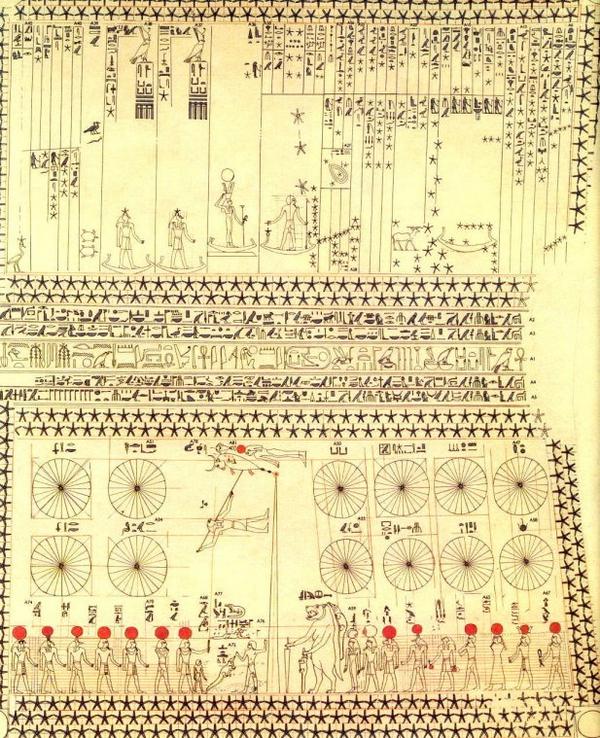
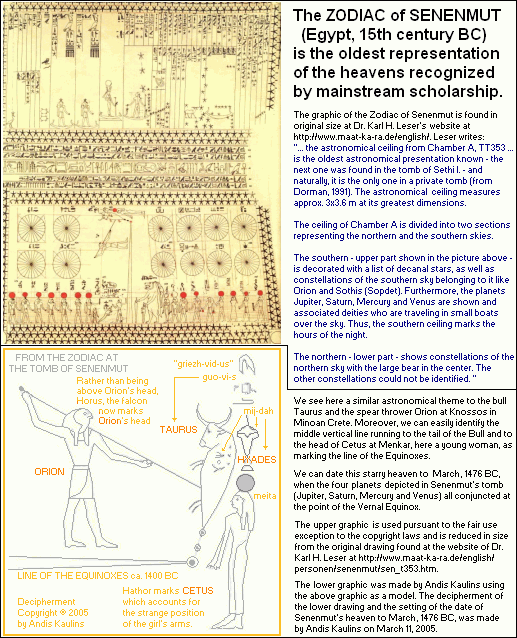
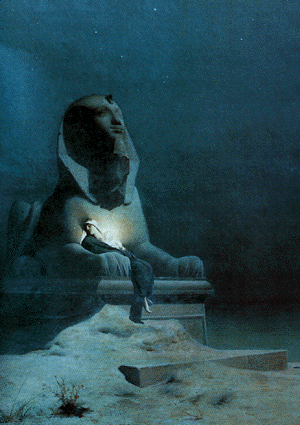
The reason why the Egyptians and many other civilizations of that era used Sirius as their marker for the passage of time is because they picked the most stable object as their reference point. In Egypt, almost all the temples were aligned with this line, including the gaze of the Sphinx. Many of the temples had a tiny hole in the wall somewhere; then there would be another wall and another, going into some dim inner chamber. The tomb of Senenmut, chief architect, lover and astronomer during the reign of Queen Hatshepsut the only female pharaoh, featured lovely astronomical ceiling. On its walls are extracts from the Book of the Dead. Hatshepsut’s temple is ideally placed to view astronomical events towards the eastern horizon, particularly the Orion constellation and the star Sirius. The alignment of the temple is set on an azimuth of 116½° ±½°. On the Senenmut calendar it is surely the sext idol from right with dog-head and a star above his name. In this case it can be the Canis Major, the Sirius dog, opposite to the Sumerian dog Rahu.
The periodicity of the helical rising of Sirius was such that the Egyptians based their calendar on it. Every year for millennia the appearance of Sirius coincided with the flooding of the Nile, an event that remarkably still happens to this day. Etymologists have suggested a connection with the ancient Egyptian god Osiris, but none can match the “Star of Isis”. Since earliest times the ancient Egyptian paid particular attention to Sirius, which they identified to the ‘soul’ of the Goddess Isis. Historic and mythological descriptions of Sirius provides further insight into the nature of the relationship between the Sun and Sirius. A shaft leading from the Queens chamber of the Great Pyramid of Egypt has been aligned precisely with Sirius.
In his book Echoes of Ancient Skies, the archaeo-astronomer Dr. Ed Krupp writes that, “After disappearing from the night sky (for 70 days) Sirius eventually reappears in the dawn, before the sun come up. The first time this occurs each year is called the star’s heliacal rising, and on this day Sirius remains visible for only a short time before the sky gets too bright to see it. In ancient Egypt this annual reappearance of Sirius fell close to the summer solstice and coincided with the time of the Nile’s inundation. Isis, as Sirius, was the ‘Mistress of the Year’s beginning’, for the Egyptian new year was set by this event. New Year’s ceremony texts at Dendera say Isis coaxes out the Nile and causes it to swell.
The metaphor is astronomical, hydraulic, and sexual, and it parallels the function of Isis in the myth. Sirius revives the Nile just as Isis revives Osiris. Her time in hiding from Seth is when Sirius is gone (70 days) from the night sky.
She (Isis) gives birth to her son Horus, as Sirius gives birth to the new year, and in the texts Horus and the new year are equated. She is the vehicle for renewal of life and order. Shining for a moment, one morning in summer, she stimulates the Nile and starts the year.”
“The coming of Osiris – the savior of Egypt – was associated with the “Star in the East” because the Egyptians recognized that the rising of Sirius with the sun, or “heliacally,” occurred around the summer solstice, the time of the Nile flooding. L ife along the Nile was highly dependent upon the inundation associated with the heliacal rising of Sirius, a flood deified as Osiris, who was said to be “born” at that time.
In addition, Pyramid Text 593:1636b/M 206 states: “Horus the pointed has come forth from thee, in his name of ‘Horus who was in Sothis.’” “Horus in Sothis,” therefore, refers to when the sun rises with Sirius. Thus, in ancient texts we find the birth of Horus the sun associated with the star in the east.
As we can see, the annual emergence of both Sirius and Orion were closely noted, meaning that these celestial events were significantly in the minds of Egyptians for thousands of years. Moreover, the “rebirth of life” in Osiris – his resurrection on Earth – constitutes an annual event, in the Nile’s flooding.
Christian
There is more than one connection between the Egyptians and Christianity. “Osiris’s coming was announced by Three Wise Men: the three stars Mintaka, Anilam, and Alnitak in the belt of Orion, which point directly to Osiris’s star in the east, Sirius (Sothis), significator of his birth.” One must envision that the Virgo was rising in the East at the same time Sirus was visible in the east as well. But also Orion, called “The Three Kings” by oriental astronomers, was in proximity to these other two constellations. Virgo is called Spica; it is to be found in the “ear of corn” (sign of fertility) which the Virgin holds.
Much has been made of the Matthew gospel account of the “star in the east” followed by “wise men” from afar, claimed to have heralded the birth of the newborn savior of the world. And many ancient gods, kings and heroes were said to have been born under a ‘bright star’ or some other sort of celestial sign.
In the gospel story, Jesus’s birth is signaled by a bright star and a visit from wise men or magi, as they are termed in the New Testament, representing Persian astrologers following the star. Despite the stellar brilliance and obviousness, this tracking was apparently not a simple act, since these “wise men” are depicted as nevertheless illogically becoming hopelessly lost and must ask Christ’s enemy King Herod for assistance. (Mt 2:1-10) “It may be inferred from Mt 2 10 that in some way or other the wise men had for a time lost sight of the star. (Mt 2:10 states: “When they saw the star, they rejoiced exceedingly with great joy.”)
Although in the gospels these magi are not numbered, their gifts are counted as three. Hence, the familiar understanding is that Jesus’s birth was accompanied by a “star in the east” and “three wise men.” At a certain point the “three kings” were given names, Caspar, Melchior and Balthasar. Coincidentally, there happen to be three very conspicuous stars in the “belt” of the constellation of Orion that are also called the “Three Kings.” Moreover, as French philosopher Simone Weil (1909-1943), herself a Christian, remarked, “The Christians named the three stars of Orion the Magi,” revealing esoteric knowledge of Christian astrotheology, regardless of when it was first adopted. Within the constellation of Orion, “the Hunter,” are three bright stars said to make up his “belt.” Concerning these stars, in The Geography of the Heavens the astronomer Elijah Hinsdale Burritt remarks:
They are sometimes denominated the Three Kings, because they point out the Hyades and Pleiades on one side, and Sirius, or the Dog-star, on the other. In Job they are called the Bands of Orion…
The biblical Book of Job (38:32) also contains reference to the Mazzaroth, or “zodiac,” and demonstrates significant astronomical knowledge, an important fact in consideration of the contention that, centuries later, the Jewish priesthood rehashed the Egyptian astrotheology in its “midrashic” or fictitious account of Jesus Christ.
The three highly visible “king-stars” of the splendid constellation of Orion are named Mintaka, Aniltak and Anilam or Alnilam, the latter of which means “string of pearls,” while the former two signify “belt.” The statement in the Egyptian texts that Sothis “leads Orion” thus constitutes the motif of the bright star followed by these three “kings,” which have also been called the “three kings of the soothsayers,” a title that may indicate the antiquity of this royal appellation.
The bright star Sirius rose with the sun at the summer solstice, signaling the birth of Osiris as the Nile inundation and the birth of Horus as the daily solar orb. In winter, the Three Kings in the belt of Orion pointed to Sirius at night before the annual birth of the sun, which is also Horus.
The appearance of the three stars in a line with Sirius occurred in the night sky over Egypt thousands of years ago, pointing to the horizon as the new sun was born at the winter solstice. Thus, it could be asserted that the three kings trailing the bright star announced the birth of the savior at the winter solstice in Egypt, ages prior to the same event purportedly taking place in Judea.
Greek
There is much speculation on the origin of its modern name which is generally thought to be derived from the Greek word “Sirio” meaning sparkling. Around 150 AD, the Hellenistic astronomer Claudius Ptolemy described Sirius as reddish, along with five other stars, Betelgeuse, Antares, Aldebaran, Arcturus and Pollux, all of which are clearly of orange or red hue. The discrepancy was first noted by amateur astronomer Thomas Barker, squire of Lyndon Hall in Rutland, who prepared a paper and spoke at a meeting of the Royal Society in London in 1760. The existence of other stars changing in brightness gave credence to the idea that some may change in colour too; Sir John Herschel noted this in 1839, possibly influenced by witnessing Eta Carinae two years earlier. Thomas Jefferson Jackson See resurrected discussion on red Sirius with the publication of several papers in 1892, and a final summary in 1926. He cited not only Ptolemy but also the poet Aratus, the orator Cicero, and general Germanicus as colouring the star red, though acknowledging that none of the latter three authors were astronomers, the last two merely translating Aratus’ poem phenomena. Seneca, too, had described Sirius as being of a deeper red colour than Mars.
Mayan
2013 is upon us, and we survived all the dire predictions about how the world would end did not happen. Among their reasoning was a total misunderstanding of the sacred Mayan calendar. The Maya understood 17 different Calendars based on Venus, Mars, Sun and Moon and most prominently the Pleiades with the precession of the equinoxes, a cycle just short of 26,000 years. So even Sirius was not accurate enough for the “Keeper’s of Time”, the Mayans. With their remarkably advanced astronomy they quickly detected the inaccuracies in using Sirius as a marker for the passage of time, and switched to an even more accurate cycle involving the Pleiades.
The Mayan view of the afterlife consisted primarily of a dangerous voyage of the soul through the underworld, which was populated by sinister gods and represented by the jaguar, symbol of night. The majority of Maya, including the rulers, went to this underworld. Heaven was reserved for those who had been sacrificed or died in childbirth. Like in any ancient belief system, to the Maya, science and religion were one and the same. The Maya developed an impressive mathematical achievements included positional notation and the use of zero; and in astronomy, they accurately calculated a solar year, compiled precise tables of positions for the Moon and Venus, and were able to predict solar eclipses.
For the ancient Maya, the Pleiades represented the principle of life on Planet Earth, and this is why it formed their sacred calendar. Mayan religion and mathematics were intimately connected with the seven stars, or suns, of the Pleiades. I traveled Yucatan once, where Mayan temples are fascinating. The calendars that are most important to beings of earth are the Haab, the Tun-Uc and the Tzolk’in. The Tzolk’in is the most important and the one with the most influence.
The Haab is the Sun calendar. It has 360 + 5 days, totaling 365 days. The Haab uses 18 months with 20 days in each month. There is a 19th month called a Vayeb and uses the 5 extra unlucky days. Each month has it’s own name/glyph. Each day uses a sacred sun/glyph.
The Tun-Uc is the moon calendar. It uses 28 day cycles that mirrors the women’s moon cycle. This cycle of the moon is broken down into 4 smaller cycles, of 7 day each.
The Tzolk’in is the sacred calendar of the Maya and is based on the cycles of 260 days. The cycle of the Pleiades uses 26,000 years, but but encompassing 260 days might allign the Venus cycle. The Mayas knew the importance of the period of 2920 days equal 8 years by 365 days, in which the Venus repeats its movement in relation to the sun, same as the Babylonian did. The “Dreseden codex” in Germany contains tables for predicting solar and lunar eclipses and ephemerides from Venus and Mars for two rounds.
Two kinds of empiric sidereal intervals of Mars were used, a long one (702 days) that included a retrograde loop and a short one that did not. While Kepler solved the sidereal problem of Mars by proposing an elliptical heliocentric orbit, anonymous but equally ingenious Maya astronomers discovered a pair of time cycles that not only accurately described the planet’s motion, but also related it to other cosmic and terrestrial concerns.
Today we only choose the Sun as our reference point, and this is obviously highly inaccurate. Every 4 years a day has to be added to keep accurate time. There is however an even more stable reference point than the Pleiades and that is the Galactic center, which from the perspective of our galaxy is the ultimate center of rotation. And indeed the Mayan’s chose the Galactic Center as a reference point to mark the passage of time, which is evident as the Mayan Long Count ends with the galactic alignment of the Solar System on December 21st 2012.
Sufism
Even as late as the 1970s Sirius became the subject of a (now rejected) theory linked to the Dogon tribe of Mali to recent scientific knowledge of Sirius. The majority of Dogon practice an animist religion, with a significant minority of the Dogon practice (Sufi) Islam, another minority practice Christianity. Sufi historian Indries Shah traces the name of the Illuminati back to a verse in the Koran which mentions a shining star, and Umar Al Sufi a Persian astronomer mentioned it in the 10 century. That knowledge of the Mail tribe concerns Siriusas a binary system. Sirius A is the highly visible star, but there is a companion known as Sirius B. From Africa, where the Dogons live, the star Sirius disappears below the horizon and is out of sight for a couple of months; then it appears again on the morning of July 23, when it rises about one minute before the Sun. It appears bright ruby-red, just above the horizon, almost exactly due east. Sixty seconds later the Sun emerges. So you can see Sirius for just a moment, then it’s gone. This is called the helical rising of Sirius, which was a very important moment for most of the ancient world, not just for the Dogons and Egypt. This is the moment when Sirius and the Sun and the Earth are in a straight line across space.
Conclusion
Sirius has been found linked with every great religion of antiquity. Why? One reason might be was a much better timekeeper than the Sun. But as has been shown, the star Sirius has played a prominent role in astronomy, myth, religion, literature, and history always with an archetype of wolfish character.
Sources
Cosmos An illustrated history of astronomy and cosmology, John David North
The Fontana history of astronomy and cosmology, John David North (German Translation)
The Rise of Early Modern Science – Islam, China and the West, Huff, Toby E.
The Biographical Encyclopedia of Astronomers, Springer Reference. New York: Springer, 2007 (via web)
Starry Night Complete Space and Astronomy Park Deluxe Edition 6
It became clear during my research of Jungian Archetype of the wolf, that in mythology, religion, in legends and fairy tales the wolf has played an outstanding ambiguous, dualist and multidimensional role. The wolf archetype is so central, that how the wolf is viewed, indicates the mindset of the human, secular or spiritual organisations of the society we live in.
In a few weeks, there is Whitsun, and I will make one of my occasional trips to the monastery. Writing this article was a preparation to the theme and will be updated afterwards The rock monastery St. George is a development center of the Benedictine order in the Austrian Inn valley. From the monastery to the St. George mountain (Karwendel) on foot takes approximately one hour. The religious exercise will be lead by a Benedictine monk, who happens to have formal psychoanalytic credentials and introduced the theme “The archetype of the wolf” for what to my understanding is a spiritual hiking weekend.
st_georgenberg_stift_fiecht
But there is much more. Joland Jacobi, a close assicate of C.G. Jung mentiones the archetype of the wolf a few times in her book “Complex, Archetypes, Symbol in the Psychology of C.G. Jung”, Bollingen Series Princton University Press, 1957. Joland Jacobi writes, “being devoured or swallowed is also a widespread archetypal motif… the wolf that devours the kid”…. [page 155, 181,185]. C:G: Jung writes numerious times about Wotan, who was eaten at Ragnarok by the giant wolf Fenrir and then avenged by his son Vidar e.g. “Four Archetypes Mother, Rebirth, Spirit, Trickster”, Routledge and Paul, 1957. In the the same book, C-G. Jung writes about the wolves about the German fairytale, in which the wolf gives the hero a magic gift of his hairs (page 109) .
Historical encounter between man and wolf
You may refer my recent article “The Wolf as an Jungian Archetype Vessel” which argues that the wolf is one of the most persistent and structurally overdetermined animal-symbols in human civilization because the historical encounter between man and wolf unfolded simultaneously on three inseparable levels: biological rivalry, social mirroring, and archetypal projection. The wolf therefore persists not merely as zoological memory nor merely as mythological ornament, but as a privileged symbolic convergence point through which deep psycho-biological structures become visible in religion, myth, dream, political imagination, and collective anxiety. In his book Of Wolves and Men, Barry Lopez argues from a naturalist view similarly that traditional hunting cultures suggest deep behavioral analogies achieved through a respectful, reciprocal relationship. These societies and wolves viewed the hunt as a sacred covenant requiring humility, dignity in the ‘conversation of death’ and hunting skills. Barry Lopez shares a Nunamiut elder’s insight that a old man and an old wolf possess identical knowledge of the land and hunting: “After a pause the old man looks up and says: The same. They know the same.“
The wolf reminded men to their domestication and their inner struggle with it. The wolf became also an image of remaining wild and sexuality, in a Jungian sense became men’s Shadow of undesired and unwanted. Those of us with Western background, do often not realize the depths and subtle (subtile) differences and similarity of Pagan German or Norse, Eastern or Native American stories. Especially wolf stories examine reincarnation, spiritual energy, gift exchange, the vitality of the body, and the spirit of the soul. In the old worldview everything is in flux and begins, balances out from, and ends with polarities akin to yin and yang. Even the gods are subject to this, undergo transformation, and often pay for what they gain with a corresponding loss. For indigenous people – including the indigenous Celts and Germanic – religion as such did not exist. Native views of spirituality wed it to time and place, land and sea and sky. Our forebears lived side by side with the wolves in an inspirited world, and that world abides, as do its instinctive, but sacred dimensions:
Axe-time, sword-time, shields are sundered,
Wind-time, wolf-time, ere the world falls;
Nor ever shall men each other spare….
Now do I see the earth anew
Rise all green from the waves again…
Myth wolf – gods, goddesses, demons and outlaws
Wolves make quick decisions, often need to trust their own instincts and make firm emotional attachments. They teach us to do the same, to trust our instincts and intuitions, and have control over our own lives. At some point in psychological development, most people struggle with the transformation of spiritual and physical aspects of their being. In many stories, the wolf was described as wild, tearing, biting, grim and bloodthirsty. The image of the wolf has been used to represent all those aspects. From where does the primeval fear and awe of the wolf originate?
The Dark Wolf Outlaw
Demons: In the Edda, the ancient Icelandic sagas, the wolf was a symbol for demonic powers: Odin, the God of war and death was accompanied by two wolves. The mythical wolf Fenrir, a son of the fire god Loki and the giant Angrboda was stronger than gods. In Indian mythology, the wolf is described as demonic. Furthermore, the wolf is portrayed as thievish, deceptive and false. In India, the demons were named after the wolf. In Christianity the wolf was even equated with the devil: Jesus Christ advised against false prophets dressed in sheep’s clothing which in fact were wolves. Numerous myths from Eastern Europe, Russia and Scandinavia tell about the creation of the wolf by the devil. During the creation of the wolf, the devil relied on the help of God and it was God’s will that the wolf kills sheep and goats.
Gods: Many different cultures worshiped the wolf. For the Egyptians the wolf symbolized the god of the empire of the dead. For the Romans the wolf was the symbol for Mars, the God of war. The combination of the wolf with war was not meant to be negative but, instead, correlated it to the glorious death of a warrior or emperor. Furthermore, the fighting heroes were compared with furious wolves.
Positive Male power: The combination of the wolf with war was not meant to be negative but, instead, correlated it to the glorious death of a warrior or emperor. Furthermore, the fighting heroes were compared with furious wolves. The wolf is also worshiped as the protector of human beings. The wolf was either seen as a fierce guardian or caring provider. The wolf is very often also associated with war and strength. In both German and Norse mythology, wolf was a symbol of chaos, destruction and death. Wolves are seen as teachers of hard, but necessary lessons. The wolf is also a symbol of guardianship, ritual, loyalty, and spirit.
Positive female power: Many different cultures worshiped the nurturing she-wolf as symbol of fertility.. The most famous myth is Romulus and Remus, the founders of the city of Rome, who were abandoned as small children. A wolf found them and raised them as her own cubs. In other contexts, the wolf also was honored as a symbol of motherly sacrifice and fertility. The frequent connection between goddess figures and totemic wolves may be taken as another indication of the great role of wolves in primitive matriarchal societies and shamanic religions.
Fenir
Negative untamed power: People from many cultures and traditions have interpreted the wolf as representing the untamed (unconscious). The word wolf is widely common in the Indo-European roots of language and often not only stands for the animal, but describes in the old Germanic languages the bandit, murderer, slayer, defied criminal, evil ghost or supernatural beast.
The Wolf in the wild
The basic social unit of wolf populations is the pack. Packs usually consist of between five and eight members, up thirty wolves or more depending of the size of the prey being hunted. Wolves generally establish territories ranging from forty to more than four hundred square miles in some cases. They define their ranges with scent markings and such vocalizations as growls, barks, and the legendary howl and will defend this area against intruders. A wolf pack is typically a family unit, consisting of the adult pair, their cubs and yearlings – two generations offspring. Wolf packs rarely accept unfamiliar adult wolves, often chasing or killing intruders to protect their territory. However, they are unique in their natural willingness to adopt unrelated orphaned pups. Members of the pack form strong social bonds that promote internal cohesion. Order is maintained by a dominance hierarchy. The alpha couple, more often the male sometimes the she-wolf depending on prey and situation, initiate pack activity and lead the group on hunts. During a hunt, they will guide the pack’s movements and assume control at critical moments. Communication is especially important for wolves, where coordinating, cooperating, and reinforcing bonds and status are necessary. Within a family of wolves, communication helps maintain social stability and solidarity. Communication among wolves is particularly complex and use a range of vocalizations to “talk”, body language and scent. The “wolf” talk conducted by the dominate male keeps the family pack together and working as a group. Research at wolves in captivity are not transferable in the wild, because here wolves of different origin or family groups were locked together.
Wolf family the-alpha-wolf-couplef-amily-the-yearling-missing
Wolves and humans were always fellow hunters, rivals, and sometimes enemies, perhaps because they were so similar to humans in many ways as mentioned before. Wolves have a strong social nature and are, like humans organized as a family tribe. In any case, through gestures and body movement, they communicate their feelings. Wolves like to howl as a pack for several reasons. It may be to encourage their closeness, to celebrate a successful hunt, and to tell other packs to keep away. The dispersed wolf, a younger male or female, is usually in search of his own territory and a mate. He will skirt the territories of others, but rarely howl. Leaving the pack allows for the sexually mature young wolves to begin the cycle of life by finding a mate, and starting their own family. This coined the misleading term ‘lone wolf’, they exist, but as exception.
Until today, the wolf evokes fear. Yet the wolf is not dangerous monstrosity, but rather an intelligent carnivore with a distinct social behavior. Anybody who “owns” a good hunting dog, observes that good dogs, good leaders and good men in general share some attribute of a wolf. The life of a man and a wolf did not differ very much a few thousand years ago: Both were either successful hunters or perished – as simple as that. During those early years of mankind wolves were always competitors with humans for the same prey species. Yet the competition between them increased when men settled 10,000 years ago and began agriculture and cattle-raising. The farm animals were for wolves easy prey, and many sheep or goats fell victim to them. The wolf became the hateful animal, which threatened the livelihood or at least property of the man. Even as backpacker I was more afraid of a wolf(s) pack than of a brown bear.
Archetypal significance of the Wolf
Wolf Archetype: Dual Archetypes – conflicting messages
No matter how polite, on the question how well advertising works, a marketer said once: One must know and find archetypal images and connect them with the products of the market. So the message becomes strong and the desired behavior tendency is more easily constructed. One finds few wolves in advertizing, since the archetypal significance of the wolf symbolizes evil as well as positive and spiritual aspects. As shown before, you do see the claimed by ideologies and religions. The wolf represents as noted before, and like the picture on the left an integration of opposites. It has always carried a sense of contradiction: a wild and fearful animal, that can represent death and evil; but at the same time a companion to the goddess Artemis and the norse god, Odin. Theis dual imago of the wolf is also represented by the contrast between its masculine and feminine nature. The masculine nature of the wolf is depicted by many cultures as the protector and warrior. The feminine nature is symbolized as the she-wolf form nurturing the twins, Romulus and Remus, or in the Irish myth of Cormac, or Kaspar Hauser who were suckled by wolves. Interesting enough, Christianity enforced and broke this dualism in early Biblical sources presenting a contrast between the wolf symbolizing bloodshed and destruction versus the symbol of the wolf and the lamb lying down together representing peace and the coming Messianic rule. The middle ages also presented this contrast between the image of the wolf as devil, versus the wolf as an “emblem of Saint Francis of Assisi who tamed the wolf”.
C.G. Jung’s basic archetypes and the Wolf
BasicArchetypesWolf
Jung developed an understanding of archetypes as being “ancient or archaic images, that derive from the collective unconscious”. There are many different archetypes, and Jung has stated they are limitless, but they have basic examples in very person include the ‘persona’, the ‘shadow’, the ‘anima’, the ‘animus’, and the Self. Four more archetypes are prominently mentioned by C.G. Jung; ‘great mother’, the ‘trickster’, the archetype of transformation and the ‘hero”. It is interesting, that the wolf can represent them all.
Jung proposed, that the archetype had a dual nature: it exists both in the psyche and in the world at large. He suggested also, that not only do the archetypal structures govern the behaviour of all living organisms, but that they were controlling the behaviour of inorganic matter as well. The archetype was not merely a psychic entity, but more fundamentally, a bridge to matter in gnostic entities in occult tradition are known as aeons. The Germanic Wotan (Norse Odin) is such an aeon described by Jung (who was very much drawn to Gnosis).
In another Jung’s theory about Wotan, invoked in the Germans by Hitler’s disposition as a “seer” drew a lot of political and academic fire. Interesting here is also, that Hitler, who was inseparable of Blondi, his wolf-hound chose a name for himself – Wolf. In Egyptian mythology a god, Upuaut was the scout, going out to clear routes for the army to proceed forward. One old inscription found mentioned Upuaut “opens the way” to king Sekhemkhet’s victory. Over time, the connection to war, and thus to death, led to Upuaut also being seen as one who opened the ways to, and through, Duat, for the spirits of the dead.
But back to my interpretation the basic sub-archetypes of the wolf:
The nurturing and protective wolf appearing as the great she-wolf who nursed Romulus and Remus (Mother, Anima).
The male wolf initiated by society forces the young adult in becoming a good hunter (Warrior,Animus).
The guard conducting souls through the gates, which had to be passed as in Egyptian mythology (Shadow).
The wolf in sheep’s clothing who attempts to hide its instinctive and wild self by developing a persona of meekness and innocence (Persona).
The howling wolf who has a voice to communicate with others and is reclaimed inner voice of the soul (Ego)
The wolf and lamb lying together, which represents inner peace (Self).
The wolf who has accepted his (or her) role in life (Ego after individuation).
C.G. Jung wrote little about wolves as archetype directly but wrote extensively about fairy tales and myths in which the wolf often plays a major role. Four archetypes “per se” are prominently mentioned by C.G. Jung; ‘great mother’, the ‘trickster’ , the archetype of rebirth (transformation) and spirit, the wolf can represent them all and more. Many references to wolves and werewolves can be found in Jung’s Collected Works and separate publications.
The Romolus myth is mentioned by Henderson in ” Der Mensch und seine Symbole, C.G. Jung, Jaffe Olten 1968, as the fourth stage of the hero myth. In Bly’s Iron John the wolf is represented by the wild man, the hunter and warrior.
C.G. Jung’s archetypes of transformation and the Wolf
The werewolf as bloodthirsty creature, once person, once wolf has been sold gladly by the film industry in “American Werewolf” or the classic silent movie Mr. Cecil and Hyde. During the Middle Ages, the belief was widely accepted, that men would transform into werewolves. The werewolf, a creature from the devil, obsessed, half human and half animal, roamed the streets at night and, “drank the still warm blood, gorged the bowels from its innocent victims during orgies of satanic cruelty”. The belief in werewolves already existed in the ancient world, but during the Middle Ages this belief grew to be much stronger. Mostly women and children became victims of werewolves, which, in reality were men, that felt and acted like wolves while under the influence of drugs and rituals. It was believed, that with the help of the Malleus Maleficarum (the hammer of the witches) in 1489, one could not only recognize witches, but also werewolves, which resulted in countless men being burned to death on bonfires as so-called werewolves. To contemporaries, it was clear, that one would turn into a werewolf through an evil spell or as a punishment for a serious sin.
Wolf archetypes and pagan myths (Edda)
There was even a a monstrous wolf who was a major threat to the gods who appears in both the ‘Poetic (or Elder) Edda’ and the ‘Prose Edda’ written down in Iceland during the 13th from earlier traditional sources, reaching into the Viking Age. The name Fenrir means “from the swamp.” Also known as the Fenriswolf, he was the offspring of the trickster fire god Loki. In Norse mythology, Loki is a god or jötunn/Jætt or both. Some of the jötnar (a mythological of giants and giantesses) have hideous appearances – claws, fangs, and deformed features. Fenrir’s sister was the goddess Hel and his brother the evil serpent Jormungand. The Vikings believed, that during Ragnarok, the battle that would take place at the end of the world. According to the myths, the evil Loki himself gave birth to Fenrir, after eating the heart of a giantess, the witch Angerbotha. After his birth, the gods received prophecies of disaster, but the gods could not kill Fenrir because it would have defiled their sanctuary. But they sought some way to tie up the beast, who grew noticeably larger each day. They attempted to restrain him, but after failed attempts they became even more afraid of the wolf’s power. Odin sent Skirnir, Frey’s messenger, down into the world of the dwarfs and had them fashion a magic restraint called Gleipnir, smooth and soft, like a silken ribbon. They called the wolf, showed him the silky band, and challenged him to test his strength again. Fenrir was suspicious because of the thinness of the band. The gods agreed to free him if he could not break out of the fetter himself. But Fenrir asked that, someone puts their hand into his mouth as a pledge, that the gods were acting in good faith. None of the gods was willing to take such a risk, knowing full well the deceit, but then Tyr stepped forward and put his right hand into the wolf’s mouth, making the sacrifice that would keep the gods safe. Fenrir was bound with Gleipnir, and he tried with all his might, but could not snap it. The gods laughed to see the wolf’s distress–except for Tyr, of course, his hand got bitten of at the wrist. Fenrir continued to howl horribly, but would remain until Ragnarok, when the gods and the giants would fight to the death. By the time of Ragnarok, the wolf would have grown so large, that when he opened his mouth, his lower jaw would be against the Earth and his upper jaw would scrape heaven. Flames would burn from his eyes and nostrils. At Ragnarok, the wolf would break loose and join the giants and other monsters in all-out war with the gods. Fenrir would kill Odin by swallowing him. Odin’s son Vidar would then come forward avenging Odin and, killing the beast at last.
Wolf archetypes – and the Egyptian Lord of the Necropolis
wepwawet
In late Egyptian mythology, Wepwawet (also rendered Upuaut) was originally a war deity. Wepwawet was called the son of Isis, and was one of several Egyptian deities to take the form of a canine, today identified as a wolf. Egyptologists now believe, that he was more likely associated with the jackal, though he is often depicted with a gray or white head. Wepwawet originally was seen as a wolf deity, thus the Greek name of Lycopolis, meaning city of wolves. Over time, the connection to war, and thus to death, led to Wepwawet also being seen as one who guarded the spirits of the dead. In later Egyptian art, Wepwawet was depicted as a wolf or a jackal, or as a man with the head of a wolf or a jackal.Reflecting his lupine origins, he was depicted dressed as a soldier, as well as carrying other military equipment – a mace and a bow. With the rise of the solar cult, particularly during the 12th Dynasty, Osiris was limited to the underworld and the local god and Wepwawet gained the titles, “Lord of Abydos” and Lord of the Necropolis”. The god is well established in New Kingdom funerary texts such as the Book of Going Forth by Day, Book of the Dead, and the Amduat (Book of That Which Is in the Underworld). Wepwawet was also thought of as the messenger and champion of royalty who accompanied the king while hunting as “the one with the sharp arrow who is more powerful than the gods.” Wepwawet is not to be confused with Anubis.
The story of Isis and Osiris is one of Egypt’s most ancient myths and base of the concept of death (and resurrection) which is so central to their religion. Osiris, Isis, Seth and Nepthys and the elder Horus were siblings born of Geb, the sky god, and Nut, the earth goddess, had five children. Osiris became king of Egypt, and he married his sister Isis. Seth was married loveless to Nepthys and always jealous of his oldest brother Osiris. On a feast of gods, he tricked Osiris into a coffin and drowned him. To prevent Isis from bringing Osiris back to live he cut him into pieces and distributed them throughout Egypt. Isis, who had great magical powers, decided, to collect the pieces of her husband’s body and re-assembling them. Once she completed this task, she breathed the breath of life into his body and resurrected him. Isis became pregnant soon after gave birth to the younger Horus, the hawk-god. The cult of Isis spread with Alexander the Great throughout Greece and became in Rome through Caligula a state religion. The image of Isis nursing the younger Horus found it way into Christianity, like the judgment after death and the hell and in Iris’ deed maybe even resurrection.
While over the time all of the many gods only “survived” as incarnations of Re, who became the most powerful, almost panteistic sun god, Osiris was able to descend into the underworld, where he became the only lord of that domain. Here the first time in history the concept of the judgement after death was introduced. There were 42 sins, you could by guilt of. Ages ago, before the birth of Younger Horus, Wepwawet’d situated himself as the god of war, aiding his followers before, during, and even after a battle. But under these new circumstances Wepwawet petitioned Osiris these days for a new role. The wolf-headed god was then assigned as guide to the dead leading the deceased through the Underworld (hence his name). Not long after Wepwawet appointed as guide did Osiris’ ability to communicate outside of the underworld began to wane. Wepwawet stepped in again and offered his help as a messenger (like the Greek Hermes and the Roman mercury). Some say Wepwawet’s still a scavenger at heart like his animal totem, groping for whatever task isn’t taken or is even partly available.
Here a list of the most important and mentioned gods:
GEB: the earth-god; husband of Nut; member of the ennead of Heliopolis; represented as a man.
NUT: the sky-goddess, wife of Geb, the earth-god; represented as a woman, her naked body curved to form the arch of heaven.
HORUS: the falcon-deity, originally the sky-god, identified with the king during his lifetime; also regarded as the son of Osiris and Isis, for the former of whom he became the avenger; cult-centers in many places, e.g. Behdet in the Delta, Hierakonpolis and Edfu in Upper Egypt. See also, Haroeris, Harpocrates, Harsiesis, Re-Harakhty.
ISIS: the divine mother, wife of Osiris and mother of Horus; one of the four ‘protector’-goddesses, guarding coffins and Canopic jars; sister of Nephthys with whom she acted as a divine mourner for the dead; in the Late Period Philae was her principal cult-centre. I have written about Isis imported to Roman culture in “Isis, Mithras and Jesus”: Clash of male and female Archetypes in classical Rome.
SETH (SET, SUTEKH): the god of storms and violence; identified with many animals, including the pig, ass, okapi, and hippopotamus; represented as an animal of unidentified type; brother of Osiris and his murderer; the rival of Horus; equated by the Greeks with Typhon.
WEPWAWET (UPUAUT): the wolf god of Asyut in Middle Egypt; a god of the necropolis and an avenger of Osiris. Wepwawet (Upuaut, Wep-wawet, and Ophois) was an ancient canine god whose worship originated in Upper Egypt. He was one of the earliest of the gods to be worshipped at Abydos, possibly predating (and absorbing) that of Khentyamentiu (another god of the Abydos necropolis). Not to be mistaken with Anubis, there is very little information about the family of Wepwawet, or parents, if he had any at all. He is sometimes the son of Set, or of Anubis. Most of the time he is said to be a son of Isis, which may further relate him to Anubis. Or he could be another foster-son adopted by Isis.
ANUBIS: protector and son of Osiris and Nephthys. As Osiris grew in popularity (absorbing both Khentyamentiu and Wepwawet) Anubis took on Wepwawet’s funerary role. During the New Kingdom his standard even preceded that of Osiris and the “procession of Wepwawet” initiated the mysteries of Osiris as a god of the dead.
NEPHTHYS is the river goddess and daughter of Nut.
AMUT, Ammut, or Ammit or Ahemait, is the crocodile goddess known as the “Devourer of the Dead” assists Anubis with carrying out the Judgements
AMON- RE (RA), Amun-Ra and Akmun-Rah: the sun-god of Heliopolis; head of the great ennead, supreme judge; often linked with other gods aspiring to universality, e.g. Amen-Re, Sobk-Re; represented as falcon-headed. Re is the god of the Sun and king of the gods until Osiris took over his throne.
OSIRIS (ASAR): the god of the underworld, identified as the dead king; also a god of the inundation and vegetation; represented as a mummified king; principal cult-center, Abydos.
ATON or ATEN is the new god of the sun, an incarnation of Re. It was a monotheistic supernova god in a cultural revolution lasting only on reign. I have written about Aton and Echnaton here.
ATON was the (monotheistic / pantheistic) religious revolution during the period of Echnaton which wanted to suppress Amon, Osiris and Re (or assimilate him). Not only Amon was dismissed (whom all the kings of the New Empire had worshipped at Thebes), but all the other gods had gone. Re became a spirit who returned life to each person after every incarnation and a new state religion, Aton (was Re) offered his mercy to all beings of every nation and color. There is a famous engraving of hands reaching to the sun representing an invitation of men towards the sky. Aton, the father of all the gods, also embodied them in his being, and became the one who could purify human beings, when they asked his aid to take them out of the darkness of their material life.
Wolf archetypes and Christianity
Early Christianity on the European continent employed the wolf, too, but instead of a symbol of nurturing or supernatural transition, the wolf became associated with evil and damnation as the agrarian way of life grew. The Bible describes Jesus as the shepherd protecting his herd of sheep from the wolf (The Bible, John 10:12). This would imply an intrinsic belief of the wolf as a symbol of sin and prurient influence. In Isaiah verse 11:16 of the old testament states “The wolf also shall dwell with the lamb.” This phrase is thought of as a metaphor of coming together of both the upper and lower under the Christian god (Religion 431), a stark contrast in comparison to the previous example and a throwback to an earlier time when the wolf represented more positive ideas. Another very prevalent notion in both the old and new testaments of the Christian Bible, is the wolf a tool of Satan and his henchmen. Wolves in this context are thought of as ravening or stealing away the souls of men.
There was an interesting sermon in St. Ottilien recently, talking about sheep. The Pater, a son of a veterinary, said he liked sheep, but to him they are dumb. When a wolf comes to them they cuddle together, neither fighting nor running away they when they get killed. They are powerless victims. He referred to the German philosopher Nietzsche, who divided us into masters and slaves, in those that are prey (sheep) and those that are predators (wolves). Nietzsche wrote psychologically and physically, this divides our human species. The master types live by strength, creativity, independence, assertiveness, and related traits. They respect power, courage, boldness, risk-taking, even recklessness. It is natural for them to follow their own path no matter what, to rebel against social pressure and conformity. The slave types live in conformity. They tend to passivity, dependence, meekness. It is natural for them to stick together for a sense of security, just as herd animals do. (Beyond Good and Evil 264).
The Pater reminded also to the claim the God is dead – but countered it with the resurrection of Jesus. Now, Nietzsche says, what we take to be moral depends on our biological nature—and different biological natures dictate different moral codes:
What will seem good to you as a sheep? Being able to graze peacefully, sticking close together with others just like you, being part of the herd and not straying off. What will seem bad to you? Well, wolves will seem bad, and anything wolf-like, predatory, aggressive. But what if you are a wolf? Then strength, viciousness, and contempt for the sheep will come naturally to you and seem good. There is nothing the wolves and the sheep can agree on morally—their natures are different, as are their needs and goals, as is what feels good to them. The same point holds for humans. The divide between strong and weak, assertive and timid, runs straight through the human species. Moral codes, Nietzsche is here suggesting, are part of a biological type’s life strategy of survival, and the more we look at the history of morality evolutionarily and biologically, the more we are struck by the diversity of circumstances and how dramatically beliefs about values have changed across time. (Beyond Good and Evil 199).
This is precisely our key problem culturally, the pater argued. This world shows, that we once prized excellence and power and looked down upon the humble and the lowly. Now the meek, the common man, the kindly neighbor are the “good guys” while the aggressive, the powerful, the strong, the proud are “evil.”
Jesus was warning the disciples in Matthew 10:16 when He says they are being, “sent out as sheep among wolves.” The image and idea here is intense, but so is being a Christ follower in a world where those who follow Christ continually are facing some level of persecution. Jesus knew this and instead of telling the disciples follow me it will be easy; He let them know it will be just as dangerous, as it is for the sheep among wolves. This is the same for those who follow Christ today. As a Christ follower, a Christian, you already have the way out through salvation in Jesus through His death on the cross and resurrection by choosing it. Christians have the cure, but Jesus tells us, that while we are on this earth, those who follow Him will have difficulties bc this is not heaven this is earth where some people chose to say no to Christ and others believe and chose to follow Jesus and to those Jesus says, “Look, I am sending you out as sheep among wolves. Be as weary as snakes and harmless as doves.” Matthew 10:16
Wolf archetypes and postmodern ideologies
The ruling archetype does not stay the same forever, as is evident from the temporal limitations, that have been set to the hoped-for reign of peace, and the irreversible Europe.The archetype of the just, fatherly, benevolent ruler and the nursing mother had been shattered over the whole of northern Europe, as the present fate of the Christian churches bears witness. Even the Catholic Church can no longer afford trials of strength. Nihilistic Gods have attacked Christianity on a broad front. In communism, he is called equality and science, in national-socialism, he is called leader, and in capitalism he is called globalism.
The wolf, seen as today’s financial predator, is naturally preying upon domesticated animals easily transforms into the metaphor of Satan seducing the innocents, drawing them away from their true nature into a state where they are compelled to acting against themselves and nature. This is perhaps the most frequent religious wolf related thought, which influenced Christianity and popular European culture. The sad fact though, is the image of the wolf in this context has little relation to anything based on reality and only serves not to enlighten thinking regarding this animal and its role in our world.
Wolf archetypes and masculinism
TheWolvesAintWhatTheyUsedtoBe – masculinism
Masculinism refers to advocacy of the rights or needs of men and the adherence to or promotion of opinions, values, regarded as typical of men. One of the most prominent men’s rights advocates, was Warren Farrell. Wolves are very good archetypes to define masculism and men. The wolf today still represents our “instinctive nature that is wild and natural” and suggests a wild and natural creature within every human, who is filled with good instincts, passionate creativity, and ageless knowing. This warrior within is seen as an archetype, that carries images, ideas, and unique behaviors for humankind. The gifts of wolfish nature come to man at birth, but society, in many instances, will attempt to civilize them into rigid roles, which will destroy the inner treasure and muffle the deep, messages of the soul. As a result, boys become trapped, over-domesticated, uncreative, and have fearful feelings. On a sociological level, societies become confused from kindergarten to the voting booth and bring Father or Mother figures against their interest in power, tangled and confused in narcistic gender issues. For men to find their soul, they will need to face their instinctive wild self so that they can become free, creative, and leading again. Of course the same can be true for females in unhealthy warrior culture, like German women who were hysterical Hitler believers or those today who proudly sacrifice their sons as suicide bombers.
Wolf archetypes and feminism
The Wolves ain’t what they used to be – feminism
The wolf is also a strong female archetype. They have insticts too. Interesting enough typical Feminist ideology divide Masculists in a) in male feminists who promote “gender equality”, a term which of course is shifting sand, and b) the others as form of misogyny promoting “male superiority or dominance” by being opposed to their definition of equality. Based on this “only dead Indians are good Indians logic”, wolves are very bad role models to define feminism, but still good ones to describe female archetypes. And there are good examples too. In her book, Women Who run With The Wolves: Myths and Stories of the Wild Woman Archetype, Clarissa Pinkola Estes (1992) suggests, that healthy wolves and healthy women in particular share certain psychic characteristics: keen sensing, playful spirit, and a heightened capacity for devotion. Female wolves and women by nature are relational, inquiring, and possess great endurance and strength. They are intuitive and concerned with their young, their mate and their pack and shamanic. There is the story of La Loba, the wolf woman. Her work was collecting bones of wolves and singing life into them. The story symbolizes the soul-voice. It conveys the truth of a woman’s healing power over anything, that is ailing or in need of restoration. Thus, the wolf is the representation of the Great Mother an archetype, which carries female images, ideas, and unique behaviors for humankind to help people to find their soul, and as warrior to help people to protect their survival. You might remember the two articles, Four archetypes of the (fe)male. The wolf combines the duality of the Great Mother and Great Warrior. The wolf can thus be seen as a symbol on an intra-psychic level for a successful individuation. The spiritual Self consoles and integrates his Anima (or her Animus) and their shadow, which was created to adjust to collective norms . Individuation suggests a commitment to inner growth and development.
Myth wolf – yesterday and today
A short summary of wolf features prominently in a number of stories everywhere.
Europe and Middle East:
Lycaon was the first king in Arcadia in Greece. He led a wicked life. The god Zeus came in disguise to a banquet at his palace and was disgusted to be served a child’s limbs. The god destroyed the palace and turned the king and his sons into wolves. Then he sent a flood to drown them all.
The Egyptians had a wolf god, Wepwawet, whose name meant “he who opens the road.” He led kings in battle, and his image was carried through the streets of his town, Assiut, during a great annual feast. The wolf counted later also as God of the underworld . He was sort of demoted together with Osiris to the underworld.
Early Biblical sources represented the wolf as destructive and associated with the evening (Jeremiah 5:6, and dishonest gain, bloodshed and destruction (Ezekiel 22:27, The Holy Bible). However, when the wolf and lamb were depicted lying down even though they were considered traditional enemies, together they represented peace and the coming Messianic rule (Isaiah 65:25 The Holy Bible). Many saints tamed wolves, just as St. Francis of Assisi did.
rome_shewolf_twins
The founding of Rome – and thus, an entire empire – was based on the story of Romulus and Remus, orphaned twins who were raised by a she-wolf . The association of the wolf with the female was seen in the primitive Roman cult of Lupa or Feronia, which was inherited from Sabine matriarchy. It is based on best known Western myth of Romulus and Remus: The wolf as a provider supposed to have nursed human infants. An ancient statue in the Lupercal grotto was later enhanced with images of the infants, Romulus and Remus were annually honored at the Lupercalia, the festival of the She-wolf, held every year in February, which was a multi-purpose event that celebrates the fertility of not only the livestock, but people as well. The “Jungle book” has a similar theme as the main character, “Mowgli”, is raised by wolves.The Romans thought it was lucky to see a wolf. The animal was sacred to Mars, god of war and protector of Rome. Julius Caesar’s victory over the Gauls at Sentinium, in 195 B.C., was attributed to a wolf, which was sent by Mars to frighten the enemy.The German Nibelungen legend tells how warriors used to eat roast wolf-meat to give themselves the courage of the wolf. Norse myths are all about valor, wolves have an important place, showing how they inspire fascination and fear in fighting men. When Wotan (Odin(, god of war and wisdom, sat on his throne at the palace of Valhalla, two great tame wolves lay at his feet,the symbol of his power and guarding the palace. The great wolves Geri and Freki, ate up the remains of the gods’ great feasts. In German fairy tales the big, bad wolf is referred to as being wild, tearing, snappish, grim and sanguinary. Grimm (German Romantic) even describes him as being the most evil creature of all animals in “The Wolf and the Seven Little Goats”.
In the stories of the Ulster cycle, the Celtic goddess Morrighan is sometimes shown as a wolf. The connection with the wolf, along with the cow, suggests that in some areas, she may have been linked to fertility and land. Prior to her role as a warrior goddess, she was linked to sovereignty and kingship. In Scotland, the goddess known as Cailleach is often associated with wolf folklore. She is an old woman who brings destruction and winter with her, and rules the dark half of the year.
Native America
amorok
The Inuit people of North America hold the great wolf Amarok in high regard. Amarok was a lone wolf, and did not travel with a pack. He was known for preying upon hunters foolish enough to go out at night. According to legend, Amarok came to the people when the caribou became so plentiful that the herd began to weaken and fall sick. Amarok came to prey upon the frail and ill caribou, thus allowing the herd to become healthy once more, so that man could hunt. There is a Lakota tale about a woman who was injured while traveling. She was found by a wolf pack, that took her in and nurtured her. During her time with them, she learned the ways of the wolves, and when she returned to her tribe, she used her newfound knowledge to help her people. In particular, she knew far before anyone else when a predator or enemy was approaching. A Cherokee tale tells the story of the dog and the wolf. Originally, Dog lived on the mountain, and Wolf lived beside the fire. When winter came, though, Dog got cold, so he came down and sent Wolf away from the fire. Wolf went to the mountains, and found that, he liked it there. Wolf prospered in the mountains, and formed a clan of his own, while Dog stayed by the fire with the people. Eventually, the people killed Wolf, but his brothers came down and took revenge.
Asia
Asian Wolves
The Turks and the fierce Mongols were enemies; but they both claimed to be descended from wolves. One young Turkish warrior, who alone survived after a Mongol raid, was rescued by a she-wolf and led by her to a secret earthly paradise in the mountains. They were married, and their children were led by a great grey wolf to the land which is now Turkey. The Mongol emperor Genghis Khan also claimed to be the son of a wolf. Besides Buddhism and Nestorians, Mongols have held mainly Shamanic beliefs before they converted to Islam.
In Turkey, the wolf is still held in high regard, and is seen in a similar light as to the Romans – the wolf Ashina Tuwu is the mother of the first of the great Khans. Also called Asena, she rescued an injured boy, nursed him back to health, and then bore him ten half-wolf half-human children. Today the wolf is still seen as a symbol of sovereignty and leadership and used from the PKK (Kurdish Separation Movement)..
The mountain people of Georgia, former part of the USSR, once thought, wolves had a society just like people. They were under the protection of a saint and were not thought of as wild animals. Hunters who killed a wolf wore mourning clothes as if they had killed a man.
In ancient China, the Wolf is prominent in the Sky. The people believed, that eclipses of the sun were caused by a great sky-wolf eating up the sun. People beat drums and shot arrows at the sun to drive the animal away. The Chinese saw the wolf also as a guardian of the heavenly palace. In Japan the wolf was admired for its ferocity, tenacity and swift attack. Also, they considered the wolf to be from heaven and to be venerated.
Conclusion
Myth is the foundation of life; it is the timeless pattern, the religious formula to which life shapes itself…Whereas in the life of mankind the mythical represents an early and primitive stage, in the life of an individual it represents a late and mature one. — Thomas Mann
The wolf archetype may seen as great bridge between gods and evil, male and female, patriarchy and matriarchy, humans and Nietzsches “Uebermensch”. However, it has to be noted, that wolves live a traditional, wild archetype adjusted to nature. The wolf clearly represents the instincts, so the full and positive wolf archetypes may be meaningless in today’s context. Or not? Can be the wolf a weak warrior or a devouring mother, can the wolf sleep with the lambs? Prefer to a be lamb or a lone wolf?
PRIMARY SOURCE APPARATUS TO BE USED
Jungian Core Texts
CW 8 — On the Nature of the Psyche
CW 9/I — The Archetypes and the Collective Unconscious
CW 10 — Civilization in Transition (especially Wotan)
Jolande Jacobi Die Psychologie von C. G. Jung. Olten: Walter Verlag, 1971
Der Mensch und seine Symbole. By Carl Gustav Jung (Hg.) , Marie-Louise von Franz, Joseph L. Henderson, Aniela Jaffé, and Jolande Jacobi. Olten Walter Verlag AG,1968
Aniela Jaffe Die Einheitswirklichkeit und das Schöpferische Erich Neumann und C-G. Jung
Wes Nisker, 1990 Crazy Wisdom
Jolande Jacobi, Complex, Archetypes, Symbol in the Psychology of C.G. Jung, Bollingen Series Princton University Press, 1957
Wolf Ethology
Of Wolves and Men, Barry Lopez 1978 Paperback 2024
European wolf recolonization studies WWF Deutschland, Berlin
The International Wolf Center – science-based education
Farley Mowat Never Cry Wolf (1963) classic memoir of the Canadian naturalist
For visual de-demonization: Jim Brandenburg ‘White Wolf’, 1990 and ‘Bruder Wolf 1994
Mech, L. E. (1991). The way of the wolf. Stillwater: Voyageur Press.
Mythological/Comparative Sources
Prose Edda / Poetic Edda
Histora Mundi Band 2 Frühe Hochkulturen
Histora Mundi Band 4 Römische Weltgeschichte und Christentum
Roman foundation myth sources
Mythologyof the American Nations
Turkic Asena materials
The Druids
Die Kelten
Indo-European canine symbolism
Egyptian funerary religion (Wepwawet)
Medieval werewolf trials and folklore, “Mac Tíre” (Son of the Earth)
The Ossory Werewolves: The Helpful Shape-Shifters
References Symbols (philosophy, history )
Richard Wagner, Ring des Nibelungen und seine Symbole, Donnington (Transl)
Spaziergänge durch Nietzsches Sils-Maria, Raabe 1994
Nietzsche und Faschismus, Taureck Reclam, 2000
Nietzsche Philosophie als Kunst, Friedrich DTV, 1999
NietzscheSchriften
Die fröhliche Wissenschaft.
Also sprach Zarathustra (1883–1885)
Jenseits von Gut und Böse
Zur Genealogie der Moral
Der Antichrist
Acient Egypt, Silverman
Geschichte des Morgenlandes im Altertum, Berlin, Historischer Verlag Baumgärtel (ca. 1904)
Mythology Comte, 1988
Geschichte Ägyptens, Breasted 1954 (Translaion)
Neue Jerusalm Bibel, Herder 2011/The holy Bible. King James Translation. (1947). Cleveland: The World Publishing Company.BishopB
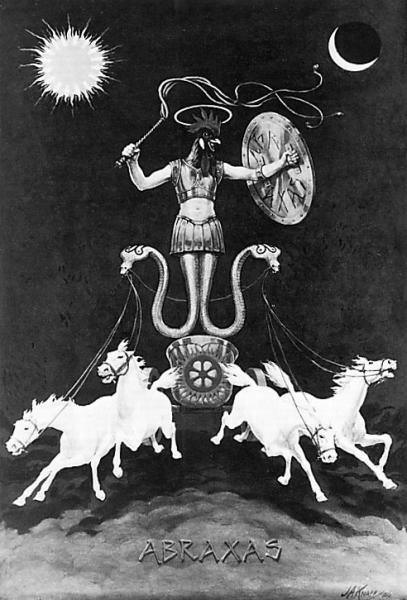
Mit Abraxas (griechisch Ἀβρασάξ, Ἀβράξας) bezeichnete der ägyptische Gnostiker Basilides in Alexandria um das 2. Jahrhundert das Symbol des höchsten Urwesens, aus dem die fünf Urkräfte Geist(Nous), Wort ( Logos), Vorsehung (Phronesis), Weisheit(Sophia) und Macht sowie sittliche Vollkommenheit und innerer Friede hervorgingen.Basilides verarbeitete verschiedene christlich-jüdische, persische und neuplatonische Überlieferungen zu einem dualistischen Weltbild.
Das frühe Christentum war stark gnostisch geprägt, gnostische Richtungen gab es auch im Judentum, und sogar der Islam hat seine Gnostiker (die Sufis). Die Gnostiker gehen davon aus, dass der Kern eines jeden Menschen ein “göttlicher Funke” ist. Der göttliche Funke ist unsterblich, er existiert außerhalb von Raum und Zeit. Solange der Mensch aber seinen wahren Zustand nicht erkannt hat, bleibt er in dieser Welt gefangen und muss immer wieder in einem neuen Körper reinkarnieren. Immer wieder einmal kommt aber ein Gesandter aus der Lichtwelt (bei den gnostischen Christen spielt Christus diese Rolle) auf die materielle Ebene, um dafür reif gewordene Seelen mit der Lichtkraft Gottes zu verbinden und es ihnen zu ermöglichen, dem Zugriff des falschen Gottes, des Demiurgen, zu entkommen. Der abrahamitische Gott ist dieser Demiurg. Daher haben die gnostischen Christen der Frühzeit das alte Testament rundweg abgelehnt.
Die Gnostiker sehen Abraxas als obersten Gott, der Gutes und Böses in einer Entität vereint, der Jesus als Sohn des alttestamentarischen Gottes Jahweh auf die Welt entsandt hat. Ähnlich wie C. G. Jung das im Alten Testament beschriebene Buch Ijob (Hiob) in seinem “Antwort auf Hiob” interpetiert hat (dort ist Jahweh sehr ambivalent beschrieben und Satan sein missratener Sohn).Anhänger des Basilides glaubten, dass der Körper von Jesus Christus eine Illusion war,während hier auf Erde weilte.
Aus dieser obersten Gottheit den die Anhänger des Basilides anbeteten, dem „ungewordenen Vater“, emanierten sieben göttliche Kräfte (nach der Zahl der Planeten), das erste Geisterreich aus dem in allmählich abnehmender Klarheit 364 weitere Geisterreiche, jedes mit sieben „Äonen“, hervorgingen. Die gesamten Geisterreiche werden zusammengefasst in dem Geheimwort Abraxas oder Abrasax, weil es die sieben griechischen Buchstaben enthielt, die numerisch gerechnet der Zahl 365 entsprechen. Abraxas wird auch unter die ägyptischen Götter eingeordnet. Er wurde auf Amuletten mit einer Peitsche in seiner Hand dargestellt. worden. Das mystische Wort Abrakadabra war von seinem Namen abgeleitet. Diese gnostischen Symbole wurden von vielen Gesellschaften angenommen, die Magie und Alchimie betrieben.
C.G. Jung schrieb in “Die sieben Belehrungen der Toten” unter dem literarischen Namen diese Basilides über Abraxas. Nach C.G. Jung kann ohne das Satan verstanden und integriert wird – wie bei Abraxas – der Mensch nicht erlöst werden. Wie soll aber nun Satan, der das Böse repräsentiert, integriert werden? Nach Jung nur durch einen Weg, das Böse (den Schatten) in das Bewusstsein zu heben. Bevor wir uns nicht völlig bewußt sind, wie entfremdet unser sozialisierter Zustand ist und wie wenig er unseren tieferen spirituellen Bedürfnissen genügt, so lange werden wir die Individuation nicht erreichen, durch die erst eine weitere und reifere Persönlichkeit entsteht.
Die Toten kamen zurück von Jerusalem, wo sie nicht fanden, was sie suchten. Sie begehrten bei mir Einlass und verlangten bei mir Lehre und so lehrte ich sie: Höret, ich beginne beim Nichts. Das Nichts ist dasselbe wie die Fülle. In der Unendlichkeit ist voll so gut wie leer. Das Nichts ist leer und voll. Ihr könnt auch ebenso gut etwas anderes vom Nichts sagen, zum Beispiel es sei weiß oder schwarz oder es sei nicht, oder es sei. Ein Unendliches und Ewiges hat keine Eigenschaften, weil es alle Eigenschaften hat. Das Nichts oder die Fülle nennen wir das PLEROMA. Dort drin hört Denken und Sein auf, denn das Ewige und Unendliche hat keine Eigenschaften. In ihm ist keiner, denn er wäre dann vom Pleroma unterschieden und hätte Eigenschaften, die ihn als etwas vom Pleroma unterschieden. Im Pleroma ist nichts und alles: Es lohnt sich nicht über das Pleroma nachzudenken, denn das hieße: Sich selber auflösen. Die CREATUR ist nicht im Pleroma, sondern in sich. Das Pleroma ist Anfang und Ende der Creatur. Es geht durch sie hindurch, wie das Sonnenlicht die Luft überall durchdringt. Obschon das Pleroma durchaus hindurch geht, so hat die Creatur doch nicht Theil daran, so wie ein vollkommen durchsichtiger Körper weder hell noch dunkel wird durch das Licht, das durch ihn hindurch geht. Wir sind aber das Pleroma selber, denn wir sind ein Theil des Ewigen und Unendlichen. Wir haben aber nicht theil daran, sondern sind vom Pleroma unendlich weit entfernt, nicht räumlich oder zeitlich, sondern WESENTLICH, indem wir uns im Wesen vom Pleroma unterscheiden als Creatur, die in Zeit und Raum beschränkt ist. Indem wir aber Theile des Pleroma sind, so ist das Pleroma auch in uns. Auch im kleinsten Punkt ist das Pleroma unendlich, ewig und ganz, denn klein und groß sind Eigenschaften, die in ihm enthalten sind. Es ist dies Nichts, das überall ganz ist und unaufhörlich. Daher rede ich von der Creatur als einem Theile des Pleroma, nur sinnbildlich, denn das Pleroma ist wirklich nirgends geteilt, denn es ist das Nichts. Wir sind auch das ganze Pleroma, denn sinnbildlich ist das Pleroma der kleinste nur angenommene, nicht seiende Punkt in uns und das unendliche Weltgewölbe um uns. Warum aber sprechen wir denn überhaupt vom Pleroma, wenn es doch Alles und Nichts ist ? Ich rede davon, um irgendwo zu beginnen, und um Euch den Wahn zu nehmen, dass irgendwo außen oder innen ein von vornherein Festes oder irgendwie Bestimmtes sei. Alles sogenannte Feste oder Bestimmte ist nur verhältnismäßig. Nur das dem Wandel unterworfene ist fest und bestimmt. Das wandelbare aber ist die Creatur, also ist sie das einzig feste und bestimmte, denn sie hat Eigenschaften, ja sie ist selber Eigenschaft. Wir erheben die Frage: wie ist die Creatur entstanden? Die Creaturen sind entstanden, nicht aber die Creatur, denn sie ist die Eigenschaft des Pleroma selber, so gut wie die Nichtschöpfung, der ewige Tod. Creatur ist immer und überall, Tod ist immer und überall. Das Pleroma hat alles, Unterschiedenheit und Ununterschiedenheit. Die Unterschiedenheit ist die Creatur. Sie ist unterschieden. Unterschiedenheit ist ihr Wesen, darum unterscheidet sie auch. Darum unterscheidet der Mensch, denn sein Wesen ist Unterschiedenheit. Darum unterscheidet er auch die Eigenschaften des Pleroma, die nicht sind. Er unterscheidet sie aus seinem Wesen heraus. Darum muss der Mensch von den Eigenschaften des Pleroma reden, die nicht sind. Ihr sagt: Was nützt es, davon zu reden? Du sagtest doch selbst, es lohne sich nicht, über das Pleroma zu denken. Ich sagte Euch das, um Euch vom Wahne zu befreien, dass man über das Pleroma denken könne. Wenn wir die Eigenschaften des Pleroma unterscheiden, so reden wir aus unsrer Unterschiedenheit und über unsre Unterschiedenheit, und haben nichts gesagt über das Pleroma. Über unsere Unterschiedenheit aber zu reden ist notwendig, damit wir uns genügend unterscheiden können. Unser Wesen ist Unterschiedenheit. Wenn wir diesem Wesen nicht getreu sind, so unterscheiden wir uns ungenügend. Wir müssen darum Unterscheidungen der Eigenschaften machen. Ihr fragt: Was schadet es, sich nicht zu unterscheiden? Wenn wir nicht unterscheiden, dann geraten wir über unser Wesen hinaus, über die Creatur hinaus und fallen in die Ununterschiedenheit, die die andere Eigenschaft des Pleroma ist. Wir fallen in das Pleroma selber und geben es auf, Creatur zu sein. Wir verfallen der Auflösung im Nichts. Das ist der Tod der Creatur. Also sterben wir in dem Maße, als wir nicht unterscheiden. Darum geht das natürliche Streben der Creatur auf Unterschiedenheit, Kampf gegen uranfängliche, gefährliche Gleichheit. Dieß nennt man das PRlNCIPIUM INDIVIDUATIONIS. Dieses Princip ist das Wesen der Creatur. Ihr seht daraus, warum die Ununterschiedenheit und das Nichtunterscheiden eine große Gefahr für die Creatur ist. Darum müssen wir die Eigenschaften des Pleroma unterscheiden. Die Eigenschaften sind die GEGENSATZPAARE, als das Wirksame und das Unwirksame, die Fülle und die Leere, das Lebendige und das Tote, das Verschiedene und das Gleiche, das Helle und das Dunkle, das Heiße und das Kalte, Die Kraft und der Stoff, die Zeit und der Raum, das Gute und das Böse, das Schöne und das Häßliche, das Eine und das Viele. etc. Die Gegensatzpaare sind die Eigenschaften des Pleroma, die nicht sind, weil sie sich aufheben. Da wir das Pleroma selber sind, so haben wir auch alle diese Eigenschaften in uns; da der Grund unsres Wesens Unterschiedenheit ist, so haben wir die Eigenschaften im Namen und Zeichen der Unterschiedenheit, das bedeutet: Erstens: die Eigenschaften sind in uns von einander unterschieden und geschieden, darum heben sie sich nicht auf, sondern sind wirksam. Darum sind wir das Opfer der Gegensatzpaare. In uns ist das Pleroma zerrissen. Zweitens: Die Eigenschaften gehören dem Pleroma, und wir können und sollen sie nur im Namen und Zeichen der Unterschiedenheit besitzen oder leben. Wir sollen uns von den Eigenschaften unterscheiden. Im Pleroma heben sie sich auf, in uns nicht. Unterscheidung von ihnen erlöst. Wenn wir nach dem Guten oder Schönen streben, so vergessen wir unsres Wesens, das Unterschiedenheit ist und wir verfallen den Eigenschaften des Pleroma, als welche die Gegensatzpaare sind. Wir bemühen uns, das Gute und Schöne zu erlangen, aber zugleich auch erfassen wir das Böse und Hässliche, denn sie sind im Pleroma eins mit dem Guten und Schönen. Wenn wir aber unserm Wesen getreu bleiben, nämlich der Unterschiedenheit, dann unterscheiden wir uns vom Guten und Schönen, und darum auch vom Bösen und Hässlichen, und wir fallen nicht ins Pleroma, nämlich in das Nichts und in die Auflösung Ihr werfet ein: Du sagtest, dass das Verschiedene und Gleiche auch Eigenschaften des Pleroma seien. Wie ist es, wenn wir nach Verschiedenheit streben? Sind wir dann nicht unserm Wesen getreu? Und müssen wir dann auch der Gleichheit verfallen, wenn wir nach Verschiedenheit streben? Ihr sollt nicht vergessen, dass das Pleroma keine Eigenschaften hat. Wir erschaffen sie durch das Denken. Wenn Ihr also nach Verschiedenheit oder Gleichheit oder sonstigen Eigenschaften strebt, so strebt Ihr nach Gedanken, die Euch aus dem Pleroma zufließen, nämlich Gedanken über die nichtseienden Eigenschaften des Pleroma. Indem Ihr nach diesen Gedanken rennt, fallet Ihr wiederum ins Pleroma und erreicht Verschiedenheit und Gleichheit zugleich. Nicht euer Denken, sondern euer Wesen ist Unterschiedenheit. Darum sollt Ihr nicht nach Verschiedenheit, wie Ihr sie denkt, streben, sondern NACH EUERM WESEN. Darum giebt es im Grunde nur ein Streben, nämlich das Streben nach dem eigenen Wesen. Wenn Ihr dieses Streben hättet, so brauchtet Ihr auch gar nichts über das Pleroma und seine Eigenschaften zu wissen und kämet doch zum richtigen Ziele kraft eures Wesens. Da aber das Denken vom Wesen entfremdet, so muss ich Euch das Wissen lehren, womit Ihr euer Denken im Zaume halten könnet.
Sermo II
Die Toten standen in der Nacht den Wänden entlang und riefen: Von Gott wollen wir wissen, wo ist Gott? Ist Gott tot? Gott ist nicht tot, er ist so lebendig wie je. Gott ist Creatur denn er ist etwas Bestimmtes und darum vom Pleroma unterschieden. Gott ist Eigenschaft des Pleroma, und alles was ich von der Creatur sagte gilt auch von ihm. Er unterscheidet sich aber von der Creatur dadurch, dass er viel undeutlicher und unbestimmbarer ist, als die Creatur. Er ist weniger unterschieden als die Creatur, denn der Grund seines Wesens ist wirksame Fülle, und nur insofern er bestimmt und unterschieden ist, ist er Creatur, und insofern ist er die Verdeutlichung der wirksamen Fülle des Pleroma. Alles, was wir nicht unterscheiden, fällt ins Pleroma und hebt sich mit seinem Gegensatz auf. Darum, wenn wir Gott nicht unterscheiden, so ist die wirksame Fülle für uns aufgehoben. Gott ist auch das Pleroma selber, wie auch jeder kleinste Punkt im Geschaffenen und im Ungeschaffenen das Pleroma selber ist. Die wirksame Leere ist das Wesen des Teufels. Gott und Teufel sind die ersten Verdeutlichungen des Nichts, das wir Pleroma nennen. Es ist gleichgültig, ob das Pleroma ist, oder nicht ist, denn es hebt sich in allem selber auf. Nicht so die Creatur. Insofern Gott und Teufel Creaturen sind, heben sie sich nicht auf, sondern bestehen gegen einander als wirksame Gegensätze. Wir brauchen keinen Beweis für ihr Sein, es genügt, dass wir immer wieder von ihnen reden müssen. Auch wenn beide nicht wären, so würde die Creatur, aus ihrem Wesen der Unterschiedenheit heraus, sie immer wieder aus dem Pleroma heraus unterscheiden.Alles was die Unterscheidung aus dem Pleroma herausnimmt, ist Gegensatzpaar, daher zu Gott immer auch der Teufel gehört. Diese Zusammengehörigkeit ist so innig, und wie Ihr erfahren habet, auch in euerem Leben so unauflösbar, wie das Pleroma selber. Das kommt davon, dass die Beiden ganz nahe am Pleroma stehen, in welchem alle Gegensätze aufgehoben und eins sind. Gott und Teufel sind unterschieden durch voll und leer, Zeugung und Zerstörung. Das WIRKENDE ist ihnen gemeinsam. Das Wirkende verbindet sie. Darum steht das Wirkende über beiden und ist ein Gott über Gott, denn es vereinigt die Fülle und die Leere in ihrer Wirkung. Dies ist ein Gott, von dem Ihr nicht wusstet, denn die Menschen vergaßen ihn. Wir nennen ihn mit seinem Namen ABRAXAS. Er ist noch unbestimmter als Gott und Teufel. ABRAXAS Um Gott von ihm zu unterscheiden, nennen wir Gott HELIOS oder Sonne. Der Abraxas ist Wirkung, ihm steht nichts entgegen, als das Unwirkliche, daher seine wirkende Natur sich frei entfaltet. Das Unwirkliche ist nicht, und widersteht nicht. Der Abraxas steht über der Sonne und über dem Teufel. Er ist das unwahrscheinlich Wahrscheinliche, das unwirklich Wirkende. Hätte das Pleroma ein Wesen, so wäre der Abraxas seine Verdeutlichung. Er ist zwar das Wirkende selbst, aber keine bestimmte Wirkung, sondern Wirkung überhaupt. Er ist unwirklich wirkend, weil er keine bestimmte Wirkung hat. Er ist auch Creatur, da er vom Pleroma unterschieden ist. Die Sonne hat eine bestimmte Wirkung, ebenso der Teufel, daher sie uns viel wirksamer erscheinen als der unbestimmbare Abraxas. Er ist Kraft, Dauer, Wandel. Hier erhoben die Toten großen Tumult denn sie waren Christen.
Sermo III
Die Toten kamen heran wie Nebel aus Sümpfen und riefen: Rede uns weiter über den obersten Gott.Der Abraxas ist der schwer erkennbare Gott. Seine Macht ist die größte, denn der Mensch sieht sie nicht. Von der Sonne sieht er das summum bonum, vom Teufel das Infimum malum, vom Abraxas aber das in allen Hinsichten unbestimmte LEBEN, welches die Mutter des Guten und des Übels ist. Das Leben scheint kleiner und schwächer zu sein als das summum bonum, weshalb es auch schwer ist zu denken, dass der Abraxas an Macht sogar die Sonne übertreffe, die doch der strahlende Quell aller Lebenskraft selber ist. Der Abraxas ist Sonne und zugleich der ewig saugende Schlund des Leeren, des Verkleinerers und Zerstücklers, des Teufels. Die Macht des Abraxas ist zwiefach. Ihr seht sie aber nicht, denn in Euern Augen hebt sich das Gegeneinander gerichtete dieser Macht auf. Was Gott Sonne spricht, ist Leben, was der Teufel spricht, ist Tod. Der Abraxas aber spricht das verehrungswürdige und verfluchte Wort, das Leben und Tod zugleich ist. Der Abraxas zeugt Wahrheit und Lüge, Gutes und Böses, Licht und Finsternis im selben Wort, und in derselben Tat. Darum ist der Abraxas furchtbar. Er ist prächtig wie der Löwe im Augenblick, wo er sein Opfer niederschlägt. Er ist schön wie ein Frühlingstag. Ja, er ist der große Pan selber und der kleine. Er ist Priapos. Er ist das Monstrum der Unterwelt, ein Polyp mit tausend Armen, beflügeltes Schlangengeringel, Raserei. Er ist der Hermaphrodit des untersten Anfanges. Er ist der Herr der Kröten und Frösche, die im Wasser wohnen und ans Land steigen, die am Mittag und um Mitternacht im Chore singen. Er ist das Volle, das sich mit dem Leeren einigt. Er ist die heilige Begattung, Er ist die Liebe und ihr Mord, Er ist der heilige und sein Verräter. Er ist das hellste Licht des Tages und die tiefste Nacht des Wahnsinns. Ihn sehen, heißt Blindheit, Ihn erkennen heißt Krankheit, Ihn anbeten heißt Tod, Ihn fürchten heißt Weisheit, Ihm nicht widerstehen heißt Erlösung. Gott wohnt hinter der Sonne, der Teufel wohnt hinter der Nacht. Was Gott aus dem Licht gebiert, zieht der Teufel in die Nacht. Der Abraxas aber ist die Welt, ihr Werden und Vergehen selber. Zu jeder Gabe des Gottes Sonne stellt der Teufel seinen Fluch. Alles, was Ihr vom Gott Sonne erbittet, zeugt eine Tat des Teufels. Alles, was Ihr mit Gott Sonne erschafft, giebt dem Teufel Gewalt des Wirkens. Das ist der furchtbare Abraxas. Er ist die gewaltigste Creatur und in ihm erschrickt die Creatur vor sich selbst. Er ist der geoffenbarte Widerspruch der Creatur gegen das Pleroma und sein Nichts. Er ist das Entsetzen des Sohnes vor der Mutter. Er ist die Liebe der Mutter zum Sohne. Er ist das Entzücken der Erde und die Grausamkeit der Himmel. Der Mensch erstarrt vor seinem Antlitz. Vor ihm giebt es nicht Frage und nicht Antwort. Er ist das Leben der Creatur. Er ist das Wirken der Unterschiedenheit. Er ist die Liebe des Menschen. Er ist die Rede des Menschen. Er ist der Schein und der Schatten des Menschen. Er ist die täuschende Wirklichkeit. Hier heulten und tobten die Toten, denn sie waren Unvollendete.
Sermo IV
Die Toten füllten murrend den Raum und sprachen: Rede zu uns von Göttern und Teufeln, Verfluchter. Gott Sonne ist das höchste Gut, der Teufel das Gegenteil, also habt Ihr zwei Götter. Es gibt aber viele hohe Güter und viele schwere Übel, und darunter giebt es zwei Gottteufel, der eine ist das BRENNENDE und der andere das WACHSENDE. Das Brennende ist der EROS in Gestalt der Flamme. Sie leuchtet, indem sie verzehrt. Das Wachsende ist der BAUM DES LEBENS, er grünt, indem er wachsend lebendigen Stoff anhäuft. Der Eros flammt auf und stirbt dahin, der Lebensbaum aber wächst langsam und stetig durch ungemessene Zeiten. Gutes und Übles einigt sich in der Flamme. Gutes und Übles einigt sich im Wachstum des Baumes. Leben und Liebe stehen in ihrer Göttlichkeit gegeneinander. Unermesslich, wie das Heer der Sterne ist die Zahl der Götter und Teufel. Jeder Stern ist ein Gott und jeder Raum, den ein Stern füllt, ist ein Teufel. Das Leervolle des Ganzen aber ist das Pleroma. Die Wirkung des Ganzen ist der Abraxas, nur Unwirkliches steht ihm entgegen. Vier ist die Zahl der Hauptgötter, denn vier ist die Zahl der Ausmessungen der Welt. Eins ist der Anfang, der Gott Sonne. Zwei ist der Eros, denn er verbindet Zwei und breitet sich leuchtend aus. Drei ist der Baum des Lebens, denn er füllt den Raum mit Körpern. Vier ist der Teufel, denn er öffnet alles Geschlossene; er löst auf alles Geformte und Körperliche, er ist der Zerstörer, in dem Alles zu Nichts wird. Wohl mir, dass es mir gegeben ist, die Vielheit und Verschiedenartigkeit der Götter zu erkennen. Wehe Euch dass Ihr diese unvereinbare Vielheit durch den einen Gott ersetzt. Dadurch schafft Ihr die Qual des Nichtverstehens und die Verstümmelung der Creatur, deren Wesen und Trachten Unterschiedenheit ist. Wie seid Ihr eurem Wesen getreu, wenn Ihr das Viele zum Einen machen wollt? Was Ihr an den Göttern tut, geschieht auch an Euch. Ihr werdet alle gleich gemacht und so ist euer Wesen verstümmelt. Um des Menschen willen herrsche Gleichheit, aber nicht um Gottes willen, denn der Götter sind viele, der Menschen aber wenige. Die Götter sind mächtig, und ertragen ihre Mannigfaltigkeit, denn wie die Sterne stehen sie in Einsamkeit und ungeheurer Entfernung von einander. Die Menschen sind schwach und ertragen ihre Mannigfaltigkeit nicht, denn sie wohnen nahe beisammen und bedürfen der Gemeinschaft, um ihre Besonderheit tragen zu können. Um der Erlösung willen lehre ich Euch das Verwerfliche, um dessentwillen ich verworfen ward. Die Vielzahl der Götter entspricht der Vielzahl der Menschen. Unzählige Götter harren der Menschwerdung. Unzählige Götter sind Menschen gewesen. Der Mensch hat am Wesen der Götter teil, er kommt von den Göttern und geht zum Gotte. So, wie es sich nicht lohnt über das Pleroma nachzudenken, so lohnt es sich nicht, die Vielheit der Götter zu verehren. Am wenigsten lohnt es sich, den ersten Gott, die wirksame Fülle und das summum bonum, zu verehren. Wir können durch unser Gebet nichts dazu tun und nichts davon nehmen, denn die wirksame Leere schluckt alles in sich auf. Die hellen Götter bilden die Himmelswelt, sie ist vielfach und unendlich sich erweiternd und vergrößernd. Ihr oberster Herr ist der Gott Sonne. Die dunkeln Götter bilden die Erdenwelt. Sie sind einfach und unendlich sich verkleinernd und vermindernd. Ihr unterster Herr ist der Teufel, der Mondgeist, der Trabant der Erde, kleiner und kälter und toter als die Erde. Es ist kein Unterschied in der Macht der himmlischen und der erdhaften Götter. Die himmlischen vergrößern, die erdhaften verkleinern. Unermesslich ist beiderlei Richtung.
Sermo V
Die Toten spotteten und riefen: Lehre uns, Narr, von Kirche und heiliger Gemeinschaft. Die Welt der Götter verdeutlicht sich in der Geistigkeit und in der Geschlechtlichkeit. Die himmlischen erscheinen in der Geistigkeit, die erdhaften in der Geschlechtlichkeit. Geistigkeit empfängt und erfasst. Sie ist weiblich und darum nennen wir sie die MATER COELESTIS, die himmlische Mutter. Geschlechtlichkeit zeugt und erschafft. Sie ist männlich und darum nennen wir sie PHALLOS, den erdhaften Vater. Die Geschlechtlichkeit des Mannes ist mehr erdhaft, die Geschlechtlichkeit des Weibes ist mehr geistig. Die Geistigkeit des Mannes ist mehr himmlisch, sie geht zum Größeren. Die Geistigkeit des Weibes ist mehr erdhaft, sie geht zum Kleineren. Lügnerisch und teuflisch ist die Geistigkeit des Mannes, die zum Kleineren geht. Lügnerisch und teuflisch ist die Geistigkeit des Weibes, die zum Größern geht. Jeder gehe zu seiner Stelle. Mann und Weib werden aneinander zum Teufel, wenn sie ihre geistigen Wege nicht trennen, denn das Wesen der Creatur ist Unterschiedenheit. Die Geschlechtlichkeit des Mannes geht zum Erdhaften, die Geschlechtlichkeit des Weibes geht zum Geistigen. Mann und Weib werden aneinander zum Teufel, wenn sie ihre Geschlechtlichkeit nicht trennen. Der Mann erkenne das Kleinere, das Weib das Größere. Der Mensch unterscheide sich von der Geistigkeit und von der Geschlechtlichkeit. Er nenne die Geistigkeit Mutter und setze sie zwischen Himmel und Erde. Er nenne die Geschlechtlichkeit Phallos und setze ihn zwischen sich und die Erde, denn die Mutter und der Phallos sind übermenschliche Dämonen und Verdeutlichungen der Götterwelt. Sie sind uns wirksamer als die Götter, weil sie unserm Wesen nahe verwandt sind. Wenn Ihr Euch von Geschlechtlichkeit und von Geistigkeit nicht unterscheidet und sie nicht als Wesen über Euch und um Euch betrachtet, so verfallt Ihr ihnen als Eigenschaften des Pleroma. Geistigkeit und Geschlechtlichkeit sind nicht Eure Eigenschaften, nicht Dinge, die Ihr besitzt und umfasst, sondern sie besitzen und umfassen Euch, denn sie sind mächtige Dämonen, Erscheinungsformen der Götter, und darum Dinge, die über Euch hinaus reichen und an sich bestehen. Es hat einer nicht eine Geistigkeit für sich oder eine Geschlechtlichkeit für sich, sondern er steht unter dem Gesetz der Geistigkeit und der Geschlechtlichkeit. Darum entgeht keiner diesen Dämonen. Ihr sollt sie ansehen als Dämonen und als gemeinsame Sache und Gefahr, als gemeinsame Last, die das Leben euch aufgebürdet hat. So ist Euch auch das Leben eine gemeinsame Sache und Gefahr, ebenso auch die Götter und zuvorderst der furchtbare Abraxas. Der Mensch ist schwach, darum ist Gemeinschaft unerläßlich; ist es nicht die Gemeinschaft im Zeichen der Mutter, so ist es sie im Zeichen des Phallos. Keine Gemeinschaft ist Leiden und Krankheit. Gemeinschaft in jeglichem ist Zerrissenheit und Auflösung. Die Unterschiedenheit führt zum Einzel sein. Einzel sein ist gegen Gemeinschaft. Aber um der Schwäche des Menschen willen gegenüber den Göttern und Dämonen und ihrem unüberwindlichen Gesetz ist Gemeinschaft nötig. Darum sei so viel Gemeinschaft als nötig, nicht um der Menschen willen, sondern wegen der Götter. Die Götter zwingen Euch zur Gemeinschaft. So viel sie Euch zwingen, so viel Gemeinschaft tut not, mehr ist von Übel. In der Gemeinschaft ordne sich jeder dem andern unter, damit die Gemeinschaft erhalten bleibe, denn Ihr bedürft ihrer. Im Einzel sein ordne sich einer dem andern über, damit jeder zu sich selber komme und Sklaverei vermeide. In der Gemeinschaft gelte Enthaltung, im Einzel sein gelte Verschwendung. Die Gemeinschaft ist die Tiefe, das Einzel sein ist Höhe. Das richtige Maß in Gemeinschaft reinigt und erhält. Das richtige Maß im Einzel sein reinigt und fügt hinzu. Die Gemeinschaft giebt uns die Wärme, das Einzel sein giebt uns das Licht.
Sermo VI
Der Dämon der Geschlechtlichkeit tritt zu unsrer Seele als eine Schlange. Sie ist zur Hälfte Menschenseele und heißt Gedankenwunsch. Der Dämon der Geistigkeit senkt sich in unsre Seele herab als der weiße Vogel. Er ist zur Hälfte Menschenseele und heißt Wunschgedanke. Die Schlange ist eine erdhafte Seele, halb dämonisch, ein Geist und verwandt den Geistern der Toten. Wie diese, so schwärmt auch sie herum in den Dingen der Erde und bewirkt, dass wir sie fürchten, oder dass sie unsere Begehrlichkeit reizen. Die Schlange ist weiblicher Natur und sucht immer die Gesellschaft der Toten, die an die Erde gebannt sind, solche, die den Weg nicht hinüberfanden, nämlich ins Einzel sein. Die Schlange ist eine Hure und buhlt mit dem Teufel und mit den bösen Geistern, ein arger Tyrann und Quälgeist, immer zu übelster Gemeinschaft verführend. Der weiße Vogel ist eine halbhimmlische Seele des Menschen. Sie weilt bei der Mutter und steigt bisweilen herab. Der Vogel ist männlich und ist wirkender Gedanke. Er ist keusch und einsam, ein Bote der Mutter. Er fliegt hoch über die Erde. Er gebietet das Einzel sein. Er bringt Kunde von den Fernen, die vorangegangen und vollendet sind. Er trägt unser Wort herum in den Dingen der Erde und bewirkt, dass wir sie fürchten, oder dass sie unsere Begehrlichkeit reizen. Die Toten blickten mit Verachtung und sprachen: Höre auf von Göttern, Dämonen und Seelen zu reden. Das wussten wir im Grunde schon längst.
Sermo VII
Des Nachts aber kamen die Toten wieder mit kläglicher Gebärde und sprachen: Noch eines, wir vergaßen davon zu reden, lehre uns vom Menschen. Der Mensch ist ein Thor, durch das Ihr aus der Außenwelt der Götter, Dämonen und Seelen eintretet in die Innenwelt, aus der größeren Welt in die kleinere Welt. Klein und nichtig ist der Mensch, schon habt Ihr ihn im Rücken, und wiederum seid Ihr im unendlichen Raume, in der kleineren oder inneren Unendlichkeit.In unermesslicher Entfernung steht ein einziger Stern im Zenith. Dies ist der eine Gott dieses Einen, dies ist seine Welt, sein Pleroma, seine Göttlichkeit. In dieser Welt ist der Mensch der Abraxas, der seine Welt gebiert oder verschlingt. Dieser Stern ist der Gott und das Ziel des Menschen. Dies ist sein einer führender Gott, in ihm geht der Mensch zur Ruhe, zu ihm geht die lange Reise der Seele nach dem Tode, in ihm erglänzt als Licht alles, was der Mensch aus der größeren Welt zurückzieht. Zu diesem einen bete der Mensch. Das Gebet mehrt das Licht des Sternes, es schlägt eine Brücke über den Tod, es bereitet das Leben der kleineren Welt, und mindert das hoffnungslose Wünschen der größeren Welt. Wenn die größere Welt kalt wird, leuchtet der Stern. Nichts ist zwischen dem Menschen und seinem einen Gotte, sofern der Mensch seine Augen vom flammenden Schauspiel des Abraxas abwenden kann. Mensch hier, Gott dort. Schwachheit und Nichtigkeit hier, ewige Schöpferkraft dort. Hier ganz Dunkelheit und feuchte Kühle, dort ganz Sonne. Darauf schwiegen die Toten und stiegen empor wie Rauch über dem Feuer des Hirten, der des Nachts seiner Herde wartete. ANAGRAMMA: NAHTRIHECCUNDE GAHINNEVERAHTUNIN ZEHGESSURKLACH ZUNNUS
Based on Carl G. Jung’s typology [Jung, 1921], people can be classified using four mental functions sensing, intuition, thinking and feeling together with the attitude (extraversion-introversion). An extrovert deals more with the objective whereas an introvert relies more with the subjective – C.G. Jung is quite clear that both the objective and the subjective represent facts and reality. The direction points to the source of energy that feeds the dominant mental function. An extrovert’s source of energy is mainly found in the outside world, whereas an Introvert’s source of energy is mainly found in his or her inner world. C. G. Jung’s classification scheme has been used quite successfully from individuals as well in the workplace.
By observation or asking certain questions it is possible to determine whether the organization of what type an individual’s nervous system results in thinking, feelings, response and behavior predominantly is. In that respect, most of Carl G. Jung’s concepts can even be applied to a group (like a team) or an organisation (like a company) or even a society. I recall a team analysis, using this method, which gave the rational for a yelling team, one of the best I ever worked with. An additional parameter in the Myer Briggs Indicator scheme, which is derived from but modified C.Jung’s system, helps to determine the dominant function. Its usefulness is in dispute as I come up in all type table derivates as having two opposite main and auxiliary function and what should you do with this – moderate introvert, distinctive intuitive, distinctive thinker, slightly judging). On the funny side, my numbers puts me in context of Isaac Newton, Niels Bohr, -and- C. G. Jung. So this article tries to explore it more from the C.G. Jung elaborate point of view.
Jung’s Introversion and extraversion Attitudes
The first of Jung’s general psychological types was the general attitude type. An attitude, according to Jung, is a person’s predisposition to behave in a particular way. There are two opposing attitudes: introversion and extraversion. The two attitudes work as opposing, yet complementary forces and are often depicted as the classing yin and yang symbol. Starting with the basic disposition or criteria, key differences between introverts and extroverts include:
Introverts direct themselves inward toward concepts and ideas while Extroverts direct themselves outward toward people and objects
Introverts are thought-oriented while extroverts are action-oriented
Introverts want depth; while extroverts seek breadth.
The introvert is most aware of his or her inner world. While the external world is still perceived, it is not pondered as seriously as inward movement of psychic energy. The introverted attitude is more concerned with subjective appraisal and often gives more consideration to fantasies and dreams.
The extrovert, by contrast, is characterized by the outward movement of psychic energy. This attitude places more importance on objectivity and gains more influence from the surrounding environment than by inner cognitive processes
Jung’s Four Functions of Personality
For Carl Jung, there were four functions that, when combined with one of his two attitudes, formed the eight different personality types.
Extraversion
Introversion
Sensing
iNtuition
Thinking
Feeling
Judging
Perceiving
Carl Jung introduced typology also a hierarchy of mental functions in two mental bipolar dimensions (dichotomies) in his approach to personality. These are Sensing-Intuition (SN) and Thinking-Feeling(TF). He used the terms dominant, auxiliary, and inferior. Please note that Extraversion/introversion is an attitude , whereas Judging/Perceiving more of a clustering.
Thinking-Feeling(TF)
The first dichotomy, TF (T stands for Thinking and F – for Feeling), refers to how an individual processes the information. The function — feeling — is the method by which a person qualifies the value of conscious activity. The function — thinking — allows a person to understand the meanings of things. This process relies on logic and careful mental activity. According to C.G. Jung thinking and feeling are called “rational” function, because it typical for mental activity that consciously operates with, judges (good or bad feeling) or analyzes received information. People with predominantly “rational” function perceive the world as an ordered structure that follows a set of rules.
Sensing and iNtuition (SN)
The second dichotomy, SN (S stands for Sensing and N – for iNtuition), represents the way in which an individual receives information. According to C.G. Jung sensing and intuition are called “irrational” functions. These functions may seem very similar, but there is an important distinction. The first irrational function – sensation- refers to the means by which a person knows something exists, derived by our senses. The other irrational function -intuition- is knowing about something without conscious understanding of where that knowledge comes from. The “irrational” function, according to Jung, is typical for mental and perceptual activity that predominantly (and, for the most part, unconsciously) operates with opportunities, i.e. various possible outcomes and sensations result from some premises and sensations, mostly driven by unconscious processes. People with predominantly “irrational” thinking see the world as a structure that can take various forms and outcomes.
Hierarchy of Personality Types
A person is not usually defined by only one of the eight personality types. Instead, the different functions exist in a hierarchy. One function will be dominant and another will have a auxiliary effect. It is only the person who achieves self-realization that has completely developed all four functions. Usually, according to Jung, a person only makes significant use of two functions. The lesser two take inferior positions and is the individuation process who tries to develop all functions over a lifetime, although according to L v. Franz the fourth function (most inferior) will always remain in the unconsciousness. One of the poles of the two dichotomies predominates over the rest of the poles. This pole defines the dominant function.
Jung called the mental activity characterized by predominantly rational functionjudging, and the mental and perceptual activity characterized by predominantly irrational function perceiving. More recently, typologists e.g. Moore have introduced theoretical systems in which all people possess eight functions—equivalent to the four functions as defined by Jung but in each of the two possible attitudes—with the four in the opposite attitude (+/-) known as bipolar “shadow functions”, residing largely in the unconscious.
All possible permutations of the two mental bipolar dimensions with the two major types of introverts and extroverts above define 8 different personality types. Each type can be assigned a name (personality type formula), as an acronym of the combination of the 4 dimensions that defines the Personality Type.
extrovert thinking orients itself strongly at objective and outside conditions and often is, but not always to objective (concrete and material) facts. This type may be opinionated and have high demand to themselves and others. They act often uncompromisingly, according to the slogan „The end justifies the means “ with little regard to feelings of themselves or others. Jung theorized that people understand the world through a mix of concrete ideas and abstract ones, but the abstract concepts are ones passed down from other people. Extroverted thinkers are often found working in the research sciences and mathematics.
extrovert feeling is altruistic, a convention oriented like no other function. With too much object influence this type appears coldly, inauthentic and purpose-oriented and can in frequent changes of the point of view give an unreliable appearance. This type is most susceptible to hysteria. These people judge the value of things based on objective fact. Comfortable in social situations, they form their opinions based on socially accepted values and majority beliefs. They are often found working in business and politics.
extrovert sensing is a vital function with the strongest life impulse. This type appears realistic and often also benefit-oriented. With to strong object influence their unscrupulous side shows up. In neuroses they develop of all kinds phobias with strong symptoms. These people perceive the world as it really exists. Their perceptions are not colored by any pre-existing beliefs. Jobs that require objective review, like accountants and administrators, are best filled by extroverted sensing people.
extrovert intuition strives for discovery of possibilities and sacrifices selves possibly for them. This type gives often only small consideration to the environment. and can be diverted easily. These people prefer to understand the meanings of things through subliminally perceived objective fact rather than incoming sensory information. They rely on hunches and often disregard what they perceive directly from their senses. Inventors that come upon their invention via a stroke of insight and some religious reformers are characterized by the extraverted intuitive type.
introvert thinking creates theory for the sake of the theory and is a little practically oriented. Danger exists that they isolate themselves.These individuals interpret stimuli in the environment through a subjective and creative way. The interpretations are informed by internal knowledge and understanding. Philosophers and theoretical scientists are often introverted thinking-oriented people.
introvert feeling is with difficulty accessible and often hidden behind a mask. These humans are inconspicuous and show few emotions; Emotions are not external but internal with them. In a neurosis the cruel side shows up. These people make judgments based on subjective ideas and on internally established beliefs. Oftentimes they ignore prevailing attitudes and defy social norms of thinking. Introverted feeling people thrive in careers as art critics.
introvert sensing leads to character-conditioned expression difficulties. The persons are often calm and passive. Their artistic expression ability is strong. They move in a mythic world and are sometimes easy believers. These individuals interpret the world through the lens of subjective attitudes and rarely see something for only what it is. They make sense of the environment by giving it meaning based on internal reflection. Introverted sensing people often turn to fine arts.
introvert intuition occurs with humans, who are interested in the background procedures of consciousness. They try to integrate their visions into its own life. In case of a neurosis they are inclined to the obsessions with hypochondriac appearance. The famous example of C.G. Jung im an interview is the “lady with a snake in the abdomen” who lived in a private brothel without noticing it.These individuals, Jung thought, are profoundly influenced by their internal motivations even though they do not completely understand them. They find meaning through unconscious, subjective ideas about the world. Introverted intuitive people comprise a significant portion of mystics, surrealistic artists, and religious fanatics. Pretty often they are mystic dreamers or shamans or seers.
You may be introverted period, or may be introverted in certain situations or you be an introvert who has adapt to your extroverted organization, or an extrovert who adopted some successful introverted behaviors. The next challenge is to find the primary and your secondary function. Maybe this is the key point – individuation means to access all four functions.
OTHER TYPE CLASSIFICATIONS
Adding the shadow
A simplified and very poetic scheme, using a triangle with two shadow possibilities (too weak, to strong), was derived by Moore using four archetypes (King, Magician, Warrior,Lover) to evaluate male behavior. Please see the separatearticlesto this.
Beebe also described the different cognitive functions’ role in the overall personality in terms of various mythic archetypes bringing in the unconscious shadow function. Isabel Myers’ original type table format can be used.
1st – Hero/Heroine
2nd – Good Parent
3rd – Puer/Puella
4th – Anima/Animus
5th – Opposing Personality
6th – Senex/Witch
7th – Trickster
8th – Daemon
Lenore Thomson as well as Linda Berens offers yet another model of type tables, terminology and ordering of cognitive processes.
Adding the dichotomy
The widely used Myers-Briggs personality type system was derived by Isabel Myers and her Mother from above described Jung’s scheme. The Myers-Briggs Type Indicator (MBTI) analyzes four preferences, resulting in sixteen possible combinations. If you look closely, the fourth letter J (for judging) or P (for perceiving) seems superfluids or at least auxiliary – adding just Jung’s dichotomy as a (not derived) preference or function.
TYPE TABLES
Isabel Myers, however, created the original type table. In her table, diametrically opposite personality types (that is, those with no traits in common among the dichotomies) are separated by one block along diagonals.
1 Understand that no one preference is better than another, and no single personality type is superior to another. The MBTI seeks to identify natural preferences, not abilities. When determining your type, look at it from the perspective of what you tend to do, not what you think you should do. Recognizing your own preferences is a useful tool in self-development.
2 Determine if you are introverted or extroverted. This preference is not so much about how social you are (which is what these terms are often associated with), as much as it deals with your tendency to act. Are you more likely to act, and then reflect? Or do you prefer to think things through before you act? Someone who acts first tends to feel motivated and energized in doing so and is typically extroverted in MTBI terms. But if you’re the kind of person who needs a break in order to introspect and re-energize, you’re probably introverted.
3 Think about how you gather information: through sensing or through intuition? Sensors see the trees, intuitives see the forest. Sensors prefer concrete detail and facts. They’re more likely to say “I won’t believe it till I see it.” They tend to distrust hunches or guesses when they’re not rooted in logic, observation or facts. Intuitives, on the other hand, feel more comfortable with abstract information and theories. They are spontaneous and more imaginative than sensors and enjoy exploring beyond the here and now, especially when thinking about the possibilities of the future. Their thoughts revolve around patterns, connections, and flashes of insights.
4 Look at how you make decisions. Once you gather your information, whether by sensing or intuitively, how do you arrive at a decision? Do you tend to try and look it it from the perspective of everyone involved in an attempt to find the most balanced, harmonious solution (e.g. reach a consensus)? If so, your preference is probably for feeling. But if instead, you tend to look for the most logical and consistent solution, perhaps measuring it up against a set of rules or assumptions, then your decision-making preference is likely to be thinking. Feeling types tend to be very uncomfortable with the presence of conflict, while thinking types usually accept and expect it as part and parcel of dealing with others. Some people assume that the feeling preference implies an emotional person, while the thinking preference is tied to a more rational person, but this is not the case. Both are rational approaches, and people with either preference can be emotional.
5 Think about how you relate to the outside world. Do you tend to communicate judgments or perceptions to others? If you have a judging preference, you’re more likely to explain to people how you make decisions and like to have matters settled – case closed. You like to make plans, check things off of a to-do list, and get things done ahead of deadlines. On the other hand, if you’re the perceiving type, you’ll tend to share your observations with the world, leaving matters open. You also prefer to do things “on the fly”, mix work with play, and wait until the last minute before making a decision or commitment.
6 Determine your personality type, which is a combination of four letters (e.g. INTJ, ENFP):
The first letter is either I (for introverted) or E (for extroverted).
The second letter is either S (for sensing) or N (for intuitive).
The third letter is either T (for thinking) or F (for feeling).
The fourth letter is either J (for judging) or P (for perceiving).
The “Huston Interviews” refer to a series of filmed conversations between pioneering psychologist Carl Gustav Jung and Dr. Richard I. Evans, a psychology professor from the University of Houston.
Recorded over four days in August 1957 in Zürich, Switzerland, these conversations were originally intended for educational purposes. They offer a uniquely intimate look into Jung’s theories, featuring several key details and discussions:
Overview Huston Interviews
Core Psychological Concepts: Jung discussed foundational ideas including archetypes, dream analysis, the anima and animus, and human behavioral patterns.
His Relationship with Freud: Jung candidly addressed his early collaboration, subsequent theoretical divergence, and eventual break from Sigmund Freud.
The Huston Interviews can either be obtained in youtube or in a written form in the Bollinger Series“C.G. Jung speaking”.
Topics of Huston Interviews
Dr. Richard I. Evans interviews Jung, giving us a unique understanding of Jung’s many archetypes theories, human behavior-patterns, Anima & Animus, dream-analysis, his relationship with Sigmund Freud and his theories in general. Jung comes acrross as caring, funny and cristal clear and highly personable human healer. The dialogue in this volume is the actual transcript of the author’s filmed interviews with Dr. Carl Jung in Zurich, Switzerland, in summer 1957 four years before death. It presents the most exciting and lucid presentation of Jung’s fundamental concepts yet recorded. Jung, reacting spontaneously to an orderly sequence of questions, commented on Freud, Adier, and on their theories; and on topics such as: The Unconscious, the Role of Sex, Introvert-Extrovert Theory and Motivation; and Psychological Testing, Psychotherapy, and Mental Telepathy. In an added section. Professor Evans presents a transcript of his filmed interview with Dr. Richard Evans — not a great interviewer.
Jung on Freud in Huston Interviews
Jung quipped and sparkled, seemed to enjoy the whole thing immensely. Much of what he said was highly interesting and quite to easy to follow – in a way an introduction to his psychoanalytic system which he explains lively. In this Jung on Film, the pioneering psychologist Carl Jung tells us about his collaboration with Sigmund Freud, about the insights he gained from listening to his patients’ dreams, and about the fascinating turns his own life has taken. Brilliant are his case studies. In this most interesting volume, Jung explains many of his concepts/models in response to interviews, questions, etc. giving the information a different slant & providing needed context on the spot. Topics include: psychological types, anima/animus, individuation vs. therapy, non-politically correct views on the differences between men & women, the persona (societal image/roles), mandalas as images of the Self, psychosomatic illnesses, Rorschach tests, mythology & archetypes, psychotherapy & the transference, the nature & value of marriage, Plato, astrology, & more.
Links
C. G. Jung – Original Transcript of the 1957 Interviews of the filmed interviews with C. G. Jung, conducted by Richard Evans in August 1957 The Gnosis Archive