Tag: Totalitarian

  • Attraction of “Adolf Hitler and Obersalzberg” – shadows of the dictator

    Attraction of “Adolf Hitler and Obersalzberg” – shadows of the dictator

    In September we camped on the lake “Königsee” enjoying a few beautiful Indian Summer days. The Königsee is only a few miles away from Obersalzberg, once Hitlers mountainside retreat. There is now a luxury hotel “Intercontinental” in this area situated above the market town of Berchtesgaden in Bavaria, Germany, located about 120 kilometres southeast of Munich.

    1935 Obersalzberg 

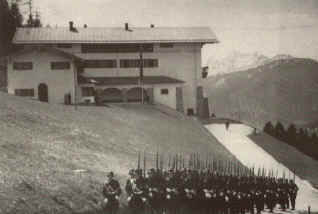
    After 1935 Obersalzberg became very fashionable under the National Socialists top brass and almost a second government district of the Third Reich. Before Hitler owned Haus Wachenfeld (later renamed the “Berghof”), and Hermann Göring a small rustic house there. This photo below shows the Obersalzberg area in the summer of 1936, following the conversion of Hitler’s Haus Wachenfeld into the Berghof. The view is looking southeast, with the Berghof in the center.

    Obersalzberg

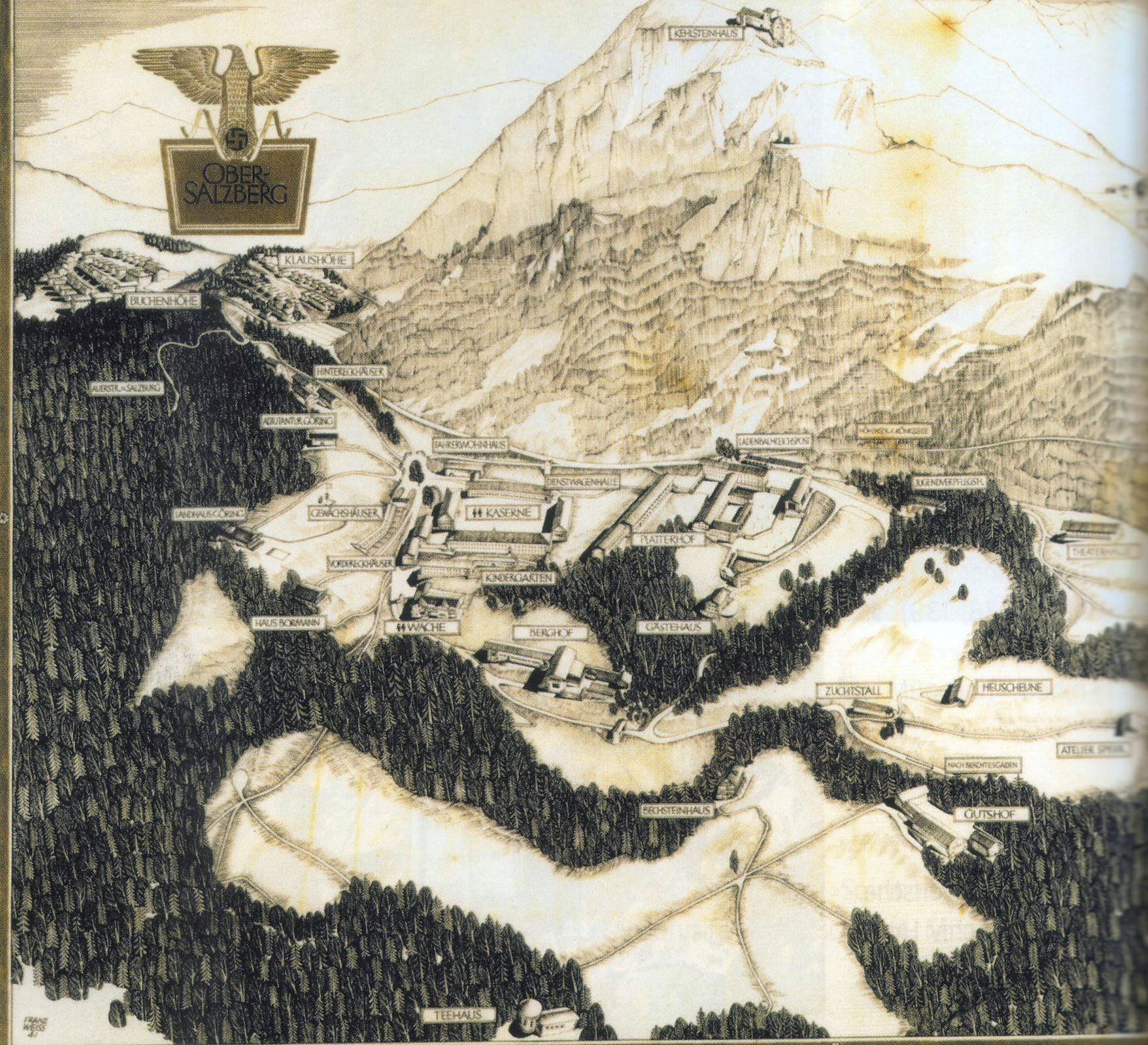
    Later Bormann’s and Göring’s houses, the Platterhof, Gästehaus and Kampfhäusl, the Hotel Zum Türken, an elaborate bunker system, the Kehlsteinhaus (Eagles Nest), SS barracks, the Gutshof, the Teehaus and miscellaneous buildings were built there or bought along with the land. The “purchases” were generous and cheap buyouts, accompanied by arm twisting or substantial threats or plainly disowned.1941 the whole area was completed as the picture below shows (Source: “Die Tödliche Utopie”, Exhibition catalogue of the documentation center).

    1945 Obersalzberg 

    Shortly after the war, “everybody from the US Army and his bother” wanted to visit this famous place and it the area was used by the US Army until it was given back to the Bavarian state. The slide show gives an impression about the surroundings, which is today a natural reserve or nature park with building restrictions like a national park in the US.

    This slideshow requires JavaScript.

    In Obersalzberg is a political Memorial Museum (the documentation center) and the Kehlsteinhaus, known in English as the Eagle’s Nest. It is open to the public and accessible via a breathtaking bus journey and a luxurious brass elevator up through the rock. The Kehlsteinhaus is the last not destroyed example of historic architecture in stunning alpine setting.

    To control the crowds who came to see their Führer and Reichskanzler in his home in Berchtesgaden, SS guards were brought in, barracks had to be built, lodgings for all the workers needed for the construction and remodeling were required, accommodations for important guests were necessary, housing for all the needed staff had to be built, kindergartens for their children. Soon the mountain area was a vast scene of construction, and a high fence was built around the entire area to keep the crowds away.
    berghofcloseup
    berghofcloseup

    Eventually, mostly by design of Nazi Reichsleiter Martin Bormann (who ran the Obersalzberg complex), Hitler’s palatial Berghof (no longer a rustic mountain lodge) was surrounded by a security area from which the common people of the Third Reich were excluded. Some of these buildings can be seen in this 1981 post card, taken from the Kehlsteinhaus almost 3000 feet higher on the Hoher Göll mountain overlooking the Obersalzberg.

    OberSalzbergFromKehlstein
    OberSalzbergFromKehlstein

    Many of these buildings were severely damaged and substantially destroyed in a Royal Air Force bombing attack on 25th April 1945.  Although Bavaria in 1947 tried hard to wipe out the last visible traces of the third of Reich after the partial returns by the Americans and blew up 1952 the remains of the destroyed Hitler domicile, the Obersalzberg is a historical area until now. The 1999 furnished “Documentation Center Obersalzberg” a memorial museum channeled the “wild” Hitler tourism in the sense of a critical – sometimes to obvious – engagement. At the same time, the permanent exhibition inspired the tourist assault on the town, which counts about 150,000 visitors annually. In addition to this permanent exhibition,  temporary exhibitions, lectures and events, and an extensive training programme was designed and is supervised on behalf of the State of Bavaria. The exhibitions offers the possibility to deal with the history of the Obersalzberg area and  national socialism at the historic site. It is good when it stays focussed on Obersalzberg. The title of the catalogue (in German only) is actually misnomer – it is about myths not about utopia – but quite good too.

    Quite a few question were left unanswered though: What has fascinated people in Hitler ever since? And what fascinates them today? If internet is the guide, the longer he is dead, the more about him is thought, processed and reproduced as the incorruptible Google timeline shows. I don’t know why, but I felt a bit uneasy after the exhibition. I was missing something. Something was also not quite right presented. I re-read the catalogue, and then I came to an observation.

    truthIsRelativeSomeTimes I
    truthIsRelativeSomeTimes I

    The inflation time was described by the exhibition almost as a natural catastrophe with children cards, although it was entirely men made. The underlying  reasons and the most important persons like Schacht and Streseman ,solving the crisis, were not mentioned. Dr. Hjalmar Schacht  was the Currency Commissioner and President of the Reichsbank under the Weimar Republic, who later (1930) resigned over disagreements about the reparation negotiations and economic issues with the German government. He fixed pretty single-handed the hyper inflation, to a big degree fueled by foreign currency speculation (besides caused by the crippling reparation payments).The same was true for the deflation time triggered by the Black Friday 1929, which he fixed as well. Schacht, a committed conservative democrat who never been a member of the Nazi Party supported Hitler from 1931 based on the common fight against the treaty of Versailles. He became President of the Reichsbank 1933 again and 1934 Minister of Economics untill he was forced out of the government. Later he went in the resistance against Hitler and thrown in the concentration camp (and from there (!) to the Nuremberg trial).Thirdly omitted was the incredibly economic turnaround engineered from 1934 to 1936. The story in the exhibition went fast forward from 1933 almost starting with the beginning of the war 1941 and the death camps 1942. The time before was hazy, as the structure of the exhibition was organized topic rather than time driven (which makes it easy to confuse people). There is nothing wrong to emphasise on the terrible deeds, but one could get the impression, that totalitarian systems are switched on instantly, like a light bulb and its cruelty and evil intentions are visible to everybody immediately.

     connerie de nobel de la paix, totalitarisme soft, union européenne
    connerie de nobel de la paix, totalitarisme soft, union européenne

    That is not the case, dictatorship may also creep on us with velvet steps and seemingly very reasonable changes, or think blockades (TINA – there is no alternative). Until its to late.

    Today’s Obersalzberg 

    There is generally an abnormal relation of today’s Germans with their Nazi Germany past and the Jews. Germany is still fighting her own shadow, her own suppressed antisemitism with think blockades and disinformation. The diagnosis was summed up once in in two sentences. The first came from the Israeli  psychoanalyst Zvi Rex: “The Germans will never forgive the Jews Auschwitz”.  As de German Journalist Henryk M. Broder, also Jewish, once dryly noted, “Germans remember two things from Jews: that they have tried to eradicate my species, and that they have failed it, which is even worse”. Auschwitz raises thus not only “concern”, but also an incredible shame and resulting aggression. The second statement comes from the journalist Johannes Gross: “The longer  the Third Reich is gone, all the more the resistance against Hitler and his regime is increasing.” He describes the strange retrospective anti-fascism of today’s German society at least in the media and the political theater. The Germans are fascinated by Nazism and deal obsessively with it – only almost always for the wrong reason. It is not progress that people oppose  after decades of repression with the Nazism era.  Usually this involves and provokes only artificial outrage of the cheapest variety a tendency to virtual acts and symbolic reactions. The next Nazis need only to say, “we are the Anti-Nazis”. Totalitarian systems always manage to mask themselves – good and evil is  never neatly separated. How difficult it was, even for highly intelligent people to see through the criminal regime, and how easy it is at hindsight to know it all. Same today, I thought, hiking in this beautiful area.
    Obersalzberg Documentation Center

  • C.G. Jung and George Orwell’s doublespeak

    C.G. Jung and George Orwell’s doublespeak

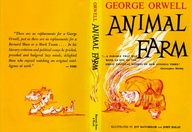
    George Orwell’s iconic 1984 stand as perfect examples of the societal structures Jung warns against. Granted, all dystopian literature set in a totalitarian future could fall into this category, but two of his books are probably the two best examples of the genre. Animal Farm, and Orwell’s novel, Nineteen Eighty-four show totalitarian systems and are highly relevant today.

    Modeled after the Stalinism, the basic pattern was repeated by Mao’s Big Leap and the Cultural Revolution, by Pol-Pot, just to name a few. It’s about state totalitarianism, and if you look too much to right or to the left you become a road-kill by well-meaning national or transnational organization. The best example the European Union, the hunger of central power and the severe distortion of reality by language intended to disguise, distort, or obscure its real meaning was aptly foreseen in “Nineteen Eighty-four” Political language, George Orwell wrote nearly 60 years ago, is “designed to make lies sound truthful and murder respectable and to give an appearance of solidity to pure wind”. It is a pity that Orwell won’t be around to write a new book about the double-speak that passes for the European Union’s and the national finance ministers official discourse on the EU crises. A fundamental concept  to control of the thought is to control of the past. Therefore, a gigantic effort is operated  today to fit all existing publications of the current political correct  line and to overpower by sheer mass production the unwanted. Especially worrisome can that be seen in dispute parts in  some Wikipedia articles.

    George Orwell lived out Jung’s theory of The Shadow. Dr. Carl Jung argues that the future depends on our ability to resist society’s mass movements. Only by understanding our unconscious inner nature-“the undiscovered self”-can we gain the self-knowledge that is antithetical to ideological fanaticism. In his book  The Undiscovered Self, C.G. Jung points with logical assertions that “it is chiefly in times of physical, political, economic and spiritual distress that men’s eyes turn with anxious hope to the future”. The only way to combat these stresses and worries is for humanity to embrace its potential on both a conscious and unconscious level. Without a finely tuned awareness of self, we are doomed to pass control of the individual self onto an external collective entity such as the government.  The Individual’s Understanding of Himself: “It has even become a political and social duty to apostrophize the capitalism of one and the communism of the other as the very devil, so as to fascinate the outward ey and prevent it from looking at the individual life within.”
     
    Much of the book warns against succumbing to the will of the collective without first consulting the needs of the individual. Humanity must open itself up to acknowledging its equal capacity for good and evil. But perhaps the strongest evidence attesting Jung’s accuracy is the near rabid, even quasi-religious nature of the political debate even in, or perhaps especially in,  the European Union which has ‘officially’ removed religion from its pitifully so-called failed “constitution”. The religion has gone underground, and political assertions of the churches in Europe have the air of dissident meetings. The same ist true for  families in one parent stays at home.
    Perhaps Jung’s approach is helping us to find the inner self first, and then unite to counter the mass-mindness and its pursuit for maximized profits, whether in the form of a government or a global corporation and the lure of a motherly state taking care of life’s hardship of the never-grew-ups.
     
    Where there are many, there is security. What the many believe, must of course be true. What the many want, must be worth striving for, necessary, and therefore good. In the clamour of the many, lies the power to snatch wish-fulfilment by force. Sweetest of all however, is that gentle and painless slipping back into the kingdom of childhood, into the paradise of parental care, into happy-go-luckiness and irresponsibility…to all questions there is an answer….
    C.G. Jung in “The Undiscovered Self
    Frightened though they were, some of the animals might possibly have protested, but at this moment the sheep set up their usual bleating of “Four legs good, two legs bad”, which went on for several minutes and put an end to the discussion.
    George Orwell in “Animal Farm”
  • Mao’s great famine – Our blight is ideologies — Revolution is not a dinner party.

    Mao’s great famine – Our blight is ideologies — Revolution is not a dinner party.

    When I worked in Beijing during the late nineties I got invited by a local resident consultant (an expat) to a dinner party at a very chic ethnic event restaurant.  Mao’s great famine was long forgotten. My colleague was a little bit esoteric, but knew her city. There was good food and even a better spirit.  Expats and local people from all over China would  dance after work together, even onetime doing some kind of polonaise. The open spirit, however, became immediately sober when a Mao Zedong-imposer entered the stage. The faces of the Chinese colleagues, of all Chinese, froze and some timidly touched the fabric of the actors costume, 20 years after Mao Zedong’s death, as if to make sure that “he” will not come back.

    Recently, more than ten years later,  I read the book of Frank Dikötter  Mao’s Great Famine: The History of China’s Most Devastating Catastrophe . The book was selected as one of the Books of the Year in 2010 by The Economist, The Independent, the Sunday Times, the London Evening Standard (selected twice), The Telegraph, the New Statesman and the BBC History Magazine, and won the 2011 Samuel Johnson Prize for Non-Fiction, Britain’s most prestigious book award for non-fiction.

    Between the years 1959 and 1961, 30 to 45 million people were starved, killed or worked to death as a result of Mao Zedong’s failed attempt at industrialization in this period of the great leap.Frank Dikötter researched the catastrophe for years and documented his findings. It was h highly centralized mismanagement that can lead a country to disaster. All checks like tradition, family and religion were swept away leaving everybody, particularly the weak,  exposed without restraint to cruelty, pure arrogance, boundless ignorance and a merciless disregard of farmers, workers and even party members.

    I just knew just the basics of the big leap and the subsequent famine that hit the People’s Republic around 1960.  But Dikötter’s painstaking research using newly opened local archives makes his estimate all too credible  that the death toll reached 45 million people. The book opened my eyes, as the man-made disaster was on the scale of the Nazis, Stalin and Pol Pot, but different in a way as the intend supposedly was good in a “we know better” attitude. When I read the book , I was reminded to the bureaucracy of the European Union. We don’t get killed and starved yet (although the latter does happen in Greece), but the propaganda and the arrogance of the EURO-phil bureaucracy are very much the same. It is no coincidence, that many of the former and current EU leaders, those who pushed Maastricht treaty or the never ending crises measures through against all good advice of experienced experts, were former admirer of Mao or even active Maoists. Their leadership performance during the EU crisis is of striking similarity, mismanagement  runs Europe against the wall and destroys all tangible and non tangible assets.

    Dikötter provides a detailed list of the degree of suffering this “Great Statesman” unleashed and the inhumane manner in which his apparatus operated. Horrors pile up as he tells of the spread of collective farms and the vast projects that caused more harm than good and involved the press-ganging of millions of people into forced labour. As the pressure mounted to provide the all-powerful state with more and more output, the use of extreme violence became the norm, with starvation used as a weapon to punish those who could not keep up with the work routine demanded of them. The justice system was abolished. Brutal party cadres ran amok. “It is impossible not to beat people to death,” one county leader said.

    The inefficiency, waste and destruction in China were of course even more  gigantic. The masses in whose name the Communist party claimed to rule were eminently disposable. The economic campaign used farmers and industrial workers as fodder expected to sacrifice themselves for the cause dictated from on high purposefully trying to get rid of the weak,the women, the children, the elderly. Cannibalism and people eating mud in search of sustenance, was the outcome of the famine caused by the Great Leaps failure and the diversion of labour from farming.  Initially launched to enable China to overtake Britain and Russia, Mao’s programme took a deadly turn, In order to maintaining food exports when the country was starving, the slogan was: “When there is not enough to eat, people starve to death. It is better to let half of the people die so that the other half can eat their fill.”

    The book gives the details, but is extremely clearly written and presents the facts very structured: (1) The pursuit of Utopia;  (2) Through the Valley of death;  (3) Destruction;  (4) Survival; (5) The Vulnerable;  (6) Ways of Dying;  The book starts slow and becomes a page turner but can also be accessed afterwards via a good index.  It describes thourougly the Sino-Soviet split, and Mao’s tricks to blame the Russians ( and other factors) for his own doing,  after it was too late and the truth could not buried any more. As family bonds and every decency broke down, basically the whole country became one contraction camp. Methods were used in the cities, just like by the IG Farben in the second world war, working people to death in an unhealthy environment without pay and sometimes without food locked in the factory. Often there was not a direct intend to kill, but human were abundantly streaming to the factories. On the countryside  dissidents or underachievers, even people who digged one potato  became literally fertilizer. Kids were conveniently lost by mothers, women had to prostitute themselves or were routinely raped by local authorities routinely in some provinces .

    The Cultural Revolution is widely remembered, the Great Leap much less so. When Maoists launched the Cultural Revolution in 1966, the  Red Guards had little new to learn, as Frank Dikötter states. Stability returned to China with the Maoists’ ouster in the late 1970s. Having gone through those two experiences, not to mention the mass purges that preceded them and the Beijing massacre of 4 June 1989, it is little wonder if the Chinese of today are set on a very different course that rejects ideology in the interests of material self-advancement but also religion is on the rise.

    As soon as people get together in masses and submerge the individual, the shadow is mobilized, and, as history shows, may even be personified and incarnated. Carl Gustav Jung , The Archetypes and the Collective Unconscious , Collected Works, 9/1, par.478

    It is in this context it is  interesting to consider is Jung’s point of view toward religion in general, and his various attitudes with regards to fanatics and totalitarian ideologies and states: “Of course, it is not a spiritual religion in the sense in which we ordinarily use the term. But remember that in the early days of Christianity it was the church which made the claim to total power, both spiritual and temporal! Today the church no longer makes this claim, but the claim has been taken by the totalitarian states which demand not only temporal but spiritual power”.

    If one looks to his quotes closely we find, that he just says there are similar concepts between totalitarian religions and totalitarian systems. Jung is speaking about the UDSSR  and Nazi Germany in a sense that was not only religious, but also political. He then compares in the context of political figures.  Jung speaks here about religion not only demanding spiritual obedience but temporal as well and the beliefs not only cover the spiritual aspects of the human condition but also the mundane as well.  In Jung’s book “Psychology and the East”( From Vols. 10, 11, 13, 18 Collected Works), Jung recounts his journey to India. One of the essays entitled “The Dreamlike world of India” show Jung expressing his utter positive attitude and amazement at the Indian subcontinent and their religious and ethnic culture. In a second essay entitled “What India can Teach Us” he concludes that the psychological and religious claimant is something that we in the West should take a page from.  There is respect for and admiration to all religions and their text. I sometimes wonder what he would say today. Called or uncalled, God is present. Religious experience plays an important role in Jungian psychology. Jung, a Christian maybe of more Gnostic virtue, believed that this experience is nothing but a product of the psyche, and consequently viewed other world religions as an expression of one psychic function that has its roots deep in the collective unconscious of mankind. If religion is absent, this is rarely  good thing, but if it rules the secular space its worse…

    Our blight is ideologies — they are the long-expected Antichrist!  C. G. Jung The Tibetan Book of the Great Liberation (1954)