Tag: Totalitarian

  • Rethinking the Banality of the Good

    Rethinking the Banality of the Good

    The Banality of the Good or for many the most evil man in the world right now, seems to be a  retired lieutenant colonel of the Russian KGB, who is determined to reestablish the Soviet empire, to invade world and was likened to Hitler by a leading politician of a superpower. To others, President Vladimir Putin is a judo-chopping, IMF-taming, U.S.-defying global hero. But according to  the controversial biography of  Stanislav Belkovsky, a star columnist at a Moscow tabloid,  former speechwriter and insider, Putin represents the “Banality of the Good” (quote).  The striking similarity with Hannah Arendt’s remark, one of the 20th century’s great political thinkers did catch my eye and let me finish his book, which has its weaknesses. Now if “being good” is all, after a string of rumours and dirty laundry, which may or may not be true, what Stanislav Belkovsky, sworn enemy of Putin, came up against him, there must be something unworthy with all of us, not belonging to the élite.  I long fancied to write a psychological study of Putin, motivated by the C.G. Jung interview of H.R. Knickerbocker 1938 in the Cosmopolitan , reprinted in C.G. Jung Speaks (page 115-135). To qualify the banality of the good (or the evil) I will follow C.G. Jung’s method, the money flow and the little I really know about the person Putin – that is some minor direct account, my own remote observation, his own account and what his enemies say.

    The Banality of the Good and Evil

    This is how one understands the banality of the good: In order to gain a sense of selfworthiness of a normal citizen, it is not needed to be an hero or to be sacrified on the cross. It is completely sufficient (and required) to take good care of and raising kids, pay taxes, go to work, obey rules and laws. And not because one would be punished hard for not obeying them, but because one sees them as mandatory and essential in a sense of the Kant’s imperative.

    The Banality of the Good is often likened to the secondary virtues or vices. Secondary virtue was an important term of the German positivism dispute in the 1970s / 1980s.  Secondary virtues or civic virtue characteristics were classified as those virtues, which contribute to the practical accomplishment of everyday tasks and a trouble-free” operation of a society without having intrinsic ethical significance, provided they are not used to implement the primary moral virtues but held up as means in itself: Diligence, loyalty, obedience, discipline, sense of duty, punctuality, reliability, tidiness, courtesy, cleanliness.  That one can with “secondary virtues” easily run a concentration camp, was thrown at a fomer German chancellor Helmut Schmidt once. And this very assessment, secondary virtues and having a tendency to choose “non-Machiavelli none-elite” friends,  was the most serious allegation Stanislav Belkovsky brought up, besides Putin’s alleged accumulated wealth. Interesting circle, bringing us back to Hannah Arendt’s banality of evil of which I have written here, isn’t it? 

    Putin through the eyes of C.G. Jung

    Putin’s Ego

    Starting point of the consideration is Putin’s reportedly rather unhappy childhood. It does not matter if the gossip version of the birth and childhood of Putin states is true, that the future Russian President was born two years before the date that is otherwise formally specified as a birthday of PutinLater, the mother gave her son to childless relatives who are officially recognized as the birth parents, in what was then Leningrad. This version is buzzing around again in MoscowStanislav Belkovsky  concludes from that Putin was looking for a father figure, which he had initially in Anatoly Sobchak, the former mayor of St. Petersburg, and later found in Boris Yeltsin. Second argument was Putin’s encounter with the – at that time – very effective hard working Germans gave him according to Stanislav Belkovsky a culture shock with lasing implications. 

    Putin’s Persona

    PutinPersona
    PutinPersona

    The Persona is  the “mask” helps us get by in the world, the ideal image we have of ourselves. We latch onto these social identities to define us, but as a part of the “collective psyche” they do not distinguish us in any significant way. For the persona of a public person you just look at the best spin and pictures in the media. The media nowadays are just hooker,s printing what they are told. It’s no secret that Russia’s Prime Minister Vladimir Putin carefully presents his reputation of masculinity with various publicity stunts and photo ops. First of all, let’s look at physique. Putin does have a certain eagerness to flaunt his bare chest, and there’s definitely a Rambo quality to the man when he starts going after wildlife.

    Vladimir Putin is a Culture Warrior. Every Jungian must admit his effort and success who he carefully constructs an archetypal warrior identity. Is seems,  most media and most of his fellow world leaders , that he receives more hate for presenting the archetype of a warrior than anything else. The imago’ range from tagging dangerous animals, to stopping wildfires, to playing with guns on vacation. Putin may not want  be the most popular guy in the world but he sure manages to be one of the most interesting. Even action-star Arnold Schwarzenegger can’t outdo this is original WWP . He does judo, which lacks the pure bestial blood lust of American football; but when not using others’ own strength against them, he likes to take to the outdoors. On a horse. With a gun. He hunts wild animals. Tigers. Bears. Moose. He prowls around the Siberian woods, with no shirt, as a variety of fearsome beasts. The Western media used to say – not anymore – iIt’s lucky he’s got affairs of state to distract him, or extinction rates of rate animals would double overnight. And when he’s not hunting, he’s hang-gliding: 2012 he led a flock of endangered cranes on their migration route.

    Putin’s Shadow

    04_Putin_shadow_g_w

    The Shadow lives within us another side of our personality that is filled with all those aspects of ourselves we hide away, both from ourselves or others, as unacceptable. The shadow has a “dark side,” what we find morally reprehensible – and often project into others, but it also has a “bright side” containing our potentialities .For the shadow of a public person again you just look at the worst public rumors and gossip printed by the mainstream media. Stanislav Belkovsky is good too, he must have compiled all dirt one can openly find and was given to him. Biographies are often books about the authors themselves and sometimes amalgam between most banal kitchen psychology, insider knowledge, personal experiences and spreading rumors.  If informal decision-making processes prevail, the hour of psychology is rife. Belkovsky  insinuates that Putin, who is divorced with two daughters, might be gay. Belkovsky offers little proof for any of this also for his allegation of wealth. He also acknowledges that people who crossed about Putin (except in one case) never meet unfortunate ends – he even gives plausible versions of the case of an  journalist and a KGB traitor, who both  died under mysterious circumstances. Stanislav Belkovsky shows Putin as weak, soft KGB bureaucrat responsible for interior work rather than the foreign Cold War agent. Stanislav Belkovsky says Putin is shy, and would much rather spend his time with four-legged friends. “Therein lies the real Putin. He flees from people and his obligations to nature. Here we have Vladimir’s best friends; the Labrador Conny and the Bulgarian shepherd dog Buffy, his only roommates in the presidential residence.” A Russian political scientist summed up Belkovsky this way: “he can be considered to be either a little crazy or a business-minded manipulator whose utterances are always well paid for by someone in advance.”

    Putin like the German Schroeder and Berlusconi all pariahs are all self made out of their own strength. That is true. Surely Putin is driven by business interests and under him the flourishing corruption is not as visible anymore but still seems to be there. Putin might be indeed, feel an end time ruler who either might slow the decay, or maybe stop it 

    From narcissism and paranoia 

    In another attack of kitchen psychology Stanislav Belkovsky differentiates two type of politicians the schizophrenic and the paranoid, the former creative enforces, do creating empires the latter manager and beholders soonly administering decay. I do agree with his thesis, only the mentally unstable go into politics (se my article Archetype of the vampire in todays culture of Narcissism). I think, however he meant narcissism and paranoia, and here, having had my own encounter with politics, he defintly  got some point. Putin  to him, is of course the weak paranoid.   Narcissism and paranoia sounds like a pathology and it often is. However, those are dynamic opposites of the psyche even in healthy subjects but can actually reach down to the severest forms of psychopathology. Healthy narcissism is the desire to be loved and to provide adequately for their own well-being, and a healthy paranoia setting corresponds to what is called healthy skepticism. In a balanced way both guarantors for mental health.  Stalin was a sever case of paranoia, and according to Jung not a creator just a devourer.  Narcissism and paranoia in a slightly or severe pathological form is found in almost any politician. Slight pathological paranoia includes distrust and to be a little suspicious with the tendency of principle: You never know Such a person is cautious, somewhat aloof but of course also vigilant. The basic feeling is that you should always be on guard.Well in regards to Putin, if so it served him well. There is a deliberate elusiveness of the Russian system, in which all sorts of conspiracy theories flourish. But according to a Russian saying, just because you’re paranoid,  it does not mean that you will not be prosecuted.

    Projection of the Westen Shadow
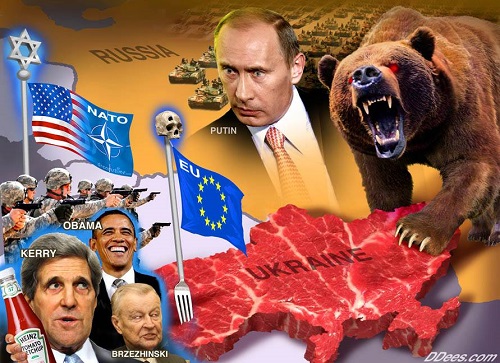
    Pojection ot the Western Shadow on Putin.
    Pojection ot the Western Shadow on Putin.

    Is Putin like Stalin? To quote C.G. Jung again: Stalin [..]  is, however, not a creator. Lenin, created; Stalin is devouring the brood. He is a conquistador; he simply took what Lenin made and put his teeth into it and devoured it. He is not even creatively destructive. Lenin was that. He tore down the whole structure of feudal and bourgeois society in Russia and replaced – it with is own creation. Stalin is destroying that. Mentally, Stalin is not so interesting as Mussolini, who resembles him in the fundamental pattern of his personality, and he is not anything like so interesting as the medicine man, the myth—Hitler. Anybody who takes command of one hundred and seventy million people as Stalin has done, is bound to be interesting, whether you like him or not. No, Stalin is just a brute—a shrewd peasant, an instinctive powerful, beast—no doubt in that way far the most powerful of all the dictators. He reminds one of a) Siberian saber-toothed tiger with that powerful neck, those sweeping mustaches, and that smile like a cat which has been eating cream. I should imagine that Genghis Khan might have been an early Stalin. I shouldn’t wonder if he makes himself Czar.

    Maybe not.

    The West has a bad habit of personalizing foreign affairs and demonizing uncooperative leaders. Remember when Egypt’s Gamal Abdel Nasser was denounced as “Hitler on the Nile?”, “Khadaffi, Mad Dog of the Mideast?”, Assad  a butcher slaughter of the innocents, Hussein and many others. Vladimir Putin is the foreign bogeyman. He is being hysterically demonized by the  Western Media, an as we know we usually project out shadow in others.


    The Terror of the Good – Origins of Totalitarianism

    Journalists are awfully liberal, Arendt they
    Journalists are awfully liberal, Arendt they?

    I’ve read Hannah Arendt “Eichmann in Jerusalem” and “The Origins of Totalitarianism”, several times – it always amazes me. I find Arendt very hard to disagree with – she just seems so shrewd, so alert, annoyingly good at noticing everything that needs noticing; She must have it right. Writing 50 years ago, this great theorists of totalitarianism, noted that totality and irreversibility are related. It used to be thought that totalitarianism had repealed the law of history by which power sows the seeds of its own destruction. If sheer ruthless vigilance could destroy any center of opposition, even any island of independent thought, then — aside from external conquest, with humanitarian  pretext — totalitarian rule could never be reversed. Conversely, if total control fails due to today’s interconnected multipolar world, what happens to single-minded direction? If totalitarianism can decay, can it not be transformed? We don’t yet know. We know only that it can be modified. It can give way to a society with some space. How much? Well,  somewhat between 1984 with drones,  full coverage realtime surveillance and a brave new world of constructed realities – the terror of the Good.

    On 5 February 1794 Robespierre stated, “Terror is nothing else than justice, prompt, severe, inflexible.” The government in a war against terror is despotism of liberty against tyranny. Sounds like today’s war on terror. Stalin said “Ideas are more powerful than guns. We would not let our enemies have guns, why should we let them have ideas?” Well, we might have run out of ideas and ideals, but sure not of weapons. How much different is President Obama, when he declared gently that “we tortured some folks.  The West shrugged their shoulders, well than we tortured some folks.  Nobody is perfect, but we are exceptional.  This is the terror of the good, the soft terror for the good, but rather the banality of the evil than the banality of the good. My famous quote of Arendt is: The sad truth is that most evil is done by people who never make up their minds to be good or evil.

    The ordinary average guy

    Certainly the terror of the Good is not the same as the Banality of the Good: do or not doing something without fear of being caught by temporal or heavenly police as Alan Watts once said. When I lived in California I could not avoid to stumble over this song.

    I’m just an ordinary average guy
    We all live ordinary average lives
    With average kids
    And average wives …
    And every Saturday we work in the yard
    Pick up the dog do
    Hope that it’s hard (whaf whaf)
    Take out the garbage and clean out the garage…
    Ordinary average average guys.

    We are getting in archetypes if not stereotypes, but the banality of the Good is not so banal after all, just like the banality of the Evil. In an essay for Foreign Affairs, Joshua Yaffa notes a fascinating way Putin has responded to what Stanislav Belkovsky, described as grumbling Haute-Volée in Moskow during his last election (he called them “Bildungsbürger” which I cannot really translate, something like educated class, bourgeoise, maybe the chattering classes is good here, a term often used in the media and by political commentators). Putin instead reached out to the average guy, channeling populist politicians in the rhetoric of class-warfare: This dynamic perhaps explains why by the end of the campaign season in February and March, Putin sought to stir up a kind of Russian class-based politics. As he saw it, he was the leader of rural and industrial Russia, defending the country from those unnamed forces that want, as he said in a campaign speech, “to interfere in our affairs, to force their will on us.” In this speech and others, Putin has tried to link in the public consciousness the country’s middle-class protestors to enemies abroad that would wish Russia ill. On the night of his victory, he told the employees of a tank factory, “You put in their places those people who went one step too far and insulted the working man.” The real “Russian people,” he went on to say, are the “worker and the engineer.”

    The banality of the good or the evil?
    The banality of the good or the evil?

    Putin through the eyes of the cultural war

    I said half-jokingly the other day that it’s sometimes hard to tell the reporting of Western mainstream media  between Soviet-era Russia and Putin-era Russia.  If you ignore the personal insults, it’s impossible to tell the difference between now and the Cold War after JFK. In many cases, Putin is closer to the US and Europa’s ideals and interests than its own élite and global financial oligarchy. Plain stereotypes of the cold war are applied from them every day, but this is not my topic here. Lets go back to C.G.  Jung.

    H.R. Knickerbocker asked the famous question: What would happen if you were to lock Hitler, Mussolini, and Stalin in a room together and give them one loaf of bread and one pitcher of water to last them a week? Who would get all the food and water, or would they divide it? Jung’s answer included a cryptic remark:The true leader is always led. We can see it work in him. He himself has referred to his Voice.”  … “The demands of the unconscious act at first like a paralyzing poison on a man’s energy and resourcefulness, so that it may well be compared to the bite of a poisonous snake.

    Journalists are awfully liberal, Arendt they?
    Hillary Clinton, hardly a reasonable facsimile of gender icons going along.

    Let’s rephrase it, What would happen, if we were to lock Hillary, Merkel, Putin and Obama today  in a room together and give them one loaf of bread and one pitcher of water to last them a week? Putin seems to be a gentlemen but not a push over. The Russian president asked whether it would be worse to meet with Clinton than President Obama: “It’s better not to argue with women. But Ms Clinton has never been too graceful in her statements.”  From there, Putin added: “When people push boundaries too far, it’s not because they are strong but because they are weak. But maybe weakness is not the worst quality for a woman.”  So that is interesting, also with Mr. Merkel, there is divide of gender archetypes of a supposedly feminized west, calling this modern and a supposedly more traditional Russia with a positive image of the male archetype. I am not sure if this cultural war is the Russian response to a cultural revolution, or just one more warfare technique before an information, financial and hot/cold war.

    Putin and his friends and enemies

    Who is Putin? The question is as pressing today as it was 14 years ago when he became Russia’s president for the first timePutin’s supporters consider him the savior of Russia, opponents see him as a tyrannical ruler. Despite the rhetorical attacks on the chaotic conditions in Russia in the nineties Putin , Putin a heir of Yeltsin’ apparently made a deal with Yeltsin’s oligarchy (The Family”) between 2000 and 2004, but on his terms. From there on he seem to have accepted a mission which Mr. Putin’s role model, Czar Peter the Great, might have tolerated. The major oligarchs who survived under Putin are Roman Abramovich, Alexander Abramov, Oleg Deripaska, Mikhail Fridman, Mikhail Prokhorov, Alisher Usmanov, German Khan, Viktor Vekselberg, Leonid Michelson, Vagit Alekperov, Pyotr Aven, and still Vladimir Potanin and Vitaly Malkin.

    • Alisher Usmanov: The richest man in Russia and the 40th richest person in the world;
    • Oleg Deripaska: Aluminum magnate Deripaska embroiled in ‘yachtgate’;
    • Mikhail Prokorov: Ran as an independent candidate against Putin;
    • Roman Abramovich: The oil tycoon one of Putin’s closest allies.  He had a major dispute with Putin king-maker Boris Berezovsky, who committed suicide after loosing an $5 billion lawsuit against him.
    • Leonid Mikhelson: CEO of Novatek, one of Russia’slargest natural gas producers and art sponsor
    • Mikhail Khodorkovsky: Once the most wealthy Russian with Yukos oil, he’s now only worth $170 million anymore.

    A few more  business people have become oligarchs during his time, such as  Vladimir Litvinenko and  Arkady R. Rotenberg (Russian). Some had to go, who did not hold the bargain and subsequently coming under fire for various illegal activities, particularly tax evasion. Vladimir Gusinsky (MediaMost) and Boris Berezovsky both avoided legal proceedings by leaving Russia, and the mentioned, Mikhail Khodorkovsky , was arrested in October 2003 and only recently as released on December 2013. Like so many other oligarchs, he made his fortune when the Soviet Union privatized its resources in an ill-fated Western strategy, tying himself in to the country’s desasterous move to a typical IMF inflicted economy.  Khodorkovsky challenged Putin openly 2003 on behalf of the old Yeltsin oligarchy and Putin pardoned him only after a decade in prison, according to Stanislav Belkovsky the only really serious counter move, Putin has inflicted on  his enemies. Even after that Khodorkovsky was allowed recently  to address a crowd of protesters in Kiev, railing against the Russian government.

    Looking at the numbers, GDP (a hockey stick success curve, granted 50% from energy business)  and dept (none), I hate to say he  did “slightly” better than President Obama’s, TARP, American Recovery and Reinvestment Act, including the banking bailouts and fiscal stimulus in years of quantitive easing (QE). We generally overlook that his value to the system, like that of the czars who preceded him, is based on maintaining the balance among competing vested interests. Just as it was centuries ago, the main battles inside the Kremlin among these groups are about power, money and access to special privileges, not ideology.

    Conclusion

    I found something C.G. Jung could, maybe even would have said about the Putin Complex:The world is as it ever has been, but our consciousness undergoes peculiar changes. First, in remote times (which can still be observed among primitives living today), the main body of psychic life was apparently in human and in nonhuman objects: it was projected, as we should say now. Consciousness can hardly exist in a state of complete projection. At most it would be a heap of emotions. Through the withdrawal of projections, conscious knowledge slowly developed. Science, curiously enough, began with the  discovery of astronomical laws, and hence with the withdrawal, so to speak, of the most distant projections. This was the first stage in the despiritualization of the world. One step followed another: already in antiquity the gods were withdrawn from mountains and rivers, from trees and animals. Modern science has subtilized its projections to an almost unrecognizable degree, but our ordinary life still swarms with them. You can find them spread out in the newspapers, in books, rumors, and ordinary social gossip. All gaps in our actual knowledge are still filled out with projections. We are still so sure we know what other people think or what their true character is C. G. Jung -“Psychology and Religion” (1938) In CW II: Psychology and Religion: West and East. P. 140
    To be continued /expanded – published as a case of oops…

    Appendix:

    Hypothesis

    • Putin is the not a real macho nor a tyrant
    • Putin is the typical “little guy” a self-made man with business sense
    • Putin is not an imperialist but an anti-Soviet
    • Putin is an outsider  of the cultural chattering class (globally and in Russia)
    • Putin is an idealist who does not care for power
    • Putin was never the tough KGB agent but a disliked outsider; as his career was nearly destroyed by the KGB he dislikes it
    • Putin did not create a central Putin system, but rather a system of many power clusters not unlike the Czar’s
    • Putin was pro-West, first puzzled, later annoyed and now confronting Western geopolitics and wars
    • Putin is the real successor of Yeltsin but with a better sense for Russian interest
    • Putin is pro-German or pro-Europe in the sense of Czar Peter the Great, Peter
    • There is a big shiism between the Moskowitsch ( god-derived) and Peterism (rule based) autocratic system

    Expanded Definition of the Banality of the Good:

    • In order to gain a sense of selfworthiness of a normal citizen, it is not needed to be an hero or to be sacrified on the cross. It is completely sufficient (and required) to take good care of raising kids, pay taxes, go to work, obey rules and laws. And not because one would be punished hard for not obeying them, but because one sees them as absolutely required in a sense of the Kant’s imperative.
    • A real direct democracy is possible.
    • Citizen an stated must mutually respect each other.

    Bibliography

    • Wladimir: Die ganze Wahrheit über Putin von Stanislaw Belkowski von Redline Verlag,München  (Dezember 2013, Translation)
    • Aus erster Hand von Wladimir Putin Heyne (2000)
    • Chodorkowskij: Legenden, Mythen und andere Wahrheiten Gebundene Ausgabe – 9. März 2012 von Viktor Timtschenko
    • Eichmann in Jerusalem: A Report on the Banality of Evil (1963). (Rev. ed. New York: Viking)
    • The Origins of Totalitarianism (1951). second enlarged edition;  A MERIDIAN BOOK First Meridian printing
    • C.G. Jung Speaking: Interviews and Encounters (Bollingen Series)
    • C.G. Jung Synchronicity: An Acausal Connecting Principle
    • C.G. Jung Four Archetypes (Routledge Classics)
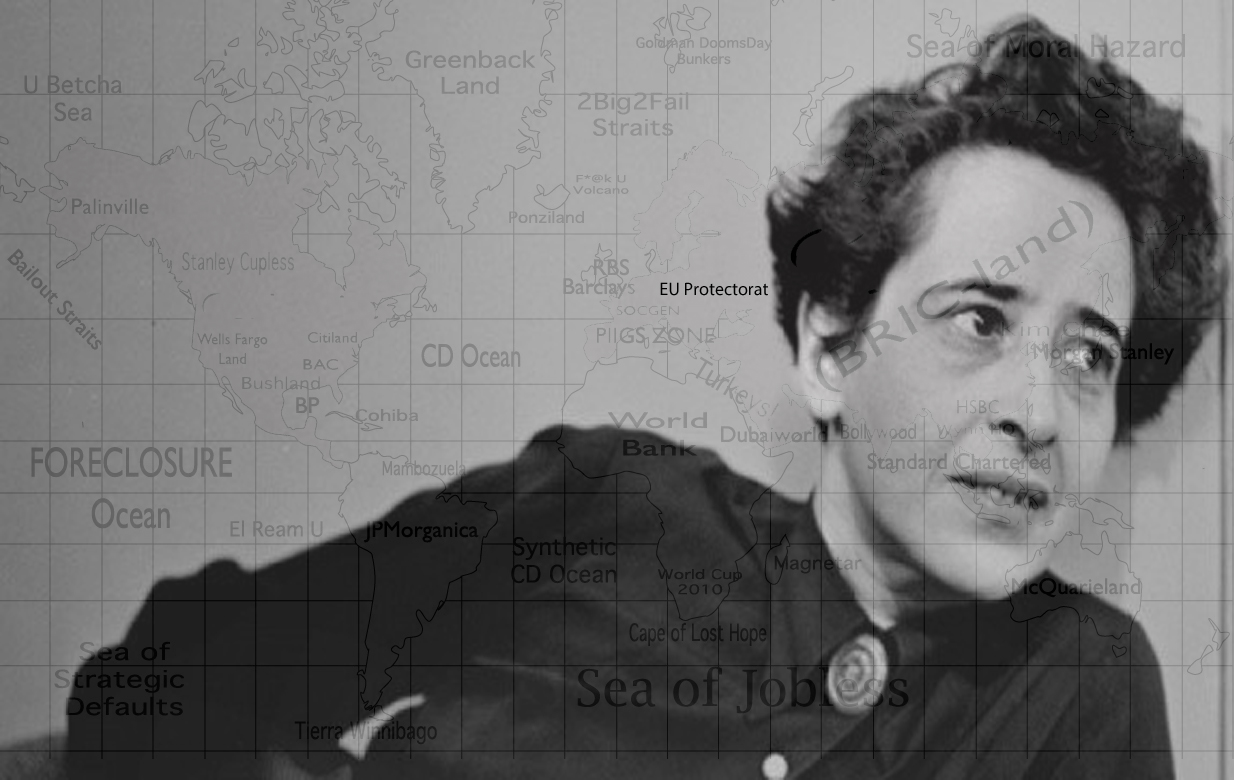
  • The banality of evil from a Jungian view

    The banality of evil from a Jungian view

    We’ve all heard the phrase “the banality of evil”, coined by the political theorist Hannah Arendt. Her 1951 masterwork, “The Origins of Totalitarianism,” about the parallels between Hitler’s Third Reich and Stalinist Russia, made her an intellectual celebrity. In her book, she argued that totalitarian regimes seek to dominate every aspect of everyone’s life as a prelude to world domination. Reflecting recent events, on more than one occasion the phrase “the banality of evil” crossed my mind. Touched by her psychological and philosophical view to totalitarian systems, I often wondered, how this radical political theorist would have commented to evil political events of the new millennium. Based on her quotes this essay suggests, that we live in the advent of new totalitarian regimes. I was very hesitant to publish this essay. Why? The psychological and philosophical analysis cannot be strictly separated from its political perspective. Be assured, that I am just interested in todays Evil from a Jungian view without political prejudices.

    Totalitarianism and supranationalism

    TheOrginsArendt emphasized repeatedly  that totalitarianism differs essentially from other forms of political oppression known to us such as despotism, tyranny and dictatorship. Wherever it rose to power, it developed entirely new political institutions and destroyed all social, legal and political traditions of the country. The term totalitarian, first used in the late ’20s, was not fully developed until the late ’40s and early ’50s, when a classical literature arose describing a new kind of tyranny created in this century.  Arendt discusses the use of supranational organizations, fake (non) governmental agencies, and doctrines as a means of concealing totalitarian aims. She claimed for instance that the Nazis were not simple nationalists. Their propaganda was directed toward their fellow-travelers and not their convinced members; the latter, on the contrary, were never allowed to lose sight of a consistently supranational approach to politics.

    Their aim was a dominating superstructure which would destroy all home-grown national structures alike. They could indulge in hypernationalistic talk even as they prepared to destroy the body politic of their own nation, because tribal nationalism, with its immoderate lust for conquest, was one of the principal powers by which to force open the narrow and modest limits of the nation-state and its sovereignty.

    Isolation and loneliness of the individual

    What made totalitarianism unique was its militant, messianic ideology; its mobilization of the masses; its total control of social life (all independent “intermediate” structures — such as churches, parties, unions — standing between the individual and the state were to be eradicated); and its systematic use of terror to enforce that control. Totalitarian regimes were thought to be (under Hitler and Stalin they certainly were) energetic, enthusiastic in an almost religious sense, on the march. Orwell’s 1984 seen from today was not a parody. It was just a mild extrapolation of past totalitarian reality and a abstract picture of today’s totalitarian possibilities. Totalitarian domination as a form of government is not content with isolation in public political life  but aims to destroy private life as well. It bases itself on loneliness, on the experience of not belonging oneself, which is among the most radical and desperate experiences of man. Superfluousness which have been the curse since the beginning of the industrial  revolution, have become individual isolation and loneliness – one looses even contact with the Self – both outcome and precondition of totalitarian domination.


    The Banality of Evil

    Hannah Arendt most memorably employed it in both the subtitle and closing words of Eichmann in Jerusalem: A Report on the Banality of Evil, her book on the trial of Nazi lieutenant-colonel Adolf Eichmann. To Arendt’s mind, Eichmann willingly did his part to organize the Holocaust — and an instrumental part it was — out of neither anti-semitism nor pure malice, but out of a non-ideological, entirely more opportunistic combination of careerism and obedience.

    The sad truth is that most evil is done by people who never make up their minds to be good or evil.

    This kind of evil is very tricky to explain, but one Jungian definition could be this one: Banal evil is a kind of evil
    which is unconscious, a kind of evil that the “evil person” hasn’t reflected over. The complex or the shadow took over.  It’s also a kind of evil that is not considered evil by the person who acts, in the moment of the evil act. The reason why the person doesn’tconsider the act as an evil act is mainly ignorance or inconsiderateness of the Ego.

    In 1961, The New Yorker sent her on her request to cover the trial of Adolf Eichmann, one of the chief instrument of the Third Reich’s Final Solution, who had been kidnapped by Mossad operatives and brought to Jerusalem to stand trial for his crimes. The five-part article which emerged, “Eichmann in Jerusalem,” set off what is considered to be one of the most passionate and best public debates concerning Evil ever to take place

    Arendt, who was born into a secular family of German Jews present-day Hanover and grew up in Königsberg (now Kaliningrad). and Berlin. She studied philosophy with Martin Heidegger (later tainted by his support of the Nazis) and wrote her dissertation in Heidelberg under the existentialist philosopher-psychologist Karl Jaspers on the concept of love in the thought of Saint Augustine, published 1929.  In 1933, she was arrested by the Gestapo for collecting evidence of anti-Semitic propaganda. After fleeing to Paris, she worked for a Jewish relief group before being sent to a French internment camp, from which she escaped. She and her second husband, Heinrich Bluecher a  German Communist, emigrated to America..

    Arendt’s original series of “Eichmann in Jerusalem” articles can be found in the New Yorker‘s online archives:: part one, part two, part three, part four, and part five. Although the poet Robert Lowell called “Eichmann in Jerusalem” a “masterpiece,” Arendt’s portrait of Eichmann as a bureaucrat motivated not by extreme ideology but rather by ambition disturbed many people. Throughout the piece, Arendt wrestles with her perception of Eichmann, calling him “monstrous” yet “terrifyingly normal.” Many readers objected to Arendt’s use of the term “banality of evil” to describe Eichmann. In a Reflections piece published posthumously, Arendt expanded on her use of the controversial phrase:

    I was struck by a manifest shallowness in the doer which made it impossible to trace the incontestable evil of his deeds to any deeper level of roots or motives. The deeds were monstrous, but the doer—at least, the very effective one now on trial—was quite ordinary, commonplace, and neither monstrous nor demonic.

    Go back 60 years to the controversy that surrounded Hannah Arendt’s Eichmann in Jerusalem, a study of the Adolf Eichmann trial, in which she coined this famous phrase “the banality of evil.” Arendt wrote in a letter to a friend: “It is indeed my opinion now that evil is never ‘radical,’ that it is only extreme, and that it possesses neither depth nor any demonic dimension. It can overgrow and lay waste the whole world precisely because it spreads like a fungus on the surface.” This was what Hannah Arendt meant: Evil is unspectacular and always human. The normality of evil is evident.

    In any event, the fearful imagination has the great advantage to dissolve the sophistic-dialectical interpretations of politics which are all based on the superstition that something good might result from evil. Such dialectical acrobatics had at least a semblance of justification so long as the worst that man could inflict upon man was murder.

    The truth about evil that needs attention now is its shallow, deadly, fungus quality. Today evil destroys not only  life, but it destroys the fact of existence itself. In a tiny, multicultural world in which different civilizations inhabit different centuries–are often moved by evil deeds, like blowing up the Other. Don’t bother demonizing  terrorists as being inherently evil (as Satan is evil). That’s not how it works.

    Opportunistic evil passes like unconscious complexes (in a Jungian sense – negative energy) through the world, clustered in supranational institutions and financial concentrations, that take up residence in individuals or cultures from time to time. For example, the International Monetary Fund (IMF), an organization of 186 countries has been the centerpiece of the world monetary order since its creation in 1944, and its supervisory role has been considerably strengthened after the advent of floating rates of 1973. The role of the IMF in the current EU-crises and  global events has been largely overlooked. But this is not the story I like to tell here.

    The Global Evil

    Distance once helped dampen the effects of human wickedness, and weapons once had limited range. But evil has burst into a new dimension. The globalization, democratization and efficiency  of the instruments of destruction and control  mean a quantum leap in the delivery systems of evil. Drones for full physical control or their diabolical stepbrother of electronic and financial means  for full virtual control, un-leveled the local playing field globally again – and the level field has fungus on it.  For a short while ragged Islamist group with weapons, which sells girls in slavery can terrorize citizens by asymmetric strategies, but even then, the Local Evil serves a purpose for the Global Evil.

    Only crime and the criminal, it is true, confront us with the perplexity of radical evil; but only the hypocrite is really rotten to the core.

    The Global Evil potential became a world-historical force, but with more discretionary destructive power at hand than the great old monsters, from Caligula to Stalin, ever had. In the new dimension, micro-evil (the dark impulse to rape or murder, say) and macro-evil (economic genocide) achieve an ominous reunion in any bid for the apocalyptic gesture. That’s the real evil that is going around. Most revolutions, as historical analyst  Hannah Arendt points out in her 1963 published book “the fools of history”, have not established and maintained a state of liberty in which a common citizen can usually make politically heard. Even the American Revolution ultimately failed because Americans lost interest in their political condition in order to pursue their private gain.

    Omnipotent Evil

    ResetTheNetAccording to Arendt that totalitarian totalitarian elites have usually a firm and sincere belief their unilateral omnipotence. Totalitarianism and the belief to be chosen to lead the world instead of other less worthy powers go together. This moral cynicism, their belief that everything is permitted, rests on the solid conviction that everything is allowed to them. Moral decisions become dependent on the context. Aggression on the grounds of “ exceptionalism”, is backed by the dubious idea that some are special and cannot be held to the same standards as others. Unilateralism, preemption, and exceptionalism, the toxic combo that has spurred hundreds of of wars, territory occupation, regime change, global surveillance, extra-judicial assassinations, drone attacks, and hyperbolic state terror most of which has been directed at civilian populations whose only fault is that they occupy regions which have some geostrategic or economic importance.

    The totalitarian attempt at global conquest and total domination has been the destructive way out of all impasses. Its victory may coincide with the destruction of humanity; wherever it has ruled, it has begun to destroy the essence of man.


    And if it is true that in the final stages of totalitarianism an absolute evil appears (absolute because it can no longer be deduced from humanly comprehensible motives), it is also true that without it we might never have known the truly radical nature of Evil.

    Narcissism of totalitarian belief systems

    It’s a cliché to say that most politicians become arrogant if they are in office for more than about six or seven years,  and become quite disconnected from reality. We perhaps didn’t realise when the exceptionalism doctrine was presented first – that exceptionalism is a extreme form of narcissism, a messiah complex, that had been always an thriving impulse in  totalitarian systems.

    narcissus-large“If you had to summarise narcissism, it’s a feeling of specialness,” says Dr Adam Perkins, a researcher at King’s College London’s Institute of Psychiatry. “Narcissists view themselves as special, as deserving of better treatment than the rest of the world.”

    I have experienced and written how narcissism and excessive self-confidence can actually “help” in the political realm often supporting a negative selection. When action is needed, Narcissism – even of the mildly delusional variety – may be a useful thing in publicity.

    And a healthy dose of narcissism is probably protective in certain situations. “If you’re dumped as a leader, it might help you to feel special – to think, well, their loss.

    Narcissus fell in love with his own reflection not because he was narcissistic, necessarily, but because his reflection was so beautiful. Extreme narcissism, however, like psychopathy, usually manifests itself evil. Narcissus’s story ended badly, of course. According to the The Diagnostic and Statistical Manual of Mental Disorders, a diagnosis of narcissistic personality disorder can be made if a patient (or system sic!) displays five of the following nine symptoms:

    • An exaggerated sense of one’s own abilities and achievements.
    • A constant need for attention, affirmation and praise.
    • A belief that he or she is unique or “special”.
    • Persistent fantasies about attaining success and power.
    • Exploiting others for personal gain.
    • A sense of entitlement and expectation of special treatment.
    • A preoccupation with power or success.
    • Feeling envious of others, or believing that others are envious.
    • A lack of empathy for others.

    I mean here extreme exceptionalism, evident in political correctness and certain supranational elites (inner circle) and organisations, and recently very openly in super powers again. Extreme unreflected exceptionalism  has been a trademark of feudal systems with a thin ruling class and a large peasant class.

    Only the mob and the elite can be attracted by the momentum of totalitarianism itself. The masses have to be won by propaganda.

    Lying and deceiving

    snowden4Totalitarian policy is as a case of the government beginning to believe their own propaganda about their narcissist exceptionalism. The distorted reality will be believed by those who use them, just as C.G. Jung said – the unconscious in us is real. It is this form of perceived omnipotence that leads to bullying and manipulating the citizens and the failed Hero acting of the elite: the weak king, the cruel warrior, the wicked magicians, the narcissistic lover. Sure, there are also clear political struggles and psychological motives behind the supranational and unipolar debate: the establishment join in the hope for the blessings of a centralist post-democratic state, because they share belief in the stability of the state as sole power (and on its non accountable priests). Anything significant beyond the state (such as the individual, the family, the truth, the religion), would challenge the semi-religious ego of the transnational institutions – not only their political clout.

    The trouble with lying and deceiving is that their efficiency depends entirely upon a clear notion of the truth that the liar and deceiver wishes to hide.In this sense, truth, even if it does not prevail in public, possesses an ineradicable primacy over all falsehoods.

    Dissent thoughts let the inner circle fear for the long-awaited stability of a nation less and culture less state. That was the reason why the Europe’s leaders and the EU bureaucracy has been trying to reassure the public with obviously wrong assurances and after an earthquakes election continue with business as usual. Assurances, which are obviously wrong arouse always a debate and laid the foundation of today’s distrust in opponents. This triggered even neutral public figures, to believe that conspiracy theories might be plausible. Welcome to virtual reality. In George Orwell’s dark vision, the year 1984 would see the triumph of totalitarianism in Europe—an era of Newspeak and Doublethink, of dictatorial cruelty and dehumanizing coercion. That fateful year is now three decades away, and it seems less and less visible that Orwell’s grim prophecy  proved correct.

    Conclusion

    I’ve read Hannah Arendt “Eichmann in Jerusalem” and “The Origins of Totalitarianism”, several times – it always amazes me. I find Arendt very hard to disagree with – she just seems so shrewd, so alert, annoyingly good at noticing everything that needs noticing; She must have it right. Writing 50 years ago, this great theorists of totalitarianism, noted that totality and irreversibility are related. It used to be thought that totalitarianism had repealed the law of history by which power sows the seeds of its own destruction. If sheer ruthless vigilance could destroy any center of opposition, even any island of independent thought, then — aside from external conquest, with humanitarian  pretext — totalitarian rule could never be reversed. Conversely, if total control fails due to today’s interconnected multipolar world, what happens to single-minded direction? If totalitarianism can decay, can it not be transformed? We don’t yet know. We know only that it can be modified. It can give way to a society with some space. How much? Well,  somewhat between 1984 with drones,  full coverage realtime surveillance and a brave new world of constructed realities.

    Obviously you can read the banality of evil as a description of the ordinariness of the people involved, or as a statement about the optimisation of work in international institutions like the IMF or others. The point about the ‘radical’ evil – the cruel, savage, sadistic kind – is that it is much easier to spot. Is is visual, it is on CNN.  That is what makes it all the more important to be aware of ‘evil’s’ other face – the unconscious  evil. It hides in the balance sheets.

    Economic growth may one day turn out to be a curse rather than a good, and under no conditions can it either lead into freedom or constitute a proof for its existence.

    The banality of evil is not so banal after all.

    Bibliography

    • Eichmann in Jerusalem: A Report on the Banality of Evil (1963). (Rev. ed. New York: Viking)
    • The Origins of Totalitarianism (1951). second enlarged edition;  A MERIDIAN BOOK First Meridian printing September 1958 Seventh printing September 1962
    • The Human Condition (Chicago: University of Chicago Press, 1958).
    • On Revolution (New York: Viking, 1963).

    Note: the first two books are available as free of charge ebooks.

  • A primatologist image of God: The Ultimate Chimp

    A primatologist image of God: The Ultimate Chimp

    A primatologist’s “Image of God” reimagines divinity through our closest evolutionary relatives, the Chimp (chimpanzee), which share ~ 98.4% of human DNA. By observing their capacity for culture, tool use, empathy, and social complexity, we are challenged to expand our understanding of the divine spark beyond purely human boundaries. Maybe it’s because I am an “unchurched”, humanist and cultural religious person, but today’s anti-religious tracts and rants do bore me.  However, a new book of  the primatologist Frans de Waal, raised hope for new insights: The Bonobo and the Atheist: In Search of Humanism Among the Primates. He made accidentally an interesting point – the reciprocal imago dei (God’s imago modeled after human) of today’s atheists (or spiritual deaf).

    I hold the opinion that God’s existence can’t be proved nor denied. God can only be experienced personally or by intuitive wisdom. Although I consider myself religious, I can only shrug my shoulder to fierce pro and con advocates. To me, religions have had a positive effect on morale and cohesion of society and intrinsic merits. Religion is formalized spirituality not an ideology, although some ideologies mutated in deadly and evil belief systems. Simply go with Kant’s categorical imperative:  How would a world look like, where everybody is… greedy, hedonistic, promiscuous and spiritual deaf? You say that would look like today’s globalized world? Bertolt Brecht concluded that 50 years ago: “Erst kommt das Fressen und dann die Moral”.

    Religions and the zoo

    According to Mr. de Waal it would look like a zoo. Doesn’t sound completely wrong to me either. Mr. de Waal has spent his career studying chimpanzees and bonobos, two of humanity’s closest living relatives. He draws on a lifetime of empirical research and claims his data provides plenty of evidence that religion is not necessary in order for animals to display something that looks strikingly like human morality. Consequently to him Gods imago is the “Great Chimp”.

    We all went in the zoo, right?  While I would admit, that apes look strikingly human, throwing excrement like – say politicians, those in power monopolizing sex and generally follow interaction pattern of large corporation, I am still surprised.  Is it my distorted view of moral or my different understanding of “Gods” image?  Now, that is exactly where we differ, Frans de Waal,  like the old Greeks, or Romans or Goths, proposes to model God after the worldly observation. Social science boldly constructs here not only the world, but also the heaven, and up there is the ultimate alfa male (chimp).  There is no place for the female Hindu goddess Kali, Confucius or pantheistic Taoism. Nevermind, lets look where this leads us to.

    7parvat-737408

    According to primatologist,  Chimps help in lab tests other chimps obtain food even though there is no benefit in doing so, or even refusing rewards themselves until their troop-mates get some. Examples also come from the wild: young chimps fetch water for oldsters who cannot manage themselves, for instance, or adopt orphaned youngsters from other families. Rhesus monkeys are recorded as tolerating handicapped  similar to human Down’s syndrome. Mr de Waal’s central aim is to attack the idea that morality makes human stand apart  “lower” animals. Thus, he concludes no religion is needed: No philosophy either. I doubt that. In Hinduism the goal of all mystical yearning is union of the individual soul with the universal soul. In the Adhyatma (‘spiritual’) Ramayana, a Sanskrit text dating from the fourteenth or fifteenth century, Sita represents the individual (jiva-atma), which has separated from the universal (param-atma) symbolized by Rama. In an almost  Jungian interpretation, Hanuman (the chimp) here is said to personify bhakti, which annihilates the ‘ahankara’ or ego (Ravana), and re-unites the two. That can be easily translated in the Jung context : The Death of the Ego as prerequisite to find God.

    Chimp Nature is our link with Creation.
    Nature is our link with Creation.

    In Hindu symbolism, a monkey signifies the human mind, which is ever restless and never still. This monkey-mind (consciousness) happens to be the only thing over which man has absolute control. We cannot control the world around us and cannot choose our life but we can choose the way we respond to it. Hanuman, when he was a child monkey, was tempted by the sun and he rushed towards it thinking it to be a delectable fruit. On his way however, he was distracted by the planet Rahu and changed his path. Thus Hanuman is the temperamental human intellect, which is unquiet and excitable. It is only by diverting it to the path of pure bhakti (devotion), that it can be made aware of its profound and silent essence. Hanuman is no ordinary monkey. While embarking on the search for Sita, the monkeys were confronted by the vast ocean lying between them and Lanka. They wondered how they would make their way across this mighty obstacle. Someone suggested that Hanuman jump and cross over the sea. But Hanuman was doubtful, “I cannot do that,” he said. At that moment, one of his companions reminded Hanuman of the awesome powers lying dormant within him. Instantly Hanuman regained memory of his divine strength and he successfully leaped across the ocean – the individuation. The monkey is us, specifically our conscious Ego , not God.

    Religion and philosophy

    Most people, the primatologist notes, accept that their bodies evolved from those of man’s predecessors, but the conceits of religion and philosophy make it much harder to accept that the same is true of human minds. I have indeed my difficulties, together with Descartes: I think – therefore I am.

    I agree, that human ethical codes arise from ancient social behaviours, but not exclusively. Different versions of this can be found in a variety of animals and variety of human tribes. Often it was ritualized in spiritual or religious conduct. For Mr. de Waal, religion is just a natural consequence of combining the built-in behaviours of an intelligent, sociable ape with strong dominance hierarchies and God’s image may very well be the ultimate, old, fat chimp with the red “bottom”. Mr de Waal’s sophisticated interpretation of religion seems to make it hard for him, however, to imagine that people can take religion allegorically and spiritually.

    I share his little patience for sometimes shallow, overly confident, assertive atheism of today, seeing it as tilting hopelessly against the strive for spirituality in human nature.  In other words, a crowd of crashing bores treating the gospel like a car manual. Called or uncalled, God is present, was written over C.G. Jung’s door. Religious experience plays an important role in Jungian psychology. Jung, a Christian maybe of more Gnostic virtue, believed that this experience is nothing but a product of the psyche, and consequently viewed other world religions as an expression of one psychic function that has its roots deep in the collective unconscious of mankind.  Jung and Mr. de Waal are strong empiricists, but to Jung religion and spirituality are based on complex archetypes not on low-level instincts.

    Religion and totalitarian systems

    The second thing to consider is Jung’s point of view toward religion in general, and his various attitudes with regards to fanatics and totalitarian ideologies and states: “Of course, it is not a spiritual religion in the sense in which we ordinarily use the term. But remember that in the early days of Christianity it was the church which made the claim to total power, both spiritual and temporal! Today the church no longer makes this claim, but the claim has been taken by the totalitarian states which demand not only temporal but spiritual power”.

    It is no coincidence that the three most religion-hating ideologies (Maoism, Stalinism and National-Socialism) killed also most humans known in history. Jung is speaking only about the USSR  and Nazi Germany (he died 1961) in a sense that those ideologies were not only secular and political, but also semi-religious.  Jung speaks about totalitarian belief systems not only demanding temporal obedience but spiritual as well and covering not only the spiritual aspects of the human condition but also mundane. If one looks to Jung’s quotes closely,  one can derive there are similar concepts between totalitarian religions and totalitarian systems. Thus, Mr de Waal has a wonderful convincing argument against himself.  Absolute religions always have striven for absolute secular power and vice versa, and both  versions exist and have power today. Deconstructional philosophy and tactics of social science is inherently inhuman. Thus, this sort of atheism is ironically also anti-humanism.  As the Tao Te Ching, written by Lao-tse  noted – this tactics are against the (divine) law:

    When people see some things as beautiful,
    other things become ugly.
    When people see some things as good,
    other things become bad.

    Manmade, constructed Gods  (even if just for the purpose of fighting religions) are more often than not – evil.

    Conclusion

    Very often  atheism employs a simple understanding of religions based on a personal god and ignores spirituality and pantheism. Mr de Waal’s shows  convincingly that social science has to catch up with 2000 years of philosophy. Humanism is not easily found in a zoo, nor can it be a substitute religion for humans need of spirituality.

    When human beings are deprived of any “image of god” (imago dei) they are reduced to numbers and seen as livestock (or primates) – result versus costs: anyone who is old, weak, sick, unwilling or just inconvenient would be starved to death or killed. It is Dante’s hell – the opposite from imago dei. Hitlers, Mao’s, Pol Pots, Stalin’s illusion of new societies, new men and totalitarian state religion crashed. Because it was not a spiritual religion, but an ideology and man-made cult utilizing instincts (and archetypes). Charley Chaplin pictured this funny in “The great Dictator”.

    Hitler’s, Stalin’s, Mao’s and Pol Pot’s approach had all in common that they wanted to form new people and themselves as supreme . Their leadership cult and the state consequently asked for religious obedience. If one looks closely we find, that the concepts of totalitarian religions and systems are similar. In their focus is hate, essentially hate against humanity and clearly defined external groups or simply against everybody, which in the last essence is self-hate. Nazi racism and evilness cannot by diluted by the historical observation of Stalin’s and Mao’s motivations which were often similar national or ethnic. The starving caused by their failed industrialization policies or flawed visions left  Stalin and Mao untouched by the death of double-digit millions  of humans.  Creating their imago as supreme semi-God, they fought a war against the nature, reason, tradition, spirituality and their own people, ultimately humanity: Can Hitler go to heaven? The evil presented in Mao, Stalin, Hitler, Pol Pot.

    It is sad, that humanist movements have become strongly aligned with secularism. Germans used the term humanism to refer to Italian Renaissance and classical learning. There is of course large benefit in learning from cultural, non-Christian sources. But solely centering philosophies and morality around human kind or primates, without attention to the divine is not sound practice. Humanism or human morality, spirituality or religion are all more than sharing a banana (within the tribe).

    Question: What imago (if so) you have of God?

  • Burning Ahmed Baba and Alexandrian library – Is Sufism haram?

    Burning Ahmed Baba and Alexandrian library – Is Sufism haram?

    Books burning in fire

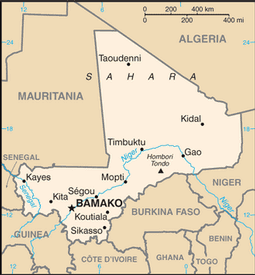
    Islamists in Mali destroyed a number of Sufism tombs in the ancient city of Timbuktu, which in the last year fell under control of a separatist insurgency. Home of the prestigious Sankore University, Timbuktu was an intellectual and spiritual capital and a centre for the propagation of Sufism (an Islam faction) throughout Africa in the 15th and 16th centuries. Its three great mosques, Djingareyber, Sankore and Sidi Yahia, recall Timbuktu’s golden age. “The destruction is a divine order,” said a spokesman from Ansar Dine, a radical outfit with alleged links to al-Qaeda. Ansar Dine  or “defenders of the faith” in Arabic is group led by a prominent leader of the Tuareg rebellion in the 1990s which wants the imposition of strict Sharia law across Mali.The Associated Press Posted Jan 28, 2013 @ 07:32 AMSEVARE, Mali (AP) — Islamist extremists torched a library containing historic manuscripts in Timbuktu, the mayor said today, as French and Malian forces closed in on Mali’s fabled desert city. 

    All of this is haram

    According to BBC the “spokesman” went on: “God is unique. All of this is haram (forbidden in Islam). We are all Muslims. Unesco is what?” According to reports, the militants teared down the centuries-old mausoleums of Muslim holy men in Timbuktu. As many as half of the city’s shrines have been destroyed in a display of fanaticism. When driven out of Timbuktu by the French, the leaving “activists” burned down the Ahmed Baba library which is a real tragedy, because so much of Sufi and African history, literature and learning was lost forever. Build by the South African government in 2009, the Ahmed Baba Institute was named after a Timbuktu-born scholar and held thousands of priceless manuscripts in its climate-controlled, underground vaults. Ancient books of culture, geography, science are now all torched up 20,000 scholarly manuscripts lost.

    Memories come up when in March 2001, Taliban fighters and grandees blew up the famed giant 6th century statues of the Buddha in Afghanistan.The Taliban also rampaged through the national museum which I visted in the seventies, smashing any art depicting the human form, considered idolatrous under their hardline interpretation of Islam. In all, they destroyed about 2,500 statues. Or of the final destruction of the ancient world’s single greatest archive of knowledge, the Library of Alexandria, which was burned down by Caliph Omar 640 AD when the Muslims took the city of Alexandria. Upon learning of “a great library containing all the knowledge of the world” the conquering general supposedly asked Caliph Omar for instructions. The Caliph has been quoted as saying of the Library’s holdings, “they will either contradict the Koran, in which case they are heresy, or they will agree with it, so they are superfluous.”  It is somewhat ironic that Alexandria was the center of Monophysitism, a Christian heresy  weakening Byzantine and Roman power.

    Ignorance

    Too many critics of Islam, including atheists, fail to appreciate just how diverse and varied Islam can be, much more than Christianity. This is especially true when it comes to Wahhabi Islam, the primary religious movement in Saudi Arabia. Saudis are aligned with the West to bring down all somewhat secular dictatorships in the region. In the puritanical strain of Islam adhered by most radical Sunni (like Taliban and Salafists) but also fundamentakist Shiites, veneration of Sufi saints – which remind on Christian saints – counts as idolatry a heretical practice that cannot be tolerated. It is against modernity, secularism, and the Enlightenment which orthodox Islam do fight — and it is this anti-secularism, anti-modernism which helps drive extremism, even to the point of cultural terrorism. Militants bearing guns, pickaxes and shovels reduced to rubble the tomb of Sidi Mahmoud, who died in 955 A.D. They have also knocked down tombs of two other prominent medieval saints, Sidi Moctar and Alpha Moya.

    Who controls the history controls the future
    Who controls the history controls the future

    Both South Africa and the Libya of Col. Muammar el-Qaddafi were involved in efforts to revive the fortunes of the ancient city and its artifacts. South African researchers involved in a project to preserve the Timbuktu manuscripts have had word that most of the treasures survived in private libraries and secure locations.Mohamed Mathee of the University of Johannesburg told  a News Channel, “It seems most of the manuscripts are OK. These manuscripts are with families and are safe.”  All those events in the new millennium have highlighted that we are today’ in a ideological war is fought with more than just weapons – just as Samuel Huntington has written in his a powerful and disturbing book in the late nineties.

    International outrage with little understanding of the Islam has been swift to blame “Islamists”. But beyond understanding history (and Islam) better, there’s little anyone can do to stop this wretched bout of iconoclasm. History is littered with the debris of toppled temples and smashed idols. Salafists and others who also believe in a more orthodox brand of Sunni Islam harbor a particular animosity toward Sufism, whose mystical interpretation of the divine affords a more heterodox faith, steeped sometimes in local pre-Islamic traditions and a reverence for saints and deceased wise men. Islam, as it spread outside the Arabian world, did so in some part through the peaceful teachings of Sufi orders and wandering monks — not just under the hooves of conquering Arab armies. Yet, recently under the Arab Spring, Sufi shrines have come under attack from emboldened and radicalized puritans in countries like Egypt and Libya by Muslim brotherhood and Salafist; in Pakistan, the Taliban and its affiliates have waged a sectarian war on Sufis, systematically targeting dozens of tombs and Sufi sites, while killing hundreds of devotees. In Persia the orthodox Shiites did not much less harm.
    The many holy places and old libraries of Timbuktu, once a prominent center of Islāmic learning in the 15th and 16th centuries, were preserved for centuries as a result of the city’s remote location on the path of now collapsed salt and gold-trade routes. In single-minded devotion to the word of the Koran, the orthodox Islam cares little for the juridical wisdom of generations of Timbuktu’s theologians who critically examined Islam’s founding holy text. The attack on Timbuktu’s cultural heritage is just one more attack against history and the values it carries — values of tolerance, exchange and living together. It is an attack against the physical evidence about the Islam’s majority livelong struggle against freedom, science and mysticism.

    Wisdom

    The Ahmed Baba Institute had nearly 30,000 manuscripts, which are being studied, catalogued and preserved. Four basic types have survived:

    • key texts of Islam, including Korans, collections of Hadiths (actions or sayings of the Prophet), Sufi texts and devotional texts
    • works of the Maliki school of Islamic law
    • texts representative of the ‘Islamic sciences’, including grammar, mathematics and astronomy
    • original works from the region, including contracts, commentaries, historical chronicles, poetry, and marginal notes and jottings, which have proved to be a surprisingly fertile source of historical data.

    Some manuscripts themselves are also of special importance to their owners to prove noble descent or land and property ownership. But they are also proof of Africa’s pre-Islamic culture, which the Islam claimed (and radical despise) like any culture Islam took over and claimed of its own.

    According to the 17th-century historian Abdurrahman As-Sadi, the history of the West African desert region could be divided into the rise and fall of three great empires – ancient Ghana, medieval Mali and the Songhay empire. Located at a hub of commercial exchange between Saharan Africa, tropical Africa and Mediterranean Africa, Timbuktu was a magnet that attracted both men of learning and men of commerce. It benefited from the gold trade , however, the most profitable trade items in Timbuktu were books. Buying them was considered a socially acceptable way of displaying wealth and a great source of prestige.  As the empire of Ghana declined, the Mali empire took its place. King Sundiata Keita of Mali conquered ancient Ghana in AD 1240, and two generations later, Islam became the dominant religion of the Malian cities and Arabic became the language of scholarship. Described as the ‘Latin of Africa’, Arabic was useful for communicating between tribes such as the Bambara, Fulani, Hausa, Mossi, Songhay and Tuareg who all spoke different languages. Just as Latin in medieval Europe was associated with Christianity, Arabic in medieval Africa was associated with Islam, and just as Europeans adopted the Latin script to write their own languages, Africans used the Arabic script to write theirs.

    Mali became indepdent 1960
    Mali became indepdent 1960

    The Sankoré University mosque was built in about AD 1300 with funding from a woman of the Aghlal, a religious Tuareg ethnic group. There were a number of challenges to Malian hegemony. ‘The Tuaregs began to raid and cause havoc on all sides. The Malians, bewildered by their many depredations, refused to make a stand against them.’ Mali lost control of Timbuktu in 1433. Once a tributary to the Mali empire, the Songhay became independent as Mali declined.  The gold traders and the scholars of Timbuktu were also treated harshly and many fled. Timbuktu benefited under the reign of the Askiya kings by tax and slavery privileges and rose to intellectual dominance in the region.  The Sankoré University mosque was the main teaching venue  but classes were also taught at the Great Mosque and at the Oratory of Sidi Yahia. Public libraries were established and employed calligraphers to copy books.

    Timbuktu was also a religious city. According to a West African proverb: ‘Salt comes from the north, gold from the south and silver from the country of the white men, but the word of God and the treasures of wisdom are only to be found in Timbuktu.’ There is a local legend that the city is guarded by 333 renowned saints as well as numerous lesser ones, and surrounding Timbuktu like a rampart are the chapels where the saints are buried. Saints and chapels are of course an anathema to orthodox Islam. According to the Sufis, a saint is a Muslim mystic, usually a scholar, who has achieved such closeness to God as to possess special powers.

    Ahmed Baba

    Ahmed Baba, the Sufi scholar after whom the burned down library was named, studied Arabic grammar and syntax, astronomy, logic, rhetoric and prosody. Textbooks were purchased and copied on a number of subjects, including astronomy, astrology, botany, dogma, geography, Islamic law, literary analysis, mathematics (including calculus and geometry), medicine, mysticism, morphology, music, rhetoric, philosophy, and occult sciences. The works of the Greek astronomer Ptolemy were basic references for Islamic astronomy. The Greek philosophers Plato and Aristotle were also common. The Greek physician Hippocrates was popular, as well as the Persian medical philosopher-scholar Avicenna. The Timbuktu manuscripts mainly comprise Korans, Koranic exegesis, collections of Hadiths, writings on Sufism, theology, law and other closely related disciplines. By the 15th century, Timbuktu scholars were producing original works as well as compiling new versions and commentaries on established texts. The reading and writing of poetry was important in these cultures. Among the Timbuktu documents are verses devoted to the Prophet and to the adoration of a particular woman or man, and poems.  A number of manuscripts were written in Ajami – Arabic script used to write local languages – with botany, diplomatic correspondence, occult sciences, poetry and traditional medicine.

    Sufism

    There are three main branches of Islam – Sunni, Shiite and Sufi. Sunnis make up about 85 percent of the Muslim population globally, while Shiites account for about 15 percent. The two split over differences of who should succeed the Prophet Muhammad but are further subdivided.

    • Sunni follows a strict, literal interpretation of the Quran and the life of Muhammad with the Sunna as core teaching. Wahhabism is an austere form of Sunni dominant in Saudi Arabia for which Muslims more often use the term Salafism.
    • Shiism is the smaller of the two major branches of Islam. It developed after the death of Muhammad, when his followers split over who would lead Islam.
    • Sufism  is an Islamic mystic tradition with followers around the world. Sufis tend to identify with either Sunni or Shiite Islam. Many Muslims are critical of Sufism as an unjustified innovation.
    Shia Faction of IslamSunni Faction of IslamSufis/Sufism
    10-15% of all MuslimsMajority of Muslims 
    Shia means “faction,” refers to “faction of Ali.”Sunni means “tradition,” adheres to orthodox traditionSuf means “wool,” considered the Mystics of Islam.
    Iran center and home of most Shia, 88% of Iranians are Shia (Shi’i), In Iraqi 96% are Muslim and over 50% of them are Shia (Shi’i), though Iraq was ruled by minority Sunnis. Reverse Syria if you consider Alawis (12er ) to be Shiites.Grew out of Umayyad dynasty. World-wide 85% of Muslims are Sunni.Developed in reaction against the excesses of the Sultans and Caliphs (who wore silks, satins), specifically the Caliphate of Damascus in the Umayyad dynasty, Sufis wore course wool garments in protest.
    Succession and Leadership
    Believe in Ali and the Imams as rightful successors of Muhammad, but not in first 3 Caliphs. Ali was first of 12 successive legitimate Imams. Succession was to be hereditary.Acknowledge each of the first four Caliphs as rightful successors to Muhammad.Value deliberate simplicity, meditation rather than just a formalistic following of the rules.
    Look forward to Messianic return of the last recognized Imam. Muhammad al-Mahdi, last Imam, disappeared 900 CE, went into “hidden realm”, was sinless. Ayatollah Khomeini (1900-1989) believed by many to be the return of the last Imam.Through the ages, Caliphs rule “in God’s name.”Sufis gathered around shaikhs (masters) and formed faqirs (orders or communities). Rabi’a (1717-1801 CE) was a Sufi poet whose poetry spoke of God’s Love  similar to Christianty Al-Ghazzali (1058-1111) first Sufi to bring the faction into mainstream Islam.
    Imam holds an exalted position, Ayatollah refers to most important Imams.Imam is a prayer leader. Sunnis approach God directly, there is no clerical hierarchy.Sufi Shaikhs are the masters. Wandering monastic culture
    Teachings and Scripture
    Characteristic is the continual exposition and reinterpretation of doctrine by the clerics.Believe in entire body (canon) of life and teachings of Muhammad as found in Qur’an and hadiths (sayings and traditions of Muhammad). Sayings and traditions are interpreted by scholars in Islamic schools.Qur’an is full of symbolism, each verse has from 7 to 70 meanings. Believe in three approaches to the divine: mysticism of Love (heart knowledge), Ecstatic (visionary knowledge) and intuitive discernment (mental knowledge)
    Both Sunni and Shia factions believe in the Sharia, the comprehensive law derived from the Qur’an (revelations of Muhammad) and the Sunnah (sayings or interpretations of Muhammad).Believe in fana (extinction) of separateness from God and “remembering” that “there is nothing but God.”
     Scholars carry on debate in Islamic Schools. Science of Tradition refers to Islamic scholarship and rating of specific writings (rated sound, good, weak, or infirm)Influenced by Christianity and Gnosticism (life is a spiritual journey—want to know God/Allah now not just after death), Persian Zoroastrianism and Hindu Mysticism
    Shia Faction of IslamSunni Faction of IslamFufis/Sufism
    Fundamentalist approach to Islam, interpretation by clericsQur’an applies to everyday life, public life is shaped by the Qur’an. Saudi Arabia considered model of proper Islamic stateCalled “the Heart of Islam,” highest experience in life is experience with Allah, can get face to face with Allah/God

    Sufism has been, especially in the West, portrayed and regarded as a valuable and legitimate part of the Islamic faith. Anybody somewhat familiar with the complex interaction of religions will agree  with this statement “considerable ink has been spent by modern scholarship on the ‘origins’ of Sufism in Islam, as to how far it is ‘genuinely’ Islamic and how far a product, in the face of Islam, of outside influences, particularly Christian and Gnostic.”  The historian Rahman seems to hint that some of this ink has been wasted, as he concludes that “outside influences must have played an accessory role and these no one may deny, but they must have supervened upon an initial native tendency.”  Sufism  goes beyond the Five Pillars of Islam are which are obligations which are required of every Muslim: shahadah (statement of faith), salat (prayers), zakat (alms), sawm (fasting), and hajj (pilgrimage).

    History of religions
    History of religions

    A thorough and critical examination of historical and present day Sufism, quickly reveals the influence of numerous religious ideas foreign to Islam.  Zoroastrianism had also an intimate contact with Islam like Gnostic Manichaeism. Zoroastrianism provided first of all a vocabulary for Sufi poets and symbols of angelology and cosmology transparent in the light of gnosis.  Most orthodox scholars would be perplexed by this conclusion, especially when it is considered that Zoroastrianism (and pre-Christan Gnostic) predated Islam by over 1000 years.

    The further one delves into Sufism from a content perspective, the more clear it becomes that both the origins and content of Sufism show the inclusion of religious ideas and influences alian and contradictory to orthodox Islam. The scholar Elliot Miller states that “[being] based on experience rather than doctrine, Sufism has always been more open to outside influence than other forms of Islam… in addition to early influences from Christianity, one can find elements of Zoroastrianism, Neoplatonism, Hinduism, and other diverse traditions.”

    Christological_heresies_in_Jesus_Human_Divine

    While Sufi teachings have been influenced by various religions, their practices also bear close similarities to those of Hinduism and other mystical religions of the East. The Sufi orders are led by shaikhs, who play the same role as Hindu gurus.  Most Sufi orders still consider the five pillars of Islam to be essential, and practice them piously, however they go far beyond this, aiming to spiritual awakening. Central to all of these practices are ritual “invocations of the Divine Name,” also known as dhikr, which can be done either silently or in a chant. Here similarities with Hindu mantras are unmistakable.  The evidence of Sufi borrowings from other Eastern religions such as Hinduism and Zoroastrianism is certain. The similarities in teachings and ritual are overwhelming. It is no surprise then that the goals of Sufism reflect their pantheism and monism.

    Echoes of Eastern ( and Western) mystic religions are of course distinctly contrary to Muslim orthodoxy but its mystic quest for spirituality has embraced all sorts of religion. How then, in conclusion, does the evidence presented, reflect not only on the nature of Sufism, but on the very nature of Islam itself? Sufism is clearly a reaction or response to what was lacking in early Islam. The very strength of Islam, in its reliance on a simple creed  combining religion, law (and power of a non-secular state) and the five pillars of practice, proved to be the very weakness of Islam. The design of the Islamic ideological system had allowed, however, for rapid expansion and political aggression. Another area of weakness in Islam, which helped lead to the problem of Sufism, is found in the inherent synthesism (and gnosticism) of Islam. Here the vagueness caused by the doctrine of the indescribably Allah (a main concept common of Gnosticism) allowed in essence creating a contradictory belief system. The orthodox ulama developed their theology borrowing and changing what they viewed as their ‘Judeo-Christian’ roots (including Chrisiam heresies), while the Sufis were largely influenced by Eastern mystics.

    Sufism, with its radical mystic concepts, is  for orthodox Islam not a legitimate part of Islam, if Islam is narrowed to a logically coherent set of beliefs. For Sufism not only points to a lack of spirituality in Islam, but also contradicts orthodox Muslim teachings – in the process clearly opening the door to all the world’s religions. One more door of many, now was violently shut by orthodox Islam in Timbuktu which goes deliberately back to its origional  political and ideological purpose as mean of expansion.“It’s truly alarming that this has happened,” Mayor Ousmane Halle told The Associated Press by telephone from Bamako. “They torched all the important ancient manuscripts. The ancient books of geography and science. It is the history of Timbuktu, of its people.” After Islamists seized Timbuktu last April they began imposing a strict Islamic version of Shariah, or religious law, across northern Mali, carrying out amputations and public executions. Women could be whipped for going out in public without wearing veils.

    Conclusion

    The golden age of Timbuktu came to an end with the collapse of the Songhay empire following the invasion by Morocco, when an Arab-European army invaded Songhay in 1591 and destroyed it. The invaders confiscated gold and other resources, enslaved the Songhay scholars – including Ahmed Baba, who was deported to Morocco – and attempted to confiscate Timbuktu’s archives. The “Liberation of Libia” hailed by the Western press, threw what was once one of West Africa’s most stable democracies once again into chaos: the rebellion in the north gained ground with Gaddafi’s fighters and weapons moving over the border into Mail and effectively capturing half the country afterwards splintering on religious lines, with Salafist factions clashing with more secular elements. Western military intervention dimly disguising economic interests started after hundreds of thousands of Malians have been forced to flee their homes as refugees. Fears of an escalating humanitarian crisis have been publicized but the writings on the wall have been ignored. You see a pattern of wisdom and ignorance here? Yes, I do too. Please note, this is an essay out of general interest (and sympathy) to religion even if not my belief. I am neither Muslim nor scholar.

  • PTSD and Moral Injury seen from C.G. Jung – Achilles in modern wars

    PTSD and Moral Injury seen from C.G. Jung – Achilles in modern wars

    The Newsweek article A New Theory of PTSD and Veterans: Moral Injurywas probably the best article I ever read about PTSD – besides Shay’s Achilles in Vietnam. Yes most important factors may very well be moral injury, traumatic events and being betrayed by leadership.  But, there is more  – ethical, Jungian depth psychological and political circumstances:

    • Villains don’t get PTSD: The individual (and its society) has to have moral standards and be reflective to experience moral injury.
    • Adding insult to injury:  Societies project their shadows on the soldiers traumatic events.
    • The line between Good and Evil:  PTSD is an Achilles heel made visible by modern media
    • Serving the Devil:  Differences between societies collective and individual  belief systems – the coming home effect (after winning and loosing) and the authoritarian mass psychology.
    • The contemporary despise of the Archetype of the Warrior – Do nothing, see nothing, hear nothing, and go nowhere, feeling good looking away.

    People never come back from war unchanged.

    I’m glad that the issue for individuals of crossing previously taboo lines of behavior, in the context of combat/trauma, is recognized as a significant factor. The example of the Marine Fox Company is very convincing and the arguments make a lot of sense. Send people to war today and a certain percentage will get PTSD, commit or see war crimes and suffer after coming home. Because war transforms also the country at war. Sometimes with a time delay. It took 50 years (protected by the American soldiers) before European social scientists and media were allowed to stereotype their fathers – all soldiers as war criminals.

    My father, a country boy, who was drafted with 17 during the Second World War, fought basically as “grunt” for his life. He served in Russia until 1945 and subsequently three years longer as prisoner of war in coal mine under very harsh conditions. 1948 he returned to Germany with empty hands, which lost not only a war but any moral standards and cared little about  foot soldiers busying itself with clearing the rubble and starting the Wirtschaftswunder. Nevertheless, he became a good father and husband and raised me fairly well. He told me little about this time, only that he almost got court marshalled two times. Once he was watched laughing over a propaganda poster and one time after a frontal assault of the russians (he was an army machine gunner). Reason was, he had to open his last ammunition box, having killed wave after wave of soldiers driven into the bullet hail by Stalin’s commissars. It was us or them, but his last box unfortunately contained food which he stashed away. But there is always more ammunition.

    Why was PTSD a lesser issue after the 2nd world war?

    It must be todays schism of moral standards imposed on the soldiers and reality – the  increased awareness of rotten political leadership sending them to war. I would argue it is the incredible difference between reality and moral standards reflected as hypocrisy of the society. If we’re serious about ending PTSD we must be serious about our shadow. Yes, there is moral injury, caused in large part by betrayal — not only from a field commander putting career over the lives of soldiers or betrayal by one’s government, namely, being sent to a war based on lies but also by us watching the war on TV projecting our undesired and evil wishes on them. The first duty of the ethically minded person is, from Jung’s psychological perspective, to become as conscious as possible of his or her own shadow.

    The good and the Evil – “good wars” and “wars of aggression”

    I would also argue there have been no “good wars” anymore after the second world war. If – and that’s at least a little  IF – even the Second World War was one. Lets assume it was. Outside of the political correct realm the older Germans remember the American soldiers (correctly) as a kind victor.

    But why did the RAF pilots who executed  ‘Bomber Commander Sir Arthur Harris’s  industrialized burning of German cities and civilians  not develop PTSD? Harris was appointed chief of Bomber Command in February 1942. His first raids were bombing of medieval Lubeck (‘more like a fire-lighter than a human habitation’, in Harris’s words) and the 1,000-bomber raid on Cologne. The Operations Order for the bombing of Hamburg in July envisaged the ‘total destruction’ of the city. And so it did. At least Harris was honest: his aim was to destroy whole German cities and their inhabitants. Others were not. The official British line was dishonest. The fires were far away. So I guess.

    Firestorm-1943: Source Universty of Exter
    Firestorm-1943: Source Universty of Exter

    Not comparing, evil with evil, few Nazis developed PTSD either. Derived from the history of  Nazi Germany, Jung would have to confront the shadow within the larger structures of any society. The ways in which a society is set up, through its laws and customs, has a lot to do with how evil is handled and perceived within its precincts. “Moral man and immoral society,” a concept of Reinhold Niebuhr’s, may be a guide here. Many scrupulous and well-intentioned individuals end up serving the Devil by being good and obedient citizens. And nobody is free of opportunistic strains, some outstanding artists and brilliant experts served dictators more or less knowingly or naively.

    Responsibility and Truth

    PTSD is itself not a moral injury. The Newsweek article rightfully does not equate PTSD with moral guilt. It makes the case, that there is a certain kind of (combat) guilt that could exacerbate or even trigger PTSD. The analysis does not blame the victim or smear the character of anyone else who suffers from PTSD. We are each responsible for our actions, but the “monies” who create the conditions and send people to war bear ultimate responsibility. That’s why the Nuremberg Tribunal judges ruled (before pre-emptive strikes became fashionable) that a “war of aggression” is the primary source of all other war-related evils – war crimes and crimes against humanity — flow. Sadly, we all own a piece of the responsibility regarding the latest generation of returning veterans and to believe what stipulates a war of aggression. War and guilt has been topic from greek tragedies, as Dr. Jonathan Shay’s points out very well in his “Achilles in Vietnam”.drshaybookachilles

    Guilt is a reflection of Evil. But what is Evil?

    It seems you need to reflect and to have a soul to develop PTSD, to accept a line between good and evil based on moral standards and coming to the conclusion to have failed on them.

    We need more understanding of human nature, because the only real danger that exists is man himself. He is the great danger, and we are pitifully unaware of it. We know nothing of man, far too little. His psyche should be studied, because we are the origin of all coming evil.(C. G Jung in an Interview , Bollinger Series or YouTube).

    Jung’s question to the problem of evil were:

    • Is the unconscious evil?
    • What is the source of evil?
    • What is the relation between good and evil?*
    • How should human beings deal with evil?

    Surely to him the unconscious is not the source of evil and Jung would answer in the affirmative that, yes, evil is real and it cannot be written off as the absence of good. Evil can inflict injuries indeed. Jung felt that a view like that  Augustin’s who espoused in his doctrine of “privatio boni” underestimated the problem of evil. Jung did not want to be soft on evil, which he thought is part of us. And yet, Jung did not want to see evil as an independent, self-standing and inherent part of nature, psychological, physical or metaphysical. This would lead to dualism. To him Evil is (like PTSD) most primarily a category of conscious thought, a judgment of the Ego, and therefore dependent for its existence upon consciousness:

    With no human consciousness to reflect themselves in, good and evil simply happen, or rather, there is no good and evil, but only a sequence of neutral events, or what the Buddhists call the Nidhanachain, the uninterrupted causal concatenation leading to suffering, old age, sickness, and death.

    The source of what we perceive as evil, then, is a mixture of psychological content (as defined by C.G. Jung as Shadow) and psychological dynamics that allow for, encourage, or require shadow enactments.

    Do nothing, see nothing, hear nothing, and go nowhere – But what is Good?

     chickenhawk-robert-mason-paperback-cover-art
    chickenhawk-robert-mason-paperback-cover-art

    I recently read Robert Mason’s narrative  of his experiences as helicopter pilot during the Vietnam War, “chickenhawk”. He comes across as perfectly decent and reflected person, who wanted to fly, enlisted and survived the war but failed bitterly afterwards in private life. Almost a prototype of the moral injury argument. He functioned perfectly in his profession, get shot at during more than thousand sorties, lost comrades, witnessed cruel violence, was abused by incompetent leadership and coming back home spit at by a society, which fancied the Anti-Archetype of the Warrior. Causes for PTSD include things like child abuse, rape, bad car accidents, or emergency calls. Some people are less prone to experience post-traumatic stress. But the only sure way to prevent PTSD is to do nothing, see nothing, hear nothing, and go nowhere, project all the own aggressions to the veterans – just be good – and let the evil, the “monies”, the Pol Pots, the Mao’s, the Stalin’s, the Hitler’s have their way.

    Religions and pseudo religions

    It has been said God is dead. Dimwits proudly announce on TV, that they are transcendental deaf and the anchoresses roll over in delight. In his reflections on Western religious history in Aion (C,G. Jung CW 9/2), published in the aftermath of the Second World War, Jung interprets the future with reference to the astrological sign of the Fishes. In this Platonic Year (the “aion” of Pisces), which has lasted for two thousand years, there has been an underlying theme of conflict between great opposing forces, which is symbolized in astrology by two opposite fishes. As Jung delineates this history, he sees the conflict as raging between spirituality and materialism (spirit vs. body) and a parallel conflict between good and evil.

    There is in Jung’s work a significant differentiation of collective shadow and individual shadow. At the very end, political correctness may be seen as today’s collective shadow. We want the paradise now and here. Ironically, the nickname of the Fox company was Saints and Sinners, but the concept of sin and confession has been largely discredited blocking to help mortals with the work of shadow awareness and integration. This is left now to a large extent to the single individual, often patched over by pharmacy or drugs. However, the work of confronting evil and dealing with it continues.The wider area of society and politics fanatical ideologies become demonic materialistic or ideological pseudo religions depending for their existence upon abuse of archetypal images, worshiped by the “Never Did Anything”.