This Sunday sermon in St. Ottilien (http://mp3.erzabtei.de/2014-05-25-0915-konventamt.mp3)addressed (from minute 23) an interesting line of thought: the four shades of love – derived from the different Greek words for love. I must confess, that those thoughts about the four archetypes of love and their shadows have both inspired and somewhat unsettled me. The priest happened to be a catholic monk and Jungian psychoanalyst and so by listening to the sermon, quite a few thoughts or association crossed my mind.
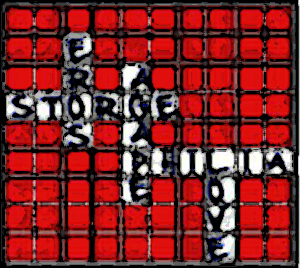
The Greek language distinguishes four distinct words for love: agápe, éros, philía, and storgē.
Four Archetypes of Love
Storge (στοργή) means “affection” in ancient and modern Greek. It is natural love, like that is felt by parents for offspring, or between brother and sister or by children for their parents. It is a descriptor of relationships within the family. It is also known to express mere acceptance or putting up with situations, as in “loving” the tyrant. The key attribute is natural.
Philia (φιλία) is “conscious” love, we know from words like philosophy – love for wisdom (Sophie). It mean a feeling of friendship and enjoyment of an activity, again used in both ancient and modern Greek. It is a dispassionate virtuous love, a concept developed by Aristotle. It includes loyalty to friends, family, and community, and requires virtue, equality and familiarity. The key attribute is rational.
Agape (ἀγάπη) means love in a “spiritual” sense. In Ancient Greek, it often refers to a general affection or deeper sense of ” unconditional love” or altruistic love , coming from the heart. In latin the eqivalent word is “caritas”, it gives and expects nothing in return. Agape is used by Christians to express the unconditional love of God for us and loving each other like we love ourselves. The key attribute is spiritual.
Eros (érōs) is “physical” passionate love, with sensual desire and longing without the balance of consciousness. The Modern Greek word “erotas” means “intimate love”. Plato expanded this definition: as appreciation of the beauty within an object, or even of beauty itself. Indeed the word platonic love today describes, “without physical attraction.” Plato argues that eros helps the soul find knowledge in beauty which contributes to an understanding of spiritual truth, leading to transcendence. The Greek believed that beauty can never be evil. The key attribute here is sensual.
The sermon continued with a few examples describing the opposite of love. Obviously indifference and hate are opposite of love, so is antipathy. A few other examples were given, like egoism and narcissism, which seem to be so common today. Now what would be the four opposites for love: agápe, éros, philía, and storgē. in some languages
storge
The opposite of storgē, would be indifference. In German I associated immediately “herzlos” (heartless) as in “herzlose Mutter” or “Rabenvater”. Also there is rarely hate in families, but quite often you find indifference in this relations.
The opposite of philía would be antisocial and disloyall behaviour in regards to community and society. Here I associated immediately “antipathy” may be mutual and unilateral disloyalty in friendship (Falscher Freund).
The opposite of Agape would be of course narcissism and egoism. Here I associate immediately, “lieblos”, “hartherzig” und “Eigenliebe” instead of “Nächstenliebe”. Narcissus feels no empathy.Narcissus is a character from Greek myth… a young man of incredible beauty that one day caught his own reflection in the surface of a pond – and became so enamored of his own face that he stayed there, gazing at himself, until he died. Modern psychology has taken this mythology and describes narcissism is a disorder wherein an individual is so wrapped up in themselves that they have trouble maintaining healthy relationships with other persons. There is reason to believe that many “successful” (and unsuccessful) leaders nowadays suffer from narcissism and narcistic wounds. I have written here about it: Archetype of the vampire in todays culture of Narcissism.
The remedy against egoism is according to the pater the holy spirit. Pope Franciscus tweeted a few days ago: “Come, Holy Spirit! Help us to overcome our selfishness”. According to C.G. Jung the Ego must be overcome to find the Self (which is our window to god). The remedy against narcissism is according to his sermon humor (or jokingly 2 years of psychotherapy). Like a needle it punches and deflates the inflated ego, allows “heart talk” and empathy. Now I do not know if he knows the book, “Heart Talk”, a study of the emotional range of the Thai language through the word ‘jai’ or heart in English. It provides a comprehensive list of 900 jai phrases, neatly organized for different situations. I will later give a few examples of this linguistic heartscape where ideas take shape and feelings are formed.
The opposite of Eros is hate. Hate is passionate and strong like love is. It is a deep feeling, often triggered by rejection. Any student of the psychotherapies would have heard of the terms: Eros and Thanatos – Life instinct and the death instinct. Sabina Spielrein wrote originally on this concept and it was sized by Freud in his revised theory of human nature. In his book “The ego and the id” he discusses this theory of opposites: Eros is a “…self-preservative instinct,…”. On the other hand there is the death instinct whose task it is to, “…lead organic life back into the inanimate state;…” We are entering into the field of the philosophy of opposites. Where has philia as in philosophy and metaphysic its place? The word philosophy comes from the two Greek words: philia and sophia. Philia is the Greek word for ‘love’ (a bond of friendship), while Sophia is Greek for ‘wisdom’. Philosophy is literally the “love of wisdom”. But love may pursue, but not possess. Wisdom comes form the mind, love from the heart. Clearly love is another, a different form of wisdom.
philo
The sermon mentioned of course that love comes from the heart. By marriage and business experience I am also familiar with the many words of heart in Thai language – Jai. Jai is one of the most important concepts for consultants to understand when they commence business in Thailand. The Western capitalism is often very pragmatic and business-like, but this culture can be misinterpreted (and sometimes rightfully interpreted) as “jai dum” – black heart.
One may consider Jai dum as opposite of Eros, very similar to a person full of hate. Jai dum is a cruel lack of humanity (dum =dark or black). In Thailand, as in many other cultures, the color black has negative associations as black is quite literally the “full lack of light”.
Kao jai (understanding) may relate to Philia.
I think Nam jai relates to Storge. Nam jai directly translates as “Water from the heart” (Nam = water). It refers to a kind, generous person, who thinks about the other person. Nam jai is one of the strong values by which Thai people judge each other. If you are perceived as mai mee nam jai (lack of nam jai), people will perceive you in western term as heartless and not cooperate.
I think Jai boon relates to Agape. Jai boon means “generous” and “full of merit”. Someone who is jai boon gives away or donates what they have to others (Boon = “merit”, reflecting the Thai Buddhist custom of “merit making” in this life for the afterlife by doing “good works” and providing alms to monks).
A lot of expressions I learned from the mentioned Canadian novelist Christopher G. Moore – his fiction is quite useful for cross cultural training: chua jai – believe, dee jai – happy, dtaam jai – please yourself, up to you, dtang jai – purposefully, dtat sin jai – decide, dtok jai – shocked, frightened, goom jai – worried, greng jai – be afraid of offending, jai baap – sinful, jai dum – cruel, malicious, jai dee – kind, generous, jai deeoh – faithful, jai keng – stubborn,jai lai – mean, nasty, jai orn – soft-hearted, jai rorn – hot tempered, impatient, jai yen – calm, jai yen yen – calm down, mai por jai – dissatisfied,man jai – confident, nam jai – generous, por jai – satisfied. There is a motto that say “Sabai jai krue Thai tae (Sabai jai is the true Thai). Sabai means “comfortable”. For example, “Sabai jai loan” is a highly advertised.
E. munch-eros
There was some relationship advice in that sermon too. You may relate agápe, éros, philía, and storgē also to relationship and marriage. When we first meet, woo and eventually commit to one another we experience Eros, a passionate love in a strange long distance relationship. However, a successful marriage must hold on Eros, but also understand that a more cooperative, sustaining connection must be formed. Philia is a love based on friendship between two people, it is patient and kind. In a marriage it is important that you not only love, but also like your mate. When we get older, sexual lure wains or shared experience decreases, a sense of connectedness must remain. Get to know your partner now as a friend, not only as lover. Next, Agape love is beyond Philia and Eros love. Selfless and non-judgemental, it is considered the spiritual dimension of love. Agape is given without self benefit, expectation or condition. Last but not least, storgē means take care for each other in a very literal sense, during sickness or old age. “For better and worse” means love despite disappointment and shortcomings, at difficult times.
marc-chagall-agape
Now, finally, what is the love of God? What the Biblical concept of ‘Love’. We’ve travelled so far away from the love God today. It was agape that the early Church used to denote the Love of God demonstrated in His sending of the Son to effect reconciliation (I John 4:10, Rom 5:8, Eph 2:4-5). It’s these twin concepts of ‘undeserved merit’ and ‘the giving of oneself’ that lie behind the concept of the love of God in the NT.
So sad whats going on in Bangkok and everywhere now. Evil is the opposite of love – in all four dimensions of it. As C.G. Jung said, your vision will become clear only when you can look into your own heart. Who looks outside, dreams; who looks inside, awakes. This is what the dynamic model of love and anti-love proposes. Up to date psychotherapies have learned from the church on the (moral) static dichotomy of good and bad and the god and the devil.
Let’s say this is not only an essay of Female Archetypes, but also a semi-fictional story. I was very pleased, that good friend of mine, who happens to be a catholic monk and Jungian psychoanalyst, accepted to be the god-father of my son. Since he lives somewhat remote on the country side – you guessed it, his home is a monastery – I picked him up on the day of the confirmation. I wanted also to show my appreciation. During the car ride, we discussed the contribution of women in psychoanalytic realm particularly C.G. Jung and women. I tested a little bit my upcoming article regarding Sabina Spielrein, and from there the conversation wandered to the subject Toni Wolff and Female Archetypes. We agreed, that she had written the most concise essay on the Anima, besides the two essays Emma Jung’s “Animus and Anima”, a work, he said, still widely used by psychoanalysts. C.G. Jung developed the idea of the Anima and Animus from his analytical practice and from examining his own psychology. Jung recognized, that there is an inferior feminine orientation in the male psyche which he named the Anima, from the Latin word for spirit, and an inferior masculine orientation in the female psyche which he called the Animus.
Five Key Women
The female Vampire
Beside Jungs’s circle of women analysts and writers, like Jolande Jacobi, Aniela Jaffe, and Marie Louise Von Franz, five key women played an important role in Jung’s life and the generation of his theory. They are Jung’s mother, his cousin Hélène Preiswerk (the first patient), Sabina Spielrein (the first patient in analysis), Emma Jung (his wife) and Toni Wolff his long-time collaborator (and many say almost minor wife). They were Medial Woman deeply embedded in Jung’s emotional life. By inductive intuition, he moved from specific observations to broader generalizations and theories. Jung’s women shaped his ideas by Memories, Dreams and Reflections, particularly Sabina Spielrein, his prototype of an Anima. Revelation of their psyches (Sabina and Toni began as patients), and Jung’s own during the crisis years gave way to The Red Book and theory. What crucially distinguishes Jung from much of the psychiatric practice surrounding him (especially Freud) was his refusal to regard spontaneous unconscious phenomena as pathological. Men by nature are more normally dualistic predisposed(formative abilityand instinctive impulsiveness), thus their cultural achievements more determined by the intellect or spirit. Thereconscious attitudeandcoping with therealityare thereforeusuallybased on themostdifferentiated function. However, Jung certainly worked empiric with two functions, “thinking” and intuition.
Archetypes according to Tony Wolff
According to Toni Wolff, women are inherently more conditioned bytheir soul, so her spiritand sexuality is rooted in the he psychical dimension.Theirconsciousness istherefore more comprehensive and holistic, but less defined.
AnimaToniWolf
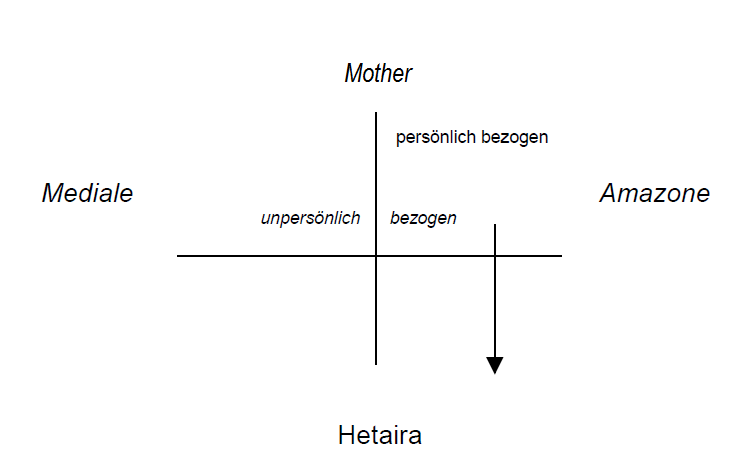
Toni Wolff structured the Anima in an interesting quadruple of four basic archetypes. She said the names are not of much importance, but one coulddescribe them asthementalforms ofMother (andwife), theHetaira(companion, friend), the AmazonandtheMedial Woman. They have in commonwith the psychologicalfunction types, that their axesare opposite(i.e,personal or impersonalrelation), thatmeans usually aformis the predominant, a secondcanjoin it, the third and fourthfirstare unconscious, and only later inof life one can madeaware ofandintegratedwith difficulty.In this respect,allfour formsare detectablethrough the cultural history, and likely tobe female archetypalstructures. They are aspects of themaleAnima and the structure schemewould bethe following:
The Mother archetype represents the woman’s natural capacity and numinous power to conceive, give birth, sustain, and renew life charitable by motherly cherishing, nursing, helping and teaching. Her instinct reacts to all in man, for which must cared for or what needs protection and development.
The Amazon archetype is independent and self-contained in a positive sense and highly capable of making her way in the world. Amazon represents the adventurous, often traveling in the direct sense of the word, but also into the territory traditionally occupied by men.
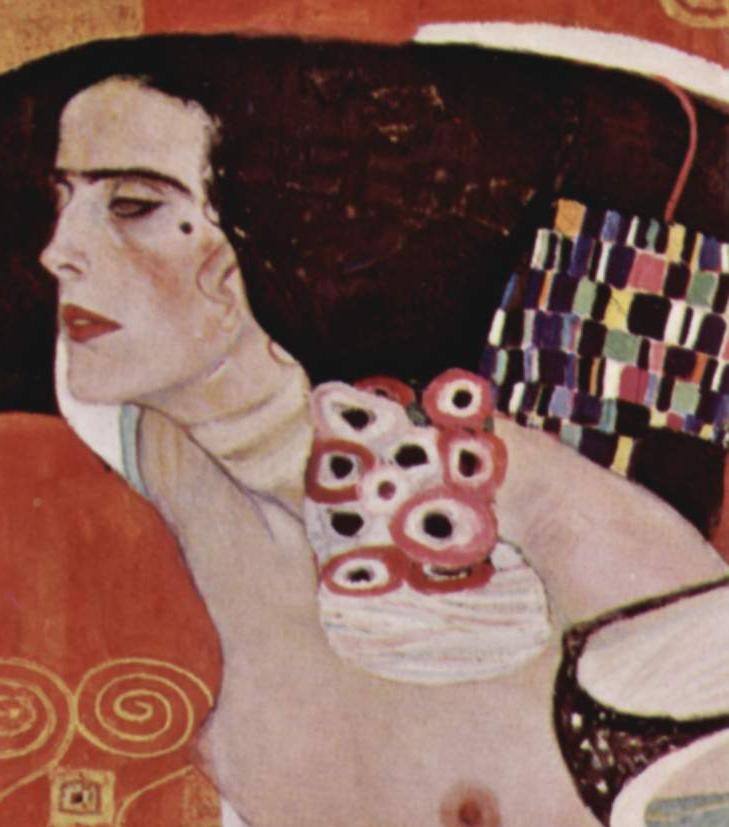
The Hetaira archetype is companion to man, related to the personal psychology of the man, as well as to her children and friend. Hetaira is the root of the word Hetaere – mistress. So reading between the line and her description, in essence Toni Wolff surely meant Eros (or Lover) which corresponds nicely with the male archetype of Thomas Moore and Douglas Gillette. They adopted and extended Jung’s approach in their exploration of the masculine psyche by using the collective archetypes of the King, the Warrior, the Magician, and the Lover, which I mapped to the female archetype quadruple in my essay: Queen, Mother, Wise Woman and Lover: Rediscovering the Archetypes of the Mature Feminine here.
The Medial archetype is immersed in the psychic atmosphere and the spirit of her period, but above all in the impersonal unconsciousness. In short, C.G. Jung would call that a seer or wise man, that sends or foretells us on a search for knowledge of all kinds: spiritual,metaphysical, gnostic, mystical, psychological, intellectual, scientific, political, or outcome of future battles. I wrote about Sabina Spielrein in Female Archetype of Sabina Spielrein – queen or wise women?
Anima and Animus unconscious elements of the psyche’s multiplicity
From Jung’s observations during the analysis of his patients, he recognized the Anima and Animus to be unconscious elements of the psyche which needed to be developed, or made conscious, to maintain a balanced connection to the world at large and first step of individuation. The Anima in a man, Jung maintained, is a mostly personal image of Woman within his psyche which each man carries with him through life. This image, or inner psychic reality, is a composition of a man’s experiences of femininity from childhood on, which is combined also with ancestral and archaic collective impressions of femininity. Jung maintained that it was the Anima which was responsible for a man becoming attracted to women, but only certain women, those who are close in character to this inner experience of femininity in the man’s psyche. In women, the Animus plays a similar role of defining the masculine side of a woman’s personality. Logically Emma Jung’s major contribution ( influenced by Toni Wolff) is her expansion on the concept of the Animus in her first essay written 1931. The Anima essay, written in 1955, presents fewer personal views, and relies more on myth, legend, and fairy tale. As her numerous references to mythologies show, Animus and Anima can affect a man and woman in regards to each other and in spiritual quest.
On the way back through the rolling hills
Moonlit Beauties. Luis Anima and Pantheism based on Ricardo Falero . US Public Domain.
On the way back, while driving during theincipientdusk in the rolling foot hills of the Bavarian Alps, we were both a bit tired after the dinner. The conversation became simpler, but a little more personal. At one point he asked me about my marriage. “A real drag” I said. He responded : “How much of it you think comes from her menopause? Somewhat cynical and blunt I quipped: Oh, a great part of it of course, I know that, but see I am a simple guy. If the sex is good – a woman can’t do hardly wrong, if the sex is bad – a woman can do little right. We had a very strong and good sexual relationship in our choppy enough marriage. Kind of glue. I know, that I have to transform my marriage, but all I could do was transferring to a decent truce and level of indifference. Silence. We must have thought both, well consultants typically are immune to counseling, so we changed the subject.
Tony Wolff’s structure of the Anima
I understood pretty clearly, that all men pick their wife (the wealthy men, or those with wealthy wives – their mistress) unconsciously after their Anima. Even Jung (especially Jung) seems a primary example to me. Toni Wolff, by the way was his mistress after Sabina Spielrein, who in turn is considered as catalyst for his Anima theory. Both women were gifted psychiatrists. Well, by chance I re-read Tony Wolff’s structure of the Anima today. Oops, now I understand my problem on a meta-level. Of course, the Anima doesn’t change, but time alters women. So that’s the meaning of the saying: Women want always to change their man and men want their woman not to change. Unfortunately, both things never happen. Eros may be for many men, the primary Anima “function”, as well as sexuality the primary path of communication, keeping the synchronization (or trust level) up. So yesterday had been a Jungian psychoanalytic session on the steering wheel. It has not solved my problem (yet), but sure was a great talk.
Jacobi, Jolande, Die Psychologie von C. G. Jung – Eine Einführung in das Gesamtwerk, mit einem Geleitwort von C. G. Jung [Gebundene Ausgabe]
Jung, C. G., Jaffé, A. (1962): Erinnerungen, Träume, Gedanken von C. G. Jung. Aufgezeichnet und herausgegeben von Aniela Jaffé. Olten: Walter
Jacobi, Jolande, Complex/Archetype/Symbol in the Psychology of C.G. Jung (Bollingen Series)
Mandala: Bilder aus dem Unbewussten (German Edition) [Hardcover] 2.Auflage Olten 1977
Jaffé, Aniela. Aufsätze zur Psychologic C. G. Jungs. (Essays on the psychology of C. G. Jung). Zürich, Daimon Verlag, 1982. Pp. 160. Paperback (The latter book I found in a heap of books in a second-hand shop)
Shortly before his own death, C.G. Jung finished his autobiographical book erinnerungen-traeume-gedanken. In addition, to the extremely popular book “Man and his symbols”, his most important theories of analytical psychology are summarized in a simple way in collaboration with his students. Supposedly a chapter about Toni Wolff has been removed on request of his family nor is Sabina Spielrein mentioned. I highly recommend this book to anyone interested in the life of Jung and the events in his life that influenced his work (edited by Aniela Jaffe) :
Introduction by Aniela Jaffé
Prolog
Childhood
Years of schooling
Academic years
Psychiatric activity
Sigmund Freud
The confrontation with the unconscious
On the origin of the work
The Tower
Travel
North Africa
The Pueblo Indians
Kenya and Uganda
India
Ravenna and Rome
Visions
About life after death
Late thoughts
Review
Reprinting panels
four essays on the work of Jung
two on more personal aspects of his life
Sabina Spielrein (1885-1942) was a brilliant psychoanalytic pioneer in many ways —one of the first women to write a psychoanalytic dissertation, the leading pioneer in child psychology, and the true originator of the “death drive” (destruction as the cause of becoming) a full decade before Freud. Sometimes not the individual misses a moment of history, but fate or history itself rejects a significant person, choosing a darker alley rather than a great moment. This essay explores Spielrein’s contribution to psychoanalytic theory and her enigmatic live including after she moved back to the USSR.
When Jung and Spielrein had their intense romantic and intellectual entanglement between 1904 and 1909. According to letters it seems initially, Freud and Jung actually colluded to downplay her and paint her as a vengeful, unstable woman to protect Jung’s career. However after Jung split from Freud in 1913, the Freudians warmly welcomed Spielrein [into the Vienna Psychoanalytic Society] very likely partially because they realized they could use her intimate knowledge of Jung as an institutional weapon. Resembles her life the female archetype of the Queen (in exile), or Russian Jewish Wise Woman entangled with the two leading pioneers of the first hour of psychoanalysis – C. G. Jung and Sigmund Freud?
By 1923, Spielrein was living and practicing in Geneva, entirely safe from the volatile political currents sweeping through Eastern Europe. However, Freud explicitly supported and encouraged her return to Soviet Russia to help establish and institutionalize psychoanalysis in Moscow. Besides ending deadly for herself and her three brothers, this served a dual, cynical purpose. It allowed Freud to plant the flag of psychoanalysis in the newly formed USSR and it permanently removed a (maybe too) brilliant, potentially vocal woman with inmate knowledge of the Freudian circle from the European intellectual center. She moved back to the USSR, shortly before Lenin’s death in January 1924. Her family was completely caught in the dual meat-grinders of the 20th century of the two totalitarian regimes of Stalin and Hitler.
Scope and Structure
Secret Symmetry
Most know from Sabina Spielrein, that she was patient and presumably a lover of of C.G. Jung and later a psychoanalyst herself. Spielrein, who could have been a decisive Jungian, switched sides to Freud and his narrow materialistic Viennese psychoanalyst school -certainly a founding stone but largely discarded clinical today. It seems to me that Freud (and to a lesser degree C.G. Jung) used and belittled her. Supposedly on advice of Freud Spielrein moved to Russia, conveniently forgotten by the psychoanalytical community and out of the way. After 1923 she has published only one scientific paper. Freud borrowed freely her ideas, and his daughter Ann assumed her role in child psychology.
1942 Spielrein and her daughters vanished in a SS massacre on the Jewish community at Rostov on Don, Spielrein’s birthplace. Between August 2 and 11, 1942, the Einsatzgruppe D SS unit murdered up to 18,000 Jewish residents in a mass shooting at the Zmiyevskaya Balka (Snake Ravine). The exact names and stories of individual families from this tragedy are extremely difficult to locate.
I like ponder the following questions about Sabina Spielrein:
Psychological Dimension
Theoretical work of Sabina Spielrein;
C.G. Jung and Sabina Spielrein
Sigmund Freud and Sabina Spielrein
Sabina Spielrein in Russia
Sabina Spielrein in psychoanalytic history
I have touched the life of Sabina Spielrein in a former article briefly, but will try to approach her in this essay by her own accounts or those of C.G.Jung and Sigmund Freud:
Spielreins’s doctoral thesis and her famous publication “Die Destruktion als Ursache des Werdens” Jahrbuch für psychoanalytische und psychopathologische Forschungen IV. Band 1912 (available as pdf).
Her recently discovered diary and letters to Jung and Freud published in “A secret symmetry” by Aldo Carotenuto (original in Italian).
Sigmund Freud, Carl Gustav Jung Briefwechsel Freud / Jung Fischer Verlag 1974 (also available by Princeton University Press);
The second must-read scholarly analysis, “A Most Dangerous Method” by John Kerr, 1993.
In order to get more historical and evidential context I used:
History of the Bolshevik Revolution by von Rauch (Wiesbaden 1955)
Historical Analyses around location and time listed in the reference section. Rostov on Don is located 500km (300mi) from the current Crimea Crisis area. The city, occupied by German troops twice, saw the first major retreat of the German forces in WWII on their way to Stalingrad.
Finally Marton’s somewhat dry documentary My Name Was Sabina Spielrein (2002) and the juicy edutainment “A Dangerous Method (2011)” by David Cronenberg which may also be called a “A Marketable Distortion”. When dealing with historical characters, freedom of art does not allow a severely distorted portrayal.
Please bear in mind this not a scholarly work buts an essay about a woman who deeply scarred by two major psychoanalytic schools, and who was destroyed by both of the twentieth century’s major totalitarian systems.
The triangle – Jung – Spielrein- Freud interaction
Throughout his life, Freud experienced competitive feelings in male-female-male triangles (John and Pauline; Wilhelm Fliess and Emma Eckstein ; C.G. Jung and Sabina Spielrein) with a male intimate companion. It is perhaps ironic that when Sigmund Freud – who lived by the psychoanalytic theory that sexual desire was the prime driver for human beings – found out his young protégé, Carl Jung, was having an extra-marital affair with Sabina Spielrein. Sabina Spielrein, seems not the only female patient with whom C.G. Jung had an relationship, he was a decidedly heterosexual man of impressive stature, but it seems this one was serious by nature. In Spielrein’s letters she writes about wanting to have a “Aryan-semitic” child, and as she tests actually Freud’s theory with those of C.G. Jung it seems that really this is meant on a a metaphorical level – merging the two complete different psychoanalytic systems together.
Freud was viewing Jung as protégé and innovative and original heir to psychoanalysis. Jung, however, soon questioned some of the basic tenets of Freudian theory. Freud’s reaction to the defection of Jung, and later that of Alfred Adler, was to close ranks and further guard his theories. C.G. Jung’s view fit nicely to contemporary thinking, that innovative conservatism, which is called for to protect freedom -and- the world environment as well as western heritage. C.G.Jung’s cultural roots were decisively neo-romantic drawn to symbolism and irrationality or at least mystic and he uniquely connected psychology and religion. In politics he questioned democracy and rejected socialism preferring elitism – like Nietzsche which is quoted extensively by Spielrein. Jung criticized also the rationalistic, “disenchanted” view of the world, Freud’s hostility against religions and contradicted him on many theses. Freud was to one-dimensional and a product of a special, narrow and bourgeois short overcome period, Freud not Jung became mainstream, Spielrein deserted Jung and of course Freud’s materialistic view appealed to the left.
Psychological Dimension – Female Archetype of Sabina Spielrein
Until 1980, Sabina Spielrein was represented in the work of Sigmund Freud in the psychoanalytic literature by four footnotes; also it is mentioned several times in the Freud-Jung correspondence (1974). Through her relationship with Jung, Sabina Spielrein had a direct effect on Jung’s own ideas, particularly the Animus. She was his first and prototype of Anima. Her second paper talks about the death instinct a concept that Freud would later adapted as part of his own theory. These marginal existence, in psychoanalytical history only changed when you have a box of highly interesting material discovered late seventies during renovation work in the basement of the Palais Wilson in Geneva from the early days of psychoanalysis. Aldo Carotenuto, a Jungian analyst, was notified and immediately recognized the importance of the matter. It was Sabina Spielrein’s namely correspondence with Sigmund Freud and Carl Jung and her diary.
Her diary and her letters to Freud and Jung constitute the greater part of the book “Secret Symmetry” of Mr. Carotenuto, a Jungian analyst and a professor of psychology at the University of Rome. There are also a number of letters from Freud to Spielrein, but, most unfortunately, the Jung family will not release Jung’s letters to her, although Carotenuto has been allowed to quote from them.
The subject – her diary
anima
Over 25 years ago, diaries of Sabina Spielrein and letters she received from Jung and Freud were found in the basement of the Wilson Palace in Geneva (the Psychology Institute where she worked used to be there).
The documents were published for the first time by Italian psychoanalyst Aldo Carotenuto. He understood that the discovered materials would once again confirm the liaison between Jung and his patient, his subsequent pupil, that Freud was also involved there quite sinister. Carotenuto (either out of gentleman’s solidarity, or because of his respect to the founders of psychoanalysis) supplied the letters with polite comments. The diary covers the years 1909 to 1912. They paint a picture of a bright, young completely healthy young woman concerned with her doctor thesis. It is also a good account to her time growing up, and shows also it seems the typical conflict of young Jewish female if they fall in love with a Christian man.
Sabina Spielrein fell deeply in love with Jung during her treatment, a love that she knew must remain secret due to his marriage and the ethics of his profession. Jung was first attracted to Spielrein at Burghölzli. In the records at Burgholzli Hospital on his treatment of Spielrein, Jung wrote an entry in his own handwriting on January 29, 1905. He states that he had visited Spielrein the previous night, “reclining on the sofa.” He describes her manner as “oriental” and “voluptuous,” and her face as bearing “a sensuous, dreamy expression” (Covington and Wharton, 96.) Both Spielrein and Jung’s feelings for each other continued to deepen in subsequent years. They shared a passionate interest in psychoanalysis that further bonded them.
The object – Letters between C.G. Jung and Sigmund Freud about “Die Kleine”
Hidden Triple Agenda – Jung and Freud writing about Sabina
Spielrein’s mental health “affliction” appeared at age seventeen, although she had been beset with problems throughout her young life. She was taken to the ( Burghölzli) Burgholzli Treatment and Care Institution (or Psychiatric Clinic) in Zurich on August 17, 1904. Spielrein became the first patient of Carl Jung, ten years her senior. She remained an out-patient in treatment with Carl Jung for years after her hospital discharge June 1, 1905. Jung wrote to Freud in October 1906 (one of their first letters (4J and 5F), seeking his opinion about a “severe case” he had involving a young female Russian student. During the course of her treatment, Sabina Spielrein became the friend and then most likely mistress of Jung. So almost one year later, in June 1907 he had to ask for advice again, telling Freud that Sabina Spielrein had made inappropriate demands to have a child with him and since he declined was badmouthing him. Indeed the letters to Jung speak of an Semite-Aryan child ,she wanted to have with him, but that seems purely metaphorical. Freud responded professional, saying in essence that is the risk of their trade. Later the stormy love affair between Jung ans Spielrein that continued until the spring of 1909 was discussed between them. To what degree the relationship was sexual remains an inclusive subject. Jung eventually ended the affair, to save his marriage and his career. A rumor was maliciously circulated in Vienna and Zurich about an affair he allegedly had with a student. Initially, both Jung and Freud thought Spielrein was the origin of the scandal as an act of revenge against Jung for ending their relationship.
Together, Jung and Freud plotted against her, later it seems Freud plotted against Jung. The next milestone was a letter from Freud to Jung in October 1911 telling him that Freud had admitted Spielrein in his Psychoanalytic Society (273F). From that on about 10 letters refer to Spielrein’s publication in the context of an inferior pupil and an afterthought. Both men refer to her as “Die Kleine” with Jung always emphasizing how much work ans support she needs to correct her publications. Freud and Jung mostly share quite destructive criticism of her. In a letter and of march 1912 (F311) Freud gives Jung a hint that he discussed with Spielrein same “intimate things” with her (about her relationship with Jung). After that the tone between Jung and Freud (and vice verso) becomes frosty and only few letter were exchanged.
The Symbol – history and culture
We are faced with the peculiar finding of psychoanalysis, the well-founded belief in the healing power of recollection, has been persistently objected in its own historicization. Handing down of a wrong diagnosis – severely disturbed person with or with out sexual undertones – ensures that in the hagiography of psychoanalysis everything remains the same.
The recent very Freud friendly movie “A Most Dangerous Method” put her gain in the category “sexual troubled” (not sure if pervert or liberated was suggested) focusing at a shallow relationship triangle story – sex sells. The juicy sex scenes seem to be dreamed up totally, as the most explicit you may find in the letters is “writing poems together. The history of psychoanalysis is littered with the discarded psyches of the women whose diagnoses were key to the fame of the great masters. One such woman was Sabina Spielrein. At least Elisabeth Márton´s film “My name is Sabina Spielrein” relates, re-stages and remembers the tragic story of Spielrein’s life as gleaned from a box of her papers discovered in 1977 in the cellar of Geneva’s former Institute of Psychology.
Sabina Spielrein, even after her death, fell victim to the severe struggle for affirmation of positions in hierarchy or political viewpoints. Several years ago a work by Peter Kuter under the title Modern Psychology was published in Germany. The scientist depicted a genealogical tree of the psychoanalytical school and mentioned Sabina Spielrein. Russian scientists were astonished to see that when the book was translated into Russian in 1997 in St.Petersburg, the Spielrein was dropped off the genealogical tree.
As always, history is the story of the past, told for present purpose, but the purpose stayed. the same and the patient psychoanalysis is not healed.
Achievements of Sabina Spielrein
In 1911, Sabina wonderfully defended a thesis on the subject “On psychology of material on one schizophrenia case”. Sabina Spielrein’s most famous work, “Destruction as the Cause of Coming into Being” (Destruktion als Ursache des Werdens, 1912) . It envisions her neither as a premature Jungian nor as a dissident Freudian, but as what she truly was: an independent theorist whose dialectic of creation and destruction in transformation occupies the intellectual space between Freud’s metapsychology and Jung’s later psychology of individuation and the collective unconscious. Spielrein, a Russian psychoanalyst, argues that creation and destruction are inseparable. Her core insight is that genuine transformation requires the dissolution of an existing form—a law that applies equally across the biological, philosophical, psychological, and symbolical realms. Sabina Spielrein’s November 29 entry presentation to the Vienna Psychoanalytic Society, bearing the working title “Über Transformation,” was a preview of her finalized 1912 paper, “Die Destruktion als Ursache des Werdens”. Her work seems inherently more Jungian than Freudian, at the crucial points, she politely disagreed with Freud—she is Sabina Spielrein. Among her Viennese colleagues, Spielrein’s presentation was therefore met with massive resistance. Freud himself was not yet ready to her ideas; it was not until his 1920 essay, “Beyond the Pleasure Principle,” that he would finally acknowledge Spielrein’s work—misunderstanding and pressing it squarely in his rigid orthodoxy and relegating Spielstein’s work to a mere footnote. He entertained the idea of a strong connection between a new instinct Thanatos and Eros, the instinct of death and the instinct of creation.
Spielrein has been considered by some as the model for Jung’s concept of the anima. She deepened both Jung and Freud’s understanding of transference and counter-transference. The relationship between Jung and Spielrein demonstrated that a therapist’s emotions and humanity could not be kept out of the psychoanalytic relationship between analyst and patient. Freud claimed as cold materialist, using science as shield and serious front-end, psychoanalysts would be able to function from an objective and neutral position in their work. C.G. Jung spiraled in the most productive crises after his split, (with Spielrein and Freud),but eventually stabilized became an accomplished empirical psychoanalyst and continued to have outside affairs with pupils and colleagues (next in line was Toni Wolff).
It is hard to explain the oblivion into which Spielrein fell until recently. Neither Ernest Jones in his standard work on Freud (1953), nor Peter Gay’s magnum opus, Freud (1987), nor even Nancy Chodorow, who wrote on the contribution of women to psychoanalysis (1987), mention her in their writings. Her primary role in child psychology has been wrongly attributed to Anna Freud or, alternatively, to Melanie Klein.
Despite of that, Spielrein pioneering work in their specialty area child analysis have remained unnoticed. In psychoanalytic reception still Freud’s daughter Anna or Melanie Klein is regarded the founder of child psychoanalysis At this time twenty-five publications of Spielrein were published, ten of them dealing with child-analytical issues. We must ask ourselves: What forces are at work here and foreclose psychoanalysis from remembering and historicization of their origin mythology?
The making of a psychoanalyst
Sabina Spielrein enrolled in the spring of 1905 at the medical faculty of the University of Zurich and rents a room in district, which is called on Zurich « Russian colony ” Although Sabina Spielrein does not need to worry financially, their years of study in Zurich are difficult and overshadowed by her relationship with Jung. It has become more complex , oscillating between therapeutic relationship , idealized teacher – student relationship , friendship and love affairs. In the winter semester 1910/11 Sabina Spielrein concludes the study of medicine. In her dissertation , she examines “the psychological content of a case of schizophrenia ( dementia praecox )”, which was the first psychoanalytic dissertation of a woman. It proves Spielrein linguistic sensibility and talent in capturing and deciphering of unconscious mental processes. The text was published 1911 as first dissertation ever in the ” Yearbook for Psychoanalytical and Psycho-pathological Research ” .
The summer semester spends Spielrein in Munich, where she writes here comprehensive meta-psychological speculation. The theme develops a theory that the sex drive consists of two antagonistic components a ” creative” and a ” destructive instinct “. The text ” Destruction as cause of becoming ” will be 1912 also published in the prestigious Yearbook side by side with an article of C.G. Jung. Her most famous publication entitled Destruction as the Cause of Coming into Being which mentioned before was published in 1912. Although praise and multiple references to her by C.G. Jung, the article fell with her into obscurity after she moved back to Russia.
In April 1912 Sabina Spielrein returned to Rostov and married the Russian-Jewish doctor Pawel Naumovich Sheftel, but the couple moved to Berlin , where Sabina gives birth in December 1913 to her first daughter. Shortly after the beginning of first World War II , we find her again in Zurich and Sabina Spielrein spends her last three years in Switzerland in Geneva. She published several articles in professional journals and lectures on psychoanalysis and education at the Institute Rousseau and works clinically and makes training analyzes of , among others, Jean Piaget. During World War I, Spielrein continued to live in Switzerland while her husband remained in Russia fighting with his regiment based in Kiev. From 1914 to 1923 Dr. Sheftel had lived with Olga Snitkova with whom he fathered daughter Nina in Russia while married with Sabina who lived and worked in Switzerland
C.G. Jung and Sabina Spielrein
In the summer of 1904 her parents sent Sabina to the Burghoelzli mental hospital in Switzerland; the diagnose was mental hysteria (debilitating hysterical/sexual complex). When she was first admitted, Jung described Spielrein as being unable to look anyone in the face, keeping her head bowed and sticking out her tongue ”with every sign of loathing” if anyone touched her. Attacks of depression alternated with weeping, laughing and screaming. The eighteen year old girl Sabina Spielrein and a thirty year old unknown doctor C. G. Jung started as of a patient-doctor relationship with a powerful transference and counter-transference between Spielrein and Jung. Jung was troubled by the strong emotions his former patient stirred in him and sought out advice on the matter from Freud, thus beginning their correspondence and relationship. Being convinced of the ideas of Sigmund Freud, he applied methods of the psychoanalyst from Vienna on Sabina for the first time. Jung described success of medical treatment of the young Russian girl with usage of these methods in letters to his friend and teacher.
Jung didn’t conceal the fact that Sabina fell in love with him (it is frequent in medical practice when female patients attribute features of a hero, father or God on their doctors). He wrote, the girl “sincerely” told she wanted to give birth to his son whom she wanted to name Siegfried. The liaison between Sabina Spielrein and Carl Gustav Jung lasted for five years. It may be that these relations turned out to be some kind of a catalyst for C.G. Jung scientific development and luring Sabina Spielrein away from Jung. Freud wrote to Sabina: “We will be happy to meet you even further if you wish to stay with us, but you must learn to discern the difference between friends and enemies (I mean Jung).”
The medical treatment went successfully. In a year Sabina felt perfectly well, and the head physician of the clinic and boss of C.G. Jung, famous psychiatrist Eugen Bleuler allowed Jung to let his patient to enroll at the Zurich University medical school for studies.
Letters between Spielrein and C.G. Jung
For years Spielrein moved endlessly, seemingly incapable of settling anywhere or with anyone. Meanwhile, says Kerr, ‘Jung was busy making her immortal.’ In the years following the First World War, Jung developed a means of categorizing the conscious. He invested the Anima with all sorts of qualities, some exhilarating and some dangerous which, Jung wrote, he’d recognized in ‘a woman… a patient, a talented psychopath who had become a living figure in my mind’. Jung’s Anima model was Sabina Spielrein.
Spielrein corresponded with Jung until at least 1919 and with Freud until 1923. The published letters cover the years 1911 to 1918 with forty six letters from Jung (only quoted unfortunately not released) and twelve of Spielrein. The topics are strictly of psychoanalytical content.
Jung was married with two children, and it is clear that his relationship with Spielrein was inappropriately intimate (whether it was sexual or not is not proven). Jung and Spielrein’s letters discussed theory at length. Just as Jung and Freud became increasingly distrustful of each other and possessive of their ideas, so too did Jung and Spielrein.
When he read her university dissertation on schizophrenia Jung told her, ‘I am surprised by the abundance of excellent thoughts, which anticipate various ideas of my own. But it is good that others see things the same way as I do.’
He commented on to her next paper, ‘Destruction as a Cause of Coming into Being’ (written immediately after she graduated with top honors), ‘As I read your paper I find uncanny parallels with my own new work.’ Spielrein clearly exploded, for his next letter exclaims, ‘You are upsetting yourself unnecessarily again!’ His reassurance that, ‘your study is extraordinarily intelligent and contains splendid ideas whose priority I am happy to acknowledge as yours,’ is undercut by his assertion that, ‘I express myself so differently from you in my work that no one could imagine you had borrowed from me.’
Sigmund Freud and Sabina Spielrein
Spielrein also sought help from Freud, initially requesting a consultation with him in 1909, but Freud declined due to his discussions with Jung about his relationship with Spielrein. Spielrein eventually met Freud in Vienna in October 1911. He was greatly impressed with her.
In autumn 1911 leaves Zurich and moves to Vienna to work with Sigmund Freud. Spielrein became an elected member of the Vienna Psychoanalytic Society. She is now twenty-five. The minutes of the club meetings show that they vividly involved in the discussions and lectures. Freud earns to appreciate and even sends her patients. There has always been a question about the extent of the relationship between Freud and Spielrein on many levels, and also about just how much of her work Freud may have adopted as his own, giving her little or no credit. Dr. Spielrein’s life ended in obscurity when she was only 55, Freud continued to increase in stature and reputation.
At that time, Freud listened to the report of the young psychoanalyst indulgently and said the speech was “logically well-composed”. Only in several years, he himself expressed the dual theory of attractions; at that he didn’t refer to Spielrein’s report delivered in 1911, that anticipated Freud’s later ideas of attraction to death. In 1930, when Freud once again mentioned his former resistance to the theory of attractions, not a single word was said that criticism of that kind was given in response to Sabina Spielrein’s article.
Letters between Spielrein and Sigmund Freud
The published letters cover the years 1909 to 1920 with twenty letters from Freud (fortunately included) and two of Spielrein. The first May 30th 1909 reads like a job application. The next is already an request to mediate between her and C.G. Jung. The last fragments talks about her about “declaring her self to “our (Psychoanalytical) Society” a “treachery which Dr. J. cannot forgive”. She first wrote to Sigmund Freud in 1909, met him in 1911 in Vienna, and continued meeting and corresponding with him at least until 1923, to some eventually developing into more of Freudian than a Jungian in her work.
A women which wants to make it, has an affair with her analyst which happens to be also important for her psychoanalytic career. She consults 1909 another analyst – which happens to be the psychoanalytic father disappointed from his heir – to help sort out her ensuing problems. A tricky situation, for the analysts even and especially if the analysts were Jung and Freud in a love hate relationship. Spielrein continued to correspond also with Jung and Freud during this time, despite the destructive split that occurred between the two men in 1912.
In a 1909 letter to Freud she writes: ”Four and a half years ago Dr. Jung was my doctor, then be became my friend and finally my ‘poet,’ i.e., my beloved. Eventually he came to me and things went as they usually do with ‘poetry.’ He preached polygamy; his wife was supposed to have no objection, etc., etc.” By 1909 Jung was trying to separate from her emotionally but continued to see her and gave her help with her dissertation. In 1910 Spielrein records that at one time Jung gave her his diary to read and said that no one else could understand him so well as she did. Then he abruptly alters his tone, addresses her formally in letters and signs himself ”Dr. Jung.” Spielrein confides in her mother, who has received an anonymous letter which says that Jung is ruining her daughter. Her mother writes to Jung, to whom she is obviously grateful for the great improvement in her daughter’s condition, begging him ”not to exceed the bounds of friendship.” Jung writes back an appalling letter.
Spielrein then writes to Freud asking to see him. As usual, Freud behaves outwardly correct. He writes to Jung requesting information. Jung reveals that Spielrein is a patient about whom Freud knows something already, since not only was she the subject of a lecture given by Jung in Amsterdam but she was also the person referred to in an earlier letter to Freud in which Jung complained that a woman patient had ”kicked up a vile scandal solely because I denied myself the pleasure of giving her a child.” Jung goes on, ”I have always acted the gentleman towards her, but before the bar of my rather too sensitive conscience I don’t feel clean. …” In a subsequent letter, Jung reveals that he has seen Spielrein again, that she was not the author of the rumors he had attributed to her and that he himself was to blame, not only for encouraging her but also for trying to defend himself ”in a manner that cannot be justified morally.’
The Freudian Case against Spielrein
The reappearance of Spielrein ‘s diaries, letters and scientific publications in the eighties were not taken on by the Freudian psychoanalysis as kick-off to revitalize memory. Rather, Spielrein was subsequently honored with a distorted, one-sided form diagnosis of severe mental disorder , a psychotic who broke with reality. Aldo Carotenuto called it ” veritable schizophrenic episode ,” Bruno Bettelheim a ” schizophrenic disorder ” or a ” severe hysteria with schizoid features ” ; Max Day spoke of ” borderline “. Happily Freudian took C.G. Jung (!) as witness , who presented the “Case Spielrein” at the International Congress of Psychiatry and Neurology in 1907 in Amsterdam.
A closer look shows that Sabina was not the lunatic ill patient not, as today’s analyst – about Carotenuto, Bruno Bettelheim or Max Day – want to make us believe. Sabina has been able to exploit the situation in Burghoelzli and developed a perspective that suited their preferences and their talent. So Jung and Spielrein got over a rapidly developing crisis. Soon after she sits – herself still patient – on the doctors table, participating in the clinic’s health studies and deals with diagnosis. It shows a remarkable success of Jung’s theory and practice – and that some very gifted psychoanalyst have crises on her own. C.G. Jung was smart enough to forbid the document of his crisis during lifetime, probably aware of the dangers of an “vicious psychoanalytical community” as a friend of mine, a Jungian psychoanalyst, liked to refer to both psychoanalytic schools.
Conflicts of and between Sigmund Freud and C.G. Jung
Sigmund Freud and C. G. Jung began to correspond with each other in April 1906. During the next seven years they corresponded regularly, usually at intervals of a few days. This extensive correspondence of approximately 360 letters has been published 1974 for the first time. The Freud–Jung relationship dominated the history of the psychoanalytic movement, until relations were finally severed early in 1912. If you read their published correspondence today, it is impossible to distinguish issues of passionate friendship, academic rivalry and theoretical conflict in their relationship. Freud was explicitly looking for a son and heir for the psychoanalytic movement. Jung seemed both to be seeking a father figure for his psychic security but soon rebelled against him.
The major players in the Red Book- Jung, Salome, Elijah
After years of exchange differences between Jung and Freud became increasingly evident 1912. Besides the professional dissent the conflict comes to a head until the opposites finally be unbridgeable. It is exciting to witness based on the selected documents the inevitable entanglement to its tragic failure. As with the correspondence between Spielrein, Freud and Jung the correspondence between Jung and Freud has become essential to understanding the evolution of psychoanalysis – and the virtually insurmountable challenges facing woman who sought to contribute in any role other than that of patient, pupil, wife, daughter, lover or groupie with or without scientific credentials. But also the vicious underpinnings of the “publish an perish” science. Both man belittled Sabina Spielrein and she after she switched sides, Spielrein became dangerous to Jung and was used by Freud.
For Jung, Spielrein’s company as patient, pupil and lover in those days may have triggered partially his career breakthrough but surely may have led breaking away from Freud. In “Memories, Dreams, Reflections”, Jung seemed to indicate that all his most important insights stemmed from his unconscious fantasies in the years 1913–18 during his creative illness after the break with Freud and Sabina Spielrein. The overlay with letters from Spielrein show remarkable ambitious women and her undeniable talents consciously or unconsciously deepened the conflict between the two alpha men.
By taking her in the Freudians effectively “owned” the scandal and utilized the narrative of Jung’s boundary violation to paint him as unprincipled, unprofessional, and psychologically unhinged, using Spielrein’s past trauma as ammunition in their corporate war against Swiss Analytical Psychology. Once the Freudians had used Spielrein to damage Jung’s reputation, they took advantage of her intellectually and then erased her from the history books. In 1920, Freud published Beyond the Pleasure Principle, introducing the “Death Instinct” (Thanatos). He relegated Spielrein—the woman who had introduced this exact concept to him in 1911—to a brief, dismissive footnote, claiming her ideas were too closely tied to her own “neurotic complexes”.
Its pure speculation, but I could envision both men were happy when she left Switzerland and was no trouble anymore. If so, for very different reasons.
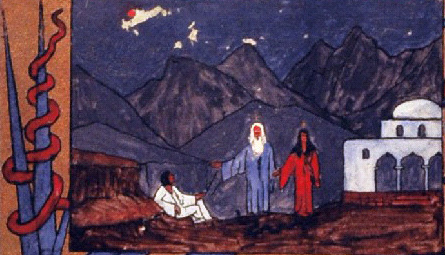
Certainly, at this point, his former patient Toni Wolff became a necessary substitute to C.G. Jung. Toni Wolff became the established mistress and important collaborator. During this crises Jung created the Red Book, published posthumous much later, which was to together with the Seven Sermons to the Dead, the seed of his work. Jung was plagued by visions of blood, an underground river with a blond male corpse, a scarab, a red new sun in the prelude to the First World War. A brown-skinned man told him to kill the hero, Siegfried. A fantasy figures of Elijah accompanied by a young girl, Salome taught him about the importance of the unconscious. A number of studies have noticed what is pretty evident if you study the Red book, that, in Elijah and Salome, he had versions of the two important people he had just lost, Freud and Sabina Spielrein.
For Spielrein the separation has been a disaster which has still has consequences today. Sigmund Freud safely managed his institutional legacy from Vienna and London. Anna Freud inherited his empire. Meanwhile, the woman who provided the raw intellectual architecture for their most famous late-stage theories was sent away which turned into harms way, her papers left rotting in a Geneva basement for over half a century.
Spielrein was the first to systematically analyze young children’s speech, play, and developmental cycles. After Spielrein was safely isolated in Russia, Anna Freud stepped into the Western vacuum, published heavily on child psychology using virtually identical clinical frameworks, and was crowned the “mother of child psychoanalysis”—effectively absorbing Spielrein’s life’s work without giving her due historical credit.
Sabina Spielrein in Russia after 1923
Sabina would have made a wonderful career if she had made it there stayed in Europe. But on recommendation of Sigmund Freud, Sabina Spielrein got back to Russia. For 1.5 years she lived in Moscow, then she moved to Rostov, where she lectured at the University and worked as a doctor.
Only few in the Russia or her hometown Rostov on Don, where Sabina was born, studied and later perished, know details of her private life and scientific activity. The woman is still a mystery, even now and despite the fact she always involved with public figures as friends, doctors or teachers.
Freudian bloom
Sabina Spielrein
In 1923, yielding to calls from parents, brothers and husband, as well as to Freud’s urging her “to accomplish important work at the side of Wulff and Ermakov” in Moscow, she returned to Russia.
In spite of the mantle of Freud and successes in Moscow, e.g., lecturing and teaching at the State Psychoanalytic Institute, as head of the section on child psychology at Moscow University and had an appointment at the State Psychoanalytic Institute and co-worker at the State Children’s Home and Laboratory “International Solidarity,” Spielein abruptly returned to Rostovand reconciled with her husband Sheftel in 1924 and in June 1926 their second daughter Eva was born. The Bolsheviks printed Freud’s writings. Under patronage of Trotsky, the Russian psychoanalysis (strictly speaking Freudian) experienced at the beginning of the twenties a short bloom. The Bolshevik revolution, already ruthless by Lenin’s design, succumbed after Lenin’s death to evil and inhuman Stalin. Under his rule, the USSR degenerated into a brutal tyranny of its own, aptly symbolized in George Orwell’s book “Animal Farm”. After the intellectual flamboyant Leon Trotsky (chosen by Lenin as his successor) had to emigrate to Mexico, all intellectuals in the Soviet Union were in great danger. Trotsky was killed 1938 with an ice pick by a Stalinist agent, in Mexico-City. Intellectuals, who stayed, had either to adapt totally and opportunistically or perish in a niche. After 1925, when Stalin began repressing psychoanalysis, would have been risky. Spielrein worked as school medical psychologist. Spielrein must have chosen the latter, she moved from Moscow for Rostov on Don, from then on working mostly practical-therapeutic.
Recently discovered personal information sheet of the Soviet People’s Commissariat of National Education , ” Narkompros ” , confirm that Spielrein had from September 1923 three appointments: as a research assistant at the State Psychoanalytic Institute in Moscow, as pedagogical doctor in the town of the Third International (a type of children’s village ) as well as Head of the Section of child psychology at the First Moscow University. In Moscow Spielrein founded together with Ivan Ermakov Dimitrievitch and Moshe Wulff, the first Institute for Psychoanalysis in the Soviet Union. It was also the first state psychoanalytic training institute in the world. 1921-1924 of the Psychoanalytic Institute experiments were performed with liberal collective education in early childhood in the orphanage Laboratory, which served the ’68 movement as a model for their sexually charged socialist children shops.
Communist Terror
Sabina Spielrein’s clinical work was directly caught in the crossfires of the lethal political war between Joseph Stalin and LeonTrotsky. In the early 1920s, Leon Trotsky was the premier champion of psychoanalysis in the USSR. Trotsky believed that Sigmund Freud’s theories could be synthesized with Marxism to forge the “New Soviet Man.” He personally funded and protected the State Psychoanalytic Institute and the Moscow “White Kindergarten” (Detski Dom). Then psychoanalysis in the Soviet Union became prohibited.
Because Trotsky had explicitly sponsored these institutions, psychoanalysis became deeply branded as a “Trotskyite deviation.” When Stalin consolidated power and exiled Trotsky, he systematically liquidated everything his rival had touched. Spielrein brothers had become successful scientists and became in the cross hair just by indirect association.
Following the collapse of the Soviet Union in 1991, the opening of the [KGB/NKVD archives] confirmed the chilling, bureaucratic precision with which Stalin’s apparatus liquidated Sabina Spielrein’s brilliant family. Her three brothers were leading Soviet intellectuals, and their files in the Declassified NKVD Execution Archives reveal a textbook operation of the Great Terror of the late thirties:
1. Isaak Spielrein (Arrested 1935, Executed 1937)
Isaak was a world-renowned psychological genius who founded the Soviet field of Psychotechnics (the psychology of industrial labor).
The Charge: Because his scientific work in the 1920s had been praised, utilized, and personally funded by Leon Trotsky, the NKVD targeted him the moment Trotsky was exiled. Declassified files show he was arrested in January 1935 under the fabricated charge of being a leader in a “Trotskyite-Zinovievite Counter-Revolutionary Terrorist Organization.”
The Execution: After two years of brutal psychological isolation, he was sentenced to death by the Military Collegium of the Supreme Court of the USSR. NKVD records show he was shot on December 26, 1937, and buried in a mass grave at the infamous Kommunarka firing range outside Moscow.
2. Jan Spielrein (Arrested 1937, Executed 1938)
Jan was a brilliant mathematician, physicist, and a member of the USSR Academy of Sciences. He was completely apolitical, dedicated entirely to engineering and electrification.
The Charge: Under Stalin’s paranoiac directives, simply having a brother who was labeled a “Trotskyite spy” made Jan an immediate target of the NKVD’s group-guilt quotas. He was arrested in 1937 on charges of espionage and sabotage of Soviet technical infrastructure.
The Execution: Declassified court logs reveal his trial lasted less than fifteen minutes. He was found guilty without defense counsel and shot on January 21, 1938.
3. Emil Spielrein (Arrested 1937, Executed 1938)
Emil was a respected biologist and the Dean of the Faculty of Natural Sciences at Rostov State University.
The Charge: Like his brothers, his proximity to Western scientific circles and his family name sealed his fate. He was arrested during the sweeping purges of the regional academic elite in 1937.
The Execution: He was convicted of counter-revolutionary propaganda and shot on June 20, 1938.
The declassified files show that by mid-1938, Sabina Spielrein was left entirely alone, her family utterly decimated by the Soviet state. The state officially stripped her of her medical licenses and academic titles because she was the sister of three “enemies of the people.”
This explains why she was forced into deep poverty, working as a marginalized music teacher in Rostov-on-Don. She survived Stalin’s NKVD only to be caught in the path of Hitler’s SS Einsatzgruppe four years later—a tragic, perfect illustration of Jung’s warning that when human beings lose their connection to individual morality, the totalitarian state functions as a meat-grinder
It was a hard life, Sabina aged rapidly, a bent woman, wearing old-fashioned clothes and shoes. The husband died of a heart attack in 1937. Thereafter Spielrein made a friendship pact with Olga Snitkova to take care of each other’s children in case one predeceased the other. .
The many deaths of Sabina Spielrein – unreliable sources
Aldo Carotenuto assumed 1982 in his book “Secret Symmetry” Spielrein’s death year around 1937 which would connect hers to the fate of her brothers. Spielrein’s death may remains a mystery to me at least in the web – which comes up with three dates for her death but no real proof.
According to many web articles “Swedish journalist M. Ljunggren”, had discovered her fate. I have found no primary sources for this on the web yet. I did find a David Ljunggren, a journalist who speaks English, French, Russian and was stationed from 1989 to 1995 in Moscow where he covered the collapse of the Soviet Union.
In the book, “Sabina Spielrein: Forgotten Pioneer of Psychoanalysis” it is written that Dr. Ljunggren supposedly brought evidence that she was killed 1941 – which would be during the first occupation which lasted only eight days.
There is indeed a Magnus (M) Ljunggren, who professor for Russian literature. In the book of Andre Karger / Christoph Weismüller (Editors) “Ich hieß Sabina Spielrein – Von einer, die auszog, Heilung zu suchen” he contibuted a chapter about Sabina und Isaak Spielrein.
However, the only base (and a credible one too) of all those repeated net claims seems to come from Henry Zvi Lothane or Henry Lothane, a clinical professor of Psychiatry, at Mount Sinai Hospital in New York. He wrote in a short paper that the wive and Isaak’s wife and daughter Menikha survived in Central Asia. According to him Menikha Isaakovna a physiologist and biochemist, was discovered in 1982 in Moscow by the Swede Magnus Ljunggren. Menikha Isaakovn had a perfect command of German. Henry Zvi Lothan quotes now a letter of Menikha Isaakovna in 1994:
“In November 1937 I decided to travel to Rostov, to my grandfather. Sabina asked me whether I believed what was being written in our newspapers about the cruelties perpetrated by Germans. She added, she had lived for many years in Germany and could not believe what is being printed in our newspapers, since she knows the high level of the German culture, of the people who gave the world Goethe, Heine, Schiller and many well known and outstanding people. I told her that I believe what was written about the Germans, I told us many stories and gave us underground literature from Germany, publications with descriptions of Nazi crimes. Obviously, I was unable to convince her. Cut off from contacts with the West, Spielrein did not know what was going on in Germany nor was she aware of Jung’s boundless admiration for the Nazis, inspired by Hitler’s Mein Kampf, aired on Radio Berlin in 1933.
The first occupation of Rostov during WW II lasted for 8 days in November of 1941 whereupon the Germans were repulsed by the Red Army. On July 27 1942 the Germans reoccupied the city. Last time Spielrein was seen in August marching with her daughters in a long column of some 27,000 Jews towards the immense Zmeyovskaia ravine, on the outskirts of Rostov: all were gunned down and thrown into the mass grave, where a museum now stands. Some commentators saw in Spielrein’s staying there as acting out her death instinct, a case of wild analysis, trivializing her martyrdom. In the hospital she wrote her last will: on her grave an oak be planted in her memory with a sign “I was once a human being and my name was Sabina Spielrein” while another inscription read: “And let young life play at the entrance of the tomb and let indifferent nature shine with outer splendor”.
In any case, of all the quotes about Spielrein’s death in her many historizations, Henry Zvi Lothan’s quote seem genuine and plausible, but it has to be noted, it reads like second or even third hearsay of an unknown source. There is a gap – Menikha seems not have stayed in Rostov between 1937 and 1942.
Spielrein’s Notes vs. Rigid Marxist Pedagogy
The Moscow “White Kindergarten” (founded by Vera Schmidt, with Spielrein as its chief clinician) was closed by the state because its psychological findings flatly contradicted the rigid, mechanical dogma of Marxist pedagogy.
Sabina Spielrein’s Clinical Approach vs. Marxist Pedagogy Human Nature Driven by complex, autonomous, internal forces (the unconscious, ancestral archetypes, and deep biological drives). A tabula rasa (blank slate); human beings have no innate psychology and are shaped entirely by material conditions and state conditioning. Child Development Children process the world dynamically through individual play, speech, fantasies, and working through internal conflicts. Children must be collectively conditioned into a productive, standardized labor resource for the state. Authority & Growth Strict, authoritarian suppression forces natural drives to mutate into destructive complexes or severe neuroses. Total, unyielding collective discipline is mandatory; individual deviation is a bourgeois defect. The “New Soviet Man” Can only be achieved through deep self-awareness, emotional liberation, and psychological healing. Is manufactured by the state through rigorous political indoctrination and physical labor.
The Clash of Clinical Reality
Spielrein’s actual clinical notes from this period show that she observed children acting out, displaying sexual curiosity, and expressing deeply ingrained aggressive impulses (her concept of the destruction drive).
To the Bolshevik state post Trotsky , these clinical notes were offensive heresy. Marxist pedagogy demanded that children be treated as purely rational, malleable cogs. If a child was aggressive or unstable, the state did not want a therapist investigating their subconscious; they blamed it on “corrupt bourgeois parenting.”
By the late 1920s, Stalinist officials launched a vicious campaign against pedology (child psychology). They condemned the White Kindergarten as a “perverted, bourgeois, psychoanalytic distortion” that over-emphasized sexuality and individuality over class solidarity. The school was shut down, psychoanalysis was completely banned, and Spielrein’s life’s work was locked away in state archives.
The intersections of her life show how terrifyingly accurate Jung’s warnings were: when the state becomes a dogmatic religion, it hunts down the scientists of the soul.
How Lev Vygotsky Secretly Saved Spielrein’s Insights
During Spielrein’s time in Moscow, both Alexander Luria and Lev Vygotsky came to work at the Psychoanalytic Institute and “Dyetski Dom” and studied with her. Spielrein’s method combining subjective psychological ideas from psychoanalysis with objective observational research of children is likely to have been an important influence on them. When Joseph Stalin officially banned psychoanalysis, pedology, and child psychology in the late 1920s, scholars who referenced Sigmund Freud or Carl Jung faced exile or execution. Lev Vygotsky (the father of Soviet developmental psychology) and his colleague Alexander Luria realized that Sabina Spielrein’s brilliant clinical discoveries would be destroyed if they remained attached to her name or to psychoanalysis.
To preserve her life’s work, Vygotsky acted as an intellectual smuggler, stripping her theories of their “bourgeois psychoanalytic” vocabulary and translating them into standard Marxist, materialist language:
The Translation of “The Unconscious” into “Inner Speech”: Spielrein was the absolute pioneer of studying child language, tracking how a child’s private babble or fantasies reflect internal, unconscious needs. Vygotsky took this exact data and re-labeled it “Inner Speech” in his famous Cultural-Historical Theory. He argued that a child talking to themselves isn’t acting out deep Freudian drives, but is rather using a tool to internalize social language. This semantic shift allowed her clinical data to survive Soviet censorship.
The “Missing Link” Between Piaget and Vygotsky: Spielrein had psychoanalyzed a young Jean Piaget in Geneva before working with Vygotsky in Moscow. She discovered that children’s thoughts develop through a dialectical tension between individual biology and social interaction. Vygotsky leveraged Spielrein’s intimate knowledge of Piaget to construct his own famous critiques of Piaget’s work, essentially using Spielrein’s mind as the silent bridge for his own theories.
Submerging the Individual into the Social: Spielrein pioneered the idea that language is inherently relational—a tool to connect the self to another. Vygotsky absorbed this, stating that all higher mental functions originate as social interactions. By scrubbing the psychoanalytic focus on individual neurosis and framing it as a socio-cultural process, Vygotsky successfully hid her foundational concepts inside the bedrock of Soviet education.
Because Vygotsky safely hid these ideas inside state-approved textbooks, her core concepts outlived Stalinism and eventually shaped global educational structures—even though Vygotsky himself never dared to cite her name in his late works out of sheer terror for his own life.
Fascist Terror
It is very possible even beyond doubt, that Sabina Spielrein met a tragic end in her hometown 1942. As a strategic bridgehead, Rostov suffered in World War II twice the occupation by the German Wehrmacht. It is a fact, that when Hitler’s troops conquered the strategic city on 27 July 1942 the second time, tens of thousands of civilians were killed. According to repeated copy cat web entries Sabina Spielrein was last seen by neighbors in the summer of 1942 , supported by her two daughters, Renata and Eva, in a group of Jews. It is another fact, that during the occupation civilians and captured Red Army commissars were driven through the streets to the outskirts ; there, in the deep gorge that is called Zmiyevskaya Balka (the Snake Gully) they were killed by men of command 10a from the “Einsatzgruppe D”. Mainly consisting of Security Police and the SD (Sicherheitsdienst) as well as Gestapo, this special non-military forces were mobile and partly stationary ideologically trained mass murders, reporting directly to SS leader Heinrich Himmler. In accordance with different sources, there are 18-27 thousand people in that common grave, and each of them was with his individual story. Sabina Spielrein with her daughters Renata, 29, a talented cellist, and Eva, 14, who could have become a wonderful violinist shared this fate. Her husband had died a few years earlier..
It has been also said that in the years after the first occupation of Rostov, that even in 1941 Sabina Spielrein refused to leave the native city or to hide. She explained the decision not to leave Rostov to the second wife of her husband. Before the war, the abandoned women understood perfectly well that each of them may be sent to the Soviet GULAG camps, that is why they agreed that the one who remains alive will bring up all children.Scientist Movshovich studying history of the Rostov region wrote: “By the time of the second occupation of Rostov, Spielrein very likely had already no illusions anymore”. However, all the same she refused to save her daughters: a friend of Sabina’s offered to give forged documents to the girls as they could have passed for Armenians. It is a mystery why Sabina Spielrein several times rejected methods of salvation.
How does Russia sees Sabina Spielrein’s work today?
The answer is a fascinating, deeply complicated paradox. It split cleanly between a localized, academic cultural pride and a broader state ideological friction.
The Rostov Revival
On a regional and civic level, there has been a remarkable, grassroots effort to reclaim Spielrein as a great Russian intellectual hero. This is a dramatic reversal from the Soviet era, when she and her work were completely erased.
The Spielrein Mansion Museum: In 2015, an official Sabina Spielrein Memorial Museum was opened inside her childhood home on Pushkinskaya Street in Rostov-on-Don. It features a permanent exhibition of her photographs, personal belongings, and a plaque honoring her as a “famous student of C.G. Jung and S. Freud”.
Immersive Tourism: Local historians and theater groups have developed immersive tours (like “The Forgotten Drama of the Spielrein House”) celebrating her life. In the Russian south, she is viewed as a brilliant, homegrown pioneer of global science.
Holocaust Memory: Her tragic murder, along with her daughters, at Zmievskaya Balka (the “Snake Gully”) in 1942 is recognized in Russia as part of the tragedy of the Great Patriotic War, anchoring her legacy to the national memory of overcoming Nazi occupation.
The Academic Re-evaluation: Claiming Vygotsky and Luria
In Russian academic circles (specifically psychology and neuroscience departments at Moscow State University), there is an ongoing effort to correct the historical record.
Russian scholars are increasingly highlighting how Spielrein’s “White Kindergarten” and her lectures in the 1920s directly shaped Lev Vygotsky (the father of Soviet developmental psychology) and Alexander Luria (the founder of modern neuropsychology).
By proving that Vygotsky and Luria integrated Spielrein’s ideas on child language and developmental psychology, Russian academia uses her to claim that the foundations of modern developmental psychology are fundamentally rooted in Russian/Soviet soil, rather than being purely Western exports.
Despite this local pride, Spielrein’s actual core theories face a silent, structural glass barrier under Russia’s current ideological framework.
The Problem of Her Core Framework: Spielrein was a pioneer of feminist psychology and early psychoanalysis—frameworks that look directly at individual trauma, unconscious desires, and sexual dynamics. Classical psychoanalysis is still subtly viewed through a conservative state lens as a Western, hyper-individualistic, and socially corrosive philosophy.
The Suppression of Memory Archives: While Spielrein the person is honored, the systematic study of how she and her family were destroyed by the state is highly sensitive. Her three brilliant brothers were executed in Stalin’s Great Purge. Organizations like Memorial (the NGO dedicated to documenting Stalinist crimes), which actively unearthed the fates of families like the Spielreins, have been banned and criminalized in Russia. Therefore, Russia certainly honors her death at the hands of the Nazis, but heavily softens her persecution by the Soviet state.
The Core Translation of Her Work
In essence, modern Russia views Spielrein much like a museum artifact: she is celebrated as a “Great Russian Mind” who competed with and influenced the giants of the West (Jung and Freud). However, the radical, individual-liberating substance of her psychological theories remains largely unintegrated into the broader, state-sanctioned cultural narrative. She has been claimed by Russian history, but her deepest warnings—much like Jung’s and Arendt’s—are kept safely inside the glass case
Sabina Spielrein in psychoanalytic history
Compared to other sciences and professions, psychoanalysis appears quite open to the participation of women. This is especially true for the early period, as the way of the role of the analys and to the profession of psychoanalyst not very far and not once was unusual. In the history of psychoanalysis is Sabina Spielrein, however vain. In Ernest Jones’ standard work “Sigmund Freud” (1953) she is not recognized; in Peter Gay’s magnum opus, “Freud” (1987) she is only briefly mentioned in the context of Freud’s concept of the death instinct. Nancy Chodorow, dealing at least with the “contribution of women to the psychoanalytic movement and Theory” (1987), forgets her completely. Ellay Zaretskey drops her name four times, with Jung having a affair, together with Piage, as female psychoanalyst in Russia and one sentence about her death (without date and source). The more the writer is leaning toward Freud, the more she is deliberately minimized, it seems. Almost like zhis is an act of repression, which is well-known defense mechanism according to Freud. Repression acts to keep information out of conscious awareness. However, as always memories about Spielrein don’t just disappear; they continue to influence the behavior of the psychoanalytic scene. Maybe they this consciously by forcing the unwanted information out of our awareness, which is known as suppression which is most likely. The last movie, “A Dangerous Method”, makes a romantic soft porn out of her story. After that movie many articles came up, but nobody seem to value her publications or even bother to read them.
Conclusion
There are many parts of Sabina Spielrein’s life that remain a mystery and there is continued controversy regarding specific dates and activities in her life . She faced many obstacles, both because she was a woman working in a predominantly male profession and because she was Jewish during a period of violent antisemitism. Not only her tragic death cut short a life of promise, but it also seems even more her decision to move to the Freudian branch, which has been connected to the political left. Lured by the false promises of revolutionary communism to Russian intellectuals and her subsequent relocation to the USSR maybe by bad advice, silenced her voice and relieved the scientific community of an inconvenient and outspoken competition.
The psychoanalytic concept of repression is based on the axiom that an earlier event A suppressed by a later event B. Thus, event A obtains new meaning and now unfolds pathogenic effect. For this operation, the concept of ” deferred action ” was coined. The question of the displacement can be applied to the history of psychoanalysis itself. One could say: First, Sabina Spielrein was forgotten. There were plenty of reasons. She reminded the psychoanalytic movement inevitably on the traumatic break between Freud and Jung in 1913. Spielrein was also an independent and rather odd person who did not allow academic mandarins clamp their interests on her. She repeatedly kicked the structures of alpha males (and their coterie). She did not (want to) understand the rules of international psychoanalytic association, and with regard to questions of scientific priority did not bother with dangerous rivalries like Freud’s daughter Anna. As a ‘free electron’, she didn’t make it in the Western entrenched structures and moved to the even more dangerous settings of the aftermath of the Bolshevik revolution. Sabina Spielrein, even after her death, fell again victim to the severe struggle for affirmation of positions in psychoanalytical hierarchy or political viewpoints.
Bibliography
Carotenuto, Aldo. A Secret Symmetry: Sabina Spielrein Between Jung and Freud. New York: 1982.
Kerr, John. A Most Dangerous Method: The Story of Jung, Freud, and Sabina Spielrein. New York: 1993.
Spielreins’s doctoral thesis and her famous publication “Die Destruktion als Ursache des Werdens” Jahrbuch für psychoanalytische und psychopathologische Forschungen IV. Band 1912 (JdP_IV_1912_1_SpielreinJung).
Sigmund Freud, Carl Gustav Jung Briefwechsel Freud / Jung Fischer Verlag 1974 (also available by Princeton University Press)
Henry Zvi Lothane, MD The real story of Sabina Spielrein: or fantasies vs. facts of a life
Karen Hall, Sabina Spielrein in the Jewish Women’s Archive
Ellay Zaretskey, Secrets of the Soul New York: 2004
Spielrein published thirty psychoanalytic papers in French and German. The majority of them have not yet been translated into English. Her two most significant works were her dissertation on schizophrenia, which contributed greatly to understanding the language of schizophrenics, and her second work, “Destruction as the Cause of Coming into Being”. Sabina Spielrein’s 1912 work, “Destruction as the Cause of Coming Into Being,” offers a profound, predictive framework for understanding collective, destructive, and renewal cycles . Her writings, which argue that “species-psyche” prioritizes collective transformation over individual ego, can be accessed through the Aphelis Archival PDF and Wiley Online Library. Furthermore, her correspondence with C.G. Jung, detailing the storage and activation of historical trauma in populations, is analyzed in SciELO. A comprehensive list of her publications is available through the Spielrein Association.
As you can see after her reconciliation with her husband 1923 in Russia she wrote only one more paper.
“Über den psychologischen Inhalt eines Falles von Schizophrenie (Dementia Praecox).” Jahrbuch für psychoanalytische und psychopathologische Forschungen (1912): 3:329–400;
“Die Destruktion als Ursache des Werdens.” Johrbuch für psychoanalytische und psychopathologische Forschungen (1912) 4:465–503;
“Beiträge zur Kenntnis der Kindlichen Seele.” Zentralblatt für Psychoanalyse und Psychotherapie (1912) 3:57–72;
“Mutterliebe.” Imago (1912) 2:523–24; “Selbstbefriedigung in Fusssymbolik.” Zentralblatt für Psychoanalyse und Psychotherapie (1913) 3:263;
“Traum vom Vater Freudenreich.” Internationale Zeitschrift für ärztliche Psychotherapie (1913) 1:484–486;
A scholarly fashion claims that only by coincidence Christ and not the Egyptian Isis or the Persian Mithras gained the upper hand as a world religion. There is some truth in it, but also an utter disregard of the attractiveness of Christianity at that time. This article will explore this question from a historical thesis, that the globalized Roman Imperia created a market of religions. Furthermore the exclusive – or shall I say smart – Christian religious offerings took in account the Romans’religious preferences and the weaknesses of the many competing religions and cults. Its explosive growth was supported by a successful sociological approach and a savvy management style – strategic global, acting locally but centralizing its control over teachings.
Christianity entered a Rome in which its citizens suffered from the first major globalization. Success bread failure, the expansion of the empire brought wealth, cheap resources and slaves, which led to unemployment of the lower classes and then to their subsidizing: the famous “bread and circus”. The Roman society was sharply divided between rich and the (heavily) sedated poor and an anxious middle class. Rome became confused, spiritually bankrupt and fractured, chasing a million different dreams–tolerant but in moral chaos–polytheistic, not exclusive–embracing a “cafeteria”approach to religion. At this point the growth of the polytheism ceased as the history and state religion slowly shifted to monotheism. (e.g. Mithraism , Sol Invictus). This brings us to Christianity, which was first seen as just another “Oriental cult” in Rome rather for somewhat crazy sectarians. A lot of ink has been spilled, how Christianity developed from a Jewish sect to the world religion, which even today is nothing else than the Western cultural identity, but the question was never answered conclusively. I suggest there is more than a miracle to worry about. By studying the nature of these cults, it’s possible to gain insight into the reasons Christianity succeeded where all the others failed in the long run. So why did Christianity win? Will it win again today?
Before we start, let’s have a look on the attributes or criteria from we want to evaluate …
religious offering: resurrection or infinite afterlife; personal relationship with God;
practical offering: community, strengthen the individual in daily life;
demand: exclusive or non-exclusive commitment from followers ?
god: monotheistic or polytheistic, pantheistic
sociological approach: what was role of women, to which class did it appeal (e.g. elite, urban)?
political demand: could it be seen as a political threat, was it private, against or with the authorities?
organization: central with approved and authorized teachings or fractured cults and spinoffs;
ethic: like charity, love, sexual conduct, hedonistic
structure: cult, integration with astrology
of early Christianity and some major religious competitors:
Isis and Sarapis
Mithras Cult
Cybele and Attis
Roman polytheistic state cults
Imperial Cult ( emperor worshipping)
Philosophical Religions
In this article I will not look at gnosticism or philosophical religions. From a Christian perspective the uprooting of Gnosis was almost an inner fight of live or death, of which I have written here. Philosophical Religions (Neo-Platonism, Neo-Pythagoreanism, Gnosticism) have Roots in Platonism and in Pythagoreanism, but no clear descent and are characterized by a disdain for the material world appeal more to intellectuals than to ordinary people. It is clear that Christianity owes Neo-Platonism and also includes some streaks of Gnostics as C.G. Jung pointed out.
Roman state religions
For early Empire, there was a strong need to reunite the Romans culturally. A possible political solution was emperor-worship•but emperors are transient and many blamed the Empire and the generals for the decline in their living standards. Its important to note that nearly every emperor following Alexander was deified by the Senate as standard practice; until the reign of Constantine in the 4th Century AD. Worse, the emperor-worship was a form of taxation –and who wants to worship tax-collectors? State religions comprised a Rome that was spiritually bankrupt and fractured, chasing a million different dreams–indifferent in disguise of tolerance but in moral chaos–polytheistic, not exclusive–embracing a “cafeteria”approach to religion. As a rule, the Roman authorities showed indifference to every cult interpreted today as tolerance, but actually can be compared to today’s Western spiritual void. The Roman Senate did exercise some limits of practicability, for instance it restricted in the 2. Century B.C. the Bacchus cult which always offered an occasion to celebrate orgies in public. Rome came down hard on cults which were understood as a political threat. However, as long as the citizen adhered to the state gods Jupiter, Juno, Minerva and paid the emperor credulity taxes, the Romans could shop freely in the religious supermarket. Here they showed a strong preference for the oriental and exotic, better said: they credited their favorite cult’s eastern origins and ministered their idols with unique attributes of non-roman origin, i.e. long trousers, Phrygian caps, or in the case of Isis, with a “typical Egyptian” guise.
Male Archetype: Mithras the Roman Warrior
MITHRA
The central motive of every Mithraism is a representation of Mithras dragging a bull and slitting its throat. Mithras defeated the bull, killing the animal creating a cycle of life. He holds the bull kneeling down, with the head of the left-hand it tears him in the neck, and the right carotid artery leads to the dagger. Snake and dog have been waiting for the blood. The Scorpion – symbol of the evil – has retreated within the testicles. The death of the bull, whose tails are not in a tuft atop, but end in an ear, frees its life-giving liquids. The divinity is originally from Persia, but that was of little importance. Mithras is also surrounded by other animals representing the zodiac, and celestial elements like the sun, moon and stars are constantly present. Scholars disagree as to the exact nature of the meaning of this, but two explanations are likely. The first is that the slaying of the bull represents a cosmic regeneration, essentially a cosmic Genesis. In many Oriental cultures, the bull is a symbol of fertility. In times of drought, bulls were sacrificed and their blood spilled to the ground to renew the fertility of the earth and forestall famine. From this perspective, Mithras is a cosmic regenerative force. By shedding the blood of the cosmic bull, he nourishes the universe against the forces of darkness of the serpent, ant and scorpion that undermine life.
The roman Mithras cult was most likely brought by Oriental troops serving in the legions and its public offshoot of Sol Invictus, the Invincible Sun, was only related to the private Mithraic cult. Sol Invictus became the official religion of the empire until conversion to Christianity much later. The Mithraic cult as practiced by Romans lived and died with vita the Roman society. When the West Roman disintegrated seriously in the fourth century, the cult declined with it.
The Romans were the first society encountering a globalization shock. From Ernest Renan comes the dictum that the Western world would have become believers of Mithras, if any accident had inhibited the spread of Christianity. Mithraism followers met in caverns or in artificial enclosures made to resemble caverns like the early Christians, often operated secretly. Of the members of the cult, the mainstay were soldiers but it seems the cult appealed to officers. There were also imperial civil servants, as well as traders, craftsmen, and many others connected to the imperial economy or government. Mithraism appealed to those connected with the Imperial establishment building tightly knit groups that met to progress through spiritual, esoteric knowledge and celebrate the. The cult was organized along a hierarchy of seven grades, and advancement through the cult was contingent on mastering various physical and spiritual trials.
Age of Taurus
It has to be noted, that the bull represents of course the constellation of Taurus. In pre-christian time the sun rose in the zodiacal sign of Taurus during the vernal equinox. By christian times the sun, due to the natural progression of astrological bodies, had moved out of Taurus into another constellation – Pisces. According to this view, Mithras by slaying the bull is in effect ending the Age of Taurus and inaugurating a new zodiacal age of Christianity which secret symbol was the fish. Mithras is thus a god of the cosmos who regulates the great astrological cycles. Mithraism was strongly connected with astrology (and superstition) and maybe this was the answer to the “mystery”of Mithras. In first-century Rome, the sun was moving from the house of Aries to Pisces but earlier (ca. 2200 BCE) the sun moved from Taurus to Aries. So according to Ulansey Mithraism was tied to those astrophysical changes.
Mithra was the god of war, battle, justice, faith, and contracts and Mithraism believed in duty, honor and sacrifice. Mithras symbolized certain sacred values that were seen as traditional to the Roman soldier. Not unlike the German philosopher Nietzsche, who knew Persian philosophy well, Mithraism emphasized the strong, superior man against the weak masses. Nietzsche considered burgeoning Christianity’s relationship to that secretive “mystery cults” that flourished alongside the official state religions of ancient Rome. He shared criticism of Christianity that the Christian religion was not based upon divine revelation but that it borrowed from pagan sources, Mithra being one of them. They assert that the figure of Mithra has many commonalities with Jesus, too common to be coincidence. However, Mithraism shared only themes with Christianity (and Judaism) which were recorded in both the Old and New Testaments too. What is more probable is derived from the timing that with the explosive growth of the Christian church in the 1st and 2nd century, other cult groups – syncretic by definition – started to adapt themselves and took advantage of some of the teachings found in Christianity:
“Allegations of an early Christian dependence on Mithraism have been rejected on many grounds. Mithraism had no concept of the death and resurrection of its god and no place for any concept of rebirth — at least during its early stages…During the early stages of the cult, the notion of rebirth would have been foreign to its basic outlook…Moreover, Mithraism was basically a military cult. Therefore, one must be skeptical about suggestions that it appealed to nonmilitary people like the early Christians.” (R. Nash, Christianity and the Hellenistic World).
If the Roman Mithras is a descendant of the older, persian Mithras, it must be understood that his cult evolved over the generations in many different lands, absorbing influences from each of them. The Mithras cult was a secret religion full of mystery which apparently didn’t harm its popularity. That was exactly what was offered. The Santa Maria Capua Vetere murals in southern Italy show also initiation ceremonies including mock executions by swords piercing the body. Those were ritual sword with the blade omitted by a headband. It is so similar to the sawed virgins in the circus, that after 2000 years you still feel the wink and the religious serenity of the Romans. It was a cheer from the fullness. There was not only Mithras, although, as one would say he was a real manly God, but also the strangely solemn Jupiter Dolichenus from Syria, always on a bull, his wife Juno on a doe. This is a very deep down in the origins of civilization, as with the cult of bulls the domestication of the animal of arable land and the state began. But at the time, the universe turned from age of bull to the age of pieces – just as our similar stormy time 2012 entered now the Age of Aquarius. So “the dawning of the Age of Aquarius” is calling today for the end of Christianity? Mithraism reached the peak of its power in the middle of the third century, but the invasions of the barbarians ended it. Temples were sacked in the uniform downfall of the Empire. The army was the only institution standing – so the Caesars founded to supported religion of their soldiers the public version of Mithraism – in honor of the Sol Invictus, leading to great persecutions of the Christians (maybe encourages by the Mithraic clergy). But the conversion of Constantin in Byzantine Empire turned the tables and target of persecutions. East Rome, became the political center of the world until 1453. Theodosius formally outlawed all pagan sects, and Mithraism was officially abolished. It did continue in secret for a number of years, but the cult was never the same with the decline of Roman power in the West. Rome remained still the center of paganism, other adversaries coming up, but that is another story.
The original Mithras, however, is a very ancient deity. In the Vedic religions that preceded Hinduism, Mitra is a solar deity and in Persian religion, he is also a solar deity because they both share an older Indo-European heritage. Apparently Mitra was a comparatively minor deity until the reformer Zoroaster revised Persian religion. In his view the cosmos was divided between a clash of light and darkness, good and evil. As the Persian Empire spread, the cult of Mitra spread with it.
mithraic-communion
Critics of Christianity claim the early Christ cults must have stolen from the Mithraic cults other refute that view claiming that Christianity was established in Rome before Mithraism , but most likely the similarity between the two cults is rooted in common Archetypes of the Greco-Oriental culture. Never forget the Ronan version Mithras cult was syncretic by nature and very different from the early Mithras cult. According to Cumont the parallels between Mithraism and Christianity were many,—belief in the immortality of the soul, a future resurrection, judgment, heaven, hell,…a communion rite consisting in Mithraism of bread and water, to which he would add wine; a purificatory rite of similar to baptism, a feature common to practically all religions, having an outward resemblance to baptism…a remote resemblance to the Christian rite of confirmation…the seven grades of the initiation as the seven sacraments, a clergy system based on it. However, according to Dumont, Mithraism was inferior to Christianity, as it offered only a mythical redeemer ( 195 ff Mysteries-of-Mithra-the.-Franz-Cumont-1903). Some non-original doctrines that mainstream “Christianity” “share” with Mithraism were Christmas on the 25th and Sunday. According to Robert Turcan Christians blamed the Mithras followers even for performing rites which supposedly were an imitation of the eucharistic liturgy. So to sum it up:
Pros: “Be different but not too different!” link the old and the new plus astrology while making your cult novel and familiar, both revolutionary and marketable.
Cons: It was a cult that played to the moment well but was bound not to age well. It omitted women and was essentially an elite cult of warriors and establishment. Today one would say, it was “a white man’s religion”.
Female Archetype: Cybele the Great Mother
cybele
It is one of the oldest cults imported into Rome, ca. 205-204 BCE, and –Cybele was credited with the Romans’victory in the Second Punic War and the goddess Cybele is the protectress of the besieged.One of Cybele’s major attributes was that she protected people at war and, as such, was often shown wearing a crown of city walls symbolizing the defense she offered adherents. Also, as an earth-mother deity in origin, she bestowed fertility and governed creatures of the wild—ancient portraits show her riding in a chariot pulled by lions—and in both aspects she appealed to the Roman public whose lifestyle was still, for the most part, agrarian. Besides that, her powers included the ability to cure disease and predict the future, making Cybele an all-purpose deity if ever there was.
The rites of Cybele revolved around not only the goddess herself but also a young male consort of hers named Attis who was said to die and be reborn annually. That is, myth held he perished each fall and returned each spring, an obvious reflection of plants and vegetation. Isis is related to the Cybele with her chubby lover Attis, who emasculated himself. Many terracotta figures witnesses that both were widespread in popular piety. These characters do show how deep the roots of Christian iconography are based in the religious imagery of the pagan “Oriental” cults of the Roman antiquity.
The way Cybele’s adherents celebrated his renewal and restoration involved much lamentation and also wild behavior, ecstasy to put it technically—ecstasis in Greek means literally “standing outside (oneself),” in other words, the transportation of a person out of his or her body which allows spirits to possess it, much the same way mediums at séances act today—and worse yet, during her rites, worshipers produced this feeling of ecstasy by dancing and carousing, whipping themselves into a frenzy where they felt elated, in Latin “carried away.” At times this involved scanty clothing and mixed company.
A traditionally conservative people, most Romans took a dim view of such behavior. The Roman Senate was repulsed enough at this purported worship to issue edicts condemning and criminalizing its bacchanal. So, in spite of their gratitude to Cybele for her help in defeating the Carthaginians, this was just not a way the majority of Romans were willing to comport themselves. Still worse, the priests who oversaw Cybele’s worship were eunuchs, men who’d been castrated when they joined the cult. That was definitely not something Roman mothers dreamed of for their boys.
But the advent of Cybele had opened a door that wouldn’t stay shut, and no senatorial edict or general disapprobation could stop the cult from growing. Besides its impressive debut, its attractions were great and manifold. First of all, it preached a doctrine of life-after-death, a promise to all its faithful of immortality through union with Cybele in the beyond. To many that was very enticing, especially those with little hope for success in this life: slaves and women and the working classes of Rome. Also, its vegetation-oriented imagery resonated well amongst a populace that was still deeply connected to the land.
Cons: most Romans naturally disliked the sort of excessive behavior seen in this cult specially as it became ever more licentious over time in order to attract followers.
Pros: Cybele thrived for other reasons he promise of life after death with Cybele appealed especially to those with little hope of finding satisfaction in this life (e.g. slaves).
Female Archetype: Isis – Holy Mary’s great predecessor
The cult of Isis–practiced as a mystery or mystery cult appealing to those who longed for a club with secret truths but the Mithras-Cult somewhat was too elitist and too male. The cult is mysterious to us today involving chorus singing and in general pageantry. As private worship, the cult of Isis probably came to Rome itself in the 30s or 40s BCE. About 50 years later, large temples, still private, were built for Isis. The maternal archetype of Isis is often shown, as a seated female figure, breast-feeding her son.
Isis-and-Holy-Mary
The symbol of Isis in the heavens was the star Sept (Sirius), which was greatly beloved because its appearance marked not only the beginning of a new year, but also announced the advance of the Inundation of the Nile, which betokened renewed wealth and prosperity of the country. As such Isis was regarded as the companion of Osiris, whose soul dwelt in the star Sah, i.e., Orion. From what has been said above it is manifestly impossible to limit the attributes of Isis, for we have seen that she possesses the powers of a water goddess, an earth goddess, a corn goddess, a star goddess, a queen of the Underworld, and a woman, and that she united in herself one or more of the attributes of all the goddesses known to us.
Scholars think that the Roman branch of Isis worship may have come to Rome as Delian and Capitoline cults, from slave trader cities set up to a free port for commercial purposes by the romans. Interestingly, temples Isis later became associated with freedom for slaves. Apparently, the worship of Isis was spreading wildly throughout the Roman world and it made the rulers nervous. Rome and the follower of the Egyptian gods were long hostile to one another. On several occasions, Isis altars on the Capitol were destroyed at the initiative of the Senate. Many of their contemporaries thought it as an affront that Caesar erected in the temple of Venus a golden sculpture of his beloved Cleopatra 44 BC. As Cleopatra as the incarnation of the Isis mind, which in turn was also the Roman Venus, came to the Egyptian goddess sacred honor.
Somewhere between Tiberius’ reign and 65 CE, the worship of Isis received imperial sanction. Under Caligula and Vespasian, it apparently flourished. By the second century CE, the worship of Isis had spread throughout the Roman Empire and Isis was being worshipped by people in every level of society, from emperors to slaves. Isis became the Universal Goddess; She was The One. A Roman graffito records what I suspect was a mantra of sorts for ancient Isiacs: Una quai es omnia, Dea Isis—Being one, Thou art all, Goddess Isis.
The cult of Isis was centered around the Egyptian deities Isis and Osiris. Its Roman origins are placed in the early empire, which would make it very likely that the Egyptian campaigns of the Second Triumvirate (most likely under Marcus Antonius) brought the cult to Rome. It had a popular following up until the fourth century CE, but as Christianity took a firmer hold was completely eliminated by the sixth century. Isis was, in Egyptian mythology, goddess of fertility and motherhood. She was the daughter of the god Keb (Earth) and his wife/sister the goddess Nut (Sky).
The central image of the cult concerned the myth of the death and rebirth of Osiris. In this myth, Osiris’ brother Seth (god of death) was envious of Osiris’ rulership of Egypt and murdered him, cutting him into many pieces. Osiris’ wife Isis then gathered the pieces together and took them into herself and gave birth to Osiris, resurrecting him. While the rituals of the cult remain a mystery even today, we do know that in the initiation ritual the initiate experienced symbolic “death” and “rebirth,” purified by the Goddess Isis gaining access to revelations and divine secrets and finally being reborn in death as a clean and new person.
The Cult of Isis was, thanks to Ptolemy, Hellenized to a degree that the Roman mind could understand it, and yet still foreign enough to be exotic and alien. However, the Iseum was walled off from the surrounding world, suggesting a space of inner sanctity. Prospective initiates were called to the goddess by dreams and visions. The subject of the ethics of the cult is a complicated one. We know that Egyptian culture as a whole was free with sexuality compared to Roman culture. Isis was in fact rather popular with courtesans and other such professions, and there are speculations that Isis cults may have promoted a kind of “positive sexuality” which Augustus and Tiberius took this as proof of a “pornographic” cult. Yet the Isis cult also demanded regular periods of sexual abstinence and gave early Christians little to complain about the degeneracy of Isis as they could about some other cults in the Empire. Twice a year large Isis festivities were celebrated in Rome. On the full moon day of the “Month of Heaven”, in which the sun is in the sign of Aries, based on Apuleius’s the “exit of the Isis” – the date of the feast celebrated varied as the Christian Easter and was also calculated.
sacred sex
The roman Isis cult mainly concerned itself like Christianity with material sacrifice (such as fasting and donations of wealth. Unlike other mystery religions, there were both yearly rituals and daily services. Not only this, but there was a very public display of devotion to Isis, with temples, devoted priests, and the worshipers in her honor. Most evidence suggests that the cult of Isis was the largest competitor for Christianity in the Empire, especially concerning the inclusion of women as priests and worshipers equally. That it had an influence on the budding religion of Christianity can be in little doubt, for the iconography of the Virgin Mary often bears similarity to Isis, and Isis’ titles such as the “Queen of Heaven” are still used to refer to the Virgin even today. Finally, Osiris’s promise of eternal life (through his sacrifice) for his followers to me parallels early Christian understandings of Christ. Her symbols are the Ankh (like a modified cross) which represented life. A completely different sign is a Graffito from Palatine Hill in Rome of the 2. Century BC which must be addressed as the first representation of a cross. A stick figure is praising the crucified and the Greek inscription reads: Alexamenos worships God which is a bashful derision. To die on the Cross, was reserved for high treason, scam and slaves. That is why the early Roman Christians first avoided presenting the image of the crucified Son of God. The sarcophagi from the Vatican Museums depict scenes from the life of Jesus, the Crucifixion in vain.
The Isis cult had a particularly large number of followers, divided into three levels. The lowest level were the normal believers. The second level were zealous supporters, the Isis cult very intensively practiced under the guidance of a priest. The top level were those whose function was so high that they often equated with priests. Only very rarely was a woman in the highest level. Isis was a relatively chaste goddess. As the Holy Father the Paleochristian Clemens (50-97 A.D. ), the Bishop of Rome, and the Christian writer Tertullian (150-230 A.D. ), praising their chaste trailer and priestesses. The cult was brisk in an ascetic direction, without sexual symbols and signs. The hairs were shaved and lowered the clothing were discreet. The ritual processions and prayers, and their facilities for water, incense and musical instruments were very frugal. The followers lived celibate, men as well as women. A rarity in the classical world. But this abstinence was only in the short term. Ten days was the usual length. The Isis of the Hellenistic time protected the chastity of lovers. Women who fled because of sexual coercion, found a safe home in its temple. They gave their very pious women married sex life and were, as Tertullian called it, to self-proclaimed widows. They rejected any further physical contact with their husbands. Sometimes they offered their husbands even new women you should replace itself. Some women avoid the contact with the men even to the extent that they refuse to kiss, their sons. Unlike Mithraism which was confined to a small percentage of “middle class” Roman males, the Isis cult was truly universal and could be practiced by women. Like Christianity it was women who perhaps took it up most enthusiastically. The cult of Isis had the numbers and the appeal to mount a serious threat to Christianity.
Some scholars assert that the triangle of Isis, Serapis and Horus were not really defeated – they were merely absorbed into the new Holy Trinity of Christianity. The reverence for Mary among high Christian churches is similar to faith in Isis. We should consider at the very least that many chapels to the Virgin were built purposely on the remains of temples to Isis, and that furthermore the iconography of the Madonna and Christ is quite similar to Isis and Horus.
Triads, trinity and quaternity
It is true, that many triads of gods were taught in non-Christian religions since ancient times. In Mesopotamia one such ‘trinity’ was Anu (the god of the sky), Enlil (the god of the earth) and Ea (the god of the waters). Another trinity, in ancient Babylon, was made up of the three gods Nimrod, Semiramas and Tammuz. Grouping of gods in triads was also common in Egypt, Greece and Rome in the centuries before and after Christ. Some of these ancient trinities are still worshipped today. In India, the three gods, Brahma, Shiva and Vishnu, are worshipped as a trinity in the Hindu faith. Likewise in Egypt, a trinity (made up of the three gods called Osiris, Isis and Horus) is worshipped. But triads are no trinities. There is a no doubt, also that quaternity as a symbol has a very long history. Quaternity could be found literally all over the world – from China to Peru , from earliest paleolithic paintings in Rhodesia to the bronze time in all cultures until today. The number four indicates the border of accuracy in information technology, was dominating also Greek philosophy and science and represents the number of dimensions in the space-time continuum. There is also no doubt, that C. G. Jung regarded quaternity as most important symbol, even more important than trinity: “The quaternity, is an archetype of almost universal occurrence [. . .] For instance, if you want to describe the horizon as a whole, you name the four quarters of heaven…There are always four elements, four prime qualities, four colours, four castes, four ways of spiritual development, etc. So, too, there are four aspects of psychological orientation [. . .] The ideal of completeness is the circle sphere, but its natural minimal division is a quaternity”. (Psychology and Religion: West and East).In more than one occurrence, Jung mentioned that the most significant “advantage” in Catholicism ist the coronation of Mary in Heaven making the four complete. This coronation of Mary in Heaven, finally endorsed by the Pius XII in 1954, made to him Quaternity out of Trinity. He regarded this of a very meaningful psychological move. It fulfilled the prophecy from Revelation which Catholics have repeatedly pleaded for. The assumption was hardly the bold stroke of a rogue pope, because the pope not only endorsed this devout custom but “on many occasions, either personally or through bishop-delegates, carried out the coronation of Marian images.” [See Pius XII, Encyclical Ad Caeli Reginam, Oct 11, 1954].
Many historians and religious scholars, however, do attest to the influence of Greek or Platonic philosophy in the development and refinement of the Trinity doctrine in the fourth century. Neoplatonic’s refined Plato’s concepts into what they referred to as three “substances”—the supreme God or “the One,” from which came “mind” or “thought” and a “spirit” or “soul.” These were different divine aspects of that same supreme good—distinct and yet unified as one. Many distinct threads of Christianity split and developed separately and debate swelled over the nature of Jesus after the Councils of Nicaea and Constantinople in the fourth century. The term Trinity is, in fact, taken directly from Platonic and Greek philosophy. The Platonic term trias, from the word for three, was Latinized as trinitas— the latter giving us the English word trinity. However as well that may be, Chalcedonian Creed at the Fourth Ecumenical Council, held at Chalcedon,, in 451, as a response to certain heretical views concerning the nature of Christ established the view that Christ has two natures (human and divine) that are unified in one person:
We, then, following the holy Fathers, all with one consent, teach men to confess one and the same Son, our Lord Jesus Christ, the same perfect in Godhead and also perfect in manhood; truly God and truly man, of a reasonable [rational] soul and body; consubstantial [co-essential] with the Father according to the Godhead, and consubstantial with us according to the Manhood; in all things like unto us, without sin; begotten before all ages of the Father according to the Godhead, and in these latter days, for us and for our salvation, born of the Virgin Mary, the Mother of God, according to the Manhood; one and the same Christ, Son, Lord, only begotten, to be acknowledged in two natures, inconfusedly, unchangeably, indivisibly, inseparably; the distinction of natures being by no means taken away by the union, but rather the property of each nature being preserved, and concurring in one Person and one Subsistence, not parted or divided into two persons, but one and the same Son, and only begotten, God the Word, the Lord Jesus Christ; as the prophets from the beginning [have declared] concerning Him, and the Lord Jesus Christ Himself has taught us, and the Creed of the holy Fathers has handed down to us.
Spead of isis-cult in the Roman Empire
In any case, the Egyptian goddess gradually conquered the Roman Empire, in the north, the cult has proven to be up to the region of Cologne his followers. Isis was also made available the new Christian faith. “As in the day of trouble helping Mother Goddess”, was Isis soon in the hearts of the people so deeply rooted that you in the time of the emerging Christianity collided with Mary to a new mother.” This will also liturgically in the pictorial representation: Isis and her son Horus here sitting on the throne, there Mary with the Infant Jesus on the arm. Theologically founded the Council of Ephesus in 431 the role of Mary as “Theotokos”.
However, Isis was never popular with the more sincere Roman rulers. Octavian took up the mantle of protecting the moral fiber of Rome from Isis worship and later while Augustus was away in 21 BC, his second-in-command, Agrippa, pushed the Isiacs out of the city entirely and forbid worship within a mile of Rome. The official Roman antipathy for Isis lasted after Augustus’ death. Caligula, not entirely a wise ruler restored Isis worship in Rome, where it would eventually flourish until the money run out. The same time, West Rome broke down, the Isis cult was pushed back in the whole empire. Its decline began at the end of the 4. Century with the destruction of the famous temple (Serapeion) in Alexandria. Patriarch Theophilus had called up to 391, encouraged by the Christian Emperor Theodosius. Only in the south of Egypt, could the Isis cult survive more than 100 years, until (East Roman) Emperor Justinian closed also this temple and threw the priests in prison.
So while it’s true that Rome generally accorded respect to foreign gods, this is not true for religions that fell afoul of the powers-that-be. Rome virtually exterminated the Druids. And we learn from Tertullian, Cassius Dio, Valerius Maximus, Josephus and others, they cracked down on Isis worship too. The female-centric Alexandrine cult was thought to be a threat to the moral fiber of Rome. Writers like Juvenal and Cattullus propagated the idea that the religion was obscene and orgiastic. Today, Isis is undergoing something of a revival among among New Age crowds and a popular symbol among those seeking an alternative to “patriarchal” religions. In fact, Isis worship is part of the “goddess spirituality” movement promoted by feminist and other postmodern identity groups with little respects for history or archaeology.
Pros: all in all, Isis worship was just as popular as Cybele worship but conducted in a more decorous way the Isis cult appealed to those Romans who wanted a more dignified and traditional way to worship a foreign deity and, provided the celebrant with the promise of eternal salvation and a personal union with the divine in the afterlife and the importance of the individual.
Cons: essentially it was like the Mithras cult an élite but very female-centric instead of male-centric movement. It also raised suspicion under the Roman middle an upper class and positioned itself as a political threat.
Some thoughts based on C.G. Jung’s Archetypes, F. A. Hayek’s “spontaneous order” and Hannah Arendt’s concept of free will
C.G. Jung saw in the Egyptian Isis the direct predecessor of Maria’s principles. She carries great wisdom and also the basic vision of life-giving. She is not just an abstract principle, but a path (encoded in her fundamental processes) and the antipode of -one- male archetype the warrior. Today too, as in Roman times, we face a major challenge: our relationship to a global world. Tangible and non-tangible conflicts are occurring at a much faster rate than predicted. There will be many ways in which sustainability of cultures will be considered. A Jungian perspective, however, will look for the underlying issues; and such a view would be long-term and more subtle in approach. Jungian’s would consider the archetypes, the worldviews, and the processes in the natural psyche of the Romans that apply to our attitudes about the cults and our growing problems. A Jungian approach would be to search for a principle of psychological and spiritual transcendence, aware that we now need a higher level charity, aware that it is now time to become “citizens of the world”. Archetypes, as written of in this blog, are those primordial, universal energy patters that form our behaviors, attitudes, and values, both individual and collective. They carry the full range of possibilities, positive and negative, for that theme. They are found in our myths, symbols, dreams, visions, and cultural stories – and in religions and cults. In considering this the archetype of those sects rise to prominence. Jung has written about male and female archetype of greatest universality. Archetypes are found throughout all cultures and all times in all religions and cults, enduring even religions and cults which are born, live, fight and die.
I want to invoke an angle borrowed from an important social philosopher and economist. The nobel price winner and freedom advocate Friedrich A. Hayek, is much appreciated again in some economic circles today, who try to understand what goes wrong with our finance system (and hated by the mainstream). Friedrich A. Hayek, seems rather appropriate for quite a number those cultural and social-philosophical aspects of the rise of Christianity. For Hayek, modern society constitutes a “spontaneous order” which no central (human) will and knowledge could ever reproduce or surpass. Certain rules are retained because they are “more efficient” and provide an advantage to those who adopt them (“rules of correct behavior”), while others are abandoned. Hayek writes: In fact, “if freedom has become a political morality, it follows from a natural selection, which means that society has gradually selected the value system responding best to the constraints of survival.”
Before urbanization, the “tribal order,” reflects “primitive” conditions of life. It denotes a closed system whose members know one another and organize their conduct in terms of concrete objectives determined in a relatively homogeneous manner. In this society of face to face interactions arranged in terms of collective goals, human relations are largely determined by “instinct” and are essentially based on solidarity, reciprocity, and group altruism.
This “tribal order” gradually unravelled as personal ties dissolved into more impersonal social structures. It gave way the classical society of Rome, which Hayek would have called an “extensive order” – something corresponding more or less to Popper’s “open society.” This type of society knows no limits. Thus social relations can no longer be regulated according to the face to face model. Within such a society, “instinctual” behavior becomes useless and is replaced by abstract contractual arrangements (except, perhaps, within very small groups such as families or early Christian communities). Order came not (only) as a result of goals or intentions, but spontaneously and in the abstract, under the impact of multiple interrelations among the various agents during this volatile time. The “early Christianity “may have been a social system which spontaneously manages itself. Hayek, an utopian, might have likened it to his term “grand society” whereas Augustine might have called it the” city of god”.
Hannah Arendt traces the origins of the concept of freedom to the practice of politics in ancient Greece. According to her study, the concept of freedom was historically inseparable from political action. According to Arendt, the concept of freedom became associated with the Christian notion of freedom of the will, or inner freedom, around the 5th century C.E. and since then, freedom as a form of political action has been neglected, even though, as she says, freedom is “the raison d’être of politics.”
In his last decade, the professing agnostic Hayek turned to the subject of religion and started to explore it from his evolutionary perspective. Personally, I would count his German lecture of 1982 about the topic at Klessheim castle and his final chapter “Religion and the Guardians of Tradition” in his final book “The Fatal Conceit” (1991) among the most important works in this field and time. For example, he rightfully observed the reproductive potential of religious groups, based on the Amish people.
Whatever happened in Rome – winning archetypes, free will as USP or superior efficiency: It might very well be, that the early Christians fixed the Roman problem of globalization – because as of today the concept of solidarity works only in small groups, not in macro societies. After all, before anything, culture is “memory of beneficial behavioral rules selected by the group.” or as C.G. Jung would say “collective memory of archetypes” the collective unconsciousness.
Conclusion – Why did Christianity win?
Christianity entered the drama of ancient life—and, in particular, Roman urban culture—rather late in the play. Onto a set already stacked to the ceiling with ecstasy, astrology, mysteries and emperor-gods, the first Christians need to carve out a room to maneuver, that marked them as different from their many religious rivals. Christianity somehow secured a niche, a very small one initially, and in what must be seen as most remarkable about their rise, especially given how little they had to work with at first, they survived their religion’s birth and infancy and ultimately found a way to take center stage.
Christ and Trinity
That makes it very important to understand that some things working in Christianity’s favor were decisions made by Christian leaders in the religion’s formative period. Clearly, its savvy architects not only assessed the evolving climate of Roman culture with great insight—not to mention foresight—but also understood well how to avoid the fallacies that eventually stifled and strangled their competition in the market. A critical success factor was for instance the abundance of women under Christians which led to a higher breeding rate and was one factor of the spectacular growth rate of Christianity. Understanding strategies and packaging of the offering is central in grasping the achievement of early Christians. Let’s review, then, a few of the most important aspects of that decision-making process, in particular, where Christianity learned from bad choices which ultimately doomed others to extinction:
Unlike Greek philosophical systems with which a number of early Christians were clearly conversant Christianity appealed primarily to the heart of the many, in addition to the intellect of the élite. If one recalls the many councils about the nature of Jesus, it becomes evident how subtile Christianity is in comparison to other religions. Christianity’s complexity lay, however, not in an echelon of gods like the Gnostics , but in a very unique offering. When God becomes human and dies for us, that in essence means there is God (or a window to God – the Self as a Jungian would say) in every human. This allows a personal one-to-one relationship to a single God for every follower – essentially the advent of the enlightened individual. Another example, the Catholic concept of the Holy Trinity was a very smart transition from polytheism to monotheism. Trinity and Jesus’ nature has been later seen as heresy by the Islam, which is radical monotheistic, essentially based on Arianism.
Christianity hid its complexity well and provided coherent messages. That allowed its proponents to deflect assaults based on reasoning and resort to its mystic dimension if challenged. That is, by avoiding “logical traps,” the young religion could stop debates which threatened to undermine its basic propositions, like the exact relationship between God the father and Jesus the son. As I have written before, communities which had allowed these sorts of discussions to proceed ultimately buckled under the weight of “logic” and were dissolved into heretical infighting like the Monophysites after Caledonian Creed. The non-diluted and simple message was as critical as the integrated spiritual dimension, both fostering also organizational unity.
Although full of mysteries, Christianity never promoted itself as a mystery cult like Mithraism or Isis worship, where the primary appeal to the initiate, the knowledge of a “secret” shared by few, kept later advocates from being able to spread the cult’s “gospel” freely in public. Early Christian leaders surely saw that, even if their movement was slow on the uptake, in the long run it was better not to create a members-only club.
Christ, however, was not a typical deity either – his final triumphs come mainly after death – and unlike other gods, the Christian god did not return to crush his detractors in real, tangible terms as the King.
The Christian God was a loving god not asking for a slave relationship (like later the Islam), nor a “little better than human” deity, who fooled around like the Roman state gods. This God offered a personal relationship.
The free will , real or not, and the personal connection to God was in and of itself very enticing and made people feel important as individuals, critical for the middle class. A savvy choice because it gave people trapped in the “machinery”of imperial rule a sense that they could do something to make themselves different.
Along with all these wise decisions, early Christian leaders also brought something new to the altar: exclusivity – an idea coming from Judaism but very different from the polytheistic myriads of gods dominating the Roman Empire. The approach “A belief is not a fruit basket”, also said recently by Pope Francis, may be one of the unique selling proposition. Exclusivity and some other strong demands of Christianity from their followers raised the “entry price” overcoming the free-rider problem and setting it apart from the inflationary gods. In general, the demand of exclusive committment is a typical property of monotheistic religions.
A scholarly view that Christianity was the religion of the poor appealing especially to the lower classes, is somewhat outdated. It is true, however, that Christianity was an urban religion. It provided a practical solution for the anonymous misery of urban life in crowded cities – health care and access community.
Many early converts were women and slaves, but that too, spread the word even faster. Christian women married often non-Christian men. There was a high abundance of Christian women in the early communities leading to marriages with pagans and more children raised in Christian belief. Roman slaves often were well-educated and had access to the nobles and the administration.
Christianity played well to the general interests of those ancient Romans who were searching for meaning in their lives in particular, it avoided pitfalls which held back and undermined other cults:
vs. Greek philosophy: Christianity appealed primarily to the heart, not the head this saved it from having to be “logical”
vs. Mithras and other mysteries: Christianity allowed a wide-open path for spreading the gospel while it lost some initial impetus, it was a better plan in the long run. Mithraism was one of Christianity’s principle competitor. The cult of Mithras was confined to a small section of the population – perhaps one or two percent. It also, unlike Christianity, excluded women and it was imperial establishment sect. Christianity’s earliest successes were most likely opposed to the imperial establishment. In terms of numbers, Mithraism could never have competed with Christianity, and most likely did not try. The cults were directed at different segments of the population – Mithras being in a shrinking niche market
vs. emperor worship: Christianity based itself on “weakness” “The meek shall inherit the earth” vs. the very real and tangible but transitory power of rulers. Divine Roman emperors were just the opposite and indeed, who wants to worship the taxation authority. It also gave the message to the political power, that here was god who stood strong in heaven, if not on earth, and in any case Christianity was not a political threat since its trump card was “strength in weakness.”
vs. Isis: Christian leaders kept up their contacts with each other and didn’t allow their religion to fracture as badly, for instance, as Isis worship had.
Christian leaders worked hard – Catholic leaders up today – to enforce uniformity of worship across the empire to keep down forces promoting diversity and schism. The Evangelists’s letters must have served as an important model for those ambitious to keep Christianity globally integrated. This tradition paid off well later, when the religion had become widely practiced and popular and, as such, naturally inspired all sorts of debate, the first slippery step toward schism. Though Christianity ultimately did fragment, and seriously—several times, in fact—there was never any sense among its early advocates, that it should be tolerated. Philip Jenkins describes in his book ”Jesus Wars” the historical intricacies that surrounded the theological debates of the fifth through eighth centuries of nature and person of Christ weakening Christianity until today.
A Hellenized (Greek influenced) version of Isis, the Queen of Heaven, was in fact one of Christianity’s strongest competitors in late Roman times until her role and title were taken over by the Christian Mary, who is still called Queen of Heaven today. Mary is a shining example of the love of a mother radiating from heaven to ease the burden of we creatures below, and though her divinity is no longer officially recognized as such, she bears the titles and receives the prayers once addressed to the Goddess, whose body is not just the earth but the universe, and whose children we are.
Division, we must remember, is the very essence of polytheism, as is the recognition that other religions bear their own validity. From its Judaic roots, Christianity inherited a very different view from this à la carte mode of worship, the notion of exclusivity. It was surely a novelty to most Romans, the idea that converts must abandon all other forms of worship when they embrace Christ. That insistence on imposing a definitive choice with grave and irreversible finality seemed to many, no doubt, an unreasonable burden to place on prospective adherents, an especially perilous tenet for a young and vulnerable cult to adopt, but exactly the opposite proved true. Demanding exclusivity turned out to be a brilliant way of playing the historical moment.
Many Romans, stuffed with all manner of worship and stripped of free speech – awash in all sorts of economic and “immigration” problems – by an increasingly necessary but ever more despotic succession of emperors, sought ways to assert themselves as individuals, some choice they could honestly call their own. And of all it offered, that freedom to choose is what Christianity delivered best, a vindication of one’s personhood, a way to spit in the face of society’s disdain. And there’s no better evidence of that than the sorts of people to whom the religion at first appealed: urbanites and women primarily, as well as others from Rome’s vast census of minorities but also people in high places.
Reeling in the top, for the power-brokers, the men in charge, it would take longer. Silently Christianity built the first Global NGO, did minor modification of its policy and took over when the Roman Empire fell. And that was the major reason for end of all this cults: after the empire broke down their funding broke down. The immensely fractured rest was mopped up, after Christianity became -the single- state religion.
As I said, why the cross at the end of the day won against the multicultural credo is pretty evident. Some Christians today see in the religious pluralism of the late Roman Empire somewhat a model for the present. Not so. The late antiquity, I would argue with the Austrian economist F. A. Hayek, was a market to be seen as an ideal communication system „experiments” on new paths and new orders. The better won, enlightened by the Holy Ghost. Religious indifference of late antiquity must not be rediscovered, otherwise we are right back in confused Roman times. And Christianity today? Well, if you look at some dry Protestant events in Europe, you could get the idea that a religious contrast by a little bit of Mithras-Cult would be not bad. The protestants in Europe are some weak crossover of social workers and Isis cult; The Catholic clergy administers a lifeless state religion collecting tax money with no spirituality whatsoever (in Germany there is a concordat). The real church is carried on the shoulder of first line priests and the pope. Look to the Pentecostal Movement and the new Pope from South America – and – our major competition. Otherwise a rotten shopping basket of pluralism is a recipe for a disaster, which is precisely where history may take us next.
The Rise of Christianity: How the Obscure, Marginal Jesus Movement Became the Dominant Religious Force in the Western World in a Few Centuries by Rodney Stark
The Lost History of Christianity: The Thousand-Year Golden Age of the Church in the Middle East, Africa, and Asia–and How It Died by Philip Jenkins
I learned recently during a trip through Scotland more about the Picts, who were a group of Late Iron Age and Early Medieval Celtic tribal people living in ancient eastern and northern part. Their language has been lost, except for fragments, although they left behind a wealth of “picture stones,” large monoliths carved with mysterious symbols whose meanings are mostly unknown. I encountered what their culture was like from the Pictish stones in Inverness. One of them showed a wolf, an important animal to them, as they were hunters which facinated me. I wanted to know more, thus I complied this article. The Ardross Wolf has been called the finest surviving animal symbol. The significance of the Pictish Wolf, or it’s meaning to the Picts is unknown. The assimilation of Pictish Culture into Gaelic Scot culture caused oral knowledge and the Pictish language to be lost, but the Wolf’s Gaelic names was Luh, Madadh Alluidh, and sometimes Mac Tire, meaning ‘earth’s son; The wolf lives still on in a number of Scottish place names though, such as Mullinavaddie (‘Mill of the wolf’) in Perthshire, as well as Lochmaddy, Ardmaddy and Craigmaddy. About 350 objects classified as Pictish stones have survived, with mysterious Pictish symbols, which have intrigued me, because those symbols live on when language of the was lost – the Archetypes of the Picts in Scotland endure.
Picts history
Picts are assumed to have been the descendants of the Caledonii and other tribes that were referred by Roman historians as Pictland, also called Pictavia. Whatever the case, by the end of the first century AD, there was an identifiable Pictish people occupying eastern Scotland above the Firth of Forth. In 84 AD, Agricola, the Roman Governor of Britain defeated a the Caledonians as, the Romans called the whole area Caledonia. The victory was transient at best: the following year, Agricola and his legions were recalled to Rome. The Romans abandoned their attempt to occupy the region and built Hadrian’s wall from Solway Firth to the mouth of the Tyne, and the Antonine wall further north, in an attempt to defend their southern territory. Near the end of the third century, Emperor Constantius invaded again still unsuccessful. From this time forward, Roman historians started referring to the northern people as Picts. Over the next hundred years, there were periodic raids across the wall driving the Romans back until they finally abandoned all of their outposts in Britain in 409. The Picts are mentioned unitil the 10th century, when they are thought to have merged with the Gaels. and by the 11th century the Pictish identity had been subsumed into the “Scots” amalgamation.
Pictish stones
The distinctive art work on stones and metalwork and later in manuscripts depict known things, while others are more mysterious geometric shapes, with distinctive curves. These stones are now thought to be associated with the territory of a family or clan. There are about fifty major Pictish picture-symbols. Some are easily identified as animals or mythical creatures; others are completely mysterious, such as the “crescent and V-rod” and the “double disk” emblems. They may have originated as tattoos or amulets. After the fifth century, most Picts converted to Christianity, and most of their carvings reflect this change; many of the so-called “Celtic crosses” dotting England and Scotland are in fact Pictish stones. Below, you can view some of the more common Pictish signs.
Animals
Pictish animal signs may have been related to Gods and Goddesses, and included typical Celtic themes of boars, salmon, wolves, and birds:
pict
Mythical creatures
Some of the most famous Pictish carvings are of monsters, mermaids, and other sea creatures:
Enigmatic Symbols
Most unusual, and most identifiably Pictish are the enigmatic symbols known as the “V-rod,” “Z-rod,” and “double disks,” all named for their unusual shapes. The V-rod appears to be a bent arrow superimposed on a crescent; it is assumed to be a symbol of death:
The so-called z-rod is found in combination with a serpent, a tomb/doorway, or a double-sun (double disk), all possibly symbols of the solar cycle and the afterlife:
Another object commonly inscribed on Pictish stones is the mirror, often paired with a comb. The comb and mirror are symbols of female wealth and prestige, and usually denote a woman’s memorial, although they are also heavily associated with mermaids.
The Pictish Wolf
A powerful image, the Pictish Wolf was one of many animals the Picts carved on their stoneworks. The lines, deeply incised on the wolf, express the force instinctive to the nature of the most feared of dogs. A fragmentary image of a wolf can be seen on the Ardross Stone, which is shown here upon, from the Inverness Museum and Art Gallery. which I visited. This is one of the most interesting and beautiful objects in the collections at Inverness Museum and Art Gallery. Made in the 6th or 7th century, the craftmanship is superb, a narrow line, expertly carved with a cleanly cut v-shaped profile. It shows a magnificent wolf which looks like it’s about to leap off the stone at any moment. The Pictish wolf stone was found in 1890 in a field dyke near to Ardross in Ross-shire.