Tag: jungian psychology

  • Jungian archetypes of Nefertiti and the Heretic Pharaoh Akhenaten

    Jungian archetypes of Nefertiti and the Heretic Pharaoh Akhenaten

    Akhenaten (Echnaton) is the most mysterious and interesting of all the ancient Egyptian pharaohs. In the following essay I will try to interpret what little is known about the androgynous pharaoh, who brought down the Egypt empire with his daring cultural and religious revolution, the enigmatic chief queen Nefertiti (Neferneferuaten), and his overpowering mother Tiye.

    By trying to piece together a somewhat coherent picture, I noticed that archeological sources, scholarly books, old texts and results of biological science with recent genetic research are not enough. C.G. Jung’s  concepts of Archetypes and complexes and his “Anima and Animus” theory in his analytical psychology writings are key to understand it. Why bother – to read on? I have become interested in the psychological aspects of those events and its potential implication to Jewish and Christian faith. Was he or she behind Atenism  (aka Amarna heresy)? Was it the first attempt of henotheism (pre-monotheistic) belief? Were the motives political, or brought the Asian princesses the seed from northern Syria? Did Christian dogma learn from the failure of Atenism – a cold sterile monotheistic abstraction – and reacted with so much focus on Trinity and the essence of Jesus – a god becoming human? Was the Heretic Pharaoh the first Oedipus and pervert or an “Uebermensch”? Was he the first individualist and humanist or a kind of pacifist Mao? Was he the archetype of the addicted lover or a weak king in a world of warriors with plenty of mature feminine archetypes around him? Yes, we think we know, but picture the story of Napoleon 2500 years ago, and all we would have, were a few royal names,  letters and DNA samples…. You judge.

    As often in Egypt history, research of powerful queens yield best results, so this essay was written through the eyes of Tye and Neferneferuaten, both likely royal blood from Mitanni (kingdom in north Syria), although the stories of their origin differ. The Eighteenth Dynasty was characterized by powerful women. Some scholars even suggest not only his mother Tiye, but later also his chief wife Neferneferuaten ruled as co-regent and both were he real power behind his reign. With Jung’s archetypes of the collective unconscious, it is possible to attach all historical figures the common cultural pattern, the  Archetypes of the mature masculine and feminine. Its all there, weak Kings, powerful Queens, Wise Women and Mother, sadist Warriors, manipulative wizards and priests of both sexes and Akhenaten the hermaphrodite, the Addicted Lover, in incestuous relationship with his mother Tiye and daughters but leading a loving family life with Neferneferuaten, maybe widow of Akhenaten’s despised father.

    Facts and Theories

    Early Historian view

    Depending which theory you follow, Akhenaten was the most outstanding individual in Egyptian history or a record-breaking pervert with Mother and Oedipus complex, both physically and mentally deformed by genetic disease. Historian James Henry Breasted considered Akhenaten to be “the first individual in history,” as well as the first monotheist, romantic, and scientist. Flinders Petrie stated, that “Akhenaten’s new worship of the old Aton of Heliopolis, brought views and symbolism to a position which we cannot logically improve upon at the present day”. Psychoanalyst Sigmund Freud assumed Akhenaten to be the pioneer of monotheistic religion and Moses as Akhenaten’s follower (some came to the conclusion that Moses was Akhenaten himself).

    Recent Historian view

    Recent historians give a less flattering view. In Akhenaten: Egypt’s False Prophet, Nicholas Reeves construes the pharaoh’s religious reformations as attempts to weaken the Amun priests, centralize his power and strengthen of his role as sole “divine monarch.” Based on the reconstructed talatat scenes Temple of Amenhotep IV at Karnak and the Akhenaten (Amarna) Temple Project, Dr. Redford reveals that opposed to being a monotheist, Akhenaten was more of an atheist as there was no real religion behind the concept of the Aten. Through the eyes of Dr. Redford, the Heretic becomes a man worth loathing, one who enforced too harshly or didn’t rule at all and for the most part did just leave the empire to rot. Based on a cache of diplomatic correspondence written on clay tablets with imperial outposts and foreign allies, detailed below, we clearly understand that Akhenaten ruled his empire from “cloud number nine” almost, but not quite, like a combination of Mao’s cultural revolution and the fairy king Ludwig II. The psychoanalyst Immanuel Velikovsky pointed to Akhenaten’s psychological troubled relationship with his father his strong mother complex.  Sigmund Freud, Thomas Mann and many others wrote about.

    Historical evidence : The Amarna letters

    A large cache of clay tablets, now known as the Amarna letters, was found in the city. Those letters provide us with a view of Akhenaten’s administration efforts and the political status in rest of the ancient world. They depict a very confused situation. These tablets span the later part of Amenhotep III’s reign, Akhenaten’s reign, and a portion of the rule of Akhenaten’s eventual successor, Tutankhaten (later Tutankhamun).

    In these letters, we see the disintegration of the massive Egyptian empire taking place. The vassals and kings of the various domains of the empire begged for gold and complained of being snubbed and cheated by Amenhotep III. Vassals asked Akhenaten for help against as a band of rebels referred to as the Apiru wreaked havoc in the empire. Early on in his reign, Akhenaten had a falling out with the king of Mitanni, and, against said king’s advice, signed a treaty with the Hittites, which unleashed on Mitanni ( the loyal vassal and buffer state) to forge out their own empire. A group of Egypt’s other allies attempted to rebel against the factions that were taking over, were captured, and begged Akhenaten for troops. Apparently, Akhenaten did not respond to their desperate pleas.

    Psychoanalytic view: Oedipus and Akhenaten
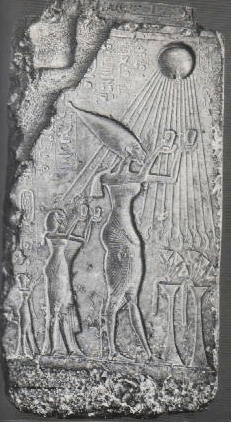
    Heretic Pharaoh Akhenaten
    Aton

    C.G. Jung and Freud were both interested in ancient Egypt. In regards of the “father-son rift” Jung and Freud discussed once publicly the extinction of the name of Pharaoh Amenhotep III. by his son Akhenaten. Freud’s protégé Karl Abraham had recently published a detailed psychoanalytical dissect about Akhenaten’s Oedipus complex. Arthur Weigall’s Life and Times of Akhnaton was then accessible in German. So Freud and Jung discussed Abraham’s thesis that Akhenaten was mother-fixed neurotic, who wanted to replace his hated father with an ideal fantasy father Aton. This idea was rejected by C. G. Jung, who saw in Akhenaten primarily a religious and innovative man. In his book “Symbole und Wandlung (pg. 163)” he described the syncretic  attempt to unite all the different gods to one abstract sun as a psychological valuable clarification of many symbols and unification of the many different archetypes to one. Although syncretism did not play a role in Christianity, Jung seems to imply that a polytheistic tendency always fight monotheism and that they can be even traced in the Christian trinity and Catholic saints.

    The connection between Akhenaten and Oedipus was not seriously pursued again until Immanuel Velikovsky published his Oedipus and Akhenaten in 1960. This work is still extremely valuable, not from archaeological evidence but correlations not found elsewhere in the published literature. In this book, “Oedipus and Akhnaton”, the  psychoanalyst Immanuel Velikovsky hypothesized an incestuous relationship of Akhnaton with his mother Tiye.  He claims this historic myth is the background of the Theban plays by Sophocles (Oedipus the King, Oedipus at Colonus, and Antigone).  Akhenaten had enlarged legs (Oedipus being Greek for “swollen feet”) and the setting may have been moved from the Greek Thebes to the Egyptian Thebes. Velikovsky uses the fact that Akhenaten viciously carried out a campaign to erase the name of his father, which he argues symbolizes Oedipus killing his father.

    There is also some circumstantial evidence, like that with Beketaten, considered to be the youngest daughter of Pharaoh Amenhotep III and his Great Royal Wife Tiye, thus the sister of Pharaoh Akhenaten. According to one theory Beketaten was in fact a daughter of Akhenaten and his secondary wife Kiya.  According to the more daring theory, however, Beketaten was in fact a daughter of Akhenaten and his mother Tiye. Both theories  partially based on the fact that Beketaten was never named king’s sister in the scenes from Amarna, but only king’s bodily daughter. She never appears alongside the daughters of Nefertiti.

    Flinders Petrie, the great Egyptologist wrote: The princess Beketaten has been usually placed as a seventh and youngest daughter of Akhnaton. She occurs,however, in a tomb of his twelfth year, or only six years after the second daughter was born; and she appears among the daughters where four or six are shown, hence the difficulty of her position…” Petrie solved the problem by demonstrating that Beketaten was not the youngest daughter of Nefertiti but a daughter of Tiye. She is always associated with Tiye, she sits by the side of Tiye, while the daughters of Akhnaton sit by their mother; she alone follows Tiye in a procession where no other children appear. Moreover, she is never called other than a King’s daughter whereas all the other princesses in every inscription are entitled Daughters of Nefertete. Beketaten’s body is depicted smaller than the body of Ankhesepaten , the third daughter of Akhnaten and Nefertete.

    Immanuel Velikovsky refers to a “relief in Huya’s tomb in which Beketaten is depicted as a small child  in the twelfth year of Akhenaten’s reign”. Indeed, if you discard co-regency with Amenhotep III, his father was already dead for twelve years. So the child depicted in the relief next to Tiye and Akhenaten might his as opposed to that of Amenhotep III. It would seem that Akhenaten is the king shown under the disk of the Aten with swollen thighs. G. Davies thought that this relief was a depiction of Amenhotep III though he also was aware of the possible time problem and the symbolism that suggested Akhenaten being the king referred to as Beketaten’s father in the words “the kings daughter of his body”.

    Oedipus married his mother and had children with her. Akhenaten was controlled by his mother, possibly in an incestuous relationship and handed over to an equally intelligent women. That women was according to some other theories the former wife of his father. So he took not only revenge by erasing his fathers inscriptions, but claiming his mother and his wife. Both lived in Thebes, Oedipus in the Greek city named after the original city in Egypt, where Akhenaten once lived. Both kings are referred to as sons of the sun god.  Both men grew up far from their homes and parents, each returning to take the throne only after the death of his father. Oedipus was described as having swollen feet, while Akhenaten was depicted as having swollen legs.

    Some other parallels are fascinating, but pure speculation. He interprets the evidence from tombs in the Valley of the Kings indicates the two sons of Akhenaten having killed each other in a battle for the throne in much the same way as the two sons of Oedipus met their untimely end. In addition, he points to a strange tomb that might be the original for the story of Antigone, the daughter of Oedipus who was sealed up in a cave for the “crime” of having buried her brother.  Ay, the father-in-law of Akhenaten, takes on much the same role as Creon, the father-in-law of Oedipus, even down to taking the throne after the death of the sons and rightful heirs of the king.

    Sigmund Freud later explored association between Akhenaten and Moses in a  study published in 1939 under the title Moses and Monotheism. However, Freud rejected the notion of his protégé Karl Abraham that Akhenaten was also Oedipus of the Greek traditions memorialized by Sophocles, Euripides and Aeschylus. The tale of the Egyptian heretic Akhenaten is enclosed in bookends about Freud’s theory of the Oedipal Complex.

    Religious view
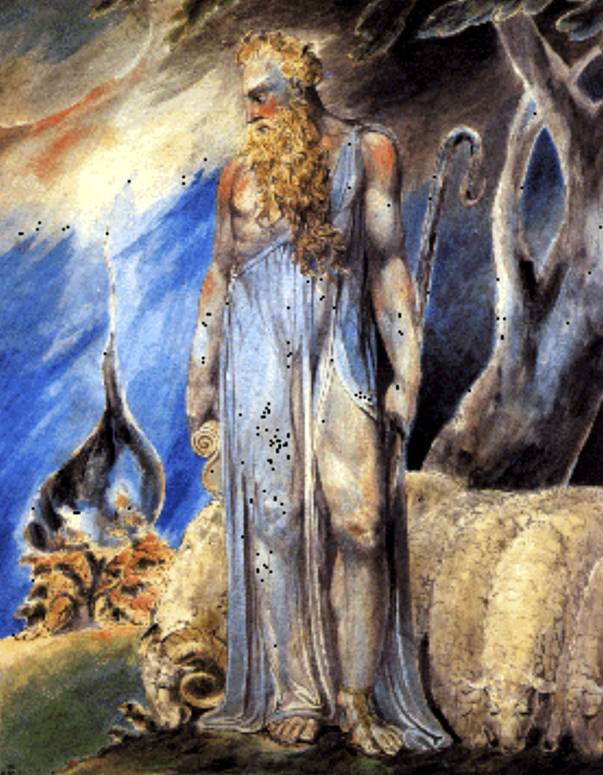
    moses
    moses

    Akhenaten carried out a religious revolution which, for a period of about twenty years,  replaced the age-old beliefs and practices of the Egyptian religion of about 2000 god and goddesses in human, composite or animal form for one single abstract concept  – the sun.  He did away with an elaborate and powerful system of priests, temples, and iconic images in particular with Amun the god of all gods. Its priests were at that time almost as powerful (and rich) as the Pharaoh.  Akhenaten alone was the mediator to god and asked to be worshiped, actually with his wife as holy family. He was the sun of Aton. Akhetaten, the new capital with temples was built from scratch, like Brasilia, but Akhetaten  lasted only 20 years.

    “O Sole God beside whom there is none”.

    Freud, in his last book , Moses and Monotheism Religion, from 1938, goes to the origin of Judaism and associated (Jewish) monotheism. But also about to the origin of Jew-hatred .  He sees in the Jewish monotheism  “progress in spirituality “over the image centered religions  (Freud , Vol IX , p 557 ). No wonder C.G. Jung got annoyed. The prohibition of images ( cf. Ex 20:4 Thou shalt not make thee any graven image) holds the key rationalist impulse. The worship of idols (symbols of transcendence) eases and ends with with pure monotheism. Strict monotheism prohibits images , rejects any magical acting ceremony and puts the emphasis on the writing and worldly ethical requirement as gods law without constraints of idolatry. In Freud’s thesis, antisemitism means reaction against humanism and pure anti-intellectualism. But Freud developed another historical truth of religion, the killing the Great Father. To him, the Jews have missed a certain progress in religion, introduced by Jesus and Paul, the transformation of the father religion into  a son religion, in which the  original sin is forgiven. The murder of God , also known as parricide , is the main subject in Freud’s Moses and Monotheism religion – the historical truth of religion. Thus in old age Freud sees a certain justification of religion, which is a present compulsive repetition of this Egyptian event. Moses is , according to Freud , ” the creator of the Jewish people ” (IX , p 553 ), and he explains this as follows: Moses himself was an Egyptian living in Egypt who imposed to a Jewish ethnic group the already banned again monotheism of Akhenaten as their own religion. Then, he led this people  (shortly after Akhenaten’s death ) out of Egypt.

    Akhenaten’s Dream In Plato’s Mind and German literature

    It’s been a long way since Earth was created from cosmic dust after the Big Bang still undisclosed and only intuitive  or religious grasped. The Artist’s Signature of Akhenaten’s was picked up by Thomas Mann, Rainer Maria Rilke and others.

    1922 wrote the German Poet Rainer Maria Rilke in a letter: “What event of calmness. Which God held his breath, that mankind came to its senses during the time of the fourth Amenhotep“. Where did they come from? And how, did it disappear after he time window closed which had give the “being” room of carved out singularity. (Note: Free translation).

    Brief family history

    Scientific evidence: Genetic research

    If you go by the recent surprising discovery in the mummified remains of the Egyptian pharaoh Akhenaten, it appears that he had a feminine body compared to the classic body frame we expect of the Pharaohs, though maybe by choice of emphasize the feminine by mimicking physical appearance of a woman in men (or vice versa).

    Recently scientists analyzed the early death of Akhenaten and the premature deaths of other Eighteenth dynasty Pharaohs (including Thutmose IV). They claim their early deaths were likely a result of a Familial Temporal Epilepsy. This would account for the untimely death of Akhenaten, his abnormal endocrine body shape on sculptures.

    Many other medical abnormalities have been brought up to explain Akhenaten’s appearance. Among them, an endocrine disorder found mostly in men called Froehlich’s Syndrome, which causes sterility and feminine fat distribution; Klinefelter Syndrome, a male chromosomal abnormality, which can cause gynecomastia (male breast enlargement) and infertility; or Marfan syndrome, a genetic disorder whose characteristics include a long face and long fingers.

    Some theorized that Akhenaten had two medical problems that together contributed to his appearance. They attributed the king’s female form to familial gynecomastia, brought on by an inherited syndrome called aromatase excess syndrome.  Aromatase (estrogen synthetase) is an enzyme complex that plays a critical role in converting androgens, hormones associated with male characteristics, into estrogens, hormones associated with female characteristics. It had recently been possible to rule out the presence of the genetic aromatase syndrome because the mummies of Akhenaten relatives Tutankhamun, Tuthmosis  I and Queen Hatshepsut do exist.
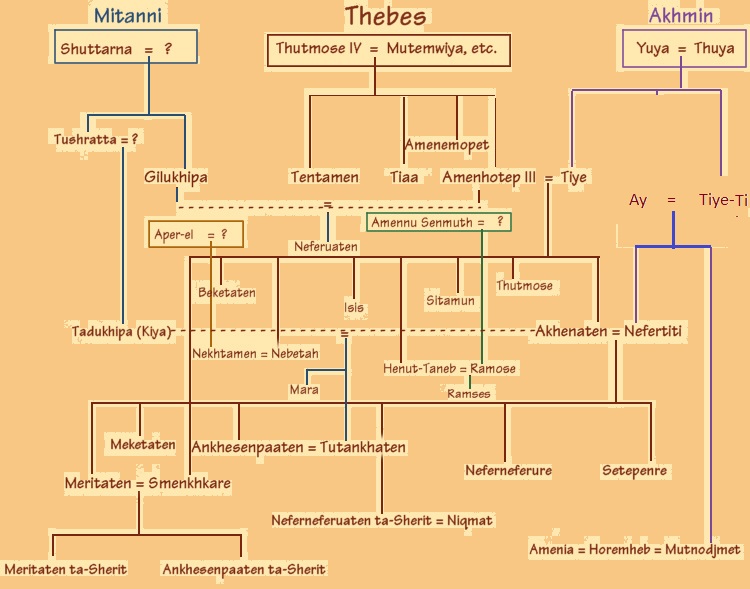
    Current Wisdom

    There is, however, a 2010 report of the Head of the Egyptian Supreme Council of Antiquities, Zahi Hawass, based on German and Italian research from 2007 to 2009 with eleven mummies of Tutankhamun’s bloodline and five more to earlier royal families. The first DNA study ever allowed by the Egyptian government to be conducted with ancient Egyptian royal mummies apparently solves several mysteries. Using DNA samples taken from the mummies’ bones, the scientists were able to create a five-generation family tree by shared genetic sequences in the Y chromosome passed only from father to son. The researchers then determined parentage for the mummies by looking for signs that a mummy’s genes are a blend of a specific couple’s DNA. In this way, the team concluded that a mummy known until now as KV55 is the “heretic king” Akhenaten. The eaely assumption that male mummy was pharaoh Amenhotep III and a mummy previously known as the Elder Lady is Queen Tiye, wife of Amenhotep II has been revised. DNA tests revealed, however,  that Akhenaten was Tutankhamun’s  father and his mother a sister of Akhenaten. Incest is never advantage for biological or genetic fitness. Tutankhamun’s  mother is as mentioned what mummy researchers had been calling the Younger Lady. DNA studies show that she was the full sister of her husband, Akhenaten. Another speculation apparently laid to rest by the new study is that Akhenaten had a genetic disorder that caused him to develop the feminine features seen in his statutes, including wide hips, a potbelly, and the female-like breasts associated with the condition gynecomastia. The researchers found that several members of the royal family were suffering from deformities. Tutankhamunhad  the so-called Köhler’s disease diagnosed, in which patients have exercise-induced pain in the bones.

    As for the shape of Akhenaten’s head, physicians attribute this more  to a condition called craniosynostosis, in which sutures, the fibrous joints of the head, fuse at an early age, and interfere with the process of skull formation. The specific condition, called a sagittal suture, is dominantly inherited. Phillip Vandenberg observed this abnormality in the king’s daughters as well as in Queen Hatshepsut, daughter of Tuthmosis I, founder of Akhenaten’s paternal line, and in Tutankhamun, who ended this line. Sutures normally expand as the brain expands and typically do not fuse until the age of 25 to 30.

    The Father: Amenhotep III

    Several early warrior pharaohs of the 18th dynasty, expended considerable effort in forging out a huge, far-reaching empire. Thutmose IV left to his young son Amenhotep III an empire that was secure and stable. Amenhotep III was a prolific builder, also more concerned with women and sport than state affairs. With him the gradual decline of Egypt’s foreign relations and power started. Into this peculiar situation, prince Amenhotep IV was born.

    The Mother: Tiye
    Tye
    Tye

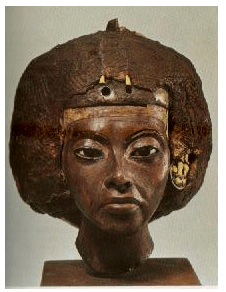
    Tiye was apparently the daughter of the non-royal Yuya and Tjuyu. She became the Great Royal Wife of the Egyptian pharaoh Amenhotep III. It is today genetic established, that she is the mother of Akhenaten and grandmother of Tutankhamun. Her mummy was identified as The Elder Lady found in the (Tomb KV35). Tiye held the power during the last years of Amenhotep’s III. After his death, she continued so; quietly and in-officially she co-ruled with Akhenaten the first eight years. No official seal of him was found until Nefertiti took over a similar, but even less quiet role as his chief queen. Tiye, who some say came also  from Mitanni,  had considerable political clout, and stayed behind in Thebes to protecting her erratic son after he left with Nefertiti. Gilukhipa (sister of Tushratta II) had married Pharaoh Amenhotep III in his 10th year.  Tadukhipa (niece if Gilukhipa) was to marry Amenhotep III more than two decades later. Both were often identified with Kiya and/or or Nefertiti. Tushratta married his daughter Tadukhipa  to his ally Amenhotep III to strengthen their alliances and for gold, as referenced in Tushratta’s thirteen Amarna letters. Amenhotep III died shortly after Tadukhipa arrived in Egypt and she eventually married his son and heir Amenhotep IV (Akhenaten), which is remarkable in respect of his father-rift. From the DNA analysis 2010, the Elder Lady was formally identify to be Queen Tiye, which means Akhenaten had not buried her with her king and she was later moved.

    The Queen: Neferneferuaten Nefertiti
    Nofretete
    Nofretete

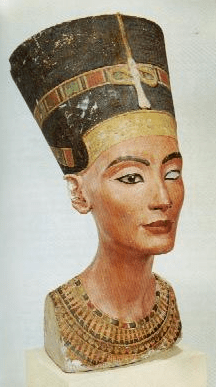
    Nefertiti is the most enigmatic figure in this. Tey, wife of Ay, are credited as Nefertiti’s parents. Many historians have wondered whether she might have been a foreign princess. As said before Nefertiti is most likely identical with Tadukhipa, Amenhotep III last wife and the daughter of Shuttarna II, ruler of Mitanni. Amenhotep IV had several temples erected at Karnak. In scenes found on the talatats, Nefertiti appears almost twice as often as her husband. She is shown appearing behind her husband the Pharaoh in offering scenes in the role of the queen supporting her husband, but she is also depicted in scenes that would have normally been the prerogative of the king (also she was presented in a way only pharaohs were presented – one leg forward). When she married Amenhotep, he was a weak 12 year old child and she a very assertive, intelligent 17 year old women. His mother Tyle,  handed over beautiful Nefertiti the motherly wife role, almost as an attempt of separation and was silent co-regent of the young Amenhotep IV until the couple left Thebes.

    Nefertiti is often referred to in history as “The Most Beautiful Woman in the World.” The Berlin bust (above), seen from two different angles, is indeed, the most famous depiction of Queen Nefertiti. Found in the workshop of the famous and outstanding sculptor Thutmose by a German archeologist , the bust is believed to be only a sculptor’s model. After the counter-revolution almost all traces of her had been destroyed. Thutmose’s technique used a carved piece of limestone, plastered the stone core to be first and then painted. Flesh tones on the face and full lips are enhanced by a bold red give the bust life. Thutmose, may or may not have been her lover, he certainly had access and close contact to her – no man could blame him falling in love. Her graceful elongated neck balances the tall, flat-top crown which adorns her sleek head. The vibrant colors of the her necklace and crown contrast the yellow-brown of her smooth skin. While everything is sculpted to perfection, the one flaw of the piece is a broken left ear. Only a few reigns before her’s had been the reign of Hatshepsut, the most famous (but not the only) female pharaoh, which certainly might have been her role model. How this remarkable sculpture came to Berlin, is quite a(nother) story

    Dr. Redford points out that Nefertiti is an Egyptian name, but there are reasons to think that she might have been like Tyle a from Mitanni, Northern Syria.  One other suggestion is that Nefertiti was Akhenaten’s cousin. The wife of the vizier Ay would have been only her wet nurse.  Redford  notes, that Ay never specifically refers to himself as the father of Nefertiti and Nefertiti’s sister, Mutnojme, not Nefertiti, is featured prominently in the decorations of the tomb of Ay.

    After a few loving years, the couple split and went on different ways (only three of her six children were from the pharaoh) but later Nefertiti became invisible to the public. Close to the end she reacted again, as it is believed that not Ankhesenamun but her mother Nefertiti sent a frantic letter to the Hittite King Suppiluliumas after Tutankhamun died, begging the longtime enemy of Akhenaten and Egypt, for a marriage with one of his sons. One of Suppiluliumas sons. Zannanza, was sent and subsequently killed on the way into Egypt most likely from Ay, thus ensuring his claim to the throne (Brier, 1998). Nefertiti then faded into history. Until recently she has not been identified, but now it is assumed that “The young Lady” (CG 61072 in KV 35) with deadly injuries breast and head is her.  CG 61074 in KV 35 (grave ofAmenhotep II)  has been assumed to be Ay, according ot DNA  the father of “The young Lady who was the Mo. “Theold Lady” (CG 61070 in KV 35) is assumed Tiye-Tii and according to DNA mother of  The young Lady” (CG 61072 in KV 35),

    The King: Amenhotep IV (later Akhenaten)
    echnaton
    echnaton

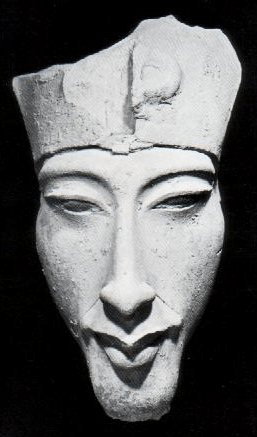
    Amenhotep IV was the second son of Amenhotep III and Tiye. The reconquering of Egypt and the forging of a new empire, started off by the pharaoh Ahmose a the beginning of the 18th dynasty, had raised the god Amun (and its priests) to a position of unprecedented power. Amenhotep IV worldly rule would become stagnant and troubled but he would be the catalyst of an unprecedented religious, cultural, political and sociological and cultural revolution.

    Egyptian religion under the early 18th dynasty knew more than 2000 gods and goodness’s  with their chief god Amun. The kings of that period devoted the booty from foreign campaigns to Amun, since they ascribed the success of their military ventures to him alone.  To further establish Amun worldly influence, from Ahmose on, a new tradition was established — that of always taking on the High Priestess of Amun (who bore the title of “God’s Wife”) as the chief queen.

    Early Life:

    His father’s reign is largely void of references to the prince. That Amenhotep IV actually appears as a co-ruler was until recently matter of great dispute. However this theory has been largely discarded. Seldom are both of them mentioned in the same text or depicted together in artwork.

    It is likely that, after his older brother Thutmose V died early under unknown circumstances, Amenhotep IV would have taken over the posts held by Thutmose, i.e., High Priest of Ptah and Governor of Memphis.

    Official art developed into the full-fledged “early Amarna” style, and recently discovered  unusual features of the king has led some scholars to believe that Akhenaten may have suffered from some sort of disorder. Akhenaten’s monotheism (actually henotheism) survived until approximately the third year of Tutankhamun’s reign, and Akhenaten/Amarna remained the center of Egypt’s administration until that time.

    Early Reign — The Karnak Years:

    Amenhotep IV kicked off his reign with a large building project. The stela documenting this event, found at Gebel Silsila, depicts the god Amun speaking to the young pharaoh: “… I have given you life, stability and dominion”. However, another god is also mentioned. The pharaoh had by now apparently taken on another title, “First Prophet of Hor-Aten”.

    We see the beginnings of the drastic changes that the pharaoh would soon impose starting to emerge. The king was claiming that the gods in the traditional Egyptian pantheon were nothing but material representations which could be destroyed, no how precious the material of their construction. Only the god that he promoted (indubitably the Aten, or sun-disc) was unique, untouchable, undeniable and indestructible.

    In the third or fourth year of Amenhotep’s reign, close to the time of his decision to change his name to Akhenaten, the king decided to have a royal jubilee, known as a Sed-festival.  The festival marked a major turning point in Akhenaten’s reign. The king had, by this time, changed his name to Akhenaten, translated most commonly as “One Who is Useful to Aten.” (Murnane)

    Fragments of a speech from Amenhotep IV’s first building at Karnak provide a fascinating insight into what was going on in the mind of the king. We know a lot from the talatat, disjointed and scattered when Akhenaten’s successors brought down his buildings, which bear many fruitful scenes and the inscription. The Akhenaten Temple Project, directed by Dr. Donald Redford, undertook a major project to piece them back together using IBM computer technology. On the talatat, aside of military personnel, and of the pharaoh worshipping the sun in various incarnations, we get many glimpses of the royal family: Akhenaten  with his mother, his chief wife Nefertiti, their six daughters, his mother, Tiye, his concubine, Kiya, and two of his mysterious successors of Smenkhkare and Tutankhaten.  The couple’s eldest daughter was Meritaten and  second daughter, Meketaten, appears somewhat later. (Redford, 1984)

    The Amarna (Akhetaten) Years:

    In the fifth year of his reign, Akhenaten abandoned the old capital city of Thebes and set out to create a new one in central Egypt in a previously uninhabited spot. He called his new city Akhetaten, or “The Horizon of the Sun-disc.”

    The site of Akhenaten, now called Amarna, is a barren place surrounded by cliffs. According to Cyril Aldred, from the Nile the eastern cliffs look like the giant hieroglyph for “akhet” or “horizon” (1988). Akhenaten made it quite clear that he wanted that place, was specifically advised from the go Aten, his father, so that it could be made for him as Akhet-Aten. In order for the construction of the city to go quickly, Akhenaten employed rather shoddy building stone  and according to archaeologists , many of the Theban officials did not come to Akhetaten and were replaced by new followers outside of the old elite (1984). Several more daughters of Akhenaten and Nefertiti: Neferneferuaten-Tasharit (tasharit means “junior”), Neferneferure and Sotepenre joined Meritaten, Meketaten and Ankhesenpaaten.

    A plague broke loose and spread across the ancient Near East (Moran, 1992; Redford, 1984). Ignoring those disasters, Akhenaten continued to build his city, and further suppressed the traditional array of Egyptian gods after a coup and began a campaign to erase the name of Amun. He even changed the spelling of the word “mut” (mother) so that it no longer made reference to the goddess of the same name and put into effect the more popular version of the written language as the official text rather than the archaic middle kingdom text known mostly by scribes and priests (Redford, 1999).

    In year twelve of his reign, Akhenaten had a large durbar, a festival in which foreign dignitaries from all across the Egyptian empire visited him in Akhetaten and presented large quantities of tribute. This durbar marked the beginning of the end of the reign of the “heretic king.” In the years following the event, the situation at Akhetaten rapidly disintegrated.

    This spiral into tragedy started when Akhenaten’s mother, Tiye, paid a visit to Akhetaten around Akhenaten’s 12th reignal year, but disappeared at the same time when Akhenaten’s second daughter, Meketaten had died in childbirth at the age of twelve or thirteen. That baby was possibly by Akhenaten (Aldred, 1988). Nefertiti faded quietly into the background (what exactly happened is unknown).

    What happened to Akhenaten at the end of his reign is unknown too. He presumably died in Akhenaten of natural causes. Upon its rediscovery and exploration in the 19th century, Akhenaten’s tomb lay empty save for some debris and the smashed remnants of the king’s red granite sarcophagus, and the city of Akhetaten was abandoned and in ruins.

    The Lover: Smenkhkare (Ankhkheperure-Neferneferuaten)

    Smenkhkare apparently reigned for about three years, and spent some uncertain length of time as Akhenaten’s coregent. Most historians assume that Smenkhkare was the lover of Akhenaten.  Newberry in his article (1928) also drew attention to a small private stele (upright stone slab) in the Berlin Museum, originally made for a military officer, which showed two kings (identified by their crowns, one the double crown of Upper and Lower Egypt and the other a war crown), nude and sitting side by side. Although the piece is unfinished, with its cartouches blank (ovals which usually contained names), the figures seemed easily identified as Akhenaten and Smenkhkare, the former caressing the youth’s chin while Smenkhkare rests his arm around the older king’s shoulder. Still he warned, the evidence is “slender” and not conclusive.

    In any case, Princess Meritaten was married to the mysterious figure to strength Ankhkheperure-Neferneferuaten’s royal claim. Some say he was Akhenaten’s son. Since neither Smenkhkare nor Tutankhamun was featured in artwork and texts from Akhenaten’s reign the way Akhenaten’s and Nefertiti’s  daughters were, some have theorized that they were Akhenaten’s children by a minor wife, such as Kiya. Little is known about the actual reign of King Ankhkheperure.

    Some people have even questioned whether he existed at all — at least, as a single individual. It was during the late part of Akhenaten’s reign that references to a second king began to appear. On a box, alongside with this name are written the names and titles of Akhenaten, and the text “King’s Chief Wife Meritaten, may she live forever.” (Murnane). It is apparent from this inscription that Akhenaten and Ankhkheperure were ruling together, and that Ankhkheperure was married to Akhenaten’s eldest daughter, Meritaten. But the most curious thing about this inscription is that one of Ankhkheperure’s names is Neferneferuaten, also one of the names of Akhenaten’s Chief Wife, Nefertiti. Because of this, some people have come to the conclusion that Akhenaten’s co-regent was none other than Nefertiti herself, in the guise of a man and taking on her own daughter(s) as a spouse. A fragmentary stela from Amarna, now known as the “Coregency Stela” had originally depicted Akhenaten, Nefertiti, and princess Meritaten. Later the name of Nefertiti had been replaced with the name of King Ankhkheperure Neferneferuaten, and the name of Meritaten had been replaced with Nefertiti’s third daughter, Ankhesenpaaten after Meritaten died.

    The Son: Tutankhaten (later Tutankhamun)

    Tutankhaten succeeded his father Akhenaten and Smenkhkare and was married to Akhenaten’s daughter Ankhesenpaaten. He came to the throne when he was about eight years old and reigned 10 years. Most likely he was advised by Ay and done away after getting too old to be manipulated. The couple soon changed their names to Tutankhamen and Ankhesenamun, moved away from Akhetaten, and reestablished the old religion. Tutankhamun, was chosen as a tool to reverse the changes and return Egypt to the traditional religion of worshipping a variety of gods. His his tomb was discovered by Howard Carter in the 1920s. The world’s most famous mummy – ancient Egyptian pharaoh Tutankhamun – was buried with his penis stood up at a 90 degree angle in order to help quash a religious revolution and make him appear as Osiris, the god of the afterlife,  to counter attempts of Akhenaten to establish a monotheistic religion. A recent examination of his body also revealed previously unknown deformations in the king’s left foot, caused by the necrosis.  The scientists found also DNA from more than one strain of mosquito-borne parasite that causes malaria (including the most deadly), the oldest known genetic proof of the disease. These factors, combined with the fracture in his left thighbone, which scientists had discovered in 2005, may have ultimately been what killed the young king. Until now the best guesses as to how he died have included a blow to the head based on his fractured skull.

    The Daughter: Meketaten

    Meketaten was the second daughter of Akhenaten and Nefertiti. She was probably born by at least the second year of her father’s reign. Her death is documented on the walls of the royal tomb at Akhenaten in the form of a poignant funeral scene. Some believe she did giving birth to a baby from Tutankhaten, later to become the famous and ill-fated pharaoh Tutankhamun. One theory is that Meketaten died in a plague raging across the Middle East at the time after that durbar, a large festival in which representatives from all across the empire paid tribute to Egypt, brought the plague to Egypt.

    An incest theory resulted from the fact that Akhenaten’s three eldest princesses all evidently had daughters when they were very young, and when they were not married. Inscriptions refer to the these infants as “child of the king.”The theory goes that, in a mad attempt to have a male heir of fully royal blood, Akhenaten fathered children on his own children. A distasteful thought, but his own father married his daughter, Akhenaten’s sister Sit-Amun, so again there is some basis for the idea

    The Magician: Ay

    Ay succeed Tutankhamen. He has been a prominent background figure even before Akhenaten. As writer he climbed the social ladder and became involved in political intrigue taking the title of Master of the Horse under Akhenaten, and, eventually, taking the throne under mysterious and rather shady circumstances. While the names of Ay’s parents are never explicitly stated, many scholars agree that Ay was probably a brother of Queen Tiye. Cyril Aldred and Donald Redford point out that it is likely that the job of Master of the Horse, formerly held by Yuya, father of Tiye, would have been passed on to Yuya’s son (Aldred, 1987; Redford, 1984). Also, the fact that “God’s Father” is among Ay’s titles–suggesting to some he was the father of Akhenaten’s chief wife  Nefertiti — if she was not North Syrian of royal blood.

    Ay held the distinctive position of “the favored one of the Good God, fan-bearer on the king’s right hand, true king’s scribe and god’s father, trusted throughout the entire land, commander of chariotry” (Redford, 1984). His wife,Tiye, had earlier been Nefertiti’s wet-nurse. Ay was, by all appearances, devoted to Akhenaten and the new religion as after the counter revolution  a follower of Amun. After the death of Akhenaten, Ay continued to serve under Akhenaten’s son-in-law, Tutankhamun. He was no doubt quite influential during the young king’s reign, and adopted the title of “eldest king’s-son” (Redford, 1984). It seems likely that Ay had much to do with the eventual return to the former religion and capital during Tutankhamun’s reign. A good deal of evidence points to Ay playing a role in the untimely death of Tutankhamun. . It seems that Ay had set himself up to become pharaoh after the death of Tutankhamun, who died shortly after reaching an age when he might have begun to take more of his pharaonic power into his own hands. Once Ay had secured the kingship, the unfortunate Ankhesenamun quickly vanished. Ay reigned for only a little over four years, and apparently had no children to succeed him. Ay devoted much of his reign to the persecution of Akhenaten. Thus, Ay brought a close to the tumultuous and fascinating Eighteenth Dynasty.

    The warrior: General Horemheb

    Ay left the throne to one General Horemheb, who had served under Akhenaten and Tutankhamun.  Other than the fact that Horemheb came from Herakleopolis near the entrance to the Fayoum, little else is known about the background of this pharaoh that we place as the last king of Egypt’s important 18th Dynasty (New Kingdom). His parentage is completely unknown. Horemheb served under Akhenaten’s father and Akhenaten. During the reign of Tutankhamun, he became King’s Deputy (and very likely regent), and may, together with Ay, been responsible for governing Egypt in the background during Tutankhamun’s reign.  It is also very possible that Ay or Horemheb had Tutankhamun murdered when that king grew near adulthood and hence, independent rule. In any case, at the time of Tutankhamun’s death, on top of all that turmoil. Egypt was engaged in a fairly major confrontation with the Hittites that ended in a defeat. Upon the death of Ay, he declared himself king of Egypt in about 1321 BC. and though he made no claim to be of royal blood, he became divinely elected to the throne by means of an oracle (most likely fabricated by the conservative Amun clerics). He formed a link back to the female royal blood line.   From the bones recovered from Horemheb’s Saqqara tomb, it is believed that Mutnodjmet, who was in poor health at the time, may have died at the age of 45 while attempting to give birth to a child during the king’s 13th year as ruler. No other children seem to have outlived the pharaoh. and though the transition had begun as early as the reign of Tutankhamun, he also sought to complete the return to Egypt’s traditional religion

    He probably felt, and rightly so, that Egypt was in need of strong leadership after the military decay Amarna Period. Besides being a very harsh ruler, it appears that it was during the reign of Horemheb that elaborate attempts were made to write the Amarna Period out of Egyptian History, and he is often credited with reopening and repairing the temples of Amun, as well as restoring the powerful priesthood who had caused for previous kings, but outflanked them by military men who’s loyalties he could trust appointed as priests. The new city Amarna and the Aten temples at Karnak were dismantled  so that the stone could be used elsewhere. That was it.

    Conclusion

    Akhenaten is all things to all people–to some he was a fanatical lunatic, to some he comes across as a strange, eccentric young man whose behavior was strongly influenced by his mother, to others he was a Christ-like visionary and a mentor of Moses, and to still others he was simply someone who happened to be there but had really had little to do with the dramatic reformations that went on during his reign. Much of the research I did is dated  since it was written more than 50 years ago and questionable.The thesis of Oedipus and Akhnaton: Myth and History is no less shocking to scholars,  does have some plausibility even if Velikovsky’s other work rightly deserves less credential. And if, as the author asserts, Oedipus of Greek myth is not the same person as the historical Pharaoh Akhenaten the psychoanalytical interpretation of the rejected child with powerful mothers and a intelligent assertive wife is evident as his clueless reign from the Araman letters. My view of the of religion is heavily influenced by C.G. Jung – human cannot be Homo Faber alone, but must be Homo religious. Nevertheless I subscribe also to Phillip Jenkins in regards of rise and fall of religions: they are born, prosper, fight with each other and die sometime.  To me Atenism died as an infant, too early to kill Amun and 2000 gods, too early for cold rationalism too early for radical exclusive monotheism.

    Bibliography:

    Redford, Donald B. (1984). Akhenaten: The Heretic King. New Jersey: Princeton University Press

    The Life and Times of Akhnaton, by Arthur Weigall

    Aldred, Cyril (1988). Akhenaten: King of Egypt. New York: Thames and Hudson Inc.

    Murnane, William J. (1995). Texts from the Amarna Period in Egypt. Georgia: Society of Biblical Literature

    Moran, William L. (1992). The Amarna Letters. Maryland: Johns Hopkins University Press

    The Religion of Ancient Egypt Sir W. M. Flinders (William Matthew Flinders) Petrie

    Nofretete, Echnaton und ihre Zeit: Scherz, Bern, München 1975 by Phillip Vandenberg,

    Geschichte des Morgenlandes im Altertum: Hertzberg, G.F.: Verlag: Berlin, Historischer Verlag Baumgärtel (ca. 1904), 1904

    Prophyläen der Weltgeschichte, Golo Mann, Ullstein 1961

    A History of Art in Ancient Egypt, Vol. I and II by Charles Chipiez, Georges P

    The Religions of Ancient Egypt and Babylonia, by A. H. (Archibald Henry) Sayce

    Ancient Egypt, by George Rawlinson (Kindle)

    Echnaton, Herrman A. Schloegl

    Nofretete, Die Wahrheit über die schöne Königin, Herrman A. Schloegl,

    Davis, T. M. et al. The Tomb of Queen Tiyi. London 1910.

    Child of the Morning: A Novel about Hatsshepsut  by Pauline Gedge 1977

    Nefertiti by Evelyn Wells 1964

    http://news.nationalgeographic.com
    Google

  • Shakespeare’s “Macbeth” from a Jungian view

    Shakespeare’s “Macbeth” from a Jungian view

    when they all know the good as good, there arises the recognition of evil.
    When they all know the good as good, there arises the recognition of evil.

    This article explores the psychological underpinnings of  Shakespeare’s “Macbeth” from a Jungian view. Carl Jung left a great deal of ambiguity surrounding his work. He understood, as long as there have been men and they have lived, they have all felt this tragic ambiguity and everybody must accept his or her “Shadow” during the individuation process. Ambiguity between good an evil, and a failed individuation is the core theme in the tragedy Macbeth: “Fair is foul, and foul is fair” say the three witches in the beginning of the play and this paradox is touched again by Macbeth: “So foul and fair a day I have not seen”. The enemy and death is “foul” – bad – but the outcome of the battle is “fair” – good, only because he has won.So the play Macbeth is about the evil, but as we see mostly the evil in us, and this evil is first impersonated by the witches. That is why Macbeth is also called the “Scottish play” by the superstitious theater folk. The play has gotten a reputation for being bad luck in terms of productions and those who act in it, and so it is referred from them to as “the Scottish play” to avoid naming it. The play is about the good consumed by the evil. However, Tao says Tao is eternal and so are the two principles Yang and Yin, so that good and evil must be eternal, as necessary elements of our world.

    Secularism, particularly relativism has tried to blur the line between good and evil where belief systems and philosophies used different approaches to mask the ambiguity between “evil and good”.  Dualistic has the view that the world consists of or is explicable as those two fundamental entities. It is God, love, death, suffering and infinity that open us to the non-dualistic mind, or contemplation. Dualism means eliminating everything that is not like you (or projecting all your rejected attributes to others). Lao-Tse and Jesus were masters of non-dualistic thinking. The Jungian System is a fine example of an non-dualistic psychology : the more inflated your self-image (Ego), the bigger your shadow will be. Macbeth looses his soul (his Self) failing to differentiate between Persona and his inflated Ego and overwhelmed by his shadow and his anima utilized by the ambitious Lady Macbeth. 

    Jung’s vastly varying influences have helped shape a psychology that has influenced a great many scholars, theorists, psychologists, and artists of various specialties. While still maintaining an empirical stance Carl Gustav Jung has taken the influential elements of literature, symbolism, religion, and the alchemy and has formed these raw, primordial factors into a unparalleled  psychoanalytic system. Jung’s view of literature was ambivalent. He was fascinated by Nietzsche, and lectured on Nietzsche’s Zarathustra, Besides of German literature C. G. Jung appears to have been influenced by Shakespeare. In particular Jung was interested in the mythic and archaic elements in literature. Hermann Hesse’s novel Demian was inspired by Jung’s theory of individuation whereas Macbeth seems to be the prototype of a failure to achieve successful ego-individuation.

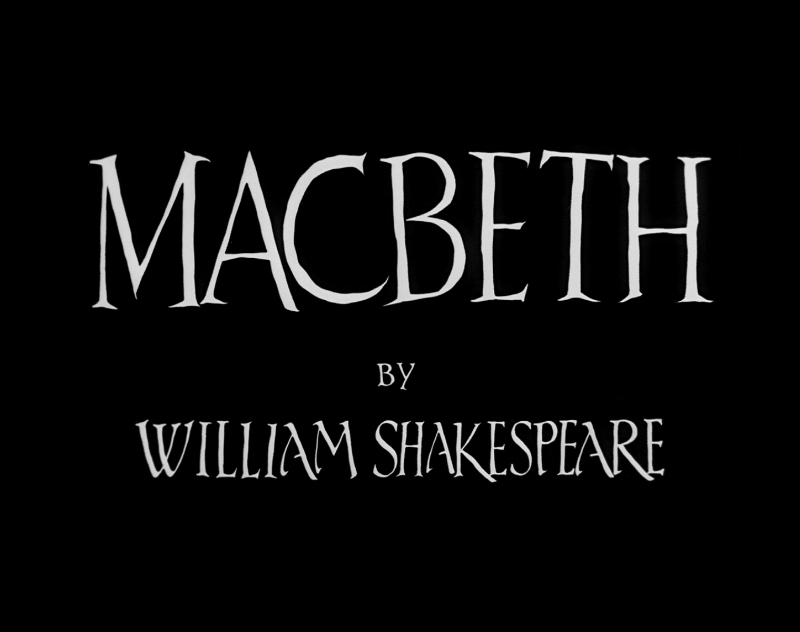
    The play Macbeth

    title_macbeth
    title_macbeth

    Jung found literature to be a psychological process which includes the process of materials being “drawn from man’s conscious life; and the visionary dealing with primordial images that transcend human understanding.” Jung found that the archetypal symbols he worked with could, quite naturally, be found in the works of various ages. “It is to be expected… that the poet will turn to these mythological images to give suitable expression to his own experiences.”

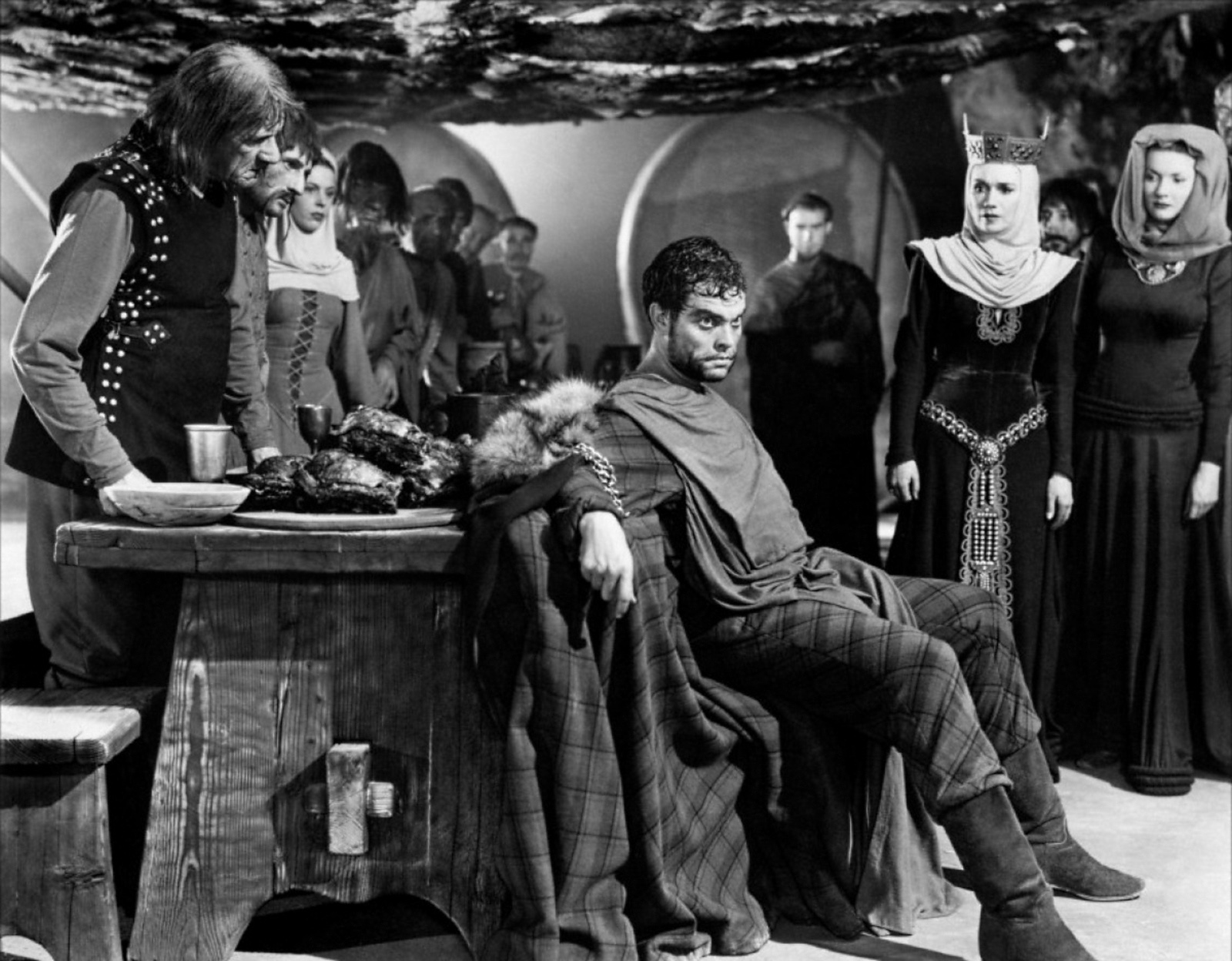
    Macbeth, when you analyze it, is a psychological battle between good and evil, and between evil ambition and order. Darkness is a symbol of the characters forgetting all about honor or goodness. The play demands that the audience think about how we make excuses in our life to pursue false ambitions that are wrong. Macbeth makes this mistake and ultimately it leads to his death. Darkness in Macbeth is a key theme. The play begins with the brief appearance of a trio of witches and then moves to a military camp, where the Scottish King Duncan hears the news that his generals, Macbeth and Banquo, have defeated two separate invading armies—one from Ireland, led by the rebel Macdonwald, and one from Norway. Macbeth and Banquo encounter the witches who prophesy that Macbeth will be made thane (a rank of Scottish nobility) of Cawdor and eventually King of Scotland. Macbeth and Banquo treat their prophecies skeptically until some of King Duncan’s men come to thank the two generals for their victories in battle and to tell Macbeth that he has indeed been named thane of Cawdor. Macbeth is intrigued by the possibility that the remainder of the witches’ prophecy—that he will be crowned king—might be true, but he is uncertain what to expect. It remins me a little bit of Wagners Rhinemaidens, who have a magical gold treasures with magical powers. Alberich an ugly dwarf, trys to score on them but they laugh at him. So he robs their treasure with  the ring (the key to power and wealth). To do this, he must renounce love. I think Macbeth never could love, neither himself nor others.

     Lady Macbeth suffers none of her husband’s uncertainty. She desires the kingship for him and wants him to murder Duncan in order to obtain it. When Macbeth arrives at Inverness, she overrides all of her husband’s objections and persuades him to kill the king that very night. He and Lady Macbeth plan to get Duncan’s two chamberlains drunk so they will blame the murder on the chamberlains. While Duncan is asleep, Macbeth stabs him, despite his doubts and a number of supernatural portents, including a vision of a bloody dagger. When Duncan’s death is discovered the next morning, Macbeth kills the chamberlains—ostensibly out of rage at their crime—and easily assumes the kingship. Duncan’s sons Malcolm and Donalbain flee to England and Ireland, respectively, fearing that whoever killed

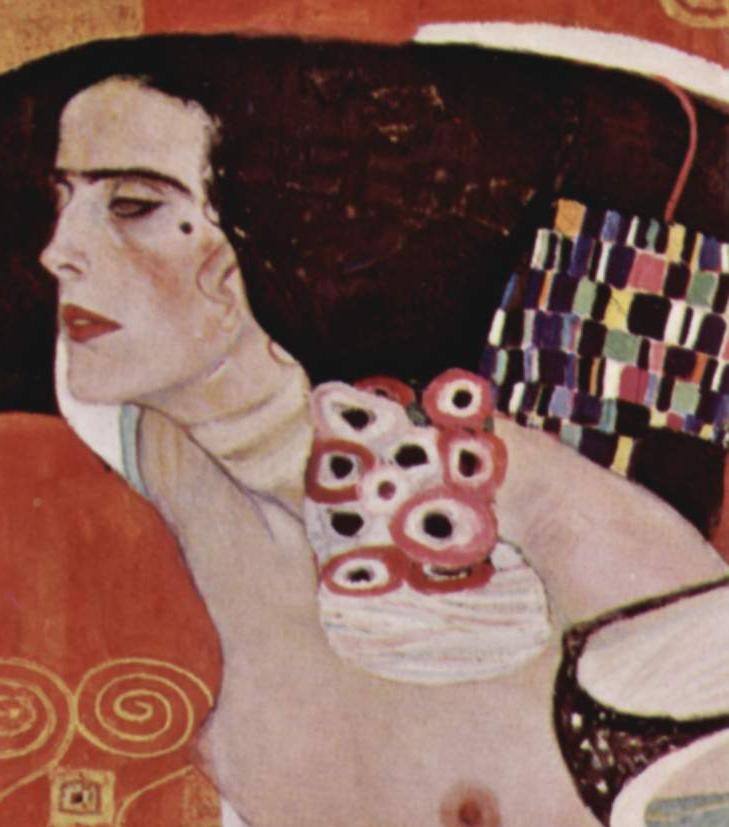
    C_G_JUNG_FEMALE_ARCHETYPES
    C_G_JUNG_MALE_FEMALE_ARCHETYPES

    Duncan desires their demise as well. Fearful of the witches’ prophecy that Banquo’s heirs will seize the throne, Macbeth hires a group of murderers to kill Banquo and his son Fleance. They ambush Banquo on his way to a royal feast, but they fail to kill Fleance, who escapes into the night. Macbeth becomes furious: as long as Fleance is alive, he fears that his power remains insecure. At the feast that night, Banquo’s ghost visits Macbeth. When he sees the ghost, Macbeth raves fearfully, startling his guests, who include most of the great Scottish nobility causing Macbeth’s kingship to incite increasing resistance from his nobles and subjects. Frightened, Macbeth goes to visit the witches in their cavern. There, they show him a sequence of demons and spirits who present him with further prophecies: he must beware of Macduff, a Scottish nobleman who opposed Macbeth’s accession to the throne. Macbeth orders that Macduff’s castle be seized and, most cruelly, that Lady Macduff and her children be murdered. It should be clear by now, that Macbeth represents the archetypes of weak king and becomes a cruel sadistic warrior, whereas Lady Macbeth seems to own foremost frigid witch qualities.

    When news of his family’s execution reaches Macduff in England, he is stricken with grief and takes revenge and with Prince Malcolm, Duncan’s son, and the support of the Scottish nobles, who are appalled and frightened by Macbeth’s tyrannical and murderous behavior. Lady Macbeth, meanwhile, becomes plagued with fits of sleepwalker in which she bemoans what she believes to be bloodstains on her hands. Before Macbeth’s opponents arrive, Macbeth receives news that she has killed herself, causing him to sink into a deep and pessimistic despair.

    He is struck numb with fear, however, when he learns that the English army is advancing on Dunsinane shielded with boughs cut from Birnam Wood. Birnam Wood is indeed coming to Dunsinane, fulfilling half of the witches’ prophecy. In the battle, Macbeth hews violently, but the English forces gradually overwhelm his army and castle and he realizes that he is doomed, Macbeth continues to fight until Macduff kills and beheads him.

    Failed Individuation in Shakespeare’s Macbeth

    macbeth
    macbeth

    Macbeth has not begun to deal with the adult developmental task of individuation. According to Jung, in the process of individuation “unconscious potentials are explored and reintegrated with the “Self”. The exploration of certain parts of the unconscious brings to consciousness unacknowledged ” missing pieces. Macbeth’s failure to individuate successfully is reflected by the distance between his rigid Persona and his real personality, and his inability to confront the shadow aspects of his psyche, and the complete rejection of his anima. Tellingly those developmental issues only seem able to get Macbeth’s attention through his hallucinations and visions. Jung said that “only through the adult development of individuation can the person become truly an ‘individual’ and not simply a carrier of unconscious images and other people’s projections”. This “carrier of unconscious images” and receptacle of “other people’s projections” is exactly how Shakespeare paints Macbeth: Macbeth is Duncan’s “O worthiest cousin” (I, iv, 17), the murderers’ “Highness,” “liege,” “lord” (III, I, 81, 102, and 131), and Malcolm’s “tyrant” (Iv, iii, 14). Throughout the play Macbeth’s identity is formed by Shakespeare’s other characters. The tragedy of Macbeth is that he has failed to explore his unconscious and discover and accept his true identity. Because he has not individuated, he can be molded and pushed into identities and actions that others project onto him. Macbeth is very conscious of his persona and of the positive reputation he has cultivated, and he enjoys thinking of himself in this way. According to Jung, the Persona (literally the mask) is the aspect of personality that adapts to the world to be accepted in society. Throughout the play Macbeth attempts to put on a “false face” (I, vii, 9 5) so that he can hide what his “false heart doth/know” (I, vii, 95-96). When he has plotted Banquo’s death and is preparing to make merry with his guests, Macbeth  believes that he can cover not only his conscious knowledge of his role in Banquo’s death from others but keep his unconscious feelings of fear, shock, and guilt at arranging a murder from himself. During dinner Macbeth has a hallucination. He sees the ghost of Banquo come to haunt him and denies his guilt: “Thou canst not say I did it. Never shake/ Thy gory locks at me” (III, iv, 61-62). Throughout the play Macbeth refuses to own his unconscious; he places supreme importance on appearances (Persona), his consciousness and refuses to deal with any desires and actions which challenge his idealized Ego.

    instinctive powerful, beast
    Shadow- instinctive powerful, beast

    His rejection and disregard of this “shadow” keep him ignorant of its motivational power and the gulf that develops between his persona and real personality. Jung described the shadow as “those aspects of the psyche that are rejected from consciousness by the ego (during sozialization in the first half of life), because they are inconsistent with one’s self-concept. Macbeth’s history of denying his shadow is detailed throughout the play. In Act I, after learning of Duncan’s intention of having Malcolm succeed to the throne, Macbeth rejects his ambitiously motivated ability to become a traitor. Jung says that as we show our persona to others and conceal our shadow from ourselves, “the shadow gets more and more ugly, and the split between persona and shadow … widens”. For Macbeth, this is true. After he kills Duncan, Macbeth refuses to believe that he could be a murderer – one although this ability to murder is present in Macbeth’s character. After his second meeting with the Weird Sisters, Macbeth resolves to kill Macduff’s family in the Thane of Fife’s absence Macbeth has progressed from ambitious regicide to familial mass murderer. Because  Macbeth has not confronted his shadow and haven’t taken the effort caused by introduction of the shadow to consciousness, Macbeth cannot follow an intrinsic moral compass. This allows him to commit his atrocities without having to justify them. Ironically, part of Macbeth’s anima is positive, but it is repressed because he believes it to contain negative qualities.

    anima
    anima

    According to Jung, men have “repressed feminine-typed qualities” (their anima) and women have “repressed masculine-typed qualities” (their animus). While this area of Macbeth seems cloudy, I believe that Macbeth cannot explore what Jung would call the inner feminine qualities of empathy and emotion because Lady Macbeth is constantly questioning his identity as a man, struggling herself to be a women and with her animus. Two passages support this theory. When Macbeth begins to vacillate between killing Duncan and maintaining his honorable reputation, Lady Macbeth chastises him for not being man enough to take what he wants (I, vii, 3 9-49). She also calls him to task for not being a man of his word (I, vii, 53-67). Lady Macbeth claims that she, a woman, is more manly than Macbeth. Macbeth is expressing fear and guilt, emotional inner controls, and Lady Macbeth makes fun at him. Later, when Macbeth is confronted with his hallucination of Banquo’s ghost, he expresses fear and revulsion at what he has done to Banquo through the ghost’s horrible appearance. Lady Macbeth tells him to stop acting like a hysterical woman and to live in reality. She even asks Macbeth, “Are you a man” (III, iv, 70). While Macbeth clearly rejects his “inner woman,” as shown by the ease with which he is manipulated by gender role identification (making him vulnerable to Lady Macbeth evilness), he is severely hampered in uncovering his anima by her disparaging of his male identity.

    Personal Layers
    Personal Layers

    Macbeth’s strict adherence to his inflated Ego a false Persona, his unwillingness to deal with his shadow. According to Jung rejecting anima have psychological consequences – sometimes the shadow and anima merge and overpower the consciousness (Ego); he has hallucinations.  Jung interpreted psychotic hallucinations and delusions as expressions of the collective unconscious archetypes, which can be interpreted as visions or a type of dream, manifesting their meaning from his personal unconscious. Act II’s floating dagger can be read as a symbol forcing its way into consciousness. Through his visions, Macbeth’s unconscious is trying to show him the issues he must deal with. One of the sadder aspects of the tragedy is that he is constantly dissuaded from looking at them. The moral conflict needed to mitigate his personal not to speak collective un consciousness  is not present.  This is why poor Macbeth (like many powerful men and women) is so far from the mark with his comments on life. They does not know enough about themself to allow anything but a shallow, two-dimensional interpretation of life, letting them be directed by passions unseen, greed and manipulative persons around them.

    Anima and Animus in Shakespeare’s Macbeth

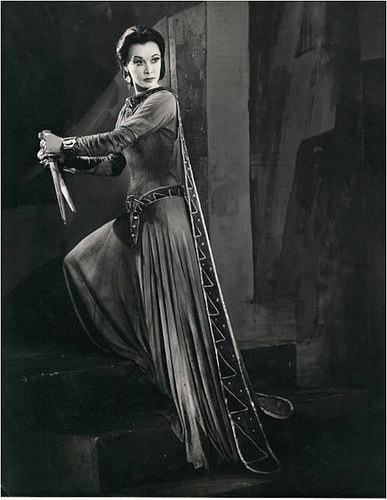
    Lady Macbeth
    Lady Macbeth

    There appears to be some critical discord in connection to the classification of Lady Macbeth, whether she qualifies as an innocent, supportive wife, or, in Malcolm’s words, as a “fiend-like queen.” (Shakespeare V. ix. 35) However, Shakespeare’s text simply does not support the idea that the Lady Macbeth did not play a serious role in the murder of King Duncan and. The concept which seems to lie at the core of critical discussion in relation to Lady Macbeth, is gender. Lady Macbeth herself, makes the argument about gender in her famous speech, wherein she appeals to the powers of dark spirits to “unsex” her, and replace any feminine tendency in her with “direst cruelty” (Shakespeare I. v. 42-43). She wishes to take all that she perceives as weak and feminine in herself, and seeks to substitute it with an evil. Jung believed that all men and women were made up of masculine and feminine energies, the former being called the animus and the latter being called the anima and this unconscious selves of individuals can be used to understand Lady Macbeth’s actions. It can be argued, that Lady Macbeth’s vehement denial of her feminine self (or her anima) that causes her to manipulate her husband into committing the murder of Duncan, affected her relationship with her husband (unable to maintain it) and ultimately led to her insanity and death.

    Conclusion

     “Fair is foul, and foul is fair” : What the line points to is the play’s concern with the discrepancy between appearance and reality: that is, the difference between how someone seems and how someone really is. It is a central concern of Shakespeare’s, and obviously one that fits well with the medium of theatre, which relies on actors seeming to be something that they most definitely aren’t. This is one of the last lines in Act 1 Scene 1 when the witches are foreshadowing events to come in the play. With these words, they are predicting the evil that will cloud Macbeth’s judgments and that those judgments will appear to Macbeth as fair and just. This line also could refer to the witches believing that things some consider to be foul and ugly are just and beautiful to them because they embody evil.

  • FALLEN ANGELS FEAR – Sacred aesthetics of fractal recursion

    FALLEN ANGELS FEAR – Sacred aesthetics of fractal recursion

    TreeOf Live - Source Avatar
    TreeOf Live – Source Avatar
    FALLEN ANGELS FEAR
    Angels Fear – The Sacred Destroyed

    FALLEN ANGELS FEAR an obvious wordplay which crossed my mind after a blog reader pointed out that Bateson’s book  Angels Fear: Towards an Epistemology of the Sacred might be of relevance to me.  

    FALLEN ANGELS FEAR

    The title created immediately multiple associations and images,  so  I became curious and got the book.  Bateson presents from a anthropologist view concepts and topology of structure- determined recursion – in a nutshell – sacred aesthetics of fractal recursion.  

    Douglas Hofstadter articulated fractal recursions mathematically in his book Goedel, Escher, Bach: An Eternal Golden Braid , 1979. The Bateson’s (father and daughter) define ecology and aesthetics, combining them to ecological aesthetics viewed at every level from the cellular to the cultural to the religious from a communicative perspective.  Angels Fear is food for thought and relevant indeed, this  book is for anyone who feels that there is more to life than logic and science. Bateson’s main thesis is that aesthetics, beauty, and the spiritual are as valid as logic and science. It is an original synthesis of cybernetics, biology, anthropology (his daughter is anthropologist) but avoids New Age. The book resounds very well with my Jungian and spiritual side, although Jung has covered that area much broader and more coherent from empirical science as a physician.

    Like the psychoanalyst C. G. Jung,  Gregory Bateson never really says what the sacred actually is. To both, it is just beyond their scope, something which is beyond facile descriptions. The sacred ( to me the religious realm) is common intuitive knowledge in every human experience. The Ego (lets say mind) and  unconsciousness cannot meet  easily., hence  there is a necessary gap between the two – so Bateson is essentially saying that our attempts to explain our human experience is always and necessarily incomplete. And that there is a lot more to life and mind than meets consciousness and unconsciousness depersonified. That is true, but hardly new – in Bateson’s words:

    ‘But the bits and pieces of mind which appear before consciousness invariably give a false picture of mind as a whole. The systemic character of mind is never there depicted, because the sampling is governed by purpose.  We never see in consciousness that the mind is like an ecosystem – a self-corrective network of circuits. We only see arcs of these circuits. And the instinctive vulgarity of scientists consists precisely in mistaking these arcs for the larger truth, i.e., thinking that because what is seen by consciousness has one character, the total mind must have the same character.Freud’s personified ‘ego’, ‘id’, ‘super-ego’ are, in fact not, truly personified at all. Each of his components is constructed in the image of only consciousness (even though the component may be unconscious) and the ‘consciousness’ does not resemble a total person. The isolated consciousness is necessarily depersonified. The whole iceberg does not have those characteristics which could be guessed at from looking only at what is above water. I mean: the iceberg does – mind does not. Mind is not like an iceberg.”

    The way that humans have dealt with this feature of human existence were religions.

    The point is that, even before modern technology, something had to be done about the innate split between consciousness and the rest of the mind, because the unaided consciousness would always wreck human relations. Because the unaided consciousness must always combine the wisdom of the dove with the harmlessness of the serpent. And I will tell you what they did in the old Stone Age to deal with that split. Religion is what they did. It’s that simple, and religion is whatever they could devise to beat into man the fact that most of him (and, analogously, most of his society and the ecosystem around him) was systemic in nature and imperceptible to his consciousness.  This included dreams and trances, intoxication, castration, rituals, human sacrifices, myths of all sorts, invocations of death, art, poetry, music and so on. And of course, they did not and could not really say or know clearly what it was they were doing or why. And, often, it did not work.” [Bateson]

    Oh yes, it did work. The rise of psychoanalytic  but also New Age quacks  clearly is attributed to the decline of religion in the West. After pseudo-religious totalitarian states collapsed, the former religions came back and vice versa. To fully live in our humanness we must ‘give away’  our Ego to  our Self but  resist the temptation futile attempts to describe or explain these experiences in a language of conscious .

    Self
    Self

    Here is what Wittgenstein says about this individuation (or religious) effort.

    “My whole tendency and I believe the tendency of all men who ever tried to write or talk Ethics or Religion was to run up against the boundaries of language. This running up against the walls of our cage is perfectly, absolutely hopeless. Ethics so far as it springs from the desire to say something about the ultimate meaning of life, the absolute good, the absolute valuable, can be no science. But it is a document of a tendency in the human mind which I personally cannot help respecting deeply and I would not for my life ridicule it. ” [1929]

    In this quote we can see that whatever we manage to concoct remains entirely our own subjective property (and thus a sense which never can proved), but that, on the other hand, we can and must transcend by making efforts to move beyond the ‘limits of language’, by bringing into question our given limits and by choosing  domains where our understandings break down. In the view of Bateson, the willingness to make this effort is a symptom of  the sacred . So far so good. Did not mathematics, art and nature always cross the boundary of language in the search of ascetics and perfection?

    Structure-determined recursion

    Escher - structure determined recursion
    Escher – structure determined recursion

    Angels Fear argues that the science of biology required an ecological aesthetic because biology, like any self-recursive communication system, must become aware of the disruption of its own relations with the unity of nature  to understand science’s limitation in a spiritual (if not even religious) realm.   In other words, biology becomes bad science,  by violation of ” Gods plan”, be it tho one known by  Christianity or Taoism and/or Zen Buddhism.  Christianity and Western cultures subsequently science  have a linear concept of time and structures.  C. G. Jung understood the true nature of time (linear, cyclical, and recursive), which generations have struggled to comprehend except ancient religions Taoists and Hindus knew.

    There are two processes of recursion, the one semantic and interpretative , the other structural.  Like C. G. Jung,  the Batesons conclude that the world of signals and signs  (or images and symbols) are an universal and collective aspect of living systems, neglected by hard (and I might add soft) science).  Goedel, Escher, Bach describes many instances of such recursion and self-reference, where symbols and archetypes speak about or refer back to themselves.  To describe such self-referencing objects, Hofstadter coins the term “strange loop”. To escape many of the logical contradictions brought about by these self-referencing objects, Hofstadter discusses Zen koans. He attempts to show readers how to perceive reality outside their own experience and embrace such paradoxical questions by rejecting the premise.

    Computer programs use functions (or methods in OOP) which can call other functions, and also themselves. When a function calls itself, it is called recursive. The nature of programming is itself recursive. Programming languages are defined by grammars which are recursive, which is why programming has infinite possibilities. On a higher level, the programmer is always seeking to abstract and generalize essential pieces, so that they can be re-used in different contexts instead of re-written. A programmer and nature  tries to repeat their processes by recursion),  always attempting to find the most elegant solution to the problem. Eventually the solution arrives at a “metastable place  and when in the future that model itself is transcended, the new model will be inside yet a higher meta-model (recursion), and so on. The higher up this pyramid of models, the more perfect the program seems. However, this pyramid has no end. This is why perfection is impossible – but beauty is the way and the way is the destination.

    Recursion is all around us. It is in our computers, in our cells, in the plants we eat, in our brain, in the land we walk on, in Goedel’s incompleteness theorem, in Escher’s art, and in Bach’s music.

    Mathematical aesthetics

    The Platonic Solids sacred-geometry
    The Platonic Solids
    sacred-geometry

    Kepler presents in Harmonices Mundi (The Harmony of the World, 1619) his findings about the concept of congruence with respect to diverse categories of the physical domain: regularities in three-dimensional geometry, the relationships among different species of magnitude, the principles of consonance in music, and the organization of the Solar System. Here we seek to highlight issues that provide a flavor of his thought:

    “On the regular figures, the harmonic proportions they create, their source, their classes, their order, and their distinction into knowability and representability.”

    This expanded his investigation of three-dimensional geometric shapes, notably of the semi-regular Archimedean Solids earlier, in the 1597 Mysterium Cosmographicum. Kepler proposed that a nested arrangement of the Platonic Solids determines the spacing between the planetary orbits of the known five planets.   As engineer, and having programmed  highly complex communication systems in a former live,  I did observe, that only aesthetic solutions are good solutions (and programs).  Well, programming was art then, before MS came into the picture.  Angels fears resound from a biological view Greek philosophy: ” beauty can’t be evil”.

    Indeed there are connections between mathematical aesthetics and spiritual receptiveness  (religiosity).  For example, I am having a hard time with my son and failed with daughter to show them how beautiful mathematic is. I am almost thinking it’s not my failure, but a systemic failure of a society which becomes intellectually flat and subsequently spiritual deaf (or vice versa). When I grew up, there was a book in our house that was called “The magic of numbers” – a brief history of numbers. Much later I read Hofstadter, with his unique synergy of  art, mathematics, music, philosophy, symbolic logic, computers, genetics, paradoxes, palindromes and Zen koans among many, many other things. Most of it is still over my head like some aspects  of structure- determined recursion. However this “nerd bible” is in a way like in religion and theology,  revealing or disclosing  some some form of truth or knowledge for (us) nerds:  differently stated by the  Austrian mathematician Kurt Goedel , the  Dutch artist M.C. Escher and  the Baroque composer Johann Sebastian Bach. It became a cult classic , while a later book,  I am a Strange Loop, goes to far darker side.

    Hofstadter was fascinated by visual and conceptual loops: feedback, self-reference, recursiveness, anything that curved back on itself in an unexpected way.  Goofing around with a video camera, Hofstadter pointed it straight at the TV screen to create an infinite receding tunnel of video feedback, some copy cat of it you might have seen in any modern art museum. Those themes–recursive loops and the physical origins of consciousness–get braided together in I Am a Strange Loop in unexpected ways.  Goedel demonstrated in 1931 that conventional mathematics, which we think of as a supremely logical and consistent system, is actually capable of making all sorts of strange, paradoxical, self-referential statements about itself. There are mathematical statements that, while true, can never be proved. How can something be both true and unprovable? This idea, loosely known as “incompleteness,” came as a logical bombshell to all mathematical philosophers (like Wittgenstein)  but in a way was inherent in Heisenberg’s famous uncertainty principle. It turns out that mathematics isn’t a neat straight line; it’s a loop, and so is life (if you are lucky enough to have kids).

    Now I do see here a connection with the human mind and the main thesis of Angles Fear. The brain, if seen  merely as a cluster of firing neurons (or like Freud of a linear,  determined machine), shouldn’t by rights be able to think–it shouldn’t be able to wake up, think, become aware of itself, and in doing so become an “I am” but it does. Just Plato observed in his famous cave example: reality is a strange, self-referential loop–it’s a mirage, but “a very peculiar kind of mirage … a mirage that perceived itself, and of course it didn’t believe that it was perceiving a mirage, but no matter–it still was a mirage.”

    Hofstadter and Bateson occupy a middle ground: it’s neither spiritual nor is it locked into the cold neurological materialism of cellular mechanics.  The same rings true with  C.G. Jung, a friend of the great physician Pauli, to whom the human mind (and reality) is a bright, shimmering, self-sustaining miracle of collective archetypical : vague, metaphorical, ambiguous, and always exceedingly beautiful object oriented programming (OOP).  Actually on a side remark, Jung’s very ambiguous description of archetypes (per se), symbols and images can be easily likened  to objects and abstract classes found in computer science. My father lives in me, a faint but real copy of his software running on my neural hardware. Hofstadter says. “If you believe that what makes for consciousness is some kind of abstract pattern, then it’s sort of self-evident fact that whatever pattern exists in my brain could exist in other physical structures in the world.

    Ecological aesthetics – fractal recursion

    tree-result
    tree-result
    Living systems are recursive systems

    Ever went hiking and looked closely to trees? Trees are beautiful and fractalTrees played an important role in the movie Avatar and in Tolkien books. Fractals can be  generated by a program that  defines a recursive process, and the resulting tree is a recursive structure. Curiously, such recursive structures and processes are found everywhere in nature.  This program grows a simple tree (no sun, no other plants, no storm) recursively, by adding two branches to the end of the current branch until it bottoms out. Bottoming out happens when the tree has branched a certain number of times. The size of the two new branches relative to the current one is determined by the sizeFactor variable. The angle at which the two new branches will branch out relative to the current one is determined by the angleFactor variable. The height of the first tree is determined by trunkHeight, and the number of levels of recursion (the number of times the tree branches into new trees until it bottoms out) is determined by depth. Investigation of social and biological systems is not equivalent to investigation of physical systems, Bateson states, for all social and biological science is participant investigation, unlike the observer-oriented science of physical systems.  As the example shows, this is not always correct for social science and as Pauli and Heisenberg found out not even true in quantum physics.  Angels Fear proposes an ecological aesthetics within the unity of life, akin to the notion of the unity inherent in the sacred aspects of religion – and I would see also in what C.G. Jung coined as collective archetypes. That requires an epistemology, a set of procedures about how one might investigate the phenomenon of unity and derive from further understanding of holism, its order and its organization. Many regularities contribute to their own determination. In biology, Bateson argues that recursive regularities cannot be simply read-out or treated solely in an abstract context.  Again the psychoanalytic C.G. Jung and the quantum physics Pail would disagree. According to Angels Fear, another pattern  permits rather than to deny circularity at the point of re-entry. These processes ‘bootstrap’ circularity so that any ‘top’ is continuously re-cycled through a ‘bottom’ and thus all cycles in between are able to support themselves in their own circularities creating aesthetics.

    The beauty of a landscape or organism affects human emotions as well as ecological facts. Aesthetic preferences determine whether landscapes are viewed as beautiful, sustainable or threatened. Naturally these preferences are subjective and have changed through time and may reflect sociological context. However, while communication of ecological research may change public perception of nature, certain facts remain until today. A house on the hill not only looks good, but one does not get the feet wet, the air more healthy and you see whats coming. Beauty has always been recognized as a fundamental part of the human experience but, like truth and evilness, beauty is a complex term that resists simple definition (outside mathematics). Among the more persistent descriptions are terms like: a harmony of parts, unity in diversity,low complexity, high integration, recursive patterns and clarity—qualities readily observable in nature. The French scientist Henri Poincaré (1913:336) wrote: “…the scientist does not study nature because it is useful; he studies it because he delights in it, and he delights in it because it is beautiful. If nature were not beautiful it would not be worth knowing, and if nature were not worth knowing, life would not be worth living”.  Aesthetic preferences clearly have played an evolutionary role in the development and the persistence of our species. C.G. Jung discussed how collective cultural responses , partially via development of aesthetic symbols over time, may have led to the survival of ancestral hominids through a deeper understanding of ecological phenomena, nature and human mind.

    True and False - Right or wrong - good or evil - black or white
    True and False – Right or wrong – good or evil – black or white

    Seen from aesthetic epistemology, Kant’s definition of aesthetic judgment is exemplary of the subjective activity of judgment, the harmony of imagination and understanding. Unlike ordinary empirical judgment, aesthetic judgment phenomenologically reveals to us a synthesizing holistic activity.  Aesthetic judgment is in the center of Kant’s epistemological project in order to show that our minds are capable of getting at something outside of ourselves in the world. Furthermore it commits to the necessary relation between the aesthetic judgment’s beauty and the reflective judgment’s logical principle of nature’s purposiveness. The principle of nature’s purposiveness must be grounded in the principle of beauty because of empirical cognition. On can indeed characterize aesthetic judgment as a resistance to or interruption of cognition.

    Science has its own version of epistemology, but most of these lie in a scientific methodology and axioms. Western science rarely argues from a holistic view, and if so, it becomes like social sciences often soft and meaningless. Those aspects of the world that scientific method cannot determine through breaking or interfering the object – routinely taken care in the realm of synchronicity and spirituality, and remains unexamined. It has become too easy for modern science to continue to treat the biosphere and humans as it had treated any other mechanism since the sixteenth century. Ecology as a holistic phenomenon would be a very different sort of undertaking, not only in a switch of focus from the physical dimensions of ecological objects, but also in the methodological path it takes. Explanations derived from quantitative examination would have to be reconsidered or abandoned, as would the inferences of drawn from these correlations. The major investigation would be one of how parts fit into a holistic order, and vice versa, how holistic order is contained in the recursion. Such as investigation would also require to add some modesty in the rationality driving  modern science.  I do not argue that this epistemology of aesthetic holism incorporating needs to return to the mediaeval realm of superstition, nor did it mean uncritical acceptance of any New Age  spirituality or take over world-views of  major religions.  In fact, aesthetic preference may have affected our behaviors and our understanding of the natural world from ancient times to the present. Like  social scientists, ecologists and biologists rarely acknowledge the way  biases  can affect research, and these may be significant and therefore worth discussing.  It is important for scientists to recognize the inherent and subtle, yet powerful, persuasion of beauty as it shadows ecological research from conception through interpretation.

    Conclusion

    Athena_Perfection
    Athena_Perfection

    Mutual  acceptance of the idea that holism, unity and beauty are purposefully coincident with each other should be an integral part of any modern science deciphering Gods creation – particularly the human “imago dei”. Bateson’s argument in Angels Fear that when humans presume to ‘play God’ the consequences are grave, is sound. Also the presumption that humans can play God tempts fate in the same way that all acts of hubris do. Developmental biologist, a branch of biology that has generally been critical of the over-arching claims of the molecular biologists who have insisted for fifty years that they have discovered the blue-print of life just shows to him a wrong sense of the sacred.  When the book strays in the intuitive realm of modern physics or Jung’s psychoanalysis  (synchronicity and individuation) his claims are not backed by empiric science and a bit dusty (or too abstract or over my head).

    For the artist, the making of the perfect piece of art has always been a purification process of his soul. When he finished his work, he knew that gods and humans alike would feel pleasure when they see the sculpture.  Investigation nature, likewise ancient Greek´stated God was a geometer, and felt that aesthetically appealing objects were beautiful in and of themselves.  Plato felt that beautiful objects incorporated proportion, harmony, and unity. Similarly, in his Metaphysics, Aristotle found that the universal elements of beauty were order, symmetry, and definiteness. That was clearly revived in Renaissance art again and transferred to science (just think of the Astronomer Kepler) and on secular issues of human life. Medieval art focusses´highly on religious images and symbols. Post-modern aesthetics  often rebels against beauty in modernist art. This Anti-Aesthetic reaction has been described “kalliphobia” (after the Greek word for beauty kalos) which leads to an inner and outer wasteland.   Although ascetics is determined by cultural contexts, a common ascetic clearly is visible and sacred. I like to believe it is recursional.

    Gödel, Escher, Bach: An Eternal Golden Braid , Douglas R. Hofstadter

    Angels Fear: Towards An Epistemology Of The Sacred by Gregory Bateson and Mary Catherine Bateson ( 2004)

    Complex/Archetype/Symbol in the Psychology of C.G. Jung. J. Jacobi;

    Flying Saucers: A Modern Myth of Things Seen in the Sky. (From Vols. 10 and 18, Collected Works). C.G. Jung; R.F.C. Hull, trans.

    Four Archetypes: (From Vol. 9, Part 1 of the Collected Works of C. G. Jung)

    Psychology and the East: (From Vols. 10, 11, 13, 18 Collected Works). C.G. Jung;

    Psychology and the Occult: (From Vols. 1, 8, 18 Collected Works). C.G. Jung;

    Psychology and Western Religion: (From Vols. 11, 18 Collected Works). C.G. Jung;

     Jung, C. G., Pauli, W. (1952): Naturerklärung und Psyche. Zürich: Rascher (Download)

    C.G. Jung (1955) Synchronicity: An Acausal Connecting Principle

    Wolfgang Pauli und die moderne Physik. Virtuelle Ausstellung der ETH-Bibliothek

    W. Pauli, The Influence of Archetypal Ideas on the Scientific Theories of Kepler

    Kepler, Harmonices mundi, Harmony of the Worlds, 1619

  • C. G. Jung’s Red Book in a hurry – Narrative

    C. G. Jung’s Red Book in a hurry – Narrative

    Prelude

    The «Red Book» created between 1914 and 1930 can be described as a visual diary of dreams. Jung described this book – its language and emotions seem at times almost embarrassing – as important testimonies of his psychological and spiritual development. The psychoanalyst referred to his unfinished work as a !necessary but annoying ‘aesthetic elaboration”‘. This is the crux of the matter. The price is annoying and the ‘ Red Book ‘ combines beauty with an aura of art and mystery. I highly recommend it to anyone who is involved with C.G. Jung, because it is a key work in the history of spirituality. It is also beautiful. This article contains my notes to the Red Book in form of a narrative and how I understood it for myself. A brief narrative is attached as appendix.

    You will need not reconsider C.G. Jung after reading this book. However, the ‘ red book ‘ is more than a psychological art catalogue. Visions and fantasies are analyzed and gaudy documented. It is C. G. Jung’s handwritten and painted legacy. Jung says later: ‘ all my work, everything that I have mentally created comes from the initial imaginings and dream. ‘ Including the sentence ‘In us is the way, the truth and the life’ set heavily on modern Christianity of the Benedictine monk Anselm Grün but also of the Gnostics reminiscen. The book may come at the right time, a time in which Europe denies his roots.

    This book consists of three major parts:

    • An introduction by Sonu Shamdasani.
    • The actual ‘ red book ‘Liber Novus’ a scanned calligraphic text with Imaginatio­ns and reflections and pictures painted by him, which look  like a medieval illuminated manuscript.
    • The manuscripts of the Liber Novus (Liber Primus, Liber Secundus, and attachments) in normal print.

    Introduction

    The Red Book has been characterized according do the New York Times variously as a creative psychosis, a descent into the underworld, a plunge in insanity, a narcissistic self-deification, a transcendence experience, a midlife crisis and an inner disturbance foreseeing the upheaval of World War I and afterwards. Whatever the case, in 1913, Jung, who was then 38, got lost in troubling visions and heard inner voices. In that age successful and well married men are prone to midlife crises. In any case Carl Gustav Jung’s personal crisis between 1913 and 1918 was a complex, multi-layered breakdown. It was not caused by a single isolated event; rather, it was a perfect storm of professional isolation, marital tension, and profound psychological disorientation.

    1. The Breakup with Sigmund Freud (Professional Crisis)

    • The Context: Freud had groomed Jung to be his “crown prince” and the heir to psychoanalysis.
    • The Rift: By 1912, Jung published Transformations and Symbols of the Libido, directly challenging Freud’s dogma that all unconscious impulses are sexual.
    • The Fallout: Their formal split in 1913 left Jung completely isolated. He resigned from the International Psychoanalytic Association and his lectureship at the University of Zurich. He was blackballed by mainstream psychology, labeled a mystic, and cut off from his professional community.

    This harsh split with his mentor Freud, throw him into a period of profound uncertainty regarding his psychology and philosophy. In 1913 the relationship with Freud came to an end and 1914 Jung resigned as president of the International Psychoanalytic Association. In was in these intense years, however, that he created a complete different psychology than Freud’s cold machinery – one could rekindle spirituality. Jung sought to find a new conception of God that would be more psychologically whole. Wholeness is a key feature in Jung’s psychology, both in terms of each human integrating or assimilating lost and undeveloped potentials of the Self, but also in terms of seeking to understand God as combining both light and dark.

    2. The Premonitions of World War I (The Visions)

    • The Cataclysm: In October 1913, Jung experienced an overwhelming waking vision while traveling: he saw a monstrous flood covering Europe, turning completely to blood and filled with thousands of floating corpses. This terrifying vision recurred multiple times over the following months.
    • The Fear of Psychosis: Because he had no logical explanation for these apocalyptic images, Jung genuinely feared he was undergoing a psychotic break or “doing a schizophrenia”.
    • The Realization: When World War I broke out in August 1914, Jung experienced immense relief. He realized his mind had not broken down; rather, he had tapped into a collective, precognitive layer of the human psyche. This realization laid the groundwork for his theory of the Collective Unconscious.

    3. Personal and Domestic Tensions (The Private Crisis)

    • Domestic Strain: During this exact window, Jung’s personal life was highly volatile. His marriage to Emma Jung was severely strained.
    • The Affair: He began a profound, lifelong, and highly complex extramarital relationship with Toni Wolff, a former patient who became his intellectual collaborator and guide through his darkest unconscious explorations.

    Instead of medicating himself or repressing these terrifying voices and images, Jung made a radical choice: he chose to dive directly into them. He used a technique he called Active Imagination, forcing himself to consciously interact with the figures haunting his mind. The Red Book is the exact, raw laboratory notebook of that experiment. Henri Ellenberger later categorized this period as a “creative illness”—a temporary, functional psychological collapse from which an individual emerges with an entirely new, transformative worldview.

    Some private remarks

    The Red Book
    The Red Book

    Jung’s Red Book has to do with  Zürich – something previously hidden reveals itself, therefore a few words about my Zürich as a stranger,  if I may. The city is an excellent city for Jungian’s, pretty much for any minority; here they have found a certain quiet niche.  Zürich, for Jungian’s, is spiritually loaded. It’s a kind of Jerusalem, the place where C. G. Jung began. It is one of the last cities, where you can strike a meaningful conversation in bookstores, especially about C.G. Jung and Freud. It is the city of Max Frisch, my favorite writer, Thomas Mann, Einstein and Lenin lived there.

    In 2010 I saw the Red Book in the exhibition in Zürich and  wanted to own a copy of it. The original  was a nearly 100-year-old book, bound in red leather. The book is big and heavy and its spine is etched with gold letters that say “Liber Novus,” which is Latin for “New Book. The Book  is odd in regards to color already.  Red is an no-no color in Zürich Finance, which I learned the hard way presenting in a large Swiss bank once.  No Red Book of Mao, no red Letters in Powerpoint, no red Figures in Excel –  please.

    Shot from Urania observatory in the Lindenhof quarter of Zurich, Switzerland. The muse of astronomy in Greek mythology
    Shot from Urania observatory in the Lindenhof quarter of Zurich, Switzerland. The muse of astronomy in Greek mythology

    Zürich is, despite the beautiful landscape around it, is neither pretty nor impressive, but one of Europe’s more purposeful cities. Lots of money and many hookers, neatly and orderly lined up  like the SBB trains which glide in and out on a flawless schedule. Fondue restaurants full of tourists and chocolatiers full of Swiss.

    Tough natives ride their bicycles  up the hill,  pedaling suicidal over the Hart fly over. In summer, white-steam ships puff around Lake Zürich; in winter, the mountains glitter on the horizon in direction of the “Pnüsli coast”. This is where I lived six+ years, working in Zürich and all over Switzerland. Zürich has  really good theaters, operas and small art movie cinemas but its Zwingli flavor gets boring after 6 months. Not an easy city, but after 2 years a Swiss father/men group  – of straight middle class men – took me under its wing. I am still grateful to them, since I learned how the city ticks, and made my peace with it. During lunch hour year-round, young business men stride the Bahnhofstrasse in their power suits and  rich, well-kept women go shopping. It’s not a fantastic tourist destination either nor a good place to hide money anymore.  However, a book was hidden for almost fifty years in a bank vault in Switzerland. Is long-awaited publication in October, 2009 was a signal event for Jungian’s.  Jung’s entire corpus, is as enigmatic as profound and Jungian’s, a species of thinkers who subscribe to the theories of Carl Jung, by definition get enthused anytime something previously hidden reveals itself. That is what C. G. Jung is all about,  right?

    The Drama

    Nachdenken und Rede sind nun wohl zwar dasselbe, nur dass das Gespräch, welches in der Seele mit sich selbst ohne Laut vor sich geht, bei uns den Namen Nachdenken erhielt? PLATON

    Jung, who was at that point, when  he “wrote” the Red Book,  an outwardly successful and ambitious man with a young family, a thriving private practice and a big, elegant house on the shores of Lake Zürich, felt his own psyche deteriorated in a life-altering crisis. For about six years, Jung worked to prevent his conscious mind from blocking out what his unconscious mind wanted to show him with actually induced hallucinations — what he called “active imaginations.” “In order to grasp the fantasies which were stirring in me ‘underground,’ ” Jung wrote at the end of his life in his book

    C.G. Jung Active Imagination
    C.G. Jung Active Imagination

    “I knew that I had to let myself plummet down into them.” Writing in German, he filled 205 oversize pages with elaborate calligraphy and with richly hued, staggeringly detailed paintings. It was not a dispassionate, academic essays on psychiatry, nor a straightforward diary. Instead, the book was a kind of  Gnostic theater play, driven by the idea that a person might move beneficially between the poles of the rational and irrational, the light and the dark, the conscious and the unconscious — that provided the core for his later work and for what analytical psychology would become. The book tells the story of facing his own demons as they emerged from the Shadow.  He worked on his red book — and he called it just that, the Red Book — on and off for about 16 years, long after his personal crisis had passed, but he never managed to finish it.  The structure sounds like a severe midlife crisis of  a psychiatrist: Man encounters midlife and loses his soul. Man goes looking for soul. After much  hardship and adventure — genius and madness,  possession and obsession taking place entirely in his head — he finds his soul again.  It was in such states that a  drama played itself out; Jung would have lengthy dialogues with the imaginal beings that spontaneously presented themselves. For Jung this was not play acting, since he took these presences as real and allowed himself to experience real emotions ranging from bliss and surprise to nausea, disgust, guilt and shame. The experiences were so intense that Jung said that at times he had to grip the table with both hands to steady himself as he endured the experiences brought on by the unconscious. For this reason he called this period of self-exploration a “confrontation with the unconscious.”

    The Cast

    Active Imagination, a dialogue with mystical or invented figures like Salome (Anima)  and Elijah (Father, wise old man)  in effect archetypes, became a hallmark of Jungian method.  Entering into the world of a dream allowed him to be fully affected by the unconscious . Interpretation is most often the goal and conclusion of working with a dream. This is not the case with Jung’s method. Finding an interpretation of a dream is only the first step in unleashing the power of an image. The Red Book is essentially a narrative of Active Imaginations (wake dreams) together with Jung’s discoveries during this endeavor. In the Red Book we witness the first time what Jung called a “confrontation” with unknown aspects of himself, giving voice to the inner figures that spontaneously arose during his descents into his unconscious. Jung’s method of dialogue with images and presences within himself was undoubtedly influenced by his observation of mediums that would go into trance states and perform séances, a widespread and common practice throughout Europe in the early part of the 1900’s.

    The major Player- Jung, Salome, Elijah
    The major Player- Jung, Salome, Elijah

    In the book, Jung travels the land of the dead, falls in love with Salome, gets squeezed by a giant serpent and, in one terrifying moment, becomes Jesus. At one point, even the devil criticizes Jung as hateful.  After he has traversed a desert, scrambled up mountains, carried God on his back, committed murder to Siegfried the Hero, visited hell; and he has had long and inconclusive talks with Philemon an FatherArchetype. Salome, a female Archetype Anima, tells him not to fear madness but to accept it, even to tap into it as a source of creativity: Madness is not to be despised and not to be feared, but instead you should give it life. If you want to find paths, you should also not spurn madness,since it malees up such a great part of your nature.  Man strives toward ·reason only so that he can make rules for himself. Life itself has no rules

    The Red Book is not an easy journey — it is larger than life,medieval and like so much else about Carl Jung, a willful oddity, synched with a alchemy and mystic. The text is dense, often poetic, always strange. The art is arresting and equally strange. While the Red Book contains many beautiful paintings, he was not doing art. His artistic expressions were a means of evoking meaning rather than being primarily an aesthetic experience to gain a deeper connection to the inner figures of his imagination. It was a way of making the representation of his inner experiences more real. In other words, he did art not for art’s sake, but rather part of the method.

    The publishing

    “There can be few unpublished works that have already exerted such far-reaching effects upon twentieth-century social and intellectual history as Jung’s Red Book,” so writes the translator of Carl Jung’s recently published personal journal. By Jung’s own admission, the period of self-examination at mid-life that was recorded in the Red Book was source for all that Jung would write about for the next several decades. Even Jung’s popular autobiography, Memories, Dreams, Reflections, is drawn from the Red Book, yet the document itself had been closely guarded and withheld from the public for fifty more years. The question whether Jung wanted to share his encounter with the unconscious with the future generations,however, remains unsolved, because he expressed himself only ambivalent on this. On the one hand he instructed his children that the Red Book should remain in the family, on the other hand he showed different versions of the work two dozen people. It is quite understandable, that Jung’s heirs declined those recordings to the professional world and interested readership for so long. A reason may be, that the author even was not sure. This indecision is quite evident in the fact, that Jung in the epilogue, which he added 1959, breaks off in the middle of the sentence in after having left the book more or less untouched for 30 or so years. He wrote:

    Epilogue 1959

    I worked on this book for 16 years. My acquaintance with alchemy in 1930 tool( me away from it. The beginning of the end came in 1928, when Wilhelm sent me the text of the “Golden Flower,” an alchemical treatise. There the contents of this book,found their way into actuality and I could no longer continue working on it. To the superficial observer, it will appear like madness. I t would also have developed into one, had I not been able to absorb the overpowering force of the original experiences. With the help of alchemy, I could finally arrange them into a whole. I always knew that these experiences contained something precious, and therefore I knew of nothing better than to write them down in a “precious,” that is to say, costly book and to paint the images that emerged through reliving it all-as well as I could. I knew how frightfully inadequate this undertaking was, but despite much work and many distractions I remained true to it,even if another possibility never …

    Credit Photo: hammer.ucla.edu
    Credit Photo: hammer.ucla.edu

    Yet the very fact he wrote an epilogue close to the end of his life, seems to indicate that he wanted to find the right audience, but only after he took great care that this will happen after his career (and death).

    Decisively for the publication of the work clouded in secrecy work was the discovery of copies by Sonu Shamdasani. The Historian meet in 1997 for the first time to the family Jung and persuaded during three years its members, to release the Red Book for the publication. Jung’s grandchildren soon recognised, that there could be hardly a more experienced Jung historian than Shamdasani.

    Underlying concepts

    Jung understood the psyche as an inherently more spiritual and fluid place, an ocean that could be fished for enlightenment and healing. Whether or not he would have wanted it this way, Jung — who regarded himself like Freud as a scientist — is today remembered more as an icon, a proponent of spirituality inside and outside religion. He is indeed the ultimate champion of dreamers and seekers. Unknown to many his more down to the earth methods were forerunner of the Myers-Briggs personality test and cross cultural trainings utilized by smart consultants. The existence of a collective unconscious and the power of archetypes — have influenced also the shallow domain of New Age thinking.

    For an introduction to the concepts of “C.G. Jung in hurry” see a few slides:

    The Author

    C.G. Jung Source Astro Wiki
    C.G. Jung Source Astro Wiki

    Even after Freud’s theories have been largely discounted for all practical purpose, C.G. Jung still remains at the fringes of orthodox, “serious” psychology. Well, they borrow his concepts liberally without giving credit but labeled him often as non-scientific and inherently politically dubious. No wonder, Jung was interested in the psychological aspects of séances, of astrology, and of witchcraft. I own for example, a book of the late 1950s that examined the psychological phenomenon of flying saucers. He broke with the established ranks of his profession. Even worse, Jung was a well-off conservative, but also a bookish James Bond, with a famously magnetic appeal with women and  prone to dangerous affairs. He even worked once for the OSS (a predecessor of the CIA) and the US president. In short, he was quite a man. Jung pored over Dante, Goethe, Kant and Nietzsche as well as mythology, world religions and cultures. Somewhere along the way, he started to view the human soul — not as an organ to be repaired or drugged — but requiring spiritual development, an idea that pushed him into a province long occupied by artists and priests but not so much by medical doctors and empirical scientists. To him the purpose of analysis was not about handing over problems to a godlike specialist or to give life back to someone who’s lost it. Jung found himself in opposition not just then but also today. Psychiatrists constitute a dominant sect with a language of symptom and diagnoses. Today the just changed asylum wards with Psychopharmaca, or even worse, sometimes project the patients ills to the society and align with political fashions.

    Conclusion

    E: "I am Elijahls7 and this is my daughter Salome."IS8I: "The daughter of Herod, the bloodthirsty woman?"
    Quite an Anima:  “I am Elijahls and this is my daughter Salome.” Jung: “The daughter of Herod, the bloodthirsty woman?”

    Even the Jungian world is cautious about regarding Carl Jung as a sage — a history of political incorrect remarks and his rather patriarchal views of women spells trouble today. I have privately gotten insights from Jungian psychology for more than 12 years and am particularly drawn to the breadth of Jung’s psychology, his knowledge of philosophy, art and world religions. His works include references to Wagner, Faust, (Franz Stuck’s) Salome, Ovid, the Norse gods Odin and Thor, the Egyptian deities Isis and Osiris,the Greek goddess Hecate, ancient Gnostic texts, Greek Hyperboreans, King Herod, the Old Testament, the New Testament, Nietzsche’s Zarathustra, alchemy and astrology, Buddha and Lao-tse. And that’s just naming a few. Jung opened to me encounters with my soul and explained to a “Homo Faber” magic, coincidence and the mythological symbols. I would not like to give most “shrinks” my hand, but found Jung’s work extremely helpful for men (and women) in the second half of their lives. The broader goals of self-discovery and wholeness — a maturation process Jung himself referred to as “individuation” – are timeless:  The blond hero lay slain. The black beetle is the death that is necessary for renewal; and so thereafter, a new sun glowed.

    Note: Of course the Red Book must not read not in a hurry.  As I said, those are just my notes sprinkeld with some quotes and personal memories. I am currently expanding them, since I re-read the book.  I hope it makes appetite.

    The Narrative

    Jung made once  a rather informative remark about the difficult language of his Red Book: „archetypes speak the language of high rhetoric, even of bombast. (…) I had no choice but to write everything down in the styles selected by the unconscious itself.“ (Jung in 1963).  It is also noteworthy that he admits to have lost the control of this self-experiment („(„Today I might equally well say that it was an experiment which was being conducted with me.“). The two most important archetypes, who accompanied him in his dream wanderings are The wise old and more fatherly Man (Elijah, then Philemon resulted from this figure) and the girl Salome (his Anima).  Other women come up, usually representing his soul, as well as one big black Serpent appear also in impressive drawings in the Red Book again. The employment of these and to other figures of his dreams and awake imagination led him to the deciding insight, namely that there are things in the psyche which avoid our control, show themselves and develop an own way of life.  More than 16 years, it was for Jung, primarily about closing the gap between that cosy and orderly outside world and his  inside world of the pictures and to understand the interaction of both worlds. Only when the contradiction between “Inside” and “Outside” was solved for him, he could conclude this self-experiment.

    The Red Book is a testament to what might be called Religion or a spirituality that is developed from the ever evolving Self that is indeed as aspect of nature. It was Jung’s experience to see what the “Deep Knowledge” would present him if he simply put aside his dominant mode of apprehension, the linear, analytical mind, and allowed what else was in him to manifest itself. The conversations we see in the Red Book are a detailed description of what Nature did with Jung. It can be the same with us as well, since our dreaming is unconscious speaking with us. All that is required is that we learn how to enter into the imaginal dialogue that would allow this other intelligence to be understood.

    Jung was very adamant that each of us can and must enter into our own experiment with the unconscious. Ultimately, if we are to become the full potential of our being then we cannot have heroes above us who do things that we cannot do. In Jung’s words, we must be the Christ; that is, we must live our lives as distinctly and as uniquely and as fully as Christ lived his life, taking on himself the full weight of a human life and being true to all that he was.

    “The images of the unconscious place a great responsibility upon a man. Failure to understand them, or a shirking of ethical responsibility, deprives him of his wholeness and imposes a painful fragmentariness on his life.” Liber Novus is an unfinished manuscript corpus, and it taken from series of manuscripts, of which no single version can be taken as final.

    .

    The Red Book: Liber Primus

    Prologue

    Main proponents:   Spirit of the Time, Spirit of the Depth  Gospel of John,  Bible

    The Way of What is to Come
    The Way of What is to Come

    Jung’s Prologue starts with a prophesy announcing Jesus: For unto us a child is born, unto us a son is given: and the government shall be upon his shoulder: and his name shall be

    called Wonderful, Counsellor, The mighty God, The everlasting Father, The Prince of Peace. (Isaiah 9:6) and continues with an vers of the famous prologue in the Gospel of John: And the Word was made flesh, and dwelt among us (and we beheld his glory; the glory as of the only begotten of the Father), full of grace and truth. (John 1:14). Then Jung himself discards the spirit of this time (Zeitgeist) who just wants only to hear about benefit and value. But I did not consider that the spirit of the depths from time immemorial and for all the future possesses a greater power.  Melting sense and anti-sense leads to a supreme (sense) meaning  –  to  “The Way of What is to Come“, – the bridge to what is  coming – but not  to God himself but to his image offering inspiration and knowledge from the Depths but also visions of the coming first Wold War.

    But the spirit of the depths said: “No one can or should halt sacrifice. Sacrifice is not destruction, sacrifice is the foundation stone of what is to come … You should carry the monastery in yourself . The desert is within you. The desert calls you and draws you back … Truly; I prepare you for solitude.”

    After this, my humanity remained silent. Something happened to my spirit, however, which I must call mercy.

    The Prologue closes:

    There is only one way and that is your way. You seek the path, I warn you away from my own. It could also be the

    wrong way for you.

     One eye of the Godhead is blind, one ear of the Godhead is deaf,

    the order of its being is crossed by chaos.

    The Red Book: Liber Primus, Chapters I-VII

    Pages filled with cramped calligraphy that seemed at once controlled but also written feverishly.

    (1) Refinding the soul

    rb-1

    Main proponents:  Jung himself reflecting of the Soul and the  Spirit of the Depth.

    Main thought:  The soul contains the images which the half (of Platon’s) world.

    If we possess the image of a thing, we possess half the thing.

    The image of the world is half the world. He who possesses the world but not its image’ possesses only half the world, since his soul is poor and has nothing. The wealth of the soul exists in images.He who possesses the image of the world, possesses half the world, even if his humanity is poor and owns nothing. 

    (2) Soul and God

    rb-2

    Main proponents:  Jung himself reflecting of the Soul and God.

    Main thought:  One has to recognize and accept that Anima and Animus is  which is irrational. Anima and Animus is the first internal God you meet. Dreams  as knowledge of the heart.

    If you are boys, your God is a woman.

    If you are women, your God is a boy.

    If you are men, your God is a maiden.

    The God is where you are not.

    So: it is wise that one has a God; this serves for your perfection.

    A maiden is the pregnant future.

    A boy is the engendering future.

    A woman is: having given birth.

    A man is: having engendered.

    So: if you are childlike beings now, your God will descend from the height of ripeness to age and death.

    (3) On the Service of the Soul

    rb-3-1

    Main proponents:  Jung  fighting seven Nights against the spirit of the Depth, writing down dreams

    Main thought: Open the gates of the soul to let the dark flood of chaos flow into your order and meaning.

    Christ taught: God is love.  But you should know that love is also terrible.

    Christ totally overcomes the temptation of the devil, but not the temptation

    of God to good and reason.

    The slave to virtue finds the way as little as the slave to vices. 

    If you believe that you are the master of your soul, then become servant.        

    If you were her servant, yourself master, since she needs to be

    ruled. These should be your first steps.

    (4) The Dessert

    rb-4

    Main proponents:  Jung  going in the desert to find his Self

    Main thought: Why is my self a desert? Have I lived too much outside of myself in men and events? Why did I avoid my self?

    When you say that the place of the soul is not, then it is not.

    But if you say that it is, then it is. Notice what the ancients said

    in images: the word is the creative act. The ancients said: in the

    beginning was the Word. Consider this and think upon it.

    The words that oscillate between nonsense and supreme

    meaning are the oldest and truest.

    Experiences in the Desert

    rb-5

    Main proponents: Jung and his Soul – after 25 nights his soul speaks to him, lectures him

    Main thought:  After 25 nights his soul speaks to him, lectures him:  “I am not your mother.”

    Should everything fall into your lap ripe and finished? You are

    full, yes, you teem with intentions and desirousness!-Do you

    still not know that the way to truth stands open only to those

    without intentions?”

    The Zeitgeist considers itself extremely clever, like every such

    spirit of the time. But wisdom is simple-minded, not just simple.

    Many will laugh at my

    foolishness. But no one will laugh more than I laughed at myself.

    So I overcame scorn. But when I had overcome it, I was near to my soul,

    and she could speak to me, and I was soon to see the desert becoming green.


    (5) Descent into Hell in the Future

    rb-5-1

    Main proponents:  Many confused  voices, thousand serpents, Jung falling, spirit of the depth, blond slain hero

    Main thought:  I am seized by fear.

    The spirit of the depths opened my eyes and I caught a glimpse of the inner things, the world of my soul, the many-formed and changing.

    I see a gray rock face along which I sink into great depths.I hear the flow of underground waters. I see the bloody head of a man on the dark stream. Someone wounded, someone

    slain floats there. I see a large black scarab floating past on the dark stream. In the deepest reach of the stream shines a red sun, radiating  through the dark water.  Serpents on the dark rock walls, striving toward the depths, where the sun shines. A thousand serpents crowd around, veiling the sun. Deep night falls. A red stream of blood, thick red blood

    springs up, surging for a long time, then ebbing. I am seized by fear.

    To the extent that the Christianity of this time lacks madness, it lacks divine life.

    But also speak of sick delusion when the spirit of this time does not leave a man and forces him to see only the surface, to deny the spirit of the depths and to

    take himself for the spirit of the times. The spirit of this time is ungodly; the spirit of the depths is ungodly; balance is godly.

    The spirit of the depths is pregnant with ice, fire, and death. You are right to fear the spirit of the depths, as

    he is full of horror.

    Blood shone at me from the red light of the crystal, and when

    I picked it up to discover its mystery; there lay the horror uncovered

    before me: in the depths of what is to come lay murder.

    The blond hero lay slain. Therefore I take part in that murder; the sun of the depths

    also shines in me after the murder has been accomplished; the

    thousand serpents that want to devour the sun are also in me. I

    myself am a murderer and murdered, sacrificer and sacrificed.

    The upwelling blood streams out of me.

    The heroic in you is the fact that you are ruled by the

    thought that this or that is good, that this or that performance

    is indispensable, this or that cause is objectionable, this or that

    goal must be attained in headlong striving work, this or that

    pleasure should be ruthlessly repressed at all costs. Consequently

    you sin against incapacity. But incapacity exists. No one should

    deny it, find fault with it, or shout it down.

    (6) Splitting of the Spirit

    rb-6

    Main proponents:  Jung’s Ego, His Soul in God mask and Devils mask

    Main thought:   Going to hell is equal to becoming hell.

    My soul: “Who gives you thoughts and words? Do you malice

    them? Are you not my serf a recipient who lies at my door and

    picks up my alms? And you dare think that what you devise and

    speak could be nonsense? Don’t you know yet that it comes from

    me and belongs to me?”


    As the first vision had predicted to me, the assassin appeared

    from the depths, and came to me just as in the fate of the people

    of this time a nameless one appeared and leveled the murder

    weapon at the prince. ( Black Book 2 continues: ”Are you neurotic? Are we neurotic?”

    Everything that becomes too old becomes evil, the same is true of your

    highest. Learn from the suffering of the crucified God that one can also betray

    and crucify a God, namely the God of the old year. If a God ceases being the

    way of life, he must fall secretly. The God becomes sick if he overstep the height of the zenith. That is why the

    spirit of the depths took me when the spirit of this time had led me to the summit.

    (7) Murder of the Hero

    rb-7

    Main proponents: Jung, Siegfried (the hero), the spirit of the depth); Siegfried was a heroic prince who appears in old German and Norse epics. In the twelfth-century Nibelunglied, he is described as follows: ”And in what magnificent style Siegfried rode! He bore a great spear, stout of shaft and broad of head; his handsome sword reached down to his spurs; and the fine horn which this lord carried was of the reddest gold” His wife, Brunhild, is tricked into revealing the only place where he could be wounded and killed. Richard Wagner reworked these epics in The Ring of the Nibelung.

    Main action:  Jung ambushes and shoots Siegfried, Jung is reborn, vision of illuminated white men

    Main thought:  “The highest truth is one and the· same with the absurd.”

    What does Siegfried mean for the Germans! What does it

    tell us that the Germans suffer Siegfried’s death! That is why

    I almost preferred to kill myself in order to spare him. But I

    wanted to go on living with a new God.

    After death on the cross Christ went into the underworld

    and became Hell. So he took on the form of the Antichrist, the

    dragon. The image of the Antichrist, which has come down to

    us from the ancients, announces the new God, whose coming

    the ancients had foreseen.

    Gods are unavoidable. The more you flee from the God, the

    more surely you fall into his hand.

    The Red Book: Liber Primus, Chapters VIII-XI

    Of Gods and Prophets.

    (8) The Conception of the God

    rb-8

    Main proponents: Child, Jesus

    Main action:  Christ’s descent into Hell ( contained in several gnostic apocryphal gospels. In the ”Apostles Creed,” it is stated that “He descended into Hell. The third day He

    arose again from the dead.” Jung commented on  this motif  in Psychology and Alchemy, 1944, CW 12, §61n, 440, 451; Mysterium Coniunctionis, 1955/56, CW 14,475). It is the psychological equivalent of an integration with the collective unconscious and an essential part of the individuation process. (Aion, CW 9,2, §72). But the serpent is also life. In the image furnished by the ancients, the serpent put an end to the childlike magnificence of paradise; they even said that Christ himself had been a serpent”  commented on this motif in 1950 in Aion, CW 9, 2. 

    Main thought:   God combining beauty and goodness, beautiful and hateful, good and evil, laughable and serious, human and inhuman. Definition of hell. Why the hero needs to be slain.

    You new spark of an eternal fire, into which night were you born?’

    When my prince had fallen, the spirit of the depths opened my vision and let me become aware of the birth of the new God.

    The divine child approached me out of the terrible ambiguity, the hateful-beautiful, the evil-good, the laughable-serious, the

    sick-healthy, the inhuman-human and the ungodly-godly.

    Therefore after his death Christ had to journey to Hell, otherwise the ascent to Heaven would have become impossible

    for him. Christ first had to become his Antichrist, his underworldly brother. No one knows what happened during the three days Christ

    was in Hell. I have experienced it. 

    The dead matter will change into black serpents.

    What do you think of the essence of Hell? Hell is when the depths come to you with all that you no longer are or are not yet

    capable of Hell is when you can no longer attain what you could attain. Hell is when you must think and feel and do everything

    that you know you do not want. Hell is when you know that your having to is also a wanting to, and that you yourself are responsible

    for it. Hell is when you know that everything serious that you have planned with yourself is also laughable, that everything fine is also brutal, that everything good is also bad, that everything high is also low, and that everything pleasant is also shameful.

    But the deepest Hell is when you realize that Hell is also no Hell, but a cheerful Heaven, not a Heaven in itself, but in this

    respect a Heaven, and in that respect a Hell.

    That is the ambiguity of the God: he is born from a dark ambiguity and rises to a bright ambiguity. Unequivocalness is

    simplicity and leads to death.141 But ambiguity is the way of life.

    I must say that the God could not come into being before the hero had been slain. The hero as we understand him has become an

    enemy of the God, since the hero is perfection. The Gods envy the perfection of man, because perfection has no need of the Gods. But

    since no one is perfect, we need the Gods.

    That will be a time of salvation and the dove, and the eternal fire, and redemption will descend.

    Then there will no longer be a hero, and no one who can imitate him.

    The hero must fall for the sake of our redemption, since he is the model and demands imitation.

    (9) Mysterium encounter

    rb-9

    Main proponents:  Jung,  Elijahls (old man, prophet),  Herod’s bloodthirsty daughter Salome,  black serpent

    Main action:  Meets Salome (his Anima) and Elijah who was one of the prophets of the Old Testament. Jung replied used once Elijah as an archetype, describing him as a “living

    archetype” who represented the collective unconscious and the self.  Salome was the daughter of Herodias and the step-daughter of King Herod danced once before Herod .  She requested the head of John the Baptist, who was then beheaded. In the late nineteenth this archetype of the Feminine Evil, or femme fatale fascinated painters and writers, including

    Oscar Wilde, and Franz von Stuck.

    Main thought:   Why ones Anima must be feared and loved.

    I: “Forgive my astonishment, am I truly in the underworld?”

    S: “Do you love me?”

    I: “How can I love you? How do you come to this question? I see only one thing, you are Salome, a tiger, your hands are stained with the blood of the holy one. How should I love you?”

    S: “You will love me.”

    I: “I? Love you? Who gives you the right to such thoughts?”

    S: “I love you.”

    I: “Leave me be, I dread you, you beast.”

    I: “I am horrified. Who wouldn’t be horrified if Salome loved him?”

    E: ”Are you cowardly? Consider this, I and my daughter have been one since eternity.”

    I see how the black serpent writhes up the tree, and hides in the branches. Apart from Elijah and Salome I found the serpent as a third

    principle. It is a stranger to both principles although it is associated with both. The serpent is the

    earthly essence of man of which he is not conscious.

    Elijah said: “You should recognize her through her love!” Not only do you venerate the object, but the object also sanctifies

    you. Salome loved the prophet, and this sanctified her. The prophet loved God, and this sanctified him. But Salome did not

    love God, and this profaned her. But the prophet did not love Salome, and this profaned him. And thus they were each other’s

    poison and death. May the thinking person accept his pleasure, and the feeling person accept his own thought. Such leads one

    along the way.

    (10) Instruction

    rb-10

    Main proponents:  Jung,  Elijahls (old man, prophet),  Herod’s bloodthirsty daughter Salome, black serpent

    Main action:  Loves Salome (his Anima) becomes prophet.

    Main thought: Sensuality is the lowest and commonest form of pleasure. This is represented by Kali. Salome is the image of his pleasure, that suffers pain,  Salome is Jungs soul. Pope in Rome has become an image and-symbol for us of how God becomes human.

    You see, prophet, I am tired, my head is as heavy as lead. I am

    Elijah and Salome stand smiling before me.

    Elijah is silent. Heaviness lies on me. Then Salome steps in, comes

    over to me and lays her arm around my shoulder. She takes me for

    her father in whose chair I sat.

    On account of my thoughts, I had left myself; therefore my

    self became hungry and made God into a selfish thought.

    Salome embraced me and I thus became a prophet, since I had

    found pleasure in the primordial beginning, in the forest, and in

    the wild animals.

    (11) Resolution

    rb-11

    Main proponents:  Jung,  Elijahls (old man, prophet),  Herod’s bloodthirsty daughter Salome,   black and white serpent, Wagner dwarf mime.


    Main action: Dialogue between Christ and Salome. Christ states that he has come to undo the work of the female, namely; lust, birth, and decay: To Salome’s question of how long shall death prevail, Christ answered, as long as women bear children. In Wagner’s Ring of the Nibelung, the Nibelung dwarf Mime is the brother of Alberich and a master craftsman. Alberich stole the Rhinegold from the Rhinemaidens; through renouncing love, he was able to forge a ring out of it that conferred limitless power. In Siegfried, Mime, who lives in a cave, brings up Siegfried so that he will kill Fafner the giant, who has transformed into a dragon and now has the ring. Siegfried slays Fafner with the invincible sword that Mime has fashioned, and kills Mime, who had intended to kill him after he had recovered the gold.  Fight of the two snakes: the white means a movement into the day, the black into the kingdom of

    darkness, with moral aspects too. Compare Dante’s Inferno. The Gnostics express this same idea in the symbol of the reversed cones. In Aion, Jung also noted that serpents were a typical pair of opposites, and that the conflict between serpents was a motif found in medieval alchemy (1951, CW 9,2, §181).

    War was not only adventure, criminal acts and killing, but the mystery of self-sacrifice. Love brings the self-sacrificer and self-sacrifice. Love is also the mother of my self-sacrifice. In that I hear and accept this, I experience that I become Christ, since I recognize that love makes me into Christ.  My willing, which earlier served the spirit-of-this-time [“Zeitgeist”] went under to the spirit of the depths, and just as it was previously determined by the spirit of the time, it is now determined by the spirit of the depths, by forethinking, by that image of the sighted Salome.  What is presented here develops the notions of the conflict between opposing functions, the identification with the leading function, and the development of

    the reconciling symbol as a resolution of the conflict of opposites, which are the central issues of psychological Types (CW 6),  the process of the fusion of the two currents to the transcendent function.

    Main thought: Jung once recounted that after Salome’s declaration that he was Christ was deification. The animal face which I felt mine transformed into was the famous [Deus] Leontocephalus of the Mithraic mysteries, the figure which is represented with a snake coiled around the man, the snake’s head resting on the man’s head, and the face of the man that of a lion … In this deification mystery you make yourself into the vessel, and are a vessel of creation in which the opposites reconcile. All say that they are fighting for the good and for peace, but one cannot fight one another over the good. No one can judge history in terms of right and wrong. Because one-half of mankind is wrong, every man is half wrong. The psychological processes, which accompany the present war , above all the incredible brutalization of public opinion, the mutual slanderings, the unprecedented fury of destruction, the monstrous flood of lies, and man’s incapacity to call a halt to the bloody demon-are suited like nothing else to powerfully push in front of the eyes of thinking men the problem of the restlessly slumbering chaotic unconscious under the ordered world of consciousness. This war has pitilessly revealed to civilized man that he is still a barbarian … But the psychology of the individual corresponds to the psychology of the nation. What the nation does is done also by each individual, and so long as the individual does it, the nation also does it. Only the change in the attitude of the individual will do.

    The rock separates day and night. On the dark side lies a big black serpent, on the bright side a white serpent.

    Elijah climbs down from the stone, his form becomes smaller in descending, and finally becomes dwarf like. The serpents

    become infinitely small. I feel as if I too am shrinking.

    E: “You wanted to come here far too much. I did not deceive you, you deceived yourself He sees badly who wants to see; you

    have overreached yourself”

    Salome draws near. The serpent has wound itself around my whole body, and my countenance

    is that of a lion.

    Salome says, “Mary was the mother of Christ, do you understand?”

    Then she cries, “I see light!” Truly; she sees, her eyes are open. The serpent falls from my body and lies languidly on the ground.  Elijah transforms into a huge flame of white light.

    The hero strives after the utmost in the pure principle, and therefore he finally falls for the serpent.

    Love and forethinking are in one and the same place. Love cannot be without forethinking, and forethinking cannot be

    without love. Man is always too much in one or the other. Thiscomes with human nature.

    You are Christians and run after heroes, and wait for redeemers who should take the

    agony on themselves for you, and totally spare you Golgotha.

    The spirit of the depths clutched the fate of man unto itself as it clutched mine. He leads mankind through the river of blood

    to the mystery: In the mystery man himself becomes the two principles, the lion and the serpent.

    Because I also want my being other, I must become a Christ. I am made into Christ, I must suffer it. Thus the redeeming blood

    flows. Through the self-sacrifice my pleasure is changed and goes above into its higher principle. Love is sighted, but pleasure is

    blind. Both principles are one in the symbol of the flame. The principles strip themselves of human form.

    The mystery showed me in images what I should afterward live. I did not possess any of those boons that the mystery showed

    me, for I still had to earn all of them.

    finis. part. prim. (End of part one)

    The Red Book: Liber Secundus, Chapters I-VII

    Strange soulmaking encounters.

    (1) The Images of the Erring

    rbs-1

    Hearken not unto the words of the prophets that prophesy unto you: they make you vain: they speak a vision of their own heart, and not out of the mouth of the Lord.” (Jeremiah 23: 16)

    (2) The Red One

    rbs-2

    Main proponents:  Jung, the Devil (The Red One)

    Main proponents:  Jung, the Devil (The Red One)

    Main action:  Funny dialogue

    Main thought: It does not help that we say in the spirit of this time: There is no personal devil. There is one I earnestly confronted my devil and behaved with him as with a real person. Take seriously every unknown wanderer who personally inhabits the inner world, since they are real because.

    T. R.: ”Are you a doctor of theology, who examines Christianity from the outside and appreciates it historically, and therefore a sophist after all?”

    I: “You’re stubborn. What I mean is that it’s hardly a coincidence that the whole world has become Christian. I also believe that it was the task of Western man to carry Christ in his heart and to grow with his suffering, death, and resurrection.”

    (2) The Castle in the Forest

    rbs-3

    Main proponents: Jung, old castle owner and his daughter

    Main action: Overnight in a castle in the wood

    Main thought: You are a slave of what you need in your soul. The most masculine man needs women, and he is consequently their slave. Become a woman yourself; and you will be saved from slavery to woman.The acceptance of femininity leads to completion. The same is valid for the woman who accepts her masculinity. The feminine in men is bound up with evil. I find it on the way of desire. The masculine in the woman is bound up with evil.

     I: “But for Heaven’s sake, tell me one thing: in all earnestness must I assume that you are real?”

    She weeps and does not answer.

    I: “Who are you, then?”

    She: “I am the old man’s daughter. He holds me here in unbearable captivity; not out of envy or hate, but out of love, since

    I am his only child and the image of my mother, who died young.”

    (3) One of the Lowly

    rbs-4

    Main proponents: Jung, a tramp (former convict)

    Main action: Wandering in a homely, snow-covered country, overnight in a country tavern.

    Main thought: At your low point you are no longer distinct from your fellow beings. You are not ashamed and do not regret it, since insofar as you live the life of your beings and descend to their lowliness / you also climb into the holy stream of common life, where you are no longer an individual on a high mountain, but a fish among fish, a frog among frogs. Your heights are your own mountain, which belongs to you and you alone. Becoming belongs to the heights and is full of torment. How can you become if you never are?

    He: “You can go to the cinema in the evenings. That’s great and it’s cheap. You get to see everything that happens in the world.” I have to think of Hell, where there are also cinemas for those who despised this institution on earth and did not go there because everyone else found it to their taste. I: “What interested you most about the cinema?” He: “One sees all sorts of stunning feats. Oh, today’s miracles are simply somewhat less mythical than technical.

    (4) The Anchorite

    rbs-5

    Main proponents: Jung, anchorite of the Libyan Desert

    Main action: hot dry yellow sand desert, discussion about the prologue of the gospel of John

     Main thought: The God of words is cold and dead and shines from afar like the moon. Honor the darkness as the light, and you will illumine your darkness.

     I: “But Philo Judeaus, if this is who you mean, was a serious philosopher and a great thinker. Even John the Evangelist included some of Philo’s thoughts in the gospel.” A: “You are right. It is to Philo’s credit that he furnished language like so many other philosophers. He belongs to the language artists. But words should not become Gods.”

    A: “Guard against being a slave to words.

    I: “‘And life was the light of men and the light shines in the darkness and the darkness has not understood it. But it became a person sent from God, by the name of John, who came as a witness and to be a witness of the light. The genuine light, which Philo Judeaus, also called Philo of Alexandria (20 BCE-50 CE), was a Greek-speaking Jewish philosopher. His works presented a fusion of Greek philosophy and Judaism. For Philo, God, to whom he referred by the Platonic term “To On” (the One), was transcendent and unknowable. A: “I ask you, was this [Logos] a concept, a word? It was a light, indeed a man, and lived among men. You see, Philo only lent John the word so that John would have at his disposal the word ‘logos’ alongside the word ‘light’ to describe the son of man.

    (5) Dies II.

    rbs-6

    Main proponents: Jung, anchorite of the Libyan Desert

    Main action: Morning in the Desert

     Main thought: Things also change, but you do not notice this if you do not change. But if you change, the countenance of the world alters. The manifold sense of things is your manifold sense. It is useless to fathom it in things. And this probably explains why the solitary went into the desert, and fathomed the thing but not himself.

     Then he said: “Dear Ammonius, I have delightful tidings for you: God has become flesh in his son and has brought us all salvation.” “What are you saying,” I called, “you probably mean Osiris, who shall appear in the mortal body?

    “No,” the old man insisted, “he was the Son of God.” “Then you mean Horus the son of Osiris, don’t you?”

    I answered.

    “No, he was not Horus, but a real man, and he was hung from a cross.” “Oh, but this must be Seth, surely; whose punishments our old ones have often described.”But the old man stood by his conviction and said: “He died and rose up on the third day.”

    “Well, then he must be Osiris,” I replied impatiently.“No,” he cried, “he is called Jesus the anointed one.”

    ”Ah, you really mean this Jewish God, whom the poor honor at the harbor, and whose unclean mysteries they celebrate in cellars.” “He was a man and yet the Son of God,” said the old man staring at me intently.

    “That’s nonsense, dear old man,” I said, and showed him to the door. But like an echo from distant rock faces the words returned to me: a man and yet the Son of God. It seemed significant to me, and this phrase was what brought me to Christianity.

    I: “But don’t you think that Christianity could ultimately be a transformation of your Egyptian teachings?”

    A: “If you say that our old teachings were less adequate expressions of Christianity, then I’m more likely to agree with you.”

     (6) Death

    rbs-7

    Main proponents: Jung, the Death

    Main action: Wandering the Northern land meeting death

    Main thought: We need the coldness of death to see clearly. Life wants to live and to die, to begin and to end.74 You are not forced to live eternally; but you can also die, since there is a will in you for both.

     We answered: “Stranger, you may well stand by me, if it is not too cold for you. As you can see, I am cold and my heart has never beaten.”

    “I know, you are ice and the end; you are the cold silence of the stones; and you are the highest snow on the mountains and the most extreme frost of outer space. I must feel this and that’s why

    I stand near you.” “What leads you here to me, you living matter? The livings are never guests here.

     When I see the lamentation and nonsense of the earth and consequently enter death with a covered head, then everything I see will indeed turn to ice. But in the shadow world the other rises, the red sun.

    The ancients said: Inter faeces et urinas nascimur. For three nights I was assaulted by the horrors of birth. On the third night junglelike.

    (7) The Remains of the Earlier Temples

    rbs-8

    Main proponents: Jung, the Devil two strange journey men probably: an old monk and a tall gangly thin man with a childish gait and discolored red clothes. The all one is the Red Rider. The old monk is Ammonius.

    Main action: wide meadows spread out before me-a carpet of flowers-soft hills-a fresh green wood in the distance.

    Main thought: They had got caught in the muck, and so they called the living a devil and traitor. Because both of them believed in themselves and in their own goodness, each in their own way, they ultimately became mired in the natural and conclusive burial ground of all outlived ideals.

    Ammonius exclaims horrified: ”Apage, Satanas!” The Red One: “Damned pagan riffraff!” I: “But my dear friends, what’s wrong with you? I’m the Hyperborean stranger, who visited you, Oh Ammonius, in the desert.84 And I’m the watchman whom you, Red One, once visited.” Ammonius: “I recognize you, you supreme devil. My downfall began with you.” The Red One looks at him reproachfully and gives him a poke in the ribs. The monk sheepishly stops. The Red One turns haughtily toward me.R: ”Already at that time I couldn’t help thinking that you lacked a noble disposition, notwithstanding your hypocritical seriousness. Your damned Christian play-act-“

    The Red Book: Liber Secundus, Chapters VIII-XI

    The healing of Izdubar

    (8) First day

    rbs-9

    Main proponents: Jung, enormous man with bullhead (Izdubar)

    Main action: Discussion with Izdubar

    Main thought: The outer opposition is an image of my inner opposition.

    I: “In the course of the centuries men have made many discoveries, through precise observation and the science of outer things.” Iz: “But this science is the awful magic that has lamed me. How can it be that you are still alive even though you drink from this poison every day?”

    I: “We’ve grown accustomed to this over time, because men get used to everything. But we’re still somewhat lamed. On the other hand, this science also has great advantages, as you’ve seen.What we’ve lost in terms of force, we’ve rediscovered many times through mastering the force of nature.”

    Iz: “Isn’t it pathetic to be so wounded? For my part, I draw my own force from the force of nature. I leave the secret force to the cowardly conjurers and womanly magicians. If I crush another’s skull to pulp, that will stop his awful magic.”

    I: “But don’t you realize how the touch of our magic has worked upon you? Terribly; I think.”

    Iz: “Unfortunately; you are right.”

    (9) Second Day

    rbs-10

    Main proponents: Jung, Izdubar who is sick

    Main action: Carrying Izdubar to the Western Land (Land of the Death in Egypt). Jung reduced Izdubar to the size of an egg so he could secretly carry Izdubar into the house and enable his healing.

    Main thought: Jung said to Aniela Jaffe concerning these sections that some of the fantasies were driven by fear, such as the chapter on the devil and the chapter on Gilgamesh-Izdubar.

    Set the egg before you, the God in his beginning. And behold it. And incubate it with the magical warmth of your gaze.

    rbs-26

    (10) The Incantations

    Main proponents: Jung, Izdubar who is in the Egg

    Main action: Christmas has come. The God is in the egg.

    Main thought: In “Dreams,” Jung wrote: “17 I 1917 Tonight: awful and formidable avalanches come crashing down the mountainside, like utterly nightmarish clouds; they will fill the valley on whose rim I am standing on the opposite side. His soul tells him to help the Gods and to sacrifice to them. She tells him that the worm crawls up to Heaven, it begins to cover the stars and with a tongue of fire he eats the dome of the seven blue heavens. The God is coming, Jung should get ready to receive him.

    My God, I love you as a mother loves the unborn whom she carries in her heart. Grow in the egg of the East, nourish yourself from my love, drink the juice of my life so that you will become a radiant God. We need your light, oh child. Since we go in darkness, light up our paths. May your light shine before us, may our fire warm the coldness of our life. We do not need your power but life.

    (11) The Opening of the Egg

    rbs-12

    Main proponents: Jung, Izdubar who is healed

    Main action: Izdubar comes out of the Egg

    Main thought: Nature is playful and terrible. Some see the playful side and dally with it and let it sparkle. Others see the horror and cover their heads and are more dead than alive. The way does not lead between both, but embraces both. It is both cheerful play and cold horror.

    Iz: Where am I How narrow it is here, how dark, how cool-am I in the graver Where was I ? It seemed to me as if I had been outside in the universe-over and under me was an endlessly dark star ,glittering sky and I was in a passion of unspeakable yearning.Streams of fire broke from my radiating body- I surged through blazing flames. I swam in a sea that wrapped me in living fires- Full of light, full of longing, full of eternity- I was ancient and perpetually renewing myself- Falling from the heights to the depths, and whirled glowing from the depths to the heights hovering around myself amidst glowing clouds as raining embers beating down like the foam of the surf, engulfing/ myself in stiffing heat-Embracing and rejecting myself in a boundless game-Where was I was completely sun. “

    I: “Oh Izdubar! Divine one! How wonderful! You are healed!”

    The Red Book: Liber Secundus, Chapters XII-XIII

    The descent to the hell

    (12) Hell

    rbs-13

    Main proponents: Jung, young maiden, death,

    Main action: Jung reached the underworld

    Main thought: No one should be astonished that men are so far removed from one another that they cannot understand one another, that they wage war and kill one another. One should be much more surprised that men believe they are close, understand one another and love one another.

    (13) The Sacrificial Murder

    rbs-15

    Main proponents: Jung, a woman with covered by an impenetrable veil –his soul

    Main action: Jung eats gods liver

    Main thought: The sacrifice has been accomplished: the divine child, the image of the God’s formation, is slain, and I have eaten from the sacrificial flesh. The child, that is, the image of the God’s formation, not only bore my human craving, but also enclosed all the primordial and elemental powers that the sons of the sun possess as an inalienable inheritance. The God needs all this for his genesis.

    S: “So, take part in his act, abase yourself and eat. I need atonement.”

    I: “So shall it be for your sake, as you are the soul of this child.” I kneel down on the stone, cut off a piece of the liver and put it in my mouth. My gorge rises-tears burst from my eye cold sweat covers my brow-a dull sweet taste of blood I swallow with desperate efforts-it is impossible-once again and once again I almost faint-it is done. The horror has been accomplished.

    S: “I thank you.”

    She throws her veil back-a beautiful maiden with ginger hair. S: “Do you recognize me?”

    I: “How strangely familiar you are! Who are you?”

    S: “I am your soul.”

    The Red Book: Liber Secundus, Chapters XIV-XVIII

    The Library, the Kitchen, and the Madhouse

    (14) Divine Folly

    rbs-16

    Main proponents: Jung, a librarian

    Main action: In a hall. Reflections about Thomas a Kempis’s The Imitation of Christ.

    Main thought: The Imitation of Christ exhorts people to be concerned with the inner spiritual life as opposed to outer things, gives advice as to how this is to be lived: ”Anyone who wishes to understand and to savor the words of Christ to the full must try to make his whole life conform to the pattern of Christ’s life”

    (15) Nox Secunda

    rbs-18

    Main proponents: Jung, fat women in kitchen, Ezechiel (Anabaptist), fellow believers on pilgrimage, two doctors

    Main action: Treated in a large sickroom.

    Main thought: Every man has a quiet place in his soul, where everything is self-evident and easily explainable, a place to which he likes to retire from the confusing possibilities of life, because there everything is simple and clear, with a manifest and limited purpose. And even this place is a smooth surface, an everyday wall, nothing more than a snugly sheltered and frequently polished crust over the mystery of chaos.

    (16) Nox tercia

    rbs-19

    Main proponents: Jung, Soul, Professor, the Fool

    Main action: treated in a madhouse

    Main thought: Commenting on transformation of Judeo- Christian God an incarnation of God after Christ”Ever since John the apocalyptist experienced for the first time (perhaps unconsciously) the conflict into which Christianity inevitably leads, mankind is burdened with this: God wanted and wants to become man” (CW II, §739). In Jung’s view, there was a direct link between John’s views and Master Eckhart’s views and points to the pleroma, and the future birth of the divine child, who, in accordance with the divine trend toward incarnation. This metaphysical process is known as the individuation process in the psychology of the unconscious.

    You can never deny your knowledge of good and evil to yourself, so that you could betray your good in order to live evil.For as soon as you separate good and evil, you recognize them. He who cannot bear doubt does not bear himself. Such a one is doubtful; he does not grow and hence he does not live. Doubt is the sign of the strongest and the weakest. The strong have doubt, but doubt has the weak. My speech is neither light nor dark, since it is the speech of someone who is growing.

    (17) Nox quarta

    rbs-20

    Main proponents: Jung, Soul, librarian

    Main action: Jung  joins a Wagner opera during the last act. One must kneel down as the Good Friday service begins: Parsifal enters-slowly

    Main thought: In Parsifal, Wagner presented his reworking of the Grail legend. The plot runs as follows: Titurel and his Christian knights have the Holy Grail in their keeping in their castle, with a sacred spear to guard it. Klingsor is a sorcerer who seeks the Grail. Parsifal defeats Klingsor’s knights. Kundry is transformed into a beautiful woman, and she kisses him. In the discussion, Jung said: “Wagner’s exhaustive treatment of the legend of the Holy Grail and Parsifal would need to be supplemented with the synthetic view that the various figures correspond to various artistic aspirations. -The incest barrier will not serve to explain that Kundry’s ensnarement fails; instead this has to do with the activity of the psyche to elevate human aspirations ever higher

    (18) The Three prophecies

    Unbenannt-21

    Main proponents: Jung, Soul

    Main action: Jung’s soul gave ancient things that pointed to the future. She gave me three things: The misery of war, the darkness of magic, and the gift of religion.

    Main thought: A free man knows only free Gods and devils that are self-contained and take effect on account of their own force. If they fail to have an effect, that is their own business, and I can remove this burden from myself But if they are effective, they need neither my protection nor my care, nor my belief.

    S: “Will you accept what I bring?”

    I: ”’I will accept what you give. I do not have the right to judge or to reject.”

    S: So listen.

    The Red Book: Liber Secundus, Chapters XIX-XXI

    Magic, Symbols and the Critique of Reason

    (19) The Gift of Magic

    rbs-22

    Main proponents: Jung, Soul

    Main action: Jung’s soul gets magic rod.

    Main thought: Abyss, give birth to the unredeemed. Who is our redeemer? Who our leader? Where are the ways through black wastes? God, do not abandon us!

    S: “Well, then, raise your hands and receive what comes to you.”

    I: “What is it? A rod? A black serpent? A black rod, formed like a serpent-with two pearls as eyes-a gold bangle around its neck. Is it not like a magical rod?”

    S: “It is a magical rod.”

    I: “What should I do with magic? Is the magical rod a misfortune? Is magic a misfortune?”

    S: “Yes, for those who possess it.”

    (20) The Way of the Cross

    rbs-23

    Main proponents: Jung, Soul

    Main action: Jung saw the black serpent, as it wound itself upward around the wood of the cross. It crept into the body of the crucified and emerged again transformed from his mouth. The black snake transformed into become white. It wound itself around the head of the dead one like a diadem, and a light gleamed above his head, and the sun.

    Main thought: The symbol is the word that goes out of the mouth, that one does not simply speak, but that rises out of the depths of the self as a word of power and great need and places itself unexpectedly on the tongue.

    The ancients devised magic to compel fate. They needed it to determine outer fate. We need it to determine inner fate and to find the way that we are unable to conceive.

    (21) The Magician

    rbs-24

    Main proponents: Jung, Philemon ( the magician) and his wife, Bankis, Salome Serpent

    Main action: Jung’s soul gave ancient things that pointed to the future. She gave me three things: The misery of war, the darkness of magic, and the gift of religion.

    Main thought: The devil is the sum of the darkness of human nature. He who lives in the light strives toward being the image of God; he who lives in the dark strives toward being the image of the devil. Because I wanted to live in the light, the sun went out for me when I touched the depths. It was dark and serpentlike.I united myself with it and did not overpower it. I took my part of the humiliation and subjugation upon myself, in that I took on the nature of the serpent.

    Elijah and Salome! The cycle is completed and the gates of the mysteries have opened again. Elijah leads Salome, the seeing one, by the hand. She blushes and lowers her eyes while lovingly batting her eyelids.

    E: “Here, I give you Salome. May she be yours.”

    I: “For God’s sake, what should I do with Salome? I am already married and we are not among the Turks.”

    E: “You helpless man, how ponderous you are. Is this not a beautiful gift? Is her healing not your doing? Won’t you accept her love as the well-deserved payment for your trouble?”

    I: “It seems to me a rather strange gift, more burden than joy. I am happy that Salome is thankful to me and loves me. I love her too-somewhat. Incidentally, the care I afforded her, was, literally, pressed out of me, rather than something I gave freely and intentionally. If my partly unintentional 1 ordeal has had such agood outcome, I’m already completely satisfied.”

    Salome to Elijah: “Leave him, he is a strange man. Heaven knows what his motives are, but he seems to be serious. I’m not ugly and surely I’m generally desirable.”

    Salome to me: “Why do you refuse me? I want to be your maid and serve you. I will sing and dance before you, fend off people for you, comfort you when you are sad, laugh with you when you are happy. I will carry all your thoughts in my heart. I will kiss the words that you speak to me. I will pick roses for you each day and all my thoughts will wait upon you and surround you.”

    I: “I thank you for your love”.

    rbs-25
    The Red Book: Liber Tertitius – Scrutinies (I)

    Philosophical and Theological Reflections. The Scrutinies consists of the Black Books 5-6 (April 1914-June 1916), Septem Sermones (1916) a handwritten and printed draft of the Red book. There are three parts, of which part and III be a final reflection after the individuation.

    I, Self, Prophet, Soul and God

    The Red Book: Liber Tertitius Scrutinies (II)

    “The Seven Sermons to the Dead” I have written about this in another article. This version is expanded.

    The Red Book: Liber Tertitius Scrutinies (III)

    Final Encounters with Elijah and Salome and Reflections

    Sources

    Biographical Scholarship: Toni Wolff & C. G. Jung: A Collaboration (2017) by Nan Savage Healy, Ph.D. (Funded via grants from the Joseph Campbell Foundation and Harvard University’s Countway Library of Medicine).
    Historical Biography: Jung: A Biography (2003) by Deirdre Bair (Winner of the National Book Award).
    Primary Text History: The Red Book: Liber Novus (Edited and introduced by prominent historian Sonu Shamdasani, 2009)

    The Red Book (German Version). 2008 Pictures:  Taken from a pdf published and freely available on the internet under public domain.

  • Sufism the Gnostic chameleon – muscle and brain of Islam

    Sufism the Gnostic chameleon – muscle and brain of Islam

    Timbuktu-Damage
    Timbuktu-Sunni activist – resurgence of animosity between Salafists and Sufis

    Sufism the Gnostic chameleon came recently  into the CNN spotlight when Al Qaeda-linked Mali Islamists armed with Kalashnikov’s and pick-axes destroyed centuries-old mausoleums of saints in the UNESCO-listed city of Timbuktu. Sufism is historically known  from the 5th century A.D on (first Sufi order was founded 657), and has survived as the only mystic (gnostic) religion the purges of the three fighting monotheist religions.  This article wants to explore its religious and historical roots, and its compatibility to the psychoanalytic concepts of C. G. Jung. Like in the “Golden Words of a Sufi Sheikh”, Sufism appears as a Gnostic chameleon always nodding its head. Gnostic thoughts had been rejected by Christianity, found a new host and became its spiritual brain, the muscle and sinew. First by oral tradition, later in writings, still later as Janissaries. Sufism is very appealing to intellectuals.  Sufism and Gnosticism take over silently, hence were often purged violently by Islam and Christianity. Sufism has inspired pacifist teachings, but also Assassination and  Jihad  for militant and tyrannical regimes. Sufis picture themselves today as struggling against violent fundamentalists who are at once their deadly foes, and ours.  Phillip Jenkins sees Sufi Muslims, as potential allies in the fight against extremism. Is todays enemy of our enemy our friend? Are Sufis – Jungian gnostics, syncretic mystics or muslim Templars? Let be history our guide.

    Compatibility issues

    Although the term “Sufism” is very vague construct, it is still used across the world in both academic and public field of interest. As western –ism concept it originates from Kufa, where Jabir Ibn Hayyan described sufi as a man, who seeks deeper and more intimate relation to God. It was used by Muhasibi and Jahiz to describe a mystic school in Kufa, which was close to Shi‘a teachings. The meaning of the word has been of ten connected with the word “wool”(suf ), from which are made the clothing for ascetics. Sufism embodies so the essence of the Cabbala as well as those of the Christian Gnostics. And not only this: In every religion, so say the Sufis, there is an “internal” “confidential” teaching which is hidden from the believer. This essence of every religion is a component of the Sufism, because the internal knowledge of all religious directions are same. The Sufism recognises this, bundles them up them and draws a line which is congruentially with the human existence. Thus it becomes even more  interesting if one sees Sufism  from a Jungian view.

    Yes, Sufism is  syncretistic and individual, but in essence it teaches a personal approach to God and the Self  long before C.G. Jung very compatible to his concept of synchronicity and individuation. It would be compatible to all world religions too, but especially if those are connected to worldly ideology, they seek to displace each other. They don’t co-exist. They wish to impose their worldview, and they wish the imposition to be publicly seen.  As Philip Jenkins the author of “The Lost History of Christianity” noted,  they live, fight,  win, go underground or die, but their cultural remains stay for a long time  like  stellar explosion. Religious history does not know for sure, why has Sufism so much common with Gnosticism. The reason is maybe, that both of these systems are essentially the mystical ways, how to experience the original religion (Judaism, Christianity or Islam,) in a deeper sense and how to unite with God. One must can also admit that the Gnostic Christianity influenced the early stage of Islam and that many Gnostics (e.g. Manicheans, Mandaeans or Christians) converted to Islam and brought the ideas of their old religion into orthodox Islamic theology. Sufi mysticism has long exercised its lure to orientalist scholars. Figures like Rumi have become well published. Based rather on poetry than history Sufism is perceived in the US as a peaceful and apolitical form of Islam and even as means of communication towards the integration of Europe and Muslims.

    Cultural  Remains

    Timbuktu-Damage-Books
    Timbuktu-Damage-Books

    A mere slaughter in Africa wouldn’t have raised a cloud of dust in the West or destruction of a Christian church – the world and the CNN would have hardly taken notice.  But have you heard about Timbuktu recently? Or of the Buddha statues in Afghanistan?  No. Why is that?  If we have lost a source of common information about ourselves, and it can never be replaced. Empires may come and go, but the records of man’s achievements are irreplaceable once lost. This is what offends me. If we lose cultural heritage we have lost something of themselves; we have lost something of that which allows us to understand our past – which is of course needed  to understand the present. Like the story of the Sufis. I touched it a few times.  Sufism has come to mean a wide range of beliefs that center on the quest for personal enlightenment in the union with God. Sufis are sometimes described as the mystics of Islam, but Sufism fits awkwardly in the categories of religions. A cornerstone of mysticism is that true knowledge of God is achieved directly and not through an intermediary like a prophet, saint or priest. Over the centuries this has led to a great deal of political conflict between mystics and non-mystics. If a cleric or Priest behaves or commands something that seems in conflict with dogma, the individual is not in a position to disagree as long as there is no direct relationship between God and the individual.

    Many Sufis are not Muslims and there are many Muslims that are reluctant to consider Sufism part of Islam. One of the few concepts that Sufis seem to agree on is that all religions offer a path to salvation or enlightenment and that true God realization, no matter how it is achieved, transcends the limitations and classification of any religion. There is no firm historical source for Sufism. Many of the early orders were considered an integrated part of Islam, but as teachings were codified and the elements of Shi’i and Sunni Islam became more distinct, Sufism emerged with an identity. One of the basic ideas of Sufism is to minimize the self or individual identity (Translate the in the Ego of C.G. Jung). Belonging to a particular group with a unique name is contradictory to this effort. It is said, “a Sufi is one who is not,” and with a philosophy that seeks the destruction of self-identity it is thought that Sufi’s received their name from outsiders. Initially the term Sufi referred only to those who had achieved God realization, but it has since come to be applied to anyone who follows that particular spiritual path.

    “The breeze at dawn has secrets to tell you. Don’t go back to sleep.You must ask for what you really want.Don’t go back to sleep.People are going back and forth across the door-sill where the two worlds touch.The door is round and open. Don’t go back to sleep”.

    “Not Christian or Jew or Muslim, not Hindu Buddhist, sufi, or zen. Not any religion or cultural system. I am not from the East or the West, not out of the ocean or up from the ground, not natural or ethereal, not composed of elements at all. I do not exist, am not an entity in this world or in the next, did not descend from Adam and Eve or any origin story. My place is placeless, a trace of the traceless. Neither body or soul. I belong to the beloved, have seen the two worlds as one and that one call to and know, first, last, outer, inner, only that breath breathing human being”.

    Both from The Essential Rumi by Coleman Barks

    Were the Sufis mystics or warriors, dervishes or monks, Christians or Muslims?

    Sufi Warrior

    Sufi Dervish were Warrior Orders called by the Calif, often from far distances, when long sieges were expected. They were not only mystics but warriors when necessity demanded.  There is good evidence, that their secret close-knit brotherhoods was the role  model of the European Knight Templars. Sufis have proved to be the most fanatical fighters  in Muslim history and in Ottoman culture they had military branches. One particular brand of Sufis influential in Pakistan and Afghanistan in a  tradition of secret societies.  Information was passed down from person to person for generations. The were active in the  jihad to regain India from the Raj for over 100 years. Sufism is influential in Chechnya:  The terrorist attacks of Beslan and the Moscow theatre siege had Sufi background. Sufism enjoys a wonderful press in the West by their good old practice writing about non understood issues and deliberately not mentioning the other half. The expansion of Islam outside the core areas of the Middle East is above all a Sufi story. Sufi orders led the armies that conquered lands in Central and South Asia, and in Southeastern Europe; through their piety and their mysticism, the brotherhoods then won the local elite over to Islam. They disguised Islam with  local traditions and worship styles, including Christian saints and Hindu gods. Today, Sufi styles and practices dominate in the non-Arab Muslim world: in India and Pakistan, in Indonesia and Malaysia, Nigeria and Senegal, and in the Muslim countries of Central Asia, such as Uzbekistan and Tajikistan.

    sufi-war-orders
    sufi-war-orders

    The Sufi Order was widespread in the Ottoman Empire (because the majority of Ottoman Janissaries were Shia-Sufis).  The Janissaries were elite soldiers, a heavy armored infantry or Foot Knights of the Ottoman Empire.  Ottoman Heavy Cavalry were Sipahis (Turkish Nobles) and Ghulams (mostly Persian).  Janissaries had “cousins” in Iran (Persia) under the Safavid Dynasty (Persian-Turkic Cousins of the Ottomans) . The Safavid counterpart of the Ottoman Janissaries were called the “Qizilbash.  Christian children were brought into the corps through the devshirme system, in which young boys were taken from their Christian families in  Greece, Serbia, Armenia, or Bulgaria , which were part of the Ottoman Empire. The word “Janissary” comes from the Turkish yeni çeri or “new soldier.” The child soldiers were converted to Islam, and trained in infantry techniques and tactics.

    By the end of the seventh century, Turkish migrants converted to Sunni Islam and became champions of Islamic orthodoxy.  Beginning in the twelfth century, new waves of Turkic migrants became attracted to militant Sufi orders, which gradually incorporated heterodox Shia beliefs. One Sufi order that appealed to Turks after they won against Christianity was the Safavi, based in northwest Iran. Safavid adherence to a Sufi version of Shi’a Islam had the support of the Turkic tribes called the mentioned Qizilbash [literary the “Redheads” for the twelve red strips on their turbans symbolizing their adherence to twelve Shi’i Imams]. Qizilbash tribes resided mostly in Asia Minor; northern Syria, and northern Iraq. Concern about the growing influence of the Safavi probably was one of the factors that prompted the Ottomans to permit unorthodox Bektasi Sufism to become the official order of the janissary soldiers.

    The Sufi orders enhanced their political role again with Western imperialism. When Islam was under threat, their close-knit brotherhoods were devastatingly effective. Sufi orders led anti-colonial movements from Morocco to Indonesia and are the core of the  stubborn Chechen guerrillas. Even Stalin’s terror campaigns could not root out the Sufi brotherhoods. A similar story can be told in Kurdistan, Kashmir, Albania, Somalia, Kosovo, and elsewhere, where believers owed their survival and cohesion to the Sufi brotherhoods.

    Sufi Mystics

    While Sufism did not exist prior to Islam, Sufi doctrine contains many elements that go beyond the teaching of Mohammad. Islam seems to be the external shell  in which the Sufism lives while the internal quest for enlightenment belongs to a realm of Sufi knowledge. It seems reasonable that the Sufi doctrine that differs the most from the rest of Islam had its beginnings much earlier (my very non-Muslim view of Sufism). For many centuries these extra qualities created a great deal of friction between mainstream Islam and the Muslim mystics. After centuries of falling in and out of favor, Sufis represent a door to other religions and that is the very reason that they became a target again. Many Sufi orders encourage honoring Saints and Prophets by visiting them if the are alive or their tombs if they have passed on. Pilgrims often will go to ask for favors in the form of miracles or prosperity. In many communities the pilgrims are people from other religions who come to the tombs in hopes of finding favor or receiving miracles, very similar to Christians. The Sufi poet Jalaluddin Rumi (in 1207-1273), said: „Go the way Mohammed, but if you are not able to do this, go the Christian way.“ What he meant with “like a Christian”, is very clear (and said by C.G. Jung later): „Jesus is in you, search for his assistance.“ Sufis idols and customs resemble catholic ones,  in Islam the associate either with Shiite or Sunnis.

    sufism
    sufism

    To the orthodox Islam, the mystic Sufism  is deemed idolatrous. But this is nothing new.  That the Sufi shrines recently became some sort of official religio-political status of global importance, which irked Sunnis and particularly Western supported Salafis, to whom all shrines and statues are blasphemous, similarly to protestants in Christianity.  Some scholars theorize that many of the esoteric impulses of Europe, from the Middles Ages on, point to Sufi influence. The Knights Templar are said to have brought back Sufi elements from their contacts in the holy lands (I have written about that). The mythical Christian Rosenkreutz of Rosicrucian fame is described as journeying to the East. Some have hypothesized links between Sufi love poetry and the rise of the Troubadours. All of which suggests that, for the West, Sufism is not so much new as it is previously unrecognized. How then do we approach the task of learning what Sufism has to offer?

    Sufi Poetry

    The best method is to become acquainted with the writings of classical Sufism: the poetry, tales, and teaching texts of the greatest Sufis in centuries past.  I have access only to German texts of Ibn El-Arabi (1165-1240) which convey the beauty better than English:

    „Mein Herz umfasst sämtliche Formen:
    Das Mönchskloster, den Tempel der Idole,
    Die Weide der Gazellen und die Kaaba des Gläubigen,
    Die Tafeln der Thora und den Koran.
    Die Liebe ist, wozu ich mich bekenne.
    Wohin meine Kamele sich auch wenden mögen,
    Die Liebe ist und bleibt mir Glaube und Gesetz“.

    Some of many facets of the Sufismus appeared with some important Sufis writers

    •  Rabia ( a Sufi saint died in 801 A.D.) spoke out against false devoutness,
    •  Al-Harith al-Muhasibi (died 857) taught the constant conscience check,
    • Dhu’n-Nun (died 859) sang of the divine in the nature and mental development,
    • al-Hallaj (executed 922 because of his spiritual conviction) based religiousness completely on personal God’s experience,
    • Hujwiri (died about 1071) stressed the meaning of own decision instead of result of ones past.
    • Abu Hamid al-Ghazzali (died in 1111) encouraged the person to one by God’s love and charity sanctified life,  Ahmad Ghazzali (died in 1126) spoke of God and person who are like mirror for each other
    • Sanai (died approx. in 1131) admonished the humanity,
    • Fariduddin Attar (died. about 1220) we carry what our soul longs for basically in ourselves,
    • Ibn’ Arabi (died in 1240) the possibility of the knowledge of God from his signs in the transient, “what shines through “,
    • Mu’inuddin Chishti (died in 1236) required tolerance  of Hindus and Muslims equally
    • Persian Sufi writer Jelaluddin Rumi (died in 1273) , was particularly valued by the dervish’s brotherhood who recognised a cosmic quality of the universe –  the evolution.

    Hazrat Inayat Khan and Pir Vilayat  are examples of the fact that modern psychoanalytic thought of C. G. Jung can already be  found in the Sufism and  modern Sufism could  become a unique religious-communication message of love, harmony and beauty as a “relieved spirituality” which is directed at all people.

    Sufi and Templars

    The connection of  the Templars with the Isma’ilis and Assassins has been well researched. The Assassins were first known as the Nizari Isma’ilis. From the Isma’ilis the Crusaders borrowed the conception which led to the formation of all the secret societies, religious and secular, of Europe. The institutions of Templars and Hospitallers; the Society of Jesus, founded in the Holy Land, composed by a body of men whose devotion to their cause can hardly be surpassed in our time; the ferocious Dominicans. the milder Franciscans – may all be traced either to Cairo or to Alamut. The Knights Templar especially, with their system of grand masters, grand priors and religious devotees, and their degrees of initiation, bear the strongest analogy to the Eastern Isma’ilis. Much of the well-known mystical symbolism of Sufism, often best known through the Rubaiyat of Omar Khayyam, was taken over by the Isma’ilis. They joined Sufism and Shiism in a peculiar and unique blend, often appearing as a particular group of Sufis with their own Shaykh. Mount Damavand, constitutes Central Iran although close ro Tehran, this mountainous area has always been and still is remote. Within a high mountain valley stands “the castle of Alamut, the fortress retreat of Hasan-i Sabbah, which became almost legendary after the supposed 1273 visit of Marco Polo and his description of the ‘Old Man of the mountains’ and the Assassins.

    “And when the Old Man wished to kill someone, he would take him and say: ‘Go and do this thing. I do this because I want to make you return to paradise’. And the assassins go and perform the deed willingly.”

    – Marco Polo – on his visit to Alamut in 1273

    Templars - Militant Sufi influenced Order?
    Templars – Militant Sufi influenced Order?

    Political assassination was not unknown in Islam before Hasan-i Sabbah. Earlier sects had used murder as a political technique, and there is evidence that Mohammed himself disposed of his enemies by suggesting that they did not deserve to live – and hoping that faithful followers would take the hint. Here the strongest possible noun is required since the criminal being confessed is being buried alive head down, thus denoting a sin of particular horror. The connection of assassin with wickedness reinforces the clarity and precision with which Dante used the word, and it was in this sense that ‘assassin’ then passed into other European languages. After the destruction of Alamut by Hulegu in 1256, many members of the Nizari Isma’ili sect are thought to have fled to Afghanistan, the Himalayas and India . The other major branch of the Isma’ilis in the East today are known as the Khojas, who are particularly strong in what was once the Punjab but is now part of Pakistan. The Isma’ilis in general, and the Nizari Isma’ilis or Assassins in particular, were always considered heretical and persecuted by official Islam. The consequence of this is that their doctrines were maintained in secrecy by the Assassins themselves, while their enemies were content to dismiss them as heretical without having deep knowledge of it. Sufi  developed–probably under Christian influence–the notion of an eschatological restorer of the faith, identified as a descendant of the Prophet or as the returning ‘Isa (i.e., Jesus). He is usually referred to as the mahdi; i.e., the ‘[divinely] guided one’. After the appearance of ‘Isa, the last judgment will begin: the good will enter paradise; the evil will fall into hell. Heaven and hell possess various goals and steps of recompense for good and evil. The time before the end is viewed pessimistically: God himself will abandon the godless world. Ka’bah (the great pilgrimage sanctuary of the Muslim world) will vanish, the copies of the Qur’an will become empty paper, and its words will disappear from memory. Then the end will draw near.”

    “In the Koran Jesus is mentioned no less than thirty-five times, under a number of impressive appellations – including ‘Messenger of God’ and ‘Messiah’. At no point, however, is he regarded as anything other than a mortal prophet, a forerunner of Mohammed and a spokesman for the single supreme God. And like Basilides and Mani, the Koran maintains that Jesus did not die on the cross, ‘they did not kill him, nor did they crucify him, but they thought that did.’ The Koran itself does not elaborate on this ambiguous statement, but Islamic commentators do. According to most of them, there was a substitute – generally, though not always, supposed to have been Simon of Cyrene. Certain Muslim writers speak of Jesus hiding in a niche of a wall and watching the Crucifixion of a surrogate as is described in the Nag Hammadi Scrolls.”

    – Baigent, Leigh & Lincoln, The Holy Blood and the Holy Grail

    Christological_heresies_in_Jesus_Human_Divine

    The doctrine of rebirth, consisted of two schools of thought: first, a belief in Ismail himself as immortal, and consequently that he is the Mahdi; second, some believed that Mohammed, son of Ismail, was the Mahdi who would not die until he had conquered the world. “Isma’ili theology was thus “revelationary” in character. The haqa’iq transcended human reason and ultimately derived from gnostic doctrines, considering the principles of spiritual and physical worlds in Neoplatonic terms. The Gnostics held that the physical world had been created by an inferior deity, the Yahweh of the Old Testament, who was allowed a certain lassitude until God decided to send His son to inhabit the body of Jesus and free the world from false teachings. As I have written once,  Gnostic notions passed into Islam when Mohammed adopted the gnostic idea that the body which was crucified was only a phantom. which the Jews and Romans could not harm.  Arguably Sufis can be seen as one strain of the Gnostic syncretic virus which, after it was stamped out within Christianity, took over successfully the rising Islam as external host for mutual benefit. The Islam, which was in the beginning an oral warrior ideology benefitted by the rich mysticism. whereas Sufi used the spread of Islam taking over the East and almost half of Europe as vehicle and protective shell. When the Templars fell after the failed crusade, the Sufis started to thrive open and militant as Janissaries.

    Sufism and Islam

    Only in that respect Sufism could have been, especially in the West, portrayed and regarded as a valuable and legitimate part of the Islamic faith.  There are three main branches of Islam – Sunni, Shiite and Sufi. Sunnis make up about 85 percent of the Muslim population globally, while Shiites account for about 15 percent. The two split over differences of who should succeed the Prophet Muhammad but are further subdivided.

    • Sunni follows a strict, literal interpretation of the Quran and the life of Muhammad with the Sunna as core teaching. Wahhabism is an austere form of Sunni dominant in Saudi Arabia for which Muslims more often use the term Salafism.
    • Shiism is the smaller of the two major branches of Islam. It developed after the death of Muhammad, when his followers split over who would lead Islam.
    • Sufism  is an Islamic mystic tradition with followers around the world. Sufis tend to identify with either Sunni or Shiite Islam. Many Muslims are critical of Sufism as an unjustified deviation if not foreign introduction.
    Shia Faction of IslamSunni Faction of IslamSufis/Sufism
    10-15% of all MuslimsMajority of Muslims
    Shia means “faction,” refers to “faction of Ali.”Sunni means “tradition,” adheres to orthodox traditionSuf means “wool,” considered the Mystics of Islam.
    Iran center and home of most Shia, 88% of Iranians are Shia (Shi’i), In Iraqi 96% are Muslim and over 50% of them are Shia (Shi’i), though Iraq was ruled by minority Sunnis. Reverse Syria if you consider Alawis (12er ) to be Shiites.Grew out of Umayyad dynasty. World-wide 85% of Muslims are Sunni.Developed in reaction against the excesses of the Sultans and Caliphs (who wore silks, satins), specifically the Caliphate of Damascus in the Umayyad dynasty, Sufis wore course wool garments in protest.
    Succession and Leadership
    Believe in Ali and the Imams as rightful successors of Muhammad, but not in first 3 Caliphs. Ali was first of 12 successive legitimate Imams. Succession was to be hereditary.Acknowledge each of the first four Caliphs as rightful successors to Muhammad.Value deliberate simplicity, meditation rather than just a formalistic following of the rules.
    Look forward to Messianic return of the last recognized Imam. Muhammad al-Mahdi, last Imam, disappeared 900 CE, went into “hidden realm”, was sinless. Ayatollah Khomeini (1900-1989) believed by many to be the return of the last Imam.Through the ages, Caliphs rule “in God’s name.”Sufis gathered around shaikhs (masters) and formed faqirs (orders or communities). Rabi’a (1717-1801 CE) was a Sufi poet whose poetry spoke of God’s Love  similar to Christianty Al-Ghazzali (1058-1111) first Sufi to bring the faction into mainstream Islam.
    Imam holds an exalted position, Ayatollah refers to most important Imams.Imam is a prayer leader. Sunnis approach God directly, there is no clerical hierarchy.Sufi Shaikhs are the masters. Wandering monastic culture
    Teachings and Scripture
    Characteristic is the continual exposition and reinterpretation of doctrine by the clerics.Believe in entire body (canon) of life and teachings of Muhammad as found in Qur’an and hadiths (sayings and traditions of Muhammad). Sayings and traditions are interpreted by scholars in Islamic schools.Qur’an is full of symbolism, each verse has from 7 to 70 meanings. Believe in three approaches to the divine: mysticism of Love (heart knowledge), Ecstatic (visionary knowledge) and intuitive discernment (mental knowledge)
    Both Sunni and Shia factions believe in the Sharia, the comprehensive law derived from the Qur’an (revelations of Muhammad) and the Sunnah (sayings or interpretations of Muhammad).Believe in fana (extinction) of separateness from God and “remembering” that “there is nothing but God.”
    Scholars carry on debate in Islamic Schools. Science of Tradition refers to Islamic scholarship and rating of specific writings (rated sound, good, weak, or infirm)Influenced by Christianity and Gnosticism (life is a spiritual journey—want to know God/Allah now not just after death), Persian Zoroastrianism and Hindu Mysticism
    Shia Faction of IslamSunni Faction of IslamFufis/Sufism
    Fundamentalist approach to Islam, interpretation by clericsQur’an applies to everyday life, public life is shaped by the Qur’an. Saudi Arabia considered model of proper Islamic stateCalled “the Heart of Islam,” highest experience in life is experience with Allah, can get face to face with Allah/God

    Sufism  goes beyond the Five Pillars of Islam are which are obligations which are required of every Muslim: shahadah (statement of faith), salat (prayers), zakat (alms), sawm (fasting), and hajj (pilgrimage). A thorough and critical examination of historical and present day Sufism, quickly reveals the influence of numerous religious ideas foreign to Islam.  Zoroastrianism had also an intimate contact with Islam like Gnostic Manichaeism. Zoroastrianism provided first of all a vocabulary for Sufi poets and symbols of angelology and cosmology transparent in the light of gnosis.  Most orthodox scholars would be perplexed by this conclusion, especially when it is considered that Zoroastrianism (and pre-Christian Gnostic) predated Islam by over 1000 years.

    Islam4Dummies (Alevites not shown)
    Islam4Dummies (Alevites not shown)

    The further one delves into Sufism from a content perspective, the more clear it becomes that both the origins and content of Sufism show the inclusion of religious ideas and influences alian and contradictory to orthodox Islam. The scholar Elliot Miller states that “[being] based on experience rather than doctrine, Sufism has always been more open to outside influence than other forms of Islam… in addition to early influences from Christianity, one can find elements of Zoroastrianism, Neoplatonism, Hinduism, and other diverse traditions.”

    Sufism and Gnostics

    Sufism might be the last living gnostic tradition today. Why did it survive?  Sufism is clearly a reaction or response to what was lacking in early Islam. The very strength of Islam, in its reliance on a simple creed  combining religion, law (and power of a non-secular state) and the five pillars of practice, proved to be the very weakness of Islam. The design of the Islamic ideological system had allowed, however, for rapid expansion and political aggression supporting Sufism. Another area of weakness in Islam, which helped lead to the problem of Sufism, is found in the inherent synthesism (and gnosticism) of Islam both share. Here the vagueness caused by the doctrine of the indescribably Allah (a main concept common of Gnosticism) allowed in essence creating a contradictory belief system. The orthodox ulama developed their theology borrowing and changing what they viewed as their ‘Judeo-Christian’ roots (including Christian heresies), while the Sufis were largely influenced by Eastern mystics.

    History of religions
    History of religions

    A lot of ink was spilled over the question of Sufism’s relationship to Islam. The Sufism does not belong to Islam. Rather vice versa: Islam belongs to the Sufism. So does Christianity. There was Sufism for a long time before Mohammed and it may exist after Mohammed is forgotten. Sufism and Islam have similar gnostic and heretic roots – seen from Christianity. But the roots of Sufism are even older. Like the mystics of the other religions, were the Sufis “dissidents”, even “heretic” for the purposes of  ruling religious interpretation, In the Christianity these were particularly  the Gnostics, in the Judaism the Cabalists. The Jewish, Christian and Muslim mysticism was the answer to the power and structure hungry monotheist religions, to what they saw as manipulation and assault at the freedom of the believers. The priest’s class was installed between the believer and God and only over them one could approach God or understand him. To them three religious systems were looking at people as conformist, conditioned beings which needed a herd and a shepherd.

    There are many different religions, but the Sufism is from all religions the heart, the most internal core, the real soul.   Religions form and resolve. The Sufism, however, remains, he will always live – because it incorporates no dogma. It is the heart of all spirituality.I think Sufis is open to include those deeply involved with religious/spiritual traditions other than Islam. The Sufi work is foremost the quest for gnosis (ma’rifah) – the state of opening or illumination in union with God. Echoes of Eastern ( and Western) mystic religions are of course distinctly contrary to Muslim orthodoxy but its mystic quest for spirituality has embraced all sorts of religion.

    The stages the dervish proceeds through along this path constitute a system of spiritual psychology and there are parallels between their individual spirituality and Jung’s theory of individuation. As such Sufism is a tradition of human transformation and as such is a valuable resource for the Western seeker. For various reasons, including the long dominance of an orthodoxy which frowned upon (and often explicitly punished) most mysticism or gnosticism not mediated by clerical  authorities or theology, these currents in the West have been primarily underground. For Sufis God alone is responsible for the creation of the world through a word. The mystic Isma‘ili sect of Islam personalize the imperative “Be”  into the God’s feminine aspect Kuni the spouse of Qadar . Through the feminine Kuni the world becomes to exist just like with Sophia in Gnosticism:“Sophia, who is called Pistis, wanted to create something, alone without her consort; and her product was a celestial thing.”  The Sufi like the  Gnostic view on the created world is sometimes very negative.“The world is a dunghill and a gathering place of dogs; and meaner than a dog is that person who does not stay away from it.” Sufi could not participate on a secular affairs and he must to know, that world is a merely an illusion. Even Jesus (highly considered by Sufis) said in the Gnostic Gospel of Thomas (56):“Whoever has come to understand the world has found (only) a corpse, and whoever has found a corpse is superior to the world.” We can clearly say that Gnostics and Sufis are not interested in the world and even despise it. Not only the world is seen in the negative light, but also the work of heavens and the time.

    Psychological Relevance

    Every religion in the world has among its practitioners those who engage the faith beyond the common boundaries of doctrine and dogma, seeking an unmediated relationship with the divine. Sufism, as can be discerned from the writings of Ibn’ Arabi and Jelaluddin Rumi, can be discussed in the terms offered by C.G. Jung in his theories of the structures and functions of the human psyche. In Jung’s terms, Sufism can be seen as an example of how a healthy, integrated psyche might function, and what a living mythology might look like. Sufism as a psychological system has postulated the discoveries of Freud or C.G.Jung centuries before: the Sufi sheikh Ghasali wrote down the sexual knowledge of Freud around 1200 AD and C. G. Jung’s findings on psychological archetypes and the collective unconscious were formulated by the Sufi Master Ibn Arabi. C.G. Jung might have known that  therefore and wrote: „What we hold for a specifically western invention, namely the psychoanalysis and those of her outgoing suggestions, it is a beginner’s attempt in comparison to that what is old-skilled art in the east.“  He meant the Far East, but also the Middle East as he was well aware of the findings of the Nag Hammadi library (famous for the “fifth” Gospel of Thomas favoured by the Sufis).

    NagHammadi Hidden in 345 AD. By whom? Why? For what future purpose? No one knows,
    NagHammadi Hidden in 345 AD. By whom? Why? For what future purpose? No one knows,

    Ibn al-‘Arabi (Ibn’ Arabi) is the most rigorous Sufi panentheism. Everything that exists is a part of and a manifestation of the Oneness of God. Humans are part of God. To him the idea of a separate self is the result of ignorance. Ibn al-‘Arabi was born in Spain, in AD 1165. At the age of twenty he was initiated into Sufism. From the 1190s he engaged in three decades of travels as a wandering scholar, poet and mystic, visiting the Maghreb, Egypt, Arabia, Syria and Asia Minor and finally settled in Damascus. Ibn’ Arabi ascribes the source of his inspirations to an angel, which, in Jungian terms, is an archetypal inhabitant of the unconscious. Angels are particularly regarded as the messengers or intermediaries between God and the human world. With respect to the psyche, as intermediaries and messengers, angels are the very permeability of the division between the two zones of the psyche. Unconscious content, which cannot be directly apprehended by the conscious, is translated into terms the conscious can comprehend: language. Intermediaries between conscious and unconscious are necessary because, as Jung points out, [. . .] “psychic contents cannot be observed in their unconscious state, and moreover the psyche cannot know itself. The conscious can know the unconscious only so far as it has become conscious “( C. G. Jung). Insofar as God is beyond the categories of human thought and beyond language and concept, He is unknowable, unutterable. Commensurately, the Sufi experience of God is referred to as knowledge of the heart. The Sufi calls “knowledge” his own experience – in all areas of the senses and in the experience of own transcendence. Between me and the motive of my causing stands nothing and nobody!

    „Das Kreuz und die Christen nahm ich von allen Seiten in Augenschein.
    Er war nicht am Kreuz.
    Ich ging zum Hindu-Tempel, zu der alten Pagode.
    An beiden Orden fand ich keine Spur von ihm.
    Ich ging zu den Höhen von Herat und nach Kandahar, schaute mich um.
    Er war nicht auf den Höhen und nicht auf der Niederung.
    Entschlossen stieg ich zur Spitze des Kaf-Berges.
    Dort wohnte nur der Anqa-Vogel.
    Ich ging zur Kaaba und traf ihn dort nicht.
    Ich fragte Ibn Sina nach seinem Wesen:
    Er war jenseits der Definitionen des Philosophen Avicenna.
    Ich schaute in mein eigenes Herz.
    An diesem Ort sah ich ihn. Er ist an keinem anderen Ort.“

    As well as Gnosticism, Sufi traditions emphasize the meaning of the intuitive knowledge (ma‘rifa) in contrast to the scientific knowledge (‘ilm). A Sufi has to recover the state he had immediately after the creation of Man. The Sufism teaches a direct connection of the searching with the last truth, to the divine dimension as internal personal experience. Important is the strength and the ability to leave the social frames of that limitation religion to which we belong; then, suddenly, the consciousness understands the true core of any religion.  Any religion.

    While Sufi teachings have been influenced by various religions, their practices also bear close similarities to those of Hinduism and other mystical religions of the East. The Sufi orders are led by shaikhs, who play the same role as Hindu gurus.  Most Sufi orders still consider the five pillars of Islam to be essential, and practice them piously, however they go far beyond this, aiming to spiritual awakening. Central to all of these practices are ritual “invocations of the Divine Name,” also known as dhikr, which can be done either silently or in a chant. Here similarities with Hindu mantras are unmistakable.  The evidence of Sufi borrowings from other Eastern religions such as Hinduism and Zoroastrianism is certain. The similarities in teachings and ritual are overwhelming. It is no surprise then that the goals of Sufism reflect their pantheism and monism.  Of course it is one of the characteristics of living traditions that they are ultimately oral. The spark that kindles the enlightenment is rarely captured on paper: it shifts its emphasis and context with the times and the individual. In matters of the heart and soul, it is the experience of love or of the Self that resonates – not dogmas or theories. This aspect of Sufism is the hardest to convey: In Sufism, great importance is given to the complete human being, the one who is considered activated. It is through the guidance of such a human being that the inner process unfolds. Any particular beliefs in dogmas dissolve as the complete one assists the seeker to fall fully into his or her relationship with God and to recognize the importance of that essential experience.

    The socially approved knowledge by argumentation is not valid for me – unless I have found out it myself. The Sufi calls all things meaningless, if they are old or new, big or small, important or insignificant, because all things are separated in reality forms one and not. All things („the evident“) are merely bridges to the true reality. Rituals, symbols are representatives, are to reflexion of an internal truth they can be exterior dead and stereotyped; but they show that who can see a way to the internal truth. There is no external sign (like the Christians Cross or the Crescent of Islam) from which one could say this symbolises the Sufi being. Sufis use the most different symbols, quite knowingly that these are just represented phenomena.

    Conclusion

    Sufism is intuitive and what is the core of all religions,  Christians, Zoroaster, Hebrews, Hindus or Buddhists. Every external religion – except atheism as faith system ( non-intellectual) – is ritualized and symbolized. To me Sufism is Taoist poetry, it is a wide, open sky. It is also individuation of C.G. Jung. The creation is the only church Sufism knows. Liberty is mandatory. One cannot lock up its heart in churches but in armies. Sufi is a tough cookie and born surviver, the (computer) virus of religions. However, like the Tao, if Sufism is squeezed into a system, religion becomes an organised power structure, a ritual,  it simply dies…  the “Sufi mind” escapes… If the host dies Sufism moves on.

    No surprisingly every rigid theology has been afraid of Sufism. If one opens doors and gate to the unconscious, nobody knows to where this will lead. And do not forget: God himself is irrational unconditional love, and this is also wonderful in such a way, what would be God otherwise than a philosophy professor at any university, a pope or a guru– but not a personal God the universe itself.  A true Sufi, that is, one who has reached realization, may well step beyond religion or secularism. At such a point, the questions of whether Sufism is Islamic or Christian or not, or whether this path is superior or inferior to others, are largely irrelevant. To Sufism anyway.  The answer to the articles question is all of above: Sufis were gnostics and syncretic mystics after which the Templars were modelled.  As Islam prevailed, the secret Christian heresy of gnosticism survived within Islam.

    • Idries Shah The Sufis 1964, Translated 1980 „Die Sufis“, Diederich’s Gelbe Reihe
    • Philip Jenkins  Baylor University, History of Christianity: The Thousand-Year Golden Age of the Church in the Middle East, Africa, and Asia — and How It Died
    • “The Other God”.  Yuri Soyanov, Yale University Press, 2000
    • neo-sufism-the-case-of-idries-shah-reprint
    •  Sölle, Dorothee: „Mystik und Widerstand“
    • Templars and Sufis
    • Osho: „Der Sufi-Weg“, Innenwelt-Verlag 2007

    Glossary of Common Sufi Terms

    One difficulty facing those who approach Sufism for the first time is the prevalence of foreign terms, most of them originally Arabic. A further complication is that the same term may be spelled slightly differently according to its Arabic, Turkish, or Persian usage. To simplify matters we have favored the most common Arabic transliterations of the terms below and elsewhere in this issue.

    Adab (literally “courtesy”). Appropriate behavior. This may range from showing respect for one’s elders to “doing the right thing at the right time.” It implies keeping attentive to one’s actions and their effects on others.

    Barakah Grace or blessing. A spiritual influence or energy infusing the universe. Saints, spiritual teachers, and Sufi orders are considered to be conduits for barakah to others.

    Dervish (“poor one”). A student of Sufism, usually initiated within a specific Sufi order.

    Dhikr or zikr (literally “remembrance”). The chanting (either aloud or silently) of names of God or Qu’ranic phrases as a means of prayer and meditation. A common Sufi practice, often done weekly at group meetings.

    Fana (literally “extinction”). The experience of the effacement of the ego or sense of self that occurs when the mystic attains union with God or realization of the Absolute. Often referred to as “annihilation.”

    Hadith (literally “report”). Advice or sayings of the Prophet Muhammad that supplement or clarify the wisdom of the Qu’ran. Certain hadiths form the key concepts behind much Sufi teaching.

    Haqiqah (“the domain of truth [haq]”). Refers to both the ultimate “Reality” and the mystic’s station of attainment to that level of truth.

    al-Insan al-kamil (literally the “perfected man”). The title for the human who has been fully realized and has become one with all of God’s attributes. According to some Sufi teachings, this is the ultimate destiny of all conscious humans.

    Ma’rifah (literally “knowledge”). Also translated as “gnosis.” The inner knowing of divine reality.

    Murid A disciple or student of Sufism who is under the leadership of a developed teacher.

    Murshid (literally “director”). An accomplished Sufi master who instructs his murids.

    Nafs The soul or psyche. The term is typically applied to the conditioned or habitual self which the dervish on the path must overcome in successive stages of unfoldment.

    Qutb (literally “axis” or “pole”). According to tradition, there is one person in each age who serves as the spiritual anchor for humanity. The Qutb resides at the top of the hierarchy of the saints and is said to exert significant unseen influence on human affairs.

    Sama (literally “hearing”). In Turkey (where it is spelled sema) it is synonymous with the spinning dance ceremony of the Mevlevi Order, the “whirling dervishes.” In general usage it refers to a concert of mystical music and dance.

    Shaikh (literally “elder”). There are several varieties of shaikhs. In some Middle Eastern towns or tribes, the title simply refers to a local leader. Within Sufism, “shaikh” refers to someone appointed to represent the order, or to someone who has successfully completed the order’s path of study and can now teach it reliably. The highest shaikhs have reached illumination, but this is not true of all who bear the title. Similar titles in some orders include Baba (father) and Dede (grandfather).

    Shariah Islamic law. The exoteric rules of the religion, intended to guide society in a moral direction. Sufis sometimes interpret components of the shariah in an esoteric fashion that may seem to conflict with orthodox interpretations.

    Silsilah (literally “chain”). The “chain of transmission” of an order, stretching from the dervish back to the order’s founder and Muhammad. Each order’s silsilahis often considered to carry its own unique barakah.

    Salafists are political correct defined and may be  distinguished as:

    1. “Jihadist Salafis” – such as the followers of al-Qaeda and like-minded local groups;
    2. “Salafis” – those who believe that the imitation of the behavior of the Prophet’s closest companions should be the basis of the social order;
    3. “Islamists” – a still broader category,which includes anyone who thinks that the precepts of Islam – however interpreted – should be fundamental to the political and social order; and,
    4. “Discontented Muslims” – people who identify themselves as Muslims,and who are unhappy with their life prospects, with the justice of their societies,and/or with the state of the wider world

    Sufi A name technically reserved for those who have completed the path of Sufism and mystical union. However in common parlance, the term gets applied to many dervishes or murids who are still far from completion. (The name is sometimes said to be derived from the Arabic word for “wool” suf, or the Persian word for “pure,” saf.)

    Tariqah (literally “path”). A Sufi order or brotherhood. The Naqshbandis, Chishtis, Mevlevis, etc. are each a different brotherhood reflecting the path first delineated by their respective founders.

    Tasawwuf (literally “self-purification”). Islamic mysticism or Sufism. The term Sufism is a relatively recent name coined by Western scholars.

    Tekke (literally “corner”). A lodge or center of Sufism, also known as a khaneqah. In the Middle Ages, tekkeswere often significant social centers where many dervishes lived and worked. In Turkey, Kemal Ataturk closed the tekkesin the mid-1920s as part of his modernizing revolution following the collapse of the Ottoman Empire.

    Appendix

    Mystical power
    Why Sufi Muslims, for centuries the most ferocious soldiers of Islam, could be our most valuable allies in the fight against extremism
    By Philip Jenkins | January 25, 2009

    THIRTY YEARS AGO this month, the collapse of the Shah’s government marked the launch of Iran’s Islamic Revolution, and since that point the topic of Islam has rarely been out of the headlines. All too often, we hear about Islam in the context of intolerance and, often, violence — of Al Qaeda savagery, of Taliban misogyny, of nuclear weapons in Pakistan and perhaps in Iran itself. Even in Europe, many fear the growth of a radical Islamic presence. For three decades, Western observers have worked fervently to comprehend Islam’s global power and appeal, its ability to inspire the poor and to topple governments. But in all that intense attention, most observers have missed a crucial part of the story: a global web of devout religious brotherhoods that by all logic should be a critical ally against extremism.

    Sufis are the power that has made Islam the world’s second-largest religion, with perhaps 1.2 billion adherents. Not a sect of Islam, but rather heirs of an ancient mystical tradition within both the Sunni and Shia branches of the faith, Sufis have through the centuries combined their inward quest with the defense and expansion of Islam worldwide. At once mystics and elite soldiers, dervishes and preachers, charismatic wonder-workers and power-brokers, ascetic Sufis have always been in the vanguard of Islam. While pushing forward the physical borders of Islam, they have been essential to the spiritual and cultural fullness of the faith. Today, the Sufi tradition is deeply threaded through the power structures of many Muslim countries, and the orders are enjoying a worldwide renaissance.

    To look at Islam without seeing the Sufis is to miss the heart of the matter. Without taking account of the Sufis, we cannot understand the origins of most contemporary political currents in the Middle East and Muslim South Asia, and of many influential political parties. We can’t comprehend the huge popular appeal of Islam for women, who so often seem excluded from Muslim life. Sufis are central to the ability of Muslim communities to survive savage persecutions — in Chechnya, in Kosovo — and then launch devastating insurgencies. They are the muscle and sinew of the faith.

    And, however startling this may seem, these very Sufis — these dedicated defenders and evangelists of mystical Islam — are potentially vital allies for the nations of the West. Many observers see a stark confrontation between the West and Islam, a global conflict that entered a traumatic new phase with the Iranian revolution. But that perspective ignores basic conflicts within the Muslim world itself, a global clash of values over the nature of religious practice, no less than overtly political issues. For the Islamists — for hard-line fundamentalists like the Saudi Wahhabis and the Taliban — the Sufis are deadly enemies, who draw on practices alien to the Quran. Where Islamists rise to power, Sufis are persecuted or driven underground; but where Sufis remain in the ascendant, it is the radical Islamist groups who must fight to survive.

    Around the world, the Sufis are struggling against violent fundamentalists who are at once their deadly foes, and ours. To look at Islam without seeing the Sufis is to be ignorant of a crucial clash of civilizations in today’s world: not the conflict between Islam and the West, but an epochal struggle within Islam itself.

    If the word “Sufi” conjures up any images for Americans, they normally involve mystical poetry or dance. Thirteenth century poet Rumi was a legendary Sufi, as are Turkey’s whirling dervishes. But these are just the most visible expressions of a movement that runs deeply through the last thousand years of Islam.

    Emerging around the year 800, they were originally pious devotees, whose poor woolen clothes showed their humility: “Sufi” comes from the Arabic word for wool. Above all, the Sufis sought the divine reality or ultimate truth that stands above all the illusions and deceptions of the material world. In order to achieve ecstatic union with God, they incorporated techniques of sound and movement — chanting and music, swaying and dance. Believers joined in tight-knit brotherhoods or tariqahs, each following a charismatic leader (shaykh). Among the dozens of these orders, a few grew to achieve special influence, and some operate in dozens of nations, including the United States.

    But the orders are more than confraternities of pious devotees. Early in their history, Sufis developed a powerful military streak, making them the knights of Islam, as well as the monks and mystics. Like the Japanese samurai, the brotherhoods trained their followers to amazing feats of devotion and overcoming pain. Fanatical dervish warriors were the special forces of every Islamic army from the 13th century through the end of the 19th.

    The expansion of Islam outside the core areas of the Middle East is above all a Sufi story. Sufi orders led the armies that conquered lands in Central and South Asia, and in Southeastern Europe; through their piety and their mysticism, the brotherhoods then won the local populations over to Islam. They presented an Islam that incorporated local traditions and worship styles, including Christian saints and Hindu gods. Today, Sufi styles and practices dominate in the non-Arab Muslim world: in India and Pakistan, in Indonesia and Malaysia, Nigeria and Senegal, and in the Muslim countries of Central Asia, such as Uzbekistan and Tajikistan.

    Over the centuries, the territories where Sufi orders seeded Islam have evolved from the faith’s frontiers to its demographic heartlands. These regions now encompass Islam’s largest and fastest-growing populations. Of the eight nations with the world’s largest Muslim communities, only one (Egypt) is Arab. A fifth of the world’s Muslims today identify with Sufism, and for many millions more, Sufism is simply part of the air they breathe.

    The Sufi orders enhanced their political role as Western empires encroached. When Islam was under threat, the Sufis were the trained soldiers, and their close-knit brotherhoods allowed them to form devastatingly effective resistance movements. Sufi orders led anti-colonial movements from Morocco to Indonesia. Most Americans, for instance, have heard of the stubborn Chechen guerrillas, but few realize how absolutely this movement is rooted in Sufism. When the Russians pushed south into Muslim lands in the 19th century, the heroic Sufi sheikh Imam Shamil launched a decades-long guerrilla war. Even Stalin’s terror campaigns could not root out the Sufi brotherhoods. The fearsome leader of modern-day Chechen resistance, Shamil Basayev, was named for the original imam.

    A similar story can be told of other oppressed peoples, in Kurdistan, Kashmir, Albania, Kosovo, and elsewhere, who owed their solidarity and cohesion to the immense power of the Sufi brotherhoods.

    The Sufis might sound like America’s worst nightmare. Not only do they ground political activism in religion, but their faith spreads through intense and secretive brotherhoods, led by charismatic masters: this recalls every sinister stereotype of Muslim fanaticism that potboiler thrillers have offered us over the decades. But it would be a terrible mistake to see the Sufis as enemies. Sufis certainly have fought Western forces through the years, and Sufi-founded movements have on occasion engaged in terrorist actions — witness the Chechens. But in the vast majority of cases, such militancy has been essentially defensive, resisting brutal colonial occupations. This is very different from the aggressive global confrontation pursued by groups such as Al Qaeda.

    Today, moreover, Sufi brotherhoods face a deadly danger from the strict puritanical or fundamentalist Islam represented by Qaeda and similar movements, which are as threatening to the Sufi brotherhoods as they are to the West. To the extent that we, like the Sufis, face a real danger from violent jihadi fundamentalism, our interests are closely aligned with those of the Sufis.

    But the Sufis are much more than tactical allies for the West: they are, potentially, the greatest hope for pluralism and democracy within Muslim nations. The Sufi religious outlook has little of the uncompromising intolerance that characterizes the fundamentalists. They have no fear of music, poetry, and other artistic forms — these are central to their sense of the faith’s beauty — and the brotherhoods cherish intellectual exploration. Progressive Sufi thinkers are quite open to modern knowledge and science.

    From their beginnings, too, Sufi traditions have been religiously inclusive. Wherever the orders flourish, popular Islamic religion focuses on the tombs of saints and sheikhs, who believers venerate with song and ritual dance. In fact, they behave much like traditional-minded Catholics do when they visit their own shrines in Mexico or southern Italy. People organize processions, they seek healing miracles, and women are welcome among the crowds. While proudly Islamic, Sufi believers have always been in dialogue with other great religions.

    This open-mindedness contrasts with the much harsher views of the fundamentalists, who we know by various names. Salafism claims to teach a return to the pure religion taught by the prophet Muhammad in the seventh century, and in that early Islamic community Salafis think they can find all they need to know about life and law. The most powerful and best-known version of this back-to-basics ideology is the Wahhabi movement that emerged in the 18th century, and which in modern times has built a worldwide presence on the strength of Saudi oil money. At its most extreme, this exclusive tradition rejects knowledge that is not clearly rooted in the Quran and Islamic legal thought, and regards other religions and cultures as dangerous rivals lacking any redeeming virtues. Al Qaeda and its affiliates represent an extreme and savage manifestation of this fundamentalist current.

    As fundamentalist Islam spreads around the world, Sufism is one of its targets, even in such strongholds as Indonesia, Pakistan, and Nigeria. Often this comes in the form of ideological struggle, but open violence has broken out as well. Sudan’s Islamist government attacks the black Sufi population of Darfur; in Iraq, suicide bombers target Sufi centers. Sufis have literally everything to lose from the continued advance of the Islamist extremists.

    But Sufis are anything but passive victims, and in their resilience lies their true importance to the West. In many nations, Sufi brotherhoods exercise influence within local regimes, and those alliances allow them to drive back radicalism. Sufi brotherhoods have emerged as critical supporters of government in several post-Communist regimes, including in former Yugoslav regions like Kosovo and Bosnia, and in Albania. When a Qaeda-affiliated Islamist movement arose in Uzbekistan, the government’s intimate alliance with the Sufi orders allowed it to destroy the insurgents quite thoroughly. Syria cultivates tolerant-minded Sufi orders as the best means of fending off Islamist subversion. For similar reasons, even the Chinese government openly favors Sufism. Hard as they try, fundamentalist radicals find it impossible to gain much of a foothold in societies where Islam is synonymous with Sufism, and where Sufi loyalty is deeply tied to cultural and national identity.

    In 2007, the influential RAND Corporation issued a major report titled “Building Moderate Muslim Networks,” which urged the US government to form links with Muslim groups that opposed Islamist extremism. The report stressed the Sufi role as moderate traditionalists open to change, and thus as potential allies against violence.

    Some Western nations are just now grasping the rich rewards that would come from an alliance with the Sufi, with Muslim forces who can claim such impeccable historical and religious credentials. The British government especially has befriended the Sufi orders, and has made groups like the British Muslim Forum and the Sufi Muslim Council its main conversation partners in the Muslim community.

    Sufis, better than anyone, can tell disaffected young Muslims that the quest for peace is not a surrender to Western oppression, still less a betrayal of Islam, but rather a return to the faith’s deepest roots. And while Sufis have religious reasons for favoring peaceful and orderly societies, they also stand to benefit mightily from government support in their struggle against the fanatics. As the fundamentalists have expanded, they press hard on Muslim populations who are overwhelmingly drawn from countries where the Sufi current has always dominated Islamic life, from Pakistan, Turkey, and North Africa.

    If this British model works, it would encourage the growth of a Euro-Islam that could reconcile easily with modernity and democracy, while yielding nothing of its religious content.

    Nobody is pretending that building bridges with Sufis will resolve the many problems that divide the West from the Islamic world. In countries like Afghanistan or Somalia, warfare and violence might be so deeply engraved into the culture that they can never be expunged. Yet in so many lands, reviving Sufi traditions provide an effective bastion against terrorism, much stronger than anything the West could supply by military means alone. The West’s best hope for global peace is not a decline or secularization of Islam, but rather a renewal and strengthening of that faith, and above all of its spiritual and mystical dimensions.

    Philip Jenkins is Distinguished Senior Fellow at the Institute for Studies of Religion at Baylor University. He is author of “The Lost History of Christianity: The Thousand-Year Golden Age of the Church in the Middle East, Africa, and Asia — and How It Died” (HarperOne, 2008).