Tag: Philosophy

  • The Wolf as an Jungian Archetype Vessel

    The Wolf as an Jungian Archetype Vessel

    This article argues that the wolf is an Jungian Archetype Vessel, one of the most persistent and structurally overdetermined animal-symbols in human civilization because the historical encounter between man and wolf unfolded simultaneously on three inseparable levels: biological rivalry, social mirroring, and archetypal projection. The wolf therefore persists as a privileged symbolic convergence point, through which deep psycho-biological structures become visible in religion, myths, dreams, political imaginations, and collective anxiety.

    It is not merely fascinating as a Natural Wolf in the wild, a zoological memory or mythological ornament.

    The present work further proposes that the differing symbolic “faces” assumed by the wolf across civilizations are not arbitrary cultural variations imposed upon a neutral animal image. Rather, they reflect differing probabilities of archetypal constellation conditioned by the organizing tendencies of the collective unconscious. The wolf functions as a recurrent imaginal vessel through which distinct cultures selectively actualize particular archetypal potentials: shadow, psychopomp, ancestor, devourer, founder, exile, or guide.

    In his view the collective unconscious may be heuristically understood as a formative probability field whose psychoid structure predisposes certain symbolic configurations to emerge under specific biological, historical, religious, and environmental conditions. The archetypal image is therefore neither mechanically determined nor freely invented, but emerges through the interaction between inherited archetypal potential and historically situated human experience.

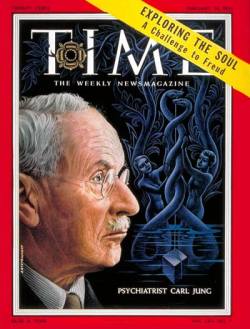
    C.G. Jung used in the On the Nature of the Psyche an analogy between the psyche and light on the electromagnetic spectrum. In this model, the non-visible ends of the spectrum represent the collective unconscious. Infrared is is the “lower” invisible end. It represents the biological instinct where the psyche merges into the physical body (matter) .Ultraviolet, the “upper” invisible end represents the archetypes. These are “psychoid” (meaning they are both psychic and non-psychic), exerting influence from a realm that feels outside of time and physical space. Visible Light is the narrow band of consciousness and the ego. It is only here that we can clearly “see” or perceive the Archetypal images and ideas produced by the invisible ends.

    On the “Psychoid” as a Probability Filter (CW 8, §417)“

    The archetype represents psychic probability, portraying ordinary instinctual events in the form of types. It is a special psychic instance of probability in general, which “is made up of the laws of chance and lays down rules for nature just as the laws of mechanics do.”

    On the “Field” and Environmental Influence (CW8, §420)

    “Just as the “psychic infra-red,” the biological instinctual psyche,gradually passes over into the physiology of the organism and thus merges with its chemical and physical conditions, so the “psychic ultra-violet,” the archetype, describes a field which exhibits none of the peculiarities of the physiological and yet, in the last analysis, can no longer be regarded as psychic, although it manifests itself psychically. But physiological processes behave in the same way, without on that account being declared psychic.”

    On Statistical Order over Causality (Letter 56P, Atom and Archetype: The Pauli/Jung Letters, 1932-1958 is a collection of correspondence between physicist Wolfgang Pauli and C. G Jung)

    “The concept of probability in mathematics corresponds to the archetype… and the laws of nature are the ‘statistical’ expressions of these underlying patterns.” (Pauli to Jung, 1950)

    1. THE NATURAL WOLF: THE BIOLOGICAL MATRIX OF THE Archetype Vessel

    The life of early man and that of the wolf did not differ greatly a few thousand years ago. Both were hunters, and both survived only through success in the pursuit of prey. During those early millennia, wolves were direct competitors with humans for the same game species. This competition intensified when human beings settled approximately ten thousand years ago and turned increasingly toward agriculture and cattle raising. Domesticated animals became easy prey for wolves, and many sheep and goats fell victim to them. Thus the wolf gradually became the hated animal that threatened not merely livestock, but human livelihood, property, and security.

    Jungian Archetype Vessel
    Wolf family the-alpha-wolf-couplef-amily-the-yearling-missing

    This ancient rivalry still shapes our instincts. Even as a backpacker, I have often felt more unease at the thought of a nearby pack of wolves than at the possibility of encountering a brown bear. Such fear is deeply inherited. Yet the paradox remains: the more closely the wolf is studied in its natural setting, the less it appears as a demon of the wilderness, and the more it resembles an older, untamed reflection of ourselves.

    1. Wolves in the wild

    The basic social unit of wolf populations is the pack. Packs usually consist of five to eight members, though in regions with abundant large prey they may number thirty wolves or more. Wolves generally establish territories ranging from forty to more than four hundred square miles. They define and maintain these ranges through scent markings and vocalizations—growls, barks, and the legendary howl—and defend them vigorously against intruders.

    A wolf pack is essentially a family unit consisting of an adult breeding pair and their offspring, often from several consecutive years. Members of the pack form strong social bonds that promote cohesion, cooperation, and survival. Earlier literature frequently described wolf society as governed by a rigid dominance hierarchy led by an “alpha male.” This concept, largely derived from observations of unrelated wolves forced together in captivity, has since been substantially revised. More recent field studies, especially those conducted on free-ranging wolves in North America and in the recolonized wolf territories of Brandenburg and eastern Germany, show that wolves live primarily as family groups: two parents guiding, protecting, and disciplining their not yet sexually mature young.

    Archetype Vessel
    wolfhowling

    Communication is especially important for wolves, since coordinated movement, reinforced bonding, and the maintenance of internal order are all essential to survival. Wolves employ a remarkably sophisticated range of signals: vocalizations, body posture, facial expression, tail position, and scent. Within the family group, this constant exchange preserves social stability and solidarity. The collective “wolf talk,” often initiated by the breeding pair, keeps the pack united and functioning as a cooperative whole.

    Research on wild wolves has shown decisively that assumptions drawn from captive animals cannot simply be transferred to free populations. In captivity, wolves of different origins and unrelated bloodlines were confined together, often producing abnormal aggression and artificial hierarchies. In the wild, however, conflict is moderated by kinship. Cooperation rather than coercion is the principle that holds the family together.

    Wolves and humans have always been rivals, and sometimes enemies, perhaps because in many respects they are strikingly similar. Wolves possess a strong social nature and, like early humans, are organized in family tribes. Through gesture, posture, and movement they communicate emotion and intent with remarkable precision. Wolves howl together for several reasons: to reinforce social closeness, to celebrate a successful hunt, to assemble scattered pack members, or to warn neighboring packs to keep away.

    The so-called lone wolf is usually a dispersing younger animal in search of its own territory and a mate. It skirts the territories of established packs, often moving silently and cautiously across large distances. By leaving the parental group, young wolves begin the cycle anew: finding a mate, establishing their own territory, and founding a new family. Thus dispersal is not exile, but a necessary mechanism of wolf continuity and a safeguard against inbreeding.

    Within the pack every wolf assumes a share of responsibility for the welfare of the group. From early playful interactions with older siblings and adults, pups are trained—almost rehearsed—into the disciplines of cooperation, hunting, caution, and leadership. Their survival, and that of the pack, depends upon it. In this respect wolf society resembles every successful civil, military, or familial organization: cohesion emerges from shared purpose and learned responsibility.

    2. The “Beast of Waste and Desolation”

    This newer understanding confirms what naturalists such as Farley Mowat in “Don’t cry Wolf” and Barry Lopez in “Of Wolves and Men” had already intuited in their descriptions of wild wolves: not ruthless gangs ruled by constant violence, but highly organized kinship hunter communities held together by communication, ritual, and cooperation. The former with a heavy dose of of anthropomorphic prose, the latter with heavy dose of reality, multifaceted by touching symbolism and history and describing human-wolf relationship almost as peers in hunting. Barry Lopez argues from a naturalist view that traditional hunting cultures suggest deep behavioral analogies achieved through a respectful, reciprocal relationship. These societies and wolves viewed the hunt as a sacred covenant requiring humility, dignity in the ‘conversation of death’ with the prey and hunting skills. Barry Lopez shares a Nunamiut elder’s insight to a question if an old man and an old wolf possess identical knowledge of the land and hunting: “After a pause the old man looks up and says: The same. They know the same.

    The wolf is not a dangerous monstrosity not a pet animal, but an intelligent carnivore with a highly differentiated social life. Anyone who has owned a good hunting dog can observe that good dogs, good leaders, and perhaps good men in general share certain attributes with the wolf: alertness, discipline, courage, endurance, hunting skills and loyalty to the group, that is fiercely loyal to its family as provider. However, this day the wolf continues to evoke fear. Yet it seems more than fear, greed and hatred.

    Barry Lopez explicitly outlines this in his 1978 book, “Of Wolves and Men, Chapter 9 provocative titled: “An American Pogrom“, not only Native Americans and wolves, but also bisons on which both depended were killed, mostly for their hides, antelope, pigeons and Indian ponies: No one knows how many animals were killed in the plains say between 1850 and 1890… it is conceivable 500 million creatures perhaps 1 million or 2 million wolves. As the land filled up with other ranchers, as water rights became an issue, and as the indigenous people were removed to reservations, however, the wolf became, as Barry Lopez’s concluded,” ‘an object of pathological hatred.’” He continues: “The motive for wiping out wolves (as opposed to controlling them) proceeded from misunderstanding, from illusions of what constituted sport, from strident attachment to private property, from ignorance and irrational hatred.

    General Philip Sheridan’s infamous remark (often reported as “The only good Indians I ever saw were dead”) was used to justify the brutal displacement and cultural erasure of Indigenous populations.
    The phrase “The only good wolf is a dead wolf” became a rallying cry for its systemic eradication. Both phrases stem from a 19th-century worldview that framed wild nature and Indigenous sovereignty as things to be tamed or extinguished to make way for expansion by erasure.

    Snowmobile ‘sport’ running down wolf

    However, he “Beast of Waste and Desolation” that Barry Lopez diagnosed in 1978 was never only a historical artifact confined to the early modern inquisitions or the 19th-century American frontier; it seems to remain the defining psychological pathology of contemporary civilization.

    We still see the terrifying persistence of this unmediated autonomous shadow.

    In early 2024 a Wyoming man reportedly ran over a wolf with a snowmobile, taped its mouth shut, paraded the suffering animal through a local tavern as a trophy of human dominance, and executed it behind the bar—an act protected by a legal framework that initially punished this ritualistic torture with a mere $250 possession fine. The man took a photo beside the wolf with its mouth taped shut, which was shared on social media. In 2026 a judge in Wyoming sentenced him additionally “for what happened after the capture” to 18 months of probation and to pay US$1,000 fine and another $425 in fees.

    Or very recently, when a men was captured on video -verified by the Gray Lady, paper of record- relentlessly beating a defenseless, chained family dog with two wooden clubs, the illusion of human supremacy is stripped away. Here lies the ultimate tragedy of our broken mediation with nature: in our manic, compulsion to conquer, dominate, and externalize the enemy, it seems it is the human being who becomes the true archetypal image of The Beast of Desolation.

    2. JUNG, THE COLLECTIVE UNCONSCIOUS, AND THE ANIMAL IMAGE

    1. Preconceptual Psyche, Archetype per se, and Archetypal Image

    In Jungian psychology, one of the greatest sources of misunderstanding lies in the loose use of the word archetype. Jung himself employed the term with shifting emphasis over the course of his work, and only in his later writings does a more rigorous distinction emerge. If this distinction is not maintained, archetypal interpretation easily degenerates into arbitrary symbol collecting, in which every recurring image is casually called an archetype. Jung’s own position is considerably more exacting.

    Strictly speaking, the archetype as such—or archetype per se (Jolande Jacobi’s Archetyp an sich)—is not an image, not a mythologem, and not a symbolic figure accessible to direct consciousness. It is an invisible ordering principle, an abstract latent structural template of psychic organization, comparable less to a formed picture than to a blueprint capable of generating innumerable images. Jung occasionally compared it to the invisible axial pattern within a crystal: one does not see the axial law itself, but one sees its concrete realizations in the formed crystal. The archetype is thus not yet the symbol, but the precondition for symbolic formation.

    What consciousness encounters are not archetypes in themselves, but archetypal images: dreams, deities, animals, rituals, compulsive fantasies, fairy-tale motifs, and emotionally charged symbolic constellations. These are the concrete manifestations through which the deeper pattern becomes representable.

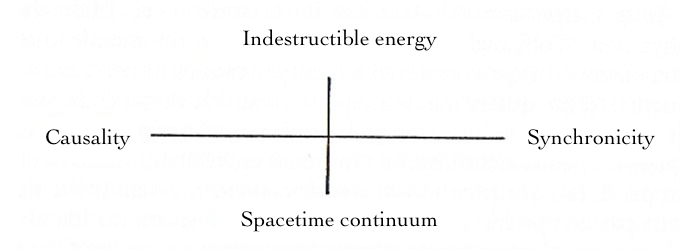
    Yet Jung’s mature psychology adds a third and still deeper dimension. The archetype is not merely a hidden schema inside the mind, as though the psyche were an enclosed subjective theater. Jung increasingly insisted that the deepest unconscious strata belong to what he termed the psychoid realm—a level of reality at which psyche and world, inner disposition and outer occurrence, are not yet fully separable. Here the archetype is no longer simply a mental category but a formative tendency participating in the structure of reality itself. This is one of the reasons Jung could later speak convincingly of synchronicity, meaningful coincidence, and the strange objective behavior of symbolic patterns in life events. The unconscious, in this view, is not unreal because it is invisible; rather, it is an unseen mode of the real.

    We may therefore distinguish three interconnected levels.

    First, the preconceptual psyche: a field in which instinct, psychic disposition, and formative reality are still entangled. Jung addresses this indirectly by pointing toward the transcendental nature of the archetype. He states in CW 8, §439:

    “Since psyche and matter are contained in one and the same world, and moreover are in continuous contact with one another… it is not only possible but fairly probable, even, that psyche and matter are two different aspects of one and the same thing. The psychoid phenomena indicate, as it were, such a background.

    Second, the archetype per se: the invisible structural blueprint or abstract ordering matrix emerging from this ground. As Jung writes:

    “One must, for the sake of accuracy, distinguish between ‘archetype’ and ‘archetypal ideas.’ The archetype as such is a hypothetical and irrepresentable model, something like the pattern of behaviour in biology.

    CW 9/I, §6 note 9

    Third, the archetypal image: the concrete symbolic manifestation by which consciousness encounters this blueprint in myth, dream, religion, animal symbolism, or lived experience. Again Jung gives the hinge sentence:

    “The archetype is essentially an unconscious content that is altered by becoming conscious and by being perceived, and it takes its color from the individual consciousness in which it happens to appear.”

    CW 9/I, §6

    Such a threefold distinction is not mere terminological precision. It has decisive methodological consequences. It means that when we speak of the wolf in archetypal terms, we are not claiming the existence of a singular metaphysical “wolf archetype,” as though a spectral wolf wandered through the collective unconscious. Rather, we are dealing with a recurrent symbolic representation through which several deep organizing patterns become visible. The wolf is one of the privileged concrete carriers chosen by the unconscious whenever certain archaic realities seek imaginal expression: predation, kinship, initiation, danger, territoriality, nocturnal intelligence, exile, and transformation.

    Thus the wolf belongs neither solely to zoology nor solely to mythology. It occupies the intermediate field where lived species-experience, inherited psychic structure, and symbolic imagination overlap. Its persistent return across civilizations suggests that mankind did not merely observe the wolf, but repeatedly encountered in it the outward manifestation of something inwardly and collectively known.

    1. Three Levels of Wolf Archetypal Emergence

    To avoid terminological ambiguity, the following three-level model is used throughout this study. It is not explicitly systematized in this form by Jung, but is derived from his later writings in Collected Works Volume 8 and Volume 9/I, particularly his distinctions between instinct, archetype as such, and archetypal representations, together with Jolande Jacobi’s description of the collective unconscious in Die Psychologie von C. G. Jung.

    Evolutionary Pattern (Biological Level)

    At the most concrete level, pattern refers to recurrent behavioral solutions stabilized through evolutionary selection pressure. These are adaptive configurations that persist because they enhance survival under recurring environmental constraints.

    In the wolf–human field these include:

    • cooperative pack hunting
    • territorial defense systems
    • kin-based social cohesion
    • dispersal of non-dominant juveniles
    • predator–prey interaction strategies

    At this level, pattern is not symbolic but functional: it describes what persists because it works under survival pressure.

    2. Archetype Per Se (Psychoid Constraint Level)

    At a deeper level, Jung posits an underlying organizing principle that is not itself observable as content, but which conditions the emergence of both instinctual behavior and symbolic imagery. He defines the archetype as “a hypothetical and irrepresentable model, something like the pattern of behaviour in biology,” and situates it within what he calls the psychoid realm, a domain in which psyche and material reality are not yet fully separable.

    At this level:

    • the archetype per se is not an image,
    • it is not a mythological figure,
    • it is not a personal psychological content.

    Rather, it functions as a structuring condition prior to reflection, shaping the space in which both instinct and imagination become organized. In heuristic terms, this level may be understood as an abstract constraint matrix governing the recurrence of certain form-generating dynamics across biological and psychic domains.

    3. Archetypal Image (Manifestation Level)

    At the third and most accessible level, archetypes become visible only through instantiation in concrete forms. The abstract archetype per se crystallizes into perceptible symbolic configurations. This is the level at which the unseen structural tendency becomes visible to consciousness.

    Jung explicitly warns against conflating these representations with the archetype itself. They are not the archetype proper, but localized symbolic realizations of the deeper structural condition.

    The model may therefore be summarized as follows:

    Evolutionary Pattern → Archetype Per Se → Archetypal Manifestation

    This describes a continuous emergence process in which biological stability generates recurrent behavioral forms; these forms correspond to deep psychoid constraints; and these constraints in turn manifest as symbolic and mythological imagery in consciousness.

    The wolf, in this framework, is not a single archetype but a recurring representational node where multiple archetypal structures converge.


    3. THE MANY ARCHETYPAL FACES OF THE WOLF

    The wolf functions as a privileged symbolic vessel through which several primal archetypal constellations become simultaneously visible in different imaginal forms.

    1. Mythological Figures: The Dual Mother and the Founder

    In mythology the wolf image often instantiates the archetype of the Dual Mother, representing nature’s capacity both to destroy and to nurture.

    The nurturing mother appears in the Roman Lupa who suckles Romulus and Remus. Here the wolf manifests the protective-maternal principle, suggesting that civilization itself is born from a raw instinctive foundation that is nevertheless cohesive and life-sustaining.

    The founder or ancestor appears in many Turkic and Mongolic myths, such as the legend of Asena, where the wolf becomes the literal progenitor of the people. In such narratives the wolf serves as the ancestral matrix linking human social identity to the primordial objectivity of the pack.

    2. Religious Symbols: The Psychopomp and Guide

    Because the wolf exists at the threshold between the civilized settlement and the dark forest, it becomes a privileged carrier of the archetype of the Guide.

    In Egyptian religion, Wepwawet—the opener of the ways, often represented as wolf or jackal—functions as scout and pathfinder for the soul. This is a symbolic realization of the wolf’s nocturnal intelligence: the ability to navigate where ordinary human consciousness is blind.

    Likewise, in Norse and Greek traditions, wolf- or hound-figures such as Fenrir and Cerberus guard the entrance to the underworld. They embody the threshold at which consciousness must confront its own biological and instinctual roots.

    3. Dream Images: Shadow and Social Self

    In dreams the wolf appears not as zoological fact but as functional psychic mirror, reflecting the dreamer’s relation to instinctual life.

    The predator commonly represents the Shadow: disowned aggression, hunger, or dangerous instinct threatening to overwhelm the ego.

    The pack often symbolizes the Social Self, highlighting either the dreamer’s need for kin-based cohesion or the fear of expulsion from the group.

    The solitary hunter frequently mirrors the dispersal phase: the psyche’s need for individuation, departure from the mother-group, and the search for an autonomous psychic territory.

    4. Transformation Symbols: The Archetype of Metamorphosis

    Transformation myths revolve around the tension between human reason and animal instinct.

    The werewolf is a symbolic realization of shadow-possession, in which the human ego is overtaken by archaic instinct. It represents not integration, but eruption: the collapse of mediation between civilized consciousness and primordial animality.

    The guardian wolf represents the opposite possibility: instinct integrated into psychic order, ferocity transformed into boundary, protection, and vigilance.

    The modern lone wolf myth is a symbolic realization of exile and individuation, though it often falsifies the biological truth that even dispersing wolves are ultimately oriented toward the creation of a new family unit.

    5. Interpreted Animal Behavior: The Archetype of Teleological Meaning

    At this level the evolutionary pattern and the archetypal image begin to merge. Human beings rarely observe wolves as merely neutral animals; they perceive organized meaning in wolf behavior.

    The alpha pair is interpreted as order, leadership, and sovereign coordination.

    The hunt becomes a symbol of purpose, synchronization, and collective goal-orientation.

    The howl functions as a symbolic carrier of communication across distance: the call that gathers the scattered members of the whole back toward the center.

    Thus the wolf is not a single archetype but a recurrent convergence point in which numerous archetypal structures become visible through one zoological carrier.

    6. Methodological Consequence for the Wolf Study

    This distinction is not merely terminological; it determines the epistemological basis of the entire study.

    When speaking of the wolf in archetypal terms, we are not positing a singular metaphysical “wolf archetype.” Rather, we are analyzing a recurrent symbolic convergence zone through which several deep organizing patterns become visible across both biological and psychic domains.

    The wolf therefore belongs neither exclusively to zoology nor exclusively to mythology. It occupies the intermediate field in which lived species interaction, inherited psychic structure, and symbolic imagination overlap.

    Its persistent recurrence across cultures suggests not that humans merely observed wolves, but that they repeatedly encountered in them the outward manifestation of structurally preformed inner realities.

    4. WOTAN, THE WOLF, AND COLLECTIVE POSSESSION

    This chapter examines the predator “shadow” manifestation of the wolf-vessel: the state of mass possession. Within Jung’s psychoid framework, Wotan and the wolf become symbolically linked expressions of storm, frenzy, instinct, and collective disinhibition.

    We argue that the creation of a lupus diaboli—wherein nature itself is cast as the enemy—signals the failure or collapse of a nation’s “civilized” containers. Likewise in temporal conflict (war), ethnic persecution or spiritual competition (Inquisition), the adversary must first be dehumanized. In this process, the aggressor’s probability field shifts toward the predatory shadow, transforming the group into a collective frenzy.

    Jung wrote extensively on the Wotan archetype and its specific constellation within the German psyche. His deep interest in mythology allowed him to recognize the lethal potential of irrational movements. He was consistently compelled by the study of semi-religious state cults (such as those imposed by Stalin, Hitler, and Mao). These systems are framed by neo-pagan metaphors as a substitute for the created religious void. In this void, the State does not merely govern; it possesses. The ‘predatory beast’ does not disappear under civilization; it simply waits for the ‘containers’ to crack. When they do, the resulting dissociation allows a rational society to participate in an archaic, predatory frenzy while believing itself to be fulfilling a ‘higher’ destiny. In his 1936 essay “Wotan,” he identified the eruption of a furor teutonicus beneath the thin veneer of Christian heritage and Enlightenment culture. “Jung’s research hypothesis—that archetypal structures condition collective behavior and symbolic imagination through which a society is either understood or unconsciously lived—finds its confirmation here. He identified the phenomenon of “dissociation”: a cultural rift wherein a rational, advanced society believes it has overcome “primitive stages,” while those stages have, in reality, only been suppressed. From this state of repression, they inevitably return.

    In “The Psychology of Dictatorship” (1936), Jung discusses how the “void” forces a return to archaic, tribal structures: The collective unconscious is a real fact in human affairs. …It is understandable, therefore, that there is such a force as the collective unconscious of a nation; … And the trouble about a nation is that it does not keep its word and has no honor, at least on the level of the collective unconscious. A nation as such, for all the claims of the totalitarian states, is a blind force.

    1. Wotan as Archetype of Storm and Frenzy

    Wotan is not a dead myth but an “autonomous psychic factor,” a restless wanderer who creates unrest and stirs up strife. Jung describes him as the “god of the storm and the frenzy, the leader of the Wild Hunt and the wolf-daemon” (CW 10, §375). In the psychoid ground, “storm” represents a non-local field of energy that overrides individual agency. When this field is activated, the collective psychic equilibrium shifts toward predatory shadow-identification, a “subjective determinant” that produces overwhelming effects in the collective life of a people.

    2. Wolves, Berserkers, and the War Band

    The historical úlfhéðnar (wolf-skinned warriors) illustrate the “psychic infra-red” state where biological rivalry becomes sacred ecstasy. This ritualized transformation allowed the warrior to bypass the “civilized” persona and tap into the raw power of the predator. By donning the wolf-skin, the individual is absorbed into the Männerbund (war-band), an entangled pack where the “predatory beast ” is no longer repressed but channeled. As Jung noted, this beast is always sleeping in the basement,”We keep forgetting that we are primates and that we have to make allowances for these primitive layers in our psyche.

    3. Odin’s Wolves and Sovereign Violence

    In the Norse mythological landscape, Wotan represents the archetype of the “Full Warrior”—the Ergreifer or “Seizer” who embodies a state of sacred, orderly or disorderly aggression. Yet, the moral and psychological direction of this warrior-energy is not contained within the God alone; it is mirrored in the dual propensity of his wolves. Here, the wolf-vessel bifurcates into two distinct psychoid possibilities: the integrated “Supportive Hunter” and the autonomous “Predator Shadow.”

    As the Sovereign Warrior, Wotan is flanked by Geri and Freki (“the greedy” and “the ravenous”). In the state of the Warrior’s “Fullness,” these wolves are not mindless monsters but high-functioning companions representing integrated instinct. They act as Supportive Hunters, channeling the raw hunger of the “infra-red” biological ground into the service of the state. They embody the virtues of the pack—loyalty, collective intelligence, and teleological coordination. In this integrated state, the predatory energy of the wolf is “socialized” through a psychoid covenant with the Warrior, providing the necessary “meat” or vitality to sustain the civilization. This is the wolf as a peer and protector, the Mac Tíre who acknowledges the Sovereign’s authority.

    However, the mythic field also holds the potential for the Predator Shadow, manifested in the catastrophic figure of Fenrir. Fenrir represents the wolf-instinct that has been repressed, chained, or dissociated from the “Full Warrior.” Like the King falls into the shadow—becoming either the Tyrant who abuses power or the Weakling who fears it—the “Supportive Hunter” disappears. The wolf then grows into an autonomous, world-ending force that can no longer be contained by the “civilized” persona. Fenrir is the eschatological result of a warrior-energy that has lost its wisdom and its mission. He is the devouring shadow that eventually breaks his chains to consume the very “God” (the Social Order) that failed to integrate him.

    Thus, Geri and Freki on one hand, and Fenrir on the other, represent the two poles of archetypal probability. They serve as a diagnostic mirror for the state of the collective: when the Warrior is in his Fullness, the wolf is a supportive ally; when the Warrior is in Shadow, the wolf becomes the predator that heralds the collapse of the world.

    The wolves Geri and Freki, who flank Odin’s throne, symbolize the duality of, “Sovereign Violence” necessary to maintain the state or win a war. This sub-chapter explores the wolf as the provider of predatory legitimacy. For the dictator or sovereign, the wolf serves as a mirror of the “predatory instinct of the primitive group.” As Jung stated in The Psychology of Dictatorship, a ruler in this state “must always have an enemy… someone to hunt, or the pack will turn on itself.” The wolf-vessel here transitions from a biological peer to a tool of absolute, non-human power.

    4. Jung’s Essay on Wotan and Collective Activation

    In his 1936 essay, Jung identified the eruption Wotan he likened to the of a furor teutonicus beneath the veneer of Enlightenment culture. In fact, Jung just foresaw the events a “powerful eruption” of the collective unconscious, the “awakening of Wotan from thousand years sleep”, and the uprising of the Germanic soul in Nazi Germany against the “rationalism”. He argued that because “traditional containers—the Church and its symbols—had become hollow,” primordial forces broke through the floor of the house (Preface of Essays on Wotan).

    C.G. Jung called Hitler 1938 in an interview with US-Journalist  H. R. Knickerbocker,a historical phenomenon, a loudspeaker of the German soul Hitler is a medicine man, a form of spiritual vessel, a demi-deity or even better, a myth”. C.G. Jung Speaking: Interviews and Encounters (edited by William McGuire and R.F.C. Hull), the H.R. Knickerbocker interview titled “Diagnosing the Dictators”

    It is worth to note a shared mechanism of the predator archetype: Demonizing the wolf (nature) and dehumanizing the enemy (man) are the same archetypal move. Both remove the “Other” from the sphere of empathy, “tilting” the psychoid ground toward pure aggression. Religious and political systems alike may seek symbolic monopoly by defining themselves as the exclusive bearers of truth, legitimacy, or collective destiny. Under conditions of dissociation, this tendency facilitates the dehumanization of the outsider and intensifies predatory group-identification. When the Church fails, the State moves in as a “surrogate,” but it uses the same “Wolf-Vessel” to organize the masses. This is a “psychic epidemic” or “true possession” where the individual’s conscious will is powerless against the autonomous force (CW 10, §388).

    “Wotan is a wolf-daemon… the individual’s conscious will is powerless against the autonomous force. It is a true possession, a psychic epidemic that has swept away the rational world.” CW 10, §388]

    Jung’s “Diagnosis” confirms that the more we believe we are “advanced” (Enlightenment) or morally superior , the higher the probability that the suppressed wolf-nature will return as a “furor.”Hitler functioned as a catalytic medium through whom latent archetypal contents achieved collective symbolic expression. He provided the voice for the furor teutonicus. Because his power was “magical” and “anti-intellectual,” it bypassed the rational “Enlightenment” filters and connected directly to the infra-red biological ground (instincts) of the people

    The significance of Jung’s 1938 interview with the American journalist H. R. Knickerbocker is heightened by Knickerbocker’s own historical role as one of the few Western reporters willing to publicize the reality of Stalin’s Holodomor against prevailing political denial. His discussions with Jung therefore occurred within a broader confrontation with the mass psychological catastrophes of the twentieth century.
    Deciphering Jung’s”Wotan essay”, distinct layers emerge in the interview “Diagnosing the Dictators”:

    • The Wind/Storm: Jung tells Knickerbocker that Hitler is “the loud-speaker which magnifies the inaudible whispers of the German soul.” This perfectly matches the “Wotan” essay’s description of the god as a “wind” that blows through a people.
    • Infection vs. Persuasion: Knickerbocker asks about the “contagion” of the movement. Jung confirms that this isn’t a political argument one can win; it’s a psychic epidemic.
    • The Role of the Journalist: Knickerbocker, by reporting both on Stalin’s Holodomor and Hitler’s awakening of the furor teutonicus, was essentially witnessing and reporting first hand the “shadows” of the 20th century. His psychology background allowed him to see that these weren’t just “bad policies,” but the unleashing of the primitive.
    • The “Wotan” Manifestation: While the 1936 essay is academic, Knickerbocker’s questioning forces Jung to describe and explain the physicality Knickerbocker saw front row of the Beer Hall Putsch 1923—the “dreamy eyes” and the power of Hitler’s voice over the crowds.

    5. Nationalism, Tribal Regression, and Predatory Group Mind

    When a society believes it has “overcome” its primitive stages, it falls into “dissociation.” This cultural rift allows a rational society to engage in archaic frenzy while believing itself to be modern. In totalitarian systems, the state becomes a “surrogate religion,” and the dictator a “demi-god” or “medicine man” of the tribe. The “Mac Tíre” (the peer) is replaced by the “Lupus Diaboli” (the enemy), a mechanism of dehumanization that allows the group to act as a predatory organism without the constraints of individual empathy.

    “The state has taken the place of God… when the traditional containers (the Church and its symbols) had become hollow, the primordial forces broke through the floor of the house.” (Preface to Essays on Wotan)

    6. The Wolf as Banner of Possessed Collectivity

    The wolf finally emerges as the literal signum or banner of the possessed group. From the Roman standards to modern paramilitary symbols, the wolf-image signals that the collective psychic equilibrium shifts toward predatory shadow-identification . The banner is the “Symbolic Convergence Zone” where the “loss of the animal soul” is replaced by a “mass psychosis.”

    The wolf-vessel, once a guide of the soul, is here inverted into the “predator wolf-shadow,” signaling that the group has successfully “swallowed the archetype” and entered the eschatological fury of the storm. Its the intersection where the Psychoid Ground speaks through the shaman. Jung’s diagnosis reveals that when a society suffers from ‘dissociation,’ it replaces the Statesman. This leader does not ‘use’ the wolf-symbol; he is consumed by the predator wolf-shadow. The resulting furor is the ‘awakening’ of a psychoid field that treats the world as a prey and the enemy as the lupus diaboli.” It seems Adolf Hitler was something more terrifying than evil: he was awakening an ancient archetype Wotan in the soul of the German people. Hitler, Jung argued, was not a normal statesman but a mouthpiece and medium, a convergence node for multiple dissociated collective contents.

    Wolf-symbolism provided an archetypal charged imaginal structure through which predatory collective identity could become psychologically organized. Modern civilizations remain vulnerable to archaic archetypal regression precisely where and when it believes itself most rational and psychologically emancipated. Under conditions of collective dissociation, archaic symbolic structures may re-emerge and organize mass political emotion in ways modern rational consciousness catastrophically underestimates. “Jung’s analysis reaches far beyond the Germany of 1936; it is a frightening diagnosis that continues to resonate—even literally today.

    5. THE WEREWOLF: ARCHETYPE OF TRANSFORMATION

    The werewolf myth symbolizes the catastrophic breakdown of mediation between human consciousness and instinctual nature. Ancient societies ritualized this tension; modern civilization represses and externalizes it, producing both individual fragmentation and collective predatory mass formation. How we treat the nature, the animal – particularly the wolf and including its archetypal images as beast), the loyal dog indicates the depth of the crisis manifest in a civilization caused by pathological estrangement from nature and instinct and loss of reason.

    A werewolf (also known as a lycanthrope) is a mythical human who possesses the ability to shapeshift into a wolf or a monstrous wolf-like hybrid creature. This transformation is historically triggered by curses, sorcery, or the light of a full moon. The word itself originates from the Old English term wer, which translates directly to “man,” combined with wolf.

    1. Historical Evolution of the Myth

    • Ancient Beginnings: The earliest referenced transformation appears in the Babylonian Epic of Gilgamesh, where a goddess turns a shepherd into a wolf.
    • Greek Mythology: King Lycaon of Arcadia was transformed into a wolf by Zeus as a punishment for serving him cannibalistic human remains. This tale birthed the word lycanthropy.
    • Roman Folklore: Romans used the word versipellis (“turnskin”) to describe sorcerers who changed forms using magical herbs.
    • Norse Culture: Legends spoke of Ulfheðnar (“wolf-coats”), fierce Viking warriors who wore wolf pelts into battle and supposedly channeled the beast’s raw, predatory rage.

    There are a number of cultures which have were-creatures in their mythology, usually involving large predators that hunt by night. Often the were-creatures takes the form of the most dangerous animal found in the area the most famous of all are the werewolves of medieval Europe. Folklore suggests a complete transformation into a natural wolf. Modern media popularized a bipedal, fur-covered humanoid beast.

    The term “were” is from the old english word “wer” meaning man, Thus, werewolves , man-wolves, are half human and half animal the grandfather of the hero Odysseus is named Autolykos, meaning “he who is wolf.” ANTIQUITY AND MEDIEVAL LYCANTHROPY TRADITIONS

    Historical lycanthropy traditions and modern collective mass formation are not literal regressions into biology, but psychic compensation mechanisms. When a group, culture, or nation experiences severe systemic distress, the fragile boundaries of the shared conscious ego dissolve. This forces a collective regression into the primordial, predatory layer of the unconscious—manifested in myths as the beast, upon today in societies as outcasts were denied innocence—denying itself reality.

    DomainCore Mechanism
    Individual psycheShadow possession / ego eclipse
    Collective psychologyMass regression / projection
    Civilizational crisisInstitutional collapse of symbolic containment
    Human-nature relationSeverance from nature and instinctual order

    1. The Archaic Paradigm: Ritualized Regression

    The earliest referenced transformation appears in the Babylonian Epic of Gilgamesh, where a goddess turns a shepherd into a wolf. In Greek mythology, King Lycaon of Arcadia was transformed into a wolf by Zeus as a punishment for serving him cannibalistic human remains—a tale that birthed the word lycanthropy. The grandfather of the hero Odysseus was named Autolykos, translating directly to “he who is wolf.” Romans later used the word versipellis (“turnskin”) to describe sorcerers who changed forms using magical herbs, while Norse culture spoke of the Úlfhéðnar (“wolf-coats”), fierce Viking warriors who wore wolf pelts into battle to channel the beast’s raw, predatory rage.

    Paradigm Shift: Controlled Ritual vs. Uncontrolled Fracture

    Archaic Paradigm (Controlled)Medieval/Modern Fracture (No Control)
    • Polytheistic/Tribal Acceptance• Rigid Moralistic Ego Framework
    • Ritualized Shape-shifting• Total Repression of Instincts
    • Safety Valve for Predatory Libido• Violent Shadow Projection & Panics

    These ancient rituals were not products of primitive ignorance, but controlled psychic safety valves. Archaic societies lacked highly differentiated, individual ego structures. In Carl Jung’s Collected Works (CW) 18: The Symbolic Life, he notes that archaic man lacked the internalized ego structure required to process overwhelming psychic energy. Instead, they relied on theriomorphic projection, externalizing internal bloodlust, survival drives, and tribal boundaries onto animal-formed deities.

    When faced with the terror of nature or war, they used ritual shape-shifting to deliberately channel the autonomous, predatory energies of the collective unconscious. By wearing the pelt or entering a trance, the human ego was temporarily suspended. This allowed the community to survive raw, chaotic environments without permanently breaking their psychic framework.

    2. The Medieval Fracture: Projections and Witch / Werewolf Trials

    The transition to medieval Europe fractured this delicate containment system. The medieval church enforced a rigid, hyper-moralistic conscious framework that completely demonized human instinct. Because the primitive, animalistic shadow could no longer be integrated through communal ritual, it was violently repressed.

    As a result, these unconscious forces revolted. The repressed predator was projected outward onto outsiders, neighbors, or “heretics.” This sparked massive collective panics where communities hunted literal “werewolves” to destroy their own internal, unacknowledged sins.

    Barry Lopez in his critically acclaimed 1978 book, Of Wolves and Men explores the wolf in European history and mythology. Lopez discusses how the fierce demonization of wolves paved the way for early modern werewolf trials. He notes that these trials mirrored the exact legal, theological, and interrogative patterns used in witch trials, and that inquisitors relied heavily on the same text, the infamous Malleus Maleficarum (known in German as the Hexenhammer, or “The Hammer of Witches”)

    In sociological terms, this period marked the birth of The Denial of Innocence. Under the pressure of collective trauma, a society’s conscious or possessed ego can no longer tolerate ambiguity or individual differentiation within an adversary group. Forced Confessions via Torture, The “Satanic Pact” Framework, extreme brutal elitists function as an aggressive cognitive flattening—a psychic defense mechanism where an agitated group actively strips away a target’s humanity or invokes The Beast (a wolf, a tiger, a leopard) to protect its own brittle psychological state.

    3. The Modern Parallel: Civilizations Under Distress

    This psychological blueprint bridges ancient lycanthropy directly to modern mass psychological phenomena, such as wartime propaganda, intense ideological shifts, and mass formation anxieties. When modern societies face overwhelming crisis or destabilization, rational systems break down.

    In this state, propaganda acts as a modern sorcery or “poisonous herb,” systematically triggering the autonomous shadow as a cultural contagion (CW 10: Civilization in Transition). Just as Jung argued in his essays on post-WWII Europe that a civilized nation could be possessed by an ancient, dormant archetype of rage (such as Wotan), the modern citizen drops their individualized moral consciousness and assumes a herd-like, predatory collective identity.

    Through the systematic Denial of Innocence, the “other side” is stripped of individual reality and flattened into a monster. The civilized nation, while consciously claiming righteousness, begins to act with the uninhibited, systematic cruelty of an unchecked apex predator.

    2. Boundary crisis a violent psychic rupture

    The lycanthrope fundamentally exists to test the limits of human agency. When the rational human mind is abruptly subjected to lupine physicality, the boundary dividing civilization from nature violently collapses. The hybrid body highlights the fragility of human identity and moral codes, suggesting that the civilized persona is merely a thin layer resting upon latent, carnivorous instincts.

    The human-animal hybrid in lycanthropic myth serves as the symbolic theater for the catastrophic collapse of the conscious ego framework. This chapter examines the structural dissolution of the boundaries that separate civilized humanity from raw animal nature.

    Rather than a fluid transition, this boundary crisis represents a violent psychic rupture where the structures of reason, language, and individual identity fail to mediate between the conscious mind and the primordial unconscious.

           A. Somatic Rupture (body mutates)
    
           B. Linguistic Collapse (loss of speech)
    
           C. Ego Eclipse (loss of agency)
    
           D. Post-Possession Trauma(return of guilt)
    
           [ CIVILIZED SPACE / EGO ]
             • Structured Language
             • Differentiated Morality
             • Solar Rationality
                        │
                        ▼  ❌ BOUNDARY RUPTURE (The Shifting Borderland)
                        ▲
             • Theriomorphic Libido
             • Somatic/Predatory Drive
             • Lunar Autonomy
           [ UNTAMED WILDERNESS / ID ]


    1. Somatic Rupture (body mutates)

    The Agony of the Bone-Shift: In John Landis’s An American Werewolf in London (1981), the transformation is intentionally stripped of any romantic mystique. It is presented as a brutal, agonizing, and non-consensual destruction of human anatomy. The literal elongation of the spine, the shattering and reforming of the jaw, and the violent eruption of hair from the skin serve as a visceral visual metaphor for the ego being ripped apart from within.

    When the instinctual overwrite is triggered visually, the human ego experiences a total eclipse, completely severing the individual from their moral center and their anchor to reality.

    2. The Loss of Speech and the Death of Rationality

    The most definitive marker of the human-animal boundary crisis is the immediate, agonizing loss of human language during the transformation. Language as an Ego Defense: In psychoanalytic terms, language is the primary tool of the conscious ego. It allows human beings to conceptualize, mediate, and delay gratification. By naming an instinctual drive, the ego establishes a healthy distance from it, containing its raw energy.

    The Speech-to-Roar Rupture

    Human Speech (The Conscious Ego)The Animal Roar (The Unconscious Id)
    • Logic and reason• Raw, chaotic emotion
    • Self-control and boundaries• Wild survival instincts
    • Civilized identity• Pure predatory drive

    The Silence of Reason: Without words, the capacity for moral reflection, logical deduction, and ethical choice vanishes. The human mind is silenced, leaving the body to operate purely on the uninhibited, non-verbal feedback loops of apex-predatory survival.

    The structural integrity of the human psyche relies entirely on its ability to maintain a differentiated boundary between the internal self and the external, instinctual ecosystem. In lycanthropy, this boundary suffers a total collapse.

    3. Ego Eclipse (loss of agency)

    In psychological terms, the werewolf is the ultimate manifestation of the autonomous Jungian Shadow. Unlike a healthy integration of these instinctual forces, lycanthropy dramatizes a catastrophic instinctual overwrite—the Shadow violently usurps the ego rather than negotiating with it, leading to a state of utter psychological possession.

    To map this dynamic accurately, we must look to the source of these overwhelming forces: the Collective Unconscious carrying capacity of the individual conscious mind. Lycanthropic possession is a violent movement between archetypal inflation and its inevitable, crushing counter-process the deflation. This psychological trajectory operates on a strict Jungian logic, mirroring the classic pattern found in profound literary studies of human-animal division, such as Hermann Hesse’s Steppenwolf.

    Archetypal inflation occurs when the fragile human ego identifies directly with the contents of the collective unconscious. The individual confuses themselves with an archetypal figure—in this case, the timeless archetype of the absolute apex predator—and assumes a scope, power, and significance that properly belong only to the untamed totality of nature.

    [ INDIVIDUAL HUMAN EGO ]
    ▼ ⚠️ IDENTIFICATION RUPTURE (The Illusion of Power)
    [ ARCHETYPAL INFLATION ] --> Ego merges with the Collective Shadow
    ▼ ❌ VISCERAL/MUNDANE TRIGGER (Jealousy / The Full Moon)
    [ VIOLENT DEFLATION ] --> Collapse into Guilt, Madness, and Trauma

    At its onset, this expansion of consciousness feels like a genuine, liberating breakthrough. Yet, a subtle and decisive error occurs: the ego does not merely witness these archetypal realities; it identifies with them. The werewolf does not simply encounter the instinctual beast—he believes himself to be the beast. His personal suffering and repressed rage are suddenly granted a tragic grandeur, elevated to a universal, mythic scale where ordinary moral boundaries seem entirely irrelevant.

    This inflated state contains the exact conditions of its own catastrophic collapse. The human ego cannot permanently sustain identification with the raw totality of the collective unconscious without fracturing. The trigger for this inevitable collapse often arrives in a moment that appears strikingly mundane, yet carries an unrefined emotional weight that the inflated ego cannot accommodate.

    The Mechanics of Psychic Capture:

    The Sovereign Ego (Healthy State)The Autonomous Shadow (Possessed State)
    • Operates from a conscious moral center• Controlled by raw, untamed libido
    • Governs action through willful choice• Guided by instinctual survival feedback loops
    • Negotiates and integrates base desires• Enforces total compliance through violence

    The structural integrity of the human psyche relies entirely on its ability to maintain a differentiated boundary between the internal self and the external, instinctual ecosystem. In lycanthropy, this boundary suffers a total collapse.

    • The Failure of the Persona: The human face—the ultimate psychological site of social mediation, recognition, and individual consciousness—is violently overwritten by the theriomorphic mask.
    • Somatic Treason: The physical body ceases to be a reliable container for the rational ego. The flesh itself rebels, stretching and mutating to accommodate the unmediated breakthrough of primitive survival drives.
    • The Internal Dehumanization: This physical distortion mirrors the internal mechanic. The ego actively strips away its own humanity, performing a deliberate cognitive flattening that reduces complex moral consciousness to a singular, predatory focus.
    • The Descent into Affect: When the lycanthrope transitions, speech is stripped away and replaced by the roar, bark, or howl

    This boundary crisis is not merely internal; it is literalized in the geography the werewolf inhabits. The lycanthrope is defined by its absolute inability to belong to any structured space.

    [VILLAGE / CIVITAS] ───> [BORDERLAND / OUTLAW] ───> [ THE WILD FOREST ]
    (Conscious Ego Space) (Homo Sacer / Wolf's Head) (Deep Unconscious)

    The werewolf operates almost exclusively in twilight, dawn, or the dead of night the precise moment when solar consciousness sets and the shadows of the personal and collective unconscious lengthen.It is trapped perpetually in a painful, shifting borderland—the edge of the woods, the graveyard, the crossroads, or the ruined homestead. Under old Germanic and Roman law, an individual expelled from the community for an unspeakable crime was declared wargus or vargr—a wolf. To the state, they wore a “wolf’s head” (caput lupinum); they could be hunted and killed by anyone without legal penalty and became outcast hunted down like witches in the medieval age, just usually werewolves wered burned alive.


    4. Post-Possession Trauma(return of guilt): The Fragile Boundaries of the 21st Century

    The Tragedy of Post-Possession Deflation: The true horror of the werewolf is that the inflation is cyclically crushed by deflation. When the frenzy subsides, the ego returns to find its world physically or morally destroyed. The human side cannot handle the animal’s guilt, and the animal side cannot be sustained in civil society. The ego is violently brought back into proportion, left to gaze upon the literal or symbolic carnage born from its failure to integrate, rather than succumb to, the darkness within

    While ancient laws and medieval traditions went to extreme lengths to enforce, police, and ritualize these boundaries, the twentieth and twenty-first centuries have exposed a terrifying development: the modern ego-boundary is far more fragile and less enforced than ever before.

    • The Digital Wilderness: In the hyper-connected modern landscape, the clear line between civilized space and the primal wild has blurred. The internet and digital media act as a borderless twilight zone where the “village” and the “forest” collide.
    • The Normalized Lowering of the Mental Level: Where ancient societies used highly restricted, sacred rituals to channel collective rage, modern technological structures systematically encourage an ongoing, unregulated abaissement du niveau mental. Anonymous digital spaces act as modern “wolf-pelts,” allowing users to instantly shed their individual moral personas and adopt predatory, pack-like identities.
    • The Invisible Pack: The globalized crises of the 21st century—driven by hyper-anxiety, echo chambers, and systemic distress—demonstrate that modern civilization does not require a physical forest to release the beast. The boundary between rational civic discourse and raw, predatory tribalism has worn razor-thin. The “wolf’s head” is no longer an exiled outcast pushed to the physical margins of society; the unchecked impulses of the collective shadow now operate directly from the center of the modern cultural apparatus

    The werewolf does not simply encounter the instinctual beast—he believes himself to be the beast. His personal suffering and repressed rage are suddenly granted a tragic grandeur, elevated to a universal, mythic scale where ordinary moral boundaries seem entirely irrelevant.

    The ultimate failure of the werewolf experience is the failed individuation. In a true process of individuation, the conscious ego learns to communicate with and integrate the unconscious instincts. The werewolf, conversely, undergoes a bifurcated, fractured existence. The human and the beast remain completely distinct and warring entities, leaving the host trapped in a cycle of either agonizing repression or completely dissociated, destructive frenzy.

    Twentieth and twenty-first-century leans heavily into the visceral horror and inevitability of this transformation. Groundbreaking films like An American Werewolf in London and The Howling utilize the physical agony of the morphological shift to emphasize the trauma of the human condition. Cinematic interpretations continue to frame the lycanthrope as an out-of-control curse rather than an integrated state, reinforcing the core argument that the subject is forever punished by a split identity they can never fully reconcile

    …. To be continued

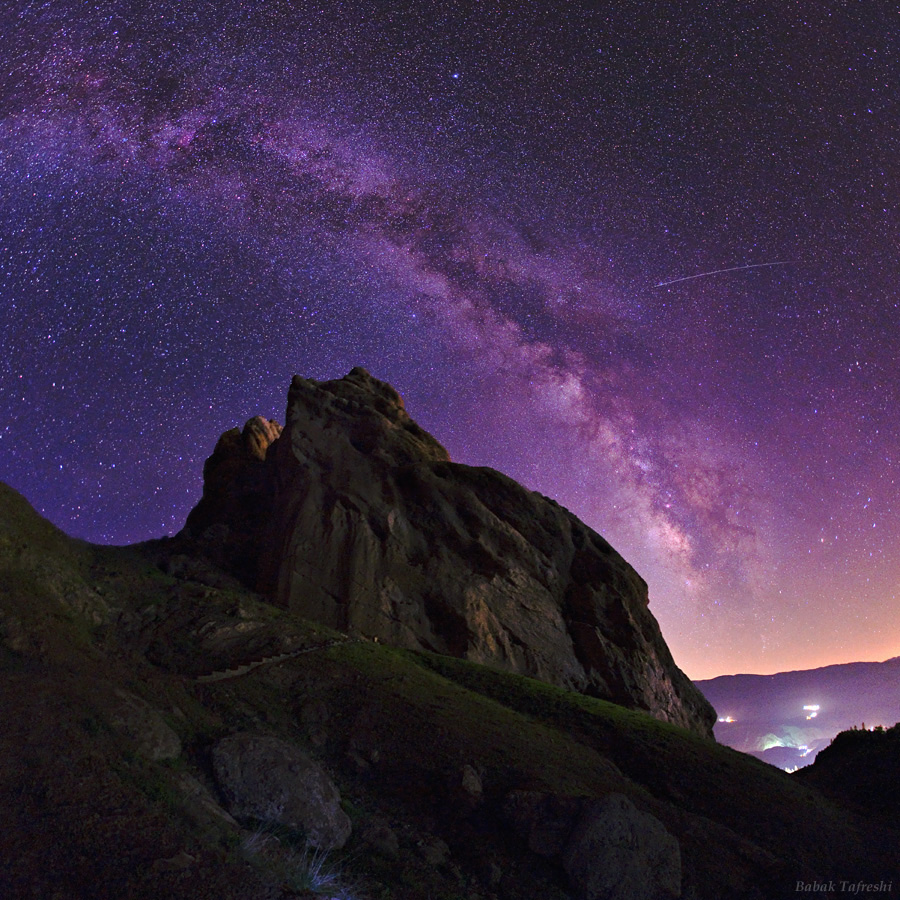
    6. THE ARCHAEOASTRONOMICAL DIMENSION OF THE WOLF MYTH


    PART SIX — THE ARCHAEOASTRONOMICAL DIMENSION OF THE WOLF MYTH

    Function : Explore celestial, calendrical, and directional codings of wolf symbolism across archaic cultures.

    Subchapters:

    1. Wolf-Star Associations in Eurasian Traditions
    2. Lunar Cycles, Nocturnal Hunting, and Mythic Time
    3. Solstitial Guardians and Directional Animals
    4. Sirius, Canid Symbolism, and Ritual Orientation
    5. Cosmological Wolves in Indo-European and Steppe Material
    6. Celestial Order and Terrestrial Predation

    Core Argument: the wolf is not only terrestrial predator but also cosmological marker of liminal time and orientation.


    PART SEVEN — THE WOLF IN MYTHS, RELIGIONS, AND CULTURES

    Function: Comparative civilizational survey demonstrating the extraordinary persistence of wolf motifs.

    Subchapters:

    1. Rome — Lupa and the Birth of the State
    2. Turkic and Mongolic Ancestor Wolves
    3. Norse Fenrir and Eschatological Devouring
    4. Greek, Persian, and Indo-Iranian Wolf Material
    5. Native American Wolf Teachers and Clan Spirits
    6. Christian Demonization and Medieval Inversion
    7. The Global Continuity of the Wolf Symbol

    Core Argument: despite cultural divergence, the same symbolic tensions recur with notable consistency.


    PART EIGHT — THE WOLF AS MIRROR OF MODERN MAN

    Function Bring the entire symbolic investigation into contemporary psychological and civilizational diagnosis.

    Subchapters:

    1. The Modern Myths of the Wolf
    2. Alienation, Masculinity, and Exile
    3. Leadership, Discipline, and Pack Longing
    4. Bureaucratic Civilization versus Predatory Instinct
    5. Digital Tribalism and New Collective Howls
    6. Why the Wolf Returns in Late Modernity
    7. The Wolf as Mirror of the Disowned Human Animal

    Core Argument: modern fascination with the wolf reflects a crisis of instinct, belonging, and psychic sovereignty.

    PRIMARY SOURCE APPARATUS TO BE USED

    Jungian Core Texts

    • CW 8 — On the Nature of the Psyche
    • CW 9/I — The Archetypes and the Collective Unconscious
    • CW 10 — Civilization in Transition (especially Wotan)
    • CW 11 — Psychology and Religion
    • CW 14 — Mysterium Coniunctionis (for transformation motifs)
    • Atom and Archetype: The Pauli/Jung Letters, 1932-1958 is a collection of correspondence between physicist Wolfgang Pauli and C. G Jung
    • CW 18 — THE SYMBOLIC LIFE MISCELLANEOUS WRITINGS
    • McGuire, William (ed.) – C. G. Jung Speaking (Princeton, 1993) (for transformation motifs)
    • Synchronicity: An Acausal Connecting Principle UK, Edition 1985
    • Four Archetypes Mother Rebirth Spirit UK, Edition 1971

    Jungian Secondary

    • Jolande Jacobi Die Psychologie von C. G. Jung. Olten: Walter Verlag, 1971
    • Der Mensch und seine Symbole. By Carl Gustav Jung, Marie-Louise von Franz, Joseph L. Henderson, Aniela Jaffé, and Jolande Jacobi. Olten Walter Verlag AG,1968
    • Aniela Jaffe Die Einheitswirklichkeit und das Schöpferische Erich Neumann und C-G. Jung

    Wolf Ethology

    • Of Wolves and Men, Barry Lopez 1978
    • European wolf recolonization studies ­ WWF Deutschland, Berlin
    • The International Wolf Center – science-based education
    • Farley Mowat Never Cry Wolf (1963) classic memoir of the Canadian naturalist
    • For visual de-demonization: Jim Brandenburg ‘White Wolf’, 1990 and ‘Bruder Wolf 1994

    Mythological/Comparative Sources

    • Prose Edda / Poetic Edda
    • Histora Mundi Band 2 Frühe Hochkulturen
    • Histora Mundi Band 4 Römische Weltgeschichte und Christentum
    • Roman foundation myth sources
    • Mythologyof the American Nations
    • Turkic Asena materials
    • The Druids
    • Die Kelten
    • Indo-European canine symbolism
    • Egyptian funerary religion (Wepwawet)
    • Medieval werewolf trials and folklore, “Mac Tíre” (Son of the Earth)
    • The Ossory Werewolves: The Helpful Shape-Shifters
  • Dante’s Divine Comedy – symbolism and archetypes

    Dante’s Divine Comedy – symbolism and archetypes

    Dante is not just any poet. With his epic poem “Commedia”, in English “Divine Comedy” he created an Italian cultural Monument, a journey through Hell, Purgatory and Paradise full of symbols, archetypes, historical and allegorical references. The article wants to revisit the work of Poet Dante Alighieri from a Jungian view in the light of 2015.

    Synopsis

    Dante’s Commedia was written from 1307 to 1321 and is the most famous Otherworld journey of world literature. Accompanied by Virgil, the poet passes through the Gates of Hell to the icy center of the earth, and from there to the paradise flying high with his beloved Beatrice. On the way, he meets almost six hundred celebrities from politics, literature and mythology for their salvation, repent of their sins, who tell the poet of their life. It was a longitudinal study of the Western World at that time.

    See above a short powerpoint as an introduction if you are in the visuals or not sure to where this article will lead: Dante in a hurry.

    Is Dante meaningful today?

    My answer is yes. Yes, period. Not only, because i every time you go in a museum, you will find pictures representations of Dane’s allegories and poems. Like Dante sensed a big transition. our world seemingly falls apart.  We all know, that transcendental illiterates try to create a paradise on earth, but achieved hell. Jihadists have created hell on earth to get into their paradise.

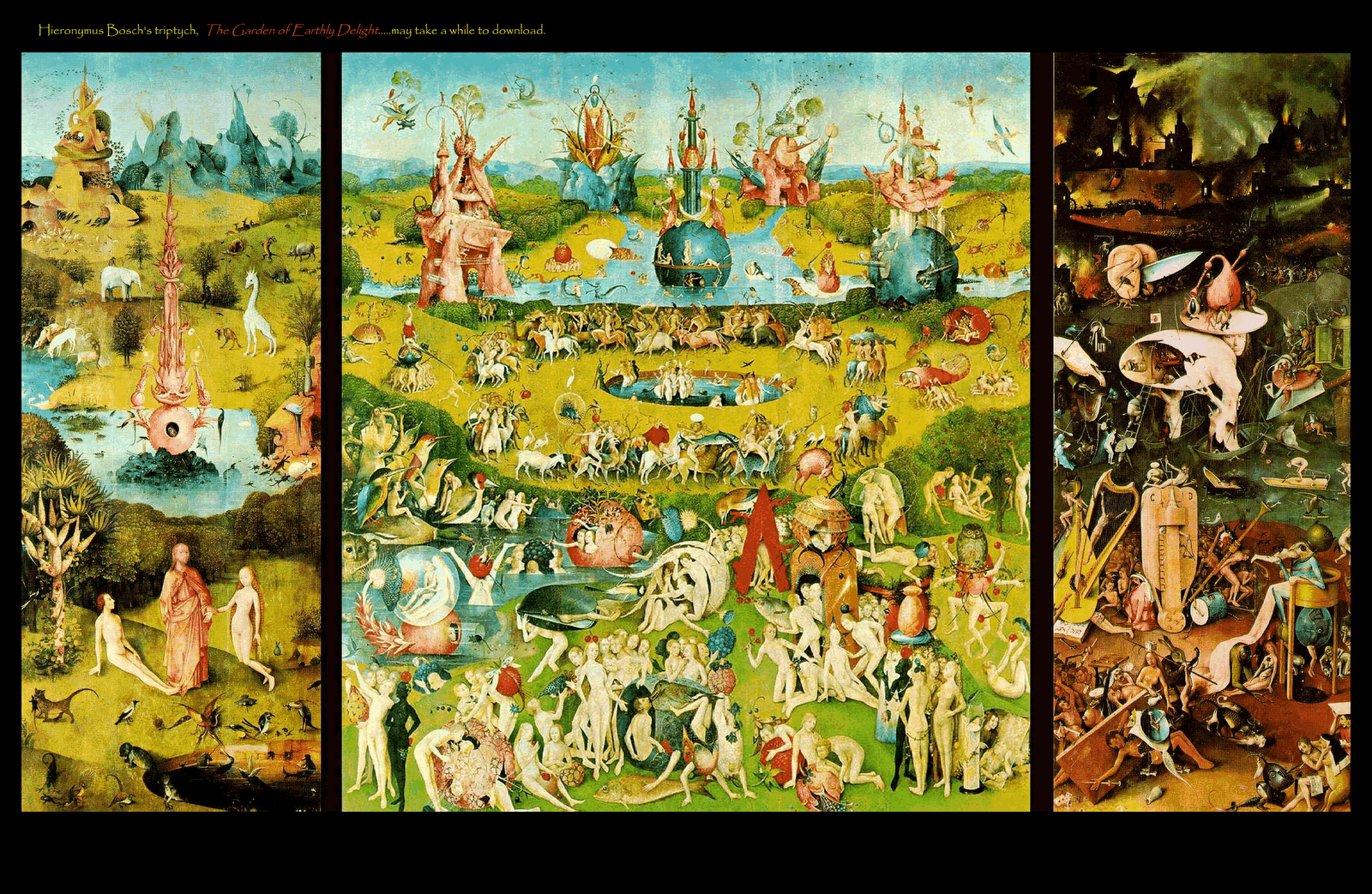
    Dantes Inferno Lust - bosch garden
    Dantes Inferno Lust

    Could it be, that one or more of Dante’s circles is as subversive today as it was then?  As a reader of my blog might expect, I am interested in Dante’s reflection in art and society and last but not least of his concept of evil, since the 34th song of his journey inspects Lucifer himself.

    •  Literal and historical: around 600 real people mentioned pointing out the disconnect between medieval and classical practice
    •  Allegorical: archetypal representative of Dante’s belief system and values
    • Moral: makes points about morality where the big questions in the Divine Comedy are:
      • What is man?
      • Why does he act as he does?
      • What is Good and what is Evil?
      • When it so often looks like “The Good loses,” why should anyone be good?

    Warning – reading Dante might be harmful

    True and False - Right or wrong - good or evil - black or white
    True and False – Right or wrong – good or evil – black or white

    The great works of world literature, Antigone, Hamlet, Faust, torture not only students’ hearts but all hide an eternal sting. This warning upfront, it is not to harmless to engage with Dante. Next to the Bible is the ‘Divine Comedy’ the most commented book in World literature. The phenomenon is even more amazing, because Dante is the most difficult, least accessible poet of world literature. Dante combines the whole scholarly tradition of the Latin Middle Ages and asks of his readers to have this knowledge or debark, before the ship leaves the safe shore:

    O voi che siete in piccioletta barca,
    desiderosi d’ascoltar, seguìti
    dietro al mio legno che cantando varca
    tornate a riveder li vostri liti:
    non vi mettete in pelago; chè forse
    perdendo me, rimarreste smarriti.

    The human rights organization “Gherush92” has claimed some chants of “Commedia” are full of racist, anti-Semitic and Islamophobic stereotypes and by the way, I add not even equal opportunity – fewer women suffer in hell.

    For the contemporary reader it is, however, not only the scholarly high sea of political correctness, in which they could get  lost. Further difficulties are added: spatial, temporal, and formal ones.

    Spatial context

    We must see the world through the eyes of Dante. The world view of Dante in the first two decades of the 14th century, his image of the earth and the structure of the three kingdoms   corresponds to the Ptolemaic system, unchallenged until Copernicus three hundred years later. This makes up the basis of Dante’s astronomy, described by his prose ‘Convivio’

    Dante’s heavenly scheme

    Comedy's geography
    Comedy’s geography

    Claudius Ptolemy concluded in the middle of the second century AD in Alexandria his main work, the ‘Megale syntaxis (‘ Big assortment ‘), his world-view: The stationary center of the universe is the spherical earth, of which only one half
    occupied with the vertex Jerusalem, the other is covered by ocean.  Down into the sea, now obviously no longer Ptolemy, but Dante, as an exact antithesis to Jerusalem, is the mountain of purification, the scene of the second part of the ‘Comedy’: the ‘Purgatorio’.  More closely tied to Ptolemaic ideas are the spatial relationships his understanding of space and stage. Albert Ritter sketched the Comedy’s geography from Dante’s Cantos:
    Hell’s entrance is near Florence with the circles descending to Earth’s centre; sketch 5 reflects Canto 34’s inversion as Dante passes down, and thereby up to Mount Purgatory’s shores in the southern hemisphere, where he passes to the first sphere of heaven at the top.

    Paradiso

    Dantes Divine Comedy - Paradiso
    Dantes Divine Comedy – Paradiso

    Around the earth revolve in outward increasing speed nine concentrically enclosing transparent hollow spheres. Seven blessed spheres with the earth as center and five planets known in his time have attached the heavenly bodies: Moon, Mercury, Venus, Sun, Mars, Jupiter and Saturn.  The ninth circle are the fixed stars, identical with what “le stelle” at Dante’s.  Beyond those nine celestial spheres is the seat of the supreme deity, the empyrean, “cielo di fiamma o vero luminoso or “the light and flame sky – itself immobile – like the earth.

    This heavenly scheme is matched by Dante’s topography of the ‘Purgatorio’ and ‘Inferno’.

    Purgatorio

    Purgatorio
    Dante’s Divind Commedy Purgatorio

    The Purgatorio rises on the apex of the uninhabited area covered by the ocean opposite to Jerusalem. It is the location of the passion and death of Jesus Christ, and also divided into nine districts. At the bottom of the beach belt land, the souls that are shipped to death first wait on a ledge and into a ravine for the entry in the actual Purgatorio, located on the ring terrace The Prayer and Purification passage leads through seven by rock walls separated ring terraces. On the top is the  abandoned earthly paradise.

    Inferno

    Inferno
    Dante’s Divine Comedy Inferno

    Likewise, the Inferno is precisely located  in the Ptolemaic system of Dante. Hell corresponds to the conical Purgatory at its negative hollow image. It is located in the interior of the inhabited hemisphere. Lucifer has bored with the insubordinate angels after his fall into the earth to its center. Thus, the funnel-shaped narrowing again be divided into nine circles Hellmouth has emerged. Where did the displaced Earth’s mass go? In this creation model, it was reused as material for the Purgatory and therefore the mountain’s height  matches the hell crater’s depth.

    Temporal context

    Poets write  for eternity, but within a Zeitgeist. Dante had his contemporary readers in mind, to achieve certain political effects. Much of this vision of the afterlife is therefore based on the period of history and culture he lived in. Naturally, as in any art, this requires explanation, if the  context is not there anymore nowadays. Like his topographic structure, are the conditions in Dante’s temporal structures coherent whole. Its center is natural is located in Rome.  As a matter of fact, in a trinity of  Rome. The Classical Rome of Augustus, the New Byzantine Rome and the Rome of the Holy Roman Empire – the papal Rome. The history of the latter began on Christmas in the year 800 with the coronation of Karl (Karl the Great) to the Roman emperor, executed by the pope Leo III.  Around 1160 the official denomination Imperium Romanum changed  into Sacrum Imperium and 1254 the empire was named Sacrum Imperium Romanum and became in the 15th century the Holy Roman Empire of German Nation. The title of the supreme monarch was initially “king”. The emperor’s honor could only be achieved only by the coronation of the pope.

    Historical context

    As an ambassador of his native city of Florence, Dante came 1301 AD to Rome. The contradiction between idea and reality on court of Pope Boniface VIII traumatized him.  Jerusalem, taken 1099,  was lost 1187, but the Crusaders had relocated their dwindling Kingdom of Jerusalem to Cyprus around 1300 but the Mamluks besieged and captured the last Templer fort Ruad in 1302. Constantinople would hold only 150 years more.  Dante’s central idea is of unity and  continuity of Roman and to him this is world history under the sign of the eagle. In the sixth canto  ‘Paradiso’ the Eastern Roman Emperor Justinian (527-565) describes the trajectory of the eagle (the Roman character)  together with history lessons. As the author of the corpus juris civilis,  on which the Napoleon code and the whole  Western legal system is based.
    Justinian is the representative of the Roman Empire. The eagle will start with Troy westward to Lazio. Under Augustus, the conquest consolidated in the golden Aion. Constantine, who moved his residence 326 moved to Constantinople against the natural and divinely ordained east-west direction and through the donation of the Papal States, repealed the division of sacred and secular rule. The Imperium Romanum was for Dante the epitome of everything that he wanted to see realized in history. Not the Sacrum but the center of the Civitas Dei, with its dual objective: eternal blessedness of the man through the exercise of the theological virtues (faith, hope and love) – under the leadership of church; earthly well-being through the use of intellectual and moral faculties – under the leadership of a worldly State with Plato’s virtues (Prudence, Justice,  Courage, Temperance).

    More problematic is the difficulty in understanding the political references: What can we do with them now? They include all a closed world view: Catholic of the Middle Ages. That is why one meets a lot of Popes and even Mohammed in Dante’s hell. To him, a natural state order has its historical origin in the classical Roman Empire. To me this the first glimpse into the area of enlightenment, to invoke a secular (one might say pagan) legitimation of power again.

    Northern Italy’s political struggle

    Conclave_Vatican_yesterdayIn Northern Italy’s political struggle between Guelphs and Ghibellines, Dante was part of the Guelphs, who in general favored the Papacy over the Holy Roman Emperor.
    Dante wrote in his political credo in ‘De Monarchia’ about the basic  relationship between empire and papacy  (Imperium and Sacerdotium), or secular and religious rule. Only in the harmonious coexistence of the two powers Dante saw a guarantee for a just and peaceful world order in which the salvation of humanity can be accomplished. Florence’s Guelphs split into factions around 1300: the White Guelphs, who opposed secular rule by Pope Boniface VIII and who wished to preserve Florence’s independence, and the Black Guelphs, who favored the Pope’s control of Florence.
    Dante was among the White Guelphs who were exiled in 1302 by the Lord-Mayor Cante de’ Gabrielli di Gubbio, after troops under Charles of Valois entered the city, at the request of Boniface and in alliance with the Blacks.
    The Pope said if he had returned he would be burned at the stake.

    Form of poetry

    We encounter now the third hurdle, with which the reader is confronted reading Dante: the formal aspects of the ‘Divine Comedy’. Three elements are highlighted here:

    •     the language,
    •     the symbolism
    •     and the symbolism.

    Dante has decided, his main work in the so-called vernacular: in Italian and that was all but self-evident at that time.
    The Italian cannot be seperated from the ‘Divina Commedia’. However, its rhythmic form, the tercet, does not occur in Italian poetry.

    Sacred numbers

    Here you find Dante’s sacred numbers:

    • 3: trinity
    • 9: 3X3
    • 33: multiple of 3
    • 10: considered number of perfection
    • 100: 10 X 10 absolute perfection

    Living systems are recursive systems
    Living systems are recursive systems

    Three verses are together, of which the first and third rhyme, while the second rhyme will be picked up in the next Tercet. So the terza rima form an elaborate chain. Three 3 cantiche, each formed of 33 cantos, adding up to 99, which with the addition of the first introductory canto, adds up to 100. The Poem is written in Teresa Rima: 3 line stanzas with a rhyme scheme aba, bcb, cdc, ded etc, so each rhyme is used 3 times.

    The big Munich Romanist Wilhelm Ritter von Hertz, whose translation of the ‘Purgatorio’ and the ‘Paradiso’ I use, dominates the iambic rhythm, rhyme and the trisection. The three rhymes belong to the center of Dante’s symbolism ultimately, together with the Trinitarian concept of God. The symbolism of numbers plays in the ‘Divine Comedy’ a very important role just as with C.G. Jung. Each of the three main parts of the work, called cantiche , consisting of thirty-three songs, canti, which indicate the years of the life of Christ. An additional song of the introduction is to increase the total number of canti to hundred. The hundred is ten times the number ten, which, according to the View in Dante’s was a symbol of perfection. The Inferno is divided into nine circles and the court; in the ‘Purgatorio’ there are pre-Purgatorio and the earthly Paradise on the top of nine circles; the nine heavens are completed by the Divine Office: the empyrean – again to number ten. The three-rhyme has not only aesthetic, but symbolic, one might almost say metaphysical significance.
    The whole work is almost saturated with symbolism. Here are more difficulties for the contemporary Dante reader. Without reading scholarly commentary, the symbols remain a very superficial affair. For example, refer the three wild animals in the first canto of the Inferno to the main vices: Sensuality (Panther), Pride (Lion), Greed (wolf). Whether something is right or left, to Sun and Star is never random. In the architecture of the poem, there are numerous, but not obvious correspondences. For example, the sixth Song of the ‘Paradiso’, in which, as mentioned, the Roman eagle represents the continuity of world history has an inner relationship to both the sixth canto of the Inferno and the ‘Purgatorio’ – pointing to the different factions in Florence.

    The 9 circles of inferno in a hurry

    First Circle (Limbo) – The virtuous Pagans

    Luke Warm. Neither sinned nor believed in Christ.
    Luke Warm. Neither sinned nor believed in Christ.

    Here reside the unbaptized and the virtuous pagans, who, though not sinful, did not accept Christ.

    Heaven does not claim them, Hell does not want them. They are not punished in an active sense, but rather grieve only because of their separation from God, without hope of reconciliation. Without baptism (“the portal of the faith that you embrace”) they lacked the hope for something greater than rational minds can conceive. Limbo includes green fields and a castle, the dwelling place of the wisest men of antiquity.

    Second Circle – The Lustful

    Lust Blown about in darkness.
    Lust Blown about in darkness.

    Those overcome by lust, are punished by violent storm in this circle. Blown about in darkness.  Dante condemns these “carnal malefactors” for letting their appetites sway their reason. They are the first ones to be truly punished in Hell. These souls are blown about to and fro by the terrible winds of a violent storm, without hope of rest. This symbolizes the power of lust to drive one  needlessly and aimlessly.

    Third Circle – The Gluttonous

    gluttony
    gluttony

    Gluttons are forced to lie in the mud under continual cold rain and hail. Deprived of individuality. Each is alone, cold, and miserable. Cerberus guards the gluttons, forced to lie in a vile slush produced by ceaseless foul, icy rain (Virgil obtains safe passage past the monster by filling its three mouths with mud).  The gluttons lie here sightless and heedless of their neighbours, symbolising the cold, selfish, and empty sensuality of their lives. Just as lust has revealed its true nature in the winds of the previous circle, here the slush reveals the true nature of sensuality – which includes not only overindulgence in food and drink, but also other kinds of addiction.

    Forth Circle – The Hoarders & Wasters

    Dante's greedy
    Dante’s greedy

    Hoarders and Wasters push as two groups a great weight against the heavy weight of the other group. Dependency toward material goods deviated from the appropriate means. They include the avaricious or miserly (including many “clergymen, and popes and cardinals”), now bankers ans politicians who hoarded possessions, and the prodigal, who squandered them. The two groups are guarded by Plutus, the Greek god of wealth (who uses the cryptic phrase Papé Satàn, papé Satàn aleppe). The two groups joust, using as weapons great weights which they push with their chests

    Fifth Circle  – The Wrathful

    Wrathful and Sullen
    Wrathful and Sullen

    In a swamp-like water of the river Styx, the wrathful fight each other on the surface. The sullen lie gurgling beneath the water, withdrawn “into a black sulkiness which can find no joy in God or man or the universe.” Phlegyas reluctantly transports Dante and Virgil across the Styx in his skiff.The lower parts of Hell are contained within the walls of the city of Dis, which is itself surrounded by the Stygian marsh. Punished within Dis are active (rather than passive) sins. The walls of Dis are guarded by fallen angels.  Oh well, fallenangel.

    Sixth Circle –  The Heretics

    Heretics are in tomb.
    Heretics are in tomb.

    Heretics are trapped in flaming tombs of the City of Dis. Heretics, such as Epicurians (who say “the soul dies with the body”) are trapped in flaming tombs. Pausing for a moment before the steep descent to the foul-smelling seventh circle, Virgil explains the geography and rationale of Lower Hell, in which violent and malicious sins are punished. In this explanation, he refers to the Nicomachean Ethics and the Physics of Aristotle. In particular, he asserts that there are only two legitimate sources of wealth: natural resources (“nature”) and human activity (“art”). Violence, to be punished in the next circle, is therefore an offence against both.

    Seventh Circle – The Violent

    The seventh circle houses the violent. Its entry is guarded by the Minotaur, and it is divided into three rings:

    Outer ring

    Violent
    Violent

    Violent against people and property,  are immersed in Phlegethon, a river of boiling blood and fire, to a level commensurate with their sins: Alexander the Great is immersed up to his eyebrows. The Centaurs, commanded by Chiron, patrol the ring, firing arrows into those trying to escape.

    Middle ring

    In this ring are the suicides, who are transformed into gnarled thorny bushes and trees, excluded from resurrection. Here are the suicides (the violent against self), who are transformed into gnarled thorny bushes and trees, which are fed on by the Harpies. Unique among the dead, the suicides will not be bodily resurrected after the final judgement, having given their bodies away through suicide. Instead they will maintain their bushy form, with their own corpses hanging from the limbs. The trees are a metaphor for the state of mind in which suicide is committed. The other residents of this ring are the profligates, who destroyed their lives by destroying the means by which life is sustained (i.e. money and property). They are perpetually chased by ferocious dogs through the thorny undergrowth.

    Inner ring

    The violent against God (blasphemers), the violent against nature (sodomites), and the violent against art (usurers), all suffer in a desert of flaming sand with fiery flakes raining from the sky. The blasphemers lie on the sand, the usurers sit, and the sodomites wander about in groups

    Eighth Circle (Malebolge) – The Fraudulent

    Fraudulent
    Fraudulent

    The fraudulent—those guilty of deliberate, knowing evil—are located in a circle named Malebolge (“Evil Pockets”), divided into ten Bolgie, or ditches of stone. The circle named Malebolge (“Evil Pockets”), is divided into ten  ditches of stone, with bridges spanning the ditches:

    Bolgia 1 (Canto XVIII):

    Panderers and seducers walk in separate lines in opposite directions, whipped by demons.

    Bolgia 2 (Canto XVIII:

    Flatterers are steeped in human excrement. )

    Bolgia 3 (Canto XIX):

    Those who committed simony are placed head-first in holes in the rock, with flames burning on the soles of their feet. One of them, Pope Nicholas III, denounces as simonists two of his successors, Pope Boniface VIII and Pope Clement V.

    Bolgia 4 (Canto XX):

    Sorcerers and false prophets have their heads twisted around on their bodies backward, so they can only see what is behind them and not into the future.

    Bolgia 5 (Cantos XXI through XXIII):

    Corrupt politicians (barrators) are immersed in a lake of boiling pitch, guarded by devils, the Malebranche (“Evil Claws”).

    Bolgia 6 (Canto XXIII):

    Hypocrites listlessly walking along wearing gold-gilded lead cloaks.

    Bolgia 7 (Cantos XXIV and XXV):

    Thieves, guarded by the centaur (as Dante describes him) Cacus, are pursued and bitten by snakes, which make them undergo various ugly transformations.

    Bolgia 8 (Cantos XXVI and XXVII):

    Fraudulent advisors are encased in individual flames. Dante

    Bolgia 9 (Cantos XXIX and XXX):

    A sword-wielding demon hacks at the sowers of discord. As they make their rounds the wounds heal, only to have the demon tear apart their bodies again. Muhammad tells Dante to warn the schismatic and heretic Fra Dolcino. (Cantos XXVIII and XXIX).

    Bolgia 10:

    Groups of various sorts of falsifiers (alchemists, counterfeiters, perjurers, and impersonators) are afflicted with different types of diseases.

    Ninth Circle (Cocytus) – The Treacherous (Canto 34).

    Frozen in a sheet of ice with only their face exposed to show the pain. Degree of depth based on degree of betrayal

    SatanCenter
    SatanCenterb

    Satan is trapped in the frozen central zone in the Ninth Circle of Hell, Inferno. The Ninth Circle is ringed by classical and Biblical giants. Each group of traitors is encased in ice to a different depth, ranging from only the waist down to complete The circle is divided into four concentric zones.

    Zone 1: Caïna (Canto XXXII)

    Named after Cain, is home to traitors to their kindred. The souls here are immersed in the ice up to their necks.

    Zone 2: Antenora  (Cantos XXXII and XXXIII)

    Traitors to political entities, such as party, city, or country, are located here. The souls here are immersed at almost the same level as those in Caïna, except they are unable to bend their necks.

    Zone 3: Ptolomæa (Canto XXXIII):

    Traitors to their guests are punished here. The souls here are immersed so much that only half of their faces are visible. As they cry, their tears freeze and seal their eyes shut- they are denied even the comfort of tears.

    Zone 4: Judecca

    Named for Judas the Iscariot, Biblical betrayer of Christ, is for traitors to their lords and benefactors. All of the sinners punished within are completely encapsulated in ice, distorted to all conceivable positions.

    Center of Ninth an all circle:  Perverted Trinity (Canto XXXIV)

    Condemned to the very center of hell for committing the ultimate sin (treachery against God) is Satan, represented as a giant, terrifying beast. He is waist deep in ice, and beats his six wings as if trying to escape, but the icy wind that emanates only further ensures his imprisonment. He is chewing on Brutus and Cassius, who were involved in the assassination of Julius Caesar, and Judas Iscariot. What is seen here is a perverted trinity. Satan is impotent, ignorant, and evil while God can be attributed as the opposite: all powerful, all knowing, and good.

     Conclusion

    The Question is:  Are we seven hundred years after the birth of the ‘Divina Commedia’ able to understand Dante’s  world and relate to Dante’s symbolism. My answer is defintely. Not only because Dante’s Inferno is now an action-adventure video game . The story is based on Inferno, the first canticle of Dante Alighieri’s Divine Comedy, and shares many similarities with the poem.

    Sources

    lDivine Comedy.” Wikipedia.   http://en.wikipedia.org/wiki/The_Divine_Comedy

    lThe World of Dante. Institute for Advanced Technologies in the Humanities http://www.worldofdante.org/

    lDante’s Divine Comedy I-III Translated by Mark Musa

    lDante’s Die göttliche Kommödie I-III Translated by Willhelm G. Hertz

  • The Self – God’s window between pantheistic Taoism and Catholic personal god

    The Self – God’s window between pantheistic Taoism and Catholic personal god

    Last Saturday (yesterday). I went on a retreat (religious exercise) at the Benedictine monastery St. Ottilien with twenty others men and women looking after their private center and true selves:

    “Looking for the self” What do we know of the psyche and soul?

    The discussion was lead by two monks – the longtime Prior Claudius and Pater Otto, who is catholic priest, Jungian psychologist and as he always proudly announces, orginally a cheese maker. Segments of discussion were preluded from the two monks with some food for thought: first from a catholic view of the wise and senior Bavarian monk and then from a psychological view from the energetic, versatile,  a curious (spiritual and intellectual) searcher in his soft American-Swiss accent. I have known both for a while, and do not  go along always with their statements or definitions. As often, many of the brief thought nuggets answered my current questions and difficulties but also opened more topics to meditated and think about. Never before have I seen priest sharing so openly their lifelong process of believing, their doubts and trust in following Christ. The (Catholic) belief they presented and have lived is one of a unique joyful religion for this life, of  boundless love, capable of deep mystic but also fully compatible with science and Jungian models.

    Life experience in an elevator pitch

    Do you think, the Prior (second in charge of this monastery) told the audience some conventual belief and bigot phrases? Think again, some of his statements would force both the official church hierarchy together with the noisy know-better-modern- lay(wo)men of today in a tailspin. A concise opening statement of the Prior summed up what one has to do in life and how that helps finding God. I was taken back by its simplicity. His crisp world view came across as a result of his own thinking and experience as a monk without giving  psychoanalysis any deep consideration. But it could be easily matched to individuation of C.G. Jung. I included a crude visualisation below. Furthermore, the Prior eased my biggest problem with a personal god, having had my God experiences in the nature.

    First the Prior showed  us a pantheon (almost Taoist) image of god, how it relates the inner center our Self: God is in everything and above everything or God does not exist. Quite frankly, that resonated well with me, since I felt god the first time, during a backpacking week around Mount Rainer (Wonderland trail). That is – God is in everything  – after I crawled out of the tent and admired nature during the glowing sunrise.
    Secondly Claudius connected men’s outer world, with his inner world and with God –  as an individual to a personal (Du to Du).  It comprised what one has to accomplish in the first half of life ( and where materialism or Freud’s machine stops) and in the second part of life and beyond.  C.G. Jung defined that  without his empiric reach but definitely within his metaphysic view.

    Dealing with the outer world: You have a good meaningful job, live in a nice house, have a good handsome/pretty spouse,your kids turn out well. You sit down and see it is good. I think this relates to the developing an Ego and Persona in the first half of your lifespan. Later Pater Otto brought  the Ego in an Example of a Gel Tub, how the Ego,the center of consciousness is needed as an outer communicator and shell to protect your our Self and our Soul.

    Dealing with inner world: You have to look into yourself think and meditate, rid yourself of the negative. (P. Claudius avoided saying evil or demons). You sit down and see it is good. I think this relates to the Individuation, overcoming the own Shadow and finding the soul (Anima). Later Pater Otto told us about the soul (lat. Anima, gr. psyche ) how this relates our psyche and psychology in general.

    Find your inner center: You have to look beyond this world, to find the loving God in you ( P. Claudius meant looking for our soul). Men is a communicating species, but you have to  have found your inner center to do this successfully..You sit down and see it is good. I think this relates to the Individuation, overcoming the own Shadow and finding the Soul (Anima) and Self. Later Pater Otto told us about the Self, the forces in making cheese by steering in the milk  and the Axis (the big pipe) between the Ego and the Self.

    Communicate with the personal god: You have to connect with the personal God using your Self as window (or membrane). You sit down and see it is good. I think this connects the Individuation process with the  religious or transcendent dimension of an accomplished life. Later P.  Otto told us about special prayers (credo prayers) and Kreuzgänge (walking silent cross walks) how  we can show God we are ready. Now here the monks moved from pantheism to the loving Christian trinity. The communication between the personal God and us as individual is facilitated by the Self, our window to God.The bigger the pipe is between Ego and Self, the easier it is to experience God. Autonomous complexes or an inflated Ego prevents that.

    The Ego, the Self and God
    The Ego, the Self and God – Individuation and Transcendence


    One Questions two views but one answer

    I have never heard it so clear. The theoretical distinctions of the Self in the different teachings is often unclear and undifferentiated. For the psychologist C.G. Jung the ‘Self’ is an empirical concept for the total amount of all psychic phenomena in humans. It expresses the oneness and wholeness of total personality. The general question in the search for the ‘Self’ is: How can the lives of people succeed? The Prior formulated it in a Christian way,  explaining how to follow Christ; aiming to the realization of the true ‘Self’. I believe that, together with psychoanalytical contribution of C.G.Jung,  the Catholic faith sheds light on the basic “W” questions but also helps in this life. Jesus’ approach to the individual and freedom is unique. We are nor slaves of a cruel god, nor impersonal white noise to resolve our Ego better sooner than later in nothingness, nor a bunch of neurons (mis)firing. As the Prior said: “we can look into the starry sky and say Du,Du, Du”. And I would add, fully aware of todays astrophysical knowledge of our universe.

    God around everything and above everything

    The Self

    Psychological schools are just models. We can’t see atoms or quarks nor can we see our soul.  Therefore scientists and psychoanalysis come up with models, to understand and predict based on empirical data. Even if the Self is a non-uniformly used term with their psychological, sociological, philosophical and theological importance variants, the Jungian model is the closest to Religion. While Freud and Adler considered very narrow psychological drives, C.G. Jung understood the central integral concept of the human psyche as the Self. This Self is the wholeness of the human psyche and connecting the conscious and unconscious parts of the personality and aims toward the harmonization of the psyche. Only the ego-consciousness has the equipment to process deliberately sensory perception and thinking, feeling, and intuition. The unconscious part of the us, which splits in the personal unconscious and the collective unconscious, is larger and often more powerful than ego-consciousness. The ego,on the other hand can run amok and super-inflate. The Self is the center of the whole personality and therefore the central window or “membran”as Pater Otto called it to God. As I interpreted the Prior Claudius, it is also the Place where God or Jesus is in us.  The Ego is the conscious of self, his eye, with whose help the self itself can recognize. The self is the God in us. Individuation is to be who one really is, and thinks a differentiation process that has the development of all skills, systems and possibilities of the individual through gradual awareness and realization of the self to the target.

    Find my Self and inner Center again

    Religion is to C.G. Jung the opportunity to discover the soul. For Freud as for Marx, religion is just opium. Jung sees the benefit of religion (especially of catholic flavor) to deal with many similar psychic circumstances. Today’s psychology – influenced by Freud – to me is Godless and today’s Western theology – influenced by the age of enlightenment – to me often lacks soul. Spirituality and religion, together with logic and science, is focus for individual and political healing. The most important insight, which I understood this day: The impending disasters right now around me, are a direct result of my buried shortcomings like a pretty big Ego which served me well in my career (i.e. the disaster in me). Its is directly linked to Jung’s reminder, the inner world is very real. The evil is in us.

    Conclusion

    I considered myself blessed to get so many hints from the monks for my specific search in such a short time:

    • Who I was in the past, I who want to be in the future and how do I make the transition?
    • How I reflect my undesired aspects of my personality and keep my identity here?
    • What are root causes of interpersonal communication defects – last call to grow up?
    • What are cause and effect of those significant problems in my current professional transition?
    • How to use the current crisis as a momentum and I deal with transcendence and the death?
    • What needs successful self-development within my current life situation (e.g., toward individuation, religiosity)?

    Lots of other questions were discussed, which might “wind up” in another blog entry:

    • Does Evil exists – questions about the dualistic view (Good and Evil)?
    • Does the hell exist. Where does the picture of it come from?
    • What is the opposite of belief (trust in God) what means believing?
    • What is the opposite of love (indifference / egoism)?
    • Usefulness of the religious church hierarchies and dogmas?
    • Theory and praxis of dreams including dream phenomenology and hierarchy?
    • Emphasis on Christ’s suffering versus Christ’s resurrection (central altar figure in  St. Ottilien)?
    • Individual injuries because of rigid and/or bigot religious practices (understood first time how severe those could influence children, and the advantage of converts)
    • Descartes and Dualism
    • Common psychological disposition (e.g. narcisissm of super inflated egos)
    • Fatherly  versus motherly images of god (got lost of this one – thinking of Kali hardly a nice one).

    I was also astonished about the  “Big Bang Didn’t need God to start universe doubt” discussion. To me, believing in God comes down to a personal experience that a benevolent deity is out there. People who are generally more intuitive in the way they think (in the Jungian sense) and make decisions are more likely to believe in God than those who ruminate over their choices. That suggests that basic differences of one’s personality type influences religious belief. Some say we believe in God because our intuitions about how and why things happen lead us to see a divine purpose behind ordinary events that don’t have obvious human causes. As on woman said in the discussion, “I translate believe in trust”. Individual’s belief is influenced by how much we trust natural intuitions. In the end, God can only be known by personal experience not by logic. If one does not experience god, too bad (for her or him). True, big bang and quantum mechanics  describe random fluctuations which can produce matter and energy out of nothingness. But quantum mechanics are just (proved) models too. I don’t doubt that physical laws can “produce” the cosmos. 

    However, minor asymmetries shortly after the beginning are the cause that matter and anti-matter (particle and antiparticle) did not annihilate itself immediately.  As an engineer, quite interested in astrophysics, physical laws do not at all affect my theological leanings. I see in such statements not attacks on the existence of God. Saying the Big Bang — a massive expansion 13.7 billion years ago that blew space up like a gigantic balloon — could have occurred without God is a far cry from saying that God doesn’t exist. With Jung, and many philosophers I don’t think one can use science to either prove or disprove the existence of God. The question, then, is, Why are there laws of physics? And one could easily say, those required a divine creator a spark that led from the laws of physics to these universes, maybe more than one.  Or, as I humbly admit, one can fall back to pantheistic belief, that ‘divine ‘ is in nature in everything  and produced the laws of physics. I would say let’s just leave that to theology, philosophy and C. G. Jung…

    Appendix :

    • The Persona : “The Persona is that which we present to the outside world. It isn’t really our selves, though there is a danger we can identify too much with it and believe it to be so. It is a mask. It’s not a bad thing to have, in fact it’s necessary for getting along with others.
    • The Ego: “The ego is the centre of consciousness. It is identity…But it is not the totality of the psyche.
    • The Shadow: “it is the receptacle for all of that which we have for one reason or another disowned. In truth there’s a great deal that’s very, very unpleasant here, since we have good reason for wanting to disown our darker natures but like the complexes it is not all evil. The avenue for an attempted redemption of the Shadow lies in the belief that everything disowned winds up here.”
    • The Anima/Animus: The Anima is the female soul image of a man, the Animus the male soul image of a woman. That is the most simple definition, and one which many struggle with, since Jung seems quite absolute in defining a person’s soul image as gender opposite. “Soul image” sounds very pretty, but the Anima/Animus is not without a negative pole as well….. If one is on good terms with one’s Anima/Animus he/she can prove a valuable messenger between the unconscious and the conscious, a connecting link – a veritable Hermes.”
    • The Self: “The Self is simply the centre and the totality of the entire psyche. It is the transcendental archetype which contains all the other archetypes and around which they orbit. Where God is within you, if you believe in God.
    • The Collective Unconscious lies under our personal unconscious, and contains the archetypes and mythical symbols that make up our human psyche. Connection to this in a healthy way is necessary for wholeness.
    • Archetypes (per se) templates (blueprints) for complexes. Note Archetypes and Complexes are used very ambiguous ind interchanged  ( I wrote a few articles just about them)
    • Complexes centers of physical energy (The can be autonomic, good or harmful and take over control.
    • Functional Complexes (The big five, Ego, Self,Persona, Anima, Shadow)
    • Synchronicity—when two or more events happen in a meaningful way to a person, and reveals something about our unconsciousness .
    • Individuation is central to all religion and all healing.
    • Quantum fluctuation is the temporary change in the amount of energy in a point in space arising from Werner Heisenberg’s uncertainty principle in quantum physics. That means that conservation of energy can be violated, but only for small times. This allows the creation of particle-antiparticle pairs important in the origin of the structure of the universe according to the model of inflation.
  • C.G. Jung, Kepler and Pauli – The Synchronicity Triangle

    C.G. Jung, Kepler and Pauli – The Synchronicity Triangle

     The psychoanalytic C.G.Jung and the famous astronomer Kepler were both intuitive thinkers and empiric scientists with strong mystic tendencies. Pauli was a famous particle physicist, who collaborated with C.G. Jung on the concept synchronicity. When I studied Kepler’s work, I found a similarity of C.G. Jung’s and Kepler’s view on astrology and to my surprise, that Kepler even used the term archetype just in the way C.G. Jung did. This is touched in Pauli’s essay on Kepler. Kepler, Pauli and Jung were trailblazers in their own disciplines as well as in the realm of collaboration across disciplines. Their similar approach as scientist or physician and the concept of synchronicity and archetype form a triangle.


    C.G.Jung valued astrology as one of the intuitive methods he used like the I Ching. For him astrology is based upon the synchronicity principle, i.e. meaningful coincidence: “Astrology is a naively projected psychology in which the different attitudes and temperaments of man are represented as gods and identified with planets and zodiacal constellations”.

    Kepler is recognized as one of the founders of modern science. He was a devout Christian with mystical tendencies (obvious in his book Harmonices Mundi) working as astrologer of General Albrecht von Wallenstein, a successful soldier of fortune for Rudolph II. Keplers (two) horoscopes of Wallenstein are studied and books written about them until today. Kepler lived during turbulent times, the 30 Year’s War, in “Germany”. This war, by no means only a religious war, decimated half of its population. Kepler was not only working as astrologer in order to make ends meet (he got never paid for his job as court astronomer and adviser of the Habsburg Holy Roman Emperor Rudolph II). Although Kepler was deeply dissatisfied with the way some astrology was practised, he strove to improve the predictive capability by strengthen the theoretical underpinnings of astrology with both mathematical and philosophical models and his superior ephemeris (his Rudolphine Tables). He used carefully selected methods (sun arc directions – and secondary directions – one ephemeris day equals one year of life –  but not for planets but  axis, which is actually a primary direction i.e.one degree on the Zodiac equals one year of life).  For Kepler the sun/earth relation is paramount..He also compared astrological predictions correcting assumed birth time and was able to use “true time” that is actual pace of the Sun not the mean time.  

    Kepler strongly believed that ‘The world of nature, the world of man, the world of God—all three fit together.In particular, Kepler reasoned that because the universe was designed by an intelligent Creator, it should function according to some logical pattern.Kepler converted to the Copernican heliocentric universe early in his career but was also strongly influenced by neo-Platonic philosophy, which saw the divine in the regularity of geometry (“God always geometrizes”, Plato). It is no exaggeration to say that Kepler was one of the most outstanding and dramatic figures under all his contemporaries and a scientist who repeatedly attacked dogmas of astronomy or astrology. He not only ensured that the Copernican theory became widely recognized, but actually gave it the needed physical and mathematical underpinnings. Before Kepler’s Laws, the basic Copernican model was neither more reliable, nor physical more accurate or mathematical less complicated than the old Ptolemaic model: All astronomers assumed (wrongly) uniform circular motion. When Kepler worked in the Prague period on the “Astronomia nova“, he discovered the famous second law of planetary motion (“planets moved in elliptical orbits, in which a focal point the Sun is”) with the millennia-old paradigm. This needed intellectual courage of Kepler, because it was a break with the tradition of all great astronomers from Ptolemy and Copernicus and the concept of the perfect form – the circle. Nonetheless, after numerous calculations and double-checks Kepler regretfully accepted, basically apologizing to god in his foreword. Kepler also calculated without wavering the birth date of Jesus Christ new. In his work “About the date of birth of God’s true Jesus Christ” Kepler identified the star of Bethlehem with the great conjunction of Saturn and the Jupiter and calculated that this event on the third year CE.

    Pauli, a “Wunderkind” may be called a pioneer of quantum physics and leading member of the group of theoretical physicists, including Niels Bohr, Werner Heisenberg and Erwin Schrödinger. The group transformed our understanding of the way matter behaves at the subatomic level encountering a new world where Einstein’s theories (and Newtons Laws) do not apply. Exploration of the Pauli-Jung collaboration is particularly interesting because of the holistic view of his major scientific work, which won him the Nobel prize.The Pauli exclusion principle explains how matters form and a variety of astrophysic effects. 

    On the psychic side, the Pauli effect was named after the anecdotal bizarre ability of his to break experiments simply by being in the vicinity and his sarcastic remarks toward colleagues. Pauli has always been a strong drinker, which did not seem to hamper his scientific genius. His marriage with a bar singer-dancer became a complete disaster within one year. His mother committed suicide. Despite his Jewish origins Pauli was baptised catholic. Pauli met with Jung, whom he consulted regularly till 1934 in a deep psychological crisis. Especially Pauli’s dreams, which were full of symbolism from alchemy, were extensively discussed.

    Pauli himself had written an article called “The Influence of Archetypal Ideas on the Scientific Theories of Kepler” which appeared later in a volume with an essay of Jung’s on synchronicity. The Pauli-Jung collaboration aimed at explication of a unifying or connecting principle bridging the gap between mind and matter or (quantum) physics with psychoanalysis. Jung’s theory of synchronicity stipulated that certain events-often called coincidences-actually reveal the operation of an non-causal connection between mental and physical events through meaning. The history of Jung’s reception by the scientific and scholarly communities is cautious – they largely discredited theories of Freud are considered scientific, but although many Jung’s concepts are widely used his overall work is labeled often as unscientific.  Synchronicity has been the prime target for criticism of Jung, but is for me a natural extension of Jung’s view of the intuitive function.

     Synchronicity

    Jung coined the word to describe what he called “temporally coincident occurrences of acausal events” or  “meaningful coincidence” and “acausal parallelism in which archetypes and the collective unconscious are governing a dynamic that underlies the whole of human experience and history — social, emotional, psychological, and spiritual.  

     Synchronicity does not admit causality in the analogy between terrestrial events and astrological constellations … What astrology can establish are the analogous events, but not that either series is the cause or the effect of the other. (For instance, the same constellation may at one time signify a catastrophe and at another time, in the same case, a cold in the head.) … In any case, astrology occupies a unique and special position among the intuitive methods… I have observed many cases where a well-defined psychological phase, or an analogous event, was accompanied by a transit (particularly when Saturn and Uranus were affected). – Carl G. Jung

    Jung’s paradigmatic example of a synchronicity occurred during a therapy session, and the connecting meaning in a synchronistic event is subjective, related to the individual’s psychological maturation, or individuation. Jung and Pauli believed, events like this occur too often enough to be only meaningless coincidence. Jung noted taking as usual phenomenological stance, while it would be “absurd” to consider the conjunction of dream material and life events to be causal, “it is wise to consider the fact that [these coincidences] do happen…The East…considers coincidences as the reliable basis of the world rather than causality. Synchronism is the prejudice of the East; causality is the modern prejudice of the West.”

    Jung mentioned the concept again in his commentary to Wilhelm’s translation of “The Secret of the Golden Flower”. He concluded that “the causality principle” cannot explain “psychic parallelisms” that must somehow be connected but are not causally related and equated synchronicity with the Chinese Tao. Jung would write about this concept again, and when he did, his focus would shift from the empirical and phenomenological aspects of synchronistic phenomena to the ontological and archetypal nature of such events. Pauli thought that the probabilistic nature of quantum theory and the Uncertainty Principle offered the possibility of discovering something beyond the mind-matter gap which transformed Jung’s understanding of synchronicity. As a result of his interaction with Pauli, Jung gradually came to see this non-causal connecting principle as an explanatory theory must be seen in combination with causality to lead to a better understanding reality, rather than having only a subjective meaning.

     Astrology and Alchemy

     C.G.Jung saw alchemy as continuation of Gnostic thoughts and wrote: “The starry vault of heaven is in truth the open book of cosmic projection, in which are reflected the mythologies, i.e., the archetypes. In this vision astrology and alchemy, the two classical functionaries of the psychology of the collective unconscious, join hands”.

     In his book “Psychology and Alchemy” of C.G. Jung contains Pauli’s early dreams which provided Jung with a rich resource for theoretical exploration, and his own interpretations played a role in Jung’s theories. Pauli clearly believed that this effort was scientific; he said that “even the most modern physics also lends itself to the symbolic representation of psychic processes, even down to the last detail.” In his final version of the synchronicity essay (The Interpretation of Nature and the Psyche Part 2), Jung wrote that the “archetype represents psychic probability”. Pauli wrote in his Kepler essay (published there as part one), that “pure logic” is not capable of establishing a “bridge between the sense perceptions and the concepts.” Kepler himself thought that scientific ideas discerned by humanity exist eternally as archetypes in the mind of God, and Jung’s theories understand archetypes similar “as ordering operators and image-formers” in the symbolic. “It would be most satisfactory” said Pauli, “if physics and psyche could be seen as complementary aspects of the same reality.”

    Kepler expressed also original ideas in relation to astrology almost like something the physical resonance theory like: the celestial bodies themselves exert no influence on the human fate, but fixed the angle between the rays toward the heavenly bodies the soul at the moment of human birth and later responds specifically to them. He used actually the term archetypes in his astrological work and not only his Wallenstein horoscope legendary. Kepler ideas, as Wolfgang Pauli observed, identify important intermediate stage between archaic, logical symbolic, and new, quantitative and mathematical description of nature. Much of what was later separated in scientific and non-scientific knowledge was at that time merged inseparably. Similar to representatives of scholastic science, Kepler relied on accuracy, allegory, speculative ideas, and mysticism, but unlike the Scholastics he tested constantly each theory and carefully compared the results with the rich observations of Tyco Brahe and calculations. C.G. Jung derived lekewise many of his insights from observation he made treating his patients.

     Ancient wisdom in a global world

    Our modern science begins with astronomy. Instead of saying that man was led by psychological motives, they formerly said he was led by his stars. … The puzzling thing is that there is really a curious coincidence between astrological and psychological facts, so that one can isolate time from the characteristics of an individual, and also, one can deduce characteristics from a certain time. Therefore we have to conclude that what we call psychological motives are in a way identical with star positions. Since we cannot demonstrate this, we must form a peculiar hypothesis. This hypothesis says that the dynamics of our psyche is not just identical with the position of the stars, nor has it to do with vibrations – that is an illegitimate hypothesis. It is better to assume that it is a phenomenon of time. … The stars are simply used by man to serve as indicators of time… – Carl G. Jung in 1929

     The arrogance of today’s scholarstoward medieval age and traditional knowledge is incomprehensible and the humiliating assessments of Kepler activity, which can be found in the “history of Western philosophy” by Bertrand Russell who described Kepler is “an example of what can achieve mediocrity through hard work”. But Kepler, not Galileo came up for the mathematical proof and physical correct model of the heliocentric model. Kepler is particularly suitable for tracking the various sides and peculiarities of the epistemological concepts, problems of scientific paradigm change and the relations between the empirical and theoretical knowledge. Kepler himself speaks of primary images as being “archetypal” [archetypalis], and Pauli develops a detailed correspondence with Jung’s archetypes. Pauli writes: “the view of the universe was not as yet split into a religious one and a scientific one.” Indeed subjects of physics, religion, mathematics and astrology are all found in one single book of Kepler. His astrological and religious themes have been neglected and Jung’s broader view of psychoanalysis has until very recently been marginalized. The tide is slowly turning, though, and at least Jung may yet have his day. Physicists with a psychological or spiritual inclination have taken note of synchronicity and written of its validity for exploring the connection between quantum and classical physics. Others scientists have begun to explore theories of human cognition that rely on constructs very much like Kepler’s and Jung’s archetypes and his evolutionary understanding of human experience so useful in a globalized world, where I cross many cultural boundaries on a given day.To me Kepler’s astrology is not only superstition but contains some psychological facts (like theosophy) which are of considerable importance. Kepler never predicted the future but in possible (character) dispositions. His astrology connects at least culturally and historically the religion and psychology of antiquity with physics and astronomy of today.

     Jung, C. G., Pauli, W. (1952): Naturerklärung und Psyche. Zürich: Rascher (Download)

    C.G. Jung (1955) Synchronicity: An Acausal Connecting Principle

    Wolfgang Pauli. Verzeichnis der Manuskripte und Korrespondenzen im Archiv der ETH Zürich

    Wolfgang Pauli und die moderne Physik. Virtuelle Ausstellung der ETH-Bibliothek

    Pauli Archives, CERN, Nachlassverzeichnis

    W. Pauli, The Influence of Archetypal Ideas on the Scientific Theories of Kepler

    Kepler, Harmonices mundi, Harmony of the Worlds, 1619

  • The Story of Nasir al-Din al-Tusi and Hulegu Khan

    The Story of Nasir al-Din al-Tusi and Hulegu Khan

    Many of  the cities and entire civilizations prospered and decayed along the way in history. The cities of the Silk Road witnessed numerous devastating wars, destructions, fires, famine and death. For centuries those dusty caravan roads were traveled by merchants, warriors, priests and scientists. The story of Nasir al-Din al-Tusi and Hulegu Khan, a Persian Astronomer and a Mongol General, a famous fortress and an observatory started in Alamut north of Tehran back in the late 13th century.. It ended in Maraghah City located to the south of Mt. Sahand,what is now northwestern Iran. From the 14th century onwards only walls of this once famous contribution to science of the Silk Road are left. It is a story of science and religion, of superstition and assassins, of violence and betrayal, a story of empires and caliphates built and lost.

    In 1971 and 1972 I traveled parts of the Silk Road on my way from Europe to Syria and later to Afghanistan. The road stretched for thousands kilometers leading caravans across scorching deserts, picturesque oases, and mountain passes but obviously travelling through the USSR was not possible at this time.

    The Silk Road originated in Chang’an, the ancient capital of China, and went along the northern Tien-Shan to Dunhua, the city near the Great Wall of China. There the single road split bordering the Taklamakan desert from the north and the south. The northern way went through Turfan to the Ili river valley. The Middle road (the so-called Southern way) led from Zhang Qian to the southern coast of Lake Issyk Kul- via Khotan and Yarkand, and reached Bactria (northern Afghanistan). There the Southern route split in two other roads: one followed to India, the other to the West and Merv where it merged with the Northern route. Further it passed via Nisa, the capital Parthia, Iran, Mesopotamia, Bagdad, went to Damascus and reached the Mediterranean. The Nestorians  and in the Middle Ages the Venetian merchant Marco Polo travelled the caravan routes. It was the German researcher Ferdinand Richthofen who coined the term the Great Silk Road in his fundamental work, “China”, in 1877.

    Along the Silk Road – Alamut and Maragha

    Science is international and transreligious. Science is like building a house. Each builder puts up a stone. These stones do not have religion, even if the person has. It’s irrelevant who put up the next block. Al-Tusi put up a block, while working for the Mongol general Hulagu Khan, very much like a few hundred years later Kepler, a Protestant working for the (kind of) catholic general Wallenstein. Hulagu Khan, the grandson of Genghis Khan, hardly a savage, but from his mother Nestorian and later Buddhist fought Islam. He built this observatory in Maragha for and with the help of this Persian astronomer, named Al Tusi. The observatory at Maragha was built to accommodate al-Tusi and many others from many places, who worked eagerly for the destroyer of the Islam Empire. Let’s go back to the history of those two men.

    The General Hulagu Khan

    The Mongol military leader Hulegu Khan believed as Wallenstein to the advice of astronomers (who were also astrologers), especially of Nasīr al-Dīn al-Tūsī who was a genius like Kepler. Tūsī then served under the Mongols as an advisor to Īlkhānid ruler Hūlāgū Khan, becoming court astrologer. Hulagu Khan, (1217 – 1265), was a Mongol ruler who conquered much of Southwest Asia. Son of Tolui and the Kerait princess Sorghaghtani Beki (both Nestorians), he was a grandson of Genghis Khan, and the brother of Arik Boke, Möngke Khan and Kublai Khan. Hulagu’s army greatly expanded the southwestern portion of the Mongol Empire, founding the Ilkhanate of Persia, a precursor to the eventual Safavid dynasty, and then the modern state of Iran. Under Hulagu’s leadership, the Mongols destroyed the greatest center of Islamic power, Baghdad, and also weakened Damascus, causing later a shift of Islamic influence to the Mamluks (slaves who formed an elite army under Islamic control) in Cairo. It was also in Hulagu’s reign that historians switched from writing in Arabic to writing in Persian.

    The Astronomer Nasir al-Din al-Tusi

    Nasir al-Din al-Tusi (1201 – 1274) of Persian origin was one of the greatest scientists, mathematician, astronomer and philosopher of his time. He was born in Tus in Khurasan (now Iran) to a family whose notion of learning was the study of religious law and how it was practiced. However, his jurist father encouraged his son to study the philosophical and natural sciences. Educated first in Tūs, where his father was a jurist in the Twelfth Imam school, the main sect of Shīite Muslims, al-Tūsī finished his education in Neyshābūr, about 75 kilometers (50 miles) to the west, an important center of learning, where he studied philosophy, medicine and mathematics and earned a reputation as an outstanding scholar. Nasir al-Din al-Tusi tried to travel to Baghdad to pursue his studies and to join the caliph’s court, still a young man when the Assassins made him an offer he couldn’t refuse. In about 1227 the Ismāiīlīte governor Nādir al-Dīn Abd al-Raiīm granted al-Tūsī “sanctuary” in his mountain fortresses in Khorāsān. Al-Tusi became astrologer in the castle of Alamut, a fortress which was the headquarters of the terrorist Assassins.

    The fortress Alamut

    Alamut - Eagel Nest
    Alamut – Eagle’s Nest

    Found in the central Alborz Mountains of Iran, Alamut Castle was built into the rock in the 9th century. The name means Eagle’s Nest.  The capital Tehran of today, is over 100 kilometers away to the southwest. The natural geographical features of the valley surrounding Alamut largely secured the castle’s defence. Positioned atop a narrow rock base approximately 180 meters above ground level, the fortress could not be taken by direct military force. To the east, the Alamut valley is bordered by a mountainous range called Alamkuh (The Throne of Solomon) between which the Alamut River flows. Under the residence of Nasir al-Din al-Tusi Alamut became also a center for libraries and education.

    Hulagu Khan captured and destroyed the Hashshashin stronghold at Alamut in present-day Iran as part of the Mongol offensive on Islamic southwest Asia. When the armies of Halagu, the grandson of Genghis Khan, massed outside the city in 1256, al-Tusi had little trouble deciding where his loyalties lay. In 1256 Al-Tusi gave away secrets of the castle to the invading Mongol army. The invading Mongols led by Hulagu Khan, grandson of Genghis Khan captured Alamut. Al-Tusi joined Halagu and accompanied him to Baghdad, which fell in 1258. Quite interested in the sciences, Hulagu treated Tusi with respect and appointed him one of his ministers and advisor. Later, while serving as an administrator of Auqaf, al-Tusi persuaded Hulagu to build an observatory at Maragha, with al-Tusi as its director as mentioned before.

    The observatory at Maragha

    Samarkand_observatoire_ulugh_beg
    Samarkand_observatoire_ulugh_beg

    So the  astronomical observatory was  built in 1259 by the astrology-addicted Hulagu Khan at the behest of his Persian minister who was assisted by Chinese astronomers. The observatory became operational in 1262, lasted and stopped to function within 50 years. In a citadel-like area stood a four-story circular stone building with a diameter of 28 meters. The mural quadrant to observe the positions of the stars and planets was aligned with the meridian. This meridian served as prime meridian for the tables in Zij-e Ilkhani, as the meridian applied today passes the Royal Greenwich Observatory. The Maragha observatory consisted of a series of buildings occupying an area 150 meters in width and 350 meters in length. One of these buildings was a dome that allowed the sun’s rays to pass through. Astronomers from across Persia, Syria, Anatolia and even China were gathered at the observatory, and the names of at least 20 of them who worked at the observatory are known. It is believed that several Chinese astronomers introduced several Chinese methods of computation. The observatory had a library with some 400,000 books on a wide range of scientific topics and a school for training specialists in mathematics, science and philosophy.

    It was here that al-Tusi did some of his most important work, using the rich library to write on logic, philosophy, mathematics and astronomy with many other scholars.   It had various instruments such as a 4 meter wall quadrant made from copper and an azimuth quadrant which was the invention of al-Tusi himself.  Al-Tusi also designed other instruments for the Observatory. A number of prominent astronomers worked with Tusi there, such as Muhyi al-Din al-Maghribi, Mu’ayyid al-Din al-’Urdi, from Damascus, and Qutb al-Din al-Shirazi.  It also attracted scholars from the Byzantine Empire, most notably Gregory Choniades, who studied under Shams ad-Din al-Bukhari, an astronomer who worked at the famous observatory under al-Tusi.  The observatory also attracted scholars from beyond the Byzantine and Islamic world, such as Hulagu’s Chinese astronomer Fao Munji, whose Chinese astronomical experience brought further improvements to the Ptolemaic system initially used by Tusi. After his death, his son was appointed the director of the institution, but it was later abandoned by the middle of the 14th century (!).

    A visit to the ruins of the observatory later inspired Ulugh Beg to build 1428 his own large observatory at Samarkand to continue the astronomical research of the Maragha school. This great astronomer, was a grandson of Tamerlane,  a Mongol Conqueror who restored the Mongol Empire and himself a descendant of a celebrated Mongol Emperor soldier, Genghis Khan. At that time, the Mongol leaders had converted already from shamanic religions, Buddhism or Nestorianism to Islam. In the end observatories failed to take root in the Islamic dominated countries. It may be fair to assume, that the orthodox Islamic belief system would have been too rigid to adjust to their findings connecting astronomy with astrology which was (like in Christianity) heresy.

    Historical Context

    The Silk Road did not only promote commodity exchange but also cultural. For example, Buddhism as one of the religions of theKushan kingdom reached China. Together with merchant caravans Buddhist monks went from India to Central Asia and China, preaching the new religion. Buddhist monuments were discovered in numerous cities along the Silk Road. In the first centuries of Christian era Manicheism (originated in the 3rd century in Iran and was a synthesis of Zoroastrism and Christianity) and Christianity (Nestorians) penetrated from the Near East to Central Asia and further to China. In the 13th century the Silk Road was the route for the new wave of Christian doctrine dissemination connected with the activity of Catholic missions. Warriors of Arabian caliphate brought Islāmic doctrine in the 7th century and the Mongolian travelled along the Silk Road in the 12th and 13th century the other way. The Silk Road was not only the source of goods but also information on their making, i.e. technologies. In particular, the ways of silk, stained glass, paper, books, gunpowder and guns production.

    Agents of transmission

    In the late 13th century A.D., Gregory Chionades travelled from Byzantium to Persia to study mathematics and astronomy under Shams ad-Din al-Bukhari, who was associated with the Maragha school of Nasir al-Din al-Tusi. Chioniades translated many works from Arabic and Persian into Greek, and is probably the person responsible for introducing such Persian innovations as the so-called “Tusi Couple” to the West. The transmission of Tusi’s work from Iran to the West is discussed in Otto Neugenauer’s History of Ancient Mathematical Astronomy. Choniades later translated the Zij-i Ilkhani into Byzantine Greek and took it to the Byzantine Empire. Al-Tusi’s deftness and ideological flexibility in pursuit of the resources to do science paid off. The road to modern astronomy, winds from Athens to Alexandria, Byzanz, Baghdad, Damascus and it was traveled not just by astronomy but by all science. In the end the observatories and science failed to take root in the Islamic dominated countries. It may be fair to assume, that the orthodox Islamic belief system would have been too rigid to adjust to their findings. Furthermore Islam (as Christianity) was connecting astronomy with astrology, which was heresy. Western Renaissance thinkers later sought out in Europe’s monastic libraries and this crumbling Byzantine Empire and Greek and Arabic works of natural sciences, philosophy and mathematics. The transmission of the Arabic, Persian and Indian astronomy (and astrology),did indeed exist, and was important but used many routes.

    The fall of the Roman and Persian Empire

    After the fall of the Western Roman Empire in the late 5th century, the Byzantine (East Roman) and Persian Empires dominated the world scene for a while. In Western Europe books were made using parchment which made them enormously expensive. In the eight and ninth centuries the Almagest was translated first into Syriac. Under the Islamic rule, Jews and Christians participated in the state of Dhimmni, significantly to art, medicine and philosophy, which endured for at least 500 years and spread from Spain to Persia. However, by the end of the 11th century AD, the Golden Age was over for many reasons including political/economic stagnation and foreign attacks. The great families who supported the translation movement and promoted advancement of science and philosophy in Persian, Byzantine and other territories were eradicated. The Muslim schools were fully established and were dominated by the fundamentalists where political ideology emphasized fate over reason. The Hellenistic cultures of Egypt, Syria and the Holy Land with its’ Greek and Syriac elements and the Byzantine (Turkey) did not survive. They lost their language and their culture of scientific tradition and enquiry. Persian culture partially survived but empirical knowledge and scientific traditions were lost. Astronomy like other branches of empirical science was virtually vanished and like medicine was only revived in the 20th century.

    The Rise of the Islam

    Commanded by the Koran to conquer and utilize all resources, and inspired by a treasure trove of ancient Greek learning, Muslims took over a Syrian, Jewish and Christian intellectuals and knowledge. Later the Chinese and Indian Science was adopted. The Arabic language must be used as official language of the oppressors. The rise of Arabic to the status of a major world language is inextricably intertwined with the rise of Islam.

    When Muhammad’s armies swept out from the Arabian Peninsula in the seventh and eighth centuries, annexing territory from Spain to Persia, they also annexed the works of Plato, Aristotle, Democritus, Pythagoras, Archimedes, Hippocrates and other Greek thinkers. The largely illiterate conquerors very effectively turned to the local intelligentsia to help them govern. Although the Babylonians, Indians and Egyptians had astronomical observatories, those founded under Mongol (operated by Persian, Indian and Chinese) rulers in Maragha and Samarkand were sophisticated, equipped with an impressive array of astrolabes, sundials, sextants, celestial globes and armillary spheres. Muhammad, the prophet entrusted by God to deliver the Islamic message, Arabic had become the official language of a world empire whose boundaries stretched from the Oxus Riverin Central Asia to the Atlantic Ocean, and had even moved northward into the Iberian Peninsula of Europe.

    Science Achievements

    al-Tusi’s Maragha in Alamut

    epicycles

    Although al-Tusi later said he had been held in Alamut against his will, al-Tusi thrived there, publishing works on astronomy, ethics, mathematics and philosophy that marked him as one of the great intellectuals of his age.

    al-Tusi’s Maragha school

    Al-Tusi’s Maragha school had a library with some 400,000 books on a wide range of scientific topics and a school for training specialists in mathematics, science and philosophy. Al-Tusi enhanced the Ptolemaic model, however, it remains a fact that the Maragha school never made the big leap to heliocentric system of Copernicus not to speak the first physical correct and accurate model of Kepler. [Toby E.Huff(1993)].

    In the Ptolemaic system, as shown below the planets and sun moved in small mini-orbits
    In the Ptolemaic system, as shown below the planets and sun moved in small mini-orbits

    To clarify a current and often copied myth, the influence of the Maragha school, say on Copernicus remains speculative, since there is no documentary evidence to prove it and even if it were, it was negligible to Copernicus’ (see below) and irrelevant to Kepler’s achievements . But Al-Tusi was an outstanding Persian scholar on his own rights, however, who wrote around 150 books in Arabic, Persian, and Turkish, with sixty-four treatises known to have survived. Many were consolidated accounts of what others had previously written. But he also made many original contributions, most particularly in mathematics. He was the first to treat trigonometry as a separate science, rather than just a set of tools for astronomy. He edited the definitive Arabic versions of the works of Euclid, Archimedes, Ptolemy, Autolycus, and Theodosius. His most famous astronomical work is the four-volume Al-Zij-Ilkhani (Astronomic Tables of Ilkhan), dedicated to Hulagu Khan. It is an accurate table of planetary movements, based on the research carried on at the Maragha Observatory. Al-Tusi’s main contribution to logic is contained in The Ground for the Acquisition of Knowledge. Al-Tusi’s commentary on Ptolemy’s Almagest, called the Tadhkira fi ilm al-Haya (“Memoir on Astronomy”) is a most thorough discussion of Ptolemaic astronomy.

    The Zij-i Ilkhani tables

    The result of his astronomical observations and calculations were compiled in the famous tables of the Zij-i Ilkhani originally in Persian. A range of evidence leads to the assumption, the nature of the “Chinese” calendar had been brought to Iran by this Chinese Taoist Fu Mengchi who accompanied his ruler Hulegu Khan. He informed Tusi of the calendar, which Tusi described in the Zij-i Ilkhani. The Chinese calendrical system was then included in the Zij of Muhyi al-Din Maghribi in the period immediately thereafter, and it was practiced only among the Mongol ruling class and their Buddhist servants, who were called “Uighur.” In reflecting on this social situation, Muhy i al-Din labeled the “Chinese” calendar as the “Chinese-Uighur” calendar, and this title succeeded to the later zijes, one of which became the first focus for analysis of the “Chinese” calendar. Thus, the calendar was attributed to the Uighurs, who surely played an important role in the nascent period of the Mongol empire. It is natural that there are similarities between the Chinese Heavenly Agreement Calendar and Season-Granting Calendar, as several previous studies have noted. These calendars were all used or compiled in accordance with the same intellectual foundation, Tusi the Chinese system. Studies on the Mongol empire shown that, while its warfare was cruel, was not at all (science) cultural ignorant as the Western history claims until today.

    The (in)famous Tusi Couple

    geometric construction, rescently known as al-Tūsī couple
    geometric construction, recently known as al-Tūsī couple

    Al-Tūsī’s most influential book in the West may have been “Treasury of astronomy”. It gave a better mathematical model (but not the reality) of planetary motion to appear in medieval times. Al-Tusi appears to have been the first to discover that if one circle rolls around inside the circumference of another and if the second circle has a radius twice, that of the first, then any point on the periphery of the first circle describes a diameter of the second. His manuscript and his ingenious device, now known as the “Tusi Couple.” solved a centuries-old problem that plagued Ptolemy and other Greek astronomers more accurate: how circular motion can generate linear motion. By means of this construction, mathematical essentially a geometric way to achieve a Fourier Transformation, al-Tusi succeeded in enhancing the accuracy of the Ptolemaic geocentric models, producing a system in which all orbits are described by uniform circular motion. The Tusi couple is a 2-cusped hypocycloid obtained by rolling a circle of radius inside a circle of radius 2a. The result is a line segment which replaced the simple different. In the Ptolemaic system, as shown below the planets and sun moved in small mini-orbits, known as epicycles, within a larger, greater orbit around the earth, was comprised in order from closest to farthest as Mercury, Venus, Sun, Mars, Jupiter, and Saturn. By means of this construction, al-Tūsī succeeded in adding value to the Ptolemaic geocentric model, producing a system in which all orbits are described but still a uniform circular motion round the earth.

    Copernicus heliocentric model

    There is a common misconception that the Copernican model did away with the need for epicycles. This is not true, because Copernicus was able to rid himself of the long-held notion that the Earth was the center of the Solar system, but he did not question the (both wrong) assumptions of uniform and circular motion. Thus, in the Copernican model the Sun was near at the center, but the planets still executed uniform circular motion about it. As Kepler discovered, the orbits of the planets are not circles, they are actually ellipses.

    Copernican model, with it assumption of uniform circular motion, still could not explain all the details of planetary motion on the celestial sphere without epicycles
    Copernican model, with it assumption of uniform circular motion, still could not explain all the details of planetary motion on the celestial sphere without epicycles

    As a consequence, the Copernican model, with it assumption of uniform circular motion, still could not explain all the details of planetary motion on the celestial sphere without epicycles. The difference was that the Copernican system required many fewer epicycles than the Ptolemaic system because it moved the Sun nearly to the center and needed it for different reasons. In the Copernican system, it can be seen then that epicycles are unnecessary as a means to explain retrograde motion. His actual reason for this was because planetary observations indicated that even when the slowing down and speeding up of the observed planets due to retrograde motion was precisely accounted for, the planets still nevertheless did not seem to travel at uniform speed about the sun. Rather, the observations clearly demonstrated that they appeared to travel faster through space when closer to the sun and slower when further away from it. Indeed, this noted fact that the planets did not maintain a constant distance from the sun at all times in their orbits led Copernicus to offset his major orbital circles so that they were not precisely centered on the sun. Thus, in holding fast to his circles, and through his conviction that the speed of the planets was uniform, he was forced to retain small planetary epicyclical orbits as a subtle way to account for the continued presence of their apparent non-uniform motion about the sun. This was really nothing more though than a mathematical manipulation employed in order not to have to discard the primary aspects of his system; to allow it to better match actual observations; and also to allow him to claim that any observed non-uniform motion was not real, but illusory. A planet in orbit about the sun is travelling anti-clockwise in its epicycles and also anti-clockwise in its main orbital circle; the centre of the smaller circle moving in uniform motion upon the circumference of the larger circle. When positioned at P1 the combined speeds of both ‘orbital circles’ are pointed in the same direction and thus are added.  The picture above (left) from the book III chapter 4 is often referred as a planetary model similar to al Tusi as it bears indeed some resemblance. However, its purpose is just to show “How the reciprocal movement or movement of liberation is composed of circular movements.

    Kopernikus Venus
    Copernicus Venus

    The models for inferior and superior planets of Copernicus are quite differently – shown below on the left (Venus) and below right (Mars).

    Kopernikus Mars
    Copernicus Mars

    I fail to see, why a heliocentric model using epicycles’ needs help of an geocentric mode using hypocycloids as some Islamic historians claim. This necessitates that the planet is at this moment travelling at its fastest in orbit about the sun. From this initial position, as the planet moves yet further about the sun on its main circle, the uniform speed of the planet in its epicycle is such that by completing half of its main orbit about the sun, reaching point P2, it has completed one full orbit of its epicycles. At this point, the main orbit is counter to the direction of that of the epicycles, and thus the planet, at its most extreme position from the sun, is travelling at its slowest. If one were to plot the actual path of one full orbit about the sun, the planet would be found to trace out an elongated circular path as opposed to an exact circle. Such is the result of combining two uniform circular orbits in the proscribed manner. Upon the issue of system accuracy, one should note that the Copernican system actually afforded mostly a lesser level of precision than that of the Ptolemaic system. Indeed, Copernicus’s continued use of epicycles was in fact necessary simply to allow it to achieve the same level of accuracy as was present under the Ptolemaic system. Without them, although the general ordering of the planets about the sun would have been correct, the predictive power of the system would have been even weaker.

    Kepler’s breakthrough – the first physical correct model

    Due to Ptolemaic system ability to fairly accurately predict the paths of the observable planets in the sky, it remained widely accepted well after Copernicus defined the heliocentric theory. Even then, Ptolemy’s system was still better able to explain the motions of the planets. Also Galileo’s support of a heliocentric theory of Copernicus model, was with the wrong arguments.

    Keplers Model
    Kepler’s Model

    It was not until the later addition of Kepler’s laws of motion and elliptic orbits until the heliocentric theory fell neatly into place that and his model become of practical use. Only Kepler provided later the mathematic laws, and broke the 2000 year obeying usage of circles, which made the heliocentric model more accurate than the Ptolemaic model. Whether Earth centered or sun centered, it is impossible to know which if any is based upon truth. The Astronomia nova is a book, published in 1609, that contains the results of the astronomer Johannes Kepler’s ten-year long investigation provided strong arguments for heliocentrism and contributed valuable insight into the movement of the planets and provided better results and accuracy. The orbit of every planet is an ellipse with the Sun at one of the two foci. A line joining a planet and the Sun sweeps out equal areas during equal intervals of time. The square of the orbital period of a planet is directly proportional to the cube of the semi-major axis of its orbit. In 1623, Kepler at last completed the Rudolphine Tables. In 1628, following the military successes of the Emperor Ferdinand’s armies under General Wallenstein, Kepler became an official advisor to Wallenstein just like Tusi to the Mongolian emperor.

    Science in Islamic dominated countries

    There is no question that at that time astronomy and science flourished in the Islamic dominated countries. The truth it was based on the Chinese, Indian, and Christian roots and local intelligentsia in countries under Islamic control responsible not Islamic science. Coming back to Al Tusi. Syrian, Arabic and Persian Astronomers writing in Arabic at that time did certainly more than simply read and fine tuning Ptolemy. However, they never questioned geocentricity. According to the philosophers, celestial bodies were supposed to move in circles, the ideal form and with uniform speeds. But the complexity of Ptolemy’s attempt to explain the very un-uniform motions of planets and the Sun as seen from Earth was marred by corrections like orbits within orbits, known as epicycles, and geometrical modifications. Al-Tusi was just adding pairs of cleverly designed epicycles to each orbit to Ptolemy’s model.

    Science in the Byzantine Empire

    The Byzantine Empire, centered at Constantinople, maintained complex relations with the Eastern Orthodox Catholic Church. Within this reign, Greek remained a common language among the native tongues of the Syrians and Arabs. Because Greek continued to be spoken and scholars still had a direct access to many Hellenistic libraries. In fact, the era following the fall of Rome and preceding the rise of Islam was the age of Byzantium. The famous library at Alexandria was burned by invading Arabs in the 8th century. When we speak of the fall of the Roman Empire, we should not forget that in fact only the western portion of that empire succumbed to the Germanic invaders. In the east, the eastern Roman, or Byzantine, Empire stood for a thousand years as a citadel against the threats of expansion by the Muslims until 1453. The Byzantine Empire made great contributions to civilization: Greek language and learning were preserved for posterity; the Roman imperial system was continued and Roman law codified; the Greek Orthodox church converted some Slavic people and fostered the development of a splendid new art. Situated at the crossroads of east and west, Constantinople acted as the disseminator of culture for all people who came in contact with the empire. Called with justification “The City,” this rich and turbulent metropolis was to the early Middle Ages what Athens and Rome had been to classical times until it was laid in ashes. Little primary resources of Byzantium contribution to science are therefore available, and its place in the history has been written by the victors. In the early seventh century (610-645) Emperor Heraclius in Constantinople took an interest in astronomy and he, or his astronomer Stephanus produced a commentary on Ptolemy’s “Handy Tables”. It was not a climate that astronomy or any scientific study could thrive. Instead, the few educated people who could preserve some of the books and knowledge of the past, looked back on Ptolemy’s achievements in awe and reverence.

    Arab Science

    Early Arab science succeeded more in pragmatic applications as it did in theoretical concepts. However, a new empire was now expanding; this was the empire of Islam. The Prophet Mohammed (570-632) and his followers the Caliphs had built up a vast empire, which included Egypt, Syria and Mesopotamia. The common language of the empire was Arabic, the language of the Koran. The Abbasid Caliphs built themselves a new capital in 762, Baghdad. In this very early period, Arabic astronomy was influenced by Indian astronomy. Indian astronomy had been influenced by Greek ideas from the time of Alexander the Greats conquests in the east. From the 750’s onwards the use of paper was introduced into the Islamic dominated countries from China. This made books much cheaper to produce and encouraged scholarship.

    The Renaissance which did not happen

    Some scientists and historians call for an ”Islamic science”, but most argue successfully that a religious conservatism has dampened the skeptical spirit necessary for good science. ”Civilizations clash,” Islam is an example of that. As discussed before, some historians of a so-called Islamic astronomy – whatever that may be – believed that some knowledge developed at Maragha found their way to Europe (perhaps via Byzantium) and provided Nicolaus Copernicus (1473–1543) with inspiration for his usage of the Tusi Couples. In this case Al Tusi was a Persian scholar working for a Nestorian / Buddhist ruler, and is it needs to be noted, that even if this may be possible, the Tusi Couple have little to do with the real revolution of the heliocentric model not speaking with the introduction of the elliptic curves. Nor was the Tusi Couple central in Copernicus’ achievement, or his model more accurate. That does not chip anything away of the outstanding achievements of Al Tusi. The conservatives in Islamic culture up today still favor the geocentric model, never having the fundamental will to break up religion doctrine and science.

    Conclusion

    Geocentrism was not the result of a priori deduction from first principles, but rather the result of empirical observation and experience. It was the best hypothesis, given the data possible at the time. It was not until Kepler that a heliocentric model was developed that worked better; and not until Newton was there a reason to believe that it ought to be physically true. Don’t forget that the real revolution of Copernicus was the revelation of the earth not being the center of creation. Mathematical and empirically his system was inferior to the Ptolemaic system and a similar device as the Tusi couple was marginally used once. Mathematical and empirical it was Kepler and Newton who switched astronomy from the math department to the physics department, and people began to wonder if these purely mathematical models might be physically true. Ptolemaic astronomers had never claimed physical reality for their epicycles.

    The attitude of conservative Muslims to science was not so much hostile as schizophrenic, wanting its benefits but not its world view. They may apply modern technology, but they don’t deal with issues of religion and basic science. One response to the invasion of Western science, in particular in the  internet, has been an effort to ”Islamicize” science by portraying the Koran as a source of scientific knowledge, very much like some Christian do. The requirement that Muslims face in the direction of Mecca when they pray, for example, required knowledge of the size and shape of the Earth. Astronomy in the East reached its zenith, at least from the Western perspective, in the 13th and 14th centuries, when al-Tusi and his successors pushed against the limits of the Ptolemaic world view that had ruled for a millennium. But the East had no need of heliocentric models of the universe and never went beyond. All motion being relative, it was irrelevant for the purposes of Muslim rituals – and is for all practical purpose of observation with the eye – whether the sun went around the Earth or vice versa. Among other things, the Islamic empire began to be whittled away in the 13th century by Crusaders from the West and Mongols from the East. Today, science still lags there, but a lot of money is spent to deconstruct and re-write science history with a little help of science- and history-ignorant media.  

    Sources:

    • The Rise of Early Modern Science – Islam, China and the West, Huff, Toby E.
    • The Biographical Encyclopedia of Astronomers, Springer Reference. New York: Springer, 2007 (via web)
    • Astronomy and astrology in the medieval Islamic world, Edward Stewart Kennedy
    • Cosmos An illustrated history of astronomy and cosmology, John David North
    • On the revolution of heavenly spheres (Niclolaus Copernicus)
    • The Fontana history of astronomy and cosmology, John David North (German Translation)
    • Aristote au Mont-Saint-Michel, Sylvain Gouguenheim (German Translation)
    • Sources by excerpts: Astronomy in the service of Islam,
    • David A. King Islamic astronomical instruments ,
    • David A. King A History of Arabic Astronomy, George Saliba Digital International Astrology Library
    • J. A. Boyle, “The Longer Introduction to the Zij-i Ilkhani of Nasir ad-Din Tusi”, Journal of Semitic Studies (1963)
    • E. S. Kennedy, A Survey of Islamic Astronomical Tables, Transactions of the American Philosophical Society