Tag: Spiritual

  • Art and violence – evil and free will

    Art and violence – evil and free will

    Whether we like to admit it or not, we always have a choice to do evil. We can deny it as much as we want. We’re always as free as we want. There was a well written article by Cristian Mihai, discussing the connection between art and violence. In the end his question turned out to be about free will. I agree with his conclusion w’re the only ones responsible for our actions.

    The author uses a good analogy – martial arts training. It actually refers to the archetype of the warrior. One learns to fight by fighting. But it doesn’t makes necessarily a violent person. Because there is what the author calls convention and I would call rules, ethical reflection maybe moral.

    Georg Gross - The retreat

    The martial art example reveals the philosophical question behind the art topic (as well as some hints to the answer). Are we ultimately responsible for our deeds? Answer – yes we are. “We” translates in “you and me” as individual and our cultural entity (family, society, nation). While it may be an influencing factor, it is not wise, simply to shift the blame to art, to the media, to computer games, to weapons, to the not (yet) developed cortex. Violence has been always present. and it always needed the effort of the individual and culture (moral, ethic, religion, law) to restrain it.

    “The psychoanalytic C.G.Jung said under the impression of the second world war: We need more understanding of human nature, because the only real danger that exists is man himself. He is the great danger, and we are pitifully unaware of it. We know nothing of man, far too little. His psyche should be studied, because we are the origin of all coming evil.”

    Simpler said, We’ve all got both light and dark inside us. The Shadow, as C.G. Jung defined it, is in us. “Omne bonum a Deo, omne malum ab homine, i.e., “All good from God, all evil from man.” said the great (religious) philosopher Augustine of Hippo (Augustinus).

    AugustineOfHippo
    AugustineOfHippo

    The free will, as Augustine sees it, differentiates man from animals.

    Having said said, we not only deny the existence of the evil by shifting the blame to something impersonal but indeed intoxicate ourselves by shallow entertainment, consumerism,  graphic violence, “sex, drugs and rock en roll” and psycho-pharmaca.

    Some turn from violence to hard science. While I largely agree that most social sciences and the bankrupt humanities are not helpful, the belief of hard sciences as savior (physics, biology, chemistry, informatics, evolutionary psychology, cognitive and neurosciences) is mechanistic and naive. Their potential solutions to prevent evil, might create evil – might create a world, in which I do not want to live in. Lack of empathy is widespread today like a mental illness. That lack seems to be even collective. In that respect, we all,  whole societies are ill. And it is a lack of empathy (or love)  that allows one to enact violence upon another living creature. I doubt, empathy levels can be enhanced through neurobiology and scientific designer drugs or information technology nor through tons of social workers.

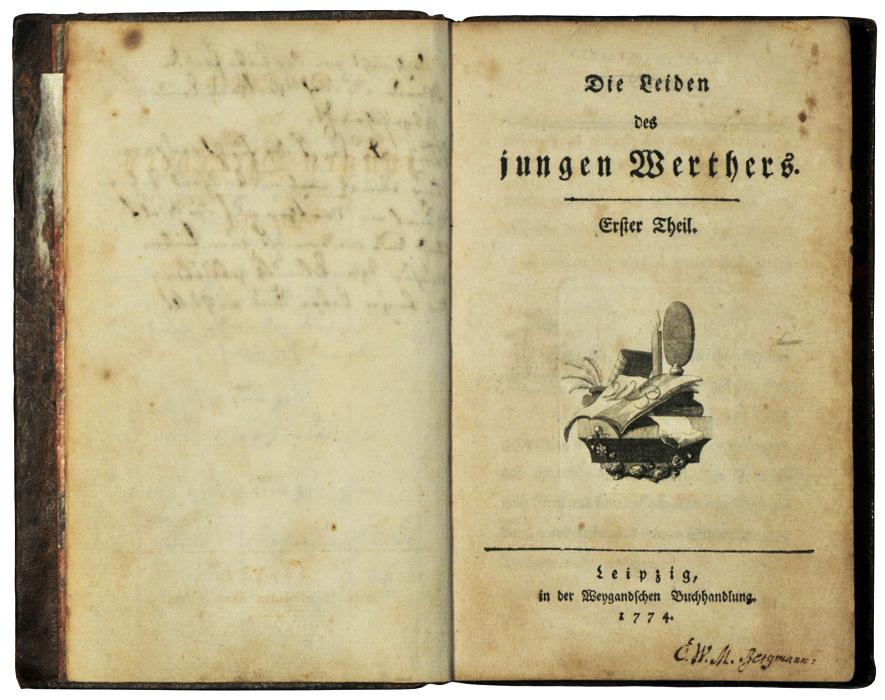
    Now is art to blame? What is art today, most of the stuff might not even be art. 1979 Francis Ford Coppola’s haunting, hallucinatory Vietnam War epic Apocalypse Now  was graphic and violent,  but visionary. It has been said, that  Coppola made art out violence by aesthetic means, thus legitimizing it. Goethe wrote 1774 a book, “Die Leiden des jungen Werther”, about an unfilled love in which the main character commits suicide.  Followers dressed in this fashion, and committed suicide in the double digits. The imitations of the Werther figure in real life, which were in suicide attempts and suicides, started a discussion about media effects, which runs up today. Since the 1970s, the psychology deals with the phenomenon of “media-mediated imitation”. Think also of the Danish caricatures, which resulted in many deaths –  the problem is global now.

    Will the easy fix help, should we forbid art (books,paintings, movies… Goethe),  forbid, internet, forbid weapons, forbid media?

    No, we have to think, feel and act properly and raise our kids within a minimum ethical context. With love (and also with fathers).  We must rely on science, as well as on metaphysics, common sense and psychology to cope with reality. but even more on intuitive understanding (“our inner self”) .  Free will is possible, it is possible to understand our genetic and biographical patterns of behavior, at least to an extent. It is called individuation. Still shooting massacre will happen. Lucky, if one can pray then, at least.

    FallenAngel (stottilien:http://wp.me/p2bcCT-15R)

  • The Death of the Ego as prerequisite to find God

    The Death of the Ego as prerequisite to find God

    Translation of my article “Gedanken zur Predigt in St. Ottilien 2012-11-18 The Death of the Ego as prerequisite to find God
    By fallenAngel

    This Sunday sermon in St. Ottilien (2012-11-18-0915-konventamt.mp3) addressed an interesting line of thought: in order to experience God (via the Self), we need the death of the Ego in us first. A very tough call indeed. “We have to kill our own will”, as Paul wrote, “so that God lives in us instead.” According to Elisabeth Kübler-Ross, a Swiss-born American psychiatrist and founder of the so called “mortality research”, there are five psychological stages of dying. Those can be applied also to the  “Death of the Ego”:

    1. Isolation
    2. Anger
    3. Negotiation (here with God for pagan believers who knows)
    4. Depression
    5. Acceptance

    I must confess, that the thought has deeply unsettled me. Just after I had brought my rather pantheistic experience of God, individuation and the personal christian God more or less in line (I refer to my post “The Self – God’s window between pantheistic Taoism and Catholic personal god”) –  I was somewhat surprised by this deeply Buddhist image of the dissolution of Ego and Self (which of course makes sense from a monastic perspective).

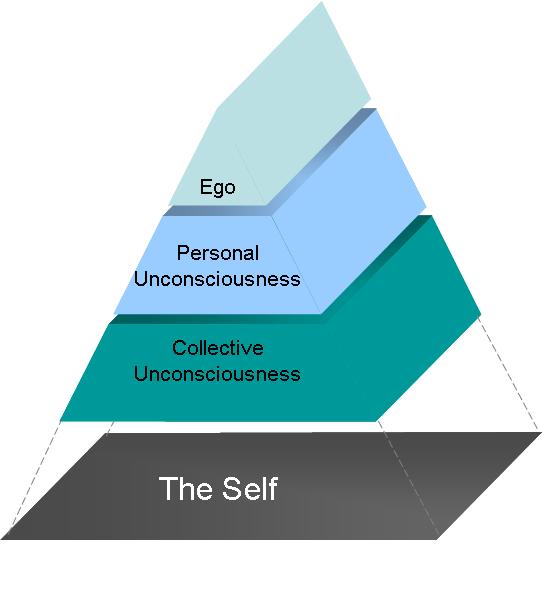
    The Ego and the Self are terms which are often interchangeably used. Likewise often no distinction between personality and Self is made nor taken into account the subconscious.  The psychological term Ego is the center of consciousness and ensures the physical survival . Ego often has an extended meaning in the spiritual language and referrers in general terms to an obstacle for Self realization.

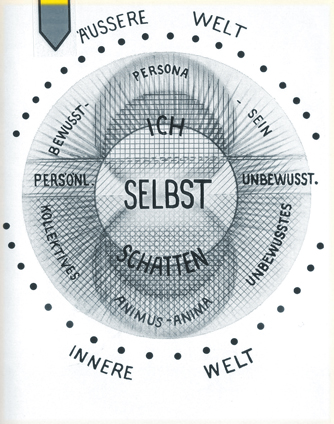
    The total psyche: (Mantra – Jolande Jacobi “The psychology of C.G. Jung”

    The model C.G. Jung does not have this limitation (see Mantra above from the book Jolande Jacobi, The Psychology of C.G. Jung). He distinguishes sharply between Ego and Self and differentiates the unconscious thoughts and feelings of both types of memories: the ones we can remember easily and those who are suppressed for some reason. In addition he introduced the collective unconscious, which belongs to the common humanity, as part of an individual psyche. This article wants to  investigate the “Death of the Ego” from that spiritual point of view and from a psychological perspective (in particular from  C.G. Jung’s individuation). I hope that the context of Jung’s model clarifies it (at least for me). As many, I  lived my life ignoring death, but since the death of my mother this attitude has changed.

    1. The Ego

    Ego is the correct  translation of the German “Ich (I)” used by C.G. Jung and Freud. The term Ego is also common in esoteric  writings often distinguishing the  Ego as a centre of the personality of a higher or true Self not unlike as in C.G. Jung’s psychoanalytic model. The term Ego is widely used In  translations of Buddhist texts for the “I” to overcome. In some languages it attends a negative meaning: to characterize, for example people with a selfish Ego. According to C.G. Jung the Ego can be equated with the conscious mind and includes all thoughts we think at that moment and also our current feelings. In the center of this consciousness we find that “I” or Ego. It guarantees the unity of (thinking, feeling, acting) is focused on physical survival and dealing with everyday demands. All religions (according to the Benedictine monk Anselm Gruen), demand more or less that we must become free from the Ego. This especially applies to our relationship with God. If we do not let go of our Ego we stay materialistic (at best).

    Egocentric-Thinking

    Jesus has spoken this wisdom of all religions in words, which are hard to understand today: “who wants to be my disciple, let him deny himself, take up his cross any day and follow me.” (Lk 9.23). To deny yourself is to say no to be ruled by monopolizing tendencies of the Ego, but distance us from it, to be free from its enslaving power. The Ego wants to impress, wants be presented (inflated) before others. Is the Ego our biggest enemy or our best friend, one might ask?  My usual answer to this question is: who can’t love himself can’t  love others nor God. It is just analogue not digital. The concept of unconditional love may answers this question differently: ” It is never an enemy. It is the best of us, who may feel neglected but in terms of love is always a very good friend .The Ego just wants to be loved – always.”

    But the trivial (or trivialized colloquial term) Ego wants also success, be better than others, wealth, recognition and so on.  In the end the effect is, it will not get love from others in this way. Why? Because it does not recognize that others are needed for this purpose. It calculates coldly cause and effect – feeling not loved (enough) in crises as profound illusion –  due to limited awareness. If we understand our commitment only from the inflated Ego,  my experience is, we may quite benefit in professional life but may get rather hurt in private relations. And: as the two Benedictine (and I think C.G. Jung) told us,  it prevents experiencing the religious dimension of our life.

    For the philosopher Boulad, the death of the Ego is the birth of the Self: we have only a single vocation: to be ourselves. We have only an obligation: especially do – to be to realize ourselves, to develop ourselves. Psychologist Hawkins described the Ego as a negatively oriented structure that denies the existence of God and wants to live independently. The Ego itself is afraid its resolution. And this would indeed happen if God influenced consciousness and we achieved higher levels of consciousness. The death of the Ego is “the final door” Hawkins or “the final moment” so a subjective enlightenment represents (as in Buddhism).

    • Freud: The Ego mediates between the demands of IT, the super-ego, and the social environment and needs a reality-oriented self-image, called Self.
    • C.G.Jung: the Ego represents the differentiation of the individual as a personality evolves. At birth, the Ego separates from the Self. In its development, the individual is always forced to adapt to its social environment; This will be done at the expense of positive attributes which are not valued or tolerated by the outside world. To protect his development, those will be negatively “charged”, fended off and become the Shadow. Furthermore adjusting of  the shared ideal of gender creates another functional complex, Jung calls the soul: the Anima (lat. soul) in men and the animus in women. Outwardly, another functional complex, called persona essential for life in society will be developed.  This is our task in the first half of our lifespan (35-40 years of age) to mature. For many people the end of mental development reached with the realization of the Ego. The life takes place only in socially prescribed patterns, fulfilling our primary need for security (and sexuality according Freud or power according to Adler). Only a few people imagine how to proceed in the midlife or thereafter, usually shaken by a crisis or emergency. The anxious questions of individuation, of Self realization, and meaning of life are major concerns of Jung.
    • Orthodox Islam knows many stages of the “I” (Arabic nafs), and to dissolve it. “The” Ego”is contrary to the spirit of [ruh] the part of the heart of man who was placed under its own control, in developing his soul”. Goal of Islam is to overcome that to a common “Ego” “We”. All people, also husband and wife, were created from a single soul (cf. Holy Quran ‘ at 7: 189). Somewhat different is the Sufi view, the mystical form of Islam. But here  too,  the goalis  the death of the Ego.

    2. The Self

    For me, the Self is again non-uniformly used term within their psychological, sociological, philosophical and theological importance variants. While Freud and Adler considered very narrow psychological driving forces, C.G. Jung understood a central integral concept of the human psyche manifested in the Self. This Self is the wholeness of the human psyche and includes the conscious and unconscious parts of the personality and aims toward the harmonization of the psyche. Only the ego-consciousness with the equipment in use is deliberately sensory perception and thinking, feeling, and intuition. The unconscious part of the people, which splits in the personal unconscious and the collective unconscious, is much more extensive than the ego-consciousness. The Self is the center of the whole personality and therefore the central control instance.  The Ego is the conscious of Self, its eye, with whose help the Self can recognize itself (almost like Adam and Eve after eating the apple). But the Self is the God in us. Individuation is to be who one really is, and a differentiation process that fosters the development of all skills, systems and possibilities of the individual through gradual awareness and realization.


    •  C.G.Jung: The goal of life is to know the Self. The Self is a new Center, a better balanced position of our own psyche. Instead of the the trivialities of the persona and the education of the self I today little more worry on the self to all people, all life, the universe and God. The Self is an archetype, embodying the transcendence of all opposites so that each aspect of the personality is expressed correctly and fair. Then it is neither nor but both, male and female, conscious and unconscious, individual and the entirety of creation. The Self represents the mentally transcendent, and equates to a religious experience.
    •  Sociology: the sociological normal type of “community” is the “self”-benevolent introduced (during the normal type of ‘society’ “as “person”).
    •  Hinduism: self as inner, eternal, indestructible shape each being (Atman)
    • Buddhism: that denies “Even” the existence of a stable, unchanging identity in favour of the doctrine of the non-self
    • Orthodox Islam knows no self, the self” is roughly equivalent with the ‘Ego’, to resolve that it applies. “The” Ego “is contrary to the spirit of [ruh] the part of the heart of man who was placed under its own control, in developing his soul”. Goal of Islam is to overcome the “I” to a common “We”. All people, also husband and wife, were created from a single soul (cf. Holy Quran ‘ at 7: 189).
    The Ego, the Self and God
    The Ego, the Self and Jesus – Individuation and Transcendence

    3. The soul

    In today’s (secular) parlance, the totality of all emotions and mental processes in humans is meant and synonymous with the term psyche with soul often. Psyche (Greek ψυχή, breath) was in the classical antiquity a synonym for the word soul.

    The discussion of the 20th century has discussed various concepts of the concept of a “soul” and a wide variety of points of view. Roughly broken down, one can distinguish the following positions:

    3.1. A philosophical and theological definition,

    which means a one’s own substance ‘Soul’, emanating from the thinking and feeling, and other spiritual acts. In Christian philosophy, but often decidedly anti-Platonic views are represented, which consider body and soul in the sense of a holistic anthropology as a unit.

     Psyche in the sense of the new, Hellenic language exists – to the contrary to the Old Testament “Nefesh” – regardless of the body and can not be killed.

    Darkness-and-Light

    • Theological is the soul of the innermost core of a human person. And of course the question: what is the core? Belong to the soul also instincts, sexuality, hunger and thirst? These elemental feelings do not belong to the theological concept of the soul. Theologically, the soul is the spiritual, life-giving principle in man. The soul is the created by God spiritual and immortal beings form of man, which determines its distinctive individuality – according to the theologians today.
    • Unfortunately, there on the terms: soul ‘ and ‘Spirit’ false statements, you must come to the very right are different, between the biblical statements of AT and NT, Greek philosophy, and the Hindu and Buddhist understanding.  To clarify what the he Bible understands of the ‘soul’. It is necessary to learn how God created man. Moses 2.7: “Since God the Lord made man from clay (matter) from the field and blew the breath of life to him”. And so man became a “living soul”(living creature). Man consists of two components: 1. matter 2. breath giving life. Here it is important that the man get a breathed  a ‘soul’ but does not have one. Only the two components resulted in a “living soul.” The soul here stands for the people in his unity and wholeness. When we die not the soul, but the breath of life leaves us. The ‘immortal soul’ does not exist in the Bible.
    • The “psyché” of New Testament in Greek relates to the Hebrew “nephesch”. Especially in the Gospels, socialized people speak Yes Hebrew Aramaic of the soul. Nephesch means originally not soul, but throat, i.e. the perceptible movement of the throat if breathing, the essence of living. For the Bible, so has every breathing “soul”. “My soul” means something like “I” (Lk 1.46). The nephesch, of a person can take off power, “grieved be unto death”. In severe disease it fades. When dying, it (i.e. the breath of life) is returned God. Because God gave the people of his breath and so man became a living being. (Gen 2, 7B). The idea of the immortality of the soul comes from the Greek (Plato and Ptolemy) and was introduced over the Gnostics into Christianity. It has shaped the medieval Christianity (and Judaism!), but is not biblical. The notion of the soul, which independently could exist without the body comes not from the Bible, but has therefore its origin in the Greek philosophy. Unfortunately, many are believe that soul of Christian origin would be the immortals. This is important in this context. Note also what the Bible says about the death of the man. Moses 3.19: “; because you are clay (matter) and should be back to Earth”;
    • We have no immortal part within us, because sin and its consequences (Romans 6: 23) relates to the people as a whole and not only a part of it. To sinful man, could not immortal after the fall, it was blocked the way to the tree of life. Moses 3, 22: “now but that he now does not stretch forth his HAND and break even by the tree of life and you will find and live ETERNALLY.” The immortality of the people would be the UNADULTERATED communion with God and the access to the tree of life been subject to. He was subjected to death by man both had destroyed his relationship with God, and therefore had no access to the tree of life. He could not free himself from this hopeless situation, his mortality. Therefore, everything else what is in the Bible follows the gradual revelation of the redemption of man from sin and death. The rescue was made possible only by the sacrificial death of Christ, who died for us. Only through Christ alone, we can regain the lost immortality. People get this on the last day, when Jesus will come a second time. Then we regain immortality, which we have lost through Adam and Eve. Immortality we find the word, however, three times in the Scriptures.
      • In 1. Timothy 6.16 writes Paul, that God alone possesses immortality! Therefore, man has no immortal soul.
      • In 1. Corinthians 15: 51-55 Paul then finds: the devout man receives immortality only at the second coming of Jesus and the resurrection of the dead. She is so a gift of God to the end of the world and not an integral part of human nature. Not who makes the belief that gives immortal soul, the Christian faith so questionable, but who drops the hope of the resurrection of the dead at the return of  Jesus (1 Corinthians 15: 12-23).
      • The man has no immortality, thinking, feeling, wanting and acting (preacher 9,5.6.10) end at his death. The Bible compares his State with a sleep from which he will wake up at the end of the world (John 11.11; Daniel 12, 13).
    • In today’s religious and philosophical opinions, the soul is independent of the body and therefore immortal “Soul” an immaterial principle, a stable identity. The Greek term of ψυχή (psyche) occurs in the New Testament which is rendered with ‘Soul’ in older translations of the Bible. In the Gospels, where psyche is, to be alive, meant, specifically to the name of the property of a specific individual – human or animal – “Life” within the meaning of the Nefesh is at most. (MT 2.20), such as lack of food (Mt 6, 25) LK 12, 22f. ), or that she will be withdrawn (Luke 12.20) and is lost (MK 8.35-37). The psyche is the seat and starting point of thinking, feeling and volition. Other places, however, show that the New Testament relation of body and soul is complicated. The term psyche is ambiguous unclear, probably in some places, the transitions between its meanings are fluent.
    • In Plato’s philosophy has the soul (ψυχή, psych) as the intangible principle of life individually. Their existence is entirely independent of the body; She existed before his birth and persists after his destruction of intact (pre-and post existence). Plato and Aristotle differentiated between a senseless and a reasonable soul, psyche and nus.
    •  The Apostle Paul, however, rarely used the term psyche in his letters and avoids him for statements about life after death.
    • Augustine represented the Union of the soul against the Platonic doctrine of the soul parts, but made a promotion to the Aristotelian tradition within the soul: “just living” soul (vegetative), function, rational soul (soul function) with spirit (mens) and will and irrational soul function with motor, sensory perception and memory. Inbound Augustine sought proof of the Incorporeality, and the immateriality of the soul.
    • Particularly Thomas Aquinas conceived the ”nus poietikos” as the creating spirit, as the immortal part of our sou. But he is keen to avoid a rugged body-soul, which is why he, Aristotle then, the unity of the human stresses the unity of mind, body and soul dualism.
    • Orthodox Islamic scholars describe four stages of the soul in the Holy Qur’an ‘ (Sufi more), which correspond to human development. The commanding soul [al-nafs al-‘amara]: the State is the starting point. Like a wild horse, the soul tries to gain control of the “rider” and even “to throw off him”. He orders uncontrollable and harmful, and must be “tamed” are. Even the pure and healthy prophets know this state of mind, even if they have mastered it and point out, like for example Josef (a.) in the Holy Quran ‘ “…And I declare myself not even for the innocent. The soul commands evil emphatically yes, unless my Lord has mercy on himself. My Lord is forgiving, merciful.” (12: 52-53)
      • The plaintive soul [al-nafs al-lawwama]. In this stage, the soul has such self-knowledge that she see their own weaknesses and blames himself “I” to overcome the “self” or. This state of mind is so developed, swore at them: “no, I swear by the day of resurrection. No, I swear by the soul which they pronounce censure.” (75: 1-2)
      • The Inspiring soul [al-nafs al-mulhama]. At this level, the soul has the ability between the useful and harmful inspirations to distinguish and uses this ability to their own development: “…”and the soul and what way she shapes and gives her their Vice and their piety!” (91: 7-8). Freedom is the freedom of knowledge and the defense of the harmful through knowledge and the adoption of useful through knowledge for this soul.
      • The satisfied soul [al-nafs al mutma’innah ‘ inna]. The soul achieves the satisfaction of ALLAH in its perfection and is therefore also pleased about the grace of contentment: “O you satisfied soul, to your Lord satisfied and accompanied by his face return. Joins the ranks of my servants, and enter my paradise. (9: 27-29)

     3.2  Moderate positions,

    such as psychological definitions, may reject a materialism but do not grant the notion of a soul in a traditional sense, in particular not  immortality. Soul is the term for the totality of all conscious and unconscious emotional processes and of all spiritual and intellectual functions.

    •   In his treatise “on the soul” (“de Anima”) defines Aristotle the soul as: “The soul is the first Entelechy of the natural organic body” (full on. II 1, 412 b 4-6). Aristotle not is so not materially the soul but as an intangible entity, which is why Aristotle comes a strict body-soul dualism in question. According to Aristotle the soul is that which the body (which only potentially is a living being) really makes the creatures, the Entelechy biologically today can be seen as a goal-oriented regulation of vital functions as the software for the hardware, which is essential for a living organism in terms of forms. Aristotle States in his treatise “on the soul”, that “the soul from the body is separable and or certain parts of it” .The soul passes so with the body, when the animal dies.
    cropped-spiritualjung.jpg

    • C.G. Jung defines soul in the sense “guarding complex” (Anima) in contrast to the notion of the mind as a “Whole” all conscious experience qualities as well as of all unconscious phenomena. The mental energy occupies a central place in Jung’s psychology. Animus soul, spirit (as opposed to the body), memory, courage, exuberance, confidence, despite, resentment, anger, disposition, mood, passion, desiring soul, desire, desire, decision, desire, inclination; Anima, however, translated with air as element or breath of air, wind, breath, soul, life, or secluded soul. C.G. Jung summed up under the term soul both terms. The soul is dynamic. In humans, this is called also personality.
    • Kant maintains the metaphysical side of the soul, that it treated but related issue of freedom within the framework of practical reason. The soul is called the regulatory term within the framework of morality.

     3.3. Materialism or Neurobiology,

    rejects the existence of a soul, claiming that all talk of mental is reducible to the physical and/or neural States. Are the same soul and psyche and the soul is that which is the psychology and / or employed Neurology.

    •  Sigmund Freud, the founder of psychoanalysis, makes two assumptions for its model of the soul: a physical body (brain, central nervous system) as the place or “Scene” and awareness Act. “” We suppose that the soul-life is the function of an apparatus “, here it is clear that the doctor Freud attempts a neurological Foundation.” We have come to the knowledge of the psychic apparatus through the study of the individual development of the human being”.

    • The man has no soul — he has not even a substantial self, says one contemporary philosopher Thomas Metzinger. Phenomenal States, the experience itself, based on neural patterns, dynamically active nerve networks. The character of the subjective experience remains the same, regardless of whether you actually perceives something or just a hallucination. External factors in the environment, and society to decide whether this experience is considered as hallucination, a abnormal psychic disease wisdom or holiness. The totality of all emotions and feelings are not different for humans or animals. The soul is a portion of the spirit thus, if emotionless information processing in a human brain is excluded (what is hardly possible in reality). Animals have feelings too and therefore also a soul.. Thus overlaps the soul with our memory and learning, forgetting, perception, the totality of all inherited traits of an individual language, intelligence, motivation, will, emotion.

     3.4. Linguistic approach

    • German Seele, Psyche
    • English soul, psyche
    • Greek psyche
    • Hebrew nephesch, ruach
    •  Latin Anima
    • Arabic nafs (نفس) can mean “even” relevant mainly in the Sufi
    •  Chinese (traditional): (línghún) like spirit – or cloud completely invisible:
    • Finnish: sielu
    • French: âme
    • Indonesian: roh
    • Icelandic: sál
    • Italian: anima (female)
    •  Japanese: (kokoro)
    • Dutch: aim (female); spil
    •  Romansh: olma (female)
    • Romanian: restless
    • Russian: душа (duschá)
    • Spanish: alma (female)
    • Thai: วิญญาณ
    • Czech duše (female); Člen (male), obyvatel (male)
    • Turkish can; Ruh
    • Hungarian: lélek
    • Venetian: anema (female)

     4. Individuation versus death of the ego

    I like to understand Individuation not as death or dissolution of the ego. I have witnessed two deaths, an easy one and one prolonged suffering in a cold – not even ill-meaning – care machine. Psychological experiences of Ego death are particularly critical and generate fear: this transformation process is most difficult, because it demands to let go one’s own identity, it may interpreted as abandonment,´resolution, disintegration or fragmentation. All spiritual development processes, however, lead us through meditation and complete resolution of our self-esteem. The individuation is a mismatch  between the beginnings of biological aging and the possibility of another psycho-spiritual development. “It represents those critical situation in which one has arrived at the height of the life and suddenly or gradually is confronted with the reality of the end of death”(Jacobi 1971, p. 31). Quite true in my case. The more one approaches the midlife (as late as this may be)  having succeeded consolidation of  the outer life, personal attitude and social situation, the more one firmly believes having discovered the correct course of life, the right ideals and principles of behavior. Therefore it  requires eternal validity and virtue to move on – otherwise one is stuck. A significant fact is,  that the adaptation and functioning in reality happens at the expense of the totality of the (Self) personality. While the first half of life stood under the aspect of identity a re-orientation must occur,  fulfilling new tasks gains importance, in essence all this is the preparation for death. This turning point is not on a specific point in time (as one of my many “midlife crisis”), but  may extend over a long period of time. First ivomes the confrontation with the shadow, than with the complexes of the collective unconscious, manifesting in  the “Anima” and later the “Old Wise Sage”, or the  woman in “Animus” and “Great Mother”.

    The materialistic-oriented Freudian psychoanalysis has been increasingly questioned, while the spiritually inspired analytical psychology of C.G. Jung becomes lately more important again with religious quests and definitely important to me. Freud, who sees most conflicts as not properly processed (sexual) repression problems, is probably the psychologist of the first half of life. His psychology is retrospective. C.G. Jung’s psychology is more perspective. He has recognized that most of the problems of his patients over 35 were essentially religious in nature. He is the psychologist of the middle and the second half of life. Freud almost always looks back. C.G Jung looked forward. 

    5. My conclusion

    The death of the Ego is to me more of an integration with the Self. Individuation” has shown a way to the Self in the second half of my life, to the deepest innermost area of the personality and has opened the spiritual dimension. Hence it is not only a preparation for death but also a  preservation of body and soul for resurrection – the Self.

    Jacobi, Jolande: Towards the individuation, Walter, Olten 1971 and see also my other standard bibliography.

    .


  • Had Jesus a wife? Professor Karen L. King publish or perish: “Gospel of Jesus’ Wife”

    Had Jesus a wife? Professor Karen L. King publish or perish: “Gospel of Jesus’ Wife”

    There has been a bit of noise about a dubious a “business card size” piece of papyrus the “Gospel of Jesus’ Wife” which purportedly provides evidence that Jesus had a wife. That Jesus was married, many hope, is somehow undermining  the core doctrines of Christianity.  Apart from the fact that it the tiny scrap is currently dated a few hundred years after Jesus life and during primetime for Gnostics inventing facts about Jesus to support their own theological (heretical) texts, many seem to think this is somehow evidence against celibacy and calls for a larger women’s role in the church (hierarchy).

    No wonder, that rumor has it, Harvard Theological Review is now declining to publish Karen King’s paper on this Coptic fragment she calls the “Gospel of Jesus’ Wife.”  When I first read about it, I discarded the headline conclusion immediately. I took also the liberty to the read the paper “Jesus’ Wife”. King_JesusSaidToThem_draft_0920. It has a lot of If’s and assumptions.  New Testament scholar Craig Evans writes:  Is the Coptic papyrus, in which Jesus speaks of his “wife,” a fake? Probably. We are far from a “consensus,” but one scholar after another and one Coptologist after another has weighed in pointing out serious problems with the paleography, the syntax, and the very troubling fact that almost all of the text has been extracted from the Gospel of Thomas (principally from logia 30, 101, and 114). I suspect the papyrus itself is probably quite old, perhaps fourth or fifth century, but the oddly written (or painted) letters on the recto side are probably modern and probably reflect recent interest in Jesus and Mary Magdalene. The decision of the editors of Harvard Theological Review not to publish Karen King’s paper is very wise. Perhaps we will eventually learn more about who actually produced this text.

    The academic world became quickly  skeptical about the ancient provenance of this fragment despite the typical professional hysteria in the media and amateur hysteria in the blogosphere. To be fair BBC brought with a lot of trivia and political motivated statement also the facts.
    Anybody who reads a bit about the history and language of the gospel might react similar. A papyrus fragment in Egyptian Coptic most likely of the fourth century, isn’t a proof of any historical value of Jesus’ life.  It’s indeed most likely nothing more than one of many gnostic heresies. By the way, Prof Karen Leigh King is foremost an expert in Gnostic writings; she could tell the – sorry for my language – uninformed press, but of course publish or perish.. This sort of debate that should be carried carefully, so scholarship can get it right.

    Before we get start rewriting Christ’s history it is worth examining the source of the document and the institution at which the discovery was made.Besides some call it a straight forward hoax, currently most experts assumed, that the so-called “gospel” was written in 4th Century AD in Egypt and is written in Coptic, the language spoken by the Egyptians of the time. The professor who discovered it,Karen L. King, and other scholars have solemnly proclaimed it to be genuine. Some doubt even that. Egypt of the 4th Century has long been known as a rich source of gnostic fabricated accounts of the lives of Jesus and his disciples. A similarly strange find –dubbed the Gospel of Judas[Iscariot] – was unveiled also by Karen L. King. This “gospel” has since dropped off the academic radar. There is so much similar stuff floating around – all utterly discredited, so it is difficult to see what a mere eight lines without any context of its finding should tell. A key to understanding the wholly over-blown nature of the controversy lies in the discoverer’s academic speciality.The focus of Professor King’s studies has been Coptic literature, Gnosticism and women in the Bible’

    King writes: “This new gospel doesn’t prove that Jesus was married, but it tells us that the whole question only came up as part of vociferous debates about sexuality and marriage.“. Is that a scholar statement or a feminist statement? Indeed, a bonus in unveiling the controversial scrap of papyrus in Rome was probably a hit on Pope Benedict XVI and the Roman Catholic Church which requires its priests to be celibate. The Huffington Post. “Beyond internal Catholic Church politics, a married Jesus invites are consideration of orthodox teachings about gender and sex,”.Professor King argues without any proof the document is a translation of an earlier one that was written in Greek. This seems a stretch. In fact, it is possible that this “gospel” fragment is associated with such writings found at Nag Hammadi, just after World War II. These writings, all originating centuries after the Apostolicera, were widely published in the 1950s and  inspired C.G. Jung. Jung was instrumental in calling attention to the Nag Hammadi library of Gnostic writings in the 1950’s because he perceived the outstanding psychological relevance of Gnostic insights. Most mythologems found in Gnostic scriptures possess psychological relevance and applicability.  Less to Christanity I would add. Gnosticism flourished in Egypt long after it had ceased to be a major headache to Christianity elsewhere. Egypt had a multi-millennia history of mysticism and so  Egyptian Coptic Christians added to Christianity. It seem we are living again in a climate of decay prone to Gnosticism and superstition.

    From Christianity’s beginnings, the Church has been attacked by those introducing false teachings, or heresies – it seems some Christian churches are too weak now to fight this fungus off. Thanks god, I am Catholic. Having said that, if ones read the Luke Gospel, one will found importance and high status Jesus assigned to women. No need to need to give him a wife.

    Sources:

    Wikipedia on Karen_Leigh_King

    Reality Check: The “Jesus’ Wife” Coptic Fragment

     “Jesus had a wife” manuscript fragment a forgery

    So What if Jesus did Have a Wife?

    Reading_Judas. by Karen L. King

  • Confession of an unchurched spiritual and religious person.

    Confession of an unchurched spiritual and religious person.

    For the past decades, steps forward to my Self (as defined by C.G. Jung) or spirituality have always been attempted at moments of incipient crisis time or when I had time to take a breath. Confession: None, though, has been really followed through. The ability and given a chance to switch my career to a lower gear and the turmoil of the death of my mother, both last year, triggered the next leap.

    I started seriously to question my belief system and state of my individuation. For that reason I went back to psychoanalysis theory C.G. Jung) and its connection to religion and mystic but also digging deeper in catholic credo and history. Subsequently I started a blog, which initially contained only my private notes as a scratchpad, but also opened additional avenues to other blogs. I stumbled over one article with title: “Am I Religious or Am I Spiritual?” – A very popular question in the US.

    Well, good question. Similar to my question I have been pondering; do you believe in a (personal) god? Don’t get me wrong, I answered to myself the question 20 years ago, after I stepped out of a tent backpacking at Mt. Rainer. Just like C.G. Jung the conclusion was: “I know God exists.” Jung said that on more than one occasion.

    “Am I Religious or Am I Spiritual?” Maybe that is a question, which I should ask myself first? One of the biggest assets of the Catholicism is, religion and spirituality are not as separated as in Protestantism for some reason. “Bells and Smells, said a Benedictine monk and C.G. Jung emphasised the big psychological benefit of the confession.

    Going after the headline “Survey: 72% of young adults ‘more spiritual than religious”, this seems to mean rarely or never:

    • pray with others, and pray by themselves either,
    • attend worship services,
    • read the Bible or sacred texts.

    To my surprise this would indicate I am religious.

    As an article in psychology magazine pointed out for personality tests, by checking the “atheist” box (if there actually were one), you’ll be waiting a long time for your matches. But if you describe yourself as “spiritual but not religious” your chances are markedly improved (though the problem now is that you’ll see a lot of new age types showing up). Why?

    Despite the fact that more and more people are comfortable “coming out” as atheists, the word is still very much associated with being immoral, or at the very least agnostic. That is to say in the US. The results of a survey in a German news magazine suggested than 80% could happily check the “atheist” box. It seems, Atheism is in Europe the belief of the masses, Voltaire is even more dead than god to them.

    Enter the word “spiritual,” which is becoming synonymous with claiming all that is good in a religious person, without the religion.

    spiritual (spîr´î-ch¡-el) adjective
    1. Of, relating to, consisting of, or having the nature of spirit; not tangible or material. See synonyms at immaterial.
    2. Of, concerned with, or affecting the soul.
    3. Of, from, or relating to God; deific.
    4. Of or belonging to a church or religion; sacred.
    5. Relating to or having the nature of spirits or a spirit; supernatural
    .

    Ignoring (4) and (2) – dictionaries adapt slowly – what exactly, does it mean to be just plain spiritual? One obvious interpretation is (5) taking the word literally: if you are spiritual you believe in spirits. A second possibility (1) is that spiritual is meant to indicate someone who devotes energy to cultivate “spirit,” as opposed to just being concerned with “material” things. That’s a pretty Gnostic definition trying to become  pneumatics the highest order of humans.

    A third interpretation would be: pondering philosophical or environmental questions and reflecting psychologically, behaving ethically ant otherwise correct and compassionately, and also nurturing ones aesthetic sense through arts and blogs. Okay, by that definition, I am also spiritual. However, by this definition, almost everybody is spiritual – some more than others.

    By the way, although I would not check the “atheists” box, I would happily check the humanist box (assuming one or more is allowed). I do suggest that we value the separation of church and state the mutual benefit of belief and rationality since the Renaissance and even pagan Hellenism. As I indicated, in addition I would need to check the “mystic” box.

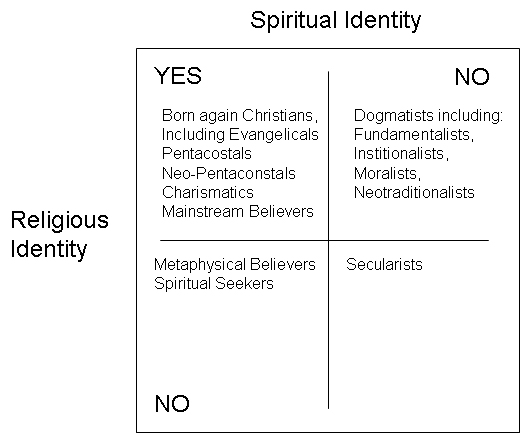
    Besides holding a degree in applied economics I’m just an average engineer who tends to check facts and does not believe anything not seen or touched. Working as a management consultant did not help either. Lets do a (googled) quadrant:

    According to this quadrant I am a mainstream believer.  On the other hand, I attend Catholic mass and routinely check in a Catholic monastery for a few days (sometime with my family), although technically not being affiliated with any religious organization. I am attracted by Taoist thoughts and my wife is Buddhist. On the other hand I like the pope, the global institution and the absolute moral system of the Catholicism not to speak of their powerful symbolism and mystic. I cannot relate to New Age, although having lived for five years in California where  I learned to meditate at Big Sur. On the other hand, I connect easily astronomy and modern physics with Astrology and C.G. Jung’s Synchronicity which is not far away of “The Dancing Wu Li Masters” – a popular New Age book.

    I come to the conclusion “being spiritual but not religious” does not make a lot of sense – to me at least even if I am legally “unchurched”. I can relate to an intelligent professing atheist; we may have fewer than we think however ,  but lots of empty check boxes.

  • Gnosticism – the empire strikes back.

    Gnosticism – the empire strikes back.

    Gnosticism can be considered collective name for a large number of greatly varying and pantheistic-dualistic sects, which flourished from some time before the Christian era down to the fifth century. It became a dangerous corruption of Christianity, even or because its first traces can be found some centuries before the Christian era. That Alexandrian thought had some share at least in the development of Christian Gnosticism is clear from the fact that the bulk of Gnostic literature which we possess comes to us from Egyptian (Coptic) sources. Sometimes Manichaeism is even classified as a form of Gnosticism and styled Parsee Gnosis, as distinguished from Syrian and Egyptian Gnosis. Though they have the doctrine of the evil of matter in common, Manichaeism starts from dualism, while Gnosticism is mainly heavily allegorical Pantheism.

    Gnostic groups were so many and different flavors, mostly alike but not quite the same. However, there were certain core markers. In gnosticism, the spiritual world was full of deep secrets. Matter was evil or unreal or at best disgusting, and spirit was good.  There was one superior and many semi creatures which formed a hierarchy.  Some spirits were more ‘good’ than others, and part of the task  was to keep these spiritual superiors happy. A few people (that is, psychic) were learning about and evolving toward the spiritual world envolving th the spiritual man — the pneumatic Gnostic. A follower’s task was to stay focused on spiritual things and to ignore or not value those sarkic (earthly, hignorant, uninitiated), who lacked such ‘knowledge’ or ‘consciousness’.  The meaning of Christian writings (including some of their leaders and pagan writings but not including most of the Old Testament) was turned upside down by way of allegory.

    Gnostic sources.

    The Gnostic “gospels” include books such as the Gospel of Thomas, Gospel of Mary, Gospel of Truth, and Dialogue of the Savior, and were written in the late second century AD. Most of these writings were found 1961 at Nag Hammadi, which was a religious library. For the most part, these ‘gnostic gospels’ are not stories told about Jesus, or reports about his life. They’re not about him giving grace, or being up close and personal with people. The Gnostics’ writings deal with Jesus’ death hardly at all. The Jesus portrayed by the gnostics gives out spiritual sayings or responds to questions, mostly left alone without a context. There’s not much of a setting – it’s as if no life was lived behind the sayings. The Gnostic Jesus has little about him that marks him as a Jew save for some apocalyptic symbolism. This could not be more unlike the Synoptic Gospels, which show Jesus at synagogue and at the Temple and in prayer, turning to the Hebrew holy books, as one would expect from the Jew he was.  For a gnostic, God would never be contaminated with humanity. Thus, of course, they had to re-translate Jesus: he was a human who had developed the highest level of contacts in the spirit world. His body either became, or always was, an illusion. Gnostic were – if they talked about Jesus – of course Eboinites.

    It is difficult in a few lines to sketch this Gnosticism, which grew into a great danger for the Church in the second century but let’s try:

    Gnosis puts that is knowledge into the place of faith.

    Gnosis means knowledge and the essence of this movement lies in the word which furnished its name To the Gnostic the great question was not, “What must I do to be saved?” In the very knowledge of these was redemption as the Gnostic understood it. Thus, by combining with the ideas original to Christianity the most various elements, such as Greek philosophy, Jewish theology, and ancient Oriental theosophy, great systems of speculative thought were constructed, all with the object of displaying the process of the world’s development.

    Gnosticism is thinly disguised Pantheism (and a subtile form of polytheism).

    In the beginning was the Depth; the Fullness of Being, first Cause. According to this development, from a pantheistic First Cause emanates a series of beings called Aeons, beings of Light, of which each in succession as it recedes from the First Cause is also less perfect than the preceding. Together with the source from which they emanate they form the Pleroma. Pleroma is simply the soul’s ascent, in Babylonian astrology as Wilhelm Anz (Ursprung des Gnosticismus, 1897) pointed out. Gnostic eschatology, consisting in the soul’s struggle with hostile Aeons  in its attempt to reach the Pleroma, is a close parallel of the soul’s ascent, in Babylonian astrology, through the realms of the seven planets to anu.

    Gnostic depressing and imperfect world.

    Gnostic world is imperfect and depressing. Gnosticism presents a distinction between the highest, unknowable God and the demiurge, “creator” of the material. The transition from the immaterial to the material, from the noumenal to the sensible, is brought about by a flaw, or a passion, or a sin, in one of the Aeon. There are many different myths about the creation some including also Sophia. In any case the last and lowest spirit (Aeon) – the demiurge – comes into contact with matter, which from all eternity has stood opposed to the divine Light— as Darkness, on-existence, and all that is the reverse of divine. From this contact, from the mingling of the Light with Matter, the visible world comes into being, in which a portion of spiritual being, of Light, is held captive by matter and combined with it. Redemption is the liberation of this captive Light from the fetters of matter, the dissolution of this union, and the restoration of the original order of things. This redemption has been accomplished by Christ.

    Gnostic salvation is a cosmic process.

    Gnostic salvation is not merely individual redemption of each human soul; it is a cosmic process. It is the return of all things to what they were before the flaw in the sphere of the Aeons brought matter. This last tenet bears testimony to the connection of Gnosticism with Christianity, in contrast to many similar heathen systems, but of course what the Gnostics call redemption is something entirely different from that to which the Scriptures give the same name. Gnostic redemption is not deliverance from sin, but the restoration of cosmic order, and so Christ is to them, not the Savior who brings salvation and forgiveness of sin; Gnostic salvation is not merely individual redemption of each human soul; it is a cosmic process. It is the return of all things to what they were before the flaw in the sphere of the Aeons brought matter.

    Some important Gnostic spirits.

    The Gnostics differentiate between the Supreme God, or God the Father, and the imperfect maker. The Demiurge became often the personification of the power of evil in consequence all law also became intrinsically evil. The speculations on Primeval Man (Protanthropos, Adam) also occupy a prominent place in several Gnostic systems. According to the Sophia myth, matter is a fruit of her sin. Sophia plays an important role in Valentinian, but is completely absent in Basilica’s system. Sophia seems to represent the supreme female principle, as for instance in the Ptolemaic system.

    Gnosticism denies Jesus having really assumed a human nature.

    There is no place in the Gnostic system for the creation, or for the incarnation. Only in appearance did he become man, and his whole life on earth, especially his passion and death, were all an illusion. The Gnostics were thorough Docetism, that is, they treated the whole manifestation of Christ as only a semblance. The events which brought salvation were not facts to them, but remained only as symbols, and the substance of Christianity was evaporated into speculative ideas.

    Gnosticism concept of  human – the divine spark

    Gnosticism taught generally that matter was evil, and as has been said the creation of a lesser spirit(called the Demiurge, after Plato). But human bodies, although their matter is evil, contained within them a divine spark that fell from the good, true God. Knowledge (gnosis) enables the divine spark to return to the true God from whence it came. For Christians all evil in the world comes from the human sin –  Omne bonum a Deo, omne malum ab homini. Gnostics come up with a simple and different answer, but complicated implementation why the world is imperfect – the Creator is, that’s why.

    Monism and Dualism in Gnosticism 

    Religious monism has two forms: atheism and pantheism. Both deny that there is a transcendent deity. Pantheism sees a deity that is immanent to the world and nature – like Taoism- and on which the world completely depends.  Everything is god. This is main concept in but Dualism is als found in Gnostics. Dualism is a system which would explain the universe as the outcome of two eternally opposed and coexisting principles, conceived as good and evil, light and darkness, or some other form of conflicting powers or signify the ordinary view that the existing universe contains two radically distinct kinds of being or substance — matter and spirit, body and mind.

    Typically, Gnostic systems are loosely described as being “dualistic” and  “monistic” in nature:

    • Radical Dualism — or absolute Dualism which posits two co-equal divine forces. Manichaeism conceives of two previously coexistent realms of light and darkness e.g. the Mandaean creation myth.
    • Mitigated Dualism — where one of the two principles is in some way inferior to the other.
    • Qualified Monism — where it is arguable whether or not the second entity is divine or semi-divine. Elements of Valentinian versions of Gnostic myth suggest to some that its understanding of the universe may have been monistic rather than a dualistic one.
    • One entity Dualism. Abraxas is a conception of God that incorporates both Good and Evil in one entity. The origins of the God Abraxas are mysterious though it is believed the concept existed in ancient Egypt, later  adopted by Jewish mystics and the Gnostic Christians.  The Swiss Psychologist Carl Jung wrote a short Gnostic treatise in 1916 called The Seven Sermons to the Dead, which called Abraxas a God higher than the Christian God and Devil, that combines all opposites into one Being. This may have come from one of his his patient, the famous writer Hermann Hesse wo wrote in „Demian”: „… unser Gott heißt Abraxas, und er ist Gott und Satan, er hat die lichte und die dunkle Welt in sich …”

    Christian philosophy, however, expounded with minor differences by theologians and philosophers from St. Augustine downwards, holds generally that physical evil is the result of the necessary limitations of finite created beings and a consequence of the creation of beings possessed of free wills and is tolerated by God but not a positive entity.

    Gnosticism schools.

    As Gnosticism possessed no central authority for either doctrine or discipline; considered as a whole it had no organization similar to the vast organization of the Catholic Church. It was but a large conglomeration of sects, of which Marcionites alone attempted in some way to rival the constitution of the Church, and even Marcionites had no unity. No other classification of these sects is possible than that according to their main trend of thought. We can therefore distinguish:

    • Syrian or Semitic;

    This school represents the oldest phase of Gnosticism, as Western Asia was the birthplace of the movement. Dositheus, Simon Magus, Menander, Cerinthus, Cerdo, Saturninus Justin, the Bardesanites, Severians, Ebionites, Encratites, Ophites, Naassenes, the Gnostics of the “Acts of Thomas”, the Sethians, the Peratae, the Cainites may be said to belong to this school. Later in Christianity , Antioch became the center of the Nestorians  which was declared a Christian heresy and Alexandria was  the  stronger and primary enemy of the Antioch school.

    • Hellenistic or Alexandrian;

    These systems were more abstract, and philosophical, and self-consistent than the Syrian. The Semitic nomenclature was almost entirely replaced by Greek names. The cosmologist problem had outgrown all proportions, the ethical side was less prominent, asceticism less strictly enforced. The two great thinkers of this school were Basilides and Valentinus. Again later in Christianity, Alexandria became the center of Monophysitism which was declared a Christian heresy leading to an 200 year struggle.

    • Dualistic Gnostics

    The system of Marcion distinguished between the God of the New Testament and the God of the Old Testament, as between two eternal principles.

    • Antinomian Gnostics.

    As a moral law was given by the God of the Jews, and opposition to the God of the Jews was a duty, the breaking of the moral law was encouraged.

    The deadly embrace.

    I have already attributed Gnosticism an all-embracing breadth. Gnosticism knew how to utilize every mental product of the age. Elements, oriental and occidental, in a curious medley, philosophy and popular superstition, all averse collected and used as materials for the building of Gnostic systems. The myths of the heathen may be found side by side with the Gospel histories, which were only myths to the Gnostic. One proof-text is taken from the Bible, and the next from Homer or Hesiod, and both alike are used by an allegorical exegesis to support the ready-made creations of the author’s fancy – breadth enough too, in morality, no trembling fear of pollution, no anxious care. It was no fiction inspired by the hatred of heresy, when the Gnostics were said to be very lax in their adhesion to the laws of morality.

    Many of them expressly permitted flight from persecution. Gnosticism extended far and wide in the second century. There was something very imposing in those mighty systems, which embraced heaven and earth. How plain and meager was in comparison seemed simple Christianity. There is something remarkably attractive in the breadth and liberality of Gnosticism, no wonder it is resurfacing even today.

    Gnostics seemed completely to have reconciled Christianity with culture. Even noble souls might be captivated by the hope of winning the world over to Christianity in this way, while the multitude was attracted by the dealing in mysteries with which the Gnostic sects fortified themselves, by offering mighty spells and amulets, thus appealing to the popular taste. Finally, some were no doubt drawn in by the fact that less strictness of life was required, and that they could thus be Christians without suffering martyrdom. But the victory of Gnosticism would have been the ruin of Christianity. Christianity would have split into a hundred sects, its line of division from Heathenism would have been erased, its inmost essence would have been lost, and instead of producing something really new, it would have become only an element of the melting mass, an additional ingredient in the fermenting chaos of religions which characterized the fight of the different heresies.

    The Church fought as for its life.

    The Church fought as for its life with all the forms of the false Gnosis and heresy. Over against the mighty systems of the Gnostics, the Church stood, in sober earnestness and childlike faith, on the simple Christian doctrine of the apostles. This was to be sought in the churches founded by the apostles themselves, where they had defined the faith in their preaching. Tradition was appealed to against the heretics, but in truth with the same end in view which the brightest had in going back to the scriptures, in order to oppose a corrupted tradition. For then the church was in direct possession of an unadulterated tradition, from which the doctrine preached by the apostles could be known with certainty. At this time the Church began to make a trustworthy collection of the apostolic writings, and, on the basis of both scripture and tradition, held with the greatest tenacity to the historical facts as the basis of true Christianity, parrying every attempt to transform them into semblances or symbols. These facts were condensed, on the basis of scripture, into a short rule of faith, and this, whose perfected expression in the “Apostles’ Creed” is still our rule of faith, was set up as a firm breakwater against the flood of Gnostic speculation.

    The empire strikes back.

    In it, over against the Gnostic scheme of Aeons emanating from the First Cause, the Church acknowledged after struggling more to the divine or the human side with clear simplicity and crisp definition the concept of Trinity in Pope Leos creed. In opposition to Gnostic idealism, the Church avowed its faith in the real historical facts, that the Son of God truly became man, was born of the Virgin Mary, was truly crucified and died, truly rose again. Thus the Church rescued Christianity (See the review of Jesus Wars).

    Only to be caught a few hundred years again later in a state of exhaustion  from another Ebionite system originating of a no-mans land desert.

    Sources:

    Historia Mundi Volume IV, Lehnen Verlag,

    Die Kirche zur Zeit der Apostel und Märtyrer

    Phillip Jenkins, “Jesus Wars” Harper, 2010

    R. M. Grant Gnosticism and Early Christianity

    C.G. Jung,  Aion Untersuchungen zur Symbolgeschichte

    O. G Neugebauer, The exact scinece in antiqitity

    John North, Cosmos, an illustrated history of astronomy and cosmology

    Web resources:

    http://www.newadvent.org/cathen/06592a.htm

    Appendix:

    Abraxas (or Abrasax); The letters of this word add up to 365. Basilidian claimed Abraxas as their supreme god, and said that Jesus Christ was only a phantom sent to earth by him.  The older Mythologists placed him among the number of Egyptian gods, and demonologists have described him as a demon, with the head of a king and with serpents forming his feet. Under the pen name Basilides, Jung uses the name Abraxas to refer to illusory reality in his neo-Gnostic text “The Seven Sermons to the Dead”  he wrote in 1916 after he had received intense psychic experiences in a crisis.

    Aeon; These are the emanations from first cause, the Father. The word not only refers to the “worlds” of emanation, but to the personalities as well. Sophia, Logos, and the other high principles are aeons.

    Agape; Unconditional love. A love that stems from the ability of the initiate to see the divine spark in all life.

    Agnosia; The state of not having insight or Gnosis. Agnostiker 😉

    Allogenes; Means “alien”. The existance of spiritual force in the material realm is “alien” to it. This includes both aeons, such as the Logos, as well as the Gnostic him/her self.

    Anthropos; “Man”. This is the cosmic human as well as the philosophical form of the regular human.

    Antinomianism; While this word literally refers to the belief that legal precepts are no longer applicable to a “saved” individual, for Gnostics like Carpocrates and Corinthuse.

    Apochryphon; “Secret Book”. The notion of secrecy was important for a wide variety of reasons. Thus the development of the “secret writings” amongst the Gnostics.

    Archon; “Ruler”. Refers to the creators and governing forces in the material world. The Demiurge and his angels.

    Arete; Means “virtue”. In Platonic ideal it is a reference to the importance of meaning above technical skill (techne).

    Autogenes; “Self Generated” is a reference to the first Aeon or the guiding light (Barbelos the first aeon androgynous connotation).

    Boule; the “will” of God which in turn leads to the word (Logos) of God.

    Bythos; the “Void”. Its the “primal ground” and the pre-beginning forefather.

    Chrestos; “Friendly” Is a play on the word Christ (anointed). Both refer to the Logos.

    Demiurge; The “Craftsman” or creator of the material world. Usually viewed in a negative fashion. If nothing else, the material is less than the spirit so that the creator is lower than the prime source.

    Docetism; From the root word “image”. This is a theological premise that states that Christ’s actions on the earth (including the “passion”) is illusory.

    Ennoia; Means “thought” Sophia in her high form Barbelo is the first thought (so she is the first Aeon and the last one as well). Creation happens in the triad of thought, word, action.

    Epinoia; Means “insight” as it comes from the higher connections of spirit. I can be translated as “wisdom” in the modern sense of the word. Without it one cannot gain Gnosis.

    Eros; This is the love that comes from the desire to reunite. It is a passion contrast with agape which is compassion). Eros originates when the Demiurge sees “light Adam” or the primal man (see Anthropos).

    Esaldaios; This is the name that the Naasenes used for the Demiurge.

    Gnosis; While the literal translation for this word is “knowledge”, it’s meaning is closer to “insight” or, to use a more modern concept, “enlightenment”. Rather than purely an intellectual understanding then, it is a “knowledge of the heart” (which is not meant to imply mere emotionalism) or wisdom. It is the complete comprehension that comes from both rational and intuited means.

    Gnosticism; the word was created by modern scholors to refer to the sects of the Late Antiquities that shared a similar cosmology and soteriology. More recently the definition has been widened in some circles to mean any form of mysticism or esotericism. However, this has largely happened as a result of ignorance as to the technical purpose of the term.

    Hebdomas; The kingdom of the “Seven”, referring to the spheres of the planets and thus the Archons and heimarene.

    Heimarene; Literally “destiny”. Hylics are controlled by the spheres of the stars, which represent different base drives. Destiny does not apply to the pneumatic, who has broken past such connections.

    Hylic; “of matter” This level of thinking (one of the three aspects of existance) deals with the lowest portion of human nature. The world and the instinctual drives with no sublimation.

    Logos; often translated as “word”, it’s true meaning is much more multifunctional (a better translation would be “reason”). The Logos is the light that gives Gnosis via communication. It is the Christ (not to be confused with Jesus). First there was a thought, then the word. We pass on knowledge in this world through words. It is something that gives us guidance by “seeing” or a certain amount of comprehension.

    Metennoia; This is the “change of mind” or perspective that happens to the initiate.

    Nous; “Mind”, The soul, which is not the same as the pneuma or spirit. It is the part of the anima that gives us conciousness. The anima as a whole gives life (or literally movement.. “animates”) to our bodies.

    Hebdomas (7). It is the realm of the Demiurgos , as well as usually being the realm of the zodiac (dodecon).

    Ouroboros; This trademark image of the serpent biting it’s own tail is meant to imply infinity. Or, possibly, eternally being stuck in the material cycle.

    Paraklete; “Comforter”. This is a familiar word used for the Holy Spirit or for the Logos.

    Pleroma; The word means “fullness”. It refers to all existence beyond matter but not including Bythos who is beyond it. In other words it is the world of the Aeons, the heavens or spiritual universe.

    Pneumatic; One who identifies with the spirit (pneuma) as opposed to the material world (hylic) or the intellect alone (psychic). The pneuma is the spark (spinther) that came from and is drawn to reunite with the Father. One who awakens it within the self does it through gnosis.

    Poimandres; “Good Shepard” This is a reference to the first androgynous emanation which guides us back. A Hermetic (rather than Gnostic) term that is basically a Sophia and a Logos.

    Prunikus; “Whore” Sophia is sometimes referred to as “Pistis Sophia Prunikus”. The fallen Sophia.

    Psychic; This level of thinking is the one right above “hylic”. It’s drive is the intellect, or normal understanding of the mind.

    Saklas; Literally means “fool”.

    Samael; The word “Samael” means “blind god” and is another name for the Demiurge.

    Sarkic; “Fleshly”. Same as “hylic” – unitiated.

    Sophia; Means “wisdom”. Like the Logos this is a primal form. While the Logos is personified as male, Sophia is female. Logos has a direct and intellectual basis for guidance, Sophia is inspirational (sometimes even sensual). The basic idea is comparable to the Shekinah, or “Holy Spirit”.

    Soter; “Savior” is a name for the Logos.

    Spinther; The “spark” or “splinter” that is awakened with Gnosis is the spirit (not the same as soul see “nous”), which is a piece of the divine source. Also see “pneumatic”.

    Syncretism; Syncretism is the interworking of two or more cultural perspectives into one system. Gnosticism  grew from syncretism. It is patchwork religion, a picking and choosing according to taste, without the internal framework of a genuine understanding of function.

    Yaldabaoth (Ialdabaoth Jaldabaoth); From the Aramaic, meaning “begetter of the Heavens”. A name for the Demiurge.

    Zoe; Means “Life” and is usually equated with “Eve” which means the same thing. This is essentially the fallen Sophia.