A primatologist’s “Image of God” reimagines divinity through our closest evolutionary relatives, the Chimp (chimpanzee), which share ~ 98.4% of human DNA. By observing their capacity for culture, tool use, empathy, and social complexity, we are challenged to expand our understanding of the divine spark beyond purely human boundaries. Maybe it’s because I am an “unchurched”, humanist and cultural religious person, but today’s anti-religious tracts and rants do bore me. However, a new book of the primatologist Frans de Waal, raised hope for new insights: The Bonobo and the Atheist: In Search of Humanism Among the Primates. He made accidentally an interesting point – the reciprocal imago dei (God’s imago modeled after human) of today’s atheists (or spiritual deaf).
I hold the opinion that God’s existence can’t be proved nor denied. God can only be experienced personally or by intuitive wisdom. Although I consider myself religious, I can only shrug my shoulder to fierce pro and con advocates. To me, religions have had a positive effect on morale and cohesion of society and intrinsic merits. Religion is formalized spirituality not an ideology, although some ideologies mutated in deadly and evil belief systems. Simply go with Kant’s categorical imperative: How would a world look like, where everybody is… greedy, hedonistic, promiscuous and spiritual deaf? You say that would look like today’s globalized world? Bertolt Brecht concluded that 50 years ago: “Erst kommt das Fressen und dann die Moral”.
Religions and the zoo
According to Mr. de Waal it would look like a zoo. Doesn’t sound completely wrong to me either. Mr. de Waal has spent his career studying chimpanzees and bonobos, two of humanity’s closest living relatives. He draws on a lifetime of empirical research and claims his data provides plenty of evidence that religion is not necessary in order for animals to display something that looks strikingly like human morality. Consequently to him Gods imago is the “Great Chimp”.
We all went in the zoo, right? While I would admit, that apes look strikingly human, throwing excrement like – say politicians, those in power monopolizing sex and generally follow interaction pattern of large corporation, I am still surprised. Is it my distorted view of moral or my different understanding of “Gods” image? Now, that is exactly where we differ, Frans de Waal, like the old Greeks, or Romans or Goths, proposes to model God after the worldly observation. Social science boldly constructs here not only the world, but also the heaven, and up there is the ultimate alfa male (chimp). There is no place for the female Hindu goddess Kali, Confucius or pantheistic Taoism. Nevermind, lets look where this leads us to.
According to primatologist, Chimps help in lab tests other chimps obtain food even though there is no benefit in doing so, or even refusing rewards themselves until their troop-mates get some. Examples also come from the wild: young chimps fetch water for oldsters who cannot manage themselves, for instance, or adopt orphaned youngsters from other families. Rhesus monkeys are recorded as tolerating handicapped similar to human Down’s syndrome. Mr de Waal’s central aim is to attack the idea that morality makes human stand apart “lower” animals. Thus, he concludes no religion is needed: No philosophy either. I doubt that. In Hinduism the goal of all mystical yearning is union of the individual soul with the universal soul. In the Adhyatma (‘spiritual’) Ramayana, a Sanskrit text dating from the fourteenth or fifteenth century, Sita represents the individual (jiva-atma), which has separated from the universal (param-atma) symbolized by Rama. In an almost Jungian interpretation, Hanuman (the chimp) here is said to personify bhakti, which annihilates the ‘ahankara’ or ego (Ravana), and re-unites the two. That can be easily translated in the Jung context : The Death of the Ego as prerequisite to find God.
Nature is our link with Creation.
In Hindu symbolism, a monkey signifies the human mind, which is ever restless and never still. This monkey-mind (consciousness) happens to be the only thing over which man has absolute control. We cannot control the world around us and cannot choose our life but we can choose the way we respond to it. Hanuman, when he was a child monkey, was tempted by the sun and he rushed towards it thinking it to be a delectable fruit. On his way however, he was distracted by the planet Rahu and changed his path. Thus Hanuman is the temperamental human intellect, which is unquiet and excitable. It is only by diverting it to the path of pure bhakti (devotion), that it can be made aware of its profound and silent essence. Hanuman is no ordinary monkey. While embarking on the search for Sita, the monkeys were confronted by the vast ocean lying between them and Lanka. They wondered how they would make their way across this mighty obstacle. Someone suggested that Hanuman jump and cross over the sea. But Hanuman was doubtful, “I cannot do that,” he said. At that moment, one of his companions reminded Hanuman of the awesome powers lying dormant within him. Instantly Hanuman regained memory of his divine strength and he successfully leaped across the ocean – the individuation. The monkey is us, specifically our conscious Ego , not God.
Religion and philosophy
Most people, the primatologist notes, accept that their bodies evolved from those of man’s predecessors, but the conceits of religion and philosophy make it much harder to accept that the same is true of human minds. I have indeed my difficulties, together with Descartes: I think – therefore I am.
I agree, that human ethical codes arise from ancient social behaviours, but not exclusively. Different versions of this can be found in a variety of animals and variety of human tribes. Often it was ritualized in spiritual or religious conduct. For Mr. de Waal, religion is just a natural consequence of combining the built-in behaviours of an intelligent, sociable ape with strong dominance hierarchies and God’s image may very well be the ultimate, old, fat chimp with the red “bottom”. Mr de Waal’s sophisticated interpretation of religion seems to make it hard for him, however, to imagine that people can take religion allegorically and spiritually.
I share his little patience for sometimes shallow, overly confident, assertive atheism of today, seeing it as tilting hopelessly against the strive for spirituality in human nature. In other words, a crowd of crashing bores treating the gospel like a car manual. Called or uncalled, God is present, was written over C.G. Jung’s door. Religious experience plays an important role in Jungian psychology. Jung, a Christian maybe of more Gnostic virtue, believed that this experience is nothing but a product of the psyche, and consequently viewed other world religions as an expression of one psychic function that has its roots deep in the collective unconscious of mankind. Jung and Mr. de Waal are strong empiricists, but to Jung religion and spirituality are based on complex archetypes not on low-level instincts.
Religion and totalitarian systems
The second thing to consider is Jung’s point of view toward religion in general, and his various attitudes with regards to fanatics and totalitarian ideologies and states: “Of course, it is not a spiritual religion in the sense in which we ordinarily use the term. But remember that in the early days of Christianity it was the church which made the claim to total power, both spiritual and temporal! Today the church no longer makes this claim, but the claim has been taken by the totalitarian states which demand not only temporal but spiritual power”.
It is no coincidence that the three most religion-hating ideologies (Maoism, Stalinism and National-Socialism) killed also most humans known in history. Jung is speaking only about the USSR and Nazi Germany (he died 1961) in a sense that those ideologies were not only secular and political, but also semi-religious. Jung speaks about totalitarian belief systems not only demanding temporal obedience but spiritual as well and covering not only the spiritual aspects of the human condition but also mundane. If one looks to Jung’s quotes closely, one can derive there are similar concepts between totalitarian religions and totalitarian systems. Thus, Mr de Waal has a wonderful convincing argument against himself. Absolute religions always have striven for absolute secular power and vice versa, and both versions exist and have power today. Deconstructional philosophy and tactics of social science is inherently inhuman. Thus, this sort of atheism is ironically also anti-humanism. As the Tao Te Ching, written by Lao-tse noted – this tactics are against the (divine) law:
When people see some things as beautiful, other things become ugly. When people see some things as good, other things become bad.
Manmade, constructed Gods (even if just for the purpose of fighting religions) are more often than not – evil.
Conclusion
Very often atheism employs a simple understanding of religions based on a personal god and ignores spirituality and pantheism. Mr de Waal’s shows convincingly that social science has to catch up with 2000 years of philosophy. Humanism is not easily found in a zoo, nor can it be a substitute religion for humans need of spirituality.
When human beings are deprived of any “image of god” (imago dei) they are reduced to numbers and seen as livestock (or primates) – result versus costs: anyone who is old, weak, sick, unwilling or just inconvenient would be starved to death or killed. It is Dante’s hell – the opposite from imago dei. Hitlers, Mao’s, Pol Pots, Stalin’s illusion of new societies, new men and totalitarian state religion crashed. Because it was not a spiritual religion, but an ideology and man-made cult utilizing instincts (and archetypes). Charley Chaplin pictured this funny in “The great Dictator”.
Hitler’s, Stalin’s, Mao’s and Pol Pot’s approach had all in common that they wanted to form new people and themselves as supreme . Their leadership cult and the state consequently asked for religious obedience. If one looks closely we find, that the concepts of totalitarian religions and systems are similar. In their focus is hate, essentially hate against humanity and clearly defined external groups or simply against everybody, which in the last essence is self-hate. Nazi racism and evilness cannot by diluted by the historical observation of Stalin’s and Mao’s motivations which were often similar national or ethnic. The starving caused by their failed industrialization policies or flawed visions left Stalin and Mao untouched by the death of double-digit millions of humans. Creating their imago as supreme semi-God, they fought a war against the nature, reason, tradition, spirituality and their own people, ultimately humanity: Can Hitler go to heaven? The evil presented in Mao, Stalin, Hitler, Pol Pot.
It is sad, that humanist movements have become strongly aligned with secularism. Germans used the term humanism to refer to Italian Renaissance and classical learning. There is of course large benefit in learning from cultural, non-Christian sources. But solely centering philosophies and morality around human kind or primates, without attention to the divine is not sound practice. Humanism or human morality, spirituality or religion are all more than sharing a banana (within the tribe).
The problem of evil has been a subject of interest in religion and philosophy. For our purpose here we want to approach the question in a inductive and psychoanalytic way looking at historic persons: Mao, Stalin, Hitler, Pol Pot: what is evil and what is the cause of it. If we consider them evil – and I do – what criteriums have those in common; was their evilness a process (of their power) or their power a result of their evilness? The article uses a clustering methodology, statistics and C.G. Jung’s Archetypes particularly the concept of the Shadow. Jung describes the shadow as those inferior aspects of the psyche that we (or culture we socialize into) dislike and suppress. The shadow sometimes contains unhealthy (evil) energies that the powers of civilization have apparently quelled but is not a synonym for or necessarily evil. For the most part, the shadow lies beyond the threshold of awareness, saying “…it is quite within the possibility for a man to recognize the relative evil of his nature, but it is a rare and shattering experience for him to gaze into the face of absolute evil.”
What is evil – can you measure it?
But first, how do we define evil? Webster defines it as morally reprehensible. Some say, there are two kinds of evil: (moral) of men and of impersonal (natural) or wicked powers (demons). Her we look only on moral evil (or sin), such as murder, rape, abuse, terrorism, or genocide. Something may be said to be evil when it takes human life, or if it causes humans to suffer in an inhumane way. Massive killings innocent and powerless is evil. Enslaving people against their will would be evil. One person killing another innocent person is evil. Mao, Stalin, Hitler, Pol Pot did all of this.
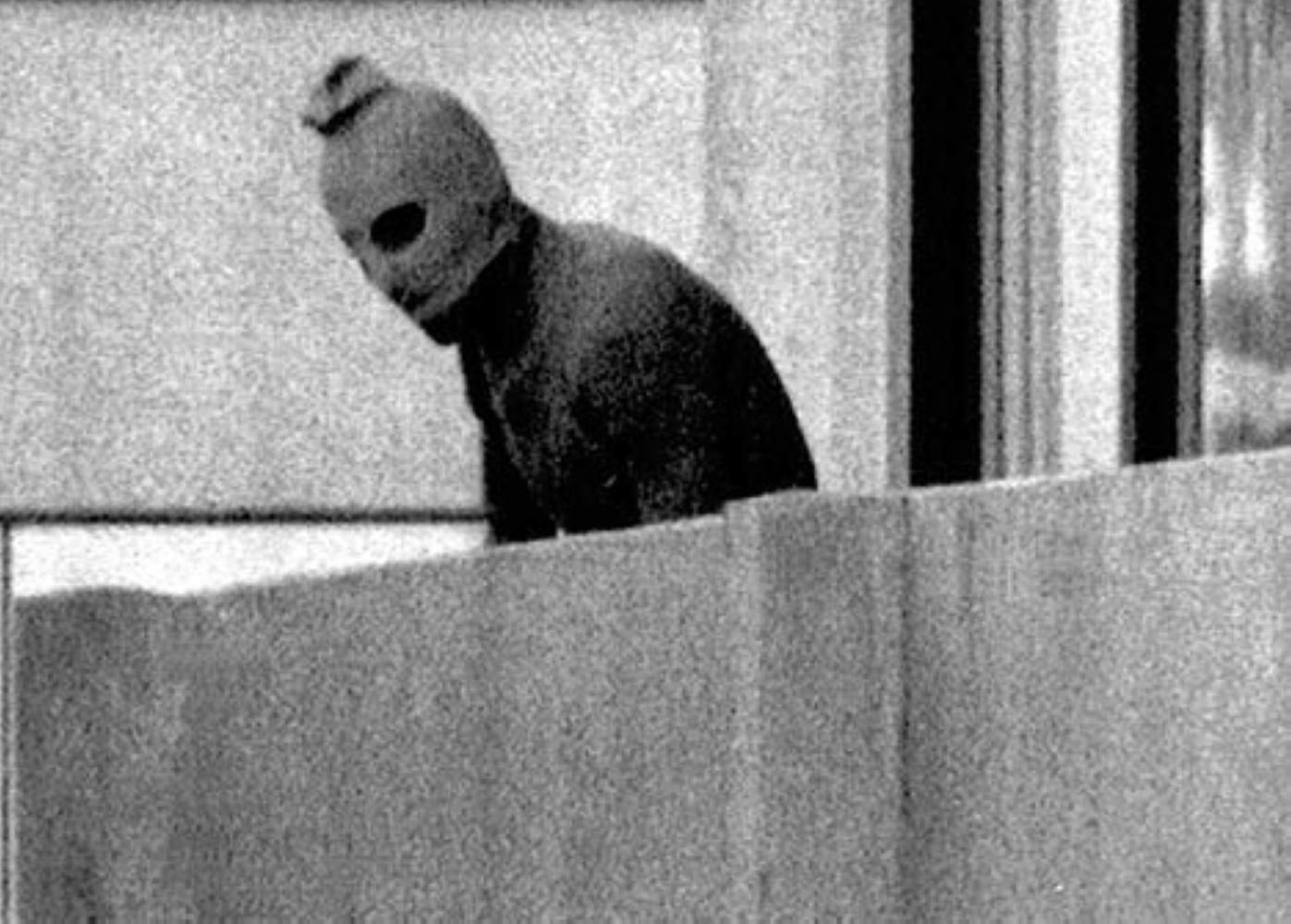
Munich 1972 The Face of Terror Hostage taking during the Olympic Games
Evil is merely an extension of the baseness of our nature. It is our shadow. Without us, evil does not exist. Evil is simply the absence of good (or god). Just as darkness is the absence of light and cold the absence of heat. Evil can only be defined in (our) relation to the good or (god). Good and Evil are the overarching opposites of all experience. They form a synergy, paired opposites. Each exists only in relationship to the other. Without their relationship, both would cease to exist.
For simplicity I will omit simple political left/right categories and value statements of means and rationalization – simply we assume the more were killed the more evil was and some qualifiers. If evil is measurable, than it has substance. It is a present force like gravity, magnetism, etc… these things were unknown to us before we understood them and could measure them. We’ve taken evil for granted. The time will come when even Non-Christians “discover” that it is as real as anything else in this “physical” world. Is implication can be indirectly seen like Dark Matter.
Correlate evil and power?
There is definitely an affinity of evil and power. If one follows C.G. Jung, power is even is a (reciprocal) function of love.
“Where love rules, there is no will to power; and where power predominates, there love is lacking. The one is the shadow of the other.” —The Psychology of the Unconscious, 1943
The psychoanalytic C. G Jung analyzed Hitler and Stalin for the American Government during the second war. To him a complex – and the Shadow is a functional complex – has the capacity to gain autonomy and to escape the control of its creator to rise beyond it origins to reach an independent, and terrifying, reality. An evil complex or (Evil) may take then control both in people and in the universe. Jung’s concept is, however one of an absolute evil which cannot be eliminated even with great effort, but only be controlled by examination of our dark side.
In the Tao Te Ching, Lao Tse also presents the idea that evil is created by missing wholeness. If there is no concept of good, there would be no concept of evil. Good and evil dependently arise together. Like the Heisenberg uncertainty principle of quantum physics, that two complementary properties of a particle are not at the same time as exactly measurable, it is only the creation of dualistic concepts that allows for the perception of evil. In the whole, or the Tao, there would be no evil, for only that which is natural and appropriate would occur.
“The higher the sun rises, the less shadow it casts” —Lao Tse
Religious believers wrestling with the emotional problem of evil may ask God in desperation, “Why?”. It is my view, that evil originates as a symptomatic expression of disharmony and it should not be attributed to either God or humans exclusively. Just as it is erroneous to blame a patient for becoming ill, it is wrong to blame either God or humanity for the origins of evil, which rises instead from the condition of the cosmos as a whole and as a result of the free will given to us. Both human and divine can cooperate in the evolution of the world and in the effort to create harmony. Harmony of this nature is found in the conjunction between God and humanity. That eases the logical tension in the following three statements: (1) God is all-powerful and all-good, (2) Men are neither, and (3) evil exists.
It occurred to me reading their memoirs, that three definite non-Nazis and intelligible, creative persons who worked closely with Hitler, could all not bring the Hitler of the thirties and of the forties together. His architect, Speer but also the brilliant director Leni Riefenstahl and the economic genius Hjalmar Schacht all asked, “Why?”.
Can even Hitler go to heaven?
A Benedictine monk, did say recently to me “even Hitler could go to heaven if he had confessed”. Highly political incorrect, but within the “concepts” of Catholicism (and C.G. Jung). Confess (or realize) your sins and you will connect to God (to your Self).
According to Taoism even in the best possible world evil is necessary for its completion – two sides of a coin – there is no good without evil. C.G. Jung’s concept of integration calls for the integration of the Shadow into consciousness. Evil is real. Even if you consider it not as personal, it is not merely an illusion.
Will hitler go to heaven?
Christians often question whether God is both all-powerful and all good. Evil is a result of people’s’ free will, so God is not accountable for evil. But even though Non-Christians want to think that they are autonomously in charge of everything, as Freud and C.G. Jung discovered their will is free only in the sense that they are only free to act in the conscious realm. According to C.G. Jung Humans are not absolutely free before the work out their shadow and complexes and reach their Self. This models adds to the Christians view problem of evil. Psychology and Religion do convincingly claim, evil is part of everybody.
Religious dimension of evil
Hitler’s, Stalin’s, Mao’s and Pol Pot’s approach had all in common that they all wanted to form new people. Their leadership cult and the state basically asked for religious obedience. If one looks closely we find, that the concepts of totalitarian religions and systems are similar. In their focus is hate, essentially hate religions against clearly defined external groups or simply against everybody, which in the last essence is self-hate.
During an interview with H. R. Knickerbocker, first published in Hearst’s International Cosmopolitan (January 1939), in which Jung was asked to diagnose Adolf Hitler, Benito Mussolini, and Joseph Stalin, later published in Is Tomorrow Hitler’s? (1941), by H. R. Knickerbocker, C.G. Jung remarked: “There is no question but that Hitler belongs in the category of the truly mystic medicine man. As somebody commented about him at the last Nürnberg party congress, since the time of Mohammed nothing like it has been seen in this world. His body does not suggest strength. The outstanding characteristic of his physiognomy is its dreamy look. I was especially struck by that when I saw pictures taken of him in the Czechoslovakian crisis; there was in his eyes the look of a seer. This markedly mystic characteristic of Hitler’s is what makes him do things which seem to us illogical, inexplicable, and unreasonable. … So you see, Hitler is a medicine man, a spiritual vessel, a demi-deity or, even better, a myth.”
In reference to the Nazi fervor that had gripped Germany like a religion C.G. Jung said 1938:
“Hitler’s ‘religion’ is the nearest to Mohammedanism, realistic, earthy, promising the maximum rewards in this life, but with a Moslem-like Valhallah into which worthy Germans may enter and continue to enjoy themselves. Like Mohammedanism, it teaches the virtue of the sword. Hitler’s first idea is to make his people powerful because the spirit of the Aryan German deserves to be supported by might, by muscle and by steel.
Perhaps my reasoning can be seen as biased, but I very much feel what Jung was saying does also relate to the 21st century issue of terrorism and religious extremism. The noted Jungian Psychologist J. Marvin Spiegelman’s stated in an article entitled “C. G. Jung’s Answer To Job:A Half Century Later”: “Jung had mentioned, in passing,that he felt the spirit of Islam in the military passion of the Nazis, without casting any aspersion on the religion of Islam itself. Rather, he sensed that passion, armed with divine mission, something missing from the West for some time, was a primitive invasion of soulless Europe.” One might say, it is quite possible to apply this statement of C.G. Jung (in German it sounds even more prophetic) to the postmodern German romanticism of today’s Left.
goetterdaemmerung
Hitlers rise was indeed in line with German idealistic anti-intellectualism of the “Romantic Area” and quite contrary to the materialistic approach of the Communists. C G. Jung foresaw the events “a “powerful eruption” of the collective unconscious, the “awakening of Wotan from thousand years sleep”, and the uprising of the Germanic soul in Nazi Germany against the “rationalism”. C.G. Jung called Hitler in the interview with US-Journalist H. R. Knickerbocker, also “a spokesman of the German soul, whose power was founded not politically, but magically, and… anti-intellectual”. He qualified also Stalin and Mussolini – equally unflattering. While Hitler’s economic success enabled him to better the life of the German’s after he took power, Stalin’s, Mao’s and Pol Pot’s vision (illusion) failed to provide even the most basic items and food. They brought chaos and hunger and needed to create zones of death and violence for all citizens. Certainly it helped Hitler, that he did not come to power due to a bloody civil war, but essentially was voted for and enabled by the elite , which he employed – used – later for his purposes. They thought they would control him. Within a year he controlled them, got rid of his political enemies and even the left wing of his own party. His welfare policies were essentially state subsidies for the lower middle class and (sometimes perfide) support for families. Like the Mao and Stalin regime, he indoctrinated the young and women.
The rat race is over the pigs won.
Stalin, Mao and Pol Pot simply had to reign with mass killings and famine – they had no other means. Anyone (former comrades, peasants, workers, common soldiers) could be anytime the enemy. Their regime created permanently enemies because of the huge gap between promises and reality and did not integrate the cultural history of their people but aimed to stamp it out. George Orwell’s iconic 1984 stand as perfect examples of this societal structures Jung warns against. Granted, all dystopian literature set in a totalitarian future could fall into this category, but two of his books are probably the two best examples of the genre. Animal Farm, and Orwell’s novel, Nineteen Eighty-four show totalitarian systems and are highly relevant today.
Modeled after the Stalinism, the basic pattern was repeated by Mao’s Big Leap and the Cultural Revolution, by Pol-Pot. It’s about state totalitarianism, and if you look too much to right or to the left you become a road-kill again.
Hitler
Hitler based his power chiefly upon the lower middle class, workers (if not communists) and farmers (if not catholic). The Germans are highly impressionable and indeed go extremes; are always a bit unbalanced. They desire to cosmopolitan, world citizens; easily lose their national (or cultural) identity. They like to be always to outdo others – the longer Hitler is dead, the larger the Hitler resistance movement grows today. Simply a psychologic projection of teir own shadow. But Hitler became also an international trademark (manifested symbol of the archetype) of Evil, which transcendents cultural borders even more than Mao and even more than Stalin. Everybody shudders and project all (of their) evil on him (and all the choose to connect with him) to feel all good. Why is that so? From a Jungian view, the alleged evils that Hitler saw in his enemies, were none other than his own shadow impulses. A shadow is a functional complex and is energy which can be utilized. Hitler mediated the power of the shadow with a charisma that charmed and swayed a great number of people in an outside Germany. C.G. Jung classifies Hitler as an archetype of a seer or shaman. By integrating our dark impulses, we gain some degree of mastery over them. In the beginning Hitler seem to be dimly aware of his shadow and his intuitive power. With the support of highly capable non-Nazis he definitely improved not only economic and political conditions of Germans. Germany was able to break the chains of her reparation payments and came out of the Great depression induced by the US banking and stock crash. Hitler was admired and politically supported by almost all foreign politicians and his party in the begin even funded by international investors. Himself of inferior taste in art, only a few great artists particularly in the movie industry worked for Hitler visualizing the mystic they felt around him.
leni-riefenstah explaines her facination with Hitller
Process of Evilness: But when the war began, and after initial successes brought defeats, his the shadow gripped Hitler’s personality. His righteousness and own truth become reality. The war in Russia was a turning point. The Germans entered a zone of in which terror and war had reigned from 1914 with terror from 1919. The Barbarossa campaign became a war with rules Stalin was comfortable with, a war of extinction. Evil fueled (or consumed) itself.
Numbers: From 1942, carbon monoxide was used at the polish death factories and Holocaust spread to the rest of occupied Europe, other Jews were gassed by hydrogen cyanide at Auschwitz-Birkenau. Overall, according to the historians the Germans, with much local assistance, deliberately murdered about 5.4 million Jews an all in all. Such plans, though unfulfilled, provided the rationale for the bloodiest occupation in the history of the world. The Germans placed Soviet prisoners of war in starvation camps, where 3.1 million perished from hunger or were shot. A million Soviet citizens also starved during the siege of Leningrad. In “reprisals” for partisan actions, the Germans killed about 700,000 civilians in grotesque mass executions. There are claims Germans killed about 11 million non-combatant during war. All in all, the figure of 11 million non-combatants rises to more than 12 million if including foreseeable deaths from deportation and hunger.
Intentions: In Hitlers mind he was the grand chief of a supposed master race and everything “other” was to be eradicated including the Germans who failed to prevail. Hitler came to power with the intention of eliminating the Jews from Europe; the war in the east changed this intention to mass killing. Hitler killed civilians almost exclusively in connection with the practice of racial imperialism and when he invaded the Soviet Union with elaborate colonization plans. It has been said by many historians Germany bears the chief responsibility for starting first and second word war. That, besides we are living now in the area of pre-emptive wars, that should be qualified further, if not even urther investigated.
Methods: Under cover of the war the Nazi regime also killed the handicapped and others deemed unfit in a large-scale “euthanasia” program that brought asphyxiation by carbon monoxide to the fore as a killing technique a predecessor of killing by gas. Germans took so many Soviet prisoners of war in part because Stalin ordered his generals not to retreat. The Germans shot so many civilians in part because Soviet partisans deliberately provoked reprisals. As has been said, a lot of death in the occupied zones were also connected with Stalin’s policy to force his citizens to stay in combat or to-be combat zones. Furthermore, the Germans shot more than a hundred thousand civilians in Warsaw in 1944 after the Soviets urged the locals to rise up and then declined to help them.
Stalin
Even after reading a few books Stalin is still emotional remote to me. I was only once in Russia on business and my connection to it is merely through my father who fought them. Emotional impressed I was of the story of “Hotel Lux” and of Trotsky murder in Mexico City. I once even visited Trotsky’s house there, which is a little private museum run by his grand son.
In “Diagnosing the Dictators Hitler, Stalin, Mussalini, 1938” C.G. Jung saw Mussolini and Stalin, as chiefs or strong men in their own right. To him Stalin as destructive force: Lenin, created; Stalin is devouring the brood. He is a conquistador; he simply took what Lenin made and put his teeth into it and devoured it. He is not even creatively destructive. Lenin was that. He tore down the whole structure of feudal and bourgeois society in Russia and replaced – it with is own creation. Stalin is destroying that. Mentally, Stalin is not so interesting as Mussolini, who resembles him in the fundamental pattern of his personality, and he is not anything like so interesting as the medicine man, the myth—Hitler. Anybody who takes command of one hundred and seventy million people as Stalin has done, is bound to be interesting, whether you like him or not. No, Stalin is just a brute—a shrewd peasant, an instinctive powerful, beast—no doubt in that way far the most powerful of all the dictators.
Numbers: For the Soviets during the Stalin period, the analogous figures are approximately six million killed non-combatants rising to almost twelve million including starvation. This total figure of civilians deliberately killed under Stalinism of six million one must add indirect deaths of Stalin’s own people during the war. Million of Russian civilians would routinely left to starve in battle areas the Germans would invade after destroying any infrastructure and housing (scorched earth policy) even city battle areas like Stalingrad.
Shadow- instinctive powerful, beast
The Russian soldiers were not better off. Political commissars and NKDW in their back would shot them if they retreated. About two million ended up prison battalions, often used for human wave front assaults where their survival rate was a few days. After the war Russian POWs were screened and often sent to Gulags or shot.In pure numbers Stalin’s regime killed far, far more people than Hitler and less than Mao. Discussion of numbers, however, can blunt our sense of the horrific personal character of each killing and the irreducible tragedy of each death.
Judging in detail and from the Soviet records, the number of people who died in the Gulag the total figure for the entire Stalinist period is likely between two million and three million. In 1937, as his vision of modernization faltered, Stalin ordered the Great Terror in 1930s. At the war’s end the Soviets killed tens of thousands of people in their own “reprisals,” especially in the Baltic states, Belarus, and Ukraine. Some 363,000 German soldiers died in Soviet captivity. The Great Terror and other shooting actions killed another million people.
The largest human catastrophe of Stalinism was the famine of 1930–1933, in which more than five million people died. Of those who starved, the 3.3 million or so inhabitants of Soviet Ukraine who died in 1932 and 1933 were victims of a deliberate killing policy related to nationality. In early 1930, Stalin had announced his intention to “liquidate” prosperous peasants (“kulaks”) as a class so that the state could control agriculture and use capital extracted from the countryside to build industry. Tens of thousands of people were shot by Soviet state police and hundreds of thousands deported. Those who remained lost their land and often went hungry as the state requisitioned food for export just like Mao did 1958. The first victims of starvation were the nomads of Soviet Kazakhstan, where about 1.3 million people died. Stalin requisitioned grain in Soviet Ukraine which ensured mass death.
Intentions: Beyond the numbers killed remains the question of intent. Stalin killed civilians almost exclusively in connection with the practice of eliminating large numbers of its own citizens particularly the elite and peasants. Mass murder in the Soviet Union also involved national and ethnic motivations, disconcertingly close to the Nazi ones. Indeed it was Stalin, not Hitler, who initiated the first ethnic killing campaigns in interwar Europe. Until World War II, Stalin’s regime was by far the more murderous of the two. Nazi Germany began to kill on the Soviet scale only after the Molotov-Ribbentrop Pact in the summer of 1939 and the joint German-Soviet invasion killing 200,000 Polish civilians, each regime responsible for about half of 200 000 deaths.
Methods: Most of the Soviet killing took place in times of peace, some related more or less distantly to an ideologically flawed vision of modernization but mostly class warfare, one might say warfare against its own citizens and any human standard and nature.
Mao
Mao is more present in my generation than Stalin. Furthermore I worked in China and Asia on many occasions, this causing a desire to understand culture and history of China. I observed, that Mao is an icon, which still deeply influences Chinese emotions. When I worked in Beijing during the late nineties I got invited by a local resident consultant (an expat) to a dinner party at a very chic ethnic event restaurant. Expats and local people from all over China would dance after work together. The open spirit, however, became immediately sober when a Mao Zedong-double entered the stage.
20080722.sosie-mao-double
The faces of the Chinese colleagues, of all Chinese, froze and some timidly touched the fabric of the actors costume, 20 years after Mao Zedong’s death, as if to make sure that “he” will not come back. Recently, more than ten years later, I read the book of Frank Dikötter Mao’s Great Famine: The History of China’s Most Devastating Catastrophe .
Numbers: Somewhere near the Stalinist ledger must belong the forty million or more Chinese starved during the Great Leap Forward, as Mao followed Stalin’s model of collectivization and industrialization. In pure numbers Mao’s regime killed far, far more people up to 78 million.
Intentions: Mao’s popularity grew into an unbreakable faith in him around the time of Cultural Revolution. The people’s image of him became less like a great leader, but almost like a god. He was always right to the people and they gave in their complete trust. Through posters, school, media and personality, Mao was successful in creating the cult. His little red book became more a bible like than a piece of political philosophy writing. Even I own one. The failure of the Great Leap Forward was caused by unmanageable goals ignoring local problems and situations but foremost basic economy even logic. Shoddy quality wasted rare resources. Of course it is hard for government to control centrally a big country. Like in Russia feedbacks to correct policies did not exist, because the terror and pressure inside the regime was to high and delegated top down. The cult of personality with Mao set free an evil autonomous complex in the masses. With total belief in Mao, especially the young Red Guards, like Pol Pot’s followers later, did not doubt their actions during the Cultural Revolution. The violent and cruel class struggles against intellectuals labeled rightist became a Shadow of revolutionary spirits.
Methods: Most of the Chinese killings took place in times of peace, and was also related more or less distantly to an ideologically flawed vision of modernization and class warfare. During the Cultural Revolution organized starving as a mean of getting rid of segments of Chinese intensified. It was highly centralized mismanagement that can lead a country to disaster. All checks like tradition, family and religion were swept away leaving everybody, particularly the weak, exposed without restraint to cruelty, pure arrogance, boundless ignorance and a merciless disregard of farmers, workers and even party members. Between the years 1959 and 1961, 30 to 45 million people were starved, killed or worked to death as a result of Mao Zedong’s failed attempt at industrialization in this period of the great leap. Research of using newly opened local archives makes his estimate all too credible that the death toll of this famine alone reached 45 million people. The Chinese cultural revolution caused the death of another 30 million people (according to the current Chinese government).
Conclusion:
The assumed special quality of Nazi racism and evilness is diluted by the historical observation that Stalin’s motivations were often similar national or ethnic. The starving caused by failed industrialization policies or flawed visions can never be seen as a price to pay to enlightenment or to create a new man. Stalin evilness was intentional violence as its own purpose. Mao was equally untouched by the death of double-digit millions of Chinese. Both fought a war against the nature, reason and their own people. The Nazis planned to eliminate the Jews in any case, but their evilness was fueled by the war against Stalin. Hitlers, Mao’s, Pol Pots, Stalin’s illusion of new societies, new men and totalitarian state religion crashed. A talk in NYC from Dikötter, which gives insights who the Hong-Kong history scholar is and what general conclusions he derived you find here. When human beings are deprived of any means to own their living they reduced to numbers and seen as livestock – result versus costs: anyone who is old, weak, sick, unwilling or just inconvenient would be starved to death or killed. It is Dante’s hell – the opposite from imago dei.
The geat faime
Were these dictators Archetypes of men’s inherent evil or absence of God? Both. Do numbers explain evil? No, not alone. Never forget: “History is the story of the Past, told at present for present purpose”.
Pol Pot (Cambodia, 1975-79) 1,700,000
Mao Ze-Dong (China, 1958-61 and 1966-69, Tibet 1949-50) 49-78,000,000 (around 40 million during the great leap) – Numbers disputed
Adolf Hitler (Germany, 1933-1945) 12,000,000 (5.8 million jews killed in concentration camps, plus non-combatants killed during WWII plus 2.6 million Russian POWs to die from hunger)
Jozef Stalin (USSR, 1932-53) 20-11,000,000 (the gulags plus the purges of the Great Terror plus Ukraine’s 5 millions famine) – Numbers disputed
(Japan, 1941-44) 5,000,000 (civilians in WWII)
Hamburg. “I wanted to do something extraordinary”. Sir Harris
(Germany, 1933-1945) Civilians killed by Allied Aerial Bombardment 635 000 and Expulsion/Deportation Civilian Dead/Missing 1,260,000
This article explores Wittgenstein’s Tractatus as a mystical, metaphysical insight in the light of Eastern philosophy, Catholic mysticism and C. G Jung. Please be gentle and read this as an (intuitive) essay not as a scholarly article. There are methodological implications of Wittgenstein’s doctrine of silence for transcendental philosophy, Zen Buddhism, psychoanalysis and metaphysics. Or there is a line from Lao-Tse to Wittgenstein, connected by Jung and Watts.
Wittgenstein’s Tractatus-Logico-Philosophicus,(Logisch-Philosophische-Abhandlung,1921 translated by C.K. Ogden 1922) is much closer to me than his work Philosophical Investigations (Philosophische Untersuchungen,1953 translated by G.E.M. Anscombe). Simply because I understand the Tractatus largely transcendental (similar to Allan Watts). A fellow blog author (Recollecting Philosophy), who knows definitely more about philosophy and Wittgenstein than I do, objected slightly to Allan Watts rating the Tractatus higher than the Investigations,however.
In the eighties and early nineties during my time in California I picked up Allan Watts thoughts. Allan Watts knew C.G. Jung well and both were quite knowledgeable in Eastern Philosophy. Watts proposed that Buddhism could be thought of as a form of psychotherapy and not just a religion. Like Jung he was (to me) a bridge between the ancient and the modern, between East and West, and between culture and science. Both had considerable problems with the institution of the church, were mystics and in a way certainly religious. Both emphasized that we Westerners cannot and should not escape our Western cultural roots but value them. Both valued Catholicism although Watts view is more bizarre. It’s not difficult to see therefore, that Allan Watts, who became a kind of Guru in California and postmodern mystic, reads Tractatus as a product of mystic consciousness.
Wittgenstein’s Tractatus
Before I had read more of Wittgenstein and secondary literature, I regarded Wittgenstein’s writings as a kind of academic “Glass Bead Game”. I still think, that what he tried to achieve, could have done simpler by mathematical language (or computer science). Therefore I can relate to Allan Watt, classifying the writings of Wittgenstein “as a form of jnana-yoga, intellectual bending” and that he favors Wittgenstein’s Tractatus.
Logic without Mystic
The Tractatus is notorious for its interpretative challenges. In Europe we live in a post-metaphysic world. If you approach Tractatus, however, from C.G. Jung’s Symbols as representation of archetypes, which manifest themselves in language (as part of the cultural context which are those archetypes) you see it crystal clear.
The Tractatus’s structure contains seven basic propositions translated by Ogden and Pears/McGuinness. Here I stick with German:
The seven basic propositions are (in German):
1 Die Welt ist alles, was der Fall ist.
2 Was der Fall ist, die Tatsache, ist das Bestehen von Sachverhalten.
3 Das logische Bild der Tatsachen ist der Gedanke.
4 Der Gedanke ist der sinnvolle Satz.
5 Der Satz ist eine Wahrheitsfunktion der Elementarsätze. (Der Elementarsatz ist eine Wahrheitsfunktion seiner selbst.)
6 Die allgemeine Form der Wahrheitsfunktion ist: [ p, ξ, N(ξ)].Dies ist die allgemeine Form des Satzes.
7 Wovon man nicht sprechen kann, darüber muss man schweigen.
After three propositions Wittgenstein leaves metaphysics realm but comes back to it with the most elegant proposition seven, which again mirrors a sentence in the bible. For that reason only 1-3 and 7 will be discussed.
Proposition (1) The world is everything that is the case.
Starting with a metaphysics, Wittgenstein sees the world as consisting of facts, rather than of objects and reads to me like the beginning of the Gospel of John:
Tractatus 1 The world is everything that is the case.
Tractatus 1.1 The world is the totality of facts, not of things.
Tractatus 1.11 The world is determined by the facts, and by these being all the facts.
Jh 1.1 In the beginning was the Logos, the Word, and the Word was with God, and the Word was God.
Jh 1.2 The same was in the beginning with God.
Jh 1.3. All things were made through him; and without him was not anything made that hath been made.
Equally beautiful and pretty much the same statement except god is absent. Logos, originally a word meaning “word,” “speech,” or “reason was used by Heraclitus to describe the principle of order and knowledge. There are some remarkable implications here starting of a debate between Plato and Aristotle which I want to move in an area between Wittgenstein and Western (Catholicism) and Eastern Mystic (Taoism and Zen Buddhism) and the psychoanalytic model of C.G Jung.
The idea of Tao is always stated negatively. The same is true of all its major characteristics, of which I would distinguish three: nothingness, the formless, and the unconditioned. Again Lao-tse as starting point of our inquiry is strikingly similar:
The Tao (Way) that can be told of is not the eternal Tao;
The name that can be named is not the eternal name.
The Nameless is the origin of Heaven and Earth;
The Named is the mother of all things.
Wittgenstein’s Tractatus – Seen from Eastern metaphysic
I understand Wittgenstein, who was from the personality type based on C.G. Jung (and like him) an innovative thinker from the mystic as well as a logic angle. As anybody knows, Wittgenstein was fond of Augustine and Kierkegaard, of Tolstoy and Dostoyevsky and wanted to become a monk on more than one occasion. Wittgenstein’s Tractatus support my religious views, which are based on Catholicism, C.G. Jung and some pantheistic Asian influence coming from Taoism and Buddhism. There is alignment between Buddhism and psychoanalysis, as Watts stated, although I see goal of alignment more in an integration of the Ego and the main archetypes than a dilution of the Ego. However, Watts followed Zen Buddhism or Zen, a 5th century line of Mahayana Buddhism, which was heavily influenced by Chinese Taoism in China. And Taoism is indeed much more compatible with Wittgenstein, Jung and Catholicism.
Crist and Buddha
Since I know Taoism and Zen Buddhism better I will focus on those. Both offer direct access to most deepest essence of our mind, exactly like Jung’s individuation.
There is good book about that particular topic from Russell Nieli, “From mysticism to ordinary language”, 1987. He claims, that Wittgenstein’s experience of language (and indeed the language game) was deeply influenced by his experience as rural school teacher, but got stuck there, staying in the uncritical childhood experience (page 244). Wittgenstein’s language analysis offers no differentiation of what is of value or absurd in a given society. Obviously he received a harsh criticism not only from the Marxist side: “When … Wittgenstein set up the actual use of language as a standard that was equivalent to accept a certain setup and belief of the society of the standard. And when he says philosophy “may not interfere”, that come to saying that it may not interfere with a currently accepted society and culture”. I think this may by a misunderstanding taking him as a positivist.
Proposition (2) What is the case (a fact) is the existence of states of affairs.
Mystics, such as Taoists or catholic mysticism, can be aligned to the West and especially Wittgenstein. Systematic inquiry through a logical analysis make its mystical elements clear and comprehensible to non intuitive audiences. But as C.G. Jung noted, its intuitive sensing is highly beneficial to the individuation in our Western culture. When for Wittgenstein, the logical structure of the picture is identical to the logical structure of the situation, in Taoism it is simpler: the inexpressible Tao is in everything, or alternatively, everything is a manifestation of the inexpressible Tao. That is pretty similar what catholic monk told me a few weeks ago: God is in us and above us or God does not exists. When one sees both statements to express the same thought, one can see Wittgenstein’s transcendental elements can be coupled with Eastern and Western religious and mystical elements.
Dreams
Wittgenstein’s Tractatus – Western metaphysic view
Plato put forth the idea that the metaphysical world is more knowable than the physical world. Following Socrates, Plato illustrates this idea through allegory of the cave. The idea is that this physical world we reside in is merely a shadow of a more real and more knowable world that is not physical but metaphysical. From here Plato posits the idea of the Forms. Plato would tell us that we know that it is a thing because there exists in our minds an abstract thing and the reason we know that the thing before us is this thing, is because of its resemblance to the archetype.
Archetypes
That archetype equals the collective known form and is a centerpiece in C.G.Jung psychoanalytic model. In short, we have knowledge of physical things here and now because of the resemblance of these physical things to their ideal metaphysical form. In contrast, Aristotle denies that the Forms exist way out there in the metaphysical realm. So, the lines are defined : Is knowledge of a thing transcendent (Plato) or is it immanent (Aristotle)? Is the nature of all things Being (Plato) or Becoming (Aristotle) or in Kant seeking a synthesise? In his Critique of Judgment, Kant says that “a final purpose is a purpose that requires no other purpose as a condition of its possibility:
The final purpose is unconditioned, and that nature would therefore be incapable of achieving it and producing it in accordance with the idea of this purpose. … But a thing that, on account of its objective character, is to exist necessarily as the final purpose of an intelligent cause must be of such a kind that in the order of purposes it depends on no condition other than just the idea of it.
Proposition (3) A logical picture of facts is a thought – Archetypes in Wittgenstein’s Tractatus
Tractatus, however, also with the conditions with Symbolism in which a sentence “means” something quite definite. In practice, language is always more or less vague, so that what we assert is never quite precise. And that’s the beauty of it – of Jung, Taoism and Christianity. Wittgenstein’s logic tries to overcome: (1) the conditions for non/sense combinations of symbols; (2) the conditions for uniqueness.
Tractatus: 3.32 The sign is the part of the symbol perceptible by the senses.
From Carl Jung’s “The Structure of the Psyche”, 1927:
The collective unconscious — so far as we can say anything about it at all — appears to consist of mythological motifs or primordial images, for which reason the myths of all nations are its real exponents. In fact, the whole of mythology could be taken as a sort of projection of the collective unconscious.
We can see this most clearly if we look at the heavenly constellations, which original chaotic forms were organized through the projection of images. This explains the influence of the stars as asserted by astrologers. These influences are nothing but unconscious, introspective perceptions of the activity of the collective unconscious. Just as the constellations were projected into the heavens, similar figures were projected into legends and fairy tales or upon historical persons.
So according to Jung, those archetypes, which Wittgenstein calls symbols, are models (abstract classes in computer science) which are innate, universal and hereditary. And that’s the point. Archetypes are unlearned (but some shared by some cultures and some by all cultures) and function to organize how we experience certain things. “All the most powerful ideas in history go back to archetypes,” Jung wrote:
“This is particularly true of religious ideas, but the central concepts of science, philosophy, and ethics are no exception to this rule. In their present form they are variants of archetypal ideas created by consciously applying and adapting these ideas to reality. For it is the function of consciousness, not only to recognize and assimilate the external world through the gateway of the senses, but to translate into visible reality the world within us.”
Conclusion
Wittgenstein’s deep understanding of the mystical dimension brings him close to Taoist and Jungian thoughts. Wittgenstein is almost a Taoist and certainly a sophisticated logician. And, both these qualities are spontaneously exhibited in Wittgenstein. No other Western philosopher is better than Wittgenstein for the representation of the synthesis of mystics and metaphysics with sophisticated logical analysis. As Wittgenstein said once, a deep thinker makes us see that there is something that cannot be said. In his transcendental philosophy, Wittgenstein shows that there is something that cannot be said. In contrast, Lao-tse says that there is something that cannot be named – this is the single difference to monotheistic views,
Proposition (7) Whereof one cannot speak, thereof one must be silent
There are methodological implications of Wittgenstein’s doctrine of silence for transcendental philosophy and metaphysics. There are two senses of “sense” which Wittgenstein uses in the Tractatus, the actual sense. and the logical sense. Wittgenstein explains that “every proposition is essentially true-false. Wittgenstein calls this “true-false” possibility bi-polarity an important concept, important to C.G. Jung, Taoism and C.G. Jung.
Philosophers should keep silent about the not speakable because “philosophy is not one of the natural sciences. The doctrine of silence is applicable to mysticism, however. Mysticism may be seen as equivalent to metaphysics, or as not too far away from metaphysics. Now we can see why the doctrine of silence is applicable to mysticism as well. Wittgenstein explains that
the urge towards the mystical comes of the non-satisfaction of our wishes by science. We feel that even if all possible scientific questions are answered our problem is still not touched at all. Of course in that case there are no questions any more; and that is the answer.
Transcendental mysticism seen in this light is the attempt to tell the same story: the inexpressible Tao and nonsense are the same story, a story that, technically and literally speaking, cannot be told. That story begins with the Lao-tzu’s inexpressibility covers Jung’s collective – not to be learned archetypes – and ends with the Tractatus’s silence.
This Sunday sermon in St. Ottilien (2012-11-18-0915-konventamt.mp3)addressed an interesting line of thought: in order to experience God (via the Self), we need the death of the Ego in us first. A very tough call indeed. “We have to kill our own will”, as Paul wrote, “so that God lives in us instead.” According to Elisabeth Kübler-Ross, a Swiss-born American psychiatrist and founder of the so called “mortality research”, there are five psychological stages of dying. Those can be applied also to the “Death of the Ego”:
Isolation
Anger
Negotiation (here with God for pagan believers who knows)
Depression
Acceptance
I must confess, that the thought has deeply unsettled me. Just after I had brought my rather pantheistic experience of God, individuation and the personal christian God more or less in line (I refer to my post “The Self – God’s window between pantheistic Taoism and Catholic personal god”)– I was somewhat surprised by this deeply Buddhist image of the dissolution of Ego and Self (which of course makes sense from a monastic perspective).
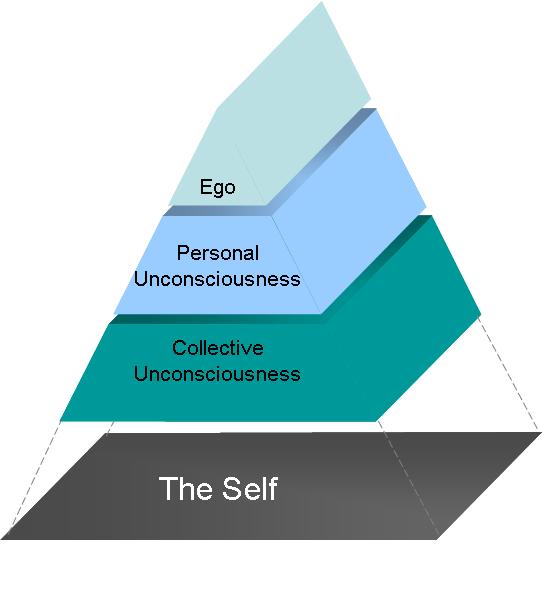
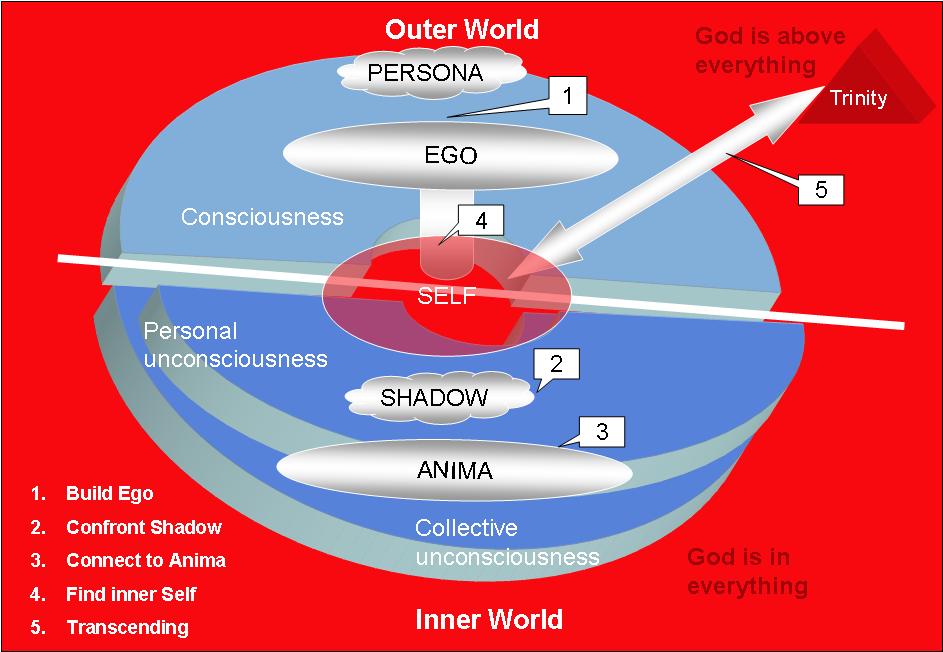
The Ego and the Self are terms which are often interchangeably used. Likewise often no distinction between personality and Self is made nor taken into account the subconscious. The psychological term Ego is the center of consciousness and ensures the physical survival . Ego often has an extended meaning in the spiritual language and referrers in general terms to an obstacle for Self realization.
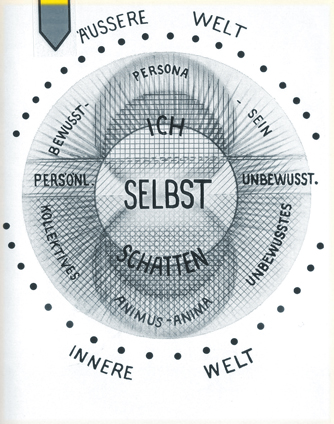
The total psyche: (Mantra – Jolande Jacobi “The psychology of C.G. Jung”
The model C.G. Jung does not have this limitation (see Mantra above from the book Jolande Jacobi, The Psychology of C.G. Jung). He distinguishes sharply between Ego and Self and differentiates the unconscious thoughts and feelings of both types of memories: the ones we can remember easily and those who are suppressed for some reason. In addition he introduced the collective unconscious, which belongs to the common humanity, as part of an individual psyche. This article wants to investigate the “Death of the Ego” from that spiritual point of view and from a psychological perspective (in particular from C.G. Jung’s individuation). I hope that the context of Jung’s model clarifies it (at least for me). As many, I lived my life ignoring death, but since the death of my mother this attitude has changed.
1. The Ego
Ego is the correct translation of the German “Ich (I)” used by C.G. Jung and Freud. The term Ego is also common in esoteric writings often distinguishing the Ego as a centre of the personality of a higher or true Self not unlike as in C.G. Jung’s psychoanalytic model. The term Ego is widely used In translations of Buddhist texts for the “I” to overcome. In some languages it attends a negative meaning: to characterize, for example people with a selfish Ego. According to C.G. Jung the Ego can be equated with the conscious mind and includes all thoughts we think at that moment and also our current feelings. In the center of this consciousness we find that “I” or Ego. It guarantees the unity of (thinking, feeling, acting) is focused on physical survival and dealing with everyday demands. All religions (according to the Benedictine monk Anselm Gruen), demand more or less that we must become free from the Ego. This especially applies to our relationship with God. If we do not let go of our Ego we stay materialistic (at best).
Jesus has spoken this wisdom of all religions in words, which are hard to understand today: “who wants to be my disciple, let him deny himself, take up his cross any day and follow me.” (Lk 9.23). To deny yourself is to say no to be ruled by monopolizing tendencies of the Ego, but distance us from it, to be free from its enslaving power. The Ego wants to impress, wants be presented (inflated) before others. Is the Ego our biggest enemy or our best friend, one might ask? My usual answer to this question is: who can’t love himself can’t love others nor God. It is just analogue not digital. The concept of unconditional love may answers this question differently: ” It is never an enemy. It is the best of us, who may feel neglected but in terms of love is always a very good friend .The Ego just wants to be loved – always.”
But the trivial (or trivialized colloquial term) Ego wants also success, be better than others, wealth, recognition and so on. In the end the effect is, it will not get love from others in this way. Why? Because it does not recognize that others are needed for this purpose. It calculates coldly cause and effect – feeling not loved (enough) in crises as profound illusion – due to limited awareness. If we understand our commitment only from the inflated Ego, my experience is, we may quite benefit in professional life but may get rather hurt in private relations. And: as the two Benedictine (and I think C.G. Jung) told us, it prevents experiencing the religious dimension of our life.
For the philosopher Boulad, the death of the Ego is the birth of the Self: we have only a single vocation: to be ourselves. We have only an obligation: especially do – to be to realize ourselves, to develop ourselves. Psychologist Hawkins described the Ego as a negatively oriented structure that denies the existence of God and wants to live independently. The Ego itself is afraid its resolution. And this would indeed happen if God influenced consciousness and we achieved higher levels of consciousness. The death of the Ego is “the final door” Hawkins or “the final moment” so a subjective enlightenment represents (as in Buddhism).
Freud: The Ego mediates between the demands of IT, the super-ego, and the social environment and needs a reality-oriented self-image, called Self.
C.G.Jung: the Ego represents the differentiation of the individual as a personality evolves. At birth, the Ego separates from the Self. In its development, the individual is always forced to adapt to its social environment; This will be done at the expense of positive attributes which are not valued or tolerated by the outside world. To protect his development, those will be negatively “charged”, fended off and become the Shadow. Furthermore adjusting of the shared ideal of gender creates another functional complex, Jung calls the soul: the Anima (lat. soul) in men and the animus in women. Outwardly, another functional complex, called persona essential for life in society will be developed. This is our task in the first half of our lifespan (35-40 years of age) to mature. For many people the end of mental development reached with the realization of the Ego. The life takes place only in socially prescribed patterns, fulfilling our primary need for security (and sexuality according Freud or power according to Adler). Only a few people imagine how to proceed in the midlife or thereafter, usually shaken by a crisis or emergency. The anxious questions of individuation, of Self realization, and meaning of life are major concerns of Jung.
Orthodox Islam knows many stages of the “I” (Arabic nafs), and to dissolve it. “The” Ego”is contrary to the spirit of [ruh] the part of the heart of man who was placed under its own control, in developing his soul”. Goal of Islam is to overcome that to a common “Ego” “We”. All people, also husband and wife, were created from a single soul (cf. Holy Quran ‘ at 7: 189). Somewhat different is the Sufi view, the mystical form of Islam. But here too, the goalis the death of the Ego.
2. The Self
For me, the Self is again non-uniformly used term within their psychological, sociological, philosophical and theological importance variants. While Freud and Adler considered very narrow psychological driving forces, C.G. Jung understood a central integral concept of the human psyche manifested in the Self. This Self is the wholeness of the human psyche and includes the conscious and unconscious parts of the personality and aims toward the harmonization of the psyche. Only the ego-consciousness with the equipment in use is deliberately sensory perception and thinking, feeling, and intuition. The unconscious part of the people, which splits in the personal unconscious and the collective unconscious, is much more extensive than the ego-consciousness. The Self is the center of the whole personality and therefore the central control instance. The Ego is the conscious of Self, its eye, with whose help the Self can recognize itself (almost like Adam and Eve after eating the apple). But the Self is the God in us. Individuation is to be who one really is, and a differentiation process that fosters the development of all skills, systems and possibilities of the individual through gradual awareness and realization.
C.G.Jung: The goal of life is to know the Self. The Self is a new Center, a better balanced position of our own psyche. Instead of the the trivialities of the persona and the education of the self I today little more worry on the self to all people, all life, the universe and God. The Self is an archetype, embodying the transcendence of all opposites so that each aspect of the personality is expressed correctly and fair. Then it is neither nor but both, male and female, conscious and unconscious, individual and the entirety of creation. The Self represents the mentally transcendent, and equates to a religious experience.
Sociology: the sociological normal type of “community” is the “self”-benevolent introduced (during the normal type of ‘society’ “as “person”).
Hinduism: self as inner, eternal, indestructible shape each being (Atman)
Buddhism: that denies “Even” the existence of a stable, unchanging identity in favour of the doctrine of the non-self
Orthodox Islam knows no self, the self” is roughly equivalent with the ‘Ego’, to resolve that it applies. “The” Ego “is contrary to the spirit of [ruh] the part of the heart of man who was placed under its own control, in developing his soul”. Goal of Islam is to overcome the “I” to a common “We”. All people, also husband and wife, were created from a single soul (cf. Holy Quran ‘ at 7: 189).
The Ego, the Self and Jesus – Individuation and Transcendence
3. The soul
In today’s (secular) parlance, the totality of all emotions and mental processes in humans is meant and synonymous with the term psyche with soul often. Psyche (Greek ψυχή, breath) was in the classical antiquity a synonym for the word soul.
The discussion of the 20th century has discussed various concepts of the concept of a “soul” and a wide variety of points of view. Roughly broken down, one can distinguish the following positions:
3.1. A philosophical and theological definition,
which means a one’s own substance ‘Soul’, emanating from the thinking and feeling, and other spiritual acts. In Christian philosophy, but often decidedly anti-Platonic views are represented, which consider body and soul in the sense of a holistic anthropology as a unit.
Psyche in the sense of the new, Hellenic language exists – to the contrary to the Old Testament “Nefesh” – regardless of the body and can not be killed.
Theological is the soul of the innermost core of a human person. And of course the question: what is the core? Belong to the soul also instincts, sexuality, hunger and thirst? These elemental feelings do not belong to the theological concept of the soul. Theologically, the soul is the spiritual, life-giving principle in man. The soul is the created by God spiritual and immortal beings form of man, which determines its distinctive individuality – according to the theologians today.
Unfortunately, there on the terms: soul ‘ and ‘Spirit’ false statements, you must come to the very right are different, between the biblical statements of AT and NT, Greek philosophy, and the Hindu and Buddhist understanding. To clarify what the he Bible understands of the ‘soul’. It is necessary to learn how God created man. Moses 2.7: “Since God the Lord made man from clay (matter) from the field and blew the breath of life to him”. And so man became a “living soul”(living creature). Man consists of two components: 1. matter 2. breath giving life. Here it is important that the man get a breathed a ‘soul’ but does not have one. Only the two components resulted in a “living soul.” The soul here stands for the people in his unity and wholeness. When we die not the soul, but the breath of life leaves us. The ‘immortal soul’ does not exist in the Bible.
The “psyché” of New Testament in Greek relates to the Hebrew “nephesch”. Especially in the Gospels, socialized people speak Yes Hebrew Aramaic of the soul. Nephesch means originally not soul, but throat, i.e. the perceptible movement of the throat if breathing, the essence of living. For the Bible, so has every breathing “soul”. “My soul” means something like “I” (Lk 1.46). The nephesch, of a person can take off power, “grieved be unto death”. In severe disease it fades. When dying, it (i.e. the breath of life) is returned God. Because God gave the people of his breath and so man became a living being. (Gen 2, 7B). The idea of the immortality of the soul comes from the Greek (Plato and Ptolemy) and was introduced over the Gnostics into Christianity. It has shaped the medieval Christianity (and Judaism!), but is not biblical. The notion of the soul, which independently could exist without the body comes not from the Bible, but has therefore its origin in the Greek philosophy. Unfortunately, many are believe that soul of Christian origin would be the immortals. This is important in this context. Note also what the Bible says about the death of the man. Moses 3.19: “; because you are clay (matter) and should be back to Earth”;
We have no immortal part within us, because sin and its consequences (Romans 6: 23) relates to the people as a whole and not only a part of it. To sinful man, could not immortal after the fall, it was blocked the way to the tree of life. Moses 3, 22: “now but that he now does not stretch forth his HAND and break even by the tree of life and you will find and live ETERNALLY.” The immortality of the people would be the UNADULTERATED communion with God and the access to the tree of life been subject to. He was subjected to death by man both had destroyed his relationship with God, and therefore had no access to the tree of life. He could not free himself from this hopeless situation, his mortality. Therefore, everything else what is in the Bible follows the gradual revelation of the redemption of man from sin and death. The rescue was made possible only by the sacrificial death of Christ, who died for us. Only through Christ alone, we can regain the lost immortality. People get this on the last day, when Jesus will come a second time. Then we regain immortality, which we have lost through Adam and Eve. Immortality we find the word, however, three times in the Scriptures.
In 1. Timothy 6.16 writes Paul, that God alone possesses immortality! Therefore, man has no immortal soul.
In 1. Corinthians 15: 51-55 Paul then finds: the devout man receives immortality only at the second coming of Jesus and the resurrection of the dead. She is so a gift of God to the end of the world and not an integral part of human nature. Not who makes the belief that gives immortal soul, the Christian faith so questionable, but who drops the hope of the resurrection of the dead at the return of Jesus (1 Corinthians 15: 12-23).
The man has no immortality, thinking, feeling, wanting and acting (preacher 9,5.6.10) end at his death. The Bible compares his State with a sleep from which he will wake up at the end of the world (John 11.11; Daniel 12, 13).
In today’s religious and philosophical opinions, the soul is independent of the body and therefore immortal “Soul” an immaterial principle, a stable identity. The Greek term of ψυχή (psyche) occurs in the New Testament which is rendered with ‘Soul’ in older translations of the Bible. In the Gospels, where psyche is, to be alive, meant, specifically to the name of the property of a specific individual – human or animal – “Life” within the meaning of the Nefesh is at most. (MT 2.20), such as lack of food (Mt 6, 25) LK 12, 22f. ), or that she will be withdrawn (Luke 12.20) and is lost (MK 8.35-37). The psyche is the seat and starting point of thinking, feeling and volition. Other places, however, show that the New Testament relation of body and soul is complicated. The term psyche is ambiguous unclear, probably in some places, the transitions between its meanings are fluent.
In Plato’s philosophy has the soul (ψυχή, psychḗ) as the intangible principle of life individually. Their existence is entirely independent of the body; She existed before his birth and persists after his destruction of intact (pre-and post existence). Plato and Aristotle differentiated between a senseless and a reasonable soul, psyche and nus.
The Apostle Paul, however, rarely used the term psyche in his letters and avoids him for statements about life after death.
Augustine represented the Union of the soul against the Platonic doctrine of the soul parts, but made a promotion to the Aristotelian tradition within the soul: “just living” soul (vegetative), function, rational soul (soul function) with spirit (mens) and will and irrational soul function with motor, sensory perception and memory. Inbound Augustine sought proof of the Incorporeality, and the immateriality of the soul.
Particularly Thomas Aquinas conceived the ”nus poietikos” as the creating spirit, as the immortal part of our sou. But he is keen to avoid a rugged body-soul, which is why he, Aristotle then, the unity of the human stresses the unity of mind, body and soul dualism.
Orthodox Islamic scholars describe four stages of the soul in the Holy Qur’an ‘ (Sufi more), which correspond to human development. The commanding soul [al-nafs al-‘amara]: the State is the starting point. Like a wild horse, the soul tries to gain control of the “rider” and even “to throw off him”. He orders uncontrollable and harmful, and must be “tamed” are. Even the pure and healthy prophets know this state of mind, even if they have mastered it and point out, like for example Josef (a.) in the Holy Quran ‘ “…And I declare myself not even for the innocent. The soul commands evil emphatically yes, unless my Lord has mercy on himself. My Lord is forgiving, merciful.” (12: 52-53)
The plaintive soul [al-nafs al-lawwama]. In this stage, the soul has such self-knowledge that she see their own weaknesses and blames himself “I” to overcome the “self” or. This state of mind is so developed, swore at them: “no, I swear by the day of resurrection. No, I swear by the soul which they pronounce censure.” (75: 1-2)
The Inspiring soul [al-nafs al-mulhama]. At this level, the soul has the ability between the useful and harmful inspirations to distinguish and uses this ability to their own development: “…”and the soul and what way she shapes and gives her their Vice and their piety!” (91: 7-8). Freedom is the freedom of knowledge and the defense of the harmful through knowledge and the adoption of useful through knowledge for this soul.
The satisfied soul [al-nafs al mutma’innah ‘ inna]. The soul achieves the satisfaction of ALLAH in its perfection and is therefore also pleased about the grace of contentment: “O you satisfied soul, to your Lord satisfied and accompanied by his face return. Joins the ranks of my servants, and enter my paradise. (9: 27-29)
3.2 Moderate positions,
such as psychological definitions, may reject a materialism but do not grant the notion of a soul in a traditional sense, in particular not immortality. Soul is the term for the totality of all conscious and unconscious emotional processes and of all spiritual and intellectual functions.
In his treatise “on the soul” (“de Anima”) defines Aristotle the soul as: “The soul is the first Entelechy of the natural organic body” (full on. II 1, 412 b 4-6). Aristotle not is so not materially the soul but as an intangible entity, which is why Aristotle comes a strict body-soul dualism in question. According to Aristotle the soul is that which the body (which only potentially is a living being) really makes the creatures, the Entelechy biologically today can be seen as a goal-oriented regulation of vital functions as the software for the hardware, which is essential for a living organism in terms of forms. Aristotle States in his treatise “on the soul”, that “the soul from the body is separable and or certain parts of it” .The soul passes so with the body, when the animal dies.
C.G. Jung defines soul in the sense “guarding complex” (Anima) in contrast to the notion of the mind as a “Whole” all conscious experience qualities as well as of all unconscious phenomena. The mental energy occupies a central place in Jung’s psychology. Animus soul, spirit (as opposed to the body), memory, courage, exuberance, confidence, despite, resentment, anger, disposition, mood, passion, desiring soul, desire, desire, decision, desire, inclination; Anima, however, translated with air as element or breath of air, wind, breath, soul, life, or secluded soul. C.G. Jung summed up under the term soul both terms. The soul is dynamic. In humans, this is called also personality.
Kant maintains the metaphysical side of the soul, that it treated but related issue of freedom within the framework of practical reason. The soul is called the regulatory term within the framework of morality.
3.3. Materialism or Neurobiology,
rejects the existence of a soul, claiming that all talk of mental is reducible to the physical and/or neural States. Are the same soul and psyche and the soul is that which is the psychology and / or employed Neurology.
Sigmund Freud, the founder of psychoanalysis, makes two assumptions for its model of the soul: a physical body (brain, central nervous system) as the place or “Scene” and awareness Act. “” We suppose that the soul-life is the function of an apparatus “, here it is clear that the doctor Freud attempts a neurological Foundation.” We have come to the knowledge of the psychic apparatus through the study of the individual development of the human being”.
The man has no soul — he has not even a substantial self, says one contemporary philosopher Thomas Metzinger. Phenomenal States, the experience itself, based on neural patterns, dynamically active nerve networks. The character of the subjective experience remains the same, regardless of whether you actually perceives something or just a hallucination. External factors in the environment, and society to decide whether this experience is considered as hallucination, a abnormal psychic disease wisdom or holiness. The totality of all emotions and feelings are not different for humans or animals. The soul is a portion of the spirit thus, if emotionless information processing in a human brain is excluded (what is hardly possible in reality). Animals have feelings too and therefore also a soul.. Thus overlaps the soul with our memory and learning, forgetting, perception, the totality of all inherited traits of an individual language, intelligence, motivation, will, emotion.
3.4. Linguistic approach
German Seele, Psyche
English soul, psyche
Greek psyche
Hebrew nephesch, ruach
Latin Anima
Arabic nafs (نفس) can mean “even” relevant mainly in the Sufi
Chinese (traditional): (línghún) like spirit – or cloud completely invisible:
Finnish: sielu
French: âme
Indonesian: roh
Icelandic: sál
Italian: anima (female)
Japanese: (kokoro)
Dutch: aim (female); spil
Romansh: olma (female)
Romanian: restless
Russian: душа (duschá)
Spanish: alma (female)
Thai: วิญญาณ
Czech duše (female); Člen (male), obyvatel (male)
Turkish can; Ruh
Hungarian: lélek
Venetian: anema (female)
4. Individuation versus death of the ego
I like to understand Individuation not as death or dissolution of the ego. I have witnessed two deaths, an easy one and one prolonged suffering in a cold – not even ill-meaning – care machine. Psychological experiences of Ego death are particularly critical and generate fear: this transformation process is most difficult, because it demands to let go one’s own identity, it may interpreted as abandonment,´resolution, disintegration or fragmentation. All spiritual development processes, however, lead us through meditation and complete resolution of our self-esteem. The individuation is a mismatch between the beginnings of biological aging and the possibility of another psycho-spiritual development. “It represents those critical situation in which one has arrived at the height of the life and suddenly or gradually is confronted with the reality of the end of death”(Jacobi 1971, p. 31). Quite true in my case. The more one approaches the midlife (as late as this may be) having succeeded consolidation of the outer life, personal attitude and social situation, the more one firmly believes having discovered the correct course of life, the right ideals and principles of behavior. Therefore it requires eternal validity and virtue to move on – otherwise one is stuck. A significant fact is, that the adaptation and functioning in reality happens at the expense of the totality of the (Self) personality. While the first half of life stood under the aspect of identity a re-orientation must occur, fulfilling new tasks gains importance, in essence all this is the preparation for death. This turning point is not on a specific point in time (as one of my many “midlife crisis”), but may extend over a long period of time. First ivomes the confrontation with the shadow, than with the complexes of the collective unconscious, manifesting in the “Anima” and later the “Old Wise Sage”, or the woman in “Animus” and “Great Mother”.
The materialistic-oriented Freudian psychoanalysis has been increasingly questioned, while the spiritually inspired analytical psychology of C.G. Jung becomes lately more important again with religious quests and definitely important to me. Freud, who sees most conflicts as not properly processed (sexual) repression problems, is probably the psychologist of the first half of life. His psychology is retrospective. C.G. Jung’s psychology is more perspective. He has recognized that most of the problems of his patients over 35 were essentially religious in nature. He is the psychologist of the middle and the second half of life. Freud almost always looks back. C.G Jung looked forward.
5. My conclusion
The death of the Ego is to me more of an integration with the Self. Individuation” has shown a way to the Self in the second half of my life, to the deepest innermost area of the personality and has opened the spiritual dimension. Hence it is not only a preparation for death but also a preservation of body and soul for resurrection – the Self.
Jacobi, Jolande: Towards the individuation, Walter, Olten 1971 and see also my other standard bibliography.
Last Saturday (yesterday). I went on a retreat (religious exercise) at the Benedictine monastery St. Ottilien with twenty others men and women looking after their private center and true selves:
“Looking for the self” What do we know of the psyche and soul?
The discussion was lead by two monks – the longtime Prior Claudius and Pater Otto, who is catholic priest, Jungian psychologist and as he always proudly announces, orginally a cheese maker. Segments of discussion were preluded from the two monks with some food for thought: first from a catholic view of the wise and senior Bavarian monk and then from a psychological view from the energetic, versatile, a curious (spiritual and intellectual) searcher in his soft American-Swiss accent. I have known both for a while, and do not go along always with their statements or definitions. As often, many of the brief thought nuggets answered my current questions and difficulties but also opened more topics to meditated and think about. Never before have I seen priest sharing so openly their lifelong process of believing, their doubts and trust in following Christ. The (Catholic) belief they presented and have lived is one of a unique joyful religion for this life, of boundless love, capable of deep mystic but also fully compatible with science and Jungian models.
Life experience in an elevator pitch
Do you think, the Prior (second in charge of this monastery) told the audience some conventual belief and bigot phrases? Think again, some of his statements would force both the official church hierarchy together with the noisy know-better-modern- lay(wo)men of today in a tailspin. A concise opening statement of the Prior summed up what one has to do in life and how that helps finding God. I was taken back by its simplicity. His crisp world view came across as a result of his own thinking and experience as a monk without giving psychoanalysis any deep consideration. But it could be easily matched to individuation of C.G. Jung. I included a crude visualisation below. Furthermore, the Prior eased my biggest problem with a personal god, having had my God experiences in the nature.
First the Prior showed us a pantheon (almost Taoist) image of god, how it relates the inner center our Self: God is in everything and above everything or God does not exist. Quite frankly, that resonated well with me, since I felt god the first time, during a backpacking week around Mount Rainer (Wonderland trail). That is – God is in everything – after I crawled out of the tent and admired nature during the glowing sunrise. Secondly Claudius connected men’s outer world, with his inner world and with God – as an individual to a personal (Du to Du). It comprised what one has to accomplish in the first half of life ( and where materialism or Freud’s machine stops) and in the second part of life and beyond. C.G. Jung defined that without his empiric reach but definitely within his metaphysic view.
Dealing with the outer world: You have a good meaningful job, live in a nice house, have a good handsome/pretty spouse,your kids turn out well.You sit down and see it is good. I think this relates to the developing an Ego and Persona in the first half of your lifespan. Later Pater Otto brought the Ego in an Example of a Gel Tub, how the Ego,the center of consciousness is needed as an outer communicator and shell to protect your our Self and our Soul.
Dealing with inner world: You have to look into yourself think and meditate, rid yourself of the negative. (P. Claudius avoided saying evil or demons). You sit down and see it is good. I think this relates to the Individuation, overcoming the own Shadow and finding the soul (Anima). Later Pater Otto told us about the soul (lat. Anima, gr. psyche ) how this relates our psyche and psychology in general.
Find your inner center: You have to look beyond this world, to find the loving God in you ( P. Claudius meant looking for our soul). Men is a communicating species, but you have to have found your inner center to do this successfully..You sit down and see it is good. I think this relates to the Individuation, overcoming the own Shadow and finding the Soul (Anima) and Self. Later Pater Otto told us about the Self, the forces in making cheese by steering in the milk and the Axis (the big pipe) between the Ego and the Self.
Communicate with the personal god: You have to connect with the personal God using your Self as window (or membrane). You sit down and see it is good. I think this connects the Individuation process with the religious or transcendent dimension of an accomplished life. Later P. Otto told us about special prayers (credo prayers) and Kreuzgänge (walking silent cross walks) how we can show God we are ready. Now here the monks moved from pantheism to the loving Christian trinity. The communication between the personal God and us as individual is facilitated by the Self, our window to God.The bigger the pipe is between Ego and Self, the easier it is to experience God. Autonomous complexes or an inflated Ego prevents that.
Multiplicity of Psyche – Individuation and Transcendence
One Questions two views but one answer
I have never heard it so clear. The theoretical distinctions of the Self in the different teachings is often unclear and undifferentiated. For the psychologist C.G. Jung the ‘Self’ is an empirical concept for the total amount of all psychic phenomena in humans. It expresses the oneness and wholeness of total personality. The general question in the search for the ‘Self’ is: How can the lives of people succeed? The Prior formulated it in a Christian way, explaining how to follow Christ; aiming to the realization of the true ‘Self’. I believe that, together with psychoanalytical contribution of C.G.Jung, the Catholic faith sheds light on the basic “W” questions but also helps in this life. Jesus’ approach to the individual and freedom is unique. We are nor slaves of a cruel god, nor impersonal white noise to resolve our Ego better sooner than later in nothingness, nor a bunch of neurons (mis)firing. As the Prior said: “we can look into the starry sky and say Du,Du, Du”. And I would add, fully aware of todays astrophysical knowledge of our universe.
God around everything and above everything
The Self
Psychological schools are just models. We can’t see atoms or quarks nor can we see our soul. Therefore scientists and psychoanalysis come up with models, to understand and predict based on empirical data. Even if the Self is a non-uniformly used term with their psychological, sociological, philosophical and theological importance variants, the Jungian model is the closest to Religion. While Freud and Adler considered very narrow psychological drives, C.G. Jung understood the central integral concept of the human psyche as the Self. This Self is the wholeness of the human psyche and connecting the conscious and unconscious parts of the personality and aims toward the harmonization of the psyche. Only the ego-consciousness has the equipment to process deliberately sensory perception and thinking, feeling, and intuition. The unconscious part of the us, which splits in the personal unconscious and the collective unconscious, is larger and often more powerful than ego-consciousness. The ego,on the other hand can run amok and super-inflate. The Self is the center of the whole personality and therefore the central window or “membran”as Pater Otto called it to God. As I interpreted the Prior Claudius, it is also the Place where God or Jesus is in us. The Ego is the conscious of self, his eye, with whose help the self itself can recognize. The self is the God in us. Individuation is to be who one really is, and thinks a differentiation process that has the development of all skills, systems and possibilities of the individual through gradual awareness and realization of the self to the target.
Find my Self and inner Center again
Religion is to C.G. Jung the opportunity to discover the soul. For Freud as for Marx, religion is just opium. Jung sees the benefit of religion (especially of catholic flavor) to deal with many similar psychic circumstances. Today’s psychology – influenced by Freud – to me is Godless and today’s Western theology – influenced by the age of enlightenment – to me often lacks soul. Spirituality and religion, together with logic and science, is focus for individual and political healing. The most important insight, which I understood this day: The impending disasters right now around me, are a direct result of my buried shortcomings like a pretty big Ego which served me well in my career (i.e. the disaster in me). Its is directly linked to Jung’s reminder, the inner world is very real. The evil is in us.
Conclusion
I considered myself blessed to get so many hints from the monks for my specific search in such a short time:
Who I was in the past, I who want to be in the future and how do I make the transition?
How I reflect my undesired aspects of my personality and keep my identity here?
What are root causes of interpersonal communication defects – last call to grow up?
What are cause and effect of those significant problems in my current professional transition?
How to use the current crisis as a momentum and I deal with transcendence and the death?
What needs successful self-development within my current life situation (e.g., toward individuation, religiosity)?
Lots of other questions were discussed, which might “wind up” in another blog entry:
Does Evil exists – questions about the dualistic view (Good and Evil)?
Does the hell exist. Where does the picture of it come from?
What is the opposite of belief (trust in God) what means believing?
What is the opposite of love (indifference / egoism)?
Usefulness of the religious church hierarchies and dogmas?
Theory and praxis of dreams including dream phenomenology and hierarchy?
Emphasis on Christ’s suffering versus Christ’s resurrection (central altar figure in St. Ottilien)?
Individual injuries because of rigid and/or bigot religious practices (understood first time how severe those could influence children, and the advantage of converts)
Descartes and Dualism
Common psychological disposition (e.g. narcisissm of super inflated egos)
Fatherly versus motherly images of god (got lost of this one – thinking of Kali hardly a nice one).
I was also astonished about the “Big Bang Didn’t need God to start universe doubt” discussion. To me, believing in God comes down to a personal experience that a benevolent deity is out there. People who are generally more intuitive in the way they think (in the Jungian sense) and make decisions are more likely to believe in God than those who ruminate over their choices. That suggests that basic differences of one’s personality type influences religious belief. Some say we believe in God because our intuitions about how and why things happen lead us to see a divine purpose behind ordinary events that don’t have obvious human causes. As on woman said in the discussion, “I translate believe in trust”. Individual’s belief is influenced by how much we trust natural intuitions. In the end, God can only be known by personal experience not by logic. If one does not experience god, too bad (for her or him). True, big bang and quantum mechanics describe random fluctuations which can produce matter and energy out of nothingness. But quantum mechanics are just (proved) models too. I don’t doubt that physical laws can “produce” the cosmos.
However, minor asymmetries shortly after the beginning are the cause that matter and anti-matter (particle and antiparticle) did not annihilate itself immediately. As an engineer, quite interested in astrophysics, physical laws do not at all affect my theological leanings. I see in such statements not attacks on the existence of God. Saying the Big Bang — a massive expansion 13.7 billion years ago that blew space up like a gigantic balloon — could have occurred without God is a far cry from saying that God doesn’t exist. With Jung, and many philosophers I don’t think one can use science to either prove or disprove the existence of God. The question, then, is, Why are there laws of physics? And one could easily say, those required a divine creator a spark that led from the laws of physics to these universes, maybe more than one. Or, as I humbly admit, one can fall back to pantheistic belief, that ‘divine ‘ is in nature in everything and produced the laws of physics. I would say let’s just leave that to theology, philosophy and C. G. Jung…
Appendix :
The Persona : “The Persona is that which we present to the outside world. It isn’t really our selves, though there is a danger we can identify too much with it and believe it to be so. It is a mask. It’s not a bad thing to have, in fact it’s necessary for getting along with others.
The Ego: “The ego is the centre of consciousness. It is identity…But it is not the totality of the psyche.
The Shadow: “it is the receptacle for all of that which we have for one reason or another disowned. In truth there’s a great deal that’s very, very unpleasant here, since we have good reason for wanting to disown our darker natures but like the complexes it is not all evil. The avenue for an attempted redemption of the Shadow lies in the belief that everything disowned winds up here.”
The Anima/Animus: The Anima is the female soul image of a man, the Animus the male soul image of a woman. That is the most simple definition, and one which many struggle with, since Jung seems quite absolute in defining a person’s soul image as gender opposite. “Soul image” sounds very pretty, but the Anima/Animus is not without a negative pole as well….. If one is on good terms with one’s Anima/Animus he/she can prove a valuable messenger between the unconscious and the conscious, a connecting link – a veritable Hermes.”
The Self: “The Self is simply the centre and the totality of the entire psyche. It is the transcendental archetype which contains all the other archetypes and around which they orbit. Where God is within you, if you believe in God.
The Collective Unconscious lies under our personal unconscious, and contains the archetypes and mythical symbols that make up our human psyche. Connection to this in a healthy way is necessary for wholeness.
Archetypes (per se) templates (blueprints) for complexes. Note Archetypes and Complexes are used very ambiguous ind interchanged ( I wrote a few articles just about them)
Complexes centers of physical energy (The can be autonomic, good or harmful and take over control.
Functional Complexes (The big five, Ego, Self,Persona, Anima, Shadow)
Synchronicity—when two or more events happen in a meaningful way to a person, and reveals something about our unconsciousness .
Individuation is central to all religion and all healing.
Quantum fluctuation is the temporary change in the amount of energy in a point in space arising from Werner Heisenberg’s uncertainty principle in quantum physics. That means that conservation of energy can be violated, but only for small times. This allows the creation of particle-antiparticle pairs important in the origin of the structure of the universe according to the model of inflation.