Tag: Art

  • Hofstadter’s Goedel Escher Bach: An Eternal Golden Braid and The Glass Bead Game

    Hofstadter’s Goedel Escher Bach: An Eternal Golden Braid and The Glass Bead Game

    1. Goedel Escher Bach: The Glass Bead Game as an Epistemic Mirror

    Read alongside Douglas Hofstadter’s Goedel Escher Bach: An Eternal Golden Braid (1979), and against the longer historical transition from Aristotelian scholasticism toward modern empirical and mathematical science, Hesse’s Castalia can be interpreted as an epistemological experiment: what happens when an intellectual culture succeeds in constructing an extraordinarily sophisticated system of knowledge, but regressively destroys the contact with the reality from which knowledge derives?

    Hermann Hesse’s The Glass Bead Game (Das Glasperlenspiel, 1943) stands as one of the great literary monuments to the twentieth-century crisis of intellect, culture, and meaning. Although superficially presented as a vision of a highly cultivated future society, the novel constructs a dense network of philosophical and epistemological tensions, drawing upon Platonic and Hegelian traditions, Jungian ideas of psychic development, Eastern spiritual thought, and the structural problems of formal systems

    From this perspective, Josef Knecht’s development is not merely a personal spiritual awakening. It is a movement from a closed intellectual order toward an open epistemology—one capable of confronting uncertainty, contradiction, experience, and the demands of a world that cannot be contained within the system.

    2. The Aristotelian Trap and the Galilean Rupture

    The structural crisis of Castalia is rooted in a profound intellectual paradox. The founders of Castalia, horrified by the cultural fragmentation of the “Feuilletonistic Age” and the catastrophic political and military conflicts surrounding it, seek refuge in an autonomous intellectual order. Castalia becomes a quasi-monastic community governed by an almost Platonic of superior leadership and Aristotelian deductive reasoning. Within it, music, mathematics, philosophy, history, and other forms of knowledge are synthesized through the Glass Bead Game into an extraordinarily refined symbolic language.

    The danger of such an institution is not that its knowledge is false. On the contrary, much of it is profoundly true and intellectually sophisticated. The danger is that the system becomes increasingly closed: it derives its legitimacy from the coherence and refinement of its own intellectual structures rather than from continuing confrontation with an external reality.

    This recalls, at a much greater historical distance, one of the central problems associated with the Aristotelian tradition.

    2.1. The Aristotelian Problem

    Aristotle built a magnificent, highly rigorous deductive framework based on rules of logic. He was deeply invested in looking at the physical world—meaning he was far from a pure mystic or a purely abstract theorist—but his method completely lacked statistical, skeptical, and experimental rigor of modern induction. His biological writings, in particular, demonstrate an extensive engagement with the natural world.

    However, what Aristotle called “induction” (epagōgē) was fundamentally different from modern scientific induction. Observations were used to move from particular phenomena toward general categorical principles; once established, these principles became the premises from which further conclusions could be deductively derived. Polemically put, observations were elevated, behind a veil of categorical reasoning, into quasi-a priori principles and subsequently treated as such in deduction. The historical problem emerged even more strongly in the subsequent scholastic tradition, when Aristotelian categories and established authorities could become sufficiently entrenched that anomalous observations were interpreted through the inherited conceptual framework rather than being allowed to challenge it.

    This helps explain why Aristotelian natural philosophy could remain so often wrong for so long: once categorical principles acquired quasi-a priori authority, contradictory observations could be dismissed rather than used to revise the system. The resulting intellectual closure became a major obstacle to the emergence of modern empirical science for roughly a millennium.The problem, therefore, was not deduction as such. Deductive reasoning is one aspect which is indispensable to science. The problem was the possibility of a closed epistemic hierarchy, in which authoritative principles and categories possessed greater epistemic weight than recalcitrant observation.

    2.2. The Galilean Rupture at Padova

    This makes Galileo Galileo’s years at the University of Padova particularly illuminating. From 1592 to 1610, Galileo worked in an intellectual environment in which Aristotelian natural philosophy remained deeply influential. His later telescopic observations—particularly those of the Moon, Jupiter’s satellites, the phases of Venus, and the changing appearance of the heavens—did not simply add new facts to an existing system. They placed pressure on the conceptual framework within which those facts were interpreted.

    The significance of the Galilean transformation therefore lies not in the simplistic replacement of “deduction” by “induction.” Galileo combined mathematical deduction, observation, experiment, and idealization. The deeper transformation was epistemological: theoretical structures became answerable to observation.

    This is precisely the distinction that illuminates Castalia.

    2.3. Castalia as a Closed Formal System

    The mature Glass Bead Game increasingly resembles an intellectual system that operates upon its own accumulated representations. It does not primarily discover new truths through confrontation with an unpredictable external world. Instead, it establishes increasingly sophisticated relationships among established truths, symbols, cultural achievements, and historical forms after incorporated into its conceptualGlass Bead Game.

    Castalia thus becomes less a laboratory of knowledge than a museum of knowledge.

    Its extraordinary refinement is simultaneously its weakness. The more completely the world is translated into the language of the Game, the less capable the system becomes of recognizing what cannot be translated into it.

    Knecht gradually recognizes this contradiction. The problem is not that Castalia knows too little.It does not generate new knowledge an in return Castalia has become epistemically self-sufficient and sterile.

    In Douglas Hofstadter’s Goedel, Escher, Bach: An Eternal Golden Braid, a closed formal system is a rigid, self-contained game played with meaningless symbols according to explicit, unchanging rules. It has a fixed set of starting strings (axioms) and transformation rules, relying on no outside meaning or external input to generate its valid outputs (theorems):

    • Symbols: A finite, restricted set of basic symbols allowed in the system,
    • Axioms: The initial “seed” strings provided for free inside the system without needing proof.
    • Rules of Production: Exact, mechanical instructions or rules on how to change existing strings into new, valid strings.
    • Theorems: Any string that can be generated by starting from an axiom and applying the rules step-by-step.

    Hofstadter introduces formal systems using simple toys like the MIU-system (the MU-puzzle) to show how syntax operates independently of semantics..

    The Limits of Closure: Gödel’s Blow

    A central theme of the book is what happens when a closed formal system becomes powerful enough to talk about basic arithmetic (such as Hofstadter’s Typographical Number Theory, or TNT).

    • When a system becomes complex enough to “look at itself,” it can construct self-referential statements.
    • Goedel shows that any consistent, closed formal system strong enough to handle number theory is incomplete—meaning statements about the system that can never be proven from within its own closed set of rules.
    • To resolve or express these truths, a thinker must “jump out of the system” to a higher meta-level, shattering the absolute closure of the original framework

    3. The Logic of Systems: Gödelian Incompleteness versus Inductive and Probabilistic Adaptation

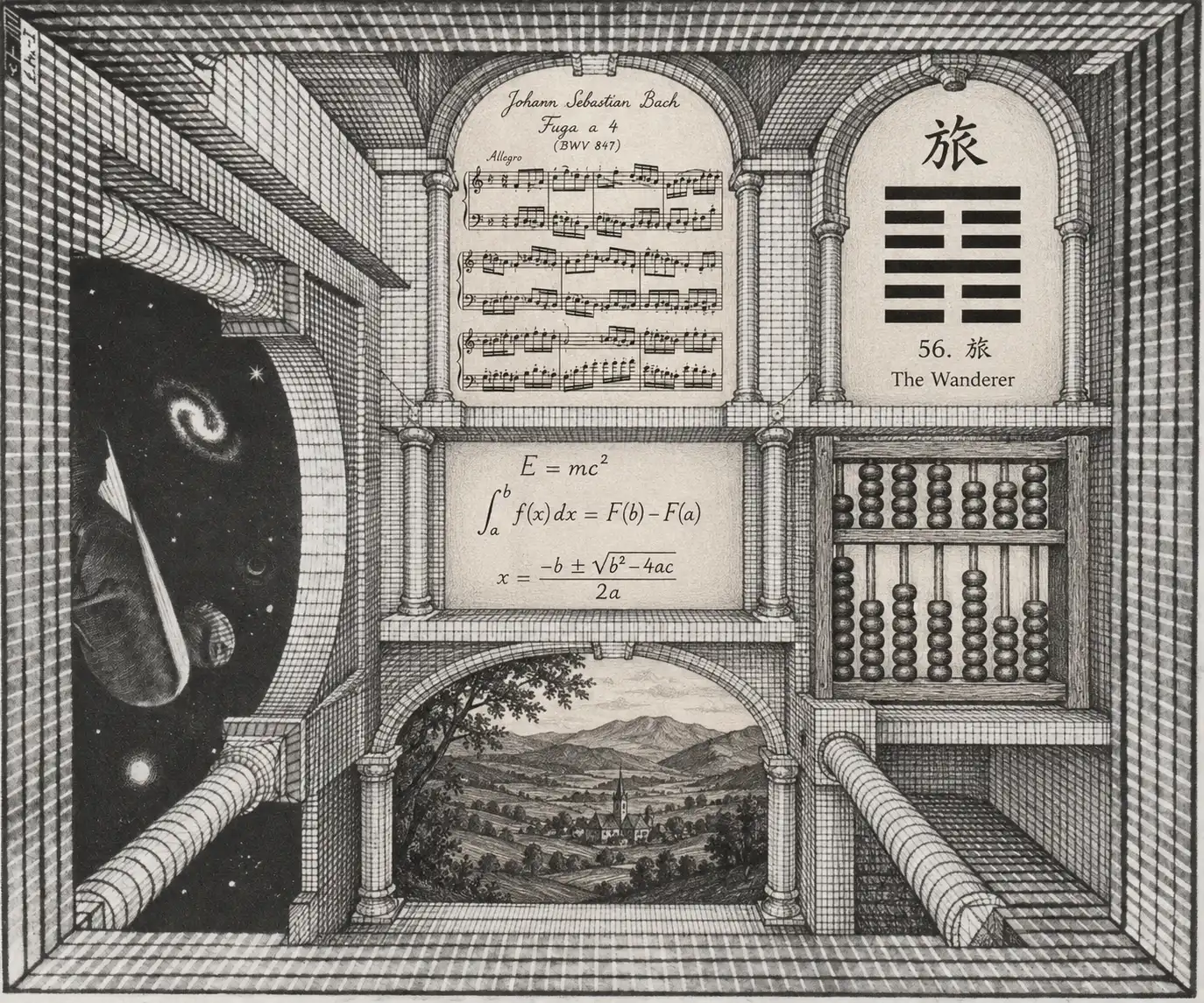
    Hofstadter provides a remarkably suggestive modern vocabulary for understanding this problem. Gödel, Escher, Bach places self-reference, formal systems, recursion, and the limits of formal reasoning at the center of its exploration of intelligence and meaning.

    Goedel Escher Bach

    The connection with Hesse should not be understood as a literal application of Gödel’s theorem to Castalia. Castalia is obviously not a formal mathematical system in Gödel’s sense. The value of the comparison is structural: both raise the question of what happens when a system attempts to generate, validate, and understand its own truths from within its own rules.

    3.1 The Gödelian Limit of Castalia

    Gödel’s incompleteness theorems demonstrate, under specific mathematical conditions, that sufficiently expressive consistent formal systems cannot establish all truths expressible within them by means of their own formal rules. The significance of Gödel’s result is therefore not simply that “there are things mathematics cannot know,” but that formal self-contained systems possess intrinsic limitations that cannot be eliminated by adding further internal sophistication alone.

    Castalia can be read as a cultural analogue of this problem.

    It possesses an enormous internal capacity for synthesis. It can connect music with mathematics, mathematics with philosophy, philosophy with history, and history with metaphysics. Yet the system cannot, by increasing the sophistication of these internal relationships, finally answer the question of whether Castalia itself ought to exist in its present form.

    That question lies outside the normal operations of the Game.

    Castalia can represent the world; it cannot adequately represent its own dependence upon the world.

    This is the deeper significance of Knecht’s growing unease. His intellectual development is not simply a rejection of scholarship. It is the recognition that a system cannot derive the ultimate justification for its own existence solely from the successful operation of the system itself.

    3.2. The Inductive Alternative

    The alternative is an open epistemic system: provisional rather than absolute, iterative rather than self-contained, and continuously exposed to evidence that may require revision.

    Modern Bayesian reasoning provides an especially clear formal analogy. An agent begins with a prior distribution, encounters new evidence, and updates its posterior beliefs according to the evidential weight of that observation. The posterior then becomes the starting point for subsequent inference. Knowledge is therefore not a finished structure but an ongoing process of belief revision under conditions of uncertainty.

    This is fundamentally different from a system whose principal activity is the internal recombination of propositions it has already accepted.

    The distinction can be formulated schematically:

    Closed system:
    axioms → deduction → internal consistency → further deduction

    Open system:
    prior → observation → evidence → posterior → new observation → revision

    The second structure does not abolish reason. It makes reason answerable to experience.

    This is precisely where the Castalian tragedy becomes visible. Castalia has perfected the first structure while progressively neglecting the second. It treats the accumulated intellectual achievements of humanity as an almost complete symbolic universe, while the unpredictable, politically unstable, morally demanding world outside its walls becomes increasingly remote.

    Knecht’s awakening therefore requires more than a change of opinion. He must break the closed Castalian epistemic circuit and re-enter the world from which the intellectual system has become detached.

    His departure is consequently both epistemological and spiritual.

    He does not abandon Geist; he refuses to allow Geist to become self-enclosed.

    The movement is not from reason to irrationality, nor from intellect to mere experience. It is from a closed order of knowledge toward an open encounter with reality. The Glass Bead Game remains valuable precisely because it represents an extraordinary achievement of synthesis. But synthesis without continual exposure to what exceeds the system eventually becomes sterile.

    In this sense, Knecht’s final movement beyond Castalia can be understood as Hesse’s answer to the problem that Hofstadter, through Gödel, later formulates in mathematical and cognitive terms: a sufficiently complex intellectual system may discover that its greatest limitation is not what it cannot represent, but its inability to recognize that reality is never exhausted by its representations.

    Castalia is not merely sterile; it is parasitic on the civilization outside it.

    The distinction you are making is crucial:

    • Castalia itself produces almost nothing new. It preserves, refines, classifies, synthesizes, and aestheticizes achievements that originated elsewhere.
    • The Glass Bead Game is its genuine intellectual creation. But precisely because the Game is the purest expression of Castalia’s genius, it also embodies Castalia’s fatal limitation: it is a closed symbolic system.
    • The Game can create new relationships among existing forms of knowledge, but it cannot generate new empirical knowledge about the world.
    • Consequently, Castalia’s intellectual productivity becomes increasingly second-order: it thinks about what humanity has already thought.
    • The outside world, meanwhile, remains the source of new historical experience, political problems, suffering, scientific discoveries, and ultimately new intellectual material.

    That gives the novel a rather devastating paradox:

    Castalia has created the perfect instrument for understanding everything that has already been understood—and thereby made itself incapable of not only understanding what comes next but to contribute and uphold reason to change.


    4. The Biographical Escher Staircase – ends

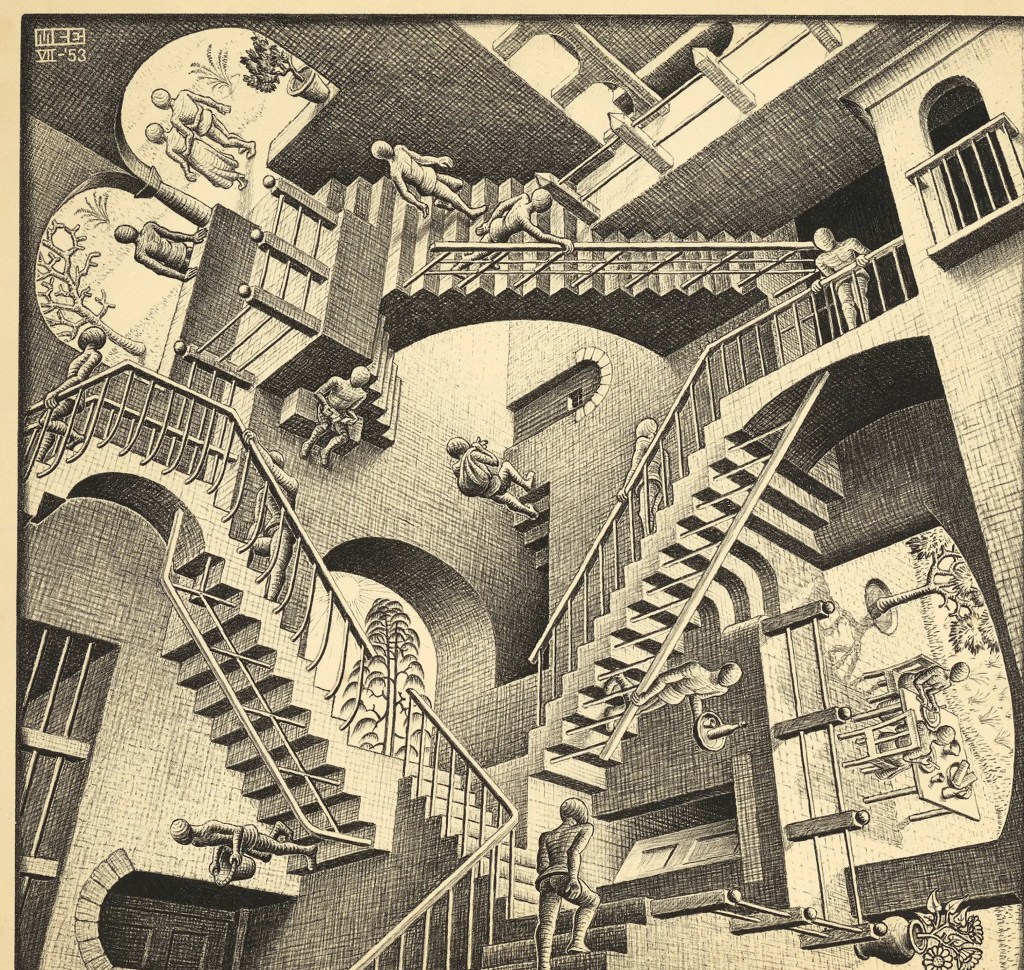
    The trajectory of Josef Knecht’s biography can be read as an Escher staircase: an apparent ascent through successive levels of intellectual and institutional mastery that eventually returns the traveler to the point from which he began—but with the decisive difference that the traveler has changed.

    Knecht’s ascent through Castalia is therefore not simply a career progression. At each stage, an apparent achievement incorporates its own contradiction. The higher Knecht rises within the system, the more clearly he perceives the limitations of the system itself.

    StageBiographical MilestoneSystemic and Psychological Integration
    1. The CallRecognition by the Music MasterAwakening to a form of harmony that cannot be reduced to academic knowledge or verbal doctrine.
    2. Internalizing the AntithesisThe encounters and debates with Plinio DesignoriRecognition that the secular world possesses forms of experience and responsibility excluded by Castalian intellectualism.
    3. Diplomat of CastaliaThe missions to Mariafels in the interaction with Patre Jacobus. Direct encounter with history, religion, and lived human reality outside the Castalian frame.
    4. Master of the GameAttainment of the highest technical competenceComplete mastery of the symbolic system that has formed him.
    5. Magister LudiAssuming the highest office in the GameThe paradox becomes unavoidable: at the summit of Castalian achievement, Knecht discovers that mastery of the system does not constitute mastery of reality.

    Knecht’s journey toward ultimate synthesis is mapped across an evolving trajectory of foundational mentors and foils. Each figure expands his epistemic horizon, shifting his path from pure aesthetic isolation toward worldly engagement:

    Plinio Designori (The Antithesis): Although a peer rather than a traditional elder master, Plinio serves as Knecht’s essential worldly mentor and ideological antagonist. Operating as a loud advocate for the laïcistic, secular world, his constant debates act as the primary psychological friction that forces Knecht to recognize the sterility of the ivory tower, ultimately providing the catalyst for his final defection.The sequence is important precisely because Knecht does not escape Castalia before mastering it. He reaches its highest institutional and intellectual position. His final rebellion is therefore not the revolt of an outsider who has failed to understand the system. It is the judgment of an insider who has understood it too well.
    The Music Master (Magister Musicae): Knecht’s primordial spiritual guide and mentor. He introduces the young protagonist to the serene, meditative heart of music and contemplation. He embodies the pure, uncorrupted ideal of Castalia—an intellectual baseline of harmony, humility, and absolute focus.

    Thomas von der Trave (The Predecessor): The reigning Magister Ludi before Knecht. He represents the absolute pinnacle of Castalian institutional mastership, classical diplomacy, and formal administration. He grooms Knecht to handle the vast administrative weights of the Order, transitioning him from a pure scholar to an institutional steward.

    The Elder Brother: The Taoist hermit of the Bamboo Grove. By teaching Knecht classical Chinese calligraphy, the translation of ancient texts, and the rhythmic wisdom of the I Ching, he introduces an organic, nature-aligned baseline of contemplation. He demonstrates a form of self-contained spirituality entirely detached from Castalia’s institutional rigidity.

    Pater Jacobus: The Benedictine monk, scholar, and eminent historian of Mariafels. He introduces Knecht to the verticality of historic time, institutional survival, and the fluid dynamics of global politics. He shatters Knecht’s illusion that Castalia is an eternal, self-sustaining paradise, grounding his intellect in temporal and secular reality.

    At the summit of the Castalian hierarchy, the staircase turns back upon itself.

    The Glass Bead Game has achieved extraordinary formal perfection, but perfection has become stagnation. Castalia can synthesize the intellectual achievements of centuries, but it cannot generate the unpredictable experiences from which genuinely new cultural forms arise. It has become increasingly capable of representing knowledge and increasingly incapable of producing knowledge.

    Knecht therefore discovers the central paradox of his education:

    The better he becomes at the Game, the more clearly he sees what the Game cannot contain.

    This is the point at which the Escher metaphor becomes particularly apt. The staircase does not lead simply upward. It is a recursive structure like those visualized by Escher. Each achievement becomes the condition for recognizing the insufficiency of the previous level. Knecht’s development therefore proceeds not through the accumulation of knowledge alone, but through iterative revisions of the framework within which knowledge is understood.

    5. The Magister Ludi’s Letter to the Board of Educators and The Zen Jump

    Joseph Knecht reaches a personal and spiritual rupture point as he awakens to the dangers of Castalia’s ivory-tower isolation from the real world. Driven by the realization that the intellectual province’s survival is inextricably linked to the outside society it relies upon, he submits a formal resignation letter—the Rundschreiben (Circular Letter)—to the High Board and his fellow masters. In this document, he articulates his fears for Castalia’s future and requests permission to step down from his exalted office as Magister Ludi so that he may re-enter ordinary life as a simple schoolteacher.

    Let me return from history and draw my conclusion. What all this means to us at the present time is this: Our system has already passed its flowering. Some time ago it reached that summit of blessedness which the mysterious game of world history sometimes allows to things beautiful and desirable in themselves. We are on the downward slope. … The road leads downhill. Historically we are, I believe, ripe for dismantling.

    .Only the Glass Bead Game is our own invention, our speciality, our favorite, our toy. It is the ultimate, subtlest expression of our Castalian type of intellectuality. It is both the most precious and the most nonutilitarian, the most beloved and the most fragile jewel in our treasury. It is the first precious stone that will be destroyed if the continuance of Castalia is imperiled, not only because it is the frailest of our possessions, but also because to laymen it is undoubtedly the most dispensable aspect of Castalia.

    When the High Board rejects his petition, Knecht realizes he must act on his own terms. He travels to the Order’s headquarters unannounced to confront Master Alexander, the President of the Order and the living embodiment of Castalian discipline and institutional authority. At first, Alexander fiercely disapproves Knecht’s decision, viewing the resignation not merely as an administrative crisis, but as a perilous betrayal of the Order. Yet, as their debate unfolds, Alexander does not encounter a reckless rebel, but a man who is completely serene, resolute, and spiritually translucent—guided by a higher sense of duty to save Castalia from its own stagnation. Recognizing that Knecht’s inner transformation is complete and entirely irreversible, Alexander’s anger dissolves into sorrow. He realizes that institutional rules no longer apply to a spirit that has outgrown them, and he quietly relinquishes his resistance, surrendering to the reality of his friend’s departure.

    After formally laying down his insignia and the seals of his office, Knecht officially leaves the Order and steps beyond the borders of Castalia. Setting out on foot, he heads toward the capital of the worldly government to reunite with his old friend, Plinio Designori, ready to embrace his new calling.

    5.1. Knecht’s Zen jump outside of the closed formal GBG system

    In Goedel, Escher, Bach: An Eternal Golden Braid (EGB), Douglas Hofstadter establishes an intriguing parallel between the mathematical limits of logic in closed formal systems and the philosophical traditions of Zen Buddhism, centering both on the concept of “jumping out of the system”. Kurt Goedel’s First Incompleteness Theorem provides the definitive mathematical proof for why an “outbreak” to a meta-level in a in closed formal systems is a logical necessity. The Glass Bead Game is such a system. An observer (here Master Ludi Knecht) must jump outside of the system to a higher meta-level, using a meta-language to analyze (and save) the system from the outside.

    At this point, a comparison with Zen becomes illuminating, provided it is understood as an interpretive analogy rather than as a literal description of Hesse’s narrative technique or hint of singular reading of the following climax.

    Hesse’s engagement with Asian thought was deep and lifelong. He was familiar with Buddhism, Hinduism, Taoism, and Chinese Zen, and his religious thought repeatedly sought a unity beyond rigid doctrinal boundaries.

    The conceptual affinity with Zen lies in the recognition that a sufficiently elaborate conceptual system can itself become an obstacle to direct apprehension. The problem is not that reason is false. The problem is that reason can become trapped within its own representations.

    The Zen koan provides a useful analogy: it pushes discursive reasoning toward a point at which further logical manipulation ceases to resolve the problem. The decisive movement is not the discovery of another proposition within the system, but a transformation of the relationship to the system itself.

    Knecht reaches an analogous threshold.

    He has argued, reasoned, negotiated, taught, mastered, administered, and finally governed. Yet none of these activities resolves the contradiction between Castalia’s intellectual perfection and its increasing detachment from life.

    He therefore stops arguing within the system.

    He leaves it.

    He enters the outer laïcite/secular World of his lifelong friend Plinio Designori with the seed or blueprint of the Syntheses of Castalia and the outer World. He becomes the tutor of his son: Tito Designori.

    5.2. The existential jump – his enigmatic drowning

    In the morning, when he sensed the house awakening, he rose. Finding a dressing gown laid ready beside his bed, he put it on, and stepped out through the rear door that Tito had shown him the night before into the arcade that connected the house with the bath hut by the lake.Before him the little lake lay motionless, gray-green.

    It is important, not to reduce the lake scene itself to a deliberate Zen suicide. Knecht does not consciously decide to drown. After leaving Castalia, he accompanies Tito to the mountain retreat and, despite being physically unprepared for the cold-water swim, follows the boy into the lake. He is overwhelmed by the conditions and drowns.

    Tito appeared, in bathing trunks. He shook hands with the Magister and pointing to the cliffs opposite said: “You’ve come at just the right moment; the sun will be rising in a minute. Oh, it’s glorious up here.

    Knecht gave him a friendly nod. He had learned long ago that Tito was an early riser, a runner, wrestler, and hiker, if only from protest against his father’s casual, unsoldierly, comfort-loving ways. …

    Knecht welcomes it all, and was determined to share his interest in sports as a means for winning over and taming the temperamental young man. It would be only one means among several, and not at all the most important; music, for example, would lead them much further.

    The boy, filled with the solemn beauty of the moment and the glorious sensation of his youth and strength, stretched his limbs with rhythmic arm movements, which his whole body soon took up, celebrating the break of day in an enthusiastic dance and expressing his deep oneness with the surging, radiant elements. His steps flew in joyous homage toward the victorious sun and reverently retreated from it; his outspread arms embraced mountain, lake, and sky…

    The boy himself was in the grip of his impulse, without knowing what was happening to him. He was not performing a dance he already knew, a dance he had practiced before.,,,

    The words were barely uttered, the challenge to a swimming race with the sun barely issued, when Tito with a tremendous leap plunged headfirst into the lake.

    Everything now matters because Hesse makes the ending radically ambiguous. The death is neither simply accident nor straightforward suicide. It is the tragic consequence of Knecht’s first attempt to inhabit the physical world he had chosen over Castalia.

    The summons was stronger than the warning, his will stronger than his instinct. He quickly shed the light dressing gown, took a deep breath, and threw himself into the water at the same spot where his pupil had dived.

    The lake, fed by glacial waters so that even in the warmest days of summer one had to be inured to it, received him with an icy cold, slashing in its enmity. He had steeled himself for a thorough chilling, but not for this fierce cold which seemed to surround him with leaping flames and after a moment of fiery burning began to penetrate rapidly into him.

    After the dive he had risen quickly to the surface, caught sight of Tito swimming far ahead of him, felt bitterly assailed by this icy, wild, hostile element, but still believed he could lessen the distance, that he was engaging in the swimming race, was fighting for the boy’s respect and comradeship, for his soul — when he was already fighting with Death, who had thrown him and was now holding him in a wrestler’s grip. Fighting with all his strength, Knecht held him off as long as his heart continued to beat..

    Knecht has spent his life attempting to cross boundaries between systems. At the end, he crosses the ultimate boundary: from protected intellectual existence into immediate physical reality.

    The man who has mastered the Game cannot master the lake. And that is precisely the point. And more.

    What follows now is defensible manifold as Hesse’s novel has been created in many parallel layers – genuinely his own manifold experience. The climax is a diamond, its sparkling depends on the reader questions and position and the light they let shine on it. Nevertheless any interpretation, subjective as it is, ought to be defended.


    6. The Hegelian Aufhebung: From Opposition to Integration

    The final movement of the novel can then be interpreted through Hegelian Aufhebung: the simultaneous negation, preservation, and elevation of an earlier form.

    Castalia and the secular world initially appear as opposites.

    Castalia represents disciplined intellect, contemplation, hierarchy, continuity, and spiritual refinement.

    The secular world represents history, contingency, embodiment, political responsibility, sexuality, suffering, and uncontrolled change.

    Neither side is sufficient.

    Castalia without the world becomes sterile. The world without cultivated reflection and transcendence risks becoming chaotic and spiritually shallow.

    Knecht’s insight is therefore not that Castalia must be destroyed and replaced by the secular world. His insight is that the two must enter into a new relationship. Essentially his insights of both sides proved the seed of a Synthesis of both world in an Geglian sense. This is the crucial distinction between revolution and Aufhebung.

    Knecht does not reject what Castalia has given him. He carries Castalia outward.

    His intended vocation is extraordinarily modest by Castalian standards: he will become a teacher.

    Yet this apparent descent in rank is actually the highest practical expression of Castalia’s original purpose. Knecht’s circular letter argues that Castalia’s knowledge must return to the society that sustains it, particularly through education. Scholarly interpretation has likewise emphasized that his departure is conceived as a return of Castalian knowledge to the wider culture rather than its abandonment.

    This makes the final relationship between Knecht and Tito, the Son of his lifelong friend especially significant.

    Tito is not simply “the secular world.” He represents a form of existence that Castalia cannot manufacture: spontaneous, embodied, instinctive, unfinished, and therefore open to development.

    At sunrise, Tito’s spontaneous dance is not a calculated ritual. It is an immediate response to the world before him. Knecht, the master of symbolic forms, encounters something that precedes symbolic mediation.

    And then Knecht follows Tito into the cold water and dies. The tragedy is not that Knecht has failed to escape Castalia.

    He has escaped it.

    His tragedy is that he does not live long enough to demonstrate what the synthesis might become.

    But Hesse deliberately transfers the consequence of Knecht’s death to Tito. The boy’s experience of Knecht’s death produces a sudden moral awakening. His world is no longer merely a playground of instinct and youthful arrogance. He has encountered responsibility, mortality, sacrifice, and the consequences of another person’s trust. Scholarly readings of the ending likewise emphasize that Knecht’s death becomes a transformative event in Tito’s development.

    The young swimmer had looked back frequently and seen with satisfaction that the Magister had followed him into the water. Now he peered once again, no longer saw him, and became uneasy. He looked and called, then turned and swam rapidly back. He could not find him. Swimming and diving, he searched for the lost swimmer until his strength too began to give out in the bitter cold. Staggering, breathless, he reached land at last, saw the dressing gown lying on the shore, and picking it up began mechanically rubbing his body and limbs until the numbed skin warmed again. Stunned, he sat down in the sunlight and stared into the water, whose cool blue-green now blinked at him strangely empty, alien, and evil. He felt overpowered by perplexity and deep sorrow, for with the waning of his physical weakness, awareness and the terror of what had happened returned to him.

    Oh! he thought in grief and horror, now I am guilty of his death. And only now, when there was no longer need to save his pride or offer resistance, he felt, in shock and sorrow, how dear this man had already become to him. And since in spite of all rational objections he felt responsible for the Master’s death, from there came over him, with a premonitory shudder of awe, a sense that this guilt would utterly change him and his life, and would demand much greater things of him than he had ever before demanded of himself.

    Thus Knecht’s life ends at precisely the moment when his intellectual project begins to enter the world.

    His body disappears. His education of Tito has barely begun.

    But the seed for Synthesis, carrying on Castalia on in the outer would has been planted.

    The final paradox is therefore profoundly Hesse:

    Knecht’s greatest intellectual achievement is to diagnose the failure of the institution that made him an intellectual—and to recognize that he can no longer reform it from within.

    He does not abandon Castalia. He carries Castalia beyond Castalia.

    That is the true Zen “jump.”

    And it transforms the Escher staircase. The staircase does not end in another higher institutional level. It ends when Knecht realizes that there is no higher level inside the staircase. Just contentious up and down, as progress is illusion.

    He must step off it.

    That is why the ending is simultaneously tragic, spiritual, epistemological, and political.

    Castalia has perfected the art of looking inward. Knecht’s final act is to turn its gaze outward.

    7. Knecht’s personal trajectory – His Three attached CV’s

    Knecht’s personal trajectory is documented by mandatory CV’s written during his is free study phase before accepted to the Castalian order..

    The three autobiographical narratives appended to The Glass Bead Game can be read as symbolic rehearsals of different modes of psychic existence. They should not, however, be treated as literal evidence of reincarnation. Hesse presents them as imaginative exercises in which Knecht explores what his life might have been under radically different historical and cultural conditions.

    Read through a Jungian lens, they nevertheless function almost like successive experiments in individuation.

    7.1. The Rainmaker — Turu

    The Rainmaker represents a world dominated by immediate physical existence, ritual, fertility, and collective survival. When Turu’s power to summon rain fails, he accepts himself as the sacrificial instrument through which the tribe may be restored.

    The important element is not simply sacrifice but the surrender of individual autonomy to a larger order of being.

    This anticipates one dimension of Knecht’s final fate: the individual life becomes meaningful through its relation to something larger than the individual ego.

    7.2. The Father Confessor — Josephus Famulus

    Josephus represents a very different psychic configuration. His struggle is inward and spiritual. He encounters in Dion a figure who mirrors his own inadequacy and spiritual conflict.

    The apparent opposition between confessor and penitent eventually collapses. Each discovers himself reflected in the other.

    This can be read in Jungian terms as an encounter with the Shadow: what initially appears to be an external adversary turns out to be an aspect of oneself. The resolution does not consist in defeating the opposite but in recognizing and integrating it.

    7.3. The Indian Life — Prince Dasa

    Dasa introduces the most explicitly Eastern dimension. His apparently complete worldly existence—power, sexuality, jealousy, violence, revenge—is revealed through the yogic encounter as an illusion within a larger reality.

    Here the central movement is the collapse of identification with the phenomenal world: Maya.

    Dasa does not simply learn that worldly experience is unreal. He experiences the instability of the ego that takes worldly experience as its ultimate reality.

    Taken together, the Three Lives therefore provide three radically different modes of transcendence:

    Turu — sacrifice of the individual to the collective.

    Josephus — integration of the divided self through the encounter with its opposite.

    Dasa — dissolution of the ego’s identification with phenomenal reality.

    Knecht’s own biography subsequently combines elements of all three.

    This makes it tempting to describe the Three Lives as “rehearsal lives” of Knecht personally. But their literary function is more subtle. They are better understood as symbolic possibilities of the his Self—imaginative forms through which Knecht explores different ways of transcending the isolated ego.

    The achievement is therefore not that Knecht has literally designed these lives before. It is that he has already learned to imagine himself beyond the narrow Ivory Tower identity imposed upon him by Castalia.

    Knecht’s development can also be read against Hesse’s earlier exploration of individuation in Steppenwolf (1927). Harry Haller remains trapped within a rigid opposition between the cultivated bourgeois intellectual and the instinctual “wolf.” The Magic Theater destabilizes this binary and reveals a psyche composed of multiple potential selves rather than a simple opposition of two identities.

    Haller’s development, however, remains incomplete. He encounters multiplicity but has not yet achieved a stable integration of it. The Magic Theater is the chronic of a failed Jungian individuation and as such also the predecessor of the Glass Bead Game,.

    8. Conclusion

    Hesse’s critique is not a critique of intellect, reason, or science. It is also not simplistic political criticism, but one regarding the retreat and regression of an elite facing a desolate repressive reality. It is a critique of intellect becoming closed upon itself. Castalia mistakes the perfection of its intellectual forms for the perfection of civilization. The Glass Bead Game is its supreme (the single) achievement—and, precisely because it is a closed system, the clearest expression of its sterility. Knecht’s awakening begins when he understands that knowledge must remain answerable to reality, and that Ratio requires transcendence if it is not to become self-referential technique. He leaves Castalia not because he has failed to master it, but because he has mastered it and therefore recognizes its limits. He carries its intellectual inheritance back toward the world, but dies before he can institutionalize the synthesis. Hesse leaves the seed to Tito—and the ambiguity—to the reader.

    Hesse, according to Thomas Mann 1937 in regards to him and his life’s work, a “German in that old, joyous, and free sense to which the German name owes its greatest renown” which has placed him at odds with the Germany then and after the War, while his international reception eventually recognized precisely the quality that his own country had difficulty accepting.

    Thomas Mann emphasized this quality in Hesse with drastic clarity . In 1946 he wrote to his lifelong friend: Your incorruptible eye for truth is, naturally, what the Germans cannot forgive you(see postscript for full text). Mann’s judgment points toward a paradox at the heart of Hesse’s work: the writer who remained deeply German in the “old, joyful and free sense” of the word could become most fully understood only when his work was encountered beyond the confines of official Germany.

    Twenty-five years later, Volker Michels commented the remarkable reversal: Hesse’s international reception—first in the United States, then Japan, Latin America, Scandinavia, and even the Soviet Union—returned to Germany a Hesse whom Germany itself had not fully recognized. The “sympathy of humanity” that Thomas Mann had foreseen had arrived from abroad..

    Hesse writes about Castalia, a secluded intellectual elite that has not merely lost contact with the world. It has retreated, fallen silent, and regressed. Knecht—and Hesse himself—refuse to become Castalians.

    9. Postscript

    I wrote two other essays about the Glass Bead Game. One 2012 about the Internet as analogous of Hesse’s feuilletonist age (and proved to be right). One recently, about today’s Internet as a Neural Network ecosystems.

    9.1. The essay trilogy

    2012: The Feuilletonist Internet (The Scattered Mind)

    • Hesse described the “Age of the Feuilleton” as a time of frantic, disconnected intellectuality.
    • People consumed bite-sized, contextless facts (e.g., “Anectodes about historical figures” or “Why a specific triangle matters”).
    • The 2012 internet of social media feeds, blogs, and algorithmic clickbait was the ultimate realization of this—infinite, shallow, fragmented data designed to amuse rather than enlighten.

    This was ahead of time in 2012. Connecting Hesse’s “Feuilletonistic Age” (the Age of the Fragment/Trivia) to the early internet was one thing, but framing Neural Networks as an ecosystem for the modern era is even more grave.

    It seems we follow evolution Hesse feared not predicting the technology of course: we transitioned from an internet of scattered, shallow distraction into a fully integrated, self-sustaining digital biosphere that mimics and consumes human culture.

    2026: The Neural Network Ecosystem (The Monoculture)

    • We are no longer just consuming scattered fragments; the fragments have been fed into a giant, living computational blender.
    • The neural network acts as a literal ecosystem. It feeds on human text, digests it, and secretes synthesized culture back out, creating a feedback loop.
    • Just like Castalia, this ecosystem is incredibly impressive, but it risks becoming a closed, sterile loop. If AI only trains on AI-generated text and images, the digital ecosystem suffers from genetic drift and collapses into generic “authoritative sounding truth with little new sholarly value.

    By writing these essays,I highlighted what Plinio Designori or the Elder Brother did in the novel. Standing outside the pristine, mathematical illusion of the digital Castalia and documenting how it warps human consciousness.

    9.2. Nachwort Hermann Hesse Thomas Mann – Briefwechsel, Bibliothek Suhrkamp

    Thomas Mann 1937 über Hesse: “Denn Deutscheres gibt es nicht als diesen Dichter und das Werk seines Lebens nichts das Deutsche wäre in dem alten frohen und freien Sinn, dem der Deutsche Name seinen besten Ruhm, dem er die Sympathie der Menschheit verdankt.” Die Sympathie der Menschheit, ja, aber noch lange nicht die des offiziellen Deutschlands. “Denn Ihr unbestechlicher Blick für das Wahre” schrieb Thomas Mann 1946 an Hesse, “ist es natürlich den ihnen die Deutschen nicht verzeihen. Wem hätten sie denn je verziehen? Sie lieben die Wahrheit nicht, wollen sie nicht wissen, kennen nicht Ihren Reiz und ihre reinigende Kraft. Sie lieben den Dunst und Dusel, das faule wehleidige brutale Gemüt und möchten noch heute nachdem sie sich damit zu Kot und Unrat gemacht haben unter den Völkern am liebsten jeden morden, der ihnen den Seelenfusel verleiten will.

    Frankfurt am Main April 1975 Volker Michels: “Dann aber, 25 Jahre später, ereignet sich das spektakuläre Kulturgeschichtlich höchst ungewöhnliche Phänomen, dass durch das unvoreingenommene Ausland eben dieses übernationale Deutschtum Hermann Hesse’s wieder ins Bewusstsein zurückgerufen wurde. Die von Thomas Mann vorausgesagte Sympathie der Menschheit stellte sich auf wahrhaft internationale Weise ein. Allen voran war es die junge Generation der USA dicht gefolgt von Japan, Lateinamerika den skandinavischen Ländern sogar der UDSSR, die Hermann Hesse für sich entdeckten, ihn nach Deutschland zurückimportierten und sich an der Basis nicht weniger als an den Hochschulen, in einer Intensität mit seinem Werk auseinandersetzten, wie sie in Hesses eigenem Sprachraum bisher noch nicht möglich gewesen war.”

    PRIMARY SOURCE APPARATUS USED

    Goedel, Escher, Bach: An Eternal Golden Braid (1979), Douglas R. Hofstadter. The book is concerned directly with the relations or links between open or closed formal systems. Hofstadter shows that formal system underlies all mental activity transcends the system that supports it and have been visualized by Escher and turned in music by Bach. Gödel, Escher, Bach is a wonderful exploration of fascinating ideas at the heart of cognitive science: meaning, reduction, recursion, and its description of self referential formal systems points to mathematical analogues behind Castalia’s Glass Bead Game.

    Major Novels and Works by Hermann Hesse

    • Das Glasperlenspiel (1943) – Hesse’s diamond like masterpiece, which earned him the Nobel Prize in Literature in 1946
    • For the original German text, you can find the chapter in the full text of The Glass Bead Game on HolyBooks.com or the excerpted section on Wattpad.
    • Demian (1919) – The story of Emil Sinclair’s youth, deeply influenced by C. G. Jung’s psychoanalysis.
    • Siddhartha (1922) – An Indian poetic novel depicting the spiritual journey of a Brahman’s son.
    • Der Steppenwolf (1927) – The inner conflict and existential division of Harry Haller between the bourgeois world and his dark, instinctual depths. A failed Jungian Individuation.
    • Narciss und Goldmund (1930) – An exploration of the relationship between intellect and nature, spirit and sensuality
    • Mein Glaube (My Belief) (2016) In addition to the two fundamental reflections “My Faith” and “A Bit of Theology,” this volume collects published and unpublished Hesse texts concerning Asian belief systems.

    Hesse Secondary Sources, Correspondence, and Critical Materials

    • Hermann Hesse – Thomas Mann: Briefwechsel: The collected correspondence documenting the deep intellectual relationship, mutual respect, and letters exchanged between Hesse and Thomas Mann.
    • Materialien zu Hermann Hesses „Der Steppenwolf“ (Suhrkamp)Translation: A comprehensive volume of critical source materials, letters, and reviews published by Suhrkamp Verlag providing deep context on the reception and creation of Der Steppenwolf.
    • Traumgeschenk (Suhrkamp)Translation: “Dream Gift” — An anthological collection containing essays, diary entries, stories, and poems focusing on Hesse’s lifelong psychological fascination with dreams.
    • Kindheit des Zauberers: “Childhood of the Magician” — An autobiographical fairy tale originally written in 1923, reflecting on his childhood memories, magic, and youth.
    • Hermann Hesse und China (Adrian Hsia, Suhrkamp)Translation: A seminal secondary source by scholar Adrian Hsia exploring Hesse’s profound relationship with Eastern philosophy, Daoism, and Chinese literature.

    Jungian Core Texts

    • CW 8 — On the Nature of the Psyche
    • CW 9/I — The Archetypes and the Collective Unconscious
    • CW 10 — Civilization in Transition
    • CW 11 — Psychology and Religion
    • CW 14 — Mysterium Coniunctionis ( transformation motifs)
  • The universe as aesthetic experience – Jung’s  “archetype of the storm” 

    The universe as aesthetic experience – Jung’s “archetype of the storm” 

    A Jungian view of my astrophotography ‘The Veil Nebula‘, the universe interpreted though Maxim Gorky’s famous poem and the philosopher Kant. Immanuel Kant saw the universe as a profound source of aesthetic experience, especially through the concept of the sublime—like the infinite universe or a violent storm— which he distinguished from beauty.

    Beauty reflects harmony between imagination and understanding, while the sublime emerges when we face something so vast or powerful that our imagination is overwhelmed.

    This dynamic is vividly echoed in art and literature: Van Gogh’s Starry Night and the spiral grandeur of Messier 51 mirror the mathematical sublime ( Van Gogh was likely inspired by the nebula M51 from a best-selling book on French astronomy); while Maxim Gorky’s The Song of the Stormy Petrel and the ghostly filaments of NGC 6960 capture the dynamical sublime—the majesty and terror of nature’s force, met by human mind’s resilient and fierce response.

    The Cry Before the Storm: The Veil Nebula

    “Let it break in all its fury —
    Let the storm burst forth!”
    — Maxim Gorky, Song of the Stormy Petrel (1901)

    Nowhere is this fusion of the outer storm and inner cry more visceral than in the luminous wreckage of a supernova shell catalogued as NGC 6960: the Veil Nebula West (the right third of my full Veil Nebula mosaic).

    UNIVERSE

    The Mosaic

    This 2.92° × 2.05° mosaic spans the luminous filaments of the Veil Nebula, the visible remains of a massive supernova in Cygnus, exploding 10,000–20,000 years ago. At the western edge lies NGC 6960, the so-called “Sturmvogel”—a nickname (storm bird, stormy petrel) popularized in early astrophotographic work by Max Wolf (1863–1932) at the Heidelberg Observatory. The filaments likely evoked the bird’s wings riding a cosmic storm. Just to the north (rotated east) lies Pickering’s Triangle, a chaotic sea of shock fronts, while the eastern arc comprises NGC 6992, NGC 6995, IC 1340, and NGC 6974. Together, they form the bright perimeter of the Cygnus Loop, a vast supernova remnant stretching across 3 degrees of sky.


    The imago

    This widefield mosaic reveals the Veil Nebula, the torn and glowing remains of a massive star that exploded between 10,000 and 20,000 years ago in the constellation Cygnus. The image covers the most prominent filaments of the Cygnus Loop, a supernova remnant still expanding into the interstellar medium. The progenitor star is estimated to have been 20 times more massive than the Sun, and its explosion may have rivaled Venus in brightness, even visible in daylight to early humans.

    The nebula is powered by shock fronts—high-velocity shells of ionized gas colliding with the surrounding medium, lighting up filaments rich in oxygen (O III), hydrogen (Hα), and sulfur (S II). These glowing arcs are what we now see as NGC 6960 in the West, Pickering’s Triangle, and the complex Eastern tangle of NGC 6992, NGC 6995, IC 1340, NGC 6974, and NGC 6979.

    The western portion, NGC 6960, became known in early 20th-century German literature as the “Sturmvogel”—a storm bird or stormy petrel. Though the origin of the name is uncertain, it was Max Wolf, the Heidelberg astronomer and pioneer of astrophotography, who brought the term into the astronomical community through his deep-sky survey plates and publications. His 1900s-era astrographs, taken with large plate cameras, helped to popularize poetic imagery and inspired the mapping of thousands of nebulae—Wolf’s catalogs eventually included over 6,000 entries.

    The “Sturmvogel” metaphor is more than lyrical. If the image is rotated 90° counterclockwise from north-up (placing east at top), the filaments of NGC 6960 unfurl like a bird in flight, its wings flaring through the turbulent ether of the surrounding shockwaves. Just “beneath” it in this orientation lies Pickering’s Triangle—a chaotic lattice of luminous threads, often overlooked but physically adjacent to NGC 6960. This region resembles a choppy, foaming sea, as though the bird skims low over stormy cosmic surf.

    The eastern arc, comprising NGC 6992, NGC 6995, IC 1340, and nearby filaments, forms the other wing of the explosion’s outer shell. Together, these bright edges trace a nearly complete hemispherical shell roughly 130 light-years across, expanding at speeds between 150 and 600 km/s. The gas within glows for tens of thousands of years after the explosion, allowing us to see this dramatic transformation in slow motion.

    Though shaped by physics, the Veil Nebula also invites metaphor and archetype. In its wisps we glimpse not just shockwaves, but stories: death and rebirth, flight and disintegration, solitude and cosmic defiance. This Sturmvogel, like Gorky’s revolutionary storm petrel, does not fear the coming storm—it becomes its herald. Turn it. Rotate the image 90° counterclockwise—place North to the left, and East to the sky.

    The poem

    Maxim Gorky’s 1901 poem, The Song of the Stormy Petrel, (in the English Translation) was written as the czarist state trembled with revolution. It was, at once, a coded call to rebellion and a hymn to those rare spirits who thrive in the coming chaos. While lesser birds cower in fear — gulls, loons, and penguins scuttling to shelter — the stormy petrel soars, shrieking, a “black lightning bolt” against the leaden clouds.

    “The clouds are darkening the sky,
    The waves groan beneath them.
    The storm! The storm is coming soon!”

    Der Originaltitel von Maxim Gorkis poem “Das Lied vom Sturmvogel” ist „Песня о Буревестнике“ (Pesnja o Burevestnike).  A special stamp was dedicated by the communist GDR post office to Gorky’s “Sturmvogel” in 1968. The stormy petrel—Sturmvogel—shrieking in the dark heavens above a choppy, silvery sea.

    Here, in the Veil Nebula, we see that storm brewing—in literal astrophysical terms.

    To call the nebula Sturmvogel—as German astronomer Max Wolf did in the early 20th century—is to see more than a name. Dr. Wolf often assigned names inspired by myth, animal shapes, and poetic metaphor.

    Beneath the arc—now the “sky” of this rotated scene—lies a tangled field of mist and filament. These lower tendrils correspond to the chaotic region extending toward the Pickering Triangle, itself a fragment of the same blast. But in this orientation, it becomes the silver sea—choppy, dispersed, alive with current.

    “The sea, with lightning crashing down on it,
    Holds the thunder in its depths.”

    The psychological dimension is impossible to ignore. To rotate this nebula is to awaken its archetypal charge.

    Toward the Storm, Toward the Self

    In standard orientations, it is just beautiful. Rotated — it becomes prophetic or as Kant said sublime. Just as Gorky’s poem was banned, feared, and venerated, this image speaks of thresholds — the point where silence ends and scream begins.

    To witness the Veil Nebula as Sturmvogel is to stand at the edge of a cosmic battlefield. A soul cries out — not in despair, but in jubilation. It is ready. It does not retreat. The stars themselves have torn open,. and from their shreds, a winged cry rises.

    The night is not quiet.
    The storm is not tragedy.
    The nebula is not death.
    It is all a prelude to flight.

    In Jungian psychology, the “archetype of the storm” can be understood through several interconnected lenses, encompassing divine power, emotional turmoil, the force of chaos, and the potential for transformation and judgment. It is not a singular, codified archetype but rather a multifaceted symbol that manifests in various ways within the collective unconscious and individual psyche, often associated with deities like Zeus and Odin (Wotan). 

    Key Aspects of the Storm Archetype in Jungian thought:

    • Divine Power and Judgment: Storms, particularly those involving thunder and lightning, are often associated with powerful sky gods like Zeus and Odin. These deities are seen as masters of spiritual phenomena and embody divine justice and judgment, capable of both creation and destruction. The storm can symbolize divine intervention or the manifestation of a higher power.
    • Emotional Turmoil and Internal States: On a personal level, storms can represent powerful and overwhelming emotions, internal struggles, and psychological crises. The “eye of the storm” can symbolize the need for centering and navigating these internal tempests towards clarity and resilience. This can be seen in dream symbolism, where storms may signify repressed emotions or significant life changes.
    • Chaos and Disorder: The storm can also embody the archetype of chaos and the destructive forces of the unconscious, as seen in mythological figures like Typhon, the Greek monster of chaotic destruction. It represents the unsettling and unpredictable aspects of life and the psyche, often linked to a struggle for consciousness against overwhelming forces.
    • Transformation and New Beginnings: Despite their destructive potential, storms can also be seen as catalysts for profound change and renewal. Emerging from the turmoil of a storm can lead to a new paradigm, a resetting of paths, and a transformation in consciousness, akin to a “new beginning” or the emergence of a new understanding.
    • The “Wotan” Archetype: Carl Jung specifically explored the “Wotan” (Odin) archetype as a powerful, dormant force within the Germanic psyche that reawakened with terrifying force, linking it to the “storm clouds” gathering over Europe in his time. This highlights how archetypal patterns can manifest in historical and collective contexts, influencing societal movements and psychological states. 

    “Let the storm burst forth—
    The proud stormy petrel soars,
    Like a black lightning bolt…”

    The Veil Nebula is not the remnant of death but literally rebirth, transformation or revolution.
    We are all stardust.

    The first stars burned their fuel quickly and were able to make only a few elements heavier than hydrogen and helium. When those stars went supernova, they expelled the elements they had produced and seeded the next generation of stars.

    Back to Kant, reason steps in to conceive the universe’s magnitude, producing a unique aesthetic response that combines awe, respect, and an awareness of both human limitation and rational capacity.

    • Mathematical Sublime: Arises when we confront immense size—like the vast universe—that imagination cannot grasp, but reason can conceptualize as infinite.
    • Dynamical Sublime: Emerges in the face of overwhelming natural power, such as storms, evoking fear yet affirming reason’s ability to comprehend from a safe vantage.
    • Aesthetic Judgment: Kant held that judgments of the sublime, though rooted in feeling, carry a claim to universal validity, expecting shared recognition.
    • Transcendental Aesthetic: Refers to Kant’s idea that space and time are forms imposed by the mind, shaping how we perceive the universe from the outset.

    1. Stormy Petrel in Flight

    l
    • Visual feature: The filamentary arc, sharply defined and curving like a wing, cutting diagonally across the lower right (now “south”) quadrant.
    • Interpretation: The stormy petrel itself — sharp-beaked, wing extended mid-cry.
    • Poetic line: “High above the silvery sea wind / Screeches the stormy petrel, / A black lightning bolt…”
    • Science: This structure is a shock front — compressed, illuminated gas being shaped like wind-sculpted feathers.
    • The rift in the emission line appears as wings opened wide against wind — almost tearing through the stars.

    2. Choppy, Silver Sea Below

    • Visual feature: The fragmented, turbulent lower-left tendrils of nebulosity, dispersed and broken up.
    • Interpretation: This is the sea whipped by storm — erratic, fragmented lines resembling waves crashing.
    • Poetic line: “The sea — under the storm’s assault — / Holds the thunder in its depths…”
    • The Veil’s wispy structure renders a heaving, unsettled ‘sea’ of starlight, luminous and restless.

    3. Darkness and Thunderclouds

    • Visual feature: Opaque, darker patches and intersections between arcs of light — spaces of visual silence.
    • Interpretation: These become thunderclouds — the pressure between light and void, mirroring psychological tension.
    • Poetic line: “The storm! The storm will break soon! / The bold petrel flies proudly in the lightning.”
    • The bright-limb–dark-core contrast functions almost as chiaroscuro — a painterly invocation of rolling storm clouds.

    4. Lightning and Cry

    • Visual feature: Sharp, high-contrast transitions and electric blue Hβ or OIII filaments, especially if narrowband data is used.
    • Interpretation: Lightning across the sky — like the scream of the petrel, jagged and divine.
    • Poetic line: “The storm — it is coming! / Let it burst in all its fury!”
    • The emission filaments serve as luminous nerve endings of the storm — prophetic and electric.

    WHY THIS ROTATION MATTERS

    Most published astrophotographs of NGC 6960 orient North up or East left — creating a sweeping horizontal arc that reads more like a curtain or a wave. But when North is turned left:

    • The arc becomes a soaring, vertical figure — winged, crying, slicing through the heavens.
    • The Veil becomes a storm landscape, not a peaceful emission cloud.
    • The entire field becomes psychologically activated: no longer passive beauty, but visionary unrest.

    This is what Max Wolf may have seen — not just a nebula, but a cosmic Sturmvogel singing against the void.


    PSYCHOANALYTIC PARALLEL

    The Veil Nebula, when viewed this way, externalizes an internal or external psychological structure:

    • The stormy petrel = archetype of the prophetic Self or Hero archetype, unafraid to confront chaos.
    • The storm = collective upheaval, unconscious energies breaking into consciousness.
    • The sea = psychic depths — turbulent but luminous, full of potential.
    • The Veil itself = the psychic boundary between known and unknown, being torn open.

    In this light, your astrophotography of the Veil is not just scientific image-making, but active imagination — to Jung a lens into cosmic individuation or as to Gorky to a historical revolution.

    1901 Poem by Maxim Gorky “Song of the Petrel” Google translation from Russian https://ruverses.com/

    Over the gray plain of the sea the wind gathers clouds. Between the clouds and the sea the Petrel proudly flies, like black lightning.
    Now touching the waves with its wing, now soaring like an arrow to the clouds, it cries, and — the clouds hear joy in the bird’s bold cry.
    In this cry — thirst for a storm! The clouds hear the power of anger, the flame of passion and confidence in victory in this cry.
    The seagulls moan before the storm — moan, rush about above the sea and are ready to hide their horror before the storm at the bottom.
    And the loons also moan — they, the loons, do not have access to the enjoyment of the battle of life: the thunder of blows frightens them.
    The stupid penguin timidly hides his fat body in the cliffs… Only the proud Petrel flies boldly and freely above the sea gray with foam!
    The clouds are sinking darker and lower over the sea, and the waves are singing, and rushing upward to meet the thunder.
    The thunder is roaring. The waves are moaning in the foam of anger, arguing with the wind. Now the wind embraces the flocks of waves with a strong embrace and throws them with all its might in wild anger onto the cliffs, smashing the emerald masses into dust and spray.
    The petrel flies with a cry, like a black lightning, pierces the clouds like an arrow, tears off the foam of the waves with its wing.
    Here it flies like a demon, – a proud, black demon of the storm, – and laughs and sobs… He laughs at the clouds, he sobs with joy!
    In the wrath of thunder, – a sensitive demon, – he has long heard fatigue, he is sure that the clouds will not hide the sun, – no, they will not hide!
    The wind howls… The thunder roars…

    The flocks of clouds blaze with a blue flame over the abyss of the sea. The sea catches the arrows of lightning and extinguishes them in its depths. Like fiery snakes, the reflections of these lightnings curl in the sea, disappearing.
    Storm! The storm will soon break out!

    This is the brave Petrel proudly fluttering between the lightning over the angrily roaring sea; then the prophet of victory cries out:
    Let the storm break out stronger!

    Maxim Gorki Das Lied vom Sturmvogel

    Ob der grauen Meeresebene schart der Wind Gewölk zusammen.
    Zwischen Wolken und Gewässern gleitet stolz der Sturmverkünder,
    einem schwarzen Blitz vergleichbar.
    Bald die Flut mit Flügeln streifend, bald als Pfeil die Wolken treffend,
    schreit er hell.
    Die Wolken hören Lust im Schrei des kühnen Vogels.
    In dem Schrei klingt Sturmessehnsucht! Kraft des Zornes, Glut der Leidenschaft
    und Siegeszuversicht.
    Dies hören in dem Schrei die Wolken.

    Vor dem Sturm die Möwen stöhnen. —
    Stöhnen, treiben überm Meere,
    möchten ihre Angst vorm Sturme auf dem Meeresgrund verbergen.
    Auch die Tauchervögel stöhnen.
    Ihnen ist er unzugänglich, der Genuss des Lebenskampfel.
    Sie erschrecken vor dem Donner.
    Der Pinguin, der dumme, feige,
    birgt den feisten Leib im Felswerk.
    Nur der stolz Sturmverkünder, frei und stolz,
    beherrscht die Höhe überm grauen Schaum des Meeres!

    II

    Immer finsterer und tiefer zieh‘n die Wolken überm Meere,
    und die Wogen singen, dringen hoch, dem Donner zu begegnen.
    Donner kracht.
    Wutschäumend , ächzend streiten mit dem Wind die Wellen.
    Er umfasst sie rudelweise, drückt sie in die starken Arme.
    Schleudert wuchtig sie in blindem Wüten an die Klippen,
    wo die hell-smaragdnen Wogen-berge
    laut zu Staub und Schaum zerschellen.
    Schreiend schießt der Sturmverkünder, einem schwarzen Blitz gleich,
    pfeilschnell durch die Wolken.
    Seine Flügel reißen Gischt vom Kamm der Wogen.
    Seht, er rast dahin! Ein Dämon — stolz.
    Des Sturmes schwarzer Dämon!
    Und sein Lachen tönt, sein Schluchzen.
    Er verlacht die finstern Wolken, und er weint und schluchzt vor Freude.
    Längst vernimmt des Dämons waches Ohr im Donnergroll: Erschöpfung.
    Das Gewölk, weiß er, es kann nicht, – kann die Sonne nicht verbergen!

    III

    Sturmwind heult — und Donner poltert.
    Überm abgrundtiefen Meere flammen blau die Wolkenschwärme.
    Und das Meer fängt Blitzespfeile, löscht sie aus in seinem Strudel.
    Und wie Feuerschlangen winden sich im Meere — und verschwinden
    Spiegelbilder dieser Blitze.
    „Sturmwind! Bald erdröhnt der Sturmwind!“
    Sehrt den stolzen Sturmverkünder! Stolz hin schwebend zwischen Blitzen,
    überm Zorngebrüll des Meeres, schreit er —
    ein Prophet des Sieges.
    „Immer stärker tobe, Sturmwind!“ 

    Unknown Translation https://ruverses.com/
  • Following the traces of Esclarmonde de Foix

    Following the traces of Esclarmonde de Foix

    Momorial of the site where over 200 Cathars were burned alive, having refused to renounce their faith.
    Memorial of the site where over 200 Cathars were burned alive, having refused to renounce their faith.

    I  just came back again from the haunted and magic Languedoc-Roussillon, where I followed the footsteps of the Esclarmonde de Foix and the heretic Cathars. This essay will focus on Esclarmonde de Foix. Cathars, Catharism and its connection to the holy grail seen through the eyes of Otto Rahn, a shady self proclaimed archaeologist, who had been driven into suicide by the Nazis:

    • Where did the Cathars come from and what were their beliefs?
    • Was Otto Rahn (“Crusade Against the Grail”), a kind of Indiana Jones, killed for failing to find the Holy Grail in the Cathar land?
    • In her mystic and symbolic importance, was Esclarmonde de Foix (1151 to 1215), not only a “Cathar Bona Femna” (Good Woman), but also a “Ketzerpäpstin” (heretic counter pope)?

    In Languedoc-Roussillon Cathar castles, Templar Abbeys and Châteaus inspire powerful myths, major mysteries, complex religious history, symbols of psychological relevance and – also significant pseudo-history. There are lots of stories about the Crusades and the mysteries of Sacred France connected to it. Or, as in the case the holy Grail, downright fabrications and conspiracy theories. So my journey became a transformational journey visiting places with magic and mysticism in addition to hiking, camping and photographing. I choose as base camp a wonderful Bed&Breakfast in sight of the last Cathar stronghold Montségur and close to Foix. As always, please be aware that this is an essay on my impressions and their reflections on history, culture and psychology, not a scholarly work. Readers of my articles know, that I have an soft spot for intuitive, but holistic interpretation of historical schisms, heretics and cross cultural transmission of myths and knowledge. Catharism holds all those secrets, and more, the egnima of Catharism can be felt still in southern France.

    My encounter with a French writer

    Chalet in France
    Chalet in France

    We stayed in sight of Montségur’s castle, in the hamlet of Mijanes, which is situated 650 m above sea level in a clearing at the end of a small road. The house is an old stone farmhouse, beautifully restored in order to preserve the built’s authenticity. At street-level, the old hay barn completely open to the south, gave the opportunity to develop a large community room with separate entrance and fireplace. Very bright, it opens onto a gallery with large sliding doors. Two hectares of meadows surround the house with lots of room for sheep, chicken and a dog called Hector. After a few tries, he got along with our dog. Around, the forest offers beautiful walks and the lack of light pollution nice astronomical pictures and nice sights of the sunset over Montsegur.

    The house has “only” room for two guests, its wall of the rooms’ corridor is fully dressed with a bark and natural pigment wallpaper from New Caledonia. The other room was occupied by a French couple, a writer and a retired teacher, who we met during breakfast. The writer happened to be Jose Dupre, who wrote about the German anthropologist Rudolf Steiner, Catharism and Déodat Roché, with whom he maintained a close relation and friendly collaboration during nearly 10 years. Not only a writer, but an expert in his field. Jose Dupre saw interestingly Déodat Roché as a bon homme, a modern Cathari Parfaite or perfect.

    JoseDupre

    Roché’s career was an interesting one, from Martinism – esoteric Christianity, concerned with the fall of the first man – and the Gnostic Church he promoted his own understanding of perennial religion while remaining an active and influential Mason leader for a small formal group of disciples. Via the work of Rudolf Steiner, “Christianity as Mystical Fact” in 1921, the then 43 years old Déodat Roché discovered a modern “Manichean spiritual stream, and received the advice to meditate on the main stages of the life of Jesus Christ from the representation of John’s Gospel. This looked for Roché like a living link with the meditative tradition, which had been maintained by the Cathars.

    He became well known through his writings, which were – especially in the 1960s and 1970s – a major source for the renewal of interest in Catharism, marketed into

    otto-rahn-faux-cathare-et-vrai-nazi
    French view of Otto Rahn

    The Holy Blood and the Holy Grail (1982) and thence into The Da Vinci Code (2003). He was a Gnostic, who lived like a contemporary Carthar lifestyle according his friend Jose Dupre – “Un cathare au 20e siècle”.

    During a conversation, I naively showed to Jose Dupre a vintage copy of Otto Rahns book which started an interesting if not agitated discussion. Otto Rahn is not forgotten in France, but highly disputed if not despised, and his views are of Chatharism and Esclarmonde considered as pure speculations. Jose Dupre told me some details of Déodat Roché, who died in 1978 at the age of 101 years He was a philosopher and seeker who sought contact with people of very different spiritual orientation like Otto Rahn, Simone Weil, but never to lost sight of Christian-Gnostic Manichaeism. Even his appearance – slim, ascetic and benevolent facial features – reminiscent of a figure of early Christianity, such as Origenes, whose writings are more interesting than many “esoteric” contemporaries.


    The heretic papessa Esclarmonde de Foix

    Esclarmonde 001

    Esclarmonde was identified from the German mystics Otto Rahnas a historical precedent of the protector of the Grail “Repanse de Schoye” of Eschenbach’s “Parzival”, which included the Grail in the mountain of Munsalvaesche (Montségur), to protect him from the armies of Lucifer.

    The historical Esclarmonde (” Light of the World ” in Occitan) was born around 1150 as daughter of Roger Bernard I, Count of Foix and who fathered also another Esclarmonde (The Bastard). Esclarmonde and her brother, Raymond-Roger grew up in the Cheateau de Foix at the foothills of the Pyrenees mountain range at the center of the triangle of Carcassonne-Toulouse-Andorra. She married Seigneur de l’Isle-Jourdain. Their six children’s children included Bertrand, Baron de Launac who later inherited the County of Foix. She was widowed in October 1200, and from this time turned openly to the Cathar Church.

    In 1204 she became a Parfaite, a member of the Cathar Elect by the Consolamentum from the hands of the Cathar Bishop Guilhabert de Castres. She would become almost a female pope of the Cathar faith, combining temporal power and transcendental authority. She moved to Pamiers and later decided to fortify the Castle at Montségur against likely assaults by the French Catholic Crusaders. Otto Rahn claims that Montségur was the famous the castle of the Gral’s legend. In 1207 she organized the Colloquy of Pamiers, the last public debate between the Cathars and the Roman Catholic Church, whose representatives were led by Dominic Guzman (later Saint Dominic). It was at this debate that Esclarmonde, an educated Occitan, famously spoke up. The of the Roman Church lost in these intellectual and theological debates as often. At one point, being reminded of the cruelty of the Church by Esclarmonde Dominic admonished her: “go to your spinning madam”. It is not proper for a woman to speak in a debate of this sort”. The following year, 1208, despairing of success through intellectual and spiritual means, Pope Innocent III would launch the Albigensian Crusade.

    05282015 Montsegur008
    Montsegur

    Certainly the Cathar and Esclarmonde challenged the central power structure of the Roman Popes. The popes of that period were very powerful and interfered quite broadly in the affairs of secular monarchies. But it was also a church that was troubled by corruption and lack of clerical celibacy and moral decency.

    Because she refused to submit to the Roman Church, the pope put a price on her head; even so, she managed to evade not only the crusaders and the papal legates but also a series of bounty hunters. There was evidence that she was in the area around Dun until 1212, but the Chateau de Foix, Esclarmonde’s brother’s estate, from was 1214 to 1218 in the hands of the papal legate, who turned it over to the feared and hated Simon de Montfort.

    When Raymond-Roger went to Rome to try to retrieve his lands in 1215 at the Lateran Council, the pope reproached him about his sister’s activities. By then she had become the symbol of the resistance against the crusaders’ occupation and the papal inquisitors, as she encouraging the resistance fighters, providing them useful information, and refortifying castles. She became so cunningly, that in time the Crusaders were to call her La Renarde de Foix (the Fox of Foix); the Occitans called her La Grande Esclarmonde (Esclarmonde the Great), and her frequent appearances all over the land gave the people hope and inspiration. In 1218, Raymond-Roger did eventually win back his castle, not through any justice or intervention of the pope, but rather by force of arms. Rumors tell, that for more than 30 years, Esclarmonde lived as a fugitive on the run, sleeping sometimes in caves and keeping a hair’s breadth ahead of the inquisitors and bounty hunters. There is one mention of her in 1232. But it was only a brief appearance, and then she vanished once more.
    Her death is said to be 1215, but no-one knows the exact time or place of Esclarmonde’s death— she was rumored to have died in one of the caves where she took shelter—but her memory lives on. Jules Massenet wrote his opera Esclarmonde about her life 1889. In 1911 in Foix, a committee tried to erect a statue to her memory, but the bishop of Pamiers, Jean-Marie Vidal, did all in his power to have the project stopped. Esclarmonde, for she remains “one of the strongest symbols of the Occitan woman’s attachment to religious freedom” and an inspiring role model for courage and strength against tyranny and despotism everywhere. Esclarmonde of Foix has become something of a role model, after her name – almost forgotten for seven hundred years – but made known again by Otto Rahn in the twentieth century.

    Otto Rahn the Indiana Jones, who worked for the Nazis

    Rahn Otto. Source http://otto-rahn.com
    Rahn Otto. Source http://otto-rahn.com

    Very little is certain in the short life of Otto Rahn. But one of the few things one can with any confidence say about him is that Rahn, small and weasel-faced, with a hesitant, sly smile and oily hair, was the inspiration for Harrison Ford’s most famous role, Indiana Jones.  Like Jones, Rahn was an archaeologist, like him, he fell foul of the Nazis and like him he was obsessed with finding the Holy Grail – the cup reputedly used to catch Christ’s blood when he was crucified.  Rahn was a dreamer, who entered into a terrible Faustian pact: impressed with his first book “Kreuzug gegen den Gral” (Crusade Against the Grail), Heinrich Himmler committed every resource imaginable to realize his dream and a formidable salary. There has been just one catch: in return, he had to find something that – if it ever existed – had not been seen for almost 2,000 years, which he write must be buried in southern France.  He didn’t, so Rahn’s obsession ended up costing him his life.

    Rahn was born in 1904 in Michelstadt (Germany) and made Abitur (German university entrance qualification) in Giessen 1922. Through one of his religion teacher, he became fascinated by the history of the Cathars. At an early age became fascinated with the Holy Grail and the famous German archaeologist, Heinrich Schliemann.  Schliemann had found what he believed to be the ruins of Troy on the western coast of Turkey. Rahn used later the 13th-century epic Parsifal as his guide to finding the Holy Grail. He started studying 1922 law, but switched and completed his university studies in literature and philology 1928.

    Research trips

    During his stays in Geneva and Paris 1928 he researched medieval scripts. In Paris he met an esoteric circle of literati and scholar like the Toulouse poet Magre, who both believed that the manuscript of the mysterious Bogomil Bishop Nicetas the Château de Monségur was preserved. It was thought to be hidden during the Albigensian Crusade as part of the legendary Cathar treasure in the underground cave of Ornolaca in the south of France, Languedoc. Through Magre,  Rahn met the spiritualist Countess Miryanne Pujol-Murat and became her protege. She claimed to be a descendant of Countess Esclarmonde de Foix and a member of a Gnostic Church.

    Grail quest with Antonin Gadal

    From 1929 Rahn undertook as part of his study,  travels in southern French Languedoc, where he researched among other things caves, and the ruins of Montsegur. In 1930 he undertook a journey to the valley of the Ariege. In France, he investigated the medieval heretic movement, especially the Cathars and Albigensians. On his first explorations he befriended Déodat Roché,  a follower of Rudolf Steiner, and the local historian Antonin Gadal.  Gadal developed an intense friendship Rahn, and become his mentor and patron, and both worked extensively in the following three years together. From late autumn 1931, Rahn settled in the small spa town of Ornolac-Ussat-les-Bains, in which Antonin Gadal lived, with whom he remained friends over the coming turmoil and difficult years until his untimely death.  From 1930-1932 Rahn explored from his home the southern French Pyrenees together with Antonin Gadal.

    The more Rahn, a serious scholar read Eschenbachs Parsifal, the more he became convinced that the Cathars, the medieval Christian sect, held the secret to the Grail’s whereabouts. In 1244, shortly before the Cathars were massacred by a Catholic crusade, three Cathar knights had apparently slipped over the wall of Montsegur Castle in the Languedoc area of France. With them, together with the Bogomil manuscripts, was a cup reputed to be the Holy Grail.

    Rahn arrived at Montsegur in the summer of 1931. He didn’t find the Grail, but he did find a complex of caves nearby that the Cathars had used as a kind of subterranean cathedral. If he’d been of a less optimistic bent, he might have shrugged his narrow shoulders and gone home. Rahn, however, wasn’t the going-home type. Certainly he was on the right track, he wrote a book called Crusade Against the Grail in which he described his quest.

    Otto Rahn and the Nazis

    It was because of this book, that Rahn met his Mephistopheles Heinrich Himmler, the head of Hitler’s SS. Not only had Himmler read Crusade Against the Grail; he loved it.  All Rahn had to do was find the Holy Grail.  Everything but a Nazi he seems to have been blithely unaware with what  what he was letting himself in for.  A few weeks later a close friend (Rahn was gay) ran into him wearing the black uniform of an SS Sturmbannführer and asked him what on earth he was doing. ‘A man has to eat,’ Rahn replied sheepishly. ‘What was I supposed to do? Turn Himmler down?’

    He wrote another book, with the none too catchy title of Lucifer’s Court: A Heretic’s Journey in Search of the Light Bringers, which detailed his further efforts to find the Grail. The book had one open anti-Semitic passage, which was not from him. By now it must have dawned on Rahn that he was dealt with extremely nasty folks.

    Otto Rahn’s mysterious death

    wilder-kaiser
    wilder-kaiser

    What gives Rahn’s dilemma peculiar piquancy, is that there’s evidence to suggest that he was Jewish himself – although it’s not clear if he was aware of it and gay. Bravely, if naively, Rahn began to move in anti-Nazi circles. As naive as it was brave, he applied to Himmler to resign from the SS – an organization you could only resigned from feet-first. And so he did. There are stories that Rahn had links with British Intelligence.  He ended up dead like Faust. One evening in March 1939, he climbed up a snow-covered slope in the Tyrol mountains and lay down to die. He is believed to have swallowed poison, although no cause of death was ever given. The following day Rahn’s body was found, frozen solid. He was 34.

    Nigel Graddon, author of a new biography of Rahn, “Otto Rahn and the Quest for the Holy Grail: the Amazing Life of the Real Indiana Jones”, believes that Himmler’s disenchantment with Rahn was a result of his failure to find the Grail.

    The Cathar heresy

    IMG_9937-Stake

    The Cathar heresy was a major challenge to the Roman Catholic Church. The Cathars rejected the Roman Catholic church structure and considered themselves the only true Christians. The Thirteenth century was at a high point of their power and influence. Unless in other countries, the itinerant preachers in southern France received extensive support of the local nobles.

    The Cathars rejected the old testament of the Bible. They called themselves “veri christiani” (true Christians) and defended of a dualistic world view, which contained Marcionites elements. Catharism promoted values of equality, neighbourliness and charity, and turned its back on the pomp, hierarchy and worldly wealth of the Catholic church. It did not have a founder or leader, nor did it take root in one place. It may have originated in the Middle East i.e. Persia, and spread to Europe via Constantinople, the Balkans and Italy. It inherited elements of Sufism, Gnosticism and Zoroastrianism, fused with the mentioned dualist perspective: a universe of Good versus Evil; Light versus Darkness;  a Good God of the spiritual world and an Evil God of the material world. By the eleventh century, there were Cathar believers all over Europe, including England. But one of the places, in which the Cathar church really flourished, and the place with which the word Cathar is now strongly associated, is southern France.

    Among several books on Albigensians another name for Catharism, that of Jacques Madaule is free of sectarianism, although noticeably not without sympathy for the phenomenon. It claims to adhere to the results of scientific research and the French writer I met, was worried that the speculation by the Otto Rahn damages their credibility.
    The riddle that gives us this first great medieval movement against the Roman Church, has so many aspects.  The central questions are:

    • How was it possible for an early Christian movement from far remote to propagate beliefs and partly hostile moods and practices in the superior Languedoc, home of the Troubadours and an advanced cultural refinement?
    • Why was their doctrine preferably found among the nobility of the country and their followers?
    • Why did Rome react so harshly under Innocent III against this doctrine and practice of nonviolence?
    • Why did the Inquisition decades after the defeat of the Albigensian army still searched for the “good people”?
    • How do we understand the proven fact, that quite many representatives of the Southern French aristocracy and Bishops were Roman Catholics, but were also persecuted and repressed?

    When one considers that there have been in northern Italy and on the Rhine Cathars and that Northern Italy temporarily offered even refuge to the persecuted, the matter is even more mysterious. To equate the Cathars with early Protestants is wrong. Those Heretics were Gnostics. Their dualist teachings, their tolerance, their mild life practice their gentility were the flower of a different culture or time. The denial of the incarnation of Christ meant in the Middle Ages the negation of all spiritual and worldly social fabric created by the councils of the forth century.

    The Chathars and the Templars

    The Templars have never taken part in the fight against the Cathars which raged around during half a century in Europe. They even accepted them into their order. There are hints that the Templars possessed original manuscripts of the apostle Johannes, from Marcion origins (old christian heresy). In the original country of the Cathars, the Southern French province of Languedoc, two-thirds of the population were exterminated in this western “crusade”. Repeated requests, to act, had been strictly rejected by the Templars. They had very good reasons. The Cathars based some of their writings of Marcion, which Templars had found in Jerusalem. In the most popular publications about the Templars, one can read nothing about it. So the Templar’s order in ecclesiastical regard was not homogeneous Christian anymore. Some of the Templar’s secrets living up to the present day. The Cathars most probably handed over sanctums and valuable texts to the Templars.

    What the knights thought at that time and felt, we are not able to imagine. The knighthood kept wisely that knowledge under strict secrecy. Later, Hugo of the Champagne procured some first Cathars writings, contents to which the accounts of the Eschaimin texts fitted. The sign of the Marcionites Gnostics was the red Thorn cross – exactly as later that of the Cathars. After the legend the mother Christ had tinkered from four thorns of the crown of thorns a small cross. This thorn cross became later the origin of all knight’s crosses. Till then the Templars had a simple Roman Cross in use. From now on it became the Red thorn cross on White.

    The Myth of the Holy grail

    IMG_9936

    Myths may be divided into three classes: those that are connected with the quest for certain power symbols, of which the Grail is only one, those that deal with the quest of the hero in a Jungian sense; and third, those that deal with the nature and history of the symbols.
    These wordily stories were interpreted in the light and spirit of medieval Christianity and mysticism, but in essence were contradictive to the Cathar dualistic rejection of the real world.

    The Holy Grail is generally considered to be the cup from which Christ drank at the Last Supper and the one used by Joseph of Arimathea to catch his blood as he hung on the cross.
    Guyot, a Provençal poet who flourished in the middle of the twelfth century, is said to be the originator of the story. Much ink had been spilled around the possible Eastern origin of the Grail legend based on an Arabic book by an astrologer, Flegitanis found in Toledo, Spain, which contained the Grail story. “Flegitanis” sounds certainly not like an Arabian proper name, but more like the Persian felekedânêh (“astrology”). Some believed the legend originated in the mind of Guyot himself, but there is, however, there is some reason to believe that the story might have been brought from the East by the Knights Templar.

    In earlier sources and in some later ones, the grail is something very different. Chrétien, for example, speaks of “un graal,” a grail or platter and thus not a unique item. Wolfram von Eschenbach’s Parzival presents the Grail as a stone which provides sustenance and prevents anyone who beholds it from dying within the week.
    Parzival is a medieval German romance written by the poet Wolfram von Eschenbach in Middle High German. The poem, commonly dated to the first quarter of the 13th century, centers on the Arthurian hero Parzival (Percival in English) and his long quest for the Holy Grail.

    As for the Grail, that too lives on, with claimants and contenders continuing to turn up in the most unlikely places. As one said at the time, ‘The Grail is like Everest: you climb it because it’s there.’ Or not there, of course.

    The Chathars and the Holy Grail through Otto Rahns Eyes

    IMG_9940

    Rahn’s studies and his extensive research in the French archives of Montsegur (Eastern Pyrenees), it eventually led him to believe that he had found the mysterious Grail, that for the first time, was mentioned by the Provencal poets of the 12th century Guyot, the inventor of the Holy Grail. So proclaimed Rahn that in the history of the Cathars so meaningful Montsegur Castle with the Castle of the Grail Montsalvatge (Mont Salva sealed) from Wolfram von Eschenbach epic Parzival is identical. Otto Rahn had put forward the theory, that the Cathars were the guardians of the Grail, which he described as a stone of light. He claimed also that Pope Innocent III. had initiated Albigensian war, actually as a crusade against the Grail. Those theses originate mainly from Antonin Gadal, a teacher, who researched after his retirement after the historical heritage of the Cathars and gained a reputation as a Neukatharer-expert. He was interested in the French history and the Cathar heresy and explored it also climbing into many caves. Gadals paleontological studies of the caves in the valley of the Ariege and his extensive research in the southern French Languedoc finally made both believe, that he had come to the mysterious Cathar treasure. They likened it to the Grail, which the inventor of the Grail legend, a Provencal poet of the 12th century Guyot , mentioned. Gadal infected Otto Rahn in his assumption that the Cathar treasure is hidden in the caves of Sabarthes and encouraged the research of the Middle Ages Montsegur Castle, which he likened to the Grail Montsalvatge (Mont Salva sealed) from Wolfram von Eschenbach epic Parzival held.

    The Albigensian Crusade and Inquisition

    The 11th century was the century of monks and knights, but also of a second wave of religious disputes like in the first two centuries, the century of heretics. While waves of Crusaders were fighting in Palestine, the common people of Europe were experiencing a crisis of faith. They could not find God in the churches, with their corrupt clergy.

    In a bizarre parallel to the fourth century, Rome tried to quell the heresy by a string of councils and sent out priests, but that did not help. Since Catharism represented a clear and present danger to Catholicism, Innocent III sent a call for another holy war March 1208, summoning all Christian nations to launch a Crusade against a country of fellow-Christians. The Pope’s appeal came four years after the sacking of Constantinople by a Crusaders’ army, already the fourth against the Saracens a much harder enemy, than initially thought. The Albigensian Crusade can clearly be described as the first act of genocide in Europe. Starting with the sack of Béziers, historians estimate that the persecution of the Cathars in Languedoc caused half a million deaths. In cultural terms, the suppression of the Cathar heresy and the consolidation of French power in Occitania led to a complete strangling of Catharism in mediaeval Europe.

    The temporal enemy was Raymond VI, Count of Toulouse, a cousin of the King of France, a feudal sovereign whose authority extended over the regions of Agenais, Quercy, Rouergue, Albigeois, Comminges and Carcassès, not to mention the County of Foix. In the owner of all the territories where the langue d’oc was spoken.

    The nobility was weakened on the battlefields of Palestine, during the various local campaigns they had to conduct proving futile. The Crusades itself were gradually appeared to be a dead end.

    What was new type of Crusade? The aristocracy of this period was as cosmopolitan as before the first World War. Italian and Spanish poets composed in the langue d’oc, and German Minnesinger took lessons from the Troubadours. Against a methodical system of oppression was established from West Rome. The circumstances which led Innocent III were of some justification for the Pope’s appeal. Every single district throughout the Count’s countries was a hotbed of heresy; and on 14th January 1208 Brother Peter of Castelnau, the Papal Legate, had been assassinated at Saint-Gilles — which was a capital crime. It did, however, justified a declaration of war, since the Church was not, in theory, a temporal power, but intervening in the life of an Emperor still a valid option.

    But when the Pope pronounced his excommunication against the County of Toulouse, he knew that was not the case. Raymond VI’s mistake was that of ruling a country where the spiritual authority of the Church was in decline. The murder of Peter of Castelnau, has been said ‘was worse than a crime: it was a mistake’, most likely not of the Count himself, who just declined to take part in the league of Southern barons, to hunt down heretics. The Papacy had no armies in its pay and could not force the French King to launch a Crusade, and in the event failed to persuade him, but could attract a ragged and greedy team of Rome’s mercenaries. The propaganda drive was so successful that the King of France found himself forced to change his stand. It was a large army, which made a considerable impression and devastated the country in what would be called today an act of ethnic cleansing or genocide. Except, that not only heretics were killed, but also Catholics and Jews, as evident in the Massacre at Béziers. “Caedite eos. Novit enim Dominus qui sunt eius. (“Kill them all, God will know His own)” was a phrase allegedly spoken by Papal legate and Cistercian abbot Arnaud Amalric prior to the first major military action of the Albigensian Crusade.

    The Fall of Montségur and termination of Catharsis

    The last stand of the Cathars took place at Montsegur 1241, literally the safe or ‘secure’ mountain. The siege lasted more than two years and there were battles and skirmishes fought every day.

    According to Magre, many of the great heroes of chivalry fought and died there. “Men such as Lantar, Belissen and Caraman”, and the beautiful Esclarmonde d’Alion, also known as “Esclarmonde the Bastard”, sword mistress of the south. Through two winters the defenders of Montsegur held out against the Pope, against the Spanish inquisition, the Teutonic knights, the kings of France and last but not least Simon de Montfort – effectively against the world.

    The castle fell to treachery just before the spring equinox in the second year of the siege, when shepherds from the neighboring village of Camon showed the Teutonic knights, who were accustomed to the icy Alpine conditions, the secret path up the sheer side of the mountain by which the defenders smuggled in their supplies and on March 16th, the last of the Albigensians, some 225 surviving men, women and children were dragged down the mountain in chains to be burned on the Camp de Cremat.

    The castle’s history as, above all, a symbol of resistance made it impossible for the conquering orthodoxy to Christianize or take in the Holy Roman faith as they did at Montserrat and countless other pagan sites such as Montserrat, Lourdes or Fatima.

    It is surprising that the outside world has thus far avoided the subject matter of a clear Catholic genocide. When the ‘Cathars’ do surface in films, they are usually portrayed in the inquisitions terms as fanatics or devil worshippers. Otto Rahn’s positive account, Crusade Against the Grail, was the first to be published outside France, and translated in the English. Despite the title, surprisingly little reference to the Grail itself is made in Otto’s opus. Besides, as before mentioned, nobody seems to know what a Grail is, theories range from the sacred bloodline or ‘Sangraal’ described in Baigent, Lincoln and Leigh’s fanciful bestseller The Holy Blood and the Holy Grail, Bran’s cauldron, the lost Gospel of Saint John, the Book of Nicetas, a graven tablet or a ‘hard, dark stone’, symbolic of Christ’s suffering according to Wolfram von Eschenbach’s Parsifal or the Indian Lapis as Otto Rahn suggested.

    Conclusion

    In what was then the largest French provincial newspaper, the Dépêche de Toulouse printed 1933 a lead editorial that tore a veil in front of the secret history of Occitan South.
    A foreigner, even German, who had until then encountered arrogant silent rejection, suddenly showed that the bloody tragedy of the crusade against the Albigensian Church had not disappeared from the awareness of citizens of Southern France nor from the world.

    What was the reason that the repressed and buried layers suddenly came to light? It was a speculative, scientifically immature book of a completely unknown young German named Otto Rahn, who wrote boldly, almost provocative “The Crusade against the Grail, the tragedy of the Cathars”. He took his life under strange circumstances in 1939, alone in the snowy mountains of the Wilder Kaiser, after he had maneuvered through an unexplained cooperation in entanglement and danger with Heinrich Himmler, head of the SS. How is it possible, that an unknown German usurped the historical past of Muret and Montségur?

    Otto Rahn was from the Marburg area, in which long ago, a judge, Konrad from Marburg had been assigned as an inquisitor to stamp out an heretic offshoot of Catharism, until his assassination.

    Rahn had presented prehistoric evidence of the caves of the Pyrenees area, that ancient Persian religions, Gnosticism and Manichaeism of post-Constantinian period had been entrained earlier than historical sources claimed, the heretic church known as Albigensians spread over later over the entire Languedoc, the county of Toulouse across to Beziers, Montpellier, Narbonne and to Catalonia and Ax. The boldest of Rahn’s thesis was, that the Grail legend was nothing more than mythologizing the Cathar belief of their heretical Sacrament and the famous and infamous Mountain Montségur in the lonely Pyrenees, the historical archetype of Montsalwatsch in the great poems of Chrétien de Troyes and the 13th-century work Parzival by Wolfram von Eschenbach and The Ring opera’s of Richard Wagner.
    It was understandable raising eyebrows in those years, that a German took the French a centerpiece of history and turned it into something like an anti-Roman gnostic anti-Pope myth.
    Now the French historical research Catharism has of course been more repressed than neglected. Jacobinism and Enlightenment as the official doctrine had no room for medieval religious wars and so-called Crusades. Meanwhile the situation has changed thoroughly. In the Tarn valley underground places of worship were discovered which suggested strange astral symbolism. Montségur, especially the burial ground (champs cremats), where the last fighting faithfuls have been burnt in 1244, was investigated and buried ceremonial objects found.
    Of course, we it is known, that there is something like a heretic movement against Rome in French South has formed; science also knows, that originally domestic Bogumiles in Bulgaria represent the link from the Christian centuries to Catharism; we know of the crusade against Albigensian by Pope Innocent III and that the “secular sword” of Anglo-Norman baron Simon yon Montfort and the subsequent Inquisition by the Dominican Order and its founder Dominic de Guzman have eradicated literally Albigensian sect. Nevertheless, there is a certain fuzziness.

    The reasons are diverse. In fact, the prosecution has produced a lot of documents, but in particular those relating to doctrine and worship, destroyed. The heretics had been driven back together with their cult in the Pyrenees caves. However, a number of important documents have found in the recent past. Ironically, scholarly Dominicans are significantly involved in these discoveries and important chronicles were found in the Vatican.
    What we do not know, comes from the fact that the Catharism continues, and in a sense the old heretic church remains to this day. Only in 1950 the Cahiers d’Etudes cathares were founded. The writer I met, called his late professor a typical “perfait”. Actually, there may be men out there, who up to the present day, form an Episcopate of the “Pure”.

    Indeed the original meaning of the word Cathari, came from the Greek katharos, “pure”). The Cathari professed a neo-Manichaean dualism—that there are two principles, one good and the other evil, and that the material world is evil. Embarrassingly often the medieval Catharism is seen as the frontrunner of Anthroposophy, Rosicrucianism, occult directions or New Age movement. Certain analogies must be stated, like the historical the historical and current anti-Roman movement particularly in Germany.

    In any case, this land is full of myths and beauty. You find further information about heretics in Southern France here:

    Sources

    • Otto Rahn  Kreuzzug gegen den Gral. Die Tragödie des Katharismus Gebundene Ausgabe – November 1955
    • The Cathars, France  MSM 2006
    • Christiana Reemts, Origenes: Eine Einführung in Leben und Denken Broschiert – Dezember 2003
    • Hans-Jürgen Lange, Otto Rahn und die Suche nach dem Gral Taschenbuch – 1999
    • The Other God: Dualist Religions from Antiquity to the Cathar Heresy (Yale Nota Bene),  Stoyanov, Yuri
    • The Cathars: The Rise and Fall of the Great Heresy by  Sean Martin
    • The Knights Templar: The History and Myths of the Legendary Military Order by Sean Martin
    • Gnosticism and Early Christianity by R. M. Grant
    • Jesus Wars Harper, 2010 by Phillip Jenkins
    • C.G. Jung,  Aion Untersuchungen zur Symbolgeschichte
    • The Rise of Christianity: How the Obscure, Marginal Jesus Movement Became the Dominant Religious Force in the Western World in a Few Centuries by Rodney Stark
    • The Lost History of Christianity: The Thousand-Year Golden Age of the Church in the Middle East, Africa, and Asia–and How It Died by Philip Jenkins
    • Historia Mundi Volume IV, Lehnen Verlag,  Die Kirche zur Zeit der Apostel und Märtyrer
    • The Cults of the Roman Empire, Robert Turcan
    • Les sites templiers, Jea Luc Barbiere
    • Montsegur Le trace du Chateau
    • Bernard Hamilton: The Albigensian Crusade. Historical Association, London, 1974.
    • Milan Loos: Dualist Heresy in the Middle Ages. Academia M.Nijhoff, Prague, 1974.
    • Renè Nelli: Èncritures cathares: La Cêne secretè.etc. Denøel , Paris, 1959.

      Renè Nelli: La philosophie du Catharisme. Payot, Paris, 1978.

      Zoe Oldenbourg: Massacre at Montsegur. New York, 1961 (Kindle)

    Only listed (as my French is not sufficient) the works of José Dupré:

    • José Dupré, Un cathare au 20e siècle : Déodat Roché, 1877-1978 : Sa vie – Son oeuvre – Sa pensée 23. August
    • José Dupré, Catharisme et chretiente (relie) 6. Oktober 2005
    •  José Dupré, Les études cathares sous le ciel : Astrologie – Biographies – Philosophie 27. Juni 2002
    •  José Dupré, Rudolf Steiner : L’anthroposophie et la liberté

      13. Januar 2005


    Internet Ressoures

    http://otto-rahn.com/
    http://www.newadvent.org/cathen/01267e.htm
    http://www.chemins-cathares.eu
    http://www.catharisme.net/les5esclarmonde.htm
    http://opera.stanford.edu/Massenet/
    http://www.terres-cathares.com/spip.php?article24

    Cathar Texts and Rituals

    http://www.cathar.info/cathar_legacy.htm

    http://gnosis.org/library/cathtx.htm


    Photos:


  • Dante’s Divine Comedy – symbolism and archetypes

    Dante’s Divine Comedy – symbolism and archetypes

    Dante is not just any poet. With his epic poem “Commedia”, in English “Divine Comedy” he created an Italian cultural Monument, a journey through Hell, Purgatory and Paradise full of symbols, archetypes, historical and allegorical references. The article wants to revisit the work of Poet Dante Alighieri from a Jungian view in the light of 2015.

    Synopsis

    Dante’s Commedia was written from 1307 to 1321 and is the most famous Otherworld journey of world literature. Accompanied by Virgil, the poet passes through the Gates of Hell to the icy center of the earth, and from there to the paradise flying high with his beloved Beatrice. On the way, he meets almost six hundred celebrities from politics, literature and mythology for their salvation, repent of their sins, who tell the poet of their life. It was a longitudinal study of the Western World at that time.

    See above a short powerpoint as an introduction if you are in the visuals or not sure to where this article will lead: Dante in a hurry.

    Is Dante meaningful today?

    My answer is yes. Yes, period. Not only, because i every time you go in a museum, you will find pictures representations of Dane’s allegories and poems. Like Dante sensed a big transition. our world seemingly falls apart.  We all know, that transcendental illiterates try to create a paradise on earth, but achieved hell. Jihadists have created hell on earth to get into their paradise.

    Dantes Inferno Lust - bosch garden
    Dantes Inferno Lust

    Could it be, that one or more of Dante’s circles is as subversive today as it was then?  As a reader of my blog might expect, I am interested in Dante’s reflection in art and society and last but not least of his concept of evil, since the 34th song of his journey inspects Lucifer himself.

    •  Literal and historical: around 600 real people mentioned pointing out the disconnect between medieval and classical practice
    •  Allegorical: archetypal representative of Dante’s belief system and values
    • Moral: makes points about morality where the big questions in the Divine Comedy are:
      • What is man?
      • Why does he act as he does?
      • What is Good and what is Evil?
      • When it so often looks like “The Good loses,” why should anyone be good?

    Warning – reading Dante might be harmful

    True and False - Right or wrong - good or evil - black or white
    True and False – Right or wrong – good or evil – black or white

    The great works of world literature, Antigone, Hamlet, Faust, torture not only students’ hearts but all hide an eternal sting. This warning upfront, it is not to harmless to engage with Dante. Next to the Bible is the ‘Divine Comedy’ the most commented book in World literature. The phenomenon is even more amazing, because Dante is the most difficult, least accessible poet of world literature. Dante combines the whole scholarly tradition of the Latin Middle Ages and asks of his readers to have this knowledge or debark, before the ship leaves the safe shore:

    O voi che siete in piccioletta barca,
    desiderosi d’ascoltar, seguìti
    dietro al mio legno che cantando varca
    tornate a riveder li vostri liti:
    non vi mettete in pelago; chè forse
    perdendo me, rimarreste smarriti.

    The human rights organization “Gherush92” has claimed some chants of “Commedia” are full of racist, anti-Semitic and Islamophobic stereotypes and by the way, I add not even equal opportunity – fewer women suffer in hell.

    For the contemporary reader it is, however, not only the scholarly high sea of political correctness, in which they could get  lost. Further difficulties are added: spatial, temporal, and formal ones.

    Spatial context

    We must see the world through the eyes of Dante. The world view of Dante in the first two decades of the 14th century, his image of the earth and the structure of the three kingdoms   corresponds to the Ptolemaic system, unchallenged until Copernicus three hundred years later. This makes up the basis of Dante’s astronomy, described by his prose ‘Convivio’

    Dante’s heavenly scheme

    Comedy's geography
    Comedy’s geography

    Claudius Ptolemy concluded in the middle of the second century AD in Alexandria his main work, the ‘Megale syntaxis (‘ Big assortment ‘), his world-view: The stationary center of the universe is the spherical earth, of which only one half
    occupied with the vertex Jerusalem, the other is covered by ocean.  Down into the sea, now obviously no longer Ptolemy, but Dante, as an exact antithesis to Jerusalem, is the mountain of purification, the scene of the second part of the ‘Comedy’: the ‘Purgatorio’.  More closely tied to Ptolemaic ideas are the spatial relationships his understanding of space and stage. Albert Ritter sketched the Comedy’s geography from Dante’s Cantos:
    Hell’s entrance is near Florence with the circles descending to Earth’s centre; sketch 5 reflects Canto 34’s inversion as Dante passes down, and thereby up to Mount Purgatory’s shores in the southern hemisphere, where he passes to the first sphere of heaven at the top.

    Paradiso

    Dantes Divine Comedy - Paradiso
    Dantes Divine Comedy – Paradiso

    Around the earth revolve in outward increasing speed nine concentrically enclosing transparent hollow spheres. Seven blessed spheres with the earth as center and five planets known in his time have attached the heavenly bodies: Moon, Mercury, Venus, Sun, Mars, Jupiter and Saturn.  The ninth circle are the fixed stars, identical with what “le stelle” at Dante’s.  Beyond those nine celestial spheres is the seat of the supreme deity, the empyrean, “cielo di fiamma o vero luminoso or “the light and flame sky – itself immobile – like the earth.

    This heavenly scheme is matched by Dante’s topography of the ‘Purgatorio’ and ‘Inferno’.

    Purgatorio

    Purgatorio
    Dante’s Divind Commedy Purgatorio

    The Purgatorio rises on the apex of the uninhabited area covered by the ocean opposite to Jerusalem. It is the location of the passion and death of Jesus Christ, and also divided into nine districts. At the bottom of the beach belt land, the souls that are shipped to death first wait on a ledge and into a ravine for the entry in the actual Purgatorio, located on the ring terrace The Prayer and Purification passage leads through seven by rock walls separated ring terraces. On the top is the  abandoned earthly paradise.

    Inferno

    Inferno
    Dante’s Divine Comedy Inferno

    Likewise, the Inferno is precisely located  in the Ptolemaic system of Dante. Hell corresponds to the conical Purgatory at its negative hollow image. It is located in the interior of the inhabited hemisphere. Lucifer has bored with the insubordinate angels after his fall into the earth to its center. Thus, the funnel-shaped narrowing again be divided into nine circles Hellmouth has emerged. Where did the displaced Earth’s mass go? In this creation model, it was reused as material for the Purgatory and therefore the mountain’s height  matches the hell crater’s depth.

    Temporal context

    Poets write  for eternity, but within a Zeitgeist. Dante had his contemporary readers in mind, to achieve certain political effects. Much of this vision of the afterlife is therefore based on the period of history and culture he lived in. Naturally, as in any art, this requires explanation, if the  context is not there anymore nowadays. Like his topographic structure, are the conditions in Dante’s temporal structures coherent whole. Its center is natural is located in Rome.  As a matter of fact, in a trinity of  Rome. The Classical Rome of Augustus, the New Byzantine Rome and the Rome of the Holy Roman Empire – the papal Rome. The history of the latter began on Christmas in the year 800 with the coronation of Karl (Karl the Great) to the Roman emperor, executed by the pope Leo III.  Around 1160 the official denomination Imperium Romanum changed  into Sacrum Imperium and 1254 the empire was named Sacrum Imperium Romanum and became in the 15th century the Holy Roman Empire of German Nation. The title of the supreme monarch was initially “king”. The emperor’s honor could only be achieved only by the coronation of the pope.

    Historical context

    As an ambassador of his native city of Florence, Dante came 1301 AD to Rome. The contradiction between idea and reality on court of Pope Boniface VIII traumatized him.  Jerusalem, taken 1099,  was lost 1187, but the Crusaders had relocated their dwindling Kingdom of Jerusalem to Cyprus around 1300 but the Mamluks besieged and captured the last Templer fort Ruad in 1302. Constantinople would hold only 150 years more.  Dante’s central idea is of unity and  continuity of Roman and to him this is world history under the sign of the eagle. In the sixth canto  ‘Paradiso’ the Eastern Roman Emperor Justinian (527-565) describes the trajectory of the eagle (the Roman character)  together with history lessons. As the author of the corpus juris civilis,  on which the Napoleon code and the whole  Western legal system is based.
    Justinian is the representative of the Roman Empire. The eagle will start with Troy westward to Lazio. Under Augustus, the conquest consolidated in the golden Aion. Constantine, who moved his residence 326 moved to Constantinople against the natural and divinely ordained east-west direction and through the donation of the Papal States, repealed the division of sacred and secular rule. The Imperium Romanum was for Dante the epitome of everything that he wanted to see realized in history. Not the Sacrum but the center of the Civitas Dei, with its dual objective: eternal blessedness of the man through the exercise of the theological virtues (faith, hope and love) – under the leadership of church; earthly well-being through the use of intellectual and moral faculties – under the leadership of a worldly State with Plato’s virtues (Prudence, Justice,  Courage, Temperance).

    More problematic is the difficulty in understanding the political references: What can we do with them now? They include all a closed world view: Catholic of the Middle Ages. That is why one meets a lot of Popes and even Mohammed in Dante’s hell. To him, a natural state order has its historical origin in the classical Roman Empire. To me this the first glimpse into the area of enlightenment, to invoke a secular (one might say pagan) legitimation of power again.

    Northern Italy’s political struggle

    Conclave_Vatican_yesterdayIn Northern Italy’s political struggle between Guelphs and Ghibellines, Dante was part of the Guelphs, who in general favored the Papacy over the Holy Roman Emperor.
    Dante wrote in his political credo in ‘De Monarchia’ about the basic  relationship between empire and papacy  (Imperium and Sacerdotium), or secular and religious rule. Only in the harmonious coexistence of the two powers Dante saw a guarantee for a just and peaceful world order in which the salvation of humanity can be accomplished. Florence’s Guelphs split into factions around 1300: the White Guelphs, who opposed secular rule by Pope Boniface VIII and who wished to preserve Florence’s independence, and the Black Guelphs, who favored the Pope’s control of Florence.
    Dante was among the White Guelphs who were exiled in 1302 by the Lord-Mayor Cante de’ Gabrielli di Gubbio, after troops under Charles of Valois entered the city, at the request of Boniface and in alliance with the Blacks.
    The Pope said if he had returned he would be burned at the stake.

    Form of poetry

    We encounter now the third hurdle, with which the reader is confronted reading Dante: the formal aspects of the ‘Divine Comedy’. Three elements are highlighted here:

    •     the language,
    •     the symbolism
    •     and the symbolism.

    Dante has decided, his main work in the so-called vernacular: in Italian and that was all but self-evident at that time.
    The Italian cannot be seperated from the ‘Divina Commedia’. However, its rhythmic form, the tercet, does not occur in Italian poetry.

    Sacred numbers

    Here you find Dante’s sacred numbers:

    • 3: trinity
    • 9: 3X3
    • 33: multiple of 3
    • 10: considered number of perfection
    • 100: 10 X 10 absolute perfection

    Living systems are recursive systems
    Living systems are recursive systems

    Three verses are together, of which the first and third rhyme, while the second rhyme will be picked up in the next Tercet. So the terza rima form an elaborate chain. Three 3 cantiche, each formed of 33 cantos, adding up to 99, which with the addition of the first introductory canto, adds up to 100. The Poem is written in Teresa Rima: 3 line stanzas with a rhyme scheme aba, bcb, cdc, ded etc, so each rhyme is used 3 times.

    The big Munich Romanist Wilhelm Ritter von Hertz, whose translation of the ‘Purgatorio’ and the ‘Paradiso’ I use, dominates the iambic rhythm, rhyme and the trisection. The three rhymes belong to the center of Dante’s symbolism ultimately, together with the Trinitarian concept of God. The symbolism of numbers plays in the ‘Divine Comedy’ a very important role just as with C.G. Jung. Each of the three main parts of the work, called cantiche , consisting of thirty-three songs, canti, which indicate the years of the life of Christ. An additional song of the introduction is to increase the total number of canti to hundred. The hundred is ten times the number ten, which, according to the View in Dante’s was a symbol of perfection. The Inferno is divided into nine circles and the court; in the ‘Purgatorio’ there are pre-Purgatorio and the earthly Paradise on the top of nine circles; the nine heavens are completed by the Divine Office: the empyrean – again to number ten. The three-rhyme has not only aesthetic, but symbolic, one might almost say metaphysical significance.
    The whole work is almost saturated with symbolism. Here are more difficulties for the contemporary Dante reader. Without reading scholarly commentary, the symbols remain a very superficial affair. For example, refer the three wild animals in the first canto of the Inferno to the main vices: Sensuality (Panther), Pride (Lion), Greed (wolf). Whether something is right or left, to Sun and Star is never random. In the architecture of the poem, there are numerous, but not obvious correspondences. For example, the sixth Song of the ‘Paradiso’, in which, as mentioned, the Roman eagle represents the continuity of world history has an inner relationship to both the sixth canto of the Inferno and the ‘Purgatorio’ – pointing to the different factions in Florence.

    The 9 circles of inferno in a hurry

    First Circle (Limbo) – The virtuous Pagans

    Luke Warm. Neither sinned nor believed in Christ.
    Luke Warm. Neither sinned nor believed in Christ.

    Here reside the unbaptized and the virtuous pagans, who, though not sinful, did not accept Christ.

    Heaven does not claim them, Hell does not want them. They are not punished in an active sense, but rather grieve only because of their separation from God, without hope of reconciliation. Without baptism (“the portal of the faith that you embrace”) they lacked the hope for something greater than rational minds can conceive. Limbo includes green fields and a castle, the dwelling place of the wisest men of antiquity.

    Second Circle – The Lustful

    Lust Blown about in darkness.
    Lust Blown about in darkness.

    Those overcome by lust, are punished by violent storm in this circle. Blown about in darkness.  Dante condemns these “carnal malefactors” for letting their appetites sway their reason. They are the first ones to be truly punished in Hell. These souls are blown about to and fro by the terrible winds of a violent storm, without hope of rest. This symbolizes the power of lust to drive one  needlessly and aimlessly.

    Third Circle – The Gluttonous

    gluttony
    gluttony

    Gluttons are forced to lie in the mud under continual cold rain and hail. Deprived of individuality. Each is alone, cold, and miserable. Cerberus guards the gluttons, forced to lie in a vile slush produced by ceaseless foul, icy rain (Virgil obtains safe passage past the monster by filling its three mouths with mud).  The gluttons lie here sightless and heedless of their neighbours, symbolising the cold, selfish, and empty sensuality of their lives. Just as lust has revealed its true nature in the winds of the previous circle, here the slush reveals the true nature of sensuality – which includes not only overindulgence in food and drink, but also other kinds of addiction.

    Forth Circle – The Hoarders & Wasters

    Dante's greedy
    Dante’s greedy

    Hoarders and Wasters push as two groups a great weight against the heavy weight of the other group. Dependency toward material goods deviated from the appropriate means. They include the avaricious or miserly (including many “clergymen, and popes and cardinals”), now bankers ans politicians who hoarded possessions, and the prodigal, who squandered them. The two groups are guarded by Plutus, the Greek god of wealth (who uses the cryptic phrase Papé Satàn, papé Satàn aleppe). The two groups joust, using as weapons great weights which they push with their chests

    Fifth Circle  – The Wrathful

    Wrathful and Sullen
    Wrathful and Sullen

    In a swamp-like water of the river Styx, the wrathful fight each other on the surface. The sullen lie gurgling beneath the water, withdrawn “into a black sulkiness which can find no joy in God or man or the universe.” Phlegyas reluctantly transports Dante and Virgil across the Styx in his skiff.The lower parts of Hell are contained within the walls of the city of Dis, which is itself surrounded by the Stygian marsh. Punished within Dis are active (rather than passive) sins. The walls of Dis are guarded by fallen angels.  Oh well, fallenangel.

    Sixth Circle –  The Heretics

    Heretics are in tomb.
    Heretics are in tomb.

    Heretics are trapped in flaming tombs of the City of Dis. Heretics, such as Epicurians (who say “the soul dies with the body”) are trapped in flaming tombs. Pausing for a moment before the steep descent to the foul-smelling seventh circle, Virgil explains the geography and rationale of Lower Hell, in which violent and malicious sins are punished. In this explanation, he refers to the Nicomachean Ethics and the Physics of Aristotle. In particular, he asserts that there are only two legitimate sources of wealth: natural resources (“nature”) and human activity (“art”). Violence, to be punished in the next circle, is therefore an offence against both.

    Seventh Circle – The Violent

    The seventh circle houses the violent. Its entry is guarded by the Minotaur, and it is divided into three rings:

    Outer ring

    Violent
    Violent

    Violent against people and property,  are immersed in Phlegethon, a river of boiling blood and fire, to a level commensurate with their sins: Alexander the Great is immersed up to his eyebrows. The Centaurs, commanded by Chiron, patrol the ring, firing arrows into those trying to escape.

    Middle ring

    In this ring are the suicides, who are transformed into gnarled thorny bushes and trees, excluded from resurrection. Here are the suicides (the violent against self), who are transformed into gnarled thorny bushes and trees, which are fed on by the Harpies. Unique among the dead, the suicides will not be bodily resurrected after the final judgement, having given their bodies away through suicide. Instead they will maintain their bushy form, with their own corpses hanging from the limbs. The trees are a metaphor for the state of mind in which suicide is committed. The other residents of this ring are the profligates, who destroyed their lives by destroying the means by which life is sustained (i.e. money and property). They are perpetually chased by ferocious dogs through the thorny undergrowth.

    Inner ring

    The violent against God (blasphemers), the violent against nature (sodomites), and the violent against art (usurers), all suffer in a desert of flaming sand with fiery flakes raining from the sky. The blasphemers lie on the sand, the usurers sit, and the sodomites wander about in groups

    Eighth Circle (Malebolge) – The Fraudulent

    Fraudulent
    Fraudulent

    The fraudulent—those guilty of deliberate, knowing evil—are located in a circle named Malebolge (“Evil Pockets”), divided into ten Bolgie, or ditches of stone. The circle named Malebolge (“Evil Pockets”), is divided into ten  ditches of stone, with bridges spanning the ditches:

    Bolgia 1 (Canto XVIII):

    Panderers and seducers walk in separate lines in opposite directions, whipped by demons.

    Bolgia 2 (Canto XVIII:

    Flatterers are steeped in human excrement. )

    Bolgia 3 (Canto XIX):

    Those who committed simony are placed head-first in holes in the rock, with flames burning on the soles of their feet. One of them, Pope Nicholas III, denounces as simonists two of his successors, Pope Boniface VIII and Pope Clement V.

    Bolgia 4 (Canto XX):

    Sorcerers and false prophets have their heads twisted around on their bodies backward, so they can only see what is behind them and not into the future.

    Bolgia 5 (Cantos XXI through XXIII):

    Corrupt politicians (barrators) are immersed in a lake of boiling pitch, guarded by devils, the Malebranche (“Evil Claws”).

    Bolgia 6 (Canto XXIII):

    Hypocrites listlessly walking along wearing gold-gilded lead cloaks.

    Bolgia 7 (Cantos XXIV and XXV):

    Thieves, guarded by the centaur (as Dante describes him) Cacus, are pursued and bitten by snakes, which make them undergo various ugly transformations.

    Bolgia 8 (Cantos XXVI and XXVII):

    Fraudulent advisors are encased in individual flames. Dante

    Bolgia 9 (Cantos XXIX and XXX):

    A sword-wielding demon hacks at the sowers of discord. As they make their rounds the wounds heal, only to have the demon tear apart their bodies again. Muhammad tells Dante to warn the schismatic and heretic Fra Dolcino. (Cantos XXVIII and XXIX).

    Bolgia 10:

    Groups of various sorts of falsifiers (alchemists, counterfeiters, perjurers, and impersonators) are afflicted with different types of diseases.

    Ninth Circle (Cocytus) – The Treacherous (Canto 34).

    Frozen in a sheet of ice with only their face exposed to show the pain. Degree of depth based on degree of betrayal

    SatanCenter
    SatanCenterb

    Satan is trapped in the frozen central zone in the Ninth Circle of Hell, Inferno. The Ninth Circle is ringed by classical and Biblical giants. Each group of traitors is encased in ice to a different depth, ranging from only the waist down to complete The circle is divided into four concentric zones.

    Zone 1: Caïna (Canto XXXII)

    Named after Cain, is home to traitors to their kindred. The souls here are immersed in the ice up to their necks.

    Zone 2: Antenora  (Cantos XXXII and XXXIII)

    Traitors to political entities, such as party, city, or country, are located here. The souls here are immersed at almost the same level as those in Caïna, except they are unable to bend their necks.

    Zone 3: Ptolomæa (Canto XXXIII):

    Traitors to their guests are punished here. The souls here are immersed so much that only half of their faces are visible. As they cry, their tears freeze and seal their eyes shut- they are denied even the comfort of tears.

    Zone 4: Judecca

    Named for Judas the Iscariot, Biblical betrayer of Christ, is for traitors to their lords and benefactors. All of the sinners punished within are completely encapsulated in ice, distorted to all conceivable positions.

    Center of Ninth an all circle:  Perverted Trinity (Canto XXXIV)

    Condemned to the very center of hell for committing the ultimate sin (treachery against God) is Satan, represented as a giant, terrifying beast. He is waist deep in ice, and beats his six wings as if trying to escape, but the icy wind that emanates only further ensures his imprisonment. He is chewing on Brutus and Cassius, who were involved in the assassination of Julius Caesar, and Judas Iscariot. What is seen here is a perverted trinity. Satan is impotent, ignorant, and evil while God can be attributed as the opposite: all powerful, all knowing, and good.

     Conclusion

    The Question is:  Are we seven hundred years after the birth of the ‘Divina Commedia’ able to understand Dante’s  world and relate to Dante’s symbolism. My answer is defintely. Not only because Dante’s Inferno is now an action-adventure video game . The story is based on Inferno, the first canticle of Dante Alighieri’s Divine Comedy, and shares many similarities with the poem.

    Sources

    lDivine Comedy.” Wikipedia.   http://en.wikipedia.org/wiki/The_Divine_Comedy

    lThe World of Dante. Institute for Advanced Technologies in the Humanities http://www.worldofdante.org/

    lDante’s Divine Comedy I-III Translated by Mark Musa

    lDante’s Die göttliche Kommödie I-III Translated by Willhelm G. Hertz

  • The many faces of Jesus from an Jungian view

    The many faces of Jesus from an Jungian view

    A recurring thought in books about The many faces of Jesus is the thought that every time created its own Jesus. Jesus, like the virgin birth, the crucifix and resurrection, is a major symbol in the Jungian sense of the word, an abstract archetype one can fill with our own multiple meanings recognized in very culture, even non-christian. Now if we look for the many faces of Jesus, we may get access to him as a person, scholarly (theologically), from contemporary views, from other main religions, from sworn enemies of any religion and from the father of symbols – C.G. Jung:

    Mny Faces of Jesus
    Mny Faces of Jesus
    • Jesus – seen archetypal
    • Jesus – seen biographical
    • Jesus – seen as private person
    • Jesus – seen from masculinism
    • Jesus – seen from feminism
    • Jesus – seen from world religions
      • Jesus – seen from Buddhism
      • Jesus – seen from Hinduism
      • Jesus – seen from Islam
      • Jesus – seen as cultural construct
        • Jesus – seen from the Egyptian god Aton
        • Jesus – seen from the Roman Mithras Cult
        • Jesus – seen from the Roman Isis Cult
        • Symbols of Christianity
        • Astronomical interpretation of mystery cults – Astral Religions
        • Historical evidence of Christianity
        • Conclusion

    The historical Jesus almost gets buried under his construction, even the catholic church rarely refers to him as real historic person in recent writings. Sometimes it seems that Jesus in the Gospel was also such a creation realizing the striking similarity of New Testament symbols with the Egyptian pantheon and myths. Those faces is what this article is all about. The best I have read in that regard about Jesus is from C.G. Jung,  so lets start with him. Warning, this is just an essay but a rather lengthy one.

    The Faces of Jesus

    Jesus – seen archetypal

    The Ego, the Self and God
    The Ego, the Self and Jesus – Individuation and Transcendence

    C.G. Jung says that humanizing Jesus is a regress, which ultimately leads to Arianism, rejection of trinity and Ebionitism, the idea that Jesus was a human being and not at all divine. This is a view god which is based more on the Old Testament or on Islam than in Christianity. Arianism does believe that Jesus Christ is less divine and is inferior to God the Father. Obviously if you look in the Jesus Wars, the regress in homoiousie is evident, since the early heryes denied the complex divine and human coexistence of the Caledonian Creed.

    The gospels are clearly non-historical, painting an image of Jesus, to emphasis his being as human and god, with a particular audience  in mind. I dare to say, the Gospels are the earliest and most beautiful faces of Jesus, deliberately created for effect. I think therefore, it is clear that Jesus lived but its historical details are less important  than the archetypal symbols he invokes. The gospels already hide his real being behind metaphysical constructs. The whole fertile ground of the Middle East and its religions are already visible creeping up. However, Jesus became an ultimate archetype of the collective unconsciousness in the West and the East as we shall see. C.G. Jung  actually saw all attributes of the hero myth in him: strange origin, holy parentage, endangered birth, narrow survival,  early  maturing, mastering death and separation, miracles, early death, symbolic way of death, postmortem deeds. To Jung the symbolic of the Gospel is a Marriage Made in Heaven : Trinity Finally Becomes a Quaternity. And Jesus is eventually the symbol of the Self and individuation, as I have written here.

    Jesus – seen biographical

    life of Jesus according to john
    life of Jesus according to john

    I think Jesus became such a strong symbol and archetype, that his biography is less important. Unlike most biographies, the Jesus Christ narrative of the gospels does not begin with his birth, or even with his conception. There are even few hard historical records proofing his very existence, as describe below. Clearly a charismatic movement can’t be started without the leader, so existed. The new archetype of Jesus, created by the gospels and St. John are so strong however, that his life before his preaching does not matter only those last two years. The essence of the powerful Jesus archetype is his death and resurrection. This is the most unique selling prepositions in comparison to other world regions. Another is that there were no heirs, was no real family, it was inconclusive if he had wife and kids, and no priest class based on heritage in Christianity after him. Jesus was an outcast, indifferent to family, money, property or rank.Unusual for the Middle East.  It is not true that his followers were only the pure, often they had high ranks – but the attraction was logos the word.

    Let’s say the narrative of the gospel are a somewhat trustworthy biography, therefore  I like to recollect it very briefly:.

    At an early age, Jesus and his family fled to Egypt because an angel warned Joseph in a dream of impending danger. When they returned from Egypt, they settled in Galilee, in the town of Nazareth.Then there is a big gap, only at one point touched by the gospel of Luke.  At the age of twelve, Jesus traveled to Jerusalem with Mary and Joseph to celebrate the Feast of the Passover and went missing nut the they found him talking with the priests and teachers. Based on the Writings found in Quaram 1947, one may assume that he belonged and was educated by the desert brotherhood of the Essenes, who lived on the north-west of the Dead Sea.

    At approximately 30 years of age, Jesus entered into the public space. John the Baptist had preached of the coming Messiah, preparing the way for Jesus’ ministry. John baptized Jesus. After this, Jesus went into the wilderness for a time of fasting and prayer . Then the devil came to him and tempted him unsuccessfully. Jesus began to preach a message of repentance, and from among his followers hand-picked twelve disciples, or the apostles. The teaching and preaching of Jesus convicted, challenged, or encouraged those who heard it. Jesus performed many miracles of healing and restoration, as well as miracles designed to teach a lesson. Then he provided the way of salvation from sin by way of the ultimate sacrifice, his crucifixion , followed by his resurrection from the dead after three days. The philosopher Karl Jaspers counts Jesus one of the most important men in humanity, together with Buddha, Socrates and Konfuzios. See below, how little we know from the historical Jesus.

    Jesus – seen as private person

    640px-Sandro_Botticelli_Lamentation over dead Christ
    Sandro_Botticelli_-_The_Virgin_and_Child_(The_Madonna_of_the_Book)_-_Google_Art_Project

    Nowhere in the gospel there is a hint that Jesus felt uncomfortable with women or vice versa, but quite the opposite. He was not a puritanical asket but almost a free spirit. His attitude towards women in adultery and prostitutes – if some of them were  prostitutes indeed at all – was understanding and feeling good about their companionship. Women were free to become his disciples and in general Mk 10.7-8 says: That’s why a man leaves his father and mother and gets married. He becomes like one person with his wife. Then they are no longer two people, but one.  If  you refer to gnostic or non-religious writing this goes even further. Yale Divinity School dean Harold Attridge asked the question about an erotic relationship recently in a short piece piece prepared in response to The Da Vinci Code based on his interpretation of the Gospel of Philip, one of the codices discovered in the 1940’s in Upper Egypt near the town of Nag Hammadi.  The Gospel of Philip has caused quite a stir for several reasons. It says Jesus’ companion (also translated as “consort”) was Mary Magdalen, and that he “loved Mary more than the rest of us because he used to kiss her on the ____ [hole in the text].” Philip also speaks of a “stainless physical union” which has great power. Early scholars translated the ‘union’ phrase as “undefiled intercourse,”. One wonders like many with the French scholar Jean-Yves Leloup, that the Gospel of Philip may speak of actual intercourse, and not the ritual kiss that “passes the peace.”

    Jesus – seen from masculinism

    Had Jesus a wife? pressHype-PsychologyToday
    Confusede? Jesus seen from masculinism -PsychologyToday

    No, I didnt’ make up the word. There has to be a balancing between the masculine and feminine energy in Christianity. That is why feminism is  a dead end: because they cannot give up what some have called “feminist dualism”. Having said that clearly the Vatican and  Christianity owes women their impact as a world religion.  “I and my Father are One” – says Jesus…..what does this mean? It explains more than the Trinity and Caledonian Creed: God the Father, God the Son, and God the Holy Spirit. They are all One yet they are separate as well. It als means, God is the Father, Jesus is His Son, and both feel good about this. Today most sons (and often fathers) say, “I and my Father are Not One – we are at variance or at odds “. This is a problem of the industrial revolution, but even before, the Catholic Church did well with Mary. I mean here Holy Mary but also Mary Magdalene. Lets face i,t the love of mother is perceived as unconditional, whereas father’s love was always connected with an important fact of socialization – conditional love. Today the father imago  is created almost exclusively by mothers or hostile media. But the Catholic church, depicting Jesus as  innocent blue eyed nice guy did not help either. The Church discarded the Shaman energy discard mal energy, still found in the fraternity of monks with the power to proselytise. Jesus thought highly of John the Baptist, the Wild Man. Only after he had been imprisoned he went North to found his movement.

    I mean really, much of Church teaching is alien to a dualistic (gnostic) understanding like God/Satan, good/evil, sacred/profane, pater/nun. In Jesus one would think, there would also be  ‘masculinism’ to counter balance ‘radical feminism’ but certaily also a male only hierarchy, todays pharisees. A lot of they published opinion on that, however, is not Christian, it’s not very Catholic either, but just profane voices out of the spiritual void to undermine Jesus’ one Holy, Catholic, Apostolic and not only the indeed very female Church. I have my doubts, we will ever get a sermon from Pope Francis denouncing radical feminism.  I suspect the fact that will ever happen is the biggest proof radical masculinism is alive and well in the Roman Catholic Church.

    Jesus – seen from feminism

    WolfFeminism
    Feminism

    Contemporary feminism believe that the “true” history of Jesus – without idolatry – will decide, if an own feminist religion must be constructed or a feminist Christianity may evolve. Obviously the have a problem with Jesus as a man and perceive especially priesthood as patriarchical relict. Pagan myths of the goodness who rests the dead hero in her lap are projected to historical women  from Mary Magdalene. Taking the gospel as history, indeed Many of Jesus’s followers were female. They were not included in the 12 apostles, but the community surrounding him was far larger than that. Women were also among his key supporters. I find myself in an interesting tension. I think overtly feminist views, especially those of the atheist-feminist circles miss the point but I do see may see as a shift from early Christianity towards a patriarchal religion.

    Jesus – seen from world religions

    Jesus – seen from Buddhism

    After individuation, or the suffering and the death of the Ego (the I) on the cross, we reach our self. A Buddhist might  say, welcome, we already here, we don’t even know the concept of Ego. It seems therefore the Cruzification must be disturbing for Buddhists.

    Jesus – seen from Hinduism

    Hinduism sees Jesus as a teacher, as the understand the relation between god and human an individual matter. This personal experience of one’s relationship with God is considered authoritative, for some, even more so than scripture. As an other religion, Hindus see the figure of Jesus Christ through the categories of their own world view. Time is not seen by Hindus in linear terms but in cyclical terms. As a human being one is subject to the round of birth, death and rebirth called samsara. The manner of one’s rebirth is governed by one’s karma.Two further issues must be considered. It is believed that from time to time God incarnates, particularly when evil seems to be gaining the upper hand within the world. So  Jesus is seen as:

    • Moral Teacher: Jesus is a great man and true guide to God
    • Incarnation: Jesus is as one with God and humankind’, stressing ‘divine humanity and absorption into God.
    • The Unbound Christ: Jesus is not bound by Christian dogma, or Western Church’s tradition, not bound by formulations which restrict, nor bound to that institutions.

     Jesus – seen from Islam

    Islam sees Jesus, as said before as a mere messenger and lesser prophet. They doubt that he died on the cross (Jusuf Ali’s translation):

     “We killed Christ Jesus the son of Mary, the Messenger of Allah”;- but they killed him not, nor crucified him, but so it was made to appear to them, and those who differ therein are full of doubts, with no (certain) knowledge, but only conjecture to follow, for of a surety they killed him not.”

    St. John Damascene’s critique of Islam was contesting Muhammad’s Arianist contention that only the appearance of Jesus was crucified, not the actual body of Jesus. “In Dante’s Inferno, Canto XXVIII puts Muhammad and Ali in the Circle of the Schismatics, not that of Heretics. The angel slashes at the damned schismatics to symbolize their tearing of the Body of Christ. Meanwhile, quite a few levels higher up, the heretics are interred alive in flaming coffins. Islam is seen from Christians as a heresy, and a recrudescence of Arianism as well as a weird forerunner of Jesus in feminism (which also denies the incarnation), but is reckoned a schism in the Inferno.

    This issue somewhat different with Shiites and quite different with Sufism, who refer to Jesus as wise ascetic man with secret knowledge.

    Jesus – seen as cultural construct

    Jesus as cultural Construct
    Jesus as cultural Construct

    There is a Peter Joseph’s Internet film series, Zeitgeist, which asserts that Jesus never existed and is in fact a mythical character, in a Jungian sense a symbol (derived of  collective archetypes), based on the Egypt sun god Aton. Some of what the Internet film asserts , essentially a New Age product, is true. Unfortunately, this is mixed with material that is only partially true and much that is plainly and simply bogus. He sees all the motifs and characters of the New Testament as coded astrological or solar references. The argument that Jesus was a mythical construct has been made and nowadays often commercially motivated —  there are a number of people claiming that the accounts of Jesus as recorded in the New Testament are simply myths borrowed from pagan folklore, such as the stories of Osiris and Mithras. The claim is that these myths are essentially the same story as the New Testament’s narrative of Jesus Christ of Nazareth. As Dan Brown claims in The Da Vinci Code, “Nothing in Christianity is original.” To discover the truth about the claim that the Gospel writers borrowed from mythology, it is important to (1) unearth the history behind the assertions, (2) examine the actual portrayals of other gods being compared to Christ, and (3) expose any logical fallacies being made. The claim that Jesus was a myth or an exaggeration originated in the writings of liberal German theologians in the nineteenth century.

    jesus_gnostic

    They essentially said that Jesus was nothing more than a copy of popular dying-and-rising gods in various places— Mesopotamia,  Syria, Asia Minor, and he trinity of Isis, Osiris and Horus in Egypt and asserted that there is no evidence for a historical Jesus. I am Christian, but I think this misses the point. The thesis ignores the messianic/apocalyptic aspects of the New Testament writings, that indeed a charismatic person is needed to kindle a spiritual movement. Religions are ritualized spiritual systems, but also cultural constructs which influence each other.  Successful religions utilize archetypes and symbols, often consciously or unconsciously borrowing of each other like great artists.  In the book – The lost history of Christianity – Philip Jenkings provided many insights of the Eastern Christians, particularly since he makes clear, that also religion history is written by the victor or winner. Religions deteriorate, vanish or die. Religions get killed and when that happens they leave ghosts or vanish without traces.That is very evident in the short-lived cultural revolution, which led to the worship of Sun God Aton and it failing after twenty years. This first attempt to a monotheistic religion also did not come out of thin air, but as  I have written most likely from Syria  in “Jungian archetypes of Nefertiti and the Heretic Pharaoh Akhenaten”. I suggest strongly, the gospel writers knew and learned from this failure. The gospels always had a target audience in mind.

    Jesus – seen from the Egyptian god Aton

    Aton
    Aton

    Akhenaten, the pharaoh who carried out a religious revolution which, for a period of about twenty years,  replaced the age-old beliefs and practices of the Egyptian religion of about 2000 god and goddesses in human, composite or animal form for one single abstract concept  – the sun (Aton).  He did away with an elaborate and powerful system of priests, temples, and iconic images in particular with Amun the god of all gods. Its priests were at that time almost as powerful (and rich) as the Pharaoh.  Akhenaten alone was the mediator to god and asked to be worshiped, actually with his wife as holy family. He was the son of Aton. Akhenaten, the new capital with temples was built from scratch, like Brasilia, but Akhenaten  lasted only 20 years and almost destroyed the Egypt empire.

    “O Sole God beside whom there is none”.

    Akhenaten has often been brought in connection with Jesus and more often Moses. The worship of idols (symbols of transcendence) eases and ends with with pure monotheism. Strict monotheism prohibits images , rejects any magical acting ceremony and puts the emphasis on the writing and worldly ethical requirement as gods law without constraints of idolatry.  The murder of God , also known as parricide , is the main subject in Freud’s Moses and Monotheism religion – the historical truth of religion.  Moses is, according to Freud , ” the creator of the Jewish people ” (IX , p 553 ), and he explains this as follows: Moses himself was an Egyptian living in Egypt who imposed to a Jewish ethnic group the already banned again monotheism of Akhenaten as their own religion. Then, he led this people  (shortly after Akhenaten’s death ) out of Egypt.

    Jesus – seen from the Roman Mithras Cult

    mithraic-communion
    mithraic-communion

    I recently attended a lecture of an Mithras expert. He explained, that mainstream scholarship speaks of at least three Mithras: Mitra, the Vedic god; Mithra, the Persian deity; and Mithras, the Greco-Roman mysteries cult. There was, however, always a problem with Cumont’s assumption that the Mithraic mysteries derived from ancient Iranian religion, the iconography in ancient Iran was different from the primary fact of the Roman Mithraic cult.lSince the 1970s, scholars have generally argued against Cumont’s master narrative of east-west transfer. whereas recently now render a revised Cumontian scenario of east-west transfer including Armenian religion.

    The important icon in the Roman cult was the tauroctony. This scene shows Mithras in the act of killing a bull, accompanied by a dog, a snake, a raven, and a scorpion; the scene is depicted as taking place inside a cave like the mithraeum itself. If the god Mithras of the Roman cult was actually the Iranian god Mithra, we should expect to find in Iranian mythology a story in which Mithra kills a bull. However, the fact is that no such Iranian myth exists: in no known Iranian text does Mithra have anything to do with killing a bull. Franz Cumont, the major expert in the twentieth century had responded by pointing to on an ancient Iranian text in which a bull is indeed killed. However, in 1971 in the course of a Congress Cumont’s scholars at the Congress hypothesized  that the Roman cult of Mithras was actually a new religion, and had simply borrowed the name of an Iranian god in order to give itself an exotic oriental flavor.  A dam was broken in regards the study of the Mithraic mysteries, its pictorial may not be based on the Iranian myth, but rather something utterly different: namely, an astronomical star map and the cult an new astral religion, for soldiers of the declining Rome as Rober Tucan pointed out.

    As one of the competing cults in the second century, Mithraism has been compared to Christianity, pointing to numerous similarities. It should be kept in mind that if elements from Roman, Armenian and Persian Mithraism were utilized, not as a whole ideology but as separate items, that is a very usual behavior of religions, which utilize and occupy archetypes in Jungian sense to prevail.  Thus, the following list represents possible independence of Christianity and Mitra/Mithra/Mithras cult.

    The Roman Mithra cult has the following in common with the Jesus character:


    • Mithras was born on December 25th of the virgin Anahita.


    • He had 12 companions or “disciples.”


    • He performed miracles.


    • He ascended to heaven.

    The Roman Mithra cult has the following similarities with Christianity:

    • Mithras represents the “Way, the Truth and the Light,” the Redeemer, the Savior, the Messiah.

    • He is described as “hears all, sees all, knows all: none can deceive him.”


    • His sacred day was Sunday.


    • The Roman Mithra cult had a rite similar to the eucharist meal.

    • Mithraism had a sort of baptism although with ritual blood.

    The Roman Mithras cult has many other attributes not common with Christianity, particularly its central mythical secret, Mithra slaying the bull.

    Jesus – seen from the Roman Isis Cult

    The cult of Isis was the opposite of the “men religion”  of Mithras. As we see later, Jesus bears similarity with Horus, whereas Isis clearly had influence on the archetype of the Holy Mary in Christianity.  The cult of Isis entered around the Egyptian deities Isis and Osiris is very likely brought to Rome under Marcus Antonius. It had a popular following up until the fourth century AD, but as Christianity took a firmer hold was completely eliminated by the sixth century. The central image of the cult concerned the myth of the death and rebirth of Osiris. While the rituals of the cult remain a mystery even today, we do know that in the initiation ritual the initiate experienced symbolic “death” and “rebirth,” purified by the Goddess Isis.  The cult mainly concerned itself with concepts of material sacrifice (such as fasting and donations of wealth), and rituals involving symbolic death and the revelations of cult secrets. Unlike other mystery religions, there were both yearly rituals and daily services.  Rodney Stark suggests that the cult of Isis was the largest competitor for Christianity in the Empire, especially concerning the inclusion of women as priests and worshipers equally. I will go in the next chapter in the details of iconography of the Virgin Mary which often bears similarity to Isis, and Isis’ titles such as the “Queen of Heaven”  a reference to the Virgin still used. Finally, Osiris’s promise of eternal life (through his sacrifice) for his followers has clear parallels to early Christian understandings of Christ.

    Symbols of Christianity

    Christ and Trinity
    Christ and Trinity

    Certainly Christianity combined a bit of religious syncretism with quite unique selling propositions (see “Isis, Mithras and Jesus: Clash of male and female Archetypes in classical Rome“.  All religions did that and some are only cut and past or heretical offshoots.  Certainly the Egyptian culture has influenced much of the world over a period of centuries and millennia.  The Egyptian religion was, like that of many cultures, polytheistic and pantheistic at the same time and for a brief period even henotheistic,  often referred as first attempt to a monotheistic belief system. Religions are based on myths and beliefs, hence must be based on archetypes.

    A scholarly fashion claims that only by coincidence Christ and not the Egyptian Isis or the Persian Mithras gained the upper hand as a world religion. There is some truth in it, but also an utter disregard of the attractiveness of Christianity at that time and uniqueness of its offering. A globalized  Roman Imperia created a market of religions. Furthermore the exclusive – or shall I say smart – Christian religious offerings took in account the Romans’religious preferences and the  weaknesses of the many competing religions and cults. Its explosive growth was supported by a successful sociological approach and a savvy management style – strategic global, acting locally but centralizing its control over teachings. But most of all on powerful symbols and archetypes. So let us in this article analyze Jesus’ many faces, using Jungian methodology of symbols and archetypes.

    The cross

    The first assertion which can be made is, that the cross – was a known  symbol of Quaternity, explained here, and not only  a representation of the instrument of Jesus’ execution.  The Christian cross probably represents a melding of the real crucifix shape with the solar cross as a bit of religious syncretism. The cross has been always a symbol of the four cardinal directions and the four winds. Hence, the solar associations of the cross, calls on another archetype as symbol of the Crucifixion. That’s true enough but falsifies nothing.

    The resurrection

    When it comes to Egyptian sources of the Christ myth,  the Isis/Osiris/Horus myth,  by Plutarch, goes as follows: Set, the evil brother of the good Osiris, murders that god and cuts his body into 14 pieces. Isis, the wife of Osiris collects and reassembles the pieces, minus one, the phallus (such thirteen the unlucky number). She copulates – without phallus – with the dead god in the form of a bird, conceives Horus and gives birth to him and let him raise in secret. Osiris becomes resurrected from the dead, although only as God of the underworld. When Horus comes of age he does battle with his uncle Set. The physical resurrection of Osiris, even though it is in the underworld, is a significant precursor to Jesus as a dying and rising god, found in many other Indian, Asian and classical myths. Surprisingly, Joseph fails to mention this bit of classical mythology. Horus being born and nursed in the rushes of an island in the Nile is an important parallel to the infant Moses being found among the rushes. The underworld and hell is an old construct.

    The virgin madonna

    isis-and-nursing-horus the child (black maddonna)
    isis-and-nursing-horus the child (black maddonna)

    However, besides the resurrection of Osiris, there are other parallels between the Egyptian myth and the New Testament like the – sort of – virgin birth. Isis with the dead body of Osiris prefigures the imagery of the Pieta. More importantly, Christians definitely took over the imagery of Isis and the infant Horus in the form of the Madonna and child. Certainly, the virgin birth and the elevation of the Virgin Mary in the Gospel of Luke reflects pagan influences on the Christ myth, which can be seen in the Lucan Nativity and which sharply contrast to the messianic/Davidic kingship motifs of Matthew. As previously noted. Luke’s Nativity seems to be based on Egyptian panels from Luxor dating to the 18th dynasty and the reign of Queen Hatshepsut.

    The panels from Luxor depict the mother of Hatshepsut being told she will bear the divine child. Next, the god Amon-Ra consorts with Hatshepsut’s mother. Then the divine child (Hatshepsut) is adored by gods and mortals. This is probably the source of Luke’s Nativity. Mary is told by the angel Gabriel she will bear the divine child. The Holy Spirit overshadows her. Then angels and mortals (shepherds) adore Jesus. Copulating with Amon Ra was part of the standard Egyptian royal myth of each Pharaoh. Amon Ra, taking his father’s mortal form to have sexual relations with the Pharaoh’s mother here even more important because Hatshepsut, a rare female Pharaoh had to prove rank and heavily decent, because as a female, she was assumed to have ordinary mortal origins.

    Christ birthday

    The December 25 — is significant, but Mithra in his solar aspect as Sol Invictus (Latin for “Unconquered Sun”). The reason Mithra/Sol Invictus was born on December 25 was that in the Roman calendar of that day, that was the Winter Solstice, the 24-hour period having the fewest number of daylight hours.  True,  Christianity had a nasty habit to hijack pagan holiday, so the birthday of Mithra as a way of occupying a rival’s holiday.

    The three magi

    Furthermore there is one astronomical event the Christ myth. This is obvious with the magi following the star in the Nativity story of Matthew. In the original Greek of the New Testament, what is translated as “wise men” is magi, that is, Zoroastrian holy men. The Greek word magos is the source of our words mage, magic and magician. Second, Matthew nowhere says how many magi came to Jerusalem. So where did we ever get the idea there were three of them? Also, if they were actually following a star, it would have led them directly to Bethlehem. The star doesn’t actually lead the magi until they have been told by Herod’s scribes to go to Bethlehem. Only then does the following happen (Mt. 2:9–11). It is in these three gifts, along with the eastern origin of the magi, that we see the key to the actual myth in Matthew’s Nativity, which is political. Throughout Mathews Nativity account, the gospel’s author takes great pains to find fulfilled prophecies showing Jesus to be the messiah of the Davidic line of kings. He is born in Bethlehem because that was David’s home town, and Jesus must be born there to fulfill the prophecy in Micah 5:2, which the chief priests and scribes quote to Herod when the magi ask where the baby is that is born to be king of the Jews (Mt. 2:5, 6). So Bethlehem’s mythic associations have to do with Davidic kingship, not astrology. The three gifts also reflect Davidic kingship, since the Queen of Sheba gave King Solomon rich and kingly gifts (1 Kings 10:10). These included a great quantity of gold and, by implication, since Sheba, or Saba was located in modern Yemen, at the southern end of the Red Sea, frankincense and myrrh. Sheba, or Saba, in Yemen is at the southern end, the point of origin of an ancient caravan route that stretched from Yemen to Damascus called the “Incense Route,” since what was traded from the southern end of the Red Sea were two forms of incense, frankincense and myrrh. Thus, the infant Jesus received from the magi the same gifts given to Solomon by the Queen of Sheba.

    The passion myth

    Easter in the Passover season was probably originally a festival of first fruits, that is, a seasonal, agricultural festival relating to rebirth. However, Jewish seasonal festivals relating to a cyclic view of time were recast in messianic, apocalyptic terms as historical and related to a linear concept of time. In the case of Jewish belief, I believe it’s safe to say that the linear, historical view effectively eclipsed the original seasonal festival. Since the Christian Passion and Resurrection narratives reintroduce a dying and rising god meme into the holiday, the layering of Easter becomes far more complex. Easter blends apocalyptic messianism, emphasizing Christ’s death and resurrection as the critical turning point in God’s war with Satan, and portraying Jesus as the culmination of Israel’s hopes and dreams, with the dying and rising god motif, and the promise to Christians that they, too, would transcend death. It must also be remembered that the cult of Isis and Osiris, which spread through the Roman Empire about a century before the time of Jesus, was not entirely the same as the millennia old Egyptian fertility cult it had originally been. Rather, it was, in all probability, Hellenized and showed some of the refinements of Greek philosophy.  As to the sighting of Easter near the time of the Vernal Equinox, we must remember that the Passion is staged during Passover. There is a complex layering here that is lost if we simply relegate Easter to a celebration of the Vernal Equinox.

    The Number 12

    Jesus having 12 disciples relates more to Jewish Messianism. The 12 disciples relate to the 12 tribes of Israel, which, though they no longer existed as political entities, were important  to the extent that Paul could confidently claim to be of the tribe of Benjamin (Romans 11:1). Actually, there were 13 tribes, 12 plus the priestly tribe of Levites. Each tribe originally supported the Levitical priesthood and maintained the central shrine for one month a year. The division of the tribes worshipping Yahweh into 12 divisions may well reflect influences of the lunar calendar.

    Jesus’ crown of thorns

    Jesus’ crown of thorns, along with most of the specific details of the Passion — his being clothed in a purple robe and given a reed as a scepter, the mocking and scourging by the Roman troops, even his being put to death — were probably elements of the Zagmuku Festival, coming from Babylon after their captivity there (587–538 BC). Elements of this festival are to be found in the entirely fictional Book of Esther and the celebration of the Jewish holiday of Purim.

    Astronomical interpretation of mystery cults – Astral Religions

     Age of Taurus, Aries, Fish and Aquarius

    Aeons of Zodiac
    Aeons of Zodiac

    The dawn of Christianity coincided with the Symbol of the fish and its trouble with dawn of Aquarius. When Jung was dying in 1961, age-old and terminally ill from heart problems, his thoughts circled round the Far Eastern practice of the rebirth. Now, so he entrusted friends, he will probably learn shortly what the Self is all about. In 1958 Jung, in a writing with the title “a modern myth”, he had forecast the coming world order in the sign of the Aquarius: “Now we approach”, he announced, “the big change, with the entry of the spring equinox we expect the coming world order in Aquarius”  with “secular changes of the collective psyche”. Jung’ assistant , Aniela Jaffé tied it with transition with the (decline) of the Christianity whose symbol is the fish. She claims, that possibly thousand years ago – as the second part of the Pisces sign was touched, the age of the Antichrist begun whose climax we experience right now.

    The precession of the Earth and the Great or Platonic Year

    The zodiac is a spherical celestial coordinate system. It designates the ecliptic as its fundamental plane and the position of the Sun at Vernal equinox as its prime meridian in 12 equal parts. In astronomy, the zodiacal constellations are a convenient way of marking the ecliptic (the Sun’s path across the sky) and the path of the moon and planets along the ecliptic.  The gradual shift in the orientation of Earth’s axis of rotation changes the apparent position of the vernal equinox through all twelve traditional constellations of the zodiac, at the rate of about 2150 years for one of them (called a Great Month) in a full cycle of ca. 26,000 years (called a Great or Platonic Year). We have entered or will enter the Aquarian Age and looks like the beauty of it lies in the beholder.

    newWorldOrder

    The edge established between Pisces and Aquarius locates the beginning of the Aquarian Age around the year 2150. C.G. Jung followed interpretation that the Age of Aquarius will begin in AD 1997 but in the Mayan Calendar / Egyptian Cycle of the Phoenix begins AD 21 December 2012. We live indeed in emotional and intellectual disturbed times. .

    The reason of the Great Year is an axial precession of the earth similar to the precession of a spinning top due to gravity. The precession of the Earth’s axis has a number of observable effects. First, the positions of the celestial poles appear to move in circles against the space-fixed backdrop of stars, completing one circuit in 25,772 Julian years (2000 rate). Thus, while today the star Polaris lies approximately at the north celestial pole, this will change over time, and other stars will become the “alignment star” for star gazers. Secondly, the position of the Earth in its orbit changes relative to the backdrop of the stars and therefore also the vernal equinox slowly regresses a full 360 degree through all twelve traditional constellations of the zodiac, at the rate of about 50.3 seconds of arc per year.

    Modern astronomy aside, all religions and cultures have recognized the vernal equinox for thousands of years. The date is significant in Christianity because Easter always falls on the first Sunday after the first full moon after the vernal equinox. It is also probably no coincidence that early Egyptians built the Great Sphinx so that it points directly toward the rising Sun on the day of the vernal equinox. The first day of spring also marks the beginning of the Persian New Year in the 3,000-year-old tradition of Zorastrianism. Other important advanced civilisations of the humanity – Maya, Sumerian, Chaldaean, Egypt’s, Chinese etc. – held a similar idea of the change of Aeon’s and interpreted it in religious and mythical traditions . ‘Aeon’ comes from the Greek and means “long time” originally a name of the old Persian eternity God czar’s van akaran (=time without end). In the numerous mystic schools of the later Gnosis, which heavily influence C.G. Jung, “Aeon”, loses this original meaning and  defines those long zodiac periods 0f 2150 years.

    The areas of the Platonic Year

    So every 2150 years, we enter a new Area. As has been shown, the defection the transition into the Aquarius depends on arbitrarily agreed zodiac borders of the constellations, the change the age cannot be defined rationally or exactly. Thus very different times were calculated up to now for the Age of Aquarius.  2012 aligned with the Mayan calendar) and 2146 were given. The latter number arises if one defines the (Western notation) year 1 A.D. or Jesus as a beginning of this Pisces age. C.G.Jung has dated such a change of “Aeons” in his work, hence, on 1997.  Lets have a short look to the ages:

     Aeons

     YEARS

     FOCUS

     ARCHETYPES

     NOTES

     1 Age of Aquarius

     (AD 2150 to 4300)

    Aquarian age will foster in a period of mass consciousness. Furthermore we saw the appearance of dictators, extreme self-expression. Traits of Aquarius such as being ‘humanitarian’ but at the same time ‘unemotional’ may indicate to the emergence of active trans-governmental organisations and global “solidarity” movements. Alternatively, it may indicate individual New Age spiritual awakening.

     Aquarius Symbol of Chaos

    12 Age of Pisces

    (AD 1 to 2150)

    Christianity (Monotheism, Spirituality) The Age of Pisces is characterized by the rise of Christianity (founded 1st Century) and Buddhism (founded 6th to 4th Century BC) due to the “spiritual” nature of Pisces to go beyond the boundaries of the physical world.

    Fish Symbol of Christianity

     11 Age of Aries

     (2150 BC to 1 AD)

    Old Testament (War and Fire) When Moses descended from the mountain with the ten commandments (c. 17th – 13th century BC, the end of the Age of Taurus), he instructed the worshippers of the golden calve to be killed. Represents Moses “killing” the bull and ending the Age of Taurus, starting his Age of Aries.

    Ram Symbol of Jews

     10 Age of Taurus

    (4300 to 2150 BC)

    Earth, Agriculture: This age is notable for theEgyptian and Iranian Empire. Mithra was the Iranian god of the sun, justice, contract, and war in pre-Zoroastrian Iran. Mithras in the Roman Empire during the 2nd and 3rd centuries ad,  was honoured as the patron of loyalty to the emperor wit the “slying bull Icon. They personify structure, solidity, stability and attempts at eternity,  ‘strength’ but at the same time ‘sensuality’ may be attributed to civilizations such as Ancient Egypt’s and Persians.

    Bull Symbol of fertility cults

     9 Age of Gemini

    (6450 to 4300 BC)

    Trading: During this age writing developed, and trade started to accelerate. Both writing and trade (including messaging) are traditional archetypes belonging to the ruling planet Mercury or Gemini. The wheel, is an archetypes associated with it.

    Gemini

     8 Age of Cancer

    (8600 to 6450 BC)

    The Age of the Great Mother: Settlements and Farming: The Neolithic Revolution, including the beginning of civilization, with domestication and farming nomadic people settled down to living in permanent dwellings. Cancer is always associated with ‘protection’ by utilizing an external barrier

    Cancer

     7 Age of Leo

    (10,500- 8000 BC)

    The Golden Age: De-glaciation of what now constitutes much of the  habitable world. Leo is a Fire sign and is traditionally ruled by the Sun.

     Leo

     6 Age of Virgo

     12650 – 10500 BC End of last Ice Age. Clay Pottery. First intensive hunter-gatherer culture. First agriculture in near East.

     5 Age of Libra

     13800- 12650 BCLascaux cave paintings. Arrival of humans in America across Bering land bridge.

     4 Age of Scorpio

     14800- 12650 BC

     3 Age of Sagittarius

     16950- 14800 BC

      2 Age of Capricorn

     19000- 16950 BC


    Christianity as astral religion

    According to this scheme the Age of Taurus (the Bull) was ending or had ended when Moses led the Israelites out of Egypt and was being superseded by the Age of Aries (the Ram). This age was, in turn, superseded by the Age of Pisces, in which we live, but which is now winding down. It will soon be followed by the Age of Aquarius, hence the song by the same name from the musical Hair. The blowing of the shofar, specifically a ram’s horn, and other symbols indicate that Judaism came, initially, out of the Age of Aries. Since Christianity came into being at the beginning of the Age of Pisces, fish symbolism is particularly common in the New Testament. Thus Jesus tells the fishermen he recruits (Mark 1:17), “Follow me, and I will make you fishers of men.” Thus he feeds the multitude with loaves and fishes, and thus the fish is a Christian symbol. So, was the fish imagery in the New Testament a reference to the Age of Pisces? When Jesus spoke of the “end of the age,” was he referring to the transition from the Piscean to Aquarian age some 2,000 plus years into the future? More maybe than yes. First we must assume that the story of the golden calf in Exodus refers, as it would seem, to general idolatry. Fish certainly are major  images in the New Testament. Yet so are olive trees, fig trees, sheaves of grain, and, particularly, sheep and lambs.

    Mithras cult as astral religion

    Mithräum Nida (Frankfurt a. M. - Heddernheim)Ärchaologisches Museum Frankfurt am Main
    Mithräum Nida (Frankfurt a. M. – Heddernheim)Ärchaologisches Museum Frankfurt am Main

    The astromical explanation of the tauroctony is based on two facts. First, every figure found in the standard tauroctony has a parallel among a group of constellations located along a continuous band in the sky: the bull is paralleled by Taurus, the dog by Canis Minor, the snake by Hydra, the raven by Corvus, and the scorpion by Scorpio. Second, Mithraic iconography in general is pervaded by explicit astronomical imagery: the zodiac, planets, sun, moon, and stars are often portrayed in Mithraic art (note for example the stars around the head of Mithras in the carving of the tauroctony illustrated above); in addition, numerous ancient authors speak about astronomical subjects in connection with Mithraism. In the writings of the Neoplatonic philosopher Porphyry, for example, we find recorded a tradition that the cave which is depicted in the tauroctony and which the underground Mithraic temples were designed to imitate was intended to be “an image of the cosmos.” Given the general presence of astronomical motifs in Mithraic art and ideology, the parallel noted above between the tauroctony-figures and constellations is unlikely to be coincidence but of course a coincidence is never a proof in history.

    Historical evidence of Christianity

    “The Age of Freedom”  and political implications

    As I said before, the historical Jesus became meaningless but certainly is attractive. The cynical view  history – the story of the past, told at present for present purpose has never been so true,  The mentioned movie Zeitgeist asserts that Christianity was, in fact, developed by the Romans as a means of social control. He cites the Council of Nicaea in 325 as the beginning of it.  I would say the Romans tolerated Christianity as they considered it politically harmless, that is true and it had followers in high ranks. However who wants to understand, why academic Europeans turned to Indian gurus in the sixties and a sacral religion of supra-nationalism today, should rather read Jung than Freud; Jung is a precursor of that capitalism and civilisation criticism which becomes more than valid  in view of the menacing economic and spiritual disasters of literally dying societies.

    Though there are no parallel verses to this in the New Testament, it also proclaims the imminent end of the world (John. 5: 28, 29):

    Do not marvel at this, for the hour is coming when all who are in the tombs will hear his [Jesus’] voice and come forth, those who have done good to the resurrection of life, and those who have done evil, to the resurrection of judgment.

    Secularism in the West and  not bring enlightenment but a soft totalitarian Socialism in partnership with the New World Order of the “Masters of the Universe”.  Presumably before the start of the current global mess and violence, the age of the Aquarius promises an era of nonconformity and individualism defined by qualities like tolerance, openness and a non-egalitarian but elitarian world bourgeoisie. I don’t think elitarian is a word, but more feudalism and hidden goals. Hence, the Aquarius Age by worldwide interlinking and globalisation it creates the base to centralize the problems of the humanity worldwide essentially in a post democratic way but there is also a decentralized counter movement.  The New World Order or the emergence of a totalitarian trans-national government seem more likely than the anticipated new human millennium the musical anticipated.

    A not so secretive power elite with a globalist agenda will eventually rule the world through an authoritarian world government— replacing sovereign nation-states—and an all-encompassing propaganda that ideologizes its establishment as the culmination of history’s progress. Numerous historical and current events can be seen as steps to achieve world domination through financial powers and manipulated decision-making processes.  Pope Francis urged the world on 2014 to shed its apathy in the face of what he characterizes as a third world war, intoning “war is madness”, The pope said “even today, after the second failure of another world war, perhaps one can speak of a third war, one fought piecemeal, with crimes, massacres, destruction.” Pope Francis said also these wars are driven by “interests, geopolitical strategies, lust for money and power, and there is the manufacture and sale of arms.”

    Both the church and academia have gotten along successfully without the historical Jesus for centuries. The historical Jesus, the human being who walked the roads of ancient Israel, gathered disciples, and was executed by the Romans, is often contrasted with the “Christ of faith,” a supra-historical figure whose presence in the world has enlivened and nourished Christian communities. The latter has always been far more important for most Christians.

    Was there a real jesus?

    marc-chagall-agape
    marc-chagall-agape

    Many have assaulted on the historicity of Jesus, claiming that, outside the New Testament, there is no indication that Jesus ever existed.

    Was there a real Jesus? While the historical evidence is meager, it does exist. In his Antiquities of the Jews, book 20, chapter 9, item 1, referring to the execution of James, Josephus refers to him as the brother of “Jesus, who was called the Christ.” It is quite plain that Josephus didn’t see Jesus as the Christ (Christos, the Greek word meaning “anointed”), he merely recorded that James’ brother was the Jesus who had been called or was alleged to be the Christ .The Roman historian Tacitus said about Jesus early in the second century. Concerning rumors that had spread that Nero had deliberately set fire to the city of Rome, Tacitus says (The Annals of Imperial Rome, Book 1, Chapter 15):

    To suppress this rumor, Nero fabricated scapegoats — and punished with every refinement the notoriously depraved Christians (as they were called). Their originator, Christ, had been executed in Tiberius’ reign by the governor of Judea, Pontius Pilatus. But in spite of this temporary setback the deadly superstition had broken out afresh, not only in Judea (where the mischief had started) but even in Rome. All degraded and shameful practices collect and flourish in the capitol.

    That Tacitus is obviously a hostile witness makes it much more likely that he accepted Jesus as a real person. Had he reason to suspect he was nothing more than a fabrication, Tacitus would certainly have said so. That author’s claim that Jesus had been executed by Pontius Pilate could only have come from one of two possible sources: Either Tacitus knew this to be true from extant imperial records or he was repeating what Christians themselves had said of Jesus. Were Jesus a mythical character they had invented, they certainly wouldn’t have gone out of their way to invent his being a criminal who had been executed.

    Why is there so much attention now to the person of Jesus? Is it part of our interest in people’s private stories, an impulse that multiplies talk shows and sells People magazine? Is it our need to humanize our heroes to make them more accessible? Is it part of the search for roots, and our desire to reclaim our pasts in a way that contributes meaning to our present? Is it simply part of humankind’s enduring interest in religion, which takes many forms, but never really fades? The answer is probably a bit of each.

    Truth is the story of the past told at present for present purpose.
    Truth is the story of the past told at present for present purpose.

    In fact, the current wave of books constitutes a third quest for the historical Jesus. The first largely Protestant quest — from the late eighteenth to the late nineteenth century — breathed the air of the Enlightenment, presenting Jesus in utterly rational terms, explaining his miracles as natural phenomena, and depicting him as a teacher of timeless wisdom. It came to a close with Albert Schweitzer’s book, The Quest for the Historical Jesus, published in 1906. He concluded that the historical Jesus must be a “stranger and an enigma.” The Jesus designed by nineteenth-century rationalists never had any existence. Furthermore, what little we could know about this Jesus was irrelevant to theology. Jesus means something to our world because a mighty spiritual force streams forth from Him and flows through our time also,” wrote Schweitzer, “This fact can neither be shaken nor confirmed by any historical discovery.” The current generation of Jesus researchers have similarly bracketed questions of theology.

    The second quest was centered in Germany in the 1950s and 60s, led by Ernst Kasemann and others who were influenced by and in reaction to the towering New Testament scholar Rudolf Bultmann, who argued that most the Gospel accounts of Jesus’ life grew out of the mythos of the early church. These scholars argued that Christian theology could not be cut off from history and developed a set of criteria for deciding what is historical in the gospels. Although their existentialist theology now seems dated, many of their rules for assessing historicity continue to be utilized, for example by the current “Jesus Seminar,” a group of scholars re-examining the synoptic traditions and particularly the sayings of Jesus. They have produced The Five Gospels, a work that evaluates the four canonical gospels and the non-canonical Gospel of Thomas for authentic sayings of Jesus.

    Despite how often the question of recovering the Jesus of history has been declared hopeless, it has nevertheless generated a vast literature. What distinguishes the latest crop of Jesus scholars from their predecessors is that they understand Jesus within the context of Jews and Judaism in the first century.  This generation also has access to more materials. The Dead Sea Scrolls, only recently available to a wide range of scholars, do not mention Jesus, but they do illuminate a brand of apocalyptic thought and expectation alive in the first century. The urgency of the impending apocalypse that John the Baptist and Jesus preached has been muted by 2,000 years of church history, but the Dead Sea Scrolls remind us that many expected the end of the world would be violent and imminent.

    In addition to the information from the Qumran materials, recent archaeological finds correspond to details of the Gospel stories of Jesus. The skeleton of a crucified man was discovered in Israel on Giv’at ha Mivtar. His ankle bones were pierced and his legs broken, giving evidence of the nature of Roman crucifixion. In 1990, archaeologists discovered an ossuary containing the bones of Joseph Caiaphas, the high priest who interrogated Jesus in the Gospel of Matthew and is mentioned in the Gospels of Luke and John.

    A number of different portraits of Jesus have emerged. Marcus Borg portrays Jesus as a religious ecstatic, a teacher of wisdom and a social prophet, focused on the present. “Jesus’ relation to the Spirit was the source of everything that he was”, Borg claims. Burton Mack describes Jesus as a Jewish Cynic, a popular sage who shocked people into understanding with his sharp and disturbing sayings. Like Borg, he sees Jesus as focused on the present state of the world, a dispenser of timeless truths. Crossan pictures him as a preacher of radical egalitarianism, addressing a peasant society suffering in political and economic straits, offering a message of healing: “You are healed healers, so take the kingdom to others, for I am not its patron and you are not its brokers. It is, was, and always will be available to any who want it.”

    As these scholars further hone their theories, certain issues dominate the emerging picture of the historical Jesus:

    Jesus preached the kingdom of God, not himself. This kingdom is about God, not Jesus himself, and is on earth. It addresses two main concerns of peasants: bread and death. I am not surprised, that the he historical Jesus and the Jesus of the early church bear little resemblance to one another. Even more tenuous is the connection between the historical Jesus and later Christianity. Contemporary Jesus scholars seem to agree one can be a good Christian without knowing a bit about this Jesus of history. The flesh-and-blood Jesus in the late ’20s of the first century gave way to the reconstructed and interpreted Jesus of the gospels in the 70s and ’80s and was superseded by the “Christ of faith” of the later church. When believers speak of their faith in Jesus, it is this last figure to which they refer.
    Jesus’ view of himself also differed widely from the early church’s. Whether he saw himself as the Messiah is debatable, but he almost certainly did not see himself as divine. His followers, and even a non-believer like the Jewish historian Josephus, recall Jesus as a healer, exorcist, and miracle worker. Interestingly, his detractors neither call him a fraud, nor say the miracles were faked, but attribute his powers to Satan or demons.
    Except for a few of the women, the bulk of Jesus’ followers abandoned him at the time of his death. Nor did his family seem to support him during his ministry. At one point (Mark 3:20-2 1), they think he is possessed.
    Remarkably, Jesus’ death did not mark the end of his movement. His followers continued to believe in his message of God’s Kingdom. Other apocalyptic leaders have arisen throughout the course of Jewish history. When Jesus’ followers, probably in hiding somewhere, heard he was dead, it did not spell the end of his group. Somehow, hope persisted and was transmuted into a force that changed history. Anyone who looks at maps of established churches in the late first, second, and third centuries cannot help but marvel at the rapid spread of Christianity. There are treasons for that: History of Christianity: Success factors and USP’s. The persistence and extraordinary growth of Jesus’ following after his death no miracle. Indeed, the transformation of some disappointed followers of Messianism into a dynamic movement is one of the fascinating stories of history as Rodney Stark has written about in “The Rise of Christianity”

    Jesus & Mary Magdalene were ‘married with children,’

    Yet another story
    Yet another story

    I love the stories of Mary Magdalene, no only from a Jungian point of view. That Jesus was a devoted family man with two kids and Mary Magdalene for his wife, new history book always based on an ancient manuscripts claim every other year also 2014.

    Claims that Jesus was married have been published before. One of the latest cases was the 2012 discovery of an Egyptian papyrus fragment, which some scholars believed to be the first explicit reference to Jesus being married.  There most plausible and enigmatic story is connected with the Cathars. In “A Jungian journey through a land of heretics and Mary Magdalene” I have written a bit of it.  The anti-CatharErmegaud deBeziers and Durand de la Huesca wrote that the Cathars secretly taught that Mary Magdalene was the wife or concubine of Christ;and also that she was the woman ‘taken in adultery’ who Christ had saved from the Jews who wanted to stone her. According to his story, after Jesus’ death (or  ascend into heaven) she flew and moved to France. Petit Provence is the region in southern France adjacent to Aude andHerault where Mary Magdalene and the others came ashore at St.Maries de la Mer. A painting of Mary Magdalene is at the Church in LesSaintesMaries de la Mer, which is west of Marseille showing the boat carrying Lazarus, Martha, Mary Magdalene and a young girl named Sarah. Also the sister of the Virgin Mary and several others are shown on the boat. Often the jar in Mary Magdalene’s hand signifies the blood of Jesus. Left is the painting of the Crucifixion from the Basilica Sainte-Marie-Madeleine et le Couvent Royal, in St.Maximin. This is where Mary Magdalene was buried. She is shown at the foot of the cross in a very beautiful almost intimate pose.

    Sandro_Botticelli_Lamentation over dead Christ
    Sandro_Botticelli_Lamentation over dead Christ
    800px-Sandro_Botticelli_excerptMaryMagdalene
    Sandro_Botticelli_Lamentation over dead Christ _ecerpt Mary Magdalene

    From this allegations has arisen something of a conspiracy theory: It has it that knowledge of Christ’s alleged relationship with Mary (and perhaps proof thereof) passed from the Cathars to the Knights Templar. It was to remove the threat of this great secret, potentially damaging as it supposedly was to the Church, that the Catholic establishment suppressed the Templars, a century after the Albigensian Crusade. Although the theory probably has a particular appeal to those with a latent penchant for goddess worship in both cases, eliminating of the Cathars and the Templars was pure politics and greed. Many esoterics have additionally speculated that Mary Magdalene was herself of royal blood, or a priestess of some Isis/Ishtar cult, and that the Cathars and Templars regarded her almost as the embodiment of the feminine aspect of the divine and the personification of holy wisdom (Sophia to the Gnostics). Another theory has Mary and Jesus founding a dynasty, which fused with the Merovingian line.

    I saw Mary Magdalene statues or paintings in almost ever church. extensively in Rennes-le-Chateau. It must be remembered that she was a legitimate Catholic Saint. Her supposed relics had been claimed by the Benedictine Monks of Vezelay in Burgundy, Central France. The cult was in evidence there from the mid eleventh century. The abbey claimed that the relics had been brought there centuries before by a monk who had retrieved them from their original shrine near Aix in Provence, where Mary had supposedly been lain to rest after spending 30 years living as a hermit in a remote cave called la Sainte Baume .Mary Magdalene is usually thought of as the second-most important woman in the New Testament after Mary. Mary Magdalene traveled with Jesus as one of his followers. She was present at Jesus’ two most important moments: the crucifixion and the resurrection. Within the four Gospels, the oldest historical record mentioning her name, she is named at least 12 times more than most of the apostles.  In the New Testament, Jesus cleansed her of “seven demons”,[Lk. 8:2] [Mk. 16:9].

    Conclusion

    RENNES-LE-CHATEAU Mary Magdalen
    RENNES-LE-CHATEAU Mary Magdalene

    The images of Jesus throughout history are as varied as the people who have embraced him, the Son of God, the Divine Word by whom the world was created, the Passover sacrifice on behalf of the people, the Suffering Servant who takes on the sins of the world, the lesser Prophet, or more recently, Jesus the liberator of the oppressed, the New Age Sun God of the heretic Pharaoh Akhenaten, or a simple tabloid Jesus in love with a woman. The careful reader reader might have noticed, not only in this essay, that I am even fond of the myth around Mary Magdalene. However, each Zeitgeist and generation sees in Jesus a reflection of itself, but the Jesus archetype as cultural pattern C.G. Jung likened to the Self has been alive for 2000 years and is here to stay. That is the essence of C.G. Jung’s archetype, to be in the collective memory, constantly be reborn as symbol. And that is the power Christianity utilized to win and still has. I touched on the lecture about the Roman Mithras cult recently; interestingly almost the complete audience were rather, rather mature women and men. They listened approvingly like they would have done hundred years ago to a sermon, nodding happily on every suggestion that Christianity might have borrowed from Mithras Cult, like this would somewhat invalidate Christianity.  However, archetypes are not owned by any religion,  every religion uses archetypes in its narrative. They quote each other like another cultural achievement – great art. An exception of the rule is the archetype of Jesus – a god became human, died and became alive again and went to heaven.  This archetype is destined to stay, even if after Christianity eases in the mental fog  and violent turmoil of radical globalization and neo-feudalism. Religions get created, prosper and die, archetypes transcend history and reality but are stunningly real.

    Bibliography

    • The Other God: Dualist Religions from Antiquity to the Cathar Heresy (Yale Nota Bene),  Stoyanov, Yuri
    • The Cathars: The Rise and Fall of the Great Heresy by  Sean Martin
    • Gnosticism and Early Christianity by R. M. Grant
    • Jesus Wars Harper, 2010 by Phillip Jenkins
    • C.G. Jung,  Aion Untersuchungen zur Symbolgeschichte
    • A History of Egypt from the Earliest Times to the Persian Conquest, James Henry Breasted Kindle-Edition
    • The Religions of Ancient Egypt and Babylonia A. H. (Archibald Henry) Sayce Kindle-Edition
    • Malcolm Barber & Keith Bate (translators & editors), The Templars: Selected Sources (Manchester Medieval Sources Series, Manchester University Press, 2002)
    • The Rise of Christianity: How the Obscure, Marginal Jesus Movement Became the Dominant Religious Force in the Western World in a Few Centuries by Rodney Stark
    • The Lost History of Christianity: The Thousand-Year Golden Age of the Church in the Middle East, Africa, and Asia–and How It Died by Philip Jenkins
    • Historia Mundi Volume IV, Lehnen Verlag,  Die Kirche zur Zeit der Apostel und Märtyrer
    • The Cults of the Roman Empire, Robert Turcan
    • Haskins, S.  Mary Magdalene: Myth and meaning,  (1993) New York, NY: Riverhead Books
    • Mithra: The Pagan Christ


    Earlier Gnostic Writings and Cathar Texts

    • The Cathar religion represents a major medieval resurgence of Gnosticism, and we offer an important collection of Cathar Texts, including the complete manuscript of the Lyon Ritual, Interrogatio Iohannis, and The Book of the Two Principles.
    • While the Nag Hammadi Library represents the richest  source of classical Gnostic texts, many other primary Gnostic documents were discovered in the century prior to the Nag Hammadi find.  These are cataloged in the Classical Gnostic Scriptures and Fragments section.
    • Of associated interest is the Christian Apocrypha and Early Christian Literature, a section containing other important Christian texts surviving outside canonical tradition, some of which manifest Gnostic influence.
    • The G.R.S Mead Collection contains over a dozen volumes written by G. R. S. Mead (1863-1933), one the greatest early scholars of Gnosticism.  These works provide an invaluable evaluation of texts relating to Gnostic tradition available before discovery of the Nag Hammadi collection.
    • Opinion about the tradition was primarily based on Works Against the Gnostics by the Church Fathers.  I included is a full text site search function.
    • A large sample of these  is presented in the Manichaean Writings collection, along with an introductory lecture.
    • Also included in the library is a section devoted to Mandaean Texts and this still living Gnostic tradition.

    Contemporary Gnostic Writings and Jungian Texts

    Alchemy was recognized by C. G. Jung as another strand of Gnosticism;

    The Nag Hammadi Library

    • Excerpt from Elaine Pagels’ excellent popular introduction to the Nag Hammadi texts.
    • The Nag Hammadi Library, a collection of thirteen ancient codices containing over fifty texts, was discovered in upper Egypt in 1945. This immensely important discovery includes a large number of primary Gnostic scriptures — texts once thought to have been entirely destroyed during the early Christian struggle to define “orthodoxy” — scriptures such as the Gospel of Thomas, the Gospel of Philip, and the Gospel of Truth. The discovery and translation of the Nag Hammadi library has provided impetus to a major re-evaluation of early Christian history and the nature of Gnosticism.
    • We have add extensive resources on two centrally important texts from Nag Hammadi: The Gospel of Thomas and The Secret Book of John. Multiple authoritative translations of several Nag Hammadi scriptures are included in the collection.
    • Valentinus and Valentinian Gnosis. Valentinus was one of the most influential Gnostic Christian teachers of the second century A.D., and was the only Gnostic considered for election as Bishop of Rome (Pope). He founded a movement which spread throughout Europe, the Middle East and North Africa. Despite persecution by developing orthodoxies, the Valentinian school endured for over 600 years. A large number of texts in the Nag Hammadi collection are influence by Valentinian tradition. Due to its importance, we have a large section of the library dedicated specifically to Valentinus and the Valentinian Tradition.

    The Dead Sea Scrolls Collection

    • The Dead Sea Scrolls Collection in the Gnostic Society Library is one of the largest and most referenced Dead Sea Scroll resources on the internet. During the middle years of the twentieth century two important but very different collections of ancient religious texts were unearthed in Palestine and Egypt: the Dead Sea Scrolls and the Nag Hammadi Library.