Symbols to mask connotations that are unclear or hidden
Now, what is art anyway? Ernst Ludwig Kirchner’s art works are symbolic patterns, which have connotations that are unclear or hidden. They may have interferences with the Zeitgeist and references to the past, both integrated through and with the individual artist’s situation at a given moment. Art, like the symbol has a future in a psychoanalytic sense.
To the psychoanalytic C.G. Jung, a symbol is a real instance of a collective or personal archetype from the past. The past does not suffice to interpret it – neurologically speaking, everything beyond 3 seconds, is considered future to our brain. The current exhibition by the “Pinakothek der Moderne”,usingUV, infrared andX-ray images, make signaturesandoverpainting visible andto givea comprehensive insightinto the working processof the artist. We see by those means the past of an art work. Good art at the time of creation in its environment is encrypted future. So this essay is about past, present and future of Kirchner’s art work – 2014, 1937 in Munich.
Hittler visiting the exibition Source Wikimedia“Pinakothek der Moderne” (Munich“Pinakothek der Moderne” (Munich)
Short excursion to history. Kirchner must have love-hated Munich. 1937 there was a opening of two exhibitions in Munich, the first “Great German Art Exhibition” in the then newly built “Haus der Kunst” and the “Degenerate Art” exhibition in the Hofgarten, it was ultimately the shunned modern art which triumphed. While the artificially created chaos of the “degenerate” art show – which included Kirchner’s work, who lived in Switzerland already – provided viewers with a unique overview of modern German and international art and got 2 million visitors, the properly displayed paintings and sculptures in the light-filled halls of the “House German Art” showed merely mediocre, provincial works, art that was not, like Hitler promised, revolutionary, but rather aesthetic primitively politicized.
Fast forward to 2014. The German Expressionists Ernst Ludwig Kirchner and the Norwegian Edward Munch are my most favourite painters. Although Kirchner played a determining role as a pioneering “bridge” Artists for the color revolution at the beginning of the last century, he was scarcely been recognized as the cunning “color man” he was (at least to me). Particularly photographs,but also drawings, sketchbooks, prints showKirchner’smulti-talentedcross-mediadesign and give insight to his private life. Majorloans from many museums in Europe, especially from Switzerland, as well ashigh-ranking GermanandSwiss privatecollections help quite a bit, because Munich for various reasons has had not as many “Kirchners” it should, although this has been getting much better lately. For the first time, both sides of selected double-sidedpainted canvas were madeaccessible. Handwrittenrevisionsallowto presentanother unusualpractice of Kirchner: Thecorrectionof hisearlier workandtheadaptation tohiscurrent style. The stunning Kirchnerexhibition gives insight in his systematicway tocolor andhisconfrontationwiththecontroversialtraditionof color theory. Basis of the presentationis a joint researchproject, whichwas conducted by theBavarianState PaintingCollectionsincooperationwiththe State Academy ofFine Arts in StuttgartandtheKirchnerMuseumDavos in Switzerland to examinesystematically Kirchner’s painting technique.
Berlin with ErnaHis colours As soldier – he was afraid to be regular army, therefore he volunteered to the artillery a wise move, most casualties in the Great Ware were maimed by artillery fire – 6000 a day… Kirchner Back of PaintingKirchner was fascinated of circusbut urbanity also frightened himThis of course is a quote of Bath four women who Paul Cezanne. He is also getting cubist hereErnaKirchner
Ernst Ludwig Kirchner studied art in Munich at the Kunsthochschule. Though critics have often tied Kirchner to influences such as Fauvism (Matisse in particular), Cubism, and Post-Impressionism, the artist himself always denied the influence of others. True, while Kirchner shows a very subjective response to reality and bold, undisguised brushstrokes and vibrant colors those did not come directly from the tube at all. Nor were they spontaneous – Kirchner was a pioneer new tar (artificial carbon) colours and he uniqely himselfprepared the canvas and mixed them with wax an cleaning solution to get the results he wanted. Like Klee he digged in colour theory als physically shown nicely in the presented dancing scenes. The Fauvist movement and German Expressionism, both projecting indebted to the same late nineteenth-century sources, especially Van Gogh. Hoewver, the French were more concerned with the formal aspects, while the German Expressionists were more emotionally involved in their subjects.
In 1905, Kirchner became one of the founding members of the “Die Brücke” group of avant-garde artists. These artists worked together to develop cross-media skills in drawing, painting, woodcut and lithography. Even when the design was based on his paintings, Kirchner’s preparation of the matrices and often hand-coloring of the prints, made each print became a unique artistic work. Their group lived counter culture, Kirchner’s studio was real bohemian, full of paintings lying all over the place, drawings, books and artist’s materials — much more like an artist’s romantic lodgings than the home of a well-organised architecture student, a place without social conventions to allow casual love-making and frequent nudity. Kirchner moved to Berlin in 1911, where he produced his most forlorn street scenes, such as the painting, “Potsdamer Platz” and the related woodcut, “Women in Potsdamer Platz”. The city facinated him, in particluarly varite, circuse and – dancers. Many of his friends and models were dancers, Erna and Nina Hard and/or very young women.
Like Lina Franziska Fehrmann (1900-1950), the adolescent model for Seated Girl, who met Kirchner in 1910. She and her siblings regularly posed for artists in the Die Brücke group. Today Kirchner most likely he would share the fate with Roman Polanski. The painter’s point of view as an expressionist is summed up in a letter which Kirchner wrote to his friend and dealer, Curt Valentin, in 1937 – oned year before his suicide “Dear Mr. Valentin,. . . Did you know that as far back as 1900 I had the audacious idea of renewing German art? Indeed I did, and the impulse came to me while looking at an exhibition of the Munich Secessionists in Munich. Their pictures were dull both in design and execution, the subjects uninteresting, and it was quite obvious that the public was bored. Indoors hung these anemic, bloodless, lifeless studio daubs and outside life, noisy and colorful, pulsated in the sun. In those days I was a strong and healthy lad, not like I am today when the spirit is still active but the body often fails me. I was filled with the desire to try and grasp what they had missed; I did and I am still doing so today.“
Not only were teenage models somehow more “authentic” than adults, they also had the advantage of being much more sympathetic to artists. Girls’ slender, nearly hermaphroditic bodies could be sexual without being exploited. Much art was in effect allowing artists to run through feelings on paper or canvas before committing to full-fledged adult relationships. In this respect, the Kirchner’s teenage nudes constitute one component in the process of identity formation as he, like almost all the Expressionists, were in their twenties when he executed his breakthrough works.
After the separation from the Brücke Group 1913 he established an individual artist identity. Despite Kirchner’s artistic success during the Berlin years, identity crisis hit the troubled artist. His neurosis may be largely influenced, like those of C.G. Jung and Herman Hesse by the impending war, which all three had viewed with a tragic sense of foreboding and fear from the outset. According to the psychoanalyst C.G. Jung, the unconscious expresses itself primarily through symbols. Although no specific symbol or image can ever fully represent an archetype (which is a form without specific content), the more closely a symbol conforms to the unconscious material organized around or in us, the more it evokes a strong, emotionally charged response. The symbol has a very complex meaning because it defies reason; it always presupposes a lot of meanings that can’t be comprehended ill a single logical concept. The symbol has a future. The past does not suffice to interpret it, because germs of the future are included in every actual situation That’s why, in elucidating a case, the symbolism is spontaneously applicable for it contains the future. Jung is concerned with two kinds of symbols: individual and collective. By individual symbols Jung means “natural” symbols that are spontaneous productions of the individual psyche, rather than images or designs created deliberately by an artist. In addition to the personal symbols found in an individual’s dreams or fantasies, there are important collective symbols, which are often images such as the cross, the six-pointed Star of David, and the Yin Yang symbol. Symbolic patterns and images represent concepts that we cannot completely define or fully comprehend.
Self-portrait as a Sick Person, 1918That was reworked to be even more claustrophobicNina Hard Dancing in Kirchners house 1929Men between two women his major theme.Men between two women his major theme.Men between two women notice the three primary colours,
In a state of nervous anxiety, and fearing that he would get called up, Kirchner began to drink absinthe and developed an increasing dependency on sleeping pills and morphine. He volunteered to the Great Wat, but was discharged after a complete nervous breakdown. Due to mental deterioration, Kirchner emigrated 1917 to Switzerland and was admitted to the Bellevue Sanatorium and became patient of the psychoanalytic Ludwig Binswanger, whose patientsincludedillustriousnames: theRussiandancerNijinsky,the actor and director Gustaf Gründgens and many others. ErnstLudwigKirchnermade22woodcuts there.
Winter landscape in moonlight 1919Mountain cabinHis house Lärchen DavosNina hard a dance he meet 1921 during a short trip in Zurich with the two sculptures Adamd an Eve.Switzerland
He settled finally in the Swiss mountains near Davos. He remained in a log cabin for the rest of his life, receiving medical treatment at regular intervals. Although he continued to paint this inspired him to depict alpine scenes of mountain farmers, rather than the urban milieu of Dresden and Berlin. His reputation grew through the rest of the decade; he became a member of the Prussian Academy of Arts in 1931. By this time, all the major museums of modern art had acquired works by him and he was regularly included in exhibitions. That changed after the Nazis came to power in 1933.
In October 1991 a Los Angeles art show – tentatively titled ”1937: Modern Art and Politics” paied homage to the artists the Nationalsozialists attemped to degrade. Of the 650 works exhibited by the Nazis in Munich only 150 appeared in there. During the eighties and the early 90ties I lived in California and ha a chances to see the restaging of the Munich “Degenerate Art” exhibition at the Los Angeles County Museum of Art. The original exhibition“Degenerate Art” first openedinMunichon 19 July1937 andshowed650works of artconfiscatedfrom32German museums. By April1941, the show had travelled totwelve othercities and attracted over3 million visitors. This ”Entartete Kunst,” or ”Degenerate Art,” was displayed the Nazis with the aim of demonstrating the ”immoral” influence of the avant-garde on German culture. Besides denouncing the great artists of the avant-garde, it disparaged Picasso, Wassily Kandinsky and Paul Klee and hundreds of others whose work was considered ”un-German.” Jews and communists, abstract pioneers, and especially the Expressionists of the “Die Brücke”were condemned as sick, poisonous artists. It was one of the most infamous exhibitions of the 20th century; it was also one of the best from contents and best attended. And its effects are being felt even today – numerous paintings in that show had been sold worldwide. That is the reason that one needs to travel, if you like German expressionists. A total of 639 works by Kirchner alone were identified as “degenerate” by the Nazis and subsequently confiscated from museums, before being sold abroad or destroyed, prompting the first thoughts of suicide in Kirchner. In 1938, soon after Nazis annexed Austria, Kirchner becomes increasingly paranoid, destroys some of his works and finally committed suicide. His longtime companion Erna, gets legal custody of his work and stay in the cabin until her death 1945. Ironically, in a Fahrenheight 451 even, customs police recently discovered in Munich an unimaginableartistic heritageof classical modernism. A cache of approximately 1,500 saved painting byPicasso, Matisse and others which werehidden intheapartment of a80year-old –including many worksthat had beenconfiscated by theNazis.
Contemporary modern art. Forgot name and artist….
While I strolled out of the special exhibition I saw this gray painting of contemporary art. If this reflects our life, watching wars on TV, why art today seems to be void of any despair I feel in Kirchner’s work? It is easy to point out the psychologically disturbed or cynical players who learn to manipulate the system to get their fifteen minutes or a nice big check from a foundation, or the hangers-on who play the game in order to get invited to the right parties. But every human field of endeavor has its hangers-on, its disturbed and cynical members, and they are never the ones who drive the scene.
The question is: Why did cynicism and commerce come to be the game you had to play to make it in the world of art? By now the main themes of modern art are clear to us. Standard histories of art tell us that modern art died around 1970, its themes and strategies exhausted, and that we now have more than a quarter-century of postmodernism behind us. The big break with the past occurred toward the end of the nineteenth century. My take is that post-modern art never challenged political powers like modern art did. Edvard Munch got there first (The Scream, 1893): If the truth is that reality is a horrifying, disintegrating swirl, then both form and content should express the feeling. Kirchner, C.G. Jung, Herman Hesse got there felt it and many others. Francis Coppola and Oliver Stone felt it.If the truth is that reality is fractured and frightening, then both form and content must express that. If the truth is, that reality is unintelligible, then art can teach this lesson by using realistic forms against the idea that we can distinguish objective reality from irrational, subjective dreams. It has always been my understanding that the truest definition of art is something that touches us in some way,emotionally, or makes us think.That needs skills and hunches. I still adhere to this.
Artistic revolutions are made by a few key individuals. At the heart of every revolution is an artist who achieves originality. A novel theme, a fresh subject, or the inventive use of composition, figure, or color marks the beginning of a new era. Artists truly are gods: they create a world in their work, and they contribute to the creation of our cultural world.Throughout the history of art it seems that a any new artistic movement is born of a rebellion against its predecessor. have seen many artists in recent years seemingly create for the shock value. Many times it comes across as simple disrespect and disdain, perhaps revealing the insecurities and psychological devils of the creator. I have always had a problem with a select few dictating what is art and what isn’t art, when it is a very personal thing. The Greek said: beauty cannot be evil. Keats said it: beauty and truth. What to move on to next? Perhaps the pendulum will always swing back. This world could use more focus on beauty and truth at the moment. And no, it’s not a celebrate beauty. And we should have expectations of art. Art is future coded in symbols.
As always, pictures if not indicated otherwise are mine but can be used giving proper credit.
Kirchner Museum Davos
The Brücke Museum, Berlin
Ernst Ludwig Kirchner, Mountain life, Kunstmuseum Basel
Ernst Ludwig Kirchner,in Berlin, Brücke Museum Berlin 2009
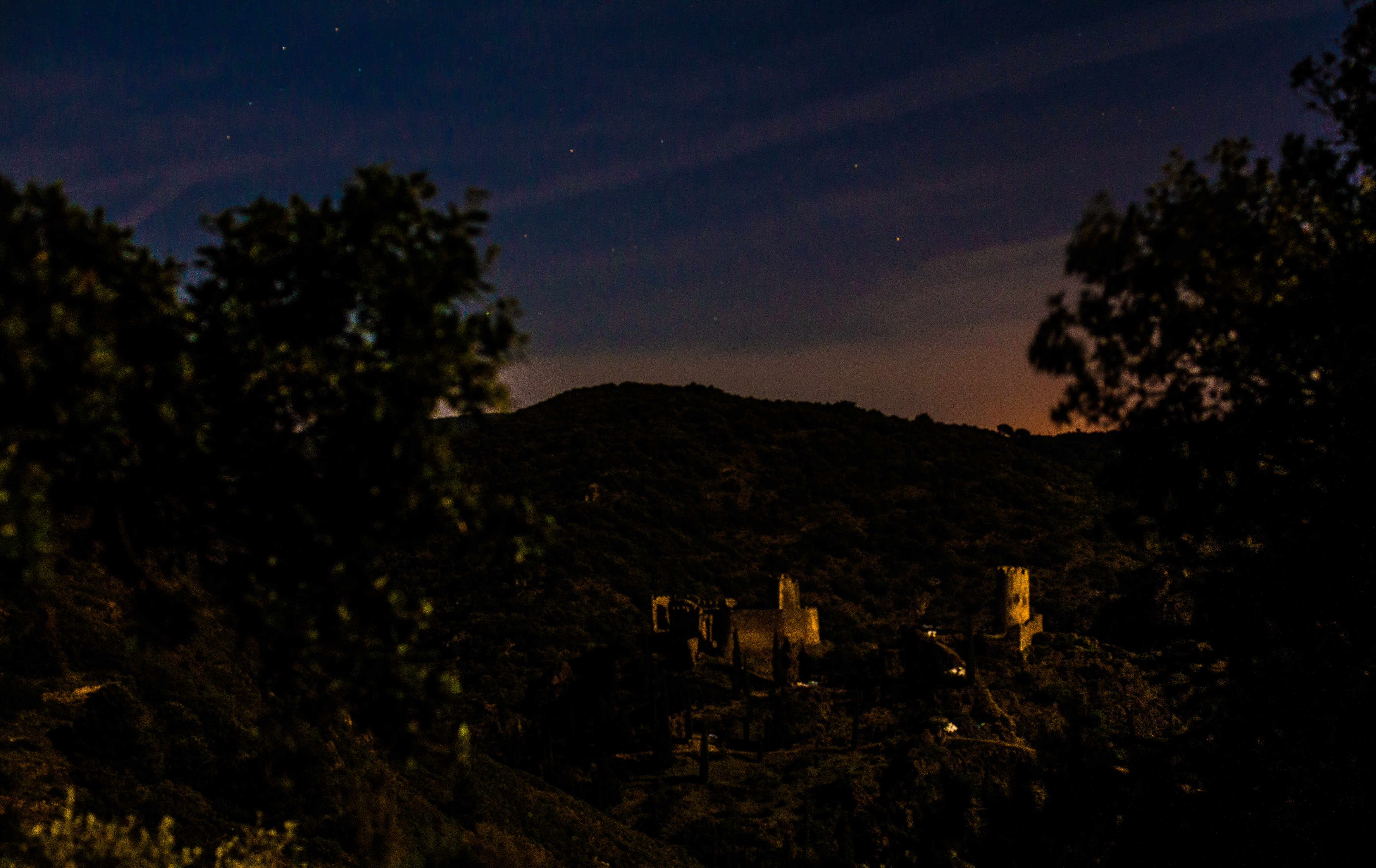
Lastours – our campground facing Château de Cabaret, Tour Régine, Château de Surdespine und Château de Querthineux
I just came back from Languedoc-Roussillon, where I followed the footsteps of May Magdalene the Templars and the heretic Cathars. This essay will focus on their similarity with early Christian and Jewish Gnostic thoughts, in which C.G. Jung was very interested. Where did the Cathars came from and what were there beliefs? What was the mystic and symbolic importance of Mary Magdalene, who is still worshiped prominently there in Catholic Churches?
In Languedoc-Roussillon Cathar castles and Templar remains, Abbeys and Châteaus are inspired by powerful myths , major mysteries, complex religious history, symbols of psychological relevance and – also significant pseudo-history. There a lots of stories about the Crusades and the mysteries of Sacred France in regards to Jesus, Mary Magdalene connected to it. Or, as in the cases of Rennes-le-Château, downright fabrications and conspiracy theories. So my journey became a transformational journey visiting places with magic and mysticism in addition to hiking, camping and photographing.
The Déjà-vu
My American wife, recently very pro-French again (wine and food) proposed the very south-west of France to improve my son’s French, she said. It is a long but doable drive, meaning that our Labrador – a good hiker – could accompany us. I tought there could be something in for me too: visiting the remains of Gnosticism and Templars. At some point the journey almost brought back 1971, when I travelled with two friends extensively in the Middle East, in particular Lebanon and Syria.
The Château de Queribus is probably the best known of all Cathar Castles. Some say it is the last Cathar stronghold, after Montesegur fell after a 10 month siege in 1244. A field below the hilltop castle Montesgur is reputed to be the site where over 200 Cathars were burned alive, having refused to renounce their fait
One drives through a harsh, sometimes nearly unpopulated rural area , ruled by medieval castles which you can visit in smoldering heat, often by yourself. Languedoc-Roussillon and especially the department Aude has been like Syria always cultural fertile and diverse with all its violent consequences. Like Levante and Egypt, Languedoc-Roussillonon harbors historical significance for Christianity and Gnosticism and their fight with each other, in what Phillip Jenkins called “Jesus Wars“. I have written about that here. Through Templars and the crusades this geographic and cultural regions are even themselves interconnected. The 11th century was the century of monks and knights, but also of a second wave of religious disputes like in the first two centuries, the century of heretics. While waves of Crusaders were fighting in Palestine, the common people of Europe were experiencing a crisis of faith. The Cathars, who lead an austere lifestyle, flourished in Aude and Herault at the foothills of the Pyrenees. My thoughts about them in the context of the Templars here.
This second wave of Gnosticism in Europe started a decade years after Jerusalem fell. Graham Simms and others have written about Jesus after the Cruzification. The book Holy Blood, Holy Grail put forward a hypothesis, that the historical Jesus married Mary Magdalene, and their children emigrated to what is now southern France and that would eventually initiated the Merovingian dynasty. This was later trivialized in the Da Vinci Code and correctly rebuked by serious historians. The Templar-Grail myth and the Rennes-le-Château version have been scolded as two of most notorious pseudo-histories and classic examples of conspiracy theories in history.
It seems sometimes, we experience today a third wave of Gnosticism, although only a trickle in the void of nihilism. Basic Gnostic theology was already known from the Nag Hammadi texts and earlier finds. Christianity has always had many variants, just as it does today, and Gnosticism is still alive and well. At some point, serious believers must decide where to place their faith not to be detracted from the basic Christian message, unless they want it. In any case from, this essay takes an interest in the transmission of thoughts from Jerusalem and Alexandria to southern France.
History of the Region
The region is named Languedoc, after the language formerly spoken there – the Language of Oc or Occitan and famous by its historic walled city of Carcassone in the north, once overrun by the Moores, today by visitors. The Pyrenees-Oriantales form in the West the border between France and Spain with both sides actual Catalan (still a spoken language). The area was trading extensively with Greece and was later called Septimania, because Augustus settled his veterans of the 7th legion there. After the break-up of the Roman Empire, this part of Gaul was dominated by the Visigoths, who migrated into France from central Europe. They sacked Rome in 491 and are known to have carried off the sacred treasure that the Romans had taken from the Temple of Jerusalem. The Visigoths dominated the Languedoc from the 5th until the 8th centuries with strongholds in Carcassone and Narbonne. There are also many remains of fortifications found around Rennes-le-Château, as mentioned a village with a recent “mystery story” and myriads of explanations on its own with a little help of the BBC.
Land of Heretics AudeCarcassonePeyrepertusePuvertQueribusQueribusQueribusAbbey of Saint-Martin-du-Canigou (Catalan: Sant Martí del Canigó) on the Spanish border.
After the Visigoths, the Arabs dominated the area for much of the 8th century. The sacred treasure is last recorded in the Visigoth treasury at Carcassone, but disappears from history after the Moorish invasions in the 8th century from Spain. Languedoc had also a substantial Jewish population in the region from Roman times – and 768 due to their help pushing back of the Arabs, a semi-autonomous Jewish principality was established there. Until the 13th century Languedoc was defacto independent of the rest of France ruled by the Counts of Toulouse. The Languedoc had its own distinct culture, which at that time – probably because of influence of Greek and Jewish – was the most cultured and advanced in Europe. It was here that the troubadour movement flourished and Gnostic thought resurfaced 1000 years after it was stamped out in the cradle of Christianity in the Middle East. In the 12th and 13th centuries the region was the heartland of the Cathar heresy, supported by the Counts of Toulouse. This gnostic form of Christianity is a strong dualism, essentially very similar to the Manichean thoughts and totally opposed to materialism and authority of the Church of Rome.The bloody and traumatic genocide of the Albigensian Crusade, so named after the major Cathar town of Albi, marked a watershed in the history of the Languedoc, ending the south of France’s independence, becoming subordinate to the north. The crusade against the Cathars infamously ended after the siege of Montségur.
The other major power in the medieval France were the Knights Templar, that mysterious order of warrior-monks formed during the Crusades. They were conspicuously neutral – some suspected even secretly helping the Cathars. After having outlived their usefulness after the fall of Outremer in the Holy land, the Templars were accused for secret heresy and for similar reasons (greed and power struggle although her of temporal forces) stamped out a century after the Cathars genocide. Although the Templars were found throughout Europe, the greatest concentration of their property was in the Languedoc and the neighbouring Roussillon region. After the crusade against the Cathars, the Languedoc retained its heretical character. The first witch trials in Europe were held at Toulouse in the 14th century. In later centuries, Languedoc was famed as a centre for alchemists – the town of Alet-les-Bains, 5 miles north of Rennes-le-Château, being a particular centre for the so-called ‘black art’.
Dualism
Ugo Bianchi, an Italian historian of religions identified three distinct features of Dualism:
Absolute Dualism regards the two principles of good and evil as coeternal and equal, whilst moderate Dualism regards the evil principle as a secondary, lesser power to the good principle.
Absolute Dualism sees the two principles as locked in combat for all eternity. Many absolute dualists’, regards time as cyclical and therefore lean to in reincarnation, whereasmoderate Dualism sees historical time as being finite and linear; at the end of time, the evil principle will be defeated by the good.
Absolute Dualism sees the material world completely evil, but moderate Dualism regards creation as essentially good.
Clearly the Cathars were absolute dualists, however this definition may be used to classify Christianity as moderatedualists, without the great (religious) philosopher Augustine of Hippo, who added our free will and Omne bonum a Deo, omne malum ab homine – “All good from God, all evil from man.”The psychoanalytic C.G .Jung said under the impression of the second world war: We need more understanding of human nature, because the only real danger that exists is man himself. ” Simpler said, We’ve all got both light and dark inside us. The Shadow, as C.G. Jung defined it, is in us.
Christian dualist heresy has always derived from a tradition that was ‘hidden’ or ‘concealed’ or suppressed from late antiquity onwards. Frome the Catholic/Orthodox point this tradition was mostly recognized as Manichaeism, occasionally in combination with other ancient dualist heretics. From the other side, of course it have been the early Christian apostles who became corrupted by the Church. Hence, this revealing of a kind of ‘secret history’ and attempt to reconstruct suppressed or concealed religious development follows the pattern of pseudo-history.
Manicheanism
Gnostic-Manichaean doctrines offered an investigation of the important dualist religious currents. Dualism defines distinctive source of evil in the divine and supernatural sphere the interrelationships between the divine, human and natural world.
The syncretism and distorted borrowings between the orthodox and heretical religions in antiquity and the Middle Ages present a complex picture. Arguably the development of such religious ideas are best evaluated over a great period of time.
With the establishment, expansion and consolidation of the Christianity, Judaism and Islam, other religious traditions dualism routinely attacked by its monistic critics, began to decline and even disappear from their traditional spheres of influence in Mediterranean Europe and the Near East. However, during the High Middle Ages dualist religiosity in Europe was resurrected, mainly through the missionary efforts of the Bogomil and Cathar heresies. The ecclesiastical and secular elites of medieval Christendom had to pursue what they saw as a re-fight of the battle against its revived ancient Manichaeism, the only universal religion to emerge from the great spiritual turmoil in third-century Mesopotamia. In Manichaeism, the traditional dualist religious vision which divided divine reality and the world into two opposed realms of good and evil was further magnified. Mani, the founder of Manichaeism, proclaimed that his intricate dualist system formed a meta-religion and underlay the teachings of Zoroaster, Buddha and Christ after it reached this universalist phase, having passed through a centuries-old evolution in Iran and the eastern Mediterranean world.
‘Dualism’ has a different usage in philosophical-historical and religio-historical contexts. In religious systems such as Manichaeism it means God and the devil as two coeternal principles. In more general terms, the term dualism is applied also to philosophical systems fort pairs of oppositions like that of Plato, with its dualities between the mortal body and the immortal soul, or the world perceived by the senses and the world of eternal ideas, comprehended by the mind; or the Kantian distinction between the phenomenal and the noumenal world.
Kabbalistic Gnosticism
Jung has been often (rightfully) seen of being a contemporary Gnostic. [1] However, the interpretations which Jung places on Gnosticism and the texts which Jung refers to on alchemy, were often Kabbalistic, so much so that one would be more justified in calling the Jung of the Mysterium Coniunctionis or Kabbalistic in contemporary disguise. One of the most serious and arguably criticisms against Kabbalah and the early Gnosticism was of course, that they may lead away from monotheism, and instead promote dualism, the belief that there is a counterpart to God: The good power versus an evil power. Gnostic-dualistic cosmology having roots in Zoroastrianism, believes since creation good and evil forces are divided; Neo-Platonism (which found its way in Christianity), argues that the universe knew a primordial harmony, disrupted by an evil force. Some argue that both models influenced Catharism.
Catharism
Queribus
Catharism was the most successful heresy of the Middle Ages, essentially a Neo-Dualism which followed the classical religious doctrine of the two principles. Most scholar agree Catharism had its roots in the Paulician movement in Armenia and the Bogomils of Bulgaria, as they inherited much (beliefs and organisation) from the Bogomils. However, explanations that it derived from local Jewish Gnostics, like the Essenes or even early Christians migrated to there are quite plausible. Often labeled as Neo-Manichaeism, one has to be aware, that Manichaeism was used then as a blanket term for Gnostics.
Flourishing principally in the Languedoc (Southern France and Northern Spain) and Italy, the Cathars taught that the world is evil and must be transcended through a simple life of prayer, work, fasting and non-violence. As all heretics, the Cathars believed themselves to be the heirs of the true heritage of Christianity going back to apostolic times, and completely rejected the Catholic Church. Most of the bible was rejected (except St. John) and Cathar services and ceremonies, were held in fields and in people’s premises. The main focus, however, has always been on the Cathars (from the Greek word meaning ‘pure’), a name that is normally reserved for the dissident Christians who lived in .
Cathars found widespread popularity among peasants, aristocrats and merchants, which alarmed the Church which founded the Inquisition and launched the Albigensian Crusade to exterminate the heresy. While previous Crusades had been directed against Muslims in the Middle East, the Albigensian Crusade was the first Crusade to be directed against fellow Christians, and was also the first European genocide. With the fall of the Cathar fortress of Montségur in 1244, Catharism was largely obliterated. Today, the mystique surrounding the Cathars is as strong as ever, as plenty can be written and projected about. Most of what we think we know comes from the Italian branch and inquisition protocols, because Catharism was mostly oral. What really happened, and what did the Cathars actually believe?
The Cathar Perfect was believed to have reached state of spiritual purity had been achieved through which the Holy Spirit, thus releasing them from the burden of reincarnation and the suffering “equal unto the angels” and thus already semi-Divine. After a rigorous training a ceremony took place in which various Scriptural extracts were like the opening verses of the Gospel of John. The Perfect were believed to have become “trans-material” or semi-angelic as expressed in the Gospel of Luke.
The first Cathar Synod was held between 1167 and 1176 at St. Felix-de-Caraman, near Toulouse marked the start of the real struggle between the Catholic Church and Catharism, as the Church now had an organised body to fight. In 1208, Pope Innocent III repeatedly tried to use diplomacy to stop the spread of Catharism, but in that year his papal legate and hated inquisitor Pierre de Castelnau was murdered (allegedly by an agent serving the Count of Toulouse). The event pushed him from diplomacy into military action. Some even consider the death of de Castelnau a false flag operation, engineered so that the crusade would be declared. An estimated 200,000 to one million people died during the twenty year campaign, which began in earnest in Béziers in July 1209. Papal Legate Arnaud-Amaury, saw no need to distinguish between the heretics and the thousands of faithful Catholics that lived in the city. “Kill them all,” was the abbot’s alleged reply. “God will recognise his own!” The number of dead that day was between 7,000 and 20,000, the latter figure reported back from Arnaud-Amaury to the Pope.
With such carnage, the other towns (e.g. Narbonne and Carcassonne) offered no resistance and soon the Southern counts had lost their territories and powers to the King of France and his allies. For these Northern lords, attaining the lands of the Languedoc had always been paramount; their mission had been accomplished.
An Inquisition was established in Toulouse in 1229 and from 1233 onwards, hunting down Catharism was no longer done on an individual basis. Many Cathar elders realised the lethal dangers they faced and began to take refuge in the fortresses at Fenouillèdes and Montségur, while others were able to incite uprisings, which forced the Inquisition out of Albi, Narbonne and Toulouse. Count Raymond-Roger de Trencavel was defeated at Carcassonne and only those Cathars hiding in the castles remained to be eradicated. A ten month siege began of the castle of Montségur but in March 1244, the last castle surrendered. Though their life would be spared if they recanted, the Cathars preferred to be burnt, rather than reject their faith. The last Cathar Parfait to be burnt at the stake was Guillaume Bélibaste, in 1321 in the between Rennes-le-Château – known for the mysterious 19th century priest Bérenger Saunière, mentioned later in this essay who with somehow could afford a lavish lifestyle an triggered a massive treasure hunt in the sixties.
Cathar Writings
Very few Cathar tracts have come down to us. Most of the surviving works come from Italy, due to literacy levels were generally higher than in the Languedoc. The Secret Supper elucidates the Cathar creation myth, in which Satan is cast out of heaven for wishing to be greater than God. Satan pretended to repent, at which God forgave him and let him do what he wanted. With his new-found freedom, Satan created the world of matter, and formed human beings from the primordial clay. Each soul was a trapped angel from heaven. Satan then convinced humanity that he was the one true god. The most important surviving Cathar tract is The Book of the Two Principles, which was written in the 1240s, probably by John of Lugio, a Cathar from the Albanensian. The Book of the Two Principles makes a case for there being two coeternal principles of good and evil, each of which created their own spheres – heaven and the material world. by Sean Martin states in his book The Cathars: The Rise and Fall of the Great Heresy: “The true god cannot be the author of evil. The verse in the Gospel of John which states ‘All things were made by it [the Word of God], and without it, was made nothing’ was interpreted as meaning that ‘nothing’ – i.e., the material world – was made by Satan.”
The Cathars studied and taught solely from the New Testament, notably the Gospel of St. John and the Book of Revelations, both of which were written by Mary Magdalene’s brother, Lazarus, who was devoted to Jesus. Cathar beliefs might thus come from Christianity in the time of Jesu. Some conclude from the Gnostic Gospels, that Mary Magdalene and Jesus were Gnostic. Gnostics believed the follower of Christ experienced Gnosis, knowledge, and thus became close to God. Some say, the Cathar were originally taught this by Mary Magdalene. As the Gnostic leaning psychoanalyst C.G. Jung described it: by knowing your Self, you can connect to God. The Cathars only appeared out of nowhere around the 11th century, but that they might have lived here in Languedoc hundreds of years before that, from the time of early Christianity is more plausible than the Bulgaria connection.
Catharism and women
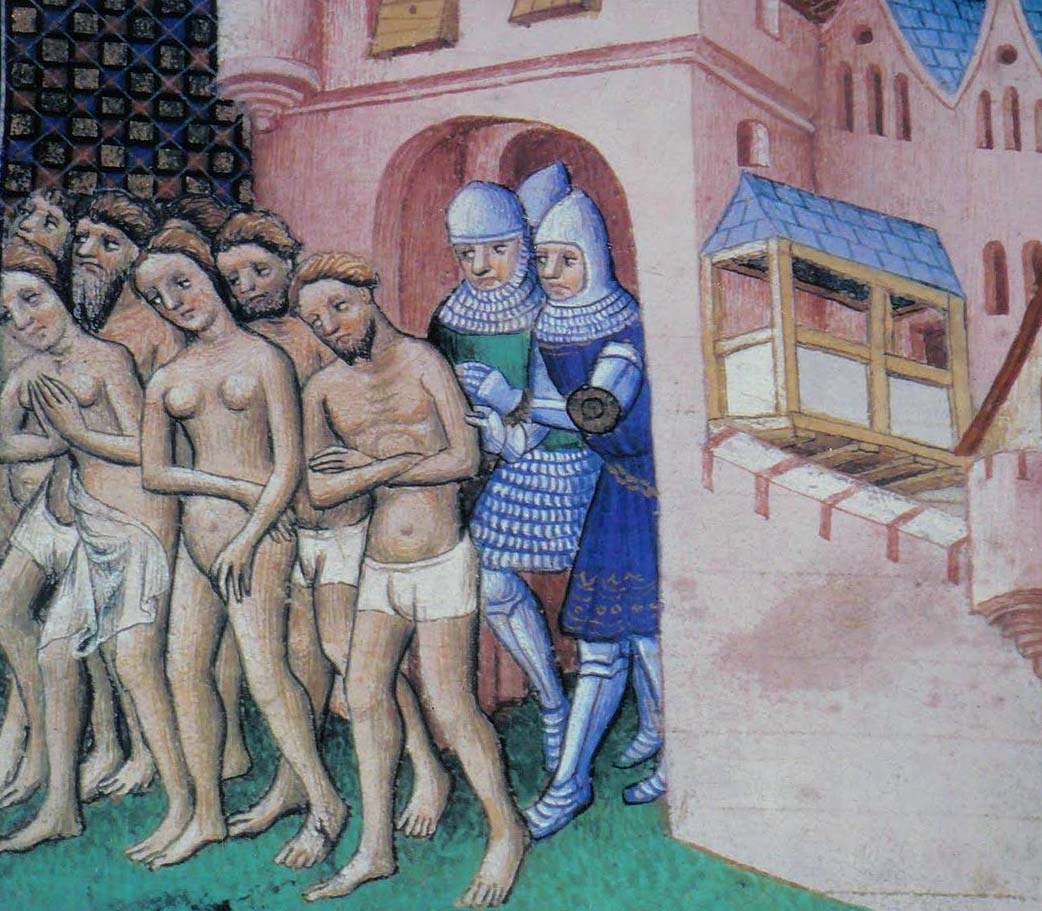
Cathars being expelled from Carcassonne in 1209. Derived from open source.
Cathars being expelled from Carcassonne in 1209. In this group, women appear not as numerous as men. As the early Christianity, also the Cathar movement proved to be extremely successful in gaining female follower. Unlike often stated. the record of Cathar and women is mixed, but the Cathars did respect women, and women played a role in the movement. Women could become Perfects known as Parfaites or Perfectaes. The Cathars were wary of the temptations of the flesh, but allowed females to receive the consolamentum and to preach. While women Perfects rarely traveled to preach the faith, they still played a vital role in the spreading of the Catharism by establishing group homes for women. Cathar beliefs include that one’s last incarnation had to be experienced as a man to break the cycle. Toward the end of the Cathar movement, French Catharism started the practice of excluding women Perfects.
Perfecti (they called themselves “bonhommes”) were expected to follow a lifestyle of extreme austerity and renunciation of the world which included abstaining from eating meat and avoiding any sexuality. They also seem to have had their own ideas concerning Mary Magdalene. [2]
Saint Mary Magdalene is still popular in southern France. She had been one of Christ’s followers. According to the Canonical Gospels, she was present at the Crucifixion, and the tomb of Christ, and took the news the missing body to the disciples. John’s Gospel additionally has her as the first to encounter the risen Christ, after she lingered in the garden weeping. Because of her role as messenger Mary Magdalene was afforded the title of apostola apostolorum. The early Gnostics has also revered the saint, and their writings portrayed her as a member of Christ’s inner circle. They believed Christ’s spirit appeared to her, after the Crucifixion, to reveal to her deeper spiritual truths. Gnostics also believed that Mary comprehended Christ’s teaching better than any other, being one of the closest people to him. According to one of the Gnostic apocrypha, the Gospel of Philip, she was called the companion of the Saviour.
…But Christ loved her more than all the other disciples and used to kiss her often on the mouth. The rest of the disciples were offended by it and expressed disapproval. They said to him ‘Why do you love her more than all of us?’ The saviour answered and told them ‘Why do I not love you like her?‘
The Catholic Church, however, downplayed her as a penitent whore. After the crucifixion, according to the medieval myth, she came and to southern France, living out her days as a hermit. Mary’s redemption by divine grace made her a symbol of God’s forgiveness of sinners. In so far as this she may have appealed to the Templars, many of whom, in their own way, had turned their backs on sinful lives to follow Christ. Many, including gypsies and poor people around the Languedoc, revered this saint, and believed the legend (fostered by Vezelay from the 1030s onwards) that she came there. She fled Palestine, and landed at Marseilles with Martha and Lazarus, and preached to the pagan inhabitants. Like the Gnostics before them, the Cathars elevated her above the other apostles. They may even have regarded her as the widow of Jesus. The anti-Cathar Ermegaud de Beziers and Durand de la Huesca wrote that the Cathars secretly taught that Mary Magdalene was the wife or concubine of Christ; and also that she was the woman ‘taken in adultery’ who Christ had saved from the Jews who wanted to stone her.
Mary Magdalene
mary magdalen st-maxim-cross – petit provence
From this allegation has arisen something of a conspiracy theory: It has it that knowledge of Christ’s alleged relationship with Mary (and perhaps proof thereof) passed from the Cathars to the Knights Templar. It was to remove the threat of this great secret, potentially damaging as it supposedly was to the Church, that the Catholic establishment suppressed the Templars, a century after the Albigensian Crusade. Although the theory probably has a particular appeal to those with a latent penchant for goddess worship in both cases, eliminating of the Cathars and the Templars was pure politics and greed. Many esoterics have additionally speculated that Mary Magdalene was herself of royal blood, or a priestess of some Isis/Ishtar cult, and that the Cathars and Templars regarded her almost as the embodiment of the feminine aspect of the divine and the personification of holy wisdom (Sophia to the Gnostics). Another theory has Mary and Jesus founding a dynasty, which fused with the Merovingian line.
I saw Mary Magdalene statues or paintings in almost ever church. extensively in Rennes-le-Chateau. It must be remembered that she was a legitimate Catholic Saint. Her supposed relics had been claimed by the Benedictine Monks of Vezelay in Burgundy, Central France. The cult was in evidence there from the mid eleventh century. The abbey claimed that the relics had been brought there centuries before by a monk who had retrieved them from their original shrine near Aix in Provence, where Mary had supposedly been lain to rest after spending 30 years living as a hermit in a remote cave called la Sainte Baume.Mary Magdalene is usually thought of as the second-most important woman in the New Testament after Mary. Mary Magdalene traveled with Jesus as one of his followers. She was present at Jesus’ two most important moments: the crucifixion and the resurrection. Within the four Gospels, the oldest historical record mentioning her name, she is named at least 12 times more than most of the apostles. In the New Testament, Jesus cleansed her of “seven demons”,[Lk. 8:2] [Mk. 16:9].
Petit Provence is the region in southern France adjacent to Aude and Herault where Mary Magdalene and the others came ashore at St. Maries de la Mer. A painting of Mary Magdalene is at the Church in Les Saintes Maries de la Mer, which is west of Marseille showing the boat carrying Lazarus, Martha, Mary Magdalene and a young girl named Sarah. Also the sister of the Virgin Mary and several others are shown on the boat. Often the jar in Mary Magdalene’s hand signifies the blood of Jesus. Left is the painting of the Crucifixion from the Basilica Sainte-Marie-Madeleine et le Couvent Royal, in St. Maximin. This is where Mary Magdalene was buried. She is shown at the foot of the cross in a very beautiful almost intimate pose.
Rennes-le-Chateau
Rennes-le-Chateau, is located near Couiza between Carcassonne and Quillan, has become world-famous ever allegedly since its infamous priest Bérenger Saunière discovered – or was given – a small fortune. About 300 books were written where the money came from, arguable and convincingly rebuked by Bill Puttnam as distorted pseudo-history:
Lack of solid evidence
Citing evidence without giving a sources
Presentation of evidence in a misleading way
Coincidence taken as evidence
Failure to explore consequences of derived conclusions
Disregard of conflicting evidence
Conflict with accepted chronology
Theories put forward, what kind of Treasure the priest Saunière might have found:
the treasure of the Visigoths, including the treasure of the temple of Jerusalem,that roman emperor Titus took ad 70. and Alaric I, took from Rome during the sack of 394
the treasure of the Cathars. When the last Cathar bastion of Montségur fell, the besieging royal troops found nothing of the famous Cathar treasure taken before its surrender
the treasure of the Knights Templar. The Templars had a presence in the region. There was a commandery at Campagne-sur-Aude and an observation post on Mount Bézu.
the treasure of Blanch of Castille. The mother of Saint Louis, regent of France, came to Rédé (Rennes-le-Château) in 1249
evidence that the Merovingian bloodline is unbroken.
evidence that Jesus didn’t die on the cross
evidence that Jesus was in fact married to Mary Magdalene.
evidence that after the crucifixion Marie Magdalene came to France carrying her offspring that later became the Merovingians or intermarried with them.
he tombs of Jesus and Joseph of Arimathea in the vicinity of Opoul Perillos
the tomb of Mary Magdalene and perhaps even one or more of her children in the vicinity of Rennes-le-Château, perhaps in the Grotto locally known as
the mummified body of Christ, Mary Magdalene or both is buried in the region somewhere
the Crypt of the Lords of Rennes beneath his church
the Arma Christi (the instruments used during the Passion of Christ) were kept in Notre Dame de Marceille and Rennes-le-Château by a group of Fransciscan Ebionites.
Mary Magdalene and Isis
But that is not the point, the area of Rennes-le-Château is full of interesting real history especially of Mary Magdalene. Although it did not exist in Roman times, founded by the Visigoths in the fifth century, there was most likely an Isis Temple there. Reports of ancient authorsrelate tothe areaof Rennes-le-Chateau ( Celtic Rhedae,Rezae,Reddis or Reda). TheGreek geographerStrabodescribesthe tribe ofCelticTectosagesas “Simple and modest intheir way of life” butthey fear thegods.Another reportcomes from theRoman authorsPomponiusfrom southern Spainwhohaswrittenabout 43AD,his famousbookDeSituOrbisGeography. In it, hedescribes ahidden treasurein the minesof the Pyreneessouth of Carcassonne. Furthermore,there is a reportthaton an oldparchment(which was discovered in Jerusalemin aBible), a temple dedicatedto Isis inRhedaeunder EmperorNero. thenunder Titusin 70 ADbaptized with thenameMagdalene.
Many think today Mary Magdalene was a Priestesses of Isis. Ironically Pope Gregory, in 591 AD cast doubt on the “purity” of Mary Magdalene’s love for Christ when he suggested that one of the seven demons that Christ cast out from Mary Magdalene must have been the sin of adultery. He also conflated Mary Magdalene with Mary of Bethany, the “sinner” who washed Christ’s feet with her tears and dried them with her hair, causing Peter, not exactly concerned of Anima, to wonder how Christ could allow such an appalling display of erotic attention. The idea that Mary Magdalene was a prostitute caught the collective imagination and spread like wildfire in legend and art. From Jungian view on has to take this contagious fantasy into account as meaningful projection of her sin which gets a life of its own for psychological reasons. The Catholic Church has admitted its error in the smearing of Mary Magdalen as a prostitute, however, although Mary Magdalene is almost always mentioned first ahead of the Virgin Mary, only a handful of scholars have attempted to reconstruct why she could have been so important. She carried a royal title that translates as “The Wise Women.” According to the Gnostics, Jesus referred to her as “The One who knew all. The Wise Women was in Mesopotamia called Cybele, Astarte, and Ishtar, the Egyptians called her Isis, the Greeks called her Athena, and the ancient Hebrews called her Asherah, The Woman of the Tree and the very consort to the Lord God YHWH. Gnostics called her Sophia, but in the hands of the Catholic Church, she became The Black Madonna. Legend connects this Black Madonna with both Isis and Mary Magdalene.
Bérenger Saunière built a house and called it Villa Bethania. That he named the house like this is the nearest thing to any mysterious religious knowledge he might have had, for then the Church believed that Mary at Bethany and Mary Magdalene were different people. But Bérenger Saunière didn’t. He built a “folly” and called it the Tour Magdala. There he would study and read.
RENNES-LE-CHATEAU Tour MagdalenRENNES-LE-CHATEAU Church PortalRENNES-LE-CHATEAU Church DevilRENNES-LE-CHATEAU Church Johann the BaptistRENNES-LE-CHATEAU Church FrontRENNES-LE-CHATEAU Church Back
The church is dedicated to Mary Magdalene, and some people think that the priest’s great treasure was spiritual – the knowledge that Mary Magdalene and Jesus were married and had founded a bloodline, great knowledge which would destroy the Church’s concepts of virginity being related to godliness. There is no doubt that the priest loved Mary Magdalene. He restored his church lovingly and spent a large sum on it between 1886 and 1897 of unknown origin.
RENNES-LE-CHATEAU Mary Magdalen
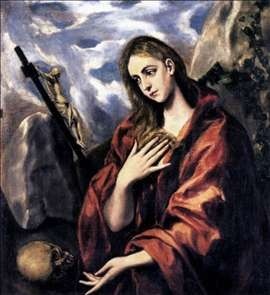
Inside the church is a statue of Mary Magdalene and she appears much more often than usual in a catholic church. It is standard iconography that Mary holds a crucifix (the crucifix was not used as an emblem until the 9th century) and her jar of ointment. At her feet is a skull resting on a book; this signifies her meditations on mortality. Although it is nowhere mentioned in the Bible, there are well known hints that Mary Magdalene was a prostitute. If we take this story seriously what does this mean? First we know that Jesus did mix with prostitutes, tax-collector and the general outcasts of society. Second, in ancient Sumer and in Egypt, priestesses participated annually in the Sacred Marriage, representing their goddess and thus ensuring fertility and the continuance of life. It is most likely that the latter idea of “temple prostitution” arose from the participation of high priestesses in the sacred rituals.
It is clear in the Old Testament that the priests of the god Jehovah hated the Priestesses of Goddess temples and referred to them as Temple prostitutes because it was known that in many Temples of the day used sexual rituals. One of the Gnostic Gospels was called “The Gospel of Mary” and this gospel it seems contains the teachings of Mary Magdalene. Another Gnostic Gospel (see Early christian writings here) called Pistis Sophia (Sophia was the Goddess of wisdom) is about a dialogue between Jesus and Mary Magdalene whom he calls, “dearly beloved. In one dialogue Peter complained to Jesus that Mary Magdalene dominated the conversation with Jesus but Jesus rebukes him. In another Gnostics text called “Dialogue of the Saviour” she is portrayed as a very wise Woman who understood Jesus completely unlike the rest of Jesus’s disciples. So it seems that Mary Magdalene was a very important member of early Christianity. Pistis Sophia was dated about 250 AD. Sophia means wisdom. In Pistis Sophia Jesus returns to the disciples eleven years after his ascension into Heaven to exchange views on his teachings. Pistis Sophia, written in 250 AD, apparently show the Gnostic teachings of Jesus and Mary Magdalene. Arguably the Pistis Sophia is blend of primitive Christianity and Hellenic Paganism, with other elements such as reincarnation, Astrology, Mystery religion and Hermetic magic. The Goddess makes an appearance in the guise of Sophia, a Fallen Angel. In Old French legend, the exiled “Magdal-eder,” the refugee Mary who seeks asylum on the southern coast of France, is Mary of Bethany, the Magdalen. The early French legend records that Mary “Magdalene,” traveling with Martha and Lazarus of Bethany, landed in a boat on the coast of Provence in France.
Mary Magdalen as Eros and feminine archetype
RENNES-LE-CHATEAU Porta 1
Back to the Church of Mary Magdalene in Rennes-le-Chateau. The inscription at the portal is most startling (at the left with permission from www.marymagdalenebooks.com). The decor may seem somewhat superficial in any Catholic church at any time and place, but a closer look reveals strangely disturbing – and perhaps even pagan – dark imager and symbols that should unsettle Christians , including a hideous grimacing plaster demon crouched just inside the door, and had the words ‘This Is A Terrible Place’ inscribed over the porch, clearly a gnostic view.
In the church Mary is shown in conventual manner, weeping as Jesus is laid in his tomb by Joseph of Arimathea. The person in red comforting the Virgin Mary in the background is Mary Magdalene’s brother, Lazarus. Like Isis and Ishtar, Mary Magdalene mourns the death of the god and her partner she loves, and when he resurrects, she celebrates his renewal. Through her intense spiritual love, she represents the feminine side of the death and resurrection phenomenon that plays a facilitating role in the humanization of the god-image the reverse process of C.G Jung’s individuation. I can’t help to think which kind of love she represents. There are four shades of love – derived from the different Greek words for love. (I have written here about it). The Greek language distinguishes four distinct words for love: agápe, éros, philía, and storgē.
Storge (στοργή) means “affection” in ancient and modern Greek. It is natural love, like that is felt by parents for offspring, or between brother and sister or by children for their parents. It is a descriptor of relationships within the family. It is also known to express mere acceptance or putting up with situations, as in “loving” the tyrant. The key attribute is natural.
Philia (φιλία) is “conscious” love, we know from words like philosophy – love for wisdom (Sophie). It mean a feeling of friendship and enjoyment of an activity, again used in both ancient and modern Greek. It is a dispassionate virtuous love, a concept developed by Aristotle. It includes loyalty to friends, family, and community, and requires virtue, equality and familiarity. The key attribute is rational.
Agape (ἀγάπη) means love in a “spiritual” sense. In Ancient Greek, it often refers to a general affection or deeper sense of ” unconditional love” or altruistic love , coming from the heart. In latin the equivalent word is “caritas”, it gives and expects nothing in return. Agape is used by Christians to express the unconditional love of God for us and loving each other like we love ourselves. The key attribute is spiritual.
Eros (érōs) is “physical” passionate love, with sensual desire and longing without the balance of consciousness. The Modern Greek word “erotas” means “intimate love”. Plato expanded this definition: as appreciation of the beauty within an object, or even of beauty itself. Indeed the word platonic love today describes, “without physical attraction.” Plato argues that eros helps the soul find knowledge in beauty which contributes to an understanding of spiritual truth, leading to transcendence. The Greek believed that beauty can never be evil. The key attribute here is sensual.
Although the Judeo-Christian fathers excluded any sign in their orthodoxy that Yahweh and Christ may have had love partners, archeological evidence and Gnostic texts point to the possibility that they did. In our era, with the psychological perspective that C. G. Jung heralded, we can understand the role of the Eros principle [3] that was split off from our god-image, along with the “evil” of the flesh. The emergence of Mary Magdalene in popular culture as the “Holy Grail” or vessel of Christ’s child reflects the intense yearning in the psyche for the feminine principle to participate in the continuing incarnation of the god-image, and for the divine feminine–masculine partnership to realize itself in personal, human experience. Mary is also the first to experience, personally and empirically, the spiritual image of God, a paradoxical union of opposites: life and death, man and god, spirit and matter.
Magdalen in this church painting on the front of the altar, is shown with a book and a skull and usual but with a crucifix of living wood, implying to some that Jesus did not die on the cross, as early heretics, Gnostics and Cathars believed.
RENNES-LE-CHATEAU Churc Mary Magdalen with empty Cross of living wood
Many argue, that Jesus was a Gnostic teacher but did not die on the cross. We know from the Bible that Jesus spent most likely his childhood in Egypt. A very important Egyptian religion of the time was the religion Isis and Osiris. Like Jesus Osiris was a god who was murdered and then returned from the dead. Many scholars have commented on the similarities between Jesus and Osiris and Isis and the Black Madonna. I have described here, obvious similarities of the teaching of the trinity of Father, Son and Holy Spirit, with triads in ancient religions. So it all does indicate to some that perhaps Jesus and Mary Magdalene was a trained priest and priestess in Egypt with relations to Isis and Gnosticism. In the porch of the church is yet another secret message that implies that Bérenger Saunière believed that Mary Magdalene loved Jesus, indeed, adored him. Just recently, after some 60 years of treasure-hunters, the village is becoming greatly loved by spiritual people interested in Mary Magdalene.
The Black Madonna
I lived for 5 years nearby the Benedictine Abbey of Einsiedeln, close to Zurich in Switzerland.
The breathtaking Baroque basilica in the Einsiedeln’s monastery alone is stunning, in which the black statue resides. The Madonna holds the Christ child, who is, himself, holding a black bird. The Way of St. James which extends from all corners of Europe, touches Einsiedeln and the 11th-century abbey of Saint-Martin-du-Canigou situated in a spectacular location in the Pyrenees mountains on the way to Santiago de Compostela and Finisterre. Black Madonnas have been a source of mysticism within the Catholic Church.
Black_Madonna_of_Einsiedeln
Whatever the true significance may be, approximately four hundred Black Virgins are now located throughout Europe, the majority in France. The Black Madonna can be frequently traced back to pre-Christian mother goddess figures. Black Madonnas may in fact have been originally pagan goddesses who were renamed to transfer worship of the Earth Mother to the Virgin Mary or as some believe Mary Magdalene as incarnation of Isis. The cult of Isis was one of the dominant religions of the Mediterranean during late Roman times had spread all over Roman-occupied lands. Please refer here, to read mor how at that time the Mithras Cult, Christianity and Roman State Religion competed: Isis, Mithras and Jesus: Clash of male and female Archetypes in classical Rome. Churches were routinely built over Isis temples after Christianity became in the fourth century state religion, like it is said happened in Rennes-le-Château. Cybele and Artemis/Diana of Ephesus, both dark-skinned fertility goddesses were still worshipped in France and the Mediterranean coast from Antibes to Barcelona during the later centuries of the Roman Empire. Cybele was during the 3rd century the supreme deity of the town of Lyon. Marseilles was devoted to Greek Artemis. When the Crusaders returned from the Middle East Knights Templar, and refuges of overun Outremer surely brought heretic and christian art and gnostic thoughts. Many of whom who were wiped out as heretics, were involved in promoting the cult of the Black Madonna and her association with Mary Magdalene. The Black Madonna Limoux, south of Carcassone very close to Rennes-le-Château. The church at Limoux is called the Notre Dame de Marceille.
Conclusion
What precisely the Cathars believed, remains somewhat of an enigma. Many have used it as a blank canvas, to paint their own thoughts or convictions on. Hence, a lot of myths and falsehoods now exist about Catharism. Suggestions that Jesus survived the crucifixion, went to Egypt, then settled in France are highly speculative, lacking historical evidence (heretic gospels grew like fungus in the formative period of Christianity) and of course are alien to my belief. However, some relations between Christianity and Egypt are clearly not. So is the thought, that gnosticism was already there long before it resurfaced. There is historical and archaeological research that proves a connection between Jerusalem, Egypt, the Land of heretics and Mary Magdalene. Nor would I argue against the view, that there is much more in the story of Mary Magdalene than the gospel tells. Except maybe rhe gospel of luke Luke – my favorite – who resonates so subtile the Anima [4] of the Church in his description of Holy Mary, Mary Magdalene and Mary of Bethany. Is seems almost they represent the classic female archetypes of love and their shadows – from a Jungian view. Notable, the Cathars recited from the gospel of Luke during the ceremony of receiving the consolamentum and become “bonhomme”.
I might return to the subject and the location.
Bishop Fulk, asking a knight why he did not expel heretics, received the classic answer: ‘We cannot. We have been reared in their midst. We have relatives among them and we see them living lives of perfection.’
Malcolm Lambert,
The Cathars
Notes:
Some of biggest creative thinker of the humanity, like C.G. Jung were de facto semi-gnostic and spiritualist. Might has always utilized symbols and collective archetypes. This is valid from Greek philosopher Plato, Dante Alighieri’s “La Divina Commedia”, up to Richard Wagner’s Parsifal, to name just a few.
In the 20th century Freud made the mistake, equating drive energy strictly with sexual energy. Jung’s break from Freud came in part because Jung saw drive energy as transpersonal and deriving from the unconscious, the feminine counterpart to consciousness.
Pope Gregory the Great’s homily on Luke’s Gospel, dated 14 September 591, first suggested that Mary Magdalene was a prostitute: “She whom Luke calls the sinful woman, whom John calls Mary, we believe to be the Mary from whom seven devils were ejected according to Mark. And what did these seven devils signify, if not all the vices? … It is clear, brothers, that the woman previously used the unguent to perfume her flesh in forbidden acts” (1844–1864, Homily XXXIII, col. 1238–1246).
Though critical, the role of the animus must be left for another time. I recommend Animus and Anima, Emma Jung.Gnosticism Term used to designate many different sects who flourished in the first few centuries AD. many elements of Christian Gnosticism are pre-Christian Gnostics, such as the belief in Dualism. The name derives from the Greek word for knowledge, gnosis.
Gnosticism: Term used to designate many different sects . Many elements of Christian Gnosticism are pre-Christian Gnostics, such as the belief in Dualism. The name derives from the Greek word for knowledge, gnosis. Gnosticism can be found around all revealing religions as it is essentially syncretistic .
Dualism: The belief that good and evil are two independent, opposing principles.
Bogomilism: Dualist heresy founded by the priest Bogomil in the early tenth century in Bulgaria. The earliest tangible evidence is datable to 1167. The movement survived up to the nineteenth century. It appears to have influenced Catharism strongly, although some see other, local roots.
Paulicianism: Dualist heresy that emerged in seventh-century Armenia. In 717, a council of the Armenian Church denounced them as ‘sons of Satan’ and ‘fuel for the fire eternal’. They are thought to have survived until the seventeenth century.
Docetism: The belief that Christ did not have a physical body, common amongst Gnostics. Docetics believed that Jesus’s body was an illusion, as was his crucifixion. Docetism was declared heretical by the Church. Both the Bogomils and the Cathars were Docetist.
Essenes: Radical Jewish sect that existed from the second century BC to the first century AD. Some argue that that both Jesus and John the Baptist had links with the sect. The community at Qumran, which produced the Dead Sea Scrolls, is thought to have been Essene.
Elchasaites: Jewish Christian sect who were, interestingly, also known as katharoi. Their most famous member was the Persian prophet Mani.
Manichaeism: Dualist religion founded by the Persian prophet Mani in the third century. As it had an Universalist claim it was majorcompetition, Wiped out in Europe during the sixth century, and emigrated as the Nestorians to Asia. ‘Manichaean’ became a blanket term for heretic during the Middle Ages
Adoptionism: Belief that Christ was not born divine, but only became so after his baptism.
Nestorianism The belief, first proposed by Nestorius, then patriarch of Constantinople in the fourth century, that Christ’s person contained two separate beings, one human, the other divine. Nestorianism was declared heretical at the Council of Ephesus in 431, but it survived in Asia and came back ironically with the Mongols in the thirteenth century. See Phillip Jenkins “Jesus Wars”.
Arianism Named after Arius (256–336), from Alexandria, denied that Christ and God were one person, seeing them instead as two different Divine entities. Declared heretical at the Council the Council of Nicaea.
Marcionism Gnostic dualist sect that taught the principle of the two gods, with Christ being the son of the true god, and the Jehovah of the Old Testament being seen as the evil god.
Some Cathar terms:
Listeners In the Cathar context, a Listener was a person interested in Catharism, but was not ready or willing to become an actual member of the church, which required the taking of the convenanza.
Believers The majority of Cathars were Believers. That is to say, they had taken the convenanza, but were not yet consoled. They were not subject to any dietary restrictions.
Perfects In the Cathar context their priests. Perfect The were ascetics who were the heart and soul of the Cathar movement. Bogomilism also had similar classes
Consolamentum Cathar rite of baptism that elevated the Believer to the state of a Perfect.
Convenanza Formal rite that made a Cathar Listener a Believer.
Bibliography
The Other God: Dualist Religions from Antiquity to the Cathar Heresy (Yale Nota Bene), Stoyanov, Yuri
The Cathars: The Rise and Fall of the Great Heresy by Sean Martin
The Knights Templar: The History and Myths of the Legendary Military Order by Sean Martin
Malcolm Barber, The Trial of the Templars (Cambridge University Press, 1978); The New Knighthood: A History of the Order of the Temple (Cambridge University Press, 1994)
Gnosticism and Early Christianity by R. M. Grant
Jesus Wars Harper, 2010 by Phillip Jenkins
The Treasure of Rennes-le-Chateau: A Mystery Solved, by Bill Putnam
C.G. Jung, Aion Untersuchungen zur Symbolgeschichte
A History of Egypt from the Earliest Times to the Persian Conquest, James Henry Breasted Kindle-Edition
The Religions of Ancient Egypt and Babylonia A. H. (Archibald Henry) Sayce Kindle-Edition
Malcolm Barber & Keith Bate (translators & editors), The Templars: Selected Sources (Manchester Medieval Sources Series, Manchester University Press, 2002)
The Rise of Christianity: How the Obscure, Marginal Jesus Movement Became the Dominant Religious Force in the Western World in a Few Centuries by Rodney Stark
The Lost History of Christianity: The Thousand-Year Golden Age of the Church in the Middle East, Africa, and Asia–and How It Died by Philip Jenkins
Historia Mundi Volume IV, Lehnen Verlag, Die Kirche zur Zeit der Apostel und Märtyrer
The Cults of the Roman Empire, Robert Turcan
Les sites templiers, Jea Luc Barbiere
Haskins, S. Mary Magdalene: Myth and meaning, (1993) New York, NY: Riverhead Books
The Cathar religion represents a major medieval resurgence of Gnosticism, and we offer an important collection of Cathar Texts, including the complete manuscript of the Lyon Ritual, Interrogatio Iohannis, and The Book of the Two Principles.
While the Nag Hammadi Library represents the richest source of classical Gnostic texts, many other primary Gnostic documents were discovered in the century prior to the Nag Hammadi find. These are cataloged in the Classical Gnostic Scriptures and Fragments section.
Of associated interest is the Christian Apocrypha and Early Christian Literature, a section containing other important Christian texts surviving outside canonical tradition, some of which manifest Gnostic influence.
The G.R.S Mead Collection contains over a dozen volumes written by G. R. S. Mead (1863-1933), one the greatest early scholars of Gnosticism. These works provide an invaluable evaluation of texts relating to Gnostic tradition available before discovery of the Nag Hammadi collection.
The Nag Hammadi Library, a collection of thirteen ancient codices containing over fifty texts, was discovered in upper Egypt in 1945. This immensely important discovery includes a large number of primary Gnostic scriptures — texts once thought to have been entirely destroyed during the early Christian struggle to define “orthodoxy” — scriptures such as the Gospel of Thomas, the Gospel of Philip, and the Gospel of Truth. The discovery and translation of the Nag Hammadi library has provided impetus to a major re-evaluation of early Christian history and the nature of Gnosticism.
We have add extensive resources on two centrally important texts from Nag Hammadi: The Gospel of Thomas and The Secret Book of John. Multiple authoritative translations of several Nag Hammadi scriptures are included in the collection.
Valentinus and Valentinian Gnosis. Valentinus was one of the most influential Gnostic Christian teachers of the second century A.D., and was the only Gnostic considered for election as Bishop of Rome (Pope). He founded a movement which spread throughout Europe, the Middle East and North Africa. Despite persecution by developing orthodoxies, the Valentinian school endured for over 600 years. A large number of texts in the Nag Hammadi collection are influence by Valentinian tradition. Due to its importance, we have a large section of the library dedicated specifically to Valentinus and the Valentinian Tradition.
Hermetism and the Hermetic Gnosis — including the Corpus Hermeticum
Beyond the bounds of classical Christian Gnosticism — represented by the above materials — the Hermetic tradition is another very important and influential Western tradition of Gnostic character. The Hermetic writings represents a non-Christian lineage of Gnosticism. Our Corpus Hermeticum and Hermetic Writings section offers the most extensive collection of Hermetic texts available on the internet. Included here you will find introductory material, the complete texts of the Corpus Hermeticum, and essentially all other extant Hermetic writings. Included is an introductory lecture.
The Dead Sea Scrolls Collection
The Dead Sea Scrolls Collection in the Gnostic Society Library is one of the largest and most referenced Dead Sea Scroll resources on the internet. During the middle years of the twentieth century two important but very different collections of ancient religious texts were unearthed in Palestine and Egypt: the Dead Sea Scrolls and the Nag Hammadi Library.
Illustrations are my own (except stated otherwise) and may be used with quoting the proper sources.
It became clear during my research of Jungian Archetype of the wolf, that in mythology, religion, in legends and fairy tales the wolf has played an outstanding ambiguous, dualist and multidimensional role. The wolf archetype is so central, that how the wolf is viewed, indicates the mindset of the human, secular or spiritual organisations of the society we live in.
In a few weeks, there is Whitsun, and I will make one of my occasional trips to the monastery. Writing this article was a preparation to the theme and will be updated afterwards The rock monastery St. George is a development center of the Benedictine order in the Austrian Inn valley. From the monastery to the St. George mountain (Karwendel) on foot takes approximately one hour. The religious exercise will be lead by a Benedictine monk, who happens to have formal psychoanalytic credentials and introduced the theme “The archetype of the wolf” for what to my understanding is a spiritual hiking weekend.
st_georgenberg_stift_fiecht
But there is much more. Joland Jacobi, a close assicate of C.G. Jung mentiones the archetype of the wolf a few times in her book “Complex, Archetypes, Symbol in the Psychology of C.G. Jung”, Bollingen Series Princton University Press, 1957. Joland Jacobi writes, “being devoured or swallowed is also a widespread archetypal motif… the wolf that devours the kid”…. [page 155, 181,185]. C:G: Jung writes numerious times about Wotan, who was eaten at Ragnarok by the giant wolf Fenrir and then avenged by his son Vidar e.g. “Four Archetypes Mother, Rebirth, Spirit, Trickster”, Routledge and Paul, 1957. In the the same book, C-G. Jung writes about the wolves about the German fairytale, in which the wolf gives the hero a magic gift of his hairs (page 109) .
Historical encounter between man and wolf
You may refer my recent article “The Wolf as an Jungian Archetype Vessel” which argues that the wolf is one of the most persistent and structurally overdetermined animal-symbols in human civilization because the historical encounter between man and wolf unfolded simultaneously on three inseparable levels: biological rivalry, social mirroring, and archetypal projection. The wolf therefore persists not merely as zoological memory nor merely as mythological ornament, but as a privileged symbolic convergence point through which deep psycho-biological structures become visible in religion, myth, dream, political imagination, and collective anxiety. In his book Of Wolves and Men, Barry Lopez argues from a naturalist view similarly that traditional hunting cultures suggest deep behavioral analogies achieved through a respectful, reciprocal relationship. These societies and wolves viewed the hunt as a sacred covenant requiring humility, dignity in the ‘conversation of death’ and hunting skills. Barry Lopez shares a Nunamiut elder’s insight that a old man and an old wolf possess identical knowledge of the land and hunting: “After a pause the old man looks up and says: The same. They know the same.“
The wolf reminded men to their domestication and their inner struggle with it. The wolf became also an image of remaining wild and sexuality, in a Jungian sense became men’s Shadow of undesired and unwanted. Those of us with Western background, do often not realize the depths and subtle (subtile) differences and similarity of Pagan German or Norse, Eastern or Native American stories. Especially wolf stories examine reincarnation, spiritual energy, gift exchange, the vitality of the body, and the spirit of the soul. In the old worldview everything is in flux and begins, balances out from, and ends with polarities akin to yin and yang. Even the gods are subject to this, undergo transformation, and often pay for what they gain with a corresponding loss. For indigenous people – including the indigenous Celts and Germanic – religion as such did not exist. Native views of spirituality wed it to time and place, land and sea and sky. Our forebears lived side by side with the wolves in an inspirited world, and that world abides, as do its instinctive, but sacred dimensions:
Axe-time, sword-time, shields are sundered,
Wind-time, wolf-time, ere the world falls;
Nor ever shall men each other spare….
Now do I see the earth anew
Rise all green from the waves again…
Myth wolf – gods, goddesses, demons and outlaws
Wolves make quick decisions, often need to trust their own instincts and make firm emotional attachments. They teach us to do the same, to trust our instincts and intuitions, and have control over our own lives. At some point in psychological development, most people struggle with the transformation of spiritual and physical aspects of their being. In many stories, the wolf was described as wild, tearing, biting, grim and bloodthirsty. The image of the wolf has been used to represent all those aspects. From where does the primeval fear and awe of the wolf originate?
The Dark Wolf Outlaw
Demons: In the Edda, the ancient Icelandic sagas, the wolf was a symbol for demonic powers: Odin, the God of war and death was accompanied by two wolves. The mythical wolf Fenrir, a son of the fire god Loki and the giant Angrboda was stronger than gods. In Indian mythology, the wolf is described as demonic. Furthermore, the wolf is portrayed as thievish, deceptive and false. In India, the demons were named after the wolf. In Christianity the wolf was even equated with the devil: Jesus Christ advised against false prophets dressed in sheep’s clothing which in fact were wolves. Numerous myths from Eastern Europe, Russia and Scandinavia tell about the creation of the wolf by the devil. During the creation of the wolf, the devil relied on the help of God and it was God’s will that the wolf kills sheep and goats.
Gods: Many different cultures worshiped the wolf. For the Egyptians the wolf symbolized the god of the empire of the dead. For the Romans the wolf was the symbol for Mars, the God of war. The combination of the wolf with war was not meant to be negative but, instead, correlated it to the glorious death of a warrior or emperor. Furthermore, the fighting heroes were compared with furious wolves.
Positive Male power: The combination of the wolf with war was not meant to be negative but, instead, correlated it to the glorious death of a warrior or emperor. Furthermore, the fighting heroes were compared with furious wolves. The wolf is also worshiped as the protector of human beings. The wolf was either seen as a fierce guardian or caring provider. The wolf is very often also associated with war and strength. In both German and Norse mythology, wolf was a symbol of chaos, destruction and death. Wolves are seen as teachers of hard, but necessary lessons. The wolf is also a symbol of guardianship, ritual, loyalty, and spirit.
Positive female power: Many different cultures worshiped the nurturing she-wolf as symbol of fertility.. The most famous myth is Romulus and Remus, the founders of the city of Rome, who were abandoned as small children. A wolf found them and raised them as her own cubs. In other contexts, the wolf also was honored as a symbol of motherly sacrifice and fertility. The frequent connection between goddess figures and totemic wolves may be taken as another indication of the great role of wolves in primitive matriarchal societies and shamanic religions.
Fenir
Negative untamed power: People from many cultures and traditions have interpreted the wolf as representing the untamed (unconscious). The word wolf is widely common in the Indo-European roots of language and often not only stands for the animal, but describes in the old Germanic languages the bandit, murderer, slayer, defied criminal, evil ghost or supernatural beast.
The Wolf in the wild
The basic social unit of wolf populations is the pack. Packs usually consist of between five and eight members, up thirty wolves or more depending of the size of the prey being hunted. Wolves generally establish territories ranging from forty to more than four hundred square miles in some cases. They define their ranges with scent markings and such vocalizations as growls, barks, and the legendary howl and will defend this area against intruders. A wolf pack is typically a family unit, consisting of the adult pair, their cubs and yearlings – two generations offspring. Wolf packs rarely accept unfamiliar adult wolves, often chasing or killing intruders to protect their territory. However, they are unique in their natural willingness to adopt unrelated orphaned pups. Members of the pack form strong social bonds that promote internal cohesion. Order is maintained by a dominance hierarchy. The alpha couple, more often the male sometimes the she-wolf depending on prey and situation, initiate pack activity and lead the group on hunts. During a hunt, they will guide the pack’s movements and assume control at critical moments. Communication is especially important for wolves, where coordinating, cooperating, and reinforcing bonds and status are necessary. Within a family of wolves, communication helps maintain social stability and solidarity. Communication among wolves is particularly complex and use a range of vocalizations to “talk”, body language and scent. The “wolf” talk conducted by the dominate male keeps the family pack together and working as a group. Research at wolves in captivity are not transferable in the wild, because here wolves of different origin or family groups were locked together.
Wolf family the-alpha-wolf-couplef-amily-the-yearling-missing
Wolves and humans were always fellow hunters, rivals, and sometimes enemies, perhaps because they were so similar to humans in many ways as mentioned before. Wolves have a strong social nature and are, like humans organized as a family tribe. In any case, through gestures and body movement, they communicate their feelings. Wolves like to howl as a pack for several reasons. It may be to encourage their closeness, to celebrate a successful hunt, and to tell other packs to keep away. The dispersed wolf, a younger male or female, is usually in search of his own territory and a mate. He will skirt the territories of others, but rarely howl. Leaving the pack allows for the sexually mature young wolves to begin the cycle of life by finding a mate, and starting their own family. This coined the misleading term ‘lone wolf’, they exist, but as exception.
Until today, the wolf evokes fear. Yet the wolf is not dangerous monstrosity, but rather an intelligent carnivore with a distinct social behavior. Anybody who “owns” a good hunting dog, observes that good dogs, good leaders and good men in general share some attribute of a wolf. The life of a man and a wolf did not differ very much a few thousand years ago: Both were either successful hunters or perished – as simple as that. During those early years of mankind wolves were always competitors with humans for the same prey species. Yet the competition between them increased when men settled 10,000 years ago and began agriculture and cattle-raising. The farm animals were for wolves easy prey, and many sheep or goats fell victim to them. The wolf became the hateful animal, which threatened the livelihood or at least property of the man. Even as backpacker I was more afraid of a wolf(s) pack than of a brown bear.
Archetypal significance of the Wolf
Wolf Archetype: Dual Archetypes – conflicting messages
No matter how polite, on the question how well advertising works, a marketer said once: One must know and find archetypal images and connect them with the products of the market. So the message becomes strong and the desired behavior tendency is more easily constructed. One finds few wolves in advertizing, since the archetypal significance of the wolf symbolizes evil as well as positive and spiritual aspects. As shown before, you do see the claimed by ideologies and religions. The wolf represents as noted before, and like the picture on the left an integration of opposites. It has always carried a sense of contradiction: a wild and fearful animal, that can represent death and evil; but at the same time a companion to the goddess Artemis and the norse god, Odin. Theis dual imago of the wolf is also represented by the contrast between its masculine and feminine nature. The masculine nature of the wolf is depicted by many cultures as the protector and warrior. The feminine nature is symbolized as the she-wolf form nurturing the twins, Romulus and Remus, or in the Irish myth of Cormac, or Kaspar Hauser who were suckled by wolves. Interesting enough, Christianity enforced and broke this dualism in early Biblical sources presenting a contrast between the wolf symbolizing bloodshed and destruction versus the symbol of the wolf and the lamb lying down together representing peace and the coming Messianic rule. The middle ages also presented this contrast between the image of the wolf as devil, versus the wolf as an “emblem of Saint Francis of Assisi who tamed the wolf”.
C.G. Jung’s basic archetypes and the Wolf
BasicArchetypesWolf
Jung developed an understanding of archetypes as being “ancient or archaic images, that derive from the collective unconscious”. There are many different archetypes, and Jung has stated they are limitless, but they have basic examples in very person include the ‘persona’, the ‘shadow’, the ‘anima’, the ‘animus’, and the Self. Four more archetypes are prominently mentioned by C.G. Jung; ‘great mother’, the ‘trickster’, the archetype of transformation and the ‘hero”. It is interesting, that the wolf can represent them all.
Jung proposed, that the archetype had a dual nature: it exists both in the psyche and in the world at large. He suggested also, that not only do the archetypal structures govern the behaviour of all living organisms, but that they were controlling the behaviour of inorganic matter as well. The archetype was not merely a psychic entity, but more fundamentally, a bridge to matter in gnostic entities in occult tradition are known as aeons. The Germanic Wotan (Norse Odin) is such an aeon described by Jung (who was very much drawn to Gnosis).
In another Jung’s theory about Wotan, invoked in the Germans by Hitler’s disposition as a “seer” drew a lot of political and academic fire. Interesting here is also, that Hitler, who was inseparable of Blondi, his wolf-hound chose a name for himself – Wolf. In Egyptian mythology a god, Upuaut was the scout, going out to clear routes for the army to proceed forward. One old inscription found mentioned Upuaut “opens the way” to king Sekhemkhet’s victory. Over time, the connection to war, and thus to death, led to Upuaut also being seen as one who opened the ways to, and through, Duat, for the spirits of the dead.
But back to my interpretation the basic sub-archetypes of the wolf:
The nurturing and protective wolf appearing as the great she-wolf who nursed Romulus and Remus (Mother, Anima).
The male wolf initiated by society forces the young adult in becoming a good hunter (Warrior,Animus).
The guard conducting souls through the gates, which had to be passed as in Egyptian mythology (Shadow).
The wolf in sheep’s clothing who attempts to hide its instinctive and wild self by developing a persona of meekness and innocence (Persona).
The howling wolf who has a voice to communicate with others and is reclaimed inner voice of the soul (Ego)
The wolf and lamb lying together, which represents inner peace (Self).
The wolf who has accepted his (or her) role in life (Ego after individuation).
C.G. Jung wrote little about wolves as archetype directly but wrote extensively about fairy tales and myths in which the wolf often plays a major role. Four archetypes “per se” are prominently mentioned by C.G. Jung; ‘great mother’, the ‘trickster’ , the archetype of rebirth (transformation) and spirit, the wolf can represent them all and more. Many references to wolves and werewolves can be found in Jung’s Collected Works and separate publications.
The Romolus myth is mentioned by Henderson in ” Der Mensch und seine Symbole, C.G. Jung, Jaffe Olten 1968, as the fourth stage of the hero myth. In Bly’s Iron John the wolf is represented by the wild man, the hunter and warrior.
C.G. Jung’s archetypes of transformation and the Wolf
The werewolf as bloodthirsty creature, once person, once wolf has been sold gladly by the film industry in “American Werewolf” or the classic silent movie Mr. Cecil and Hyde. During the Middle Ages, the belief was widely accepted, that men would transform into werewolves. The werewolf, a creature from the devil, obsessed, half human and half animal, roamed the streets at night and, “drank the still warm blood, gorged the bowels from its innocent victims during orgies of satanic cruelty”. The belief in werewolves already existed in the ancient world, but during the Middle Ages this belief grew to be much stronger. Mostly women and children became victims of werewolves, which, in reality were men, that felt and acted like wolves while under the influence of drugs and rituals. It was believed, that with the help of the Malleus Maleficarum (the hammer of the witches) in 1489, one could not only recognize witches, but also werewolves, which resulted in countless men being burned to death on bonfires as so-called werewolves. To contemporaries, it was clear, that one would turn into a werewolf through an evil spell or as a punishment for a serious sin.
Wolf archetypes and pagan myths (Edda)
There was even a a monstrous wolf who was a major threat to the gods who appears in both the ‘Poetic (or Elder) Edda’ and the ‘Prose Edda’ written down in Iceland during the 13th from earlier traditional sources, reaching into the Viking Age. The name Fenrir means “from the swamp.” Also known as the Fenriswolf, he was the offspring of the trickster fire god Loki. In Norse mythology, Loki is a god or jötunn/Jætt or both. Some of the jötnar (a mythological of giants and giantesses) have hideous appearances – claws, fangs, and deformed features. Fenrir’s sister was the goddess Hel and his brother the evil serpent Jormungand. The Vikings believed, that during Ragnarok, the battle that would take place at the end of the world. According to the myths, the evil Loki himself gave birth to Fenrir, after eating the heart of a giantess, the witch Angerbotha. After his birth, the gods received prophecies of disaster, but the gods could not kill Fenrir because it would have defiled their sanctuary. But they sought some way to tie up the beast, who grew noticeably larger each day. They attempted to restrain him, but after failed attempts they became even more afraid of the wolf’s power. Odin sent Skirnir, Frey’s messenger, down into the world of the dwarfs and had them fashion a magic restraint called Gleipnir, smooth and soft, like a silken ribbon. They called the wolf, showed him the silky band, and challenged him to test his strength again. Fenrir was suspicious because of the thinness of the band. The gods agreed to free him if he could not break out of the fetter himself. But Fenrir asked that, someone puts their hand into his mouth as a pledge, that the gods were acting in good faith. None of the gods was willing to take such a risk, knowing full well the deceit, but then Tyr stepped forward and put his right hand into the wolf’s mouth, making the sacrifice that would keep the gods safe. Fenrir was bound with Gleipnir, and he tried with all his might, but could not snap it. The gods laughed to see the wolf’s distress–except for Tyr, of course, his hand got bitten of at the wrist. Fenrir continued to howl horribly, but would remain until Ragnarok, when the gods and the giants would fight to the death. By the time of Ragnarok, the wolf would have grown so large, that when he opened his mouth, his lower jaw would be against the Earth and his upper jaw would scrape heaven. Flames would burn from his eyes and nostrils. At Ragnarok, the wolf would break loose and join the giants and other monsters in all-out war with the gods. Fenrir would kill Odin by swallowing him. Odin’s son Vidar would then come forward avenging Odin and, killing the beast at last.
Wolf archetypes – and the Egyptian Lord of the Necropolis
wepwawet
In late Egyptian mythology, Wepwawet (also rendered Upuaut) was originally a war deity. Wepwawet was called the son of Isis, and was one of several Egyptian deities to take the form of a canine, today identified as a wolf. Egyptologists now believe, that he was more likely associated with the jackal, though he is often depicted with a gray or white head. Wepwawet originally was seen as a wolf deity, thus the Greek name of Lycopolis, meaning city of wolves. Over time, the connection to war, and thus to death, led to Wepwawet also being seen as one who guarded the spirits of the dead. In later Egyptian art, Wepwawet was depicted as a wolf or a jackal, or as a man with the head of a wolf or a jackal.Reflecting his lupine origins, he was depicted dressed as a soldier, as well as carrying other military equipment – a mace and a bow. With the rise of the solar cult, particularly during the 12th Dynasty, Osiris was limited to the underworld and the local god and Wepwawet gained the titles, “Lord of Abydos” and Lord of the Necropolis”. The god is well established in New Kingdom funerary texts such as the Book of Going Forth by Day, Book of the Dead, and the Amduat (Book of That Which Is in the Underworld). Wepwawet was also thought of as the messenger and champion of royalty who accompanied the king while hunting as “the one with the sharp arrow who is more powerful than the gods.” Wepwawet is not to be confused with Anubis.
The story of Isis and Osiris is one of Egypt’s most ancient myths and base of the concept of death (and resurrection) which is so central to their religion. Osiris, Isis, Seth and Nepthys and the elder Horus were siblings born of Geb, the sky god, and Nut, the earth goddess, had five children. Osiris became king of Egypt, and he married his sister Isis. Seth was married loveless to Nepthys and always jealous of his oldest brother Osiris. On a feast of gods, he tricked Osiris into a coffin and drowned him. To prevent Isis from bringing Osiris back to live he cut him into pieces and distributed them throughout Egypt. Isis, who had great magical powers, decided, to collect the pieces of her husband’s body and re-assembling them. Once she completed this task, she breathed the breath of life into his body and resurrected him. Isis became pregnant soon after gave birth to the younger Horus, the hawk-god. The cult of Isis spread with Alexander the Great throughout Greece and became in Rome through Caligula a state religion. The image of Isis nursing the younger Horus found it way into Christianity, like the judgment after death and the hell and in Iris’ deed maybe even resurrection.
While over the time all of the many gods only “survived” as incarnations of Re, who became the most powerful, almost panteistic sun god, Osiris was able to descend into the underworld, where he became the only lord of that domain. Here the first time in history the concept of the judgement after death was introduced. There were 42 sins, you could by guilt of. Ages ago, before the birth of Younger Horus, Wepwawet’d situated himself as the god of war, aiding his followers before, during, and even after a battle. But under these new circumstances Wepwawet petitioned Osiris these days for a new role. The wolf-headed god was then assigned as guide to the dead leading the deceased through the Underworld (hence his name). Not long after Wepwawet appointed as guide did Osiris’ ability to communicate outside of the underworld began to wane. Wepwawet stepped in again and offered his help as a messenger (like the Greek Hermes and the Roman mercury). Some say Wepwawet’s still a scavenger at heart like his animal totem, groping for whatever task isn’t taken or is even partly available.
Here a list of the most important and mentioned gods:
GEB: the earth-god; husband of Nut; member of the ennead of Heliopolis; represented as a man.
NUT: the sky-goddess, wife of Geb, the earth-god; represented as a woman, her naked body curved to form the arch of heaven.
HORUS: the falcon-deity, originally the sky-god, identified with the king during his lifetime; also regarded as the son of Osiris and Isis, for the former of whom he became the avenger; cult-centers in many places, e.g. Behdet in the Delta, Hierakonpolis and Edfu in Upper Egypt. See also, Haroeris, Harpocrates, Harsiesis, Re-Harakhty.
ISIS: the divine mother, wife of Osiris and mother of Horus; one of the four ‘protector’-goddesses, guarding coffins and Canopic jars; sister of Nephthys with whom she acted as a divine mourner for the dead; in the Late Period Philae was her principal cult-centre. I have written about Isis imported to Roman culture in “Isis, Mithras and Jesus”: Clash of male and female Archetypes in classical Rome.
SETH (SET, SUTEKH): the god of storms and violence; identified with many animals, including the pig, ass, okapi, and hippopotamus; represented as an animal of unidentified type; brother of Osiris and his murderer; the rival of Horus; equated by the Greeks with Typhon.
WEPWAWET (UPUAUT): the wolf god of Asyut in Middle Egypt; a god of the necropolis and an avenger of Osiris. Wepwawet (Upuaut, Wep-wawet, and Ophois) was an ancient canine god whose worship originated in Upper Egypt. He was one of the earliest of the gods to be worshipped at Abydos, possibly predating (and absorbing) that of Khentyamentiu (another god of the Abydos necropolis). Not to be mistaken with Anubis, there is very little information about the family of Wepwawet, or parents, if he had any at all. He is sometimes the son of Set, or of Anubis. Most of the time he is said to be a son of Isis, which may further relate him to Anubis. Or he could be another foster-son adopted by Isis.
ANUBIS: protector and son of Osiris and Nephthys. As Osiris grew in popularity (absorbing both Khentyamentiu and Wepwawet) Anubis took on Wepwawet’s funerary role. During the New Kingdom his standard even preceded that of Osiris and the “procession of Wepwawet” initiated the mysteries of Osiris as a god of the dead.
NEPHTHYS is the river goddess and daughter of Nut.
AMUT, Ammut, or Ammit or Ahemait, is the crocodile goddess known as the “Devourer of the Dead” assists Anubis with carrying out the Judgements
AMON- RE (RA), Amun-Ra and Akmun-Rah: the sun-god of Heliopolis; head of the great ennead, supreme judge; often linked with other gods aspiring to universality, e.g. Amen-Re, Sobk-Re; represented as falcon-headed. Re is the god of the Sun and king of the gods until Osiris took over his throne.
OSIRIS (ASAR): the god of the underworld, identified as the dead king; also a god of the inundation and vegetation; represented as a mummified king; principal cult-center, Abydos.
ATON or ATEN is the new god of the sun, an incarnation of Re. It was a monotheistic supernova god in a cultural revolution lasting only on reign. I have written about Aton and Echnaton here.
ATON was the (monotheistic / pantheistic) religious revolution during the period of Echnaton which wanted to suppress Amon, Osiris and Re (or assimilate him). Not only Amon was dismissed (whom all the kings of the New Empire had worshipped at Thebes), but all the other gods had gone. Re became a spirit who returned life to each person after every incarnation and a new state religion, Aton (was Re) offered his mercy to all beings of every nation and color. There is a famous engraving of hands reaching to the sun representing an invitation of men towards the sky. Aton, the father of all the gods, also embodied them in his being, and became the one who could purify human beings, when they asked his aid to take them out of the darkness of their material life.
Wolf archetypes and Christianity
Early Christianity on the European continent employed the wolf, too, but instead of a symbol of nurturing or supernatural transition, the wolf became associated with evil and damnation as the agrarian way of life grew. The Bible describes Jesus as the shepherd protecting his herd of sheep from the wolf (The Bible, John 10:12). This would imply an intrinsic belief of the wolf as a symbol of sin and prurient influence. In Isaiah verse 11:16 of the old testament states “The wolf also shall dwell with the lamb.” This phrase is thought of as a metaphor of coming together of both the upper and lower under the Christian god (Religion 431), a stark contrast in comparison to the previous example and a throwback to an earlier time when the wolf represented more positive ideas. Another very prevalent notion in both the old and new testaments of the Christian Bible, is the wolf a tool of Satan and his henchmen. Wolves in this context are thought of as ravening or stealing away the souls of men.
There was an interesting sermon in St. Ottilien recently, talking about sheep. The Pater, a son of a veterinary, said he liked sheep, but to him they are dumb. When a wolf comes to them they cuddle together, neither fighting nor running away they when they get killed. They are powerless victims. He referred to the German philosopher Nietzsche, who divided us into masters and slaves, in those that are prey (sheep) and those that are predators (wolves). Nietzsche wrote psychologically and physically, this divides our human species. The master types live by strength, creativity, independence, assertiveness, and related traits. They respect power, courage, boldness, risk-taking, even recklessness. It is natural for them to follow their own path no matter what, to rebel against social pressure and conformity. The slave types live in conformity. They tend to passivity, dependence, meekness. It is natural for them to stick together for a sense of security, just as herd animals do. (Beyond Good and Evil 264).
The Pater reminded also to the claim the God is dead – but countered it with the resurrection of Jesus. Now, Nietzsche says, what we take to be moral depends on our biological nature—and different biological natures dictate different moral codes:
What will seem good to you as a sheep? Being able to graze peacefully, sticking close together with others just like you, being part of the herd and not straying off. What will seem bad to you? Well, wolves will seem bad, and anything wolf-like, predatory, aggressive. But what if you are a wolf? Then strength, viciousness, and contempt for the sheep will come naturally to you and seem good. There is nothing the wolves and the sheep can agree on morally—their natures are different, as are their needs and goals, as is what feels good to them. The same point holds for humans. The divide between strong and weak, assertive and timid, runs straight through the human species. Moral codes, Nietzsche is here suggesting, are part of a biological type’s life strategy of survival, and the more we look at the history of morality evolutionarily and biologically, the more we are struck by the diversity of circumstances and how dramatically beliefs about values have changed across time. (Beyond Good and Evil 199).
This is precisely our key problem culturally, the pater argued. This world shows, that we once prized excellence and power and looked down upon the humble and the lowly. Now the meek, the common man, the kindly neighbor are the “good guys” while the aggressive, the powerful, the strong, the proud are “evil.”
Jesus was warning the disciples in Matthew 10:16 when He says they are being, “sent out as sheep among wolves.” The image and idea here is intense, but so is being a Christ follower in a world where those who follow Christ continually are facing some level of persecution. Jesus knew this and instead of telling the disciples follow me it will be easy; He let them know it will be just as dangerous, as it is for the sheep among wolves. This is the same for those who follow Christ today. As a Christ follower, a Christian, you already have the way out through salvation in Jesus through His death on the cross and resurrection by choosing it. Christians have the cure, but Jesus tells us, that while we are on this earth, those who follow Him will have difficulties bc this is not heaven this is earth where some people chose to say no to Christ and others believe and chose to follow Jesus and to those Jesus says, “Look, I am sending you out as sheep among wolves. Be as weary as snakes and harmless as doves.” Matthew 10:16
Wolf archetypes and postmodern ideologies
The ruling archetype does not stay the same forever, as is evident from the temporal limitations, that have been set to the hoped-for reign of peace, and the irreversible Europe.The archetype of the just, fatherly, benevolent ruler and the nursing mother had been shattered over the whole of northern Europe, as the present fate of the Christian churches bears witness. Even the Catholic Church can no longer afford trials of strength. Nihilistic Gods have attacked Christianity on a broad front. In communism, he is called equality and science, in national-socialism, he is called leader, and in capitalism he is called globalism.
The wolf, seen as today’s financial predator, is naturally preying upon domesticated animals easily transforms into the metaphor of Satan seducing the innocents, drawing them away from their true nature into a state where they are compelled to acting against themselves and nature. This is perhaps the most frequent religious wolf related thought, which influenced Christianity and popular European culture. The sad fact though, is the image of the wolf in this context has little relation to anything based on reality and only serves not to enlighten thinking regarding this animal and its role in our world.
Wolf archetypes and masculinism
TheWolvesAintWhatTheyUsedtoBe – masculinism
Masculinism refers to advocacy of the rights or needs of men and the adherence to or promotion of opinions, values, regarded as typical of men. One of the most prominent men’s rights advocates, was Warren Farrell. Wolves are very good archetypes to define masculism and men. The wolf today still represents our “instinctive nature that is wild and natural” and suggests a wild and natural creature within every human, who is filled with good instincts, passionate creativity, and ageless knowing. This warrior within is seen as an archetype, that carries images, ideas, and unique behaviors for humankind. The gifts of wolfish nature come to man at birth, but society, in many instances, will attempt to civilize them into rigid roles, which will destroy the inner treasure and muffle the deep, messages of the soul. As a result, boys become trapped, over-domesticated, uncreative, and have fearful feelings. On a sociological level, societies become confused from kindergarten to the voting booth and bring Father or Mother figures against their interest in power, tangled and confused in narcistic gender issues. For men to find their soul, they will need to face their instinctive wild self so that they can become free, creative, and leading again. Of course the same can be true for females in unhealthy warrior culture, like German women who were hysterical Hitler believers or those today who proudly sacrifice their sons as suicide bombers.
Wolf archetypes and feminism
The Wolves ain’t what they used to be – feminism
The wolf is also a strong female archetype. They have insticts too. Interesting enough typical Feminist ideology divide Masculists in a) in male feminists who promote “gender equality”, a term which of course is shifting sand, and b) the others as form of misogyny promoting “male superiority or dominance” by being opposed to their definition of equality. Based on this “only dead Indians are good Indians logic”, wolves are very bad role models to define feminism, but still good ones to describe female archetypes. And there are good examples too. In her book, Women Who run With The Wolves: Myths and Stories of the Wild Woman Archetype, Clarissa Pinkola Estes (1992) suggests, that healthy wolves and healthy women in particular share certain psychic characteristics: keen sensing, playful spirit, and a heightened capacity for devotion. Female wolves and women by nature are relational, inquiring, and possess great endurance and strength. They are intuitive and concerned with their young, their mate and their pack and shamanic. There is the story of La Loba, the wolf woman. Her work was collecting bones of wolves and singing life into them. The story symbolizes the soul-voice. It conveys the truth of a woman’s healing power over anything, that is ailing or in need of restoration. Thus, the wolf is the representation of the Great Mother an archetype, which carries female images, ideas, and unique behaviors for humankind to help people to find their soul, and as warrior to help people to protect their survival. You might remember the two articles, Four archetypes of the (fe)male. The wolf combines the duality of the Great Mother and Great Warrior. The wolf can thus be seen as a symbol on an intra-psychic level for a successful individuation. The spiritual Self consoles and integrates his Anima (or her Animus) and their shadow, which was created to adjust to collective norms . Individuation suggests a commitment to inner growth and development.
Myth wolf – yesterday and today
A short summary of wolf features prominently in a number of stories everywhere.
Europe and Middle East:
Lycaon was the first king in Arcadia in Greece. He led a wicked life. The god Zeus came in disguise to a banquet at his palace and was disgusted to be served a child’s limbs. The god destroyed the palace and turned the king and his sons into wolves. Then he sent a flood to drown them all.
The Egyptians had a wolf god, Wepwawet, whose name meant “he who opens the road.” He led kings in battle, and his image was carried through the streets of his town, Assiut, during a great annual feast. The wolf counted later also as God of the underworld . He was sort of demoted together with Osiris to the underworld.
Early Biblical sources represented the wolf as destructive and associated with the evening (Jeremiah 5:6, and dishonest gain, bloodshed and destruction (Ezekiel 22:27, The Holy Bible). However, when the wolf and lamb were depicted lying down even though they were considered traditional enemies, together they represented peace and the coming Messianic rule (Isaiah 65:25 The Holy Bible). Many saints tamed wolves, just as St. Francis of Assisi did.
rome_shewolf_twins
The founding of Rome – and thus, an entire empire – was based on the story of Romulus and Remus, orphaned twins who were raised by a she-wolf . The association of the wolf with the female was seen in the primitive Roman cult of Lupa or Feronia, which was inherited from Sabine matriarchy. It is based on best known Western myth of Romulus and Remus: The wolf as a provider supposed to have nursed human infants. An ancient statue in the Lupercal grotto was later enhanced with images of the infants, Romulus and Remus were annually honored at the Lupercalia, the festival of the She-wolf, held every year in February, which was a multi-purpose event that celebrates the fertility of not only the livestock, but people as well. The “Jungle book” has a similar theme as the main character, “Mowgli”, is raised by wolves.The Romans thought it was lucky to see a wolf. The animal was sacred to Mars, god of war and protector of Rome. Julius Caesar’s victory over the Gauls at Sentinium, in 195 B.C., was attributed to a wolf, which was sent by Mars to frighten the enemy.The German Nibelungen legend tells how warriors used to eat roast wolf-meat to give themselves the courage of the wolf. Norse myths are all about valor, wolves have an important place, showing how they inspire fascination and fear in fighting men. When Wotan (Odin(, god of war and wisdom, sat on his throne at the palace of Valhalla, two great tame wolves lay at his feet,the symbol of his power and guarding the palace. The great wolves Geri and Freki, ate up the remains of the gods’ great feasts. In German fairy tales the big, bad wolf is referred to as being wild, tearing, snappish, grim and sanguinary. Grimm (German Romantic) even describes him as being the most evil creature of all animals in “The Wolf and the Seven Little Goats”.
In the stories of the Ulster cycle, the Celtic goddess Morrighan is sometimes shown as a wolf. The connection with the wolf, along with the cow, suggests that in some areas, she may have been linked to fertility and land. Prior to her role as a warrior goddess, she was linked to sovereignty and kingship. In Scotland, the goddess known as Cailleach is often associated with wolf folklore. She is an old woman who brings destruction and winter with her, and rules the dark half of the year.
Native America
amorok
The Inuit people of North America hold the great wolf Amarok in high regard. Amarok was a lone wolf, and did not travel with a pack. He was known for preying upon hunters foolish enough to go out at night. According to legend, Amarok came to the people when the caribou became so plentiful that the herd began to weaken and fall sick. Amarok came to prey upon the frail and ill caribou, thus allowing the herd to become healthy once more, so that man could hunt. There is a Lakota tale about a woman who was injured while traveling. She was found by a wolf pack, that took her in and nurtured her. During her time with them, she learned the ways of the wolves, and when she returned to her tribe, she used her newfound knowledge to help her people. In particular, she knew far before anyone else when a predator or enemy was approaching. A Cherokee tale tells the story of the dog and the wolf. Originally, Dog lived on the mountain, and Wolf lived beside the fire. When winter came, though, Dog got cold, so he came down and sent Wolf away from the fire. Wolf went to the mountains, and found that, he liked it there. Wolf prospered in the mountains, and formed a clan of his own, while Dog stayed by the fire with the people. Eventually, the people killed Wolf, but his brothers came down and took revenge.
Asia
Asian Wolves
The Turks and the fierce Mongols were enemies; but they both claimed to be descended from wolves. One young Turkish warrior, who alone survived after a Mongol raid, was rescued by a she-wolf and led by her to a secret earthly paradise in the mountains. They were married, and their children were led by a great grey wolf to the land which is now Turkey. The Mongol emperor Genghis Khan also claimed to be the son of a wolf. Besides Buddhism and Nestorians, Mongols have held mainly Shamanic beliefs before they converted to Islam.
In Turkey, the wolf is still held in high regard, and is seen in a similar light as to the Romans – the wolf Ashina Tuwu is the mother of the first of the great Khans. Also called Asena, she rescued an injured boy, nursed him back to health, and then bore him ten half-wolf half-human children. Today the wolf is still seen as a symbol of sovereignty and leadership and used from the PKK (Kurdish Separation Movement)..
The mountain people of Georgia, former part of the USSR, once thought, wolves had a society just like people. They were under the protection of a saint and were not thought of as wild animals. Hunters who killed a wolf wore mourning clothes as if they had killed a man.
In ancient China, the Wolf is prominent in the Sky. The people believed, that eclipses of the sun were caused by a great sky-wolf eating up the sun. People beat drums and shot arrows at the sun to drive the animal away. The Chinese saw the wolf also as a guardian of the heavenly palace. In Japan the wolf was admired for its ferocity, tenacity and swift attack. Also, they considered the wolf to be from heaven and to be venerated.
Conclusion
Myth is the foundation of life; it is the timeless pattern, the religious formula to which life shapes itself…Whereas in the life of mankind the mythical represents an early and primitive stage, in the life of an individual it represents a late and mature one. — Thomas Mann
The wolf archetype may seen as great bridge between gods and evil, male and female, patriarchy and matriarchy, humans and Nietzsches “Uebermensch”. However, it has to be noted, that wolves live a traditional, wild archetype adjusted to nature. The wolf clearly represents the instincts, so the full and positive wolf archetypes may be meaningless in today’s context. Or not? Can be the wolf a weak warrior or a devouring mother, can the wolf sleep with the lambs? Prefer to a be lamb or a lone wolf?
PRIMARY SOURCE APPARATUS TO BE USED
Jungian Core Texts
CW 8 — On the Nature of the Psyche
CW 9/I — The Archetypes and the Collective Unconscious
CW 10 — Civilization in Transition (especially Wotan)
Jolande Jacobi Die Psychologie von C. G. Jung. Olten: Walter Verlag, 1971
Der Mensch und seine Symbole. By Carl Gustav Jung (Hg.) , Marie-Louise von Franz, Joseph L. Henderson, Aniela Jaffé, and Jolande Jacobi. Olten Walter Verlag AG,1968
Aniela Jaffe Die Einheitswirklichkeit und das Schöpferische Erich Neumann und C-G. Jung
Wes Nisker, 1990 Crazy Wisdom
Jolande Jacobi, Complex, Archetypes, Symbol in the Psychology of C.G. Jung, Bollingen Series Princton University Press, 1957
Wolf Ethology
Of Wolves and Men, Barry Lopez 1978 Paperback 2024
European wolf recolonization studies WWF Deutschland, Berlin
The International Wolf Center – science-based education
Farley Mowat Never Cry Wolf (1963) classic memoir of the Canadian naturalist
For visual de-demonization: Jim Brandenburg ‘White Wolf’, 1990 and ‘Bruder Wolf 1994
Mech, L. E. (1991). The way of the wolf. Stillwater: Voyageur Press.
Mythological/Comparative Sources
Prose Edda / Poetic Edda
Histora Mundi Band 2 Frühe Hochkulturen
Histora Mundi Band 4 Römische Weltgeschichte und Christentum
Roman foundation myth sources
Mythologyof the American Nations
Turkic Asena materials
The Druids
Die Kelten
Indo-European canine symbolism
Egyptian funerary religion (Wepwawet)
Medieval werewolf trials and folklore, “Mac Tíre” (Son of the Earth)
The Ossory Werewolves: The Helpful Shape-Shifters
References Symbols (philosophy, history )
Richard Wagner, Ring des Nibelungen und seine Symbole, Donnington (Transl)
Spaziergänge durch Nietzsches Sils-Maria, Raabe 1994
Nietzsche und Faschismus, Taureck Reclam, 2000
Nietzsche Philosophie als Kunst, Friedrich DTV, 1999
NietzscheSchriften
Die fröhliche Wissenschaft.
Also sprach Zarathustra (1883–1885)
Jenseits von Gut und Böse
Zur Genealogie der Moral
Der Antichrist
Acient Egypt, Silverman
Geschichte des Morgenlandes im Altertum, Berlin, Historischer Verlag Baumgärtel (ca. 1904)
Mythology Comte, 1988
Geschichte Ägyptens, Breasted 1954 (Translaion)
Neue Jerusalm Bibel, Herder 2011/The holy Bible. King James Translation. (1947). Cleveland: The World Publishing Company.BishopB
TreeOf Live – Source AvatarAngels Fear – The Sacred Destroyed
FALLEN ANGELS FEAR an obvious wordplay which crossed my mind after a blog reader pointed out that Bateson’s book Angels Fear: Towards an Epistemology of the Sacred might be of relevance to me.
FALLEN ANGELS FEAR
The title created immediately multiple associations and images, so I became curious and got the book. Bateson presents from a anthropologist view concepts and topology of structure- determined recursion – in a nutshell – sacred aesthetics of fractal recursion.
Douglas Hofstadter articulated fractal recursions mathematically in his book Goedel, Escher, Bach: An Eternal Golden Braid , 1979. The Bateson’s (father and daughter) define ecology and aesthetics, combining them to ecological aesthetics viewed at every level from the cellular to the cultural to the religious from a communicative perspective. Angels Fear is food for thought and relevant indeed, this book is for anyone who feels that there is more to life than logic and science. Bateson’s main thesis is that aesthetics, beauty, and the spiritual are as valid as logic and science. It is an original synthesis of cybernetics, biology, anthropology (his daughter is anthropologist) but avoids New Age. The book resounds very well with my Jungian and spiritual side, although Jung has covered that area much broader and more coherent from empirical science as a physician.
Like the psychoanalyst C. G. Jung, Gregory Bateson never really says what the sacred actually is. To both, it is just beyond their scope, something which is beyond facile descriptions. The sacred ( to me the religious realm) is common intuitive knowledge in every human experience. The Ego (lets say mind) and unconsciousness cannot meet easily., hence there is a necessary gap between the two – so Bateson is essentially saying that our attempts to explain our human experience is always and necessarily incomplete. And that there is a lot more to life and mind than meets consciousness and unconsciousness depersonified. That is true, but hardly new – in Bateson’s words:
‘But the bits and pieces of mind which appear before consciousness invariably give a false picture of mind as a whole. The systemic character of mind is never there depicted, because the sampling is governed by purpose. We never see in consciousness that the mind is like an ecosystem – a self-corrective network of circuits. We only see arcs of these circuits. And the instinctive vulgarity of scientists consists precisely in mistaking these arcs for the larger truth, i.e., thinking that because what is seen by consciousness has one character, the total mind must have the same character.Freud’s personified ‘ego’, ‘id’, ‘super-ego’ are, in fact not, truly personified at all. Each of his components is constructed in the image of only consciousness (even though the component may be unconscious) and the ‘consciousness’ does not resemble a total person. The isolated consciousness is necessarily depersonified. The whole iceberg does not have those characteristics which could be guessed at from looking only at what is above water. I mean: the iceberg does – mind does not. Mind is not like an iceberg.”
The way that humans have dealt with this feature of human existence were religions.
‘The point is that, even before modern technology, something had to be done about the innate split between consciousness and the rest of the mind, because the unaided consciousness would always wreck human relations. Because the unaided consciousness must always combine the wisdom of the dove with the harmlessness of the serpent. And I will tell you what they did in the old Stone Age to deal with that split. Religion is what they did. It’s that simple, and religion is whatever they could devise to beat into man the fact that most of him (and, analogously, most of his society and the ecosystem around him) was systemic in nature and imperceptible to his consciousness. This included dreams and trances, intoxication, castration, rituals, human sacrifices, myths of all sorts, invocations of death, art, poetry, music and so on. And of course, they did not and could not really say or know clearly what it was they were doing or why. And, often, it did not work.” [Bateson]
Oh yes, it did work. The rise of psychoanalytic but also New Age quacks clearly is attributed to the decline of religion in the West. After pseudo-religious totalitarian states collapsed, the former religions came back and vice versa. To fully live in our humanness we must ‘give away’ our Ego to our Self but resist the temptation futile attempts to describe or explain these experiences in a language of conscious .
Self
Here is what Wittgenstein says about this individuation (or religious) effort.
“My whole tendency and I believe the tendency of all men who ever tried to write or talk Ethics or Religion was to run up against the boundaries of language. This running up against the walls of our cage is perfectly, absolutely hopeless. Ethics so far as it springs from the desire to say something about the ultimate meaning of life, the absolute good, the absolute valuable, can be no science. But it is a document of a tendency in the human mind which I personally cannot help respecting deeply and I would not for my life ridicule it. ” [1929]
In this quote we can see that whatever we manage to concoct remains entirely our own subjective property (and thus a sense which never can proved), but that, on the other hand, we can and must transcend by making efforts to move beyond the ‘limits of language’, by bringing into question our given limits and by choosing domains where our understandings break down. In the view of Bateson, the willingness to make this effort is a symptom of the sacred . So far so good. Did not mathematics, art and nature always cross the boundary of language in the search of ascetics and perfection?
Structure-determined recursion
Escher – structure determined recursion
Angels Fear argues that the science of biology required an ecological aesthetic because biology, like any self-recursive communication system, must become aware of the disruption of its own relations with the unity of nature to understand science’s limitation in a spiritual (if not even religious) realm. In other words, biology becomes bad science, by violation of ” Gods plan”, be it tho one known by Christianity or Taoism and/or Zen Buddhism. Christianity and Western cultures subsequently science have a linear concept of time and structures. C. G. Jung understood the true nature of time (linear, cyclical, and recursive), which generations have struggled to comprehend except ancient religions Taoists and Hindus knew.
There are two processes of recursion, the one semantic and interpretative , the other structural. Like C. G. Jung, the Batesons conclude that the world of signals and signs (or images and symbols) are an universal and collective aspect of living systems, neglected by hard (and I might add soft) science). Goedel, Escher, Bach describes many instances of such recursion and self-reference, where symbols and archetypes speak about or refer back to themselves. To describe such self-referencing objects, Hofstadter coins the term “strange loop”. To escape many of the logical contradictions brought about by these self-referencing objects, Hofstadter discusses Zen koans. He attempts to show readers how to perceive reality outside their own experience and embrace such paradoxical questions by rejecting the premise.
Computer programs use functions (or methods in OOP) which can call other functions, and also themselves. When a function calls itself, it is called recursive. The nature of programming is itself recursive. Programming languages are defined by grammars which are recursive, which is why programming has infinite possibilities. On a higher level, the programmer is always seeking to abstract and generalize essential pieces, so that they can be re-used in different contexts instead of re-written. A programmer and nature tries to repeat their processes by recursion), always attempting to find the most elegant solution to the problem. Eventually the solution arrives at a “metastable place and when in the future that model itself is transcended, the new model will be inside yet a higher meta-model (recursion), and so on. The higher up this pyramid of models, the more perfect the program seems. However, this pyramid has no end. This is why perfection is impossible – but beauty is the way and the way is the destination.
Recursion is all around us. It is in our computers, in our cells, in the plants we eat, in our brain, in the land we walk on, in Goedel’s incompleteness theorem, in Escher’s art, and in Bach’s music.
Mathematical aesthetics
The Platonic Solids sacred-geometry
Kepler presents in Harmonices Mundi (The Harmony of the World, 1619) his findings about the concept of congruence with respect to diverse categories of the physical domain: regularities in three-dimensional geometry, the relationships among different species of magnitude, the principles of consonance in music, and the organization of the Solar System. Here we seek to highlight issues that provide a flavor of his thought:
“On the regular figures, the harmonic proportions they create, their source, their classes, their order, and their distinction into knowability and representability.”
This expanded his investigation of three-dimensional geometric shapes, notably of the semi-regular Archimedean Solids earlier, in the 1597 Mysterium Cosmographicum. Kepler proposed that a nested arrangement of the Platonic Solids determines the spacing between the planetary orbits of the known five planets. As engineer, and having programmed highly complex communication systems in a former live, I did observe, that only aesthetic solutions are good solutions (and programs). Well, programming was art then, before MS came into the picture. Angels fears resound from a biological view Greek philosophy: ” beauty can’t be evil”.
Indeed there are connections between mathematical aesthetics and spiritual receptiveness (religiosity). For example, I am having a hard time with my son and failed with daughter to show them how beautiful mathematic is. I am almost thinking it’s not my failure, but a systemic failure of a society which becomes intellectually flat and subsequently spiritual deaf (or vice versa). When I grew up, there was a book in our house that was called “The magic of numbers” – a brief history of numbers. Much later I read Hofstadter, with his unique synergy of art, mathematics, music, philosophy, symbolic logic, computers, genetics, paradoxes, palindromes and Zen koans among many, many other things. Most of it is still over my head like some aspects of structure- determined recursion. However this “nerd bible” is in a way like in religion and theology, revealing or disclosing some some form of truth or knowledge for (us) nerds: differently stated by the Austrian mathematician Kurt Goedel , the Dutch artist M.C. Escher and the Baroque composer Johann Sebastian Bach. It became a cult classic , while a later book, I am a Strange Loop, goes to far darker side.
Hofstadter was fascinated by visual and conceptual loops: feedback, self-reference, recursiveness, anything that curved back on itself in an unexpected way. Goofing around with a video camera, Hofstadter pointed it straight at the TV screen to create an infinite receding tunnel of video feedback, some copy cat of it you might have seen in any modern art museum. Those themes–recursive loops and the physical origins of consciousness–get braided together in I Am a Strange Loop in unexpected ways. Goedel demonstrated in 1931 that conventional mathematics, which we think of as a supremely logical and consistent system, is actually capable of making all sorts of strange, paradoxical, self-referential statements about itself. There are mathematical statements that, while true, can never be proved. How can something be both true and unprovable? This idea, loosely known as “incompleteness,” came as a logical bombshell to all mathematical philosophers (like Wittgenstein) but in a way was inherent in Heisenberg’s famous uncertainty principle. It turns out that mathematics isn’t a neat straight line; it’s a loop, and so is life (if you are lucky enough to have kids).
Now I do see here a connection with the human mind and the main thesis of Angles Fear. The brain, if seen merely as a cluster of firing neurons (or like Freud of a linear, determined machine), shouldn’t by rights be able to think–it shouldn’t be able to wake up, think, become aware of itself, and in doing so become an “I am” but it does. Just Plato observed in his famous cave example: reality is a strange, self-referential loop–it’s a mirage, but “a very peculiar kind of mirage … a mirage that perceived itself, and of course it didn’t believe that it was perceiving a mirage, but no matter–it still was a mirage.”
Hofstadter and Bateson occupy a middle ground: it’s neither spiritual nor is it locked into the cold neurological materialism of cellular mechanics. The same rings true with C.G. Jung, a friend of the great physician Pauli, to whom the human mind (and reality) is a bright, shimmering, self-sustaining miracle of collective archetypical : vague, metaphorical, ambiguous, and always exceedingly beautiful object oriented programming (OOP). Actually on a side remark, Jung’s very ambiguous description of archetypes (per se), symbols and images can be easily likened to objects and abstract classes found in computer science. My father lives in me, a faint but real copy of his software running on my neural hardware. Hofstadter says. “If you believe that what makes for consciousness is some kind of abstract pattern, then it’s sort of self-evident fact that whatever pattern exists in my brain could exist in other physical structures in the world.
Ecological aesthetics – fractal recursion
tree-result
Ever went hiking and looked closely to trees? Trees are beautiful and fractal. Trees played an important role in the movie Avatar and in Tolkien books.Fractals can be generated by a program that defines a recursive process, and the resulting tree is a recursive structure. Curiously, such recursive structures and processes are found everywhere in nature. This program grows a simple tree (no sun, no other plants, no storm) recursively, by adding two branches to the end of the current branch until it bottoms out. Bottoming out happens when the tree has branched a certain number of times. The size of the two new branches relative to the current one is determined by the sizeFactor variable. The angle at which the two new branches will branch out relative to the current one is determined by the angleFactor variable. The height of the first tree is determined by trunkHeight, and the number of levels of recursion (the number of times the tree branches into new trees until it bottoms out) is determined by depth. Investigation of social and biological systems is not equivalent to investigation of physical systems, Bateson states, for all social and biological science is participant investigation, unlike the observer-oriented science of physical systems. As the example shows, this is not always correct for social science and as Pauli and Heisenberg found out not even true in quantum physics. Angels Fear proposes an ecological aesthetics within the unity of life, akin to the notion of the unity inherent in the sacred aspects of religion – and I would see also in what C.G. Jung coined as collective archetypes. That requires an epistemology, a set of procedures about how one might investigate the phenomenon of unity and derive from further understanding of holism, its order and its organization. Many regularities contribute to their own determination. In biology, Bateson argues that recursive regularities cannot be simply read-out or treated solely in an abstract context. Again the psychoanalytic C.G. Jung and the quantum physics Pail would disagree. According to Angels Fear, another pattern permits rather than to deny circularity at the point of re-entry. These processes ‘bootstrap’ circularity so that any ‘top’ is continuously re-cycled through a ‘bottom’ and thus all cycles in between are able to support themselves in their own circularities creating aesthetics.
The beauty of a landscape or organism affects human emotions as well as ecological facts. Aesthetic preferences determine whether landscapes are viewed as beautiful, sustainable or threatened. Naturally these preferences are subjective and have changed through time and may reflect sociological context. However, while communication of ecological research may change public perception of nature, certain facts remain until today. A house on the hill not only looks good, but one does not get the feet wet, the air more healthy and you see whats coming. Beauty has always been recognized as a fundamental part of the human experience but, like truth and evilness, beauty is a complex term that resists simple definition (outside mathematics). Among the more persistent descriptions are terms like: a harmony of parts, unity in diversity,low complexity, high integration, recursive patterns and clarity—qualities readily observable in nature. The French scientist Henri Poincaré (1913:336) wrote: “…the scientist does not study nature because it is useful; he studies it because he delights in it, and he delights in it because it is beautiful. If nature were not beautiful it would not be worth knowing, and if nature were not worth knowing, life would not be worth living”. Aesthetic preferences clearly have played an evolutionary role in the development and the persistence of our species. C.G. Jung discussed how collective cultural responses , partially via development of aesthetic symbols over time, may have led to the survival of ancestral hominids through a deeper understanding of ecological phenomena, nature and human mind.
True and False – Right or wrong – good or evil – black or white
Seen from aesthetic epistemology, Kant’s definition of aesthetic judgment is exemplary of the subjective activity of judgment, the harmony of imagination and understanding. Unlike ordinary empirical judgment, aesthetic judgment phenomenologically reveals to us a synthesizing holistic activity. Aesthetic judgment is in the center of Kant’s epistemological project in order to show that our minds are capable of getting at something outside of ourselves in the world. Furthermore it commits to the necessary relation between the aesthetic judgment’s beauty and the reflective judgment’s logical principle of nature’s purposiveness. The principle of nature’s purposiveness must be grounded in the principle of beauty because of empirical cognition. On can indeed characterize aesthetic judgment as a resistance to or interruption of cognition.
Science has its own version of epistemology, but most of these lie in a scientific methodology and axioms. Western science rarely argues from a holistic view, and if so, it becomes like social sciences often soft and meaningless. Those aspects of the world that scientific method cannot determine through breaking or interfering the object – routinely taken care in the realm of synchronicity and spirituality, and remains unexamined. It has become too easy for modern science to continue to treat the biosphere and humans as it had treated any other mechanism since the sixteenth century. Ecology as a holistic phenomenon would be a very different sort of undertaking, not only in a switch of focus from the physical dimensions of ecological objects, but also in the methodological path it takes. Explanations derived from quantitative examination would have to be reconsidered or abandoned, as would the inferences of drawn from these correlations. The major investigation would be one of how parts fit into a holistic order, and vice versa, how holistic order is contained in the recursion. Such as investigation would also require to add some modesty in the rationality driving modern science. I do not argue that this epistemology of aesthetic holism incorporating needs to return to the mediaeval realm of superstition, nor did it mean uncritical acceptance of any New Age spirituality or take over world-views of major religions. In fact, aesthetic preference may have affected our behaviors and our understanding of the natural world from ancient times to the present. Like social scientists, ecologists and biologists rarely acknowledge the way biases can affect research, and these may be significant and therefore worth discussing. It is important for scientists to recognize the inherent and subtle, yet powerful, persuasion of beauty as it shadows ecological research from conception through interpretation.
Conclusion
Athena_Perfection
Mutual acceptance of the idea that holism, unity and beauty are purposefully coincident with each other should be an integral part of any modern science deciphering Gods creation – particularly the human “imago dei”. Bateson’s argument in Angels Fear that when humans presume to ‘play God’ the consequences are grave, is sound. Also the presumption that humans can play God tempts fate in the same way that all acts of hubris do. Developmental biologist, a branch of biology that has generally been critical of the over-arching claims of the molecular biologists who have insisted for fifty years that they have discovered the blue-print of life just shows to him a wrong sense of the sacred. When the book strays in the intuitive realm of modern physics or Jung’s psychoanalysis (synchronicity and individuation) his claims are not backed by empiric science and a bit dusty (or too abstract or over my head).
For the artist, the making of the perfect piece of art has always been a purification process of his soul. When he finished his work, he knew that gods and humans alike would feel pleasure when they see the sculpture. Investigation nature, likewise ancient Greek´stated God was a geometer, and felt that aesthetically appealing objects were beautiful in and of themselves. Plato felt that beautiful objects incorporated proportion, harmony, and unity. Similarly, in his Metaphysics, Aristotle found that the universal elements of beauty were order, symmetry, and definiteness. That was clearly revived in Renaissance art again and transferred to science (just think of the Astronomer Kepler) and on secular issues of human life. Medieval art focusses´highly on religious images and symbols. Post-modern aesthetics often rebels against beauty in modernist art. This Anti-Aesthetic reaction has been described “kalliphobia” (after the Greek word for beauty kalos) which leads to an inner and outer wasteland. Although ascetics is determined by cultural contexts, a common ascetic clearly is visible and sacred. I like to believe it is recursional.
Gödel, Escher, Bach: An Eternal Golden Braid , Douglas R. Hofstadter
Angels Fear: Towards An Epistemology Of The Sacred by Gregory Bateson and Mary Catherine Bateson ( 2004)
Complex/Archetype/Symbol in the Psychology of C.G. Jung. J. Jacobi;
Flying Saucers: A Modern Myth of Things Seen in the Sky. (From Vols. 10 and 18, Collected Works). C.G. Jung; R.F.C. Hull, trans.
Four Archetypes: (From Vol. 9, Part 1 of the Collected Works of C. G. Jung)
Psychology and the East: (From Vols. 10, 11, 13, 18 Collected Works). C.G. Jung;
Psychology and the Occult: (From Vols. 1, 8, 18 Collected Works). C.G. Jung;
Psychology and Western Religion: (From Vols. 11, 18 Collected Works). C.G. Jung;
Jung, C. G., Pauli, W. (1952): Naturerklärung und Psyche. Zürich: Rascher (Download)
C.G. Jung (1955) Synchronicity: An Acausal Connecting Principle
Wolfgang Pauli und die moderne Physik. Virtuelle Ausstellung der ETH-Bibliothek
W. Pauli, The Influence of Archetypal Ideas on the Scientific Theories of Kepler
Kepler, Harmonices mundi, Harmony of the Worlds, 1619
Pope Gregory connected Mary Magdalene with the sinner (I think labeling her a prostitute came later) who washed the feet of Jesus with her tears and dried them with her hairs. Her name is not given in the Luke Gospel. Lk 7, 36-50 is the most beautiful – and sensual – part of my favorite Gospel. It is such a powerful image – Grace and Passion indeed. I strongly believe that Luke not only gives womanhood the uttermost respect, but also favors spiritual rule breakers. It would also believe Pope Gregory’s intention was not at all degrading women. Quite the opposite.