We’ve all heard the phrase “the banality of evil”, coined by the political theorist Hannah Arendt. Her 1951 masterwork, “The Origins of Totalitarianism,” about the parallels between Hitler’s Third Reich and Stalinist Russia, made her an intellectual celebrity. In her book, she argued that totalitarian regimes seek to dominate every aspect of everyone’s life as a prelude to world domination. Reflecting recent events, on more than one occasion the phrase “the banality of evil” crossed my mind. Touched by her psychological and philosophical view to totalitarian systems, I often wondered, how this radical political theorist would have commented to evil political events of the new millennium. Based on her quotes this essay suggests, that we live in the advent of new totalitarian regimes. I was very hesitant to publish this essay. Why? The psychological and philosophical analysis cannot be strictly separated from its political perspective. Be assured, that I am just interested in todays Evil from a Jungian view without political prejudices.
Totalitarianism and supranationalism
Arendt emphasized repeatedly that totalitarianism differs essentially from other forms of political oppression known to us such as despotism, tyranny and dictatorship. Wherever it rose to power, it developed entirely new political institutions and destroyed all social, legal and political traditions of the country. The term totalitarian, first used in the late ’20s, was not fully developed until the late ’40s and early ’50s, when a classical literature arose describing a new kind of tyranny created in this century. Arendt discusses the use of supranational organizations, fake (non) governmental agencies, and doctrines as a means of concealing totalitarian aims. She claimed for instance that the Nazis were not simple nationalists. Their propaganda was directed toward their fellow-travelers and not their convinced members; the latter, on the contrary, were never allowed to lose sight of a consistently supranational approach to politics.
Their aim was a dominating superstructure which would destroy all home-grown national structures alike. They could indulge in hypernationalistic talk even as they prepared to destroy the body politic of their own nation, because tribal nationalism, with its immoderate lust for conquest, was one of the principal powers by which to force open the narrow and modest limits of the nation-state and its sovereignty.
Isolation and loneliness of the individual
What made totalitarianism unique was its militant, messianic ideology; its mobilization of the masses; its total control of social life (all independent “intermediate” structures — such as churches, parties, unions — standing between the individual and the state were to be eradicated); and its systematic use of terror to enforce that control. Totalitarian regimes were thought to be (under Hitler and Stalin they certainly were) energetic, enthusiastic in an almost religious sense, on the march. Orwell’s 1984 seen from today was not a parody. It was just a mild extrapolation of past totalitarian reality and a abstract picture of today’s totalitarian possibilities. Totalitarian domination as a form of government is not content with isolation in public political life but aims to destroy private life as well. It bases itself on loneliness, on the experience of not belonging oneself, which is among the most radical and desperate experiences of man. Superfluousness which have been the curse since the beginning of the industrial revolution, have become individual isolation and loneliness – one looses even contact with the Self – both outcome and precondition of totalitarian domination.
The Banality of Evil
Hannah Arendt most memorably employed it in both the subtitle and closing words of Eichmann in Jerusalem: A Report on the Banality of Evil, her book on the trial of Nazi lieutenant-colonel Adolf Eichmann. To Arendt’s mind, Eichmann willingly did his part to organize the Holocaust — and an instrumental part it was — out of neither anti-semitism nor pure malice, but out of a non-ideological, entirely more opportunistic combination of careerism and obedience.
The sad truth is that most evil is done by people who never make up their minds to be good or evil.
This kind of evil is very tricky to explain, but one Jungian definition could be this one: Banal evil is a kind of evil
which is unconscious, a kind of evil that the “evil person” hasn’t reflected over. The complex or the shadow took over. It’s also a kind of evil that is not considered evil by the person who acts, in the moment of the evil act. The reason why the person doesn’tconsider the act as an evil act is mainly ignorance or inconsiderateness of the Ego.
In 1961, The New Yorker sent her on her request to cover the trial of Adolf Eichmann, one of the chief instrument of the Third Reich’s Final Solution, who had been kidnapped by Mossad operatives and brought to Jerusalem to stand trial for his crimes. The five-part article which emerged, “Eichmann in Jerusalem,” set off what is considered to be one of the most passionate and best public debates concerning Evil ever to take place
Arendt, who was born into a secular family of German Jews present-day Hanover and grew up in Königsberg (now Kaliningrad). and Berlin. She studied philosophy with Martin Heidegger (later tainted by his support of the Nazis) and wrote her dissertation in Heidelberg under the existentialist philosopher-psychologist Karl Jaspers on the concept of love in the thought of Saint Augustine, published 1929. In 1933, she was arrested by the Gestapo for collecting evidence of anti-Semitic propaganda. After fleeing to Paris, she worked for a Jewish relief group before being sent to a French internment camp, from which she escaped. She and her second husband, Heinrich Bluecher a German Communist, emigrated to America..
Arendt’s original series of “Eichmann in Jerusalem” articles can be found in the New Yorker‘s online archives:: part one, part two, part three, part four, and part five. Although the poet Robert Lowell called “Eichmann in Jerusalem” a “masterpiece,” Arendt’s portrait of Eichmann as a bureaucrat motivated not by extreme ideology but rather by ambition disturbed many people. Throughout the piece, Arendt wrestles with her perception of Eichmann, calling him “monstrous” yet “terrifyingly normal.” Many readers objected to Arendt’s use of the term “banality of evil” to describe Eichmann. In a Reflections piece published posthumously, Arendt expanded on her use of the controversial phrase:
I was struck by a manifest shallowness in the doer which made it impossible to trace the incontestable evil of his deeds to any deeper level of roots or motives. The deeds were monstrous, but the doer—at least, the very effective one now on trial—was quite ordinary, commonplace, and neither monstrous nor demonic.
Go back 60 years to the controversy that surrounded Hannah Arendt’s Eichmann in Jerusalem, a study of the Adolf Eichmann trial, in which she coined this famous phrase “the banality of evil.” Arendt wrote in a letter to a friend: “It is indeed my opinion now that evil is never ‘radical,’ that it is only extreme, and that it possesses neither depth nor any demonic dimension. It can overgrow and lay waste the whole world precisely because it spreads like a fungus on the surface.” This was what Hannah Arendt meant: Evil is unspectacular and always human. The normality of evil is evident.
In any event, the fearful imagination has the great advantage to dissolve the sophistic-dialectical interpretations of politics which are all based on the superstition that something good might result from evil. Such dialectical acrobatics had at least a semblance of justification so long as the worst that man could inflict upon man was murder.
The truth about evil that needs attention now is its shallow, deadly, fungus quality. Today evil destroys not only life, but it destroys the fact of existence itself. In a tiny, multicultural world in which different civilizations inhabit different centuries–are often moved by evil deeds, like blowing up the Other. Don’t bother demonizing terrorists as being inherently evil (as Satan is evil). That’s not how it works.
Opportunistic evil passes like unconscious complexes (in a Jungian sense – negative energy) through the world, clustered in supranational institutions and financial concentrations, that take up residence in individuals or cultures from time to time. For example, the International Monetary Fund (IMF), an organization of 186 countries has been the centerpiece of the world monetary order since its creation in 1944, and its supervisory role has been considerably strengthened after the advent of floating rates of 1973. The role of the IMF in the current EU-crises and global events has been largely overlooked. But this is not the story I like to tell here.
The Global Evil
Distance once helped dampen the effects of human wickedness, and weapons once had limited range. But evil has burst into a new dimension. The globalization, democratization and efficiency of the instruments of destruction and control mean a quantum leap in the delivery systems of evil. Drones for full physical control or their diabolical stepbrother of electronic and financial means for full virtual control, un-leveled the local playing field globally again – and the level field has fungus on it. For a short while ragged Islamist group with weapons, which sells girls in slavery can terrorize citizens by asymmetric strategies, but even then, the Local Evil serves a purpose for the Global Evil.
Only crime and the criminal, it is true, confront us with the perplexity of radical evil; but only the hypocrite is really rotten to the core.
The Global Evil potential became a world-historical force, but with more discretionary destructive power at hand than the great old monsters, from Caligula to Stalin, ever had. In the new dimension, micro-evil (the dark impulse to rape or murder, say) and macro-evil (economic genocide) achieve an ominous reunion in any bid for the apocalyptic gesture. That’s the real evil that is going around. Most revolutions, as historical analyst Hannah Arendt points out in her 1963 published book “the fools of history”, have not established and maintained a state of liberty in which a common citizen can usually make politically heard. Even the American Revolution ultimately failed because Americans lost interest in their political condition in order to pursue their private gain.
Omnipotent Evil
According to Arendt that totalitarian totalitarian elites have usually a firm and sincere belief their unilateral omnipotence. Totalitarianism and the belief to be chosen to lead the world instead of other less worthy powers go together. This moral cynicism, their belief that everything is permitted, rests on the solid conviction that everything is allowed to them. Moral decisions become dependent on the context. Aggression on the grounds of “ exceptionalism”, is backed by the dubious idea that some are special and cannot be held to the same standards as others. Unilateralism, preemption, and exceptionalism, the toxic combo that has spurred hundreds of of wars, territory occupation, regime change, global surveillance, extra-judicial assassinations, drone attacks, and hyperbolic state terror most of which has been directed at civilian populations whose only fault is that they occupy regions which have some geostrategic or economic importance.
The totalitarian attempt at global conquest and total domination has been the destructive way out of all impasses. Its victory may coincide with the destruction of humanity; wherever it has ruled, it has begun to destroy the essence of man.
… And if it is true that in the final stages of totalitarianism an absolute evil appears (absolute because it can no longer be deduced from humanly comprehensible motives), it is also true that without it we might never have known the truly radical nature of Evil.
Narcissism of totalitarian belief systems
It’s a cliché to say that most politicians become arrogant if they are in office for more than about six or seven years, and become quite disconnected from reality. We perhaps didn’t realise when the exceptionalism doctrine was presented first – that exceptionalism is a extreme form of narcissism, a messiah complex, that had been always an thriving impulse in totalitarian systems.
“If you had to summarise narcissism, it’s a feeling of specialness,” says Dr Adam Perkins, a researcher at King’s College London’s Institute of Psychiatry. “Narcissists view themselves as special, as deserving of better treatment than the rest of the world.”
I have experienced and written how narcissism and excessive self-confidence can actually “help” in the political realm often supporting a negative selection. When action is needed, Narcissism – even of the mildly delusional variety – may be a useful thing in publicity.
And a healthy dose of narcissism is probably protective in certain situations. “If you’re dumped as a leader, it might help you to feel special – to think, well, their loss.
Narcissus fell in love with his own reflection not because he was narcissistic, necessarily, but because his reflection was so beautiful. Extreme narcissism, however, like psychopathy, usually manifests itself evil. Narcissus’s story ended badly, of course. According to the The Diagnostic and Statistical Manual of Mental Disorders, a diagnosis of narcissistic personality disorder can be made if a patient (or system sic!) displays five of the following nine symptoms:
An exaggerated sense of one’s own abilities and achievements.
A constant need for attention, affirmation and praise.
A belief that he or she is unique or “special”.
Persistent fantasies about attaining success and power.
Exploiting others for personal gain.
A sense of entitlement and expectation of special treatment.
A preoccupation with power or success.
Feeling envious of others, or believing that others are envious.
A lack of empathy for others.
I mean here extreme exceptionalism, evident in political correctness and certain supranational elites (inner circle) and organisations, and recently very openly in super powers again. Extreme unreflected exceptionalism has been a trademark of feudal systems with a thin ruling class and a large peasant class.
Only the mob and the elite can be attracted by the momentum of totalitarianism itself. The masses have to be won by propaganda.
Lying and deceiving
Totalitarian policy is as a case of the government beginning to believe their own propaganda about their narcissist exceptionalism. The distorted reality will be believed by those who use them, just as C.G. Jung said – the unconscious in us is real. It is this form of perceived omnipotence that leads to bullying and manipulating the citizens and the failed Hero acting of the elite: the weak king, the cruel warrior, the wicked magicians, the narcissistic lover. Sure, there are also clear political struggles and psychological motives behind the supranational and unipolar debate: the establishment join in the hope for the blessings of a centralist post-democratic state, because they share belief in the stability of the state as sole power (and on its non accountable priests). Anything significant beyond the state (such as the individual, the family, the truth, the religion), would challenge the semi-religious ego of the transnational institutions – not only their political clout.
The trouble with lying and deceiving is that their efficiency depends entirely upon a clear notion of the truth that the liar and deceiver wishes to hide.In this sense, truth, even if it does not prevail in public, possesses an ineradicable primacy over all falsehoods.
Dissent thoughts let the inner circle fear for the long-awaited stability of a nation less and culture less state. That was the reason why the Europe’s leaders and the EU bureaucracy has been trying to reassure the public with obviously wrong assurances and after an earthquakes election continue with business as usual. Assurances, which are obviously wrong arouse always a debate and laid the foundation of today’s distrust in opponents. This triggered even neutral public figures, to believe that conspiracy theories might be plausible. Welcome to virtual reality. In George Orwell’s dark vision, the year 1984 would see the triumph of totalitarianism in Europe—an era of Newspeak and Doublethink, of dictatorial cruelty and dehumanizing coercion. That fateful year is now three decades away, and it seems less and less visible that Orwell’s grim prophecy proved correct.
Conclusion
I’ve read Hannah Arendt “Eichmann in Jerusalem” and “The Origins of Totalitarianism”, several times – it always amazes me. I find Arendt very hard to disagree with – she just seems so shrewd, so alert, annoyingly good at noticing everything that needs noticing; She must have it right. Writing 50 years ago, this great theorists of totalitarianism, noted that totality and irreversibility are related. It used to be thought that totalitarianism had repealed the law of history by which power sows the seeds of its own destruction. If sheer ruthless vigilance could destroy any center of opposition, even any island of independent thought, then — aside from external conquest, with humanitarian pretext — totalitarian rule could never be reversed. Conversely, if total control fails due to today’s interconnected multipolar world, what happens to single-minded direction? If totalitarianism can decay, can it not be transformed? We don’t yet know. We know only that it can be modified. It can give way to a society with some space. How much? Well, somewhat between 1984 with drones, full coverage realtime surveillance and a brave new world of constructed realities.
Obviously you can read the banality of evil as a description of the ordinariness of the people involved, or as a statement about the optimisation of work in international institutions like the IMF or others. The point about the ‘radical’ evil – the cruel, savage, sadistic kind – is that it is much easier to spot. Is is visual, it is on CNN. That is what makes it all the more important to be aware of ‘evil’s’ other face – the unconscious evil. It hides in the balance sheets.
Economic growth may one day turn out to be a curse rather than a good, and under no conditions can it either lead into freedom or constitute a proof for its existence.
The banality of evil is not so banal after all.
Bibliography
Eichmann in Jerusalem: A Report on the Banality of Evil (1963). (Rev. ed. New York: Viking)
The Origins of Totalitarianism (1951). second enlarged edition; A MERIDIAN BOOK First Meridian printing September 1958 Seventh printing September 1962
The Human Condition (Chicago: University of Chicago Press, 1958).
On Revolution (New York: Viking, 1963).
Note: the first two books are available as free of charge ebooks.
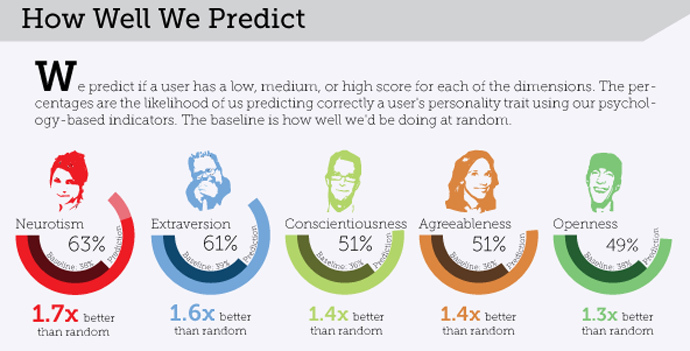
This is a short snippet on Personality models, not an analysis but a warning to watch your friendly data collector near to you and your friendly government’s use of phobias. A paper published in the Proceedings of the 6th International Conference on Social Computing, Behavioral-Cultural Modeling and Prediction shows that collected communication and social network trails, may turn out to be of highly personal character if not even of psychoanalytical use.
Meta-Data prediction models are not perfect yet, but they have a huge potential. People with superior data mining tools can predict much more than just the personality. The science is not there yet, but a potential is to know the subject better than the subject understand him/her-self. Of course, also to predict what the subject will do in some patterned situations and to know the right reward and the right punishment for behavior for and against observer’s wishes. It is a dream resource for soft (and hard) totalitarian.
A group of US and French researchers found that personality of the speaker on the phone could be reliably predicted by the way he or she makes calls. Their database was collected in the MIT Human Dynamics Lab in a year-and-a-half-long study from March 2010 to June 2011.
What Metadata can do for you
The researchers, Yves-Alexandre de Montjoye, Jordi Quoidbach, Florent Robic and Alex Pentland used the 36 easy-to-obtain metadata elements, which fall into five categories:
Basic phone use including the number of calls;
Active user behaviors, as in the number of calls initiated, and the time it took the subject to answer a text;
Location, or how far the subject moved, the number of places from which calls have been made, and other indicators of so-called radius of gyration;
Regularity of calling routine;
Diversity, defined as the ratio between the subject’s total number of contacts and the relative frequency at which he or she interacts with them.
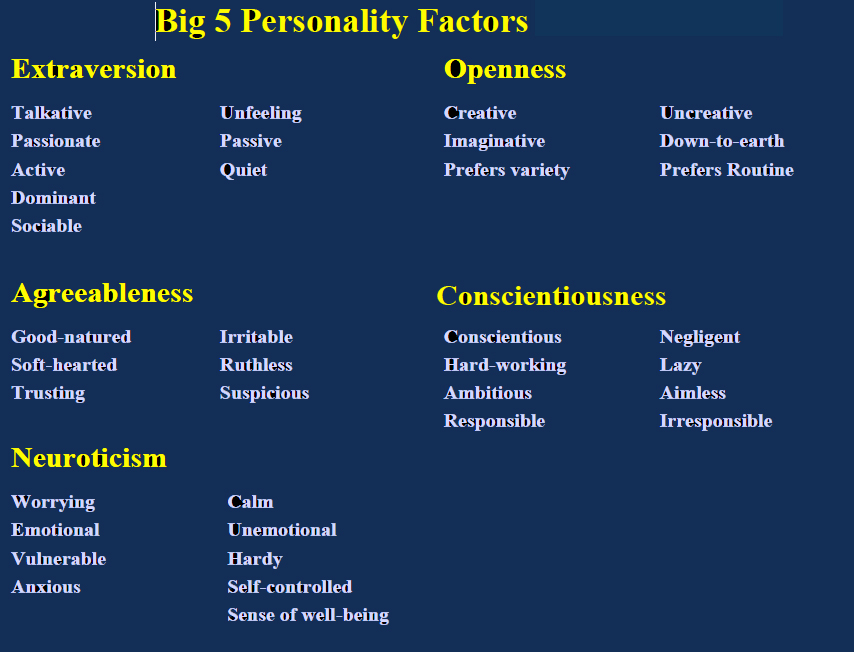
To figure out the results of the metadata analysis and to compare it with the personality, ‘hidden’ behind it, the organizational psychologists had determined psycho-types of 100 students, who participated in the survey (with a final sample of 69 people), and divided them also into five categories. They used major dimensions in the Big Five model (also called Five Factor Model) of personality, which also consists of conscientiousness, extraversion, neuroticism, openness to experience, and agreeableness.
The Big Five Model
Over the past few decades, personality psychology (mostly for marketing purpose) reached the consensus that the adjectives people use everywhere could be subsumed into five general constructs. As far back as William McDougall (1932) noted that all personality could be measured by five traits: intellect, character, temperament, disposition, and temper. Dixon (1977) argued that terms used to describe thinking, feeling, and acting were found in all recorded human languages. Rieman (1987) attributed this universality to genetics (!)— the genes shared across races and cultures. Subsequently, Costa and McCrae’s five-factor model, measured by the NEO Personality Inventory (NEO-PI), has been tested and its structure replicated in every language and country within which it has been studied. The five-factor model was actually one of two separate five-factor theoretical models.
Big Five – No yin an yang – Freudian Ethic
One model, popularized by Norman, and Digman purported that to understand and describe personality, one must have and use the terms contained within his/her language. Because personality was necessary for interpersonal interaction, personality traits would have to be in every language for people to coexist. The second model differs in the terms used for the five factors, but both had five similar measures for personality dimensions contrasting both sharply what are good and bad traits.
The NEO-PI was associated with Costa and McCrae (1985). The first of its five factors was named Neuroticism or emotional stability. It included aspects of insecurity, tempermentalness, worrying, and self-consciousness, but it also included anxiety, anger, and depression, a factor measuring mental health in terms of normality/abnormality, not just some aspect of normal functioning or coping. Extroversion or Surgency formed the second factor. It was characterized by being friendly,sociable, and outgoing. It also had a hint of value judgement in it as well, but seemed generally more accepted than the neuroticism factor. Openness included being daring, original, open-minded, and imaginative. It involved being accepting of fantasies, feelings, and values. Agreeableness was the fourth factor. It was often contrasted with antagonism, which was characterized by narcissism, perfectionism, and arrogance. Agreeableness included aspects of trust versus skepticism and sympathy versus stubborn uncooperativeness. Factor five, termed Conscientiousness, had also been contrasted with undirectedness. Amelang and Borkenau titled this factor self-control versus impulsivity (!). Some called it superego strength as in an individual’s abilities in persevering, striving for excellence, hard working, and exerting effort with a purposeful direction.
The Big Five (v.s. the MBTI) is one of marketing, its not help you to understand yourself, but others to benchmark you against a desired standard behavioral set.
These factors are very broad and inclusive, but almost stipulate a Freudian ethic. They assumed that all human could be categorized under these five headings – and measure in a way just adaption to the society. To me, the Big Five, is a tool how good you function in the “rat race” or as consumer. To correct this, there’s growing support for a HEXACO model of personality that adds a sixth trait: honesty-humility.
C. G. Jung’s typology and the MBTI Model
Example
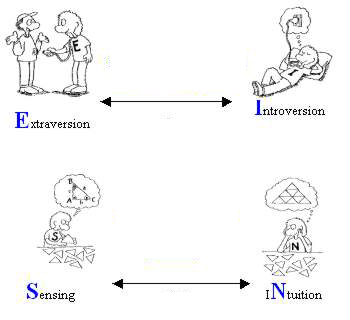
Based on C. G. Jung’s typology [Jung, 1921], people can be classified using four mental functions sensing, intuition, thinking and feeling together with the attitude (extraversion-introversion). An extrovert deals more with the objective whereas an introvert relies more with the subjective – C.G. Jung is quite clear that both the objective and the subjective represent facts and reality. The direction points to the source of energy that feeds the dominant mental function. An extrovert’s source of energy is mainly found in the outside world, whereas an Introvert’s source of energy is mainly found in his or her inner world. C. G. Jung’s classification scheme has been used quite successfully from individuals (I’ve written here) as well in the workplace (see here). The unconscious layer, Carl Jung’s analytical psychology model provides, maps to the structures of the organizational or political conscious and unconscious which parallel what Jung conceived as the architecture of the individual psyche.
Attitude Extravert: Outer-directed, need for sociability, chooses people as a source of energy, often action-oriented.
Attitude Introvert: Inner-directed, need for privacy and space; chooses solitude to recover energy, often reflective.
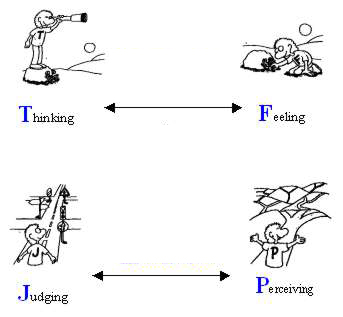
Feeling function: Valuing positively or negatively. (thus rational and not the same as the word used in emotion)
Sensing function: Sensory, oriented toward the body and senses, detailed, concrete, present.
Intuitive function: Sees many possibilities in situations, goes with hunches not details, sometimes not present. The function that is opposite to sensation. Intuition is a perception of realities that are not known to consciousness, and that come via the unconscious.
One rarely finds pure types and originally with Jung obviously there were 8 combinations with ones primary function but ones secondary function may be developed (and rarely the third and forth). The extroverted thinking person tends to be tied to facts, may believe his ideas represent absolute truth and that “the ends justify the means”dislikes and fears the irrational. Introverted thinking person is interested not in facts but ideas. Extroverted feeling person often seems to be well adjusted, charming, concerned with personal relationships. Introverted feeling type are not easily adaptable and may express self in music, poetry, religion. Extroverted sensing type– the object arousing the sensation is the important thing. Introverted sensing types have trouble expressing themselves. Extroverted Intuitive lives see possibilities as important. Last, the Introverted intuitive is concerned with the collective unconscious and has visions or revelations of religious or cosmic nature.
Mapping The Myers-Briggs Type Indicator (MBTI) to the Big Five
The Myers-Briggs Type Indicator (MBTI) dimensions (Extraversion-Introversion; Sensation-Intuition; Thinking-Feeling; and Judging-Perceiving), based on C.G. Jung formed a tight 4-factor model similar to that of Costa and McCrae’s Big Five model for openness, conscientiousness, agreeableness, extraversion.
My thoughts on the Big Five. I find it hard to not look at Openness and neuroticism as a dichotomy. How can we be both open and neurotic at the same time?
All in all, the big 5 uses 5 traits, and doesn’t link them together, where as the MBTI uses 8, and links them together. The MBTI just gives more information, however, Big 5 is also more static, and can definitely be used at the same time as MBTI. Jungian’s, however, don’t recognize that just four letters do justice to anyone’s identity for the whole life. Bad leaders, consultants, counselors, coaches, and teachers, had been delivering this message, omitting C.G. Jung’s view of individuation – i.e. that healthy persons are in control of their four functions and grow to manipulate MBTI to money making personality tests. To make matter worse, the Big five seem to judge only one alternative dimension as desirable (unlike C.G. Jung did). I don’t subscribe to this.
Extraversion – people who tend to seek stimulation in the company of others, who are outgoing and energetic; I fail to see why the Big Five Model changes the “o” into an “a”…. E of course equals the MBTI E with the implicit assumption that introverts are bad .
Agreeableness – sensing, compassionate and cooperative people (easy to manipulate however); Agreeableness, I’d say it may also be Fe , not only F.
Openness – and creative ones, who are open to feelings (intellectually less curious, however); You might recall that thinking and feeling are rational functions to C.G. Jung and to him indeed feeling means either accept or reject. So Openness equals to F, without a mix of N or P, but not with 100% correlations.
Conscientiousness – self-disciplined and judging people, who are eager for success ( not perceiving others); Conscientiousness seems like a sure J.
I think the neurotic scale shows us the probability that we are utilizing shadow survival functions. Neuroticism in big 5 is the only scale that doesn’t correlate with MBTI directly. The fifth dimension – neuroticism – will tell which button to press of anxiety, moodiness, worry, envy, and jealousy. Neuroticism is a risk factor for the “internalizing” mental disorders such as phobia, depression and other anxiety disorders, all of which are traditionally called neuroses but become more and more political terms. Furthermore MBTI has N and F in I and E attitude, while Big Five just mixes the both in one, and the rating scales aren’t 100% the same, like 40% openness might still come out as N in MBTI test.
Conclusion
Add personalty tests with capabilities to obtain and crunch your data with a big data warehouse for your Twitter, email and Facebook, not to mention your browsing history or Amazon preferences , than psychoanalysis become truly affordable for everybody. Interested will check on your conscientiousness and your eagerness for success like for credit rating or how you do on neuroticism in respect to xyz-phobia.
When they all know the good as good, there arises the recognition of evil.
This article explores the psychological underpinnings of Shakespeare’s “Macbeth” from a Jungian view. Carl Jung left a great deal of ambiguity surrounding his work. He understood, as long as there have been men and they have lived, they have all felt this tragic ambiguity and everybody must accept his or her “Shadow” during the individuation process. Ambiguity between good an evil, and a failed individuation is the core theme in the tragedy Macbeth: “Fair is foul, and foul is fair” say the three witches in the beginning of the play and this paradox is touched again by Macbeth: “So foul and fair a day I have not seen”. The enemy and death is “foul” – bad – but the outcome of the battle is “fair” – good, only because he has won.So the play Macbeth is about the evil, but as we see mostly the evil in us, and this evil is first impersonated by the witches. That is why Macbeth is also called the “Scottish play” by the superstitious theater folk. The play has gotten a reputation for being bad luck in terms of productions and those who act in it, and so it is referred from them to as “the Scottish play” to avoid naming it. The play is about the good consumed by the evil. However, Tao says Tao is eternal and so are the two principles Yang and Yin, so that good and evil must be eternal, as necessary elements of our world.
Secularism, particularly relativism has tried to blur the line between good and evil where belief systems and philosophies used different approaches to mask the ambiguity between “evil and good”. Dualistic has the view that the world consists of or is explicable as those two fundamental entities. It is God, love, death, suffering and infinity that open us to the non-dualistic mind, or contemplation. Dualism means eliminating everything that is not like you (or projecting all your rejected attributes to others). Lao-Tse and Jesus were masters of non-dualistic thinking. The Jungian System is a fine example of an non-dualistic psychology : the more inflated your self-image (Ego), the bigger your shadow will be. Macbeth looses his soul (his Self) failing to differentiate between Persona and his inflated Ego and overwhelmed by his shadow and his anima utilized by the ambitious Lady Macbeth.
Jung’s vastly varying influences have helped shape a psychology that has influenced a great many scholars, theorists, psychologists, and artists of various specialties. While still maintaining an empirical stance Carl Gustav Jung has taken the influential elements of literature, symbolism, religion, and the alchemy and has formed these raw, primordial factors into a unparalleled psychoanalytic system. Jung’s view of literature was ambivalent. He was fascinated by Nietzsche, and lectured on Nietzsche’s Zarathustra, Besides of German literature C. G. Jung appears to have been influenced by Shakespeare. In particular Jung was interested in the mythic and archaic elements in literature. Hermann Hesse’s novel Demian was inspired by Jung’s theory of individuation whereas Macbeth seems to be the prototype of a failure to achieve successful ego-individuation.
The play Macbeth
title_macbeth
Jung found literature to be a psychological process which includes the process of materials being “drawn from man’s conscious life; and the visionary dealing with primordial images that transcend human understanding.” Jung found that the archetypal symbols he worked with could, quite naturally, be found in the works of various ages. “It is to be expected… that the poet will turn to these mythological images to give suitable expression to his own experiences.”
Macbeth, when you analyze it, is a psychological battle between good and evil, and between evil ambition and order. Darkness is a symbol of the characters forgetting all about honor or goodness. The play demands that the audience think about how we make excuses in our life to pursue false ambitions that are wrong. Macbeth makes this mistake and ultimately it leads to his death. Darkness in Macbeth is a key theme. The play begins with the brief appearance of a trio of witches and then moves to a military camp, where the Scottish King Duncan hears the news that his generals, Macbeth and Banquo, have defeated two separate invading armies—one from Ireland, led by the rebel Macdonwald, and one from Norway. Macbeth and Banquo encounter the witches who prophesy that Macbeth will be made thane (a rank of Scottish nobility) of Cawdor and eventually King of Scotland. Macbeth and Banquo treat their prophecies skeptically until some of King Duncan’s men come to thank the two generals for their victories in battle and to tell Macbeth that he has indeed been named thane of Cawdor. Macbeth is intrigued by the possibility that the remainder of the witches’ prophecy—that he will be crowned king—might be true, but he is uncertain what to expect. It remins me a little bit of Wagners Rhinemaidens, who have a magical gold treasures with magical powers. Alberich an ugly dwarf, trys to score on them but they laugh at him. So he robs their treasure with the ring (the key to power and wealth). To do this, he must renounce love. I think Macbeth never could love, neither himself nor others.
Lady Macbeth suffers none of her husband’s uncertainty. She desires the kingship for him and wants him to murder Duncan in order to obtain it. When Macbeth arrives at Inverness, she overrides all of her husband’s objections and persuades him to kill the king that very night. He and Lady Macbeth plan to get Duncan’s two chamberlains drunk so they will blame the murder on the chamberlains. While Duncan is asleep, Macbeth stabs him, despite his doubts and a number of supernatural portents, including a vision of a bloody dagger. When Duncan’s death is discovered the next morning, Macbeth kills the chamberlains—ostensibly out of rage at their crime—and easily assumes the kingship. Duncan’s sons Malcolm and Donalbain flee to England and Ireland, respectively, fearing that whoever killed
C_G_JUNG_MALE_FEMALE_ARCHETYPES
Duncan desires their demise as well. Fearful of the witches’ prophecy that Banquo’s heirs will seize the throne, Macbeth hires a group of murderers to kill Banquo and his son Fleance. They ambush Banquo on his way to a royal feast, but they fail to kill Fleance, who escapes into the night. Macbeth becomes furious: as long as Fleance is alive, he fears that his power remains insecure. At the feast that night, Banquo’s ghost visits Macbeth. When he sees the ghost, Macbeth raves fearfully, startling his guests, who include most of the great Scottish nobility causing Macbeth’s kingship to incite increasing resistance from his nobles and subjects. Frightened, Macbeth goes to visit the witches in their cavern. There, they show him a sequence of demons and spirits who present him with further prophecies: he must beware of Macduff, a Scottish nobleman who opposed Macbeth’s accession to the throne. Macbeth orders that Macduff’s castle be seized and, most cruelly, that Lady Macduff and her children be murdered. It should be clear by now, that Macbeth represents the archetypes of weak king and becomes a cruel sadistic warrior, whereas Lady Macbeth seems to own foremost frigid witch qualities.
When news of his family’s execution reaches Macduff in England, he is stricken with grief and takes revenge and with Prince Malcolm, Duncan’s son, and the support of the Scottish nobles, who are appalled and frightened by Macbeth’s tyrannical and murderous behavior. Lady Macbeth, meanwhile, becomes plagued with fits of sleepwalker in which she bemoans what she believes to be bloodstains on her hands. Before Macbeth’s opponents arrive, Macbeth receives news that she has killed herself, causing him to sink into a deep and pessimistic despair.
He is struck numb with fear, however, when he learns that the English army is advancing on Dunsinane shielded with boughs cut from Birnam Wood. Birnam Wood is indeed coming to Dunsinane, fulfilling half of the witches’ prophecy. In the battle, Macbeth hews violently, but the English forces gradually overwhelm his army and castle and he realizes that he is doomed, Macbeth continues to fight until Macduff kills and beheads him.
Failed Individuation in Shakespeare’s Macbeth
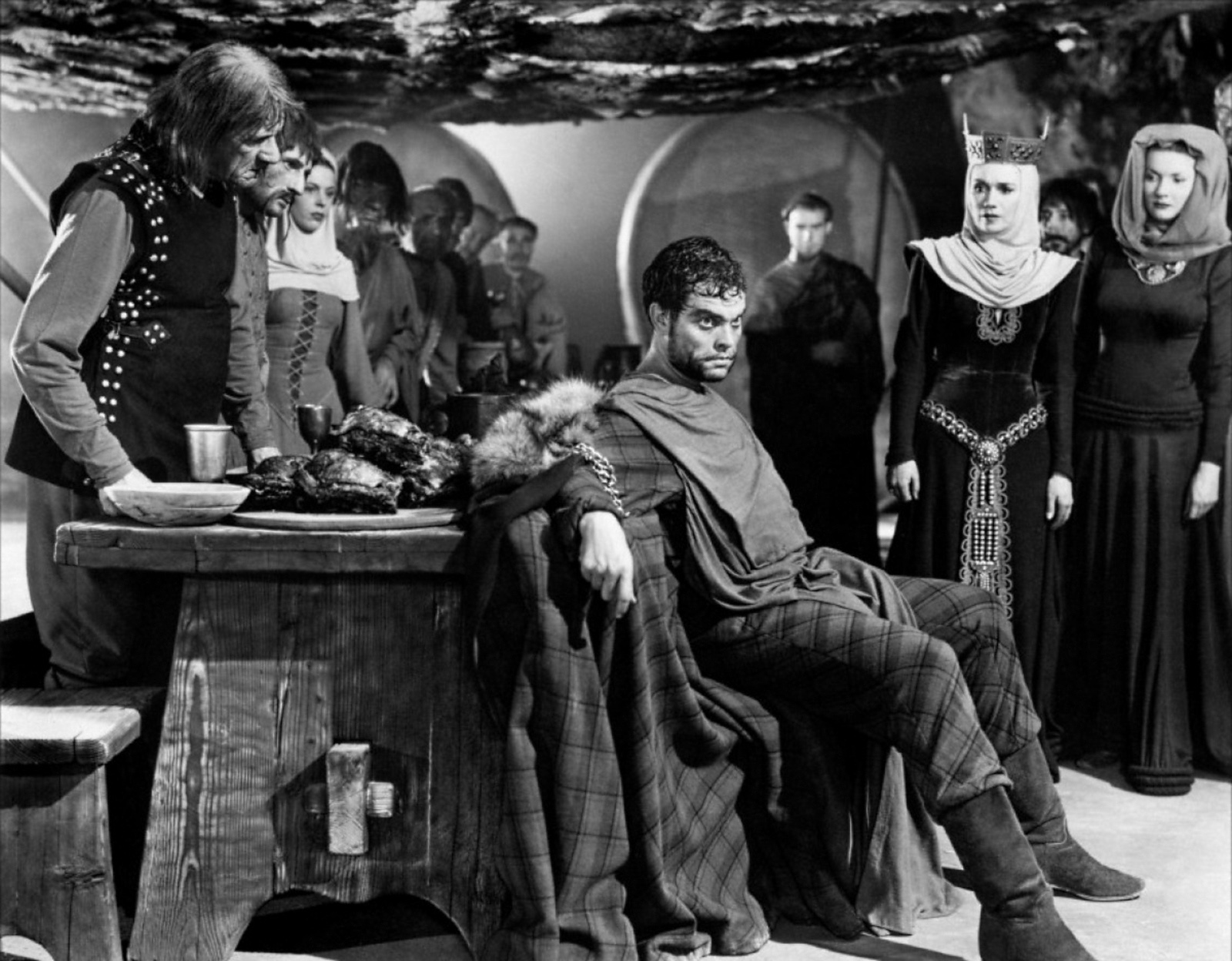
macbeth
Macbeth has not begun to deal with the adult developmental task of individuation. According to Jung, in the process of individuation “unconscious potentials are explored and reintegrated with the “Self”. The exploration of certain parts of the unconscious brings to consciousness unacknowledged ” missing pieces. Macbeth’s failure to individuate successfully is reflected by the distance between his rigid Persona and his real personality, and his inability to confront the shadow aspects of his psyche, and the complete rejection of his anima. Tellingly those developmental issues only seem able to get Macbeth’s attention through his hallucinations and visions. Jung said that “only through the adult development of individuation can the person become truly an ‘individual’ and not simply a carrier of unconscious images and other people’s projections”. This “carrier of unconscious images” and receptacle of “other people’s projections” is exactly how Shakespeare paints Macbeth: Macbeth is Duncan’s “O worthiest cousin” (I, iv, 17), the murderers’ “Highness,” “liege,” “lord” (III, I, 81, 102, and 131), and Malcolm’s “tyrant” (Iv, iii, 14). Throughout the play Macbeth’s identity is formed by Shakespeare’s other characters. The tragedy of Macbeth is that he has failed to explore his unconscious and discover and accept his true identity. Because he has not individuated, he can be molded and pushed into identities and actions that others project onto him. Macbeth is very conscious of his persona and of the positive reputation he has cultivated, and he enjoys thinking of himself in this way. According to Jung, the Persona (literally the mask) is the aspect of personality that adapts to the world to be accepted in society. Throughout the play Macbeth attempts to put on a “false face” (I, vii, 9 5) so that he can hide what his “false heart doth/know” (I, vii, 95-96). When he has plotted Banquo’s death and is preparing to make merry with his guests, Macbeth believes that he can cover not only his conscious knowledge of his role in Banquo’s death from others but keep his unconscious feelings of fear, shock, and guilt at arranging a murder from himself. During dinner Macbeth has a hallucination. He sees the ghost of Banquo come to haunt him and denies his guilt: “Thou canst not say I did it. Never shake/ Thy gory locks at me” (III, iv, 61-62). Throughout the play Macbeth refuses to own his unconscious; he places supreme importance on appearances (Persona), his consciousness and refuses to deal with any desires and actions which challenge his idealized Ego.
Shadow- instinctive powerful, beast
His rejection and disregard of this “shadow” keep him ignorant of its motivational power and the gulf that develops between his persona and real personality. Jung described the shadow as “those aspects of the psyche that are rejected from consciousness by the ego (during sozialization in the first half of life), because they are inconsistent with one’s self-concept. Macbeth’s history of denying his shadow is detailed throughout the play. In Act I, after learning of Duncan’s intention of having Malcolm succeed to the throne, Macbeth rejects his ambitiously motivated ability to become a traitor. Jung says that as we show our persona to others and conceal our shadow from ourselves, “the shadow gets more and more ugly, and the split between persona and shadow … widens”. For Macbeth, this is true. After he kills Duncan, Macbeth refuses to believe that he could be a murderer – one although this ability to murder is present in Macbeth’s character. After his second meeting with the Weird Sisters, Macbeth resolves to kill Macduff’s family in the Thane of Fife’s absence Macbeth has progressed from ambitious regicide to familial mass murderer. Because Macbeth has not confronted his shadow and haven’t taken the effort caused by introduction of the shadow to consciousness, Macbeth cannot follow an intrinsic moral compass. This allows him to commit his atrocities without having to justify them. Ironically, part of Macbeth’s anima is positive, but it is repressed because he believes it to contain negative qualities.
anima
According to Jung, men have “repressed feminine-typed qualities” (their anima) and women have “repressed masculine-typed qualities” (their animus). While this area of Macbeth seems cloudy, I believe that Macbeth cannot explore what Jung would call the inner feminine qualities of empathy and emotion because Lady Macbeth is constantly questioning his identity as a man, struggling herself to be a women and with her animus. Two passages support this theory. When Macbeth begins to vacillate between killing Duncan and maintaining his honorable reputation, Lady Macbeth chastises him for not being man enough to take what he wants (I, vii, 3 9-49). She also calls him to task for not being a man of his word (I, vii, 53-67). Lady Macbeth claims that she, a woman, is more manly than Macbeth. Macbeth is expressing fear and guilt, emotional inner controls, and Lady Macbeth makes fun at him. Later, when Macbeth is confronted with his hallucination of Banquo’s ghost, he expresses fear and revulsion at what he has done to Banquo through the ghost’s horrible appearance. Lady Macbeth tells him to stop acting like a hysterical woman and to live in reality. She even asks Macbeth, “Are you a man” (III, iv, 70). While Macbeth clearly rejects his “inner woman,” as shown by the ease with which he is manipulated by gender role identification (making him vulnerable to Lady Macbeth evilness), he is severely hampered in uncovering his anima by her disparaging of his male identity.
Personal Layers
Macbeth’s strict adherence to his inflated Ego a false Persona, his unwillingness to deal with his shadow. According to Jung rejecting anima have psychological consequences – sometimes the shadow and anima merge and overpower the consciousness (Ego); he has hallucinations. Jung interpreted psychotic hallucinations and delusions as expressions of the collective unconscious archetypes, which can be interpreted as visions or a type of dream, manifesting their meaning from his personal unconscious. Act II’s floating dagger can be read as a symbol forcing its way into consciousness. Through his visions, Macbeth’s unconscious is trying to show him the issues he must deal with. One of the sadder aspects of the tragedy is that he is constantly dissuaded from looking at them. The moral conflict needed to mitigate his personal not to speak collective un consciousness is not present. This is why poor Macbeth (like many powerful men and women) is so far from the mark with his comments on life. They does not know enough about themself to allow anything but a shallow, two-dimensional interpretation of life, letting them be directed by passions unseen, greed and manipulative persons around them.
Anima and Animus in Shakespeare’s Macbeth
Lady Macbeth
There appears to be some critical discord in connection to the classification of Lady Macbeth, whether she qualifies as an innocent, supportive wife, or, in Malcolm’s words, as a “fiend-like queen.” (Shakespeare V. ix. 35) However, Shakespeare’s text simply does not support the idea that the Lady Macbeth did not play a serious role in the murder of King Duncan and. The concept which seems to lie at the core of critical discussion in relation to Lady Macbeth, is gender. Lady Macbeth herself, makes the argument about gender in her famous speech, wherein she appeals to the powers of dark spirits to “unsex” her, and replace any feminine tendency in her with “direst cruelty” (Shakespeare I. v. 42-43). She wishes to take all that she perceives as weak and feminine in herself, and seeks to substitute it with an evil. Jung believed that all men and women were made up of masculine and feminine energies, the former being called the animus and the latter being called the anima and this unconscious selves of individuals can be used to understand Lady Macbeth’s actions. It can be argued, that Lady Macbeth’s vehement denial of her feminine self (or her anima) that causes her to manipulate her husband into committing the murder of Duncan, affected her relationship with her husband (unable to maintain it) and ultimately led to her insanity and death.
Conclusion
“Fair is foul, and foul is fair” : What the line points to is the play’s concern with the discrepancy between appearance and reality: that is, the difference between how someone seems and how someone really is. It is a central concern of Shakespeare’s, and obviously one that fits well with the medium of theatre, which relies on actors seeming to be something that they most definitely aren’t. This is one of the last lines in Act 1 Scene 1 when the witches are foreshadowing events to come in the play. With these words, they are predicting the evil that will cloud Macbeth’s judgments and that those judgments will appear to Macbeth as fair and just. This line also could refer to the witches believing that things some consider to be foul and ugly are just and beautiful to them because they embody evil.
The Article Lupus and Astronomy is an extension of the last post: the archetype of the wolf. I am a hobby astronomer and fond of its older sister Astrology. So lets look to the Wolf from that perspective. The wolf is inherently pagan and shamanic, that means American Indian, Chinese, Egyptians, Babylonians should have big stakes in in its Astronomy representation. There is a Constellation – Lupus (the Wolf) in the southern hemisphere, originally listed as a constellation by the Greek astronomer Ptolemy in the 2nd century CE. Besides the fact, that Lupus was once the site of the brightest supernova SN 1006 (1006 A:D), there is little of archetypal concern.
But the Dog Star” Sirius matters as Noah Brosch said in his book. Sirius is the brightest star in the night sky and can’t be missed in a city, nevermind in a desert. Mostly called the “Dog Star”, in China the “Blue Beast (wolf)” Sirius represents the Heavenly Wolf and in Greece and Roman culture it was associated not only with the dog, but also with wolf and jackal.
Lupus and Astronomy Facts
Sirius: The Embodiment of Isis
Sirius absolute brightness is 23 times as bright as our sun and the fifth nearest star to our solar system. Known to astronomers as Alpha Canis Major, it is the principal star of the constellation Canis Major (the Big Dog). The brightest of the nighttime stars, Sirius caught the eye of the early sky watcher and can even been seen in daylight with a telescope. Sirius is a binary star. Very long ago, Sirius could not even be seen in the sky from some places. This was because of a phenomenon known as the Precession of the Equinoxes. The Precession is a very slow wobble of our planet taking the polar axis of the Earth in a circular swing of 47 degrees every 26,000 years.
For the Egyptians, Sirius was, astronomically speaking, the foundation of their entire religious and temporal system. It was the embodiment of Isis, wife of the god Osiris, who appeared in the sky as Orion. Egyptians called Sirius the “Dog Star”, after their god Osiris, whose head in pictograms resembled that of a dog.The ancient Egyptians called it Septit, the Hebrews knew it as Avrek or Sihor, to the Greeks as Sothis and also as the “the Dog Star” that followed Orion the Hunter. On that latitude the “Star in the East” in our Gospel accounts, was on the meridian line.Egyptian
senenmut zodiac
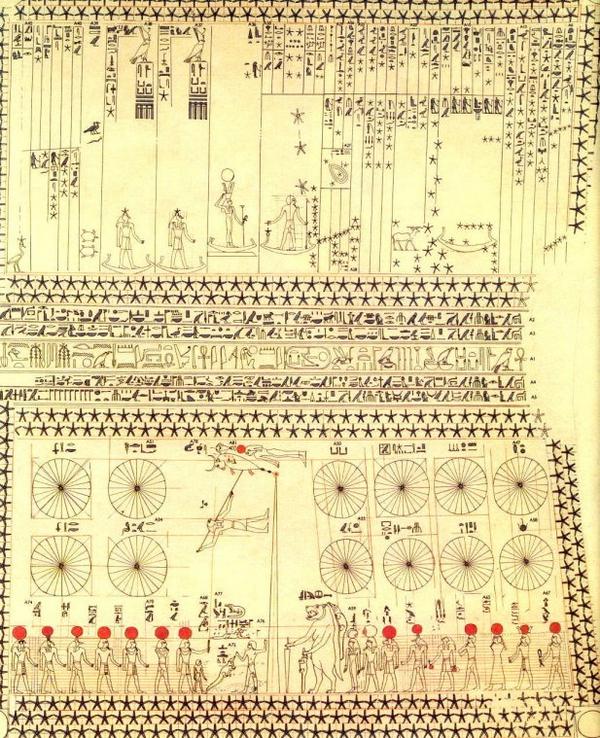
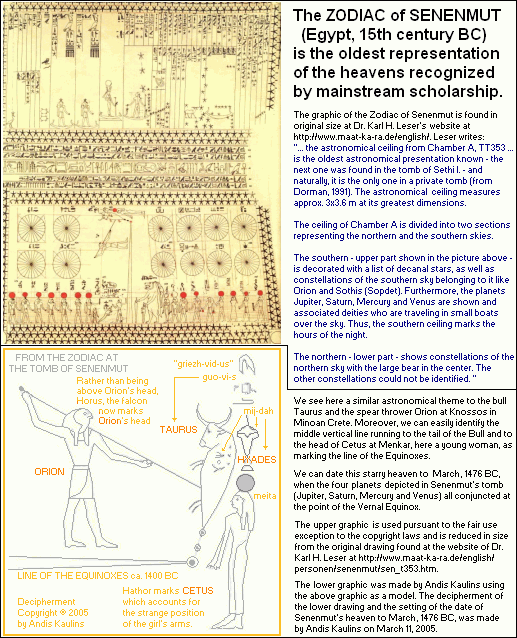
The reason why the Egyptians and many other civilizations of that era used Sirius as their marker for the passage of time is because they picked the most stable object as their reference point. In Egypt, almost all the temples were aligned with this line, including the gaze of the Sphinx. Many of the temples had a tiny hole in the wall somewhere; then there would be another wall and another, going into some dim inner chamber. The tomb of Senenmut, chief architect, lover and astronomer during the reign of Queen Hatshepsut the only female pharaoh, featured lovely astronomical ceiling. On its walls are extracts from the Book of the Dead. Hatshepsut’s temple is ideally placed to view astronomical events towards the eastern horizon, particularly the Orion constellation and the star Sirius. The alignment of the temple is set on an azimuth of 116½° ±½°. On the Senenmut calendar it is surely the sext idol from right with dog-head and a star above his name. In this case it can be the Canis Major, the Sirius dog, opposite to the Sumerian dog Rahu.
The periodicity of the helical rising of Sirius was such that the Egyptians based their calendar on it. Every year for millennia the appearance of Sirius coincided with the flooding of the Nile, an event that remarkably still happens to this day. Etymologists have suggested a connection with the ancient Egyptian god Osiris, but none can match the “Star of Isis”. Since earliest times the ancient Egyptian paid particular attention to Sirius, which they identified to the ‘soul’ of the Goddess Isis. Historic and mythological descriptions of Sirius provides further insight into the nature of the relationship between the Sun and Sirius. A shaft leading from the Queens chamber of the Great Pyramid of Egypt has been aligned precisely with Sirius.
In his book Echoes of Ancient Skies, the archaeo-astronomer Dr. Ed Krupp writes that, “After disappearing from the night sky (for 70 days) Sirius eventually reappears in the dawn, before the sun come up. The first time this occurs each year is called the star’s heliacal rising, and on this day Sirius remains visible for only a short time before the sky gets too bright to see it. In ancient Egypt this annual reappearance of Sirius fell close to the summer solstice and coincided with the time of the Nile’s inundation. Isis, as Sirius, was the ‘Mistress of the Year’s beginning’, for the Egyptian new year was set by this event. New Year’s ceremony texts at Dendera say Isis coaxes out the Nile and causes it to swell.
The metaphor is astronomical, hydraulic, and sexual, and it parallels the function of Isis in the myth. Sirius revives the Nile just as Isis revives Osiris. Her time in hiding from Seth is when Sirius is gone (70 days) from the night sky.
She (Isis) gives birth to her son Horus, as Sirius gives birth to the new year, and in the texts Horus and the new year are equated. She is the vehicle for renewal of life and order. Shining for a moment, one morning in summer, she stimulates the Nile and starts the year.”
“The coming of Osiris – the savior of Egypt – was associated with the “Star in the East” because the Egyptians recognized that the rising of Sirius with the sun, or “heliacally,” occurred around the summer solstice, the time of the Nile flooding. L ife along the Nile was highly dependent upon the inundation associated with the heliacal rising of Sirius, a flood deified as Osiris, who was said to be “born” at that time.
In addition, Pyramid Text 593:1636b/M 206 states: “Horus the pointed has come forth from thee, in his name of ‘Horus who was in Sothis.’” “Horus in Sothis,” therefore, refers to when the sun rises with Sirius. Thus, in ancient texts we find the birth of Horus the sun associated with the star in the east.
As we can see, the annual emergence of both Sirius and Orion were closely noted, meaning that these celestial events were significantly in the minds of Egyptians for thousands of years. Moreover, the “rebirth of life” in Osiris – his resurrection on Earth – constitutes an annual event, in the Nile’s flooding.
Christian
There is more than one connection between the Egyptians and Christianity. “Osiris’s coming was announced by Three Wise Men: the three stars Mintaka, Anilam, and Alnitak in the belt of Orion, which point directly to Osiris’s star in the east, Sirius (Sothis), significator of his birth.” One must envision that the Virgo was rising in the East at the same time Sirus was visible in the east as well. But also Orion, called “The Three Kings” by oriental astronomers, was in proximity to these other two constellations. Virgo is called Spica; it is to be found in the “ear of corn” (sign of fertility) which the Virgin holds.
Much has been made of the Matthew gospel account of the “star in the east” followed by “wise men” from afar, claimed to have heralded the birth of the newborn savior of the world. And many ancient gods, kings and heroes were said to have been born under a ‘bright star’ or some other sort of celestial sign.
In the gospel story, Jesus’s birth is signaled by a bright star and a visit from wise men or magi, as they are termed in the New Testament, representing Persian astrologers following the star. Despite the stellar brilliance and obviousness, this tracking was apparently not a simple act, since these “wise men” are depicted as nevertheless illogically becoming hopelessly lost and must ask Christ’s enemy King Herod for assistance. (Mt 2:1-10) “It may be inferred from Mt 2 10 that in some way or other the wise men had for a time lost sight of the star. (Mt 2:10 states: “When they saw the star, they rejoiced exceedingly with great joy.”)
Although in the gospels these magi are not numbered, their gifts are counted as three. Hence, the familiar understanding is that Jesus’s birth was accompanied by a “star in the east” and “three wise men.” At a certain point the “three kings” were given names, Caspar, Melchior and Balthasar. Coincidentally, there happen to be three very conspicuous stars in the “belt” of the constellation of Orion that are also called the “Three Kings.” Moreover, as French philosopher Simone Weil (1909-1943), herself a Christian, remarked, “The Christians named the three stars of Orion the Magi,” revealing esoteric knowledge of Christian astrotheology, regardless of when it was first adopted. Within the constellation of Orion, “the Hunter,” are three bright stars said to make up his “belt.” Concerning these stars, in The Geography of the Heavens the astronomer Elijah Hinsdale Burritt remarks:
They are sometimes denominated the Three Kings, because they point out the Hyades and Pleiades on one side, and Sirius, or the Dog-star, on the other. In Job they are called the Bands of Orion…
The biblical Book of Job (38:32) also contains reference to the Mazzaroth, or “zodiac,” and demonstrates significant astronomical knowledge, an important fact in consideration of the contention that, centuries later, the Jewish priesthood rehashed the Egyptian astrotheology in its “midrashic” or fictitious account of Jesus Christ.
The three highly visible “king-stars” of the splendid constellation of Orion are named Mintaka, Aniltak and Anilam or Alnilam, the latter of which means “string of pearls,” while the former two signify “belt.” The statement in the Egyptian texts that Sothis “leads Orion” thus constitutes the motif of the bright star followed by these three “kings,” which have also been called the “three kings of the soothsayers,” a title that may indicate the antiquity of this royal appellation.
The bright star Sirius rose with the sun at the summer solstice, signaling the birth of Osiris as the Nile inundation and the birth of Horus as the daily solar orb. In winter, the Three Kings in the belt of Orion pointed to Sirius at night before the annual birth of the sun, which is also Horus.
The appearance of the three stars in a line with Sirius occurred in the night sky over Egypt thousands of years ago, pointing to the horizon as the new sun was born at the winter solstice. Thus, it could be asserted that the three kings trailing the bright star announced the birth of the savior at the winter solstice in Egypt, ages prior to the same event purportedly taking place in Judea.
Greek
There is much speculation on the origin of its modern name which is generally thought to be derived from the Greek word “Sirio” meaning sparkling. Around 150 AD, the Hellenistic astronomer Claudius Ptolemy described Sirius as reddish, along with five other stars, Betelgeuse, Antares, Aldebaran, Arcturus and Pollux, all of which are clearly of orange or red hue. The discrepancy was first noted by amateur astronomer Thomas Barker, squire of Lyndon Hall in Rutland, who prepared a paper and spoke at a meeting of the Royal Society in London in 1760. The existence of other stars changing in brightness gave credence to the idea that some may change in colour too; Sir John Herschel noted this in 1839, possibly influenced by witnessing Eta Carinae two years earlier. Thomas Jefferson Jackson See resurrected discussion on red Sirius with the publication of several papers in 1892, and a final summary in 1926. He cited not only Ptolemy but also the poet Aratus, the orator Cicero, and general Germanicus as colouring the star red, though acknowledging that none of the latter three authors were astronomers, the last two merely translating Aratus’ poem phenomena. Seneca, too, had described Sirius as being of a deeper red colour than Mars.
Mayan
2013 is upon us, and we survived all the dire predictions about how the world would end did not happen. Among their reasoning was a total misunderstanding of the sacred Mayan calendar. The Maya understood 17 different Calendars based on Venus, Mars, Sun and Moon and most prominently the Pleiades with the precession of the equinoxes, a cycle just short of 26,000 years. So even Sirius was not accurate enough for the “Keeper’s of Time”, the Mayans. With their remarkably advanced astronomy they quickly detected the inaccuracies in using Sirius as a marker for the passage of time, and switched to an even more accurate cycle involving the Pleiades.
The Mayan view of the afterlife consisted primarily of a dangerous voyage of the soul through the underworld, which was populated by sinister gods and represented by the jaguar, symbol of night. The majority of Maya, including the rulers, went to this underworld. Heaven was reserved for those who had been sacrificed or died in childbirth. Like in any ancient belief system, to the Maya, science and religion were one and the same. The Maya developed an impressive mathematical achievements included positional notation and the use of zero; and in astronomy, they accurately calculated a solar year, compiled precise tables of positions for the Moon and Venus, and were able to predict solar eclipses.
For the ancient Maya, the Pleiades represented the principle of life on Planet Earth, and this is why it formed their sacred calendar. Mayan religion and mathematics were intimately connected with the seven stars, or suns, of the Pleiades. I traveled Yucatan once, where Mayan temples are fascinating. The calendars that are most important to beings of earth are the Haab, the Tun-Uc and the Tzolk’in. The Tzolk’in is the most important and the one with the most influence.
The Haab is the Sun calendar. It has 360 + 5 days, totaling 365 days. The Haab uses 18 months with 20 days in each month. There is a 19th month called a Vayeb and uses the 5 extra unlucky days. Each month has it’s own name/glyph. Each day uses a sacred sun/glyph.
The Tun-Uc is the moon calendar. It uses 28 day cycles that mirrors the women’s moon cycle. This cycle of the moon is broken down into 4 smaller cycles, of 7 day each.
The Tzolk’in is the sacred calendar of the Maya and is based on the cycles of 260 days. The cycle of the Pleiades uses 26,000 years, but but encompassing 260 days might allign the Venus cycle. The Mayas knew the importance of the period of 2920 days equal 8 years by 365 days, in which the Venus repeats its movement in relation to the sun, same as the Babylonian did. The “Dreseden codex” in Germany contains tables for predicting solar and lunar eclipses and ephemerides from Venus and Mars for two rounds.
Two kinds of empiric sidereal intervals of Mars were used, a long one (702 days) that included a retrograde loop and a short one that did not. While Kepler solved the sidereal problem of Mars by proposing an elliptical heliocentric orbit, anonymous but equally ingenious Maya astronomers discovered a pair of time cycles that not only accurately described the planet’s motion, but also related it to other cosmic and terrestrial concerns.
Today we only choose the Sun as our reference point, and this is obviously highly inaccurate. Every 4 years a day has to be added to keep accurate time. There is however an even more stable reference point than the Pleiades and that is the Galactic center, which from the perspective of our galaxy is the ultimate center of rotation. And indeed the Mayan’s chose the Galactic Center as a reference point to mark the passage of time, which is evident as the Mayan Long Count ends with the galactic alignment of the Solar System on December 21st 2012.
Sufism
Even as late as the 1970s Sirius became the subject of a (now rejected) theory linked to the Dogon tribe of Mali to recent scientific knowledge of Sirius. The majority of Dogon practice an animist religion, with a significant minority of the Dogon practice (Sufi) Islam, another minority practice Christianity. Sufi historian Indries Shah traces the name of the Illuminati back to a verse in the Koran which mentions a shining star, and Umar Al Sufi a Persian astronomer mentioned it in the 10 century. That knowledge of the Mail tribe concerns Siriusas a binary system. Sirius A is the highly visible star, but there is a companion known as Sirius B. From Africa, where the Dogons live, the star Sirius disappears below the horizon and is out of sight for a couple of months; then it appears again on the morning of July 23, when it rises about one minute before the Sun. It appears bright ruby-red, just above the horizon, almost exactly due east. Sixty seconds later the Sun emerges. So you can see Sirius for just a moment, then it’s gone. This is called the helical rising of Sirius, which was a very important moment for most of the ancient world, not just for the Dogons and Egypt. This is the moment when Sirius and the Sun and the Earth are in a straight line across space.
Conclusion
Sirius has been found linked with every great religion of antiquity. Why? One reason might be was a much better timekeeper than the Sun. But as has been shown, the star Sirius has played a prominent role in astronomy, myth, religion, literature, and history always with an archetype of wolfish character.
Sources
Cosmos An illustrated history of astronomy and cosmology, John David North
The Fontana history of astronomy and cosmology, John David North (German Translation)
The Rise of Early Modern Science – Islam, China and the West, Huff, Toby E.
The Biographical Encyclopedia of Astronomers, Springer Reference. New York: Springer, 2007 (via web)
Starry Night Complete Space and Astronomy Park Deluxe Edition 6
It became clear during my research of Jungian Archetype of the wolf, that in mythology, religion, in legends and fairy tales the wolf has played an outstanding ambiguous, dualist and multidimensional role. The wolf archetype is so central, that how the wolf is viewed, indicates the mindset of the human, secular or spiritual organisations of the society we live in.
In a few weeks, there is Whitsun, and I will make one of my occasional trips to the monastery. Writing this article was a preparation to the theme and will be updated afterwards The rock monastery St. George is a development center of the Benedictine order in the Austrian Inn valley. From the monastery to the St. George mountain (Karwendel) on foot takes approximately one hour. The religious exercise will be lead by a Benedictine monk, who happens to have formal psychoanalytic credentials and introduced the theme “The archetype of the wolf” for what to my understanding is a spiritual hiking weekend.
st_georgenberg_stift_fiecht
But there is much more. Joland Jacobi, a close assicate of C.G. Jung mentiones the archetype of the wolf a few times in her book “Complex, Archetypes, Symbol in the Psychology of C.G. Jung”, Bollingen Series Princton University Press, 1957. Joland Jacobi writes, “being devoured or swallowed is also a widespread archetypal motif… the wolf that devours the kid”…. [page 155, 181,185]. C:G: Jung writes numerious times about Wotan, who was eaten at Ragnarok by the giant wolf Fenrir and then avenged by his son Vidar e.g. “Four Archetypes Mother, Rebirth, Spirit, Trickster”, Routledge and Paul, 1957. In the the same book, C-G. Jung writes about the wolves about the German fairytale, in which the wolf gives the hero a magic gift of his hairs (page 109) .
Historical encounter between man and wolf
You may refer my recent article “The Wolf as an Jungian Archetype Vessel” which argues that the wolf is one of the most persistent and structurally overdetermined animal-symbols in human civilization because the historical encounter between man and wolf unfolded simultaneously on three inseparable levels: biological rivalry, social mirroring, and archetypal projection. The wolf therefore persists not merely as zoological memory nor merely as mythological ornament, but as a privileged symbolic convergence point through which deep psycho-biological structures become visible in religion, myth, dream, political imagination, and collective anxiety. In his book Of Wolves and Men, Barry Lopez argues from a naturalist view similarly that traditional hunting cultures suggest deep behavioral analogies achieved through a respectful, reciprocal relationship. These societies and wolves viewed the hunt as a sacred covenant requiring humility, dignity in the ‘conversation of death’ and hunting skills. Barry Lopez shares a Nunamiut elder’s insight that a old man and an old wolf possess identical knowledge of the land and hunting: “After a pause the old man looks up and says: The same. They know the same.“
The wolf reminded men to their domestication and their inner struggle with it. The wolf became also an image of remaining wild and sexuality, in a Jungian sense became men’s Shadow of undesired and unwanted. Those of us with Western background, do often not realize the depths and subtle (subtile) differences and similarity of Pagan German or Norse, Eastern or Native American stories. Especially wolf stories examine reincarnation, spiritual energy, gift exchange, the vitality of the body, and the spirit of the soul. In the old worldview everything is in flux and begins, balances out from, and ends with polarities akin to yin and yang. Even the gods are subject to this, undergo transformation, and often pay for what they gain with a corresponding loss. For indigenous people – including the indigenous Celts and Germanic – religion as such did not exist. Native views of spirituality wed it to time and place, land and sea and sky. Our forebears lived side by side with the wolves in an inspirited world, and that world abides, as do its instinctive, but sacred dimensions:
Axe-time, sword-time, shields are sundered,
Wind-time, wolf-time, ere the world falls;
Nor ever shall men each other spare….
Now do I see the earth anew
Rise all green from the waves again…
Myth wolf – gods, goddesses, demons and outlaws
Wolves make quick decisions, often need to trust their own instincts and make firm emotional attachments. They teach us to do the same, to trust our instincts and intuitions, and have control over our own lives. At some point in psychological development, most people struggle with the transformation of spiritual and physical aspects of their being. In many stories, the wolf was described as wild, tearing, biting, grim and bloodthirsty. The image of the wolf has been used to represent all those aspects. From where does the primeval fear and awe of the wolf originate?
The Dark Wolf Outlaw
Demons: In the Edda, the ancient Icelandic sagas, the wolf was a symbol for demonic powers: Odin, the God of war and death was accompanied by two wolves. The mythical wolf Fenrir, a son of the fire god Loki and the giant Angrboda was stronger than gods. In Indian mythology, the wolf is described as demonic. Furthermore, the wolf is portrayed as thievish, deceptive and false. In India, the demons were named after the wolf. In Christianity the wolf was even equated with the devil: Jesus Christ advised against false prophets dressed in sheep’s clothing which in fact were wolves. Numerous myths from Eastern Europe, Russia and Scandinavia tell about the creation of the wolf by the devil. During the creation of the wolf, the devil relied on the help of God and it was God’s will that the wolf kills sheep and goats.
Gods: Many different cultures worshiped the wolf. For the Egyptians the wolf symbolized the god of the empire of the dead. For the Romans the wolf was the symbol for Mars, the God of war. The combination of the wolf with war was not meant to be negative but, instead, correlated it to the glorious death of a warrior or emperor. Furthermore, the fighting heroes were compared with furious wolves.
Positive Male power: The combination of the wolf with war was not meant to be negative but, instead, correlated it to the glorious death of a warrior or emperor. Furthermore, the fighting heroes were compared with furious wolves. The wolf is also worshiped as the protector of human beings. The wolf was either seen as a fierce guardian or caring provider. The wolf is very often also associated with war and strength. In both German and Norse mythology, wolf was a symbol of chaos, destruction and death. Wolves are seen as teachers of hard, but necessary lessons. The wolf is also a symbol of guardianship, ritual, loyalty, and spirit.
Positive female power: Many different cultures worshiped the nurturing she-wolf as symbol of fertility.. The most famous myth is Romulus and Remus, the founders of the city of Rome, who were abandoned as small children. A wolf found them and raised them as her own cubs. In other contexts, the wolf also was honored as a symbol of motherly sacrifice and fertility. The frequent connection between goddess figures and totemic wolves may be taken as another indication of the great role of wolves in primitive matriarchal societies and shamanic religions.
Fenir
Negative untamed power: People from many cultures and traditions have interpreted the wolf as representing the untamed (unconscious). The word wolf is widely common in the Indo-European roots of language and often not only stands for the animal, but describes in the old Germanic languages the bandit, murderer, slayer, defied criminal, evil ghost or supernatural beast.
The Wolf in the wild
The basic social unit of wolf populations is the pack. Packs usually consist of between five and eight members, up thirty wolves or more depending of the size of the prey being hunted. Wolves generally establish territories ranging from forty to more than four hundred square miles in some cases. They define their ranges with scent markings and such vocalizations as growls, barks, and the legendary howl and will defend this area against intruders. A wolf pack is typically a family unit, consisting of the adult pair, their cubs and yearlings – two generations offspring. Wolf packs rarely accept unfamiliar adult wolves, often chasing or killing intruders to protect their territory. However, they are unique in their natural willingness to adopt unrelated orphaned pups. Members of the pack form strong social bonds that promote internal cohesion. Order is maintained by a dominance hierarchy. The alpha couple, more often the male sometimes the she-wolf depending on prey and situation, initiate pack activity and lead the group on hunts. During a hunt, they will guide the pack’s movements and assume control at critical moments. Communication is especially important for wolves, where coordinating, cooperating, and reinforcing bonds and status are necessary. Within a family of wolves, communication helps maintain social stability and solidarity. Communication among wolves is particularly complex and use a range of vocalizations to “talk”, body language and scent. The “wolf” talk conducted by the dominate male keeps the family pack together and working as a group. Research at wolves in captivity are not transferable in the wild, because here wolves of different origin or family groups were locked together.
Wolf family the-alpha-wolf-couplef-amily-the-yearling-missing
Wolves and humans were always fellow hunters, rivals, and sometimes enemies, perhaps because they were so similar to humans in many ways as mentioned before. Wolves have a strong social nature and are, like humans organized as a family tribe. In any case, through gestures and body movement, they communicate their feelings. Wolves like to howl as a pack for several reasons. It may be to encourage their closeness, to celebrate a successful hunt, and to tell other packs to keep away. The dispersed wolf, a younger male or female, is usually in search of his own territory and a mate. He will skirt the territories of others, but rarely howl. Leaving the pack allows for the sexually mature young wolves to begin the cycle of life by finding a mate, and starting their own family. This coined the misleading term ‘lone wolf’, they exist, but as exception.
Until today, the wolf evokes fear. Yet the wolf is not dangerous monstrosity, but rather an intelligent carnivore with a distinct social behavior. Anybody who “owns” a good hunting dog, observes that good dogs, good leaders and good men in general share some attribute of a wolf. The life of a man and a wolf did not differ very much a few thousand years ago: Both were either successful hunters or perished – as simple as that. During those early years of mankind wolves were always competitors with humans for the same prey species. Yet the competition between them increased when men settled 10,000 years ago and began agriculture and cattle-raising. The farm animals were for wolves easy prey, and many sheep or goats fell victim to them. The wolf became the hateful animal, which threatened the livelihood or at least property of the man. Even as backpacker I was more afraid of a wolf(s) pack than of a brown bear.
Archetypal significance of the Wolf
Wolf Archetype: Dual Archetypes – conflicting messages
No matter how polite, on the question how well advertising works, a marketer said once: One must know and find archetypal images and connect them with the products of the market. So the message becomes strong and the desired behavior tendency is more easily constructed. One finds few wolves in advertizing, since the archetypal significance of the wolf symbolizes evil as well as positive and spiritual aspects. As shown before, you do see the claimed by ideologies and religions. The wolf represents as noted before, and like the picture on the left an integration of opposites. It has always carried a sense of contradiction: a wild and fearful animal, that can represent death and evil; but at the same time a companion to the goddess Artemis and the norse god, Odin. Theis dual imago of the wolf is also represented by the contrast between its masculine and feminine nature. The masculine nature of the wolf is depicted by many cultures as the protector and warrior. The feminine nature is symbolized as the she-wolf form nurturing the twins, Romulus and Remus, or in the Irish myth of Cormac, or Kaspar Hauser who were suckled by wolves. Interesting enough, Christianity enforced and broke this dualism in early Biblical sources presenting a contrast between the wolf symbolizing bloodshed and destruction versus the symbol of the wolf and the lamb lying down together representing peace and the coming Messianic rule. The middle ages also presented this contrast between the image of the wolf as devil, versus the wolf as an “emblem of Saint Francis of Assisi who tamed the wolf”.
C.G. Jung’s basic archetypes and the Wolf
BasicArchetypesWolf
Jung developed an understanding of archetypes as being “ancient or archaic images, that derive from the collective unconscious”. There are many different archetypes, and Jung has stated they are limitless, but they have basic examples in very person include the ‘persona’, the ‘shadow’, the ‘anima’, the ‘animus’, and the Self. Four more archetypes are prominently mentioned by C.G. Jung; ‘great mother’, the ‘trickster’, the archetype of transformation and the ‘hero”. It is interesting, that the wolf can represent them all.
Jung proposed, that the archetype had a dual nature: it exists both in the psyche and in the world at large. He suggested also, that not only do the archetypal structures govern the behaviour of all living organisms, but that they were controlling the behaviour of inorganic matter as well. The archetype was not merely a psychic entity, but more fundamentally, a bridge to matter in gnostic entities in occult tradition are known as aeons. The Germanic Wotan (Norse Odin) is such an aeon described by Jung (who was very much drawn to Gnosis).
In another Jung’s theory about Wotan, invoked in the Germans by Hitler’s disposition as a “seer” drew a lot of political and academic fire. Interesting here is also, that Hitler, who was inseparable of Blondi, his wolf-hound chose a name for himself – Wolf. In Egyptian mythology a god, Upuaut was the scout, going out to clear routes for the army to proceed forward. One old inscription found mentioned Upuaut “opens the way” to king Sekhemkhet’s victory. Over time, the connection to war, and thus to death, led to Upuaut also being seen as one who opened the ways to, and through, Duat, for the spirits of the dead.
But back to my interpretation the basic sub-archetypes of the wolf:
The nurturing and protective wolf appearing as the great she-wolf who nursed Romulus and Remus (Mother, Anima).
The male wolf initiated by society forces the young adult in becoming a good hunter (Warrior,Animus).
The guard conducting souls through the gates, which had to be passed as in Egyptian mythology (Shadow).
The wolf in sheep’s clothing who attempts to hide its instinctive and wild self by developing a persona of meekness and innocence (Persona).
The howling wolf who has a voice to communicate with others and is reclaimed inner voice of the soul (Ego)
The wolf and lamb lying together, which represents inner peace (Self).
The wolf who has accepted his (or her) role in life (Ego after individuation).
C.G. Jung wrote little about wolves as archetype directly but wrote extensively about fairy tales and myths in which the wolf often plays a major role. Four archetypes “per se” are prominently mentioned by C.G. Jung; ‘great mother’, the ‘trickster’ , the archetype of rebirth (transformation) and spirit, the wolf can represent them all and more. Many references to wolves and werewolves can be found in Jung’s Collected Works and separate publications.
The Romolus myth is mentioned by Henderson in ” Der Mensch und seine Symbole, C.G. Jung, Jaffe Olten 1968, as the fourth stage of the hero myth. In Bly’s Iron John the wolf is represented by the wild man, the hunter and warrior.
C.G. Jung’s archetypes of transformation and the Wolf
The werewolf as bloodthirsty creature, once person, once wolf has been sold gladly by the film industry in “American Werewolf” or the classic silent movie Mr. Cecil and Hyde. During the Middle Ages, the belief was widely accepted, that men would transform into werewolves. The werewolf, a creature from the devil, obsessed, half human and half animal, roamed the streets at night and, “drank the still warm blood, gorged the bowels from its innocent victims during orgies of satanic cruelty”. The belief in werewolves already existed in the ancient world, but during the Middle Ages this belief grew to be much stronger. Mostly women and children became victims of werewolves, which, in reality were men, that felt and acted like wolves while under the influence of drugs and rituals. It was believed, that with the help of the Malleus Maleficarum (the hammer of the witches) in 1489, one could not only recognize witches, but also werewolves, which resulted in countless men being burned to death on bonfires as so-called werewolves. To contemporaries, it was clear, that one would turn into a werewolf through an evil spell or as a punishment for a serious sin.
Wolf archetypes and pagan myths (Edda)
There was even a a monstrous wolf who was a major threat to the gods who appears in both the ‘Poetic (or Elder) Edda’ and the ‘Prose Edda’ written down in Iceland during the 13th from earlier traditional sources, reaching into the Viking Age. The name Fenrir means “from the swamp.” Also known as the Fenriswolf, he was the offspring of the trickster fire god Loki. In Norse mythology, Loki is a god or jötunn/Jætt or both. Some of the jötnar (a mythological of giants and giantesses) have hideous appearances – claws, fangs, and deformed features. Fenrir’s sister was the goddess Hel and his brother the evil serpent Jormungand. The Vikings believed, that during Ragnarok, the battle that would take place at the end of the world. According to the myths, the evil Loki himself gave birth to Fenrir, after eating the heart of a giantess, the witch Angerbotha. After his birth, the gods received prophecies of disaster, but the gods could not kill Fenrir because it would have defiled their sanctuary. But they sought some way to tie up the beast, who grew noticeably larger each day. They attempted to restrain him, but after failed attempts they became even more afraid of the wolf’s power. Odin sent Skirnir, Frey’s messenger, down into the world of the dwarfs and had them fashion a magic restraint called Gleipnir, smooth and soft, like a silken ribbon. They called the wolf, showed him the silky band, and challenged him to test his strength again. Fenrir was suspicious because of the thinness of the band. The gods agreed to free him if he could not break out of the fetter himself. But Fenrir asked that, someone puts their hand into his mouth as a pledge, that the gods were acting in good faith. None of the gods was willing to take such a risk, knowing full well the deceit, but then Tyr stepped forward and put his right hand into the wolf’s mouth, making the sacrifice that would keep the gods safe. Fenrir was bound with Gleipnir, and he tried with all his might, but could not snap it. The gods laughed to see the wolf’s distress–except for Tyr, of course, his hand got bitten of at the wrist. Fenrir continued to howl horribly, but would remain until Ragnarok, when the gods and the giants would fight to the death. By the time of Ragnarok, the wolf would have grown so large, that when he opened his mouth, his lower jaw would be against the Earth and his upper jaw would scrape heaven. Flames would burn from his eyes and nostrils. At Ragnarok, the wolf would break loose and join the giants and other monsters in all-out war with the gods. Fenrir would kill Odin by swallowing him. Odin’s son Vidar would then come forward avenging Odin and, killing the beast at last.
Wolf archetypes – and the Egyptian Lord of the Necropolis
wepwawet
In late Egyptian mythology, Wepwawet (also rendered Upuaut) was originally a war deity. Wepwawet was called the son of Isis, and was one of several Egyptian deities to take the form of a canine, today identified as a wolf. Egyptologists now believe, that he was more likely associated with the jackal, though he is often depicted with a gray or white head. Wepwawet originally was seen as a wolf deity, thus the Greek name of Lycopolis, meaning city of wolves. Over time, the connection to war, and thus to death, led to Wepwawet also being seen as one who guarded the spirits of the dead. In later Egyptian art, Wepwawet was depicted as a wolf or a jackal, or as a man with the head of a wolf or a jackal.Reflecting his lupine origins, he was depicted dressed as a soldier, as well as carrying other military equipment – a mace and a bow. With the rise of the solar cult, particularly during the 12th Dynasty, Osiris was limited to the underworld and the local god and Wepwawet gained the titles, “Lord of Abydos” and Lord of the Necropolis”. The god is well established in New Kingdom funerary texts such as the Book of Going Forth by Day, Book of the Dead, and the Amduat (Book of That Which Is in the Underworld). Wepwawet was also thought of as the messenger and champion of royalty who accompanied the king while hunting as “the one with the sharp arrow who is more powerful than the gods.” Wepwawet is not to be confused with Anubis.
The story of Isis and Osiris is one of Egypt’s most ancient myths and base of the concept of death (and resurrection) which is so central to their religion. Osiris, Isis, Seth and Nepthys and the elder Horus were siblings born of Geb, the sky god, and Nut, the earth goddess, had five children. Osiris became king of Egypt, and he married his sister Isis. Seth was married loveless to Nepthys and always jealous of his oldest brother Osiris. On a feast of gods, he tricked Osiris into a coffin and drowned him. To prevent Isis from bringing Osiris back to live he cut him into pieces and distributed them throughout Egypt. Isis, who had great magical powers, decided, to collect the pieces of her husband’s body and re-assembling them. Once she completed this task, she breathed the breath of life into his body and resurrected him. Isis became pregnant soon after gave birth to the younger Horus, the hawk-god. The cult of Isis spread with Alexander the Great throughout Greece and became in Rome through Caligula a state religion. The image of Isis nursing the younger Horus found it way into Christianity, like the judgment after death and the hell and in Iris’ deed maybe even resurrection.
While over the time all of the many gods only “survived” as incarnations of Re, who became the most powerful, almost panteistic sun god, Osiris was able to descend into the underworld, where he became the only lord of that domain. Here the first time in history the concept of the judgement after death was introduced. There were 42 sins, you could by guilt of. Ages ago, before the birth of Younger Horus, Wepwawet’d situated himself as the god of war, aiding his followers before, during, and even after a battle. But under these new circumstances Wepwawet petitioned Osiris these days for a new role. The wolf-headed god was then assigned as guide to the dead leading the deceased through the Underworld (hence his name). Not long after Wepwawet appointed as guide did Osiris’ ability to communicate outside of the underworld began to wane. Wepwawet stepped in again and offered his help as a messenger (like the Greek Hermes and the Roman mercury). Some say Wepwawet’s still a scavenger at heart like his animal totem, groping for whatever task isn’t taken or is even partly available.
Here a list of the most important and mentioned gods:
GEB: the earth-god; husband of Nut; member of the ennead of Heliopolis; represented as a man.
NUT: the sky-goddess, wife of Geb, the earth-god; represented as a woman, her naked body curved to form the arch of heaven.
HORUS: the falcon-deity, originally the sky-god, identified with the king during his lifetime; also regarded as the son of Osiris and Isis, for the former of whom he became the avenger; cult-centers in many places, e.g. Behdet in the Delta, Hierakonpolis and Edfu in Upper Egypt. See also, Haroeris, Harpocrates, Harsiesis, Re-Harakhty.
ISIS: the divine mother, wife of Osiris and mother of Horus; one of the four ‘protector’-goddesses, guarding coffins and Canopic jars; sister of Nephthys with whom she acted as a divine mourner for the dead; in the Late Period Philae was her principal cult-centre. I have written about Isis imported to Roman culture in “Isis, Mithras and Jesus”: Clash of male and female Archetypes in classical Rome.
SETH (SET, SUTEKH): the god of storms and violence; identified with many animals, including the pig, ass, okapi, and hippopotamus; represented as an animal of unidentified type; brother of Osiris and his murderer; the rival of Horus; equated by the Greeks with Typhon.
WEPWAWET (UPUAUT): the wolf god of Asyut in Middle Egypt; a god of the necropolis and an avenger of Osiris. Wepwawet (Upuaut, Wep-wawet, and Ophois) was an ancient canine god whose worship originated in Upper Egypt. He was one of the earliest of the gods to be worshipped at Abydos, possibly predating (and absorbing) that of Khentyamentiu (another god of the Abydos necropolis). Not to be mistaken with Anubis, there is very little information about the family of Wepwawet, or parents, if he had any at all. He is sometimes the son of Set, or of Anubis. Most of the time he is said to be a son of Isis, which may further relate him to Anubis. Or he could be another foster-son adopted by Isis.
ANUBIS: protector and son of Osiris and Nephthys. As Osiris grew in popularity (absorbing both Khentyamentiu and Wepwawet) Anubis took on Wepwawet’s funerary role. During the New Kingdom his standard even preceded that of Osiris and the “procession of Wepwawet” initiated the mysteries of Osiris as a god of the dead.
NEPHTHYS is the river goddess and daughter of Nut.
AMUT, Ammut, or Ammit or Ahemait, is the crocodile goddess known as the “Devourer of the Dead” assists Anubis with carrying out the Judgements
AMON- RE (RA), Amun-Ra and Akmun-Rah: the sun-god of Heliopolis; head of the great ennead, supreme judge; often linked with other gods aspiring to universality, e.g. Amen-Re, Sobk-Re; represented as falcon-headed. Re is the god of the Sun and king of the gods until Osiris took over his throne.
OSIRIS (ASAR): the god of the underworld, identified as the dead king; also a god of the inundation and vegetation; represented as a mummified king; principal cult-center, Abydos.
ATON or ATEN is the new god of the sun, an incarnation of Re. It was a monotheistic supernova god in a cultural revolution lasting only on reign. I have written about Aton and Echnaton here.
ATON was the (monotheistic / pantheistic) religious revolution during the period of Echnaton which wanted to suppress Amon, Osiris and Re (or assimilate him). Not only Amon was dismissed (whom all the kings of the New Empire had worshipped at Thebes), but all the other gods had gone. Re became a spirit who returned life to each person after every incarnation and a new state religion, Aton (was Re) offered his mercy to all beings of every nation and color. There is a famous engraving of hands reaching to the sun representing an invitation of men towards the sky. Aton, the father of all the gods, also embodied them in his being, and became the one who could purify human beings, when they asked his aid to take them out of the darkness of their material life.
Wolf archetypes and Christianity
Early Christianity on the European continent employed the wolf, too, but instead of a symbol of nurturing or supernatural transition, the wolf became associated with evil and damnation as the agrarian way of life grew. The Bible describes Jesus as the shepherd protecting his herd of sheep from the wolf (The Bible, John 10:12). This would imply an intrinsic belief of the wolf as a symbol of sin and prurient influence. In Isaiah verse 11:16 of the old testament states “The wolf also shall dwell with the lamb.” This phrase is thought of as a metaphor of coming together of both the upper and lower under the Christian god (Religion 431), a stark contrast in comparison to the previous example and a throwback to an earlier time when the wolf represented more positive ideas. Another very prevalent notion in both the old and new testaments of the Christian Bible, is the wolf a tool of Satan and his henchmen. Wolves in this context are thought of as ravening or stealing away the souls of men.
There was an interesting sermon in St. Ottilien recently, talking about sheep. The Pater, a son of a veterinary, said he liked sheep, but to him they are dumb. When a wolf comes to them they cuddle together, neither fighting nor running away they when they get killed. They are powerless victims. He referred to the German philosopher Nietzsche, who divided us into masters and slaves, in those that are prey (sheep) and those that are predators (wolves). Nietzsche wrote psychologically and physically, this divides our human species. The master types live by strength, creativity, independence, assertiveness, and related traits. They respect power, courage, boldness, risk-taking, even recklessness. It is natural for them to follow their own path no matter what, to rebel against social pressure and conformity. The slave types live in conformity. They tend to passivity, dependence, meekness. It is natural for them to stick together for a sense of security, just as herd animals do. (Beyond Good and Evil 264).
The Pater reminded also to the claim the God is dead – but countered it with the resurrection of Jesus. Now, Nietzsche says, what we take to be moral depends on our biological nature—and different biological natures dictate different moral codes:
What will seem good to you as a sheep? Being able to graze peacefully, sticking close together with others just like you, being part of the herd and not straying off. What will seem bad to you? Well, wolves will seem bad, and anything wolf-like, predatory, aggressive. But what if you are a wolf? Then strength, viciousness, and contempt for the sheep will come naturally to you and seem good. There is nothing the wolves and the sheep can agree on morally—their natures are different, as are their needs and goals, as is what feels good to them. The same point holds for humans. The divide between strong and weak, assertive and timid, runs straight through the human species. Moral codes, Nietzsche is here suggesting, are part of a biological type’s life strategy of survival, and the more we look at the history of morality evolutionarily and biologically, the more we are struck by the diversity of circumstances and how dramatically beliefs about values have changed across time. (Beyond Good and Evil 199).
This is precisely our key problem culturally, the pater argued. This world shows, that we once prized excellence and power and looked down upon the humble and the lowly. Now the meek, the common man, the kindly neighbor are the “good guys” while the aggressive, the powerful, the strong, the proud are “evil.”
Jesus was warning the disciples in Matthew 10:16 when He says they are being, “sent out as sheep among wolves.” The image and idea here is intense, but so is being a Christ follower in a world where those who follow Christ continually are facing some level of persecution. Jesus knew this and instead of telling the disciples follow me it will be easy; He let them know it will be just as dangerous, as it is for the sheep among wolves. This is the same for those who follow Christ today. As a Christ follower, a Christian, you already have the way out through salvation in Jesus through His death on the cross and resurrection by choosing it. Christians have the cure, but Jesus tells us, that while we are on this earth, those who follow Him will have difficulties bc this is not heaven this is earth where some people chose to say no to Christ and others believe and chose to follow Jesus and to those Jesus says, “Look, I am sending you out as sheep among wolves. Be as weary as snakes and harmless as doves.” Matthew 10:16
Wolf archetypes and postmodern ideologies
The ruling archetype does not stay the same forever, as is evident from the temporal limitations, that have been set to the hoped-for reign of peace, and the irreversible Europe.The archetype of the just, fatherly, benevolent ruler and the nursing mother had been shattered over the whole of northern Europe, as the present fate of the Christian churches bears witness. Even the Catholic Church can no longer afford trials of strength. Nihilistic Gods have attacked Christianity on a broad front. In communism, he is called equality and science, in national-socialism, he is called leader, and in capitalism he is called globalism.
The wolf, seen as today’s financial predator, is naturally preying upon domesticated animals easily transforms into the metaphor of Satan seducing the innocents, drawing them away from their true nature into a state where they are compelled to acting against themselves and nature. This is perhaps the most frequent religious wolf related thought, which influenced Christianity and popular European culture. The sad fact though, is the image of the wolf in this context has little relation to anything based on reality and only serves not to enlighten thinking regarding this animal and its role in our world.
Wolf archetypes and masculinism
TheWolvesAintWhatTheyUsedtoBe – masculinism
Masculinism refers to advocacy of the rights or needs of men and the adherence to or promotion of opinions, values, regarded as typical of men. One of the most prominent men’s rights advocates, was Warren Farrell. Wolves are very good archetypes to define masculism and men. The wolf today still represents our “instinctive nature that is wild and natural” and suggests a wild and natural creature within every human, who is filled with good instincts, passionate creativity, and ageless knowing. This warrior within is seen as an archetype, that carries images, ideas, and unique behaviors for humankind. The gifts of wolfish nature come to man at birth, but society, in many instances, will attempt to civilize them into rigid roles, which will destroy the inner treasure and muffle the deep, messages of the soul. As a result, boys become trapped, over-domesticated, uncreative, and have fearful feelings. On a sociological level, societies become confused from kindergarten to the voting booth and bring Father or Mother figures against their interest in power, tangled and confused in narcistic gender issues. For men to find their soul, they will need to face their instinctive wild self so that they can become free, creative, and leading again. Of course the same can be true for females in unhealthy warrior culture, like German women who were hysterical Hitler believers or those today who proudly sacrifice their sons as suicide bombers.
Wolf archetypes and feminism
The Wolves ain’t what they used to be – feminism
The wolf is also a strong female archetype. They have insticts too. Interesting enough typical Feminist ideology divide Masculists in a) in male feminists who promote “gender equality”, a term which of course is shifting sand, and b) the others as form of misogyny promoting “male superiority or dominance” by being opposed to their definition of equality. Based on this “only dead Indians are good Indians logic”, wolves are very bad role models to define feminism, but still good ones to describe female archetypes. And there are good examples too. In her book, Women Who run With The Wolves: Myths and Stories of the Wild Woman Archetype, Clarissa Pinkola Estes (1992) suggests, that healthy wolves and healthy women in particular share certain psychic characteristics: keen sensing, playful spirit, and a heightened capacity for devotion. Female wolves and women by nature are relational, inquiring, and possess great endurance and strength. They are intuitive and concerned with their young, their mate and their pack and shamanic. There is the story of La Loba, the wolf woman. Her work was collecting bones of wolves and singing life into them. The story symbolizes the soul-voice. It conveys the truth of a woman’s healing power over anything, that is ailing or in need of restoration. Thus, the wolf is the representation of the Great Mother an archetype, which carries female images, ideas, and unique behaviors for humankind to help people to find their soul, and as warrior to help people to protect their survival. You might remember the two articles, Four archetypes of the (fe)male. The wolf combines the duality of the Great Mother and Great Warrior. The wolf can thus be seen as a symbol on an intra-psychic level for a successful individuation. The spiritual Self consoles and integrates his Anima (or her Animus) and their shadow, which was created to adjust to collective norms . Individuation suggests a commitment to inner growth and development.
Myth wolf – yesterday and today
A short summary of wolf features prominently in a number of stories everywhere.
Europe and Middle East:
Lycaon was the first king in Arcadia in Greece. He led a wicked life. The god Zeus came in disguise to a banquet at his palace and was disgusted to be served a child’s limbs. The god destroyed the palace and turned the king and his sons into wolves. Then he sent a flood to drown them all.
The Egyptians had a wolf god, Wepwawet, whose name meant “he who opens the road.” He led kings in battle, and his image was carried through the streets of his town, Assiut, during a great annual feast. The wolf counted later also as God of the underworld . He was sort of demoted together with Osiris to the underworld.
Early Biblical sources represented the wolf as destructive and associated with the evening (Jeremiah 5:6, and dishonest gain, bloodshed and destruction (Ezekiel 22:27, The Holy Bible). However, when the wolf and lamb were depicted lying down even though they were considered traditional enemies, together they represented peace and the coming Messianic rule (Isaiah 65:25 The Holy Bible). Many saints tamed wolves, just as St. Francis of Assisi did.
rome_shewolf_twins
The founding of Rome – and thus, an entire empire – was based on the story of Romulus and Remus, orphaned twins who were raised by a she-wolf . The association of the wolf with the female was seen in the primitive Roman cult of Lupa or Feronia, which was inherited from Sabine matriarchy. It is based on best known Western myth of Romulus and Remus: The wolf as a provider supposed to have nursed human infants. An ancient statue in the Lupercal grotto was later enhanced with images of the infants, Romulus and Remus were annually honored at the Lupercalia, the festival of the She-wolf, held every year in February, which was a multi-purpose event that celebrates the fertility of not only the livestock, but people as well. The “Jungle book” has a similar theme as the main character, “Mowgli”, is raised by wolves.The Romans thought it was lucky to see a wolf. The animal was sacred to Mars, god of war and protector of Rome. Julius Caesar’s victory over the Gauls at Sentinium, in 195 B.C., was attributed to a wolf, which was sent by Mars to frighten the enemy.The German Nibelungen legend tells how warriors used to eat roast wolf-meat to give themselves the courage of the wolf. Norse myths are all about valor, wolves have an important place, showing how they inspire fascination and fear in fighting men. When Wotan (Odin(, god of war and wisdom, sat on his throne at the palace of Valhalla, two great tame wolves lay at his feet,the symbol of his power and guarding the palace. The great wolves Geri and Freki, ate up the remains of the gods’ great feasts. In German fairy tales the big, bad wolf is referred to as being wild, tearing, snappish, grim and sanguinary. Grimm (German Romantic) even describes him as being the most evil creature of all animals in “The Wolf and the Seven Little Goats”.
In the stories of the Ulster cycle, the Celtic goddess Morrighan is sometimes shown as a wolf. The connection with the wolf, along with the cow, suggests that in some areas, she may have been linked to fertility and land. Prior to her role as a warrior goddess, she was linked to sovereignty and kingship. In Scotland, the goddess known as Cailleach is often associated with wolf folklore. She is an old woman who brings destruction and winter with her, and rules the dark half of the year.
Native America
amorok
The Inuit people of North America hold the great wolf Amarok in high regard. Amarok was a lone wolf, and did not travel with a pack. He was known for preying upon hunters foolish enough to go out at night. According to legend, Amarok came to the people when the caribou became so plentiful that the herd began to weaken and fall sick. Amarok came to prey upon the frail and ill caribou, thus allowing the herd to become healthy once more, so that man could hunt. There is a Lakota tale about a woman who was injured while traveling. She was found by a wolf pack, that took her in and nurtured her. During her time with them, she learned the ways of the wolves, and when she returned to her tribe, she used her newfound knowledge to help her people. In particular, she knew far before anyone else when a predator or enemy was approaching. A Cherokee tale tells the story of the dog and the wolf. Originally, Dog lived on the mountain, and Wolf lived beside the fire. When winter came, though, Dog got cold, so he came down and sent Wolf away from the fire. Wolf went to the mountains, and found that, he liked it there. Wolf prospered in the mountains, and formed a clan of his own, while Dog stayed by the fire with the people. Eventually, the people killed Wolf, but his brothers came down and took revenge.
Asia
Asian Wolves
The Turks and the fierce Mongols were enemies; but they both claimed to be descended from wolves. One young Turkish warrior, who alone survived after a Mongol raid, was rescued by a she-wolf and led by her to a secret earthly paradise in the mountains. They were married, and their children were led by a great grey wolf to the land which is now Turkey. The Mongol emperor Genghis Khan also claimed to be the son of a wolf. Besides Buddhism and Nestorians, Mongols have held mainly Shamanic beliefs before they converted to Islam.
In Turkey, the wolf is still held in high regard, and is seen in a similar light as to the Romans – the wolf Ashina Tuwu is the mother of the first of the great Khans. Also called Asena, she rescued an injured boy, nursed him back to health, and then bore him ten half-wolf half-human children. Today the wolf is still seen as a symbol of sovereignty and leadership and used from the PKK (Kurdish Separation Movement)..
The mountain people of Georgia, former part of the USSR, once thought, wolves had a society just like people. They were under the protection of a saint and were not thought of as wild animals. Hunters who killed a wolf wore mourning clothes as if they had killed a man.
In ancient China, the Wolf is prominent in the Sky. The people believed, that eclipses of the sun were caused by a great sky-wolf eating up the sun. People beat drums and shot arrows at the sun to drive the animal away. The Chinese saw the wolf also as a guardian of the heavenly palace. In Japan the wolf was admired for its ferocity, tenacity and swift attack. Also, they considered the wolf to be from heaven and to be venerated.
Conclusion
Myth is the foundation of life; it is the timeless pattern, the religious formula to which life shapes itself…Whereas in the life of mankind the mythical represents an early and primitive stage, in the life of an individual it represents a late and mature one. — Thomas Mann
The wolf archetype may seen as great bridge between gods and evil, male and female, patriarchy and matriarchy, humans and Nietzsches “Uebermensch”. However, it has to be noted, that wolves live a traditional, wild archetype adjusted to nature. The wolf clearly represents the instincts, so the full and positive wolf archetypes may be meaningless in today’s context. Or not? Can be the wolf a weak warrior or a devouring mother, can the wolf sleep with the lambs? Prefer to a be lamb or a lone wolf?
PRIMARY SOURCE APPARATUS TO BE USED
Jungian Core Texts
CW 8 — On the Nature of the Psyche
CW 9/I — The Archetypes and the Collective Unconscious
CW 10 — Civilization in Transition (especially Wotan)
Jolande Jacobi Die Psychologie von C. G. Jung. Olten: Walter Verlag, 1971
Der Mensch und seine Symbole. By Carl Gustav Jung (Hg.) , Marie-Louise von Franz, Joseph L. Henderson, Aniela Jaffé, and Jolande Jacobi. Olten Walter Verlag AG,1968
Aniela Jaffe Die Einheitswirklichkeit und das Schöpferische Erich Neumann und C-G. Jung
Wes Nisker, 1990 Crazy Wisdom
Jolande Jacobi, Complex, Archetypes, Symbol in the Psychology of C.G. Jung, Bollingen Series Princton University Press, 1957
Wolf Ethology
Of Wolves and Men, Barry Lopez 1978 Paperback 2024
European wolf recolonization studies WWF Deutschland, Berlin
The International Wolf Center – science-based education
Farley Mowat Never Cry Wolf (1963) classic memoir of the Canadian naturalist
For visual de-demonization: Jim Brandenburg ‘White Wolf’, 1990 and ‘Bruder Wolf 1994
Mech, L. E. (1991). The way of the wolf. Stillwater: Voyageur Press.
Mythological/Comparative Sources
Prose Edda / Poetic Edda
Histora Mundi Band 2 Frühe Hochkulturen
Histora Mundi Band 4 Römische Weltgeschichte und Christentum
Roman foundation myth sources
Mythologyof the American Nations
Turkic Asena materials
The Druids
Die Kelten
Indo-European canine symbolism
Egyptian funerary religion (Wepwawet)
Medieval werewolf trials and folklore, “Mac Tíre” (Son of the Earth)
The Ossory Werewolves: The Helpful Shape-Shifters
References Symbols (philosophy, history )
Richard Wagner, Ring des Nibelungen und seine Symbole, Donnington (Transl)
Spaziergänge durch Nietzsches Sils-Maria, Raabe 1994
Nietzsche und Faschismus, Taureck Reclam, 2000
Nietzsche Philosophie als Kunst, Friedrich DTV, 1999
NietzscheSchriften
Die fröhliche Wissenschaft.
Also sprach Zarathustra (1883–1885)
Jenseits von Gut und Böse
Zur Genealogie der Moral
Der Antichrist
Acient Egypt, Silverman
Geschichte des Morgenlandes im Altertum, Berlin, Historischer Verlag Baumgärtel (ca. 1904)
Mythology Comte, 1988
Geschichte Ägyptens, Breasted 1954 (Translaion)
Neue Jerusalm Bibel, Herder 2011/The holy Bible. King James Translation. (1947). Cleveland: The World Publishing Company.BishopB
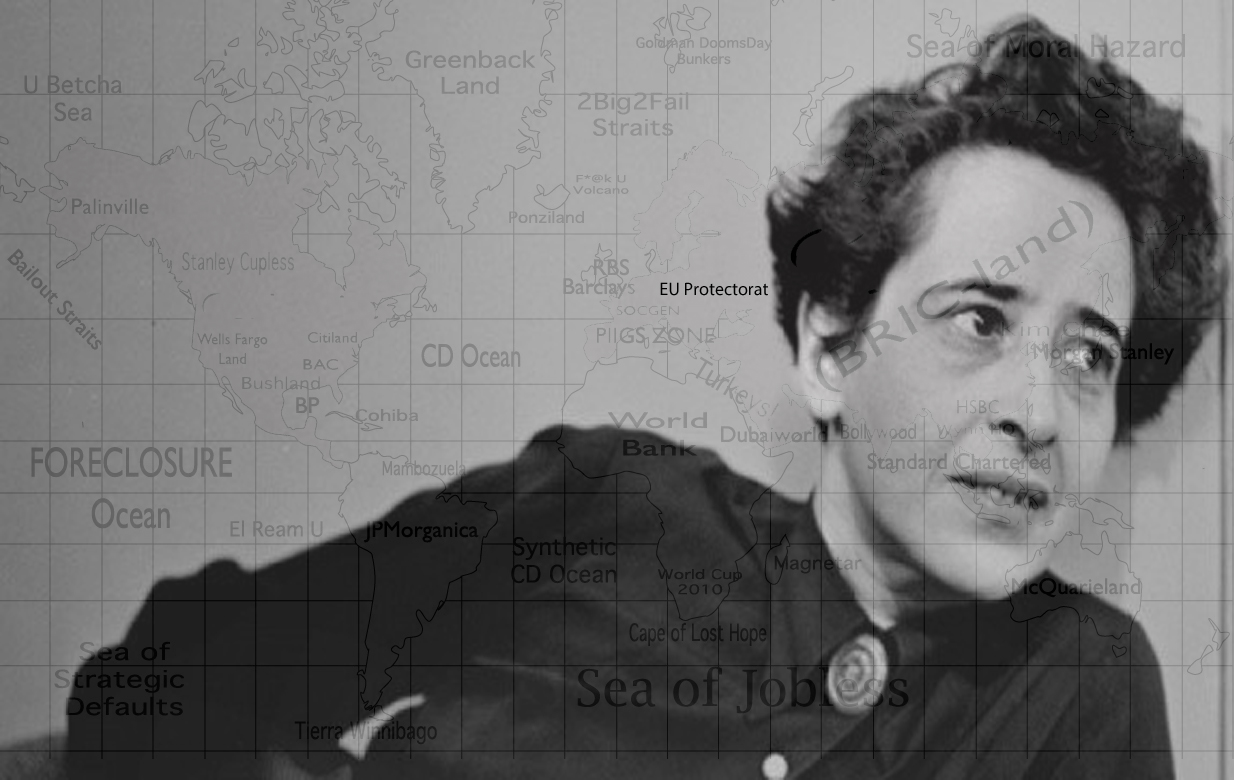
 Arendt emphasized repeatedly that totalitarianism differs essentially from other forms of political oppression known to us such as despotism, tyranny and dictatorship. Wherever it rose to power, it developed entirely new political institutions and destroyed all social, legal and political traditions of the country. The term totalitarian, first used in the late ’20s, was not fully developed until the late ’40s and early ’50s, when a classical literature arose describing a new kind of tyranny created in this century. Arendt discusses the use of supranational organizations, fake (non) governmental agencies, and doctrines as a means of concealing totalitarian aims. She claimed for instance that the Nazis were not simple nationalists. Their propaganda was directed toward their fellow-travelers and not their convinced members; the latter, on the contrary, were never allowed to lose sight of a consistently supranational approach to politics.
 According to Arendt that totalitarian totalitarian elites have usually a firm and sincere belief their unilateral omnipotence. Totalitarianism and the belief to be chosen to lead the world instead of other less worthy powers go together. This moral cynicism, their belief that everything is permitted, rests on the solid conviction that everything is allowed to them. Moral decisions become dependent on the context. Aggression on the grounds of “ exceptionalism”, is backed by the dubious idea that some are special and cannot be held to the same standards as others. Unilateralism, preemption, and exceptionalism, the toxic combo that has spurred hundreds of of wars, territory occupation, regime change, global surveillance, extra-judicial assassinations, drone attacks, and hyperbolic state terror most of which has been directed at civilian populations whose only fault is that they occupy regions which have some geostrategic or economic importance.
 “If you had to summarise narcissism, it’s a feeling of specialness,” says Dr Adam Perkins, a researcher at King’s College London’s Institute of Psychiatry. “Narcissists view themselves as special, as deserving of better treatment than the rest of the world.”
 Totalitarian policy is as a case of the government beginning to believe their own propaganda about their narcissist exceptionalism. The distorted reality will be believed by those who use them, just as C.G. Jung said – the unconscious in us is real. It is this form of perceived omnipotence that leads to bullying and manipulating the citizens and the failed Hero acting of the elite: the weak king, the cruel warrior, the wicked magicians, the narcissistic lover. Sure, there are also clear political struggles and psychological motives behind the supranational and unipolar debate: the establishment join in the hope for the blessings of a centralist post-democratic state, because they share belief in the stability of the state as sole power (and on its non accountable priests). Anything significant beyond the state (such as the individual, the family, the truth, the religion), would challenge the semi-religious ego of the transnational institutions – not only their political clout.