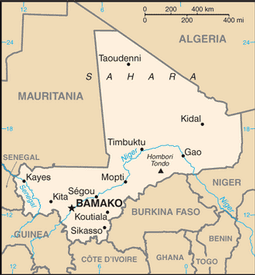
Islamists in Mali destroyed a number of Sufism tombs in the ancient city of Timbuktu, which in the last year fell under control of a separatist insurgency. Home of the prestigious Sankore University, Timbuktu was an intellectual and spiritual capital and a centre for the propagation of Sufism (an Islam faction) throughout Africa in the 15th and 16th centuries. Its three great mosques, Djingareyber, Sankore and Sidi Yahia, recall Timbuktu’s golden age. “The destruction is a divine order,” said a spokesman from Ansar Dine, a radical outfit with alleged links to al-Qaeda. Ansar Dine or “defenders of the faith” in Arabic is group led by a prominent leader of the Tuareg rebellion in the 1990s which wants the imposition of strict Sharia law across Mali.The Associated Press Posted Jan 28, 2013 @ 07:32 AMSEVARE, Mali (AP) — Islamist extremists torched a library containing historic manuscripts in Timbuktu, the mayor said today, as French and Malian forces closed in on Mali’s fabled desert city.
All of this is haram
According to BBC the “spokesman” went on: “God is unique. All of this is haram (forbidden in Islam). We are all Muslims. Unesco is what?” According to reports, the militants teared down the centuries-old mausoleums of Muslim holy men in Timbuktu. As many as half of the city’s shrines have been destroyed in a display of fanaticism. When driven out of Timbuktu by the French, the leaving “activists” burned down the Ahmed Baba library which is a real tragedy, because so much of Sufi and African history, literature and learning was lost forever. Build by the South African government in 2009, the Ahmed Baba Institute was named after a Timbuktu-born scholar and held thousands of priceless manuscripts in its climate-controlled, underground vaults. Ancient books of culture, geography, science are now all torched up 20,000 scholarly manuscripts lost.
Memories come up when in March 2001, Taliban fighters and grandees blew up the famed giant 6th century statues of the Buddha in Afghanistan.The Taliban also rampaged through the national museum which I visted in the seventies, smashing any art depicting the human form, considered idolatrous under their hardline interpretation of Islam. In all, they destroyed about 2,500 statues. Or of the final destruction of the ancient world’s single greatest archive of knowledge, the Library of Alexandria, which was burned down by Caliph Omar 640 AD when the Muslims took the city of Alexandria. Upon learning of “a great library containing all the knowledge of the world” the conquering general supposedly asked Caliph Omar for instructions. The Caliph has been quoted as saying of the Library’s holdings, “they will either contradict the Koran, in which case they are heresy, or they will agree with it, so they are superfluous.” It is somewhat ironic that Alexandria was the center of Monophysitism, a Christian heresy weakening Byzantine and Roman power.
Ignorance
Too many critics of Islam, including atheists, fail to appreciate just how diverse and varied Islam can be, much more than Christianity. This is especially true when it comes to Wahhabi Islam, the primary religious movement in Saudi Arabia. Saudis are aligned with the West to bring down all somewhat secular dictatorships in the region. In the puritanical strain of Islam adhered by most radical Sunni (like Taliban and Salafists) but also fundamentakist Shiites, veneration of Sufi saints – which remind on Christian saints – counts as idolatry a heretical practice that cannot be tolerated. It is against modernity, secularism, and the Enlightenment which orthodox Islam do fight — and it is this anti-secularism, anti-modernism which helps drive extremism, even to the point of cultural terrorism. Militants bearing guns, pickaxes and shovels reduced to rubble the tomb of Sidi Mahmoud, who died in 955 A.D. They have also knocked down tombs of two other prominent medieval saints, Sidi Moctar and Alpha Moya.
Who controls the history controls the future
Both South Africa and the Libya of Col. Muammar el-Qaddafi were involved in efforts to revive the fortunes of the ancient city and its artifacts. South African researchers involved in a project to preserve the Timbuktu manuscripts have had word that most of the treasures survived in private libraries and secure locations.Mohamed Mathee of the University of Johannesburg told a News Channel, “It seems most of the manuscripts are OK. These manuscripts are with families and are safe.” All those events in the new millennium have highlighted that we are today’ in a ideological war is fought with more than just weapons – just as Samuel Huntington has written in his a powerful and disturbing book in the late nineties.
International outrage with little understanding of the Islam has been swift to blame “Islamists”. But beyond understanding history (and Islam) better, there’s little anyone can do to stop this wretched bout of iconoclasm. History is littered with the debris of toppled temples and smashed idols. Salafists and others who also believe in a more orthodox brand of Sunni Islam harbor a particular animosity toward Sufism, whose mystical interpretation of the divine affords a more heterodox faith, steeped sometimes in local pre-Islamic traditions and a reverence for saints and deceased wise men. Islam, as it spread outside the Arabian world, did so in some part through the peaceful teachings of Sufi orders and wandering monks — not just under the hooves of conquering Arab armies. Yet, recently under the Arab Spring, Sufi shrines have come under attack from emboldened and radicalized puritans in countries like Egypt and Libya by Muslim brotherhood and Salafist; in Pakistan, the Taliban and its affiliates have waged a sectarian war on Sufis, systematically targeting dozens of tombs and Sufi sites, while killing hundreds of devotees. In Persia the orthodox Shiites did not much less harm.
The many holy places and old libraries of Timbuktu, once a prominent center of Islāmic learning in the 15th and 16th centuries, were preserved for centuries as a result of the city’s remote location on the path of now collapsed salt and gold-trade routes. In single-minded devotion to the word of the Koran, the orthodox Islam cares little for the juridical wisdom of generations of Timbuktu’s theologians who critically examined Islam’s founding holy text. The attack on Timbuktu’s cultural heritage is just one more attack against history and the values it carries — values of tolerance, exchange and living together. It is an attack against the physical evidence about the Islam’s majority livelong struggle against freedom, science and mysticism.
Wisdom
The Ahmed Baba Institute had nearly 30,000 manuscripts, which are being studied, catalogued and preserved. Four basic types have survived:
key texts of Islam, including Korans, collections of Hadiths (actions or sayings of the Prophet), Sufi texts and devotional texts
works of the Maliki school of Islamic law
texts representative of the ‘Islamic sciences’, including grammar, mathematics and astronomy
original works from the region, including contracts, commentaries, historical chronicles, poetry, and marginal notes and jottings, which have proved to be a surprisingly fertile source of historical data.
Some manuscripts themselves are also of special importance to their owners to prove noble descent or land and property ownership. But they are also proof of Africa’s pre-Islamic culture, which the Islam claimed (and radical despise) like any culture Islam took over and claimed of its own.
According to the 17th-century historian Abdurrahman As-Sadi, the history of the West African desert region could be divided into the rise and fall of three great empires – ancient Ghana, medieval Mali and the Songhay empire. Located at a hub of commercial exchange between Saharan Africa, tropical Africa and Mediterranean Africa, Timbuktu was a magnet that attracted both men of learning and men of commerce. It benefited from the gold trade , however, the most profitable trade items in Timbuktu were books. Buying them was considered a socially acceptable way of displaying wealth and a great source of prestige. As the empire of Ghana declined, the Mali empire took its place. King Sundiata Keita of Mali conquered ancient Ghana in AD 1240, and two generations later, Islam became the dominant religion of the Malian cities and Arabic became the language of scholarship. Described as the ‘Latin of Africa’, Arabic was useful for communicating between tribes such as the Bambara, Fulani, Hausa, Mossi, Songhay and Tuareg who all spoke different languages. Just as Latin in medieval Europe was associated with Christianity, Arabic in medieval Africa was associated with Islam, and just as Europeans adopted the Latin script to write their own languages, Africans used the Arabic script to write theirs.
Mali became indepdent 1960
The Sankoré University mosque was built in about AD 1300 with funding from a woman of the Aghlal, a religious Tuareg ethnic group. There were a number of challenges to Malian hegemony. ‘The Tuaregs began to raid and cause havoc on all sides. The Malians, bewildered by their many depredations, refused to make a stand against them.’ Mali lost control of Timbuktu in 1433. Once a tributary to the Mali empire, the Songhay became independent as Mali declined. The gold traders and the scholars of Timbuktu were also treated harshly and many fled. Timbuktu benefited under the reign of the Askiya kings by tax and slavery privileges and rose to intellectual dominance in the region. The Sankoré University mosque was the main teaching venue but classes were also taught at the Great Mosque and at the Oratory of Sidi Yahia. Public libraries were established and employed calligraphers to copy books.
Timbuktu was also a religious city. According to a West African proverb: ‘Salt comes from the north, gold from the south and silver from the country of the white men, but the word of God and the treasures of wisdom are only to be found in Timbuktu.’ There is a local legend that the city is guarded by 333 renowned saints as well as numerous lesser ones, and surrounding Timbuktu like a rampart are the chapels where the saints are buried. Saints and chapels are of course an anathema to orthodox Islam. According to the Sufis, a saint is a Muslim mystic, usually a scholar, who has achieved such closeness to God as to possess special powers.
Ahmed Baba
Ahmed Baba, the Sufi scholar after whom the burned down library was named, studied Arabic grammar and syntax, astronomy, logic, rhetoric and prosody. Textbooks were purchased and copied on a number of subjects, including astronomy, astrology, botany, dogma, geography, Islamic law, literary analysis, mathematics (including calculus and geometry), medicine, mysticism, morphology, music, rhetoric, philosophy, and occult sciences. The works of the Greek astronomer Ptolemy were basic references for Islamic astronomy. The Greek philosophers Plato and Aristotle were also common. The Greek physician Hippocrates was popular, as well as the Persian medical philosopher-scholar Avicenna. The Timbuktu manuscripts mainly comprise Korans, Koranic exegesis, collections of Hadiths, writings on Sufism, theology, law and other closely related disciplines. By the 15th century, Timbuktu scholars were producing original works as well as compiling new versions and commentaries on established texts. The reading and writing of poetry was important in these cultures. Among the Timbuktu documents are verses devoted to the Prophet and to the adoration of a particular woman or man, and poems. A number of manuscripts were written in Ajami – Arabic script used to write local languages – with botany, diplomatic correspondence, occult sciences, poetry and traditional medicine.
Sufism
There are three main branches of Islam – Sunni, Shiite and Sufi. Sunnis make up about 85 percent of the Muslim population globally, while Shiites account for about 15 percent. The two split over differences of who should succeed the Prophet Muhammad but are further subdivided.
Sunni follows a strict, literal interpretation of the Quran and the life of Muhammad with the Sunna as core teaching. Wahhabism is an austere form of Sunni dominant in Saudi Arabia for which Muslims more often use the term Salafism.
Shiism is the smaller of the two major branches of Islam. It developed after the death of Muhammad, when his followers split over who would lead Islam.
Sufism is an Islamic mystic tradition with followers around the world. Sufis tend to identify with either Sunni or Shiite Islam. Many Muslims are critical of Sufism as an unjustified innovation.
Shia Faction of Islam
Sunni Faction of Islam
Sufis/Sufism
10-15% of all Muslims
Majority of Muslims
Shia means “faction,” refers to “faction of Ali.”
Sunni means “tradition,” adheres to orthodox tradition
Suf means “wool,” considered the Mystics of Islam.
Iran center and home of most Shia, 88% of Iranians are Shia (Shi’i), In Iraqi 96% are Muslim and over 50% of them are Shia (Shi’i), though Iraq was ruled by minority Sunnis. Reverse Syria if you consider Alawis (12er ) to be Shiites.
Grew out of Umayyad dynasty. World-wide 85% of Muslims are Sunni.
Developed in reaction against the excesses of the Sultans and Caliphs (who wore silks, satins), specifically the Caliphate of Damascus in the Umayyad dynasty, Sufis wore course wool garments in protest.
Succession and Leadership
Believe in Ali and the Imams as rightful successors of Muhammad, but not in first 3 Caliphs. Ali was first of 12 successive legitimate Imams. Succession was to be hereditary.
Acknowledge each of the first four Caliphs as rightful successors to Muhammad.
Value deliberate simplicity, meditation rather than just a formalistic following of the rules.
Look forward to Messianic return of the last recognized Imam. Muhammad al-Mahdi, last Imam, disappeared 900 CE, went into “hidden realm”, was sinless. Ayatollah Khomeini (1900-1989) believed by many to be the return of the last Imam.
Through the ages, Caliphs rule “in God’s name.”
Sufis gathered around shaikhs (masters) and formed faqirs (orders or communities). Rabi’a (1717-1801 CE) was a Sufi poet whose poetry spoke of God’s Love similar to Christianty Al-Ghazzali (1058-1111) first Sufi to bring the faction into mainstream Islam.
Imam holds an exalted position, Ayatollah refers to most important Imams.
Imam is a prayer leader. Sunnis approach God directly, there is no clerical hierarchy.
Sufi Shaikhs are the masters. Wandering monastic culture
Teachings and Scripture
Characteristic is the continual exposition and reinterpretation of doctrine by the clerics.
Believe in entire body (canon) of life and teachings of Muhammad as found in Qur’an and hadiths (sayings and traditions of Muhammad). Sayings and traditions are interpreted by scholars in Islamic schools.
Qur’an is full of symbolism, each verse has from 7 to 70 meanings. Believe in three approaches to the divine: mysticism of Love (heart knowledge), Ecstatic (visionary knowledge) and intuitive discernment (mental knowledge)
Both Sunni and Shia factions believe in the Sharia, the comprehensive law derived from the Qur’an (revelations of Muhammad) and the Sunnah (sayings or interpretations of Muhammad).
Believe in fana (extinction) of separateness from God and “remembering” that “there is nothing but God.”
Scholars carry on debate in Islamic Schools. Science of Tradition refers to Islamic scholarship and rating of specific writings (rated sound, good, weak, or infirm)
Influenced by Christianity and Gnosticism (life is a spiritual journey—want to know God/Allah now not just after death), Persian Zoroastrianism and Hindu Mysticism
Shia Faction of Islam
Sunni Faction of Islam
Fufis/Sufism
Fundamentalist approach to Islam, interpretation by clerics
Qur’an applies to everyday life, public life is shaped by the Qur’an. Saudi Arabia considered model of proper Islamic state
Called “the Heart of Islam,” highest experience in life is experience with Allah, can get face to face with Allah/God
Sufism has been, especially in the West, portrayed and regarded as a valuable and legitimate part of the Islamic faith. Anybody somewhat familiar with the complex interaction of religions will agree with this statement “considerable ink has been spent by modern scholarship on the ‘origins’ of Sufism in Islam, as to how far it is ‘genuinely’ Islamic and how far a product, in the face of Islam, of outside influences, particularly Christian and Gnostic.” The historian Rahman seems to hint that some of this ink has been wasted, as he concludes that “outside influences must have played an accessory role and these no one may deny, but they must have supervened upon an initial native tendency.” Sufism goes beyond the Five Pillars of Islam are which are obligations which are required of every Muslim: shahadah (statement of faith), salat (prayers), zakat (alms), sawm (fasting), and hajj (pilgrimage).
History of religions
A thorough and critical examination of historical and present day Sufism, quickly reveals the influence of numerous religious ideas foreign to Islam. Zoroastrianism had also an intimate contact with Islam like Gnostic Manichaeism. Zoroastrianism provided first of all a vocabulary for Sufi poets and symbols of angelology and cosmology transparent in the light of gnosis. Most orthodox scholars would be perplexed by this conclusion, especially when it is considered that Zoroastrianism (and pre-Christan Gnostic) predated Islam by over 1000 years.
The further one delves into Sufism from a content perspective, the more clear it becomes that both the origins and content of Sufism show the inclusion of religious ideas and influences alian and contradictory to orthodox Islam. The scholar Elliot Miller states that “[being] based on experience rather than doctrine, Sufism has always been more open to outside influence than other forms of Islam… in addition to early influences from Christianity, one can find elements of Zoroastrianism, Neoplatonism, Hinduism, and other diverse traditions.”
While Sufi teachings have been influenced by various religions, their practices also bear close similarities to those of Hinduism and other mystical religions of the East. The Sufi orders are led by shaikhs, who play the same role as Hindu gurus. Most Sufi orders still consider the five pillars of Islam to be essential, and practice them piously, however they go far beyond this, aiming to spiritual awakening. Central to all of these practices are ritual “invocations of the Divine Name,” also known as dhikr, which can be done either silently or in a chant. Here similarities with Hindu mantras are unmistakable. The evidence of Sufi borrowings from other Eastern religions such as Hinduism and Zoroastrianism is certain. The similarities in teachings and ritual are overwhelming. It is no surprise then that the goals of Sufism reflect their pantheism and monism.
Echoes of Eastern ( and Western) mystic religions are of course distinctly contrary to Muslim orthodoxy but its mystic quest for spirituality has embraced all sorts of religion. How then, in conclusion, does the evidence presented, reflect not only on the nature of Sufism, but on the very nature of Islam itself? Sufism is clearly a reaction or response to what was lacking in early Islam. The very strength of Islam, in its reliance on a simple creed combining religion, law (and power of a non-secular state) and the five pillars of practice, proved to be the very weakness of Islam. The design of the Islamic ideological system had allowed, however, for rapid expansion and political aggression. Another area of weakness in Islam, which helped lead to the problem of Sufism, is found in the inherent synthesism (and gnosticism) of Islam. Here the vagueness caused by the doctrine of the indescribably Allah (a main concept common of Gnosticism) allowed in essence creating a contradictory belief system. The orthodox ulama developed their theology borrowing and changing what they viewed as their ‘Judeo-Christian’ roots (including Chrisiam heresies), while the Sufis were largely influenced by Eastern mystics.
Sufism, with its radical mystic concepts, is for orthodox Islam not a legitimate part of Islam, if Islam is narrowed to a logically coherent set of beliefs. For Sufism not only points to a lack of spirituality in Islam, but also contradicts orthodox Muslim teachings – in the process clearly opening the door to all the world’s religions. One more door of many, now was violently shut by orthodox Islam in Timbuktu which goes deliberately back to its origional political and ideological purpose as mean of expansion.“It’s truly alarming that this has happened,” Mayor Ousmane Halle told The Associated Press by telephone from Bamako. “They torched all the important ancient manuscripts. The ancient books of geography and science. It is the history of Timbuktu, of its people.” After Islamists seized Timbuktu last April they began imposing a strict Islamic version of Shariah, or religious law, across northern Mali, carrying out amputations and public executions. Women could be whipped for going out in public without wearing veils.
Conclusion
The golden age of Timbuktu came to an end with the collapse of the Songhay empire following the invasion by Morocco, when an Arab-European army invaded Songhay in 1591 and destroyed it. The invaders confiscated gold and other resources, enslaved the Songhay scholars – including Ahmed Baba, who was deported to Morocco – and attempted to confiscate Timbuktu’s archives. The “Liberation of Libia” hailed by the Western press, threw what was once one of West Africa’s most stable democracies once again into chaos: the rebellion in the north gained ground with Gaddafi’s fighters and weapons moving over the border into Mail and effectively capturing half the country afterwards splintering on religious lines, with Salafist factions clashing with more secular elements. Western military intervention dimly disguising economic interests started after hundreds of thousands of Malians have been forced to flee their homes as refugees. Fears of an escalating humanitarian crisis have been publicized but the writings on the wall have been ignored. You see a pattern of wisdom and ignorance here? Yes, I do too. Please note, this is an essay out of general interest (and sympathy) to religion even if not my belief. I am neither Muslim nor scholar.
C. G. Jung had shown a pronounced and informed interest in Gnosticism and Alchemy. This is evident in the Quaternio Series of the Self in his book. “Aion”. In his early works “Seven Sermons to the Dead” (“Die sieben Reden an die Toten ”) and “The Red Book” (recently published) he perceived the outstanding psychological relevance of Gnostic insights. Was Jung really a Gnostic? I seems to me, that “Aion” and another late work The “Answer to Job” give some evidence to the assertion: No, he wasn’t.
Quaternity in religion and psychoanalysis
It is true that C.G. Jung saw in Quaternity a divine concept and welcomed the proclamation by the Pope Pius XII in the year 1950 adding the Catholic Holy Virgin Mary, expanding so the Christian Trinity. Neoplatonic philosophy ( and many other metaphysics e.g. Mayan) contained what Jung has called the element of “fourness,” or quaternity, that seems to be so prominent an aspect of the life of the unconscious collective landscape across various cultures. This quaternity is – as the one of the Christian cross – a (3+1) structure, meaning that three parts are equal and the fourth is the “totally different”. One of the most important ramifications, however, unacceptable to some Christians, of the Jungian quaternal recipe is bringing back the original nature of evil and its personification in the real or mythological being of the evil.
In “Aion” (collected works 9ii) Jung summarizes his researches into the phenomenology of the Self, good and evil seen from Christianity, Alchemy and Gnosis . “Answer to Job” an interpretation of a book in the bible,(“Antwort auf Hiob”) maybe interpreted as gnostic answer to the Bible but to me is more a subtile but well-meaning ironic description of the omnipotent god Yahweh of the Old Testament who needs the reflection of the human Job to send his son Jesus to become a just God (again). In this article I want to investigate C.Jung’s starting point and journeys in regards to Jesus. C. G. Jung was a prolific writer and practitioner of psychoanalysis. The reader is invited to consult the C. G. Jung’s Work for expansion on the theme in this essay or to follow the links in this article (indicated in blue).
Gnosticism is the knowledge of transcendence arrived at by way of interior, intuitive knowing (Gnosis). Gnosticism was primarily defined in Christian context also including pre-Christian religious beliefs common to early Christianity, Hellenistic Judaism, Greco-Roman mystery religions, Zoroastrianism (especially Zurvanism), and Neoplatonism. Gnosticism goes hand in hand with Kabbalah, which is the esoteric or mystic religion of Rabbinic Judaism. These occult teachings deal with magic, hypnotism, sorcery and all sorts of pagan practices collected throughout centuries borrowing from different cultures. The mixing of all these pagan traditions turned into a complicated set of Gnostic teachings with all sorts of perverted doctrines added to “Christian” mingling its pure and simple teaching with theosophy and even magic. Gnostic thought were stamped out by Christianity in a struggle of life and death. The Gnostic teacher Carpocrates, as opposed to the official Christian dogma that salvation is the result of a single, unrepeatable event – the crucifixion of Jesus – postulated this process as continuing through a number of lives of earth. Abraxas, the summation and ruler of the sevenfold planetary spectrum, is thus the true archetype of man’s potential freedom and independence from unconscious psychological pressures and compulsions.
The Nag Hammadi library, discovered in upper Egypt in 1945 provided a cache of new gnostic documents and its psychological importance was pointed out by C.G. Jung. After his death and the publication of his autobiography, Memories, Dreams and Reflections, and the Red Book, it became also clear that Jung underwent an intense period of spiritual experience between 1912 and 1917. The only fragment of his writings from that period which he permitted to be published was The Seven Sermons to the Dead, using terminology and style of second century Gnosticism. Jung attributes the authorship to Basilides, a Gnostic sage who taught in Alexandria around A.D. 125-140 (see below). It is clear, however, that Jung disagreed with Gnostics (and Buddhism) on the ultimate goal of the individual to return to a supreme, other-worldly re-unification with the Pleroma ( the superior unknown God) as this would be a total identification with the unconscious.
We can argue then that there are three types of evil. The first is relative, caused by the perception of the human mind which labels things it does not accept as evil. The second arises from imbalance. This evil originates in an action that comes at the wrong time for the wrong reasons and which causes much damage as a result. The evil that thus occurs is neither relative nor absolute but falls someplace in-between. The third type is absolute evil. It arises from imbalance but feeds on evil itself and soon grows like a cancer to spread through the body that gave rise to it. One can only fight this evil by trying to find one’s own balance and relationship to the Self.
In his work The Archetypes of the Collective Unconscious Jung restated the message contained in the Second Sermon when he says: “Evil is the necessary opposite of good, without which there would be no good either. It is impossible to even think good out of existence.” Jung was insistent evil to be real, for he felt that western humanity, dwarfed the picture of evil. In Civilization in Transition he wrote that evil “is of gigantic proportions, so that for the Church to talk of original sin and to trace it back to Adam’s relatively innocent slip-up with Eve is almost a euphemism. The case is far graver and is grossly underestimated.”
If you recall my article Can Hitler go to heaven? The evil presented in Mao, Stalin, Hitler, Pol Pot. you can only see them as anything but evil, if we take Jung’s point of view seriously. Of course there are many other kinds of what seems to be pure evil in the world. According to Jung, good and evil are not two opposite poles of a linear dimensionality. They resemble a circle wherein going far enough in either direction is likely to associate one with the opposite polarity. He said that there is no good that cannot produce evil and no evil that cannot produce good.
Aion: Phenomenology of the Self
Aion is one of a number of major works that Jung wrote during his seventies that were concerned with the relations between psychology, alchemy and religion. He is particularly concerned in this volume with the rise of Christianity and with the figure of Christ. He explores how Christianity came about when it did, the importance of the figure of Christ and the identification of the figure of Christ with the archetype of the Self. A matter of special importance to Jung in his seventies – the problem of opposites, particularly good and evil – is further discussed and the importance of the symbolism of the fish, which recurs as a symbol of both Christ and the devil, is examined. As a study of the archetype of the self, Aion complements The Archetypes and the Collective Unconscious.
Jung does not decodes events in dreams and associated unconscious products as a facade behind which the true meaning lies, but takes those events themselves as important symbols. Hence, “symbols” must not be misunderstood. To Jung the symbol manifests an unconscious product in conscious form. To appreciate why symbols mean so much to Jung, we need to understand symbols are a bridge for religions which are an object with universally projected contents. That is why there are so much symbols in religion and also why Jung spent so much time looking into the meaning behind religious symbols, and symbols in other fields such as alchemy. Symbols have often an irrational element, as well as a rational part. Within Jung’s Framework the specific process of successfully acknowledging and integrating the meaning behind (formerly) unconscious contents to the consciousness is called “individuation” and results in the individual achieving the realization of the “Self” and thus finding transcendence, which is the main theme in this book. The story of the self and Jesus in his book resembles closely the story of the human psyche that loses its connection with the collective unconscious and needs to be rescued by the Self.
Jung compares in this book also his concept of “self” with other teachings. Jung had never qualms about reducing religion or magic to a psychological process. However, that is not to say it is then worthless in the practical field, because Jung is dedicated to showing precisely how large a factor the psychic realm is in ordering our lives. It must not be forgotten that for Jung, Buddhism itself was originally a result of projected unconscious contents, and the broad parallels are there. In dualistic Gnostic teaching, the Self is reached when we have rid ourselves of opposites. Jung’s reflections had long been influenced in the thought of the ancient Gnostics to such an extent that he quotes In Aion Second Book XIV Hipolytes: to him were Gnostics psychiatrists. One may go so far to considered them the virtual roots of his ‘depth psychology’.
In the light of such recognitions one may ask: “Is Gnosticism a religion or a psychology?” The answer is (in the broad sense) both, just like Jung’s thoughts can be interpreted religiously. Most mythologies found in Gnostic scriptures have psychological relevance and applicability. For instance, the basic Gnostic myth to Aeons, intermediate deific beings who exist between the ultimate, True God and ourselves. They, together with the True God, comprise the realm of Fullness (Pleroma) wherein the potency of divinity operates fully. The Fullness stands in contrast to our existential state, which in comparison may be called emptiness. The false creator God bears a close resemblance to the alienated human ego that has lost contact with the Self. One of the aeonial beings who bears the name Sophia (“Wisdom”), referred to by C.G. Jung many times in his works, is of great importance to the Gnostic world . Analogies of this sort exist in numbers.
Highly interesting are Jung’s diagrams in Aion (CW 9ii, penultimate chapter) in which Jung summarizes his researches into the phenomenology of the Self. In those diagrams Jung works his way through 2000 Years of Christian (and Gnostic) symbols of the Self. Using four octahedrons (double pyramids, i.e. one the platonic solids), he clearly tries to enhance the trinity of religion (Christianity) and science (space, time, causality) with a fourth dimension (his concept of synchronicity).
The Moses Quaternia
The Moses Quaternia
Lower Adam corresponds to the ordinary mortal man Moses corresponds to the culture hero and lawgiver, personalised ally to the ‘father’ Zipporah corresponds to the ‘higher mother’ as the daughter of a king and priest Moses and Zipporah represent the ‘royal pair’ for the ordinary man (Lower Adam) which for Moses corresponds on the other hand to his ‘higher man’ (Higher Adam) and his anima, Miriam The higher man is synonymous with the ‘spiritual, inner” man, who is represented in the quaternio by Jethro Such is the meaning of the quaternio when seen from the standpoint of Moses. But since Moses is related to Jethro as the lower Adam, or ordinary man, is to Moses, the quaternio cannot be understood merely as the structure of Moses’ personality, but must be looked at from the standpoint of the lower Adam as well.
The extended (shadow) Moses Quaternia
The Extended Moses Quaternia
Extensions of the ordinary man’s psychic structure downwards, towards the subhuman, the dark and evil side represented by the shadow – the extended Mose. Homo carnalis refers here to the human Mose as opposite of the spiritual lead. The black woman is his wife. The negative anima is represented by Miriam who was the sister of two powerful biblical figures, Moses and Aaron. Her name derives from the root Mary, Mariamne, or Maria, meaning “bitterness.” She remained steadfast in her determination to free the Hebrew people from the pharaoh’s oppression. But Miriam was human, and not perfect. For her pride and insubordination to the power of God working through Moses, she became afflicted with a disfiguring skin disease (leprous’). Miriam ‘spoke against’ Moses and even stirred up his brother Aaron against him. because of the black(Ethiopian) woman whom he had married.
The paradise Quaternia.
The Paradise Quaternia
The snake symbol brings us to the images of Paradise, trees and earth. This amounts to an evolutionary regression from the animal Kingdom back to plants and inorganic nature, epitomized in alchemy by the secret of matter, the lapis. Here lapis is not to be understood as the end product of the opus but rather as its initial material. This arcane substance was also called lapis by the alchemists.” Lapis–a unity, often stands for the prima materia in general, consists of four elements or has to be put together from them.
prima materia–a bit of the original chaos (increatum of Paracelsus) which was believed to be hidden somewhere in metals, particularly in mercury, or in other substances. Not in itself a simple thing (massa confusa). Elements are not united but merely coexistent in chaos, they are hostile to one another and will not unite of their own accord–must be combined through the alchemical procedure. Represents and original state of conflict and mutual repulsion. Splitting up or unfolding of the original unity into the multiplicity of the visible world.
The Lapis Quaternio
The Lapis (Alchemy) Quaternia
This primary substance is round (masa globosa, rotundum) like the world and the world soul; it is the ‘stone that has spirit’, in modern parlance the most elementary building-stone in the architecture of matter, the atom, which is an intellectual model. The alchemists describe the ’round element’ now as a primal water, now as a primal fire, or as pneuma, primal earth, or ‘corpusculum nostrae sapientiae’, the little body of our wisdom. As water or fire it is the universal solvent, as stone and metal it is something that has to be dissolved and changed into air (pneuma, spirit).
Zosimos calls the rotundum the omega element, which probably signifies the head. The skull is mentioned as the vessel of transformation in the Sabaen treatise…the vas is often synonymous with the lapis, so that there is no difference between the vessel and its content; in other words, it is the same arcanum.
In the hierarchical series of those four, Good and evil are clearly shown to arise from a deintegration of the central Serpens node, “the point of maximal tension in the psyche.” In the Serpens node itself, these extreme opposites presumably coexist without contradictions. In these Aion diagrams, Jung shows two distinct forms of the archetypal Self. Evil (Diabolos) and Good (Christos) arise only in the first hierarchical form of the Self. They do not occur at all in the circular forms of the Self—the ouroboric, rotational.
Quaternio series; Man culminates in the of a good God, but rests below on a dark and evil principle (Devil or serpent). The serpent has its compliment in the Paradise Quaternio which leads into the world of plants and animals. Indeed, this serpent actually dwells in the interior of the earth and is the pneuma that lies hidden in the stone. The symmetrical compliment of the serpent, then, is the stone (earth) or in symbolism, the alchemical stage, whose central idea is the lapis which compliments the serpent. The stone is, however, not a human ego but a collective entity, a collective soul an hermaphrodite.The point of greatest tension between the opposites…(is)…the double significance of the serpent, which occupies the center of the system. Being an allegory of Christ as well as of the devil, it contains and symbolizes the strongest polarity into which the Anthropos falls when he descends into Physis. The ordinary man has not reached this point of tension: he has it merely in the unconscious, i.e., in the serpent.The Round is the primary substance (rotundum) like the world and the world soul; it is the ‘stone that has spirit’, in modern parlance the most elementary building-stone in the architecture of matter. The alchemists describe the rotundum the omega element.
The hierarchical Quaternio series shows the highest central node, the Anthropos, evolving in four deintegrations and reintegrations from the lowest central node, the rotundum. In doing so, it passes through four quaternios. A quaternio is a structure composed of two pyramids sharing a common base. If the apex of one pyramid points upward, the apex of the other necessarily points downward. It might be possible to construct a fifth quaternio above the Anthropos. It might deintegrate into God-Shekinah and Jesus-Mary, his mother. The reintegration would occur in the next higher central node which could be named simply “God.” But here the upward progression seems to end. What is beyond God? Jung addresses this particular problem by asking, rhetorically, what his diagram would be if its hierarchical nature were destroyed by bending it around so that the lowest node, rotundum, lay next to the highest node, Anthropos?
In the circular Quaternio series
Quaternio series circular
the lowest node moves “upward” toward increasingly more comprehensive integrations.Can this upward movement continue indefinitely? Obviously it cannot. Much more can be said about the cricular one. For the present discussion of evil it is only necessary to point out that Evil belongs only to first quaterino. There is no place for Evil in the structure of second. Again, both good and evil arise from disintegration of the Serpens node, the “point of maximal tension in the psyche.
Jung’s View on Jesus “Answer to Job”
Jung agrees with all modern scholars of antiquity and biblical scholar that Jesus existed. He also does not question his metaphysical importance. His thoughts of Jesus must be seen from his framework and are strictly restricted strictly to psychoanalytic dimensions. He writes extensively in Aion about Jesus as a symbol (manifest and visible) of the archetype Self. But not the full Self. Since Jesus is all good, he feels that is missing his Shadow. The shadow is of course the devil (which was in Answer to Job als God son and Jesus brother). That Jesus was crucified by the order of the Roman Prefect Pontius Pilate is given great significance in the Quaternio series of his book Aion: The serpent is the central node and mediator between Jesus and Lucifer. In his book Aion Jung consistently opposes this summum bonum view of God. Jung, in his psychological works puts a strong emphasis on this (see also my article C. G. Jung’s “Antwort auf Hiob” und das “Johannes Evangelium”). According to his theory of wholeness being the conjunction of opposites, Jung always affirmed conscious existence after death and, since one opposite is not possible without the other, neither is “good” or “bad” in itself as single entity. As long as many, if not the majority of us, expect all problems to be solved outside of ourselves, they will be beset by “inhumanity upon inhumanity, holocaust upon holocaust”. To him Christianity of the old Testament has not solved the problem of evil. It flirts with two great metaphysical forces, Good and Evil (or God and the Devil), but always opts for the final supremacy of God. Lucifer is only a “fallen angel” whose true place is in the heavenly court.
The story of Job, as seen by Jung in his Book Answer to Job (1952), is therefore the culmination of the Old Testament leading to the Gospel: Job sees that “You (Yahweh) are not a man” (Job 9:32). When Yahweh finally appears to him, Job hopes for an explanation of why he, an honest and just man, had been sent such undeserved afflictions. Yahweh seems unaware of any ethical dimension whatsoever. He overwhelms Job by recounting his creative acts. Job does not so much see evil in Yahweh as he sees a mass of unbalanced forces (as in the Kabbalah and Taoism). Job accepts that he cannot expect justice from God as long as God is primarily identified with His power, His omnipotence. Job realizes that God himself is evolving. Thus Job is able to say, “I know that my redeemer liveth” (Job 19:25). That is, Job intuitively knows that God will evolve in himself the ethical sense that Job already has: to distinguish Right/Wrong and Good/Evil. Another move that Christianity makes is to assert that all good comes from God and all evil comes from man.
With Abraxas (Greek Ἀβρασάξ, Ἀβράξας) Jung described Egyptian Gnostics of Basilides in Alexandria around the 2nd century the symbol of the highest Nikolaos, from which emerged the five primal forces Geist(nous), Word (logos), Providence (Phronesis), Weisheit(Sophia) and power as well as moral perfection and inner peace.The name Abraxas is presented on amulets with the head of a cock, dragon’s feet and a whip in his hand. Later, he is recorded as having the head of a king and demon’s feet. He was seen by the Basilidians (after Basilides), a group of twelfth century heretics) as the supreme god which claimed that Abraxas sent Jesus Christ to earth in the form of a benevolent spirit
Basilides integrated various Christian Jewish, Persian, and neo platonic traditions to a dualistic view of the world. The early Christianity was heavily Gnostic-influenced. Gnostic directions also in Judaism and even Islam has its Gnostics (the Sufis). The gnostics believe that the core of every human is a “divine spark”. The spark of the divine is immortal, he exists outside of time and space. As long as the man but has not recognized its true state, he remains trapped in this world and must reincarnate again and again in a new body. Every once an envoy from the world of light comes but (Christ plays this role in the Gnostic Christians) at the material level in order to connect the souls that have become ripe with the light power of God, and to enable them to escape the access of the false God, the demiurge.
The Abrahamic God (which describes Jung in “Answer to Job” is this demiurge. Therefore, early Gnostic Christians have roundly rejected the old testament.The Gnostics see Abraxas as Supreme God, good and evil in an entity “Whole”, who sent Jesus as God’s (Yahweh) son in the world.
Followers of Basilides believed that the body of Jesus Christ was an illusion, visited while here on Earth. From this supreme deity which the followers of Basilides worshipped, emanated seven divine powers (according to the number of planets), the first realm from the gradually decreasing clarity 364 more ghost kingdoms, each with seven “eons”. If one summarizes the entire realms of spirits in the secret word Abraxas or Abrasax, it contained the seven Greek letters which correspond numerically calculatedto the number 365. Abraxas is classified under the Egyptian gods. He was depicted on amulets with a whip in his hand. been. The Mystic Word Abracadabra was derived from his name. These Gnostic symbols were adopted by many companies, operated the magic and Alchemy.
C.G. Jung wrote in “The seven Sermons of the dead” under the pen name Basilides about Abraxas. According to C.G. Jung Abraxas – man cannot be redeemed without that Satan is understood and integrated . But how will Satan, who represents evil, will be integrated? Jung asserts, only by a way to lift the evil (the shadow) in the consciousness. Before we are not fully aware of our our deeper spiritual needs we will not achieve the individuation, which creates a more and more mature personality. The “Seven Sermons to the Dead” was privately printed, without copyright or date, sometime between 1920 and 1925, and distributed only to a select group of friends. The text is available for the interested in the internet. But there is a significant translation of Stephan A. Hoeller in his book “The Gnostic Jung” in which Hoeller not only interprets “The Seven Sermons as a Gnostic document, but also claims that Jung himself was a modern Gnostic. The Gnostic Jung is essentially an attempt – and a very interesting one at that – to interpret the Seven Sermons. Along the way, Hoeller, an almost worshipful admirer of the “Wise Man of Küsnacht” as he calls him, gives us a clear, skillful elucidation of some of Jung’s essential ideas. But the question is: Was Jung really a Gnostic is answered with the late work.
Conclusion
Gnosticism may possess both a psychological and a religious authenticity. Gnostic psychology and Gnostic religion need not be exclusive of one another but may complement each other within an implicit order of wholeness. Gnostics have always held that divinity is immanent within the human spirit, although it is not limited to it. The convergence of Gnostic religious teaching with psychological insight is thus quite understandable. The Red Book reveals the experiential, Gnostic roots of Jung’s psychology and certainly Jung studied Gnostic thought and his works are liberally sprinkled with references to them. But he never called himself a Gnostic. Without doubt Jung’s kind of psychoanalysis was different. Mental illness was considered to be a divided or incomplete condition and health as a state of spiritual wholeness – or near wholeness which could be reached through a process Jung called individuation. Jung always insisted that his writings were based upon empirical evidence and personal experience – it seems he was be worried to be accused of mystical or metaphysical theories but he connected them very often explicit to (catholic) Christianity.
This essay has delineated some of the main ways in which Jung can help us to understand the real meaning behind Christianity and Gnostics. It is not comprehensive and exhaustive, but shows how we as humans have a tendency to neglect our unconscious side, and the pressing need to recognize and integrate its contents (achieve individuation). In plain English, Jung shows us, particularly in Aion the salutary and prospective character of Religion.
References
CW9(i) = Jung, C.G. The Collected Works of C.G. Jung, Vol.9, Part I, The Archetypes of the Collective Unconscious Zürich 1951, Rascher
CW9(ii) = Jung, C.G. The Collected Works of C.G. Jung, Vol.9, Part II, Aion Zürich 1951, Rascher
Jacobi, J. The Psychology of C.G. Jung. Zürich 1961
Today’s [2012] coverage of the Syrian conflict and Syrian Alawites in the media is inexcusable – its often simplistic misguided, or worse.
I traveled the Middle East and the little I know about this area, one thing I am sure of – we have to consider at least two thousand years ethnic differences and religious history to understand what happens in Syria today. Syria is not a backward country, this area is arguable the cradle of civilization and certainly also Christianity. It is widely ignored in the media, that If Assad falls, many fear a backlash for Alawites, outnumbered six to one by the Sunnis in a Syrian population of 23 million, and also for large minorities of Christians and ethnic Kurds. So it is of interest to understand religious subtleties of this area in which history and culture was invented.
For starters the current ruling minority in Syria, the Alawis also known as Alawites, Nusayris and Ansaris is often confused with the Alevis (Alevites) which is predominately a Kurdish religion. The Kurds (a nation without state) play also a role in Syria. The Kurds live the eastern Taurus and the Zagros mountain ranges. Seven states meet in and near that area: Turkey, Iran, Iraq, Syria, Georgia, Armenia and Azebaijan. In this highland area called Kurdistan (German speakers may remember Karl May) they have lived for thousands of years. Their main centre lies between Lake Van in Turkey and Lake Urmia in Iran.
Alawism and Alevism
Alawism and Alevism are usually both relatively unintelligible narrowed to just another Shiite Islam sect. The Alevis are, however, predominantly in Kurdish East-Turkey, and have in common with the Alawites that both are considered as an extrem variant of the Shiite Islam of Iran, who revere Ali Ibn Abi Talib and the Twelve Imams of his house. It is fair to say, that Alawites have been disliked if not hated by Syrian Sunnis and Alevis by Turkish Sunnis alike. Alawites and Alevis have had a bad (his)story for thousand years with the Sunnis and were both subject to Genocides. After the revival of Islamist in Turkey the Alevis (who aligned with secular Atatürk) have been prosecuted and still encounter sporadic violence in Turkey similar to Christians until today. It is unclear if Kurds are Alevis or the other way around. Todays young Kurds a mostly political left.
But if one looks closer, more differences to Shiite Islam than similarities can be found in both groups. The Syrian Alawites are a mystical, syncretic religious community that functions almost as a disguised Christian Gnostic offshoot, aligned with Islam more through politics than through creed or ritual. Meanwhile, the Turkish Alevis resemble a Sufi Islamic offshoot but are fundamentally a non-monotheistic ‘Angel Cult.’ The foundations of this ‘Angel Cult’ were likely brought from Western Siberia by Indo-Europeans during the third and second millennia BC to Northern India, Europe, and the Middle East, explaining its striking similarities to Hinduism.
The Syrian Alawites (historically known as Nusayris) are a mystical, syncretic religious community whose theology functions similarly to a disguised Christian Gnostic offshoot. Structurally, they are aligned with Islam more through political expedience than through creed or ritual. Their core theology centers on a Divine Triad—comprising Ali as the Ma’na (Meaning), Muhammad as the Ism (Name or Veil), and Salman al-Farisi as the Bab (Gate)—which mirrors the Neoplatonic and Gnostic concept of cosmic emanations. Furthermore, their esoteric doctrine (batin) includes a firm belief in the transmigration of souls (tanasukh), an initiatory hierarchy restricted exclusively to men, and the celebration of Christian liturgical feasts like Epiphany and Christmas.
Meanwhile, Anatolian Alevis behave more like a Sufi Islamic offshoot on the surface, but their foundational belief system structurally resembles a non-monotheistic, pre-Islamic “Angel Cult”. Academically linked by some scholars to historical “Yazdanism” or ancient Kurdish/Anatolian angel worship, Alevi theology views God, Muhammad, and Ali as a singular spiritual light, rather than a physical incarnation. This complex cosmology is overseen by holy spiritual entities or angels.
Historically, Sunni majorities viewed the “Shiite leaning” of Alawites and Alevis not merely as heterodoxy, but as absolute heresy (Zandaqa) and apostasy (Irtidad). Because both groups deified Ali and rejected the outer pillars of Islamic law, Sunni authorities historically classified them as Ghulāt (extremists who exceeded the bounds of Islam), often judging them more harshly than Christians or Jews.
Alawites & Alevis elevate Ali far beyond a human leader into a cosmic, divine manifestation:
For Alawites, Ali is the supreme aspect of a divine trinity (the Ma’na or Meaning).
For Alevis, Ali is part of a mystical unity expressed as Hak-Muhammed-Ali (Truth-Muhammad-Ali), viewed as a single spiritual light.
Gnostic traits are highly visible in both traditions, but they are particularly explicit and structurally central to Syrian Alawism. When analyzing these groups through the lens of academic religious studies, several core Gnostic doctrines—such as cosmic dualism, hidden knowledge (gnosis), and the fall and redemption of souls—are clearly identifiablWhen Islamic armies conquered the Levant and Anatolia, the indigenous populations did not simply abandon their ancient Gnostic and Neo-Platonic worldviews. Instead, they adapted them. They took the Gnostic concept of the “Unknowable Father” and named him Ali; they took the “Demiurge/Emanation” and named him Muhammad; and they took the “Gnostic path to awakening” and turned it into the secret initiatory rites of the Alawites and the Cem ceremonies of the Alevis.
One can clearly understand that Sunni majorities did not see the Alawite and Alevi “Shiite leaning” as a valid branch of Shiism. Instead, Sunnis viewed it as a syncretic mask—a clever infiltration of pre-Islamic, Gnostic, and pagan ideas disguised under the name of Ali to subvert orthodox Islam from within. Early Christianity fought off this infiltration tooth and nail. From an academic perspective, orthodox Shiites view Alawites and Alevis through the lens of a specific, deeply reviled Islamic legal category: the Ghulāt (the “Exaggerators”).
Syrian Alawite
The Syrian Alawite (Nusayri) Tradition: is almost Pure Gnosticism. The Alawite cosmogony mirrors for instance classical 2nd-century Christian Gnosticism (like Valentinianism or Basilideanism) almost item for item.The Cycle of Reincarnation (Tanasukh): To return to the stars, a soul must be purified. Uninitiated Alawites or non-believers are reincarnated into other human bodies (or even animals and plants) repeatedly. Initiated Alawites who achieve gnosis break this cycle and return to their original form as stars in the cosmos.
In Syria, the Alawite claim to represent the furthest extension of Twelver Shi’ism. The Alawites take their name from Ali ibn Abi Talib, cousin and son-in-law of Muhammad, who was the first Shi’a Imam and the fourth and last “Rightly Guided Caliph” of Sunni Islam. Until fairly recently, Alawis were referred to as “Nusairis”, but this name is considered derogatory from them. The origin of the Alawis is disputed. The Alawis themselves trace their origins to the eleventh Imam, Hassan al-‘Askari (d. 873). The Alavis have been perfected by al-Khasibi, who travelled extensively in Persia and Iraq even founded a branch in Baghdad. He finally settled and died in Aleppo about 969 and in 1032 his grandson and pupil al-Tabarani moved to Latakia (close to Antioch, which was then controlled by the Byzantine Empire. Al-Tabarani converted the rural population of the Syrian Coastal Mountain Range and the plain of Cilicia to the Alawi faith, so their ancestral heartlands in Syria are in the agriculturally poor Nusayri Mountain range in the coastal part of north-west Syria, but with sizeable communities on the inland plains of Homs and Hama.
Poor peasants until the twentieth century, they changed ploughshares into swords, first becoming military officers, then using the instruments of war to seize the state. Tribal affiliation, kinship, and ideology forced to be secular against vicious religious opposition defines Syria’s yet ruling elite. The old controversy over the origins of the Alawis has been forgotten, and the contemporary Alawi enigma is this: the Alawis are heirs to a distinctive and secretive religious tradition, which is at the root of their dilemma in modern Syria. Beginning in the nineteenth century, scholars acquired and published some of the esoteric texts of the Alawis, and these texts still provide most of what is known about Alawi doctrine.
The picture that emerged from these documents was of a highly eclectic creed, embracing elements of uncertain origin. Some of its features were indisputably Shi’ite, and included the veneration of Ali and the twelve Imams. But in the instance of Ali, this veneration carried over into actual deification, which is a touchstone of Alawi belief. Astral gnosticism and metemspychosis (transmigration of souls) also figured in Alawi cosmology. These religious truths were guarded by a caste of religious shaykhs. The mass of uninitiated Alawis knew only the exoteric features of their faith. Alawi doctrine attracted much interest among French missionaries and orientalists, some of whom were convinced that the Alawis were lost Christians. From 1922 to 1936, the Alawis even had a separate state of their own, under French mandate.
Esoteric Knowledge (Batin / Gnosis): Salvation is not achieved through good deeds or keeping Islamic law (Sharia). It is achieved exclusively through Batin—the secret, mystical knowledge of the true nature of the universe, transmitted only to male initiates through a multi-stage ritual process.
The Unknowable God and Emanations: Classical Gnosticism posits a supreme, unknowable God (the Monad or Bythos) who creates the universe through a series of divine emanations. In Alawite theology, Ali is the Ma’na (the absolute, unknowable Essence/Meaning). He emanates Muhammad (the Ism, or Name/Veil), who in turn emanates Salman al-Farisi (the Bab, or Gate). This Triad is a classic Gnostic emanationist structure disguised with Islamic names.
The Fall of Souls from the Spiritual Realm: Alawite myth states that humans were originally luminous, celestial stars in the divine world. Due to pride and a refusal to recognize the supreme divinity, they fell from grace and were entrapped in material, physical bodies (the Gnostic concept of matter as a prison for the spirit).]
The history has been rich in irony. Exchanging insult to injury, Alawis have bent Shiite Islam beyond recognition under Arab rule. Politically the Alawis, having been denied their own state by the Sunni nationalists, had taken all of Syria instead. In February 1971, Hafiz al-Asad became the first Alawi president of Syria. Then came the Sunni violence of 1973 and the reiterated charge that the Alawis were not Muslims. In June 1977, Ali Shariati was laid to rest in Damascus and this motley assortment of Iranian émigrés and dissidents came to power in Iran later. A sense of shared fate, not shared faith, have bound now these two regimes together until today and brought them in the crosshairs of the radical Muslim brotherhood and Salafists and the supporting Wester powers.
The mountainous areas of Syria have always been a safe haven for minority groups seeking security. Three Islamic sects found refuge there: the infamous Assassins (Nizari Isma’ilis) and the Druze who were direct offshoots of the Isma’ili Sevener Fatimids of Egypt, and the ‘Alawis who were based on extreme Twelver Shi’a thought mixed with syncretic Christian and pagan influences;
Secrecy: ‘Alawites have tried to keep their inner teaching and rituals secret, somewhat like the masons or Mormons. One of their rituals is a communion, including drinking wine. Like Catholics, they believe that the wine is transubstantiated into deity, Allah.
The Five Pillars of Islam: the creed, prayer, alms, pilgrimage, fasting during Ramadan, are believed only as symbols and there is no need to practice them. They have two other pillars:
Jihad, or holy struggle/war, was also considered the sixth pillar by the Kharijites.
Worship of ‘Ali, (called Waliya), is the seventh pillar. This involves not only devotion to ‘Ali, but also struggle against ‘Ali’s enemies.
A “Trinity”: Almost all Shi’ites (Zaydis excepted) believe ‘Ali, the son-in-law of Mohammed, was the rightful first caliph. However, ‘Alawites go further and believe ‘Ali is a member of an appearance of a “Trinity” of Allah together with Saliman al Farisi. Muslims sees any Trinity – including the Christian – as heresy. Like the other Isma’ilis, Alawites believe Allah has appeared in a threeness at least seven times. The last appearance was Mohammed, ‘Ali and Saliman al-Farisi. “al-Farisi” means “the Persian”.
Seven Cycles: ‘Alawites believe Allah appeared in seven cycles of three parts.
Revealed
Hidden
Gate
Adam
Abel
Noah
Seth
Jacob
Joseph
Moses
Joshua
Solomon
Asaph/’Asaf
Jesus
Peter
Mohammed
‘Ali
Saliman al Farisi
Note that Noah and Seth are together, even though Seth is an Egyptian god.
Reincarnation: People who deny ‘Ali will be punished by being reincarnated into animals.
Attending Mosque is not important to most ‘Alawites.
Holidays: Like both Sunnis and Shi’ites, they celebrate the sacrificial feast Id al-Azha. Like other Shi’ites, they celebrate the festivals of Idr i-Fitr, Idr i-Kabir, and Ashura. They also celebrate Christmas and Epiphany. They also celebrate Nawruz, which is the New Year of the Zoroastrians. Other Shi’ites celebrate this also, teaching this was the day Mohammed gave the Caliphate to ‘Ali.
Astrology: While Mohammed was against astrology, ‘Alawites use astrology; perhaps they were influenced by Zoroastrians here. They believe the stars in the Milky Way are actually the deified souls of believers.
ETHNIC CONTEXT
In the Jabal al-Nusayriyah, the mountain ranges of north-western Syria that overlook the Mediterranean Sea, the ‘Alawi community has maintained itself for over one thousand years, fiercely clinging to its syncretistic secret religion. The ‘Alawis have survived as a distinct group in spite of repeated persecution and the threat of extinction by the Sunni majority and rulers who considered them pagans, “disloyal Persians” and heretics who were not even eligible for the status of a dhimmi religion.Around the turn of the last century, some Western scholars believed Alawis to be descended from ancient Middle Eastern peoples such as Canaanites and Hittites. They are an Arabic speaking ethno-religious community, who also lived until 1948 concentrated in the Latakiah province of Syria and in the adjacent districts of northern Lebanon and southern Turkey. In recent years many ‘Alawis have moved to the large cities of Syria. A small number still survive in Wadi al-Taym south of Mt Hermon.
World wide they number 2.2 million people, of whom 1.6 million live in Syria where they constitute 13% of the population and are the largest minority group. The second largest group is that of southern Turkey (0.5 million).The ‘Alawis are a tribal people (divided into four main tribes) with a closed society. They see themselves chosen people of God, the only ones to have seen the light in a world of darkness.
RELIGIOUS CONTEXT
The ‘Alawi religion is secret and just revealed by an convert to Christianity, Sulyman al-Adani (taken from the book Extremist Shiites: The Ghulat Sects By Matti Moosa). Its doctrine is based on the myth of the creation and fall of lights souls that are imprisoned in bodies of flesh and blood. The Alawites see themselves as descendants of Ali. He is a manifestation of the highest, nameless God of mythological realm.
Many common points with Christianity are visible, for example in the feast calendar, the names of Holy, supporting theories that suggest a relationship of the Alawites to the Christians. However the Gnostic similarities are much stronger. Other sources assume that the term “Nusairier“, from which to derive is root “nsr”, meaning “the star watcher” or “keep the cult”. The self-designation of the Mandeans (Nasoraya), and the names of various pre-Christian and Judah-Christian sects are derived from this root. Here is an article “The many life of Christianity” about the Christian Development Tree including heresies stamped out in “Jesus Wars”.
One has to rembemer that Syria long before the rise of Islam (and even Jesus birth) hosted not only Christianity (including what was later labeled as heresies) , but also the oldest shools of Gnosticism. It was the birthplace of the Gnostic movement also. Notable Simon Magus, Menander, Ebionites, Encratites, Ophites, Naassenes, the Gnostics of the “Acts of Thomas”, and many others heveavily influenced by Persians.
Their religion seems therefore a syncretistic mixture of extreme Shi’a (who sees Ali as highest God), ancient (Persian) pagan, gnostic and Christian elements. They do not keep the five pillars of Islam, and their festivals include Persian and especially to Christian elements as the celebration of festivals, the private and public confession of sins, the partaking of a ceremonial meal resembling the Lord’s Supper and a ceremony similar to the Christian mass and finally a trinitarian manifestation of God, which runs completely against orthodox Muslim belief (which considers also Christian trinity as heresy). The following quotes are from Matti Moosa, Extremist Shiites: The Ghulat Sects, 1988 :
It would be easy to dismiss the members of these sects as heterodox Shiites who have deviated from orthodox Islam, but the fact remains that they maintain many religious beliefs and rituals not only alien but blasphemous to orthodox Islam. Thorough investigation surprisingly reveals a Christian origin for some of these beliefs.
The study of their religious tenets reveals a syncretism of Islamic Shiism, Sufism, and Christianity, along with traces of animistic and heathen superstitions. But one should be careful not to confuse these sects with the greater body of Shiites, especially the Twelvers, who do not deify Ali.
There is a great deal of fluidity and divergence in the religious practices of the Ghulat sects, due perhaps to the ignorance of their religious leaders, their lack of substantial body of religious literature, and the utter secrecy with which they guard their beliefs. Nevertheless, the investigation of these beliefs shows that they derive partly from heathenism, partly from Shiite Islam, and partly from Christianity
The ‘Alawis believe in the absolute unity and transcendence of God who is undefinable and unknowable. God however reveals himself periodically to man in a Trinitarian form. This has happened seven times in history, the last and final revelation being in ‘Ali, Muhammad, and Salman al-Farisi. (Salman was a Persian disciple and close companion of Muhammad). Alawis adopted the name partly to indicate that through their devotion to Ali they belonged within the Shi’a.
Alawis subscribe to the idea of a Divine Triad, expressed in seven emanations of the Godhead, each embodied in three persons.The first person of this Trinity (‘Ali) represents the Meaning of the Deity (Ma’na) which is the inner essence of God. The second person (Muhammad) is the Name or the Veil of Deity (Ism, Hijab) – its outward manifestation. The third person (Salman) is the Gate (Bab) of the Deity, through whom the true believer can gain an entrance to the mystery Muhammad emanated from the light of ‘Ali’s essence, and ‘Ali taught him the Quran. Muhammad’s role was to create and sustain the universe, and to reveal ‘Ali to mankind. Muhammad is thus like the Gnostic demiurge.Salman in turn emanated from Muhammad and also appeared as the angel Gabriel to guide Muhammad into the Quran. He is also called the Holy Spirit and the Universal Soul, the third person in the ‘Alawi Trinity.
The ‘Alawi profession of faith states: “I testify that there is no God but ‘Ali ibn-Talib the one to be worshipped, no Veil but the Lord Muhammad worthy to be praised, and no Gate but the Lord Salman al-Farisi the object of love”.
The mystery of the Trinity is the centre of ‘Alawi worship and rituals. It is symbolised by the three letters AMS (Arabic ‘Ain, Mim, Sin) standing for ‘Ali, Muhammad and Salman. Meditating on the relationship between the three persons of this Trinity is part of ‘Alawi religious practice.
Out of the Bab emanated the five Lords of the Elements and below them are five further spiritual ranks and in addition, the ‘Alawis also revere many prophets and apostles. The total number of hierarchies, apostles and prophets is said to be 124,000.
Light is the very essence of God, so the ‘Alawis worship the sun and the moon seeing them as the abodes of ‘Ali, Muhammad and Salman and and an ancient Aramaic community of upper Mesopotamia (Harran) who worshipped the sun, moon and the five planets. The Persian Nawruz (New Year, held in Spring and symbolising the change from cold to heat), and the Mihrajan (signifying the change from heat to cold in the Autumn), are also celebrated by the ‘Alawis revealing the strong Persian links of their religion.
The main ‘Alawi Holy Book is the “Kitab al-Majmu’” compiled by al-Khasibi and containing 16 Suras. Other sacred books are: Kitab al-Mashaykha (manual for Sheikhs), Kitab Majmu’ al-‘Ayad (Book of Feasts) and Kitab Ta’lim al-Diyana al-Nusayriyyah, the ‘Alawi chatechism.
The ‘Alawis believe in the transmigration of souls (metempshychosis, reincarnation). Unbelievers (Muslims, Christians, Jews) return as animals, whilst ‘Alawis are reincarnated in other ‘Alawis and eventually can reach the state of luminous stars.
SOCIOLOGICAL CONTEXT
An important ‘Alawi principle is that of Taqiya – religious dissimulation, practiced also by Shi’as and the Druze. ‘Alawis may pretend to adhere outwardly to the majority religion in order to ensure their own survival. This also means keeping the ‘Alawi religion and its principles hidden from outsiders and may explain how the present themselves them often so eagerly as Muslims. Alawites swear by the initiation to keep secret the teachings of his religion. The ‘Alawi community is organised as a secret society, revealing its teachings only to the fully initiated who pledge themselves to keep them secret.
The ‘Alawi community is divided into the “Khassah”, the initiated religious leaders who learn the mysteries of the religion, and the ignorant majority called “‘Ammah”. All Khassah must pledge to keep the secrets of the faith (Kitman) and it’s obligations. The ignorant ‘Ammah are expected only to keep general moral rules, be loyal to the community’s spiritual leaders, celebrate the ‘Alawi feasts and make pilgrimages to the tombs of various holy men, amongst them al-Khidr (Elijah, St. George) and other saints venerated also by Muslims and Christians.
Religious knowledge is the exclusive privilege of the men, so only males are initiated. ‘Alawis believe that women were created from devils. ‘Alawi society is still strongly tribal and patriarchal. Feuding was the norm until the beginning of this century, and marauding into the territories of neighbouring non-‘Alawi communities was common.
CHRISTANITY AND ALAWIS
There are many nominal Christian and heretical Christian elements in ‘Alawi religion. They include the concept of the Trinity, the celebration of the mass, the keeping of Christmas and other Christian holy days. Christian names such as Matthew, Gabriel, Catherine and Helen are common.
Christian feast days such as Christmas, Epiphany (the baptism of Jesus by John the Baptist), Pentecost and Palm Sunday are celebrated. Also the feasts of Saint John the Baptist, Saint John Chrysostom, Saint Barbara and Saint Mary Magdalene.
The ‘Alawis also celebrate a ceremony resembling the mass (Quddass), where wine and bread are consecrated and partaken of by the male initiates. The wine especially is considered to be the very essence of God (‘Ali), transsubstantiated by the mass and offered to the believer.
As with the Druze and other similar closed and secret sects, the ‘Alawis are bound by gnostic principalities and powers who will not easily be shaken. Whilst there are superficial similarities to Christian doctrines, concepts and practices, one must be careful to realise the differences. Christians have a loving personal God with whom Christians can have a relationship as opposed to the Gnostic abstract and unknowable God or the Islam with its master slave relation. Of course the concept of incarnation, where God not only manifested himself in human flesh, but actually was made flesh and dwelt amongst us in Jesus Christ is unknown to Alawis.
ALAWIS AND ISLAM
Like Twelver Shi’ites, the ‘Alawis believe in the twelve Imams from ‘Ali down to Muhammad the Mahdi, each of whom had a Gate (Bab) who served as the pathway leading believers to the Imam. The twelfth Imam disappeared leaving no Bab. This position was then claimed by ibn-Nusayr the founder of the ‘Alawi faith. The Imams are seen as pre- existent heavenly spirits around God’s throne who later descended to earth in physical bodies to lead humans in praise back to God.
The ‘Alawi feasts include the general Muslim feasts of ‘Id al-Fitr ( but without the fast of Ramadan) and ‘Id al-Adha (without the pilgrimage to Mecca). From Shi’a Islam they celebrate ‘Id al-Ghadir that commemorates ‘Ali’s nomination as successor to Muhammad, and the ‘Ashura that commemorates the martyrdom of Hussein, ‘Ali’s son, at Karbala.
The Alawites are considered relatively liberal. To pray like other Muslims five times a day, and a pilgrimage to Mecca once in life, is not considered as absolute obligation. One can not accept the Alawite faith, one can only be born Alawites. The most obvious difference between Alawites and Shiite Muslims, is that Alawis believe the Sunni Caliph and Shiite Imam Ali is an incarnation of one of the persons of God and wholly divine, along with Jesus Christ, Muhammad and many other eastern holy men. Some Sunnis and Shiites do not even recognize the Alawites as Muslims, since the Alawites do not recognize Sharia law. With they Isma’ilis, share many ideas of exoteric and esoteric beliefs. Some Alawis disregard the basic Muslim ritual duties. But there are some branches which even go to Qom in Iran to study in Shia religious schools. A fatwa by Imam Musa al Sadr declares Alawis Shi’a Muslims.
ALWIS AND GNOSTICS
Like these other groups, the ‘Alawi religion has a strong gnostic base and is characterised by Syrio-Babylonian, Hellenistic, Persian and Christian influences. The ‘Alawi Nusayriyah are one of several groups of extremist Shi’a sects known as the Ghulat (exaggerators). While most Shi’a groups revere ‘Ali and his family, the Ghulat have gone beyond veneration, considering ‘Ali to be the very manifestation God. That is a tough call for the strict monothestic Islam.
The ‘Alawis may be descendants of an ancient community that kept its own pagan basis and consecutively added to it elements of the new majority religions – Christianity in the Roman-Byzantine period and Shi’a Islam after the Muslim conquest. This local ethnic group was especially receptive to the gnostic ideas of the Ghulat and also absorbed Arabic and Persian tribes with similar beliefs who migrated to their mountains.
The founder of the ‘Alawi sect was Abu Shu’ayb Muhammad ibn Nusayr (d.874), the “Gate” (Bab) to the eleventh Twelver Shi’a Imam Hasan al-‘Askari. He deified ‘Ali and his successors in his teachings which started in Persia and Iraq but was brought to Syria by al-Khasibi (d. 957) in the second part of the tenth century. There it took root and survived whilst other centers of the sect disappeared. Alawis adopted the name partly to indicate that through their devotion to Ali they belonged within the Shi’a.
Many of the Byzantines and Persians who turned to Islam after the Arab conquest, strongly resented the Arab dominance under which they were relegated to dhimni status. They regained sort of cultural superiority over the Arabs that led them to accept extreme Shi’a (as well as Sufi) teaching, mixing it with their own ancient religious and philosophical systems.
In the ‘Alawi religion there is a definite stress on the superiority of Persia in a golden age before Islam. ‘Ali is said to have manifested himself in the person of two Persian Kings before reappearing as an Arab. Before leaving, he deposited with the Persian Kings the divine wisdom and revelation of himself which the Persians (as Shi’as) have faithfully preserved, whilst the Arabs (as Sunnis) have lost. Most ‘Alawi religious leaders and writers were of Persian origin.
Ibn-Nusayr, the founder, was followed by ibn-Jundub and al-Junbulani as leaders. Then came al-Khasibi who is the highly respected unifier and consolidator of this religion. Al-Khasibi (d.957) taught for a while at the courts of the Shi’a Hamdanids of Aleppo and the Shi’a Buyids of Baghdad. When these Twelver Shi’a states were taken over by the Sunni Seljuk Turks, he moved to Latakia which became the ‘Alawi centre.
During the Crusades, the ‘Alawis were accused of favouring the Franks, and were punished for it by the victorious Sunni Ayyubis and Mamluks (warror slaves) of Egypt. In 1220 the ‘Alawis were almost eliminated by the Sunni Kurds migrating from the north-east and by the Isma’ilis attacking from the south. After 1090 AD under the leadership of Hasan-i Sabbah, Alamut became the site of intense activity for the Shi’a Nizari Ismai’li, along with a smaller subgroup known as the Assassins (who used assassinations as mean of politics).
They had another brief respite for Alawis (and Nestorians) during the Mongol invasion of Persia and Syria dismantling the ardent Nizari Ismaili state. Hukegu had to successively destroy these castles – most famous 1256 AD Alamut (Eagles Nest), where Al Tusi was imprisioned. Only after their destruction could the invading Mongols proceed to remove the Abbasid caliph from Baghdad and advance their conquest westward.
But later the victorious Mameluk armies of Sultan Baybars destroyed their castles and forced them to build mosques and to conform to orthodox Sunni Islam but they again fled to the mountains to escape persecution in a deep and bitter conflict with the dominant Sunni culture on the plain ever since. Most Alawis were tribal mountain folks until the twentieth century..
The Mamluk rule lasted till 1516, when the Ottoman Turks crushed the Mamluks and added Syria and Egypt to their Sunni Empire. During the takeover they massacred thousands of ‘Alawi leaders. In the centuries long conflict between the Sunni Ottomans and the Shi’a Safavids of Persia, the ‘Alawis were suspected of favouring the Persians and as a result they were again cruelly persecuted and not given independent religious status and were exploited by the Sunni. The ‘Alawis rebelled against the Ottomans in 1806, 1811 and 1852
Following the breakup of the Ottoman Empire during World War I, France administered Syria until its independence in 1946. The French created a separate autonomous ‘Alawi region which was given independent status in 1922. The economic conditions where improved and education introduced.The country lacked political stability, however, and experienced a series of military coups during its first decades.
Syria united with Egypt in February 1958 to form the United Arab Republic, but in September 1961 the two entities separated and the Syrian Arab Republic was reestablished. Alawites cooperated with the occupying forces during the French mandate rule at the beginning of the 20th century in Syria. Large numbers of peasant Alawis joined Les Troupes Speciales under French rule but then moved en mass to the Ba’ath. They gained again political weight for the first time in 1963 in Syria by the seizure of power by the Baath party, because a lot of the leaders in the party and army were Alawites. In November 1970, Hafiz al-ASAD, a member of the Socialist Ba’th Party and the minority Alawite sect, seized power in a bloodless coup and brought political stability to the country.
I traveled as young student in the summer 1971 all over Syria. Despite of a car accident, which brought a Kafkaesk encounter with the Hafiz al-Assad state, I remember the people in Damascus (and Beirut) as pleasant. The general setting was quite cosmopolitan in which young upwardly mobile members of the military and the Ba’ath saw that the best opportunity in secular Arab nationalism. The rapid growth of an Alawi middle and professional class from the mid-twentieth century, where none existed before, transformed the Alawite community from a backward tribe they still were 1948 into a coherent and economically powerful and arguably the best educated group. As always in this area, however, family and tribe still count in patronage networks.
Under Sunni-dominated Syria, the Alawi minority faced discrimination as heretics and most Sunnis still accuse the Alawites of heresy. Once Hafez al-Assad, an Alawi, seized power in 1970, group members rapidly but also Christians gained privileged status. Assad surrounded himself with Alawis, especially stocking them in key state security roles. The Muslim Brotherhood, a Sunni organization favored by by the West in the Arab spring, targeted Alawis for violence during the 1970s, but the regime crushed it 1982.
Alawis maintained their privileged status when Assad’s son Bashar assumed the presidency following his death in 2000. It is important to note that whilst government is dominated by Alawi leaders, there are also Alawis among the opposition. However, the Syrian Alawites see the rise of the Sunni Islamist movement and the Muslim Brotherhood and other conservative Sunnis with anxiety. I do not blame them. If you read an internal Islamic discussion about Alawis today, however 50 percent will say they Alawis are Muslims (mostly Alawis) and the other 50% (mostly Sunnis) tell exactly the opposite. One example of a Sunni comment by far not the most radical:
“Thursday, 6 December, 2012 at 11:53
salam alaykum,
humans need faith (imam) belonging – not national belonging; all scholars, whether muslim or not, agree that ‘nationalism’ is a constructed (taught) identity, while faith (imam) is rooted in our hearts – felt identity.
humans need a caliph – not a president; a caliph is the best in faith (imam) practice, (very) highly educated, respected family lineage AND have a practical skill (craft) – he is independent. a president just must have your votes, nothing else.
humans need a caliphate – not a state.
humans need sharia – not demo(N)cracy; ‘voting is the most non-democratic way of deciding’ – said a western friend of mine.
– for 1400 years muslims mastered the knowledge of dunia and of the books, with the blessings of Allah (swt). when muslims (arabs) got poisoned by kafirs with ideas about ‘nationalism’ and ‘state’ (and money), the blessed ottoman empire weakened. . time is now, time is here, mahdi is coming, insha-allah.”
Turkish Alevis
Alevisms origin is similar controversial. By theological and scientific research it has become clear over the years that we can not assume a general theology, because it varies widely. Here are a few rituals that have a deep theological significance for Alevites:
light candles on the graves of deceased Saints
kissing the doors of Holy spaces or grave borders
do not step on the threshold of Holy spaces
looking for prayers done by healers or shamans
Prayers on pieces of cloth or paper writing and bind to trees, which are regarded as particularly sacred.
One can see hardly any similarities with the theology of Islam. It should be remembered that the most Alevites have taken the name of Islam to find protection from the Ottoman Empire, Arabs and Persians (a so-called protection name). The name Alevites was taken because of these protection measures, the previous names of the Kurdish Alevites were as follows; Haq al, Ezdan, Yarisdan.
HISTORICAL CONTEXT
The cult of the Angels is the Kurdish religion par excellence and one can find the most important municipalities of the cult in the Kurdish regions: in Eastern Turkey, the Iran (in the area of Kermanshah), in the northern Iraq (in the region of Mosul and Sinjar Jebel) and in the North of Syria, Aleppo and Qameshli. There are also large exile communities in Germany, the United States and even in Australia. While it is possible to declare the origins of Christianity, Islam, and Buddhism and even of Judaism, the origins of the cult of the angels are in the dark. Paradoxically the cult of angels which was open as a universal religion was modified in the sense of a stronger demarcation. In the cult of the Angels, every believer had to be respected, no matter what was his faith because he was a believer. And his religion deserves respect and could be included at the end of even partially or completely in the original cult.
ALEVIS AND SUFI SLAM
Its Islam roots go back to Shah Ismail (Azerbaijan, Iran). Although Alevis are often influenced by Sufism, viewed as followers of Shiism. The Sufis, being the “monkish and catholic” branch of Islam have high regards for Jesus, depicting him as “the monk of the monk.”. The Alevites have little to do with orthodox Islam,: they are followers of the cult of the Angels. Their religion is characterized especially by humanism and liberal social behaviours that are far removed from those of traditional Islam. So they equate men and women. They follow not the fast of Ramadan. The majority of the Kurdish Alevites belong now to the Sufi Bektashi (or Baktâshi), and meet on the occasion of major events in Hacibektas, a city in Central Anatolia, in honor of Hacibektas, the founder of the faith and one of the most important one (spirit avatar).
RELIGIOUS CONTEXT
The Alevis should be understood primarily as an Angel cult. There are still three variations of the cult of the Angels: Alevism, Yezidism and Yarsanism. While these religions were kept secret until a short time ago for reasons of security and survival, they are exercised far more open today. They are examined by scholars and in the context of any major religions. Religious rites are often accompanied by dancing and mystical music, held on “Meeting places”, the Cem, which are no mosques, are called in the presence of religious leaders, Dede, or SAM. Since they have no holy books, they value Torah and the Koran, and the Gospel. You believe in five angels, 12 Messenger of God and 40 prophets as a mediator between God and man. Known as the “Red heads” (Kizibasch), they are found especially in Anatolia, in the provinces of Diyarbekir, OASIS and Kharpout.
Followers of the cult believe in a universal spirit that had created the material universe, after he had created himself. Then he gave birth to seven angelic creatures, luminaries who were responsible to protect the universe from the seven powers of darkness. The followers of faith believed in transmigration of souls and multiple rebirths. This transmigration of souls also applies to the universal mind in the form of seven avatars, which include also minor avatars just like in some Gnostic belief systems.
ETHNIC CONTEXT
Etymologically, you could search for the origin of the Alevism in Islam, because the word Elewi is thus the Kurdish version of the Arabic word Alawi (trailer) of Caliph Ali ibn Abu Talib (the son-in-law of Prophet Muhammad). What is Alevism and wherever it goes, is discussed by all sides and unfortunately much divided. The older ones are think that the Alevism belongs to Islam and even the origin would be. Another view is that the Alevism is an independent religion, but has influenced by Islam. There is still another opinion that considers the Alevism as ethic system and a life philosophy.
According to latest estimates, the Kurdish and non-Kurdish Alevis should make up more than 25% of the Turkish population. A claim that is difficult to verify because the Alevites show often greatest restraint: the times are yet not so long ago, as the Ottoman Empire (officially Sunni), which controlled the whole Middle East, condemned the Alevism and caused true massacres among its followers. Today, things have somewhat changed, but Alevites are still in disrepute in the leading circles of the Sunnis.
ALEVIS AND ORTODOX ISLAM
Roughly speaking two categories of religion have formed in the course of human history,
the so-called indigenous religions often lumped together with polytheistic religions (like Hinduism)and dualistic beliefs (like Gnostic) as pagan religions and
the monotheistic (Christianity, Islam, Judaism) religions including Pantheism beliefs that hold the universe itself is God (like Taoism).
You would have to categorize Alevism as indigenous beliefs, which has little to do with the monotheistic religions. Many people associate with religion, the monotheistic religions. Accordingly, the Alevis are asked always for a God and Prophet. But you should be aware that there are still indigenous beliefs such as Alevism.
Let us look at the time that initial thesis the Alevism belong to Islam. Who compares Alevism with Islam, must consider the so-called five pillars of Islamic practice of faith:
Creed (Profession of faith)
Ritual prayers five times daily
Fasting during Ramadan
Charity (give alms
Pilgrimage to Mecca.
Here, there are enormous differences between Islam and Alevism.
Profession of faith: many of the Alevis have a very open defined pantheistic notion of God such as: “God is all things of the universe.” Or: “God is a undefined force or power”. Many of them interpret hence the Muslim creed, which States: “there is no God but Allah, and Mohammed is the Prophet of God”, very differently and it is much more important in which way a man is dealing with his fellow as about the correct theology.
Ritual prayer: there is hardly an Alevis who prays five times a day in the mosque and also the Friday prayer is little visited. Alevites meet in special meetings to the worship and the common prayer and enter into a deeper spiritual relationship to the conductor and to God. Participate can only those who are clear of (have confessed) personal sins and disputes. No ablution is carried out and the most Alevis say that the inner cleaning is important as the exterior.
Fasting: The most Alewis do not take part in the 30-day fasting during the month of Ramadan. The first 12 days of the Muslim month of Muharrem which begins 20 days after the feast of the sacrifice are their most important lent. There is even a fast from February 13-15.
Charity: there is no fixed sum or percentage that Alevites should give as alms. It is generally as given food or a sacrifice of sheep consumed together with guests. It is given also money for the poor or to organizations or centers of Alevites to support religious, cultural activities or to promote education.
Pilgrimage: the pilgrimage to Mecca is not performed by the Alevites. You can visit the tombs of Alevi Saints but quite often.
Conclusion
It is clear to see that the naive and not so naive support (for instance to destabilize Shiite Iran) of the West lends to the predominately Sunni side may be a similar bad move like the support of the Taliban thirty years ago in Afghanistan had been. A government run with Muslim brotherhood and Salafists majority will hurt the urban and well educated minorities and the Arab Spring may turn in a caliphate Winter at best. And a Sunni-Alawite bloodbath or at least civil prosecution in Syria could lead to something similar happening in Iraq, Saudi Arabia, Bahrain, and Lebanon. We see already the effect of the Western “Arab Spring support 2011 against Libyan leader Moammar Gadhafi, which plunged Libya into chaos. His weapons became available and the Tuareg — who fought on his payroll — seized them before they fled and now took up arms against the Malian government.
Update Jan. 30. Aleppo Khan Al-Wazeer before & after #FSA decided to liberate
The result of the naivite in Syria could also be a sectarian war that might last for generations. The best option would have been a military coup led by an Alawite general who would free political prisoners, initiate real and major reforms, imprison those guilty of corruption and murder in the current government, and bring a transformation to democracy making the downfall of the Assad regime even more important and pressing.
Otherwise, both Syria and the region will pay a high price, with the victims being mostly innocent victims of communal and religious hatred on both sides. It is vital that those in the West understand there is limited time and that a successful revolution in Syria followed by national conciliation is in everyone’s interest. What we see with the constitution in Egypt is not encouraging. In Syria it becomes more and more clear that the activists in the FSA are hostages of the Saudi (and US) supported terrorists.
Note dated August 2014:My worst fears became true. I feel for the people and children in despair in a now dismantled but formals functioning state, as terrible it looked by Western universal values. Better said, values the West once had. I could scream at the Western propaganda bullhorns, as they prepare the ground for yet another war, now in Syria for resources and more weapon sales. I could scream to the uninformed people who buy the corporate narrative to cover their tracks. Presumably fighting ISIS, which did the dirty work of big money, to once again redraw colonial borderlines. Christianity and all other minorities are now extinguished. The country and all its 2000 years old heritage has gone up in flames. The second conquest of Syria after the 7th century to the region known as the Bilad al-Sham, the Levant, or Greater Syria to conquer and finally destroy an important culture. Actually the roots of civilized mankind.
Ethnic groups: Arab 90.3%, Kurds, Armenians, and other 9.7%
Religions: Sunni Muslim 74%, Alawite, Druze, and other sects 16%, Christian (various sects) 10%, Jewish (tiny communities in Damascus, Al Qamishli, and Aleppo)
Languages: Arabic (official); Kurdish, Armenian, Aramaic, ; French, English somewhat
Literacy: 79.6% — Male: 86%, Female: 73.6%
PRIMARY SOURCE APPARATUS TO BE USED
Within their tradition, the true core of their faith (Batin) is strictly withheld from the outside world, from Alawite women, and from uninitiated Alawite males under the age of roughly 18 to 20. Admission into the religious class (Khassa, or the elite) requires a multi-staged initiation process where the young initiate takes blood oaths never to betray the secret text (Kitab al-Majmu) or the allegorical nature of the divine triad. Historically, breaking this oath carried penalties of execution or spiritual damnation.
The most highly regarded secondary literature, scholarly monographs, and dissertations analyzing the secret society mechanics and initiatory systems of the Alawites include the following:
1. The Definitive Monographs on Secrecy & Initiation
Why it’s essential: Dr. Bella Tendler’s work is the absolute gold standard for your thesis. She specifically investigates the why and how of the Alawite secret society. She breaks down the exact multi-staged educational and ritual process by which young males are initiated, analyzing the heavy reliance on taqiyya (dissimulation) and the pattern of secrecy used to preserve their early Islamic heretical links.
Friedman, Y. (2010).The Nusayri-ʿAlawis: An introduction to the religion, history and identity of a leading minority in the Middle East. Brill. brill.com
Why it’s essential: Yaron Friedman provides a massive historical analysis of the sect’s survival tactics. He analyzes how the group operated as a closed-off, geographical enclave in the Syrian coastal mountains, creating an impenetrable closed circle where doctrinal secrets were transmitted strictly by word of mouth to protect the community from the Mamluk and Ottoman empires.
2. Contemporary & Anthropological Perspectives
Tezcür, G. M. (2024).Liminal minorities: Religious difference and mass violence in Muslim societies. Cornell University Press. cornell.edu
Why it’s essential: Dr. Tezcür categorizes Alawites, Alevis, and Druze as “liminal minorities” whose intense secrecy was a direct defensive reaction to being stigmatized and heavily targeted for mass violence by dominant state entities. He explains how secret society dynamics form organically as an existential shell against generational persecution.
Geerse, J. (2025). Alawite politics of religious secrecy: Dynamics of dissimulation and concealment among a religious minority in Antakya, Türkiye. In The politics of religious secrecy. Brill. https://brill.com/display/book/9789004749016/BP000018.xml
Why it’s essential: This chapter offers an up-to-date ethnographic case study focusing specifically on the Turkish Alawites of Hatay (Antakya). It explores how the ancient, strict boundaries of religious concealment operate today within a modern, secular state, showing how the secret rituals keep the inner boundaries of the community safe from external sunnification.
3. Early 20th-Century Pioneer Literature
Dussaud, R. (1900).Histoire et religion des Nosairîs [History and religion of the Nusayris]. Librairie Émile Bouillon. archive.or
Gnostic general core texts
1. Dualism and Heretical Continuities
Stoyanov, Y. (2000).The other God: Dualist religions from antiquity to the Cathar heresy. Yale University Press. jstor.org
Academic Rationale: Use this text to justify your argument regarding the “Angel Cult” and the geographical migration of dualist ideas. Stoyanov provides the historical framework for how Indo-European, Zoroastrian, and Manichaean dualism moved across Eurasia into the Middle East and Anatolia, setting the exact historical stage for the emergence of the Alevi and Alawite belief systems.
2. Esoteric Frameworks and the “Syncretic Mask”
Shah, I. (2015).The Sufis. ISF Publishing. (Original work published 1964). idriesshahfoundation.org
Academic Rationale: Use this source to theorize the “syncretic mask.” Shah argues that esoteric movements frequently adopt the outward linguistic and cultural structures of a dominant religion (such as the veneration of Ali in Islam) to shield a core, pre-Islamic spiritual psychology. This perfectly backs up your thesis that their “Shiite leaning” served as a political and social cloak.
Shah, I. (1999).The way of the Sufi. Penguin Compass. (Original work published 1968). idriesshahfoundation.org
Academic Rationale: Cite this anthology when discussing the rejection of orthodox Islamic structures. Shah details how various non-traditional mystic groups rejected formal external rituals (like the mosque or standard legalistic prayer) in favor of communal, music-driven, and experiential learning structures, which structurally mirrors the Anatolian Alevi Cem ceremony.
3. General Gnostic Theory and History
Hoeller, S. A. (2002).Gnosticism: New light on the ancient tradition of inner knowing. Quest Books. google.com
Academic Rationale: Use this text to contrast faith-based monotheism with Gnosis (direct, experiential spiritual knowledge). It provides an accessible academic foundation for explaining how Alawites and Alevis prioritize internal, secret illumination (Batin) over external adherence to Islamic law (Zahir).
Jonas, H. (2001).The Gnostic religion: The message of the alien God and the beginnings of Christianity (3rd ed.). Beacon Press. (Original work published 1958). beacon.org
Academic Rationale: This is your primary source for mapping specific Gnostic doctrines to the Syrian Alawite cosmogony. Jonas clearly outlines the concepts of cosmic dualism, the fall of celestial souls into physical matter (the body as a prison), and the radical rejection of external religious laws (antinomianism), all of which are explicitly mirrored in Alawite theology.
Rudolph, K. (2001).Gnosis: The nature and history of Gnosticism (R. M. Wilson, Trans.). Edinburgh University Press. (Original work published 1977). euppublishing.com
Academic Rationale: Cite Rudolph to demonstrate the historical fragmentation of Gnostic sects. He traces how 2nd- and 3rd-century Gnostic groups were pushed underground and migrated eastward into Mesopotamia and the Levant, directly illustrating how these ancient ideas survived long enough to cross-pollinate with early Islamic heterodox movements (Ghulāt).
Primary Gnostic Source Texts
Barnstone, W., & Meyer, M. (Eds.). (2009).The Gnostic Bible: Revised and expanded edition. Shambhala Publications. shambhala.com
Academic Rationale: Use this broad compilation to draw parallel textual connections. The editors trace the lineage of Gnostic thought through various historical iterations, including West Asian heresies, allowing you to argue that the textual framework of the Syrian Alawite Kitab al-Majmu belongs within the broader Gnostic literary tradition.
Davies, S. (Trans.). (2007).The secret book of John: The Gnostic gospel, annotated & explained. SkyLight Paths Publishing. google.com
Academic Rationale: Primary text when explicitly comparing the Alawite Divine Triad (Ali-Muhammad-Salman) to classical Gnostic emanationist cosmology. The Apocryphon of John provides the ultimate blueprint for how a supreme, unknowable essence projects itself into the cosmos through a series of divine emanations, “veils,” and “gates.”
Pagels, E. (1989).The Gnostic Gospels. Vintage Books. (Original work published 1979). randomhousebooks.com
Academic Rationale: Use this to defend the structural mechanics of how alternative religious visions are labeled as heresy by dominant political forces trying to centralize institutional authority.
Pagels, E. (2004).Beyond belief: The secret Gospel of Thomas. Vintage Books. (Original work published 2003). https://www.elaine-pagels.com/books
Academic Rationale: Use this to analyze the transition from institutional, literalist religious requirements (Zahir) to individualistic, mystical paths of internal illumination (Batin).
Christian Gnostic Source Texts
Irenaeus, Bk V, Ch. IX, 1-2.ii. Gospel of Philip 22 Gospel of Mary 5:5, Philip 59. Irenaeus of Lyon. Against Heresies, Bk. I, Ch. VI, 3. Gospel of Thomas 114. First Apocalypse of James 41:15-19; cf. Clement of Alexandria, Excerpts from Theodotus, 79, and commentary in Hippolytus, Refutation of All Heresies, 5.8.44.
Pagan, Christian, and Islamic Elements in the Beliefs of the Ghulat (excerpt chapter 37)
References have been made throughout this study to pagan, Christian, and Islamic elements in the beliefs of contemporary extremist Shiite sects, and especially to such Christian elements as the celebration of festivals, the private and public confession of sins, and the partaking of a ceremonial meal resembling the Lord’s Supper. In this chapter we shall discuss the sources of these elements and show how they found their way into the worship and rituals of extremist Shiite sects, particularly the Kizilbash Kurds of Turkey.
It would be easy to dismiss the members of these sects as heterodox Shiites who have deviated from orthodox Islam, but the fact remains that they maintain many religious beliefs and rituals not only alien but blasphemous to orthodox Islam. Thorough investigation surprisingly reveals a Christian origin for some of these beliefs. Al-Sarraf, who discussed the confession of sins and the ceremonial meal observed by the Shabak, states that these practices are of Christian origin, but fails to explain how such non-Islamic rituals came to be practiced by the Shabak. Although he avers that these rituals are common among such other groups as the Bektashis, Kizilbash, Nusayris, and Ahl-i Haqq (Ali Ilahis), he admits to puzzlement as to how they found their way into the worship of these extremist Shiites (1).
We have pointed out throughout this study that the contemporary Ghulat are mostly of Turkoman, Persian, Kurdish, or Arab origin. Despite their common belief in the deification of Ali, their names, languages, and locations vary widely. The Ahl-i Haqq are found mainly in Western Iran; the Shabak, Bajwan, Ibrahimiyya, and Sarliyya-Kakaiyya [420] live in Iraq; the Nusayris live in Syria and Lebanon; and the Bektashis, Kizilbash (Alevis), Çepnis, and Takhtajis in Turkey (2). Generally, the names of these sects indicate a religious rather than an ethnological identity. The study of their religious tenets reveals a syncretism of Islamic Shiism, Sufism, and Christianity, along with traces of animistic and heathen superstitions. But one should be careful not to confuse these sects with the greater body of Shiites, especially the Twelvers, who do not deify Ali. These sects are extremists whose apotheosis of Ali is the cornerstone of their belief. Their belief in a trinity of God, Muhammad, and Ali (or Ali, Muhammad, and Salman al-Farisi in the case of the Nusayris) and in metempsychosis also separates them from Twelver Shiism and from orthodox Islam.
There is a great deal of fluidity and divergence in the religious practices of the Ghulat sects, due perhaps to the ignorance of their religious leaders, their lack of substantial body of religious literature, and the utter secrecy with which they guard their beliefs. Nevertheless, the investigation of these beliefs shows that they derive partly from heathenism, partly from Shiite Islam, and partly from Christianity.
Writers have observed idolatrous practices among these groups, especially the Kizilbash. Dunmore writes that whenever the Kizilbash find a piece of black wood, they worship it, saying it is a relic of some holy man or of a horse (3). Herrick considers them heathens because they revere their religious leaders to the point of worship. He reports some of these idolatrous practices, for example, their practice of bowing before wands cut from a certain tree and kept in the house of their shaykh, or religious leader (4). In this sense the Kizilbash are no different from the Ahl-i Haqq, who deify their shaykhs (5). J. G. Taylor speaks of a rock that is the object of idolatrous worship by some Kizilbash in the district of Dersim (Tunceli), in the upper Euphrates valley. He also reports that some Kizilbash worship fire, the sun at its rising and setting, and the sources of rivers, practices he believes are remnants of old Armenian paganism (6). Taylor thus implies that the Kizilbash Kurds of Dersim are of Armenian origin; this, as shall be seen shortly, has a great bearing on the presence of Christian elements in the worship of extremist Shiite groups.
Similar traces of paganism among the Kizilbash have also been observed by Grenard, who reports that they worship the sun and the moon, and subscribe to the cults of the goddesses Anahit, Artemis, Aphrodite, Astarte (Ishtar), and others (7). This has also been observed by G. E. White, who points out that in ancient Anatolia, the female principle in the divine nature was primary, while the male principle was secondary, accounting for the worship of goddeseses (8). Devil worship is reported among a [421] branch of the Ahl-i Haqq as well as among the Yezidis of northern Iraq. It may be more accurate, however, to say that the Ahl-i Haqq and Yezidis do not worship Satan as a deity, but honor him from fear of his evil power. Like the Yezidis, some Ahl-i Haqq honor Taus Malak, the peacock angel that they believe guards the gates of paradise; they are therefore known as the Tausis, or peacock sect (9).
Pantheistic beliefs are also reported among some of the Ahl-i Haqq. S. G. Wilson, a longtime missionary in Persia, states that some Ahl-i Haqq (whom he calls Ali Ilahis) maintain that “not only prophets and Imams, but also all of God’s creation (including angels), emanate from Him and are an integral part of His essence. This belief is closely associated with the doctrine of metempsychosis and the ultimate absorption of all things in the infinite” (10). Although specific pagan practices are not reported among the extremist Shiites of northern Iraq, it is certain that the Shabak share with their neighbors the Yezidis a veneration for some holy shrines (the shrine of Hasan Fardosh in the village of al-Darawish, east of Mosul, Iraq, for one) in addition to celebrating of some Yezidi festivals (11). The Ghulat also believe in the transmigration of souls, a doctrine which has a major place in the belief systems of the Ahl-i Haqq (Ali Ilahis), the Kakaiyya, and the Nusayris.
On the Shiite side, we may note the exalted position these groups give to the Imam Ali, whom they deify. They consider him part of a trinity along with God and Muhammad or among the Nusayris, with Muhammad and Salman al-Farisi. They exalt Ali above the Prophet Muhammad, who they maintain was the forerunner of Ali. To them Ali is God incarnate. He is the divine being that dwelt in the biblical prophets Abraham, Moses, and David, and even in Christ. As an expression of their worship of Ali, they offer him prayer and sacrifice (12). To the Nusayris Ali is God Himself the Lord of Lords, the creator of mankind and the source of the livelihood of His creation. The author of the Nusayri Kitab al-Mashyakha (Manual for shaykhs) states that Ali/God created Muhammad from the light of His unity and from the power of His eternity. This book contains traditions in which Muhammad himself attests to the divinity of Ali, demonstrating that Ali is superior to Muhammad (13). The extremist Shiites also exalt the Imams, considering them infallible, sinless, and divine.
Such hyperbole is totally foreign to orthodox Islam. In fact, to orthodox Muslims, the majority of the Shiites, and especially the Ghulat, are heretics. The Ghulats’ total disregard for religious duties and obligations moreover, drive them still farther from orthodox Islam. They do not pray or perform the ablution (purification by washing) before prayer. [422] They do not fast during the month of Ramadan or make the pilgrimage to Mecca. They do not recognize the Quran as the only sacred book—they have their own sacred books—or accept Muhammad as a prophet. Some of them prohibit divorce, a practice sanctioned by the Quran. They have a religious hierarchy of elders, or shaykhs, who they believe are the descendants of Ali and are infallible regarding religous matters (14).
The most striking phenomenon about the extremist Shiites is the Christian elements in their belief and rituals; those elements are noted by almost every writer who has come in contact with them. Most of the writers focus on the Bektashis and Kizilbash of Asia Minor and on smaller groups like the Takhtajis and Çepnis; Sir Charles Wilson was the first to classify the Shabak and Bajwan as Kizilbash, who have many things in common with the Ahl-i Haqq of western Iran (15).
Christian elements are prevalent in both the beliefs and the rituals of the extremist Shiite groups. The Nusayris celebrate Christmas and other Christian festivals, and their catechism affirms their belief in the Holy Eucharist. Some extremist Shiites believe that Jesus is the Son of God or even God Himself, although they maintain that He appeared under the name of Ali. They believe that as God is Christ, so Ali is the one who spoke through Moses and the prophets. To them Jesus is also the Word of God and the Savior of men, who intercedes with the Father on behalf of sinful humanity.
Like the Christians, they maintain that God comprises a trinity, although unlike the Christian trinity, the three persons of their trinity do not seem to be equal. Some of them baptize their children, but in the name of Ali. They believe that Mary is the mother of God, and that her conception of Jesus was an act of divine will. Like the Roman Catholics and all the Eastern Churches, they maintain that Mary was a virgin before and after she gave birth to Christ. They celebrate a rite resembling the Lord’s Supper, partaking of a cup of wine which they call the Cup of Love. Those guilty of sin are not allowed to partake of this cup. They confess their sins to their pirs and once a year hold a ceremony of public penance.
The religious hierarchy of the Ghulat is quite similar to that of Christianity. They observe several Christian holidays and honor several Christian saints. Finally, some of them accept the Bible rather than the Quran as a sacred book (16). Nutting, who attended an open prayer meeting of some Kizilbash in Turkey, writes that at the end of their worship, men and women kissed one another in the most modest manner. This practice resembles the Christian kiss of peace, performed during the celebration of the liturgy by the Eastern Churches to this day. Nutting [423] also found other practices among the Kurdish Kizilbash which he believed had a Christian origin. Among these were phrases and concepts contained in their songs and hymns proclaining such Christian truths as the duty of humility and the necessity of forgiving injuries inflicted by others (17).
Before baking their bread, the Kizilbash women around Marsovan, Turkey, mark every loaf with the sign of the cross (18). Christian traits among the Kizilbash of the Hermus valley in the neighborhood of Sardis were noted by Sir William M. Ramsay. He states that while the men of these villages bore Muslim names, the women had such common Christian names as Sophia, Ann, and Maryam. The villagers drank wine and were monogamous. They accepted Christian holy books and were visited by an itinerant religious official, a kind of priest, called a Karabash (one who wears a black headdress). Ramsay’s informant told him that these villagers were Christians with a veneer of Muhammadanism (19).
Their beliefs and practices have led many writers to regard extremist Shiites as crypto-Christian or, as Grenard puts it, “Islamic Protestants” (20). Some writers have maintained that these extremist Shiites are closer to Christianity than to Islam (21). S. G. Wilson states that one of the beliefs of the Ahl-i Haqq of Persia is that as a god incarnate, Ali manifested himself in Christ. Therefore, Ali and Christ are identical; like Christ, Ali becomes the Redeemer. For this reason the Ahl-i Haqq receive Christians as their brethren and listen to the gospel. Wilson further relates that one time, when he attended the celebration of the Persian New Year, a part of the end of the celebration was omitted, and at that point he was invited to read from the Injil (gospel) (22).
E M. Stead relates that once, when he was preaching the gospel to the Ahl-i Haqq in Western Iran, they asked him, “Why do you come to us with this message? We are already near you in belief. You should go to the Muslims, who are far removed in faith” (23). This corroborates the statement of de Gobineau, who wrote in the middle of the nineteenth century that the Muslims of Persia consider the Ahl-i Haqq close to the Christians, for just as the Christians believe that Jesus is God incarnate, the Ahl-i Haqq believe that Ali is the manifestation of God (24). Such evidence illustrates how far these deifiers of Ali are from orthodox Islam and how near they are to Christianity. G. E. White, for many years a missionary in Turkey with many friends among the Kizilbash (whom he calls the Shia Turks), rightly states that there is much truth in their claim that “less than the thickness of an onionskin separates [them] from Christians” (25).
Our study of the extremist Shiite sects of northern Iraq shows that their rituals, like those of the Bektashis and Kizilbash, contain [424] unmistakably Christian elements. There is no evidence that these rituals were introduced by the small Christian communities in Iraq (namely, the Assyrians or Nestorians), whose members were converted to Catholicism in the eighteenth and nineteenth centuries and were renamed Chaldeans by the Church of Rome. To determine the effect of Christianity on the extremist Shiites of northern Iraq, we should look for evidence instead among the Shiite heterodox groups of Turkey, especially the Bektashis and the Kizilbash. These groups, Turkoman by origin, lived in Anatolia and held the same religious beliefs as the Shabak and related sectaries in Iraq. But how were these extremist Shiites in Turkey influenced by Christian beliefs and rituals?
To answer this question, it is necessary to trace the spread of Christianity among the Turks and Mongols. In the apostolic and post-apostolic eras, Christianity spread into Central Asia and China, taking especial hold among the Turks and Mongols. There is ample evidence in Greek, Latin, and Syriac sources to attest to this historical fact. From Bardaysan (154-222), Eusebius of Caesarea (263-339), and St. Jerome (347-420) to the Syrian Maphrian Bar Hebraeus (1226-1286) and the Venetian traveler Marco Polo (1254-1324), we learn about the spread of Christianity among the Scythians, Parthians, Chinese, Turks, and Mongols (26).
It is difficult, however, to determine the extent to which Christianity influenced these people, especially the Turks, among whose beliefs Christian elements persisted even after their conversion to Islam. One could dismiss the whole question by saying that after the Byzantines were defeated at the battle of Malazgirt in 1071 and the hordes of Muslim Turkoman tribes rushed from Persia to Iraq to dwell in Asia Minor, there ensued a mass conversion of the Christian population to Islam. One can also speculate that the Ghazis—zealot Muslim religious warriors motivated by the Islamic tenet of Jihad (holy war) against the Christian “infidels”—were instrumental in spreading Islam in Asia Minor and establishing a number of Muslim Turkish states. There is evidence that the leaders of these Ghazis, the Danishmends, were Armenian converts to Islam (27), which explains the emergence of crypto-Christian communities like the extremist Shiites. On the surface this may be true, and there is no denying that cases of forced conversion among the population of Asia Minor can be cited. But there is no evidence of forcible mass conversion under the Seljuk Turks.
As the Ottomans consolidated their power toward the end of the thirteenth century, a large number of conquered people converted to Islam, and a new army, the Janissaries, was recruited from captured [425] Christian children. Many of the Christians retained their religion and were recognized as independent ethnic or religious communities under the millet system (28). From a purely economic point of view, mass conversion of these rayas (subjects) was not in the interest of the Ottomans, because as soon as the rayas became Muslims they were exempt from the taxes imposed on non-Muslims according to Islamic law. There were, however, Christians who converted to Islam but retained most of their religious practices in secret. They are most likely the same people from Trebizond and the neighboring mountains mentioned by W. J. Hamilton. He calls them “Greek Turks” or “Turkish Greeks” and says that they profess to be Muslims and, observe such Muslim religious duties as circumcision and attending the mosque, but are secretly Christians (29). According to Ramsay, these crypto-Christians “have now ceased to be under the necessity of practicing this sham Mohammedanism” (30).
Rev. Horatio Southgate also refers to these people in describing a visit to the district of Trebizond in 1841. He states that in the city of Trebizond, there are several hundred people of Greek origin called Croomlees who are outwardly Muslims, but secretly Christians. They baptize their children, receive Holy Communion, and welcome priests to their homes, but in public they profess to be Muslims and wear the white turban of the Turks. Southgate also writes that in the vicinity of Trebizond there are many Muslims of Greek descent; indeed, they make up the majority of the Muslim population between Trebizond and Gumuşhane (31).
Vital Cuinet mentions the crypto-Christians of Trebizond in the district of Rize, who, though Muslims by faith, have preserved some Christian rituals, such as baptism (32). Many of these crypto-Christians speak not Turkish but Armenian, indicating their Armenian origin. Southgate states that in the district east of Trebizond live some thousand Muslim families of Armenian origin who still speak the Armenian language (33). The influence of Armenian Christianity on the extremist Shiites, particularly the Kizilbash, will be explored later. Suffice it to say here that incidents of conversion to Islam did exist. The conversion to Islam of the crypto-Christians of Trebizond, however, was recent (the seventeenth century), and they were most likely converted to Sunnite rather than to Shiite Islam (34).
Tracing the history of the transition from Christianity to Islam in Asia Minor is difficult and complex, due mainly to the dearth of information available about the Christian cults in Asia Minor at the time of the Turkish conquest, except for the heterodox Paulicians in Armenia and eastern Anatolia, who shall be discussed later. There is, however, [426] ample evidence of religious interrelations between Christians and Muslims and of the usurpation of many Christian sanctuaries and saints by Muslims (35). Like the orthodox Muslims, the Bektashis, Kizilbash, and Mevlevis appropriated a number of Christian sanctuaries, saints, and burial grounds, but in their dealings with the Christians of Asia Minor they followed a policy of tolerance, in order to win the Christian peasantry to their fold.
It should be remembered that the difference between the Bektashis and Kizilbash is less in their teachings than in their organization (36), and if we realize that the Shabak and other related sects in northern Iraq are of both Bektashi and Kizilbash origin, we can safely state that what applies to the Bektashis and Kizilbash regarding their association with Christianity applies also to the Shabak and related sects. One difference is that while the Bektashis and Kizilbash in Asia Minor continued to revere Christian saints and sanctuaries, the Shabak and related sects, who since the sixteenth century had lived as an isolated group in northern Iraq, lost faith. Their neighbors were either Sunnite Muslims or Yezidis, and the Shabak and related sects found themselves drawn more toward the Yezidis than to the Sunnite Muslims, with whom they had sharp religious differences. This explains their sharing of some shrines and festivities with the Yezidis. From the defeat of the Byzantine army at the battle of Malazgirt (1071) until the rise of the Ottomans to power at the end of the thirteenth century, Christians and Turks lived side by side. The establishment of the Seljuk state of Rum in 1077 may be regarded as the beginning of a long association between Muslim Turks and Christians. The Seljuk sultans of Rum were patrons of the liberal arts, literature, and science, and left behind them the most beautiful architecture in Asia Minor. Many of them were familiar with Christianity and treated their Christian subjects with tolerance (37).
The Seljuks may also have been influenced by the Crusaders from Europe, who in 1096 marched through Asia Minor on their way to the Holy Land to wrest Jerusalem from Muslim hands. In 1190 Frederick Barbarossa captured Konya, the capital of the Seljuks, forcing Konya to furnish him with guides and provisions. Six years later, the Seljuk Sultan Rukn al-Din Sulayman (reigned 1196-1206) coined money in imitation of Christian money. The opponents of the Seljuks, the Danishmends of Malatya (Melitene) and Sivas, even minted coins with the image of Christ on them. Many of the coins minted by Rukn al-Din Sulayman had a portrait of a horseman carrying a mace on his shoulders, in imitation of the coin minted by Roger of Antioch one hundred years earlier (38).
The Seljuk Sultan Ala al-Din Kaykubad I (reigned 1219-1236) became [427] acquainted with Christianity during his eleven years of exile in Constantinople. One of his predecessors, Ghiyath al-Din Kaykhosraw I (reigned 1192-1196 and 1204-1210), who was obliged to take refuge in Lesser Armenia, Trebizond, and Constantinople, fell in love with a Greek woman while in the Byzantine capital, a lady of noble birth, the daughter of Manuel Movrozomas (39). At one time Ghiyath al-Din was accused of apostasy by his more strict Muslim neighbors of Aleppo (40). It is even said that Giyath al-Din’s son Izz al-Din Kaykaus I (reigned 1210-1219), while in Constantinople, was admitted to the Sacraments (41). Many Seljuk sultans married Christian wives and had Christian mothers, some of whom had great influence on the Seljuk court. One of these women was the Georgian Princess Russudana, wife of Ghiyath al-Din Kaykhosraw II (reigned 1236-1245). Kaykhosraw’s II intention to stamp a portrait of his wife on his coin met with public opposition, and he was forced to abandon the idea (42). His partiality toward the Christians also enraged his Muslim subjects. His chief judge accused him of loving and admiring the Byzantine [Christian] way of life. Angered by the audacity of the judge, Ghiyath al-Din had him killed instantly (43).
In the latter part of the thirteenth century, the prevalence of Christian elements among the Turks of Asia Minor caused Anthimus, Patriarch of Constantinople, to believe that Izz al-Din Kaykaus II (1246-1283) had secretly converted to Christianity, and that there were many converts among the Bektashis and the Ismailis. It is not certain whether Izz al-Din Kaykaus II was converted to Christianity, but there is no doubt that his youngest son, Malik Constantine, lived in Constantinople, converted to Christianity, and married a Greek woman (44). At Konya, headquarters of the Mevlevi (Mawlawi) order of dervishes, Christians (both Greek and Armenian) and Jews were treated with tolerance. Scholars and physicians among them were welcomed at the court of the Seljuk sultans, as were their Muslim counterparts. Some Greeks and Armenians converted to Islam for convenience, in order to seek favor with the Sultans or to protect their property, but they continued to adhere to certain Christian practices which eventually became part of the Seljuk tradition. With the state of Lesser Armenia to the east and the Greeks and the Crusaders to the west of their sultanate, and with many Christians living amongst them, the Seljuks could hardly have escaped Christian influence (45).
Such tolerance was perhaps one factor giving rise to the dervish orders of the Mevlevis (Mawlawis) and the Bektashis. The period of the Seljuk state of Rum at Konya, especially during the rule of Ala al-Din Kaykubad I, was marked by great upheavals in art and literature and the fusion of Christian and Muslim cultures. In fact, the rise of the Seljuks of [428] Rum to power coincides with the rise of the state of Lesser Armenia in 1180. For 300 years this state fought on all fronts against the Byzantines, Arabs, and Seljuks.
The impact of Armenian legends and beliefs is most evident among the Kizilbash Kurds and the Ahl-i Haqq, as shall be seen in the following chapter. Under the Seljuk sultans of Rum, especially during the thirteenth century, constant warfare, the mingling of population and ideas, and especially religious tolerance were the major factors in the emergence of the dervish orders, whose religion combined pagan, Christian, and Muslim beliefs (46). It was during this period that numerous holy men and mystics from Bukhara, Khurasan, and other parts of Persia, driven by Mongol pressure at home, left for Anatolia. Most notable among them were the mystic poet Jalal al-Din Rumi, who left Bukhara and arrived in Konya in 1233, and his friend Shams al-Din Tabrizi (d. 1246), who arrived in the same city in 1244. There they founded the Mevlevi Order. Rumi was tolerant toward Christians and even had Christian disciples (47).
The Bektashis were one of the dervish orders which flourished at this time; unlike the Mevlevis (Mawlawis), they began to propagate their beliefs among different people, including the Christian peasantry. Under Ala al-Din I, Konya became the focus of ideas and a culture wholly derived from Persia. Many of these dervishes were probably already Shiites or influenced by Shiite beliefs. There is evidence that in Asia Minor, missionaries from Konya preached Shiism to the common people. The objects of Shiite propaganda were the Takhtajis of Lycia and the Alawi (Kizilbash) Kurds of Diyarbakr. According to Hamd Allah Mustawfi (1340), the inhabitants of Senusa, near Amasia, were fanatic Shiites (48). Other streams of Shiism flowed from neighboring Syria. We have noted earlier that a certain Baba Ishaq, originally from the town of Kfarsud on the Syrian border, preached extreme Shiite beliefs to the Turkoman tribes and instigated an insurrection by these tribes against the Seljuk Sultan Ghiyath al-Din Kaykhosraw II (reigned 1236-45) (49).
The rise of the dervish orders may also be attributed partially to the rise of the Ottomans to power near the end of the thirteenth century and their establishment of a theocratic state based on the Islamic Sharia. Although Turkoman in origin, the Ottomans were nevertheless distinct from the rest of the Turks of Asia Minor in character, outlook, and political ambition (50). The Ottomans were the ruling class, and their objective was to build a strong empire. They were political pragmatists, more concerned with their destiny as a military elite than with the religious duty of converting non-Muslims, which motivated the Turkish Ghazis. To the Ottoman rulers the non-Muslims, whether of Greek, [429] Armenian, or any other origin, were taxpayers, and their conversion to Islam would deprive the state of substantial revenue. This is why the Ottomans based their state not on race but on religious denominationalism (the millet system), offering the Christian communities the freedom to manage their own cultural and religious affairs as long as they accepted the status of rayas (subjects) and paid the Jizya (poll-tax) (51).
Most significant, however, is that the Ottomans adopted orthodox Islam according to the Hanafite school as the formal religion of their state. The reason may be that they found in orthodox Islam a workable judicial and administrative system able to meet the needs of the new state. The Islamic Sharia served also as a convenient solution to the problems caused by the many different religious groups in the Ottoman state. Non-Muslisms had to pay the Jizya and Kharaj (land-tax) to receive protection from the state. Thus, the relationship between the non-Muslim subjects and the state was more concerned with economics than with allegiance. The elaborate and intricate judicial system of Islam was based on the Quran and the interpretation of jurists, the Ulama (men learned in religious science). They were the guardians of the Sharia and its application to the lives of the Muslim believers. The chief of these Ulama was Shaykh al-Islam, who advised the Ottoman sultans on the operation and actions of the government, to ensure that they were in conformity with the tenets of the Quran and the Sharia. The juristic opinions of Shaykh al-Islam ranged from determining the fast of Ramadan to the declaration of war on a foreign state.
The reverence of the Ulama and their sultans for the Islamic Sharia was boundless, since, according to Islam, its source was God, not man. Hence, to the Ulama, the Sharia was divinely instituted, and no mortal could tamper with it. The Ulama, the upholders of the Sharia, became a separate caste, and along with the ruling class and the military were the backbone of the Ottoman state. One of the results of their adherence to Islamic orthodoxy was that the Ottomans came to employ more and more Arabic words and usages, which caused their language to diverge increasingly from the old Turkish. According to Ziya Gökalp (d. 1924), it was the official language of the Ottomans, but not of the Turkish masses (32).
In fact, at one time some sultans wanted to adopt Arabic, the language of the Quran, as their formal tongue. By the fourteenth century, the dichotomy between the Ottomans and the Turkish masses began to widen, and it continued to do so until the fall of the empire in 1918. According to some authorities, from the beginning of their political career in the latter part of the thirteenth century, the Ottomans called themselves only Ottomans, never Turks. They also considered themselves different from the Turks (53). [430] The American missionaries Eli Smith and G. H. O. Dwight, who traveled through Turkey at the beginning of the nineteenth century, observed that the Turkomans were generally called Turks by the Ottomans, who abhorred the name Turk and preferred to be called Musulmans (Muslims) (54).
To the Ottomans, “Turk” was a name that belonged to the people of Turkestan and the nomadic hordes who roamed the steppes of Khurasan. They considered themselves civilized Ottomans, and could not understand why Europeans called them Turks. As a sophisticated ruling class, the Ottomans looked down upon the Turkish peasantry, calling them Eshek Turk (the donkey Turk) and Kaba Turk (stupid Turk) (55). Expressions like “Turk-head” and “Turk-person” were contemptously used by Ottomans when they wanted to denigrate each other (56).
The Turkish peasantry, although Muslim, was little affected by the Ottomans’ Islamic orthodoxy, with its intricate scholastic theology, its religious schools, the juristic opinions of the Ulama, and the Arabic terminology that inundated the Ottoman literary language. To the masses, the Ottomans were as alien, as the Greeks. The strict and complex orthodoxy adopted by the Ottomans appealed little to the Turkish peasant who, although Islamized, was still influenced by the shamanistic origin of his culture. Their God was Tanri, the old pagan deity who symbolized love and beauty. According to Halide Edib, Muslim preachers who threatened the masses with hellfire and the torture of Ifrits (demons) were less popular among the masses than those who talked of Tanri as the symbol of beauty and love. It is against this background that many dervish orders and heterodox sects emerged in Asia Minor, in reaction to strict Islamic orthodoxy. Among these were the Kizilbash, the Mevlevis (Mawlawis), and the Bektashis, whose simple spiritual teaching and emphasis on mystical love and universal brotherhood appealed tremendously to the Turkish masses (57). To them, true religion was the internal enlightenment of the heart, rather than a formal application of ritual. This is why they rejected the religious dogmatism and ritualism of the orthodoxy sponsored by the state.
In the thirteenth and fourteenth centuries, the Bektashis were actively competing with other orders to win the majority of the populace to their fold. There is evidence that they encroached upon the tribal sanctuaries and holy places of other orders. This encroachment extended to Christian sanctuaries, churches, saints, and tombs (58). In order to win the Christian peasantry to their fold, the Bektashis opened their own holy places to the Christians (59) At the beginning of the fifteenth century [431] Badr al-Din, son of the judge of Samawna, led a socio-religious rebellion which was connected with the Bektashi sect. There is evidence that in the wake of this rebellion, Christian converts to Bektashism were enthusiastically welcomed, and the equality of Christians with Muslims in their worship of God was so emphasized that leaders of the rebellion proclaimed that any Turk who denied the truths of the Christian religion was himself irreligious (60).
Thus, in time, the simple and illiterate folk of Anatolia, both Christian and Muslim, came to honor the same saints, visit the same shrines, and share common burial grounds. For example, the Haji Bektash lodge near Kirşehir is visited not only by members of the Bektashi order, but also by Christians, who, on entering the shrine, make the sign of the cross. For this reason, local tradition associates the tomb of Haji Bektash with the Greek Saint Charalambo, and the Bektashi dervishes who guard the shrine seem to encourage this association. It is said that many Bektashi dervishes consider Haji Bektash to be the incarnation of St. Charalambo, whom they honor so much that they do not hesitate to kill any Muslim who blasphemes him or Christ (61). The Haji Bektash lodge has also become the religious center for all Bektashis, Kizilbash, and other extremist Shiite sects in Asia Minor. To these extremist Shiites, the holy shrines of Karbala and Najaf in Iraq were too far to visit as a religious duty; they found it more convenient to perform the pilgrimage to the Haji Bektash lodge (62). A similar shrine is in the village of Haydar al-Sultan, near Angora (Ankara), where a Muslim saint is buried. He is identified as Khoja Ahmad (Karaja Ahmad), presumably a disciple of Haji Bektash. His wife Mene was a Christian from Caesarea. Local tradition indicates that this tekke stands on the site of a Christian monastery. The inhabitants of the village are Kizilbash, indicating that the differences between the Bektashis and Kizilbash are minor (63).
Yaron Friedman “The Nusayri-Alawis: An Introduction to the Religion, History, and Identity of the Leading Minority in Syria”, 2010
The book uses recently published Alawi religious sources and looks at the period from the origins of the sect in the 9th century to the period of political, social, and theological consolidation in the 14th century He claims that Alawi religious views are as fully Muslim as those of any other sect. The book is somewhat misleading because members of this group are the “leading minority in Syria” is late 20th-century phenomenon and not taken in account that the Shiite – Sunni is essentially a religious expression of the Persia – Arab conflict. While I agree, that the Ortodox Islam view has just the justification of majority and raw power and have great respect of the spritual and intellectual strength of Sufi Islam and Shia Islam, I fail to see how Alawism – if one just takes creed not the religious practice of the non-initiated – is within the limits of a strict monotheistic religion as Islam is.
Pope Gregory connected Mary Magdalene with the sinner (I think labeling her a prostitute came later) who washed the feet of Jesus with her tears and dried them with her hairs. Her name is not given in the Luke Gospel. Lk 7, 36-50 is the most beautiful – and sensual – part of my favorite Gospel. It is such a powerful image – Grace and Passion indeed. I strongly believe that Luke not only gives womanhood the uttermost respect, but also favors spiritual rule breakers. It would also believe Pope Gregory’s intention was not at all degrading women. Quite the opposite.
There has been a bit of noise about a dubious a “business card size” piece of papyrus the “Gospel of Jesus’ Wife” which purportedly provides evidence that Jesus had a wife. That Jesus was married, many hope, is somehow undermining the core doctrines of Christianity. Apart from the fact that it the tiny scrap is currently dated a few hundred years after Jesus life and during primetime for Gnostics inventing facts about Jesus to support their own theological (heretical) texts, many seem to think this is somehow evidence against celibacy and calls for a larger women’s role in the church (hierarchy).
No wonder, that rumor has it, Harvard Theological Review is now declining to publish Karen King’s paper on this Coptic fragment she calls the “Gospel of Jesus’ Wife.” When I first read about it, I discarded the headline conclusion immediately. I took also the liberty to the read the paper “Jesus’ Wife”. King_JesusSaidToThem_draft_0920. It has a lot of If’s and assumptions. New Testament scholar Craig Evans writes: Is the Coptic papyrus, in which Jesus speaks of his “wife,” a fake? Probably. We are far from a “consensus,” but one scholar after another and one Coptologist after another has weighed in pointing out serious problems with the paleography, the syntax, and the very troubling fact that almost all of the text has been extracted from the Gospel of Thomas (principally from logia 30, 101, and 114). I suspect the papyrus itself is probably quite old, perhaps fourth or fifth century, but the oddly written (or painted) letters on the recto side are probably modern and probably reflect recent interest in Jesus and Mary Magdalene. The decision of the editors of Harvard Theological Review not to publish Karen King’s paper is very wise. Perhaps we will eventually learn more about who actually produced this text.
The academic world became quickly skeptical about the ancient provenance of this fragment despite the typical professional hysteria in the media and amateur hysteria in the blogosphere. To be fair BBC brought with a lot of trivia and political motivated statement also the facts.
Anybody who reads a bit about the history and language of the gospel might react similar. A papyrus fragment in Egyptian Coptic most likely of the fourth century, isn’t a proof of any historical value of Jesus’ life. It’s indeed most likely nothing more than one of many gnostic heresies. By the way, Prof Karen Leigh King is foremost an expert in Gnostic writings; she could tell the – sorry for my language – uninformed press, but of course publish or perish.. This sort of debate that should be carried carefully, so scholarship can get it right.
Before we get start rewriting Christ’s history it is worth examining the source of the document and the institution at which the discovery was made.Besides some call it a straight forward hoax, currently most experts assumed, that the so-called “gospel” was written in 4th Century AD in Egypt and is written in Coptic, the language spoken by the Egyptians of the time. The professor who discovered it,Karen L. King, and other scholars have solemnly proclaimed it to be genuine. Some doubt even that. Egypt of the 4th Century has long been known as a rich source of gnostic fabricated accounts of the lives of Jesus and his disciples. A similarly strange find –dubbed the Gospel of Judas[Iscariot] – was unveiled also by Karen L. King. This “gospel” has since dropped off the academic radar. There is so much similar stuff floating around – all utterly discredited, so it is difficult to see what a mere eight lines without any context of its finding should tell. A key to understanding the wholly over-blown nature of the controversy lies in the discoverer’s academic speciality.The focus of Professor King’s studies has been Coptic literature, Gnosticism and women in the Bible’
King writes: “This new gospel doesn’t prove that Jesus was married, but it tells us that the whole question only came up as part of vociferous debates about sexuality and marriage.“. Is that a scholar statement or a feminist statement? Indeed, a bonus in unveiling the controversial scrap of papyrus in Rome was probably a hit on Pope Benedict XVI and the Roman Catholic Church which requires its priests to be celibate. The Huffington Post. “Beyond internal Catholic Church politics, a married Jesus invites are consideration of orthodox teachings about gender and sex,”.Professor King argues without any proof the document is a translation of an earlier one that was written in Greek. This seems a stretch. In fact, it is possible that this “gospel” fragment is associated with such writings found at Nag Hammadi, just after World War II. These writings, all originating centuries after the Apostolicera, were widely published in the 1950s and inspired C.G. Jung. Jung was instrumental in calling attention to the Nag Hammadi library of Gnostic writings in the 1950’s because he perceived the outstanding psychological relevance of Gnostic insights. Most mythologems found in Gnostic scriptures possess psychological relevance and applicability. Less to Christanity I would add. Gnosticism flourished in Egypt long after it had ceased to be a major headache to Christianity elsewhere. Egypt had a multi-millennia history of mysticism and so Egyptian Coptic Christians added to Christianity. It seem we are living again in a climate of decay prone to Gnosticism and superstition.
From Christianity’s beginnings, the Church has been attacked by those introducing false teachings, or heresies – it seems some Christian churches are too weak now to fight this fungus off. Thanks god, I am Catholic. Having said that, if ones read the Luke Gospel, one will found importance and high status Jesus assigned to women. No need to need to give him a wife.