Immanuel Kant saw the universe as a profound source of aesthetic experience, especially through the concept of the sublime, which he distinguished from beauty. Beauty reflects harmony between imagination and understanding, while the sublime emerges when we face something so vast or powerful—like the infinite cosmos or a violent storm—that our imagination is overwhelmed. This dynamic is vividly echoed in art and literature: Van Gogh’s Starry Night and the spiral grandeur of Messier 51 mirror the mathematical sublime ( Van Gogh was likely inspired by the nebula M51 from a best-selling book on French astronomy); while Maxim Gorky’s The Song of the Stormy Petrel and the ghostly filaments of NGC 6960 capture the dynamical sublime—the majesty and terror of nature’s force, met by human mind’s resilient and fierce response.
The Cry Before the Storm: The Veil Nebula
“Let it break in all its fury —
Let the storm burst forth!”
— Maxim Gorky, Song of the Stormy Petrel (1901)
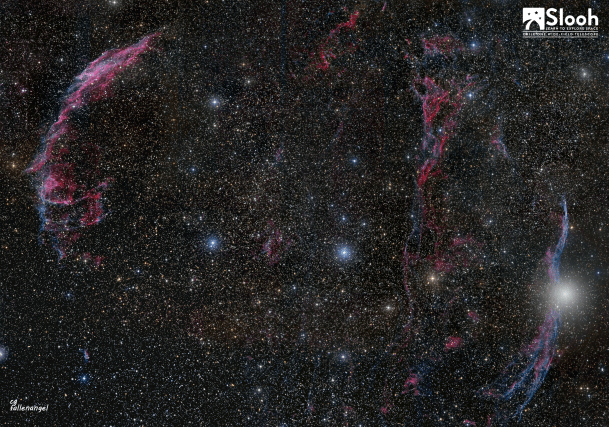
Nowhere is this fusion of the outer storm and inner cry more visceral than in the luminous wreckage of a supernova shell catalogued as NGC 6960: the Veil Nebula West (the right third of my full Veil Nebula mosaic).
The Mosaic
This 2.92° × 2.05° mosaic spans the luminous filaments of the Veil Nebula, the visible remains of a massive supernova in Cygnus, exploding 10,000–20,000 years ago. At the western edge lies NGC 6960, the so-called “Sturmvogel”—a nickname (storm bird, stormy petrel) popularized in early astrophotographic work by Max Wolf (1863–1932) at the Heidelberg Observatory. The filaments likely evoked the bird’s wings riding a cosmic storm. Just to the north (rotated east) lies Pickering’s Triangle, a chaotic sea of shock fronts, while the eastern arc comprises NGC 6992, NGC 6995, IC 1340, and NGC 6974. Together, they form the bright perimeter of the Cygnus Loop, a vast supernova remnant stretching across 3 degrees of sky.
The imago
This widefield mosaic reveals the Veil Nebula, the torn and glowing remains of a massive star that exploded between 10,000 and 20,000 years ago in the constellation Cygnus. The image covers the most prominent filaments of the Cygnus Loop, a supernova remnant still expanding into the interstellar medium. The progenitor star is estimated to have been 20 times more massive than the Sun, and its explosion may have rivaled Venus in brightness, even visible in daylight to early humans.
The nebula is powered by shock fronts—high-velocity shells of ionized gas colliding with the surrounding medium, lighting up filaments rich in oxygen (O III), hydrogen (Hα), and sulfur (S II). These glowing arcs are what we now see as NGC 6960 in the West, Pickering’s Triangle, and the complex Eastern tangle of NGC 6992, NGC 6995, IC 1340, NGC 6974, and NGC 6979.
The western portion, NGC 6960, became known in early 20th-century German literature as the “Sturmvogel”—a storm bird or stormy petrel. Though the origin of the name is uncertain, it was Max Wolf, the Heidelberg astronomer and pioneer of astrophotography, who brought the term into the astronomical community through his deep-sky survey plates and publications. His 1900s-era astrographs, taken with large plate cameras, helped to popularize poetic imagery and inspired the mapping of thousands of nebulae—Wolf’s catalogs eventually included over 6,000 entries.
The “Sturmvogel” metaphor is more than lyrical. If the image is rotated 90° counterclockwise from north-up (placing east at top), the filaments of NGC 6960 unfurl like a bird in flight, its wings flaring through the turbulent ether of the surrounding shockwaves. Just “beneath” it in this orientation lies Pickering’s Triangle—a chaotic lattice of luminous threads, often overlooked but physically adjacent to NGC 6960. This region resembles a choppy, foaming sea, as though the bird skims low over stormy cosmic surf.
The eastern arc, comprising NGC 6992, NGC 6995, IC 1340, and nearby filaments, forms the other wing of the explosion’s outer shell. Together, these bright edges trace a nearly complete hemispherical shell roughly 130 light-years across, expanding at speeds between 150 and 600 km/s. The gas within glows for tens of thousands of years after the explosion, allowing us to see this dramatic transformation in slow motion.
Though shaped by physics, the Veil Nebula also invites metaphor and archetype. In its wisps we glimpse not just shockwaves, but stories: death and rebirth, flight and disintegration, solitude and cosmic defiance. This Sturmvogel, like Gorky’s revolutionary storm petrel, does not fear the coming storm—it becomes its herald. Turn it. Rotate the image 90° counterclockwise—place North to the left, and East to the sky.
The poem
Maxim Gorky’s 1901 poem, The Song of the Stormy Petrel, (in the English Translation) was written as the czarist state trembled with revolution. It was, at once, a coded call to rebellion and a hymn to those rare spirits who thrive in the coming chaos. While lesser birds cower in fear — gulls, loons, and penguins scuttling to shelter — the stormy petrel soars, shrieking, a “black lightning bolt” against the leaden clouds.
“The clouds are darkening the sky,
The waves groan beneath them.
The storm! The storm is coming soon!”Der Originaltitel von Maxim Gorkis poem “Das Lied vom Sturmvogel” ist „Песня о Буревестнике“ (Pesnja o Burevestnike). A special stamp was dedicated by the communist GDR post office to Gorky’s “Sturmvogel” in 1968. The stormy petrel—Sturmvogel—shrieking in the dark heavens above a choppy, silvery sea.
Here, in the Veil Nebula, we see that storm brewing—in literal astrophysical terms.
To call the nebula Sturmvogel—as German astronomer Max Wolf did in the early 20th century—is to see more than a name. Dr. Wolf often assigned names inspired by myth, animal shapes, and poetic metaphor.
Beneath the arc—now the “sky” of this rotated scene—lies a tangled field of mist and filament. These lower tendrils correspond to the chaotic region extending toward the Pickering Triangle, itself a fragment of the same blast. But in this orientation, it becomes the silver sea—choppy, dispersed, alive with current.
“The sea, with lightning crashing down on it,
Holds the thunder in its depths.”
The psychological dimension is impossible to ignore. To rotate this nebula is to awaken its archetypal charge.
Toward the Storm, Toward the Self
In standard orientations, it is just beautiful. Rotated — it becomes prophetic or as Kant said sublime. Just as Gorky’s poem was banned, feared, and venerated, this image speaks of thresholds — the point where silence ends and scream begins.
To witness the Veil Nebula as Sturmvogel is to stand at the edge of a cosmic battlefield. A soul cries out — not in despair, but in jubilation. It is ready. It does not retreat. The stars themselves have torn open,. and from their shreds, a winged cry rises.
The night is not quiet.
The storm is not tragedy.
The nebula is not death.
It is all a prelude to flight.
In Jungian psychology, the “archetype of the storm” can be understood through several interconnected lenses, encompassing divine power, emotional turmoil, the force of chaos, and the potential for transformation and judgment. It is not a singular, codified archetype but rather a multifaceted symbol that manifests in various ways within the collective unconscious and individual psyche, often associated with deities like Zeus and Odin (Wotan).
Key Aspects of the Storm Archetype in Jungian thought:
- Divine Power and Judgment: Storms, particularly those involving thunder and lightning, are often associated with powerful sky gods like Zeus and Odin. These deities are seen as masters of spiritual phenomena and embody divine justice and judgment, capable of both creation and destruction. The storm can symbolize divine intervention or the manifestation of a higher power.
- Emotional Turmoil and Internal States: On a personal level, storms can represent powerful and overwhelming emotions, internal struggles, and psychological crises. The “eye of the storm” can symbolize the need for centering and navigating these internal tempests towards clarity and resilience. This can be seen in dream symbolism, where storms may signify repressed emotions or significant life changes.
- Chaos and Disorder: The storm can also embody the archetype of chaos and the destructive forces of the unconscious, as seen in mythological figures like Typhon, the Greek monster of chaotic destruction. It represents the unsettling and unpredictable aspects of life and the psyche, often linked to a struggle for consciousness against overwhelming forces.
- Transformation and New Beginnings: Despite their destructive potential, storms can also be seen as catalysts for profound change and renewal. Emerging from the turmoil of a storm can lead to a new paradigm, a resetting of paths, and a transformation in consciousness, akin to a “new beginning” or the emergence of a new understanding.
- The “Wotan” Archetype: Carl Jung specifically explored the “Wotan” (Odin) archetype as a powerful, dormant force within the Germanic psyche that reawakened with terrifying force, linking it to the “storm clouds” gathering over Europe in his time. This highlights how archetypal patterns can manifest in historical and collective contexts, influencing societal movements and psychological states.
“Let the storm burst forth—
The proud stormy petrel soars,
Like a black lightning bolt…”
The Veil Nebula is not the remnant of death but literally rebirth, transformation or revolution.
We are all stardust.
The first stars burned their fuel quickly and were able to make only a few elements heavier than hydrogen and helium. When those stars went supernova, they expelled the elements they had produced and seeded the next generation of stars.
Back to Kant, reason steps in to conceive the universe’s magnitude, producing a unique aesthetic response that combines awe, respect, and an awareness of both human limitation and rational capacity.
- Mathematical Sublime: Arises when we confront immense size—like the vast universe—that imagination cannot grasp, but reason can conceptualize as infinite.
- Dynamical Sublime: Emerges in the face of overwhelming natural power, such as storms, evoking fear yet affirming reason’s ability to comprehend from a safe vantage.
- Aesthetic Judgment: Kant held that judgments of the sublime, though rooted in feeling, carry a claim to universal validity, expecting shared recognition.
- Transcendental Aesthetic: Refers to Kant’s idea that space and time are forms imposed by the mind, shaping how we perceive the universe from the outset.
1. Stormy Petrel in Flight

- Visual feature: The filamentary arc, sharply defined and curving like a wing, cutting diagonally across the lower right (now “south”) quadrant.
- Interpretation: The stormy petrel itself — sharp-beaked, wing extended mid-cry.
- Poetic line: “High above the silvery sea wind / Screeches the stormy petrel, / A black lightning bolt…”
- Science: This structure is a shock front — compressed, illuminated gas being shaped like wind-sculpted feathers.
- The rift in the emission line appears as wings opened wide against wind — almost tearing through the stars.
2. Choppy, Silver Sea Below
- Visual feature: The fragmented, turbulent lower-left tendrils of nebulosity, dispersed and broken up.
- Interpretation: This is the sea whipped by storm — erratic, fragmented lines resembling waves crashing.
- Poetic line: “The sea — under the storm’s assault — / Holds the thunder in its depths…”
- The Veil’s wispy structure renders a heaving, unsettled ‘sea’ of starlight, luminous and restless.
3. Darkness and Thunderclouds
- Visual feature: Opaque, darker patches and intersections between arcs of light — spaces of visual silence.
- Interpretation: These become thunderclouds — the pressure between light and void, mirroring psychological tension.
- Poetic line: “The storm! The storm will break soon! / The bold petrel flies proudly in the lightning.”
- The bright-limb–dark-core contrast functions almost as chiaroscuro — a painterly invocation of rolling storm clouds.
4. Lightning and Cry
- Visual feature: Sharp, high-contrast transitions and electric blue Hβ or OIII filaments, especially if narrowband data is used.
- Interpretation: Lightning across the sky — like the scream of the petrel, jagged and divine.
- Poetic line: “The storm — it is coming! / Let it burst in all its fury!”
- The emission filaments serve as luminous nerve endings of the storm — prophetic and electric.
WHY THIS ROTATION MATTERS
Most published astrophotographs of NGC 6960 orient North up or East left — creating a sweeping horizontal arc that reads more like a curtain or a wave. But when North is turned left:
- The arc becomes a soaring, vertical figure — winged, crying, slicing through the heavens.
- The Veil becomes a storm landscape, not a peaceful emission cloud.
- The entire field becomes psychologically activated: no longer passive beauty, but visionary unrest.
This is what Max Wolf may have seen — not just a nebula, but a cosmic Sturmvogel singing against the void.
PSYCHOANALYTIC PARALLEL
The Veil Nebula, when viewed this way, externalizes an internal or external psychological structure:
- The stormy petrel = archetype of the prophetic Self or Hero archetype, unafraid to confront chaos.
- The storm = collective upheaval, unconscious energies breaking into consciousness.
- The sea = psychic depths — turbulent but luminous, full of potential.
- The Veil itself = the psychic boundary between known and unknown, being torn open.
In this light, your astrophotography of the Veil is not just scientific image-making, but active imagination — to Jung a lens into cosmic individuation or as to Gorky to a historical revolution.
1901 Poem by Maxim Gorky “Song of the Petrel” Google translation from Russian https://ruverses.com/
Over the gray plain of the sea the wind gathers clouds. Between the clouds and the sea the Petrel proudly flies, like black lightning.
Now touching the waves with its wing, now soaring like an arrow to the clouds, it cries, and — the clouds hear joy in the bird’s bold cry.
In this cry — thirst for a storm! The clouds hear the power of anger, the flame of passion and confidence in victory in this cry.
The seagulls moan before the storm — moan, rush about above the sea and are ready to hide their horror before the storm at the bottom.
And the loons also moan — they, the loons, do not have access to the enjoyment of the battle of life: the thunder of blows frightens them.
The stupid penguin timidly hides his fat body in the cliffs… Only the proud Petrel flies boldly and freely above the sea gray with foam!
The clouds are sinking darker and lower over the sea, and the waves are singing, and rushing upward to meet the thunder.
The thunder is roaring. The waves are moaning in the foam of anger, arguing with the wind. Now the wind embraces the flocks of waves with a strong embrace and throws them with all its might in wild anger onto the cliffs, smashing the emerald masses into dust and spray.
The petrel flies with a cry, like a black lightning, pierces the clouds like an arrow, tears off the foam of the waves with its wing.
Here it flies like a demon, – a proud, black demon of the storm, – and laughs and sobs… He laughs at the clouds, he sobs with joy!
In the wrath of thunder, – a sensitive demon, – he has long heard fatigue, he is sure that the clouds will not hide the sun, – no, they will not hide!
The wind howls… The thunder roars…
The flocks of clouds blaze with a blue flame over the abyss of the sea. The sea catches the arrows of lightning and extinguishes them in its depths. Like fiery snakes, the reflections of these lightnings curl in the sea, disappearing.
Storm! The storm will soon break out!
This is the brave Petrel proudly fluttering between the lightning over the angrily roaring sea; then the prophet of victory cries out:
Let the storm break out stronger!
Maxim Gorki Das Lied vom Sturmvogel
Ob der grauen Meeresebene schart der Wind Gewölk zusammen.
Zwischen Wolken und Gewässern gleitet stolz der Sturmverkünder,
einem schwarzen Blitz vergleichbar.
Bald die Flut mit Flügeln streifend, bald als Pfeil die Wolken treffend,
schreit er hell.
Die Wolken hören Lust im Schrei des kühnen Vogels.
In dem Schrei klingt Sturmessehnsucht! Kraft des Zornes, Glut der Leidenschaft
und Siegeszuversicht.
Dies hören in dem Schrei die Wolken.
Vor dem Sturm die Möwen stöhnen. —
Stöhnen, treiben überm Meere,
möchten ihre Angst vorm Sturme auf dem Meeresgrund verbergen.
Auch die Tauchervögel stöhnen.
Ihnen ist er unzugänglich, der Genuss des Lebenskampfel.
Sie erschrecken vor dem Donner.
Der Pinguin, der dumme, feige,
birgt den feisten Leib im Felswerk.
Nur der stolz Sturmverkünder, frei und stolz,
beherrscht die Höhe überm grauen Schaum des Meeres!
II
Immer finsterer und tiefer zieh‘n die Wolken überm Meere,
und die Wogen singen, dringen hoch, dem Donner zu begegnen.
Donner kracht.
Wutschäumend , ächzend streiten mit dem Wind die Wellen.
Er umfasst sie rudelweise, drückt sie in die starken Arme.
Schleudert wuchtig sie in blindem Wüten an die Klippen,
wo die hell-smaragdnen Wogen-berge
laut zu Staub und Schaum zerschellen.
Schreiend schießt der Sturmverkünder, einem schwarzen Blitz gleich,
pfeilschnell durch die Wolken.
Seine Flügel reißen Gischt vom Kamm der Wogen.
Seht, er rast dahin! Ein Dämon — stolz.
Des Sturmes schwarzer Dämon!
Und sein Lachen tönt, sein Schluchzen.
Er verlacht die finstern Wolken, und er weint und schluchzt vor Freude.
Längst vernimmt des Dämons waches Ohr im Donnergroll: Erschöpfung.
Das Gewölk, weiß er, es kann nicht, – kann die Sonne nicht verbergen!
III
Sturmwind heult — und Donner poltert.
Überm abgrundtiefen Meere flammen blau die Wolkenschwärme.
Und das Meer fängt Blitzespfeile, löscht sie aus in seinem Strudel.
Und wie Feuerschlangen winden sich im Meere — und verschwinden
Spiegelbilder dieser Blitze.
„Sturmwind! Bald erdröhnt der Sturmwind!“
Sehrt den stolzen Sturmverkünder! Stolz hin schwebend zwischen Blitzen,
überm Zorngebrüll des Meeres, schreit er —
ein Prophet des Sieges.
„Immer stärker tobe, Sturmwind!“
 stOttilien
You must be logged in to post a comment.