Tag: Art

  • Male and female archetypes in Wong Kar Wai Films – Draft

    Male and female archetypes in Wong Kar Wai Films – Draft

    For the uninitiated, Wong Kar Wai’s films seem pointless and confusing, which is reinforced by the director’s trademark cinematic indulgences, laggard pacing and minimalist plotting. However, upon closer inspection, it is easy to become intrigued by the rampant symbolism, the metaphor-laden dialogue, and the philosophical and psychological underpinnings of his films. Maybe its a problem of “if you have hammer, everything looks like a nail”, but I cant help his movies remind me on C.G. Jung: Failed individuation, shadows, persona and archetypes manifest in the here and now. But are there common elements that tie his entire body of work together? Is there some underlying structure or theme by which one can gain a better comprehension of his sometimes cryptic images and symbols?

    The classic archetypes  in Wong Kar Wai Films

    One way of approaching the cure for the modern malaise in his films may come from the book King, Warrior, Magician, Lover: Rediscovering the Archetypes of the Mature Masculine, by Jungian psychologist Robert Moore and mythologist Douglas Gillette. Moore argues that masculinity is made up of four archetypal male energies which serve different purposes: King, Warrior, Magician, Lover. Like much of the literature in the mythopoeic realm, KWML is grounded in the psychology of Carl Jung, particularly in his idea of psychological archetypes. While Jung suggested a number of universal archetypes (Mother, Hero), the four personal ones are: the Self, the Shadow, the Animus and Anima, and the Persona. They play a role too, as they are parts of the personal unconscious. I like to investigate, here some archetypes and their shadow representation ( and symbols which are archetypes in the here and now). Each of the four consists according to Moore of three parts: the full and highest expression of the archetype and two bi-polar dysfunctional shadows of the archetype. To better understand this, Moore portrays each archetype as a triangle full (to weak, to strong, and an bi-polar shadow split.  These shadows are the result of the archetype not being integrated in a healthy and coherent way. The two shadows of the Lover archetype are the Addicted Lover and the Impotent Lover. A man possessed by the Addicted Lover is, as Moore puts it, “eternally restless.”Men dogged by the Impotent Lover archetype feel depressed, flat, and dead inside. Nothing brings them joy anymore. They’ve lost their passion for life and become cynical. Relationships, whether romantic or platonic, struggle and falter.

     Ashes of Time is best candidate applying this framework, as it is almost a greek tragedy. You find the cynical magician, the weak king (note the absence of the positive king), the full warrior who becomes a hero and the addicted lover who cannot love. The women are brilliant too, there is the virgin, the animus, the unfaithful and loyal wife and there is Maggie Cheu.

    Brigitte Lin in Ashes of Time (1994)

    Wong’s films, at their most basic level, are an exploration of the double-edged sword known as memory, which may be seen as consciousness. This strong thematic undercurrent is expressed through subtext in the dialogue, characterizations, and the often-minimalist plotting. Pain of loss and the tenacity of remembrance are both destructive forces, yet essential for survival. All the characters in his films are products of this loss, and their actions in the present stem from their reactions to that loss. Unfortunately, the results are often tragic. In ashes of time the girl with the donkey begs the agent for assassins  ( in my view a cynical materialistic magician type):

                  Please help me. I beg of you.

    It’s no use. I’m just an agent. You must solve your own problem.

    “Ashes of Time”

    Ouyang Feng’s lost love ( Cheung’s character in Ashes of Time)  ultimately married his brother because she tired of waiting for her real love return to her. Wai’s camera stares intently at her while she gazes beyond time and relieves the past full of regret to his “friend. She dies as there is no reason to live.  Besides being one of the strongest impression of melodrama, it is also the most puzzling. I noted two times the look in the mirror, visually and verbal in the film. It almost seems tis relates to the pain to learn about ourselves.

    Do you know what the most important thing is in my life?

    Maggie Cheung ponders in Ashes of Time (1994)

    Your son?

    I thought so too. But as he grows up, I know he’ll be leaving me one day. Nothing’s important to me now. I thought the words ‘I love you’ really mattered. I thought they meant a lifetime commitment. But looking back, nothing matters… because everything changes. I thought I was the winner, until one day I looked into the mirror and saw the face of a loser. I failed to have the person I loved most to be with me in my best years. How wonderful it would be if we could forget the past…

    “Ashes of Time”

    The post-modern archetypes  in Wong Kar Wai Films

    His other films are mostly a study of relationships in the post-modern world, in which the exchange of goods and services serves as the basis of all relationships, instead of emotional connection– a representation of cosmopolitan life in modern Hong Kong – and elsewhere. Very few of the relationships found in Wong’s films are based on emotional connection, and the struggle that his characters face is to cultivate deeper forms of association. Unfortunately, many of his characters do not form these emotional connections, out of fear of rejection, and find it much easier to have transaction-based encounters. After thinking this through, and stereotypes not being archetypes, it appears to me that his central archetypes of loneliness are (negative) lover and warrior.

    When I am about to leave, I ask him to take me home. I haven’t ridden on a motorbike for a long time. Actually, I haven’t been so close with a man for a while. The road isn’t that long, and I know that I’ll be getting off soon, but I’m feeling such warmth this very moment.

    “Fallen Angels”

    The most important aspect of Wong’s thematic focus is the transience of relationships. Even if the characters manage to find an emotional connection with one another, they learn to accept the fact that all relationships must end, and those who survive at the end of the film have learned to embrace the moment. This theme was best represented by #223’s (Takeshi Kaneshiro) ‘expiry date’ speech in “Chungking Express”, and the final soliloquy given by the nameless agent (Michelle Reis) while riding into the Hong Kong night on the back of a motorcycle. Not surprisingly, this can also be seen in Wong’s fascination with images of smoke and drifting clouds– like these transient phenomena, relationships form like a puff of smoke, only to quickly lose their cohesion and dissipate into the night. To embody these themes within his films, Wong populates his films with a number of archetypal characters: the ‘impotent lover’, the ‘carefree lover’, and sometimes, ‘the indecisive warrior’.

    The impotent lover

    Tony Leung Chiu Wai as the Blind Swordsman in Ashes of Time
    Tony Leung Chiu Wai as the Blind Swordsman in Ashes of Time

    The impotent lover has been seen in many forms, but their origins and current condition are always the same: the small time gangster Wah Ha-tau (Andy Lau) from “As Tears Go By”, both Yuddy (Leslie Cheung) and the soda counter girl Su Lizhen (Maggie Cheung) in “Days of Being Wild”, the Blind Swordsman (Tony Leung Chiu Wai) in “Ashes of Time”, and Police Officer #663 (Tony Leung Chiu Wai) in “Chungking Express”.

    This the time of year to change into a summer uniform. I don’t know if it is the weather, but I feel that things are changing.

    “Chungking Express”

    The impotent lover is in a constant state of emotional paralysis, arising from his or her inability to forget the pain of a broken relationship. Blinded by the haze of nostalgia and desperately attempting to hang on their halcyon days, they miss the opportunities of the present and are completely unaware of the incessant progression of time.

    Go ahead. I just want you to hate me. That way, at least you won’t forget me.

    “Days of Being Wild”

    #663 of “Chungking Express” is another good example of the impotent lover. Always waiting for his stewardess ex-girlfriend (Zhou Jialing) to return, he is completely oblivious to the fact that Fay (Faye Wong), the counter girl at a local fast food place, has been breaking into his apartment and rearranging his belongings. He does not notice that his canned food tastes different, or that the number of goldfish in his aquarium is increasing.

    To capture the impotent lover’s introspective point-of-view visually, Wong employs a number of cinematic techniques. His use of the Godard-ian jump cut seamlessly blends temporally-exclusive scenes together, making the passage of time unnoticeable. Other Godard-ian touches include the many shots of clocks, which remind the viewer that despite the blind mourner’s fixation on the past, time continues to move on and that moments in the present are fleeting.

    Tony Leung Chiu Wai and Faye Wong share a moment in Chungking Express

    Another interesting technique, seen in “Chungking Express”, clearly represents the lover’s detachment from reality– the film is sped up, but the actors move very slowly. The resulting visual effect then conveys that while the rest of the world blurs by like the flapping of a hummingbird’s wings, the impotent lover is in a stagnant state of existence, lost within their own nostalgic thoughts.

    The addicted lover

    I’ve heard that there’s a kind of bird without legs that can only fly and fly, and sleep in the wind when it is tired. The bird only lands once in its life… that’s when it dies.

    “Days of Being Wild”

    In contrast to the impotents lover is the other staple characterization of Wong’s films, the ‘addicted lover’. Characters that fall into this classification include the hotheaded Fly (Jackie Cheung) from “As Tears Go By”, the lonely beat cop (Andy Lau) from “Days of Being Wild”  an mostely the amnesic Huang Yoshi (Tony Leung Ka-Fai) from “Ashes of Time”, and the fickle Ho Wo Ping (Leslie Cheung) of “Happy Together”.

    I never think about the next time when doing anything.

    “As Tears Go By”

    The carefree addicted lover is a character oblivious to history with no appreciation for the lessons of the past. As a result, their actions usually end up destroying the lives of those they come across. In “As Tears Go By”, it is clear that Fly is the carefree wanderer, since it is his reckless actions that end up destroying three lives, despite the escalating consequences of his previous misdeeds and the volatile situations he manages to entangle himself in.

    Tony Ka Fai Leung drinks the magic wine in Ashes of Time (1994)

    The more wine you drink, the warmer you’ll get. Water will only make you feel cold.

    “Ashes of Time”

    The most literal interpretation of the carefree addicted lover was seen in “Ashes of Time“. Huang Yoshi has his memory of the past erased after drinking a magical wine called ‘A Happy Go Lucky Life’ which erases memory. While the wine has eased the pain of the past for Huang Yoshi , it has also made him forget his emotional connections with others. As a result, his ‘carefree’ existence ends up destroying the lives of the other characters, including the split-personality Murong Yin/Yang (Bridget Lin) and the Blind Swordsman wife but mostly Ouyang Feng’s love  and his “friend” Ouyang Feng .

    Similarly, Ho Wo Ping in “Happy Together” has a shiftless existence living for only the moment. His inability to recognize his history with Lai Yiu Fai (Tony Leung Chiu Wai) ends up relegating him to a lonely permanence of his own doing.

    I used to think there was a kind of bird that, once born, would keep flying until death. The fact is that the bird hasn’t gone anywhere. It was dead from the beginning.

    “Days of Being Wild”

    Through this stock character, Wong illustrates the other extreme to the impotent lover. While the addicted lover is not subject to the anguish of remembrance, they too are caught in a stagnant existence. Instead of missing the opportunities of the present due to an obsessive fixation on some past trauma, they never learn from their mistakes, nor do they ever form stable relationships with those around them. However, the result is the same– a lonely existence in isolation.

    Do you remember at 3pm on April the sixteenth last year, what you were doing?

    Why this question?

    Well, I have a friend who challenges my memory. She asked me what I did on that day. I wouldn’t remember. Do you?

    She told you?

    I thought you would have forgotten.

    What’s to be remembered, I would always remember. So you knew each other?

    For a period of time. I left for the sea, and we lost contact. How about you?

    Me? It’s off. What else did she tell you?

    Not much. We’ve actually only known each other for a short period of time.

    Did you love her?

    Not exactly… just friends.

    If you see her again in the future, tell her I’ve forgotten her. That’ll be better for everyone.

    I’m not sure I’ll see her again. Maybe, she would have forgotten about me too.

    “Days of Being Wild”

    The indecisive warrior

    michelle reis as the killer’s agent in Fallen Angels

    The best thing about my profession is that there’s no need to make any decision. Who’s to die… when… where… it’s all been planned by others. I’m a lazy person. I like people to arrange things for me. That’s why I need a partner.

    “Fallen Angels”

    This last archetype is a more recent innovation in Wong’s films, first seen in “Fallen Angels”. To me it seams, it is a parody of a warrior. The male leads, hit man Wong Zhiming (Leon Lai) and mute 223 (Takeshi Kaneshiro), are both in search of a sense of belonging, but end up in pathological situations where they lose their identity. Zhiming muses that the best thing about his ‘job’ is that he never has to make any decisions of his own, since everything he does has been arranged for him by his partner, the unnamed agent. When he finally does realize that he must take a more active role in the job, he is too late– ironically he is gunned down in an ambush set up by his lovelorn agent.

    Charlie Yeung and Takeshi Kaneshiro in Fallen Angels

    They say that love can change a man. I start to find myself looking better and more charming, and suddenly I discover that I’m turning blonde.

    “Fallen Angels”

    Leon Lai in Fallen Angels

    223 has a similar problem. Creating a state of moral contradiction, 223 breaks into other people’s businesses at night such that he can ‘be his own boss’. However, in actuality, he has merely taken decisions that have been made by others and uses them, instead of making his own. He also hooks up with brokenhearted woman (Charlie Yeung) who is obsessed with getting revenge on a woman named Blondie. Together, they traverse the Hong Kong nightscape in search of Blondie, and in the process, blonde hairs begin to sprout from 223’s head, a metaphor for his adoption of his newfound partner’s system of values.

    Like the impotent lover and the carefree lover, the life of the indecisive warrior is a lonely one. However, unlike the tragic note that Zhiming’s story ends one, 223’s outcome is certainly more upbeat. He ends up being rejected by the jilted woman and learns to make decisions for himself in the process (visually conveyed by his blonde hairs disappearing), the first of which is to give Zhiming’s former agent a ride home on his motorcycle.

    Conclusion

    So instead of being confusing jumbles of abstract dialogue and quirky characterizations, the films of Wong Kar Wai have a consistency in structure and theme. The archetypal characters of Wong Kar Wai’s angst-ridden narratives are classical different perspectives on man and women. While some of these characters do meet tragic ends resulting from their inability to change, the director does provide a glimmer of hope in the characters that do survive the melancholic plot.
  • Jianghu seen as Archetypes defined by C.G. Jung (Magician, King, Lover, Warrior and Hero)

    Jianghu seen as Archetypes defined by C.G. Jung (Magician, King, Lover, Warrior and Hero)

    The Jianghu is the fictional alternative universe coexisting with the actual historical in which many Chinese wuxia stories are set. It seems jianghu, a literary tradition going back to the Ming Dynasty,  can easily be explained  as collective unconscious in which the Chinese universal themes which run through all human life. Inwardly, the whole history of the human race, back to the most primitive times, lives on in us and the wuxia stories are myths bringing the archetypes  of the  collective unconscious. A strong element in the structure of jianghu, is the line between good and evil, right and wrong, is crystal clear; it is absolute, an in this movie you can see the Archetypes of the shadow, animus and anima of the personal unconsciousness. Typically, the heroes in Chinese wuxia fiction do not serve a lord, wield military power or belong to the aristocratic class. The Chinese wuxia stories can be contrasted with martial codes from other countries, such as the Japanese samurai’s bushido tradition, the chivalry of medieval European knights and America’s Western but moral and laws of physics my not apply in this grene.

    One example  is the cult movie Ashes of Time,  Wong Kar-Wai’s wuxiapian is the most uncompromisingly complex film of thinking man’s martial arts melodrama with very little action outlined like a greek tragedy. It features some of the  biggest stars in Hong kong Cinema and Christopher Doyle’s usual magnificent visuals, and William Chang’s predictably sublime art direction,  derived from the two characters  from Lois Chas’s novel The Eagelshooting Heros: Xidu (Emperor of the West) and Dongxie (Emperor of the East).  One is the anti-thesis of the other, they are implemented as the two negative Archetypes Ouyang (The Magicician) and Huang (The Lover).

    Wong’s goal is focusing on the psychological and emotional reasons that brought the characters to the behavior we see in the novel. The most striking example is the principal character Ouyang Feng (Leslie Cheung). In the film he’s still a man who trusts people, and is not completely selfish. His troubled relationship with a woman (the famous Maggie Cheung) shapes his character, and leads to his change to an evil and treacherous man.  The movie took a de-humanized world (where heroism was often more important than sentiments) and injected humanity into it. We’re presented with allegedly invincible characters who turn out to  crumble under the pressure and pain of rejection and memory.

    It’s pointless trying to write about Ashes of Time’s plot, as doing so would be entirely too superficial, and leave out important facets of the story. With a careful eye and a few repeated viewings the film’s story is not so hard to grasp. What’s important is the mood Wong Kar-Wai creates, and the symbols and Archetypes we feel in each and every character. For those who seek metaphors,  the movie presents the eye as well as the illusions of vision. One character is nearly blind. Another, a swordsman, goes blind in the middle of a horrendous battle. Two characters, Yin and Yang—one presented as a man, the other as his sister—are identical. And there is a brief appearance by a legendary sword fighter who hones his skills against his own reflection. Plenty of visual symbolism , from the Yin/Yang character to the motifs of water and the desert landscape. Two women hopelessly in love with the man who pines away for the woman who will never be his (and whom we do not learn about until the very end).

    Ouyang Feng (Leslie Cheung Kwok-Wing) the fallen swordsman commissioning assassins later known as the Poison of the West.The impotent Lover becoming the (cruel) Magician
    Hong Qigong  (Jacky Cheung Hok-Yau) the young idealistic swordsman, going north with his wife The Warrior in its fullness – The Hero
    Murong Yin (Brigitte Lin Ching-Hsia) daughter of Murong clan; Murong Yang the Brother one schyzophrene personBrother want to have Huang killed because of rejection of Murong’s love she his brother Animus and shadow under control of ego
    The Blind Swordsman (Tony Leung Chiu-Wai)
     The (weak) wandering King – Ödipus at Colonos
    Ouyang Feng’s love (Maggie Cheung Man-Yuk) she married his brother, because he asked her too late and waits her whole live for him The Mother Earth – center of the pentagon
    Huang Yoshi (Tony Leung Ka-Fai) adventurous swordsman and longtime friend of Ouyang Feng Huang is a burnt-out womanizer later he will be known as the Evil of the East. The (addicted) Lover
    The girl with the mule (Charlie Young Choi-Nei) The virgin (Maria?)
    Hong Qigong’s wife (Li Bai) The loyal wife
    Blind Swordsman’s wife (Carina Lau) The queen

    Leslie Cheung Kwok-Wing, Maggie Cheung Man-Yuk, Tony Leung Chiu-Wai, Tony Leung Ka-Fai, Brigitte Lin Ching-Hsia, Carina Lau Ka-Ling, Jacky Cheung Hok-Yau, Charlie Young Choi-Nei, Lau Shun

    Occurring over the five months of the Chinese calendar, Ashes of Time spends most of its length with two characters in particular, Ouyang Feng (Leslie Cheung) and Huang Yaoshi (Tony Leung Ka-fai). Old friends who meet once a year to catch up and drink a magic wine, the two serve as the nexus for the film’s overlapping narratives, mired in their own emotional crises.  Ouyang Feng’s  inn is the center of the action, as the stories are told by and about the visitors in the great Chaucerian tradition. Ouyang is morally bankrupt, yet manages to come up with some of the most poetic observations of human nature in his ruthless monologues.The story is not circular, despite the essentially equivalent monologue delivered by the protagonist at both ends of the film.  Ashes of time is a study of personalities and as such follows the convoluted logic of human relationships.  For the first half of the film characters come and go in seemingly pointless chaos. Yet, the travelers at the inn are connected, and their fates intertwined by the simplest passions. In a bizarre twist, one woman is the reason for Feng’s self-imposed hermitage, for he rejected her to marry his older brother even though they had both been in love and connects all main characters.

    Raised by his elder brother, Ouyang’s ambition is to become a famous swordsman  and faced with a choice 10 years earlier between the said woman he loves and martial adventures, he chooses the latter. Ouyang becomes cynical and materialistic,  runs a small inn at the edge of the desert,  commissioning assassins by  hiring young but poor swordsmen. Every year during the season in which peach trees blossom a close friend visits him, Huang Yaoshi. This year Huang brought something for his friend Ouyang, a magical wine that would make one forget the past.

    Huang Yaoshi, has, like Ouyang, also  a sad love story to tell–he once had an unconsummated affair with the wife of his best friend – which turns out the blind swordsman – at Peach Blossom Land. Over the next year, in the different seasons, many travellers pass by the inn each bringing their stories, many of them being about lost love and why would one wish to forget the past.   Ouyang  becomes an assassin contract from the schizophrenic Murong Yang/Murong Yin (Sister and Brother). He meets the down-and-out swordsman with failing eyesight (who turns out to be Huang’s friend who seduced his wife); an impoverished young girl with an mule who wants to avenge her brother’s death; and Hong Qi, another aspiring poor swordsman, and his loyal wife.

    Murong Yin/Yang (Brigitte Lin) at first it appears as if Yin and Yang are brother and sister, the brother wanting to kill the womanizer Huang for rejecting his sister, and the sister wanting to kill her brother for interfering with her relationship. As it turns out, however, Yin-Yang are one and the same physical person, who has developed a severe split personality disorder because of Huang’s rejection of Murong’s love.

    The pentagon.

    The Blind Swordsman (Tony Leung Chiu Wai) also suffers from rejected love, his wife having been seduced by said Huang on their wedding night. He wishes to complete one last job to raise the money to return home to see the “peach blossom,” later revealed to be the name of his wife, before his creeping blindness ensures he can never see her again.

    Carina Lau, playing the Blind Swordsman’s wife is shown wordlessly caressing her horse with such tenderness that the stallion becomes as much a symbol of virility and sexuality, The Blind Swordsman’s last job has him saving a village from a swarm of bandits, and the ensuing bloodbath is more visceral than anything to crop up in the last decade’s boom of arty martial arts films. Yet even that sequence is undercut by Wong’s directorial flourishes, the image bleeding into white when the swordsman looks up and has his already weakened vision bleached out by the sun. The entire scene builds less a sense of heroism than a mounting futility.

    Achetypes

    The other two strangers, Hung Chi (Jacky Cheung) and the Young Girl (Charlie Yeung), arrive separately only to influence each other’s lives profoundly. She wants to hire Feng to arrange the murder of some men, who have killed her brother. She has nothing to offer except eggs and her mule and Feng refuses to help, but suggests that her body is more marketable than her pitiful eggs. She refuses to yield and waits for someone to agree to help her. The young Hung is a master swordsman, but also a bit of an idealist. He works for Feng for a while but eventually takes pity on the girl and goes on a murderous rampage, slaughtering all those who had participated in the killing of her brother. In the brawl he loses his finger and thus the ability to wield a sword. He is undeterred, however, and when Feng refuses to send for a doctor hinting to the Girl again that she might have to prostitute herself for the sake of Hung, he forbids her to do so. He picks up where the Blind Swordsman fails. Where he has spent his entire life counting the money of each job to collect wealth, Hong redeems himself when he helped the poor village girl who paied  him a single chicken egg. The girl, the virgin with the donky leaves without trace. Visually, she is almost like a distorted Eastern Version of the Virgin Mary. She is also the only one not interconnected in the pentagon.  After he recovered Hung, heads with his loyal wife north, leaving Feng in envy of fulfilled love.

    In the books to which Ashes of Time serves as a prequel, the Ouyang and Huang are hard-hearted and violent, Huang someone who still believes in love but can never have it himself, Ouyang a man who rejects love entirely. Ouyang has fled from the woman who loves him, while Huang never follows through with the love he inspires . Maggie Cheung arrives near the end of the film to deliver a devastating monologue to Huang. Ouyang’s ex-lover, Cheung’s character ultimately married the man’s brother because she tired of waiting for Feng to return to her. She clarifies the reasons for Huang and Ouyang’s annual meeting and the woman who links them in pain, and her speech, framed in a simple, wide-angle close-up without trickery that lets all focus rest on her words, speaks directly and piercingly to the pain of unrequited love. When the story comes full circle and the two main characters discover the uselessness  deception of themselves, that the attempt to forget only further ensconces painful remembrances in memory, Cheung’s pain is fully visited upon Ouyang and Huang. Maggie Cheung’s five-minute  are the undisputed centerpiece of the film both in terms of story (she is the one link between most of the characters) and acting. Wai’s camera stares intently at her while she gazes beyond time and relives the past full of regret.

    Maggie is an accomplished actress, but this performance was beyond description.

    Her subtle agony is expressed obliquely and the one has to look into her eyes to touch the intensity of her feeling. Ouyang’s ex-lover, Cheung’s character gives Huang  the wine to forget and  dies soon afterwards. When she dies, the expression is beyond visual. Her body seems to become colder and shrinks, the eyes close, the flower wilds. She dies as there is no reason to live.

    The mesmerizing tale of lost chances, fear of abandoning oneself to another, and pain of betrayal stops by the individuation when Oyuand returns to White Camel Mountain after finding out that his beloved has died. Where in the youth he saw mountains only as obstacles that concealed a wonderful world behind them, where he would climb them, leaving his love to seek this world, where once there he would find that there’s nothing worth seeing; he now no longer wondered what hid behind the mountains. He burns  his inn and moves back later be known of the Poison of the West.

    The cinematography is out of this world. There is so much imagery that repeated viewing is a must. Complicated tracking shots, abrupt editing, impressionistic pastel-like blurred images, and static scenes, all mix together in a veritable whirlpool of technique and ideas. Christopher Doyle is perhaps one of the best, most imaginative, and daring cinematographers out there. Seeing is believing.

    http://www.youtube.com/watch?v=5VZfieiscO4

  • Leni Riefenstahl und C. G. Jung – Die Macht der Bilder

    Leni Riefenstahl und C. G. Jung – Die Macht der Bilder

    Das Werk des Schweizer Tiefenpsychologen C.G.Jung spielt in der heutigen öffentlichen Diskussion Deutschlands kaum eine Rolle obwohl fast alle Konzepte von ihm selbstverständliche Werkzeuge von Psychologen und Consultants und manche seiner Begriffe Teil der Alltagssprache sind. Ähnlich werden Leni Riefenstahls damals die Zukunft verwegnehmenden, filmischen Konzepte – Die Macht der Bilder – in Film und Kunst routinemässig eingesetzt.  Da ich Jung für den Psychanalytiker des 20. Jahrhunderts halte, der gerade zu Religion und Mythen uns heute noch viel zu sagen hat, ist es für mich notwendig, etwaige Vorwürfe mit dem innersten Kern seines Werkes zu vergleichen. Dabei stiess ich auf Leni Riefenstahl, ähnlich brilliant  und ebenso negiert in Deutschland. Leni Riefenstahl schuf in ihren 101 Jahren ein beeindruckendes Werk aus Filmen und Photos. Sie war gleichzeitig eine der einflussreichsten und eine der umstrittensten Filmschaffenden. Während ihre ästhetischen Ansätze und dokumentarischen Methoden noch heute vielfach imitiert werden, wurde ihr Name gleichbedeutend mit den Gegenständen ihrer Filme: Die Glorifizierung des Nazi-Regimes. .

    Woman in blonde wig (Brigitte Lin)  Somehow I’ve become very cautious. When I put on a raincoat, I put on sunglasses too. Who knows when it will rain, or when it will turn out sunny?

    Oppertunismus und Karriere

    Auf dringende Bitten seiner Kollegen übernahm Jung den Vorsitz der “Ärztlichen Gesellschaft für Psychotherapie”, die einen internationalen Charakter hatte, und nutzte seinen Freiraum als Schweizer, um den internationalen Status und die politische Neutralität der Organisation zu garantieren und brachte auch den Nazis  Missliebige in der internationalen Sektion unter. Es gab also einen internationalen Dachverband mit verschiedenen Ländergruppen. Die offizielle Zeitschrift der internationalen Vereinigung war das “Zentralblatt für Psychotherapie”. Ein Stein des Anstoßes sind einige Formulierungen Jungs aus einem Aufsatz, den er 1934 im “Zentralblatt für Psychotherapie” veröffentlichte.  Probleme entstanden für Jung, als Prof. Göring  (der Vorsitzende der deutschen Ländergruppe) 1934 ein deutsches Beiheft (“Deutsche Seelenheilkunde”) plante, das auch in der regulären Nummer des Zentralblattes erschien, wodurch der Herausgeber Jung unfreiwillig in die Rolle des NS-Befürworters geriet.

    Leni Riefenstahl wird in Peter Wartson’s “German Genius” erwähnt. Leni Riefenstahl zeigte im “Blauen Licht” (1932), ihrer ersten eigenen Produktion, in der sie obendrein – aus Geldmangel – Regie führte was in ihr steckte. Der Film gewann bei der Biennale in Venedig Silber und viele weitere Auszeichnungen. Mit der Machtübernahme boten sich der Riefenstahl neue Aufgaben. Aufgaben, denen sie sich aber nur widerstrebend hingegeben haben will. Da kam der Hitler dazwischen, der Film  “Blauen Licht” und “Der heilige Berg” haben ihm gefallen.  Sie machte Dokumentarfilme, die Meilenstein der Filmästhetik waren, andererseits  perfekte Überhöhungen und Symbolik für das damalige Deutschland und die Nationalsozialisten boten.

    Zeitgeist
    Problematischer Zeit völkerpsychologische Unterscheidungen zwischen “Germanen” und “Juden” erwiesen sich als fatal. Unterscheidungen zwischen der Mentalität verschiedener Völker hatte zwar auch Jung’s Lehrer Sigmund Freud vorgenommen, der etwa seinem Kollegen K. Abraham schrieb, dass dieser aufgrund seiner jüdischen “Rassenverwandtschaft” Freud’s Auffassung von Psychoanalyse näher stünde als Jung. (2) l. So schrieb C.G. Jung in dem Aufsatz “Zur gegenwärtigen Lage der Psychotherapie”, der Jude sei aufgrund seiner langen Leidensgeschichte desillusionierter, habe keine eigene Kulturform und brauche zu seiner Entfaltung “ein mehr oder weniger zivilisiertes Wirtsvolk”. Demgegenüber seien die noch jungen germanischen Völker energiegeladener und enthielten “Spannkräfte und schöpferische Keime von noch zu erfüllender Zukunft.” (3).
    Liest man diese Begriffe ohne den Kontext des Gesamtwerkes, erschrickt man zunächst, aller5dings bewertet Jung keineswegs das “Barbarische” des Germanen pauschal höher gegenüber einem für minderwertig erklärten Judentum. Wenn er vom unterdrückten Barbaren im Deutschen spricht, schwingt immer auch Schrecken und Warnung mit. Schon in seiner Krise 1918 sah er voraus, dass archaische und unterdrückte Regungen gerade auch bei diesem “Kulturvolk” ein besonders gefährliches politisches Potential bilden könnten: “Das Christentum zerteilte den germanischen Barbaren in seine untere und obere Hälfte, und so gelang es ihm – nämlich durch Verdrängung der dunklen Seite – die helle Seite zu domestizieren und für die Kultur geschickt zu machen. Die untere Hälfte aber harrt der Erlösung und einer zweiten Domestikation. Bis dahin bleibt sie assoziiert mit den Resten der Vorzeit, mit dem kollektiven Unbewußten, was eine eigentümliche und steigende Belebung des kollektiven Unbewußten bedeuten muß. Je mehr die unbedingte Autorität der christlichen Weltanschauung sich verliert, desto vernehmlicher wird sich die ‘blonde Bestie’ in ihrem unterirdischen Gefängnis umdrehen und uns mit einem Ausbruch mit verheerenden Folgen bedrohen.” (4)
    Solche Formulierungen werden “(politisch) korrekten” Historikern nicht sonderlich gefallen,  sind aber bedenkenswert, vor allem wenn man sich mit der deutschen Neigung zum Undemokratischen auch mit psychologischen Überlegungen nähern will. Jung wertet die Juden nicht einfach ab, sondern sieht in ihnen ein im Gegensatz zu den Germanen viel älteres und abgeklärteres Kulturvolk, das sich infolge seiner langen Geschichte menschlicher Schwächen bewußter sei. Dies ermögliche ihnen, “mit vollem Bewußtsein in wohlwollender, freundlicher und duldsamer Nachbarschaft ihrer eigenen Untugenden zu leben, während wir noch zu jung sind, um keine ‘Illusionen’ über uns zu haben.” (5) Jung hat – bereits damals für solche Äußerungen angegriffen – seine Aussagen zunächst als legitime “Völkerpsychologie” bezeichnet, die einem Forscher erlaubt sein müsse, um Unterschiede herauszuarbeiten. Er hat ausdrücklich betont, dass es sich dabei nicht um Werturteile handle. Auch die Feststellung von Differenzen zwischen englischer und chinesischer Mentalität seien ja normal und
    schlössen nicht den Respekt vor einer alten Hochkultur aus.  M.L.v.Franz vertritt mit C.G.Jung die These, dass sich, tiefenpsychologisch gesehen, hinter dem Phänomen des Nationalsozialismus ein religiöses Problem verberge. Es gehe um die Erneuerung des Gottesbildes. Das nationalsozialistische Hakenkreuz kann durchaus als der Schatten des christlichen Kreuzes verstanden werden. Auch die DDR (und das heutige Deutschland) kannte und kennt pseudo-religiöse Rituale und die Ausgrenzung – heute als Rassist.
    Doch wäre es berechtigt, die Kapitalismuskritik von Karl Marx als Ganzes zu diffamieren, nur weil er den “Schacher” als das “Wesen des Judentums” bezeichnete oder von den Slawen als “Völkerabfällen” sprach, die vom nächsten Weltkrieg “vernichtet” werden müßten? (8) Jung mußte seinen eigenen Schatten – und die Antipathie zum Freudschen System – abarbeiten. Schon 1936, zwei Jahre nach den oben genannten problematischen Äußerungen, hält C.G. Jung einen Vortrag in London, wo er sich bestürzt über die politische Entwicklung in Deutschland äußert:
    “Wenn vor dreißig Jahren jemand vorauszusagen gewagt hätte, daß die psychologische Entwicklung in Richtung eines Wiedererwachens mittelalterlicher Judenverfolgung gehen, daß Europa erneut vor den römischen Liktorenbündeln und unter dem Marschtritt der Legionen erzittern würde … und daß statt des christlichen Kreuzes eine archaische Swastika Millionen von Kriegern zu Todesbereitschaft anködern würde – man hätte diesen Mann als einen mystischen Narren verschrien. Und heute? So bestürzend es erscheinen mag, dieser ganze Wahnsinn ist gräßliche Wirklichkeit.” (9)

    1933-1936 Bilder und Mythen
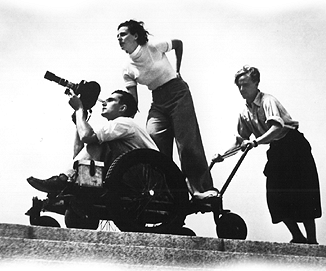
    Nach der Machtergreifung holte Propaganda Minister Göbbels alle Filmemache zu sich und zeigte Ihnen den Film von Eisenstein, ” Panzerkreuzer Potkim” – so wollte er Filmkunst gestalten – Kunst mit(unauffälliger) Propaganda und mit Dokumentationen.  Leni Riefenstahl  war damals eine wenig bekannte Schauspielerin aus Weimar, die sich als Regisseur gerade  selbst neu erfand.  Sie machte 1934 “Triumph des Willens” – der Nürnberger Parteitag der NSDAP, die Ankunft Hitlers und seiner Helfer.  Bewegte Kamera, wechselnde Perspektiven, souveräne Montagetechnik. „Triumph des Willens“ wurde durch Hitler selbst in Auftrag gegeben,  der sie sehr zum Unmut von Göbbels direkt protegierte (sie belegte zeitweise sein ganzen Kameras). Der Film fing die erste Parteiversammlung in Nürnberg mit 16 Kameras ein.  Nach zwei Jahren schneiden kam ein Film mit durchschlagendem Effekt heraus. Noch cleverer war „Olympia“ der die Spiele 1936 aufnahm. Ihr Ziel war – wieder mit hohem technischem Aufwand (89 Kameraleuten)  und einer heute kaum mehr erreichten Astethik – „ennobled good losers, supreme winners, and endwelled on fine musculature particularly of Jesse Owns … to Hitlers extreme displeasure.“

    Ebenfall 1936 (dem Jahr des Olympia Dokumentarfilms von Leni Riefenstahl) erscheint Jung’s berühmter “Wotan”-Aufsatz, der vom Aufbrechen eines “furor teutonicus” unter der dünnen Schicht christlich-aufgeklärter Kultur spricht und Deutschland als “geistiges Katastrophenland” bezeichnet, wo die Menschen eher von etwas “ergriffen” werden statt es zu “begreifen” (10). Alle von Jung’s folgenden Äußerungen zum Nationalsozialismus umkreisen von nun an die Frage, wie es ausgerechnet in einem hochentwickelten Kulturland zu einem solchen Verhängnis kommen konnte und aktualisieren seine Einsicht von der Notwendigkeit, sich intensiver mit den archaischen Regungen unterhalb der Zivilisationsoberfläche auseinander zusetzen. Was ihn einmal partiell fasziniert hatte – die euphorische Aufbruchsstimmung zu Beginn des Dritten Reiches – führt jetzt nicht nur zu Bestürzung und Ohnmacht, sondern zu tieferen Geschichtsanalysen, um einer bis heute kaum verstandenen Dynamik auf die Spur zu kommen. Dabei gibt es im Denkansatz übrigens Parallelen zur Frankfurter Schule, die ebenfalls im Nationalsozialismus eine nicht für möglich gehaltene Wiederkehr des Mythischen in “aufgeklärter Zeit” erblickten.(11) Jung findet seine alte Forschungshypothese bestätigt, daß Archetypen, kollektive Verhaltensmuster und archaische Bildwelten bewußt durchgearbeitet statt verdrängt oder unbewußt ausgelebt werden müßten. Nicht nur in Deutschland, sondern in ganz Europa sieht er das Phänomen der “Dissoziation” vor sich: eine Spaltung der Kultur in einen rational-fortschrittlichen Teil, der glaubt, “primitive Stufen” überwunden zu haben, während diese in Wirklichkeit verdrängt worden seien. Denn gerade das, was Christentum und Aufklärung verhindern wollten, geschah trotzdem: Kollektivrausch statt individueller Freiheit, Blutmystik statt Verstandesklarheit, Kriegerkult statt Pazifismus, Anbetung von archaischen Symbolen statt christlicher Werte von Mitleid und Versöhnung. Interessant und bis heute zu wenig bedacht sind Jung’s auf Gesamteuropa ausgedehnte Schlußfolgerungen, zu denen er seine Analyse des Nationalsozialismus erweitert: Auch die Inquisition, die Hexenverfolgung, kolonisatorische Raubzüge des “weissen Mannes”, blutige Revolutionen oder das Vernichtungspotential der Atombombe seien letztlich Folgen einer “schizophrenen” europäischen Kulturentwicklung, die vorgab, mittelalterliche “Primitivität” überwunden zu haben, um in noch barbarischere Exzesse zurückzufallen.(12) Eine wichtige und bestürzende Erkenntnis, die – wie wir im Hass auf alles religiöse sehen – auch heute noch kritisches Potential in sich birgt.

    Leni Riefenstahl bezeichnet sich als politisch nicht interessiert. Sie habe sich daher überfordert gefühlt von Hitlers Wunsch, dass sie den Parteifilm machen müsse. Doch hat sie, intuitiv oder geplant, Ablauf und Symbolik der Aufmärsche sofort erfasst – und filmisch überhöht. Sieht man “Tiumph des Willens”, scheint das also ein korrekte Analyse. Auch im Film “Triumph des Willens” ist ja nichts gestellt. Leni Riefenstah: “Das ist ein Zeitdokument. Das haben auch die Richter bei den Entnazifizierungen so gesehen. Es ist ein Zeitdokument. Ob es der Arbeitsdienst ist, oder ob es der Vorbeimarsch ist, oder die Jugend, vor der Hitler eine Rede hält. Das war damals so. Und damals waren die Leute, und nicht nur die Deutschen, auch die Ausländer, fasziniert. Und glauben Sie, dass der “Triumph des Willens” von Frankreich eine Goldmedaille bekommen hätte, kurz vor dem Ausbruch des Krieges, wenn sie den als Propagandafilm gesehen hätten, vorm Krieg, die Franzosen?”.

    Nach dem Krieg
    In einem 1946 geführten Gespräch mit dem Rabbiner und Auschwitz-Überlebenden Leo Baeck hat Jung Fehler eingestanden und sich entschuldigt, was zu einer Versöhnung zwischen den beiden führte. Der Kabbala-Spezialist Gershom Sholem berichtete diese Begebenheit, die für ihn ausschlaggebend war,weitere Einladungen Jung’s zu dessen Eranos-Tagungen anzunehmen. (13) Interessant ist diesbezüglich vor allem die Tatsache, daß sich jüdisch-amerikanische Gelehrte und Psychotherapeuten viel intensiver mit diesem Problem befaßten als ihre deutschen Kollegen. So gab es 1989 in New York eine wissenschaftliche Tagung (“Lingering Shadows”), die sich ausschließlich mit den Antisemitismusvorwürfen gegenüber Jung beschäftigte.(14) Hierbei wurde nicht mit Kritik gespart, doch ohne zu pauschalieren. Vor allem wurde auf das gespannte Verhältnis von Jung zu seinem jüdischen Lehrer Freud hingewiesen, das zu einigen überspitzten Verallgemeinerungen in dem oben genannten Aufsatz führte. Freud und Jung – anfangs auch eine Vater-Sohn-Beziehung – entzweiten sich unter Streit und Schmerzen, als die Unterschiede in ihrer Beurteilung der spirituellen Dimension der Seele zu eklatant wurden. Während Freud in der Religion nur unbewältigte Vaterproblematik, Aberglauben und Projektion erblickte, waren mythische Bilder und Gottsuche für Jung elementare Bedürfnisse des Menschen, sich mit verborgenen und transzendenten Kräften auseinander zusetzen. Er sah in Freud den Prototyp des säkularisierten Juden, der alle Spiritualität zugunsten eines “modernen” naturwissenschaftlichen Erkenntnisideals verleugnete und übertrug diese Meinung voreilig auf das gesamte Judentum.

    Leni Riefenstahl stieß als Fotografin nach dem Krieg rasch in die Weltspitze vor. Bildberichte über ihre Aufenthalte bei den Nuba erschienen zuerst in den Zeitschriften »Stern«, »The Sunday Times Magazine«,»Paris Match«, »L’Europeo«,»Newsweek« und »The Sun«. Vor allem ihre Bildbände »Die Nuba« und »Die Nuba von Kau« brachten ihr weitere Ehrungen und Auszeichnungen ein. Im Alter von 71 Jahren besucht  Leni Riefenstahl  einen Tauchkurs, um künftig auch als Unterwasser-Fotografin arbeiten zu können. Bald schon erwies sie sich auch in diesem Metier als Meisterin. Nochmal Leni Riefenstahl: “Insofern fühl ich mich schuldig, dass ich am Anfang, in den ersten Jahren so fasziniert war weil Hitler sein Versprechen gehalten hatte die Arbeitslosen wegzufischen und die ganze Not aus Deutschland zu verbannen. Aber ich hätte ja ebenso wie die anderen auch sehen müssen, dass man nicht in jüdischen Geschäften einkaufen durfte, sollte. Ich habe gekauft in jüdischen Geschäften aber es war an sich nicht erwünscht. Das alleine hätte mir zu denken geben müssen und das kann ich nicht verstehen heute, dass das nicht der Fall war. Ich war eben mit angesteckt von der ganzen fast hysterischen Begeisterung, die damals war.” Ich habe einmal eine Schauspielerin kennengelernt. die in dieser Zeit jung und produktiv waren. Vor diesem Hintergrund klingt das – für mich – plausibel- naiv .

    Gottesbilder und  atheistischen Utopien
    J. Marvin Spiegelman’s “Judaism and Jungian Psychology” (1993) weist daraufhin, daß gerade nach dem Zerfall der marxistisch-atheistischen Utopien in aller Welt Fragen nach religiösen Wurzeln und Identitäten wieder neubelebt würden. (16) Die spirituellen Bedürfnisse der Seele seien mehr als bloßes “Wunschdenken”.
    Tiefgreifende Lebensereignisse wie Tod, Verlust, Liebe, Krise und Verwandlung wollten auch bildhaftrituell erlebt werden. Gerade die Beschäftigung mit Jung habe Spiegelman auch wieder zu den eigenen religiösen Texten geführt und – etwa durch die Lektüre von dessen berühmter “Hiob” – Interpretation – zu einem vertieften Verstehen des jüdischen Gottesbegriffes.(19) Diesen wichtigen Essay von Jung ignoriert z.B. auch Richard Noll, der 1993 versuchte, dessen Psychologie als eine Art völkischer Ersatzreligion zu entlarven. (20) War Jahwe für Jung vielleicht anfangs noch eine einseitig strafende und überdimensionale Vaterfigur, so wird ihm 1952 durch die Lektüre der alttestamentarischen “Hiob”-Geschichte eine größere Vielschichtigkeit im Verhältnis von Jahwe zu den Menschen klar. (21) . Jung’s “Hiob”-Lektüre wird eine intensive Begegnung mit jüdischer Religion, aber er versucht auch, die Kontinuität innerhalb der Bibel zu verstehen, ohne das Alte gegenüber dem Neuen Testament abzuwerten. Im Gegenteil: Die Figur des Jesus Christus scheint ihm noch als zusätzliche Erfahrungsstufe Jahwes Sinn zu machen, aber als Jung bei der Johannes-Offenbarung ankommt, hat man den Eindruck, daß er die komplexe Figur des jüdischen Gottes doch seinem einseitig “guten” christlichen Pendant vorzieht. Er sieht sogar eine Gefahr darin, daß sich das Christentum hier zu einem schroff dualistischen Denken verengt, welches das “Böse” als “Satan” abspaltet und glaubt, es durch Verbannung aus der Welt schaffen zu können. Dies sei unrealistisches Wunschdenken, widerspräche der Realität der menschlichen Psyche und berge in sich die Anlage für zukünftige Katastrophen:  “Als Ganzheit ist das Selbst … immer eine complexio oppositorum, und seine Erscheinungsweise ist umso dunkler und drohender, je mehr das Bewußtsein sich Lichtnatur vindiziert und daher auf moralische Autorität Anspruch erhebt.” (22)

    Gut und Böse und Leni Riefenstahl
    Gerade die Lektüre von Jung’s “Hiob” eröffnet auch ein tieferes Verständnis der Problematik des “Bösen”: Nur wer lerne, in sich das gegensätzliche Nebeneinander von “Licht” und “Dunkel” zu akzeptieren, könne letztlich auch der Erfahrung des Göttlichen eine angemessene Heimstatt bieten. (23) Übertragen auf den Nationalsozialismus könnte das heißen: Der, der die Möglichkeit der eigenen Verfehlung für denkbar hält, ist gefeiter gegen ideologische Verführung und dualistisches Feindbilddenken, weil dieses ja stets die eigenen Schatten nach außen projiziert.  Was hat uns die Jung’sche Psychologie darüber hinaus heute noch zu sagen?  Jung’s Archetypenlehre wird manchmal vorgeworfen worden, reaktionär zu sein, weil sie unbeweisbare “Urbilder” oder “ewige Grundmuster” statuiere und damit den Menschen zur unfreien Marionette gegenüber statischen Kräften mache. Doch eigentlich ist das Gegenteil der Fall: Jung wiederholt in seinem gesamten Werk immer wieder die Forderung, unbewußte Verhaltensmuster und suggestive Bilder ins Bewußtsein zu heben, um den Menschen einen freien Umgang mit ihnen zu ermöglichen.

    Im Nationalsozialismus und mit Riefenstahl-Filmen geschah genau das Umgekehrte. Die Menschen gerieten in einen Rausch und überließen sich unbewußt atavistischen Strömungen und Symbolen, wurden von etwas “ergriffen” statt es zu “begreifen”. Sie traten nicht in ein kritisches oder befragendes Verhältnis zu archaischen Inhalten, sondern verfielen ihnen in blinder Hörigkeit. Ein Beispiel  wie mächtig Bilder sind, zeigte der Film “Triumph des Willens” eine Auftragsarbeit für die NSDAP von einer offensichtlich intelligenten jungen Frau und brillianten Künstlerin, die sich mit kulturlosen Halsabschneidern einliess. Es liegt im Wesen des Films (und von Bildern), dass die Umstände seiner Entstehung verblassen. Riefenstahls Werke sind dabei, etwas zu werden wie Jungs Werke, dem man das Leben und Leiden, das sich um ihn herum abspielte, nicht mehr ansieht. Es bleibt nur noch das Bild – und so wird es den Riefenstahl-Filmen auch ergehen. Der Werbefilm ist zu weiten Teilen von Riefenstahl beeinflusst, was sich im Mystifizieren und Dramatisieren von Dingen zeigt, sei es ein Trainingsschuh oder ein Auto. Extreme Kamerawinkel, Kreisfahrten, Auflösungen, Schnitttechniken – was sie erfunden hat, wenden die Werberegisseure heute alle an, vom Nike-Spot bis zu MTV. Die “Krieg der Sterne”-Trilogie enthält Anleihen bei Riefenstahl; der Helm von Darth Vader sieht aus wie von der Wehrmacht ausgeliehen, und die Klonkrieger in der neusten Folge marschieren wie bei Truppen beim Parteitag. Ohne Standpunkt (“gut” oder “böse§ kann man keine realen Alltagssituationen dokumentieren, keine Figuren entwickeln und keine Geschichten erzählen. Um die Inschrift zu paraphrasieren, die C.G. Jung auf seinen Grabstein setzen ließ: „Ob gerufen oder nicht, Gott wird da sein.“ Es liegt nahe, daß große Bilder eine große Ausstrahlung haben. Auch heute ist diese Problematik trotz aller “Aufklärung” nicht aus der Welt.  Aber “Vielleicht bedeutet die Kunst gar nichts, hat gar keinen Sinn, wenigstens so wie wir vom Sinn sprechen.” (23)

    Zusammenfassung
    Jung fordert keine nostalgische Aufwärmung alter Mythen, sondern eine neue Theorie symbolischen Denkens – sein Horizont ist jedoch  weiter als der von seelisch verarmten Rationalisten aber auch von denen dem Unbewussten mit Bildern huldigen, weil er die menschliche Sehnsucht nach Mythen und Bildern nicht nur verdammt, sondern ernstnimmt, aber ihre bewußte Durchdringung fordert.  Im Gegensatz ging Leni Riefenstahl im Sog der Symbole  unter.  Dass nach wie vor viele Menschen mythischen Bildern erliegen, die in Gewalt und Abhängigkeit münden können, beweisen problematische Kino- und Videofilme, politische Korrektheit, religiöser, anti-religiöser und anti-westlicher Fundamentalismus , rechte und linke Ausgrenzungswahn, ja  auch die Wiederkehr von pseudo-religöser Symbolik in der Politik.

    1) Aniela Jaffé: Aus Leben und Werkstatt von C.G.Jung, Zürich und Stuttgart 1968, 89f
    2) Ebd. 95
    3) C.G. Jung, Gesammelte Werke, Band 10, Solothurn und Düsseldorf 1995, 190f
    4) Ebd. 25
    5) Ebd. 190
    6) Ebd. 106, Jung spricht hier sogar vom “arischen Raubvogel” und seiner “unersättlichen Beutegier”, die ihn “über alle ihn nichts
    angehenden Länder führt” sowie von unserem “Größenwahn, der sich zum Beispiel einbildet, das Christentum sei die einzige
    Wahrheit, der weiße Christus der einzige Erlöser.”
    7) Ebd. 61f
    8) Karl Marx: “Zur Judenfrage”, MEW Bd.1, 376f und “Neue Rheinische Zeitung” 1849, zitiert in Konrad Löw: Das Rotbuch der
    kommunistischen Ideologie, München 1999, 74f. (Diese Stelle ist in der Marx-Engels-Gesamtausgabe nicht enthalten)
    9) Jung, Gesammelte Werke, Bd.9/1, 60f
    10) Jung, Gesammelte Werke, Bd.10, 203ff
    11) Max Horkheimer/ Theodor W. Adorno: Dialektik der Aufklärung, Philosophische Fragmente, Frankfurt/Main 1973
    12) Jung, Gesammelte Werke Bd. 10, 221f, 237f, 268ff, 273,
    13) Aniela Jaffé: a.a.O. 103f
    14) Aryan Maidenbaum/ Stephen A. Martin (Hg.): Lingering Shadows: Jungians, Freudians and Anti-Semitism, Boston/ London
    1991
    15) Ebd. 277ff
    16) J. Marvin Spiegelman: Judaism and Jungian Psychology, Boston/ London 1993, 21f
    17) Ebd. 47
    18) Ebd. 25f, 40
    19) Ebd. 56ff
    20) In seinem Buch “The Jung Cult. Origins of a Charismatic Movement” (Princeton 1994) versucht Richard Noll in reiner Konzentration auf das Frühwerk und auch dort vereinfachend nachzuweisen, daß Jung aus Aversion gegen das “Semitische” nur die “arisch-indoeuropäischen” Mythen interessiert hätten. Doch kommen in dessen frühen Schriften auch Symbole und
    Göttervorstellungen aus Ägypten und Asien vor. Ein paar Bemerkungen über “Siegfried”, “Walhall” und die “Walküren” sowie reale bzw. vermutete Bekanntschaften mit völkischen Autoren reichen noch nicht aus, um aus Jung einen völkisch orientierten Germanenmystiker á la Guido von List zu machen.
    21) C.G. Jung, Gesammelte Werke, Bd. 11, 363ff, siehe auch Micha Brumlik: C.G.Jung. Zur Einführung, Hamburg 1993, 110 ff
    22) C.G. Jung, Ges. Werke, Bd 11, 445

    23) C.G. Jung, Ges. Werke, Bd 15, 49/50

    24) C.G. Jung, Kommentar zu Richard Willhelm, das Geheimnis der Goldenen Blüte

    Leni Riefenstahl..

  • C.G. Jung and symbols of the film noir

    C.G. Jung and symbols of the film noir

    Again, Jungians were faster to search for symbols of the film noir. I just saw some old movies again, including Pulp Fiction, Blade Runner, Rosmary´s Baby and 2001 – A Space Odyssey and some film noir movies.  I was interested how Jungian ideas could help me understand the films from a different angle and advance with a little project since I read Marcus – the image of the good and the evil, deamons and shadows. I thought this was an original thought, but no,  of course a few articles had been written already.

    In Pulp Fiction,  Jules (the hit man) expresses his idea of religion: “There’s a passage I got memorized. Ezekiel 25:17. “The path of the righteous man is beset on all sides by the inequities of the selfish and the tyranny of evil men. Blessed is he who, in the name of charity and good will, shepherds the weak through the valley of the darkness. For he is truly his brother’s keeper and the finder of lost children. And I will strike down upon thee with great vengeance and furious anger those who attempt to poison and destroy my brothers. And you will know I am the Lord when I lay my vengeance upon you.” I been sayin’ that shit for years. And if you ever heard it, it meant your ass. I never really questioned what it meant. I thought it was just a cold-blooded thing to say to a motherfucker ‘fore you popped a cap in his ass. But I saw some shit this mornin’ made me think twice. Now I’m thinkin’, it could mean you’re the evil man. And I’m the righteous man. And Mr. 9mm here, he’s the shepherd protecting my righteous ass in the valley of darkness. Or it could be you’re the righteous man and I’m the shepherd and it’s the world that’s evil and selfish. I’d like that. But that shit ain’t the truth. The truth is you’re the weak. And I’m the tyranny of evil men. But I’m tryin’. I’m tryin’ real hard to be a shepherd”. Sounds like Nietzsche’s  Zarathustra, the weak men need the strong independent man without moral.

    For the viewer of Pulp Fiction, the five-fold pattern punched out by the bullet tracks soon after the film has begun is like Quentin Tarantino’s message. This is the film for anyone to see who wants to understand better what our violent, fear-ridden society may unconsciously be aiming at beyond its own self-destruction. From one side of the ambivalent feeling it sets off, Pulp Fiction is a sharply funny satire of the violence of our culture, offering itself, with its vulgar language and tense set-pieces, as a supreme occasion for indulging our regret at the deterioration of our culture’s values. For me, Pulp Fiction feels like a weirdly hopeful, even religious, film, an angel carrying the message that our collective weariness with violence is a deconstruction within the Western shadow itself.

    Five is 4 + 1 or 2 + 3. In the first case its the  symbol of the rule of the spirit over the four elements symbolizes  (white) magic. In the second case it is the combination of the first female with the first male number and becomes the symbol of the sensuality and (predominantly male) sexuality. In the Christianity its symbolized by the  five wounds of Christ a . Five was subordinated in the Christian culture of the four: the  the four books of the New Testament. Five was also the number of the old-Babylonian goddess Ischta and in the Alchemie by it quinta essentia, the spirituelle quintessence was the spirit, which was symbolized by the rule of the upright-standing Pentagramm over the four elements. Darkly is the fallen Pentagramm,  which symbolized the subordination of the spirit under the raw forces –  the spiritual fall. It is symbol for the black magic.

    Five bullet holes appear in the wall behind Vincent and Jules, hit men who have come to discipline a flat full of drug dealers for holding back a stash that they owe to the drug lord Marsellus Wallace. Discovering that they have survived an unexpected counterattack from a hidden observer, the two react quite differently. For the yuppier of the pair, coolly slack Vincent (John Travolta), the close call is another occasion to express his dismay at the way things go in our unmannerly society. The more reflective, intense Jules (eloquent Samuel L. Jackson) takes the sparing of his life as a religious rather than social sign, an indication that God wants to keep him alive. He uses the event as an opportunity for a reappraisal of his own relation to the culture of violence.

    Five brings me to the next movie: Rosemary’s Baby. The Pentagramm served gnostics and pagans as protection against night daemons (Drude, “weibliche Nachtgeister” like Animus) and bad powers . In Goethe’s  Faus Mephisto cannot cross the door limit, because a Pentagramm is scratched there.  In the hermetic traditions is the Pentagramm one of the most important symbol. Since the antiquity this symbolism possibly relates to the  periodic motion of the planet, whose positions describe every eight  years an accurate Pentagramm. Geometry has two great treasures; one is the Theorem of Pythagoras; the other, the division of a line into extreme and mean ratio. The first we may compare to a measure of gold, the second we may name a precious jewel (Johannes Kepler). The Divine Proportion plays an essential role in the construction of the pentagon and five-fold symmetry. The reverse five-pointed star, however,  used in the movie,  is the most well-known indication of the Satan.  The reverse cross standing on the head symbolizes  refusal of the Christian cross and  666, the number of the anti-Christian from the “Offenbarung” of Johannes, all are used in Rosemary’s Baby.

    Polanski’s Nóż w wodzie – Knife in the water (1962), Repulsion (1965), Dance of the Vampires (1967), Rosemary’s Baby (1968), The Tragedy of Macbeth (1971) and Chinatown are all dark haunted movies. In particular Rosemary’s Baby connects directly to the catholic church. Polanski’s movies paint poetic soul landscapes, whose origins may lie in his  personal trauma experiences. As a child the Polish producer survived the Holocaust, which took its mother to it.  On August 9th 1969  his  high-pregnant wife Sharon Tate was murdered  by the Charles Manson gang , a murder for which many held the movie (more Polanskis indirect connection to Manson due to his tideous research) partially responsible. Polanskis experiences with anti-Semitism, force and murder play a central role in this film. His unconcisiouness ceates artistic imageswhich are symbols of shadowly creatures.

    Though there have long been films that featured demonic activity, devil worshippers, or appearances by Satan, the release of Rosemary’s Baby marked a significant t new openness to mystical and to explicitly religious themes. Rosemary’s Baby can be seen as nothing more than a well-crafted movie that plays on the timeless and archetypal fear of “the Devil”. However, when one looks at the movie’s precise timing in American history and the incredible series of events that followed its release, the movie becomes unsettling. The same way Rosemary discovers the workings of an international witch coven, Western society “discovers” a darker side of europeanl politics.  Media slaves are unleashed in the public, shocking anti-christian events occur and Western culture becomes a celebration of depravity. In terms of mysticism, the unconscious is direct link to our psychic interpretation and divine inspiration. In psychological terms, it would best be associated to what Carl Jung described as the ‘Collective Unconscious.’ Specific cultural archetypes, as Jung described, are able to be found universally through this Collective Unconscious, or that common inner experience that we all share. The projections of these archetypes, such as angelic beings or deamons like in  Rosemary’s Baby are simple representations of one’s inner self  -of our society that is to say-  that can be projected or confronted: ” Angst ist Forderung und Aufgabe, denn nur das Wagnis kann von der Angst befreien. Und wenn es nicht gewagt wird, so ist […] alle zukunft zu hoffnungsvoller Plattheit verdammt, zu einer Dämmerung, die nur noch durch Irrlichter erhellt wird” (C.G. Jung Symbole der Wandlung). Rosemary bore the devil.  “Satan” is clearly an archetype for the Reptilian race. “Satan” was often symbolized as a dragon, a snake, a lizard or a strange looking bi-pedal, upright standing and cleverly cunning, half human/half reptile creature (refer to the Gnostic texts for this Reptilian being known as ‘Nachash’). The Jewish Haggada also describes in great detail, amongst a plethora of other ancient accounts, the nature and appearance of this Reptilian race that seeded and interbred with mankind. Rosmary, however, resigns herself to this situation. She gave the Evil existence and shape. She looks at this terrible creature in the cradle (with te reverse cross), the cradle song rings out. It is their child.  She bore it.  The Good and the Evil  are mother and father of this child, which we believed are not part of us. Rosemary’s hesitant, insecure faith no match for the evil of the coven and the  good and the evil falls outside of comfortable dualities and binary oppositions.

  • C.G. Jung’s Red Book and ‘The Seven Sermons to the Dead’

    C.G. Jung’s Red Book and ‘The Seven Sermons to the Dead’

    Seven Sermons to the Dead (Septem Sermones ad Mortuos) is a collection of seven mystical or “Gnostic” texts written and privately published by C.G. Jung, under the title Seven Sermons to the Dead, written by Basilides of Alexandria, the city where East and West meet.

    It is the only portion of his famous, deeply private The Red Book (Liber Novus) that Jung chose to share and privately distribute to select friends and students during his lifetime. Scholars widely consider these sermons to be the “summary revelation” and the foundational psychological nucleus of all of Jung’s later academic work.

    'The Seven Sermons to the Dead'

    Origins of the ‘The Seven Sermons to the Dead’

    • The Pseudonym: Jung did not publish the work under his own name. Instead, he attributed the text to Basilides of Alexandria, a prominent second-century Christian Gnostic teacher. [1, 2]
    • The Setting: Jung framing the sermons as being written in Alexandria, “the city where East and West meet,” to symbolize the bridging of rationalism and mysticism. [1, 2]
    • The Context: Jung wrote the sermons during a intense period of introspection following his 1913 professional split from Sigmund Freud. He referred to this tumultuous time as his “confrontation with the unconscious”.

    The Core Narrative and Structure ‘The Seven Sermons to the Dead’

    The ‘The Seven Sermons to the Dead’ begins with a haunting narrative framing: the spirits of dead Christian crusaders return from Jerusalem because they did not find what they were seeking. They gather at Jung’s house demanding answers, prompting the speaker to deliver seven distinct psychological and cosmological lessons:

    • Sermon I (The Pleroma): Introduces the Pleroma, a Gnostic term for the ultimate, undifferentiated fullness and nothingness where all opposites cancel out. Creation (Creatura) only exists because it differentiates itself from this void.
    • Sermons II & III (God and Abraxas): Introduces Abraxas, a supreme deity higher than both the traditional Christian God and Satan. Abraxas represents a force that unites all opposites, seamlessly blending life and death, good and evil, light and darkness.
    • Sermon IV (The Tree of Life): Explores how humanity splits into multiplicities and outlines the fundamental driving forces of spiritual and physical life.
    • Sermon V (The Community): Focuses on spirituality and the tension between human communities and individual distinctiveness.
    • Sermon VI (The Daemons): Outlines the inner spiritual guides influencing the soul, symbolized by the serpent (earthly sexuality and desire) and the white bird (celestial spirituality). [1]
    • Sermon VII (The Inner Star): Concludes by teaching the dead that man is a gateway to the cosmos. Redemption is found by following one’s own unique, inner guiding star. [1]

    Availability and Influence of ‘The Seven Sermons to the Dead’

    Upon hearing the seventh sermon, the enlightened dead express gratitude and peacefully depart. While the text remained obscure for decades, Jung eventually allowed it to be published as an appendix to his 1962 autobiography, Memories, Dreams, Reflections. Today, you can read or listen to the full text via platforms like the Gnostic Society Library text repository

    ‘The Seven Sermons to the Dead’ is a part of Jung’s Red Book and can be described as its “summary revelation.”

    The Red Book

    The ‘Red Book’ connects aesthetics with an aura of art and secrecy. It touches the layman like me, who gets involved with C.G. Jung, because it is a central work regarding the history of spirituality and it contains  the roots of the works C.G. Jung  with lots of reference to gnosticism. It is also beautiful.

    The publisher, Sonu Shamdasani, a science historian, brings in the introduction the available texts of C. to G. Jung in culture and science-historical context and creates a connection to lives and work of the depth psychologist.

    Contrary to C. G. Jung as scientist,  ‘The Red Book’ documents subjective recordings of a self trial (active imagination). It contains the notes of the ‘Black book,  reflections C.G.Jung wrote down over many years beginning after with separation from Freud. The book was created and  accessible only for good friends and not published formerly. The language appears sometimes emotion-filled, but everyone,  who wrote a diary (particularly during a crisis), may understand this.

    Carl Gustav Jung was 37 when by most accounts he lost his soul. As psychological historian Sonu Shamdasani explained, “Jung had reached a point in 1912 when he’d achieved all of his youthful ambitions but felt that he’d lost meaning in his life, an existential crisis in which he simply neglected the areas of ultimate spiritual concern that were his main motivations in his youth.

    Under no circumstances, we have to reconsider or re-evaluate C.G. Jung after reading this book. `The Red Book’ is, however, nevertheless more than a psychological picture book or an art catalog. Visions and fantasies are large-sized, ornate and colourful held. It is C.G. Jung’s hand written and painted legacy.

    The book records more than its author’s spiritual crisis and is a foretaste of his evolving intellectual path.  Liber Novus (Latin for “New Book”) documents such matters as his conversations with the winged “Philemon” during his daytime walks.  The book records obviously the results of the ‘active imagination’ technique described later in his works.

    C.G. Jung says later: `Everything my work, everything that I created mentally, comes from the initial imaginations and – dream. 1912 began it, that are now nearly 50 years ago. Everything that I did in my later life, is in them already contained, although only in the form of emotions or pictures.  He continues, ‘In uns ist der Weg, die Wahrheit und das Leben’ , which reminds me strongly of modern Christianity. The book comes perhaps on the right time, a time, in which Europe denies its roots. One can call the ‘Red book’ created between 1914 and 1930, a visual dream diary. C. G. Jung qualified his book – whose language and emotions  are often nearly embarrassing – as important documentation of its psychological and mental development.

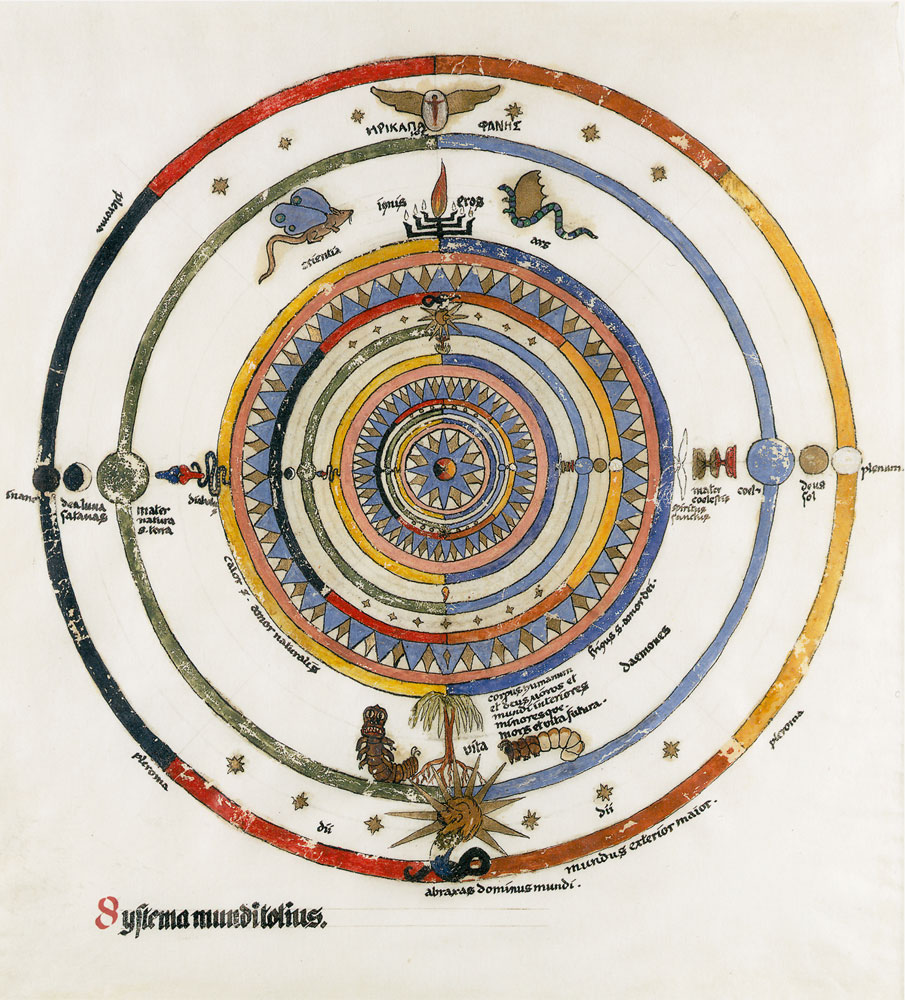
    No doubt, Jung was captivated by mandala’s, not merely because of his attraction to Eastern philosophy, but also because he thought the circular images represent the self or totality of the personality.  It could be experienced Museum Rietberg “Carl Gustav Jung: Das Rote Buch Le Livre Rouge from December 2010 to March 2011  where Jung’s first-known mandala-inspired work, “Systema mundi totius”,  illustrated in 1916 was on display. The brightly hued circular graphic shows a reference to very gnostic-like text ”The Seven Sermons to the Dead” he wrote 1916/1917. He had a striking parapsychological event in the winter of that year, in which the dead, whom he’d encountered in his fantasies about two years earlier, end up at his door. There is an interesting book evaluating and commenting  ‘The Seven Sermons to the Dead’ from a gnostic point of view. Both books lay the foundation of his Jung’s legacy.

    The original

    When I had my last project in Zürich I had a chance to see the Red book. C.G. Jung marked its unfinished work, ‘a necessary, but annoying ästhetisierende elaboration’. The adjective “ästhetisierende” means to place an object into an aesthetic context and qualified by criteria as beautiful or ugly. That hits the core of the matter 

    The original ‘Red Book’ is approximately seven kilograms heavy work bound into red leather is written and in the ornate calligraphic of medieval handwriting held in a strangely high German language. The book, we can buy, has the format of the original and is bound in linen. One reason for the enigma surrounding Carl Jung’s Red Book is that he never  finished  it. The  book ends 1958 mid-sentence in his normal hand writing (pg 190/191):

    “Ich habe an diesem Buch 16 Jahre gearbeitet.“ “Die Bekanntschaft mit der Alchemie 1930 hat mich davon weggenommen. Der Anfang vom Ende kam 1928, als mir Willhelm den Text der  Golden Blüte eines alchemistischenn Traktates sandte. Da fand der Inhalt diese Buches in die Wirklichkeit und ich konnte nicht mehr weiterarbeiten. Dem oberflächlichen Betrachter wird es wie eine Verrücktheit vorkommen. Es wäre auch zu einer solchen geworden, wenn ich die überwältigende Kraft der ursprünglichen Erlebnisse nicht mehr hätte auffangen können. Mit Hilfe der Alchemie konnte ich sie schließlich in ein Ganzes einordnen. Ich wusste immer, dass jene Erlebnisse Kostbares enthielten und darum wusste ich Nichts Besseres als sie in einem „kostbaren“ d.h. teueren Buch aufzuschreiben und die beim Wiederdurchleben auftretenden Bilder zu malen – so gut dies eben ging. Ich weiss, wie erschreckend inadäquat diese Unternehmung war, aber trotz vieler Arbeit und Ablenkung blieb ich ihr getreu, auch wenn ich nie eine andere Möglichkeit.“

    Addon 2013: I own one facsimile of the Red Book. I penned a synopsis containing my notes and narrative of the Red Book . If you are interested,  you find it here. I must warn you, even a short version of C.G. Jung results in a long article.