Tag: Humanism

  • Dante’s Divine Comedy – symbolism and archetypes

    Dante’s Divine Comedy – symbolism and archetypes

    Dante is not just any poet. With his epic poem “Commedia”, in English “Divine Comedy” he created an Italian cultural Monument, a journey through Hell, Purgatory and Paradise full of symbols, archetypes, historical and allegorical references. The article wants to revisit the work of Poet Dante Alighieri from a Jungian view in the light of 2015.

    Synopsis

    Dante’s Commedia was written from 1307 to 1321 and is the most famous Otherworld journey of world literature. Accompanied by Virgil, the poet passes through the Gates of Hell to the icy center of the earth, and from there to the paradise flying high with his beloved Beatrice. On the way, he meets almost six hundred celebrities from politics, literature and mythology for their salvation, repent of their sins, who tell the poet of their life. It was a longitudinal study of the Western World at that time.

    See above a short powerpoint as an introduction if you are in the visuals or not sure to where this article will lead: Dante in a hurry.

    Is Dante meaningful today?

    My answer is yes. Yes, period. Not only, because i every time you go in a museum, you will find pictures representations of Dane’s allegories and poems. Like Dante sensed a big transition. our world seemingly falls apart.  We all know, that transcendental illiterates try to create a paradise on earth, but achieved hell. Jihadists have created hell on earth to get into their paradise.

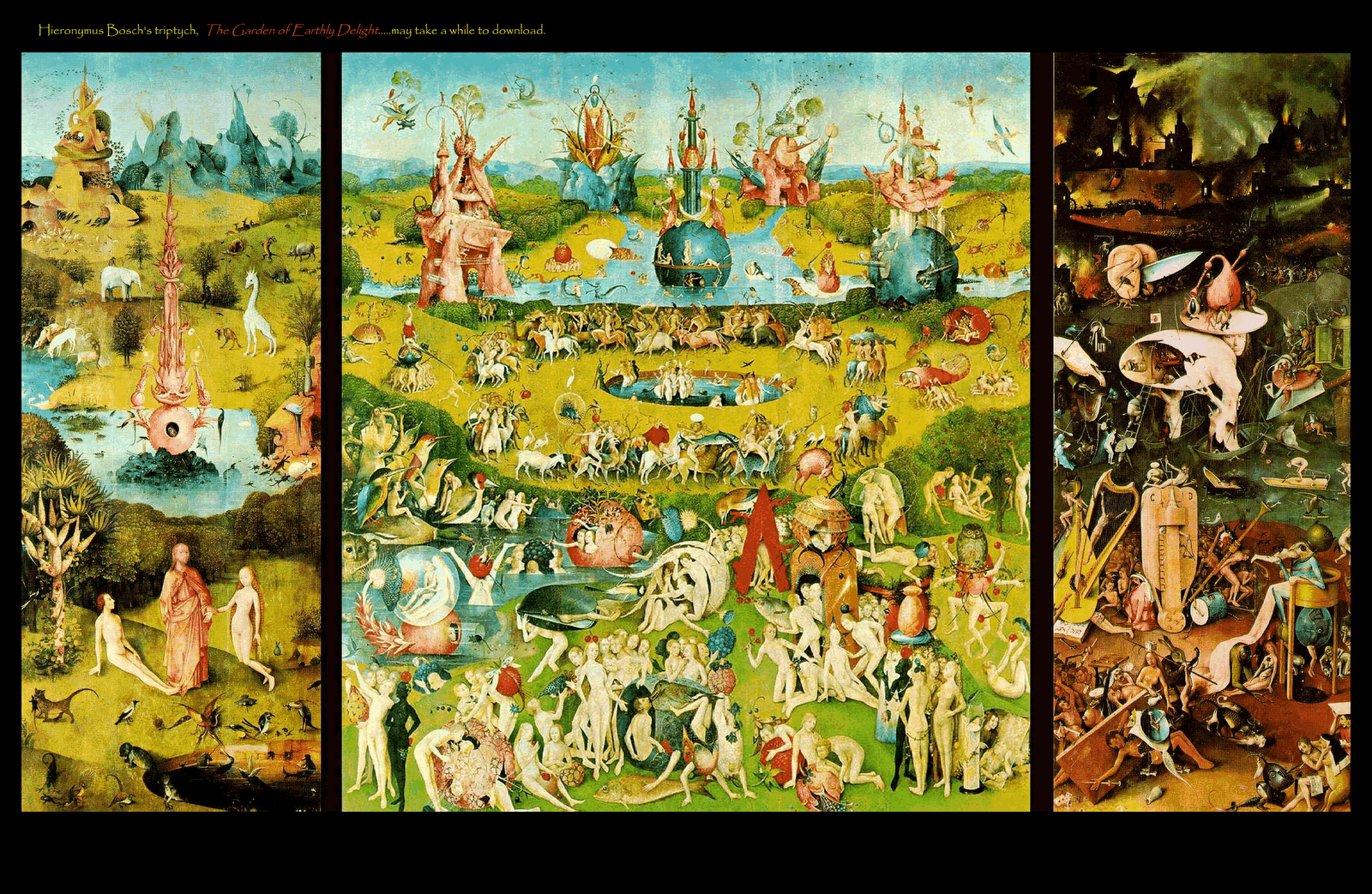
    Dantes Inferno Lust - bosch garden
    Dantes Inferno Lust

    Could it be, that one or more of Dante’s circles is as subversive today as it was then?  As a reader of my blog might expect, I am interested in Dante’s reflection in art and society and last but not least of his concept of evil, since the 34th song of his journey inspects Lucifer himself.

    •  Literal and historical: around 600 real people mentioned pointing out the disconnect between medieval and classical practice
    •  Allegorical: archetypal representative of Dante’s belief system and values
    • Moral: makes points about morality where the big questions in the Divine Comedy are:
      • What is man?
      • Why does he act as he does?
      • What is Good and what is Evil?
      • When it so often looks like “The Good loses,” why should anyone be good?

    Warning – reading Dante might be harmful

    True and False - Right or wrong - good or evil - black or white
    True and False – Right or wrong – good or evil – black or white

    The great works of world literature, Antigone, Hamlet, Faust, torture not only students’ hearts but all hide an eternal sting. This warning upfront, it is not to harmless to engage with Dante. Next to the Bible is the ‘Divine Comedy’ the most commented book in World literature. The phenomenon is even more amazing, because Dante is the most difficult, least accessible poet of world literature. Dante combines the whole scholarly tradition of the Latin Middle Ages and asks of his readers to have this knowledge or debark, before the ship leaves the safe shore:

    O voi che siete in piccioletta barca,
    desiderosi d’ascoltar, seguìti
    dietro al mio legno che cantando varca
    tornate a riveder li vostri liti:
    non vi mettete in pelago; chè forse
    perdendo me, rimarreste smarriti.

    The human rights organization “Gherush92” has claimed some chants of “Commedia” are full of racist, anti-Semitic and Islamophobic stereotypes and by the way, I add not even equal opportunity – fewer women suffer in hell.

    For the contemporary reader it is, however, not only the scholarly high sea of political correctness, in which they could get  lost. Further difficulties are added: spatial, temporal, and formal ones.

    Spatial context

    We must see the world through the eyes of Dante. The world view of Dante in the first two decades of the 14th century, his image of the earth and the structure of the three kingdoms   corresponds to the Ptolemaic system, unchallenged until Copernicus three hundred years later. This makes up the basis of Dante’s astronomy, described by his prose ‘Convivio’

    Dante’s heavenly scheme

    Comedy's geography
    Comedy’s geography

    Claudius Ptolemy concluded in the middle of the second century AD in Alexandria his main work, the ‘Megale syntaxis (‘ Big assortment ‘), his world-view: The stationary center of the universe is the spherical earth, of which only one half
    occupied with the vertex Jerusalem, the other is covered by ocean.  Down into the sea, now obviously no longer Ptolemy, but Dante, as an exact antithesis to Jerusalem, is the mountain of purification, the scene of the second part of the ‘Comedy’: the ‘Purgatorio’.  More closely tied to Ptolemaic ideas are the spatial relationships his understanding of space and stage. Albert Ritter sketched the Comedy’s geography from Dante’s Cantos:
    Hell’s entrance is near Florence with the circles descending to Earth’s centre; sketch 5 reflects Canto 34’s inversion as Dante passes down, and thereby up to Mount Purgatory’s shores in the southern hemisphere, where he passes to the first sphere of heaven at the top.

    Paradiso

    Dantes Divine Comedy - Paradiso
    Dantes Divine Comedy – Paradiso

    Around the earth revolve in outward increasing speed nine concentrically enclosing transparent hollow spheres. Seven blessed spheres with the earth as center and five planets known in his time have attached the heavenly bodies: Moon, Mercury, Venus, Sun, Mars, Jupiter and Saturn.  The ninth circle are the fixed stars, identical with what “le stelle” at Dante’s.  Beyond those nine celestial spheres is the seat of the supreme deity, the empyrean, “cielo di fiamma o vero luminoso or “the light and flame sky – itself immobile – like the earth.

    This heavenly scheme is matched by Dante’s topography of the ‘Purgatorio’ and ‘Inferno’.

    Purgatorio

    Purgatorio
    Dante’s Divind Commedy Purgatorio

    The Purgatorio rises on the apex of the uninhabited area covered by the ocean opposite to Jerusalem. It is the location of the passion and death of Jesus Christ, and also divided into nine districts. At the bottom of the beach belt land, the souls that are shipped to death first wait on a ledge and into a ravine for the entry in the actual Purgatorio, located on the ring terrace The Prayer and Purification passage leads through seven by rock walls separated ring terraces. On the top is the  abandoned earthly paradise.

    Inferno

    Inferno
    Dante’s Divine Comedy Inferno

    Likewise, the Inferno is precisely located  in the Ptolemaic system of Dante. Hell corresponds to the conical Purgatory at its negative hollow image. It is located in the interior of the inhabited hemisphere. Lucifer has bored with the insubordinate angels after his fall into the earth to its center. Thus, the funnel-shaped narrowing again be divided into nine circles Hellmouth has emerged. Where did the displaced Earth’s mass go? In this creation model, it was reused as material for the Purgatory and therefore the mountain’s height  matches the hell crater’s depth.

    Temporal context

    Poets write  for eternity, but within a Zeitgeist. Dante had his contemporary readers in mind, to achieve certain political effects. Much of this vision of the afterlife is therefore based on the period of history and culture he lived in. Naturally, as in any art, this requires explanation, if the  context is not there anymore nowadays. Like his topographic structure, are the conditions in Dante’s temporal structures coherent whole. Its center is natural is located in Rome.  As a matter of fact, in a trinity of  Rome. The Classical Rome of Augustus, the New Byzantine Rome and the Rome of the Holy Roman Empire – the papal Rome. The history of the latter began on Christmas in the year 800 with the coronation of Karl (Karl the Great) to the Roman emperor, executed by the pope Leo III.  Around 1160 the official denomination Imperium Romanum changed  into Sacrum Imperium and 1254 the empire was named Sacrum Imperium Romanum and became in the 15th century the Holy Roman Empire of German Nation. The title of the supreme monarch was initially “king”. The emperor’s honor could only be achieved only by the coronation of the pope.

    Historical context

    As an ambassador of his native city of Florence, Dante came 1301 AD to Rome. The contradiction between idea and reality on court of Pope Boniface VIII traumatized him.  Jerusalem, taken 1099,  was lost 1187, but the Crusaders had relocated their dwindling Kingdom of Jerusalem to Cyprus around 1300 but the Mamluks besieged and captured the last Templer fort Ruad in 1302. Constantinople would hold only 150 years more.  Dante’s central idea is of unity and  continuity of Roman and to him this is world history under the sign of the eagle. In the sixth canto  ‘Paradiso’ the Eastern Roman Emperor Justinian (527-565) describes the trajectory of the eagle (the Roman character)  together with history lessons. As the author of the corpus juris civilis,  on which the Napoleon code and the whole  Western legal system is based.
    Justinian is the representative of the Roman Empire. The eagle will start with Troy westward to Lazio. Under Augustus, the conquest consolidated in the golden Aion. Constantine, who moved his residence 326 moved to Constantinople against the natural and divinely ordained east-west direction and through the donation of the Papal States, repealed the division of sacred and secular rule. The Imperium Romanum was for Dante the epitome of everything that he wanted to see realized in history. Not the Sacrum but the center of the Civitas Dei, with its dual objective: eternal blessedness of the man through the exercise of the theological virtues (faith, hope and love) – under the leadership of church; earthly well-being through the use of intellectual and moral faculties – under the leadership of a worldly State with Plato’s virtues (Prudence, Justice,  Courage, Temperance).

    More problematic is the difficulty in understanding the political references: What can we do with them now? They include all a closed world view: Catholic of the Middle Ages. That is why one meets a lot of Popes and even Mohammed in Dante’s hell. To him, a natural state order has its historical origin in the classical Roman Empire. To me this the first glimpse into the area of enlightenment, to invoke a secular (one might say pagan) legitimation of power again.

    Northern Italy’s political struggle

    Conclave_Vatican_yesterdayIn Northern Italy’s political struggle between Guelphs and Ghibellines, Dante was part of the Guelphs, who in general favored the Papacy over the Holy Roman Emperor.
    Dante wrote in his political credo in ‘De Monarchia’ about the basic  relationship between empire and papacy  (Imperium and Sacerdotium), or secular and religious rule. Only in the harmonious coexistence of the two powers Dante saw a guarantee for a just and peaceful world order in which the salvation of humanity can be accomplished. Florence’s Guelphs split into factions around 1300: the White Guelphs, who opposed secular rule by Pope Boniface VIII and who wished to preserve Florence’s independence, and the Black Guelphs, who favored the Pope’s control of Florence.
    Dante was among the White Guelphs who were exiled in 1302 by the Lord-Mayor Cante de’ Gabrielli di Gubbio, after troops under Charles of Valois entered the city, at the request of Boniface and in alliance with the Blacks.
    The Pope said if he had returned he would be burned at the stake.

    Form of poetry

    We encounter now the third hurdle, with which the reader is confronted reading Dante: the formal aspects of the ‘Divine Comedy’. Three elements are highlighted here:

    •     the language,
    •     the symbolism
    •     and the symbolism.

    Dante has decided, his main work in the so-called vernacular: in Italian and that was all but self-evident at that time.
    The Italian cannot be seperated from the ‘Divina Commedia’. However, its rhythmic form, the tercet, does not occur in Italian poetry.

    Sacred numbers

    Here you find Dante’s sacred numbers:

    • 3: trinity
    • 9: 3X3
    • 33: multiple of 3
    • 10: considered number of perfection
    • 100: 10 X 10 absolute perfection
    Living systems are recursive systems
    Living systems are recursive systems

    Three verses are together, of which the first and third rhyme, while the second rhyme will be picked up in the next Tercet. So the terza rima form an elaborate chain. Three 3 cantiche, each formed of 33 cantos, adding up to 99, which with the addition of the first introductory canto, adds up to 100. The Poem is written in Teresa Rima: 3 line stanzas with a rhyme scheme aba, bcb, cdc, ded etc, so each rhyme is used 3 times.

    The big Munich Romanist Wilhelm Ritter von Hertz, whose translation of the ‘Purgatorio’ and the ‘Paradiso’ I use, dominates the iambic rhythm, rhyme and the trisection. The three rhymes belong to the center of Dante’s symbolism ultimately, together with the Trinitarian concept of God. The symbolism of numbers plays in the ‘Divine Comedy’ a very important role just as with C.G. Jung. Each of the three main parts of the work, called cantiche , consisting of thirty-three songs, canti, which indicate the years of the life of Christ. An additional song of the introduction is to increase the total number of canti to hundred. The hundred is ten times the number ten, which, according to the View in Dante’s was a symbol of perfection. The Inferno is divided into nine circles and the court; in the ‘Purgatorio’ there are pre-Purgatorio and the earthly Paradise on the top of nine circles; the nine heavens are completed by the Divine Office: the empyrean – again to number ten. The three-rhyme has not only aesthetic, but symbolic, one might almost say metaphysical significance.
    The whole work is almost saturated with symbolism. Here are more difficulties for the contemporary Dante reader. Without reading scholarly commentary, the symbols remain a very superficial affair. For example, refer the three wild animals in the first canto of the Inferno to the main vices: Sensuality (Panther), Pride (Lion), Greed (wolf). Whether something is right or left, to Sun and Star is never random. In the architecture of the poem, there are numerous, but not obvious correspondences. For example, the sixth Song of the ‘Paradiso’, in which, as mentioned, the Roman eagle represents the continuity of world history has an inner relationship to both the sixth canto of the Inferno and the ‘Purgatorio’ – pointing to the different factions in Florence.

    The 9 circles of inferno in a hurry

    First Circle (Limbo) – The virtuous Pagans

    Luke Warm. Neither sinned nor believed in Christ.
    Luke Warm. Neither sinned nor believed in Christ.

    Here reside the unbaptized and the virtuous pagans, who, though not sinful, did not accept Christ.

    Heaven does not claim them, Hell does not want them. They are not punished in an active sense, but rather grieve only because of their separation from God, without hope of reconciliation. Without baptism (“the portal of the faith that you embrace”) they lacked the hope for something greater than rational minds can conceive. Limbo includes green fields and a castle, the dwelling place of the wisest men of antiquity.

    Second Circle – The Lustful

    Lust Blown about in darkness.
    Lust Blown about in darkness.

    Those overcome by lust, are punished by violent storm in this circle. Blown about in darkness.  Dante condemns these “carnal malefactors” for letting their appetites sway their reason. They are the first ones to be truly punished in Hell. These souls are blown about to and fro by the terrible winds of a violent storm, without hope of rest. This symbolizes the power of lust to drive one  needlessly and aimlessly.

    Third Circle – The Gluttonous

    gluttony
    gluttony

    Gluttons are forced to lie in the mud under continual cold rain and hail. Deprived of individuality. Each is alone, cold, and miserable. Cerberus guards the gluttons, forced to lie in a vile slush produced by ceaseless foul, icy rain (Virgil obtains safe passage past the monster by filling its three mouths with mud).  The gluttons lie here sightless and heedless of their neighbours, symbolising the cold, selfish, and empty sensuality of their lives. Just as lust has revealed its true nature in the winds of the previous circle, here the slush reveals the true nature of sensuality – which includes not only overindulgence in food and drink, but also other kinds of addiction.

    Forth Circle – The Hoarders & Wasters

    Dante's greedy
    Dante’s greedy

    Hoarders and Wasters push as two groups a great weight against the heavy weight of the other group. Dependency toward material goods deviated from the appropriate means. They include the avaricious or miserly (including many “clergymen, and popes and cardinals”), now bankers ans politicians who hoarded possessions, and the prodigal, who squandered them. The two groups are guarded by Plutus, the Greek god of wealth (who uses the cryptic phrase Papé Satàn, papé Satàn aleppe). The two groups joust, using as weapons great weights which they push with their chests

    Fifth Circle  – The Wrathful

    Wrathful and Sullen
    Wrathful and Sullen

    In a swamp-like water of the river Styx, the wrathful fight each other on the surface. The sullen lie gurgling beneath the water, withdrawn “into a black sulkiness which can find no joy in God or man or the universe.” Phlegyas reluctantly transports Dante and Virgil across the Styx in his skiff.The lower parts of Hell are contained within the walls of the city of Dis, which is itself surrounded by the Stygian marsh. Punished within Dis are active (rather than passive) sins. The walls of Dis are guarded by fallen angels.  Oh well, fallenangel.

    Sixth Circle –  The Heretics

    Heretics are in tomb.
    Heretics are in tomb.

    Heretics are trapped in flaming tombs of the City of Dis. Heretics, such as Epicurians (who say “the soul dies with the body”) are trapped in flaming tombs. Pausing for a moment before the steep descent to the foul-smelling seventh circle, Virgil explains the geography and rationale of Lower Hell, in which violent and malicious sins are punished. In this explanation, he refers to the Nicomachean Ethics and the Physics of Aristotle. In particular, he asserts that there are only two legitimate sources of wealth: natural resources (“nature”) and human activity (“art”). Violence, to be punished in the next circle, is therefore an offence against both.

    Seventh Circle – The Violent

    The seventh circle houses the violent. Its entry is guarded by the Minotaur, and it is divided into three rings:

    Outer ring

    Violent
    Violent

    Violent against people and property,  are immersed in Phlegethon, a river of boiling blood and fire, to a level commensurate with their sins: Alexander the Great is immersed up to his eyebrows. The Centaurs, commanded by Chiron, patrol the ring, firing arrows into those trying to escape.

    Middle ring

    In this ring are the suicides, who are transformed into gnarled thorny bushes and trees, excluded from resurrection. Here are the suicides (the violent against self), who are transformed into gnarled thorny bushes and trees, which are fed on by the Harpies. Unique among the dead, the suicides will not be bodily resurrected after the final judgement, having given their bodies away through suicide. Instead they will maintain their bushy form, with their own corpses hanging from the limbs. The trees are a metaphor for the state of mind in which suicide is committed. The other residents of this ring are the profligates, who destroyed their lives by destroying the means by which life is sustained (i.e. money and property). They are perpetually chased by ferocious dogs through the thorny undergrowth.

    Inner ring

    The violent against God (blasphemers), the violent against nature (sodomites), and the violent against art (usurers), all suffer in a desert of flaming sand with fiery flakes raining from the sky. The blasphemers lie on the sand, the usurers sit, and the sodomites wander about in groups

    Eighth Circle (Malebolge) – The Fraudulent

    Fraudulent
    Fraudulent

    The fraudulent—those guilty of deliberate, knowing evil—are located in a circle named Malebolge (“Evil Pockets”), divided into ten Bolgie, or ditches of stone. The circle named Malebolge (“Evil Pockets”), is divided into ten  ditches of stone, with bridges spanning the ditches:

    Bolgia 1 (Canto XVIII):

    Panderers and seducers walk in separate lines in opposite directions, whipped by demons.

    Bolgia 2 (Canto XVIII:

    Flatterers are steeped in human excrement. )

    Bolgia 3 (Canto XIX):

    Those who committed simony are placed head-first in holes in the rock, with flames burning on the soles of their feet. One of them, Pope Nicholas III, denounces as simonists two of his successors, Pope Boniface VIII and Pope Clement V.

    Bolgia 4 (Canto XX):

    Sorcerers and false prophets have their heads twisted around on their bodies backward, so they can only see what is behind them and not into the future.

    Bolgia 5 (Cantos XXI through XXIII):

    Corrupt politicians (barrators) are immersed in a lake of boiling pitch, guarded by devils, the Malebranche (“Evil Claws”).

    Bolgia 6 (Canto XXIII):

    Hypocrites listlessly walking along wearing gold-gilded lead cloaks.

    Bolgia 7 (Cantos XXIV and XXV):

    Thieves, guarded by the centaur (as Dante describes him) Cacus, are pursued and bitten by snakes, which make them undergo various ugly transformations.

    Bolgia 8 (Cantos XXVI and XXVII):

    Fraudulent advisors are encased in individual flames. Dante

    Bolgia 9 (Cantos XXIX and XXX):

    A sword-wielding demon hacks at the sowers of discord. As they make their rounds the wounds heal, only to have the demon tear apart their bodies again. Muhammad tells Dante to warn the schismatic and heretic Fra Dolcino. (Cantos XXVIII and XXIX).

    Bolgia 10:

    Groups of various sorts of falsifiers (alchemists, counterfeiters, perjurers, and impersonators) are afflicted with different types of diseases.

    Ninth Circle (Cocytus) – The Treacherous (Canto 34).

    Frozen in a sheet of ice with only their face exposed to show the pain. Degree of depth based on degree of betrayal

    SatanCenter
    SatanCenterb

    Satan is trapped in the frozen central zone in the Ninth Circle of Hell, Inferno. The Ninth Circle is ringed by classical and Biblical giants. Each group of traitors is encased in ice to a different depth, ranging from only the waist down to complete The circle is divided into four concentric zones.

    Zone 1: Caïna (Canto XXXII)

    Named after Cain, is home to traitors to their kindred. The souls here are immersed in the ice up to their necks.

    Zone 2: Antenora  (Cantos XXXII and XXXIII)

    Traitors to political entities, such as party, city, or country, are located here. The souls here are immersed at almost the same level as those in Caïna, except they are unable to bend their necks.

    Zone 3: Ptolomæa (Canto XXXIII):

    Traitors to their guests are punished here. The souls here are immersed so much that only half of their faces are visible. As they cry, their tears freeze and seal their eyes shut- they are denied even the comfort of tears.

    Zone 4: Judecca

    Named for Judas the Iscariot, Biblical betrayer of Christ, is for traitors to their lords and benefactors. All of the sinners punished within are completely encapsulated in ice, distorted to all conceivable positions.

    Center of Ninth an all circle:  Perverted Trinity (Canto XXXIV)

    Condemned to the very center of hell for committing the ultimate sin (treachery against God) is Satan, represented as a giant, terrifying beast. He is waist deep in ice, and beats his six wings as if trying to escape, but the icy wind that emanates only further ensures his imprisonment. He is chewing on Brutus and Cassius, who were involved in the assassination of Julius Caesar, and Judas Iscariot. What is seen here is a perverted trinity. Satan is impotent, ignorant, and evil while God can be attributed as the opposite: all powerful, all knowing, and good.

     Conclusion

    The Question is:  Are we seven hundred years after the birth of the ‘Divina Commedia’ able to understand Dante’s  world and relate to Dante’s symbolism. My answer is defintely. Not only because Dante’s Inferno is now an action-adventure video game . The story is based on Inferno, the first canticle of Dante Alighieri’s Divine Comedy, and shares many similarities with the poem.

    Sources

    lDivine Comedy.” Wikipedia.   http://en.wikipedia.org/wiki/The_Divine_Comedy

    lThe World of Dante. Institute for Advanced Technologies in the Humanities http://www.worldofdante.org/

    lDante’s Divine Comedy I-III Translated by Mark Musa

    lDante’s Die göttliche Kommödie I-III Translated by Willhelm G. Hertz

  • Art Symbols future and past – Ernst Ludwig Kirchner 2014 and 1937

    Art Symbols future and past – Ernst Ludwig Kirchner 2014 and 1937

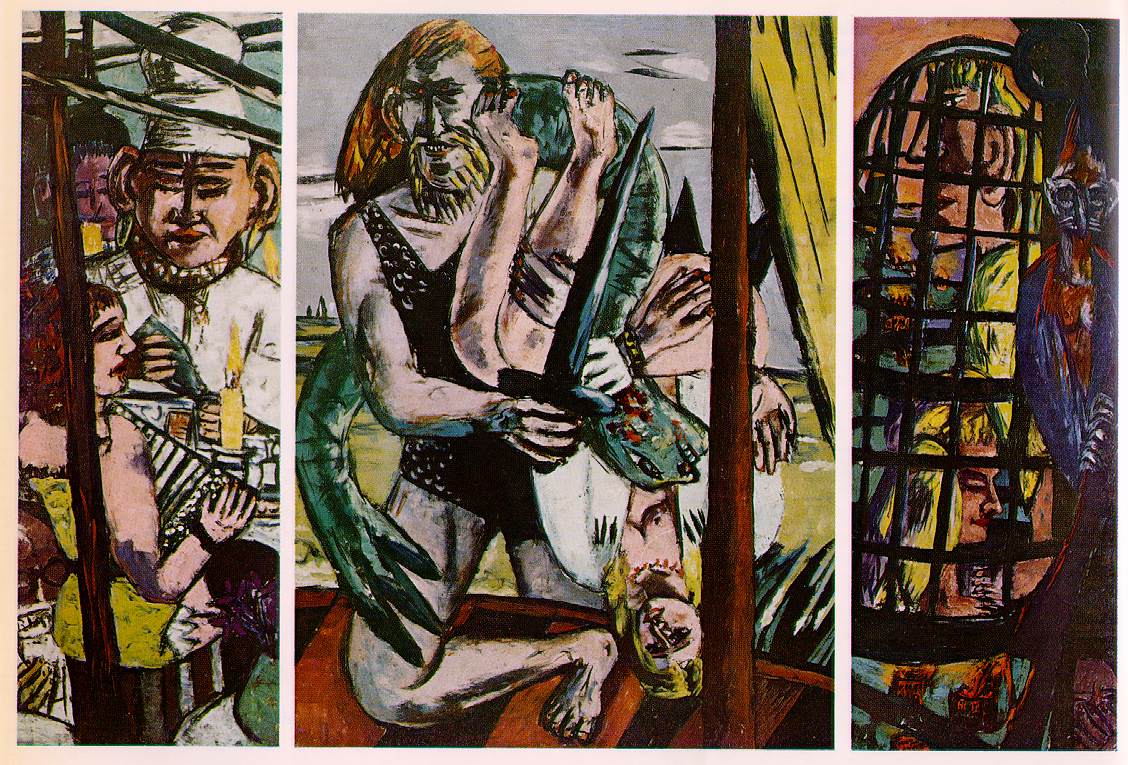
    Reminds me of Beckmann
    Symbols to mask connotations that are unclear or hidden

    Now, what is art anyway? Ernst Ludwig Kirchner’s art works are symbolic patterns, which have connotations that are unclear or hidden. They may have interferences  with the Zeitgeist and references to the past, both integrated through and with  the individual artist’s situation at a given moment. Art, like the symbol has a future in a psychoanalytic sense.

    To the psychoanalytic C.G. Jung, a symbol is a real instance of a collective or personal archetype from the past. The past does not suffice to interpret it – neurologically speaking, everything beyond 3 seconds, is considered future to our brain. The current exhibition by the  “Pinakothek der Moderne”, using UV, infrared and X-ray images, make signatures and overpainting visible and to give a comprehensive insight into the working process of the artist.  We see by those means the past of an art work. Good art at the time of creation in its environment is encrypted future. So this essay is about past, present and future of Kirchner’s art work – 2014, 1937 in Munich.

    Short excursion to history. Kirchner must have love-hated Munich. 1937 there was a opening of two exhibitions in Munich, the first “Great German Art Exhibition” in the then newly built “Haus der Kunst” and the “Degenerate Art” exhibition in the Hofgarten,  it was ultimately the shunned modern art which triumphed. While the artificially created chaos of the “degenerate” art show – which included Kirchner’s work, who lived in Switzerland already –  provided viewers with a unique overview of modern German and international art and got 2 million visitors, the properly displayed paintings and sculptures in the light-filled halls of the “House German Art” showed merely mediocre, provincial works, art that was not, like Hitler promised, revolutionary, but rather aesthetic primitively politicized. 

    Fast forward to 2014. The German Expressionists Ernst Ludwig Kirchner and the Norwegian Edward Munch are my most favourite painters. Although Kirchner played a determining role as a pioneering “bridge” Artists for the color revolution at the beginning of the last century, he was scarcely been recognized as the cunning “color man” he was (at least to me). Particularly photographs, but also drawings, sketchbooks, prints show Kirchner’s multi-talented cross-media design and give insight to his private life. Major loans from many museums in Europe, especially from Switzerland, as well as high-ranking German and Swiss private collections help quite a bit, because Munich for various reasons has had not as many “Kirchners” it should, although this has been getting much better lately. For the first time, both sides of selected double-sided painted canvas were made accessible. Handwritten revisions allow to present another unusual practice of Kirchner: The correction of his earlier work and the adaptation to his current style. The stunning Kirchner exhibition gives insight in his systematic way to color and his confrontation with the controversial tradition of color theory. Basis of the presentation is a joint research project, which was conducted by the Bavarian State Painting Collections in cooperation with the State Academy of Fine Arts in Stuttgart and the Kirchner Museum Davos in Switzerland to examine systematically Kirchner’s painting technique.

    IMG_20140803_131200_bearbeitet-2

    Ernst Ludwig Kirchner studied  art in Munich at the Kunsthochschule. Though critics have often tied Kirchner to influences such as Fauvism (Matisse in particular), Cubism, and Post-Impressionism, the artist himself always denied the influence of others. True, while Kirchner shows a very subjective response to reality and bold, undisguised brushstrokes and vibrant colors those did not come directly from the tube at all. Nor were they spontaneous – Kirchner was a pioneer new tar (artificial carbon) colours and he uniqely himselfprepared the canvas and mixed them with wax an cleaning solution to get the results he wanted. Like Klee he digged in colour theory als physically shown nicely in the presented dancing scenes. The Fauvist movement and German Expressionism, both projecting  indebted to the same late nineteenth-century sources, especially Van Gogh. Hoewver, the French were more concerned with the formal aspects, while the German Expressionists were more emotionally involved in their subjects.

    In 1905, Kirchner became one of the founding members of the “Die Brücke” group of avant-garde artists. These artists worked together to develop cross-media skills in drawing, painting, woodcut and lithography. Even when the design was based on his paintings, Kirchner’s preparation of the matrices and often hand-coloring of the prints, made each print became a unique artistic work. Their group lived counter culture, Kirchner’s studio was real bohemian, full of paintings lying all over the place, drawings, books and artist’s materials — much more like an artist’s romantic lodgings than the home of a well-organised architecture student, a place without social conventions to allow casual love-making and frequent nudity. Kirchner moved to Berlin in 1911, where he produced his most forlorn street scenes, such as the painting, “Potsdamer Platz” and the related woodcut, “Women in Potsdamer Platz”. The city facinated him, in particluarly varite, circuse and – dancers. Many of his friends and models were dancers, Erna and Nina Hard and/or very young women.

    Like Lina Franziska Fehrmann (1900-1950), the adolescent model for Seated Girl, who met Kirchner in 1910. She and her siblings regularly posed for artists in the Die Brücke group. Today Kirchner most likely he would share the fate with Roman Polanski. The painter’s point of view as an expressionist is summed up in a letter which Kirchner wrote to his friend and dealer, Curt Valentin, in 1937 – oned year before his suicide “Dear Mr. Valentin,. . . Did you know that as far back as 1900 I had the audacious idea of renewing German art? Indeed I did, and the impulse came to me while looking at an exhibition of the Munich Secessionists in Munich. Their pictures were dull both in design and execution, the subjects uninteresting, and it was quite obvious that the public was bored. Indoors hung these anemic, bloodless, lifeless studio daubs and outside life, noisy and colorful, pulsated in the sun. In those days I was a strong and healthy lad, not like I am today when the spirit is still active but the body often fails me. I was filled with the desire to try and grasp what they had missed; I did and I am still doing so today.“

    Not only were teenage models somehow more “authentic” than adults, they also had the advantage of being much more sympathetic to artists. Girls’ slender, nearly hermaphroditic bodies could be sexual without being exploited. Much art was in effect allowing artists to run through feelings on paper or canvas before committing to full-fledged adult relationships. In this respect, the Kirchner’s teenage nudes constitute one component in the process of identity formation as he, like almost all the Expressionists, were in their twenties when he executed his breakthrough works.

    After the separation from the Brücke Group 1913 he established an individual artist identity. Despite Kirchner’s artistic success during the Berlin years, identity crisis hit the troubled artist. His neurosis may be largely influenced, like those of C.G. Jung and Herman Hesse by the impending war, which all three had viewed with a tragic sense of foreboding and fear from the outset. According to the psychoanalyst C.G. Jung, the unconscious expresses itself primarily through symbols. Although no specific symbol or image can ever fully represent an archetype (which is a form without specific content), the more closely a symbol conforms to the unconscious material organized around or in us, the more it evokes a strong, emotionally charged response. The symbol has a very complex meaning because it defies reason; it always presupposes a lot of meanings that can’t be comprehended ill a single logical concept. The symbol has a future. The past does not suffice to interpret it, because germs of the future are included in every actual situation That’s why, in elucidating a case, the symbolism is spontaneously applicable for it contains the future. Jung is concerned with two kinds of symbols: individual and collective. By individual symbols Jung means “natural” symbols that are spontaneous productions of the individual psyche, rather than images or designs created deliberately by an artist. In addition to the personal symbols found in an individual’s dreams or fantasies, there are important collective symbols, which are often  images such as the cross, the six-pointed Star of David, and the Yin Yang symbol. Symbolic patterns and images represent concepts that we cannot completely define or fully comprehend.

    In a state of nervous anxiety, and fearing that he would get called up, Kirchner began to drink absinthe and developed an increasing dependency on sleeping pills and morphine. He volunteered to the Great Wat, but was discharged after a complete nervous breakdown. Due to mental deterioration, Kirchner emigrated 1917 to Switzerland and was admitted to the Bellevue Sanatorium and became patient of the psychoanalytic Ludwig Binswanger, whose patients  included illustrious names: the Russian dancer Nijinsky, the actor and director  Gustaf Gründgens and many others. Ernst Ludwig Kirchner made 22 woodcuts there.

    He settled finally in the Swiss mountains near Davos.  He remained in a log cabin for the rest of his life, receiving medical treatment at regular intervals. Although he continued to paint this inspired him to depict alpine scenes of mountain farmers, rather than the urban milieu of Dresden and Berlin.  His reputation grew through the rest of the decade; he became a member of the Prussian Academy of Arts in 1931. By this time, all the major museums of modern art had acquired works by him and he was regularly included in exhibitions. That changed after the Nazis came to power in 1933.

    Kunst

    In October 1991 a Los Angeles art show – tentatively titled ”1937: Modern Art and Politics” paied homage to the artists the Nationalsozialists attemped to degrade. Of the 650 works exhibited by the Nazis in Munich only 150 appeared in there.
    During the eighties and the early 90ties I lived in California and ha a chances to see the restaging of the Munich “Degenerate Art” exhibition at the Los Angeles County Museum of Art.
    The original exhibition Degenerate Art” first  opened in Munich on 19 July 1937 and showed 650 works of art confiscated from 32 German museums. By April 1941, the show had  travelled to twelve other cities and attracted over 3 million visitors. This ”Entartete Kunst,” or ”Degenerate Art,” was displayed the Nazis with the aim of demonstrating the ”immoral” influence of the avant-garde on German culture. Besides denouncing the great artists of the avant-garde, it disparaged Picasso, Wassily Kandinsky and Paul Klee and  hundreds of others whose work was considered ”un-German.” Jews and communists, abstract pioneers, and especially the Expressionists of the “Die Brücke”were condemned as sick, poisonous artists. It was one of the most infamous exhibitions of the 20th century; it was also one of the best from contents and best attended. And its effects are being felt even today – numerous paintings in that show had been sold worldwide. That is the reason that one needs to travel, if you like German expressionists. A total of 639 works by Kirchner alone were identified as “degenerate” by the Nazis and subsequently confiscated from museums, before being sold abroad or destroyed, prompting the first thoughts of suicide in Kirchner. In 1938, soon after Nazis annexed Austria, Kirchner becomes increasingly paranoid, destroys some of his works and finally committed suicide. His longtime companion Erna, gets legal custody of his work and stay in the cabin until her death 1945. Ironically, in a Fahrenheight 451 even,  customs police recently discovered in Munich  an unimaginable artistic heritage of classical modernism. A cache of approximately 1,500 saved painting by Picasso, Matisse and others which were hidden in the apartment of a 80year-old including many works that had been confiscated by the Nazis.


    Contemorary_20140803_140218_bearbeitet-1
    Contemporary modern art. Forgot name and artist….

    While I strolled out of the special exhibition I saw this gray painting of contemporary art. If this reflects our life, watching wars on TV, why art today seems to be void of any despair I feel in Kirchner’s work? It is easy to point out the psychologically disturbed or cynical players who learn to manipulate the system to get their fifteen minutes or a nice big check from a foundation, or the hangers-on who play the game in order to get invited to the right parties. But every human field of endeavor has its hangers-on, its disturbed and cynical members, and they are never the ones who drive the scene.

    The question is: Why did cynicism and commerce come to be the game you had to play to make it in the world of art? By now the main themes of modern art are clear to us. Standard histories of art tell us that modern art died around 1970, its themes and strategies exhausted, and that we now have more than a quarter-century of postmodernism behind us. The big break with the past occurred toward the end of the nineteenth century. My take is that post-modern art never challenged political powers like modern art did. Edvard Munch got there first (The Scream, 1893): If the truth is that reality is a horrifying, disintegrating swirl, then both form and content should express the feeling. Kirchner, C.G. Jung, Herman Hesse got there felt it and many others. Francis Coppola and Oliver Stone felt it.If the truth is that reality is fractured and frightening, then both form and content must express that.  If the truth is, that reality is unintelligible, then art can teach this lesson by using realistic forms against the idea that we can distinguish objective reality from irrational, subjective dreams. It has always been my understanding that the truest definition of art is something that touches us in some way,emotionally, or makes us think.That needs skills and hunches. I still adhere to this.
    Artistic revolutions are made by a few key individuals. At the heart of every revolution is an artist who achieves originality. A novel theme, a fresh subject, or the inventive use of composition, figure, or color marks the beginning of a new era. Artists truly are gods: they create a world in their work, and they contribute to the creation of our cultural world.Throughout the history of art it seems that a any new artistic movement is born of a rebellion against its predecessor.  have seen many artists in recent years seemingly create for the shock value. Many times it comes across as simple disrespect and disdain, perhaps revealing the insecurities and psychological devils of the creator. I have always had a problem with a select few dictating what is art and what isn’t art, when it is a very personal thing.  The Greek said: beauty cannot be evil. Keats said it: beauty and truth. What to move on to next? Perhaps the pendulum will always swing back. This world could use more focus on beauty and truth at the moment. And no, it’s not a celebrate  beauty. And we should have expectations of art. Art is future coded in symbols.

    As always, pictures if not indicated otherwise are mine but can be used giving proper credit.

    • Kirchner Museum Davos
    • The Brücke Museum, Berlin
    • Ernst Ludwig Kirchner, Mountain life, Kunstmuseum Basel
    • Ernst Ludwig Kirchner,in Berlin, Brücke Museum Berlin 2009
    • Expressiv, Albertina Wien
    • Expressionisten, Sammlung Bucheim, München
    • The Museum og Modern Art, New York
    • The Expressionists, Thames and Hudson
    • Farbenmensch Kirchner Link

  • A primatologist image of God: The Ultimate Chimp

    A primatologist image of God: The Ultimate Chimp

    A primatologist’s “Image of God” reimagines divinity through our closest evolutionary relatives, the Chimp (chimpanzee), which share ~ 98.4% of human DNA. By observing their capacity for culture, tool use, empathy, and social complexity, we are challenged to expand our understanding of the divine spark beyond purely human boundaries. Maybe it’s because I am an “unchurched”, humanist and cultural religious person, but today’s anti-religious tracts and rants do bore me.  However, a new book of  the primatologist Frans de Waal, raised hope for new insights: The Bonobo and the Atheist: In Search of Humanism Among the Primates. He made accidentally an interesting point – the reciprocal imago dei (God’s imago modeled after human) of today’s atheists (or spiritual deaf).

    I hold the opinion that God’s existence can’t be proved nor denied. God can only be experienced personally or by intuitive wisdom. Although I consider myself religious, I can only shrug my shoulder to fierce pro and con advocates. To me, religions have had a positive effect on morale and cohesion of society and intrinsic merits. Religion is formalized spirituality not an ideology, although some ideologies mutated in deadly and evil belief systems. Simply go with Kant’s categorical imperative:  How would a world look like, where everybody is… greedy, hedonistic, promiscuous and spiritual deaf? You say that would look like today’s globalized world? Bertolt Brecht concluded that 50 years ago: “Erst kommt das Fressen und dann die Moral”.

    Religions and the zoo

    According to Mr. de Waal it would look like a zoo. Doesn’t sound completely wrong to me either. Mr. de Waal has spent his career studying chimpanzees and bonobos, two of humanity’s closest living relatives. He draws on a lifetime of empirical research and claims his data provides plenty of evidence that religion is not necessary in order for animals to display something that looks strikingly like human morality. Consequently to him Gods imago is the “Great Chimp”.

    We all went in the zoo, right?  While I would admit, that apes look strikingly human, throwing excrement like – say politicians, those in power monopolizing sex and generally follow interaction pattern of large corporation, I am still surprised.  Is it my distorted view of moral or my different understanding of “Gods” image?  Now, that is exactly where we differ, Frans de Waal,  like the old Greeks, or Romans or Goths, proposes to model God after the worldly observation. Social science boldly constructs here not only the world, but also the heaven, and up there is the ultimate alfa male (chimp).  There is no place for the female Hindu goddess Kali, Confucius or pantheistic Taoism. Nevermind, lets look where this leads us to.

    7parvat-737408

    According to primatologist,  Chimps help in lab tests other chimps obtain food even though there is no benefit in doing so, or even refusing rewards themselves until their troop-mates get some. Examples also come from the wild: young chimps fetch water for oldsters who cannot manage themselves, for instance, or adopt orphaned youngsters from other families. Rhesus monkeys are recorded as tolerating handicapped  similar to human Down’s syndrome. Mr de Waal’s central aim is to attack the idea that morality makes human stand apart  “lower” animals. Thus, he concludes no religion is needed: No philosophy either. I doubt that. In Hinduism the goal of all mystical yearning is union of the individual soul with the universal soul. In the Adhyatma (‘spiritual’) Ramayana, a Sanskrit text dating from the fourteenth or fifteenth century, Sita represents the individual (jiva-atma), which has separated from the universal (param-atma) symbolized by Rama. In an almost  Jungian interpretation, Hanuman (the chimp) here is said to personify bhakti, which annihilates the ‘ahankara’ or ego (Ravana), and re-unites the two. That can be easily translated in the Jung context : The Death of the Ego as prerequisite to find God.

    Chimp Nature is our link with Creation.
    Nature is our link with Creation.

    In Hindu symbolism, a monkey signifies the human mind, which is ever restless and never still. This monkey-mind (consciousness) happens to be the only thing over which man has absolute control. We cannot control the world around us and cannot choose our life but we can choose the way we respond to it. Hanuman, when he was a child monkey, was tempted by the sun and he rushed towards it thinking it to be a delectable fruit. On his way however, he was distracted by the planet Rahu and changed his path. Thus Hanuman is the temperamental human intellect, which is unquiet and excitable. It is only by diverting it to the path of pure bhakti (devotion), that it can be made aware of its profound and silent essence. Hanuman is no ordinary monkey. While embarking on the search for Sita, the monkeys were confronted by the vast ocean lying between them and Lanka. They wondered how they would make their way across this mighty obstacle. Someone suggested that Hanuman jump and cross over the sea. But Hanuman was doubtful, “I cannot do that,” he said. At that moment, one of his companions reminded Hanuman of the awesome powers lying dormant within him. Instantly Hanuman regained memory of his divine strength and he successfully leaped across the ocean – the individuation. The monkey is us, specifically our conscious Ego , not God.

    Religion and philosophy

    Most people, the primatologist notes, accept that their bodies evolved from those of man’s predecessors, but the conceits of religion and philosophy make it much harder to accept that the same is true of human minds. I have indeed my difficulties, together with Descartes: I think – therefore I am.

    I agree, that human ethical codes arise from ancient social behaviours, but not exclusively. Different versions of this can be found in a variety of animals and variety of human tribes. Often it was ritualized in spiritual or religious conduct. For Mr. de Waal, religion is just a natural consequence of combining the built-in behaviours of an intelligent, sociable ape with strong dominance hierarchies and God’s image may very well be the ultimate, old, fat chimp with the red “bottom”. Mr de Waal’s sophisticated interpretation of religion seems to make it hard for him, however, to imagine that people can take religion allegorically and spiritually.

    I share his little patience for sometimes shallow, overly confident, assertive atheism of today, seeing it as tilting hopelessly against the strive for spirituality in human nature.  In other words, a crowd of crashing bores treating the gospel like a car manual. Called or uncalled, God is present, was written over C.G. Jung’s door. Religious experience plays an important role in Jungian psychology. Jung, a Christian maybe of more Gnostic virtue, believed that this experience is nothing but a product of the psyche, and consequently viewed other world religions as an expression of one psychic function that has its roots deep in the collective unconscious of mankind.  Jung and Mr. de Waal are strong empiricists, but to Jung religion and spirituality are based on complex archetypes not on low-level instincts.

    Religion and totalitarian systems

    The second thing to consider is Jung’s point of view toward religion in general, and his various attitudes with regards to fanatics and totalitarian ideologies and states: “Of course, it is not a spiritual religion in the sense in which we ordinarily use the term. But remember that in the early days of Christianity it was the church which made the claim to total power, both spiritual and temporal! Today the church no longer makes this claim, but the claim has been taken by the totalitarian states which demand not only temporal but spiritual power”.

    It is no coincidence that the three most religion-hating ideologies (Maoism, Stalinism and National-Socialism) killed also most humans known in history. Jung is speaking only about the USSR  and Nazi Germany (he died 1961) in a sense that those ideologies were not only secular and political, but also semi-religious.  Jung speaks about totalitarian belief systems not only demanding temporal obedience but spiritual as well and covering not only the spiritual aspects of the human condition but also mundane. If one looks to Jung’s quotes closely,  one can derive there are similar concepts between totalitarian religions and totalitarian systems. Thus, Mr de Waal has a wonderful convincing argument against himself.  Absolute religions always have striven for absolute secular power and vice versa, and both  versions exist and have power today. Deconstructional philosophy and tactics of social science is inherently inhuman. Thus, this sort of atheism is ironically also anti-humanism.  As the Tao Te Ching, written by Lao-tse  noted – this tactics are against the (divine) law:

    When people see some things as beautiful,
    other things become ugly.
    When people see some things as good,
    other things become bad.

    Manmade, constructed Gods  (even if just for the purpose of fighting religions) are more often than not – evil.

    Conclusion

    Very often  atheism employs a simple understanding of religions based on a personal god and ignores spirituality and pantheism. Mr de Waal’s shows  convincingly that social science has to catch up with 2000 years of philosophy. Humanism is not easily found in a zoo, nor can it be a substitute religion for humans need of spirituality.

    When human beings are deprived of any “image of god” (imago dei) they are reduced to numbers and seen as livestock (or primates) – result versus costs: anyone who is old, weak, sick, unwilling or just inconvenient would be starved to death or killed. It is Dante’s hell – the opposite from imago dei. Hitlers, Mao’s, Pol Pots, Stalin’s illusion of new societies, new men and totalitarian state religion crashed. Because it was not a spiritual religion, but an ideology and man-made cult utilizing instincts (and archetypes). Charley Chaplin pictured this funny in “The great Dictator”.

    Hitler’s, Stalin’s, Mao’s and Pol Pot’s approach had all in common that they wanted to form new people and themselves as supreme . Their leadership cult and the state consequently asked for religious obedience. If one looks closely we find, that the concepts of totalitarian religions and systems are similar. In their focus is hate, essentially hate against humanity and clearly defined external groups or simply against everybody, which in the last essence is self-hate. Nazi racism and evilness cannot by diluted by the historical observation of Stalin’s and Mao’s motivations which were often similar national or ethnic. The starving caused by their failed industrialization policies or flawed visions left  Stalin and Mao untouched by the death of double-digit millions  of humans.  Creating their imago as supreme semi-God, they fought a war against the nature, reason, tradition, spirituality and their own people, ultimately humanity: Can Hitler go to heaven? The evil presented in Mao, Stalin, Hitler, Pol Pot.

    It is sad, that humanist movements have become strongly aligned with secularism. Germans used the term humanism to refer to Italian Renaissance and classical learning. There is of course large benefit in learning from cultural, non-Christian sources. But solely centering philosophies and morality around human kind or primates, without attention to the divine is not sound practice. Humanism or human morality, spirituality or religion are all more than sharing a banana (within the tribe).

    Question: What imago (if so) you have of God?

  • “become what you are” C. G. Jung’s answer to aging

    “become what you are” C. G. Jung’s answer to aging

    Todays answer to aging of medicine, psychology and sociology (or the happy union of postmodern and materialistic society) is contrary to common sense and spiritual void: Accept to be incomplete and fragmentary and the own life – regardless of the question how incomplete, unsuccessful void it has been. Consume if you have money, don’t bother us if you don’t.

    To the contrary C. G. Jung was of one of the first who explored the development and spiritual maturing of the second half of life and described life as a continuum. Jung called this process of lifelong learning and striving for wholeness “become what you are”  as individuation.

    Basic factors of happiness

    Jung answered  on the question during a Sunday Times interview on the occasion of his 85th birthday: “What do you consider to be more or less basic factors making for happiness in the human mind?”:

    • Good physical and mental health.
    • Good personal and intimate relationships, such as those of marriage, the family, and friendships.
    • The faculty for perceiving beauty in art and nature.
    • Reasonable standards of living and satisfactory work.
    • A philosophic or religious point of view capable of coping successfully with the vicissitudes of life.

    He added that the list to define unhappiness would be much longer and under certain circumstances some factors of happiness can even cause the opposite. In the same interview Jung noted somewhat amused his contempt for intellectuals who do not read his books.  “Recently I had an intellectual as  visitor who I lectured 30 minutes without  any response from him. Finally he got enlightened, and muttered surprised: What you say Dr. Jung,  is common sense”.

    Common Sense
    Common Sense

    So it is. C.G. Jung is not a doctor without medicine but a doctor who does not need pharmacy. Despite his mystic tendencies, the basics in his writings  – especially in regards to individuation – are fairly easy to understand. No need for shrinks, experts and new age prophets. Without meaning it cynical, I found a supplement of roman-catholic belief with monastic a Jungian influence helpful. It can clearly be seen, that striving for those five key factors can and should be lifelong.

    The crisis which needs to be

    One conclusion, which I derived from the interview, was that a crisis is a perquisite for progress in one’s life, as the instinct will tell the solution – within the so-called “important dreams. While I phase gradually out of my job,  I definitely experience aging as crisis as well as an opportunity. The question I like to discuss therefore in this essay:  can I keep up these five success factors during this transition  – or do they turn against me?

    aging-marriage

    Aging comes in a variety of very different shades:  the relieved faces of the well-off generation of 60-plus, enjoying life and the independence associated with it ;  fearful  faces of old people in nursing homes, which I saw while caring for my mother before death; There’s also the melancholy face of the age, which needs to acknowledge  limitations and the injuries to an inflated ego, correct narcissism, often behind a self-deprecating attitude; This new phase of life beyond 60  is not always an adventure awaited eagerly, but – according to the culturally mediated age stereotype – a dreaded lifetime expected as a period of degradation, loss of attractiveness, health and mental ability with fright and burden to society or, if the elderly target consumer is affluent,  shallow and pampered pseudo youth. The age itself is a sociopolitical issue, because society in Europe as a whole experiences serious demographic changes. Its macroeconomic implications raise additional issues for those who are aging.

    aging-barbie – Anything can be expolited

    The above statement of  C.G Jung contradicts todays point of view, which defines ages as imbalance between our physical capabilities and  problem-solving requirements. The Chinese character crisis means: risk, decision, peak, and turning point as well as chance.

    aging-crisis
    aging-crisis

    But to Jung there is even more to it. Crises are the needed worsening of a situation where people are seized by panic and fear and see no way out and no longer can use their previous patterns to cope with the situation.  According to Jung such cross-border and transit situations are needed to break the pattern in order to follow ones instinct.  Crisis is the time in which the human being as a whole is in question and undergoes a change from which it emerges as a new energetic other with a spiritual outlook,  i.e. religiosity. To C.G. Jung Personal growth is:

    • Increase in awareness,
    • Increase in behavior options
    • Gain in ego-strength,
    • Increase in permeability,
    • Ultimately a mystery.

    He also suggested that finding the Self is like a marriage which becomes rarely or perhaps never smoothly and without crises a personal relationship; “There is no consciousness without pain”. The first step to the individuality is the break off with the unconsciousness of the herd. “It is the loneliness of mature man,  who no  longer ´depends on the value judgements of his environment, but in his relationship to the Self is firmly established.”

    All the wrong answers

    Todays psychology is not helpful in that respect, almost destructive by focussing on the bad news, by  pointing out that almost a third of all suicides are carried out by people over 60 years of age being only a fifth of the population. The retirement, the loss of employment, experience of being “too old” on the labour market, the physical changes are fear factors during transition from middle adulthood to the age. Indeed, with noticing the seemingly ever faster rushing time by, a lot of questions come up: “This should have it been now? Was that my life worth? Have I fulfilled its meaning?  Can I and I will I survive my relationship?” . Not addressing the development and maturing tasks of age together may indeed result in aggressive-destructive and sometimes vicious behaviors. But todays media cacophony encourages older people to hide their hardships and problems not to face them.

    aging-postmodern

    Even if age researcher Gene D. Cohen speaks vehemently against the relativistic stereotype of aging as a foreclosure process, he misses individuation. Cohen’s theories are supported by results of recent brain research, but again his theses are purely neurological. being deaf towards spiritual potentials.

    • Remodeling is continually the human brain through learning and experience.
    • Through new brain cells are formed through the whole life.
    • The emotional connectivity patterns in the brain become more complex with age.
    • In older adults, the interplay between of the two halves of the brain is more balanced than in younger people. This allows more holistic, balanced reactions, DIS-embodied behavior than in recent years.
    • A mature brain has learned more as a junior. It can capture better therefore diverse aspects of life.
    • The complex neural structure of the older brain, which consists in decades of experience and everyday coping is a fundamental strength of older adults, the wisdom of their age.
    • Challenging mental activities stimulate the growth of neurons, as well as physical activity. And better networking and connectivity can make up a certain extent taking place gradually slowing down of the signal transmission and loss of nerve cells.

    Age as living and aging opportunity

    All life transitions are per definition phases of increased instability. Jungian Verena Kast says: “you are associated with anxiety, tension, and self-doubt. Conflicts that habitually are part of our lives, be difficulties that we have always had reactivated […]. It is a phase where it is vulnerable, which harbors the opportunity in itself but to old issues again, again himself and his creation to deal with.” She criticizes the gerontological medicine system with its predominantly arrested viewpoints of  Pathology, describing age almost exclusively as a foreclosure,  loss and descent to death.

    Individuation is the centerpiece of Jungian analytical psychology. It involves an archetypical specific differentiation process in the dispute between Ego and Self as a conscious and unconscious search for spiritual wholeness and completeness. In the above mentioned Interview, the journalist Gordon Young asked him also how he sees  people after crossing the boundary to the second half of life.  Jung’s reply: “an ever-deepening self-awareness seems to me as  probably essential for the continuation of a truly meaningful life in the age, how uncomfortable this self-knowledge may be. Nothing is more ridiculous or unsuitable as older people who act as if they were still young — they lose even their dignity, the only privilege of age. The watch must be the introspection. Everything is revealed in self-knowledge, what is it, what it is intended to and about what and what for one lives. The wholeness of ourselves is certainly a rational not to complete something, but we are just so, and that must be lived as a unique, repetitive experience.”

    aging-individuation

    Where this wholeness is lacking, where people can find no transcendence of ay kind, no relationship in their life, we are often demoralized, blunt and atrophy in the age. Who can understand individuation without discarding postmodernism first? It is so important and necessary to seek his wholeness, which cannot been done without to accept one’s own life imperfectness. So one has to strive for wholeness and to learn, on the other hand but even more for transcendence and the death of the Ego.

    Conclusion

    The answer of today’s to the art of aging and mental health is common sense – read C.G Jung and ignore today’s social science and todays mechanistic medicine :

    • To learn even more and understand and even reconcile with the Self
    • Be at peace.
    • To learn yourself well to ensure the appropriate forms to find us.
    • In diverse forms of intellectual and other exchanges with others to stay.
    • To confront the fundamental spiritual questions, and to be able to give the own life meaning and importance.
    • Accept the different experiences of aging.
    • Death and dying need not to be hidden but  included.
    • To recognize that human life is embedded in a larger context of transcendent.
  • Confession of an unchurched spiritual and religious person.

    Confession of an unchurched spiritual and religious person.

    For the past decades, steps forward to my Self (as defined by C.G. Jung) or spirituality have always been attempted at moments of incipient crisis time or when I had time to take a breath. Confession: None, though, has been really followed through. The ability and given a chance to switch my career to a lower gear and the turmoil of the death of my mother, both last year, triggered the next leap.

    I started seriously to question my belief system and state of my individuation. For that reason I went back to psychoanalysis theory C.G. Jung) and its connection to religion and mystic but also digging deeper in catholic credo and history. Subsequently I started a blog, which initially contained only my private notes as a scratchpad, but also opened additional avenues to other blogs. I stumbled over one article with title: “Am I Religious or Am I Spiritual?” – A very popular question in the US.

    Well, good question. Similar to my question I have been pondering; do you believe in a (personal) god? Don’t get me wrong, I answered to myself the question 20 years ago, after I stepped out of a tent backpacking at Mt. Rainer. Just like C.G. Jung the conclusion was: “I know God exists.” Jung said that on more than one occasion.

    “Am I Religious or Am I Spiritual?” Maybe that is a question, which I should ask myself first? One of the biggest assets of the Catholicism is, religion and spirituality are not as separated as in Protestantism for some reason. “Bells and Smells, said a Benedictine monk and C.G. Jung emphasised the big psychological benefit of the confession.

    Going after the headline “Survey: 72% of young adults ‘more spiritual than religious”, this seems to mean rarely or never:

    • pray with others, and pray by themselves either,
    • attend worship services,
    • read the Bible or sacred texts.

    To my surprise this would indicate I am religious.

    As an article in psychology magazine pointed out for personality tests, by checking the “atheist” box (if there actually were one), you’ll be waiting a long time for your matches. But if you describe yourself as “spiritual but not religious” your chances are markedly improved (though the problem now is that you’ll see a lot of new age types showing up). Why?

    Despite the fact that more and more people are comfortable “coming out” as atheists, the word is still very much associated with being immoral, or at the very least agnostic. That is to say in the US. The results of a survey in a German news magazine suggested than 80% could happily check the “atheist” box. It seems, Atheism is in Europe the belief of the masses, Voltaire is even more dead than god to them.

    Enter the word “spiritual,” which is becoming synonymous with claiming all that is good in a religious person, without the religion.

    spiritual (spîr´î-ch¡-el) adjective
    1. Of, relating to, consisting of, or having the nature of spirit; not tangible or material. See synonyms at immaterial.
    2. Of, concerned with, or affecting the soul.
    3. Of, from, or relating to God; deific.
    4. Of or belonging to a church or religion; sacred.
    5. Relating to or having the nature of spirits or a spirit; supernatural
    .

    Ignoring (4) and (2) – dictionaries adapt slowly – what exactly, does it mean to be just plain spiritual? One obvious interpretation is (5) taking the word literally: if you are spiritual you believe in spirits. A second possibility (1) is that spiritual is meant to indicate someone who devotes energy to cultivate “spirit,” as opposed to just being concerned with “material” things. That’s a pretty Gnostic definition trying to become  pneumatics the highest order of humans.

    A third interpretation would be: pondering philosophical or environmental questions and reflecting psychologically, behaving ethically ant otherwise correct and compassionately, and also nurturing ones aesthetic sense through arts and blogs. Okay, by that definition, I am also spiritual. However, by this definition, almost everybody is spiritual – some more than others.

    By the way, although I would not check the “atheists” box, I would happily check the humanist box (assuming one or more is allowed). I do suggest that we value the separation of church and state the mutual benefit of belief and rationality since the Renaissance and even pagan Hellenism. As I indicated, in addition I would need to check the “mystic” box.

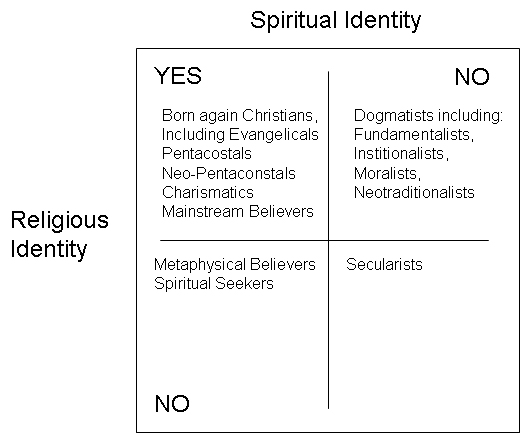
    Besides holding a degree in applied economics I’m just an average engineer who tends to check facts and does not believe anything not seen or touched. Working as a management consultant did not help either. Lets do a (googled) quadrant:

    According to this quadrant I am a mainstream believer.  On the other hand, I attend Catholic mass and routinely check in a Catholic monastery for a few days (sometime with my family), although technically not being affiliated with any religious organization. I am attracted by Taoist thoughts and my wife is Buddhist. On the other hand I like the pope, the global institution and the absolute moral system of the Catholicism not to speak of their powerful symbolism and mystic. I cannot relate to New Age, although having lived for five years in California where  I learned to meditate at Big Sur. On the other hand, I connect easily astronomy and modern physics with Astrology and C.G. Jung’s Synchronicity which is not far away of “The Dancing Wu Li Masters” – a popular New Age book.

    I come to the conclusion “being spiritual but not religious” does not make a lot of sense – to me at least even if I am legally “unchurched”. I can relate to an intelligent professing atheist; we may have fewer than we think however ,  but lots of empty check boxes.