Thanks to the very unassuming moderation of Mr. Schieffer, the Monday presidential debate was civilized and pleasant. How boring. Who won? Let’s look in the catacombs of C.G. Jung’s collective unconscious.
As debates has become more ritualized over the decades, journalists (particular from CNN) have begun to sound like art or sport critics. Contests are analyzed on aesthetic or numerical grounds almost as though they are movies or football games.
Third presidential’s debate split/smoke screen – The Romney/Obama Siamese twin show
A consensus emerged among the critics about Mondays debate: The foreign policy debate is a flop: Romney/Obama Siamese twins.The problem with treating politics as stagecraft, particularly this election, is that it mistakes the policies for the play and confuses theater with politics. Maybe not. Theater should provide entertainment, politicians should provide leadership. And it’s at this psychological level that this campaign is singularly confusing. Down in the catacombs of C.G. Jung’s collective unconscious where elections really occur, where the commenters don’t reach, and where the polls can barely penetrate, a mythological struggle is unfolding between two profoundly different archetypal figures: a lost boy who grew up with questions of identity, and a favorite son. Barack Obama, a lonely meritocratic smooth talker and Mitt Romney, from a family of pioneers. They’re even further divided by what they have in common. Both are outsiders, one because of the color of his skin, one because of the nature of his Mormon faith. One is caught in a politically (correct) suitable social worker language, the other in a CEO lingo.
Mirror worlds
Both candidates are campaigning in mirror worlds. Obama’s followers (also in Europe) have euphoric tendencies and a proven tolerance for paradox. The idea of “soft power” (killing by drones) makes sense to them, as does the notion that going into debt helps lift a sinking economy. Romney’s vision is a binder of women and balanced checking account, strictly suppressing his faith or any transcendent thought. In C.G. Jung’s Four Functions of Personality Obama is intuitive thinking and extrovert, Romney extrovert and sensing, and their contest strikes us as garbled and annoying because they create dissonances of a Mars and Venus sort of thing.
Not since John F. Kennedy faced Richard Nixon, a good-looking man against a five o’clock shadow, has U.S. presidential politics united such constitutionally different beings. One man clings to words, the other to numbers. One educated himself by reading books, the other by scrutinizing balance sheets. On the screen, both personas and images (in the narrow meaning) seem almost identical fakes, like Siamese twins.
I liked Mr. Schieffer’s Obama Bin Laden slip. It was not his fault, however, that it turned into an uninformative and rather anti-intellectual foreign debate. In this state of the race it was predictable that the candiates relied on rhetorics, repeated soundbites and strayed to domestic economics.
If you stop drinking the Whine of Change and smoking Hopium
As usual Obama played ‘commander-in-chief’ card – his most memorable (and correct) statement was: here’s one thing I’ve learned as commander in chief.. You’ve got to be clear, both to our allies and our enemies, about where you stand and what you mean. Was he the last 4 years? To his enemies maybe – with the drone policy. To Europe, certainly not. In any case one should stop congratulating Obama for killing Bin Laden. The Navy Seals killed Bin Laden.
Romney hit more content focused:attacking me is not an agenda. Attacking me is not talking about how we’re going to deal with the challenges … we can’t kill our way out of this mess…
Romney came across at least as informed and quick study and held his ground. Romney stated that the weak economy and apologetic policies are national security issue that has weakened America’s standing in the world.
Hedge Funds Hot for Ailing Greece’s Debt again. Papanicolaou and his predecessor, Christoforos Sardelis, revealed a contract that helped Greece mask its growing sovereign debt to meet European Union requirements.“In secret deals, intermediaries have the upper hand and use it to squeeze taxpayers,” “The bargaining power is in investment banks’ hands.”
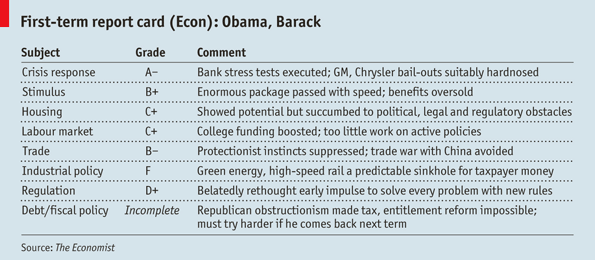
Problem with Obama is, if you stop drinking the Whine of Change and smoking Hopium he has little to show of his first four years than headaches. In foreign policy – especially in the Middle East – he mostly reacted. During the banking crisis November 2008 actually Obama proped up a financial system that was essentially a dead man walking. Some portrayed his top officials as, in effect, tools of Wall Street . These men and women have “no venality,” Krugman (NYT) hastened to say March 2009 in an interview with NEWSWEEK. But they are suffering from “osmosis,” from simply spending too much time around investment bankers and the like. Details of the administration’s bank-rescue plan i.e. Troubled Asset Relief Program (TARP) settled on a financial plan that, in essence, assumes that banks are fundamentally sound and that bankers know what they’re doing. It’s as if the president were determined to confirm the growing perception that he and his economic team are out of touch, that their economic vision is clouded by excessively close ties to Wall Street.” When he had his chance to go after the big banks March 2009 he didn’t touch them, sacrificing Europe (and the US citizens) to the big money complex. Resolving a systemic financial crisis ever since means now recapitalising weak financial institutions and moving their bad loans from the private to the public sector (vulgo taxpayer). The bail out money is borrowed by private banks increasing the deficit that gives him today the only good grade – from the financal system. One wonders why.
The election has a serious “B” word hang-up. Barack, Binders, bayonets, Big Bird, Benghazi, Bush, and recently bullshitter:
The attack in Benghazi was by a spontaneous mob in response to some obscure YouTube video.” #Bullshitter
You know who’s a #bullshitter? The guy who repackages his failed first term agenda and promises, no really, I’ll get it done this time.
Not convinced of both.
If you are satisfied with the next 4 years repeating the previous 4 years, then Obama is your man, if you are serious about something (unknown) not too different choose Romney. Both are in the pockets of Wall Street. The speculative money complex has a binder full of European and American politicians.
Wong Kar Wai’s 2046 while still a beautiful movie, at first sight it is a bit disappointing after all the others spellbinding subtle storylines. 2046 doesn’t come near to it for me – some part of the story is even repetitive. Visually still top-notch as ever like Wong’s earlier works with his signatures throughout: quick cutting, slow motion, fast motion, freeze frames, black and white, tilt shots, color filters, neon-sign lighting, aided ably by three able cinematographers. Music by Shigeru Umebayashi is haunting and sets the right mood. While doing the stills, I tought every second scene – if not every one – was a pure and strangely beautiful picture. A photographers movie indeed.
Wong Kar Wai apparently intended initially to do three separate stories, all exploring the idea of sexual relations between humans and androids.
There are three different intermingled trails and flashbacks playing in reality that Tony Leung Chiu-Wai as Chow Mo-wan meets after losing his love:
Maggie Cheung as Su Li-Zhen, the lost love of “in the Mood for Love”
Gong Li as Another Su Li-Zhen. the “professional gambler”. Note the death card, coming up twice in this movie. I am very impressed about the gambler. A shadow of his old love Su maybe?
Faye Wong Wang Jing Wen “hotel owners daughter with the Japanese lover”. After finding out that she still misses her ex in Japan, he takes her to his office so that she can call him.
Zhang Ziyi as Bai Ling. beautiful call girl heart-broken by him. Big star in Hongkong and in Chungking Express.
The fourth is the world of 2046 and concerns futuristic train passenger falling in love with an android in the train to (or from) 2046.
The story is complex – I recommend the wiki article for hints about the plot. But what is it all about? I have three hypothesis.
(1) A sequel of in the Mood For Love.
In the eighties there was a documentary cult book in the liberal, leftist circles in Germany – „Tod des Märchenprinzen“ .- death of the fairy prince, an authentic story written from the point of view of a women. It was answered with a little brochure from the Märchenprinz in the book: „Ich war der Märchenprinz – I was the prince, to set things right. Similar, in a follow-up to the film, 2046 covers the aftermath of the doomed affair between Chow Mo-wan (Tony Leung Chiu Wai) and Su Li-zhen Chan (Maggie Cheung) from the „Mood For Love“, told from Chow’s perspective. In the first movie he was a the “Quiet Asian” and in 2046 he has become a lost womanizer, a typical addicted (weak) lover like in Ashes of Time .
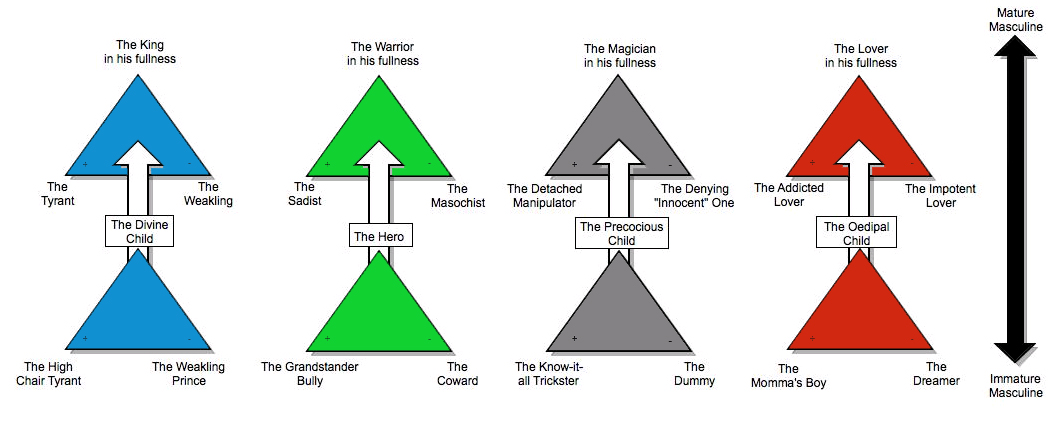
That is one way to tell this story. From a Jungian point of view the change is from the „impotent lover“ to the „Addicted Lover“. But there is a complete different angle. Like ashes of time the few key final scenes have put all the random pieces together so perfectly to deliver a simply truth about transaction based love and the connected loss and Chow only once, with the hotel owners daughter becomes caring and human again. In all other cases he makes women unhappy and women make him unhappy. The Addicted Lover is a collector–of experiences, possessions, or women. But without any structure, unable to connect the women he collects, his life feels fragmentary and the Lover’s energy shatters into a million directions. A man possessed by the Addicted Lover is, as Moore puts it in his book, King, Warrior, Magician, Lover: Rediscovering the Archetypes of the Mature Masculine , “eternally restless.”
(3) The number 2046 and 2047.
With a fellow blogger in Hongkong I discussed the year 2047, that’s when Hongkong might lose its status as a window to the outside, its currency and will be fully integrated in the People Republic of China(PRC). Hong Kong is supposed to remain status quote up to 2047. Deng allowed HK another 50 years to “enjoy” the systems described in 2046. Wong Kar Wai picked 2046 as a title, thats when currency and fiscal sovereignty is handed over – which translates in political freedom. HK is on “borrowed time, borrowed place” . In Hongkong the change will be gradual so by 2047 HK will naturally and smoothly will become just another leading city of China.
The movie 2046 takes place in the late 1960’s, where Chow moves in the Orient Hotel, Hong Kong where he writes a science fiction novel. After a quick encounter with Mimi/Lulu, she gets killed in rom 2046 by her boyfriend. The number triggers the idea to the title. Since the bloodstained room needs to be cleaned he moves in room 2047 and stays there. So the big change is due 2047.
That maybe one reason, that Wong 2046 turns out it to be occupied by one of his old flames Lulu (Carina Lau), who was a former tenant in room 2046 before mysteriously vanishing. Some stills with Lulu are Art Nouveau. Fascinating red, and asynchrone camera angles.
The number triggers reflections on where he and Su Li-zhen used to go for afternoon romps, and serves as artistic inspiration. He creates a story about a place called 2046, where people go to find love and recall old memories. It’s a futuristic world with fast-paced trains, surreal colors, androids, and raw perspective not found regularly in real life. It resembles an acid-trip dream as enticing as it is frightening. As said before, the slow motion acting of the Androids don’t work.
The movie jumps back and forth from the present (1960’s) to the future (2046) where his fictional story is centered.
Reality: While staying at the hotel, Chow meets a gorgeous high-class call girl named Bai Ling (Zhang Ziyi). They become lovers and go out together, but he manages to provoke her to fall hopelessly in love with him. He treats her poorly, soliciting 10 USD per interaction for their afternoon encounters, even though she fell deeply for him. She ultimately breaks down from the emotional abuse, and let him go. To add insult to injury, he tells her to come over anytime she wants a quickie.
A new Su Li-zhen comes up, an enigmatic gambler and finally his old love Su in a flashback (below).
The daughter of the hotel owner, Jing (Faye Wong) is madly in love with her Japanese man, whose nationality leads her father Mr. Wang (Wang Sum), to sternly disapprove of them seeing each other. Chow befriends her and helps the two of them stay in contact by gathering love letters and arranging phone calls. In the process, he starts to have some feelings for her, acting even like a fatherly caring protector –almost like the cynical Rick in Casablanca discovering his good heart and quick to cover it up.
Further encounters take place in Chow’s life, but none that match the love story he experienced during In The Mood For Love. The most tortured woman in the movie is certainly Bai Ling, acted with sheer perfection by Zhang Ziyi, who expresses bottomless agony with a single teardrop.
Fiction: The futuristic story of 2046 is Chow’s way of turning those women into fictional. It’s his method of reflecting similar to the way discussing it within psychoanalysis. The random flashes into the world of 2046 are a therapy session in which Chow confronts his shadow and express the feelings that he has locked away inside. But what the use of those slow-moving androids? In a bad mood I would call it close to a boring relationship movie your wife/girlfriend drags you in. The pictures are great, however, the metaphor may hint either the politics or addicted lover theme.
2046 is a sequels and it shows. I have viewed all movies of Wong Kar Wai. Usually I write reviews of books or movies which are important to me, to collect my understanding of them. So far I did not understand 2046 yet. Chungking Express, Fallen Angles – source of my Avatar – provide fascinating psychoanalytic symbols and pictures but best of the best is Ashes of Time. So I thought, at least until I saw the last scene of 2046 a few times.
Last scene; Chow is stunned when Bai hands him a stack of money, each $10 bill representing one night they had spent together. He sets himself free staring empty into space, as the camera slowly follows a moving taxi. The last minutes makes the story round again. Lost souls.
Still highly recommended. I take my initial critique back, the last 5 minutes fuse all the story trails together. 2046 is actually a great movie, but not what it seems to be or the sound bites “The ultimate Love Film” suggests . As a man I give a piece of advice. Don’t drag your date on the first night in this movie (except she is an art movie buff). I did this one time with Chungking Express, with little success. Didn’t break the relationship, but she always was on guard after that. Suppose 2046 would work either…
When I worked in Beijing during the late nineties I got invited by a local resident consultant (an expat) to a dinner party at a very chic ethnic event restaurant. Mao’s great famine was long forgotten. My colleague was a little bit esoteric, but knew her city. There was good food and even a better spirit. Expats and local people from all over China would dance after work together, even onetime doing some kind of polonaise. The open spirit, however, became immediately sober when a Mao Zedong-imposer entered the stage. The faces of the Chinese colleagues, of all Chinese, froze and some timidly touched the fabric of the actors costume, 20 years after Mao Zedong’s death, as if to make sure that “he” will not come back.
Recently, more than ten years later, I read the book of Frank Dikötter Mao’s Great Famine: The History of China’s Most Devastating Catastrophe . The book was selected as one of the Books of the Year in 2010 by The Economist, The Independent, the Sunday Times, the London Evening Standard (selected twice), The Telegraph, the New Statesman and the BBC History Magazine, and won the 2011 Samuel Johnson Prize for Non-Fiction, Britain’s most prestigious book award for non-fiction.
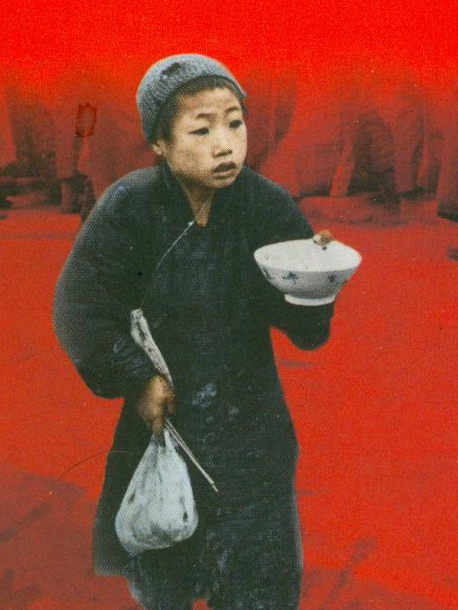
Between the years 1959 and 1961, 30 to 45 million people were starved, killed or worked to death as a result of Mao Zedong’s failed attempt at industrialization in this period of the great leap.Frank Dikötter researched the catastrophe for years and documented his findings. It was h highly centralized mismanagement that can lead a country to disaster. All checks like tradition, family and religion were swept away leaving everybody, particularly the weak, exposed without restraint to cruelty, pure arrogance, boundless ignorance and a merciless disregard of farmers, workers and even party members.
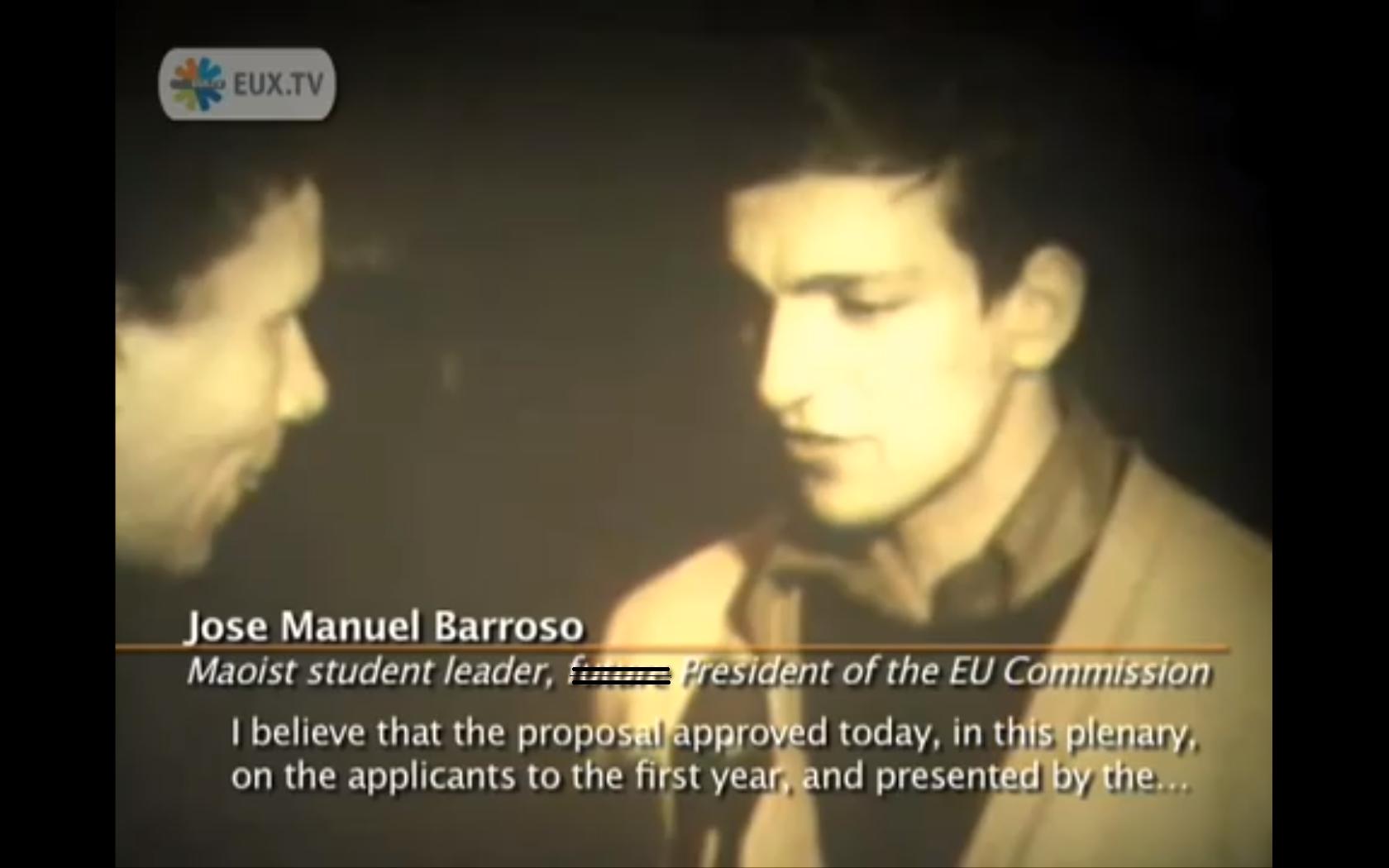
I just knew just the basics of the big leap and the subsequent famine that hit the People’s Republic around 1960. But Dikötter’s painstaking research using newly opened local archives makes his estimate all too credible that the death toll reached 45 million people. The book opened my eyes, as the man-made disaster was on the scale of the Nazis, Stalin and Pol Pot, but different in a way as the intend supposedly was good in a “we know better” attitude. When I read the book , I was reminded to the bureaucracy of the European Union. We don’t get killed and starved yet (although the latter does happen in Greece), but the propaganda and the arrogance of the EURO-phil bureaucracy are very much the same. It is no coincidence, that many of the former and current EU leaders, those who pushed Maastricht treaty or the never ending crises measures through against all good advice of experienced experts, were former admirer of Mao or even active Maoists. Their leadership performance during the EU crisis is of striking similarity, mismanagement runs Europe against the wall and destroys all tangible and non tangible assets.
Dikötter provides a detailed list of the degree of suffering this “Great Statesman” unleashed and the inhumane manner in which his apparatus operated. Horrors pile up as he tells of the spread of collective farms and the vast projects that caused more harm than good and involved the press-ganging of millions of people into forced labour. As the pressure mounted to provide the all-powerful state with more and more output, the use of extreme violence became the norm, with starvation used as a weapon to punish those who could not keep up with the work routine demanded of them. The justice system was abolished. Brutal party cadres ran amok. “It is impossible not to beat people to death,” one county leader said.
The inefficiency, waste and destruction in China were of course even more gigantic. The masses in whose name the Communist party claimed to rule were eminently disposable. The economic campaign used farmers and industrial workers as fodder expected to sacrifice themselves for the cause dictated from on high purposefully trying to get rid of the weak,the women, the children, the elderly. Cannibalism and people eating mud in search of sustenance, was the outcome of the famine caused by the Great Leaps failure and the diversion of labour from farming. Initially launched to enable China to overtake Britain and Russia, Mao’s programme took a deadly turn, In order to maintaining food exports when the country was starving, the slogan was: “When there is not enough to eat, people starve to death. It is better to let half of the people die so that the other half can eat their fill.”
The book gives the details, but is extremely clearly written and presents the facts very structured: (1) The pursuit of Utopia; (2) Through the Valley of death; (3) Destruction; (4) Survival; (5) The Vulnerable; (6) Ways of Dying; The book starts slow and becomes a page turner but can also be accessed afterwards via a good index. It describes thourougly the Sino-Soviet split, and Mao’s tricks to blame the Russians ( and other factors) for his own doing, after it was too late and the truth could not buried any more. As family bonds and every decency broke down, basically the whole country became one contraction camp. Methods were used in the cities, just like by the IG Farben in the second world war, working people to death in an unhealthy environment without pay and sometimes without food locked in the factory. Often there was not a direct intend to kill, but human were abundantly streaming to the factories. On the countryside dissidents or underachievers, even people who digged one potato became literally fertilizer. Kids were conveniently lost by mothers, women had to prostitute themselves or were routinely raped by local authorities routinely in some provinces .
The Cultural Revolution is widely remembered, the Great Leap much less so. When Maoists launched the Cultural Revolution in 1966, the Red Guards had little new to learn, as Frank Dikötter states. Stability returned to China with the Maoists’ ouster in the late 1970s. Having gone through those two experiences, not to mention the mass purges that preceded them and the Beijing massacre of 4 June 1989, it is little wonder if the Chinese of today are set on a very different course that rejects ideology in the interests of material self-advancement but also religion is on the rise.
As soon as people get together in masses and submerge the individual, the shadow is mobilized, and, as history shows, may even be personified and incarnated. Carl Gustav Jung , The Archetypes and the Collective Unconscious , Collected Works, 9/1, par.478
It is in this context it is interesting to consider is Jung’s point of view toward religion in general, and his various attitudes with regards to fanatics and totalitarian ideologies and states: “Of course, it is not a spiritual religion in the sense in which we ordinarily use the term. But remember that in the early days of Christianity it was the church which made the claim to total power, both spiritual and temporal! Today the church no longer makes this claim, but the claim has been taken by the totalitarian states which demand not only temporal but spiritual power”.
If one looks to his quotes closely we find, that he just says there are similar concepts between totalitarian religions and totalitarian systems. Jung is speaking about the UDSSR and Nazi Germany in a sense that was not only religious, but also political. He then compares in the context of political figures. Jung speaks here about religion not only demanding spiritual obedience but temporal as well and the beliefs not only cover the spiritual aspects of the human condition but also the mundane as well. In Jung’s book “Psychology and the East”( From Vols. 10, 11, 13, 18 Collected Works), Jung recounts his journey to India. One of the essays entitled “The Dreamlike world of India” show Jung expressing his utter positive attitude and amazement at the Indian subcontinent and their religious and ethnic culture. In a second essay entitled “What India can Teach Us” he concludes that the psychological and religious claimant is something that we in the West should take a page from. There is respect for and admiration to all religions and their text. I sometimes wonder what he would say today. Called or uncalled, God is present. Religious experience plays an important role in Jungian psychology. Jung, a Christian maybe of more Gnostic virtue, believed that this experience is nothing but a product of the psyche, and consequently viewed other world religions as an expression of one psychic function that has its roots deep in the collective unconscious of mankind. If religion is absent, this is rarely good thing, but if it rules the secular space its worse…
Our blight is ideologies — they are the long-expected Antichrist! C. G. Jung The Tibetan Book of the Great Liberation (1954)
In his book book “Jesus Wars” Philip Jenkins is able to communicate complex ideas and complicated concepts in a manner that preserves their integrity to a wide audience and at the same time renders them as a fascinating and lively story. I have been a fan of his books for some time. His book “Jesus Wars” describes the historical intricacies that surrounded the theological debates of the fifth through eighth centuries of nature and person of Christ. The book lives up to its subtitle — How Four Patriarchs, Three Queens, and Two Emperors Decided What Christians Would Believe for the Next 1,500 Years in more than one way. “Jesus Wars” explains how arbitrary and narrowly the Orthodox belief won over what’s declared as Heresy. Phillip Jenkins got me hooked from the first page by answering my key questions about this Byzantine period of Christian schism in the 4th and 5th century (and beyond):
Why were theological battles about Jesus’ nature that fierce and violent?
Were those Christian “civil wars” the primary cause of the “Fall of the Roman Empire”
Did those tensions in the cradle of Christianity lead to appeasement toward their invaders?
How interacted religion, patriarchs and worldly powers?
Were the theological differences subtile or substantial?
Orthodoxy (and of course the Roman Catholic Church) state that Jesus was both God and Human. Seen from C. G. Jung it misses just one dimension why the most complex monotheistic symbol (Trinity) prevailed. As Phillip Jenkins explained in another brilliant book “The Lost History of Christianity” – religions fight, prosper, flee, fade away, die or get even killed. His sociological understanding of religious history is always helpful to connect related and interdependent events. He argues also convincingly from Mark gospel and even more from (mystic and slightly gnostic) St. John the validation approaches. Approaching religious and the mystic questions with logic (!) is less convincing: “But when we have said that, we have raised more questions than we have answered, as the basic belief in Jesus Christ demands combining two utterly different categories of being”.
The book explains very well, the substance of different beliefs of Jesus’ nature and their political and philosophical implications. Such a transgression of boundaries indicated indeed a crossroad within Christianity between the “patriarchs” of Constantinople, Rome, Antiochian and Alexandria. It has been also hotly disputed, up today by strict monotheists such as Muslims and Jews. If pressed to identify a deficiency in Jenkins’ telling of these debates it is that his text emphasis to the human and political factors in this drama. Modern history is somewhat deaf in regards of religious, transcendent and psychoanalytical importance of those positions keeping God at a distance. Jenkins knows the Gospel but may underestimate the powerful value of combining the material (human) and the spiritual (divine), the power of archetypes and symbols and the importance of the female Mary leading to Quaternity.
Seen only from the historian angle Phillip Jenkins notes correctly “What ultimately became accepted as Christian orthodoxy was hammered out in a process that was painfully slow, gradual, and often bloody. This conflict was marked by repeated struggles, coups, and open warfare spread over centuries. It is easy to imagine another outcome in which the so-called Orthodox would have been scorned as heretics, with incalculable consequences for mainstream political history, not to mention all later Christian thought and devotion.” Phillip Jenkins believes that this thing “turned on a dime.” Doctrinal shifts went back and forth and there was a time when the two-nature or God/Human description of Jesus was a heresy. This is how one of the battles was won: “Caledonian ideas triumphed not because of the force of their logic, but because the world that opposed them perished.” “Looking at history, the process of establishing orthodoxy involved a huge amount of what we might call political accident” he claims — on the outcome of dynastic succession, on victory or defeat in battle, on the theological tastes and political plans of key figures. History is however, always a story of ifs, and matters might very easily have gone another way. And yet the outcome — the Trinityand the supposed two natures of Jesus — form the bedrock of orthodox Christian belief.
Jenkins asks if chance is a valid concept and when he says no — not from a Christian perspective – he steps over the border being a historian. Yes, Nestorians, or Monophysites could have won – but they didn’t – and so failed other competitors to the Roman Church. As Christians refused to worship the emperor as a god, persecution of the Christians and conflicts continued until the reign of Constantine in the early 4th century AD. Very popular with the military was for instance Mithraism, until by 392 AD, Emperor Theodosius I banned the practice of pagan religions in Rome altogether and Christianity was, without question, the official religion of the state. That is just another if.
From my catholic profession and Jungian point I would strongly disagree with Jenkins when he analyzes logically Monophysitism,Nestorianism and the prevailing Orthodox concept of Trinity. He leaves aside its theological novelty, uniqueness and the symbolic value of the separated dual nature picture of Jesus. I share his critique of the basic political process: this is the truth and if you don’t believe it, you are a heretic. Philip Jenkins points out that these conflicts have “left an impact that survives into the present day.” He then makes what I feel is his most profound contribution: he says that the church councils which were responsible for the present-day creeds “remade a faith.” Quite frankly – yes- this central and dogmatic approach is the very reason why the Roman Church became the first and still is the largest global organisation with the “biggest brand name” and not 38000 other Christian side branches.
We all know that the winners write history but as Jenkins sees it, it is even worse than that — far worse. He rightfully argues that “historians write retroactively from the point of view of those who would win at some later point, even if that victory was nowhere in sight at the time they are describing.” Quite frankly, his story of twisted, tortured history applies also to the background of postmodern de-constructionism also known as political correctness.
The author describes the key questions of an honest fight between concepts (or religions): How is it possible to possess two natures — what was their relationship?
Arianism is the teaching that Jesus was not eternal, that he was a created being, created within the framework of earthly space and time, and thus not fully God. Arius was a priest in Alexandria, Egypt, who died in AD 336. Jesus was seen as the very best creature that God created. Arius had triggered such turmoil within the churches that it was a leading cause of the Council of Nicaea in 325 AD. The Council examined the Scriptures that spoke of who and what Jesus was, in Paul’s letters and the first chapter of the Gospel of John, and declared Arianism to be a heresy. They wrote a creed that was mainly aimed at opposing Arianism. The struggle continued after Nicaea and after Arius’ death, and it even took on political implications. The chief of the opposition to Arianism was Athanasius. In 381, the Council of Constantinople once again called Arianism a heresy, mostly due to the Biblical and philosophical case that Athanasius had built over the years. Arianism faded fast after that. The specific Arianist group Athanasius fought had died, but the basic idea did not. It resurrected itself many times throughout church history. Many of today’s groups that derived from Christianity have strong tendencies toward that belief, even if expressed very differently: Unitarianism and Jehovah’s Witnesses
Docetism [ < Greek dokeo (to seem, appear to be)] : The idea that Jesus Christ was a totally divine being who only appeared to be human. It is the opposite idea to Arianism, in which Jesus was all-human and not in any way divine in nature. For docetists, Jesus was with us, but never really of us, and thus didn’t really suffer, and (for most Docetism) didn’t really die. Docetism is not a heretical group as much as it is a category, a basic idea which describes many schools of thought over the years. Any idea that assigns a low worth to the material world and a high value to that which is deemed ‘spiritual’ will tend toward this idea. (See “Gnostic” below.) Docetism is a form of dualism, and like other dualisms, Docetism was rejected by the early church as not being in keeping with what Christ was about. God so loved us that God ‘incarnated’ (that is, became human) in Jesus, thus blessing the whole ‘material’ realm with the ‘spiritual’ impact of God. But like most heresies, Docetism tries to come in the back door; the churches, especially parts of Roman Catholicism, and fundamentalist Calvinists often draw a vigorous sacred/secular divide. Christian Gnostics are in effect docetists.
Ebionitism [ < Heb. ‘ebyônim (the poor) < ‘ebyôn (a poor person)]: The idea that Jesus was a human being and not at all divine, but Jesus was given certain gifts by God’s spirit which set him apart from other people. Because of what God gave Him, Jesus was deemed the Messiah or Christ, but that meant only that He was chosen by God, not that He was savior of all humankind. The Law of Moses was still what counts with God. The church rejected the idea behind it, possibly as early as 110 AD. Some scholars have made the claim that the Ebionites were pretty much the lineal descendents of the Jewish Christians that were led by James the Just at the time of Paul. (These scholars posit a stronger adversarial relationship between James himself and Paul than Acts or Paul’s letters show.) However, it would be much more accurate to put them in the context of other groups, both Jewish and Christian, that existed during the first two centuries of Christianity. There were many small Jewish groups (like the Essenes of Dead Sea Scrolls fame) with many different shades of practice, with many ideas and practices which bled into those of other groups, making a continuum. Like Judaism, Christianity also had small groups which took a different direction than the mainstream. Nearly all of these were moral rightist in some way — their behavior had to tightly conform to the Law of Moses, seen to varying degrees through the lens of Jesus’ sermons. And only some of them were rejected by mainstream Christianity. Ebionitism view of Jesus is shared by Islam.
Apollinarism or Apollinarianism : Since the Nicean Council in 325, Christian theological-talk focused on what the Trinity meant, especially to explain how Jesus Christ could be fully God and fully human at the same time. Apollinaris the Younger (d. 390 AD) became bishop of Laodicea (in Syria) around 361 AD. He championed the idea that Jesus’ mind was solely divine and not human, that the creative Logos of God had in some way taken the place of the human Jesus’ mind. His human nature was confined to His body (physical nature), but even that was in a sense ‘glorified’. This made Jesus almost entirely divine and not fully human. The trouble was that the churches had come to see in Scripture Jesus’ role in relating not just to God within the Trinity but to humans as a human. He was on both sides of the Divine/Human relationship. It was the only way he could effectively reunite and reconcile the two sides. Or, to use the language of the sacrifice: he was fully God, in order to be a pure and worthy sacrifice, and he was fully human like us, so he could be the sacrifice for us. Apollinaris’ approach makes Jesus un-like us and not quite like God, a third kind of being. Athanasius showed how Apollinaris’ approach poorly explained what Jesus Christ did, at a Synod (in Alexandria in 362. The “fully God, fully human” approach of Athanasius won the day in 381 at the Council of Constantinople.
Eutychianism: In the Eutychian way of thinking, Christ was put through a blender – that is, His being God and His being human were so totally mixed together that He was homogenized into being Something Else. When theologians say that Christ has two natures, they mean that Jesus was fully God (and thus had the full power and ability to accomplish His mission of rescue) – and fully a human, living out a material human life (which made it possible to experience life such as what we have, to be in full solidarity with us, and to redeem us out of love). Jesus is one of us, and that is what makes what He did so real, what makes it matter. No third type of being could do it for real, because it wouldn’t be on either side of the relationship that was to be healed.
Gnosticism gnosis [ < Greek gnosis (knowledge)]. The Greek word gnosis is a basic word for any sort of knowledge. In a religious or philosophical context, it usually refers to the ‘secret’ or ‘special’ knowledge that is said to set one free from the ‘illusory’ material world. Gnosticism was a religious and philosophical movement of the late Hellenistic times, which according to modern scholar have Egyptian and Persian roots and arising out of Jewish mysticism. Gnosticism arrived therefore even before Christianity. It was the offspring of the mystery cults and pantheism religions of Greece, Persian Dualism, and Palestine, with Jewish sectarian apocalypse .
The starting point is noble but it’s many ideas depressing. The one God is without fail and perfect but the created world is on big mistake and illusion. The contradiction is solved by an imperfect creator – the demiurge – created an illusionary world – in modern times the Movie “Matrix” has purely gnostic concepts:
the material world is not an illusion for us to be freed from, it is a wonder-work of God’s creation we were made to be a part of, and God is still at work today to make it whole again;
the knowledge on which everything hangs is already revealed by (and as) Jesus Christ, and God sent the Spirit to reveal to all believers what God is up to — this is no ‘secret’, and even if it was, the Christian’s duty would be to give it away freely anyway.
To the contrary, the Christian see a perfect world, created by a God as perfect creator. , in that the eval came by Gnosticism was more than a corruption of Christianity, which fought it with furor. Even today you can read Christian qualify Gnostic as “fungus” and “cancer” trying to take over Christianity which tried its best to suck in the strong, fledgling Christian faith and reshape it into its image.
The gnostic “Jesus” is one who saves you from the world, not for it. A Gnostic god could never really be ‘God-with-us’, nor could it be so focused on loving those wallowing in the earthly mire. Gnosticism faded away as they most converted to Islam but recently raised again New Age and left its traces in other places (Psychoanalysis). The idea of ‘secret’ or ‘special’ spiritual knowledge has historically had its strongest appeal among the intelligentsia and C.G. Jung was deeply influenced with Gnostic thoughts.
Nestorianism, deriving from Antiochian school sees the Person of Christ as a single unified human person having two disjoint natures. Nestorianism stressed the distinction between the divine and the human in Christ to such an extent that it appeared that two persons were living in the same body and rejected the title Theotokos (“Bringer forth of God”) for the Virgin Mary.
Monophysitism, from the Alexandrian school of thought (fashioned on the Gospel of John) see Jesus Christ, as the incarnation of the eternal Son or Word (Logos) of God, who had only a single (divine) nature.
Miaphysitism holds that in the one person of Jesus Christ, Divinity and Humanity are mingled in one or single nature (“physis”). As Nestorianism had its roots in the Antiochene tradition and was opposed by the Alexandrian tradition, Christians in Syria and Egypt wanted to distance themselves with this term. A scholarly used term only, Miaphysitism will be usually – and is also by Jenkins’ book – lumped together with Monophysitism. Note the subtile difference to Roman Catholic and Eastern Orthodox belief, which is mainly in understanding of the word nature.
Roman Catholic and Eastern Orthodox belief explained the huge issue of a God better, who could suffer and die, strongly opposing Nestorius who said, “The creature did not bear the Creator, but she bore a man, the instrument of deity” and Cyril, Bishop of Alexandria, who thought that Christ was an abstraction, going into very grave heresies, seeing Jesus as a “nonresident alien.” The Council of Chalcedon was the watershed of prevailing Roman Catholic and Eastern Orthodox belief. Human and divine natures of the Person of Christ co-exist, yet each is distinct and complete and the Council clearly distinguished between person and nature. The fight between Monophysitism and Caledonians (later Roman Catholic) went on for 200 years after the Council of Chalcedon until Antioch and Alexandria came under -from Monophysitism welcomed- rule of the Islam with disastrous results. After a brief period of dimmni status, this part of the world was in effect lost to Christianity after the Christians lost majority presecutution started.
I appreciate, as always, Jenkins the fresh and unique historian and recommend this book, but I am a little bit disappointed in Jenkins’ description of “transcendent issues” and behavior of organisation in this “business”. Great book though of the best scholar covering those issues and that time.
Philip Jenkins argues that in his book the “The Next Christendom” – in the long run Christ wins out. He observes that especially Pentecostalism, mainly a protestant renewal movement within Christianity (German: Pfingstler, Pfingstkirche, Pfingstbewegung), is steadily winning millions of follower in Latin America, South America, Africa, India, Malaysia, China, and Eastern Europe, including Russia. There is also a Catholic Charismatic Renewal, which Benedict XVI praised highlighting its positive contribution. According to the U.S. urban specialist Mike Davis “Pentecostalism is the largest self-organized movement of urban poor in the world”. Philip Jenkins has a joint appointment at Penn State University and at Baylor University and is also the author of “The Lost History of Christianity”, another excellent book. A respected professor of history and religious studies who has been known for “going against the flow,” Jenkins argues that the rapid growth of Christianity around the world (both within and alongside existing traditions) will literally reshape the world, with possible religious and geopolitic conflicts.
Between 1900 and 2000, the number of Christians in Africa grew from 10 million to 360 million, and by 2025 is expected to reach 633 million. In a post-modern world, religion returned to center stage in the 90s , and Jenkins revisits Huntington from a Christian perspective and new data. Jenkins contests Samuel Huntington’s thesis in The Clash of Civilizations and the Remaking of World Order, that “the relative Christian share of global population will fall steeply in the [21st] century, and that this religion will be supplanted by Islam.” Huntington predicted that “in the long run . . . Muhammad wins out,” mainly because Islam is advanced by “conversion and reproduction,” whereas “Christianity spreads primarily by conversion.” Both share many valid points, and even Philip Jenkins dryly notes in his own book difficulties to predict the future. Both do agree on the danger of potential conflicts caused by religious and cultural differences. Sociological and religious future trends interact – as always – and this perils are unfortunately today’s reality.
Philip Jenkins “The Next Christendom” is not entirely an optimistic book, but it is profoundly helpful and up-to-date. Another eye opener.
Ch. 1. The Christian Revolution
Jenkins’ opening chapter provocatively suggests, religious revolutions are not, as Western intellectuals too often propose against the history, mere spiritual, private matters. They bring with them profoundly this-worldly repercussions like genocides, wars, and what Samuel Huntington has famously termed ‘the clash of civilizations’. They can also renew and uproot societies. Jenkins argues that a ‘Christian revolution’ is already underway in the developing world, one that our political leaders ignore to the peril of all of us: “We are currently living through one of the transforming moments in the history of religion worldwide. – ” The Christian center of gravity has shifted to Africa, Asia, and Latin America “By 2050, only about 1/5 of the world’s 3 billion Christians will be non-Hispanic Whites.” “The era of Western Christianity has passed within our lifetimes….” “The emerging Christian world will be anchored in the Southern continents.” Growing from a handful to several hundred million, the Pentecostal movement is the most successful social movement of the past century that places special emphasis on a direct personal experience of God through the baptism in the Holy Spirit.
Ch. 2. Disciples of All Nations
The chapter reviews the history of Christian expansion, showing that it developed globally from the beginning. particularly it questioned the modernization requests to and attempts of the christian institutions, like the Catholic Church as the whole idea of ‘Western Christianity’ distorts the true scope of the religion’s development. As the author already pointed out in his former book, even in the Middle East, African and Asian regions subjugated by Islam, Christian loyalties survived for centuries in some cases until today. In the Middle East, “Arab Christians remained politically powerful until the rise of a new Muslim fundamentalism in the 1980s.” Westerners apologize for the Crusades but do not suggest that Muslims apologize for the aggressive acts that gave them power over these various lands in the first place. Westerners have forgotten the once-great Christian communities of the Eastern world.
Ch 3. Missionaries and Prophets
Jenkins, states – “Undeniably, the Christian missions of this historical phase were intimately connected with political and imperial adventures, and Protestant and Catholic fortunes followed the success of the different empires.” and “For all the hypocrisy and the flagrantly self-serving rhetoric of the imperial age, the dedication of the missionaries was beyond question.” He continues, “amazing as it may appear to a blasé West, Christianity exercises an overwhelming global appeal, which shows not the slightest sign of waning.” and “Many Westerners…see missionary Christianity as a kind of cultural leprosy.” But why did Africans and Asians adopt Christianity? “One all-too-obvious explanation is that individuals came to believe the message offered, and found this the best means of explaining the world around them.” Their convictions are illustrated by the many stories of zeal in the face of persecution.
Ch. 4. Standing Along
When the demise of European empires brought forward the moment for non-Western churches to stand alone, they had little trouble doing so. Jenkins observes parallels between the developments he surveys in the ‘South’ and those that characterized a similar time of awakening, urbanization, and religious effervescence in the industrializing North. He states, that “Up until the end of the eighteenth century, large-scale missionary efforts were strictly the preserve of the Catholic powers….” The book argues, to connect the spread of Christianity only with imperial expansion is not entirely correct, since fate of the religion would be affected by the breakup of the old European empires. The countries with the largest number of Catholics are Brazil (137 million), Mexico (89 million), Philippines (61 million), the United States (58 million), and Italy (55 million). Catholic growth has been particularly dramatic in Africa, usually in former French and Belgian territories. In 1995, there were 16 million Catholics in all of Africa. Today, there are 120 million. Jenkings states, “For the foreseeable future, the characteristic religious forms of Southern Christianity, enthusiastic and spontaneous, fundamentalist and supernatural-oriented, look massively different from those of the older centers in Europe and North America.” and “In the coming decades, the religious life characteristic of those regions may well become the Christian norm.”
Ch. 5. The Rise of the New Christianity
Population growth and contraction look poised to reduce European populations radically while a boom in many southern states continues apace. When turning to religious indicators, all of them suggest that the surge in southern Christianity has barely begun. The picture becomes even more interestingly when population mobility is factored into the equation. Immigration to Europe may well establish a renewed Christian presence on that continent. America looks set to become even more of a Christian nation than it is today, again due to immigration. Southern nations are growing rapidly but Northern states are relatively static. – “The stagnation of Northern and particularly European populations will be one of the most significant facts of the twenty-first century.” “By 2050, there will be an ever-growing contrast between the age profiles of the global South and North, between the world of the young and very mobile and the world of the old and static.” “In another epochal change, these urban centers will be overwhelmingly Southern.” “A largely secularized First World confronts a rapidly growing ‘South’ in which religion thrives and expands.” But many in the South are moving north. “ “Looking at the spread of mosques across urban Europe, it would be easy to believe that Islam might indeed be Europe’s future religion. Yet a great many other European immigrants are Christian, and they raise the prospect of a revitalized Christian presence on European soil.” The number of Muslims in the U.S., is probably about 4 million or so, much less than the up to 8 million claimed. Many Arab-Americans are in fact Christian. “Any likely Muslim growth through immigration will be far exceeded by the continuing Christian influx from Africa, Asia, and above all, Latin America.” – “Christian predominance is likely to be still more marked in decades to come.”
Ch. 6. Coming to Terms
In ‘Coming to Terms’ Jenkins surveys how churches in the Two-Thirds world `inculturate’ the gospel in their cultural contexts. Though the results are sometimes alarming to Western Christians, Jenkins’ view is rather more sanguine, claiming that most of these adaptations are well within the parameters of recognizably Christian faith. As demographic changes favor the Southern churches, their patterns of life and worship-often visceral supernatural in their orientation-are bound to become the dominant ones in a new Christendom. “The rising churches usually preach a strong and even pristine Christian message.” “Another new ‘missionary century’ may dawn, although next time, the missionaries would be traveling northward.”
Ch. 7. God and The World
Jenkins’ seventh chapter prognosticates about the varying models of church and state that can be expected as important southern countries become demographically. The predictions are not all reassuring to heirs of a strong tradition of separation between the two. Americans keep church and state separate, but such a distinction is incomprehensible in much of the world. ‘Not only is Christianity flourishing in the Third World, but so are distinctively Christian politics. “Northerners are going to find themselves ever more out of touch with the religious dimensions that shape the new world, and literally unable to communicate with the new people of faith.” – “In one possible scenario of the world to come, an incredibly wealthy although numerically shrinking Northern population espouses the values of humanism, ornamented with the vestiges of liberal Christianity and Judaism.” “Meanwhile, this future North confronts the poorer and vastly more numerous global masses who waves the flags…of ascendant Christianity and Islam. …the have-nots will be inspired by the scriptures and the language of apocalyptic, rather than by the texts of Marx and Mao. In this world, we, the West, will be the final Babylon.” – “The North would be secular, rational, and tolerant, the South primitive and fundamentalist. The North would define itself against Christianity.”
Ch. 8. The Next Crusade
Jenkins acknowledges that a world in which powerful adversaries take religion far more seriously than does today’s sophisticated North should keep strategic analysts alert. Simple parents like myself imagining the world in which my son will come of age already plans immigration for him out of Europe.“Religious loyalties are at the root of many of the world’s ongoing civil wars and political violence, and in most cases, the critical division is the age-old battle between Christianity and Islam.” (163) “The parochialism of Western public opinion is striking. When a single racial or religious-motivated murder takes place in Europe or North America, the event occasions widespread soul-searching, but when thousands are massacred on the grounds of their faith in Nigeria, Indonesia, or the Sudan, the story rarely registers. Come lives are worth more than others. In addition, a kind of religious prejudice helps to explain the silence about nations like the Sudan. “No less than 10 of the world’s 25 largest states in 2050 could be profoundly divided between Islam and Christianity, and judging by present trends, any or all of them could be the scene of serious interfaith conflict.” -. “A number of European nations face huge disparities between very fertile immigrant groups and relatively static old-stock populations, and religious instability could easily result.” – “The fundamental question here is whether Islam and Christianity can coexist.” “What is most disturbing about the Sudanese experience is that it shows how, in the new religious climate, existing non-Muslim minorities can be reduced or even eliminated. The same bitter lesson may be in progress in…Egypt, the home of the ancient community of Coptic Christians.” -. “Some of the likely winners in the religious economy of the new century are precisely those groups who have a strongly apocalyptic mindset, in which the triumph of righteousness is associated with the vision of a world devastated by fire and plague.” “The situation could become so sensitive that a global catastrophe could be provoked by the slightest misjudgment –just like 1914.”
Ch. 9. Coming Home
Events since the late 90s have given the author some hard facts to work with. The southern churches are almost all theologically and culturally more conservative than their northern partners. But are they so distinct so as to be incapable of re-evangelizing secularized Europe and the USA? A fundamental issue: How will the global North change in response to the rise of a new global Christianity? Will its religious character remain Christian, perhaps with a powerful Southern cast? Or will it entirely lose its Christian character?” . “While traditional Christianity is weakening in large sections of the North, it is indeed being reinforced and reinvigorated by Southern churches, by means of immigration and evangelization.
Ch. 10. Seeing Christianity Again for the First Time
In the last and best chapter analysis is exchanged for what becomes almost an indictment of northern Christian scenario. From the view 2050 A.D., the persecution and poverty of which so much are made in the New Testament literature is also the context of the majority of today’s Christians (not to mention those who await their moment a half-century hence): “For whatever reason, Western investment in missions has been cut back dramatically at just the point it is most desperately needed, at the peak of the current surge in Christian numbers.” and “For the average Western audience, New Testament passages about standing firm in the face of pagan persecution have little immediate relevance…. “Millions of Christians around the world do in fact live in constant danger of persecution or forced conversion, from either governments or local vigilantes.”
When he says, “Looking at Christianity as a planetary phenomenon, not merely a Western one, makes it impossible to read the New Testament in quite the same way ever again”, he has a particular strong point pointing out the Book of Revelation. and that nevertheless, “Christianity is flourishing wonderfully among the poor and persecuted, while it atrophies among the rich and secure.” I agree to the assertion, “Christianity is never as weak as it appears, nor as strong as it appears. And whether we look backward or forward in history, we can see tat time and again, Christianity demonstrates a breathtaking ability to transform weakness into strength.”