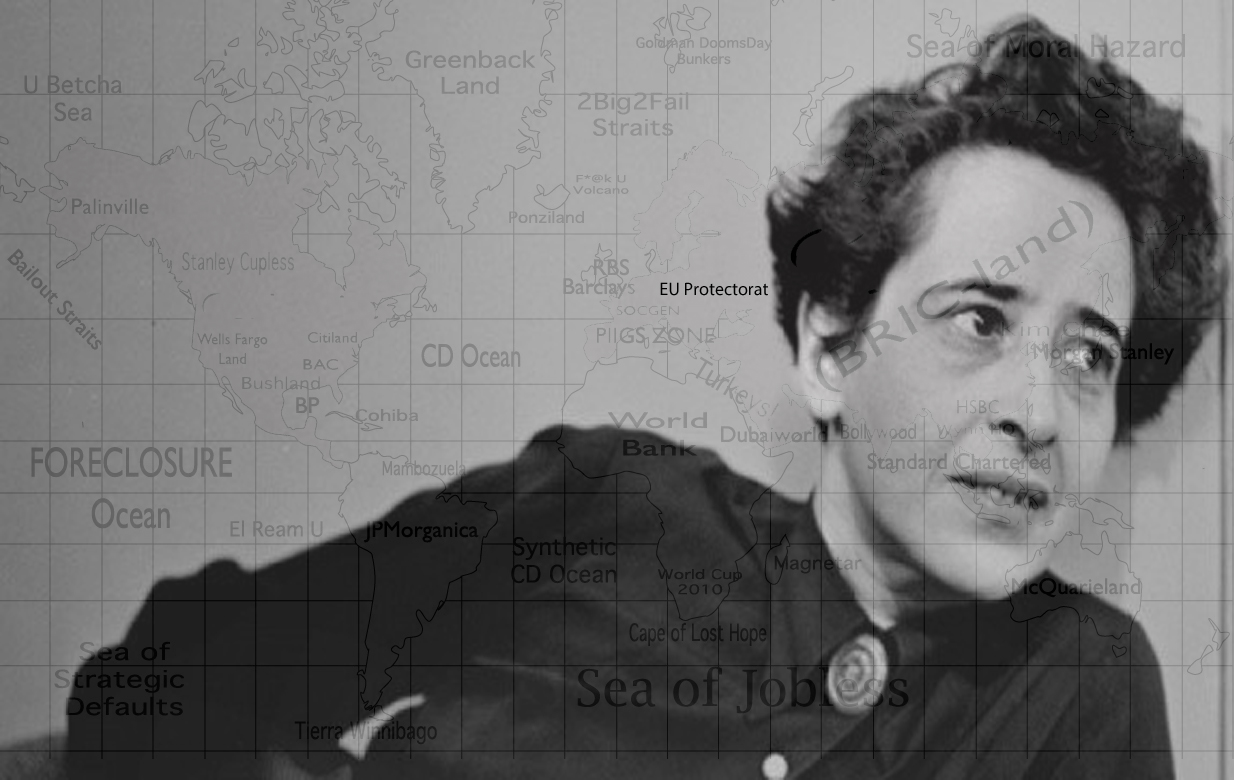
We’ve all heard the phrase “the banality of evil”, coined by the political theorist Hannah Arendt. Her 1951 masterwork, “The Origins of Totalitarianism,” about the parallels between Hitler’s Third Reich and Stalinist Russia, made her an intellectual celebrity. In her book, she argued that totalitarian regimes seek to dominate every aspect of everyone’s life as a prelude to world domination. Reflecting recent events, on more than one occasion the phrase “the banality of evil” crossed my mind. Touched by her psychological and philosophical view to totalitarian systems, I often wondered, how this radical political theorist would have commented to evil political events of the new millennium. Based on her quotes this essay suggests, that we live in the advent of new totalitarian regimes. I was very hesitant to publish this essay. Why? The psychological and philosophical analysis cannot be strictly separated from its political perspective. Be assured, that I am just interested in todays Evil from a Jungian view without political prejudices.
Totalitarianism and supranationalism
 Arendt emphasized repeatedly that totalitarianism differs essentially from other forms of political oppression known to us such as despotism, tyranny and dictatorship. Wherever it rose to power, it developed entirely new political institutions and destroyed all social, legal and political traditions of the country. The term totalitarian, first used in the late ’20s, was not fully developed until the late ’40s and early ’50s, when a classical literature arose describing a new kind of tyranny created in this century. Arendt discusses the use of supranational organizations, fake (non) governmental agencies, and doctrines as a means of concealing totalitarian aims. She claimed for instance that the Nazis were not simple nationalists. Their propaganda was directed toward their fellow-travelers and not their convinced members; the latter, on the contrary, were never allowed to lose sight of a consistently supranational approach to politics.
Their aim was a dominating superstructure which would destroy all home-grown national structures alike. They could indulge in hypernationalistic talk even as they prepared to destroy the body politic of their own nation, because tribal nationalism, with its immoderate lust for conquest, was one of the principal powers by which to force open the narrow and modest limits of the nation-state and its sovereignty.
Isolation and loneliness of the individual
What made totalitarianism unique was its militant, messianic ideology; its mobilization of the masses; its total control of social life (all independent “intermediate” structures — such as churches, parties, unions — standing between the individual and the state were to be eradicated); and its systematic use of terror to enforce that control. Totalitarian regimes were thought to be (under Hitler and Stalin they certainly were) energetic, enthusiastic in an almost religious sense, on the march. Orwell’s 1984 seen from today was not a parody. It was just a mild extrapolation of past totalitarian reality and a abstract picture of today’s totalitarian possibilities. Totalitarian domination as a form of government is not content with isolation in public political life but aims to destroy private life as well. It bases itself on loneliness, on the experience of not belonging oneself, which is among the most radical and desperate experiences of man. Superfluousness which have been the curse since the beginning of the industrial revolution, have become individual isolation and loneliness – one looses even contact with the Self – both outcome and precondition of totalitarian domination.
The Banality of Evil
Hannah Arendt most memorably employed it in both the subtitle and closing words of Eichmann in Jerusalem: A Report on the Banality of Evil, her book on the trial of Nazi lieutenant-colonel Adolf Eichmann. To Arendt’s mind, Eichmann willingly did his part to organize the Holocaust — and an instrumental part it was — out of neither anti-semitism nor pure malice, but out of a non-ideological, entirely more opportunistic combination of careerism and obedience.
The sad truth is that most evil is done by people who never make up their minds to be good or evil.
This kind of evil is very tricky to explain, but one Jungian definition could be this one: Banal evil is a kind of evil
which is unconscious, a kind of evil that the “evil person” hasn’t reflected over. The complex or the shadow took over. It’s also a kind of evil that is not considered evil by the person who acts, in the moment of the evil act. The reason why the person doesn’tconsider the act as an evil act is mainly ignorance or inconsiderateness of the Ego.
In 1961, The New Yorker sent her on her request to cover the trial of Adolf Eichmann, one of the chief instrument of the Third Reich’s Final Solution, who had been kidnapped by Mossad operatives and brought to Jerusalem to stand trial for his crimes. The five-part article which emerged, “Eichmann in Jerusalem,” set off what is considered to be one of the most passionate and best public debates concerning Evil ever to take place
Arendt, who was born into a secular family of German Jews present-day Hanover and grew up in Königsberg (now Kaliningrad). and Berlin. She studied philosophy with Martin Heidegger (later tainted by his support of the Nazis) and wrote her dissertation in Heidelberg under the existentialist philosopher-psychologist Karl Jaspers on the concept of love in the thought of Saint Augustine, published 1929. In 1933, she was arrested by the Gestapo for collecting evidence of anti-Semitic propaganda. After fleeing to Paris, she worked for a Jewish relief group before being sent to a French internment camp, from which she escaped. She and her second husband, Heinrich Bluecher a German Communist, emigrated to America..
Arendt’s original series of “Eichmann in Jerusalem” articles can be found in the New Yorker‘s online archives:: part one, part two, part three, part four, and part five. Although the poet Robert Lowell called “Eichmann in Jerusalem” a “masterpiece,” Arendt’s portrait of Eichmann as a bureaucrat motivated not by extreme ideology but rather by ambition disturbed many people. Throughout the piece, Arendt wrestles with her perception of Eichmann, calling him “monstrous” yet “terrifyingly normal.” Many readers objected to Arendt’s use of the term “banality of evil” to describe Eichmann. In a Reflections piece published posthumously, Arendt expanded on her use of the controversial phrase:
I was struck by a manifest shallowness in the doer which made it impossible to trace the incontestable evil of his deeds to any deeper level of roots or motives. The deeds were monstrous, but the doer—at least, the very effective one now on trial—was quite ordinary, commonplace, and neither monstrous nor demonic.
Go back 60 years to the controversy that surrounded Hannah Arendt’s Eichmann in Jerusalem, a study of the Adolf Eichmann trial, in which she coined this famous phrase “the banality of evil.” Arendt wrote in a letter to a friend: “It is indeed my opinion now that evil is never ‘radical,’ that it is only extreme, and that it possesses neither depth nor any demonic dimension. It can overgrow and lay waste the whole world precisely because it spreads like a fungus on the surface.” This was what Hannah Arendt meant: Evil is unspectacular and always human. The normality of evil is evident.
In any event, the fearful imagination has the great advantage to dissolve the sophistic-dialectical interpretations of politics which are all based on the superstition that something good might result from evil. Such dialectical acrobatics had at least a semblance of justification so long as the worst that man could inflict upon man was murder.
The truth about evil that needs attention now is its shallow, deadly, fungus quality. Today evil destroys not only life, but it destroys the fact of existence itself. In a tiny, multicultural world in which different civilizations inhabit different centuries–are often moved by evil deeds, like blowing up the Other. Don’t bother demonizing terrorists as being inherently evil (as Satan is evil). That’s not how it works.
Opportunistic evil passes like unconscious complexes (in a Jungian sense – negative energy) through the world, clustered in supranational institutions and financial concentrations, that take up residence in individuals or cultures from time to time. For example, the International Monetary Fund (IMF), an organization of 186 countries has been the centerpiece of the world monetary order since its creation in 1944, and its supervisory role has been considerably strengthened after the advent of floating rates of 1973. The role of the IMF in the current EU-crises and global events has been largely overlooked. But this is not the story I like to tell here.
The Global Evil
Distance once helped dampen the effects of human wickedness, and weapons once had limited range. But evil has burst into a new dimension. The globalization, democratization and efficiency of the instruments of destruction and control mean a quantum leap in the delivery systems of evil. Drones for full physical control or their diabolical stepbrother of electronic and financial means for full virtual control, un-leveled the local playing field globally again – and the level field has fungus on it. For a short while ragged Islamist group with weapons, which sells girls in slavery can terrorize citizens by asymmetric strategies, but even then, the Local Evil serves a purpose for the Global Evil.
Only crime and the criminal, it is true, confront us with the perplexity of radical evil; but only the hypocrite is really rotten to the core.
The Global Evil potential became a world-historical force, but with more discretionary destructive power at hand than the great old monsters, from Caligula to Stalin, ever had. In the new dimension, micro-evil (the dark impulse to rape or murder, say) and macro-evil (economic genocide) achieve an ominous reunion in any bid for the apocalyptic gesture. That’s the real evil that is going around. Most revolutions, as historical analyst Hannah Arendt points out in her 1963 published book “the fools of history”, have not established and maintained a state of liberty in which a common citizen can usually make politically heard. Even the American Revolution ultimately failed because Americans lost interest in their political condition in order to pursue their private gain.
Omnipotent Evil
 According to Arendt that totalitarian totalitarian elites have usually a firm and sincere belief their unilateral omnipotence. Totalitarianism and the belief to be chosen to lead the world instead of other less worthy powers go together. This moral cynicism, their belief that everything is permitted, rests on the solid conviction that everything is allowed to them. Moral decisions become dependent on the context. Aggression on the grounds of “ exceptionalism”, is backed by the dubious idea that some are special and cannot be held to the same standards as others. Unilateralism, preemption, and exceptionalism, the toxic combo that has spurred hundreds of of wars, territory occupation, regime change, global surveillance, extra-judicial assassinations, drone attacks, and hyperbolic state terror most of which has been directed at civilian populations whose only fault is that they occupy regions which have some geostrategic or economic importance.
The totalitarian attempt at global conquest and total domination has been the destructive way out of all impasses. Its victory may coincide with the destruction of humanity; wherever it has ruled, it has begun to destroy the essence of man.
…
And if it is true that in the final stages of totalitarianism an absolute evil appears (absolute because it can no longer be deduced from humanly comprehensible motives), it is also true that without it we might never have known the truly radical nature of Evil.
Narcissism of totalitarian belief systems
It’s a cliché to say that most politicians become arrogant if they are in office for more than about six or seven years, and become quite disconnected from reality. We perhaps didn’t realise when the exceptionalism doctrine was presented first – that exceptionalism is a extreme form of narcissism, a messiah complex, that had been always an thriving impulse in totalitarian systems.
 “If you had to summarise narcissism, it’s a feeling of specialness,” says Dr Adam Perkins, a researcher at King’s College London’s Institute of Psychiatry. “Narcissists view themselves as special, as deserving of better treatment than the rest of the world.”
I have experienced and written how narcissism and excessive self-confidence can actually “help” in the political realm often supporting a negative selection. When action is needed, Narcissism – even of the mildly delusional variety – may be a useful thing in publicity.
And a healthy dose of narcissism is probably protective in certain situations. “If you’re dumped as a leader, it might help you to feel special – to think, well, their loss.
Narcissus fell in love with his own reflection not because he was narcissistic, necessarily, but because his reflection was so beautiful. Extreme narcissism, however, like psychopathy, usually manifests itself evil. Narcissus’s story ended badly, of course. According to the The Diagnostic and Statistical Manual of Mental Disorders, a diagnosis of narcissistic personality disorder can be made if a patient (or system sic!) displays five of the following nine symptoms:
- An exaggerated sense of one’s own abilities and achievements.
- A constant need for attention, affirmation and praise.
- A belief that he or she is unique or “special”.
- Persistent fantasies about attaining success and power.
- Exploiting others for personal gain.
- A sense of entitlement and expectation of special treatment.
- A preoccupation with power or success.
- Feeling envious of others, or believing that others are envious.
- A lack of empathy for others.
I mean here extreme exceptionalism, evident in political correctness and certain supranational elites (inner circle) and organisations, and recently very openly in super powers again. Extreme unreflected exceptionalism has been a trademark of feudal systems with a thin ruling class and a large peasant class.
Only the mob and the elite can be attracted by the momentum of totalitarianism itself. The masses have to be won by propaganda.
Lying and deceiving
 Totalitarian policy is as a case of the government beginning to believe their own propaganda about their narcissist exceptionalism. The distorted reality will be believed by those who use them, just as C.G. Jung said – the unconscious in us is real. It is this form of perceived omnipotence that leads to bullying and manipulating the citizens and the failed Hero acting of the elite: the weak king, the cruel warrior, the wicked magicians, the narcissistic lover. Sure, there are also clear political struggles and psychological motives behind the supranational and unipolar debate: the establishment join in the hope for the blessings of a centralist post-democratic state, because they share belief in the stability of the state as sole power (and on its non accountable priests). Anything significant beyond the state (such as the individual, the family, the truth, the religion), would challenge the semi-religious ego of the transnational institutions – not only their political clout.
The trouble with lying and deceiving is that their efficiency depends entirely upon a clear notion of the truth that the liar and deceiver wishes to hide.In this sense, truth, even if it does not prevail in public, possesses an ineradicable primacy over all falsehoods.
Dissent thoughts let the inner circle fear for the long-awaited stability of a nation less and culture less state. That was the reason why the Europe’s leaders and the EU bureaucracy has been trying to reassure the public with obviously wrong assurances and after an earthquakes election continue with business as usual. Assurances, which are obviously wrong arouse always a debate and laid the foundation of today’s distrust in opponents. This triggered even neutral public figures, to believe that conspiracy theories might be plausible. Welcome to virtual reality. In George Orwell’s dark vision, the year 1984 would see the triumph of totalitarianism in Europe—an era of Newspeak and Doublethink, of dictatorial cruelty and dehumanizing coercion. That fateful year is now three decades away, and it seems less and less visible that Orwell’s grim prophecy proved correct.
Conclusion
I’ve read Hannah Arendt “Eichmann in Jerusalem” and “The Origins of Totalitarianism”, several times – it always amazes me. I find Arendt very hard to disagree with – she just seems so shrewd, so alert, annoyingly good at noticing everything that needs noticing; She must have it right. Writing 50 years ago, this great theorists of totalitarianism, noted that totality and irreversibility are related. It used to be thought that totalitarianism had repealed the law of history by which power sows the seeds of its own destruction. If sheer ruthless vigilance could destroy any center of opposition, even any island of independent thought, then — aside from external conquest, with humanitarian pretext — totalitarian rule could never be reversed. Conversely, if total control fails due to today’s interconnected multipolar world, what happens to single-minded direction? If totalitarianism can decay, can it not be transformed? We don’t yet know. We know only that it can be modified. It can give way to a society with some space. How much? Well, somewhat between 1984 with drones, full coverage realtime surveillance and a brave new world of constructed realities.
Obviously you can read the banality of evil as a description of the ordinariness of the people involved, or as a statement about the optimisation of work in international institutions like the IMF or others. The point about the ‘radical’ evil – the cruel, savage, sadistic kind – is that it is much easier to spot. Is is visual, it is on CNN. That is what makes it all the more important to be aware of ‘evil’s’ other face – the unconscious evil. It hides in the balance sheets.
Economic growth may one day turn out to be a curse rather than a good, and under no conditions can it either lead into freedom or constitute a proof for its existence.
The banality of evil is not so banal after all.
Bibliography
- Eichmann in Jerusalem: A Report on the Banality of Evil (1963). (Rev. ed. New York: Viking)
- The Origins of Totalitarianism (1951). second enlarged edition; A MERIDIAN BOOK First Meridian printing September 1958 Seventh printing September 1962
- The Human Condition (Chicago: University of Chicago Press, 1958).
- On Revolution (New York: Viking, 1963).
Note: the first two books are available as free of charge ebooks.