
A scholarly fashion claims that only by coincidence Christ and not the Egyptian Isis or the Persian Mithras gained the upper hand as a world religion. There is some truth in it, but also an utter disregard of the attractiveness of Christianity at that time. This article will explore this question from a historical thesis, that the globalized Roman Imperia created a market of religions. Furthermore the exclusive – or shall I say smart – Christian religious offerings took in account the Romans’religious preferences and the weaknesses of the many competing religions and cults. Its explosive growth was supported by a successful sociological approach and a savvy management style – strategic global, acting locally but centralizing its control over teachings.
Christianity entered a Rome in which its citizens suffered from the first major globalization. Success bread failure, the expansion of the empire brought wealth, cheap resources and slaves, which led to unemployment of the lower classes and then to their subsidizing: the famous “bread and circus”. The Roman society was sharply divided between rich and the (heavily) sedated poor and an anxious middle class. Rome became confused, spiritually bankrupt and fractured, chasing a million different dreams–tolerant but in moral chaos–polytheistic, not exclusive–embracing a “cafeteria”approach to religion. At this point the growth of the polytheism ceased as the history and state religion slowly shifted to monotheism. (e.g. Mithraism , Sol Invictus). This brings us to Christianity, which was first seen as just another “Oriental cult” in Rome rather for somewhat crazy sectarians. A lot of ink has been spilled, how Christianity developed from a Jewish sect to the world religion, which even today is nothing else than the Western cultural identity, but the question was never answered conclusively. I suggest there is more than a miracle to worry about. By studying the nature of these cults, it’s possible to gain insight into the reasons Christianity succeeded where all the others failed in the long run. So why did Christianity win? Will it win again today?
Before we start, let’s have a look on the attributes or criteria from we want to evaluate …
- religious offering: resurrection or infinite afterlife; personal relationship with God;
- practical offering: community, strengthen the individual in daily life;
- demand: exclusive or non-exclusive commitment from followers ?
- god: monotheistic or polytheistic, pantheistic
- sociological approach: what was role of women, to which class did it appeal (e.g. elite, urban)?
- political demand: could it be seen as a political threat, was it private, against or with the authorities?
- organization: central with approved and authorized teachings or fractured cults and spinoffs;
- ethic: like charity, love, sexual conduct, hedonistic
- structure: cult, integration with astrology
of early Christianity and some major religious competitors:
- Isis and Sarapis
- Mithras Cult
- Cybele and Attis
- Roman polytheistic state cults
- Imperial Cult ( emperor worshipping)
Philosophical Religions
In this article I will not look at gnosticism or philosophical religions. From a Christian perspective the uprooting of Gnosis was almost an inner fight of live or death, of which I have written here. Philosophical Religions (Neo-Platonism, Neo-Pythagoreanism, Gnosticism) have Roots in Platonism and in Pythagoreanism, but no clear descent and are characterized by a disdain for the material world appeal more to intellectuals than to ordinary people. It is clear that Christianity owes Neo-Platonism and also includes some streaks of Gnostics as C.G. Jung pointed out.
Roman state religions
For early Empire, there was a strong need to reunite the Romans culturally. A possible political solution was emperor-worship•but emperors are transient and many blamed the Empire and the generals for the decline in their living standards. Its important to note that nearly every emperor following Alexander was deified by the Senate as standard practice; until the reign of Constantine in the 4th Century AD. Worse, the emperor-worship was a form of taxation –and who wants to worship tax-collectors? State religions comprised a Rome that was spiritually bankrupt and fractured, chasing a million different dreams–indifferent in disguise of tolerance but in moral chaos–polytheistic, not exclusive–embracing a “cafeteria”approach to religion. As a rule, the Roman authorities showed indifference to every cult interpreted today as tolerance, but actually can be compared to today’s Western spiritual void. The Roman Senate did exercise some limits of practicability, for instance it restricted in the 2. Century B.C. the Bacchus cult which always offered an occasion to celebrate orgies in public. Rome came down hard on cults which were understood as a political threat. However, as long as the citizen adhered to the state gods Jupiter, Juno, Minerva and paid the emperor credulity taxes, the Romans could shop freely in the religious supermarket. Here they showed a strong preference for the oriental and exotic, better said: they credited their favorite cult’s eastern origins and ministered their idols with unique attributes of non-roman origin, i.e. long trousers, Phrygian caps, or in the case of Isis, with a “typical Egyptian” guise.
Male Archetype: Mithras the Roman Warrior
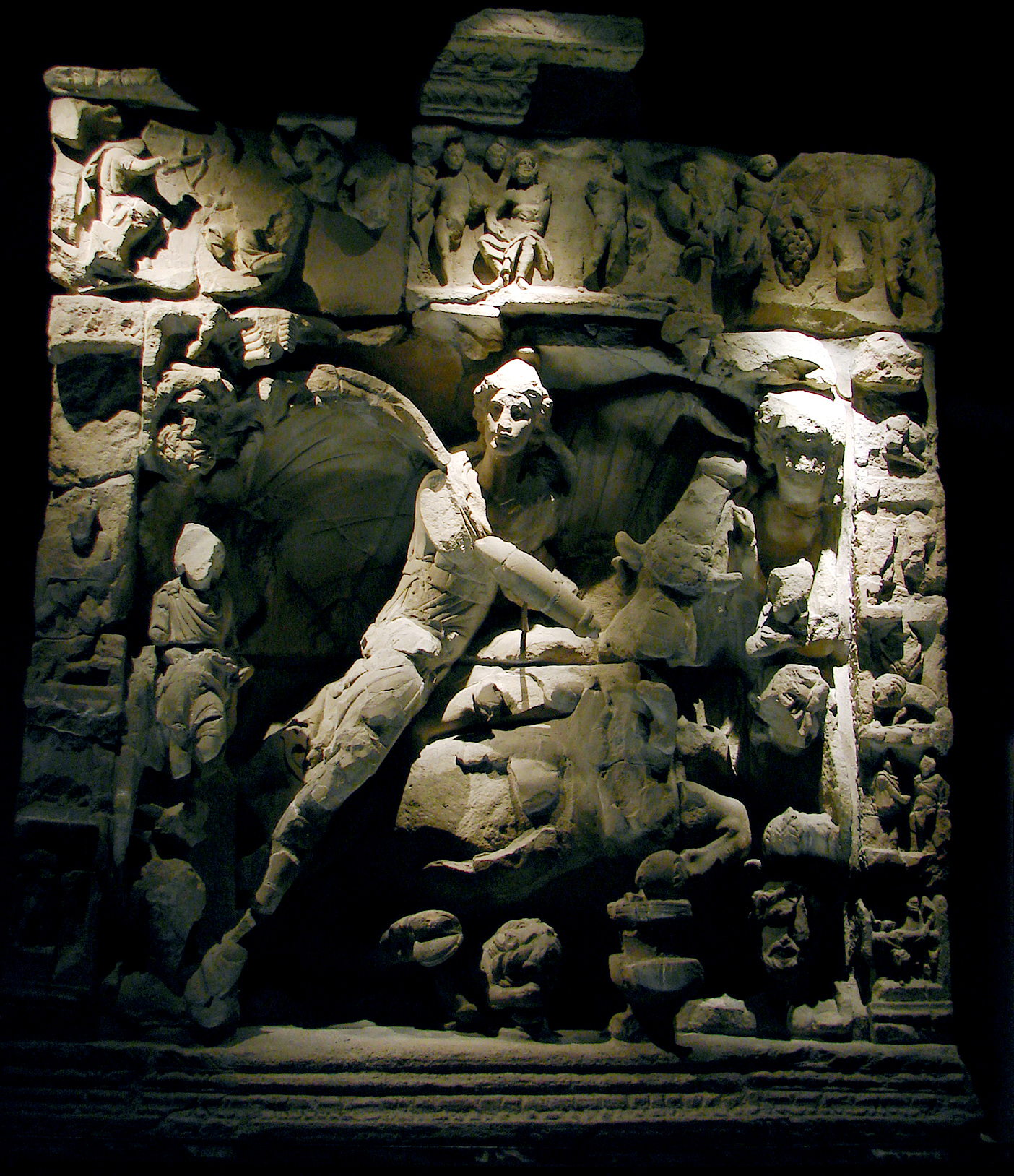
The central motive of every Mithraism is a representation of Mithras dragging a bull and slitting its throat. Mithras defeated the bull, killing the animal creating a cycle of life. He holds the bull kneeling down, with the head of the left-hand it tears him in the neck, and the right carotid artery leads to the dagger. Snake and dog have been waiting for the blood. The Scorpion – symbol of the evil – has retreated within the testicles. The death of the bull, whose tails are not in a tuft atop, but end in an ear, frees its life-giving liquids. The divinity is originally from Persia, but that was of little importance. Mithras is also surrounded by other animals representing the zodiac, and celestial elements like the sun, moon and stars are constantly present. Scholars disagree as to the exact nature of the meaning of this, but two explanations are likely. The first is that the slaying of the bull represents a cosmic regeneration, essentially a cosmic Genesis. In many Oriental cultures, the bull is a symbol of fertility. In times of drought, bulls were sacrificed and their blood spilled to the ground to renew the fertility of the earth and forestall famine. From this perspective, Mithras is a cosmic regenerative force. By shedding the blood of the cosmic bull, he nourishes the universe against the forces of darkness of the serpent, ant and scorpion that undermine life.
The roman Mithras cult was most likely brought by Oriental troops serving in the legions and its public offshoot of Sol Invictus, the Invincible Sun, was only related to the private Mithraic cult. Sol Invictus became the official religion of the empire until conversion to Christianity much later. The Mithraic cult as practiced by Romans lived and died with vita the Roman society. When the West Roman disintegrated seriously in the fourth century, the cult declined with it.
The Romans were the first society encountering a globalization shock. From Ernest Renan comes the dictum that the Western world would have become believers of Mithras, if any accident had inhibited the spread of Christianity. Mithraism followers met in caverns or in artificial enclosures made to resemble caverns like the early Christians, often operated secretly. Of the members of the cult, the mainstay were soldiers but it seems the cult appealed to officers. There were also imperial civil servants, as well as traders, craftsmen, and many others connected to the imperial economy or government. Mithraism appealed to those connected with the Imperial establishment building tightly knit groups that met to progress through spiritual, esoteric knowledge and celebrate the. The cult was organized along a hierarchy of seven grades, and advancement through the cult was contingent on mastering various physical and spiritual trials.

It has to be noted, that the bull represents of course the constellation of Taurus. In pre-christian time the sun rose in the zodiacal sign of Taurus during the vernal equinox. By christian times the sun, due to the natural progression of astrological bodies, had moved out of Taurus into another constellation – Pisces. According to this view, Mithras by slaying the bull is in effect ending the Age of Taurus and inaugurating a new zodiacal age of Christianity which secret symbol was the fish. Mithras is thus a god of the cosmos who regulates the great astrological cycles. Mithraism was strongly connected with astrology (and superstition) and maybe this was the answer to the “mystery”of Mithras. In first-century Rome, the sun was moving from the house of Aries to Pisces but earlier (ca. 2200 BCE) the sun moved from Taurus to Aries. So according to Ulansey Mithraism was tied to those astrophysical changes.
Mithra was the god of war, battle, justice, faith, and contracts and Mithraism believed in duty, honor and sacrifice. Mithras symbolized certain sacred values that were seen as traditional to the Roman soldier. Not unlike the German philosopher Nietzsche, who knew Persian philosophy well, Mithraism emphasized the strong, superior man against the weak masses. Nietzsche considered burgeoning Christianity’s relationship to that secretive “mystery cults” that flourished alongside the official state religions of ancient Rome. He shared criticism of Christianity that the Christian religion was not based upon divine revelation but that it borrowed from pagan sources, Mithra being one of them. They assert that the figure of Mithra has many commonalities with Jesus, too common to be coincidence. However, Mithraism shared only themes with Christianity (and Judaism) which were recorded in both the Old and New Testaments too. What is more probable is derived from the timing that with the explosive growth of the Christian church in the 1st and 2nd century, other cult groups – syncretic by definition – started to adapt themselves and took advantage of some of the teachings found in Christianity:
“Allegations of an early Christian dependence on Mithraism have been rejected on many grounds. Mithraism had no concept of the death and resurrection of its god and no place for any concept of rebirth — at least during its early stages…During the early stages of the cult, the notion of rebirth would have been foreign to its basic outlook…Moreover, Mithraism was basically a military cult. Therefore, one must be skeptical about suggestions that it appealed to nonmilitary people like the early Christians.” (R. Nash, Christianity and the Hellenistic World).
If the Roman Mithras is a descendant of the older, persian Mithras, it must be understood that his cult evolved over the generations in many different lands, absorbing influences from each of them. The Mithras cult was a secret religion full of mystery which apparently didn’t harm its popularity. That was exactly what was offered. The Santa Maria Capua Vetere murals in southern Italy show also initiation ceremonies including mock executions by swords piercing the body. Those were ritual sword with the blade omitted by a headband. It is so similar to the sawed virgins in the circus, that after 2000 years you still feel the wink and the religious serenity of the Romans. It was a cheer from the fullness. There was not only Mithras, although, as one would say he was a real manly God, but also the strangely solemn Jupiter Dolichenus from Syria, always on a bull, his wife Juno on a doe. This is a very deep down in the origins of civilization, as with the cult of bulls the domestication of the animal of arable land and the state began. But at the time, the universe turned from age of bull to the age of pieces – just as our similar stormy time 2012 entered now the Age of Aquarius. So “the dawning of the Age of Aquarius” is calling today for the end of Christianity? Mithraism reached the peak of its power in the middle of the third century, but the invasions of the barbarians ended it. Temples were sacked in the uniform downfall of the Empire. The army was the only institution standing – so the Caesars founded to supported religion of their soldiers the public version of Mithraism – in honor of the Sol Invictus, leading to great persecutions of the Christians (maybe encourages by the Mithraic clergy). But the conversion of Constantin in Byzantine Empire turned the tables and target of persecutions. East Rome, became the political center of the world until 1453. Theodosius formally outlawed all pagan sects, and Mithraism was officially abolished. It did continue in secret for a number of years, but the cult was never the same with the decline of Roman power in the West. Rome remained still the center of paganism, other adversaries coming up, but that is another story.
The original Mithras, however, is a very ancient deity. In the Vedic religions that preceded Hinduism, Mitra is a solar deity and in Persian religion, he is also a solar deity because they both share an older Indo-European heritage. Apparently Mitra was a comparatively minor deity until the reformer Zoroaster revised Persian religion. In his view the cosmos was divided between a clash of light and darkness, good and evil. As the Persian Empire spread, the cult of Mitra spread with it.
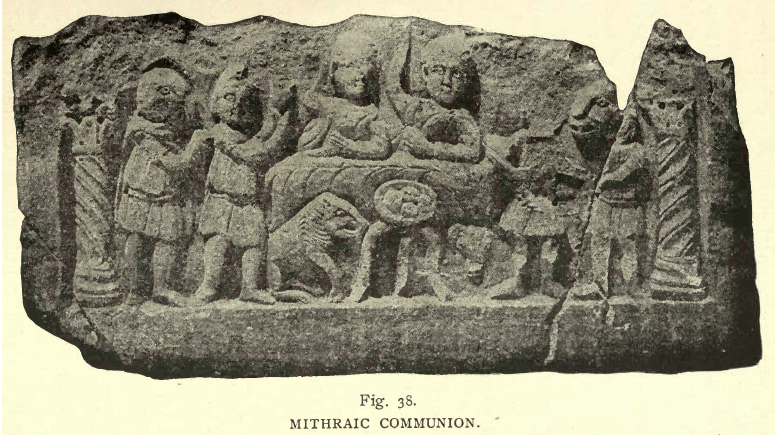
Critics of Christianity claim the early Christ cults must have stolen from the Mithraic cults other refute that view claiming that Christianity was established in Rome before Mithraism , but most likely the similarity between the two cults is rooted in common Archetypes of the Greco-Oriental culture. Never forget the Ronan version Mithras cult was syncretic by nature and very different from the early Mithras cult. According to Cumont the parallels between Mithraism and Christianity were many,—belief in the immortality of the soul, a future resurrection, judgment, heaven, hell,…a communion rite consisting in Mithraism of bread and water, to which he would add wine; a purificatory rite of similar to baptism, a feature common to practically all religions, having an outward resemblance to baptism…a remote resemblance to the Christian rite of confirmation…the seven grades of the initiation as the seven sacraments, a clergy system based on it. However, according to Dumont, Mithraism was inferior to Christianity, as it offered only a mythical redeemer ( 195 ff Mysteries-of-Mithra-the.-Franz-Cumont-1903). Some non-original doctrines that mainstream “Christianity” “share” with Mithraism were Christmas on the 25th and Sunday. According to Robert Turcan Christians blamed the Mithras followers even for performing rites which supposedly were an imitation of the eucharistic liturgy. So to sum it up:
- Pros: “Be different but not too different!” link the old and the new plus astrology while making your cult novel and familiar, both revolutionary and marketable.
- Cons: It was a cult that played to the moment well but was bound not to age well. It omitted women and was essentially an elite cult of warriors and establishment. Today one would say, it was “a white man’s religion”.
Female Archetype: Cybele the Great Mother
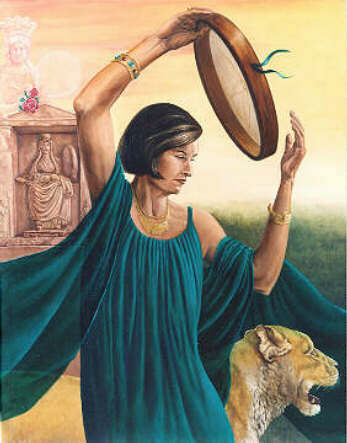
It is one of the oldest cults imported into Rome, ca. 205-204 BCE, and –Cybele was credited with the Romans’victory in the Second Punic War and the goddess Cybele is the protectress of the besieged.One of Cybele’s major attributes was that she protected people at war and, as such, was often shown wearing a crown of city walls symbolizing the defense she offered adherents. Also, as an earth-mother deity in origin, she bestowed fertility and governed creatures of the wild—ancient portraits show her riding in a chariot pulled by lions—and in both aspects she appealed to the Roman public whose lifestyle was still, for the most part, agrarian. Besides that, her powers included the ability to cure disease and predict the future, making Cybele an all-purpose deity if ever there was.
The rites of Cybele revolved around not only the goddess herself but also a young male consort of hers named Attis who was said to die and be reborn annually. That is, myth held he perished each fall and returned each spring, an obvious reflection of plants and vegetation. Isis is related to the Cybele with her chubby lover Attis, who emasculated himself. Many terracotta figures witnesses that both were widespread in popular piety. These characters do show how deep the roots of Christian iconography are based in the religious imagery of the pagan “Oriental” cults of the Roman antiquity.
The way Cybele’s adherents celebrated his renewal and restoration involved much lamentation and also wild behavior, ecstasy to put it technically—ecstasis in Greek means literally “standing outside (oneself),” in other words, the transportation of a person out of his or her body which allows spirits to possess it, much the same way mediums at séances act today—and worse yet, during her rites, worshipers produced this feeling of ecstasy by dancing and carousing, whipping themselves into a frenzy where they felt elated, in Latin “carried away.” At times this involved scanty clothing and mixed company.
A traditionally conservative people, most Romans took a dim view of such behavior. The Roman Senate was repulsed enough at this purported worship to issue edicts condemning and criminalizing its bacchanal. So, in spite of their gratitude to Cybele for her help in defeating the Carthaginians, this was just not a way the majority of Romans were willing to comport themselves. Still worse, the priests who oversaw Cybele’s worship were eunuchs, men who’d been castrated when they joined the cult. That was definitely not something Roman mothers dreamed of for their boys.
But the advent of Cybele had opened a door that wouldn’t stay shut, and no senatorial edict or general disapprobation could stop the cult from growing. Besides its impressive debut, its attractions were great and manifold. First of all, it preached a doctrine of life-after-death, a promise to all its faithful of immortality through union with Cybele in the beyond. To many that was very enticing, especially those with little hope for success in this life: slaves and women and the working classes of Rome. Also, its vegetation-oriented imagery resonated well amongst a populace that was still deeply connected to the land.
- Cons: most Romans naturally disliked the sort of excessive behavior seen in this cult specially as it became ever more licentious over time in order to attract followers.
- Pros: Cybele thrived for other reasons he promise of life after death with Cybele appealed especially to those with little hope of finding satisfaction in this life (e.g. slaves).
Female Archetype: Isis – Holy Mary’s great predecessor
The cult of Isis–practiced as a mystery or mystery cult appealing to those who longed for a club with secret truths but the Mithras-Cult somewhat was too elitist and too male. The cult is mysterious to us today involving chorus singing and in general pageantry. As private worship, the cult of Isis probably came to Rome itself in the 30s or 40s BCE. About 50 years later, large temples, still private, were built for Isis. The maternal archetype of Isis is often shown, as a seated female figure, breast-feeding her son.

The symbol of Isis in the heavens was the star Sept (Sirius), which was greatly beloved because its appearance marked not only the beginning of a new year, but also announced the advance of the Inundation of the Nile, which betokened renewed wealth and prosperity of the country. As such Isis was regarded as the companion of Osiris, whose soul dwelt in the star Sah, i.e., Orion. From what has been said above it is manifestly impossible to limit the attributes of Isis, for we have seen that she possesses the powers of a water goddess, an earth goddess, a corn goddess, a star goddess, a queen of the Underworld, and a woman, and that she united in herself one or more of the attributes of all the goddesses known to us.
Scholars think that the Roman branch of Isis worship may have come to Rome as Delian and Capitoline cults, from slave trader cities set up to a free port for commercial purposes by the romans. Interestingly, temples Isis later became associated with freedom for slaves. Apparently, the worship of Isis was spreading wildly throughout the Roman world and it made the rulers nervous. Rome and the follower of the Egyptian gods were long hostile to one another. On several occasions, Isis altars on the Capitol were destroyed at the initiative of the Senate. Many of their contemporaries thought it as an affront that Caesar erected in the temple of Venus a golden sculpture of his beloved Cleopatra 44 BC. As Cleopatra as the incarnation of the Isis mind, which in turn was also the Roman Venus, came to the Egyptian goddess sacred honor.
Somewhere between Tiberius’ reign and 65 CE, the worship of Isis received imperial sanction. Under Caligula and Vespasian, it apparently flourished. By the second century CE, the worship of Isis had spread throughout the Roman Empire and Isis was being worshipped by people in every level of society, from emperors to slaves. Isis became the Universal Goddess; She was The One. A Roman graffito records what I suspect was a mantra of sorts for ancient Isiacs: Una quai es omnia, Dea Isis—Being one, Thou art all, Goddess Isis.
The cult of Isis was centered around the Egyptian deities Isis and Osiris. Its Roman origins are placed in the early empire, which would make it very likely that the Egyptian campaigns of the Second Triumvirate (most likely under Marcus Antonius) brought the cult to Rome. It had a popular following up until the fourth century CE, but as Christianity took a firmer hold was completely eliminated by the sixth century. Isis was, in Egyptian mythology, goddess of fertility and motherhood. She was the daughter of the god Keb (Earth) and his wife/sister the goddess Nut (Sky).
The central image of the cult concerned the myth of the death and rebirth of Osiris. In this myth, Osiris’ brother Seth (god of death) was envious of Osiris’ rulership of Egypt and murdered him, cutting him into many pieces. Osiris’ wife Isis then gathered the pieces together and took them into herself and gave birth to Osiris, resurrecting him. While the rituals of the cult remain a mystery even today, we do know that in the initiation ritual the initiate experienced symbolic “death” and “rebirth,” purified by the Goddess Isis gaining access to revelations and divine secrets and finally being reborn in death as a clean and new person.
The Cult of Isis was, thanks to Ptolemy, Hellenized to a degree that the Roman mind could understand it, and yet still foreign enough to be exotic and alien. However, the Iseum was walled off from the surrounding world, suggesting a space of inner sanctity. Prospective initiates were called to the goddess by dreams and visions. The subject of the ethics of the cult is a complicated one. We know that Egyptian culture as a whole was free with sexuality compared to Roman culture. Isis was in fact rather popular with courtesans and other such professions, and there are speculations that Isis cults may have promoted a kind of “positive sexuality” which Augustus and Tiberius took this as proof of a “pornographic” cult. Yet the Isis cult also demanded regular periods of sexual abstinence and gave early Christians little to complain about the degeneracy of Isis as they could about some other cults in the Empire. Twice a year large Isis festivities were celebrated in Rome. On the full moon day of the “Month of Heaven”, in which the sun is in the sign of Aries, based on Apuleius’s the “exit of the Isis” – the date of the feast celebrated varied as the Christian Easter and was also calculated.

The roman Isis cult mainly concerned itself like Christianity with material sacrifice (such as fasting and donations of wealth. Unlike other mystery religions, there were both yearly rituals and daily services. Not only this, but there was a very public display of devotion to Isis, with temples, devoted priests, and the worshipers in her honor. Most evidence suggests that the cult of Isis was the largest competitor for Christianity in the Empire, especially concerning the inclusion of women as priests and worshipers equally. That it had an influence on the budding religion of Christianity can be in little doubt, for the iconography of the Virgin Mary often bears similarity to Isis, and Isis’ titles such as the “Queen of Heaven” are still used to refer to the Virgin even today. Finally, Osiris’s promise of eternal life (through his sacrifice) for his followers to me parallels early Christian understandings of Christ. Her symbols are the Ankh (like a modified cross) which represented life. A completely different sign is a Graffito from Palatine Hill in Rome of the 2. Century BC which must be addressed as the first representation of a cross. A stick figure is praising the crucified and the Greek inscription reads: Alexamenos worships God which is a bashful derision. To die on the Cross, was reserved for high treason, scam and slaves. That is why the early Roman Christians first avoided presenting the image of the crucified Son of God. The sarcophagi from the Vatican Museums depict scenes from the life of Jesus, the Crucifixion in vain.
The Isis cult had a particularly large number of followers, divided into three levels. The lowest level were the normal believers. The second level were zealous supporters, the Isis cult very intensively practiced under the guidance of a priest. The top level were those whose function was so high that they often equated with priests. Only very rarely was a woman in the highest level. Isis was a relatively chaste goddess. As the Holy Father the Paleochristian Clemens (50-97 A.D. ), the Bishop of Rome, and the Christian writer Tertullian (150-230 A.D. ), praising their chaste trailer and priestesses. The cult was brisk in an ascetic direction, without sexual symbols and signs. The hairs were shaved and lowered the clothing were discreet. The ritual processions and prayers, and their facilities for water, incense and musical instruments were very frugal. The followers lived celibate, men as well as women. A rarity in the classical world. But this abstinence was only in the short term. Ten days was the usual length. The Isis of the Hellenistic time protected the chastity of lovers. Women who fled because of sexual coercion, found a safe home in its temple. They gave their very pious women married sex life and were, as Tertullian called it, to self-proclaimed widows. They rejected any further physical contact with their husbands. Sometimes they offered their husbands even new women you should replace itself. Some women avoid the contact with the men even to the extent that they refuse to kiss, their sons. Unlike Mithraism which was confined to a small percentage of “middle class” Roman males, the Isis cult was truly universal and could be practiced by women. Like Christianity it was women who perhaps took it up most enthusiastically. The cult of Isis had the numbers and the appeal to mount a serious threat to Christianity.
Some scholars assert that the triangle of Isis, Serapis and Horus were not really defeated – they were merely absorbed into the new Holy Trinity of Christianity. The reverence for Mary among high Christian churches is similar to faith in Isis. We should consider at the very least that many chapels to the Virgin were built purposely on the remains of temples to Isis, and that furthermore the iconography of the Madonna and Christ is quite similar to Isis and Horus.
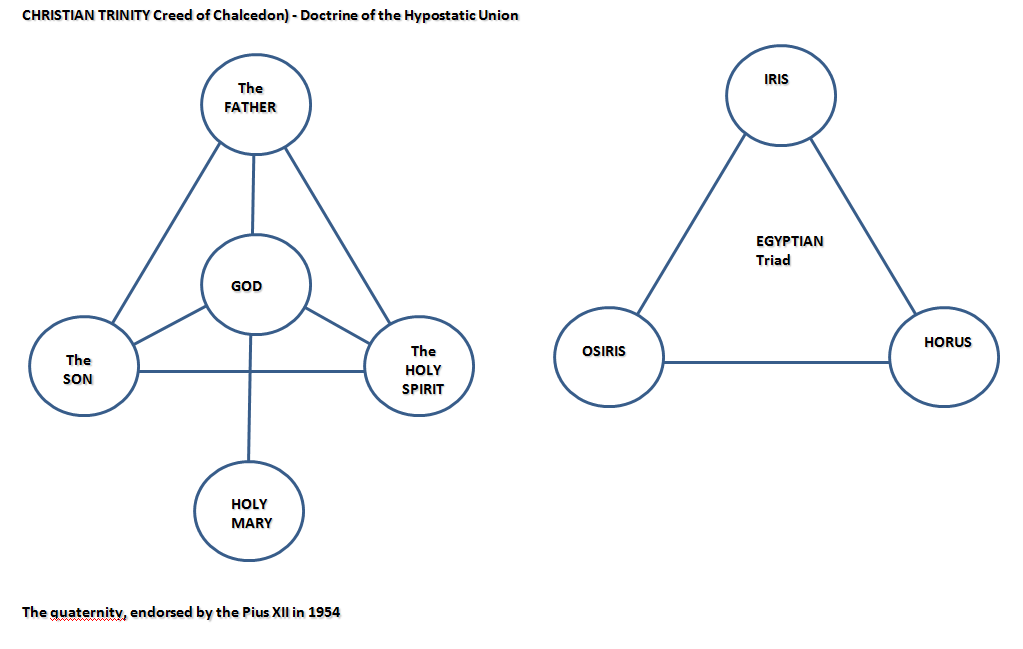
It is true, that many triads of gods were taught in non-Christian religions since ancient times. In Mesopotamia one such ‘trinity’ was Anu (the god of the sky), Enlil (the god of the earth) and Ea (the god of the waters). Another trinity, in ancient Babylon, was made up of the three gods Nimrod, Semiramas and Tammuz. Grouping of gods in triads was also common in Egypt, Greece and Rome in the centuries before and after Christ. Some of these ancient trinities are still worshipped today. In India, the three gods, Brahma, Shiva and Vishnu, are worshipped as a trinity in the Hindu faith. Likewise in Egypt, a trinity (made up of the three gods called Osiris, Isis and Horus) is worshipped. But triads are no trinities. There is a no doubt, also that quaternity as a symbol has a very long history. Quaternity could be found literally all over the world – from China to Peru , from earliest paleolithic paintings in Rhodesia to the bronze time in all cultures until today. The number four indicates the border of accuracy in information technology, was dominating also Greek philosophy and science and represents the number of dimensions in the space-time continuum. There is also no doubt, that C. G. Jung regarded quaternity as most important symbol, even more important than trinity: “The quaternity, is an archetype of almost universal occurrence [. . .] For instance, if you want to describe the horizon as a whole, you name the four quarters of heaven…There are always four elements, four prime qualities, four colours, four castes, four ways of spiritual development, etc. So, too, there are four aspects of psychological orientation [. . .] The ideal of completeness is the circle sphere, but its natural minimal division is a quaternity”. (Psychology and Religion: West and East).In more than one occurrence, Jung mentioned that the most significant “advantage” in Catholicism ist the coronation of Mary in Heaven making the four complete. This coronation of Mary in Heaven, finally endorsed by the Pius XII in 1954, made to him Quaternity out of Trinity. He regarded this of a very meaningful psychological move. It fulfilled the prophecy from Revelation which Catholics have repeatedly pleaded for. The assumption was hardly the bold stroke of a rogue pope, because the pope not only endorsed this devout custom but “on many occasions, either personally or through bishop-delegates, carried out the coronation of Marian images.” [See Pius XII, Encyclical Ad Caeli Reginam, Oct 11, 1954].

Many historians and religious scholars, however, do attest to the influence of Greek or Platonic philosophy in the development and refinement of the Trinity doctrine in the fourth century. Neoplatonic’s refined Plato’s concepts into what they referred to as three “substances”—the supreme God or “the One,” from which came “mind” or “thought” and a “spirit” or “soul.” These were different divine aspects of that same supreme good—distinct and yet unified as one. Many distinct threads of Christianity split and developed separately and debate swelled over the nature of Jesus after the Councils of Nicaea and Constantinople in the fourth century. The term Trinity is, in fact, taken directly from Platonic and Greek philosophy. The Platonic term trias, from the word for three, was Latinized as trinitas— the latter giving us the English word trinity. However as well that may be, Chalcedonian Creed at the Fourth Ecumenical Council, held at Chalcedon,, in 451, as a response to certain heretical views concerning the nature of Christ established the view that Christ has two natures (human and divine) that are unified in one person:
We, then, following the holy Fathers, all with one consent, teach men to confess one and the same Son, our Lord Jesus Christ, the same perfect in Godhead and also perfect in manhood; truly God and truly man, of a reasonable [rational] soul and body; consubstantial [co-essential] with the Father according to the Godhead, and consubstantial with us according to the Manhood; in all things like unto us, without sin; begotten before all ages of the Father according to the Godhead, and in these latter days, for us and for our salvation, born of the Virgin Mary, the Mother of God, according to the Manhood; one and the same Christ, Son, Lord, only begotten, to be acknowledged in two natures, inconfusedly, unchangeably, indivisibly, inseparably; the distinction of natures being by no means taken away by the union, but rather the property of each nature being preserved, and concurring in one Person and one Subsistence, not parted or divided into two persons, but one and the same Son, and only begotten, God the Word, the Lord Jesus Christ; as the prophets from the beginning [have declared] concerning Him, and the Lord Jesus Christ Himself has taught us, and the Creed of the holy Fathers has handed down to us.

In any case, the Egyptian goddess gradually conquered the Roman Empire, in the north, the cult has proven to be up to the region of Cologne his followers. Isis was also made available the new Christian faith. “As in the day of trouble helping Mother Goddess”, was Isis soon in the hearts of the people so deeply rooted that you in the time of the emerging Christianity collided with Mary to a new mother.” This will also liturgically in the pictorial representation: Isis and her son Horus here sitting on the throne, there Mary with the Infant Jesus on the arm. Theologically founded the Council of Ephesus in 431 the role of Mary as “Theotokos”.
However, Isis was never popular with the more sincere Roman rulers. Octavian took up the mantle of protecting the moral fiber of Rome from Isis worship and later while Augustus was away in 21 BC, his second-in-command, Agrippa, pushed the Isiacs out of the city entirely and forbid worship within a mile of Rome. The official Roman antipathy for Isis lasted after Augustus’ death. Caligula, not entirely a wise ruler restored Isis worship in Rome, where it would eventually flourish until the money run out. The same time, West Rome broke down, the Isis cult was pushed back in the whole empire. Its decline began at the end of the 4. Century with the destruction of the famous temple (Serapeion) in Alexandria. Patriarch Theophilus had called up to 391, encouraged by the Christian Emperor Theodosius. Only in the south of Egypt, could the Isis cult survive more than 100 years, until (East Roman) Emperor Justinian closed also this temple and threw the priests in prison.
So while it’s true that Rome generally accorded respect to foreign gods, this is not true for religions that fell afoul of the powers-that-be. Rome virtually exterminated the Druids. And we learn from Tertullian, Cassius Dio, Valerius Maximus, Josephus and others, they cracked down on Isis worship too. The female-centric Alexandrine cult was thought to be a threat to the moral fiber of Rome. Writers like Juvenal and Cattullus propagated the idea that the religion was obscene and orgiastic. Today, Isis is undergoing something of a revival among among New Age crowds and a popular symbol among those seeking an alternative to “patriarchal” religions. In fact, Isis worship is part of the “goddess spirituality” movement promoted by feminist and other postmodern identity groups with little respects for history or archaeology.
- Pros: all in all, Isis worship was just as popular as Cybele worship but conducted in a more decorous way the Isis cult appealed to those Romans who wanted a more dignified and traditional way to worship a foreign deity and, provided the celebrant with the promise of eternal salvation and a personal union with the divine in the afterlife and the importance of the individual.
- Cons: essentially it was like the Mithras cult an élite but very female-centric instead of male-centric movement. It also raised suspicion under the Roman middle an upper class and positioned itself as a political threat.
Some thoughts based on C.G. Jung’s Archetypes, F. A. Hayek’s “spontaneous order” and Hannah Arendt’s concept of free will
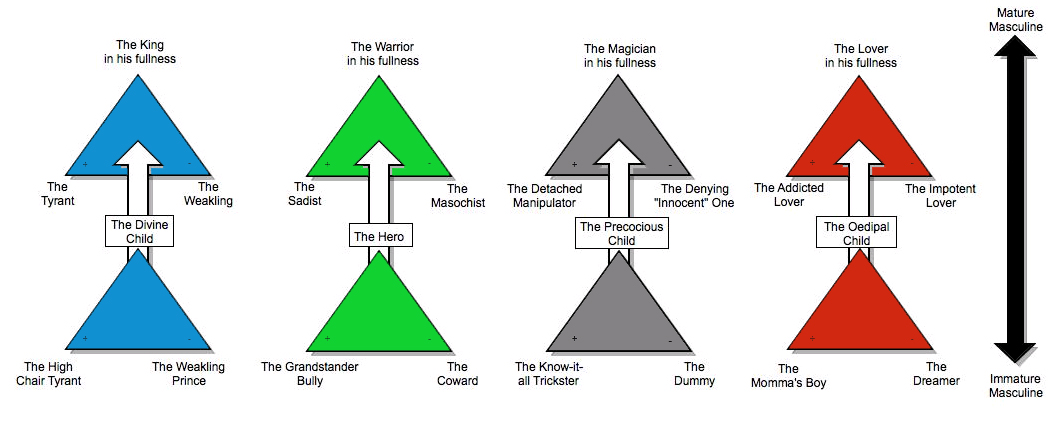
C.G. Jung saw in the Egyptian Isis the direct predecessor of Maria’s principles. She carries great wisdom and also the basic vision of life-giving. She is not just an abstract principle, but a path (encoded in her fundamental processes) and the antipode of -one- male archetype the warrior. Today too, as in Roman times, we face a major challenge: our relationship to a global world. Tangible and non-tangible conflicts are occurring at a much faster rate than predicted. There will be many ways in which sustainability of cultures will be considered. A Jungian perspective, however, will look for the underlying issues; and such a view would be long-term and more subtle in approach. Jungian’s would consider the archetypes, the worldviews, and the processes in the natural psyche of the Romans that apply to our attitudes about the cults and our growing problems. A Jungian approach would be to search for a principle of psychological and spiritual transcendence, aware that we now need a higher level charity, aware that it is now time to become “citizens of the world”. Archetypes, as written of in this blog, are those primordial, universal energy patters that form our behaviors, attitudes, and values, both individual and collective. They carry the full range of possibilities, positive and negative, for that theme. They are found in our myths, symbols, dreams, visions, and cultural stories – and in religions and cults. In considering this the archetype of those sects rise to prominence. Jung has written about male and female archetype of greatest universality. Archetypes are found throughout all cultures and all times in all religions and cults, enduring even religions and cults which are born, live, fight and die.
I want to invoke an angle borrowed from an important social philosopher and economist. The nobel price winner and freedom advocate Friedrich A. Hayek, is much appreciated again in some economic circles today, who try to understand what goes wrong with our finance system (and hated by the mainstream). Friedrich A. Hayek, seems rather appropriate for quite a number those cultural and social-philosophical aspects of the rise of Christianity. For Hayek, modern society constitutes a “spontaneous order” which no central (human) will and knowledge could ever reproduce or surpass. Certain rules are retained because they are “more efficient” and provide an advantage to those who adopt them (“rules of correct behavior”), while others are abandoned. Hayek writes: In fact, “if freedom has become a political morality, it follows from a natural selection, which means that society has gradually selected the value system responding best to the constraints of survival.”
Before urbanization, the “tribal order,” reflects “primitive” conditions of life. It denotes a closed system whose members know one another and organize their conduct in terms of concrete objectives determined in a relatively homogeneous manner. In this society of face to face interactions arranged in terms of collective goals, human relations are largely determined by “instinct” and are essentially based on solidarity, reciprocity, and group altruism.
This “tribal order” gradually unravelled as personal ties dissolved into more impersonal social structures. It gave way the classical society of Rome, which Hayek would have called an “extensive order” – something corresponding more or less to Popper’s “open society.” This type of society knows no limits. Thus social relations can no longer be regulated according to the face to face model. Within such a society, “instinctual” behavior becomes useless and is replaced by abstract contractual arrangements (except, perhaps, within very small groups such as families or early Christian communities). Order came not (only) as a result of goals or intentions, but spontaneously and in the abstract, under the impact of multiple interrelations among the various agents during this volatile time. The “early Christianity “may have been a social system which spontaneously manages itself. Hayek, an utopian, might have likened it to his term “grand society” whereas Augustine might have called it the” city of god”.
Hannah Arendt traces the origins of the concept of freedom to the practice of politics in ancient Greece. According to her study, the concept of freedom was historically inseparable from political action. According to Arendt, the concept of freedom became associated with the Christian notion of freedom of the will, or inner freedom, around the 5th century C.E. and since then, freedom as a form of political action has been neglected, even though, as she says, freedom is “the raison d’être of politics.”
In his last decade, the professing agnostic Hayek turned to the subject of religion and started to explore it from his evolutionary perspective. Personally, I would count his German lecture of 1982 about the topic at Klessheim castle and his final chapter “Religion and the Guardians of Tradition” in his final book “The Fatal Conceit” (1991) among the most important works in this field and time. For example, he rightfully observed the reproductive potential of religious groups, based on the Amish people.
Whatever happened in Rome – winning archetypes, free will as USP or superior efficiency: It might very well be, that the early Christians fixed the Roman problem of globalization – because as of today the concept of solidarity works only in small groups, not in macro societies. After all, before anything, culture is “memory of beneficial behavioral rules selected by the group.” or as C.G. Jung would say “collective memory of archetypes” the collective unconsciousness.
Conclusion – Why did Christianity win?
Christianity entered the drama of ancient life—and, in particular, Roman urban culture—rather late in the play. Onto a set already stacked to the ceiling with ecstasy, astrology, mysteries and emperor-gods, the first Christians need to carve out a room to maneuver, that marked them as different from their many religious rivals. Christianity somehow secured a niche, a very small one initially, and in what must be seen as most remarkable about their rise, especially given how little they had to work with at first, they survived their religion’s birth and infancy and ultimately found a way to take center stage.

That makes it very important to understand that some things working in Christianity’s favor were decisions made by Christian leaders in the religion’s formative period. Clearly, its savvy architects not only assessed the evolving climate of Roman culture with great insight—not to mention foresight—but also understood well how to avoid the fallacies that eventually stifled and strangled their competition in the market. A critical success factor was for instance the abundance of women under Christians which led to a higher breeding rate and was one factor of the spectacular growth rate of Christianity. Understanding strategies and packaging of the offering is central in grasping the achievement of early Christians. Let’s review, then, a few of the most important aspects of that decision-making process, in particular, where Christianity learned from bad choices which ultimately doomed others to extinction:
Unlike Greek philosophical systems with which a number of early Christians were clearly conversant Christianity appealed primarily to the heart of the many, in addition to the intellect of the élite. If one recalls the many councils about the nature of Jesus, it becomes evident how subtile Christianity is in comparison to other religions. Christianity’s complexity lay, however, not in an echelon of gods like the Gnostics , but in a very unique offering. When God becomes human and dies for us, that in essence means there is God (or a window to God – the Self as a Jungian would say) in every human. This allows a personal one-to-one relationship to a single God for every follower – essentially the advent of the enlightened individual. Another example, the Catholic concept of the Holy Trinity was a very smart transition from polytheism to monotheism. Trinity and Jesus’ nature has been later seen as heresy by the Islam, which is radical monotheistic, essentially based on Arianism.
Christianity hid its complexity well and provided coherent messages. That allowed its proponents to deflect assaults based on reasoning and resort to its mystic dimension if challenged. That is, by avoiding “logical traps,” the young religion could stop debates which threatened to undermine its basic propositions, like the exact relationship between God the father and Jesus the son. As I have written before, communities which had allowed these sorts of discussions to proceed ultimately buckled under the weight of “logic” and were dissolved into heretical infighting like the Monophysites after Caledonian Creed. The non-diluted and simple message was as critical as the integrated spiritual dimension, both fostering also organizational unity.
- Although full of mysteries, Christianity never promoted itself as a mystery cult like Mithraism or Isis worship, where the primary appeal to the initiate, the knowledge of a “secret” shared by few, kept later advocates from being able to spread the cult’s “gospel” freely in public. Early Christian leaders surely saw that, even if their movement was slow on the uptake, in the long run it was better not to create a members-only club.
- Christ, however, was not a typical deity either – his final triumphs come mainly after death – and unlike other gods, the Christian god did not return to crush his detractors in real, tangible terms as the King.
- The Christian God was a loving god not asking for a slave relationship (like later the Islam), nor a “little better than human” deity, who fooled around like the Roman state gods. This God offered a personal relationship.
- The free will , real or not, and the personal connection to God was in and of itself very enticing and made people feel important as individuals, critical for the middle class. A savvy choice because it gave people trapped in the “machinery”of imperial rule a sense that they could do something to make themselves different.
- Along with all these wise decisions, early Christian leaders also brought something new to the altar: exclusivity – an idea coming from Judaism but very different from the polytheistic myriads of gods dominating the Roman Empire. The approach “A belief is not a fruit basket”, also said recently by Pope Francis, may be one of the unique selling proposition. Exclusivity and some other strong demands of Christianity from their followers raised the “entry price” overcoming the free-rider problem and setting it apart from the inflationary gods. In general, the demand of exclusive committment is a typical property of monotheistic religions.
- A scholarly view that Christianity was the religion of the poor appealing especially to the lower classes, is somewhat outdated. It is true, however, that Christianity was an urban religion. It provided a practical solution for the anonymous misery of urban life in crowded cities – health care and access community.
- Many early converts were women and slaves, but that too, spread the word even faster. Christian women married often non-Christian men. There was a high abundance of Christian women in the early communities leading to marriages with pagans and more children raised in Christian belief. Roman slaves often were well-educated and had access to the nobles and the administration.
- Christianity played well to the general interests of those ancient Romans who were searching for meaning in their lives in particular, it avoided pitfalls which held back and undermined other cults:
- vs. Greek philosophy: Christianity appealed primarily to the heart, not the head this saved it from having to be “logical”
- vs. Mithras and other mysteries: Christianity allowed a wide-open path for spreading the gospel while it lost some initial impetus, it was a better plan in the long run. Mithraism was one of Christianity’s principle competitor. The cult of Mithras was confined to a small section of the population – perhaps one or two percent. It also, unlike Christianity, excluded women and it was imperial establishment sect. Christianity’s earliest successes were most likely opposed to the imperial establishment. In terms of numbers, Mithraism could never have competed with Christianity, and most likely did not try. The cults were directed at different segments of the population – Mithras being in a shrinking niche market
- vs. emperor worship: Christianity based itself on “weakness” “The meek shall inherit the earth” vs. the very real and tangible but transitory power of rulers. Divine Roman emperors were just the opposite and indeed, who wants to worship the taxation authority. It also gave the message to the political power, that here was god who stood strong in heaven, if not on earth, and in any case Christianity was not a political threat since its trump card was “strength in weakness.”
- vs. Isis: Christian leaders kept up their contacts with each other and didn’t allow their religion to fracture as badly, for instance, as Isis worship had.
Christian leaders worked hard – Catholic leaders up today – to enforce uniformity of worship across the empire to keep down forces promoting diversity and schism. The Evangelists’s letters must have served as an important model for those ambitious to keep Christianity globally integrated. This tradition paid off well later, when the religion had become widely practiced and popular and, as such, naturally inspired all sorts of debate, the first slippery step toward schism. Though Christianity ultimately did fragment, and seriously—several times, in fact—there was never any sense among its early advocates, that it should be tolerated. Philip Jenkins describes in his book ”Jesus Wars” the historical intricacies that surrounded the theological debates of the fifth through eighth centuries of nature and person of Christ weakening Christianity until today.
A Hellenized (Greek influenced) version of Isis, the Queen of Heaven, was in fact one of Christianity’s strongest competitors in late Roman times until her role and title were taken over by the Christian Mary, who is still called Queen of Heaven today. Mary is a shining example of the love of a mother radiating from heaven to ease the burden of we creatures below, and though her divinity is no longer officially recognized as such, she bears the titles and receives the prayers once addressed to the Goddess, whose body is not just the earth but the universe, and whose children we are.
Division, we must remember, is the very essence of polytheism, as is the recognition that other religions bear their own validity. From its Judaic roots, Christianity inherited a very different view from this à la carte mode of worship, the notion of exclusivity. It was surely a novelty to most Romans, the idea that converts must abandon all other forms of worship when they embrace Christ. That insistence on imposing a definitive choice with grave and irreversible finality seemed to many, no doubt, an unreasonable burden to place on prospective adherents, an especially perilous tenet for a young and vulnerable cult to adopt, but exactly the opposite proved true. Demanding exclusivity turned out to be a brilliant way of playing the historical moment.
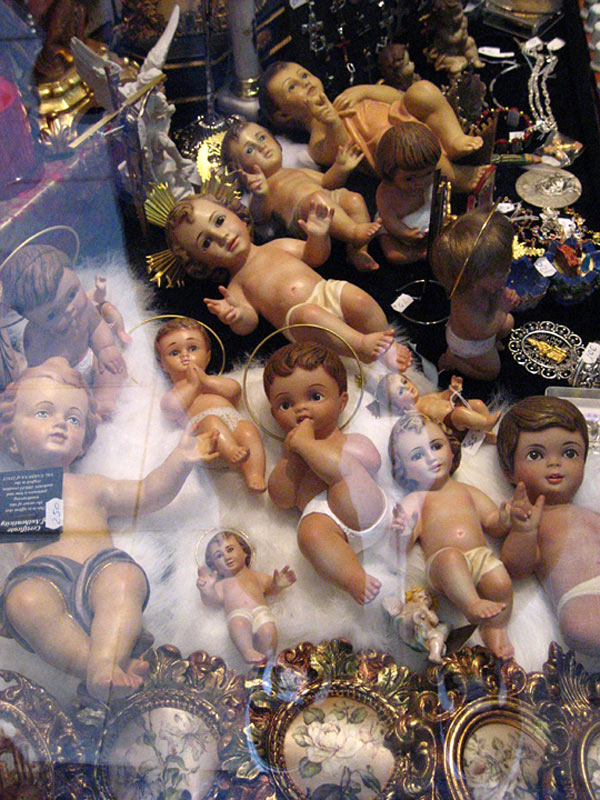
Many Romans, stuffed with all manner of worship and stripped of free speech – awash in all sorts of economic and “immigration” problems – by an increasingly necessary but ever more despotic succession of emperors, sought ways to assert themselves as individuals, some choice they could honestly call their own. And of all it offered, that freedom to choose is what Christianity delivered best, a vindication of one’s personhood, a way to spit in the face of society’s disdain. And there’s no better evidence of that than the sorts of people to whom the religion at first appealed: urbanites and women primarily, as well as others from Rome’s vast census of minorities but also people in high places.
Reeling in the top, for the power-brokers, the men in charge, it would take longer. Silently Christianity built the first Global NGO, did minor modification of its policy and took over when the Roman Empire fell. And that was the major reason for end of all this cults: after the empire broke down their funding broke down. The immensely fractured rest was mopped up, after Christianity became -the single- state religion.
As I said, why the cross at the end of the day won against the multicultural credo is pretty evident. Some Christians today see in the religious pluralism of the late Roman Empire somewhat a model for the present. Not so. The late antiquity, I would argue with the Austrian economist F. A. Hayek, was a market to be seen as an ideal communication system „experiments” on new paths and new orders. The better won, enlightened by the Holy Ghost. Religious indifference of late antiquity must not be rediscovered, otherwise we are right back in confused Roman times. And Christianity today? Well, if you look at some dry Protestant events in Europe, you could get the idea that a religious contrast by a little bit of Mithras-Cult would be not bad. The protestants in Europe are some weak crossover of social workers and Isis cult; The Catholic clergy administers a lifeless state religion collecting tax money with no spirituality whatsoever (in Germany there is a concordat). The real church is carried on the shoulder of first line priests and the pope. Look to the Pentecostal Movement and the new Pope from South America – and – our major competition. Otherwise a rotten shopping basket of pluralism is a recipe for a disaster, which is precisely where history may take us next.
Sources:
The Cults of the Roman Empire by Robert Turcan
Mysteries-of-Mithra-the.-Franz-Cumont-1903
The Rise of Christianity: How the Obscure, Marginal Jesus Movement Became the Dominant Religious Force in the Western World in a Few Centuries by Rodney Stark
The Lost History of Christianity: The Thousand-Year Golden Age of the Church in the Middle East, Africa, and Asia–and How It Died by Philip Jenkins
Historia Mundi Volume IV, Lehnen Verlag,
Die Kirche zur Zeit der Apostel und Märtyrer
“Von Hayek and the Amish Fertility. How religious communities manage to be fruitful and multiply. A Case study“, in: Frey, Ulrich (Hrsg.), The Nature of God – Evolution and Religion“, Tectum Verlag Marburg 2010
Phillip Jenkins, “Jesus Wars” Harper, 2010
http://www.theknowledgeden.com/area/ancient-history-archaeology-mythology/
“The Reproductive Advantage of Religiosity – Bristol 2010“, Lecture at the “Explaining Religion” Conference, Bristol University 2010 (PowerPoint-Sheets)
.